WO2021235378A1 - 電動舌ブラシ - Google Patents
電動舌ブラシ Download PDFInfo
- Publication number
- WO2021235378A1 WO2021235378A1 PCT/JP2021/018549 JP2021018549W WO2021235378A1 WO 2021235378 A1 WO2021235378 A1 WO 2021235378A1 JP 2021018549 W JP2021018549 W JP 2021018549W WO 2021235378 A1 WO2021235378 A1 WO 2021235378A1
- Authority
- WO
- WIPO (PCT)
- Prior art keywords
- tongue
- brush
- electric
- electric motor
- brush head
- Prior art date
- Legal status (The legal status is an assumption and is not a legal conclusion. Google has not performed a legal analysis and makes no representation as to the accuracy of the status listed.)
- Ceased
Links
Images



Classifications
-
- A—HUMAN NECESSITIES
- A46—BRUSHWARE
- A46B—BRUSHES
- A46B13/00—Brushes with driven brush bodies or carriers
- A46B13/02—Brushes with driven brush bodies or carriers power-driven carriers
-
- A—HUMAN NECESSITIES
- A61—MEDICAL OR VETERINARY SCIENCE; HYGIENE
- A61C—DENTISTRY; APPARATUS OR METHODS FOR ORAL OR DENTAL HYGIENE
- A61C17/00—Devices for cleaning, polishing, rinsing or drying teeth, teeth cavities or prostheses; Saliva removers; Dental appliances for receiving spittle
- A61C17/16—Power-driven cleaning or polishing devices
- A61C17/22—Power-driven cleaning or polishing devices with brushes, cushions, cups, or the like
-
- A—HUMAN NECESSITIES
- A61—MEDICAL OR VETERINARY SCIENCE; HYGIENE
- A61C—DENTISTRY; APPARATUS OR METHODS FOR ORAL OR DENTAL HYGIENE
- A61C17/00—Devices for cleaning, polishing, rinsing or drying teeth, teeth cavities or prostheses; Saliva removers; Dental appliances for receiving spittle
- A61C17/16—Power-driven cleaning or polishing devices
- A61C17/22—Power-driven cleaning or polishing devices with brushes, cushions, cups, or the like
- A61C17/24—Power-driven cleaning or polishing devices with brushes, cushions, cups, or the like rotating continuously
- A61C17/26—Power-driven cleaning or polishing devices with brushes, cushions, cups, or the like rotating continuously driven by electric motor
Definitions
- the present invention relates to an electric tongue brush for removing tongue coating adhering to the tongue by electrically reciprocating or rotating a brush head.
- the present invention has been made in view of the above circumstances, and an object of the present invention is to provide an electric tongue brush capable of easily and surely removing tongue coating adhering to the tongue by electric power.
- the present invention is an electric tongue brush (1) for removing tongue coating adhering to the tongue, which is tapered from one end of the main body case (2A) and the main body case (2A).
- a tongue brush body (2) provided with a neck portion (2B), a brush head (3) rotatably provided at the tip of the neck portion (2B) to which a plurality of hair bundles (6) are planted, and a brush head (3).
- the surface of the tongue is touched.
- the attached tongue coating is easily and effectively removed by the hair bundle, and not only bad breath but also stomatitis and virus infection can be prevented.
- the conversion mechanism that converts the rotation of the electric motor (8) into the reciprocating rotary motion of the brush head (3) is the rotation of the output shaft (8a) of the electric motor (8).
- the first mechanism includes a gear (9) coupled to the output shaft (8a) of the electric motor (8), a ring gear (10) that meshes with the gear (9), and the ring gear (10).
- 10) is configured to include an eccentric cam (12) having a point eccentric from the center of rotation as the center of rotation, and a driven member (14) having a long hole (14a) with which the eccentric cam (12) is engaged.
- the swinging end is slidably fitted into the elongated hole (5a) formed in the brush head (3) in the radial direction, and one point of the base end portion is the rod (13).
- It may be configured to include a swing arm (16) that is rotatably connected to the tip portion and the other one point of the base end portion is swingably supported around the swing shaft (18). ..
- the rotation of the output shaft of the electric motor is converted into the reciprocating linear motion of the rod by the first mechanism, and the reciprocating linear motion of the rod is converted into the reciprocating linear motion of the brush head by the second mechanism. Will be done. Therefore, the rotation of the output shaft of the electric motor is converted into the reciprocating rotary motion of the brush head via the first and second mechanisms.
- the conversion mechanism that converts the rotation of the electric motor (8) into the rotation of the brush head (3) is the rotation of the output shaft (8a) of the electric motor (8). It may be configured by bevel gears (20, 22) that convert the direction to the direction perpendicular to the axis.
- the rotation direction of the output shaft of the electric motor is converted by the bevel gear in the direction perpendicular to the axis and transmitted to the brush head, so that the brush head is rotated in the regular rotation direction (rotation direction of the output shaft of the electric motor). It is possible to easily and surely remove the tongue moss adhering to the tongue by rotating it in a rotation direction orthogonal to the above.
- each hair bundle (6) planted in the brush head (3) has a thickness (d) of 75 to 80 ⁇ m and a length (L) of 5 to 12 mm.
- the circumscribed circle diameter (D) of the plurality of hair bundles (6) may be set to ⁇ 2.0 to 2.5 cm.
- the filament constituting the hair bundle planted in the brush head has a thickness of 75 to 80 ⁇ m and a length L of 5 to 12 mm, which is thinner and longer than the filament constituting the hair bundle of the toothbrush. Moreover, because it is flexible, the surface of the tongue is not damaged by hair bundles.
- tongue coating adhering to the tongue can be easily and surely removed electrically, which can contribute to the prevention of bad breath.
- FIG. 1 is a perspective view of the electric tongue brush according to the first embodiment of the present invention
- FIG. 2 is a perspective view of a brush head portion of the electric tongue brush
- FIG. 3 is a schematic view showing a configuration of a drive system of the electric tongue brush.
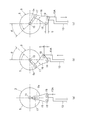
- 4 (a) to 4 (c) are diagrams showing the reciprocating rotational movement of the brush head of the electric tongue brush.
- the electric tongue brush 1 is mainly for electrically removing tongue coating adhering to a human tongue, and as shown in FIG. 1, the tongue brush main body 2 and the tongue brush main body are used. It is configured to include a brush head 3 rotatably provided at the tip of the brush head 2 and a drive system for driving the brush head 3 in a reciprocating rotation.
- the arrow directions shown in FIG. 1 are referred to as "up and down” and "front and back".
- the tongue brush main body 2 is composed of a bottomed cylindrical main body case 2A and a tapered tubular neck portion (handle) 2B extending upward from the upper end of the main body case 2A.
- a brush head 3 is rotatably provided at the upper end of 2B.
- the brush main body 2 is made of a resin such as polyethylene terephthalate (PET) and polyacetal (POM), and the neck portion 2B is detachably connected to the main body case 2A.
- PET polyethylene terephthalate
- POM polyacetal
- a round ON / OFF switch 4 for rotating / stopping the brush head 3 is provided at an intermediate height position of the tongue brush main body 2.
- the brush head 3 is configured by planting a plurality of hair bundles 6 in a columnar shape on a disk-shaped flocking table 5 rotatably supported.
- each hair bundle 6 is configured by bundling a plurality of nylon filaments (not shown) having a thickness d of 75 to 80 ⁇ m and a length L of 5 to 12 mm.
- each hair bundle 6 is shown as one columnar mass in FIGS. 1 and 2, it is actually configured by bundling a plurality of filaments (not shown).
- the diameter D of the outer diameter of the cylinder formed by the plurality of hair bundles 6 planted on the flocking table 5 is ⁇ 2.0 to 2.5 cm. Is set to.
- a battery 7 as a power source shown in FIG. 3 and an electric motor 8 rotationally driven by the electric power supplied from the battery 7 are housed in a vertically placed state.
- a gear 9 is attached to the upper end of the output shaft (motor shaft) 8a extending upward from the center of the electric motor 8, and the gear 9 meshes with the ring gear 10.
- a disposable primary battery or a rechargeable secondary battery can be used as the battery 7, a disposable primary battery or a rechargeable secondary battery can be used.
- the ring gear 10 is housed in the upper part of the main body case 2A, and is rotatably supported around a rotation shaft 11 arranged along the front-rear direction (the direction perpendicular to the paper surface in FIG. 3).
- An eccentric cam 12 having a center at a position eccentric by ⁇ in the figure with respect to the center of the rotating shaft 11 is attached to the rotating shaft 11.
- a driven member 14 is attached to the lower end of a rod 13 inserted in the neck portion 2B of the tongue brush main body 2 in the vertical direction, and the eccentric cam is formed in the elongated hole 14a formed in the driven member 14. 12 are engaged.
- the gear 9, the ring gear 10, the eccentric cam 12, and the driven member 14 convert the rotation of the output shaft 8a of the electric motor 8 into a reciprocating linear motion of the rod 13 in the vertical direction (direction of arrow A in FIG. 3). It constitutes a first mechanism for doing so.
- the flocking table 5 of the brush head 3 is rotatably supported by a shaft 15 whose center is arranged in the front-rear direction, and the back surface of the flocking table 5 is radially supported.
- the elongated hole 5a is formed.
- a roller 17 provided at the upper end (swing end) of the swing arm 16 is slidably fitted in the elongated hole 5a.
- the lower end portion (base end portion) of the swing arm 16 is pivotally attached to the neck portion 2B of the tongue brush main body 2 by the swing shaft 18 so as to be swingable.
- a bent portion 13A is formed at the upper end portion of the rod 13, and the upper end of the bent portion 13A is connected to the lower end (base end portion) of the swing arm 16 by a pin 19.
- the swing arm 16 constitutes a second mechanism for converting the vertical reciprocating linear motion of the rod 13 into the reciprocating rotational motion of the brush head 3 (alternate forward / reverse rotational motion within a predetermined angle range). doing.
- the battery 7 is energized to the electric motor 8 to start the electric motor 8, and the output shaft of the electric motor 8 is activated. 8a rotates. Then, the rotation of the output shaft 8a is decelerated via the gear 9 and the ring gear 10 and transmitted to the rotating shaft 11, and the rotating shaft 11 and the eccentric cam 12 coupled to the rotating shaft 11 rotate.
- the filament constituting the hair bundle 6 planted on the planting table 5 of the brush head 3 has a thickness d of 75 to 80 ⁇ m and a length L of 5 to 12 mm, and constitutes a hair bundle of a toothbrush. Since it is thinner, longer, and more flexible than the filament, the surface of the tongue is not damaged by the hair bundle 6.
- FIG. 5 is a schematic diagram showing the configuration of the drive system of the electric tongue brush according to the second embodiment of the present invention. Since the basic configuration of the electric tongue brush 1 according to the present embodiment is the same as that of the electric tongue brush 1 according to the first embodiment, the following description will be omitted, and the description thereof will be omitted below. Then, the same reference numerals are used for the same elements as those shown in FIGS. 1 and 2.
- the electric tongue brush 1 according to the present embodiment differs from that of the first embodiment only in the configuration of the drive system of the brush head 3, and the brush head 3 is continuously rotationally driven in one direction.
- the battery 7 as a power source and the battery 7 are supplied into the main body case 2A (see FIG. 1) of the tongue brush main body 2 as in the drive system according to the first embodiment.
- the electric motor 8 that is rotationally driven by the electric power is housed in a vertical position. Then, the output shaft (motor shaft) 8a extending upward from the center of the electric motor 8 extends to the brush head 3 through the neck portion 2B (see FIG. 1) of the tongue brush main body 2, and the bevel gear is at the upper end thereof. 20 is attached.
- the brush head 3 is attached to a rotating shaft 21 arranged along a front-rear direction orthogonal to the output shaft 8a of the electric motor 8, and a Benel gear 22 is attached to the front end portion of the rotating shaft 21.
- the bevel gear 22 and the bevel gear 20 are meshed with each other.
- the two bevel gears 20 and 22 that mesh with each other form a conversion mechanism that converts the rotation direction of the output shaft 8a of the electric motor 8 into a direction perpendicular to the axis.
- the user inserts the brush head 3 side of the electric tongue brush 1 into the mouth, and while applying the plurality of hair bundles 6 planted on the hair-implanting table 5 of the rotating brush head 3 to the surface of the tongue.
- the tongue coating adhering to the surface of the tongue is easily and effectively removed by the hair bundle 6, and not only bad breath but also stomatitis and virus infection can be prevented.
- a motor 8 capable of forward and reverse rotation is used and the polarity of the electric motor 8 is alternately switched by a switching means such as a switching circuit, the same as that of the first embodiment.
- the brush head 3 can be reversed forward and backward.
- the brush head 3 is reciprocally rotated or rotated to remove the tongue coating adhering to the tongue, but the reciprocating or rotating brush head 3 is vibrated at high speed (high frequency vibration). May be added at the same time.
Landscapes
- Health & Medical Sciences (AREA)
- Dentistry (AREA)
- Epidemiology (AREA)
- Life Sciences & Earth Sciences (AREA)
- Animal Behavior & Ethology (AREA)
- General Health & Medical Sciences (AREA)
- Public Health (AREA)
- Veterinary Medicine (AREA)
- Brushes (AREA)
Priority Applications (1)
| Application Number | Priority Date | Filing Date | Title |
|---|---|---|---|
| JP2022524454A JP7812568B2 (ja) | 2020-05-19 | 2021-05-17 | 電動舌ブラシ |
Applications Claiming Priority (2)
| Application Number | Priority Date | Filing Date | Title |
|---|---|---|---|
| JP2020-087773 | 2020-05-19 | ||
| JP2020087773 | 2020-05-19 |
Publications (1)
| Publication Number | Publication Date |
|---|---|
| WO2021235378A1 true WO2021235378A1 (ja) | 2021-11-25 |
Family
ID=78709033
Family Applications (1)
| Application Number | Title | Priority Date | Filing Date |
|---|---|---|---|
| PCT/JP2021/018549 Ceased WO2021235378A1 (ja) | 2020-05-19 | 2021-05-17 | 電動舌ブラシ |
Country Status (3)
| Country | Link |
|---|---|
| JP (1) | JP7812568B2 (https=) |
| TW (1) | TWI756129B (https=) |
| WO (1) | WO2021235378A1 (https=) |
Families Citing this family (1)
| Publication number | Priority date | Publication date | Assignee | Title |
|---|---|---|---|---|
| US12207727B1 (en) * | 2024-08-20 | 2025-01-28 | Yong Jiang | Reciprocating cleaning brush |
Citations (3)
| Publication number | Priority date | Publication date | Assignee | Title |
|---|---|---|---|---|
| JP3190601U (ja) * | 2014-02-27 | 2014-05-15 | ファミリー・サービス・エイコー株式会社 | 舌ブラシ |
| CN105380699A (zh) * | 2015-10-27 | 2016-03-09 | 张宗贤 | 一种人体舌头清洗器 |
| JP2018183280A (ja) * | 2017-04-24 | 2018-11-22 | サンスター株式会社 | 電動歯ブラシ |
Family Cites Families (5)
| Publication number | Priority date | Publication date | Assignee | Title |
|---|---|---|---|---|
| JP2000000118A (ja) | 1998-06-15 | 2000-01-07 | Lion Corp | 歯ブラシ |
| DK2550937T3 (da) | 2011-07-25 | 2014-05-19 | Braun Gmbh | Magnetforbindelse mellem et tandbørstehåndtag og et børstehoved |
| KR101329880B1 (ko) * | 2012-03-30 | 2013-11-15 | 김종두 | 칫솔판의 각도조절이 용이한 칫솔의 헤드 구조 및 이를 포함하는 칫솔 |
| CN110934654A (zh) | 2018-09-21 | 2020-03-31 | 陈慧 | 一种用于电动牙刷的刷头及电动牙刷 |
| CN110811894A (zh) * | 2019-11-08 | 2020-02-21 | 东莞市明罡电子科技有限公司 | 一种电动洁牙器刷头、电动洁牙器及洁牙方法 |
-
2021
- 2021-05-17 JP JP2022524454A patent/JP7812568B2/ja active Active
- 2021-05-17 WO PCT/JP2021/018549 patent/WO2021235378A1/ja not_active Ceased
- 2021-05-17 TW TW110117755A patent/TWI756129B/zh active
Patent Citations (3)
| Publication number | Priority date | Publication date | Assignee | Title |
|---|---|---|---|---|
| JP3190601U (ja) * | 2014-02-27 | 2014-05-15 | ファミリー・サービス・エイコー株式会社 | 舌ブラシ |
| CN105380699A (zh) * | 2015-10-27 | 2016-03-09 | 张宗贤 | 一种人体舌头清洗器 |
| JP2018183280A (ja) * | 2017-04-24 | 2018-11-22 | サンスター株式会社 | 電動歯ブラシ |
Also Published As
| Publication number | Publication date |
|---|---|
| JPWO2021235378A1 (https=) | 2021-11-25 |
| JP7812568B2 (ja) | 2026-02-10 |
| TW202143922A (zh) | 2021-12-01 |
| TWI756129B (zh) | 2022-02-21 |
Similar Documents
| Publication | Publication Date | Title |
|---|---|---|
| US5186627A (en) | Hand-actuated rotatable toothbrush | |
| KR960001869B1 (ko) | 트윈-브러쉬 회전식 치솔 | |
| US20030140435A1 (en) | Powered toothbrush | |
| JP5373763B2 (ja) | 歯ブラシ | |
| JP2811246B2 (ja) | 電動歯ブラシ器の歯ブラシ | |
| WO1994005230A1 (en) | Power operated toothbrush | |
| US7464430B2 (en) | Electric toothbrush | |
| US20050022322A1 (en) | Powered toothbrush with curved neck and flexible shaft and single battery | |
| US7020925B1 (en) | Mechanical toothbrush | |
| US20120174938A1 (en) | Rotating toothbrush | |
| WO2021235378A1 (ja) | 電動舌ブラシ | |
| JPH05269024A (ja) | 電動歯ブラシ | |
| US20040016068A1 (en) | Electric toothbrush | |
| NZ534515A (en) | Powered toothbrush | |
| US8990991B2 (en) | Power toothbrush and brushhead therefor, with multiple motion brush member | |
| JP3372658B2 (ja) | 電動歯ブラシ | |
| JP2009153532A (ja) | 口腔内清掃具 | |
| JPWO2021235378A5 (https=) | ||
| KR200348352Y1 (ko) | 수동식 회전칫솔 | |
| US20040226119A1 (en) | Powered toothbrush with curved neck and flexible shaft | |
| WO2016039710A1 (en) | A toothbrush head for electric toothbrushes | |
| CN108392287A (zh) | 一种电动牙刷及工作方法 | |
| JPH05115321A (ja) | 電動歯ぶらし | |
| WO2012101627A2 (en) | Motorized toothbrush | |
| US20040226120A1 (en) | Powered toothbrush with curved neck, flexible shaft and tapered head |
Legal Events
| Date | Code | Title | Description |
|---|---|---|---|
| 121 | Ep: the epo has been informed by wipo that ep was designated in this application |
Ref document number: 21807838 Country of ref document: EP Kind code of ref document: A1 |
|
| ENP | Entry into the national phase |
Ref document number: 2022524454 Country of ref document: JP Kind code of ref document: A |
|
| NENP | Non-entry into the national phase |
Ref country code: DE |
|
| 122 | Ep: pct application non-entry in european phase |
Ref document number: 21807838 Country of ref document: EP Kind code of ref document: A1 |