WO2021234824A1 - プレート式熱交換器、冷凍サイクル装置および伝熱装置 - Google Patents
プレート式熱交換器、冷凍サイクル装置および伝熱装置 Download PDFInfo
- Publication number
- WO2021234824A1 WO2021234824A1 PCT/JP2020/019806 JP2020019806W WO2021234824A1 WO 2021234824 A1 WO2021234824 A1 WO 2021234824A1 JP 2020019806 W JP2020019806 W JP 2020019806W WO 2021234824 A1 WO2021234824 A1 WO 2021234824A1
- Authority
- WO
- WIPO (PCT)
- Prior art keywords
- heat transfer
- plate
- transfer plate
- heat
- convex portion
- Prior art date
- Legal status (The legal status is an assumption and is not a legal conclusion. Google has not performed a legal analysis and makes no representation as to the accuracy of the status listed.)
- Ceased
Links
Images




Classifications
-
- F—MECHANICAL ENGINEERING; LIGHTING; HEATING; WEAPONS; BLASTING
- F28—HEAT EXCHANGE IN GENERAL
- F28F—DETAILS OF HEAT-EXCHANGE AND HEAT-TRANSFER APPARATUS, OF GENERAL APPLICATION
- F28F3/00—Plate-like or laminated elements; Assemblies of plate-like or laminated elements
- F28F3/08—Elements constructed for building-up into stacks, e.g. capable of being taken apart for cleaning
Definitions
- This technology relates to plate heat exchangers, refrigeration cycle devices and heat transfer devices. In particular, it relates to a configuration for preventing fluid mixing related to heat exchange.
- the plate heat exchanger is a heat exchanger in which a plurality of heat transfer plates having a plurality of rows of corrugated irregularities are laminated.
- the plate heat exchanger includes a plate heat exchanger such as an inner fin type or a helicopter bone type.
- the plate heat exchanger is used, for example, for heat exchange of a fluid between a refrigerant circulating in a refrigerant circuit and a heat medium such as water supplied indoors. By exchanging heat with a plate heat exchanger mounted on an outdoor outdoor unit, heat can be supplied without flowing the refrigerant indoors.
- the form of damage such as the damaged part is determined by error factors such as manufacturing conditions or environmental conditions. Therefore, the area where the first heat transfer plate and the second heat transfer plate are in contact may be damaged.
- the region where the first heat transfer plate and the second heat transfer plate are in contact is damaged, it affects other heat transfer plates, the refrigerant and the heat medium are mixed, and the flammable refrigerant flows into the room.
- a specific part may be damaged when a large load is applied due to the design of the inner fins or the like. Can be controlled to.
- the region serving as the header portion where the passage hole through which the refrigerant or the like passes is formed is a portion where the inner fins are not arranged and only the heat transfer plates face each other. , The degree of freedom in design is low. Therefore, it is difficult to control the damaged portion and improve the reliability. Further, unlike the area where the inner fins are arranged, the brazing is not performed.
- the plate-type heat transfer device includes a first heat transfer plate and a second heat transfer plate as heat transfer plates having a header portion including a passage hole serving as an outflow port for the first fluid and an outflow port for the second fluid. And a first flow path through which the first fluid flows, which is provided with a third heat transfer plate and is formed so that the first heat transfer plate and the second heat transfer plate face each other, and on the surface opposite to the second heat transfer plate.
- a plate-type heat exchanger having a space in which a heat transfer unit for heat transfer between the second heat transfer plate and the third heat transfer plate is installed in a gap between the third heat transfer plate. At least one of the first heat transfer plate, the second heat transfer plate and the third heat transfer plate has a convex portion protruding toward the flow path side in the header portion, and the second heat transfer plate and the third heat transfer plate. The plate thickness of the heat plate is thinner than the plate thickness of the first heat transfer plate.
- the refrigerating cycle device includes a compressor that compresses and discharges the refrigerant, a condenser that condenses the refrigerant by heat exchange, a throttle device that depressurizes the refrigerant related to condensation, and evaporates the refrigerant by heat exchange. It has a refrigerant circuit configured by connecting a refrigerant to be connected by a pipe, and at least one of the evaporator and the condenser has the above-mentioned plate heat exchanger.
- the heat transfer device includes the above-mentioned refrigeration cycle device and a heat medium circuit in which a heat medium that transfers heat to a heat supply target circulates, and is a plate heat exchanger included in the refrigeration cycle device. It exchanges heat between the refrigerant and the heat medium.
- the plate thickness of the second heat transfer plate and the third heat transfer plate is made thinner than the plate thickness of the first heat transfer plate. Then, in the header portion, the damaged portion can be controlled against a load exceeding the limit in the second heat transfer plate and the third heat transfer plate by the position of the convex portion of at least one of the heat transfer plates. ..
- the heat transfer part improves the heat exchange performance, and while the structure is simple and can be manufactured at low cost, flammable refrigerant and the like leak into the room regardless of error factors such as manufacturing conditions and environmental conditions. Can be prevented and the long-term reliability of the device can be improved.
- FIG. 1 shows the schematic structure of the heat transfer apparatus 100 which concerns on Embodiment 1.
- FIG. 2 is an exploded perspective view which shows the plate type heat exchanger 30 which concerns on Embodiment 1.
- FIG. It is a figure explaining the relationship between the combination of various heat transfer plates and various inner fins in the plate type heat exchanger 30 according to the first embodiment. It is a figure explaining the arrangement of the 1st inner fin 33 and the 2nd inner fin 35 which concerns on Embodiment 1.
- FIG. is sectional drawing of the header part 72 in the plate type heat exchanger 30 which concerns on Embodiment 1.
- FIG. is sectional drawing of the header part 72 in the plate type heat exchanger 30 which concerns on Embodiment 2.
- FIG. 1 shows the schematic structure of the heat transfer apparatus 100 which concerns on Embodiment 1.
- FIG. is an exploded perspective view which shows the plate type heat exchanger 30 which concerns on Embodiment 1.
- FIG. It is a figure explaining the relationship between the combination of various heat transfer plates and various inner fins in the
- FIG. 1 It is sectional drawing of the header part 72 in the plate type heat exchanger 30 which concerns on Embodiment 3.
- FIG. It is sectional drawing of the header part 72 in the plate type heat exchanger 30 which concerns on Embodiment 4.
- FIG. It is sectional drawing of the header part 72 in the plate type heat exchanger 30 which concerns on Embodiment 5.
- FIG. It is sectional drawing of the header part 72 in the plate type heat exchanger 30 which concerns on Embodiment 6.
- FIG. It is sectional drawing of the header part 72 in the plate type heat exchanger 30 which concerns on Embodiment 7.
- FIG. It is sectional drawing of the header part 72 in the plate type heat exchanger 30 which concerns on Embodiment 8.
- FIG. It is a figure explaining the arrangement of the convex part 71 in the header part 72 of the plate type heat exchanger 30 which concerns on Embodiment 9.
- FIG. 9 It is a figure explaining the arrangement of the convex part 71 in the header part 72 of the plate type heat exchanger 30
- the high and low pressure and temperature are not fixed in relation to the absolute values, but are relatively fixed in terms of the state and operation of the device and the like.
- the subscripts and the like may be omitted.
- FIG. 1 is a diagram showing a schematic configuration of a heat transfer device 100 according to the first embodiment.
- the heat transfer device 100 includes a refrigerant circuit 10 and a heat medium circuit 20 included in the refrigeration cycle device.
- the refrigerant circuit 10 is a circuit that circulates a refrigerant as a second fluid to cool or heat a heat medium as the first fluid.
- the heat medium circuit 20 is a circuit that circulates the heat medium and supplies the heat obtained by the heat medium from the refrigerant circuit 10 to the radiator 23 in the house 21, which will be described later.
- the refrigerant circuit 10 is mounted on the outdoor unit 11 installed outdoors. Further, some devices of the heat medium circuit 20 are installed in the outdoor unit 11, and other devices are installed in the house 21.
- the outdoor unit 11 includes a compressor 12, a four-way valve 13, a plate heat exchanger 30, an expansion valve 14 serving as a throttle device, and an outdoor heat exchanger 15. Then, the compressor 12, the four-way valve 13, the plate heat exchanger 30, the expansion valve 14, and the outdoor heat exchanger 15 are sequentially connected in an annular shape by the refrigerant pipe 16 to form the above-mentioned refrigerant circuit 10.
- the refrigerant as the second fluid is not particularly limited, but here, a flammable refrigerant such as R32 or R290, which is a low GWP refrigerant, is used. However, it is not limited to low GWP flammable refrigerants.
- the compressor 12 compresses the sucked refrigerant and discharges the high temperature and high pressure refrigerant.
- the compressor 12 is, for example, a scroll type compressor, a reciprocating type compressor, a vane type compressor, or the like. Further, although not particularly limited, the compressor 12 can change the capacity of the compressor 12 by arbitrarily changing the operating frequency by, for example, an inverter circuit or the like.
- the four-way valve 13 serving as the flow path switching device is a valve that switches the flow of the refrigerant by, for example, a cooling operation for cooling the heat medium and a heating operation for heating the heat medium.
- the plate heat exchanger 30 exchanges heat between the refrigerant circulating in the refrigerant circuit 10 and the heat medium circulating in the heat medium circuit 20. Therefore, the plate heat exchanger 30 functions as an evaporator that evaporates the refrigerant in the refrigerant circuit 10 during the cooling operation. Further, the plate heat exchanger 30 functions as a condenser that condenses the refrigerant in the refrigerant circuit 10 during the heating operation. As will be described later, the plate heat exchanger 30 of the first embodiment has a heat medium flow path 38 as a first flow path through which the heat medium flows and a refrigerant flow path 39 as a second flow path through which the refrigerant flows. ..
- the plate heat exchanger 30 causes heat exchange between the heat medium flowing through the heat medium flow path 38 and the refrigerant flowing through the refrigerant flow path 39.
- the plate heat exchanger 30 exchanges heat between the refrigerant in the low temperature and low pressure states and the heat medium via the expansion valve 14.
- the heat medium is cooled in the plate heat exchanger 30.
- the plate heat exchanger 30 exchanges heat between the refrigerant in the high temperature and high pressure states compressed by the compressor 12 and the heat medium.
- the heat medium is heated in the plate heat exchanger 30.
- the configuration of the plate heat exchanger 30 and the like will be described later.
- the expansion valve 14 is a throttle device that functions as a throttle mechanism between the plate heat exchanger 30 and the outdoor heat exchanger 15.
- the expansion valve 14 decompresses and expands the refrigerant.
- the outdoor heat exchanger 15 is an air heat exchanger that exchanges heat between the refrigerant and the air that is the outside air.
- the outdoor heat exchanger 15 functions as a condenser when the plate heat exchanger 30 functions as an evaporator.
- the outdoor heat exchanger 15 functions as an evaporator when the plate heat exchanger 30 functions as a condenser.
- the heat medium circuit 20 includes a plate heat exchanger 30, a circulation pump 22, and a radiator 23. Then, the plate heat exchanger 30, the circulation pump 22, and the radiator 23 are connected in an annular shape by the heat medium pipe 24 to form the above-mentioned heat medium circuit 20.
- the heat medium circuit 20 may include a storage tank (not shown) for storing the heat medium.
- a highly safe liquid such as brine (antifreeze), water, a mixed solution of brine and water, and a mixed solution of an additive having a high anticorrosion effect and water can be used. ..
- the circulation pump 22 imparts a transport force for circulating in a certain direction to the heat medium flowing through the heat medium piping 24.
- the circulation pump 22 is mounted on the indoor unit 25 in the house 21.
- the present invention is not limited to this, and the circulation pump 22 may be mounted on the outdoor unit 11.
- the radiator 23 is a device that exchanges heat between the air in the house 21 to be heat supplied and the heat medium.
- the radiator 23 cools the air in the house 21 when the cooled heat medium passes through the inside. Further, the radiator 23 heats the air in the house 21 when the heated heat medium passes through the inside.
- the heat medium circuit 20 will be described as having a radiator 23, but may have another heat exchanger.
- FIG. 2 is an exploded perspective view showing the plate heat exchanger 30 according to the first embodiment.
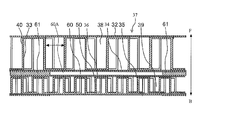
- FIG. 3 is a diagram illustrating a relationship between various heat transfer plates and various inner fins in the plate heat exchanger 30 according to the first embodiment.
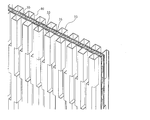
- FIG. 4 is a diagram illustrating an arrangement of the first inner fin 33 and the second inner fin 35 according to the first embodiment.
- U, D, R, L, F and B shown in FIG. 2 and the like represent top, bottom, right, left, front and back, respectively.
- the plate heat exchanger 30 of the first embodiment has a pair of side plates 31, a plurality of first heat transfer plates 32, a first inner fin 33, and a plurality of second heat transfer plates 34.
- a plurality of third heat transfer plates 36 and a plurality of second inner fins 35 are provided.
- Various components of the plate heat exchanger 30 are made of a metal such as stainless steel, copper, aluminum or titanium, or a synthetic resin.
- the first heat transfer plate 32 or the second heat transfer plate 34 may be formed of a clad material.
- the pair of side plates 31 are flat, substantially rectangular plates.
- the pair of side plates 31 have a plurality of first heat transfer plates 32, a first inner fin 33, a plurality of second heat transfer plates 34, a plurality of third heat transfer plates 36, and a plurality of second inner fins 35. It is placed on both sides of a structure that is stacked in order.
- the side plate 31 serves to reinforce the plate heat exchanger 30 and increase its strength.
- one of the side plates 31 has a heat medium inlet pipe 31a and heat in each of the four corners in accordance with the passage holes that serve as the flow paths of the refrigerant and the heat medium of each heat transfer plate. It has a medium outlet pipe 31b, a refrigerant inlet pipe 31c, and a refrigerant outlet pipe 31d.
- the side plate 31 of the first embodiment has the heat medium inlet pipe 31a in the upper left corner when viewed as the side plate 31 in the back direction B. Further, the side plate 31 has a heat medium outlet pipe 31b in the lower left corner.
- the side plate 31 has a refrigerant inlet pipe 31c in the lower right corner and a refrigerant outlet pipe 31d in the upper right corner.
- the heat medium inlet pipe 31a and the heat medium outlet pipe 31b serve as passage holes for the heat medium.
- the refrigerant inlet pipe 31c and the refrigerant outlet pipe 31d serve as a passage hole for the refrigerant.
- the other side plate 31 does not have a passage hole.
- the plurality of first heat transfer plates 32, the plurality of second heat transfer plates 34, and the plurality of third heat transfer plates 36 are substantially rectangular plates each having a flat heat transfer surface.
- Each of the first heat transfer plates 32, each second heat transfer plate 34, and each third heat transfer plate 36 includes a heat medium inlet pipe 31a, a heat medium outlet pipe 31b, a refrigerant inlet pipe 31c, and a refrigerant outlet pipe 31d of the side plate 31.
- each of the four corners of the rectangular shape has a passage hole.
- the passage hole is a through hole that serves as an outflow port for the refrigerant and the heat medium.
- the first heat transfer plate 32 has a heat medium outward path hole 32a, a heat medium return path hole 32b, a refrigerant outward path hole 32c, and a refrigerant return path hole 32d.
- the second heat transfer plate 34 has a heat medium outward path hole 34a, a heat medium return path hole 34b, a refrigerant outward path hole 34c, and a refrigerant return path hole 34d.
- the third heat transfer plate 36 has a heat medium outward path hole 36a, a heat medium return path hole 36b, a refrigerant outward path hole 36c, and a refrigerant return path hole 36d.
- the plurality of first heat transfer plates 32, the plurality of second heat transfer plates 34, and the plurality of third heat transfer plates 36 guide the heat medium flowing through the passage holes to the heat medium flow path 38 or use the refrigerant flowing through the passage holes as a refrigerant. It has a burring portion (not shown) leading to the flow path 39.
- the end portion on the short side including the passage hole becomes a header portion 72 in which the first inner fin 33 and the second inner fin 35 are not arranged in the flow path, as will be described later.
- Each first heat transfer plate 32 is paired with each second heat transfer plate 34.
- the paired first heat transfer plate 32 and the second heat transfer plate 34 face each other on one surface of the first heat transfer plate 32.
- a heat medium flow path 38 which is a first flow path through which the heat medium passes, is formed pair by pair.
- the heat medium flow path 38 is a flow path through which the heat medium flows downward from the upper U to the lower D in the height direction extending from the upper U to the lower D.
- the heat medium flow path 38 is, for example, from the upper left corner where the heat medium outward path hole 32a and the heat medium outward path hole 34a into which the heat medium flows flows, to the lower right corner where the refrigerant outward path hole 32c and the refrigerant outward path hole 34c are located.
- the heat medium may be inclined toward the flow.
- each first heat transfer plate 32 is paired with each third heat transfer plate 36.
- the paired first heat transfer plate 32 and each third heat transfer plate 36 face each other on the other surface opposite to one surface facing the second heat transfer plate 34.
- a refrigerant flow path 39 which is a second flow path through which the refrigerant passes, is formed pair by pair.
- the refrigerant flow path 39 is a flow path in which the refrigerant flows upward from the lower D to the upper U in the height direction.
- the refrigerant flow path 39 is inclined from the lower right corner where the refrigerant outbound hole 32c and the refrigerant outbound hole 34c into which the refrigerant flows flows toward the upper left corner where the heat medium outbound hole 32a and the heat medium outbound hole 34a are located.
- the heat medium may be allowed to flow.
- the combination of the third heat transfer plate 36, the first heat transfer plate 32, and the second heat transfer plate 34 on which the first flow path and the second flow path are formed is referred to as a plate group 37.
- the plate heat exchanger 30 of the first embodiment has a structure of a plurality of laminated plate groups 37.
- the space portion 60 communicates with an external space such as the atmosphere.
- the space portion 60 has a heat transfer portion 61 in a part thereof.
- the heat transfer unit 61 has a heat transfer member.
- the second heat transfer plate 34 and the third heat transfer plate 36 are thermally connected by brazing a heat transfer member in the heat transfer portion 61.
- the heat transfer portion 61 of the space portion 60 is also installed in the header portion 72.
- heat exchange can be performed between the refrigerant and the heat refrigerant also in the header portion 72 via the heat transfer portion 61.
- the heat transfer portions 61 are provided so as to be scattered in the space portion 60. Therefore, the space in the space portion 60 formed by the gap 60A is not closed by the heat transfer portion 61.
- the relationship between the plate thicknesses of the first heat transfer plate 32, the second heat transfer plate 34, and the third heat transfer plate 36 is the first heat transfer plate 32.
- Third heat transfer plate 36 ⁇ second heat transfer plate 34.
- a thick plate is effective in preventing the progress of corrosion and improving the strength in the plate heat exchanger 30.
- a thin plate is effective in reducing thermal resistance, suppressing deterioration of heat exchange performance, and reducing material costs.
- the plate thicknesses of the plurality of first heat transfer plates 32, the plurality of second heat transfer plates 34, and the plurality of third heat transfer plates 36 can be selected according to desired conditions.
- the first heat transfer plate 32 is thicker than the third heat transfer plate 36 and the second heat transfer plate 34, damage to the first heat transfer plate 32 can be prevented.
- the third heat transfer plate 36 and the second heat transfer plate 34 are thinner than the first heat transfer plate 32, and when a load sufficient to cause damage is applied, the third heat transfer plate is applied.
- the plate 36 and the second heat transfer plate 34 can be controlled so as to be damaged.
- the thickness of the third heat transfer plate 36 which is a wall in the refrigerant flow path 39, is made thicker than the plate thickness retention of the second heat transfer plate 34, which is a wall in the heat medium flow path 38, so that it is flammable. The possibility of leakage of the refrigerant can be reduced.
- the third heat transfer plate 36 serves as a wall of the refrigerant flow path 39 and the refrigerant flows, the third heat transfer plate 36 ⁇ the second heat transfer plate 34.
- the thickness of the plate it is not limited to this relationship. The relationship of plate thickness may differ depending on the fluid that becomes the first fluid and the second fluid.
- an excessive load that does not occur in the normal operation of the heat transfer device 100 in the heat transfer flow path 38 or the refrigerant flow path 39 is such that the heat transfer plate is damaged. (Hereinafter referred to as overload) may occur.
- the thickness of the second heat transfer plate 34 and the third heat transfer plate 36 is thinner than the plate thickness of the first heat transfer plate 32, so that when an overload occurs, the second heat transfer plate 34 or the third heat transfer plate 34 or the third heat transfer plate The plate 36 breaks before the first heat transfer plate 32.
- the heat medium flow path 38 or the refrigerant flow path 39 is the same as the space portion 60 described above. It only communicates and does not damage other heat transfer plates. Therefore, the heat medium or the refrigerant leaks into the space 60 and is discharged to the outside, and the heat medium flow path 38 and the refrigerant flow path 39 do not communicate with each other.
- the plate heat exchanger 30 of the first embodiment has a plurality of first inner fins 33 and a plurality of second inner fins 35.
- the first inner fin 33 and the second inner fin 35 are offset fins for promoting heat transfer.
- Each first inner fin 33 is arranged in a heat medium flow path 38 between the corresponding pair of first heat transfer plates 32 and the second heat transfer plate.
- the first inner fin 33 has a substantially plate-like shape in which the width direction and the height direction are larger than those in the thickness direction.
- each first inner fin 33 has a structure in which a concave-convex pitch 40 composed of substantially right angles is repeated over the width direction in which the thin-walled element is in the left-right direction.
- the uneven pitch 40 aligns the plate surface with the flow direction of the heat medium flowing through the heat medium flow path 38 at the plurality of first inner fins 33, and does not block the flow of the heat medium flowing through the heat medium flow path 38.
- the top or bottom of the pair of first heat transfer plates 32 and the second heat transfer plates facing each other is formed on a flat surface.
- the plurality of first inner fins 33 come into surface contact with both of the corresponding pair of first heat transfer plates 32 on the flat surface of the top or bottom.
- each second inner fin 35 is arranged in the refrigerant flow path 39 between the corresponding pair of first heat transfer plates 32 and the third heat transfer plate 36.
- the second inner fin 35 has a substantially plate-like shape in which the width direction and the height direction are larger than those in the thickness direction.
- the second inner fin 35 includes a structure in which the uneven pitch 50 in which the thin element is formed at a substantially right angle over the right R and the left L in the width direction is repeated.
- the tops or bottoms of the pair of the first heat transfer plates 32 and the third heat transfer plates 36 facing each other are formed on a flat surface.
- the plurality of second inner fins 35 come into surface contact with both of the corresponding pair of second heat transfer plates 34 on the flat surface of the top or bottom.
- the first inner fin 33 and the second inner fin 35 are shown in the same shape.
- the size of the uneven pitch 40 in the first inner fin 33 and the size of the uneven pitch 50 in the second inner fin 35 are different from each other. Therefore, the heat transfer area is different between the first inner fin 33 and the second inner fin 35.
- the first heat transfer plate 32 and the second heat transfer plate 34 are brazed to the first inner fin 33, respectively. Further, the first heat transfer plate and the third heat transfer plate 36 are brazed to the second inner fin 35, respectively. Then, as described above, the second heat transfer plate 34 and the third heat transfer plate 36 are brazed in the heat transfer portion 61.
- the plate-type heat exchanger 30 of the first embodiment has a double wall structure in which the second heat transfer plate 34 and the third heat transfer plate 36 sandwich the space portion 60 by the heat transfer portion 61 which is a heat transfer member. However, it is a heat exchanger that aims to improve heat transfer efficiency.
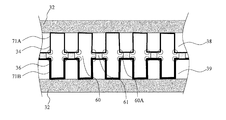
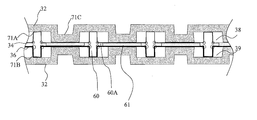
- FIG. 5 is a cross-sectional view of a header portion 72 in the plate heat exchanger 30 according to the first embodiment.
- the header portion 72 is a portion around a passage hole in the first heat transfer plate 32, the second heat transfer plate 34, and the third heat transfer plate 36.
- the header portion 72 is a portion in the refrigerant flow path 39 between the first heat transfer plate 32 and the second heat transfer plate 34 where the first inner fin 33 is not arranged.
- the header portion 72 is a portion where the second inner fin 35 is not arranged in the heat medium flow path 38 between the first heat transfer plate 32 and the third heat transfer plate 36.
- the second heat transfer plate 34 of the first embodiment has a plurality of convex portions 71A protruding toward the first heat transfer plate 32 in the header portion 72.
- the third heat transfer plate 36 of the first embodiment has a plurality of convex portions 71B protruding toward the first heat transfer plate 32 in the header portion 72.
- Each convex portion 71A and each convex portion 71B are in contact with the first heat transfer plate 32.
- the convex portion 71A of the second heat transfer plate 34 and the convex portion 71B of the third heat transfer plate 36 are not distinguished, the convex portion 71 is used.
- the plate heat exchanger 30 of the first embodiment has a space portion 60 in which heat transfer portions 61 are scattered between the second heat transfer plate 34 and the third heat transfer plate 36. Since the heat transfer portion 61 joins the second heat transfer plate 34 and the third heat transfer plate 36, in the plate heat exchanger 30 of the first embodiment, the heat transfer portion 61 is formed on the convex portion 71. Not located.
- the convex portion 71 of the second heat transfer plate 34 and the third heat transfer plate 36 is formed by stretching the flat plate. Therefore, the plate thickness of the convex portion 71 is thinner than that of the flat portion that is not processed. In particular, in the convex portion 71, the boundary portion with the flat portion is particularly thinned and the plate thickness becomes thin.
- the region damaged in the second heat transfer plate 34 and the third heat transfer plate 36 becomes the thinned convex portion 71. Therefore, the heat transfer plate is not damaged at the position corresponding to the heat transfer portion 61 of the space portion 60, but is damaged at the position corresponding to the gap 60A of the space portion 60.
- the circles in FIG. 5 indicate parts that are easily damaged (the same applies to the following figures).
- the plate thickness has a relationship of 1st heat transfer plate 32> 3rd heat transfer plate 36 ⁇ 2nd heat transfer plate 34.
- the plate group 37 with the heat plates facing each other is laminated.
- a heat transfer member that transfers heat between the second heat transfer plate 34 and the third heat transfer plate 36 facing the second heat transfer plate 34 is placed between the second heat transfer plate 34 and the third heat transfer plate 36 facing the second heat transfer plate 34.
- the heat transfer portion 61 attached and joined has a space portion 60 provided in a part thereof.
- the second heat transfer plate 34 and the third heat transfer plate 36 have a convex portion 71 which is thinned by processing in the header portion 72.
- the heat transfer unit 61 improves the heat exchange performance, and the structure is simple and can be manufactured at low cost, but the flammable refrigerant leaks into the room regardless of error factors such as manufacturing conditions and environmental conditions. Can be prevented and the long-term reliability of the device can be improved.
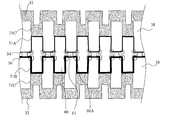
- FIG. 6 is a cross-sectional view of the header portion 72 of the plate heat exchanger 30 according to the second embodiment.
- the convex portion 71A of the second heat transfer plate 34 and the convex portion 71B of the third heat transfer plate 36 are respectively. It has a structure that protrudes in the same direction.
- the top of the second heat transfer plate 34 at the convex portion 71A and the top of the third heat transfer plate 36 facing the top of the convex portion 71B of the second heat transfer plate 34 are located at the top of the convex portion 71B. It is brazed and joined.
- the volume of the space portion 60 created by the convex portion 71A and the convex portion 71B is reduced. Therefore, the thermal resistance in the space 60 becomes small, and the heat transfer performance in the plate heat exchanger 30 can be improved. Further, since the protruding directions of the convex portion 71A and the convex portion 71B are unified, the second heat transfer plate 34 and the third heat transfer plate 36 can be stacked and molded at the same time. Therefore, it is possible to improve the production efficiency and reduce the cost of the plate heat exchanger 30.
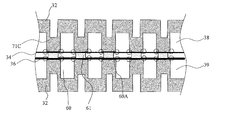
- FIG. 7 is a cross-sectional view of the header portion 72 of the plate heat exchanger 30 according to the third embodiment.
- the second heat transfer plate 34 and the third heat transfer plate 36 have a convex portion 71.
- the first heat transfer plate 32 has a plurality of convex portions 71C. Then, the convex portion 71C projects toward the second heat transfer plate 34 and the third heat transfer plate 36 and abuts on the third heat transfer plate 36.
- the first heat transfer plate 32 is sufficiently thicker than the second heat transfer plate 34 and the third heat transfer plate 36. Therefore, the thickness of the first heat transfer plate 32 is thicker than that of the second heat transfer plate 34 and the third heat transfer plate 36, even if the thickness reduction when the convex portion 71C is formed is included. As a result, even if an overload that is not normally damaged is applied to the refrigerant flow path 39 or the heat transfer flow path 38, it is not the first heat transfer plate 32 but the second heat transfer plate 34 and the heat transfer plate 34 that are damaged. It is the third heat transfer plate 36. In particular, the portion where the load is concentrated in the vicinity of the convex portion 71C is liable to be damaged.
- the space portion 60 causes the other heat transfer plates to be damaged. Can be prevented. Further, since the first heat transfer plate 32 having a thick plate thickness has the convex portion 71C, it is possible to reduce cracking due to wall thinning when forming the convex portion 71C, and it is possible to improve workability.
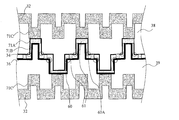
- FIG. 8 is a cross-sectional view of the header portion 72 in the plate heat exchanger 30 according to the fourth embodiment.
- the second heat transfer plate 34 and the third heat transfer plate 36 have a convex portion 71.
- the first heat transfer plate 32 has a convex portion 71C.
- the first heat transfer plate 32, the second heat transfer plate 34, and the third heat transfer plate 36 each have a plurality of convex portions 71C. ..
- the number of convex portions 71 is increased, the intervals are narrowed, and the pitch is increased.
- the plate heat exchanger 30 of the fourth embodiment has a convex portion 71C in which the first heat transfer plate 32 projects toward the second heat transfer plate 34 and the third heat transfer plate 36. Then, the convex portion 71C comes into contact with a portion other than the convex portion 71A of the second heat transfer plate 34 and the convex portion 71B of the third heat transfer plate 36. Further, in the plate heat exchanger 30, the convex portion 71A of the second heat transfer plate 34 and the convex portion 71B of the third heat transfer plate 36 project toward the first heat transfer plate 32, and the first heat transfer plate 32 It comes into contact with a portion other than the convex portion 71C of.
- the pitch between the first heat transfer plate 32 and the second heat transfer plate 34 and the third heat transfer plate 36 can be increased, and the heat medium flow can be increased.
- the pressure resistance strength in the passage 38 or the refrigerant flow path 39 can be increased.
- FIG. 9 is a cross-sectional view of the header portion 72 in the plate heat exchanger 30 according to the fifth embodiment.
- the convex portion 71 of each heat transfer plate is in contact with a portion other than the convex portion 71.
- the plate heat exchanger 30 of the fifth embodiment has a structure in which the convex portion 71C of the first heat transfer plate 32 abuts the convex portion 71A of the second heat transfer plate 34 and the convex portion 71B of the third heat transfer plate 36. And.
- the widths of the heat medium flow path 38 and the refrigerant flow path 39 Spreads. Therefore, the performance can be improved by reducing the pressure loss and increasing the heat transfer area.
- FIG. 10 is a cross-sectional view of the header portion 72 in the plate heat exchanger 30 according to the sixth embodiment.
- the plate heat exchanger 30 of the sixth embodiment has the convex portion 71C of the first heat transfer plate 32 and the convex portion 71A of the second heat transfer plate 34, as in the fifth embodiment.
- the structure is such that the abutment is made.
- the convex portion 71A of the second heat transfer plate 34 and the convex portion 71B of the third heat transfer plate 36 have the same directions as in the second embodiment. It has a protruding structure.
- the volume of the space portion 60 is reduced and the thermal resistance due to the space portion 60 is reduced as in the second embodiment, and the heat transfer performance is improved. can do.
- the second heat transfer plate 34 and the third heat transfer plate 36 can be stacked and molded at the same time, and the production efficiency of the plate heat exchanger 30 can be improved and the cost can be reduced.
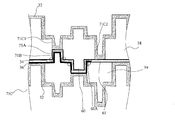
- FIG. 11 is a cross-sectional view of the header portion 72 of the plate heat exchanger 30 according to the seventh embodiment.
- the first heat transfer plate 32 has two types of convex portions 71C having different protruding heights.
- the first convex portion 71C1 of the first heat transfer plate 32 and the convex portion 71A of the second heat transfer plate 34 The structure is such that the convex portion 71B of the third heat transfer plate 36 is in contact with the convex portion 71B.
- the portion other than the convex portion 71A of the second heat transfer plate 34 and the flat portion other than the convex portion 71B of the third heat transfer plate 36 Contact the part.
- the first heat transfer plate 32 is thicker than the second heat transfer plate 34 and the third heat transfer plate 36. Therefore, the first heat transfer plate 32 can easily have a high pitch and a high convex portion 71C. Therefore, in the plate heat exchanger 30, the convex portion 71 is in contact with the facing heat transfer plate, and the convex portion 71 is provided at many places as a support column to reinforce the header portion 72 against a load or the like. can.
- the thinned portion of the second heat transfer plate 34 or the third heat transfer plate 36 is thinner than the thinned portion of the second convex portion 71C2 of the first heat transfer plate 32. By doing so, it is possible to prevent damage to other heat transfer plates.
- FIG. 12 is a cross-sectional view of the header portion 72 of the plate heat exchanger 30 according to the eighth embodiment.
- the first heat transfer plate 32 similarly to the seventh embodiment, the first heat transfer plate 32 has two types of protrusions 71C having different protruding heights.
- the convex portion 71A of the second heat transfer plate 34 and the convex portion 71B of the third heat transfer plate 36 have the same directions as in the second embodiment. It has a protruding structure.
- the volume of the space portion 60 is reduced and the thermal resistance due to the space portion 60 is reduced as in the second embodiment, and the heat transfer performance is improved. can do.
- the second heat transfer plate 34 and the third heat transfer plate 36 can be stacked and molded at the same time, and the production efficiency of the plate heat exchanger 30 can be improved and the cost can be reduced.
- Embodiment 9 In any of the plate heat exchangers 30 of the above-described first to eighth embodiments, the portion damaged by the overload is the convex portion 71 and the flat portion in the second heat transfer plate 34 or the third heat transfer plate 36. It becomes the root portion (rising portion) of the convex portion 71 which is the boundary with the above. Therefore, by setting the position of the root portion of the convex portion 71 as the space portion 60 and preventing brazing by the heat transfer portion 61, the second heat transfer plate 34 or the third heat transfer plate 36 is damaged. However, the other heat transfer plates will not be damaged via the heat transfer unit 61. Then, the heat medium or the refrigerant is opened to the outside from the space 60. As a result, it is possible to realize a configuration in which the deterioration of the heat transfer performance due to the space portion 60 is suppressed.
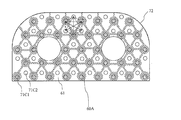
- FIG. 13 is a diagram illustrating the arrangement of the convex portion 71 in the header portion 72 of the plate heat exchanger 30 according to the ninth embodiment.
- FIG. 13 shows the arrangement in the first heat transfer plate 32 having two types of protrusions 71C in the plate heat exchanger 30 of the seventh and eighth embodiments.
- the central axes of the six nearest convex portions 71C are connected to arbitrary virtual points in the flat portion, they form a hexagon and the convex portions 71C become vertices.
- the first convex portion 71C1 and the second convex portion 71C2 described above are alternately arranged three by three.
- the distance from the second convex portion 71C2 having a high height is the longest in the second convex portion 71C2 having a low height. Therefore, when an overload is generated and an evenly distributed load is applied to the heat transfer plate, the distance between the convex portions is maximized, and a support point and a maximum bending stress forming a virtual side that produces a maximum amount of deflection are generated.
- the support points are supported by the first convex portion 71C1 and the second convex portion 71C2, respectively.
- the plate thickness of the second heat transfer plate 34 and the third heat transfer plate 36 is thinner than the plate thickness of the second convex portion 71C2, as a result, the root or the first of the convex portion 71A of the second heat transfer plate 34.
- the root of the convex portion 71B of the three heat transfer plates 36 will be damaged.
- the above-mentioned heat transfer device 100 can be used as an industrial and household device equipped with a plate heat exchanger 30.
- the heat transfer device 100 can be utilized for air conditioning, power generation, heat sterilization treatment of food, and the like.
Landscapes
- Engineering & Computer Science (AREA)
- Physics & Mathematics (AREA)
- Thermal Sciences (AREA)
- Mechanical Engineering (AREA)
- General Engineering & Computer Science (AREA)
- Heat-Exchange Devices With Radiators And Conduit Assemblies (AREA)
Priority Applications (2)
| Application Number | Priority Date | Filing Date | Title |
|---|---|---|---|
| JP2022523797A JP7301224B2 (ja) | 2020-05-19 | 2020-05-19 | プレート式熱交換器、冷凍サイクル装置および伝熱装置 |
| PCT/JP2020/019806 WO2021234824A1 (ja) | 2020-05-19 | 2020-05-19 | プレート式熱交換器、冷凍サイクル装置および伝熱装置 |
Applications Claiming Priority (1)
| Application Number | Priority Date | Filing Date | Title |
|---|---|---|---|
| PCT/JP2020/019806 WO2021234824A1 (ja) | 2020-05-19 | 2020-05-19 | プレート式熱交換器、冷凍サイクル装置および伝熱装置 |
Publications (1)
| Publication Number | Publication Date |
|---|---|
| WO2021234824A1 true WO2021234824A1 (ja) | 2021-11-25 |
Family
ID=78708418
Family Applications (1)
| Application Number | Title | Priority Date | Filing Date |
|---|---|---|---|
| PCT/JP2020/019806 Ceased WO2021234824A1 (ja) | 2020-05-19 | 2020-05-19 | プレート式熱交換器、冷凍サイクル装置および伝熱装置 |
Country Status (2)
| Country | Link |
|---|---|
| JP (1) | JP7301224B2 (https=) |
| WO (1) | WO2021234824A1 (https=) |
Cited By (2)
| Publication number | Priority date | Publication date | Assignee | Title |
|---|---|---|---|---|
| WO2023108819A1 (zh) * | 2021-12-14 | 2023-06-22 | 浙江银轮机械股份有限公司 | 换热器 |
| EP4560247A4 (en) * | 2022-07-19 | 2025-10-22 | Daikin Ind Ltd | HEAT EXCHANGER |
Citations (3)
| Publication number | Priority date | Publication date | Assignee | Title |
|---|---|---|---|---|
| WO2013183629A1 (ja) * | 2012-06-05 | 2013-12-12 | 三菱電機株式会社 | プレート式熱交換器及びそれを備えた冷凍サイクル装置 |
| WO2014147804A1 (ja) * | 2013-03-22 | 2014-09-25 | 三菱電機株式会社 | プレート式熱交換器及びそれを備えた冷凍サイクル装置 |
| WO2019176567A1 (ja) * | 2018-03-15 | 2019-09-19 | 三菱電機株式会社 | プレート式熱交換器及びそれを備えたヒートポンプ装置 |
-
2020
- 2020-05-19 JP JP2022523797A patent/JP7301224B2/ja active Active
- 2020-05-19 WO PCT/JP2020/019806 patent/WO2021234824A1/ja not_active Ceased
Patent Citations (3)
| Publication number | Priority date | Publication date | Assignee | Title |
|---|---|---|---|---|
| WO2013183629A1 (ja) * | 2012-06-05 | 2013-12-12 | 三菱電機株式会社 | プレート式熱交換器及びそれを備えた冷凍サイクル装置 |
| WO2014147804A1 (ja) * | 2013-03-22 | 2014-09-25 | 三菱電機株式会社 | プレート式熱交換器及びそれを備えた冷凍サイクル装置 |
| WO2019176567A1 (ja) * | 2018-03-15 | 2019-09-19 | 三菱電機株式会社 | プレート式熱交換器及びそれを備えたヒートポンプ装置 |
Cited By (2)
| Publication number | Priority date | Publication date | Assignee | Title |
|---|---|---|---|---|
| WO2023108819A1 (zh) * | 2021-12-14 | 2023-06-22 | 浙江银轮机械股份有限公司 | 换热器 |
| EP4560247A4 (en) * | 2022-07-19 | 2025-10-22 | Daikin Ind Ltd | HEAT EXCHANGER |
Also Published As
| Publication number | Publication date |
|---|---|
| JP7301224B2 (ja) | 2023-06-30 |
| JPWO2021234824A1 (https=) | 2021-11-25 |
Similar Documents
| Publication | Publication Date | Title |
|---|---|---|
| US10161687B2 (en) | Plate heat exchanger and heat pump outdoor unit | |
| US9752836B2 (en) | Plate heat exchanger and heat pump apparatus | |
| JP5474483B2 (ja) | 中間熱交換器及びそれを用いた空調給湯システム | |
| JPWO2018216245A1 (ja) | プレート式熱交換器及びヒートポンプ式給湯システム | |
| JP5025783B2 (ja) | 蒸発器、及び該蒸発器を備えた冷凍システム | |
| JP7301224B2 (ja) | プレート式熱交換器、冷凍サイクル装置および伝熱装置 | |
| CN113557404B (zh) | 板式热交换器以及具备该板式热交换器的热泵装置 | |
| CN110285603B (zh) | 热交换器和使用其的制冷系统 | |
| KR101281230B1 (ko) | 공기 조화 시스템 | |
| JP7199533B2 (ja) | プレート式熱交換器及び伝熱装置 | |
| WO2013114474A1 (ja) | 積層型熱交換器及びそれを搭載したヒートポンプシステム、並びに積層型熱交換器の製造方法 | |
| JP2014074508A (ja) | カスケード熱交換器 | |
| JPH03211377A (ja) | 暖冷房機用熱交換器 | |
| JP5404541B2 (ja) | 熱交換器、およびそれを備えた給湯装置 | |
| WO2021234954A1 (ja) | 熱交換器、室外機および冷凍サイクル装置 | |
| WO2024089805A1 (ja) | 熱交換器およびこの熱交換器を備えた冷凍サイクル装置 | |
| JP6947314B2 (ja) | プレート式熱交換器およびヒートポンプ装置 | |
| JP6925508B2 (ja) | 熱交換器、冷凍サイクル装置および空気調和装置 | |
| JPWO2018047299A1 (ja) | プレート式熱交換器および冷凍サイクル装置 | |
| JP7292435B2 (ja) | プレート式熱交換器及び伝熱装置 | |
| JP7590685B2 (ja) | 冷凍サイクルシステム | |
| US20250305731A1 (en) | Heat exchanger and refrigeration cycle apparatus | |
| KR20240157395A (ko) | 공기조화장치 | |
| JP2009281595A (ja) | 冷凍装置 | |
| KR102058051B1 (ko) | 공조시스템의 판형열교환기 |
Legal Events
| Date | Code | Title | Description |
|---|---|---|---|
| 121 | Ep: the epo has been informed by wipo that ep was designated in this application |
Ref document number: 20936428 Country of ref document: EP Kind code of ref document: A1 |
|
| ENP | Entry into the national phase |
Ref document number: 2022523797 Country of ref document: JP Kind code of ref document: A |
|
| NENP | Non-entry into the national phase |
Ref country code: DE |
|
| 122 | Ep: pct application non-entry in european phase |
Ref document number: 20936428 Country of ref document: EP Kind code of ref document: A1 |