WO2021206120A1 - リチウム二次電池及びリチウム二次電池用電解液 - Google Patents
リチウム二次電池及びリチウム二次電池用電解液 Download PDFInfo
- Publication number
- WO2021206120A1 WO2021206120A1 PCT/JP2021/014754 JP2021014754W WO2021206120A1 WO 2021206120 A1 WO2021206120 A1 WO 2021206120A1 JP 2021014754 W JP2021014754 W JP 2021014754W WO 2021206120 A1 WO2021206120 A1 WO 2021206120A1
- Authority
- WO
- WIPO (PCT)
- Prior art keywords
- aluminum
- secondary battery
- lithium secondary
- negative electrode
- electrolytic solution
- Prior art date
- Legal status (The legal status is an assumption and is not a legal conclusion. Google has not performed a legal analysis and makes no representation as to the accuracy of the status listed.)
- Ceased
Links
Images

Classifications
-
- H—ELECTRICITY
- H01—ELECTRIC ELEMENTS
- H01M—PROCESSES OR MEANS, e.g. BATTERIES, FOR THE DIRECT CONVERSION OF CHEMICAL ENERGY INTO ELECTRICAL ENERGY
- H01M10/00—Secondary cells; Manufacture thereof
- H01M10/05—Accumulators with non-aqueous electrolyte
- H01M10/052—Li-accumulators
- H01M10/0525—Rocking-chair batteries, i.e. batteries with lithium insertion or intercalation in both electrodes; Lithium-ion batteries
-
- H—ELECTRICITY
- H01—ELECTRIC ELEMENTS
- H01M—PROCESSES OR MEANS, e.g. BATTERIES, FOR THE DIRECT CONVERSION OF CHEMICAL ENERGY INTO ELECTRICAL ENERGY
- H01M4/00—Electrodes
- H01M4/02—Electrodes composed of, or comprising, active material
- H01M4/36—Selection of substances as active materials, active masses, active liquids
- H01M4/38—Selection of substances as active materials, active masses, active liquids of elements or alloys
- H01M4/46—Alloys based on magnesium or aluminium
- H01M4/463—Aluminium based
-
- H—ELECTRICITY
- H01—ELECTRIC ELEMENTS
- H01M—PROCESSES OR MEANS, e.g. BATTERIES, FOR THE DIRECT CONVERSION OF CHEMICAL ENERGY INTO ELECTRICAL ENERGY
- H01M10/00—Secondary cells; Manufacture thereof
- H01M10/05—Accumulators with non-aqueous electrolyte
- H01M10/052—Li-accumulators
-
- H—ELECTRICITY
- H01—ELECTRIC ELEMENTS
- H01M—PROCESSES OR MEANS, e.g. BATTERIES, FOR THE DIRECT CONVERSION OF CHEMICAL ENERGY INTO ELECTRICAL ENERGY
- H01M10/00—Secondary cells; Manufacture thereof
- H01M10/05—Accumulators with non-aqueous electrolyte
- H01M10/056—Accumulators with non-aqueous electrolyte characterised by the materials used as electrolytes, e.g. mixed inorganic/organic electrolytes
- H01M10/0564—Accumulators with non-aqueous electrolyte characterised by the materials used as electrolytes, e.g. mixed inorganic/organic electrolytes the electrolyte being constituted of organic materials only
- H01M10/0566—Liquid materials
- H01M10/0567—Liquid materials characterised by the additives
-
- H—ELECTRICITY
- H01—ELECTRIC ELEMENTS
- H01M—PROCESSES OR MEANS, e.g. BATTERIES, FOR THE DIRECT CONVERSION OF CHEMICAL ENERGY INTO ELECTRICAL ENERGY
- H01M10/00—Secondary cells; Manufacture thereof
- H01M10/05—Accumulators with non-aqueous electrolyte
- H01M10/056—Accumulators with non-aqueous electrolyte characterised by the materials used as electrolytes, e.g. mixed inorganic/organic electrolytes
- H01M10/0564—Accumulators with non-aqueous electrolyte characterised by the materials used as electrolytes, e.g. mixed inorganic/organic electrolytes the electrolyte being constituted of organic materials only
- H01M10/0566—Liquid materials
- H01M10/0569—Liquid materials characterised by the solvents
-
- H—ELECTRICITY
- H01—ELECTRIC ELEMENTS
- H01M—PROCESSES OR MEANS, e.g. BATTERIES, FOR THE DIRECT CONVERSION OF CHEMICAL ENERGY INTO ELECTRICAL ENERGY
- H01M4/00—Electrodes
- H01M4/02—Electrodes composed of, or comprising, active material
- H01M4/13—Electrodes for accumulators with non-aqueous electrolyte, e.g. for lithium-accumulators; Processes of manufacture thereof
- H01M4/134—Electrodes based on metals, Si or alloys
-
- H—ELECTRICITY
- H01—ELECTRIC ELEMENTS
- H01M—PROCESSES OR MEANS, e.g. BATTERIES, FOR THE DIRECT CONVERSION OF CHEMICAL ENERGY INTO ELECTRICAL ENERGY
- H01M4/00—Electrodes
- H01M4/02—Electrodes composed of, or comprising, active material
- H01M4/36—Selection of substances as active materials, active masses, active liquids
- H01M4/362—Composites
- H01M4/366—Composites as layered products
-
- H—ELECTRICITY
- H01—ELECTRIC ELEMENTS
- H01M—PROCESSES OR MEANS, e.g. BATTERIES, FOR THE DIRECT CONVERSION OF CHEMICAL ENERGY INTO ELECTRICAL ENERGY
- H01M4/00—Electrodes
- H01M4/02—Electrodes composed of, or comprising, active material
- H01M4/36—Selection of substances as active materials, active masses, active liquids
- H01M4/38—Selection of substances as active materials, active masses, active liquids of elements or alloys
- H01M4/386—Silicon or alloys based on silicon
-
- H—ELECTRICITY
- H01—ELECTRIC ELEMENTS
- H01M—PROCESSES OR MEANS, e.g. BATTERIES, FOR THE DIRECT CONVERSION OF CHEMICAL ENERGY INTO ELECTRICAL ENERGY
- H01M4/00—Electrodes
- H01M4/02—Electrodes composed of, or comprising, active material
- H01M2004/021—Physical characteristics, e.g. porosity, surface area
-
- H—ELECTRICITY
- H01—ELECTRIC ELEMENTS
- H01M—PROCESSES OR MEANS, e.g. BATTERIES, FOR THE DIRECT CONVERSION OF CHEMICAL ENERGY INTO ELECTRICAL ENERGY
- H01M4/00—Electrodes
- H01M4/02—Electrodes composed of, or comprising, active material
- H01M2004/026—Electrodes composed of, or comprising, active material characterised by the polarity
- H01M2004/027—Negative electrodes
-
- H—ELECTRICITY
- H01—ELECTRIC ELEMENTS
- H01M—PROCESSES OR MEANS, e.g. BATTERIES, FOR THE DIRECT CONVERSION OF CHEMICAL ENERGY INTO ELECTRICAL ENERGY
- H01M2300/00—Electrolytes
- H01M2300/0017—Non-aqueous electrolytes
- H01M2300/0025—Organic electrolyte
-
- H—ELECTRICITY
- H01—ELECTRIC ELEMENTS
- H01M—PROCESSES OR MEANS, e.g. BATTERIES, FOR THE DIRECT CONVERSION OF CHEMICAL ENERGY INTO ELECTRICAL ENERGY
- H01M2300/00—Electrolytes
- H01M2300/0017—Non-aqueous electrolytes
- H01M2300/0025—Organic electrolyte
- H01M2300/0028—Organic electrolyte characterised by the solvent
- H01M2300/0037—Mixture of solvents
-
- Y—GENERAL TAGGING OF NEW TECHNOLOGICAL DEVELOPMENTS; GENERAL TAGGING OF CROSS-SECTIONAL TECHNOLOGIES SPANNING OVER SEVERAL SECTIONS OF THE IPC; TECHNICAL SUBJECTS COVERED BY FORMER USPC CROSS-REFERENCE ART COLLECTIONS [XRACs] AND DIGESTS
- Y02—TECHNOLOGIES OR APPLICATIONS FOR MITIGATION OR ADAPTATION AGAINST CLIMATE CHANGE
- Y02E—REDUCTION OF GREENHOUSE GAS [GHG] EMISSIONS, RELATED TO ENERGY GENERATION, TRANSMISSION OR DISTRIBUTION
- Y02E60/00—Enabling technologies; Technologies with a potential or indirect contribution to GHG emissions mitigation
- Y02E60/10—Energy storage using batteries
Definitions
- the present invention relates to a lithium secondary battery and an electrolytic solution for a lithium secondary battery.
- the present application claims priority based on Japanese Patent Application No. 2020-07803 filed in Japan on April 9, 2020, the contents of which are incorporated herein by reference.
- Rechargeable lithium secondary batteries are already being put to practical use not only in small power sources for mobile phones and notebook computers, but also in medium-sized or large-sized power sources for automobiles and power storage.
- a negative electrode formed of a metal material may be referred to as an "aluminum negative electrode".
- Patent Document 1 describes a negative electrode which is a porous aluminum alloy and is composed of a negative electrode active material for a secondary battery containing at least one kind of silicon or tin.
- the present invention has been made in view of the above circumstances, and an object of the present invention is to provide a lithium secondary battery having a high discharge capacity.
- the discharge capacity is measured by the following method. First, the coin-type lithium secondary battery is allowed to stand at room temperature for 10 hours to sufficiently impregnate the separator and the positive electrode mixture layer with the electrolytic solution. Next, a constant current constant current charge of 4.2 V at 1 mA is performed at room temperature, a constant current constant voltage charge of 4.2 V is performed for 5 hours, and then a constant current discharge of 1 mA to 3.0 V is performed. This performs initial charging and discharging. The discharge capacity is measured, and the obtained value is defined as the "initial discharge capacity" (mAh / g).
- the present invention includes the following [1] to [10].
- An aluminum negative electrode capable of storing and releasing lithium ions, a positive electrode capable of storing and releasing lithium ions, and an electrolytic solution are provided.
- the aluminum negative electrode is composed of an aluminum-containing metal, and the electrolytic solution is an electrolyte.
- a lithium secondary battery containing an organic solvent and an additive.
- the additives include fluorocyclic carbonates, vinylene carbonates, 1,3-propanesalton, methanesulfonic acid, adiponitrile, 1,4-butansulton, succinonitrile, hexaphenylbenzene, cyclohexylbenzene, t.
- the lithium secondary battery according to [1] which is a solvent containing at least one selected from the group consisting of amylbenzene, dioxane, diphenylsulfide, biphenyl, fluorobenzene, and t-butylbenzene.
- the additive is a solvent containing dimethyl sulfoxide or acetonitrile.
- the content of the additive is 10% by mass or less based on the total amount of the electrolytic solution.
- the additives include fluorocyclic carbonates, vinylene carbonates, 1,3-propanesalton, methanesulfonic acid, adiponitrile, 1,4-butansulton, succinonitrile, hexaphenylbenzene, cyclohexylbenzene, t.
- the electrolytic solution for a lithium secondary battery according to [8] which is a solvent containing at least one selected from the group consisting of amylbenzene, dioxane, diphenylsulfide, biphenyl, fluorobenzene, and t-butylbenzene.
- Lithium secondary battery The lithium secondary battery of the present embodiment will be described.
- the lithium secondary battery according to the present embodiment will be described with reference to the drawings.
- the dimensions and ratios of the components are appropriately different in order to make the drawings easier to see.
- the lithium secondary battery of the present embodiment includes an aluminum negative electrode capable of occluding and releasing lithium ions, a positive electrode capable of occluding and releasing lithium ions, and an electrolyte.
- Examples of the lithium secondary battery include a non-aqueous electrolyte type lithium secondary battery using an electrolytic solution as an electrolyte.
- the aluminum negative electrode is composed of an aluminum-containing metal.
- the aluminum negative electrode is preferably any one of the aluminum negative electrodes 1 to 3 described below.
- the aluminum negative electrode 1 is an aluminum-containing metal.
- the aluminum-containing metal of the aluminum negative electrode 1 is present in which the non-aluminum metal phase is dispersed in the aluminum metal phase.
- Non-aluminum metal means a metal that does not contain aluminum.
- the non-aluminum metal phase is preferably composed of a non-aluminum metal compound containing at least one selected from the group consisting of Si, Ge, Sn, Ag, Sb, Bi, In and Mg.
- the non-aluminum metal phase is more preferably composed of a non-aluminum metal compound containing at least one selected from the group consisting of Si, Ge, Sn, Ag, Sb, Bi and In.
- the non-aluminum metal phase is preferably composed of non-aluminum metal compound particles.
- the non-aluminum metal compound constituting the non-aluminum metal phase has a very large occlusion of lithium. Therefore, the non-aluminum metal compound has a large volume expansion during lithium insertion and a large volume contraction during lithium desorption. The strain generated by the expansion and contraction develops into cracks of the non-aluminum metal compound particles, and miniaturization occurs in which the non-aluminum metal compound particles become smaller. The miniaturization of the non-aluminum metal compound acting as the negative electrode active material during charging and discharging causes a shortening of the cycle life.
- the aluminum negative electrode 1 is a metal in which a non-aluminum metal phase is dispersed in an aluminum metal phase.
- the non-aluminum metal compound particles are coated with aluminum which can alloy with lithium.
- the non-aluminum metal compound particles are difficult to crack and therefore difficult to be atomized. Therefore, it is easy to maintain the initial discharge capacity even when the lithium secondary battery is repeatedly charged and discharged. That is, the discharge capacity of the lithium secondary battery can be increased.
- the content of the non-aluminum metal phase in the aluminum negative electrode 1 preferably satisfies 0.01% by mass or more and 8% by mass or less with respect to the total amount of the aluminum metal phase and the non-aluminum metal phase.
- the lower limit of the content of the non-aluminum metal phase is preferably 0.02% by mass, more preferably 0.05% by mass, and particularly preferably 0.1% by mass.
- the upper limit of the content of the non-aluminum metal phase is preferably 7% by mass, more preferably 6% by mass, and particularly preferably 5% by mass.
- the upper limit value and the lower limit value can be arbitrarily combined.
- the content of the non-aluminum metal phase is 0.02% by mass or more and 7% by mass or less, 0.05% by mass or more and 6% by mass or less, and 0.1 crystal% or more and 5% by mass or less. Be done.
- the content of the non-aluminum metal phase is equal to or higher than the above lower limit, a metal or metal compound other than aluminum that can contribute to the occlusion of lithium can be sufficiently secured. Further, when the content of the non-aluminum metal phase is not more than the above upper limit value, the dispersed state of the non-aluminum metal phase in the aluminum phase tends to be good. Further, when it is not more than the above upper limit value, rolling tends to be easy.
- the non-aluminum metal phase may contain an arbitrary metal other than Si, Ge, Sn, Ag, Sb, Bi, In and Mg.
- the optional metal include Mn, Zn, Ni and the like.
- the aluminum negative electrode 1 is preferably an Al—Si binary alloy or an Al—Si—Mn ternary alloy. In the case of a ternary alloy, it is preferable that each metal is uniformly solid-solved.
- Sr when the non-aluminum metal phase is Si, Sr may be further contained in order to promote the miniaturization of the non-metal aluminum phase.
- a method for adding Sr to promote the miniaturization of Si the method described in Light Metal Vol. 37, No. 2, 1987, pp. 146-152 can be used.
- the ratio of the area corresponding to the non-aluminum metal phase of the aluminum negative electrode 1 is the sum of the area corresponding to the aluminum phase and the area corresponding to the metal phase. It is preferably 10% or less.
- the aluminum negative electrode 1 is rolled into a foil having a thickness of 0.5 mm.
- the foil is cut perpendicular to the rolling direction and the cut surface is etched with 1.0 mass% sodium hydroxide aqueous solution.
- the aluminum metal phase and the non-aluminum metal phase have different solubilities in sodium hydroxide. Therefore, by etching, a height difference of unevenness is formed between the portion corresponding to the non-aluminum metal phase exposed on the cut surface and the portion corresponding to the aluminum metal phase. Due to the difference in height of the unevenness, the contrast becomes clear during microscopic observation, which will be described later.
- a cross-sectional image of the cut surface is acquired, and the cross-sectional image is image-processed to obtain a binarized image obtained by converting the convex portion corresponding to the aluminum metal phase and the concave portion corresponding to the non-aluminum metal phase, respectively.
- the area of the recess corresponds to the area of the non-aluminum metal phase.
- the cross-sectional image can be obtained using, for example, a metallurgical microscope.
- a metallurgical microscope image having a magnification of 200 times or more and 500 times or less is acquired.
- a scanning electron microscope (SEM) is used for the observation.
- SEM scanning electron microscope
- an SEM image with a magnification of 10000 is acquired.
- metallurgical microscope for example, Nikon EPIPHOT 300 can be used.
- the obtained SEM image or metallurgical microscope image with the above magnification is taken into a computer and binarized using image analysis software.
- the binarization process is a process of binarizing an intermediate value between the maximum brightness and the minimum brightness in an image.
- a binarized image can be obtained in which the portion corresponding to the aluminum metal phase is white and the portion corresponding to the non-aluminum metal phase is black.
- image analysis software software capable of the above binarization processing can be appropriately selected. Specifically, Image J, Photoshop, Image Pro Plus, or the like can be used as the image analysis software.
- the area corresponding to the aluminum metal phase is S1 and the area corresponding to the non-aluminum metal phase is S2.
- the ratio of S2 to the total of S1 and S2 (S2 / [S1 + S2]) ⁇ 100 (%) is preferably 10% or less, more preferably 6% or less, and particularly preferably 3% or less.
- the ratio of S2 is not more than the above upper limit value, the non-aluminum metal compound is sufficiently coated with aluminum, so that the non-aluminum metal compound becomes more difficult to crack. Therefore, even when the lithium secondary battery is repeatedly charged and discharged, the initial discharge capacity can be easily maintained.
- the aluminum negative electrode 1 has a non-aluminum metal phase dispersed in an aluminum metal phase.
- the non-aluminum metal phase is dispersed in the aluminum metal phase means a state in which the non-aluminum metal compound particles are present in the aluminum metal matrix.
- the shape surrounded by the outer periphery of the recess corresponding to the non-aluminum metal compound phase observed when observing the cross section of the foil-shaped aluminum negative electrode 1 having a thickness of 0.5 mm is defined as the cross section of one particle. It is preferable that the number of observed particles satisfies both the following condition (1) and condition (2).
- Condition (1) The number density of non-aluminum metal compound particles having a particle size of 0.1 ⁇ m or more and less than 100 ⁇ m is 1000 particles / mm 2 or less.
- Condition (2) The number density of the non-aluminum metal compound particles having a particle size of 100 ⁇ m or more is 25 particles / mm 2 or less.
- the particle size of the non-aluminum metal compound particles is the distance between the parallel lines when, for example, a projection image of the cross-sectional shape of the non-aluminum metal compound particles is sandwiched between parallel lines drawn in a certain direction from an SEM image photograph or a metal microscope image.
- the directional diameter is measured as the particle size of the non-aluminum metal compound particles.
- the "number density” means the density of the number of non-aluminum metal compound particles present per unit area in SEM photographs and metal micrographs.
- the aluminum negative electrode 1 is preferably manufactured by a manufacturing method including an alloy casting step and a rolling step.
- -Alloy casting step When casting, first, a predetermined amount of a metal constituting a non-aluminum metal phase is added to aluminum or high-purity aluminum to obtain a mixture 1. High-purity aluminum can be obtained by the method described later. Next, the mixture 1 is melted at 680 ° C. or higher and 800 ° C. or lower to obtain an alloy molten metal 1 of aluminum and metal.
- aluminum constituting the aluminum phase aluminum having a purity of 99.9% by mass or more, high-purity aluminum having a purity of 99.99% by mass or more can be used.
- the metal constituting the non-aluminum metal phase is one or more selected from the group consisting of Si, Ge, Sn, Ag, Sb, Bi, In and Mg.
- the metal constituting the non-aluminum metal phase for example, high-purity silicon having a purity of 99.999% by mass or more is used.
- the molten alloy 1 is preferably subjected to a treatment for cleaning by removing gas and non-metal inclusions.
- the cleaning treatment include the addition of flux, the treatment of blowing an inert gas or chlorine gas, and the vacuum treatment of molten aluminum.
- the vacuum treatment is performed under the conditions of, for example, 700 ° C. or higher and 800 ° C. or lower, 1 hour or longer and 10 hours or lower, and a vacuum degree of 0.1 Pa or higher and 100 Pa or lower.
- the molten alloy 1 that has been cleaned by vacuum treatment or the like becomes an ingot by casting using a mold.
- a mold an iron mold or a graphite mold heated to 50 ° C. or higher and 200 ° C. or lower is used.
- the aluminum negative electrode 1 can be cast by pouring a molten alloy 1 having a temperature of 680 ° C or higher and 800 ° C or lower into a mold. Further, an ingot may be obtained by semi-continuous casting.
- the obtained ingot of the alloy can be directly cut and used for the aluminum negative electrode 1.
- the ingot rolling step is, for example, a step of performing hot rolling and cold rolling to process the ingot into a plate material. Hot rolling is repeated, for example, under the conditions that the temperature of the ingot is 350 ° C. or higher and 550 ° C. or lower and the processing rate per rolling is 2% or higher and 30% or lower, until the aluminum ingot has the desired thickness. ..
- the "processing rate” means the rate of change in thickness when rolling. For example, when a plate having a thickness of 1 mm has a thickness of 0.7 mm, the processing rate is 30%.
- intermediate annealing treatment may be performed before cold rolling.
- the intermediate annealing treatment is performed, for example, by heating a hot-rolled plate material to raise the temperature and then allowing it to cool.
- the temperature raising step in the intermediate annealing treatment may be, for example, raising the temperature to 350 ° C. or higher and 550 ° C. or lower. Further, in the temperature raising step, for example, the temperature of 350 ° C. or higher and 550 ° C. or lower may be maintained for about 1 hour or longer and 5 hours or shorter.
- the cooling step in the intermediate annealing treatment may be performed immediately after the temperature is raised. In the cooling step, it is preferable to allow the mixture to cool to about 20 ° C.
- the cooling step may be appropriately adjusted according to the size of the desired non-aluminum metal phase.
- the cooling step is carried out by allowing to cool rapidly, the non-aluminum metal phase tends to become smaller.
- the cooling step is carried out at a moderate cooling rate, the crystal structure of the metal constituting the non-aluminum metal phase tends to grow.
- Cold rolling is preferably carried out at a temperature lower than the recrystallization temperature of aluminum. Further, it is preferable to repeatedly roll the aluminum ingot to the desired thickness under the condition that the rolling ratio per rolling is 1% or more and 20% or less.
- the temperature of cold rolling may be adjusted from 10 ° C. to 80 ° C. or lower by adjusting the temperature of the metal to be rolled.
- the heat treatment after cold rolling is usually performed in the air, but may be performed in a nitrogen atmosphere or a vacuum atmosphere.
- various physical properties, specifically hardness, conductivity and tensile strength may be adjusted by controlling the crystal structure.
- Examples of the heat treatment conditions include conditions for heat treatment at a temperature of 300 ° C. or higher and 400 ° C. or lower for 5 hours or longer and 10 hours or shorter.
- the aluminum negative electrode 1 is preferably a metal foil.
- the thickness of the metal foil is preferably 5 ⁇ m or more, more preferably 6 ⁇ m or more, and even more preferably 7 ⁇ m or more. Further, 200 ⁇ m or less is preferable, 190 ⁇ m or less is more preferable, and 180 ⁇ m or less is further preferable.
- the above upper limit value and lower limit value of the thickness of the metal foil can be arbitrarily combined.
- the thickness of the metal foil is preferably 5 ⁇ m or more and 200 ⁇ m or less. The thickness of the metal foil may be measured using a thickness gauge or a caliper.
- the aluminum negative electrode 1 may be a powder having an average particle diameter of 1 ⁇ m or more and 20 ⁇ m or less, and may be negative electrode active material particles.
- the negative electrode active material particles can be obtained by pulverizing the ingot obtained by the above casting step.
- the crushing method is not particularly limited, and examples thereof include a method using a ball mill, a bead mill, etc., and a method using a jet mill, etc.
- the powder production method is not particularly limited, and for example, it can be produced by an atomizing method in which molten aluminum is ejected from a nozzle.
- the average particle size of the negative electrode active material particles which is a powder, can be measured by, for example, a laser diffraction method.
- examples of the purification method for purifying aluminum include a segregation method and a three-layer electrolysis method.
- the segregation method is a purification method that utilizes the segregation phenomenon during solidification of molten aluminum, and a plurality of methods have been put into practical use.
- One form of the segregation method is a method in which molten aluminum is poured into a container, and the molten aluminum at the top is heated and stirred while rotating the container to solidify the purified aluminum from the bottom.
- High-purity aluminum having a purity of 99.99% by mass or more can be obtained by the segregation method.
- the three-layer electrolysis method is an electrolysis method for purifying aluminum.
- relatively low-purity aluminum or the like for example, at the time of JIS-H2102 with a purity of 99.9% by mass or less, about one grade
- it is a method in which an anode is used in a molten state, and an electrolytic bath containing, for example, aluminum fluoride and barium fluoride is placed on the anode to precipitate high-purity aluminum on the cathode.
- an electrolytic bath containing, for example, aluminum fluoride and barium fluoride is placed on the anode to precipitate high-purity aluminum on the cathode.
- the method for purifying aluminum is not limited to the segregation method and the three-layer electrolysis method, but other already known methods such as a band melt purification method and an ultra-high vacuum solubility manufacturing method may be used.
- the aluminum negative electrode 2 is an aluminum-containing metal.
- the aluminum negative electrode 2 satisfies the average corrosion rate of 0.2 mm / year or less measured by the immersion test under the following immersion conditions.
- the aluminum-containing metal is a test metal piece having a size of 40 mm in length, 40 mm in width, and 0.5 mm in thickness.
- the test metal piece is immersed in a 3.5% NaCl aqueous solution adjusted to pH 3 using acetic acid as a pH adjuster, and the test metal piece is taken out after 72 hours.
- the immersion temperature is 30 ° C.
- Corrosion rate (mm / year) [Corrosion degree x 365] / Specimen density (g / cm 3 )
- test metal piece may be washed with ethanol or the like before being immersed in a 3.5% NaCl aqueous solution adjusted to pH 3.
- the aluminum negative electrode 2 is preferably made of an aluminum-containing metal represented by the following composition formula (1).
- M 1 is one or more selected from the group consisting of Mg, Ni, Mn, Zn, Cd, and Pb.
- M 2 is an unavoidable impurity. 0 mass% ⁇ y ⁇ 8 mass. %, [X / (x + z)] ⁇ 99.9 mass%.)
- M 1 is more preferably one or more selected from the group consisting of Mg, Ni, Mn, and Zn.
- y is preferably 0.1% by mass ⁇ y ⁇ 8.0% by mass, preferably 0.5% by mass ⁇ y ⁇ 7.0% by mass, and 0.7% by mass ⁇ y ⁇ 6. .0% by mass is particularly preferable.
- the range of y is equal to or greater than the above lower limit value, the average corrosion rate can be controlled within the above range. Further, when the range of y is not more than the above upper limit value, rolling can be performed without cracking during the rolling process at the time of casting.
- M 2 is an unavoidable impurity such as a production residue that is inevitably mixed in the refining step of high-purity aluminum, and specifically, is a metal component other than aluminum and M 1.
- unavoidable impurities include iron and copper.
- z is 0.1% by mass or less, preferably 0.05% by mass or less, and more preferably 0.01% by mass or less.
- [x / (x + z)] is preferably 99.95% or more, more preferably 99.99% or more, and particularly preferably 99.995% or more.
- the aluminum negative electrode 2 contains high-purity aluminum in which [x / (x + z)] is at least the above lower limit value. The refining method for purifying aluminum will be described later.
- those having y exceeding 0 may be described as a high-purity aluminum alloy.
- the high-purity aluminum or the high-purity aluminum alloy according to any one of the following (1) to (5) is preferable.
- High-purity aluminum-magnesium alloy 1 It is an alloy of aluminum with a purity of 99.999% and magnesium.
- the content of magnesium in the total amount of aluminum-containing metal is 0.1% by mass or more and 4.0% by mass or less.
- the average corrosion rate is 0.04 mm / year to 0.06 mm / year.
- High-purity aluminum-magnesium alloy 2 It is an alloy of 99.9% pure aluminum and magnesium.
- the content of magnesium in the total amount of aluminum-containing metal is 0.1% by mass or more and 1.0% by mass or less.
- the average corrosion rate is 0.1 mm / year to 0.14 mm / year.
- High-purity aluminum-nickel alloy This is an alloy of aluminum with a purity of 99.999% and nickel. The content of nickel in the total amount of aluminum-containing metal is 0.1% by mass or more and 1.0% by mass or less. The average corrosion rate is 0.1 mm / year to 0.14 mm / year.
- High-purity aluminum-manganese-magnesium alloy It is an alloy of 99.99% pure aluminum, manganese, and magnesium. The total content of manganese and magnesium in the total amount of aluminum-containing metal is 1.0% by mass or more and 2.0% by mass or less.
- the average corrosion rate is 0.03 mm / year to 0.05 mm / year.
- High-purity aluminum Aluminum having a purity of 99.999%. The average corrosion rate is 0.05 mm / year.
- the method for manufacturing the aluminum negative electrode 2 will be described separately as a method 1 for manufacturing the aluminum negative electrode 2 in which the aluminum negative electrode 2 is high-purity aluminum and a method 2 for manufacturing the aluminum negative electrode 2 which is a high-purity aluminum alloy.
- aluminum is highly purified.
- the method for purifying aluminum include the method for purifying aluminum described in the above-mentioned (method for manufacturing the aluminum negative electrode 1).
- Impurities such as manufacturing residues may be mixed even when the aluminum is highly purified by the high purification method.
- the total content of iron and copper contained in aluminum is preferably 100 ppm or less, more preferably 80 ppm or less, still more preferably 50 ppm or less.
- the manufacturing method 1 preferably includes a casting step of high-purity aluminum and a rolling step.
- Highly purified aluminum can be cast by the above method to obtain an aluminum ingot having a shape suitable for rolling.
- high-purity aluminum is melted at about 680 ° C. or higher and 800 ° C. or lower to obtain a molten aluminum.
- cleaning process include the same method as the cleaning process described for the aluminum negative electrode 1.
- the purified molten aluminum is cast into ingots by casting using a mold.
- a mold an iron mold or a graphite mold heated to 50 ° C. or higher and 200 ° C. or lower is used.
- the aluminum negative electrode 2 can be cast by pouring a molten aluminum of 680 ° C. or higher and 800 ° C. or lower into a mold. Further, an ingot may be obtained by semi-continuous casting.
- the obtained ingot of aluminum can be cut as it is and used for the aluminum negative electrode 2. It is preferable that the ingot of aluminum is rolled, extruded, forged, or the like to form a plate material. Further, it is more preferable to roll.
- the rolling step can be carried out by the same method as the rolling step described in the method for manufacturing the aluminum negative electrode 1.
- the manufacturing method 2 preferably includes a casting step of a high-purity aluminum alloy and a rolling step.
- -Casting step When casting, first, a predetermined amount of a metal element is added to high-purity aluminum to obtain a mixture 2. Next, the mixture 2 is melted at 680 ° C. or higher and 800 ° C. or lower to obtain a molten aluminum-metal alloy 2.
- the metal element to be added is preferably one or more selected from the group consisting of Mg, Ni, Mn, Zn, Cd, and Pb.
- the metal containing these elements to be added preferably has a purity of 99% by mass or more.
- a high-purity aluminum alloy ingot is obtained by the same method as the casting process in the manufacturing method of the aluminum negative electrode 1 except that the molten alloy 2 is used.
- the rolling step is performed by the same method as the manufacturing method 1 of the aluminum negative electrode 2 described above.
- the thickness of the metal foil of the aluminum negative electrode 2 is preferably 5 ⁇ m or more, more preferably 6 ⁇ m or more, still more preferably 7 ⁇ m or more. Further, 200 ⁇ m or less is preferable, 190 ⁇ m or less is more preferable, and 180 ⁇ m or less is further preferable.
- the upper limit value and the lower limit value of the thickness of the metal foil of the aluminum negative electrode 2 can be arbitrarily combined. In the present embodiment, the thickness of the metal foil of the aluminum negative electrode 2 is preferably 5 ⁇ m or more and 200 ⁇ m or less.
- the aluminum negative electrode 2 may be a powder having an average particle diameter of 1 ⁇ m or more and 20 ⁇ m or less, and may be a negative electrode active material particle.
- the negative electrode active material particles can be obtained by pulverizing the ingot obtained by the above casting step.
- the crushing method is not particularly limited, and examples thereof include a method using a ball mill, a bead mill, and the like, and a method using a jet mill and the like.
- the powder production method is not particularly limited, and for example, it can be produced by an atomizing method in which molten aluminum is ejected from a nozzle.
- the aluminum negative electrode 2 may be a non-woven fabric made of aluminum fibers.
- the non-woven fabric made of aluminum include a method in which aluminum fibers are obtained by a melt spinning method and then the jetted cotton-like fibers are rolled.
- the melt spinning method is a method of producing fibers by pressurizing a high-purity molten aluminum and injecting it from a nozzle to quench and solidify it.
- the aluminum fiber include aluminum fiber having a diameter of 5 ⁇ m or more and 200 ⁇ m, short aluminum fiber, and the like.
- the aluminum negative electrode 3 is an aluminum-containing metal.
- the Vickers hardness of the aluminum negative electrode 3 is preferably 10 HV or more and 70 HV or less, more preferably 20 HV or more and 70 HV or less, further preferably 30 HV or more and 70 HV or less, and particularly preferably 35 HV or more and 55 HV or less.
- the crystal structure When the aluminum negative electrode 3 occludes lithium, the crystal structure may be distorted.
- the Vickers hardness is not more than the above upper limit value, it is presumed that the strain of the crystal structure can be relaxed when the aluminum negative electrode 3 occludes lithium, and the crystal structure can be maintained. Therefore, the lithium secondary battery using the aluminum negative electrode 3 can maintain the discharge capacity even when charging and discharging are repeated.
- the Vickers hardness As an index of the hardness of the aluminum negative electrode 3, the Vickers hardness (HV0.05) is measured using a micro Vickers hardness tester. The Vickers hardness is a value measured according to JIS Z2244: 2009 "Vickers hardness test-test method". To measure the Vickers hardness, a diamond indenter having a regular quadrangular pyramid is pushed into the surface of the test piece in the aluminum negative electrode 3, the test force is released, and then the hardness is calculated from the diagonal length of the dent remaining on the surface.
- the aluminum negative electrode 1 may have the properties of the aluminum negative electrode 2. Specifically, it is preferable that the aluminum negative electrode 1 satisfies the average corrosion rate of 0.2 mm / year or less measured by the immersion test under the above immersion conditions.
- the aluminum negative electrode 1 may have the properties of the aluminum negative electrode 3. Specifically, the aluminum negative electrode 1 preferably has a Vickers hardness of 10 HV or more and 70 HV or less.
- the aluminum negative electrode 1 may have the properties of the aluminum negative electrode 2 and the aluminum negative electrode 3. Specifically, it is preferable that the aluminum negative electrode 1 satisfies the average corrosion rate of 0.2 mm / year or less measured by the immersion test under the above immersion conditions and the Vickers hardness of 10 HV or more and 70 HV or less.
- the aluminum negative electrode 2 may have the properties of the aluminum negative electrode 3. Specifically, the aluminum negative electrode 2 preferably has a Vickers hardness of 10 HV or more and 70 HV or less.
- the component analysis of the aluminum negative electrode can be performed using an emission spectroscopic analyzer. This makes it possible to quantify the amount of metal elements in the aluminum-containing metal.
- the luminescence spectroscopic analyzer for example, a model: ARL-4460, manufactured by Thermo Fisher Scientific Co., Ltd. can be used.
- the metal element can be quantified more accurately by a glow discharge mass spectrometer.
- the material of the negative electrode current collector may be a strip-shaped member made of a metal material such as Cu, Ni, or stainless steel.
- a metal material such as Cu, Ni, or stainless steel.
- Cu is used as a forming material and processed into a thin film because it is difficult to form an alloy with lithium and it is easy to process.
- Examples of the method of supporting the negative electrode mixture on such a negative electrode current collector include a method of pressure molding, a method of pasting with a solvent and the like, coating on the negative electrode current collector, drying, and pressing and crimping.
- the positive electrode has a positive electrode active material.
- a lithium-containing compound or another metal compound can be used as the positive electrode active material.
- the lithium-containing compound include a lithium cobalt composite oxide having a layered structure, a lithium nickel composite oxide having a layered structure, a lithium manganese composite oxide having a spinel structure, and lithium iron phosphate having an olivine type structure. ..
- Examples of other metal compounds include oxides such as titanium oxide, vanadium oxide and manganese dioxide, and sulfides such as titanium sulfide and molybdenum sulfide.
- a carbon material As the conductive material, a carbon material can be used.
- the carbon material include graphite powder, carbon black (for example, acetylene black), and fibrous carbon material. Since carbon black is fine and has a large surface area, it is possible to increase the conductivity inside the positive electrode and improve the charge / discharge efficiency and output characteristics by adding a small amount to the positive electrode mixture.
- the ratio of the conductive material in the positive electrode mixture is preferably 5 parts by mass or more and 20 parts by mass or less with respect to 100 parts by mass of the positive electrode active material.
- a fibrous carbon material such as graphitized carbon fiber or carbon nanotube is used as the conductive material, this ratio can be reduced.
- thermoplastic resin As the binder, a thermoplastic resin can be used.
- the thermoplastic resin includes polyvinylidene fluoride (hereinafter, may be referred to as PVdF), polytetrafluoroethylene (hereinafter, may be referred to as PTFE), ethylene tetrafluoride, propylene hexafluoride, and vinylidene fluoride.
- Fluororesin such as copolymer, propylene hexafluoride / vinylidene fluoride-based copolymer, ethylene tetrafluoride / perfluorovinyl ether-based copolymer; polyolefin resin such as polyethylene and polypropylene; can be mentioned.
- thermoplastic resins may be used as a mixture of two or more types. Fluororesin and polyolefin resin are used as binders, and the ratio of fluororesin to the entire positive electrode mixture is 1% by mass or more and 10% by mass or less, and the ratio of polyolefin resin is 0.1% by mass or more and 2% by mass or less. It is possible to obtain a positive electrode mixture having high adhesion to the current collector and high bonding force inside the positive electrode mixture.
- the positive electrode current collector As the positive electrode current collector, a band-shaped member made of a metal material such as Al, Ni, or stainless steel can be used. Of these, Al is used as a forming material and processed into a thin film because it is easy to process and inexpensive.
- Examples of the method of supporting the positive electrode mixture on the positive electrode current collector include a method of pressure molding the positive electrode mixture on the positive electrode current collector. Further, the positive electrode mixture is made into a paste using an organic solvent, and the obtained positive electrode mixture paste is applied to at least one surface side of the positive electrode current collector, dried, pressed and fixed to the positive electrode current collector. The mixture may be carried.
- the organic solvents that can be used include amine solvents such as N, N-dimethylaminopropylamine and diethylenetriamine; ether solvents such as tetrahydrofuran; ketone solvents such as methyl ethyl ketone; methyl acetate. Etc.; amide-based solvents such as dimethylacetamide and N-methyl-2-pyrrolidone;
- Examples of the method of applying the positive electrode mixture paste to the positive electrode current collector include a slit die coating method, a screen coating method, a curtain coating method, a knife coating method, a gravure coating method and an electrostatic spray method.
- the positive electrode can be manufactured by the methods listed above.
- the electrolytic solution contained in the lithium secondary battery of the present embodiment contains an electrolyte and an organic solvent, and further contains an additive.
- LiClO 4 LiPF 6, LiAsF 6, LiSbF 6, LiBF 4, LiCF 3 SO 3, LiN (SO 2 CF 3) 2, LiN (SO 2 C 2 F 5) 2 , LiN (SO 2 CF 3 ) (COCF 3 ), Li (C 4 F 9 SO 3 ), LiC (SO 2 CF 3 ) 3 , Li 2 B 10 Cl 10 , LiBOB (where BOB is bis (oxalato) ) Borate), LiFSI (here, FSI means bis (fluorosulfonyl) image), lower aliphatic carboxylic acid lithium salt, lithium salts such as LiAlCl 4, and two or more of these.
- the electrolyte is at least selected from the group consisting of LiPF 6 , LiAsF 6 , LiSbF 6 , LiBF 4 , LiCF 3 SO 3 , LiN (SO 2 CF 3 ) 2 and LiC (SO 2 CF 3 ) 3 containing fluorine. It is preferable to use one containing one type.
- organic solvent contained in the electrolytic solution examples include propylene carbonate, ethylene carbonate, dimethyl carbonate, diethyl carbonate, ethyl methyl carbonate, 4-trifluoromethyl-1,3-dioxolane-2-one, 1, Examples thereof include carbonates such as 2-di (methoxycarbonyloxy) ethane.
- ethers such as 1,2-dimethoxyethane, 1,3-dimethoxypropane, pentafluoropropylmethyl ether, 2,2,3,3-tetrafluoropropyldifluoromethyl ether, tetrahydrofuran and 2-methyltetrahydrofuran. ..
- esters such as methyl formate, methyl acetate, propyl propionate and ⁇ -butyrolactone.
- nitriles such as acetonitrile and butyronitrile can be mentioned.
- amides such as N, N-dimethylformamide and N, N-dimethylacetamide can be mentioned.
- sulfur-containing compounds such as sulfolane and dimethyl sulfoxide can be used.
- the organic solvent it is preferable to use a mixture of two or more of these.
- a mixed solvent containing carbonates is preferable, and a mixed solvent of cyclic carbonate and acyclic carbonate and a mixed solvent of cyclic carbonate and ethers are more preferable.
- a mixed solvent of the cyclic carbonate and the acyclic carbonate a mixed solvent containing ethylene carbonate, dimethyl carbonate and ethyl methyl carbonate is preferable.
- an electrolytic solution containing a lithium salt containing fluorine such as LiPF 6 and an organic solvent having a fluorine substituent since the safety of the obtained lithium secondary battery is enhanced, it is preferable to use an electrolytic solution containing a lithium salt containing fluorine such as LiPF 6 and an organic solvent having a fluorine substituent.
- Additives are different from the above organic solvents, and include fluorocyclic carbonates, vinylene carbonates, 1,3-propanesalton, methanesulfonic acid, adiponitrile, 1,4-butanesulton, and succinonitrile. , Hexaphenylbenzene, Cyclohexabenzene, t-amylbenzene, dioxane, diphenylsulfide, biphenyl, fluorobenzene, and a solvent containing one or more selected from the group consisting of t-butylbenzene.
- the additive is different from the organic solvent, and examples thereof include a solvent containing dimethyl sulfoxide or acetonitrile.
- fluorine-containing cyclic carbonate examples include fluoroethylene carbonate.
- vinylene carbonates include vinylene carbonate (VC), 4-methylvinylene carbonate, 4,5-dimethylvinylene carbonate, 4-ethylvinylene carbonate, 4,5-diethylvinylene carbonate, 4-propylvinylene carbonate, 4,5-.
- vinylene carbonates include vinylene carbonate (VC), 4-methylvinylene carbonate, 4,5-dimethylvinylene carbonate, 4-ethylvinylene carbonate, 4,5-diethylvinylene carbonate, 4-propylvinylene carbonate, 4,5-.
- examples thereof include dipropylvinylene carbonate, 4-phenylvinylene carbonate and 4,5-diphenylvinylene carbonate.
- fluorocyclic carbonates or vinylene carbonates are preferable, and fluoroethylene carbonate or vinylene carbonate is particularly preferable.
- dimethyl sulfoxide or acetonitrile is preferable.
- SEI Solid Electrolyte Interface
- the content of the additive is preferably 10% by mass or less, more preferably 5% by mass or less, still more preferably 3% by mass or less, based on the total amount of the electrolytic solution.
- Examples of the content of the additive include 0.1% by mass or more, 0.2% by mass or more, and 0.3% by mass or more with respect to the total amount of the electrolytic solution.
- the above upper limit value and lower limit value of the content of the additive can be arbitrarily combined. Examples of the combination include 0.1% by mass or more and 10% by mass or less, 0.2% by mass or more and 5% by mass or less, and 0.3% by mass or more and 3% by mass or less in the content of the additive.
- the electrolytic solution may contain tris phosphate (trimethylsilyl), tris borate (trimethylsilyl) and the like as optional components.
- the separator When the lithium secondary battery has a separator, the separator may be in the form of a porous film, a non-woven fabric, a woven fabric, or the like, which is made of a material such as a polyolefin resin such as polyethylene or polypropylene, a fluororesin, or a nitrogen-containing aromatic polymer. A material having the above can be used. Further, two or more kinds of these materials may be used to form a separator, or these materials may be laminated to form a separator.
- the air permeation resistance by the Garley method defined by JIS P 8117 must be 50 seconds / 100 cc or more and 300 seconds / 100 cc or less. It is preferably 50 seconds / 100 cc or more and 200 seconds / 100 cc or less.
- the porosity of the separator is preferably 30% by volume or more and 80% by volume or less, and more preferably 40% by volume or more and 70% by volume or less.
- the separator may be a stack of separators having different porosities.
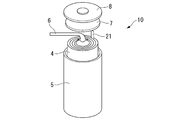
- Cylindrical 1A and 1B are schematic views showing an example of the lithium secondary battery of the present embodiment.
- the cylindrical lithium secondary battery 10 is manufactured as follows.
- a pair of strip-shaped separators 1, a strip-shaped positive electrode 2 having a positive electrode lead 21 at one end, and a strip-shaped aluminum negative electrode having a negative electrode lead 31 at one end are divided into a separator 1, a positive electrode 2, and a separator. 1.
- the current collector integrated negative electrode 3 is laminated in this order and wound to form an electrode group 4.
- the material of the positive electrode lead 21 and the negative electrode lead 31 can be appropriately selected from nickel, copper, iron, stainless steel or aluminum. From a potential point of view, the positive electrode lead 21 and the negative electrode lead 31 are preferably made of aluminum.
- the lithium secondary battery 10 can be manufactured by sealing the upper part of the battery exterior body 5 with the top insulator 7 and the sealing body 8.
- the shape of the electrode group 4 is, for example, a columnar shape such that the cross-sectional shape when the electrode group 4 is cut in the direction perpendicular to the winding axis is a circle, an ellipse, a rectangle, or a rectangle with rounded corners. Can be mentioned.
- the shape of the lithium secondary battery having such an electrode group 4 the shape defined by IEC60086, which is a standard for batteries defined by the International Electrotechnical Commission (IEC), or JIS C8500 can be adopted. ..
- IEC60086 which is a standard for batteries defined by the International Electrotechnical Commission (IEC), or JIS C8500
- a cylindrical shape, a square shape, or the like can be mentioned.
- the lithium secondary battery is not limited to the above-mentioned winding type configuration, and may have a laminated structure in which a laminated structure of a positive electrode, a separator, an aluminum negative electrode, and a separator is repeatedly stacked.
- the laminated lithium secondary battery include so-called coin-type batteries, button-type batteries, and paper-type (or sheet-type) batteries.
- the lithium secondary battery is evaluated by assembling the lithium secondary battery and measuring the discharge capacity.
- any one of the above-mentioned aluminum negative electrodes 1 to 3 is used.
- the positive electrode is produced, for example, by the following method. First, LiNi 0.5 Co 0.2 Mn 0.3 O 2 and a conductive material (acetylene black) and a binder (PVdF) were added to LiNi 0.5 Co 0.2 Mn 0.3 O 2 : conductive material: A paste-like positive electrode mixture is prepared by adding and kneading the binder at a ratio of 92: 5: 3 (mass ratio). When preparing the positive electrode mixture, N-methyl-2-pyrrolidone is used as the organic solvent.
- the obtained positive electrode mixture is applied to an Al foil having a thickness of 40 ⁇ m as a current collector and vacuum dried at 150 ° C. for 8 hours to obtain a positive electrode.
- the electrode area of this positive electrode is 1.65 cm 2 .
- An electrolytic solution prepared by dissolving LiPF 6 at a ratio of 1 mol / liter in a mixed solvent obtained by mixing ethylene carbonate (EC) and diethyl carbonate (DEC) at an EC: DEC 30: 70 (volume ratio). do.
- the above-mentioned additive is added in an amount of 3% by mass based on the total amount of the electrolytic solution.
- the discharge capacity (mAh / g) at the 5th cycle, the 20th cycle, and the 30th cycle is measured.
- the discharge capacity after each cycle is 3.9 mAh / g or more, it is evaluated as "the discharge capacity is large”.
- the present invention also includes the following aspects.
- the additive is a solvent containing one or more selected from the group consisting of fluoroethylene carbonate, vinylene carbonate, 1,3-propanesalton, methanesulfonic acid, and adiponitrile, according to (1-1). Use of electrolytes for lithium secondary batteries.
- the non-aluminum metal phase is composed of a non-aluminum metal compound containing at least one selected from the group consisting of Si, Ge, Sn, Ag, Sb, Bi, In and Mg, and the content of the non-aluminum metal phase.
- the ratio of the area corresponding to the non-aluminum metal phase is 10% or less with respect to the total of the area corresponding to the aluminum phase and the area corresponding to the non-aluminum metal phase.
- the use of the electrolytic solution for the lithium secondary battery according to (1-5). Roll the aluminum negative electrode into a foil with a thickness of 0.5 mm. The foil is cut perpendicular to the rolling direction, and the cut surface is etched with a 1.0 mass% sodium hydroxide aqueous solution. A cross-sectional image of the cut surface is acquired, and the cross-sectional image is image-processed to obtain a binarized image.
- the non-aluminum metal compound is one of (1-1) to (1-7), which comprises one or more selected from the group consisting of Si, Ge, Sn, Ag, Sb, Bi and In. Use of electrolytes for the listed lithium secondary batteries.
- An emission spectroscopic analyzer (model: ARL-4460, manufactured by Thermo Fisher Scientific Co., Ltd.) was used to quantify the amount of metal elements in the aluminum-containing metal.
- the obtained cross section was observed using a metallurgical microscope (Nikon EPIPHOT 300) at a magnification of 200 times.
- image analysis software image-Pro Plus
- the obtained image was binarized and the aluminum metal phase was simply binarized to white and the non-aluminum metal phase to black.
- the aluminum-containing metal obtained by the method described later was used as a test metal piece having a size of 40 mm in length, 40 mm in width, and 0.5 mm in thickness.
- the surface of the test metal piece was washed with ethanol.
- the test metal piece was immersed in a 3.5% NaCl aqueous solution adjusted to pH 3 using acetic acid as a pH adjuster, and the test metal piece was taken out after 72 hours.
- the immersion temperature was 30 ° C.
- Corrosion rate (mm / year) [Corrosion degree x 365] / Specimen density (g / cm 3 )
- the Vickers hardness (HV0.05) of the aluminum-containing metal obtained by the method described later was measured using a Micro Vickers hardness tester as an index of hardness.
- the Vickers hardness is a value measured according to JIS Z2244: 2009 "Vickers hardness test-test method".
- a micro Vickers hardness tester manufactured by Shimadzu Corporation was used for the measurement.
- the Vickers hardness was measured from the diagonal length of the dent remaining on the surface after the diamond indenter of a regular quadrangular pyramid was pushed into the surface of the test piece (metal leaf) and the force to push the indenter (test force) was released.
- Example 1 [Preparation of negative electrode]
- the silicon-aluminum alloy used in Example 1 was produced by the following method. By heating and holding high-purity aluminum (purity: 99.99% by mass or more) and high-purity chemical silicon (purity: 99.999% by mass or more) at 760 ° C., the silicon content is 1.0% by mass.
- An aluminum-silicon alloy molten metal was obtained. Next, the molten alloy was kept at a temperature of 740 ° C. for 2 hours under the condition of a vacuum degree of 50 Pa for cleaning. The molten alloy was cast in a cast iron mold (22 mm ⁇ 150 mm ⁇ 200 mm) dried at 150 ° C. to obtain an ingot.
- Rolling was carried out under the following conditions. After chamfering both sides of the ingot by 2 mm, cold rolling was performed from a thickness of 18 mm at a processing rate of 99.6%. The thickness of the obtained rolled material was 100 ⁇ m.
- the number density of the non-aluminum metal compound particles having a particle diameter of 0.1 ⁇ m or more and less than 100 ⁇ m is 318. It was / mm 2. Further, in the aluminum negative electrode 11, the number density of non-aluminum metal compound particles having a particle diameter of 100 ⁇ m or more was 9 particles / mm 2 .
- the particle size of the non-aluminum metal compound particles is the distance between the parallel lines when the projected image of the cross-sectional shape of the non-aluminum metal compound particles is sandwiched between parallel lines drawn in a certain direction from the SEM image photograph at a magnification of 10000 times (constant). Directional diameter) was measured as the particle size of the non-aluminum metal compound particles.
- the "number density” means the density of the number of non-aluminum metal compound particles existing per unit area in the SEM image photograph at a magnification of 10000 times.
- the aluminum negative electrode 11 had a non-aluminum metal phase equivalent area ratio of 4%, an average corrosion rate of 0.067 mm / year, and a Vickers hardness of 59.6 Hv.
- lithium cobalt oxide product name CellSeed, manufactured by Nippon Chemical Industrial Co., Ltd., average particle size (D50) 10 ⁇ m
- vinylidene polyfluoride manufactured by Kureha Co., Ltd.
- a conductive material As a result, 5 parts by mass of acetylene black (product name: Denka Black, manufactured by
- the obtained electrode mixture was coated on an aluminum foil having a thickness of 15 ⁇ m, which is a current collector, by a doctor blade method.
- the coated electrode mixture was dried at 60 ° C. for 2 hours and then vacuum dried at 150 ° C. for 10 hours to volatilize N-methyl-2-pyrrolidone.
- the amount of the positive electrode active material applied after drying was 21.5 mg / cm 2 .
- a mixed solution prepared by dissolving LiPF 6 at a ratio of 1 mol / liter in a mixed solvent obtained by mixing ethylene carbonate (EC) and diethyl carbonate (DEC) at an EC: DEC 30: 70 (volume ratio). bottom.
- An electrolytic solution was prepared by adding 3% by mass of fluoroethylene carbonate to the total amount of the obtained mixed solution.
- Example 1 the discharge capacity calculated by the above method was 3.9 mAh in the 5th cycle, 4.1 mAh in the 20th cycle, and 4.3 mAh in the 30th cycle.
- a lithium secondary battery was produced by the same method as in Example 1 except for the above.
- Example 1 the discharge capacities in the 5th and 20th cycles were 3.9 mAh or more. Further, in Example 1, the discharge capacity at the 30th cycle was as large as 4.0 mAh / g or more. On the other hand, in Comparative Example 1, the discharge capacity at the 5th cycle and the 20th cycle was less than 3.9 mAh. The discharge capacity at the 30th cycle was as small as less than 4.0 mAh / g.
- Example 2 In the preparation of the electrolytic solution, a non-aqueous electrolyte secondary battery was prepared by the same method as in Example 1 except that 1% by mass of vinylene carbonate was added to the total amount of the mixed solution instead of fluoroethylene carbonate. In Example 2, the discharge capacity calculated by the above method was 4.1 mAh in the 5th cycle, 4.0 mAh in the 20th cycle, and 4.0 mAh in the 30th cycle.
- Example 3 In the preparation of the electrolytic solution, a non-aqueous electrolyte secondary battery was prepared by the same method as in Example 1 except that 3% by mass of vinylene carbonate was added to the total amount of the mixed solution instead of fluoroethylene carbonate. In Example 3, the discharge capacity calculated by the above method was 3.9 mAh in the 5th cycle, 3.9 mAh in the 20th cycle, and 3.9 mAh in the 30th cycle.
- Example 4 In the preparation of the electrolytic solution, a non-aqueous electrolyte secondary battery was prepared by the same method as in Example 1 except that 1% by mass of dimethyl sulfoxide was added to the total amount of the mixed solution instead of fluoroethylene carbonate. In Example 4, the discharge capacity calculated by the above method was 4.2 mAh in the 5th cycle, 4.0 mAh in the 20th cycle, and 4.0 mAh in the 30th cycle.
- Example 5 In the preparation of the electrolytic solution, a non-aqueous electrolyte secondary battery was prepared by the same method as in Example 1 except that 1% by mass of acetonitrile was added to the total amount of the mixed solution instead of fluoroethylene carbonate. In Example 5, the discharge capacity calculated by the above method was 4.3 mAh in the 5th cycle, 4.6 mAh in the 20th cycle, and 4.3 mAh in the 30th cycle.
- Electrode group 5 ... Battery can, 6 ... Electrolyte, 7 ... Top insulator, 8 ... Seal, 10 ... Lithium secondary battery, 21 ... Positive lead, 31 ... Negative electrode lead
Landscapes
- Chemical & Material Sciences (AREA)
- Chemical Kinetics & Catalysis (AREA)
- Electrochemistry (AREA)
- General Chemical & Material Sciences (AREA)
- Engineering & Computer Science (AREA)
- Manufacturing & Machinery (AREA)
- Physics & Mathematics (AREA)
- Condensed Matter Physics & Semiconductors (AREA)
- General Physics & Mathematics (AREA)
- Inorganic Chemistry (AREA)
- Materials Engineering (AREA)
- Composite Materials (AREA)
- Secondary Cells (AREA)
- Battery Electrode And Active Subsutance (AREA)
Priority Applications (5)
| Application Number | Priority Date | Filing Date | Title |
|---|---|---|---|
| EP21785104.7A EP4135066A1 (en) | 2020-04-09 | 2021-04-07 | Lithium secondary battery and electrolytic solution for lithium secondary battery |
| JP2022514108A JPWO2021206120A1 (https=) | 2020-04-09 | 2021-04-07 | |
| KR1020227032928A KR20220166791A (ko) | 2020-04-09 | 2021-04-07 | 리튬 이차 전지 및 리튬 이차 전지용 전해액 |
| US17/913,921 US20230343991A1 (en) | 2020-04-09 | 2021-04-07 | Lithium secondary battery and electrolyte solution for lithium secondary battery |
| CN202180024901.2A CN115336065A (zh) | 2020-04-09 | 2021-04-07 | 锂二次电池以及锂二次电池用电解液 |
Applications Claiming Priority (2)
| Application Number | Priority Date | Filing Date | Title |
|---|---|---|---|
| JP2020070383 | 2020-04-09 | ||
| JP2020-070383 | 2020-04-09 |
Publications (1)
| Publication Number | Publication Date |
|---|---|
| WO2021206120A1 true WO2021206120A1 (ja) | 2021-10-14 |
Family
ID=78023971
Family Applications (1)
| Application Number | Title | Priority Date | Filing Date |
|---|---|---|---|
| PCT/JP2021/014754 Ceased WO2021206120A1 (ja) | 2020-04-09 | 2021-04-07 | リチウム二次電池及びリチウム二次電池用電解液 |
Country Status (6)
| Country | Link |
|---|---|
| US (1) | US20230343991A1 (https=) |
| EP (1) | EP4135066A1 (https=) |
| JP (1) | JPWO2021206120A1 (https=) |
| KR (1) | KR20220166791A (https=) |
| CN (1) | CN115336065A (https=) |
| WO (1) | WO2021206120A1 (https=) |
Cited By (2)
| Publication number | Priority date | Publication date | Assignee | Title |
|---|---|---|---|---|
| WO2022209506A1 (ja) * | 2021-03-31 | 2022-10-06 | 住友化学株式会社 | リチウム二次電池用負極活物質、金属負極及びリチウム二次電池 |
| WO2023190198A1 (ja) * | 2022-03-31 | 2023-10-05 | 住友化学株式会社 | アルミニウム負極及び非水電解液二次電池 |
Families Citing this family (1)
| Publication number | Priority date | Publication date | Assignee | Title |
|---|---|---|---|---|
| KR20250177647A (ko) * | 2024-06-17 | 2025-12-24 | 제주대학교 산학협력단 | 알루미늄 전기화학 에너지 전지 |
Citations (10)
| Publication number | Priority date | Publication date | Assignee | Title |
|---|---|---|---|---|
| JPH07320723A (ja) * | 1994-05-18 | 1995-12-08 | Hitachi Maxell Ltd | リチウム二次電池およびその製造方法 |
| JP2001256997A (ja) * | 2000-03-13 | 2001-09-21 | Sanyo Electric Co Ltd | リチウム二次電池 |
| JP2011228058A (ja) | 2010-04-16 | 2011-11-10 | Kobelco Kaken:Kk | 負極活物質、これを用いた二次電池およびキャパシタ |
| JP2016119175A (ja) * | 2014-12-19 | 2016-06-30 | 日立マクセル株式会社 | 非水電解液電池 |
| CN106602129A (zh) * | 2016-12-12 | 2017-04-26 | 北京科技大学 | 一种多离子电池及其制备方法 |
| JP2017195028A (ja) * | 2016-04-18 | 2017-10-26 | 日立マクセル株式会社 | 非水電解液電池およびその製造方法 |
| WO2019146231A1 (ja) * | 2018-01-24 | 2019-08-01 | 住友化学株式会社 | 非水電解液二次電池用負極活物質、負極及び電池 |
| JP2019175568A (ja) * | 2018-03-27 | 2019-10-10 | 本田技研工業株式会社 | リチウムイオン二次電池 |
| JP2019207755A (ja) * | 2018-05-28 | 2019-12-05 | マクセルホールディングス株式会社 | 非水電解液電池及びその製造方法 |
| JP2020070383A (ja) | 2018-11-01 | 2020-05-07 | 光洋シーリングテクノ株式会社 | オイルシール用ゴム組成物及びオイルシール |
Family Cites Families (4)
| Publication number | Priority date | Publication date | Assignee | Title |
|---|---|---|---|---|
| JP2002008648A (ja) * | 2000-06-20 | 2002-01-11 | Sanyo Electric Co Ltd | リチウム二次電池用負極 |
| US7851085B2 (en) * | 2005-07-25 | 2010-12-14 | 3M Innovative Properties Company | Alloy compositions for lithium ion batteries |
| EP1955393B1 (en) * | 2005-12-01 | 2014-08-27 | 3M Innovative Properties Company | Electrode compositions based on an amorphous alloy having a high silicon content |
| US20130202967A1 (en) * | 2012-02-07 | 2013-08-08 | Jae-Hyuk Kim | Negative active material for rechargeable lithium battery and rechargeable lithium battery including same |
-
2021
- 2021-04-07 US US17/913,921 patent/US20230343991A1/en not_active Abandoned
- 2021-04-07 KR KR1020227032928A patent/KR20220166791A/ko not_active Withdrawn
- 2021-04-07 WO PCT/JP2021/014754 patent/WO2021206120A1/ja not_active Ceased
- 2021-04-07 CN CN202180024901.2A patent/CN115336065A/zh active Pending
- 2021-04-07 EP EP21785104.7A patent/EP4135066A1/en not_active Withdrawn
- 2021-04-07 JP JP2022514108A patent/JPWO2021206120A1/ja active Pending
Patent Citations (10)
| Publication number | Priority date | Publication date | Assignee | Title |
|---|---|---|---|---|
| JPH07320723A (ja) * | 1994-05-18 | 1995-12-08 | Hitachi Maxell Ltd | リチウム二次電池およびその製造方法 |
| JP2001256997A (ja) * | 2000-03-13 | 2001-09-21 | Sanyo Electric Co Ltd | リチウム二次電池 |
| JP2011228058A (ja) | 2010-04-16 | 2011-11-10 | Kobelco Kaken:Kk | 負極活物質、これを用いた二次電池およびキャパシタ |
| JP2016119175A (ja) * | 2014-12-19 | 2016-06-30 | 日立マクセル株式会社 | 非水電解液電池 |
| JP2017195028A (ja) * | 2016-04-18 | 2017-10-26 | 日立マクセル株式会社 | 非水電解液電池およびその製造方法 |
| CN106602129A (zh) * | 2016-12-12 | 2017-04-26 | 北京科技大学 | 一种多离子电池及其制备方法 |
| WO2019146231A1 (ja) * | 2018-01-24 | 2019-08-01 | 住友化学株式会社 | 非水電解液二次電池用負極活物質、負極及び電池 |
| JP2019175568A (ja) * | 2018-03-27 | 2019-10-10 | 本田技研工業株式会社 | リチウムイオン二次電池 |
| JP2019207755A (ja) * | 2018-05-28 | 2019-12-05 | マクセルホールディングス株式会社 | 非水電解液電池及びその製造方法 |
| JP2020070383A (ja) | 2018-11-01 | 2020-05-07 | 光洋シーリングテクノ株式会社 | オイルシール用ゴム組成物及びオイルシール |
Non-Patent Citations (1)
| Title |
|---|
| JOURNAL OF JAPAN INSTITUTE OF LIGHT METALS, vol. 37, 1987, pages 146 - 152 |
Cited By (2)
| Publication number | Priority date | Publication date | Assignee | Title |
|---|---|---|---|---|
| WO2022209506A1 (ja) * | 2021-03-31 | 2022-10-06 | 住友化学株式会社 | リチウム二次電池用負極活物質、金属負極及びリチウム二次電池 |
| WO2023190198A1 (ja) * | 2022-03-31 | 2023-10-05 | 住友化学株式会社 | アルミニウム負極及び非水電解液二次電池 |
Also Published As
| Publication number | Publication date |
|---|---|
| US20230343991A1 (en) | 2023-10-26 |
| EP4135066A1 (en) | 2023-02-15 |
| JPWO2021206120A1 (https=) | 2021-10-14 |
| CN115336065A (zh) | 2022-11-11 |
| KR20220166791A (ko) | 2022-12-19 |
Similar Documents
| Publication | Publication Date | Title |
|---|---|---|
| JP6792741B2 (ja) | 非水電解液二次電池用負極活物質、負極、電池及びアルミニウムクラッド金属積層体 | |
| JP6731130B1 (ja) | 非水電解液二次電池用負極活物質、負極、電池及び積層体 | |
| CN111630694B (zh) | 非水电解液二次电池用负极活性物质、负极以及电池 | |
| US20230139959A1 (en) | Method of manufacturing lithium secondary battery and method of charging lithium secondary battery | |
| WO2021206120A1 (ja) | リチウム二次電池及びリチウム二次電池用電解液 | |
| US20230024005A1 (en) | Anode for current collector-integrated secondary battery and lithium secondary battery | |
| US20240014376A1 (en) | Metal anode, lithium secondary cell, battery system, and production method for metal anode | |
| JP2019129144A (ja) | 非水電解液二次電池用負極活物質、負極及び電池 | |
| WO2021206118A1 (ja) | リチウム二次電池用積層体 | |
| US20230155121A1 (en) | Lithium secondary battery | |
| JP7535214B2 (ja) | バッテリーシステム | |
| WO2022210393A1 (ja) | リチウム二次電池及びリチウム二次電池の製造方法 |
Legal Events
| Date | Code | Title | Description |
|---|---|---|---|
| 121 | Ep: the epo has been informed by wipo that ep was designated in this application |
Ref document number: 21785104 Country of ref document: EP Kind code of ref document: A1 |
|
| ENP | Entry into the national phase |
Ref document number: 2022514108 Country of ref document: JP Kind code of ref document: A |
|
| NENP | Non-entry into the national phase |
Ref country code: DE |
|
| ENP | Entry into the national phase |
Ref document number: 2021785104 Country of ref document: EP Effective date: 20221109 |