WO2021193166A1 - 注型用エポキシ樹脂組成物及び電気・電子部品 - Google Patents
注型用エポキシ樹脂組成物及び電気・電子部品 Download PDFInfo
- Publication number
- WO2021193166A1 WO2021193166A1 PCT/JP2021/010217 JP2021010217W WO2021193166A1 WO 2021193166 A1 WO2021193166 A1 WO 2021193166A1 JP 2021010217 W JP2021010217 W JP 2021010217W WO 2021193166 A1 WO2021193166 A1 WO 2021193166A1
- Authority
- WO
- WIPO (PCT)
- Prior art keywords
- epoxy resin
- resin composition
- casting
- inorganic filler
- parts
- Prior art date
- Legal status (The legal status is an assumption and is not a legal conclusion. Google has not performed a legal analysis and makes no representation as to the accuracy of the status listed.)
- Ceased
Links
Classifications
-
- C—CHEMISTRY; METALLURGY
- C08—ORGANIC MACROMOLECULAR COMPOUNDS; THEIR PREPARATION OR CHEMICAL WORKING-UP; COMPOSITIONS BASED THEREON
- C08G—MACROMOLECULAR COMPOUNDS OBTAINED OTHERWISE THAN BY REACTIONS ONLY INVOLVING UNSATURATED CARBON-TO-CARBON BONDS
- C08G59/00—Polycondensates containing more than one epoxy group per molecule; Macromolecules obtained by polymerising compounds containing more than one epoxy group per molecule using curing agents or catalysts which react with the epoxy groups
- C08G59/18—Macromolecules obtained by polymerising compounds containing more than one epoxy group per molecule using curing agents or catalysts which react with the epoxy groups ; e.g. general methods of curing
- C08G59/20—Macromolecules obtained by polymerising compounds containing more than one epoxy group per molecule using curing agents or catalysts which react with the epoxy groups ; e.g. general methods of curing characterised by the epoxy compounds used
- C08G59/22—Di-epoxy compounds
- C08G59/24—Di-epoxy compounds carbocyclic
-
- C—CHEMISTRY; METALLURGY
- C08—ORGANIC MACROMOLECULAR COMPOUNDS; THEIR PREPARATION OR CHEMICAL WORKING-UP; COMPOSITIONS BASED THEREON
- C08K—Use of inorganic or non-macromolecular organic substances as compounding ingredients
- C08K3/00—Use of inorganic substances as compounding ingredients
- C08K3/01—Use of inorganic substances as compounding ingredients characterized by their specific function
- C08K3/013—Fillers, pigments or reinforcing additives
-
- C—CHEMISTRY; METALLURGY
- C08—ORGANIC MACROMOLECULAR COMPOUNDS; THEIR PREPARATION OR CHEMICAL WORKING-UP; COMPOSITIONS BASED THEREON
- C08L—COMPOSITIONS OF MACROMOLECULAR COMPOUNDS
- C08L63/00—Compositions of epoxy resins; Compositions of derivatives of epoxy resins
Definitions
- the present invention relates to an epoxy resin composition for casting and electrical / electronic parts.
- an epoxy resin composition is used as an adhesive, a paint, or an electric component such as a coil or a capacitor as a casting material. It is widely used for insulating and sealing electronic components such as semiconductor devices.
- Patent Document 2 As a method of suppressing the sedimentation of the inorganic filler of the epoxy resin composition, a method of imparting thixotropy by an inhibitor of sedimentation is effective (Patent Document 2).
- Patent Document 2 a method of imparting thixotropy by an inhibitor of sedimentation is effective.
- the impregnation property into the coil or the like may decrease due to an increase in thixotropy. Therefore, the reliability of the cured product, particularly the thermal impact resistance, may be lowered.
- An object of the present invention is to provide a cast epoxy resin composition which can obtain a cured product having excellent heat and impact resistance and has excellent impregnation property into electrical and electronic parts such as coils.
- the present inventors have limited the average particle size (D50) of the inorganic filler to a specific range by using an epoxy resin having a specific structure and molecular weight distribution. , It was found that by setting the blending ratio of the epoxy resin and the inorganic filler in a specific range, a cured product having less sedimentation of the inorganic filler, excellent impregnation property into a coil, etc., and excellent heat resistance and impact resistance can be obtained.
- the present invention has been completed.
- the epoxy resin is a bisphenol type epoxy resin represented by the following general formula (1), and gel permeation chromatography.
- the average particle size of the inorganic filler ( D50) is 0.2 to 50 ⁇ m
- the amount of the inorganic filler is 50 to 500 parts by mass with respect to 100 parts by mass of the epoxy resin.
- R 1 and R 2 are independently hydrogen atoms or hydrocarbon groups having 1 to 6 carbon atoms, and n is a repetition number, which is an average number of 0.5 to 5.
- the viscosity of the epoxy resin at 25 ° C. is preferably 60,000 to 100,000 mPa ⁇ s, and the epoxy equivalent of the epoxy resin is 180 to 250 g / eq. Is preferable.
- the epoxy resin is preferably a mixture of a bisphenol A type epoxy resin and a bisphenol F type epoxy resin.
- the acid anhydride is preferably liquid, and its viscosity at 25 ° C. is preferably 30 to 500 mPa ⁇ s.
- the present invention is an electrical / electronic component characterized in that the epoxy resin composition for casting is cast.
- the epoxy resin composition for casting according to the present invention is an epoxy resin capable of obtaining a cured product having excellent thermal shock resistance, with less sedimentation of the inorganic filler during curing, excellent impregnation into electrical and electronic parts such as coils. The composition can be obtained.
- the epoxy resin composition for casting of the present invention will be described.
- the epoxy resin used in the casting epoxy resin composition of the present invention (sometimes referred to as "the resin composition of the present invention"), the bisphenol type epoxy resin represented by the above general formula (1) is indispensable. be.
- R 1 and R 2 are independently hydrogen atoms or hydrocarbon groups having 1 to 6 carbon atoms.
- the hydrocarbon group having 1 to 6 carbon atoms is an alkyl group or a phenyl group having 1 to 6 carbon atoms.
- the alkyl group having 1 to 6 carbon atoms may be linear, branched, or cyclic, and may be, for example, a methyl group, an ethyl group, a propyl group, an isopropyl group, an n-butyl group, an s-butyl group, or t.
- n-pentyl group, neopentyl group, s-pentyl group, t-pentyl group, cyclopentyl group, methylcyclopentyl group, hexyl group, cyclohexyl group and the like can be mentioned, but are not limited thereto.
- R 1 and R 2 a hydrogen atom, a methyl group, and a phenyl group are preferable, and a hydrogen atom and a methyl group are more preferable, from the viewpoint of easy availability and reactivity when prepared as a cured product.
- Any bisphenol type epoxy resin having the above molecular weight distribution can be used, and the production method thereof is not specified, but the method of mixing the low molecular weight bisphenol type epoxy resin and the medium molecular weight bisphenol type epoxy resin makes it easier to control the molecular weight distribution. preferable.
- the bisphenol type epoxy resin represented by the general formula (1) of the present invention it is preferable to adjust the bisphenol type epoxy resin represented by the general formula (1) of the present invention to have a specific molecular weight distribution.
- the small molecule bisphenol type epoxy resin may be blended in an amount of preferably 60% by mass or more, more preferably 70% by mass or more.
- the epoxy resin has a relatively low viscosity, so that it is not necessary to add a large amount of a diluting agent or a low-viscosity liquid epoxy resin to reduce the viscosity, and the coil.
- a resin composition having excellent impregnation property into electric / electronic parts such as the above can be obtained.
- the inorganic filler can be sufficiently blended, a cured product having excellent thermal shock resistance can be obtained.
- Examples of the bisphenol type epoxy resin represented by the above formula (1) include bisphenol A type epoxy resin, bisphenol F type epoxy resin, bisphenol AD type epoxy resin, bisphenol acetophenone type epoxy resin, bisphenol C type epoxy resin, and tetramethyl. Examples thereof include bisphenol A type epoxy resin and tetramethyl bisphenol F type epoxy resin. These epoxy resins may be used alone or in combination of two or more. By mixing the small molecule bisphenol type epoxy resin and the medium molecule bisphenol type epoxy resin, the epoxy resin having the above-mentioned preferable molecular weight distribution can also be obtained.
- bisphenol A type or F type liquid epoxy resin is selected as the low molecular weight bisphenol type epoxy resin
- bisphenol F type or A type solid epoxy resin is selected as the medium molecular weight bisphenol type epoxy resin, and these are mixed and used. Is preferable.
- the viscosity of the epoxy resin at 25 ° C. is not particularly limited, but is preferably 60,000 to 100,000 mPa ⁇ s, and more preferably 65,000 to 80,000 mPa ⁇ s. Within this range, it becomes easy to suppress the sedimentation of the inorganic filler during curing of the casting epoxy resin, and the impregnation property into a good coil or the like is good without reducing the workability due to the decrease in fluidity. Can be obtained.
- the epoxy equivalent of the epoxy resin is 180-250 g / eq. Is preferable, and 185 to 225 g / eq. Is more preferable. Within this range, a cured product having excellent thermal shock resistance can be obtained.
- the blending amount of the epoxy resin is not particularly limited, but from the viewpoint of workability, curability, impregnation into the coil, etc., 5 to 40% by mass is contained in the epoxy resin composition for casting. Preferably, 10 to 30% by mass is more preferable.
- the acid anhydride-based curing agent used in the present invention is not particularly limited as long as it has an acid anhydride group in the molecule, but an acid anhydride-based curing agent that is liquid at room temperature is preferable.
- the viscosity at 25 ° C. is preferably 30 to 500 mPa ⁇ s, more preferably 40 to 200 mPa ⁇ s.
- Examples of such a liquid acid anhydride-based curing agent include methyltetrahydrophthalic anhydride, methylhexahydrophthalic anhydride, methylnadic anhydride, dodecenylsuccinic anhydride, methylhymic anhydride and derivatives thereof. Can be mentioned.
- an acid anhydride-based curing agent that is solid at room temperature, it is preferable to use it in combination with a liquid acid anhydride-based curing agent or as a eutectic mixture.
- solid acid anhydride-based curing agents include tetrahydrophthalic anhydride, hexahydrophthalic anhydride, nadicic anhydride, polyazeline anhydride, acid anhydrides containing trimellitic acid derivatives, and benzophenone tetracarboxylic acid dianhydride.
- Anhydrides, pyromellitic anhydrides and the like, and derivatives thereof and the like can be mentioned.
- These acid anhydride-based curing agents can be used alone or in combination of two or more.
- the acid anhydride equivalent of the acid anhydride-based curing agent is 150 to 400 g / eq. Is preferable, and 170 to 300 g / eq. Is more preferable.
- the amount of the curing agent to be blended is not particularly limited, but from the viewpoint of workability, curability, impregnation into the coil, etc., 5 to 40% by mass is contained in the casting epoxy resin composition. Preferably, 10 to 30% by mass is more preferable.
- the mixing ratio of the epoxy resin and the curing agent is preferably 1 / 0.7 to 1.2, more preferably 1 / 0.8 to 1.1, based on the equivalent ratio of total epoxy resin / total curing agent. Within the above range, excellent mechanical and electrical properties can be obtained when the cast epoxy resin composition is cured.
- the inorganic filler used in the present invention is not particularly limited, and examples thereof include silica, alumina, calcium carbonate, aluminum hydroxide, talc, and mica, and these are used alone or in combination of two or more. Can be used. Examples of commercially available products are Calfine 200M (light calcium carbonate, manufactured by Maruo Calcium), C-301N (aluminum hydroxide, manufactured by Sumitomo Chemical Co., Ltd.), Hughes Rex RY (molten silica, manufactured by Ryumori Co., Ltd.), LS-210B.
- silica, alumina, silicon carbide, boron nitride, and aluminum nitride are preferable, and silica and alumina are more preferable, in terms of improving the thermal conductivity of the cured product.
- calcium carbonate, aluminum hydroxide, molten silica and alumina are preferable, and aluminum hydroxide, silica and alumina are more preferable in that kneading into a resin is easy and the viscosity is hard to increase.
- Calcium carbonate, aluminum hydroxide, silica, and alumina are preferable, and aluminum hydroxide, molten silica, and alumina are more preferable, from the viewpoint of stable product quality due to a large amount of physical flow in the market.
- the silica fused silica obtained by completely melting high-purity quartz at a high temperature to form quartz vitrification is more preferable.
- the particle shape of the inorganic filler used in the present invention may be irregular or spherical, and coarse particles to fine particles may be combined and blended in consideration of the viscosity of the resin composition, sedimentation of the inorganic filler, and the like. However, only a single particle size may be used.
- the average particle size (D50) measured by the laser diffraction type particle size distribution device is 0.2 to 50 ⁇ m, preferably 0.5 to 40 ⁇ m, and more preferably 1 to 30 ⁇ m. If the average particle size (D50) is less than 0.2 ⁇ m, the dispersion rate may be significantly reduced when the epoxy resin composition is prepared.
- the average particle size (D50) exceeds 50 ⁇ m, a partial sedimentation phenomenon may occur in the epoxy resin composition, and a homogeneous resin composition may not be obtained.
- D98 is preferably 200 ⁇ m or less, and more preferably 100 ⁇ m or less.
- the blending amount of the inorganic filler used in the present invention is 50 to 500 parts by mass, preferably 250 to 450 parts by mass, and preferably 300 to 425 parts by mass with respect to 100 parts by mass of the epoxy resin.
- a dispersant to the resin composition of the present invention in order to uniformly disperse the inorganic filler.
- the dispersant can be widely used without particular limitation as long as it has an inorganic filler adsorbing group and a resin affinity group.
- anionic compounds, cationic compounds, nonionic compounds, and polymer compounds can be mentioned, and these can be used alone or in combination of two or more.
- non-ionic compounds and polymer compounds are preferable, polymer compounds are more preferable, and polycarboxylic acid-based polymer compounds are further preferable.
- Examples of the polycarboxylic acid-based polymer compound include a partial esterified product of an ⁇ -olefin / maleic anhydride copolymer.
- Examples of commercially available products include fullerene G-700 and fullerene GW-1500 (all manufactured by Kyoeisha Chemical Co., Ltd.).
- the blending amount of the dispersant is preferably 0.1 to 10% by mass, more preferably 0.3 to 5.0% by mass in the resin composition from the viewpoint of the balance between the sedimentation property and the cured physical properties of the inorganic filler. It is preferable, and 0.5 to 3.0% by mass is more preferable.
- a curing accelerator may be added to the resin composition of the present invention, if necessary.
- the amount of the curing accelerator added is usually in the range of 0.2 to 10 parts by weight with respect to 100 parts by weight of the epoxy resin.
- the curing accelerator is not particularly limited as long as it has an action of accelerating the reaction between the epoxy resin and the curing agent.
- an imidazole compound, a tertiary amine, a diazabicycloalkene and a derivative thereof. Phosphines and the like, and these can be used alone or in combination of two or more.
- imidazole compound examples include 2-ethyl-4-methylimidazole, 2-methylimidazole, 2-ethylimidazole, 2-phenylimidazole, 2-phenyl-4-methylimidazole, 2-phenyl-4-hydroxymethylimidazole, and the like.
- Examples thereof include 1-cyanoethyl-2-methylimidazole, 1-cyanoethyl-2-ethyl-4-methylimidazole, 2-phenyl-4-methyl-5-hydroxymethylimidazole and the like.
- tertiary amines examples include triethylamine, triethylenediamine, benzyldimethylamine, ⁇ -methylbenzyldimethylamine, triethanolamine, dimethylaminoethanol, 2- (dimethylaminomethyl) phenol, tris (dimethylaminomethyl) phenol and the like.
- diazabicycloalkene and its derivatives include 1,8-diazabicyclo [5,4,0] undecene-7 (DBU), 1,5-diazabicyclo [4,3,0] nonene-5 and the like.
- phosphines examples include triethylphosphine, triphenylphosphine, diphenylphosphine and the like.
- the resin composition of the present invention may be blended with a coupling agent, a coloring agent such as carbon black or a synthetic dye, a defoaming agent, a leveling agent, a flame retardant and the like, if necessary, as long as the invention is not hindered. Can be done.
- the casting epoxy resin composition of the present invention can be obtained by mixing and / or kneading a casting epoxy resin composition composed of a main agent component and a curing agent component. More specifically, for example, the main component can be produced by mixing a part of the inorganic filler and various components blended as needed with the bisphenol type epoxy resin. Further, the curing agent component can be produced by mixing the acid anhydride with the residue of the inorganic filler, the curing accelerator, and various components blended as needed.
- the epoxy resin composition for casting can be obtained by mixing and / or kneading the main agent component and the curing agent component using a mixer such as a mixer and / or a kneader such as a kneader or a roll.
- a mixer such as a mixer and / or a kneader such as a kneader or a roll.
- the resin composition of the present invention can be applied to either a one-component type in which all the components are mixed and stored, or a two-component type in which the main agent component and the curing agent component are stored and mixed at the time of casting.
- the epoxy resin composition for casting thus obtained can be used for casting and insulating sealing of electric / electronic parts such as electric coils to provide excellent reliability.
- the electric / electronic component device of the present invention can be obtained by casting the epoxy resin composition for casting of the present invention into an electric / electronic component such as an electric coil or a capacitor and curing it.
- an electric / electronic component such as an electric coil or a capacitor
- vacuum defoaming it is possible to remove air and the like contained in the epoxy resin composition for casting, and to obtain an electric / electronic component having few voids in the cured product of the epoxy resin composition.
- the molding and curing conditions are, for example, heat curing at 80 to 100 ° C. for 4 to 8 hours, and then post-curing at 110 to 150 ° C. for 5 to 10 hours.
- Epoxy equivalent The measurement was performed in accordance with JIS K 7236 standard.
- Viscosity The measurement was performed in accordance with JIS K 7233 standard and 4.2 single cylinder rotational viscometer method. Specifically, the measurement was performed at 25 ° C. using a Brookfield type viscometer. The unit is mPa ⁇ s.
- the GPC measurement conditions are shown below. (GPC measurement conditions) Equipment: GPC-8220 system (manufactured by Tosoh) Column: TSK-GEL (manufactured by Tosoh) G2000H XL x 2 + G1000H XL Temperature: 40 ° C Eluent: tetrahydrofuran Flow rate: 1.0 mL / min Detector: RI Sample concentration: 0.1 g / 10 mL (tetrahydrofuran) Sample injection volume: 25 ⁇ L
- Glass transition temperature (Tg) Based on JIS K 7121 standard and transition temperature measurement method, measurement was performed using a differential scanning calorimeter (DSC) under the condition of a heating rate of 10 ° C./min.
- the volume resistivity value of the cured product at 120 ° C. was measured according to JIS K 6911 standard, and evaluated by the following two-step evaluation method.
- ⁇ The volume resistivity value at 120 ° C is 10 13 ⁇ ⁇ cm or more
- ⁇ The volume resistivity value at 120 ° C is less than 10 13 ⁇ ⁇ cm
- E1 Dispersant (manufactured by Kyoeisha Chemical Co., Ltd., fullerene G-700, weight average molecular weight 2,700, acid value 60 mgKOH / g)
- E2 Antifoaming agent (manufactured by Momentive Performance Materials Japan, TSA720)
- E3 Wet dispersant (manufactured by Big Chemie, BYK-110)
- E4 Silane coupling agent (manufactured by Momentive Performance Materials Japan, TSL-8350)
- E5 Colorant (manufactured by Mitsubishi Chemical Corporation, MA-8)
- Synthesis example 1 In a reaction vessel equipped with a stirrer and a nitrogen introduction tube, 85 parts of A1 and 18 parts of A4 were charged at room temperature, and while introducing nitrogen, the temperature was raised to 100 ° C. and uniformly mixed, and the epoxy resin (R1) was mixed. ) was obtained.
- Synthesis example 7 In a reaction vessel equipped with a stirrer, a thermometer, and a nitrogen gas introduction device, 159 parts of A1 and 41 parts of bisphenol F (manufactured by Nittetsu Chemical & Materials Co., Ltd.) were charged at room temperature, and nitrogen gas was flowed and stirred. The temperature was raised to 130 ° C., 0.2 part of n-butyltriphenylphosphonium bromide was added, the temperature was raised to 160 ° C., and the reaction was carried out at the same temperature for 2 hours. Then, 800 parts of A1 was charged and further reacted at 160 ° C. for 2 hours to obtain an epoxy resin (R7).
- A1 and 41 parts of bisphenol F manufactured by Nittetsu Chemical & Materials Co., Ltd.
- Example 1 100 parts of the epoxy resin (R1) obtained in Synthesis Example 1, 80 parts of B1, 12 parts of C1, 22 parts of C2, 230 parts of C3, 0.5 parts of D1, 6 parts of E1 and E2. 0.2 parts, 1.9 parts of E3, 0.5 parts of E4, 1 part of E5 were vacuum kneaded at room temperature for 1 hour to obtain an epoxy resin composition for casting.
- the obtained epoxy resin composition for casting was cured under the conditions of 80 ° C./6 hours + 130 ° C./10 hours to obtain a cured product.
- Example 2 to 7 and Comparative Examples 1 to 4 According to the charged amount (part) of each raw material shown in Table 3, the same operation as in Example 1 was carried out to obtain an epoxy resin composition for casting and a cured product.
- the blending amounts of C1, C2, C3, D1, E1, E2, E3, E4, and E5 are the same as in Example 1.
- the epoxy resin composition for casting of the present invention has excellent impregnation property (castability) and a cured product having excellent heat impact resistance can be obtained.
- the epoxy resin composition for casting of the present invention can be used for casting and insulating sealing of electrical and electronic parts to provide excellent reliability, for example, for small motors, ignition coils for automobiles, and the like. Useful for manufacturing.
Landscapes
- Chemical & Material Sciences (AREA)
- Health & Medical Sciences (AREA)
- Chemical Kinetics & Catalysis (AREA)
- Medicinal Chemistry (AREA)
- Polymers & Plastics (AREA)
- Organic Chemistry (AREA)
- Compositions Of Macromolecular Compounds (AREA)
Abstract
耐熱衝撃性の優れた硬化物が得られ、かつ、コイル等への含浸性に優れた注型用エポキシ樹脂組成物を提供することを目的とする。 エポキシ樹脂、酸無水物、及び無機物充填剤を含む注型用エポキシ樹脂組成物であって、エポキシ樹脂が下記一般式(1)で表されるビスフェノール型エポキシ樹脂であり、ゲルパーミエーションクロマトグラフィー測定において、n=0体の含有量が60~75面積%であり、n=2体以上の含有量の合計が5~25面積%であり、無機充填材の平均粒径(D50)が0.2~50μmであリ、エポキシ樹脂100質量部に対して、無機充填材が50~500質量部である注型用エポキシ樹脂組成物。式中、R1及びR2はそれぞれ独立に、水素原子又は炭素数1~6の炭化水素基であり、nは平均で0.5~5の数である。
Description
本発明は、注型用エポキシ樹脂組成物及び電気・電子部品に関する。
従来から、エポキシ樹脂組成物の硬化物は優れた機械的特性、化学的特性、電気的特性が得られるため、エポキシ樹脂組成物は接着剤、塗料、注型材料としてコイル、コンデンサ等の電気部品や半導体素子等の電子部品の絶縁封止に広く使用されている。
エポキシ樹脂組成物を電気コイル等の注型用に用いる場合、含浸性(注型性)、絶縁性、機械的強度が優れたものが選定されており、近年、低コスト化、高機能化及び作業性の向上の要求が高まっている。
高機能化、高信頼性という観点から、熱膨張率の低減及び機械的強度の向上が必要であり、シリカ等の無機充填材を配合することで機械的強度の向上が図られてきた(特許文献1)。しかし、無機充填材を配合することで、硬化時に無機充填材が沈降してしまい、エポキシ樹脂組成物の均一性が悪化し、硬化物の信頼性、特に耐熱衝撃性が低下する場合があった。
エポキシ樹脂組成物の無機充填材の沈降を抑制させる手法としては、沈降防止剤により、チキソトロピー性を付与する手法が有効である(特許文献2)。しかしながら、コイル等に注型した際に、チキソトロピー性の増加により、コイル等への含浸性が低下する場合があった。そのため、硬化物の信頼性、特に耐熱衝撃性が低下する場合があった。
本発明の目的は、耐熱衝撃性の優れた硬化物が得られ、かつ、コイル等の電気・電子部品への含浸性に優れた注型用エポキシ樹脂組成物を提供することにある。
本発明者らは、上記の課題を解決するために鋭意研究を進めた結果、特定の構造及び分子量分布のエポキシ樹脂を使用して、無機充填材の平均粒度(D50)を特定範囲に限定し、エポキシ樹脂と無機充填材の配合割合を特定範囲にすることで、無機充填材の沈降が少なく、コイル等への含浸性に優れ、耐熱衝撃性の優れた硬化物が得られることを見出し、本発明を完成した。
すなわち、エポキシ樹脂、酸無水物、及び無機物充填剤を含む注型用エポキシ樹脂組成物であって、エポキシ樹脂が下記一般式(1)で表されるビスフェノール型エポキシ樹脂であり、ゲルパーミエーションクロマトグラフィー(GPC)測定において、n=0体の含有量が60~75面積%であり、n=2体以上の含有量の合計が5~25面積%であり、無機充填材の平均粒径(D50)が0.2~50μmであリ、エポキシ樹脂100質量部に対して、無機充填材が50~500質量部である注型用エポキシ樹脂組成物である。

エポキシ樹脂の25℃における粘度は60000~100000mPa・sが好ましく、エポキシ樹脂のエポキシ当量は180~250g/eq.が好ましい。
エポキシ樹脂はビスフェノールA型エポキシ樹脂とビスフェノールF型エポキシ樹脂の混合物であることが好ましい。
酸無水物は液状が好ましく、その25℃における粘度は30~500mPa・sが好ましい。
また、本発明は、上記注型用エポキシ樹脂組成物が注型されてなることを特徴とする電気・電子部品である。
本発明による注型用エポキシ樹脂組成物は、硬化時の無機充填材の沈降が少なく、コイル等の電気・電子部品への含浸性が優れ、耐熱衝撃性の優れた硬化物を得られるエポキシ樹脂組成物を得ることができる。
本発明による注型用エポキシ樹脂組成物は、硬化時の無機充填材の沈降が少なく、コイル等の電気・電子部品への含浸性が優れ、耐熱衝撃性の優れた硬化物を得られるエポキシ樹脂組成物を得ることができる。
以下、本発明の実施の形態について詳細に説明する。
まず、本発明の注型用エポキシ樹脂組成物について説明する。
本発明の注型用エポキシ樹脂組成物(「本発明の樹脂組成物」と称することがある)に用いられるエポキシ樹脂としては、上記一般式(1)で表されるビスフェノール型エポキシ樹脂が必須である。
まず、本発明の注型用エポキシ樹脂組成物について説明する。
本発明の注型用エポキシ樹脂組成物(「本発明の樹脂組成物」と称することがある)に用いられるエポキシ樹脂としては、上記一般式(1)で表されるビスフェノール型エポキシ樹脂が必須である。
式(1)において、R1及びR2はそれぞれ独立に、水素原子又は炭素数1~6の炭化水素基である。炭素数1~6の炭化水素基としては、炭素数1~6のアルキル基又はフェニル基である。炭素数1~6のアルキル基としては、直鎖状、分岐状、環状のいずれでもかまわず、例えば、メチル基、エチル基、プロピル基、イソプロピル基、n-ブチル基、s-ブチル基、t-ブチル基、n-ペンチル基、ネオペンチル基、s-ペンチル基、t-ペンチル基、シクロペンチル基、メチルシクロペンチル基、ヘキシル基、シクロヘキシル基等が挙げられるが、これらに限定されない。R1及びR2としては、入手の容易性及び硬化物とするときの反応性の観点から、水素原子、メチル基、フェニル基が好ましく、水素原子、メチル基がより好ましい。
上記エポキシ樹脂のn=0体の含有量は、60~75面積%であり、62~72面積%が好ましく、65~70面積%がより好ましい。また、n=2体以上の含有量の合計は、5~25面積%であり、8~20面積%がより好ましく、10~16面積%がより好ましい。なお、n=1体の含有量は、残部なので、n=0体の含有量、n=2体以上の含有量から計算で求められる。上記の分子量分布を有するビスフェノール型エポキシ樹脂であれば使用可能であり、その製造方法は特定されないが、低分子ビスフェノール型エポキシ樹脂と中分子ビスフェノール型エポキシ樹脂を混合する方法が分子量分布を管理しやすく好ましい。例えば、低分子ビスフェノール型エポキシ樹脂としてn=0体の含有量が65面積%以上のもの、中分子ビスフェノール型エポキシ樹脂としてn=2体以上の含有量合計が70面積以上のものを選択し、これらを所望の配合量で混合することにより、本発明の一般式(1)で表されるビスフェノール型エポキシ樹脂であって特定の分子量分布を持つものに調整するとよい。この場合、低分子ビスフェノール型エポキシ樹脂を、好ましくは60質量%以上、より好ましくは70質量%以上配合するとよい。
n=0体の含有量を上記範囲にすることで、エポキシ樹脂が比較的低粘度になるため、粘度を低下させるための稀釈剤や低粘度液状エポキシ樹脂を多量に配合する必要がなく、コイル等の電気・電子部品への含浸性に優る樹脂組成物が得られる。更に、無機充填剤を十分に配合できるため、耐熱衝撃性に優れた硬化物が得られる。また、n=2体以上の含有量の合計を上記範囲にすることで、機械物性(曲げ強度保持率や高い伸び率)の優れた硬化物が得られる。
n=0体の含有量を上記範囲にすることで、エポキシ樹脂が比較的低粘度になるため、粘度を低下させるための稀釈剤や低粘度液状エポキシ樹脂を多量に配合する必要がなく、コイル等の電気・電子部品への含浸性に優る樹脂組成物が得られる。更に、無機充填剤を十分に配合できるため、耐熱衝撃性に優れた硬化物が得られる。また、n=2体以上の含有量の合計を上記範囲にすることで、機械物性(曲げ強度保持率や高い伸び率)の優れた硬化物が得られる。
上記式(1)で表されるビスフェノール型エポキシ樹脂としては、例えば、ビスフェノールA型エポキシ樹脂、ビスフェノールF型エポキシ樹脂、ビスフェノールAD型エポキシ樹脂、ビスフェノールアセトフェノン型エポキシ樹脂、ビスフェノールC型エポキシ樹脂、テトラメチルビスフェノールA型エポキシ樹脂、テトラメチルビスフェノールF型エポキシ樹脂が挙げられる。これらのエポキシ樹脂は単独でも、2種以上を混合して使用してもよい。低分子ビスフェノール型エポキシ樹脂と中分子ビスフェノール型エポキシ樹脂を混合することによって、上記の好ましい分子量分布のエポキシ樹脂にすることもできる。中でも、低分子ビスフェノール型エポキシ樹脂として、ビスフェノールA型又はF型液状エポキシ樹脂を選び、中分子ビスフェノール型エポキシ樹脂として、ビスフェノールF型又はA型固形エポキシ樹脂を選び、これらを混合して使用することが好ましい。
上記エポキシ樹脂の25℃における粘度は、特に限定されるものではないが、60000~100000mPa・sが好ましく、65000~80000mPa・sがより好ましい。この範囲であれば、注型用エポキシ樹脂の硬化時の無機充填材の沈降を抑制することが容易になり、流動性の低下により作業性を低下させることなく、良好なコイル等への含浸性を得ることができる。
エポキシ樹脂のエポキシ当量は、180~250g/eq.が好ましく、185~225g/eq.がより好ましい。この範囲であれば、耐熱衝撃性の優れた硬化物を得ることができる。
エポキシ樹脂の配合量としては、特に限定されるものではないが、作業性、硬化性、コイル等への含浸性等の観点から、注型用エポキシ樹脂組成物中に、5~40質量%が好ましく、10~30質量%がより好ましい。
本発明に用いられる酸無水物系硬化剤としては、分子中に酸無水物基を有するものであれば特に限定されずに使用可能だが、常温で液状の酸無水物系硬化剤が好ましく、その25℃における粘度は、30~500mPa・sが好ましく、40~200mPa・sがより好ましい。このような液状の酸無水物系硬化剤としては、例えば、メチルテトラヒドロ無水フタル酸、メチルヘキサヒドロ無水フタル酸、無水メチルナジック酸、ドデセニル無水コハク酸、無水メチルハイミック酸及びこれらの誘導体等が挙げられる。また、常温で固形の酸無水物系硬化剤の場合は、液状の酸無水物系硬化剤と混合使用又は共融混合物として使用することが好ましい。このような固形の酸無水物系硬化剤としては、例えば、テトラヒドロ無水フタル酸、ヘキサヒドロ無水フタル酸、無水ナジック酸、無水ポリアゼライン酸、トリメリット酸誘導体を含む酸無水物、ベンゾフェノンテトラカルボン酸二無水物や無水ピロメリット酸等及びこれらの誘導体等が挙げられる。これらの酸無水物系硬化剤は、単独又は2種以上混合して使用することができる。また、酸無水物系硬化剤の酸無水物当量は、150~400g/eq.が好ましく、170~300g/eq.がより好ましい。
硬化剤の配合量としては、特に限定されるものではないが、作業性、硬化性、コイル等への含浸性等の観点から、注型用エポキシ樹脂組成物中に、5~40質量%が好ましく、10~30質量%がより好ましい。また、エポキシ樹脂と硬化剤の配合割合は、当量比で全エポキシ樹脂/全硬化剤=1/0.7~1.2が好ましく、1/0.8~1.1がより好ましい。上記範囲内とすることで、注型用エポキシ樹脂組成物を硬化させた際、優れた機械的特性及び電気特性を得ることができる。
本発明に用いられる無機充填材としては、特に限定されるものではないが、例えば、シリカ、アルミナ、炭酸カルシウム、水酸化アルミニウム、タルク、マイカ等が挙げられ、これらを単独又は2種以上混合して使用できる。市販品を例示すると、カルファイン200M(軽質炭酸カルシウム、丸尾カルシウム社製)、C-301N(水酸化アルミニウム、住友化学社製)、ヒューズレックスRY(溶融シリカ、龍森社製)、LS-210B(アルミナ、日本軽金属社製)、シナノランダムGP(炭化ケイ素、信越電気製錬社製)、デンカボロンナイトライドHGP(窒化ホウ素、デンカ社製)、トーヤルテックフィラーTFZ-N05P(窒化アルミニウム、東洋アルミ社製)等が挙げられる。これらの無機充填剤のうち、硬化物の熱伝導率向上の点では、シリカ、アルミナ、炭化ケイ素、窒化ホウ素、窒化アルミニウムが好ましく、シリカ、アルミナがより好ましい。また、樹脂への混錬が容易で粘度が上昇し難いという点では、炭酸カルシウム、水酸化アルミニウム、溶融シリカ、アルミナが好ましく、水酸化アルミニウム、シリカ、アルミナがより好ましい。なお、市場での物流量が多いことから製品品質が安定しているという観点では、炭酸カルシウム、水酸化アルミニウム、シリカ、アルミナが好ましく、水酸化アルミニウム、溶融シリカ、アルミナがより好ましい。また、シリカとしては、高純度の石英を高温で完全に溶融して石英ガラス化した溶融シリカが更に好ましい。
本発明に用いられる無機充填材の粒子形状は、不定形でも球状でもよく、樹脂組成物の粘度や無機充填材の沈降等を考慮して、粗い粒子から微粒子までを組み合わせて配合してもよいし、単一粒径だけを用いてもよい。レーザー回折式粒度分布装置で測定した平均粒径(D50)は0.2~50μmであり、0.5~40μmが好ましく、1~30μmがより好ましい。平均粒径(D50)が0.2μm未満では、エポキシ樹脂組成物を作る際に分散速度が著しく低下する恐れがある。また平均粒径(D50)が50μmを越えると、エポキシ樹脂組成物において一部沈降現象が起こり均質な樹脂組成物が得られない恐れがある。また、特に限定されないが、D98は200μm以下が好ましく、100μm以下がより好ましい。好ましい粒度分布の無機充填材を使用することで、注型用エポキシ樹脂組成物の硬化時の無機充填材の沈降を抑制することが容易になり、コイル等の電気・電子部品への含浸性が低下しない。
本発明に用いられる無機充填材の配合量は、エポキシ樹脂100質量部に対して、無機充填材が50~500質量部であり、250~450質量部が好ましく、300~425質量部が好ましい。上記範囲の下限値以上とすることで、注型用エポキシ樹脂組成物を硬化させた際、優れた機械的特性(特に耐熱衝撃性)及び電気特性を得ることができる。また、上記範囲の上限値以下とすることで、流動性の低下により作業性を低下させることなく、良好なコイル等への含浸性を得ることができる。
また、本発明の樹脂組成物には、無機充填剤を均一に分散させるために、分散剤を配合することが好ましい。分散剤としては、無機充填剤吸着基と樹脂親和基を有するものであれば特に制限なく広く使用することができる。例えば、アニオン性化合物、カチオン性化合物、非イオン性化合物、高分子化合物が挙がられ、これらを単独又は2種以上混合して使用できる。これらの中では、非イオン性化合物、高分子化合物が好ましく、高分子化合物がより好ましく、ポリカルボン酸系高分子化合物が更に好ましい。ポリカルボン酸系高分子化合物としては、α-オレフィン/無水マレイン酸共重合物の部分エステル化物が挙げられる。市販品を例示すると、フローレンG-700、フローレンGW-1500(以上、共栄社化学製)が挙げられる。分散剤の配合量は、無機充填剤の沈降性と硬化物性とのバランスの観点から、樹脂組成物中で、0.1~10質量%が好ましく、0.3~5.0質量%がより好ましく、0.5~3.0質量%が更に好ましい。
更に、本発明の樹脂組成物には、以上の成分の他、必要に応じて硬化促進剤を配合してもよい。硬化促進剤の添加量としては、通常、エポキシ樹脂100重量部に対して、0.2~10重量部の範囲である。硬化促進剤としては、エポキシ樹脂と硬化剤との反応を促進する作用を有するものであれば、特に限定されるものではなく、例えば、イミダゾール化合物、3級アミン類、ジアザビシクロアルケン及びその誘導体、ホスフィン類等が挙げられ、これらを単独又は2種以上を混合して使用することができる。
イミダゾール化合物としては、例えば、2-エチル-4-メチルイミダゾール、2-メチルイミダゾール、2-エチルイミダゾール、2-フェニルイミダゾール、2-フェニル-4-メチルイミダゾール、2-フェニル-4-ヒドロキシメチルイミダゾール、1-シアノエチル-2-メチルイミダゾール、1-シアノエチル-2-エチル-4-メチルイミダゾール、2-フェニル-4-メチル-5-ヒドロキシメチルイミダゾール等が挙げられる。
3級アミン類としては、例えば、トリエチルアミン、トリエチレンジアミン、ベンジルジメチルアミン、α-メチルベンジルジメチルアミン、トリエタノールアミン、ジメチルアミノエタノール、2-(ジメチルアミノメチル)フェノール、トリス(ジメチルアミノメチル)フェノール等が挙げられる。
ジアザビシクロアルケン及びその誘導体としては、例えば、1,8-ジアザビシクロ[5,4,0]ウンデセン-7(DBU)、1,5-ジアザビシクロ[4,3,0]ノネン-5等が挙げられる。
ホスフィン類としては、例えば、トリエチルホスフィン、トリフェニルホスフィン、ジフェニルホスフィン等が挙げられる。
3級アミン類としては、例えば、トリエチルアミン、トリエチレンジアミン、ベンジルジメチルアミン、α-メチルベンジルジメチルアミン、トリエタノールアミン、ジメチルアミノエタノール、2-(ジメチルアミノメチル)フェノール、トリス(ジメチルアミノメチル)フェノール等が挙げられる。
ジアザビシクロアルケン及びその誘導体としては、例えば、1,8-ジアザビシクロ[5,4,0]ウンデセン-7(DBU)、1,5-ジアザビシクロ[4,3,0]ノネン-5等が挙げられる。
ホスフィン類としては、例えば、トリエチルホスフィン、トリフェニルホスフィン、ジフェニルホスフィン等が挙げられる。
更に、本発明の樹脂組成物には、発明を阻害しない範囲で必要に応じて、カップリング剤、カーボンブラックや合成染料等の着色剤、消泡剤、レベリング剤、難燃剤等を配合することができる。
次に、本発明の注型用エポキシ樹脂組成物の製造方法について詳細に説明する。本発明の注型用エポキシ樹脂組成物は、主剤成分と硬化剤成分からなる注型用エポキシ樹脂組成物を混合及び/又は混練して得ることができる。より具体的には、例えば、主剤成分は、ビスフェノール型エポキシ樹脂に、無機充填材の一部、及び必要に応じて配合される各種成分を混合して製造することができる。また、硬化剤成分は、酸無水物に、無機充填材の残分、硬化促進剤、及び必要に応じて配合される各種成分を混合して製造することができる。次いで、主剤成分と硬化剤成分とを、ミキサー等の混合機、及び/又はニーダ、ロール等の混練機を用いて、混合及び/又は混練することにより注型用エポキシ樹脂組成物を得ることができる。本発明の樹脂組成物は、全成分を混合して保存する一液タイプ、又は主剤成分と硬化剤成分を各保存し注型に際して混合する二液タイプのいずれでも適用できる。
このようにして得られた注型用エポキシ樹脂組成物は、電気コイル等の電気・電子部品の注型及び絶縁封止に用いることで、優れた信頼性を与えることができる。
次に、本発明の電気・電子装置について詳細に説明する。本発明の電気・電子部品装置は、電気コイル等・コンデンサー等の電気・電子部品に本発明の注型用エポキシ樹脂組成物を注型し、硬化させて得ることができ、注型時及び/又は注型前後に注型用エポキシ樹脂組成物を真空脱泡することが好ましい。真空脱泡をすることで、注型用エポキシ樹脂組成物に含まれた空気等を除き、エポキシ樹脂組成物の硬化物中にボイドの少ない電気・電子部品を得ることができる。
本発明のエポキシ樹脂組成物を用いて注型する場合、加熱が行われ、硬化させる。この場合、成形硬化条件は、例えば80~100℃で4~8時間加熱硬化した後、更に110~150℃で5~10時間の後硬化である。
本発明のエポキシ樹脂組成物を用いて注型する場合、加熱が行われ、硬化させる。この場合、成形硬化条件は、例えば80~100℃で4~8時間加熱硬化した後、更に110~150℃で5~10時間の後硬化である。
以下、実施例及び比較例を挙げて本発明を具体的に説明するが、本発明はこれらに限定されるものではない。特に断りがない限り「部」は質量部を表し、「%」は質量%を表し、「ppm」は質量ppmを表す。分方法及び測定方法を以下に示す。また、各種当量の単位は全て「g/eq.」である。
(1)エポキシ当量:
JIS K 7236規格に準拠して測定を行った。
JIS K 7236規格に準拠して測定を行った。
(2)粘度:
JIS K 7233規格、4.2単一円筒回転粘度計法に準拠して測定を行った。具体的には、ブルックフィールド型粘度計を用い、25℃での測定を行った。単位はmPa・sである。
JIS K 7233規格、4.2単一円筒回転粘度計法に準拠して測定を行った。具体的には、ブルックフィールド型粘度計を用い、25℃での測定を行った。単位はmPa・sである。
(3)エポキシ樹脂のn=0体含有量、n=2体以上の合計含有量:
GPC測定により求めた。単位は面積%である。GPC測定条件を次に示す。
(GPC測定条件)
装置:GPC-8220システム(東ソー社製)
カラム:TSK-GEL(東ソー社製)
G2000HXL×2本+G1000HXL
温度:40℃
溶離液:テトラヒドロフラン
流量:1.0mL/分
検出器:RI
試料濃度:0.1g/10mL(テトラヒドロフラン)
試料注入量:25μL
GPC測定により求めた。単位は面積%である。GPC測定条件を次に示す。
(GPC測定条件)
装置:GPC-8220システム(東ソー社製)
カラム:TSK-GEL(東ソー社製)
G2000HXL×2本+G1000HXL
温度:40℃
溶離液:テトラヒドロフラン
流量:1.0mL/分
検出器:RI
試料濃度:0.1g/10mL(テトラヒドロフラン)
試料注入量:25μL
(4)ガラス転移温度(Tg):
JIS K 7121規格、転移温度測定方法に基づき、示差走査熱量計(DSC)を用いて、昇温速度10℃/分の条件で測定した。
JIS K 7121規格、転移温度測定方法に基づき、示差走査熱量計(DSC)を用いて、昇温速度10℃/分の条件で測定した。
(5)耐熱衝撃性:
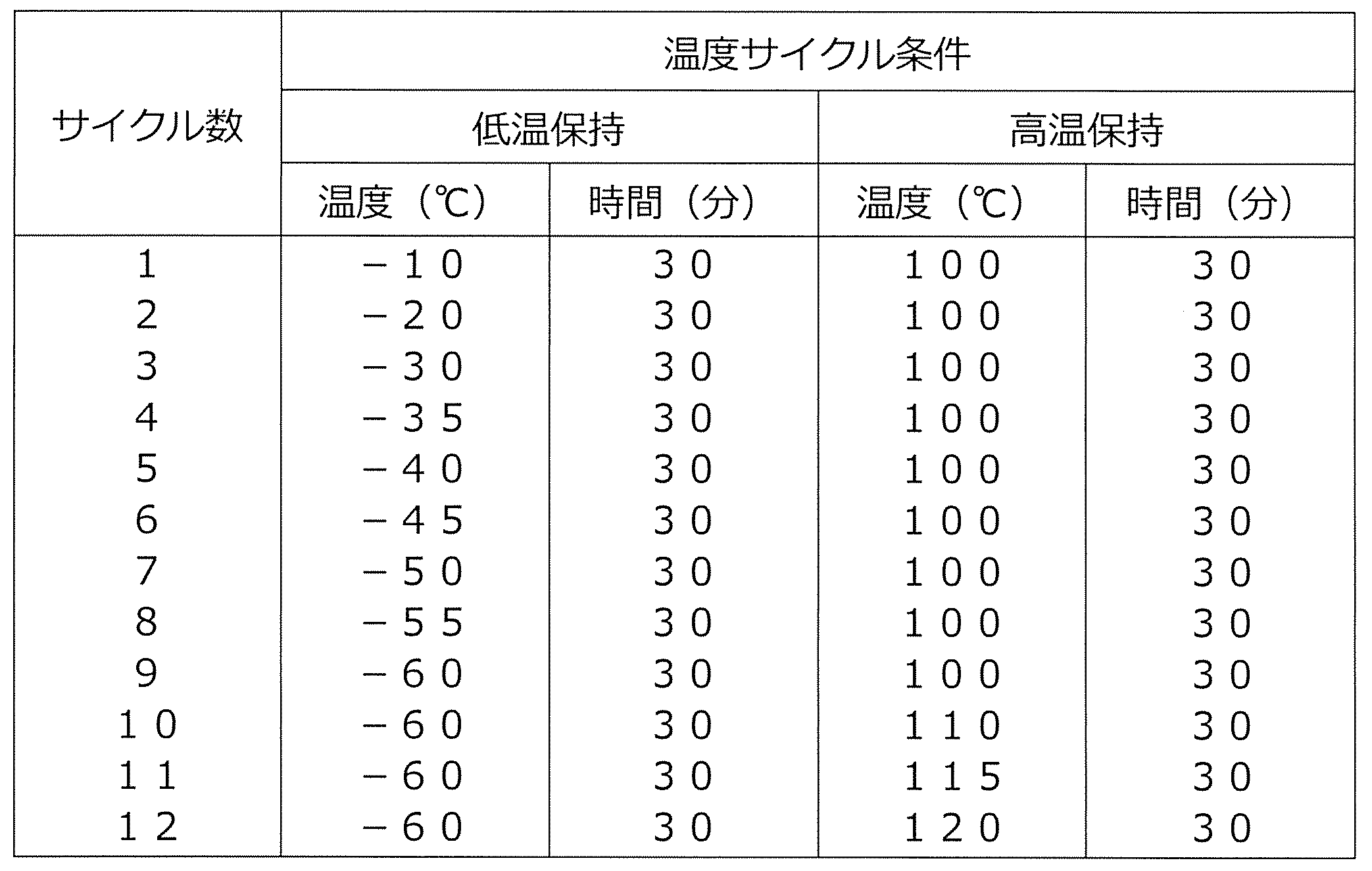
JIS C 2105規格、6.5.6.0A耐クラック性試験に従い、試験片を各7個作製し、表1に示す温度サイクル条件で冷熱サイクル性試験を行った。試験片のクラック性の評価判定は6.5.6.0Aに従って行い、試験片7個中に2個以上クラックが入ったサイクル数を測定し、次の3段階評価法によって評価した。
○:11サイクル以上、 △:7~10サイクル、 ×:6サイクル以下
JIS C 2105規格、6.5.6.0A耐クラック性試験に従い、試験片を各7個作製し、表1に示す温度サイクル条件で冷熱サイクル性試験を行った。試験片のクラック性の評価判定は6.5.6.0Aに従って行い、試験片7個中に2個以上クラックが入ったサイクル数を測定し、次の3段階評価法によって評価した。
○:11サイクル以上、 △:7~10サイクル、 ×:6サイクル以下
(6)電気特性(絶縁性):
JIS K 6911規格に従い、120℃における硬化物の体積固有抵抗値を測定し、次の2段階評価法にて、評価した。
○:120℃の体積固有抵抗値が、1013Ω・cm以上
×:120℃の体積固有抵抗値が、1013Ω・cm未満
JIS K 6911規格に従い、120℃における硬化物の体積固有抵抗値を測定し、次の2段階評価法にて、評価した。
○:120℃の体積固有抵抗値が、1013Ω・cm以上
×:120℃の体積固有抵抗値が、1013Ω・cm未満
(7)注型性:
注型用エポキシ樹脂組成物150gを、70℃で加熱した後、直ちに、90℃に予熱してある金型(隙間4mm、寸法160mmx180mm)に、常圧下で垂直方向より流し入れ、金型内への注型が完了するまでの時間(分)を測定した。なお、全く注入できなかった場合は「x」とした。
注型用エポキシ樹脂組成物150gを、70℃で加熱した後、直ちに、90℃に予熱してある金型(隙間4mm、寸法160mmx180mm)に、常圧下で垂直方向より流し入れ、金型内への注型が完了するまでの時間(分)を測定した。なお、全く注入できなかった場合は「x」とした。
実施例及び比較例で使用した略号の説明は以下のとおりである。
[エポキシ樹脂]
R1~R7、RH1~RH4:合成例1~7、比較合成例1~4で得られたエポキシ樹脂
A1:ビスフェノールA型液状エポキシ樹脂(日鉄ケミカル&マテリアル社製、エポトートYD-128、エポキシ当量187、n=0体含有量80面積%、n=2体以上の合計含有量2面積%)
A2:ビスフェノールF型液状エポキシ樹脂(日鉄ケミカル&マテリアル社製、エポトートYDF-170、エポキシ当量167g/eq、n=0体含有量70面積%、n=2体以上の合計含有量0.2面積%)
A3:テトラメチルビスフェノールF型結晶性エポキシ樹脂(日鉄ケミカル&マテリアル社製、エポトートYSLV-80XY、エポキシ当量187、n=0体含有量92面積%、n=2体以上の合計含有量0.3面積%、融点80℃)
A4:ビスフェノールF型固形エポキシ樹脂(日鉄ケミカル&マテリアル社製、エポトートYDF-2001、エポキシ当量485、n=0体含有量10面積%、n=2体以上の合計含有量75面積%)
A5:ビスフェノールF型固形エポキシ樹脂(日鉄ケミカル&マテリアル社製、エポトートYDF-2004、エポキシ当量950、n=0体含有量4面積%、n=2体以上の合計含有量90面積%)
A6:ビスフェノールA型固形エポキシ樹脂(日鉄ケミカル&マテリアル社製、エポトートYD-012、エポキシ当量620、n=0体含有量5面積%、n=2体以上の合計含有量85面積%)
[エポキシ樹脂]
R1~R7、RH1~RH4:合成例1~7、比較合成例1~4で得られたエポキシ樹脂
A1:ビスフェノールA型液状エポキシ樹脂(日鉄ケミカル&マテリアル社製、エポトートYD-128、エポキシ当量187、n=0体含有量80面積%、n=2体以上の合計含有量2面積%)
A2:ビスフェノールF型液状エポキシ樹脂(日鉄ケミカル&マテリアル社製、エポトートYDF-170、エポキシ当量167g/eq、n=0体含有量70面積%、n=2体以上の合計含有量0.2面積%)
A3:テトラメチルビスフェノールF型結晶性エポキシ樹脂(日鉄ケミカル&マテリアル社製、エポトートYSLV-80XY、エポキシ当量187、n=0体含有量92面積%、n=2体以上の合計含有量0.3面積%、融点80℃)
A4:ビスフェノールF型固形エポキシ樹脂(日鉄ケミカル&マテリアル社製、エポトートYDF-2001、エポキシ当量485、n=0体含有量10面積%、n=2体以上の合計含有量75面積%)
A5:ビスフェノールF型固形エポキシ樹脂(日鉄ケミカル&マテリアル社製、エポトートYDF-2004、エポキシ当量950、n=0体含有量4面積%、n=2体以上の合計含有量90面積%)
A6:ビスフェノールA型固形エポキシ樹脂(日鉄ケミカル&マテリアル社製、エポトートYD-012、エポキシ当量620、n=0体含有量5面積%、n=2体以上の合計含有量85面積%)
[硬化剤]
B1:3又は4-メチル-1,2,3,6-テトラヒドロ無水フタル酸(日立化成社製、HN-2200R、25℃における粘度=70mPa・s)
B1:3又は4-メチル-1,2,3,6-テトラヒドロ無水フタル酸(日立化成社製、HN-2200R、25℃における粘度=70mPa・s)
[無機充填剤]
C1:水酸化アルミニウム(住友化学社製、C-301N、BET比表面積=4.0m2/g、D50=1.5μm、D98=64μm)
C2:溶融シリカ(龍森社製、ヒューズレックスSY、D50=20μm、D98=96μm)
C3:溶融シリカ(龍森社製、ヒューズレックスRD-20、D50=7μm、D98=32μm)
C1:水酸化アルミニウム(住友化学社製、C-301N、BET比表面積=4.0m2/g、D50=1.5μm、D98=64μm)
C2:溶融シリカ(龍森社製、ヒューズレックスSY、D50=20μm、D98=96μm)
C3:溶融シリカ(龍森社製、ヒューズレックスRD-20、D50=7μm、D98=32μm)
[硬化促進剤]
D1:1-ベンジル-2-メチルイミダゾール(四国化成工業社製、キュアゾール1B2MZ)
D1:1-ベンジル-2-メチルイミダゾール(四国化成工業社製、キュアゾール1B2MZ)
[その他添加剤]
E1:分散剤(共栄社化学社製、フローレンG-700、重量平均分子量2,700、酸価60mgKOH/g)
E2:消泡剤(モメンティブ・パフォーマンス・マテリアルズ・ジャパン社製、TSA720)
E3:湿潤分散剤(ビックケミー社製、BYK-110)
E4:シランカップリング剤(モメンティブ・パフォーマンス・マテリアルズ・ジャパン社製、TSL-8350)
E5:着色剤(三菱ケミカル社製、MA-8)
E1:分散剤(共栄社化学社製、フローレンG-700、重量平均分子量2,700、酸価60mgKOH/g)
E2:消泡剤(モメンティブ・パフォーマンス・マテリアルズ・ジャパン社製、TSA720)
E3:湿潤分散剤(ビックケミー社製、BYK-110)
E4:シランカップリング剤(モメンティブ・パフォーマンス・マテリアルズ・ジャパン社製、TSL-8350)
E5:着色剤(三菱ケミカル社製、MA-8)
合成例1
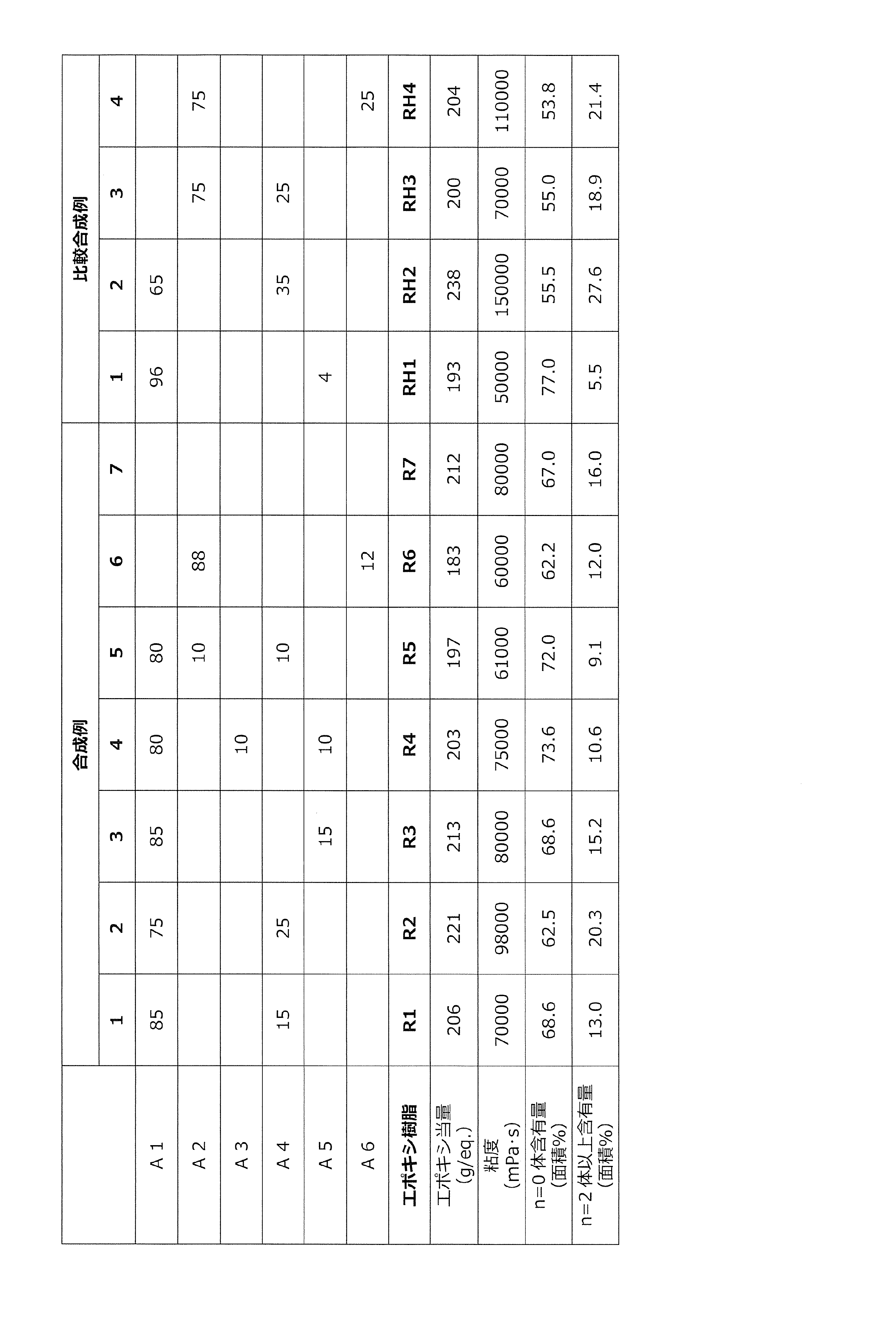
撹拌機及び窒素導入管を備えた反応容器に、A1を85部、A4を18部、室温にて仕込み、窒素を導入しながら、100℃まで昇温して均一混合して、エポキシ樹脂(R1)を得た。
撹拌機及び窒素導入管を備えた反応容器に、A1を85部、A4を18部、室温にて仕込み、窒素を導入しながら、100℃まで昇温して均一混合して、エポキシ樹脂(R1)を得た。
合成例2~6及び比較合成例1~4
表2に示す各原料の仕込み量(部)に従い、実施例1と同様操作を行い、エポキシ樹脂(R2~R6)、(RH1~RH4)を得た。
表2に示す各原料の仕込み量(部)に従い、実施例1と同様操作を行い、エポキシ樹脂(R2~R6)、(RH1~RH4)を得た。
合成例7
撹拌装置、温度計、及び窒素ガス導入装置を備えた反応容器に、室温下で、A1を159部、ビスフェノールF(日鉄ケミカル&マテリアル社製)を41部仕込み、窒素ガスを流し撹拌しながら130℃まで昇温し、n-ブチルトリフェニルホスホニウムブロミドを0.2部添加した後、160℃まで昇温し、同温度で2時間反応を行った。その後、A1を800部仕込み、更に160℃で2時間反応を行い、エポキシ樹脂(R7)を得た。
撹拌装置、温度計、及び窒素ガス導入装置を備えた反応容器に、室温下で、A1を159部、ビスフェノールF(日鉄ケミカル&マテリアル社製)を41部仕込み、窒素ガスを流し撹拌しながら130℃まで昇温し、n-ブチルトリフェニルホスホニウムブロミドを0.2部添加した後、160℃まで昇温し、同温度で2時間反応を行った。その後、A1を800部仕込み、更に160℃で2時間反応を行い、エポキシ樹脂(R7)を得た。
実施例1
合成例1で得られたエポキシ樹脂(R1)を100部、B1を80部、C1を12部、C2を22部、C3を230部、D1を0.5部、E1を6部、E2を0.2部、E3を1.9部、E4を0.5部、E5を1部、常温で1時間真空混練して注型用エポキシ樹脂組成物を得た。
合成例1で得られたエポキシ樹脂(R1)を100部、B1を80部、C1を12部、C2を22部、C3を230部、D1を0.5部、E1を6部、E2を0.2部、E3を1.9部、E4を0.5部、E5を1部、常温で1時間真空混練して注型用エポキシ樹脂組成物を得た。
得られた注型用エポキシ樹脂組成物を、80℃/6時間+130℃/10時間の条件で硬化させて硬化物を得た。
実施例2~7及び比較例1~4
表3に示す各原料の仕込み量(部)に従い、実施例1と同様操作を行い、注型用エポキシ樹脂組成物、及び硬化物を得た。なお、C1、C2、C3、D1、E1、E2、E3、E4、E5の配合量は、実施例1と同じである。
表3に示す各原料の仕込み量(部)に従い、実施例1と同様操作を行い、注型用エポキシ樹脂組成物、及び硬化物を得た。なお、C1、C2、C3、D1、E1、E2、E3、E4、E5の配合量は、実施例1と同じである。
実施例1~7及び比較例1~4で得られた注型用エポキシ樹脂組成物を用いて測定した注型性、硬化物を用いて測定したTg、耐熱衝撃性、及び絶縁性をそれぞれ表3に示す。

表3から、本発明の注形用エポキシ樹脂組成物は、含浸性(注型性)に優れ、耐熱衝撃性の優れた硬化物が得られることが確認された。
本発明の注型用エポキシ樹脂組成物は、電気・電子部品の注型及び絶縁封止に用いることで、優れた信頼性を与えることができ、例えば、小型モーターや自動車用のイグニッションコイル等の製造に有用である。
Claims (6)
- エポキシ樹脂、酸無水物、及び無機物充填剤を含む注型用エポキシ樹脂組成物であって、エポキシ樹脂が下記一般式(1)で表されるビスフェノール型エポキシ樹脂であり、ゲルパーミエーションクロマトグラフィー測定において、n=0体の含有量が60~75面積%であり、n=2体以上の含有量の合計が5~25面積%であり、無機充填材の平均粒径(D50)が0.2~50μmであリ、エポキシ樹脂100質量部に対して、無機充填材が50~500質量部である注型用エポキシ樹脂組成物。

- エポキシ樹脂の25℃における粘度が60000~100000mPa・sである請求項1に記載の注型用エポキシ樹脂組成物。
- エポキシ樹脂のエポキシ当量が180~250g/eq.である請求項1に記載の注型用エポキシ樹脂組成物。
- エポキシ樹脂がビスフェノールA型エポキシ樹脂とビスフェノールF型エポキシ樹脂の混合物である請求項1に記載の注型用エポキシ樹脂組成物。
- 酸無水物が液状であり、その25℃における粘度が30~500mPa・sである請求項1に記載の注型用エポキシ樹脂組成物。
- 請求項1に記載の注型用エポキシ樹脂組成物が注型されてなることを特徴とする電気・電子部品。
Priority Applications (1)
| Application Number | Priority Date | Filing Date | Title |
|---|---|---|---|
| JP2022509935A JPWO2021193166A1 (ja) | 2020-03-25 | 2021-03-12 |
Applications Claiming Priority (2)
| Application Number | Priority Date | Filing Date | Title |
|---|---|---|---|
| JP2020053661 | 2020-03-25 | ||
| JP2020-053661 | 2020-03-25 |
Publications (1)
| Publication Number | Publication Date |
|---|---|
| WO2021193166A1 true WO2021193166A1 (ja) | 2021-09-30 |
Family
ID=77891818
Family Applications (1)
| Application Number | Title | Priority Date | Filing Date |
|---|---|---|---|
| PCT/JP2021/010217 Ceased WO2021193166A1 (ja) | 2020-03-25 | 2021-03-12 | 注型用エポキシ樹脂組成物及び電気・電子部品 |
Country Status (3)
| Country | Link |
|---|---|
| JP (1) | JPWO2021193166A1 (ja) |
| TW (1) | TW202138422A (ja) |
| WO (1) | WO2021193166A1 (ja) |
Citations (4)
| Publication number | Priority date | Publication date | Assignee | Title |
|---|---|---|---|---|
| JPH05238799A (ja) * | 1992-02-21 | 1993-09-17 | Hitachi Chem Co Ltd | 人造大理石用エポキシ樹脂組成物、成形材料および人造大理石の製造法 |
| JPH09268222A (ja) * | 1996-03-29 | 1997-10-14 | Nippon Kayaku Co Ltd | エポキシ樹脂組成物 |
| JP2007197647A (ja) * | 2005-12-27 | 2007-08-09 | Sumitomo Electric Ind Ltd | 液状熱硬化性樹脂組成物、および接合材 |
| JP2015063629A (ja) * | 2013-09-26 | 2015-04-09 | 住友ベークライト株式会社 | エポキシ樹脂成形材料、モールドコイルの製造方法及びモールドコイル |
Family Cites Families (5)
| Publication number | Priority date | Publication date | Assignee | Title |
|---|---|---|---|---|
| JPH06100610A (ja) * | 1992-08-10 | 1994-04-12 | Nippon Shokubai Co Ltd | 重合体の製造方法、前記重合体を含む組成物ならびに前記組成物から誘導されるポリマー |
| JPH08319452A (ja) * | 1995-05-26 | 1996-12-03 | Mitsui Petrochem Ind Ltd | 缶塗料用高分子量エポキシ樹脂およびその製造方法 |
| JP3906122B2 (ja) * | 2002-07-03 | 2007-04-18 | ジャパンコンポジット株式会社 | 貯蔵安定性に優れた人造大理石用ビニルエステル樹脂組成物 |
| JP5179839B2 (ja) * | 2007-11-08 | 2013-04-10 | 株式会社ダイセル | エポキシ樹脂組成物、及びその硬化物 |
| JPWO2017131152A1 (ja) * | 2016-01-27 | 2018-11-29 | クラスターテクノロジー株式会社 | 白色リフレクター用硬化性エポキシ樹脂組成物及びその硬化物、光半導体素子搭載用基板、並びに光半導体装置 |
-
2021
- 2021-03-12 WO PCT/JP2021/010217 patent/WO2021193166A1/ja not_active Ceased
- 2021-03-12 JP JP2022509935A patent/JPWO2021193166A1/ja active Pending
- 2021-03-19 TW TW110110083A patent/TW202138422A/zh unknown
Patent Citations (4)
| Publication number | Priority date | Publication date | Assignee | Title |
|---|---|---|---|---|
| JPH05238799A (ja) * | 1992-02-21 | 1993-09-17 | Hitachi Chem Co Ltd | 人造大理石用エポキシ樹脂組成物、成形材料および人造大理石の製造法 |
| JPH09268222A (ja) * | 1996-03-29 | 1997-10-14 | Nippon Kayaku Co Ltd | エポキシ樹脂組成物 |
| JP2007197647A (ja) * | 2005-12-27 | 2007-08-09 | Sumitomo Electric Ind Ltd | 液状熱硬化性樹脂組成物、および接合材 |
| JP2015063629A (ja) * | 2013-09-26 | 2015-04-09 | 住友ベークライト株式会社 | エポキシ樹脂成形材料、モールドコイルの製造方法及びモールドコイル |
Also Published As
| Publication number | Publication date |
|---|---|
| TW202138422A (zh) | 2021-10-16 |
| JPWO2021193166A1 (ja) | 2021-09-30 |
Similar Documents
| Publication | Publication Date | Title |
|---|---|---|
| JP6030126B2 (ja) | 絶縁配合物 | |
| JP2010523747A (ja) | 硬化性エポキシ樹脂組成物 | |
| US20120025151A1 (en) | Curable epoxy resin composition | |
| EP2751202B1 (en) | Use of hydrophobic epoxide resin system for encapsulation of a instrument transformer | |
| JP7687499B2 (ja) | アンダーフィル材、電子部品装置及び電子部品装置の製造方法 | |
| US5106947A (en) | Curable composition based on cycloaliphatic epoxy resins | |
| TWI801488B (zh) | 樹脂組成物及其硬化物、電子零件用接著劑、半導體裝置,以及電子零件 | |
| KR100546716B1 (ko) | 저온 경화성 에폭시 수지를 이용한 분체도료용 조성물 | |
| TWI896622B (zh) | 注塑用環氧樹脂組成物及電氣電子零件 | |
| JP3735896B2 (ja) | エポキシ樹脂組成物及び半導体封止材料 | |
| WO2021193166A1 (ja) | 注型用エポキシ樹脂組成物及び電気・電子部品 | |
| TWI910752B (zh) | 環氧樹脂用硬化劑、環氧樹脂組合物、硬化物、密封材料及接著劑 | |
| JP5086678B2 (ja) | 液状半導体封止剤、及びこれを用いて封止した半導体装置 | |
| JP4322047B2 (ja) | 電気絶縁用注型エポキシ樹脂組成物及び硬化物 | |
| JP7295826B2 (ja) | エポキシ樹脂組成物 | |
| JP2004143362A (ja) | 低粘度エポキシ樹脂組成物 | |
| JP4517182B2 (ja) | 注型用エポキシ樹脂組成物 | |
| JP2014196488A (ja) | エポキシ樹脂組成物および硬化物 | |
| JP2018012745A (ja) | 注型用エポキシ樹脂組成物及び電気・電子部品 | |
| JP2560469B2 (ja) | エポキシ系樹脂組成物 | |
| KR20030056495A (ko) | 몰드변압기용 에폭시 수지 조성물 및 그의 제조방법 | |
| JP2025038882A (ja) | イミド基含有エポキシ樹脂及びこれを含有する硬化性エポキシ樹脂組成物 | |
| WO2025052983A1 (ja) | イミド基含有エポキシ樹脂及びこれを含有する硬化性エポキシ樹脂組成物 | |
| JPH03157420A (ja) | 熱硬化性エポキシ樹脂組成物、エポキシ樹脂注型材料及びモールドコイル | |
| KR100479856B1 (ko) | 캐비티 다운형 볼그리드어레이 패키지용 액상 에폭시 수지조성물 |
Legal Events
| Date | Code | Title | Description |
|---|---|---|---|
| 121 | Ep: the epo has been informed by wipo that ep was designated in this application |
Ref document number: 21774919 Country of ref document: EP Kind code of ref document: A1 |
|
| ENP | Entry into the national phase |
Ref document number: 2022509935 Country of ref document: JP Kind code of ref document: A |
|
| NENP | Non-entry into the national phase |
Ref country code: DE |
|
| 122 | Ep: pct application non-entry in european phase |
Ref document number: 21774919 Country of ref document: EP Kind code of ref document: A1 |