WO2021192037A1 - スキル出力装置、スキル出力方法およびスキル出力プログラム - Google Patents
スキル出力装置、スキル出力方法およびスキル出力プログラム Download PDFInfo
- Publication number
- WO2021192037A1 WO2021192037A1 PCT/JP2020/013031 JP2020013031W WO2021192037A1 WO 2021192037 A1 WO2021192037 A1 WO 2021192037A1 JP 2020013031 W JP2020013031 W JP 2020013031W WO 2021192037 A1 WO2021192037 A1 WO 2021192037A1
- Authority
- WO
- WIPO (PCT)
- Prior art keywords
- skill
- output
- learner
- proficiency level
- threshold value
- Prior art date
- Legal status (The legal status is an assumption and is not a legal conclusion. Google has not performed a legal analysis and makes no representation as to the accuracy of the status listed.)
- Ceased
Links
Images




Classifications
-
- G—PHYSICS
- G09—EDUCATION; CRYPTOGRAPHY; DISPLAY; ADVERTISING; SEALS
- G09B—EDUCATIONAL OR DEMONSTRATION APPLIANCES; APPLIANCES FOR TEACHING, OR COMMUNICATING WITH, THE BLIND, DEAF OR MUTE; MODELS; PLANETARIA; GLOBES; MAPS; DIAGRAMS
- G09B7/00—Electrically-operated teaching apparatus or devices working with questions and answers
- G09B7/02—Electrically-operated teaching apparatus or devices working with questions and answers of the type wherein the student is expected to construct an answer to the question which is presented or wherein the machine gives an answer to the question presented by a student
- G09B7/04—Electrically-operated teaching apparatus or devices working with questions and answers of the type wherein the student is expected to construct an answer to the question which is presented or wherein the machine gives an answer to the question presented by a student characterised by modifying the teaching program in response to a wrong answer, e.g. repeating the question or supplying a further explanation
-
- G—PHYSICS
- G06—COMPUTING OR CALCULATING; COUNTING
- G06Q—INFORMATION AND COMMUNICATION TECHNOLOGY [ICT] SPECIALLY ADAPTED FOR ADMINISTRATIVE, COMMERCIAL, FINANCIAL, MANAGERIAL OR SUPERVISORY PURPOSES; SYSTEMS OR METHODS SPECIALLY ADAPTED FOR ADMINISTRATIVE, COMMERCIAL, FINANCIAL, MANAGERIAL OR SUPERVISORY PURPOSES, NOT OTHERWISE PROVIDED FOR
- G06Q50/00—Information and communication technology [ICT] specially adapted for implementation of business processes of specific business sectors, e.g. utilities or tourism
- G06Q50/10—Services
- G06Q50/20—Education
Definitions
- the present invention relates to a skill output device, a skill output method, and a skill output program that output the skill status of a learner.
- Knowledge tracing visualizes the learner's skills to grasp the learning situation in real time, predicts whether or not the problem can be solved, and provides the optimum problem for the learner.
- the proficiency level of each student's learning content is grasped in detail to support effective review, and exercises optimized for the proficiency level of each student's learning content are optimized.
- the test creation server that creates the collection is listed.
- Non-Patent Document 1 describes interpretable knowledge tracing by a probabilistic model having a non-compensated item response model.
- AI Artificial Intelligence
- a learning method in which the learner can independently decide what to study while interacting with the AI that is, a learning method in which the learner can independently master the AI. For that purpose, it is necessary to feed back information so that the learner can independently think about how to deal with his / her weaknesses.
- the test creation server described in Patent Document 1 has " ⁇ (a circle indicating all correct answers)” and “ ⁇ (some incorrect answers) according to the ratio of the number of correct answers to the number of questions given in the small unit.
- the learning achievement rate is displayed in three stages: “triangle indicating”) and "x (cross indicating incorrect answers to all questions)”.
- the display content described in Patent Document 1 only displays the results of correct or incorrect answers, it is possible to grasp how much the skill for solving the question is satisfied. It is not possible.
- an object of the present invention is to provide a skill output device, a skill output method, and a skill output program capable of expressing the skill satisfaction status of a learner necessary for solving a problem.
- the skill output device provides an output means for outputting a threshold value indicating the skill proficiency required for solving a target problem and a skill proficiency assumed to be possessed by the learner in association with each other. It is characterized by being prepared.
- the computer outputs a threshold value indicating the proficiency level of the skill required to solve the target problem in association with the proficiency level of the skill assumed to be possessed by the learner. It is characterized by being characterized by that.
- the skill output program outputs to a computer in association with a threshold indicating the proficiency level of the skill required to solve the target problem and the proficiency level of the skill assumed to be possessed by the learner. It is characterized in that output processing is executed.
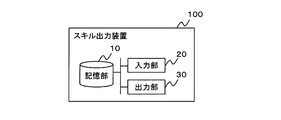
- FIG. 1 is a block diagram showing a configuration example of an embodiment of the skill output device according to the present invention.
- the skill output device 100 of the present embodiment includes a storage unit 10, an input unit 20, and an output unit 30.
- the storage unit 10 stores various information used for processing by the skill output device 100 of the present embodiment. Specifically, the storage unit 10 stores the skills required to solve each problem.
- FIG. 2 is an explanatory diagram showing an example of associating a problem with a necessary skill. In the example shown in FIG. 2, an example in which a problem and a skill required to solve the problem are associated with each other in a table format is shown. As illustrated in FIG. 2, the skills required for each question may be one or two or more. The correspondence between the problem and the necessary skill is set in advance by the user or the like.
- the storage unit 10 stores information for specifying a value (hereinafter, referred to as a threshold value) indicating the proficiency level of the skill required to solve the target problem. It should be noted that this threshold value can be said to be the difficulty level of the problem.
- the storage unit 10 may store the threshold value itself set individually for each skill required to solve each problem. Further, even if the storage unit 10 is a model learned based on the learner's past learning achievements and stores a probability model representing a distribution of correct answer probabilities according to the proficiency level of the skill possessed by the learner. good. When such a probability model is stored, the threshold value can be specified by setting the correct answer probability to an arbitrary value (for example, 80%). Further, the storage unit 10 may memorize the proficiency level of the skill in the learner.
- Non-Patent Document 1 a method for specifying a threshold value using a probability model will be described using the non-compensated item response model described in Non-Patent Document 1 as an example.
- a model described in Non-Patent Document 1 is called an uncompensated model in multidimensional item response theory. It can be said that the explanation of the reason for prediction using this uncompensated model is natural.
- the uncompensated model will be described with reference to specific examples.
- the skill s 1 of the fraction is considered to be a necessary skill s 2 of the equation.
- the model that predicts the correct answer probability is represented by the product of each skill.
- the prediction model can be expressed as follows using the sigmoid function ⁇ .
- the explanation is high because it is interpreted that "the above problem cannot be solved without knowledge of fractions and equations".
- Equation 1 a model representing the probability that the learner can solve the problem i can be defined by, for example, Equation 1 illustrated below. That is, the model illustrated in Equation 1 is represented by a combination of skills k required by the learner to solve the problem i, and the probability of solving the problem is calculated by the product of each skill.
- the learner's state z represents the proficiency level of each skill k possessed by the learner at a certain point in time.
- Equation 1 bi and k represent the difficulty level of the skill k used in the problem i, and ai and k are parameters representing the degree of rise (slope) of the skill k related to the problem i. That is, Equation 1, b i, the higher the skill level z k skills than difficulty indicating k is, indicating that a problem with a high probability can be solved.
- FIG. 3 is an explanatory diagram showing an example of the likelihood function of the correct answer probability.
- the vertical axis (z-axis) shows the probability of correct answer
- the other axes (x-axis and y-axis) show the proficiency level of the skill required to solve the problem.
- the likelihood function illustrated in FIG. 3 is represented by the equation 1 illustrated above. For example, suppose that two skills are required to solve a problem, as illustrated in FIG. In this case, it is shown that the correct answer probability does not increase even if only one skill is high, but the correct answer probability increases when both skills are high.
- the model used to specify the threshold value is not limited to the non-compensation type model as described above, and the content is arbitrary as long as it is a model that can specify the skill required to solve each problem.
- the storage unit 10 may store the target problem itself (for example, a problem sentence or a figure).
- the storage unit 10 is realized by a magnetic disk or the like.
- the input unit 20 accepts input of information for specifying the proficiency level of the skill assumed to be possessed by the learner.
- the input unit 20 may acquire the skill proficiency level of the target learner from the storage unit 10. Further, the input unit 20 may also accept the input of the uncertainty degree of the skill possessed by the learner. When the state representing the learner's skill follows a Gaussian distribution, the uncertainty of the learner's skill may be calculated by the output unit 30 described later.
- the input unit 20 accepts input of information for specifying a threshold value indicating the proficiency level of the skill required to solve the target problem.
- the input unit 20 may acquire the threshold value from the storage unit 10 or may acquire the model information used for calculating the threshold value.
- the output unit 30 outputs the satisfaction status of the learner's skills necessary for solving the problem. Specifically, the output unit 30 outputs the skill proficiency required to solve the target problem (that is, the threshold value) in association with the skill proficiency assumed to be possessed by the learner. do. When a plurality of skills are required to solve a problem, the output unit 30 has a threshold value for each of the plurality of skills required to solve the target problem, and a plurality of skills assumed to be possessed by the learner. The skill proficiency level is output in association with each skill.
- the method by which the output unit 30 outputs the skill satisfaction status is arbitrary.
- the output unit 30 may output the skill satisfaction status in a graph format, for example, or may output the skill satisfaction status as a sentence.
- FIG. 4 is an explanatory diagram showing an example in which the skill satisfaction status is output as a graph.
- the dotted line 101 represents the threshold value
- the bar graph 102 represents the skill proficiency level.
- the threshold value is, for example, "proficiency level satisfying 80% of the correct answer probability".
- the threshold value is output to the position of the same proficiency level for all skills, but the threshold value position may be different from each other.
- the graph format is not limited to the bar graph as illustrated in FIG. 4, and may be a line graph, a radar chart, or the like.
- the output unit 30 outputs the proficiency level of the skill assumed to be possessed by the learner and the threshold value in association with each other to indicate the satisfaction status of the learner's skill necessary for solving the problem. Can be done. Therefore, the learner can grasp how much he / she is satisfied with the skill for solving the question.
- the output unit 30 may output the proficiency level of the skill assumed to be possessed by the learner and the uncertainty level of the proficiency level together.
- the output unit 30 may output the uncertainty degree received by the input unit 20, or may output the calculation result based on the uncertainty degree of the learner's state. The method of calculating the uncertainty of the learner will be described later.
- FIG. 5 is an explanatory diagram showing another example in which the skill satisfaction status is output as a graph.
- the uncertainty degree representing the variable state of the skill is shown by the line 103, and the line 103 is superimposed and displayed on the bar graph 102.
- the output unit 30 may output the skill proficiency and the uncertainty in combination by such a method.
- the output unit 30 uses a model representing the distribution of the correct answer probabilities of each problem according to the learner's skill proficiency, and uses the threshold value of each skill calculated by the designated correct answer probabilities and the relative to the threshold value. You may output the skill proficiency of a learner.
- FIG. 6 is an explanatory diagram schematically showing information of the uncompensated model.
- the x mark 113 shown at the lower left of the graph indicates the current state of the learner's skill. Further, the ellipse 114 surrounding the x mark 113 indicates a contour line of the probability when the distribution of the learner's skill state follows the Gaussian distribution. In this case, the position of the learner's skill state corresponds to the mean in the Gaussian distribution.
- the output unit 30 calculates the threshold value.
- the threshold value calculated here corresponds to the threshold value indicated by the dotted line 101 illustrated in FIG.
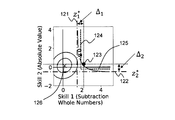
- FIG. 7 is an explanatory diagram showing an example of processing for calculating the threshold value.
- the output unit 30 calculates the coordinates z k * for each dimension. For example, the output unit 30 calculates z k * based on the above formula 1 and using the formula 2 illustrated below.
- Equation 2 represents the correctness probability
- a i and b i are similar to the equation 1, respectively, showing the slope and difficulty.
- the z k * calculated here corresponds to the coordinates of the surface tangent to the likelihood function illustrated in FIG. 3 from the outside, and corresponds to the long chain lines 121 and 122 in FIG. 7.
- ⁇ is the difference between z k * and z ⁇ calculated for each dimension.
- the z ⁇ calculated here corresponds to the coordinates of the surface tangent to the likelihood function illustrated in FIG. 3 from the inside, and corresponds to the coordinates of the point 123 in FIG. 7.
- the output unit 30 repeats the following two processes when calculating the coordinates z ⁇ . First, as the first process, the output unit 30 sets the output unit 30 as an initial point. To calculate. Then, the output unit 30 calculates the value of each ⁇ k based on this z k. Then, the output unit 30, as the second process, the dimension k for the largest delta k, updating shown in Equation 3 below. Note that ⁇ is a parameter and is predetermined.
- the output unit 30 sets z kmax after the update to z', and updates the dimension k for the smallest ⁇ k as shown in the following equation 4.
- the output unit 30 repeats these two processes until a predetermined condition (for example, the amount of change is less than the threshold value, a predetermined number of times, etc.) is satisfied.
- the output unit 30 approximates the region to a rectangle by calculating (z ⁇ k ⁇ z k *) / 2 for each k.
- the values calculated here correspond to the coordinates of the dashed lines 124 and 125 in FIG.
- the output unit 30 outputs a bar graph based on the ratio of the learner's skill proficiency to the value indicated by the rectangular approximated coordinates. Specifically, the output unit 30 may output a bar graph based on the ratio of the coordinates 126 indicating the state of the learner's skill to the coordinates indicated by the broken lines 124 and 125. Further, the output unit 30 may also output the uncertainty degree of the learner's skill state.
- FIG. 8 is an explanatory diagram showing an example of a process for visualizing the result. For example, if the learner's skill state for skill 1 (integer subtraction) is estimated to be z 1 2 and the variance ⁇ ⁇ of the skill state in the Gaussian distribution is z 1 1 and z 1 3 respectively. do. Then, the coordinates of the broken line 124 in FIG. 7 is calculated as z 1 4. At this time, the output unit 30 sets the learner's proficiency level of skill 1 to ⁇ ( ai, 1 (z 1 2- bi , 1 )) / ⁇ ( ai, 1 (z 1 4- bi , 1)). Calculate in 1 )).
- the output unit 30 may output the variance of the Gaussian distribution as the uncertainty of the proficiency level by using the distribution indicating the state of the learner's skill estimated by the Gaussian distribution.
- the output unit 30 the range of uncertainty, ⁇ (a i, 1 ( z 1 1 -b i, 1)) / ⁇ (a i, 1 (z 1 4 -b i, 1 )) and ⁇ (a i, 1 (z 1 3 -b i, 1)) / ⁇ (a i, 1 (z 1 4 -b i, 1)) is calculated at.
- skill 2 absolute value
- the output unit 30 calculates the relative skill proficiency and uncertainty when the threshold value is 1. That is, the output unit 30 expresses the proficiency level and the uncertainty level of the current learner's skill with respect to the threshold value as relative values in association with the skill name. Therefore, the excess or deficiency of the learner's skill can be presented based on the skill name that the learner can understand. Further, the output unit 30 can improve the learner's sense of conviction by expressing the uncertainty of each skill together.
- the output unit 30 identifies a skill whose proficiency level does not satisfy the threshold value (hereinafter, may be referred to as a causal skill), and sets a candidate problem that requires the specified skill as a "recommended problem". It may be output. Specifically, the output unit 30 may specify a candidate for a problem that requires the causative skill from a table in which the problem as illustrated in FIG. 2 and the skill required to solve the problem are associated with each other. good. Further, the output unit 30 may output not only a problem that requires only the causative skill but also a problem that requires the same combination of skills as the wrong problem as a candidate.
- the output unit 30 may output only the problems having a difficulty level within a predetermined range among the identified problem candidates.
- the output unit 30 is, for example, the problem of difficulty corresponding to z 1 4 from z 1 1 illustrated in FIG. 8, may be output as a candidate.
- a predetermined range for example, z 1 2 z 1 4 from was added to the difficulty problems may be a predetermined number of output before and after difficulty of problems that range ..
- the output unit 30 may output the problem candidates based on the difficulty level.
- the storage unit 10 when storing the uncompensated model as described above, since the difficulty is equivalent to b i, the output unit 30 outputs the candidate in question on the basis of the b i You may.
- FIG. 9 is an explanatory diagram showing an output example of the recommended problem.
- the output unit 30 identifies the skills in "Integer subtractive" is insufficient, problems that require skills identified candidates (recommended problem: Q 13, Q 18, the Q 31), the extent (i.e., in need of such skills, indicating that the learning level, and outputs the ordering depending on the difficulty level). Further, as illustrated in FIG. 9, when the learner mouses over the recommended question number with a pointing device such as a mouse, the output unit 30 may output the question corresponding to the number.
- the input unit 20 and the output unit 30 are realized by a computer processor (for example, CPU (Central Processing Unit), GPU (Graphics Processing Unit)) that operates according to a program (skill output program).
- a computer processor for example, CPU (Central Processing Unit), GPU (Graphics Processing Unit)
- CPU Central Processing Unit
- GPU Graphics Processing Unit
- the program may be stored in the storage unit 10, and the processor may read the program and operate as the input unit 20 and the output unit 30 according to the program. Further, the functions of the input unit 20 and the output unit 30 may be provided in the SaaS (Software as a Service) format.
- SaaS Software as a Service
- the input unit 20 and the output unit 30 may be realized by dedicated hardware, respectively.
- a part or all of each component of each device may be realized by a general-purpose or dedicated circuit (circuitry), a processor, or a combination thereof. These may be composed of a single chip or may be composed of a plurality of chips connected via a bus.
- a part or all of each component of each device may be realized by a combination of the above-mentioned circuit or the like and a program.
- each component of the input unit 20 and the output unit 30 may be realized by a plurality of information processing devices and circuits
- the plurality of information processing devices and circuits may be centrally arranged. It may be arranged in a distributed manner.
- the information processing device, the circuit, and the like may be realized as a form in which each of the client-server system, the cloud computing system, and the like is connected via a communication network.
- FIG. 10 is a flowchart showing an operation example of the skill output device 100 of the present embodiment.
- the input unit 20 accepts input of information for specifying the threshold value and the skill level of the skill (step S11).
- the output unit 30 outputs the specified threshold value and the skill level in association with each other (step S12).
- FIG. 11 is an explanatory diagram showing a specific example of a learning method using the skill output device 100.
- the skill output device 100 outputs a problem to the learner (step S21).
- the learner answers the output question.
- the skill output device 100 outputs the wrong problem in association with the threshold value of the skill proficiency level and the learner's skill proficiency level (step S23).
- the learner confirms the proficiency level of his / her skill (step S24).
- the skill output device 100 outputs a candidate problem that requires a skill determined to be insufficient as a recommended problem (step S25). After confirming the lacking skills, the learner selects a question that he / she deems necessary from the recommended questions presented (step S26). The output unit 30 outputs the selected problem to the learner (step S27). After that, the processes after step S22 are repeated.
- the output unit 30 corresponds to the threshold value indicating the proficiency level of the skill required to solve the target problem and the proficiency level of the skill assumed to be possessed by the learner. Attach and output. Therefore, it is possible to show the fulfillment status of the learner's skills necessary for solving the problem.
- the output unit 30 outputs the quantified threshold value and the skill proficiency level in association with each other. Therefore, the learner can grasp how much skill proficiency is required to solve the problem and how proficiency his / her own skill has reached.
- FIG. 12 is a block diagram showing an outline of the skill output device according to the present invention.
- the skill output device 80 (for example, the skill output device 100) according to the present invention has a threshold indicating the proficiency level of the skill required to solve the target problem, and the proficiency level of the skill assumed to be possessed by the learner. It is provided with an output means 81 (for example, an output unit 30) that outputs in association with the above.
- the output means 81 associates the threshold value for each of the plurality of skills required to solve the target problem with the proficiency level of the plurality of skills assumed to be possessed by the learner for each skill. It may be output.
- the output means 81 may output the proficiency level of the skill assumed to be possessed by the learner and the uncertainty level of the proficiency level together.
- the output means 81 may specify a skill whose proficiency level does not satisfy the threshold value, and output a candidate problem that requires the specified skill.
- the output means 81 may output the problem candidates that require the specified skill in order according to the degree to which the skill is required.
- the output means 81 uses a model (for example, an uncompensated model) that represents the distribution of the correct answer probabilities of each problem according to the learner's skill proficiency, and each skill calculated by the designated correct answer probabilities. And the proficiency level of the learner's skill relative to the threshold may be output.
- a model for example, an uncompensated model
- the output means 81 may output the threshold value and proficiency level of each skill using a non-compensated model.
- the output means 81 may output the variance of the Gaussian distribution as the uncertainty of the proficiency level by using the distribution indicating the state of the learner's skill estimated by the Gaussian distribution.
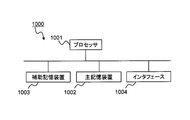
- FIG. 13 is a schematic block diagram showing a configuration of a computer according to at least one embodiment.
- the computer 1000 includes a processor 1001, a main storage device 1002, an auxiliary storage device 1003, and an interface 1004.
- the skill output device 80 described above is mounted on the computer 1000.
- the operation of each processing unit described above is stored in the auxiliary storage device 1003 in the form of a program (skill output program).
- the processor 1001 reads a program from the auxiliary storage device 1003, deploys it to the main storage device 1002, and executes the above processing according to the program.
- the auxiliary storage device 1003 is an example of a non-temporary tangible medium.
- non-temporary tangible media include magnetic disks, magneto-optical disks, CD-ROMs (Compact Disc Read-only memory), DVD-ROMs (Read-only memory), which are connected via interface 1004. Examples include semiconductor memory.
- the program may be for realizing a part of the above-mentioned functions. Further, the program may be a so-called difference file (difference program) that realizes the above-mentioned function in combination with another program already stored in the auxiliary storage device 1003.
- difference file difference program
- An output means for outputting the threshold value indicating the proficiency level of the skill required to solve the target problem and the proficiency level of the skill assumed to be possessed by the learner is provided.
- a skill output device featuring.
- the output means corresponds to the threshold value for each of the plurality of skills required to solve the target problem and the proficiency level of the plurality of skills that the learner is supposed to have for each skill.
- the skill output device described in Appendix 1 that is attached and output.
- Appendix 3 The skill output device according to Appendix 1 or Appendix 2, which outputs the proficiency level of the skill assumed to be possessed by the learner and the uncertainty level of the proficiency level together.
- the output means identifies a skill whose proficiency does not satisfy the threshold value, and outputs a candidate for a problem that requires the specified skill.
- Appendix 5 The skill output device according to Appendix 4, wherein the output means outputs problem candidates that require the specified skill in order according to the degree to which the skill is required.
- the output means uses a model representing the distribution of the correct answer probabilities of each question according to the learner's skill proficiency, and uses the specified correct answer probabilities to calculate the threshold value of each skill and the threshold value.
- the skill output device according to any one of Appendix 1 to Appendix 5, which outputs the relative proficiency level of the learner's skill.
- Appendix 7 The skill output device according to Appendix 6, wherein the output means uses a non-compensated model to output the threshold value and proficiency level of each skill.
- the output means uses a distribution indicating the state of the learner's skill estimated by the Gaussian distribution, and outputs the variance of the Gaussian distribution as the uncertainty of the proficiency level. Output device.
- the feature is that the computer outputs the threshold value indicating the proficiency level of the skill required to solve the target problem in association with the proficiency level of the skill assumed to be possessed by the learner. Skill output method.
- the computer associates the threshold value for each of the plurality of skills required to solve the target problem with the proficiency level of the plurality of skills assumed to be possessed by the learner for each skill.
- Appendix 12 Skills of the thresholds for each of the plurality of skills required to solve the target problem and the proficiency level of the plurality of skills assumed to be possessed by the learner in the output processing on the computer.
Landscapes
- Engineering & Computer Science (AREA)
- Business, Economics & Management (AREA)
- Theoretical Computer Science (AREA)
- Physics & Mathematics (AREA)
- Educational Administration (AREA)
- Educational Technology (AREA)
- General Physics & Mathematics (AREA)
- Tourism & Hospitality (AREA)
- Health & Medical Sciences (AREA)
- Economics (AREA)
- General Health & Medical Sciences (AREA)
- Human Resources & Organizations (AREA)
- Marketing (AREA)
- Primary Health Care (AREA)
- Strategic Management (AREA)
- General Business, Economics & Management (AREA)
- Electrically Operated Instructional Devices (AREA)
- Management, Administration, Business Operations System, And Electronic Commerce (AREA)
Priority Applications (3)
| Application Number | Priority Date | Filing Date | Title |
|---|---|---|---|
| PCT/JP2020/013031 WO2021192037A1 (ja) | 2020-03-24 | 2020-03-24 | スキル出力装置、スキル出力方法およびスキル出力プログラム |
| US17/801,876 US20230100924A1 (en) | 2020-03-24 | 2020-03-24 | Skill output device, skill output method, and skill output program |
| JP2022509832A JP7409481B2 (ja) | 2020-03-24 | 2020-03-24 | スキル出力装置、スキル出力方法およびスキル出力プログラム |
Applications Claiming Priority (1)
| Application Number | Priority Date | Filing Date | Title |
|---|---|---|---|
| PCT/JP2020/013031 WO2021192037A1 (ja) | 2020-03-24 | 2020-03-24 | スキル出力装置、スキル出力方法およびスキル出力プログラム |
Publications (1)
| Publication Number | Publication Date |
|---|---|
| WO2021192037A1 true WO2021192037A1 (ja) | 2021-09-30 |
Family
ID=77891225
Family Applications (1)
| Application Number | Title | Priority Date | Filing Date |
|---|---|---|---|
| PCT/JP2020/013031 Ceased WO2021192037A1 (ja) | 2020-03-24 | 2020-03-24 | スキル出力装置、スキル出力方法およびスキル出力プログラム |
Country Status (3)
| Country | Link |
|---|---|
| US (1) | US20230100924A1 (https=) |
| JP (1) | JP7409481B2 (https=) |
| WO (1) | WO2021192037A1 (https=) |
Families Citing this family (1)
| Publication number | Priority date | Publication date | Assignee | Title |
|---|---|---|---|---|
| KR102669921B1 (ko) * | 2022-01-24 | 2024-05-30 | 비트루브 주식회사 | 사용자의 개념 이해도에 관한 정보를 제공하기 위한 방법, 시스템 및 비일시성의 컴퓨터 판독 가능 기록 매체 |
Citations (5)
| Publication number | Priority date | Publication date | Assignee | Title |
|---|---|---|---|---|
| JP2005250423A (ja) * | 2004-03-08 | 2005-09-15 | Haruhiko Nitta | 語学学習システム |
| JP2008058687A (ja) * | 2006-08-31 | 2008-03-13 | Casio Comput Co Ltd | 情報表示装置及び情報表示プログラム |
| US20110091859A1 (en) * | 2009-10-20 | 2011-04-21 | Hall David A | Method for Online Learning |
| JP2017090554A (ja) * | 2015-11-04 | 2017-05-25 | 株式会社エジュテックジャパン | 学習支援システム及びプログラム |
| JP2019061000A (ja) * | 2017-09-26 | 2019-04-18 | カシオ計算機株式会社 | 学習支援装置、学習支援システム、学習支援方法及びプログラム |
Family Cites Families (6)
| Publication number | Priority date | Publication date | Assignee | Title |
|---|---|---|---|---|
| WO2005017688A2 (en) * | 2003-08-11 | 2005-02-24 | George Dale Grayson | Method and apparatus for teaching |
| US20120208166A1 (en) * | 2011-02-16 | 2012-08-16 | Steve Ernst | System and Method for Adaptive Knowledge Assessment And Learning |
| WO2015064840A1 (ko) * | 2013-11-01 | 2015-05-07 | 주식회사 테라클 | 학습자 맞춤형 학습 서비스 제공 서버 및 방법 |
| US10354544B1 (en) * | 2015-02-20 | 2019-07-16 | Snapwiz Inc. | Predicting student proficiencies in knowledge components |
| US10424217B1 (en) * | 2015-12-22 | 2019-09-24 | Educational Testing Service | Systems and methods for ability-appropriate text generation |
| US10319255B2 (en) * | 2016-11-08 | 2019-06-11 | Pearson Education, Inc. | Measuring language learning using standardized score scales and adaptive assessment engines |
-
2020
- 2020-03-24 US US17/801,876 patent/US20230100924A1/en active Pending
- 2020-03-24 JP JP2022509832A patent/JP7409481B2/ja active Active
- 2020-03-24 WO PCT/JP2020/013031 patent/WO2021192037A1/ja not_active Ceased
Patent Citations (5)
| Publication number | Priority date | Publication date | Assignee | Title |
|---|---|---|---|---|
| JP2005250423A (ja) * | 2004-03-08 | 2005-09-15 | Haruhiko Nitta | 語学学習システム |
| JP2008058687A (ja) * | 2006-08-31 | 2008-03-13 | Casio Comput Co Ltd | 情報表示装置及び情報表示プログラム |
| US20110091859A1 (en) * | 2009-10-20 | 2011-04-21 | Hall David A | Method for Online Learning |
| JP2017090554A (ja) * | 2015-11-04 | 2017-05-25 | 株式会社エジュテックジャパン | 学習支援システム及びプログラム |
| JP2019061000A (ja) * | 2017-09-26 | 2019-04-18 | カシオ計算機株式会社 | 学習支援装置、学習支援システム、学習支援方法及びプログラム |
Non-Patent Citations (2)
| Title |
|---|
| ANONYMOUS: "Summary of basic knowledge of the normal distribution", MATHTRAIN - BEAUTIFUL STORY OF HIGH SCHOOL MATH, 6 March 2021 (2021-03-06), XP055861983, Retrieved from the Internet <URL:https://mathtrain.jp/gaussdistribution> [retrieved on 20211116] * |
| YAGI, SHUDAI: "Multidimensional Item Response Theory Model for Performance Assessment", PROCEEDINGS OF IEICE D, vol. J102-D, no. 10, 1 October 2019 (2019-10-01), pages 708 - 720 * |
Also Published As
| Publication number | Publication date |
|---|---|
| JPWO2021192037A1 (https=) | 2021-09-30 |
| US20230100924A1 (en) | 2023-03-30 |
| JP7409481B2 (ja) | 2024-01-09 |
Similar Documents
| Publication | Publication Date | Title |
|---|---|---|
| JP2021520529A (ja) | アクティブ学習手法を適用した機械学習フレームワークの運用方法、装置及びコンピュータプログラム | |
| US10537801B2 (en) | System and method for decision making in strategic environments | |
| US10831516B1 (en) | Proficiency based tutorial modification | |
| WO2021240684A1 (ja) | 学習装置、学習方法および学習プログラム | |
| KR101966597B1 (ko) | 놀이형 코딩교육 방법 | |
| US20260087377A1 (en) | Knowledge tracing device, method, and program | |
| Monajemi et al. | Making massive computational experiments painless | |
| JP7091607B2 (ja) | 学習支援端末、学習支援サーバ、学習支援システム、学習支援方法、および学習支援プログラム | |
| CN112016678B (zh) | 用于增强学习的策略生成网络的训练方法、装置和电子设备 | |
| JP2019128904A (ja) | 予測システム、シミュレーションシステム、方法およびプログラム | |
| JP7355240B2 (ja) | スキル可視化装置、スキル可視化方法およびスキル可視化プログラム | |
| CN112199476A (zh) | 在会话智能导师系统中部分正确答案后选择支架的自动决策 | |
| US11475324B2 (en) | Dynamic recommendation system for correlated metrics and key performance indicators | |
| WO2021192037A1 (ja) | スキル出力装置、スキル出力方法およびスキル出力プログラム | |
| CN110796262B (zh) | 机器学习模型的测试数据优化方法、装置及电子设备 | |
| US20230129842A1 (en) | Questionnaire data analysis method and information processing apparatus | |
| Conati et al. | Comparing representations for learner models in interactive simulations | |
| CN114357297B (zh) | 学生画像构建及学习资源分发方法、计算机设备及存储介质 | |
| Scardua et al. | Automatic tuning of the unscented Kalman filter and the blind tricyclist problem: An optimization problem | |
| CN111091626B (zh) | 灾害仿真方法、计算机存储介质及电子设备 | |
| Sasmita et al. | Development of machine learning implementation in engineering education: A literature review | |
| Chen et al. | Using machine learning to predict the number of latent skills in online learning environments | |
| JP7604991B2 (ja) | 情報処理装置、情報処理方法及びプログラム | |
| JP7244056B2 (ja) | 実技レベルの達成条件の判定装置、判定方法、プログラム、および記録媒体 | |
| JP7410339B1 (ja) | 識別装置、識別方法およびプログラム |
Legal Events
| Date | Code | Title | Description |
|---|---|---|---|
| 121 | Ep: the epo has been informed by wipo that ep was designated in this application |
Ref document number: 20926784 Country of ref document: EP Kind code of ref document: A1 |
|
| ENP | Entry into the national phase |
Ref document number: 2022509832 Country of ref document: JP Kind code of ref document: A |
|
| NENP | Non-entry into the national phase |
Ref country code: DE |
|
| 122 | Ep: pct application non-entry in european phase |
Ref document number: 20926784 Country of ref document: EP Kind code of ref document: A1 |