WO2021186784A1 - 炭酸飲料 - Google Patents
炭酸飲料 Download PDFInfo
- Publication number
- WO2021186784A1 WO2021186784A1 PCT/JP2020/040358 JP2020040358W WO2021186784A1 WO 2021186784 A1 WO2021186784 A1 WO 2021186784A1 JP 2020040358 W JP2020040358 W JP 2020040358W WO 2021186784 A1 WO2021186784 A1 WO 2021186784A1
- Authority
- WO
- WIPO (PCT)
- Prior art keywords
- bisabolol
- carbonated
- sabinene
- beverage
- ppm
- Prior art date
- Legal status (The legal status is an assumption and is not a legal conclusion. Google has not performed a legal analysis and makes no representation as to the accuracy of the status listed.)
- Ceased
Links
Classifications
-
- A—HUMAN NECESSITIES
- A23—FOODS OR FOODSTUFFS; TREATMENT THEREOF, NOT COVERED BY OTHER CLASSES
- A23L—FOODS, FOODSTUFFS OR NON-ALCOHOLIC BEVERAGES, NOT OTHERWISE PROVIDED FOR; PREPARATION OR TREATMENT THEREOF
- A23L2/00—Non-alcoholic beverages; Dry compositions or concentrates therefor; Preparation or treatment thereof
- A23L2/52—Adding ingredients
- A23L2/56—Flavouring or bittering agents
-
- A—HUMAN NECESSITIES
- A23—FOODS OR FOODSTUFFS; TREATMENT THEREOF, NOT COVERED BY OTHER CLASSES
- A23L—FOODS, FOODSTUFFS OR NON-ALCOHOLIC BEVERAGES, NOT OTHERWISE PROVIDED FOR; PREPARATION OR TREATMENT THEREOF
- A23L2/00—Non-alcoholic beverages; Dry compositions or concentrates therefor; Preparation or treatment thereof
- A23L2/52—Adding ingredients
- A23L2/54—Mixing with gases
-
- A—HUMAN NECESSITIES
- A23—FOODS OR FOODSTUFFS; TREATMENT THEREOF, NOT COVERED BY OTHER CLASSES
- A23V—INDEXING SCHEME RELATING TO FOODS, FOODSTUFFS OR NON-ALCOHOLIC BEVERAGES AND LACTIC OR PROPIONIC ACID BACTERIA USED IN FOODSTUFFS OR FOOD PREPARATION
- A23V2002/00—Food compositions, function of food ingredients or processes for food or foodstuffs
Definitions
- the present invention relates to a carbonated beverage having an improved feeling of carbonation and exhilaration.
- Carbonated drinks are drinks in which carbon dioxide is injected into water suitable for drinking, and drinks in which sweeteners, acidulants, flavoring, etc. are added. Fruit juices and spices are mainly used for flavoring. Most carbonated drinks have strong sweetness and acidity, such as ramune, cola, and ginger ale, but due to the recent appeal for health consciousness and low calories, carbonated drinks that do not contain sugar (so-called sugar-free drinks) The need for carbonated water) is increasing.
- the feeling of carbonation and exhilaration derived from carbon dioxide is an important characteristic.
- those having a stronger carbonic acid stimulus tend to be preferred.
- the feeling of carbonic acid can be enhanced by increasing the amount of carbon dioxide gas press-fitted into the beverage, but when the carbon dioxide gas volume is high, spraying is likely to occur when the container is filled or opened.
- flavors may be used to improve various characteristics of beverages in addition to imparting their own flavor.
- ⁇ -ionone, methyl salicylate, 1-p-menten-9-ol, 1-p-menten-9-ylacetate, sabinene, and p-cymen do not have the flavor of mandarin oranges by themselves. By blending these in an appropriate amount in foods and drinks and cosmetics, the feeling of fruit juice can be improved (Patent Document 1).
- An object of the present invention is to provide a carbonated beverage having an improved feeling of carbonation and exhilaration without increasing the volume of carbon dioxide gas.
- the present inventors have found that by adding ⁇ -bisabolol or sabinene to a carbonated drink, it is possible to improve the feeling of carbonation and exhilaration without increasing the carbon dioxide gas volume. Completed the invention.
- the carbonated beverage, the method for producing a carbonated beverage, the method for improving the carbonic sensation of a carbonated beverage, the method for improving the refreshing sensation of a carbonated beverage, and the carbonic acid sensation improving agent according to the present invention are the following [1] to [10].
- the carbonated beverage according to the above [1] which contains 0.5 to 4.0 ppm of sabinene.
- a carbonated beverage In a carbonated beverage, one or more fragrances selected from the group consisting of ⁇ -bisabolol and sabinene are added to adjust the concentration of ⁇ -bisabolol in the beverage to 0.25 to 2.0 ppm, or the beverage. A method for improving the carbonation of a carbonated beverage by adjusting the sabinene concentration in the beverage to 0.5 to 4.0 ppm. [9] In a carbonated beverage, one or more fragrances selected from the group consisting of ⁇ -bisabolol and sabinene are added to adjust the concentration of ⁇ -bisabolol in the beverage to 0.25 to 2.0 ppm, or the beverage.
- the "carbonated beverage” means a beverage containing carbon dioxide gas.
- the amount of carbon dioxide contained in the beverage is represented by the carbon dioxide volume [vol].
- the carbon dioxide gas volume [vol] refers to the ratio of the volume of carbon dioxide gas dissolved in the carbonated drink to the volume of the carbonated drink at 1 atm and 20 ° C.
- the carbon dioxide gas volume can be measured using, for example, a commercially available measuring instrument (gas volume measuring device GVA-500A manufactured by Kyoto Electronics Industry Co., Ltd.).
- an in-gas pressure gauge is attached, the stopcock is opened once to perform a degassing (snift) operation, the stopcock is closed immediately, and then vigorously shaken to keep the pressure constant. It can be obtained by calculating from the value at the time of becoming.
- the carbon dioxide gas volume of the carbonated beverage according to the present invention is not particularly limited, and can be within the general range of the carbonated beverage.
- the carbonated beverage according to the present invention is a sugar-free carbonated beverage
- the lower limit of the carbonic acid gas volume is preferably 3.0 vol, which makes it difficult to increase the carbonic acid feeling and the refreshing feeling by increasing the gas volume. More preferably, it is 0.0 vol.
- the upper limit of the carbon dioxide gas volume can be 5.5 vol.
- the "carbonated feeling" of a carbonated beverage means a stimulus that is felt when minute bubbles of carbon dioxide gas are generated / grown in the oral cavity or burst.
- the "exhilaration" of a carbonated beverage means the difficulty of remaining aftertaste in the oral cavity after drinking.
- the improved refreshing feeling of carbonated drinks means that the aftertaste of the taste after drinking is weakened and the refreshing feeling is strengthened.
- the "sugar-free beverage” means a beverage containing substantially no sugar. According to the nutrition labeling standard based on the Health Promotion Law, if the sugar content is less than 0.5 g per 100 mL of beverage, it can be labeled as sugar-free. Also in the present invention and the present specification, a beverage having a sugar content of less than 0.5 g per 100 mL of beverage is referred to as a sugar-free beverage, and a beverage having a sugar content of 0.5 g or more per 100 mL of beverage is referred to as a sugar-containing beverage. That is.
- the sugar refers to monosaccharides and disaccharides such as fructose-glucose liquid sugar and sugar.
- the present invention is selected from the group consisting of ⁇ -bisabolol (bisabola-3,7 (11) -dien-10-ol) and sabinene (1-isopropyl-4-methylenebicyclo [3.1.0] hexane) for carbonated beverages. It is characterized in that the feeling of carbonation and irritation is improved by adjusting one or more kinds of aroma components so as to have an appropriate content.
- ⁇ -bisabolol and sabinen are aroma components contained in citrus fruits, but there is not much correlation with the strength of citrus flavor, and they are used in beverages containing citrus fruit juice and citrus flavors (citrus beverages).
- ⁇ -bisabolol and sabinene have an effect of improving the carbonic sensation and irritation of a carbonated beverage and can be an active ingredient of a carbonic sensation improver added to a carbonated beverage.
- the carbonated beverage according to the present invention is, as a first aspect, a carbonated beverage containing 0.25 to 2.0 ppm of ⁇ -bisabolol.
- a feeling of carbonation is obtained as compared with a carbonated drink having the same carbon dioxide gas volume but not containing ⁇ -bisabolol or having a lower content thereof.
- the refreshing feeling can be improved, and a carbonated beverage with a strong carbonated feeling and a strong refreshing feeling can be produced.
- the ⁇ -bisabolol content in the carbonated beverage is preferably 0.5 to 2.0 ppm, more preferably 1.0 to 2.0 ppm, still more preferably 1.5 to 2.0 ppm.
- 0.25 to 2.0 ppm is a concentration range in which the aroma of ⁇ -bisabolol itself is not felt.
- the carbonated beverage according to the present invention is also a carbonated beverage containing 0.5 to 4.0 ppm of sabinene as a second aspect.
- 0.5 to 4.0 ppm of sabinen in a carbonated drink By including 0.5 to 4.0 ppm of sabinen in a carbonated drink, the feeling of carbonation and exhilaration is improved as compared with a carbonated drink having the same carbon dioxide gas volume but not containing sabinen or having a lower content thereof. It is possible to produce a carbonated beverage with a strong sense of carbonation and exhilaration.
- the sabinene content in the carbonated beverage is preferably 1.0 to 4.0 ppm, more preferably 2.0 to 4.0 ppm.
- 0.5 to 4.0 ppm is a concentration range in which the aroma of sabinene itself is not felt.
- the carbonated beverage according to the present invention may contain both ⁇ -bisabolol and sabinene.
- ⁇ -bisabolol and sabinene By using ⁇ -bisabolol and sabinene together, a higher effect of improving carbonation and exhilaration can be obtained.
- the ⁇ -bisabolol added to the carbonated beverage may be chemically synthesized or extracted / purified from a natural product. Further, a fragrance containing ⁇ -bisabolol may be used as a raw material.
- the sabinene added to the carbonated beverage may be chemically synthesized or extracted / purified from a natural product. Further, a fragrance containing sabinene may be used as a raw material.
- ⁇ -bisabolol and sabinene are not included in various natural products and flavors that are generally used as raw materials for beverages. Therefore, the content of ⁇ -bisabolol and sabinene in the carbonated beverage can be calculated from the amount of ⁇ -bisabolol and sabinene blended as raw materials.
- ⁇ -bisabolol and sabinene in carbonated beverages can be measured by, for example, a dichloromethane extraction method using a gas chromatograph mass spectrometer (GC / MS). For quantification, for example, it can be calculated by the internal standard method using heptane-3-ol based on the relationship between the peak area ratio and the concentration ratio of the target component and the internal standard substance.
- the carbonated beverage that improves the carbonated or refreshing sensation by containing ⁇ -bisabolol or sabinene may be a sugar-free beverage or a sugar-sweetened beverage.
- a sugar-free carbonated drink refers to a carbonated drink that is substantially sugar-free (that is, a carbonated drink having a sugar content of less than 0.5 g per 100 mL), and is also generally referred to as carbonated water. There is.
- a preferred sugar-free carbonated beverage has a sugar content of 0.0 g per 100 mL of beverage.
- the carbonated beverage according to the present invention is preferably a sugar-free carbonated beverage because the effect of ⁇ -bisabolol or sabinen on improving the carbonation and refreshing sensation is more strongly exhibited, and a sweetener other than sugar, for example, aspartame.
- sweeteners contained in carbonated beverages include high fructose corn syrup, sugar (including sucrose and granulated sugar), high fructose corn syrup, high fructose corn syrup, glucose, oligosaccharide, lactose, honey, starch syrup (maltose), and sugar.
- sugar alcohols include reduced water candy (reduced starch hydrolyzate), erythritol, trehalose, sorbitol, xylitol, maltitol, isomalt, mannitol, lactitol, reduced palatinose, glycerin and the like.
- High-sweetness sweeteners include, for example, aspartame, acesulfame potassium, disodium glycyrrhizinate, saccharin, saccharin calcium, saccharin sodium, sucralose, neotame, arabinose, kanzo extract, xylose, stevia, taumatin, lacanca extract, lambnorth and ribose. Can be mentioned.
- the carbonated beverage according to the present invention is a sugar-sweetened beverage, one type of sweetener may be used alone, or two or more types may be used.
- the carbonated drink that improves the feeling of carbonation or exhilaration by containing ⁇ -bisaborol or sabinen may be a flavored carbonated drink (flavored carbonated drink) or a non-flavored carbonated drink (non-flavored carbonated drink). May be.
- the carbonated beverage according to the present invention may be an alcoholic beverage, or may be a so-called non-alcoholic beverage or a low-alcoholic beverage having an alcohol content of less than 1% by volume.
- Flavored carbonated drinks include soft drinks made from fruits and vegetables, soft drinks containing flavors such as fruits, tea, tea, coffee, cocoa, fragrant tea and other favorite drinks, milk and the like. Examples thereof include carbonated beverages obtained by mixing carbonated water or press-fitting carbonated gas into a dairy beverage made from fermented milk. Further, it may be a sparkling alcoholic beverage such as beer, wine or cider.
- the flavored carbonated beverage is preferable as the carbonated beverage that improves the carbonated feeling and the refreshing feeling by containing ⁇ -bisabolol or sabinene.
- the added ⁇ -bisabolol or the like may improve the feeling of carbonation or the like, but may impair the flavor of the beverage itself.
- Flavored soft drinks have less effect on the original flavor of the drink due to the addition of ⁇ -bisabolol and sabinene than non-flavored carbonated drinks, so a sufficient amount of ⁇ -bisabolol and sabinene can be used to improve the feeling of carbonation and irritation. Even when the beverage is contained, the flavor of the beverage is not easily impaired.
- the carbonated drink according to the present invention is preferably a carbonated drink having a fruity flavor among flavored carbonated drinks because it has good compatibility with the aroma components of ⁇ -bisabolol and sabinen itself, and is a citrus fruit. It is more preferable that it is a carbonated beverage having the above-mentioned flavor.
- the citrus fruit include lemon, grapefruit, yuzu, lime, shiikuwasha, orange, mandarin orange and the like, and lemon is particularly preferable.
- non-citrus fruits include apples, thighs, grapes, melons, strawberries, mangoes, pineapples, blackcurrants, bananas and the like.
- the carbonated beverage according to the present invention includes sweeteners, acidulants, flavors, fruits, fruit juices, vegetable juices, antioxidants, etc., which are used in ordinary beverages. It may contain minerals such as salts, bitterness agents, coloring agents, nutritional enhancers, pH adjusters, antifoaming agents, emulsifiers and the like.
- sweetener those listed above can be used.
- acidulants include citric acid, lactic acid, malic acid, tartaric acid, adipic acid, gluconodeltalactone, gluconic acid, succinic acid, glacial acetic acid, fumaric acid, phytic acid, phosphoric acid and salts thereof.
- One type of these acidulants may be used alone, or two or more types may be used.
- the fruits and juices are not particularly limited as long as they are generally used as raw materials for beverages.
- the fruit or fruit juice is preferably a citrus fruit or its juice, and may be a non-citrus fruit or its juice.
- Examples of citrus fruits and non-citrus fruits include those similar to those mentioned above.
- One kind of these fruits or fruit juices may be used alone, or two or more kinds may be used.
- the type of vegetables in the vegetable juice is not particularly limited as long as it is generally used as a raw material for the vegetable juice.
- vegetable juices such as tomatoes, carrots, spinach, cabbage, Brussels sprouts, broccoli, cauliflower, celery, lettuce, parsley, cressons, kale, soybeans, beets, red peppers, pumpkins, and Japanese mustard spinach can be used.
- One kind of these vegetable juices may be used alone, or two or more kinds may be used.
- the fragrance may be a natural fragrance or a synthetic fragrance. Specific examples include fruit flavors, plant flavors, milk flavors, yogurt flavors, or mixtures thereof. Examples of the "fruit” in the fruit flavor and the "fruit” from which the juice is derived include the above-mentioned fruits. One type of these fragrances may be used alone, or two or more types may be used.
- the nutritional enhancer is not particularly limited as long as it is a component that is expected to improve any of the physiological functions by ingestion by animals including humans.
- the component include water-soluble dietary fiber, polyphenols, catechins, microbial cells and the like. These nutritional enhancers may be used alone or in combination of two or more.
- Water-soluble dietary fiber means carbohydrates that are soluble in water and are not or difficult to be digested by human digestive enzymes.
- examples of the water-soluble dietary fiber include soy dietary fiber (soluble soybean polysaccharide), polydextrose, indigestible dextrin, galactomannan, inulin, guar gum decomposition product, pectin, and gum arabic.
- Examples of the defoaming agent include silicone-based defoaming agents such as dimethylpolysiloxane.
- Examples of the emulsifier include polyglycerin fatty acid ester, glycerin fatty acid ester, sucrose fatty acid ester, polypropylene glycol fatty acid ester, sorbitan fatty acid ester, polysorbate and the like.
- the container for filling the carbonated beverage according to the present invention is not particularly limited. Specific examples thereof include glass bottles, cans, and flexible containers.
- the flexible container include a container formed by molding a flexible resin such as PE (polyethylene), PP (polypropylene), EVOH (ethylene / vinyl alcohol copolymer), and PET (polyethylene terephthalate).
- the flexible container may be made of a single-layer resin or may be made of a multi-layer resin.
- the carbonated beverage according to the present invention can generally be produced by a method (formulation method) of mixing each raw material.
- a method (formulation method) of mixing each raw material for example, specifically, it can be produced by a compounding step of preparing a compounding solution by mixing each raw material and a gas introduction step of adding carbon dioxide gas to the obtained compounding solution.
- a compounding solution is prepared by mixing the raw materials.
- the order in which each raw material is mixed is not particularly limited. All the raw materials may be added to the raw material water at the same time, or the raw materials remaining after dissolving the previously added raw materials may be added in sequence.
- a solid (for example, powder or granular) raw material may be mixed with the raw material water, or the solid raw material may be prepared as an aqueous solution in advance, and these aqueous solutions and, if necessary, the raw material water may be mixed. ..
- a heated raw material may be added to the raw material water, or the prepared preparation liquid may be heated.
- the insoluble matter removing treatment is not particularly limited, and can be carried out by a method usually used in the art such as a filtration method and a centrifugation method.
- the insoluble matter is preferably removed by filtration, and more preferably removed by a filtration method.
- carbon dioxide gas is added to the blending solution obtained in the blending step.
- the carbon dioxide gas can be added by a conventional method.
- the blended solution obtained in the blending step and carbonated water may be mixed, and carbon dioxide gas may be directly added to the blended solution obtained in the blending step to dissolve it.
- the score of the base liquid having a carbonic acid pressure of 0 GV is 0 points
- the score of the base liquid having a carbonic acid pressure of 3.5 GV is 1 point
- the score of the base liquid having a carbon dioxide pressure of 4 GV is 5 points.
- the score of the base liquid of 4.5 GV was set to 10 points, and the higher the score, the stronger the feeling.
- Example 1 After comprehensive screening of aroma components highly associated with irritating carbonic acid, ⁇ -bisabolol, sabinene, geranyl acetate, and ⁇ -terpinene were selected. Regarding these, the effects on the carbonic acid feeling, the refreshing feeling, and the strength of stimulation when blended in a carbonated drink were investigated. Specifically, water containing a lemon fragrance (0.5 g / L) (lemon flavored water) was used as a base liquid, and a liquid press-fitted into this base liquid so as to have a carbon dioxide gas volume of 4.0 GV was used as a control sample. bottom.
- a lemon fragrance 0.5 g / L
- a liquid press-fitted into this base liquid so as to have a carbon dioxide gas volume of 4.0 GV was used as a control sample. bottom.
- Example 2 The effects of ⁇ -bisabolol and sabinene on sugar-free, non-flavored carbonated drinks were investigated. Specifically, the base liquid 1 in Table 1 was used as the base liquid, and the liquid press-fitted into the base liquid so that the carbonic acid gas volume was 4.0 GV was used as the control sample. A solution prepared by adding 0.25 to 2.0 ppm of ⁇ -bisabolol or 0.5 to 4.0 ppm of sabinene to this control sample was used as a sample, and each sample was subjected to sensory evaluation as described above. The results are shown in Tables 4 and 5.
- the sample to which 0.25 to 2.0 ppm of ⁇ -bisabolol was added and the sample to which 0.5 to 4.0 ppm of sabinene was added had a carbonated feeling, a refreshing feeling, and a strong stimulus.
- the effect of improving the feeling of carbonation by ⁇ -bisabolol and sabinene was stronger than that of the sugar-free non-flavored carbonated drink of Example 4 described later.
- Example 3 The effects of ⁇ -bisabolol and sabinene on unsweetened lemon-flavored carbonated drinks were investigated. Specifically, the base liquid 2 in Table 1 was used as the base liquid, and the liquid press-fitted into the base liquid so that the carbonic acid gas volume was 4.0 GV was used as the control sample. A solution prepared by adding 0.25 to 2.0 ppm of ⁇ -bisabolol or 0.5 to 4.0 ppm of sabinene to this control sample was used as a sample, and each sample was subjected to sensory evaluation as described above. The results are shown in Tables 6 and 7.
- Example 4 The effects of ⁇ -bisabolol and sabinene on sugar-free, non-flavored carbonated drinks were investigated. Specifically, the base liquid 3 in Table 1 was used as the base liquid, and a liquid press-fitted into the base liquid so that the carbonic acid gas volume was 4.0 GV was used as a control sample. A solution prepared by adding 0.25 to 2.0 ppm of ⁇ -bisabolol or 0.5 to 4.0 ppm of sabinene to this control sample was used as a sample, and each sample was subjected to sensory evaluation as described above. The results are shown in Tables 8 and 9.
- Example 5 The effects of ⁇ -bisabolol and sabinene on sugared lemon-flavored carbonated drinks were investigated. Specifically, the base liquid 4 in Table 1 was used as the base liquid, and a liquid press-fitted into the base liquid so that the carbonic acid gas volume was 4.0 GV was used as a control sample. A solution prepared by adding 0.25 to 2.0 ppm of ⁇ -bisabolol or 0.5 to 4.0 ppm of sabinene to this control sample was used as a sample, and each sample was subjected to sensory evaluation as described above. The results are shown in Tables 10 and 11.
- Example 6 The effects of ⁇ -bisabolol and sabinene on sugar-free, non-flavored carbonated drinks were investigated. Specifically, the base liquid 1 in Table 1 was used as the base liquid, and the liquid press-fitted into the base liquid so that the carbonic acid gas volume was 4.0 GV was used as the control sample. A solution prepared by adding 0 to 1.5 ppm of ⁇ -bisabolol and 0 to 3.0 ppm of sabinene to this control sample was used as a sample, and each sample was subjected to sensory evaluation as described above. The results are shown in Table 12.
- Example 7 The effects of ⁇ -bisabolol and sabinene on unsweetened lemon-flavored carbonated drinks were investigated. Specifically, the base liquid 2 in Table 1 was used as the base liquid, and the liquid press-fitted into the base liquid so that the carbonic acid gas volume was 4.0 GV was used as the control sample. A solution prepared by adding 0 to 1.5 ppm of ⁇ -bisabolol and 0 to 3.0 ppm of sabinene to this control sample was used as a sample, and each sample was subjected to sensory evaluation as described above. The results are shown in Table 13.
- Example 3 When compared with the results of Example 3, the sample in which ⁇ -bisabolol and sabinene were used in combination had better carbonation and refreshing feeling than the sample in which each was added alone, and the combined use of both had a higher feeling of carbonation and exhilaration. It was found that an improvement effect could be obtained. In particular, Samples 3 to 5 were excellent in carbonation and exhilaration. In addition, the effect of improving the feeling of carbonation by ⁇ -bisabolol and sabinene was stronger than that of the sugar-sweetened lemon-flavored carbonated drink of Example 9 described later. In addition, the aroma of ⁇ -bisabolol and sabinene itself was not felt in any of the samples.
- Example 8 The effects of ⁇ -bisabolol and sabinene on sugared lemon-flavored carbonated drinks were investigated. Specifically, the base liquid 3 in Table 1 was used as the base liquid, and a liquid press-fitted into the base liquid so that the carbonic acid gas volume was 4.0 GV was used as a control sample. A solution prepared by adding 0 to 1.5 ppm of ⁇ -bisabolol and 0 to 3.0 ppm of sabinene to this control sample was used as a sample, and each sample was subjected to sensory evaluation as described above. The results are shown in Table 14.
- Example 4 When compared with the results of Example 4, the sample in which ⁇ -bisabolol and sabinene were used in combination had better carbonation and refreshing feeling than the sample in which each was added alone, and the combined use of both had a higher feeling of carbonation and exhilaration. It was found that an improvement effect could be obtained. In particular, Samples 3 to 5 were excellent in carbonation and exhilaration. In addition, the aroma of ⁇ -bisabolol and sabinene itself was not felt in any of the samples.
- Example 9 The effects of ⁇ -bisabolol and sabinene on sugared lemon-flavored carbonated drinks were investigated. Specifically, the base liquid 4 in Table 1 was used as the base liquid, and a liquid press-fitted into the base liquid so that the carbonic acid gas volume was 4.0 GV was used as a control sample. A solution prepared by adding 0 to 1.5 ppm of ⁇ -bisabolol and 0 to 3.0 ppm of sabinene to this control sample was used as a sample, and each sample was subjected to sensory evaluation as described above. The results are shown in Table 15.
- Example 5 When compared with the results of Example 5, the sample in which ⁇ -bisabolol and sabinene were used in combination had better carbonation and refreshing feeling than the sample in which each was added alone, and the combined use of both had a higher feeling of carbonation and exhilaration. It was found that an improvement effect could be obtained. In particular, Samples 3 to 5 were excellent in carbonation and exhilaration. In addition, the aroma of ⁇ -bisabolol and sabinene itself was not felt in any of the samples.
Landscapes
- Health & Medical Sciences (AREA)
- Nutrition Science (AREA)
- Life Sciences & Earth Sciences (AREA)
- Chemical & Material Sciences (AREA)
- Engineering & Computer Science (AREA)
- Food Science & Technology (AREA)
- Polymers & Plastics (AREA)
- Non-Alcoholic Beverages (AREA)
- Seasonings (AREA)
Abstract
本発明は、α-ビサボロールを0.25~2.0ppm含有する炭酸飲料およびサビネンを0.5~4.0ppm含有する炭酸飲料を提供する。また、本発明は、炭酸飲料において、α-ビサボロール及びサビネンからなる群より選択される1種以上の香料を添加し、飲料中のα-ビサボロール濃度を0.25~2.0ppmに調整する、又は、飲料中のサビネン濃度を0.5~4.0ppmに調整する、炭酸飲料の炭酸感向上方法を提供する。
Description
本発明は、炭酸感や爽快感が向上した炭酸飲料に関する。
炭酸飲料は、飲用適の水に二酸化炭素を圧入した飲料や、これに甘味料、酸味料、フレーバリング等を加えた飲料である。フレーバリングには、果汁や香料等が主に使用されている。炭酸飲料の多くは、ラムネやコーラ、ジンジャーエールのように、甘味と酸味の両方が強いが、近年の健康志向、低カロリーへの訴求から、糖類を含まない無糖飲料である炭酸飲料(いわゆる炭酸水)のニーズが高まっている。
炭酸飲料においては、炭酸ガスに由来する炭酸感や爽快感が重要な特性である。特に、甘味や酸味が弱い炭酸飲料では、炭酸刺激のより強いものが好まれる傾向にある。炭酸感は、飲料に圧入する炭酸ガス量を増やすことによって増強できるが、炭酸ガスボリュームが高くなると、容器への充填時や開栓時に噴きが生じやすくなる。
一方で、香料は、自身が有する香味を付与する以外にも、飲料の様々な特性を改善するために用いられることがある。例えば、β-イオノン、サリチル酸メチル、1-p-メンテン-9-オール、1-p-メンテン-9-イルアセテート、サビネン、p-サイメンは、それ自体はみかんの香味を有していないものの、これらを飲食品や香粧品に適切な量配合することにより、果汁感を向上させることができる(特許文献1)。
本発明においては、炭酸ガスボリュームを高めることなく、炭酸感や爽快感を向上させた炭酸飲料を提供することを目的とする。
本発明者らは、炭酸飲料にα-ビサボロール(α-bisabolol)又はサビネン(Sabinene)を含有させることにより、炭酸ガスボリュームを高めることなく、炭酸感や爽快感を向上させられることを見出し、本発明を完成させた。
本発明に係る炭酸飲料、炭酸飲料の製造方法、炭酸飲料の炭酸感向上方法、炭酸飲料の爽快感向上方法、及び炭酸感向上剤は、下記[1]~[10]である。
[1] α-ビサボロールを0.25~2.0ppm含有する、炭酸飲料。
[2] さらに、サビネンを0.5~4.0ppm含有する、前記[1]の炭酸飲料。
[3] サビネンを0.5~4.0ppm含有する、炭酸飲料。
[4] 無糖飲料である、前記[1]~[3]のいずれかの炭酸飲料。
[5] 柑橘系果実の香味を有する、前記[1]~[4]のいずれかの炭酸飲料。
[6] 前記柑橘系果実がレモンである、前記[5]の炭酸飲料。
[7] 炭酸飲料において、α-ビサボロール及びサビネンからなる群より選択される1種以上の香料を添加し、飲料中のα-ビサボロール濃度を0.25~2.0ppmに調整する、又は、飲料中のサビネン濃度を0.5~4.0ppmに調整する、炭酸飲料の製造方法。
[8] 炭酸飲料において、α-ビサボロール及びサビネンからなる群より選択される1種以上の香料を添加し、飲料中のα-ビサボロール濃度を0.25~2.0ppmに調整する、又は、飲料中のサビネン濃度を0.5~4.0ppmに調整する、炭酸飲料の炭酸感向上方法。
[9] 炭酸飲料において、α-ビサボロール及びサビネンからなる群より選択される1種以上の香料を添加し、飲料中のα-ビサボロール濃度を0.25~2.0ppmに調整する、又は、飲料中のサビネン濃度を0.5~4.0ppmに調整する、炭酸飲料の爽快感向上方法。
[10] α-ビサボロール及びサビネンからなる群より選択される1種以上を有効成分とし、炭酸飲料に添加される、炭酸感向上剤。
[1] α-ビサボロールを0.25~2.0ppm含有する、炭酸飲料。
[2] さらに、サビネンを0.5~4.0ppm含有する、前記[1]の炭酸飲料。
[3] サビネンを0.5~4.0ppm含有する、炭酸飲料。
[4] 無糖飲料である、前記[1]~[3]のいずれかの炭酸飲料。
[5] 柑橘系果実の香味を有する、前記[1]~[4]のいずれかの炭酸飲料。
[6] 前記柑橘系果実がレモンである、前記[5]の炭酸飲料。
[7] 炭酸飲料において、α-ビサボロール及びサビネンからなる群より選択される1種以上の香料を添加し、飲料中のα-ビサボロール濃度を0.25~2.0ppmに調整する、又は、飲料中のサビネン濃度を0.5~4.0ppmに調整する、炭酸飲料の製造方法。
[8] 炭酸飲料において、α-ビサボロール及びサビネンからなる群より選択される1種以上の香料を添加し、飲料中のα-ビサボロール濃度を0.25~2.0ppmに調整する、又は、飲料中のサビネン濃度を0.5~4.0ppmに調整する、炭酸飲料の炭酸感向上方法。
[9] 炭酸飲料において、α-ビサボロール及びサビネンからなる群より選択される1種以上の香料を添加し、飲料中のα-ビサボロール濃度を0.25~2.0ppmに調整する、又は、飲料中のサビネン濃度を0.5~4.0ppmに調整する、炭酸飲料の爽快感向上方法。
[10] α-ビサボロール及びサビネンからなる群より選択される1種以上を有効成分とし、炭酸飲料に添加される、炭酸感向上剤。
本発明により、炭酸ガスボリュームが同程度の炭酸飲料よりも、炭酸感や爽快感が高い炭酸飲料を提供することができる。
本発明及び本願明細書において、「炭酸飲料」とは、炭酸ガスを含有する飲料を意味する。飲料に含まれている炭酸ガス量は、炭酸ガスボリューム[vol]で表される。炭酸ガスボリューム[vol]とは、1気圧、20℃における、炭酸飲料の体積に対する、炭酸飲料中に溶解している炭酸ガスの体積の比を指す。炭酸ガスボリュームは、例えば、市販の測定器(京都電子工業製ガスボリューム測定装置GVA-500A)を用いて測定することができる。より具体的には、試料を20℃とした後、ガス内圧力計を取り付け、一度活栓を開いてガス抜き(スニフト)操作を行い、直ちに活栓を閉じてから激しく振とうし、圧力が一定になった時の値から算出することで得ることができる。
本発明に係る炭酸飲料の炭酸ガスボリュームは、特に限定されるものではなく、炭酸飲料の一般的な範囲内とすることができる。本発明に係る炭酸飲料が、特に無糖炭酸飲料の場合、炭酸ガスボリュームの下限値は、ガスボリュームを上げることで炭酸感や爽快感を上げることが難しい3.0volであることが好ましく、4.0volであることがより好ましい。また、炭酸ガスボリュームの上限値は、5.5volとすることができる。
本発明及び本願明細書において、炭酸飲料の「炭酸感」とは、炭酸ガスの微小な気泡が口腔内で発生・成長する時やはじける時に感じられる刺激を意味する。炭酸ガスボリュームが高い飲料程、炭酸感は高くなる。
本発明及び本願明細書において、炭酸飲料の「爽快感」とは、喫飲後の口腔内の後味の残り難さを意味する。炭酸飲料の爽快感が向上したとは、喫飲後の味の後引きが弱くなっており、すっきりとした感じが強くなったことを意味する。
本発明及び本願明細書において、「無糖飲料」とは、実質的に糖類を含まない飲料を意味する。健康増進法に基づく栄養表示基準においては、糖類の含有量が飲料100mL当たり0.5g未満であれば、無糖と表示することができる。本発明及び本願明細書においても、糖類の含有量が飲料100mL当たり0.5g未満である飲料を無糖飲料といい、糖類の含有量が飲料100mL当たり0.5g以上である飲料を有糖飲料という。なお、糖類とは、果糖ぶどう糖液糖や砂糖などの単糖類及び二糖類を指す。
本発明は、炭酸飲料に、α-ビサボロール(bisabola-3,7(11)-dien-10-ol)及びサビネン(1-isopropyl-4-methylenebicyclo[3.1.0]hexane)からなる群より選択される1種以上の香気成分を適切な含有量となるように調整することによって、炭酸感や刺激感を向上させることを特徴とする。α-ビサボロールとサビネンは、いずれも柑橘類に含まれている香気成分であるが、柑橘風味の強さとの相関はあまりなく、柑橘系果実の果汁や柑橘系香料を含む飲料(柑橘系飲料)には、微量(例えば、α-ビサボロールは0~50ppb、サビネンは0~10ppb)含まれているにすぎない。α-ビサボロール及びサビネンが炭酸飲料の炭酸感や刺激感を向上させる作用があり、炭酸飲料に添加される炭酸感向上剤の有効成分となり得ることは、本願発明者らが初めて見出した。
本発明に係る炭酸飲料は、第1の態様として、α-ビサボロールを0.25~2.0ppm含有する炭酸飲料である。炭酸飲料にα-ビサボロールを0.25~2.0ppm含有させることにより、同じ炭酸ガスボリュームであって、α-ビサボロールを含有していない又はその含有量がより少ない炭酸飲料よりも、炭酸感と爽快感を向上させることができ、炭酸感と爽快感が強い炭酸飲料を製造できる。炭酸飲料中のα-ビサボロール含有量は、0.5~2.0ppmが好ましく、1.0~2.0ppmがより好ましく、1.5~2.0ppmがさらに好ましい。なお、0.25~2.0ppmは、α-ビサボロール自体の香気は感じられない濃度範囲である。
本発明に係る炭酸飲料は、第2の態様として、サビネンを0.5~4.0ppm含有する炭酸飲料でもある。炭酸飲料にサビネンを0.5~4.0ppm含有させることにより、同じ炭酸ガスボリュームであって、サビネンを含有していない又はその含有量がより少ない炭酸飲料よりも、炭酸感と爽快感を向上させることができ、炭酸感と爽快感が強い炭酸飲料を製造できる。炭酸飲料中のサビネン含有量は、1.0~4.0ppmが好ましく、2.0~4.0ppmがより好ましい。なお、0.5~4.0ppmは、サビネン自体の香気は感じられない濃度範囲である。
本発明に係る炭酸飲料としては、α-ビサボロールとサビネンの両方を含有するものであってもよい。α-ビサボロールとサビネンを併用することにより、炭酸感と爽快感に対してより高い向上効果が得られる。両者を併用する場合、比率は特に限定されるものではない。例えば、両者を、α-ビサボロール:サビネン=1:1~1:4の範囲内に含有させることにより、優れた炭酸感と爽快感の向上効果が得られる。
本発明において、炭酸飲料に添加されるα-ビサボロールは、化学合成されたものであってもよく、天然物から抽出・精製されたものであってもよい。また、α-ビサボロールを含有する香料を原料としてもよい。同様に、炭酸飲料に添加されるサビネンとしては、化学合成されたものであってもよく、天然物から抽出・精製されたものであってもよい。また、サビネンを含有する香料を原料としてもよい。
α-ビサボロール及びサビネンは、一般的に飲料の原料として使用される各種天然物や香料にはあまり含まれていない。このため、炭酸飲料中のα-ビサボロール及びサビネンの含有量は、原料として配合したα-ビサボロール及びサビネンの量から算出することができる。その他、炭酸飲料中のα-ビサボロール及びサビネンは、例えば、ガスクロマトグラフ質量分析計(GC/MS)を用いたジクロロメタン抽出法等により測定することができる。定量には、例えば、ヘプタン-3-オールを用いた内部標準法により、目的成分と内部標準物質のピーク面積比と濃度比の関係をもとに計算することができる。
α-ビサボロール又はサビネンを含有させることによって炭酸感又は爽快感を向上させる炭酸飲料としては、無糖飲料であってもよく、有糖飲料であってもよい。無糖炭酸飲料は、実質的に糖類を非含有である炭酸飲料(つまり、糖類の含有量が100mL当たり0.5g未満である炭酸飲料)を指し、一般的には、炭酸水とも称されている。好ましい無糖炭酸飲料は、飲料100mL当たり糖類の含有量が0.0gである。本発明に係る炭酸飲料としては、α-ビサボロール又はサビネンによる炭酸感及び爽快感の向上効果がより強く発揮されることから、無糖炭酸飲料であることが好ましく、糖類以外の甘味料、例えばアスパルテームなどの高甘味度甘味料を含有しない無糖炭酸飲料がより好ましく、糖類を含めた全ての甘味料が含まれていない無糖炭酸飲料がさらに好ましい。
炭酸飲料が含有する甘味料としては、例えば、果糖ぶどう糖液糖、砂糖(ショ糖やグラニュー糖を含む)、果糖、高果糖液糖、ぶどう糖、オリゴ糖、乳糖、はちみつ、水飴(麦芽糖)、糖アルコール、高甘味度甘味料等が挙げられる。糖アルコールとしては、例えば、還元水飴(還元澱粉加水分解物)、エリスリトール、トレハロース、ソルビトール、キシリトール、マルチトール、イソマルト、マンニトール、ラクチトール、還元パラチノース、グリセリン等が挙げられる。高甘味度甘味料としては、例えば、アスパルテーム、アセスルファムカリウム、グリチルリチン酸二ナトリウム、サッカリン、サッカリンカルシウム、サッカリンナトリウム、スクラロース、ネオテーム、アラビノース、カンゾウ抽出物、キシロース、ステビア、タウマチン、ラカンカ抽出物、ラムノース及びリボースが挙げられる。本発明に係る炭酸飲料が有糖飲料の場合、含有する甘味料は、1種類を単独で用いてもよく、また2種類以上を用いてもよい。
α-ビサボロール又はサビネンを含有させることによって炭酸感又は爽快感を向上させる炭酸飲料としては、風味を有する炭酸飲料(フレーバー炭酸飲料)であってもよく、風味のない炭酸飲料(ノンフレーバー炭酸飲料)であってもよい。また、本発明に係る炭酸飲料は、アルコール飲料であってもよく、アルコール含量が1容量%未満であるいわゆるノンアルコール飲料又はローアルコール飲料であってもよい。フレーバー炭酸飲料としては、果実や野菜などを原料とする清涼飲料や、果実等の風味を付与する香料を含有する清涼飲料、茶、紅茶、コーヒー、ココア、香草茶等の嗜好性飲料、牛乳や発酵乳を原料とする乳性飲料等に、炭酸水を混合したり、炭酸ガスを圧入することによって得られる炭酸飲料が挙げられる。また、ビール、ワイン、シードル等の発泡性アルコール飲料であってもよい。
本発明において、α-ビサボロール又はサビネンを含有させることにより炭酸感及び爽快感を向上させる炭酸飲料としては、フレーバー炭酸飲料であることが好ましい。飲料の種類によっては、添加したα-ビサボロール等によって、炭酸感等は改善されるものの、飲料自体の風味が損なわれる場合がある。ノンフレーバー炭酸飲料よりもフレーバー炭酸飲料のほうが、α-ビサボロールやサビネンの添加による飲料本来の風味への影響が抑えられるため、炭酸感や刺激感の改善のために十分量のα-ビサボロールやサビネンを含有させた場合でも、飲料の風味が損なわれ難い。
本発明に係る炭酸飲料としては、α-ビサボロールやサビネン自体の香気成分との相性が良好であることから、フレーバー炭酸飲料の中でも、果実の香味を有する炭酸飲料であることが好ましく、柑橘系果実の香味を有する炭酸飲料であることがより好ましい。柑橘系果実としては、例えば、レモン、グレープフルーツ、ゆず、ライム、シイクワシャー、オレンジ、みかん等が挙げられ、レモンが特に好ましい。柑橘系以外の果実としては、例えば、リンゴ、もも、ブドウ、メロン、イチゴ、マンゴー、パインアップル、カシス、バナナ等が挙げられる。
本発明に係る炭酸飲料は、炭酸ガスとα-ビサボロール及び/又はサビネンに加えて、通常の飲料に用いられる甘味料、酸味料、香料(フレーバー)、果実、果汁、野菜汁、酸化防止剤、塩類などのミネラル、苦味料、着色料、栄養強化剤、pH調整剤、消泡剤、乳化剤などを含んでもよい。甘味料としては前記で挙げられたものを用いることができる。
酸味料としては、クエン酸、乳酸、リンゴ酸、酒石酸、アジピン酸、グルコノデルタラクトン、グルコン酸、コハク酸、氷酢酸、フマル酸、フィチン酸、リン酸及びそれらの塩が挙げられる。これら酸味料は、1種類を単独で用いてもよく、また2種類以上を用いてもよい。
果実や果汁としては、一般的に飲料の原料として使用されるものであれば特に限定されるものではない。果実又は果汁としては、柑橘系果実又はその果汁が好ましく、柑橘系以外の果実又はその果汁であってもよい。柑橘系果実及び柑橘系以外の果実としては、前記で挙げられたものと同様のものが挙げられる。これら果実又は果汁は、1種類を単独で用いてもよく、また2種類以上を用いてもよい。
野菜汁の野菜の種類としては、野菜ジュースの原料として一般的に用いられるものであれば特に限定されるものではない。具体的には、トマト、ニンジン、ホウレン草、キャベツ、メキャベツ、ブロッコリー、カリフラワー、セロリ、レタス、パセリ、クレソン、ケール、大豆、ビート、赤ピーマン、カボチャ、小松菜等の野菜汁を用いることができる。これら野菜汁は、1種類を単独で用いてもよく、また2種類以上を用いてもよい。
香料としては、天然香料であってもよく、合成香料であってもよい。具体的には、フルーツフレーバー、植物フレーバー、ミルクフレーバー、ヨーグルトフレーバー、又はこれらの混合物が挙げられる。フルーツフレーバーにおける「フルーツ」や果汁が由来する「フルーツ」としては、例えば、前記の果実が挙げられる。これら香料は、1種類を単独で用いてもよく、また2種類以上を用いてもよい。
栄養強化剤としては、ヒトをはじめとする動物が摂取することによりいずれかの生理機能が改善することが期待される成分であれば特に限定されるものではない。当該成分としては、例えば、水溶性食物繊維、ポリフェノール、カテキン類、微生物菌体等が挙げられる。これら栄養強化剤は、1種類を単独で用いてもよく、また2種類以上を用いてもよい。
水溶性食物繊維とは、水に溶解し、かつヒトの消化酵素により消化されない又は消化され難い炭水化物を意味する。水溶性食物繊維としては、例えば、大豆食物繊維(可溶性大豆多糖類)、ポリデキストロース、難消化性デキストリン、ガラクトマンナン、イヌリン、グアーガム分解物、ペクチン、アラビアゴム等が挙げられる。
消泡剤としては、例えば、ジメチルポリシロキサン等のシリコーン系消泡剤等が挙げられる。
乳化剤としては、例えば、ポリグリセリン脂肪酸エステル、グリセリン脂肪酸エステル、スクロース脂肪酸エステル、ポリプロピレングリコール脂肪酸エステル、ソルビタン脂肪酸エステル、ポリソルベート等が挙げられる。
乳化剤としては、例えば、ポリグリセリン脂肪酸エステル、グリセリン脂肪酸エステル、スクロース脂肪酸エステル、ポリプロピレングリコール脂肪酸エステル、ソルビタン脂肪酸エステル、ポリソルベート等が挙げられる。
本発明に係る炭酸飲料が容器詰飲料である場合、本発明に係る炭酸飲料を充填する容器としては、特に限定されるものではない。具体的には、ガラス瓶、缶、可撓性容器等が挙げられる。可撓性容器としては、PE(ポリエチレン)、PP(ポリプロピレン)、EVOH(エチレン・ビニルアルコール共重合体)、PET(ポリエチレンテレフタレート)等の可撓性樹脂を成形してなる容器が挙げられる。可撓性容器は、単層樹脂からなるものであってもよく、多層樹脂からなるものであってもよい。
本発明に係る炭酸飲料は、一般的には、各原料を混合する方法(調合法)によって製造できる。例えば、具体的には、各原料を混合することにより、調合液を調製する調合工程と、得られた調合液に炭酸ガスを加えるガス導入工程と、により製造することができる。
まず、調合工程において、原料を混合することにより、調合液を調製する。調合工程においては、炭酸ガス以外の全ての原料を混合した調合液を調製することが好ましい。各原料を混合する順番は特に限定されるものではない。原料水に、全ての原料を同時に添加してもよく、先に添加した原料を溶解させた後に残る原料を添加する等、順次原料を添加してもよい。また、例えば、原料水に、固形(例えば粉末状や顆粒状)の原料を混合してもよく、固形原料を予め水溶液としておき、これらの水溶液、必要に応じて原料水を混合してもよい。さらに、原料水に原料を加熱したものを入れてもよく、調製した調合液を加熱してもよい。
調合工程において調製された調合液に、不溶物が生じた場合には、ガス導入工程の前に、当該調合液に対して濾過等の不溶物を除去する処理を行うことが好ましい。不溶物除去処理は、特に限定されるものではなく、濾過法、遠心分離法等の当該技術分野で通常用いられている方法で行うことができる。本発明においては、不溶物は濾過除去することが好ましく、濾過法により除去することがより好ましい。
次いで、ガス導入工程として、調合工程により得られた調合液に炭酸ガスを加える。これにより、炭酸飲料を得る。なお、炭酸ガスの添加は、常法により行うことができる。例えば、調合工程により得られた調合液、及び炭酸水を混合してよく、調合工程により得られた調合液に炭酸ガスを直接加えて溶け込ませてもよい。
次に実施例及び参考例を示して本発明をさらに詳細に説明するが、本発明は以下の実施例等に限定されるものではない。
<炭酸飲料の官能評価>
炭酸飲料の炭酸感、爽快感、刺激の強さ、及びおいしさ(総合評価)について、6~10人の専門パネルにより、11段階(0点が最も感じられない、10点が最も感じられる)で評価した。評価は、炭酸ガス圧入前のベース液(ガスボリュームが0.0)、当該ベース液に炭酸ガスをガスボリューム(GV)が3.5、4.0又は4.5となるように圧入した液を調製し、それらを評価基準液とした。具体的には、表1に示すように、炭酸圧が0GVであるベース液の評点を0点、3.5GVであるベース液の評点を1点、4GVであるベース液の評点を5点、4.5GVであるベース液の評点を10点とし、点数が高いほど強く感じられるとした。
炭酸飲料の炭酸感、爽快感、刺激の強さ、及びおいしさ(総合評価)について、6~10人の専門パネルにより、11段階(0点が最も感じられない、10点が最も感じられる)で評価した。評価は、炭酸ガス圧入前のベース液(ガスボリュームが0.0)、当該ベース液に炭酸ガスをガスボリューム(GV)が3.5、4.0又は4.5となるように圧入した液を調製し、それらを評価基準液とした。具体的には、表1に示すように、炭酸圧が0GVであるベース液の評点を0点、3.5GVであるベース液の評点を1点、4GVであるベース液の評点を5点、4.5GVであるベース液の評点を10点とし、点数が高いほど強く感じられるとした。

特に記載のない限り、ベース液は下記表2に記載の組成のいずれかを用いた。

[実施例1]
刺激炭酸感と関連性が高い香気成分を網羅的にスクリーニングしたところ、α-ビサボロール、サビネン、酢酸ゲラニル、及びγ-テルピネンが選出された。これらについて、炭酸飲料に配合した場合における炭酸感、爽快感、刺激の強さに対する影響を調べた。
具体的には、レモン香料(0.5g/L)を配合した水(レモンフレーバー水)をベース液とし、このベース液に炭酸ガスボリュームが4.0GVとなるように圧入した液を対照サンプルとした。この対照サンプルに、α-ビサボロール(1.0ppm)、サビネン(2.0ppm)、酢酸ゲラニル(2.0ppm)、又はγ-テルピネン(1.0ppm)をそれぞれ添加した液をサンプルとし、各サンプルについて、前記の通り官能評価を行った。結果を表3に示す。なお、これらの香気成分の添加量は、市販されている飲料に含有されている濃度より顕著に多く、かつ添加により対照サンプルの本来の香味に影響を与えない濃度とした。
刺激炭酸感と関連性が高い香気成分を網羅的にスクリーニングしたところ、α-ビサボロール、サビネン、酢酸ゲラニル、及びγ-テルピネンが選出された。これらについて、炭酸飲料に配合した場合における炭酸感、爽快感、刺激の強さに対する影響を調べた。
具体的には、レモン香料(0.5g/L)を配合した水(レモンフレーバー水)をベース液とし、このベース液に炭酸ガスボリュームが4.0GVとなるように圧入した液を対照サンプルとした。この対照サンプルに、α-ビサボロール(1.0ppm)、サビネン(2.0ppm)、酢酸ゲラニル(2.0ppm)、又はγ-テルピネン(1.0ppm)をそれぞれ添加した液をサンプルとし、各サンプルについて、前記の通り官能評価を行った。結果を表3に示す。なお、これらの香気成分の添加量は、市販されている飲料に含有されている濃度より顕著に多く、かつ添加により対照サンプルの本来の香味に影響を与えない濃度とした。
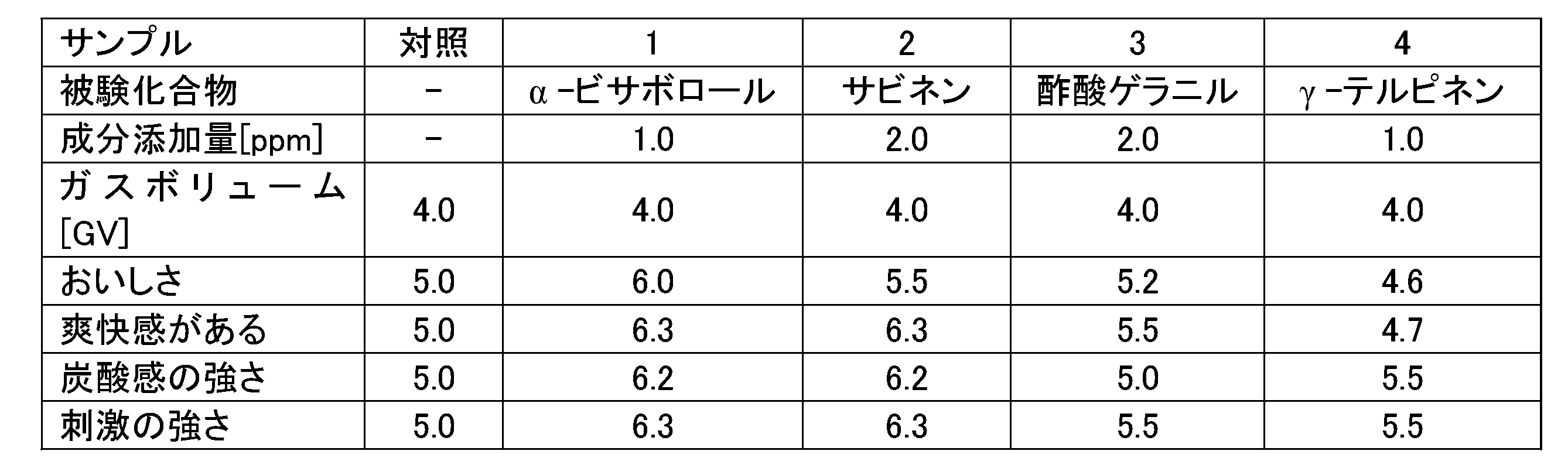
この結果、α-ビサボロールとサビネンを添加したサンプルでは、炭酸感、爽快感、及び刺激の強さがいずれも向上していた。つまり、α-ビサボロールとサビネンは炭酸感、爽快感、及び刺激の強さを向上させる効果を有することが明らかとなった。一方で、酢酸ゲラニルとγ-テルピネンを含有させたサンプルでは、これらの向上効果が確認されなかった。
[実施例2]
無糖ノンフレーバー炭酸飲料に対する、α-ビサボロールとサビネンの影響を調べた。具体的には、表1のベース液1をベース液とし、このベース液に炭酸ガスボリュームが4.0GVとなるように圧入した液を対照サンプルとした。この対照サンプルに、α-ビサボロールを0.25~2.0ppm、又はサビネンを0.5~4.0ppm添加した液をサンプルとし、各サンプルについて、前記の通り官能評価を行った。結果を表4及び5に示す。
無糖ノンフレーバー炭酸飲料に対する、α-ビサボロールとサビネンの影響を調べた。具体的には、表1のベース液1をベース液とし、このベース液に炭酸ガスボリュームが4.0GVとなるように圧入した液を対照サンプルとした。この対照サンプルに、α-ビサボロールを0.25~2.0ppm、又はサビネンを0.5~4.0ppm添加した液をサンプルとし、各サンプルについて、前記の通り官能評価を行った。結果を表4及び5に示す。
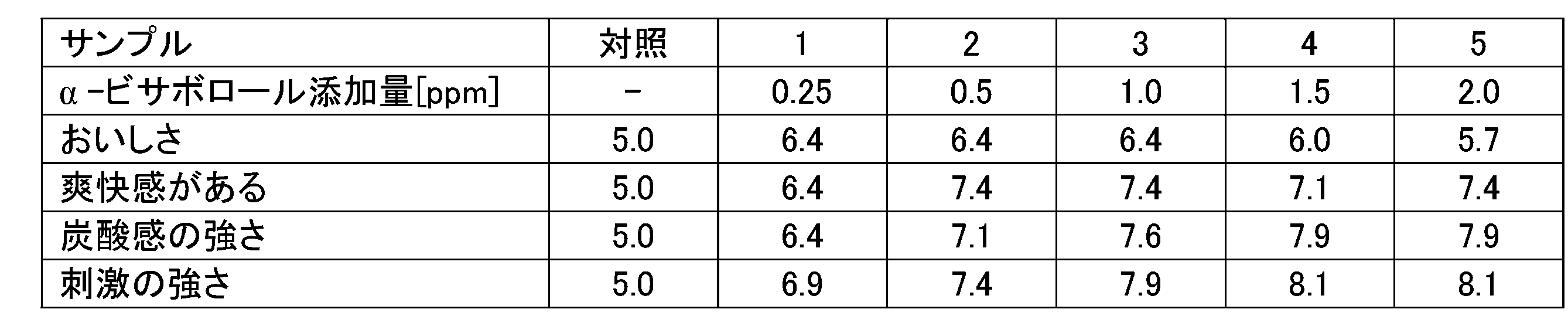
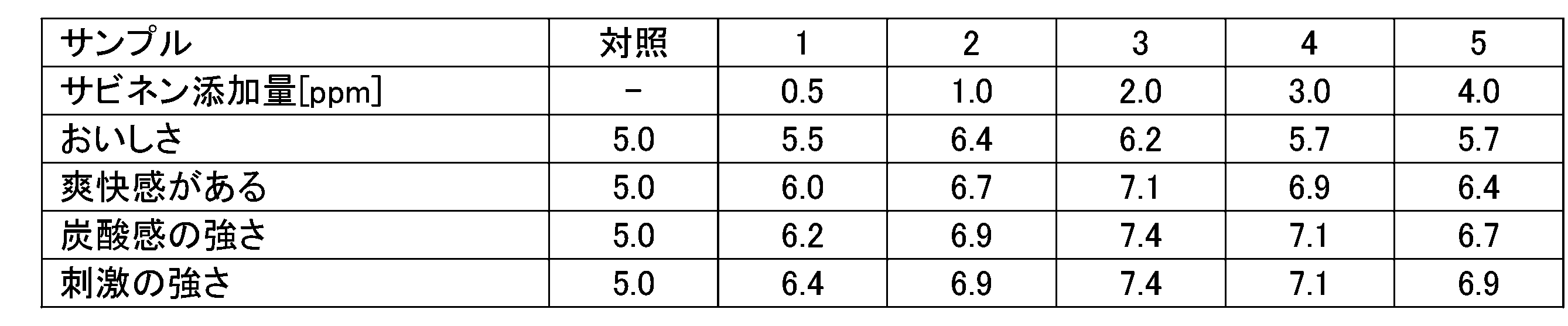
無糖ノンフレーバー炭酸飲料において、α-ビサボロールを0.25~2.0ppm添加したサンプル及びサビネンを0.5~4.0ppm添加したサンプルでは、炭酸感、爽快感、及び刺激の強さがいずれも向上していた。また、α-ビサボロールとサビネンによる炭酸感等の向上効果は、後記実施例4の有糖ノンフレーバー炭酸飲料の場合よりも強く発揮されていた。
[実施例3]
無糖レモンフレーバー炭酸飲料に対する、α-ビサボロールとサビネンの影響を調べた。具体的には、表1のベース液2をベース液とし、このベース液に炭酸ガスボリュームが4.0GVとなるように圧入した液を対照サンプルとした。この対照サンプルに、α-ビサボロールを0.25~2.0ppm、又はサビネンを0.5~4.0ppm添加した液をサンプルとし、各サンプルについて、前記の通り官能評価を行った。結果を表6及び7に示す。
無糖レモンフレーバー炭酸飲料に対する、α-ビサボロールとサビネンの影響を調べた。具体的には、表1のベース液2をベース液とし、このベース液に炭酸ガスボリュームが4.0GVとなるように圧入した液を対照サンプルとした。この対照サンプルに、α-ビサボロールを0.25~2.0ppm、又はサビネンを0.5~4.0ppm添加した液をサンプルとし、各サンプルについて、前記の通り官能評価を行った。結果を表6及び7に示す。

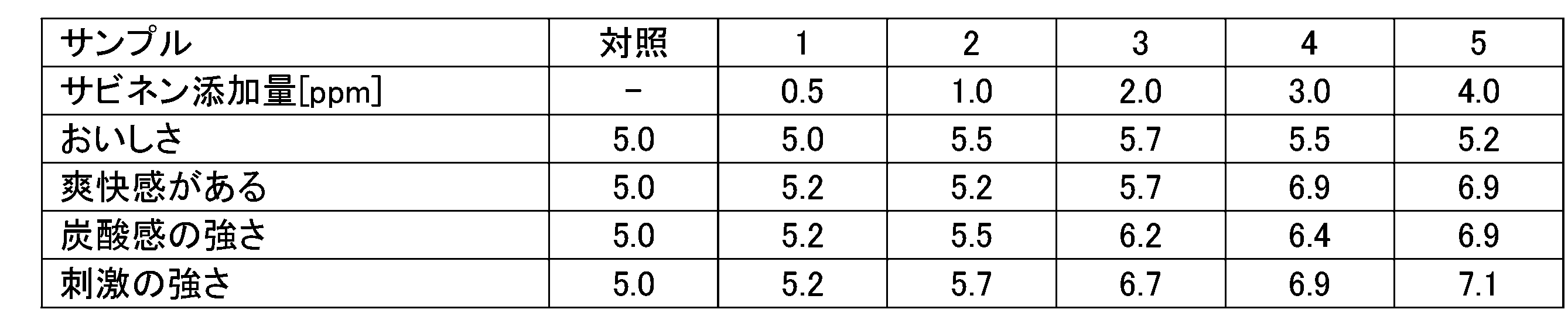
無糖レモンフレーバー炭酸飲料において、α-ビサボロールを0.25~2.0ppm添加したサンプルでは、炭酸感、爽快感、及び刺激の強さがいずれも向上しており、特に0.5~2.0ppm添加したサンプルでは高い向上効果が確認された。一方で、サビネンを添加したサンプルでは、添加量が2.0~4.0ppmで、炭酸感、爽快感、及び刺激の強さの向上効果がみられた。また、α-ビサボロールとサビネンによる炭酸感等の向上効果は、後記実施例5の有糖レモンフレーバー炭酸飲料よりも強く発揮されていた。また、いずれのサンプルもα-ビサボロール、サビネン自体の香気は感じられなかった。
[実施例4]
有糖ノンフレーバー炭酸飲料に対する、α-ビサボロールとサビネンの影響を調べた。具体的には、表1のベース液3をベース液とし、このベース液に炭酸ガスボリュームが4.0GVとなるように圧入した液を対照サンプルとした。この対照サンプルに、α-ビサボロールを0.25~2.0ppm、又はサビネンを0.5~4.0ppm添加した液をサンプルとし、各サンプルについて、前記の通り官能評価を行った。結果を表8及び9に示す。
有糖ノンフレーバー炭酸飲料に対する、α-ビサボロールとサビネンの影響を調べた。具体的には、表1のベース液3をベース液とし、このベース液に炭酸ガスボリュームが4.0GVとなるように圧入した液を対照サンプルとした。この対照サンプルに、α-ビサボロールを0.25~2.0ppm、又はサビネンを0.5~4.0ppm添加した液をサンプルとし、各サンプルについて、前記の通り官能評価を行った。結果を表8及び9に示す。
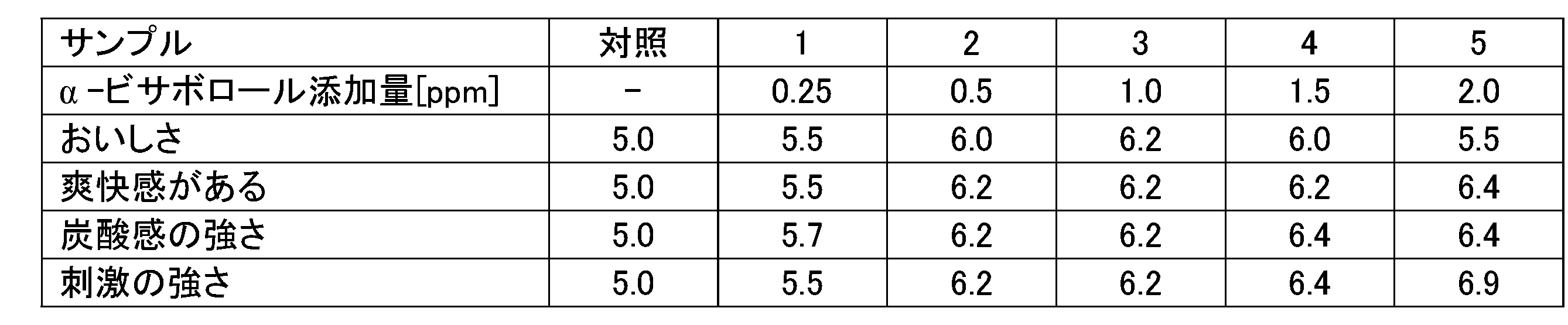
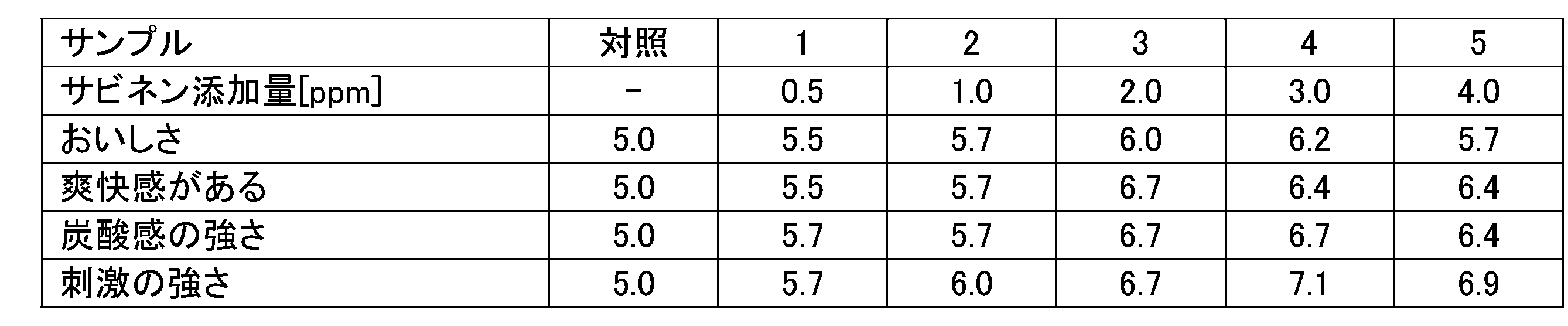
有糖ノンフレーバー炭酸飲料において、α-ビサボロールを0.5~2.0ppm添加したサンプルでは、炭酸感、爽快感、及び刺激の強さがいずれも向上していた。一方で、サビネンを添加したサンプルでは、添加量が2.0~4.0ppmで、炭酸感、爽快感、及び刺激の強さの向上効果がみられた。また、いずれのサンプルもα-ビサボロール、サビネン自体の香気は感じられなかった。
[実施例5]
有糖レモンフレーバー炭酸飲料に対する、α-ビサボロールとサビネンの影響を調べた。具体的には、表1のベース液4をベース液とし、このベース液に炭酸ガスボリュームが4.0GVとなるように圧入した液を対照サンプルとした。この対照サンプルに、α-ビサボロールを0.25~2.0ppm、又はサビネンを0.5~4.0ppm添加した液をサンプルとし、各サンプルについて、前記の通り官能評価を行った。結果を表10及び11に示す。
有糖レモンフレーバー炭酸飲料に対する、α-ビサボロールとサビネンの影響を調べた。具体的には、表1のベース液4をベース液とし、このベース液に炭酸ガスボリュームが4.0GVとなるように圧入した液を対照サンプルとした。この対照サンプルに、α-ビサボロールを0.25~2.0ppm、又はサビネンを0.5~4.0ppm添加した液をサンプルとし、各サンプルについて、前記の通り官能評価を行った。結果を表10及び11に示す。
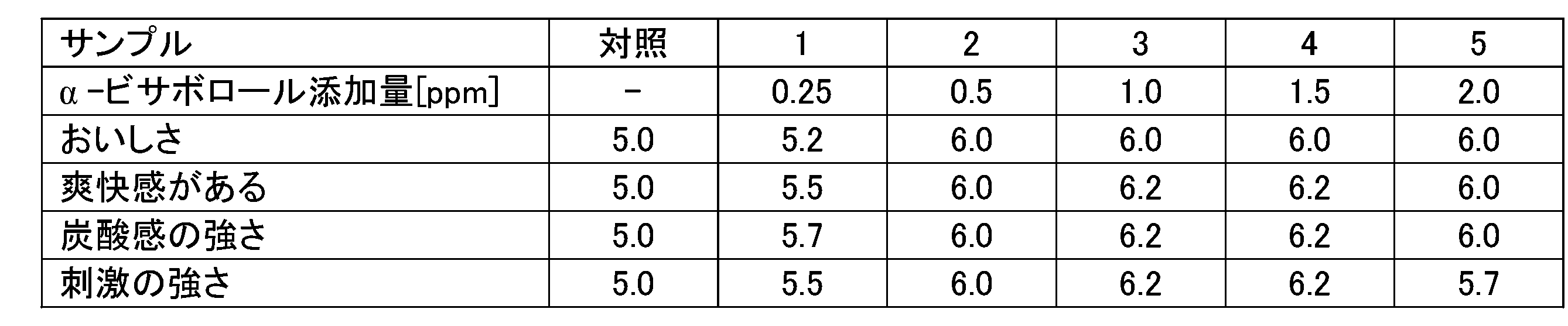

有糖レモンフレーバー炭酸飲料において、α-ビサボロールを0.5~2.0ppm添加したサンプルでは、炭酸感、爽快感、及び刺激の強さがいずれも向上していた。一方で、サビネンを添加したサンプルでは、添加量が2.0~4.0ppmで、炭酸感、爽快感、及び刺激の強さの向上効果がみられた。また、いずれのサンプルもα-ビサボロール、サビネン自体の香気は感じられなかった。
[実施例6]
無糖ノンフレーバー炭酸飲料に対する、α-ビサボロールとサビネンの影響を調べた。具体的には、表1のベース液1をベース液とし、このベース液に炭酸ガスボリュームが4.0GVとなるように圧入した液を対照サンプルとした。この対照サンプルに、α-ビサボロールを0~1.5ppm及びサビネンを0~3.0ppm添加した液をサンプルとし、各サンプルについて、前記の通り官能評価を行った。結果を表12に示す。
無糖ノンフレーバー炭酸飲料に対する、α-ビサボロールとサビネンの影響を調べた。具体的には、表1のベース液1をベース液とし、このベース液に炭酸ガスボリュームが4.0GVとなるように圧入した液を対照サンプルとした。この対照サンプルに、α-ビサボロールを0~1.5ppm及びサビネンを0~3.0ppm添加した液をサンプルとし、各サンプルについて、前記の通り官能評価を行った。結果を表12に示す。
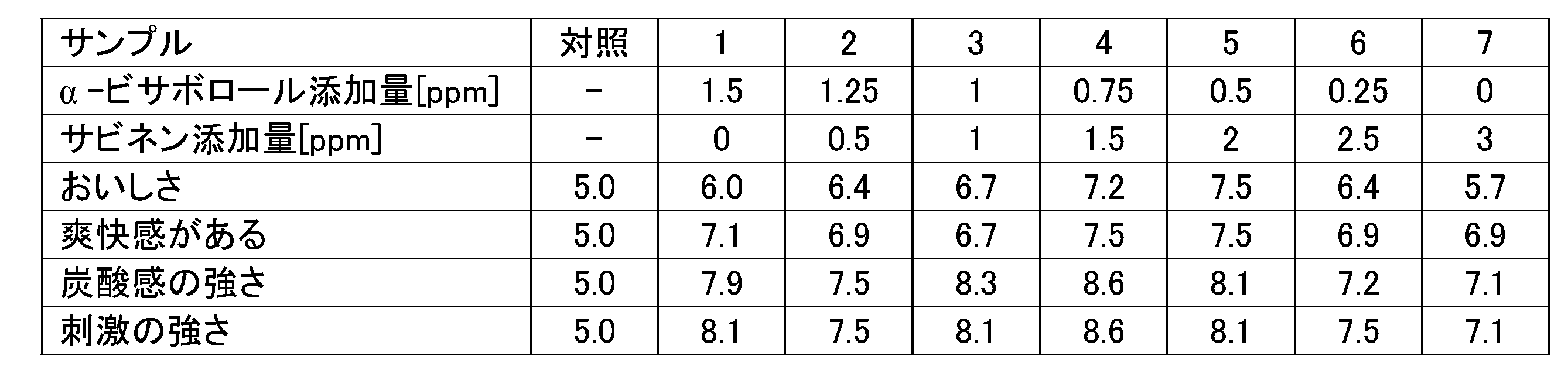
実施例2の結果と比較したところ、α-ビサボロールとサビネンを併用したサンプルのほうが、それぞれ単独で添加したサンプルよりも、炭酸感や爽快感が良好であり、両者を併用することにより、より高い向上効果が得られることがわかった。特に、両者を、α-ビサボロール:サビネン=1:1~1:4の範囲内に含有させたサンプル3~5は、炭酸感や爽快感に優れていた。また、α-ビサボロールとサビネンによる炭酸感等の向上効果は、後記実施例8の有糖ノンフレーバー炭酸飲料の場合よりも強く発揮されていた。また、いずれのサンプルもα-ビサボロール、サビネン自体の香気は感じられなかった。
[実施例7]
無糖レモンフレーバー炭酸飲料に対する、α-ビサボロールとサビネンの影響を調べた。具体的には、表1のベース液2をベース液とし、このベース液に炭酸ガスボリュームが4.0GVとなるように圧入した液を対照サンプルとした。この対照サンプルに、α-ビサボロールを0~1.5ppm及びサビネンを0~3.0ppm添加した液をサンプルとし、各サンプルについて、前記の通り官能評価を行った。結果を表13に示す。
無糖レモンフレーバー炭酸飲料に対する、α-ビサボロールとサビネンの影響を調べた。具体的には、表1のベース液2をベース液とし、このベース液に炭酸ガスボリュームが4.0GVとなるように圧入した液を対照サンプルとした。この対照サンプルに、α-ビサボロールを0~1.5ppm及びサビネンを0~3.0ppm添加した液をサンプルとし、各サンプルについて、前記の通り官能評価を行った。結果を表13に示す。

実施例3の結果と比較したところ、α-ビサボロールとサビネンを併用したサンプルのほうが、それぞれ単独で添加したサンプルよりも、炭酸感や爽快感が良好であり、両者を併用することにより、より高い向上効果が得られることがわかった。特に、サンプル3~5は、炭酸感や爽快感に優れていた。また、α-ビサボロールとサビネンによる炭酸感等の向上効果は、後記実施例9の有糖レモンフレーバー炭酸飲料よりも強く発揮されていた。また、いずれのサンプルもα-ビサボロール、サビネン自体の香気は感じられなかった。
[実施例8]
有糖レモンフレーバー炭酸飲料に対する、α-ビサボロールとサビネンの影響を調べた。具体的には、表1のベース液3をベース液とし、このベース液に炭酸ガスボリュームが4.0GVとなるように圧入した液を対照サンプルとした。この対照サンプルに、α-ビサボロールを0~1.5ppm及びサビネンを0~3.0ppm添加した液をサンプルとし、各サンプルについて、前記の通り官能評価を行った。結果を表14に示す。
有糖レモンフレーバー炭酸飲料に対する、α-ビサボロールとサビネンの影響を調べた。具体的には、表1のベース液3をベース液とし、このベース液に炭酸ガスボリュームが4.0GVとなるように圧入した液を対照サンプルとした。この対照サンプルに、α-ビサボロールを0~1.5ppm及びサビネンを0~3.0ppm添加した液をサンプルとし、各サンプルについて、前記の通り官能評価を行った。結果を表14に示す。
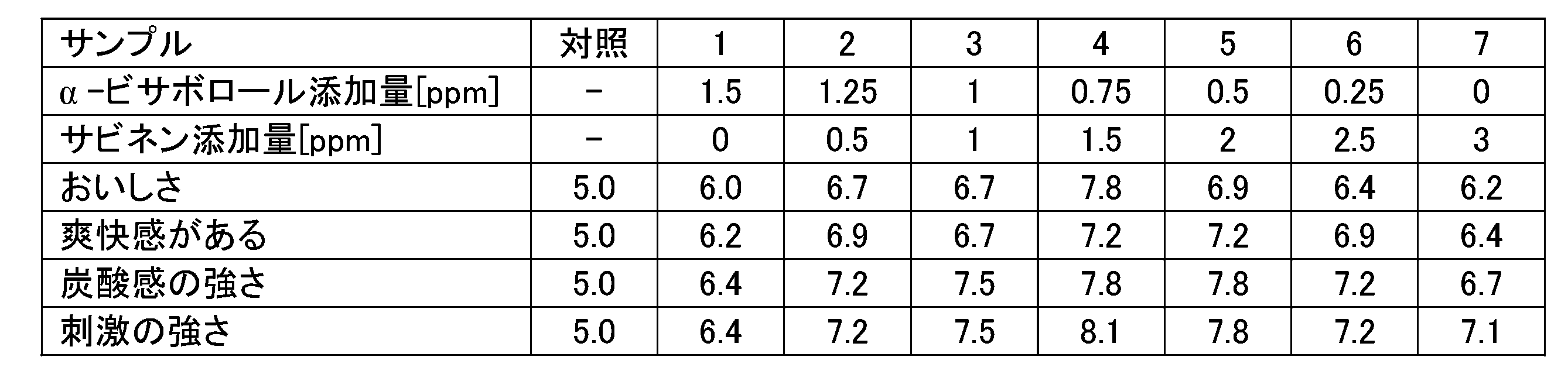
実施例4の結果と比較したところ、α-ビサボロールとサビネンを併用したサンプルのほうが、それぞれ単独で添加したサンプルよりも、炭酸感や爽快感が良好であり、両者を併用することにより、より高い向上効果が得られることがわかった。特に、サンプル3~5は、炭酸感や爽快感に優れていた。また、いずれのサンプルもα-ビサボロール、サビネン自体の香気は感じられなかった。
[実施例9]
有糖レモンフレーバー炭酸飲料に対する、α-ビサボロールとサビネンの影響を調べた。具体的には、表1のベース液4をベース液とし、このベース液に炭酸ガスボリュームが4.0GVとなるように圧入した液を対照サンプルとした。この対照サンプルに、α-ビサボロールを0~1.5ppm及びサビネンを0~3.0ppm添加した液をサンプルとし、各サンプルについて、前記の通り官能評価を行った。結果を表15に示す。
有糖レモンフレーバー炭酸飲料に対する、α-ビサボロールとサビネンの影響を調べた。具体的には、表1のベース液4をベース液とし、このベース液に炭酸ガスボリュームが4.0GVとなるように圧入した液を対照サンプルとした。この対照サンプルに、α-ビサボロールを0~1.5ppm及びサビネンを0~3.0ppm添加した液をサンプルとし、各サンプルについて、前記の通り官能評価を行った。結果を表15に示す。
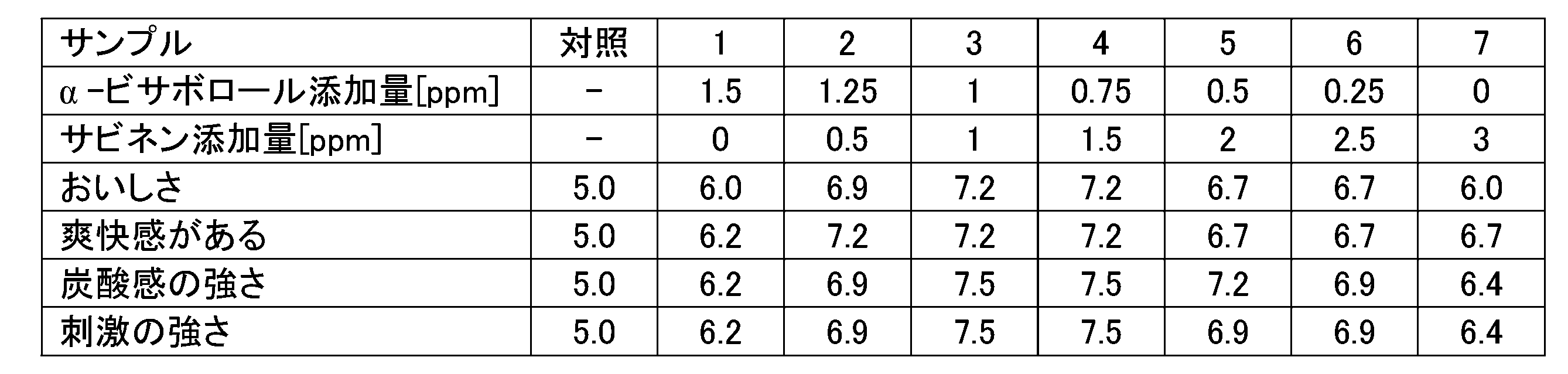
実施例5の結果と比較したところ、α-ビサボロールとサビネンを併用したサンプルのほうが、それぞれ単独で添加したサンプルよりも、炭酸感や爽快感が良好であり、両者を併用することにより、より高い向上効果が得られることがわかった。特に、サンプル3~5は、炭酸感や爽快感に優れていた。また、いずれのサンプルもα-ビサボロール、サビネン自体の香気は感じられなかった。
Claims (10)
- α-ビサボロールを0.25~2.0ppm含有する、炭酸飲料。
- さらに、サビネンを0.5~4.0ppm含有する、請求項1に記載の炭酸飲料。
- サビネンを0.5~4.0ppm含有する、炭酸飲料。
- 無糖飲料である、請求項1~3のいずれか一項に記載の炭酸飲料。
- 柑橘系果実の香味を有する、請求項1~4のいずれか一項に記載の炭酸飲料。
- 前記柑橘系果実がレモンである、請求項5に記載の炭酸飲料。
- 炭酸飲料において、α-ビサボロール及びサビネンからなる群より選択される1種以上の香料を添加し、飲料中のα-ビサボロール濃度を0.25~2.0ppmに調整する、又は、飲料中のサビネン濃度を0.5~4.0ppmに調整する、炭酸飲料の製造方法。
- 炭酸飲料において、α-ビサボロール及びサビネンからなる群より選択される1種以上の香料を添加し、飲料中のα-ビサボロール濃度を0.25~2.0ppmに調整する、又は、飲料中のサビネン濃度を0.5~4.0ppmに調整する、炭酸飲料の炭酸感向上方法。
- 炭酸飲料において、α-ビサボロール及びサビネンからなる群より選択される1種以上の香料を添加し、飲料中のα-ビサボロール濃度を0.25~2.0ppmに調整する、又は、飲料中のサビネン濃度を0.5~4.0ppmに調整する、炭酸飲料の爽快感向上方法。
- α-ビサボロール及びサビネンからなる群より選択される1種以上を有効成分とし、炭酸飲料に添加される、炭酸感向上剤。
Priority Applications (1)
| Application Number | Priority Date | Filing Date | Title |
|---|---|---|---|
| US17/784,538 US12329186B2 (en) | 2020-03-16 | 2020-10-28 | Carbonated beverage |
Applications Claiming Priority (2)
| Application Number | Priority Date | Filing Date | Title |
|---|---|---|---|
| JP2020-045416 | 2020-03-16 | ||
| JP2020045416A JP7623789B2 (ja) | 2020-03-16 | 2020-03-16 | 炭酸飲料 |
Publications (1)
| Publication Number | Publication Date |
|---|---|
| WO2021186784A1 true WO2021186784A1 (ja) | 2021-09-23 |
Family
ID=77771155
Family Applications (1)
| Application Number | Title | Priority Date | Filing Date |
|---|---|---|---|
| PCT/JP2020/040358 Ceased WO2021186784A1 (ja) | 2020-03-16 | 2020-10-28 | 炭酸飲料 |
Country Status (4)
| Country | Link |
|---|---|
| US (1) | US12329186B2 (ja) |
| JP (2) | JP7623789B2 (ja) |
| TW (1) | TWI855183B (ja) |
| WO (1) | WO2021186784A1 (ja) |
Cited By (2)
| Publication number | Priority date | Publication date | Assignee | Title |
|---|---|---|---|---|
| WO2023243534A1 (ja) * | 2022-06-16 | 2023-12-21 | アサヒグループホールディングス株式会社 | レモン風味飲料の香味改善方法 |
| JP7817472B1 (ja) * | 2025-02-14 | 2026-02-18 | サントリーホールディングス株式会社 | 柑橘果汁含有無糖炭酸飲料及びその製造方法 |
Families Citing this family (1)
| Publication number | Priority date | Publication date | Assignee | Title |
|---|---|---|---|---|
| JP7623789B2 (ja) * | 2020-03-16 | 2025-01-29 | アサヒ飲料株式会社 | 炭酸飲料 |
Citations (2)
| Publication number | Priority date | Publication date | Assignee | Title |
|---|---|---|---|---|
| JP2004168936A (ja) * | 2002-11-21 | 2004-06-17 | Kiyomitsu Kawasaki | シトラス様香料組成物 |
| JP2005015686A (ja) * | 2003-06-27 | 2005-01-20 | Kiyomitsu Kawasaki | フルーツ様香料組成物 |
Family Cites Families (2)
| Publication number | Priority date | Publication date | Assignee | Title |
|---|---|---|---|---|
| JP6238349B2 (ja) | 2013-11-20 | 2017-11-29 | 曽田香料株式会社 | 温州みかん香料又は温州みかん風味飲食品の果汁感向上剤、それを添加してなる香料、飲食品又は香粧品 |
| JP7623789B2 (ja) * | 2020-03-16 | 2025-01-29 | アサヒ飲料株式会社 | 炭酸飲料 |
-
2020
- 2020-03-16 JP JP2020045416A patent/JP7623789B2/ja active Active
- 2020-10-28 US US17/784,538 patent/US12329186B2/en active Active
- 2020-10-28 WO PCT/JP2020/040358 patent/WO2021186784A1/ja not_active Ceased
- 2020-11-20 TW TW109140861A patent/TWI855183B/zh active
-
2024
- 2024-10-04 JP JP2024175191A patent/JP2024177474A/ja active Pending
Patent Citations (2)
| Publication number | Priority date | Publication date | Assignee | Title |
|---|---|---|---|---|
| JP2004168936A (ja) * | 2002-11-21 | 2004-06-17 | Kiyomitsu Kawasaki | シトラス様香料組成物 |
| JP2005015686A (ja) * | 2003-06-27 | 2005-01-20 | Kiyomitsu Kawasaki | フルーツ様香料組成物 |
Non-Patent Citations (1)
| Title |
|---|
| SIMAS, D. L. R. ET AL.: "Citrus species essential oils and their components can inihibit or stimulate fungal growth in fruit", INDUSTRIAL CROPS AND PRODUCTS, vol. 98, 2017, pages 108 - 115, XP029907842, DOI: 10.1016/j.indcrop.2017.01.026 * |
Cited By (2)
| Publication number | Priority date | Publication date | Assignee | Title |
|---|---|---|---|---|
| WO2023243534A1 (ja) * | 2022-06-16 | 2023-12-21 | アサヒグループホールディングス株式会社 | レモン風味飲料の香味改善方法 |
| JP7817472B1 (ja) * | 2025-02-14 | 2026-02-18 | サントリーホールディングス株式会社 | 柑橘果汁含有無糖炭酸飲料及びその製造方法 |
Also Published As
| Publication number | Publication date |
|---|---|
| JP2021145560A (ja) | 2021-09-27 |
| JP7623789B2 (ja) | 2025-01-29 |
| US12329186B2 (en) | 2025-06-17 |
| TW202142125A (zh) | 2021-11-16 |
| JP2024177474A (ja) | 2024-12-19 |
| US20230011443A1 (en) | 2023-01-12 |
| TWI855183B (zh) | 2024-09-11 |
Similar Documents
| Publication | Publication Date | Title |
|---|---|---|
| JP4964969B2 (ja) | レバウディオサイドa、エリトリトールまたはタガトースおよび酸味料を含むダイエット用飲料製品 | |
| JP4966381B2 (ja) | コーラ飲料 | |
| JP5291639B2 (ja) | ダイエットコーラ飲料 | |
| JP2010521167A (ja) | 天然飲料製品 | |
| HK1218693A1 (zh) | 甜叶菊甙甜味剂组合物以及用其增甜的食物产品 | |
| JP2024177474A (ja) | 炭酸飲料 | |
| JP2001095541A (ja) | ビター系炭酸飲料 | |
| JP7368546B2 (ja) | 炭酸飲料 | |
| JP6420867B2 (ja) | 炭酸ガスボリュームが高い炭酸飲料 | |
| JP6745375B1 (ja) | 柑橘風味の無糖炭酸飲料 | |
| JP7148253B2 (ja) | 炭酸飲料 | |
| JP6283446B1 (ja) | ティリロサイド含有炭酸飲料 | |
| JP2012183026A (ja) | 飲食物及びその製造方法 | |
| JP5921804B2 (ja) | アルコール飲料の飲用感が付与された非アルコール飲料およびその製造方法 | |
| JP7827428B2 (ja) | 柑橘風味アルコール飲料 | |
| JP7458192B2 (ja) | 果汁含有飲料 | |
| JP6931433B1 (ja) | 低甘味の炭酸飲料 | |
| JP7114442B2 (ja) | 炭酸飲料、炭酸感の向上方法、及び後味のキレ向上方法 | |
| JP7821587B2 (ja) | 容器詰アルコール飲料 | |
| JP7570823B2 (ja) | ナトリウム含有飲料 | |
| JP7114441B2 (ja) | 酸性飲料及び酸性飲料の風香味の維持方法 | |
| JP7394557B2 (ja) | 飲料 | |
| JP6280665B1 (ja) | カラメル色素を含有する飲料 | |
| WO2023037771A1 (ja) | 容器詰アルコール飲料 |
Legal Events
| Date | Code | Title | Description |
|---|---|---|---|
| 121 | Ep: the epo has been informed by wipo that ep was designated in this application |
Ref document number: 20925871 Country of ref document: EP Kind code of ref document: A1 |
|
| NENP | Non-entry into the national phase |
Ref country code: DE |
|
| 122 | Ep: pct application non-entry in european phase |
Ref document number: 20925871 Country of ref document: EP Kind code of ref document: A1 |
|
| WWG | Wipo information: grant in national office |
Ref document number: 17784538 Country of ref document: US |