WO2021182390A1 - 医療デバイス - Google Patents
医療デバイス Download PDFInfo
- Publication number
- WO2021182390A1 WO2021182390A1 PCT/JP2021/008971 JP2021008971W WO2021182390A1 WO 2021182390 A1 WO2021182390 A1 WO 2021182390A1 JP 2021008971 W JP2021008971 W JP 2021008971W WO 2021182390 A1 WO2021182390 A1 WO 2021182390A1
- Authority
- WO
- WIPO (PCT)
- Prior art keywords
- region
- edema
- unit
- water
- moisture
- Prior art date
- Legal status (The legal status is an assumption and is not a legal conclusion. Google has not performed a legal analysis and makes no representation as to the accuracy of the status listed.)
- Ceased
Links
Images


Classifications
-
- A—HUMAN NECESSITIES
- A61—MEDICAL OR VETERINARY SCIENCE; HYGIENE
- A61B—DIAGNOSIS; SURGERY; IDENTIFICATION
- A61B10/00—Instruments for taking body samples for diagnostic purposes; Other methods or instruments for diagnosis, e.g. for vaccination diagnosis, sex determination or ovulation-period determination; Throat striking implements
-
- A—HUMAN NECESSITIES
- A61—MEDICAL OR VETERINARY SCIENCE; HYGIENE
- A61B—DIAGNOSIS; SURGERY; IDENTIFICATION
- A61B5/00—Measuring for diagnostic purposes; Identification of persons
- A61B5/05—Detecting, measuring or recording for diagnosis by means of electric currents or magnetic fields; Measuring using microwaves or radio waves
- A61B5/053—Measuring electrical impedance or conductance of a portion of the body
- A61B5/0537—Measuring body composition by impedance, e.g. tissue hydration or fat content
-
- A—HUMAN NECESSITIES
- A61—MEDICAL OR VETERINARY SCIENCE; HYGIENE
- A61N—ELECTROTHERAPY; MAGNETOTHERAPY; RADIATION THERAPY; ULTRASOUND THERAPY
- A61N1/00—Electrotherapy; Circuits therefor
- A61N1/02—Details
- A61N1/08—Arrangements or circuits for monitoring, protecting, controlling or indicating
-
- A—HUMAN NECESSITIES
- A61—MEDICAL OR VETERINARY SCIENCE; HYGIENE
- A61N—ELECTROTHERAPY; MAGNETOTHERAPY; RADIATION THERAPY; ULTRASOUND THERAPY
- A61N1/00—Electrotherapy; Circuits therefor
- A61N1/18—Applying electric currents by contact electrodes
- A61N1/32—Applying electric currents by contact electrodes alternating or intermittent currents
- A61N1/36—Applying electric currents by contact electrodes alternating or intermittent currents for stimulation
Definitions
- the present invention relates to a medical device.
- Eczema is caused by a decrease in osmotic pressure due to an imbalance between the osmotic pressure of cell tissue fluid (interstitial fluid) and blood in body fluids, an increase in blood pressure (stagnation or obstruction of veins and lymph vessels), and an increase in vascular permeability. , Excessive movement of water from the vascular system to the tissue, or improper movement of water back from the tissue to the vascular system causes water to accumulate in the tissue and swell.
- Diseases and conditions that can cause edema include, for example, heart disease including congestive heart failure, liver disease including cirrhosis, clots or tumors that impede blood and lymph flow, allergic reactions, hypoalbuminemia, renal disease, pregnancy, drugs. There are adverse reactions to, and other similar medical conditions. Edema caused by these diseases and medical conditions is typically found in the extremities, especially the peripheral sites such as the hands, feet and ankles, and the gastrocnemius muscle.
- Patent Document 1 As a device capable of appropriately diagnosing changes in the pathological condition of a heart failure patient, for example, a device disclosed in Patent Document 1 below is known.
- Patent Document 1 Although it is possible to observe changes in the pathological condition based on the physiological index of a heart failure patient, it does not have a function for providing appropriate treatment according to the observation result. Therefore, when treating a patient, it is necessary to separately prepare a device (treatment device) for performing the treatment, but in order to perform appropriate treatment according to the observation result, the device setting (driving amount) according to the treatment device is performed. Etc.) must be performed individually, which is complicated.
- At least one embodiment of the present invention has been made in view of the above circumstances, and specifically, medical treatment capable of observing the edema state of a patient and providing appropriate treatment according to the edema state. To provide the device.
- the medical device is provided based on a measuring unit that measures the state of edema at a peripheral site of a patient, a driving unit that gives a predetermined stimulus to a part of the patient's body, and a state of edema.
- a control unit that adjusts and controls the drive amount of the drive unit so that the evaluation value approaches a target value set for the purpose of improving edema is provided.
- the state of edema of a patient can be observed and appropriate treatment can be given according to the state of edema.
- the medical device 1 quantitatively evaluates the state of edema caused by various pathological conditions of a patient, and performs treatment according to each patient according to the evaluation result to improve the edema.
- the purpose is.
- the medical device 1 quantitatively evaluates the state of edema that has developed in a patient and performs treatment based on the evaluation result, peripheral parts of the body (limbs, etc.) where edema is relatively likely to develop. It is attached to. Further, as the peripheral site to which the medical device 1 is attached, it is preferable to use a lower leg (calf) that can efficiently perform a series of operations until treatment is performed based on the state of edema that has developed in the patient.
- calf lower leg
- the device is described as a device mainly for the treatment of edema that may occur in a heart failure patient, and the "attachment location" is the lower leg of the patient. Therefore, the "mounting point" on which the medical device 1 is mounted is a “measurement point” for measuring the state of edema, and is a “treatment point” for which treatment for improving edema is performed.
- the body part to which the medical device 1 is attached is not limited to the lower leg, but is a part where the edema state can be measured as a measurement point and a part where the edema state can be improved by giving a predetermined stimulus as a treatment part. All you need is. Therefore, the "wearing point”, “measuring point”, and “treatment point” of the medical device 1 do not necessarily have to be the same part of the body, and may be set individually.
- FIG. 1 shows a schematic configuration of the medical device 1 according to the present embodiment of the present invention
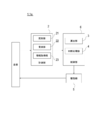
- FIG. 2 shows a functional block diagram of the medical device 1 according to the present embodiment.
- the medical device 1 includes a measurement unit 2, a calculation unit 3, a judgment processing unit 4, and a drive unit 5.
- the medical device 1 includes at least a main body 1a in which a measuring unit 2 and a driving unit 5 are housed, and the main body 1a is attached to a patient's attachment site.
- the medical device 1 includes a control unit 6 that realizes the functions of the calculation unit 3 and the judgment processing unit 4 and comprehensively controls the processing operation of the device.
- the control unit 6 is composed of various processors such as a CPU, ROM, and RAM, and controls the drive of each unit constituting the medical device 1.
- the medical device 1 includes a power supply unit (not shown) that supplies electric power required for driving each unit.
- the power supply unit may be a battery (whether a primary battery or a secondary battery), or may be supplied with electric power from an external power source.
- the main body 1a of the medical device 1 has a configuration in which the wearing state is maintained on the body part of the patient.
- the main body 1a may be composed of a band-shaped member (belt or band) that can be wound around the mounting portion.
- This band-shaped member is manufactured by using an elastic member (for example, an elastic material such as polyurethane) so that it can be held at an appropriate winding position according to the size of the patient's attachment site and a good attachment feeling can be obtained. May be done.
- a fixing member is attached to the surface of the band-shaped member. Fasteners, hook-and-loop fasteners, etc. may be provided.
- the main body 1a is not limited to the band-shaped member, and may be in a form that can be attached to a body part.
- the measuring unit 2 measures the state of edema of the patient.
- the measuring method for measuring the state of edema by the measuring unit 2 is a first water content existing in a first region (hereinafter, also referred to as “outflow region”) that is a source of water outflow that causes edema.
- Moisture discrimination that distinguishes between (intravascular water) and the second water (water in the subcutaneous tissue) existing in the second region (hereinafter, also referred to as “inflow region”) into which the water flowing out from the outflow region flows in. Get information.
- the acquisition timing and output timing of the moisture determination information by the measuring unit 2 may be executed at all times or at predetermined time intervals (for example, at 1-minute intervals) from the start to the end of the measurement.
- the "outflow area” is a "blood vessel” that runs under the skin of the site where edema has developed, and the "inflow area” is a "subcutaneous tissue (fat, etc.)” that exists around the blood vessel.
- the measuring unit 2 uses an irradiation unit 21 that irradiates a measurement point of the body with an electromagnetic wave (for example, a microwave) having a predetermined frequency having excellent transparency to the human body, and a transmitted wave that has passed through the body.
- a wave receiving unit 22 for receiving waves and an information acquisition unit 23 for acquiring moisture discrimination information according to the dielectric constant based on the phase difference between the irradiation wave and the transmitted wave are provided.
- the irradiation surface of the irradiation unit 21 and the receiving surface of the receiving unit 22 are arranged to face each other.
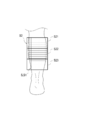
- FIG. 3 is a diagram schematically showing a division area S1 in which the measurement surface S is divided into a predetermined number of divisions and set.
- the irradiation unit 21 irradiates the irradiation wave to each of the division regions S1 in which the measurement surface S is divided into a matrix.
- the division region S1 may be a region set by dividing a predetermined surface region (for example, 100 mm ⁇ 100 mm) of the calf to be attached by a predetermined size (for example, 2 mm square).
- the irradiation wave emitted from the irradiation unit 21 passes through the division region S1 and reaches the opposite receiving unit 22.
- the irradiation unit 21 outputs the phase information of the irradiation wave irradiated 7 for each division region S1 to the information acquisition unit 23.
- the method of dividing the division area S1 is not limited to the matrix shape, and may be divided into a plurality of areas within the measurement surface S.
- the receiving unit 22 receives the transmitted wave that the irradiation wave emitted from the irradiation unit 21 has passed through the body.
- the receiving unit 22 receives the irradiation wave for each division region S1 irradiated from the irradiation unit 21.
- the wave receiving unit 22 acquires the phase information of the transmitted wave received for each division region S1 and outputs the phase information to the information acquisition unit 23.
- the information acquisition unit 23 obtains the phase difference for each division region S1 from the phase information of the irradiation wave and the phase information of the transmitted wave, and calculates the dielectric constant for each division region S1 from these phase differences.
- the information acquisition unit 23 determines whether the water detected in the corresponding division region S1 is "intravascular water” or "subcutaneous tissue water” based on the calculated dielectric constant of each division region S1.
- the area information in which the determination result is associated with each division area S1 is acquired as "moisture discrimination information”.
- the information acquisition unit 23 outputs the acquired moisture determination information to the calculation unit 3 and the determination processing unit 4, respectively.
- the water content discrimination information is information that distinguishes between intravascular water and subcutaneous tissue water at the peripheral site, and classifies a region mainly composed of intravascular water and a region mainly composed of subcutaneous tissue water. Determined from the dielectric constant of each region S1, the first water region in which intravascular water is mainly present is designated as "intravascular water region S1A”, and the second water region in which water in the subcutaneous tissue is mainly present is "subcutaneous”. Each is set as “intra-tissue moisture region S1B".
- the division area S1 is set to 2500 areas on the measurement surface S of 100 mm square.
- the intravascular water region S1A is the “200 region”
- the subcutaneous tissue water region S1B is the “600 region”
- the remaining compartmentalized region S1 is another. It can be distinguished as tissue (eg bone).
- the calculation unit 3 calculates a value that quantitatively indicates the state of edema of the patient.
- the calculation unit 3 calculates the abundance ratio of the water content in the blood vessel and the water content in the subcutaneous tissue on the measurement surface S.
- a method for obtaining the abundance ratio of the water content in the blood vessel and the water content in the subcutaneous tissue in the measurement surface S as an example, the water content region S1A in the blood vessel on the measurement surface S and the water content region S1A in the blood vessel based on the water content discrimination information measured by the measurement unit 2 are used.
- the area ratio of the water region S1B in the subcutaneous tissue is calculated.
- the calculation unit 3 outputs this calculation result to the determination processing unit 4 as ratio information.
- the calculation timing by the calculation unit 3 and the output timing of the ratio information depend on the input timing from the measurement unit 2.
- the ratio information is a value obtained by dividing the number of regions of the subcutaneous water region S1B by the number of regions of the intravascular water region S1A.
- the ratio information is based on the case where the ratio is "3" when the edema does not occur and the water region S1B in the subcutaneous tissue is "600 region” and the water region S1A in the blood vessel is "200 region”).
- the ratio can be "6".
- the determination processing unit 4 determines the state of edema on the measurement surface S, and drives and controls the drive unit 5 so that treatment suitable for the state of edema is given according to the determination result. In addition, the determination processing unit 4 sequentially determines at a predetermined timing whether or not the edema score, which is a value (evaluation value) for evaluating the state of edema, has reached the target value. The determination timing by the determination processing unit 4 re-acquires the edema score at predetermined time (for example, 1 minute interval) after the drive control of the drive unit 5 is started, and compares the acquired new edema score with the target value. Judgment is based on the result. In the present embodiment, the term "reaching" the edema score means that the edema score includes both "equivalent” and "approximate" to the target value.
- the ratio information calculated by the calculation unit 3 is used as an evaluation standard for quantifying the degree of progression of edema according to the area ratio, for example, "for score setting".
- An evaluation value indicating the current state of edema according to the ratio information may be obtained as an edema score by collating with "information”.
- the judgment processing unit 4 differentiates the preset target value from the acquired edema score, and appropriately treats the current edema condition according to the difference result.
- a control sequence for driving and controlling the drive unit 5 is set.
- the determination processing unit 4 outputs a control instruction (control signal) to the drive unit 5 based on the set control sequence to control the drive.
- the "target value” is a set value for guiding the edema that develops in the direction of improvement by collating with the edema score, and is set for each patient.
- the target value may be based on the edema score when the patient is healthy without edema (or when edema is present but relatively mild).
- the determination processing unit 4 controls the driving unit 5 and the edema score "6" is the target value.
- a control sequence for controlling the drive unit 5 so as to be equal to or less than "2.5” is generated, and the drive unit 5 is driven and controlled according to this control sequence.
- the target value may be set in advance before wearing the medical device 1, or may be appropriately set to an optimum value according to the edema score acquired when the medical device 1 is worn.
- control sequence means that the drive unit 5 is feedback-controlled while comparing the sequentially acquired edema score with the target value so that the measured current edema score reaches the set target value. It is a control program for.
- timing setting information for specifying the timing of stimulating and the timing of stopping
- stimulation amount setting information for adjusting the strength of the stimulus amount for edema
- the determination processing unit 4 sets the drive region S2 of the drive unit 5 based on the distribution state of the first moisture region and the second moisture region, and drives the drive unit 5 individually for each drive region S2.
- a control sequence may be generated to control.
- FIG. 4 shows an example in which a drive region S2 (first drive region S21, second drive region S22, third drive region S23) is set by dividing the measurement surface S set in the substantially vertical direction into three in the height direction. be.
- the stimuli are sequentially stimulated from the first drive region S21 located at the lower side in the figure, through the second drive region S22 located at the middle, and toward the third drive region S23 located at the upper side.
- the determination processing unit 4 may set the stimulus setting information so as to give the stimulus in the order of the first drive area S21 ⁇ the second drive area S22 ⁇ the third drive area S23.
- the judgment processing unit 4 may generate a control sequence so as to finely control how to give a stimulus for each drive region S2 by using the water content discrimination information from the measurement unit 2.
- the subcutaneous tissue water region S1B in the first drive region S21 is biased to the left side
- the subcutaneous tissue water region S1B in the second drive region S22 is biased to the right
- the third drive region S23 It is assumed that the water region S1B in the subcutaneous tissue inside is biased upward and downward.
- the determination processing unit 4 mainly stimulates the left side of the region where the subcutaneous tissue water region S1B is abundant in the first drive region S21, and the subcutaneous tissue water region S1B is abundant in the second drive region S22.
- the control sequence may be set so that the right side of the existing region is mainly stimulated, and in the third driving region S23, the lower side of the region where the water region S1B in the subcutaneous tissue is abundant is mainly stimulated. That is, it is possible to generate a control sequence based on the ratio information, the edema score, and the like so that the treatment operation by the driving unit 5 is optimized.
- the determination processing unit 4 controls the driving unit 5 in order to make the edema score reach the target value when the edema score deviates from the target value as a result of comparing the edema score with the target value.
- the control sequence is regenerated, and the drive unit 5 is driven and controlled according to the control sequence.
- the regeneration process of this control sequence may be performed at substantially the same frequency as the reacquisition process of the edema score at the time of comparison judgment between the edema score and the target value.
- the determination processing unit 4 is generated as a control sequence so as to automatically stop the driving of the driving unit 5 when it is determined that the edema score does not reach the target value after a predetermined time (for example, 30 minutes) has elapsed. You can also.
- the judgment processing unit 4 sets a judgment threshold value for automatic stop in advance, and when an improvement of a predetermined value or more is confirmed from the edema score at the start of treatment (the edema score exceeds the judgment threshold value). Case) can also be generated so that the treatment by the drive unit 5 is continued without automatically stopping.
- the driving unit 5 gives a predetermined stimulus to the edema to improve the symptom.
- the driving unit 5 is housed in the main body 1a, and gives a predetermined stimulus to the edema that develops in the peripheral site to be attached, and performs a treatment for returning the water stored in the subcutaneous tissue into the blood vessel.
- the drive unit 5 outputs a low-frequency pulse in contact with a therapeutic device that intermittently compresses and treats edema by flowing a fluid (air, water, etc.) in the accommodating unit, and a skin surface on which edema has developed.
- a therapeutic device that intermittently compresses and treats edema by flowing a fluid (air, water, etc.) in the accommodating unit, and a skin surface on which edema has developed.
- a therapeutic device that intermittently compresses and treats edema by flowing a fluid (air, water, etc.) in the accommodating unit, and a skin surface on which edema has developed.
- Any device that provides edema with a stimulus that is expected to improve edema such as an electronic therapy device that has a plurality of electrodes and an electric circuit that supplies a predetermined pulse current to these electrodes, may be used.
- the driving unit 5 drives according to a control instruction from the judgment processing unit 4 to give a predetermined stimulus to the edema.
- the amount of venous return begins to increase, and the water in the subcutaneous tissue water region S1B, which is the second water region, is returned to the blood vessel, which is the first region.
- the water stored in the water region S1B in the subcutaneous tissue gradually decreases. As a result, the symptoms of edema are gradually improved and the patient's QOL is improved.
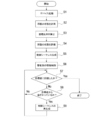
- the medical worker attaches the medical device 1 to the peripheral part of the patient and activates it (S1).
- the control unit 6 causes the measurement unit 2 to execute a process of measuring the state of edema (S2).
- step S2 the measuring unit 2 irradiates the electromagnetic wave from the irradiation unit 21 for each of the plurality of division regions S1 in which the set measurement surface S is divided, and receives the transmitted wave that has passed through the peripheral portion at the receiving unit 22. do.
- the information acquisition unit 23 separates the division region S1 according to the difference in the properties of the water content in the division region S1 based on the dielectric constant obtained from the phase difference between the irradiation wave and the transmitted wave, and divides the division region S1 into the intravascular water region S1A and subcutaneously.
- the moisture discrimination information distributed to the moisture region S1B in the tissue is acquired.
- the control unit 6 When the measurement process of the edema state by the measuring unit 2 is completed, the control unit 6 then becomes the intravascular water region S1A, which is the first water region measured by the measuring unit 2, and the first water region.
- the calculation unit 3 is made to execute the process of calculating the area ratio of the water region S1B in the subcutaneous tissue (S3).
- step S3 the calculation unit 3 calculates the area of the first moisture region and the second moisture region on the measurement surface S in order to calculate the abundance ratio of the first moisture and the second moisture on the measurement surface S.
- the ratio is calculated, and the calculation result is output to the determination processing unit 4 as the ratio information.
- control unit 6 causes the determination processing unit 4 to execute the process of determining the state of edema (S4).
- step S4 the judgment processing unit 4 determines the edema score, which is an evaluation value obtained by scoring the edema state based on the collation result between the ratio information calculated by the calculation unit 3 and the score setting information as an evaluation standard. get.
- control unit 6 causes the determination processing unit 4 to execute a process of generating a control sequence for appropriately treating the edema based on the determination result (S5). ).
- step S5 the determination processing unit 4 generates a control sequence for driving and controlling the driving unit 5 so that the treatment for bringing the acquired edema score to the target value is performed.
- control unit 6 causes the judgment processing unit 4 to execute a process of driving and controlling the drive unit 5 according to the generated control sequence (S6).
- step S6 the determination processing unit 4 drives the driving unit 5 according to the generated control sequence to start the treatment of edema.
- the drive unit 5 sequentially applies a predetermined stimulus to the drive region S2 according to a control sequence.
- control unit 6 causes the determination process unit 4 to determine whether or not the edema score has reached the set target value (S7).
- step S7 when the edema score reaches the target value (S7: Yes), it is confirmed that the edema has been improved, so the drive of the drive unit 5 is stopped and the process is terminated. On the other hand, when the edema score does not reach the target value (S7: No), the control unit 6 determines whether the compared edema score is far from the target value, that is, whether the edema condition is worsening. Let the processing unit 4 execute it (S8).
- step S8 when the edema score is far from the target value (S8: Yes), the judgment processing unit 4 regenerates the control sequence according to the current edema score so that the edema is improved (S9), and the step. Returning to S7, the driving unit 5 is driven according to the regenerated control sequence. On the other hand, when the edema score is not far from the target value (that is, there is no change in the edema score) (S8: No), the process returns to step S7 again.
- steps S8 and S9 the processing loop returning to step S7 may be repeated until the edema score reaches the target value, or continues only until a predetermined time elapses after the processing is started. May be good.
- step S8 when no change is observed in the edema score, a state in which no change is observed in the edema score is monitored, and when a predetermined time elapses (or when the number of judgments reaches the predetermined number), the step is taken.
- the control sequence may be regenerated to proceed to S9 and improve edema.
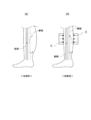
- FIG. 6 shows an example of the state before and after treatment for edema that developed in the lower limbs.
- FIG. 6 (a) shows before treatment
- FIG. 6 (b) shows after treatment.
- Blood that flows from the heart along the arteries that run through the lower limbs flows back into the heart through veins, but when the calf muscle pumping function declines due to weakness of the heart or skeletal muscles, blood swells in the lower limbs. It becomes easy to get stuck.
- FIG. 6 (a) shows that blood begins to stagnate, as shown in FIG. 6 (a)
- the pressure in the veins of the lower extremities rises
- inflammation occurs in the blood vessels
- the plasma component (water) of the blood exudes from the inside of the blood vessels to the outside of the blood vessels. Inflammation occurs due to the accumulation of water in the subcutaneous tissue outside the blood vessels.
- the state of the edema is measured and driven so that the edema is improved based on the measurement result.
- the treatment is performed while the driving amount of the part 5 is optimized.
- the amount of venous return is increased by the treatment for improving edema (massage treatment of predetermined stimulation by the driving unit 5), as shown in FIG. 6 (b).
- the water in the subcutaneous tissue is returned to the blood vessels and the edema is improved, the blood circulation in the arteries is improved, and as a result, the QOL of the patient is improved.
- the medical device 1 includes a measuring unit 2 that measures the state of edema at a peripheral site of the patient, a driving unit 5 that gives a predetermined stimulus to a part of the patient's body, and edema.
- the control unit 6 is provided with a control unit 6 that adjusts and controls the drive amount of the drive unit 5 so that the edema score calculated based on the above-mentioned state reaches a target value set for the purpose of improving the edema.
- the measuring unit 2 has the first water content (intravascular water) which is the water content in the first region in the peripheral portion and the intravascular water content flowing out from the first region.
- the control unit 6 includes an information acquisition unit 23 that acquires water discrimination information for distinguishing the water in the second region into which the water flows, from the second water (moisture in the subcutaneous tissue), and the control unit 6 is based on the water discrimination information.
- the edema score which is an evaluation value given based on the abundance ratio calculated by the calculation unit 3 and the calculation unit 3 for calculating the abundance ratio of the first water content and the second water content, reaches the target value. It may be configured to include a determination processing unit 4 for adjusting and controlling the driving amount of the driving unit 5.
- the edema score is acquired based on the abundance ratio of the water in the blood vessel and the water in the subcutaneous tissue in the edema to be measured, and the driving unit 5 is set so that the edema score reaches the target value. Since the driving amount can be adjusted and controlled, the driving unit 5 can be driven with an appropriate driving amount according to the ratio of the water content in the subcutaneous tissue, and the effect of improving edema can be enhanced.
- the measurement unit 2 sets a measurement surface S composed of a plurality of divided regions S1 as a peripheral portion, and the water content discrimination information is obtained by the first water content on the measurement surface S. Distinguish between the first water region (intravascular water region S1A) which is the existing division region S1 and the second water region (intrasubcutaneous water region S1B) which is the division region S1 in which the second water is present.
- the calculation unit 3 includes information, and based on the number of regions of the first moisture region and the second moisture region included in the moisture discrimination information as the abundance ratio, the calculation unit 3 has the first moisture and the second moisture on the measurement surface S. It may be configured to calculate the area ratio with water.
- the measurement surface S is set for the edema to be measured, the intravascular water region S1A in which the intravascular water existing in the measurement surface S exists, and the subcutaneous tissue in which the subcutaneous tissue water exists.
- An edema score can be obtained based on the area ratio with the water region S1B in the tissue, and the driving amount of the driving unit 5 can be adjusted and controlled so that the edema score reaches the target value.
- the amount of driving by the driving unit 5 can be adjusted according to the ratio of the water region S1B in the subcutaneous tissue in which the water in the subcutaneous tissue is present, and the optimum treatment that can be expected to improve edema can be performed.
- the determination processing unit 4 sets the drive region S2 driven by the drive unit 5 in the peripheral portion as a first water region (intravascular water region S1A) and a second water region. It may be set based on the distribution state of (moisture region S1B in the subcutaneous tissue), and the drive unit 5 may be controlled by a drive amount corresponding to each drive region S2.
- the drive of the drive unit 5 can be controlled for each set drive area S2, so that more suitable treatment for edema can be performed.
- the measurement unit 2 is arranged so that the irradiation unit 21 irradiates the peripheral portion with an electromagnetic wave that can pass through the peripheral portion and the irradiation unit 21 faces the irradiation unit 21 via the peripheral portion. It may be configured to include a receiving portion 22 that receives the transmitted wave transmitted through the peripheral portion.
- the first region may be a blood vessel running subcutaneously at the site where edema has developed
- the second region may be a subcutaneous tissue existing around the blood vessel. ..
- the first region is a lymphatic system running subcutaneously at the site where edema has developed
- the second region is a subcutaneous tissue existing around the lymphatic system. May be.
- the present invention is not limited to the above embodiment, and can be appropriately modified and implemented according to the usage environment and the like as shown below. Further, the following modifications can be carried out in any combination within a range that does not deviate from the gist of the present invention.
- the calculation unit 3 calculates the abundance ratio of the water content in the blood vessel and the water content in the subcutaneous tissue on the measurement surface S based on the water content discrimination information measured by the measurement unit 2.
- the area ratio between the internal water region S1A and the subcutaneous tissue water region S1B was calculated, but is not limited thereto.
- the calculation unit 3 may be able to quantitatively calculate the state of edema by obtaining the abundance ratio of the water content in the blood vessel and the water content in the subcutaneous tissue in the measurement surface S.
- the state of edema is determined by bioelectrical impedance (BIA method: bioelectrical impedance) in which a weak current is passed through the living body and the water content in the target region is measured from the resistance value.
- BIOA method bioelectrical impedance
- the calculation unit 3 may calculate the abundance ratio of the water content in the blood vessel and the water content in the subcutaneous tissue on the measurement surface S based on the water content discrimination information obtained by these methods.
- the dielectric constants of the inside of the blood vessel, which is the first region, and the subcutaneous tissue, which is the second region are different, even if the measurement is performed using a single frequency, the first region and the second region can be sufficiently measured. It is possible to know the area ratio, but taking advantage of the fact that the permittivity has frequency dependence, by measuring multiple times while changing the frequency and finding the average value of them, the first is more accurate.
- the first moisture region and the second moisture region can be distinguished.
- the outflow region from which the water that causes edema flows out is referred to as a “blood vessel”, and the inflow region into which the water flowing out from the outflow region flows out is referred to as a “subcutaneous tissue”, but the present invention is not limited thereto. .. Edema is a symptom caused by the accumulation of water flowing out of the outflow area in the inflow area. Therefore, for example, the outflow area is referred to as “lymphatic system”, the inflow area is referred to as “subcutaneous tissue”, and water is referred to as "lymphatic fluid”. It can also be applied to the treatment of lymphedema.
- 1 medical device 1a body, 2 Measurement unit (21 irradiation unit, 22 wave receiving unit, 23 information acquisition unit), 3 Calculation unit, 4 Judgment processing unit, 5 Drive unit, 6 Control unit, S measurement surface, S1 compartmentalized area (S1A intravascular water area, S1B subcutaneous tissue water area), S2 drive area (S21 first drive area, S22 second drive area, S23 third drive area).
- Measurement unit 21 irradiation unit, 22 wave receiving unit, 23 information acquisition unit
- 3 Calculation unit 4 Judgment processing unit
- 5 Drive unit 6 Control unit, S measurement surface, S1 compartmentalized area (S1A intravascular water area, S1B subcutaneous tissue water area), S2 drive area (S21 first drive area, S22 second drive area, S23 third drive area).
Landscapes
- Health & Medical Sciences (AREA)
- Life Sciences & Earth Sciences (AREA)
- Public Health (AREA)
- Engineering & Computer Science (AREA)
- Biomedical Technology (AREA)
- Veterinary Medicine (AREA)
- Animal Behavior & Ethology (AREA)
- General Health & Medical Sciences (AREA)
- Heart & Thoracic Surgery (AREA)
- Radiology & Medical Imaging (AREA)
- Nuclear Medicine, Radiotherapy & Molecular Imaging (AREA)
- Pathology (AREA)
- Medical Informatics (AREA)
- Molecular Biology (AREA)
- Surgery (AREA)
- Neurology (AREA)
- Physics & Mathematics (AREA)
- Biophysics (AREA)
- Measurement And Recording Of Electrical Phenomena And Electrical Characteristics Of The Living Body (AREA)
- Surgical Instruments (AREA)
Priority Applications (2)
| Application Number | Priority Date | Filing Date | Title |
|---|---|---|---|
| CN202180019427.4A CN115243757A (zh) | 2020-03-12 | 2021-03-08 | 医疗器械 |
| JP2022507175A JPWO2021182390A1 (https=) | 2020-03-12 | 2021-03-08 |
Applications Claiming Priority (2)
| Application Number | Priority Date | Filing Date | Title |
|---|---|---|---|
| JP2020-043031 | 2020-03-12 | ||
| JP2020043031 | 2020-03-12 |
Publications (1)
| Publication Number | Publication Date |
|---|---|
| WO2021182390A1 true WO2021182390A1 (ja) | 2021-09-16 |
Family
ID=77672380
Family Applications (1)
| Application Number | Title | Priority Date | Filing Date |
|---|---|---|---|
| PCT/JP2021/008971 Ceased WO2021182390A1 (ja) | 2020-03-12 | 2021-03-08 | 医療デバイス |
Country Status (3)
| Country | Link |
|---|---|
| JP (1) | JPWO2021182390A1 (https=) |
| CN (1) | CN115243757A (https=) |
| WO (1) | WO2021182390A1 (https=) |
Citations (7)
| Publication number | Priority date | Publication date | Assignee | Title |
|---|---|---|---|---|
| JPH10137193A (ja) * | 1996-11-07 | 1998-05-26 | Kao Corp | むくみ評価方法 |
| JP2002282232A (ja) * | 2001-03-26 | 2002-10-02 | Tanita Corp | むくみ測定装置 |
| JP2002315728A (ja) * | 2001-04-23 | 2002-10-29 | Toshiba Tec Corp | 血流値測定装置 |
| JP2005065812A (ja) * | 2003-08-21 | 2005-03-17 | Nec Fielding Ltd | 健康診断システム,方法およびプログラム |
| JP2006175016A (ja) * | 2004-12-22 | 2006-07-06 | Matsushita Electric Works Ltd | エア式マッサージ機 |
| JP2008502382A (ja) * | 2004-06-18 | 2008-01-31 | ザ ユニバーシティ オブ クイーンズランド | 浮腫検出 |
| KR20200055318A (ko) * | 2018-11-13 | 2020-05-21 | 주식회사 바디프랜드 | 부종 상태를 고려하여 림프순환을 돕는 마사지를 제공하는 마사지 장치 및 방법 |
-
2021
- 2021-03-08 JP JP2022507175A patent/JPWO2021182390A1/ja active Pending
- 2021-03-08 CN CN202180019427.4A patent/CN115243757A/zh active Pending
- 2021-03-08 WO PCT/JP2021/008971 patent/WO2021182390A1/ja not_active Ceased
Patent Citations (7)
| Publication number | Priority date | Publication date | Assignee | Title |
|---|---|---|---|---|
| JPH10137193A (ja) * | 1996-11-07 | 1998-05-26 | Kao Corp | むくみ評価方法 |
| JP2002282232A (ja) * | 2001-03-26 | 2002-10-02 | Tanita Corp | むくみ測定装置 |
| JP2002315728A (ja) * | 2001-04-23 | 2002-10-29 | Toshiba Tec Corp | 血流値測定装置 |
| JP2005065812A (ja) * | 2003-08-21 | 2005-03-17 | Nec Fielding Ltd | 健康診断システム,方法およびプログラム |
| JP2008502382A (ja) * | 2004-06-18 | 2008-01-31 | ザ ユニバーシティ オブ クイーンズランド | 浮腫検出 |
| JP2006175016A (ja) * | 2004-12-22 | 2006-07-06 | Matsushita Electric Works Ltd | エア式マッサージ機 |
| KR20200055318A (ko) * | 2018-11-13 | 2020-05-21 | 주식회사 바디프랜드 | 부종 상태를 고려하여 림프순환을 돕는 마사지를 제공하는 마사지 장치 및 방법 |
Also Published As
| Publication number | Publication date |
|---|---|
| CN115243757A (zh) | 2022-10-25 |
| JPWO2021182390A1 (https=) | 2021-09-16 |
Similar Documents
| Publication | Publication Date | Title |
|---|---|---|
| Mayrovitz | The standard of care for lymphedema: current concepts and physiological considerations | |
| US20230157563A1 (en) | Ocular impedance-based system for brain health monitoring | |
| JP2007521098A (ja) | グルコースレベルのモニター方法 | |
| JP2008520306A (ja) | 装置 | |
| JP7611901B2 (ja) | 治療装置 | |
| WO2007063900A1 (ja) | 身体表面刺激治療装置ならびに身体表面刺激治療プログラムおよびこれを記録したコンピュータ読み取り可能な記録媒体 | |
| JP7813738B2 (ja) | 核磁気共鳴を使用する処置のための装置を調整する方法 | |
| Агзамходжаев et al. | DIAGNOSTIC ADVANTAGES OF CONTACTLESS BIOIMPEDANESOMETRY | |
| RU2093069C1 (ru) | Способ определения объема жидкостных секторов организма | |
| WO2021182390A1 (ja) | 医療デバイス | |
| RU2078557C1 (ru) | Способ рефлексотерапии и устройство для его осуществления | |
| US11857784B2 (en) | Method for conducting stimulus treatment | |
| Haritha et al. | Varicose vein diagnosis system and therapy: A review | |
| JP6373647B2 (ja) | 超音波照射装置及び診断システム | |
| KR101838813B1 (ko) | 생체 정보 측정 장치 및 방법 | |
| KR20230107525A (ko) | 맞춤형 전기 자극 제공 시스템 및 그 방법 | |
| JP2001276005A (ja) | 筋の活動度又は疲労度の評価装置 | |
| RU2499544C2 (ru) | Способ эластометрической диагностики тканевых изменений при синдроме диабетической стопы | |
| RU2465814C2 (ru) | Способ электротермометрической диагностики тканевых изменений при синдроме диабетической стопы | |
| US20150112206A1 (en) | Heat stimulus transmission evaluation method and evaluation method of drug benefit by thermal stimulation transmission | |
| JP2013233416A (ja) | 超音波照射装置及び診断システム | |
| RU2393765C2 (ru) | Способ контроля адаптационно-компенсаторных реакций организма в процессе квч-пунктуры | |
| RU2757080C2 (ru) | Устройство для воздействия электромагнитным полем на кровеносную систему пациента и соответствующий способ | |
| RU2501583C1 (ru) | Способ лечения больных с гонартрозом | |
| RU2181256C2 (ru) | Способ низкочастотной импедансометрии в диагностике нарушений лимфатической системы конечностей |
Legal Events
| Date | Code | Title | Description |
|---|---|---|---|
| 121 | Ep: the epo has been informed by wipo that ep was designated in this application |
Ref document number: 21768650 Country of ref document: EP Kind code of ref document: A1 |
|
| ENP | Entry into the national phase |
Ref document number: 2022507175 Country of ref document: JP Kind code of ref document: A |
|
| NENP | Non-entry into the national phase |
Ref country code: DE |
|
| 122 | Ep: pct application non-entry in european phase |
Ref document number: 21768650 Country of ref document: EP Kind code of ref document: A1 |