WO2021153159A1 - 情報処理装置、方法、コンピュータプログラム及び通信システム - Google Patents
情報処理装置、方法、コンピュータプログラム及び通信システム Download PDFInfo
- Publication number
- WO2021153159A1 WO2021153159A1 PCT/JP2021/000004 JP2021000004W WO2021153159A1 WO 2021153159 A1 WO2021153159 A1 WO 2021153159A1 JP 2021000004 W JP2021000004 W JP 2021000004W WO 2021153159 A1 WO2021153159 A1 WO 2021153159A1
- Authority
- WO
- WIPO (PCT)
- Prior art keywords
- drone
- moving body
- priority
- information
- control unit
- Prior art date
- Legal status (The legal status is an assumption and is not a legal conclusion. Google has not performed a legal analysis and makes no representation as to the accuracy of the status listed.)
- Ceased
Links
Images




Classifications
-
- G—PHYSICS
- G05—CONTROLLING; REGULATING
- G05D—SYSTEMS FOR CONTROLLING OR REGULATING NON-ELECTRIC VARIABLES
- G05D1/00—Control of position, course, altitude or attitude of land, water, air or space vehicles, e.g. using automatic pilots
- G05D1/10—Simultaneous control of position or course in three dimensions
- G05D1/101—Simultaneous control of position or course in three dimensions specially adapted for aircraft
-
- G—PHYSICS
- G06—COMPUTING OR CALCULATING; COUNTING
- G06V—IMAGE OR VIDEO RECOGNITION OR UNDERSTANDING
- G06V20/00—Scenes; Scene-specific elements
- G06V20/10—Terrestrial scenes
- G06V20/17—Terrestrial scenes taken from planes or by drones
-
- B—PERFORMING OPERATIONS; TRANSPORTING
- B64—AIRCRAFT; AVIATION; COSMONAUTICS
- B64D—EQUIPMENT FOR FITTING IN OR TO AIRCRAFT; FLIGHT SUITS; PARACHUTES; ARRANGEMENT OR MOUNTING OF POWER PLANTS OR PROPULSION TRANSMISSIONS IN AIRCRAFT
- B64D45/00—Aircraft indicators or protectors not otherwise provided for
-
- B—PERFORMING OPERATIONS; TRANSPORTING
- B64—AIRCRAFT; AVIATION; COSMONAUTICS
- B64U—UNMANNED AERIAL VEHICLES [UAV]; EQUIPMENT THEREFOR
- B64U20/00—Constructional aspects of UAVs
- B64U20/80—Arrangement of on-board electronics, e.g. avionics systems or wiring
- B64U20/87—Mounting of imaging devices, e.g. mounting of gimbals
-
- G—PHYSICS
- G05—CONTROLLING; REGULATING
- G05D—SYSTEMS FOR CONTROLLING OR REGULATING NON-ELECTRIC VARIABLES
- G05D1/00—Control of position, course, altitude or attitude of land, water, air or space vehicles, e.g. using automatic pilots
- G05D1/10—Simultaneous control of position or course in three dimensions
- G05D1/101—Simultaneous control of position or course in three dimensions specially adapted for aircraft
- G05D1/106—Change initiated in response to external conditions, e.g. avoidance of elevated terrain or of no-fly zones
- G05D1/1064—Change initiated in response to external conditions, e.g. avoidance of elevated terrain or of no-fly zones specially adapted for avoiding collisions with other aircraft
-
- G—PHYSICS
- G05—CONTROLLING; REGULATING
- G05D—SYSTEMS FOR CONTROLLING OR REGULATING NON-ELECTRIC VARIABLES
- G05D1/00—Control of position, course, altitude or attitude of land, water, air or space vehicles, e.g. using automatic pilots
- G05D1/60—Intended control result
- G05D1/617—Safety or protection, e.g. defining protection zones around obstacles or avoiding hazards
-
- G—PHYSICS
- G06—COMPUTING OR CALCULATING; COUNTING
- G06V—IMAGE OR VIDEO RECOGNITION OR UNDERSTANDING
- G06V20/00—Scenes; Scene-specific elements
- G06V20/50—Context or environment of the image
- G06V20/56—Context or environment of the image exterior to a vehicle by using sensors mounted on the vehicle
- G06V20/58—Recognition of moving objects or obstacles, e.g. vehicles or pedestrians; Recognition of traffic objects, e.g. traffic signs, traffic lights or roads
-
- G—PHYSICS
- G08—SIGNALLING
- G08G—TRAFFIC CONTROL SYSTEMS
- G08G1/00—Traffic control systems for road vehicles
- G08G1/16—Anti-collision systems
-
- G—PHYSICS
- G08—SIGNALLING
- G08G—TRAFFIC CONTROL SYSTEMS
- G08G5/00—Traffic control systems for aircraft
- G08G5/80—Anti-collision systems
-
- B—PERFORMING OPERATIONS; TRANSPORTING
- B64—AIRCRAFT; AVIATION; COSMONAUTICS
- B64U—UNMANNED AERIAL VEHICLES [UAV]; EQUIPMENT THEREFOR
- B64U2101/00—UAVs specially adapted for particular uses or applications
- B64U2101/30—UAVs specially adapted for particular uses or applications for imaging, photography or videography
Definitions
- This disclosure relates to information processing devices, methods, computer programs and communication systems.
- Patent Document 1 discloses a method in which the priority of a drone is determined from the flight speed, weight, etc., and each drone takes an action for collision avoidance in the priority order according to the determined priority. In this method, when the distance between drones becomes a certain value or less, the priorities of the drones are compared and the priority of the drones is determined.
- the present disclosure provides information processing devices, methods, computer programs and communication systems that prevent collisions with other mobile objects.
- the information processing device is By imaging the environment including the traveling direction of the moving body, an imaging unit that acquires image data and other moving bodies existing in the traveling direction of the moving body are detected based on the image data. It is provided with a control unit that performs an action of preventing a collision with the other moving body based on the information about the other moving body.
- the control unit determines the action to prevent a collision with the other moving body, and performs the action.
- the control unit as the action, Whether to proceed while performing the avoidance action against the other moving body Whether to perform the standby operation or proceed without performing the avoidance operation for the other moving body Either change the route.
- the control unit Determining which of the moving body and the other moving body has priority, When the other moving body has priority, the other moving body is subjected to either an avoidance operation with respect to the other moving body, a standby operation, or a change of the route. When the moving body has priority, the process proceeds without performing an avoidance operation on the other moving body.
- the control unit The priority of the moving body and the priority of the other moving body are determined, and the priority is determined. Based on the priority of the moving body and the priority of the other moving body, it is determined whether the moving body or the other moving body has priority.
- the information about the other mobile includes the recognition performance of the imaging unit of the other mobile.
- the control unit determines which of the moving body and the other moving body has priority based on the recognition performance of the imaging unit and the recognition performance of the imaging unit of the other moving body.
- the imaging unit and the imaging unit of the other mobile body include at least one camera.
- the recognition performance of the image pickup unit and the recognition performance of the image pickup unit of the other moving body are The number of cameras The angle of view of the camera, The installation position of the camera, The resolution of the camera, It is determined based on at least one of.
- the recognition performance of the imaging unit is determined based on the number of other moving objects detected by the control unit.
- the recognition performance of the imaging unit of the other moving body is determined based on the number of moving bodies recognized by the other moving body in the traveling direction of the other moving body.
- the control unit Determining if the other moving body recognizes the moving body, If it is determined that the other moving body does not recognize the moving body, the other moving body is given priority.
- the information about the other mobile includes the purpose of movement of the other mobile.
- the control unit determines which of the moving body and the other moving body has priority based on the moving purpose of the moving body and the moving purpose of the other moving body.
- the information about the other mobile includes the movement performance of the other mobile.
- the control unit determines which of the moving body and the other moving body has priority based on the moving performance of the moving body and the moving performance of the other moving body.
- the information about the other mobile includes the speed of the other mobile.
- the control unit determines which of the moving body and the other moving body has priority based on the speed of the moving body and the speed of the other moving body.
- the control unit calculates the time until the moving body collides with the other moving body, and calculates the time until the moving body collides with the other moving body. Depending on the time, the control unit or the base station determines whether the mobile body or the other mobile body has priority. If the base station decides to make the decision, it sends a request to make the decision to the base station.
- the control unit The time until the moving body collides with the other moving body is calculated. Based on the time, the type of information to be acquired is determined. The information acquisition unit acquires the determined type of information.
- the information about the other moving body includes at least one of the position of the other moving body and the distance to the other moving body.
- the moving body is a flying body.
- the computer program according to this disclosure is It is a computer program to be executed by a computer mounted on a mobile body.
- the method according to the present disclosure is a method performed by a mobile body.
- Image data is acquired by imaging the environment including the traveling direction of the moving body. Based on the image data, another moving body existing in the traveling direction of the moving body is detected. Based on the information about the other moving body, the action of preventing the collision with the other moving body is performed.
- the communication system is a communication system including a plurality of mobile bodies and a base station.
- the plurality of moving bodies include an imaging unit that acquires image data by imaging an environment including the traveling direction of the moving body. Based on the image data, a control unit that detects another moving body existing in the traveling direction of the moving body, and a control unit. It is equipped with a communication unit that communicates with the base station.
- the base station A communication unit that communicates with the mobile body, An information acquisition unit that acquires information on the moving body and the image data from the moving body, and A control that generates information for determining an action for the moving body to prevent a collision with the other moving body based on the information about the moving body and the image data, and transmits the generated information to the moving body. It has a part and.
- the block diagram of the communication system including the information processing apparatus which concerns on 1st Embodiment. Drone block diagram.
- Block diagram of the base station The schematic diagram which showed the state of the drone A and the drone B in flight in a plane.
- a flowchart of an example of collision avoidance control performed in the control unit of the drone The flowchart of an example of the priority determination process performed in the control unit of the drone.
- the flowchart of the first example of collision avoidance control The figure for demonstrating the 2nd example of a collision avoidance control.
- the flowchart of the second example of the collision avoidance control The figure for demonstrating the specific example of the 3rd example of a collision avoidance control.
- the figure for demonstrating the specific example of the 3rd example of a collision avoidance control The figure for demonstrating the specific example of the 3rd example of a collision avoidance control.
- the flowchart of the third example of the collision avoidance control The figure which shows an example of the hardware composition of the information processing apparatus of a drone or a base station.
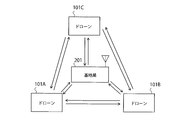
- FIG. 1 is a block diagram of a communication system according to the first embodiment.
- the communication system of FIG. 1 includes a plurality of mobile bodies 101A, 101B, 101C and a base station 201.
- the mobile body of the present embodiment is a drone (unmanned aerial vehicle), and the mobile bodies 101A to 101C are referred to as drones 101A to 101C.
- the drone is an example of a moving body, and the moving body may be a robot, an automatic guided vehicle, or the like.
- the figure shows three drones, but the number of drones may be two or four or more.
- any one drone will be referred to as a drone 101.
- the arrows in the figure indicate the direction of communication.
- the drone 101A and the drone 101B can communicate in both directions, the drone 101A and the drone 101C can communicate in both directions, and the drone 101B and the drone 101C can communicate in both directions. Further, the base station 201 can communicate bidirectionally with any of the drone 101A, the drone 101B, and the drone 101C.
- Drone 101 is a mobile body that can fly by driving a plurality of rotors.
- the drone 101 can wirelessly communicate with the base station 201.
- the drone 101 flies along the route under the control of the base station 201.
- the drone 101 may generate a route from the starting point and the destination by itself and fly (autonomous flight), or the route may be designated by the base station 201 and fly on the designated route.
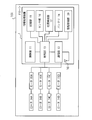
- FIG. 2 is a block diagram of the drone 101.
- the drone 101 includes an information processing device 1, rotors 14A to 14D, and motors 15A to 15D.
- the information processing device 1 includes an antenna 10, an imaging unit 11, a control unit 13, a communication unit 12, a sensor unit 16, a position detection unit 17, a battery 18, a storage unit 19, and an information acquisition unit 20.
- the imaging unit 11 images the environment including the traveling direction of the drone 101 and acquires image data.
- the image capturing unit 11 stores the captured image data in the storage unit 19 in association with the time. Alternatively, the imaging unit 11 may provide the captured image data to the control unit 13.
- the captured image is a still image or a moving image.
- the image pickup device 101 includes one or more cameras including a lens, an image pickup device, and the like.
- the camera may be a stereo camera.
- the image sensor is, for example, a CCD (Charge Coupled Device) image sensor, a CMOS (Complementary Metal Oxide Semiconductor) image sensor, or the like.
- the rotors 14A to 14D fly the drone 101 by generating lift by rotation.
- the rotors 14A to 14D are rotated by the motors 15A to 15D.
- Motors 15A to 15D rotate rotors 14A to 14D.
- the rotation of the motors 15A to 15D is controlled by the control unit 13.
- the control unit 13 controls the operation of the drone 101.
- the control unit 13 controls the image pickup unit 11, the communication unit 12, the motors 15A to 15D, the sensor unit 16, the position detection unit 17, the battery 18, the information acquisition unit 20, and the storage unit 19.
- the control unit 13 adjusts the rotation speeds of the rotors 14A to 14D by adjusting the rotation speeds of the motors 15A to 15D. By adjusting the rotation speeds of the rotors 14A to 14D, the drone 101 can be moved in any direction and at any speed.
- the control unit 13 controls the image pickup by the image pickup unit 11 during the flight. For example, control is performed so that imaging is performed at regular sampling intervals. Further, the control unit 13 controls the transmission / reception processing of information or data with another device (for example, the base station 101 and another mobile body) via the communication unit 12.
- another device for example, the base station 101 and another mobile body
- the control unit 13 generates a flight route based on the departure point and the destination of the flight given as instruction data from the base station 201, and flies along the generated route. That is, the control unit 13 performs autonomous flight.
- the control unit 13 has a function of avoiding other drones (hereinafter, other drones) and other obstacles.
- the control unit 13 may regenerate the route when it wants to change the route for preventing the collision with the obstacle.
- the control unit 13 may receive the flight route data from the base station 201 and fly along the route of the received data.
- the control unit 13 may transmit information such as the position of the drone 101 to the base station 201 and transmit a request for regenerating the route.
- the control unit 13 performs a process of detecting another drone existing in the traveling direction of the drone 101 based on the image data captured by the imaging unit 11.
- Other drones that exist in the direction of travel are called interference drones as drones that may interfere with their own drone.
- the process of detecting the interference drone is called the interference drone detection process.
- the control unit 13 performs an interference drone detection process every time image data is acquired by the image pickup unit 11. By detecting the interference drone, the control unit 13 can recognize another drone existing in the traveling direction.
- the direction of travel of the drone is, for example, the forward direction of the drone, but it is not necessarily limited to the forward direction. For example, when the drone goes up or down, the direction of travel may be upward or downward.
- An example of the interference drone detection process is performed by detecting a drone object from image data using segmentation technology. For example, semantic segmentation that detects objects at the pixel level can be used. The drone indicated by the detected object is determined as an interfering drone.
- the method of detecting the interference drone from the image data is not limited to the method using the segmentation technique, and any method may be used.
- a medium for example, a sticker to which the aircraft ID of the drone 101 is added may be added to the drone 101.
- the aircraft ID is an ID that uniquely identifies the drone. If the aircraft ID can be read from the image data, the aircraft ID of the interfering drone may be specified from the read information.
- the drone existing in the traveling direction of the drone 101 is, for example, a drone shown in an image captured by a camera installed at a location corresponding to the traveling direction of the drone 101 (for example, in front of the aircraft).
- the entire image captured by the camera is targeted for object detection, and the detected object is determined as an interference drone.
- a part of the captured image may be the target of object detection.
- a specific part (partial image) of the captured image may be targeted for object detection.
- the specific location may be a certain range from the center of the captured image.
- the specific portion may be a portion through which the own drone passes (a portion of the space occupied by the own drone) or a portion in which a margin area is added to the portion of the space occupied by the own drone.
- Other drones existing in the direction of travel may be detected by other methods.
- the control unit 13 may perform a process of detecting a drone in a peripheral direction other than the traveling direction (for example, a rear direction, a left side direction, a right side direction, a lower side direction, an upper side direction, etc.).
- image data captured by a camera installed at a location other than the location corresponding to the traveling direction may be used.
- detecting a drone in a direction other than the traveling direction it is possible to prevent a collision with another drone, for example, when avoiding an interfering drone in the traveling direction.
- the control unit 13 When the control unit 13 detects an interference drone from the image data, the control unit 13 generates interference detection information including the position and time of the interference drone.
- the control unit 13 stores the interference detection information in the storage unit 19.
- the set of interference detection information corresponds to the detection history of the interference drone.
- the distance to the interfering drone may be calculated.
- the position or distance of the interference drone can be calculated using, for example, image data captured by a stereo camera.
- the communication unit 12 performs information or data transmission / reception processing by performing wireless communication with the base station 101 and other drones (including the case of an interference drone).
- the wireless communication method may be arbitrary.
- the standard may be based on the IEEE802.11 standard, the IEEE802.5.1 standard, or other standards.
- the frequency band used for wireless communication is, for example, a 2.4 GHz band, a 5 GHz band, or another frequency band.
- the communication unit 12 receives flight instruction data from the base station 201.
- the communication unit 12 provides the instruction data to the control unit 13.
- the control unit 13 controls to fly according to the instruction data.
- the instruction data includes the starting point and the destination.
- the control unit 13 generates a route to the destination and controls to fly according to the generated route.
- the communication unit 12 also receives information about the other drone (details will be described later) from the other drone.
- the communication unit 12 provides the information acquisition unit 20 with information on the acquired other drone.
- the communication unit 12 may acquire information on the other drone via the base station 101. Further, the communication unit 12 may transmit information about the drone 101 (own drone) to the interference drone or the base station 101.
- the position detection unit 17 detects the position of the drone 101.
- the position of the drone 101 is, for example, the current position (real-time position) of the drone 101.
- the position detection unit 17 detects the position using, for example, GPS (Global Positioning System) or the like.
- the position detection unit 17 stores the detected position information in the storage unit 19 in association with the time.
- the position detection unit 17 may provide the position information to the control unit 13.
- the position of the drone is, for example, a position in a predetermined coordinate system.
- the predetermined coordinate system may be a three-axis coordinate system (XYZ coordinate system) in which the position of the base station 101 is the origin or a predetermined position.
- XYZ coordinate system three-axis coordinate system
- the coordinate system may have a point other than the position of the base station 101 as the origin.
- the position of the drone may be a position based on the latitude and longitude acquired by GPS. The latitude and longitude positions may be converted to positions in a predetermined coordinate system.
- the sensor unit 16 includes one or a plurality of sensors for acquiring the state of the drone 101.
- sensors include accelerometers, orientation sensors (gyro sensors, GPS compasses or electronic compasses, etc.), ultrasonic sensors, and barometric pressure sensors.
- the sensor unit 16 stores the acquired information representing the state of the drone 101 in the storage unit 19 in association with the time.
- the sensor unit 16 may provide the control unit 13 with information indicating the acquired state of the drone 101.
- the traveling direction is represented by a predetermined coordinate system as an example.
- the traveling direction may be represented by, for example, an absolute direction represented by a range of up to 359.99 in the eastward direction, with the true north direction being 0 degrees.
- the absolute orientation may be converted to a direction in a predetermined coordinate system.
- the image pickup unit 11, the sensor unit 16, and the position detection unit 17 operate (imaging, sensing, and position detection) at a constant sampling interval and the same time under the control of the control unit 13.
- the sampling interval and the operation time of the operations of the image pickup unit 11, the sensor unit 16, and the position detection unit 17 may be different.
- the battery 18 stores electric power energy for operating each element in the drone 101.
- the battery 18 may be a primary battery that can only be discharged or a secondary battery that can be charged and discharged.
- the storage unit 19 has information acquired by the sensor unit 16 (speed, traveling direction, etc.), position information acquired by the position detection unit 17, image data acquired by the imaging unit 11, and acquired by the control unit 13. Stores interference detection information (position and time of interference drone, etc.).
- the control unit 13 may acquire information on the amount of remaining energy of the battery 18 and store the acquired information in the storage unit 19.
- the storage unit 19 stores information regarding the attributes and performance of the drone 101.
- Examples of information on the attributes and performance of the drone 101 include: ⁇ Aircraft ID ⁇ Flight purpose (movement purpose) ⁇ Flight performance (movement performance) ⁇ Departure point and destination ⁇ Recognition performance
- the aircraft ID is an ID that uniquely identifies the drone. For example, "ABC123" and the like.
- the aircraft ID may include an address for communication according to the protocol used.
- Examples of flight purposes include photography, lifesaving (including rescue), logistics, fire extinguishing, and surveillance.
- Examples of photography include photography of a vehicle traveling on a road surface on the ground, photography of a transport vehicle autonomously traveling in a facility, photography of a ship, and the like.
- An example of lifesaving is the transportation of medical supplies or daily necessities to a disaster area or an accident site.
- An example of digestion is the dropping of a digestive agent on a fire scene.
- An example of logistics is the transportation of luggage.
- Examples of monitoring include detection of suspicious persons and detection of abnormalities in facilities.
- Examples of flight performance include braking performance or small turning performance.
- braking performance for example, there is a distance (braking distance) from when the control unit issues a stop command (command to stop in the air) until the drone actually stops.
- the braking distance depends on the speed of the drone or the strength of the brake (braking force).
- small turning performance for example, there is a minimum turning radius.
- the destination or departure point is determined in a predetermined coordinate system as an example.
- the destination or departure point may be a position based on latitude and longitude acquired by GPS. When flying cyclically on the same route for surveillance purposes, the destination may not exist.
- Recognition performance is the performance of the ability to detect drones from image data. Examples of recognition performance are at least one of the position, number, angle of view, and resolution of cameras installed in the drone. The recognition performance may include the number of other drones recognized by the drone in the direction of travel.
- only one camera may be installed in front of the drone, or multiple (for example, eight) cameras may be installed around the drone. If only one camera is installed in front of the drone, only the front of the drone can be photographed, so only the drone in front can be detected. That is, only the drone in front can be recognized.
- the drone can be detected over a wide range because it is possible to shoot not only the front but also the entire surroundings such as the rear, the left, and the right. That is, the drone can be recognized over a wide range.
- the narrower the angle of view the farther you can shoot. That is, it can recognize a drone that is far away.
- the shooting range is narrowed, it is necessary to increase the number of cameras installed in order to recognize the drone in a wide range as compared with the case of using a camera with a wide angle of view.
- the drone included in the captured image can be identified with higher accuracy. For example, even if the drone appears small in the captured image, the drone can be detected and recognized as an interference drone.
- the information acquisition unit 20 acquires information about the other drone from the other drone via the communication unit 12.
- the information acquisition unit 20 may acquire information about another drone from the base station 101.
- the information about the other drone acquired from the information acquisition unit 20 includes, for example, the same items as the information in the storage unit 19 of the drone 101. For example, it includes the following items. ⁇ Aircraft ID ⁇ Flight purpose (movement purpose) ⁇ Flight performance (movement performance) ⁇ Departure point and destination ⁇ Recognition performance ⁇ Position ⁇ Speed ⁇ Direction of travel ⁇ Battery remaining energy ⁇ Interference detection information (interference drone position and detection time, etc.)
- the control unit 13 detects one or more interfering drones from the image data in the traveling direction of the own drone, the control unit 13 communicates with the interfering drone and acquires information about the interfering drone.
- the information about the interfering drone to be acquired is all or part of the above items. There may be a configuration in which part or all of the information regarding the interfering drone is acquired from the base station 201. Further, the control unit 13 may transmit information about the drone 101 to the interference drone or the base station 201 via the communication unit 12.
- Communication with the interfering drone is performed based on the aircraft ID if the aircraft ID of the interfering drone can be identified from the image data. For example, communication is performed using a packet including an aircraft ID. If the aircraft ID cannot be specified, a directional beam may be formed with respect to the position of the interfering drone to perform communication. Alternatively, the interfering drone may be transmitted by broadcasting and the interfering drone may be identified based on the response packet transmitted from the direction or position of the interfering drone.
- the control unit 13 determines the action necessary to prevent the collision with the interfering drone based on the acquired information about the interfering drone.
- the control unit 13 controls the flight of the drone 101 based on the determined action.
- Examples of actions required to prevent a collision include avoiding a collision with an interfering drone (ie, performing an evasive action), proceeding without an evasive action, performing a standby action, and changing the route. I have something to do.
- the standby operation includes a pause on the route or a save operation to save to a position off the route.
- the action of determining the action to prevent the collision and executing the decided action in this way is called collision avoidance control.
- the standby operation the flight is resumed after the interference is eliminated, that is, after the interference drone no longer exists in the direction of travel. If the flight is paused as a standby operation, the flight will resume from the paused location.
- the evasion operation is performed as the standby operation, the flight returns to the original route and continues the flight, or a new route is regenerated from the evacuated position and the flight is performed along the regenerated route. The details of the collision avoidance control will be described later.
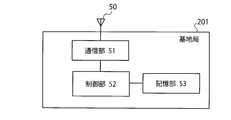
- FIG. 3 is a block diagram of the base station 201.
- the base station 201 includes an antenna 50, a communication unit 51, a control unit 52, and a storage unit 53.
- the communication unit 51 performs information or data transmission / reception processing by performing wireless communication with the drone 101 (101A to 101C).
- the wireless communication method may be arbitrary.
- the IEEE802.11 standard, the IEEE802.5.1 standard, and other standards may be used.
- the frequency band used for wireless communication is, for example, a 2.4 GHz band, a 5 GHz band, or another frequency band.
- the communication unit 51 acquires flight instruction data from the control unit 52 to the drone 101, and transmits the instruction data to the drone 101.
- Information on the attributes and performance of the drone 101 is stored in the storage unit 53.
- information on the aircraft ID of the drone 101 spec information (model, weight, size, etc.), flight purpose (movement purpose), flight performance (movement performance), departure place and destination, and recognition performance are stored.
- the control unit 52 controls the operation of the base station 201. In addition, the drone 101 is instructed regarding flight.
- the control unit 52 generates instruction data regarding the flight of the drone 101 based on the information regarding the drone 101 in the storage unit 53.
- the instruction data includes the starting point and the destination as an example.
- the instruction data may include a flight path.
- the control unit 52 transmits the generated instruction data to the drone 101 via the communication unit 51.
- control unit 52 When the control unit 52 receives the request for route regeneration from the drone 101, the control unit 52 regenerates the route.
- the control unit 52 transmits instruction data including the regenerated route to the drone 101.
- the control unit 52 controls the transmission and reception of information or data with the drone 101.
- the control unit 52 acquires the information or data acquired by the sensor unit 16, the control unit 13 and the position detection unit 17 of the drone 101 from the drone 101, and stores the acquired information or data in the storage unit 53. Store.
- control unit 52 When the control unit 52 receives a request for transmitting information about another drone from the drone 101, the control unit 52 reads the requested drone information from the storage unit 53 and transmits it to the drone 101.
- FIG. 4 is a schematic view showing the state of drone A and drone B in flight in a plane. Drone A is flying in the direction of travel indicated by the arrow, and Drone B is flying in the direction of travel indicated by the arrow.
- FIG. 5 shows an example of image data 31 taken by a camera installed in front of the drone A. This camera acquires image data in the traveling direction.
- the drone A detects the object B on the left side of the center of the image data 31. From the shape of the object B, it is determined that the object B is a drone. That is, in the drone A, the object B is determined to be an interference drone.
- Drone B may also detect drone A as an interfering drone by analyzing image data in the same manner as drone A.
- the control unit 13 of the drone 101 determines which of the drone 101 and the interfering drone preferentially advances.
- the drone 101 will be referred to as a drone A
- the drone B will be referred to as an interfering drone.
- the drone 101 When the interfering drone has priority, the drone 101 performs, for example, a standby operation (pause or evacuate to a position off the route) as an operation for preventing a collision with the interfering drone. Alternatively, change the route.
- the drone 101 makes an avoidance operation (flying while avoiding an interfering drone). Which of the drone 101 and the interfering drone has priority is determined by negotiation between the drone 101 and the interfering drone as an example. Alternatively, one of the drones serves as the master, and it is determined whether the drone 101 or the interfering drone has priority. Alternatively, as will be described later, there is also a configuration in which the base station 201 determines which of the drone 101 and the interfering drone has priority.
- the drone 101 proceeds without performing the avoidance operation. That is, it flies as it is along the current route.
- the interfering drone performs a standby operation or an avoidance operation.
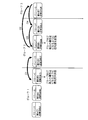
- FIG. 6 is a diagram showing an example of avoidance operation from the side.
- drone A and drone B are flying in opposite directions (FIG. 6 (A)).
- drone B takes precedence over drone A.
- Drone B goes straight along the route.
- Drone A rises while advancing and avoids drone B (Fig. 6 (B)).
- Drone A returns to the original route after avoiding drone B (FIG. 6 (C)).
- the drone A has risen to avoid the drone B, but it may fall, and the drone B may be avoided to the left or right.
- the drone A may regenerate the route without returning to the original route. Interfering drone B may be avoided by other methods.
- FIG. 7 is a diagram showing an example of the evasion operation from the side. Similar to FIG. 6, drone A and drone B are flying in opposite directions. Suppose drone B takes precedence over drone A. Drone B goes straight along the route. Drone A pauses and then rises, for example, 10 m (FIG. 7 (A)). Drone A waits until interference with drone B is avoided. For example, evacuate to a position raised by 10 m. After the interference with the interfering drone B is avoided (after the interfering drone disappears in the traveling direction of the drone A), the drone A descends and returns to the original route (FIG. 7 (B)). Drone A resumes flight (Fig. 7 (C)). The drone A may regenerate a new route at the ascended position and switch the route to the regenerated route. Here, the drone A has risen to avoid the drone B, but may fall, move to the left or to the right.
- FIG. 8 is a plan showing an example of pausing. Drone A and Drone B are going straight along the route (Fig. 8 (A)). Suppose drone B takes precedence over drone A. Drone A pauses and Drone B goes straight on (Fig. 8 (B)). After the interference with the interfering drone B is avoided (after the interfering drone disappears in the traveling direction of the drone A), the drone A resumes the flight from the paused position (FIG. 8C).
- the control unit 13 of the drone 101 determines the priority of the drone 101 and the priority of the interfering drone based on the information about the drone 101 and the interfering drone.
- the control unit 13 determines that the drone 101 and the interfering drone are prioritized in descending order of priority. For example, if the drone 101 has priority 2 and the two interfering drones (referred to as interfering drones X and Y) have priority 1 and priority 3, respectively, the interfering drone X, the drone 101, and the interfering drone Y have priority in this order. do. In this case, as an example, the highest priority interfering drone X proceeds as it is along the path.
- the drone 101 and the drone Y perform a standby operation. Once the interference with the interfering drone X is avoided, the next highest priority drone 101 resumes flight. The lowest priority drone Y resumes flight once interference with the interfering drone X is avoided.
- the drone 101 and the drone Y performed a standby operation as an action to prevent the collision, but at least one of the drone 101 and the drone Y may perform an avoidance operation. Alternatively, at least one of the drone 101 and the drone Y may change the route.
- an example of determining the priority will be described as a first to fifth example.
- the priority is determined based on the recognition performance of the drone 101 and the recognition performance of the interference drone. For example, when the recognition performance of the interfering drone is lower than that of the drone 101, the priority of the interfering drone is set higher than that of the drone 101. As an example of low recognition performance of the interference drone, the number of cameras installed may be less than that of the drone 101. A camera is installed in the drone 101 other than in front of the drone, but in the interference drone, when the camera is not installed in other than the front of the drone, the recognition performance of the interference drone can be said to be lower than that of the drone 101. Further, the recognition performances of the drone 101 and the interfering drone may be compared according to the number of drones recognized in the traveling direction.
- the recognition performance may be compared between the drone 101 and the interfering drone by other methods. If the avoidance operation or the evasion operation is performed when the recognition performance is low, there is a possibility of collision with an unrecognized drone (undetected drone). Can be made to proceed in a targeted manner.
- the recognition performance may be classified into two classes of high and low, or three classes of high, medium and low. For example, if the number of installed cameras is less than the threshold value, the class is low, and if the number of cameras is more than the threshold value, the class is high. In addition, classification may be performed according to the number of drones recognized in the direction of travel. If the recognition performance is the same or the class is the same, the drone 101 and the interfering drone may negotiate to determine the priority. At this time, the priority may be randomly determined.
- the priority is determined based on the flight purpose of the drone 101 and the flight purpose of the interfering drone. For example, if the flight purposes of the three drones are lifesaving purpose, photography purpose, and distribution purpose, respectively, the priority may be increased in this order. As another example, the emergency drone may have the highest priority. Examples of urgent purposes include lifesaving purposes or fire extinguishing purposes. If the flight objectives are the same or in the same category, the drone 101 and the interfering drone may negotiate to determine the priority.
- the priority is determined based on whether the drone 101 is recognized by the interfering drone (detected by the analysis of the image data). Whether or not the drone 101 is recognized by the interference drone can be determined, for example, based on the interference detection information of the interference drone. For example, if the position of the other drone included in the interference detection information of the interfering drone matches the position of the drone 101 or falls within a certain margin, the drone 101 can determine that the interfering drone recognizes the drone 101. Alternatively, if the interference detection information includes the aircraft ID of the drone 101 as the aircraft ID of the drone detected by the interference drone, the drone 101 can determine that the interference drone recognizes the drone 101.
- FIG. 9 is a diagram for specifically explaining a third example of priority determination.
- three drones A, B, and C are flying.
- the figure shows the positions of drones A to C (own drone) and the positions of other drones (interference drones) discovered by drones A to C in the direction of travel.
- the information in FIG. 9 is based on the positions of the drones A to C and the interference detection information at the same time (for example, the latest time) as an example.
- Drone B also detects the position of its own drone and the relative position of two other drones from its own drone.
- Drone C also detects the position of its own drone and the relative position of one other drone from its own drone. Drone C recognizes only one of drones A and B, and does not recognize (overlooks) the other.
- the relative position (2m, 5m, -2m) of the other drone detected by the drone A corresponds to the relative position (-2m, -5m, 2m) of the other drone detected by the drone B. Therefore, the drone at the relative position (2m, 5m, -2m) detected by the drone A can be determined as the drone B.
- the aircraft ID of the drone B may be specified by communicating with the drone B, or may be specified by inquiring the base station 201 about the aircraft ID of the drone existing at the position of the drone B.
- the drone at the relative position (5 m, -1 m, 4 m) detected by the drone A can be determined as the drone C.
- the drone at the relative position (-2m, -5m, 2m) detected by drone B can be determined to be drone A.
- the drone (drone C) existing at the relative position (3 m, -6 m, 6 m) detected by the drone B does not detect another drone at the position of the drone B. Therefore, it can be determined that the drone B is not recognized by the drone (drone C) existing at the relative position (3 m, -6 m, 6 m).
- the drone at the relative position (-5m, 1m, -4m) detected by the drone C can be determined to be the drone A.
- the drone C does not recognize the drone at the position of the drone B.
- Drones A to C communicate with each other and determine priorities. Even if the drone C cannot recognize the drone B (even if the drone B is not shown in the camera of the drone C), it may be possible to communicate with the drone B by the communication triggered by the drone B. However, even if the drone C can communicate with the drone B, the drone C cannot recognize the drone B with the camera, so the drone C treats it as not recognizing the drone B. Drone C does not recognize drone B and determines that it has the lowest recognition performance and has the highest priority of 1.
- the drone C cannot recognize the drone B (the angle of view is narrow and cannot be captured by the camera, etc.), and there is a possibility of collision with the drone B. Since the drone A and the drone B can recognize each other, the priority may be determined using the first or second example of the priority determination described above, or the fourth or fifth example described later. Alternatively, the priority may be randomly determined.
- the priority is determined based on the flight performance of the drone 101 and the flight performance of the interfering drone.
- the priority is determined based on the maximum flight altitude of the drone 101 and the maximum flight altitude of the interfering drone. As an example, give priority to drones with the lowest altitude. This is because the drone with the higher maximum altitude can avoid other drones by ascending to a higher altitude position, and there are more options for action to avoid it. If the flight performance is the same or equivalent, the drone 101 and the interfering drone may negotiate to determine the priority. Alternatively, the priority may be randomly determined.
- the priority may be determined based on whether there is a shuntable space above the drone 101 and the interfering drone. As a premise, it is assumed that both the drone 101 and the interfering drone have the performance of further rising from the current position. If there is yet another drone or other obstacle above the drone 101 and the interfering drone, it is determined that there is no shuntable space above the drone 101 and the interfering drone. Lower the priority of drones with shunting space than that of drones without shunting space.
- the priority is determined based on the braking performance of the drone 101 and the braking performance of the interfering drone. This is because it takes a long time for a drone with low braking performance to stop after the stop order is issued. In this case, a high priority is determined for a drone with low braking performance, and a low priority is determined for a drone with high braking ability. High-priority drones can proceed without changing speed, and low-priority drones can be stopped by waiting for the drone to pass in front of them.
- the priority is determined based on the small turning performance of the drone 101 and the small turning performance of the interfering drone.
- the higher the small turning performance the smaller the minimum turning radius. Therefore, when performing a evasion operation or an avoidance operation by changing the direction, there is less unnecessary movement when changing the direction, and the possibility of collision with another drone can be reduced.
- the flight performance used to determine the priority is not limited to the above example, and other performance may be used.
- the priority is determined based on the speed of the drone 101 and the speed of the interfering drone. For example, if the speed of the drone 101 is faster than the interfering drone, the priority of the drone 101 is higher than that of the interfering drone. This is because a drone with a higher speed usually takes a longer time to stop. However, the time required from the issuance of the stop command to the stop may be calculated based on the braking performance of both drones, and the priority of the drone having a long time may be higher than that of the drone having a short time.
- the first to fifth examples of priority determination are only examples, and two or more examples of the first to fifth may be combined. Also, priorities may be determined in other ways as long as the information about the drone 101 and the interfering drone is used.
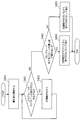
- FIG. 10 is a flowchart of an example of collision avoidance control performed by the control unit 13 of the drone 101.
- step S101 Based on the image data acquired by the imaging unit 11, it is determined whether another drone (interference drone) has been found in the traveling direction of the drone 101 (S101). If no other drone is found (NO), the process proceeds to step S105.
- the control unit 13 receives information about the other drone from the other drone via the communication unit 12 (S102).
- S103 Determine the priority between your own drone and other drones (S103). As an example, prioritize all drones (own drone and other drones) while negotiating between own drone and other drones. Alternatively, each drone may prioritize all drones (own drone and other drones). If the own drone and other drones have the same information and the priority is determined by the same algorithm, the priority of all drones determined by each drone will be the same.
- one of the own drone and the other drone may decide the priority of all the drones as the master.
- the master sends the determined priority information to other drones.
- the master drone is, for example, a drone that recognizes the most other drones, or a drone equipped with an arithmetic unit having the highest arithmetic performance.
- Drone 101 (own drone) becomes the master, the own drone determines the priority of all drones.
- the drone 101 may transmit priority information to the other drone via the base station 201 or another drone when there is another drone that cannot communicate.
- one of the other drones is recognized by the own drone and another other drone, but the other drone does not recognize the own drone and another other drone, and communication is not possible.
- the highest priority is determined for the one other drone between the own drone and another drone. Priority information is not sent to the other drone.
- the other drone as the highest priority drone for example, proceeds as it is in the direction of travel.
- the drone 101 flies according to the priority determined in step S103 (S104). More specifically, the action to prevent the collision (for example, straight ahead, avoidance action, or standby action) is determined based on the priority of each drone, and the determined action is executed. The details of this step S104 will be described later.
- step S105 it is determined whether or not to end this operation. For example, when the drone 101 lands, it is decided to end this operation. When it is decided to end this operation (YES), the operation is terminated. In other cases, the process returns to step S101. If the flight is restarted after the operation is completed, the processing of the flowchart of FIG. 10 is resumed.
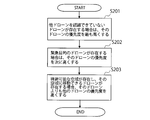
- FIG. 11 is a flowchart of an example of the priority determination process performed in step S103 of FIG. 10 in the control unit 13 of the drone 101.
- the priority of drone X is set to the highest (S201). For example, set the priority to 1. If the drone X does not recognize the other drone but can communicate with the other drone, the drone X may have the highest priority in negotiations between the drones including the drone X. If the drone X cannot communicate with other drones, the priority of the drone X is determined to be the highest priority in negotiations between drones other than the drone X. When the only drone other than the drone X is the drone 101, the drone 101 may determine the priority of the drone X to be the highest priority. If Drone X cannot communicate with other drones, it will not send any information to Drone X. Drone X will proceed as it is along the direction of travel.
- Drone X cannot communicate with other drones, it will not send any information to Drone X. Drone X will proceed as it is along the direction of travel.
- the flight purpose of the drone 101 and the flight purpose of other drones are compared, and it is determined whether or not there is an emergency drone (S202).
- the urgent purpose is, for example, a lifesaving purpose or a fire extinguishing purpose.
- the priority of the drone is raised next to the drone specified in step S201 (S202). If the drone is not specified in step S201, the drone specified in step 202 has the highest priority. If there are multiple drones for emergency purposes, the priority will be decided by negotiation between the drones. Alternatively, the priority may be determined by a finer classification such as a lifesaving purpose or a fire extinguishing purpose. In the present embodiment, different priorities are set for each drone, but it is not excluded that the same priority is set for a plurality of drones.
- step S104 the action of each drone is determined according to the priority determined in step S103, and the determined action is executed (collision avoidance control).
- the second and subsequent priority drones will resume flight along the direction of travel when the drone with the next higher priority no longer exists in the direction of travel. Specifically, when the drone is temporarily on standby, it starts flying from that position along the direction of travel (see FIG. 8). If the evacuation operation has been performed, the drone returns to the original route and starts flying (see FIG. 7). Alternatively, a new route may be created and the flight resumed.
- the determination as to whether or not the drone with the higher priority does not exist in the traveling direction is performed based on the image data acquired by the imaging unit 11.
- the determination may be made by receiving information notifying that interference has been avoided (that is, no other drone exists in the direction of travel) from the drone of the next higher priority.
- the notification may be received from the base station 201.
- each drone can fly without colliding with each other.
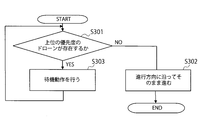
- FIG. 12 is a flowchart of a first example of collision avoidance control performed by the control unit 13 of the drone 101. It is determined whether or not there is a drone having a priority higher than that of the drone 101 (S301). If it does not exist (NO), the drone 101 advances in the direction of travel (S302).
- the drone 101 performs a standby operation (S303). For example, when the drone 101 is on the route, if a drone having a higher priority than the drone 101 may collide with the drone 101, it will be evacuated to an airspace such as the sky. If there is no such possibility, pause on the current route. Even if the drone 101 cannot evacuate to an airspace such as the sky due to flight performance, it will pause on the current route. In this case, if there is a possibility that the drone with high priority collides with the own drone 101, it is expected that the drone avoids the own drone 101 (see FIG. 6).
- the drone 101 may transmit information notifying that the interference has been avoided or the like to the drone having a lower priority.
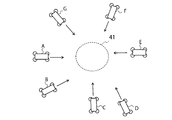
- FIG. 13 is a diagram for explaining a second example of collision avoidance control.
- the top three drones are grouped in descending order of priority.
- the three drones A to C in the group proceed in parallel along the direction of travel.
- the drone having the highest priority among the drones A to C proceeds without performing an avoidance action against other drones (drones B and C), and the drones B and C have the highest priority. Fly while performing avoidance actions against the high drone A and one of the drones (C or B).
- the top three drones are grouped in descending order of priority.
- the drones D to F of the second group continue the standby operation (temporary standby or evasion operation) until the drones A to C belonging to the first group no longer exist in the traveling direction.
- the second group of drones D to F resume (progress) flight along their respective directions of travel.
- the drone with the highest priority among the three for example, drone D
- the drones E and F have the highest priority. Fly while performing avoidance actions against the high drone D and one of the drones (F or E).
- three drones will be flown at the same time as one group.
- the drone G proceeds as it is along the traveling direction.
- three drones are grouped together, but the number of drones included in the group may be less than three depending on the flight performance and interference recognition performance of the drones.
- multiple drones included in the group were flown at the same time.
- the drone may be made to perform a standby operation until another drone avoids interference.
- each drone can fly without colliding with each other.
- FIG. 14 is a flowchart of a second example of collision avoidance control performed by the control unit 13 of the drone 101. The same description as in FIG. 12 will be omitted as appropriate.
- the adjustment of priorities and the behavior of each drone may be decided by negotiation between the drones, or one drone may be decided as the master.
- each drone is classified into a drone with high recognition performance (high recognition performance drone) and a drone with low recognition performance (low recognition performance drone) based on the recognition performance of each drone.
- a high recognition performance drone is a drone that has the ability to recognize other drones while avoiding other drones.
- Low-recognition performance drones are those that are incapable of recognizing other drones while avoiding them or have low recognition (ie, drones that may lose sight of the other drone during the action of avoiding it). Suppose there is.
- a high recognition performance drone or a low recognition performance drone may be classified according to the number of installed cameras and the installation location.
- a drone with only one camera in front may lose sight of the drone being evaded during the evasion action.
- Such a drone corresponds to a low recognition performance drone.
- the drone in which the cameras are installed around and above and below can recognize the drone to be avoided even during the avoidance operation.
- Such a drone corresponds to a high recognition performance drone.
- the drone may be determined whether the drone has high recognition performance or low recognition performance based on the angle of view or resolution. In addition to the recognition performance, it may be determined whether the drone has a high recognition performance or a low recognition performance by using interference detection information or flight performance. For example, a drone with low turning performance is more likely to collide because it cannot be avoided in time, so it may be classified as a low recognition performance drone. Further, when there are seven drones including a certain drone and the number of interfering drones recognized by the certain drone is less than six, the certain drone may be regarded as a low recognition performance drone.
- the drones are classified into two classes, high recognition performance and low recognition performance, but they may be classified into three classes, high recognition performance, low recognition performance, and medium recognition performance. Alternatively, it may be classified into four or more classes.
- the drone may fly as it is along the direction of travel without performing the avoidance action for other drones, or may be made to perform the standby action.
- action options fly while performing evasive action against other drones, fly as it is along the direction of travel without performing evasive action against other drones, or standby action.
- you have something to do Based on this premise, the priority will be adjusted by negotiation between each drone.
- FIGS 15, 16 and 17 are diagrams for explaining a specific example of the third example of collision avoidance control.
- there are seven drones (A, B, C, D, E, F, G).
- In the direction of travel of the seven drones there is a space where the three drones can pass each other.
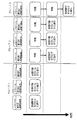
- FIG. 15 shows the priority of the seven drones before adjustment and the recognition performance (high or low).
- group 3 drones into a group in descending order of priority If you select a group in descending order of priority, the drone with the highest priority among the three in the group will not perform the avoidance action, but will proceed as it is in the direction of travel, and the remaining two will perform the avoidance action. do. Drones that do not belong to the selected group are supposed to perform a standby operation.
- the first group Under this premise, under the current priority (priority before adjustment), the first group will be drones A, B, C.
- the first group is called group 1. Since the drone A has the highest priority in the group 1, it is necessary to proceed in the direction of travel as it is without performing the avoidance operation. It is necessary for the second and third priority drones B and C to perform the avoidance operation, but since the drone C has low recognition performance, it is not possible to cause the drone C to perform the avoidance operation. Therefore, the priority of the drone C is set so that it has the highest priority in any of the groups, in other words, the priority can be set so that the drone C can proceed as it is in the traveling direction without performing the avoidance operation. Need to be adjusted.
- the second group (called group 2) is drones D, E, F. Since the drone D has the highest priority in the group 2, it is necessary to proceed in the direction of travel as it is without performing the avoidance operation.
- the second and third priority drones E and F need to perform the avoidance operation, but since the drone E has low recognition performance, the drone E cannot perform the avoidance operation. Therefore, the priority of the drone E is set so that it has the highest priority in any of the groups, in other words, the priority can be set so that the drone E can proceed as it is in the traveling direction without performing the avoidance operation. Need to be adjusted.
- Drone G remains as the third group (Group 3). Since the drone G has the highest priority, it can proceed as it is in the traveling direction without performing the avoidance operation.
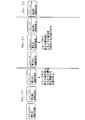
- FIG. 16 shows an example of an operation procedure for adjusting the priority so that the priority of the drone C and the drone E, which need to be adjusted, is the highest in any of the groups.
- the operation O1 replaces the priority 3 of the drone C and the priority 4 of the drone D. Further, the operation O2 sets the priority of the drone E to the highest priority 7 in the group 3. Operation O3 raises the priority 6 of the drone F to 5. The operation O4 raises the priority 7 of the drone G to the priority 6.
- FIG. 17 shows the result of adjusting the priority. Drone C with low recognition performance is the highest priority in Group 2. The priority of drone E with low recognition performance is the highest priority in Group 3.
- FIG. 18 shows an example in which each drone is made to act according to the adjusted priority shown in FIG.
- group 1 including drones A, B, and D is targeted in descending order of priority.
- Drone A which has the highest priority in Group 1, proceeds without evasive action, and drones B and D proceed while performing evasive action.
- the drones A, B, and D are in progress, the drones C, F, G, and E are in standby operation.
- group 2 including drones C, F, and G is targeted in descending order of priority.
- Drone C which has the highest priority in Group 2
- Drone E is on standby during the progress of groups C, F, and G.
- group 3 including drone E is targeted in descending order of priority.
- Drone E, which has the highest priority in Group 3 proceeds without taking evasive action.
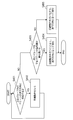
- FIG. 19 is a flowchart of a third example of collision avoidance control performed by the control unit 13 of the drone 101. The same description as in FIGS. 12 and 14 will be omitted as appropriate.
- step S501 of the process of adjusting the priority is added first.
- the other steps are the same as in FIG.
- step S501 the priority of each drone is adjusted so that the drone with low recognition performance has the highest priority in the group. Priority adjustments are made while negotiating between drones. Alternatively, one drone may be the master and the priority of each drone may be adjusted.
- other drones that have entered the course of the own drone are detected based on the image data taken by the drone.
- Determine the priority of the own drone and the detected drone according to at least one of recognition performance, flight performance, flight purpose, etc. determine the action to prevent collision according to the priority, and execute the determined action.
- Examples of actions include a plurality of types such as progressing along a route without performing an avoidance action, progressing along a path while performing an avoidance action, and a standby action (pause or evacuate to the sky, etc.). Therefore, it is possible to determine an appropriate action to prevent a collision in consideration of the recognition performance, flight performance, flight purpose, etc. of the own drone and other drones.
- the collision can be prevented by determining the priority of the other drone to a high priority and flying the other drone preferentially.
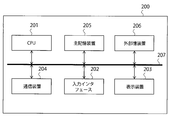
- FIG. 20 shows an example of the hardware configuration of the drone 101 of FIG. 2 or the base station 201 of FIG.
- the information processing device 1 of the drone 101 of FIG. 2 or the base station 201 of FIG. 3 is composed of a computer device 200.
- the computer device 200 includes a CPU 201, an input interface 202, a display device 203, a communication device 204, a main storage device 205, and an external storage device 206, which are connected to each other by a bus 207.
- the information processing apparatus 1 or the base station 201 may not include at least one of these elements.
- the CPU (Central Processing Unit) 201 executes a computer program on the main storage device 205.
- the computer program is a program that realizes each of the above-mentioned functional configurations of the information processing device 1 or the base station 201.
- the computer program may be realized by a combination of a plurality of programs and scripts instead of one program.
- Each functional configuration is realized by the CPU 201 executing a computer program.
- the input interface 202 is a circuit for inputting operation signals from input devices such as a keyboard, a mouse, and a touch panel to the information processing device 1 or the base station 201.
- the display device 203 displays the data stored in the information processing device 1 or the base station 201 or the data calculated by the information processing device 1 or the base station 201.
- the display device 203 is, for example, an LCD (liquid crystal display), an organic electroluminescence display, a CRT (cathode ray tube), or a PDP (plasma display), but is not limited thereto.
- the communication device 204 is a circuit for the information processing device 1 or the base station 201 to communicate with the external device wirelessly or by wire.
- the data used by the information processing device 1 or the base station 201 can be input from an external device via the communication device 204.
- Communication device 204 includes an antenna.
- the data input from the external device can be stored in the main storage device 205 or the external storage device 206.
- the main storage device 205 stores a computer program, data necessary for executing the computer program, data generated by executing the computer program, and the like.
- the computer program is expanded and executed on the main storage 205.
- the main storage device 205 is, for example, a RAM, a DRAM, or an SRAM, but is not limited thereto.
- the storage unit of FIG. 2 or FIG. 3 may be constructed on the main storage device 205.
- the external storage device 206 stores a computer program, data necessary for executing the computer program, data generated by executing the computer program, and the like. These computer programs and data are read out to the main storage device 205 when the computer program is executed.
- the external storage device 206 is, for example, a hard disk, an optical disk, a flash memory, and a magnetic tape, but is not limited thereto.
- the storage unit of FIG. 2 or FIG. 3 may be constructed on the external storage device 206.
- the computer program may be pre-installed in the computer device 200, or may be stored in a storage medium such as a CD-ROM.
- the computer program may also be uploaded on the Internet.
- the computer device 200 may be configured by a single device, or may be configured as a system composed of a plurality of computer devices connected to each other.
- the priority is adjusted by using the recognition performance (step S501 in FIG. 19), but in addition to the recognition performance or instead of the recognition performance.
- Other information may be used to adjust the priority.
- the priority may be adjusted for flight purposes.
- the priority may be adjusted when the flight objectives are hindered between drones.
- the flight purpose of the drone A is to photograph the surface of the earth
- the flight purpose of the drone B is to photograph a vehicle traveling on a road.
- the drone A flies while avoiding the drone B, and as a result, the drone B comes to the lower side of the drone A or the aircraft of the drone A tilts, the shooting by the drone A will be hindered.
- the priority is adjusted so that the drone A and the drone B can proceed without performing the avoidance operation.
- drone A and drone B are grouped separately so that they have the highest priority within the group.
- the flight purpose of drone A is to photograph the surface of the earth
- the flight purpose of drone B is to transport luggage.
- the drone A has the highest priority in the group
- the drone B has a lower priority than the drone A when it is in the same group as the drone A.
- the drone A proceeds without performing the avoidance operation, so that there is no problem in shooting. Since the drone B transports luggage, there is no problem even if the avoidance operation is performed.
- the priority can be adjusted by using information other than the recognition performance.
- control unit 13 of the drone 101 determines the time until it collides with the interfering drone based on the speed of the own drone, the speed of the interfering drone, the distance from the own drone to the interfering drone, and the braking performance of the own drone. calculate.
- the speed of the own drone is 20 m / s
- the position of the interfering drone is 20 m ahead of the direction of travel of the own drone.
- the braking performance of the own drone is the performance that can stop 20 m / s in 1 second.
- the interfering drone is paused for filming. In this case, the time until the collision is 1 second. This time is even shorter if the interfering drone is flying in the direction of its own drone.
- the order of priority is [1] position, speed, recognition performance, [2] flight purpose, [3] flight performance, [4] and others. Limit the types of information to be acquired according to the time.
- [1] when the time is ⁇ or less [1] to [2] when ⁇ or more and less than ⁇ , [1] to [3] when ⁇ or more and less than ⁇ , and ⁇ or more.
- the examples described are merely examples, and other examples may be used.
- the above-mentioned priority is an example, and other examples may be used.
- the time until they collide with each of all interfering drones is calculated, and the time allowed for communication with each interfering drone is calculated based on the shortest time. Only obtain the type of information according to the calculated time from each interfering drone.
- the third embodiment by limiting the information acquired according to the time until the collision with the interfering drone, it is possible to determine the action until the collision is stopped before the collision with the interfering drone.
- the priority is determined mainly by negotiation between the drones, but in the fourth embodiment, the base station 201 determines the priority.
- the control unit 52 (see FIG. 3) of the base station 201 receives a notification of interference drone detection from the drone (referred to as drone A) that has detected the interference drone via the communication unit 51.
- the control unit 52 communicates with the drone A to acquire information about the drone A (position, speed, traveling direction, recognition performance, flight purpose, flight performance, interference detection information, etc.).
- the control unit 52 communicates with an interference drone (referred to as drone B) existing at the position indicated in the interference detection information, and information about the drone B (position, speed, traveling direction, recognition performance, flight purpose, flight performance, interference detection). Information etc.) is acquired.
- the control unit 52 determines the priorities of the drones A and B in the same manner as in the first to third embodiments, and transmits the determined priority information to the drones A and the drone B.
- the priority information is information for the drones A and B to determine the action to prevent the collision with each other.
- Each of drone A and drone B decides an action based on the received priority and executes the decided action. For example, when the first example of the collision avoidance control of the first embodiment is followed, one drone having a higher priority advances in the traveling direction first. The other drone waits until the progress of one drone is completed (until one drone no longer exists in the direction of progress of the other drone). When the progress of one drone is completed, the other drone starts progressing.
- the base station 201 acquires the information about each drone and determines the priority. Then, the determined priority information is transmitted to each drone. Further, as the example of collision avoidance control, not only the first example but also the second example or the third example is possible.
- the calculation load of the drone can be reduced by the base station 201 determining the priority. Further, since the base station 201 usually has higher computing performance than the drone, the priority can be determined at high speed even if many kinds of information are used. In addition, when the priority is decided by negotiating between the drones, the amount of communication between the drones increases and the control becomes complicated, but the drone can be collectively determined by the base station 201. The amount of communication between them is reduced, and complicated control is not required.
- the action of each drone is further determined based on the determined priority.
- Base station 201 transmits data including information on the determined action to each drone.
- the information on the action is information for the drones A and B to determine the action to prevent the collision with each other.
- each drone may be determined in the same manner as in the first to third examples of collision avoidance control in the first embodiment.
- the control unit 52 of the base station 201 may regenerate a route that allows each drone to avoid collisions with each other. At this time, the drone having the highest priority in the group may use the original route as it is without regenerating the route.
- the base station 201 transmits the route information generated for each drone to each drone. Each drone flies along a route designated by base station 201. Such a method is effective not only when each drone is not capable of autonomous flight, but also when it is capable of autonomous flight.
- the calculation load of each drone can be reduced by the base station 201 determining the behavior of each drone.
- the base station 201 determines the priority, but in the fifth embodiment, the base station 201 determines the priority or the drone determines the priority according to the situation of each drone. To decide whether to decide.
- the drone when the drone acquires information about another drone (interference drone) detected based on the image data, if it takes time to acquire the information, it may collide with the other drone. There is sex. Therefore, the time until the detected collision with the other drone is calculated, and it is determined whether the priority is determined by the own drone or the base station 201 according to the calculated time. If there is time to spare, the base station 201 determines the priority. In this case, a more appropriate priority can be determined by using a lot of information (for example, all of the above-mentioned [1] to [4]). If you don't have the time, use your drone to prioritize. In this case, the priority is simply determined using limited information (for example, only predetermined information among the above-mentioned [1] to [4]).
- the control unit 13 of the drone 101 has the speed of the own drone, the speed of the interfering drone, the distance from the own drone to the interfering drone, and the braking performance of the own drone. Based on, the time to collide with the interfering drone is calculated. If the time is less than a predetermined value, information about the drone 101 is transmitted to the base station 201, and the base station 201 is made to determine the priority. If the time is equal to or greater than a predetermined value, the drone 101 determines the priority.
- the description thereof will be omitted. Since the operation when the base station 201 determines the priority is the same as that of the fourth embodiment, the description thereof will be omitted. Since the operation when the drone determines the priority is the same as that of the first to third embodiments, the description thereof will be omitted.
- FIG. 21 is a flowchart of an example of collision avoidance control performed by the drone control unit 13 in the fifth embodiment. Steps S701 to S703 are added to FIG. 10 used in the first embodiment.
- control unit 13 finds another drone in the direction of travel, the control unit 13 calculates the time until it collides with the other drone. If the calculated time is equal to or greater than a predetermined value, it is determined that there is a time margin until the collision (YES in S701), and the process proceeds to step S102.
- the steps S102 and subsequent steps are the same as those in the first embodiment.
- step S701 If the calculated time is less than the predetermined value, it is judged that there is no time margin until the collision (NO in S701).
- the control unit 13 transmits information about the own drone to the base station 201 via the communication unit 12 (S702).
- the control unit 13 receives information on the priority of the own drone and other drones determined by the base station 201 via the communication unit 12 (S703). After that, the process proceeds to step S104.
- the steps after step S104 are the same as those in the first embodiment.
- the base station 201 when there is time to collide with the interfering drone, the base station 201 can use a lot of information to determine an appropriate priority. If there is not enough time, the priority can be easily determined based on the limited information between the drones.
- the present disclosure may also have the following structure.
- An imaging unit that acquires image data by imaging the environment of a moving object
- a control unit that detects another moving body existing in the traveling direction of the moving body based on the image data and performs an action to prevent a collision with the other moving body based on the information about the other moving body.
- Information processing device equipped with [Item 2] The information processing device according to item 1, wherein the control unit determines the action of preventing a collision with the other moving body, and performs the action.
- the control unit as the action, Whether to proceed while performing the avoidance action against the other moving body Whether to perform the standby operation or proceed without performing the avoidance operation for the other moving body
- the information processing apparatus according to item 1, which either changes the route.
- the control unit Determining which of the moving body and the other moving body has priority, When the other moving body has priority, the other moving body is subjected to either an avoidance operation with respect to the other moving body, a standby operation, or a change of the route. When the moving body has priority, the process proceeds without performing an avoidance operation on the other moving body.
- the information processing device according to item 3.
- the control unit The priority of the moving body and the priority of the other moving body are determined, and the priority is determined.
- the information processing apparatus according to item 4, wherein it is determined which of the moving body and the other moving body has priority based on the priority of the moving body and the priority of the other moving body.
- the information about the other mobile includes the recognition performance of the imaging unit of the other mobile.
- Item 5 in which the control unit determines which of the moving body and the other moving body has priority based on the recognition performance of the imaging unit and the recognition performance of the imaging unit of the other moving body.
- the imaging unit and the imaging unit of the other mobile body include at least one camera.
- the recognition performance of the image pickup unit and the recognition performance of the image pickup unit of the other moving body are The number of cameras The angle of view of the camera, The installation position of the camera, The resolution of the camera, Item 6.
- the information processing apparatus according to item 6, which is determined based on at least one of the above.
- the recognition performance of the imaging unit is determined based on the number of other moving objects detected by the control unit.
- Item 6. The information processing apparatus according to item 6, wherein the recognition performance of the imaging unit of the other mobile body is determined based on the number of mobile bodies recognized by the other mobile body in the traveling direction of the other mobile body.
- the control unit Determining if the other moving body recognizes the moving body, The information processing device according to item 4, which gives priority to the other mobile body when it is determined that the other mobile body does not recognize the mobile body.
- the information about the other mobile includes the purpose of movement of the other mobile.
- Device. [Item 12] The information about the other mobile includes the speed of the other mobile.
- the control unit calculates the time until the moving body collides with the other moving body, and calculates the time until the moving body collides with the other moving body. Depending on the time, the control unit or the base station determines whether the mobile body or the other mobile body has priority.
- the information processing apparatus according to item 4, wherein when the base station decides to make a decision, a request for making the decision is transmitted to the base station.
- the control unit The time until the moving body collides with the other moving body is calculated. Based on the time, the type of information to be acquired is determined.
- the information processing device according to item 1, wherein the information acquisition unit acquires the determined type of information.
- the information processing apparatus according to item 13, wherein the information about the other mobile body includes at least one of the position of the other mobile body and the distance to the other mobile body.
- the information processing device according to item 1, wherein the moving body is a flying body.
- Image data is acquired by imaging the environment including the traveling direction of the moving body. Based on the image data, another moving body existing in the traveling direction of the moving body is detected. A method of performing an action to prevent a collision with the other moving body based on the information about the other moving body.
- the plurality of moving bodies include an imaging unit that acquires image data by imaging an environment including the traveling direction of the moving body.
- a control unit that detects another moving body existing in the traveling direction of the moving body, and a control unit. It is equipped with a communication unit that communicates with the base station.
- the base station A communication unit that communicates with the mobile body, An information acquisition unit that acquires information on the moving body and the image data from the moving body, and A control that generates information for determining an action in which the moving body prevents a collision with the other moving body based on the information about the moving body and the image data, and transmits the generated information to the moving body.
Landscapes
- Engineering & Computer Science (AREA)
- General Physics & Mathematics (AREA)
- Physics & Mathematics (AREA)
- Remote Sensing (AREA)
- Aviation & Aerospace Engineering (AREA)
- Multimedia (AREA)
- Theoretical Computer Science (AREA)
- Automation & Control Theory (AREA)
- Radar, Positioning & Navigation (AREA)
- Microelectronics & Electronic Packaging (AREA)
- Mechanical Engineering (AREA)
- Control Of Position, Course, Altitude, Or Attitude Of Moving Bodies (AREA)
- Traffic Control Systems (AREA)
Priority Applications (3)
| Application Number | Priority Date | Filing Date | Title |
|---|---|---|---|
| US17/794,636 US12307762B2 (en) | 2020-01-31 | 2021-01-04 | Information processing device, method, computer program, and communication system |
| JP2021574567A JP7622653B2 (ja) | 2020-01-31 | 2021-01-04 | 情報処理装置、方法、コンピュータプログラム及び通信システム |
| CN202180010488.4A CN114981855A (zh) | 2020-01-31 | 2021-01-04 | 信息处理设备、方法、计算机程序和通信系统 |
Applications Claiming Priority (2)
| Application Number | Priority Date | Filing Date | Title |
|---|---|---|---|
| JP2020014462 | 2020-01-31 | ||
| JP2020-014462 | 2020-01-31 |
Publications (1)
| Publication Number | Publication Date |
|---|---|
| WO2021153159A1 true WO2021153159A1 (ja) | 2021-08-05 |
Family
ID=77079288
Family Applications (1)
| Application Number | Title | Priority Date | Filing Date |
|---|---|---|---|
| PCT/JP2021/000004 Ceased WO2021153159A1 (ja) | 2020-01-31 | 2021-01-04 | 情報処理装置、方法、コンピュータプログラム及び通信システム |
Country Status (4)
| Country | Link |
|---|---|
| US (1) | US12307762B2 (https=) |
| JP (1) | JP7622653B2 (https=) |
| CN (1) | CN114981855A (https=) |
| WO (1) | WO2021153159A1 (https=) |
Cited By (1)
| Publication number | Priority date | Publication date | Assignee | Title |
|---|---|---|---|---|
| JP7261334B1 (ja) | 2022-03-15 | 2023-04-19 | Kddi株式会社 | 飛行管理装置、飛行管理方法及びプログラム |
Families Citing this family (2)
| Publication number | Priority date | Publication date | Assignee | Title |
|---|---|---|---|---|
| JP7501495B2 (ja) * | 2021-11-05 | 2024-06-18 | 株式会社デンソー | 飛行制御装置及び飛行制御プログラム |
| CN118922792A (zh) * | 2022-03-31 | 2024-11-08 | 索尼集团公司 | 无人移动体、信息处理方法和计算机程序 |
Citations (5)
| Publication number | Priority date | Publication date | Assignee | Title |
|---|---|---|---|---|
| JP2017045385A (ja) * | 2015-08-28 | 2017-03-02 | 株式会社デンソー | 運転支援装置及びプログラム |
| JP2019011971A (ja) * | 2017-06-29 | 2019-01-24 | 株式会社東芝 | 推定システムおよび自動車 |
| JP2019028712A (ja) * | 2017-07-31 | 2019-02-21 | 株式会社Aerial Lab Industries | 飛行体の誘導方法、誘導装置、及び誘導システム |
| JP2019046272A (ja) * | 2017-09-05 | 2019-03-22 | キヤノンマーケティングジャパン株式会社 | 無人航空機、無線局、無人航空機制御システム、その制御方法、及びプログラム |
| JP2019164003A (ja) * | 2018-03-19 | 2019-09-26 | 本田技研工業株式会社 | 移動体の管理システム及びその制御方法並びに管理サーバ |
Family Cites Families (13)
| Publication number | Priority date | Publication date | Assignee | Title |
|---|---|---|---|---|
| JP4329442B2 (ja) * | 2003-07-30 | 2009-09-09 | 日産自動車株式会社 | 周辺車両検出装置 |
| JP4658155B2 (ja) * | 2008-03-17 | 2011-03-23 | 株式会社日立製作所 | 自律移動ロボット装置及び自律移動ロボット装置の回避方法 |
| JP5590684B2 (ja) * | 2009-12-10 | 2014-09-17 | パナソニック株式会社 | 情報表示装置及び情報表示方法 |
| JP5929870B2 (ja) * | 2013-10-17 | 2016-06-08 | 株式会社デンソー | 物標検出装置 |
| CN107531324B (zh) * | 2015-03-31 | 2021-02-05 | 深圳市大疆创新科技有限公司 | 用于移动地理围栏的系统和方法 |
| US11341858B2 (en) * | 2016-06-10 | 2022-05-24 | Metal Raptor, Llc | Managing dynamic obstructions in air traffic control systems for passenger drones and unmanned aerial vehicles |
| JP2018077754A (ja) | 2016-11-11 | 2018-05-17 | 株式会社リコー | 自律移動装置、プログラムおよび制御方法 |
| US11501651B2 (en) * | 2017-11-09 | 2022-11-15 | Ntt Docomo, Inc. | Flight control apparatus and flight control system |
| EP3770884B1 (en) * | 2018-03-19 | 2025-06-11 | Honda Motor Co., Ltd. | Management system, control method therefor, and management server |
| JP2021166316A (ja) * | 2018-06-18 | 2021-10-14 | ソニーグループ株式会社 | 移動体及び制御方法 |
| WO2020027142A1 (ja) * | 2018-08-03 | 2020-02-06 | 株式会社デンソー | 移動空間情報処理システム、移動空間情報処理方法および通信装置 |
| US11565807B1 (en) * | 2019-06-05 | 2023-01-31 | Gal Zuckerman | Systems and methods facilitating street-level interactions between flying drones and on-road vehicles |
| KR102292364B1 (ko) * | 2020-04-20 | 2021-08-24 | 임영덕 | 교차로 3d 가상노드 설정을 통한 드론간 비행 충돌방지 시스템 |
-
2021
- 2021-01-04 WO PCT/JP2021/000004 patent/WO2021153159A1/ja not_active Ceased
- 2021-01-04 JP JP2021574567A patent/JP7622653B2/ja active Active
- 2021-01-04 CN CN202180010488.4A patent/CN114981855A/zh active Pending
- 2021-01-04 US US17/794,636 patent/US12307762B2/en active Active
Patent Citations (5)
| Publication number | Priority date | Publication date | Assignee | Title |
|---|---|---|---|---|
| JP2017045385A (ja) * | 2015-08-28 | 2017-03-02 | 株式会社デンソー | 運転支援装置及びプログラム |
| JP2019011971A (ja) * | 2017-06-29 | 2019-01-24 | 株式会社東芝 | 推定システムおよび自動車 |
| JP2019028712A (ja) * | 2017-07-31 | 2019-02-21 | 株式会社Aerial Lab Industries | 飛行体の誘導方法、誘導装置、及び誘導システム |
| JP2019046272A (ja) * | 2017-09-05 | 2019-03-22 | キヤノンマーケティングジャパン株式会社 | 無人航空機、無線局、無人航空機制御システム、その制御方法、及びプログラム |
| JP2019164003A (ja) * | 2018-03-19 | 2019-09-26 | 本田技研工業株式会社 | 移動体の管理システム及びその制御方法並びに管理サーバ |
Cited By (2)
| Publication number | Priority date | Publication date | Assignee | Title |
|---|---|---|---|---|
| JP7261334B1 (ja) | 2022-03-15 | 2023-04-19 | Kddi株式会社 | 飛行管理装置、飛行管理方法及びプログラム |
| JP2023135255A (ja) * | 2022-03-15 | 2023-09-28 | Kddi株式会社 | 飛行管理装置、飛行管理方法及びプログラム |
Also Published As
| Publication number | Publication date |
|---|---|
| JPWO2021153159A1 (https=) | 2021-08-05 |
| CN114981855A (zh) | 2022-08-30 |
| US20230109408A1 (en) | 2023-04-06 |
| US12307762B2 (en) | 2025-05-20 |
| JP7622653B2 (ja) | 2025-01-28 |
Similar Documents
| Publication | Publication Date | Title |
|---|---|---|
| EP3491474B1 (en) | System and method of dynamically controlling parameters for processing sensor output data for collision avoidance and path planning | |
| US11592829B2 (en) | Control device and control method, program, and mobile object | |
| US11294398B2 (en) | Personal security robotic vehicle | |
| JP2024053085A (ja) | 飛行体制御装置、飛行体制御方法、及びプログラム | |
| US12431030B2 (en) | Unmanned aerial vehicle dispatching method, server, base station, system, and readable storage medium | |
| CN111566713B (zh) | 标识供机器人交通工具进行着陆的着陆区 | |
| CN111801717A (zh) | 机器人式运载工具的自动探索控制 | |
| JP7622653B2 (ja) | 情報処理装置、方法、コンピュータプログラム及び通信システム | |
| JP7257737B2 (ja) | 情報処理装置、自己位置推定方法、及び、プログラム | |
| KR101701397B1 (ko) | 무인 비행체를 이용한 차량 단속방법 및 시스템 | |
| US11982758B2 (en) | Relay point generation method and apparatus, and unmanned aerial vehicle | |
| US12436541B2 (en) | Unmanned autonomous vehicle and information processing method to calculate wind information acting on the unmanned autonomous vehicle | |
| US12400169B2 (en) | Control apparatus for aircraft and control method therefor | |
| CN119096279A (zh) | 路径生成装置、路径生成方法、计算机程序以及移动体管理系统 | |
| CN112639651A (zh) | 信息处理方法、信息处理装置和可移动设备 | |
| CN110998235B (zh) | 在机器人式运载工具中的图像输出调整 | |
| CN110997488A (zh) | 动态控制用于处理传感器输出数据的参数的系统和方法 | |
| JP7351280B2 (ja) | 情報処理装置及び方法 | |
| CN119675770B (zh) | 基于光通信无人机识别信息自动广播的避让方法及装置 | |
| CN112567308A (zh) | 空域检测方法、可移动平台、设备和存储介质 | |
| JP7112714B2 (ja) | 監視装置、監視プログラム及び飛行体を利用した監視システム | |
| WO2025069621A1 (ja) | 情報処理装置、情報処理方法、及びプログラム | |
| WO2025211022A1 (ja) | 情報処理方法、情報処理装置、及びプログラム | |
| KR20250159798A (ko) | 통신 음영지역에서의 드론의 운용 및 관리 방법 | |
| WO2021140916A1 (ja) | 移動体、情報処理装置、情報処理方法、及びプログラム |
Legal Events
| Date | Code | Title | Description |
|---|---|---|---|
| 121 | Ep: the epo has been informed by wipo that ep was designated in this application |
Ref document number: 21747609 Country of ref document: EP Kind code of ref document: A1 |
|
| ENP | Entry into the national phase |
Ref document number: 2021574567 Country of ref document: JP Kind code of ref document: A |
|
| NENP | Non-entry into the national phase |
Ref country code: DE |
|
| 122 | Ep: pct application non-entry in european phase |
Ref document number: 21747609 Country of ref document: EP Kind code of ref document: A1 |
|
| WWG | Wipo information: grant in national office |
Ref document number: 17794636 Country of ref document: US |