WO2021145104A1 - 樹脂組成物、光ファイバ及び光ファイバの製造方法 - Google Patents
樹脂組成物、光ファイバ及び光ファイバの製造方法 Download PDFInfo
- Publication number
- WO2021145104A1 WO2021145104A1 PCT/JP2020/045662 JP2020045662W WO2021145104A1 WO 2021145104 A1 WO2021145104 A1 WO 2021145104A1 JP 2020045662 W JP2020045662 W JP 2020045662W WO 2021145104 A1 WO2021145104 A1 WO 2021145104A1
- Authority
- WO
- WIPO (PCT)
- Prior art keywords
- acrylate
- meth
- resin composition
- optical fiber
- resin layer
- Prior art date
- Legal status (The legal status is an assumption and is not a legal conclusion. Google has not performed a legal analysis and makes no representation as to the accuracy of the status listed.)
- Ceased
Links
Images
Classifications
-
- C—CHEMISTRY; METALLURGY
- C03—GLASS; MINERAL OR SLAG WOOL
- C03C—CHEMICAL COMPOSITION OF GLASSES, GLAZES OR VITREOUS ENAMELS; SURFACE TREATMENT OF GLASS; SURFACE TREATMENT OF FIBRES OR FILAMENTS MADE FROM GLASS, MINERALS OR SLAGS; JOINING GLASS TO GLASS OR OTHER MATERIALS
- C03C25/00—Surface treatment of fibres or filaments made from glass, minerals or slags
- C03C25/10—Coating
- C03C25/104—Coating to obtain optical fibres
- C03C25/1065—Multiple coatings
-
- C—CHEMISTRY; METALLURGY
- C03—GLASS; MINERAL OR SLAG WOOL
- C03C—CHEMICAL COMPOSITION OF GLASSES, GLAZES OR VITREOUS ENAMELS; SURFACE TREATMENT OF GLASS; SURFACE TREATMENT OF FIBRES OR FILAMENTS MADE FROM GLASS, MINERALS OR SLAGS; JOINING GLASS TO GLASS OR OTHER MATERIALS
- C03C25/00—Surface treatment of fibres or filaments made from glass, minerals or slags
- C03C25/10—Coating
- C03C25/24—Coatings containing organic materials
- C03C25/26—Macromolecular compounds or prepolymers
- C03C25/28—Macromolecular compounds or prepolymers obtained by reactions involving only carbon-to-carbon unsaturated bonds
- C03C25/285—Acrylic resins
-
- C—CHEMISTRY; METALLURGY
- C03—GLASS; MINERAL OR SLAG WOOL
- C03C—CHEMICAL COMPOSITION OF GLASSES, GLAZES OR VITREOUS ENAMELS; SURFACE TREATMENT OF GLASS; SURFACE TREATMENT OF FIBRES OR FILAMENTS MADE FROM GLASS, MINERALS OR SLAGS; JOINING GLASS TO GLASS OR OTHER MATERIALS
- C03C25/00—Surface treatment of fibres or filaments made from glass, minerals or slags
- C03C25/10—Coating
- C03C25/24—Coatings containing organic materials
- C03C25/26—Macromolecular compounds or prepolymers
- C03C25/32—Macromolecular compounds or prepolymers obtained otherwise than by reactions involving only carbon-to-carbon unsaturated bonds
- C03C25/326—Polyureas; Polyurethanes
-
- C—CHEMISTRY; METALLURGY
- C03—GLASS; MINERAL OR SLAG WOOL
- C03C—CHEMICAL COMPOSITION OF GLASSES, GLAZES OR VITREOUS ENAMELS; SURFACE TREATMENT OF GLASS; SURFACE TREATMENT OF FIBRES OR FILAMENTS MADE FROM GLASS, MINERALS OR SLAGS; JOINING GLASS TO GLASS OR OTHER MATERIALS
- C03C25/00—Surface treatment of fibres or filaments made from glass, minerals or slags
- C03C25/62—Surface treatment of fibres or filaments made from glass, minerals or slags by application of electric or wave energy; by particle radiation or ion implantation
- C03C25/6206—Electromagnetic waves
- C03C25/6226—Ultraviolet
-
- C—CHEMISTRY; METALLURGY
- C08—ORGANIC MACROMOLECULAR COMPOUNDS; THEIR PREPARATION OR CHEMICAL WORKING-UP; COMPOSITIONS BASED THEREON
- C08F—MACROMOLECULAR COMPOUNDS OBTAINED BY REACTIONS ONLY INVOLVING CARBON-TO-CARBON UNSATURATED BONDS
- C08F290/00—Macromolecular compounds obtained by polymerising monomers on to polymers modified by introduction of aliphatic unsaturated end or side groups
- C08F290/02—Macromolecular compounds obtained by polymerising monomers on to polymers modified by introduction of aliphatic unsaturated end or side groups on to polymers modified by introduction of unsaturated end groups
- C08F290/06—Polymers provided for in subclass C08G
-
- C—CHEMISTRY; METALLURGY
- C08—ORGANIC MACROMOLECULAR COMPOUNDS; THEIR PREPARATION OR CHEMICAL WORKING-UP; COMPOSITIONS BASED THEREON
- C08L—COMPOSITIONS OF MACROMOLECULAR COMPOUNDS
- C08L75/00—Compositions of polyureas or polyurethanes; Compositions of derivatives of such polymers
- C08L75/04—Polyurethanes
-
- G—PHYSICS
- G02—OPTICS
- G02B—OPTICAL ELEMENTS, SYSTEMS OR APPARATUS
- G02B6/00—Light guides; Structural details of arrangements comprising light guides and other optical elements, e.g. couplings
- G02B6/44—Mechanical structures for providing tensile strength and external protection for fibres, e.g. optical transmission cables
Definitions
- the present disclosure relates to a resin composition for secondary coating of an optical fiber, an optical fiber, and a method for producing the optical fiber.
- the optical fiber is provided with a coating resin layer for protecting the glass fiber which is an optical transmitter.
- the coating resin layer is composed of, for example, two layers, a primary resin layer in contact with the glass fiber and a secondary resin layer formed on the outer layer of the primary resin layer.
- the secondary resin layer is required to have surface slipperiness, scratch resistance, tack prevention property, etc. in order to prevent damage to the optical fiber and improve the handleability of the optical fiber.
- Patent Documents 1 and 2 disclose that the surface slipperiness is improved by forming a resin layer using a resin composition containing a silicone compound. Further, Patent Documents 3 and 4 disclose that the tack prevention property is improved by forming a resin layer using a resin composition containing a specific urethane (meth) acrylate.
- the resin composition for secondary coating of an optical fiber is a resin composition containing a hydroxyl group-containing urethane compound having a number average molecular weight of 10,000 or more and 40,000 or less, a photopolymerizable compound, and a photopolymerization initiator.
- the content of the hydroxyl group-containing urethane compound is 0.05 parts by mass or more and 10 parts by mass or less based on 100 parts by mass of the total amount of the resin composition, and the hydroxyl group-containing urethane compound has a number average molecular weight of 1800. It is a reaction product of a polyol of 4500 or less and a diisocyanate.
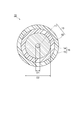
- FIG. 1 is a schematic cross-sectional view showing an example of an optical fiber according to the present embodiment.
- the slipperiness of the surface of the coating resin layer gradually becomes slippery due to external forces such as contact with a guide roller and a screening test (a test in which a tensile load of several kg is applied to the optical fiber to remove low-strength parts in advance). This may worsen and meander when the optical fiber is wound around the bobbin, which may reduce the productivity of the optical fiber.
- the secondary resin layer is required to have excellent surface slipperiness and abrasion resistance when an external force is applied to the optical fiber.
- An object of the present disclosure is to provide a resin composition for secondary coating of an optical fiber having excellent surface slipperiness and abrasion resistance when an external force is applied to the optical fiber, and an optical fiber having excellent productivity. ..
- the resin composition for secondary coating of an optical fiber is a resin composition containing a hydroxyl group-containing urethane compound having a number average molecular weight of 10,000 or more and 40,000 or less, a photopolymerizable compound, and a photopolymerization initiator.
- the content of the hydroxyl group-containing urethane compound is 0.05 parts by mass or more and 10 parts by mass or less based on 100 parts by mass of the total amount of the resin composition, and the hydroxyl group-containing urethane compound has a number average molecular weight. It is a reaction product of a polyol of 1800 or more and 4500 or less and diisocyanate.
- Such a resin composition can form a secondary resin layer having excellent surface slipperiness and abrasion resistance when an external force is applied to the optical fiber, so that the productivity of the optical fiber can be improved. ..
- the photopolymerizable compound may contain urethane (meth) acrylate having a number average molecular weight of 1000 or more and 6000 or less in order to impart appropriate toughness to the secondary resin layer.
- the urethane (meth) acrylate may be a reaction product of a polyol having a number average molecular weight of 350 or more and 2500 or less, a diisocyanate, and a hydroxyl group-containing (meth) acrylate.
- the photopolymerizable compound may further contain an epoxy (meth) acrylate in order to impart appropriate toughness to the secondary resin layer.
- the epoxy (meth) acrylate may have an aromatic ring in order to further improve the wear resistance.
- the optical fiber according to one aspect of the present disclosure includes a glass fiber including a core and a clad, a primary resin layer that is in contact with the glass fiber and coats the glass fiber, and a secondary resin layer that coats the primary resin layer.
- the resin layer contains a cured product of the above resin composition.
- the method for producing an optical fiber according to one aspect of the present disclosure includes a coating step of applying the above resin composition to the outer periphery of a glass fiber including a core and a clad, and a coating step of applying ultraviolet rays after the coating step to apply the resin composition. Includes a curing step of curing. As a result, an optical fiber having excellent surface slipperiness and abrasion resistance can be produced.
- the resin composition according to the present embodiment contains a hydroxyl group-containing urethane compound, a photopolymerizable compound, and a photopolymerization initiator.
- the hydroxyl group-containing urethane compound according to the present embodiment is a urethane compound having a number average molecular weight (Mn) of 10,000 or more and 40,000 or less and having a hydroxyl group (hereinafter, referred to as “hydroxyl group-containing urethane compound (A)”).
- Mn number average molecular weight
- the Mn of the hydroxyl group-containing urethane compound (A) is preferably 11,000 or more and 40,000 or less, and more preferably 12,000 or more and 39000 or less. If the Mn of the hydroxyl group-containing urethane compound (A) is less than 10,000, the slipperiness and wear resistance of the surface tend to decrease, and if the Mn exceeds 40,000, the resin composition tends to become cloudy.
- the hydroxyl group-containing urethane compound (A) is a reaction product of a polyol having Mn of 1800 or more and 4500 or less and diisocyanate.
- the hydroxyl group-containing urethane compound (A) has a urethane structure based on the reaction of a polyol having Mn of 1800 or more and 4500 or less and diisocyanate, and a hydroxyl group bonded to the end of the urethane structure.
- the hydroxyl group-containing urethane compound (A) is a compound that does not have a photopolymerizable group such as a (meth) acryloyl group.
- polystyrene resin examples include polytetramethylene glycol, polyethylene glycol, polypropylene glycol, polyester polyol, polycaprolactone polyol, polycarbonate polyol, polybutadiene polyol, and bisphenol A / ethylene oxide-added diol. Above all, it is preferable to use polypropylene glycol as the polyol.
- diisocyanate examples include 2,4-tolylene diisocyanate, 2,6-tolylene diisocyanate, isophorone diisocyanate, dicyclohexylmethane diisocyanate, diphenylmethane diisocyanate, hexamethylene diisocyanate, xylylene diisocyanate, hydrogenated xylylene diisocyanate, 1, Examples thereof include 5-naphthalenediocyanate, norbornene diisocyanate, 1,5-pentamethylene diisocyanate, tetramethylxylylene diisocyanate, and trimethylhexamethylene diisocyanate.
- the hydroxyl group-containing urethane compound (A) reacts a polyol and a diisocyanate at a molar ratio (OH / NCO) of the hydroxyl group (OH) of the polyol and the isocyanate group (NCO) of the diisocyanate of 1.1 or more and 1.8 or less.
- OH / NCO molar ratio of the hydroxyl group (OH) of the polyol
- NCO isocyanate group
- the Mn of the polyol constituting the hydroxyl group-containing urethane compound (A) is 1800 or more, preferably 2000 or more, more preferably 2500 or more. preferable. Since the proportion of urethane bonds contained in the hydroxyl group-containing urethane compound (A) increases and it becomes easier to form a secondary resin layer having good surface properties, the Mn of the polyol is 4500 or less, preferably 4000 or less. More preferably, it is 3500 or less.
- hydroxyl group-containing urethane compound (A) For example, polypropylene glycol is used as the polyol and 2,4-tolylene diisocyanate is used as the diisocyanate. Polypropylene glycol and 2,4-tolylene diisocyanate are reacted at a molar ratio of OH / NCO of 1.1 or more and 1.8 or less to synthesize a urethane compound having a hydroxyl group at the end.
- the hydroxyl group-containing urethane compound (A) can be represented by the following formula (1).
- HO- (P-U-I-U) m-P-OH (1)
- HO and OH represent a hydroxyl group
- U represents a urethane bond
- I represents a residue of 2,4-tolylene diisocyanate
- P represents a residue of polypropylene glycol
- m is an integer of 1 or more.
- the content of the hydroxyl group-containing urethane compound (A) is 0.05 part by mass or more based on the total amount (100 parts by mass) of the resin composition, and 0. 1 part by mass or more is preferable, 0.2 part by mass or more is more preferable, and 0.3 part by mass or more is further preferable.
- the content of the hydroxyl group-containing urethane compound (A) is 10 parts by mass or less, preferably 8 parts by mass or less, preferably 6 parts by mass, based on the total amount of the resin composition. It is more preferably parts or less, and even more preferably 5 parts by mass or less.
- the photopolymerizable compound according to the present embodiment is a urethane (meth) acrylate having a Mn of 1000 or more and 6000 or less (hereinafter, referred to as “urethane (meth) acrylate (B)”). May include.
- the Mn of urethane (meth) acrylate (B) is preferably 1050 or more and 5800 or less, and more preferably 1100 or more and 5500 or less.
- the Mn of the urethane (meth) acrylate (B) is 1000 or more, a tough secondary resin layer is easily formed, and when it is 6000 or less, the Young's modulus of the secondary resin layer is easily increased.
- the (meth) acrylate means an acrylate or a methacrylate corresponding thereto.
- the urethane (meth) acrylate (B) may be a reaction product of a polyol having a Mn of 350 or more and 2500 or less, a diisocyanate, and a hydroxyl group-containing (meth) acrylate.
- the urethane (meth) acrylate (B) may have a urethane structure based on the reaction of a polyol having a Mn of 350 or more and 2500 or less and a diisocyanate, and a (meth) acryloyl group bonded to the end of the urethane structure. preferable.
- hydroxyl group-containing (meth) acrylate examples include 2-hydroxyethyl (meth) acrylate, 2-hydroxypropyl (meth) acrylate, 2-hydroxybutyl (meth) acrylate, caprolactone (meth) acrylate, and 2-hydroxy-3-.
- Phenoxypropyl (meth) acrylate, 2- (meth) acryloyloxyethyl-2-hydroxyethylphthalic acid, 2-hydroxy-O-phenylphenolpropyl (meth) acrylate, 2-hydroxy-3-methacrylpropyl acrylate, trimethylol Propane di (meth) acrylate and pentaerythritol tri (meth) acrylate can be mentioned.
- Urethane (meth) acrylate (B) is obtained by reacting a polyol having a Mn of 350 or more and 2500 or less and a diisocyanate with an NCO / OH of 1.5 or more and 4 or less, and then reacting with an OH-containing (meth) acrylate. Obtainable. When NCO / OH is in the above range, a tough secondary resin layer is easily formed.
- urethane (meth) acrylate (B) urethane (meth) acrylate
- polypropylene glycol is used as the polyol
- 2,4-tolylene diisocyanate is used as the diisocyanate
- 2-hydroxyethyl acrylate is used as the hydroxyl group-containing (meth) acrylate.
- polypropylene glycol is reacted with 2,4-tolylene diisocyanate to synthesize an NCO-terminated prepolymer.
- the NCO-terminated prepolymer is reacted with 2-hydroxyethyl acrylate to synthesize urethane acrylate.
- the urethane acrylate (B) can be represented by the following formula (2).
- A represents a residue of 2-hydroxyethyl acrylate
- U represents a urethane bond
- I represents a residue of 2,4-tolylene diisocyanate
- P represents a residue of polypropylene glycol
- n represents 1 or more. It is an integer.
- NCO / OH n can change the ratio of urethane bonds possessed by urethane acrylate. The smaller the NCO / OH, the larger n, and the larger the NCO / OH, the smaller n.
- the Mn of the polyol constituting the urethane (meth) acrylate (B) is more preferably 400 or more and 2200 or less, and further preferably 500 or more and 2000 or less.
- the content of urethane (meth) acrylate (B) is preferably 5 parts by mass or more and 60 parts by mass or less, and 10 parts by mass or more and 50 parts by mass or less, based on the total amount of the resin composition. The following is more preferable.
- An organotin compound or an amine compound is used as a catalyst for synthesizing the hydroxyl group-containing urethane compound (A) and urethane (meth) acrylate (B).
- the organotin compound include dibutyltin dilaurate, dibutyltin diacetate, dibutyltinmalate, dibutyltinbis (2-ethylhexyl mercaptoacetate), dibutyltinbis (isooctyl mercaptoacetate), and dibutyltin oxide. From the viewpoint of easy availability or catalytic performance, it is preferable to use dibutyltin dilaurate or dibutyltin diacetate as the catalyst.
- the photopolymerizable compound according to the present embodiment may further contain an epoxy (meth) acrylate in order to impart appropriate toughness to the secondary resin layer.
- the epoxy (meth) acrylate is a compound obtained by reacting an epoxy compound having two or more glycidyl groups with a compound having a (meth) acryloyl group.
- Epoxy (meth) acrylate preferably has an aromatic ring because it further improves wear resistance.
- the epoxy (meth) acrylate having an aromatic ring include novolak epoxy (meth) acrylate, the product name "Viscoat # 540" manufactured by Osaka Organic Chemical Industry Co., Ltd., and the product name "epoxy ester 3002M” manufactured by Kyoeisha Chemical Co., Ltd. , "Epoxy ester 3002A", “Epoxy ester 3000MK", “Epoxy ester 3000A” and the like.
- the photopolymerizable compound according to the present embodiment may further contain an epoxy (meth) acrylate having no aromatic ring in order to impart flexibility to the secondary resin layer.
- an epoxy (meth) acrylate having no aromatic ring examples include trade names "epoxy ester 40EM”, “epoxy ester 70PA”, “epoxy ester 200PA”, and “epoxy ester 80MFA” manufactured by Kyoeisha Chemical Co., Ltd. ..
- the content of the epoxy (meth) acrylate may be 5 parts by mass or more, 10 parts by mass or more, or 20 parts by mass or more, based on the total amount of the resin composition, and is 70 parts by mass or less, 65 parts by mass or less, or 60 parts by mass. It may be:
- the photopolymerizable compound according to the present embodiment may further contain a photopolymerizable compound (hereinafter, referred to as "monomer") other than urethane (meth) acrylate and epoxy (meth) acrylate.
- a photopolymerizable compound hereinafter, referred to as "monomer”
- the monomer a monofunctional monomer having one photopolymerizable ethylenically unsaturated group and a polyfunctional monomer having two or more ethylenically unsaturated groups can be used. Two or more kinds of monomers may be mixed and used.
- Examples of the monofunctional monomer include methyl (meth) acrylate, ethyl (meth) acrylate, propyl (meth) acrylate, n-butyl (meth) acrylate, s-butyl (meth) acrylate, and t-butyl (meth) acrylate.
- polyfunctional monomer examples include ethylene glycol di (meth) acrylate, polyethylene glycol di (meth) acrylate, polypropylene glycol di (meth) acrylate, neopentyl glycol di (meth) acrylate, and trimethylolpropylene di (meth) acrylate.
- the photopolymerization initiator it can be appropriately selected from known radical photopolymerization initiators and used.
- the photopolymerization initiator for example, 1-hydroxycyclohexylphenylketone (Omnirad 184, manufactured by IGM Resins), 2,2-dimethoxy-2-phenylacetophenone (Omnirad 651, manufactured by IGM Resins), 2,4,6- Trimethylbenzoyldiphenylphosphine oxide (Omnirad TPO, manufactured by IGM Resins), ethyl (2,4,6-trimethylbenzoyl) -phenylphosphinate (Omnirad TPO-L, manufactured by IGM Resins), 2-benzoyl-2-dimethylamino -4'-morpholinobtyrophenone (Omnirad TPO369, manufactured by IGM Resins), 2-dimethylamino-2- (4-methyl-benzyl) -1- (4-morpholin-4-yl
- the photopolymerization initiator may be used as a mixture of two or more.
- the photopolymerization initiator preferably contains 2,4,6-trimethylbenzoyldiphenylphosphine oxide because the resin composition is excellent in quick-curing property.
- the content of the photopolymerization initiator is preferably 0.2 parts by mass or more and 5 parts by mass or less, more preferably 0.4 parts by mass or more and 3 parts by mass or less, and 0.5 parts by mass or more, based on the total amount of the resin composition. More preferably, it is 2 parts by mass or less.
- the resin composition according to the present embodiment may further contain a photoacid generator, a leveling agent, an antifoaming agent, an antioxidant and the like.
- a + B - structure may be used onium salt formed by the.
- the photoacid generator include sulfonium salts such as CPI-100P, 110P (manufactured by Sun Appro Co., Ltd.), Omnicat 270, 290 (manufactured by IGM Resins), Omnicat 250 (manufactured by IGM Resins), WPI-113, 116. , 124, 169, 170 (manufactured by Fujifilm Wako Pure Chemical Industries, Ltd.) and the like.
- FIG. 1 is a schematic cross-sectional view showing an example of an optical fiber according to the present embodiment.
- the optical fiber 10 includes a glass fiber 13 including a core 11 and a clad 12, and a coating resin layer 16 including a primary resin layer 14 and a secondary resin layer 15 provided on the outer periphery of the glass fiber 13.
- the clad 12 surrounds the core 11.
- the core 11 and the clad 12 mainly contain glass such as quartz glass.
- glass such as quartz glass.
- quartz glass or pure quartz glass to which germanium is added can be used for the core 11, and pure quartz glass or pure quartz glass or pure quartz glass can be used for the clad 12.
- Fused quartz glass to which fluorine has been added can be used.
- the outer diameter (D2) of the glass fiber 13 is about 100 ⁇ m to 125 ⁇ m.
- the diameter (D1) of the core 11 constituting the glass fiber 13 is about 7 ⁇ m to 15 ⁇ m.
- the thickness of the coating resin layer 16 is usually about 60 ⁇ m to 70 ⁇ m.
- the thickness of each of the primary resin layer 14 and the secondary resin layer 15 may be about 20 ⁇ m to 40 ⁇ m.
- the thickness of the primary resin layer 14 is 35 ⁇ m and the thickness of the secondary resin layer 15 is 25 ⁇ m. You may.
- the coating diameter of the optical fibers is small.
- the total thickness of the coating resin layer 16 is preferably 30 ⁇ m or more and 40 ⁇ m or less, and the thickness of the primary resin layer and the secondary resin layer can be 10 ⁇ m or more and 30 ⁇ m or less, respectively.
- the method for producing an optical fiber according to the present embodiment is a coating step of applying the above resin composition to the outer periphery of a glass fiber including a core and a clad, and a coating step of applying ultraviolet rays after the coating step to cure the resin composition. Including a curing step.
- the Young's modulus of the secondary resin layer is preferably 500 MPa or more, more preferably 800 MPa or more at 23 ° C. ⁇ 2 ° C.
- the upper limit of the Young's modulus of the secondary resin layer is not particularly limited, but from the viewpoint of imparting appropriate toughness to the secondary resin layer, it may be 3000 MPa or less, 2500 MPa or less, 2000 MPa or less, or 1500 MPa or less at 23 ° C. ⁇ 2 ° C. good.
- the Young's modulus of the secondary resin layer can be measured by the following method. First, the optical fiber is immersed in a mixed solvent of acetone and ethanol, and only the coating resin layer is extracted in a tubular shape. At this time, the primary resin layer and the secondary resin layer are integrated, but the Young's modulus of the primary resin layer is 1/1000 to 1/10000 of the Young's modulus of the secondary resin layer, so that the Young's modulus of the primary resin layer is It can be ignored. Next, after removing the solvent from the coating resin layer by vacuum drying, a tensile test (tensile rate is 1 mm / min) is performed at 23 ° C., and the Young's modulus can be determined by a secant method with 2.5% strain.
- the primary resin layer 14 can be formed by curing a resin composition containing, for example, urethane (meth) acrylate, a monomer, a photopolymerization initiator, and the like.
- the resin composition forming the primary resin layer has a composition different from that of the resin composition for secondary coating.
- the resin composition for the primary coating can be prepared using a conventionally known technique.
- the Young's modulus of the primary resin layer is preferably 0.5 MPa or less. If the Young's modulus of the primary resin layer exceeds 0.5 MPa, the external force is likely to be transmitted to the glass fiber, and the increase in transmission loss due to microbend may increase.
- multiple optical fibers are arranged in parallel and integrated with a ribbon resin to form an optical fiber ribbon.
- the resin composition according to the present disclosure can also be used as a resin for ribbons. As a result, it is possible to improve the slipperiness and abrasion resistance of the surface when an external force is applied to the optical fiber ribbon as in the case of the optical fiber.
- (A-2) The hydroxyl group-containing urethane compound (A-2) of Mn13100 was prepared in the same manner as in the synthesis of (A-1) except that polypropylene glycol (PPG3000) of Mn3000 and TDI were blended so that the OH / NCO was 1.5. Obtained.
- (A-3) The hydroxyl group-containing urethane compound (A-3) of Mn15600 was prepared in the same manner as in the synthesis of (A-1) except that polypropylene glycol (PPG2000) of Mn2000 and TDI were blended so that OH / NCO was 1.2. Obtained.
- a hydroxyl group-containing urethane compound (A-4) of Mn37800 was obtained in the same manner as in the synthesis of (A-1) except that PPG3000 and TDI were blended so that OH / NCO was 1.1.
- B-2 Mn2200 urethane acrylate (B-) was prepared in the same manner as in (B-1) except that polypropylene glycol (PPG600) of Mn600 and TDI were reacted at NCO / OH of 2.0 to prepare an NCO-terminated prepolymer. 2) was obtained.
- PPG600 polypropylene glycol
- TDI polypropylene glycol
- Resin composition for primary coating 70 parts by mass of urethane acrylate (B-5), 19 parts by mass of nonylphenol polyethylene glycol acrylate (manufactured by Sartomer, trade name "SR504"), 10 parts by mass of isobornyl acrylate, and 1 part by mass of Omnirad TPO were mixed. A resin composition for primary coating was obtained.
- a resin composition for primary coating and a resin composition for secondary coating were applied to the outer peripheral surface of the glass fiber 13, respectively.
- each resin composition was cured by irradiating with ultraviolet rays to form a coated resin layer 16 including a primary resin layer 14 and a secondary resin layer 15, and an optical fiber 10 was produced.
- the thickness of the primary resin layer 14 was 35 ⁇ m
- the thickness of the secondary resin layer 15 was 25 ⁇ m.
Landscapes
- Chemical & Material Sciences (AREA)
- Life Sciences & Earth Sciences (AREA)
- Chemical Kinetics & Catalysis (AREA)
- Organic Chemistry (AREA)
- Geochemistry & Mineralogy (AREA)
- General Chemical & Material Sciences (AREA)
- Materials Engineering (AREA)
- Engineering & Computer Science (AREA)
- General Life Sciences & Earth Sciences (AREA)
- Physics & Mathematics (AREA)
- Polymers & Plastics (AREA)
- Health & Medical Sciences (AREA)
- Medicinal Chemistry (AREA)
- Electromagnetism (AREA)
- General Physics & Mathematics (AREA)
- Optics & Photonics (AREA)
- Macromonomer-Based Addition Polymer (AREA)
- Optical Fibers, Optical Fiber Cores, And Optical Fiber Bundles (AREA)
- Surface Treatment Of Glass Fibres Or Filaments (AREA)
- Polyurethanes Or Polyureas (AREA)
Priority Applications (1)
| Application Number | Priority Date | Filing Date | Title |
|---|---|---|---|
| JP2021570682A JP7582210B2 (ja) | 2020-01-14 | 2020-12-08 | 樹脂組成物、光ファイバ及び光ファイバの製造方法 |
Applications Claiming Priority (2)
| Application Number | Priority Date | Filing Date | Title |
|---|---|---|---|
| JP2020003518 | 2020-01-14 | ||
| JP2020-003518 | 2020-01-14 |
Publications (1)
| Publication Number | Publication Date |
|---|---|
| WO2021145104A1 true WO2021145104A1 (ja) | 2021-07-22 |
Family
ID=76864183
Family Applications (1)
| Application Number | Title | Priority Date | Filing Date |
|---|---|---|---|
| PCT/JP2020/045662 Ceased WO2021145104A1 (ja) | 2020-01-14 | 2020-12-08 | 樹脂組成物、光ファイバ及び光ファイバの製造方法 |
Country Status (2)
| Country | Link |
|---|---|
| JP (1) | JP7582210B2 (https=) |
| WO (1) | WO2021145104A1 (https=) |
Cited By (1)
| Publication number | Priority date | Publication date | Assignee | Title |
|---|---|---|---|---|
| WO2023074295A1 (ja) * | 2021-10-26 | 2023-05-04 | 住友電気工業株式会社 | 光ファイバ被覆用の樹脂組成物、光ファイバの着色被覆材料、及び光ファイバ |
Citations (5)
| Publication number | Priority date | Publication date | Assignee | Title |
|---|---|---|---|---|
| JPS6385030A (ja) * | 1986-09-25 | 1988-04-15 | Mitsubishi Petrochem Co Ltd | 光学ガラスフアイバ−二次被覆用樹脂組成物 |
| JP2008247981A (ja) * | 2007-03-29 | 2008-10-16 | Jsr Corp | 液状硬化性樹脂組成物 |
| JP2009227988A (ja) * | 2008-02-28 | 2009-10-08 | Jsr Corp | 液状硬化性樹脂組成物 |
| JP2010235814A (ja) * | 2009-03-31 | 2010-10-21 | Jsr Corp | 液状硬化性樹脂組成物 |
| US20180372971A1 (en) * | 2015-12-16 | 2018-12-27 | Prysmian S.P.A | Optical fibre with enhanced high temperature resistance |
-
2020
- 2020-12-08 WO PCT/JP2020/045662 patent/WO2021145104A1/ja not_active Ceased
- 2020-12-08 JP JP2021570682A patent/JP7582210B2/ja active Active
Patent Citations (5)
| Publication number | Priority date | Publication date | Assignee | Title |
|---|---|---|---|---|
| JPS6385030A (ja) * | 1986-09-25 | 1988-04-15 | Mitsubishi Petrochem Co Ltd | 光学ガラスフアイバ−二次被覆用樹脂組成物 |
| JP2008247981A (ja) * | 2007-03-29 | 2008-10-16 | Jsr Corp | 液状硬化性樹脂組成物 |
| JP2009227988A (ja) * | 2008-02-28 | 2009-10-08 | Jsr Corp | 液状硬化性樹脂組成物 |
| JP2010235814A (ja) * | 2009-03-31 | 2010-10-21 | Jsr Corp | 液状硬化性樹脂組成物 |
| US20180372971A1 (en) * | 2015-12-16 | 2018-12-27 | Prysmian S.P.A | Optical fibre with enhanced high temperature resistance |
Cited By (1)
| Publication number | Priority date | Publication date | Assignee | Title |
|---|---|---|---|---|
| WO2023074295A1 (ja) * | 2021-10-26 | 2023-05-04 | 住友電気工業株式会社 | 光ファイバ被覆用の樹脂組成物、光ファイバの着色被覆材料、及び光ファイバ |
Also Published As
| Publication number | Publication date |
|---|---|
| JP7582210B2 (ja) | 2024-11-13 |
| JPWO2021145104A1 (https=) | 2021-07-22 |
Similar Documents
| Publication | Publication Date | Title |
|---|---|---|
| JP7582209B2 (ja) | 樹脂組成物、光ファイバ及び光ファイバの製造方法 | |
| JP7658371B2 (ja) | 樹脂組成物、光ファイバ及び光ファイバの製造方法 | |
| JP2017517023A (ja) | 非放射線硬化性成分を含有する光ファイバ用一次被覆組成物 | |
| JP7835166B2 (ja) | 樹脂組成物、光ファイバ、光ファイバの製造方法、光ファイバリボン、及び光ファイバケーブル | |
| JP7582208B2 (ja) | 樹脂組成物、光ファイバ及び光ファイバの製造方法 | |
| JP7779263B2 (ja) | 樹脂組成物、光ファイバ及び光ファイバの製造方法 | |
| WO2022123969A1 (ja) | 樹脂組成物、光ファイバ及び光ファイバの製造方法 | |
| JP7582210B2 (ja) | 樹脂組成物、光ファイバ及び光ファイバの製造方法 | |
| JP7697474B2 (ja) | 樹脂組成物、光ファイバ及び光ファイバの製造方法 | |
| JP7786397B2 (ja) | 樹脂組成物、樹脂組成物の製造方法、光ファイバ、光ファイバの製造方法、光ファイバリボン、及び光ファイバケーブル | |
| JP7582207B2 (ja) | 樹脂組成物、光ファイバ及び光ファイバの製造方法 | |
| WO2022004122A1 (ja) | 樹脂組成物、光ファイバ及び光ファイバの製造方法 | |
| JP7677327B2 (ja) | 樹脂組成物、樹脂組成物の製造方法、光ファイバ及び光ファイバの製造方法 | |
| JP7852503B2 (ja) | 樹脂組成物、光ファイバ及び光ファイバの製造方法 | |
| WO2024247601A1 (ja) | 樹脂組成物、光ファイバ、光ファイバの製造方法、光ファイバリボン、および光ファイバケーブル |
Legal Events
| Date | Code | Title | Description |
|---|---|---|---|
| 121 | Ep: the epo has been informed by wipo that ep was designated in this application |
Ref document number: 20914718 Country of ref document: EP Kind code of ref document: A1 |
|
| ENP | Entry into the national phase |
Ref document number: 2021570682 Country of ref document: JP Kind code of ref document: A |
|
| NENP | Non-entry into the national phase |
Ref country code: DE |
|
| 122 | Ep: pct application non-entry in european phase |
Ref document number: 20914718 Country of ref document: EP Kind code of ref document: A1 |