WO2021124916A1 - 画像表示装置 - Google Patents
画像表示装置 Download PDFInfo
- Publication number
- WO2021124916A1 WO2021124916A1 PCT/JP2020/045156 JP2020045156W WO2021124916A1 WO 2021124916 A1 WO2021124916 A1 WO 2021124916A1 JP 2020045156 W JP2020045156 W JP 2020045156W WO 2021124916 A1 WO2021124916 A1 WO 2021124916A1
- Authority
- WO
- WIPO (PCT)
- Prior art keywords
- image
- viewpoint
- display device
- change
- image data
- Prior art date
- Legal status (The legal status is an assumption and is not a legal conclusion. Google has not performed a legal analysis and makes no representation as to the accuracy of the status listed.)
- Ceased
Links
Images








Classifications
-
- H—ELECTRICITY
- H04—ELECTRIC COMMUNICATION TECHNIQUE
- H04N—PICTORIAL COMMUNICATION, e.g. TELEVISION
- H04N13/00—Stereoscopic video systems; Multi-view video systems; Details thereof
- H04N13/30—Image reproducers
- H04N13/302—Image reproducers for viewing without the aid of special glasses, i.e. using autostereoscopic displays
- H04N13/305—Image reproducers for viewing without the aid of special glasses, i.e. using autostereoscopic displays using lenticular lenses, e.g. arrangements of cylindrical lenses
-
- G—PHYSICS
- G02—OPTICS
- G02B—OPTICAL ELEMENTS, SYSTEMS OR APPARATUS
- G02B27/00—Optical systems or apparatus not provided for by any of the groups G02B1/00 - G02B26/00, G02B30/00
- G02B27/01—Head-up displays
- G02B27/017—Head mounted
-
- G—PHYSICS
- G02—OPTICS
- G02B—OPTICAL ELEMENTS, SYSTEMS OR APPARATUS
- G02B30/00—Optical systems or apparatus for producing three-dimensional [3D] effects, e.g. stereoscopic images
- G02B30/20—Optical systems or apparatus for producing three-dimensional [3D] effects, e.g. stereoscopic images by providing first and second parallax images to an observer's left and right eyes
- G02B30/26—Optical systems or apparatus for producing three-dimensional [3D] effects, e.g. stereoscopic images by providing first and second parallax images to an observer's left and right eyes of the autostereoscopic type
-
- G—PHYSICS
- G02—OPTICS
- G02B—OPTICAL ELEMENTS, SYSTEMS OR APPARATUS
- G02B5/00—Optical elements other than lenses
- G02B5/32—Holograms used as optical elements
-
- G—PHYSICS
- G09—EDUCATION; CRYPTOGRAPHY; DISPLAY; ADVERTISING; SEALS
- G09G—ARRANGEMENTS OR CIRCUITS FOR CONTROL OF INDICATING DEVICES USING STATIC MEANS TO PRESENT VARIABLE INFORMATION
- G09G5/00—Control arrangements or circuits for visual indicators common to cathode-ray tube indicators and other visual indicators
-
- G—PHYSICS
- G09—EDUCATION; CRYPTOGRAPHY; DISPLAY; ADVERTISING; SEALS
- G09G—ARRANGEMENTS OR CIRCUITS FOR CONTROL OF INDICATING DEVICES USING STATIC MEANS TO PRESENT VARIABLE INFORMATION
- G09G5/00—Control arrangements or circuits for visual indicators common to cathode-ray tube indicators and other visual indicators
- G09G5/02—Control arrangements or circuits for visual indicators common to cathode-ray tube indicators and other visual indicators characterised by the way in which colour is displayed
-
- G—PHYSICS
- G09—EDUCATION; CRYPTOGRAPHY; DISPLAY; ADVERTISING; SEALS
- G09G—ARRANGEMENTS OR CIRCUITS FOR CONTROL OF INDICATING DEVICES USING STATIC MEANS TO PRESENT VARIABLE INFORMATION
- G09G5/00—Control arrangements or circuits for visual indicators common to cathode-ray tube indicators and other visual indicators
- G09G5/10—Intensity circuits
-
- G—PHYSICS
- G09—EDUCATION; CRYPTOGRAPHY; DISPLAY; ADVERTISING; SEALS
- G09G—ARRANGEMENTS OR CIRCUITS FOR CONTROL OF INDICATING DEVICES USING STATIC MEANS TO PRESENT VARIABLE INFORMATION
- G09G5/00—Control arrangements or circuits for visual indicators common to cathode-ray tube indicators and other visual indicators
- G09G5/36—Control arrangements or circuits for visual indicators common to cathode-ray tube indicators and other visual indicators characterised by the display of a graphic pattern, e.g. using an all-points-addressable [APA] memory
-
- G—PHYSICS
- G09—EDUCATION; CRYPTOGRAPHY; DISPLAY; ADVERTISING; SEALS
- G09G—ARRANGEMENTS OR CIRCUITS FOR CONTROL OF INDICATING DEVICES USING STATIC MEANS TO PRESENT VARIABLE INFORMATION
- G09G5/00—Control arrangements or circuits for visual indicators common to cathode-ray tube indicators and other visual indicators
- G09G5/36—Control arrangements or circuits for visual indicators common to cathode-ray tube indicators and other visual indicators characterised by the display of a graphic pattern, e.g. using an all-points-addressable [APA] memory
- G09G5/38—Control arrangements or circuits for visual indicators common to cathode-ray tube indicators and other visual indicators characterised by the display of a graphic pattern, e.g. using an all-points-addressable [APA] memory with means for controlling the display position
-
- H—ELECTRICITY
- H04—ELECTRIC COMMUNICATION TECHNIQUE
- H04N—PICTORIAL COMMUNICATION, e.g. TELEVISION
- H04N13/00—Stereoscopic video systems; Multi-view video systems; Details thereof
- H04N13/30—Image reproducers
- H04N13/302—Image reproducers for viewing without the aid of special glasses, i.e. using autostereoscopic displays
-
- H—ELECTRICITY
- H04—ELECTRIC COMMUNICATION TECHNIQUE
- H04N—PICTORIAL COMMUNICATION, e.g. TELEVISION
- H04N13/00—Stereoscopic video systems; Multi-view video systems; Details thereof
- H04N13/30—Image reproducers
- H04N13/302—Image reproducers for viewing without the aid of special glasses, i.e. using autostereoscopic displays
- H04N13/31—Image reproducers for viewing without the aid of special glasses, i.e. using autostereoscopic displays using parallax barriers
-
- H—ELECTRICITY
- H04—ELECTRIC COMMUNICATION TECHNIQUE
- H04N—PICTORIAL COMMUNICATION, e.g. TELEVISION
- H04N13/00—Stereoscopic video systems; Multi-view video systems; Details thereof
- H04N13/30—Image reproducers
- H04N13/363—Image reproducers using image projection screens
-
- H—ELECTRICITY
- H04—ELECTRIC COMMUNICATION TECHNIQUE
- H04N—PICTORIAL COMMUNICATION, e.g. TELEVISION
- H04N13/00—Stereoscopic video systems; Multi-view video systems; Details thereof
- H04N13/30—Image reproducers
- H04N13/366—Image reproducers using viewer tracking
-
- H—ELECTRICITY
- H04—ELECTRIC COMMUNICATION TECHNIQUE
- H04N—PICTORIAL COMMUNICATION, e.g. TELEVISION
- H04N13/00—Stereoscopic video systems; Multi-view video systems; Details thereof
- H04N13/30—Image reproducers
- H04N13/366—Image reproducers using viewer tracking
- H04N13/383—Image reproducers using viewer tracking for tracking with gaze detection, i.e. detecting the lines of sight of the viewer's eyes
-
- H—ELECTRICITY
- H04—ELECTRIC COMMUNICATION TECHNIQUE
- H04N—PICTORIAL COMMUNICATION, e.g. TELEVISION
- H04N9/00—Details of colour television systems
- H04N9/12—Picture reproducers
- H04N9/31—Projection devices for colour picture display, e.g. using electronic spatial light modulators [ESLM]
- H04N9/3141—Constructional details thereof
- H04N9/3147—Multi-projection systems
-
- G—PHYSICS
- G02—OPTICS
- G02B—OPTICAL ELEMENTS, SYSTEMS OR APPARATUS
- G02B27/00—Optical systems or apparatus not provided for by any of the groups G02B1/00 - G02B26/00, G02B30/00
- G02B27/42—Diffraction optics, i.e. systems including a diffractive element being designed for providing a diffractive effect
- G02B27/4205—Diffraction optics, i.e. systems including a diffractive element being designed for providing a diffractive effect having a diffractive optical element [DOE] contributing to image formation, e.g. whereby modulation transfer function MTF or optical aberrations are relevant
-
- G—PHYSICS
- G02—OPTICS
- G02B—OPTICAL ELEMENTS, SYSTEMS OR APPARATUS
- G02B30/00—Optical systems or apparatus for producing three-dimensional [3D] effects, e.g. stereoscopic images
- G02B30/20—Optical systems or apparatus for producing three-dimensional [3D] effects, e.g. stereoscopic images by providing first and second parallax images to an observer's left and right eyes
- G02B30/26—Optical systems or apparatus for producing three-dimensional [3D] effects, e.g. stereoscopic images by providing first and second parallax images to an observer's left and right eyes of the autostereoscopic type
- G02B30/27—Optical systems or apparatus for producing three-dimensional [3D] effects, e.g. stereoscopic images by providing first and second parallax images to an observer's left and right eyes of the autostereoscopic type involving lenticular arrays
-
- G—PHYSICS
- G02—OPTICS
- G02B—OPTICAL ELEMENTS, SYSTEMS OR APPARATUS
- G02B30/00—Optical systems or apparatus for producing three-dimensional [3D] effects, e.g. stereoscopic images
- G02B30/20—Optical systems or apparatus for producing three-dimensional [3D] effects, e.g. stereoscopic images by providing first and second parallax images to an observer's left and right eyes
- G02B30/26—Optical systems or apparatus for producing three-dimensional [3D] effects, e.g. stereoscopic images by providing first and second parallax images to an observer's left and right eyes of the autostereoscopic type
- G02B30/30—Optical systems or apparatus for producing three-dimensional [3D] effects, e.g. stereoscopic images by providing first and second parallax images to an observer's left and right eyes of the autostereoscopic type involving parallax barriers
Definitions
- This technology relates to an image display device that displays an image using a virtual image.
- a reflective hologram, a light emitting display means, and the like are designed so that the virtual image is greatly distorted when the observer observes the virtual image at a standard position.
- the distortion (dynamic distortion) of the virtual image when the eyes are moved from the observation position is suppressed.
- the display image of the light emitted from the light emitting display means for displaying the virtual image is preliminarily distorted so that the distortion of the virtual image observed at the standard position is offset.
- the dynamic distortion caused by the hologram is reduced (paragraphs [0020] [0031] [0042] of the specification of Patent Document 1 and the like).
- an object of the present technology is to provide an image display device capable of suppressing a change in the display state of a virtual image in response to a change in the viewpoint position.
- the image display device includes an emission unit, a diffraction optical element, and an emission control unit.
- the emitting unit emits the image light of the target image.
- the diffractive optical element has an incident surface and an exit surface, diffracts the image light incident on the incident surface, emits the image light from the exit surface, and displays a virtual image of the target image.
- the emission control unit controls the emission of the image light by the emission unit using image data generated in response to a change in the display state of the virtual image in response to a change in the viewpoint position.
- the emission of image light is controlled by using the image data generated in response to the change in the display state of the virtual image according to the change in the viewpoint position. This makes it possible to suppress changes in the display state of the virtual image in response to changes in the viewpoint position.
- the change in the display state of the virtual image may include at least one change in the display position of the virtual image, a change in the brightness of the virtual image, or a change in the chromaticity of the virtual image.
- the emitting unit may emit the viewpoint image light of each of a plurality of viewpoint images which are a plurality of target images corresponding to a plurality of viewpoint positions.
- the emission control unit uses the plurality of viewpoint image data generated corresponding to the change in the display state of the virtual image in response to the change in the viewpoint position in response to the plurality of viewpoint images.
- the emission of the viewpoint image light by the unit may be controlled.
- the plurality of viewpoint image data may be subjected to image processing for correcting a change in the display state of the virtual image.
- the image processing for correcting the change in the display state of the virtual image may be executed based on the optical characteristics of the diffractive optical element.
- the image processing for correcting the change in the display state of the virtual image may include a process of continuously correcting each of the plurality of viewpoint image data along a predetermined direction.
- the emitting unit may include a plurality of projectors.
- the image light emitted by each of the plurality of projectors is used as the corresponding image light
- the emission control unit uses the plurality of corresponding image data corresponding to the plurality of projectors and is described by each of the plurality of projectors.
- the emission of the image light by the emitting unit may be controlled.
- the plurality of corresponding image data may be generated in response to a change in the display state of the virtual image in response to a change in the viewpoint position.
- the emitting unit may emit the viewpoint image light of each of a plurality of viewpoint images which are a plurality of target images corresponding to a plurality of viewpoint positions.
- each of the plurality of corresponding image data may be divided into a plurality of image regions in which at least one corresponds to a part of the viewpoint image.
- At least one of the plurality of corresponding image data may correspond to a part of each of the viewpoint images in which the image regions different from each other correspond to each other.
- Each of the plurality of corresponding image data may be subjected to image processing for correcting a change in the display state of the virtual image for each of the plurality of image regions.
- the image processing for correcting the change in the display state of the virtual image may include a process of continuously performing correction along a predetermined direction for each of the plurality of image regions.
- the emitting unit may include a multi-view display configured by any one of a lenticular lens system, a lens array system, and a parallax barrier system.
- the emission control unit uses the multi-viewpoint image data generated in response to the change in the display state of the virtual image in response to the change in the viewpoint position to emit the image light by the multi-viewpoint display. You may control it.
- the multi-viewpoint display may emit light from each viewpoint image of a plurality of viewpoint images, which are a plurality of target images corresponding to a plurality of viewpoint positions.
- the multi-viewpoint image data may be divided into a plurality of image regions corresponding to the plurality of viewpoint images.
- the multi-viewpoint image data may be subjected to image processing for correcting a change in the display state of the virtual image for each of the plurality of image regions.
- the image processing for correcting the change in the display state of the virtual image may include a process of continuously performing correction along a predetermined direction for each of the plurality of image regions.
- the diffractive optical element may be a reflective holographic optical element or a transmissive holographic optical element.
- the image display device may further include a detection unit that detects the viewpoint position.
- the image data generated in response to the change in the display state may be the image data generated in response to the viewpoint position.
- the emission control unit may control the emission of the image light by the emission unit based on the detected viewpoint position.
- FIG. 1 is a schematic diagram showing a basic configuration of an image display device according to the present technology.
- the image display device 100 according to the present embodiment functions as a virtual image display device, and can display a virtual image to a user (observer).
- the image display device 100 includes an emission unit 5, a diffractive optical element (DOE) 6, and an emission control unit 7.
- the emitting unit 5 emits the image light 8 of the target image.
- the target image is an image to be displayed.
- Image light is light that constitutes an image. It is also possible to paraphrase the emission of image light as the projection of an image. Further, in the present disclosure, the image includes both a still image and a moving image (video). A specific configuration example of the emitting unit 5 will be described later.
- the diffractive optical element 6 has an incident surface 10 and an exit surface 11, diffracts the image light 8 incident on the incident surface 10 and emits the image light 8 from the exit surface 11, and displays a virtual image 1 of the target image.
- the diffractive optical element 6 is configured to be transparent.
- transparency is a concept including translucency and colored transparency.
- the virtual image surface 3 on which the virtual image 1 is formed is schematically illustrated by a dotted line region.
- a holographic optical element (HOE) is used as the diffractive optical element 6.
- the HOE is an optical element using hologram technology, and realizes control of the traveling direction of light (optical path control) by diffracting light by interference fringes recorded in advance.
- a HOE configured to emit light incident at a predetermined incident angle at a predetermined emission angle is used as the diffractive optical element 6.
- the light incident on the HOE can be emitted in a desired direction.
- the characteristics of a plane mirror and a curved surface mirror may be imparted to the HOE.
- a reflective holographic optical element (reflective HOE) 9a is used as the diffractive optical element 6.
- the reflective HOE9a is configured to diffract the light incident on the incident surface 10 in a specific angle range, emit it to the same surface as the incident surface 10, and transmit the light in another angle range. Therefore, as shown in FIG. 1A, in the reflection type HOE9a, the entrance surface 10 and the exit surface 11 are the same surface. Light incident on the reflective HOE9a in a specific angle range is reflected at an emission angle corresponding to the incident angle. Further, light incident at an incident angle other than a specific angle range passes through the reflective HOE9a with almost no diffraction due to interference fringes. As a result, the reflective HOE9a constitutes a transparent virtual image screen, and it is possible to display the virtual image 1 superimposed on the background through the virtual image screen.
- a transmission type holographic optical element (transmission type HOE) 9b is used as the diffraction optical element 6.
- the transmission type HOE9b is configured to diffract the light incident on the incident surface 10 in a specific angle range and emit it to the surface opposite to the incident surface 10 to transmit the light in the other angle range. Therefore, as shown in FIG. 1B, in the transmission type HOE9b, the entrance surface 10 and the exit surface 11 are opposite surfaces to each other. Light incident on the transmissive HOE 9b in a specific angle range is emitted from the emission surface 11 at an emission angle corresponding to the incident angle.
- the transparent HOE9b constitutes a transparent virtual image screen, and it is possible to display the virtual image 1 superimposed on the background through the virtual image screen.
- the transmissive HOE9b is used as the diffractive optical element 6, the emitting portion 5 can be arranged on the back side when viewed from the user, which is advantageous for improving the appearance of the apparatus.
- the specific configuration of the HOE is not limited, and for example, a volume type HOE in which interference fringes are recorded inside the device may be used. Alternatively, a relief type (embossed type) HOE or the like in which interference fringes are recorded due to irregularities on the surface of the element or the like may be used. Further, in addition to the HOE that records interference fringes and diffracts light, a diffractive optical element of a type that diffracts light using a diffraction grating or the like having a predetermined pattern may be used. In addition, any diffractive optical element capable of displaying the virtual image 1 may be used. The diffractive optical element 6 functions as a combiner that superimposes and displays the virtual image 1 of the display image on the background. When HOE is used as the diffractive optical element 6, it functions as a hologram combiner.
- the emission control unit 7 controls the emission of the image light 8 by the emission unit 5 by using the image data 15 generated in response to the change in the display state of the virtual image 1 in response to the change in the viewpoint position 2. As a result, it is possible to suppress the change in the display state of the virtual image 1 in response to the change in the viewpoint position 2.
- the emission control unit 7 has hardware necessary for configuring a computer, such as a processor such as a CPU, GPU, and DSP, a memory such as a ROM and a RAM, and a storage device such as an HDD.
- the emission control unit 7 can be realized by an arbitrary computer such as a PC (Personal Computer). Of course, hardware such as FPGA and ASIC may be used. The operation of the image data 15 and the output control unit 7 will be described later.
- FIG. 2 is a schematic view showing a configuration example of a multi-view display device 110, which is an embodiment of the image display device 100 shown in FIG.
- FIG. 2A shows a configuration example including the reflective HOE9a.
- FIG. 2B shows a configuration example including the transmissive HOE9b. In FIG. 2B, the virtual image 1 and the virtual image surface 3 are not shown.
- the multi-viewpoint display device 110 includes a multi-viewpoint video source 17, HOE9 (9a, 9b), and an emission control unit 7.
- the multi-viewpoint video source 17 functions as the emission unit 5 shown in FIG.
- the multi-viewpoint video source 17 can display a plurality of viewpoint images 18 (18a to 18c: see FIG. 3) corresponding to the plurality of viewpoint positions 2 (2a to 2c). That is, the multi-viewpoint image source 17 can emit the respective viewpoint image lights 19 (19a to 19c) of the plurality of viewpoint images 18 (18a to 18c).
- the plurality of viewpoint images 18 (18a to 18c) correspond to a plurality of target images corresponding to the plurality of viewpoint positions 2 (2a to 2c).
- the HOE9 (9a, 9b) diffracts and emits a plurality of viewpoint image lights 19 (19a to 19c) emitted by the multi-viewpoint image source 17. As a result, each virtual image 1 of the plurality of viewpoint images 18 (18a to 18c) is displayed.
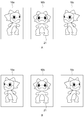
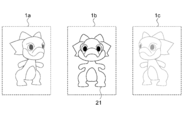
- FIG. 3 is a schematic view showing an example of the viewpoint images 18a to 18c.
- FIG. 3A is a schematic view showing an example of viewpoint images 18a to 18c in the configuration including the reflection type HOE9a shown in FIG. 2A.
- the viewpoint image 18b corresponding to the viewpoint position 2b, which is the position in front of the multi-view display device 110
- the viewpoint image 18b is an image composed of the viewpoint image light 19b.
- an image when the character 21 is viewed from the left side is displayed as a viewpoint image 18a corresponding to the viewpoint position 2a which is a position moved to the left side from the front viewpoint position 2b. ..
- the viewpoint image 18a is an image composed of the viewpoint image light 19a.
- an image when the character 21 is viewed from the right side is displayed as a viewpoint image 18c corresponding to the viewpoint position 2c which is a position moved from the front viewpoint position 2b to the right side. ..
- the viewpoint image 18c is an image composed of the viewpoint image light 19c.
- the virtual image 1 of the viewpoint image 18b can be observed from the front viewpoint position 2b. From the viewpoint position 2a on the left side, it is possible to observe the virtual image 1 of the viewpoint image 18a. From the viewpoint position 2c on the right side, it is possible to see the virtual image 1 of the viewpoint image 18c.
- the display of the virtual image 1 changes from the virtual image 1 seen from the viewpoint position 2 before the movement to the virtual image 1 seen from the viewpoint position 2 after the movement.
- a virtual image 1 seen from each viewpoint position 2 is generated so that different orientations of the character 21 are expressed. That is, the viewpoint image 18 corresponding to each viewpoint position 2 is generated so that different directions of the character 21 are expressed. This makes it possible to observe different orientations of the character 21.
- FIG. 3B is a schematic view showing an example of viewpoint images 18a to 18c in the configuration including the transmission type HOE9b shown in FIG. 2B.
- the transmission type HOE9b is used as the diffractive optical element 6, the viewpoint image 18 composed of the viewpoint image light 19 emitted by the multi-viewpoint image source 17 is reproduced in a state of being left-right inverted with respect to the user. Therefore, when the transmissive HOE9b is used, it is necessary to display the image to be reproduced horizontally inverted. For example, as shown in FIG. 3B, an image in which the viewpoint images 18 (18a to 18c) shown in FIG. 3A are horizontally inverted is displayed as the viewpoint images 18 (18a to 18c).
- From the front viewpoint position 2b it is possible to observe the virtual image 1 in which the viewpoint image 18b shown in FIG. 3B is flipped horizontally. From the viewpoint position 2a on the left side, it is possible to observe the virtual image 1 in which the viewpoint image 18a shown in FIG. 3B is flipped horizontally. From the viewpoint position 2c on the right side, it is possible to see the virtual image 1 in which the viewpoint image 18c shown in FIG. 3B is flipped horizontally. As a result, by moving the viewpoint position 2 to the left or right, it is possible to observe different directions of the character 21.
- the multi-viewpoint display device 110 capable of three-dimensionally displaying the virtual image 1 to be displayed can be said to be a three-dimensional image display device.
- the multi-viewpoint video source 17 can be said to be a light ray reproducing device that reproduces light rays emitted from an object.
- the emission control unit 7 controls the emission of the viewpoint image light 19 (19a to 19c) by the multi-viewpoint image source 17 by using a plurality of viewpoint image data corresponding to the plurality of viewpoint images 18.
- a plurality of viewpoint image data for displaying each of the plurality of viewpoint images 18a to 18c illustrated in FIGS. 3A and 3B are used.
- the plurality of viewpoint image data are included in the image data 15 generated in response to the change in the display state of the virtual image 1 in response to the change in the viewpoint position 2 illustrated in FIG. That is, the plurality of viewpoint image data are generated in response to the change in the display state of the virtual image 1 in response to the change in the viewpoint position 2.
- the plurality of viewpoint image data are image data in which image processing for correcting the change in the display state of the virtual image 1 according to the change in the viewpoint position 2 has been executed.
- the image processing for correcting the change in the display state of the virtual image 1 according to the change in the viewpoint position 2 will be described in detail later.
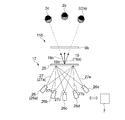
- FIG. 4 is a schematic diagram showing an embodiment of the multi-viewpoint video source 17.
- the multi-viewpoint video source 17 is realized by the multi-projector type display.
- the multi-projector type display includes a transmissive anisotropic diffusion screen 25 and a plurality of projectors 26 (26a to 26e) constituting the projector array.
- the plurality of viewpoint image lights 19a to 19c are emitted by projecting the image light toward the transmissive anisotropic diffusion screen 25 by each of the plurality of projectors 26a to 26e. ..
- the image light emitted by each of the plurality of projectors 26a to 26e will be referred to as the corresponding image light 27 (27a to 27e).
- the anisotropic diffusion screen 25 functions as a real image screen.
- the anisotropic diffusion screen 25 diffuses and transmits the corresponding image lights 27a to 27e emitted by each of the plurality of projectors 26a to 26e.
- a plurality of viewpoint image lights 19a to 19c are emitted from the anisotropic diffusion screen 25 toward the transmission type HOE9b.
- the transmissive anisotropic diffusion screen 25 has, for example, anisotropic diffusion characteristics having different diffusivity in the horizontal direction and the vertical direction.
- the degree of diffusion in the horizontal direction is set to be smaller than that in the vertical direction, and is configured to have a narrow diffusion characteristic with respect to the horizontal direction.
- the anisotropic diffusion screen 25 is composed of a lens diffusion plate or the like whose diffusion degree is biased in the horizontal and vertical directions by, for example, a microlens array or the like.
- a transmission type HOE in which the anisotropic diffusion characteristics are recorded may be used as the anisotropic diffusion screen 25.
- any configuration may be adopted.
- the plurality of projectors 26a to 26e project an image toward the anisotropic diffusion screen 25. That is, the plurality of projectors 26a to 26e emit the corresponding image lights 27a to 27e toward the anisotropic diffusion screen 25. It is desirable to use a laser light source as the light source of the projector 26. This makes it possible to display the viewpoint image 18 using colored light having a narrow wavelength width, improve the diffraction efficiency of the transmission type HOE9b, and increase the display brightness. Further, it is possible to avoid blurring of the image due to wavelength dispersion in the transmissive HOE9b. An LED light source may be used as the light source of the projector 26.
- the specific configuration of the projector 26 is not limited.
- the plurality of projectors 26a to 26e are arranged at a predetermined pitch so as to face a predetermined reference position of the anisotropic diffusion screen 25.
- a predetermined reference position for example, a central position
- the projector 26 is arranged on these a plurality of straight lines.
- the configuration is not limited to such a configuration, and the number of projectors 26, the pitch between the projectors 26, the arrangement configuration of the plurality of projectors 26, and the like may be arbitrarily set so that the desired viewpoint image light 19 can be projected.
- the emission control unit 7 controls the emission of the corresponding image lights 27a to 27e by each of the plurality of projectors 26a to 26e by using the plurality of corresponding image data corresponding to the plurality of projectors 26a to 26e. As a result, the emission of the plurality of viewpoint image lights 19a to 19c by the multi-viewpoint image source 17 is controlled.
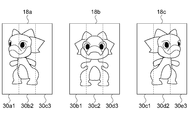
- FIG. 5 is a schematic diagram showing an example of a plurality of viewpoint images 18a to 18c reproduced by the multi-viewpoint video source 17 according to the present embodiment.
- the viewpoint image light 19a constitutes the viewpoint image 18a
- the viewpoint image light 19b constitutes the viewpoint image 18b
- the viewpoint image 18c is formed by the viewpoint image light 19c.
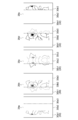
- FIG. 6 is a schematic diagram showing an example of a plurality of corresponding image data 29 (20a to 29e) corresponding to the plurality of projectors 26a to 26e.
- the correspondence between the plurality of corresponding image data 29 shown in FIG. 6 and the plurality of projectors 26 shown in FIG. 5 is as follows.
- Each projector 26 controls the emission of the corresponding image light 27 based on the corresponding corresponding image data 29.
- the image data and the image composed of the image light emitted based on the image data are represented by the same drawing. Therefore, for example, the drawing shown in FIG. 5 may be used as a drawing representing a plurality of viewpoint images 18a to 18c, or may be used as a drawing representing a plurality of viewpoint image data corresponding to the plurality of viewpoint images 18a to 18c. There can also be. Further, the drawing shown in FIG. 6 may be used as a drawing representing a plurality of corresponding image data 29a to 29e, or as a drawing representing a plurality of projected images projected based on the plurality of corresponding image data 29a to 29e. It may also be used.
- each of the plurality of corresponding image data 29a to 29e is divided into a plurality of image regions 30.
- the image region 30 is a partial region in the image data and is a region constituting a partial image.
- the image area 30 is not necessarily limited to one area in the image data.
- a plurality of regions separated from each other may form one partial image.
- one image region 30 is composed of a plurality of regions separated from each other.
- each of the plurality of corresponding image data 29a to 29e is divided into three image regions 30 of a left region, a center region, and a right region, which are divided into three equal parts along the left-right direction of the image. ing.
- the corresponding image data 29a is divided into a left region 30a1, a central region 30a2, and a right region 30a3.
- the corresponding image data 29b is divided into a left region 30b1, a central region 30b2, and a right region 30b3.
- the corresponding image data 29c is divided into a left region 30c1, a central region 30c2, and a right region 30c3.
- the corresponding image data 29d is divided into a left region 30d1, a central region 30d2, and a right region 30d3.
- the corresponding image data 29e is divided into a left region 30e1, a central region 30e2, and a right region 30e3.
- each viewpoint image 18 is divided into three in the left-right direction in the same manner as the three image regions 30 of the corresponding image data 29.
- the following correspondence is established between the left region, the center region, and the right region of each viewpoint image 18 and the left region, the center region, and the right region of each corresponding image data 29 shown in FIG.
- Viewpoint image 18a Left area: Left area 30a1 of the corresponding image data 29a Central area: Central area 30b2 of the corresponding image data 29b Right area: Right area 30c3 of the corresponding image data 29c Viewpoint image 18b Left area: Left area 30b1 of the corresponding image data 29b Central area: Central area 30c2 of the corresponding image data 29c Right area: Right area 30d3 of the corresponding image data 29d Viewpoint image 18c Left area: Left area 30c1 of the corresponding image data 29c Central area: Central area 30d2 of the corresponding image data 29d Right area: Right area 30e3 of the corresponding image data 29e
- each of the plurality of corresponding image data 29a to 29e is divided into a plurality of image regions 30 in which at least one corresponds to a part of the viewpoint image 18.
- at least one of the plurality of image regions 30 corresponds to a part of the viewpoint image 18.
- different image regions 30 correspond to each part of the different viewpoint images 18.
- each viewpoint image data corresponding to each viewpoint image 18 is first generated, and each viewpoint image data is divided into a plurality of image regions. By combining the image data of the divided image areas of each viewpoint image data, the corresponding image data 29 shown in FIG. 6 is generated. Of course, it is not limited to this generation method.
- the viewpoint image light 19a shown in FIG. 4 is composed of the following corresponding image lights.
- Corresponding image light 27a emitted by the projector 26a based on the left region 30a1 of the corresponding image data 29a image light constituting the left region of the projected image by the projector 26a.
- Corresponding image light 27b emitted by the projector 26b based on the central region 30b2 of the corresponding image data 29b image light constituting the central region of the projected image by the projector 26b.
- Corresponding image light 27c emitted by the projector 26c based on the right region 30c3 of the corresponding image data 29c image light constituting the right region of the projected image by the projector 26c). Therefore, the viewpoint image 18a shown in FIG.
- the left region 30a1 of the corresponding image data 29a, the central region 30b2 of the corresponding image data 29b, and the right region 30c3 of the corresponding image data 29c correspond to the viewpoint image data corresponding to the viewpoint image 18a.
- the viewpoint image light 19b shown in FIG. 4 is composed of the following corresponding image lights.
- Corresponding image light 27d emitted by the projector 26d based on the right region 30d3 of the corresponding image data 29d image light constituting the right region of the projected image by the projector 26d). Therefore, the viewpoint image 18b shown in FIG.
- the left region 30b1 of the corresponding image data 29b, the central region 30c2 of the corresponding image data 29c, and the right region 30d3 of the corresponding image data 29d correspond to the viewpoint image data corresponding to the viewpoint image 18b.
- the viewpoint image light 19c shown in FIG. 4 is composed of the following corresponding image lights.
- Corresponding image light 27d emitted by the projector 26d based on the left region 30d1 of the corresponding image data 29d image light constituting the left region of the projected image by the projector 26d.
- Corresponding image light 27d emitted by the projector 26d based on the central region 30d2 of the corresponding image data 29d image light constituting the central region of the projected image by the projector 26d.
- Corresponding image light 27e emitted by the projector 26e based on the right region 30e3 of the corresponding image data 29e image light constituting the right region of the projected image by the projector 26e. Therefore, the viewpoint image 18c shown in FIG.
- the left region 30c1 of the corresponding image data 29c, the central region 30d2 of the corresponding image data 29d, and the right region 30d3 of the corresponding image data 29d correspond to the viewpoint image data corresponding to the viewpoint image 18c.
- the light rays from the front projector 26c in addition to the light rays from the front projector 26c (corresponding image light 27c in the central region 30c2), the light rays from the projectors 26b and 26d adjacent to the left and right (correspondence of the left region 30b1).
- the image light 27b and the corresponding image light 27d) in the right region 30d3 are also incident on the pupil.
- the light rays from each projector 26 (corresponding image light 27 in each image region 30) are diffused with a width by the anisotropic diffusion screen 25. Therefore, the light rays of the three image regions 30 divided into strips allow the user to observe one image (virtual image 1). Similarly, one image (virtual image 1) can be observed at the other viewpoint positions 2a and 2c.
- the emission control unit 7 uses the image data 15 generated in response to the change in the display state of the virtual image 1 in response to the change in the viewpoint position 2 by the emission control unit 5. Controls the emission of the image light 8.
- the change in the display state of the virtual image 1 includes, for example, a change in the display position of the virtual image 1, a change in the brightness of the virtual image 1, and a change in the chromaticity of the virtual image 1. It should be noted that there is a good possibility that this technique can be applied to changes in other parameters related to the display state of the virtual image 1.
- the multi-viewpoint display device 110 shown in FIG. 2 corresponds to a plurality of viewpoint images 18a to 18c, and displays a plurality of viewpoint image data generated in response to a change in the display state of the virtual image 1 in response to a change in the viewpoint position 2.
- the emission of a plurality of viewpoint image lights 19a to 19c by the multi-viewpoint image source 17 is controlled.
- Image processing for correcting the change in the display state of the virtual image 1 is executed on the plurality of viewpoint image data.
- the output of the corresponding image lights 27a to 27e by each of the plurality of projectors 26a to 26e is controlled by using the plurality of corresponding image data 29a to 29e shown in FIG.
- the emission of a plurality of viewpoint image lights 19a to 19c by the viewpoint image source 17 is controlled.
- the plurality of corresponding image data 29a to 29e are generated in response to the change in the display state of the virtual image 1 in response to the change in the viewpoint position 2, and image processing for correcting the change in the display state of the virtual image 1 is executed. Has been done. Specifically, image processing for correcting a change in the display state of the virtual image 1 is executed for each of the plurality of image regions 30 included in each of the plurality of corresponding image data 29a to 29e.
- image processing for correcting changes in the display state of virtual image 1 An image process for correcting a change in the display state of the virtual image 1 (hereinafter, simply referred to as an image process A with a reference numeral), which is executed on the viewpoint image data and the corresponding image data 29, will be described. Typically, image processing is performed to cancel (cancel) the change in the display state of the virtual image 1.
- the image processing A includes performing correction to the original viewpoint image data (original corresponding image data 29) for displaying the viewpoint image 18 so that the change in the display state of the virtual image 1 can be offset. ..
- the original viewpoint image data (original corresponding image data 29) is used as it is without being corrected, which is also included in the image processing A.
- the image processing A includes a process of correcting the original viewpoint image data (original corresponding image data 29) so that the change in the display state of the virtual image 1 can be offset, if necessary.
- the drawings shown in FIGS. 5 and 6 can be said to be drawings representing the original viewpoint image data (original corresponding image data 29).
- Image processing A is typically performed based on the optical properties of the diffractive optical element 6.
- image processing A is executed based on calibration or the like at a predetermined timing such as at the time of shipment of the image display device 100 (multi-view display device 110).
- a predetermined timing such as at the time of shipment of the image display device 100 (multi-view display device 110).
- the image processing A may be executed at a predetermined timing.
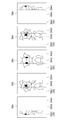
- FIG. 7 is a schematic view showing an example of a change in the display position of the virtual image 1.
- FIG. 7A is a virtual image 1a (virtual image 1 corresponding to the viewpoint image 18a) observed from the viewpoint position 2a.
- FIG. 7B is a virtual image 1b (virtual image 1 corresponding to the viewpoint image 18b) observed from the viewpoint position 2b.
- FIG. 7C is a virtual image 1c (virtual image 1 corresponding to the viewpoint image 18c) observed from the viewpoint position 2c.
- the display position of the virtual image 1 may change according to the left-right movement of the viewpoint position 2.
- the display of the virtual image 1 changes from the virtual image 1b to the virtual image 1a.
- the display position of the virtual image 1 moves upward.
- the display of the virtual image 1 changes from the virtual image 1b to the virtual image 1c.
- the display position of the virtual image 1 moves downward.
- Such a change in the display position of the virtual image 1 can occur, for example, due to a change in the emission angle of the diffracted light by the diffractive optical element 6.
- the viewpoint image 18 viewpoint image light 19
- the viewpoint image 18 viewpoint image light 19
- the incident angle of each viewpoint image light 19 with respect to the diffracted optical element 6 changes
- the emission angle of each diffracted viewpoint image light 19 changes.
- the display position of the virtual image 1 changes.
- the display position may change due to other factors.
- FIG. 8 is a schematic diagram showing an example of viewpoint image data 35 (35a to 35c) generated in response to a change in the display position of the virtual image 1.
- the viewpoint image data 35a to 35b capable of canceling the change in the display position of the virtual image 1 are generated.
- the viewpoint image data 35 is generated so that the character 21 is displayed at a position deviated in the direction opposite to the fluctuation direction of the virtual image 1.
- image data such that the character 21 is moved downward and displayed is generated.
- viewpoint image data 35b for generating the viewpoint image 18b corresponding to the viewpoint position 2b image data is generated so that the character 21 is displayed at the original position without moving.
- viewpoint image data 35c for generating the viewpoint image 18c corresponding to the viewpoint position 2c image data such that the character 21 is moved upward and displayed is generated.
- FIG. 9 is a schematic diagram showing an example of corresponding image data 29 (29a to 29e) generated in response to a change in the display position of the virtual image 1.
- Image processing A is executed for each of the plurality of image regions 30, and viewpoint image data 35a to 35b capable of canceling changes in the display position of the virtual image 1 are generated.
- corresponding image data 29a correction is executed so that the display content is moved downward and displayed with respect to the left region 30a1.
- the correction is executed so that the display content is moved downward and displayed with respect to the central region 30b2.
- correction is executed so that the display content is moved upward and displayed with respect to the left region 30c1.
- the correction is executed so that the displayed content is moved downward and displayed in the right area 30c3.
- the correction is executed so that the display content is moved upward and displayed with respect to the central region 30d2.
- correction is executed so that the display content is moved upward and displayed in the right region 30e3.
- the image processing A generates a plurality of viewpoint image data 35a to 35c as shown in FIG. 8 and a plurality of corresponding image data 29a to 29e as shown in FIG.
- the change in the display position of the virtual image 1 in response to the change in the viewpoint position 2 is not limited to the change in the vertical direction (vertical direction).
- the display position may change in other directions depending on the optical characteristics of the diffractive optical element 6.
- the display position of the entire virtual image 1 changes according to the viewpoint position 2.
- the display position of each region (left region, center region, right region) of the virtual image 1 may change individually according to the change of the viewpoint position 2.
- the display position of the virtual image 1 may change in such various aspects.
- the image processing A generates a plurality of viewpoint image data 35 and a plurality of corresponding image data 29 to change the display position of the virtual image 1 in response to the change in the viewpoint position 2. It becomes possible to suppress.
- FIG. 10 is a schematic diagram showing an example of a change in the brightness of the virtual image 1.
- FIG. 10A is a virtual image 1a (virtual image 1 of the viewpoint image 18a) observed from the viewpoint position 2a.
- FIG. 10B is a virtual image 1b (virtual image 1 of the viewpoint image 18b) observed from the viewpoint position 2b.
- FIG. 10C is a virtual image 1c (virtual image 1 of the viewpoint image 18c) observed from the viewpoint position 2c.
- the high and low brightness is expressed by the shade of gray color. Colors closer to black have higher brightness, and colors closer to white have lower brightness.
- the brightness of the virtual image 1 may change according to the left-right movement of the viewpoint position 2.
- the display of the virtual image 1 changes from the virtual image 1b to the virtual image 1a. At that time, the brightness of the virtual image 1 becomes low.
- the display of the virtual image 1 changes from the virtual image 1b to the virtual image 1c. At that time, the brightness of the virtual image 1 is also lowered. Comparing the virtual image 1a and the virtual image 1c, the virtual image 1c has a lower brightness.
- Such a change in the display position of the virtual image 1 can occur, for example, due to a change in the diffraction efficiency of the diffraction optical element 6.
- the viewpoint image 18 viewpoint image light 19
- the diffraction efficiency with respect to each viewpoint image light 19 changes.
- the brightness of the virtual image 1 changes.
- the brightness may change due to other factors.
- FIG. 11 is a schematic diagram showing an example of viewpoint image data 35 (35a to 35c) generated in response to a change in the brightness of the virtual image 1.
- the viewpoint image data 35a to 35b capable of canceling the change in the brightness of the virtual image 1 are generated.
- the brightness of the viewpoint image 18 (the brightness value of the viewpoint image data 35) is controlled in order to cancel the change in the brightness of the virtual image 1. For example, the brightness (luminance value) is increased with respect to the viewpoint image 18 in which the virtual image 1 is displayed with low brightness. The brightness (luminance value) is lowered with respect to the viewpoint image 18 in which the virtual image 1 is displayed with high brightness.
- the brightness of the viewpoint image 18 (luminance value of the viewpoint image data 35) corresponding to the other virtual image 1 is controlled so as to match the brightness of the virtual image 1 having the lowest brightness.
- the high and low brightness is expressed by the shade of gray color. A color closer to black has a higher brightness (higher brightness value), and a color closer to white has a lower brightness (lower brightness value).
- the brightness value of the viewpoint image data 35c is corrected so that the viewpoint image 18c corresponding to the viewpoint position 2c has the highest brightness.
- the brightness values of the viewpoint image data 35a and 35b are corrected so that the virtual image 1 is displayed with a brightness equal to the brightness of the virtual image 1c corresponding to the viewpoint image 18c.
- the brightness value of the viewpoint image data 35b is corrected so that the viewpoint image 18b corresponding to the viewpoint position 2b has the lowest brightness.
- the viewpoint image 18a corresponding to the viewpoint position 2a has a brightness value of the viewpoint image data 35a so as to have a brightness between the brightness of the viewpoint image 18c and the brightness of the viewpoint image 18b (hereinafter, referred to as an intermediate brightness). Is corrected.
- FIG. 12 is a schematic diagram showing an example of the corresponding image data 29 (29a to 29e) generated in response to the change in the brightness of the virtual image 1.
- Image processing A is executed for each of the plurality of image regions 30, and viewpoint image data 35a to 35b capable of canceling changes in the brightness of the virtual image 1 are generated.
- the corresponding image data 29a the brightness value is corrected so that the image has an intermediate brightness with respect to the left region 30a1.
- the brightness value is corrected so that the image has the lowest brightness with respect to the left region 30b1. Further, the brightness value is corrected so that the image has an intermediate brightness with respect to the central region 30b2.
- the brightness value is corrected so that the image has the highest brightness with respect to the left region 30c1. Further, the brightness value is corrected so that the image has the lowest brightness with respect to the central region 30c2. Further, the brightness value is corrected so that the image has an intermediate brightness with respect to the right region 30c3.
- the brightness value is corrected so that the image has the highest brightness with respect to the central region 30d2. Further, the brightness value is corrected so that the image has the lowest brightness with respect to the right region 30d3.
- the brightness value is corrected so that the image has the highest brightness with respect to the right region 30e3.
- the image processing A generates a plurality of viewpoint image data 35a to 35c as shown in FIG. 11 and a plurality of corresponding image data 29a to 29e as shown in FIG.
- the present invention is not limited to the case where the brightness of the entire virtual image 1 changes according to the viewpoint position 2.
- the brightness of each region (left region, center region, right region) of the virtual image 1 may change individually according to the change of the viewpoint position 2.
- the chromaticity of the virtual image 1 may change according to the change in the viewpoint position 2.
- each of the virtual images 1a to 1c shown in FIGS. 7 and 10 may be different.
- the character 21 can be seen in blue from the front viewpoint position 2b.
- the blue-green character 21 can be seen from the viewpoint position 2a on the left side.
- the purple character 21 can be seen from the viewpoint position 2a on the left side. Such a change in chromaticity may occur.
- the viewpoint image data 35a to 35b and the corresponding image data 29a to 29e capable of canceling the change in the chromaticity of the virtual image 1 are generated.
- the viewpoint image data 35 image area 30 of the corresponding image data 29
- the viewpoint image data 35 is corrected so that the chromaticity of the viewpoint image 18 changes along the chromaticity direction opposite to the change of the chromaticity generated in the virtual image 1. ..
- FIG. 13 is a schematic diagram for explaining an example of image processing A.
- the upper graph of FIG. 13 is a graph showing the diffraction efficiency of RGB with respect to colored light according to the viewpoint position 2.
- the lower graph of FIG. 13 is a schematic diagram showing the set values of each RGB brightness value of the viewpoint image data 35 for displaying the viewpoint image 18 according to the viewpoint position 2.
- the brightness value of each color light in the viewpoint image data 35 is set according to the diffraction efficiency of each color light depending on the viewpoint position 2.
- a low luminance value is set for colored light having high diffraction efficiency
- a high luminance value is set for colored light having low diffraction efficiency.
- a plurality of viewpoint image data 35a to 35c and a plurality of corresponding image data 29a to 29e are generated.
- the present invention is not limited to the case where the chromaticity of the entire virtual image 1 changes according to the viewpoint position 2.
- the chromaticity of each region (left region, center region, right region) of the virtual image 1 may change individually according to the change in the viewpoint image position. Even in such a case, it is possible to suppress the change in chromaticity 1 in response to the change in the viewpoint position 2 by generating the plurality of viewpoint image data 35 and the plurality of corresponding image data 29 by the image processing A. It becomes.
- the image processing A described with reference to FIG. 13 can be said to be a process for canceling the change in the diffraction efficiency of the HOE 9 in response to the change in the viewpoint position 2.
- FIG. 14 is a schematic view showing an example of a case where the viewpoint image data is continuously corrected along a predetermined direction.
- the display state of the virtual image 1 may change non-uniformly according to the change in the viewpoint position 2.
- the change in the display position of the virtual image 1 occurs uniformly according to the change in the viewpoint position 2.
- the change in the display position may occur unevenly in the virtual image plane 3 according to the change in the viewpoint position 2.
- the virtual image 1 based on the viewpoint image data 35b is displayed in response to the movement from the viewpoint position 2a to the viewpoint position 2b, it is assumed that the change in the display state occurs unevenly in the virtual image surface 3.
- FIG. 14 is a schematic view showing an example of a case where the viewpoint image data is continuously corrected along a predetermined direction.
- the display state of the virtual image 1 may change non-uniformly according to the change in the viewpoint position 2.
- the change in the display position of the virtual image 1 occurs uniformly according to the change in the viewpoint position 2.
- the viewpoint image data 35b is corrected so that the display position continuously changes along the left-right direction of the image in response to the non-uniform change in the display position. That is, the viewpoint image data 35b is corrected smoothly (linearly) along the left-right direction of the image. This makes it possible to suppress non-uniform changes in the display position in response to changes in the viewpoint position 2.
- correction is performed so that the display position of each image area 30 (30c1, 30c2, 30c3) of the corresponding image data 29c changes continuously along the left-right direction of the image. It may be executed. That is, one image region 30 may be corrected smoothly (linearly) along the left-right direction of the image. By executing such continuous correction for each image region 30, it is possible to suppress a non-uniform change in the display position in response to a change in the viewpoint position 2. It should be noted that correction may be performed so that the display position changes continuously with respect to the entire corresponding image data 29c. That is, the correction may be smoothly (linearly) executed on the entire corresponding image data 29c without distinguishing the image area 30. In the example shown in FIG.
- a correction for suppressing a non-uniform change in the display position of the virtual image 1 is given as an example. Not limited to this, as shown in FIG. 14, in order to suppress non-uniform changes in other display states such as non-uniform changes in the brightness of the virtual image 1 and non-uniform changes in the chromaticity of the virtual image 1. Smooth corrections may be performed.
- the image processing A executed on the image data includes a process of continuously correcting the image data along a predetermined direction.
- the predetermined direction is, for example, the horizontal direction or the vertical direction of the image.
- the correction may be continuously executed along the other direction.
- the image light is used by using the image data 15 generated in response to the change in the display state of the virtual image 1 in response to the change in the viewpoint position 2.
- the emission of 8 is controlled. As a result, it is possible to suppress the change in the display state of the virtual image 1 in response to the change in the viewpoint position 2.
- a device that uses a half mirror as a combiner can be considered.
- the image light is specularly reflected, so that the viewpoint position where the virtual image 1 can be observed is limited by the positional relationship between the emitting portion and the combiner.
- the degree of freedom regarding the design of the device is reduced, and the device configuration is very limited.
- a diffractive optical element 6 such as HOE is used as a combiner.
- HOE diffractive optical element 6
- the HOE combiner is also used in the holographic display system described in Patent Document 1 described above.
- the distortion (dynamic distortion) of the virtual image when the eyes are moved from the observation position is suppressed by designing the device so that the virtual image observed at the standard position is greatly distorted. Has been done. Therefore, the degree of freedom regarding the design of the device is low, and the device configuration is limited. In addition, changes in the brightness, chromaticity, etc. of the virtual image when the eyes are moved cannot be corrected.
- image light is used by using the image data 15 (viewpoint image data 35, corresponding image data 29) in which the image processing A is executed. Emission of 8 (viewpoint image light 19, corresponding image light 27) is controlled. As a result, it is possible to sufficiently suppress changes in the display state including changes in the display position of the virtual image 1 according to changes in the viewpoint position 2, changes in the brightness of the virtual image 1, changes in the chromaticity of the virtual image 1, and the like. ..
- the desired light beam can be reproduced by using the image data 15 according to the deterioration.
- the device such as the position and installation angle of the emitting unit 5 (multi-viewpoint image source 17) and the diffractive optical element 6 and the like. It is possible to realize a highly accurate multi-view display without limiting the configuration.
- a multi-view display may be used as the multi-view image source 17 shown in FIG. 2 and the like. That is, a multi-view display may be used as the emission unit 5 shown in FIG.
- the multi-view display is a direct-view type display capable of displaying a multi-view image without using dedicated glasses or the like.
- the multi-view display has an image display surface for displaying a multi-view image.
- a direct-view type multi-view display generally displays a multi-view image by displaying a plurality of viewpoint images in a plurality of display directions.
- the multi-view display can be configured by, for example, any one of a lenticular lens system, a lens array system, and a parallax barrier system. Of course, it is not limited to these methods.
- the lenticular lens method is a method in which viewpoint images are displayed in different directions by using a lenticular lens that controls light rays in the horizontal direction. By using the lenticular lens method, it is possible to display a brighter viewpoint image as compared with the parallax barrier method or the like.
- the lens array method is a method of displaying a viewpoint image by controlling light rays in the vertical and horizontal directions using a microlens array.
- the line-of-sight barrier method is a method of displaying a viewpoint image by using a parallax barrier or the like that selectively blocks the light of each pixel, and can realize a wider viewing angle as compared with other methods.
- a flat panel display such as an LCD (Liquid Crystal Display) displays an image that is the source of the viewpoint image.
- the light source used for the backlight of the display is preferably a laser light source.
- HOE wavelength dispersion in the combiner
- the multi-viewpoint display emits each viewpoint image light of a plurality of viewpoint images, which are a plurality of target images corresponding to a plurality of viewpoint positions.
- the emission control unit can control the emission of a plurality of viewpoint image lights by the multi-viewpoint display by controlling the emission of the image light (hereinafter, referred to as multi-viewpoint image light) by the flat panel display. Further, the emission control unit controls the emission of the multi-viewpoint image light by the flat panel display by using the multi-viewpoint image data generated in response to the change in the display state of the virtual image according to the change in the viewpoint position.
- FIG. 15 is a schematic view showing a configuration example of a lenticular lens type multi-viewpoint display.
- the multi-view display 40a shown in FIG. 15A has a flat display panel 41 and a lenticular lens 42.
- the flat display panel 41 has a plurality of pixels 43 arranged in the horizontal direction and the vertical direction.
- the lenticular lens 42 is arranged along the vertical direction.
- the multi-viewpoint display 40a illustrated in FIG. 15A can reproduce four viewpoint images 18a to 18d corresponding to the four viewpoint positions 2a to 2d.
- the viewpoint image light 19a is emitted from the pixels 43a shown in black, and the viewpoint image 18a is reproduced via the lenticular lens 42.
- the viewpoint image light 19b is emitted by the pixels 43b shown in dark gray, and the viewpoint image 18b is reproduced via the lenticular lens 42.
- the viewpoint image light 19c is emitted by the pixels 43c shown in light gray, and the viewpoint image 18c is reproduced via the lenticular lens 42.
- the viewpoint image light 19d is emitted from the pixel 43d shown in white, and the viewpoint image 18d is reproduced via the lenticular lens 42.
- the multi-viewpoint image data displayed by the flat display panel 41 for reproducing the plurality of viewpoint images 18a to 18d includes an image area composed of pixels 43a, an image area composed of pixels 43b, an image area composed of pixels 44c, and The image area composed of the pixels 43d is divided into a plurality of image areas.
- image processing for correcting a change in the display state of the virtual image 1 is executed for each of the plurality of image regions. Typically, image processing is performed to offset the change in the display state of the virtual image 1. That is, various image processing A described above is executed.
- the lenticular lens 42 can be arranged obliquely with respect to the flat display panel 41.
- the pixels 43 for reproducing the same viewpoint image 18 a plurality of pixels 43 arranged diagonally are assigned instead of a plurality of pixels 43 arranged along the vertical direction.
- the multi-viewpoint image data is a plurality of image regions of an image region consisting of pixels 43a, an image region consisting of pixels 43b, an image region consisting of pixels 44c, and an image region consisting of pixels 43d.
- This technology can also be applied to multi-viewpoint displays other than the lenticular lens method.
- image processing for correcting the change in the display state of the virtual image 1 on the multi-viewpoint image data displayed by the flat display panel 41 the display position of the virtual image 1 in response to the change in the viewpoint position 2 It is possible to suppress changes and provide a high-quality viewing experience. That is, it is possible to reproduce a desired light ray with respect to the display target, and it is possible to realize a high-quality multi-viewpoint display.
- the lens array method using the microlens array it is possible to increase the number of viewpoints not only in the horizontal direction but also in the vertical direction.
- a plurality of projectors 26 are arranged along two axes in the horizontal direction (horizontal direction) and the vertical direction (vertical direction) with respect to the diffusion screen. Since the projector 26 is also arranged in the vertical direction, it is possible to use a diffusion screen that does not have anisotropic diffusion characteristics. As a result, it is possible to display a plurality of viewpoint images corresponding to the plurality of viewpoint positions 2 not only in the horizontal direction but also in the vertical direction. As a result, the display of the virtual image 1 can be switched according to the movement of the viewpoint position 2 along the vertical direction. Therefore, the user can observe different directions of the virtual image 1 not only in the horizontal direction but also in the vertical direction.
- FIG. 17 is a schematic diagram showing an example of a plurality of corresponding image data 29 corresponding to the plurality of projectors 26 shown in FIG.
- the image is divided into nine image regions 30 along each of the left-right direction and the up-down direction of the image. At least one of the plurality of image regions 30 corresponds to a part of any viewpoint image among the plurality of viewpoint images.
- image processing for correcting the change in the display state of the virtual image 1 is executed for each of the plurality of image areas 30. That is, various image processing A described above is executed.
- the setting of the plurality of image areas 30 is not limited to the division as shown in FIG.
- a plurality of image areas 30 may be appropriately set according to the arrangement configuration of the projector 26 and the like.
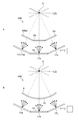
- a plurality of diffractive optical elements 6 (6a to 6c) and a plurality of multi-viewpoint video sources 17 (17a to 17c) corresponding thereto are used.
- the diffractive optical elements 6a to 6c are arranged so as to surround the central axis O. That is, it is arranged on the circumference centered on the central axis O.
- the multi-viewpoint image sources 17a to 17c are arranged on the corresponding diffractive optical elements 6a to 6c so that a plurality of viewpoint image lights 19 can be emitted.
- the multi-viewpoint video sources 17a to 17c are arranged so that the emission surface of the viewpoint image light 19 faces the central axis O.
- the 18A can be said to be a configuration in which a plurality of pairs of the diffraction optical element 6 and the multi-viewpoint image source 17 are arranged.
- a configuration in which a plurality of pairs of the diffraction optical element 6 and the multi-viewpoint image source 17 are arranged.
- the virtual image surface 3 on which the virtual image 1 is formed is formed with reference to the central axis O. Therefore, it is possible to realize the display of the virtual image 1 as if the display target exists on the central axis O.
- a diffractive optical element 6 having a curved surface shape and a plurality of multi-viewpoint video sources 17 (17a to 17c) are used.
- the diffractive optical element 6 is arranged so as to surround the central axis O. That is, they are arranged along the circumference centered on the central axis O.
- the viewpoint image light 19 emitted from each of the plurality of multi-viewpoint video sources 17a to 17c is emitted from the incident surface 10 having a curved surface shape of the diffractive optical element 6.
- the viewpoint image light 19 is diffracted by the diffractive optical element 6 and emitted, so that the virtual image 1 is displayed with the central axis O as a reference.
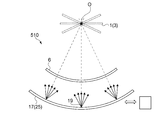
- a diffractive optical element 6 having a curved surface shape and a multi-viewpoint image source 17 having a curved surface shape are used.
- the diffractive optical element 6 is arranged so as to surround the central axis O. That is, they are arranged along the circumference centered on the central axis O.
- the multi-viewpoint video source 17 for example, the multi-projector type display shown in FIGS. 4 and 16 is used.
- the transmissive anisotropic diffusion screen 25 included in the multi-projector type display is formed in a curved surface shape and is arranged so as to surround the central axis O.
- Corresponding image light 27 is emitted from a plurality of regions of the anisotropic diffusion screen 25 having a curved surface shape by the plurality of projectors 26 (see FIG. 4).
- the viewpoint image light 19 is emitted from the plurality of regions of the anisotropic diffusion screen 25 toward the diffractive optical element 6. Even in such a configuration, it is possible to observe different directions of the virtual image 1 in a wider range in the left-right direction (horizontal direction). Further, it is possible to realize the display of the virtual image 1 as if the display target exists on the central axis O.
- the present technology can also be applied to the multi-view display devices 310 to 510 as shown in FIGS. 18 and 19. As a result, it is possible to suppress the change in the display position of the virtual image 1 in response to the change in the viewpoint position 2, and it is possible to provide a high-quality viewing experience.
- any configuration may be adopted as the image display device (multi-viewpoint display device) according to the present technology.
- a plurality of diffractive optical elements 6 may be arranged so as to cover the entire circumference of the central axis O. That is, a plurality of diffractive optical elements 6 may be arranged so as to form a cylindrical shape.
- the viewpoint image light 19 is emitted from the entire circumference of 360 ° to the plurality of diffractive optical elements 6.
- the incident surfaces on which the image light is incident may be separated from each other. It is also possible to emit the viewpoint image light 19 to a plurality of regions of the diffractive optical element 6 by using one image source.
- the image display device 600 shown in FIG. 20 further includes a camera 50.
- the camera 50 is installed so that the area of the face including the user's eyes can be photographed.
- the camera 50 is set so that the area of the user's face can be photographed even when the user moves the viewpoint position 2 within the range in which the virtual image 1 can be observed.
- a digital camera including an image sensor such as a CMOS (Complementary Metal-Oxide Semiconductor) sensor or a CCD (Charge Coupled Device) sensor is used.
- an infrared camera equipped with infrared illumination such as an infrared LED may be used.
- a viewpoint position detection unit (not shown) is configured as a software block, and the viewpoint position 2 is detected based on an image taken by the camera 50.
- the method of detecting the viewpoint position 2 based on the captured image is not limited, and any technique such as face tracking may be used.
- a machine learning algorithm using a neural network such as RNN (Recurrent Neural Network), CNN (Convolutional Neural Network), or MLP (Multilayer Perceptron) may be used.
- RNN Recurrent Neural Network
- CNN Convolutional Neural Network
- MLP Multilayer Perceptron
- any machine learning algorithm that executes supervised learning method, unsupervised learning method, semi-supervised learning method, reinforcement learning method, etc. may be used.
- the viewpoint position detection unit configured as a software block is configured by, for example, the processor of the emission control unit 7 executing a program according to the present technology.
- the camera 50 may be configured with a viewpoint position detection unit.
- the viewpoint position detection unit may be configured by another computer on the network. In the example shown in FIG. 20, the camera 50 and the viewpoint position detection unit realize a detection unit that detects the viewpoint position.
- the method of realizing the detection unit is not limited.
- a flat panel display is used as the emission unit 5. Further, as the image data 15 generated corresponding to the display state of the virtual image 1, the image data generated corresponding to the viewpoint position 2 is used. Therefore, from the flat display, as the emitted light 8, the image light constituting the image corresponding to a certain viewpoint position 2 is emitted.
- the emission control unit 7 selects the image data corresponding to the viewpoint position 2 based on the viewpoint position 2 detected by the viewpoint position detection unit. Then, based on the selected image data, the image corresponding to the viewpoint position 2 is displayed on the flat display. That is, the emission control unit 7 controls the emission of image light by the flat display based on the detected viewpoint position 2.
- the user can observe the virtual image 1 of the image corresponding to each viewpoint position 2 when the viewpoint position 2 is moved. That is, it is possible to observe different directions of the virtual image 1.
- the image display device 600 it is possible to realize the multi-view body display of the virtual image 1 without using the multi-view video source.
- the image data of each of the plurality of images corresponding to the plurality of viewpoint positions 2 is appropriately corrected based on the optical characteristics of the diffractive optical element. As a result, it is possible to suppress the change in the display position of the virtual image 1 in response to the change in the viewpoint position 2, and it is possible to provide a high-quality viewing experience.
- This technology can be applied even when the image light is specularly reflected by the diffractive optical element.
- the present technology can also adopt the following configurations.
- (1) The exit part that emits the image light of the target image and A diffractive optical element having an incident surface and an exit surface, diffracting the image light incident on the incident surface and emitting the image light from the exit surface to display a virtual image of the target image.
- An image display device including an emission control unit that controls the emission of the image light by the emission unit using image data generated in response to a change in the display state of the virtual image in response to a change in the viewpoint position.
- (2) The image display device according to (1).
- An image display device that includes at least one change in the display state of the virtual image, a change in the display position of the virtual image, a change in the brightness of the virtual image, or a change in the chromaticity of the virtual image.
- the image display device (3) The image display device according to (1) or (2).
- the emitting unit emits the viewpoint image light of each of the plurality of viewpoint images, which is a plurality of target images corresponding to the plurality of viewpoint positions.
- the emission control unit uses a plurality of viewpoint image data generated in response to a change in the display state of the virtual image in response to a change in the viewpoint position in response to the plurality of viewpoint images, and the emission control unit uses the plurality of viewpoint image data.
- the plurality of viewpoint image data is an image display device on which image processing for correcting a change in the display state of the virtual image is executed.
- the image display device according to (4).
- An image display device that performs image processing for correcting a change in the display state of a virtual image based on the optical characteristics of the diffractive optical element.
- the image processing for correcting the change in the display state of the virtual image is an image display device including a process of continuously correcting each of the plurality of viewpoint image data along a predetermined direction.
- the emitting unit includes a plurality of projectors, and the image light emitted by each of the plurality of projectors is used as the corresponding image light.
- the emission control unit uses a plurality of corresponding image data corresponding to the plurality of projectors to control the emission of the corresponding image light by each of the plurality of projectors, whereby the emission of the image light by the emission unit.
- Control and The plurality of corresponding image data is an image display device generated in response to a change in the display state of the virtual image in response to a change in the viewpoint position.
- the image display device according to (7).
- the emitting unit emits the viewpoint image light of each of the plurality of viewpoint images, which is a plurality of target images corresponding to the plurality of viewpoint positions.
- An image display device in which at least one of each of the plurality of corresponding image data is divided into a plurality of image regions corresponding to a part of the viewpoint image.
- the image display device (9) The image display device according to (8). At least one of the plurality of corresponding image data is an image display device in which the image regions different from each other correspond to each part of the viewpoint images different from each other. (10) The image display device according to (8) or (9). An image display device in which image processing for correcting a change in the display state of the virtual image is executed for each of the plurality of corresponding image data in each of the plurality of image regions. (11) The image display device according to (10). The image processing for correcting the change in the display state of the virtual image is an image display device including a process of continuously performing correction along a predetermined direction for each of the plurality of image regions. (12) The image display device according to any one of (1) to (6).
- the exit unit includes a multi-view display configured by any one of a lenticular lens system, a lens array system, and a parallax barrier system.
- the emission control unit uses the multi-viewpoint image data generated in response to the change in the display state of the virtual image in response to the change in the viewpoint position to control the emission of the image light by the multi-viewpoint display.
- Display device (13) The image display device according to (12).
- the multi-viewpoint display emits light from each viewpoint image of a plurality of viewpoint images, which are a plurality of target images corresponding to a plurality of viewpoint positions.
- the multi-viewpoint image data is an image display device that is divided into a plurality of image regions corresponding to the plurality of viewpoint images.
- the multi-viewpoint image data is an image display device in which image processing for correcting a change in the display state of the virtual image is executed for each of the plurality of image regions.
- the image processing for correcting the change in the display state of the virtual image is an image display device including a process of continuously performing correction along a predetermined direction for each of the plurality of image regions.
- the diffractive optical element is an image display device that is a reflective holographic optical element or a transmissive holographic optical element.
- the image display device according to (1), further A detection unit for detecting the viewpoint position is provided.
- the image data generated in response to the change in the display state is the image data generated in response to the viewpoint position.
- the emission control unit is an image display device that controls the emission of the image light by the emission unit based on the detected viewpoint position.
Landscapes
- Engineering & Computer Science (AREA)
- Physics & Mathematics (AREA)
- Multimedia (AREA)
- Signal Processing (AREA)
- General Physics & Mathematics (AREA)
- Computer Hardware Design (AREA)
- Theoretical Computer Science (AREA)
- Optics & Photonics (AREA)
- Testing, Inspecting, Measuring Of Stereoscopic Televisions And Televisions (AREA)
Priority Applications (2)
| Application Number | Priority Date | Filing Date | Title |
|---|---|---|---|
| US17/784,234 US12095977B2 (en) | 2019-12-18 | 2020-12-04 | Image display apparatus |
| JP2021565464A JPWO2021124916A1 (https=) | 2019-12-18 | 2020-12-04 |
Applications Claiming Priority (2)
| Application Number | Priority Date | Filing Date | Title |
|---|---|---|---|
| JP2019-228449 | 2019-12-18 | ||
| JP2019228449 | 2019-12-18 |
Publications (1)
| Publication Number | Publication Date |
|---|---|
| WO2021124916A1 true WO2021124916A1 (ja) | 2021-06-24 |
Family
ID=76477302
Family Applications (1)
| Application Number | Title | Priority Date | Filing Date |
|---|---|---|---|
| PCT/JP2020/045156 Ceased WO2021124916A1 (ja) | 2019-12-18 | 2020-12-04 | 画像表示装置 |
Country Status (3)
| Country | Link |
|---|---|
| US (1) | US12095977B2 (https=) |
| JP (1) | JPWO2021124916A1 (https=) |
| WO (1) | WO2021124916A1 (https=) |
Cited By (1)
| Publication number | Priority date | Publication date | Assignee | Title |
|---|---|---|---|---|
| JP2023114995A (ja) * | 2022-02-07 | 2023-08-18 | ヘ-ヨン・チョイ | 空間譜面台装置 |
Families Citing this family (3)
| Publication number | Priority date | Publication date | Assignee | Title |
|---|---|---|---|---|
| US11936844B1 (en) | 2020-08-11 | 2024-03-19 | Apple Inc. | Pre-processing in a display pipeline |
| US12200185B1 (en) | 2020-08-11 | 2025-01-14 | Apple Inc. | Ray tracing in a display |
| JP2022126206A (ja) * | 2021-02-18 | 2022-08-30 | キヤノン株式会社 | 画像処理装置、画像処理方法及びプログラム |
Citations (7)
| Publication number | Priority date | Publication date | Assignee | Title |
|---|---|---|---|---|
| JPH06113339A (ja) * | 1992-09-30 | 1994-04-22 | Fujitsu Ltd | 立体画像情報伝送システム |
| JPH07257225A (ja) * | 1994-03-22 | 1995-10-09 | Asahi Glass Co Ltd | ホログラフィック表示システム |
| JP2005533291A (ja) * | 2002-07-12 | 2005-11-04 | イクスドライデー テヒノロギーズ ゲーエムベーハー | 自動立体視投影装置 |
| JP2015087619A (ja) * | 2013-10-31 | 2015-05-07 | 日本精機株式会社 | 車両情報投影システム及び投影装置 |
| JP2016014741A (ja) * | 2014-07-01 | 2016-01-28 | 国立研究開発法人情報通信研究機構 | 立体ディスプレイ |
| JP2016014742A (ja) * | 2014-07-01 | 2016-01-28 | 国立研究開発法人情報通信研究機構 | 立体ディスプレイ |
| JP2018533262A (ja) * | 2015-09-05 | 2018-11-08 | レイア、インコーポレイテッドLeia Inc. | ヘッドトラッキングを備えたマルチビューディスプレイ |
Family Cites Families (9)
| Publication number | Priority date | Publication date | Assignee | Title |
|---|---|---|---|---|
| JP3476114B2 (ja) * | 1996-08-13 | 2003-12-10 | 富士通株式会社 | 立体表示方法及び装置 |
| US7506011B2 (en) * | 2006-07-26 | 2009-03-17 | International Business Machines Corporation | System and apparatus for optimally trading off the replication overhead and consistency level in distributed applications |
| US8305899B2 (en) * | 2008-05-28 | 2012-11-06 | Microsoft Corporation | Pull-based data transmission approach |
| MX2013002382A (es) * | 2010-08-31 | 2013-04-03 | Living Proof Inc | Composiciones cutaneas y metodos para su uso. |
| US9308221B2 (en) * | 2010-08-31 | 2016-04-12 | Olivo Laboratories, Llc | Skin compositions and methods of use thereof |
| US20120237461A1 (en) * | 2010-08-31 | 2012-09-20 | Betty Yu | Skin compositions and methods of use thereof |
| EP2936122A1 (en) * | 2012-12-19 | 2015-10-28 | Stichting Sanquin Bloedvoorziening | Methods and means for detecting cells using surface plasmon resonance |
| JP2015203765A (ja) * | 2014-04-14 | 2015-11-16 | セイコーエプソン株式会社 | 画像表示装置及び電子機器 |
| US10575728B2 (en) * | 2015-10-09 | 2020-03-03 | Senseye, Inc. | Emotional intelligence engine via the eye |
-
2020
- 2020-12-04 JP JP2021565464A patent/JPWO2021124916A1/ja not_active Ceased
- 2020-12-04 US US17/784,234 patent/US12095977B2/en active Active
- 2020-12-04 WO PCT/JP2020/045156 patent/WO2021124916A1/ja not_active Ceased
Patent Citations (7)
| Publication number | Priority date | Publication date | Assignee | Title |
|---|---|---|---|---|
| JPH06113339A (ja) * | 1992-09-30 | 1994-04-22 | Fujitsu Ltd | 立体画像情報伝送システム |
| JPH07257225A (ja) * | 1994-03-22 | 1995-10-09 | Asahi Glass Co Ltd | ホログラフィック表示システム |
| JP2005533291A (ja) * | 2002-07-12 | 2005-11-04 | イクスドライデー テヒノロギーズ ゲーエムベーハー | 自動立体視投影装置 |
| JP2015087619A (ja) * | 2013-10-31 | 2015-05-07 | 日本精機株式会社 | 車両情報投影システム及び投影装置 |
| JP2016014741A (ja) * | 2014-07-01 | 2016-01-28 | 国立研究開発法人情報通信研究機構 | 立体ディスプレイ |
| JP2016014742A (ja) * | 2014-07-01 | 2016-01-28 | 国立研究開発法人情報通信研究機構 | 立体ディスプレイ |
| JP2018533262A (ja) * | 2015-09-05 | 2018-11-08 | レイア、インコーポレイテッドLeia Inc. | ヘッドトラッキングを備えたマルチビューディスプレイ |
Cited By (2)
| Publication number | Priority date | Publication date | Assignee | Title |
|---|---|---|---|---|
| JP2023114995A (ja) * | 2022-02-07 | 2023-08-18 | ヘ-ヨン・チョイ | 空間譜面台装置 |
| JP7840281B2 (ja) | 2022-02-07 | 2026-04-03 | ヘ-ヨン・チョイ | 空間譜面台装置 |
Also Published As
| Publication number | Publication date |
|---|---|
| JPWO2021124916A1 (https=) | 2021-06-24 |
| US12095977B2 (en) | 2024-09-17 |
| US20230042351A1 (en) | 2023-02-09 |
Similar Documents
| Publication | Publication Date | Title |
|---|---|---|
| WO2021124916A1 (ja) | 画像表示装置 | |
| JP7190580B2 (ja) | ニアアイディスプレイのバーチャル像の色補正 | |
| JP3180075U (ja) | 3d画像を表示する装置 | |
| AU2005332290A1 (en) | Method and apparatus for generating 3D images | |
| TWI531215B (zh) | 編碼光源與應用其之光場投影裝置 | |
| JP5903670B2 (ja) | 3次元撮像装置、画像処理装置、画像処理方法および画像処理プログラム | |
| US11187898B2 (en) | Image display apparatus | |
| WO2020080111A1 (ja) | 画像表示装置 | |
| US20180101018A1 (en) | Light-field display | |
| CN100571408C (zh) | 生成3d图像的方法与设备 | |
| US20140266985A1 (en) | System and method for chromatic aberration correction for an image projection system | |
| WO2020248535A1 (zh) | 一种纳米波导镜片及ar显示装置 | |
| JPWO2020017403A1 (ja) | 画像表示装置及び画像表示方法 | |
| JP7438737B2 (ja) | 3次元映像を表示する装置及び方法 | |
| US11054658B2 (en) | Display apparatus and method using reflective elements and opacity mask | |
| JP4064337B2 (ja) | 3次元表示装置 | |
| JP7127415B2 (ja) | 虚像表示装置 | |
| KR20230118657A (ko) | 디스플레이 시스템 | |
| JP4472607B2 (ja) | 3次元映像提示・撮像装置 | |
| KR20220110185A (ko) | 화상표시장치 | |
| JP3739348B2 (ja) | 三次元表示装置 | |
| Hu et al. | X-Mask: Improving Soft-Edge Occlusion in Optical See-Through Displays with Cross-Shaped Pinholes | |
| JP2005099425A (ja) | 三次元表示装置 | |
| HK1100859B (en) | Method and apparatus for generating 3d images | |
| JP2011128227A (ja) | 表示装置および表示方法 |
Legal Events
| Date | Code | Title | Description |
|---|---|---|---|
| 121 | Ep: the epo has been informed by wipo that ep was designated in this application |
Ref document number: 20903468 Country of ref document: EP Kind code of ref document: A1 |
|
| ENP | Entry into the national phase |
Ref document number: 2021565464 Country of ref document: JP Kind code of ref document: A |
|
| NENP | Non-entry into the national phase |
Ref country code: DE |
|
| 122 | Ep: pct application non-entry in european phase |
Ref document number: 20903468 Country of ref document: EP Kind code of ref document: A1 |