WO2021117534A1 - 基板処理方法および基板処理装置 - Google Patents
基板処理方法および基板処理装置 Download PDFInfo
- Publication number
- WO2021117534A1 WO2021117534A1 PCT/JP2020/044535 JP2020044535W WO2021117534A1 WO 2021117534 A1 WO2021117534 A1 WO 2021117534A1 JP 2020044535 W JP2020044535 W JP 2020044535W WO 2021117534 A1 WO2021117534 A1 WO 2021117534A1
- Authority
- WO
- WIPO (PCT)
- Prior art keywords
- substrate
- region
- precursor
- processing method
- substrate processing
- Prior art date
- Legal status (The legal status is an assumption and is not a legal conclusion. Google has not performed a legal analysis and makes no representation as to the accuracy of the status listed.)
- Ceased
Links
Images







Classifications
-
- C—CHEMISTRY; METALLURGY
- C09—DYES; PAINTS; POLISHES; NATURAL RESINS; ADHESIVES; COMPOSITIONS NOT OTHERWISE PROVIDED FOR; APPLICATIONS OF MATERIALS NOT OTHERWISE PROVIDED FOR
- C09K—MATERIALS FOR MISCELLANEOUS APPLICATIONS, NOT PROVIDED FOR ELSEWHERE
- C09K13/00—Etching, surface-brightening or pickling compositions
- C09K13/04—Etching, surface-brightening or pickling compositions containing an inorganic acid
- C09K13/08—Etching, surface-brightening or pickling compositions containing an inorganic acid containing a fluorine compound
-
- H—ELECTRICITY
- H01—ELECTRIC ELEMENTS
- H01J—ELECTRIC DISCHARGE TUBES OR DISCHARGE LAMPS
- H01J37/00—Discharge tubes with provision for introducing objects or material to be exposed to the discharge, e.g. for the purpose of examination or processing thereof
- H01J37/32—Gas-filled discharge tubes
- H01J37/32431—Constructional details of the reactor
- H01J37/3244—Gas supply means
- H01J37/32449—Gas control, e.g. control of the gas flow
-
- H—ELECTRICITY
- H10—SEMICONDUCTOR DEVICES; ELECTRIC SOLID-STATE DEVICES NOT OTHERWISE PROVIDED FOR
- H10P—GENERIC PROCESSES OR APPARATUS FOR THE MANUFACTURE OR TREATMENT OF DEVICES COVERED BY CLASS H10
- H10P50/00—Etching of wafers, substrates or parts of devices
- H10P50/20—Dry etching; Plasma etching; Reactive-ion etching
- H10P50/28—Dry etching; Plasma etching; Reactive-ion etching of insulating materials
- H10P50/282—Dry etching; Plasma etching; Reactive-ion etching of insulating materials of inorganic materials
- H10P50/283—Dry etching; Plasma etching; Reactive-ion etching of insulating materials of inorganic materials by chemical means
-
- H—ELECTRICITY
- H10—SEMICONDUCTOR DEVICES; ELECTRIC SOLID-STATE DEVICES NOT OTHERWISE PROVIDED FOR
- H10P—GENERIC PROCESSES OR APPARATUS FOR THE MANUFACTURE OR TREATMENT OF DEVICES COVERED BY CLASS H10
- H10P72/00—Handling or holding of wafers, substrates or devices during manufacture or treatment thereof
- H10P72/04—Apparatus for manufacture or treatment
- H10P72/0402—Apparatus for fluid treatment
- H10P72/0418—Apparatus for fluid treatment for etching
- H10P72/0421—Apparatus for fluid treatment for etching for drying etching
-
- H—ELECTRICITY
- H01—ELECTRIC ELEMENTS
- H01J—ELECTRIC DISCHARGE TUBES OR DISCHARGE LAMPS
- H01J2237/00—Discharge tubes exposing object to beam, e.g. for analysis treatment, etching, imaging
- H01J2237/32—Processing objects by plasma generation
- H01J2237/33—Processing objects by plasma generation characterised by the type of processing
- H01J2237/334—Etching
-
- H—ELECTRICITY
- H01—ELECTRIC ELEMENTS
- H01J—ELECTRIC DISCHARGE TUBES OR DISCHARGE LAMPS
- H01J37/00—Discharge tubes with provision for introducing objects or material to be exposed to the discharge, e.g. for the purpose of examination or processing thereof
- H01J37/32—Gas-filled discharge tubes
- H01J37/32009—Arrangements for generation of plasma specially adapted for examination or treatment of objects, e.g. plasma sources
- H01J37/32082—Radio frequency generated discharge
Definitions
- This disclosure relates to a substrate processing method and a substrate processing apparatus.
- Patent Document 1 discloses a method of etching a region composed of silicon oxide.
- an object to be treated having the region is exposed to a plasma of a treatment gas containing a fluorocarbon gas, and a deposit containing fluorocarbon is formed on the region. Then, the region is etched by the radicals of fluorocarbon contained in the sediment.
- the present disclosure provides a substrate processing method and a substrate processing apparatus capable of performing selective etching processing.
- the substrate processing method includes a) a step of providing a substrate having a first region on the surface, and b) a precursor containing at least halogen and carbon and forming a first chemical bond in the first region. Is included in the step of supplying the substrate surface to the substrate surface, and c) the step of exposing the substrate surface to plasma of an inert gas.
- the flowchart which shows an example of the substrate processing method which concerns on 1st Embodiment.
- Image of the board before the precursor is supplied.
- Image of the board after the precursor is supplied.
- a reaction formula that represents a chemical reaction in which a precursor forms a chemical bond with the surface of a substrate Image of the substrate exposed to the plasma of the inert gas.
- the flowchart which shows an example of the substrate processing method which concerns on 2nd Embodiment.
- the flowchart which shows an example of the substrate processing method which concerns on 3rd Embodiment.
- the graph which shows the etching depth of the substrate surface.
- the flowchart which shows an example of the substrate processing method which concerns on 4th Embodiment.
- the flowchart which shows an example of the substrate processing method which concerns on 5th Embodiment.
- the cross-sectional schematic diagram which shows an example of the substrate processing apparatus which concerns on one Embodiment.
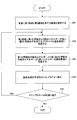
- FIG. 1 is a flowchart showing an example of a substrate processing method according to the first embodiment.
- a plasma processing (for example, plasma etching) method will be described.
- the substrate processing method of the first embodiment includes a) a step of providing a substrate having a first region on the surface, and b) a precursor containing at least halogen and carbon and forming a first chemical bond in the first region. , And c) the step of exposing the substrate surface to plasma of an inert gas.
- steps S11 to S13 are executed.
- step S11 a substrate having a first region on the surface is provided. Note that step S11 is an example of a step of providing a substrate having a first region on the surface in the substrate processing method of the present disclosure.
- the substrate W is indicated by the reference numeral W as shown in FIG.
- the substrate W can be composed of a semiconductor wafer (hereinafter referred to as a wafer).
- the substrate W is not limited to the wafer, and may be composed of a glass substrate for manufacturing a flat panel display or the like.
- the substrate is an example of the substrate provided in the substrate processing method of the present disclosure.
- the substrate W has a first region R1 and a second region R2 on its surface. As shown in FIG. 2, the first region R1 and the second region R2 are arranged side by side on a plane when viewed from above the substrate W.
- the regions arranged on a plane may be those arranged on the same plane or those arranged on different planes having steps in the thickness direction of the substrate.
- the first region R1 and the second region R2 are not limited to the configuration shown in FIG. 2, and may be laminated on the surface of the substrate in the vertical direction. Further, the first region R1 and the second region R2 laminated on the surface of the substrate may be arranged on the surface of the substrate so that the stacking direction is orthogonal to the thickness direction of the substrate.
- the first region R1 is formed of silicon nitride (SiN), and the second region R2 is formed of silicon oxide (SiO 2).
- the surface (terminal) of the first region formed of silicon nitride is composed of two Si—NH groups in which hydrogen (H) is easily bonded to the surplus bond at the end (see FIG. 2).
- the surface (terminal) of the second region formed of silicon oxide is composed of Si—OH groups because hydroxyl groups (OH groups) are easily bonded to the remaining bonds at the ends (see FIG. 2). ..
- a precursor is supplied to the surface of the substrate (hereinafter referred to as the substrate surface) (see FIGS. 1 and 3).
- the precursor indicates a precursor used for processing a substrate.
- the precursor contains at least halogen and carbon.
- the halogen contained in the precursor is not limited, but is preferably fluorine, chlorine, bromine, iodine, or a mixture of two or more thereof, and more preferably fluorine or chlorine.
- the component of the precursor is not limited, and for example, an alkyl halide, an aryl halide and the like can be contained, and among these, an alkyl halide is preferable.
- the alkyl halide has preferably 5 or more and 20 or less carbon atoms, and more preferably 5 or more and 15 or less carbon atoms.
- the alkyl halide preferably has at least one unsaturated bond.
- the unsaturated bond is not limited to a double bond between atoms, and may be a multiple bond such as a triple bond.
- the alkyl halide preferably has an unsaturated bond at at least one terminal.
- at least one of the ends indicates any one or more ends when there are a plurality of ends.
- An alkyl halide having an unsaturated bond at at least one of the terminals has, for example, an unsaturated bond at both ends of the straight chain when the alkyl halide has a linear structure, or either of the two ends. It has an unsaturated bond at one end.
- the alkyl halide preferably has 0.5 or more and 2 or less halogen atoms per carbon atom contained in the molecule.
- the number of halogen atoms contained in the alkyl halide is 0.5 or more and 2 or less per carbon atom contained in the alkyl halide, so that the halogen atom is contained in the alkyl halide having 5 or more and 20 or less carbon atoms.
- the number of halogens is 3 or more and 40 or less.
- the number of halogen atoms contained in the alkyl halide per carbon atom contained in the alkyl halide is more preferably 0.7 or more and 1.8 or less, and further preferably 1 or more and 1.5 or less. is there.
- the number of halogens contained in the alkyl halide having 5 or more and 20 or less carbon atoms is more preferably 4 or more and 35 or less, and further preferably 5 or more and 30 or less.
- the precursor further forms a first chemical bond in the first region R1.
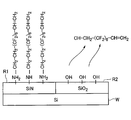
- the precursor is chemically adsorbed (hereinafter referred to as chemisorption) on silicon nitride (SiN) constituting the first region R1 (see FIG. 4).
- the mode of the chemical bond is preferably a covalent bond, but a covalent bond and a chemical bond other than the covalent bond (ionic bond or the like) may be mixed.
- a part of the precursor may be covalently bonded to the first region R1 and the other part may be physically adsorbed (hereinafter referred to as physical adsorption) by an intermolecular force or the like.
- the precursor does not form a chemical bond with the second region R2. Specifically, the precursor does not chemically adsorb to the silicon oxide (SiO 2 ) constituting the second region R2, or all or part of the precursor is physically adsorbed to the second region R2 by an intermolecular force or the like (FIG. FIG. 4).
- FIG. 5 shows a reaction formula representing a chemical reaction in which a precursor forms a chemical bond with the surface of a substrate.
- a part of the carbon contained in the precursor can be bonded to nitrogen existing on the surface of the first region R1 (silicon nitride) to form a carbon-nitrogen bond (FIGS. 4 and 5). reference).
- it does not or is difficult to bond with oxygen existing on the surface of the second region R2 (silicon oxide) see FIG. 4).
- a component of an alkyl halide having 5 or more and 20 or less carbon atoms, 0.5 or more and 2 or less halogen atoms per carbon atom, and forming a carbon-nitrogen bond with silicon nitride is not limited.
- alkyl halides are, for example, alkenyl compounds such as 1,6-divinylperfluorohexane; chlorodimethyl (3,3,4,4,5,5,6,6,7,7,8,8, 8-tridecafluoro-n-octyl) silane, chloro (3,3,4,4,5,5,6,6,7,7,8,8,9,9,10,10,10-heptadeca Silane coupling compounds such as fluorodecyl) dimethylsilane, triethoxy-1H, 1H, 2H, 2H-tridecafluoro-n-octylsilane, trichloro (1H, 1H, 2H, 2H-tridecafluoro-n-octyl) silane.
- alkenyl compounds such as 1,6-divinylperfluorohexane; chlorodimethyl (3,3,4,4,5,5,6,6,7,7,8,8, 8-tridecafluoro-n-oc
- Carboxylic acids such as undecafluorohexanoic acid; sulfonic acids such as heptadecafluorooctane sulfonic acid; phosphonic acids such as (1H, 1H, 2H, 2H-heptadecafluorodecyl) phosphonic acid; and the like.
- 1,6-divinylperfluorohexane having an unsaturated bond at the terminal is preferable.
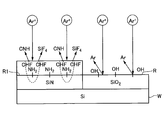
- step S13 the surface of the substrate is exposed to plasma of an inert gas (see FIG. 6).
- the inert gas is a gas that does not easily cause a chemical reaction, preferably a rare gas, and more preferably an argon (Ar) gas. Exposing the substrate surface to plasma means that the plasma comes into contact with the substrate surface via a plasma sheath.
- a plasma of the inert gas is generated by exciting the inert gas supplied to the surface of the substrate with RF (Radio Frequency) electric power or the like.
- the plasma of an inert gas produces cations ionized from the molecules that make up the inert gas.
- an Ar gas plasma produces Ar ions (Ar + ).
- the intervening plasma sheath accelerates the cations (Ar + ) in the plasma and irradiates the substrate surface.
- the first region R1 chemically adsorbed by the precursor is irradiated.
- the portion shown by the broken line in FIG. 6 is excited by the energy from the generated cation (Ar +).
- the activity of silicon fluoride such as silicon tetrafluoride and carbon nitride such as hydrocarbon (CNH) is activated. Seeds are generated and the first region R1 on the surface of the substrate W is etched (see FIGS. 6 and 7).
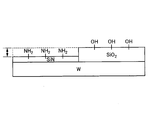
- the second region R2 on which the precursor is not chemically adsorbed is not etched (see FIG. 7).
- the precursor can be selectively chemically adsorbed on the first region R1 of the substrate W as an etchant (FIGS. 4 and 5). reference).
- the surface of the substrate W on which the precursor is chemically adsorbed as an etchant on the first region R1 is exposed to the plasma of an inert gas and irradiated with Ar ions (Ar + ), so that the first region R1 on the surface of the substrate W is irradiated.
- the etching process can be selectively performed (see FIGS. 6 and 7).
- the present disclosure by supplying a precursor (1,6-divinylperfluorohexane, etc.) that forms a chemical bond with the surface of the substrate W, only the precursor that can be chemically adsorbed on the surface of the substrate W is deposited on the surface of the substrate W. (See FIGS. 3, 4, and 5). Therefore, unlike the case where the etchant is physically adsorbed on the surface of the substrate W (for example, when the surface of the substrate is irradiated with ions generated by the plasma of the etchant), the process control of the etching process is easy and the etching process is stable. Can be performed (see FIGS. 6 and 7).
- a precursor (1,6-divinylperfluorohexane, etc.) that forms a chemical bond with the surface of the substrate W is chemically adsorbed on the surface of the substrate W, so that only the region to be treated on the surface of the substrate W is treated.
- Precasa as an etchant can be deposited (see FIGS. 4 and 5).
- the precursor is less likely to be deposited on the region (second region R2) of the surface of the substrate W that is not the target of processing or the portion other than the substrate (for example, the side wall in the processing chamber), so that the generation of particles can be suppressed. (See FIGS. 4, 5, 6, and 7).
- a bulky precursor as an etchant can be used as the substrate W. It can be chemically adsorbed on the surface (see FIGS. 3, 4, and 5). Therefore, sufficient etchants can be deposited on the surface of the substrate W without forcibly depositing the etchants on the surface of the substrate or increasing the amount of the etchants to be deposited by physically adsorbing the plasmatized etchants.
- the alkyl halide contained in the precursor has an unsaturated bond (for example, when the precursor contains 1,6-divinylperfluorohexane or the like), the unsaturated bond of the alkyl halide and the surface of the substrate W An addition reaction can occur with the first region R1 (see FIG. 5). Therefore, such a precursor containing an alkyl halide can be chemically adsorbed on the first region R1 on the surface of the substrate W via an unsaturated bond.
- the alkyl halide contained in the precursor has an unsaturated bond at at least one of the terminals (for example, when the precursor contains 1,6-divinylperfluorohexane, etc.), so that the terminal of the alkyl halide is contained.
- the precursor containing an alkyl halide is likely to be chemically adsorbed to the first region R1 on the surface of the substrate W via an unsaturated bond at the terminal (see FIGS. 4 and 5).
- the alkyl halide by reducing the number of halogen atoms per carbon atom to 0.5 or more and 2 or less (for example, when the precursor contains 1,6-divinylperfluorohexane or the like), the number of carbon atoms is increased.
- the number of halogens contained in the alkyl halide of 5 or more and 20 or less is 3 or more and 40 or less.
- FIG. 8 is a flowchart showing an example of the substrate processing method according to the second embodiment.
- the parts common to FIG. 1 are designated by reference numerals corresponding to those in FIG. 1, and the description thereof will be omitted.
- the substrate processing method of the second embodiment repeats the above b) and the above c).
- the process returns to step S22, and steps S22 and S23 are repeated (step S24 in FIG. 8).
- the precursor is further supplied to the surface of the substrate W on which the precursor is chemically adsorbed on the first region R1, and the supplied precursor is chemically adsorbed on the precursor chemically adsorbed on the first region R1.
- the mode of modifying the precursor is arbitrary.
- the precursor that is chemically adsorbed on the substrate surface can be made even bulkier.
- stable etching processing can be performed with high accuracy.
- FIG. 9 is a flowchart showing an example of the substrate processing method according to the third embodiment.
- a reference numeral corresponding to FIG. 8 is added to a portion common to FIG. 8, and the description thereof will be omitted.
- the substrate processing method of the third embodiment includes a step of purging the substrate surface between e) the b) and the c).
- the surface of the substrate W is purged after step S32 and before step S34 (step S33 in FIG. 9).
- purging the substrate surface indicates, for example, supplying purge gas to the substrate surface to purify the substrate surface.
- a precursor that is not chemically adsorbed on the second region R2 on the surface of the substrate W is removed (see FIGS. 4 and 10).
- the component of the purge gas is not limited, but is preferably a gas that does not cause a chemical reaction or a gas that does not easily cause a chemical reaction, more preferably a rare gas, and further preferably an argon (Ar) gas.
- the purging of the substrate W surface may purify the substrate W surface by stopping the supply of gas and removing the precursor that has not been chemically adsorbed by evacuation.
- the precursor (1,6-divinyl perfluorohexane, etc.) is supplied before being exposed to the plasma of the inert gas
- impurities such as particles and excess remaining on the surface of the substrate W are left.
- the precursor can be removed (see FIGS. 4 and 10).
- the supplied inert gas does not contain the residue of the precursor, and the ions and radicals derived from the residue of the precursor are contained. Since it is not generated, the first region R1 (silicon nitride) on the surface of the substrate W can be selectively etched.
- Freon gas (1,6-divinylperfluorohexane) is supplied to the surface of the substrate W as a precursor for about 20 seconds (sec), and the substrate W is used as an inert gas (Ar gas).
- Ar gas inert gas
- the etching depth E / A (nm) is less than 2 nm even if the number of cycles reaches 100 cycles.
- the etching depth E / A (nm) increases to about 4 nm when the number of cycles is 50, and the etching depth E when the number of cycles is 100.
- / A (nm) exceeds 12 nm.
- FIG. 11 shows that the first region R1 on the surface of the substrate W is selectively etched by the substrate processing method of the present disclosure.
- FIG. 12 is a flowchart showing an example of the substrate processing method according to the fourth embodiment.
- a reference numeral corresponding to FIG. 9 is added to a portion common to FIG. 9, and the description thereof will be omitted.
- the substrate processing method of the fourth embodiment includes a step of irradiating the substrate surface with ultraviolet rays before d) the b).
- ultraviolet rays (UV) are irradiated before step S43 (step S42 in FIG. 12).
- ultraviolet rays (UV) are electromagnetic waves having a wavelength of about 1 to 380 nm, which are shorter than visible light and longer than X-rays.
- the mode of irradiating UV is not limited, and for example, a light source such as a UV lamp or a UV irradiation device can be used.
- plasma such as He gas that emits light having an ultraviolet (UV) wavelength may be generated on the substrate W.
- the surface of the substrate W irradiated with UV is the surface of the substrate before the precursor is supplied (steps S41 and S42 in FIG. 12) and the surface of the substrate on which the precursor is already chemically adsorbed (in FIG. 12). Step S46, step S42).
- impurities are removed from the surface of the substrate W by irradiating the surface of the substrate W with ultraviolet rays (UV) before supplying the precursor (1,6-divinylperfluorohexane, etc.).
- UV ultraviolet rays
- a precursor (1,6-divinylperfluorohexane, etc.) is already chemically adsorbed on the surface of the substrate W and the surface of the substrate W is irradiated with ultraviolet rays (UV), the precursor is chemically adsorbed on the surface of the substrate W. Is modified, making it easier to chemically bond (polymerize) with another precursor.
- the precursors are chemically bonded (polymerized) to each other, and a bulkier precursor is deposited on the surface of the substrate. Thereby, when the precursor is chemically adsorbed on the surface of the substrate W, the amount of the precursor deposited on the surface of the substrate W can be adjusted.
- FIG. 13 is a flowchart showing an example of the substrate processing method according to the fifth embodiment.
- a reference numeral corresponding to FIG. 8 is added to a portion common to FIG. 8, and the description thereof will be omitted.
- the substrate further has a second region on the surface, and the precursor forms a second chemical bond in the second region having a bond energy lower than that of the first chemical bond.
- the binding energy indicates the energy (dissociation energy) required to break the bond (dissociate the bonding atom) when two or more atoms are bonded.
- the mode of the supplied energy is not limited, and various energies such as thermal energy, electric energy, vibration energy, and light energy can be used.
- a substrate having a first region and a second region on the surface is provided.
- a substrate W having a first region R1 formed of silicon nitride (SiN) and a second region R2 formed of silicon oxide (SiO 2 ) on its surface is prepared. (See Fig. 2).
- step S52 a precursor that forms a second chemical bond having a bond energy lower than that of the first chemical bond is supplied to the substrate surface in the second region.
- the precursor chemically adsorbs to both the first region R1 and the second region R2 on the surface of the substrate W.
- the precursor is not limited, and is, for example, a nitrogen-containing carbonyl compound containing halogen and carbon, preferably an isocyanate containing halogen and carbon (halogenated isocyanate).
- isocyanates include aromatic isocyanates and aliphatic isocyanates.
- urea bond is formed as a first chemical bond in the first region R1 formed of silicon nitride, and a second region R2 formed of silicon oxide has a second region R2. 2 A urethane bond is formed as a chemical bond.
- step S53 energy lower than the bond energy of the first chemical bond and higher than the bond energy of the second chemical bond is supplied to the substrate surface.
- step S53 in the second region R2 on the surface of the substrate W, the second chemical bond is dissociated, and the precursor is eliminated from the second region R2.
- the first chemical bond in the first region R1 on the surface of the substrate W, the first chemical bond is not dissociated, and the precursor remains chemically adsorbed on the first region R1.
- the temperature of the substrate surface is lower than the temperature at which the first chemical bond is broken and the temperature at which the second chemical bond is broken. It is preferable to set the temperature above.
- the temperature at which the first chemical bond is broken is a temperature corresponding to the bond energy (or dissociation energy) of the first chemical bond.
- the temperature at which the second chemical bond is broken is a temperature corresponding to the bond energy (or dissociation energy) of the second chemical bond.
- urea bond is formed in the first region R1 and a urethane bond is formed in the second region R2 as described above, but both the urea bond and the urethane bond are carbonyls. Since it contains groups, it is energetically stabilized by electron delocalization. However, since the electronegativity of the atom adjacent to the carbonyl group is higher in the oxygen atom than in the nitrogen atom, the effect of delocalization is smaller in the urethane bond containing the ester than in the urea bond containing the amide. Therefore, the binding energy of the urethane bond is smaller than the binding energy of the urea bond.
- the first chemical bond (urea bond) is attached to the first region R1 (silicon nitride) by utilizing the difference in properties between the first chemical bond (urea bond) and the second chemical bond (urethane bond).
- a precursor (isocyanate) that forms a second chemical bond (urethane bond) with a lower bond energy than the first chemical bond (urea bond) in the second region R2 (silicon oxide) is formed in the first region R1 (silicon nitride).
- the surface of the substrate W having the second region R2 (silicon oxide) is chemically adsorbed on both the first region R1 (silicon nitride) and the second region R2 (silicon oxide) on the surface of the substrate W.
- the surface of the substrate W to which the precursor (isocyanate) is chemically adsorbed is then supplied with energy lower than the binding energy of the first chemical bond (urea bond) and higher than the binding energy of the second chemical bond (urethane bond). Then, in the second region R2 (silicon oxide) on the surface of the substrate W, the second chemical bond (urethane bond) is dissociated (or cut), and the precursor (isocyanate) is desorbed from the second region R2 (silicon oxide). ..
- the first chemical bond (urea bond) is not dissociated (or cut), and the precursor (isocyanate) is chemically adsorbed on the first region R1 (silicon nitride). Will remain.
- the first chemical bond (urea bond) is changed to the first region R1 (nitridation).
- Energy lower than the bond energy of the first chemical bond (urea bond) and higher than the bond energy of the second chemical bond (urethane bond) is supplied to the surface of the substrate W.
- the precursor that can be used is not limited to the material that is chemically adsorbed only on the first region R1 (silicon nitride) to be treated on the surface of the substrate W. That is, a precursor that chemically adsorbs to a region (silicon oxide) that is not a treatment target on the surface of the substrate W can be used. Therefore, in the present embodiment, the range of selection of the precursor that can be used as a processing material for etchants and the like is expanded.
- the temperature of the surface of the substrate W on which the precursor (isocyanate) is chemically adsorbed is adjusted to a temperature lower than the temperature at which the first chemical bond is broken and higher than the temperature at which the second chemical bond is broken.
- the first chemical bond (urea bond) in the first region R1 is not cleaved
- the second chemical bond (urethane bond) in the second region R2 is cleaved.
- the precursor (isocyanate) that is chemically adsorbed on the region to be treated (second region R2) is removed with high accuracy
- the precursor that is chemically adsorbed on the region to be treated (first region R1) is removed.
- Isocyanate can be left with high accuracy.
- FIG. 14 is a schematic cross-sectional view showing an example of the substrate processing apparatus according to the present disclosure.
- a plasma processing apparatus for example, a plasma etching apparatus
- the substrate processing apparatus 1 includes a chamber 10, a gas supply unit 20, an RF power supply unit 30, an exhaust system 40, and a control unit 50.
- the chamber 10 includes a support portion 11 and an upper electrode shower head 12 in the processing space 10s, and etches the substrate W.
- the support portion 11 is arranged in the lower region of the processing space 10s in the chamber 10.
- the upper electrode shower head 12 is located above the support portion 11 and may function as part of the ceiling of the chamber 10.
- the chamber 10 is an example of a chamber for etching a substrate, which constitutes the substrate processing apparatus of the present disclosure.
- the support portion 11 is configured to support the substrate in the processing space 10s.
- a substrate W having a first region R1 formed of silicon nitride (SiN) and a second region R2) formed of silicon oxide (SiO 2 ) on its surface is used (FIG. 2). reference).
- the support portion 11 includes a lower electrode 111, an electrostatic chuck 112, and an edge ring 113.
- the electrostatic chuck 112 is arranged on the lower electrode 111 and is configured to support the substrate W on the upper surface of the electrostatic chuck 112.
- the edge ring 113 is arranged so as to surround the substrate W on the upper surface of the peripheral edge of the lower electrode 111 (see FIG. 14).
- the support portion 11 may include a temperature control module (not shown) configured to adjust at least one of the electrostatic chuck 112 and the substrate W to the target temperature.
- the temperature control module may include a heater, a flow path, or a combination thereof.
- a temperature control fluid such as a refrigerant or a heat transfer gas flows through the flow path.
- the support portion 11 is an example of a mounting portion that constitutes a part of the substrate processing apparatus according to the present disclosure.
- the upper electrode shower head 12 is configured to supply one or more processing gases from the gas supply unit 20 to the processing space 10s.
- the upper electrode shower head 12 has a gas inlet 12a, a gas diffusion chamber 12b, and a plurality of gas outlets 12c.
- the gas inlet 12a communicates with the gas supply unit 20 and the gas diffusion chamber 12b.
- the plurality of gas outlets 12c communicate with the gas diffusion chamber 12b and the treatment space 10s in a fluid manner.
- the upper electrode shower head 12 is configured to supply the processing gas from the gas inlet 12a to the processing space 10s via the gas diffusion chamber 12b and the plurality of gas outlets 12c.
- the gas supply unit 20 may include one or more gas sources 21 and one or more flow rate controllers 22.
- the gas supply unit 20 is configured to supply the processing gas from the corresponding gas source 21 to the gas inlet 12a via the corresponding flow rate controller 22.
- Each flow rate controller 22 may include, for example, a mass flow controller or a pressure controlled flow rate controller.
- the gas supply unit 20 may include one or more flow rate modulation devices that modulate or pulse the flow rate of the processing gas.
- the above-mentioned precursor (1,6-divinylperfluorohexane) and an inert gas (argon, etc.) are used as the processing gas supplied by the gas supply unit 20 to the processing space 10s of the chamber 10. (See FIGS. 3 and 6).
- the inert gas (argon, etc.) is mixed with the precursor and supplied to the processing space 10s as the carrier gas of the precursor when the precursor is supplied to the processing space 10s (steps S12 and 8 in FIG. 1). 22), step S32 of FIG. 9, step S43 of FIG. 12, and step S52 of FIG. 13).
- the inert gas (argon, etc.) is supplied to the processing space 10s as a purge gas for purging the surface of the substrate W after the precursor is supplied to the processing space 10s and the supply of the precursor is stopped before the substrate W is exposed to plasma. It is supplied (see step S33 in FIG. 9 and step S44 in FIG. 12). Specifically, the step e) (step of purging the substrate surface) in the substrate processing method of the present embodiment described above is executed (see FIGS. 9, 10, and 12).
- the inert gas (argon or the like) is supplied to the processing space 10s as a single raw material gas that generates plasma (plasmaized ions) when the substrate W is exposed to the plasma of the inert gas. (See step S13 in FIG. 1, step S23 in FIG. 8, step S34 in FIG. 9, step S45 in FIG. 12, and step S54 in FIG. 13).
- the RF power supply unit 30 applies RF (Radio Frequency) power, for example, one or more RF powers (or RF signals) to the lower electrode 111, the upper electrode shower head 12, or the lower electrode 111 and the upper electrode shower head 12. It is configured to supply one or more electrodes, such as both.
- the RF power indicates a high frequency (Radio Frequency) power.
- the RF power supply unit 30 can function as at least a part of the plasma generation unit configured to generate plasma from the processing gas (inert gas) in the chamber 10.
- the RF power supply unit 30 includes a first RF power supply unit 30a and a second RF power supply unit 30b.
- the first RF power supply unit 30a includes a first RF generation unit 31a and a first matching circuit 32a.
- the first RF power supply unit 30a is configured to supply the first RF signal from the first RF generation unit 31a to the upper electrode shower head 12 via the first matching circuit 32a.
- the first RF signal may have frequencies in the range of 27 MHz to 100 MHz.
- the second RF power supply unit 30b includes a second RF generation unit 31b and a second matching circuit 32b.
- the second RF power supply unit 30b is configured to supply the second RF signal from the second RF generation unit 31b to the lower electrode 111 via the second matching circuit 32b.
- the second RF signal may have frequencies in the range of 400 kHz to 13.56 MHz.
- a DC (Direct Current) pulse generation unit may be used instead of the second RF generation unit 31b.
- the RF power supply unit 30 may be configured to supply the first RF signal from the RF generation unit to the lower electrode 111 and the second RF signal from the other RF generation unit to the lower electrode 111. Good. Further, the RF power supply unit 30 supplies the first RF signal from the RF generation unit to the lower electrode 111, supplies the second RF signal from the other RF generation unit to the lower electrode 111, and supplies the third RF signal. May be configured to be supplied to the upper electrode shower head 12 from yet another RF generator. Further, in the RF power supply unit 30, a DC voltage may be applied to the upper electrode shower head 12.
- the amplitude of one or more RF signals may be pulsed or modulated.
- Amplitude modulation may include pulsing the RF signal amplitude between the on and off states, or between two or more different on states.
- the exhaust system 40 may be connected to, for example, an exhaust port 10e provided at the bottom of the chamber 10.
- the exhaust system 40 may include a pressure valve and a vacuum pump.
- the vacuum pump may include a turbo molecular pump, a roughing pump or a combination thereof.
- the substrate processing device 1 may have a UV irradiation unit 60.
- the UV irradiation unit 60 has a function of irradiating the surface of the substrate W with ultraviolet rays (UV).
- the mode of the UV irradiation unit 60 is not limited, and for example, a light source such as a UV lamp or a UV irradiation device can be used.
- the UV irradiation unit 60 receives ultraviolet rays (UV) on the surface of the substrate W, for example, through a transmission window 13 provided on the side wall (or top) of the chamber 10 and capable of transmitting ultraviolet rays (UV) around the chamber 10. Is provided at a position where it can be irradiated (see FIG. 14). Further, the UV irradiation unit 60 may be provided in the chamber 10.
- UV ultraviolet rays
- the position where the UV irradiation unit 60 is provided is not limited to the periphery of the chamber 10 or the inside of the chamber 10, but is provided in another chamber provided outside the chamber 10 and the substrate W is carried into the other chamber. UV irradiation may be performed. Further, instead of the UV irradiation unit 60, plasma such as He gas that emits light having a wavelength of ultraviolet rays (UV) may be generated in the chamber 10 to irradiate the surface of the substrate W with ultraviolet rays (UV).
- UV ultraviolet rays
- control unit 50 processes a computer-executable instruction that causes the substrate processing apparatus 1 to execute various steps (steps) described later in the present disclosure.
- the control unit 50 may be configured to control each element of the substrate processing apparatus 1.
- all of the control unit 50 is configured as a part of the substrate processing device 1, but the present invention is not limited to this configuration, and a part or all of the control unit 50 is provided separately from the substrate processing device 1. You may.
- the control unit 50 may include, for example, a computer 51.
- the computer 51 may include, for example, a processing unit (CPU: Central Processing Unit) 511, a storage unit 512, and a communication interface 513.
- the control unit 50 is an example of a control unit that constitutes a part of the substrate processing apparatus according to the present disclosure.
- the processing unit 511 can be configured to perform various control operations based on the program stored in the storage unit 512.
- the storage unit 512 may include a RAM (Random Access Memory), a ROM (Read Only Memory), an HDD (Hard Disk Drive), an SSD (Solid State Drive), or a combination thereof.
- the communication interface 513 may communicate with each element of the substrate processing device 1 via a communication line such as a LAN (Local Area Network).
- control unit provides a substrate having a first region on the surface to the chamber, and a precursor containing at least halogen and carbon and forming a first chemical bond in the first region is provided on the surface of the substrate. Control is performed so as to supply and expose the substrate surface to plasma of an inert gas.
- the chamber 10 is controlled by the control unit 50, and the above-mentioned steps S11, S21, step S31, step S41, and step S51 are executed (FIGS. 1, FIG. 2, FIG. 8, FIG. 9, FIG. 12). , See FIG. 13).
- the step (step of providing the substrate having the first region on the surface) of the above-mentioned a) in the substrate processing method of the present embodiment described above is executed (FIGS. 1, FIG. 2, FIG. 8, FIG. 9, FIG. 12 and FIG. 13).
- step S12, step S22, step S24, step S32, step S33, step S35, step S43, step S44, step S46, step S52, Step S55 is executed (see FIGS. 1, 3, 4, 5, 8, 9, 9, 10, 12, and 13).
- step S12, step S22, step S24, step S32, step S33, step S35, step S43, step S44, step S46, step S52, Step S55 is executed (see FIGS. 1, 3, 4, 5, 8, 9, 9, 10, 12, and 13).
- step c) step of exposing the substrate surface to the plasma of the inert gas in the substrate processing method of the present embodiment described above is executed (FIGS. 1, FIG. 6, FIG. 7, FIG. 8). , FIG. 9, FIG. 12, and FIG. 13).
- the UV irradiation unit 60 is controlled by the control unit 50, and steps S42 and S46 are executed (see FIG. 12). Specifically, the step d) (step of irradiating the substrate surface with ultraviolet rays) in the substrate processing method of the present embodiment described above is executed (see FIG. 12).
- the substrate processing apparatus of the present disclosure is provided in the chamber and has a mounting portion on which the substrate is mounted, and the control unit controls so as to supply RF power to the previously described mounting portion.
- the RF power supply unit 30 is controlled by the control unit 50, and RF power is supplied to either or both of the lower electrode 111 and the upper electrode shower head 12 to generate plasma (see FIG. 14). ..
- a precursor that contains halogen and carbon on the surface of the substrate W having the first region R1 (silicon nitride) and forms a first chemical bond (carbon-nitrogen bond) in the first region R1.
- the precursor can be selectively chemically adsorbed on the first region R1 of the substrate W as an etchant.
- the surface of the substrate W on which the precursor is chemically adsorbed as an etchant on the first region R1 is exposed to plasma (Ar ions) of an inert gas, so that the first region R1 on the surface of the substrate W is selectively etched. It can be applied (see FIGS. 6, 7, and 14).
- the substrate processing apparatus 1 of the present disclosure by supplying a precursor (1,6-divinylperfluorohexane, etc.) that forms a chemical bond with the surface of the substrate W, only the precursor that can be chemically adsorbed on the surface of the substrate W is the substrate W. It can be deposited on the surface (see FIGS. 3, 4, 5, and 14). Therefore, unlike the case where the etchant is physically adsorbed on the surface of the substrate W (for example, when the surface of the substrate W is irradiated with ions generated by the plasma of the etchant), the process control of the etching process is easy and stable etching is performed. Processing can be performed (see FIGS. 6, 7, 11, and 14).
- the precursor (1,6-divinylperfluorohexane, etc.) forming a chemical bond with the surface of the substrate W is chemically adsorbed on the surface of the substrate W to treat the surface of the substrate W.
- the precursor as an etchant can be deposited only in the target area (see FIGS. 4, 5, and 14). As a result, the precursor is less likely to be deposited on the region (second region R2) of the surface of the substrate W that is not the target of processing or the portion other than the substrate (for example, the side wall in the processing chamber), so that the generation of particles can be suppressed. (See FIGS. 4, 5, 6, 7, 7, and 14).
- the control unit 50 sets the substrate processing apparatus 1 so that RF power is supplied to the mounting portion (support portion 11) provided in the chamber 10 for mounting the substrate W.
- a bias electrode can be formed in the mounting portion (support portion 11) to which RF power is supplied.
- the ions (argon ions) of the inert gas (argon gas) generated by the plasma of the inert gas are drawn into the surface of the substrate W mounted on the mounting portion (support portion 11), and the surface of the substrate W is drawn.
- the chemically adsorbed precursor is excited in the first region of the above. In this way, etching is promoted in the first region of the surface of the substrate W, and efficient etching processing can be performed (see FIGS. 6, 7, 11, and 14).
- the substrate processing apparatus 1 of the present embodiment since RF power is supplied to the mounting portion (support portion 11) in the chamber 10, it is mounted on the mounting portion (support portion 11) in the chamber 10. Parts other than the substrate W (for example, side walls and the like) are difficult to be etched (see FIGS. 6, 7, and 14). Therefore, it is possible to suppress erosion in the chamber 10 and generation of particles accompanying it. As a result, stable etching processing can be performed, and maintenance of the substrate processing apparatus becomes easy.
- the step b) (the step of supplying the precursor to the substrate surface) and the step c) (the step of exposing the substrate surface to the plasma of the inert gas) are exposed to the atmosphere. It is preferable that it is executed without any problems. In the present embodiment, the steps b) and c) above are executed while maintaining the vacuum (without breaking the vacuum).
- each of the steps b) and c) is continuously executed by one substrate processing device 1, but the present invention is not limited to this.
- each of the steps b) and c) above may be performed in the same chamber or in the same processing system (in-situ) as described above. Further, each of the steps b) and c) may be performed in a separate chamber.
- each step of b) and c) may be executed by using a separate substrate processing device 1.
- the separate substrate processing devices 1 may share the vacuum transfer mechanism and transfer the substrate W without exposing it to the atmosphere.
- the step c) is executed by using the substrate processing device 1, and the step b) is a temperature-adjustable mounting table and precursor such as a thermal CVD (Chemical Vapor Deposition) device. It may be carried out using a chamber that is configured to have a gas supply of gas. At that time, the substrate processing device 1 and the thermal CVD device may share the vacuum transfer mechanism and transfer the substrate W without exposing it to the atmosphere.
- a thermal CVD Chemical Vapor Deposition
- Substrate processing device 10 Chamber 10s Processing space 10e Exhaust port 11 Support part 111 Lower electrode 112 Electrostatic chuck 113 Edge ring 12 Upper electrode shower head 12a Gas inlet 12b Gas diffusion chamber 12c Gas outlet 13 Transmission window 20 Gas supply part 21 Gas source 22 Flow controller 30 RF power supply unit 30a First RF power supply unit 31a First RF generation unit 32a First matching circuit 30b Second RF power supply unit 31b Second RF generation unit 32b Second matching Circuit 40 Exhaust system 50 Control unit 51 Computer 511 Processing unit 512 Storage unit 513 Communication interface 60 UV irradiation unit W board R1 1st area R2 2nd area
Landscapes
- Chemical & Material Sciences (AREA)
- Engineering & Computer Science (AREA)
- Physics & Mathematics (AREA)
- Plasma & Fusion (AREA)
- Analytical Chemistry (AREA)
- Inorganic Chemistry (AREA)
- Materials Engineering (AREA)
- Organic Chemistry (AREA)
- Drying Of Semiconductors (AREA)
- Chemical Vapour Deposition (AREA)
Priority Applications (3)
| Application Number | Priority Date | Filing Date | Title |
|---|---|---|---|
| JP2021563863A JPWO2021117534A1 (https=) | 2019-12-12 | 2020-11-30 | |
| KR1020227022500A KR102882113B1 (ko) | 2019-12-12 | 2020-11-30 | 기판 처리 방법 및 기판 처리 장치 |
| US17/756,780 US20230010867A1 (en) | 2019-12-12 | 2020-11-30 | Substrate processing method and substrate processing apparatus |
Applications Claiming Priority (2)
| Application Number | Priority Date | Filing Date | Title |
|---|---|---|---|
| JP2019224476 | 2019-12-12 | ||
| JP2019-224476 | 2019-12-12 |
Publications (1)
| Publication Number | Publication Date |
|---|---|
| WO2021117534A1 true WO2021117534A1 (ja) | 2021-06-17 |
Family
ID=76330215
Family Applications (1)
| Application Number | Title | Priority Date | Filing Date |
|---|---|---|---|
| PCT/JP2020/044535 Ceased WO2021117534A1 (ja) | 2019-12-12 | 2020-11-30 | 基板処理方法および基板処理装置 |
Country Status (4)
| Country | Link |
|---|---|
| US (1) | US20230010867A1 (https=) |
| JP (1) | JPWO2021117534A1 (https=) |
| KR (1) | KR102882113B1 (https=) |
| WO (1) | WO2021117534A1 (https=) |
Cited By (2)
| Publication number | Priority date | Publication date | Assignee | Title |
|---|---|---|---|---|
| JP2023074176A (ja) * | 2021-11-17 | 2023-05-29 | Jsr株式会社 | 基板の製造方法及び塗工液 |
| WO2025028301A1 (ja) * | 2023-08-02 | 2025-02-06 | 東京エレクトロン株式会社 | エッチング方法及びプラズマ処理装置 |
Citations (3)
| Publication number | Priority date | Publication date | Assignee | Title |
|---|---|---|---|---|
| JPH09190993A (ja) * | 1996-01-09 | 1997-07-22 | Hitachi Ltd | 表面清浄化方法 |
| JP2013235912A (ja) * | 2012-05-08 | 2013-11-21 | Tokyo Electron Ltd | 被処理基体をエッチングする方法、及びプラズマエッチング装置 |
| WO2019054490A1 (ja) * | 2017-09-15 | 2019-03-21 | 関東電化工業株式会社 | 酸ハロゲン化物を用いた原子層エッチング |
Family Cites Families (5)
| Publication number | Priority date | Publication date | Assignee | Title |
|---|---|---|---|---|
| JP6396699B2 (ja) | 2014-02-24 | 2018-09-26 | 東京エレクトロン株式会社 | エッチング方法 |
| US9875907B2 (en) * | 2015-11-20 | 2018-01-23 | Applied Materials, Inc. | Self-aligned shielding of silicon oxide |
| KR102805391B1 (ko) * | 2016-12-09 | 2025-05-12 | 에이에스엠 아이피 홀딩 비.브이. | 열적 원자층 식각 공정 |
| TWI729285B (zh) * | 2017-06-14 | 2021-06-01 | 荷蘭商Asm Ip控股公司 | 金屬薄膜的選擇性沈積 |
| US12062538B2 (en) * | 2019-04-30 | 2024-08-13 | Lam Research Corporation | Atomic layer etch and selective deposition process for extreme ultraviolet lithography resist improvement |
-
2020
- 2020-11-30 JP JP2021563863A patent/JPWO2021117534A1/ja active Pending
- 2020-11-30 WO PCT/JP2020/044535 patent/WO2021117534A1/ja not_active Ceased
- 2020-11-30 KR KR1020227022500A patent/KR102882113B1/ko active Active
- 2020-11-30 US US17/756,780 patent/US20230010867A1/en active Pending
Patent Citations (3)
| Publication number | Priority date | Publication date | Assignee | Title |
|---|---|---|---|---|
| JPH09190993A (ja) * | 1996-01-09 | 1997-07-22 | Hitachi Ltd | 表面清浄化方法 |
| JP2013235912A (ja) * | 2012-05-08 | 2013-11-21 | Tokyo Electron Ltd | 被処理基体をエッチングする方法、及びプラズマエッチング装置 |
| WO2019054490A1 (ja) * | 2017-09-15 | 2019-03-21 | 関東電化工業株式会社 | 酸ハロゲン化物を用いた原子層エッチング |
Cited By (3)
| Publication number | Priority date | Publication date | Assignee | Title |
|---|---|---|---|---|
| JP2023074176A (ja) * | 2021-11-17 | 2023-05-29 | Jsr株式会社 | 基板の製造方法及び塗工液 |
| JP7712854B2 (ja) | 2021-11-17 | 2025-07-24 | Jsr株式会社 | 基板の製造方法及び塗工液 |
| WO2025028301A1 (ja) * | 2023-08-02 | 2025-02-06 | 東京エレクトロン株式会社 | エッチング方法及びプラズマ処理装置 |
Also Published As
| Publication number | Publication date |
|---|---|
| US20230010867A1 (en) | 2023-01-12 |
| KR102882113B1 (ko) | 2025-11-05 |
| KR20220109440A (ko) | 2022-08-04 |
| JPWO2021117534A1 (https=) | 2021-06-17 |
Similar Documents
| Publication | Publication Date | Title |
|---|---|---|
| JP7320646B2 (ja) | 被処理体を処理する方法 | |
| KR102215970B1 (ko) | 산할로겐화물을 사용한 원자층 에칭 | |
| US8563096B2 (en) | Vertical film formation apparatus and method for using same | |
| TWI836576B (zh) | 電漿處理裝置及電漿處理方法 | |
| KR20240145080A (ko) | 유전체 막의 기하학적으로 선택적인 증착 | |
| JP2017034245A (ja) | 感受性材料上にハロゲン化物含有ald膜を統合する方法 | |
| KR20210150606A (ko) | 변조된 원자 층 증착 | |
| TW201523732A (zh) | 用於蝕刻速率一致性的方法 | |
| JP7071175B2 (ja) | 被処理体を処理する方法 | |
| JP6823527B2 (ja) | エッチング方法 | |
| KR20190026844A (ko) | 피처리체를 처리하는 방법 | |
| WO2021117534A1 (ja) | 基板処理方法および基板処理装置 | |
| KR102678853B1 (ko) | 피처리체를 처리하는 방법 | |
| TWI899193B (zh) | 基板處理方法及電漿處理裝置 | |
| JP7045428B2 (ja) | 被処理体を処理する方法 | |
| TWI918732B (zh) | 於階梯式結構上沉積材料的方法 | |
| TW202245056A (zh) | 基板處理方法及基板處理裝置 | |
| JP2015018876A (ja) | 反応装置のコンディショニング方法 |
Legal Events
| Date | Code | Title | Description |
|---|---|---|---|
| 121 | Ep: the epo has been informed by wipo that ep was designated in this application |
Ref document number: 20899436 Country of ref document: EP Kind code of ref document: A1 |
|
| ENP | Entry into the national phase |
Ref document number: 2021563863 Country of ref document: JP Kind code of ref document: A |
|
| ENP | Entry into the national phase |
Ref document number: 20227022500 Country of ref document: KR Kind code of ref document: A |
|
| NENP | Non-entry into the national phase |
Ref country code: DE |
|
| 122 | Ep: pct application non-entry in european phase |
Ref document number: 20899436 Country of ref document: EP Kind code of ref document: A1 |