WO2021112096A1 - 疲労推定システム、推定装置、及び疲労推定方法 - Google Patents
疲労推定システム、推定装置、及び疲労推定方法 Download PDFInfo
- Publication number
- WO2021112096A1 WO2021112096A1 PCT/JP2020/044731 JP2020044731W WO2021112096A1 WO 2021112096 A1 WO2021112096 A1 WO 2021112096A1 JP 2020044731 W JP2020044731 W JP 2020044731W WO 2021112096 A1 WO2021112096 A1 WO 2021112096A1
- Authority
- WO
- WIPO (PCT)
- Prior art keywords
- fatigue
- subject
- posture
- estimation
- degree
- Prior art date
- Legal status (The legal status is an assumption and is not a legal conclusion. Google has not performed a legal analysis and makes no representation as to the accuracy of the status listed.)
- Ceased
Links
Images






Classifications
-
- A—HUMAN NECESSITIES
- A61—MEDICAL OR VETERINARY SCIENCE; HYGIENE
- A61B—DIAGNOSIS; SURGERY; IDENTIFICATION
- A61B5/00—Measuring for diagnostic purposes; Identification of persons
- A61B5/103—Measuring devices for testing the shape, pattern, colour, size or movement of the body or parts thereof, for diagnostic purposes
- A61B5/11—Measuring movement of the entire body or parts thereof, e.g. head or hand tremor or mobility of a limb
- A61B5/1126—Measuring movement of the entire body or parts thereof, e.g. head or hand tremor or mobility of a limb using a particular sensing technique
- A61B5/1128—Measuring movement of the entire body or parts thereof, e.g. head or hand tremor or mobility of a limb using a particular sensing technique using image analysis
-
- A—HUMAN NECESSITIES
- A61—MEDICAL OR VETERINARY SCIENCE; HYGIENE
- A61B—DIAGNOSIS; SURGERY; IDENTIFICATION
- A61B5/00—Measuring for diagnostic purposes; Identification of persons
- A61B5/16—Devices for psychotechnics; Testing reaction times ; Devices for evaluating the psychological state
-
- A—HUMAN NECESSITIES
- A61—MEDICAL OR VETERINARY SCIENCE; HYGIENE
- A61B—DIAGNOSIS; SURGERY; IDENTIFICATION
- A61B5/00—Measuring for diagnostic purposes; Identification of persons
- A61B5/02—Detecting, measuring or recording for evaluating the cardiovascular system, e.g. pulse, heart rate, blood pressure or blood flow
- A61B5/026—Measuring blood flow
-
- A—HUMAN NECESSITIES
- A61—MEDICAL OR VETERINARY SCIENCE; HYGIENE
- A61B—DIAGNOSIS; SURGERY; IDENTIFICATION
- A61B5/00—Measuring for diagnostic purposes; Identification of persons
- A61B5/103—Measuring devices for testing the shape, pattern, colour, size or movement of the body or parts thereof, for diagnostic purposes
- A61B5/11—Measuring movement of the entire body or parts thereof, e.g. head or hand tremor or mobility of a limb
- A61B5/1116—Determining posture transitions
-
- A—HUMAN NECESSITIES
- A61—MEDICAL OR VETERINARY SCIENCE; HYGIENE
- A61B—DIAGNOSIS; SURGERY; IDENTIFICATION
- A61B5/00—Measuring for diagnostic purposes; Identification of persons
- A61B5/68—Arrangements of detecting, measuring or recording means, e.g. sensors, in relation to patient
- A61B5/6801—Arrangements of detecting, measuring or recording means, e.g. sensors, in relation to patient specially adapted to be attached to or worn on the body surface
- A61B5/6802—Sensor mounted on worn items
- A61B5/6804—Garments; Clothes
-
- A—HUMAN NECESSITIES
- A61—MEDICAL OR VETERINARY SCIENCE; HYGIENE
- A61B—DIAGNOSIS; SURGERY; IDENTIFICATION
- A61B5/00—Measuring for diagnostic purposes; Identification of persons
- A61B5/74—Details of notification to user or communication with user or patient; User input means
- A61B5/742—Details of notification to user or communication with user or patient; User input means using visual displays
-
- G—PHYSICS
- G06—COMPUTING OR CALCULATING; COUNTING
- G06V—IMAGE OR VIDEO RECOGNITION OR UNDERSTANDING
- G06V40/00—Recognition of biometric, human-related or animal-related patterns in image or video data
- G06V40/10—Human or animal bodies, e.g. vehicle occupants or pedestrians; Body parts, e.g. hands
-
- A—HUMAN NECESSITIES
- A61—MEDICAL OR VETERINARY SCIENCE; HYGIENE
- A61B—DIAGNOSIS; SURGERY; IDENTIFICATION
- A61B2503/00—Evaluating a particular growth phase or type of persons or animals
- A61B2503/20—Workers
Definitions
- the present disclosure relates to a fatigue estimation system for estimating the degree of fatigue of a subject, an estimation device used in the estimation system, and a fatigue estimation method.
- Patent Document 1 discloses a fatigue determination device that determines the presence or absence of fatigue and the type of fatigue based on force measurement and bioelectric impedance measurement. ..
- the present disclosure provides a fatigue estimation system or the like that estimates the degree of fatigue with higher accuracy.
- the fatigue estimation system estimates the posture of the subject based on an information output device that outputs information regarding the position of the body part of the subject and the information output by the information output device. It is provided with an estimation device for estimating the degree of fatigue of the subject based on the estimated posture and the duration of the posture.
- the estimation device estimates the posture of the subject based on the acquisition unit that acquires information on the position of the body part of the subject and the information acquired by the acquisition unit. It includes a posture estimation unit and a fatigue estimation unit that estimates the degree of fatigue based on the duration of the posture estimated by the posture estimation unit.
- the fatigue estimation method estimates the posture of the subject based on the acquisition step of acquiring information on the position of the body part of the subject and the information acquired in the acquisition step.
- the posture estimation step is included, and the fatigue estimation step for estimating the degree of fatigue based on the duration of the posture estimated in the posture estimation step is included.
- the fatigue estimation system and the like can estimate fatigue with higher accuracy.
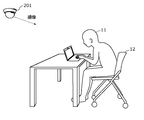
- FIG. 1A is a diagram for explaining the estimation of the degree of fatigue according to the embodiment.
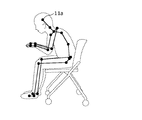
- FIG. 1B is a second diagram for explaining the estimation of the degree of fatigue according to the embodiment.
- FIG. 1C is a third diagram for explaining the estimation of the degree of fatigue according to the embodiment.
- FIG. 2 is a block diagram showing a functional configuration of the fatigue estimation system according to the embodiment.
- FIG. 3 is a flowchart showing a method of estimating the degree of fatigue according to the embodiment.
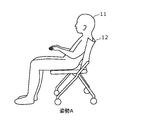
- FIG. 4A is a diagram showing a subject who is stationary in the posture A.
- FIG. 4B is a diagram showing a subject who is stationary in the posture B.
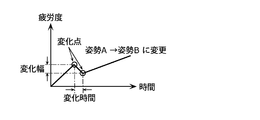
- FIG. 5A is a diagram illustrating the accumulation of the estimated degree of fatigue of the subject according to the embodiment.
- FIG. 5B is a second diagram illustrating the accumulation of the estimated degree of fatigue of the subject according to the embodiment.
- FIG. 6 is a first diagram showing a display example of the estimation result according to the embodiment.
- FIG. 7 is a second diagram showing a display example of the estimation result according to the embodiment.
- FIG. 8 is a diagram for explaining the estimation of the posture according to the modified example of the embodiment.
- each figure is a schematic diagram and is not necessarily exactly illustrated. Further, in each figure, substantially the same configuration may be designated by the same reference numerals, and duplicate description may be omitted or simplified.
- FIG. 1A is a diagram for explaining the estimation of the degree of fatigue according to the embodiment.
- FIG. 1B is a second diagram for explaining the estimation of the degree of fatigue according to the embodiment.
- FIG. 1C is a third diagram for explaining the estimation of the degree of fatigue according to the embodiment.
- the fatigue estimation system 200 estimates the degree of fatigue in the subject 11 by using the image output by the imaging of the subject 11 using the imaging device 201. It is a system to do.
- the image pickup device 201 is not limited in its form as long as it is a camera that captures the subject 11 and outputs an image, and is a fixed camera installed on a wall surface or ceiling of a building or the like as shown in FIG. 1A. It may be a camera mounted on a PC, a smartphone, a tablet terminal, or the like operated by the target person 11.
- the subject is in a posture of sitting on a chair 12.
- the degree of fatigue of the subject 11 is estimated based on the fatigue accumulated by taking a stationary posture in which the posture is fixed among the fatigues of the subject 11. This means that the posture is fixed, and the load on at least one of the muscles and joints and the fatigue accumulated by the worsening blood flow (hereinafter, also referred to as the decrease in blood flow) are estimated. Therefore, the subject 11 is in a stationary posture in a sitting, lying or standing position for at least a certain period of time.
- the constant period is, for example, several tens of seconds or several seconds, which is the minimum period during which fatigue can be estimated by the fatigue estimation system 200. Such a period is determined depending on the processing capacity of the image pickup apparatus 201 and the estimation apparatus 100 (see FIG. 2 described later) constituting the fatigue estimation system 200.
- Examples of the target person 11 who takes such a stationary posture include a desk worker in an office, a driver who steers a moving body, a person who performs strength training using a load in the stationary posture, a resident of a facility such as a hospital, an airplane, and the like. Passengers and crew members, etc.
- the image captured and output by the image pickup device 201 is processed by the estimation device 100, and the posture of the subject 11 is estimated as shown in FIG. 1B.
- the estimated posture of the subject 11 is output as a rigid body link model as an example. Specifically, as shown in FIG. 1B, the skeletons shown by straight lines are connected by the joints shown by black dots, and the posture of the subject 11 can be reproduced by the positional relationship between the two skeletons connected by one joint.
- Posture estimation is performed by image recognition, and is output as the above rigid body link model based on the positional relationship between the joint and the skeleton.
- the muscles that pull the skeletons together and the body parts of the joints that connect the skeletons so that the positional relationship can be changed can be changed.
- the load applied to at least one of the muscles and joints of each body part is calculated as an estimated value. Since the estimated value of the load amount in at least one of the muscles and joints of each body part is accumulated as the duration of the resting posture is extended, the calculation using the estimated value of the load amount and the duration is used. The degree of fatigue caused by the subject 11 maintaining a stationary posture is calculated.
- “at least one of muscles and joints” is also referred to as "muscles and / or joints”.
- the degree of fatigue in addition to the above-mentioned estimated value of the load applied to the muscles and / or joints, the degree of fatigue can be estimated based on the estimated value of the blood flow rate of the subject 11.
- the degree of fatigue of the subject 11 using the estimated values of the load on the muscles and the load on the joints will be mainly described, but the estimated values of the blood flow rate are combined here. It is also possible to estimate the degree of fatigue of the subject 11 with higher accuracy. Further, the fatigue degree of the subject 11 can be estimated by using any one of the load amount to the muscle, the load amount to the joint, and the blood flow rate of the subject 11.
- the fatigue estimation system 200 estimates the posture of the subject 11, and then based on the duration of the posture, at least one of the load on the muscles, the load on the joints, and the blood flow of the subject 11. To estimate.
- the fatigue estimation system 200 estimates the degree of fatigue of the subject 11 based on at least one estimated value of the load on the muscles, the load on the joints, and the blood flow of the subject 11.
- the estimated value of the load amount may be simply expressed as the load amount or the estimated value. If the estimated value includes an estimated blood flow rate, the load amount is read as blood flow rate, and a large load amount is replaced with a decrease in blood flow rate, and a low load amount is replaced with an increase in blood flow rate. You may.
- the blood flow rate is information for quantifying the blood flow that deteriorates when the subject 11 maintains the posture, as described above.
- the blood flow rate may be acquired as an absolute numerical value at the time of measurement, or may be acquired as a relative change value of the numerical value between two different time points.
- the degree of deterioration of the blood flow of the subject 11 can be estimated from the absolute numerical values of the blood flow at the posture of the subject 11 and the start time and the end time of the posture.
- the blood flow rate of the subject is simply calculated from the posture of the elephant 11 and the duration of the posture. You may estimate.
- At least one of the load on the muscles, the load on the joints, and the blood flow is estimated from the posture of the subject 11 using the above-mentioned musculoskeletal model.
- a method using actual measurement data can also be applied as a method for estimating the load on muscles, the load on joints, and the blood flow.
- This measured data is, in other words, a database constructed by accumulating the measured values of the load on the muscles, the load on the joints, and the blood flow measured for each posture in association with the posture.
- the fatigue estimation system 200 in this case, by inputting the estimated posture of the subject 11 into the database, the measured values of the load on the muscles, the load on the joints, and the blood flow in the corresponding postures can be obtained. It can be obtained as an output.
- the measured data may be constructed using the measured values for each individual in consideration of the individual differences of the subject 11, and statistical analysis or machine learning is performed on the big data obtained from an unspecified number of subjects. It may be qualified and constructed so as to be adapted to each subject 11 by analysis processing such as.
- FIG. 2 is a block diagram showing a functional configuration of the fatigue estimation system according to the embodiment.
- the fatigue estimation system 200 in the present disclosure includes an estimation device 100, an image pickup device 201, a timekeeping device 202, a pressure sensor 203, a reception device 204, a display device 205, and a recovery device 206.
- the estimation device 100 includes a first acquisition unit 101, a second acquisition unit 102, a third acquisition unit 103, a fourth acquisition unit 104, a posture estimation unit 105, a first calculation unit 106, and a second calculation unit. It includes 107, a fatigue estimation unit 108, and an output unit 109.
- the first acquisition unit 101 is a communication module that is connected to the image pickup device 201 and acquires an image captured by the subject 11 from the image pickup device 201. That is, the first acquisition unit 101 is an example of the acquisition unit.
- the connection between the first acquisition unit 101 and the image pickup apparatus 201 is performed by wire or wirelessly, and the communication method performed via the connection is not particularly limited.
- the second acquisition unit 102 is a communication module that is connected to the timekeeping device 202 and acquires time from the timekeeping device 202.
- the connection between the second acquisition unit 102 and the timekeeping device 202 is performed by wire or wirelessly, and the method of communication performed via the connection is not particularly limited.
- the third acquisition unit 103 is a communication module connected to the pressure sensor 203 and acquires the pressure distribution from the pressure sensor 203.
- the connection between the third acquisition unit 103 and the pressure sensor 203 is performed by wire or wirelessly, and the communication method performed via the connection is not particularly limited.
- the fourth acquisition unit 104 is a communication module that is connected to the reception device 204 and acquires personal information from the reception device 204.
- the connection between the fourth acquisition unit 104 and the reception device 204 is performed by wire or wirelessly, and the communication method performed via the connection is not particularly limited.
- the posture estimation unit 105 is a processing unit realized by executing a predetermined program using a processor and a memory. By the processing of the posture estimation unit 105, the posture of the subject 11 is estimated based on the image acquired by the first acquisition unit 101 and the pressure distribution acquired by the third acquisition unit 103.
- the first calculation unit 106 is a processing unit realized by executing a predetermined program using a processor and a memory. By the processing of the first calculation unit 106, the load amount applied to each muscle and / or joint is calculated based on the estimated posture of the subject 11 and the personal information acquired by the fourth acquisition unit 104.
- the second calculation unit 107 is a processing unit realized by executing a predetermined program using a processor and a memory. By the processing of the second calculation unit 107, the amount of recovery from fatigue in individual muscles and / or joints is calculated based on the estimated amount of change in the posture of the subject.
- the fatigue estimation unit 108 is a processing unit realized by executing a predetermined program using a processor and a memory.
- the fatigue estimation unit 108 uses the posture estimated by the posture estimation unit 105 and the time acquired by the second acquisition unit 102 to determine the degree of fatigue of the subject 11 based on the estimated duration of the posture. presume.
- the output unit 109 is a communication module that is connected to the display device 205 and the recovery device 206 and outputs the contents based on the estimation result of the degree of fatigue by the estimation device 100 to the display device 205 and the recovery device 206.
- the connection between the output unit 109 and the display device 205 or the recovery device 206 is performed by wire or wirelessly, and the communication method performed via the connection is not particularly limited.
- the image pickup device 201 is a device that captures the subject 11 and outputs an image, and is realized by a camera.
- an existing camera may be used in a space to which the fatigue estimation system 200 such as a security camera or a fixed point camera is applied, or a dedicated camera may be newly provided.
- Such an image pickup device 201 is an example of an information output device that outputs an image as information regarding the position of a body part of the subject 11. Therefore, the output information is an image, and is information including the positional relationship of the body part of the subject 11 on the projected image sensor.
- the timekeeping device 202 is a device that measures time and is realized by a clock.
- the timekeeping device 202 can transmit the time to the connected second acquisition unit 102.
- the time measured by the time measuring device 202 may be an absolute time or may be a relative elapsed time from the starting point on the time axis.
- the timekeeping device 202 can be realized in any form as long as it can measure the time between two time points (that is, the duration of the stationary posture) between the time point when the subject 11 is detected to be stationary and the time point when the fatigue degree is estimated. Good.
- the pressure sensor 203 is a sensor having a detection surface, and measures the pressure applied to each of the unit detection surfaces that divide the detection surface into one or more.
- the pressure sensor 203 measures the pressure for each unit detection surface in this way and outputs the pressure distribution on the detection surface.
- the pressure sensor 203 is provided so that the subject 11 is located on the detection surface.
- the pressure sensor 203 is provided on the seat surface of the chair on which the subject 11 sits and on the backrest. Further, for example, the pressure sensor 203 may have a marker attached on the detection surface and guide the target person 11 onto the detection surface by displaying a message such as "Please sit on the marker". Further, by guiding the target person 11 on the detection surface of the pressure sensor 203 provided on a part of the floor in this way, the pressure sensor 203 can output the pressure distribution of the target person 11 on the floor. Good. Since the pressure distribution is used for the purpose of improving the estimation accuracy of the degree of fatigue, the fatigue estimation system 200 may be realized without the pressure sensor 203 if sufficient accuracy is ensured.
- the reception device 204 is a user interface that receives input of personal information of the target person 11, and is realized by an input device such as a touch panel or a keyboard.
- Personal information includes at least one of age, gender, height, weight, muscle mass, stress level, body fat percentage, and exercise proficiency.
- the age of the subject 11 may be a specific numerical value, may be an age range divided by 10 years, such as teens, 20s, and 30s, and may be 59 years or younger or 60 years or less. It may be in two age zones with a predetermined age as a boundary, such as over the age, or it may be in the other.
- the gender of the subject 11 is one that is appropriate for the subject 11, which is selected from two, male or female. Further, as the height and weight, specific values of height and weight of the subject 11 are accepted, respectively. As the muscle mass, the muscle composition ratio of the subject 11 measured using a body composition analyzer or the like is accepted. Further, the stress level of the subject 11 is selected by the subject 11 itself from options such as high, medium, and low as the degree of subjective stress felt by the subject 11.
- the body fat percentage of the subject 11 is the ratio of the weight of the body fat to the body weight of the subject 11, and is expressed by, for example, a percentage.
- the proficiency level of the subject 11 for exercise may be quantified by the score when the subject 11 executes a predetermined exercise program, or may be the situation of the exercise that the subject 11 usually works on. In the former, for example, it is quantified by the time required to perform the back muscle 10 times, the time required to run 50 m, the flight distance of long-distance casting, and the like. In the latter, for example, it is quantified by how many days of exercise or how many hours of exercise are performed in a week. Since personal information is used for the purpose of improving the accuracy of estimating the degree of fatigue, the fatigue estimation system 200 may be realized without the reception device 204 if sufficient accuracy is ensured.
- the display device 205 is a device for displaying the contents based on the estimation result of the degree of fatigue output by the output unit 109.
- the display device 205 displays an image showing the contents based on the estimation result of the degree of fatigue by a display panel such as a liquid crystal panel or an organic EL (Electroluminescence) panel.
- a display panel such as a liquid crystal panel or an organic EL (Electroluminescence) panel.
- the contents displayed by the display device 205 will be described later. Further, when the fatigue estimation system 200 is configured to only reduce the fatigue degree of the subject 11 by using the recovery device 206, it is sufficient to include only the recovery device 206, and the display device 205 is not essential.
- the recovery device 206 is a device that reduces the degree of fatigue of the subject 11 by promoting the blood circulation of the subject 11.
- the recovery device 206 is an object to be seated by applying a voltage, pressurizing, vibrating, heating, or the like, or by changing the arrangement of each part of the chair 12 by a mechanism provided in the chair 12. Actively change the posture of person 11.
- the recovery device 206 changes the mode of loading of at least one of the muscles and joints of the subject 11 and also promotes blood circulation. From the viewpoint of blood flow, by promoting blood circulation in this way, the influence of deterioration of blood flow due to the subject 11 being in a resting posture is reduced, and the degree of fatigue is recovered.
- the recovery device 206 is pre-mounted or contacted with an appropriate body part of the subject 11 depending on the configuration of the device.
- the fatigue estimation system 200 is configured to only display the estimation result of the degree of fatigue to the subject 11, only the display device 205 may be provided, and the recovery device 206 is not essential.
- FIG. 3 is a flowchart showing a method of estimating the degree of fatigue according to the embodiment.
- the fatigue estimation system 200 first acquires the personal information of the target person 11 (step S101).
- the acquisition of personal information is performed by the target person 11 himself or the manager who manages the degree of fatigue of the target person 11 by inputting to the reception device 204.
- the input personal information of the subject 11 is stored in a storage device or the like (not shown), and is read out and used when estimating the degree of fatigue.
- the fatigue estimation system 200 detects the subject 11 by the imaging device 201 (step S102).
- the detection of the target person 11 is performed by determining whether or not the target person 11 has entered the angle of view of the camera which is the imaging device 201.
- the target person 11 may be a specific target person 11, and a person who enters the angle of view of the camera from an unspecified number may be the target person 11.
- the input of personal information may be omitted.
- a step of identifying the target person 11 by image recognition or the like is added.
- the degree of fatigue is estimated by the 11 target persons inputting personal information, grasping the detection area by the imaging device 201, and entering the detection area. Therefore, image recognition or the like is unnecessary, and the degree of fatigue is estimated by taking into account personal information.
- the fatigue estimation system 200 repeats step S102 until the target person 11 is detected.
- the image output by the image pickup apparatus 201 is acquired by the first acquisition unit 101 (step S103, an example of the acquisition step).
- the estimation device 100 estimates the posture of the target person 11. Specifically, first, the third acquisition unit 103 acquires the pressure distribution applied to the detection surface from the pressure sensor 203 (step S105).
- the posture estimation unit 105 estimates the posture of the subject 11 based on the acquired image and the pressure distribution (posture estimation step S106).
- the pressure distribution is used, for example, to correct the estimated posture so that the bias is formed when a biased pressure is applied.
- the first calculation unit 106 calculates the load amount in each muscle and / or joint of the subject 11 from the estimation result of the posture. At this time, the load amount is corrected and calculated using the personal information acquired in advance (step S107). Since the posture of the subject 11 is estimated using FIG. 1B and the load amount is calculated using FIG. 1C, a specific description thereof will be omitted.
- the load amount is reduced as the age of the subject 11 is closer to the peak age of muscle development, and the load amount is increased as the distance from the peak age is increased.
- a peak value may be based on the gender of the subject 11. Further, if the gender of the subject 11 is male, the load amount may be small, and if the gender is female, the load amount may be large. Further, the smaller the height and weight of the subject 11, the smaller the load amount, and the larger the height and weight, the larger the load amount.
- the load amount may be smaller as the muscle mass of the subject 11 is larger, and the load amount may be larger as the muscle mass is smaller.
- the higher the proficiency level for exercise of the subject 11, the smaller the load amount, and the lower the proficiency level for exercise, the larger the load amount may be.
- the duration of the stationary posture of the subject 11 is measured based on the time acquired by the second acquisition unit 102 (step S108).
- the fatigue estimation unit 108 adds the load amount calculated above every time the duration elapses for a unit time, and estimates the fatigue degree of the subject 11 at this time point (fatigue estimation step S109).
- the processing of step S108 and fatigue estimation step S109 is continued until the stationary state of the subject 11 is released. Specifically, it is determined whether or not the stationary state is released depending on whether or not the posture estimated by the posture estimating unit 105 has been changed from a certain stationary posture (step S110).
- step S110 If it is not determined that the stationary state has been released (No in step S110), the process returns to step S108, the duration is measured, the process proceeds to the fatigue estimation step S109, and the load amount is added, so that the stationary posture is continued.
- the degree of fatigue of the subject 11 is integrated. That is, by repeating step S108 and fatigue estimation step S109, the fatigue estimation unit 108 fatigues the subject 11 by using an increase function of the fatigue degree having a slope corresponding to the calculated load amount with respect to the duration. Estimate the degree. Therefore, the larger the calculated load amount, the greater the degree of fatigue of the subject 11, which increases per unit time. In such integration of fatigue, the fatigue of the subject 11 is initialized (set to 0) at the start timing of the stationary posture, which is the starting point.
- the posture estimation unit 105 calculates the amount of change in the posture from the original posture in the stationary state to the changed current posture.
- the amount of change in posture is calculated for each individual muscle and / or joint in the same manner as the amount of load described above.
- the second calculation unit 107 calculates the amount of recovery, which is the degree of recovery of the degree of fatigue, based on the amount of change in posture (step S111).
- the change time which is the time during which the posture change of the subject 11 continues, is measured (step S112).
- the relationship between the recovery amount and the change time is the same as the relationship between the load amount and the duration, and the recovery amount of the subject 11 is integrated as long as the change in posture is continued. That is, the fatigue estimation unit 108 estimates the degree of fatigue of the subject 11 by subtracting the recovery amount each time a unit time elapses at the timing when the posture of the subject 11 changes in this way (step S113).
- steps S111, S112 and S113 are continued until the posture of the subject 11 is stopped. Specifically, it is determined whether or not the posture estimated by the posture estimation unit 105 is a certain stationary posture (step S114). If the stationary subject 11 is not detected (No in step S114), the process returns to step S111, the recovery amount is calculated, the process proceeds to step S112, the change time is measured, the process proceeds to step S113, and the recovery amount is subtracted. Then, as long as the posture change is continued, the degree of fatigue of the subject 11 is accumulated so as to recover.
- the fatigue estimation unit 108 uses a fatigue degree reduction function having a slope corresponding to the calculated recovery amount with respect to the change time, and the subject 11 Estimate the degree of fatigue. Since the amount of recovery of the degree of fatigue depends on the amount of change in posture, the larger the amount of change in posture, the greater the degree of fatigue of the subject 11 who decreases per unit time.
- step S114 when the subject 11 is detected to be stationary (Yes in step S114), the process returns to step S105, and the posture and the degree of fatigue are estimated again for the new stationary posture.
- the degree of fatigue of the subject 11 is calculated based on the image in consideration of the duration in the stationary posture, so that the burden on the subject 11 is small and the accuracy is higher. The degree of fatigue of the subject 11 can be estimated.
- FIG. 4A is a diagram showing a subject who is stationary in the posture A.
- FIG. 4B is a diagram showing a subject who is stationary in the posture B.
- the subject 11 shown in FIGS. 4A and 4B is in a stationary posture while sitting on the chair 12, similar to that shown in FIG. 1A.
- FIG. 4A and FIG. 4B although a table, a PC, etc. (not shown) actually exist, only the subject 11 and the chair 12 are shown here.
- the stationary posture of the subject 11 shown in FIG. 4A is a posture A in which the load on the shoulder is relatively large.
- the stationary posture of the subject 11 shown in FIG. 4B is the posture B in which the load on the shoulder is relatively small.
- FIG. 5A is a diagram illustrating the accumulation of the estimated degree of fatigue of the subject according to the embodiment.
- FIG. 5B is a second diagram illustrating the accumulation of the estimated degree of fatigue of the subject according to the embodiment.
- the fatigue degree of the subject 11 is the load amount calculated from the posture. It is represented by a linear function that is the slope.
- the posture A is a posture in which the load is larger than that of the posture B. Therefore, for example, in a certain muscle of the subject 11 (here, the muscle related to the movement of the shoulder), the load amount of the posture A (the slope of the straight line of the posture A) is larger than the load amount of the posture B (the slope of the straight line of the posture B). Is also big. Therefore, in the posture A, the subject 11 accumulates (accumulates) a larger degree of fatigue in a shorter time than when the subject 11 is stationary in the posture B.
- the degree of fatigue of the subject 11 is the load amount calculated from the posture. It is expressed by a function in which a linear function whose inclination is and a linear function whose inclination is the amount of change in posture are concatenated.
- the degree of fatigue of the subject 11 is an increasing function of a positive inclination corresponding to the load amount of the posture A, as in FIG. 5A. It is estimated as the accumulation (addition) of the degree of fatigue, and the accumulation (addition) turns to recovery (decrease) at the change point where the subject 11 begins to change his / her posture.
- the fatigue level of the subject 11 is the fatigue level of the subject 11 during the period in which the posture change indicated as the change time in the figure is continued by the decrease function of the negative slope corresponding to the change amount of the posture. It recovers (decreases) by the amount shown as the range of change.
- the fatigue degree of the subject 11 is estimated as the accumulation (addition) of the fatigue degree by the increasing function of the positive slope corresponding to the load amount of the posture B. Will be done.
- the degree of fatigue of the subject 11 in which the accumulation and recovery are reflected according to the stationary and the change of the posture of the subject 11 is estimated.
- FIG. 6 is a first diagram showing a display example of the estimation result according to the embodiment.
- FIG. 7 is a second diagram showing a display example of the estimation result according to the embodiment.
- the estimation result of the fatigue degree of the subject 11 can be displayed and fed back by using the display device 205.
- the display device 205 by visualizing the degree of fatigue of the subject 11, it is possible to visually grasp how tired the subject 11 is.
- the doll imitating the subject 11 and the degree of fatigue of the shoulder, back, and main part of the subject 11 are integrally displayed by the display device 205.
- the degree of fatigue of the shoulder is shown as "stiff shoulder”
- the degree of fatigue of the back is shown as "back pain”
- the degree of fatigue of the lower back is shown as "back pain”. Has been done.
- the estimation device 100 has muscles and / or joints in each of a plurality of body parts including the first part (for example, shoulder part) and second part (for example, back part), and the third part (for example, lumbar part) of the subject 11.
- the degree of fatigue is estimated from one posture of the subject 11. Therefore, even if the posture of the subject 11 is constant, the degree of fatigue accumulated in the muscles and / or joints differs depending on the body part, but in the fatigue estimation system 200, such different degrees of fatigue are simultaneously and individually. Can be estimated.
- the load amount is calculated for each muscle and / or joint of the subject 11, so that each muscle and / or joint is not limited unless the processing resource is limited. Fatigue can be estimated. Therefore, the number of body parts whose degree of fatigue is estimated from the images captured at one time is not limited, and may be one place, two places, or four or more places.
- the estimation device 100 calculates the load amount for each of the plurality of body parts, and in one posture of the subject 11, the degree of fatigue of the first part (the above-mentioned stiff shoulder degree) due to the load amount calculated for the first part. , The fatigue degree of the second part (the above-mentioned back pain degree) due to the load amount calculated in the second part, and the fatigue degree of the third part (the above-mentioned back pain degree) due to the load amount calculated in the third part. Can be estimated.
- the stiff shoulder is estimated from the load of the trapezius muscle
- the back pain is estimated from the fatigue of the latissimus dorsi muscle
- the back pain is estimated from the load of the lumbar paraspinal muscle.
- one fatigue level may be estimated from the load amount of one muscle and / or joint, but one fatigue level may be estimated from the combined load amount of a plurality of muscles and / or joints.
- the degree of stiff shoulder (that is, the degree of fatigue of one shoulder) may be estimated from the average value of the load amounts of the trapezius muscle, the levator scapula muscle, the rhomboid muscle, and the deltoid muscle.
- the degree of fatigue estimated in this way may be shown as a relative position on a reference meter with a minimum value of 0 and a maximum value of 100, respectively, as shown in the figure.
- a reference value is provided at a predetermined position on the reference meter.
- Such a reference value is set at a relative position (or before or after) of the degree of fatigue at which subjective symptoms such as pain can occur in a general subject 11 quantified in advance by an epidemiological survey or the like. Therefore, the reference value may be set to a different value according to the degree of fatigue of each body part.
- the display device 205 may display a warning to the subject 11 as an estimation result when the estimated fatigue level of the subject 11 reaches the reference value.
- the reference value here is an example of the first threshold value.
- "the degree of stiff shoulder exceeds the reference value” is shown as displayed at the bottom of the display device 205.
- the display device 205 may display a specific coping method such as "Recommend a break" as shown in the figure.
- the display device 205 refers to the currently estimated subject 11 with respect to the subject 11 when the estimated fatigue level of the subject 11 reaches the reference value.
- a recommended posture may be displayed in which the amount of load on the body part that has reached the reference value is smaller than that of the posture.
- the reference value here is an example of the second threshold value, and may be the same as or different from the first threshold value.
- specific precautions such as "put your weight on the backrest of the chair” and "sit deeply on the seat surface” may be written together with the doll taking the posture.
- the fatigue estimation system 200 actively activates the subject 11. It is also possible to consider a configuration that recovers the degree of fatigue. Specifically, the fatigue level of the subject 11 is recovered by operating the recovery device 206 shown in FIG. The specific configuration of the recovery device 206 will be omitted because it is as described above, but when the estimated fatigue level of the subject 11 reaches the reference value, the recovery device 206 operates. By changing the load on at least one of the muscles and joints of the subject 11 and promoting blood circulation, the degree of fatigue of the subject is reduced.
- the reference value here is an example of the third threshold value, and may be the same as or different from either the first threshold value or the second threshold value.
- the fatigue estimation system 200 has an information output device (for example, an image pickup device 201) that outputs information regarding the position of a body part of the subject 11, and information output by the information output device. It is provided with an estimation device 100 that estimates the posture of the subject 11 based on (for example, an image) and estimates the degree of fatigue of the subject 11 based on the estimated posture and the duration of the posture.
- an information output device for example, an image pickup device 201 that outputs information regarding the position of a body part of the subject 11, and information output by the information output device.
- an estimation device 100 that estimates the posture of the subject 11 based on (for example, an image) and estimates the degree of fatigue of the subject 11 based on the estimated posture and the duration of the posture.
- the information output device is an image pickup device 201 that captures an image of the subject 11 and outputs an image as information regarding the position of a body part
- the estimation device 100 is based on the image output by the image pickup device 201.
- the posture of the subject 11 may be estimated.
- Such a fatigue estimation system 200 can estimate the degree of fatigue of the subject 11 using the image output by the image pickup apparatus 201.
- the posture of the subject 11 estimated from the output image is used. Specifically, the amount of load on the muscles, the amount of load on the joints, and the deterioration of blood flow due to the maintenance of a constant stationary posture from the duration elapsed in the stationary posture of the subject 11 The accumulation of fatigue associated with such factors is quantified as the degree of fatigue.
- the fatigue degree of the subject 11 is calculated based on the image in consideration of the duration in the stationary posture, so that the burden on the subject 11 is small and the accuracy is higher.
- the degree of fatigue of the subject 11 in a stationary posture can be estimated.
- the estimation device 100 calculates the load amount on at least one of the muscles and joints of the subject 11 used for maintaining the estimated posture by using a musculoskeletal model, and is a function of increasing the degree of fatigue with respect to the duration.
- the increasing function used to estimate the degree of fatigue the greater the calculated load, the greater the degree of fatigue that increases per unit time.
- the load amount for at least one of individual muscles and joints is calculated using the musculoskeletal model.
- the degree of fatigue of the subject 11 can be easily estimated by the increasing function with the load amount calculated in this way as the slope. Therefore, it is possible to easily estimate the degree of fatigue of the subject 11 with higher accuracy.
- the estimation device 100 calculates the load amount on at least one of the muscles and joints in each of two or more body parts including the first part and the second part of the body parts of the subject 11, and the subject. In one posture of 11, at least the first fatigue degree of the first part based on the load amount calculated in the first part and the second fatigue degree of the second part based on the load amount calculated in the second part. You may estimate.
- the estimation device 100 estimates the fatigue degree by using the fatigue degree decrease function with respect to time, and the decrease function used for estimating the fatigue degree has a large amount of change in the posture.
- the degree of fatigue that decreases per unit time may be increased.
- the recovery of the fatigue level by changing the load on at least one of the muscles and joints and improving the blood flow with the change in the posture of the subject 11 is reflected in the estimated fatigue level. Will be done. Therefore, the degree of fatigue of the subject 11 can be estimated with higher accuracy.
- the fatigue estimation system 200 is a display device that displays a warning to the subject 11 as an estimation result when the fatigue degree of the subject 11 estimated by the estimation device 100 reaches the first threshold value. 205 may be provided.
- the subject 11 and the like can know from the warning displayed on the display device 205 that the fatigue level of the subject 11 has reached the first threshold value.
- the subject 11 can suppress the possibility of causing poor physical condition, injury, accident, or the like due to fatigue. Therefore, the fatigue caused by the fatigue of the subject 11 is suppressed by using the fatigue degree estimated with higher accuracy.
- the fatigue estimation system 200 when the fatigue degree of the subject 11 estimated by the estimation device 100 reaches the second threshold value, the load amount on the subject 11 is more than the posture.
- a display device 205 that displays a small number of recommended postures may be provided.
- the subject 11 and the like can deal with the degree of fatigue of the subject 11 who has reached the second threshold value by the recommended posture displayed on the display device 205.
- the fatigue level of the subject 11 is expected to recover, so that the subject 11 can suppress the accumulation of fatigue without being particularly conscious of it. Therefore, the fatigue caused by the fatigue of the subject 11 is suppressed by using the fatigue degree estimated with higher accuracy.
- the fatigue estimation system 200 further promotes the blood circulation of the subject 11 when the fatigue degree of the subject 11 estimated by the estimation device 100 reaches the third threshold value.
- the recovery device 206 may be provided to reduce the degree of fatigue.
- the recovery device 206 since the recovery device 206 is expected to recover the fatigue level of the subject 11, the subject 11 can suppress the accumulation of fatigue without being particularly conscious of it. Therefore, the fatigue caused by the fatigue of the subject 11 is suppressed by using the fatigue degree estimated with higher accuracy.
- the fatigue estimation system 200 further includes a pressure sensor 203 that outputs a pressure distribution indicating the distribution of pressure applied on the detection surface, and the estimation device 100 sets the pressure distribution output by the pressure sensor 203. Based on this, the estimated posture of the subject 11 may be corrected, and the load amount for maintaining the corrected posture may be calculated.
- the pressure distribution output by the pressure sensor 203 can be used to estimate the posture of the subject 11. Therefore, the posture of the subject 11 is estimated with high accuracy by the correction in the pressure distribution. Therefore, the degree of fatigue of the subject 11 can be estimated with higher accuracy.
- the fatigue estimation system 200 further includes personal information including at least one of the age, sex, height, weight, muscle mass, stress level, body fat percentage, and exercise proficiency level of the subject 11.
- the reception device 204 is provided with an input receiving device 204, and the estimation device 100 may correct the load amount based on the personal information received by the reception device 204 when calculating the load amount for maintaining the estimated posture. Good.
- the personal information received by the reception device 204 can be used for calculating the load amount. Therefore, the load amount in the stationary posture is calculated with high accuracy by the correction with the personal information. Therefore, the degree of fatigue of the subject 11 can be estimated with higher accuracy.
- the estimation device 100 in the present embodiment is based on the first acquisition unit 101 that acquires information on the position of the body part of the subject 11 and the information acquired by the first acquisition unit 101. It includes a posture estimation unit 105 that estimates a posture, and a fatigue estimation unit 108 that estimates a degree of fatigue based on the duration of the posture estimated by the posture estimation unit 105.
- Such an estimation device 100 can estimate the degree of fatigue of the subject 11 by using the acquired information such as an image.
- the posture of the subject 11 estimated from the acquired image or the like is used. Specifically, the load on at least one of the muscles and joints and the deterioration of blood flow due to the maintenance of a constant stationary posture from the duration elapsed in the stationary posture of the subject 11 The accumulation of fatigue associated with this is quantified as the degree of fatigue.
- the fatigue degree of the subject 11 is calculated in consideration of the duration in the stationary posture, so that the fatigue degree of the subject 11 in the stationary posture can be estimated with higher accuracy. it can.
- the posture of the subject 11 is based on the acquisition step (step S103 and the like) for acquiring the information regarding the position of the body part of the subject 11 and the information acquired in the acquisition step.
- the posture estimation step S106 for estimating the fatigue degree and the fatigue estimation step S109 for estimating the degree of fatigue based on the duration of the posture estimated in the posture estimation step S106 are included.
- another processing unit may execute the processing executed by the specific processing unit.
- the order of the plurality of processes may be changed, or the plurality of processes may be executed in parallel.
- the fatigue estimation system or the estimation device in the present disclosure may be realized by a plurality of devices having a part of each of the plurality of components, or may be realized by a single device having all of the plurality of components. Good.
- a part of the function of the component may be realized as a function of another component, and each function may be distributed to each component in any way. It is included in the present disclosure if it has a configuration having substantially all the functions that can realize the fatigue estimation system or the estimation device of the present disclosure.
- each component may be realized by executing a software program suitable for each component.
- Each component may be realized by a program execution unit such as a CPU or a processor reading and executing a software program recorded on a recording medium such as a hard disk or a semiconductor memory.
- each component may be realized by hardware.
- each component may be a circuit (or an integrated circuit). These circuits may form one circuit as a whole, or may be separate circuits from each other. Further, each of these circuits may be a general-purpose circuit or a dedicated circuit.
- the general or specific aspects of the present disclosure may be realized by a recording medium such as a system, an apparatus, a method, an integrated circuit, a computer program, or a computer-readable CD-ROM. Further, it may be realized by any combination of a system, an apparatus, a method, an integrated circuit, a computer program and a recording medium.
- the posture of the target person is estimated from the image using the rigid body link model generated by image recognition, the load amount is calculated from the estimated posture of the target person, and the load amount is based on the load amount and the duration.
- the method of estimating the degree of fatigue is not limited to this. Any existing method may be used as a method of estimating the posture of the subject from the image, and any existing method may be used as a method of estimating the load amount from the posture of the subject.
- FIG. 8 is a diagram for explaining the estimation of the posture according to the modified example of the embodiment.
- the posture of the subject 11 is estimated using the sensor module 207 including the position sensor 207a and the potential sensor 207b.
- a plurality of sensor modules 207 are mounted on the target person 11, but the number of sensor modules 207 mounted on the target person 11 is not particularly limited. Only one sensor module 207 may be attached to the subject 11.
- the mounting style of the sensor module 207 is not particularly limited, and any style may be used as long as the position of a predetermined body part of the subject 11 can be measured.
- the plurality of sensor modules 207 are attached to the subject 11 by wearing a costume to which a plurality of sensor modules 207 are attached.
- the sensor module 207 is a device that is attached to a predetermined body part of the subject 11 and outputs information indicating the result of detection or measurement in conjunction with the predetermined body part. Specifically, the sensor module 207 outputs the position sensor 207a that outputs the position information regarding the spatial position of the predetermined body part of the subject 11, and the potential information indicating the potential of the target person 11 in the predetermined body part. It has a potential sensor 207b. In the figure, the sensor module 207 having both the position sensor 207a and the potential sensor 207b is shown, but if the sensor module 207 has the position sensor 207a, the potential sensor 207b is not essential.
- the position sensor 207a in such a sensor module 207 is an example of an information output device that outputs position information as information regarding the position of a body part of the subject 11. Therefore, the output information is position information, and is information including the relative or absolute position of a predetermined body part of the subject 11. Further, the output information may include, for example, potential information.
- the electric potential information is information including the electric potential value measured in a predetermined body part of the subject 11. The position information and the potential information will be described in detail below together with the position sensor 207a and the potential sensor 207b.
- the position sensor 207a detects the spatial relative position or the absolute position of the predetermined body part of the subject 11 to which the sensor module 207 is mounted, and outputs the information regarding the spatial position of the predetermined body part which is the detection result. It is a vessel.
- the information regarding the spatial position includes the information that can specify the position of the body part in the space as described above and the information that can specify the change in the position of the body part due to the body movement.
- the information regarding the spatial position includes the position of the joint and the skeleton in the space and the information indicating the change of the position.
- the position sensor 207a is configured by combining various sensors such as an acceleration sensor, an angular velocity sensor, a geomagnetic sensor, and a distance measuring sensor. Since the position information output by the position sensor 207a can be approximated to the spatial position of the predetermined body part of the subject 11, the posture of the subject 11 can be estimated from the spatial position of the predetermined body part.
- the potential sensor 207b is a detector that measures the potential of the subject 11 to which the sensor module 207 is mounted and outputs information indicating the potential of the predetermined body part, which is the measurement result.
- the potential sensor 207b is a measuring instrument having a plurality of electrodes and measuring the potential generated between the plurality of electrodes with an electrometer.
- the potential information output by the potential sensor 207b indicates the potential generated in the predetermined body part of the subject 11, and since the potential corresponds to the action potential of the muscle in the predetermined body part, the potential of the predetermined body part It is possible to improve the estimation accuracy of the posture of the subject 11 estimated from the action potential and the like.
- the fatigue estimation system in this modified example estimates the degree of fatigue of the subject 11 using the posture of the subject 11 estimated as described above. Since the processing after the estimation of the posture of the target person 11 is the same as that of the above embodiment, the description thereof will be omitted.
- the information output device is attached to a predetermined body part of the subject 11, and position information regarding the spatial position of the predetermined body part is provided as information regarding the position of the body part of the subject 11.
- the position sensor 207a outputs, and the estimation device 100 estimates the posture of the target person 11 based on the position information output by the position sensor 207a.
- the degree of fatigue of the subject 11 can be estimated using the position information output by the position sensor 207a.
- the posture of the subject 11 estimated from the output information is used. Specifically, the accumulation of fatigue due to the maintenance of a constant stationary posture is quantified as the degree of fatigue from the duration elapsed in the stationary posture of the subject 11.
- the degree of fatigue of the subject 11 is calculated based on the results of detection and measurement by the sensor module 207 in consideration of the duration in the stationary posture, so that the burden on the subject 11 is increased. It is possible to estimate the degree of fatigue of the subject 11 in a stationary posture with less and more accuracy.
- the increasing function and the decreasing function have been described as being linear linear functions, but the present invention is not limited to this.
- the increasing function may be a curvilinear function as long as the fatigue level increases with the passage of time.
- the decreasing function may be a curvilinear function as long as the fatigue degree decreases with the passage of time.
- the estimation device described above estimates the degree of fatigue of the subject using the estimated values of the load on the muscles, the load on the joints, and the blood flow rate estimated from the posture of the subject. As described above, it is also possible to correct the estimated value based on the value measured using the measuring device to realize a more accurate estimation of the degree of fatigue.
- the estimation device is a measurement value based on the measurement result of measuring the target person by the measurement device, and acquires the measurement value corresponding to the estimated value.
- the detection device is, for example, an electromyogram, a muscle hardness meter, a pressure gauge, a near-infrared spectrometer, etc., and obtains measured values relating to the amount of load on muscles, the amount of load on joints, and the amount of blood flow by measurement. Can be done.
- an electromyogram can estimate the movement of a muscle corresponding to the electric potential based on the electric potential measured by the electric potential measurement. That is, a value that estimates the movement of the muscle can be obtained as a measured value. Since the estimated value of muscle movement can be converted into the amount of load on the muscle, that is, the estimated value of the amount of load on the muscle can be corrected by the measured value.
- the correction here is, for example, to take the average value of the estimated value and the measured value, to select one of the estimated value and the measured value, and to set the estimated value to the correlation function between the estimated value and the measured value. Substitution, etc.
- the muscle hardness tester can estimate the hardness of the muscle from the stress when pressure is applied to the muscle. Since the value estimated for muscle hardness can be converted into the amount of load on the muscle, it can be used for correcting the estimated value in the same manner as described above.
- the pressure gauge can obtain as a measured value what kind of pressure is applied to the body part of the subject.
- Such pressure parameters can be input to the musculoskeletal model.
- the estimation accuracy of the musculoskeletal model is improved, and the estimated value estimated using the musculoskeletal model can be corrected with higher accuracy.
- the near-infrared spectrometer can obtain a measured value obtained by spectroscopically measuring the blood flow rate of the subject.
- the estimated value may be corrected by combining the blood flow rate measured by the infrared spectrometer. Further, even when the estimated value includes the blood flow rate, the measured blood flow rate may be used when the reliability of the estimated value of the blood flow rate is low.
- the fatigue factor identification system for identifying the cause of fatigue of the subject may be configured by using the fatigue estimation system described in the above embodiment.
- a body part in which fatigue is likely to accumulate (a body part having a large estimated amount that promotes various types of fatigue) is specified as a fatigue factor part in the stationary posture taken by the subject.
- the fatigue factor identification system may simply specify the fatigue factor part in one stationary posture taken by the subject, and the estimated amount at the most fatigue factor part from the plurality of stationary postures taken by the subject. Fatigue factors with many postures may be specified. Further, a recommended posture instead of the fatigue factor posture specified in this way may be presented, or a fatigue factor recovery operation using a recovery device may be performed on the fatigue factor portion in the fatigue factor posture.
- the fatigue factor identification system includes the fatigue estimation system described in the above embodiment and a storage device for storing information on the estimated fatigue level.
- a storage device is realized by using, for example, a semiconductor memory or the like, and each main storage unit or the like constituting the fatigue estimation system may be used, and a storage device that is communicatively connected to the estimation device is newly provided. May be good.
- the present disclosure may be realized as a fatigue estimation method executed by a fatigue estimation system or an estimation device.
- the present disclosure may be realized as a program for causing a computer to execute such a fatigue estimation method, or may be realized as a computer-readable non-temporary recording medium in which such a program is recorded. ..
- Target person 100 Estimator 101 First acquisition unit (acquisition unit) 105 Posture estimation unit 108 Fatigue estimation unit 200 Fatigue estimation system 201 Imaging device 203 Pressure sensor 204 Reception device 205 Display device 206 Recovery device 207a Position sensor
Landscapes
- Health & Medical Sciences (AREA)
- Life Sciences & Earth Sciences (AREA)
- Engineering & Computer Science (AREA)
- Physics & Mathematics (AREA)
- Veterinary Medicine (AREA)
- General Health & Medical Sciences (AREA)
- Animal Behavior & Ethology (AREA)
- Surgery (AREA)
- Molecular Biology (AREA)
- Public Health (AREA)
- Medical Informatics (AREA)
- Biophysics (AREA)
- Pathology (AREA)
- Biomedical Technology (AREA)
- Heart & Thoracic Surgery (AREA)
- Physiology (AREA)
- Dentistry (AREA)
- Oral & Maxillofacial Surgery (AREA)
- Child & Adolescent Psychology (AREA)
- Multimedia (AREA)
- Educational Technology (AREA)
- Developmental Disabilities (AREA)
- Theoretical Computer Science (AREA)
- Hospice & Palliative Care (AREA)
- Social Psychology (AREA)
- Psychiatry (AREA)
- Psychology (AREA)
- Human Computer Interaction (AREA)
- General Physics & Mathematics (AREA)
- Cardiology (AREA)
- Hematology (AREA)
- Computer Vision & Pattern Recognition (AREA)
- Nuclear Medicine, Radiotherapy & Molecular Imaging (AREA)
- Radiology & Medical Imaging (AREA)
- Measurement Of The Respiration, Hearing Ability, Form, And Blood Characteristics Of Living Organisms (AREA)
Priority Applications (3)
| Application Number | Priority Date | Filing Date | Title |
|---|---|---|---|
| CN202080080187.4A CN114760921A (zh) | 2019-12-06 | 2020-12-01 | 疲劳推测系统、推测装置及疲劳推测方法 |
| US17/781,689 US20230000409A1 (en) | 2019-12-06 | 2020-12-01 | Fatigue estimation system, estimation device, and fatigue estimation method |
| JP2021562668A JP7133779B2 (ja) | 2019-12-06 | 2020-12-01 | 疲労推定システム、推定装置、及び疲労推定方法 |
Applications Claiming Priority (4)
| Application Number | Priority Date | Filing Date | Title |
|---|---|---|---|
| JP2019221235 | 2019-12-06 | ||
| JP2019-221235 | 2019-12-06 | ||
| JP2020092894 | 2020-05-28 | ||
| JP2020-092894 | 2020-05-28 |
Publications (1)
| Publication Number | Publication Date |
|---|---|
| WO2021112096A1 true WO2021112096A1 (ja) | 2021-06-10 |
Family
ID=76221682
Family Applications (1)
| Application Number | Title | Priority Date | Filing Date |
|---|---|---|---|
| PCT/JP2020/044731 Ceased WO2021112096A1 (ja) | 2019-12-06 | 2020-12-01 | 疲労推定システム、推定装置、及び疲労推定方法 |
Country Status (4)
| Country | Link |
|---|---|
| US (1) | US20230000409A1 (https=) |
| JP (1) | JP7133779B2 (https=) |
| CN (1) | CN114760921A (https=) |
| WO (1) | WO2021112096A1 (https=) |
Cited By (6)
| Publication number | Priority date | Publication date | Assignee | Title |
|---|---|---|---|---|
| WO2022264463A1 (ja) * | 2021-06-15 | 2022-12-22 | 株式会社日立製作所 | 作業支援システム及びフィードバック提示方法 |
| WO2023013562A1 (ja) * | 2021-08-04 | 2023-02-09 | パナソニックIpマネジメント株式会社 | 疲労推定システム、疲労推定方法、姿勢推定装置及びプログラム |
| WO2023100718A1 (ja) * | 2021-11-30 | 2023-06-08 | パナソニックIpマネジメント株式会社 | 疲労推定システム、推定装置、及び疲労推定方法 |
| WO2023120064A1 (ja) * | 2021-12-24 | 2023-06-29 | パナソニックIpマネジメント株式会社 | 疲労推定装置、疲労推定システム、及び疲労推定方法 |
| WO2023223880A1 (ja) * | 2022-05-19 | 2023-11-23 | パナソニックIpマネジメント株式会社 | 姿勢評価装置、個室ブース、及び姿勢評価方法 |
| JP2024005974A (ja) * | 2022-06-30 | 2024-01-17 | トヨタ自動車株式会社 | 予測システム |
Families Citing this family (2)
| Publication number | Priority date | Publication date | Assignee | Title |
|---|---|---|---|---|
| CN116942145A (zh) * | 2023-07-18 | 2023-10-27 | 江西瑞声电子有限公司 | 头部姿态监测方法、主控设备以及智能穿戴设备 |
| CN116942144B (zh) * | 2023-07-18 | 2026-04-28 | 江西瑞声电子有限公司 | 头部姿态监测方法、主控设备以及智能穿戴设备 |
Citations (5)
| Publication number | Priority date | Publication date | Assignee | Title |
|---|---|---|---|---|
| JP2003325489A (ja) * | 2002-05-13 | 2003-11-18 | Toyota Central Res & Dev Lab Inc | 腰筋肉疲労判定装置 |
| JP2014136543A (ja) * | 2013-01-18 | 2014-07-28 | Nhk Spring Co Ltd | 車両用シート |
| JP2015150150A (ja) * | 2014-02-13 | 2015-08-24 | 富士ゼロックス株式会社 | 情報提供装置及びプログラム |
| JP2016150098A (ja) * | 2015-02-17 | 2016-08-22 | 株式会社タニタ | 身体情報処理装置、方法、及びプログラム |
| CN109528205A (zh) * | 2018-11-15 | 2019-03-29 | 歌尔科技有限公司 | 一种提示方法、装置、头戴设备及计算机可读存储介质 |
Family Cites Families (12)
| Publication number | Priority date | Publication date | Assignee | Title |
|---|---|---|---|---|
| JP4709496B2 (ja) | 2004-04-02 | 2011-06-22 | 株式会社デルタツーリング | シート構造 |
| WO2006054542A1 (ja) * | 2004-11-16 | 2006-05-26 | Nihon University | 疲労判定システム及び疲労判定方法 |
| WO2007138930A1 (ja) * | 2006-05-29 | 2007-12-06 | Sharp Kabushiki Kaisha | 疲労推定装置及びそれを搭載した電子機器 |
| CN101968918B (zh) * | 2010-11-01 | 2012-05-23 | 庄力可 | 反馈式疲劳检测系统 |
| NZ630770A (en) * | 2013-10-09 | 2016-03-31 | Resmed Sensor Technologies Ltd | Fatigue monitoring and management system |
| JP6565017B2 (ja) * | 2015-07-21 | 2019-08-28 | 株式会社タニタ | 疲労判定装置及びプログラム |
| JP6493127B2 (ja) * | 2015-09-30 | 2019-04-03 | 日産自動車株式会社 | シート制御装置及びシート制御方法 |
| JP6703893B2 (ja) * | 2015-12-01 | 2020-06-03 | パナソニック インテレクチュアル プロパティ コーポレーション オブ アメリカPanasonic Intellectual Property Corporation of America | 体調推定装置、及び、体調推定システム |
| CN105976581B (zh) * | 2016-05-11 | 2018-10-26 | 安徽华米信息科技有限公司 | 姿势提醒方法、装置及可穿戴设备 |
| US10311746B2 (en) * | 2016-06-14 | 2019-06-04 | Orcam Technologies Ltd. | Wearable apparatus and method for monitoring posture |
| CN106710145B (zh) * | 2016-12-29 | 2019-10-25 | 清华大学苏州汽车研究院(吴江) | 一种引导式驾驶员困倦预防方法 |
| JP2019111092A (ja) * | 2017-12-22 | 2019-07-11 | オムロン株式会社 | 生体状態推定装置、方法およびプログラム |
-
2020
- 2020-12-01 JP JP2021562668A patent/JP7133779B2/ja active Active
- 2020-12-01 CN CN202080080187.4A patent/CN114760921A/zh active Pending
- 2020-12-01 WO PCT/JP2020/044731 patent/WO2021112096A1/ja not_active Ceased
- 2020-12-01 US US17/781,689 patent/US20230000409A1/en active Pending
Patent Citations (5)
| Publication number | Priority date | Publication date | Assignee | Title |
|---|---|---|---|---|
| JP2003325489A (ja) * | 2002-05-13 | 2003-11-18 | Toyota Central Res & Dev Lab Inc | 腰筋肉疲労判定装置 |
| JP2014136543A (ja) * | 2013-01-18 | 2014-07-28 | Nhk Spring Co Ltd | 車両用シート |
| JP2015150150A (ja) * | 2014-02-13 | 2015-08-24 | 富士ゼロックス株式会社 | 情報提供装置及びプログラム |
| JP2016150098A (ja) * | 2015-02-17 | 2016-08-22 | 株式会社タニタ | 身体情報処理装置、方法、及びプログラム |
| CN109528205A (zh) * | 2018-11-15 | 2019-03-29 | 歌尔科技有限公司 | 一种提示方法、装置、头戴设备及计算机可读存储介质 |
Cited By (15)
| Publication number | Priority date | Publication date | Assignee | Title |
|---|---|---|---|---|
| WO2022264463A1 (ja) * | 2021-06-15 | 2022-12-22 | 株式会社日立製作所 | 作業支援システム及びフィードバック提示方法 |
| WO2023013562A1 (ja) * | 2021-08-04 | 2023-02-09 | パナソニックIpマネジメント株式会社 | 疲労推定システム、疲労推定方法、姿勢推定装置及びプログラム |
| JPWO2023013562A1 (https=) * | 2021-08-04 | 2023-02-09 | ||
| JP7630118B2 (ja) | 2021-08-04 | 2025-02-17 | パナソニックIpマネジメント株式会社 | 疲労推定システム、疲労推定方法、姿勢推定装置及びプログラム |
| JP7599124B2 (ja) | 2021-11-30 | 2024-12-13 | パナソニックIpマネジメント株式会社 | 疲労推定システム、推定装置、及び疲労推定方法 |
| WO2023100718A1 (ja) * | 2021-11-30 | 2023-06-08 | パナソニックIpマネジメント株式会社 | 疲労推定システム、推定装置、及び疲労推定方法 |
| JPWO2023100718A1 (https=) * | 2021-11-30 | 2023-06-08 | ||
| JPWO2023120064A1 (https=) * | 2021-12-24 | 2023-06-29 | ||
| WO2023120064A1 (ja) * | 2021-12-24 | 2023-06-29 | パナソニックIpマネジメント株式会社 | 疲労推定装置、疲労推定システム、及び疲労推定方法 |
| JP7762887B2 (ja) | 2021-12-24 | 2025-10-31 | パナソニックIpマネジメント株式会社 | 疲労推定装置、疲労推定システム、及び疲労推定方法 |
| JPWO2023223880A1 (https=) * | 2022-05-19 | 2023-11-23 | ||
| WO2023223880A1 (ja) * | 2022-05-19 | 2023-11-23 | パナソニックIpマネジメント株式会社 | 姿勢評価装置、個室ブース、及び姿勢評価方法 |
| JP7734347B2 (ja) | 2022-05-19 | 2025-09-05 | パナソニックIpマネジメント株式会社 | 姿勢評価装置、個室ブース、及び姿勢評価方法 |
| JP2024005974A (ja) * | 2022-06-30 | 2024-01-17 | トヨタ自動車株式会社 | 予測システム |
| JP7718337B2 (ja) | 2022-06-30 | 2025-08-05 | トヨタ自動車株式会社 | 予測システム |
Also Published As
| Publication number | Publication date |
|---|---|
| US20230000409A1 (en) | 2023-01-05 |
| JP7133779B2 (ja) | 2022-09-09 |
| JPWO2021112096A1 (https=) | 2021-06-10 |
| CN114760921A (zh) | 2022-07-15 |
Similar Documents
| Publication | Publication Date | Title |
|---|---|---|
| JP7133779B2 (ja) | 疲労推定システム、推定装置、及び疲労推定方法 | |
| AU2017202152B2 (en) | Method and system for determining postural balance of a person | |
| JP6433805B2 (ja) | 運動機能診断装置及び方法、並びにプログラム | |
| US9659150B2 (en) | Method for assessing cognitive function and predicting cognitive decline through quantitative assessment of the TUG test | |
| CN111698952B (zh) | 认知功能评估装置、系统和方法、及程序记录介质 | |
| US20150305656A1 (en) | Motor Function Measurement Apparatus, Method and Recording Medium Storing Program | |
| US12161480B2 (en) | Method and device for correcting posture | |
| US20160282215A1 (en) | Standing position evaluation apparatus, standing position evaluation method, and non-transitory computer readable medium | |
| CN115551411B (zh) | 疲劳推测系统、疲劳推测方法及程序记录介质 | |
| JP7611504B2 (ja) | 集中度計測装置 | |
| JP7734347B2 (ja) | 姿勢評価装置、個室ブース、及び姿勢評価方法 | |
| US20040059264A1 (en) | Footprint analyzer | |
| WO2023127203A1 (ja) | 活動量算出装置及び活動量算出方法 | |
| JP7599124B2 (ja) | 疲労推定システム、推定装置、及び疲労推定方法 | |
| JP7630118B2 (ja) | 疲労推定システム、疲労推定方法、姿勢推定装置及びプログラム | |
| JP7762887B2 (ja) | 疲労推定装置、疲労推定システム、及び疲労推定方法 | |
| KR102411882B1 (ko) | 이미지를 이용한 비대면 체력측정 시스템 | |
| KR102351534B1 (ko) | 균형 능력 평가 장치 및 방법 | |
| WO2025033200A1 (ja) | 姿勢分析装置、姿勢分析方法、及び、プログラム | |
| WO2022249746A1 (ja) | 身体機能推定システム、身体機能推定方法、及び、プログラム | |
| US20230172506A1 (en) | Fatigue estimation system, fatigue estimation method, and recording medium | |
| KR102568107B1 (ko) | 멀티 센싱 및 비전 인식을 통한 근손실 진단 시스템 | |
| JP2025088015A (ja) | 表示システム、表示方法、及びプログラム | |
| US20240359081A1 (en) | Information processing apparatus, method, and non-transitory computer-readable program | |
| JP2025181206A (ja) | 姿勢評価装置、疲労推定システム、及び、姿勢評価方法 |
Legal Events
| Date | Code | Title | Description |
|---|---|---|---|
| 121 | Ep: the epo has been informed by wipo that ep was designated in this application |
Ref document number: 20894926 Country of ref document: EP Kind code of ref document: A1 |
|
| ENP | Entry into the national phase |
Ref document number: 2021562668 Country of ref document: JP Kind code of ref document: A |
|
| NENP | Non-entry into the national phase |
Ref country code: DE |
|
| 122 | Ep: pct application non-entry in european phase |
Ref document number: 20894926 Country of ref document: EP Kind code of ref document: A1 |