WO2021100512A1 - 水系の金属の防食方法及び水系添加用薬剤 - Google Patents
水系の金属の防食方法及び水系添加用薬剤 Download PDFInfo
- Publication number
- WO2021100512A1 WO2021100512A1 PCT/JP2020/041689 JP2020041689W WO2021100512A1 WO 2021100512 A1 WO2021100512 A1 WO 2021100512A1 JP 2020041689 W JP2020041689 W JP 2020041689W WO 2021100512 A1 WO2021100512 A1 WO 2021100512A1
- Authority
- WO
- WIPO (PCT)
- Prior art keywords
- water
- nitrite
- water system
- aqueous
- added
- Prior art date
- Legal status (The legal status is an assumption and is not a legal conclusion. Google has not performed a legal analysis and makes no representation as to the accuracy of the status listed.)
- Ceased
Links
Images

Classifications
-
- C—CHEMISTRY; METALLURGY
- C23—COATING METALLIC MATERIAL; COATING MATERIAL WITH METALLIC MATERIAL; CHEMICAL SURFACE TREATMENT; DIFFUSION TREATMENT OF METALLIC MATERIAL; COATING BY VACUUM EVAPORATION, BY SPUTTERING, BY ION IMPLANTATION OR BY CHEMICAL VAPOUR DEPOSITION, IN GENERAL; INHIBITING CORROSION OF METALLIC MATERIAL OR INCRUSTATION IN GENERAL
- C23F—NON-MECHANICAL REMOVAL OF METALLIC MATERIAL FROM SURFACE; INHIBITING CORROSION OF METALLIC MATERIAL OR INCRUSTATION IN GENERAL; MULTI-STEP PROCESSES FOR SURFACE TREATMENT OF METALLIC MATERIAL INVOLVING AT LEAST ONE PROCESS PROVIDED FOR IN CLASS C23 AND AT LEAST ONE PROCESS COVERED BY SUBCLASS C21D OR C22F OR CLASS C25
- C23F11/00—Inhibiting corrosion of metallic material by applying inhibitors to the surface in danger of corrosion or adding them to the corrosive agent
- C23F11/08—Inhibiting corrosion of metallic material by applying inhibitors to the surface in danger of corrosion or adding them to the corrosive agent in other liquids
- C23F11/18—Inhibiting corrosion of metallic material by applying inhibitors to the surface in danger of corrosion or adding them to the corrosive agent in other liquids using inorganic inhibitors
Definitions
- the present invention relates to a method for preventing corrosion of water-based metals and a chemical for adding water-based additives. More specifically, the present invention relates to an anticorrosive method for an aqueous metal using a nitrite-based anticorrosive agent, an anticorrosive method for suppressing a decrease in nitrite ions in the aqueous system due to nitrite-oxidizing bacteria, and an aqueous additive agent for that purpose.
- Nitrite-based anticorrosive agents are anode-type inhibitors used as anticorrosive agents for various metals such as iron, copper, aluminum, and zinc in water systems. Nitrite-based anticorrosive agents are widely used because they oxidize metals to form an anticorrosive film and passivate the metal surface, thereby exerting a strong corrosion-suppressing effect on metals. For example, it is widely used to prevent or suppress corrosion of metal parts in water systems in industrial fields such as building air conditioners, air conditioners, factories and transportation pipes.
- nitrite-oxidizing bacteria there may be various independent bacterium called nitrite-oxidizing bacteria in the water system that grows using the energy used to oxidize nitrite ions to nitrate ions.
- nitrite-oxidizing bacteria may be mixed from the atmosphere.
- Nitrite-oxidizing bacteria are known to grow in an aqueous system in the presence of oxygen under temperature conditions of about 5-50 ° C.
- a nitrite-based anticorrosive agent such as nitrite
- the nitrite ions in the aqueous system are oxidized to nitrate ions and consumed, resulting in a decrease in anticorrosion. The effect is impaired.
- Patent Document 1 discloses a method of adding alkyldimethylbenzylammonium chloride to an aqueous system together with a nitrite-based anticorrosive agent.
- Patent Document 2 discloses a method for allowing nitrosohydroxylamine or a salt thereof to exist in an aqueous system as an antibacterial agent for nitrite-oxidizing bacteria. Further, a method of adding an antibacterial agent such as sodium hypochlorite or 5-chloro-2-methyl-4-isothiazolin-3-one (Cl-MIT) into the water system is also conceivable.
- an antibacterial agent such as sodium hypochlorite or 5-chloro-2-methyl-4-isothiazolin-3-one (Cl-MIT) into the water system is also conceivable.
- Patent Document 3 discloses a method of removing dissolved oxygen by replacing the air in the system with nitrogen and dissolving nitrogen in the water system in a growth environment of nitrite-oxidizing bacteria having a water temperature of 5 to 50 ° C.
- Patent Document 4 discloses a method of providing a germicidal lamp in the system. Further, as described in Patent Document 5, in order to limit the dissolution of oxygen in water in the system and reduce the dissolved oxygen concentration, a method of covering the gas-liquid contact surface with an oxygen dissolution shield can be considered.
- the method of adding an antibacterial agent against nitrite-oxidizing bacteria is when the use of an antibacterial agent is not preferable from the viewpoints of corrosion prevention against various metals, safety, human health, environmental measures, diversion of domestic water in the event of a disaster, etc. Cannot be adopted for.
- the antibacterial agent decomposes over time and the effect diminishes, so that nitrite-oxidizing bacteria unexpectedly grow, nitrite ions are consumed, and the anticorrosion effect is not exhibited. is there.
- An object of the present invention is to provide an anticorrosive method for an aqueous metal using a nitrite-based anticorrosive agent, which suppresses a decrease in nitrite ions in the aqueous system due to nitrite-oxidizing bacteria.
- Another object of the present invention is to provide an aqueous additive agent capable of suppressing a decrease in nitrite ions in an aqueous system when anticorrosing an aqueous metal using a nitrite anticorrosive agent.
- the present inventor has found that the above object can be achieved by using a nitrite-based anticorrosive agent and a water-soluble tungstic acid compound in combination, and completed the present invention.
- the water-soluble tungstic acid compound is used as an anticorrosive agent in an aqueous system.
- the water-soluble tungstate compound is useful as a drug for suppressing the oxidation of nitrite ions to nitrate ions in water systems, especially in water systems in which nitrite-oxidizing bacteria are present or in which nitrite-oxidizing bacteria are expected to be mixed. It was not known until now.
- the gist of the present invention is as follows.
- a method for protecting water-based metals by adding a nitrite-based anticorrosive agent and a water-soluble tungstic acid compound to an aqueous system in which nitrite-oxidizing bacteria are present or in which nitrite-oxidizing bacteria are expected to be mixed.
- An aqueous additive agent that suppresses the oxidation of nitrite ions to nitrate ions in an aqueous system, and contains a water-soluble tungstic acid compound.
- the water system to which the method for preventing corrosion of the metal of the water system of the present invention is applied (hereinafter, may be referred to as "the target water system of the present invention") is expected to contain nitrite-oxidizing bacteria or to be contaminated with nitrite-oxidizing bacteria. It is a water system.
- the nitrite-oxidizing bacterium is not particularly limited, and examples thereof include one or more of various bacterial species such as Nitrobacter, nitrospira, and nitrococcus.
- the target water system of the present invention is a water system that already contains nitrite-oxidizing bacteria or may contain nitrite-oxidizing bacteria in the future.
- the following water systems (1) to (3) can be mentioned.
- Nitrite-oxidizing bacteria are contained in the water system, and a decrease in nitrite ions and an increase in nitrite ions are observed.
- Nitrite-oxidizing bacteria are contained in the water system. Water system where reduction of nitrate ions and increase of nitrate ions are expected (3) Although nitrite-oxidizing bacteria are not contained in the water system, nitrite-oxidizing bacteria will be contained in the water system due to the outside air in contact with the water system in the future. Water system that may be mixed in
- the presence or absence of nitrite-oxidizing bacteria in the water system can be confirmed qualitatively and quantitatively by, for example, the MPN method, the antibody method, the quantitative PCR method, or the like.
- the abundance of nitrite-oxidizing bacteria in the aqueous system is, for example, 1.0 ⁇ 10 2 copies / mL or more, 1.0 ⁇ 10 3 copies / mL or more, or 1.0 ⁇ 10 at a concentration of 16 SrDNA in the quantitative PCR method. It may be 4 to 1.0 ⁇ 10 5 copies / mL.
- the decrease in nitrite ion and the increase in nitrate ion in the water system can be confirmed by a well-known chemical analysis method.
- the target water system of the present invention may be any of a closed circulating cooling water system, a semi-closed circulating cooling water system, and an open circulating cooling water system.
- these water systems include a closed or semi-closed circulating water system in an air-conditioning facility, an air-conditioning facility, a plant, an engine, etc., and an open circulating water system provided with a cooling tower, such as a heat storage cold / hot water system and a cooling water system.
- the target water system of the present invention is preferably a cooling water system, and more preferably a closed cooling water system.
- the pH of the target water system of the present invention is not particularly limited, but is, for example, pH 5.5 to 9.5 (weakly acidic to weakly alkaline), preferably pH 6.5 to 8.5 (almost neutral to weakly alkaline).
- the temperature of the target water system of the present invention is 55 ° C. or lower, preferably 0 to 50 ° C., particularly preferably 10 to 40 ° C., and even more preferably 20 to 30 ° C.
- the nitrite-oxidizing bacteria are killed by heat at a temperature exceeding 55 ° C., particularly at 60 ° C. or higher.
- the target water system of the present invention may be a highly concentrated water system, a low concentrated water system, or a non-concentrated water system.
- a water system that is not a highly concentrated water system having a concentration of 2 times or more, and a low concentration water system having a concentration of less than 2 times, preferably a concentration of 1.9 times or less, or an unconcentrated water system can be mentioned, but is particularly limited. Not done.
- the target water system of the present invention is preferably a system that does not need to discharge (blow) water in the system economically, or a system in which the amount of water discharged is small.
- the target water system of the present invention is not limited to such a water system.
- the target water system of the present invention may be a cooling water system in circulation operation, or a cooling water system in suspension or storage.
- a cooling water system in circulation operation or a cooling water system in suspension or storage.
- it may be a cooling water system during storage after the operation of the cooling water equipment is stopped.
- the target water system of the present invention may be a water system containing a dispersant or a water system not containing a dispersant.
- Examples of the metal to be protected against corrosion include one or more metals selected from iron (carbon steel), stainless steel, copper, copper alloy, zinc, aluminum, aluminum alloy and the like. Preferably, it is one or more metals selected from carbon steel, copper, copper alloys and zinc. These metals are used as materials for water-based pipes, heat exchangers, refrigerators, air conditioners, tanks, and the like.
- the nitrite-based anticorrosive agent is not particularly limited as long as it contains a water-soluble nitrite compound.
- a water-soluble nitrite compound for example, one or more selected from water-soluble nitrites such as alkali metal nitrite and ammonium nitrite and nitrite can be mentioned.
- it is one or more nitrites selected from sodium nitrite, potassium nitrite, and ammonium nitrite.
- the nitrite-based anticorrosive agent has, for example, a nitrite ion concentration of usually 10 mg-N / L or more, preferably 20 to 500 mg-N / L, more preferably 50 to 200 mg-N / L in the target water system of the present invention. Preferably, it is added in an amount of 100 to 200 mg-N / L.
- the nitrite-based anticorrosive agent can be added at any time to adjust the nitrite ion concentration in the aqueous system to the required concentration.
- Examples of the timing for adding the nitrite-based anticorrosive agent include any one or more of the following (1) to (6). (1) At the time of construction of the water system (at the time of starting) (2) At the start of steady operation (3) At the time of inspection (4) When determined based on the measurement result of nitrite ion concentration (5) When a certain period of time has passed since the last injection (6) Storage after the operation of the water system is stopped Time
- the water-soluble tungstic acid compound is not particularly limited as long as it contains a tungstic acid compound that can generate tungstic acid ions when added to an aqueous system.
- a tungstic acid compound that can generate tungstic acid ions when added to an aqueous system.
- alkali metal salts of tungstic acid, ammonium tungstic acid, hydrates thereof and the like can be mentioned.
- it is one or more selected from lithium tungstate, sodium tungstate, potassium tungstate, ammonium tungstate and hydrates thereof.
- the water-soluble tungstate compound is added to an aqueous system using a nitrite-based anticorrosive agent in order to suppress the oxidation of nitrite ions to nitrate ions by nitrite-oxidizing bacteria.
- the water-soluble tungstic acid compound can be added to the aqueous system at any time, alone or in combination with other components.
- Examples of the timing for adding the water-soluble tungstic acid compound include any one or more of the following (1) to (9). (1) At the time of construction of the water system (at the time of start-up) (2) When the steady operation of the water system starts (3) When the water system is inspected (4) When it is calculated as the addition time based on the measurement result of the nitrite ion concentration of the water system (5) When a certain period has passed since the last injection ( 6) During storage after the operation of the water system is stopped (7) When the addition time is determined based on the measurement result of the nitrite ion concentration of the water system (8) Nitrite anticorrosion to adjust the nitrite ion concentration of the water system When the agent is added (9) When the 16S rDNA concentration of the aqueous nitrite-oxidizing bacteria based on an arbitrary quantification method reaches a predetermined value
- the water-soluble tungstic acid compound has, for example, a tungstic acid ion concentration of usually 0.1 mg-W / L or more, preferably 0.1 to 500 mg-W / L, more preferably 0.1 to 200 mg in the target aqueous system of the present invention.
- -W / L more preferably 0.5 to 100 mg-W / L, particularly preferably 1.0 to 50 mg-W / L, and most preferably 5 to 20 mg-W / L.
- the amount of the water-soluble tungstic acid compound added can be adjusted according to the type and amount of various ions other than the tungstic acid ion present in the aqueous system.
- the water-soluble tungstic acid compound has, for example, an amount such that the tungstic acid ion concentration in the aqueous system is 0.1 mg-W / L or more, and further.
- the amount of tungsten added is 300 times or more, preferably 500 times or more, more preferably 500 to 20000 times, still more preferably 700 to 15000 times the weight ratio of the aqueous molybdenum concentration.
- the amount of the water-soluble tungstic acid compound added is controlled based on the molybdenum concentration for the following reasons. Since the nitrite oxidase system retained by nitrite-oxidizing bacteria contains an enzyme whose active center is molybdenum, molybdenum is a micronutrient necessary for the growth of nitrite-oxidizing bacteria. Since tungsten is considered to inhibit the enzyme system as an analog of molybdenum, it is necessary to consider the ratio of tungsten to molybdenum.
- the ratio of the tungstate ion concentration to the aqueous nitrite ion concentration is, for example, 1/5000 to 500/100 as the tungstate ion concentration (mg-W / L) / nitrite ion concentration (mg-N / L).
- the amount is preferably 1/2000 to 400/100, more preferably 1/400 to 200/100, still more preferably 1/200 to 100/100, and particularly preferably 1/40 to 40/100.
- the nitrite-based anticorrosive agent and the water-soluble tungstic acid compound may be added to the aqueous system at the same time, or may be added separately.
- the nitrite-based anticorrosive agent all of them may be added at once, or some of them may be added in stages. The same can be applied to the addition of the water-soluble tungstic acid compound.
- the order of addition of the nitrite-based anticorrosive agent and the water-soluble tungstic acid compound is not particularly limited. Appropriate amounts of both components may be added alternately.
- nitrite-based anticorrosive agent (nitrite ion) and the water-soluble tungstic acid compound (tungstic acid ion) a known additive can be added to the target aqueous system of the present invention, if necessary.
- additives include dispersants, antibacterial agents, antiscale agents, pH adjusters and the like.
- Such additives may be added simultaneously with or after treatment with the nitrite-based anticorrosive agent (nitrite ion) and the water-soluble tungstic acid compound (tungstic acid ion), and the nitrite-based anticorrosive agent (nitrite ion) and The water-soluble tungstic acid compound (tungstic acid ion) may be added in advance before starting the treatment.
- the water-based additive agent of the present invention is used in the method for preventing corrosion of water-based metals of the present invention.
- the water-soluble tungstic acid compound and the water system are the same as the water-soluble tungstic acid compound and the water system described in the above [Method for preventing corrosion of water-based metal], respectively.
- the water-based additive agent of the present invention contains components such as a nitrite-based anticorrosive agent, a dispersant, an antibacterial agent, a scale inhibitor, and a pH adjuster described in the above [Method for anticorrosion of water-based metal]. Good.
- the blending amount of these components can be appropriately adjusted according to the nitrite ion concentration, molybdenum concentration, etc. in the target water system of the present invention.
- the timing of adding the water-based additive agent of the present invention to the water system can be set to the timing of adding the nitrite-based anticorrosive agent or the water-soluble tungstic acid compound described in the above [Method for preventing corrosion of water-based metals]. ..
- Example 1 Water was sampled from the air-conditioned heat storage cooling water system in Tokyo, which is a closed cooling water system that is treated with nitrite-based anticorrosive. When the concentration of 16SrDNA derived from Nitrobacter bacteria in this water was examined by a quantitative PCR method, it was 1.2 ⁇ 10 4 copies / mL, and it was converted to nitrate ion of nitrite ion using oxygen dissolved from the gas-liquid contact part. Oxidation was always observed.
- Example 2 Take 1L of water collected from the air-conditioning heat storage cooling water system in Tokyo, which is a closed cooling water system that is treated with a nitrite-based anticorrosive agent, into three beakers, and add salt to each of them with a final concentration of 100 mg-Cl / L. Added to be. The nitrite ion concentration in water was 71.2 mg-N / L. Of the three beakers, sodium tungstate dihydrate was added to the "tungsten-added" beaker so as to have a final concentration of 5 mg-W / L. Sodium molybdate and dihydrate were added to the "molybdenum addition system" so as to have a final concentration of 5 mg-Mo / L. The remaining one beaker was regarded as "additive-free" and these were not added.
- the iron ion concentration in water 32 days after the start of the reaction was simply quantified with "Pack Test Iron” manufactured by Kyoritsu Institute of Physical and Chemical Research. The results are shown in Table 3. In the “tungsten-added system”, the concentration was 0.2 mg / L, which was not different from the concentration at the start of the reaction, whereas in the “additive-free system” and the “molybdenum-added system", it was 5.0 mg-Fe / L.
- Example 3 Take 5 mL each of water collected from the air-conditioned heat storage cooling water system in Tokyo, which is a closed cooling water system that is treated with a nitrite-based anticorrosive agent, into a test tube, and add sodium tungstate / dihydrate to a final concentration of 10 mg-W / It was added so as to be L. Further, sodium molybdate dihydrate was added so as to have a concentration of 0 to 300 ⁇ g-Mo / L, and shaking was performed under the conditions of 25 ° C. and 200 rpm, and the nitrite ion concentration up to 19 days later was examined.
- the nitrite ion concentration was colorimetrically quantified using "Digital Pack Test High Concentration Nitrite Reagent" manufactured by Kyoritsu Institute of Physical and Chemical Research. In addition, the nitrite ion concentration up to 19 days was examined in the case where neither sodium tungstate / dihydrate nor sodium molybdate / dihydrate was added.
- Example 3 The results are shown in Table 4. It was observed that when 30 ⁇ g-Mo / L or more of sodium molybdate / dihydrate was added, the effect of suppressing sodium nitrite consumption by sodium tungstate / dihydrate was reduced.
- the final concentration of sodium molybdate / dihydrate added is at least 10 ⁇ g / L or less in order to maintain the effect of suppressing sodium nitrite consumption by sodium tungstate / dihydrate.
- the amount was found to be particularly effective. It is considered that tungstic acid having a concentration of 1000 times or more the metal weight ratio with respect to the concentration of molybdic acid in water is particularly preferable.
- Example 4 Water was collected from the open cooling water system in Aichi prefecture, where nitrite-based anticorrosive agents and isothiazolin-based antibacterial agents are used for storage and anticorrosion treatment of the cooling water system due to the suspension of operation of the cooling equipment in winter.
- the collected water was placed in two culture flasks of 100 mL each, and sodium tungstate / dihydrate was added to only one of the culture flasks so as to have a final concentration of 5 mg-W / L. Both culture flasks were shaken under aerobic conditions at 26 ° C. and 80 rpm, and the nitrite ion concentration was examined for 48 days. The amount of water evaporation was corrected by adding pure water on a regular basis. The nitrite ion concentration was colorimetrically quantified using "Digital Pack Test High Concentration Nitrite Reagent" manufactured by Kyoritsu Institute of Physical and Chemical Research.
- Example 5 A water flow test was conducted using the circulating water flow test device shown in FIG.
- the water in the circulating water tank (water retention capacity 50 L) 1 is a transparent acrylic column (diameter) in which an iron (SPCC) test piece (50 mm ⁇ 10 mm ⁇ 1 mm) 2 is mounted inside by a pump P. 20 mm) 3 is configured to circulate and pass water.
- SPCC iron
- 50 L of water from Nogi Town, Tochigi Prefecture which had been dechlorinated with activated carbon, was filled in the circulating water tank 1.
- Sodium tungstate / dihydrate was added to one of the circulating water flow test devices so as to have a final concentration of 5 mg-W / L (addition system).
- Sodium nitrite was added to both circulating water flow test devices to a final concentration of 300 mg / L, and 0.05 mL of activated sludge for BOD measurement was added as an inoculum to prepare test water, and then the test piece 2 was added.
- the test water in the circulating water tank 1 was circulated through the attached transparent acrylic column 3 so as to have a flow flux of 0.3 m / s. No aeration or mechanical agitation was performed, and the circulating water tank 1 was ventilated and agitated by mixing through the circulating water return water involving air.
- the water temperature was set to 28 ° C., and the pH changed in the range of 7.7 to 8.1.
- the molybdenum concentration at the start of water flow was less than 10 ⁇ g-Mo / L.
- Table 7 shows the results of water quality analysis after 70 days of water flow.
- Water quality analysis was performed according to JIS K0102.
- a decrease in the nitrite ion concentration was observed on the 29th day after the start of the test, and it was almost not detected on the 55th day.
- All nitrite ions were oxidized to nitrate ions.
- both the nitrite ion concentration and the tungstic acid concentration were stable even on the 70th day.
- noB gene nitrite oxidoreductase gene
Landscapes
- Chemical & Material Sciences (AREA)
- Inorganic Chemistry (AREA)
- Engineering & Computer Science (AREA)
- Materials Engineering (AREA)
- Mechanical Engineering (AREA)
- Metallurgy (AREA)
- Organic Chemistry (AREA)
- Preventing Corrosion Or Incrustation Of Metals (AREA)
Abstract
亜硝酸系防食剤を用いる水系の金属の防食方法において、亜硝酸酸化細菌による水系内の亜硝酸イオンの減少を抑制する防食方法、及び、そのための水系添加用薬剤を提供する。亜硝酸酸化細菌が存在する又は亜硝酸酸化細菌の混入が予測される水系に、亜硝酸系防食剤と水溶性タングステン酸化合物とを添加する、水系の金属の防食方法。水溶性タングステン酸化合物を含む、水系における亜硝酸イオンの硝酸イオンへの酸化を抑制する水系添加用薬剤。
Description
本発明は、水系の金属の防食方法及び水系添加用薬剤に関する。より詳しくは、亜硝酸系防食剤を用いる水系の金属の防食方法において、亜硝酸酸化細菌による水系内の亜硝酸イオンの減少を抑制する防食方法と、そのための水系添加用薬剤に関する。
亜硝酸系防食剤は、水系における鉄、銅、アルミニウム、亜鉛等の各種金属の防食剤として利用されるアノード型インヒビターである。亜硝酸系防食剤は、金属を酸化して防食被膜を形成し、金属表面を不動態化することによって、金属に対する強力な腐食抑制効果を発揮することから、広く使用されている。例えば、ビル空調設備や冷暖房施設、あるいは工場や輸送配管など産業分野における水系内の金属部分の腐食を防止又は抑制するために広く使用されている。
しかし、水系には、亜硝酸イオンを硝酸イオンに酸化する際のエネルギーを用いて生育する、亜硝酸酸化細菌と呼ばれる種々の独立栄養細菌が存在している可能性がある。また、亜硝酸酸化細菌は、大気中から混入する可能性もある。
亜硝酸酸化細菌は、約5~50℃の温度条件下、酸素が存在する水系において増殖することが知られている。
亜硝酸塩等の亜硝酸系防食剤で防食処理を実施している水系において、亜硝酸酸化細菌が増殖すると、水系内の亜硝酸イオンが硝酸イオンに酸化されて消費されることで減少し、防食効果が損なわれる。
亜硝酸酸化細菌は、約5~50℃の温度条件下、酸素が存在する水系において増殖することが知られている。
亜硝酸塩等の亜硝酸系防食剤で防食処理を実施している水系において、亜硝酸酸化細菌が増殖すると、水系内の亜硝酸イオンが硝酸イオンに酸化されて消費されることで減少し、防食効果が損なわれる。
このため、水系における亜硝酸酸化細菌の増殖を抑制し、亜硝酸イオンの消費及び減少を抑制する方法として、系内に種々の抗菌剤を添加する方法が提案されている。
特許文献1には、亜硝酸系防食剤とともに、アルキルジメチルベンジルアンモニウムクロライドを水系内に添加する方法が開示されている。
特許文献2には、亜硝酸酸化細菌用の抗菌剤として、ニトロソヒドロキシルアミン又はその塩を水系内に存在させる方法が開示されている。
また、次亜塩素酸ナトリウムや5-クロロ-2-メチル-4-イソチアゾリン-3-オン(Cl-MIT)等の抗菌剤を水系内に添加する方法も考えられる。
特許文献1には、亜硝酸系防食剤とともに、アルキルジメチルベンジルアンモニウムクロライドを水系内に添加する方法が開示されている。
特許文献2には、亜硝酸酸化細菌用の抗菌剤として、ニトロソヒドロキシルアミン又はその塩を水系内に存在させる方法が開示されている。
また、次亜塩素酸ナトリウムや5-クロロ-2-メチル-4-イソチアゾリン-3-オン(Cl-MIT)等の抗菌剤を水系内に添加する方法も考えられる。
一方、水系における亜硝酸酸化細菌の増殖を抑制し、亜硝酸イオンの消費及び減少を抑制する方法において、抗菌剤を用いない方法も提案されている。
特許文献3には、水温5~50℃の亜硝酸酸化細菌の増殖環境において、系内の空気を窒素で置換するとともに窒素を水系に溶解させて溶存酸素を除去する方法が開示されている。
特許文献4には、系内に滅菌灯を設ける方法が開示されている。
また、特許文献5にあるように、系内の水中への酸素の溶解を制限し溶存酸素濃度を低減するため、気液接触面を酸素溶解遮蔽体で覆う方法が考えられる。
特許文献3には、水温5~50℃の亜硝酸酸化細菌の増殖環境において、系内の空気を窒素で置換するとともに窒素を水系に溶解させて溶存酸素を除去する方法が開示されている。
特許文献4には、系内に滅菌灯を設ける方法が開示されている。
また、特許文献5にあるように、系内の水中への酸素の溶解を制限し溶存酸素濃度を低減するため、気液接触面を酸素溶解遮蔽体で覆う方法が考えられる。
亜硝酸酸化細菌に対する抗菌剤を添加する方法は、各種金属に対する腐食防止、安全性、ヒトへの健康、環境対応、災害時等における生活用水転用等の観点から、抗菌剤の使用が好ましくない場合には採用することができない。また、採用した場合においても、抗菌剤は時間とともに分解し効果が減衰していくため、予期せずに亜硝酸酸化細菌が増殖し、亜硝酸イオンが消耗されて防食効果が発揮されなくなることがある。これを防ぐためには、定期的に抗菌剤の添加を繰り返す必要があるが、この場合には、そのための労力とコストを要する。
このように、抗菌剤の添加によって、亜硝酸酸化細菌による水系内の亜硝酸イオンの減少を抑制することは困難である。
このように、抗菌剤の添加によって、亜硝酸酸化細菌による水系内の亜硝酸イオンの減少を抑制することは困難である。
系内における酸素と亜硝酸酸化細菌との接触を防止する方法では、系内の酸素の除去や系内の遮蔽を完全に行うことは困難であり、微量の酸素が系内に混入することを防止することはできないため、緩慢ながら水系内の亜硝酸イオンの消費による減少を抑制することはできない。さらには、気液の接触面積が大きい水槽を有するなど酸素の除去や遮蔽が困難な水系や、開放式冷却塔を有するなど外気との接触機会が大きい水系では、この方法は適用が難しい。
以上の状況から、従来、亜硝酸酸化細菌の存在が確認されていたり、亜硝酸酸化細菌の混入が予測されていたりする水系では、亜硝酸系防食剤の使用を避けることが多かった。
本発明は、亜硝酸系防食剤を用いる水系の金属の防食方法において、亜硝酸酸化細菌による水系内の亜硝酸イオンの減少を抑制する防食方法を提供することを目的とする。
また、本発明は、亜硝酸系防食剤を用いて水系の金属を防食するに当たり、水系内の亜硝酸イオンの減少を抑制することができる水系添加用薬剤を提供することを目的とする。
また、本発明は、亜硝酸系防食剤を用いて水系の金属を防食するに当たり、水系内の亜硝酸イオンの減少を抑制することができる水系添加用薬剤を提供することを目的とする。
本発明者は、亜硝酸系防食剤と水溶性タングステン酸化合物とを併用することにより、上記目的が達成されることを見出し、本発明を完成した。
水溶性タングステン酸化合物は、水系における防食剤として用いられている。しかしながら、水溶性タングステン酸化合物が、水系、特に、亜硝酸酸化細菌が存在する又は亜硝酸酸化細菌の混入が予測される水系において、亜硝酸イオンの硝酸イオンへの酸化を抑制する薬剤として有用であることは、これまで知られていなかった。
水溶性タングステン酸化合物は、水系における防食剤として用いられている。しかしながら、水溶性タングステン酸化合物が、水系、特に、亜硝酸酸化細菌が存在する又は亜硝酸酸化細菌の混入が予測される水系において、亜硝酸イオンの硝酸イオンへの酸化を抑制する薬剤として有用であることは、これまで知られていなかった。
本発明は、以下を要旨とする。
[1] 亜硝酸酸化細菌が存在する又は亜硝酸酸化細菌の混入が予測される水系に、亜硝酸系防食剤と水溶性タングステン酸化合物とを添加する、水系の金属の防食方法。
[2] 前記水系における亜硝酸酸化細菌由来16SrDNAの濃度が、1.0×10²copies/mL以上である、[1]に記載の水系の金属の防食方法。
[3] 前記水系における亜硝酸イオン濃度が、10mg-N/L以上である、[1]又は[2]に記載の水系の金属の防食方法。
[4] 前記水溶性タングステン酸化合物を、前記水系におけるタングステン酸イオン濃度が0.1mg-W/L以上となるように添加する、[1]~[3]のいずれかに記載の水系の金属の防食方法。
[5] 前記水系が、冷却水系である、[1]~[4]のいずれかに記載の水系の金属の防食方法。
[6] 前記水系が、密閉冷却水系である、[1]~[4]のいずれかに記載の水系の金属の防食方法。
[7]前記水系が、開放冷却水系である、[1]~[4]のいずれかに記載の水系の金属の防食方法。
[8] 前記水系が冷却水設備運転停止後の保管中の冷却水系である、[1]~[4]のいずれかに記載の水系の金属の防食方法。
[9] 前記水系のモリブデン濃度に対し、重量比で300倍以上のタングステン濃度に相当する量の前記水溶性タングステン酸化合物を添加する、[1]~[8]のいずれかに記載の水系の金属の防食方法。
[10] 水系における亜硝酸イオンの硝酸イオンへの酸化を抑制する水系添加用薬剤であって、水溶性タングステン酸化合物を含む、水系添加用薬剤。
本発明により、亜硝酸系防食剤を用いる水系の金属の防食方法において、亜硝酸酸化細菌による水系内の亜硝酸イオンの減少を抑制することができ、亜硝酸系防食剤による防食効果を長期に亘り、安定に維持することができる。
以下に本発明の実施の形態を詳細に説明する。
[水系の金属の防食方法]
本発明の水系の金属の防食方法が適用(以下、「本発明の対象水系」と称す場合がある。)される水系は、亜硝酸酸化細菌が存在する又は亜硝酸酸化細菌の混入が予測される水系である。
亜硝酸酸化細菌としては、特に限定されないが、例えば、ニトロバクター、ニトロスピラ、ニトロコッカス等の種々の菌種の1種以上が挙げられる。
本発明の水系の金属の防食方法が適用(以下、「本発明の対象水系」と称す場合がある。)される水系は、亜硝酸酸化細菌が存在する又は亜硝酸酸化細菌の混入が予測される水系である。
亜硝酸酸化細菌としては、特に限定されないが、例えば、ニトロバクター、ニトロスピラ、ニトロコッカス等の種々の菌種の1種以上が挙げられる。
本発明の対象水系は、既に亜硝酸酸化細菌が含まれている、又は、今後亜硝酸酸化細菌が含まれる可能性のある水系である。
例えば、下記(1)~(3)の水系が挙げられる。
(1)水系内に亜硝酸酸化細菌が含まれており、亜硝酸イオンの低減や硝酸イオンの増大が観察される水系
(2)水系内に亜硝酸酸化細菌が含まれており、今後、亜硝酸イオンの低減や硝酸イオンの増大が予測される水系
(3)水系内に亜硝酸酸化細菌が含まれていないものの、今後、水系と接触している外気等から、亜硝酸酸化細菌が水系内に混入するおそれがある水系
例えば、下記(1)~(3)の水系が挙げられる。
(1)水系内に亜硝酸酸化細菌が含まれており、亜硝酸イオンの低減や硝酸イオンの増大が観察される水系
(2)水系内に亜硝酸酸化細菌が含まれており、今後、亜硝酸イオンの低減や硝酸イオンの増大が予測される水系
(3)水系内に亜硝酸酸化細菌が含まれていないものの、今後、水系と接触している外気等から、亜硝酸酸化細菌が水系内に混入するおそれがある水系
水系内の亜硝酸酸化細菌の存在の有無は、例えば、MPN法、抗体法、定量PCR法等によって定性的及び定量的に確認できる。
水系内の亜硝酸酸化細菌の存在量としては、例えば、定量PCR法における16SrDNA濃度で1.0×10²copies/mL以上、1.0×103copies/mL以上、又は1.0×104~1.0×105copies/mLであってよい。
水系内の亜硝酸酸化細菌の存在量としては、例えば、定量PCR法における16SrDNA濃度で1.0×10²copies/mL以上、1.0×103copies/mL以上、又は1.0×104~1.0×105copies/mLであってよい。
水系における亜硝酸イオンの低減や硝酸イオンの増大は、周知の化学分析手法等により確認をすることができる。
本発明の対象水系は、密閉循環冷却水系、半密閉循環水系及び開放循環冷却水系のいずれでもよい。これらの水系としては、例えば、冷暖房施設、空調施設、プラント、エンジン等における密閉又は半密閉循環水系や、冷却塔を備えた開放循環水系であって、蓄熱冷温水系や冷却水系が挙げられる。本発明の対象水系は、好ましくは冷却水系であり、より好ましくは密閉冷却水系である。
本発明の対象水系のpHは特に限定されないが、例えばpH5.5~9.5(弱酸性~弱アルカリ性)、好ましくはpH6.5~8.5(ほぼ中性~弱アルカリ性)である。
本発明の対象水系の温度は55℃以下、好ましくは0~50℃、特に好ましくは10~40℃、さらに好ましくは20~30℃である。なお、亜硝酸酸化細菌は、55℃を超える温度、特に60℃以上では、熱により死滅してしまう。
本発明の対象水系の温度は55℃以下、好ましくは0~50℃、特に好ましくは10~40℃、さらに好ましくは20~30℃である。なお、亜硝酸酸化細菌は、55℃を超える温度、特に60℃以上では、熱により死滅してしまう。
本発明の対象水系は、高濃縮水系、低濃縮水系、濃縮されていない水系のいずれでもよい。例えば、濃縮度2倍以上の高濃縮水系ではない水系であって、濃縮度2倍未満、好ましくは濃縮度1.9倍以下の低濃縮水系や濃縮されていない水系が挙げられるが、特に限定されない。
亜硝酸系防食剤が防食効果を発揮するには、水中の亜硝酸イオン濃度を常に有効濃度に維持しておく必要がある。従って、本発明の対象水系は、経済的には系内の水を排出(ブロー)する必要がない系、あるいは排出量が少ない系が望ましい。ただし、本発明の対象水系はこのような水系に限定されない。
本発明の対象水系は、循環稼動中の冷却水系であっても、休止あるいは保管中の冷却水系であってもよい。例えば、冷却水設備運転停止後の保管中の冷却水系であってもよい。
本発明の対象水系は、分散剤を含む水系であってもよく、含まない水系であってもよい。
防食対象となる金属としては、例えば、鉄(炭素鋼)、ステンレス鋼、銅、銅合金、亜鉛、アルミニウム、アルミニウム合金等から選ばれる1種以上の金属が挙げられる。好ましくは、炭素鋼、銅、銅合金、亜鉛から選ばれる1種以上の金属である。これらの金属は、水系の配管、熱交換器、冷凍機、空気調和機、タンク等の材料として使用されている。
亜硝酸系防食剤としては、水溶性の亜硝酸化合物を含むものであれば特に限定されない。例えば、亜硝酸アルカリ金属塩、亜硝酸アンモニウム等の水溶性の亜硝酸塩や亜硝酸から選ばれる1種以上が挙げられる。好ましくは、亜硝酸ナトリウム、亜硝酸カリウム、及び亜硝酸アンモニウムから選ばれる1種以上の亜硝酸塩である。
亜硝酸系防食剤は、例えば、本発明の対象水系における亜硝酸イオン濃度が通常10mg-N/L以上、好ましくは20~500mg-N/L、より好ましくは50~200mg-N/L、さらに好ましくは100~200mg-N/Lとなる量添加される。
亜硝酸系防食剤は、水系における亜硝酸イオン濃度を必要な濃度に調整するために、任意の時点で添加することができる。亜硝酸系防食剤の添加時期としては、例えば下記(1)~(6)のいずれか1つ以上が挙げられる。
(1)水系の構築時(始動時)
(2)定常運転開始時
(3)点検時
(4)亜硝酸イオン濃度の測定結果に基づき定められた時
(5)前回投入時から一定期間経過した時
(6)水系の運転停止後の保管時
(1)水系の構築時(始動時)
(2)定常運転開始時
(3)点検時
(4)亜硝酸イオン濃度の測定結果に基づき定められた時
(5)前回投入時から一定期間経過した時
(6)水系の運転停止後の保管時
水溶性タングステン酸化合物としては、水系に添加された際にタングステン酸イオンを発生し得るタングステン酸化合物を含むものであれば特に限定されない。例えば、タングステン酸アルカリ金属塩、タングステン酸アンモニウム及びこれらの水和物等から選ばれる1種以上が挙げられる。好ましくは、タングステン酸リチウム、タングステン酸ナトリウム、タングステン酸カリウム、タングステン酸アンモニウム及びこれらの水和物から選ばれる1種以上である。
本発明において、水溶性タングステン酸化合物は、亜硝酸系防食剤を用いる水系に、亜硝酸酸化細菌による亜硝酸イオンの硝酸イオンへの酸化を抑制するために添加される。
水溶性タングステン酸化合物は、任意の時に、単独で又はほかの成分とともに水系に添加できる。水溶性タングステン酸化合物の添加時期としては、例えば、下記(1)~(9)のいずれか1つ以上が挙げられる。
(1)水系の構築時(始動時)
(2)水系の定常運転開始時
(3)水系の点検時
(4)水系の亜硝酸イオン濃度の測定結果に基づき添加時期として算出された時
(5)前回投入時から一定期間経過した時
(6)水系の運転停止後の保管時
(7)水系の亜硝酸イオン濃度の測定結果に基づいて添加時期として定められた時
(8)水系の亜硝酸イオン濃度を調整するために亜硝酸系防食剤を添加する時
(9)任意の定量法に基づく水系の亜硝酸酸化細菌の16SrDNA濃度が所定の値になった時
(1)水系の構築時(始動時)
(2)水系の定常運転開始時
(3)水系の点検時
(4)水系の亜硝酸イオン濃度の測定結果に基づき添加時期として算出された時
(5)前回投入時から一定期間経過した時
(6)水系の運転停止後の保管時
(7)水系の亜硝酸イオン濃度の測定結果に基づいて添加時期として定められた時
(8)水系の亜硝酸イオン濃度を調整するために亜硝酸系防食剤を添加する時
(9)任意の定量法に基づく水系の亜硝酸酸化細菌の16SrDNA濃度が所定の値になった時
水溶性タングステン酸化合物は、例えば、本発明の対象水系におけるタングステン酸イオン濃度が通常0.1mg-W/L以上、好ましくは0.1~500mg-W/L、より好ましくは0.1~200mg-W/L、さらに好ましくは0.5~100mg-W/L、特に好ましくは1.0~50mg-W/L、最も好ましくは5~20mg-W/Lとなる量添加される。
また、水系に存在するタングステン酸イオン以外の各種イオンの種類及びその量により水溶性タングステン酸化合物の添加量を調整することができる。一例として、水系に微量のモリブデン又はモリブデン酸が含まれている場合、水溶性タングステン酸化合物は、例えば、水系におけるタングステン酸イオン濃度が0.1mg-W/L以上となる量であって、さらに、水系のモリブデン濃度に対してタングステン濃度が重量比で300倍以上となる量、好ましくは500倍以上、より好ましくは500~20000倍、さらに好ましくは700~15000倍となる量添加される。
モリブデン濃度に基づく水溶性タングステン酸化合物の添加量制御は以下の理由による。
亜硝酸酸化細菌が保持する亜硝酸酸化酵素系はモリブデンを活性中心とする酵素を含むことから、モリブデンは亜硝酸酸化細菌の生育に必要な微量栄養素である。タングステンはモリブデンのアナログとして当該酵素系を阻害するものと考えられることから、タングステンとモリブデンの比率を考慮する必要がある。
亜硝酸酸化細菌が保持する亜硝酸酸化酵素系はモリブデンを活性中心とする酵素を含むことから、モリブデンは亜硝酸酸化細菌の生育に必要な微量栄養素である。タングステンはモリブデンのアナログとして当該酵素系を阻害するものと考えられることから、タングステンとモリブデンの比率を考慮する必要がある。
水系の亜硝酸イオン濃度に対するタングステン酸イオン濃度の割合としては、タングステン酸イオン濃度(mg-W/L)/亜硝酸イオン濃度(mg-N/L)として、例えば、1/5000~500/100、好ましくは1/2000~400/100、より好ましくは1/400~200/100、さらに好ましくは1/200~100/100、特に好ましくは1/40~40/100となる量である。
本発明において、亜硝酸系防食剤と、水溶性タングステン酸化合物とは、同時に水系に添加してもよく、別々に添加してもよい。亜硝酸系防食剤の添加に際しては、一度に全部を添加してもよく一部を段階的に添加してもよい。水溶性タングステン酸化合物の添加に際しても、同様にすることができる。さらに、亜硝酸系防食剤と水溶性タングステン酸化合物の添加順は、特に限定されない。両成分の適量を交互に添加するようにしてもよい。
本発明の対象水系は、亜硝酸系防食剤(亜硝酸イオン)及び水溶性タングステン酸化合物(タングステン酸イオン)以外に、必要に応じて公知の添加剤を添加することができる。このような添加剤としては、例えば、分散剤、抗菌剤、スケール防止剤、pH調整剤等が挙げられる。このような添加剤は、亜硝酸系防食剤(亜硝酸イオン)及び水溶性タングステン酸化合物(タングステン酸イオン)と同時あるいは処理後に添加してもよく、亜硝酸系防食剤(亜硝酸イオン)及び水溶性タングステン酸化合物(タングステン酸イオン)の処理を始める前にあらかじめ添加しておいてもよい。
[水系添加用薬剤]
本発明の水系添加用薬剤は、本発明の水系の金属の防食方法に用いられるものである。
ここで、水溶性タングステン酸化合物及び水系は、それぞれ上記[水系の金属の防食方法]において記載した水溶性タングステン酸化合物及び水系と同様のものである。
本発明の水系添加用薬剤は、本発明の水系の金属の防食方法に用いられるものである。
ここで、水溶性タングステン酸化合物及び水系は、それぞれ上記[水系の金属の防食方法]において記載した水溶性タングステン酸化合物及び水系と同様のものである。
本発明の水系添加用薬剤には、上記[水系の金属の防食方法]において記載した亜硝酸系防食剤、分散剤、抗菌剤、スケール防止剤、pH調整剤等の成分が含まれていてもよい。それらの成分の配合量は、本発明の対象水系における亜硝酸イオン濃度、モリブデン濃度等により適宜調整することができる。
また、本発明の水系添加用薬剤を水系に添加する時期等については、上記[水系の金属の防食方法]において記載した亜硝酸系防食剤や水溶性タングステン酸化合物の添加時期とすることができる。
また、本発明の水系添加用薬剤を水系に添加する時期等については、上記[水系の金属の防食方法]において記載した亜硝酸系防食剤や水溶性タングステン酸化合物の添加時期とすることができる。
以下に実施例を挙げて本発明をさらに詳細に説明するが、本発明はこれらの実施例に限定されるものではない。
[実施例1]
亜硝酸系防食剤による水処理を行っている密閉冷却水系である東京都内の空調蓄熱冷却水系より水を採取した。本水中のニトロバクター属細菌由来16SrDNAの濃度を定量PCR法によって調べたところ、1.2×10⁴copies/mLであり、気液接触部より溶解する酸素を利用した亜硝酸イオンの硝酸イオンへの酸化が常に観察されていた。
亜硝酸系防食剤による水処理を行っている密閉冷却水系である東京都内の空調蓄熱冷却水系より水を採取した。本水中のニトロバクター属細菌由来16SrDNAの濃度を定量PCR法によって調べたところ、1.2×10⁴copies/mLであり、気液接触部より溶解する酸素を利用した亜硝酸イオンの硝酸イオンへの酸化が常に観察されていた。
採取した水を5mLずつ試験管にとり、タングステン酸ナトリウム・二水和物を終濃度0~100mg-W/Lとなるように加え、25℃、200rpmの好気条件で振とうを行い、14日間の亜硝酸イオン濃度を調べた。亜硝酸イオン濃度は共立理化学研究所製「デジタルパックテスト高濃度亜硝酸試薬」を用いて比色定量した。実験は、各タングステン酸ナトリウム濃度について2系行い、2系の平均値を算出し結果とした。
結果を表1に示す。
タングステン酸ナトリウム・二水和物無添加系では、好気条件で酸素供給を積極的に行うことにより亜硝酸イオンの顕著な消費が観察された。一方、終濃度が1mg-W/L以上となる量のタングステン酸ナトリウム・二水和物を添加した系では、亜硝酸イオンの消費が抑制されることがわかった。終濃度が5mg-W/L以上の系では亜硝酸イオンの消費をほぼ完全に抑制することが可能であった。
タングステン酸ナトリウム・二水和物無添加系では、好気条件で酸素供給を積極的に行うことにより亜硝酸イオンの顕著な消費が観察された。一方、終濃度が1mg-W/L以上となる量のタングステン酸ナトリウム・二水和物を添加した系では、亜硝酸イオンの消費が抑制されることがわかった。終濃度が5mg-W/L以上の系では亜硝酸イオンの消費をほぼ完全に抑制することが可能であった。

[実施例2]
亜硝酸系防食剤による水処理を行っている密閉冷却水系である東京都内の空調蓄熱冷却水系より採取した水を1Lずつ、3個のビーカーにとり、それぞれに食塩を終濃度100mg-Cl/Lとなるように加えた。水中の亜硝酸イオン濃度は、71.2mg-N/Lであった。
3個のビーカーのうち、「タングステン添加系」のビーカーには終濃度5mg-W/Lとなるようにタングステン酸ナトリウム・二水和物を添加した。「モリブデン添加系」には終濃度5mg-Mo/Lとなるようにモリブデン酸ナトリウム・二水和物を加えた。残り1個のビーカーは「無添加系」として、これらを添加しなかった。
亜硝酸系防食剤による水処理を行っている密閉冷却水系である東京都内の空調蓄熱冷却水系より採取した水を1Lずつ、3個のビーカーにとり、それぞれに食塩を終濃度100mg-Cl/Lとなるように加えた。水中の亜硝酸イオン濃度は、71.2mg-N/Lであった。
3個のビーカーのうち、「タングステン添加系」のビーカーには終濃度5mg-W/Lとなるようにタングステン酸ナトリウム・二水和物を添加した。「モリブデン添加系」には終濃度5mg-Mo/Lとなるようにモリブデン酸ナトリウム・二水和物を加えた。残り1個のビーカーは「無添加系」として、これらを添加しなかった。
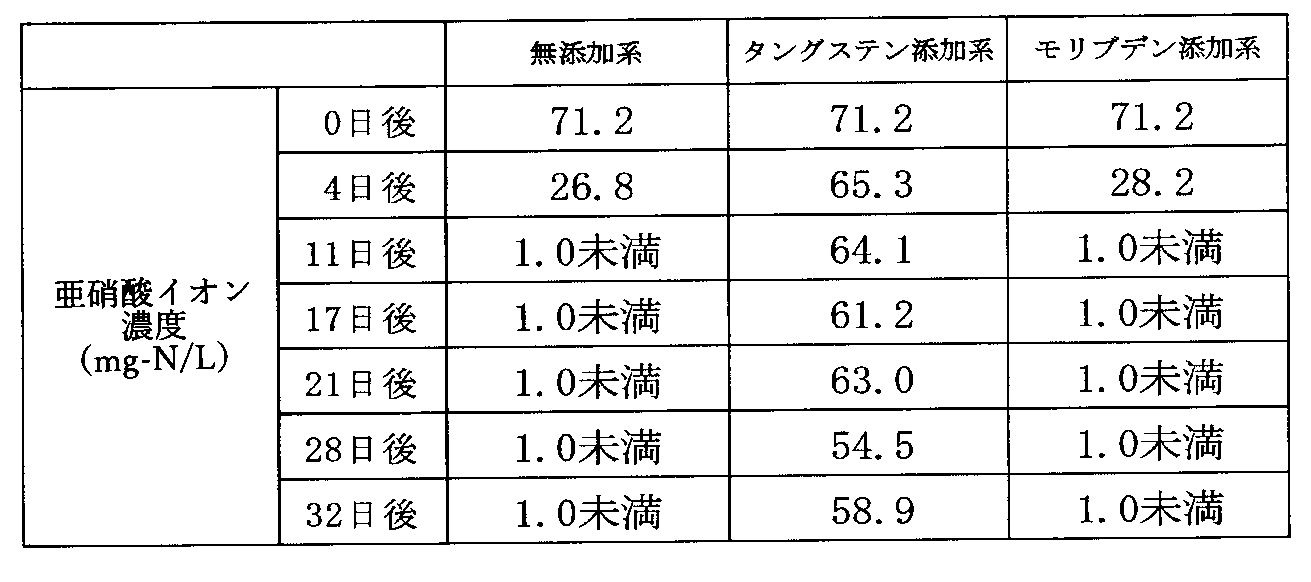
炭素鋼テストピースを水中に浸かるように各々のビーカーに浸漬させた後、スターラーマグネットによる300rpmの撹拌を行い、20℃にて反応を進め、32日間の亜硝酸イオン濃度を共立理化学研究所製「デジタルパックテスト高濃度亜硝酸試薬」を用いて比色定量した。
結果を表2に示す。
「無添加系」ならびに「モリブデン添加系」の亜硝酸イオン濃度は11日後には検出限界(1.0mg-N/L未満)となったが、「タングステン添加系」では32日後においても58.9mg-N/Lを維持していた。
反応開始32日後のテストピースを観察すると、「タングステン添加系」では赤錆は全く観察されなかったのに対し、「無添加系」と「モリブデン添加系」では局所的に赤錆が観察された。
結果を表2に示す。
「無添加系」ならびに「モリブデン添加系」の亜硝酸イオン濃度は11日後には検出限界(1.0mg-N/L未満)となったが、「タングステン添加系」では32日後においても58.9mg-N/Lを維持していた。
反応開始32日後のテストピースを観察すると、「タングステン添加系」では赤錆は全く観察されなかったのに対し、「無添加系」と「モリブデン添加系」では局所的に赤錆が観察された。
また、反応開始32日後の水中の鉄イオン濃度を共立理化学研究所製「パックテスト鉄」で簡易定量した。
結果を表3に示す。
「タングステン添加系」では0.2mg/Lと反応開始時の濃度と差はなかったのに対し、「無添加系」と「モリブデン添加系」では5.0mg-Fe/Lであった。
結果を表3に示す。
「タングステン添加系」では0.2mg/Lと反応開始時の濃度と差はなかったのに対し、「無添加系」と「モリブデン添加系」では5.0mg-Fe/Lであった。
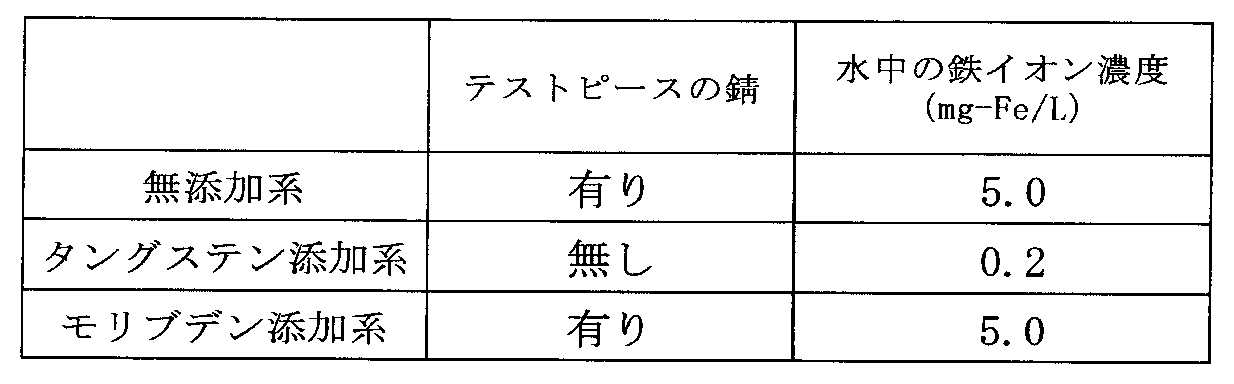
以上の結果より、「無添加系」及び「モリブデン添加系」では亜硝酸イオンが消費され防食効果が低減した結果、炭素鋼の腐食がおこり鉄イオンの溶出が認められたのに対し、「タングステン添加系」では亜硝酸イオンによる防食効果が保たれ、鉄イオンの溶出が抑えられたことがわかった。これより、タングステンとモリブデンは同族元素であるにもかかわらず、タングステン酸ナトリウム・二水和物では亜硝酸系防食剤による防食を維持できるが、モリブデン酸ナトリウム・二水和物では、亜硝酸系防食剤による防食効果が損なわれ、腐食とそれに伴う鉄イオンの溶出を抑制できないことがわかった。
[実施例3]
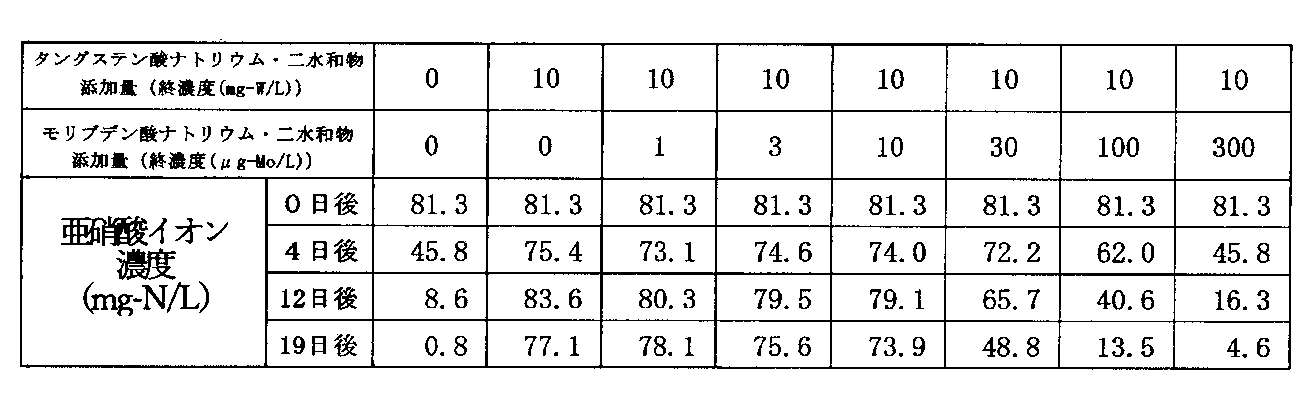
亜硝酸系防食剤による水処理を行っている密閉冷却水系である東京都内の空調蓄熱冷却水系より採取した水を5mLずつ試験管にとり、タングステン酸ナトリウム・二水和物を終濃度10mg-W/Lとなるように加えた。さらに、モリブデン酸ナトリウム・二水和物を0~300μg-Mo/Lとなるように加え、25℃、200rpmの条件で振とうを行い、19日後までの亜硝酸イオン濃度を調べた。亜硝酸イオン濃度は共立理化学研究所製「デジタルパックテスト高濃度亜硝酸試薬」を用いて比色定量した。また、タングステン酸ナトリウム・二水和物もモリブデン酸ナトリウム・二水和物も加えない場合についても、19日後までの亜硝酸イオン濃度を調べた。
亜硝酸系防食剤による水処理を行っている密閉冷却水系である東京都内の空調蓄熱冷却水系より採取した水を5mLずつ試験管にとり、タングステン酸ナトリウム・二水和物を終濃度10mg-W/Lとなるように加えた。さらに、モリブデン酸ナトリウム・二水和物を0~300μg-Mo/Lとなるように加え、25℃、200rpmの条件で振とうを行い、19日後までの亜硝酸イオン濃度を調べた。亜硝酸イオン濃度は共立理化学研究所製「デジタルパックテスト高濃度亜硝酸試薬」を用いて比色定量した。また、タングステン酸ナトリウム・二水和物もモリブデン酸ナトリウム・二水和物も加えない場合についても、19日後までの亜硝酸イオン濃度を調べた。
結果を表4に示す。
30μg-Mo/L以上のモリブデン酸ナトリウム・二水和物が添加されると、タングステン酸ナトリウム・二水和物による亜硝酸イオン消費抑制効果が低下する現象が観察された。
実施例3においては、タングステン酸ナトリウム・二水和物による亜硝酸イオン消費抑制効果を維持するために、モリブデン酸ナトリウム・二水和物の添加量を、終濃度が少なくとも10μg/L以下となる量にすると特に効果的であることがわかった。水中のモリブデン酸の濃度に対して、金属重量比で1000倍以上の濃度のタングステン酸が特に好ましいと考えられる。
30μg-Mo/L以上のモリブデン酸ナトリウム・二水和物が添加されると、タングステン酸ナトリウム・二水和物による亜硝酸イオン消費抑制効果が低下する現象が観察された。
実施例3においては、タングステン酸ナトリウム・二水和物による亜硝酸イオン消費抑制効果を維持するために、モリブデン酸ナトリウム・二水和物の添加量を、終濃度が少なくとも10μg/L以下となる量にすると特に効果的であることがわかった。水中のモリブデン酸の濃度に対して、金属重量比で1000倍以上の濃度のタングステン酸が特に好ましいと考えられる。
[参考例1]
栃木県野木町脱塩素町水を1Lずつ、3個のビーカーにとり、それぞれに食塩を100mg-Cl/Lとなるように加えた。
3個のビーカーのうち、「亜硝酸添加系」のビーカーには終濃度80mg-N/Lとなるように亜硝酸ナトリウムを添加した。「タングステン添加系」には終濃度5mg-W/Lとなるようにタングステン酸ナトリウム・二水和物を添加した。「亜硝酸+タングステン添加系」には終濃度80mg-N/Lとなるように亜硝酸ナトリウムを添加すると共に、終濃度5mg-W/Lとなるようにタングステン酸ナトリウム・二水和物を添加した。
予め秤量した炭素鋼テストピースを各々のビーカーの水中に浸かるように浸漬させた後、スターラーマグネットで300rpmの撹拌を伴いながら、20℃にて11日間の反応を行い、反応終了後のテストピースの重量変化から腐食速度(mdd)を求めた。なお、野木町水中のニトロバクター属細菌由来16SrDNAの濃度を定量PCR法によって調べたが、検出限界以下(1.0×10²copies/mL未満)であった。
栃木県野木町脱塩素町水を1Lずつ、3個のビーカーにとり、それぞれに食塩を100mg-Cl/Lとなるように加えた。
3個のビーカーのうち、「亜硝酸添加系」のビーカーには終濃度80mg-N/Lとなるように亜硝酸ナトリウムを添加した。「タングステン添加系」には終濃度5mg-W/Lとなるようにタングステン酸ナトリウム・二水和物を添加した。「亜硝酸+タングステン添加系」には終濃度80mg-N/Lとなるように亜硝酸ナトリウムを添加すると共に、終濃度5mg-W/Lとなるようにタングステン酸ナトリウム・二水和物を添加した。
予め秤量した炭素鋼テストピースを各々のビーカーの水中に浸かるように浸漬させた後、スターラーマグネットで300rpmの撹拌を伴いながら、20℃にて11日間の反応を行い、反応終了後のテストピースの重量変化から腐食速度(mdd)を求めた。なお、野木町水中のニトロバクター属細菌由来16SrDNAの濃度を定量PCR法によって調べたが、検出限界以下(1.0×10²copies/mL未満)であった。
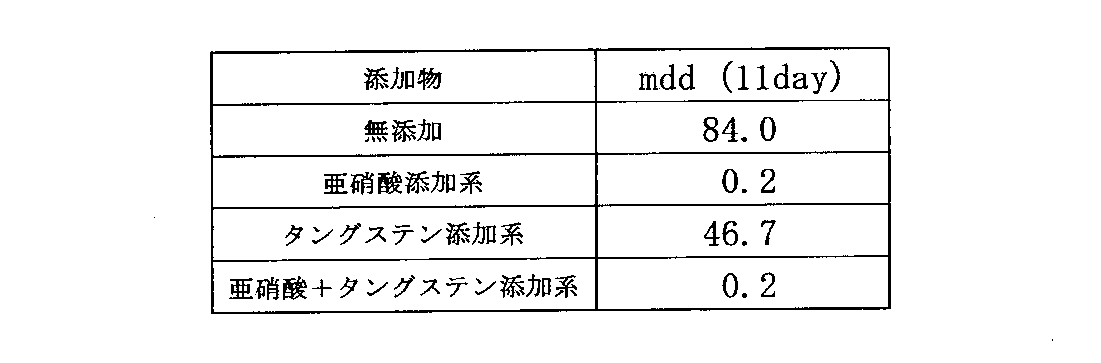
結果を、表5に示す。
亜硝酸ナトリウムを含む「亜硝酸添加系」及び「亜硝酸+タングステン添加系」は、mdd(11day)がいずれも0.2で優れた防食効果を示すのに対し、「タングステン添加系」は、mdd(11day)が46.7で防食効果が劣ることがわかった。
これより、20℃の亜硝酸酸化細菌を含まない水系では、水溶性タングステン酸化合物(タングステン酸ナトリウム・二水和物)は、金属に対する防食効果が確認できないことがわかった。
亜硝酸ナトリウムを含む「亜硝酸添加系」及び「亜硝酸+タングステン添加系」は、mdd(11day)がいずれも0.2で優れた防食効果を示すのに対し、「タングステン添加系」は、mdd(11day)が46.7で防食効果が劣ることがわかった。
これより、20℃の亜硝酸酸化細菌を含まない水系では、水溶性タングステン酸化合物(タングステン酸ナトリウム・二水和物)は、金属に対する防食効果が確認できないことがわかった。
[実施例4]
冷却設備の冬季運転休止に伴う冷却水系の保管防食処理を亜硝酸系防食剤とイソチアゾリン系抗菌剤を用いて実施している、愛知県内の開放冷却水系より水を採取した。
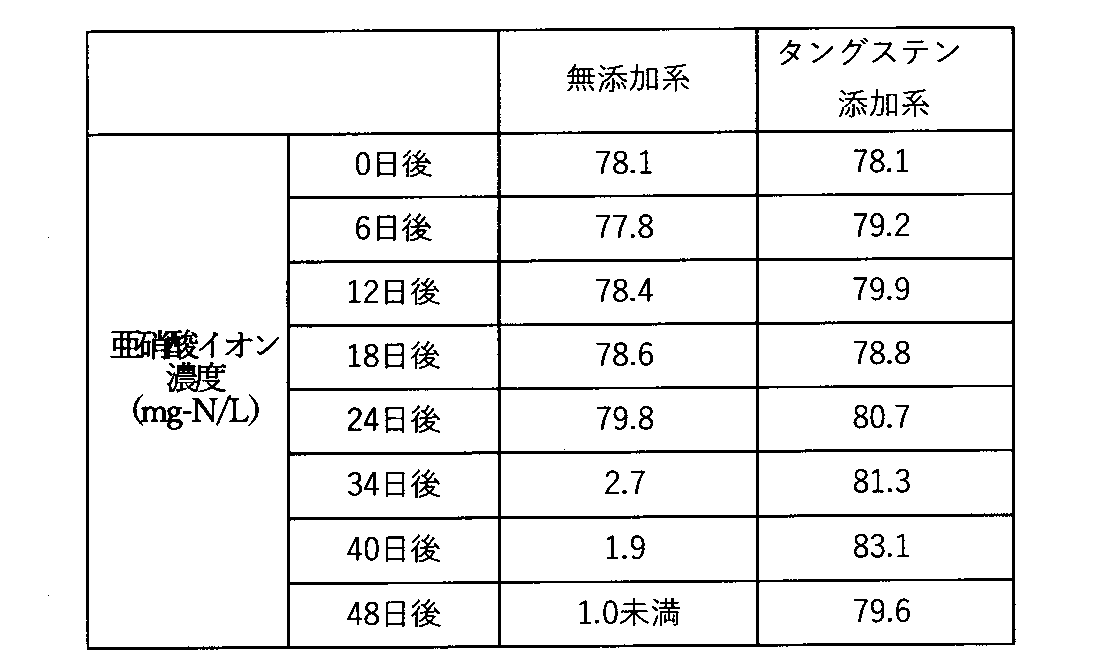
採取した水を100mLずつ2個の培養用フラスコにとり、一方の培養用フラスコにのみタングステン酸ナトリウム・二水和物を終濃度5mg-W/Lとなるように加えた。双方の培養用フラスコを、26℃、80rpmの好気条件で振とうし、48日間の亜硝酸イオン濃度を調べた。水の蒸発分は、定期的に純水を足して補正した。亜硝酸イオン濃度は共立理化学研究所製「デジタルパックテスト高濃度亜硝酸試薬」を用いて比色定量した。
冷却設備の冬季運転休止に伴う冷却水系の保管防食処理を亜硝酸系防食剤とイソチアゾリン系抗菌剤を用いて実施している、愛知県内の開放冷却水系より水を採取した。
採取した水を100mLずつ2個の培養用フラスコにとり、一方の培養用フラスコにのみタングステン酸ナトリウム・二水和物を終濃度5mg-W/Lとなるように加えた。双方の培養用フラスコを、26℃、80rpmの好気条件で振とうし、48日間の亜硝酸イオン濃度を調べた。水の蒸発分は、定期的に純水を足して補正した。亜硝酸イオン濃度は共立理化学研究所製「デジタルパックテスト高濃度亜硝酸試薬」を用いて比色定量した。
結果を表6に示す。
タングステン酸ナトリウム・二水和物無添加系では、試験開始24日目まで亜硝酸イオン濃度は安定であったが、34日目以降、亜硝酸イオンの急速な消耗が確認された。一方、終濃度5mg-W/Lのタングステン酸ナトリウム・二水和物を添加した系では、亜硝酸イオンの消耗をほぼ完全に抑制することが可能であった。イソチアゾリン系抗菌剤の有効期間はおよそ一か月程度であり、抗菌活性の失効によって無添加系では水中の亜硝酸酸化細菌が亜硝酸酸化活性を取り戻して亜硝酸イオンを酸化したが、タングステン添加系では抗菌活性の失効ののちも亜硝酸酸化細菌の活性を抑制し続けたものとみられる。
タングステン酸ナトリウム・二水和物無添加系では、試験開始24日目まで亜硝酸イオン濃度は安定であったが、34日目以降、亜硝酸イオンの急速な消耗が確認された。一方、終濃度5mg-W/Lのタングステン酸ナトリウム・二水和物を添加した系では、亜硝酸イオンの消耗をほぼ完全に抑制することが可能であった。イソチアゾリン系抗菌剤の有効期間はおよそ一か月程度であり、抗菌活性の失効によって無添加系では水中の亜硝酸酸化細菌が亜硝酸酸化活性を取り戻して亜硝酸イオンを酸化したが、タングステン添加系では抗菌活性の失効ののちも亜硝酸酸化細菌の活性を抑制し続けたものとみられる。
[実施例5]
図1に示す循環通水試験装置を用いて通水試験を行った。
この循環通水試験装置は、循環水タンク(保水量50L)1内の水が、ポンプPにより、内部に鉄(SPCC)テストピース(50mm×10mm×1mm)2を装着した透明アクリルカラム(直径20mm)3に循環通水されるように構成されている。
この循環通水試験装置を2機用い、それぞれ、活性炭により脱塩素処理した栃木県野木町水50Lを循環水タンク1に満たした。一方の循環通水試験装置には、タングステン酸ナトリウム・二水和物を終濃度5mg-W/Lとなるように添加した(添加系)。双方の循環通水試験装置に亜硝酸ナトリウムを終濃度300mg/Lとなるように添加し、さらに種菌としてBOD測定用活性汚泥を0.05mLずつ加えて試験水を調製した後、テストピース2を装着した透明アクリルカラム3に対して循環水タンク1内の試験水を流束0.3m/sとなるように循環通水した。
曝気や機械撹拌は行わず、空気を巻き込んだ循環水戻り水を介した混合によって循環水タンク1内の通気と撹拌を行った。水温は28℃に設定し、pHは成り行きで7.7~8.1の範囲内で推移した。通水開始時のモリブデン濃度は10μg-Mo/L未満未満であった。
図1に示す循環通水試験装置を用いて通水試験を行った。
この循環通水試験装置は、循環水タンク(保水量50L)1内の水が、ポンプPにより、内部に鉄(SPCC)テストピース(50mm×10mm×1mm)2を装着した透明アクリルカラム(直径20mm)3に循環通水されるように構成されている。
この循環通水試験装置を2機用い、それぞれ、活性炭により脱塩素処理した栃木県野木町水50Lを循環水タンク1に満たした。一方の循環通水試験装置には、タングステン酸ナトリウム・二水和物を終濃度5mg-W/Lとなるように添加した(添加系)。双方の循環通水試験装置に亜硝酸ナトリウムを終濃度300mg/Lとなるように添加し、さらに種菌としてBOD測定用活性汚泥を0.05mLずつ加えて試験水を調製した後、テストピース2を装着した透明アクリルカラム3に対して循環水タンク1内の試験水を流束0.3m/sとなるように循環通水した。
曝気や機械撹拌は行わず、空気を巻き込んだ循環水戻り水を介した混合によって循環水タンク1内の通気と撹拌を行った。水温は28℃に設定し、pHは成り行きで7.7~8.1の範囲内で推移した。通水開始時のモリブデン濃度は10μg-Mo/L未満未満であった。
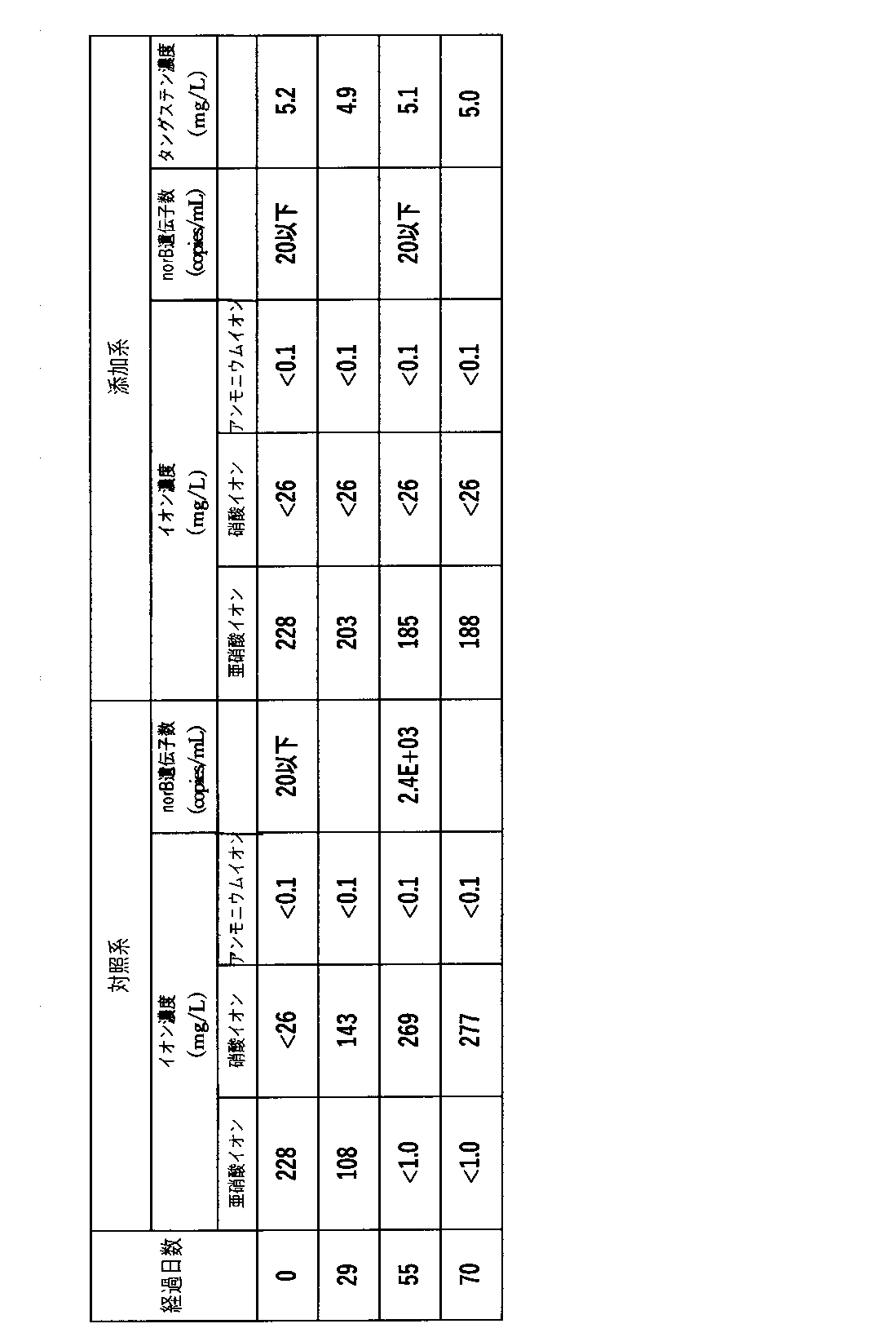
70日間通水後の水質分析結果を表7に示す。
水質分析はJIS K0102に従って実施した。
タングステン酸ナトリウム・二水和物を添加していない対象系では、試験開始29日目には亜硝酸イオン濃度の低下が観察され、55日目にはほぼ検出されなくなった。亜硝酸イオンは全て硝酸イオンに酸化されていた。
一方、添加系では、亜硝酸イオン濃度、タングステン酸濃度ともに70日目においても安定であった。
水質分析はJIS K0102に従って実施した。
タングステン酸ナトリウム・二水和物を添加していない対象系では、試験開始29日目には亜硝酸イオン濃度の低下が観察され、55日目にはほぼ検出されなくなった。亜硝酸イオンは全て硝酸イオンに酸化されていた。
一方、添加系では、亜硝酸イオン濃度、タングステン酸濃度ともに70日目においても安定であった。
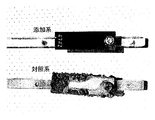
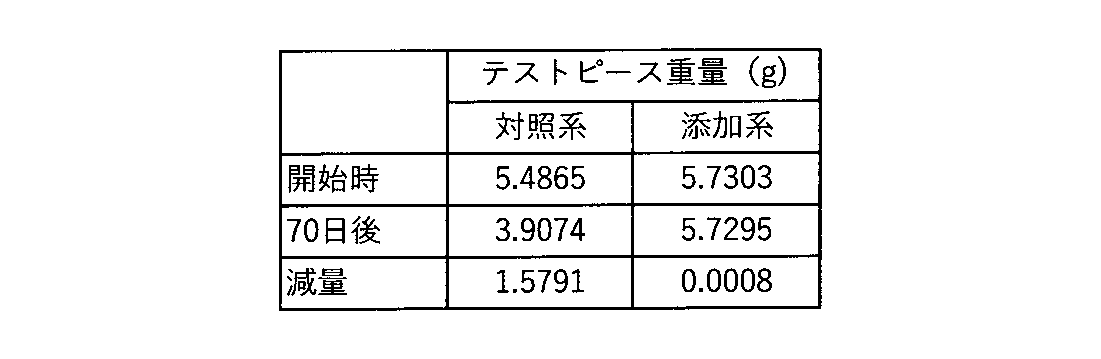
対照系では試験開始35日目頃よりテストピース刻印部に赤錆が発生し、その後広範囲に広がった。70日目のテストピースの写真を図2に示す。添加系では赤錆は全く観察されなかった。テストピースの重量を測定した結果、表8に示す様に対照系のテストピースには著しい腐食が確認された。
norB遺伝子(亜硝酸酸化還元酵素遺伝子)を指標とした定量PCR分析の結果、対照系では55日目にnorB遺伝子数の有意な増加が見られたが、添加系では同遺伝子は検出限界以下であった。
以上の試験結果より、対照系では亜硝酸酸化細菌が増殖し、系内の亜硝酸イオン濃度が低下することにより防食効果がなくなり鉄の腐食が発生した。一方、添加系では亜硝酸酸化細菌の増殖が抑制され、系内の亜硝酸イオン濃度が維持されるため防食効果も安定して発揮されることが示された。
[参考例2]
図1に示す循環通水試験装置を用い、活性炭を用いて脱塩素処理した栃木県野木町水50Lを循環水タンク1に満たし、タングステン酸ナトリウム・二水和物を終濃度5mg-W/Lとなるように添加し、さらに種菌としてBOD測定用活性汚泥を0.05mL加えた後、テストピース2を装着した透明アクリルカラム3に流束0.3m/sで循環通水した。曝気や機械撹拌は行わず、空気を巻き込んだ循環水戻り水を介した混合によって槽内の通気と撹拌を行った。水温は28℃に設定し、pHは成り行きで7.7~8.1の範囲内で推移した。通水開始時のモリブデン濃度は10ng-Mo/L未満であった。
図1に示す循環通水試験装置を用い、活性炭を用いて脱塩素処理した栃木県野木町水50Lを循環水タンク1に満たし、タングステン酸ナトリウム・二水和物を終濃度5mg-W/Lとなるように添加し、さらに種菌としてBOD測定用活性汚泥を0.05mL加えた後、テストピース2を装着した透明アクリルカラム3に流束0.3m/sで循環通水した。曝気や機械撹拌は行わず、空気を巻き込んだ循環水戻り水を介した混合によって槽内の通気と撹拌を行った。水温は28℃に設定し、pHは成り行きで7.7~8.1の範囲内で推移した。通水開始時のモリブデン濃度は10ng-Mo/L未満であった。
その結果、通水開始7日後にはテストピース刻印部に赤錆の発生が観察された。
以上の結果より、終濃度5mg-W/Lのタングステン酸ナトリウム・二水和物では、鉄に対して十分な防食効果を示さないことがわかった。
以上の結果より、終濃度5mg-W/Lのタングステン酸ナトリウム・二水和物では、鉄に対して十分な防食効果を示さないことがわかった。
本発明を特定の態様を用いて詳細に説明したが、本発明の意図と範囲を離れることなく様々な変更が可能であることは当業者に明らかである。
本出願は、2019年11月20日付で出願された日本特許出願2019-209685に基づいており、その全体が引用により援用される。
本出願は、2019年11月20日付で出願された日本特許出願2019-209685に基づいており、その全体が引用により援用される。
1 循環水タンク
2 テストピース
3 透明アクリルカラム
2 テストピース
3 透明アクリルカラム
Claims (10)
- 亜硝酸酸化細菌が存在する又は亜硝酸酸化細菌の混入が予測される水系に、亜硝酸系防食剤と水溶性タングステン酸化合物とを添加する、水系の金属の防食方法。
- 前記水系における亜硝酸酸化細菌由来16SrDNAの濃度が、1.0×10²copies/mL以上である、請求項1に記載の水系の金属の防食方法。
- 前記水系における亜硝酸イオン濃度が、10mg-N/L以上である、請求項1又は2に記載の水系の金属の防食方法。
- 前記水溶性タングステン酸化合物を、前記水系におけるタングステン酸イオン濃度が0.1mg-W/L以上となるように添加する、請求項1~3のいずれかに記載の水系の金属の防食方法。
- 前記水系が、冷却水系である、請求項1~4のいずれかに記載の水系の金属の防食方法。
- 前記水系が、密閉冷却水系である、請求項1~4のいずれかに記載の水系の金属の防食方法。
- 前記水系が、開放冷却水系である、請求項1~4のいずれかに記載の水系の金属の防食方法。
- 前記水系が冷却水設備運転停止後の保管中の冷却水系である、請求項1~4のいずれかに記載の水系の金属の防食方法。
- 前記水系のモリブデン濃度に対し、重量比で300倍以上のタングステン濃度に相当する量の前記水溶性タングステン酸化合物を添加する、請求項1~8のいずれかに記載の水系の金属の防食方法。
- 水系における亜硝酸イオンの硝酸イオンへの酸化を抑制する水系添加用薬剤であって、水溶性タングステン酸化合物を含む、水系添加用薬剤。
Priority Applications (2)
| Application Number | Priority Date | Filing Date | Title |
|---|---|---|---|
| SG11202112389QA SG11202112389QA (en) | 2019-11-20 | 2020-11-09 | Method for preventing metal corrosion in water system and chemical agent for addition to water system |
| JP2020563727A JP6958750B1 (ja) | 2019-11-20 | 2020-11-09 | 水系の金属の防食方法 |
Applications Claiming Priority (2)
| Application Number | Priority Date | Filing Date | Title |
|---|---|---|---|
| JP2019209685 | 2019-11-20 | ||
| JP2019-209685 | 2019-11-20 |
Publications (1)
| Publication Number | Publication Date |
|---|---|
| WO2021100512A1 true WO2021100512A1 (ja) | 2021-05-27 |
Family
ID=75981231
Family Applications (1)
| Application Number | Title | Priority Date | Filing Date |
|---|---|---|---|
| PCT/JP2020/041689 Ceased WO2021100512A1 (ja) | 2019-11-20 | 2020-11-09 | 水系の金属の防食方法及び水系添加用薬剤 |
Country Status (4)
| Country | Link |
|---|---|
| JP (1) | JP6958750B1 (ja) |
| SG (1) | SG11202112389QA (ja) |
| TW (1) | TW202129080A (ja) |
| WO (1) | WO2021100512A1 (ja) |
Cited By (1)
| Publication number | Priority date | Publication date | Assignee | Title |
|---|---|---|---|---|
| CN114853217A (zh) * | 2022-05-24 | 2022-08-05 | 中国石油化工股份有限公司 | 一种水煤浆技术协同处理硝基苯废水的装置及其方法 |
Citations (4)
| Publication number | Priority date | Publication date | Assignee | Title |
|---|---|---|---|---|
| JPS5278640A (en) * | 1975-12-25 | 1977-07-02 | Katayama Chemical Works Co | Anticorrosive method for system for circulating highly condensed water |
| JPH10195681A (ja) * | 1997-01-10 | 1998-07-28 | Showa Kk | 防食剤及び防食方法 |
| JP2013245389A (ja) * | 2012-05-28 | 2013-12-09 | Kurita Water Ind Ltd | 密閉冷却水系における腐食抑制方法 |
| WO2014119788A1 (ja) * | 2013-02-04 | 2014-08-07 | 栗田工業株式会社 | 密閉循環式冷却水系の腐食抑制方法 |
-
2020
- 2020-11-09 WO PCT/JP2020/041689 patent/WO2021100512A1/ja not_active Ceased
- 2020-11-09 SG SG11202112389QA patent/SG11202112389QA/en unknown
- 2020-11-09 JP JP2020563727A patent/JP6958750B1/ja active Active
- 2020-11-16 TW TW109139836A patent/TW202129080A/zh unknown
Patent Citations (4)
| Publication number | Priority date | Publication date | Assignee | Title |
|---|---|---|---|---|
| JPS5278640A (en) * | 1975-12-25 | 1977-07-02 | Katayama Chemical Works Co | Anticorrosive method for system for circulating highly condensed water |
| JPH10195681A (ja) * | 1997-01-10 | 1998-07-28 | Showa Kk | 防食剤及び防食方法 |
| JP2013245389A (ja) * | 2012-05-28 | 2013-12-09 | Kurita Water Ind Ltd | 密閉冷却水系における腐食抑制方法 |
| WO2014119788A1 (ja) * | 2013-02-04 | 2014-08-07 | 栗田工業株式会社 | 密閉循環式冷却水系の腐食抑制方法 |
Cited By (1)
| Publication number | Priority date | Publication date | Assignee | Title |
|---|---|---|---|---|
| CN114853217A (zh) * | 2022-05-24 | 2022-08-05 | 中国石油化工股份有限公司 | 一种水煤浆技术协同处理硝基苯废水的装置及其方法 |
Also Published As
| Publication number | Publication date |
|---|---|
| SG11202112389QA (en) | 2021-12-30 |
| JP6958750B1 (ja) | 2021-11-02 |
| TW202129080A (zh) | 2021-08-01 |
| JPWO2021100512A1 (ja) | 2021-12-02 |
Similar Documents
| Publication | Publication Date | Title |
|---|---|---|
| Sahinkaya et al. | Simultaneous bioreduction of nitrate and chromate using sulfur-based mixotrophic denitrification process | |
| JP6958750B1 (ja) | 水系の金属の防食方法 | |
| JP2011121646A (ja) | 金属面を有する容器に保存された飲料水中の微生物の成長の抑制方法、銀イオン含有飲料水の長期保存用の金属面を有する容器の加工方法、及び銀イオンを含む飲料水を収容するための容器 | |
| JPH06306652A (ja) | 金属腐食抑制剤および金属腐食抑制方法 | |
| TWI708867B (zh) | 密閉冷卻水系中腐蝕抑制方法及密閉冷卻水系用腐蝕抑制劑以及腐蝕抑制系統 | |
| US8535661B2 (en) | Enzymatically active compositions for suppressing sulfide generation and methods of use thereof | |
| JP5963241B2 (ja) | 酵素処理剤 | |
| TWI516456B (zh) | Corrosion Suppression Method in Closed Cooling Water System | |
| US8992780B2 (en) | Reduction of hydrogen sulfide and/or malodor gassing from water via the addition of peroxyacetic acid/hydrogen peroxide product | |
| EP3114089B1 (en) | Apparatus comprising a trace element dosage device and method for treating raw water in biofilter | |
| AU2002214357A1 (en) | Multifunctional water-treating composition and method of water-treating using the same | |
| TWI637916B (zh) | Nitrifying bacteria inhibitor and nitrifying bacteria inhibiting method | |
| JP2003267812A (ja) | 防藻剤、防藻剤組成物および防藻方法 | |
| Wallace et al. | Effects of material choice on biocide loss in Orion water storage tanks | |
| JP3951276B2 (ja) | 微生物に基づく硫化水素発生の防止方法 | |
| JP2002193712A (ja) | スライムコントロール剤 | |
| JP2010173994A (ja) | 多機能型水処理剤 | |
| US12552694B2 (en) | Use of trivalent metals to enhance aquatic pesticide efficacy, surface water, and sediment quality while minimizing risk to aquatic biota | |
| JP4852877B2 (ja) | 亜硝酸塩系防食剤含有排水の処理方法 | |
| JP6806186B2 (ja) | 循環冷却水用初期処理剤及び循環冷却水系の初期処理方法 | |
| JP2008248303A (ja) | 銅基材を含む循環冷却水系の孔食抑制剤および孔食抑制方法 | |
| JP2004049940A (ja) | 硫化水素の除去及び発生防止方法並びにその装置 | |
| JP2000117239A (ja) | 廃水処理工程における硫化水素発生抑制剤および硫化水素発生抑制方法 | |
| JPS62280381A (ja) | 防食方法 | |
| JP2024154282A (ja) | 廃水の処理方法、及び活性汚泥用栄養剤 |
Legal Events
| Date | Code | Title | Description |
|---|---|---|---|
| ENP | Entry into the national phase |
Ref document number: 2020563727 Country of ref document: JP Kind code of ref document: A |
|
| 121 | Ep: the epo has been informed by wipo that ep was designated in this application |
Ref document number: 20890240 Country of ref document: EP Kind code of ref document: A1 |
|
| NENP | Non-entry into the national phase |
Ref country code: DE |
|
| 122 | Ep: pct application non-entry in european phase |
Ref document number: 20890240 Country of ref document: EP Kind code of ref document: A1 |