WO2021075340A1 - 照明装置および測距装置 - Google Patents
照明装置および測距装置 Download PDFInfo
- Publication number
- WO2021075340A1 WO2021075340A1 PCT/JP2020/038090 JP2020038090W WO2021075340A1 WO 2021075340 A1 WO2021075340 A1 WO 2021075340A1 JP 2020038090 W JP2020038090 W JP 2020038090W WO 2021075340 A1 WO2021075340 A1 WO 2021075340A1
- Authority
- WO
- WIPO (PCT)
- Prior art keywords
- light emitting
- emitting units
- light
- lights
- lighting device
- Prior art date
- Legal status (The legal status is an assumption and is not a legal conclusion. Google has not performed a legal analysis and makes no representation as to the accuracy of the status listed.)
- Ceased
Links
Images

















Classifications
-
- G—PHYSICS
- G01—MEASURING; TESTING
- G01S—RADIO DIRECTION-FINDING; RADIO NAVIGATION; DETERMINING DISTANCE OR VELOCITY BY USE OF RADIO WAVES; LOCATING OR PRESENCE-DETECTING BY USE OF THE REFLECTION OR RERADIATION OF RADIO WAVES; ANALOGOUS ARRANGEMENTS USING OTHER WAVES
- G01S7/00—Details of systems according to groups G01S13/00, G01S15/00, G01S17/00
- G01S7/48—Details of systems according to groups G01S13/00, G01S15/00, G01S17/00 of systems according to group G01S17/00
- G01S7/481—Constructional features, e.g. arrangements of optical elements
- G01S7/4814—Constructional features, e.g. arrangements of optical elements of transmitters alone
- G01S7/4815—Constructional features, e.g. arrangements of optical elements of transmitters alone using multiple transmitters
-
- G—PHYSICS
- G01—MEASURING; TESTING
- G01S—RADIO DIRECTION-FINDING; RADIO NAVIGATION; DETERMINING DISTANCE OR VELOCITY BY USE OF RADIO WAVES; LOCATING OR PRESENCE-DETECTING BY USE OF THE REFLECTION OR RERADIATION OF RADIO WAVES; ANALOGOUS ARRANGEMENTS USING OTHER WAVES
- G01S17/00—Systems using the reflection or reradiation of electromagnetic waves other than radio waves, e.g. lidar systems
- G01S17/02—Systems using the reflection of electromagnetic waves other than radio waves
- G01S17/06—Systems determining position data of a target
- G01S17/08—Systems determining position data of a target for measuring distance only
-
- G—PHYSICS
- G01—MEASURING; TESTING
- G01S—RADIO DIRECTION-FINDING; RADIO NAVIGATION; DETERMINING DISTANCE OR VELOCITY BY USE OF RADIO WAVES; LOCATING OR PRESENCE-DETECTING BY USE OF THE REFLECTION OR RERADIATION OF RADIO WAVES; ANALOGOUS ARRANGEMENTS USING OTHER WAVES
- G01S7/00—Details of systems according to groups G01S13/00, G01S15/00, G01S17/00
- G01S7/48—Details of systems according to groups G01S13/00, G01S15/00, G01S17/00 of systems according to group G01S17/00
- G01S7/481—Constructional features, e.g. arrangements of optical elements
-
- G—PHYSICS
- G01—MEASURING; TESTING
- G01S—RADIO DIRECTION-FINDING; RADIO NAVIGATION; DETERMINING DISTANCE OR VELOCITY BY USE OF RADIO WAVES; LOCATING OR PRESENCE-DETECTING BY USE OF THE REFLECTION OR RERADIATION OF RADIO WAVES; ANALOGOUS ARRANGEMENTS USING OTHER WAVES
- G01S7/00—Details of systems according to groups G01S13/00, G01S15/00, G01S17/00
- G01S7/48—Details of systems according to groups G01S13/00, G01S15/00, G01S17/00 of systems according to group G01S17/00
- G01S7/481—Constructional features, e.g. arrangements of optical elements
- G01S7/4814—Constructional features, e.g. arrangements of optical elements of transmitters alone
-
- G—PHYSICS
- G02—OPTICS
- G02B—OPTICAL ELEMENTS, SYSTEMS OR APPARATUS
- G02B27/00—Optical systems or apparatus not provided for by any of the groups G02B1/00 - G02B26/00, G02B30/00
- G02B27/09—Beam shaping, e.g. changing the cross-sectional area, not otherwise provided for
- G02B27/0905—Dividing and/or superposing multiple light beams
-
- G—PHYSICS
- G02—OPTICS
- G02B—OPTICAL ELEMENTS, SYSTEMS OR APPARATUS
- G02B27/00—Optical systems or apparatus not provided for by any of the groups G02B1/00 - G02B26/00, G02B30/00
- G02B27/09—Beam shaping, e.g. changing the cross-sectional area, not otherwise provided for
- G02B27/0916—Adapting the beam shape of a semiconductor light source such as a laser diode or an LED, e.g. for efficiently coupling into optical fibers
- G02B27/0922—Adapting the beam shape of a semiconductor light source such as a laser diode or an LED, e.g. for efficiently coupling into optical fibers the semiconductor light source comprising an array of light emitters
-
- G—PHYSICS
- G02—OPTICS
- G02B—OPTICAL ELEMENTS, SYSTEMS OR APPARATUS
- G02B27/00—Optical systems or apparatus not provided for by any of the groups G02B1/00 - G02B26/00, G02B30/00
- G02B27/09—Beam shaping, e.g. changing the cross-sectional area, not otherwise provided for
- G02B27/0938—Using specific optical elements
- G02B27/0944—Diffractive optical elements, e.g. gratings, holograms
-
- G—PHYSICS
- G01—MEASURING; TESTING
- G01S—RADIO DIRECTION-FINDING; RADIO NAVIGATION; DETERMINING DISTANCE OR VELOCITY BY USE OF RADIO WAVES; LOCATING OR PRESENCE-DETECTING BY USE OF THE REFLECTION OR RERADIATION OF RADIO WAVES; ANALOGOUS ARRANGEMENTS USING OTHER WAVES
- G01S17/00—Systems using the reflection or reradiation of electromagnetic waves other than radio waves, e.g. lidar systems
- G01S17/88—Lidar systems specially adapted for specific applications
- G01S17/89—Lidar systems specially adapted for specific applications for mapping or imaging
-
- H—ELECTRICITY
- H01—ELECTRIC ELEMENTS
- H01S—DEVICES USING THE PROCESS OF LIGHT AMPLIFICATION BY STIMULATED EMISSION OF RADIATION [LASER] TO AMPLIFY OR GENERATE LIGHT; DEVICES USING STIMULATED EMISSION OF ELECTROMAGNETIC RADIATION IN WAVE RANGES OTHER THAN OPTICAL
- H01S5/00—Semiconductor lasers
- H01S5/005—Optical components external to the laser cavity, specially adapted therefor, e.g. for homogenisation or merging of the beams or for manipulating laser pulses, e.g. pulse shaping
-
- H—ELECTRICITY
- H01—ELECTRIC ELEMENTS
- H01S—DEVICES USING THE PROCESS OF LIGHT AMPLIFICATION BY STIMULATED EMISSION OF RADIATION [LASER] TO AMPLIFY OR GENERATE LIGHT; DEVICES USING STIMULATED EMISSION OF ELECTROMAGNETIC RADIATION IN WAVE RANGES OTHER THAN OPTICAL
- H01S5/00—Semiconductor lasers
- H01S5/10—Construction or shape of the optical resonator, e.g. extended or external cavity, coupled cavities, bent-guide, varying width, thickness or composition of the active region
- H01S5/18—Surface-emitting [SE] lasers, e.g. having both horizontal and vertical cavities
- H01S5/183—Surface-emitting [SE] lasers, e.g. having both horizontal and vertical cavities having only vertical cavities, e.g. vertical cavity surface-emitting lasers [VCSEL]
- H01S5/18305—Surface-emitting [SE] lasers, e.g. having both horizontal and vertical cavities having only vertical cavities, e.g. vertical cavity surface-emitting lasers [VCSEL] with emission through the substrate, i.e. bottom emission
-
- H—ELECTRICITY
- H01—ELECTRIC ELEMENTS
- H01S—DEVICES USING THE PROCESS OF LIGHT AMPLIFICATION BY STIMULATED EMISSION OF RADIATION [LASER] TO AMPLIFY OR GENERATE LIGHT; DEVICES USING STIMULATED EMISSION OF ELECTROMAGNETIC RADIATION IN WAVE RANGES OTHER THAN OPTICAL
- H01S5/00—Semiconductor lasers
- H01S5/40—Arrangement of two or more semiconductor lasers, not provided for in groups H01S5/02 - H01S5/30
- H01S5/42—Arrays of surface emitting lasers
- H01S5/423—Arrays of surface emitting lasers having a vertical cavity
Definitions
- the present disclosure relates to an illumination device using, for example, a surface emitting semiconductor laser as a light emitting element, and a distance measuring device provided with the lighting device.
- One of the distance measurement methods is the time of flight (TOF) method for measuring the spatial propagation of light.
- TOF time of flight
- a method of measuring a short distance widely light emitted from a plurality of light emitting parts is diffused by a diffusing plate, uniformly irradiated (uniformly irradiated) over the entire measurement target range, and divided into two dimensions.
- As a method of extending the distance measurement distance there is a method of making the light emitted from a plurality of light emitting units substantially parallel with a collimator lens and irradiating a measurement object with a point-shaped light beam (spot irradiation).
- Patent Document 1 discloses an optical projector capable of uniform irradiation and spot irradiation by adjusting the position of a collimator lens.
- the distance measuring device is required to be miniaturized.
- the first illuminating device includes a light emitting element having a plurality of first light emitting units and a plurality of second light emitting units, and a plurality of first light emitting units emitted from the plurality of first light emitting units.
- a light emitting element having a plurality of first light emitting units and a plurality of second light emitting units, and a plurality of first light emitting units emitted from the plurality of first light emitting units.
- the first optical member that emits the light and the plurality of second lights emitted from the plurality of second light emitting units in substantially parallel manner, and the plurality of first lights and the plurality of second lights. It is provided with a plurality of first light and a second optical member that emits a plurality of second lights as light having at least one beam shape of the above and having different beam shapes.
- the distance measuring device of one embodiment of the present disclosure measures a distance to an object based on an illumination device that emits light to an object, a light receiving unit that detects the amount of light received from the object, and a light receiving amount. It is equipped with a distance measuring unit.
- the lighting device mounted on the distance measuring device has the same components as the lighting device of the above-described embodiment.
- the second lighting device of one embodiment, and the distance measuring device of one embodiment light emission having a plurality of first light emitting parts and a plurality of second light emitting parts is provided.
- a second optical member that forms at least one beam shape of the light emitted from the element (plurality of first light and plurality of second light) and emits the light is arranged.
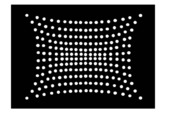
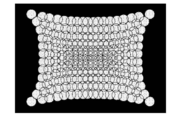
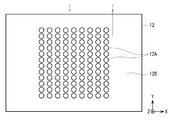
- FIG. 3 is a block diagram showing an example of a schematic configuration of a distance measuring device including the lighting device shown in FIG. 1. It is a figure which shows the irradiation pattern at the time of spot irradiation of the lighting apparatus shown in FIG. It is a figure which shows the irradiation pattern at the time of the uniform irradiation of the lighting apparatus shown in FIG. It is a figure which shows the irradiation pattern at the time of performing spot irradiation and uniform irradiation at the same time. It is a schematic diagram which shows an example of the plane structure of the light emitting element shown in FIG.
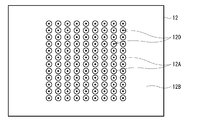
- FIG. 5 is a schematic plan view showing an example of the configuration of the diffractive optical element shown in FIG. It is a figure which shows an example of the plane pattern of the lens part of the diffractive optical element shown in FIG. It is a figure which shows the cross-sectional pattern of the lens part of the diffractive optical element shown in FIG. It is a figure which shows the irradiation pattern at the time of uniform irradiation to the object through the diffractive optical element shown in FIG.
- FIG. 28 It is a figure which shows the irradiation position of the light which irradiates an object from the light emitting part for spot irradiation and the light emitting part for uniform irradiation. It is a figure which shows the irradiation position of the light emitted from the light emitting part for spot irradiation through the diffraction grating shown in FIG. 28 with respect to an object. It is sectional drawing which shows an example of the schematic structure of the lighting apparatus which concerns on the modification 5 of this disclosure. It is a figure which shows an example of the cross-sectional structure of the light emitting element in the lighting apparatus shown in FIG. 30 and the positional relationship with a microlens array. FIG.
- FIG. 3 is a schematic cross-sectional view showing another configuration of the lighting device shown in FIG. It is a schematic diagram which shows another example of the cross-sectional structure of the light emitting element in the modification 6 of this disclosure. It is a schematic diagram which shows another example of the cross-sectional structure of the light emitting element in the modification 6 of this disclosure. It is a schematic diagram which shows another example of the cross-sectional structure of the light emitting element in the modification 6 of this disclosure. It is a schematic diagram which shows another example of the cross-sectional structure of the light emitting element in the modification 6 of this disclosure.
- Modification 2 (Other examples of microlens array configuration) 2-3.
- Modification 3 (Example of using a diffractive optical element as an optical element having a beam forming function) 2-4.
- Modification 4 (Example in which the grating is placed after the collimator lens) 2-5.
- Modification 5 (Example of using a back-emission type surface-emitting laser as a light-emitting element) 2-6.
- Modification 6 (Other examples of the configuration of the light emitting element)
- FIG. 1 is a cross-sectional view schematically showing an example of a schematic configuration of a lighting device (lighting device 1) according to an embodiment of the present disclosure.
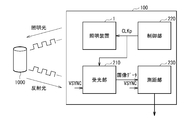
- FIG. 2 is a block diagram showing a schematic configuration of a distance measuring device (distance measuring device 100) including the lighting device 1 shown in FIG.
- the lighting device 1 of the present embodiment forms, for example, the beam shape of the light L2 among the lights L1 and L2 emitted from the light emitting element 11 having a plurality of light emitting units (light emitting units 110 and 120, see FIG. 6).
- the object 1000 to be irradiated is subjected to, for example, spot irradiation as shown in FIG. 3, uniform irradiation as shown in FIG. 4, and simultaneous irradiation as shown in FIG.
- the holding portion 21 has, for example, one cathode electrode portion 23 and two anode electrode portions 24, 25 on a surface 21S2 opposite to the surface 21S1 that holds the light emitting element 11 and the microlens array 12.
- each member constituting the lighting device 1 will be described in detail.
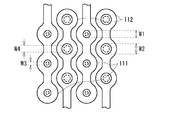
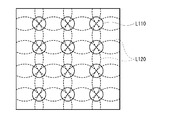
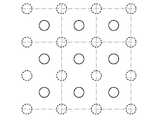
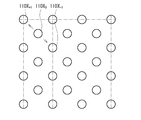
- FIG. 7 is an enlarged representation of a part of the arrangement of the plurality of light emitting units 110 and the plurality of light emitting units 120 shown in FIG. It is preferable that the plurality of light emitting units 110 and the plurality of light emitting units 120 have different light emitting areas (OA diameters W3 and W4). Specifically, the light emitting area (OA diameter W3) of the plurality of light emitting units 110 for spot irradiation is preferably smaller than the light emitting area (OA diameter W4) of the plurality of light emitting units 120 for uniform irradiation. As a result, the light beam for spot irradiation (laser beam L110, see FIG.
- laser beam L110 see FIG.
- the light beam for uniform irradiation (laser beam L120, see FIG. 12) irradiated from the plurality of light emitting units 120 can irradiate a wider range, and is more uniform with respect to the irradiation target 1000. , High output uniform irradiation is possible.
- the opening width W1 of the wiring connecting each of the plurality of light emitting units 110 becomes smaller than the opening width W2 of the wiring connecting each of the plurality of light emitting units 120.
- the upper DBR layer 145 is formed by alternately laminating low refractive index layers and high refractive index layers (neither of them is shown).
- the low refractive index layer is composed of, for example, p-type Al x6 Ga 1-x6 As (0 ⁇ x6 ⁇ 1) having a thickness of ⁇ 0 / 4n 3 (n 3 is a refractive index).
- the high refractive index layer is composed of, for example, p-type Al x7 Ga 1-x7 As (0 ⁇ x7 ⁇ x6) having a thickness of ⁇ 0 / 4n 4 (n 4 is a refractive index).
- the contact layer 16 is composed of, for example, p-type Al x8 Ga 1-x8 As (0 ⁇ x8 ⁇ 1).
- the light emitting element 11 is further provided with a current constriction layer 148 and a buffer layer 149.
- the current constriction layer 148 and the buffer layer 149 are provided in the upper DBR layer 145.
- the current injection region 148A is composed of, for example, p-type Al x9 Ga 1-x9 As (0.98 ⁇ x9 ⁇ 1).
- the current constriction region 148B is composed of, for example, aluminum oxide (Al 2 O 3 ), and for example, an oxidized layer (not shown) composed of p-type Al x9 Ga 1-x9 As is provided in the mesa portion 17. It was obtained by oxidizing from the side surface. As a result, the current constriction layer 148 has a function of constricting the current.
- the buffer layer 149 is formed closer to the active layer 143 in relation to the current constriction layer 148.
- the buffer layer 149 is formed adjacent to the current constriction layer 148. As shown in FIG. 8, for example, the buffer layer 149 is formed in contact with the surface (lower surface) of the current constriction layer 148 on the active layer 143 side.
- a thin layer having a thickness of, for example, several nm may be provided between the current constriction layer 148 and the buffer layer 149.
- the buffer layer 149 is provided, for example, in the upper DBR layer 145 at a portion of the high refractive index layer, for example, several layers away from the current constriction layer 148, in place of the high refractive index layer.
- the oxidized layer of the buffer layer 149 is made of a material and a thickness that has a higher oxidation rate than the lower DBR layer 141 and the upper DBR layer 145 and a slower oxidation rate than the oxidized layer of the current constriction layer 148. It is configured.
- the electrode pad 240 and the electrode pad 250 are respectively connected to the electrode portion provided on the front surface (surface 21S1) of the holding portion 21 described later by wire bonding, and provided on the back surface (surface 21S2) of the holding portion 21. It is electrically connected to the anode electrode portion 24 and the anode electrode portion 25.
- a lower electrode 152 is provided on the other surface of the substrate 130 (the back surface (surface 130S2).
- the lower electrode 152 is, for example, a cathode electrode provided on the back surface (surface 21S2) of the holding portion 21 described later.
- the cathode electrode is used as a common electrode and the anode electrode is provided separately.
- the anode electrode may be used.
- the common electrode may be used, and the cathode electrode may be provided separately.
- the microlens array 12 has, for example, the beam shape of at least one of the light (laser beam L110, laser beam L120) emitted from the plurality of light emitting units 110 for spot irradiation and the plurality of light emitting units 120 for uniform irradiation. Is molded and emitted.
- the microlens array 12 corresponds to a specific example of the "second optical member" of the present disclosure.
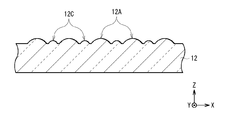
- FIG. 9A schematically shows an example of the planar configuration of the microlens array 12, and
- FIG. 9B schematically shows the cross-sectional configuration of the microlens array 12 on the line II shown in FIG. 9A. It is a thing.
- the microlens array 12 is formed by arranging a plurality of microlenses in an array, and has a plurality of lens portions 12A and a parallel flat plate portion 12B.
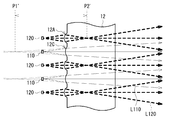
- the microlens array 12 is a parallel flat plate as shown in FIG. 10B so that the lens portion 12A faces a plurality of light emitting portions 120 for uniform irradiation.
- the unit 12B is arranged so as to face a plurality of light emitting units 110 for spot irradiation.
- the laser beams L120 emitted from the plurality of light emitting units 120 are refracted by the lens surface of the lens unit 12A, and form, for example, a virtual light emitting point P2'in the microlens array 12. ..
- the laser beam L110 emitted from the plurality of light emitting units 110 is, for example, spot-shaped irradiation as shown in FIGS. 3 and 12. Form a pattern. Further, the laser beams L120 emitted from the plurality of light emitting units 120 are predetermined by, for example, partially superimposing the laser beams L120 emitted from the adjacent light emitting units 120 as shown in FIGS. 4 and 12. An irradiation pattern is formed in which the range of light is irradiated with substantially uniform light intensity. In the lighting device 1, by switching between the light emission of the plurality of light emitting units 110 and the light emission of the plurality of light emitting units 120, it is possible to switch between spot irradiation and uniform irradiation.
- the diffraction element 14 By arranging the diffraction element 14, it is possible to tiling the light fluxes of the laser beam L110 and the laser beam L120, for example, to increase the number of spots during spot irradiation or to expand the irradiation range during uniform irradiation. It becomes.
- a plurality of electrode portions are provided on the back surface (surface 21S2) of the holding portion 21.
- a cathode electrode unit 23 common to a plurality of light emitting units 110 for spot irradiation and a plurality of light emitting units 120 for uniform irradiation, and a plurality of light emitting units for spot irradiation.
- An anode electrode portion 24 of the unit 110 and an anode electrode portion 25 of a plurality of light emitting units 120 for uniform irradiation are provided.
- the configuration of the plurality of electrode portions provided on the surface 21S2 of the holding portion 21 is not limited to the above, and for example, the plurality of light emitting units 110 for spot irradiation and the plurality of light emitting units 120 for uniform irradiation.
- the cathode electrode portions may be formed separately, or the anode electrode portions of the plurality of light emitting portions 110 for spot irradiation and the plurality of light emitting portions 120 for uniform irradiation may be formed as common electrode portions.
- FIG. 1 shows an example in which the microlens array 12 is held by the holding portion 21, the present invention is not limited to this, and for example, the microlens array 12 may be held by the holding portion 22.
- the collimator lens 13 and the diffraction element 14 may be held by the holding portion 21.
- a light emitting unit group X composed of a plurality of light emitting units 110 for spot irradiation and a light emitting unit group Y composed of a plurality of light emitting units 120 for uniform irradiation provided in the light emitting element 11. Drive independently of each other.
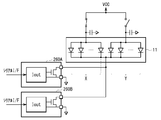
- FIG. 13 shows an example of the configuration of the drive circuit of the lighting device 1. Switching between the light emitting unit group X and the light emitting unit group X2 can be realized by using, for example, one drive unit 260 and using an external changeover switch.
- switching between the light emitting unit group X and the light emitting unit group X2 can also be performed using, for example, two drive units 260A and 240B as shown in FIG.
- the current and voltage of the light emitting unit group X that performs spot irradiation and the light emitting unit group Y that performs uniform irradiation It is possible to individually control the driving conditions such as.
- the drive unit 260 may be provided outside the lighting device 1, for example, or may be built in the holding unit 21, for example. Further, the light emitting element 11 and the drive unit 260 may be directly connected.
- FIG. 15 shows the light emission sequence of the lighting device 1.
- the light emission of the light emitting unit group X and the light emitting unit group Y may be switched, for example, in units of one frame or in units of blocks.
- the light emission of the light emitting unit group X and the light emitting unit group Y may be switched in units of a plurality of blocks. This makes it possible to switch between spot irradiation and uniform irradiation at a faster speed than, for example, a method of mechanically switching the focal positions of laser beams emitted from a plurality of light emitting units.
- the distance measuring device 100 shown in FIG. 2 measures the distance by the ToF method.
- the distance measuring device 100 includes, for example, a lighting device 1, a light receiving unit 210, a control unit 220, and a distance measuring unit 230.
- the lighting device 1 irradiates the irradiation target 1000 with a point-shaped light beam (spot irradiation) by switching the light emission between the plurality of light emitting units 110 and the plurality of light emitting units 120. Irradiation of a light beam of the same light intensity (uniform irradiation) is performed.
- irradiation light is generated in synchronization with the emission control signal CLKp of a square wave.
- the light emission control signal CLKp is not limited to a rectangular wave as long as it is a periodic signal.
- the light emission control signal CLKp may be a sine wave.
- the light receiving unit 210 receives the reflected light reflected from the irradiation object 1000, and detects the amount of light received within the cycle of the vertical synchronization signal VSYNC each time the cycle is elapsed.
- a 60 Hz (Hz) periodic signal is used as the vertical sync signal VSYNC.
- a plurality of pixel circuits are arranged in a two-dimensional lattice pattern in the light receiving unit 210.
- the light receiving unit 210 supplies image data (frames) corresponding to the amount of light received by these pixel circuits to the distance measuring unit 230.
- the frequency of the vertical synchronization signal VSYNC is not limited to 60 hertz (Hz), and may be 30 hertz (Hz) or 120 hertz (Hz).
- the control unit 220 controls the lighting device 1.
- the control unit 220 generates a light emission control signal CLKp and supplies it to the lighting device 1 and the light receiving unit 210.
- the frequency of the light emission control signal CLKp is, for example, 20 MHz (MHz).
- the frequency of the light emission control signal CLKp is not limited to 20 MHz (MHz), and may be, for example, 5 MHz (MHz).
- the distance measuring unit 230 measures the distance to the irradiation target 1000 by the ToF method based on the image data.
- the distance measuring unit 230 measures the distance for each pixel circuit and generates a depth map showing the distance to the object for each pixel as a gradation value. This depth map is used, for example, for image processing that performs a degree of blurring processing according to a distance, autofocus (AF) processing that obtains the in-focus of a focus lens according to a distance, and the like.
- AF autofocus
- the lighting device 1 of the present embodiment has a plurality of light emitting units (plurality of light emitting units 110, a plurality of light emitting units 120) constituting each light emitting unit group X and light emitting unit group Y for spot irradiation and uniform irradiation.
- a microlens array in which, for example, the beam shape of the laser beam L120 for uniform irradiation is formed and emitted on the optical path of the light L1 (laser beam L110) and the light L2 (laser beam L120) emitted from the light emitting element 11 having the light emitting element 11. 12 was arranged.
- the positions of the light emitting points of the laser beam L110 and the laser beam L120 emitted from the plurality of light emitting units 110 and the plurality of light emitting units 120, respectively, can be shifted in the optical axis direction. This will be described below.
- a method of uniformly irradiating the entire surface of the measurement target range with light emitted from a plurality of light emitting parts and a collimator lens for the light emitted from the plurality of light emitting parts There is a method of irradiating the entire measurement target range in a spot shape by making them substantially parallel to each other.
- a ranging device provided with two light sources one for uniform irradiation and the other for spot irradiation, is used as a technique for reducing the ranging error due to the light scattered by the object to be measured.
- a ranging device provided with two light sources for spot irradiation in addition to this, it is possible to compensate for a decrease in XY resolution by uniform irradiation while increasing the light density by spot irradiation to extend the ranging distance.
- the laser beam L120 incident on the lens unit 12A is refracted by the lens surface of the lens unit 12A to change the beam shape, and for example, a virtual light emitting point P2'is formed in the microlens array 12.
- the optical members for example, the collimator lens 13 arranged in the emission direction of the plurality of light emitting units 110 for spot irradiation and the plurality of light emitting units 120 for uniform irradiation.
- the light emitting areas (OA diameters W3 and W4) of the plurality of light emitting units 110 for spot irradiation and the plurality of light emitting units 120 for uniform irradiation are set to the light emitting units 110 for spot irradiation.
- the OA diameter W3 is relatively small, and the OA diameter W4 of the plurality of light emitting units 120 for uniform irradiation is relatively large. This makes it possible to further focus the laser beam L110 for spot irradiation. In addition, it is possible to improve the uniformity of light intensity and the light output at the time of uniform irradiation.
- FIG. 16 shows the beam forming function by the microlens array 12 in the first modification of the present disclosure.
- the parallel flat plate portion 12B is arranged so as to face the plurality of light emitting portions 120 for uniform irradiation so that the lens portion 12A faces the plurality of light emitting portions 120 for uniform irradiation.
- the parallel flat plate portion 12B is arranged so as to face the plurality of light emitting portions 120 for uniform irradiation so that the lens portion 12A faces the plurality of light emitting portions 110 for spot irradiation. It may be. Even with such a configuration, the same effect as that of the above embodiment can be obtained.
- FIG. 17A schematically shows an example of the planar configuration of the microlens array 12 in the modified example 2 of the present disclosure
- FIG. 17B is a cross section of the microlens array 12 on the line II-II shown in FIG. 17A. It is a schematic representation of the configuration.
- the microlens array 12 shown in FIGS. 17A and 17B is formed by arranging two types of microlenses having different radii of curvature in an array, and a plurality of lens portions 12A having different radii of curvature and a plurality of lenses. It has a part 12C.
- the laser beams L120 emitted from the plurality of light emitting units 120 are refracted by the lens surface of the lens unit 12A to form, for example, a virtual light emitting point P2'in the microlens array 12. ..
- the laser beams L110 emitted from the plurality of light emitting units 110 are refracted by the lens surface of the lens unit 12C, and form, for example, a virtual light emitting point P1'behind the plurality of light emitting units 110.
- the microlens array 12 having two types of lens units (lens unit 12A and lens unit 12C) having different radii of curvature is used, and each of the plurality of light emitting units 110 for spot irradiation is used.
- the beam shapes of both the laser beam L110 and the laser beam L120 are formed by incidenting the emitted laser beam L110 and the laser beam L120 emitted from the plurality of light emitting units 120 for uniform irradiation.
- the positions of the respective light emitting points can be further significantly different in the optical axis direction.
- the laser beams L110 and L120 emitted from the respective light emitting units 110 and L120 can be obtained. It becomes easy to arrange the microlens array 12 at the position before overlapping. This makes it easy to effectively utilize the laser beams L110 and L120, and for example, it is possible to further improve the uniformity of light intensity at the time of uniform irradiation.
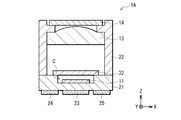
- FIG. 19 is a cross-sectional view schematically showing an example of a schematic configuration of the lighting device (lighting device 1A) according to the third modification of the present disclosure.
- the lighting device 1A of this modification is different from the above embodiment in that a diffractive optical element (DOE) 32 is used as the second optical member.
- DOE diffractive optical element
- the diffractive optical element 32 has, for example, a beam shape of at least one of the light (laser beam L110, laser beam L120) emitted from the plurality of light emitting units 110 for spot irradiation and the plurality of light emitting units 120 for uniform irradiation. Is molded and emitted.
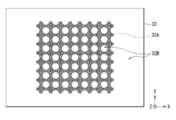
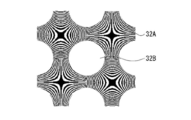
- FIG. 20 schematically shows an example of the planar configuration of the diffractive optical element 32. For example, a plurality of light emitting units 120 for uniform irradiation in the region 32A and a plurality of light emitting units for spot irradiation in the region 32B.
- the portions 110 are arranged so as to face each other.
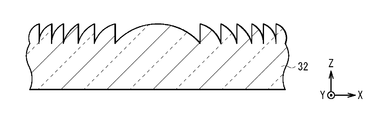
- the diffractive optical element 32 for example, a Fresnel lens having a plane pattern as shown in FIG. 21 and a cross-sectional pattern as shown in FIG. 22 can be used in the region 32A.
- the region 32B is, for example, a parallel flat plate region.
- the laser beams L120 emitted from the plurality of light emitting units 120 form an irradiation pattern as shown in FIG. 23 with respect to the irradiation target 1000, for example. be able to.
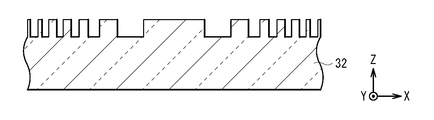
- the diffractive optical element 32 for example, a binary lens having a cross-sectional pattern as shown in FIG. 24 can be used in the region 32A.
- a binary lens is used as the diffractive optical element 32, the laser beams L120 emitted from the plurality of light emitting units 120 are generated by overlapping the +1st order light and the -1st order light, for example, as shown in FIG. An irradiation pattern can be formed.
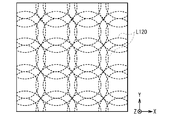
- the diffractive optical element 32 for example, a DOE corresponding to a saddle-shaped lens having a plane pattern as shown in FIG. 26A can be used in the region 32A.
- the plane patterns shown in FIG. 26A are arranged so as to be rotated by 45 ° in adjacent regions.
- the laser beams L120 emitted from the plurality of light emitting units 120 form, for example, an irradiation pattern as shown in FIG. 27. This makes it possible to improve, for example, a decrease in uniformity with respect to a deviation in the optical axis direction.
- a diffractive optical element 32 such as a Fresnel lens is used as the second optical member of the present disclosure.
- the microlens array 12 is used as the second optical member of the present disclosure, and for example, the laser beam L120 emitted from the plurality of light emitting units 120 for uniform irradiation is refracted. It is possible to further improve the uniformity of light intensity at the time of uniform irradiation as compared with the case where the shape is formed.
- a diffuser plate can be used in addition to the diffractive optical element 32 such as the microlens array 12 and the Fresnel lens described above.
- the position accuracy required is relaxed as compared with the case where the microlens array 12 or the diffractive optical element 32 is used, and the cost can be reduced. Become.
- the diffraction element 34 divides and emits the laser beam L110 emitted from the plurality of light emitting units 110 and the laser beam L120 emitted from the plurality of light emitting units 120.
- the diffraction element 34 is, for example, a simple diffraction grating in which a large number of parallel slits are arranged at equal intervals. This diffraction element 34 corresponds to a specific example of the "third optical member" of the present disclosure.
- the laser beam L120 for uniform irradiation emitted from the plurality of light emitting units 120 is also diffracted in the same manner as the laser beam L110 for spot irradiation, the light intensity at the time of uniform irradiation due to the overlap of the diffracted light. It becomes possible to further improve the uniformity of.
- the diffraction element 34 is further arranged on the optical paths of the laser beams L1110 and L120 emitted from the plurality of light emitting units 110 and the plurality of light emitting units 120, respectively.
- the present modification shows an example in which the diffraction element 14 and the diffraction element 34 are configured as separate parts, the diffraction optical surfaces may be arranged on both sides of one optical element. Further, in FIG. 28, an example in which the diffraction element 34 is arranged after the collimator lens 13 is shown, but the arrangement position of the diffraction element 34 is not limited to this, and for example, the microlens array 12 and the collimator lens 13 are arranged. It may be arranged in between.
- the diffraction element 34 may be integrated with the microlens array 12, for example. In that case, for example, it may be configured to act only on the laser beam L110 for spot irradiation or only the laser beam L120 for uniform irradiation. Further, the laser beam L110 for spot irradiation and the laser beam L120 for uniform irradiation can form different diffraction patterns from each other.
- DOE diffraction optical element
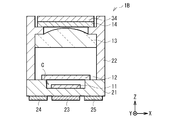
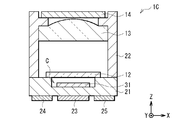
- FIG. 30 is a cross-sectional view schematically showing an example of a schematic configuration of the lighting device (lighting device 1C) according to the modified example 5 of the present disclosure.
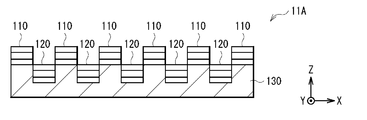
- the lighting device 1C of this modification is different from the above embodiment in that a back-emission type surface-emitting semiconductor laser is used as the light-emitting element 31.
- FIG. 31 shows an example of the cross-sectional configuration of the light emitting element 31 in the lighting device 1C and the positional relationship with the microlens array 12.
- the light emitting element 31 is a back-emission type surface-emitting semiconductor laser, and a plurality of light-emitting units 310 and 320 for spot irradiation and uniform irradiation are arranged on the back surface (surface 130S2) side of the substrate 130. It is formed in a shape.
- the surface 130S2 of the substrate 130 is further provided with an electrode pad 340 for applying a voltage to the plurality of light emitting units 310 and an electrode pad 350 for applying a voltage to the plurality of light emitting units 320. Except for this point, the light emitting element 31 has the same configuration as the above-mentioned light emitting element 11.
- the lighting apparatus of the present disclosure not only the front-illuminated surface-emitting semiconductor laser but also the back-illuminated surface-emitting semiconductor laser can be used.
- a back-illuminated surface-emitting semiconductor laser as the light-emitting element 31, it is possible to reduce the area of the plurality of electrode pads. Further, as compared with the above-described embodiment, it is possible to easily switch between spot irradiation and uniform irradiation.
- FIG. 32 shows an example in which the microlens 42 is arranged as the second optical member, but the present invention is not limited to this, and a diffractive optical element such as a Fresnel lens or a diffuser may be arranged.
- a diffractive optical element such as a Fresnel lens or a diffuser
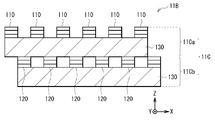
- FIG. 33 schematically shows another example of the cross-sectional configuration of the light emitting element 11 in the modified example 6 of the present disclosure.
- a light emitting element 11 having a plurality of light emitting units 110 for spot irradiation and a plurality of light emitting units 120 for uniform irradiation is used on the same plane, but each of the plurality of light emitting units 110 And the plurality of light emitting units 120 may be formed on different planes from each other.
- one of the plurality of light emitting units 110 and the plurality of light emitting units 120 (for example, the plurality of light emitting units 110) is on the surface (surface 130S1) side of the substrate 130.
- the other (for example, a plurality of light emitting units 120) may be provided on the back surface (surface 130S2) side of the substrate 130. That is, of the plurality of light emitting parts for spot irradiation and the plurality of light emitting parts for uniform irradiation, one of the plurality of light emitting parts is a front-emission type surface-emitting semiconductor laser, and the other plurality of light-emitting parts are back-emission type.
- the surface emitting semiconductor laser of the above may be used.
- the present disclosure has been described above with reference to the embodiments and modifications 1 to 6, the present disclosure is not limited to the above-described embodiments and the like, and various modifications are possible.
- the above-mentioned modifications 1 to 6 may be combined with each other, and for example, a back-emission type surface emitting laser and a diffractive optical element 32 such as a Fresnel lens may be combined.
- the DOE diffractive optical element 32
- FIGS. 21 and 26 the DOE (diffraction optical element 32) having a period larger than the wavelength is shown, but a structure having a size smaller than the wavelength, a so-called metamaterial, may be used to provide a beam forming function. Good.
- the present technology can also have the following configurations.
- the light plural of first light and plurality of second light
- a light emitting element having a plurality of first light emitting portions and a plurality of second light emitting portions. Since the second optical member that forms at least one of the beam shapes and emits the second optical member is arranged, the positions of the emission points of the plurality of first lights and the plurality of second lights can be changed. Therefore, it is possible to realize miniaturization of the lighting device and the distance measuring device provided with the lighting device.
- (11) It is arranged on the optical paths of the plurality of first lights and the plurality of second lights, and refracts or diffracts the plurality of first lights to increase the number of spots irradiated to the irradiation target.
- the third optical member further includes a third optical member that increases the overlapping range with the second light emitted from the adjacent second light emitting unit by refracting or diffracting the plurality of second lights. 2) The lighting device according to any one of (10).
- the plurality of first light emitting units and the plurality of second light emitting units are provided on one surface of the substrate, respectively, and the plurality of first light emitting units are provided from the other surface of the substrate facing the one surface.
- the light and the plurality of second lights are emitted, respectively.
- the light emitting element is a back surface emitting type surface emitting laser.
- a light emitting element having a plurality of first light emitting parts and a plurality of second light emitting parts, A first optical member that emits a plurality of first lights emitted from the plurality of first light emitting units and a plurality of second lights emitted from the plurality of second light emitting units in substantially parallel manner.
- a second optical member that forms and emits beam shapes of the plurality of second lights emitted from the plurality of second light emitting units, and a second optical member. It is provided with a drive unit that independently controls switching between lighting and extinguishing of the first light emitting unit and the second light emitting unit.
- the lighting device is A light emitting element having a plurality of first light emitting parts and a plurality of second light emitting parts, A first optical member that emits a plurality of first lights emitted from the plurality of first light emitting units and a plurality of second lights emitted from the plurality of second light emitting units in substantially parallel manner.
- the plurality of first lights and the plurality of second lights are formed as light having different beam shapes by forming at least one beam shape of the plurality of first lights and the plurality of second lights.
- a distance measuring device having a second optical member that emits light.
Landscapes
- Physics & Mathematics (AREA)
- Engineering & Computer Science (AREA)
- General Physics & Mathematics (AREA)
- Remote Sensing (AREA)
- Computer Networks & Wireless Communication (AREA)
- Radar, Positioning & Navigation (AREA)
- Optics & Photonics (AREA)
- Electromagnetism (AREA)
- General Engineering & Computer Science (AREA)
- Semiconductor Lasers (AREA)
- Non-Portable Lighting Devices Or Systems Thereof (AREA)
- Microelectronics & Electronic Packaging (AREA)
- Measurement Of Optical Distance (AREA)
Priority Applications (3)
| Application Number | Priority Date | Filing Date | Title |
|---|---|---|---|
| JP2021552354A JPWO2021075340A1 (https=) | 2019-10-15 | 2020-10-08 | |
| US17/760,882 US12566266B2 (en) | 2019-10-15 | 2020-10-08 | Lighting device and distance measurement apparatus |
| EP20876299.7A EP4024629A4 (en) | 2019-10-15 | 2020-10-08 | LIGHTING DEVICE AND RANGING DEVICE |
Applications Claiming Priority (2)
| Application Number | Priority Date | Filing Date | Title |
|---|---|---|---|
| JP2019188724 | 2019-10-15 | ||
| JP2019-188724 | 2019-10-15 |
Publications (1)
| Publication Number | Publication Date |
|---|---|
| WO2021075340A1 true WO2021075340A1 (ja) | 2021-04-22 |
Family
ID=75537963
Family Applications (1)
| Application Number | Title | Priority Date | Filing Date |
|---|---|---|---|
| PCT/JP2020/038090 Ceased WO2021075340A1 (ja) | 2019-10-15 | 2020-10-08 | 照明装置および測距装置 |
Country Status (4)
| Country | Link |
|---|---|
| US (1) | US12566266B2 (https=) |
| EP (1) | EP4024629A4 (https=) |
| JP (1) | JPWO2021075340A1 (https=) |
| WO (1) | WO2021075340A1 (https=) |
Cited By (6)
| Publication number | Priority date | Publication date | Assignee | Title |
|---|---|---|---|---|
| WO2022176389A1 (ja) * | 2021-02-16 | 2022-08-25 | ソニーセミコンダクタソリューションズ株式会社 | 光学モジュールおよび距離測定装置 |
| WO2022209375A1 (ja) * | 2021-03-31 | 2022-10-06 | ソニーセミコンダクタソリューションズ株式会社 | 発光素子、照明装置、および、測距装置 |
| EP4163668A1 (en) * | 2021-10-08 | 2023-04-12 | II-VI Delaware, Inc. | Shared optic assembly for combined dot and flood illumination modules |
| WO2024013948A1 (ja) * | 2022-07-14 | 2024-01-18 | 日清紡マイクロデバイス株式会社 | 半導体レーザ駆動装置 |
| WO2024014138A1 (ja) * | 2022-07-15 | 2024-01-18 | キヤノン株式会社 | 光学装置、車載システム、および移動装置 |
| WO2024122207A1 (ja) * | 2022-12-06 | 2024-06-13 | ソニーセミコンダクタソリューションズ株式会社 | 照明装置及び測距装置 |
Families Citing this family (1)
| Publication number | Priority date | Publication date | Assignee | Title |
|---|---|---|---|---|
| US20240113496A1 (en) * | 2022-09-29 | 2024-04-04 | Zebra Technologies Corporation | Compact Optical System For A VCSEL Based Laser Aim Pattern Generator |
Citations (8)
| Publication number | Priority date | Publication date | Assignee | Title |
|---|---|---|---|---|
| JP2011510344A (ja) * | 2008-01-21 | 2011-03-31 | プライムセンス リミテッド | 0次低減のための光学設計 |
| US20140376092A1 (en) * | 2013-06-19 | 2014-12-25 | Primesense Ltd. | Integrated structured-light projector |
| JP2016519436A (ja) * | 2013-04-22 | 2016-06-30 | トリルミナ コーポレーション | 高周波動作のための光電子装置のマルチビームアレイ用マイクロレンズ |
| JP2017102319A (ja) * | 2015-12-03 | 2017-06-08 | 日立金属株式会社 | 光モジュール及びその製造方法 |
| US20190018137A1 (en) | 2017-07-14 | 2019-01-17 | Microsoft Technology Licensing, Llc | Optical projector having switchable light emission patterns |
| US20190033429A1 (en) * | 2017-07-28 | 2019-01-31 | OPSYS Tech Ltd. | VCSEL Array LIDAR Transmitter with Small Angular Divergence |
| JP2019113530A (ja) * | 2017-12-22 | 2019-07-11 | 株式会社デンソー | 距離測定装置、認識装置、及び距離測定方法 |
| JP2019188724A (ja) | 2018-04-26 | 2019-10-31 | 京セラドキュメントソリューションズ株式会社 | 画像形成装置、報知方法 |
Family Cites Families (14)
| Publication number | Priority date | Publication date | Assignee | Title |
|---|---|---|---|---|
| JP4985100B2 (ja) * | 2007-05-28 | 2012-07-25 | ソニー株式会社 | 多波長レーザ、光ピックアップ装置および光ディスク装置 |
| US8995493B2 (en) | 2009-02-17 | 2015-03-31 | Trilumina Corp. | Microlenses for multibeam arrays of optoelectronic devices for high frequency operation |
| DE102011107893A1 (de) * | 2011-07-18 | 2013-01-24 | Heraeus Noblelight Gmbh | Optoelektronisches Modul mit verbesserter Optik |
| EP3259612B1 (en) * | 2015-02-19 | 2018-09-26 | Koninklijke Philips N.V. | Infrared laser illumination device |
| WO2018191489A1 (en) * | 2017-04-12 | 2018-10-18 | Sense Photonics, Inc. | Ultra-small vertical cavity surface emitting laser (vcsel) and arrays incorporating the same |
| CN107424188B (zh) * | 2017-05-19 | 2020-06-30 | 深圳奥比中光科技有限公司 | 基于vcsel阵列光源的结构光投影模组 |
| EP3447862A1 (en) * | 2017-08-23 | 2019-02-27 | Koninklijke Philips N.V. | Vcsel array with common wafer level integrated optical device |
| US10355456B2 (en) * | 2017-09-26 | 2019-07-16 | Lumentum Operations Llc | Emitter array with variable spacing between adjacent emitters |
| US11126060B2 (en) * | 2017-10-02 | 2021-09-21 | Liqxtal Technology Inc. | Tunable light projector |
| US11662433B2 (en) * | 2017-12-22 | 2023-05-30 | Denso Corporation | Distance measuring apparatus, recognizing apparatus, and distance measuring method |
| CN108169981A (zh) | 2018-01-15 | 2018-06-15 | 深圳奥比中光科技有限公司 | 多功能照明模组 |
| CN108828563B (zh) * | 2018-06-08 | 2021-03-05 | 上海禾赛科技股份有限公司 | 一种激光发射装置 |
| CN113253474A (zh) * | 2019-01-25 | 2021-08-13 | 深圳市光鉴科技有限公司 | 可切换式漫射器投射系统和方法 |
| CN110412544A (zh) * | 2019-08-23 | 2019-11-05 | 上海禾赛光电科技有限公司 | 激光发射系统以及包括所述激光发射系统的激光雷达 |
-
2020
- 2020-10-08 JP JP2021552354A patent/JPWO2021075340A1/ja active Pending
- 2020-10-08 EP EP20876299.7A patent/EP4024629A4/en active Pending
- 2020-10-08 WO PCT/JP2020/038090 patent/WO2021075340A1/ja not_active Ceased
- 2020-10-08 US US17/760,882 patent/US12566266B2/en active Active
Patent Citations (8)
| Publication number | Priority date | Publication date | Assignee | Title |
|---|---|---|---|---|
| JP2011510344A (ja) * | 2008-01-21 | 2011-03-31 | プライムセンス リミテッド | 0次低減のための光学設計 |
| JP2016519436A (ja) * | 2013-04-22 | 2016-06-30 | トリルミナ コーポレーション | 高周波動作のための光電子装置のマルチビームアレイ用マイクロレンズ |
| US20140376092A1 (en) * | 2013-06-19 | 2014-12-25 | Primesense Ltd. | Integrated structured-light projector |
| JP2017102319A (ja) * | 2015-12-03 | 2017-06-08 | 日立金属株式会社 | 光モジュール及びその製造方法 |
| US20190018137A1 (en) | 2017-07-14 | 2019-01-17 | Microsoft Technology Licensing, Llc | Optical projector having switchable light emission patterns |
| US20190033429A1 (en) * | 2017-07-28 | 2019-01-31 | OPSYS Tech Ltd. | VCSEL Array LIDAR Transmitter with Small Angular Divergence |
| JP2019113530A (ja) * | 2017-12-22 | 2019-07-11 | 株式会社デンソー | 距離測定装置、認識装置、及び距離測定方法 |
| JP2019188724A (ja) | 2018-04-26 | 2019-10-31 | 京セラドキュメントソリューションズ株式会社 | 画像形成装置、報知方法 |
Non-Patent Citations (1)
| Title |
|---|
| See also references of EP4024629A4 |
Cited By (7)
| Publication number | Priority date | Publication date | Assignee | Title |
|---|---|---|---|---|
| WO2022176389A1 (ja) * | 2021-02-16 | 2022-08-25 | ソニーセミコンダクタソリューションズ株式会社 | 光学モジュールおよび距離測定装置 |
| WO2022209375A1 (ja) * | 2021-03-31 | 2022-10-06 | ソニーセミコンダクタソリューションズ株式会社 | 発光素子、照明装置、および、測距装置 |
| EP4163668A1 (en) * | 2021-10-08 | 2023-04-12 | II-VI Delaware, Inc. | Shared optic assembly for combined dot and flood illumination modules |
| WO2024013948A1 (ja) * | 2022-07-14 | 2024-01-18 | 日清紡マイクロデバイス株式会社 | 半導体レーザ駆動装置 |
| WO2024014138A1 (ja) * | 2022-07-15 | 2024-01-18 | キヤノン株式会社 | 光学装置、車載システム、および移動装置 |
| JP2024011627A (ja) * | 2022-07-15 | 2024-01-25 | キヤノン株式会社 | 光学装置、車載システム、および移動装置 |
| WO2024122207A1 (ja) * | 2022-12-06 | 2024-06-13 | ソニーセミコンダクタソリューションズ株式会社 | 照明装置及び測距装置 |
Also Published As
| Publication number | Publication date |
|---|---|
| US12566266B2 (en) | 2026-03-03 |
| EP4024629A4 (en) | 2022-10-12 |
| US20220342070A1 (en) | 2022-10-27 |
| JPWO2021075340A1 (https=) | 2021-04-22 |
| EP4024629A1 (en) | 2022-07-06 |
Similar Documents
| Publication | Publication Date | Title |
|---|---|---|
| WO2021075340A1 (ja) | 照明装置および測距装置 | |
| US20240019547A1 (en) | Illumination apparatus and ranging apparatus | |
| CN118117450A (zh) | 具有一体式微透镜的竖直发射器 | |
| CN114995015A (zh) | 多功能照明模组 | |
| CN114428437B (zh) | 一种结构光与泛光照明合置的3d投射器及电子设备 | |
| CN115524711B (zh) | 用于三维测距系统的线阵投影器 | |
| JP2023099236A (ja) | 発光装置および測距装置 | |
| JP7756153B2 (ja) | 照明装置および測距装置 | |
| CN110928123A (zh) | 一种激光器阵列、激光光源及激光投影设备 | |
| WO2018150942A1 (ja) | 光源装置および投光装置 | |
| KR20230000915A (ko) | 3차원 거리 측정 시스템에 사용하기 위한 도트 패턴 프로젝터 | |
| US20230048675A1 (en) | Light-emitting apparatus | |
| US20240422417A1 (en) | Illumination device for illuminating a scene, camera system and method for illuminating a scene | |
| US20240111030A1 (en) | Optical module and distance measuring device | |
| KR102951745B1 (ko) | 조명 광학계 및 노광 장치 | |
| US20240183946A1 (en) | Illumination device and distance measuring device | |
| US20240219526A1 (en) | Illumination device and ranging device | |
| JPWO2019049589A1 (ja) | 光源装置および投光装置 | |
| WO2022209375A1 (ja) | 発光素子、照明装置、および、測距装置 | |
| KR101533690B1 (ko) | 모듈형 광학 장치 | |
| JP2022074031A (ja) | 光学素子、光学装置、距離測定装置及び移動体 | |
| KR20230091869A (ko) | 발광 장치 및 측거 시스템 | |
| JP2021136249A (ja) | 光源装置及び光源装置の製造方法 | |
| US20240151821A1 (en) | Optical module and distance measuring device | |
| JP2010085434A (ja) | ビーム照射装置および位置検出装置 |
Legal Events
| Date | Code | Title | Description |
|---|---|---|---|
| 121 | Ep: the epo has been informed by wipo that ep was designated in this application |
Ref document number: 20876299 Country of ref document: EP Kind code of ref document: A1 |
|
| ENP | Entry into the national phase |
Ref document number: 2021552354 Country of ref document: JP Kind code of ref document: A |
|
| ENP | Entry into the national phase |
Ref document number: 2020876299 Country of ref document: EP Effective date: 20220330 |
|
| NENP | Non-entry into the national phase |
Ref country code: DE |
|
| WWG | Wipo information: grant in national office |
Ref document number: 17760882 Country of ref document: US |