WO2021065161A1 - 高周波信号伝送部品 - Google Patents
高周波信号伝送部品 Download PDFInfo
- Publication number
- WO2021065161A1 WO2021065161A1 PCT/JP2020/028077 JP2020028077W WO2021065161A1 WO 2021065161 A1 WO2021065161 A1 WO 2021065161A1 JP 2020028077 W JP2020028077 W JP 2020028077W WO 2021065161 A1 WO2021065161 A1 WO 2021065161A1
- Authority
- WO
- WIPO (PCT)
- Prior art keywords
- frequency signal
- signal transmission
- polybutylene terephthalate
- terephthalate resin
- transmission component
- Prior art date
- Legal status (The legal status is an assumption and is not a legal conclusion. Google has not performed a legal analysis and makes no representation as to the accuracy of the status listed.)
- Ceased
Links
Images

Classifications
-
- H—ELECTRICITY
- H01—ELECTRIC ELEMENTS
- H01Q—ANTENNAS, i.e. RADIO AERIALS
- H01Q1/00—Details of, or arrangements associated with, antennas
- H01Q1/42—Housings not intimately mechanically associated with radiating elements, e.g. radome
-
- C—CHEMISTRY; METALLURGY
- C08—ORGANIC MACROMOLECULAR COMPOUNDS; THEIR PREPARATION OR CHEMICAL WORKING-UP; COMPOSITIONS BASED THEREON
- C08K—Use of inorganic or non-macromolecular organic substances as compounding ingredients
- C08K7/00—Use of ingredients characterised by shape
- C08K7/02—Fibres or whiskers
- C08K7/04—Fibres or whiskers inorganic
-
- C—CHEMISTRY; METALLURGY
- C08—ORGANIC MACROMOLECULAR COMPOUNDS; THEIR PREPARATION OR CHEMICAL WORKING-UP; COMPOSITIONS BASED THEREON
- C08L—COMPOSITIONS OF MACROMOLECULAR COMPOUNDS
- C08L67/00—Compositions of polyesters obtained by reactions forming a carboxylic ester link in the main chain; Compositions of derivatives of such polymers
- C08L67/02—Polyesters derived from dicarboxylic acids and dihydroxy compounds
-
- H—ELECTRICITY
- H01—ELECTRIC ELEMENTS
- H01Q—ANTENNAS, i.e. RADIO AERIALS
- H01Q1/00—Details of, or arrangements associated with, antennas
- H01Q1/36—Structural form of radiating elements, e.g. cone, spiral, umbrella; Particular materials used therewith
- H01Q1/38—Structural form of radiating elements, e.g. cone, spiral, umbrella; Particular materials used therewith formed by a conductive layer on an insulating support
-
- H—ELECTRICITY
- H01—ELECTRIC ELEMENTS
- H01R—ELECTRICALLY-CONDUCTIVE CONNECTIONS; STRUCTURAL ASSOCIATIONS OF A PLURALITY OF MUTUALLY-INSULATED ELECTRICAL CONNECTING ELEMENTS; COUPLING DEVICES; CURRENT COLLECTORS
- H01R13/00—Details of coupling devices of the kinds covered by groups H01R12/70 or H01R24/00 - H01R33/00
- H01R13/46—Bases; Cases
-
- H—ELECTRICITY
- H05—ELECTRIC TECHNIQUES NOT OTHERWISE PROVIDED FOR
- H05K—PRINTED CIRCUITS; CASINGS OR CONSTRUCTIONAL DETAILS OF ELECTRIC APPARATUS; MANUFACTURE OF ASSEMBLAGES OF ELECTRICAL COMPONENTS
- H05K1/00—Printed circuits
- H05K1/02—Details
- H05K1/0213—Electrical arrangements not otherwise provided for
- H05K1/0237—High frequency adaptations
-
- H—ELECTRICITY
- H05—ELECTRIC TECHNIQUES NOT OTHERWISE PROVIDED FOR
- H05K—PRINTED CIRCUITS; CASINGS OR CONSTRUCTIONAL DETAILS OF ELECTRIC APPARATUS; MANUFACTURE OF ASSEMBLAGES OF ELECTRICAL COMPONENTS
- H05K1/00—Printed circuits
- H05K1/02—Details
- H05K1/03—Use of materials for the substrate
- H05K1/0313—Organic insulating material
- H05K1/0353—Organic insulating material consisting of two or more materials, e.g. two or more polymers, polymer + filler, + reinforcement
-
- H—ELECTRICITY
- H05—ELECTRIC TECHNIQUES NOT OTHERWISE PROVIDED FOR
- H05K—PRINTED CIRCUITS; CASINGS OR CONSTRUCTIONAL DETAILS OF ELECTRIC APPARATUS; MANUFACTURE OF ASSEMBLAGES OF ELECTRICAL COMPONENTS
- H05K1/00—Printed circuits
- H05K1/18—Printed circuits structurally associated with non-printed electric components
- H05K1/181—Printed circuits structurally associated with non-printed electric components associated with surface mounted components
-
- H—ELECTRICITY
- H05—ELECTRIC TECHNIQUES NOT OTHERWISE PROVIDED FOR
- H05K—PRINTED CIRCUITS; CASINGS OR CONSTRUCTIONAL DETAILS OF ELECTRIC APPARATUS; MANUFACTURE OF ASSEMBLAGES OF ELECTRICAL COMPONENTS
- H05K3/00—Apparatus or processes for manufacturing printed circuits
- H05K3/22—Secondary treatment of printed circuits
- H05K3/28—Applying non-metallic protective coatings
- H05K3/284—Applying non-metallic protective coatings for encapsulating mounted components
-
- C—CHEMISTRY; METALLURGY
- C08—ORGANIC MACROMOLECULAR COMPOUNDS; THEIR PREPARATION OR CHEMICAL WORKING-UP; COMPOSITIONS BASED THEREON
- C08L—COMPOSITIONS OF MACROMOLECULAR COMPOUNDS
- C08L25/00—Compositions of, homopolymers or copolymers of compounds having one or more unsaturated aliphatic radicals, each having only one carbon-to-carbon double bond, and at least one being terminated by an aromatic carbocyclic ring; Compositions of derivatives of such polymers
- C08L25/02—Homopolymers or copolymers of hydrocarbons
- C08L25/04—Homopolymers or copolymers of styrene
- C08L25/06—Polystyrene
-
- H—ELECTRICITY
- H01—ELECTRIC ELEMENTS
- H01B—CABLES; CONDUCTORS; INSULATORS; SELECTION OF MATERIALS FOR THEIR CONDUCTIVE, INSULATING OR DIELECTRIC PROPERTIES
- H01B3/00—Insulators or insulating bodies characterised by the insulating materials; Selection of materials for their insulating or dielectric properties
- H01B3/18—Insulators or insulating bodies characterised by the insulating materials; Selection of materials for their insulating or dielectric properties mainly consisting of organic substances
- H01B3/30—Insulators or insulating bodies characterised by the insulating materials; Selection of materials for their insulating or dielectric properties mainly consisting of organic substances plastics; resins; waxes
- H01B3/42—Insulators or insulating bodies characterised by the insulating materials; Selection of materials for their insulating or dielectric properties mainly consisting of organic substances plastics; resins; waxes polyesters; polyethers; polyacetals
-
- H—ELECTRICITY
- H01—ELECTRIC ELEMENTS
- H01Q—ANTENNAS, i.e. RADIO AERIALS
- H01Q1/00—Details of, or arrangements associated with, antennas
- H01Q1/27—Adaptation for use in or on movable bodies
- H01Q1/32—Adaptation for use in or on road or rail vehicles
- H01Q1/3208—Adaptation for use in or on road or rail vehicles characterised by the application wherein the antenna is used
- H01Q1/3233—Adaptation for use in or on road or rail vehicles characterised by the application wherein the antenna is used particular used as part of a sensor or in a security system, e.g. for automotive radar, navigation systems
Definitions
- the present invention relates to a high frequency signal transmission component.
- Engineering plastics are widely used in various applications such as automobile parts and electrical / electronic parts because they have excellent mechanical properties, electrical properties, water resistance, chemical resistance, solvent resistance, and the like.
- the dielectric property means that the transmission loss and transmission loss of high-frequency signals are small. That is, excellent dielectric properties mean low dielectric loss characteristics.
- the mechanical strength refers to a mechanical strength that can sufficiently withstand even when used outdoors or when used for a long period of time.
- Polyolefin resins such as polyethylene and polypropylene are known as resin materials having low dielectric loss characteristics. Many high-frequency signal transmission components generate heat, and when these general-purpose resins are used, the mechanical strength at high temperatures is not sufficient, and they may not be preferably used.
- polybutylene terephthalate resin (hereinafter, may be referred to as PBT resin) is preferable as a raw material for high-frequency signal transmission components because it has physical properties such as mechanical strength required for high-frequency signal transmission components and is also excellent in heat resistance.
- PBT resin polybutylene terephthalate resin
- polybutylene terephthalate resin does not have sufficient low dielectric loss characteristics, it cannot be preferably used as a raw material for high-frequency signal transmission components.
- Patent Document 1 a mixture of PBT resin and polyethylene-based resin is disclosed as a resin material having mechanical strength of a certain level or higher and low dielectric loss characteristics.
- the present invention has been made to solve this problem, and an object of the present invention is to provide a high-frequency signal transmission component having an excellent property of being less susceptible to moisture than before.
- a high frequency signal transmission component comprising a polybutylene terephthalate resin composition containing and. 2.
- the dielectric loss tangent after 300 hours humidity control at 23 ° C. and 50% RH is 0.01 or less, the relative permittivity ⁇ r 1 after 300 hours humidity control at 23 ° C. and 50% RH, and drying at 110 ° C. for 24 hours.
- the high-frequency signal transmission component according to 1 above wherein the difference in the relative permittivity from the relative permittivity ⁇ r 2 at the time is 0.01 or less. 3. 3.
- the relative permittivity ⁇ r 1 after humidity control at 23 ° C. and 50% RH for 300 hours is 3.5 or less, and the difference from the relative permittivity ⁇ r 3 at the time of water absorption after immersion in warm water at 80 ° C. for 300 hours is The high-frequency signal transmission component according to 1 or 2 above, which is 0.10 or less. 4.
- FIG. 1A and 1B are diagrams schematically showing a usage example of the high-frequency signal transmission component of the present invention
- FIG. 1A is a diagram showing a case where the high-frequency signal transmission component covers a high-frequency signal transmitter
- FIG. 1B is a diagram showing a case where the high-frequency signal transmission component covers the high-frequency signal transmitter. It is a figure which shows the case where the high frequency signal transmission component covers a high frequency signal receiving part.
- FIG. 1 is a diagram schematically showing a usage example of the high-frequency signal transmission component of the present embodiment, (a) is a case where the high-frequency signal transmission component covers the high-frequency signal transmission portion, and (b) is a high-frequency signal transmission component. Covers the high frequency signal receiver.
- the high-frequency signal transmission component of the present embodiment is a component used for high-frequency electric / electronic equipment, and more specifically, a circuit board of high-frequency electric / electronic equipment, an antenna base material of high-frequency electric / electronic equipment, and the like.
- Antenna covers for high-frequency electrical and electronic equipment, connectors for high-frequency electrical and electronic equipment, housings for high-frequency electrical and electronic equipment, etc.
- the high-frequency signal transmission component 10 of the present embodiment is a component for covering the high-frequency signal transmission transmission unit 20 and the high-frequency signal reception unit 30.
- the high-frequency signal transmission component 10 covers the high-frequency signal transmission component 20, as shown in FIG. 1A, the electromagnetic waves emitted by the high-frequency signal transmission unit 20 pass through the high-frequency signal transmission component 10 and exist outside. It is received by a high-frequency signal receiver (not shown).
- an electromagnetic wave emitted by an external high-frequency signal transmitting unit (not shown) transmits the high-frequency signal. It passes through the component 10 and is received by the high frequency signal receiving unit 30.
- the high-frequency signal transmission component 10 of the present embodiment has low dielectric loss characteristics, excellent impact resistance, and excellent water resistance, and is therefore preferable as a high-frequency signal transmission component used in a harsh environment.
- parts for protecting the in-vehicle collision prevention radar parts for protecting the radar for the purpose of collision avoidance, etc.
- in-vehicle antenna cover parts for protecting the radar for the purpose of collision avoidance, etc.
- in-vehicle connector parts for protecting the radar for the purpose of collision avoidance, etc.
- in-vehicle electronic control circuit housing parts for protecting the in-vehicle antenna cover, in-vehicle connector, in-vehicle electronic control circuit housing, mobile phone housing.
- the water resistance and mechanical strength of the present invention are often required.
- the entire high-frequency signal transmission component 10 covering the high-frequency signal transmitting unit 20 and the high-frequency signal receiving unit 30 is the high-frequency signal transmission component of the present invention, but the present invention is used as a part of a portion through which an electromagnetic wave passes.
- High frequency signal transmission components may be arranged.
- the high-frequency signal transmitting unit 20 and the high-frequency signal receiving unit 30 covered with the high-frequency signal transmission component 10 of the present embodiment is an example of the high-frequency electric / electronic device of the present invention.
- Examples of high-frequency electric / electronic devices include radar sensors and the like.
- the high-frequency signal transmission component of the present invention has low dielectric loss characteristics, excellent mechanical strength, and excellent water resistance because the high-frequency signal transmission component has (A) polybutylene terephthalate resin and (B) polystyrene-based resin. This is because it is composed of a polybutylene terephthalate resin composition containing (C) a fibrous inorganic filler.
- the polybutylene terephthalate resin composition constituting the high-frequency signal transmission component of the present invention contains at least (A) polybutylene terephthalate resin, (B) polystyrene-based resin, and (C) fibrous inorganic filler.
- the polybutylene terephthalate resin (A) contains a dicarboxylic acid component containing at least terephthalic acid or an ester-forming derivative thereof (such as an alkyl ester of C 1-6 or an acid halide) and an alkylene glycol having at least 4 carbon atoms (1, It is a polybutylene terephthalate resin obtained by polycondensing with a glycol component containing 4-butanediol) or an ester-forming derivative thereof (acetylated product, etc.).
- the polybutylene terephthalate resin is not limited to the homopolybutylene terephthalate resin, and may be a copolymer containing 60 mol% or more (particularly 75 mol% or more and 95 mol% or less) of butylene terephthalate units.
- examples of the dicarboxylic acid component (comonomer component) other than terephthalic acid and its ester-forming derivative include isophthalic acid, phthalic acid, 2,6-naphthalenedicarboxylic acid, and 4 , 4'-C 8-14 aromatic dicarboxylic acid such as dicarboxydiphenyl ether; C 4-16 arcandicarboxylic acid such as succinic acid, adipic acid, azelaic acid, sebacic acid; C 5-10 such as cyclohexanedicarboxylic acid Cycloalkanedicarboxylic acid; Examples thereof include ester-forming derivatives of these dicarboxylic acid components (C 1-6 alkyl ester derivatives, acid halides, etc.). These dicarboxylic acid components can be used alone or in combination of two or more.
- examples of the glycol component (comonomer component) other than 1,4-butanediol include ethylene glycol, propylene glycol, trimethylene glycol, 1,3-butylene glycol, and hexa.
- C 2-10 alkylene glycols such as methylene glycol, neopentyl glycol and 1,3-octanediol; polyoxyalkylene glycols such as diethylene glycol, triethylene glycol and dipropylene glycol; fats such as cyclohexanedimethanol and hydride bisphenol A Cyclic diols; aromatic diols such as bisphenol A, 4,4'-dihydroxybiphenyl; C 2-4 of bisphenol A such as ethylene oxide 2 mol adduct of bisphenol A and propylene oxide 3 mol adduct of bisphenol A. Alkylene oxide adducts; or ester-forming derivatives of these glycols (acetylates, etc.) can be mentioned. These glycol components can be used alone or in combination of two or more.
- the intrinsic viscosity of the polybutylene terephthalate resin used in the present invention is not particularly limited as long as the object of the present invention is not impaired. Further, polybutylene terephthalate resins having different intrinsic viscosities may be mixed to prepare a polybutylene terephthalate resin having a desired intrinsic viscosity.
- the amount of terminal carboxyl groups of the (A) polybutylene terephthalate resin used in the present invention is not particularly limited as long as the object of the present invention is not impaired, but when the (D) compatibilizer described later is contained in the polybutylene terephthalate resin composition.
- the terminal carboxyl group is preferably contained in a specific range. Details will be described later.
- the polystyrene-based resin is formed by polymerizing a styrene-based monomer having a polymerizable double bond in the molecule.
- the styrene-based monomer is not particularly limited, and for example, styrene, p-methylstyrene, m-methylstyrene, p-chlorostyrene, p-fluorostyrene, p-phenylstyrene, pt-butylstyrene, ⁇ -methyl. Examples thereof include styrene ethylene, p-methyl- ⁇ -methyl styrene, and 2-vinylnaphthalene.
- the polystyrene-based resin may be copolymerized with other monomers, but the styrene-derived monomer is preferably 50 mol% or more, more preferably 60 mol% or more, and 70 mol% or more. Is even more preferable, 80 mol% or more is even more preferable, 90 mol% or more is particularly preferable, and 100 mol% is most preferable.
- other monomers include olefin monomers such as ethylene and propylene, and acrylic ester monomers such as methyl methacrylate.
- the content of the (B) polystyrene-based resin is preferably 10 parts by mass or more and 100 parts by mass or less with respect to 100 parts by mass of the (A) polybutylene terephthalate resin.
- the content of the polystyrene-based resin (B), which is more preferable, is 10 parts by mass or more and 60 parts by mass or less.
- (C) Fibrous inorganic filler ⁇
- the type of (C) fibrous inorganic filler is not particularly limited.
- the (C) fibrous inorganic filler include metal fibrous materials.
- glass fiber is particularly preferable among these (C) fibrous inorganic fillers.
- any known glass fiber is preferably used, and the glass fiber diameter, the shape such as a cylinder, a cocoon-shaped cross section, an oval cross section, or the length and glass cut when used in the production of chopped strands, rovings, etc. It does not depend on the method of.
- the type of glass is not limited, and in addition to A glass and E glass generally used in resin compositions, corrosion-resistant glass containing a zirconium element in the composition can also be used, but has a low dielectric loss.
- so-called low-dielectric glass such as D glass and NE glass is preferably used.
- the low-dielectric glass is a glass having a composition containing a large amount of boron oxide and a small amount of aluminum oxide, calcium oxide, and magnesium oxide as compared with A glass and E glass, and is known to have a low relative permittivity and dielectric loss tangent.
- the fiber length and fiber diameter of the glass fiber may be within the general range.
- fibers having a fiber length of 2.0 mm or more and 6.0 mm or less and a fiber diameter of 9.0 ⁇ m or more and 14.0 ⁇ m or less can be used.
- an organic treatment agent such as a silane compound or an epoxy compound for the purpose of improving the interface characteristics between (C) the fibrous inorganic filler and (A) polybutylene terephthalate resin.
- Fillers are preferably used. Any known silane compound or epoxy compound can be preferably used.
- the content of the (C) fibrous inorganic filler is not particularly limited, but is preferably 20 parts by mass or more and 80 parts by mass or less with respect to 100 parts by mass of the (A) polybutylene terephthalate resin.
- the content is preferably 20 parts by mass or more because high mechanical strength can be obtained, and 80 parts by mass or less is preferable because the dielectric properties and moldability are not impaired.
- the more preferable content of the fibrous inorganic filler (C) is 20 parts by mass or more and 60 parts by mass or less.
- the polybutylene terephthalate resin composition may contain (D) a compatibilizer.
- (D) compatibilizer used in the present invention, the compatibility between the (A) polybutylene terephthalate resin and the (B) polystyrene resin is improved, and the resin is exposed to moisture such as rain when used outdoors. Even in an environment, it becomes easy to suppress the infiltration of water into the interface between the (A) polybutylene terephthalate resin and the (B) polystyrene-based resin.
- Examples of the (D) compatibilizer include compounds having a functional group that reacts with the terminal carboxyl group of the (A) polybutylene terephthalate resin, such as a glycidyl group-containing reactive compound and a maleic acid-modified compound, and contain a glycidyl group.
- Examples of the reactive compound include a reactive copolymer composed of a monomer having a glycidyl group and an ethylene-based monomer or a styrene-based monomer, and / or, in addition to this, a methacrylic acid alkyl ester-based monomer and an acrylic acid alkyl ester-based monomer. It may be a glycidyl group-containing reactive compound composed of three or more kinds of monomers containing a monomer.
- the maleic acid-modified compound may be a styrene / maleic anhydride copolymer, a styrene-acrylonitrile-maleic anhydride copolymer, or a styrene / maleic acid half ester copolymer.
- w ⁇ is the content of the (A) polybutylene terephthalate resin (100 parts by mass)
- w ⁇ is the content of the (D) compatible filler (the (A) polybutylene terephthalate resin 100). Represents the content with respect to parts by mass.
- the content of the (D) compatibilizer is 1 part by mass or more and 15 parts by mass or less per 100 parts by mass of the (A) polybutylene terephthalate resin.
- the polybutylene terephthalate resin composition may contain other components as long as the effects of the present invention are not impaired.
- other components include additives such as nucleating agents, pigments, antioxidants, stabilizers, plasticizers, lubricants, mold release agents and flame retardants, and other resins.
- the content of other components in the polybutylene terephthalate resin composition is not particularly limited, but the above content is usually preferably 20% by mass or less, and more preferably 10% by mass or less.
- the content is preferably 50% by mass or less, more preferably 40% by mass or less.
- the specific embodiment of the method for preparing the polybutylene terephthalate resin composition is not particularly limited, and the resin composition can be prepared by equipment and methods generally known as a method for preparing the resin composition or a molded product thereof. it can.
- the required components can be mixed and kneaded using a single-screw or twin-screw extruder or other melt-kneading device to prepare pellets for molding.
- a plurality of extruders or other melt-kneading devices may be used.
- all the components may be input from the hopper at the same time, or some components may be input from the side feed port.
- the polybutylene terephthalate resin composition has a sea-island structure. Specifically, it is composed of a matrix phase (sea) of polybutylene terephthalate resin and a dispersed phase (islands) of polystyrene resin.
- the sea-island structure can be formed by adjusting the content of the polybutylene terephthalate resin and the content of the polystyrene-based resin.
- the above-mentioned sea-island structure can be obtained by increasing the content of polybutylene terephthalate in the polystyrene-based resin. Can be formed.
- the fibrous inorganic filler is present in the matrix phase.
- the surface of the fibrous inorganic filler can be treated with the above organic treatment agent to facilitate the presence of the fibrous inorganic filler in the matrix phase. it can.
- the polybutylene terephthalate resin composition is that it is superior in impact resistance to a polystyrene-based resin alone or a polybutylene terephthalate resin reinforced with a fibrous inorganic filler. Since the composition has excellent low dielectric loss characteristics and water resistance as described below, it can be preferably used as a raw material for high-frequency signal transmission components. When the resin composition has the following physical properties while having extremely excellent impact resistance, the resin composition can be preferably used as a raw material for an in-vehicle collision prevention radar or the like.
- the polybutylene terephthalate resin composition has excellent dielectric properties. Specifically, the dielectric loss tangent after moisture conditioning was 300 hours conditioned at 23 ° C. 50% RH is 0.01 or less, 24 hours drying in the relative dielectric constant .epsilon.r 1 and 110 ° C. after dampening 300 hours conditioned at 23 ° C. 50% RH Those having a difference from the relative permittivity ⁇ r 2 at the time of 0.10 or less are preferably used.
- the relative permittivity ⁇ r 1 after adjusting the humidity at 23 ° C. and 50% RH for 300 hours is 3.5 or less, and the difference from the relative permittivity ⁇ r 3 at the time of water absorption after being immersed in warm water at 80 ° C. for 300 hours.
- Those having a thickness of 0.10 or less are preferably used.
- the polybutylene terephthalate resin composition of the present invention is less affected by humidity and has excellent water-resistant dielectric properties.
- the high-frequency signal transmission component of the present invention is formed by molding the above-mentioned polybutylene terephthalate resin composition.
- the molding method is not particularly limited, and for example, an injection molding method or the like can be adopted, but a preferable molding method can be adopted depending on the shape or the like of the high frequency signal transmission component.
- the high-frequency signal transmission component of the present invention also has excellent impact resistance and water resistance. Has properties and dielectric properties.
- PBT Polybutylene terephthalate resin
- PS Polystyrene resin 1
- SPS Syndiotactic polystyrene resin
- PP Polypropylene (Prime Polypro J707EG, manufactured by Prime Polymer Co., Ltd.)
- PTFE Tetrafluoroethylene resin (KTL-450 manufactured by Kitamura Co., Ltd.)
- PPE Polyphenylene ether (PX100L, manufactured by Mitsubishi Engineering Plastics)
- EEA Ethylene ethyl acrylate (NUC-6570, manufactured by Nippon Unicar Co., Ltd.)
- PC Polycarbonate (Panlite L1225, manufactured by Teijin Chemicals Ltd.)
- PET Polyethylene terephthalate (BF3067, manufactured by Indrama)
- PA6 Polyamide (UBE nylon 1015B, manufactured by Ube Industries, Ltd.) Core-shell polymer (Paraloid EXL2311, manufactured by Rohm and Haas Japan) Epoxy resin (Epicoat JER1004K, manufactured by Mitsubishi Chemical Corporation)
- C-1) Fibrous inorganic filler Glass fiber (E glass) (GF) (ECS03T-187, manufactured by Nippon Electric Glass Co., Ltd.)
- C-2) Low Dielectric Glass Fiber (TLD-CS10-3.0-T-436S manufactured by Taizan Glass Fiber Co., Ltd.)
- Phenolic Antioxidant (Irganox 1010, manufactured by BASF Japan Ltd.)
- D-1 Compatibility agent: glycidyl group-containing reactive compound: glycidyl methacrylate / ethylene copolymer polymer (“Bond First E”, manufactured by Sumitomo Chemical Co., Ltd., epoxy equivalent: about 1200 g / eq, glycidyl methacrylate 12% by mass
- D-2) Compatibility agent: Maleic anhydride-modified SEBS (FG1901 polystyrene content 30% by mass manufactured by Kraton Polymer Japan) Carbon black (750B, manufactured by Mitsubishi Chemical Corporation)
- the polybutylene terephthalate resin composition (PBT resin composition of Examples) that can be used as a raw material for the high-frequency signal transmission component of the present invention has dielectric properties and water resistance without deteriorating mechanical strength. It was confirmed that it was excellent in sex.
- High-frequency signal transmission component 20 High-frequency signal transmission transmitter 30 High-frequency signal receiver
Landscapes
- Chemical & Material Sciences (AREA)
- Engineering & Computer Science (AREA)
- Microelectronics & Electronic Packaging (AREA)
- Health & Medical Sciences (AREA)
- Chemical Kinetics & Catalysis (AREA)
- Medicinal Chemistry (AREA)
- Polymers & Plastics (AREA)
- Organic Chemistry (AREA)
- Manufacturing & Machinery (AREA)
- Compositions Of Macromolecular Compounds (AREA)
- Casings For Electric Apparatus (AREA)
Abstract
本発明の目的は、高周波信号伝送部品として、従来よりも水分の影響を受けにくいという優れたものを提供することである。 本発明の目的は、少なくとも、 (A)ポリブチレンテレフタレート樹脂100質量部、 (B)ポリスチレン系樹脂15~50質量部、および (C)繊維状無機充填材0~70質量部、 とを含むポリブチレンテレフタレート樹脂組成物からなる高周波信号伝送部品、によって達成された。
Description
本発明は、高周波信号伝送部品に関する。
エンジニアリングプラスチックは、機械的特性、電気的特性、耐水性、耐薬品性及び耐溶剤性等に優れるため、自動車用部品、電気・電子部品等の種々の用途に広く利用されている。
近年、自動車用部品やモバイル用の電気・電子機器用に樹脂材料を用いることは、省資源・低環境負荷、軽量化等の観点からも特に望まれている。このような用途の中には、高周波信号を伝達あるいは電磁波を受発信する、電子回路の基材、該電子回路の接続用部品、該電子回路を覆う部品(以下、これらを高周波信号伝送部品という)もあり、このような部品に対しては耐衝撃性等の機械的強度のみならず、誘電特性に優れることも求められる。
ここで、誘電特性とは高周波信号の伝送損失や透過損失が小さいことを指す。つまり、優れた誘電特性とは低誘電損失特性を意味する。また、機械的強度とは、屋外で使用される場合や、長期間使用される場合であっても充分に耐えられる程度の機械的強度を指す。
低誘電損失特性を有する樹脂材料として、ポリエチレン、ポリプロピレン等のポリオレフィン樹脂が知られている。高周波信号伝送部品の中には発熱するもの多く、これらの汎用樹脂を用いる場合、高温下の機械的強度が充分ではなく、好ましく使用出来ないことがあった。
また、ポリブチレンテレフタレート樹脂(以下、PBT樹脂という場合がある)は、高周波信号伝送部品に求められる機械的強度等の物性を有するとともに、耐熱性にも優れるため、高周波信号伝送部品の原料として好ましいように思われるものの、ポリブチレンテレフタレート樹脂は低誘電損失特性が充分ではないため、高周波信号伝送部品の原料として好ましく用いることができない。
その改善策として、PBT樹脂とポリエチレン系樹脂の混合物が、一定水準以上の機械的強度を有し、かつ低誘電損失特性を有する樹脂材料として開示されている(特許文献1)。
しかしながら近年特にアンテナ、レドーム、センサーなど屋外で利用される高周波信号伝送部品用としての低誘電損失特性の樹脂材料が求められており、これらには屋外の環境として特に雨、雪等の水分による影響を受けにくいという特性(以下、耐水性という)が必要であり、上記材料ではいまだその性能は満足するものではなかった。
本発明はこの課題を解決するためになされたものであり、その目的は、高周波信号伝送部品として、従来よりも水分の影響を受けにくいという優れた特性を有するものを提供することにある。
本発明者らは、以下によって上記課題を解決できることを見出した。
1. 少なくとも、
(A)ポリブチレンテレフタレート樹脂100質量部、
(B)ポリスチレン系樹脂15~50質量部、および
(C)繊維状無機充填材0~70質量部、
とを含むポリブチレンテレフタレート樹脂組成物からなる高周波信号伝送部品。
2. 23℃、50%RHで300時間調湿した後の誘電正接が0.01以下であり、23℃50%RHで300時間調湿した後の比誘電率εr1と、110℃で24時間乾燥時の比誘電率εr2との比誘電率の差が、0.01以下である、前記1記載の高周波信号伝送部品。
3. 23℃50%RHで300時間調湿した後の比誘電率εr1が3.5以下であり、80℃の温水に300時間浸漬した後の吸水時の比誘電率εr3との差が、0.10以下である、前記1又は2記載の高周波信号伝送部品。
4. ポリブチレンテレフタレート樹脂組成物が、相溶化剤を含む前記1~3いずれかに記載の高周波信号伝送部品。
(A)ポリブチレンテレフタレート樹脂100質量部、
(B)ポリスチレン系樹脂15~50質量部、および
(C)繊維状無機充填材0~70質量部、
とを含むポリブチレンテレフタレート樹脂組成物からなる高周波信号伝送部品。
2. 23℃、50%RHで300時間調湿した後の誘電正接が0.01以下であり、23℃50%RHで300時間調湿した後の比誘電率εr1と、110℃で24時間乾燥時の比誘電率εr2との比誘電率の差が、0.01以下である、前記1記載の高周波信号伝送部品。
3. 23℃50%RHで300時間調湿した後の比誘電率εr1が3.5以下であり、80℃の温水に300時間浸漬した後の吸水時の比誘電率εr3との差が、0.10以下である、前記1又は2記載の高周波信号伝送部品。
4. ポリブチレンテレフタレート樹脂組成物が、相溶化剤を含む前記1~3いずれかに記載の高周波信号伝送部品。
本発明によって、高周波信号伝送部品として、従来よりも水分の影響を受けにくいという優れた特性を有するものを提供することができる。
本発明の効果が発現する機構について、まだ明らかではないが、連続するベンゼン環構造の重なりが、低誘電損失特性と耐水性の両方によい影響を与えていると推測している。
本発明の効果が発現する機構について、まだ明らかではないが、連続するベンゼン環構造の重なりが、低誘電損失特性と耐水性の両方によい影響を与えていると推測している。
以下、本発明の実施形態について説明する。なお、本発明は以下の実施形態に限定されない。
<高周波信号伝送部品>
図1は本実施形態の高周波信号伝送部品の使用例を模式的に示す図であり、(a)は高周波信号伝送部品が高周波信号発信部を覆う場合であり、(b)は高周波信号伝送部品が高周波信号受信部を覆う場合である。このように本実施形態の高周波信号伝送部品は、高周波電気・電子機器に用いられる部品であり、より具体的には、高周波電気・電子機器の回路基板、高周波電気・電子機器のアンテナ基材、高周波電気・電子機器のアンテナカバー、高周波電気・電子機器のコネクタ、高周波電気・電子機器の筺体等である。
図1は本実施形態の高周波信号伝送部品の使用例を模式的に示す図であり、(a)は高周波信号伝送部品が高周波信号発信部を覆う場合であり、(b)は高周波信号伝送部品が高周波信号受信部を覆う場合である。このように本実施形態の高周波信号伝送部品は、高周波電気・電子機器に用いられる部品であり、より具体的には、高周波電気・電子機器の回路基板、高周波電気・電子機器のアンテナ基材、高周波電気・電子機器のアンテナカバー、高周波電気・電子機器のコネクタ、高周波電気・電子機器の筺体等である。
図1に示されるように、本実施形態の高周波信号伝送部品10は、高周波信号伝送発信部20や高周波信号受信部30を覆うための部品である。高周波信号伝送部品10が高周波信号発信部20を覆う場合には、図1(a)に示すように、高周波信号発信部20が発した電磁波が高周波信号伝送部品10を透過して、外部に存在する高周波信号受信部(図示せず)に受信される。
また、高周波信号伝送部品10が高周波信号受信部30を覆う場合には、図1(b)に示すように、外部に存在する高周波信号発信部(図示せず)が発した電磁波が高周波信号伝送部品10を透過して、高周波信号受信部30に受信される。
本実施形態の高周波信号伝送部品10は、低誘電損失特性、優れた耐衝撃性、優れた耐水性を備えるため、過酷な環境下で使用される高周波信号伝送部品として好ましい。特に、車載衝突防止用レーダーを保護するための部品(衝突回避等を目的としたレーダーを保護するための部品)、車載用アンテナカバー、車載用コネクタ、車載電子制御回路筐体、携帯電話用筐体、ノートパソコン用筐体として用いられる場合には、本発明の有する耐水性や機械的強度が必要になる場合が多い。
また、図1では高周波信号発信部20や高周波信号受信部30を覆う高周波信号伝送部品10の全体が本発明の高周波信号伝送部品になっているが、電磁波が通る部分等の一部に本発明の高周波信号伝送部品を配置してもよい。
また、図1に示すような、高周波信号発信部20や高周波信号受信部30を、本実施形態の高周波信号伝送部品10が覆ったものは、本発明の高周波電気・電子機器の一例である。高周波電気・電子機器の例としては、レーダーセンサ等が挙げられる。
本発明の高周波信号伝送部品が、低誘電損失特性、優れた機械的強度、そして優れた耐水性を備えるのは、高周波信号伝送部品が(A)ポリブチレンテレフタレート樹脂、(B)ポリスチレン系樹脂、(C)繊維状無機充填材とを含むポリブチレンテレフタレート樹脂組成物から構成されるからである。
<ポリブチレンテレフタレート樹脂組成物>
本発明の高周波信号伝送部品を構成するポリブチレンテレフタレート樹脂組成物は、少なくとも(A)ポリブチレンテレフタレート樹脂、(B)ポリスチレン系樹脂および(C)繊維状無機充填材とを含む。
本発明の高周波信号伝送部品を構成するポリブチレンテレフタレート樹脂組成物は、少なくとも(A)ポリブチレンテレフタレート樹脂、(B)ポリスチレン系樹脂および(C)繊維状無機充填材とを含む。
≪(A)ポリブチレンテレフタレート樹脂≫
(A)ポリブチレンテレフタレート樹脂は、少なくともテレフタル酸又はそのエステル形成性誘導体(C1-6のアルキルエステルや酸ハロゲン化物等)を含むジカルボン酸成分と、少なくとも炭素原子数4のアルキレングリコール(1,4-ブタンジオール)又はそのエステル形成性誘導体(アセチル化物等)を含むグリコール成分とを重縮合して得られるポリブチレンテレフタレート樹脂である。ポリブチレンテレフタレート樹脂はホモポリブチレンテレフタレート樹脂に限らず、ブチレンテレフタレート単位を60モル%以上(特に75モル%以上95モル%以下)含有する共重合体であってもよい。
(A)ポリブチレンテレフタレート樹脂は、少なくともテレフタル酸又はそのエステル形成性誘導体(C1-6のアルキルエステルや酸ハロゲン化物等)を含むジカルボン酸成分と、少なくとも炭素原子数4のアルキレングリコール(1,4-ブタンジオール)又はそのエステル形成性誘導体(アセチル化物等)を含むグリコール成分とを重縮合して得られるポリブチレンテレフタレート樹脂である。ポリブチレンテレフタレート樹脂はホモポリブチレンテレフタレート樹脂に限らず、ブチレンテレフタレート単位を60モル%以上(特に75モル%以上95モル%以下)含有する共重合体であってもよい。
本発明で用いる(A)ポリブチレンテレフタレート樹脂において、テレフタル酸及びそのエステル形成性誘導体以外のジカルボン酸成分(コモノマー成分)としては、例えば、イソフタル酸、フタル酸、2,6-ナフタレンジカルボン酸、4,4’-ジカルボキシジフェニルエーテル等のC8-14の芳香族ジカルボン酸;コハク酸、アジピン酸、アゼライン酸、セバシン酸等のC4-16のアルカンジカルボン酸;シクロヘキサンジカルボン酸等のC5-10のシクロアルカンジカルボン酸;これらのジカルボン酸成分のエステル形成性誘導体(C1-6のアルキルエステル誘導体や酸ハロゲン化物等)が挙げられる。これらのジカルボン酸成分は、単独で又は2種以上を組み合わせて使用できる。
本発明において用いる(A)ポリブチレンテレフタレート樹脂において、1,4-ブタンジオール以外のグリコール成分(コモノマー成分)としては、例えば、エチレングリコール、プロピレングリコール、トリメチレングリコール、1,3-ブチレングリコール、ヘキサメチレングリコール、ネオペンチルグリコール、1,3-オクタンジオール等のC2-10のアルキレングリコール;ジエチレングリコール、トリエチレングリコール、ジプロピレングリコール等のポリオキシアルキレングリコール;シクロヘキサンジメタノール、水素化ビスフェノールA等の脂環式ジオール;ビスフェノールA、4,4’-ジヒドロキシビフェニル等の芳香族ジオール;ビスフェノールAのエチレンオキサイド2モル付加体、ビスフェノールAのプロピレンオキサイド3モル付加体等の、ビスフェノールAのC2-4のアルキレンオキサイド付加体;又はこれらのグリコールのエステル形成性誘導体(アセチル化物等)が挙げられる。これらのグリコール成分は、単独で又は2種以上を組み合わせて使用できる。
本発明において用いるポリブチレンテレフタレート樹脂の固有粘度は、本発明の目的を阻害しない範囲で特に制限されない。また、固有粘度の異なるポリブチレンテレフタレート樹脂を混合して、所望の固有粘度のポリブチレンテレフタレート樹脂に調整してもよい。
本発明で用いる(A)ポリブチレンテレフタレート樹脂の末端カルボキシル基量は、本発明の目的を阻害しない限り特に制限されないが、後述する(D)相溶化剤を、ポリブチレンテレフタレート樹脂組成物が含む場合には、上記末端カルボキシル基は特定の範囲に含まれることが好ましい。詳細は後述する。
≪(B)ポリスチレン系樹脂≫
(B)ポリスチレン系樹脂は、分子内に重合性二重結合を有するスチレン系モノマーを重合してなるものである。上記スチレン系モノマーとしては特に限定されず、例えば、スチレン、p-メチルスチレン、m-メチルスチレン、p-クロロスチレン、p-フルオロスチレン、p-フェニルスチレン、p-t-ブチルスチレン、α-メチルスチレンエチレン、p-メチル-α-メチルスチレン、2-ビニルナフタレン等が挙げられる。
(B)ポリスチレン系樹脂は、分子内に重合性二重結合を有するスチレン系モノマーを重合してなるものである。上記スチレン系モノマーとしては特に限定されず、例えば、スチレン、p-メチルスチレン、m-メチルスチレン、p-クロロスチレン、p-フルオロスチレン、p-フェニルスチレン、p-t-ブチルスチレン、α-メチルスチレンエチレン、p-メチル-α-メチルスチレン、2-ビニルナフタレン等が挙げられる。
(B)ポリスチレン系樹脂は、他のモノマーを共重合してもよいが、スチレン由来のモノマーが50モル%以上であることが好ましく、60モル%以上であることがより好ましく、70モル%以上であることがさらに好ましく、80モル%以上であることがさらにより好ましく、90モル%以上であることが特に好ましく、100モル%であることが最も好ましい。他のモノマーとしては、エチレン、プロピレン等のオレフィンモノマー、メチルメタクリレート等のアクリルエステルモノマー等を挙げることができる。
(B)ポリスチレン系樹脂の含有量は(A)ポリブチレンテレフタレート樹脂100質量部に対して、10質量部以上100質量部以下であることが好ましい。(B)ポリスチレン系樹脂の上記含有量が10質量部以上であれば低誘電損失特性や優れた耐衝撃性を示すという理由で好ましく、100質量部以下であれば機械的強度や耐水性に優れるという理由で好ましい。より好ましい(B)ポリスチレン系樹脂の上記含有量は10質量部以上60質量部以下である。
≪(C)繊維状無機充填材≫
本発明において、(C)繊維状無機充填材の種類は特に限定されない。例えば、ガラス繊維、アスベスト繊維、シリカ繊維、シリカ・アルミナ繊維、アルミナ繊維、ジルコニア繊維、窒化硼素繊維、窒化珪素繊維、硼素繊維、チタン酸カリウム繊維、さらにステンレス、アルミニウム、チタン、銅、真鍮等の金属の繊維状物等が(C)繊維状無機充填材として挙げられる。
本発明において、(C)繊維状無機充填材の種類は特に限定されない。例えば、ガラス繊維、アスベスト繊維、シリカ繊維、シリカ・アルミナ繊維、アルミナ繊維、ジルコニア繊維、窒化硼素繊維、窒化珪素繊維、硼素繊維、チタン酸カリウム繊維、さらにステンレス、アルミニウム、チタン、銅、真鍮等の金属の繊維状物等が(C)繊維状無機充填材として挙げられる。
本発明においては、これらの(C)繊維状無機充填材の中でもガラス繊維が特に好ましい。ガラス繊維とは、公知のガラス繊維がいずれも好ましく用いられ、ガラス繊維径や、円筒、繭形断面、長円断面等の形状、あるいはチョップドストランドやロービング等の製造に用いる際の長さやガラスカットの方法にはよらない。
本発明では、ガラスの種類にも限定されず、樹脂組成物に一般的に用いられるAガラスやEガラスの他、組成中にジルコニウム元素を含む耐腐食ガラスを用いることもできるが、低誘電損失特性の観点では、DガラスやNEガラスといった、いわゆる低誘電ガラスが好ましく用いられる。低誘電ガラスはAガラスやEガラスに比べ、酸化ホウ素を多く含み、酸化アルミニウムや酸化カルシウム、酸化マグネシウムが少ない組成のガラスであり、比誘電率や誘電正接が低いものとして知られている。
上記の通り、ガラス繊維の繊維長、繊維径も一般的な範囲内にあればよい。例えば、繊維長が2.0mm以上6.0mm以下、繊維径が9.0μm以上14.0μm以下のものを使用可能である。
また、(C)繊維状無機充填材と、(A)ポリブチレンテレフタレート樹脂との界面特性を向上させる目的で、シラン化合物やエポキシ化合物等の有機処理剤で表面処理された(C)繊維状無機充填材が好ましく用いられる。かかるシラン化合物やエポキシ化合物としては公知のものがいずれも好ましく用いることができる。
(C)繊維状無機充填材の含有量は特に限定されないが、(A)ポリブチレンテレフタレート樹脂100質量部に対して、20質量部以上80質量部以下であることが好ましい。上記含有量は20質量部以上であれば高い機械的強度が得られるという理由で好ましく、80質量部以下であれば誘電特性や成形性を損なわないという理由で好ましい。(C)繊維状無機充填材のより好ましい含有量は20質量部以上60質量部以下である。
≪(D)相溶化剤≫
上記ポリブチレンテレフタレート樹脂組成物は、(D)相溶化剤を含んでもよい。本発明で用いる(D)相溶化剤を添加することにより、(A)ポリブチレンテレフタレート樹脂と(B)ポリスチレン系樹脂の相溶性を向上させ、屋外での使用により雨等の水分に曝される環境であっても、(A)ポリブチレンテレフタレート樹脂と(B)ポリスチレン系樹脂の界面への水分の浸入を抑制しやすくなる。
上記ポリブチレンテレフタレート樹脂組成物は、(D)相溶化剤を含んでもよい。本発明で用いる(D)相溶化剤を添加することにより、(A)ポリブチレンテレフタレート樹脂と(B)ポリスチレン系樹脂の相溶性を向上させ、屋外での使用により雨等の水分に曝される環境であっても、(A)ポリブチレンテレフタレート樹脂と(B)ポリスチレン系樹脂の界面への水分の浸入を抑制しやすくなる。
(D)相溶化剤の例としては、グリシジル基含有反応性化合物、マレイン酸変性化合物等、(A)ポリブチレンテレフタレート樹脂の末端カルボキシル基と反応する官能基を有する化合物が挙げられ、グリシジル基含有反応性化合物としては、グリシジル基を有するモノマーと、エチレン系モノマーまたはスチレン系モノマーから構成される反応性共重合体、および/または、これに加えてメタクリル酸アルキルエステル系モノマー、アクリル酸アルキルエステル系モノマーを含んだ3種以上のモノマーから構成されるグリシジル基含有反応性化合物であってもよい。
マレイン酸変性化合物としては、スチレン/無水マレイン酸共重合体、スチレン-アクリロニトリル-無水マレイン酸共重合体、スチレン・マレイン酸ハーフエステル共重合体であってもよい。
(D)相溶化剤中の(A)ポリブチレンテレフタレート樹脂の末端カルボキシル基と反応する官能基当量をγ(g/eq)、(A)ポリブチレンテレフタレート樹脂の1kg当たりの末端カルボキシル基量をα(meq/kg)としたとき、上記官能基当量と、上記末端カルボキシル基の当量との比(γ-1×106×wγ/(α×wα)が、0.1以上5以下であることが好ましい。 ここで、wαは(A)ポリブチレンテレフタレート樹脂の含有量(100質量部)、wγは(D)相溶加材の含有量(前記(A)ポリブチレンテレフタレート樹脂100質量部に対する含有量をそれぞれ表す。
(D)相溶化剤の含有量は、(A)ポリブチレンテレフタレート樹脂100質量部当たり、1質量部以上15質量部以下である。
≪その他の添加物≫
ポリブチレンテレフタレート樹脂組成物には、本発明の効果を害さない範囲で、その他の成分が含まれていてもよい。その他の成分としては、例えば、核剤、顔料、酸化防止剤、安定剤、可塑剤、滑剤、離型剤及び難燃剤等の添加剤、その他の樹脂等を挙げることができる。
ポリブチレンテレフタレート樹脂組成物には、本発明の効果を害さない範囲で、その他の成分が含まれていてもよい。その他の成分としては、例えば、核剤、顔料、酸化防止剤、安定剤、可塑剤、滑剤、離型剤及び難燃剤等の添加剤、その他の樹脂等を挙げることができる。
ポリブチレンテレフタレート樹脂組成物中の、その他の成分の含有量は特に限定されないが、上記含有量は、通常20質量%以下が好ましく、より好ましくは10質量%以下である。なお、その他の成分として難燃剤を用いる場合には上記含有量は、50質量%以下であることが好ましく、より好ましくは40質量%以下である。
<ポリブチレンテレフタレート樹脂組成物の製造方法>
ポリブチレンテレフタレート樹脂組成物の調製法の具体的態様は、特に限定されるものではなく、一般に樹脂組成物又はその成形体の調製法として公知の設備と方法により、樹脂組成物を調製することができる。例えば、必要な成分を混合し、1軸又は2軸の押出機又はその他の溶融混練装置を使用して混練し、成形用ペレットとして調製することができる。また、押出機又はその他の溶融混練装置は複数使用してもよい。また、全ての成分をホッパから同時に投入してもよいし、一部の成分はサイドフィード口から投入してもよい。
ポリブチレンテレフタレート樹脂組成物の調製法の具体的態様は、特に限定されるものではなく、一般に樹脂組成物又はその成形体の調製法として公知の設備と方法により、樹脂組成物を調製することができる。例えば、必要な成分を混合し、1軸又は2軸の押出機又はその他の溶融混練装置を使用して混練し、成形用ペレットとして調製することができる。また、押出機又はその他の溶融混練装置は複数使用してもよい。また、全ての成分をホッパから同時に投入してもよいし、一部の成分はサイドフィード口から投入してもよい。
<ポリブチレンテレフタレート樹脂組成物の性質>
上記ポリブチレンテレフタレート樹脂組成物は、海島構造を有する。具体的には、ポリブチレンテレフタレート樹脂のマトリックス相(海)と、ポリスチレン系樹脂の分散相(島)とから構成される。ポリブチレンテレフタレート樹脂の含有量とポリスチレン系樹脂の含有量とを調整することで上記海島構造を形成させることができる。
上記ポリブチレンテレフタレート樹脂組成物は、海島構造を有する。具体的には、ポリブチレンテレフタレート樹脂のマトリックス相(海)と、ポリスチレン系樹脂の分散相(島)とから構成される。ポリブチレンテレフタレート樹脂の含有量とポリスチレン系樹脂の含有量とを調整することで上記海島構造を形成させることができる。
例えば、ポリスチレン系樹脂のマトリックス相になっている場合、マトリックス相と分散相との判別が困難な場合には、ポリスチレン系樹脂に対するポリブチレンテレフタレートの含有量を増加させることで、上記の海島構造を形成させることができる。
また、ポリブチレンテレフタレート樹脂組成物において、繊維状無機充填材はマトリックス相に存在している。マトリックス相に繊維状無機充填材が存在していない場合には、繊維状無機充填材の表面を上記有機処理剤で処理することで、繊維状無機充填材をマトリックス相に存在させやすくすることができる。
上記ポリブチレンテレフタレート樹脂組成物は、ポリスチレン系樹脂単体や、繊維状無機充填材で強化されたポリブチレンテレフタレート樹脂よりも耐衝撃性に優れる点が特徴の1つであるが、上記ポリブチレンテレフタレート樹脂組成物は下記の通り優れた低誘電損失特性、耐水性を有するため、高周波信号伝送部品の原料として好ましく採用することができる。樹脂組成物が、非常に優れた耐衝撃性を有しつつ、以下のような物性を備えることで、樹脂組成物を車載衝突防止用レーダー等の原料に好ましく用いることができる。
上記ポリブチレンテレフタレート樹脂組成物は、優れた誘電特性を有する。具体的には23℃50%RHで300時間調湿した後の誘電正接が0.01以下、23℃50%RHで300時間調湿した後の比誘電率εr1と110℃で24時間乾燥時の比誘電率εr2との差が、0.10以下であるものが好ましく用いられる。
また、23℃50%RHで300時間調湿した後の比誘電率εr1が3.5以下、80℃の温水に300時間浸漬した後の吸水時の比誘電率εr3との差が、0.10以下であるものが好ましく用いられる。
つまり本発明のポリブチレンテレフタレート樹脂組成物は、湿度の影響が小さく、優れた耐水性のある誘電特性を有する。
<高周波信号伝送部品>
本発明の高周波信号伝送部品は、上記ポリブチレンテレフタレート樹脂組成物を成形してなる。成形方法は特に限定されず、例えば、射出成形法等を採用可能であるが、高周波信号伝送部品の形状等に応じて好ましい成形方法を採用することができる。
本発明の高周波信号伝送部品は、上記ポリブチレンテレフタレート樹脂組成物を成形してなる。成形方法は特に限定されず、例えば、射出成形法等を採用可能であるが、高周波信号伝送部品の形状等に応じて好ましい成形方法を採用することができる。
上記の通り、原料であるポリブチレンテレフタレート樹脂組成物が、耐衝撃性に優れ、さらに、優れた耐水性や誘電特性を有するため、本発明の高周波信号伝送部品も、優れた耐衝撃性、耐水性、誘電特性を有する。
以下、実施例及び比較例を示し、本発明を具体的に説明するが、本発明はこれらの実施例に限定されるものではない。
<材料>
(A)ポリブチレンテレフタレート樹脂(PBT):(ポリプラスチックス社製)、末端カルボキシル基量24meq/kg
(B-1)ポリスチレン系樹脂1(PS)(HF-77、PSジャパン社製)
(B-2)シンジオタクチックポリスチレン樹脂(SPS)(ザレック130ZC、出光興産社製)
(A)ポリブチレンテレフタレート樹脂(PBT):(ポリプラスチックス社製)、末端カルボキシル基量24meq/kg
(B-1)ポリスチレン系樹脂1(PS)(HF-77、PSジャパン社製)
(B-2)シンジオタクチックポリスチレン樹脂(SPS)(ザレック130ZC、出光興産社製)
また、その他使用した樹脂は以下の通りである。
PP:ポリプロピレン(プライムポリプロJ707EG、プライムポリマー社製)
PTFE: 四フッ化エチレン樹脂(KTL-450 喜多村社製)
PPE:ポリフェニレンエーテル(PX100L、三菱エンジニアリングプラスチックス社製)
EEA:エチレンエチルアクリレート(NUC-6570、日本ユニカー社製)
PC:ポリカーボネート(パンライトL1225、帝人化成社製)
PET:ポリエチレンテレフタレート(BF3067、インドラマ社製)
PA6:ポリアミド(UBEナイロン1015B、宇部興産社製)
コアシェル型ポリマー(パラロイドEXL2311、ロームアンドハースジャパン社製)
エポキシ樹脂(エピコートJER1004K、三菱化学社製)
PP:ポリプロピレン(プライムポリプロJ707EG、プライムポリマー社製)
PTFE: 四フッ化エチレン樹脂(KTL-450 喜多村社製)
PPE:ポリフェニレンエーテル(PX100L、三菱エンジニアリングプラスチックス社製)
EEA:エチレンエチルアクリレート(NUC-6570、日本ユニカー社製)
PC:ポリカーボネート(パンライトL1225、帝人化成社製)
PET:ポリエチレンテレフタレート(BF3067、インドラマ社製)
PA6:ポリアミド(UBEナイロン1015B、宇部興産社製)
コアシェル型ポリマー(パラロイドEXL2311、ロームアンドハースジャパン社製)
エポキシ樹脂(エピコートJER1004K、三菱化学社製)
(C-1)繊維状無機充填材:ガラスファイバー(Eガラス)(GF)(ECS03T-187 日本電気硝子社製)
(C-2)低誘電ガラス繊維:(TLD-CS10-3.0-T-436S 泰山ガラス繊維社製)
(C-2)低誘電ガラス繊維:(TLD-CS10-3.0-T-436S 泰山ガラス繊維社製)
フェノール系酸化防止剤(イルガノックス1010 BASFジャパン社製)
(D-1)相溶化剤:グリシジル基含有反応性化合物:メタクリル酸グリシジル/エチレン 共重合ポリマー(「ボンドファーストE」、住友化学社製、エポキシ当量約1200g/eq、メタクリル酸グリシジル12質量%)
(D-2)相溶化剤:無水マレイン酸変性SEBS(クレイトンポリマージャパン製FG1901 ポリスチレン含量30質量%)
カーボンブラック(750B、三菱化学製)
(D-1)相溶化剤:グリシジル基含有反応性化合物:メタクリル酸グリシジル/エチレン 共重合ポリマー(「ボンドファーストE」、住友化学社製、エポキシ当量約1200g/eq、メタクリル酸グリシジル12質量%)
(D-2)相溶化剤:無水マレイン酸変性SEBS(クレイトンポリマージャパン製FG1901 ポリスチレン含量30質量%)
カーボンブラック(750B、三菱化学製)
<ポリブチレンテレフタレート樹脂組成物の製造>
表1、2に示す成分を表1、2に示す割合(単位は質量部)で使用し、30mmφのスクリューを有する2軸押出機(日本製鋼所製TEX-30α)に供給して250℃で溶融混練し、ペレット状のポリブチレンテレフタレート樹脂組成物を得た。
表1、2に示す成分を表1、2に示す割合(単位は質量部)で使用し、30mmφのスクリューを有する2軸押出機(日本製鋼所製TEX-30α)に供給して250℃で溶融混練し、ペレット状のポリブチレンテレフタレート樹脂組成物を得た。
<評価>
得られたペレット状のポリブチレンテレフタレート樹脂組成物、また、表に示す材料を使用し、下記の評価に使用する試験片を、射出成形法にて製造した。
得られたペレット状のポリブチレンテレフタレート樹脂組成物、また、表に示す材料を使用し、下記の評価に使用する試験片を、射出成形法にて製造した。
[引張試験]
機械物性評価用試験片を用い、ISO527-1,2に定められている評価基準に従い、引張強さ、引張伸びを評価した。評価結果を表1、2に示した。
[曲げ試験]
ISO178に準拠して、試験片の曲げ強度、曲げ弾性率を評価した。評価結果を表1、2に示した。
[シャルピー衝撃値]
機械物性評価用試験片を用い、ISO-179(試験片厚み4mm)に定められている評価基準に従い、シャルピー衝撃強度評価した。評価結果を表1、2に示した。
機械物性評価用試験片を用い、ISO527-1,2に定められている評価基準に従い、引張強さ、引張伸びを評価した。評価結果を表1、2に示した。
[曲げ試験]
ISO178に準拠して、試験片の曲げ強度、曲げ弾性率を評価した。評価結果を表1、2に示した。
[シャルピー衝撃値]
機械物性評価用試験片を用い、ISO-179(試験片厚み4mm)に定められている評価基準に従い、シャルピー衝撃強度評価した。評価結果を表1、2に示した。
[溶融粘度特性(MV)]
本発明の樹脂組成物のペレットを140℃で3時間乾燥後、ISO11443に準拠し、キャピログラフ1B(東洋精機製作所社製)を用いて、炉体温度260℃、キャピラリーφ1mm×20mmL、剪断速度1000sec-1にて測定した。単位はkPa・sである。評価結果を表1、2に示した。
本発明の樹脂組成物のペレットを140℃で3時間乾燥後、ISO11443に準拠し、キャピログラフ1B(東洋精機製作所社製)を用いて、炉体温度260℃、キャピラリーφ1mm×20mmL、剪断速度1000sec-1にて測定した。単位はkPa・sである。評価結果を表1、2に示した。
[誘電特性および耐水性の評価]
実施例、比較例について、比誘電率、誘電正接を測定した。具体的にはAgilent社製ネットワークアナライザー8757D及び関東電子株式会社製空洞共振器複素誘電率測定装置を用い、1GHzにおける比誘電率を空洞共振器摂動法により23℃50%RHで測定した。なお、測定の際には、所定の形状(断面1.0mm×1.0mm、長さ80mm)の試験片を、空洞共振器に挿入した。評価結果を表1、2に示した。
実施例、比較例について、比誘電率、誘電正接を測定した。具体的にはAgilent社製ネットワークアナライザー8757D及び関東電子株式会社製空洞共振器複素誘電率測定装置を用い、1GHzにおける比誘電率を空洞共振器摂動法により23℃50%RHで測定した。なお、測定の際には、所定の形状(断面1.0mm×1.0mm、長さ80mm)の試験片を、空洞共振器に挿入した。評価結果を表1、2に示した。

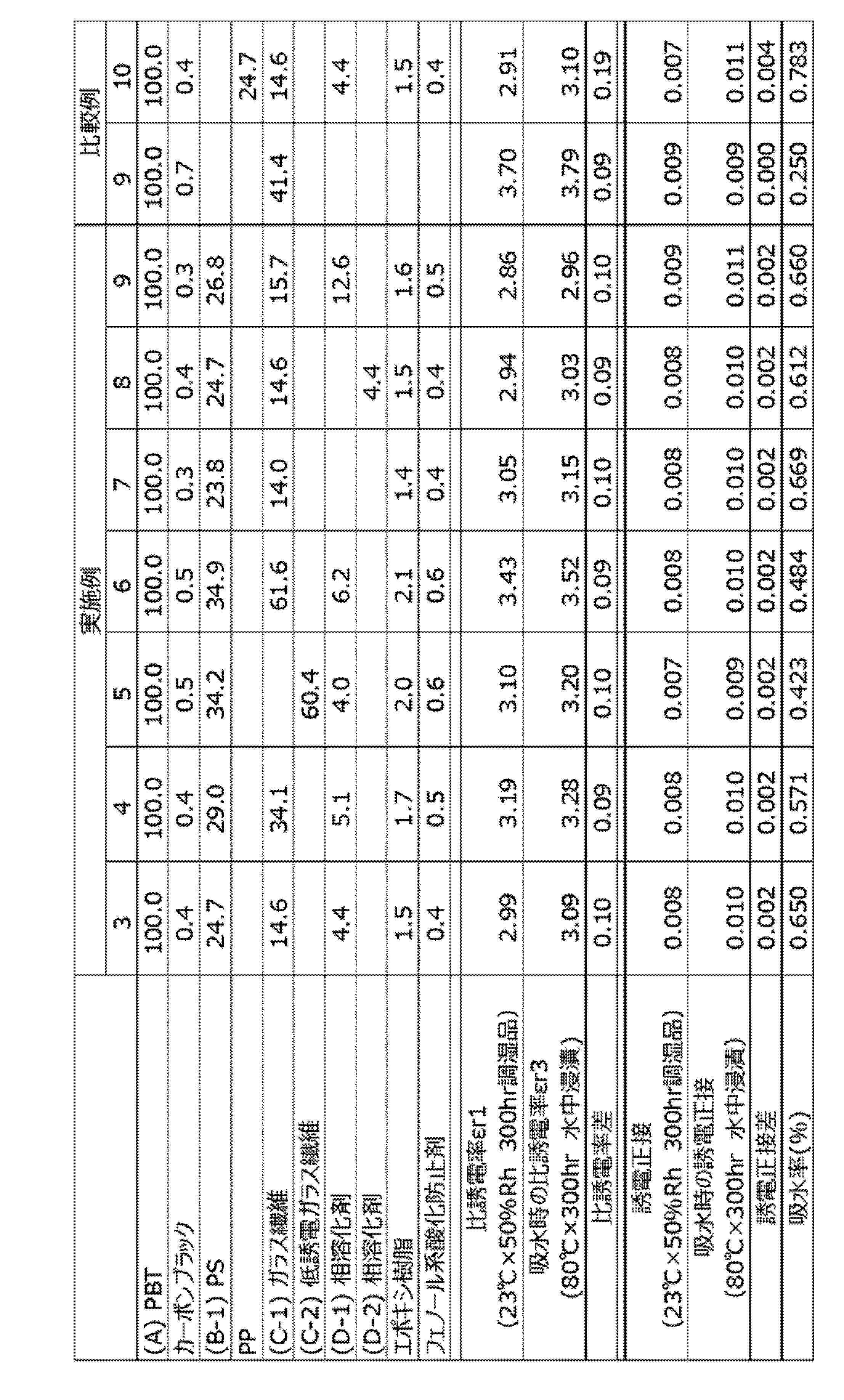
表1、2から、本発明の高周波信号伝送部品の原料として使用可能なポリブチレンテレフタレート樹脂組成物(実施例のPBT樹脂組成物)であれば、機械的強度を落とすことなく、誘電特性および耐水性において優れていることが確認された。
10 高周波信号伝送部品
20 高周波信号伝送発信部
30 高周波信号受信部
20 高周波信号伝送発信部
30 高周波信号受信部
Claims (4)
- 少なくとも、
(A)ポリブチレンテレフタレート樹脂100質量部、
(B)ポリスチレン系樹脂15~50質量部、および
(C)繊維状無機充填材0~70質量部、
とを含むポリブチレンテレフタレート樹脂組成物からなる高周波信号伝送部品。 - 23℃、50%RHで300時間調湿した後の誘電正接が0.01以下であり、23℃50%RHで300時間調湿した後の比誘電率εr1と、110℃で24時間乾燥時の比誘電率εr2との比誘電率の差が、0.01以下である、請求項1記載の高周波信号伝送部品。
- 23℃50%RHで300時間調湿した後の比誘電率εr1が3.5以下であり、80℃の温水に300時間浸漬した後の吸水時の比誘電率εr3との差が、0.10以下である、請求項1又は2記載の高周波信号伝送部品。
- ポリブチレンテレフタレート樹脂組成物が、相溶化剤を含む請求項1~3いずれかに記載の高周波信号伝送部品。
Priority Applications (3)
| Application Number | Priority Date | Filing Date | Title |
|---|---|---|---|
| JP2021550368A JP7356508B2 (ja) | 2019-10-04 | 2020-07-20 | 高周波信号伝送部品 |
| DE112020004746.6T DE112020004746T5 (de) | 2019-10-04 | 2020-07-20 | Bauteil zur übertragung von hochfrequenz-signalen |
| CN202080062390.9A CN114364742B (zh) | 2019-10-04 | 2020-07-20 | 高频信号传输部件 |
Applications Claiming Priority (2)
| Application Number | Priority Date | Filing Date | Title |
|---|---|---|---|
| JP2019183774 | 2019-10-04 | ||
| JP2019-183774 | 2019-10-04 |
Publications (1)
| Publication Number | Publication Date |
|---|---|
| WO2021065161A1 true WO2021065161A1 (ja) | 2021-04-08 |
Family
ID=75338089
Family Applications (1)
| Application Number | Title | Priority Date | Filing Date |
|---|---|---|---|
| PCT/JP2020/028077 Ceased WO2021065161A1 (ja) | 2019-10-04 | 2020-07-20 | 高周波信号伝送部品 |
Country Status (4)
| Country | Link |
|---|---|
| JP (1) | JP7356508B2 (ja) |
| CN (1) | CN114364742B (ja) |
| DE (1) | DE112020004746T5 (ja) |
| WO (1) | WO2021065161A1 (ja) |
Cited By (4)
| Publication number | Priority date | Publication date | Assignee | Title |
|---|---|---|---|---|
| JP2022553024A (ja) * | 2019-10-16 | 2022-12-21 | ビーエーエスエフ ソシエタス・ヨーロピア | ポリブチレンテレフタレート組成物およびその物品 |
| WO2023022139A1 (ja) * | 2021-08-16 | 2023-02-23 | ポリプラスチックス株式会社 | 二色成形用樹脂組成物及びその成形品 |
| JP2023549261A (ja) * | 2020-11-16 | 2023-11-22 | ビーエーエスエフ ソシエタス・ヨーロピア | ポリブチレンテレフタレート組成物及びそのレーダ装置成分 |
| WO2025192734A1 (en) * | 2024-03-15 | 2025-09-18 | Daikin Industries, Ltd. | Composition for forming a molded product having low dielectric loss, method for forming a molded product, and molded product having low dielectric loss |
Families Citing this family (1)
| Publication number | Priority date | Publication date | Assignee | Title |
|---|---|---|---|---|
| US20250163262A1 (en) * | 2023-11-20 | 2025-05-22 | Chang Chun Plastics Co., Ltd | Polyester composition and its molded product |
Citations (4)
| Publication number | Priority date | Publication date | Assignee | Title |
|---|---|---|---|---|
| JP2010189584A (ja) * | 2009-02-20 | 2010-09-02 | Toray Ind Inc | ポリブチレンテレフタレート系樹脂組成物 |
| JP2013043942A (ja) * | 2011-08-24 | 2013-03-04 | Wintech Polymer Ltd | ポリブチレンテレフタレート樹脂組成物 |
| JP2013131576A (ja) * | 2011-12-20 | 2013-07-04 | Wintech Polymer Ltd | 高周波信号伝送部品、及び高周波電気・電子機器 |
| JP2019031079A (ja) * | 2017-08-04 | 2019-02-28 | 積水化学工業株式会社 | 積層体 |
Family Cites Families (3)
| Publication number | Priority date | Publication date | Assignee | Title |
|---|---|---|---|---|
| JP4565958B2 (ja) * | 2003-10-07 | 2010-10-20 | ウィンテックポリマー株式会社 | レーザ溶着用樹脂組成物及び成形品 |
| CN101484526A (zh) * | 2006-07-14 | 2009-07-15 | 胜技高分子株式会社 | 绝缘部件用聚对苯二甲酸丁二醇酯树脂组合物 |
| TWI549985B (zh) * | 2009-11-10 | 2016-09-21 | Wintech Polymer Ltd | Polybutylene terephthalate resin composition |
-
2020
- 2020-07-20 CN CN202080062390.9A patent/CN114364742B/zh active Active
- 2020-07-20 WO PCT/JP2020/028077 patent/WO2021065161A1/ja not_active Ceased
- 2020-07-20 DE DE112020004746.6T patent/DE112020004746T5/de active Pending
- 2020-07-20 JP JP2021550368A patent/JP7356508B2/ja active Active
Patent Citations (4)
| Publication number | Priority date | Publication date | Assignee | Title |
|---|---|---|---|---|
| JP2010189584A (ja) * | 2009-02-20 | 2010-09-02 | Toray Ind Inc | ポリブチレンテレフタレート系樹脂組成物 |
| JP2013043942A (ja) * | 2011-08-24 | 2013-03-04 | Wintech Polymer Ltd | ポリブチレンテレフタレート樹脂組成物 |
| JP2013131576A (ja) * | 2011-12-20 | 2013-07-04 | Wintech Polymer Ltd | 高周波信号伝送部品、及び高周波電気・電子機器 |
| JP2019031079A (ja) * | 2017-08-04 | 2019-02-28 | 積水化学工業株式会社 | 積層体 |
Cited By (5)
| Publication number | Priority date | Publication date | Assignee | Title |
|---|---|---|---|---|
| JP2022553024A (ja) * | 2019-10-16 | 2022-12-21 | ビーエーエスエフ ソシエタス・ヨーロピア | ポリブチレンテレフタレート組成物およびその物品 |
| JP7802658B2 (ja) | 2019-10-16 | 2026-01-20 | ビーエーエスエフ ソシエタス・ヨーロピア | ポリブチレンテレフタレート組成物およびその物品 |
| JP2023549261A (ja) * | 2020-11-16 | 2023-11-22 | ビーエーエスエフ ソシエタス・ヨーロピア | ポリブチレンテレフタレート組成物及びそのレーダ装置成分 |
| WO2023022139A1 (ja) * | 2021-08-16 | 2023-02-23 | ポリプラスチックス株式会社 | 二色成形用樹脂組成物及びその成形品 |
| WO2025192734A1 (en) * | 2024-03-15 | 2025-09-18 | Daikin Industries, Ltd. | Composition for forming a molded product having low dielectric loss, method for forming a molded product, and molded product having low dielectric loss |
Also Published As
| Publication number | Publication date |
|---|---|
| CN114364742B (zh) | 2024-03-05 |
| JPWO2021065161A1 (ja) | 2021-04-08 |
| CN114364742A (zh) | 2022-04-15 |
| DE112020004746T5 (de) | 2022-06-15 |
| JP7356508B2 (ja) | 2023-10-04 |
Similar Documents
| Publication | Publication Date | Title |
|---|---|---|
| JP7356508B2 (ja) | 高周波信号伝送部品 | |
| JP6147956B2 (ja) | 高周波信号伝送部品、及び高周波電気・電子機器 | |
| JP6787501B2 (ja) | 熱可塑性ポリエステル樹脂組成物および成形品 | |
| JP6490682B2 (ja) | 炭素繊維強化プラスチック成形材料 | |
| CN104098898A (zh) | 嵌件成型用树脂组合物、使用其的金属树脂复合成型体及其制造方法 | |
| JP7814315B2 (ja) | ポリエステル組成物及び相当する物品 | |
| WO2017043176A1 (ja) | 樹脂組成物及び樹脂組成物の曲げ破断ひずみの低下を抑制する方法 | |
| JP6657922B2 (ja) | 樹脂組成物および樹脂成形体 | |
| KR20140092471A (ko) | 폴리에스터 수지 조성물 | |
| JPH08151518A (ja) | ポリアリーレンスルフィド樹脂組成物 | |
| JP2006193727A (ja) | ポリアミド樹脂組成物、成形品および筐体 | |
| KR102428814B1 (ko) | 저-유전성이 우수한 열가소성 수지 조성물 및 이를 포함하는 성형품 | |
| KR100566507B1 (ko) | 폴리페닐렌 설파이드 열가소성 수지 조성물 | |
| JP2001316587A (ja) | 筐体材料 | |
| KR102173834B1 (ko) | 열가소성 수지 조성물 및 이로부터 제조된 성형품 | |
| WO2022180051A1 (en) | Polyamide compositions with functionalized polyolefin and mobile electronic device components containing them | |
| KR101201832B1 (ko) | 유리섬유 강화 폴리에스테르계 수지 조성물 | |
| KR20220033866A (ko) | 열가소성 수지 조성물, 이의 제조방법 및 이로부터 제조된 성형품 | |
| JP2016102151A (ja) | ポリフェニレンスルフィド樹脂組成物およびそれからなる成形品 | |
| KR20210070592A (ko) | 폴리에스테르계 조성물 및 이의 성형물을 포함하는 레이돔 | |
| KR20140055060A (ko) | 터프니스가 우수한 편평 유리섬유 강화 폴리카보네이트 수지 조성물 | |
| US20240018354A1 (en) | Modified Polyphenylene Oxide Resin Composition | |
| JP3432610B2 (ja) | 樹脂組成物 | |
| WO2024150113A1 (en) | Liquid crystalline polymer compositions including an ionomer compatibilizer | |
| JPH10101931A (ja) | 低誘電性樹脂組成物 |
Legal Events
| Date | Code | Title | Description |
|---|---|---|---|
| 121 | Ep: the epo has been informed by wipo that ep was designated in this application |
Ref document number: 20872197 Country of ref document: EP Kind code of ref document: A1 |
|
| ENP | Entry into the national phase |
Ref document number: 2021550368 Country of ref document: JP Kind code of ref document: A |
|
| 122 | Ep: pct application non-entry in european phase |
Ref document number: 20872197 Country of ref document: EP Kind code of ref document: A1 |