WO2021033732A1 - 放牧動物管理システム - Google Patents
放牧動物管理システム Download PDFInfo
- Publication number
- WO2021033732A1 WO2021033732A1 PCT/JP2020/031342 JP2020031342W WO2021033732A1 WO 2021033732 A1 WO2021033732 A1 WO 2021033732A1 JP 2020031342 W JP2020031342 W JP 2020031342W WO 2021033732 A1 WO2021033732 A1 WO 2021033732A1
- Authority
- WO
- WIPO (PCT)
- Prior art keywords
- animal
- grazing
- management system
- animals
- state
- Prior art date
- Legal status (The legal status is an assumption and is not a legal conclusion. Google has not performed a legal analysis and makes no representation as to the accuracy of the status listed.)
- Ceased
Links
Images







Classifications
-
- A—HUMAN NECESSITIES
- A01—AGRICULTURE; FORESTRY; ANIMAL HUSBANDRY; HUNTING; TRAPPING; FISHING
- A01K—ANIMAL HUSBANDRY; AVICULTURE; APICULTURE; PISCICULTURE; FISHING; REARING OR BREEDING ANIMALS, NOT OTHERWISE PROVIDED FOR; NEW BREEDS OF ANIMALS
- A01K29/00—Other apparatus for animal husbandry
-
- G—PHYSICS
- G01—MEASURING; TESTING
- G01P—MEASURING LINEAR OR ANGULAR SPEED, ACCELERATION, DECELERATION, OR SHOCK; INDICATING PRESENCE, ABSENCE, OR DIRECTION, OF MOVEMENT
- G01P15/00—Measuring acceleration; Measuring deceleration; Measuring shock, i.e. sudden change of acceleration
- G01P15/18—Measuring acceleration; Measuring deceleration; Measuring shock, i.e. sudden change of acceleration in two or more dimensions
-
- Y—GENERAL TAGGING OF NEW TECHNOLOGICAL DEVELOPMENTS; GENERAL TAGGING OF CROSS-SECTIONAL TECHNOLOGIES SPANNING OVER SEVERAL SECTIONS OF THE IPC; TECHNICAL SUBJECTS COVERED BY FORMER USPC CROSS-REFERENCE ART COLLECTIONS [XRACs] AND DIGESTS
- Y02—TECHNOLOGIES OR APPLICATIONS FOR MITIGATION OR ADAPTATION AGAINST CLIMATE CHANGE
- Y02A—TECHNOLOGIES FOR ADAPTATION TO CLIMATE CHANGE
- Y02A40/00—Adaptation technologies in agriculture, forestry, livestock or agroalimentary production
- Y02A40/70—Adaptation technologies in agriculture, forestry, livestock or agroalimentary production in livestock or poultry
Definitions
- the present invention relates to a grazing animal management system that manages the state of a plurality of animals grazing on a grazing land.
- a collar is attached to a cow grazing on a pasture, livestock position data based on radio waves from GPS satellites is transmitted from the collar, and the monitoring center transmits the received livestock position data on the screen of the pasture. Describes that a point image is displayed as the livestock position on the map, that the point image showing the position of the cow is displayed as a mass on the map, and that it is determined from the movement trajectory data file that a calf has been born. Has been done.
- Grazing cattle are bred and managed in a different environment than barn cattle.
- individual position / travel distance information GPS
- behavior information by an acceleration sensor e.g., a Bosch Sensortec BMA150
- weather information e.g., weather information that affects behavior.
- the daily work at the grazing multi-head management site is carried out by a small number of people, and covers a wide range of tasks such as grassland condition, transhumance work, observation of each cow, insemination work associated with estrus detection, and delivery confirmation / assistance.
- an object of the present invention is to provide a grazing animal management system that can reduce the management burden on a large number of animals by focusing on the habit of animals that form a herd and determining an animal that is out of the herd as an abnormality. To do.
- the grazing animal management system of the present invention provides an acceleration sensor 11, a position detection sensor 12, and a transmission unit 13 that transmits these detected values together with an individual identification code to a plurality of animals grazing on the grazing land.
- a server 20 that is a grazing animal management system that manages the state of the animal and has an animal information database 22 that registers the management information of the animal is specified by the detection value that is attached and transmitted from the transmission unit 13.
- the group determination step and the management target candidate animal extraction step are repeated a plurality of times at different times, and the management target animal identification step for identifying the animal extracted as the management target candidate animal a predetermined number of times or more as a management target animal. It is characterized by having and.
- the server 20 in the grazing animal management system according to the first aspect, the server 20 exists at a predetermined position for a predetermined time or longer with respect to the controlled animal specified in the controlled animal identification step.
- the animal state determination step for determining whether or not the animal is present and the animal condition determination step, the managed animal determined to be present at the predetermined position for the predetermined time or longer is output as a delivery state or a rescue-requiring state.
- the detection value of the acceleration sensor 11 is obtained for the controlled animal identified by the server 20 in the controlled animal identification step. It is characterized by having an animal state determination step of calculating exercise intensity from the acceleration per unit time or the standard deviation of the acceleration, and determining the estrus state from the calculated exercise intensity.
- the animal condition determination step in the grazing animal management system according to the third aspect, the exercise intensity on the day (n) and one day before (n-1) to X days before (n).
- the present invention according to claim 5 is determined from the exercise intensity on the day (n) in comparison with one day before (n-1) in the animal state determination step in the grazing animal management system according to claim 3. It is characterized by that.
- the interval period from the previous estrus date is set to the estrus state. It is characterized by adding to the judgment.
- the unit time is determined from the detection value of the position detection sensor 12.
- the present invention is the acceleration sensor 11 for the controlled animal identified by the server 20 in the controlled animal identification step in the grazing animal management system according to claim 1 or 2. It has a controlled animal display step that displays changes in the detected values in time series, and in the managed animal display step, the acceleration sensor 11 of the controlled animal identified in the managed animal specifying step. It is characterized in that the acceleration per unit time or the change in exercise intensity calculated from the standard deviation of the acceleration is displayed in time series using the detected value.
- the present invention by setting an animal that moves away from the herd as a controlled animal, it is possible to detect estrus, monitor delivery, detect a disease, detect a fence, and detect an accident, which is difficult when targeting all animals. Therefore, the condition of the grassland and the timing of transhumance can be grasped, and the management burden can be reduced even if a large number of animals are grazing.
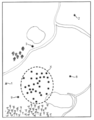
- Flow chart of the grazing animal management system Image diagram at specific time t1 to explain the grazing animal management system Image diagram at specific time t2 to explain the grazing animal management system Image diagram at specific time t3 to explain the grazing animal management system A graph showing an animal state determination processing method in a grazing animal management system according to another embodiment of the present invention.
- the figure which shows the animal state judgment processing method in the grazing animal management system by still another Example of this invention A graph showing an animal state determination processing method in a grazing animal management system according to still another embodiment of the present invention.
- Explanatory drawing which shows the grazing animal management system by still another Example of this invention
- the grazing animal management system includes a herd determination step in which a server having an animal information database for registering animal management information determines a herd from the existence positions of a plurality of animals at a specific time.
- the management target candidate animal extraction step for extracting the animals that do not belong to the flock judged in the flock judgment step as the management target candidate animals, and the flock judgment step and the management target candidate animal extraction step are repeated multiple times at different times for management. It has a controlled animal identification step of identifying an animal extracted as a target candidate animal a predetermined number of times or more as a controlled animal.
- estrus detection, delivery monitoring, disease detection, transhumance detection, and accident detection are difficult when targeting all animals. It is possible to grasp the condition of grassland and the timing of transhumance, and even if a large number of animals are grazing, the management burden can be reduced.
- the server in the grazing animal management system according to the first embodiment, exists at a predetermined position for a predetermined time or longer with respect to the managed animal specified in the managed animal identification step.
- the managed animal determined to be present at a predetermined position for a predetermined time or longer is output as a grazing state or a rescue-requiring state, and is output at a predetermined position for a predetermined time. It has an output step that outputs a controlled animal determined to be nonexistent as an estrus state. According to the present embodiment, it is possible to predict whether an animal that can be presumed to be abnormal is in a state of parturition, a state requiring rescue, or a state of estrus.
- a third embodiment of the present invention is the grazing animal management system according to the first embodiment, in which the controlled animal identified by the server in the controlled animal identification step is used for a unit time using the detection value of the acceleration sensor. It has an animal state determination step in which the exercise intensity is calculated from the hit acceleration or the standard deviation of the acceleration, and the estrus state is determined from the calculated exercise intensity. According to this embodiment, the estrus state can be predicted for an animal that can be presumed to be abnormal.
- the fourth embodiment of the present invention is the grazing animal management system according to the third embodiment, in the animal condition determination step, the exercise intensity on the day (n) and one day before (n-1) to X days before (n-1). It is judged from the comparison with the average exercise intensity up to nX). According to this embodiment, the estrus state can be predicted by comparing with the past average exercise intensity.
- the fifth embodiment of the present invention is determined from the exercise intensity of the day (n) in comparison with the one day before (n-1) in the animal state determination step in the grazing animal management system according to the third embodiment. It is something to do. According to this embodiment, the estrus state can be predicted by comparing with the exercise intensity of the previous day.
- a sixth embodiment of the present invention is a grazing animal management system according to any one of the third to fifth embodiments.
- the interval period from the previous estrus date is used to determine the estrus state. It is something to add.
- the estrus state can be predicted more accurately by adding the interval period from the past estrus date to the judgment.
- the moving distance per unit time is calculated from the detection value of the position detection sensor. It is calculated and the calculated travel distance is added to the judgment of the estrus state. According to the present embodiment, the estrus state can be predicted more accurately by adding the moving distance to the judgment.
- the change of the detection value of the acceleration sensor is timed for the controlled animal specified in the controlled animal identification step. It has a managed animal display step that displays in series, and in the managed animal display step, the acceleration per unit time, or the above, for the managed animal identified in the managed animal identification step, using the detection value of the acceleration sensor.
- the change in exercise intensity calculated from the standard deviation of acceleration is displayed in chronological order. According to this embodiment, the health condition of an animal that can be presumed to be abnormal can be determined.
- FIG. 1 is a block diagram showing a grazing animal management system according to an embodiment of the present invention by means for realizing functions.
- the grazing animal management system according to the present embodiment includes a terminal 10 attached to an animal grazing on the grazing land and a server 20 that manages the state of the grazing animal on the grazing land.
- the terminal 10 when the animal is a ruminant such as a cow, the terminal 10 is preferably attached to the neck.
- the terminal 10 includes an acceleration sensor 11, a position detection sensor 12, and a transmission unit 13 that transmits these detected values together with an individual identification code.
- the acceleration sensor 11 is preferably a 3-axis acceleration sensor, and by using the 3-axis acceleration sensor, it is possible to detect anteroposterior acceleration, a vertical acceleration, and a lateral acceleration, and it is possible to detect foraging, chewing during reclamation, and lying down. Rest can be discriminated from the anteroposterior acceleration, the longitudinal acceleration, and the lateral acceleration.
- the anteroposterior acceleration, the vertical acceleration, and the lateral acceleration exceed the threshold value at a predetermined time in the continuous elapsed time, it is determined that the food is eaten instead of chewing and lying down during rumination. be able to.
- the regularity of the chewing acceleration waveform at the time of reflex is determined from at least one of the longitudinal acceleration, the vertical acceleration, and the horizontal acceleration, and if a high regularity is recognized in the acceleration waveform, it is healthy. It can be evaluated as being.
- the position detection sensor 12 is preferably a sensor based on GNSS (Global Navigation Satellite System). As the individual identification code, it is sufficient that the individual animal can be identified, and the terminal identification code assigned to the terminal 10 can also be used.
- the server 20 has a receiving unit 21 that receives the detected value transmitted from the transmitting unit 13, an animal information database 22 that stores the received detected value together with time information for each individual identification code, a control unit 23, and a display unit 24. And have.
- the control unit 23 includes a herd determination means 23A for determining a herd, a management target animal extraction means 23B for extracting an individual not included in the herd as a management target animal, and a management target animal identification means 23C for identifying a management target animal.
- the animal condition determination means 23D for determining the individual condition of the animal to be managed is provided.
- the herd determination means 23A determines the herd from the individual existence positions of a plurality of animals at a specific time.
- the grazing land can be divided into mesh areas, a mesh area in which a predetermined number of individuals exist can be extracted, and a range in which the extracted mesh areas are continuous can be determined as a herd area. Further, if a predetermined number of other individuals exist in a predetermined range centered on an individual individual, it can be determined that the individual is in a group.
- the management target candidate animal extraction means 23B extracts an individual that does not belong to the herd determined in the herd determination step as a management target candidate animal at a specific time.
- the managed animal identification means 23C identifies an individual extracted as a management target candidate animal a predetermined number of times or more as a management target animal within a predetermined period.
- the animal state determining means 23D determines whether or not the managed animal identified in the managed animal identification step has been present at a predetermined position for a predetermined time or longer, and when it has been present at the predetermined position for a predetermined time or longer. Determines the managed animal as a calving state or a rescue-requiring state, and determines that the managed animal is in an estrus state if it does not exist at a predetermined position for a predetermined time or longer.
- the display unit 24 can display the change in the detection value of the acceleration sensor 11 in time series and the change in the detection value of the position detection sensor 12 in time series for the animal to be managed.
- FIG. 2 is a flow chart of the grazing animal management system.
- the server 20 receives the detected value in the receiving unit 21 (S1), the server 20 registers the received detected value in the animal information database 22 (S2).
- the flock determination means 23A extracts the detection value of the individual position detection sensor 12 at the specific time from the animal information database 22 (S3), and the individual at the specific time from the extracted detection value of the position detection sensor 12.
- Judge the flock of (S4) In the management target candidate animal extraction step, individuals that do not belong to the herd determined in S4 are extracted as management target candidate animals (S5).
- the herd determination step (S3, S4) and the management target candidate animal extraction step (S5) are repeated a plurality of times at different times until a predetermined period elapses (No in S6).
- the predetermined period here is, for example, 6 hours, 12 hours, or 24 hours.
- the process proceeds to the controlled animal identification step.
- the management target animal identification step it is determined whether or not the animal has been extracted as a management target candidate animal a predetermined number of times or more (S7), and the individual extracted as a management target candidate animal a predetermined number of times or more is specified as a management target animal (S8).
- changes in the detection value of the acceleration sensor 11 are displayed in chronological order for the managed animal specified in the managed animal identification step (S11), and the managed animal specified in the managed animal identification step.
- changes in the detected values of the position detection sensor 12 are displayed in chronological order (S12).
- the animal state determination step it is determined whether or not the managed animal identified in the control target animal identification step exists at a predetermined position for a predetermined time or longer (S13), and in the output step, it is determined at a predetermined position for a predetermined time or longer.
- the managed animal determined to exist is output as a delivery state or a rescue-required state (S14), and the managed animal determined to not exist at a predetermined position for a predetermined time or longer is output as an estrus state (S15).
- FIG. 3 to 5 are image diagrams for explaining the grazing animal management system, FIG. 3 shows the position of an animal at a specific time t1 in a predetermined rangeland, and FIG. 4 shows a position at a specific time t2 in the predetermined rangeland. The location of the animal is shown, and FIG. 5 shows the location of the animal at a specific time t3 in a predetermined rangeland.
- the broken line frame X is an area indicating the group determined in the group determination step.
- animals 1 to 7 are judged not to be in the herd
- animals 1 to 3 are judged not to be in the herd
- animals 1 to 3, 8 and 9 are in the herd. It is an individual that is judged not to enter, and these individuals are extracted as management target candidate animals at the specific time t1, the specific time t2, and the specific time t3, respectively.
- animals 1 to 3 are specified as managed animals. Since the animals 1 and 3 exist at different positions at the specific time t1, the specific time t2, and the specific time t3, it can be determined that the animals 1 and 3 do not exist at the predetermined position for a predetermined time or more, and can be predicted to be in an estrus state. Further, since the animal 2 exists at the same position at the specific time t1, the specific time t2, and the specific time t3, it can be predicted that the animal 2 is in a delivery state or a rescue-requiring state.
- the management burden can be reduced even if a large number of animals are grazing, and the change in the detection value of the acceleration sensor 11 for the managed animals can be changed.
- By displaying in chronological order or by displaying the change in the detection value of the position detection sensor 12 in chronological order it is possible to judge the health condition of an animal that can be presumed to be abnormal, or to determine the state of delivery, the state requiring rescue, or estrus. You can predict if you are in a state.
- FIG. 6 is a graph showing an animal state determination processing method in a grazing animal management system according to another embodiment of the present invention
- FIG. 6A shows a change in exercise intensity on the day (n)
- FIG. b) shows the standard deviation of the exercise intensity of the day (n) with respect to the average exercise intensity from one day ago (n-1) to X days ago (nX)
- FIG. 6 (c) shows one from FIG. 6 (b).
- a graph obtained by graphing the data of the part is shown
- FIG. 6 (d) shows a graph of the frequency of FIG. 6 (c).
- the animal condition determination process according to this embodiment is performed by the animal condition determination means 23D shown in FIG. FIG.
- FIG. 6A is a graph in which the acceleration per unit time is standardized using the detection value of the acceleration sensor 11 for the day (n), and the vertical axis is the acceleration and the horizontal axis is the time.
- a high value means strong exercise intensity
- a low value means weak exercise intensity.
- FIG. 6B the acceleration per unit time of the day (n) was standardized based on the mean value and standard deviation of the acceleration per unit time from one day ago (n-1) to X days ago (nX).
- the vertical axis is acceleration and the horizontal axis is time.
- a high value means strong exercise intensity
- a low value means weak exercise intensity.
- FIG. 6 (c) cuts out the data 24 hours before the “time for determining estrus” shown in FIG.
- FIG. 6D shows the time distribution of exercise intensity
- the estrus state can be determined from the time distribution of exercise intensity.
- the estrus state can be predicted by comparing with the past average exercise intensity.
- the exercise intensity can be calculated from the acceleration at 10-minute, 20-minute, 30-minute, and 60-minute intervals or the standard deviation of the acceleration, and the estrus state can be determined from the calculated exercise intensity.
- FIG. 7 is a diagram showing an animal state determination processing method in a grazing animal management system according to still another embodiment of the present invention
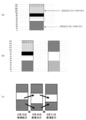
- FIG. 7A is a diagram after calculating and setting a classification threshold value of exercise intensity by machine learning.
- 7 (b) shows the time distribution of the exercise intensity shown in FIG. 7 (a)
- FIG. 7 (c) shows the time distribution of the time distribution shown in FIG. 7 (a) in three categories
- FIG. 7 (c) shows 3 shown in FIG. 7 (b). It shows the changes in the time distribution divided into two categories before and after estrus.
- the animal state determination process according to this embodiment is performed by the animal state determination means 23D shown in FIG. 1, but the machine learning calculation can also be performed by a server other than the server 20.
- FIG. 7 shows the changes in the time distribution divided into two categories before and after estrus.
- FIG. 7A the magnitudes of exercise intensity at regular intervals are classified into eight categories.
- FIG. 7 (b) the eight categories in FIG. 7 (a) are summarized into three categories. The magnitudes of exercise intensity in each of the three categories are evenly spaced.
- FIG. 7 (c) shows the increase / decrease in exercise intensity on the day of estrus (August 30), the day before estrus (August 29), and the day after estrus (August 31).
- estrus days in the three category distributions are that estrus reduces rest time, eating behavior, and rumination, resulting in decreased behavior with low exercise intensity and moderate (walking). Etc.) will increase.
- the animal state determination process can be determined from the exercise intensity of the day (n) in comparison with the one day before (n-1), and is compared with the exercise intensity of the previous day.
- the state of estrus can be predicted.
- FIG. 8 is a diagram showing an animal state determination processing method in a grazing animal management system according to still another embodiment of the present invention.
- FIG. 8 shows the detection of estrus at an arbitrary time using 24-hour data of grazing breeding cows.
- the user can use the accelerometer 11 to obtain data for a predetermined period before the instruction, for example, 24 hours before the instruction, using the animal state determination means 23D.
- "Emotional signs / estrus” can be predicted by calculating the exercise intensity from the acceleration per unit time or the standard deviation of the acceleration using the detected value and determining the estrus state from the calculated exercise intensity.
- the estrus state in a predetermined period before the set time can be predicted and displayed. Therefore, it is possible to provide information according to the work schedule of the manager / artificial insemination because information on the presence or absence of estrus can be obtained by setting an arbitrary instruction time according to the convenience of the work / working hours of the grazing manager. Become.
- FIG. 9A and 9B are diagrams showing an animal state determination processing method in a grazing animal management system according to still another embodiment of the present invention
- FIG. 9A shows a processing flow
- FIG. 9B shows a processing result. It is a graph which shows.
- the animal condition determination process according to this embodiment is performed by the animal condition determination means 23D shown in FIG.
- estrus can be predicted in real time by using, for example, 10-minute, 20-minute, 30-minute, and 1-hour (variable) interval data of grazing breeding cows.
- the detection value of the acceleration sensor 11 sent from the transmission unit 13 is standardized (S31), and the exercise intensity standardized in S31 is added to obtain 1-hour data (S32).
- the 1-hour data is squared (S34), and the result is displayed as a graph (S35).
- the exercise intensity is calculated for each individual to calculate the coefficient of the estrus level (S33), and the coefficient for each individual is used in the graphing in S35, and the emission information is detected when the threshold value is exceeded (S36).
- S34 the threshold value is displayed on the graph.
- the threshold value is set for each individual grazing breeding cow, and when this threshold value (slice level / estrus detection level) is exceeded, the estrus start time can be predicted. If there is no manager on the grazing land for business purposes, it is possible to sequentially calculate (predict) cattle that require estrus time information for other reasons as a "real-time estrus mode".
- the calving prediction which is one of the animal conditions of grazing cattle, can be made according to the following criteria. Significant decrease in feeding time (estrus day ⁇ delivery day), decrease in travel time that occurs at the same time as the change in feeding time (estrus day> delivery date), staying time in a specific area (radius 150-500 m) 60 It can be judged by the criteria of when it becomes more than a minute and when it is 30 to 1000 m or more away from the center of the flock.
- the feeding time can be detected by the acceleration fluctuation by the acceleration sensor 11, and the moving time, the staying time in the specific area, and the distance from the center of the flock can be detected by the position detection by the position detection sensor 12.
- FIG. 10 is a graph showing a method for determining an animal state in a grazing animal management system according to still another embodiment of the present invention, and shows a method for determining an abnormal cattle (disease / accident / death).
- FIG. 10 is a correlation distribution diagram of the moving distance and the acceleration variable. As shown in FIG. 10, when the level becomes almost zero after 19:30 on August 1, 2019, it can be estimated that there is an abnormality such as a disease, an accident, or death. Therefore, when the acceleration difference value does not fluctuate within a predetermined time such as 1 hour and the moving distance is within a predetermined range such as 10 m, it is determined as an abnormal behavior and notified. be able to.
- FIG. 11 is a graph showing the animal state determination processing method in the grazing animal management system according to still another embodiment of the present invention, and shows the number of times the animals went to the water fountain.
- FIG. 11 shows a distribution map obtained from latitude / longitude data for a certain individual of grazing breeding cows for a period of one week, and the circled part is a drinking fountain. The number plotted in the area surrounded by the black frame is the number of visits to the drinking fountain. When it rains, the number of times you go to the drinking fountain decreases. In addition, the distance traveled is also on a downward trend, and movement during estrus is also suppressed. Therefore, in the process of determining the animal state, it is preferable to change the threshold value and the algorithm in the case of rainy weather as in the case of weather other than rainy weather.
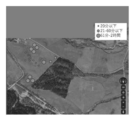
- FIG. 12 is a screen image diagram showing a grazing animal management system according to still another embodiment of the present invention, and shows the staying time of grazing breeding cattle on a map.
- the small diameter circle indicates a stay of 20 minutes or less
- the medium diameter circle indicates a stay of 21 minutes or more and 60 minutes or less
- the large diameter circle indicates 61 minutes or more and up to 2 hours.
- grassland management can be performed by outputting the fluctuation information of the grassland staying time of the grazing breeding cow together with the position information (map information).
- FIG. 13 is a screen image diagram showing a grazing animal management system according to still another embodiment of the present invention, and shows a distribution showing which side the entire herd stayed at at what time.
- the white circles indicate the stays from 4:00 to 18:00
- the black circles indicate the stays from 18:00 to 4:00
- FIG. 13 (b) A to F in FIG. 13 (a). It shows the average staying time in a group in the place mesh-divided by P1 to P5. In this way, it is possible to visualize where and how long it takes to eat in the grassland and display it on the map.
- FIG. 14 is a screen image diagram showing a grazing animal management system according to still another embodiment of the present invention, and is an output image diagram capable of extracting a changing individual.
- FIG. 14 (a) is a list list output comparing the distance traveled and the amount of activity between the previous day and the current day for each individual, and
- FIG. 14 (b) is the current position of a specific individual from the list in FIG. 14 (a). Is displayed on the map. In this way, the distance traveled and the amount of activity between the previous day and the day can be compared for each individual, and individuals with changes can be extracted, and managed in place of the flock judgment means 23A or together with the judgment by the flock judgment means 23A. It can also be extracted as a target candidate animal.
- FIG. 15 is an explanatory diagram showing a grazing animal management system according to still another embodiment of the present invention.
- FIG. 15A is a diagram for explaining the estimation of the center position of the flock and the distance information from the center position of each individual
- FIG. 15B is a calculation formula for the center of the flock.
- the center point of the flock is estimated from the detection value of the position detection sensor 12, the distance from the coordinates of the center point by a linear distance is measured, and the data is registered in the animal information data base 22.
- This information can be used as information such as calving prediction (delivery at a position away from the herd), difficulty in moving due to motor disease, management of cows with low social ranking, and so on.
- the estimated distance from the flock center point at 5 minute, 10 minute, 30 minute, and 1 hour intervals is recorded and used as management information.
- the center point can be obtained by the formula shown in FIG. 15 (b).
- the center point (XO, YO) is replaced with the coordinates of latitude and longitude, and the distance (Ln) of each individual position (Xn, Yn) is obtained.
- Distance information at 1-minute, 2-minute, 10-minute, and 20-minute intervals is registered in the animal information database 22.
- estrus detection, parturition monitoring, disease detection, and transhumance detection are difficult when targeting all animals. It is possible to detect accidents, grasp the condition of grasslands and the timing of transhumance, and reduce the management burden even if a large number of animals are grazing.
- the estrus state can be predicted more accurately by adding the interval period from the previous estrus date to the estrus state determination. Further, in the animal state determination step, the movement distance per unit time is calculated from the detection value of the position detection sensor 12, and the calculated movement distance is added to the determination of the estrus state, so that the estrus state can be predicted more accurately. ..
- the grazing animal management system adjusts the influence of the weather on the behavior by using the weather sensor installed on the pasture and the widely provided weather information in addition to the acceleration sensor 11 and the position detection sensor 12. This makes it possible to notify the timing of estrus detection, delivery detection, disease detection, fence removal, and accidents in grazing, grassland conditions, or transhumance.
- the data transmission interval from the transmission unit 13 attached to the collar is as long as 5 to 20 minutes, and the loss rate is 3% or less by limiting the number of transmission data to the detection value of the acceleration sensor 11 and the detection value of the position detection sensor 12. Can be done.
- the data from the transmission unit 13 can be transmitted to and stored in the server 20 by using an internet line via a public wireless system (LPWA).
- LPWA public wireless system
- the data received by the receiving unit 21 can be recalculated in the server 20 and displayed by a WEB-compatible application using a large PC monitor in the office or a mobile terminal that can be carried on site.
- the estrus of each individual can be detected by recalculating in the server 20 at an arbitrary time according to the business hours of the grazing manager.
- the estrus prediction method is a method of recalculating and predicting 24-hour data retroactively from an arbitrary time, analysis results of 5 minutes, 10 minutes, 20 minutes, and 1 hour intervals and an interval from the previous estrus date. You can choose how to detect estrus signs over time. At the same time, the accuracy can be improved by using the increase / decrease in the moving distance by the position detection sensor 12 as a determination factor for estrus detection.
- the decrease data of the feeding behavior by the position detection sensor 12 and the acceleration sensor 11 can be used as a trigger. Grazing cows tend to feed on the grass near the fence, travel longer distances, or not go to specific locations when there is less grass in the grassland. Therefore, it is possible to display a tendency that the time zone near the fence is increasing and an alarm prompting the judgment of the edible state of the grassland currently grazing from the number of animals.
- Notification of cows that have become stuck in grazing can be notified of abnormal cows (state in which they cannot move due to illness, etc.) or dead cows when they are separated from the group for 2 hours or more, or depending on the reaction between the movement distance and acceleration. ..
- the present invention is suitable for estrus, calving, and injury management, especially for grazing cattle.
Landscapes
- Life Sciences & Earth Sciences (AREA)
- Environmental Sciences (AREA)
- Animal Husbandry (AREA)
- Biodiversity & Conservation Biology (AREA)
- Physics & Mathematics (AREA)
- General Physics & Mathematics (AREA)
- Management, Administration, Business Operations System, And Electronic Commerce (AREA)
Priority Applications (1)
| Application Number | Priority Date | Filing Date | Title |
|---|---|---|---|
| JP2021540975A JP7228171B2 (ja) | 2019-08-20 | 2020-08-19 | 放牧動物管理システム |
Applications Claiming Priority (2)
| Application Number | Priority Date | Filing Date | Title |
|---|---|---|---|
| JP2019150738 | 2019-08-20 | ||
| JP2019-150738 | 2019-08-20 |
Publications (1)
| Publication Number | Publication Date |
|---|---|
| WO2021033732A1 true WO2021033732A1 (ja) | 2021-02-25 |
Family
ID=74661151
Family Applications (1)
| Application Number | Title | Priority Date | Filing Date |
|---|---|---|---|
| PCT/JP2020/031342 Ceased WO2021033732A1 (ja) | 2019-08-20 | 2020-08-19 | 放牧動物管理システム |
Country Status (2)
| Country | Link |
|---|---|
| JP (1) | JP7228171B2 (https=) |
| WO (1) | WO2021033732A1 (https=) |
Cited By (1)
| Publication number | Priority date | Publication date | Assignee | Title |
|---|---|---|---|---|
| CN114287361A (zh) * | 2022-01-20 | 2022-04-08 | 中国农业科学院农业信息研究所 | 一种牲畜行为监测分析系统及方法 |
Citations (8)
| Publication number | Priority date | Publication date | Assignee | Title |
|---|---|---|---|---|
| JPS5846292B2 (ja) * | 1980-01-24 | 1983-10-15 | カバヤ食品株式会社 | 棒状チヨコレ−トの連続製造装置 |
| JPH10295212A (ja) * | 1997-04-28 | 1998-11-10 | Matsushita Electric Works Ltd | 放牧管理装置及びその装置を用いた放牧管理システム |
| JPH11128210A (ja) * | 1997-10-29 | 1999-05-18 | Matsushita Electric Works Ltd | 動物の運動量管理装置及び運動量管理システム並びに動物の運動量管理プログラムを記録した記録媒体 |
| US20070044732A1 (en) * | 2005-08-29 | 2007-03-01 | St-Infonox | Animal-herd management using distributed sensor networks |
| JP4229757B2 (ja) * | 2003-05-16 | 2009-02-25 | 北海道 | 乳牛の発情発見方法及び装置 |
| JP2011234668A (ja) * | 2010-05-10 | 2011-11-24 | Technos Japan:Kk | 家畜の分娩・発情検知センサ、及びそれを用いた検知装置並びに検知方法 |
| GB2548190A (en) * | 2015-12-23 | 2017-09-13 | Inst Of Tech Sligo | A lambing monitoring system |
| WO2017183350A1 (ja) * | 2016-04-21 | 2017-10-26 | ソニー株式会社 | 情報処理装置、情報処理システム、及び情報処理方法 |
Family Cites Families (2)
| Publication number | Priority date | Publication date | Assignee | Title |
|---|---|---|---|---|
| JP5892235B2 (ja) * | 2012-03-30 | 2016-03-23 | 富士通株式会社 | 歩数補正方法、歩数補正装置、歩数補正プログラム、発情報知方法および発情報知装置 |
| PL2832219T3 (pl) * | 2012-03-30 | 2019-06-28 | Fujitsu Limited | Sposób powiadamiania o rui, urządzenie powiadamiające o rui i program powiadamiający o rui |
-
2020
- 2020-08-19 WO PCT/JP2020/031342 patent/WO2021033732A1/ja not_active Ceased
- 2020-08-19 JP JP2021540975A patent/JP7228171B2/ja active Active
Patent Citations (8)
| Publication number | Priority date | Publication date | Assignee | Title |
|---|---|---|---|---|
| JPS5846292B2 (ja) * | 1980-01-24 | 1983-10-15 | カバヤ食品株式会社 | 棒状チヨコレ−トの連続製造装置 |
| JPH10295212A (ja) * | 1997-04-28 | 1998-11-10 | Matsushita Electric Works Ltd | 放牧管理装置及びその装置を用いた放牧管理システム |
| JPH11128210A (ja) * | 1997-10-29 | 1999-05-18 | Matsushita Electric Works Ltd | 動物の運動量管理装置及び運動量管理システム並びに動物の運動量管理プログラムを記録した記録媒体 |
| JP4229757B2 (ja) * | 2003-05-16 | 2009-02-25 | 北海道 | 乳牛の発情発見方法及び装置 |
| US20070044732A1 (en) * | 2005-08-29 | 2007-03-01 | St-Infonox | Animal-herd management using distributed sensor networks |
| JP2011234668A (ja) * | 2010-05-10 | 2011-11-24 | Technos Japan:Kk | 家畜の分娩・発情検知センサ、及びそれを用いた検知装置並びに検知方法 |
| GB2548190A (en) * | 2015-12-23 | 2017-09-13 | Inst Of Tech Sligo | A lambing monitoring system |
| WO2017183350A1 (ja) * | 2016-04-21 | 2017-10-26 | ソニー株式会社 | 情報処理装置、情報処理システム、及び情報処理方法 |
Cited By (1)
| Publication number | Priority date | Publication date | Assignee | Title |
|---|---|---|---|---|
| CN114287361A (zh) * | 2022-01-20 | 2022-04-08 | 中国农业科学院农业信息研究所 | 一种牲畜行为监测分析系统及方法 |
Also Published As
| Publication number | Publication date |
|---|---|
| JPWO2021033732A1 (https=) | 2021-02-25 |
| JP7228171B2 (ja) | 2023-02-24 |
Similar Documents
| Publication | Publication Date | Title |
|---|---|---|
| US12034400B2 (en) | Livestock management system | |
| US11763205B2 (en) | Livestock and feedlot data collection and processing using UHF-band interrogation of radio frequency identification tags for feedlot arrival and risk assessment | |
| Lamanna et al. | Wearable collar technologies for dairy cows: A systematized review of the current applications and future innovations in precision livestock farming | |
| US10905105B2 (en) | Farm asset tracking, monitoring, and alerts | |
| US10045511B1 (en) | Cattle and other veterinary monitoring | |
| Tekin et al. | Precision livestock farming technologies: Novel direction of information flow | |
| Firk et al. | Improving oestrus detection by combination of activity measurements with information about previous oestrus cases | |
| US20170202185A1 (en) | Unmanned livestock monitoring system and methods of use | |
| US20140155756A1 (en) | System and methods for health monitoring of anonymous animals in livestock groups | |
| MX2011008205A (es) | Medidor de vitalidad para monitorear la salud de animales anonimos en grupos de ganado. | |
| Dela Rue et al. | Using activity-based monitoring systems to detect dairy cows in oestrus: a field evaluation | |
| Dervić et al. | Improving lameness detection in cows: A machine learning algorithm application | |
| WO2021033732A1 (ja) | 放牧動物管理システム | |
| Simanungkalit et al. | Validation of automatic systems for monitoring the licking behaviour in Angus and Brahman cattle | |
| Beaver et al. | Precision livestock farming technologies for dairy and beef production | |
| JPWO2021033732A5 (https=) | ||
| US20250212846A1 (en) | Free-range livestock management server apparatus, system, method, and program | |
| WO2022115916A1 (en) | Livestock monitoring and management | |
| Perea | Development of Precision Livestock Management Technologies for Application in Cow-Calf Operations on Arid Rangelands of the Southwestern United States | |
| WO2026074510A1 (en) | Determining reproductive status | |
| Glasson et al. | ‘uSuckled’: Detection of maternal behaviours associated with suckling in beef cattle | |
| Morgan et al. | Advanced livestock management solutions (application) | |
| Yousfi et al. | Smart dairy cattle farming: current tools, technologies, and future (Literature review) | |
| Cotcher | Assessing Innovations in Wildlife Monitoring: Estimating Abundance and Inferring Parturition of Ungulates With Technology | |
| Tobin | Potential for Precision Livestock Management Applications on Cattle Ranches |
Legal Events
| Date | Code | Title | Description |
|---|---|---|---|
| 121 | Ep: the epo has been informed by wipo that ep was designated in this application |
Ref document number: 20854881 Country of ref document: EP Kind code of ref document: A1 |
|
| ENP | Entry into the national phase |
Ref document number: 2021540975 Country of ref document: JP Kind code of ref document: A |
|
| NENP | Non-entry into the national phase |
Ref country code: DE |
|
| 122 | Ep: pct application non-entry in european phase |
Ref document number: 20854881 Country of ref document: EP Kind code of ref document: A1 |