WO2020262074A1 - 信号処理装置、弦楽器、信号処理方法、及びプログラム - Google Patents
信号処理装置、弦楽器、信号処理方法、及びプログラム Download PDFInfo
- Publication number
- WO2020262074A1 WO2020262074A1 PCT/JP2020/023420 JP2020023420W WO2020262074A1 WO 2020262074 A1 WO2020262074 A1 WO 2020262074A1 JP 2020023420 W JP2020023420 W JP 2020023420W WO 2020262074 A1 WO2020262074 A1 WO 2020262074A1
- Authority
- WO
- WIPO (PCT)
- Prior art keywords
- signal processing
- information
- fingering
- processing device
- equalizer
- Prior art date
- Legal status (The legal status is an assumption and is not a legal conclusion. Google has not performed a legal analysis and makes no representation as to the accuracy of the status listed.)
- Ceased
Links
Images



Classifications
-
- G—PHYSICS
- G10—MUSICAL INSTRUMENTS; ACOUSTICS
- G10H—ELECTROPHONIC MUSICAL INSTRUMENTS; INSTRUMENTS IN WHICH THE TONES ARE GENERATED BY ELECTROMECHANICAL MEANS OR ELECTRONIC GENERATORS, OR IN WHICH THE TONES ARE SYNTHESISED FROM A DATA STORE
- G10H1/00—Details of electrophonic musical instruments
- G10H1/02—Means for controlling the tone frequencies, e.g. attack or decay; Means for producing special musical effects, e.g. vibratos or glissandos
- G10H1/06—Circuits for establishing the harmonic content of tones, or other arrangements for changing the tone colour
- G10H1/12—Circuits for establishing the harmonic content of tones, or other arrangements for changing the tone colour by filtering complex waveforms
- G10H1/125—Circuits for establishing the harmonic content of tones, or other arrangements for changing the tone colour by filtering complex waveforms using a digital filter
-
- G—PHYSICS
- G10—MUSICAL INSTRUMENTS; ACOUSTICS
- G10H—ELECTROPHONIC MUSICAL INSTRUMENTS; INSTRUMENTS IN WHICH THE TONES ARE GENERATED BY ELECTROMECHANICAL MEANS OR ELECTRONIC GENERATORS, OR IN WHICH THE TONES ARE SYNTHESISED FROM A DATA STORE
- G10H1/00—Details of electrophonic musical instruments
- G10H1/0008—Associated control or indicating means
-
- G—PHYSICS
- G10—MUSICAL INSTRUMENTS; ACOUSTICS
- G10H—ELECTROPHONIC MUSICAL INSTRUMENTS; INSTRUMENTS IN WHICH THE TONES ARE GENERATED BY ELECTROMECHANICAL MEANS OR ELECTRONIC GENERATORS, OR IN WHICH THE TONES ARE SYNTHESISED FROM A DATA STORE
- G10H1/00—Details of electrophonic musical instruments
- G10H1/02—Means for controlling the tone frequencies, e.g. attack or decay; Means for producing special musical effects, e.g. vibratos or glissandos
- G10H1/06—Circuits for establishing the harmonic content of tones, or other arrangements for changing the tone colour
- G10H1/14—Circuits for establishing the harmonic content of tones, or other arrangements for changing the tone colour during execution
-
- G—PHYSICS
- G10—MUSICAL INSTRUMENTS; ACOUSTICS
- G10H—ELECTROPHONIC MUSICAL INSTRUMENTS; INSTRUMENTS IN WHICH THE TONES ARE GENERATED BY ELECTROMECHANICAL MEANS OR ELECTRONIC GENERATORS, OR IN WHICH THE TONES ARE SYNTHESISED FROM A DATA STORE
- G10H1/00—Details of electrophonic musical instruments
- G10H1/32—Constructional details
- G10H1/34—Switch arrangements, e.g. keyboards or mechanical switches specially adapted for electrophonic musical instruments
- G10H1/342—Switch arrangements, e.g. keyboards or mechanical switches specially adapted for electrophonic musical instruments for guitar-like instruments with or without strings and with a neck on which switches or string-fret contacts are used to detect the notes being played
-
- G—PHYSICS
- G10—MUSICAL INSTRUMENTS; ACOUSTICS
- G10H—ELECTROPHONIC MUSICAL INSTRUMENTS; INSTRUMENTS IN WHICH THE TONES ARE GENERATED BY ELECTROMECHANICAL MEANS OR ELECTRONIC GENERATORS, OR IN WHICH THE TONES ARE SYNTHESISED FROM A DATA STORE
- G10H3/00—Instruments in which the tones are generated by electromechanical means
- G10H3/12—Instruments in which the tones are generated by electromechanical means using mechanical resonant generators, e.g. strings or percussive instruments, the tones of which are picked up by electromechanical transducers, the electrical signals being further manipulated or amplified and subsequently converted to sound by a loudspeaker or equivalent instrument
- G10H3/14—Instruments in which the tones are generated by electromechanical means using mechanical resonant generators, e.g. strings or percussive instruments, the tones of which are picked up by electromechanical transducers, the electrical signals being further manipulated or amplified and subsequently converted to sound by a loudspeaker or equivalent instrument using mechanically actuated vibrators with pick-up means
- G10H3/18—Instruments in which the tones are generated by electromechanical means using mechanical resonant generators, e.g. strings or percussive instruments, the tones of which are picked up by electromechanical transducers, the electrical signals being further manipulated or amplified and subsequently converted to sound by a loudspeaker or equivalent instrument using mechanically actuated vibrators with pick-up means using a string, e.g. electric guitar
- G10H3/186—Means for processing the signal picked up from the strings
-
- G—PHYSICS
- G10—MUSICAL INSTRUMENTS; ACOUSTICS
- G10H—ELECTROPHONIC MUSICAL INSTRUMENTS; INSTRUMENTS IN WHICH THE TONES ARE GENERATED BY ELECTROMECHANICAL MEANS OR ELECTRONIC GENERATORS, OR IN WHICH THE TONES ARE SYNTHESISED FROM A DATA STORE
- G10H2250/00—Aspects of algorithms or signal processing methods without intrinsic musical character, yet specifically adapted for or used in electrophonic musical processing
- G10H2250/055—Filters for musical processing or musical effects; Filter responses, filter architecture, filter coefficients or control parameters therefor
- G10H2250/125—Notch filters
Definitions
- the present invention relates to signal processing devices, stringed instruments, signal processing methods, and programs. This application claims priority on the basis of Japanese Patent Application No. 2019-116223 filed on June 24, 2019 and incorporates all of its disclosures herein.
- the setting of the equalizer frequency and the like is fixed, and it is necessary to set in advance. Further, in a conventional signal processing device, once a setting such as a frequency is set, it is difficult to change it dynamically during a performance.
- An example of an object of the present invention is to provide a signal processing device, a stringed instrument, a signal processing method, and a program capable of dynamically changing the setting of an equalizer according to a performance.
- One aspect of the present invention is a signal processing device including an acquisition unit for acquiring information about a stringed instrument and a setting unit for setting parameters in an equalizer based on the acquired information.
- one aspect of the present invention is a stringed instrument including a fingering information detection unit that detects the fingering information and the signal processing device described above.
- one aspect of the present invention is a signal processing method of a signal processing device, which includes acquiring information about a stringed instrument and setting parameters in an equalizer based on the acquired information. Is.
- one aspect of the present invention is a program for causing a computer to acquire fingering information regarding a stringed instrument and execute setting parameters on an equalizer based on the acquired information.
- the equalizer setting can be dynamically changed according to the performance.
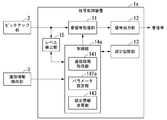
- FIG. 1 is a block diagram showing an example of a signal processing device 1 according to the first embodiment of the present invention.
- the signal processing device 1 includes a sound signal processing unit 11, a signal output unit 12, a setting storage unit 13, and a control unit 14.
- the signal processing device 1 executes sound signal processing by an equalizer on a sound signal indicating a sound obtained by playing a stringed instrument such as a guitar, and outputs the sound signal processed sound signal.
- the signal processing device 1 is, for example, an audio device such as an effector.
- the signal processing device 1 may be provided inside the stringed instrument.
- the signal processing device 1 may be provided separately from the stringed instrument, that is, outside the stringed instrument. In this case, the signal processing device 1 may receive a signal from the stringed instrument or transmit the signal to the stringed instrument, for example, by wire or wirelessly.
- the pickup unit 2 converts the vibration of the strings of the guitar into a sound signal, and outputs the sound signal to the signal processing device 1 as a pickup signal.
- the pickup unit 2 is not limited to the method of detecting the vibration of the strings of the guitar, and may be the method of collecting the sound by the microphone.
- the fingering information detection unit 3 detects the fingering information of the guitar. Fingering information is an example of information about a stringed instrument. The fingering information detection unit 3 detects the fingered string number (string number) and the pressed fret number (fret number) held by the performer's finger as fingering information.
- the pressed string number indicates the number of the string pressed by the user's performance
- the pressed fret number indicates the number of the fret whose string was pressed by the user's performance.
- the fingering information detection unit 3 outputs the detected fingering information to the signal processing device 1.
- the string pressing number and the pressing fret number also include a fret open state in which the string is not pressed.
- fret switches switches may be provided between the frets on the fingerboard of the guitar corresponding to each string.
- the fingering information detection unit 3 detects fingering information based on the on / off state of each fret switch. More specifically, the fret switch is turned on when the string comes into contact with the string by being pressed by the performer's finger.
- the fret switch is turned off when the string separates from the fret switch.
- the fingering information detection unit 3 detects the string number and the fret number corresponding to the fret switch in the ON state as the string number and the fret number.
- Japanese Patent Application Laid-Open No. 02-162397 discloses a method of detecting a fret operation position by providing a fret switch.
- the method of detecting fingering information in the embodiment of the present invention is not limited to such an example.
- the fingering information detection unit 3 optically detects whether or not the string is close to the fret at each fret position by using a photoreflector or the like, and the string is close to the fret. Fingering information may be detected based on whether or not it is in a state.
- the sound signal processing unit (an example of the processing unit) 11 executes sound signal processing by the equalizer for the input sound signal based on the set parameters.
- the sound signal processing unit 11 functions as an equalizer.
- the sound signal processing unit 11 may acquire a pickup signal (sound signal) obtained by converting the vibration of a guitar string into a sound signal from the pickup unit 2.
- the sound signal processing unit 11 executes sound signal processing by an equalizer based on the parameters on the acquired pickup signal, and executes sound signal processing on the pickup signal to output the output sound signal obtained by the signal output unit. It may be output to 12.
- the sound signal processing unit 11 is provided with, for example, a DSP (Digital Signal Processor), and realizes the function of an equalizer by digital signal processing by the DSP.
- DSP Digital Signal Processor
- the sound signal processing unit 11 may perform sound signal processing for each pickup signal corresponding to each string of the guitar, or perform sound signal processing on the pickup signal obtained by mixing (mixing) the pickup signals corresponding to each string. You may go.
- the signal output unit 12 (an example of an output unit) is, for example, a DAC (Digital to Analog Converter), an output amplifier, or the like, and outputs an output sound signal to which sound signal processing has been executed by the sound signal processing unit 11. ..
- DAC Digital to Analog Converter
- the setting storage unit 13 stores information for the parameter setting unit 142, which will be described later, to determine the parameters of the equalizer.
- the setting storage unit 13 stores setting information (setting table, setting function, etc.) that associates fingering information with parameters.
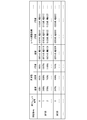
- FIG. 2 is a diagram showing a data example of the setting storage unit 13 in the present embodiment.
- the setting storage unit 13 stores the frequency and the level adjustment information in association with each other for the chord number and the fret number.
- the pressed string number and the pressed fret number are examples of fingering information.
- the frequency indicates the frequency of the equalizer.
- the level adjustment information includes, for example, the gain of the equalizer and the Q value that determines the bandwidth for setting the gain.
- the frequency of the fundamental tone corresponding to the first string and the fret number 0 (open) is 330 Hz
- the level adjustment information is G101 dB (gain) and width Q101 (Q value). It is shown that. Further, it is shown that the frequency of the second harmonic overtone corresponding to the first string and the fret number of 0 (open) is 660 Hz, and the level adjustment information is G102 dB (gain) and width Q102 (Q value). There is.
- FIG. 2 an example of setting three frequency and level adjustment information of the fundamental tone, the second harmonic overtone, and the third harmonic overtone corresponding to the pressed string number and the pressed fret number is described, and this embodiment describes such an example. Not limited to. A plurality of frequency and level adjustment information of 4th harmonic or higher may be set, or one frequency and level adjustment information may be set. Further, when setting one frequency, the frequency of the fundamental tone, which is the fundamental frequency corresponding to the pressed string number and the pressed fret number, may be set.
- control unit 14 includes, for example, a fingering information acquisition unit 141, a parameter setting unit 142, and a setting information changing unit 143.
- the fingering information acquisition unit 141 (an example of the fingering information acquisition unit and the acquisition unit) acquires the fingering information of a guitar (stringed instrument). That is, the fingering information acquisition unit 141 acquires fingering information from the fingering information detection unit 3.
- the parameter setting unit (an example of the setting unit) 142 sets the equalizer parameters based on the fingering information acquired by the fingering information acquisition unit 141.
- the parameter setting unit 142 sets the parameters, for example, based on the setting information (setting table) stored in the setting storage unit 13. That is, the parameter setting unit 142 acquires the parameters (frequency and level adjustment information) corresponding to the fingering information (string number and fret number) from the setting storage unit 13, and the acquired parameters (frequency and level adjustment information). Is set in the sound signal processing unit 11.
- the parameter setting unit 142 sets the frequency and level adjustment information corresponding to the fingering information as parameters.
- the frequency corresponding to the fingering information includes the frequencies of the fundamental and overtones corresponding to the fingering information.
- the parameter setting unit 142 sets the frequencies of the fundamental and overtones corresponding to the fingering information as parameters according to the fingering information.
- the fingering information includes a string number indicating a string number used for fingering the guitar. The parameter setting unit 142 sets the parameters according to the fingering of each string based on the string pressing number.
- the setting information changing unit 143 writes or changes the setting information in the setting storage unit 13 based on an instruction from an external device (not shown).
- the setting information changing unit 143 stores the setting information acquired from the external device in the setting storage unit 13 based on the instruction from the external device, for example, when adjusting or customizing the parameters according to the characteristics of the guitar.
- FIG. 3 is a flowchart showing an example of the parameter setting process in the present embodiment.
- the control unit 14 of the signal processing device 1 first acquires fingering information (step S101). That is, the fingering information acquisition unit 141 of the control unit 14 acquires the fingering information (for example, the string press number and the press fret number) detected by the fingering information detection unit 3.
- the fingering information acquisition unit 141 of the control unit 14 acquires the fingering information (for example, the string press number and the press fret number) detected by the fingering information detection unit 3.
- the parameter setting unit 142 of the control unit 14 determines the parameter according to the fingering information (step S102). For example, the parameter setting unit 142 acquires the frequency and level adjustment information corresponding to the fingering number and the fret number, which are fingering information, from the setting storage unit 13, and uses the frequency and level adjustment information as parameters.
- the parameter setting unit 142 sets the parameter in the equalizer (step S103). That is, the parameter setting unit 142 sets the parameters in the sound signal processing unit 11 to change the characteristics of the sound signal processing. After the process of step S103, the parameter setting unit 142 returns the process to step S101.
- the processes of steps S101 to S103 are periodically repeated.
- the parameters of the equalizer in the sound signal processing are changed according to the fingering of the guitar.
- the parameters of the sound signal processing for example, by changing the chord by fingering, it is possible to change the parameters of the sound signal processing (equalizer) before the pickup unit 2 picks up the vibration of the strings.
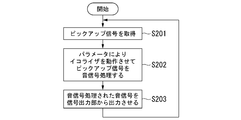
- FIG. 4 is a flowchart showing an example of sound signal processing in the present embodiment.
- the sound signal processing unit 11 of the signal processing device 1 when executing the sound signal processing, the sound signal processing unit 11 of the signal processing device 1 first acquires the pickup signal (step S201). That is, the sound signal processing unit 11 acquires the pickup signal (sound signal) input from the pickup unit 2.
- the sound signal processing unit 11 operates the equalizer according to the parameter to process the pickup signal as a sound signal (step S202). That is, the sound signal processing unit 11 executes sound signal processing by the equalizer for the input sound signal based on the parameters set by the parameter setting unit 142.
- the sound signal processing unit 11 outputs the sound signal processed sound signal from the signal output unit 12 (step S203).
- the sound signal processing unit 11 outputs the sound signal subjected to the sound signal processing to the signal output unit 12.
- the signal output unit 12 outputs a sound signal to the outside.
- the sound signal processing unit 11 returns the processing to step S201.
- the signal processing device 1 processes the pickup signal input by the parameters changed according to the finger movement information as a sound signal, and outputs the sound signal processed sound signal.
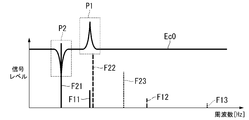
- FIG. 5 is a diagram showing an example of the operation of the signal processing device 1 according to the present embodiment.
- the vertical axis of the graph indicates the signal level
- the horizontal axis indicates the frequency.
- the equalizer characteristic Ec0 indicates the frequency characteristic of the equalizer set based on the fingering information.
- the frequency F11 indicates the frequency of the base tone corresponding to the first string
- the frequency F12 indicates the frequency of the second overtone corresponding to the first string
- the frequency F13 indicates the frequency of the third overtone corresponding to the first string.
- the frequency F21 indicates the frequency of the base tone corresponding to the second string
- the frequency F22 indicates the frequency of the second overtone corresponding to the second string
- the frequency F23 indicates the frequency of the third overtone corresponding to the first string.
- the frequency signal level is shown as a bar graph.
- the signal level of the fundamental frequency is shown by a solid line
- the signal level of the 2nd overtone frequency is shown by a broken line
- the signal level of the 3rd overtone frequency is shown by a dotted line.
- the example shown in FIG. 5 is an example of performing sound signal processing for adjusting the signal level of the fundamental frequency corresponding to fingering information.
- the parameter setting unit 142 sets the frequency F11 corresponding to the first string to amplify the signal level as shown in the parameter P1. Further, the parameter setting unit 142 sets, for example, to reduce the signal level for the frequency F21 corresponding to the second string, as shown in the parameter P2.
- the sound signal processing unit 11 executes the sound signal processing by operating the equalizer according to the frequency characteristic shown in the equalizer characteristic Ec0 for the pick-up signal, and the sound signal processed sound is processed via the signal output unit 12. Output the signal to the outside.
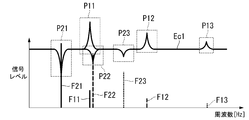
- FIG. 6 is a diagram showing another example of the operation of the signal processing device 1 according to the present embodiment.
- it is an example of performing sound signal processing for adjusting the signal levels of the fundamental tone, the second harmonic overtone, and the third harmonic overtone corresponding to the fingering information.
- the equalizer characteristic Ec1 the frequency characteristic of the equalizer set based on the fingering information is different from the above-mentioned example shown in FIG.
- the other parts are the same as those in FIG. 5 described above.
- the parameter setting unit 142 has parameters P11 and parameters for the frequencies F11 (fundamental tone), frequency F12 (2nd harmonic overtone), and frequency F13 (3rd harmonic overtone) corresponding to the first string, respectively.
- the signal level is set to be amplified.
- the parameter setting unit 142 has, for example, the parameters P21, the parameter P22, and the parameter P23 for the frequencies F21 (fundamental tone), the frequency F22 (second harmonic overtone), and the frequency F23 (third harmonic overtone) corresponding to the second string, respectively. As shown in, make settings to reduce the signal level.
- the sound signal processing unit 11 executes the sound signal processing by operating the equalizer according to the frequency characteristic shown in the equalizer characteristic Ec1 for the pick-up signal, and transmits the sound signal processed sound signal via the signal output unit 12. And output to the outside.
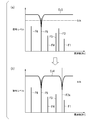
- FIG. 7 is a diagram illustrating a difference in processing according to a change in fingering information of the signal processing device 1 according to the present embodiment.
- Part (a) of FIG. 7 shows the parameters of the equalizer set in the fingering state c1 shown in FIG. 6 described above.
- the portion (b) of FIG. 7 shows the parameters of the equalizer set in the state after the fingering information of the first string has changed from the fingering state c1 to the fingering state c2.
- the parameter setting unit 142 changes from the frequency characteristic shown in the equalizer characteristic Ec1 in the portion (a) of FIG. ,
- the setting of the equalizer parameter is changed to the frequency characteristic shown in the equalizer characteristic Ec2 of the part (b) of FIG. That is, for example, the parameter setting unit 142 refers to the frequency F11a (fundamental tone), the frequency F12a (second harmonic overtone), and the frequency F13a (third harmonic overtone) corresponding to the pressed fret number of the fingering state c2 of the first string.
- the parameters P11a, P12a, and parameter P13a respectively, the signal level is set to be reduced.
- the sound signal processing unit 11 processes the pick-up signal by operating the equalizer according to the frequency characteristic changed from the equalizer characteristic Ec1 in the finger movement state c1 to the equalizer characteristic Ec2 in the finger movement state c2. Is executed, and the sound signal processed by the sound signal is output to the outside via the signal output unit 12.
- the parameters of the equalizer can be changed before picking up (before producing sound) according to the state of fingering, and the sound signal processing can be changed. ..
- the signal processing device 1 includes a fingering information acquisition unit 141, a parameter setting unit 142, a sound signal processing unit 11, and a signal output unit 12.
- the fingering information acquisition unit 141 acquires fingering information of a guitar (stringed instrument).
- the parameter setting unit 142 sets the parameters of the equalizer based on the fingering information acquired by the fingering information acquisition unit 141.
- the sound signal processing unit 11 executes sound signal processing by the equalizer on the input sound signal based on the parameters set by the parameter setting unit 142.
- the signal output unit 12 outputs an output sound signal to which sound signal processing has been executed by the sound signal processing unit 11.
- the signal processing device 1 according to the present embodiment changes the parameters according to the fingering information, so that the equalizer setting can be dynamically changed according to the performance. Further, since the signal processing device 1 according to the present embodiment changes the parameters according to the fingering information, the equalizer setting is changed for each pitch of the stringed instrument corresponding to the fingering information, so that each pitch of the stringed instrument is changed. Volume variation can be reduced.
- the parameters of the equalizer can be changed according to the fingering information, so that, for example, various pitches and harmony (chords) can be appropriately dealt with. Can be done.
- the parameter includes the frequency and the level adjustment information for adjusting the signal level of the sound signal corresponding to the frequency.
- the parameter setting unit 142 sets the frequency and level adjustment information corresponding to the fingering information as parameters.
- the sound signal processing unit 11 adjusts the signal level of the frequency corresponding to the fingering information based on the level adjustment information.
- the signal processing device 1 according to the present embodiment can appropriately change the equalizer setting according to the fingering information.
- the frequency corresponding to the fingering information includes the frequencies of the fundamental tone and the overtone corresponding to the fingering information.
- the parameter setting unit 142 sets the frequencies of the fundamental and overtones corresponding to the fingering information as parameters according to the fingering information.
- the signal processing device 1 according to the present embodiment can further appropriately change the equalizer setting according to the fingering information.
- the fingering information includes a string number indicating a string number used for fingering a guitar (stringed instrument).
- the parameter setting unit 142 sets the parameters according to the fingering of each string based on the string pressing number.
- the pressed string number is an example of string number information.
- the signal processing device 1 includes a setting storage unit 13 that stores setting information in which fingering information and parameters are associated with each other.
- the parameter setting unit 142 sets the parameters based on the setting information stored in the setting storage unit 13.
- the signal processing device 1 according to the present embodiment can appropriately change the equalizer setting according to the fingering information. For example, by changing the setting information stored in the setting storage unit 13, it is possible to easily adjust the individual variation of the guitar (stringed instrument) and customize it by the user.
- a sound signal processing unit 11 that executes sound signal processing by an equalizer and an output sound signal that is sound signal processed by the sound signal processing unit 11 are applied to the sound signal.
- the finger movement information acquisition unit 141 acquires the finger movement information of the guitar (finger movement information acquisition step), and the parameter setting unit 142 , Equalizer parameters are set based on the finger movement information acquired by the finger movement information acquisition unit 141 (parameter setting step), and the sound signal processing unit 11 inputs based on the parameters set by the parameter setting unit 142.
- the sound signal processed by the equalizer is executed (sound signal processing step).
- the signal processing method according to the present embodiment has the same effect as the signal processing device 1 described above, and the equalizer setting can be dynamically changed according to the performance.
- FIG. 8 is a block diagram showing an example of the signal processing device 1a according to the second embodiment.
- the signal processing device 1a includes a sound signal processing unit 11, a signal output unit 12, a setting storage unit 13, a control unit 14a, and a level detection unit 15.
- the signal processing device 1a may be provided inside the stringed instrument.
- the signal processing device 1a may be provided separately from the stringed instrument, that is, outside the stringed instrument. In this case, the signal processing device 1a may receive a signal from the stringed instrument or transmit the signal to the stringed instrument, for example, by wire or wirelessly.
- the same reference numerals are given to the same configurations as those shown in FIG. 1, and the description thereof will be omitted.
- the signal processing device 1a includes the level detection unit 15, and the processing by the control unit 14a is different from that of the first embodiment.
- the level detection unit 15 detects the signal level (detection signal level) of a predetermined frequency of the sound signal.
- the level detection unit 15 detects, for example, the signal level of the frequency specified by the control unit 14a from the pickup signals output by the pickup unit 2.
- the level detection unit 15 detects a signal level of a designated frequency by using, for example, a bandpass filter, an FFT (Fast Fourier Transform) process, or the like.
- the control unit 14a includes a fingering information acquisition unit 141, a parameter setting unit 142a, and a setting information changing unit 143.
- the parameter setting unit 142a sets the equalizer parameters based on the fingering information acquired by the fingering information acquisition unit 141.
- the parameter setting unit 142a sets the parameters according to the detection signal level detected by the level detection unit 15 and the fingering information.
- the parameter setting unit 142a acquires, for example, parameters (frequency and level adjustment information) corresponding to fingering information (string number and fret number) from the setting storage unit 13.
- the parameter setting unit 142a sets the acquired frequency in the level detection unit 15.
- the parameter setting unit 142a sets the parameters in the sound signal processing unit 11 according to the detection signal level of the frequency detected by the level detection unit 15.
- the parameter setting unit 142a corresponds to the finger movement information based on the level adjustment information when the signal level of the frequency detected by the level detection unit 15 is equal to or higher than a predetermined threshold value.
- Level adjustment information for reducing the level of the sound signal of the frequency is set in the sound signal processing unit 11.
- the sound signal processing unit 11 uses the equalizer to reduce the level of the sound signal at the frequency corresponding to the fingering information when the signal level at the frequency corresponding to the fingering information is equal to or higher than a predetermined threshold value. Perform signal processing.
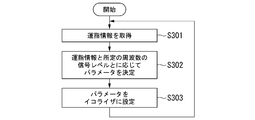
- FIG. 9 is a flowchart showing an example of the parameter setting process in the present embodiment.
- the control unit 14a of the signal processing device 1a first acquires fingering information (step S301). That is, the fingering information acquisition unit 141 of the control unit 14a acquires the fingering information detected by the fingering information detection unit 3.
- the parameter setting unit 142a of the control unit 14a determines the parameter according to the fingering information and the signal level of the predetermined frequency (step S302).
- the parameter setting unit 142a acquires, for example, frequency and level adjustment information corresponding to the fingering number and the fret number, which are fingering information, from the setting storage unit 13, and corresponds to the fingering information detected by the level detection unit 15. Acquires the detection signal level of the frequency to be detected. For example, when the signal level of the frequency corresponding to the fingering information is equal to or higher than a predetermined threshold value, the parameter setting unit 142a uses the frequency and level adjustment information as parameters.
- the parameter setting unit 142a sets the parameter in the equalizer (step S303). That is, the parameter setting unit 142a sets the parameters in the sound signal processing unit 11 to change the characteristics of the sound signal processing. After the process of step S303, the parameter setting unit 142a returns the process to step S301.
- FIG. 10 is a diagram showing an example of the operation of the signal processing device 1a according to the present embodiment.
- Part (a) of FIG. 10 shows, for example, the signal level and frequency characteristics of the frequency (fundamental tone) corresponding to each of the first to sixth strings in the fingering state c3.
- the frequencies F1 to F6 indicate frequencies corresponding to the first to sixth strings in the fingering state c3, respectively.
- the equalizer characteristic Ec3 indicates the frequency characteristic of the equalizer set based on the fingering information in the fingering state c3.
- the parameter setting unit 142a has a frequency as shown in the equalizer characteristic Ec3 when the signal level of the frequency F5 corresponding to the fifth string becomes equal to or higher than a predetermined threshold value Lth.
- the parameter setting unit 142a makes a setting to reduce the signal level of the frequency F5 in order to prevent howling when the signal level of the frequency F5 becomes equal to or higher than the predetermined threshold value Lth.
- the sound signal processing unit 11 when the signal level of the frequency F5 is equal to or higher than a predetermined threshold Lth with respect to the pick-up signal, the sound signal processing unit 11 operates the equalizer according to the frequency characteristic shown in the equalizer characteristic Ec3 to execute the sound signal processing. Then, the output sound signal processed by the sound signal is output to the outside via the signal output unit 12.
- the parameter setting unit 142a is a parameter when the signal level of the frequency F2a corresponding to the push fret number of the second string becomes equal to or higher than a predetermined threshold Lth in response to the change of the push fret number of the second string. Is added to the equalizer characteristic Ec3, and the parameters of the equalizer are set so as to have the frequency characteristics as shown in the equalizer characteristic Ec4.
- the parameter setting unit 142a is set to reduce the signal level of the frequency F5 in order to prevent howling when the signal level of the frequency F5 becomes equal to or higher than the predetermined threshold value Lth, and the signal of the frequency F2a is set.
- the signal level of the frequency F2a is set to be reduced in order to prevent howling.
- the sound signal processing unit 11 processes the pick-up signal by operating the equalizer according to the frequency characteristic changed from the equalizer characteristic Ec3 in the finger movement state c3 to the equalizer characteristic Ec4 in the finger movement state c4. Is executed, and the output sound signal processed by the sound signal is output to the outside via the signal output unit 12.
- the signal processing device 1a includes the parameter setting unit 142a. Further, the parameter setting unit 142a lowers the level of the sound signal at the frequency corresponding to the fingering information when the signal level of the frequency corresponding to the fingering information is equal to or higher than a predetermined threshold value (for example, the threshold Lth or higher). Set the level adjustment information to be set. As a result, the signal processing device 1a according to the present embodiment can reduce howling of the sound signal.
- a predetermined threshold value for example, the threshold Lth or higher.
- the parameter setting unit 142a is set to reduce the signal level of the frequency to be howling in order to reduce howling, and further, according to the fingering information, Change the frequency that is the target of howling. Therefore, in the signal processing device 1a according to the present embodiment, the setting of the equalizer for howling countermeasures can be minimized. As a result, it is possible to reduce the change in timbre due to howling measures.
- the signal processing device 1a according to the present embodiment sets a threshold value for the signal level to which the howling countermeasure is applied. Therefore, when howling does not occur, the sound signal processing for reducing the signal level is not executed. As a result, the signal processing device 1a according to the present embodiment can further reduce the change in timbre due to howling countermeasures.
- the signal processing device 1a includes a level detection unit 15 that detects a signal level of a predetermined frequency of a sound signal.
- the parameter setting unit 142a sets the parameters according to the detection signal level detected by the level detection unit 15 and the fingering information.
- the signal processing device 1a according to the present embodiment can further dynamically change the equalizer setting according to the performance.
- a level detection unit 15 is provided outside the sound signal processing unit 11 and the parameter setting unit 142a changes the equalizer parameter according to the signal level of a predetermined frequency.
- the sound signal processing unit 11 may include a level detection unit 15 and switch whether or not to apply the set parameters according to the signal level of a predetermined frequency.
- the setting storage unit 13 may store the setting information including the threshold value of the signal level.
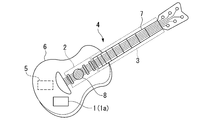
- FIG. 11 is a configuration diagram showing a guitar 4 which is an example of a stringed instrument according to the present embodiment.
- the guitar 4 includes a pickup unit 2, a fingering information detection unit 3, a signal processing device 1 (1a), a vibration exciter 5, a body (body) 6, and a neck 7. I have.
- the exciter 5 is provided inside the body 6.
- the body 6 has a sound hole 8.
- the fingering information detection unit 3 is arranged on the neck 7 of the guitar 4, for example, detects the fingering information of each string, and outputs the fingering information of each string to the signal processing device 1 (1a).
- the pickup unit 2 is arranged on the body 6 of the guitar 4. The pickup unit 2 converts the vibration of the strings of the guitar 4 into a sound signal, and outputs the sound signal to the signal processing device 1 (1a) as a pickup signal.
- the signal processing device 1 (1a) changes the equalizer parameters according to the finger movement information detected by the finger movement information detection unit 3, and the pickup unit 2 outputs the guitar 4 when the player plays the strings.
- the pickup signal to be processed is processed as a sound signal and output to the exciter 5 (an external example).
- the exciter 5 vibrates the body 6 according to the pick-up signal (sound signal) processed by the sound signal.
- the volume (or timbre) emitted by the guitar 4 is changed by the vibration of the body 6 by the exciter 5.
- the guitar 4 (stringed instrument) according to the present embodiment includes a fingering information detection unit 3 for detecting fingering information and a signal processing device 1 (1a) described above.
- the guitar 4 (stringed instrument) according to the present embodiment has the same effect as the signal processing device 1 (1a) described above, and the equalizer setting can be dynamically changed according to the performance.
- the present invention is not limited to each of the above embodiments, and can be modified without departing from the spirit of the present invention.
- the signal processing device 1 (1a) is an audio device such as an effector
- the signal processing device 1 (1a) may be, for example, an electronic device such as a smartphone, a tablet terminal device, or a PC (personal computer). Further, the signal processing device 1 (1a) may be provided with a sound signal processing unit 11 and a signal output unit 12 externally.
- the signal processing device 1 (1a) may be applied to a guitar that emits sound from an external speaker, such as an electric guitar, an electric guitar, and an electronic guitar.
- the signal processing device 1 (1a) is not limited to various guitars, and may be applied to other musical instruments such as wood bass, electric bass, violin and cello. In that case, for musical instruments that do not have frets, a configuration may be provided for detecting whether or not a string or finger is in contact with the fingerboard.
- the signal processing device 1 (1a) may detect the string pressing position information indicating the position where the string is pressed instead of the pressing fret number as the fingering information.
- the signal processing device 1 (1a) may specify the pitch of the sound, that is, the frequency of the sound by using the string pressing position information, and perform the sound signal processing based on the specified frequency.
- the signal processing device 1 has described an example in which the sound signal processing by the equalizer is applied to the overtones up to the third harmonic, but the sound signal processing by the equalizer is applied to the harmonics of the fourth harmonic or higher. You may try to do it.
- the signal processing device 1a may set the frequency and level adjustment information of the fundamental tone and the overtone as in the first embodiment.
- fingering information has been described as an example of information regarding a stringed instrument, but the embodiment of the present invention is not limited to such an example.
- the information about the stringed instrument may be vibration information about the vibration generated by the stringed instrument, or pitch information about the pitch of the sound emitted by the stringed instrument.
- the parameter setting unit 142 may specify a frequency having a signal level equal to or higher than the threshold value by performing signal processing on vibration information or pitch information.
- the parameter setting unit 142 may acquire parameters (level adjustment information) corresponding to the specified frequency from the setting storage unit 13 and set the acquired parameters in the equalizer (sound signal processing unit 11).
- Each configuration included in the signal processing device 1 (1a) described above has a computer system inside. Then, a program for realizing the functions of each configuration included in the signal processing device 1 (1a) described above is recorded on a computer-readable recording medium, and the program recorded on the recording medium is read into the computer system. By executing the processing, the processing in each configuration included in the signal processing device 1 (1a) described above may be performed.
- “loading a computer system a program recorded on a recording medium and executing it” includes installing the program in the computer system.
- computer system includes hardware such as an OS and peripheral devices.
- the "computer system” may include a plurality of computer devices connected via a network including a communication line such as the Internet, WAN, LAN, and a dedicated line.
- the "computer-readable recording medium” refers to a portable medium such as a flexible disk, a magneto-optical disk, a ROM, or a CD-ROM, or a storage device such as a hard disk built in a computer system.
- the recording medium in which the program is stored may be a non-transient recording medium such as a CD-ROM.
- the recording medium also includes a recording medium provided internally or externally accessible from the distribution server for distributing the program. Even if the program is divided into a plurality of programs, downloaded at different timings, and then combined with each configuration provided in the signal processing device 1 (1a), or the distribution server that distributes each of the divided programs is different. Good.
- a "computer-readable recording medium” is a volatile memory (RAM) inside a computer system that serves as a server or client when a program is transmitted via a network, and holds the program for a certain period of time. It shall include things.
- the above program may be for realizing a part of the above-mentioned functions.
- the program may be a so-called difference file (difference program) that can realize the above-mentioned functions in combination with a program already recorded in the computer system.
- a part or all of the above-mentioned functions may be realized as an integrated circuit such as an LSI (Large Scale Integration).
- LSI Large Scale Integration
- Each of the above-mentioned functions may be made into a processor individually, or a part or all of them may be integrated into a processor.
- the method of making an integrated circuit is not limited to LSI, and may be realized by a dedicated circuit or a general-purpose processor. Further, when an integrated circuit technology that replaces an LSI appears due to advances in semiconductor technology, an integrated circuit based on this technology may be used.
- the present invention may be applied to signal processing devices, stringed instruments, signal processing methods, and programs.
Landscapes
- Engineering & Computer Science (AREA)
- Physics & Mathematics (AREA)
- Acoustics & Sound (AREA)
- Multimedia (AREA)
- Signal Processing (AREA)
- Electrophonic Musical Instruments (AREA)
- Circuit For Audible Band Transducer (AREA)
- Tone Control, Compression And Expansion, Limiting Amplitude (AREA)
Priority Applications (4)
| Application Number | Priority Date | Filing Date | Title |
|---|---|---|---|
| JP2021528220A JP7639681B2 (ja) | 2019-06-24 | 2020-06-15 | 信号処理装置、弦楽器、信号処理方法、及びプログラム |
| CN202080044258.5A CN113994421B (zh) | 2019-06-24 | 2020-06-15 | 信号处理装置、弦乐器、信号处理方法及程序 |
| US17/643,950 US12400626B2 (en) | 2019-06-24 | 2021-12-13 | Signal processing device, stringed instrument, signal processing method, and program |
| JP2025025953A JP7768440B2 (ja) | 2019-06-24 | 2025-02-20 | 信号処理装置、弦楽器、及びプログラム |
Applications Claiming Priority (2)
| Application Number | Priority Date | Filing Date | Title |
|---|---|---|---|
| JP2019116223 | 2019-06-24 | ||
| JP2019-116223 | 2019-06-24 |
Related Child Applications (1)
| Application Number | Title | Priority Date | Filing Date |
|---|---|---|---|
| US17/643,950 Continuation US12400626B2 (en) | 2019-06-24 | 2021-12-13 | Signal processing device, stringed instrument, signal processing method, and program |
Publications (1)
| Publication Number | Publication Date |
|---|---|
| WO2020262074A1 true WO2020262074A1 (ja) | 2020-12-30 |
Family
ID=74061882
Family Applications (1)
| Application Number | Title | Priority Date | Filing Date |
|---|---|---|---|
| PCT/JP2020/023420 Ceased WO2020262074A1 (ja) | 2019-06-24 | 2020-06-15 | 信号処理装置、弦楽器、信号処理方法、及びプログラム |
Country Status (4)
| Country | Link |
|---|---|
| US (1) | US12400626B2 (https=) |
| JP (2) | JP7639681B2 (https=) |
| CN (1) | CN113994421B (https=) |
| WO (1) | WO2020262074A1 (https=) |
Families Citing this family (1)
| Publication number | Priority date | Publication date | Assignee | Title |
|---|---|---|---|---|
| WO2020262074A1 (ja) * | 2019-06-24 | 2020-12-30 | ヤマハ株式会社 | 信号処理装置、弦楽器、信号処理方法、及びプログラム |
Citations (5)
| Publication number | Priority date | Publication date | Assignee | Title |
|---|---|---|---|---|
| JPH023100A (ja) * | 1988-06-20 | 1990-01-08 | Casio Comput Co Ltd | 電子楽器 |
| JPH10171454A (ja) * | 1996-12-12 | 1998-06-26 | Casio Comput Co Ltd | 音色制御装置および音色制御方法 |
| JP2005037759A (ja) * | 2003-07-17 | 2005-02-10 | Roland Corp | 効果装置 |
| JP2014134756A (ja) * | 2013-04-12 | 2014-07-24 | Casio Comput Co Ltd | 電子弦楽器、楽音発生方法及びプログラム |
| WO2016152219A1 (ja) * | 2015-03-24 | 2016-09-29 | ヤマハ株式会社 | 付加的振動音を発生可能な楽器及び方法 |
Family Cites Families (23)
| Publication number | Priority date | Publication date | Assignee | Title |
|---|---|---|---|---|
| JPH02162397A (ja) | 1988-12-16 | 1990-06-21 | Casio Comput Co Ltd | 電子弦楽器のフレット操作位置検出装置 |
| US6689947B2 (en) * | 1998-05-15 | 2004-02-10 | Lester Frank Ludwig | Real-time floor controller for control of music, signal processing, mixing, video, lighting, and other systems |
| US6111186A (en) * | 1998-07-09 | 2000-08-29 | Paul Reed Smith Guitars | Signal processing circuit for string instruments |
| JP2004117621A (ja) * | 2002-09-25 | 2004-04-15 | Yamaha Corp | 弦楽器型電子楽器 |
| JP4159555B2 (ja) * | 2005-01-31 | 2008-10-01 | ローランド株式会社 | 楽器用プリアンプおよび電気楽器 |
| JP2007310308A (ja) * | 2006-05-22 | 2007-11-29 | Yamaha Corp | 録音支援装置 |
| JP4285531B2 (ja) * | 2006-11-29 | 2009-06-24 | ソニー株式会社 | 信号処理装置、信号処理方法、プログラム |
| JP5339568B2 (ja) * | 2006-12-12 | 2013-11-13 | カシオ計算機株式会社 | 電子弦楽器 |
| EP2261896B1 (en) * | 2008-07-29 | 2017-12-06 | Yamaha Corporation | Performance-related information output device, system provided with performance-related information output device, and electronic musical instrument |
| JP2010147827A (ja) * | 2008-12-19 | 2010-07-01 | Yamaha Corp | 音響特性補正システム、音響特性補正方法および音響特性補正プログラム |
| JP5691209B2 (ja) * | 2010-03-18 | 2015-04-01 | ヤマハ株式会社 | 信号処理装置および弦楽器 |
| JP5573263B2 (ja) * | 2010-03-18 | 2014-08-20 | ヤマハ株式会社 | 信号処理装置および弦楽器 |
| JP2012094958A (ja) * | 2010-10-25 | 2012-05-17 | Nec Casio Mobile Communications Ltd | 移動通信端末の音響特性調整システム、音響特性調整方法、音響特性補正サーバ又は移動通信端末 |
| WO2012058497A1 (en) * | 2010-10-28 | 2012-05-03 | Gibson Guitar Corp. | Wireless electric guitar |
| SE535612C2 (sv) * | 2011-01-11 | 2012-10-16 | Arne Wallander | Förändring av ett ljuds upplevda styrkegrad medelst filtrering med en parametrisk equalizer |
| US20120294459A1 (en) * | 2011-05-17 | 2012-11-22 | Fender Musical Instruments Corporation | Audio System and Method of Using Adaptive Intelligence to Distinguish Information Content of Audio Signals in Consumer Audio and Control Signal Processing Function |
| US20120294457A1 (en) * | 2011-05-17 | 2012-11-22 | Fender Musical Instruments Corporation | Audio System and Method of Using Adaptive Intelligence to Distinguish Information Content of Audio Signals and Control Signal Processing Function |
| JP2017072623A (ja) * | 2014-01-22 | 2017-04-13 | ヤマハ株式会社 | 楽器の音響効果設定方法 |
| JP6507508B2 (ja) * | 2014-07-16 | 2019-05-08 | カシオ計算機株式会社 | 楽音制御装置、電子楽器、楽音制御方法及びプログラム |
| JP2017073631A (ja) * | 2015-10-06 | 2017-04-13 | ヤマハ株式会社 | 音信号処理装置用設定プログラム |
| CN108701448B (zh) * | 2016-01-20 | 2019-11-15 | 雅马哈株式会社 | 可产生附加性振动音的乐器及方法 |
| JP7423916B2 (ja) * | 2019-06-19 | 2024-01-30 | ヤマハ株式会社 | 信号処理装置、信号処理方法、及びプログラム |
| WO2020262074A1 (ja) * | 2019-06-24 | 2020-12-30 | ヤマハ株式会社 | 信号処理装置、弦楽器、信号処理方法、及びプログラム |
-
2020
- 2020-06-15 WO PCT/JP2020/023420 patent/WO2020262074A1/ja not_active Ceased
- 2020-06-15 CN CN202080044258.5A patent/CN113994421B/zh active Active
- 2020-06-15 JP JP2021528220A patent/JP7639681B2/ja active Active
-
2021
- 2021-12-13 US US17/643,950 patent/US12400626B2/en active Active
-
2025
- 2025-02-20 JP JP2025025953A patent/JP7768440B2/ja active Active
Patent Citations (5)
| Publication number | Priority date | Publication date | Assignee | Title |
|---|---|---|---|---|
| JPH023100A (ja) * | 1988-06-20 | 1990-01-08 | Casio Comput Co Ltd | 電子楽器 |
| JPH10171454A (ja) * | 1996-12-12 | 1998-06-26 | Casio Comput Co Ltd | 音色制御装置および音色制御方法 |
| JP2005037759A (ja) * | 2003-07-17 | 2005-02-10 | Roland Corp | 効果装置 |
| JP2014134756A (ja) * | 2013-04-12 | 2014-07-24 | Casio Comput Co Ltd | 電子弦楽器、楽音発生方法及びプログラム |
| WO2016152219A1 (ja) * | 2015-03-24 | 2016-09-29 | ヤマハ株式会社 | 付加的振動音を発生可能な楽器及び方法 |
Also Published As
| Publication number | Publication date |
|---|---|
| JP7639681B2 (ja) | 2025-03-05 |
| US12400626B2 (en) | 2025-08-26 |
| CN113994421A (zh) | 2022-01-28 |
| JP2025068091A (ja) | 2025-04-24 |
| JPWO2020262074A1 (https=) | 2020-12-30 |
| JP7768440B2 (ja) | 2025-11-12 |
| US20220101820A1 (en) | 2022-03-31 |
| CN113994421B (zh) | 2025-10-10 |
Similar Documents
| Publication | Publication Date | Title |
|---|---|---|
| EP2946479B1 (en) | Synthesizer with bi-directional transmission | |
| US10115381B2 (en) | Device and method for simulating a sound timbre, particularly for stringed electrical musical instruments | |
| CN102194451B (zh) | 信号处理装置和弦乐器 | |
| JP7768440B2 (ja) | 信号処理装置、弦楽器、及びプログラム | |
| US11875777B2 (en) | Information processing method, estimation model construction method, information processing device, and estimation model constructing device | |
| CN112420006B (zh) | 运行模拟乐器组件的方法及装置、存储介质、计算机设备 | |
| US10805475B2 (en) | Resonance sound signal generation device, resonance sound signal generation method, non-transitory computer readable medium storing resonance sound signal generation program and electronic musical apparatus | |
| US20130112069A1 (en) | Apparatus And Method To Transform Stringed Musical Instrument Vibrations | |
| CN111279412B (zh) | 音响装置及音响控制方法 | |
| JP2014142508A (ja) | 電子弦楽器、楽音生成方法及びプログラム | |
| US9384724B2 (en) | Music playing device, electronic instrument, music playing method, and storage medium | |
| JP7835046B2 (ja) | 情報処理装置および情報処理方法 | |
| Thuillier et al. | Feedback control in an actuated acoustic guitar using frequency shifting | |
| WO2017135350A1 (ja) | 記録媒体、音響処理装置および音響処理方法 | |
| JP7184218B1 (ja) | 音響機器および該音響機器のパラメータ出力方法 | |
| JP7790061B2 (ja) | 情報処理装置、方法及びプログラム | |
| JP7750495B1 (ja) | 電子アコーディオン、プログラム | |
| EP4571730A1 (en) | Playback device and playback system | |
| US20250391391A1 (en) | Audio processing method and device | |
| JP2024077977A (ja) | プログラム | |
| JP5151603B2 (ja) | 電子楽器 | |
| RU2573369C1 (ru) | Пиано-гитара | |
| CN115497436A (zh) | 乐器声音调整方法、乐器及存储介质 | |
| JP6255725B2 (ja) | 楽音発生装置、楽音発生方法及びプログラム | |
| WO2010119541A1 (ja) | 音発生装置、音発生方法、音発生プログラム、及び記録媒体 |
Legal Events
| Date | Code | Title | Description |
|---|---|---|---|
| 121 | Ep: the epo has been informed by wipo that ep was designated in this application |
Ref document number: 20832748 Country of ref document: EP Kind code of ref document: A1 |
|
| ENP | Entry into the national phase |
Ref document number: 2021528220 Country of ref document: JP Kind code of ref document: A |
|
| NENP | Non-entry into the national phase |
Ref country code: DE |
|
| 122 | Ep: pct application non-entry in european phase |
Ref document number: 20832748 Country of ref document: EP Kind code of ref document: A1 |
|
| WWG | Wipo information: grant in national office |
Ref document number: 202080044258.5 Country of ref document: CN |