WO2020255467A1 - 固体電解質、電極、蓄電素子及び固体電解質の製造方法 - Google Patents
固体電解質、電極、蓄電素子及び固体電解質の製造方法 Download PDFInfo
- Publication number
- WO2020255467A1 WO2020255467A1 PCT/JP2020/002180 JP2020002180W WO2020255467A1 WO 2020255467 A1 WO2020255467 A1 WO 2020255467A1 JP 2020002180 W JP2020002180 W JP 2020002180W WO 2020255467 A1 WO2020255467 A1 WO 2020255467A1
- Authority
- WO
- WIPO (PCT)
- Prior art keywords
- solid electrolyte
- layer
- ions
- electrolyte according
- ion
- Prior art date
- Legal status (The legal status is an assumption and is not a legal conclusion. Google has not performed a legal analysis and makes no representation as to the accuracy of the status listed.)
- Ceased
Links
Images









Classifications
-
- H—ELECTRICITY
- H01—ELECTRIC ELEMENTS
- H01M—PROCESSES OR MEANS, e.g. BATTERIES, FOR THE DIRECT CONVERSION OF CHEMICAL ENERGY INTO ELECTRICAL ENERGY
- H01M10/00—Secondary cells; Manufacture thereof
- H01M10/05—Accumulators with non-aqueous electrolyte
- H01M10/056—Accumulators with non-aqueous electrolyte characterised by the materials used as electrolytes, e.g. mixed inorganic/organic electrolytes
- H01M10/0564—Accumulators with non-aqueous electrolyte characterised by the materials used as electrolytes, e.g. mixed inorganic/organic electrolytes the electrolyte being constituted of organic materials only
- H01M10/0565—Polymeric materials, e.g. gel-type or solid-type
-
- H—ELECTRICITY
- H01—ELECTRIC ELEMENTS
- H01M—PROCESSES OR MEANS, e.g. BATTERIES, FOR THE DIRECT CONVERSION OF CHEMICAL ENERGY INTO ELECTRICAL ENERGY
- H01M10/00—Secondary cells; Manufacture thereof
- H01M10/05—Accumulators with non-aqueous electrolyte
- H01M10/056—Accumulators with non-aqueous electrolyte characterised by the materials used as electrolytes, e.g. mixed inorganic/organic electrolytes
-
- H—ELECTRICITY
- H01—ELECTRIC ELEMENTS
- H01M—PROCESSES OR MEANS, e.g. BATTERIES, FOR THE DIRECT CONVERSION OF CHEMICAL ENERGY INTO ELECTRICAL ENERGY
- H01M10/00—Secondary cells; Manufacture thereof
- H01M10/05—Accumulators with non-aqueous electrolyte
- H01M10/052—Li-accumulators
-
- H—ELECTRICITY
- H01—ELECTRIC ELEMENTS
- H01M—PROCESSES OR MEANS, e.g. BATTERIES, FOR THE DIRECT CONVERSION OF CHEMICAL ENERGY INTO ELECTRICAL ENERGY
- H01M4/00—Electrodes
- H01M4/02—Electrodes composed of, or comprising, active material
- H01M4/64—Carriers or collectors
- H01M4/70—Carriers or collectors characterised by shape or form
- H01M4/80—Porous plates, e.g. sintered carriers
-
- H—ELECTRICITY
- H01—ELECTRIC ELEMENTS
- H01M—PROCESSES OR MEANS, e.g. BATTERIES, FOR THE DIRECT CONVERSION OF CHEMICAL ENERGY INTO ELECTRICAL ENERGY
- H01M50/00—Constructional details or processes of manufacture of the non-active parts of electrochemical cells other than fuel cells, e.g. hybrid cells
- H01M50/40—Separators; Membranes; Diaphragms; Spacing elements inside cells
- H01M50/403—Manufacturing processes of separators, membranes or diaphragms
-
- H—ELECTRICITY
- H01—ELECTRIC ELEMENTS
- H01M—PROCESSES OR MEANS, e.g. BATTERIES, FOR THE DIRECT CONVERSION OF CHEMICAL ENERGY INTO ELECTRICAL ENERGY
- H01M50/00—Constructional details or processes of manufacture of the non-active parts of electrochemical cells other than fuel cells, e.g. hybrid cells
- H01M50/40—Separators; Membranes; Diaphragms; Spacing elements inside cells
- H01M50/489—Separators, membranes, diaphragms or spacing elements inside the cells, characterised by their physical properties, e.g. swelling degree, hydrophilicity or shut down properties
- H01M50/491—Porosity
-
- H—ELECTRICITY
- H01—ELECTRIC ELEMENTS
- H01M—PROCESSES OR MEANS, e.g. BATTERIES, FOR THE DIRECT CONVERSION OF CHEMICAL ENERGY INTO ELECTRICAL ENERGY
- H01M4/00—Electrodes
- H01M4/02—Electrodes composed of, or comprising, active material
- H01M2004/021—Physical characteristics, e.g. porosity, surface area
-
- H—ELECTRICITY
- H01—ELECTRIC ELEMENTS
- H01M—PROCESSES OR MEANS, e.g. BATTERIES, FOR THE DIRECT CONVERSION OF CHEMICAL ENERGY INTO ELECTRICAL ENERGY
- H01M2300/00—Electrolytes
- H01M2300/0017—Non-aqueous electrolytes
- H01M2300/0065—Solid electrolytes
- H01M2300/0082—Organic polymers
-
- Y—GENERAL TAGGING OF NEW TECHNOLOGICAL DEVELOPMENTS; GENERAL TAGGING OF CROSS-SECTIONAL TECHNOLOGIES SPANNING OVER SEVERAL SECTIONS OF THE IPC; TECHNICAL SUBJECTS COVERED BY FORMER USPC CROSS-REFERENCE ART COLLECTIONS [XRACs] AND DIGESTS
- Y02—TECHNOLOGIES OR APPLICATIONS FOR MITIGATION OR ADAPTATION AGAINST CLIMATE CHANGE
- Y02E—REDUCTION OF GREENHOUSE GAS [GHG] EMISSIONS, RELATED TO ENERGY GENERATION, TRANSMISSION OR DISTRIBUTION
- Y02E60/00—Enabling technologies; Technologies with a potential or indirect contribution to GHG emissions mitigation
- Y02E60/10—Energy storage using batteries
Definitions
- the present disclosure relates to a method for producing a solid electrolyte, an electrode, a power storage element, and a solid electrolyte.
- Patent Document 1 discloses a method for producing a solid electrolyte by a sol-gel method using a mixed solution containing an ionic liquid, a lithium salt and a silica precursor.
- the present disclosure provides a novel solid electrolyte that exhibits high ionic conductivity.
- This disclosure is Porous dielectrics with multiple interconnected pores and An electrolyte containing at least one selected from the group consisting of an ionic compound and a bipolar compound, a metal salt, and at least partially filling the inside of the plurality of pores.
- An electrolyte containing at least one selected from the group consisting of an ionic compound and a bipolar compound, a metal salt, and at least partially filling the inside of the plurality of pores.
- the inner surface of the plurality of pores of the porous dielectric provides a solid electrolyte that is at least partially modified with functional groups containing halogen atoms.
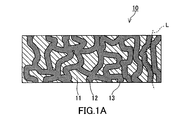
- FIG. 1A is a diagram schematically showing an example of a cross-sectional structure of the solid electrolyte according to the first embodiment.
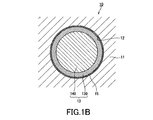
- FIG. 1B is a diagram schematically showing a cross section of a hole of a porous dielectric.
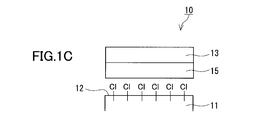
- FIG. 1C is a diagram schematically showing the state of the inner surface of a plurality of pores of the porous dielectric.
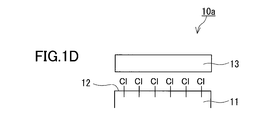
- FIG. 1D is a diagram schematically showing another state of the inner surface of a plurality of pores of a porous dielectric.
- FIG. 2 is a diagram schematically showing an example of the structure of the polarization layer.
- FIG. 3 is a diagram schematically showing another example of the structure of the polarization layer.
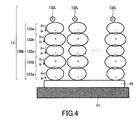
- FIG. 4 is a diagram schematically showing still another example of the structure of the polarization layer.
- FIG. 5 is a diagram schematically showing still another example of the structure of the polarization layer.
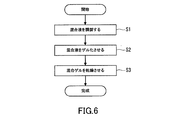
- FIG. 6 is a flowchart showing an example of a method for producing a solid electrolyte according to the first embodiment.
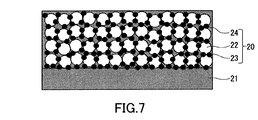
- FIG. 7 is a diagram schematically showing an example of the cross-sectional structure of the electrode according to the second embodiment.
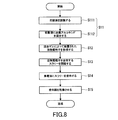
- FIG. 8 is a flowchart showing an example of the electrode manufacturing method according to the second embodiment.
- FIG. 9 is a flowchart showing another example of the electrode manufacturing method according to the second embodiment.
- FIG. 10 is a flowchart showing still another example of the electrode manufacturing method according to the second embodiment.
- FIG. 11 is a diagram schematically showing an example of a cross-sectional structure of the power storage element according to the third embodiment.
- FIG. 11 is a diagram schematically showing an example of a cross-sectional structure of the power storage element according to the third embodiment.
- FIG. 12 is a diagram schematically showing an example of the cross-sectional structure of the power storage element according to the fourth embodiment.
- FIG. 13 is a diagram schematically showing an example of the cross-sectional structure of the power storage element according to the fifth embodiment.
- FIG. 14 is a graph showing the relationship between the ionic conductivity of the solid electrolytes of Samples 1a to 1e and the amount of Cl-TMOS added.
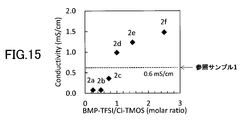
- FIG. 15 is a graph showing the relationship between the ionic conductivity of the solid electrolyte of Samples 2a to 2f and the molar ratio of the ionic liquid to Cl—TMS.
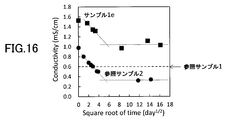
- FIG. 16 is a graph showing the time course of ionic conductivity after the solid electrolyte of sample 1e and the electrolyte of reference sample 2 are stored in a low humidity environment.
- FIG. 17 is a graph showing the temperature dependence of the ionic conductivity of the solid electrolyte of sample 1e and the electrolyte of reference sample 1.
- Figure 18 is a graph showing the results of the sample 1e of the solid electrolyte and the reference sample 1 electrolytes FT-IR measurement in the wavenumber range of 1400 cm -1 from 1000 cm -1.
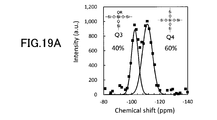
- FIG. 19A is a graph showing the results of solid-state NMR measurement of the solid electrolyte of Reference Sample 2 in the chemical shift range of ⁇ 80 ppm to ⁇ 140 ppm.
- FIG. 19B is a graph showing the results of solid-state NMR measurement of the solid electrolyte of sample 1e in the chemical shift range of -60 ppm to -100 ppm.
- Patent Document 1 has a support skeleton of SiO 2 having a mesoporous structure. Lithium ion conductivity is improved by orienting ionic liquid molecules on the inner surface of the pore pores.
- the solid electrolyte according to the first aspect of the present disclosure is Porous dielectrics with multiple interconnected pores and An electrolyte containing at least one selected from the group consisting of an ionic compound and a bipolar compound, a metal salt, and at least partially filling the inside of the plurality of pores.
- the inner surfaces of the plurality of pores of the porous dielectric are at least partially modified with functional groups containing halogen atoms.
- the electronegativity of the halogen atom is high, the adsorption and orientation of the ions constituting the electrolyte to the porous dielectric are enhanced. As a result, the solid electrolyte exhibits high ionic conductivity.
- the halogen atom may be present at the terminal of the functional group.
- the halogen atom is easily exposed on the inner surface of the plurality of pores of the porous dielectric, so that the above-mentioned effect can be easily obtained.
- the halogen atom may be a chlorine atom.
- the solid electrolyte exhibits higher ionic conductivity.
- the solid electrolyte according to any one of the first to third aspects further includes a surface adsorption layer that is adsorbed on the inner surface of the plurality of pores to induce polarization. You may.
- the surface adsorption layer improves ionic conductivity.
- the electrolyte is contained in the inner surface of the pores of the porous dielectric or in the surface adsorption layer.
- a polarization layer adsorbed on the surface may be included, and the polarization layer may include a first ion layer, a second ion layer, and a third ion layer, and the first ion layer is the porous dielectric. It may be a layer containing a plurality of first ions bonded to the body or the surface adsorption layer, and each of the plurality of first ions may have a first polarity, and the second ion layer may be used.
- the third ion layer may have polarity
- the third ion layer may be a layer containing a plurality of third ions bonded to the plurality of second ions, and each of the plurality of third ions may have the polarity. It may have a first polarity.
- the polarization layer improves ionic conductivity.
- each of the plurality of first ions may be an anion derived from the ionic compound or the metal salt, and the plurality of first ions may be anions.
- Each of the second ions may be a cation derived from the ionic compound, and each of the plurality of third ions may be an anion derived from the ionic compound or the metal salt.
- the polarization layer can be composed of cations and anions derived from ionic compounds or metal salts.
- the electrolyte exists at a position farther from the inner surface of the plurality of pores than the position where the polarization layer exists. It may further contain a bulk layer. The bulk layer also contributes to the conduction of ions.
- the surface adsorption layer may contain water adsorbed on the inner surface of the plurality of pores. Water can effectively impart the ability of the polarization layer to induce polarization to the surface adsorption layer.
- the water may form a monomolecular layer of 1 or more and 4 or less. As a result, water can stably exist on the inner surface of the pores of the porous dielectric.
- the surface adsorption layer may contain a polyether adsorbed on the inner surface of the plurality of pores.
- the polyether can effectively impart the ability of the polarization layer to induce polarization to the surface adsorption layer.
- the polyether may contain polyethylene glycol.
- Polyethylene glycol can effectively form a surface adsorption layer.
- the metal salt may be a lithium salt.
- the solid electrolyte of the present disclosure can be applied to a lithium ion secondary battery.
- the lithium salt may contain lithium bis (trifluoromethanesulfonyl) imide.
- Li-TFSI lithium bis (trifluoromethanesulfonyl) imide.
- the ionic compound may be an ionic liquid.
- Ionic liquids have properties such as flame retardancy, volatility, and high ionic conductivity, and are therefore suitable as materials for solid electrolytes.
- the ionic liquid may contain a bis (trifluoromethanesulfonyl) imide anion.
- the bis (trifluoromethanesulfonyl) imide anion is suitable for the solid electrolyte of the present disclosure.
- the ionic liquid may contain 1-butyl-1-methylpyrrolidinium bis (trifluoromethanesulfonyl) imide. This ionic liquid is suitable for the solid electrolytes of the present disclosure.
- the porous dielectric may be porous silica.
- Porous silica is chemically stable and therefore suitable as a base material for solid electrolytes.
- the porous dielectric may form a single layer, and the outer shape of the solid electrolyte may be formed. May be defined by the porous dielectric. According to such a configuration, the solid electrolyte can be easily handled, and the solid electrolyte can be easily applied to a power storage element or the like.
- the electrode according to the 19th aspect of the present disclosure is The solid electrolyte according to any one of the first to eighteenth aspects and Electrode active material and Is equipped with.
- an electrode having excellent electrical characteristics can be obtained.
- the electrode according to the 19th aspect may further include at least one selected from a conductive auxiliary agent and a binder.
- the conductive auxiliary agent contributes to sufficiently reduce the internal resistance of the electrode.
- the binder plays a role of fixing the particles of the electrode active material to each other. When the particles of the electrode active material are fixed to each other, the generation of gaps due to the expansion and contraction of the particles of the electrode active material is suppressed. As a result, the decrease in the discharge capacity of the battery is suppressed.
- the power storage element according to the 21st aspect of the present disclosure is With the positive electrode With the negative electrode
- a power storage element having excellent electrical characteristics can be obtained.
- the power storage element according to the 22nd aspect of the present disclosure is With the positive electrode With the negative electrode With At least one selected from the positive electrode and the negative electrode is the electrode according to the 19th or 20th aspect.
- a power storage element having excellent electrical characteristics can be obtained.
- the method for producing a solid electrolyte according to the 23rd aspect of the present disclosure is described.
- a mixed solution by mixing a precursor of a porous dielectric, at least one selected from the group consisting of an ionic compound and a bipolar compound, a metal salt, water, and an organic solvent.
- a mixed gel by gelling the mixed solution,
- a solid electrolyte by drying the mixed gel, Including
- the precursor has a functional group containing a halogen atom.
- the solid electrolyte of the present disclosure can be efficiently produced.
- the precursor may contain a metal alkoxide having a functional group containing a halogen atom.
- the solid electrolyte of the present disclosure can be efficiently produced.
- the metal alkoxide may be a silicon alkoxide.
- Porous dielectrics can be efficiently formed using silicon alkoxides.
- FIG. 1A schematically shows an example of the cross-sectional structure of the solid electrolyte 10 according to the first embodiment.
- the solid electrolyte 10 includes a porous dielectric 11 and an electrolyte 13.
- the porous dielectric 11 has a plurality of interconnected holes 12.
- the plurality of holes 12 are so-called continuous holes.
- the plurality of holes 12 may include independent holes.
- the electrolyte 13 covers the inner surface of those pores 12.
- the electrolyte 13 may fill the inside of the plurality of holes 12 at least partially, or may fill the entire inside of the plurality of holes 12.
- FIG. 1B schematically shows a cross section of the hole 12 of the porous dielectric 11.
- the electrolyte 13 has a polarization layer 130.
- the polarization layer 130 is a layer adsorbed on the inner surface of the surface adsorption layer 15.
- the polarization layer 130 may be a continuous film formed continuously along the direction in which the pores 12 extend.
- the ions constituting the electrolyte 13 are orderedly oriented.
- the polarization layers 130 provided inside each of the plurality of holes 12 may be connected to each other to form a three-dimensional network. As shown by the broken line L in FIG. 1A, a conduction path for moving metal ions is formed near the inner surface of the porous dielectric 11. More specifically, a conduction path for the movement of metal ions is formed on the inner surface of the polarization layer 130.
- the electrolyte 13 may include a bulk layer 140.
- the bulk layer 140 is in contact with the inner surface of the polarization layer 130.
- the bulk layer 140 exists at a position farther from the inner surface of the hole 12 than the position where the polarization layer 130 exists. In other words, the bulk layer 140 is located in the central portion of the hole 12.
- the bulk layer 140 is surrounded by the polarization layer 130.
- the bulk layer 140 is a layer in which ions derived from ionic compounds and metal salts are randomly oriented. Ions may have fluidity in the bulk layer 140.
- the bulk layer 140 also contributes to the conduction of metal ions.
- the solid electrolyte 10 may further include a surface adsorption layer 15.
- the surface adsorption layer 15 is located between the inner surface of the hole 12 and the electrolyte 13.
- the surface adsorption layer 15 is a layer that is adsorbed on the inner surface of the plurality of holes 12 to induce polarization.
- the presence of the surface adsorption layer 15 improves the ionic conductivity of the electrolyte 13 and enhances the ionic conductivity of the solid electrolyte 10.
- the surface adsorption layer 15 is not essential.
- FIG. 1C schematically shows the state of the inner surface of the plurality of holes 12 of the porous dielectric 11.
- the inner surfaces of the plurality of pores 12 of the porous dielectric 11 are at least partially modified by functional groups containing halogen atoms.
- functional groups containing halogen atoms are present on the inner surface of the plurality of pores 12.
- the skeleton of the porous dielectric 11 is at least partially terminated with halogen atoms. Since the electronegativity of the halogen atom is high, the adsorption and orientation of the ions constituting the electrolyte 13 to the porous dielectric 11 are strengthened. As a result, the solid electrolyte 10 exhibits high ionic conductivity.
- the surface adsorption layer 15 is adsorbed on a group of functional groups containing halogen atoms.
- FIG. 1D schematically shows other states of the inner surfaces of the plurality of holes 12 of the porous dielectric 11.
- the electrolyte 13 is adsorbed on a group of functional groups containing halogen atoms.
- the functional group containing a halogen atom may be a halogen atom itself or an alkyl group in which a part of a hydrogen atom is replaced with a halogen atom.
- the halogen atom is, for example, a chlorine atom.
- the presence of chlorine atoms with high electronegativity further enhances the adsorption and orientation of the ions constituting the electrolyte 13 to the porous dielectric 11. As a result, the solid electrolyte 10 exhibits higher ionic conductivity.
- the halogen atom may be a fluorine atom, a bromine atom or an iodine atom.
- the inner surface of the plurality of pores 12 may include a region in which a functional group containing a halogen atom does not exist.
- solid means that the system as a whole is solid at room temperature, and does not exclude those partially containing liquid.
- An example of a “solid” is a gel.
- the porous dielectric 11 is, for example, porous silica.
- the porous silica is, for example, mesoporous silica. Porous silica is chemically stable and is therefore suitable as a base material for the solid electrolyte 10. Since the surface of the porous silica is hydrophilic, for example, when the surface adsorption layer 15 contains water, water molecules can be stably adsorbed on the porous silica.
- Other examples of the porous dielectric 11 include porous alumina (Al 2 O 3 ), porous titania (TIO 2 ), porous zirconia (ZrO 2 ), and mixtures thereof.
- the porous dielectric 11 may have a porosity in the range of 25% or more and 95% or less.
- the diameter of each of the holes 12 of the porous dielectric 11 is, for example, in the range of 2 nm or more and 300 nm or less.
- the diameter of the hole 12 can be measured, for example, by the following method. After immersing the solid electrolyte 10 in an organic solvent to dissolve the electrolyte 13 in the organic solvent, the electrolyte 13 is removed by supercritical drying, and the specific surface area of the porous dielectric 11 is measured by the BET method. From the measurement results, the porosity and the respective diameters (pore distribution) of the pores 12 can be calculated.
- a thin piece of the solid electrolyte 10 can be prepared by a focused ion beam method (FIB), and the thin piece of the solid electrolyte 10 can be observed with a transmission electron microscope (TEM) to determine the void ratio and the diameter of the pore 12.
- FIB focused ion beam method
- TEM transmission electron microscope
- the porous dielectric 11 forms a single layer.
- the layer of the porous dielectric 11 may be self-supporting.
- the outer shape of the solid electrolyte 10 is defined by the porous dielectric 11. According to such a configuration, the solid electrolyte 10 can be easily handled, and the solid electrolyte 10 can be easily applied to a power storage element or the like.
- Electrolyte 13 contains, for example, an ionic compound.
- the ionic compound can be an ionic liquid.
- the ionic liquid has properties such as flame retardancy, flame retardancy, and high ionic conductivity, and is therefore suitable as a material for the solid electrolyte 10. Since the ions in the ionic liquid can move relatively freely, for example, when the electrolyte 13 includes the polarization layer 130, the ions in the polarization layer 130 can be efficiently oriented.
- Examples of cations constituting the ionic liquid include 1-butyl-1-methylpyrrolidinium cation (BMP + ), 1-butyl-3-methylimidazolium cation (BMI + ), and 1-ethyl-3-methylimidazole.
- EMI + 1,2-dimethyl-3-propylimidazolium cation
- DEDMI + 1,2-diethyl-3,5-dimethylimidazolium cation
- TMHA + trimethyl-n-hexalammonium cation
- PYR14 + n-butyl-n-methylpyrrolidinium cation
- PYR15 + n-methyl-n-pentylpyrrolidinium cation
- PEP triethylsulfonium cation
- TES + triethylsulfonium cation
- the 1-butyl-1-methylpyrrolidinium cation (BMP + ) and the triethylsulfonium cation (TES + ) are suitable for the solid electrolyte 10 of the present disclosure.
- BMP + constitutes the cation layer described later
- BMP + is, BMP + in the longitudinal direction (i.e., extending direction is n- butyl group constituting BMP +) is such that along the inner surface of the bore 12 Can be oriented to. Therefore, the thickness of the polarization layer 130 with respect to the number of ionic layers constituting the polarization layer 130 can be reduced, and the polarization of the polarization layer 130 can be efficiently induced.
- anion constituting the ionic liquid bis (trifluoromethanesulfonyl) imide anion (TFSI -), bis (fluorosulfonyl) imide anion (FSI -), bis (pentafluoroethane sulfonyl) imide anion (BETI -), triflate anion (OTf -), dicyanamide anion (DCA -), dimethyl phosphate anion (DMP -), diethyl phosphate anion (DEP -), dibutyl phosphate anion (DBP -), 2,2,2- trifluoro -n-(trifluoromethanesulfonyl) acetamide imide anion (TSAC -), Parko anion (ClO 4 -), perfluoroalkyl fluoro phosphate anion (FAP -), tetrafluoroborate anion anion (BF 4 -), and hexafluorophosphate anion (TF
- the bis (trifluoromethanesulfonyl) imide anion (TFSI ⁇ ) is suitable for the solid electrolyte 10 of the present disclosure.
- TFSI ⁇ constitutes an anion layer described later
- TFSI ⁇ has rotational symmetry and is likely to be oriented in an orderly manner.
- the ionic liquid can be composed of any combination of the above cations and anions.
- As the ionic liquid at least one selected from the group consisting of 1-butyl-1-methylpyrrolidinium bis (trifluoromethanesulfonyl) imide and triethyl sulfonium bis (trifluoromethanesulfonyl) imide can be used. These ionic liquids are suitable for the solid electrolyte 10 of the present disclosure.
- the electrolyte 13 further contains a metal salt.
- the metal salt dissolves in the ionic compound and constitutes the electrolyte 13 together with the ionic compound.
- the ions that make up the metal salt can function as carriers.
- metal salt cations include Li + , Na + , K + , Ca 2+ , Mg 2+ , Cu 2+ , Al 3+ , Co 2+ , and Ni 2+ .
- the metal salt may be a lithium salt.
- the lithium ions can function as carriers, so that the solid electrolyte 10 of the present disclosure can be applied to a lithium ion secondary battery.
- lithium salts include lithium perchlorate (LiClO 4 ), lithium borofluoride (LiBF 4 ), lithium hexafluorophosphate (LiPF 6 ), lithium bis (fluorosulfonyl) imide (Li-FSI), and lithium bis (Li-FSI).
- lithium-TFSI trifluoromethanesulfonyl imide
- Li-BETI lithium bis (pentafluoroethanesulfonyl) imide
- Li-OTf trifluoromethanesulfonate
- TFSI ⁇ constitutes an anion layer described later
- TFSI ⁇ has rotational symmetry and is likely to be oriented in an orderly manner.
- the molar ratio of the ionic compound to the porous dielectric 11 is, for example, greater than 0.25 and less than 3.5. As a result, the ionic conductivity can be improved while maintaining the solid electrolyte 10 in a solid state.
- the molar ratio at which the ionic conductivity is maximized depends on the respective compositions of the porous dielectric 11 and the ionic compound. The optimum molar ratio varies depending on the composition of the porous dielectric 11 and the ionic compound. The optimum molar ratio can be confirmed by preparing a plurality of solid electrolytes having different molar ratios and evaluating their ionic conductivity.
- the solid electrolyte 10 exhibits high ionic conductivity even in a low humidity environment.
- the solid electrolyte 10 exhibits an ionic conductivity of 1.0 mS / cm or more after being stored in a low humidity environment of 0.0005% RH at room temperature for a sufficient period of time.
- a sufficient period is, for example, 8 days.
- the surface adsorption layer 15 contains, for example, at least one selected from the group consisting of water adsorbed on the inner surfaces of the plurality of holes 12 and polyethers adsorbed on the inner surfaces of the plurality of holes 12.
- Water can effectively impart the ability of the polarization layer 130 to induce polarization to the surface adsorption layer 15.
- Polyesters can also effectively impart the ability of the polarization layer 130 to induce polarization to the surface adsorption layer 15.
- Water may constitute a monomolecular layer of 1 or more and 4 or less.
- This monolayer has a solid (Ice-like) structure and immobility. Therefore, the surface adsorption layer 15 can stably maintain its structure even when a high voltage is applied to the solid electrolyte, for example.
- the surface adsorption layer 15 may have a laminated structure of a layer of water and a layer of polyether, and the surface adsorption layer 15 may have a laminated structure of water and a polyether. It may have a mixed structure.
- polyethers examples include polyethylene glycol, polypropylene glycol, and polytetramethylene glycol.
- polyethylene glycol is suitable for the solid electrolyte 10 of the present disclosure.
- Polyethylene glycol can effectively form the surface adsorption layer 15.
- a polyether having a structure in which ethylene glycol is polymerized is referred to as "polyethylene glycol" regardless of its molecular weight.
- polyethylene glycol also includes a high molecular weight polyethylene glycol called polyethylene oxide.
- the surface adsorption layer 15 covers the entire inner surface of the holes 12.
- the inner surface of the hole 12 may include a region not covered by the surface adsorption layer 15.
- the polarization layer 130 covers the entire inner surface of the surface adsorption layer 15.
- the inner surface of the surface adsorption layer 15 may include a region not covered by the polarization layer 130.
- FIG. 2 schematically shows an example of the structure of the polarization layer 130 near the inner surface of the pore 12 of the porous dielectric 11.
- the bis (trifluoromethanesulfonyl) imide anion may be referred to as "TFSI - ion”.
- the 1-butyl-1-methylpyrrolidinium cation may be referred to as "BMP + ion”.
- the surface adsorption layer 15 is formed on the inner surface of the hole 12.
- the surface adsorption layer 15 is bonded to the porous dielectric 11.
- a polarization layer 130 is formed on the inner surface of the surface adsorption layer 15.
- the polarization layer 130 includes a first ion layer 131a, a second ion layer 131b, and a third ion layer 132a.
- the first ion layer 131a, the second ion layer 131b, and the third ion layer 132a are formed on the surface adsorption layer 15 in this order.
- the metal ion 132L is present on the polarization layer 130.
- the polarization layer 130 improves the conductivity of the metal ion 132L.
- the first ion layer 131a is a layer containing a plurality of first ions bonded to the surface adsorption layer 15. Each of the plurality of first ions has a first polarity.
- the first ion layer 131a is composed of a plurality of TFSI - ions. These TFSI - ions are bound to the surface adsorption layer 15.
- the TFSI - ion is the first ion and the negative polarity is the first polarity.
- the second ion layer 131b is a layer containing a plurality of second ions bonded to a plurality of first ions. Each of the plurality of second ions has a second polarity, which is the opposite polarity to the first polarity.
- the second ion layer 131b is composed of a plurality of BMP + ions. These BMP + ions are bound to each of a plurality of TFSI - ions constituting the first ion layer 131a.
- the BMP + ion is the second ion and the positive polarity is the second polarity.
- the third ion layer 132a is a layer containing a plurality of third ions bonded to the plurality of second ions. Each of the plurality of third ions has a first polarity.
- the third ion layer 132a is composed of an anion (for example, TFSI - ion) derived from a metal salt. Each of these anions is bound to a plurality of BMP + ions constituting the second ion layer 131b.
- the TFSI - ion is the third ion and the negative polarity is the first polarity.
- Each of the plurality of first ions constituting the first ion layer 131a can be an anion derived from an ionic compound or a metal salt.
- Each of the plurality of second ions constituting the second ion layer 131b can be a cation derived from an ionic compound.
- Each of the plurality of third ions constituting the third ion layer 132a can be an anion derived from an ionic compound or a metal salt.
- the form of bond between anion and cation is, in particular, an ionic bond.
- the polarization layer 130 can be composed of a cation derived from an ionic compound and an anion derived from an ionic compound or a metal salt.
- the metal ion 132L such as lithium ion can easily move on the polarization layer 130 (specifically, on the third ion layer 132a) by the following mechanism.
- the atom of the first ion (for example, oxygen atom) contained in the first ion layer 131a is bonded to the hydrogen atom of the water molecule contained in the adsorption water layer.
- the hydrogen atom of the OH group contained in the surface adsorption layer 15 attracts the charge of the ion contained in the first ion layer 131a by the electrically weak positive charge.
- the ion contained in the first ion layer 131a is a TFSI - ion
- a negative polarization charge is generated on the side close to the surface adsorption layer 15, and a positive polarization charge is generated on the side far from the surface adsorption layer 15.
- the BMP + ion when the ion contained in the second ion layer 131b is a BMP + ion, the BMP + ion has a five-membered ring.
- the five-membered ring ⁇ electron has a large localization.
- the BMP + ion binds to the TFSI - ion contained in the first ion layer 131a, the ⁇ electron of the BMP + ion is attracted to the first ion layer 131a side by being induced by the charge bias of the TFSI - ion.
- the charge of BMP + ions is also biased. Specifically, in BMP + ions, a negative polarization charge is generated on the side near the surface adsorption layer 15, and a positive polarization charge is generated on the side far from the surface adsorption layer 15.
- the charge bias of the BMP + ion contained in the second ion layer 131b also induces the charge bias in the third ion layer 132a.
- the ions contained in the third ion layer 132a are TFSI - ions, a negative polarization charge is generated on the side close to the surface adsorption layer 15 and a positive polarization charge is generated on the side far from the surface adsorption layer 15 in the TFSI - ions. Occurs.
- the positive polarization charge on the surface of the third ion layer 132a can weaken the force of the third ion layer 132a to attract the metal ions 132L.
- TFSI third ion layer 132a - Coulomb interaction between the ions and the metal ions 132L is weakened.
- the metal ion 132L can easily move on the third ion layer 132a.
- the charge bias in the third ion layer 132a is strengthened, and the force of the third ion layer 132a to attract the metal ion 132L is effectively reduced. Can be done.
- FIG. 3 schematically shows another example of the structure of the polarization layer.
- the ions constituting each layer of the polarization layer 130a are not bonded in a one-to-one correspondence.
- the ions constituting each layer of the polarization layer 130a may be bonded to each other depending on the molar ratio of the ionic compound and the metal salt.
- FIG. 4 schematically shows yet another example of the structure of the polarization layer.
- the polarization layer 130b further includes a fourth ion layer 132b and a fifth ion layer 133a in addition to the structure described with reference to FIG.
- the fourth ion layer 132b and the fifth ion layer 133a are formed on the third ion layer 132a in this order.
- the metal ion 132L is present on the fifth ion layer 133a.
- the polarization layer may include a plurality of anion layers.
- the type of anion in each anion layer may be the same or different.
- the polarization layer may include a plurality of cation layers. The type of cation in each cation layer may be the same or different.
- the first ion layer 131a is an anion layer
- the second ion layer 131b is a cation layer
- the third ion layer 132a is an anion layer.
- the anion layer and the cation layer may be interchanged with each other.
- the first ion layer 131a is a cation layer
- the second ion layer 131b is an anion layer
- the third ion layer 132a is a cation layer.
- the ion moving on the surface of the polarization layer 130 is anion 132F.
- the anion 132F include fluoride ion (F - ion) and hydride ion (H - ion).
- a metal fluoride or a metal hydride is used as the metal salt.
- metal fluorides include NaF and KF.
- metal hydrides include NaH, KH, and CaH 2 .
- the production method shown in FIG. 6 includes a step S1 for preparing a mixed solution, a step S2 for forming a mixed gel from the mixed solution, and a step S3 for drying the mixed gel.
- the sol-gel method the solid electrolyte 10 described with reference to FIG. 1A can be efficiently produced.
- step S1 the metal alkoxide, the ionic compound, the metal salt, water, and the organic solvent are mixed.
- a metal alkoxide, an ionic compound, a metal salt, a lithium salt, water, and an organic solvent is placed in a container and mixed.
- a mixed solution is obtained.
- the metal alkoxide is a precursor of the porous dielectric 11. Bipolar compounds may be used in place of or in addition to the ionic compounds.
- a precursor having a functional group containing a halogen atom is typically a metal alkoxide having a functional group containing a halogen atom.
- a functional group containing a halogen atom is bonded to a metal atom constituting a metal alkoxide, the functional group containing a halogen atom remains in the porous dielectric 11 obtained by the hydrolysis reaction and the condensation reaction of the metal alkoxide. sell.
- the metal alkoxide only a metal alkoxide having a functional group containing a halogen atom may be used, and a metal alkoxide having a functional group containing a halogen atom and a metal alkoxide having no functional group containing a halogen atom may be used. May be used in combination.
- Typical examples of the metal alkoxide having a functional group containing a halogen atom include silicon alkoxides such as chloromethyltrimethoxysilane and chloromethyltriethoxysilane. If silicon alkoxide is used, the porous dielectric 11 can be efficiently formed. In this specification, silicon is also treated as a metal.
- Examples of functional group-free silicon alkoxides containing halogen atoms include tetraethyl orthosilicate (TEOS), tetramethyl orthosilicate (TMS), methyltrimethoxysilane (MTMS), phenyltrimethoxysilane (PTMOS), and phenyltri.
- TEOS tetraethyl orthosilicate
- TMS tetramethyl orthosilicate
- MTMS methyltrimethoxysilane
- PTMOS phenyltrimethoxysilane
- Ethoxysilane (PTEOS) 3-glycidyloxypropyltrimethoxysilane (GOTMS), 3-acryloxypropyltrimethoxysilane (APTMS), 3-aminopropyltriethoxysilane (APTES), and 3-aminopropyltrimethoxysilane (APTMOS) can be mentioned.
- TEOS does not easily volatilize when preparing a mixed solution, it is easy to accurately control the amount of silica finally obtained when TEOS is used as a raw material.
- Examples of the silicon alkoxide having a functional group containing a halogen atom include the above-mentioned silicon alkoxide substituents.
- the "substituent” is a silicon alkoxide represented by replacing the functional group bonded to the silicon atom of the above-mentioned silicon alkoxide with a functional group containing a halogen atom, or a functional group bonded to the silicon atom of the above-mentioned silicon alkoxide. It means a silicon alkoxide represented by replacing a hydrogen atom with a halogen atom in.
- Functional groups bonded to silicon atoms include hydrogen atom, methyl group, ethyl group, methoxy group, ethoxy group, propoxy group, phenyl group, 3-glycidyloxypropyl group, 3-acryloxypropyl group, 3-aminopropyl and the like. Can be mentioned.
- the corresponding silicon alkoxide is chloromethyltrimethoxysilane.
- TMS tetramethyl orthosilicate
- the precursor of the porous dielectric 11 is not limited to silicon alkoxide.
- Other metal alkoxides such as aluminum trisecbutoxide (ATB), tetrabutyl orthotitanium (TBOT), zirconium (IV) tetrabutoxide (ZTB) can also be used.
- ATB aluminum trisecbutoxide
- TBOT tetrabutyl orthotitanium
- IV zirconium
- ZTB zirconium
- ZTB zirconium
- a mixture of a plurality of metal alkoxides having different metal species may be used.
- metal salts include the various materials mentioned above.
- ionic compounds include the various materials mentioned above.
- the water may be any water that hydrolyzes the metal alkoxide, for example, deionized water.
- the organic solvent may be any one that can uniformly mix metal alkoxide, ionic compound, metal salt, and water, and is, for example, alcohol.
- alcohols include methanol, ethanol, isopropanol, and 1-methoxy-2-propanol (PGME). One or more selected from these alcohols can be used.
- the mixed solution may contain a polyether, if necessary.
- the mixture may contain other materials.
- a mixed gel is formed by gelling the mixed solution.
- the mixed solution changes to a wet mixed gel in about 3 to 23 days.
- the time required for gelation can be controlled by the amount of water, the amount of organic solvent, and the storage temperature.
- the silicon alkoxide is used as the metal alkoxide
- the following reaction proceeds. First, the silicon alkoxide is hydrolyzed to form silanol. Next, a siloxane monomer is formed by dehydration polycondensation of the two silanols. Then, a siloxane polymer is formed by dehydration polycondensation of a plurality of siloxanes. In this way, the siloxane polymer forms a network in a three-dimensional network, so that the mixed solution gels.
- step S3 the mixed gel is dried.
- the mixed gel is dried over 48 hours to 96 hours under the conditions of a pressure of 0.1 Pa or more and 200 Pa or less and a temperature of 15 ° C. or more and 150 ° C. or less (ambient temperature) using a vacuum dryer.
- a pre-drying treatment may be performed before the vacuum drying step.
- the pre-drying treatment for example, using a hot plate installed in a local exhaust device, it takes 24 to 96 hours under the conditions of atmospheric pressure and a temperature of 15 ° C. or higher and 90 ° C. or lower (surface temperature of the hot plate). Heat the mixed gel.
- the pre-drying treatment can evaporate most of the water and organic solvent contained in the mixed gel.
- the pre-drying treatment may be carried out by leaving the mixed gel in the air for 24 to 96 hours.
- the solid electrolyte 10 may contain a bipolar compound in place of the ionic compound or in addition to the ionic compound.
- a bipolar compound is a compound in which delocalized charges are distributed to a plurality of separated atoms in a molecule.
- the polarization layer 130 contains a bipolar compound, in FIG. 2, the element indicated by reference numeral 131a corresponds to the portion of the bipolar compound containing an atom having a negative charge, and the element indicated by reference numeral 131b. Corresponds to the portion of the bipolar compound containing a positively charged atom.
- bipolar compounds examples include 1,2-dipoles, 1,3-dipoles, 1,4-dipoles, and 1,5-dipoles.
- the bipolar compound is, for example, at least one selected from the group consisting of diazomethane, phosphonium ylide, and carbonyl oxide.
- a mixed solution can be prepared using these bipolar compounds.
- FIG. 7 schematically shows an example of the cross-sectional structure of the electrode 20 according to the second embodiment.
- the electrode 20 is arranged on the current collector 21.
- the electrode 20 contains an electrode active material, a conductive auxiliary agent, and a solid electrolyte.
- the electrode 20 includes the active material particles 22, the conductive additive particles 23, and the solid electrolyte 24.
- the active material particles 22 are embedded and fixed in the matrix of the solid electrolyte 24.
- the conductive auxiliary agent particles 23 are also embedded and fixed in the matrix of the solid electrolyte 24.
- the shapes of the particles 22 and 23 are not particularly limited.
- the current collector 21 is made of a conductive material.
- conductive materials include metals, conductive oxides, conductive nitrides, conductive carbides, conductive borides, and conductive resins.
- the solid electrolyte 10 described in the first embodiment can be used. Since the solid electrolyte 10 of the present disclosure has high ionic conductivity, the electrode 20 having excellent electrical characteristics can be obtained by using the solid electrolyte 10.
- the active material particles 22 (first particles) and the conductive additive particles 23 (second particles) are fixed in the matrix of the solid electrolyte 24. According to such a structure, the electrode 20 can surely exhibit excellent electrical characteristics based on the high ionic conductivity of the solid electrolyte 24.
- examples of the positive electrode active material include lithium-containing transition metal oxide, vanadium oxide, chromium oxide, and lithium-containing transition metal sulfide. ..
- examples of lithium-containing transition metal oxides are LiCoO 2 , LiNiO 2 , LiMnO 2 , LiMn 2 O 4 , LiNiCoMnO 2 , LiNiCoO 2 , LiCoMnO 2 , LiNiMnO 2 , LiNiCoMnO 4 , LiMnNiO 4 , LiMnCoO 4 , LiNiCoAlO 2 , LiNiCoAlO 2 .
- lithium-containing transition metal sulfides include LiTiS 2 , Li 2 TiS 3 , and Li 3 NbS 4 .
- One or more selected from these positive electrode active materials can be used.
- examples of the negative electrode active material include metals, semimetals, oxides, nitrides, and carbon.
- metals or metalloids include lithium, silicon, amorphous silicon, aluminum, silver, tin, antimony, and alloys thereof.
- oxides are Li 4 Ti 5 O 12 , Li 2 SrTi 6 O 14 , TiO 2 , Nb 2 O 5 , SnO 2 , Ta 2 O 5 , WO 2 , WO 3 , Fe 2 O 3 , CoO, Examples include MoO 2 , SiO, SnBPO 6 , and mixtures thereof.
- nitrides examples include LiCoN, Li 3 FeN 2 , Li 7 MnN 4 and mixtures thereof.
- carbon examples include graphite, graphene, hard carbon, carbon nanotubes and mixtures thereof. One or more selected from these negative electrode active materials can be used.
- the conductive auxiliary agent is, for example, conductive carbon.
- conductive carbon include carbon black, fibrous carbon, graphite, Ketjen black, and acetylene black.
- One or more selected from these conductive auxiliaries can be used.
- the conductive auxiliary agent contributes to sufficiently reducing the internal resistance of the electrode 20.
- the electrode 20 may further contain a binder.
- binders include carboxymethyl cellulose (CMC) and styrene butadiene rubber (SBR). One or more selected from these binders can be used.
- CMC carboxymethyl cellulose
- SBR styrene butadiene rubber
- the binder exerts the effect of maintaining the shape of the electrode 20.
- Step S11 a mixed solution containing active material particles is prepared.
- Step S11 may include sub-step S111 and sub-step S112.
- an ionic compound, a metal salt, water, an organic solvent and active material particles are mixed to prepare a precursor solution.
- the precursor solution may further contain a polyether.
- the metal alkoxide is mixed with the precursor solution.
- a mixed solution containing the active material particles is obtained.
- the metal alkoxide is dropped into the container containing the precursor liquid.
- Step S11 is the same step as step S1 in the first embodiment except that the active material particles are added to the mixed solution.
- the metal alkoxide only a metal alkoxide having a functional group containing a halogen atom may be used, or a metal alkoxide having a functional group containing a halogen atom and another metal alkoxide may be combined. You may use it.
- step S12 active material particles coated with a solid electrolyte are formed.
- step S12 for example, the same operations as in steps S2 and S3 in the first embodiment are performed. Since the mixture contains the active material particles, when the mixture is gelled, the mixed gel is formed so as to cover at least a part of the surface of the active material particles. Drying the active material particles coated with the mixed gel gives the active material particles coated with a solid electrolyte.
- a slurry containing the coated active material particles is prepared.
- An electrolytic solution or a solvent is added to the coated active material particles and the conductive additive particles and mixed.
- Binders may be added to the slurry, if desired.
- the conductive auxiliary agent may be added to the mixed solution in advance in step S11.
- the electrolytic solution used for preparing the slurry include an electrolytic solution containing a metal salt and a carbonic acid ester.
- carbonic acid esters include chain carbonates, cyclic carbonates, and mixtures thereof.
- an electrolytic solution is obtained by dissolving LiPF 6 at a concentration of 1 mol / liter in a mixed solvent containing ethylene carbonate and diethyl carbonate in a volume ratio of 1: 1.
- solvents used to prepare the slurry include water and organic solvents.
- organic solvents include N-methylpyrrolidone (NMP).
- step S14 the slurry is applied to the current collector to form a coating film.
- the method of applying the slurry is not particularly limited.
- the slurry is applied to the current collector by the blade coating method.
- step S15 the coating film formed on the current collector is dried.
- the dried coating film may be rolled so that the electrode 20 having a predetermined volume filling factor can be obtained. As a result, the electrode 20 is obtained.
- the coating film is dried over 4 to 12 hours using, for example, a vacuum dryer under the conditions of a pressure of 0.1 Pa or more and 200 Pa or less and a temperature of 80 ° C. or more and 150 ° C. or less (ambient temperature). ..
- Step S21 a mixed solution is prepared.
- Step S21 is, for example, the same step as step S1 in the first embodiment.
- step S22 an electrode layer is formed on the current collector.
- the electrode layer is obtained by applying a slurry containing active material particles and conductive auxiliary agent particles to a current collector and drying the coating film.
- the slurry can be prepared by adding an electrolytic solution or an organic solvent to the active material particles and the conductive additive particles and mixing them.
- step S22 the same operations as in steps S14 and S15 described with reference to FIG. 8 may be performed.
- Process S21 is a process independent of process S22.
- the order of the steps S21 and S22 is not particularly limited.
- the electrode layer is impregnated with the mixed solution.
- the mixed solution may be dropped onto the electrode layer, or the electrode layer may be immersed in the mixed solution.
- gelation of the mixed solution may partially proceed. For example, after preparing the mixture, if the mixture is stored at room temperature for several days, gelation will proceed slightly.
- the electrode layer may be impregnated with such a mixed solution.
- step S24 active material particles coated with a solid electrolyte are formed.
- the mixed solution impregnated in the electrode layer is gelled, and the mixed gel is dried.
- step S24 for example, the same operations as in steps S2 and S3 in the first embodiment are performed. From the above, the electrode 20 is obtained.
- Step S31 a slurry containing active material particles is prepared.
- Step S31 may include sub-step S311 and sub-step S312.
- an ionic compound, a metal salt, water, an organic solvent, active material particles, conductive additive particles and a binder are mixed to prepare a precursor liquid.
- the precursor liquid may contain a polyether.
- the metal alkoxide is mixed with the precursor solution. As a result, a slurry for forming an electrode is obtained.
- the metal alkoxide is added dropwise to the container containing the precursor solution.
- step S32 the slurry is applied to the current collector to form a coating film.
- the method of applying the slurry is not particularly limited.
- the slurry is applied to the current collector by the blade coating method.
- step S33 the coating film formed on the current collector is dried.
- the coating film is dried, the hydrolysis reaction and dehydration polycondensation reaction described above proceed, and a matrix of solid electrolytes is formed around the active material particles and the conductive additive particles.
- the coating film may be stored at room temperature for a predetermined period (for example, 4 to 23 days), and then the coating film may be dried under predetermined conditions.
- the coating film is dried over 48 to 72 hours using, for example, a vacuum dryer under the conditions of a pressure of 0.1 Pa or more and 200 Pa or less and a temperature of 15 ° C. or more and 150 ° C. or less (ambient temperature). ..
- the dried coating film may be rolled so that the electrode 20 having a predetermined volume filling factor can be obtained. As a result, the electrode 20 is obtained.
- FIG. 11 schematically shows an example of the cross-sectional structure of the power storage element 30 according to the third embodiment.
- the power storage element 30 includes a current collector 31, a positive electrode 32, a solid electrolyte 33, a negative electrode 34, and a current collector 35.
- the current collectors 31 and 35 the current collectors 21 described in the second embodiment can be used.
- the positive electrode 32 contains, for example, the positive electrode active material described in the second embodiment.
- the negative electrode 34 contains, for example, the negative electrode active material described in the second embodiment.
- the solid electrolyte 33 is arranged between the positive electrode 32 and the negative electrode 34.
- the solid electrolyte 33 the solid electrolyte 10 described in the first embodiment can be used. Since the solid electrolyte 10 of the present disclosure has high ionic conductivity, a power storage element 30 having excellent electrical characteristics can be obtained by using the solid electrolyte 10.
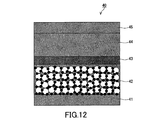
- FIG. 12 shows an example of the cross-sectional structure of the power storage element 40 according to the fourth embodiment.
- the power storage element 40 includes a current collector 41, a positive electrode 42, a solid electrolyte 43, a negative electrode 44, and a current collector 45.
- the current collectors 41 and 45 the current collectors 21 described in the second embodiment can be used.
- the positive electrode 42 the electrode 20 described in the second embodiment can be used.
- the negative electrode 44 contains, for example, the negative electrode active material described in the second embodiment.
- the solid electrolyte 43 is arranged between the positive electrode 42 and the negative electrode 44.
- the solid electrolyte 43 the solid electrolyte 10 described in the first embodiment can be used.
- the solid electrolyte 43 may be another solid electrolyte.
- examples of other solid electrolytes include inorganic solid electrolytes and polymer electrolytes.
- examples of inorganic solid electrolytes include inorganic oxides and inorganic sulfides.
- inorganic oxides are LiPON, LiAlTi (PO 4 ) 3 , LiAlGeTi (PO 4 ) 3 , LiLaTIO, LiLaZrO, Li 3 PO 4 , Li 2 SiO 2 , Li 3 SiO 4 , Li 3 VO 4 , Li 4 Examples thereof include SiO 4- Zn 2 SiO 4 , Li 4 GeO 4- Li 2 GeZNO 4 , Li 2 GeZnO 4- Zn 2 GeO 4 , and Li 4 GeO 4- Li 3 VO 4 .
- inorganic sulfide Li 2 S-P 2 S 5, Li 2 S-P 2 S 5 -LiI, Li 2 S-P 2 S 5 -Li 2 O-LiI, Li 2 S-SiS 2, Li 2 S-SiS 2- LiI, Li 2 S-SiS 2- LiBr, Li 2 S-SiS 2- LiCl, Li 2 S-SiS 2- B 2 S 3- LiI, Li 2 S-SiS 2- P 2 S 5 -LiI, Li 2 S- B 2 S 3, Li 2 S-P 2 S 5 -GeS, Li 2 S-P 2 S 5 -ZnS, Li 2 S-P 2 S 5 -GaS, Li 2 S -GeS 2 , Li 2 S-SiS 2 -Li 3 PO 4 , Li 2 S-SiS 2- LiPO, Li 2 S-SiS 2- LiSiO, Li 2 S-SiS 2- LiGeO, Li 2 S-SiS 2- LiBO, Li
- the solid electrolyte 43 may be omitted if sufficient electronic insulation can be ensured inside the power storage element 40.
- a mixed solution is applied to the surface of the electrode 20 to form a coating film.
- a thin layer of solid electrolyte can be formed on the electrode 20. If this thin layer is sufficient to prevent a short circuit between the positive and negative electrodes, then no separate solid electrolyte acting as a separator is required.
- an electrode containing the solid electrolyte of the present disclosure is used only in the positive electrode 42.
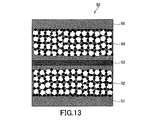
- FIG. 13 shows an example of the cross-sectional structure of the power storage element 50 according to the fifth embodiment.
- the power storage element 50 includes a current collector 51, a positive electrode 52, a solid electrolyte 53, a negative electrode 54, and a current collector 55.
- the current collectors 51 and 55 the current collectors 21 described in the second embodiment can be used.
- the positive electrode 52 and the negative electrode 54 the electrodes 20 described in the second embodiment can be used.
- the solid electrolyte 53 is arranged between the positive electrode 52 and the negative electrode 54.
- the solid electrolyte 53 the solid electrolyte 10 described in the first embodiment can be used.
- the solid electrolyte 53 may be another solid electrolyte.
- electrodes containing the solid electrolyte of the present disclosure are used for both the positive electrode 52 and the negative electrode 54.
- an electrode containing the solid electrolyte of the present disclosure may be used only for the negative electrode 54.
- the electrode 20 of the present disclosure is used for at least one selected from the positive electrode and the negative electrode.
- the electrode 20 contains the solid electrolyte 10 of the present disclosure. Since the solid electrolyte 10 has high ionic conductivity, a power storage element having excellent electrical characteristics can be obtained by using the solid electrolyte 10.
- Example 1a 1.02 ml of BMP-TFSI, 0.324 g of Li-TFSI, a predetermined amount of silicon alkoxide, 1.0 ml of PGME and 0.5 ml of water were placed in a glass container and mixed to obtain a mixed solution.
- a mixture of TEOS and chloromethyltrimethoxysilane (Cl-TMOS) was used as the silicon alkoxide.
- the ratio of chloromethyltrimethoxysilane to the total amount of silicon alkoxide was 10 mol%.
- the glass container was sealed and the mixed solution was stored at 25 ° C.
- the mixture changed to a wet mixed gel in 5 to 17 days.
- the mixed gel was pre-dried at 40 ° C. and 80 kPa for 96 hours. Then, the mixed gel was placed in a vacuum oven and dried at 25 ° C. and 0.1 Pa or less for 72 hours. As a result, the solid electrolyte of sample 1a was obtained.
- sample 1b to Sample 1e A solid electrolyte of sample 1b to sample 1e was prepared in the same manner as sample 1a, except that the ratio of chloromethyltrimethoxysilane to the total amount of silicon alkoxide was changed to 25 mol%, 75 mol%, 90 mol% and 100 mol%.
- the solid electrolyte of sample 1a to sample 1e was transferred to a glove box (humidity ⁇ 0.0005% RH), and the ionic conductivity at about 23 ° C. to 24 ° C. was measured by the AC impedance method.
- FIG. 14 shows the relationship between the ionic conductivity of the solid electrolytes of Samples 1a to 1e and the amount of Cl-TMOS added.
- the vertical axis shows the ionic conductivity.
- the horizontal axis shows the ratio of chloromethyltrimethoxysilane (Cl-TMOS) to the total amount of silicon alkoxide. As the ratio of Cl-TMOS increased, the ionic conductivity increased. All of the solid electrolytes of Samples 1a to 1e showed higher ionic conductivity than that of Reference Sample 1.
- sample 2b to Sample 2f Samples from sample 2b in the same manner as sample 2a, except that the ratio of BMP-TFSI to Cl-TMS was changed to 0.5, 0.75, 1.0, 1.5 and 2.5 in molar ratio. A 2f solid electrolyte was prepared.
- FIG. 15 shows the relationship between the ionic conductivity of the solid electrolyte of Samples 2a to 2f and the molar ratio of BMP-TFSI to Cl-TMOS.
- the vertical axis shows the ionic conductivity.
- the horizontal axis shows the molar ratio of BMP-TFSI to Cl-TMS.
- the value of BMP-TFSI / Cl-TMOS can be set to 1.0 or more in terms of molar ratio.
- the upper limit of the value of BMP-TFSI / Cl-TMOS is not particularly limited, and is, for example, 2.5.
- the solid electrolyte of Reference Sample 2 was prepared in the same manner as in 1a.
- FIG. 16 shows the time course of the ionic conductivity of the solid electrolyte of sample 1e and the solid electrolyte of reference sample 2 after being stored in a low humidity environment.
- the vertical axis shows the ionic conductivity.
- the horizontal axis shows the 1/2 power of the elapsed time (days) immediately after production.
- the broken line shows the ionic conductivity (0.6 mS / cm) of the electrolyte of Reference Sample 1.
- the ionic conductivity of the solid electrolyte of Reference Sample 2 was higher than that of the electrolyte of Reference Sample 1.
- the solid electrolyte of Reference Sample 2 was stored in a low humidity environment ( ⁇ 0.0005% RH)
- the ionic conductivity gradually decreased.
- the solid electrolyte of Reference Sample 2 showed lower ionic conductivity than the electrolyte of Reference Sample 1.
- the ionic conductivity of the solid electrolyte of sample 1e was higher than that of the electrolytes of reference sample 1 and reference sample 2 immediately after preparation.
- the ionic conductivity of the solid electrolyte of sample 1e gradually decreased.
- the solid electrolyte of sample 1e showed higher ionic conductivity than the ionic conductivity of the electrolytes of reference sample 1 and reference sample 2.
- the solid electrolyte of Reference Sample 2 has an adsorbed aqueous layer as a surface adsorption layer. Immediately after preparation, the adsorbed aqueous layer of the solid electrolyte of Reference Sample 2 is thick and dense. Therefore, the polarization of the ions are strongly induced in the polarization layer, Li + ions are TFSI immediately below - weakens the force attracted to the ion, Li + ions are easy to move. As a result, the solid electrolyte of Reference Sample 2 shows high ionic conductivity.
- FIG. 17 shows the temperature dependence of the ionic conductivity of the solid electrolyte of sample 1e and the electrolyte of reference sample 1.
- the vertical axis shows the natural logarithm of ionic conductivity.
- the horizontal axis represents a value of 1000 / T (T is temperature (K)).
- T is temperature (K)
- the electrolyte of Reference Sample 1 showed a remarkable change in ionic conductivity due to liquefaction or solidification of the ionic liquid.
- the solid electrolyte of sample 1e no rapid change in ionic conductivity was observed. It is presumed that this is because the molecules of the ionic liquid are adsorbed on the Cl-modified SiO 2 and form a phase different from that of the pure liquid and the pure solid.
- FT-IR measurement In order to confirm that the molecules of the ionic liquid were adsorbed, the solid electrolyte of sample 1e was stored in a low humidity environment ( ⁇ 0.0005% RH) for 284 days, and then FT-IR measurement was performed. At the same time, FT-IR measurement of the electrolyte of Reference Sample 1 was also performed.
- Figure 18 shows the results from 1000 cm -1 of sample 1e of wave number range of 1400 cm -1 of the solid electrolyte and the reference sample 1 electrolyte FT-IR measurement.
- the solid vertical line indicates the position of the peak of sample 1e.
- the vertical line of the broken line indicates the position of the peak of the reference sample 1.
- the arrow indicates the shift of the peak position.
- a peak was observed at the 1178Cm -1 and 1353cm -1.
- sample 1e each peak was shifted to the low energy side.
- FIG. 19A shows the results of solid-state NMR measurements of the solid electrolyte of Reference Sample 2 in the chemical shift range of ⁇ 80 ppm to ⁇ 140 ppm.
- FIG. 19B shows the results of solid-state NMR measurements of the solid electrolyte of sample 1e in the chemical shift range of -60 ppm to -100 ppm.
- the spectrum of reference sample 2 had two peaks, Q3 and Q4.
- the peak of Q3 cannot form a complete Si—O bond and reflects the OH bond or alkyl group remaining as a surface terminal group.
- the peak of Q4 is a peak derived from a complete Si—O bond.
- Q3: Q4 40%: 60%. This result shows that the molar ratio of surface end groups to Si reaches up to 40%.
- the spectrum of sample 1e had two peaks, T2 and T3. However, other peaks such as Q3 and Q4 were not detected. Both the T2 peak and the T3 peak are peaks derived from chlorine atoms.
- the spectrum of FIG. 19B shows that 100% of -CH 2 Cl groups remain even after sample preparation. That is, it is shown that the molar ratio of the Cl terminal group, which is the surface terminal group, reaches 100% at the maximum with respect to Si.
- FIGS. 19A and 19B suggest that the density of surface end groups in sample 1e may be higher than the density of surface end groups in reference sample 2.
- the technology of the present disclosure is useful for power storage elements such as lithium ion secondary batteries.
Landscapes
- Chemical & Material Sciences (AREA)
- Chemical Kinetics & Catalysis (AREA)
- Electrochemistry (AREA)
- General Chemical & Material Sciences (AREA)
- Manufacturing & Machinery (AREA)
- Engineering & Computer Science (AREA)
- Inorganic Chemistry (AREA)
- Physics & Mathematics (AREA)
- Dispersion Chemistry (AREA)
- General Physics & Mathematics (AREA)
- Condensed Matter Physics & Semiconductors (AREA)
- Conductive Materials (AREA)
- Secondary Cells (AREA)
- Battery Electrode And Active Subsutance (AREA)
Priority Applications (7)
| Application Number | Priority Date | Filing Date | Title |
|---|---|---|---|
| PL20796681.3T PL3780163T3 (pl) | 2019-06-21 | 2020-01-22 | Elektrolit stały, elektroda, element magazynujący energię i sposób wytwarzania elektrolitu stałego |
| ES20796681T ES3053603T3 (en) | 2019-06-21 | 2020-01-22 | Solid electrolyte, electrode, power storage element, and method for producing solid electrolyte |
| JP2020547157A JP7245258B2 (ja) | 2019-06-21 | 2020-01-22 | 固体電解質、電極、蓄電素子及び固体電解質の製造方法 |
| CN202080002774.1A CN112424974B (zh) | 2019-06-21 | 2020-01-22 | 固体电解质、电极、蓄电元件及固体电解质的制造方法 |
| EP20796681.3A EP3780163B1 (en) | 2019-06-21 | 2020-01-22 | Solid electrolyte, electrode, power storage element, and method for producing solid electrolyte |
| US17/060,821 US11777143B2 (en) | 2019-06-21 | 2020-10-01 | Solid electrolyte, electrode, power storage device, and method for producing solid electrolytes |
| JP2022081862A JP2022109315A (ja) | 2019-06-21 | 2022-05-18 | 固体電解質、電極、蓄電素子及び固体電解質の製造方法 |
Applications Claiming Priority (2)
| Application Number | Priority Date | Filing Date | Title |
|---|---|---|---|
| JP2019-115275 | 2019-06-21 | ||
| JP2019115275 | 2019-06-21 |
Related Child Applications (1)
| Application Number | Title | Priority Date | Filing Date |
|---|---|---|---|
| US17/060,821 Continuation US11777143B2 (en) | 2019-06-21 | 2020-10-01 | Solid electrolyte, electrode, power storage device, and method for producing solid electrolytes |
Publications (1)
| Publication Number | Publication Date |
|---|---|
| WO2020255467A1 true WO2020255467A1 (ja) | 2020-12-24 |
Family
ID=73726762
Family Applications (1)
| Application Number | Title | Priority Date | Filing Date |
|---|---|---|---|
| PCT/JP2020/002180 Ceased WO2020255467A1 (ja) | 2019-06-21 | 2020-01-22 | 固体電解質、電極、蓄電素子及び固体電解質の製造方法 |
Country Status (7)
| Country | Link |
|---|---|
| US (1) | US11777143B2 (https=) |
| EP (1) | EP3780163B1 (https=) |
| JP (2) | JP7245258B2 (https=) |
| CN (1) | CN112424974B (https=) |
| ES (1) | ES3053603T3 (https=) |
| PL (1) | PL3780163T3 (https=) |
| WO (1) | WO2020255467A1 (https=) |
Cited By (1)
| Publication number | Priority date | Publication date | Assignee | Title |
|---|---|---|---|---|
| EP3809424A4 (en) * | 2018-06-12 | 2021-08-25 | Imec Vzw | SOLID ELECTROLYTE, ELECTRODE AND CONDENSER ELEMENT |
Families Citing this family (1)
| Publication number | Priority date | Publication date | Assignee | Title |
|---|---|---|---|---|
| KR20250143314A (ko) | 2023-01-27 | 2025-10-01 | 솔리터 | 고체-상태 배터리를 위한 고체 전해질 및 전극, 및 이의 제조방법 |
Citations (2)
| Publication number | Priority date | Publication date | Assignee | Title |
|---|---|---|---|---|
| JP2012518248A (ja) | 2009-02-13 | 2012-08-09 | サントル ナショナル ドゥ ラ ルシェルシュ シアンティフィク | イオン導電ゲルに基づく高エネルギー非水電池、その製造方法及びその用途 |
| WO2018197073A1 (en) * | 2017-04-24 | 2018-11-01 | Imec Vzw | Solid nanocomposite electrolyte materials |
Family Cites Families (5)
| Publication number | Priority date | Publication date | Assignee | Title |
|---|---|---|---|---|
| JP4082214B2 (ja) * | 2000-11-20 | 2008-04-30 | 中央電気工業株式会社 | 非水電解質二次電池とその正極活物質 |
| WO2008140647A2 (en) * | 2007-03-01 | 2008-11-20 | The Regents Of The University Of California | In situ fabricated electrochemical device |
| JP2015002053A (ja) * | 2013-06-14 | 2015-01-05 | 出光興産株式会社 | 固体電解質組成物 |
| WO2018029580A1 (en) * | 2016-08-10 | 2018-02-15 | Sabic Global Technologies B.V. | Separators, articles and methods of making thereof |
| WO2019018432A1 (en) * | 2017-07-17 | 2019-01-24 | NOHMs Technologies, Inc. | ELECTROLYTES CONTAINING PHOSPHORUS |
-
2020
- 2020-01-22 WO PCT/JP2020/002180 patent/WO2020255467A1/ja not_active Ceased
- 2020-01-22 JP JP2020547157A patent/JP7245258B2/ja active Active
- 2020-01-22 PL PL20796681.3T patent/PL3780163T3/pl unknown
- 2020-01-22 CN CN202080002774.1A patent/CN112424974B/zh active Active
- 2020-01-22 ES ES20796681T patent/ES3053603T3/es active Active
- 2020-01-22 EP EP20796681.3A patent/EP3780163B1/en active Active
- 2020-10-01 US US17/060,821 patent/US11777143B2/en active Active
-
2022
- 2022-05-18 JP JP2022081862A patent/JP2022109315A/ja not_active Withdrawn
Patent Citations (2)
| Publication number | Priority date | Publication date | Assignee | Title |
|---|---|---|---|---|
| JP2012518248A (ja) | 2009-02-13 | 2012-08-09 | サントル ナショナル ドゥ ラ ルシェルシュ シアンティフィク | イオン導電ゲルに基づく高エネルギー非水電池、その製造方法及びその用途 |
| WO2018197073A1 (en) * | 2017-04-24 | 2018-11-01 | Imec Vzw | Solid nanocomposite electrolyte materials |
Cited By (1)
| Publication number | Priority date | Publication date | Assignee | Title |
|---|---|---|---|---|
| EP3809424A4 (en) * | 2018-06-12 | 2021-08-25 | Imec Vzw | SOLID ELECTROLYTE, ELECTRODE AND CONDENSER ELEMENT |
Also Published As
| Publication number | Publication date |
|---|---|
| JP2022109315A (ja) | 2022-07-27 |
| EP3780163B1 (en) | 2025-09-03 |
| JP7245258B2 (ja) | 2023-03-23 |
| ES3053603T3 (en) | 2026-01-23 |
| US20210020988A1 (en) | 2021-01-21 |
| EP3780163A1 (en) | 2021-02-17 |
| EP3780163A4 (en) | 2021-06-16 |
| PL3780163T3 (pl) | 2026-02-16 |
| JPWO2020255467A1 (ja) | 2021-09-13 |
| CN112424974B (zh) | 2024-05-31 |
| CN112424974A (zh) | 2021-02-26 |
| US11777143B2 (en) | 2023-10-03 |
Similar Documents
| Publication | Publication Date | Title |
|---|---|---|
| JP7134948B2 (ja) | 固体電解質、電極、蓄電素子及び固体電解質の製造方法 | |
| JP2012089406A (ja) | 正極活物質材料の製造方法、リチウム固体電池の製造方法および正極活物質材料 | |
| WO2012105048A1 (ja) | 被覆活物質、電池および被覆活物質の製造方法 | |
| US20230092036A1 (en) | Solid electrolyte, electrode, power storage element, and method for producing solid electrolyte | |
| Chen et al. | Hybrid solid electrolytes with excellent electrochemical properties and their applications in all-solid-state cells | |
| KR20190139232A (ko) | 고체 나노복합재 전해질 재료 | |
| JP7177044B2 (ja) | 固体電解質、電極、及び蓄電素子 | |
| WO2014119205A1 (ja) | 活物質材料およびリチウムイオン電池 | |
| US11777143B2 (en) | Solid electrolyte, electrode, power storage device, and method for producing solid electrolytes | |
| JP7178347B2 (ja) | 固体電解質、電極及び蓄電素子 | |
| Yang et al. | Improving cathode/Li6. 4La3Zr1. 4Ta0. 6O12 electrolyte interface with a hybrid PVDF-HFP-based buffer layer for solid lithium battery | |
| Liao et al. | A novel SiO2 nanofiber-supported organic–inorganic gel polymer electrolyte for dendrite-free lithium metal batteries | |
| Das et al. | Optimizing structural and cycling stability in sodium-ion batteries using tailored glass fiber separators | |
| JP2008300099A (ja) | リチウム二次電池 | |
| Hartmann | Silica-based solid electrolyte for Li-ion microbatteries | |
| Shi | Study of fluorinated ether-based electrolyte for high-voltage lithium ion batteries and functional porous sulfur cathode for lithium sulfur batteries | |
| JP2021153010A (ja) | リチウム二次電池 | |
| Azimi | Flourinated Electrolytes for High Performance Rechargeable Lithium-Sulfur Batteries |
Legal Events
| Date | Code | Title | Description |
|---|---|---|---|
| ENP | Entry into the national phase |
Ref document number: 2020547157 Country of ref document: JP Kind code of ref document: A |
|
| ENP | Entry into the national phase |
Ref document number: 2020796681 Country of ref document: EP Effective date: 20201103 |
|
| NENP | Non-entry into the national phase |
Ref country code: DE |
|
| WWG | Wipo information: grant in national office |
Ref document number: 2020796681 Country of ref document: EP |