WO2020241898A1 - シート用リクライナー構造及び乗物用シート - Google Patents
シート用リクライナー構造及び乗物用シート Download PDFInfo
- Publication number
- WO2020241898A1 WO2020241898A1 PCT/JP2020/021539 JP2020021539W WO2020241898A1 WO 2020241898 A1 WO2020241898 A1 WO 2020241898A1 JP 2020021539 W JP2020021539 W JP 2020021539W WO 2020241898 A1 WO2020241898 A1 WO 2020241898A1
- Authority
- WO
- WIPO (PCT)
- Prior art keywords
- recliner
- rattling
- recliners
- guide bracket
- seat
- Prior art date
- Legal status (The legal status is an assumption and is not a legal conclusion. Google has not performed a legal analysis and makes no representation as to the accuracy of the status listed.)
- Ceased
Links
Images



Classifications
-
- B—PERFORMING OPERATIONS; TRANSPORTING
- B60—VEHICLES IN GENERAL
- B60N—SEATS SPECIALLY ADAPTED FOR VEHICLES; VEHICLE PASSENGER ACCOMMODATION NOT OTHERWISE PROVIDED FOR
- B60N2/00—Seats specially adapted for vehicles; Arrangement or mounting of seats in vehicles
- B60N2/02—Seats specially adapted for vehicles; Arrangement or mounting of seats in vehicles the seat or part thereof being movable, e.g. adjustable
- B60N2/22—Seats specially adapted for vehicles; Arrangement or mounting of seats in vehicles the seat or part thereof being movable, e.g. adjustable the back-rest being adjustable
- B60N2/235—Seats specially adapted for vehicles; Arrangement or mounting of seats in vehicles the seat or part thereof being movable, e.g. adjustable the back-rest being adjustable by gear-pawl type mechanisms
- B60N2/2356—Seats specially adapted for vehicles; Arrangement or mounting of seats in vehicles the seat or part thereof being movable, e.g. adjustable the back-rest being adjustable by gear-pawl type mechanisms with internal pawls
- B60N2/236—Seats specially adapted for vehicles; Arrangement or mounting of seats in vehicles the seat or part thereof being movable, e.g. adjustable the back-rest being adjustable by gear-pawl type mechanisms with internal pawls linearly movable
-
- B—PERFORMING OPERATIONS; TRANSPORTING
- B60—VEHICLES IN GENERAL
- B60N—SEATS SPECIALLY ADAPTED FOR VEHICLES; VEHICLE PASSENGER ACCOMMODATION NOT OTHERWISE PROVIDED FOR
- B60N2/00—Seats specially adapted for vehicles; Arrangement or mounting of seats in vehicles
- B60N2/02—Seats specially adapted for vehicles; Arrangement or mounting of seats in vehicles the seat or part thereof being movable, e.g. adjustable
- B60N2/22—Seats specially adapted for vehicles; Arrangement or mounting of seats in vehicles the seat or part thereof being movable, e.g. adjustable the back-rest being adjustable
- B60N2/235—Seats specially adapted for vehicles; Arrangement or mounting of seats in vehicles the seat or part thereof being movable, e.g. adjustable the back-rest being adjustable by gear-pawl type mechanisms
- B60N2/2356—Seats specially adapted for vehicles; Arrangement or mounting of seats in vehicles the seat or part thereof being movable, e.g. adjustable the back-rest being adjustable by gear-pawl type mechanisms with internal pawls
-
- B—PERFORMING OPERATIONS; TRANSPORTING
- B60—VEHICLES IN GENERAL
- B60N—SEATS SPECIALLY ADAPTED FOR VEHICLES; VEHICLE PASSENGER ACCOMMODATION NOT OTHERWISE PROVIDED FOR
- B60N2/00—Seats specially adapted for vehicles; Arrangement or mounting of seats in vehicles
- B60N2/02—Seats specially adapted for vehicles; Arrangement or mounting of seats in vehicles the seat or part thereof being movable, e.g. adjustable
- B60N2/22—Seats specially adapted for vehicles; Arrangement or mounting of seats in vehicles the seat or part thereof being movable, e.g. adjustable the back-rest being adjustable
- B60N2/235—Seats specially adapted for vehicles; Arrangement or mounting of seats in vehicles the seat or part thereof being movable, e.g. adjustable the back-rest being adjustable by gear-pawl type mechanisms
-
- B—PERFORMING OPERATIONS; TRANSPORTING
- B60—VEHICLES IN GENERAL
- B60N—SEATS SPECIALLY ADAPTED FOR VEHICLES; VEHICLE PASSENGER ACCOMMODATION NOT OTHERWISE PROVIDED FOR
- B60N2205/00—General mechanical or structural details
- B60N2205/20—Measures for elimination or compensation of play or backlash
-
- B—PERFORMING OPERATIONS; TRANSPORTING
- B60—VEHICLES IN GENERAL
- B60N—SEATS SPECIALLY ADAPTED FOR VEHICLES; VEHICLE PASSENGER ACCOMMODATION NOT OTHERWISE PROVIDED FOR
- B60N2205/00—General mechanical or structural details
- B60N2205/30—Seat or seat parts characterised by comprising plural parts or pieces
Definitions
- the present invention relates to a seat recliner structure and a vehicle seat having such a seat recliner structure.
- the seat frame of an automobile is a single structure made by welding various pressed parts.
- the back frame and cushion frame are joined by a recliner to form a seat frame.
- Pressed parts are manufactured with high precision, but welded structures have variations in processing, and various defects occur when assembled.
- the section modulus differs greatly between the recliner made of thick plate parts and the thin plate frame.
- the left and right recliners work in sync with the connecting rods.
- the connecting rod is elastically deformed due to the accumulation of variations in the assembly, and residual stress is generated. Then, the sliding resistance of the internal unit parts of the recliner increases, and a synchronization failure in which the left and right recliners do not lock at the same time or a pseudo lock in which one side does not lock occurs.
- An object of the present invention is to provide a vehicle seat having a recliner structure and a recliner structure for such a seat.
- the present invention synchronizes the cushion frame and the recliners provided on the left and right sides of the back frame with the left and right recliners in order to recline the back frame with respect to the cushion frame.
- a seat recliner structure with a connecting rod to connect As the left and right recliners, those having different rattling are used, and the recliner structure for a sheet is provided, characterized in that the rattling of the recliner on the driving side is smaller than the rattling of the recliner on the driven side.
- the left and right recliners both rotate relative to each other, and one has a guide bracket and an internal gear attached to the cushion frame and the other to the back frame, and the guide bracket and the internal gear It is a structure provided with a plurality of lock gears having external teeth that engage with the internal teeth of the internal gear and engage with each other in the radial direction.
- a recliner structure for a seat which has a structure in which the rattling differs depending on whether or not a steel ball is provided between any one of the plurality of lock gears and the guide bracket. It is preferable that the recliner having the steel balls has a structure in which the rattling is relatively smaller than that of the recliner having no steel balls.
- the left and right recliners both rotate relative to each other, and one has a guide bracket and an internal gear attached to the cushion frame and the other to the back frame, and the guide bracket and the internal gear It has a structure provided with a plurality of lock gears having external teeth that engage with the internal teeth of the internal gear and engage with each other in the radial direction. It has a structure in which a steel ball is provided between any one of the plurality of lock gears and the guide bracket.
- a recliner structure for a sheet which has a structure in which the rattling differs depending on the shape of the grooves provided on the facing surfaces of the lock gear on which the steel ball is arranged and the guide bracket. It is preferable that the structure is such that the smaller the amount of movement of the steel ball in the circumferential direction regulated by the groove, the smaller the rattling.
- the structure has a different rattling.
- the plate member is attached to the fixing jig via the recliner, and a load is applied up to 50 N in the front-rear direction and the left-right direction of the plate member at a position 500 mm above the rotation center of the recliner.
- a load-deflection characteristic indicated by the spring constant obtained in relation to the amount of deflection measured at the input point of The left and right recliners are selected from those having a spring constant in the range of linear change having almost the same value in the front-rear direction and the left-right direction.
- the recliner that exhibits the strongest linearity in both the front-back direction and the left-right direction is defined as the one with the least rattling, and in comparison with the one with the least rattling.
- the seat recliner structure in which the driven side and the driven side recliners are selected is provided.
- a vehicle seat having a seat recliner structure for reclining the back frame with respect to the cushion frame.
- a vehicle seat characterized in that the seat recliner structure is used.
- the rattling of the recliner on the driving side is smaller than the rattling of the recliner on the driven side, so that even if the dimensional accuracy of the seat frame including the cushion frame and the back frame varies. It is possible to improve the synchronization of the movements of the left and right recliners and improve the smoothness of operation.
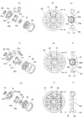
- FIG. 1 is a perspective view showing a seat frame of a vehicle seat according to an embodiment of the present invention.
- 2 (a) to 2 (c) show the schematic structure of "Recliner: High” of the example, (a) is an exploded perspective view, (b) is a plan view, and (c) is A- of (b). It is a cross-sectional view of line A.
- 2 (d) to 2 (f) show a schematic structure of "Recliner: Middle" of the embodiment, (d) is an exploded perspective view, (e) is a plan view, and (f) is B- of (e). It is a cross-sectional view of line B.
- FIG. 3A is a diagram for explaining a method of measuring the load-deflection characteristic measured by attaching the recliner of the embodiment to the fixing jig and attaching the plate member to the recliner
- FIG. 3B, FIG. 3C is a diagram for explaining a method of measuring the load-deflection characteristic measured by attaching the recliners of the embodiment to both sides of a rigid frame corresponding to the back frame.
- FIG. 4 (a) to 4 (c) are diagrams showing the measurement results of the load-deflection characteristics of "Recliner: High”, “Recliner: Middle” and “Recliner: Low”, respectively.
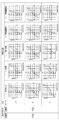
- FIG. 5 is a diagram showing the measurement results of the load-deflection characteristic in the front-rear direction when the "recliner: High” is attached to both the driving side and the driven side.
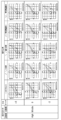
- FIG. 6 is a diagram showing the measurement results of the load-deflection characteristic in the front-rear direction when the "recliner: High” is attached to the driving side and the "recliner: Middle” is attached to the driven side.
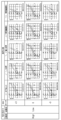
- FIG. 7 is a diagram showing the measurement results of the load-deflection characteristic in the front-rear direction when the "recliner: High” is attached to the driving side and the "recliner: Low” is attached to the driven side.
- FIG. 1 shows a vehicle seat 1 used in an automobile adopting the seat recliner structure 10 according to the embodiment of the present invention.
- the seat recliner structure 10 is attached between the side frame 2a of the seat cushion frame 2 and the side frame 3a of the seat back frame 3.
- the seat recliner structure 10 includes recliners 11 and 12 arranged on the left and right, and a connecting rod 13 for connecting the shaft portions of both.
- One of the left and right recliners 11 and 12 is the main driving side to which the driving members such as the operating lever and the motor are connected, and the other is the subordinate side.
- the driving side is the recliner 11
- the driven side is the recliner 12. Then, as the recliner 11 on the driving side and the recliner 12 on the driven side, those having different backlash are used.
- the rattling of the recliner 11 on the driving side is smaller than the rattling of the recliner on the driven side.
- each recliner shown in FIG. 2 is a structure in which four lock gears 23a to 23d are included in the space created by the guide bracket 21 and the internal gear 22.
- Reference numeral 24 is a ring having an annular bottom wall portion 24a and a peripheral wall portion 24b rising from the periphery thereof.
- An internal gear 22 is arranged in the peripheral wall portion 24b of the ring 24, and is located near the upper end of the peripheral wall portion 24b.
- the peripheral surface of the guide bracket 21 is fixed to the portion by welding. That is, the ring 24 and the guide bracket 21 are integrally formed by welding, and the internal gear 22 is rotatable with respect to the ring 24 and the guide bracket 21.
- the ring 24 and the guide bracket 21 are fixed to the seat cushion frame 2 side, and the internal gear 22 is fixed to the seat back frame 3 side.
- the lock gears 23a to 23d are separated from each other in the diametrical direction by rotating the cams 25 arranged on the inner peripheral side thereof.
- the cam 25 In the normal state, the cam 25 is urged in one direction by the spring 26 to push the lock gears 23a to 23d outward, and the outer teeth of the lock gears 23a to 23d mesh with the inner teeth of the internal gear 22.
- This state is the locked state, and when the lock is released, an operation lever (not shown) is operated to rotate the cam 25 in the other direction.
- an operation lever (not shown) is operated to rotate the cam 25 in the other direction.
- the lock gears 23a to 23d move in the central direction against the spring 25, and the meshing between the outer teeth of the lock gears 23a to 23d and the inner teeth of the internal gear 22 is released.
- Recliner High is the structure proposed in Japanese Patent Application No. 2019-70768 of the present applicant, and as shown in FIGS. 2 (a) to 2 (c), the guide bracket 21 and two sheets at positions facing 180 degrees.
- a steel ball 27 is arranged between the lock gears 23a and 23b (lock gear A) of the above.
- the steel ball 27 functions to center the lock gears 23a and 23b in the circumferential direction between the pair of adjacent guide wall portions 21a and 21a provided on the guide bracket 21, and as shown by the arrows in FIG. 2C.
- lock gear B By centering the lock gears 23a and 23b, the rattling that occurs in the recliner is reduced as compared with the case where they are arranged unevenly.
- the remaining two lock gears 23c and 23d (lock gear B) generate friction due to the actual matching due to the compressive force at the time of assembly.
- the compressive force at the time of assembly is about 10N.
- Recliner Middle is a structure disclosed in Patent Document 1 (WO2017 / 043665). As shown in FIGS. 2 (d) to 2 (f), the shapes of the grooves 21b and 23e provided in the guide bracket 21 and the lock gears 23a and 23b (lock gear A) are the recliners of FIGS. 2 (a) to 2 (c): High. different. Recliner: In High, the slopes of both the grooves 21b and 23e are formed in a substantially V shape with the groove bottom at the same inclination angle (about 30 to 60 degrees) on the left and right (see FIG. 2C).
- the groove 21b of the guide bracket 21 has a cross-sectional shape of a left-right asymmetric groove in which the slope on one side is more gentle than the other side with the groove bottom as the center. Further, at least the slope with a gentle angle is a gentler angle than the slope of the recliner: High slope.
- the grooves 23e formed in the lock gears 23a and 23b (lock gear A) have a cross-sectional shape having vertical surfaces extending at right angles from both ends of the groove bottom surface having a predetermined width. ing.
- the movement of the steel ball 27 in the circumferential direction in the grooves 21b and 23e is restricted in the recliner: High than in the recliner: Middle, so that the friction coefficient is designed to be higher. Further, the recliner: Middle slightly increases the clearance between the lock gears 23c and 23d (lock gear B) and the internal gear 22 (0.4 mm in this embodiment) as compared with the recliner: High. Further, a spacer 28 for reducing the frictional force is provided between the ring 24 and the internal gear 22.
- the recliner: Middle has a large amount of rattling in relative comparison with the recliner: High, even if other design conditions are the same as those of the recliner: High.
- the recliner: Middle further increases the clearance between the lock gears 23c and 23d (lock gear B) and the internal gear 22 as compared with the recliner: High, it is relatively more reliable than the recliner: High. It is designed with a large amount of rattling.
- the amount of movement of the steel ball 27 in the circumferential direction is the cross-sectional shape (inclination angle of the slope, groove) along the circumferential direction of the grooves 21b and 23e when the steel ball 27 having the same size is adopted.
- the size can be set according to the width of the bottom, the width of the entire groove, the depth of the groove, etc.).
- the recliner: Low has no steel balls arranged between the guide bracket 21 and the four lock gears 23a to 23d, and the lock gears 23a to 23d are internal gears 22. Slides in the gap between the guide bracket 21 and the guide bracket 21.
- the internal gear 22 is assembled by the ring 24 and the guide bracket 21 so as not to play.
- the compressive force at the time of assembly is about 10 N.
- Recliner: Low is designed for the driven side, and the recliner: High attached to the driven side dominates the function as a structure.
- the recliner: Low rotates the cam 25 via the connecting rod 13 to slide the lock gears 23a to 23d.
- the variation that occurs in the connecting rod 13 affects the movement of the cam 25.
- the cam 25 is tilted due to variation, and the lock gears 23a to 23d are slid in the tilted state.
- In order to absorb the inclination of the lock gears 23a to 23d there is a clearance between the facing surfaces of the internal gear 22 and the guide bracket 21 and the lock gears 23a to 23d. Due to this clearance, the sliding resistance of the lock gears 23a to 23d is reduced, and lock defects are reduced. Therefore, since the recliner: Low does not have a steel ball and has such a clearance, the design has a large amount of rattling compared to the recliner: High as well as the recliner: Middle.
- the recliner: High and the recliner: Middle are common in that the steel balls 27 are arranged between the guide bracket 21 and the lock gears 23a and 23b (lock gear A) of two of the four pieces, but the grooves are formed.
- the other two lock gears 23c and 23d (lock gear B) and the internal gear 22 are used.
- the steel balls 27 are arranged in the recliner: High and the recliner: Middle, the two lock gears 23a and 23b (lock gear A) are placed on any of the facing surfaces of the internal gear 22 and the guide bracket 21.
- the recliner: Low has a structure in which steel balls are not arranged, and preferably all of the four lock gears 23a to 23d are in contact with each other of the internal gear 22 and the guide bracket 21.
- Recliner load-deflection characteristic measurement Fig. 3 (a) shows a method for measuring the recliner load-deflection characteristic.
- the recliner is fixed to the fixing jig, a long aluminum plate member is attached to the recliner, and a load of up to 50 N is applied to the plate member in the front-rear and left-right directions at a position 500 mm above the center of rotation of the recliner.
- a dial gauge is used to measure the amount of deflection.
- the condition of +3 mm is set assuming that a preliminary load is applied in the tensile direction (forward).
- the nominal condition assumes that the recliner is not loaded.
- the condition of -3 mm assumes a state in which a preliminary load is applied in the compression direction (rearward).
- Insert spacers so that the variation is +3 mm, nominal, and -3 mm at the four fixing parts of the left and right recliners with the fixing jig, and attach the left and right recliners to the fixing jig.
- Five patterns are set as the variation condition of the seat back frame which is a welded structure.
- Table 1 shows the dimensional settings of the four fixed portions for each variation.
- Confirmation of lockability is a subjective judgment by confirming whether or not the locks of the left and right recliners are synchronized. Attach the lever to the connecting rod and operate it in the unlocking direction to unlock the recliners on both sides. In that state, release the lever and check the synchronization of the left and right locks when locking again. Input with a push-pull gauge to know the guideline of input, and read the accurate load with the load cell. Displacement is measured by a dial gauge.
- Recliner load-deflection characteristic measurement Fig. 4 shows the load-deflection characteristics of three types of recliners.
- the broken line shows the load-deflection characteristic in the front-rear direction
- the solid line shows the load-deflection characteristic in the left-right direction.
- Recliner: High indicates linear spring characteristics in the front-back and left-right directions.
- the spring constant (the average value of the spring constants obtained based on the predetermined deflection amount range for obtaining the spring constants) was 25 to 50 N / mm in the front-rear direction and 2 to 6 N / mm in the left-right direction.
- Recliner: Middle shows combined nonlinear spring characteristics in the anterior-posterior direction and approximately linear spring characteristics in the left-right direction.
- the range of the amount of deflection (non-linear range) of 0 to +1.5 mm at which the spring constant becomes small is 5 to 8 N / mm, and before and after the range of the amount of deflection of 0 to +1.5 mm.
- the range was similar to Recliner: High.
- the spring constant in the left-right direction was the same as that of the recliner: High.
- Recliner Low shows non-linear spring characteristics by combining both front and rear and left and right directions.
- the spring constant is 3 to 5 N / mm in the range of the amount of deflection (non-linear range) of -1 to +2 mm in which the spring constant becomes smaller in the front-rear direction, and in the range before and after the range of the amount of deflection of -1 to +2 mm.
- Recliner High
- Recliner Middle.
- a load of up to 50 N is applied in the front-back and left-right directions at a position 500 mm above the center of rotation of the recliner, and the most rattling characteristic is the spring constant obtained in relation to the amount of deflection measured at the input point.
- Small recliner High has smaller change in spring constant in the middle and linearity than the other two recliners: Middle and Recliner: Low in the entire range of change in the amount of deflection, both front and back and left and right. It was the highest. Whether the linearity is high or low is determined by the magnitude of change (the magnitude of the non-linear range) in the middle of the slope of the graph showing the spring constant in the graph indicated by the load-deflection characteristic in this way.
- the recliner Middle with less rattling has the same spring constant in the left-right direction as the recliner: High, but the front and rear spring characteristics have a non-linear range in which the spring constant becomes smaller in the middle range of the change in the amount of deflection. Shows non-linear spring characteristics. However, it has the characteristic that the spring constant in the range showing linear spring characteristics other than the midway range is the same as that of Recliner: High.
- Recliner with the largest rattling Low shows non-linear spring characteristics in combination in both the front-back direction and the left-right direction, and the deflection amount range with a spring constant of 1 N / mm or less in the left-right direction is about 1/3 of the total deflection amount in the left and right directions. Occupy.
- the spring constant in the entire range shows the combined nonlinear spring characteristic.
- the recliner has almost the same spring constant in the front-back direction and the left-right direction (within ⁇ 20% of the spring constant value) in the range showing linear spring characteristics excluding the intermediate range (non-linear range) of the amount of deflection at which the spring constant becomes small.
- the recliners 11 on the driving side and the recliners 12 on the driven side are selected by comparing each other.
- the one having the relatively highest linearity (the one having a relatively small change in the spring constant in the middle range) is regarded as the one with the smallest rattling in the entire range of change in the amount of deflection.
- the one showing the non-linear spring characteristic by combining only one of the front-rear direction and the left-right direction (the front-back direction in this embodiment) is defined as the one with relatively large rattling, and the front-back direction is defined as the one showing the characteristic.
- a combination of both directions and left-right directions that exhibits non-linear spring characteristics is defined as having a relatively large amount of rattling. Then, the recliner 11 on the driving side and the recliner 12 on the driven side are selected from the recliners to be compared using such a criterion.
- FIG. 5 shows the spring characteristics of the recliner: High-High combination.
- the hysteresis loss was 10N.
- the C-shaped condition showed weak combination nonlinear spring characteristics, and the other four conditions showed linear spring characteristics.
- the hysteresis loss was 20 to 40 N.
- the offset type condition showed weak combination nonlinear spring characteristics, and the other four conditions showed linear spring characteristics.
- the hysteresis loss was 20 to 38 N.
- FIG. 6 shows the spring characteristics of the recliner: High-Middle combination.
- a weak combination nonlinear spring characteristic was shown when the variation in the left-right direction was the nominal condition.
- the hysteresis loss was 7N.
- a weak combination nonlinear spring characteristic was exhibited, and the hysteresis loss was 20 to 47 N.
- the variation in the left-right direction was -3 mm, a weak combination nonlinear spring characteristic was shown except for the inverted C-shaped condition, and the inverted C-shaped condition showed a linear spring characteristic.
- the hysteresis loss was 22 to 47 N.
- FIG. 7 shows the spring characteristics of the recliner: High-Low combination.
- the combination nonlinear spring characteristics were shown when the variation in the left-right direction was the nominal condition with respect to the variation of the five types of back frames.
- the hysteresis loss was 8N.
- Each condition of the variation in the left-right direction of +3 mm and -3 mm showed linear spring characteristics when the shape was inverted C, and the hysteresis loss was in the range of 10 to 30 N.
- the offset type and the V-shape showed weak combination nonlinear spring characteristics, and the hysteresis loss was 10 to 47N.
- the parallelogram type II with a lateral variation of +3 mm had the characteristics of the parallelogram type I with a -3 mm condition.
- the parallelogram type II with a lateral variation of -3 mm has the characteristics of the parallelogram type I with a + 3 mm condition.
- Table 2 shows the results of confirming the lockability.
- the parallelograms I and II did not lock on both the driving side and the driven side under the conditions of variation +3 mm and -3 mm.
- the driving side did not lock when the parallelogram type I was used under the variation +3 mm condition and when the parallelogram type II was used under the variation-3 mm condition.
- the spring characteristics in the front-rear direction are combined to be non-linear spring characteristics under the nominal condition, and abnormal noise is generated when the input is more than expected, for example, when traveling on a rough road.
- the lockability even if the hysteresis loss was 40 N, the locks of the left and right recliners were synchronized and there was no problem. Therefore, the combination of High-Low was the most effective in terms of lockability.
- the spring characteristics were linear spring characteristics, and no abnormal noise was generated.
- a lock failure occurred when the frame became a parallelogram under the conditions of variations in the left-right direction of +3 mm and -3 mm.
- the curvature of the connecting rod could not absorb the variation, the cam and lock gear tilted, the frictional force between the guide bracket and lock gear increased, and the sliding resistance increased.
- the tooth tips of the internal gear and the tooth tips of the lock gear came into contact with each other, causing a phenomenon in which the gears were difficult to bite.
- the rattling of the recliner on the driving side is preferably smaller than the rattling of the recliner on the driven side by changing the spring characteristics of the driven side and the driven side as described above.
Landscapes
- Engineering & Computer Science (AREA)
- Aviation & Aerospace Engineering (AREA)
- Transportation (AREA)
- Mechanical Engineering (AREA)
- Chairs For Special Purposes, Such As Reclining Chairs (AREA)
- Seats For Vehicles (AREA)
Priority Applications (3)
| Application Number | Priority Date | Filing Date | Title |
|---|---|---|---|
| JP2021521921A JPWO2020241898A1 (https=) | 2019-05-31 | 2020-06-01 | |
| EP20813038.5A EP3977896A4 (en) | 2019-05-31 | 2020-06-01 | SEAT RECLINE STRUCTURE AND VEHICLE SEAT |
| US17/615,011 US20220227267A1 (en) | 2019-05-31 | 2020-06-01 | Seat recliner structure and vehicle seat |
Applications Claiming Priority (2)
| Application Number | Priority Date | Filing Date | Title |
|---|---|---|---|
| JP2019-103399 | 2019-05-31 | ||
| JP2019103399 | 2019-05-31 |
Publications (1)
| Publication Number | Publication Date |
|---|---|
| WO2020241898A1 true WO2020241898A1 (ja) | 2020-12-03 |
Family
ID=73552180
Family Applications (1)
| Application Number | Title | Priority Date | Filing Date |
|---|---|---|---|
| PCT/JP2020/021539 Ceased WO2020241898A1 (ja) | 2019-05-31 | 2020-06-01 | シート用リクライナー構造及び乗物用シート |
Country Status (4)
| Country | Link |
|---|---|
| US (1) | US20220227267A1 (https=) |
| EP (1) | EP3977896A4 (https=) |
| JP (1) | JPWO2020241898A1 (https=) |
| WO (1) | WO2020241898A1 (https=) |
Citations (5)
| Publication number | Priority date | Publication date | Assignee | Title |
|---|---|---|---|---|
| JP2005152148A (ja) * | 2003-11-21 | 2005-06-16 | Delta Kogyo Co Ltd | シートのリクライニング装置 |
| JP2012091623A (ja) * | 2010-10-26 | 2012-05-17 | Fuji Kiko Co Ltd | シートリクライニング装置 |
| WO2013111723A1 (ja) * | 2012-01-26 | 2013-08-01 | アイシン精機 株式会社 | 車両用シートリクライニング装置 |
| WO2017043665A1 (ja) | 2015-09-13 | 2017-03-16 | デルタ工業株式会社 | シート用リクライニング装置及びシート |
| JP2019070768A (ja) | 2017-10-11 | 2019-05-09 | シャープ株式会社 | アレイ基板およびその製造方法、並びに表示パネル |
Family Cites Families (5)
| Publication number | Priority date | Publication date | Assignee | Title |
|---|---|---|---|---|
| JPH1146914A (ja) * | 1997-08-08 | 1999-02-23 | Ikeda Bussan Co Ltd | 両側リクライニング装置 |
| JP3926997B2 (ja) * | 2001-03-30 | 2007-06-06 | シロキ工業株式会社 | 両側リクライニング装置 |
| JP6196185B2 (ja) * | 2014-04-25 | 2017-09-13 | トヨタ紡織株式会社 | 乗物用シート及びその製造方法 |
| US11077774B2 (en) * | 2019-08-20 | 2021-08-03 | Fisher & Company, Incorporated | High torque load power rotary recliner with anti-back drive capability and reduced backlash for car seat |
| US11267374B2 (en) * | 2019-12-18 | 2022-03-08 | Faurecia Automotive Seating, Llc | Shafted recliners dual decoupling system |
-
2020
- 2020-06-01 JP JP2021521921A patent/JPWO2020241898A1/ja active Pending
- 2020-06-01 EP EP20813038.5A patent/EP3977896A4/en not_active Withdrawn
- 2020-06-01 US US17/615,011 patent/US20220227267A1/en not_active Abandoned
- 2020-06-01 WO PCT/JP2020/021539 patent/WO2020241898A1/ja not_active Ceased
Patent Citations (5)
| Publication number | Priority date | Publication date | Assignee | Title |
|---|---|---|---|---|
| JP2005152148A (ja) * | 2003-11-21 | 2005-06-16 | Delta Kogyo Co Ltd | シートのリクライニング装置 |
| JP2012091623A (ja) * | 2010-10-26 | 2012-05-17 | Fuji Kiko Co Ltd | シートリクライニング装置 |
| WO2013111723A1 (ja) * | 2012-01-26 | 2013-08-01 | アイシン精機 株式会社 | 車両用シートリクライニング装置 |
| WO2017043665A1 (ja) | 2015-09-13 | 2017-03-16 | デルタ工業株式会社 | シート用リクライニング装置及びシート |
| JP2019070768A (ja) | 2017-10-11 | 2019-05-09 | シャープ株式会社 | アレイ基板およびその製造方法、並びに表示パネル |
Non-Patent Citations (1)
| Title |
|---|
| See also references of EP3977896A4 |
Also Published As
| Publication number | Publication date |
|---|---|
| US20220227267A1 (en) | 2022-07-21 |
| JPWO2020241898A1 (https=) | 2020-12-03 |
| EP3977896A1 (en) | 2022-04-06 |
| EP3977896A4 (en) | 2022-07-27 |
Similar Documents
| Publication | Publication Date | Title |
|---|---|---|
| US7731289B2 (en) | Automotive seat reclining device | |
| US10582773B2 (en) | Seat reclining device and seat | |
| KR102107609B1 (ko) | 파워 시트 길이 조절 시스템 및 제조 방법 | |
| US7021715B2 (en) | Recliner adjuster for a seat | |
| US20060170269A1 (en) | Recliner adjuster | |
| CN105358367B (zh) | 旋转动作控制机构及座椅 | |
| JP2010064619A (ja) | 車両用パワーシート装置 | |
| US7192090B2 (en) | Recliner adjuster | |
| CN111231786A (zh) | 用于车辆座椅的倾斜装置 | |
| US11766956B2 (en) | Open architecture power length adjuster assembly for a vehicle seat and method of manufacturing the same | |
| WO2020241898A1 (ja) | シート用リクライナー構造及び乗物用シート | |
| CN107074130B (zh) | 旋转动作控制机构以及座椅 | |
| CN1244307C (zh) | 座椅倾斜度调节器 | |
| JP6588227B2 (ja) | シート用リクライニング装置及びシート | |
| JP6529739B2 (ja) | 回転動作制御機構及びシート | |
| JP2019077336A (ja) | シートリフター及びシート | |
| JP6989467B2 (ja) | クラッチユニット | |
| US20220363167A1 (en) | Reclining device and seat | |
| JP7727184B2 (ja) | リクライニング装置 | |
| WO2016143909A1 (ja) | シート用リクライニング装置及びシート | |
| GB2311094A (en) | Hinge assembly, e.g. for vehicle seat | |
| JP3477748B2 (ja) | 噛合継手 | |
| WO2025225241A1 (ja) | リクライニング装置およびシート | |
| JP2024158261A (ja) | リクライニング装置およびシート | |
| CN120891642A (zh) | 一种hud反射镜传动机构及汽车hud系统 |
Legal Events
| Date | Code | Title | Description |
|---|---|---|---|
| 121 | Ep: the epo has been informed by wipo that ep was designated in this application |
Ref document number: 20813038 Country of ref document: EP Kind code of ref document: A1 |
|
| ENP | Entry into the national phase |
Ref document number: 2021521921 Country of ref document: JP Kind code of ref document: A |
|
| NENP | Non-entry into the national phase |
Ref country code: DE |
|
| ENP | Entry into the national phase |
Ref document number: 2020813038 Country of ref document: EP Effective date: 20220103 |