WO2020240822A1 - 電気絶縁樹脂組成物、及び電気絶縁体 - Google Patents
電気絶縁樹脂組成物、及び電気絶縁体 Download PDFInfo
- Publication number
- WO2020240822A1 WO2020240822A1 PCT/JP2019/021733 JP2019021733W WO2020240822A1 WO 2020240822 A1 WO2020240822 A1 WO 2020240822A1 JP 2019021733 W JP2019021733 W JP 2019021733W WO 2020240822 A1 WO2020240822 A1 WO 2020240822A1
- Authority
- WO
- WIPO (PCT)
- Prior art keywords
- resin composition
- electrically insulating
- fine particles
- silica fine
- insulating resin
- Prior art date
- Legal status (The legal status is an assumption and is not a legal conclusion. Google has not performed a legal analysis and makes no representation as to the accuracy of the status listed.)
- Ceased
Links
- ZUOUZKKEUPVFJK-UHFFFAOYSA-N c(cc1)ccc1-c1ccccc1 Chemical compound c(cc1)ccc1-c1ccccc1 ZUOUZKKEUPVFJK-UHFFFAOYSA-N 0.000 description 1
Images




Classifications
-
- C—CHEMISTRY; METALLURGY
- C08—ORGANIC MACROMOLECULAR COMPOUNDS; THEIR PREPARATION OR CHEMICAL WORKING-UP; COMPOSITIONS BASED THEREON
- C08K—Use of inorganic or non-macromolecular organic substances as compounding ingredients
- C08K3/00—Use of inorganic substances as compounding ingredients
- C08K3/34—Silicon-containing compounds
- C08K3/36—Silica
-
- C—CHEMISTRY; METALLURGY
- C08—ORGANIC MACROMOLECULAR COMPOUNDS; THEIR PREPARATION OR CHEMICAL WORKING-UP; COMPOSITIONS BASED THEREON
- C08L—COMPOSITIONS OF MACROMOLECULAR COMPOUNDS
- C08L79/00—Compositions of macromolecular compounds obtained by reactions forming in the main chain of the macromolecule a linkage containing nitrogen with or without oxygen or carbon only, not provided for in groups C08L61/00 - C08L77/00
- C08L79/04—Polycondensates having nitrogen-containing heterocyclic rings in the main chain; Polyhydrazides; Polyamide acids or similar polyimide precursors
- C08L79/08—Polyimides; Polyester-imides; Polyamide-imides; Polyamide acids or similar polyimide precursors
-
- H—ELECTRICITY
- H01—ELECTRIC ELEMENTS
- H01B—CABLES; CONDUCTORS; INSULATORS; SELECTION OF MATERIALS FOR THEIR CONDUCTIVE, INSULATING OR DIELECTRIC PROPERTIES
- H01B3/00—Insulators or insulating bodies characterised by the insulating materials; Selection of materials for their insulating or dielectric properties
- H01B3/18—Insulators or insulating bodies characterised by the insulating materials; Selection of materials for their insulating or dielectric properties mainly consisting of organic substances
- H01B3/30—Insulators or insulating bodies characterised by the insulating materials; Selection of materials for their insulating or dielectric properties mainly consisting of organic substances plastics; resins; waxes
-
- H—ELECTRICITY
- H01—ELECTRIC ELEMENTS
- H01B—CABLES; CONDUCTORS; INSULATORS; SELECTION OF MATERIALS FOR THEIR CONDUCTIVE, INSULATING OR DIELECTRIC PROPERTIES
- H01B7/00—Insulated conductors or cables characterised by their form
- H01B7/02—Disposition of insulation
Definitions
- the present disclosure relates to an electric insulating resin composition capable of forming an electric insulator having excellent withstand voltage life characteristics with respect to a surge voltage, and an electric insulator using the electric insulating resin composition.
- inverter-controlled electrical equipment has been widely used in various fields from the viewpoint of energy saving and variable speed control.
- high efficiency is required in control systems in the fields of hybrid vehicles and industrial motors. Therefore, inverter drive is applied as a variable speed device, and the device is rapidly becoming smaller, lighter, more heat resistant, and higher in voltage.
- polyamide-imide resin is used in various applications as an important electrical insulating material because it is excellent in work resistance, heat resistance, chemical resistance, hydrolysis resistance, and the like.
- work resistance heat resistance
- chemical resistance chemical resistance
- hydrolysis resistance hydrolysis resistance
- the windings are often installed in the presence of transmission oil. Therefore, the performance requirements for the windings used in the motor are that they are not affected by the mission oil and that they are resistant to hydrolysis due to moisture in the oil. Further, the winding is also required to have heat resistance that can withstand use at a high temperature. From this point of view, the polyamide-imide resin is indispensable as an electrically insulating material used for windings (particularly insulated electric wires).
- partial discharge deterioration destructive deterioration of the insulating film due to partial discharge
- processing resistance, heat resistance, chemical resistance, hydrolysis resistance, etc. can be suppressed.
- electrically insulating material that meets the typical performance requirements for an insulated wire.
- a resin composition containing a polyamide-imide resin modified with a specific polybutadiene resin is disclosed as an electrically insulating material capable of suppressing partial discharge deterioration (Patent Document 1). Further, as another electrically insulating material, a resin composition containing a resin such as a polyamide-imide resin and inorganic particles such as silica is disclosed (Patent Documents 2 to 4).
- JP-A-2015-84329 Japanese Unexamined Patent Publication No. 2001-307557 Japanese Unexamined Patent Publication No. 2012-197367 JP-A-2008-251295
- Inorganic particles are one method of increasing the resistance to partial discharge deterioration of an insulating film formed from an electrically insulating material containing a resin such as a polyamide-imide resin and inorganic particles such as silica, and improving the withstand voltage life of the electrical insulator.
- a resin such as a polyamide-imide resin
- inorganic particles such as silica
- the flexibility of the insulating film, the adhesion to the conductor, and the dielectric breakdown voltage characteristics tend to decrease.
- the insulating wire having such an insulating film tends to have a reduced insulating property due to mechanical stress during winding processing.
- the dielectric breakdown voltage characteristic is low, the dielectric breakdown of the insulating film is likely to occur not only when a partial discharge occurs. Further, when the content of the inorganic particles in the electrically insulating material is increased, the viscosity tends to increase and the storage stability tends to decrease.
- the present disclosure is an electrically insulating resin composition capable of forming an insulating film having excellent resistance to partial discharge deterioration in addition to flexibility, adhesion, and dielectric breakdown voltage characteristics, and having excellent storage stability. Provide things.
- the present disclosure also provides an electrically insulating material having high insulation reliability using the above-mentioned electrically insulating resin composition.
- the present inventors have diligently studied an electrically insulating resin composition containing a polyamide-imide resin and inorganic particles.
- an electrically insulating resin composition containing a polyamide-imide resin and inorganic particles.
- silica fine particles as the inorganic particles, the typical characteristics required for the insulating film of the insulated wire such as flexibility, adhesion, and dielectric breakdown voltage characteristics are maintained, while the portion We have found that it is possible to enhance the resistance to discharge deterioration, improve the withstand voltage life characteristics, and realize an electrically insulating resin composition having excellent storage stability, and have completed the present invention. That is, the present invention relates to the embodiments described below. However, the present invention is not limited to the following embodiments.
- One embodiment relates to an electrically insulating resin composition containing a polyamide-imide resin and silica fine particles, and the content of the silica fine particles based on the total mass of solid content is 6 to 24% by mass.
- the silica fine particles preferably contain wet silica fine particles.
- the turbidity of the electrically insulating resin composition is preferably 30 NTU or less.
- One embodiment relates to an electric insulator having a conductor and an insulating film formed by using the electric insulating resin composition of the above embodiment.
- the conductor is preferably a metal wire.
- an insulating film having excellent partial discharge deterioration resistance is formed in addition to typical characteristics required for an insulating film of an insulated wire such as flexibility, adhesion, and dielectric breakdown voltage characteristics. It is possible to provide an electrically insulating resin composition which is possible and has excellent storage stability. Further, the electric insulating resin composition can be used to provide an electric insulator having high insulation reliability.
- FIG. 1 is a schematic cross-sectional view showing an embodiment of an insulated electric wire.
- FIG. 2 is a schematic cross-sectional view showing another embodiment of the insulated wire.
- FIG. 3 is a schematic cross-sectional view showing another embodiment of the insulated wire.
- FIG. 4 is a schematic cross-sectional view showing another embodiment of the insulated wire.
- One embodiment relates to an electrically insulating resin composition containing a polyamide-imide resin and silica fine particles, and the content of the silica fine particles based on the total mass of solid content is 6 to 24% by mass. ..
- each component will be described.
- the polyamide-imide resin is a resin having an amide bond and an imide bond in the molecule.
- the polyamide-imide resin is a monomer mixture containing an acid component containing a tricarboxylic acid anhydride or a derivative thereof (hereinafter, also referred to as an acid component (a)) and a diisocyanate compound or a diamine compound (hereinafter, also referred to as a component (b)). It is a resin obtained by the reaction.
- the electrically insulating resin composition may contain one kind of polyamide-imide resin or may contain two or more kinds of polyamide-imide resins.
- the tricarboxylic acid anhydride used as the acid component (a) may be a trivalent carboxylic acid having an acid anhydride group that reacts with the isocyanate group or the amino group in the component (b).
- a tricarboxylic acid anhydride or a derivative thereof can be used without particular limitation for producing a polyamide-imide resin.
- the tricarboxylic acid anhydride in the acid component (a) preferably has a structure containing an aromatic group.
- the acid component (a) preferably contains a tricarboxylic acid anhydride represented by the following formula (I) or the following formula (II).
- trimellitic anhydride is particularly preferable from the viewpoint of heat resistance and cost.
- the tricarboxylic acid anhydride represented by the following formula (I) or the following formula (II) may be used alone or in combination of two or more depending on the purpose.
- X 1 represents -CH 2- , -CO-, -SO 2- or -O-.
- the acid component (a) may further contain an acid component different from the above tricarboxylic acid anhydride.
- tetracarboxylic dianhydride may be further contained as a part of the acid component (a), if necessary.
- Specific examples of tetracarboxylic acid dianhydrides include pyromellitic dianhydride, 3,3', 4,4'-benzophenone tetracarboxylic acid dianhydride, 3,3', 4,4'-biphenyltetracarboxylic acid.
- the diisocyanate compound or diamine compound is not particularly limited as long as it is a compound having two isocyanate groups or amino groups in the molecule.
- the component (b) preferably contains an aromatic compound having an isocyanate group or an amino group represented by the following formulas (III), (IV), and (V).
- R 1 and R 2 independently represent a hydrogen atom, an alkyl group, an alkoxy group, or a hydroxyl group.
- the alkyl group or alkoxy group preferably has 1 to 20 carbon atoms, more preferably 1 to 15 carbon atoms, and even more preferably 1 to 10 carbon atoms.
- at least one hydrogen atom may be substituted with a halogen atom such as a fluorine atom.
- R 1 and R 2 are independently hydrogen atoms.
- Y represents an isocyanate group or an amino group, respectively.
- R 3 and R 4 independently represent the above-mentioned alkyl group or alkoxy group. The alkyl group or alkoxy group is as described above.
- R 3 and R 4 are one or more substituents selected from the group consisting of alkyl groups, trifluoromethyl groups, trichloromethyl groups, and phenyl groups having 1 to 10 carbon atoms.
- X 2 is preferably -CH 2- .
- aromatic diisocyanate compound or aromatic diamine compound represented by the above formulas (III), (IV) or (V) are 4,4'-diisosianatodiphenylmethane, 4,4'-diisocyanatobiphenyl, 3,3'-diisocyanatobiphenyl, 3,4'-diisocyanatobiphenyl, 4,4'-diisocyanato-3,3'-dimethylbiphenyl, 4,4'-diisocyanato-2,2'-dimethylbiphenyl, 4,4'-Diisocyanato-3,3'-diethylbiphenyl, 4,4'-diisocyanato-2,2'-diethylbiphenyl, 4,4'-diisocyanato-3,3'-dimethoxybiphenyl, 4,4'- Diisocyanato-2,2'-dimethoxybiphenyl, 1,5-dii
- diisocyanate compound or diamine compound examples include tolylene diisocyanate, xylylene diisocyanate, 4,4'-diisocyanatodiphenyl ether, 2,2-bis [4- (4'-isocyanatophenoxy) phenyl] propane, and the like.
- Aromatic diisocyanate compounds or aromatic diamine compounds such as tolylene diamine, xylylene diamine, 4,4'-diaminodiphenyl ether, 2,2-bis [4- (4'-aminophenoxy) phenyl] propane may be used. it can.
- examples of the diisocyanate compound or diamine compound include hexamethylenediamine, 2,2,4-trimethylhexamethylenediamine, diaminoisophorone, bis (4-aminocyclohexyl) methane, 1,4-diaminotranscyclohexane, and hydrogenated m.
- aliphatic or alicyclic diisocyanate compound such as range isocyanate or a diamine compound can be used.
- aromatic diisocyanate compound or aromatic diamine compound it is preferable to use the above-mentioned aromatic diisocyanate compound or aromatic diamine compound in combination.
- the amount of the aliphatic or alicyclic compound used is preferably 50 mol% or less of the total amount of the diisocyanate compound or diamine compound from the viewpoint of heat resistance of the obtained resin and the like.
- diisocyanate compound or diamine compound may be used in combination with a trifunctional or higher functional polyisocyanate compound or polyamine compound.
- 4,4'-diphenylmethane diisocyanate is particularly preferable in consideration of the balance of heat resistance, solubility, mechanical properties, cost and the like.
- an isocyanate group stabilized with a blocking agent may be used.
- the blocking agent include alcohol, phenol, oxime and the like, but there are no particular restrictions.
- the ratio of the blending amount of the component (b) (representing the diisocyanate compound or the diamine compound) to the acid component (a) is particularly high. It can be adjusted without limitation. If the molar ratio becomes too small, it tends to be difficult to increase the molecular weight of the resin. On the other hand, if the molar ratio is too large, the foaming reaction becomes intense, the unreacted components remain, and the stability of the resin tends to deteriorate.
- the molar ratio of the blending amount of the component (b) to 1 mol of the acid component (a) is 0.6 to 1.4. It is preferably 0.7 to 1.3, more preferably 0.8 to 1.2.
- the molar ratio of the blending amount is the isocyanate group of the diisocyanate compound or the diamine compound in the component (b) with respect to the total number of moles of the carboxyl group and the acid anhydride group in the acid component (a) and the reactive hydroxyl groups optionally contained. And is a value calculated as a ratio of the total number of moles of amino groups.
- the polyamide-imide resin can be synthesized, for example, according to the following production method.
- a method for synthesizing a polyamide-imide resin by mixing the acid component (a) and the component (b) at once and reacting them.
- the component (b) is reacted in excess with the acid component (a) to synthesize an amide-imide oligomer having an isocyanate group at the terminal, and then the acid component (a) is added and reacted to form a polyamide.
- a method for synthesizing an imide resin A method for synthesizing an imide resin.
- reaction temperature is preferably in the range of 80 to 150 ° C.
- the reaction time is determined in consideration of obtaining a desired number average molecular weight (Mn), but is usually preferably 1 to 10 hours.
- the solvent (synthetic solvent) used in the synthesis of the polyamideimide resin is not particularly limited, but for example, N-methyl-2-pyrrolidone, N, N-dimethylformamide, ⁇ -butyrolactone, N, N'-dimethylpropylene urea [ 1,3-dimethyl-3,4,5,6-tetrahydropyridimin-2 (1H) -one], dimethyl sulfoxide, diethylene glycol dimethyl ether, triethylene glycol dimethyl ether, and polar solvents such as sulfolane, xylene, toluene and the like.
- Examples include aromatic hydrocarbon solvents, and ketones such as methyl ethyl ketone and methyl isobutyl ketone.
- the amount of the synthetic solvent used is not particularly limited, but is preferably 50 to 180 parts by mass and 60 to 120 parts by mass with respect to 100 parts by mass of the total amount of the acid component (a) and the component (b). More preferably.
- the amount of the synthetic solvent used is adjusted to the above range, the occurrence of foaming reaction during synthesis can be suppressed, and the time required for synthesis can be easily adjusted.
- the number average molecular weight (Mn) of the polyamide-imide resin used as an electrically insulating material is preferably 5,000 or more, and preferably 10,000 or more, from the viewpoint of ensuring the strength of the coating film. More preferably, it is more preferably 12,000 or more.
- the Mn of the polyamide-imide resin is preferably 100,000 or less, more preferably 70,000 or less, and further preferably 50,000 or less.
- a polyamide-imide resin having a Mn of 12,000 to 30,000 can be preferably used to form the polyamide-imide resin composition.
- the Mn of the polyamide-imide resin is more preferably 12,000 to 20,000.
- the Mn of the polyamide-imide resin can be adjusted according to the amount of raw material charged, the reaction time, and the like. For example, it can be controlled by sampling at the time of resin synthesis, measuring by gel permeation chromatography (GPC) using a calibration curve of standard polystyrene, and continuing the reaction until the desired Mn is reached.
- GPC gel permeation chromatography
- the polyamide-imide resin preferably has an acid value of 30 to 50 mgKOH / g.
- the acid value is more preferably 35 to 45 mgKOH / g.
- the acid value represents the number of milligrams (mg) of KOH required to neutralize 1 g of the polyamide-imide resin, and the carboxyl group in which the carboxyl group and the acid anhydride group in the polyamide-imide resin are opened. It means the acid value combined with.
- the polyamide-imide resin When a polyamide-imide resin having an acid value in the above range is used, the polyamide-imide resin tends to be easily dissolved or dispersed in a mixed solvent described later. In addition, there is a tendency that gelation of the finally obtained polyamide-imide resin composition due to aging can be easily suppressed. Further, although not constrained by theory, it is conceivable that the dispersibility of the silica fine particles is improved by the interaction between the carboxyl group in the polyamide-imide resin and the silica fine particles described later.
- silica fine particles Among the typical inorganic particles used in the electrically insulating material, silica is preferable because it has excellent dispersibility in the resin and the particles are less likely to aggregate. In particular, it is preferable to use silica fine particles with respect to the polyamide-imide resin.
- silica fine particles means silica (silicon oxide) having an average primary particle diameter of 50 nm or less. Silica fine particles are expected to exhibit beneficial properties such as improvement in film formation property and adhesion of an insulating film due to a small particle size.
- the average primary particle diameter of the silica fine particles is preferably 40 nm or less, more preferably 30 nm or less, and further preferably 20 nm or less. From the viewpoint of handleability and the like, the average primary particle diameter of the silica fine particles is preferably 3 nm or more, more preferably 5 nm or more, further preferably 7 nm or more, and most preferably 10 nm or more. In one embodiment, the average primary particle size of the silica fine particles may be in the range of 10 nm to 20 nm, more preferably in the range of 10 nm to 15 nm.
- the "average primary particle size” means not the average particle size of agglomerated particles, that is, the secondary particle size, but the average particle size of a single non-aggregated particle.
- the average primary particle size of the silica fine particles can be typically measured by a method using a laser diffraction type particle size distribution measuring device or a transmission electron microscope (TEM). For example, in the method using TEM, first, the area of each particle image is measured by TEM for at least 100 or more particles randomly selected from the composition or dispersion. Next, the diameter of the circle having the same area as the value of the obtained area is regarded as the particle diameter, and the average value of each particle diameter is calculated by a known statistical process to obtain the average primary particle diameter.
- TEM transmission electron microscope
- the content of the silica fine particles in the electrically insulating resin composition is preferably 6% by mass or more, more preferably 8% by mass or more, and 10% by mass, based on the total mass of the solid content. The above is more preferable.
- the content of the silica fine particles in the electrically insulating resin composition is preferably 24% by mass or less, more preferably 22% by mass or less, based on the total mass of the solid content, 20%. More preferably, it is by mass or less.
- the content of the silica fine particles in the electrically insulating resin composition is preferably in the range of 6 to 24% by mass, more preferably in the range of 8 to 20% by mass, based on the total mass of the solid content.
- the range of to 18% by mass is more preferable, and the range of 10 to 15% by mass is most preferable.
- the above content means a value calculated from the solid content content of the silica fine particles contained in the silica sol.
- silica fine particles is expected to exhibit beneficial properties such as improved film formation and adhesion of the insulating film.
- the silica fine particles tend to cause secondary agglutination and the dispersibility tends to decrease. Therefore, when the electrically insulating resin composition is composed of silica fine particles, the composition generally contains agglomerates having a non-uniform particle size, which causes deterioration of characteristics such as cracking of the insulating film and viscosity of the resin composition. It is considered that problems such as rising are likely to occur.
- the electrically insulating resin composition of the above-described embodiment by using a specific amount of silica fine particles, it is possible to improve the withstand voltage life characteristic without deteriorating the characteristic of the insulating film, and it is also excellent. Storage stability can also be obtained.
- the silica fine particles are not particularly limited except that the average primary particle diameter is 50 nm or less, and known silica fine particles can be used.
- the method for synthesizing silica fine particles is roughly classified into a dry method and a wet method, and silica fine particles produced by any of the synthetic methods may be used.
- the dry method includes a combustion method and an arc method.
- the wet method includes a precipitation method, a gel method, and a sol-gel method.
- silica fine particles produced by a wet method can be preferably used.
- the wet silica fine particles have more silanol groups on the surface in comparison with the silica fine particles produced by the dry method (hereinafter referred to as dry silica fine particles). Therefore, when wet silica fine particles are used, there are advantages such as easy surface treatment on the silica fine particles. Further, when wet silica is used, the compatibility with the insulating resin is improved in comparison with dry silica, so that excellent dispersibility can be easily obtained.
- silica fine particles produced by the sol-gel method can be more preferably used.
- Sol-gel silica fine particles can be typically produced by hydrolyzing and polycondensing with an ammonia catalyst in a solution using tetraalkoxysilane.
- the decrease in dispersibility is suppressed by using a specific amount of silica fine particles, and an excellent withstand voltage life can be realized.
- the dispersibility of the silica fine particles in the electrically insulating resin composition can be evaluated by, for example, the turbidity measured according to the transmitted scattered light method.
- the turbidity of the electrically insulating resin composition having a solid content of 50% by mass or less, more preferably 40% by mass or less, still more preferably 20 to 40% by mass is preferably 30 NTU or less.
- the turbidity is more preferably 20 NTU or less, and even more preferably 10 NTU or less.
- the solid content content means the ratio of the total amount of the polyamide-imide resin and the silica fine particles to the total mass of the electrically insulating resin composition.
- the unit of turbidity NTU Nephelometric Turbidity Units
- the unit of turbidity NTU means a turbidity unit of the specific turbidity method, and among the silica fine particles, when sol-gel silica fine particles produced by the sol-gel method are used, the turbidity is electrically insulated within the above range.
- the resin composition can be easily constructed.
- the storage stability of the electrically insulating resin composition can be evaluated by the rate of change (%) in viscosity with time before and after storage of the polyamide-imide resin composition (varnish).
- rate of change % in viscosity with time before and after storage of the polyamide-imide resin composition (varnish).
- a certain amount of the polyamide-imide resin composition having a solid content of 10 to 50% by mass was placed in a closed container, and the closed container was stored in a dryer set at 25 ° C. for one month.
- the viscosity aging rate before and after storage is preferably equal to or less than the viscosity aging rate of the varnish containing no silica fine particles.
- the rate of change in viscosity of the varnish over time is preferably 24% or less.
- the initial viscosity (Pa ⁇ s) of the electrically insulating resin composition is preferably 2.3 or less, more preferably 2.1 or less, and even more preferably 2.0 or less. Therefore, it is more preferable that the initial viscosity of the varnish is within the above range and the rate of change in viscosity with time is 24% or less.
- the silica fine particles when the sol-gel silica fine particles produced by the sol-gel method are used, an electrically insulating resin composition (varnish) having excellent handleability and storage stability can be easily constructed.
- the silica fine particles may be treated with a surface treatment agent such as a silane coupling agent or a dispersant from the viewpoint of enhancing dispersibility in the resin.
- a surface treatment agent such as a silane coupling agent or a dispersant from the viewpoint of enhancing dispersibility in the resin.
- the silane coupling agent include known alkoxy-type silane coupling agents.
- the dispersant include known phosphate ester dispersants.
- Silica fine particles may be used in the form of silica sol or may be replaced with a solvent.
- the silica sol means a dispersion in which silica fine particles are dispersed in a dispersion medium, and has fluidity.
- the silica microparticles are preferably used in the form of silica sol.
- silica particles having an average primary particle diameter of 50 nm or less are likely to be secondary agglutinated, but when a silica sol is used, it becomes easy to maintain good dispersibility and suppression of particle settling due to agglutination is suppressed. Tends to be easy.
- the dispersion medium in the silica sol preferably has excellent compatibility with the above-mentioned polyamide-imide resin.
- the dispersion medium for example, N, N-dimethylacetamide, methyl ethyl isobutyl ketone, water, or methanol can be used.
- a mixed solvent of xylene and butanol or the like can also be used.
- a silica sol containing N, N-dimethylacetamide can be preferably used as the dispersion medium.
- the dispersion medium may be the same as the mixed solvent described later.
- the silica sol a commercially available product may be used, but it can also be prepared according to a method known to those skilled in the art.
- a common method of dispersing the powder in a liquid can be applied to produce the silica sol.
- a method of mixing silica fine particles, a dispersion medium, and other components such as a dispersant and then performing a dispersion treatment according to an ultrasonic method, a mixer method, a three-roll method, a ball mill method, or the like can be mentioned.
- the blending amount of the silica fine particles in the silica sol may be in the range of 10 to 50% by mass, more preferably in the range of 20 to 40% by mass, based on the total mass of the silica sol. Good.
- the above silica fine particles and other inorganic particles may be used in combination as long as excellent dispersibility can be maintained.
- the silica fine particles and silica having an average primary particle diameter of more than 50 nm may be used in combination.
- inorganic particles other than silica include metal oxides such as aluminum oxide (alumina), titanium oxide, magnesium oxide, and zirconium oxide.
- metal oxides such as aluminum oxide (alumina), titanium oxide, magnesium oxide, and zirconium oxide.
- Other specific examples include clay, talc, barium sulfate, calcium carbonate and the like.
- the electrically insulating resin composition may contain the above-mentioned polyamide-imide resin, the above-mentioned silica fine particles, and a solvent for mixing these components (hereinafter, referred to as a mixed solvent).
- the mixed solvent is preferably one that can dissolve the polyamide-imide resin, and may be the same as the synthetic solvent used at the time of synthesizing the above-mentioned polyamide-imide resin. Therefore, in order to produce the electrically insulating resin composition, the reaction solution obtained during the production of the polyamide-imide resin can be used as it is.
- the synthetic solvent and mixed solvent preferably contain N-methyl-2-pyrrolidone and / or N, N-dimethylacetamide.
- the blending amount of the synthetic solvent and / or the mixed solvent is not particularly limited.
- the polyamide-imide resin can be diluted with a synthetic solvent and / or a mixed solvent, and the blending amount can be adjusted so as to obtain a viscosity suitable for the desired application.
- the electrically insulating resin composition may be in the form of an electrically insulating coating material (varnish) containing a polyamide-imide resin, silica fine particles, and a solvent.
- the electrically insulating resin composition is prepared as a varnish, the solid content is generally preferably 10 to 50% by mass, more preferably 20 to 40% by mass, based on the total mass of the varnish. By adjusting the solid content in the varnish to the above range, excellent coatability can be obtained, and coating can be repeated to easily thicken the film.
- the solid content may be typically the total amount of the polyamide-imide resin and the silica fine particles.
- the electrically insulating resin composition may further contain additives such as a colorant, if necessary.
- the blending amount of the additive is preferably adjusted within a range that does not deteriorate the film characteristics.
- the electrically insulating resin composition is prepared by mixing and dispersing the above-mentioned polyamide-imide resin, the above-mentioned silica fine particles, and, if necessary, other components such as a mixed solvent and additives according to a known method. be able to.
- the mixing / dispersing treatment can be carried out using a known mixing / dispersing machine such as a high-speed mixer, a homomixer, a ball mill, a roll mill, and an ultrasonic disperser. When two or more kinds of mixing and dispersing machines are used in combination, a good dispersion state can be easily obtained.
- a dispersant such as a phosphoric acid ester dispersant may be used in the preparation of the electrically insulating resin composition.
- the dispersant may be used in an embodiment of mixing with a polyamide-imide resin and silica fine particles.
- the dispersant may be used in the form of premixing with silica microparticles prior to the preparation of the electrically insulating resin composition.
- the dispersant may not only adhere to the surface of the silica fine particles but also float in the system of the electrically insulating resin composition.
- the electrically insulating resin composition of the above embodiment can be suitably used as an electrically insulating material for imparting insulation to various conductors.
- One embodiment relates to an electrical insulator having a conductor and an insulating film formed from the electrically insulating resin composition of the above embodiment for imparting insulating properties to the conductor.
- the insulating film can be formed, for example, by applying the electrically insulating resin composition of the above embodiment to a conductor and baking it.
- the conductor examples include metal wires such as copper wires and other structures for which it is desirable to impart insulating properties.
- the conductor may further have an additional insulating film made of another electric insulating material in addition to the insulating film made of the above electric insulating resin composition.
- conductor examples include metal wires described later and electrical and electronic components used in inverter-controlled electric devices and the like.
- the electrical and electronic components to which the insulating film formed from the electrically insulating resin composition of the above embodiment is provided are particularly useful for high voltage and inverter control.
- the insulating film formed from the electrically insulating resin composition of the above embodiment has excellent resistance to partial discharge deterioration, and therefore can be suitably used for anti-surge measures for electrical and electronic components.
- the electrically insulating resin composition of the above embodiment When the electrically insulating resin composition of the above embodiment is applied to a metal wire, it meets typical performance requirements such as excellent partial discharge deterioration resistance, work resistance such as flexibility, heat resistance, and dielectric breakdown voltage characteristics. It is possible to provide an insulated wire (enamel wire) that satisfies and has high insulation reliability. Further, by using the insulated wire of the above embodiment, it is possible to provide an electric / electronic component having high resistance to dielectric breakdown and excellent withstand voltage life. In addition, insulation destruction due to partial discharge is not limited to the insulating film of insulated wires, but also of insulating films such as interphase insulating paper for electric motors, insulating varnish covering motor coils, generators, transformers, switching devices, and other power equipment. Since it also occurs in an insulating electric wire and a filling mold insulating member, the electrically insulating resin composition of the above embodiment can be used as an electrically insulating material for forming these insulating portions.
- the method for applying the electrically insulating resin composition of the above embodiment is not particularly limited, and a technique well known in the art can be applied.
- a technique well known in the art can be applied.
- an electrically insulating resin composition prepared as an electrically insulating paint (varnish) is applied to an electric wire (metal wire)
- a method such as die coating or felt coating can be applied.
- the electrically insulating resin composition of the above embodiment can form an insulating film by coating the conductor to be coated with the coating film and then drying and curing the coating film. Drying and curing of the coating film can be achieved by performing heat treatment at a temperature of 260 to 520 ° C. for a time of 2 seconds to several minutes. If the temperature during the heat treatment is low, the solvent may remain after the coating film is dried and cured, and the coating film characteristics may be deteriorated. Further, if the curing temperature is not sufficiently high (for example, when the curing temperature is less than 260 ° C.), the coating film may be insufficiently dried and cured. If the heating time is too short, the solvent remains in the coating film and the coating film characteristics tend to deteriorate. On the other hand, if the heating time is too long, time and energy are wasted and the production efficiency tends to decrease.
- the method of drying and curing (baking method) of the electrically insulating resin composition applied to the metal wire (electric wire) can be carried out according to a conventional method.
- a typical method is to apply an electrically insulating resin composition to an electric wire and then pass it through a heating furnace. From the viewpoint of improving the dielectric breakdown resistance of the insulating film made of the cured film formed by the drying and curing, it is preferable to repeat the application of the electrically insulating resin composition several times to form the insulating film.
- the insulating film may have a single-layer structure or a multi-layer structure.
- the total thickness of the insulating film is preferably 20 to 200 ⁇ m, more preferably 40 to 150 ⁇ m. If the coating film is too thin, the insulating property will be insufficient, and if it is too thick, the proportion of conductors in the coil will decrease, and the electrical capacity will decrease. Further, if the coating film is too thick, it is disadvantageous for miniaturization and thinning.
- FIG. 1 is a schematic cross-sectional view showing an embodiment of an insulated electric wire.
- 2 to 4 are schematic cross-sectional views showing another embodiment of the insulated wire.
- the insulated wire A shown in FIG. 1 has a conductor 1 and an insulating film 2 formed by applying the electrically insulating resin composition of the above embodiment to the conductor 1 and baking the conductor 1.
- a specific example of the conductor 1 is a metal wire such as a copper wire.
- the cross-sectional shape of the metal wire may be circular as shown in FIG. In other embodiments, the cross-sectional shape of the metal wire may be square, rectangular, or flat.
- the insulating film 2 may have a multi-layer structure in combination with another electrical insulating material.
- the insulating film has a multi-layer structure in which two or more layers of different electrical insulating materials are laminated.
- the insulating film formed from the electrically insulating resin composition of the above-described embodiment is an intermediate layer regardless of whether it is the innermost layer in contact with the conductor or the outermost layer in contact with the outside air.
- Other electrically insulating materials include, for example, polyesterimide resin, polyurethane resin, polyester resin, polyimide resin, and polyamide-imide resin which is essentially free of inorganic particles.
- the insulated wire A may have a structure having a primer layer 3 between the conductor 1 and the insulating film 2.
- the insulated wire A may have a structure having a conductor 1, an insulating film 2, and an overcoat layer 4 as shown in FIG.
- the insulated wire A may have a structure having a conductor 1, a primer layer 3, an insulating film 2, and an overcoat layer 4.
- the primer layer and the overcoat layer are not particularly limited, but are preferably composed of a polyamide-imide resin that essentially does not contain inorganic particles from the viewpoint of resin compatibility with the insulating film 2.
- the primer layer and the overcoat layer may contain less than 5 parts by mass of inorganic particles with respect to 100 parts by mass of the polyamide-imide resin, but are preferably composed of only the polyamide-imide resin.
- the polyamide-imide resin used to form the primer layer may be the same as the specific polyamide-imide resin constituting the electrically insulating resin composition of the above embodiment, but is not particularly limited, and other polyamides having a larger Mn.
- An imide resin may be used.
- the Mn of the polyamide-imide resin used to form the primer layer and the overcoat layer may be 23,000 to 29,000.
- the conductor 1 is covered with the insulating film 2 formed from the electrically insulating resin composition of the above embodiment, so that the conductor 1 is covered with work resistance such as flexibility, adhesion, and heat resistance. , And dielectric breakdown voltage characteristics are given, and insulation reliability is high. Therefore, the insulated wire of the above embodiment can be suitably used for the coil of the stator or the rotor.
- a stator or rotor is installed in an inverter drive motor and other high voltage drive motors.
- inverter drive motors include motors for hybrid vehicles, motors for electric vehicles, motors for hybrid diesel locomotives, motors for electric motorcycles, motors for elevators, and motors used in construction machinery.
- the coil constructed by using the insulated wire of the above embodiment can provide high insulation reliability and can realize a long life of an electric device and a motor in the above application. Such an effect becomes more effective especially in the inverter control to which a high voltage is applied. Further, since the electric insulating resin composition can impart sufficient dielectric breakdown voltage characteristics even with a thin insulating film, it can contribute to the miniaturization and weight reduction of electric devices and motors.
- Example 2 In the preparation of the electrically insulating resin composition of Example 1, the electrically insulating resin composition was prepared in the same manner as in Example 1 except that the blending amount of the wet silica sol was changed. Specifically, 100 parts by mass of the previously prepared polyamide-imide resin solution (adding DMAC to adjust the solid content to 37%) and 21.4 parts by mass of the wet silica sol were added at 60 to 70 ° C. for 1 hour. An electrically insulating resin composition was obtained by mixing and dispersing the mixture. In the obtained electrically insulating resin composition, the content of the silica fine particles based on the total mass of the solid components was 15% by mass.
- Example 3 In the preparation of the electrically insulating resin composition of Example 1, the electrically insulating resin composition was prepared in the same manner as in Example 1 except that the wet silica sol was changed to a sol of dry silica fine particles (dry silica sol). Specifically, 100 parts by mass of the previously prepared polyamide-imide resin solution (adding DMAC to adjust the solid content to 37%) and 27.4 parts by mass of the dry silica sol were added at 60 to 70 ° C. for 1 hour. An electrically insulating resin composition was obtained by mixing and dispersing the mixture.
- the dry silica sol contained 15.0% by mass of dry silica fine particles having an average primary particle diameter of 11 nm, and the content of N, N-dimethylacetamide as a dispersion medium was 85.0% by mass.
- the content of the silica fine particles based on the total mass of the solid content was 10% by mass.
- Example 4 In the preparation of the electrically insulating resin composition of Example 3, the electrically insulating resin composition was prepared in the same manner as in Example 1 except that the blending amount of the dry silica sol was changed. Specifically, 100 parts by mass of the previously prepared polyamide-imide resin solution (adding DMAC to adjust the solid content to 37%) and 43.5 parts by mass of the dry silica sol were added at 60 to 70 ° C. for 1 hour. An electrically insulating resin composition was obtained by mixing and dispersing the mixture. In the obtained electrically insulating resin composition, the content of the silica fine particles based on the total mass of the solid content was 15% by mass.
- Example 2 In the preparation of the electrically insulating resin composition of Example 1, the electrically insulating resin composition was prepared in the same manner as in Example 1 except that the blending amount of the wet silica sol was changed. Specifically, 100 parts by mass of the previously prepared polyamide-imide resin solution (the solid content was adjusted to 37% by adding DMAC) and 6.4 parts by mass of the wet silica sol were added at 60 to 70 ° C. for 1 hour. The mixture was mixed and dispersed to obtain an electrically insulating resin composition. In the obtained electrically insulating resin composition, the content of the silica fine particles based on the total mass of the solid components was 5% by mass.
- Example 3 In the preparation of the electrically insulating resin composition of Example 1, the electrically insulating resin composition was prepared in the same manner as in Example 1 except that the blending amount of the wet silica sol was changed. Specifically, 100 parts by mass of the previously prepared polyamide-imide resin solution (adding DMAC to adjust the solid content to 37%) and 40.3 parts by mass of the wet silica sol were added at 60 to 70 ° C. for 1 hour. An electrically insulating resin composition was obtained by mixing and dispersing the mixture. In the obtained electrically insulating resin composition, the content of the silica fine particles based on the total mass of the solid content was 25% by mass.
- Example 4 In the preparation of the electrically insulating resin composition of Example 1, the electrically insulating resin composition was prepared in the same manner as in Example 1 except that the blending amount of the wet silica sol was changed. Specifically, 100 parts by mass of the previously prepared polyamide-imide resin solution (the solid content is adjusted to 37% by adding DMAC) and 52 parts by mass of the wet silica sol are mixed at 60 to 70 ° C. for 1 hour. By dispersion treatment, an electrically insulating resin composition was obtained. In the obtained electrically insulating resin composition, the content of the silica fine particles based on the total mass of the solid content was 30% by mass.
- Viscosity change rate with time (storage stability) For the electrically insulating resin compositions (varnishes) of Examples 1 to 4 and Comparative Examples 1 to 4, the rate of change (%) in viscosity with time before and after storage at 25 ° C. for 1 month was calculated according to the following procedure. First, the viscosity of the polyamide-imide resin composition (varnish) was measured before storage. Next, a certain amount of the above resin composition (varnish) was placed in a closed container, and the closed container was stored in a dryer set at 25 ° C. for 1 month, and then the viscosity was measured. From each measured value, the rate of change in viscosity with time was calculated according to the following (Equation 1).
- V1 represents the initial viscosity (Pa ⁇ s) measured before storage.
- V2 represents the viscosity (Pa ⁇ s) measured after storage at 25 ° C. for 1 month.
- Each viscosity measurement was carried out in accordance with JIS C2103, using a B-type rotational viscometer under the conditions of 25 ° C., rotor No. 3, and rotation speed 30 rpm. The values obtained by the viscosity measurement are shown in Table 1.
- the rate of change in viscosity over time (%) is preferably equal to or less than the rate of change when silica fine particles are not contained.
- the initial viscosity V1 (Pa ⁇ s) measured under the above conditions is preferably 2.3 or less, more preferably 2.1 or less, and even more preferably 2.0 or less. In such an initial viscosity range, the rate of change in viscosity over time (%) is preferably 24% or less.
- the unit of turbidity is the specific turbidity unit (NTU: Nephelometer Turbidity Units).
- NTU Nephelometer Turbidity Units
- Insulated wire characteristics Insulation film characteristics
- the electrically insulating resin compositions obtained in Examples 1 to 4 and Comparative Examples 1 to 4 are applied to a copper wire having a diameter of 1.0 mm and then baked to obtain an insulated wire having an insulating film having a thickness of 0.034 mm. Manufactured.
- Table 1 the solid content of the varnish is a value calculated from the total amount of the polyamide-imide (PAI) resin and the silica fine particles.
- Withstand voltage life characteristics (partial discharge deterioration resistance) A double-twisted sample specified in JIS C3216-5 was prepared using the insulated wire prepared above. Next, a square wave AC voltage of 20 kHz was applied to this sample under the conditions of a measurement temperature of 155 ⁇ 3 ° C. and a pulse voltage of 3000 V, and the time until the sample was dielectrically broken down was measured. If the withstand voltage life is 5 hours or more, it is within a practical range. The withstand voltage life is preferably 15 hours or more, more preferably 30 hours or more.
- Softening resistance (heat resistance) The measurement was performed according to JIS C3216-6 using the insulated wire prepared above. If the softening temperature is 400 ° C. or higher, it is in a practical range, and if it is lower than 400 ° C., it is not practically desirable.
- the softening temperature is preferably 450 ° C. or higher, more preferably 480 ° C. or higher.
- Dielectric breakdown voltage characteristics The measurement was performed according to JIS C3216-5 using the insulated wire prepared above. If the dielectric breakdown voltage is 8 kV or more, it is within a practical range. The dielectric breakdown voltage is preferably 9 kV or higher, more preferably 10 kV or higher.
- the electrically insulating resin composition suitable as an electrically insulating material for forming an insulating film, and such an electrically insulating resin composition can be used against a surge voltage. It is also possible to provide an electric insulator having excellent withstand voltage life characteristics. Therefore, the electrically insulating resin composition according to the present invention is particularly useful for improving the long-term reliability of an inverter drive motor whose frequency and voltage are increasing.
Landscapes
- Chemical & Material Sciences (AREA)
- Health & Medical Sciences (AREA)
- Chemical Kinetics & Catalysis (AREA)
- Medicinal Chemistry (AREA)
- Polymers & Plastics (AREA)
- Organic Chemistry (AREA)
- Physics & Mathematics (AREA)
- Spectroscopy & Molecular Physics (AREA)
- Organic Insulating Materials (AREA)
- Insulated Conductors (AREA)
- Compositions Of Macromolecular Compounds (AREA)
Abstract
ポリアミドイミド樹脂と、シリカ微粒子とを含有し、固形分の全質量を基準とするシリカ微粒子の含有量が6~24質量%である電気絶縁樹脂組成物。この電気絶縁樹脂組成物を使用して、サージ電圧に対して優れた耐電圧寿命特性を有する電気絶縁体を提供することができる。
Description
本開示は、サージ電圧に対して優れた耐電圧寿命特性を有する電気絶縁体を形成可能な電気絶縁樹脂組成物、及び当該電気絶縁樹脂組成物を用いた電気絶縁体に関する。
近年、省エネルギー及び可変速制御の観点から、様々な分野でインバータ制御方式の電気機器が多く用いられている。特に、ハイブリッド自動車及び産業用モータの分野における制御系では、高効率化が要求されている。そのため、可変速装置としてインバータ駆動が適用され、装置の小型化、軽量化、高耐熱化、及び高電圧駆動化が急速に進んでいる。
インバータ駆動のパワーデバイスとして、近年、IGBT(Insulated Gate Bipolar Transistor)等の高速スイッチング可能な素子の開発が進められている。その一方で、パワーデバイスの高速スイッチングに伴いサージ電圧値が上昇することによって、モータ及び電気機器が早期に絶縁破壊し、寿命が極端に短くなる事例が頻度を増してきている。
上記絶縁破壊の原因の一つとして、サージによってモータ用コイル等に高い電圧が印加された時に部分放電が発生し、電気絶縁体の絶縁皮膜が劣化することが指摘されている。そのため、インバータ駆動によるモータ及び電気機器等の長寿命化に向けて、部分放電による絶縁皮膜の劣化を抑制できる電気絶縁材料が望まれている。
一方、耐加工性、耐熱性、耐薬品性、及び耐加水分解性等に優れることから、ポリアミドイミド樹脂は、重要な電気絶縁材料として、種々の用途で使用されている。特に、自動車用モータ(ハイブリッド自動車用モータを含む)の分野では、モータ製造時の巻線加工において、巻線は、強いテンションが加えられながら、伸長、屈曲、及び摩耗等を受けて加工される。そのため、巻線には、可とう性等の優れた耐加工性が求められている。
また、巻線は、トランスミッションオイルの存在下に設置されることが多い。そのため、モータで用いられる巻線に対する性能要求として、ミッションオイルに侵されないこと、また、オイル中の水分による加水分解に耐性を有することが挙げられる。さらに、巻線には、高温下での使用に耐え得る耐熱性も求められる。このような観点から、ポリアミドイミド樹脂は、巻線(特に絶縁電線)に用いられる電気絶縁材料として欠かせないものとなっている。
これらの観点から、部分放電による破壊的な絶縁皮膜の劣化(以下、部分放電劣化ともいう)を抑制することができ、かつ耐加工性、耐熱性、耐薬品性、及び耐加水分解性等の絶縁電線に対する代表的な性能要求を満たす電気絶縁材料の実現に向けて様々な検討が行われている。
例えば、部分放電劣化を抑制可能な電気絶縁材料として、特定のポリブタジエン系樹脂によって変性されたポリアミドイミド樹脂を含有する樹脂組成物が開示されている(特許文献1)。また、他の電気絶縁材料として、ポリアミドイミド樹脂等の樹脂と、シリカ等の無機粒子とを含む樹脂組成物が開示されている(特許文献2~4)。
しかし、近年のサージ電圧値の上昇に対して、従来の電気絶縁材料によって十分に満足できる耐電圧寿命特性を得ることは難しい。そのため、部分放電劣化に対して従来よりも高い耐性を有し、耐電圧寿命特性を向上することができる電気絶縁材料が望まれている。
ポリアミドイミド樹脂等の樹脂と、シリカ等の無機粒子とを含む電気絶縁材料から形成される絶縁皮膜の部分放電劣化耐性を高め、電気絶縁体の耐電圧寿命を向上させる1つの方法として、無機粒子の含有量を増加させることが挙げられる。しかし、電気絶縁材料における無機粒子の含有量を増加させると、絶縁皮膜の可とう性、導体への密着性、及び絶縁破壊電圧特性は低下する傾向がある。絶縁皮膜の可とう性及び密着性が低い場合、そのような絶縁皮膜を有する絶縁電線は、巻線加工時に機械的ストレスによって絶縁性が低下しやすい。また、絶縁破壊電圧特性が低いと、部分放電発生時に限らず絶縁皮膜の絶縁破壊が生じやすくなる。さらに、電気絶縁材料における無機粒子の含有量を増加させると、粘度上昇が起こりやすく、貯蔵安定性が低下する傾向がある。
このようなことから、従来の無機粒子を含む電気絶縁材料に対して、可とう性、密着性、及び絶縁破壊電圧特性といった絶縁電線の絶縁皮膜に要求される代表的な特性を維持する一方で、部分放電劣化耐性を向上して耐電圧寿命特性を改善すること、及び貯蔵安定性を改善することが望まれている。
したがって、本開示は、可とう性、密着性、及び絶縁破壊電圧特性に加えて、部分放電劣化耐性にも優れる絶縁皮膜を形成可能であり、かつ優れた貯蔵安定性を有する、電気絶縁樹脂組成物を提供する。また、本開示は、上記電気絶縁樹脂組成物を用いた絶縁信頼性の高い電気絶縁体を提供する。
本発明者らは、ポリアミドイミド樹脂と無機粒子とを含む電気絶縁樹脂組成物について鋭意検討を行った。その結果、無機粒子として特定量のシリカ微粒子を使用することによって、可とう性、密着性及び絶縁破壊電圧特性等の絶縁電線の絶縁皮膜に要求される代表的な特性を維持する一方で、部分放電劣化耐性を高めて、耐電圧寿命特性を向上させることができ、また優れた貯蔵安定性を有する電気絶縁樹脂組成物を実現できることを見出し、本発明を完成するに至った。すなわち、本発明は、以下に記載する実施形態に関する。但し、本発明は、以下の実施形態に限定されるものではない。
一実施形態は、ポリアミドイミド樹脂と、シリカ微粒子とを含有し、固形分の全質量を基準とするシリカ微粒子の含有量が6~24質量%である電気絶縁樹脂組成物に関する。上記シリカ微粒子は、湿式シリカ微粒子を含むことが好ましい。上記電気絶縁樹脂組成物の濁度は、30NTU以下であることが好ましい。
一実施形態は、導体と、上記実施形態の電気絶縁樹脂組成物を用いて形成された絶縁皮膜とを有する電気絶縁体に関する。上記導体は、金属線であることが好ましい。
本発明によれば、可とう性、密着性、絶縁破壊電圧特性等の絶縁電線の絶縁皮膜に対して要求される代表的な特性に加えて、優れた部分放電劣化耐性を有する絶縁皮膜を形成可能であり、かつ優れた貯蔵安定性を有する電気絶縁樹脂組成物を提供することができる。また、上記電気絶縁樹脂組成物を用いて絶縁信頼性の高い電気絶縁体を提供することができる。
以下、本発明の実施形態についてより具体的に説明するが、本発明は以下に記載する実施形態に限定されるものではない。
1.電気絶縁樹脂組成物
一実施形態は、ポリアミドイミド樹脂と、シリカ微粒子とを含み、固形分の全質量を基準とする上記シリカ微粒子の含有量が6~24質量%である電気絶縁樹脂組成物に関する。以下、各成分について説明する。
一実施形態は、ポリアミドイミド樹脂と、シリカ微粒子とを含み、固形分の全質量を基準とする上記シリカ微粒子の含有量が6~24質量%である電気絶縁樹脂組成物に関する。以下、各成分について説明する。
[ポリアミドイミド樹脂]
ポリアミドイミド樹脂は、分子内にアミド結合とイミド結合とを有する樹脂である。ポリアミドイミド樹脂は、トリカルボン酸無水物又はその誘導体を含む酸成分(以下、酸成分(a)ともいう)と、ジイソシアネート化合物又はジアミン化合物(以下、成分(b)ともいう)とを含むモノマー混合物の反応によって得られる樹脂である。電気絶縁樹脂組成物は、1種のポリアミドイミド樹脂を含んでも、2種以上のポリアミドイミド樹脂を含んでもよい。
ポリアミドイミド樹脂は、分子内にアミド結合とイミド結合とを有する樹脂である。ポリアミドイミド樹脂は、トリカルボン酸無水物又はその誘導体を含む酸成分(以下、酸成分(a)ともいう)と、ジイソシアネート化合物又はジアミン化合物(以下、成分(b)ともいう)とを含むモノマー混合物の反応によって得られる樹脂である。電気絶縁樹脂組成物は、1種のポリアミドイミド樹脂を含んでも、2種以上のポリアミドイミド樹脂を含んでもよい。
(酸成分(a))
上記酸成分(a)として使用されるトリカルボン酸無水物は、成分(b)におけるイソシアネート基又はアミノ基と反応する、酸無水物基を有する3価のカルボン酸であればよい。ポリアミドイミド樹脂を製造するために、トリカルボン酸無水物又はその誘導体を特に制限なく使用することができる。
耐熱性の観点から、酸成分(a)においてトリカルボン酸無水物は、芳香族基を含む構造を有することが好ましい。一実施形態において、酸成分(a)は、下式(I)又は下式(II)で示されるトリカルボン酸無水物を含むことが好ましい。なかでも、耐熱性、及びコストの観点から、トリメリット酸無水物が特に好ましい。下式(I)又は下式(II)で示されるトリカルボン酸無水物は、目的に応じて単独で使用しても、又は2種以上を組合せて使用してもよい。
上記酸成分(a)として使用されるトリカルボン酸無水物は、成分(b)におけるイソシアネート基又はアミノ基と反応する、酸無水物基を有する3価のカルボン酸であればよい。ポリアミドイミド樹脂を製造するために、トリカルボン酸無水物又はその誘導体を特に制限なく使用することができる。
耐熱性の観点から、酸成分(a)においてトリカルボン酸無水物は、芳香族基を含む構造を有することが好ましい。一実施形態において、酸成分(a)は、下式(I)又は下式(II)で示されるトリカルボン酸無水物を含むことが好ましい。なかでも、耐熱性、及びコストの観点から、トリメリット酸無水物が特に好ましい。下式(I)又は下式(II)で示されるトリカルボン酸無水物は、目的に応じて単独で使用しても、又は2種以上を組合せて使用してもよい。

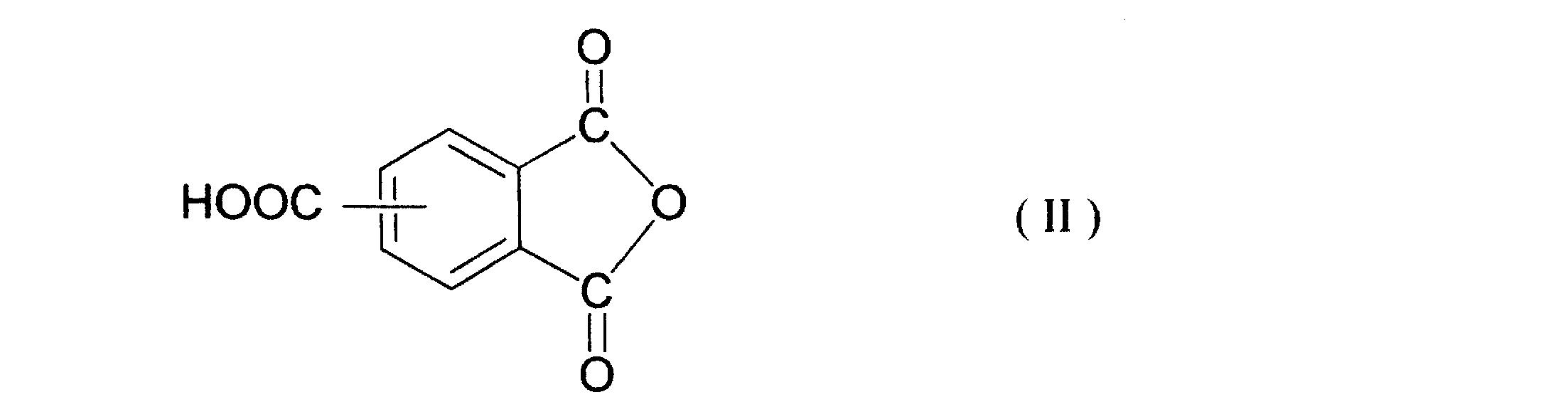
他の実施形態において、酸成分(a)は、上記トリカルボン酸無水物とは異なる酸成分をさらに含んでもよい。例えば、酸成分(a)の一部として、必要に応じて、テトラカルボン酸二無水物をさらに含んでもよい。テトラカルボン酸二無水物の具体例として、ピロメリット酸二無水物、3,3’,4,4’-ベンゾフェノンテトラカルボン酸二無水物、3,3’,4,4’-ビフェニルテトラカルボン酸二無水物、1,2,5,6-ナフタレンテトラカルボン酸二無水物、2,3,5,6-ピリジンテトラカルボン酸二無水物、1,4,5,8-ナフタレンテトラカルボン酸二無水物、3,4,9,10-ペリレンテトラカルボン酸二無水物、4,4’-スルホニルジフタル酸二無水物、m-ターフェニル-3,3’,4,4’-テトラカルボン酸二無水物(3,3’’,4,4’’-m-ターフェニルテトラカルボン酸二無水物)、4,4’-オキシジフタル酸二無水物、1,1,1,3,3,3-ヘキサフルオロ-2,2-ビス(2,3-又は3,4-ジカルボキシフェニル)プロパン二無水物、2,2-ビス(2,3-又は3,4-ジカルボキシフェニル)プロパン二無水物、2,2-ビス[4-(2,3-又は3,4-ジカルボキシフェノキシ)フェニル]プロパン二無水物、1,1,1,3,3,3-ヘキサフルオロ-2,2-ビス[4-(2,3-又は3,4-ジカルボキシフェノキシ)フェニル]プロパン二無水物、1,3-ビス(3,4-ジカルボキシフェニル)-1,1,3,3-テトラメチルジシロキサン二無水物、ブタンテトラカルボン酸二無水物、ビシクロ-[2,2,2]-オクト-7-エン-2:3:5:6-テトラカルボン酸二無水物等を使用することができる。
(成分(b))
ジイソシアネート化合物又はジアミン化合物は、特に制限されず、分子内に2個のイソシアネート基又はアミノ基を有する化合物であればよい。一実施形態において、成分(b)は、下式(III)、(IV)、及び(V)で表されるイソシアネート基又はアミノ基を有する芳香族化合物を含むことが好ましい。
ジイソシアネート化合物又はジアミン化合物は、特に制限されず、分子内に2個のイソシアネート基又はアミノ基を有する化合物であればよい。一実施形態において、成分(b)は、下式(III)、(IV)、及び(V)で表されるイソシアネート基又はアミノ基を有する芳香族化合物を含むことが好ましい。


上式中、R1及びR2は、それぞれ独立して、水素原子、アルキル基、アルコキシ基、又は水酸基を表す。上記アルキル基又はアルコキシ基は、炭素数1~20であることが好ましく、炭素数1~15であることがより好ましく、炭素数1~10であることがさらに好ましい。上記アルキル基又はアルコキシ基は、水素原子の少なくとも1つがフッ素原子等のハロゲン原子で置換されていてもよい。一実施形態において、R1及びR2は、それぞれ独立して水素原子であることが好ましい。
Yは、それぞれ、イソシアネート基又はアミノ基を示す。
X2は、-CH2-、-C(=O)-、-S(=O)-、-SO2-、-O-、-S-、又は-CR3R4-を示す。R3及びR4は、それぞれ独立して、上記アルキル基又はアルコキシ基を表す。上記アルキル基又はアルコキシ基は、先に説明したとおりである。一実施形態において、R3及びR4は、炭素数1~10のアルキル基、トリフルオロメチル基、トリクロロメチル基、及びフェニル基からなる群から選択される1種以上の置換基である。一実施形態において、X2は、-CH2-であることが好ましい。
Yは、それぞれ、イソシアネート基又はアミノ基を示す。
X2は、-CH2-、-C(=O)-、-S(=O)-、-SO2-、-O-、-S-、又は-CR3R4-を示す。R3及びR4は、それぞれ独立して、上記アルキル基又はアルコキシ基を表す。上記アルキル基又はアルコキシ基は、先に説明したとおりである。一実施形態において、R3及びR4は、炭素数1~10のアルキル基、トリフルオロメチル基、トリクロロメチル基、及びフェニル基からなる群から選択される1種以上の置換基である。一実施形態において、X2は、-CH2-であることが好ましい。
上式(III)、(IV)又は(V)で示される芳香族ジイソシアネート化合物又は芳香族ジアミン化合物の具体例として、4,4’-ジイソシアナトジフェニルメタン、4,4’-ジイソシアナトビフェニル、3,3’-ジイソシアナトビフェニル、3,4’-ジイソシアナトビフェニル、4,4’-ジイソシアナト-3,3’-ジメチルビフェニル、4,4’-ジイソシアナト-2,2’-ジメチルビフェニル、4,4’-ジイソシアナト-3,3’-ジエチルビフェニル、4,4’-ジイソシアナト-2,2’-ジエチルビフェニル、4,4’-ジイソシアナト-3,3’-ジメトキシビフェニル、4,4’-ジイソシアナト-2,2’-ジメトキシビフェニル、1,5-ジイソシアナトナフタレン、2,6-ジイソシアナトナフタレン、4,4’-ジアミノジフェニルメタン、4,4’-ジアミノビフェニル、3,3’-ジアミノビフェニル、3,4’-ジアミノビフェニル、4,4’-ジアミノ-3,3’-ジメチルビフェニル、4,4’-ジアミノ-2,2’-ジメチルビフェニル、4,4’-ジアミノ-3,3’-ジエチルビフェニル、4,4’-ジアミノ-2,2’-ジエチルビフェニル、4,4’-ジアミノ-3,3’-ジメトキシビフェニル、4,4’-ジアミノ-2,2’-ジメトキシビフェニル、1,5-ジアミノナフタレン、及び2,6-ジアミノナフタレン等が挙げられる。これらは、単独で使用しても、又は2種以上を組み合わせて使用してもよい。
また、ジイソシアネート化合物又はジアミン化合物としては、例えば、トリレンジイソシアネート、キシリレンジイソシアネート、4,4’-ジイソシアナトジフェニルエーテル、2,2-ビス[4-(4’-イソシアナトフェノキシ)フェニル]プロパン、トリレンジアミン、キシリレンジアミン、4,4’-ジアミノジフェニルエーテル、2,2-ビス[4-(4’-アミノフェノキシ)フェニル]プロパン等の芳香族ジイソシアネート化合物又は芳香族ジアミン化合物を使用することができる。
更に、ジイソシアネート化合物又はジアミン化合物としては、例えば、ヘキサメチレンジアミン、2,2,4-トリメチルヘキサメチレンジアミン、ジアミノイソホロン、ビス(4-アミノシクロヘキシル)メタン、1,4-ジアミノトランスシクロヘキサン、水添m-キシリレンジアミン、ヘキサメチレンジイソシアネート、2,2,4-トリメチルヘキサメチレンジイソシアネート、ジイソシアナトイソホロン、ビス(4-イソシアナトシクロヘキシル)メタン、1,4-ジイソシアナトトランスシクロヘキサン、水添m-キシリレンジイソシアネート等の脂肪族又は脂環式のジイソシアネート化合物又はジアミン化合物を使用することができる。ただし、上記脂肪族又は脂環式の化合物を使用する時は、上述した芳香族ジイソシアネート化合物又は芳香族ジアミン化合物を併用することが好ましい。上記脂肪族又は脂環式の化合物の使用量は、得られる樹脂の耐熱性等の観点から、ジイソシアネート化合物又はジアミン化合物全量の50モル%以下が好ましい。
上述したジイソシアネート化合物又はジアミン化合物は、3官能以上のポリイソシアネート化合物又はポリアミン化合物を併用することもできる。
一実施形態において、ジイソシアネート化合物又はジアミン化合物としては、耐熱性、溶解性、機械特性、及びコスト面等のバランスを考慮すれば、4,4’-ジフェニルメタンジイソシアネートが特に好ましい。
また、経日変化を避けるために、必要に応じて、ブロック剤でイソシアネート基を安定化したものを使用してもよい。ブロック剤としては、例えば、アルコール、フェノール、オキシム等が挙げられるが、特に制限はない。
(酸成分(a)と成分(b)の配合比)
上記ポリアミドイミド樹脂を製造する時の、酸成分(a)に対する成分(b)(上記ジイソシアネート化合物又はジアミン化合物を表す)の配合量の割合((b)/(a)のモル比)は、特に制限されることなく調整することができる。上記モル比が小さくなりすぎると樹脂の分子量を高くすることが困難となる傾向がある。一方、上記モル比が大きすぎると、発泡反応が激しくなり、また、未反応成分の残存が多くなり、樹脂の安定性が悪くなる傾向がある。
上記ポリアミドイミド樹脂を製造する時の、酸成分(a)に対する成分(b)(上記ジイソシアネート化合物又はジアミン化合物を表す)の配合量の割合((b)/(a)のモル比)は、特に制限されることなく調整することができる。上記モル比が小さくなりすぎると樹脂の分子量を高くすることが困難となる傾向がある。一方、上記モル比が大きすぎると、発泡反応が激しくなり、また、未反応成分の残存が多くなり、樹脂の安定性が悪くなる傾向がある。
一実施形態において、所望とするMn及び酸価を得ることが容易となることから、酸成分(a)1モルに対する成分(b)の配合量のモル比は、0.6~1.4であることが好ましく、0.7~1.3であることがより好ましく、0.8~1.2であることが特に好ましい。上記配合量のモル比は、酸成分(a)におけるカルボキシル基及び酸無水物基、並びに任意に含まれる反応性の水酸基の総モル数に対する、成分(b)におけるジイソシアネート化合物又はジアミン化合物のイソシアネート基及びアミノ基の総モル数の比として算出される値である。
ポリアミドイミド樹脂は、例えば、次の製造方法に沿って合成することができる。
(1)酸成分(a)及び成分(b)を一度に混合し、反応させてポリアミドイミド樹脂を合成する方法。
(2)酸成分(a)に対して成分(b)を過剰量で反応させて末端にイソシアネート基を有するアミドイミドオリゴマーを合成し、次いで、酸成分(a)を追加して反応させてポリアミドイミド樹脂を合成する方法。
(3)酸成分(a)の過剰量と成分(b)を反応させて末端に酸又は酸無水物基を有するアミドイミドオリゴマーを合成し、次いで、酸成分(a)及び成分(b)を追加して反応させてポリアミドイミド樹脂を合成する方法。
(1)酸成分(a)及び成分(b)を一度に混合し、反応させてポリアミドイミド樹脂を合成する方法。
(2)酸成分(a)に対して成分(b)を過剰量で反応させて末端にイソシアネート基を有するアミドイミドオリゴマーを合成し、次いで、酸成分(a)を追加して反応させてポリアミドイミド樹脂を合成する方法。
(3)酸成分(a)の過剰量と成分(b)を反応させて末端に酸又は酸無水物基を有するアミドイミドオリゴマーを合成し、次いで、酸成分(a)及び成分(b)を追加して反応させてポリアミドイミド樹脂を合成する方法。
(反応温度、反応時間)
上記のいずれの方法においても、反応温度は80~150℃の範囲が好ましい。また、反応時間は、所望の数平均分子量(Mn)が得られるように考慮して決定されるが、通常、1~10時間が好ましい。
上記のいずれの方法においても、反応温度は80~150℃の範囲が好ましい。また、反応時間は、所望の数平均分子量(Mn)が得られるように考慮して決定されるが、通常、1~10時間が好ましい。
(反応時の溶媒)
ポリアミドイミド樹脂の合成時に使用する溶媒(合成溶媒)は、特に限定されないが、例えば、N-メチル-2-ピロリドン、N,N-ジメチルホルムアミド、γ-ブチロラクトン、N,N’-ジメチルプロピレン尿素〔1,3-ジメチル-3,4,5,6-テトラヒドロピリジミン-2(1H)-オン〕、ジメチルスルホキシド、ジエチレングリコールジメチルエーテル、トリエチレングリコールジメチルエーテル、及びスルホラン等の極性溶媒、キシレン、及びトルエン等の芳香族炭化水素溶媒、並びにメチルエチルケトン、及びメチルイソブチルケトン等のケトン類などが挙げられる。
ポリアミドイミド樹脂の合成時に使用する溶媒(合成溶媒)は、特に限定されないが、例えば、N-メチル-2-ピロリドン、N,N-ジメチルホルムアミド、γ-ブチロラクトン、N,N’-ジメチルプロピレン尿素〔1,3-ジメチル-3,4,5,6-テトラヒドロピリジミン-2(1H)-オン〕、ジメチルスルホキシド、ジエチレングリコールジメチルエーテル、トリエチレングリコールジメチルエーテル、及びスルホラン等の極性溶媒、キシレン、及びトルエン等の芳香族炭化水素溶媒、並びにメチルエチルケトン、及びメチルイソブチルケトン等のケトン類などが挙げられる。
合成溶媒の使用量は、特に限定されないが、酸成分(a)と成分(b)との合計量100質量部に対して、50~180質量部であることが好ましく、60~120質量部であることがより好ましい。合成溶媒の使用量を上記範囲に調整した場合、合成時の発泡反応の発生を抑制することができ、また合成に要する時間を適切に調整することが容易となる。
(ポリアミドイミド樹脂の分子量)
一般的に、電気絶縁材料として使用するポリアミドイミド樹脂の数平均分子量(Mn)は、塗膜の強度を確保する観点から、5,000以上であることが好ましく、10,000以上であることがより好ましく、12,000以上であることがさらに好ましい。一方、塗装時の作業性の観点から、ポリアミドイミド樹脂のMnは、100,000以下であることが好ましく、70,000以下であることがより好ましく、50,000以下であることがさらに好ましい。
一般的に、電気絶縁材料として使用するポリアミドイミド樹脂の数平均分子量(Mn)は、塗膜の強度を確保する観点から、5,000以上であることが好ましく、10,000以上であることがより好ましく、12,000以上であることがさらに好ましい。一方、塗装時の作業性の観点から、ポリアミドイミド樹脂のMnは、100,000以下であることが好ましく、70,000以下であることがより好ましく、50,000以下であることがさらに好ましい。
特に限定するものではないが、一実施形態において、ポリアミドイミド樹脂組成物を構成するために、Mnが12,000~30,000であるポリアミドイミド樹脂を好適に使用することができる。ポリアミドイミド樹脂のMnは、12,000~20,000であることがより好ましい。Mnが上記範囲内のポリアミドイミド樹脂を使用した場合、シリカ微粒子の分散性を向上させることが容易となる傾向がある。
ポリアミドイミド樹脂のMnは、原料の仕込み量、及び反応時間等によって調整することができる。例えば、樹脂合成時にサンプリングして、ゲルパーミエーションクロマトグラフ(GPC)により、標準ポリスチレンの検量線を用いて測定し、目的とするMnになるまで反応を継続することにより、管理することができる。
また、一実施形態において、ポリアミドイミド樹脂は、酸価が30~50mgKOH/gであることが好ましい。上記酸価は、35~45mgKOH/gであることがより好ましい。ここで、上記酸価は、1gのポリアミドイミド樹脂を中和するために必要なKOHのミリグラム数(mg)を表し、ポリアミドイミド樹脂中のカルボキシル基と酸無水物基を開環させたカルボキシル基とを合わせた酸価を意味する。
上記範囲の酸価を有するポリアミドイミド樹脂を使用した場合、後述する混合溶媒へのポリアミドイミド樹脂の溶解又は分散が容易になる傾向がある。また、最終的に得られるポリアミドイミド樹脂組成物の経日によるゲル化を容易に抑制できる傾向がある。さらに、理論によって拘束するものではないが、ポリアミドイミド樹脂中のカルボキシル基と後述するシリカ微粒子との相互作用によって、シリカ微粒子の分散性が向上することが考えられる。
(シリカ微粒子)
電気絶縁材料で使用される代表的な無機粒子のなかでも、シリカは、樹脂への分散性に優れ、かつ粒子の凝集が起こり難い点で好ましい。特に、ポリアミドイミド樹脂に対して、シリカ微粒子を使用することが好ましい。
本明細書において「シリカ微粒子」とは、平均一次粒子径が50nm以下であるシリカ(酸化ケイ素)を意味する。シリカ微粒子は、粒子径が小さいことによって、絶縁皮膜の成膜性及び密着性の向上といった有益な特性を示すことが期待される。
電気絶縁材料で使用される代表的な無機粒子のなかでも、シリカは、樹脂への分散性に優れ、かつ粒子の凝集が起こり難い点で好ましい。特に、ポリアミドイミド樹脂に対して、シリカ微粒子を使用することが好ましい。
本明細書において「シリカ微粒子」とは、平均一次粒子径が50nm以下であるシリカ(酸化ケイ素)を意味する。シリカ微粒子は、粒子径が小さいことによって、絶縁皮膜の成膜性及び密着性の向上といった有益な特性を示すことが期待される。
一実施形態において、成膜性及び密着性の観点から、シリカ微粒子の平均一次粒子径は、40nm以下であることが好ましく、30nm以下であることがより好ましく、20nm以下であることがさらに好ましい。取扱い性等の観点から、シリカ微粒子の平均一次粒子径は3nm以上であることが好ましく、5nm以上であることがより好ましく、7nm以上であることがさらに好ましく、10nm以上であることが最も好ましい。一実施形態において、シリカ微粒子の平均一次粒子径は、10nm~20nmの範囲であってよく、より好ましくは10nm~15nmの範囲であってよい。
本明細書において、「平均一次粒子径」とは、凝集した粒子の平均粒子径、つまり二次粒子径ではなく、凝集していない単体での平均粒子径を意味する。シリカ微粒子の平均一次粒子径は、代表的に、レーザー回析式粒度分布測定装置又は透過型電子顕微鏡(TEM)を用いる方法によって測定することができる。例えば、TEMを用いる方法では、先ず、組成物又は分散体の中から無作為に選ばれた少なくとも百個以上の粒子について、TEMによってそれぞれの粒子像の面積を測定する。次いで、得られた面積の値と同面積となる円の直径を粒子径と見なし、公知の統計処理によって各粒子径の平均値を算出することによって、平均一次粒子径を得る。
部分放電劣化耐性を高める観点から、電気絶縁樹脂組成物中のシリカ微粒子の含有量は、固形分の全質量を基準として、6質量%以上が好ましく、8質量%以上がより好ましく、10質量%以上がさらに好ましい。一方、優れた分散性を得る観点から、電気絶縁樹脂組成物中のシリカ微粒子の含有量は、固形分の全質量を基準として、24質量%以下が好ましく、22質量%以下がより好ましく、20質量%以下がさらに好ましい。
一実施形態において、電気絶縁樹脂組成物中のシリカ微粒子の含有量は、固形分の全質量を基準として、6~24質量%の範囲が好ましく、8~20質量%の範囲がより好ましく、10~18質量%の範囲がさらに好ましく、10~15質量%であることが最も好ましい。後述するようにシリカ微粒子のゾル(シリカゾル)を使用した場合、上記含有量は、シリカゾル中に含まれるシリカ微粒子の固形分含有量から算出される値を意味する。
シリカ微粒子の使用は、成膜性及び絶縁皮膜の密着性の向上といった有益な特性を示すことが期待される。しかし、その一方で、平均一次粒子径が50nmを超えるシリカ粒子との比較において、シリカ微粒子は二次凝集を起こしやすく、分散性が低下しやすい。そのため、シリカ微粒子を使用して電気絶縁樹脂組成物を構成した場合、一般的に組成物は不均一な粒径の凝集体を含み、絶縁皮膜の割れ等の特性低下、及び樹脂組成物の粘度上昇等の不具合が生じやすいと考えられる。
しかし、上記実施形態の電気絶縁樹脂組成物によれば、シリカ微粒子を特定量で使用することで、絶縁皮膜の特性を低下させることなく、耐電圧寿命特性を向上することができ、また優れた貯蔵安定性を得ることもできる。理論によって拘束するものではないが、特定量のシリカ微粒子を使用することで二次凝集が抑制され、その結果、シリカ微粒子が一次粒子径を維持した状態で絶縁樹脂組成物中に均一に分散した良好な分散状態となり、粘度上昇が抑制されるためと推測される。
シリカ微粒子は、平均一次粒子径が50nm以下であることを除き特に限定されず、公知のシリカ微粒子を使用することができる。シリカ微粒子の合成法は、乾式法と、湿式法とに大別されるが、いずれの合成法によって製造されたシリカ微粒子でもよい。ここで、乾式法とは、燃焼法、及びアーク法を含む。また、湿式法とは、沈殿法、ゲル法、及びゾルゲル法を含む。
一実施形態において、湿式法によって製造されたシリカ微粒子(以下、湿式シリカ微粒子という)を好適に使用することができる。湿式シリカ微粒子は、乾式法によって製造されたシリカ微粒子(以下、乾式シリカ微粒子という)との対比において、表面に、より多くのシラノール基が存在する。そのため、湿式シリカ微粒子を使用した場合、シリカ微粒子に対する表面処理が容易である等の利点がある。また、湿式シリカを使用した場合、乾式シリカとの対比において、絶縁樹脂に対する相溶性が向上するため、優れた分散性を容易に得ることができる。
一実施形態において、湿式シリカ微粒子のなかでも、ゾルゲル法によって製造されたシリカ微粒子(以下、ゾルゲルシリカ微粒子という)をより好適に使用することができる。ゾルゲルシリカ微粒子は、代表的に、テトラアルコキシシランを用い、溶液中で、アンモニア触媒によって加水分解及び重縮合を行うことによって製造することができる。
上述のように、上記実施形態の電気絶縁樹脂組成物では、シリカ微粒子を特定量で使用することによって分散性の低下が抑制され、優れた耐電圧寿命を実現することが可能となる。電気絶縁樹脂組成物におけるシリカ微粒子の分散性は、例えば、透過散乱光方式に従い測定される濁度によって評価することができる。
一実施形態において、固形分含有量が50質量%以下、より好ましくは40質量%以下、さらに好ましくは20~40質量%の電気絶縁樹脂組成物の濁度は、30NTU以下であることが好ましい。上記濁度は、20NTU以下であることがより好ましく、10NTU以下であることがさらに好ましい。上記固形分含有量は、電気絶縁樹脂組成物の全質量に対するポリアミドイミド樹脂とシリカ微粒子との合計量の割合を意味する。濁度の単位NTU(Nephelometric Turbidity Units)は、比濁法濁度単位を意味し、シリカ微粒子のなかでも、ゾルゲル法によって製造されたゾルゲルシリカ微粒子をした場合、濁度が上記範囲内の電気絶縁樹脂組成物を容易に構成できる。
電気絶縁樹脂組成物の貯蔵安定性は、ポリアミドイミド樹脂組成物(ワニス)の保管前後の粘度経時変化率(%)によって評価することができる。一実施形態において、固形分含有量が10~50質量%のポリアミドイミド樹脂組成物の一定量を密閉容器に入れ、この密閉容器を、25℃に設定した乾燥器内で1か月間にわたって保管した場合、保管前後の粘度経時変化率は、シリカ微粒子を含まないワニスの粘度経時変化率と同等であるか、又はより少ないことが好ましい。
一実施形態において、上記ワニスの経時粘度変化率は、24%以下であることが好ましい。ただし、電気絶縁樹脂組成物の初期粘度が高すぎると、上記経時粘度変化率が小さい場合であっても初期粘度が高いと、取扱い性に劣る傾向がある。そのため、電気絶縁樹脂組成物の初期粘度(Pa・s)は2.3以下が好ましく、2.1以下がより好ましく、2.0以下がさらに好ましい。したがって、ワニスは、初期粘度が上記範囲内であり、かつ経時粘度変化率が24%以下であることがより好ましい。シリカ微粒子のなかでも、ゾルゲル法によって製造されたゾルゲルシリカ微粒子を使用した場合、取扱い性に優れ、かつ貯蔵安定性に優れる電気絶縁樹脂組成物(ワニス)を容易に構成できる。
シリカ微粒子は、樹脂への分散性を高める観点から、シランカップリング剤等の表面処理剤、又は分散剤で処理されたものであってもよい。シランカップリング剤の具体例として、公知のアルコキシ型シランカップリング剤が挙げられる。分散剤の具体例として、公知のリン酸エステル分散剤が挙げられる。
シリカ微粒子はシリカゾルの形態で使用されてもよく、溶媒置換してもよい。ここで、シリカゾルとは、シリカ微粒子を分散媒に分散させた分散体を意味し、流動性を有する。一実施形態において、シリカ微粒子はシリカゾルの形態で使用されることが好ましい。一般的に、平均一次粒子径が50nm以下のシリカ粒子は、二次凝集しやすいが、シリカゾルを使用した場合は、良好な分散性を保持することが容易となり、凝集による粒子の沈降等を抑制しやすい傾向がある。
シリカゾルにおける分散媒は、上記ポリアミドイミド樹脂と相溶性に優れることが好ましい。分散媒として、例えば、N,N-ジメチルアセトアミド、メチルエチルイソブチルケトン、水、又はメタノールを使用することができる。その他、キシレンとブタノールとの混合溶媒等を使用することもできる。なかでも、分散媒としてN,N-ジメチルアセトアミドを含むシリカゾルを好適に使用することができる。一実施形態において、分散媒は、後述する混合溶媒と同じであってもよい。
シリカゾルは、市販品を使用してもよいが、当業者に公知の方法に従って調製することもできる。シリカゾルを製造するために、紛体を液体に分散する一般的な方法を適用することができる。例えば、シリカ微粒子と、分散媒と、分散剤等のその他の成分とを混合した後、超音波法、ミキサー法、3本ロール法、及びボールミル法等に従って分散処理を行う方法が挙げられる。特に限定するものではないが、シリカゾルにおけるシリカ微粒子の配合量は、シリカゾルの全質量を基準として、10~50質量%の範囲であってよく、より好ましくは20~40質量%の範囲であってよい。
電気絶縁樹脂組成物の一実施形態において、優れた分散性を維持できる範囲で、上記シリカ微粒子と、その他の無機粒子とを併用してもよい。例えば、上記シリカ微粒子と、平均一次粒子径が50nmを超えるシリカとを併用してもよい。また、併用可能なシリカ以外の無機粒子として、酸化アルミニウム(アルミナ)、酸化チタン、酸化マグネシウム、及び酸化ジルコニウム等の金属酸化物が挙げられる。他の具体例として、クレー、タルク、硫酸バリウム、及び炭酸カルシウム等が挙げられる。
(混合溶媒)
一実施形態において、電気絶縁樹脂組成物は、上記ポリアミドイミド樹脂と、上記シリカ微粒子と、さらに、これら成分を混合するための溶媒(以後、混合溶媒という)とを含んでよい。混合溶媒は、ポリアミドイミド樹脂を溶解可能なものが好ましく、上記ポリアミドイミド樹脂の合成時に使用した合成溶媒と同じであってもよい。したがって、電気絶縁樹脂組成物を製造するために、ポリアミドイミド樹脂の製造時に得られる反応溶液をそのまま使用することもできる。一実施形態において、合成溶媒及び混合溶媒は、N-メチル-2-ピロリドン、及び/又はN,N-ジメチルアセトアミドを含むことが好ましい。
一実施形態において、電気絶縁樹脂組成物は、上記ポリアミドイミド樹脂と、上記シリカ微粒子と、さらに、これら成分を混合するための溶媒(以後、混合溶媒という)とを含んでよい。混合溶媒は、ポリアミドイミド樹脂を溶解可能なものが好ましく、上記ポリアミドイミド樹脂の合成時に使用した合成溶媒と同じであってもよい。したがって、電気絶縁樹脂組成物を製造するために、ポリアミドイミド樹脂の製造時に得られる反応溶液をそのまま使用することもできる。一実施形態において、合成溶媒及び混合溶媒は、N-メチル-2-ピロリドン、及び/又はN,N-ジメチルアセトアミドを含むことが好ましい。
電気絶縁樹脂組成物において、合成溶媒及び/又は混合溶媒の配合量は特に制限されない。ポリアミドイミド樹脂を合成溶媒及び/又は混合溶媒によって希釈し、所望とする用途に適した粘度が得られるように配合量を調整することができる。一実施形態において、電気絶縁樹脂組成物は、ポリアミドイミド樹脂と、シリカ微粒子と、溶媒とを含む電気絶縁塗料(ワニス)の形態であってよい。電気絶縁樹脂組成物をワニスとして調製する場合、一般に、ワニスの全質量を基準として、固形分含有量は10~50質量%であることが好ましく、20~40質量%であることがより好ましい。ワニスにおける固形分含有量を上記範囲に調整することによって、優れた塗工性が得られるとともに、塗工を繰返して容易に厚膜化することができる。上記固形分含有量は、代表的に、ポリアミドイミド樹脂とシリカ微粒子との合計量であってよい。
(その他成分)
電気絶縁樹脂組成物は、必要に応じて、さらに、着色剤等の添加剤を含んでもよい。添加剤の配合量は、皮膜特性を低下させない範囲で調整することが好ましい。
電気絶縁樹脂組成物は、必要に応じて、さらに、着色剤等の添加剤を含んでもよい。添加剤の配合量は、皮膜特性を低下させない範囲で調整することが好ましい。
電気絶縁樹脂組成物は、上記ポリアミドイミド樹脂と、上記シリカ微粒子と、さらに必要に応じて、混合溶媒、及び添加剤等のその他の成分とを、公知の方法に従い混合分散処理することによって調製することができる。混合分散処理は、例えば、ハイスピードミキサー、ホモミキサー、ボールミル、ロールミル、及び超音波分散機等の公知の混合分散機を使用して実施することができる。2種以上の混合分散機を組み合わせて使用した場合、良好な分散状態を容易に得ることができる。
電気絶縁樹脂組成物の調製において、リン酸エステル分散剤等の分散剤を使用してもよい。分散剤は、ポリアミドイミド樹脂及びシリカ微粒子と一緒に混合する実施形態で使用されてよい。他の実施形態において、分散剤は、電気絶縁樹脂組成物の調製に先立ち、シリカ微粒子と一緒に予備混合する形態で使用されてもよい。分散剤は、シリカ微粒子の表面に付着するだけでなく、電気絶縁樹脂組成物の系中に浮遊していてもよい。
2.電気絶縁体
上記実施形態の電気絶縁樹脂組成物は、様々な導体に絶縁性を付与するための電気絶縁材料として好適に使用することができる。一実施形態は、導体と、当該導体に絶縁性を付与するための、上記実施形態の電気絶縁樹脂組成物から形成される絶縁皮膜とを有する電気絶縁体に関する。上記絶縁皮膜は、例えば、導体に上記実施形態の電気絶縁樹脂組成物を塗布し、焼付けることによって形成することができる。
上記実施形態の電気絶縁樹脂組成物は、様々な導体に絶縁性を付与するための電気絶縁材料として好適に使用することができる。一実施形態は、導体と、当該導体に絶縁性を付与するための、上記実施形態の電気絶縁樹脂組成物から形成される絶縁皮膜とを有する電気絶縁体に関する。上記絶縁皮膜は、例えば、導体に上記実施形態の電気絶縁樹脂組成物を塗布し、焼付けることによって形成することができる。
上記導体は、銅線等の金属線、及びその他の絶縁性を付与することが望ましい構造体が挙げられる。電気絶縁体において、導体は、上記電気絶縁樹脂組成物から構成される絶縁皮膜に加えて、他の電気絶縁材料から構成される追加の絶縁皮膜をさらに有してもよい。
(導体)
上記導体は、例えば、後述する金属線や、インバータ制御電気機器等に用いられる電気電子部品が挙げられる。上記実施形態の電気絶縁樹脂組成物から形成される絶縁皮膜が付与された電気電子部品は、特に、高電圧用、インバータ制御用として有用である。
上記導体は、例えば、後述する金属線や、インバータ制御電気機器等に用いられる電気電子部品が挙げられる。上記実施形態の電気絶縁樹脂組成物から形成される絶縁皮膜が付与された電気電子部品は、特に、高電圧用、インバータ制御用として有用である。
高電圧が印加される電気電子部品、及びインバータ制御電気機器に用いられる電気電子部品では、近年のサージ電圧値の上昇に伴い、絶縁皮膜の部分放電劣化が起こりやすく、耐電圧寿命が短い傾向がある。これに対し、上記実施形態の電気絶縁樹脂組成物から形成される絶縁皮膜は、優れた部分放電劣化耐性を有するため、電気電子部品のサージ対策の用途で好適に使用することができる。
上記実施形態の電気絶縁樹脂組成物を金属線に塗布した場合、優れた部分放電劣化耐性とともに、可とう性等の耐加工性、耐熱性、及び絶縁破壊電圧特性等の代表的な性能要求を満たす、絶縁信頼性の高い絶縁電線(エナメル線)を提供することができる。また、上記実施形態の絶縁電線を使用することによって、絶縁破壊に対して高い耐性を有し、耐電圧寿命に優れる電気電子部品を提供することができる。その他、部分放電による絶縁破壊は、絶縁電線の絶縁皮膜に限らず、電動モータの相間絶縁紙等の絶縁フィルム、モータコイルを被覆する絶縁ワニス、発電機、変圧器、開閉装置等の電力機器の絶縁用電線及び充填モールド絶縁部材においても生じるため、これらの絶縁部を構成するための電気絶縁材料として上記実施形態の電気絶縁樹脂組成物を使用することもできる。
(絶縁皮膜の作製方法)
上記実施形態の電気絶縁樹脂組成物を塗布する方法としては、特に限定されず、当技術分野で周知の技術を適用することができる。例えば、電気絶縁塗料(ワニス)として調製した電気絶縁樹脂組成物を電線(金属線)に塗布する場合、ダイス塗装、フェルト塗装等の方法を適用することができる。
上記実施形態の電気絶縁樹脂組成物を塗布する方法としては、特に限定されず、当技術分野で周知の技術を適用することができる。例えば、電気絶縁塗料(ワニス)として調製した電気絶縁樹脂組成物を電線(金属線)に塗布する場合、ダイス塗装、フェルト塗装等の方法を適用することができる。
上記実施形態の電気絶縁樹脂組成物は、被塗物となる導体に塗装後、塗膜を乾燥及び硬化させることによって絶縁皮膜を形成することができる。塗膜の乾燥及び硬化は、260~520℃の温度で、2秒~数分の時間にわたり、熱処理を行うことで達成できる。熱処理時の温度が低いと、塗膜の乾燥及び硬化の後に、溶媒が残り、塗膜特性が低下する可能性がある。また、硬化時の温度が十分に高くない場合(例えば、硬化温度が260℃未満の場合)、塗膜の乾燥及び硬化が不十分になることがある。加熱時間が短すぎると、塗膜に溶媒が残存し塗膜特性が低下しやすい。一方、加熱時間が長すぎると、時間とエネルギーが無駄になり生産効率が低下しやすい。
金属線(電線)に塗布した電気絶縁樹脂組成物の乾燥及び硬化方法(焼付け方法)は、常法に従って実施することができる。代表的には、電線に電気絶縁樹脂組成物を塗布した後に、加熱炉を通過させる方法が挙げられる。上記乾燥及び硬化によって形成される硬化膜からなる絶縁皮膜の耐絶縁破壊性を向上させる観点から、電気絶縁樹脂組成物の塗布を数回繰り返して、絶縁皮膜を形成することが好ましい。
絶縁皮膜は、単層構造としても、多層構造としてもよい。特に限定されないが、一実施形態において、絶縁皮膜の全体の厚さは、20~200μmが好ましく、40~150μmがより好ましい。塗膜が薄すぎると、絶縁性が不十分になり、厚すぎるとコイルにした時の導体割合が低下し、電気的な能力が低下する。また、塗膜が厚すぎると、小型化、薄型化に不利となる。
(絶縁電線(エナメル線))
次に、上記電気絶縁体の一例として、絶縁電線についてより具体的に説明する。図1は、絶縁電線の一実施形態を示す模式断面図である。図2~4は、絶縁電線の他の実施形態を示す模式断面図である。図1に示される絶縁電線Aは、導体1と、該導体1に、上記実施形態の電気絶縁樹脂組成物を塗布し焼付けることにより形成した絶縁皮膜2とを有する。
次に、上記電気絶縁体の一例として、絶縁電線についてより具体的に説明する。図1は、絶縁電線の一実施形態を示す模式断面図である。図2~4は、絶縁電線の他の実施形態を示す模式断面図である。図1に示される絶縁電線Aは、導体1と、該導体1に、上記実施形態の電気絶縁樹脂組成物を塗布し焼付けることにより形成した絶縁皮膜2とを有する。
導体1の具体例として、銅線等の金属線が挙げられる。一実施形態において、金属線の断面形状は、図1に示すように円形であってよい。他の実施形態において、金属線の断面形状は、正方形、矩形状、又は平角状であってもよい。
絶縁皮膜2は、他の電気絶縁材料と組合せた多層構造になっていてもよい。この場合、絶縁皮膜は、異なった電気絶縁材料を2層以上積層した多層構造となる。このような多層構造において、上記実施形態の電気絶縁樹脂組成物から形成される絶縁皮膜は、導体に接触する最内層であっても、外気と接触する最外層であっても、中間の層であってもよい。他の電気絶縁材料としては、例えば、ポリエステルイミド樹脂、ポリウレタン樹脂、ポリエステル樹脂、ポリイミド樹脂、及び本質的に無機粒子を含まないポリアミドイミド樹脂等がある。
一実施形態において、絶縁電線Aは、図2に示すように、導体1と、絶縁皮膜2との間にプライマー層3を有する構造であってよい。他の実施形態において、絶縁電線Aは、図3に示すように、導体1と、絶縁皮膜2と、さらにオーバーコート層4とを有する構造であってもよい。さらに、他の実施形態において、絶縁電線Aは、導体1と、プライマー層3と、絶縁皮膜2と、オーバーコート層4とを有する構造であってよい。
上記プライマー層及び上記オーバーコート層は、特に限定するものではないが、絶縁皮膜2との樹脂の相溶性の観点から、本質的に無機粒子を含まないポリアミドイミド樹脂から構成されることが好ましい。プライマー層及びオーバーコート層は、ポリアミドイミド樹脂100質量部に対して5質量部未満の無機粒子を含んでもよいが、ポリアミドイミド樹脂のみから構成されることが好ましい。プライマー層を形成するために使用するポリアミドイミド樹脂は上記実施形態の電気絶縁樹脂組成物を構成する特定のポリアミドイミド樹脂と同じであってもよいが、特に制限なく、Mnがより大きいその他のポリアミドイミド樹脂を使用してもよい。例えば、一実施形態において、プライマー層及びオーバーコート層を形成するために使用するポリアミドイミド樹脂のMnは、23,000~29,000であってよい。
上述のように、絶縁電線Aでは、上記実施形態の電気絶縁樹脂組成物から形成された絶縁皮膜2で導体1が被覆されることによって、可とう性などの耐加工性、密着性、耐熱性、及び絶縁破壊電圧特性などが付与され、絶縁信頼性が高い。そのため、上記実施形態の絶縁電線は、ステータ、又はローターのコイルに好適に使用することができる。このようなステータ又はローターは、インバータ駆動モータ及びその他の高電圧駆動モータなどに装備される。インバータ駆動モータの一例として、ハイブリッド自動車用モータ、電気自動車用モータ、ハイブリッドディーゼル機関車用モータ、電気自動二輪車用モータ、エレベータ用モータ、及び建設機械に使用されるモータなどが挙げられる。
上記実施形態の絶縁電線を用いて構成したコイルは、上記用途において、高い絶縁信頼性を提供することができ、かつ電気機器及びモータの長寿命化を実現可能とすることができる。このような効果は、特に、高い電圧が加わるインバータ制御においてより有効となる。また、上記電気絶縁樹脂組成物は、薄い絶縁皮膜であっても十分な絶縁破壊電圧特性を付与できることから、電気機器及びモータ等の小型化、及び軽量化に寄与することもできる。
以下、本発明を実施例によって詳細に説明する。但し、本発明は以下に記載する実施例に限定されるものではなく、本発明の要旨を逸脱しない範囲で種々の変更を加えることができる。
<1>ポリアミドイミド樹脂の調製
温度計、撹拌機、及び冷却管を備えたフラスコに、トリメリット酸無水物192.1g(1.00モル)、4,4’-ジフェニルメタンジイソシアネート250.3g(1.00モル)、及びN-メチル-2-ピロリドン362.0gを入れた。次いで、これらの混合物を、乾燥した窒素気流中で、反応によって生じる炭酸ガスの急激な発泡に注意しながら、約6時間かけて130℃まで徐々に昇温し、さらに130℃で4時間保温することによって、ポリアミドイミド樹脂溶液を得た。このポリアミドイミド樹脂溶液を、N,N-ジメチルアセトアミド(DMAC)で希釈し、さらに200℃で2時間保温することによって、樹脂濃度(固形分含有量)が40%のポリアミドイミド樹脂溶液を調製した。得られた溶液中のポリアミドイミド樹脂を分析したところ、数平均分子量は21,000であり、酸価は40mgKOH/gであった。
<1>ポリアミドイミド樹脂の調製
温度計、撹拌機、及び冷却管を備えたフラスコに、トリメリット酸無水物192.1g(1.00モル)、4,4’-ジフェニルメタンジイソシアネート250.3g(1.00モル)、及びN-メチル-2-ピロリドン362.0gを入れた。次いで、これらの混合物を、乾燥した窒素気流中で、反応によって生じる炭酸ガスの急激な発泡に注意しながら、約6時間かけて130℃まで徐々に昇温し、さらに130℃で4時間保温することによって、ポリアミドイミド樹脂溶液を得た。このポリアミドイミド樹脂溶液を、N,N-ジメチルアセトアミド(DMAC)で希釈し、さらに200℃で2時間保温することによって、樹脂濃度(固形分含有量)が40%のポリアミドイミド樹脂溶液を調製した。得られた溶液中のポリアミドイミド樹脂を分析したところ、数平均分子量は21,000であり、酸価は40mgKOH/gであった。
ポリアミドイミド樹脂の数平均分子量、及び酸価の測定は以下のようにして実施した。
(数平均分子量(Mn))
測定時の条件は、以下のとおりである。
GPC機種:日立 L6000
検出器:日立 L4000型UV
波長:270nm
データ処理機:ATT 8
カラム:Gelpack GL-S300MDT-5(×2)
カラムサイズ:8mmφ×300mm
溶媒:DMF/THF=1/1(リットル)+リン酸0.06M+臭化リチウム0.06M
試料濃度:5mg/1ml
注入量:5μl
圧力:49kgf/cm2(4.8×106Pa)
流量:1.0ml/分
(数平均分子量(Mn))
測定時の条件は、以下のとおりである。
GPC機種:日立 L6000
検出器:日立 L4000型UV
波長:270nm
データ処理機:ATT 8
カラム:Gelpack GL-S300MDT-5(×2)
カラムサイズ:8mmφ×300mm
溶媒:DMF/THF=1/1(リットル)+リン酸0.06M+臭化リチウム0.06M
試料濃度:5mg/1ml
注入量:5μl
圧力:49kgf/cm2(4.8×106Pa)
流量:1.0ml/分
(酸価)
ポリアミドイミド樹脂を0.5g採取し、これに1,4-ジアザビシクロ[2,2,2]オクタンを0.15g加え、さらにN-メチル-2-ピロリドンを60gとイオン交換水を1mL加え、ポリアミドイミド樹脂が完全に溶解するまで撹拌する。このようにして得られた溶液を、0.05モル/Lのエタノール性水酸化カリウム溶液を使用して電位差滴定装置で滴定した。
ポリアミドイミド樹脂を0.5g採取し、これに1,4-ジアザビシクロ[2,2,2]オクタンを0.15g加え、さらにN-メチル-2-ピロリドンを60gとイオン交換水を1mL加え、ポリアミドイミド樹脂が完全に溶解するまで撹拌する。このようにして得られた溶液を、0.05モル/Lのエタノール性水酸化カリウム溶液を使用して電位差滴定装置で滴定した。
<2>電気絶縁樹脂組成物の調製
(実施例1)
先に調製したポリアミドイミド樹脂溶液100質量部(DMACを加えて固形分含有量を37%に調整)と、湿式シリカ微粒子のゾル(湿式シリカゾル)13.5質量部とを、60~70℃で1時間にわたって混合分散処理することによって、電気絶縁樹脂組成物を得た。上記湿式シリカゾルは、平均一次粒子径が11nmのゾルゲルシリカを30.5質量%含み、分散媒としてのDMACの含有量は69.5質量%であった。
得られた電気絶縁樹脂組成物において、固形成分の全質量を基準とするシリカ微粒子の含有量は10質量%であった。
(実施例1)
先に調製したポリアミドイミド樹脂溶液100質量部(DMACを加えて固形分含有量を37%に調整)と、湿式シリカ微粒子のゾル(湿式シリカゾル)13.5質量部とを、60~70℃で1時間にわたって混合分散処理することによって、電気絶縁樹脂組成物を得た。上記湿式シリカゾルは、平均一次粒子径が11nmのゾルゲルシリカを30.5質量%含み、分散媒としてのDMACの含有量は69.5質量%であった。
得られた電気絶縁樹脂組成物において、固形成分の全質量を基準とするシリカ微粒子の含有量は10質量%であった。
(実施例2)
実施例1の電気絶縁樹脂組成物の調製において、湿式シリカゾルの配合量を変更したことを除き、全て実施例1と同様にして、電気絶縁樹脂組成物を調製した。具体的には、先に調製したポリアミドイミド樹脂溶液100質量部(DMACを加えて固形分含有量を37%に調整)と、湿式シリカゾル21.4質量部とを、60~70℃で1時間にわたって混合分散処理することによって、電気絶縁樹脂組成物を得た。
得られた電気絶縁樹脂組成物において、固形成分の全質量を基準とするシリカ微粒子の含有量は15質量%であった。
実施例1の電気絶縁樹脂組成物の調製において、湿式シリカゾルの配合量を変更したことを除き、全て実施例1と同様にして、電気絶縁樹脂組成物を調製した。具体的には、先に調製したポリアミドイミド樹脂溶液100質量部(DMACを加えて固形分含有量を37%に調整)と、湿式シリカゾル21.4質量部とを、60~70℃で1時間にわたって混合分散処理することによって、電気絶縁樹脂組成物を得た。
得られた電気絶縁樹脂組成物において、固形成分の全質量を基準とするシリカ微粒子の含有量は15質量%であった。
(実施例3)
実施例1の電気絶縁樹脂組成物の調製において、湿式シリカゾルを乾式シリカ微粒子のゾル(乾式シリカゾル)に変更したことを除き、全て実施例1と同様にして、電気絶縁樹脂組成物を調製した。具体的には、先に調製したポリアミドイミド樹脂溶液100質量部(DMACを加えて固形分含有量を37%に調整)と、乾式シリカゾル27.4質量部とを、60~70℃で1時間にわたって混合分散処理することによって、電気絶縁樹脂組成物を得た。上記乾式シリカゾルは、平均一次粒子径が11nmの乾式シリカ微粒子を15.0質量%含み、分散媒としてのN,N-ジメチルアセトアミドの含有量は85.0質量%であった。
得られた電気絶縁樹脂組成物において、固形分の全質量を基準とするシリカ微粒子の含有量は10質量%であった。
実施例1の電気絶縁樹脂組成物の調製において、湿式シリカゾルを乾式シリカ微粒子のゾル(乾式シリカゾル)に変更したことを除き、全て実施例1と同様にして、電気絶縁樹脂組成物を調製した。具体的には、先に調製したポリアミドイミド樹脂溶液100質量部(DMACを加えて固形分含有量を37%に調整)と、乾式シリカゾル27.4質量部とを、60~70℃で1時間にわたって混合分散処理することによって、電気絶縁樹脂組成物を得た。上記乾式シリカゾルは、平均一次粒子径が11nmの乾式シリカ微粒子を15.0質量%含み、分散媒としてのN,N-ジメチルアセトアミドの含有量は85.0質量%であった。
得られた電気絶縁樹脂組成物において、固形分の全質量を基準とするシリカ微粒子の含有量は10質量%であった。
(実施例4)
実施例3の電気絶縁樹脂組成物の調製において、乾式シリカゾルの配合量を変更したことを除き、全て実施例1と同様にして、電気絶縁樹脂組成物を調製した。具体的には、先に調製したポリアミドイミド樹脂溶液100質量部(DMACを加えて固形分含有量を37%に調整)と、乾式シリカゾル43.5質量部とを、60~70℃で1時間にわたって混合分散処理することによって、電気絶縁樹脂組成物を得た。
得られた電気絶縁樹脂組成物において、固形分の全質量を基準とするシリカ微粒子の含有量は15質量%であった。
実施例3の電気絶縁樹脂組成物の調製において、乾式シリカゾルの配合量を変更したことを除き、全て実施例1と同様にして、電気絶縁樹脂組成物を調製した。具体的には、先に調製したポリアミドイミド樹脂溶液100質量部(DMACを加えて固形分含有量を37%に調整)と、乾式シリカゾル43.5質量部とを、60~70℃で1時間にわたって混合分散処理することによって、電気絶縁樹脂組成物を得た。
得られた電気絶縁樹脂組成物において、固形分の全質量を基準とするシリカ微粒子の含有量は15質量%であった。
(比較例1)
先に調製したポリアミドイミド樹脂溶液(DMACを加えて固形分含有量を37%に調整)にさらにDMACを加えて、シリカゾル(シリカ微粒子)を含まない電気絶縁樹脂組成物を調製した(固形分含有量34%)。
先に調製したポリアミドイミド樹脂溶液(DMACを加えて固形分含有量を37%に調整)にさらにDMACを加えて、シリカゾル(シリカ微粒子)を含まない電気絶縁樹脂組成物を調製した(固形分含有量34%)。
(比較例2)
実施例1の電気絶縁樹脂組成物の調製において、湿式シリカゾルの配合量を変更したことを除き、全て実施例1と同様にして、電気絶縁樹脂組成物を調製した。具体的には、先に調製したポリアミドイミド樹脂溶液100質量部(DMACを加えて固形分含有量を37%に調整)と、湿式シリカゾル6.4質量部とを、60~70℃で1時間にわたって混合分散処理し、電気絶縁樹脂組成物を得た。
得られた電気絶縁樹脂組成物において、固形成分の全質量を基準とするシリカ微粒子の含有量は5質量%であった。
実施例1の電気絶縁樹脂組成物の調製において、湿式シリカゾルの配合量を変更したことを除き、全て実施例1と同様にして、電気絶縁樹脂組成物を調製した。具体的には、先に調製したポリアミドイミド樹脂溶液100質量部(DMACを加えて固形分含有量を37%に調整)と、湿式シリカゾル6.4質量部とを、60~70℃で1時間にわたって混合分散処理し、電気絶縁樹脂組成物を得た。
得られた電気絶縁樹脂組成物において、固形成分の全質量を基準とするシリカ微粒子の含有量は5質量%であった。
(比較例3)
実施例1の電気絶縁樹脂組成物の調製において、湿式シリカゾルの配合量を変更したことを除き、全て実施例1と同様にして、電気絶縁樹脂組成物を調製した。具体的には、先に調製したポリアミドイミド樹脂溶液100質量部(DMACを加えて固形分含有量を37%に調整)と、湿式シリカゾル40.3質量部とを、60~70℃で1時間にわたって混合分散処理することによって、電気絶縁樹脂組成物を得た。
得られた電気絶縁樹脂組成物において、固形分の全質量を基準とするシリカ微粒子の含有量は25質量%であった。
実施例1の電気絶縁樹脂組成物の調製において、湿式シリカゾルの配合量を変更したことを除き、全て実施例1と同様にして、電気絶縁樹脂組成物を調製した。具体的には、先に調製したポリアミドイミド樹脂溶液100質量部(DMACを加えて固形分含有量を37%に調整)と、湿式シリカゾル40.3質量部とを、60~70℃で1時間にわたって混合分散処理することによって、電気絶縁樹脂組成物を得た。
得られた電気絶縁樹脂組成物において、固形分の全質量を基準とするシリカ微粒子の含有量は25質量%であった。
(比較例4)
実施例1の電気絶縁樹脂組成物の調製において、湿式シリカゾルの配合量を変更したことを除き、全て実施例1と同様にして、電気絶縁樹脂組成物を調製した。具体的には、先に調製したポリアミドイミド樹脂溶液100質量部(DMACを加えて固形分含有量を37%に調整)と、湿式シリカゾル52質量部とを、60~70℃で1時間にわたって混合分散処理することによって、電気絶縁樹脂組成物を得た。
得られた電気絶縁樹脂組成物において、固形分の全質量を基準とするシリカ微粒子の含有量は30質量%であった。
実施例1の電気絶縁樹脂組成物の調製において、湿式シリカゾルの配合量を変更したことを除き、全て実施例1と同様にして、電気絶縁樹脂組成物を調製した。具体的には、先に調製したポリアミドイミド樹脂溶液100質量部(DMACを加えて固形分含有量を37%に調整)と、湿式シリカゾル52質量部とを、60~70℃で1時間にわたって混合分散処理することによって、電気絶縁樹脂組成物を得た。
得られた電気絶縁樹脂組成物において、固形分の全質量を基準とするシリカ微粒子の含有量は30質量%であった。
<3>電気絶縁樹脂組成物の評価
<3-1>ワニス特性
(1)粘度経時変化率(貯蔵安定性)
実施例1~4及び比較例1~4の電気絶縁樹脂組成物(ワニス)について、以下の手順に従い、それぞれ25℃で1か月間保管した前後での粘度経時変化率(%)を算出した。
先ず、ポリアミドイミド樹脂組成物(ワニス)を保管前にその粘度を測定した。次に、上記樹脂組成物(ワニス)の一定量を密閉容器に入れ、この密閉容器を25℃に設定した乾燥器内で1か月間にわたって保管した後に粘度を測定した。それぞれの測定値から、下記(式1)に従い、粘度経時変化率を算出した。
<3-1>ワニス特性
(1)粘度経時変化率(貯蔵安定性)
実施例1~4及び比較例1~4の電気絶縁樹脂組成物(ワニス)について、以下の手順に従い、それぞれ25℃で1か月間保管した前後での粘度経時変化率(%)を算出した。
先ず、ポリアミドイミド樹脂組成物(ワニス)を保管前にその粘度を測定した。次に、上記樹脂組成物(ワニス)の一定量を密閉容器に入れ、この密閉容器を25℃に設定した乾燥器内で1か月間にわたって保管した後に粘度を測定した。それぞれの測定値から、下記(式1)に従い、粘度経時変化率を算出した。
(式1)
経時粘度変化率(%)=(V2-V1)/V1×100
経時粘度変化率(%)=(V2-V1)/V1×100
式1において、「V1」は、保管前に測定した初期粘度(Pa・s)を表す。「V2」は、25℃で1か月間保管後に測定した粘度(Pa・s)を表す。それぞれの粘度測定は、JIS C 2103に準拠し、B型回転粘度計を用い、25℃、ローター3号、回転数30rpmの条件下で実施した。粘度測定によって得られた値を表1に示す。
貯蔵安定性の観点から、経時粘度変化率(%)は、シリカ微粒子を含まない場合の変化率と同等であるか、又は上記変化率よりも少ないことが好ましい。上記条件下で測定される初期粘度V1(Pa・s)は2.3以下が好ましく、2.1以下がより好ましく、2.0以下がさらに好ましい。このような初期粘度の範囲において、経時粘度変化率(%)は、24%以下であることが好ましい。
(2)濁度(分散性)
透過散乱光方式に従い濁度を求めた。先ず、日本電色工業株式会社製の分光色彩計「COH400」を使用し、実施例1~4及び比較例1~4の電気絶縁樹脂組成物の光の強度を測定した。測定条件は下記のとおりである。
(測定条件)
光源:タングステンランプ、色温度2500度(絶対温度)
セル寸法(光路長合計):10cm
入射光に対する受光角:90±30°
感度特性のピーク:500nm
次に、得られた値から、ホルマジン標準液を用いた検量線に基づき濁度を求めた。結果を表1に示す。濁度の単位は比濁法濁度単位(NTU:Nephelometric Turbidity Units)である。濁度の値が小さいほど、電気絶縁樹脂組成物が透明であり、シリカ微粒子の分散性が良好であることを意味する。
透過散乱光方式に従い濁度を求めた。先ず、日本電色工業株式会社製の分光色彩計「COH400」を使用し、実施例1~4及び比較例1~4の電気絶縁樹脂組成物の光の強度を測定した。測定条件は下記のとおりである。
(測定条件)
光源:タングステンランプ、色温度2500度(絶対温度)
セル寸法(光路長合計):10cm
入射光に対する受光角:90±30°
感度特性のピーク:500nm
次に、得られた値から、ホルマジン標準液を用いた検量線に基づき濁度を求めた。結果を表1に示す。濁度の単位は比濁法濁度単位(NTU:Nephelometric Turbidity Units)である。濁度の値が小さいほど、電気絶縁樹脂組成物が透明であり、シリカ微粒子の分散性が良好であることを意味する。
<3-2>絶縁電線特性(絶縁皮膜特性)
実施例1~4及び比較例1~4で得た電気絶縁樹脂組成物を、直径1.0mmの銅線に塗布し、次いで焼付けを行い、膜厚0.034mmの絶縁皮膜を有する絶縁電線を製造した。
実施例1~4及び比較例1~4で得た電気絶縁樹脂組成物を、直径1.0mmの銅線に塗布し、次いで焼付けを行い、膜厚0.034mmの絶縁皮膜を有する絶縁電線を製造した。
絶縁電線製造時の条件、及び絶縁皮膜の膜厚の測定方法は、以下のとおりである。
(塗布及び焼付けの条件)
焼付け炉:熱風式竪炉(炉長5m)
塗装回数:ダイス絞り8回(塗装、焼付けを8回繰り返した)
炉温:入口(蒸発帯)/出口(硬化帯)=320℃/430℃
線速:16m/分
(塗布及び焼付けの条件)
焼付け炉:熱風式竪炉(炉長5m)
塗装回数:ダイス絞り8回(塗装、焼付けを8回繰り返した)
炉温:入口(蒸発帯)/出口(硬化帯)=320℃/430℃
線速:16m/分
(絶縁皮膜厚さの測定)
絶縁電線の皮膜厚さは、マイクロメータを用いて絶縁電線の直径(D1)を測定し、次いで、皮膜を焼いて取り除いた後の導線の直径(D2)を測定し、その差を1/2にすることによって求めた。
絶縁電線の皮膜厚さは、マイクロメータを用いて絶縁電線の直径(D1)を測定し、次いで、皮膜を焼いて取り除いた後の導線の直径(D2)を測定し、その差を1/2にすることによって求めた。
得られた絶縁電線における絶縁皮膜の各特性について下記方法によって試験し評価した。その結果を表1に示す。表1において、ワニスの固形分含有量は、ポリアミドイミド(PAI)樹脂とシリカ微粒子との合計量から算出した値である。
(1)耐電圧寿命特性(部分放電劣化耐性)
先に作製した絶縁電線を使用して、JIS C3216-5に規定される2個撚り試料を準備した。次いで、この試料に対して、測定温度155±3℃、パルス電圧3000Vの条件下で、矩形波交流電圧20kHzを印加し、試料が絶縁破壊するまでの時間を測定した。
耐電圧寿命が5時間以上であれば実用可能な範囲である。耐電圧寿命は15時間以上が好ましく、30時間以上がより好ましい。
先に作製した絶縁電線を使用して、JIS C3216-5に規定される2個撚り試料を準備した。次いで、この試料に対して、測定温度155±3℃、パルス電圧3000Vの条件下で、矩形波交流電圧20kHzを印加し、試料が絶縁破壊するまでの時間を測定した。
耐電圧寿命が5時間以上であれば実用可能な範囲である。耐電圧寿命は15時間以上が好ましく、30時間以上がより好ましい。
(2)可とう性
JIS C3216-3に準じて測定した。先に作製した絶縁電線を20%伸長で巻き付け、絶縁皮膜を目視にて観察した時に、亀裂が確認できない径を表1に示す。2倍径で亀裂が観測できなければ実用可能な範囲であり、3倍径以上では実用上望ましくない。
JIS C3216-3に準じて測定した。先に作製した絶縁電線を20%伸長で巻き付け、絶縁皮膜を目視にて観察した時に、亀裂が確認できない径を表1に示す。2倍径で亀裂が観測できなければ実用可能な範囲であり、3倍径以上では実用上望ましくない。
(3)密着性
JIS C3216-3に準じて、焼付後、1日以上放置させた絶縁皮膜を回転数:100回/分にて捻回させ、皮膜が剥離するまでの回転数を測定した。回転数が80回以上であれば実用可能な範囲であり、80回未満では実用上望ましくない。
JIS C3216-3に準じて、焼付後、1日以上放置させた絶縁皮膜を回転数:100回/分にて捻回させ、皮膜が剥離するまでの回転数を測定した。回転数が80回以上であれば実用可能な範囲であり、80回未満では実用上望ましくない。
(4)耐軟化性(耐熱性)
先に作製した絶縁電線を用いて、JIS C3216-6に準じて測定した。軟化温度が400℃以上であれば実用可能な範囲であり、400℃未満では実用上望ましくない。軟化温度は450℃以上が好ましく、480℃以上がより好ましい。
先に作製した絶縁電線を用いて、JIS C3216-6に準じて測定した。軟化温度が400℃以上であれば実用可能な範囲であり、400℃未満では実用上望ましくない。軟化温度は450℃以上が好ましく、480℃以上がより好ましい。
(5)絶縁破壊電圧特性
先に作製した絶縁電線を用いて、JIS C3216-5に準じて測定した。絶縁破壊電圧が8kV以上であれば実用可能な範囲である。絶縁破壊電圧は9kV以上であることが好ましく、10kV以上であることがより好ましい。
先に作製した絶縁電線を用いて、JIS C3216-5に準じて測定した。絶縁破壊電圧が8kV以上であれば実用可能な範囲である。絶縁破壊電圧は9kV以上であることが好ましく、10kV以上であることがより好ましい。
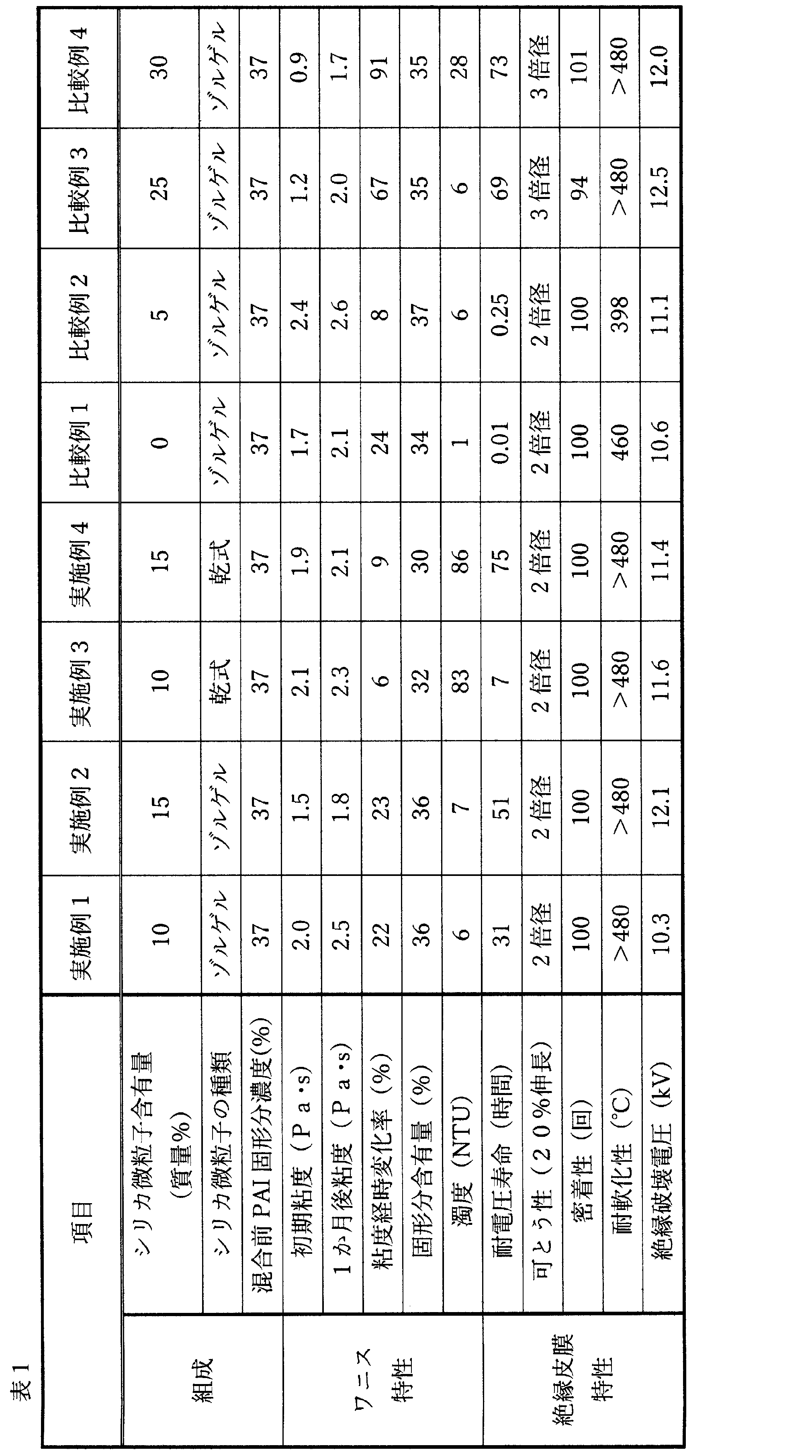
表1に示した結果から、実施例1~4で得られた電気絶縁樹脂組成物では、特定量のシリカ微粒子を使用することで、絶縁電線の絶縁皮膜に対して要求される可とう性、密着性、耐熱性、及び絶縁破壊電圧特性を維持する一方で、部分放電劣化耐性を向上させて優れた耐電圧寿命特性が得られることが分かる。これに対し、シリカ微粒子を含まない比較例1、及びシリカ微粒子の含有量が少ない比較例2では、耐電圧寿命特性が著しく低下する結果となった。また、比較例3及び4では、シリカ微粒子の含有量が多いため、耐電圧寿命特性に優れているが、絶縁皮膜の可とう性が低下し、さらに貯蔵安定性が著しく低下する結果となった。
さらに、実施例1及び3と、実施例2及び4との対比から、シリカ微粒子の含有量が同じであっても、湿式シリカ微粒子(ゾルゲルシリカ微粒子)を使用した場合(実施例1及び2)では、初期粘度の値がより低く、シリカ微粒子を含まない比較例1の経時粘度変化率の値に近い結果となった。また、ゾルゲルシリカ微粒子を使用した場合(実施例1及び2)の濁度の値は、乾式シリカ微粒子を使用した場合(実施例3及び4)よりも著しく小さい。このことから、同じ含有量であっても、湿式シリカ微粒子を使用することによって、より優れた分散性が得られ、より優れた耐電圧寿命特性が得られることが分かる。
このように、本発明によれば、絶縁皮膜を形成する電気絶縁材料として好適な電気絶縁樹脂組成物を提供することができ、このような電気絶縁樹脂組成物を用いて、サージ電圧に対して優れた耐電圧寿命特性に優れた電気絶縁体を提供することも可能となる。そのため、本発明による電気絶縁樹脂組成物は、特に、高周波数化及び高電圧化が進行しているインバータ駆動モータの長期信頼性の向上に有用である。
Claims (5)
- ポリアミドイミド樹脂と、シリカ微粒子とを含有し、固形分の全質量を基準とするシリカ微粒子の含有量が6~24質量%である電気絶縁樹脂組成物。
- 前記シリカ微粒子が、湿式シリカ微粒子を含む、請求項1に記載の電気絶縁樹脂組成物。
- 濁度が30NTU以下である、請求項1又は2に記載の電気絶縁樹脂組成物。
- 導体と、請求項1~3のいずれか1項に記載の電気絶縁樹脂組成物を用いて形成された絶縁皮膜とを有する、電気絶縁体。
- 前記導体が、金属線である、請求項4に記載の電気絶縁体。
Priority Applications (2)
| Application Number | Priority Date | Filing Date | Title |
|---|---|---|---|
| JP2021521730A JP7367759B2 (ja) | 2019-05-31 | 2019-05-31 | 電気絶縁樹脂組成物、及び電気絶縁体 |
| PCT/JP2019/021733 WO2020240822A1 (ja) | 2019-05-31 | 2019-05-31 | 電気絶縁樹脂組成物、及び電気絶縁体 |
Applications Claiming Priority (1)
| Application Number | Priority Date | Filing Date | Title |
|---|---|---|---|
| PCT/JP2019/021733 WO2020240822A1 (ja) | 2019-05-31 | 2019-05-31 | 電気絶縁樹脂組成物、及び電気絶縁体 |
Publications (1)
| Publication Number | Publication Date |
|---|---|
| WO2020240822A1 true WO2020240822A1 (ja) | 2020-12-03 |
Family
ID=73553684
Family Applications (1)
| Application Number | Title | Priority Date | Filing Date |
|---|---|---|---|
| PCT/JP2019/021733 Ceased WO2020240822A1 (ja) | 2019-05-31 | 2019-05-31 | 電気絶縁樹脂組成物、及び電気絶縁体 |
Country Status (2)
| Country | Link |
|---|---|
| JP (1) | JP7367759B2 (ja) |
| WO (1) | WO2020240822A1 (ja) |
Citations (2)
| Publication number | Priority date | Publication date | Assignee | Title |
|---|---|---|---|---|
| JP2011207955A (ja) * | 2010-03-29 | 2011-10-20 | Hitachi Cable Ltd | 絶縁塗料およびそれを用いた絶縁電線 |
| JP2016015295A (ja) * | 2014-07-03 | 2016-01-28 | 三菱マテリアル株式会社 | 耐熱性絶縁電線とその絶縁層の形成に用いる電着液 |
Family Cites Families (3)
| Publication number | Priority date | Publication date | Assignee | Title |
|---|---|---|---|---|
| JP2005108927A (ja) | 2003-09-29 | 2005-04-21 | Sumitomo Electric Wintec Inc | 部分絶縁被覆金属テープおよびその製造方法 |
| JP5854930B2 (ja) | 2011-08-25 | 2016-02-09 | 日東電工株式会社 | 絶縁フィルム |
| JP2019053880A (ja) | 2017-09-14 | 2019-04-04 | 日立化成株式会社 | 絶縁電線とその製造方法及び絶縁電線の皮膜形成用水系耐熱性樹脂組成物と絶縁塗料 |
-
2019
- 2019-05-31 JP JP2021521730A patent/JP7367759B2/ja active Active
- 2019-05-31 WO PCT/JP2019/021733 patent/WO2020240822A1/ja not_active Ceased
Patent Citations (2)
| Publication number | Priority date | Publication date | Assignee | Title |
|---|---|---|---|---|
| JP2011207955A (ja) * | 2010-03-29 | 2011-10-20 | Hitachi Cable Ltd | 絶縁塗料およびそれを用いた絶縁電線 |
| JP2016015295A (ja) * | 2014-07-03 | 2016-01-28 | 三菱マテリアル株式会社 | 耐熱性絶縁電線とその絶縁層の形成に用いる電着液 |
Also Published As
| Publication number | Publication date |
|---|---|
| JPWO2020240822A1 (ja) | 2020-12-03 |
| JP7367759B2 (ja) | 2023-10-24 |
Similar Documents
| Publication | Publication Date | Title |
|---|---|---|
| JP4584014B2 (ja) | 耐部分放電性絶縁塗料、絶縁電線、及びそれらの製造方法 | |
| US9080073B2 (en) | Method of making partial-discharge-resistant insulated wire | |
| JP4473916B2 (ja) | ポリアミドイミド樹脂絶縁塗料及びそれを用いた絶縁電線 | |
| CN102206464B (zh) | 绝缘涂料以及使用该绝缘涂料的绝缘电线 | |
| CN109135554B (zh) | 聚酰亚胺清漆及其制备方法和应用 | |
| JP5896006B2 (ja) | 変性ポリアミドイミド樹脂、電気絶縁材料、絶縁層の耐絶縁破壊性向上方法及び絶縁電線 | |
| CN117343636B (zh) | 一种耐电晕的聚酰胺酰亚胺绝缘漆及其制备方法和应用 | |
| JP7367760B2 (ja) | 電気絶縁樹脂組成物、及び電気絶縁体 | |
| JP7367759B2 (ja) | 電気絶縁樹脂組成物、及び電気絶縁体 | |
| JP7338643B2 (ja) | 電気絶縁樹脂組成物、及び電気絶縁体 | |
| CN111518468B (zh) | 聚酰胺酰亚胺清漆及其制备方法和应用 | |
| CN110437714A (zh) | 自粘清漆及其应用 | |
| JP5804314B2 (ja) | 絶縁電線用ポリアミドイミド樹脂、絶縁電線用絶縁塗料及びそれを用いた絶縁電線 | |
| JP5880914B2 (ja) | 変性ポリアミドイミド樹脂、絶縁塗料及びそれを用いた絶縁電線の製造方法 | |
| WO2020049783A1 (ja) | 耐部分放電用塗料、耐部分放電用絶縁被膜、電線、及び回転電機 | |
| JP2015127424A (ja) | ポリアミドイミド樹脂、電気絶縁用材料、絶縁塗料及びそれを用いた絶縁電線 | |
| JP5081258B2 (ja) | ポリアミドイミド樹脂絶縁塗料及びそれを用いた絶縁電線 | |
| JPWO2020049783A1 (ja) | 耐部分放電用塗料、耐部分放電用絶縁被膜、電線、及び回転電機 |
Legal Events
| Date | Code | Title | Description |
|---|---|---|---|
| 121 | Ep: the epo has been informed by wipo that ep was designated in this application |
Ref document number: 19931047 Country of ref document: EP Kind code of ref document: A1 |
|
| ENP | Entry into the national phase |
Ref document number: 2021521730 Country of ref document: JP Kind code of ref document: A |
|
| NENP | Non-entry into the national phase |
Ref country code: DE |
|
| 122 | Ep: pct application non-entry in european phase |
Ref document number: 19931047 Country of ref document: EP Kind code of ref document: A1 |