WO2020234937A1 - 蓄熱シートの製造方法 - Google Patents
蓄熱シートの製造方法 Download PDFInfo
- Publication number
- WO2020234937A1 WO2020234937A1 PCT/JP2019/019771 JP2019019771W WO2020234937A1 WO 2020234937 A1 WO2020234937 A1 WO 2020234937A1 JP 2019019771 W JP2019019771 W JP 2019019771W WO 2020234937 A1 WO2020234937 A1 WO 2020234937A1
- Authority
- WO
- WIPO (PCT)
- Prior art keywords
- heat storage
- storage layer
- layer
- sheet according
- temperature
- Prior art date
- Legal status (The legal status is an assumption and is not a legal conclusion. Google has not performed a legal analysis and makes no representation as to the accuracy of the status listed.)
- Ceased
Links
Images



Classifications
-
- C—CHEMISTRY; METALLURGY
- C08—ORGANIC MACROMOLECULAR COMPOUNDS; THEIR PREPARATION OR CHEMICAL WORKING-UP; COMPOSITIONS BASED THEREON
- C08J—WORKING-UP; GENERAL PROCESSES OF COMPOUNDING; AFTER-TREATMENT NOT COVERED BY SUBCLASSES C08B, C08C, C08F, C08G or C08H
- C08J5/00—Manufacture of articles or shaped materials containing macromolecular substances
- C08J5/18—Manufacture of films or sheets
-
- B—PERFORMING OPERATIONS; TRANSPORTING
- B32—LAYERED PRODUCTS
- B32B—LAYERED PRODUCTS, i.e. PRODUCTS BUILT-UP OF STRATA OF FLAT OR NON-FLAT, e.g. CELLULAR OR HONEYCOMB, FORM
- B32B37/00—Methods or apparatus for laminating, e.g. by curing or by ultrasonic bonding
- B32B37/02—Methods or apparatus for laminating, e.g. by curing or by ultrasonic bonding characterised by a sequence of laminating steps, e.g. by adding new layers at consecutive laminating stations
- B32B37/025—Transfer laminating
-
- B—PERFORMING OPERATIONS; TRANSPORTING
- B32—LAYERED PRODUCTS
- B32B—LAYERED PRODUCTS, i.e. PRODUCTS BUILT-UP OF STRATA OF FLAT OR NON-FLAT, e.g. CELLULAR OR HONEYCOMB, FORM
- B32B37/00—Methods or apparatus for laminating, e.g. by curing or by ultrasonic bonding
- B32B37/14—Methods or apparatus for laminating, e.g. by curing or by ultrasonic bonding characterised by the properties of the layers
- B32B37/15—Methods or apparatus for laminating, e.g. by curing or by ultrasonic bonding characterised by the properties of the layers with at least one layer being manufactured and immediately laminated before reaching its stable state, e.g. in which a layer is extruded and laminated while in semi-molten state
-
- Y—GENERAL TAGGING OF NEW TECHNOLOGICAL DEVELOPMENTS; GENERAL TAGGING OF CROSS-SECTIONAL TECHNOLOGIES SPANNING OVER SEVERAL SECTIONS OF THE IPC; TECHNICAL SUBJECTS COVERED BY FORMER USPC CROSS-REFERENCE ART COLLECTIONS [XRACs] AND DIGESTS
- Y02—TECHNOLOGIES OR APPLICATIONS FOR MITIGATION OR ADAPTATION AGAINST CLIMATE CHANGE
- Y02E—REDUCTION OF GREENHOUSE GAS [GHG] EMISSIONS, RELATED TO ENERGY GENERATION, TRANSMISSION OR DISTRIBUTION
- Y02E60/00—Enabling technologies; Technologies with a potential or indirect contribution to GHG emissions mitigation
- Y02E60/14—Thermal energy storage
Definitions
- This disclosure relates to a method for manufacturing a heat storage sheet.
- the heat storage material is a material that can take out the stored energy as heat as needed.
- the heat storage material is used in applications such as air conditioning equipment, floor heating equipment, refrigerators, electronic parts such as IC chips, automobile interior / exterior materials, automobile parts such as canisters, and heat insulating containers.
- Patent Document 1 discloses a heat storage material including a thermoplastic polymer, a capsule core manufactured from a latent heat storage material, and microcapsules having a polymer as a capsule wall.
- Patent Document 1 discloses that, in an example, a sheet having a thickness of about 5 mm was produced by undergoing a step of discharging the melt discharged from the extruder by a sheet die.
- the heat storage material may be bent and used, or wrapped around the application target. Therefore, it is desirable that the sheet-shaped heat storage material has excellent flexibility.
- the present disclosure provides a method for efficiently producing a heat storage sheet having a heat storage layer having excellent flexibility.
- the present inventors formed the heat storage material in a layer having a thickness of about 200 ⁇ m and evaluated the flexibility.
- heat storage layer a layer having heat storage
- heat storage layer By advancing the curing reaction by light or heat in the state where the layer is heated (that is, the state in which the heat storage component is melted or non-crystalline), the curing reaction proceeds under a temperature condition lower than the phase transition temperature of the heat storage material. It was found that the flexibility of the heat storage layer was improved as compared with the case where the heat storage layer was allowed to be used.
- the method for producing a heat storage sheet according to the first aspect of the present disclosure includes a step of curing the heat storage layer by irradiation with active energy rays (for example, ultraviolet rays). That is, the method for manufacturing the heat storage sheet includes the following steps. -A process of forming a heat storage layer containing a heat storage component that develops heat storage by phase transition and a photocuring agent on the surface of the base film-The temperature of the heat storage layer is higher than the phase transition temperature of the heat storage component. In the step of curing the heat storage layer by irradiating the heat storage layer with active energy rays.
- active energy rays for example, ultraviolet rays
- the heat storage layer in a state higher than the phase transition temperature (a state in which the heat storage component is melted or in a non-crystalline state) is cured by active energy rays (hereinafter, "photocuring treatment").
- the flexibility of the heat storage layer can be improved by applying ().
- the heat storage layer in a state higher than the phase transition temperature is highly transparent to the active energy rays, the heat storage layer is sufficiently photocured over the entire thickness direction of the heat storage layer by irradiating the heat storage layer with the active energy rays. The reaction can proceed.
- the method for producing a heat storage sheet according to the second aspect of the present disclosure includes a step of curing the heat storage layer by heat. That is, the method for manufacturing the heat storage sheet includes the following steps. -A process of forming a heat storage layer containing a heat storage component and a heat curing agent that develop heat storage properties by phase transition on the surface of the base film.-Heat storage at a temperature 20 ° C or more higher than the phase transition temperature of the heat storage component. The process of curing the heat storage layer by heating the layer ⁇ Confirmation
- the heat storage layer in a state higher than the phase transition temperature (a state in which the heat storage component is melted or in a non-crystalline state) is heat-cured (hereinafter referred to as "thermosetting").
- thermosetting a state in which the heat storage component is melted or in a non-crystalline state
- the flexibility of the heat storage layer can be improved.
- the thermosetting treatment is useful when the photocuring treatment is unsuitable, such as when the transparency of the heat storage layer to the active energy rays is low.
- the filler is dispersed in the heat storage layer from the viewpoint of further improving the flexibility, the transparency of the heat storage layer tends to decrease, so that heat is used instead of the photocuring treatment or together with the photocuring treatment.
- the curing treatment may be carried out. Even when the heat storage layer contains a filler, the photo-curing treatment may be performed independently without performing the heat-curing treatment, depending on the filler content of the heat storage layer or the thickness of the heat storage layer.
- the active temperature of the heat storage layer is a heat storage component so that the heat curing reaction of the heat storage layer does not proceed before the heat storage layer is heat-cured. It is preferable to use one having a temperature higher than the phase transition temperature of. That is, the activation temperature of the hardener and T A ° C., when the phase transition temperature of the heat storage component has a T P ° C., preferably satisfies the condition represented by the following inequality (1). 0 ⁇ T A -T P ⁇ 100 ⁇ (1)
- each step for example, formation of a heat storage layer on the surface of the base film, photocuring treatment and thermosetting treatment may be carried out under hypoxic conditions having an oxygen concentration of 5% by volume or less.
- an adhesive layer may be provided in advance on the surface of the base film on which the heat storage layer is formed, and the adhesive layer may be transferred to the heat storage layer side by undergoing a photocuring treatment or a thermosetting treatment.
- an adhesive layer may be formed on the surface of the heat storage layer before or after the photocuring treatment or the thermosetting treatment by means such as laminating or coating.
- a cover film may be attached to the surface of the adhesive layer from the viewpoint of preventing foreign matter from adhering to the adhesive layer.
- the thickness of the heat storage layer is, for example, 10 to 500 ⁇ m.
- the thickness of the heat storage layer is within this range, it is suitable as a heat storage material for devices that are required to be miniaturized or thinned.
- the heat storage layer may be formed by applying a varnish containing a solvent and drying it.
- a melt of the composition containing a heat storage component or the like may be applied onto the surface of the base film without using a solvent. When the composition is melted by heat, the composition may be heated to a temperature at which the heat storage component is melted but the thermosetting reaction does not proceed.
- At least two heat storage layers before or after being subjected to the curing treatment by light or heat may be separately prepared and bonded to each other to prepare a heat storage layer having a predetermined thickness.
- the two heat storage layers to be bonded are in a state of being melted by heat storage, the two heat storage layers can be integrated without interposing an adhesive layer between them.
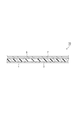
- FIG. 1 is a cross-sectional view schematically showing a heat storage sheet according to the first embodiment.
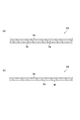
- FIG. 2A is a cross-sectional view schematically showing a state in which a heat storage layer is formed on the surface of the base film
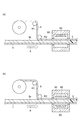
- FIG. 2B shows an example of a photocuring treatment for the heat storage layer and an adhesive layer is formed.
- FIG. 2C is a cross-sectional view schematically showing a step
- FIG. 2C is a cross-sectional view schematically showing another example of the photocuring treatment for the heat storage layer and the step of forming the adhesive layer.
- 3A and 3B are cross-sectional views schematically showing an example of an adhesive sheet including an adhesive layer.
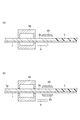
- FIGS. 2 (b) and 2 (c) are cross-sectional views schematically showing a modified example of the steps shown in FIGS. 2 (b) and 2 (c).
- 5 (a) and 5 (b) are cross-sectional views schematically showing a heating furnace and an ultraviolet irradiation device arranged in a subsequent stage.
- 6 (a) and 6 (b) are cross-sectional views schematically showing an example of a thermosetting treatment for the heat storage layer and a step of forming the adhesive layer.
- FIG. 7 is a cross-sectional view schematically showing the heat storage sheet according to the second embodiment.
- FIG. 8 is a cross-sectional view schematically showing another embodiment of the heat storage sheet.
- (meth) acryloyl means “acryloyl” and the corresponding “methacryloyl”, and the same applies to similar expressions such as “(meth) acrylate” and “(meth) acrylic”. ..
- the weight average molecular weight (Mw) in the present specification means a value determined by using gel permeation chromatography (GPC) under the following conditions and using polystyrene as a standard substance.
- GPC gel permeation chromatography
- -Analytical column TSKgel SuperMultipore HZ-H (3 connected) (Product name, manufactured by Tosoh Corporation) -Guard column: TSKguardvolume SuperMP (HZ) -H (product name, manufactured by Tosoh Corporation) -Eluent: THF ⁇ Measurement temperature: 25 ° C
- FIG. 1 is a cross-sectional view schematically showing a heat storage sheet according to the present embodiment.
- the heat storage sheet 10 shown in the figure includes a base film 1, a heat storage layer 3, an adhesive layer 5, and a cover film 7, and these are laminated in this order.
- the heat storage sheet 10 may be in a form that meets the user's request, and may be, for example, a tape wound on a reel and cut to an appropriate length by the user at the time of use. , It may be in the form of a card having a predetermined area.
- the tape-shaped heat storage sheet 10 wound on the reel has, for example, a length of 500 to 1000 m, may be 10 to 100 m or 20 to 50 m, and has a width of, for example, 0.5 to 1.0 m. , 0.5-5.0 cm or 10-50 cm.
- the shape is, for example, a substantially square or a substantially rectangular shape, and the length of one side is, for example, 0.5 to 20 cm, and may be 1 to 10 cm or 3 to 5 cm.
- a tape-shaped or card-shaped heat storage sheet can be manufactured by forming a heat storage layer 3 or the like on the surface of the raw film and then cutting the heat storage layer 3 or the like into a predetermined width or size.
- the base film 1 may be any as long as it has resistance to the manufacturing process of the heat storage sheet 10 (for example, heat resistance, chemical resistance and tensile strength).
- Specific examples of the base film 1 include polyester film, polypropylene film (OPP film, etc.), polyethylene terephthalate film, polyimide film, polyetherimide film, polyethernaphthalate film, and methylpentene film.
- the thickness of the base film 1 is, for example, 5 to 200 ⁇ m, and may be 10 to 150 ⁇ m or 50 to 100 ⁇ m.
- the base film 1 may be removed when the heat storage sheet 10 is used, or may remain laminated on the heat storage layer 3.
- the heat storage layer 3 is a layer containing a heat storage component that exhibits heat storage properties by a phase transition.
- the heat storage layer 3 is composed of a heat storage material composed of a polymer matrix and heat storage components contained therein. This type of heat storage material is called a composite heat storage material.
- the polymer matrix may have a heat storage property.
- the thickness of the heat storage layer 3 is, for example, 10 to 500 ⁇ m, and may be 25 to 250 ⁇ m or 50 to 200 ⁇ m.
- the heat storage component is preferably one having crystallinity such as paraffin, for example, from the viewpoint that a heat storage material having a particularly excellent heat storage amount can be obtained because it does not easily exude from the polymer matrix.
- the phase transition temperature (melting point) of the crystalline component is, for example, 0 to 200 ° C, and may be 15 to 100 ° C or 20 to 60 ° C.
- the phase transition temperature of the crystalline component depends on the weight average molecular weight of the crystalline component. Details of the polymer matrix and the heat storage component (crystalline component) will be described later.
- the adhesive layer 5 is for imparting adhesiveness to the heat storage layer 3 from the viewpoint of ease of use of the heat storage sheet 10.
- Known adhesives can be used as the adhesive contained in the adhesive layer 5.
- Specific examples of the pressure-sensitive adhesive include urethane-based pressure-sensitive adhesives and acrylic-based pressure-sensitive adhesives. From the viewpoint of heat resistance, it is preferable to use a urethane adhesive.
- the thickness of the adhesive layer 5 is, for example, 0.1 to 100 ⁇ m, and may be 1 to 50 ⁇ m or 5 to 10 ⁇ m.
- the cover film 7 is for preventing foreign matter from adhering to the adhesive layer 5.
- Specific examples of the cover film 7 include the same as the above-mentioned base film 1.
- the heat storage sheet 10 is manufactured through the following steps.
- the heat storage layer 3 means a heat storage layer after the photo-curing treatment
- the heat storage layer 3p means a heat storage layer before the photo-curing treatment.
- A1 A step of forming a heat storage layer 3p on the surface of the base film 1 (see FIG. 2A).
- (B1) A step of curing the heat storage layer 3p by irradiating the heat storage layer 3p with active energy rays in a state where the temperature of the heat storage layer 3p is higher than the phase transition temperature of the heat storage component (FIG. 2B).
- C1 A step of forming the adhesive layer 5 and the cover film 7 on the surface of the heat storage layer 3 after the photocuring treatment.
- the heat storage layer 3 having excellent flexibility can be formed by subjecting the heat storage layer 3p in a state higher than the phase transition temperature of the heat storage component to a photocuring treatment. Further, since the heat storage layer 3p containing the heat storage component in the molten state or the non-crystalline state has high transparency to the active energy rays, the thickness of the heat storage layer 3p is increased by irradiating the heat storage layer 3p with the active energy rays. The photocuring reaction can be sufficiently allowed to proceed throughout the direction.
- each step of the method for manufacturing the heat storage sheet 10 will be described in detail.
- This step is a step of forming the heat storage layer 3p on the surface of the base film 1.
- a varnish for forming the heat storage layer 3p is prepared.
- the varnish contains one or more monomers, a crystalline component, a photopolymerization initiator (also called a photocuring agent or a photoradical generator), and optionally an additive (eg, an antioxidant). ..
- a varnish in which each material is sufficiently uniformly mixed is obtained, it is not necessary to heat the varnish when preparing it.
- the heat storage layer 3p is formed on the surface of the base film 1.
- a single-screw or twin-screw kneading extruder is used to supply the varnish.
- the thickness of the heat storage layer 3p can be controlled by adjusting the transport speed of the base film 1 and the amount of varnish supplied per unit time.
- the heat storage layer 3p is formed by using a varnish (solvent-free) is illustrated, but instead of the varnish, a solution containing the above-mentioned material and a solvent (for example, water, methyl ethyl ketone) is prepared, and this is used. After coating on the surface of the base film 1, the solvent may be removed by drying. It is preferable that the varnish or solution is prepared and the heat storage layer 3p is formed under low oxygen conditions (for example, in an inert gas environment) having an oxygen concentration of 5% by volume or less. Further, in order to suppress the exposure of the heat storage layer 3p to oxygen, a cover film having an oxygen blocking property (not shown) may be attached to the heat storage layer 3p. This cover film is peeled off at an appropriate timing in the subsequent process.
- a cover film having an oxygen blocking property may be attached to the heat storage layer 3p. This cover film is peeled off at an appropriate timing in the subsequent process.
- This step is a step of curing the heat storage layer 3p by irradiating the heat storage layer 3p with active energy rays in a state where the temperature of the heat storage layer 3p is higher than the phase transition temperature of the heat storage component.
- a polymer matrix is formed by copolymerizing a plurality of monomers contained in the heat storage layer 3p before curing, and the polymer matrix is in a state in which a crystalline component is included.
- active energy rays include ultraviolet rays, electron beams, and visible light.
- the photocuring treatment with ultraviolet rays will be described.
- FIG. 2B is a cross-sectional view schematically showing how the heat storage layer 3p moves together with the base film 1 in the heating furnace 50 provided with the ultraviolet irradiation device 60.
- the arrow A in the figure means the moving direction of the base film 1 and the heat storage layer 3p.
- the heat storage layer 3p (before curing), which is at least higher than the phase transition temperature of the crystalline component, is subjected to a photocuring treatment to form the heat storage layer 3 (after curing) having excellent flexibility. can do.
- the phase transition temperature of the crystalline component means the temperature of the melting peak measured as follows using a differential scanning calorimeter. That is, the temperature is lowered to ⁇ 40 ° C. at an arbitrary speed, held at ⁇ 40 ° C.
- FIG. 2B illustrates a case where ultraviolet rays are irradiated from the ultraviolet irradiation device 60 arranged on one side (upper side in the figure) of the base film 1 toward the heat storage layer 3p in the heating furnace 50.
- the ultraviolet irradiation device 60 is also arranged on the other side (lower side in the same figure) of the base film 1, and is directed from both sides of the heat storage layer 3p toward the heat storage layer 3p. You may irradiate with ultraviolet rays.
- a film having high transparency to ultraviolet rays is used as the base film 1.
- the transparency of the heat storage layer 3p tends to decrease, but the heat storage layer 3p is sufficiently thin, or ultraviolet rays are irradiated from both sides of the heat storage layer 3p toward the heat storage layer 3p. Therefore (see FIG. 2C), the curing reaction of the heat storage layer 3p can be sufficiently advanced.
- This step is a step of forming the adhesive layer 5 and the cover film 7 on the surface of the heat storage layer 3 after the photocuring treatment.
- a roll of the adhesive layer 5 is prepared so that the adhesive layer 5 is bonded to the heat storage layer 3 via a plurality of rollers R1 and R2. Just do it.
- the cover film 7 is attached to the adhesive layer 5 from the viewpoint of preventing foreign matter from adhering to the adhesive layer 5.
- an adhesive sheet 5A in which the support layer 5a such as a PET film is sandwiched between the two adhesive layers 5b and 5b is prepared. Then, this may be attached to the heat storage layer 3.
- a two-layer structure adhesive sheet 5B having a support layer 5a and an adhesive layer 5b may be used instead of the three-layer structure adhesive sheet 5A.
- the surface 5f of the support layer 5a of the pressure-sensitive adhesive sheet 5B preferably has an appropriate surface roughness.
- the first embodiment may be changed as follows.
- the step (C1) after the step (B1) an embodiment in which the adhesive layer 5 is formed on the surface of the heat storage layer 3 after the photocuring treatment has been illustrated, but FIGS. 4 (a) and 4 (b) show.
- the adhesive layer 5 may be formed on the surface of the heat storage layer 3p before the photocuring treatment.
- step (B1) an embodiment in which heating and ultraviolet irradiation are performed simultaneously in the heating furnace 50 has been illustrated, but as long as the heat storage layer 3p has a temperature higher than the phase transition temperature of the crystalline component, heating and ultraviolet irradiation are performed. It does not have to be done at the same time. That is, as shown in FIGS. 5A and 5B, the ultraviolet irradiation device 60 may be arranged after the heating furnace 50. Ultraviolet rays may be applied to the heat storage layer 3p in which the crystalline component is melted or non-crystalline due to the residual heat after heating in the heating furnace 50. Further, if the temperature of the heat storage layer 3p becomes higher than the phase transition temperature of the crystalline component due to the irradiation of ultraviolet rays, the heating furnace 50 may not be used.
- the heat storage sheet 20 according to the second embodiment is manufactured through the following steps.
- a varnish or solution is prepared using a thermal polymerization initiator (also referred to as a thermosetting agent or thermal radical generator) instead of the photopolymerization initiator used in the first embodiment.
- the varnish or solution may be prepared under temperature conditions above the phase transition temperature of the crystalline component and below the active temperature of the thermal radical generator.
- the radical generation start temperature (active temperature) of the thermal radical generator is preferably higher than the phase transition temperature of the crystalline component from the viewpoint of suppressing the progress of the thermosetting reaction during the preparation of the varnish or the solution.
- the activation temperature of the heat radical generator and T A ° C. when the phase transition temperature of the crystalline component was T P ° C., preferably satisfy the condition represented by the following inequality (1), It is more preferable to satisfy the condition represented by the inequality (2).
- the heat storage layer 13p is formed in the same manner as in the first embodiment.
- This step is a step of curing the heat storage layer 13p by heating the heat storage layer 13p to a temperature 20 ° C. or higher (preferably a temperature 20 to 50 ° C. higher) than the phase transition temperature of the heat storage component (FIG. 6 (FIG. 6).
- a) See A polymer matrix is formed by copolymerizing a plurality of monomers contained in the heat storage layer 13p before curing, and the polymer matrix is in a state in which a crystalline component is included.
- This step is a step of forming the adhesive layer 5 and the cover film 7 on the surface of the heat storage layer 13 after the thermosetting treatment.
- a roll of the adhesive layer 5 may be prepared so that the adhesive layer 5 is bonded to the heat storage layer 3 via a plurality of rollers R1 and R2.
- the cover film 7 is attached to the adhesive layer 5 from the viewpoint of preventing foreign matter from adhering to the adhesive layer 5.
- step (C2) after the step (B2) an embodiment in which the adhesive layer 5 is formed on the surface of the heat storage layer 13 after the thermal curing treatment is illustrated, which is shown in FIG. 6 (b).
- the adhesive layer 5 may be formed on the surface of the heat storage layer 13p before the thermal treatment.
- the embodiment in which the adhesive layer 5 is formed on the heat storage layer formed on the base film 1 is illustrated.
- the adhesive layer 5 is formed on one surface.
- the base film 1 may be prepared and the heat storage layers 3 and 13 may be formed on the surface of the adhesive layer 5.
- the adhesive layer 5 may be transferred to the heat storage layer side by undergoing a subsequent photocuring treatment or thermosetting treatment. In this case, the heat storage sheet 25 having the layer structure shown in FIG. 8 is obtained.
- the heat storage layers 3 and 13 include a monomer, a photopolymerization initiator (photocuring agent, photoradical generator) or a thermal polymerization initiator (thermosetting agent, thermal radical generator), and a crystalline component. It is formed by subjecting a curable composition containing the above to a photocuring treatment or a thermosetting treatment.
- the heat storage layer 3p is irradiated with active energy rays in a state where the temperature of the heat storage layer 3p is higher than the phase transition temperature of the crystalline component.
- the temperature of the heat storage layer 3p is higher than the phase transition temperature of at least one kind of crystalline components when irradiated with active energy rays, and preferably two kinds. It is in a state higher than all the phase transition temperatures of the above crystalline components.
- the heat storage layer 13p is heated to a temperature 20 ° C. higher than the phase transition temperature of the crystalline component.
- the temperature of the heat storage layer 3p during heating is higher than the phase transition temperature of at least one kind of crystalline components, and preferably all of two or more kinds of crystalline components. Higher than the phase transition temperature of.
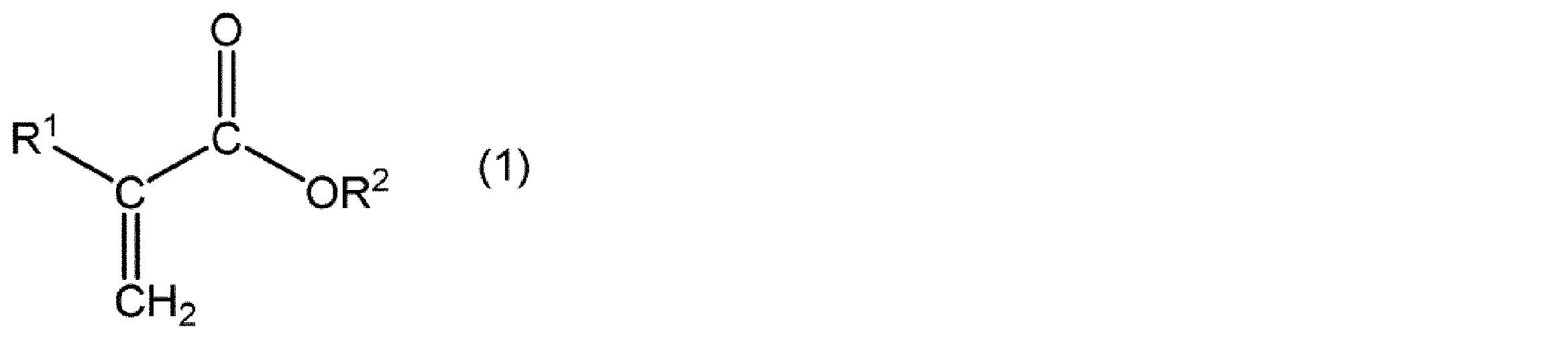
- the monomer may be, for example, one or more monofunctional (meth) acrylates represented by the following formula (1).
- R 1 represents a hydrogen atom or a methyl group
- R 2 represents an alkyl group or a group having a polyoxyalkylene chain.
- R 2 is an alkyl group
- the alkyl group may be linear or branched.
- the number of carbon atoms of the alkyl group may be, for example, 1 to 30.
- the number of carbon atoms of the alkyl group may be 1 to 11, 1 to 8, 1 to 6, or 1 to 4.
- the number of carbon atoms of the alkyl group may be 12 to 30, 12 to 28, 12 to 24, 12 to 22, 12 to 18, or 12 to 14, in which case the monomer itself has a heat storage property. Since the polymer matrix itself composed of the monomer also has a heat storage property, the amount of heat storage can be further improved.
- R 2 is a group having a polyoxyalkylene chain
- the monomer itself can function as a heat storage component having a heat storage property, so that the polymer matrix itself composed of the monomer also has a heat storage property, and the amount of heat storage can be increased. Improvement is achieved.
- the group having a polyoxyalkylene chain represented by R 2 may be a group represented by the following formula (3).
- Ra represents a hydrogen atom or an alkyl group having 1 to 18 carbon atoms
- R b represents an alkylene group
- n represents an integer of 2 to 90
- * represents a bond.
- the alkyl group represented by Ra may be linear or branched.
- the number of carbon atoms of the alkyl group represented by Ra is preferably 1 to 15, more preferably 1 to 10, and even more preferably 1 to 5.
- Ra is particularly preferably a hydrogen atom or a methyl group.
- the alkylene group represented by R b may be linear or branched.
- R b may be, for example, an alkylene group having 2 to 4 carbon atoms.
- a plurality of R bs present in the polyoxyalkylene chain may be the same as each other or may be different from each other.
- the polyoxyalkylene chain preferably has one or more selected from the group consisting of an oxyethylene group, an oxypropylene group and an oxybutylene group, and more preferably from an oxyethylene group and an oxypropylene group. It has one or two kinds selected from the above group, and more preferably has only an oxyethylene group.
- n is preferably an integer of 4 to 80, 6 to 60, 9 to 40, 9 to 30, 10 to 30, 15 to 30, or 15 to 25.
- the monomer may further contain a polyfunctional (meth) acrylate having two or more (meth) acryloyl groups in addition to the above monofunctional (meth) acrylate.
- crosslinks derived from polyfunctional (meth) acrylate may be formed in the polymer matrix in the heat storage layers 3 and 13.
- the monomer may further contain a monomer (reactive monomer) that is copolymerizable with the monofunctional (meth) acrylate and has a reactive group.
- a monomer (reactive monomer) that is copolymerizable with the monofunctional (meth) acrylate and has a reactive group.
- the reactive group contained in the reactive monomer is reacted with a curing agent described later to obtain a curable composition (heat storage layer). It can be further cured.
- the reactive group in the reactive monomer is a group capable of reacting with a curing agent described later, and is, for example, at least one group selected from the group consisting of a carboxyl group, a hydroxyl group, an isocyanate group, an amino group and an epoxy group. .. That is, the reactive monomer is, for example, a carboxyl group-containing monomer, a hydroxyl group-containing monomer, an isocyanate group-containing monomer, an amino group-containing monomer, or an epoxy group-containing monomer.
- carboxyl group-containing monomer examples include (meth) acrylic acid, carboxyethyl (meth) acrylate, carboxypentyl (meth) acrylate, itaconic acid, maleic acid, fumaric acid, crotonic acid, isocrotonic acid and the like.
- hydroxyl group-containing monomer examples include 2-hydroxyethyl (meth) acrylate, 3-hydroxypropyl (meth) acrylate, 4-hydroxybutyl (meth) acrylate, 6-hydroxyhexyl (meth) acrylate, and 8-hydroxyoctyl ( Hydroxyalkyl (meth) acrylates such as meta) acrylates, 10-hydroxydecyl (meth) acrylates, 12-hydroxylauryl (meth) acrylates; hydroxyalkylcycloalkanes such as (4-hydroxymethylcyclohexyl) methyl (meth) acrylates. Examples include (meth) acrylate.
- the hydroxyl group-containing monomer may be hydroxyethyl (meth) acrylamide, allyl alcohol, 2-hydroxyethyl vinyl ether, 4-hydroxybutyl vinyl ether, diethylene glycol monovinyl ether and the like.
- Examples of the isocyanate group-containing monomer include 2-methacryloyloxyethyl isocyanate and 2-acryloyloxyethyl isocyanate.
- the isocyanate group in the isocyanate group-containing monomer may be blocked (protected) by a blocking agent (protecting group) that can be desorbed by heat. That is, the isocyanate group-containing monomer may be a monomer having a blocked isocyanate group represented by the following formula (4-1). In the formula, B represents a protecting group and * represents a bond.
- the protecting group in the blocked isocyanate group may be a protecting group that can be desorbed (deprotected) by heating (for example, heating at 80 to 160 ° C.).
- a substitution reaction between the blocking agent (protecting group) and the curing agent described later can occur under deprotection conditions (for example, heating conditions of 80 to 160 ° C.).
- an isocyanate group is generated by deprotection, and the isocyanate group can react with a curing agent described later.
- Examples of the blocking agent in the blocked isocyanate group include oxime monomers such as formaldehyde, acetoaldoxime, acetooxime, methylethylketooxime and cyclohexanone oxime; pyrazole monomers such as pyrazole, 3-methylpyrazole and 3,5-dimethylpyrazole; ⁇ - Lactam monomers such as caprolactam, ⁇ -valerolactam, ⁇ -butyrolactam and ⁇ -propiolactam; mercaptan monomers such as thiophenol, methylthiophenol and ethylthiophenol; acid amide monomers such as acetate and benzamide; imide succinate and malein Examples thereof include imide monomers such as acid imide.
- oxime monomers such as formaldehyde, acetoaldoxime, acetooxime, methylethylketooxime and cyclohexanone oxime
- pyrazole monomers such
- Examples of the monomer having a blocked isocyanate group include 2-[(3,5-dimethylpyrazolyl) carbonylamino] ethyl methacrylate and 2- (0- [1'-methylpropylideneamino] carboxyamino) methacrylate.
- amino group-containing monomer examples include N, N-dimethylaminoethyl (meth) acrylate, N, N-diethylaminoethyl (meth) acrylate, N, N-dimethylaminopropyl (meth) acrylate, and N, N-diethylaminopropyl.
- examples include (meth) acrylate.
- Examples of the epoxy group-containing monomer include glycidyl (meth) acrylate, glycidyl ⁇ -ethyl (meth) acrylate, glycidyl ⁇ -n-propyl (meth) acrylate, and glycidyl ⁇ -n-butyl (meth) acrylate.
- the content of the reactive monomer may be, for example, 0.5 parts by mass or more, 1 part by mass or more, or 1.5 parts by mass or more with respect to 100 parts by mass of the total content of the monomers, and 10 parts by mass. Hereinafter, it may be 8 parts by mass or less, or 5 parts by mass or less.
- the total content of the monomers is 30% by mass or more, 40% by mass or more, 50% by mass or more, 60% by mass or more, 70% by mass or more, 80% by mass or more, or 90% by mass based on the total amount of the curable composition. It may be the above, and may be 99.9% by mass or less.
- the photopolymerization initiator examples include a benzoin ether-based photopolymerization initiator, an acetophenone-based photopolymerization initiator, an ⁇ -ketol-based photopolymerization initiator, an aromatic sulfonyl chloride-based photopolymerization initiator, and a photoactive oxime-based photopolymerization initiator.
- Benzoin-based photopolymerization initiator Benzyl-based photopolymerization initiator, benzophenone-based photopolymerization initiator, Ketal-based photopolymerization initiator, thioxanthone-based photopolymerization initiator, acylphosphine oxide-based photopolymerization initiator, and the like. ..
- benzoin ether-based photopolymerization initiator examples include benzoin methyl ether, benzoin ethyl ether, benzoin propyl ether, benzoin isopropyl ether, benzoin isobutyl ether, and 2,2-dimethoxy-1,2-diphenylethane-1-one (trade name:). Irgacure 651, manufactured by BASF), anisole methyl ether and the like.
- acetophenone-based photopolymerization initiator examples include 1-hydroxycyclohexylphenyl ketone (trade name: Irgacure 184, manufactured by BASF), 4-phenoxydichloroacetophenone, 4-t-butyl-dichloroacetophenone, 1- [4- (2- (2-). Hydroxyethoxy) -phenyl] -2-hydroxy-2-methyl-1-propane-1-one (trade name: Irgacure 2959, manufactured by BASF), 2-hydroxy-2-methyl-1-phenyl-propane-1-one On (trade name: Irgacure 1173, manufactured by BASF), methoxyacetophenone and the like can be mentioned.
- Examples of the ⁇ -ketol-based photopolymerization initiator include 2-methyl-2-hydroxypropiophenone, 1- [4- (2-hydroxyethyl) -phenyl] -2-hydroxy-2-methylpropan-1-one, etc. Can be mentioned.
- Examples of the aromatic sulfonyl chloride-based photopolymerization initiator include 2-naphthalene sulfonyl chloride and the like.
- Examples of the photoactive oxime-based photopolymerization initiator include 1-phenyl-1,1-propanedione-2- (o-ethoxycarbonyl) -oxime.
- Examples of the benzoin-based photopolymerization initiator include benzoin and the like.
- Examples of the benzyl-based photopolymerization initiator include benzyl and the like.
- Examples of the benzophenone-based photopolymerization initiator include benzophenone, benzoylbenzoic acid, 3,3'-dimethyl-4-methoxybenzophenone, polyvinylbenzophenone, ⁇ -hydroxycyclohexylphenyl ketone and the like.
- Examples of the ketal-based photopolymerization initiator include benzyldimethyl ketal and the like.
- Examples of the thioxanthone-based photopolymerization initiator include thioxanthone, 2-chlorothioxanthone, 2-methylthioxanthone, 2,4-dimethylthioxanthone, isopropylthioxanthone, 2,4-dichlorothioxanthone, 2,4-diethylthioxanthone, isopropylthioxanthone, 2, Examples thereof include 4-diisopropylthioxanthone and dodecylthioxanthone.
- acylphosphine-based photopolymerization initiator examples include bis (2,6-dimethoxybenzoyl) phenylphosphine oxide, bis (2,6-dimethoxybenzoyl) (2,4,4-trimethylpentyl) phosphine oxide, and bis (2,).
- 6-Dimethoxybenzoyl) -n-butylphosphinoxide bis (2,6-dimethoxybenzoyl)-(2-methylpropan-1-yl) phosphine oxide, bis (2,6-dimethoxybenzoyl)-(1-methylpropane -1-yl) phosphine oxide, bis (2,6-dimethoxybenzoyl) -t-butylphosphine oxide, bis (2,6-dimethoxybenzoyl) cyclohexylphosphine oxide, bis (2,6-dimethoxybenzoyl) octylphosphine oxide, Bis (2-methoxybenzoyl) (2-methylpropan-1-yl) phosphine oxide, bis (2-methoxybenzoyl) (1-methylpropan-1-yl) phosphine oxide, bis (2,6-diethoxybenzoyl) (2-Methylpropan-1-yl) phos
- the above-mentioned photopolymerization initiator may be used alone or in combination of two or more.
- thermal polymerization initiator examples include azo compounds such as azobisisobutyronitrile, azobis-4-methoxy-2,4-dimethylvaleronitrile, azobiscyclohexanone-1-carbonitrile, and azodibenzoyl, benzoyl peroxide, and excess. Lauroyl oxide, di-t-butylperoxyhexahydroterephthalate, t-butylperoxy-2-ethylhexanoate, 1,1-t-butylperoxy-3,3,5-trimethylcyclohexane, t-butylperoxy Examples thereof include organic peroxides such as isopropyl carbonate.
- the thermal polymerization initiator may be used alone or in combination of two or more.
- the content of the photopolymerization initiator or the thermal polymerization initiator is preferably 0.01 part by mass or more, more preferably 0.% by mass, based on 100 parts by mass of the total content of the monomers from the viewpoint of preferably advancing the polymerization. It is 02 parts by mass or more, more preferably 0.05 parts by mass or more.
- the content of the photopolymerization initiator or the thermal polymerization initiator the molecular weight of the polymer matrix in the heat storage layers 3 and 13 is in a suitable range, the decomposition products are suppressed, and the adhesive strength is suitable when used as a heat storage material.
- the crystalline component for example, one having a phase transition temperature suitable for the target temperature is appropriately selected according to the purpose of use.
- the crystalline component has a solid phase / liquid phase transition point (melting point) showing a solid phase / liquid phase transition at, for example, ⁇ 30 to 120 ° C. from the viewpoint of obtaining a heat storage effect in a practical range.
- Crystalline components include, for example, chain (linear or branched (branched chain)) saturated hydrocarbon compounds (paraffinic hydrocarbon compounds), fatty acids, natural waxes, petroleum waxes, sugar alcohols, and polyalkylene glycols. And so on.
- the crystalline component may be one or more of these.
- chain saturated hydrocarbon compound paraffin-based hydrocarbon compound
- chain saturated hydrocarbon compound include n-decane (C10 (number of carbon atoms, the same applies hereinafter), -29 ° C. (phase transition temperature (melting point), the same applies hereinafter)).
- n-Undecane (C11, -25 ° C), n-dodecane (C12, -9 ° C), n-tridecan (C13, -5 ° C), n-tetradecane (C14, 6 ° C), n-pentadecane (C15, 9 ° C) ° C.), n-hexadecane (C16, 18 ° C.), n-heptadecane (C17, 21 ° C.), n-octadecane (C18, 28 ° C.), n-nanodecane (C19, 32 ° C.), n-icosane (C20, 37 ° C.) ° C.), n-henicosane (C21, 41 ° C.), n-docosane (C22, 46 ° C.), n-triacontane (C23, 47 ° C.), n-tetracosan
- the compound having a long-chain alkyl group may be, for example, a fatty acid ester having an alkyl group having 9 or more carbon atoms.
- the fatty acid ester is, for example, an ester of a fatty acid having an alkyl group having 9 or more carbon atoms (that is, a fatty acid having 10 or more carbon atoms) and an aliphatic alcohol.
- the carbon number of the fatty acid is, for example, 10 to 40, 10 to 30 or 10 to 25.
- the carbon number of the aliphatic alcohol is, for example, 1 to 20, 1 to 10 or 1 to 8.
- the aliphatic alcohol may be, for example, a monohydric alcohol, preferably a monohydric alcohol.
- the fatty acid ester may be a partial ester in which a part of the hydroxyl groups of the polyhydric alcohol is esterified, and all the hydroxyl groups of the polyhydric alcohol are esterified. It may be a complete ester.
- fatty acid ester examples include glycerol monomyristate (44 to 48 ° C. (phase transition temperature (melting point), the same applies hereinafter)), methyl stearate (37 to 41 ° C.), and ethyl stearate (33 to 35 ° C.).
- the compound having a long-chain alkyl group may be a compound having an alkyl group having 9 or more carbon atoms other than the above fatty acid ester.
- the compound having such a long-chain alkyl group may be, for example, a fatty acid having an alkyl group having 9 or more carbon atoms, an aliphatic alcohol having an alkyl group having 9 or more carbon atoms, and 9 or more carbon atoms. It may be an aliphatic ether having an alkyl group of.
- Glycoalcohols specifically include meso-erythritol, L-erythritol, D-erythritol, and DL-erythritol, erythritol, pentaerythritol, dipentaerythritol, xylitol, D-arabitol, L-arabitol, and DL-arabitol.
- the polyalkylene glycol may be, for example, polyethylene glycol, polypropylene glycol, polybutylene glycol, or the like, and is preferably polyethylene glycol.
- the weight average molecular weight (Mw) of the polyalkylene glycol may be 800 or more, 900 or more, or 1000 or more, and may be 2000 or less, 1900 or less, or 1800 or less.
- the crystalline component may be contained in the curable composition as a heat storage capsule contained in the capsule.
- the heat storage capsule has a crystalline component (heat storage component) and an outer shell (shell) containing the heat storage component.
- the outer shell (shell) containing the crystalline component is preferably formed of a material having a heat resistant temperature sufficiently higher than the transition point (melting point) of the crystalline component.
- the material forming the outer shell has a heat resistant temperature of, for example, 30 ° C. or higher, preferably 50 ° C. or higher, with respect to the transition point (melting point) of the crystalline component.
- the heat resistant temperature is defined as the temperature at which the weight loss of the capsule is measured by 1% when the weight loss of the capsule is measured using a differential thermogravimetric simultaneous measuring device (for example, TG-DTA6300 (manufactured by Hitachi High-Tech Science Co., Ltd.)). Will be done.
- the outer shell is preferably made of melamine resin, acrylic resin, urethane resin, silica or the like.
- microcapsules having an outer shell containing melamine resin include BA410xxP, 6C, BA410xxP, 18C, BA410xxP, 37C manufactured by Outlast Technology, and ThermoMemory FP-16, FP-25, and FP manufactured by Mitsubishi Paper Mills Limited. Examples thereof include -31, FP-39, and Riken Resin PMCD-15SP, 25SP, and 32SP manufactured by Miki Riken Kogyo Co., Ltd.
- microcapsules having an outer shell containing an acrylic resin include Micronal DS5001X and 5040X manufactured by BASF.
- microcapsules having an outer shell containing silica include Liken Resins LA-15, LA-25, LA-32, etc. manufactured by Miki Riken Kogyo Co., Ltd.
- the content of the crystalline component in the heat storage capsule is preferably 20% by mass or more, more preferably 60% by mass or more, based on the total amount of the heat storage capsule, from the viewpoint of further enhancing the heat storage effect. From the viewpoint of suppressing breakage of the capsule due to volume change, it is preferably 80% by mass or less.
- the heat storage capsule may further contain graphite, metal powder, alcohol, etc. in the outer shell for the purpose of adjusting the thermal conductivity, specific gravity, etc. of the capsule.
- the particle size (average particle size) of the heat storage capsule is preferably 0.1 ⁇ m or more, more preferably 0.2 ⁇ m or more, still more preferably 0.5 ⁇ m or more, preferably 100 ⁇ m or less, and more preferably 50 ⁇ m or less. ..
- the particle size (average particle size) of the heat storage capsule is measured using a laser diffraction type particle size distribution measuring device (for example, SALD-2300 (manufactured by Shimadzu Corporation)).
- the content of the heat storage capsule is preferably 20% by mass or more, more preferably 30% by mass or more, still more preferably 40% by mass or more, based on the total amount of the curable composition, from the viewpoint of further enhancing the heat storage effect.
- the content of the heat storage capsule is preferably 90% by mass or less, more preferably 85% by mass or less based on the total amount of the curable composition, from the viewpoint of suppressing the heat storage capsule from falling off from the cured product of the curable composition. More preferably, it is 80% by mass or less.
- the curable composition preferably further contains a curing agent capable of reacting with the reactive group contained in the reactive monomer.
- the curing agent examples include isocyanate-based curing agents, phenol-based curing agents, amine-based curing agents, imidazole-based curing agents, acid anhydride-based curing agents, and carboxylic acid-based curing agents. These curing agents are appropriately selected as one type alone or as a combination of two or more types, depending on the type of the reactive group contained in the compound represented by the formula (4). For example, when the reactive group is an epoxy group, the curing agent is preferably a phenolic curing agent or an imidazole-based curing agent.
- isocyanate-based curing agent examples include tolylene diisocyanate (2,4- or 2,6-tolylene diisocyanate or a mixture thereof) (TDI), phenylenediocyanate (m- or p-phenylenediocyanate, or a mixture thereof).
- TDI tolylene diisocyanate (2,4- or 2,6-tolylene diisocyanate or a mixture thereof)
- phenylenediocyanate m- or p-phenylenediocyanate, or a mixture thereof.
- 4,4'-diphenyldiisocyanis 1,5-naphthalenediis diisocyanis (NDI), diphenylmethane diisocyanate (4,4'-, 2,4'-or 2,2'-diphenylmethane diisocyanate, or a mixture thereof) (MDI), 4 , 4'-toluidine diisocyanis (TODI), 4,4'-diphenyl ether diisocyanate, xylylene diisocyanate (1,3- or 1,4-xylylene diisocyanate or a mixture thereof) (XDI), tetramethylxylylene diisocyanate (1) , 3- Or 1,4-tetramethylxylylene diisocyanate, or a mixture thereof) (TMXDI), ⁇ , ⁇ '-diisocyanate-1,4-diisocyanate, and other aromatic diisocyanates.
- NDI 1,5-naphthalenediis diisocyanis
- isocyanate-based curing agent examples include trimethylene diisocyanate, 1,2-propylene diisocyanate, butylene diisocyanate (tetramethylene diisocyanate, 1,2-butylene diisocyanate, 2,3-butylene diisocyanate, 1,3-butylene diisocyanate), 1,5.
- An aliphatic diisocyanate such as -pentamethylene diisocyanate (PDI), 1,6-hexamethylene diisocyanate (HDI), 2,4,4- or 2,2,4-trimethylhexamethylene diisocyanate, 2,6-diisocyanate methylcapate.
- phenolic curing agent examples include bisphenol A, bisphenol F, bisphenol S, 4,4'-biphenylphenol, tetramethylbisphenol A, dimethylbisphenol A, tetramethylbisphenol F, dimethylbisphenol F, tetramethylbisphenol S, and dimethyl.
- Bisphenol S tetramethyl-4,4'-biphenol, dimethyl-4,4'-biphenylphenol, 1- (4-hydroxyphenyl) -2- [4- (1,1-bis- (4-hydroxyphenyl)) Ethyl) phenyl] propane, 2,2'-methylene-bis (4-methyl-6-tert-butylphenol), 4,4'-butylidene-bis (3-methyl-6-tert-butylphenol), trishydroxyphenylmethane , Resolsinol, hydroquinone, pyrogallol, phenol compound having diisopropyridene skeleton; phenol compound having fluorene skeleton such as 1,1-di-4-hydroxyphenylfluorene; cresol compound; ethylphenol compound; butylphenol compound; octylphenol compound; bisphenol Novolac resin made from various phenols such as A, bisphenol F, bisphenol S, naphthol compound, xylylene
- amine-based curing agent examples include aromatics such as diaminodiphenylmethane, diaminodiphenylsulphon, diaminodiphenyl ether, p-phenylenediamine, m-phenylenediamine, o-phenylenediamine, 1,5-diaminonaphthalene, and m-xylylene diamine.
- aromatics such as diaminodiphenylmethane, diaminodiphenylsulphon, diaminodiphenyl ether, p-phenylenediamine, m-phenylenediamine, o-phenylenediamine, 1,5-diaminonaphthalene, and m-xylylene diamine.
- Aliphatic amines such as amines, ethylenediamines, diethylenediamines, hexamethylenediamines, isophoronediamines, bis (4-amino-3-methyldicyclohe
- imidazole-based curing agent examples include 2-methylimidazole, 2-ethyl-4-methylimidazole, 2-phenylimidazole, 2-undecylimidazole, 2-heptadecylimidazole, 2-phenyl-4-methylimidazole, 1 -Benzyl-2-phenylimidazole, 1-benzyl-2-methylimidazole, 1-cyanoethyl-2-methylimidazole, 1-cyanoethyl-2-phenylimidazole, 1-cyanoethyl-2-undecylimidazole, 2,3-dihydro -1H-pyrrolo- [1,2-a] benzimidazole, 2,4-diamino-6 (2'-methylimidazole (1')) ethyl-s-triazine, 2,4-diamino-6 (2'- Undecylimidazole (1')) ethyl-s-triazine
- acid anhydride-based curing agent examples include phthalic anhydride, trimellitic anhydride, pyromellitic anhydride, benzophenone tetracarboxylic acid anhydride, ethylene glycol trimellitic anhydride, biphenyltetracarboxylic acid anhydride and the like.
- Aromatic carboxylic acid anhydrides include anhydrides of aliphatic carboxylic acids such as azelaic acid, sebacic acid, dodecanedioic acid, tetrahydrophthalic acid anhydrides, hexahydrophthalic acid anhydrides, nadic acid anhydrides, het acid anhydrides, Examples thereof include alicyclic carboxylic acid anhydrides such as hymic acid anhydrides.
- carboxylic acid-based curing agent examples include succinic acid, glutaric acid, adipic acid, sebacic acid, phthalic acid, isophthalic acid, and terephthalic acid.
- the content of the curing agent may be 0.01% by mass or more, 10% by mass or less, 5% by mass or less, or 1% by mass or less based on the total amount of the curable composition.
- the curable composition preferably further contains an antioxidant from the viewpoint of improving the thermal reliability of the cured product (heat storage layer) of the curable composition.
- the antioxidant may be, for example, a phenol-based antioxidant, a benzophenone-based antioxidant, a benzoate-based antioxidant, a hindered amine-based antioxidant, a benzotriazole-based antioxidant, or the like.
- the content of the antioxidant may be 0.1% by mass or more, 0.5% by mass or more, 0.8% by mass or more, or 1% by mass or more based on the total amount of the curable composition, and is 10% by mass. It may be less than or equal to 5% by mass or less, and from the viewpoint of excellent flexibility of the cured product of the curable composition, it is preferably 4% by mass or less, more preferably 3% by mass or less, still more preferably 2.5% by mass or less. , Particularly preferably 2% by mass or less.
- a heat storage layer may be formed. That is, in another embodiment, instead of the curable composition described in the first embodiment and the second embodiment, a monomer component containing the first monomer represented by the following formula (1) is contained. A curable composition that does not contain the above-mentioned crystalline component may be used.
- R 1 represents a hydrogen atom or a methyl group
- R 2 represents an alkyl group having 12 to 30 carbon atoms or a monovalent group having a polyoxyalkylene chain.
- the acrylic resin composed of the monomer since the first monomer itself can function as a heat storage component having a heat storage property, the acrylic resin composed of the monomer also exhibits the heat storage property, and the heat storage layer is formed even if the crystalline component is not contained. Can be done.
- the heat storage layer 3p is irradiated with active energy rays in a state where the temperature of the heat storage layer 3p is higher than the phase transition temperature of the first monomer.
- the temperature of the heat storage layer 3p is higher than the phase transition temperature of at least one kind of the first monomer at the time of irradiation with the active energy ray, and it is preferable. It is a state higher than all the phase transition temperatures of two or more first monomers.
- the heat storage layer 13p is heated to a temperature 20 ° C. higher than the phase transition temperature of the first monomer.
- the temperature of the heat storage layer 3p during heating is higher than the phase transition temperature of at least one kind of the first monomer, and preferably two or more kinds of first monomers. Higher than all phase transition temperatures of the monomer.
- R 2 When R 2 is an alkyl group, the alkyl group may be linear or branched. The number of carbon atoms in the alkyl group represented by R 2 is preferably 12-28.
- R 2 When R 2 is a group having a polyoxyalkylene chain, the group having a polyoxyalkylene chain represented by R 2 may be a group represented by the following formula (3).
- Ra represents a hydrogen atom or an alkyl group having 1 to 18 carbon atoms
- R b represents an alkylene group
- n represents an integer of 2 to 90
- * represents a bond.
- the alkyl group represented by Ra may be linear or branched.
- the number of carbon atoms of the alkyl group represented by Ra is preferably 1 to 15, more preferably 1 to 10, and even more preferably 1 to 5.
- Ra is particularly preferably a hydrogen atom or a methyl group.
- the alkylene group represented by R b may be linear or branched.
- R b may be, for example, an alkylene group having 2 to 4 carbon atoms.
- a plurality of R bs present in the polyoxyalkylene chain may be the same as each other or may be different from each other.
- the polyoxyalkylene chain preferably has one or more selected from the group consisting of an oxyethylene group, an oxypropylene group and an oxybutylene group, and more preferably from an oxyethylene group and an oxypropylene group. It has one or two kinds selected from the above group, and more preferably has only an oxyethylene group.
- N is preferably an integer of 4 to 80, 6 to 60, 9 to 40, 9 to 30, 10 to 30, 15 to 30, or 15 to 25 from the viewpoint of further excellent heat storage amount of the heat storage material.
- the first monomer may be a (meth) acrylate having a group having a polyoxyalkylene chain represented by the formula (3) at the end of the ester group.
- polyethylene glycol (meth) acrylate (n in the formula (3) is an integer of 2 to 90; the same applies hereinafter), methoxypolyethylene glycol (meth) acrylate, polypropylene glycol (meth) acrylate, methoxypolypropylene. It is at least one selected from the group consisting of glycol (meth) acrylate, polybutylene glycol (meth) acrylate, and methoxypolybutylene glycol (meth) acrylate.
- a commercially available product can be used as the first monomer represented by the formula (1).
- Commercially available products used as the first monomer are PP-500, PP-800, PP-1000, AP-400, AP-550, AP-800, 700PEP-350B, 10PEP-550B, manufactured by Nichiyu Co., Ltd.
- It may be M130G, M-230G, ester RS-30 manufactured by Sanyo Kasei Kogyo Co., Ltd., Bismer MPE400A, Bismer MPE550A manufactured by Osaka Organic Chemical Industry Co., Ltd., or the like.
- the content of the first monomer may be 20 parts by mass or more, 25 parts by mass or more, or 30 parts by mass or more with respect to 100 parts by mass of the monomer component, and a more excellent heat storage amount when the heat storage material is formed. From the viewpoint of obtaining the above, it is preferably 60 parts by mass or more, more preferably 80 parts by mass or more, and for example, 98 parts by mass or less.
- the monomer component is copolymerizable with the first monomer and may further contain a second monomer having a reactive group.
- the second monomer may be similar to the reactive monomer described above.
- the content of the second monomer is 2 parts by mass or more, 3 parts by mass or more, 5 parts by mass or more, 7 parts by mass or more, or 7 parts by mass or more with respect to 100 parts by mass of the monomer component from the viewpoint of further excellent heat storage amount of the heat storage material. It may be 8 parts by mass or more, 25 parts by mass or less, preferably 20 parts by mass or less, more preferably 15 parts by mass or less, still more preferably 13 parts by mass or less, and particularly preferably 10 parts by mass or less. ..
- the monomer component can further contain other monomers in addition to the first monomer and the second monomer, if necessary.
- Other monomers include, for example, dodecyl (meth) acrylate (lauryl (meth) acrylate), tetradecyl (meth) acrylate, hexadecyl (meth) acrylate, octadecyl (meth) acrylate (stearyl (meth) acrylate), docosyl (meth) acrylate.
- Alkyl having a linear or branched alkyl group having 12 to 30 carbon atoms at the end of the ester group such as (behenyl (meth) acrylate), tetracosyl (meth) acrylate, hexacosyl (meth) acrylate, octacosyl (meth) acrylate, etc.
- (Meta) acrylate An alkyl group having less than 12 carbon atoms (1 to 11 carbon atoms) such as methyl (meth) acrylate, ethyl (meth) acrylate, propyl (meth) acrylate, and butyl (meth) acrylate is added to the end of the ester group.
- Other monomers may be used alone or in combination of two or more.
- the monomer component is an alkyl having a first monomer, a second monomer, and, if necessary, a linear or branched alkyl group having 1 to 30 carbon atoms at the end of the ester group. It contains only at least one third monomer selected from the group consisting of meta) acrylates and cycloalkyl (meth) acrylates having a cyclic hydrocarbon group at the end of the ester group.
- the monomer component does not contain a monomer other than the first monomer, the second monomer and the third monomer (for example, a (meth) acrylic monomer having a siloxane skeleton).
- the monomer component may contain only the first monomer and the second monomer in one embodiment, and may contain only the first monomer, the second monomer and the third monomer in the other embodiment. It's okay.
- the curable composition may further contain a curing agent capable of reacting with the reactive group contained in the second monomer.
- This curing agent may be the same as the curing agent described above.
- the curable composition may further contain a liquid medium.
- the liquid medium is not particularly limited as long as it is a solvent that dissolves each component or a dispersion medium that disperses each component, but may be, for example, a liquid medium composed of an organic compound.
- a liquid medium ethyl lactate, propylene glycol monomethyl ether acetate, ethyl acetate, butyl acetate, ethoxyethyl propionate, 3-methylmethoxypropionate, N, N-dimethylformamide, methyl ethyl ketone, cyclopentanone, cyclohexanone, propylene Glycol monomethyl ether, toluene, xylene and the like can be mentioned.
- These liquid media may be used alone or in combination of two or more.
- the content of the liquid medium is preferably 5% by mass or more, more preferably 10% by mass or more, and preferably 80% by mass or less based on the total amount of the curable composition. , More preferably 70% by mass or less.
- the curable composition may further contain a surface treatment agent.
- the surface treatment agent may be, for example, a coupling agent.
- Coupling agents include aminosilane-based coupling agents, epoxysilane-based coupling agents, phenylsilane-based coupling agents, alkylsilane-based coupling agents, alkenylsilane-based coupling agents, alkynylsilane-based coupling agents, and haloalkylsilane-based coupling agents.
- Coupling agent siloxane-based coupling agent, hydrosilane-based coupling agent, silazane-based coupling agent, alkoxysilane-based coupling agent, chlorosilane-based coupling agent, (meth) acrylic silane-based coupling agent, aminosilane-based coupling agent , Isocyanuratesilane-based coupling agent, ureidosilane-based coupling agent, mercaptosilane-based coupling agent, sulfidesilane-based coupling agent, isocyanatesilane-based coupling agent and the like.
- the coupling agent is preferably an aminosilane-based coupling agent from the viewpoint of reactivity with the resin.
- the content of the surface treatment agent may be 0.01% by mass or more, 0.02% by mass or more, or 0.05% by mass or more based on the total amount of the curable composition, and is 10% by mass or less and 5% by mass. It may be less than or equal to 2% by mass or less.
- the curable composition may further contain a curing accelerator.
- a curing accelerator examples include an organic phosphorus-based curing accelerator, a quaternary ammonium salt-based curing accelerator, a tin catalyst, and the like. These curing accelerators may be used alone or in combination of two or more.
- the content of the curing accelerator is preferably 0.005% by mass or more, more preferably 0.01% by mass or more, still more preferably 0.02% by mass or more, and preferably 0.02% by mass or more, based on the total amount of the curable composition. Is 1% by mass or less, more preferably 0.5% by mass or less, still more preferably 0.2% by mass or less.
- the curable composition can further contain other additives, if necessary.
- Other additives include, for example, antioxidants, colorants, fillers, crystal nucleating agents, heat stabilizers, heat conductive materials, plasticizers, foaming agents, flame retardants, vibration damping agents, dehydrating agents, flame retardant aids. (For example, metal oxide) and the like.
- Other additives may be used alone or in combination of two or more.
- the content of the other additives may be 0.1% by mass or more and 30% by mass or less based on the total amount of the curable composition.
- ⁇ Heat storage component> (A-1) Cetyl acrylate ("Blemmer CA” manufactured by NOF CORPORATION) (A-2) Stearyl Acrylate (“Blemmer SA” manufactured by NOF CORPORATION) (A-3) Methoxypolyethylene glycol acrylate (weight average molecular weight: 1000, "AM-230G” manufactured by Shin Nakamura Chemical Industry Co., Ltd.) (A-4) Polyethylene glycol (weight average molecular weight: 1500, "PEG1540” manufactured by Sanyo Chemical Industries, Ltd.)
- ⁇ Photopolymerization initiator> (B) 2-Hydroxy-2-methyl-1-phenyl-propane-1-one (BASF's "Irgacure 1173")
- ⁇ Other ingredients> C-1) Methyl methacrylate (manufactured by Nippon Shokubai Co., Ltd.) (C-2) Butyl acrylate (manufactured by Fuji).
- phase transition temperature The phase transition temperature of the heat storage component used in Examples and Comparative Examples was measured using a differential scanning calorimetry meter (manufactured by PerkinElmer, model number DSC8500). Specifically, the temperature is raised to 100 ° C. at 20 ° C./min, held at 100 ° C. for 3 minutes, then lowered to -30 ° C. at a rate of 10 ° C./min, and then held at -30 ° C. for 3 minutes. The temperature was raised again to 100 ° C. at a rate of 10 ° C./min and the thermal behavior was measured. The melting peak was taken as the phase transition temperature of the heat storage component. The results are shown in Table 1.
Landscapes
- Chemical & Material Sciences (AREA)
- Engineering & Computer Science (AREA)
- Manufacturing & Machinery (AREA)
- Materials Engineering (AREA)
- Health & Medical Sciences (AREA)
- Chemical Kinetics & Catalysis (AREA)
- Medicinal Chemistry (AREA)
- Polymers & Plastics (AREA)
- Organic Chemistry (AREA)
- Laminated Bodies (AREA)
- Manufacture Of Macromolecular Shaped Articles (AREA)
Abstract
Description
・基材フィルムの表面上に、相転移によって蓄熱性を発現する蓄熱性成分と光硬化剤とを含む蓄熱層を形成する工程
・蓄熱層の温度が蓄熱性成分の相転移温度よりも高い状態において、蓄熱層に対して活性エネルギー線を照射することによって蓄熱層を硬化させる工程
・基材フィルムの表面上に、相転移によって蓄熱性を発現する蓄熱性成分と熱硬化剤とを含む蓄熱層を形成する工程
・蓄熱性成分の相転移温度よりも20℃以上高い温度に蓄熱層を加熱することによって蓄熱層を硬化させる工程
→確認
0<TA-TP≦100・・・(1)
・測定機器:HLC-8320GPC(製品名、東ソー(株)製)
・分析カラム:TSKgel SuperMultipore HZ-H(3本連結)(製品名、東ソー(株)製)
・ガードカラム:TSKguardcolumn SuperMP(HZ)-H(製品名、東ソー(株)製)
・溶離液:THF
・測定温度:25℃
(蓄熱シート)
図1は、本実施形態に係る蓄熱シートを模式的に示す断面図である。同図に示す蓄熱シート10は、基材フィルム1と、蓄熱層3と、粘着層5と、カバーフィルム7とを備え、これらがこの順序で積層されている。蓄熱シート10は、ユーザーの要求に応じた形態であればよく、例えば、リールに巻かれたテープ状でありユーザーが使用時に適度な長さに切断して使用されるものであってもよいし、所定の面積を有するカード状であってもよい。リールに巻かれたテープ状の蓄熱シート10は、例えば、長さが500~1000mであり、10~100m又は20~50mであってもよく、例えば、幅が0.5~1.0mであり、0.5~5.0cm又は10~50cmであってもよい。カード状である場合、その形状は、例えば略正方形又は略長方形であり、一辺の長さは、例えば0.5~20cmであり、1~10cm又は3~5cmであってもよい。原反フィルムの表面上に、蓄熱層3等を形成した後、所定の幅又はサイズに切断することによってテープ状又はカード状の蓄熱シートを製造することができる。
蓄熱シート10は以下の工程を経て製造される。なお、蓄熱層3は光硬化処理後の蓄熱層を意味し、蓄熱層3pは光硬化処理前の蓄熱層を意味する。
(A1)基材フィルム1の表面上に、蓄熱層3pを形成する工程(図2(a)参照)
(B1)蓄熱層3pの温度が蓄熱性成分の相転移温度よりも高い状態において、蓄熱層3pに対して活性エネルギー線を照射することによって蓄熱層3pを硬化させる工程(図2(b))
(C1)光硬化処理後の蓄熱層3の表面上に、粘着層5及びカバーフィルム7を形成する工程
この工程は、基材フィルム1の表面上に蓄熱層3pを形成する工程である。まず、蓄熱層3pを形成するためのワニスを準備する。ワニスは、一つ又は複数のモノマーと、結晶性成分と、光重合開始剤(光硬化剤又は光ラジカル発生剤とも呼ばれる)と、必要に応じて添加剤(例えば、酸化防止剤)とを含む。各材料が十分均一に混合したワニスが得られる限り、ワニスの調製に際して加熱をしなくてもよい。
この工程は、蓄熱層3pの温度が蓄熱性成分の相転移温度よりも高い状態において、蓄熱層3pに対して活性エネルギー線を照射することによって蓄熱層3pを硬化させる工程である。硬化前の蓄熱層3pに含まれる複数のモノマーが共重合することによってポリマーマトリックスが形成されてポリマーマトリックスに結晶性成分が包含された状態となる。活性エネルギー線の具体例として、紫外線、電子線及び可視光線が挙げられる。以下、紫外線による光硬化処理について説明する。
この工程は、光硬化処理後の蓄熱層3の表面上に、粘着層5及びカバーフィルム7を形成する工程である。図2(b)及び図2(c)に示されるように、粘着層5のロールを準備し、複数のローラR1,R2を経由して粘着層5が蓄熱層3に貼り合わされるようにすればよい。粘着層5に異物が付着するのを防止する観点から、粘着層5にカバーフィルム7を貼り付ける。これらの工程を経で図1に示される蓄熱シート10が作製される。
第一実施形態においては、光硬化処理によって蓄熱層3pを硬化させる態様を例示したが、熱硬化処理によって蓄熱層を硬化させる工程を経て蓄熱シートを作製してもよい。すなわち、第二実施形態に係る蓄熱シート20は以下の工程を経て製造される。
(A2)基材フィルム1の表面上に、相転移によって蓄熱性を発現する蓄熱性成分と、熱硬化剤とを含む蓄熱層13pを形成する工程
(B2)蓄熱性成分の相転移温度よりも20℃以上高い温度に蓄熱層13pを加熱することによって蓄熱層13pを硬化させる工程
(C2)熱硬化処理後の蓄熱層13の表面上に、粘着層5及びカバーフィルム7を形成する工程
以下、第二実施形態が第一実施形態と相違する事項について主に説明する。
第一実施形態で使用した光重合開始剤の代わりに、熱重合開始剤(熱硬化剤又は熱ラジカル発生剤とも呼ばれる)を使用してワニス又は溶液を調製する。ワニス又は溶液の調製は、結晶性成分の相転移温度以上であり且つ熱ラジカル発生剤の活性温度未満の温度条件で行えばよい。熱ラジカル発生剤のラジカル発生開始温度(活性温度)は、ワニス又は溶液の調製中に熱硬化反応が進行することを抑制する観点から、結晶性成分の相転移温度よりも高いことが好ましい。具体的には、熱ラジカル発生剤の活性温度をTA℃とし、結晶性成分の相転移温度をTP℃としたとき、以下の不等式(1)で表される条件を満たすことが好ましく、不等式(2)で表される条件を満たすことがより好ましい。
0<TA-TP≦100・・・(1)
20≦TA-TP≦50・・・(2)
ワニス又は溶液を調製した後、第一実施形態と同様にして蓄熱層13pを形成する。
この工程は、蓄熱性成分の相転移温度よりも20℃以上高い温度(好ましくは20~50℃高い温度)に蓄熱層13pを加熱することによって蓄熱層13pを硬化させる工程である(図6(a)参照)。硬化前の蓄熱層13pに含まれる複数のモノマーが共重合することによってポリマーマトリックスが形成されてポリマーマトリックスに結晶性成分が包含された状態となる。
この工程は、熱硬化処理後の蓄熱層13の表面上に、粘着層5及びカバーフィルム7を形成する工程である。図6(a)に示されるように、粘着層5のロールを準備し、複数のローラR1,R2を経由して粘着層5が蓄熱層3に貼り合わされるようにすればよい。粘着層5に異物が付着するのを防止する観点から、粘着層5にカバーフィルム7を貼り付ける。これらの工程を経で図7に示される蓄熱シート20が作製される。




<蓄熱性成分>
(A-1)セチルアクリレート(日油(株)製「ブレンマーCA」)
(A-2)ステアリルアクリレート(日油(株)製「ブレンマーSA」)
(A-3)メトキシポリエチレングリコールアクリレート(重量平均分子量:1000、新中村化学工業(株)製「AM-230G」)
(A-4)ポリエチレングリコール(重量平均分子量:1500、三洋化成工業株式会社製「PEG1540」)
<光重合開始剤>
(B)2-ヒドロキシ-2-メチル-1-フェニル-プロパン-1-オン(BASF社製「イルガキュア1173」)
<その他の成分>
(C-1)メチルメタクリレート((株)日本触媒製)
(C-2)ブチルアクリレート(富士フイルム和光純薬(株)製)
(C-3)脂肪族ウレタンジアクリレート((株)ダイセル製「EBECRYL8402」)
(C-4)ポリエチレングリコールジアクリレート(新中村化学工業(株)製「A-6000」)
(実施例1~5)
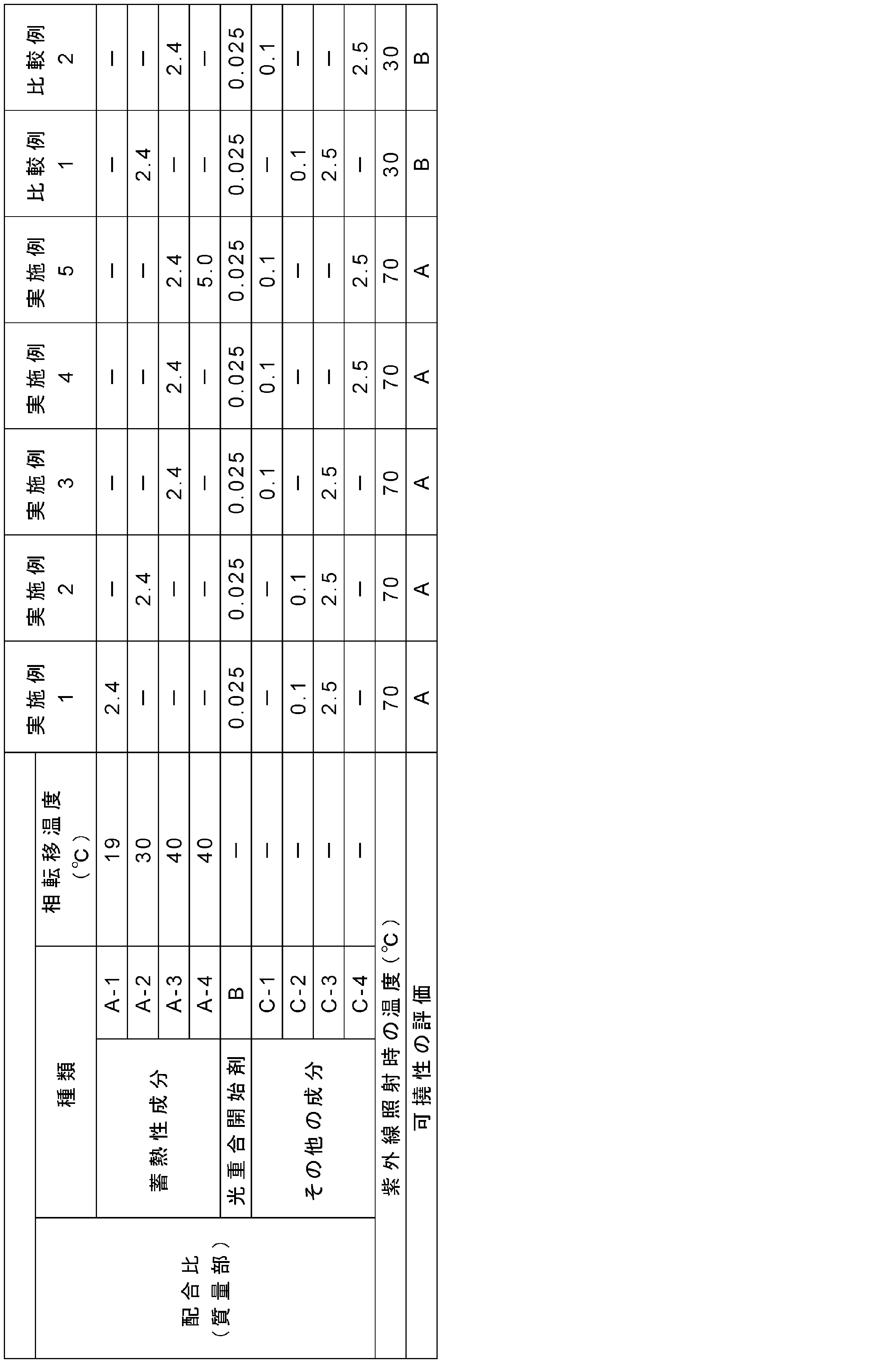
表1に示す配合比で各成分を50℃で加熱混合し、硬化性組成物を得た。次に、50℃の条件下で、バーコーターを用いて、硬化後の蓄熱層の厚さが200μmとなるように硬化性組成物をPETフィルム上に塗布した。窒素置換したイナートガスオーブン(温度:70℃)内において、紫外線(波長:365nm、強度:200mW)を蓄熱層に向けて照射することにより、蓄熱層の光硬化処理を行った。紫外線の照射量は3000mJ/cm2とした。
窒素置換したイナートガスオーブンの温度を70℃とする代わりに、30℃としたことの他は、実施例1~5と同様にして蓄熱層の光硬化処理を行った。
実施例及び比較例で用いた蓄熱性成分の相転移温度を、示差走査熱量測定計(パーキンエルマー社製、型番DSC8500)を用いて測定した。具体的には、20℃/分で100℃まで昇温し、100℃で3分間保持した後、10℃/分の速度で-30℃まで降温し、次いで-30℃で3分間保持した後、10℃/分の速度で100℃まで再び昇温して熱挙動を測定した。融解ピークを蓄熱性成分の相転移温度とした。結果を表1に示す。
PETフィルムをはがし、蓄熱層のみのシートを90°以上曲げたときに破断もしくは一部欠けが生じたものをB、90°以上曲げても破断もしくは欠けが生じなかったものをAと判定した。結果を表1に示す。
Claims (17)
- 基材フィルムの表面上に、相転移によって蓄熱性を発現する蓄熱性成分と、光硬化剤とを含む蓄熱層を形成する工程と、
前記蓄熱層の温度が前記蓄熱性成分の相転移温度よりも高い状態において、前記蓄熱層に対して活性エネルギー線を照射することによって前記蓄熱層を硬化させる工程と、
を含む蓄熱シートの製造方法。 - 前記活性エネルギー線が照射される前の前記蓄熱層に対してカバーフィルムを貼り付ける工程を更に含む、請求項1に記載の蓄熱シートの製造方法。
- 前記基材フィルムは、前記蓄熱層が形成される表面に粘着層を有し、
前記活性エネルギー線を照射する工程を経ることによって前記粘着層が前記蓄熱層側に転写される、請求項1又は2に記載の蓄熱シートの製造方法。 - 前記活性エネルギー線が照射される前又は後の前記蓄熱層の表面上に、粘着層を形成する工程を更に含む、請求項1に記載の蓄熱シートの製造方法。
- 前記粘着層に対してカバーフィルムを貼り付ける工程を更に含む、請求項4に記載の蓄熱シートの製造方法。
- 前記活性エネルギー線が照射される前又は後の前記蓄熱層を別々に少なくとも二層準備し、これらを貼り合わせる工程を含む、請求項1~5のいずれか一項に記載の蓄熱シートの製造方法。
- 前記基材フィルムは前記活性エネルギー線に対する透明性を有し、
前記基材フィルムの側から前記蓄熱層に向けて前記活性エネルギー線を照射する、請求項1~6のいずれか一項に記載の蓄熱シートの製造方法。 - 基材フィルムの表面上に、相転移によって蓄熱性を発現する蓄熱性成分と、熱硬化剤とを含む蓄熱層を形成する工程と、
前記蓄熱性成分の相転移温度よりも20℃以上高い温度に前記蓄熱層を加熱することによって前記蓄熱層を硬化させる工程と、
を含む蓄熱シートの製造方法。 - 前記温度に加熱される前の前記蓄熱層に対してカバーフィルムを貼り付ける工程を更に含む、請求項8に記載の蓄熱シートの製造方法。
- 前記基材フィルムは、前記蓄熱層が形成される表面に粘着層を有し、
前記温度に加熱される工程を経ることによって前記粘着層が前記蓄熱層側に転写される、請求項8又は9に記載の蓄熱シートの製造方法。 - 前記温度に加熱される前又は後の前記蓄熱層の表面上に、粘着層を形成する工程を更に含む、請求項8に記載の蓄熱シートの製造方法。
- 前記粘着層に対してカバーフィルムを貼り付ける工程を更に含む、請求項11に記載の蓄熱シートの製造方法。
- 前記温度に加熱される前又は後の前記蓄熱層を別々に少なくとも二層準備し、これらを貼り合わせる工程を含む、請求項8~12のいずれか一項に記載の蓄熱シートの製造方法。
- 前記熱硬化剤の活性温度をTA℃とし、前記蓄熱性成分の相転移温度をTP℃としたとき、以下の不等式(1)で表される条件を満たす、請求項8~13のいずれか一項に記載の蓄熱シートの製造方法。
0<TA-TP≦100・・・(1) - 前記蓄熱層がフィラーを更に含む、請求項8~14のいずれか一項に記載の蓄熱シートの製造方法。
- 酸素濃度5体積%以下の低酸素条件下において、各工程を実施する、請求項1~15のいずれか一項に記載の蓄熱シートの製造方法。
- 前記蓄熱層の厚さが10~500μmである、請求項1~16のいずれか一項に記載の蓄熱シートの製造方法。
Priority Applications (5)
| Application Number | Priority Date | Filing Date | Title |
|---|---|---|---|
| JP2021520508A JP7235107B2 (ja) | 2019-05-17 | 2019-05-17 | 蓄熱シートの製造方法 |
| CN201980096374.9A CN113825787B (zh) | 2019-05-17 | 2019-05-17 | 蓄热片的制造方法 |
| KR1020217040087A KR102702704B1 (ko) | 2019-05-17 | 2019-05-17 | 축열 시트의 제조 방법 |
| PCT/JP2019/019771 WO2020234937A1 (ja) | 2019-05-17 | 2019-05-17 | 蓄熱シートの製造方法 |
| TW109115909A TWI836074B (zh) | 2019-05-17 | 2020-05-13 | 蓄熱片的製造方法 |
Applications Claiming Priority (1)
| Application Number | Priority Date | Filing Date | Title |
|---|---|---|---|
| PCT/JP2019/019771 WO2020234937A1 (ja) | 2019-05-17 | 2019-05-17 | 蓄熱シートの製造方法 |
Publications (1)
| Publication Number | Publication Date |
|---|---|
| WO2020234937A1 true WO2020234937A1 (ja) | 2020-11-26 |
Family
ID=73458978
Family Applications (1)
| Application Number | Title | Priority Date | Filing Date |
|---|---|---|---|
| PCT/JP2019/019771 Ceased WO2020234937A1 (ja) | 2019-05-17 | 2019-05-17 | 蓄熱シートの製造方法 |
Country Status (5)
| Country | Link |
|---|---|
| JP (1) | JP7235107B2 (ja) |
| KR (1) | KR102702704B1 (ja) |
| CN (1) | CN113825787B (ja) |
| TW (1) | TWI836074B (ja) |
| WO (1) | WO2020234937A1 (ja) |
Citations (5)
| Publication number | Priority date | Publication date | Assignee | Title |
|---|---|---|---|---|
| JPH10306277A (ja) * | 1997-05-06 | 1998-11-17 | Mitsubishi Chem Corp | 蓄熱部材およびその製造方法 |
| JP2009273983A (ja) * | 2008-05-13 | 2009-11-26 | Nissan Motor Co Ltd | マイクロ波による塗膜の硬化方法 |
| WO2009145020A1 (ja) * | 2008-05-27 | 2009-12-03 | 大阪ガスケミカル株式会社 | 蓄熱材の製造方法、蓄熱材、蓄熱機能付吸着材、キャニスター |
| JP2010169303A (ja) * | 2009-01-22 | 2010-08-05 | Panasonic Corp | 電気採暖具 |
| JP2018507773A (ja) * | 2015-02-04 | 2018-03-22 | アウトラスト テクノロジーズ,リミテッド ライアビリティ カンパニー | 相変化材料を含む熱管理フィルム |
Family Cites Families (4)
| Publication number | Priority date | Publication date | Assignee | Title |
|---|---|---|---|---|
| KR100838112B1 (ko) * | 2006-06-19 | 2008-06-20 | 이경훈 | 상전이물질을 이용한 휴대폰 케이스 제조방법 |
| KR200427596Y1 (ko) * | 2006-07-05 | 2006-09-27 | (주)데카닉스 | 상변화 물질을 이용한 열전도 및 흡수 시트 |
| JP2014500359A (ja) | 2010-11-24 | 2014-01-09 | ビーエーエスエフ ソシエタス・ヨーロピア | マイクロカプセル化潜熱蓄熱材料を含む熱可塑性成形組成物 |
| WO2018207387A1 (ja) * | 2017-05-12 | 2018-11-15 | 日立化成株式会社 | 樹脂組成物、蓄熱材、熱制御材及び熱制御シート |
-
2019
- 2019-05-17 WO PCT/JP2019/019771 patent/WO2020234937A1/ja not_active Ceased
- 2019-05-17 JP JP2021520508A patent/JP7235107B2/ja active Active
- 2019-05-17 CN CN201980096374.9A patent/CN113825787B/zh active Active
- 2019-05-17 KR KR1020217040087A patent/KR102702704B1/ko active Active
-
2020
- 2020-05-13 TW TW109115909A patent/TWI836074B/zh active
Patent Citations (5)
| Publication number | Priority date | Publication date | Assignee | Title |
|---|---|---|---|---|
| JPH10306277A (ja) * | 1997-05-06 | 1998-11-17 | Mitsubishi Chem Corp | 蓄熱部材およびその製造方法 |
| JP2009273983A (ja) * | 2008-05-13 | 2009-11-26 | Nissan Motor Co Ltd | マイクロ波による塗膜の硬化方法 |
| WO2009145020A1 (ja) * | 2008-05-27 | 2009-12-03 | 大阪ガスケミカル株式会社 | 蓄熱材の製造方法、蓄熱材、蓄熱機能付吸着材、キャニスター |
| JP2010169303A (ja) * | 2009-01-22 | 2010-08-05 | Panasonic Corp | 電気採暖具 |
| JP2018507773A (ja) * | 2015-02-04 | 2018-03-22 | アウトラスト テクノロジーズ,リミテッド ライアビリティ カンパニー | 相変化材料を含む熱管理フィルム |
Also Published As
| Publication number | Publication date |
|---|---|
| KR20220010727A (ko) | 2022-01-26 |
| JPWO2020234937A1 (ja) | 2020-11-26 |
| KR102702704B1 (ko) | 2024-09-04 |
| TW202110968A (zh) | 2021-03-16 |
| JP7235107B2 (ja) | 2023-03-08 |
| CN113825787A (zh) | 2021-12-21 |
| TWI836074B (zh) | 2024-03-21 |
| CN113825787B (zh) | 2024-12-06 |
Similar Documents
| Publication | Publication Date | Title |
|---|---|---|
| TWI700317B (zh) | 包含相變材料之熱管理膜 | |
| JP5560630B2 (ja) | 熱伝導シート、この熱伝導シートの製造方法及び熱伝導シートを用いた放熱装置 | |
| JP7375750B2 (ja) | 樹脂組成物、蓄熱材、及び物品 | |
| JP2019179222A (ja) | 硬化性樹脂組成物、硬化物およびプリント配線板 | |
| JP2021172698A (ja) | 硬化性組成物、蓄熱材、及び物品 | |
| JP7028704B2 (ja) | 熱硬化性材料 | |
| JP7235107B2 (ja) | 蓄熱シートの製造方法 | |
| JP7487731B2 (ja) | 硬化性組成物、蓄熱材、及び物品 | |
| JP7375819B2 (ja) | 樹脂組成物、蓄熱材、及び物品 | |
| CN116096768B (zh) | 固化性组合物、蓄热材料及物品 | |
| JPWO2019220665A1 (ja) | 硬化性組成物、硬化性組成物セット、蓄熱材、及び物品 | |
| JP2019179223A (ja) | ドライフィルム、硬化物およびプリント配線板 | |
| TW202608983A (zh) | 硬化性組成物、蓄熱材及物品 |
Legal Events
| Date | Code | Title | Description |
|---|---|---|---|
| 121 | Ep: the epo has been informed by wipo that ep was designated in this application |
Ref document number: 19929784 Country of ref document: EP Kind code of ref document: A1 |
|
| ENP | Entry into the national phase |
Ref document number: 2021520508 Country of ref document: JP Kind code of ref document: A |
|
| NENP | Non-entry into the national phase |
Ref country code: DE |
|
| ENP | Entry into the national phase |
Ref document number: 20217040087 Country of ref document: KR Kind code of ref document: A |
|
| 122 | Ep: pct application non-entry in european phase |
Ref document number: 19929784 Country of ref document: EP Kind code of ref document: A1 |