WO2020204061A1 - 車両用灯具 - Google Patents
車両用灯具 Download PDFInfo
- Publication number
- WO2020204061A1 WO2020204061A1 PCT/JP2020/014991 JP2020014991W WO2020204061A1 WO 2020204061 A1 WO2020204061 A1 WO 2020204061A1 JP 2020014991 W JP2020014991 W JP 2020014991W WO 2020204061 A1 WO2020204061 A1 WO 2020204061A1
- Authority
- WO
- WIPO (PCT)
- Prior art keywords
- light
- control surface
- reflection control
- optical system
- region
- Prior art date
- Legal status (The legal status is an assumption and is not a legal conclusion. Google has not performed a legal analysis and makes no representation as to the accuracy of the status listed.)
- Ceased
Links
Images






Classifications
-
- F—MECHANICAL ENGINEERING; LIGHTING; HEATING; WEAPONS; BLASTING
- F21—LIGHTING
- F21S—NON-PORTABLE LIGHTING DEVICES; SYSTEMS THEREOF; VEHICLE LIGHTING DEVICES SPECIALLY ADAPTED FOR VEHICLE EXTERIORS
- F21S41/00—Illuminating devices specially adapted for vehicle exteriors, e.g. headlamps
- F21S41/10—Illuminating devices specially adapted for vehicle exteriors, e.g. headlamps characterised by the light source
- F21S41/14—Illuminating devices specially adapted for vehicle exteriors, e.g. headlamps characterised by the light source characterised by the type of light source
- F21S41/141—Light emitting diodes [LED]
- F21S41/143—Light emitting diodes [LED] the main emission direction of the LED being parallel to the optical axis of the illuminating device
- F21S41/145—Light emitting diodes [LED] the main emission direction of the LED being parallel to the optical axis of the illuminating device the main emission direction of the LED being opposite to the main emission direction of the illuminating device
-
- F—MECHANICAL ENGINEERING; LIGHTING; HEATING; WEAPONS; BLASTING
- F21—LIGHTING
- F21S—NON-PORTABLE LIGHTING DEVICES; SYSTEMS THEREOF; VEHICLE LIGHTING DEVICES SPECIALLY ADAPTED FOR VEHICLE EXTERIORS
- F21S41/00—Illuminating devices specially adapted for vehicle exteriors, e.g. headlamps
- F21S41/10—Illuminating devices specially adapted for vehicle exteriors, e.g. headlamps characterised by the light source
- F21S41/14—Illuminating devices specially adapted for vehicle exteriors, e.g. headlamps characterised by the light source characterised by the type of light source
- F21S41/141—Light emitting diodes [LED]
- F21S41/147—Light emitting diodes [LED] the main emission direction of the LED being angled to the optical axis of the illuminating device
-
- F—MECHANICAL ENGINEERING; LIGHTING; HEATING; WEAPONS; BLASTING
- F21—LIGHTING
- F21S—NON-PORTABLE LIGHTING DEVICES; SYSTEMS THEREOF; VEHICLE LIGHTING DEVICES SPECIALLY ADAPTED FOR VEHICLE EXTERIORS
- F21S41/00—Illuminating devices specially adapted for vehicle exteriors, e.g. headlamps
- F21S41/20—Illuminating devices specially adapted for vehicle exteriors, e.g. headlamps characterised by refractors, transparent cover plates, light guides or filters
- F21S41/25—Projection lenses
-
- F—MECHANICAL ENGINEERING; LIGHTING; HEATING; WEAPONS; BLASTING
- F21—LIGHTING
- F21S—NON-PORTABLE LIGHTING DEVICES; SYSTEMS THEREOF; VEHICLE LIGHTING DEVICES SPECIALLY ADAPTED FOR VEHICLE EXTERIORS
- F21S41/00—Illuminating devices specially adapted for vehicle exteriors, e.g. headlamps
- F21S41/30—Illuminating devices specially adapted for vehicle exteriors, e.g. headlamps characterised by reflectors
- F21S41/32—Optical layout thereof
- F21S41/33—Multi-surface reflectors, e.g. reflectors with facets or reflectors with portions of different curvature
-
- F—MECHANICAL ENGINEERING; LIGHTING; HEATING; WEAPONS; BLASTING
- F21—LIGHTING
- F21S—NON-PORTABLE LIGHTING DEVICES; SYSTEMS THEREOF; VEHICLE LIGHTING DEVICES SPECIALLY ADAPTED FOR VEHICLE EXTERIORS
- F21S41/00—Illuminating devices specially adapted for vehicle exteriors, e.g. headlamps
- F21S41/30—Illuminating devices specially adapted for vehicle exteriors, e.g. headlamps characterised by reflectors
- F21S41/32—Optical layout thereof
- F21S41/36—Combinations of two or more separate reflectors
- F21S41/365—Combinations of two or more separate reflectors successively reflecting the light
-
- F—MECHANICAL ENGINEERING; LIGHTING; HEATING; WEAPONS; BLASTING
- F21—LIGHTING
- F21S—NON-PORTABLE LIGHTING DEVICES; SYSTEMS THEREOF; VEHICLE LIGHTING DEVICES SPECIALLY ADAPTED FOR VEHICLE EXTERIORS
- F21S41/00—Illuminating devices specially adapted for vehicle exteriors, e.g. headlamps
- F21S41/60—Illuminating devices specially adapted for vehicle exteriors, e.g. headlamps characterised by a variable light distribution
- F21S41/67—Illuminating devices specially adapted for vehicle exteriors, e.g. headlamps characterised by a variable light distribution by acting on reflectors
- F21S41/675—Illuminating devices specially adapted for vehicle exteriors, e.g. headlamps characterised by a variable light distribution by acting on reflectors by moving reflectors
-
- F—MECHANICAL ENGINEERING; LIGHTING; HEATING; WEAPONS; BLASTING
- F21—LIGHTING
- F21V—FUNCTIONAL FEATURES OR DETAILS OF LIGHTING DEVICES OR SYSTEMS THEREOF; STRUCTURAL COMBINATIONS OF LIGHTING DEVICES WITH OTHER ARTICLES, NOT OTHERWISE PROVIDED FOR
- F21V14/00—Controlling the distribution of the light emitted by adjustment of elements
- F21V14/04—Controlling the distribution of the light emitted by adjustment of elements by movement of reflectors
-
- F—MECHANICAL ENGINEERING; LIGHTING; HEATING; WEAPONS; BLASTING
- F21—LIGHTING
- F21V—FUNCTIONAL FEATURES OR DETAILS OF LIGHTING DEVICES OR SYSTEMS THEREOF; STRUCTURAL COMBINATIONS OF LIGHTING DEVICES WITH OTHER ARTICLES, NOT OTHERWISE PROVIDED FOR
- F21V5/00—Refractors for light sources
- F21V5/04—Refractors for light sources of lens shape
-
- F—MECHANICAL ENGINEERING; LIGHTING; HEATING; WEAPONS; BLASTING
- F21—LIGHTING
- F21V—FUNCTIONAL FEATURES OR DETAILS OF LIGHTING DEVICES OR SYSTEMS THEREOF; STRUCTURAL COMBINATIONS OF LIGHTING DEVICES WITH OTHER ARTICLES, NOT OTHERWISE PROVIDED FOR
- F21V7/00—Reflectors for light sources
-
- F—MECHANICAL ENGINEERING; LIGHTING; HEATING; WEAPONS; BLASTING
- F21—LIGHTING
- F21V—FUNCTIONAL FEATURES OR DETAILS OF LIGHTING DEVICES OR SYSTEMS THEREOF; STRUCTURAL COMBINATIONS OF LIGHTING DEVICES WITH OTHER ARTICLES, NOT OTHERWISE PROVIDED FOR
- F21V7/00—Reflectors for light sources
- F21V7/04—Optical design
- F21V7/06—Optical design with parabolic curvature
-
- F—MECHANICAL ENGINEERING; LIGHTING; HEATING; WEAPONS; BLASTING
- F21—LIGHTING
- F21V—FUNCTIONAL FEATURES OR DETAILS OF LIGHTING DEVICES OR SYSTEMS THEREOF; STRUCTURAL COMBINATIONS OF LIGHTING DEVICES WITH OTHER ARTICLES, NOT OTHERWISE PROVIDED FOR
- F21V7/00—Reflectors for light sources
- F21V7/04—Optical design
- F21V7/08—Optical design with elliptical curvature
Definitions
- the present invention relates to a vehicle lamp.
- vehicle lighting equipment As vehicle lighting equipment, vehicle headlights typified by automobile headlights, drawing devices for drawing images on road surfaces, etc. are known. By the way, various configurations have been studied in order to obtain a desired image as a projected image in a vehicle lamp.
- Patent Document 1 discloses a vehicle lighting fixture including one light emitting optical system that emits light and a reflecting device that reflects the light emitted from the light emitting optical system.
- This reflecting device is a so-called DMD (Digital Mirror Device)
- DMD Digital Mirror Device
- vehicle lighting fixtures may irradiate a wide area in front of the vehicle or draw a large image on the road surface, which may require a large amount of light. Therefore, for example, in a vehicle lamp as in Patent Document 1, it is conceivable to irradiate the reflection control surface of the reflection device with light emitted from a plurality of light emitting optical systems. Each of the lights emitted from these emission optical systems and applied to the reflection control surface generally has an intensity distribution. Therefore, when the reflection control surface is irradiated with light emitted from a plurality of emission optical systems, the intensity of the light in a specific region of the reflection control surface may be unintentionally increased.
- the reflecting device of Patent Document 1 forms a light distribution pattern by reflecting light by the reflection control surface, the intensity distribution in the light distribution pattern tends to be affected by the light intensity distribution on the reflection control surface. .. Therefore, as described above, when the light intensity in a specific region of the reflection control surface is unintentionally increased, there is a region in which the light intensity is unintentionally increased in the predetermined light distribution pattern to be emitted. , There is a concern that visibility will decrease.
- an object of the present invention is to provide a vehicle lamp that can suppress a decrease in visibility.
- the vehicle lighting equipment of the present invention has a plurality of tilting states that can be individually switched between a first light emitting optical system having a first light source and a second light emitting optical system having a second light source. It has a reflection control surface formed by the reflection surface of the reflection element, and the light emitted from the first emission optical system and the light emitted from the second emission optical system are reflected by the reflection control surface to reflect the plurality of reflections.
- This vehicle lighting fixture can emit light having a predetermined light distribution pattern by controlling the tilted state of a plurality of reflecting elements in the reflecting device. Further, in this vehicle lamp, as described above, the first region having the highest intensity in the irradiation pattern of the light from the first emission optical system irradiated on the reflection control surface and the second region irradiated on the reflection control surface. The second region having the highest intensity in the irradiation pattern of light from the emission optical system does not overlap with each other. Therefore, in this vehicle lamp, the intensity of light in a specific region of the reflection control surface is unintentionally increased as compared with the case where the first region and the second region overlap each other on the reflection control surface. Can be suppressed. Therefore, this vehicle lamp can suppress the occurrence of a region where the light intensity is unintentionally increased in the predetermined light distribution pattern to be emitted, and can suppress the deterioration of visibility.
- the portion of the first emission optical system that irradiates the reflection control surface and the first region are on one side of a predetermined straight line passing through the center of the reflection control surface.
- the portion of the second light emitting optical system that irradiates the reflection control surface with light and the second region may be located on the opposite side of the predetermined straight line.
- the reflecting device reflects light by the reflection control surface to form a light distribution pattern. Therefore, as the angle between the propagation direction of the light from the first light emitting optical system irradiated on the reflection control surface and the propagation direction of the light from the second light emitting optical system irradiated on the reflection control surface increases, the first Of the light from the first emission optical system and the light from the second emission optical system, the amount of light that is reflected by the reflection control surface to form a light distribution pattern is reduced, and the energy efficiency is reduced.
- the portion to irradiate the reflection control surface in the first light emitting optical system and the first region pass through the center of the reflection control surface.
- the portion of the second light emitting optical system that irradiates the reflection control surface with light and the second region are located on the other side of the predetermined straight line. Therefore, when the reflection control surface is viewed in a plan view, the portion of the first light emitting optical system to which the reflection control surface is irradiated with light and the first region are located on different sides with respect to the above straight line, and the second From the first light emitting optical system irradiated to the reflection control surface, as compared with the case where the portion of the light emitting optical system that irradiates the reflection control surface with light and the second region are located on different sides with respect to the above straight line.
- the angle between the propagation direction of the light and the propagation direction of the light from the second light emitting optical system irradiated on the reflection control surface can be reduced. Therefore, this vehicle lighting fixture can suppress a decrease in energy efficiency.
- the portion of the light emitting optical system that irradiates the reflection control surface with light is, for example, the light emitting surface of the light source when the light emitting optical system is composed of only a light source. Further, for example, when the light emitting optical system has an optical element different from the light source and emits light from this optical element, the portion of the optical element that emits light is the portion that irradiates the reflection control surface of the light emitting optical system with light. It becomes.
- the center side of the reflection control surface with respect to the center of the first region in the irradiation pattern of light from the first emission optical system on the surface including the reflection control surface is the first region in the irradiation pattern.
- the reflection control is longer than the center of the reflection control surface and longer than the center of the second region in the irradiation pattern of light from the second emission optical system on the surface including the reflection control surface.
- the center side of the surface may be longer than the center of the second region in the irradiation pattern and longer than the side opposite to the center of the reflection control surface.
- the first region is located on one side of a predetermined straight line passing through the center of the reflection control surface, so that the first region is reflection control. It is off the center of the surface. Further, as described above, the center side of the reflection control surface rather than the center of the first region in the irradiation pattern of the light from the first emission optical system on the surface including the reflection control surface is the first region in the irradiation pattern. It is longer than the center and longer than the side opposite to the center of the reflection control surface.
- the center side of the reflection control surface is shorter or the same length as the center of the reflection control surface than the center of the first region in this irradiation pattern.
- the size of the region that does not overlap with the reflection control surface in the irradiation pattern of the light from the first emission optical system on the surface including the reflection control surface can be reduced.
- the second region is deviated from the center of the reflection control surface as in the first region.
- the center side of the reflection control surface rather than the center of the second region in the irradiation pattern of the light from the second emission optical system on the surface including the reflection control surface is the second region in the irradiation pattern.
- this vehicle lamp can increase the amount of light applied to the reflection control surface and improve energy efficiency as compared with the above case.
- the light irradiation pattern from the first emission optical system on the reflection control surface and the light irradiation pattern from the second emission optical system on the reflection control surface are based on the predetermined straight line. It may be symmetrical.
- the light irradiation pattern from the first emission optical system on the reflection control surface and the light irradiation pattern from the second emission optical system on the reflection control surface are the centers of the reflection control surface.
- the intensity distribution of the light applied to the reflection control surface can be leveled in the direction perpendicular to this straight line, as compared with the case where the light is asymmetrical with respect to a predetermined straight line passing through. Therefore, this vehicle lamp can further suppress the occurrence of a region where the light intensity is unintentionally increased in the predetermined light distribution pattern to be emitted, and can further suppress the decrease in visibility.
- the irradiation pattern includes an intensity distribution as well as a shape.
- the first light emitting optical system further includes a first light collecting member that collects light emitted from the first light source and irradiates the reflection control surface, and the second light emitting optical system is the second light source.
- a second condensing member that condenses the light emitted from the light source and irradiates the reflection control surface with the light may be further provided.
- the reflection control surface can be compared with the case where the first light emitting optical system does not have the first light collecting member or the second light emitting optical system does not have the second light collecting member.
- the amount of light emitted can be increased and energy efficiency can be improved.
- the first condensing member and the second condensing member may be reflectors having a reflecting surface.
- the first light emitting optical system and the second light emitting optical system can be arranged close to the reflecting device, so that the vehicle lamp can be miniaturized.
- the first condensing member and the second condensing member may be lenses.
- the reflection type condensing member is used. Compared with the member, the deviation of the light emission direction from the light collecting member to the reflection control surface can be suppressed. As described above, changes in the position and inclination of the condensing member and the incident angle of the light incident on the condensing member can be allowed to some extent, so that the arrangement of the optical members such as the light source and the condensing member can be facilitated.
- the vehicle lamp may further include a projection lens that emits light from the reflection control surface and adjusts the divergence angle of light that forms a light distribution pattern according to the tilted state of the plurality of reflecting elements.
- FIG. 7 (A) is a diagram schematically showing an irradiation pattern of light from the first light emitting optical system irradiated to the reflecting device, and FIG.
- FIG. 7 (B) is a diagram showing a second light emitting optical irradiated to the reflecting device.
- FIG. 7C is a diagram schematically showing an irradiation pattern of light from the system, in which light from the first emission optical system and light from the second emission optical system irradiated to the reflecting device are combined. It is a figure which shows roughly the irradiation pattern of the light. It is a figure which shows the light distribution pattern for night lighting. It is a figure which shows the lamp for vehicle in 2nd Embodiment of this invention in the same manner as FIG. It is a figure which shows the lamp unit shown in FIG. 9 in the same manner as FIG. It is a figure for demonstrating the focal position of each of the 1st lens and the 2nd lens.
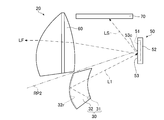
- FIG. 1 is a diagram showing a vehicle lamp according to the present embodiment, and is a diagram schematically showing a horizontal cross section of the vehicle lamp.
- the vehicle lighting fixture 1 of the present embodiment is a headlight for an automobile. Headlights for automobiles are generally provided in each of the left and right directions in front of the vehicle, and the left and right headlights are generally symmetrical in the left and right directions. Therefore, in this embodiment, one of the headlights will be described.
- the vehicle lamp 1 of the present embodiment includes a housing 10 and a lamp unit 20 as main configurations.
- the housing 10 includes a lamp housing 11, a front cover 12, and a back cover 13 as main configurations.
- the front of the lamp housing 11 has an opening, and the front cover 12 is fixed to the lamp housing 11 so as to close the opening. Further, an opening smaller than the front is formed behind the lamp housing 11, and the back cover 13 is fixed to the lamp housing 11 so as to close the opening.
- the space formed by the lamp housing 11, the front cover 12 that closes the front opening of the lamp housing 11, and the back cover 13 that closes the rear opening of the lamp housing 11 is a light chamber R, and the light room R is
- the lamp unit 20 is housed inside.
- FIG. 2 is a perspective view schematically showing the lamp unit shown in FIG. 1, and is a perspective view of the lamp unit viewed from the rear side.
- FIG. 3 is a side view schematically showing the lamp unit shown in FIG.
- the lamp unit 20 of the present embodiment includes a first light emitting optical system 30, a second light emitting optical system 40, a reflecting device 50, a projection lens 60, and light absorption.
- a plate 70 is provided as a main configuration, and is fixed to the housing 10 by a configuration (not shown). For ease of understanding, the description of the light absorption plate 70 is omitted in FIG. 2, and the description of the second light emitting optical system 40 is omitted in FIG.
- the first light emitting optical system 30 and the second light emitting optical system 40 are arranged side by side in the left-right direction, and have a symmetrical configuration.
- the first light emitting optical system 30 has a first light source 31 and a first reflector 32 as a first condensing member.
- the second light emitting optical system 40 has a second light source 41 and a second reflector 42 as a second condensing member.
- the first light source 31 is a light emitting element that emits light, and in the present embodiment, it is a surface mount type LED (Light Emitting Diode) that emits white light with a substantially rectangular exit surface. Further, the first light source 31 is arranged so that the exit surface faces the front side and the upper side.
- the lamp unit 20 has a circuit board (not shown), and the first light source 31 is mounted on the circuit board.
- the first reflector 32 as the first condensing member reflects the light emitted from the first light source 31 by the reflecting surface 32r to collect the light and irradiate the reflection control surface of the reflecting device 50 described later. It is composed of. That is, the light emitted from the first light source 31 and reflected by the reflecting surface 32r of the first reflector 32 is emitted from the first light emitting optical system 30. Therefore, the portion of the first light emitting optical system 30 that irradiates the reflection control surface of the reflection device 50 with light is the reflection surface 32r of the first reflector 32.
- the first reflector 32 is a curved plate-shaped member, and is arranged so as to cover the first light source 31 from the front side.
- the surface of the first reflector 32 on the side of the first light source 31 is a reflecting surface 32r that reflects the light emitted from the first light source 31, and the reflecting surface 32r is based on a rotating elliptic curved surface.
- the first focal point of the elliptic surface on the reflecting surface 32r is located on or near the emitting surface of the first light source 31.
- the second light source 41 is a light emitting element that emits light, and in the present embodiment, like the first light source 31, a surface mount type LED that emits white light with a substantially rectangular exit surface. Will be done. Further, the second light source 41 is arranged so that the exit surface faces the front side and the upper side as in the case of the first light source, and is mounted on the above circuit board.
- the second reflector 42 as the second light collecting member reflects the light emitted from the second light source 41 by the reflecting surface 42r to collect the light and irradiate the reflection control surface of the reflecting device 50 described later. It is composed of. That is, the light emitted from the second light source 41 and reflected by the reflecting surface 42r of the second reflector 42 is emitted from the second light emitting optical system 40. Therefore, the portion of the second light emitting optical system 40 that irradiates the reflection control surface of the reflection device 50 with light is the reflection surface 42r of the second reflector 42.
- the second reflector 42 is a curved plate-shaped member, and is arranged so as to cover the second light source 41 from the front side.
- the surface of the second reflector 42 on the side of the second light source 41 is a reflecting surface 42r that reflects the light emitted from the second light source 41, and the reflecting surface 42r is based on a rotating elliptic curved surface.
- the first focal point of the elliptic surface on the reflecting surface 42r is located on or near the emitting surface of the second light source 41.
- the end of the second reflector 42 on the first reflector 32 side and the end of the first reflector 32 on the second reflector 42 side are joined to each other to form the first reflector 32 and the second reflector 42. It is formed integrally.
- the first reflector 32 and the second reflector 42 may be formed separately.
- the reflecting device 50 of the present embodiment is a so-called DMD, and as shown in FIG. 1, includes a reflecting portion 51 and an edge cover 52 as a main configuration. In FIG. 1, the description inside the reflection unit 51 is omitted.
- the reflection unit 51 has a reflection control surface 53 configured to form a predetermined light distribution pattern by reflecting incident light, and the light emitted from the first light emitting optical system 30 on the reflection control surface 53. And the light emitted from the second light emitting optical system 40 is irradiated.
- FIG. 4 is a diagram schematically showing a cross section in the thickness direction of a part of the reflective portion shown in FIG. 1, and is a diagram schematically showing a cross section in the vertical direction of a part of the reflective portion.
- the reflection unit 51 of the present embodiment has a plurality of reflection elements 54 two-dimensionally arranged on a substrate (not shown), and the reflection control surface 53 of the reflection unit 51 is composed of the reflection surfaces 54r of the plurality of reflection elements 54. ing.
- the plurality of reflecting elements 54 are individually tiltably supported on the substrate about the rotation shaft 54a.
- the plurality of reflecting elements 54 can be individually switched between a first tilted state in which a predetermined angle is tilted to one side and a second tilted state in which the other side is tilted by a predetermined angle.
- the rotation axes 54a of the plurality of reflecting elements 54 are substantially parallel to each other, and each reflecting element 54 is from the first light emitting optical system 30 that is incident on the reflecting surface 54r in the first tilted state. The light and the light from the second light emitting optical system 40 are reflected in the first direction.
- each of the reflecting elements 54 directs the light from the first light emitting optical system 30 and the light from the second light emitting optical system 40 incident on the reflecting surface 54r in the second tilted state in a second direction different from the first direction.
- the plurality of reflecting elements 54 may reflect the light from the first light emitting optical system 30 and the light from the second light emitting optical system 40 incident on the reflecting surface 54r in the first tilted state toward the first direction. I hope I can.
- the plurality of reflecting elements 54 may include a plurality of reflecting elements having different second directions from the first direction. That is, the rotation axes 54a of the plurality of reflecting elements 54 may be non-parallel to each other.
- the plurality of reflecting elements 54 can be individually switched between a first tilted state in which a predetermined angle is tilted to one side and a second tilted state in which a predetermined angle is tilted to the other side. Therefore, the reflecting unit 51 can form a predetermined light distribution pattern by controlling the tilted state of these reflecting elements 54, for example, by the light emitted from the reflection control surface 53 in the first direction. Further, by controlling the tilted state of these reflecting elements 54 over time, the intensity distribution of a predetermined light distribution pattern can be made into a predetermined intensity distribution.
- the amount of light emitted in the first direction from the reflecting element 54 that is repeatedly switched between the first tilted state and the second tilted state at predetermined time intervals is always set to the first tilted state. It is lower than the amount of light emitted from the reflecting element 54 in the first direction per unit time.
- the amount of light emitted from each of the reflecting elements 54 in the first direction changes depending on the time-dependent difference in the tilted state of the reflecting element 54. Therefore, by controlling the tilted state of the plurality of reflecting elements 54 over time, the intensity distribution in the light distribution pattern of the light emitted in the first direction can be set to a predetermined intensity distribution.
- a plurality of low beam light distribution patterns are formed by light emitted from the reflection control surface 53 in the first direction by a control unit (not shown) electrically connected to the reflection device 50.
- the tilted state of the reflecting element 54 is controlled.
- the number, shape, arrangement, size, etc. of the plurality of reflecting elements 54 are not particularly limited.
- the reflection control surface 53 may be covered with a member having translucency.
- FIG. 5 is a front view schematically showing the reflection device shown in FIG. 1, and is a front view of the reflection device 50 viewed from the reflection control surface 53 side.
- the reflection portion 51 of the present embodiment is formed to be substantially rectangular in the front view, and the entire region in the front view is the reflection control surface 53.
- the edge cover 52 covers the entire circumference of the side surface of the reflection portion 51 and the side opposite to the reflection control surface 53, and the reflection control surface 53 is exposed to the outside without being covered by the edge cover 52.
- the edge cover 52 is not particularly limited.
- the reflection device 50 may not cover the back surface side of the reflection portion 51, and the reflection device 50 may not include the edge cover 52.
- the reflection control surface 53 is irradiated with the light from the first emission optical system 30 and the light from the second emission optical system 40, and the reflection control surface 53 is directed toward the first direction.
- the emitted light is arranged so as to enter the projection lens 60.
- the reflection control surface 53 is substantially parallel to the vertical direction and extends in the left-right direction, and is located on the rear side and the upper side of the first light source 31 and the second light source 41. Arranged to do.
- the extending direction of the rotating shafts 54a of the plurality of reflecting elements 54 is substantially parallel to the left-right direction.
- the first light emitting optical system 30 is located on one side of the first reference plane RP1 that passes through the center 53c of the reflection control surface 53 and extends in the front-rear direction and the vertical direction.
- the second light emitting optical system 40 is located on the other side of the first reference plane RP1 as a reference. Therefore, the reflection surface 32r of the first reflector 32, which is a portion for irradiating the reflection control surface 53 of the first light emitting optical system 30 with light, is located on one side with respect to the first reference plane RP1.
- the reflection surface 42r of the second reflector 42 which is a portion of irradiating the reflection control surface 53 of the second emission optical system 40 with light, is located on the other side with respect to the first reference plane RP1.
- the first reference plane RP1 of the present embodiment is substantially perpendicular to the rotating shaft 54a. is there.
- the reflection control surface 53 is substantially parallel to the vertical direction and extends in the left-right direction, the first reference plane RP1 appears as a straight line when the reflection control surface 53 is viewed in a plane as shown in FIG.
- a second reference plane RP2 that passes through the center 53c of the reflection control surface 53 and extends in a direction perpendicular to the reflection surface 54r of the reflection element 54 in the first tilted state and the first reference plane RP1.
- the first light emitting optical system 30 and the second light emitting optical system 40 are located below. Therefore, the reflection surface 32r of the first reflector 32, which is a portion for irradiating the reflection control surface 53 of the first emission optical system 30, and the portion for irradiating the reflection control surface 53 of the second emission optical system 40 with light.
- the reflection surface 42r of a second reflector 42 is located below the second reference plane RP2.
- the second focus of the elliptic surface on the reflection surface 32r of the first reflector 32 and the second focus of the elliptic surface on the reflection surface 42r of the second reflector 42 are on the reflection control surface 53 or its own. It is located in the vicinity. Therefore, the light from the first light source 31 is collected by the first reflector 32 and irradiated to the reflection control surface 53, and the light from the second light source 41 is collected by the second reflector 42 and applied to the reflection control surface 53. Be irradiated.
- the projection lens 60 is a lens that adjusts the divergence angle of incident light.
- the projection lens 60 is arranged in front of the reflection device 50, and light emitted from the reflection control surface 53 in the first direction is incident on the projection lens 60, and the divergence angle of this light is adjusted by the projection lens 60. ..
- the light whose divergence angle is adjusted by the projection lens 60 is emitted from the vehicle lamp 1 via the front cover 12.
- the projection lens 60 is a lens having an incident surface and an exit surface formed in a convex shape, and is arranged so that the rear focal point is located on or near the reflection control surface 53 of the reflection device 50. Further, the lower part of the projection lens 60 is cut out, and a part of the first reflector 32 and a part of the second reflector are located in the space formed by the cutout of the lower part of the projection lens 60. There is.
- the light absorption plate 70 is a plate-shaped member having light absorption property, and is configured to convert most of the incident light into heat.
- the light absorption plate 70 is arranged in front of and above the reflection device 50, and light emitted from the reflection control surface 53 in the second direction is incident on the light absorption plate 70, and most of this light is emitted. Is converted to heat.
- the light absorbing plate 70 include a plate-shaped member made of a metal such as aluminum and having a surface subjected to black alumite processing or the like.
- the light absorption plate 70 may be formed integrally with the lamp housing 11 of the housing 10 and may be a part of the lamp housing 11.
- FIG. 6 is a diagram for explaining the focal positions of the reflection surfaces of the first reflector and the second reflector, and is a diagram for explaining the reflection control surface 53 of the reflection device 50, the emission surface 31o of the first light source 31, and the second light source 41. It is a perspective view which looks at the exit surface 41o of the above from the front side.
- the first focal point 32f1 of the elliptic surface on the reflecting surface 32r of the first reflector 32 is located on or near the emitting surface 31o of the first light source 31.
- the first focal point 32f1 is within the region 31a on the first reference plane RP1 side of the center 31c of the emission surface 31o on the emission surface 31o of the first light source 31. Is located in. In FIG. 6, the region 31a on the exit surface 31o is hatched. Further, the second focal point 32f2 of the elliptic curved surface on the reflection surface 32r of the first reflector 32 is located on or near the reflection control surface 53. Further, as shown in FIG.
- the second focal point 32f2 is on the first emission optical system 30 side, that is, with respect to the first reference plane RP1 passing through the center 53c of the reflection control surface 53. It is located in the area on the side of the first reflector 32.
- the first focal point 42f1 of the elliptic curved surface on the reflecting surface 42r of the second reflector 42 is located on or near the emitting surface 41o of the second light source 41.
- the first focus 42f1 is within the region 41a on the first reference plane RP1 side of the center 41c of the emission surface 41o on the emission surface 41o of the second light source 41. Is located in. In FIG. 6, the region 41a on the exit surface 41o is hatched.
- the second focal point 42f2 of the elliptic curved surface on the reflection surface 42r of the second reflector 42 is located on or near the reflection control surface 53.
- the second focal point 42f2 is closer to the second emission optical system 40 than the first reference plane RP1 passing through the center 53c of the reflection control surface 53, that is, It is located in the area on the side of the second reflector 42.
- white lights L1 and L2 are emitted from the first light source 31 and the second light source 41.
- the light L1 emitted from the first light source 31 is reflected by the reflecting surface 32r of the first reflector 32 and emitted from the first light emitting optical system 30.
- the light L1 emitted from the first light emitting optical system 30 is condensed and irradiated on the reflection control surface 53 of the reflection device 50.
- the light L2 emitted from the second light source 41 is reflected by the reflecting surface 42r of the second reflector 42 and emitted from the second light emitting optical system 40.
- the light L2 emitted from the second light emitting optical system 40 is focused and irradiated on the reflection control surface 53 of the reflection device 50.
- FIGS. 7 (A), 7 (B), and 7 (C) are diagrams schematically showing the irradiation pattern of the light irradiated to the reflecting device, and the light on the surface including the reflection control surface 53. It is a figure which shows the irradiation pattern schematicly. In FIGS. 7 (A), 7 (B), and 7 (C), the irradiation pattern is shown by a thick line. Specifically, FIG. 7A is a diagram schematically showing an irradiation pattern on a surface including the reflection control surface 53 of the light L1 from the first light emitting optical system 30 irradiated to the reflection device 50. FIG.
- FIG. 7B is a diagram schematically showing an irradiation pattern on the surface including the reflection control surface 53 of the light L2 from the second light emitting optical system 40 irradiated to the reflection device 50.
- FIG. 7C is a surface including a light reflection control surface 53 in which the light L1 from the first light emitting optical system 30 and the light L2 from the second light emitting optical system 40 irradiated to the reflecting device 50 are combined. It is a figure which shows the irradiation pattern schematicly.
- the surface including the reflection control surface 53 here means reflection when, for example, the tilted state of the plurality of reflecting elements 54 is a state in which the reflecting surfaces 54r of the plurality of reflecting elements 54 are located on the same plane. It is a flat surface including the control surface 53.
- the region AF1 is the region with the highest intensity, and the intensity decreases in the order of region AF2, region AF3, region AF4, and region AF5.
- the region AF1 having the highest intensity is located in the reflection control surface 53. That is, the region of the irradiation pattern PF having the highest intensity on the reflection control surface 53 is the region AF1.
- the region AF1 having the highest intensity is, for example, a region in which the intensity of light in the irradiation pattern PF is 0.9 times or more the maximum intensity in the irradiation pattern PF.
- this region AF1 is located on the side where the first reflector 32 with reference to the first reference plane RP1 which is a straight line passing through the center 53c of the reflection control surface 53 is located. ing. That is, when the reflection control surface 53 is viewed in a plan view, the reflection surface 32r of the first reflector 32, which is a portion for irradiating the reflection control surface 53 in the first emission optical system 30, and this region AF1 are the first reference. It is located on one side of the plane RP1.
- the center 53c side of the reflection control surface 53 is longer than the center AF1c of the region AF1 in the irradiation pattern PF than the center AF1c of the region AF1 in the irradiation pattern PF, and is longer than the side opposite to the center 53c of the reflection control surface 53.
- the width WF1 of the irradiation pattern PF on the center 53c side of the reflection control surface 53 with respect to the center AF1c of the region AF1 The width of the irradiation pattern PF on the side opposite to the center 53c of the reflection control surface 53 is larger than the width WF2 of the center AF1c of the region AF1.
- the center AF1c of the region AF1 is, for example, the center of gravity of the region AF1.
- the entire reflection control surface 53 is located in the irradiation pattern PF, and the light L1 emitted from the first light emitting optical system 30 irradiates the entire reflection control surface 53.
- the irradiation pattern PF is long in a specific direction, and the width in the direction parallel to the straight line SL1 in the irradiation pattern PF is larger than the width in the direction perpendicular to the straight line SL1 in the irradiation pattern PF.
- the position of the region AF1 and the outer shape of the irradiation pattern PF change according to the shape of the reflecting surface 32r of the first reflector 32.
- the position of the two focal points 32f2 is adjusted.
- the region AS1 has the highest intensity, and the intensity decreases in the order of region AS2, region AS3, region AS4, and region AS5.
- the region AS1 having the highest intensity is located in the reflection control surface 53. That is, the region of the irradiation pattern PS having the highest intensity on the reflection control surface 53 is the region AS1.
- the region AS1 having the highest intensity is, for example, a region in which the intensity of light in the irradiation pattern PS is 0.9 times or more the maximum intensity in the irradiation pattern PS.
- this region AS1 is located on the side where the second reflector 42 with reference to the first reference plane RP1 which is a straight line passing through the center 53c of the reflection control surface 53 is located. ing. That is, when the reflection control surface 53 is viewed in a plan view, the reflection surface 42r of the second reflector 42, which is a portion for irradiating the reflection control surface 53 in the second emission optical system 40 with light, and this region AS1 are the first reference. It is located on the other side of the plane RP1. Therefore, the region AF1 of the irradiation pattern PF and the region AS1 of the irradiation pattern PS do not overlap each other. In FIG.
- the region AF1 of the irradiation pattern PF is shown by a broken line. Further, the center 53c side of the reflection control surface 53 is longer than the center AS1c of the region AS1 in the irradiation pattern PS than the center AS1c of the region AS1 in the irradiation pattern PS, and is longer than the center 53c of the reflection control surface 53.
- the width WS1 of the irradiation pattern PS on the center 53c side of the reflection control surface 53 with respect to the center AS1c of the region AS1 is larger than the center AS1c of the region AS1.
- the center AS1c of the region AS1 is, for example, the center of gravity of the region AS1.
- the entire reflection control surface 53 is located in the irradiation pattern PS, and the light L2 emitted from the second light emitting optical system 40 irradiates the entire reflection control surface 53. Therefore, on the reflection control surface 53, the irradiation pattern PF and the irradiation pattern PS overlap each other. Further, the irradiation pattern PS is long in a specific direction, and the width in the direction parallel to the straight line SL2 in the irradiation pattern PS is larger than the width in the direction perpendicular to the straight line SL2 in the irradiation pattern PS. Further, the irradiation pattern PF and the irradiation pattern PS are symmetrical with respect to the first reference plane RP1.
- the irradiation pattern PF and the irradiation pattern PS include an intensity distribution as well as an outer shape.
- the position of the region AS1 and the outer shape of the irradiation pattern PS change according to the shape of the reflection surface 42r of the second reflector 42. That is, the first focal point 42f1 and the first focus 42f1 of the second reflector 42 and the second reflector 42 so that the irradiation pattern PS on the surface including the reflection control surface 53 of the light L2 from the second light emitting optical system 40 irradiated to the reflection device 50 becomes like this.
- the position of the two focal points 42f2 is adjusted.
- the region AC1 is the region with the highest intensity, and the intensity decreases in the order of region AC2, region AC3, region AC4, and region AC5.
- This irradiation pattern PC is a pattern in which the irradiation pattern PF and the irradiation pattern PS are combined. Then, when the lights L1 and L2 are emitted from the first light source 31 and the second light source 41, the light reflecting device 50 is irradiated with the light whose irradiation pattern on the surface including the reflection control surface 53 is the irradiation pattern PC.
- the reflection control surface 53 is composed of the reflection surfaces 54r of the plurality of reflection elements 54. Therefore, the light emitted to the reflection control surface 53 is reflected by the reflection surfaces 54r of the plurality of reflection elements 54. Further, the plurality of reflecting elements 54 can be individually switched between the first tilted state and the second tilted state.
- the reflecting surface 54r of the reflecting element 54 in the first tilted state reflects the light L1 and L2 applied to the reflection control surface 53 toward the first direction
- the reflecting surface 54r of the reflecting element 54 in the second tilted state reflects the light L1 and L2.
- the light L1 and L2 applied to the reflection control surface 53 are reflected in the second direction.
- the tilted state of the plurality of reflecting elements 54 is controlled so as to form a low beam light distribution pattern by the light LF emitted from the reflection control surface 53 in the first direction. Therefore, the light LF emitted from the reflection control surface 53 in the first direction is a low beam, and the divergence angle of this light LF is adjusted by the projection lens 60 and emitted from the vehicle lamp 1 via the front cover 12. .. In this way, the light of the low beam light distribution pattern is emitted from the vehicle lamp 1. Most of the light LS emitted from the reflection control surface 53 in the second direction is incident on the light absorption plate 70 and converted into heat.
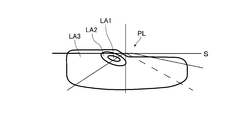
- FIG. 8 is a diagram showing a light distribution pattern for night lighting, specifically, a diagram showing a low beam light distribution pattern PL.
- S indicates a horizontal line
- the light distribution pattern is indicated by a thick line.
- the region LA1 is the region with the highest intensity, and the intensity decreases in the order of the region LA2 and the region LA3. That is, the tilted state of the plurality of reflecting elements 54 of the reflecting unit 51 is controlled so that the light LF emitted from the reflection control surface 53 in the first direction becomes light forming a light distribution pattern including the intensity distribution of the low beam. Will be done.
- the vehicle lamp 1 of the present embodiment includes a first light emitting optical system 30 having a first light source 31, a second light emitting optical system 40 having a second light source 41, and a reflecting device 50.
- the reflection device 50 has a reflection control surface 53 composed of reflection surfaces 54r of a plurality of reflection elements 54 whose tilting states can be individually switched.
- the reflecting device 50 reflects the light L1 emitted from the first light emitting optical system 30 and the light L2 emitted from the second light emitting optical system 40 by the reflection control surface 53, and distributes light according to the tilted state of the plurality of reflecting elements 54. Form a pattern.
- the region having the highest intensity on the reflection control surface 53 is the region AF1.
- the region having the highest intensity on the reflection control surface 53 is the region AS1. Then, these regions AF1 and regions AS1 do not overlap each other.
- the vehicle lamp 1 of the present embodiment can emit light having a predetermined light distribution pattern by controlling the tilted state of the plurality of reflecting elements 54 in the reflecting device 50. Further, in the vehicle lamp 1 of the present embodiment, as described above, the region AF1 and the reflection control surface having the highest intensity in the irradiation pattern PF of the light L1 from the first light emitting optical system 30 irradiated to the reflection control surface 53. The light L2 from the second light emitting optical system 40 irradiated to 53 does not overlap with the region AS1 having the highest intensity in the irradiation pattern PS.
- the intensity of light in a specific region of the reflection control surface 53 is unintentionally compared with the case where the region AF1 and the region AS1 overlap each other on the reflection control surface 53. It can be suppressed from becoming high. Therefore, the vehicle lamp 1 of the present embodiment can suppress the occurrence of a region where the light intensity is unintentionally increased in the predetermined light distribution pattern to be emitted, and can suppress the deterioration of visibility.
- the reflection control surface 53 when the reflection control surface 53 is viewed in a plan view, the reflection surface 32r and the region of the first reflector 32, which is a portion for irradiating the reflection control surface 53 in the first light emitting optical system 30 with light.
- AF1 is located on one side of the first reference plane RP1 which is a straight line passing through the center of the reflection control surface 53.
- the reflection surface 42r of the second reflector 42 and the region AS1 which are the portions for irradiating the reflection control surface 53 in the second emission optical system 40 are the reflection control surface 53. It is located on the other side of the first reference plane RP1, which is a straight line passing through the center.
- the reflection device 50 reflects light by the reflection control surface 53 to form a light distribution pattern. Therefore, the angle formed by the propagation direction of the light L1 from the first light emitting optical system 30 irradiated on the reflection control surface 53 and the propagation direction of the light L2 from the second light emitting optical system 40 irradiated on the reflection control surface 53. The amount of light that becomes the light LF that is reflected by the reflection control surface 53 to form a light distribution pattern among the light L1 from the first light emitting optical system 30 and the light L2 from the second light emitting optical system 40. Is reduced and energy efficiency is reduced.
- the portion and the region AF1 that irradiate the reflection control surface 53 in the first light emitting optical system 30 are reflected control.
- the reflection control surface 53 when the reflection control surface 53 is viewed in a plan view, the portion of the first light emitting optical system 30 that irradiates the reflection control surface 53 and the region AF1 are located on different sides with respect to the first reference plane RP1. At the same time, the reflection control surface 53 is irradiated with light as compared with the case where the portion of the second light emitting optical system 40 for irradiating the reflection control surface 53 and the region AS1 are located on different sides with respect to the first reference plane RP1. The angle between the propagation direction of the light L1 from the first emission optical system 30 and the propagation direction of the light L2 from the second emission optical system 40 irradiated on the reflection control surface 53 can be reduced. Therefore, the vehicle lamp 1 of the present embodiment can suppress a decrease in energy efficiency.
- the center 53c side of the reflection control surface 53 is longer than the center AF1c of the region AF1 in the irradiation pattern PF and longer than the side opposite to the center 53c of the reflection control surface 53.
- the center 53c of the reflection control surface 53 is more than the center AS1c of the region AS1 in the irradiation pattern PS of the light L2 from the second emission optical system 40 on the surface including the reflection control surface 53.
- the side is longer than the center AS1c of the region AS1 in the irradiation pattern PS and the side opposite to the center 53c of the reflection control surface 53.
- the region AF1 is located on one side of the first reference plane RP1 passing through the center 53c of the reflection control surface 53. .. Therefore, the region AF1 is deviated from the center 53c of the reflection control surface 53. Further, as described above, the center 53c side of the reflection control surface 53 is irradiated from the center AF1c of the region AF1 in the irradiation pattern PF of the light L1 from the first emission optical system 30 on the surface including the reflection control surface 53. It is longer than the center AF1c of the region AF1 in the pattern PF and longer than the side opposite to the center 53c of the reflection control surface 53.
- the center 53c side of the reflection control surface 53 is shorter than the center AF1c of the region AF1 and the center 53c side of the reflection control surface 53 is shorter or the same length as the center AF1c of the region AF1 in this irradiation pattern PF.
- the size of the region not overlapping with the reflection control surface 53 in the irradiation pattern PF of the light L1 from the first light emitting optical system 30 on the surface including the reflection control surface 53 can be reduced.
- the region AS1 in the irradiation pattern PS is deviated from the center 53c of the reflection control surface 53, similarly to the region AF1.
- the center 53c side of the reflection control surface 53 is irradiated from the center AS1c of the region AS1 in the irradiation pattern PS of the light L2 from the second emission optical system 40 on the surface including the reflection control surface 53. It is longer than the center AS1c of the region AS1 in the pattern PS and longer than the side opposite to the center 53c of the reflection control surface 53. Therefore, in this irradiation pattern PS, when the center 53c side of the reflection control surface 53 is shorter than the center AS1c of the region AS1 and shorter than or the same length as the center 53c of the reflection control surface 53 than the center AS1c of the region AS1.
- the vehicle lamp 1 of the present embodiment can increase the amount of light emitted to the reflection control surface 53 and improve the energy efficiency as compared with the above case.
- the irradiation pattern PF of the light L1 from the first light emitting optical system 30 on the reflection control surface 53 and the irradiation of the light L2 from the second light emitting optical system 40 on the reflection control surface 53 is symmetrical with respect to the first reference plane RP1 which is a straight line passing through the center of the reflection control surface 53 when the reflection control surface 53 is viewed in a plan view.
- the irradiation pattern on the reflection control surface 53 is an irradiation pattern of a portion of the irradiation pattern on the surface including the reflection control surface 53 on the reflection control surface 53.
- the reflection control surface is compared with the case where the irradiation pattern PF on the reflection control surface 53 and the irradiation pattern PS on the reflection control surface 53 are asymmetric with respect to the first reference plane RP1.
- the intensity distribution of the light applied to 53 can be leveled in the direction perpendicular to the first reference plane RP1. Therefore, the vehicle lamp 1 of the present embodiment can further suppress the occurrence of a region where the light intensity is unintentionally increased in the predetermined light distribution pattern to be emitted, and can further suppress the decrease in visibility.
- the first light emitting optical system 30 has a first reflector 32 as a first light collecting member that collects the light emitted from the first light source 31 and irradiates the reflection control surface 53 with the light.
- the second light emitting optical system 40 further has a second reflector 42 as a second light collecting member that collects the light emitted from the second light source 41 and irradiates the reflection control surface 53 with the light.
- the first light emitting optical system 30 does not have the first reflector 32 as the first light collecting member, or the second light emitting optical system 40 has the second reflector as the second light collecting member.
- the amount of light emitted to the reflection control surface 53 can be increased, and the energy efficiency can be improved.
- the first light collecting member is a first reflector 32 having a reflecting surface 32r
- the second light collecting member is a second reflector 42 having a reflecting surface 42r.
- the reflection type condensing member By using the reflection type condensing member in this way, the first light emitting optical system 30 and the second light emitting optical system 40 can be arranged close to the reflecting device 50, so that the vehicle lamp 1 can be miniaturized.
- the vehicle lamp 1 of the present embodiment further includes a projection lens 60 that adjusts the divergence angle of the light LF that emits light from the reflection control surface 53 and forms a light distribution pattern according to the tilted state of the plurality of reflection elements 54.
- one of the second reference plane RP2 that is substantially parallel to the rotating shaft 54a of the reflecting element 54 and perpendicular to the reflecting surface 54r of the reflecting element 54 in the first tilted state.
- the reflection surface 32r of the first reflector 32 which is the portion that irradiates the reflection control surface 53 of the first emission optical system 30, and the portion that irradiates the reflection control surface 53 of the second emission optical system 40 with light.
- the reflection surface 42r of a second reflector 42 is located.
- the arrangement of the light absorbing plate 70 can be easily designed, and the light absorbing plate 70 can be miniaturized.
- FIG. 9 is a diagram showing the vehicle lamp according to the second embodiment of the present invention in the same manner as in FIG. 1, and FIG. 10 is a diagram showing the lamp unit shown in FIG. 9 in the same manner as in FIG.
- the first light emitting optical system 30 includes a first lens 35 in place of the first reflector 32 as the first condensing member. It is mainly different from the lamp unit 20 of the first embodiment in that the light emitting optical system 40 includes a second lens 45 in place of the second reflector 42 as the second condensing member.
- the first light source 31 is arranged so that the exit surface faces the reflecting device 50 side.
- the first lens 35 is a lens that collects incident light, and is arranged between the first light source 31 and the reflecting device 50.
- the first lens 35 is a lens in which the entrance surface 35i and the exit surface 35o are formed in a convex shape.
- the light L1 emitted from the first light source 31 is incident on the first lens 35, is condensed by the first lens 35, and is irradiated on the reflection control surface 53 of the reflection device 50.
- the lens Therefore, in the present embodiment, the portion of the first light emitting optical system 30 that irradiates the reflection control surface 53 with light is the exit surface 35o of the first lens 35.
- the second light emitting optical system 40 of the present embodiment has a configuration symmetrical to that of the first light emitting optical system 30, and the second light source 41 is arranged so that the emitting surface faces the reflecting device 50 side.
- the second lens 45 is a lens that collects incident light, and is arranged between the second light source 41 and the reflecting device 50.
- the second lens 45 is a lens in which the entrance surface 45i and the exit surface 45o are formed in a convex shape.
- the first focus of the second lens 45 is located on or near the exit surface of the second light source 41, and the second focus is located on or near the reflection control surface 53 of the reflection device 50. are doing.
- the light L2 emitted from the second light source 41 is incident on the second lens 45, condensed by the second lens 45, and irradiated on the reflection control surface 53 of the reflection device 50.
- the lens Therefore, in the present embodiment, the portion of the second light emitting optical system 40 that irradiates the reflection control surface 53 with light is the exit surface 45o of the second lens 45.
- FIG. 11 is a diagram for explaining the focal positions of the first lens and the second lens, and similarly to FIG. 6, the reflection control surface 53 of the reflection device 50, the emission surface 31o of the first light source 31, and the first 2 is a perspective view of the exit surface 31o of the light source 41 as viewed from the front side.
- the first focal point 35f1 of the first lens 35 is located on or near the exit surface 31o of the first light source 31.
- the first focal point 35f1 is on the exit surface 31o of the first light source 31 opposite to the center 31c of the emission surface 31o on the side opposite to the first reference plane RP1 side. It is located within region 31b.
- FIG. 11 is a diagram for explaining the focal positions of the first lens and the second lens, and similarly to FIG. 6, the reflection control surface 53 of the reflection device 50, the emission surface 31o of the first light source 31, and the first 2 is a perspective view of the exit surface 31o of the light source 41 as viewed from the front side.
- the region 31b on the exit surface 31o is hatched.
- the second focal point 35f2 of the first lens 35 is located on or near the reflection control surface 53.
- the second focal point 35f2 is a case where the reflection control surface 53 is viewed in a plane as in the case where the second focal point 32f2 of the elliptic curved surface on the reflecting surface 32r of the first reflector 32 of the first embodiment is viewed. , It is located in the region on the first emission optical system 30 side, that is, on the first lens 35 side with respect to the first reference plane RP1 passing through the center 53c of the reflection control surface 53.
- the first focal point 45f1 of the second lens 45 is located on or near the exit surface 41o of the second light source 41. Further, when the exit surface 41o of the second light source 41 is viewed in a plan view, the first focal point 45f1 is on the side opposite to the first reference plane RP1 side of the center 41c of the emission surface 41o on the emission surface 41o of the second light source 41. It is located within region 41b. In FIG. 11, the region 41b on the exit surface 41o is hatched. Further, the second focal point 45f2 of the second lens 45 is located on or near the reflection control surface 53.
- the second focal point 45f2 is a case where the reflection control surface 53 is viewed in a plane as in the case where the second focal point 42f2 of the elliptic curved surface on the reflecting surface 42r of the second reflector 42 of the first embodiment is viewed. , It is located in the region on the second emission optical system 40 side, that is, on the second lens 45 side with respect to the first reference plane RP1 passing through the center 53c of the reflection control surface 53.
- the irradiation pattern PF on the surface including the reflection control surface 53 of the light L1 from the first emission optical system 30 irradiated to the reflection device 50 of the present embodiment is the same irradiation pattern as the irradiation pattern PF of the first embodiment.
- the region AF1 having the highest intensity is located on the side in the reflection control surface 53 where the first light emitting optical system 30 with reference to the first reference plane RP1 is located. Therefore, when the reflection control surface 53 is viewed in a plan view, the emission surface 35o of the first lens 35, which is a portion for irradiating the reflection control surface 53 in the first emission optical system 30, and this region AF1 are first. It is located on one side of the reference plane RP1.
- the center 53c side of the reflection control surface 53 is longer than the center AF1c of the region AF1 in the irradiation pattern PF than the center AF1c of the region AF1 in the irradiation pattern PF, and is longer than the side opposite to the center 53c of the reflection control surface 53.
- the width of the irradiation pattern PF on the center 53c side of the reflection control surface 53 with respect to the center AF1c of the region AF1 is the width of the irradiation pattern PF on the side opposite to the center 53c of the reflection control surface 53 with respect to the center AF1c of the region AF1. It is said to be larger than WF2.
- the reflection control surface 53 is located in the irradiation pattern PF, and the light L1 emitted from the first light emitting optical system 30 irradiates the entire reflection control surface 53.
- the irradiation pattern PF is elongated in a specific direction, and the width in the direction parallel to the straight line SL1 passing through the center AF1c of the region AF1 and the center 53c of the reflection control surface 53 in the irradiation pattern PF is the irradiation pattern PF. It is made larger than the width in the direction perpendicular to the straight line SL1.
- the position of the region AF1 and the outer shape of the irradiation pattern PF change according to the shapes of the entrance surface 35i and the emission surface 35o of the first lens 35. That is, the first focal point 35f1 and the first focus 35f1 of the first lens 35 and the first lens 35 so that the irradiation pattern PF on the surface including the reflection control surface 53 of the light L1 from the first emission optical system 30 irradiated to the reflection device 50 becomes like this.
- the position of the two focal points 35f2 is adjusted.
- the irradiation pattern PS on the surface including the reflection control surface 53 of the light L2 from the second light emitting optical system 40 irradiated to the reflection device 50 of the present embodiment is the same irradiation pattern PS as the irradiation pattern PS of the first embodiment. It is said that. Specifically, the region AS1 having the highest intensity is located on the side in the reflection control surface 53 where the second light emitting optical system 40 with reference to the first reference plane RP1 is located. Therefore, when the reflection control surface 53 is viewed in a plan view, the exit surface 45o of the second lens 45, which is a portion for irradiating the reflection control surface 53 in the second emission optical system 40 with light, and this region AS1 are first.
- the region AF1 of the irradiation pattern PF and the region AS1 of the irradiation pattern PS do not overlap each other.
- the center 53c side of the reflection control surface 53 is longer than the center AS1c of the region AS1 in the irradiation pattern PS than the center AS1c of the region AS1 in the irradiation pattern PS, and is longer than the center 53c of the reflection control surface 53.
- the width WS1 of the irradiation pattern PS on the center 53c side of the reflection control surface 53 with respect to the center AS1c of the region AS1 is the width of the irradiation pattern PS on the side opposite to the center 53c of the reflection control surface 53 with respect to the center AS1c of the region AS1. It is said to be larger than WS2. Further, the reflection control surface 53 is located in the irradiation pattern PS, and the light L2 emitted from the second light emitting optical system 40 irradiates the entire reflection control surface 53.
- the irradiation pattern PS is elongated in a specific direction, and the width in the direction parallel to the straight line SL2 passing through the center AS1c of the region AS1 and the center 53c of the reflection control surface 53 in the irradiation pattern PS is the irradiation pattern PS. It is made larger than the width in the direction perpendicular to the straight line SL2. Further, the irradiation pattern PF and the irradiation pattern PS are symmetrical with respect to the first reference plane RP1. Further, on the reflection control surface 53, the irradiation pattern PF and the irradiation pattern PS overlap each other.
- the position of the region AS1 and the outer shape of the irradiation pattern PS change according to the shapes of the entrance surface 45i and the emission surface 45o of the second lens 45. That is, the first focal point 45f1 and the first focus 45f1 of the second lens 45 and the second lens 45 so that the irradiation pattern PS on the surface including the reflection control surface 53 of the light L2 from the second light emitting optical system 40 irradiated to the reflection device 50 becomes like this.
- the position of the two focal points 45f2 is adjusted.
- the first condensing member is a first lens 35 that transmits light
- the second condensing member is a second lens 45 that transmits light.
- the vehicle lamp 1 is supposed to irradiate a low beam, but the present invention is not particularly limited.
- the vehicle lamp 1 may emit a high beam, or may irradiate an irradiated body such as a road surface with light constituting an image.
- the direction of the light emitted by the vehicle lamp and the position where the vehicle lamp is attached to the vehicle are not particularly limited. ..
- the vehicle lamp 1 has two light emitting optical systems 30 and 40 that irradiate the reflection control surface 53 of the reflection device 50 with light.
- the vehicle lamp 1 may have a plurality of light emitting optical systems for irradiating the reflection control surface 53 of the reflecting device 50 with light, and may further have, for example, a third light emitting optical system.
- the third light emitting optical system may have a configuration including a light source and a reflector that reflects light emitted from the light source, as in the case of the first light emitting optical system 30 of the first embodiment. 1. Similar to the light emitting optical system 30, the configuration may include a light source and a lens that collects light emitted from the light source.
- Such a third light emitting optical system is arranged, for example, between the first light emitting optical system 30 and the second light emitting optical system 40.
- the vehicle lamp 1 includes a first light emitting optical system having a light source and a reflector for reflecting light emitted from the light source, and a second light emitting optical system having a light source and a lens for condensing light emitted from the light source. You may have.
- the first light emitting optical system 30 and the second light emitting optical system 40 have reflectors 32 and 42 and lenses 35 and 45 as condensing members, but are composed of only light sources 31 and 41. It may have been.
- the reflecting surfaces 32r and 42r of the reflectors 32 and 42 are based on a rotating elliptic curved surface.
- the reflecting surfaces 32r and 42r need only be able to collect the light from the light sources 31 and 41 and irradiate the reflection control surface 53 of the reflecting device 50 from a free curved surface based on a parabola that opens toward the reflecting device 50 side. It may have a concave shape.
- the lamp unit 20 includes a projection lens 60 composed of one lens.
- the projection lens 60 included in the lamp unit 20 may be a lens group composed of a plurality of lenses arranged in parallel in the propagation direction of the light emitted from the reflecting device 50, and the plurality of parallel lenses may be a convex lens or a concave lens.
- a plurality of types of lenses such as a free curved lens may be included.
- the lamp unit 20 does not have to include the projection lens 60.
- the light sources 31 and 41 are surface mount type LEDs.
- the light source is not particularly limited, and for example, the light source may be a laser element that emits laser light.
- a vehicle lamp that can suppress a decrease in visibility is provided, and can be used in a field such as a vehicle lamp such as an automobile.
Landscapes
- Engineering & Computer Science (AREA)
- General Engineering & Computer Science (AREA)
- Physics & Mathematics (AREA)
- Microelectronics & Electronic Packaging (AREA)
- Optics & Photonics (AREA)
- Non-Portable Lighting Devices Or Systems Thereof (AREA)
Priority Applications (1)
| Application Number | Priority Date | Filing Date | Title |
|---|---|---|---|
| JP2021512168A JPWO2020204061A1 (https=) | 2019-04-05 | 2020-04-01 |
Applications Claiming Priority (2)
| Application Number | Priority Date | Filing Date | Title |
|---|---|---|---|
| JP2019-073072 | 2019-04-05 | ||
| JP2019073072 | 2019-04-05 |
Publications (1)
| Publication Number | Publication Date |
|---|---|
| WO2020204061A1 true WO2020204061A1 (ja) | 2020-10-08 |
Family
ID=72668227
Family Applications (1)
| Application Number | Title | Priority Date | Filing Date |
|---|---|---|---|
| PCT/JP2020/014991 Ceased WO2020204061A1 (ja) | 2019-04-05 | 2020-04-01 | 車両用灯具 |
Country Status (2)
| Country | Link |
|---|---|
| JP (1) | JPWO2020204061A1 (https=) |
| WO (1) | WO2020204061A1 (https=) |
Citations (7)
| Publication number | Priority date | Publication date | Assignee | Title |
|---|---|---|---|---|
| WO2014002630A1 (ja) * | 2012-06-29 | 2014-01-03 | 株式会社小糸製作所 | 車両用灯具およびその制御方法 |
| WO2015033764A1 (ja) * | 2013-09-05 | 2015-03-12 | 株式会社小糸製作所 | 車両用灯具 |
| US20170284621A1 (en) * | 2016-03-31 | 2017-10-05 | Hyundai Motor Company | Lamp apparatus for vehicle |
| WO2018021109A1 (ja) * | 2016-07-29 | 2018-02-01 | パナソニックIpマネジメント株式会社 | 発光装置及び照明装置 |
| WO2018022700A1 (en) * | 2016-07-26 | 2018-02-01 | Texas Instruments Incorporated | Quasi-sparse optical illumination |
| JP2018092761A (ja) * | 2016-12-01 | 2018-06-14 | スタンレー電気株式会社 | 車両用灯具 |
| JP2019507950A (ja) * | 2016-02-24 | 2019-03-22 | ツェットカーヴェー グループ ゲーエムベーハー | 乗物用投光装置 |
-
2020
- 2020-04-01 JP JP2021512168A patent/JPWO2020204061A1/ja active Pending
- 2020-04-01 WO PCT/JP2020/014991 patent/WO2020204061A1/ja not_active Ceased
Patent Citations (7)
| Publication number | Priority date | Publication date | Assignee | Title |
|---|---|---|---|---|
| WO2014002630A1 (ja) * | 2012-06-29 | 2014-01-03 | 株式会社小糸製作所 | 車両用灯具およびその制御方法 |
| WO2015033764A1 (ja) * | 2013-09-05 | 2015-03-12 | 株式会社小糸製作所 | 車両用灯具 |
| JP2019507950A (ja) * | 2016-02-24 | 2019-03-22 | ツェットカーヴェー グループ ゲーエムベーハー | 乗物用投光装置 |
| US20170284621A1 (en) * | 2016-03-31 | 2017-10-05 | Hyundai Motor Company | Lamp apparatus for vehicle |
| WO2018022700A1 (en) * | 2016-07-26 | 2018-02-01 | Texas Instruments Incorporated | Quasi-sparse optical illumination |
| WO2018021109A1 (ja) * | 2016-07-29 | 2018-02-01 | パナソニックIpマネジメント株式会社 | 発光装置及び照明装置 |
| JP2018092761A (ja) * | 2016-12-01 | 2018-06-14 | スタンレー電気株式会社 | 車両用灯具 |
Also Published As
| Publication number | Publication date |
|---|---|
| JPWO2020204061A1 (https=) | 2020-10-08 |
Similar Documents
| Publication | Publication Date | Title |
|---|---|---|
| JP6581588B2 (ja) | 車両用前照灯 | |
| JP5087500B2 (ja) | 車両用灯具ユニット | |
| JP4080780B2 (ja) | 光源ユニット | |
| JP4024628B2 (ja) | 車両用前照灯 | |
| KR102155080B1 (ko) | 차량 헤드램프 | |
| US7607811B2 (en) | Lighting unit | |
| JP4047266B2 (ja) | 灯具 | |
| US20050162857A1 (en) | Lamp unit for vehicle and illumination lamp for vehicle | |
| JP5313525B2 (ja) | 自動車のヘッドライトのための光モジュール | |
| CN110094689B (zh) | 智能头灯 | |
| JP5574411B2 (ja) | 車両用灯具ユニット | |
| JP6517008B2 (ja) | 灯具ユニット | |
| CN114623414B (zh) | 用于车辆的灯 | |
| JP7397849B2 (ja) | 車両用灯具 | |
| WO2020204061A1 (ja) | 車両用灯具 | |
| JP7495932B2 (ja) | 車両用灯具 | |
| JP7125473B2 (ja) | 灯具ユニット | |
| CN113757618A (zh) | 车辆用灯具 | |
| WO2021015184A1 (ja) | 車両用灯具、及び車両用前照灯 | |
| JP4189807B2 (ja) | 車両用灯具 | |
| WO2024048390A1 (ja) | ランプユニット、車両用灯具 | |
| JP2024172016A (ja) | 車両用前照灯 | |
| JP2024172015A (ja) | 車両用前照灯 |
Legal Events
| Date | Code | Title | Description |
|---|---|---|---|
| 121 | Ep: the epo has been informed by wipo that ep was designated in this application |
Ref document number: 20783179 Country of ref document: EP Kind code of ref document: A1 |
|
| ENP | Entry into the national phase |
Ref document number: 2021512168 Country of ref document: JP Kind code of ref document: A |
|
| NENP | Non-entry into the national phase |
Ref country code: DE |
|
| 122 | Ep: pct application non-entry in european phase |
Ref document number: 20783179 Country of ref document: EP Kind code of ref document: A1 |