WO2020194932A1 - 表示装置 - Google Patents
表示装置 Download PDFInfo
- Publication number
- WO2020194932A1 WO2020194932A1 PCT/JP2019/049828 JP2019049828W WO2020194932A1 WO 2020194932 A1 WO2020194932 A1 WO 2020194932A1 JP 2019049828 W JP2019049828 W JP 2019049828W WO 2020194932 A1 WO2020194932 A1 WO 2020194932A1
- Authority
- WO
- WIPO (PCT)
- Prior art keywords
- capacitor
- light emitting
- display device
- capacity
- thin film
- Prior art date
- Legal status (The legal status is an assumption and is not a legal conclusion. Google has not performed a legal analysis and makes no representation as to the accuracy of the status listed.)
- Ceased
Links
Images



Classifications
-
- G—PHYSICS
- G09—EDUCATION; CRYPTOGRAPHY; DISPLAY; ADVERTISING; SEALS
- G09G—ARRANGEMENTS OR CIRCUITS FOR CONTROL OF INDICATING DEVICES USING STATIC MEANS TO PRESENT VARIABLE INFORMATION
- G09G3/00—Control arrangements or circuits, of interest only in connection with visual indicators other than cathode-ray tubes
- G09G3/20—Control arrangements or circuits, of interest only in connection with visual indicators other than cathode-ray tubes for presentation of an assembly of a number of characters, e.g. a page, by composing the assembly by combination of individual elements arranged in a matrix no fixed position being assigned to or needed to be assigned to the individual characters or partial characters
- G09G3/22—Control arrangements or circuits, of interest only in connection with visual indicators other than cathode-ray tubes for presentation of an assembly of a number of characters, e.g. a page, by composing the assembly by combination of individual elements arranged in a matrix no fixed position being assigned to or needed to be assigned to the individual characters or partial characters using controlled light sources
- G09G3/30—Control arrangements or circuits, of interest only in connection with visual indicators other than cathode-ray tubes for presentation of an assembly of a number of characters, e.g. a page, by composing the assembly by combination of individual elements arranged in a matrix no fixed position being assigned to or needed to be assigned to the individual characters or partial characters using controlled light sources using electroluminescent panels
- G09G3/32—Control arrangements or circuits, of interest only in connection with visual indicators other than cathode-ray tubes for presentation of an assembly of a number of characters, e.g. a page, by composing the assembly by combination of individual elements arranged in a matrix no fixed position being assigned to or needed to be assigned to the individual characters or partial characters using controlled light sources using electroluminescent panels semiconductive, e.g. using light-emitting diodes [LED]
- G09G3/3208—Control arrangements or circuits, of interest only in connection with visual indicators other than cathode-ray tubes for presentation of an assembly of a number of characters, e.g. a page, by composing the assembly by combination of individual elements arranged in a matrix no fixed position being assigned to or needed to be assigned to the individual characters or partial characters using controlled light sources using electroluminescent panels semiconductive, e.g. using light-emitting diodes [LED] organic, e.g. using organic light-emitting diodes [OLED]
- G09G3/3225—Control arrangements or circuits, of interest only in connection with visual indicators other than cathode-ray tubes for presentation of an assembly of a number of characters, e.g. a page, by composing the assembly by combination of individual elements arranged in a matrix no fixed position being assigned to or needed to be assigned to the individual characters or partial characters using controlled light sources using electroluminescent panels semiconductive, e.g. using light-emitting diodes [LED] organic, e.g. using organic light-emitting diodes [OLED] using an active matrix
- G09G3/3233—Control arrangements or circuits, of interest only in connection with visual indicators other than cathode-ray tubes for presentation of an assembly of a number of characters, e.g. a page, by composing the assembly by combination of individual elements arranged in a matrix no fixed position being assigned to or needed to be assigned to the individual characters or partial characters using controlled light sources using electroluminescent panels semiconductive, e.g. using light-emitting diodes [LED] organic, e.g. using organic light-emitting diodes [OLED] using an active matrix with pixel circuitry controlling the current through the light-emitting element
-
- G—PHYSICS
- G09—EDUCATION; CRYPTOGRAPHY; DISPLAY; ADVERTISING; SEALS
- G09F—DISPLAYING; ADVERTISING; SIGNS; LABELS OR NAME-PLATES; SEALS
- G09F9/00—Indicating arrangements for variable information in which the information is built-up on a support by selection or combination of individual elements
- G09F9/30—Indicating arrangements for variable information in which the information is built-up on a support by selection or combination of individual elements in which the desired character or characters are formed by combining individual elements
-
- G—PHYSICS
- G09—EDUCATION; CRYPTOGRAPHY; DISPLAY; ADVERTISING; SEALS
- G09F—DISPLAYING; ADVERTISING; SIGNS; LABELS OR NAME-PLATES; SEALS
- G09F9/00—Indicating arrangements for variable information in which the information is built-up on a support by selection or combination of individual elements
- G09F9/30—Indicating arrangements for variable information in which the information is built-up on a support by selection or combination of individual elements in which the desired character or characters are formed by combining individual elements
- G09F9/302—Indicating arrangements for variable information in which the information is built-up on a support by selection or combination of individual elements in which the desired character or characters are formed by combining individual elements characterised by the form or geometrical disposition of the individual elements
-
- G—PHYSICS
- G09—EDUCATION; CRYPTOGRAPHY; DISPLAY; ADVERTISING; SEALS
- G09G—ARRANGEMENTS OR CIRCUITS FOR CONTROL OF INDICATING DEVICES USING STATIC MEANS TO PRESENT VARIABLE INFORMATION
- G09G3/00—Control arrangements or circuits, of interest only in connection with visual indicators other than cathode-ray tubes
- G09G3/20—Control arrangements or circuits, of interest only in connection with visual indicators other than cathode-ray tubes for presentation of an assembly of a number of characters, e.g. a page, by composing the assembly by combination of individual elements arranged in a matrix no fixed position being assigned to or needed to be assigned to the individual characters or partial characters
- G09G3/22—Control arrangements or circuits, of interest only in connection with visual indicators other than cathode-ray tubes for presentation of an assembly of a number of characters, e.g. a page, by composing the assembly by combination of individual elements arranged in a matrix no fixed position being assigned to or needed to be assigned to the individual characters or partial characters using controlled light sources
- G09G3/30—Control arrangements or circuits, of interest only in connection with visual indicators other than cathode-ray tubes for presentation of an assembly of a number of characters, e.g. a page, by composing the assembly by combination of individual elements arranged in a matrix no fixed position being assigned to or needed to be assigned to the individual characters or partial characters using controlled light sources using electroluminescent panels
- G09G3/32—Control arrangements or circuits, of interest only in connection with visual indicators other than cathode-ray tubes for presentation of an assembly of a number of characters, e.g. a page, by composing the assembly by combination of individual elements arranged in a matrix no fixed position being assigned to or needed to be assigned to the individual characters or partial characters using controlled light sources using electroluminescent panels semiconductive, e.g. using light-emitting diodes [LED]
- G09G3/3208—Control arrangements or circuits, of interest only in connection with visual indicators other than cathode-ray tubes for presentation of an assembly of a number of characters, e.g. a page, by composing the assembly by combination of individual elements arranged in a matrix no fixed position being assigned to or needed to be assigned to the individual characters or partial characters using controlled light sources using electroluminescent panels semiconductive, e.g. using light-emitting diodes [LED] organic, e.g. using organic light-emitting diodes [OLED]
-
- H—ELECTRICITY
- H05—ELECTRIC TECHNIQUES NOT OTHERWISE PROVIDED FOR
- H05B—ELECTRIC HEATING; ELECTRIC LIGHT SOURCES NOT OTHERWISE PROVIDED FOR; CIRCUIT ARRANGEMENTS FOR ELECTRIC LIGHT SOURCES, IN GENERAL
- H05B33/00—Electroluminescent light sources
- H05B33/12—Light sources with substantially two-dimensional radiating surfaces
-
- H—ELECTRICITY
- H10—SEMICONDUCTOR DEVICES; ELECTRIC SOLID-STATE DEVICES NOT OTHERWISE PROVIDED FOR
- H10K—ORGANIC ELECTRIC SOLID-STATE DEVICES
- H10K59/00—Integrated devices, or assemblies of multiple devices, comprising at least one organic light-emitting element covered by group H10K50/00
- H10K59/10—OLED displays
- H10K59/12—Active-matrix OLED [AMOLED] displays
- H10K59/121—Active-matrix OLED [AMOLED] displays characterised by the geometry or disposition of pixel elements
- H10K59/1216—Active-matrix OLED [AMOLED] displays characterised by the geometry or disposition of pixel elements the pixel elements being capacitors
-
- H—ELECTRICITY
- H10—SEMICONDUCTOR DEVICES; ELECTRIC SOLID-STATE DEVICES NOT OTHERWISE PROVIDED FOR
- H10K—ORGANIC ELECTRIC SOLID-STATE DEVICES
- H10K59/00—Integrated devices, or assemblies of multiple devices, comprising at least one organic light-emitting element covered by group H10K50/00
- H10K59/30—Devices specially adapted for multicolour light emission
- H10K59/35—Devices specially adapted for multicolour light emission comprising red-green-blue [RGB] subpixels
- H10K59/353—Devices specially adapted for multicolour light emission comprising red-green-blue [RGB] subpixels characterised by the geometrical arrangement of the RGB subpixels
-
- G—PHYSICS
- G09—EDUCATION; CRYPTOGRAPHY; DISPLAY; ADVERTISING; SEALS
- G09G—ARRANGEMENTS OR CIRCUITS FOR CONTROL OF INDICATING DEVICES USING STATIC MEANS TO PRESENT VARIABLE INFORMATION
- G09G2300/00—Aspects of the constitution of display devices
- G09G2300/04—Structural and physical details of display devices
- G09G2300/0421—Structural details of the set of electrodes
- G09G2300/0426—Layout of electrodes and connections
-
- G—PHYSICS
- G09—EDUCATION; CRYPTOGRAPHY; DISPLAY; ADVERTISING; SEALS
- G09G—ARRANGEMENTS OR CIRCUITS FOR CONTROL OF INDICATING DEVICES USING STATIC MEANS TO PRESENT VARIABLE INFORMATION
- G09G2300/00—Aspects of the constitution of display devices
- G09G2300/08—Active matrix structure, i.e. with use of active elements, inclusive of non-linear two terminal elements, in the pixels together with light emitting or modulating elements
- G09G2300/0809—Several active elements per pixel in active matrix panels
- G09G2300/0842—Several active elements per pixel in active matrix panels forming a memory circuit, e.g. a dynamic memory with one capacitor
- G09G2300/0861—Several active elements per pixel in active matrix panels forming a memory circuit, e.g. a dynamic memory with one capacitor with additional control of the display period without amending the charge stored in a pixel memory, e.g. by means of additional select electrodes
-
- G—PHYSICS
- G09—EDUCATION; CRYPTOGRAPHY; DISPLAY; ADVERTISING; SEALS
- G09G—ARRANGEMENTS OR CIRCUITS FOR CONTROL OF INDICATING DEVICES USING STATIC MEANS TO PRESENT VARIABLE INFORMATION
- G09G2310/00—Command of the display device
- G09G2310/02—Addressing, scanning or driving the display screen or processing steps related thereto
- G09G2310/0243—Details of the generation of driving signals
- G09G2310/0251—Precharge or discharge of pixel before applying new pixel voltage
-
- G—PHYSICS
- G09—EDUCATION; CRYPTOGRAPHY; DISPLAY; ADVERTISING; SEALS
- G09G—ARRANGEMENTS OR CIRCUITS FOR CONTROL OF INDICATING DEVICES USING STATIC MEANS TO PRESENT VARIABLE INFORMATION
- G09G2310/00—Command of the display device
- G09G2310/02—Addressing, scanning or driving the display screen or processing steps related thereto
- G09G2310/0262—The addressing of the pixel, in a display other than an active matrix LCD, involving the control of two or more scan electrodes or two or more data electrodes, e.g. pixel voltage dependent on signals of two data electrodes
-
- G—PHYSICS
- G09—EDUCATION; CRYPTOGRAPHY; DISPLAY; ADVERTISING; SEALS
- G09G—ARRANGEMENTS OR CIRCUITS FOR CONTROL OF INDICATING DEVICES USING STATIC MEANS TO PRESENT VARIABLE INFORMATION
- G09G2310/00—Command of the display device
- G09G2310/08—Details of timing specific for flat panels, other than clock recovery
Definitions
- the present invention relates to a display device.
- the organic electroluminescence display device emits light from the light emitting layer in multiple gradations by passing a current corresponding to the input image signal, thereby displaying an image (Patent Document 1).
- the current is controlled by the thin film transistor.
- An object of the present invention is to eliminate the difference in current control due to the thin film transistor.
- the display device includes a plurality of light emitting elements provided for each of a plurality of emission color sub-pixels constituting each of the plurality of pixels, a drive circuit for driving each of the plurality of light emitting elements, and a drive circuit for driving each of the plurality of light emitting elements.
- the plurality of light emitting elements include a first light emitting element corresponding to one of the plurality of light emitting colors and a second light emitting element corresponding to the other one of the plurality of light emitting colors.
- the first light emitting element has a larger light emitting region than the second light emitting element, and the drive circuit includes high-potential wiring and low-potential wiring for passing a current through the corresponding one of the plurality of light emitting elements.
- a current switching element that switches the flow and cutoff of the current, a thin film that is connected in series with the current switching element to control the amount of the current, and a signal switching element that switches the input and cut of a video signal to the gate of the thin film.
- a holding capacitor interposed between one of the source and drain of the thin film and the gate, an element capacitor composed of a corresponding one of the plurality of light emitting elements, and the one and the height of the source and drain.
- the drive circuit for driving the first light emitting element includes a first element capacitor as the element capacitor and the additional capacitor, including an additional capacitor interposed between the potential wiring and the low potential wiring.
- the drive circuit for driving the second light emitting element includes a second element capacitor as the element capacitor and a second additional capacitor as the additional capacitor.
- the capacity of the first element capacitor is larger than the capacity of the second element capacitor, and the capacity of the first additional capacitor is smaller than the capacity of the second additional capacitor.
- the first light emitting element has a larger capacity of the first element capacitor because the light emitting region is larger than that of the second light emitting element, but the capacity of the first addition capacitor is smaller. As a result, it is possible to eliminate the difference in current control between the first light emitting element and the second light emitting element.
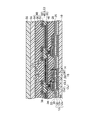
- FIG. 5 is a sectional view taken along line VV of the display device shown in FIG.
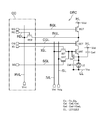
- VI-VI line sectional view of the display device shown in FIG. It is a figure which shows the detail of a drive circuit.
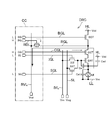
- It is a figure which shows the operation in the period 1 of FIG. It is a figure which shows the operation in the period 2 of FIG.
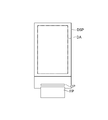
- FIG. 1 is a plan view of the display device according to the embodiment. Since the display device is actually used by being bent, FIG. 1 is a developed view before the display device is bent.
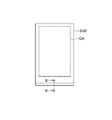
- FIG. 2 is a schematic view showing a usage state of the display device.
- FIG. 3 is a schematic view of a cross section taken along line III-III of the display device shown in FIG.
- the display device is, for example, an organic electroluminescence display device.
- the display device includes a display DSP.
- a spacer SP is arranged inside the bend to prevent the display DSP from bending too much.
- the display DSP is flexible and is folded outside the display area DA on which the image is displayed.
- the display DSP is equipped with an integrated circuit chip CP for driving an element for displaying an image.
- a flexible printed circuit board FP is connected to the display DSP outside the display area DA.
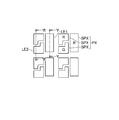
- FIG. 4 is a diagram showing a part of the display area shown in FIG.
- a full-color one-pixel PX is formed by combining a plurality of sub-pixel SPXs (sub-pixels) whose emission colors are red R, green G, and blue B, and a full-color image is produced by the plurality of pixel PXs. Is displayed. Since the sensitivity of the human eye is lower than that of blue B, the sub-pixel SPX of blue B is the largest.
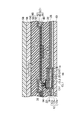
- FIG. 5 is a sectional view taken along line VV of the display device shown in FIG. Specifically, it is sectional drawing of the sub-pixel SPX whose emission color is blue B.
- the substrate 10 is made of polyimide. However, other resin materials may be used as long as the base material has sufficient flexibility to form a sheet display or a flexible display.
- a barrier inorganic film 12 (undercoat layer) is laminated on the substrate 10.
- the barrier inorganic film 12 has a three-layer laminated structure of a silicon oxide film 12a, a silicon nitride film 12b, and a silicon oxide film 12c.
- the silicon nitride film 12b of the middle layer is a blocking film of moisture and impurities from the outside, and the silicon oxide film 12c of the uppermost layer is a silicon nitride film.
- Each of them is provided as a block film for preventing the hydrogen atom contained in 12b from diffusing on the semiconductor layer 16 side of the thin film transistor DRT, but the structure is not particularly limited, and further lamination may be performed, or simply. It may be a layer or a two-layer laminate.
- the functional film 14 may be formed according to the location where the thin film transistor DRT is formed.
- the functional film 14 suppresses changes in the characteristics of the thin film transistor DRT due to intrusion of light from the back surface of the channel, or is formed of a conductive material to give a predetermined potential to give the thin film transistor DRT a back gate effect. Can be done.
- the functional film 14 is formed in an island shape according to the location where the thin film transistor DRT is formed, and then the silicon nitride film 12b and the silicon oxide film 12c are laminated to form a barrier inorganic film.
- the functional film 14 is formed so as to be enclosed in the film 12, but the present invention is not limited to this, and the functional film 14 may be first formed on the substrate 10 and then the barrier inorganic film 12 may be formed.
- a thin film transistor DRT is formed on the barrier inorganic film 12. Taking a polysilicon thin film transistor as an example, only the Nch transistor is shown here, but the Pch transistor may be formed at the same time.
- the semiconductor layer 16 of the thin film transistor DRT adopts a structure in which a low-concentration impurity region is provided between a channel region and a source / drain region.
- a silicon oxide film is used here as the gate insulating film 18.
- the gate electrode 20 is a part of the first wiring layer W1 formed of MoW.
- the first wiring layer W1 has a first holding capacitance line CL1 in addition to the gate electrode 20.
- a part of the holding capacitor Cs is formed between the first holding capacitance line CL1 and the semiconductor layer 16 (source / drain region) via the gate insulating film 18.
- An interlayer insulating film 22 (silicon oxide film and silicon nitride film) is laminated on the gate electrode 20.
- a second wiring layer W2 including a portion serving as a source / drain electrode 24 is formed on the interlayer insulating film 22.
- a three-layer laminated structure of Ti, Al and Ti is adopted.
- the first holding capacitance line CL1 (a part of the first wiring layer W1) and the second holding capacitance line CL2 (a part of the second wiring layer W2) pass through the interlayer insulating film 22, and the other holding capacitors Cs. Part is formed.
- a passivation film 26 is formed on the interlayer insulating film 22 so as to cover the second wiring layer W2 (source / drain electrode 24).
- a flattening organic film 28 is provided on the passivation film 26. Since the flattening organic film 28 is superior in surface flatness as compared with an inorganic insulating material formed by CVD (Chemical Vapor Deposition) or the like, a resin such as photosensitive acrylic is used.
- the flattened organic film 28 and the passivation film 26 are removed at the pixel contact portion 30, and an indium tin oxide (ITO) film 32 is formed on the flattened organic film 28 and the passivation film 26.
- the indium tin oxide film 32 includes a first transparent conductive film 32a and a second transparent conductive film 32b separated from each other.
- the second wiring layer W2 whose surfaces are exposed by removing the flattening organic film 28 and the passivation film 26 is covered with the first transparent conductive film 32a.
- a silicon nitride film 34 is provided on the flattening organic film 28 so as to cover the first transparent conductive film 32a.
- the silicon nitride film 34 has an opening in the pixel contact portion 30, and the pixel electrode 36 is laminated so as to conduct electricity to the source / drain electrode 24 through the opening.
- the pixel electrode 36 is formed as a reflective electrode and has a three-layer laminated structure of an indium zinc oxide film, an Ag film, and an indium zinc oxide film.
- an indium tin oxide film may be used instead of the indium zinc oxide film.
- the pixel electrode 36 extends laterally from the pixel contact portion 30 and reaches above the thin film transistor DRT.
- the second transparent conductive film 32b is provided adjacent to the pixel contact portion 30 and below the pixel electrode 36 (further below the silicon nitride film 34).
- the second transparent conductive film 32b, the silicon nitride film 34, and the pixel electrode 36 overlap each other, whereby the first addition capacitor Cad1 is formed.
- the first addition capacitor Cad1 has a first counter electrode 46A facing the pixel electrode 36.
- a bank rib
- photosensitive acrylic or the like is used as in the flattened organic film 28. It is preferable that the insulating organic film 38 is opened so as to expose the surface of the pixel electrode 36 as a light emitting region, and the open end thereof has a gently tapered shape. If the open end has a steep shape, the coverage of the organic electroluminescence layer 40 formed on the open end is poor.
- the flattening organic film 28 and the insulating organic film 38 are in contact with each other through an opening provided in the silicon nitride film 34 between them. As a result, moisture and degassing desorbed from the flattening organic film 28 can be extracted through the insulating organic film 38 through heat treatment or the like after the formation of the insulating organic film 38.
- An organic electroluminescence layer 40 made of an organic material is laminated on the pixel electrode 36.
- the organic electroluminescence layer 40 may be a single layer, but may have a structure in which a hole transport layer, a light emitting layer, and an electron transport layer are laminated in this order from the pixel electrode 36 side. These layers may be formed by thin film deposition.
- a common electrode 42 is provided on the organic electroluminescence layer 40.
- the common electrode 42 is transparent.
- the Mg layer and the Ag layer are formed as a thin film to which the emitted light from the organic electroluminescence layer 40 is transmitted.
- the pixel electrode 36 serves as an anode and the common electrode 42 serves as a cathode.
- the first light emitting element LE1 is composed of a plurality of pixel electrodes 36, a common electrode 42, and an organic electroluminescence layer 40 interposed between the central portion of each of the plurality of pixel electrodes 36 and the common electrode 42.
- the first light emitting element LE1 constitutes the first element capacitor Cel1.
- a sealing layer 48 covering the first light emitting element LE1 is formed on the common electrode 42.
- the sealing layer 48 has one of the functions of preventing the invasion of moisture from the outside of the previously formed organic electroluminescence layer 40, and is required to have a high gas barrier property.
- the sealing layer 48 has a laminated structure of an organic film 50, a first inorganic film 52 sandwiching the organic film 50, and a second inorganic film 54 (for example, a silicon nitride film).
- a resin layer 56 and a polarizing plate 58 (for example, a circular polarizing plate) are laminated on the sealing layer 48.
- FIG. 6 is a sectional view taken along line VI-VI of the display device shown in FIG. More specifically, it is a cross-sectional view of a sub-pixel SPX whose emission colors are red R and green G.
- the second light emitting element LE2 constitutes the second element capacitor Cel2.
- the first light emitting element LE1 shown in FIG. 5 has a larger light emitting region than the second light emitting element LE2 shown in FIG. 6 (see FIG. 4). Specifically, the pixel electrode 36 of the first light emitting element LE1 is larger than the pixel electrode 36 of the second light emitting element LE2.
- the pixel electrode 36 which is the one electrode 36A of the first addition capacitor Cad1 shown in FIG. 5, is larger than the pixel electrode 36, which is the one electrode 36B of the second addition capacitor Cad2 shown in FIG.
- the second addition capacitor Cad2 has a second counter electrode 46B facing the pixel electrode 36 (one electrode 36B).
- the first counter electrode 46A (FIG. 5) included in the first addition capacitor Cad1 is smaller than the second counter electrode 46B (FIG. 6) included in the second addition capacitor Cad2.
- Other configurations are the same as those shown in FIG.
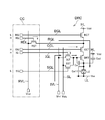
- FIG. 7 is a diagram showing details of the drive circuit.
- the plurality of light emitting elements LE includes a first light emitting element LE1 (FIG. 5) corresponding to one of the plurality of emission colors R, G, and B.
- the plurality of light emitting elements LE includes a second light emitting element LE2 (FIG. 6) corresponding to the other one of the plurality of emission colors R, G, and B.
- the display device has a plurality of light emitting elements LE provided in the sub-pixels SPX of the plurality of light emitting colors R, G, and B constituting each of the plurality of pixel PXs.
- the display device has a drive circuit DRC for driving each of the plurality of light emitting elements LE.
- the potential difference between the high-potential wiring HL and the low-potential wiring LL allows a current to flow through each of the plurality of light emitting elements LE.
- the flow and interruption of the current is switched by the current switching element BCT.
- a thin film transistor DRT is connected in series to the current switching element BCT to control the amount of current.
- the input and cutoff of the video signal Vsig to the gate of the thin film transistor DRT can be switched by the signal switching element SST.
- Holding capacitors Cs are interposed between one of the source and drain of the thin film transistor DRT and the gate.
- Each of the plurality of light emitting elements LE constitutes an element capacitor Cel.
- the element capacitor Cel is a capacitance attached between the anode (pixel electrode 36) and the cathode (common electrode 42) of the light emitting element LE.
- the drive circuit DRC for driving the first light emitting element LE1 shown in FIG. 5 includes the first element capacitor Cel1 as the element capacitor Cel.
- the drive circuit DRC for driving the second light emitting element LE2 shown in FIG. 6 includes the second element capacitor Cel2 as the element capacitor Cel.
- Each of the plurality of pixel electrodes 36 is shared as one electrode 36A and 36B of the element capacitor Cel and the addition capacitor Cad, respectively. On the other hand, since the electrode 36A is larger than the one electrode 36B, the capacitance of the first element capacitor Cel1 is larger than the capacitance of the second element capacitor Cel2.
- the drive circuit DRC includes an additional capacitor CAD interposed between one of the source and drain and one of the high potential wiring HL and the low potential wiring LL.
- the drive circuit DRC for driving the first light emitting element LE1 shown in FIG. 5 includes a first additional capacitor Cad1 as an additional capacitor Cad.
- the drive circuit DRC for driving the second light emitting element LE2 shown in FIG. 6 includes a second additional capacitor Cad2 as an additional capacitor Cad.
- the capacitance of the first addition capacitor Cad1 is smaller than the capacitance of the second addition capacitor Cad2.
- the total capacitance of the first element capacitor Cel1 and the capacitance of the first additional capacitor Cad1 is equal to the total capacitance of the second element capacitor Cel2 and the capacitance of the second additional capacitor Cad2.
- the first light emitting element LE1 shown in FIG. 5 has a larger capacitance of the first element capacitor Cel1 due to the larger light emitting region than the second light emitting element LE2 shown in FIG. 1
- the capacity of the additional capacitor Cad1 is small.
- Signals BG, CG, IG, and SG are output from the control circuit CC to the optical control line BGL, the correction control line CGL, the initialization control line IGL, and the write control line SGL, respectively.
- the drive circuit DRC is provided with a current switching element BCT, a correction transistor CCT, an initialization transistor IST, a signal switching element SST, and a thin film transistor DRT. At least one of these transistors may be shared between adjacent drive circuit DRCs. Retention capacitors Cs are provided between the gate and source of the thin film transistor DRT.
- the current switching element BCT, the correction transistor CCT, the initialization transistor IST, and the signal switching element SST function as switching elements for selecting conduction or non-conduction between two nodes.
- the thin film transistor DRT functions as a current control element that controls the current value flowing through the light emitting element LE according to the gate-source voltage.
- the transistor used may be an N-type transistor or a P-type transistor. When a P-type transistor is used, it is advisable to appropriately match the connection of the power supply potential and the holding capacitance.
- the anode of the light emitting element LE is connected to the high potential wiring HL of high potential (power supply voltage Vdd) via the current switching element BCT, the correction transistor CCT, and the thin film transistor DRT.
- the cathode is connected to the low potential wiring LL having a low potential (power supply voltage Vss).
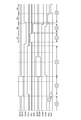
- FIG. 8 is a diagram showing a timing chart of the control circuit CC for driving the drive circuit DRC.
- the signals RG, BG, CG, and IG are input to the drive circuit DRC group arranged in two lines at the same time, and the two-digit numbers attached after the codes RG, BG, CG, and IG are respectively. Indicates the line number to which the signal of is input.
- the one-digit number added after the code SG indicates the line number to which the signal is input.
- Each section represented by the reference numerals G1 to G4 has one horizontal period, and although omitted thereafter, the same timing relationship continues until the last line. In FIG. 8, the periods 0 to 6 will be described in detail below.
- the light emitting element LE continues the light emitting state of the previous frame until the processing in a certain frame period is started (period 0).
- FIG. 9 is a diagram showing the operation in the period 1 of FIG. In this period, the signal BG becomes the L level, the signal CG becomes the H level, the signal RG becomes the H level, the current switching element BCT is turned off, and the correction transistor CCT is turned on. The signal RG becomes H level, and the reset transistor RST is turned on via the reset drive line RDL.
- One reset transistor RST is provided outside the display area DA, for example, in each row. The current from the power supply voltage Vdd is cut off by the current switching element BCT, and the light emitting of the light emitting element LE is stopped.
- the electric charge remaining on the anode side of the light emitting element LE is drawn out to the reset potential line RVL through the reset transistor RST via the reset control line RGL.
- the source of the thin film transistor DRT is fixed at the reset potential Vrst.
- the reset potential Vrst is set to a potential lower than the emission start voltage of the light emitting element LE with respect to the power supply voltage Vss.
- FIG. 10 is a diagram showing the operation in the period 2 of FIG. In this period, the signal IG becomes H level and the initialization transistor IST is turned on. As a result, the gate of the thin film transistor DRT is fixed to the initialization potential Vini via the initialization potential line IVL.
- the initialization potential Vini is set to a potential larger than the threshold value Vth of the thin film transistor DRT with respect to the reset potential Vrst. That is, by this operation, the thin film transistor DRT is turned on. However, since the current switching element BCT is off, no current flows through the thin film transistor DRT yet.
- FIG. 11 is a diagram showing the operation in the period 3 of FIG. In this period, the signal BG becomes the H level, the signal RG becomes the L level, the current switching element BCT turns on, and the reset transistor RST turns off. Since the thin film transistor DRT is turned on by the previous operation, a current is supplied to the thin film transistor DRT from the power supply voltage Vdd through the current switching element BCT and the correction transistor CCT.
- the source of the thin film transistor DRT is charged by the current supplied from the power supply voltage Vdd, and its potential rises.
- the thin film transistor DRT since the gate potential of the thin film transistor DRT is the initialization potential Vini, the thin film transistor DRT is turned off when the source potential of the thin film transistor DRT becomes (Vini-Vth), and the rise of the source potential stops.
- the threshold voltage Vth of the thin film transistor DRT varies depending on the drive circuit DRC
- the potential of the source of the thin film transistor DRT when the increase in potential is stopped differs depending on the drive circuit DRC. That is, by this operation, a voltage corresponding to the threshold voltage Vth of the thin film transistor DRT is acquired between the source and the gate in each drive circuit DRC.
- the operations from the source initialization (period 1) to the offset cancellation (period 3) of the thin film transistor DRT are performed in parallel for the drive circuit DRC group for two lines.
- FIG. 12 is a diagram showing the operation during the periods 4 and 5 of FIG. In this period, the signal CG becomes L level, the signal IG becomes L level, the signal SG becomes H level, the correction transistor CCT is turned off, the initialization transistor IST is turned off, and the signal switching element SST is turned on.
- the video signal Vsig is input to the gate of the thin film transistor DRT, and the gate potential of the thin film transistor DRT changes from the initialization potential Vini to the video signal Vsig. That is, the video signal Vsig is written to the gate of the thin film transistor DRT.
- the source potential of the thin film transistor DRT becomes a potential (Vini-Vth) corresponding to the value of the threshold voltage Vth. Therefore, a write of the same video signal Vsig, the gate-source voltage V GS of the TFT DRT becomes to reflect the variation in the threshold voltage Vth ⁇ Vsig- (Vini-Vth) ⁇ . That is, even if there is a variation in the threshold voltage Vth between the drive circuits DRC, it is possible to perform writing corrected accordingly.
- the first line is written, and in period 5, the second line is written.
- the even-numbered lines are written.
- the signal switching element SST is turned off at odd-numbered lines to enter a "waiting" state. Since the video signal line SL sharing the video signal Vsig is common to the drive circuits DRC of a plurality of lines belonging to the same column, the video signal writing operation is sequentially performed line by line.
- FIG. 13 is a diagram showing the operation in the period 6 of FIG. In this period, the signal CG becomes H level, the signal SG becomes L level, the correction transistor CCT is turned on, and the signal switching element SST is turned off. A current is supplied from the power supply voltage Vdd to the thin film transistor DRT through the current switching element BCT and the correction transistor CCT.
- the thin film transistor DRT causes a current corresponding to the gate-source voltage V GS set up to the previous step to flow through the light emitting element LE, and the light emitting element LE emits light with brightness corresponding to the current. Since the voltage between the anode and the cathode of the light emitting element LE at this time becomes a voltage corresponding to the current, the potential on the anode side rises, and the holding capacitor Cs holds the voltage between the gate and the source of the thin film transistor DRT. The gate potential of the thin film transistor DRT also rises due to the coupling of the holding capacitors Cs.
- the increase in the gate potential of the thin film transistor DRT is larger than the increase in the potential on the anode side. Slightly smaller. Since this value is known, the potential of the video signal Vsig may be determined so as to obtain a desired current value at the gate-source voltage of the final thin film transistor DRT.
- the present invention is not limited to the above-described embodiment, and various modifications are possible.
- the configurations described in the embodiments can be replaced with substantially the same configurations, configurations that exhibit the same effects, or configurations that can achieve the same objectives.
Landscapes
- Engineering & Computer Science (AREA)
- Physics & Mathematics (AREA)
- General Physics & Mathematics (AREA)
- Theoretical Computer Science (AREA)
- Computer Hardware Design (AREA)
- Geometry (AREA)
- Microelectronics & Electronic Packaging (AREA)
- Electroluminescent Light Sources (AREA)
- Control Of Indicators Other Than Cathode Ray Tubes (AREA)
- Control Of El Displays (AREA)
- Devices For Indicating Variable Information By Combining Individual Elements (AREA)
Priority Applications (1)
| Application Number | Priority Date | Filing Date | Title |
|---|---|---|---|
| US17/474,228 US12004402B2 (en) | 2019-03-22 | 2021-09-14 | Display device |
Applications Claiming Priority (2)
| Application Number | Priority Date | Filing Date | Title |
|---|---|---|---|
| JP2019-054605 | 2019-03-22 | ||
| JP2019054605A JP7372749B2 (ja) | 2019-03-22 | 2019-03-22 | 表示装置 |
Related Child Applications (1)
| Application Number | Title | Priority Date | Filing Date |
|---|---|---|---|
| US17/474,228 Continuation US12004402B2 (en) | 2019-03-22 | 2021-09-14 | Display device |
Publications (1)
| Publication Number | Publication Date |
|---|---|
| WO2020194932A1 true WO2020194932A1 (ja) | 2020-10-01 |
Family
ID=72558864
Family Applications (1)
| Application Number | Title | Priority Date | Filing Date |
|---|---|---|---|
| PCT/JP2019/049828 Ceased WO2020194932A1 (ja) | 2019-03-22 | 2019-12-19 | 表示装置 |
Country Status (3)
| Country | Link |
|---|---|
| US (1) | US12004402B2 (enExample) |
| JP (1) | JP7372749B2 (enExample) |
| WO (1) | WO2020194932A1 (enExample) |
Families Citing this family (8)
| Publication number | Priority date | Publication date | Assignee | Title |
|---|---|---|---|---|
| JP2019103690A (ja) * | 2017-12-14 | 2019-06-27 | 株式会社三洋物産 | 遊技機 |
| JP2019103692A (ja) * | 2017-12-14 | 2019-06-27 | 株式会社三洋物産 | 遊技機 |
| JP2019103691A (ja) * | 2017-12-14 | 2019-06-27 | 株式会社三洋物産 | 遊技機 |
| JP2019103693A (ja) * | 2017-12-14 | 2019-06-27 | 株式会社三洋物産 | 遊技機 |
| JP2019103689A (ja) * | 2017-12-14 | 2019-06-27 | 株式会社三洋物産 | 遊技機 |
| JP7114893B2 (ja) * | 2017-12-14 | 2022-08-09 | 株式会社三洋物産 | 遊技機 |
| JP2020195816A (ja) * | 2020-09-01 | 2020-12-10 | 株式会社三洋物産 | 遊技機 |
| KR102884569B1 (ko) * | 2021-12-09 | 2025-11-12 | 삼성디스플레이 주식회사 | 화소 회로 및 이를 포함하는 표시 장치 |
Citations (5)
| Publication number | Priority date | Publication date | Assignee | Title |
|---|---|---|---|---|
| JP2008083084A (ja) * | 2006-09-25 | 2008-04-10 | Sony Corp | 画素回路及び表示装置 |
| JP2008249919A (ja) * | 2007-03-30 | 2008-10-16 | Sony Corp | 表示装置及び電子機器 |
| JP2017053899A (ja) * | 2015-09-07 | 2017-03-16 | 株式会社ジャパンディスプレイ | 表示装置 |
| US20190088200A1 (en) * | 2017-09-21 | 2019-03-21 | Samsung Display Co., Ltd. | Display device |
| JP2019160596A (ja) * | 2018-03-14 | 2019-09-19 | 株式会社ジャパンディスプレイ | 表示装置、および表示装置の製造方法 |
Family Cites Families (1)
| Publication number | Priority date | Publication date | Assignee | Title |
|---|---|---|---|---|
| JP2019016504A (ja) * | 2017-07-06 | 2019-01-31 | 株式会社ジャパンディスプレイ | 表示装置、及び表示装置の製造方法 |
-
2019
- 2019-03-22 JP JP2019054605A patent/JP7372749B2/ja active Active
- 2019-12-19 WO PCT/JP2019/049828 patent/WO2020194932A1/ja not_active Ceased
-
2021
- 2021-09-14 US US17/474,228 patent/US12004402B2/en active Active
Patent Citations (5)
| Publication number | Priority date | Publication date | Assignee | Title |
|---|---|---|---|---|
| JP2008083084A (ja) * | 2006-09-25 | 2008-04-10 | Sony Corp | 画素回路及び表示装置 |
| JP2008249919A (ja) * | 2007-03-30 | 2008-10-16 | Sony Corp | 表示装置及び電子機器 |
| JP2017053899A (ja) * | 2015-09-07 | 2017-03-16 | 株式会社ジャパンディスプレイ | 表示装置 |
| US20190088200A1 (en) * | 2017-09-21 | 2019-03-21 | Samsung Display Co., Ltd. | Display device |
| JP2019160596A (ja) * | 2018-03-14 | 2019-09-19 | 株式会社ジャパンディスプレイ | 表示装置、および表示装置の製造方法 |
Also Published As
| Publication number | Publication date |
|---|---|
| JP2020154215A (ja) | 2020-09-24 |
| JP7372749B2 (ja) | 2023-11-01 |
| US12004402B2 (en) | 2024-06-04 |
| US20210408165A1 (en) | 2021-12-30 |
Similar Documents
| Publication | Publication Date | Title |
|---|---|---|
| JP7372749B2 (ja) | 表示装置 | |
| US11296172B2 (en) | Semiconductor device | |
| CN107527590B (zh) | 显示装置 | |
| US11678555B2 (en) | Display device having transmissive area | |
| US10637008B2 (en) | Display device | |
| JP7276131B2 (ja) | 表示装置、表示装置の製造方法、及び、電子機器 | |
| US11903285B2 (en) | Display device and electronic device with peripheral connection to cathode electrode | |
| CN111326673B (zh) | 显示装置 | |
| CN113793861A (zh) | 显示装置 | |
| JP2005005227A (ja) | 有機el発光表示装置 | |
| TWI756731B (zh) | 顯示裝置 | |
| KR20170026900A (ko) | 유기발광 표시장치 | |
| CN107452750A (zh) | 显示装置 | |
| US11810491B2 (en) | TFT substrate including a non-rectangular active region | |
| KR102537442B1 (ko) | 표시 장치 | |
| US7355220B2 (en) | Array substrate | |
| US20250098418A1 (en) | Display device | |
| KR102798534B1 (ko) | 표시 장치 및 표시 장치의 제조 방법 | |
| JP2007003792A (ja) | 表示装置及びアレイ基板 |
Legal Events
| Date | Code | Title | Description |
|---|---|---|---|
| 121 | Ep: the epo has been informed by wipo that ep was designated in this application |
Ref document number: 19921242 Country of ref document: EP Kind code of ref document: A1 |
|
| NENP | Non-entry into the national phase |
Ref country code: DE |
|
| 122 | Ep: pct application non-entry in european phase |
Ref document number: 19921242 Country of ref document: EP Kind code of ref document: A1 |