WO2020189454A1 - ポリウレタンフォーム、その製造方法及び車両用防音材 - Google Patents
ポリウレタンフォーム、その製造方法及び車両用防音材 Download PDFInfo
- Publication number
- WO2020189454A1 WO2020189454A1 PCT/JP2020/010639 JP2020010639W WO2020189454A1 WO 2020189454 A1 WO2020189454 A1 WO 2020189454A1 JP 2020010639 W JP2020010639 W JP 2020010639W WO 2020189454 A1 WO2020189454 A1 WO 2020189454A1
- Authority
- WO
- WIPO (PCT)
- Prior art keywords
- polyurethane foam
- mass
- producing
- sound absorption
- raw material
- Prior art date
- Legal status (The legal status is an assumption and is not a legal conclusion. Google has not performed a legal analysis and makes no representation as to the accuracy of the status listed.)
- Ceased
Links
Classifications
-
- C—CHEMISTRY; METALLURGY
- C08—ORGANIC MACROMOLECULAR COMPOUNDS; THEIR PREPARATION OR CHEMICAL WORKING-UP; COMPOSITIONS BASED THEREON
- C08G—MACROMOLECULAR COMPOUNDS OBTAINED OTHERWISE THAN BY REACTIONS ONLY INVOLVING UNSATURATED CARBON-TO-CARBON BONDS
- C08G18/00—Polymeric products of isocyanates or isothiocyanates
-
- C—CHEMISTRY; METALLURGY
- C08—ORGANIC MACROMOLECULAR COMPOUNDS; THEIR PREPARATION OR CHEMICAL WORKING-UP; COMPOSITIONS BASED THEREON
- C08G—MACROMOLECULAR COMPOUNDS OBTAINED OTHERWISE THAN BY REACTIONS ONLY INVOLVING UNSATURATED CARBON-TO-CARBON BONDS
- C08G18/00—Polymeric products of isocyanates or isothiocyanates
- C08G18/06—Polymeric products of isocyanates or isothiocyanates with compounds having active hydrogen
- C08G18/08—Processes
- C08G18/16—Catalysts
- C08G18/18—Catalysts containing secondary or tertiary amines or salts thereof
-
- C—CHEMISTRY; METALLURGY
- C08—ORGANIC MACROMOLECULAR COMPOUNDS; THEIR PREPARATION OR CHEMICAL WORKING-UP; COMPOSITIONS BASED THEREON
- C08G—MACROMOLECULAR COMPOUNDS OBTAINED OTHERWISE THAN BY REACTIONS ONLY INVOLVING UNSATURATED CARBON-TO-CARBON BONDS
- C08G18/00—Polymeric products of isocyanates or isothiocyanates
- C08G18/06—Polymeric products of isocyanates or isothiocyanates with compounds having active hydrogen
- C08G18/08—Processes
- C08G18/16—Catalysts
- C08G18/22—Catalysts containing metal compounds
- C08G18/24—Catalysts containing metal compounds of tin
-
- C—CHEMISTRY; METALLURGY
- C08—ORGANIC MACROMOLECULAR COMPOUNDS; THEIR PREPARATION OR CHEMICAL WORKING-UP; COMPOSITIONS BASED THEREON
- C08G—MACROMOLECULAR COMPOUNDS OBTAINED OTHERWISE THAN BY REACTIONS ONLY INVOLVING UNSATURATED CARBON-TO-CARBON BONDS
- C08G18/00—Polymeric products of isocyanates or isothiocyanates
- C08G18/06—Polymeric products of isocyanates or isothiocyanates with compounds having active hydrogen
- C08G18/28—Polymeric products of isocyanates or isothiocyanates with compounds having active hydrogen characterised by the compounds used containing active hydrogen
- C08G18/40—High-molecular-weight compounds
- C08G18/48—Polyethers
Definitions
- the present invention relates to polyurethane foam, a method for producing the same, and a soundproofing material for vehicles.
- Vehicles such as automobiles are equipped with soundproofing materials for the purpose of suppressing noise and vibration from the motor, engine or outside the vehicle.
- a non-woven fabric of polyester fiber or polyolefin fiber or polyurethane foam is used as the soundproofing material.
- Polyurethane foam is cheaper than polyester fiber and polyolefin fiber, but has been used as a composite with a sheet of rubber, thermoplastic elastomer, or thermoplastic resin because it alone lacks sound absorption performance in the low frequency region. ..
- the composite of polyurethane foam and other materials has problems such as an increase in manufacturing cost and an increase in mass.
- Patent Document 1 describes a polyurethane foam produced by foaming in a closed mold using a raw material composition containing a high molecular weight polyoxyalkylene polyol, an organic polyisocyanate compound, a foaming agent and a catalyst.
- Patent Document 1 describes that a polyurethane foam having a density of 60 to 120 kg / m 3 is preferable, and in Examples, a polyurethane foam having a density of 81.1 to 104 kg / m 3 is disclosed.
- Patent Document 2 describes a sound absorbing body having a porous inner main body and a dense skin formed on the surface of the inner main body, wherein the density of the inner main body is 45 to 75 kg / m 3. Has been done.
- the polyurethane foam described in Patent Document 1 does not have sufficient sound absorption coefficient in the middle to high frequency bands of 3000 to 4000 Hz and has a high density. Therefore, there is a limit to weight reduction in order to obtain sufficient sound absorption performance. It was.
- the sound absorbing body described in Patent Document 2 also has an insufficient sound absorbing coefficient in the middle to high frequency band of 3000 to 4000 Hz and has a high density. Therefore, there is a limit to weight reduction in order to obtain sufficient sound absorbing performance. It was.
- the present invention has been made in view of the above circumstances, has a good sound absorption coefficient in the middle to high frequency band of 3000 to 4000 Hz, can be reduced in weight while maintaining sound absorption performance equal to or higher than the conventional one, and is not used in combination with other materials.
- a polyurethane foam that can be used as a soundproofing material for vehicles, a method for producing the same, and a soundproofing material for vehicles.
- the problem is solved by the following configuration.
- the sound absorption coefficient in the entire frequency range of 3000 to 4000 Hz is 0.95 or more, the density is 5 to 25 kg / m 3 , and the residual film ratio of the foam cell.
- the value obtained by dividing the average skeleton diameter of the foam cell by the average cell diameter is 0.10 to 0.25, and the average cell diameter of the foam cell is 50 to 400 ⁇ m, according to [1].
- Polyurethane foam. [3] The polyurethane foam according to [1] or [2], which has a thickness of 3 to 50 mm.
- the polyoxyalkylene polyol contains a trifunctional polyoxyalkylene polyol.
- the foaming agent contains water
- the catalyst is at least one selected from the group consisting of amine-based catalysts and tin-based catalysts.
- a method for producing a polyurethane foam which comprises 4 parts by mass or more of water as a foaming agent with respect to 100 parts by mass of the polyoxyalkylene polyol.
- the organic polyisocyanate compound comprises a group consisting of aromatic polyisocyanates having two or more isocyanate groups, alicyclic polyisocyanates, aliphatic polyisocyanates, and modified polyisocyanates obtained by modifying these.
- the raw material composition further contains a hydrocarbon compound having a boiling point of 70 ° C. or lower and a carbon number of 8 or less as the foaming agent, and a part of hydrogen atoms bonded to carbon atoms of the hydrocarbon compound is The method for producing a polyurethane foam according to any one of [5] to [8], which comprises a saturated hydrocarbon which may be substituted with a halogen atom.
- the sound absorption coefficient in the middle to high frequency band of 3000 to 4000 Hz is good, the weight can be reduced while maintaining the sound absorption performance equal to or higher than the conventional one, and the soundproof material for vehicles is not used in combination with other materials.
- Polyurethane foam, a method for producing the same, and a soundproofing material for vehicles can be provided.
- the polyurethane foam of the present invention has a sound absorption coefficient of 0.95 or more in the entire frequency range of 3000 to 4000 Hz, a density of 5 to 25 kg / m 3 , and a foam cell in the sound absorption coefficient measurement method by the vertical incident method. It is a polyurethane foam having a residual film ratio of 40% or more and less than 94%.
- the sound absorption coefficient of the polyurethane foam of the present invention is 0.95 or more, preferably 0.95 to 1, and more preferably 0.96 to 1 in the entire frequency range of 3000 to 4000 Hz.
- the polyurethane foam of the present invention is excellent in sound absorption performance in the middle to high frequency range of 3000 to 4000 Hz.
- the polyurethane foam having a sound absorption coefficient within this range is suitable for use as a soundproofing material for vehicles. In particular, when the installation site is a narrowed portion, it will be used in a thin state, and the advantages of the polyurethane foam of the present invention will be utilized.
- a measurement sample having a thickness of 20 mm (hereinafter, may be simply referred to as a "measurement sample") obtained by cutting polyurethane foam with a sharp blade is used as JIS A 1405-2: 2007 "acoustic tube”. It is a sound absorption coefficient obtained by measuring the entire range of 3000 to 4000 Hz by a method based on "Measurement of sound absorption coefficient and impedance by”.
- the density of the polyurethane foam of the present invention is 5 ⁇ 25kg / m 3, preferably from 5 ⁇ 20kg / m 3, more preferably 5 ⁇ 15kg / m 3.
- the polyurethane foam of the present invention can be reduced in weight while maintaining the sound absorbing performance equal to or higher than the conventional one.
- recent vehicle soundproofing materials are strongly required to be lightweight, and the advantages of the polyurethane foam of the present invention can be utilized. It can also be used in parts where it is difficult to support a large weight, such as vehicle ceiling materials.
- the density is a density (unit: kg / m 3 ) measured according to JIS K 7222: 2005 “Foam plastics and rubber-How to obtain apparent density”.
- the residual film ratio of the foamed cell in the polyurethane foam of the present invention is 40% or more and less than 94%, preferably 40 to 90%, more preferably 50 to 85%, still more preferably 60 to 85%.
- the polyurethane foam of the present invention is excellent in sound absorption performance in the middle to high frequency range of 3000 to 4000 Hz. Further, when the residual film ratio is within this range, shrinkage is less likely to occur during molding of the polyurethane foam, and molding is easy.
- the residual film ratio of the foamed cell is calculated by the method described below.
- the cross section of the measurement sample is imaged using an optical microscope. The part where the cell skeleton can be confirmed over the entire circumference and there is no clear destruction of the peripheral skeleton is to be observed. If there is an undamaged film on the inner circumference of the cell skeleton to be observed, it is determined that there is a residual film. If there is no membrane on the inner circumference of the cell skeleton to be observed, or if the membrane is partially torn, it is judged as "no residual membrane".
- the cross section of the measurement sample is imaged at 10 or more places, 100 cell skeletons are observed, the number of "with residual film” and "without residual film” is counted, and the ratio of "with residual film” is a percentage. calculate.
- the average cell diameter of the foamed cell of the polyurethane foam of the present invention is not particularly limited, but is preferably 50 to 400 ⁇ m, more preferably 50 to 350 ⁇ m, and even more preferably 100 to 300 ⁇ m. When the average cell diameter of the foamed cell is within this range, the polyurethane foam of the present invention is excellent in sound absorption performance in the middle to high frequency range of 3000 to 4000 Hz.
- the average cell diameter of the foamed cell is calculated by the method described below.
- the cross section of the measurement sample is imaged using an optical microscope.
- the part where the cell skeleton can be confirmed over the entire circumference is the observation target.
- the contour of the inner circumference of the cell to be observed is extracted using image processing software, and the area surrounded by the contour is calculated.
- the diameter of a circle (circle-equivalent diameter) having an area equal to the calculated area is calculated and used as the cell diameter of one cell.
- the cross section of the measurement sample is imaged at 10 or more places, the cell diameters of 80 observation objects are measured, and the arithmetic mean thereof is taken as the average cell diameter of the foam cell of polyurethane foam.
- the value obtained by dividing the average skeleton diameter of the foamed cells of the polyurethane foam of the present invention by the average cell diameter is not particularly limited, but is preferably 0.10 to 0.25, more preferably 0.15 to 0.24. When the above value is within this range, the polyurethane foam of the present invention further improves the sound absorption performance in the middle to high frequency region of 3000 to 4000 Hz.
- the average skeleton diameter of the foam cell is calculated by the method described below.
- the cross section of the measurement sample is imaged using an optical microscope. The part where the boundary between the skeleton part, the cell part, and the membrane part can be clearly observed is the observation target.
- the diameter of the cell skeleton to be observed is measured using image processing software. For a skeleton with a constricted shape, the smallest diameter portion is the skeleton diameter of the skeleton portion.
- the cross section of the measurement sample is imaged at 10 or more places, the skeleton diameters of 70 observation objects are measured, and the arithmetic mean thereof is taken as the average skeleton diameter of the foam cell of polyurethane foam.
- the average cell diameter of the foamed cell is calculated by the method described above. The value is obtained by dividing the average skeleton diameter of the foam cells calculated by the above method by the average cell diameter of the foam cells calculated by the above method.
- the thickness of the polyurethane foam of the present invention is not particularly limited, but is preferably 3 to 50 mm, more preferably 3 to 35 mm, still more preferably 15 to 25 mm. When the thickness is at least the above lower limit value, good sound absorption performance can be exhibited. On the other hand, when the thickness is not more than the above upper limit value, the polyurethane foam of the present invention is easy to exhibit good sound absorption performance while being lightweight.
- the air volume of the polyurethane foam of the present invention is not particularly limited, but is preferably 5 to 50 L / min, more preferably 10 to 45 L / min, and even more preferably 15 to 35 L / min.
- the aeration amount is within this range, the residual film ratio of the foamed cell tends to be within a desired range, and the polyurethane foam of the present invention further improves the sound absorption performance in the middle to high frequency range of 3000 to 4000 Hz.
- the aeration amount is the aeration amount (unit: L / min) when a 26 mm thick sample is measured according to JIS K 6400-7: 2012 A method "Soft foam material-How to obtain physical properties".
- the method for producing a polyurethane foam of the present invention is a method for producing a polyurethane foam that is foamed using a raw material composition G containing a polyoxyalkylene polyol A, an organic polyisocyanate compound B, a foaming agent C, and a catalyst D.
- the raw material composition G contains a polyoxyalkylene polyol A, an organic polyisocyanate compound B, a foaming agent C and a catalyst D.
- the raw material composition G is usually prepared by mixing a polyol system liquid H containing a raw material other than the organic polyisocyanate compound B and an organic polyisocyanate compound B.
- Polyoxyalkylene polyol A Polyoxyalkylene polyol A (hereinafter sometimes referred to as "polyxate A”) is usually synthesized by ring-opening addition polymerization of alkylene oxide as an initiator in the presence of a catalyst.
- the polyol A contains a trifunctional polyoxyalkylene polyol, that is, a polyoxyalkylene polyol having three hydroxyl groups in one molecule.
- the polyoxyalkylene polyol other than the trifunctional polyoxyalkylene polyol is not particularly limited, and is, for example, a bifunctional or tetrafunctional or higher functional polyoxyalkylene polyol.
- the number of hydroxyl groups per molecule of polyol A (hereinafter, may be referred to as "average number of hydroxyl groups") is not particularly limited as long as it is 2 or more, but 2 to 8 is preferable, 2 to 4 is more preferable, and 2.2 to 2 to 4 is more preferable. 3.9 is more preferable, and 2.4 to 3.7 is even more preferable.
- the number of hydroxyl groups in one molecule of the polyoxyalkylene polyol is the same as the number of active hydrogen-containing groups of the initiator used in the synthesis of the polyoxyalkylene polyol.
- the number average molecular weight of polyol A is not particularly limited, but is preferably 1000 to 20000, more preferably 1000 to 16000, and even more preferably 1500 to 12000. When the molecular weight is within this range, it is easy to set the residual film ratio of the foamed cell in the polyurethane foam in an appropriate range, and it is easy to improve the sound absorption performance in the middle to high frequency region of 3000 to 4000 Hz.
- the number average molecular weight per hydroxyl group of polyol A (hereinafter, may be referred to as "molecular weight / number of hydroxyl groups”) is not particularly limited, but is usually 500 or more, preferably 500 to 5000, and more preferably 1000 to 3500. preferable. When the molecular weight / number of hydroxyl groups is within this range, the polyurethane foam is less likely to shrink and the elasticity becomes better.
- a polyoxyalkylene polyol having a molecular weight / number of hydroxyl groups of less than 500 is usually classified as a cross-linking agent F described later.
- the initiator used in the production of polyol A is preferably a compound having 2 to 8 active hydrogen-containing groups in one molecule.
- a 2- to 8-valent polyhydric alcohol, a polyhydric phenol or an amine is preferable.
- the divalent to octavalent polyhydric alcohols include ethylene glycol, propylene glycol, 1,4-butanediol, neopentyl glycol, dipropylene glycol, glycerin, trimethylolpropane, pentaerythritol, diglycerin, and meso-erythritol.
- Methylglucoside glucose, dextrose, sorbitol or sucrose, but not limited to these.
- polyhydric phenol include, but are not limited to, bisphenol A, bisphenol F, pyrogallol or hydroquinone.
- amine include polyamines such as ethylenediamine, diethylenediamine, diaminodiphenylmethane, hexamethylenediamine and propylenediamine, and condensation compounds obtained by condensing the polyamine with a phenol resin or a novolak resin. Not limited to.
- the polyhydric alcohol, the polyhydric phenol, or a low molecular weight polyether polyol having a hydroxyl group at the terminal of the molecular chain obtained by ring-opening addition polymerization of a small amount of alkylene oxide to the amine can also be used as an initiator.
- the molecular weight per hydroxyl group of such a low molecular weight polyether polyol is usually 1200 or less, preferably 200 to 500, and more preferably 200 to 350.
- a compound having 2 to 4 hydroxyl groups in one molecule is more preferable, and a dihydric to tetravalent polyhydric alcohol or a 2 to 4 valent low molecular weight polyether polyol is preferable.
- a polyol produced by using a trihydric or higher-valent polyhydric alcohol or a low molecular weight polyether polyol as an initiator has a better balance of soundproofing performance, foaming stability and physical properties of polyurethane foam.
- one type may be used alone, or two or more types may be used in combination.
- the alkylene oxide is not particularly limited, but one or more selected from ethylene oxide, propylene oxide, butylene oxide and styrene oxide is preferable, and one or more selected from ethylene oxide and propylene oxide are more preferable.
- the content of the unit derived from ethylene oxide (hereinafter, may be referred to as “EO content”) in the polyoxyalkylene chain of polyol A is not particularly limited, but is 0 to 20 mass of the total mass of the polyoxyalkylene chain. % Is preferable, and 0 to 15% by mass is more preferable.
- the EO content is within this range, the hydrophilicity of the polyoxyalkylene chain becomes more preferable, and the residual film ratio of the foamed cell in the obtained polyurethane foam tends to be within a more appropriate range.
- a conventionally used catalyst is used as a catalyst for ring-opening addition polymerization of alkylene oxide as an initiator.
- catalysts include, but are not limited to, potassium hydroxide, sodium hydroxide, cesium hydroxide, phosphazenium compounds, boron trifloride compounds or complex metal cyanide complexes.
- the polyol A may contain polymer fine particles dispersed in the polyol A.
- the polymer fine particles are stably dispersed in the base polyol as a dispersion medium.
- the polymer fine particles include addition polymerization type polymers and polycondensation type polymers.
- the polymer constituting the polymer fine particles include addition polymerization polymers such as homopolymers or copolymers of acrylonitrile, styrene, alkyl methacrylate, alkyl acrylates and other vinyl monomers, or polypolymers such as polyester, polyurea, polyurethane or melamine resin. Polymers are preferred, and homopolymers or copolymers of acrylonitrile, styrene are more preferred.
- polyols other than polyol A may be used in combination.
- examples of such a polyol include other high molecular weight polyols such as polyester polyol.
- the amount of the polyol other than the polyol A to be used is preferably 0 to 20 parts by mass, more preferably 0 to 10 parts by mass, and 0 parts by mass, that is, not used, based on 100 parts by mass of the total amount of the polyol A. preferable.
- the content of the components other than the polyol A in the raw material composition G is defined as the content in 100 parts by mass of the polyol A.
- One type of polyol A may be used alone, or two or more types may be used in combination.
- Organic polyisocyanate compound B used for producing the polyurethane foam of the present invention is not particularly limited, but for example, aromatic polyisocyanates having two or more isocyanate groups, alicyclic polyisocyanates, aliphatic polyisocyanates, and these are used. At least one selected from the group consisting of modified polyisocyanates obtained by modification can be mentioned.
- organic polyisocyanate compound B examples include toluene diisocyanate (TDI), diphenylmethane diisocyanate (MDI), polymethylene polyphenyl isocyanate (commonly known as crude MDI), xylylene diisocyanate (XDI), isophorone diisocyanate (IPDI) or hexamethylene diisocyanate. (HMDI), prepolymer modified products of these polyisocyanates, isocyanurate modified products, urea modified products or carbodiimide modified products, but are not limited to these, and consist of TDI, MDI, crude MDI and modified products thereof. At least one selected from the group is preferred.
- the TDI may be either 2,4-TDI or 2,6-TDI, or a mixture.
- the MDI may be any of 2,2'-MDI, 2,4'-MDI and 4,4'-MDI, and may be a mixture of two or three of these.
- the content of the organic polyisocyanate compound B in the raw material composition G is not particularly limited, but is a value obtained by dividing the total number of moles of the isocyanate groups of the organic polyisocyanate compound B by the total number of moles of the hydroxyl groups of the polyol A and multiplying by 100.
- the amount of (isocyanate index) is preferably 90 to 120, more preferably 80 to 120, and even more preferably 80 to 110. When the isocyanate index is within this range, curing can proceed sufficiently, and a foam having an appropriate degree of curing can be obtained without excessive curing progressing.
- the organic polyisocyanate compound B one type may be used alone, or two or more types may be used in combination.
- the foaming agent used in the production of the polyurethane foam of the present invention contains water. Further, a foaming agent other than water can be used for the purpose of reducing the density of the foam. As the foaming agent other than water, an inert compound having a low boiling point is preferable. Such an inert compound further includes, for example, an inert gas and a hydrocarbon compound having a boiling point of 70 ° C. or lower and a carbon number of 8 or less, and is one of the hydrogen atoms bonded to the carbon atom of the hydrocarbon compound. Examples thereof include saturated hydrocarbons in which the part may be substituted with a halogen atom (hereinafter, may be referred to as “saturated hydrocarbon X”).
- the halogen atom is, for example, a chlorine atom or a fluorine atom.
- saturated hydrocarbon X include, but are not limited to, butane, pentane, hexane, dichloromethane (methylene chloride), trichloroethane or various chlorofluorocarbon compounds.
- the content of water as the foaming agent C in the raw material composition G is 4 parts by mass or more, preferably 4 to 10 parts by mass, and 5.5 to 8 parts by mass with respect to 100 parts by mass of the polyol A. More preferred. Within this range, foaming can proceed sufficiently and the density of the foam can be easily set to a desired range.
- the content of the foaming agent other than water in the raw material composition G is not particularly limited, but is preferably 0 to 25 parts by mass, more preferably 0 to 20 parts by mass, based on 100 parts by mass of the polyol A. More preferably, 5 to 15 parts by mass.
- One type of foaming agent C may be used alone, or two or more types may be used in combination.
- the catalyst D used for producing the polyurethane foam of the present invention is at least one selected from the group consisting of amine-based catalysts and tin-based catalysts.
- the catalyst D is a catalyst used when reacting a polyoxyalkylene polyol with an organic polyisocyanate compound.
- Examples of the amine-based catalyst include triethylenediamine, bis (2-dimethylaminoethyl) ether, N, N, N', N'-tetramethylhexamethylenediamine, N, N-dimethylaminoethoxyethoxyethanol, N, N-Dimethylamino-6-hexanol, N, N-dimethylaminoethoxyethanol, N, N-dimethylaminoethoxyethanol plus 2 mol of ethylene oxide, or 5- (N, N-dimethyl) amino-3- Examples include, but are not limited to, methyl-1-pentanol.
- the content of the amine-based catalyst in the raw material composition G is not particularly limited, but is preferably 0.1 to 5.0 parts by mass and 0.2 to 3.0 parts by mass with respect to 100 parts by mass of the polyol A. More preferred.
- One type of the amine-based catalyst may be used alone, or two or more types may be used in combination.
- tin catalyst examples include di-n-butyl tin oxide, di-n-butyl tin dilaurate, di-n-butyl tin diacetate, di-n-octyl tin oxide, di-n-octyl tin dilaurate, and monobutyl tin dilaurate.
- examples include, but are not limited to, chloride, di-n-butyltin dialkyl mercaptan or di-n-octyl tin dialkyl mercaptan.
- the content of the tin-based catalyst in the raw material composition G is not particularly limited, but is preferably 1.0 part by mass or less, more preferably 0.005 to 1.0 part by mass, based on 100 parts by mass of polyol A. preferable.
- One type of the tin-based catalyst may be used alone, or two or more types may be used in combination.
- the raw material composition G used for producing the polyurethane foam of the present invention may further contain a foam stabilizer E.
- the foam stabilizer E include, but are not limited to, a silicone-based foam stabilizer or a fluorine-containing compound-based foam stabilizer.
- the content of the foam stabilizer E in the raw material composition G is not particularly limited, but is preferably 0.1 to 5.0 parts by mass and 0.3 to 4.0 parts by mass with respect to 100 parts by mass of the polyol A. Parts are more preferable, and 0.5 to 3.0 parts by mass are further preferable.
- One type of foam stabilizer E may be used alone, or two or more types may be used in combination.
- the raw material composition G used for producing the polyurethane foam of the present invention may further contain a cross-linking agent F.
- a cross-linking agent F a compound having two or more active hydrogen-containing groups selected from a hydroxyl group, a primary amino group and a secondary amino group is preferable.
- the number of active hydrogen-containing groups is preferably 2 to 8.
- the molecular weight of the cross-linking agent per active hydrogen-containing group is preferably less than 500.
- cross-linking agent F examples include ethylene glycol, propylene glycol, 1,4-butanediol, neopentyl glycol, 1,6-hexanediol, diethylene glycol, triethylene glycol, dipropylene glycol, glycerin, trimethylolpropane, pentaerythritol, and di.
- Glycerin monoethanolamine, diethanolamine, triethanolamine, bisphenol A, ethylenediamine, 3,5-diethyl-2,4-diaminotoluene, 3,5-diaminotolu, 6-diaminotoluene, 2-chloro-p-phenylene Diamine, 3,5-bis (methylthio) -2,4-diaminotoluene, 3,5-bis (methylthio) -2,6-diaminotoluene, 1-trifluoromethyl-3,5-diaminobenzene, 1-tri Fluoromethyl-4-chloro-3,5-diaminobenzene, 2,4-toludiamine, 2,6-toludiamine, bis (3,5-dimethyl-4-aminophenyl) methane, 4,4'-diaminodiphenylmethane , M-xylylene diamine, 1,4-diaminohexane, 1,3-bis (amino
- the content of the cross-linking agent F in the raw material composition G is not particularly limited, but is preferably 0.1 to 20 parts by mass, more preferably 0.5 to 10 parts by mass with respect to 100 parts by mass of the polyol A.
- the cross-linking agent F one type may be used alone, or two or more types may be used in combination.
- the raw material composition G used for producing the polyurethane foam of the present invention may further contain an additive.
- the additive include an emulsifier, an antioxidant, an antiaging agent such as an ultraviolet absorber, a filler such as calcium carbonate or barium sulfate, a plasticizer, a colorant, a flame retardant, an antifungal agent or a foam breaking agent.
- Various known additives or auxiliaries can be mentioned, but the present invention is not limited to these, and additives conventionally used for polyurethane foam can be used.
- the content of the additive or the like in the raw material composition G is not particularly limited as long as it does not interfere with the effects of the present invention.
- ⁇ Molding method> In the method for producing a polyurethane foam of the present invention, a molding method in which the raw material composition G is injected into a non-sealed mold is preferable. Examples of this molding method include a molding method called slab foaming or free foaming.
- the polyurethane foam produced by the method for producing a polyurethane foam of the present invention is the above-mentioned polyurethane foam of the present invention.
- the characteristics of the polyurethane foam produced by the method for producing the polyurethane foam of the present invention such as sound absorption coefficient, density, residual film ratio of foamed cells, average cell diameter, average skeleton diameter, thickness and air volume, are as described above. ..
- the vehicle soundproofing material of the present invention includes the polyurethane foam described above.
- As the vehicle an automobile is preferable.
- the polyurethane foam of the present invention does not need to be used in combination with other materials, and can be made lighter while having sound absorption performance equal to or higher than that of the conventional one, and is useful for reducing the weight of a vehicle.
- Polyoxyalkylene polyol A1 was synthesized by ring-opening addition polymerization of propylene oxide using glycerin as an initiator in the presence of a potassium hydroxide catalyst.
- the number average molecular weight of the polyoxyalkylene polyol A1, the number of hydroxyl groups per molecule, the molecular weight per hydroxyl group, and the EO content are as shown in Table 1, respectively.
- a composite metal cyanide complex catalyst (hereinafter, may be referred to as “DMC catalyst”) was produced by the production method described in JP-A-2016-006203, [0021] to [0034].
- DMC catalyst propylene oxide was subjected to ring-opening addition polymerization using glycerin as an initiator to obtain a polyoxyalkylene polyol A2.
- the number average molecular weight of the polyoxyalkylene polyol A2, the number of hydroxyl groups per molecule, the molecular weight per hydroxyl group, and the EO content are as shown in Table 1, respectively.
- ⁇ Synthesis example 3> In the presence of a potassium hydroxide catalyst, propylene oxide was subjected to ring-opening addition polymerization using glycerin as an initiator, and then ethylene oxide was further subjected to ring-opening addition polymerization to synthesize a polyoxyalkylene polyol A3.
- the number average molecular weight of the polyoxyalkylene polyol A3, the number of hydroxyl groups per molecule, the molecular weight per hydroxyl group, and the EO content are as shown in Table 1, respectively.
- ⁇ Synthesis example 4> Using the polyoxyalkylene polyol A3 obtained above as a dispersion medium, acrylonitrile polymer fine particles (20% by mass) were dispersed to obtain a polyoxyalkylene polyol A4.
- the number average molecular weight of the polyoxyalkylene polyol A4, the number of hydroxyl groups per molecule, the molecular weight per hydroxyl group, the EO content, and the polymer particle content are as shown in Table 1, respectively.
- the EO content refers to the content (mass%) of units derived from ethylene oxide in the polyoxyalkylene chain of the polyoxyalkylene polyol.
- Example 1 A wooden box with a length, width and height of 300 mm was prepared. This box is a container-shaped box in which one side of a rectangular parallelepiped is open. As shown in Table 2, 100 parts by mass of the polyoxyalkylene polyol A1, 6 parts by mass of the foaming agent C1, 15 parts by mass of the foaming agent C2, 0.3 parts by mass of the catalyst D1 and 0.2 parts by mass of the catalyst D2. A portion and 1.5 parts by mass of the foaming agent E1 were placed in a container and mixed at 3000 rpm for 30 seconds using a high-speed mixer. A mixture containing a raw material other than the organic polyisocyanate compound (hereinafter referred to as "polyol system liquid 1”) was obtained.
- polyol system liquid 1 A mixture containing a raw material other than the organic polyisocyanate compound
- raw material composition 1 A raw material composition (hereinafter referred to as "raw material composition 1") was obtained.
- the raw material composition 1 was put into a wooden box prepared in advance and foamed and cured.
- the cured product was taken out from the wooden box to obtain a flexible polyurethane foam (hereinafter referred to as "polyurethane foam 1").
- the polyol system liquid 1, the raw material composition 1, and the polyurethane foam 1 were all produced in an environment of 25 ° C. at both room temperature and liquid temperature.
- the polyurethane foam 1 was left in a room adjusted to a temperature of 23 ° C. and a humidity of 50% RH for 24 hours or more.
- the sound absorption coefficient and density of the urethane foam 1 Using the urethane foam 1 after being left to stand, the sound absorption coefficient and density of the urethane foam 1, the residual film ratio of the foamed cells, the average cell diameter, the average skeleton diameter, the value obtained by dividing the average skeleton diameter by the average cell diameter, and the air volume are determined. Calculated. The detailed evaluation method will be described later.
- Example 2 A mixture containing a raw material other than the organic polyisocyanate compound (hereinafter referred to as "polyxol system liquid 2”) was obtained in the same manner as in Example 1 except that the foaming agent C2 was not added.
- a raw material composition (hereinafter referred to as “raw material composition 2") was obtained in the same manner as in Example 1.
- the raw material composition 2 was put into a wooden box similar to Example 1 and foamed and cured. The cured product was taken out from the wooden box to obtain a flexible polyurethane foam (hereinafter referred to as "polyurethane foam 2").
- the polyurethane foam 2 was left in a room adjusted to a room temperature of 23 ° C. and a humidity of 50% RH for 24 hours or more.
- Example 2 Similar to Example 1, the value obtained by dividing the sound absorption coefficient and density of the polyurethane foam, the residual film ratio of the foamed cells, the average cell diameter, the average skeleton diameter, and the average skeleton diameter by the average cell diameter using the polyurethane foam 2 after being left to stand. , And the air volume was evaluated. The detailed evaluation method will be described later.
- Example 3 As shown in Table 2, 100 parts by mass of the polyoxyalkylene polyol A2, 6.2 parts by mass of the foaming agent C1, 0.35 parts by mass of the catalyst D1, 0.2 parts by mass of the catalyst D2, and a foam stabilizer. 1.5 parts by mass of E1 was placed in a container and mixed in the same manner as in Example 1 to obtain a mixture containing a raw material other than the organic polyisocyanate compound (hereinafter referred to as "polyxol system liquid 3"). A raw material composition (hereinafter referred to as “raw material composition 3”) was obtained in the same manner as in Example 1. The raw material composition 3 was put into a wooden box similar to Example 1 and foamed and cured.
- polyurethane foam 3 The polyurethane foam 3 was left in a room adjusted to a room temperature of 23 ° C. and a humidity of 50% RH for 24 hours or more.
- Example 2 Similar to Example 1, the value obtained by dividing the sound absorption coefficient and density of the polyurethane foam, the residual film ratio of the foamed cells, the average cell diameter, the average skeleton diameter, and the average skeleton diameter by the average cell diameter using the polyurethane foam 3 after being left to stand. , And the air volume was evaluated. The detailed evaluation method will be described later.
- Example 4 A wooden box having a length, width, and height of 300 mm similar to that of Example 1 was prepared. This box is a container-shaped box in which one side of a rectangular parallelepiped is open. As shown in Table 2, 60 parts by mass of the polyoxyalkylene polyol A3, 40 parts by mass of the polyoxyalkylene polyol A4, 5 parts by mass of the foaming agent C1, 0.5 parts by mass of the catalyst D1 and 0 parts of the catalyst D2. 05 parts by mass, 1 part by mass of the foam stabilizer E2, and 3 parts by mass of the cross-linking agent F1 were placed in a container and mixed at 3000 rpm for 30 seconds using a high-speed mixer.
- a mixture containing a raw material other than the organic polyisocyanate compound (hereinafter referred to as "polyxol system liquid 4") was obtained. 60.2 parts by mass of the organic polyisocyanate compound B2 was added to the polyol system liquid 4, and the mixture was mixed at 3000 rpm for 5 seconds using a high-speed mixer. A raw material composition (hereinafter referred to as “raw material composition 4”) was obtained. The raw material composition 4 was put into the prepared wooden box and foam-cured. The cured product was taken out from the wooden box to obtain a flexible polyurethane foam (hereinafter referred to as "polyurethane foam 4").
- the polyol system liquid 4, the raw material composition 4, and the polyurethane foam 4 were all produced in an environment of 25 ° C.
- the polyurethane foam 4 was left in a room adjusted to a room temperature of 23 ° C. and a humidity of 50% RH for 24 hours or more.
- Example 2 Similar to Example 1, the value obtained by dividing the sound absorption coefficient and density of the polyurethane foam, the residual film ratio of the foamed cells, the average cell diameter, the average skeleton diameter, and the average skeleton diameter by the average cell diameter using the polyurethane foam 4 after being left to stand. , And the air volume was evaluated. The detailed evaluation method will be described later.
- Example 5 An aluminum mold having a length, a width of 400 mm, and a height of 70 mm was prepared. As shown in Table 2, 60 parts by mass of the polyoxyalkylene polyol A3, 40 parts by mass of the polyoxyalkylene polyol A4, 3.5 parts by mass of the foaming agent C1, 0.5 parts by mass of the catalyst D1 and the catalyst D2. 0.05 parts by mass, 1 part by mass of the foam stabilizer E3, and 3 parts by mass of the cross-linking agent F1 were placed in a container and mixed at 3000 rpm for 30 seconds using a high-speed mixer. A mixture containing a raw material other than the organic polyisocyanate compound (hereinafter referred to as "polyol system liquid 5”) was obtained.
- polyol system liquid 5 A mixture containing a raw material other than the organic polyisocyanate compound
- raw material composition 5 50.3 parts by mass of the organic polyisocyanate compound B2 was added to the polyol system liquid 5, and the mixture was mixed at 3000 rpm for 5 seconds using a high-speed mixer.
- a raw material composition (hereinafter referred to as "raw material composition 5") was obtained.
- the raw material composition 5 was added and foamed and cured.
- the cured product was taken out from the mold, crushed and degassed to obtain a flexible polyurethane foam (hereinafter referred to as "polyurethane foam 5").
- the polyol system liquid 5, the raw material composition 5, and the polyurethane foam 5 were all produced in an environment of 25 ° C.
- the polyurethane foam 5 was left in a room adjusted to a room temperature of 23 ° C. and a humidity of 50% RH for 24 hours or more.
- the surface layer of the polyurethane foam 5 after being left to stand was removed by cutting.
- the sound absorption coefficient and density of the polyurethane foam, the residual film ratio of the foamed cell, the average cell diameter, the average skeleton diameter, the value obtained by dividing the average skeleton diameter by the average cell diameter, and the air volume were evaluated. The detailed evaluation method will be described later.
- Catalyst-D1 Triethylenediamine dipropylene glycol solution (TEDA L-33, manufactured by Tosoh Corporation) Amine-based catalyst-D2 2-ethylhexanoate tin (DABCO® T-9, manufactured by EVONIK)
- E Foam regulator / E1 Silicone foam stabilizer (SZ-580, manufactured by Dow Corning) -E2 Silicone foam stabilizer (TEGOSTAB (registered trademark) B8737 LF2, manufactured by EVONIK) ⁇ E3 Silicone foam stabilizer (PRX-607, manufactured by Dow Corning)
- Crosslinking agent / F1 crosslinking agent (polypoly having a molecular weight of 400, a number of functional groups of 4, and an EO content of 100% by mass)
- the EO content of F1 of 100% by mass means that the unit derived from ethylene oxide is 100% by mass among the units derived from alkylene oxide in the polyoxyalkylene chain.
- the sound absorption coefficient is 3000 by a method based on JIS A 1405-2: 2007 "Measurement of sound absorption coefficient and impedance by acoustic tube" of a measurement sample having a thickness of 20 mm obtained by cutting polyurethane foam with a sharp blade. It is a sound absorption coefficient obtained by measuring over the entire range of about 4000 Hz.
- the sound absorption coefficient is a vertical incident sound absorption measuring tube (40 mm ⁇ , manufactured by Nippon Acoustic Engineering Co., Ltd.), analysis software (WinZacMTX VER.5.0, manufactured by Nippon Acoustic Engineering Co., Ltd.), a power amplifier (AP15d, manufactured by FOSTEX), a microphone (46BD,). The measurement was performed using a microphone amplifier (12AQ, manufactured by GRAS), and an audio interface (Fireface UC, manufactured by RME).
- Density was measured according to JIS K 7222: 2005 "Foam Plastics and Rubber-How to Obtain Apparent Density". The core part was used for measuring the density. The measurement results of the density are shown in the column of "Density [kg / m 3 ]" in Table 3.
- ⁇ Residual film ratio> The cross section of the measurement sample was imaged with an optical microscope (VHX-1000, manufactured by KEYENCE CORPORATION) at a magnification of 150 times. The cell skeleton could be confirmed over the entire circumference, and the part where there was no clear destruction of the peripheral skeleton was observed. If there was an undamaged membrane on the inner circumference of the cell skeleton to be observed, it was judged that there was a residual membrane. If there was no membrane on the inner circumference of the cell skeleton to be observed, or if the membrane was partially torn, it was judged as "no residual membrane”.
- the cross section of the measurement sample is imaged at 10 points, 100 cell skeletons are observed, the number of "with residual film” and “without residual film” is counted, and the ratio of "with residual film” is calculated as a percentage. did.
- the calculation result of the residual film ratio is shown in the column of “Residual film ratio [%]” in Table 3.
- ⁇ Average skeleton diameter> The cross section of the measurement sample was imaged with an optical microscope (VHX-1000, manufactured by KEYENCE CORPORATION) at a magnification of 150 times. The part where the boundary between the skeleton part, the cell part and the membrane part can be clearly observed was set as the observation target. The diameter of the cell skeleton to be observed was measured using image processing software (ImageJ, National Institutes of Health). For the skeleton with a constricted shape, the smallest diameter was used as the skeleton diameter of the skeleton.
- the cross section of the measurement sample was imaged at 10 places, the skeleton diameters of 70 observation objects were measured, and the average skeleton diameter of the foam cell of polyurethane foam was calculated by the arithmetic mean.
- the measurement results of the average skeleton diameter are shown in the column of "Average skeleton diameter [ ⁇ m]" in Table 3.
- ⁇ Average cell diameter> The cross section of the measurement sample was imaged with an optical microscope (VHX-1000, manufactured by KEYENCE CORPORATION) at a magnification of 150 times. The part where the cell skeleton can be confirmed over the entire circumference was used as the observation target. The contour of the inner circumference of the cell to be observed was extracted using image processing software (ImageJ, National Institutes of Health), and the area surrounded by the contour was calculated. The diameter of a circle (circle-equivalent diameter) having an area equal to the calculated area was calculated and used as the cell diameter of one cell.
- the cross section of the measurement sample was imaged at 10 places, the cell diameters of 80 observation objects were measured, and the average cell diameter of the foamed cell of polyurethane foam was calculated by the arithmetic mean.
- the measurement results of the average cell diameter are shown in the column of "Average cell diameter [ ⁇ m]" in Table 3.
- Air volume> The air volume was measured according to JIS K 6400-7: 2012 A method "Soft foam material-How to determine physical properties". The sample thickness was 26 mm. The measurement result of the air volume is shown in the column of "air volume [L / min]" in Table 3.
- Examples 1 to 3 correspond to Examples, and Examples 4 and 5 correspond to Comparative Examples.
- the polyurethane foams of Examples 1 to 3 have a residual film ratio of the foam cell within a specific range, and are excellent not only in sound absorption characteristics in the middle to high frequency range of 3000 to 4000 Hz but also in sound absorption performance in the middle to low frequency range. I understand. Further, since the polyurethane foams of Examples 1 to 3 have a low density, sound absorption performance equal to or higher than that of the conventional polyurethane foam can be achieved even if the polyurethane foam is thinner and lighter.
- the polyurethane foam of Example 1 has better sound absorbing performance and a lower density than the polyurethane foam of Example 2.
- the polyurethane foam of Example 3 has better sound absorbing performance and a lower density than the polyurethane foam of Example 2. It is considered that this is because the residual film ratio of the foamed cell became more preferable by using the polyoxyalkylene polyol having a larger number average molecular weight.
- the residual film ratio of the foam cells is out of the specific range, the sound absorption performance in the high frequency region is inferior, and the density is high.
- the polyurethane foam of the present invention has good sound absorption characteristics in the high frequency region of 3000 to 4000 Hz, and is therefore suitable as a soundproofing material for vehicles. Furthermore, it does not need to be a composite with other materials, and an excellent soundproofing effect can be obtained even if it is thin, so it is particularly suitable as a soundproofing material for automobiles, and it is also effective in reducing the weight of automobiles and expanding the application area. Demonstrate.
- the entire contents of the specification, claims and abstract of Japanese Patent Application No. 2019-053534 filed on March 20, 2019 are cited here and incorporated as disclosure of the specification of the present invention. Is.
Landscapes
- Chemical & Material Sciences (AREA)
- Health & Medical Sciences (AREA)
- Chemical Kinetics & Catalysis (AREA)
- Medicinal Chemistry (AREA)
- Polymers & Plastics (AREA)
- Organic Chemistry (AREA)
- Polyurethanes Or Polyureas (AREA)
Abstract
3000~4000Hzの中~高周波数帯の吸音率が良好であり、従来と同等以上の吸音性能を維持しながら軽量化でき、他の素材と併用せず、車両用防音材として使用可能なポリウレタンフォーム、その製造方法及び車両用防音材の提供。 垂直入射法による吸音率測定法における、周波数3000~4000Hz領域全域での吸音率が0.95以上であり、密度が5~25kg/m3であり、かつ、発泡セルの残膜率が40%以上94%未満である、ポリウレタンフォーム、ポリウレタンフォームの製造方法、及び車両用防音材。
Description
本発明は、ポリウレタンフォーム、その製造方法及び車両用防音材に関する。
自動車等の車両には、モーター、エンジン又は車外からの騒音及び振動の抑制を目的として、防音材が装着されている。防音材としては、ポリエステル繊維若しくはポリオレフィン繊維の不織布又はポリウレタンフォームが用いられている。ポリウレタンフォームは、ポリエステル繊維及びポリオレフィン繊維に比べて安価であるが、単独では低周波数領域の吸音性能が不足するため、ゴム、熱可塑性エラストマー又は熱可塑性樹脂のシートとの複合体として利用されてきた。しかし、ポリウレタンフォームと他の素材との複合体では、製造コストの上昇及び質量の増加という問題が生じていた。
特許文献1には、高分子量ポリオキシアルキレンポリオール、有機ポリイソシアネート化合物、発泡剤及び触媒を含む原料組成物を用いて密閉された金型内で発泡させて製造するポリウレタンフォームが記載されている。特許文献1には、ポリウレタンフォームの密度が60~120kg/m3が好ましいことが記載されるとともに、実施例では、密度が81.1~104kg/m3のポリウレタンフォームが開示されている。
特許文献2には、多孔質の内部本体と、この内部本体の表面に形成された緻密な表皮とを備える吸音体において、前記内部本体の密度が45~75kg/m3である吸音体が記載されている。
特許文献2には、多孔質の内部本体と、この内部本体の表面に形成された緻密な表皮とを備える吸音体において、前記内部本体の密度が45~75kg/m3である吸音体が記載されている。
特許文献1に記載されたポリウレタンフォームは、3000~4000Hzの中~高周波数帯の吸音率が充分ではなく、密度が高いことから、充分な吸音性能を得ようとすると、軽量化に限界があった。特許文献2に記載された吸音体も、3000~4000Hzの中~高周波数帯の吸音率が充分ではなく、密度が高いことから、充分な吸音性能を得ようとすると、軽量化に限界があった。
本発明は、前記事情に鑑みてなされ、3000~4000Hzの中~高周波数帯の吸音率が良好であり、従来と同等以上の吸音性能を維持しながら軽量化でき、他の素材と併用せず、車両用防音材として使用可能なポリウレタンフォーム、その製造方法及び車両用防音材の提供を課題とする。
前記課題は以下の構成により解決される。
[1] 垂直入射法による吸音率測定法における、周波数3000~4000Hz領域全域での吸音率が0.95以上であり、密度が5~25kg/m3であり、かつ、発泡セルの残膜率が40%以上94%未満である、ポリウレタンフォーム。
[2] 前記発泡セルの平均骨格径を平均セル径で除した値が0.10~0.25であり、かつ、前記発泡セルの平均セル径が50~400μmである、[1]に記載のポリウレタンフォーム。
[3] 厚みが3~50mmである、[1]又は[2]に記載のポリウレタンフォーム。
[4] 通気量が5~50L/minである、[1]~[3]のいずれか1つに記載のポリウレタンフォーム。
[5] ポリオキシアルキレンポリオール、有機ポリイソシアネート化合物、発泡剤及び触媒を含む原料組成物を用いて発泡させる[1]~[4]のいずれか1つに記載のポリウレタンフォームの製造方法であって、
前記ポリオキシアルキレンポリオールが3官能のポリオキシアルキレンポリオールを含み、
前記発泡剤が水を含み、
前記触媒がアミン系触媒及びスズ系触媒からなる群から選択される少なくとも1種であり、
前記ポリオキシアルキレンポリオールの100質量部に対して、発泡剤としての水を4質量部以上含む、ポリウレタンフォームの製造方法。
[6] 前記有機ポリイソシアネート化合物が、イソシアネート基を2個以上有する芳香族系ポリイソシアネート、脂環式ポリイソシアネート、脂肪族系ポリイソシアネート、及びこれらを変性して得られる変性ポリイソシアネートからなる群から選択される少なくとも1種である、[5]に記載のポリウレタンフォームの製造方法。
[7] 前記有機ポリイソシアネート化合物がジイソシアネートである、[5]又は[6]に記載のポリウレタンフォームの製造方法。
[8] 前記原料組成物が整泡剤をさらに含む、[5]~[7]のいずれか1つに記載のポリウレタンフォームの製造方法。
[9] 前記原料組成物が、前記発泡剤として、沸点が70℃以下で、炭素数が8以下の炭化水素化合物をさらに含み、前記炭化水素化合物の炭素原子に結合する水素原子の一部は、ハロゲン原子に置換されていてもよい飽和炭化水素を含む、[5]~[8]のいずれか1つに記載のポリウレタンフォームの製造方法。
[10] 前記ハロゲン原子が塩素原子又はフッ素原子である、[9]に記載のポリウレタンフォームの製造方法。
[11] [1]~[4]のいずれか1つに記載のポリウレタンフォームを含む車両用防音材。
[1] 垂直入射法による吸音率測定法における、周波数3000~4000Hz領域全域での吸音率が0.95以上であり、密度が5~25kg/m3であり、かつ、発泡セルの残膜率が40%以上94%未満である、ポリウレタンフォーム。
[2] 前記発泡セルの平均骨格径を平均セル径で除した値が0.10~0.25であり、かつ、前記発泡セルの平均セル径が50~400μmである、[1]に記載のポリウレタンフォーム。
[3] 厚みが3~50mmである、[1]又は[2]に記載のポリウレタンフォーム。
[4] 通気量が5~50L/minである、[1]~[3]のいずれか1つに記載のポリウレタンフォーム。
[5] ポリオキシアルキレンポリオール、有機ポリイソシアネート化合物、発泡剤及び触媒を含む原料組成物を用いて発泡させる[1]~[4]のいずれか1つに記載のポリウレタンフォームの製造方法であって、
前記ポリオキシアルキレンポリオールが3官能のポリオキシアルキレンポリオールを含み、
前記発泡剤が水を含み、
前記触媒がアミン系触媒及びスズ系触媒からなる群から選択される少なくとも1種であり、
前記ポリオキシアルキレンポリオールの100質量部に対して、発泡剤としての水を4質量部以上含む、ポリウレタンフォームの製造方法。
[6] 前記有機ポリイソシアネート化合物が、イソシアネート基を2個以上有する芳香族系ポリイソシアネート、脂環式ポリイソシアネート、脂肪族系ポリイソシアネート、及びこれらを変性して得られる変性ポリイソシアネートからなる群から選択される少なくとも1種である、[5]に記載のポリウレタンフォームの製造方法。
[7] 前記有機ポリイソシアネート化合物がジイソシアネートである、[5]又は[6]に記載のポリウレタンフォームの製造方法。
[8] 前記原料組成物が整泡剤をさらに含む、[5]~[7]のいずれか1つに記載のポリウレタンフォームの製造方法。
[9] 前記原料組成物が、前記発泡剤として、沸点が70℃以下で、炭素数が8以下の炭化水素化合物をさらに含み、前記炭化水素化合物の炭素原子に結合する水素原子の一部は、ハロゲン原子に置換されていてもよい飽和炭化水素を含む、[5]~[8]のいずれか1つに記載のポリウレタンフォームの製造方法。
[10] 前記ハロゲン原子が塩素原子又はフッ素原子である、[9]に記載のポリウレタンフォームの製造方法。
[11] [1]~[4]のいずれか1つに記載のポリウレタンフォームを含む車両用防音材。
本発明によれば、3000~4000Hzの中~高周波数帯の吸音率が良好であり、従来と同等以上の吸音性能を維持しながら軽量化でき、他の素材と併用せず、車両用防音材として使用可能なポリウレタンフォーム、その製造方法及び車両用防音材を提供できる。
以下、本発明の実施の形態を説明するが、本発明の技術的範囲は、以下に記載する実施の形態に限定されず、本発明の趣旨を逸脱しない範囲において種々の変更を加えることが可能である。
[ポリウレタンフォーム]
本発明のポリウレタンフォームは、垂直入射法による吸音率測定法における、周波数3000~4000Hz領域全域での吸音率が0.95以上であり、密度が5~25kg/m3であり、かつ、発泡セルの残膜率が40%以上94%未満である、ポリウレタンフォームである。
本発明のポリウレタンフォームは、垂直入射法による吸音率測定法における、周波数3000~4000Hz領域全域での吸音率が0.95以上であり、密度が5~25kg/m3であり、かつ、発泡セルの残膜率が40%以上94%未満である、ポリウレタンフォームである。
本発明のポリウレタンフォームの吸音率は、周波数3000~4000Hz領域全域において、0.95以上であり、0.95~1が好ましく、0.96~1がより好ましい。
前記吸音率がこの範囲内であると、本発明のポリウレタンフォームは、3000~4000Hzの中~高周波数領域の吸音性能が優れる。
前記吸音率がこの範囲内のポリウレタンフォームは、車両用の防音材としての利用に適している。特に、設置部位が狭窄部である場合は、薄い状態で使用されることとなり、本発明のポリウレタンフォームの利点が生かされることとなる。
前記吸音率がこの範囲内であると、本発明のポリウレタンフォームは、3000~4000Hzの中~高周波数領域の吸音性能が優れる。
前記吸音率がこの範囲内のポリウレタンフォームは、車両用の防音材としての利用に適している。特に、設置部位が狭窄部である場合は、薄い状態で使用されることとなり、本発明のポリウレタンフォームの利点が生かされることとなる。
吸音率は、ポリウレタンフォームを鋭利な刃物を用いて切断した、厚みが20mmの測定用サンプル(以下、単に「測定用サンプル」という場合がある。)を、JIS A 1405-2:2007「音響管による吸音率及びインピーダンスの測定」に準拠した方法により、3000~4000Hz領域全域について測定して得られる吸音率である。
本発明のポリウレタンフォームの密度は、5~25kg/m3であり、5~20kg/m3が好ましく、5~15kg/m3がより好ましい。
前記密度がこの範囲内であると、本発明のポリウレタンフォームは、吸音性能を従来と同等以上に維持しながら、軽量化できる。
特に、近年の車両用防音材は、軽量化の要求が強く、本発明のポリウレタンフォームの利点を生かすことができる。また、車両の天井材など、大きな重量を支えることが難しい部位にも使用できる。
前記密度がこの範囲内であると、本発明のポリウレタンフォームは、吸音性能を従来と同等以上に維持しながら、軽量化できる。
特に、近年の車両用防音材は、軽量化の要求が強く、本発明のポリウレタンフォームの利点を生かすことができる。また、車両の天井材など、大きな重量を支えることが難しい部位にも使用できる。
前記密度は、JIS K 7222:2005「発泡プラスチック及びゴム-見掛け密度の求め方」に従って測定した密度(単位:kg/m3)である。
本発明のポリウレタンフォームにおける発泡セルの残膜率は、40%以上94%未満であり、40~90%が好ましく、50~85%がより好ましく、60~85%がさらに好ましい。
前記発泡セルの残膜率がこの範囲内であると、本発明のポリウレタンフォームは、3000~4000Hzの中~高周波数領域の吸音性能が優れる。
また、前記残膜率がこの範囲内であると、ポリウレタンフォームの成形時に収縮が起きにくく、成形しやすい。
前記発泡セルの残膜率がこの範囲内であると、本発明のポリウレタンフォームは、3000~4000Hzの中~高周波数領域の吸音性能が優れる。
また、前記残膜率がこの範囲内であると、ポリウレタンフォームの成形時に収縮が起きにくく、成形しやすい。
前記発泡セルの残膜率は、以下に説明する方法によって算出する。
測定用サンプルの断面を、光学顕微鏡を用いて撮像する。全周にわたりセル骨格を確認でき、かつ明確な周辺骨格部の破壊がない部分を観察対象とする。
観察対象のセル骨格の内周部に破損が無い膜が存在しているものを「残膜あり」と判定する。
観察対象のセル骨格の内周部に膜が無いが、又は膜が一部でも破れているものを「残膜なし」と判定する。
測定用サンプルの断面を10か所以上撮像し、100個のセル骨格を観察して、「残膜あり」及び「残膜なし」の数をカウントし、「残膜あり」の割合を百分率で算出する。
測定用サンプルの断面を、光学顕微鏡を用いて撮像する。全周にわたりセル骨格を確認でき、かつ明確な周辺骨格部の破壊がない部分を観察対象とする。
観察対象のセル骨格の内周部に破損が無い膜が存在しているものを「残膜あり」と判定する。
観察対象のセル骨格の内周部に膜が無いが、又は膜が一部でも破れているものを「残膜なし」と判定する。
測定用サンプルの断面を10か所以上撮像し、100個のセル骨格を観察して、「残膜あり」及び「残膜なし」の数をカウントし、「残膜あり」の割合を百分率で算出する。
本発明のポリウレタンフォームの発泡セルの平均セル径は、特に限定されないが、50~400μmが好ましく、50~350μmがより好ましく、100~300μmがさらに好ましい。
前記発泡セルの平均セル径がこの範囲内であると、本発明のポリウレタンフォームは、3000~4000Hzの中~高周波数領域の吸音性能が優れる。
前記発泡セルの平均セル径がこの範囲内であると、本発明のポリウレタンフォームは、3000~4000Hzの中~高周波数領域の吸音性能が優れる。
前記発泡セルの平均セル径は、以下に説明する方法によって算出する。
測定用サンプルの断面を、光学顕微鏡を用いて撮像する。全周にわたりセル骨格を確認できる部分を観察対象とする。
観察対象のセルの内周部の輪郭を、画像処理ソフトウェアを用いて抽出し、その輪郭で囲まれる面積を算出する。算出した面積と等しい面積の円の直径(円換算直径)を算出し、1つのセルのセル径とする。
測定用サンプルの断面を10か所以上撮像し、80個の観察対象のセル径を測定して、その算術平均をポリウレタンフォームの発泡セルの平均セル径とする。
測定用サンプルの断面を、光学顕微鏡を用いて撮像する。全周にわたりセル骨格を確認できる部分を観察対象とする。
観察対象のセルの内周部の輪郭を、画像処理ソフトウェアを用いて抽出し、その輪郭で囲まれる面積を算出する。算出した面積と等しい面積の円の直径(円換算直径)を算出し、1つのセルのセル径とする。
測定用サンプルの断面を10か所以上撮像し、80個の観察対象のセル径を測定して、その算術平均をポリウレタンフォームの発泡セルの平均セル径とする。
本発明のポリウレタンフォームの発泡セルの平均骨格径を平均セル径で除した値は、特に限定されないが、0.10~0.25が好ましく、0.15~0.24がより好ましい。
前記値がこの範囲内であると、本発明のポリウレタンフォームは、3000~4000Hzの中~高周波数領域の吸音性能がより向上する。
前記値がこの範囲内であると、本発明のポリウレタンフォームは、3000~4000Hzの中~高周波数領域の吸音性能がより向上する。
前記発泡セルの平均骨格径は、以下に説明する方法によって算出する。
測定用サンプルの断面を、光学顕微鏡を用いて撮像する。骨格部とセル部及び膜部との境界が明瞭に観察できる部分を観察対象とする。
観察対象のセル骨格部の径を、画像処理ソフトウェアを用いて計測する。形状がくびれている骨格は、最も径の細い部分をその骨格部の骨格径とする。
測定用サンプルの断面を10か所以上撮像し、70個の観察対象の骨格径を測定して、その算術平均をポリウレタンフォームの発泡セルの平均骨格径とする。
前記発泡セルの平均セル径は、上述した方法により算出する。
前記方法により算出した発泡セルの平均骨格径を前記方法により算出した発泡セルの平均セル径で除して、値を求める。
測定用サンプルの断面を、光学顕微鏡を用いて撮像する。骨格部とセル部及び膜部との境界が明瞭に観察できる部分を観察対象とする。
観察対象のセル骨格部の径を、画像処理ソフトウェアを用いて計測する。形状がくびれている骨格は、最も径の細い部分をその骨格部の骨格径とする。
測定用サンプルの断面を10か所以上撮像し、70個の観察対象の骨格径を測定して、その算術平均をポリウレタンフォームの発泡セルの平均骨格径とする。
前記発泡セルの平均セル径は、上述した方法により算出する。
前記方法により算出した発泡セルの平均骨格径を前記方法により算出した発泡セルの平均セル径で除して、値を求める。
本発明のポリウレタンフォームの厚みは、特に限定されないが、3~50mmが好ましく、3~35mmがより好ましく、15~25mmがさらに好ましい。
前記厚みが上記の下限値以上であることで、良好な吸音性能を発揮できる。一方、前記厚みが上記の上限値以下であることで、本発明のポリウレタンフォームは、軽量でありながら、良好な吸音性能を発揮しやすい。
前記厚みが上記の下限値以上であることで、良好な吸音性能を発揮できる。一方、前記厚みが上記の上限値以下であることで、本発明のポリウレタンフォームは、軽量でありながら、良好な吸音性能を発揮しやすい。
本発明のポリウレタンフォームの通気量は、特に限定されないが、5~50L/minが好ましく、10~45L/minがより好ましく、15~35L/minがさらに好ましい。
前記通気量がこの範囲内であると、発泡セルの残膜率が所望の範囲内となりやすく、本発明のポリウレタンフォームは、3000~4000Hzの中~高周波数領域の吸音性能がより向上する。
前記通気量がこの範囲内であると、発泡セルの残膜率が所望の範囲内となりやすく、本発明のポリウレタンフォームは、3000~4000Hzの中~高周波数領域の吸音性能がより向上する。
前記通気量は、JIS K 6400-7:2012 A法「軟質発泡材料-物理特性の求め方」に従って測定した、26mm厚み試料としたときの通気量(単位:L/min)である。
[ポリウレタンフォームの製造方法]
本発明のポリウレタンフォームの製造方法は、ポリオキシアルキレンポリオールA、有機ポリイソシアネート化合物B、発泡剤C及び触媒Dを含む原料組成物Gを用いて発泡させるポリウレタンフォームの製造方法である。
本発明のポリウレタンフォームの製造方法は、ポリオキシアルキレンポリオールA、有機ポリイソシアネート化合物B、発泡剤C及び触媒Dを含む原料組成物Gを用いて発泡させるポリウレタンフォームの製造方法である。
<原料組成物G>
原料組成物Gは、ポリオキシアルキレンポリオールA、有機ポリイソシアネート化合物B、発泡剤C及び触媒Dを含む。原料組成物Gは、通常、有機ポリイソシアネート化合物B以外の原料を含むポリオールシステム液Hと、有機ポリイソシアネート化合物Bとを混合して調製する。
原料組成物Gは、ポリオキシアルキレンポリオールA、有機ポリイソシアネート化合物B、発泡剤C及び触媒Dを含む。原料組成物Gは、通常、有機ポリイソシアネート化合物B以外の原料を含むポリオールシステム液Hと、有機ポリイソシアネート化合物Bとを混合して調製する。
(ポリオキシアルキレンポリオールA)
ポリオキシアルキレンポリオールA(以下「ポリオールA」という場合がある。)は、通常、触媒の存在下、開始剤にアルキレンオキシドを開環付加重合して合成する。
ポリオールAは、3官能のポリオキシアルキレンポリオール、すなわち、1分子中に3個の水酸基を有するポリオキシアルキレンポリオールを含む。3官能のポリオキシアルキレンポリオール以外のポリオキシアルキレンポリオールは、特に限定されないが、例えば、2官能又は4官能以上のポリオキシアルキレンポリオールである。
ポリオールAの1分子当たりの水酸基数(以下「平均水酸基数」という場合がある。)は2以上であれば特に限定されないが、2~8が好ましく、2~4がより好ましく、2.2~3.9がさらに好ましく、2.4~3.7がいっそう好ましい。
平均水酸基数がこの範囲内であると、ポリウレタンフォームの軟らかさがより適度になり、圧縮永久歪がより改善し、伸び等の機械物性がより良好になり、防音性能がより向上する傾向がある。ポリオキシアルキレンポリオールの1分子の水酸基数は、そのポリオキシアルキレンポリオールの合成に用いた開始剤の活性水素含有基数と一致する。
ポリオキシアルキレンポリオールA(以下「ポリオールA」という場合がある。)は、通常、触媒の存在下、開始剤にアルキレンオキシドを開環付加重合して合成する。
ポリオールAは、3官能のポリオキシアルキレンポリオール、すなわち、1分子中に3個の水酸基を有するポリオキシアルキレンポリオールを含む。3官能のポリオキシアルキレンポリオール以外のポリオキシアルキレンポリオールは、特に限定されないが、例えば、2官能又は4官能以上のポリオキシアルキレンポリオールである。
ポリオールAの1分子当たりの水酸基数(以下「平均水酸基数」という場合がある。)は2以上であれば特に限定されないが、2~8が好ましく、2~4がより好ましく、2.2~3.9がさらに好ましく、2.4~3.7がいっそう好ましい。
平均水酸基数がこの範囲内であると、ポリウレタンフォームの軟らかさがより適度になり、圧縮永久歪がより改善し、伸び等の機械物性がより良好になり、防音性能がより向上する傾向がある。ポリオキシアルキレンポリオールの1分子の水酸基数は、そのポリオキシアルキレンポリオールの合成に用いた開始剤の活性水素含有基数と一致する。
ポリオールAの数平均分子量は、特に限定されないが、1000~20000が好ましく、1000~16000がより好ましく、1500~12000がさらに好ましい。分子量がこの範囲内であると、ポリウレタンフォームにおける発泡セルの残膜率を適度な範囲としやすく、3000~4000Hzの中~高周波数領域の吸音性能を改善しやすい。
ポリオールAの水酸基1個当たりの数平均分子量(以下「分子量/水酸基数」という場合がある。)は、特に限定されないが、通常、500以上であり、500~5000が好ましく、1000~3500がより好ましい。分子量/水酸基数がこの範囲内であると、ポリウレタンフォームの収縮がより起こりにくく、弾性がより良好になる。本発明では、分子量/水酸基数が500未満のポリオキシアルキレンポリオールは、通常、後述する架橋剤Fに分類する。
ポリオールAの製造の際に用いる開始剤は、1分子中に活性水素含有基を2~8個有する化合物が好ましい。このような化合物としては、2~8価の多価アルコール、多価フェノール又はアミンが好ましい。
前記2~8価の多価アルコールの例としては、エチレングリコール、プロピレングリコール、1,4-ブタンジオール、ネオペンチルグリコール、ジプロピレングリコール、グリセリン、トリメチロールプロパン、ペンタエリスリトール、ジグリセリン、meso-エリスリトール、メチルグルコシド、グルコース、デキストロース、ソルビトール又はショ糖が挙げられるが、これらに限定されない。
前記多価フェノールの例としては、ビスフェノールA、ビスフェノールF、ピロガロール又はヒドロキノンが挙げられるが、これらに限定されない。
前記アミンの例としては、エチレンジアミン、ジエチレンジアミン、ジアミノジフェニルメタン、ヘキサメチレンジアミン及びプロピレンジアミン等のポリアミン、又は該ポリアミンとフェノール樹脂又はノボラック樹脂を縮合反応させて得られる縮合系化合物が挙げられるが、これらに限定されない。
また、前記多価アルコール、前記多価フェノール、又は前記アミンにアルキレンオキシドを少量開環付加重合して得られる分子鎖末端に水酸基を有する低分子量ポリエーテルポリオールも開始剤として使用できる。このような低分子量ポリエーテルポリオールの水酸基当たりの分子量は、通常、1200以下であり、200~500が好ましく、200~350がより好ましい。
前記2~8価の多価アルコールの例としては、エチレングリコール、プロピレングリコール、1,4-ブタンジオール、ネオペンチルグリコール、ジプロピレングリコール、グリセリン、トリメチロールプロパン、ペンタエリスリトール、ジグリセリン、meso-エリスリトール、メチルグルコシド、グルコース、デキストロース、ソルビトール又はショ糖が挙げられるが、これらに限定されない。
前記多価フェノールの例としては、ビスフェノールA、ビスフェノールF、ピロガロール又はヒドロキノンが挙げられるが、これらに限定されない。
前記アミンの例としては、エチレンジアミン、ジエチレンジアミン、ジアミノジフェニルメタン、ヘキサメチレンジアミン及びプロピレンジアミン等のポリアミン、又は該ポリアミンとフェノール樹脂又はノボラック樹脂を縮合反応させて得られる縮合系化合物が挙げられるが、これらに限定されない。
また、前記多価アルコール、前記多価フェノール、又は前記アミンにアルキレンオキシドを少量開環付加重合して得られる分子鎖末端に水酸基を有する低分子量ポリエーテルポリオールも開始剤として使用できる。このような低分子量ポリエーテルポリオールの水酸基当たりの分子量は、通常、1200以下であり、200~500が好ましく、200~350がより好ましい。
開始剤としては、1分子中に水酸基を2~4個有する化合物がより好ましく、2~4価の多価アルコール又は2~4価の低分子量ポリエーテルポリオールが好ましい。中でも、3価以上の多価アルコール又は低分子量ポリエーテルポリオールを開始剤として用いて製造したポリオールは、ポリウレタンフォームの防音性能、発泡安定性及び物性のバランスがより良好である。開始剤は、1種類を単独で用いてもよいし、2種類以上を併用してもよい。
アルキレンオキシドは、特に限定されないが、エチレンオキシド、プロピレンオキシド、ブチレンオキシド及びスチレンオキシドから選択される1種類以上が好ましく、エチレンオキシド及びプロピレンオキシドから選択される1種類以上がより好ましい。エチレンオキシドの含有量が多くなると、ポリオキシアルキレン鎖の結晶性が向上し、ポリウレタンのソフトセグメントが剛直になる傾向がある。ポリオールAのポリオキシアルキレン鎖中の、エチレンオキシドに由来する単位の含有量(以下「EO含有量」という場合がある。)は、特に限定されないが、ポリオキシアルキレン鎖の総質量の0~20質量%が好ましく、0~15質量%がより好ましい。EO含有量がこの範囲内であると、ポリオキシアルキレン鎖の親水性がより好ましくなり、得られるポリウレタンフォームにおける発泡セルの残膜率がより適度な範囲内になりやすい。
開始剤にアルキレンオキシドを開環付加重合する際の触媒としては、従来使用されている触媒が用いられる。触媒の例としては、水酸化カリウム、水酸化ナトリウム、水酸化セシウム、ホスファゼニウム化合物、ボロントリフロリド化合物又は複合金属シアン化物錯体が挙げられるが、これらに限定されない。
ポリオールAは、ポリマー微粒子をポリオールA中に分散して含んでいてもよい。ポリマー微粒子は、分散媒としてのベースポリオール中にポリマー微粒子が安定的に分散する。ポリマー微粒子としては、付加重合系ポリマー及び縮重合系ポリマーが挙げられる。ポリマー微粒子を構成するポリマーとしては、アクリロニトリル、スチレン、アルキルメタクリレート、アルキルアクリレー及びその他のビニルモノマーのホモポリマー若しくはコポリマー等の付加重合系ポリマー、又はポリエステル、ポリウレア、ポリウレタン若しくはメラミン樹脂等の縮重合系ポリマーが好ましく、アクリロニトリル、スチレンのホモポリマー又はコポリマーがより好ましい。
本発明のポリウレタンフォームの製造方法においては、ポリオールA以外のポリオールを併用してもよい。このようなポリオールとしては、ポリエステルポリオール等の他の高分子量ポリオールが挙げられる。ポリオールA以外のポリオールの使用量は、ポリオールAの合計100質量部に対して、0~20質量部が好ましく、0~10質量部がより好ましく、0質量部、すなわち、使用しないこと、がさらに好ましい。
以下、原料組成物G中のポリオールA以外の成分の含有量を、100質量部のポリオールAに対する含有量として定義する。
ポリオールAは、1種類を単独で用いてもよいし、2種類以上を併用してもよい。
ポリオールAは、1種類を単独で用いてもよいし、2種類以上を併用してもよい。
(有機ポリイソシアネート化合物B)
本発明のポリウレタンフォームの製造に用いる有機ポリイソシアネート化合物Bは、特に限定されないが、例えば、イソシアネート基を2以上有する芳香族系ポリイソシアネート、脂環式ポリイソシアネート、脂肪族系ポリイソシアネート、及びこれらを変性して得られる変性ポリイソシアネートからなる群から選択される少なくとも1種が挙げられる。
有機ポリイソシアネート化合物Bの例としては、トルエンジイソシアネート(TDI)、ジフェニルメタンジイソシアネート(MDI)、ポリメチレンポリフェニルイソシアネート(通称:クルードMDI)、キシリレンジイソシアネート(XDI)、イソホロンジイソシアネート(IPDI)又はヘキサメチレンジイソシアネート(HMDI)、これらのポリイソシアネートのプレポリマー変性体、イソシアヌレート変性体、ウレア変性体又はカルボジイミド変性体が挙げられるが、これらに限定されないが、TDI、MDI、クルードMDI及びこれらの変性体からなる群から選択される少なくとも1種が好ましい。TDIは2,4-TDI及び2,6-TDIのいずれでもよく、混合物でもよい。MDIは2,2’-MDI、2,4’-MDI及び4,4’-MDIのいずれでもよく、これらのうち2種類又は3種類の混合物でもよい。有機ポリイソシアネート化合物Bとしては、TDIが特に好ましい。
本発明のポリウレタンフォームの製造に用いる有機ポリイソシアネート化合物Bは、特に限定されないが、例えば、イソシアネート基を2以上有する芳香族系ポリイソシアネート、脂環式ポリイソシアネート、脂肪族系ポリイソシアネート、及びこれらを変性して得られる変性ポリイソシアネートからなる群から選択される少なくとも1種が挙げられる。
有機ポリイソシアネート化合物Bの例としては、トルエンジイソシアネート(TDI)、ジフェニルメタンジイソシアネート(MDI)、ポリメチレンポリフェニルイソシアネート(通称:クルードMDI)、キシリレンジイソシアネート(XDI)、イソホロンジイソシアネート(IPDI)又はヘキサメチレンジイソシアネート(HMDI)、これらのポリイソシアネートのプレポリマー変性体、イソシアヌレート変性体、ウレア変性体又はカルボジイミド変性体が挙げられるが、これらに限定されないが、TDI、MDI、クルードMDI及びこれらの変性体からなる群から選択される少なくとも1種が好ましい。TDIは2,4-TDI及び2,6-TDIのいずれでもよく、混合物でもよい。MDIは2,2’-MDI、2,4’-MDI及び4,4’-MDIのいずれでもよく、これらのうち2種類又は3種類の混合物でもよい。有機ポリイソシアネート化合物Bとしては、TDIが特に好ましい。
原料組成物G中の有機ポリイソシアネート化合物Bの含有量は、特に限定されないが、有機ポリイソシアネート化合物Bのイソシアネート基の総モル数をポリオールAの水酸基の総モル数で除して100倍した値(イソシアネートインデックス)が、90~120となる量が好ましく、80~120となる量がより好ましく、80~110となる量がさらに好ましい。イソシアネートインデックスがこの範囲内であると、硬化を充分に進行させることができ、かつ、硬化が過剰に進行することなく、適切な硬化度の発泡体を得ることができる。
有機ポリイソシアネート化合物Bは、1種類を単独で用いてもよいし、2種類以上を併用してもよい。
有機ポリイソシアネート化合物Bは、1種類を単独で用いてもよいし、2種類以上を併用してもよい。
(発泡剤C)
本発明のポリウレタンフォームの製造に用いる発泡剤は、水を含む。
また、発泡体の密度を低くする目的で、水以外の発泡剤を用いることができる。水以外の発泡剤としては、低沸点の不活性化合物が好ましい。このような不活性化合物としては、例えば、不活性ガス、及び沸点が70℃以下で、炭素数が8以下の炭化水素化合物をさらに含み、前記炭化水素化合物の炭素原子に結合する水素原子の一部がハロゲン原子に置換されていてもよい飽和炭化水素(以下「飽和炭化水素X」という場合がある。)が挙げられる。前記ハロゲン原子は、例えば、塩素原子又はフッ素原子である。
飽和炭化水素Xの例としては、ブタン、ペンタン、ヘキサン、ジクロロメタン(塩化メチレン)、トリクロロエタン又は各種フロン化合物が挙げられるが、これらに限定されない。
本発明のポリウレタンフォームの製造に用いる発泡剤は、水を含む。
また、発泡体の密度を低くする目的で、水以外の発泡剤を用いることができる。水以外の発泡剤としては、低沸点の不活性化合物が好ましい。このような不活性化合物としては、例えば、不活性ガス、及び沸点が70℃以下で、炭素数が8以下の炭化水素化合物をさらに含み、前記炭化水素化合物の炭素原子に結合する水素原子の一部がハロゲン原子に置換されていてもよい飽和炭化水素(以下「飽和炭化水素X」という場合がある。)が挙げられる。前記ハロゲン原子は、例えば、塩素原子又はフッ素原子である。
飽和炭化水素Xの例としては、ブタン、ペンタン、ヘキサン、ジクロロメタン(塩化メチレン)、トリクロロエタン又は各種フロン化合物が挙げられるが、これらに限定されない。
原料組成物G中の発泡剤Cとしての水の含有量は、ポリオールAの100質量部に対して、4質量部以上であり、4~10質量部が好ましく、5.5~8質量部がより好ましい。当該範囲とすることで、発泡を充分に進行させ、発泡体の密度を所望の範囲としやすくなる。
また、原料組成物G中の水以外の発泡剤の含有量は、特に限定されないが、ポリオールAの100質量部に対して、0~25質量部が好ましく、0~20質量部がより好ましく、5~15質量部がさらに好ましい。
発泡剤Cは、1種類を単独で用いてもよいし、2種類以上を併用してもよい。
また、原料組成物G中の水以外の発泡剤の含有量は、特に限定されないが、ポリオールAの100質量部に対して、0~25質量部が好ましく、0~20質量部がより好ましく、5~15質量部がさらに好ましい。
発泡剤Cは、1種類を単独で用いてもよいし、2種類以上を併用してもよい。
(触媒D)
本発明のポリウレタンフォームの製造に用いる触媒Dは、アミン系触媒及びスズ系触媒からなる群から選択される少なくとも1種である。
触媒Dは、ポリオキシアルキレンポリオールと有機ポリイソシアネート化合物とを反応させる際に使用する触媒である。
本発明のポリウレタンフォームの製造に用いる触媒Dは、アミン系触媒及びスズ系触媒からなる群から選択される少なくとも1種である。
触媒Dは、ポリオキシアルキレンポリオールと有機ポリイソシアネート化合物とを反応させる際に使用する触媒である。
前記アミン系触媒の例としては、トリエチレンジアミン、ビス(2-ジメチルアミノエチル)エーテル、N,N,N’,N’-テトラメチルヘキサメチレンジアミン、N,N-ジメチルアミノエトキシエトキシエタノール、N,N-ジメチルアミノ-6-ヘキサノール、N,N-ジメチルアミノエトキシエタノール、N,N-ジメチルアミノエトキシエタノールに2モルのエチレンオキシドを付加した化合物、又は5-(N,N-ジメチル)アミノ-3-メチル-1-ペンタノールが挙げられるが、これらに限定されない。
原料組成物G中の前記アミン系触媒の含有量は、特に限定されないが、ポリオールAの100質量部に対して、0.1~5.0質量部が好ましく、0.2~3.0質量部がより好ましい。
前記アミン系触媒は、1種類を単独で用いてもよいし、2種類以上を併用してもよい。
前記アミン系触媒は、1種類を単独で用いてもよいし、2種類以上を併用してもよい。
前記スズ系触媒の例としては、ジ-n-ブチルスズオキシド、ジ-n-ブチルスズジラウレート、ジ-n-ブチルスズジアセテート、ジ-n-オクチルスズオキシド、ジ-n-オクチルスズジラウレート、モノブチルスズトリクロリド、ジ-n-ブチルスズジアルキルメルカプタン又はジ-n-オクチルスズジアルキルメルカプタンが挙げられるが、これらに限定されない。
原料組成物G中の前記スズ系触媒の含有量は、特に限定されないが、ポリオールAの100質量部に対して、1.0質量部以下が好ましく、0.005~1.0質量部がより好ましい。
前記スズ系触媒は、1種類を単独で用いてもよいし、2種類以上を併用してもよい。
前記スズ系触媒は、1種類を単独で用いてもよいし、2種類以上を併用してもよい。
(整泡剤E)
本発明のポリウレタンフォームの製造に用いる原料組成物Gは、さらに、整泡剤Eを含んでもよい。
整泡剤Eの例としては、シリコーン系整泡剤又は含フッ素化合物系整泡剤が挙げられるがこれらに限定されない。
原料組成物Gが整泡剤Eを含むと、良好な気泡を形成できる。
原料組成物G中の整泡剤Eの含有量は、特に限定されないが、ポリオールAの100質量部に対して、0.1~5.0質量部が好ましく、0.3~4.0質量部がより好ましく、0.5~3.0質量部がさらに好ましい。
整泡剤Eは、1種類を単独で用いてもよいし、2種類以上を併用してもよい。
本発明のポリウレタンフォームの製造に用いる原料組成物Gは、さらに、整泡剤Eを含んでもよい。
整泡剤Eの例としては、シリコーン系整泡剤又は含フッ素化合物系整泡剤が挙げられるがこれらに限定されない。
原料組成物Gが整泡剤Eを含むと、良好な気泡を形成できる。
原料組成物G中の整泡剤Eの含有量は、特に限定されないが、ポリオールAの100質量部に対して、0.1~5.0質量部が好ましく、0.3~4.0質量部がより好ましく、0.5~3.0質量部がさらに好ましい。
整泡剤Eは、1種類を単独で用いてもよいし、2種類以上を併用してもよい。
(架橋剤F)
本発明のポリウレタンフォームの製造に用いる原料組成物Gは、さらに、架橋剤Fを含んでもよい。架橋剤Fとしては、水酸基、1級アミノ基及び2級アミノ基から選ばれる活性水素含有基を2個以上有する化合物が好ましい。活性水素含有基の数は2~8が好ましい。また、架橋剤の活性水素含有基当たりの分子量は、500未満が好ましい。
本発明のポリウレタンフォームの製造に用いる原料組成物Gは、さらに、架橋剤Fを含んでもよい。架橋剤Fとしては、水酸基、1級アミノ基及び2級アミノ基から選ばれる活性水素含有基を2個以上有する化合物が好ましい。活性水素含有基の数は2~8が好ましい。また、架橋剤の活性水素含有基当たりの分子量は、500未満が好ましい。
架橋剤Fとしては、エチレングリコール、プロピレングリコール、1,4-ブタンジオール、ネオペンチルグリコール、1,6-ヘキサンジオール、ジエチレングリコール、トリエチレングリコール、ジプロピレングリコール、グリセリン、トリメチロールプロパン、ペンタエリスリトール、ジグリセリン、モノエタノールアミン、ジエタノールアミン、トリエタノールアミン、ビスフェノールA、エチレンジアミン、3,5-ジエチル-2,4-ジアミノトルエン、3,5-ジエチル-2,6-ジアミノトルエン、2-クロロ-p-フェニレンジアミン、3,5-ビス(メチルチオ)-2,4-ジアミノトルエン、3,5-ビス(メチルチオ)-2,6-ジアミノトルエン、1-トリフルオロメチル-3,5-ジアミノベンゼン、1-トリフルオロメチル-4-クロロ-3,5-ジアミノベンゼン、2,4-トルエンジアミン、2,6-トルエンジアミン、ビス(3,5-ジメチル-4-アミノフェニル)メタン、4,4’-ジアミノジフェニルメタン、m-キシリレンジアミン、1,4-ジアミノヘキサン、1,3-ビス(アミノメチル)シクロヘキサン又はイソホロンジアミンが挙げられるが、これらに限定されない。また、架橋剤Fとして、上述した分子量/水酸基数が500未満のポリオキシアルキレンポリオールも使用できる。
原料組成物G中の架橋剤Fの含有量は、特に限定されないが、ポリオールAの100質量部に対して、0.1~20質量部が好ましく、0.5~10質量部がより好ましい。
架橋剤Fは、1種類を単独で用いてもよいし、2種類以上を併用してもよい。
架橋剤Fは、1種類を単独で用いてもよいし、2種類以上を併用してもよい。
(添加剤)
本発明のポリウレタンフォームの製造に用いる原料組成物Gは、さらに、添加剤を含んでもよい。
前記添加剤としては、例えば、乳化剤、酸化防止剤、紫外線吸収剤等の老化防止剤、炭酸カルシウム又は硫酸バリウム等の充填剤、可塑剤、着色剤、難燃剤、抗カビ剤若しくは破泡剤等の公知の各種添加剤又は助剤が挙げられるが、これらに限定されず、従来ポリウレタンフォームに使用されている添加剤を使用できる。
原料組成物G中の前記添加剤等の含有量は、本発明の効果を妨げなければ、特に限定されない。
本発明のポリウレタンフォームの製造に用いる原料組成物Gは、さらに、添加剤を含んでもよい。
前記添加剤としては、例えば、乳化剤、酸化防止剤、紫外線吸収剤等の老化防止剤、炭酸カルシウム又は硫酸バリウム等の充填剤、可塑剤、着色剤、難燃剤、抗カビ剤若しくは破泡剤等の公知の各種添加剤又は助剤が挙げられるが、これらに限定されず、従来ポリウレタンフォームに使用されている添加剤を使用できる。
原料組成物G中の前記添加剤等の含有量は、本発明の効果を妨げなければ、特に限定されない。
<成型方法>
本発明のポリウレタンフォームの製造方法では、原料組成物Gを非密閉の型に注入する成型方法が好ましい。この成型方法としては、例えば、スラブ発泡又はフリー発泡と呼ばれる成型方法が挙げられる。
本発明のポリウレタンフォームの製造方法では、原料組成物Gを非密閉の型に注入する成型方法が好ましい。この成型方法としては、例えば、スラブ発泡又はフリー発泡と呼ばれる成型方法が挙げられる。
<製造されるポリウレタンフォーム>
本発明のポリウレタンフォームの製造方法により製造されるポリウレタンフォームは、上述した本発明のポリウレタンフォームである。
本発明のポリウレタンフォームの製造方法により製造されるポリウレタンフォームの、吸音率、密度、発泡セルの残膜率、平均セル径、平均骨格径、厚み及び通気量等の特性は、上述したとおりである。
本発明のポリウレタンフォームの製造方法により製造されるポリウレタンフォームは、上述した本発明のポリウレタンフォームである。
本発明のポリウレタンフォームの製造方法により製造されるポリウレタンフォームの、吸音率、密度、発泡セルの残膜率、平均セル径、平均骨格径、厚み及び通気量等の特性は、上述したとおりである。
[車両用防音材]
本発明の車両用防音材は、上述したポリウレタンフォームを含む。
車両としては、自動車が好ましい。
本発明のポリウレタンフォームは、他の素材と併用する必要がなく、従来と同等以上の吸音性能を持ちながら、より軽量にできるので、車両の軽量化のために有用である。
本発明の車両用防音材は、上述したポリウレタンフォームを含む。
車両としては、自動車が好ましい。
本発明のポリウレタンフォームは、他の素材と併用する必要がなく、従来と同等以上の吸音性能を持ちながら、より軽量にできるので、車両の軽量化のために有用である。
以下、実施例により、本発明をより具体的に説明するが、本発明の技術的範囲は、後述する実施例に限定されず、本発明の趣旨を逸脱しない範囲において種々の変更を加えることが可能である。
[合成例]
以下の手順に従って、ポリオキシアルキレンポリオールを合成した。
以下の手順に従って、ポリオキシアルキレンポリオールを合成した。
<合成例1>
水酸化カリウム触媒の存在下、グリセリンを開始剤として、プロピレンオキシドを開環付加重合させて、ポリオキシアルキレンポリオールA1を合成した。
ポリオキシアルキレンポリオールA1の数平均分子量、1分子当たりの水酸基数、水酸基当たりの分子量、EO含有量は、それぞれ、表1に示すとおりである。
水酸化カリウム触媒の存在下、グリセリンを開始剤として、プロピレンオキシドを開環付加重合させて、ポリオキシアルキレンポリオールA1を合成した。
ポリオキシアルキレンポリオールA1の数平均分子量、1分子当たりの水酸基数、水酸基当たりの分子量、EO含有量は、それぞれ、表1に示すとおりである。
<合成例2>
特開2016-006203号公報の[0021]~[0034]に記載された製造方法によって複合金属シアン化物錯体触媒(以下「DMC触媒」という場合がある。)を製造した。
DMC触媒の存在下、グリセリンを開始剤として、プロピレンオキシドを開環付加重合させて、ポリオキシアルキレンポリオールA2を得た。
ポリオキシアルキレンポリオールA2の数平均分子量、1分子当たりの水酸基数、水酸基当たりの分子量、EO含有量は、それぞれ、表1に示すとおりである。
特開2016-006203号公報の[0021]~[0034]に記載された製造方法によって複合金属シアン化物錯体触媒(以下「DMC触媒」という場合がある。)を製造した。
DMC触媒の存在下、グリセリンを開始剤として、プロピレンオキシドを開環付加重合させて、ポリオキシアルキレンポリオールA2を得た。
ポリオキシアルキレンポリオールA2の数平均分子量、1分子当たりの水酸基数、水酸基当たりの分子量、EO含有量は、それぞれ、表1に示すとおりである。
<合成例3>
水酸化カリウム触媒の存在下、グリセリンを開始剤として、プロピレンオキシドを開環付加重合させた後、さらにエチレンオキシドを開環付加重合させて、ポリオキシアルキレンポリオールA3を合成した。
ポリオキシアルキレンポリオールA3の数平均分子量、1分子当たりの水酸基数、水酸基当たりの分子量、EO含有量は、それぞれ、表1に示すとおりである。
水酸化カリウム触媒の存在下、グリセリンを開始剤として、プロピレンオキシドを開環付加重合させた後、さらにエチレンオキシドを開環付加重合させて、ポリオキシアルキレンポリオールA3を合成した。
ポリオキシアルキレンポリオールA3の数平均分子量、1分子当たりの水酸基数、水酸基当たりの分子量、EO含有量は、それぞれ、表1に示すとおりである。
<合成例4>
上記で得られたポリオキシアルキレンポリオールA3を分散媒とし、アクリロニトリルポリマー微粒子(20質量%)を分散させて、ポリオキシアルキレンポリオールA4を得た。
ポリオキシアルキレンポリオールA4の数平均分子量、1分子当たりの水酸基数、水酸基当たりの分子量、EO含有量、ポリマー粒子含有量は、それぞれ、表1に示すとおりである。
上記で得られたポリオキシアルキレンポリオールA3を分散媒とし、アクリロニトリルポリマー微粒子(20質量%)を分散させて、ポリオキシアルキレンポリオールA4を得た。
ポリオキシアルキレンポリオールA4の数平均分子量、1分子当たりの水酸基数、水酸基当たりの分子量、EO含有量、ポリマー粒子含有量は、それぞれ、表1に示すとおりである。

表1中、EO含有量は、ポリオキシアルキレンポリオールのポリオキシアルキレン鎖中の、エチレンオキシドに由来する単位の含有量(質量%)をいう。
[例1]
縦、横、高さ300mmの木製の箱を準備した。この箱は、直方体の1面が解放されている容器状の箱である。
表2に示すとおり、ポリオキシアルキレンポリオールA1の100質量部と、発泡剤C1の6質量部及び発泡剤C2の15質量部と、触媒D1の0.3質量部及び触媒D2の0.2質量部と、整泡剤E1の1.5質量部とを、容器に入れ、高速ミキサーを用いて、3000rpmで30秒間混合した。有機ポリイソシアネート化合物以外の原料を含む混合物(以下「ポリオールシステム液1」という。)を得た。
ポリオールシステム液1に、有機ポリイソシアネート化合物B1の66.9質量部を加え、高速ミキサーを用いて、3000rpmで5秒間混合した。原料組成物(以下「原料組成物1」という。)を得た。
予め準備しておいた木製の箱に、原料組成物1を投入し、発泡硬化させた。木製の箱から硬化物を取出し、軟質ポリウレタンフォーム(以下「ポリウレタンフォーム1」という。)を得た。
ポリオールシステム液1、原料組成物1及びポリウレタンフォーム1の製造は、いずれも、室温・液温ともに25℃の環境下で行った。
ポリウレタンフォーム1を、温度23℃で、湿度50%RHに調節した室内に24時間以上放置した。
縦、横、高さ300mmの木製の箱を準備した。この箱は、直方体の1面が解放されている容器状の箱である。
表2に示すとおり、ポリオキシアルキレンポリオールA1の100質量部と、発泡剤C1の6質量部及び発泡剤C2の15質量部と、触媒D1の0.3質量部及び触媒D2の0.2質量部と、整泡剤E1の1.5質量部とを、容器に入れ、高速ミキサーを用いて、3000rpmで30秒間混合した。有機ポリイソシアネート化合物以外の原料を含む混合物(以下「ポリオールシステム液1」という。)を得た。
ポリオールシステム液1に、有機ポリイソシアネート化合物B1の66.9質量部を加え、高速ミキサーを用いて、3000rpmで5秒間混合した。原料組成物(以下「原料組成物1」という。)を得た。
予め準備しておいた木製の箱に、原料組成物1を投入し、発泡硬化させた。木製の箱から硬化物を取出し、軟質ポリウレタンフォーム(以下「ポリウレタンフォーム1」という。)を得た。
ポリオールシステム液1、原料組成物1及びポリウレタンフォーム1の製造は、いずれも、室温・液温ともに25℃の環境下で行った。
ポリウレタンフォーム1を、温度23℃で、湿度50%RHに調節した室内に24時間以上放置した。
放置後のウレタンフォーム1を用いて、ウレタンフォーム1の吸音率、密度、発泡セルの残膜率、平均セル径、平均骨格径、平均骨格径を平均セル径で除した値、及び通気量を算出した。詳細な評価方法は後述する。
[例2]
発泡剤C2を添加しない点を除いて、例1と同様にして、有機ポリイソシアネート化合物以外の原料を含む混合物(以下「ポリオールシステム液2」という。)を得た。例1と同様にして、原料組成物(以下「原料組成物2」という。)を得た。例1と同様の木製の箱に、原料組成物2を投入し、発泡硬化させた。木製の箱から硬化物を取出し、軟質ポリウレタンフォーム(以下「ポリウレタンフォーム2」という。)を得た。
ポリウレタンフォーム2を、室温23℃、湿度50%RHに調節した室内に24時間以上放置した。
発泡剤C2を添加しない点を除いて、例1と同様にして、有機ポリイソシアネート化合物以外の原料を含む混合物(以下「ポリオールシステム液2」という。)を得た。例1と同様にして、原料組成物(以下「原料組成物2」という。)を得た。例1と同様の木製の箱に、原料組成物2を投入し、発泡硬化させた。木製の箱から硬化物を取出し、軟質ポリウレタンフォーム(以下「ポリウレタンフォーム2」という。)を得た。
ポリウレタンフォーム2を、室温23℃、湿度50%RHに調節した室内に24時間以上放置した。
例1と同様に、放置後のポリウレタンフォーム2を用いて、ポリウレタンフォームの吸音率、密度、発泡セルの残膜率、平均セル径、平均骨格径、平均骨格径を平均セル径で除した値、及び通気量を評価した。詳細な評価方法は後述する。
[例3]
表2に示すとおり、ポリオキシアルキレンポリオールA2の100質量部と、発泡剤C1の6.2質量部と、触媒D1の0.35質量部及び触媒D2の0.2質量部と、整泡剤E1の1.5質量部とを、容器に入れ、例1と同様に混合して、有機ポリイソシアネート化合物以外の原料を含む混合物(以下「ポリオールシステム液3」という。)を得た。例1と同様にして、原料組成物(以下「原料組成物3」という。)を得た。例1と同様の木製の箱に、原料組成物3を投入し、発泡硬化させた。木製の箱から硬化物を取出し、軟質ポリウレタンフォーム(以下「ポリウレタンフォーム3」という。)を得た。
ポリウレタンフォーム3を、室温23℃、湿度50%RHに調節した室内に24時間以上放置した。
表2に示すとおり、ポリオキシアルキレンポリオールA2の100質量部と、発泡剤C1の6.2質量部と、触媒D1の0.35質量部及び触媒D2の0.2質量部と、整泡剤E1の1.5質量部とを、容器に入れ、例1と同様に混合して、有機ポリイソシアネート化合物以外の原料を含む混合物(以下「ポリオールシステム液3」という。)を得た。例1と同様にして、原料組成物(以下「原料組成物3」という。)を得た。例1と同様の木製の箱に、原料組成物3を投入し、発泡硬化させた。木製の箱から硬化物を取出し、軟質ポリウレタンフォーム(以下「ポリウレタンフォーム3」という。)を得た。
ポリウレタンフォーム3を、室温23℃、湿度50%RHに調節した室内に24時間以上放置した。
例1と同様に、放置後のポリウレタンフォーム3を用いて、ポリウレタンフォームの吸音率、密度、発泡セルの残膜率、平均セル径、平均骨格径、平均骨格径を平均セル径で除した値、及び通気量を評価した。詳細な評価方法は後述する。
[例4]
例1と同様の縦、横、高さ300mmの木製の箱を準備した。この箱は、直方体の1面が解放されている容器状の箱である。
表2に示すとおり、ポリオキシアルキレンポリオールA3の60質量部及びポリオキシアルキレンポリオールA4の40質量部と、発泡剤C1の5質量部と、触媒D1の0.5質量部及び触媒D2の0.05質量部と、整泡剤E2の1質量部と、架橋剤F1の3質量部とを、容器に入れ、高速ミキサーを用いて、3000rpmで30秒間混合した。有機ポリイソシアネート化合物以外の原料を含む混合物(以下「ポリオールシステム液4」という。)を得た。
ポリオールシステム液4に、有機ポリイソシアネート化合物B2の60.2質量部を加え、高速ミキサーを用いて、3000rpmで5秒間混合した。原料組成物(以下「原料組成物4」という。)を得た。
準備しておいた木製の箱に原料組成物4を投入し、発泡硬化させた。木製の箱から硬化物を取出し、軟質ポリウレタンフォーム(以下「ポリウレタンフォーム4」という。)を得た。
ポリオールシステム液4、原料組成物4及びポリウレタンフォーム4の製造は、いずれも、25℃環境下で行った。
ポリウレタンフォーム4を、室温23℃、湿度50%RHに調節した室内に24時間以上放置した。
例1と同様の縦、横、高さ300mmの木製の箱を準備した。この箱は、直方体の1面が解放されている容器状の箱である。
表2に示すとおり、ポリオキシアルキレンポリオールA3の60質量部及びポリオキシアルキレンポリオールA4の40質量部と、発泡剤C1の5質量部と、触媒D1の0.5質量部及び触媒D2の0.05質量部と、整泡剤E2の1質量部と、架橋剤F1の3質量部とを、容器に入れ、高速ミキサーを用いて、3000rpmで30秒間混合した。有機ポリイソシアネート化合物以外の原料を含む混合物(以下「ポリオールシステム液4」という。)を得た。
ポリオールシステム液4に、有機ポリイソシアネート化合物B2の60.2質量部を加え、高速ミキサーを用いて、3000rpmで5秒間混合した。原料組成物(以下「原料組成物4」という。)を得た。
準備しておいた木製の箱に原料組成物4を投入し、発泡硬化させた。木製の箱から硬化物を取出し、軟質ポリウレタンフォーム(以下「ポリウレタンフォーム4」という。)を得た。
ポリオールシステム液4、原料組成物4及びポリウレタンフォーム4の製造は、いずれも、25℃環境下で行った。
ポリウレタンフォーム4を、室温23℃、湿度50%RHに調節した室内に24時間以上放置した。
例1と同様に、放置後のポリウレタンフォーム4を用いて、ポリウレタンフォームの吸音率、密度、発泡セルの残膜率、平均セル径、平均骨格径、平均骨格径を平均セル径で除した値、及び通気量を評価した。詳細な評価方法は後述する。
[例5]
縦、横400mm、高さ70mmのアルミニウム製金型を準備した。
表2に示すとおり、ポリオキシアルキレンポリオールA3の60質量部及びポリオキシアルキレンポリオールA4の40質量部と、発泡剤C1の3.5質量部と、触媒D1の0.5質量部及び触媒D2の0.05質量部と、整泡剤E3の1質量部と、架橋剤F1の3質量部とを、容器に入れ、高速ミキサーを用いて、3000rpmで30秒間混合した。有機ポリイソシアネート化合物以外の原料を含む混合物(以下「ポリオールシステム液5」という。)を得た。
ポリオールシステム液5に、有機ポリイソシアネート化合物B2の50.3質量部を加え、高速ミキサーを用いて、3000rpmで5秒間混合した。原料組成物(以下「原料組成物5」という。)を得た。
準備しておいた金型の上下型温度を60℃に加温してから、原料組成物5を投入し、発泡硬化させた。3分後、金型から硬化物を取り出し、押しつぶしてガス抜きを行い、軟質ポリウレタンフォーム(以下「ポリウレタンフォーム5」という。)を得た。
ポリオールシステム液5、原料組成物5及びポリウレタンフォーム5の製造は、いずれも、25℃環境下で行った。
ポリウレタンフォーム5を、室温23℃、湿度50%RHに調節した室内に24時間以上放置した。
縦、横400mm、高さ70mmのアルミニウム製金型を準備した。
表2に示すとおり、ポリオキシアルキレンポリオールA3の60質量部及びポリオキシアルキレンポリオールA4の40質量部と、発泡剤C1の3.5質量部と、触媒D1の0.5質量部及び触媒D2の0.05質量部と、整泡剤E3の1質量部と、架橋剤F1の3質量部とを、容器に入れ、高速ミキサーを用いて、3000rpmで30秒間混合した。有機ポリイソシアネート化合物以外の原料を含む混合物(以下「ポリオールシステム液5」という。)を得た。
ポリオールシステム液5に、有機ポリイソシアネート化合物B2の50.3質量部を加え、高速ミキサーを用いて、3000rpmで5秒間混合した。原料組成物(以下「原料組成物5」という。)を得た。
準備しておいた金型の上下型温度を60℃に加温してから、原料組成物5を投入し、発泡硬化させた。3分後、金型から硬化物を取り出し、押しつぶしてガス抜きを行い、軟質ポリウレタンフォーム(以下「ポリウレタンフォーム5」という。)を得た。
ポリオールシステム液5、原料組成物5及びポリウレタンフォーム5の製造は、いずれも、25℃環境下で行った。
ポリウレタンフォーム5を、室温23℃、湿度50%RHに調節した室内に24時間以上放置した。
放置後のポリウレタンフォーム5の表面層を切断により取り除いた。例1と同様に、ポリウレタンフォームの吸音率、密度、発泡セルの残膜率、平均セル径、平均骨格径、平均骨格径を平均セル径で除した値、及び通気量を評価した。詳細な評価方法は後述する。
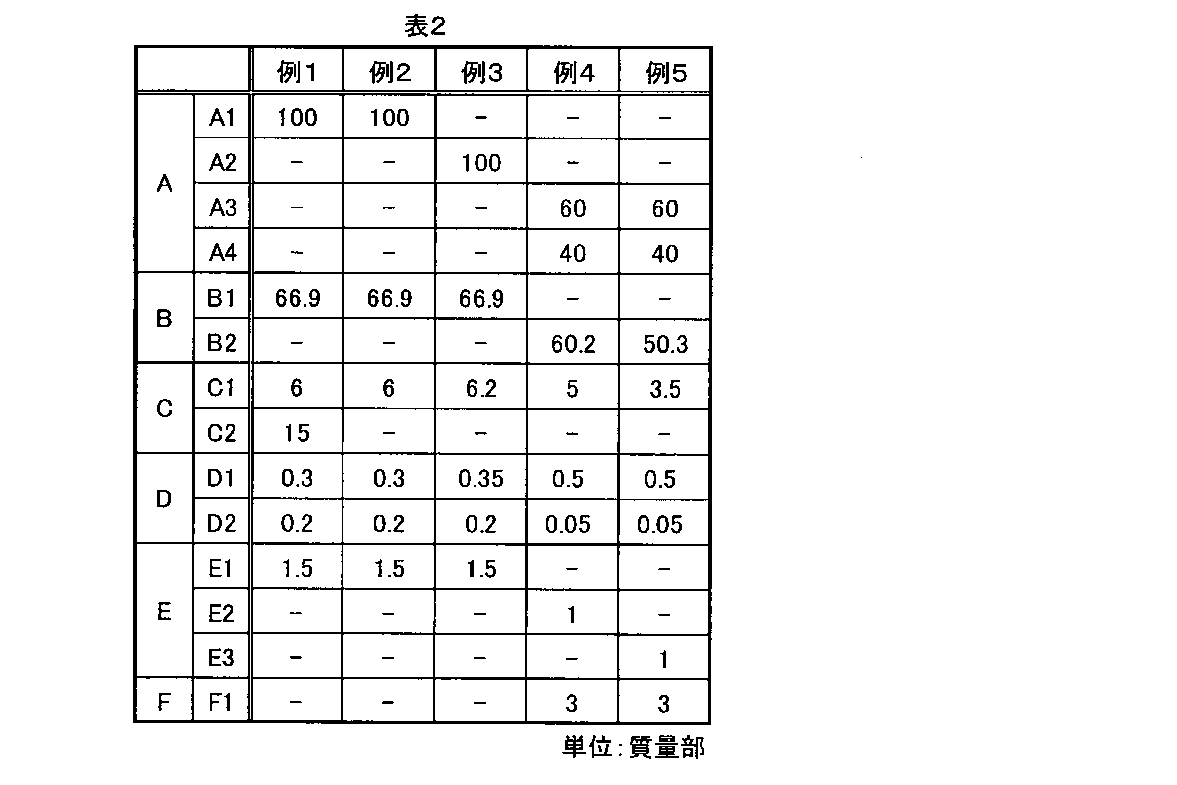
表2中の記号の意味は以下のとおりである。
A:ポリオキシアルキレンポリオール
・A1 合成例1で合成したポリオキシアルキレンポリオールA1
・A2 合成例2で合成したポリオキシアルキレンポリオールA2
・A3 合成例3で合成したポリオキシアルキレンポリオールA3
・A4 合成例4で合成したポリオキシアルキレンポリオールA4
A:ポリオキシアルキレンポリオール
・A1 合成例1で合成したポリオキシアルキレンポリオールA1
・A2 合成例2で合成したポリオキシアルキレンポリオールA2
・A3 合成例3で合成したポリオキシアルキレンポリオールA3
・A4 合成例4で合成したポリオキシアルキレンポリオールA4
B:有機ポリイソシアネート化合物
・B1 TDI混合物(コロネートT-80、東ソー社製)
2,4-TDIと2,6-TDIの質量比が2,4-TDI/2,6-TDI=80/20の混合物
イソシアネート基含有率48.3質量%
・B2 TDIとMDIとの混合物(コロネート1021、東ソー社製)
2,4-TDIと2,6-TDIとクルードMDIの質量比が2,4-TDI/2,6-TDI/クルードMDI=64/16/20の混合物
イソシアネート基含有率44.8質量%
・B1 TDI混合物(コロネートT-80、東ソー社製)
2,4-TDIと2,6-TDIの質量比が2,4-TDI/2,6-TDI=80/20の混合物
イソシアネート基含有率48.3質量%
・B2 TDIとMDIとの混合物(コロネート1021、東ソー社製)
2,4-TDIと2,6-TDIとクルードMDIの質量比が2,4-TDI/2,6-TDI/クルードMDI=64/16/20の混合物
イソシアネート基含有率44.8質量%
C:発泡剤
・C1 水
・C2 塩化メチレン(メチレンクロライド(一般品)、AGC社製) 沸点40.2℃
・C1 水
・C2 塩化メチレン(メチレンクロライド(一般品)、AGC社製) 沸点40.2℃
D:触媒
・D1 トリエチレンジアミンのジプロピレングリコール溶液(TEDA L-33、東ソー社製) アミン系触媒
・D2 2-エチルヘキサン酸スズ(DABCO(登録商標) T-9、EVONIK社製)
・D1 トリエチレンジアミンのジプロピレングリコール溶液(TEDA L-33、東ソー社製) アミン系触媒
・D2 2-エチルヘキサン酸スズ(DABCO(登録商標) T-9、EVONIK社製)
E:整泡剤
・E1 シリコーン系整泡剤(SZ-580、ダウコーニング社製)
・E2 シリコーン系整泡剤(TEGOSTAB(登録商標) B8737 LF2、EVONIK社製)
・E3 シリコーン系整泡剤(PRX-607、ダウコーニング社製)
・E1 シリコーン系整泡剤(SZ-580、ダウコーニング社製)
・E2 シリコーン系整泡剤(TEGOSTAB(登録商標) B8737 LF2、EVONIK社製)
・E3 シリコーン系整泡剤(PRX-607、ダウコーニング社製)
F:架橋剤
・F1 架橋剤(分子量400、官能基数4、EO含有率100質量%のポリオール)
ただし、F1のEO含有率100質量%は、ポリオキシアルキレン鎖中アルキレンオキシドに由来する単位中、エチレンオキシドに由来する単位が、100質量%であることを表す。
・F1 架橋剤(分子量400、官能基数4、EO含有率100質量%のポリオール)
ただし、F1のEO含有率100質量%は、ポリオキシアルキレン鎖中アルキレンオキシドに由来する単位中、エチレンオキシドに由来する単位が、100質量%であることを表す。
[評価方法]
例1~5のポリウレタンフォームの吸音率、密度、発泡セルの残膜率、平均セル径、平均骨格径、平均骨格径を平均セル径で除した値、及び通気量を、以下に記載する方法によって評価した。
例1~5のポリウレタンフォームの吸音率、密度、発泡セルの残膜率、平均セル径、平均骨格径、平均骨格径を平均セル径で除した値、及び通気量を、以下に記載する方法によって評価した。
<吸音率>
吸音率は、ポリウレタンフォームを鋭利な刃物を用いて切断した、厚みが20mmの測定用サンプルの、JIS A 1405-2:2007「音響管による吸音率及びインピーダンスの測定」に準拠した方法により、3000~4000Hz領域全域について測定して得られる吸音率である。
吸音率は、垂直入射吸音測定管(40mmφ、日本音響エンジニアリング社製)、解析ソフトウェア(WinZacMTX VER.5.0、日本音響エンジニアリング社製)、パワーアンプ(AP15d、FOSTEX社製)、マイクロホン(46BD、GRAS社製)、マイクロホンアンプ(12AQ、GRAS社製)、及びオーディオインターフェース(Fireface UC、RME社製)を用いて測定した。
吸音率は、ポリウレタンフォームを鋭利な刃物を用いて切断した、厚みが20mmの測定用サンプルの、JIS A 1405-2:2007「音響管による吸音率及びインピーダンスの測定」に準拠した方法により、3000~4000Hz領域全域について測定して得られる吸音率である。
吸音率は、垂直入射吸音測定管(40mmφ、日本音響エンジニアリング社製)、解析ソフトウェア(WinZacMTX VER.5.0、日本音響エンジニアリング社製)、パワーアンプ(AP15d、FOSTEX社製)、マイクロホン(46BD、GRAS社製)、マイクロホンアンプ(12AQ、GRAS社製)、及びオーディオインターフェース(Fireface UC、RME社製)を用いて測定した。
<密度>
密度は、JIS K 7222:2005「発泡プラスチック及びゴム-見掛け密度の求め方」に従って測定した。密度の測定はコア部を用いた。
密度の測定結果を、表3の「密度[kg/m3]」の欄に示す。
密度は、JIS K 7222:2005「発泡プラスチック及びゴム-見掛け密度の求め方」に従って測定した。密度の測定はコア部を用いた。
密度の測定結果を、表3の「密度[kg/m3]」の欄に示す。
<残膜率>
上記測定用サンプルの断面を、光学顕微鏡(VHX-1000、キーエンス社製)を用いて、倍率150倍で撮像した。全周にわたりセル骨格を確認でき、かつ明確な周辺骨格部の破壊がない部分を観察対象とした。
観察対象のセル骨格の内周部に破損が無い膜が存在しているものを「残膜あり」と判定した。
観察対象のセル骨格の内周部に膜が無いが、又は膜が一部でも破れているものを「残膜なし」と判定した。
測定用サンプルの断面を10か所撮像し、100個のセル骨格を観察して、「残膜あり」及び「残膜なし」の数をカウントし、「残膜あり」の割合を百分率で算出した。
残膜率の算出結果を、表3の「残膜率[%]」の欄に示す。
上記測定用サンプルの断面を、光学顕微鏡(VHX-1000、キーエンス社製)を用いて、倍率150倍で撮像した。全周にわたりセル骨格を確認でき、かつ明確な周辺骨格部の破壊がない部分を観察対象とした。
観察対象のセル骨格の内周部に破損が無い膜が存在しているものを「残膜あり」と判定した。
観察対象のセル骨格の内周部に膜が無いが、又は膜が一部でも破れているものを「残膜なし」と判定した。
測定用サンプルの断面を10か所撮像し、100個のセル骨格を観察して、「残膜あり」及び「残膜なし」の数をカウントし、「残膜あり」の割合を百分率で算出した。
残膜率の算出結果を、表3の「残膜率[%]」の欄に示す。
<平均骨格径>
上記測定用サンプルの断面を、光学顕微鏡(VHX-1000、キーエンス社製)を用いて、倍率150倍で撮像した。骨格部とセル部及び膜部との境界が明瞭に観察できる部分を観察対象とした。
観察対象としたセル骨格部の径を、画像処理ソフトウェア(ImageJ、アメリカ国立衛生研究所)を用いて計測した。形状がくびれている骨格は、最も径の細い部分をその骨格部の骨格径とした。
測定用サンプルの断面を10か所撮像し、70個の観察対象の骨格径を測定して、その算術平均により、ポリウレタンフォームの発泡セルの平均骨格径を算出した。
平均骨格径の測定結果を、表3の「平均骨格径[μm]」の欄に示す。
上記測定用サンプルの断面を、光学顕微鏡(VHX-1000、キーエンス社製)を用いて、倍率150倍で撮像した。骨格部とセル部及び膜部との境界が明瞭に観察できる部分を観察対象とした。
観察対象としたセル骨格部の径を、画像処理ソフトウェア(ImageJ、アメリカ国立衛生研究所)を用いて計測した。形状がくびれている骨格は、最も径の細い部分をその骨格部の骨格径とした。
測定用サンプルの断面を10か所撮像し、70個の観察対象の骨格径を測定して、その算術平均により、ポリウレタンフォームの発泡セルの平均骨格径を算出した。
平均骨格径の測定結果を、表3の「平均骨格径[μm]」の欄に示す。
<平均セル径>
上記測定用サンプルの断面を、光学顕微鏡(VHX-1000、キーエンス社製)を用いて、倍率150倍で撮像した。全周にわたりセル骨格を確認できる部分を観察対象とした。
観察対象としたセルの内周部の輪郭を画像処理ソフトウェア(ImageJ、アメリカ国立衛生研究所)を用いて抽出し、その輪郭で囲まれる面積を算出した。算出した面積と等しい面積の円の直径(円換算直径)を算出し、1つのセルのセル径とした。
測定用サンプルの断面を10か所撮像し、80個の観察対象のセル径を測定して、その算術平均により、ポリウレタンフォームの発泡セルの平均セル径を算出した。
平均セル径の測定結果を、表3の「平均セル径[μm]」の欄に示す。
上記測定用サンプルの断面を、光学顕微鏡(VHX-1000、キーエンス社製)を用いて、倍率150倍で撮像した。全周にわたりセル骨格を確認できる部分を観察対象とした。
観察対象としたセルの内周部の輪郭を画像処理ソフトウェア(ImageJ、アメリカ国立衛生研究所)を用いて抽出し、その輪郭で囲まれる面積を算出した。算出した面積と等しい面積の円の直径(円換算直径)を算出し、1つのセルのセル径とした。
測定用サンプルの断面を10か所撮像し、80個の観察対象のセル径を測定して、その算術平均により、ポリウレタンフォームの発泡セルの平均セル径を算出した。
平均セル径の測定結果を、表3の「平均セル径[μm]」の欄に示す。
<平均骨格径を平均セル径で除した値>
上述した方法により求めた平均骨格径及び平均セル径より、平均骨格径を平均セル径で除した値を算出した。
算出した平均骨格径を平均セル径で除した値を、表3の「平均骨格径/平均セル径」の欄に示す。
上述した方法により求めた平均骨格径及び平均セル径より、平均骨格径を平均セル径で除した値を算出した。
算出した平均骨格径を平均セル径で除した値を、表3の「平均骨格径/平均セル径」の欄に示す。
<通気量>
通気量は、JIS K 6400-7:2012 A法「軟質発泡材料-物理特性の求め方」に従って測定した。試料厚みは26mmとした。
通気量の測定結果を、表3の「通気量[L/min]」の欄に示す。
通気量は、JIS K 6400-7:2012 A法「軟質発泡材料-物理特性の求め方」に従って測定した。試料厚みは26mmとした。
通気量の測定結果を、表3の「通気量[L/min]」の欄に示す。
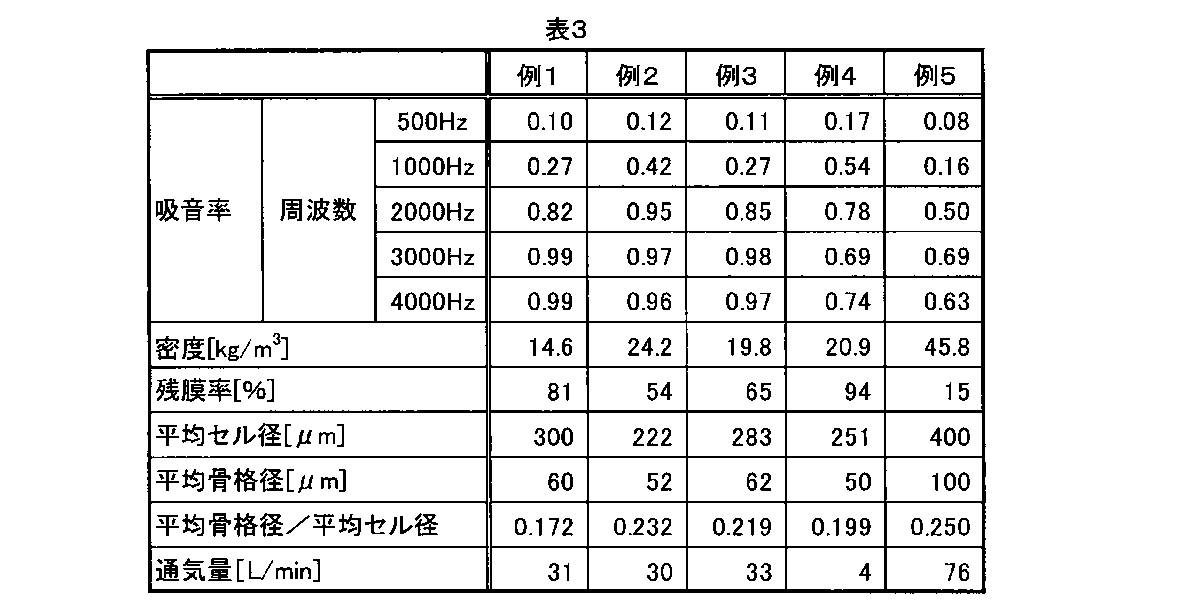
[結果の説明]
例1~3が実施例に該当し、例4及び例5が比較例に該当する。
例1~3のポリウレタンフォームは、発泡セルの残膜率が特定範囲内であり、3000~4000Hzの中~高周波数領域の吸音特性だけではなく、中~低周波数領域の吸音性能にも優れることがわかる。また、例1~3のポリウレタンフォームは、密度が低いので、より薄く、より軽量でも、従来のポリウレタンフォームと同等以上の吸音性能を達成できる。
例1のポリウレタンフォームは例2のポリウレタンフォームと比べて、より優れた吸音性能を有し、より低密度である。これは、発泡剤として、低沸点の飽和炭化水素を含有したことにより、発泡速度とウレタン化反応速度のバランスがより好ましくなったことによると考えられる。
例3のポリウレタンフォームは例2のポリウレタンフォームと比べて、より優れた吸音性能を有し、より低密度である。これは、数平均分子量がより大きなポリオキシアルキレンポリオールを用いたことにより、発泡セルの残膜率がより好ましくなったことによると考えられる。
これに対し、例4及び例5のポリウレタンフォームは、発泡セルの残膜率が特定範囲外であり、高周波数領域での吸音性能が劣り、密度も高い。
例1~3が実施例に該当し、例4及び例5が比較例に該当する。
例1~3のポリウレタンフォームは、発泡セルの残膜率が特定範囲内であり、3000~4000Hzの中~高周波数領域の吸音特性だけではなく、中~低周波数領域の吸音性能にも優れることがわかる。また、例1~3のポリウレタンフォームは、密度が低いので、より薄く、より軽量でも、従来のポリウレタンフォームと同等以上の吸音性能を達成できる。
例1のポリウレタンフォームは例2のポリウレタンフォームと比べて、より優れた吸音性能を有し、より低密度である。これは、発泡剤として、低沸点の飽和炭化水素を含有したことにより、発泡速度とウレタン化反応速度のバランスがより好ましくなったことによると考えられる。
例3のポリウレタンフォームは例2のポリウレタンフォームと比べて、より優れた吸音性能を有し、より低密度である。これは、数平均分子量がより大きなポリオキシアルキレンポリオールを用いたことにより、発泡セルの残膜率がより好ましくなったことによると考えられる。
これに対し、例4及び例5のポリウレタンフォームは、発泡セルの残膜率が特定範囲外であり、高周波数領域での吸音性能が劣り、密度も高い。
本発明のポリウレタンフォームは、3000~4000Hzの高周波数領域の吸音特性が良好なので、車両用防音材として適する。さらに、他の素材との複合体とする必要がなく、薄くても優れた防音効果が得られるので、特に自動車用防音材として好適であり、自動車の軽量化とともに、適用部位の拡大にも効果を発揮する。
なお、2019年03月20日に出願された日本特許出願2019-053534号の明細書、特許請求の範囲および要約書の全内容をここに引用し、本発明の明細書の開示として、取り入れるものである。
なお、2019年03月20日に出願された日本特許出願2019-053534号の明細書、特許請求の範囲および要約書の全内容をここに引用し、本発明の明細書の開示として、取り入れるものである。
Claims (11)
- 垂直入射法による吸音率測定法における、周波数3000~4000Hz領域全域での吸音率が0.95以上であり、密度が5~25kg/m3であり、かつ、発泡セルの残膜率が40%以上94%未満である、ポリウレタンフォーム。
- 前記発泡セルの平均骨格径を平均セル径で除した値が0.10~0.25であり、かつ、前記発泡セルの平均セル径が50~400μmである、請求項1に記載のポリウレタンフォーム。
- 厚みが3~50mmである、請求項1又は2に記載のポリウレタンフォーム。
- 通気量が5~50L/minである、請求項1~3のいずれか1項に記載のポリウレタンフォーム。
- ポリオキシアルキレンポリオール、有機ポリイソシアネート化合物、発泡剤及び触媒を含む原料組成物を用いて発泡させる、請求項1~4のいずれか1項に記載のポリウレタンフォームの製造方法であって、
前記ポリオキシアルキレンポリオールが3官能のポリオキシアルキレンポリオールを含み、
前記発泡剤が水を含み、
前記触媒がアミン系触媒及びスズ系触媒からなる群から選択される少なくとも1種であり、
前記ポリオキシアルキレンポリオールの100質量部に対して、発泡剤としての水を4質量部以上含む、ポリウレタンフォームの製造方法。 - 前記有機ポリイソシアネート化合物が、イソシアネート基を2個以上有する芳香族系ポリイソシアネート、脂環式ポリイソシアネート、脂肪族系ポリイソシアネート、及びこれらを変性して得られる変性ポリイソシアネートからなる群から選択される少なくとも1種である、請求項5に記載のポリウレタンフォームの製造方法。
- 前記有機ポリイソシアネート化合物がジイソシアネートである、請求項5又は6に記載のポリウレタンフォームの製造方法。
- 前記原料組成物が整泡剤をさらに含む、請求項5~7のいずれか1項に記載のポリウレタンフォームの製造方法。
- 前記原料組成物が、前記発泡剤として、沸点が70℃以下で、炭素数が8以下の炭化水素化合物をさらに含み、前記炭化水素化合物の炭素原子に結合する水素原子の一部は、ハロゲン原子に置換されていてもよい飽和炭化水素を含む、請求項5~8のいずれか1項に記載のポリウレタンフォームの製造方法。
- 前記ハロゲン原子が塩素原子又はフッ素原子である、請求項9に記載のポリウレタンフォームの製造方法。
- 請求項1~4のいずれか1項に記載のポリウレタンフォームを含む車両用防音材。
Priority Applications (1)
| Application Number | Priority Date | Filing Date | Title |
|---|---|---|---|
| JP2021507247A JP7414061B2 (ja) | 2019-03-20 | 2020-03-11 | ポリウレタンフォーム、及び車両用防音材 |
Applications Claiming Priority (2)
| Application Number | Priority Date | Filing Date | Title |
|---|---|---|---|
| JP2019053534 | 2019-03-20 | ||
| JP2019-053534 | 2019-03-20 |
Publications (1)
| Publication Number | Publication Date |
|---|---|
| WO2020189454A1 true WO2020189454A1 (ja) | 2020-09-24 |
Family
ID=72520331
Family Applications (1)
| Application Number | Title | Priority Date | Filing Date |
|---|---|---|---|
| PCT/JP2020/010639 Ceased WO2020189454A1 (ja) | 2019-03-20 | 2020-03-11 | ポリウレタンフォーム、その製造方法及び車両用防音材 |
Country Status (2)
| Country | Link |
|---|---|
| JP (1) | JP7414061B2 (ja) |
| WO (1) | WO2020189454A1 (ja) |
Families Citing this family (1)
| Publication number | Priority date | Publication date | Assignee | Title |
|---|---|---|---|---|
| JP7819047B2 (ja) * | 2022-06-28 | 2026-02-24 | 東海化成工業株式会社 | 車両用難燃性防音材 |
Citations (7)
| Publication number | Priority date | Publication date | Assignee | Title |
|---|---|---|---|---|
| JP2004124076A (ja) * | 2002-07-31 | 2004-04-22 | Sanyo Chem Ind Ltd | 遮吸音材用ポリウレタンフォーム |
| JP2005113134A (ja) * | 2003-09-19 | 2005-04-28 | Asahi Glass Co Ltd | 軟質ポリウレタンフォームおよびその製造方法 |
| JP2006265467A (ja) * | 2005-03-25 | 2006-10-05 | Tokai Rubber Ind Ltd | 車両用難燃性防音・防振材及びその製造方法 |
| JP2007169556A (ja) * | 2005-12-26 | 2007-07-05 | Inoac Corp | ポリウレタン発泡体 |
| JP2014141595A (ja) * | 2013-01-24 | 2014-08-07 | Asahi Glass Co Ltd | 硬質発泡合成樹脂の製造方法 |
| JP2015024028A (ja) * | 2013-07-26 | 2015-02-05 | 旭硝子株式会社 | 車輌用シートクッション |
| JP2019183008A (ja) * | 2018-04-11 | 2019-10-24 | 株式会社イノアックコーポレーション | ポリウレタンフォームとその製造方法 |
-
2020
- 2020-03-11 JP JP2021507247A patent/JP7414061B2/ja active Active
- 2020-03-11 WO PCT/JP2020/010639 patent/WO2020189454A1/ja not_active Ceased
Patent Citations (7)
| Publication number | Priority date | Publication date | Assignee | Title |
|---|---|---|---|---|
| JP2004124076A (ja) * | 2002-07-31 | 2004-04-22 | Sanyo Chem Ind Ltd | 遮吸音材用ポリウレタンフォーム |
| JP2005113134A (ja) * | 2003-09-19 | 2005-04-28 | Asahi Glass Co Ltd | 軟質ポリウレタンフォームおよびその製造方法 |
| JP2006265467A (ja) * | 2005-03-25 | 2006-10-05 | Tokai Rubber Ind Ltd | 車両用難燃性防音・防振材及びその製造方法 |
| JP2007169556A (ja) * | 2005-12-26 | 2007-07-05 | Inoac Corp | ポリウレタン発泡体 |
| JP2014141595A (ja) * | 2013-01-24 | 2014-08-07 | Asahi Glass Co Ltd | 硬質発泡合成樹脂の製造方法 |
| JP2015024028A (ja) * | 2013-07-26 | 2015-02-05 | 旭硝子株式会社 | 車輌用シートクッション |
| JP2019183008A (ja) * | 2018-04-11 | 2019-10-24 | 株式会社イノアックコーポレーション | ポリウレタンフォームとその製造方法 |
Also Published As
| Publication number | Publication date |
|---|---|
| JPWO2020189454A1 (ja) | 2020-09-24 |
| JP7414061B2 (ja) | 2024-01-16 |
Similar Documents
| Publication | Publication Date | Title |
|---|---|---|
| CN100509902C (zh) | 软质聚氨酯泡沫塑料及其制造方法 | |
| CN1221585C (zh) | 软质聚氨酯泡沫材料及其制造方法 | |
| US20080085945A1 (en) | Flexible polyurethane foam, process for its production, and seat for automobile | |
| WO2001079323A1 (fr) | Procede de production de mousse de polyurethane flexible | |
| CN1406999A (zh) | 挠性聚氨酯泡沫及其制造方法和用于其制造的材料体系 | |
| JP2007106881A (ja) | 連続気泡構造を有する硬質ポリウレタン発泡体の製造方法 | |
| KR101916508B1 (ko) | 폴리우레탄 폼 제조용 조성물 및 이의 성형품 | |
| KR20130048057A (ko) | 고 안락성 자동차용 폴리 우레탄 시트 조성물 | |
| JP7113011B2 (ja) | 軟質ポリウレタンフォーム用組成物、軟質ポリウレタンフォーム並びに車両用シートパッド | |
| JP7414061B2 (ja) | ポリウレタンフォーム、及び車両用防音材 | |
| JP4617793B2 (ja) | 自動車内装材用の防音材 | |
| JP7601009B2 (ja) | ポリウレタンフォーム、及び車両用防音材 | |
| JP2010184655A (ja) | 積層吸音材 | |
| JP5986838B2 (ja) | 吸音衝撃吸収材及びその製造方法 | |
| JP2005272806A (ja) | 硬質ポリウレタンフォーム | |
| JP2005120247A (ja) | 自動車用防音材に使用される軟質ポリウレタンフォームおよびその製造方法 | |
| JP3631558B2 (ja) | 軟質モールドフォームの製造法 | |
| WO2010140304A1 (ja) | 車輌用シートクッション用軟質ポリウレタンフォームおよびその製造方法 | |
| JP4832702B2 (ja) | 軟質ポリウレタンフォームとその製造方法 | |
| WO2003072626A1 (en) | Process for production of flexible polyurethane foam | |
| JP2009280658A (ja) | 低密度軟質ポリウレタン発泡体成形用組成物 | |
| JP2005193612A (ja) | 硬質ポリウレタンフォーム | |
| JP2006008773A (ja) | 軟質ポリウレタンフォーム、及びその製造方法 | |
| JP2005179579A (ja) | 防音材の製造方法 | |
| JP5456634B2 (ja) | シートクッションの製造方法 |
Legal Events
| Date | Code | Title | Description |
|---|---|---|---|
| 121 | Ep: the epo has been informed by wipo that ep was designated in this application |
Ref document number: 20774284 Country of ref document: EP Kind code of ref document: A1 |
|
| ENP | Entry into the national phase |
Ref document number: 2021507247 Country of ref document: JP Kind code of ref document: A |
|
| NENP | Non-entry into the national phase |
Ref country code: DE |
|
| 122 | Ep: pct application non-entry in european phase |
Ref document number: 20774284 Country of ref document: EP Kind code of ref document: A1 |