WO2020179920A1 - 空気入りタイヤ - Google Patents
空気入りタイヤ Download PDFInfo
- Publication number
- WO2020179920A1 WO2020179920A1 PCT/JP2020/009794 JP2020009794W WO2020179920A1 WO 2020179920 A1 WO2020179920 A1 WO 2020179920A1 JP 2020009794 W JP2020009794 W JP 2020009794W WO 2020179920 A1 WO2020179920 A1 WO 2020179920A1
- Authority
- WO
- WIPO (PCT)
- Prior art keywords
- cord
- carcass
- dtex
- carcass cord
- pneumatic tire
- Prior art date
- Legal status (The legal status is an assumption and is not a legal conclusion. Google has not performed a legal analysis and makes no representation as to the accuracy of the status listed.)
- Ceased
Links
Images


Classifications
-
- B—PERFORMING OPERATIONS; TRANSPORTING
- B60—VEHICLES IN GENERAL
- B60C—VEHICLE TYRES; TYRE INFLATION; TYRE CHANGING; CONNECTING VALVES TO INFLATABLE ELASTIC BODIES IN GENERAL; DEVICES OR ARRANGEMENTS RELATED TO TYRES
- B60C15/00—Tyre beads, e.g. ply turn-up or overlap
- B60C15/0009—Tyre beads, e.g. ply turn-up or overlap features of the carcass terminal portion
- B60C15/0054—Tyre beads, e.g. ply turn-up or overlap features of the carcass terminal portion with ply turn-up portion parallel and adjacent to carcass main portion
-
- B—PERFORMING OPERATIONS; TRANSPORTING
- B60—VEHICLES IN GENERAL
- B60C—VEHICLE TYRES; TYRE INFLATION; TYRE CHANGING; CONNECTING VALVES TO INFLATABLE ELASTIC BODIES IN GENERAL; DEVICES OR ARRANGEMENTS RELATED TO TYRES
- B60C1/00—Tyres characterised by the chemical composition or the physical arrangement or mixture of the composition
- B60C1/0041—Compositions of the carcass layers
-
- B—PERFORMING OPERATIONS; TRANSPORTING
- B60—VEHICLES IN GENERAL
- B60C—VEHICLE TYRES; TYRE INFLATION; TYRE CHANGING; CONNECTING VALVES TO INFLATABLE ELASTIC BODIES IN GENERAL; DEVICES OR ARRANGEMENTS RELATED TO TYRES
- B60C9/00—Reinforcements or ply arrangement of pneumatic tyres
- B60C9/02—Carcasses
- B60C9/04—Carcasses the reinforcing cords of each carcass ply arranged in a substantially parallel relationship
- B60C9/08—Carcasses the reinforcing cords of each carcass ply arranged in a substantially parallel relationship the cords extend transversely from bead to bead, i.e. radial ply
-
- C—CHEMISTRY; METALLURGY
- C08—ORGANIC MACROMOLECULAR COMPOUNDS; THEIR PREPARATION OR CHEMICAL WORKING-UP; COMPOSITIONS BASED THEREON
- C08L—COMPOSITIONS OF MACROMOLECULAR COMPOUNDS
- C08L67/00—Compositions of polyesters obtained by reactions forming a carboxylic ester link in the main chain; Compositions of derivatives of such polymers
- C08L67/02—Polyesters derived from dicarboxylic acids and dihydroxy compounds
-
- B—PERFORMING OPERATIONS; TRANSPORTING
- B60—VEHICLES IN GENERAL
- B60C—VEHICLE TYRES; TYRE INFLATION; TYRE CHANGING; CONNECTING VALVES TO INFLATABLE ELASTIC BODIES IN GENERAL; DEVICES OR ARRANGEMENTS RELATED TO TYRES
- B60C15/00—Tyre beads, e.g. ply turn-up or overlap
- B60C15/0009—Tyre beads, e.g. ply turn-up or overlap features of the carcass terminal portion
- B60C15/0036—Tyre beads, e.g. ply turn-up or overlap features of the carcass terminal portion with high ply turn-up, i.e. folded around the bead core and terminating radially above the point of maximum section width
-
- B—PERFORMING OPERATIONS; TRANSPORTING
- B60—VEHICLES IN GENERAL
- B60C—VEHICLE TYRES; TYRE INFLATION; TYRE CHANGING; CONNECTING VALVES TO INFLATABLE ELASTIC BODIES IN GENERAL; DEVICES OR ARRANGEMENTS RELATED TO TYRES
- B60C9/00—Reinforcements or ply arrangement of pneumatic tyres
- B60C9/02—Carcasses
- B60C2009/0269—Physical properties or dimensions of the carcass coating rubber
- B60C2009/0284—Thickness
-
- B—PERFORMING OPERATIONS; TRANSPORTING
- B60—VEHICLES IN GENERAL
- B60C—VEHICLE TYRES; TYRE INFLATION; TYRE CHANGING; CONNECTING VALVES TO INFLATABLE ELASTIC BODIES IN GENERAL; DEVICES OR ARRANGEMENTS RELATED TO TYRES
- B60C9/00—Reinforcements or ply arrangement of pneumatic tyres
- B60C9/02—Carcasses
- B60C9/04—Carcasses the reinforcing cords of each carcass ply arranged in a substantially parallel relationship
- B60C2009/0416—Physical properties or dimensions of the carcass cords
- B60C2009/0425—Diameters of the cords; Linear density thereof
-
- B—PERFORMING OPERATIONS; TRANSPORTING
- B60—VEHICLES IN GENERAL
- B60C—VEHICLE TYRES; TYRE INFLATION; TYRE CHANGING; CONNECTING VALVES TO INFLATABLE ELASTIC BODIES IN GENERAL; DEVICES OR ARRANGEMENTS RELATED TO TYRES
- B60C9/00—Reinforcements or ply arrangement of pneumatic tyres
- B60C9/02—Carcasses
- B60C9/04—Carcasses the reinforcing cords of each carcass ply arranged in a substantially parallel relationship
- B60C2009/0416—Physical properties or dimensions of the carcass cords
- B60C2009/0433—Modulus
-
- B—PERFORMING OPERATIONS; TRANSPORTING
- B60—VEHICLES IN GENERAL
- B60C—VEHICLE TYRES; TYRE INFLATION; TYRE CHANGING; CONNECTING VALVES TO INFLATABLE ELASTIC BODIES IN GENERAL; DEVICES OR ARRANGEMENTS RELATED TO TYRES
- B60C9/00—Reinforcements or ply arrangement of pneumatic tyres
- B60C9/02—Carcasses
- B60C9/04—Carcasses the reinforcing cords of each carcass ply arranged in a substantially parallel relationship
- B60C2009/0416—Physical properties or dimensions of the carcass cords
- B60C2009/045—Tensile strength
-
- B—PERFORMING OPERATIONS; TRANSPORTING
- B60—VEHICLES IN GENERAL
- B60C—VEHICLE TYRES; TYRE INFLATION; TYRE CHANGING; CONNECTING VALVES TO INFLATABLE ELASTIC BODIES IN GENERAL; DEVICES OR ARRANGEMENTS RELATED TO TYRES
- B60C9/00—Reinforcements or ply arrangement of pneumatic tyres
- B60C9/02—Carcasses
- B60C9/04—Carcasses the reinforcing cords of each carcass ply arranged in a substantially parallel relationship
- B60C2009/0416—Physical properties or dimensions of the carcass cords
- B60C2009/0466—Twist structures
-
- B—PERFORMING OPERATIONS; TRANSPORTING
- B60—VEHICLES IN GENERAL
- B60C—VEHICLE TYRES; TYRE INFLATION; TYRE CHANGING; CONNECTING VALVES TO INFLATABLE ELASTIC BODIES IN GENERAL; DEVICES OR ARRANGEMENTS RELATED TO TYRES
- B60C9/00—Reinforcements or ply arrangement of pneumatic tyres
- B60C9/02—Carcasses
- B60C9/04—Carcasses the reinforcing cords of each carcass ply arranged in a substantially parallel relationship
- B60C2009/0475—Particular materials of the carcass cords
Definitions
- the present invention relates to a pneumatic tire provided with a carcass layer made of an organic fiber cord, and more specifically to a pneumatic tire capable of achieving both steering stability and high speed durability.
- Pneumatic tires usually have a carcass layer mounted between a pair of bead sections.
- a carcass cord constituting such a carcass layer a rayon fiber cord is preferably used particularly in a high performance tire.
- PET fiber cord polyethylene terephthalate fiber cord
- PET fiber cord polyethylene terephthalate fiber cord
- the fineness of the carcass cord is increased to increase the rigidity of the carcass cord (particularly in the sidewall portion). It has been attempted to achieve high rigidity).
- the carcass cord which has a large fineness and high rigidity, generates a large amount of heat, the temperature rise in the sidewall portion (particularly the region where the main body portion of the carcass layer and the folded portion come into contact with each other) becomes large, and the carcass cord during high-speed traveling. There is a possibility that the adhesiveness between the main body portion and the folded portion of the layer is lowered and separation occurs. Therefore, in a pneumatic tire provided with a carcass layer made of an organic fiber cord, there is a demand for measures to achieve a high degree of both steering stability and high-speed durability.
- An object of the present invention is to provide a pneumatic tire provided with a carcass layer made of an organic fiber cord, which enables both steering stability and high-speed durability.
- the pneumatic tire of the present invention for achieving the above object is a tread portion extending in the tire circumferential direction and forming an annular shape, a pair of sidewall portions arranged on both sides of the tread portion, and these sidewall portions.
- the carcass layer is a filament of an organic fiber.
- the carcass cord composed of organic fiber cords in which bundles are twisted, and the fineness of the carcass cord after dipping treatment is 4000 dtex to 8000 dtex, and when a 1.0 cN / dtex load is applied to the sidewall portion of the carcass cord.
- the carcass layer includes the main body portion extending from the tread portion to each bead portion through each sidewall portion, and the carcass layer is folded back at each bead portion to form each side portion.
- the ratio G/R of the interlayer rubber gauge G between the carcass cord in the part and the carcass cord in the folded-back part is 0.50 to 0.60.
- the fineness of the carcass cord constituting the carcass layer after the dip treatment is 4000 dtex to 8000 dtex, and the intermediate elongation of the sidewall portion of the carcass cord under a 1.0 cN / dtex load is 3. Since it is 3% to 4.2%, it is possible to increase the rigidity of the sidewall portion and improve the steering stability.
- the above-mentioned ratio G / R is set in the range of 0.50 to 0.60, and the interlayer rubber gauge G between the carcass cord in the main body portion and the carcass cord in the folded portion in the contact region is the carcass.
- the pneumatic tire of the present invention can achieve both steering stability and high-speed durability at a high level.
- the twist coefficient K of the carcass cord represented by the following equation (1) after the dip treatment is 2000 or more.
- K T ⁇ D 1/2 (1) (However, T is the number of top twists of the cord (times / 10 cm), and D is the total fineness (dtex) of the cord.)
- the organic fiber constituting the carcass cord is polyethylene terephthalate fiber.
- the physical properties of the carcass cord are further improved, which is advantageous for achieving both steering stability and high-speed durability at a high level.
- the fineness of the carcass cord after dipping treatment is preferably 5000 dtex to 7000 dtex. Further, it is preferable that the intermediate elongation of the sidewall portion of the carcass cord under a 1.0 cN / dtex load is 3.5% to 4.0%. Further, it is preferable that the twist coefficient K of the carcass cord after the dip treatment is 2100 dtex to 2500 dtex.
- FIG. 1 is a cross-sectional view of a meridian showing a pneumatic radial tire according to an embodiment of the present invention.
- FIG. 2 is a schematic view illustrating an interlayer rubber gauge G by combining a partial meridian cross-sectional view of the pneumatic radial tire of the present invention and a cross-sectional view taken along the line XX in the drawing.
- a pneumatic tire of the present invention includes a tread portion 1, a pair of sidewall portions 2 arranged on both sides of the tread portion 1, and a sidewall portion 2 which is arranged inside a tire radial direction. And a pair of bead portions 3.
- reference numeral CL indicates the tire equator.
- FIG. 1 is not drawn because it is a meridional cross-sectional view, the tread portion 1, the sidewall portion 2, and the bead portion 3 each extend in the tire circumferential direction to form an annular shape.
- the basic structure of the shape is constructed.
- each tire constituent member extends in the tire circumferential direction to form an annular shape.
- a plurality of main grooves (4 in the illustrated example) extending in the tire circumferential direction are formed on the outer surface of the tread portion 1, but the number of main grooves is not particularly limited. Further, in addition to the main groove, various grooves and sipes including a lug groove extending in the tire width direction can be formed.
- a carcass layer 4 including a plurality of reinforcing cords (carcass cords 4c) extending in the tire radial direction is mounted between the pair of left and right bead portions 3.
- a bead core 5 is embedded in each bead portion, and a bead filler 6 having a substantially triangular cross section is arranged on the outer periphery of the bead core 5.
- the carcass layer 4 is folded around the bead core 5 from the inside to the outside in the tire width direction.
- the bead core 5 and the bead filler 6 are the main body portion 4A of the carcass layer 4 (the portion extending from the tread portion 1 to each bead portion 3 via each sidewall portion 2) and the folded portion 4B (the bead core 5 in each bead portion 3). It is wrapped around (a part that is folded back and extends toward each sidewall 2 side).
- each belt layer 7 includes a plurality of reinforcing cords (belt cords) inclined with respect to the tire circumferential direction, and the belt cords are arranged so as to intersect each other between the layers.
- the inclination angle of the belt cord with respect to the tire circumferential direction is set in the range of, for example, 10 ° to 40 °.
- a steel cord is used as the belt cord.
- a belt cover layer 8 is provided on the outer peripheral side of the belt layer 7 for the purpose of improving high-speed durability and reducing road noise.
- the belt reinforcing layer 8 includes a reinforcing cord (belt reinforcing cord) oriented in the tire circumferential direction.
- the angle of the belt reinforcing cord with respect to the tire circumferential direction is set to, for example, 0 ° to 5 °.
- An organic fiber cord (for example, PET fiber cord) is used as the belt reinforcing cord.
- the belt cover layer 8 always includes a full cover layer 8a that covers the entire area of the belt layer 7, and optionally includes a pair of edge cover layers 8b that locally cover both ends of the belt layer 7.
- the belt cover layer 8 may be formed by aligning at least one belt reinforcing cord and spirally winding a strip material covered with coated rubber in the tire circumferential direction, and it is particularly desirable to have a jointless structure.
- the present invention relates to the carcass cords that form the above-mentioned carcass layer 4, the basic structure of the entire tire is not limited to the above.
- the carcass cord 4c constituting the carcass layer 4 is composed of an organic fiber cord obtained by twisting filament bundles of organic fibers.
- the fineness of the carcass cord 4c (organic fiber cord) after the dip treatment is 4000 dtex to 8000 dtex, preferably 500 dtex to 7000 dtex.
- the intermediate elongation of the sidewall portion 2 of the carcass cord 4c under a 1.0 cN / dtex load is 3.3% to 4.2%, preferably 3.5% to 4.0%.
- the type of organic fiber constituting the carcass cord 4c is not particularly limited, but for example, polyester fiber, nylon fiber, aramid fiber and the like can be used, and among them, polyester fiber can be preferably used.
- polyester fiber examples include polyethylene terephthalate fiber (PET fiber), polyethylene terephthalate fiber (PEN fiber), polybutylene terephthalate fiber (PBT), and polybutylene terephthalate fiber (PBN). It can be preferably used.
- PET fiber polyethylene terephthalate fiber
- PEN fiber polyethylene terephthalate fiber
- PBT polybutylene terephthalate fiber
- PBN polybutylene terephthalate fiber
- the "fineness after the dip treatment” is a fineness measured after the carcass cord 4c (organic fiber cord) is subjected to the dip treatment, and is not a numerical value of the carcass cord 4c (organic fiber cord) itself, but after the dip treatment. It is a numerical value including the dip liquid adhering to the carcass cord 4c (organic fiber cord) of.
- the "intermediate elongation under 1.0 cN / dtex load” conforms to the "chemical fiber tire code test method" of JIS L1017 for the carcass code 4c (sample code) taken out from the sidewall portion 2 of the pneumatic tire.
- the elongation rate (%) of the sample code measured under the conditions of a grip interval of 250 mm and a tensile speed of 300 ⁇ 20 mm / min and a load of 1.0 cN / dtex.
- the sidewall portion 2 has the contact area A where the body portion 4A and the folded portion 4B are in contact with each other.
- the range of the contact region A is not particularly limited, but can be set to a range of, for example, 2 mm to 15 mm from the tire radial outside end of the bead filler 6 toward the tire radial outside.
- this contact area A as shown in FIG. 2, when the sidewall portion 2 is cut along the tire circumferential direction, between the carcass cord 4c included in the main body portion 4A and the carcass cord 4c included in the folded portion 4B.
- the ratio G / R of the interlayer rubber gauge G to the cord diameter R of the carcass cord 4c is 0.50 to 0.60, preferably 0.52 to 0.58. Since the carcass cord 4c may vary in a cross section obtained by cutting the sidewall portion 2 along the tire circumferential direction, the interlayer rubber gauge G is used for the plurality of carcass included in the main body portion 4A as shown in FIG. An approximate straight line at the center of the cord 4c and an approximate straight line at the center of the plurality of carcass cords 4c included in the folded portion 4B are drawn so as to be parallel to each other, and the distance L between these approximate straight lines is used to determine the cord diameter of the carcass cord 4c. Shall be calculated by subtracting R.
- the pneumatic tire of the present invention can be obtained by using an organic fiber cord having specific physical properties for the carcass layer 4 and setting the interlayer rubber gauge G in the contact region with respect to the cord diameter R as described above.
- the steering stability and the high speed durability can be highly compatible with each other. That is, since the carcass layer 4 (organic fiber cord) has the above-mentioned physical properties, the rigidity of the sidewall portion 2 can be increased and the steering stability can be improved.
- the interlayer rubber gauge G is secured to be appropriately larger than the cord diameter R of the carcass cord 4c in the contact region A, the interlayer between the main body portion 4A and the folded portion 4B of the carcass layer 4 in the contact region A High-speed durability can be improved by suppressing temperature rise and shear strain.
- the carcass cord 4c after dip treatment is less than 4000 dtex, the carcass cord 4c is too thin to secure sufficient rigidity, and thus the effect of improving steering stability cannot be obtained.
- the fineness of the carcass cord 4c after the dip treatment exceeds 8000 dtex, the heat generation due to the carcass cord 4c cannot be suppressed and the high-speed durability deteriorates.
- the above-mentioned intermediate elongation is less than 3.3%, the rigidity of the sidewall portion 2 becomes excessive, and the high-speed durability is lowered. If the above-described intermediate elongation exceeds 4.2%, the rigidity of the sidewall portion 2 cannot be sufficiently secured, and the effect of improving steering stability cannot be obtained.
- the interlayer rubber gauge is small, so that it is not possible to sufficiently suppress the temperature rise and the shear strain between the body portion 4A and the folded portion 4B of the carcass layer 4. , High speed durability is reduced.
- the above-mentioned ratio G / R exceeds 0.60, the rigidity of the sidewall portion 2 becomes excessive and the high-speed durability is lowered.
- the twist coefficient K represented by the following formula (1) is preferably 2000 or more, and more preferably 2100 to 2500.
- the twist coefficient K is a numerical value of the carcass code 4c after the dip treatment. Setting a large twist coefficient K in this way is advantageous for improving high-speed durability.
- the twist coefficient K is less than 2000, the carcass layer 4 is likely to be fatigued due to repeated compression deformation of the winding portion of the carcass layer 4 due to the collapse of the bead portion when the tire is rolled, and high-speed durability is improved. There is a risk that the effect will not be fully obtained.
- K T ⁇ D 1/2 (1) (However, T is the number of top twists of the cord (times / 10 cm), and D is the total fineness (dtex) of the cord.)
- the tire size is 255 / 35R19, and it has the basic structure illustrated in FIG. 1, the fineness of the carcass cord after dipping, the intermediate elongation of the sidewall of the carcass cord under 1.0 cN / dtex load, and the carcass.
- Tables 1 and 2 the ratio G/R of the interlayer rubber gauge G between the carcass cord in the main body and the carcass cord in the folded portion and the twisting coefficient K in the contact area with respect to the cord diameter R of the cord were changed.
- Pneumatic tires of Conventional Example 1, Comparative Examples 1 to 5, and Examples 1 to 7 were produced.
- the rubber gauge G was measured with a cross section obtained by cutting the sidewall portion in the tire circumferential direction at a position 5 mm outward from the radial outer end of the bead filler in the tire radial direction. Further, in all the examples, polyethylene terephthalate fiber (PET fiber) was used as the organic fiber constituting the carcass cord.
- PET fiber polyethylene terephthalate fiber
- test tire was assembled on a wheel having a rim size of 19 ⁇ 9.0J, and stored for 30 days in a chamber maintained at a temperature of 70 ° C. and a humidity of 95% in a state where oxygen was sealed at an internal pressure of 240 kPa.
- the test tire thus pretreated was mounted on a drum tester equipped with a drum made of steel with a smooth surface and a diameter of 1707 mm, the ambient temperature was controlled to 38 ⁇ 3 ° C., and the speed was 120 km / h for 30 minutes.
- the tires were accelerated by 10 km / h each time, and the mileage until the tire failed was measured.
- the evaluation results are shown by an index with the measured value of Conventional Example 1 being 100. The larger the index value, the better the high-speed durability.
- the tires of Examples 1 to 7 have a high degree of both steering stability and high-speed durability in comparison with the standard Conventional Example 1. In addition, no separation occurred even after the high-speed durability test.
- Comparative Example 1 the fineness of the carcass cord after the dip treatment was small, so that the steering stability was lowered.
- Comparative Example 2 since the intermediate elongation of the carcass cord in the sidewall portion under the load of 1.0 cN/dtex was small, the high-speed durability was deteriorated, and the tire after the high-speed durability test had separation.
- Comparative Example 3 since the intermediate elongation of the carcass cord in the sidewall portion under the load of 1.0 cN/dtex was large, the steering stability was lowered. In Comparative Example 4, since the ratio G/R was small, the high-speed durability was deteriorated, and the tire after the high-speed durability test had separation. In Comparative Example 5, since the ratio G / R was large, the steering stability was lowered.
- tread part 2 sidewall part 3 bead part 4 carcass layer 4A body part 4B folding part 4c carcass cord 5 bead core 6 bead filler 7 belt layer 8 belt reinforcing layer A contact area CL tire equator
Landscapes
- Engineering & Computer Science (AREA)
- Mechanical Engineering (AREA)
- Chemical & Material Sciences (AREA)
- Health & Medical Sciences (AREA)
- Chemical Kinetics & Catalysis (AREA)
- Medicinal Chemistry (AREA)
- Polymers & Plastics (AREA)
- Organic Chemistry (AREA)
- Tires In General (AREA)
Abstract
有機繊維コードからなるカーカス層を備えた空気入りタイヤであって、操縦安定性および高速耐久性の両立を可能にした空気入りタイヤを提供する。一対のビード部3間に装架された少なくとも1層のカーカス層4を、有機繊維のフィラメント束を撚り合わせた有機繊維コードからなるカーカスコード4cで構成し、このカーカスコード4cの正量繊度を4000dtex~8000dtex、サイドウォール部2におけるカーカスコード4cの1.0cN/dtex負荷時の中間伸度を3.3%~4.2%にし、カーカス層4において本体部4Aと折り返し部4Bとが接する接触領域Aにおいてカーカスコード4cのコード径Rに対する本体部4Aと折り返し部4Bとの層間ゴムゲージGの比G/Rを0.50~0.60にする。
Description
本発明は、有機繊維コードからなるカーカス層を備えた空気入りタイヤに関し、更に詳しくは、操縦安定性および高速耐久性の両立を可能にした空気入りタイヤに関する。
空気入りタイヤは、通常、一対のビード部間に装架されたカーカス層を備えている。このようなカーカス層を構成するカーカスコードとして、特にハイパフォーマンスタイヤにおいてはレーヨン繊維コードが好ましく使用されている。これに対して、例えば空気入りタイヤの軽量化の観点から、レーヨン繊維コードに比べて高強度であり、かつ安価なポリエチレンテレフタレート繊維コード(以下、PET繊維コードと言う)を使用することが提案されている(例えば、特許文献1参照)。
このようなポリエステル繊維コードをカーカス層に用いた空気入りタイヤにおいて、操縦安定性の更なる改善のために、カーカスコードの繊度を大きくして、カーカスコードの高剛性化(特に、サイドウォール部における高剛性化)を図ることが試みられている。しかしながら、繊度が大きく高剛性であるカーカスコードは高発熱であるため、サイドウォール部(特に、カーカス層の本体部と折り返し部とが接触する領域)での温度上昇が大きくなり、高速走行時にカーカス層の本体部と折り返し部との層間の接着性が低下してセパレーションが生じる虞がある。そのため、有機繊維コードからなるカーカス層を備えた空気入りタイヤにおいて、操縦安定性と高速耐久性とを高度に両立する対策が求められている。
本発明の目的は、有機繊維コードからなるカーカス層を備えた空気入りタイヤであって、操縦安定性および高速耐久性の両立を可能にした空気入りタイヤを提供することにある。
上記目的を達成するための本発明の空気入りタイヤは、タイヤ周方向に延在して環状をなすトレッド部と、該トレッド部の両側に配置された一対のサイドウォール部と、これらサイドウォール部のタイヤ径方向内側に配置された一対のビード部とを備え、前記一対のビード部間に装架された少なくとも1層のカーカス層を有する空気入りタイヤにおいて、前記カーカス層は、有機繊維のフィラメント束を撚り合わせた有機繊維コードからなるカーカスコードで構成されており、前記カーカスコードのディップ処理後の繊度が4000dtex~8000dtexであり、前記カーカスコードの前記サイドウォール部における1.0cN/dtex負荷時の中間伸度が3.3%~4.2%であり、前記カーカス層は、前記トレッド部から各サイドウォール部を経て各ビード部に至る本体部と、各ビード部において折り返されて各サイドウォール部側に向かって延在する折り返し部とからなり、前記サイドウォール部において前記本体部と前記折り返し部とが接する接触領域を有し、前記カーカスコードのコード径Rに対する前記接触領域における前記本体部中のカーカスコードと前記折り返し部中のカーカスコードとの間の層間ゴムゲージGの比G/Rが0.50~0.60であることを特徴とする。
本発明では、上述のように、カーカス層を構成するカーカスコードのディップ処理後の繊度が4000dtex~8000dtexであり、カーカスコードのサイドウォール部における1.0cN/dtex負荷時の中間伸度が3.3%~4.2%であるので、サイドウォール部における剛性を高めて、操縦安定性を向上することができる。その一方で、上述の比G/Rが0.50~0.60の範囲に設定されて、接触領域における本体部中のカーカスコードと折り返し部中のカーカスコードとの間の層間ゴムゲージGがカーカスコードのコード径Rに対して適度に大きく確保されているので、接触領域におけるカーカス層の本体部と折り返し部との層間の温度上昇や剪断歪みが抑制されて、高速耐久性を向上することができる。これらの協働により、本発明の空気入りタイヤは、操縦安定性および高速耐久性を高度に両立することができる。
本発明では、下記(1)式で表される前記カーカスコードのディップ処理後の撚り係数Kが2000以上であることが好ましい。このように撚り係数Kを大きくすることで、タイヤ転動時のビード部の倒れ込みに起因するカーカス層の巻き上げ部の繰り返し圧縮変形に基づく疲労に対する耐久性を確保することができる。
K=T×D1/2 ・・・(1)
(但し、Tはコードの上撚り数(回/10cm)であり、Dはコードの総繊度(dtex)である。)
K=T×D1/2 ・・・(1)
(但し、Tはコードの上撚り数(回/10cm)であり、Dはコードの総繊度(dtex)である。)
本発明では、カーカスコードを構成する有機繊維がポリエチレンテレフタレート繊維であることが好ましい。これにより、カーカスコードの物性が更に良好になり、操縦安定性と高速耐久性とを高度に両立するには有利になる。
本発明では、カーカスコードのディップ処理後の繊度が5000dtex~7000dtexであることが好ましい。また、カーカスコードのサイドウォール部における1.0cN/dtex負荷時の中間伸度が3.5%~4.0%であることが好ましい。更に、カーカスコードのディップ処理後の撚り係数Kが2100dtex~2500dtexであることが好ましい。このように各物性値を定めることでカーカスコードの物性が更に良好になり、操縦安定性と高速耐久性とを高度に両立するには有利になる。
以下、本発明の構成について添付の図面を参照しながら詳細に説明する。
図1に示すように、本発明の空気入りタイヤは、トレッド部1と、このトレッド部1の両側に配置された一対のサイドウォール部2と、サイドウォール部2のタイヤ径方向内側に配置された一対のビード部3とを備えている。図1において、符号CLはタイヤ赤道を示す。図1は子午線断面図であるため描写されないが、トレッド部1、サイドウォール部2、ビード部3は、それぞれタイヤ周方向に延在して環状を成しており、これにより空気入りタイヤのトロイダル状の基本構造が構成される。以下、図1を用いた説明は基本的に図示の子午線断面形状に基づくが、各タイヤ構成部材はいずれもタイヤ周方向に延在して環状を成すものである。
図示の例では、トレッド部1の外表面にタイヤ周方向に延びる複数本(図示の例では4本)の主溝が形成されているが、主溝の本数は特に限定されない。また、主溝の他にタイヤ幅方向に延びるラグ溝を含む各種の溝やサイプを形成することもできる。
左右一対のビード部3間にはタイヤ径方向に延びる複数本の補強コード(カーカスコード4c)を含むカーカス層4が装架されている。各ビード部には、ビードコア5が埋設されており、そのビードコア5の外周上に断面略三角形状のビードフィラー6が配置されている。カーカス層4は、ビードコア5の廻りにタイヤ幅方向内側から外側に折り返されている。これにより、ビードコア5およびビードフィラー6はカーカス層4の本体部4A(トレッド部1から各サイドウォール部2を経て各ビード部3に至る部分)と折り返し部4B(各ビード部3においてビードコア5の廻りに折り返されて各サイドウォール部2側に向かって延在する部分)とにより包み込まれている。
一方、トレッド部1におけるカーカス層4の外周側には複数層(図示の例では2層)のベルト層7が埋設されている。各ベルト層7は、タイヤ周方向に対して傾斜する複数本の補強コード(ベルトコード)を含み、かつ層間でベルトコードが互いに交差するように配置されている。これらベルト層7において、ベルトコードのタイヤ周方向に対する傾斜角度は例えば10°~40°の範囲に設定されている。ベルトコードとしては例えばスチールコードが使用される。
ベルト層7の外周側には、高速耐久性の向上とロードノイズの低減を目的として、ベルトカバー層8が設けられている。ベルト補強層8は、タイヤ周方向に配向する補強コード(ベルト補強コード)を含む。ベルト補強層8において、ベルト補強コードはタイヤ周方向に対する角度が例えば0°~5°に設定されている。ベルト補強コードとしては有機繊維コード(例えばPET繊維コード)が使用される。本発明では、ベルトカバー層8は、ベルト層7の全域を覆うフルカバー層8aを必ず含み、任意でベルト層7の両端部を局所的に覆う一対のエッジカバー層8bを含む構成にすることができる(図示の例では、フルカバー層8aおよびエッジカバー層8bの両方を含む)。ベルトカバー層8は、少なくとも1本のベルト補強コードを引き揃えてコートゴムで被覆したストリップ材をタイヤ周方向に螺旋状に巻回して構成するとよく、特にジョイントレス構造とすることが望ましい。
本発明は、上述のカーカス層4を構成するカーカスコードに関するものであるので、タイヤ全体の基本構造は上述のものに限定されない。
本発明において、カーカス層4を構成するカーカスコード4cは、有機繊維のフィラメント束を撚り合わせた有機繊維コードで構成される。このカーカスコード4c(有機繊維コード)のディップ処理後の繊度は4000dtex~8000dtex、好ましくは500dtex~7000dtexである。また、このカーカスコード4cのサイドウォール部2における1.0cN/dtex負荷時の中間伸度は3.3%~4.2%、好ましくは3.5%~4.0%である。カーカスコード4cを構成する有機繊維の種類は特に限定されないが、例えばポリエステル繊維、ナイロン繊維、アラミド繊維などを用いることができ、なかでもポリエステル繊維を好適に用いることができる。また、ポリエステル繊維としては、ポリエチレンテレフタレート繊維(PET繊維)、ポリエチレンナフタレート繊維(PEN繊維)、ポリブチレンテレフタレート繊維(PBT)、ポリブチレンナフタレート繊維(PBN)を例示することができ、PET繊維を好適に用いることができる。尚、「ディップ処理後の繊度」は、カーカスコード4c(有機繊維コード)にディップ処理を行った後に測定される繊度であり、カーカスコード4c(有機繊維コード)自体の数値ではなく、ディップ処理後のカーカスコード4c(有機繊維コード)に付着したディップ液も含めた数値である。また、「1.0cN/dtex負荷時の中間伸度」は、空気入りタイヤのサイドウォール部2から取り出したカーカスコード4c(試料コード)について、JIS L1017の「化学繊維タイヤコード試験方法」に準拠し、つかみ間隔250mm、引張速度300±20mm/分の条件にて引張試験を実施し、1.0cN/dtex負荷時に測定される試料コードの伸び率(%)である。
また、カーカス層4は、前述のように本体部4Aと折り返し部4Bとからなるため、サイドウォール部2においては本体部4Aと折り返し部4Bとが接する接触領域Aを有する。接触領域Aの範囲は特に限定されないが、ビードフィラー6のタイヤ径方向外側端からタイヤ径方向外側に向かって例えば2mm~15mmの範囲にすることができる。この接触領域Aにおいて、図2に示すように、サイドウォール部2をタイヤ周方向に沿って切断したとき、本体部4Aに含まれるカーカスコード4cと折り返し部4Bに含まれるカーカスコード4cとの間の距離を層間ゴムゲージGとすると、この層間ゴムゲージGとカーカスコード4cのコード径Rとの比G/Rは0.50~0.60、好ましくは0.52~0.58である。尚、サイドウォール部2をタイヤ周方向に沿って切断した断面では、カーカスコード4cにばらつきが生じ得るので、層間ゴムゲージGは、図2に示すように、本体部4Aに含まれる複数本のカーカスコード4cの中心の近似直線と折り返し部4Bに含まれる複数本のカーカスコード4cの中心の近似直線とを互いに平行になるように引いて、これら近似直線間の距離Lからカーカスコード4cのコード径Rを引いて求めるものとする。
このように、特定の物性を有する有機繊維コードをカーカス層4に用いて、接触領域における層間ゴムゲージGをコード径Rに対して上記のように設定することで、本発明の空気入りタイヤは、操縦安定性と高速耐久性とを高度に両立することができる。即ち、カーカス層4(有機繊維コード)が上述の物性を有することで、サイドウォール部2における剛性を高めることができ、操縦安定性を向上することができる。その一方で、接触領域Aにおいて層間ゴムゲージGがカーカスコード4cのコード径Rに対して適度に大きく確保されているので、接触領域Aにおけるカーカス層4の本体部4Aと折り返し部4Bとの層間の温度上昇や剪断歪みが抑制されて、高速耐久性を向上することができる。
このとき、カーカスコード4cのディップ処理後の繊度が4000dtex未満であると、カーカスコード4cが細すぎて剛性を充分に確保できないため、操縦安定性を向上する効果が得られない。カーカスコード4cのディップ処理後の繊度が8000dtexを超えると、カーカスコード4cに起因する発熱を抑えることできず、高速耐久性が低下する。上述の中間伸度が3.3%未満であると、サイドウォール部2の剛性が過剰になり、高速耐久性が低下する。上述の中間伸度が4.2%を超えると、サイドウォール部2の剛性を充分に確保できず、操縦安定性を向上する効果が得られない。上述の比G/Rが0.50未満であると、層間ゴムゲージが小さいため、カーカス層4の本体部4Aと折り返し部4Bとの層間の温度上昇や剪断歪みを充分に抑制することができず、高速耐久性が低下する。上述の比G/Rが0.60を超えると、サイドウォール部2の剛性が過剰になり、高速耐久性が低下する。
本発明のカーカスコード4cは、上述の物性に加えて、下記(1)式で表される撚り係数Kが好ましくは2000以上、より好ましくは2100~2500であるとよい。尚、この撚り係数Kは、ディップ処理後のカーカスコード4cの数値である。このように撚り係数Kを大きく設定することで、高速耐久性を向上するには有利になる。撚り係数Kが2000未満であると、タイヤ転動時のビード部の倒れ込みに起因するカーカス層4の巻き上げ部の繰り返し圧縮変形により、カーカス層4に疲労が生じやすくなり、高速耐久性を改善する効果が充分に得られなくなる虞がある。
K=T×D1/2 ・・・(1)
(但し、Tはコードの上撚り数(回/10cm)であり、Dはコードの総繊度(dtex)である。)
K=T×D1/2 ・・・(1)
(但し、Tはコードの上撚り数(回/10cm)であり、Dはコードの総繊度(dtex)である。)
タイヤサイズが255/35R19であり、図1に例示する基本構造を有し、、カーカスコードのディップ処理後の繊度、カーカスコードのサイドウォール部における1.0cN/dtex負荷時の中間伸度、カーカスコードのコード径Rに対する接触領域における本体部中のカーカスコードと折り返し部中のカーカスコードとの間の層間ゴムゲージGの比G/R、撚り係数Kを、表1~2のように異ならせた従来例1、比較例1~5、実施例1~7の空気入りタイヤを製作した。
尚、いずれの例においてもゴムゲージGは、ビードフィラーの径方向外側端からタイヤ径方向外側に5mmの位置でサイドウォール部をタイヤ周方向に切断した断面で測定した。また、いずれの例においても、カーカスコードを構成する有機繊維としてポリエチレンテレフタレート繊維(PET繊維)を用いた。
これら試験タイヤについて、下記の評価方法により、操縦安定性、高速耐久性、セパレーションの有無を評価し、その結果を表1,2に併せて示した。
操縦安定性
各試験タイヤをリムサイズ19×9.0Jのホイールに組み付けて、試験車両(排気量2000ccの4輪駆動車)に装着し、空気圧を240kPaに設定し、2名乗車相当の荷重を負荷し、速度110km/hの条件で、操縦安定性について舗装路からなるテストコースにて3名のテストドライバーによる官能評価を行った。評価結果はそれぞれ従来例1の結果を3点(基準)とする5点法で採点し、3名のテストドライバーの点数の平均値を示した。この点数が大きいほど高速走行時の操縦安定性が優れていることを意味する。
各試験タイヤをリムサイズ19×9.0Jのホイールに組み付けて、試験車両(排気量2000ccの4輪駆動車)に装着し、空気圧を240kPaに設定し、2名乗車相当の荷重を負荷し、速度110km/hの条件で、操縦安定性について舗装路からなるテストコースにて3名のテストドライバーによる官能評価を行った。評価結果はそれぞれ従来例1の結果を3点(基準)とする5点法で採点し、3名のテストドライバーの点数の平均値を示した。この点数が大きいほど高速走行時の操縦安定性が優れていることを意味する。
高速耐久性
各試験タイヤをリムサイズ19×9.0Jのホイールに組み付け、内圧240kPaで酸素を封入した状態で温度70℃、湿度95%に保持されたチャンバー内に30日間保管した。このように前処理された試験タイヤを、表面が平滑な鋼製で直径1707mmのドラムを備えたドラム試験機に装着し、周辺温度を38±3℃に制御し、速度120km/hから30分毎に10km/hずつ加速し、タイヤに故障が生じるまでの走行距離を計測した。評価結果は、従来例1の測定値を100とする指数にて示した。この指数値が大きいほど高速耐久性が優れていることを意味する。
各試験タイヤをリムサイズ19×9.0Jのホイールに組み付け、内圧240kPaで酸素を封入した状態で温度70℃、湿度95%に保持されたチャンバー内に30日間保管した。このように前処理された試験タイヤを、表面が平滑な鋼製で直径1707mmのドラムを備えたドラム試験機に装着し、周辺温度を38±3℃に制御し、速度120km/hから30分毎に10km/hずつ加速し、タイヤに故障が生じるまでの走行距離を計測した。評価結果は、従来例1の測定値を100とする指数にて示した。この指数値が大きいほど高速耐久性が優れていることを意味する。
セパレーションの有無
上記高速耐久性の試験を行った後、各試験タイヤを解体してカーカス層の巻き上げ端部におけるセパレーションの有無を確認した。評価結果は、セパレーションが生じている場合は「有」、セパレーションが生じていない場合は「無」と表示した。
上記高速耐久性の試験を行った後、各試験タイヤを解体してカーカス層の巻き上げ端部におけるセパレーションの有無を確認した。評価結果は、セパレーションが生じている場合は「有」、セパレーションが生じていない場合は「無」と表示した。

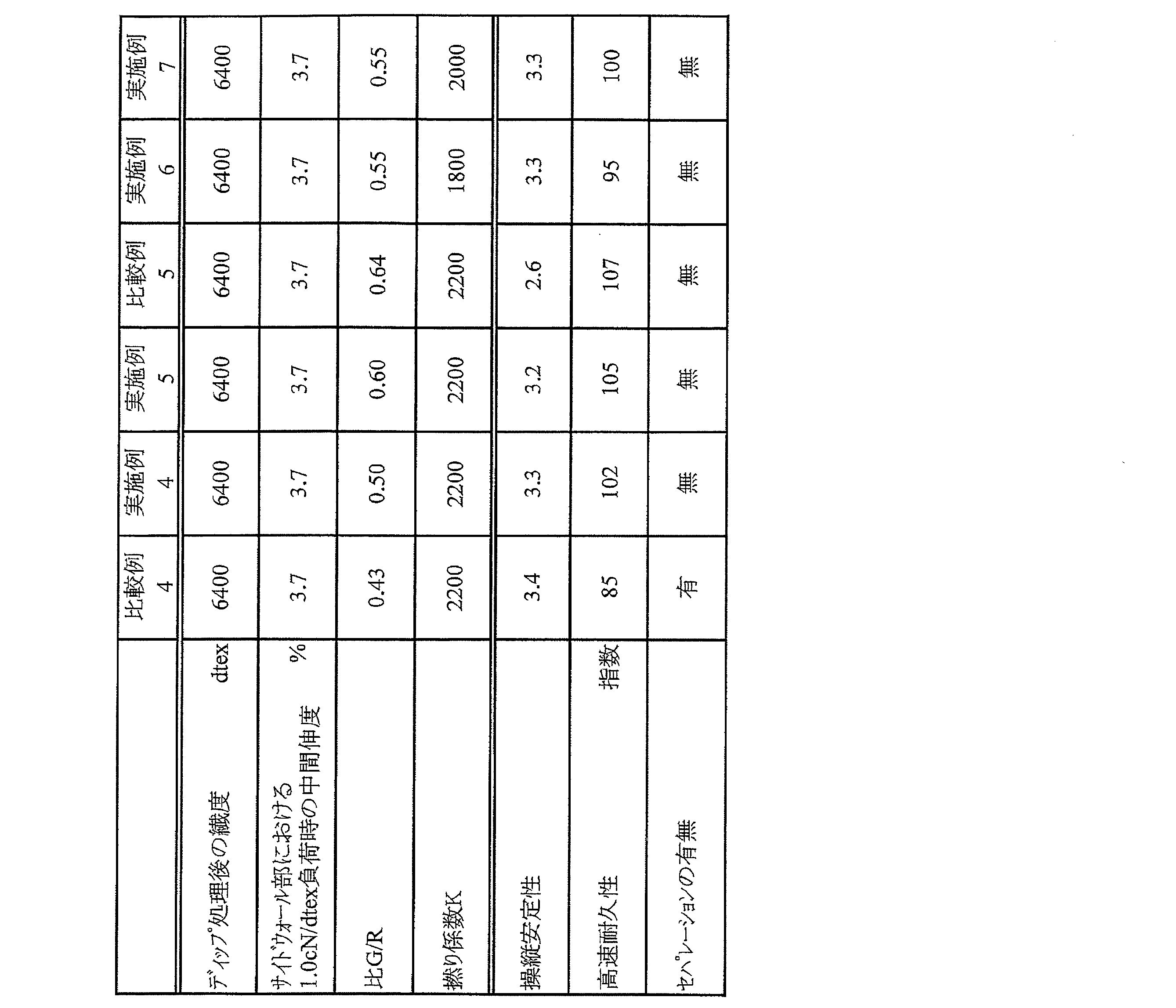
表1,2から判るように、実施例1~7のタイヤは、基準となる従来例1との対比において、操縦安定性および高速耐久性を高度に両立した。また、高速耐久性の試験後においてもセパレーションは発生していなかった。一方、比較例1は、ディップ処理後のカーカスコードの繊度が小さいため、操縦安定性が低下した。比較例2は、サイドウォール部におけるカーカスコードの1.0cN/dtex負荷時の中間伸度が小さいため、高速耐久性が悪化し、高速耐久性試験後のタイヤではセパレーションが発生していた。比較例3は、サイドウォール部におけるカーカスコードの1.0cN/dtex負荷時の中間伸度が大きいため、操縦安定性が低下した。比較例4は、比G/Rが小さいため、高速耐久性が悪化し、高速耐久性試験後のタイヤではセパレーションが発生していた。比較例5は、比G/Rが大きいため、操縦安定性が低下した。
1 トレッド部
2 サイドウォール部
3 ビード部
4 カーカス層
4A 本体部
4B 折り返し部
4c カーカスコード
5 ビードコア
6 ビードフィラー
7 ベルト層
8 ベルト補強層
A 接触領域
CL タイヤ赤道
2 サイドウォール部
3 ビード部
4 カーカス層
4A 本体部
4B 折り返し部
4c カーカスコード
5 ビードコア
6 ビードフィラー
7 ベルト層
8 ベルト補強層
A 接触領域
CL タイヤ赤道
Claims (6)
- タイヤ周方向に延在して環状をなすトレッド部と、該トレッド部の両側に配置された一対のサイドウォール部と、これらサイドウォール部のタイヤ径方向内側に配置された一対のビード部とを備え、前記一対のビード部間に装架された少なくとも1層のカーカス層を有する空気入りタイヤにおいて、
前記カーカス層は、有機繊維のフィラメント束を撚り合わせた有機繊維コードからなるカーカスコードで構成されており、前記カーカスコードのディップ処理後の繊度が4000dtex~8000dtexであり、前記カーカスコードの前記サイドウォール部における1.0cN/dtex負荷時の中間伸度が3.3%~4.2%であり、
前記カーカス層は、前記トレッド部から各サイドウォール部を経て各ビード部に至る本体部と、各ビード部において折り返されて各サイドウォール部側に向かって延在する折り返し部とからなり、前記サイドウォール部において前記本体部と前記折り返し部とが接する接触領域を有し、前記カーカスコードのコード径Rに対する前記接触領域における前記本体部中のカーカスコードと前記折り返し部中のカーカスコードとの間の層間ゴムゲージGの比G/Rが0.50~0.60であることを特徴とする空気入りタイヤ。 - 下記(1)式で表される前記カーカスコードのディップ処理後の撚り係数Kが2000以上であることを特徴とする請求項1に記載の空気入りタイヤ。
K=T×D1/2 ・・・(1)
(但し、Tはコードの上撚り数(回/10cm)であり、Dはコードの総繊度(dtex)である。) - 前記カーカスコードを構成する有機繊維がポリエチレンテレフタレート繊維であることを特徴とする請求項1または2に記載の空気入りタイヤ。
- 前記カーカスコードのディップ処理後の繊度が5000dtex~7000dtexであることを特徴とする請求項1~3のいずれかに記載の空気入りタイヤ。
- 前記カーカスコードの前記サイドウォール部における1.0cN/dtex負荷時の中間伸度が3.5%~4.0%であることを特徴とする請求項1~4のいずれかに記載の空気入りタイヤ。
- 前記カーカスコードのディップ処理後の撚り係数Kが2100dtex~2500dtexであることを特徴とする請求項1~5のいずれかに記載の空気入りタイヤ。
Priority Applications (3)
| Application Number | Priority Date | Filing Date | Title |
|---|---|---|---|
| US17/310,975 US11780267B2 (en) | 2019-03-07 | 2020-03-06 | Pneumatic tire |
| CN202080016726.8A CN113474184B (zh) | 2019-03-07 | 2020-03-06 | 充气轮胎 |
| DE112020000664.6T DE112020000664B4 (de) | 2019-03-07 | 2020-03-06 | L u f t r e i f e n |
Applications Claiming Priority (2)
| Application Number | Priority Date | Filing Date | Title |
|---|---|---|---|
| JP2019041746A JP7107255B2 (ja) | 2019-03-07 | 2019-03-07 | 空気入りタイヤ |
| JP2019-041746 | 2019-03-07 |
Publications (1)
| Publication Number | Publication Date |
|---|---|
| WO2020179920A1 true WO2020179920A1 (ja) | 2020-09-10 |
Family
ID=72337330
Family Applications (1)
| Application Number | Title | Priority Date | Filing Date |
|---|---|---|---|
| PCT/JP2020/009794 Ceased WO2020179920A1 (ja) | 2019-03-07 | 2020-03-06 | 空気入りタイヤ |
Country Status (5)
| Country | Link |
|---|---|
| US (1) | US11780267B2 (ja) |
| JP (1) | JP7107255B2 (ja) |
| CN (1) | CN113474184B (ja) |
| DE (1) | DE112020000664B4 (ja) |
| WO (1) | WO2020179920A1 (ja) |
Families Citing this family (1)
| Publication number | Priority date | Publication date | Assignee | Title |
|---|---|---|---|---|
| JP7815927B2 (ja) * | 2022-03-30 | 2026-02-18 | 住友ゴム工業株式会社 | タイヤ |
Citations (7)
| Publication number | Priority date | Publication date | Assignee | Title |
|---|---|---|---|---|
| JPH11170807A (ja) * | 1997-12-16 | 1999-06-29 | Sumitomo Rubber Ind Ltd | 重荷重用タイヤ |
| JP2002002214A (ja) * | 2000-06-26 | 2002-01-08 | Toyo Tire & Rubber Co Ltd | 空気入りラジアルタイヤ |
| JP2004322782A (ja) * | 2003-04-23 | 2004-11-18 | Yokohama Rubber Co Ltd:The | 空気入りラジアルタイヤ |
| JP2007230405A (ja) * | 2006-03-01 | 2007-09-13 | Bridgestone Corp | 重荷重用空気入りラジアルタイヤ |
| JP2009179105A (ja) * | 2008-01-29 | 2009-08-13 | Bridgestone Corp | 空気入りランフラットタイヤ |
| JP2016222010A (ja) * | 2015-05-27 | 2016-12-28 | 横浜ゴム株式会社 | 空気入りタイヤ |
| JP2018070064A (ja) * | 2016-11-02 | 2018-05-10 | 株式会社ブリヂストン | 空気入りタイヤ |
Family Cites Families (17)
| Publication number | Priority date | Publication date | Assignee | Title |
|---|---|---|---|---|
| JPS604045B2 (ja) * | 1981-08-27 | 1985-02-01 | 商業印刷株式会社 | 結束装置 |
| US6736178B2 (en) * | 1998-04-10 | 2004-05-18 | Sumitomo Rubber Industries, Ltd. | Pneumatic tire with specified bead portion |
| JP4726275B2 (ja) * | 2000-01-12 | 2011-07-20 | 株式会社ブリヂストン | 空気入りラジアルタイヤ |
| JP4645283B2 (ja) * | 2005-04-20 | 2011-03-09 | 横浜ゴム株式会社 | 空気入りタイヤ |
| JP4720332B2 (ja) * | 2005-07-15 | 2011-07-13 | 横浜ゴム株式会社 | 空気入りタイヤ |
| JP4316660B2 (ja) | 2007-11-30 | 2009-08-19 | 横浜ゴム株式会社 | 空気入りタイヤ |
| JP5200690B2 (ja) * | 2008-06-20 | 2013-06-05 | 横浜ゴム株式会社 | 空気入りタイヤ |
| WO2011129444A1 (ja) * | 2010-04-15 | 2011-10-20 | 株式会社ブリヂストン | 空気入りタイヤ |
| JP2012030737A (ja) * | 2010-08-02 | 2012-02-16 | Yokohama Rubber Co Ltd:The | 空気入りラジアルタイヤ |
| EP2853623A4 (en) * | 2012-05-21 | 2016-01-20 | Bridgestone Corp | CORD, RUBBER CORD ASSOCIATED STRUCTURE AND TIRES |
| JP5987973B2 (ja) * | 2013-03-29 | 2016-09-07 | 横浜ゴム株式会社 | 空気入りタイヤ |
| US20150020944A1 (en) * | 2013-07-17 | 2015-01-22 | The Goodyear Tire & Rubber Company | Pneumatic tire having a single carcass ply reinforced with polyester cords |
| JP6241346B2 (ja) * | 2014-03-27 | 2017-12-06 | 横浜ゴム株式会社 | 空気入りタイヤ |
| JP6287457B2 (ja) | 2014-03-27 | 2018-03-07 | 横浜ゴム株式会社 | 空気入りタイヤ |
| JP6423177B2 (ja) * | 2014-06-09 | 2018-11-14 | 株式会社ブリヂストン | 空気入りタイヤ |
| JP6593030B2 (ja) * | 2015-08-25 | 2019-10-23 | 横浜ゴム株式会社 | 空気入りタイヤ |
| JP6743511B2 (ja) * | 2016-06-22 | 2020-08-19 | 横浜ゴム株式会社 | 空気入りタイヤ |
-
2019
- 2019-03-07 JP JP2019041746A patent/JP7107255B2/ja active Active
-
2020
- 2020-03-06 CN CN202080016726.8A patent/CN113474184B/zh active Active
- 2020-03-06 WO PCT/JP2020/009794 patent/WO2020179920A1/ja not_active Ceased
- 2020-03-06 US US17/310,975 patent/US11780267B2/en active Active
- 2020-03-06 DE DE112020000664.6T patent/DE112020000664B4/de active Active
Patent Citations (7)
| Publication number | Priority date | Publication date | Assignee | Title |
|---|---|---|---|---|
| JPH11170807A (ja) * | 1997-12-16 | 1999-06-29 | Sumitomo Rubber Ind Ltd | 重荷重用タイヤ |
| JP2002002214A (ja) * | 2000-06-26 | 2002-01-08 | Toyo Tire & Rubber Co Ltd | 空気入りラジアルタイヤ |
| JP2004322782A (ja) * | 2003-04-23 | 2004-11-18 | Yokohama Rubber Co Ltd:The | 空気入りラジアルタイヤ |
| JP2007230405A (ja) * | 2006-03-01 | 2007-09-13 | Bridgestone Corp | 重荷重用空気入りラジアルタイヤ |
| JP2009179105A (ja) * | 2008-01-29 | 2009-08-13 | Bridgestone Corp | 空気入りランフラットタイヤ |
| JP2016222010A (ja) * | 2015-05-27 | 2016-12-28 | 横浜ゴム株式会社 | 空気入りタイヤ |
| JP2018070064A (ja) * | 2016-11-02 | 2018-05-10 | 株式会社ブリヂストン | 空気入りタイヤ |
Also Published As
| Publication number | Publication date |
|---|---|
| CN113474184B (zh) | 2024-03-29 |
| DE112020000664T5 (de) | 2021-12-09 |
| JP2020142701A (ja) | 2020-09-10 |
| US11780267B2 (en) | 2023-10-10 |
| CN113474184A (zh) | 2021-10-01 |
| DE112020000664B4 (de) | 2023-06-07 |
| JP7107255B2 (ja) | 2022-07-27 |
| US20220041018A1 (en) | 2022-02-10 |
Similar Documents
| Publication | Publication Date | Title |
|---|---|---|
| JP6954321B2 (ja) | 空気入りタイヤ | |
| US20220126629A1 (en) | Pneumatic radial tire | |
| WO2018105717A1 (ja) | 空気入りタイヤ | |
| CN115362071B (zh) | 充气轮胎 | |
| JP7417030B2 (ja) | 空気入りタイヤ | |
| JP7010356B1 (ja) | 空気入りタイヤ | |
| JP7290200B2 (ja) | 空気入りタイヤ | |
| JP7028225B2 (ja) | 空気入りタイヤ | |
| JP7305991B2 (ja) | 空気入りタイヤ | |
| JP7107255B2 (ja) | 空気入りタイヤ | |
| CN115776949B (zh) | 充气轮胎 | |
| JP6915719B1 (ja) | 空気入りタイヤ | |
| JP6988865B2 (ja) | 空気入りタイヤ | |
| JP7773029B2 (ja) | 空気入りタイヤ | |
| JP7492126B2 (ja) | 空気入りタイヤ | |
| JP7477759B2 (ja) | 空気入りタイヤ | |
| JP7572605B2 (ja) | 空気入りタイヤ | |
| WO2023026952A1 (ja) | 空気入りタイヤ |
Legal Events
| Date | Code | Title | Description |
|---|---|---|---|
| 121 | Ep: the epo has been informed by wipo that ep was designated in this application |
Ref document number: 20766847 Country of ref document: EP Kind code of ref document: A1 |
|
| 122 | Ep: pct application non-entry in european phase |
Ref document number: 20766847 Country of ref document: EP Kind code of ref document: A1 |