WO2020179756A1 - 電磁波遮蔽材 - Google Patents
電磁波遮蔽材 Download PDFInfo
- Publication number
- WO2020179756A1 WO2020179756A1 PCT/JP2020/008779 JP2020008779W WO2020179756A1 WO 2020179756 A1 WO2020179756 A1 WO 2020179756A1 JP 2020008779 W JP2020008779 W JP 2020008779W WO 2020179756 A1 WO2020179756 A1 WO 2020179756A1
- Authority
- WO
- WIPO (PCT)
- Prior art keywords
- electromagnetic wave
- wave shielding
- pts
- base material
- paper
- Prior art date
- Legal status (The legal status is an assumption and is not a legal conclusion. Google has not performed a legal analysis and makes no representation as to the accuracy of the status listed.)
- Ceased
Links
Images


Classifications
-
- H—ELECTRICITY
- H05—ELECTRIC TECHNIQUES NOT OTHERWISE PROVIDED FOR
- H05K—PRINTED CIRCUITS; CASINGS OR CONSTRUCTIONAL DETAILS OF ELECTRIC APPARATUS; MANUFACTURE OF ASSEMBLAGES OF ELECTRICAL COMPONENTS
- H05K9/00—Screening of apparatus or components against electric or magnetic fields
- H05K9/0073—Shielding materials
- H05K9/0081—Electromagnetic shielding materials, e.g. EMI, RFI shielding
- H05K9/009—Electromagnetic shielding materials, e.g. EMI, RFI shielding comprising electro-conductive fibres, e.g. metal fibres, carbon fibres, metallised textile fibres, electro-conductive mesh, woven, non-woven mat, fleece, cross-linked
-
- B—PERFORMING OPERATIONS; TRANSPORTING
- B32—LAYERED PRODUCTS
- B32B—LAYERED PRODUCTS, i.e. PRODUCTS BUILT-UP OF STRATA OF FLAT OR NON-FLAT, e.g. CELLULAR OR HONEYCOMB, FORM
- B32B7/00—Layered products characterised by the relation between layers; Layered products characterised by the relative orientation of features between layers, or by the relative values of a measurable parameter between layers, i.e. products comprising layers having different physical, chemical or physicochemical properties; Layered products characterised by the interconnection of layers
- B32B7/02—Physical, chemical or physicochemical properties
- B32B7/025—Electric or magnetic properties
-
- D—TEXTILES; PAPER
- D06—TREATMENT OF TEXTILES OR THE LIKE; LAUNDERING; FLEXIBLE MATERIALS NOT OTHERWISE PROVIDED FOR
- D06M—TREATMENT, NOT PROVIDED FOR ELSEWHERE IN CLASS D06, OF FIBRES, THREADS, YARNS, FABRICS, FEATHERS OR FIBROUS GOODS MADE FROM SUCH MATERIALS
- D06M15/00—Treating fibres, threads, yarns, fabrics, or fibrous goods made from such materials, with macromolecular compounds; Such treatment combined with mechanical treatment
- D06M15/19—Treating fibres, threads, yarns, fabrics, or fibrous goods made from such materials, with macromolecular compounds; Such treatment combined with mechanical treatment with synthetic macromolecular compounds
- D06M15/37—Macromolecular compounds obtained otherwise than by reactions only involving carbon-to-carbon unsaturated bonds
- D06M15/63—Macromolecular compounds obtained otherwise than by reactions only involving carbon-to-carbon unsaturated bonds containing sulfur in the main chain, e.g. polysulfones
-
- H—ELECTRICITY
- H05—ELECTRIC TECHNIQUES NOT OTHERWISE PROVIDED FOR
- H05K—PRINTED CIRCUITS; CASINGS OR CONSTRUCTIONAL DETAILS OF ELECTRIC APPARATUS; MANUFACTURE OF ASSEMBLAGES OF ELECTRICAL COMPONENTS
- H05K9/00—Screening of apparatus or components against electric or magnetic fields
Definitions
- the present invention is an invention relating to an electromagnetic wave shielding means, and more specifically, an invention relating to an electromagnetic wave shielding material, an electromagnetic wave shielding body using the electromagnetic wave shielding material, and a method for reducing electromagnetic waves.
- an electromagnetic wave in the frequency range of 40-75 GHz which is defined as a V band (standard name given by IEEE)
- V band standard name given by IEEE
- millimeter-wave radar is used in millimeter-wave radar and is applied to a collision prevention system in automobile driving.
- this band will be actively used as a frequency band capable of transmitting and receiving with higher capacity and higher speed.
- Patent Document 1 relates to an electromagnetic wave absorber having a bandwidth of 2 GHz or more in a frequency band of 60 to 90 GHz.
- PEDOT-pTS poly(3,4-ethylene-dioxythiophene)-p-toluenesulfonate
- PEDOT-pTS poly(3,4-ethylene-dioxythiophene)-p-toluenesulfonate
- PADOT-pTS poly(3,4-ethylene-dioxythiophene)-p-toluenesulfonate
- PADOT-pTS poly(3,4-ethylene-dioxythiophene)-p-toluenesulfonate
- PEDOT-PSS poly(3,4-ethylenedioxythiophene)-polystyrenesulfonate
- a conductive polymer having a predetermined performance Patent Documents 4 and 5.
- Patent Document 1 widens the electromagnetic wave absorption bandwidth in the frequency band of 60 to 90 GHz, but it is necessary to construct a three-layer structure of a dielectric layer, a resistance layer, and a conductive layer. There is a clear peak of the absorbed electromagnetic wave wavelength, which varies depending on the thickness and material of the dielectric layer, and it was necessary to construct a standard or combination corresponding to the specific purpose of use.
- the present inventor adhered it to a fiber material to obtain a conductive polymer having an electrical resistance of about several hundred-1 k ⁇ . Not only can it be a hybrid material and can be used as a flexible material whose shape can be freely deformed, but surprisingly, it has an electromagnetic wave shielding property in a wide range of bandwidth for radio waves, specifically, at least 1- It has been found to have a wide range of 60 GHz from microwave (UHF) to millimeter wave (SHF).
- UHF microwave
- SHF millimeter wave
- the material to which the conductive polymer is attached has an electromagnetic wave absorbing ability with respect to an electromagnetic wave of 1 GHz or more, and in particular, if it is 8 GHz or more, a predetermined electromagnetic wave without a large peak up to about 60 GHz at least. It became clear that it was possible to shield. Moreover, even if a complicated structure such as a laminated structure with other materials or a pyramid structure is not provided, the above-mentioned adhering material itself is recognized for its ability to shield electromagnetic waves in a wide range of radio waves, and further adhering the adhering materials together. By simply stacking them, it is possible to enhance the electromagnetic wave shielding ability. At the time of the above-mentioned superposition, it is preferable to sandwich an insulator such as a base material, a film, or paper having no conductor between the adhering materials.
- an insulator such as a base material, a film, or paper having no conductor between the adhering materials.
- the present invention provides PEDOT-pTS (poly(3,4-ethylene-dioxythiophene)-p-toluenesulfonate) or PEDOT-PSS (poly(3,4-ethylenedioxythiophene)-polystyrenesulfonate) on all or part of the substrate.
- an electromagnetic wave shielding material hereinafter, also referred to as an electromagnetic wave shielding material of the present invention
- Electromagnetic wave shielding is a concept that includes both electromagnetic wave absorption and electromagnetic wave reflection, but the main electromagnetic wave shielding means of the electromagnetic wave shielding material of the present invention is electromagnetic wave absorption.
- the material of the substrate is not particularly limited as long as it is a material to which PEDOT-pTS or PEDOT-PSS can be attached, and examples thereof include polyester, polyamide, polyurethane, sericin coating material of these synthetic fibers, paper, And, a base material containing one kind or two or more kinds of silk can be exemplified. At least, paper-containing substrates, silk, or polyester have been found to be suitable, but not limited to these. Further, it is more preferable that the above-mentioned "paper-containing base material" is Japanese paper.
- the above-mentioned base material may be a sheet in which "eyes" (gaps) are not recognized by visual observation at a clear viewing distance, but it is preferable that it is "cloth", and as the cloth, Knitted fabrics, woven fabrics, braids, nets and the like can be mentioned, but reticulated fabrics such as knitted fabrics, woven fabrics or nets are particularly preferable, knitted fabrics or woven fabrics are very preferable, and knitted fabrics are most preferable. It is presumed that the knitted fabric is, in principle, preferably a continuous composition of one yarn.
- the range of frequencies that can be absorbed by the electromagnetic wave shielding material of the present invention is a wide range of microwaves (UHF) to millimeter waves (SHF) (included in radio waves) of at least 1 to 60 GHz.
- the electromagnetic wave shielding material of the present invention is characterized in that it exhibits an electromagnetic wave shielding ability by including an arbitrary region selected from this range. If the frequency range is at least 8-60 GHz, a large peak-free predetermined electromagnetic wave is obtained. It is possible to shield.
- the present invention provides an electromagnetic wave shield (hereinafter, also referred to as the electromagnetic wave shield of the present invention) including the electromagnetic wave shield of the present invention.
- the electromagnetic wave shield of the present invention may include a non-essential part other than the electromagnetic wave shield of the present invention.
- a non-essential part a conductive material, an insulating material, a dielectric material, a conductive connector, a cover material for covering the electromagnetic wave shielding material of the present invention, an adhesive material for attaching the electromagnetic wave shielding material to another object, Examples thereof include a cushioning material and a filler for protecting the electromagnetic wave shielding material.
- PEDOT-pTS poly (3,4-ethylene-dioxythiophene) -p-toluenesulfonate
- PEDOT-PSS poly (3,4-ethylenedioxythiophene) -polystyrenesulfonate
- an electromagnetic wave attenuation method for exposing a base material to an electromagnetic wave to attenuate the electromagnetic wave.
- an electromagnetic wave shielding material capable of widely absorbing and shielding electromagnetic waves in a radio wave region and an electromagnetic wave shielding body including the electromagnetic wave shielding material are provided, and an electromagnetic wave attenuation method using the electromagnetic wave shielding material is provided.
- the base material used for the electromagnetic wave shielding material of the present invention is not particularly limited, but a “paper-containing base material” is preferable.
- the “paper-containing base material” may be a “paper base material” or a "material in which paper and materials other than paper are mixed". Examples of “a mixture of paper and materials other than paper” include the case where fibers other than paper are present in the constituent fibers combined by twisting in the paper yarn.
- the base material is a fabric
- the content ratio of paper in the "base material containing paper” is 10% by mass or more, and may be 100% by mass, based on the entire base material. In particular, when emphasizing the presence of paper, 20% by mass or more is preferable.
- the "paper” which is the main material of the base material of the electromagnetic wave shielding material of the present invention is produced by gluing plant fibers and, if necessary, other fibers, and its production method is known. Therefore, it is basically produced by obtaining plant fibers by beating or the like, dispersing them in water or the like, scooping them up, and drying them.
- plant fiber examples include seed fiber such as cotton; bast fiber such as flax, cannabis, jute, kozo, mitsumata, ganpi; coniferous fiber such as spruce, fir, pine, larch; poplar, hippo, beech, willow, eucalyptus, Broadleaf fiber such as nire; leaf fiber such as abaca (manila hemp); rice fiber such as rice straw and straw; other examples include esparto, reed, bamboo, bamboo grass, and kumazasa.
- seed fiber such as cotton
- bast fiber such as flax, cannabis, jute, kozo, mitsumata, ganpi
- coniferous fiber such as spruce, fir, pine, larch
- poplar hippo, beech, willow, eucalyptus
- Broadleaf fiber such as nire
- leaf fiber such as abaca (manila hemp)
- rice fiber
- Fibers include polyamide fibers such as nylon, polyester fibers such as PET, acrylic fibers, aramid fibers, polyurethane fibers, carbon fibers, glass fibers, etc., and added as a constituent component of paper depending on the properties of the fibers. Be done.
- components other than fibers which are usually contained in paper, for example, fillers such as talc, clay, calcium carbonate, titanium dioxide, and glue, are also defined in the present invention as components of paper.
- fillers such as talc, clay, calcium carbonate, titanium dioxide, and glue
- flame-retardant paper it is a "material” and is different from this "component contained in the inside of the paper that is integrally configured".
- An example of such a technique is the flame-retardant paper described in JP-A-2013-2003 (flame-retardant paper containing a predetermined amount of cellulose fiber, glass fiber, aluminum hydroxide powder, and guanidine phosphate flame retardant). ..
- Japanese paper that is the main material of the base material of the electromagnetic wave shielding material of the present invention
- Japanese paper has excellent hygroscopicity as a material to be used, and further the constituent fibers are long and the entangled state of the fibers is moderate. Therefore, it is preferable in that PEDOT-pTS or PEDOT-PSS has excellent fixability.
- the Japanese paper in the present invention is a paper whose constituent fibers are substantially bast fibers. Washi was originally made from bast fiber (above) as a raw material and by a hand-plow method using a paste (vegetable mucus), but in the present invention, a paper made by a mechanical plow method is also used in the present invention. Included in “Washi”.
- the "Washi" of the present invention also includes a mixture of bast fibers and components other than vegetable burr, for example, chemical substances that replace the burr, and other plant components, such as Kumazasa fiber. ..
- the paper thread that constitutes a knit or woven fabric can be manufactured by shredding a sheet of paper that has already been manufactured into slits, and twisting the slitted paper. At the time of twisting, it is possible to cross-twist with fibers or threads other than paper, for example, silk, rayon, cotton thread, etc., and it is also possible to use other types of threads as the core material, but at least on the surface of the threads. It is necessary that the paper is exposed on all or part of it.
- the thickness of the paper thread is not particularly limited and can be selected in the range of about 0.1 ⁇ m-3 mm as needed, but usually it is about 1 ⁇ m-1 mm.
- polyester fibers such as PET (polyethylene terephthalate) fibers, polyamide (nylon) fibers, polyurethane fibers. And so on. Further, it may be coated with sericin, which is a constituent of silk (Japanese Patent Laid-Open No. 2003-171874).
- Silk may be raw silk, or may have been "refined", which is a process for removing sericin and other impurities.
- the scouring include soap scouring, alkali scouring, soap/alkali scouring, enzyme scouring, high temperature/high pressure scouring, acid scouring, and any scouring method can be used.
- a blended twisted yarn of silk and other fibers for example, a silk-acetate blended twisted yarn, a silk-nylon blended twisted yarn, a silk-polyester blended twisted yarn, and a silk-polyester blended yarn, and these are blended combinations. Not limited to.
- silk obtained by using gene recombination technology, for example, "shining silkworm obtained by incorporating a gene encoding a fluorescent protein” It is also possible to use "silk” or the like.
- Materials to be coated with sericin in the sericin-coated yarn include polyamide fibers such as nylon, polyester fibers such as PET, acrylic fibers, aramid fibers, polyurethane fibers, synthetic fibers such as carbon fibers; cotton, linen, jute and the like. Vegetable fibers; in addition to the above silk, animal fibers such as wool and collagen fibers; or mixed fibers thereof can be used.
- polyester fiber in addition to PET (polyethylene terephthalate) fiber, PEN (polyethylene terephthalate) fiber, PTT (polytrimethylene terephthalate) fiber, PBT (polybutylene terephthalate) fiber and the like can also be used.
- the form of the polyester yarn imparted with stretchability may be a filament yarn (long fiber) or a yarn that has undergone a spinning process. As described above, it can also be used as a blended yarn in combination with other fibers.
- the polyamide fiber can be made into a yarn having stretchability by using nylon 6, nylon 6,6, nylon 11, nylon 12, etc., and is used as a blended yarn combined with other fibers as described above. You can also do it.
- the material of the fiber or thread other than paper is not particularly limited as long as it is composed of a polymer, and examples thereof include synthetic fiber, vegetable fiber, animal fiber. Fiber or the like is used. It may consist of a single material, or it may be a mixture.
- Examples of the synthetic fiber include nylon fiber, polyester fiber, acrylic fiber, aramid fiber, polyurethane fiber, carbon fiber and the like.
- Examples of the vegetable fiber include cotton, hemp, jute and the like.
- Examples of the animal fiber include silk, wool, collagen, elastic fiber forming animal tissue, and the like.
- the thickness of the thread other than the above-mentioned paper thread is not particularly limited and can be selected as needed in the range of about 1 ⁇ m-3 mm, but is usually about 10 ⁇ m-1 mm.
- a fabric composed of a paper yarn which is one embodiment of the electromagnetic wave shielding material of the present invention, is a fabric in which PEDOT-pTS or PEDOT-PSS is attached to the fabric based on the paper yarn, As described above, the type of fabric is preferably knitted or woven, and most preferably knitted.
- the knitted fabric or woven fabric may be single-layered or multi-layered. Even if it is a single layer, it is possible to provide overlapping threads in the thickness direction depending on the knitting method and the weaving method.
- a knit is basically a fabric made of a single thread, and is a cloth made of a thread loop (knit) formed continuously by hooking threads one after another on a thread loop. Unlike woven fabrics, warp and weft threads are not used. As described above, it is presumed that the fact that the constituent yarn is one in principle is one of the reasons why the knitted fabric is suitable as the base material in the present invention.
- the knitting machine used in the present invention is not particularly limited, and may be machine knitting (flat knitting machine, warp knitting machine, circular knitting machine, tricot knitting machine, Rachel knitting machine, Milanese knitting machine, rubber knitting machine, interlock knitting machine, etc.). ), Needle knitting, hook needle knitting,riel knitting, or any other knitting method may be used.
- the knitting structure is not limited, for example, flat knitting, Kanoko knitting, rubber knitting, pearl knitting, tack knitting, transfer knitting, velvet knitting, double knitting, double-sided knitting, swinging knitting, velvet knitting, floating knitting, pile knitting.
- Woven fabric is a fabric made by combining warp threads and weft threads.
- the structure of the woven fabric used in the present invention is not particularly limited. For example, it can be used as a plain weave, a twill weave, and a satin weave. Further, it may be a changed structure in which the Mihara structure is changed or combined, or it may be a single special structure or a crested structure. Further, it may be a plurality of woven fabrics such as warp double woven fabric, weft double woven fabric, warp and weft double woven fabric, pile woven fabric, towel woven fabric, and joy woven fabric.
- Woven fabric is a fabric made by combining with warp threads.
- the structure of the woven fabric used in the present invention is not particularly limited. For example, it can be used as a plain weave, a twill weave, and a satin weave. Further, it may be a changed structure in which the Mihara structure is changed or combined, or it may be a single special structure or a crested structure. Further, it may be a plurality of woven fabrics such as warp double woven fabric, weft double woven fabric, warp and weft double woven fabric, pile woven fabric, towel woven fabric, and joy woven fabric. As described above, the multiple woven fabric can be provided with overlapping yarns in the thickness direction.
- woven fabrics have warp and weft yarns caught by each other compared to knitted fabrics, and the yarns pull each other to maintain a plane balance as a fabric, and there are originally many points of contact between yarns.
- the knitting or weaving is even in order to obtain the same level of absorption of electromagnetic waves, but, for example, in order to prevent fraying of threads, closed knitting (ears) may be added to the outer edge in It is also possible to provide the same. Also, the stitches or weaves can be adjusted in frequency or size in order to obtain appropriate sensitivity to electromagnetic waves.
- the size of the stitches is not particularly limited, and fine stitches that cannot be easily confirmed by visual observation at a clear viewing distance are acceptable, but normally, a 10 cm width is 100-5 stitches, 100 stitches. It is about -5 steps (1 mm 2 -4 cm 2 in stitch size).
- the size of the weave is not particularly limited, and a fine weave that is difficult to visually confirm at a clear viewing distance is acceptable, but normally the weave size is 0.2 mm 2 It is about -2 mm 2 .
- PEDOT-pTS poly (3,4-ethylene-dioxythiophene) -p-toluenesulfonate
- pTS p-toluenesulfonate
- EDOT 3,4-ethylenedioxythiophene
- the PEDOT-pTS can be adhered by contacting it with a thread-shaped substrate) by dipping or printing, and then subjecting it to a polymerization promoting treatment (disclosed in Patent Document 2). Method or its modification).
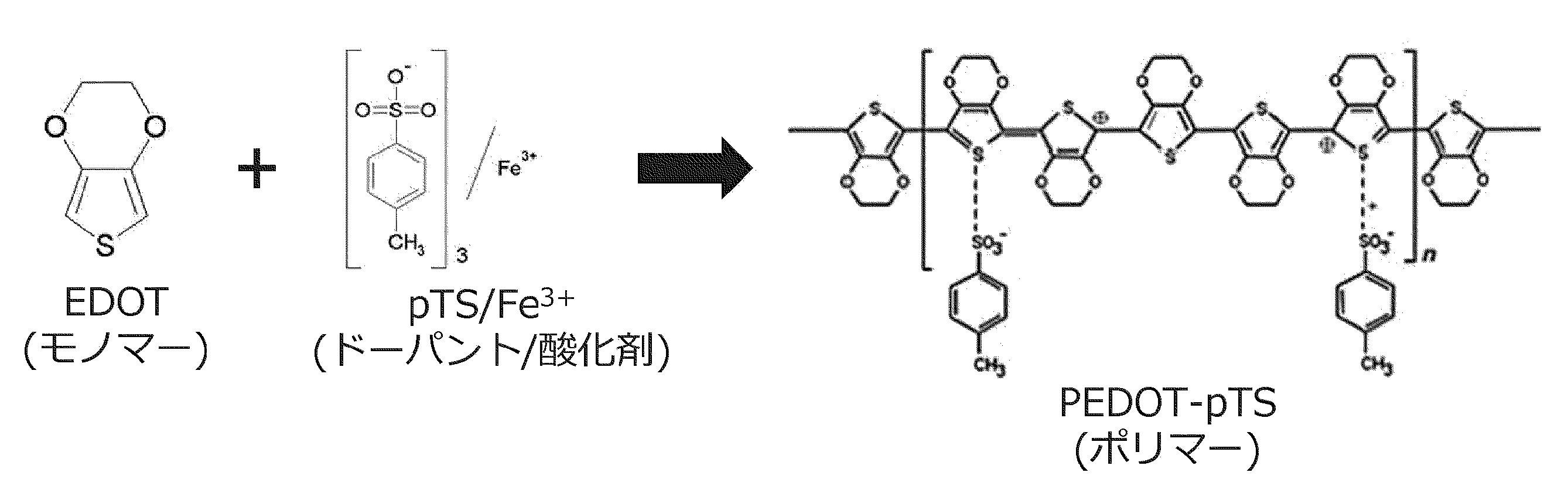
- a second attaching method (a) an attaching step of attaching a pTS solution containing an oxidizing component and pTS to a base material (mainly a sheet-like base material or a thread-like base material), (b) an attaching step ( PEDOT-pTS can be attached by further adhering EDOT to the above-mentioned substrate to which the oxidizing component and pTS are attached in a) and promoting a polymerization reaction to generate PEDOT-pTS in these (( Second attachment method: the method disclosed in Patent Document 3).
- the polymerization reaction of EDOT proceeds in the pTS-EDOT mixed solution, and PEDOT-pTS, which is a polymer, is formed.
- the polymerization rate of the polymerization reaction increases as the temperature rises, and if stored at a refrigerator-level low temperature, the polymerization rate can be reduced and the time for the adhesion step can be secured.
- Fe 3+ is exemplified as an oxidizing component, but the present invention is not limited to this.
- “afterwards” means that the polymerization promotion treatment is performed at “after the same time”, which is related to the timing at which the pTS-EDOT liquid mixture contacts the substrate. Specifically, both timings may be virtually the same, and a polymerization accelerating treatment may be performed by providing a time lag from the timing at which the pTS-EDOT liquid mixture contacts the substrate.
- a mode in which the pTS-EDOT mixed liquid is contacted on the base material while continuously maintaining the state of performing the polymerization promotion treatment on the base material, and the time lag is not substantially provided in the first attaching method. Included in "afterwards”.
- ⁇ pTS is known as a para-toluene sulfonic acid compound (salt or ester with para-toluene sulfonic acid (tosylic acid)) and is commercially available.
- the organic solvent that can serve as a solvent for the pTS solution is capable of dissolving pTS and the oxidizing component and the like, and preferably has good compatibility with an aqueous solvent.
- Specific examples include monohydric lower alcohols having 1 to 6 carbon atoms, specifically, methanol, ethanol, propyl alcohol, isopropyl alcohol, butanol, pentanol, or hexanol.
- the skeleton of carbon atoms constituting these monohydric lower alcohols may be linear, branched or cyclic, and may be used alone or in combination of two or more. Alternatively, it may be appropriately diluted with water before use.
- monovalent lower alcohols having 1-4 carbon atoms specifically, methanol, ethanol, propyl alcohol, isopropyl alcohol, or butanol are suitable as the organic solvent for the pTS solution.
- the oxidizing component contained in the pTS solution is not particularly limited as long as it can activate the polymerization reaction to PEDOT-pTS in the pTS-EDOT mixed solution, and examples thereof include transition elements and halogens.
- a first transition element such as iron, titanium, chromium, manganese, cobalt, nickel and zinc; a second transition element such as molybdenum, silver, zirconium and cadmium; a third transition element such as cerium, platinum and gold.
- a first transition element such as iron, titanium, chromium, manganese, cobalt, nickel and zinc
- a second transition element such as molybdenum, silver, zirconium and cadmium
- a third transition element such as cerium, platinum and gold.
- the content of the oxidizing component in the pTS solution varies depending on the type of the oxidizing component used, and is not particularly limited as long as it is an amount that can activate the above polymerization reaction.
- the amount of ferric chloride is preferably 1-10% by mass, and particularly preferably 3-7% by mass, based on the solution. If the content is too large, the polymerization reaction proceeds rapidly, but it becomes difficult to remove iron in the subsequent step, and if it is too small, the polymerization reaction proceeds slowly.
- the content of pTS acting as a dopant in the pTS solution is preferably 0.1-10% by mass, more preferably 0.15-7% by mass, and particularly preferably 1-6% by mass with respect to the solution. %, Most preferably 2-5% by mass.
- EDOT is known as 3,4-ethylenedioxythiophene and is commercially available. EDOT is liquid at room temperature and water-soluble, and can be appropriately diluted with an aqueous solvent such as water before use.
- the pTS solution does not impair the effect of the present invention quantitatively or qualitatively, such as the adhesion of the pTS-EDOT mixed solution to the substrate and the conductive performance of the finished conductive material are not substantially impaired. Can be blended as needed.
- Examples of the other component include glycerol, polyethylene glycol-polyprene glycol polymer, ethylene glycol, sorbitol, sphingosine, and phosphatidylcholine, preferably glycerol, polyethylene glycol-polyprene glycol polymer, and sorbitol. 1 type or 2 or more types are mentioned.
- cationic surfactants such as quaternary alkyl ammonium salts and alkyl pyridinium halides; anionic surfactants such as alkyl sulfates, alkylbenzene sulfonates, alkyl sulfosuccinates and fatty acid salts; polyoxyethylene, poly Nonionic surfactants such as oxyethylene alkyl ethers; natural polysaccharides such as chitosan, chitin, glucose and aminoglycans; sugar alcohols and dimethyl sulfoxide.
- the step of removing the excess gelled polymer adhering to the substrate after the contact with the mixed solution.
- the base material separated from the mixed solution can be removed by physical means such as vibration, ventilation, and contact with a roller.
- the step of removing the extra gelling polymer is not carried out after the polymerization reaction, the contact between the base material and the mixed solution is carried out in a short time after the preparation of the mixed solution, and the preparation of the mixed solution. There is a restriction that the contact should be made in a short time later.
- the adhesion by the above contact should be completed within 5 minutes, more preferably 1 minute after the preparation of the pTS-EDOT mixed solution.
- the adhesion of PEDOT-pTS to the substrate sufficient by taking an adhesion process time of 10 minutes or more, more preferably 15 minutes or more. Even if the adhesion step takes 40 minutes or more, the adhesion promoting effect corresponding to the long process is not recognized due to the progress of gelation.
- Adhesion by contact in the first adhesion method is preferably performed by dropping, spraying, dipping, transferring, or coating.
- Heat treatment can be mentioned as the polymerization promoting treatment in the first adhesion method.
- the heat treatment includes ( ⁇ ) contact with a heat-dissipating member at 50-90° C. in the polymerization promoting portion, ( ⁇ ) contact with hot air set so that the polymerization promoting portion is at 50-90° C., ( ⁇ ) Contact with a heating atmosphere at 50-90 ° C. in a constant temperature bath or the like can be mentioned.
- the heating time of 50 to 90° C. of the above ( ⁇ ) is preferably 3 to 10 minutes, particularly preferably 3 to 6 minutes, and most preferably 4 to 6 minutes.
- the heating atmosphere is set to 50-90° C. of the above ( ⁇ ), 3-10 minutes is preferable, and 4-6 minutes is particularly preferable.
- the substrate is taken out from the solution, washed with water, more preferably distilled water or deionized water, and then dried with a constant temperature bath, hot or warm air, or sun.
- water more preferably distilled water or deionized water
- the adhesion part of the pTS-EDOT mixed solution contacting the base material on a part of the base material plane, the "adhesion part is less likely to bleed"
- the characteristics of the attachment method of 1 can be utilized. Drawing design is different from simple one-sided attachment, and includes simple figures such as circles and triangles as well as various depictions such as animal and plant drawings, portraits, characters, patterns and the like.
- mask treatment or spray spraying can be performed to create a drawing design on the base material more precisely.
- the masking process is a process of previously covering a portion where the conductive polymer is not attached with a mask.
- the mask treatment is performed on the portion excluding the intended adhesion portion, and then at least the adhesion is performed.
- the mask is removed after contacting with the mixed solution at a planned location and further performing a polymerization promoting treatment.
- a stain-proof paste or beeswax as a masking agent
- the stain-proofing paste include starch paste such as maize paste, corn starch paste, and sweet potato starch paste; rubber paste; seaweed paste such as fusuri paste; and various other types of paste.
- starch paste is suitable.
- the concentration of the resist dye paste at the time of use is not particularly limited, but is approximately 3-5% by mass.
- the resist dye paste can be removed by washing with water.
- Beeswax a wax derived from beehives, is also suitable. At the time of use, it is usually used by directly heating and melting. The beeswax is removed by melting it again by heating.
- organic solvent that can be the solvent for pTS and the oxidizing component contained therein are the same as the above-mentioned "organic solvent and oxidizing component of the pTS solution of the first adhesion method".
- other components that can be contained in the pTS solution are also the same as the above-mentioned “other components in the pTS solution of the first adhesion method”.
- the content of the oxidizing component in the pTS solution varies depending on the type of the oxidizing component used, and is not particularly limited as long as it is an amount capable of activating the above polymerization reaction.
- the amount of ferric chloride is preferably 1-10% by mass, more preferably 3-7% by mass, based on the pTS solution. If the content is too large, the polymerization reaction proceeds rapidly, but it becomes difficult to remove iron in the subsequent step, and if it is too small, the polymerization reaction proceeds slowly.
- the content of pTS acting as a dopant in the pTS solution is preferably 0.1-10% by mass, more preferably 0.15-7% by mass, and particularly preferably 1-6% by mass with respect to the solution. %, Most preferably 2-5% by mass.
- the monomer EDOT is added to the PTS solution in which the above substrate is immersed, and then at 50-100° C., preferably 10 minutes-60 minutes, more preferably 50- Heating is performed at 80 ° C. for 10-40 minutes, very preferably 60-80 ° C. for 10-30 minutes. After heating, the substrate is taken out from the solution, washed with water, more preferably distilled water or deionized water, and then dried with a thermostat, hot or warm air, or sun.
- PEDOT-PSS poly (3,4-ethylenedioxythiophene) -polystyrenesulfonate
- the PEDOT-PSS attached to the substrate can be attached by a so-called electrolytic polymerization method in which PEDOT-PSS attached to the substrate is electrochemically polymerized and fixed by running electricity between the electrodes while pulling it vertically from the solution (Patent Document 4). ..
- a resin composition obtained by mixing PEDOT-PSS and a binder resin may be attached to a stretched yarn and then solidified or polymerized by drying, heating, heating or the like (Patent Document 5).
- Patent Document 5 a resin composition obtained by mixing PEDOT-PSS and a binder resin
- a solution/solvent is made to be conductive, Is possible.
- Example 10 As the base material of the conductive material of the present invention, Japanese paper yarn having a thickness of 240 denier (22 count) (double yarn with a sweet twist on the upper twist) is used for knitting of Kanoko (sparse knitting base material with a mesh width of 3111 ⁇ m and a dense knitting of 1783 ⁇ m). Two kinds of stretchable fabrics (50 cm ⁇ 50 cm) made into knitting base materials were obtained. One is a “sparse knitted base material” having a mesh width of 3111 ⁇ m, and the other is a “dense knitted base material” having a mesh width of 1783 ⁇ m.
- a butanol solution containing iron(III) ion of a transition metal and pTS (CLEVIOS CB40 V2 manufactured by Heraeus: p-toluenesulfonate iron(III) is about 4% by mass: "CLEVIOS”. Is a registered trademark).
- EDOT an aqueous solution of EDOT (CLEVIOS MV2 manufactured by Heraeus, EDOT is about 98.5 mass%: "CLEVIOS” is a registered trademark) was used.
- a mixed solution prepared by mixing EDOT with the above pTS solution was prepared, cooled to about 4° C., and the above base material was immersed in the mixed solution at room temperature for 20 minutes. After that, the immersed base material is taken out of the mixed solution, suspended at two points on one side by clips, and exposed to the wind (strong wind) of a fan for 5 to 10 minutes to dry the base material while vibrating the base material. Further, it was rubbed with a roller to remove excess gelled polymer adhering to the substrate by these steps.
- the base material from which the gelled polymer had been removed was placed in a constant temperature bath at 70° C. and heated for 5 minutes to polymerize to PEDOT-pTS.
- the polymerization base material was repeatedly washed with water twice and then dried at 90° C. to obtain two kinds of “knitted fabric made of paper to which PEDOT-pTS was attached”. These are also referred to as “sparse knitting base material” and “tight knitting base material”, respectively.
- an adhesive base material for silk fabric was also obtained. This is also referred to as a "silk base material”. These were used as samples.
- Electromagnetic wave shielding test 1 Measurement of electromagnetic wave shielding function
- the two horn antennas should have the same plane of polarization. Face each other, insert the sample between the two horn antennas, and set the “shielding amount of test electromagnetic wave” to “(transmission amount of test electromagnetic wave without sample)-(transmission amount of test electromagnetic wave with sample). ) ”Was calculated by a network analyzer (VNA).
- VNA network analyzer
- the horn antennas Place the horn antennas on the transmitting side and the receiving side, respectively, facing the sample (sheet-shaped electromagnetic wave shielding material) that is fixedly installed by enclosing it with the electromagnetic wave absorber so as to fill the calculated first Fresnel zone cross section, and set it at the predetermined position.
- the predetermined electromagnetic wave was transmitted and received, and the amount of electromagnetic wave shielding was calculated according to the above equation.
- the angle between the sample surface and the direction of the horn antenna was basically orthogonal (90 degrees).
- Fig. 1 (2) An overview of this measurement system is shown in Fig. 1 (2).
- the black structure in the front is a super high frequency electromagnetic wave absorber having a pyramid type structural unit.
- a sample is placed in the vicinity of the window by providing a window in the center and aligning the sample surfaces so as to be parallel to the window surface.
- the vector network analyzer used a Keysight Field Microwave Analyzer N9916A, and the calibration was performed at the input end of the antenna.
- the horn antenna was Schwarzbeck Mess Electronik, BBHA9120B, and the sample-antenna distance (D) was 2300 mm (> far field condition 2208 mm) in the vertical direction (90 degrees), and the sample size was 50 cm x 50 cm, respectively. There is one sample for each.
- the results are shown in Figure 2.
- the horizontal axis of FIG. 2 is the measurement frequency (GHz), and the vertical axis is the shielding amount (dB) of the measured electromagnetic wave. From FIG.
- the substantial electromagnetic wave shielding effect was recognized in the knitted paper yarn (the loose knitted base material and the dense knitted base material), and was slight in the most densely knitted silk base material.
- the electromagnetic wave shielding effect of the knitted paper yarn increased at 1-8 GHz, and a flattening tendency was observed thereafter.
- the vector network analyzer uses Rohda & Schwarz ZVA67 (-67 GHz), the horn antenna uses SAGE, MN:SAR-2309-19-52 (40-60 GHz), and the sample-antenna distance (D) is 500 mm. (> Far field condition of about 460 mm) in the vertical direction (90 degrees), the sample size is 50 cm ⁇ 50 cm, and each sample is one.
- FIG. 2 (40-60 GHz). Together with these and the results of FIG. 2 above, it was found that a good and stable frequency shielding property of about 5-8 db as it is from 10 GHz to at least 60 GHz is recognized in the knitted paper yarn.
- the electromagnetic wave shielding performance will be improved according to the number of stacked plates, and the same number of base plates will be obtained when the electromagnetic wave irradiation angle from the horn antenna is 45 degrees.
- the electromagnetic wave shielding performance of the material was the best.
- the electric resistance value of the coarse knit base material is 29 ⁇ 5.3 k ⁇ (5.8 k ⁇ per yarn), and the electric resistance value of the close knit base material is 116 ⁇ 16 k ⁇ (per yarn) It was 23.2 k ⁇ ).
- Electromagnetic wave shielding test 2 From the results of the electromagnetic wave shielding test 1 described above, confirmation of the electromagnetic wave shielding effect of the base material in the frequency band of 10-40 GHz where an electromagnetic wave shielding effect of about 5 dB is expected is confirmed by a moving body sensor (near 10 GHz) and a moving body/distance sensor. (Near 24 GHz) was used.
- test using a moving body sensor (near 10 GHz)
- a test system using a moving body sensor for examining the electromagnetic wave blocking effect in the vicinity of 10 GHz is as shown in FIG.
- the sample 2 (sparsely-knitted base material) was placed near the opening of the end with respect to the central longitudinal axis of the tubular body 1. Is fixed as a basic position, and the moving body sensor 3 is fixed near the other end side so that the electromagnetic wave emitted from the moving body sensor 3 is emitted in the central longitudinal axis direction of the tubular body 1.
- Three types of lengths of the tubular body 1 were used: 100 mm, 150 mm, and 200 mm, and these were treated as the “distance from the sensor of the sample”.
- the frequency of the transmitted electromagnetic wave is "10.525 GHz”.
- the sample was moved vertically or horizontally so as to be parallel to the opening surface of the cylindrical body, and the electromagnetic wave shielding rate (%) was calculated using the difference in intensity between the transmitted wave and the received wave as a parameter.
- the result is shown in FIG.
- the electromagnetic wave shielding effect at the frequency of the electromagnetic wave was recognized from any distance.
- the greater the distance from the sensor the weaker the intensity of the transmitted electromagnetic wave when it comes into contact with the sample, and the greater the shielding effect.
- the electromagnetic wave shielding effect of the sample at the frequency was 6-8 (dB).
- the shielding effect was further enhanced when the samples were stacked with a non-conductive base material such as paper or an insulator such as an insulating film sandwiched between them.
- test using moving object / distance sensor (near 24 GHz)
- a test system using a moving body/distance sensor for examining the electromagnetic wave shielding effect in the vicinity of 24 GHz is as shown in FIG.
- the sample 20 (sparsely-knitted base material) was placed in the immediate vicinity of the transmission point of the electromagnetic wave transmitted from the moving body/distance sensor 30 so as to be intercepted perpendicularly to the central traveling direction of the transmitted electromagnetic wave, and separated by 6 m.
- the reflected electromagnetic wave from the concrete wall surface 40 was detected by the moving body / distance sensor.
- the frequency of the transmitted electromagnetic wave is "24.05-24.25 GHz".
- the method used for detection is the FMCW (Frequency Continuous Modulation) method, which is a method of transmitting radio waves that are modulated so that the frequency increases linearly with time, and the detection sensitivity of distance measurement by this is used as an index.
- the shielding effect was evaluated. As a result, the electromagnetic wave shielding effect of the sample at the frequency was 5.4-6.7 (dB).
- the above sample 20 is knitted with silk thread instead of the loose knitting base material (Japanese paper thread) (silk thread is knitted by Kanoko knitting using "3 out of 21": size is 50 cm x 50 cm, mesh is the above.
- the same "test using a moving body/distance sensor” was conducted using a finer than densely woven base material), and the electromagnetic wave shielding effect in the vicinity of 24 GHz was examined. The electromagnetic wave shielding effect of was confirmed.
- the above sample 20 is knitted with polyester yarn instead of the loosely knitted base material (Japanese paper yarn) (the mesh is dense, and it is difficult to visually confirm the mesh from a distance of 50 cm: the size is 50 cm ⁇ 50 cm. )
- the mesh is dense, and it is difficult to visually confirm the mesh from a distance of 50 cm: the size is 50 cm ⁇ 50 cm.
- the electromagnetic wave shielding effect in the vicinity of 24 GHz was examined, but it was inferior to the system using the above sparse knitting description, but it cannot be ignored. A degree of electromagnetic wave shielding effect was confirmed.
- the electromagnetic wave shielding test 2 shows that the electromagnetic wave shielding material of the present invention has an excellent electromagnetic wave shielding effect in the radio wave region, and a plurality of kinds of materials and various stitch sizes can be obtained. It was confirmed in the knitted fabric.
Landscapes
- Engineering & Computer Science (AREA)
- Textile Engineering (AREA)
- Microelectronics & Electronic Packaging (AREA)
- Chemical & Material Sciences (AREA)
- Chemical Kinetics & Catalysis (AREA)
- Physics & Mathematics (AREA)
- Electromagnetism (AREA)
- Shielding Devices Or Components To Electric Or Magnetic Fields (AREA)
- Chemical Or Physical Treatment Of Fibers (AREA)
Abstract
Description
本発明の電磁波遮蔽材に用いられる基材は特に限定されないが、「紙を含有する基材」であることが好適である。「紙を含有する基材」とは、「紙からなる基材」であってもよいし、「紙と紙以外の素材が混じり合っているもの」ものであってもよい。「紙と紙以外の素材が混じり合っているもの」とは、例えば、紙糸において撚糸によって組み合わされた構成繊維の中に、紙以外の繊維が存在する場合が挙げられる。また、基材が布地の場合において、前記紙糸と他の種類の糸が組み合わさって布地、すなわち、編物、織物等を構成する場合も挙げられる。「紙を含有する基材」における紙の含有比率は、当該基材全体に対して紙が10質量%以上であり、100質量%であってもよい。特に、紙の存在を強調する場合には、同20質量%以上が好適である。
PEDOT-pTS(poly(3,4-ethylene-dioxythiophene)-p-toluenesulfonate)は、pTS(p-toluenesulfonate)とEDOT(3,4-ethylenedioxythiophene)を重合反応させて形成される導電性高分子であり、例えば、第1の付着方法として、酸化成分とpTSを含有する有機溶媒性溶液と、EDOTの混合液の、基材(主にはシート状の基材又は糸状の基材)への接触による付着を浸漬又は印刷等にて行い、その後に重合促進処理を当該接触箇所に施すことにより、PEDOT-pTSの付着を行うことができる(特許文献2に開示された方法又はその変法)。第2の付着方法として、(a)酸化成分とpTSとを含むpTS溶液を、基材(主にはシート状の基材又は糸状の基材)に付着させる付着工程、(b)付着工程(a)において酸化成分とpTSを付着させた前記基材に、さらにEDOTを付着させて、これらにおいてPEDOT-pTSを生成する重合反応を進行させることにより、PEDOT-pTSの付着を行うことができる(第2の付着方法:特許文献3に開示された方法)。
第1の付着方法において、pTS溶液とEDOTを混合することにより、EDOTの重合反応がpTS-EDOT混合液中において進行し、高分子ポリマーであるPEDOT-pTSが形成される。この重合反応は、下記式に従い、温度上昇に従って重合速度は大きくなり、冷蔵庫レベルの低温で保存すれば重合速度を低下させて、付着工程の時間確保に資することができる。酸化成分としてFe3+が例示されているが、これに限定されるものではない。
第2の付着方法では、まず、有機溶媒性溶液に、酸化成分と、ドーパントとしてのpTSとを溶かし、その有機溶媒性溶液(pTS溶液)に基材を浸漬する。
PEDOT-PSS(poly(3,4-ethylenedioxythiophene)-polystyrenesulfonate)は、PEDOT-PSSを含む導電性の溶液に、基材を浸漬し、当該基材を導電性の溶液から垂直に引き上げながら電極間で走行させて通電することにより、当該基材に付着したPEDOT-PSSを電気化学的に重合固定する、いわゆる電解重合法により付着させることができる(特許文献4)。また、PEDOT-PSSとバインダー樹脂とを混合した樹脂組成物をストレッチ性が付与された糸に付着させ、乾燥、加温、加熱等により固化又は重合させることにより付着させることができる(特許文献5)。あるいは、微粒子化(平均粒径は10ミクロン程度)したPEDOT-PSSを溶液/溶媒中に分散させた水溶性/溶媒分散液を基材に吸着させることで、当該基材を導電性化することが可能である。
本発明の導電性材の基材として、太さ240デニール(22番手)の和紙糸(上撚りが甘撚の双糸)を用いて鹿の子編み(網目幅3111μmの疎編み基材と1783μmの密編み基材)にした伸縮性を有する布地(50cm×50cm)2種類を入手した。一方は、網目幅3111μmの「疎編み基材」であり、他方は網目幅1783μmの「密編み基材」である。
1.電磁波遮蔽作用の測定
試料である付着基材を非破壊、非接触で、被験電磁波の吸収量・遮蔽量の測定を行う「自由空間法」のうち、2ホーンアンテナを偏波面が一致するように対向させ、当該2ホーンアンテナの間に試料を挿入して、「被験電磁波の遮蔽量」を、「(試料が無い場合の被験電磁波の透過量)-(試料が有る場合の被験電磁波の透過量)」としてネットワークアナライザ(VNA)により算出した。この測定系の略図を図1(1)-(3)に示す。図1(1)は、測定系の簡便な見取り図である。発信側と受信側にそれぞれホーンアンテナを、算出された第一フレネルゾーン断面を埋めるように電波吸収体で囲んで固定設置された試料(シート状の電磁波遮蔽材)に対向させて、所定の位置に配置して、所定電磁波の発信と受信を行い、上式に従って電磁波の遮蔽量を算出した。試料面とホーンアンテナの向き(電磁波照射方向と受信方向)の角度は直交(90度)であることを基本とした。
この測定系の概観は、図1(2)に示した。正面にある黒い構造物はピラミッド型の構造単位を有する超高域電磁波吸収体である。その中央部に窓を設けてこの窓面と平行になるように試料面を合わせて、試料が当該窓近傍に配置されている。
この測定系の概観は、図1(3)に示した。基本的な方式は図1(2)に準じている。
上記の紙糸の編物(疎編み基材と密編み基材)における電気抵抗値を、各サンプル布から糸を1本5cmで5本切り取り、1本のみではテスターの端子との接触が安定しないため、5本束ねて測定した。繊維を安定させて真っ直ぐな状態で測定するため、平板上に粘着テープを糸の長さ方向に沿って貼り付けた状態で測定した。測定は各3回行った。テスターは、FLUKE115 True RMS Multimeterを用いた。
上記の電磁波遮蔽試験1の結果より、5dB前後の電磁波遮断効果が見込まれる10-40GHzの周波数帯における、上記基材の電磁波遮蔽効果についての確認を、動体センサ(10GHz近傍)と動体・距離センサ(24GHz近傍)を用いて行った。
10GHz近傍の電磁波遮断効果を検討するための、動体センサを用いた試験系は、図4に示す通りである。筒の外側と内側をアルミ箔で覆った筒状体1の一端側に、上記の試料2(疎編み基材)を、当該端の開口部近傍に筒状体1の中心長手方向軸に対して直角となる位置を基本の位置として固定し、他端側近傍に、動体センサ3を、その発信電磁波が筒状体1の中心長手方向軸方向に発信されるように固定した。筒状体1の長さは、100mm、150mm、200mmと3種類を用い、これらを「試料のセンサからの距離」として扱った。
24GHz近傍の電磁波遮断効果を検討するための、動体・距離センサを用いた試験系は、図6に示す通りである。動体・距離センサ30の発信電磁波の発信ポイントの直近に、上記の試料20(疎編み基材)を、発信電磁波の中心進行方向に対して垂直に遮断するように載置して、6m離れたコンクリート製の壁面40からの反射電磁波を、動体・距離センサにより検知した。
Claims (9)
- 基材の全部又は一部に、PEDOT-pTS(poly(3,4-ethylene-dioxythiophene)-p-toluenesulfonate)、又は、PEDOT-PSS(Poly(3,4-ethylenedioxythiophene)-polystyrenesulfonate)が付着している、電磁波遮蔽材。
- 基材は、ポリエステル、ポリアミド、ポリウレタン、これらの合成繊維のセリシン被覆材、紙、及び、絹、からなる1種又は2種以上を含有する基材である、請求項1に記載の電磁波遮蔽材。
- 基材は、紙を含有する基材、絹、又は、ポリエステルである、請求項1に記載の電磁波遮蔽材。
- 前記紙は、和紙である、請求項3に記載の電磁波遮蔽材。
- 前記基材は、布地である、請求項1-4のいずれか1項に記載の電磁波遮蔽材。
- 前記布地は、編物又は織物である、請求項5に記載の電磁波遮蔽材。
- 遮蔽される電磁波の周波数領域は、1-60GHzから選ばれる任意の領域を含んでいる、請求項1-6のいずれか1項記載の電磁波遮蔽材。
- 請求項1-7のいずれか1項に記載の電磁波遮蔽材を含む、電磁波遮蔽体。
- PEDOT-pTS(poly(3,4-ethylene-dioxythiophene)-p-toluenesulfonate)、又は、PEDOT-PSS(Poly(3,4-ethylenedioxythiophene)-polystyrenesulfonate)が、全部又は一部に付着している基材を電磁波に晒して、当該電磁波を減弱する、電磁波の減弱方法。
Priority Applications (3)
| Application Number | Priority Date | Filing Date | Title |
|---|---|---|---|
| CN202080018292.5A CN113508648A (zh) | 2019-03-03 | 2020-03-03 | 电磁波屏蔽材料 |
| JP2021504095A JP7599715B2 (ja) | 2019-03-03 | 2020-03-03 | 電磁波遮蔽材 |
| KR1020217031739A KR20210134372A (ko) | 2019-03-03 | 2020-03-03 | 전자파 차폐재 |
Applications Claiming Priority (2)
| Application Number | Priority Date | Filing Date | Title |
|---|---|---|---|
| JP2019-038103 | 2019-03-03 | ||
| JP2019038103 | 2019-03-03 |
Publications (1)
| Publication Number | Publication Date |
|---|---|
| WO2020179756A1 true WO2020179756A1 (ja) | 2020-09-10 |
Family
ID=72338326
Family Applications (1)
| Application Number | Title | Priority Date | Filing Date |
|---|---|---|---|
| PCT/JP2020/008779 Ceased WO2020179756A1 (ja) | 2019-03-03 | 2020-03-03 | 電磁波遮蔽材 |
Country Status (4)
| Country | Link |
|---|---|
| JP (1) | JP7599715B2 (ja) |
| KR (1) | KR20210134372A (ja) |
| CN (1) | CN113508648A (ja) |
| WO (1) | WO2020179756A1 (ja) |
Families Citing this family (2)
| Publication number | Priority date | Publication date | Assignee | Title |
|---|---|---|---|---|
| CN116444856A (zh) * | 2023-03-31 | 2023-07-18 | 陕西科技大学 | 一种x波段低反射聚合物电磁屏蔽气凝胶及其制备方法 |
| KR102815704B1 (ko) * | 2024-05-29 | 2025-05-30 | 수원대학교 산학협력단 | 라텍스 블렌딩에 의한 유연성 전자파 차폐 필름 및 이의 제조 방법 |
Citations (4)
| Publication number | Priority date | Publication date | Assignee | Title |
|---|---|---|---|---|
| JP2005216791A (ja) * | 2004-02-02 | 2005-08-11 | Napura:Kk | 電磁波吸収遮蔽材 |
| JP2006205524A (ja) * | 2005-01-27 | 2006-08-10 | Oishi Corporation:Kk | 電波吸収体 |
| JP2010080911A (ja) * | 2008-04-30 | 2010-04-08 | Tayca Corp | 広帯域電磁波吸収体及びその製造方法 |
| JP2012243993A (ja) * | 2011-05-20 | 2012-12-10 | Asahi Kasei Fibers Corp | ノイズ吸収布帛 |
Family Cites Families (14)
| Publication number | Priority date | Publication date | Assignee | Title |
|---|---|---|---|---|
| KR100393134B1 (ko) * | 1998-06-15 | 2003-11-28 | 제일모직주식회사 | 고전도성 및 고투명성을 갖는 전도성 고분자의 제조방법 |
| JP2002217589A (ja) * | 2001-01-16 | 2002-08-02 | Ueda Shikimono Kojo:Kk | 電磁波遮蔽材 |
| CN101585959B (zh) * | 2008-05-21 | 2011-05-25 | 中国科学院理化技术研究所 | 导电聚合物吸波材料 |
| CN102634169B (zh) * | 2011-02-15 | 2014-08-20 | 中国科学院理化技术研究所 | 磁性材料和导电聚合物复合的吸波材料及其制备方法 |
| JP5706539B2 (ja) | 2011-11-17 | 2015-04-22 | 日本電信電話株式会社 | 導電性高分子繊維、生体電極、体内埋め込み型電極、および生体信号測定装置 |
| JP5984645B2 (ja) | 2012-11-30 | 2016-09-06 | 日本電信電話株式会社 | 感圧センサー、及び感圧センサー装置 |
| US20170296079A1 (en) | 2014-08-28 | 2017-10-19 | Tohoku University | Electrically conductive material and production method therefor, and bioelectrode |
| JP6515559B2 (ja) * | 2015-02-06 | 2019-05-22 | 住友ベークライト株式会社 | 電磁波シールド用フィルム、および電子部品搭載基板 |
| JP6686244B2 (ja) | 2015-03-17 | 2020-04-22 | 国立大学法人東北大学 | 電極素子及び電極の生産方法、並びに、当該電極を用いる測定システムの作製 |
| JP6587104B2 (ja) * | 2016-02-28 | 2019-10-09 | 国立大学法人東北大学 | 導電性材及びその製造方法、ならびに生体電極 |
| JP6453295B2 (ja) | 2016-12-14 | 2019-01-16 | 日東電工株式会社 | 電磁波吸収体 |
| CN106700961B (zh) * | 2017-01-13 | 2020-04-14 | 合肥微晶材料科技有限公司 | 一种电磁波屏蔽膜及基于其的高度透明强电磁波屏蔽胶带 |
| KR20180084351A (ko) * | 2017-01-17 | 2018-07-25 | 한국과학기술원 | 고분자 기반 광대역 전자파 차폐 필름 |
| CN107476069B (zh) * | 2017-08-22 | 2019-12-17 | 北京工商大学 | 一种三维中空结构电磁屏蔽材料及其制备方法 |
-
2020
- 2020-03-03 WO PCT/JP2020/008779 patent/WO2020179756A1/ja not_active Ceased
- 2020-03-03 KR KR1020217031739A patent/KR20210134372A/ko not_active Withdrawn
- 2020-03-03 JP JP2021504095A patent/JP7599715B2/ja active Active
- 2020-03-03 CN CN202080018292.5A patent/CN113508648A/zh active Pending
Patent Citations (4)
| Publication number | Priority date | Publication date | Assignee | Title |
|---|---|---|---|---|
| JP2005216791A (ja) * | 2004-02-02 | 2005-08-11 | Napura:Kk | 電磁波吸収遮蔽材 |
| JP2006205524A (ja) * | 2005-01-27 | 2006-08-10 | Oishi Corporation:Kk | 電波吸収体 |
| JP2010080911A (ja) * | 2008-04-30 | 2010-04-08 | Tayca Corp | 広帯域電磁波吸収体及びその製造方法 |
| JP2012243993A (ja) * | 2011-05-20 | 2012-12-10 | Asahi Kasei Fibers Corp | ノイズ吸収布帛 |
Also Published As
| Publication number | Publication date |
|---|---|
| JP7599715B2 (ja) | 2024-12-16 |
| JPWO2020179756A1 (ja) | 2020-09-10 |
| KR20210134372A (ko) | 2021-11-09 |
| CN113508648A (zh) | 2021-10-15 |
Similar Documents
| Publication | Publication Date | Title |
|---|---|---|
| Maity et al. | Textiles in electromagnetic radiation protection | |
| EP0010712B1 (de) | Verwendung von metallisierten textilen Flächengebilden als Strahlenschutz gegen Mikrowellen | |
| Jagatheesan et al. | Electromagnetic shielding behaviour of conductive filler composites and conductive fabrics--A review. | |
| KR101028984B1 (ko) | 도전성 폴리비닐알코올계 섬유 | |
| JP7599715B2 (ja) | 電磁波遮蔽材 | |
| Safdar et al. | Polymeric textile-based electromagnetic interference shielding materials, their synthesis, mechanism and applications–A review | |
| CN107988787B (zh) | 一种吸波型电磁屏蔽织物的制备方法 | |
| Riaz et al. | Layer by layer deposition of PEDOT, silver and copper to develop durable, flexible, and EMI shielding and antibacterial textiles | |
| CN102120891A (zh) | 具有优异emi屏蔽性能的热塑性树脂组合物以及由其制备的emi屏蔽产品 | |
| Das et al. | Analysis of the electromagnetic shielding behavior of stainless steel filament and PET/SS hybrid yarn incorporated conductive woven fabrics | |
| TW201841129A (zh) | 天線、無線通訊裝置、生物體訊號測定裝置及衣服 | |
| KR100943303B1 (ko) | 커버링 복합사를 이용한 전자기파 차폐직물의 제조방법 | |
| Ahmad et al. | Preparation of conductive polyethylene terephthalate yarns by deposition of silver & copper nanoparticles | |
| CN107083675A (zh) | 一种耐腐蚀的抗电磁辐射织物的制备方法 | |
| WO2019240241A1 (ja) | 導電性材とこれを備える電気的素子、センサ | |
| WO2007069803A1 (en) | Camouflage textile with non-electrolytic plated fiber | |
| Xiao et al. | Electromagnetic function textiles | |
| CN206089958U (zh) | 一种具有导电性周期结构的电磁屏蔽织物 | |
| Chatterjee et al. | Electroconductive textiles | |
| Dhineshbabu et al. | Smart textile fabrics for screening millimeter wavelength radiations: challenges and future perspectives | |
| JP2021095648A (ja) | 離隔動作識別素子とこれを有する荷重刺激のセンシングシステム、及びこれらに関連する学習済みモデルと推測システム | |
| JP2007231483A (ja) | 導電性繊維およびその製造方法 | |
| RU2841279C2 (ru) | Ткань, экранирующая электромагнитное излучение | |
| RU2322735C1 (ru) | Поглотитель электромагнитных волн | |
| JP2010209481A (ja) | 伸縮性導電繊維及びその製造方法 |
Legal Events
| Date | Code | Title | Description |
|---|---|---|---|
| 121 | Ep: the epo has been informed by wipo that ep was designated in this application |
Ref document number: 20767247 Country of ref document: EP Kind code of ref document: A1 |
|
| ENP | Entry into the national phase |
Ref document number: 2021504095 Country of ref document: JP Kind code of ref document: A |
|
| NENP | Non-entry into the national phase |
Ref country code: DE |
|
| ENP | Entry into the national phase |
Ref document number: 20217031739 Country of ref document: KR Kind code of ref document: A |
|
| 122 | Ep: pct application non-entry in european phase |
Ref document number: 20767247 Country of ref document: EP Kind code of ref document: A1 |