WO2020170677A1 - 積層体、粘着剤層および粘着シート - Google Patents
積層体、粘着剤層および粘着シート Download PDFInfo
- Publication number
- WO2020170677A1 WO2020170677A1 PCT/JP2020/001703 JP2020001703W WO2020170677A1 WO 2020170677 A1 WO2020170677 A1 WO 2020170677A1 JP 2020001703 W JP2020001703 W JP 2020001703W WO 2020170677 A1 WO2020170677 A1 WO 2020170677A1
- Authority
- WO
- WIPO (PCT)
- Prior art keywords
- pressure
- sensitive adhesive
- layer
- adhesive layer
- meth
- Prior art date
- Legal status (The legal status is an assumption and is not a legal conclusion. Google has not performed a legal analysis and makes no representation as to the accuracy of the status listed.)
- Ceased
Links
- 0 C[U](c(cc1)ccc1C(Oc(cc1)ccc1OC(C(CC1)CCC1O*)=O)=N)N Chemical compound C[U](c(cc1)ccc1C(Oc(cc1)ccc1OC(C(CC1)CCC1O*)=O)=N)N 0.000 description 1
Images


Classifications
-
- B—PERFORMING OPERATIONS; TRANSPORTING
- B32—LAYERED PRODUCTS
- B32B—LAYERED PRODUCTS, i.e. PRODUCTS BUILT-UP OF STRATA OF FLAT OR NON-FLAT, e.g. CELLULAR OR HONEYCOMB, FORM
- B32B7/00—Layered products characterised by the relation between layers; Layered products characterised by the relative orientation of features between layers, or by the relative values of a measurable parameter between layers, i.e. products comprising layers having different physical, chemical or physicochemical properties; Layered products characterised by the interconnection of layers
- B32B7/04—Interconnection of layers
- B32B7/12—Interconnection of layers using interposed adhesives or interposed materials with bonding properties
-
- B—PERFORMING OPERATIONS; TRANSPORTING
- B32—LAYERED PRODUCTS
- B32B—LAYERED PRODUCTS, i.e. PRODUCTS BUILT-UP OF STRATA OF FLAT OR NON-FLAT, e.g. CELLULAR OR HONEYCOMB, FORM
- B32B27/00—Layered products comprising a layer of synthetic resin
-
- B—PERFORMING OPERATIONS; TRANSPORTING
- B32—LAYERED PRODUCTS
- B32B—LAYERED PRODUCTS, i.e. PRODUCTS BUILT-UP OF STRATA OF FLAT OR NON-FLAT, e.g. CELLULAR OR HONEYCOMB, FORM
- B32B27/00—Layered products comprising a layer of synthetic resin
- B32B27/30—Layered products comprising a layer of synthetic resin comprising vinyl (co)polymers; comprising acrylic (co)polymers
-
- B—PERFORMING OPERATIONS; TRANSPORTING
- B32—LAYERED PRODUCTS
- B32B—LAYERED PRODUCTS, i.e. PRODUCTS BUILT-UP OF STRATA OF FLAT OR NON-FLAT, e.g. CELLULAR OR HONEYCOMB, FORM
- B32B7/00—Layered products characterised by the relation between layers; Layered products characterised by the relative orientation of features between layers, or by the relative values of a measurable parameter between layers, i.e. products comprising layers having different physical, chemical or physicochemical properties; Layered products characterised by the interconnection of layers
- B32B7/02—Physical, chemical or physicochemical properties
- B32B7/023—Optical properties
-
- C—CHEMISTRY; METALLURGY
- C08—ORGANIC MACROMOLECULAR COMPOUNDS; THEIR PREPARATION OR CHEMICAL WORKING-UP; COMPOSITIONS BASED THEREON
- C08F—MACROMOLECULAR COMPOUNDS OBTAINED BY REACTIONS ONLY INVOLVING CARBON-TO-CARBON UNSATURATED BONDS
- C08F2/00—Processes of polymerisation
- C08F2/44—Polymerisation in the presence of compounding ingredients, e.g. plasticisers, dyestuffs, fillers
-
- C—CHEMISTRY; METALLURGY
- C08—ORGANIC MACROMOLECULAR COMPOUNDS; THEIR PREPARATION OR CHEMICAL WORKING-UP; COMPOSITIONS BASED THEREON
- C08F—MACROMOLECULAR COMPOUNDS OBTAINED BY REACTIONS ONLY INVOLVING CARBON-TO-CARBON UNSATURATED BONDS
- C08F2/00—Processes of polymerisation
- C08F2/46—Polymerisation initiated by wave energy or particle radiation
- C08F2/48—Polymerisation initiated by wave energy or particle radiation by ultraviolet or visible light
- C08F2/50—Polymerisation initiated by wave energy or particle radiation by ultraviolet or visible light with sensitising agents
-
- C—CHEMISTRY; METALLURGY
- C08—ORGANIC MACROMOLECULAR COMPOUNDS; THEIR PREPARATION OR CHEMICAL WORKING-UP; COMPOSITIONS BASED THEREON
- C08F—MACROMOLECULAR COMPOUNDS OBTAINED BY REACTIONS ONLY INVOLVING CARBON-TO-CARBON UNSATURATED BONDS
- C08F265/00—Macromolecular compounds obtained by polymerising monomers on to polymers of unsaturated monocarboxylic acids or derivatives thereof as defined in group C08F20/00
- C08F265/04—Macromolecular compounds obtained by polymerising monomers on to polymers of unsaturated monocarboxylic acids or derivatives thereof as defined in group C08F20/00 on to polymers of esters
- C08F265/06—Polymerisation of acrylate or methacrylate esters on to polymers thereof
-
- C—CHEMISTRY; METALLURGY
- C09—DYES; PAINTS; POLISHES; NATURAL RESINS; ADHESIVES; COMPOSITIONS NOT OTHERWISE PROVIDED FOR; APPLICATIONS OF MATERIALS NOT OTHERWISE PROVIDED FOR
- C09J—ADHESIVES; NON-MECHANICAL ASPECTS OF ADHESIVE PROCESSES IN GENERAL; ADHESIVE PROCESSES NOT PROVIDED FOR ELSEWHERE; USE OF MATERIALS AS ADHESIVES
- C09J11/00—Features of adhesives not provided for in group C09J9/00, e.g. additives
- C09J11/02—Non-macromolecular additives
- C09J11/04—Non-macromolecular additives inorganic
-
- C—CHEMISTRY; METALLURGY
- C09—DYES; PAINTS; POLISHES; NATURAL RESINS; ADHESIVES; COMPOSITIONS NOT OTHERWISE PROVIDED FOR; APPLICATIONS OF MATERIALS NOT OTHERWISE PROVIDED FOR
- C09J—ADHESIVES; NON-MECHANICAL ASPECTS OF ADHESIVE PROCESSES IN GENERAL; ADHESIVE PROCESSES NOT PROVIDED FOR ELSEWHERE; USE OF MATERIALS AS ADHESIVES
- C09J11/00—Features of adhesives not provided for in group C09J9/00, e.g. additives
- C09J11/02—Non-macromolecular additives
- C09J11/06—Non-macromolecular additives organic
-
- C—CHEMISTRY; METALLURGY
- C09—DYES; PAINTS; POLISHES; NATURAL RESINS; ADHESIVES; COMPOSITIONS NOT OTHERWISE PROVIDED FOR; APPLICATIONS OF MATERIALS NOT OTHERWISE PROVIDED FOR
- C09J—ADHESIVES; NON-MECHANICAL ASPECTS OF ADHESIVE PROCESSES IN GENERAL; ADHESIVE PROCESSES NOT PROVIDED FOR ELSEWHERE; USE OF MATERIALS AS ADHESIVES
- C09J133/00—Adhesives based on homopolymers or copolymers of compounds having one or more unsaturated aliphatic radicals, each having only one carbon-to-carbon double bond, and at least one being terminated by only one carboxyl radical, or of salts, anhydrides, esters, amides, imides, or nitriles thereof; Adhesives based on derivatives of such polymers
-
- C—CHEMISTRY; METALLURGY
- C09—DYES; PAINTS; POLISHES; NATURAL RESINS; ADHESIVES; COMPOSITIONS NOT OTHERWISE PROVIDED FOR; APPLICATIONS OF MATERIALS NOT OTHERWISE PROVIDED FOR
- C09J—ADHESIVES; NON-MECHANICAL ASPECTS OF ADHESIVE PROCESSES IN GENERAL; ADHESIVE PROCESSES NOT PROVIDED FOR ELSEWHERE; USE OF MATERIALS AS ADHESIVES
- C09J151/00—Adhesives based on graft polymers in which the grafted component is obtained by reactions only involving carbon-to-carbon unsaturated bonds; Adhesives based on derivatives of such polymers
- C09J151/06—Adhesives based on graft polymers in which the grafted component is obtained by reactions only involving carbon-to-carbon unsaturated bonds; Adhesives based on derivatives of such polymers grafted on to homopolymers or copolymers of aliphatic hydrocarbons containing only one carbon-to-carbon double bond
-
- C—CHEMISTRY; METALLURGY
- C09—DYES; PAINTS; POLISHES; NATURAL RESINS; ADHESIVES; COMPOSITIONS NOT OTHERWISE PROVIDED FOR; APPLICATIONS OF MATERIALS NOT OTHERWISE PROVIDED FOR
- C09J—ADHESIVES; NON-MECHANICAL ASPECTS OF ADHESIVE PROCESSES IN GENERAL; ADHESIVE PROCESSES NOT PROVIDED FOR ELSEWHERE; USE OF MATERIALS AS ADHESIVES
- C09J7/00—Adhesives in the form of films or foils
- C09J7/30—Adhesives in the form of films or foils characterised by the adhesive composition
- C09J7/38—Pressure-sensitive adhesives [PSA]
-
- C—CHEMISTRY; METALLURGY
- C09—DYES; PAINTS; POLISHES; NATURAL RESINS; ADHESIVES; COMPOSITIONS NOT OTHERWISE PROVIDED FOR; APPLICATIONS OF MATERIALS NOT OTHERWISE PROVIDED FOR
- C09J—ADHESIVES; NON-MECHANICAL ASPECTS OF ADHESIVE PROCESSES IN GENERAL; ADHESIVE PROCESSES NOT PROVIDED FOR ELSEWHERE; USE OF MATERIALS AS ADHESIVES
- C09J7/00—Adhesives in the form of films or foils
- C09J7/30—Adhesives in the form of films or foils characterised by the adhesive composition
- C09J7/38—Pressure-sensitive adhesives [PSA]
- C09J7/381—Pressure-sensitive adhesives [PSA] based on macromolecular compounds obtained by reactions involving only carbon-to-carbon unsaturated bonds
- C09J7/385—Acrylic polymers
-
- G—PHYSICS
- G02—OPTICS
- G02B—OPTICAL ELEMENTS, SYSTEMS OR APPARATUS
- G02B5/00—Optical elements other than lenses
- G02B5/30—Polarising elements
-
- G—PHYSICS
- G02—OPTICS
- G02F—OPTICAL DEVICES OR ARRANGEMENTS FOR THE CONTROL OF LIGHT BY MODIFICATION OF THE OPTICAL PROPERTIES OF THE MEDIA OF THE ELEMENTS INVOLVED THEREIN; NON-LINEAR OPTICS; FREQUENCY-CHANGING OF LIGHT; OPTICAL LOGIC ELEMENTS; OPTICAL ANALOGUE/DIGITAL CONVERTERS
- G02F1/00—Devices or arrangements for the control of the intensity, colour, phase, polarisation or direction of light arriving from an independent light source, e.g. switching, gating or modulating; Non-linear optics
- G02F1/01—Devices or arrangements for the control of the intensity, colour, phase, polarisation or direction of light arriving from an independent light source, e.g. switching, gating or modulating; Non-linear optics for the control of the intensity, phase, polarisation or colour
- G02F1/13—Devices or arrangements for the control of the intensity, colour, phase, polarisation or direction of light arriving from an independent light source, e.g. switching, gating or modulating; Non-linear optics for the control of the intensity, phase, polarisation or colour based on liquid crystals, e.g. single liquid crystal display cells
- G02F1/133—Constructional arrangements; Operation of liquid crystal cells; Circuit arrangements
- G02F1/1333—Constructional arrangements; Manufacturing methods
- G02F1/1335—Structural association of cells with optical devices, e.g. polarisers or reflectors
-
- B—PERFORMING OPERATIONS; TRANSPORTING
- B32—LAYERED PRODUCTS
- B32B—LAYERED PRODUCTS, i.e. PRODUCTS BUILT-UP OF STRATA OF FLAT OR NON-FLAT, e.g. CELLULAR OR HONEYCOMB, FORM
- B32B2457/00—Electrical equipment
- B32B2457/20—Displays, e.g. liquid crystal displays, plasma displays
- B32B2457/208—Touch screens
Definitions
- the present invention relates to a laminate, an adhesive layer and an adhesive sheet.
- Patent Documents 1 and 2 It is known to use an adhesive film having an adhesive layer composed of an adhesive composition in a display device.
- An object of the present invention is to provide a laminate, a pressure-sensitive adhesive layer and a pressure-sensitive adhesive sheet that can have excellent flexibility and durability by suppressing the generation of bubbles at high temperatures.
- the present invention provides the following laminate, pressure-sensitive adhesive layer and pressure-sensitive adhesive sheet.
- a laminate including a front plate, an adhesive layer, and a back plate in this order,
- the pressure-sensitive adhesive layer is formed from a pressure-sensitive adhesive composition containing a (meth)acrylic polymer, inorganic particles having an active energy ray-polymerizable group, and a photopolymerization initiator,
- the pressure-sensitive adhesive layer has a storage elastic modulus (G′) at 80° C.
- a pressure-sensitive adhesive layer formed from a pressure-sensitive adhesive composition contains a (meth)acrylic polymer, inorganic particles having an active energy ray-polymerizable group, and a photopolymerization initiator,
- the pressure-sensitive adhesive layer has a storage elastic modulus (G′) at 80° C. of 5 ⁇ 10 3 Pa or more and 1 ⁇ 10 5 Pa or less,
- G′ storage elastic modulus
- the pressure-sensitive adhesive layer, wherein the inorganic particles having an active energy ray-polymerizable group are contained in the pressure-sensitive adhesive layer in a ratio of 20 parts by mass or less based on 100 parts by mass of the (meth)acrylic polymer.
- a pressure-sensitive adhesive sheet comprising a base material and the pressure-sensitive adhesive layer according to [4] formed on the base material.
- a laminate, a pressure-sensitive adhesive layer and a pressure-sensitive adhesive sheet that can have excellent flexibility and durability by suppressing the generation of bubbles at high temperatures.
- laminated body according to one embodiment of the present invention (hereinafter, also simply referred to as “laminated body”) will be described.
- the present invention relates to a laminate including a front plate, an adhesive layer and a back plate in this order.
- the back plate preferably contains at least one selected from the group consisting of a polarizer layer and a touch sensor panel. Since the laminate according to the present invention can have excellent flexibility and durability by suppressing the generation of bubbles at high temperatures, it is suitable as a material used for a display device or the like.
- FIG. 1 A schematic cross-sectional view of a laminate according to one embodiment of the present invention is shown in FIG.
- the laminate 100 includes a front plate 101, a first pressure-sensitive adhesive layer 102 as a pressure-sensitive adhesive layer, and a back plate in this order.
- the back plate includes a polarizer layer 103, a bonding layer 104, and a plate body 105 in this order.
- the polarizer layer 103 will be described later.
- the bonding layer 104 can be formed from a conventionally known pressure-sensitive adhesive or adhesive, and can also be formed from the same pressure-sensitive adhesive composition as the first pressure-sensitive adhesive layer 102.
- the thickness of the laminate 100 is not particularly limited as it varies depending on the function required for the laminate and the application of the laminate, but is, for example, 50 ⁇ m or more and 4000 ⁇ m or less, preferably 100 ⁇ m or more and 2000 ⁇ m or less, and more preferably 150 ⁇ m or more. It is 1000 ⁇ m or less.
- the planar view shape of the laminated body 100 may be, for example, a rectangular shape, preferably a rectangular shape having a long side and a short side, and more preferably a rectangular shape.
- the long side may have a length of, for example, 10 mm or more and 1400 mm or less, and preferably 50 mm or more and 600 mm or less.
- the length of the short side is, for example, 5 mm or more and 800 mm or less, preferably 30 mm or more and 500 mm or less, and more preferably 50 mm or more and 300 mm or less.
- the corners of each layer constituting the laminated body may be rounded, the ends thereof may be notched, or the holes may be perforated.
- the laminated body 100 can be used, for example, in a display device or the like.
- the display device is not particularly limited, and examples thereof include an organic electroluminescence (organic EL) display device, an inorganic electroluminescence (inorganic EL) display device, a liquid crystal display device, and an electroluminescent display device.
- the display device may have a touch panel function.
- the front plate 101 is not limited in material and thickness as long as it is a plate that can transmit light, and may be composed of only one layer, or may be composed of two or more layers. Examples thereof include a resin plate (for example, a resin plate, a resin sheet, a resin film, etc.), a glass plate (for example, a glass plate, a glass film, etc.), and a touch sensor panel described later.
- the front plate 101 may be a layer arranged on the outermost surface of the display device.
- the thickness of the front plate 101 may be, for example, 10 ⁇ m or more and 500 ⁇ m or less, preferably 20 ⁇ m or more and 200 ⁇ m or less, and more preferably 30 ⁇ m or more and 100 ⁇ m or less.
- the thickness of each layer such as the front plate, the first pressure-sensitive adhesive layer, and the back plate can be measured according to the thickness measuring method described in Examples below.
- the resin plate is not limited as long as it can transmit light.
- the resin constituting the resin plate-like body such as a resin film include triacetyl cellulose, acetyl cellulose butyrate, ethylene-vinyl acetate copolymer, propionyl cellulose, butyryl cellulose, acetyl propionyl cellulose, polyester, polystyrene, and the like.
- Polyamide Polyamide, polyetherimide, poly(meth)acrylic, polyimide, polyethersulfone, polysulfone, polyethylene, polypropylene, polymethylpentene, polyvinyl chloride, polyvinylidene chloride, polyvinyl alcohol, polyvinyl acetal, polyether ketone, polyether ether ketone
- the film include polymers formed of polymers such as polyether sulfone, polymethylmethacrylate, polyethylene terephthalate, polybutylene terephthalate, polyethylene naphthalate, polycarbonate and polyamide imide. These polymers can be used alone or in combination of two or more.
- the resin is preferably a film formed of a polymer such as polyimide, polyamide, or polyamide-imide.
- the thickness of the resin plate may be, for example, 10 ⁇ m or more and 500 ⁇ m or less, preferably 20 ⁇ m or more and 200 ⁇ m or less, more preferably 30 ⁇ m or more and 150 ⁇ m or less, and may be 100 ⁇ m or less.
- the front plate 101 is preferably a film in which a hard coat layer is provided on at least one surface of a base film from the viewpoint of hardness.
- a film made of the above resin can be used as the substrate film.
- the hard coat layer may be formed on one surface of the base film or may be formed on both surfaces.
- the hard coat layer is, for example, a cured layer of an ultraviolet curable resin.
- the ultraviolet curable resin include acrylic resin, silicone resin, polyester resin, urethane resin, amide resin, epoxy resin and the like.
- the hard coat layer may contain an additive in order to improve the strength.
- the additive is not limited, and includes inorganic fine particles, organic fine particles, or a mixture thereof.
- the front plate 101 is a glass plate
- a tempered glass for display is preferably used as the glass plate.
- the thickness of the glass plate may be, for example, 10 ⁇ m or more and 500 ⁇ m or less.
- the front plate 101 When the laminated body 100 is used for a display device, the front plate 101 has not only a function of protecting the front surface (screen) of the display device (function as a window film) but also a function as a touch sensor and a blue light cut function. It may have a viewing angle adjusting function.
- the pressure-sensitive adhesive layer (first pressure-sensitive adhesive layer 102) is formed from a pressure-sensitive adhesive composition containing a (meth)acrylic polymer, inorganic particles having an active energy ray-polymerizable group, and a photopolymerization initiator.
- the pressure-sensitive adhesive layer has a storage elastic modulus (G′) at 80° C. of 5 ⁇ 10 3 Pa or more and 1 ⁇ 10 5 Pa or less.
- the inorganic particles having an active energy ray-polymerizable group are contained in the pressure-sensitive adhesive layer in a ratio of 20 parts by mass or less based on 100 parts by mass of the (meth)acrylic polymer.
- the adhesive layer is applied as the first adhesive layer 102 in the laminate 100 of FIG.
- the pressure-sensitive adhesive layer may also be applied as the bonding layer 104 in the laminated body 100 of FIG.
- the first pressure-sensitive adhesive layer 102 is a layer that is interposed between the front plate 101 and the back plate (polarizer layer 103 or a laminate of the polarizer layer 103 and the plate-like body 105) to bond them together,
- it may be a layer composed of an adhesive or a layer obtained by subjecting the layer to some treatment.
- the first pressure-sensitive adhesive layer 102 is a pressure-sensitive adhesive layer arranged at a position closest to the front plate among the pressure-sensitive adhesive layers forming the laminate 100.
- the “adhesive” is also called a pressure sensitive adhesive.
- the “adhesive” refers to an adhesive other than a pressure-sensitive adhesive (pressure-sensitive adhesive) and is clearly distinguished from the pressure-sensitive adhesive.
- the first pressure-sensitive adhesive layer 102 may be one layer, or may be composed of two or more layers, but is preferably one layer.
- the thickness of the first pressure-sensitive adhesive layer 102 is, for example, preferably 3 ⁇ m or more and 100 ⁇ m or less, more preferably 5 ⁇ m or more and 50 ⁇ m or less, and may be 20 ⁇ m or more.
- the first pressure-sensitive adhesive layer 102 is a pressure-sensitive adhesive composition containing a (meth)acrylic polymer, inorganic particles having an active energy ray-polymerizable group, and a photopolymerization initiator (hereinafter, referred to as "pressure-sensitive adhesive composition A"). (Also called).
- the pressure-sensitive adhesive composition A contains a (meth)acrylic polymer from the viewpoint of suppressing the generation of bubbles at high temperatures.
- the pressure sensitive adhesive composition A may be an active energy ray curable type.
- the “(meth)acrylic polymer” means at least one selected from the group consisting of acrylic polymers and methacrylic polymers. The same applies to other terms with "(meta)”.
- the active energy ray-curable pressure-sensitive adhesive composition has a property of being cured by being irradiated with active energy rays such as ultraviolet rays and electron beams, and thus has adhesiveness even before irradiation with active energy rays.
- the pressure-sensitive adhesive composition has a property that it can be brought into close contact with an adherend such as a film, and that it can be cured by irradiation with an active energy ray to adjust the adhesion and the like.
- the pressure-sensitive adhesive composition A is preferably an ultraviolet curable type as an active energy ray-curable pressure-sensitive adhesive composition.
- the (meth)acrylic polymer (hereinafter, also referred to as “(meth)acrylic polymer A”) contained in the pressure-sensitive adhesive composition A has a structural unit derived from a monomer having a polar functional group other than the (meth)acryloyl group. It is preferably less than 5% by weight, based on the total weight of the polymer.
- polar functional groups other than the (meth)acryloyl group include a hydroxyl group, a carboxyl group, an amino group, an amide group and an epoxy group.
- the (meth)acrylic polymer A preferably has a constitutional unit derived from a monomer having a polar functional group other than the (meth)acryloyl group based on the total mass of the polymer from the viewpoint of suppressing the generation of bubbles at high temperatures. It is not more than 0.01% by mass, more preferably not more than 0.01% by mass, and further preferably it does not have a constitutional unit derived from a monomer having a polar functional group other than a (meth)acryloyl group.
- the (meth)acrylic polymer A itself also preferably does not have a hydroxyl group, a carboxyl group, an amino group, an amide group, or an epoxy group.
- the (meth)acrylic polymer A can include a structural unit derived from a (meth)acrylic monomer having a linear or branched alkyl group having 1 to 24 carbon atoms.
- the (meth)acrylic monomer having a linear or branched alkyl group having 1 to 24 carbon atoms may be, for example, (meth)acrylic acid ester, and examples thereof include (meth) Butyl acrylate, methyl (meth)acrylate, ethyl (meth)acrylate, hexyl (meth)acrylate, octyl (meth)acrylate, lauryl (meth)acrylate, isooctyl (meth)acrylate, (meth)acrylic Examples thereof include isodecyl acid, 2-ethylhexyl (meth)acrylate, and isobornyl (meth)acrylate.
- the (meth)acrylic polymer A may be a polymer or copolymer containing one or more of the (meth)acrylic acid esters as monomers.
- the content of the (meth)acrylic polymer A in the pressure-sensitive adhesive composition A may be, for example, 50% by mass or more and 100% by mass or less, based on the total mass% of the solid content of the pressure-sensitive adhesive composition A, preferably It is 80 mass% or more and 99.5 mass% or less, more preferably 90 mass% or more and 99 mass% or less, and further preferably 95 mass% or more and 98 mass% or less.
- the weight average molecular weight (Mw) of the (meth)acrylic polymer A may be, for example, 300,000 or more and 700,000 or less, and preferably 300,000 or more and 600,000 or less from the viewpoint of flexibility.
- the weight average molecular weight (Mw) can be measured according to the measuring method described in Examples below.
- the pressure-sensitive adhesive composition A may contain one or more (meth)acrylic polymer A.
- the pressure-sensitive adhesive composition A contains the (meth)acrylic polymer A as its constituent and may further contain a crosslinking agent.
- a cross-linking agent a metal ion having a valence of 2 or more and forming a carboxylic acid metal salt with a carboxyl group; a polyamine compound forming an amide bond with a carboxyl group; Examples thereof include epoxy compounds or polyols that form an ester bond with a carboxyl group; and polyisocyanate compounds that form an amide bond with a carboxyl group. Of these, polyisocyanate compounds are preferable.
- the content of the crosslinking agent may be, for example, 5 parts by mass or less based on 100 parts by mass (solid content) of the (meth)acrylic polymer A in terms of solid content. , Preferably 1 part by mass or less, more preferably 0.5 part by mass or less, still more preferably 0.1 part by mass or less. Most preferably, the pressure-sensitive adhesive composition A does not contain a crosslinking agent.
- the pressure-sensitive adhesive composition A contains, in addition to the (meth)acrylic polymer A, inorganic particles having an active energy ray-polymerizable group from the viewpoint of more sufficiently suppressing the generation of bubbles at high temperatures.
- the inorganic particle having an active energy ray-polymerizable group is a particulate compound in which the surface of the inorganic particle is modified with the active energy ray-polymerizable group. Accordingly, in the pressure-sensitive adhesive composition A, the (meth)acrylic polymer A can form a crosslinked structure through the inorganic particles having an active energy ray-polymerizable group. Therefore, the pressure-sensitive adhesive composition A can improve the cohesive force of the pressure-sensitive adhesive layer and can suppress the generation of bubbles at high temperatures. Further, it becomes possible to set the storage elastic modulus (G′) at 80° C., which will be described later, within a predetermined range.
- the inorganic particles constituting the inorganic particles having an active energy ray-polymerizable group are not particularly limited as long as they are particles containing an inorganic material, preferably particles composed of an inorganic material, for example, silica (silicon dioxide); aluminum oxide, zirconia, Metal oxide particles such as titania, zinc oxide, germanium oxide, indium oxide, tin oxide, indium tin oxide, antimony oxide and cerium oxide; metal fluoride particles such as magnesium fluoride and sodium fluoride; metal sulfide particles; Metal nitride particles; metal particles and the like can be mentioned.
- silica silicon dioxide
- aluminum oxide zirconia
- Metal oxide particles such as titania, zinc oxide, germanium oxide, indium oxide, tin oxide, indium tin oxide, antimony oxide and cerium oxide
- metal fluoride particles such as magnesium fluoride and sodium fluoride
- metal sulfide particles Metal nitride particles; metal particles and the like can be mentioned
- inorganic particles having a Mohs hardness of 6 or more are preferable, and for example, silica particles, titania particles, zirconia particles, aluminum oxide particles and the like can be preferably used.
- (Meth)acryloyl group, vinyl group and the like can be mentioned as the active energy ray-polymerizable group constituting the inorganic particles having the active energy ray-polymerizable group. That is, the inorganic particle having an active energy ray-polymerizable group may be an inorganic particle surface-modified with a (meth)acryloyl group, which is an active energy ray-polymerizable group, or a vinyl group. Colloidal particles can be used as the inorganic particles having an active energy ray-polymerizable group. For example, colloidal silica in which silica particles having an active energy ray-polymerizable group are dispersed in a dispersion medium can be preferably used.
- the inorganic particles having an active energy ray-polymerizable group may have, for example, a substantially spherical shape, or may have an irregular shape such as powder.
- the shape of the inorganic particles is preferably substantially spherical, more preferably substantially spherical with an aspect ratio of 1.5 or less, and most preferably true spherical.
- Inorganic particles having an active energy ray-polymerizable group are contained in the pressure-sensitive adhesive layer in a ratio of 20 parts by mass or less relative to 100 parts by mass of the (meth)acrylic polymer.
- the blending amount of the inorganic particles having an active energy ray-polymerizable group may be 20 parts by mass or less in terms of solid content based on 100 parts by mass (solid content) of the (meth)acrylic polymer A. It can be made, and preferably it can be 0.5 parts by mass or more and 10 parts by mass or less.
- Adhesive composition A further contains a photopolymerization initiator.
- the pressure-sensitive adhesive composition A can further contain (meth)acrylic polymer A, an active energy ray-polymerizable compound other than the inorganic particles having an active energy ray-polymerizable group, a photosensitizer, and the like.
- the photopolymerization initiator examples include benzyl dimethyl ketal and 1-hydroxycyclohexyl ketone.
- the pressure-sensitive adhesive composition A may contain one or more photopolymerization initiators.
- the content of the photopolymerization initiator in the pressure-sensitive adhesive composition A is, in terms of solid content, for example, 0.01 part by mass or more and 1 part by mass or less with respect to 100 parts by mass (solid content) of the (meth)acrylic polymer A. can do.
- Examples of the active energy ray-polymerizable compound other than the (meth)acrylic polymer A and the inorganic particles having an active energy ray-polymerizable group include the following compounds.
- a (meth)acrylate monomer having at least one (meth)acryloyloxy group in the molecule; obtained by reacting two or more functional group-containing compounds, and at least two (meth)acryloyloxy groups in the molecule (Meth)acryl-based compounds such as (meth)acryloyloxy group-containing compounds such as (meth)acrylate oligomers having
- the pressure-sensitive adhesive composition A contains the (meth)acrylic polymer A and the active energy ray-polymerizable compound other than the inorganic particles having the active energy ray-polymerizable group, based on the total mass of the solid content of the pressure-sensitive adhesive composition A. It can be contained in an amount of 0% by mass or more and 10% by mass or less.
- the pressure-sensitive adhesive composition A includes fine particles for imparting light-scattering properties, beads (resin beads, glass beads, etc.), glass fibers, resins other than the base polymer, tackifiers, fillers (metal powder or other inorganic materials). Powder, etc.), antioxidants, UV absorbers, dyes, pigments, colorants, defoamers, corrosion inhibitors, and other additives.
- the pressure-sensitive adhesive composition A preferably does not contain an organic solvent from the viewpoint of preventing the problem of durability deterioration due to the residual solvent.
- the pressure-sensitive adhesive layer can be formed by applying the pressure-sensitive adhesive composition A onto a substrate.
- the pressure-sensitive adhesive layer formed on the base material becomes a cured product having a desired degree of curing when irradiated with an active energy ray.
- Examples of the base material include a front plate, a back plate, and a release film that has been subjected to a release treatment described later.
- the first adhesive layer 102 has a storage elastic modulus (G′) at 80° C. of 5 ⁇ 10 3 Pa or more and 1 ⁇ 10 5 Pa or less.
- the first adhesive layer 102 preferably has a storage elastic modulus (G′) of 1 ⁇ 10 4 Pa or more and 1 ⁇ 10 5 Pa or less from the viewpoint of suppressing the generation of bubbles at high temperatures.
- the storage elastic modulus (G′) at 80° C. can be measured according to the measuring method described in Examples below.
- the stress relaxation property is one of the properties required for the pressure-sensitive adhesive layer in the laminate used for the display device.
- the stress relaxation property is excellent, due to the difference in elastic modulus between the pressure-sensitive adhesive layer and the base material (front plate, back plate, etc.), when the laminate is repeatedly bent at high temperature, the inside of the pressure-sensitive adhesive layer, etc. Bubbles may be generated in.
- the storage elastic modulus (G′) of the pressure-sensitive adhesive layer at 80° C. is within the above range, the stress relaxation property tends to be sustained at high temperature, resulting in lamination.
- the adhesive layer has excellent flexibility at high temperature. This means that it can be bent without causing bubbles.
- the laminate 100 is repeatedly bent in at least one direction in the plane so that the bending radius of the inner surface of the laminate 100 is 2.5 mm at 80° C., even if the bending number is 50,000 times. No bubbles are generated.
- the bubbles include bubbles generated inside the pressure-sensitive adhesive layer, voids generated by peeling between the pressure-sensitive adhesive layer and the constituent members of the laminate, and the like.
- bending includes a form of bending in which a curved surface is formed in the bent portion.
- the bending radius of the bent inner surface is not particularly limited.
- the bending includes a refraction mode in which the inner surface has a refraction angle of more than 0 degree and less than 180 degrees, and the inner surface has a bending radius close to zero, or an inner surface has a refraction angle of 0 degree. included.
- the laminate 100 should be bent with the front plate side facing inward. Both (infold) and bending with the front plate side facing outward (outfold) are possible.
- the laminated body 100 has a thickness of 80 in at least one direction in the plane.
- the bending radius of the inner surface of the laminate 100 at 2.5° C. is 2.5 mm, it is preferable that no bubbles are generated even if the bending frequency is 50,000 times.
- the laminate 100 is repeatedly bent so that the bending radius of the inner surface of the laminate 100 is 2.5 mm at 80° C. in at least one direction in the plane, more preferably, the number of bends is about 100,000 times.
- No bubbles are generated, more preferably no bubbles are generated even when the number of flexing is about 150,000, and even more preferably, bubbles are generated even when the number of flexing is about 200,000. Absent. It is preferable that the number of times of bending of the laminated body 100, at least in one direction in the plane and a direction orthogonal thereto, at which the bubble is not generated when the above repeated bending is performed at 80° C. is within the above range.
- a display device to which such a laminated body 100 is applied can be used as a flexible display that can be bent or rolled.
- the method for adjusting the storage elastic modulus (G′) of the first pressure-sensitive adhesive layer 102 at 80° C. to 5 ⁇ 10 3 Pa or more and 1 ⁇ 10 5 Pa or less should not be particularly limited, but may be, for example, the pressure-sensitive adhesive layer.
- the method of forming the above from the pressure-sensitive adhesive composition A can be exemplified. Furthermore, the kind of the monomer which comprises the said (meth)acrylic-type polymer A is changed, the molecular weight of the (meth)acrylic-type polymer A is adjusted, the method of combining these etc. can be illustrated.
- the laminated body 100 includes a front plate 101, a first pressure-sensitive adhesive layer 102, and a rear plate in this order as illustrated in FIG. 1.
- the back plate includes a polarizer layer 103, a bonding layer 104, and a plate body 105 in this order.
- the laminated body may have a form including a front plate, an adhesive layer and a polarizer layer as a back plate in this order, and as a front plate, an adhesive layer and a back plate.
- the touch sensor panel and the touch sensor panel are included in this order.
- the back plate preferably contains at least one selected from the group consisting of a polarizer layer and a touch sensor panel.
- the back plate can be a polarizer layer, a touch sensor panel or other plate, or a combination thereof.
- the back plate may be one layer or may be composed of two or more layers, but is preferably composed of a plurality of layers.
- the back plate may include a retardation layer, which will be described later, the above-mentioned bonding layer 104, and the like as constituent elements used for the back plate.
- the thickness of the back plate may be, for example, 10 ⁇ m or more and 2000 ⁇ m or less, and preferably 50 ⁇ m or more and 1000 ⁇ m or less.
- the present invention may include a polarizer layer 103 as part of the back plate, for example as shown in FIG.
- the polarizer layer 103 include a stretched film or a stretched layer having a dichroic dye adsorbed thereon, a layer obtained by applying a composition containing a dichroic dye and a polymerizable compound, and curing the composition.
- the dye When the dye is dispersed and oriented in an anisotropic medium, it may appear colored from a certain direction and appear almost colorless from a direction perpendicular to it. A dye showing such a phenomenon is called a dichroic dye.
- Specific examples of the dichroic dye include iodine and dichroic organic dyes.
- the dichroic organic dye includes C.I. I. Included are dichroic direct dyes composed of disazo compounds such as DIRECT RED 39, and dichroic direct dyes composed of compounds such as trisazo and tetrakisazo.
- the thickness of the polarizer layer 103 is, for example, 2 ⁇ m or more and 40 ⁇ m or less.
- the thickness of the polarizer layer 103 may be 5 ⁇ m or more, 20 ⁇ m or less, further 15 ⁇ m or less, and even further 10 ⁇ m or less.
- the polarizer layer which is a stretched film or a stretched layer-
- the polarizer layer which is a stretched film having a dichroic dye adsorbed, is usually a step of uniaxially stretching a polyvinyl alcohol-based resin film, and the dichroic dye is obtained by dyeing the polyvinyl alcohol-based resin film with the dichroic dye. It can be manufactured through a step of adsorbing a dye, a step of treating a polyvinyl alcohol-based resin film on which a dichroic pigment is adsorbed with a boric acid aqueous solution, and a step of washing with water after the treatment with the boric acid aqueous solution.
- Polyvinyl alcohol resin is obtained by saponifying polyvinyl acetate resin.
- polyvinyl acetate-based resin in addition to polyvinyl acetate, which is a homopolymer of vinyl acetate, a copolymer of vinyl acetate and another monomer copolymerizable therewith is used.
- the other monomer copolymerizable with vinyl acetate include unsaturated carboxylic acids, olefins, vinyl ethers, unsaturated sulfonic acids, and (meth)acrylamides having an ammonium group.
- the saponification degree of the polyvinyl alcohol resin is usually about 85 mol% or more and 100 mol% or less, preferably 98 mol% or more.
- the polyvinyl alcohol-based resin may be modified, and for example, polyvinyl formal or polyvinyl acetal modified with aldehydes can be used.
- the degree of polymerization of the polyvinyl alcohol-based resin is usually 1000 or more and 10000 or less, preferably 1500 or more and 5000 or less.
- the polarizer layer which is a stretched layer having a dichroic dye adsorbed, is usually a step of applying a coating liquid containing the polyvinyl alcohol resin onto a base film, a step of uniaxially stretching the obtained laminated film, and a uniaxial
- the step of dyeing the polyvinyl alcohol-based resin layer of the stretched laminated film with a dichroic dye to thereby adsorb the dichroic dye to form a polarizer layer, and the film on which the dichroic dye is adsorbed is boric acid. It can be manufactured through a step of treating with an aqueous solution and a step of washing with water after treatment with an aqueous solution of boric acid.
- the base film is peeled off from the polarizer layer if necessary.
- the material and thickness of the base film may be the same as the material and thickness of the thermoplastic resin film described later.
- the polarizer layer which is a stretched film or a stretched layer, may be incorporated in a laminate in a form in which a thermoplastic resin film is attached to one side or both sides thereof.
- This thermoplastic resin film can function as a protective film for the polarizer layer 103 or a retardation film.
- the thermoplastic resin film is, for example, a polyolefin resin such as a chain polyolefin resin (such as polypropylene resin) or a cyclic polyolefin resin (such as norbornene resin); a cellulose resin such as triacetyl cellulose; polyethylene terephthalate, polyethylene
- the film may be a polyester resin such as phthalate or polybutylene terephthalate; a polycarbonate resin; a (meth)acrylic resin; or a mixture thereof.
- the thickness of the thermoplastic resin film is usually 300 ⁇ m or less, preferably 200 ⁇ m or less, more preferably 100 ⁇ m or less, further preferably 80 ⁇ m or less, and still more preferably 60 ⁇ m or less from the viewpoint of thinning. And usually 5 ⁇ m or more, preferably 20 ⁇ m or more.
- thermoplastic resin film may or may not have a retardation.
- the thermoplastic resin film can be attached to the polarizer layer 103 using, for example, an adhesive layer.
- a polarizer layer obtained by coating and curing a composition containing a dichroic dye and a polymerizable compound- The polarizer layer obtained by applying and curing a composition containing a dichroic dye and a polymerizable compound, a composition containing a polymerizable dichroic dye having liquid crystallinity or a dichroic dye and a polymerizable liquid crystal Examples include a polarizer layer containing a cured product of a polymerizable liquid crystal compound such as a layer obtained by applying a composition containing the composition to a substrate film and curing the composition.
- a polarizer layer obtained by coating and curing a composition containing a dichroic dye and a polymerizable compound is preferable because it has no limitation in the bending direction as compared with a stretched film or stretched layer having a dichroic dye adsorbed thereon.
- the above base film may be peeled and removed from the polarizer layer if necessary.
- the material and the thickness of the base film may be the same as the material and the thickness of the thermoplastic resin film described above.
- the polarizer layer obtained by applying and curing a composition containing a dichroic dye and a polymerizable compound may be incorporated into a laminate in a form in which a thermoplastic resin film is attached to one side or both sides thereof.
- a thermoplastic resin film the same thermoplastic resin film as that which can be used for the polarizer layer which is a stretched film or a stretched layer can be used.
- the thermoplastic resin film can be attached to the polarizer layer using, for example, an adhesive layer.
- the thickness of the polarizer layer formed by applying and curing a composition containing a dichroic dye and a polymerizable compound is usually 10 ⁇ m or less, preferably 0.5 ⁇ m or more and 8 ⁇ m or less, more preferably 1 ⁇ m or more and 5 ⁇ m or less. Is.
- the present invention can include a plate-shaped body 105 exemplified as a touch sensor panel or the like as a part of the back plate, for example, as illustrated in FIG. 1.
- a plate-like body 105 a plate-like body that can transmit light in addition to the touch sensor panel can be used, and the plate-like body (resin plate, resin sheet, resin film, The same thing as a glass plate, a glass film, etc.) can also be used.
- the thickness of the plate-like body 105 may be, for example, 5 ⁇ m or more and 2000 ⁇ m or less, preferably 10 ⁇ m or more and 1000 ⁇ m or less, and more preferably 15 ⁇ m or more and 500 ⁇ m or less.
- the plate-shaped body 105 may be composed of only one layer, or may be composed of two or more layers.
- the touch sensor panel is not limited to a detection method as long as it is a sensor that can detect a touched position, and includes a resistance film method, a capacitive coupling method, an optical sensor method, an ultrasonic method, and an electromagnetic induction coupling.
- Examples of the touch sensor panel include a method and a surface acoustic wave method.
- a resistance film type and a capacitive coupling type touch sensor panel are preferably used because of low cost.
- An example of a resistive film type touch sensor panel is a pair of substrates arranged to face each other, an insulating spacer sandwiched between the pair of substrates, and a transparent film provided as a resistive film on the inner front surface of each substrate. It is composed of a conductive film and a touch position detection circuit.
- a resistive film type touch sensor panel when the surface of the front plate is touched, the opposing resistive films are short-circuited, and a current flows through the resistive film.
- the touch position detection circuit detects a change in voltage at this time, and the touched position is detected.
- An example of a capacitive coupling type touch sensor panel is composed of a substrate, a position detecting transparent electrode provided on the entire surface of the substrate, and a touch position detecting circuit.
- a capacitive coupling type touch sensor panel when the surface of the front plate is touched, the transparent electrode is grounded via the electrostatic capacitance of the human body at the touched point.
- the touch position detection circuit detects the grounding of the transparent electrode, and the touched position is detected.
- the thickness of the touch sensor panel may be, for example, 5 ⁇ m or more and 2000 ⁇ m or less, or may be 5 ⁇ m or more and 100 ⁇ m or less.
- the laminate 100 may further include one layer or two or more retardation layers as a part of the back plate.
- the retardation layer is usually arranged between the polarizer layer 103 and the plate body 105.
- the retardation layer can be laminated on other layers (including other retardation layers) via the first pressure-sensitive adhesive layer 102 or the laminating layer 104 composed of a pressure-sensitive adhesive or an adhesive described later.
- the bonding layer 104 is, for example, a layer arranged between the polarizer layer 103 and the plate body 105. However, the bonding layer 104 should not be limited to this, and may be disposed between the polarizer layer 103 and the retardation layer, between the retardation layer and the plate-like body 105, and the like.
- the bonding layer 104 is a layer made of an adhesive or an adhesive.
- the pressure-sensitive adhesive forming the bonding layer 104 may be the same as the one exemplified for the pressure-sensitive adhesive composition forming the first pressure-sensitive adhesive layer 102, or another pressure-sensitive adhesive such as the first pressure-sensitive adhesive. (Meth)acrylic adhesive other than the adhesive composition constituting the layer 102, styrene adhesive, silicone adhesive, rubber adhesive, urethane adhesive, polyester adhesive, epoxy copolymer adhesive It may be an agent or the like.
- the laminating layer 104 can be exemplified by a second pressure-sensitive adhesive layer as a pressure-sensitive adhesive layer arranged between the polarizer layer 103 and the plate-like body 105.
- the second pressure-sensitive adhesive layer may be a layer formed from a pressure-sensitive adhesive having the same composition as the pressure-sensitive adhesive composition forming the first pressure-sensitive adhesive layer 102, or may be another pressure-sensitive adhesive layer. Good. It can be said that the second pressure-sensitive adhesive layer is a pressure-sensitive adhesive layer arranged at a position closest to the back plate among the pressure-sensitive adhesive layers constituting the laminate.
- the second pressure-sensitive adhesive layer may be one layer or may be composed of two or more layers, but is preferably one layer.
- the storage elastic modulus (G′) at 80° C. is the above-mentioned first pressure-sensitive adhesive. It may be the same as that shown in the description of the agent layer 102.
- the adhesive constituting the bonding layer 104 for example, one or two or more of water-based adhesives, active energy ray-curable adhesives and the like can be formed in combination.
- the water-based adhesive include a polyvinyl alcohol-based resin aqueous solution and a water-based two-component urethane-based emulsion adhesive.
- the active energy ray-curable adhesive is an adhesive that is cured by irradiating active energy rays such as ultraviolet rays, for example, one containing a polymerizable compound and a photopolymerizable initiator, one containing a photoreactive resin, Examples thereof include those containing a binder resin and a photoreactive crosslinking agent.
- Examples of the polymerizable compound include photocurable epoxy monomers, photocurable acrylic monomers, photopolymerizable monomers such as photocurable urethane monomers, and oligomers derived from these monomers.
- Examples of the photopolymerization initiator include those containing a substance that emits active species such as neutral radicals, anion radicals, and cation radicals upon irradiation with active energy rays such as ultraviolet rays.
- the thickness of the bonding layer 104 may be, for example, 1 ⁇ m or more, preferably 1 ⁇ m or more and 50 ⁇ m or less, and more preferably 2 ⁇ m or more and 25 ⁇ m or less.
- the laminated body 200 shown in FIG. 2 includes a front plate 101, a first pressure-sensitive adhesive layer 102, a polarizer layer 103, a bonding layer 104, and a plate-like body 105, and includes a bonding layer 108, a first retardation layer 106, and a bonding layer.
- the composite layer 109 and the second retardation layer 107 are further included.
- first retardation layer 106 and second retardation layer 107 examples include a positive A plate such as a ⁇ /4 plate and a ⁇ /2 plate, and a positive C plate.
- the retardation layer may be, for example, a retardation film that can be formed from the thermoplastic resin film described above, or a layer formed by curing a polymerizable liquid crystal compound, that is, a cured product of the polymerizable liquid crystal compound. It may be a layer, but the latter is preferable.
- the thickness of the retardation film may be the same as the thickness of the thermoplastic resin film described above.
- the thickness of the retardation layer formed by curing the polymerizable liquid crystal compound is, for example, 0.1 ⁇ m or more and 10 ⁇ m or less, preferably 0.5 ⁇ m or more and 8 ⁇ m or less, and more preferably 1 ⁇ m or more and 6 ⁇ m or less.
- the retardation layer formed by curing the polymerizable liquid crystal compound can be formed by applying a composition containing the polymerizable liquid crystal compound onto a base film and curing the composition.
- An alignment layer may be formed between the base film and the coating layer.
- the material and the thickness of the base film may be the same as the material and the thickness of the thermoplastic resin film described above.
- the retardation layer obtained by curing the polymerizable liquid crystal compound may be incorporated in the laminate 100 in a form having an alignment layer and/or a base film.
- the base film to which the above composition is applied may be the plate-shaped body 105.
- the bonding layer 108 and the bonding layer 109 may use an adhesive or a pressure-sensitive adhesive.
- the pressure-sensitive adhesive is the agent comprising the pressure-sensitive adhesive composition A described above.
- the water-based adhesive include an adhesive composed of a polyvinyl alcohol-based resin aqueous solution and a water-based two-component urethane-based emulsion adhesive.
- the bonding layers 108 and 109 and the bonding layer 104 may be layers formed of a pressure-sensitive adhesive or an adhesive having the same composition, or may be formed of pressure-sensitive adhesives or an adhesive having different compositions. It may be a layer.
- the laminated body 100 can be manufactured by a method including a step of laminating the layers constituting the laminated body 100 via an adhesive layer or an adhesive layer.
- a step of laminating the layers constituting the laminated body 100 via an adhesive layer or an adhesive layer it is preferable to subject one or both of the attachment surfaces to surface activation treatment such as corona treatment in order to enhance the adhesion.
- the polarizer layer 103 can be directly formed on the thermoplastic resin film or the base film, and the thermoplastic resin film or the base film may be incorporated in the laminate 100, or the polarizer may be formed. It may not be separated from the layer 103 and become a constituent element of the laminate.
- a display device includes the above-mentioned laminated body. Specifically, it is preferable that the display device specifically includes the above-described laminated body and the display element in this order.
- the type of display device is not particularly limited, and examples thereof include image display devices such as organic EL display devices, inorganic EL display devices, liquid crystal display devices, and electroluminescent display devices.
- the display device may have a touch panel function.
- the laminated body is suitable for a flexible display device that can be bent or folded.
- Examples of the stacking order of the constituent elements in the display device include window film (front plate)/circular polarizing plate/touch sensor panel/organic EL display element, window film/touch sensor panel/circular polarizing plate/organic EL display element, and the like.
- the display element should not be limited to the organic EL display element described above, and any conventionally known display element can be used.
- organic EL electroluminescence
- inorganic EL display elements inorganic EL display elements, liquid crystal display elements, electroluminescent display elements and the like can be mentioned.
- the laminate is arranged on the viewing side of the display element of the display device with the front plate facing outward (the side opposite to the display element side, that is, the viewing side).
- the display device according to the present invention can be used as mobile devices such as smartphones and tablets, televisions, digital photo frames, electronic signboards, measuring instruments, measuring instruments, office equipment, medical equipment, computer equipment, and the like.
- the display device according to the present invention is excellent in the visibility of the screen because the distortion of the reflected image reflected on the front plate surface is suppressed.
- the pressure-sensitive adhesive layer according to the present invention is a pressure-sensitive adhesive layer formed from the above pressure-sensitive adhesive composition.
- the pressure-sensitive adhesive composition contains a (meth)acrylic polymer, inorganic particles having an active energy ray-polymerizable group, and a photopolymerization initiator.
- the pressure-sensitive adhesive layer has a storage elastic modulus (G′) at 80° C. of 5 ⁇ 10 3 Pa or more and 1 ⁇ 10 5 Pa or less.
- the inorganic particles having an active energy ray-polymerizable group are contained in the pressure-sensitive adhesive layer in a ratio of 20 parts by mass or less based on 100 parts by mass of the (meth)acrylic polymer.
- the pressure-sensitive adhesive layer according to the present invention is excellent in flexibility and durability at high temperatures, and thus is suitable as a material for forming the pressure-sensitive adhesive layer of the laminate.
- types of monomers constituting the (meth)acrylic polymer types of monomers constituting the (meth)acrylic polymer, weight average molecular weight and content of the (meth)acrylic polymer, types of inorganic particles having an active energy ray-polymerizable group, contents and average particles
- the diameter, the type of the photopolymerization initiator, the additives that can be mixed in the pressure-sensitive adhesive layer, and the like are the same as those exemplified in the description of the pressure-sensitive adhesive composition A described above.
- the value of the storage elastic modulus (G′) at 80° C. of the pressure-sensitive adhesive layer is the same as that of the pressure-sensitive adhesive layer formed from the pressure-sensitive adhesive composition A described above.
- the pressure-sensitive adhesive layer according to the present invention has a storage elastic modulus (G′) value at 80° C. of 1 ⁇ 10 4 Pa or more and 1 ⁇ 10 5 Pa or less from the viewpoint of suppressing generation of bubbles at high temperature.
- G′ storage elastic modulus
- the pressure-sensitive adhesive composition according to the present invention can be produced by a known method, for example, by collectively mixing the components using a mixer or the like.
- the pressure-sensitive adhesive sheet according to the present invention includes a base material and the pressure-sensitive adhesive layer formed on the base material.
- the pressure-sensitive adhesive sheet is a thin film sheet having a total thickness of the above-mentioned base material and pressure-sensitive adhesive layer of 5 ⁇ m or more and 2000 ⁇ m or less, preferably 5 ⁇ m or more and 1000 ⁇ m or less, and is preferably flexible.
- Examples of the base material include a front plate, a back plate, and a release film that has been subjected to a release treatment described later.
- the pressure-sensitive adhesive layer can be formed from the pressure-sensitive adhesive composition A.
- the pressure-sensitive adhesive sheet can be formed by applying the pressure-sensitive adhesive composition A onto the substrate, and the pressure-sensitive adhesive layer formed on the substrate can be formed. By irradiation with active energy rays, a cured product having a desired curing degree can be obtained.
- the above base material may be a release film that has been subjected to a release treatment.
- the pressure-sensitive adhesive sheet can be prepared by forming a pressure-sensitive adhesive layer in the form of a sheet on a release film, and then laminating another release film on the pressure-sensitive adhesive layer.
- the storage elastic modulus (G′) [Pa] at 80° C. was measured using a viscoelasticity measuring device (“MCR-301”, manufactured by Anton Paar).
- MCR-301 a viscoelasticity measuring device
- the same pressure-sensitive adhesive sheet as used in Examples and Comparative Examples described below was set to have a width of 30 mm ⁇ a length of 30 mm, the release film was peeled off, and a plurality of sheets were laminated to have a thickness of 150 ⁇ m and bonded to a glass plate, and then a measurement chip Glued In this state, the storage elastic modulus (G′) [Pa] was measured by the torsion shearing method under the conditions of 80° C. and frequency of 1 Hz.
- FIG. 3 is a diagram schematically showing the method of this evaluation test.
- two mounts 501 and 502 that can be moved individually are arranged so that the gap C is 5.0 mm (2.5 R), and the center in the width direction is located at the center of the gap C.
- the laminated body 100 was fixed and arrange
- the two mounting tables 501 and 502 are rotated upward by 90 degrees about the positions P1 and P2 as the centers of the rotation axes, and a bending force is applied to the region of the stacked body 100 corresponding to the clearance C of the mounting table ( FIG. 3B).
- the two mounting tables 501 and 502 were returned to their original positions (FIG. 3A).
- the number of times the bending force was applied was counted as one. After repeating this at 80° C., the presence or absence of air bubbles in the region corresponding to the gap C of the mounting tables 501 and 502 of the laminated body 100 is confirmed, and based on the evaluation criteria (ranks A to E) described later. evaluated.
- the moving speeds of the mounting tables 501 and 502 and the pace at which the bending force was applied were set to the same conditions in the evaluation test for any of the laminated bodies.
- the presence or absence of air bubbles was visually evaluated for each laminated body after bending each laminated body.
- the "pressure-sensitive adhesive loss” means a phenomenon in which the pressure-sensitive adhesive protrudes to the outside of the laminate.
- A No bubbles were generated inside the pressure-sensitive adhesive layer even if the number of times the bending force was applied reached 100,000.
- B Bubbles were generated inside the pressure-sensitive adhesive layer when the number of times the bending force was applied was 50,000 or more and less than 100,000.
- C Bubbles were generated inside the adhesive layer when the bending force was applied 20,000 or more and less than 50,000
- D Bubbles were generated inside the adhesive layer when the bending force was applied 10,000 or more and less than 20,000
- E When the number of times the bending force was applied was less than 10,000, air bubbles/adhesion agent omission occurred inside the adhesive layer.
- the laminate 100 was bent (2.5R) in the same manner as the high temperature flexibility test. After being left in an environment of 60° C./90% RH in a bent state for 72 hours, the presence or absence of bubbles in the pressure-sensitive adhesive layer and, if bubbles are present, the size of the bubbles is confirmed, and the evaluation criteria described later ( It was evaluated based on ranks A to E). In the rank E, the "pressure-sensitive adhesive loss" means a phenomenon in which the pressure-sensitive adhesive protrudes to the outside of the laminate.
- Bubble generation E Bubbles with a diameter of more than 10 mm were generated inside the pressure-sensitive adhesive layer/pressure-sensitive adhesive was missing.
- the weight average molecular weight (Mw) of the (meth)acrylic polymer was determined as the polystyrene-equivalent number average molecular weight (Mn) by using tetrahydrofuran as a mobile phase and by the following size exclusion chromatography (SEC). Specifically, the (meth)acrylic polymer to be measured was dissolved in tetrahydrofuran at a concentration of about 0.05% by mass, and 10 ⁇ L was injected into SEC. The mobile phase was run at a flow rate of 1.0 mL/min. PLgel MIXED-B (manufactured by Polymer Laboratories) was used as a column. A UV-VIS detector (trade name: Agilent GPC) was used as the detector.
- SEC size exclusion chromatography
- the average particle size is about 20 nm.
- Table 1 summarizes the compositions of Production Examples A1 to A4.
- Examples 1 to 4 and Comparative Examples 1 to 6 (1) Preparation of pressure-sensitive adhesive sheet
- the pressure-sensitive adhesive compositions of Examples 1 to 4 and Comparative Examples 1 to 4 were manufactured by mixing the components and ratios shown in Table 2, and the pressure-sensitive adhesive sheet was manufactured by the method described below. did.
- Table 2 the compounding amounts of the "(meth)acrylate polymer", “photopolymerization initiator” and “crosslinking agent” excluding "inorganic particles having an active energy ray-polymerizable group” are each converted into solid content. Is shown.
- the pressure-sensitive adhesive compositions of Examples 1 to 4 and Comparative Examples 1 to 4 were each applied onto a release film B (polyethylene terephthalate film, thickness 38 ⁇ m) coated with a silicone release agent so as to have a thickness of 25 ⁇ m. ..
- a release film A polyethylene terephthalate film, thickness: 38 ⁇ m
- UV irradiation was further performed to produce a pressure-sensitive adhesive sheet composed of release film A/pressure-sensitive adhesive layer/release film B.
- the storage elastic modulus (G′) at 80° C. was measured and evaluated based on the evaluation criteria described above. The results are shown in Table 3.
- a polyimide film having a hard coat layer on both sides was prepared as a front plate.
- the polyimide film is also referred to as a "window film”.
- the polymerizable liquid crystal compound includes a polymerizable liquid crystal compound represented by the formula (1-6) [hereinafter also referred to as compound (1-6)] and a polymerizable liquid crystal compound represented by the formula (1-7) [hereinafter, Also referred to as compound (1-7)].
- the dichroic dye As the dichroic dye, the azo dye described in Examples of JP-A-2013-101328 represented by the following formulas (2-1a), (2-1b) and (2-3a) was used.
- composition for forming a polarizer layer comprises 75 parts of the compound (1-6), 25 parts of the compound (1-7), and the above formulas (2-1a), (2-1b) and (2- 2.5 parts each of the azo dyes represented by 3a) and 6 parts by weight of 2-dimethylamino-2-benzyl-1-(4-morpholinophenyl)butan-1-one (Irgacure369, manufactured by BASF Japan Ltd.) as a polymerization initiator.
- Irgacure369 2-dimethylamino-2-benzyl-1-(4-morpholinophenyl)butan-1-one
- Parts and 1.2 parts of a polyacrylate compound (BYK-361N, BYK-Chemie) as a leveling agent are mixed with 400 parts of toluene as a solvent, and the resulting mixture is stirred at 80° C. for 1 hour. Prepared.
- Polymer 1 is a polymer having a photoreactive group composed of the following structural units.
- the obtained polymer 1 had a number average molecular weight of 28200, Mw/Mn of 1.82, and a monomer content of 0.5%.
- composition for forming an alignment film A solution prepared by dissolving Polymer 1 in cyclopentanone at a concentration of 5% by mass was used as a composition for forming an alignment film.
- the composition for forming an alignment film was applied onto a substrate (triacetyl cellulose film, thickness: 25 ⁇ m) by a bar coating method, and dried by heating in a drying oven at 80° C. for 1 minute to obtain a dry coating film.
- This dried coating film was subjected to polarized UV irradiation treatment to form a first alignment film (AL1).
- polarized UV treatment light emitted from a UV irradiation device (“SPOT CURE SP-7”, manufactured by USHIO INC.) is transmitted through a wire grid (“UIS-27132##”, manufactured by USHIO INC.). Then, the integrated light quantity measured at a wavelength of 365 nm was 100 mJ/cm 2 .
- the thickness of the first alignment film (AL1) was 100 nm.
- the composition for forming a polarizer layer was applied onto the first alignment film (AL1) by a bar coating method, heated and dried in a drying oven at 120° C. for 1 minute, and then cooled to room temperature.
- a polarizer layer (pol) was formed by irradiating the dry coating film with ultraviolet rays with an integrated light amount of 1200 mJ/cm 2 (365 nm standard) using the UV irradiation device.
- the thickness of the obtained polarizer layer was 2 ⁇ m.
- a composition containing polyvinyl alcohol and water was coated on the above-mentioned polarizer layer so that the thickness after drying was 1 ⁇ m, and dried at 80° C. for 3 minutes to form an overcoat layer.
- a retardation film (thickness: 11 ⁇ m, layer structure: a ⁇ /4 plate composed of a layer in which a polymerizable liquid crystal compound is cured and an alignment film (thickness: 3 ⁇ m) with an acrylic adhesive layer having a thickness of 5 ⁇ m interposed )/Adhesive layer (acrylic adhesive layer, thickness: 5 ⁇ m)/Positive C plate (thickness: 3 ⁇ m) composed of a layer in which a liquid crystal compound is cured and an alignment film) was laminated.
- a circularly polarizing plate having a thickness of 44 ⁇ m and a length of 177 mm ⁇ width of 105 mm, which is composed of the layer structure of TAC film/first alignment film (AL1)/polarizer layer/overcoat layer/adhesive layer/retarder film , which was prepared as a back plate.
- A1 first alignment film
- polarizer layer/overcoat layer/adhesive layer/retarder film which was prepared as a back plate.
- the laminate was manufactured by the following procedure. That is, as the first pressure-sensitive adhesive layer constituting the laminated body, the above-mentioned pressure-sensitive adhesive sheets (the pressure-sensitive adhesive sheets of Examples 1 to 4 and Comparative Examples 1 to 4) comprising the above-mentioned release film A/pressure-sensitive adhesive layer/release film B are prepared. did. After peeling off one release film A of this pressure-sensitive adhesive sheet, the exposed pressure-sensitive adhesive layer was subjected to corona treatment.
- Corona treatment was applied to the surface of the back plate on the TAC film side.
- the exposed pressure-sensitive adhesive layer and the surface of the back plate on the TAC film side were bonded together so that the corona-treated surface became the bonding surface.
- the release film B was peeled off from the pressure-sensitive adhesive sheet, and the exposed first pressure-sensitive adhesive layer was subjected to corona treatment.
- One side of the window film was corona treated.
- the first pressure-sensitive adhesive layer and the window film were bonded together so that the surface subjected to corona treatment became the bonding surface.
Landscapes
- Chemical & Material Sciences (AREA)
- Organic Chemistry (AREA)
- Physics & Mathematics (AREA)
- Chemical Kinetics & Catalysis (AREA)
- Health & Medical Sciences (AREA)
- Medicinal Chemistry (AREA)
- Polymers & Plastics (AREA)
- General Physics & Mathematics (AREA)
- Optics & Photonics (AREA)
- Nonlinear Science (AREA)
- Crystallography & Structural Chemistry (AREA)
- Mathematical Physics (AREA)
- Inorganic Chemistry (AREA)
- Laminated Bodies (AREA)
- Adhesives Or Adhesive Processes (AREA)
- Adhesive Tapes (AREA)
- Polarising Elements (AREA)
- Liquid Crystal (AREA)
Abstract
高温時の気泡の発生を抑制することができる積層体を提供する。前面板、粘着剤層および背面板をこの順に含む積層体であって、前記粘着剤層は、(メタ)アクリル系ポリマー、活性エネルギー線重合性基を有する無機粒子および光重合開始剤を含有する粘着剤組成物から形成され、前記粘着剤層は、80℃での貯蔵弾性率(G')が5×10³Pa以上1×10⁵Pa以下であり、前記活性エネルギー線重合性基を有する無機粒子は、前記粘着剤層において(メタ)アクリル系ポリマー100質量部に対し20質量部以下の比率で含まれる、積層体。
Description
本発明は、積層体、粘着剤層および粘着シートに関する。
粘着剤組成物から構成された粘着剤層を有する粘着フィルムを表示装置に用いることが知られている(特許文献1~2)。
表示装置に用いる積層体を高温において屈曲させた場合、粘着剤層に気泡が発生することによって屈曲性および耐久性の確保が困難となる場合があった。
本発明の目的は、高温時の気泡の発生が抑制されることにより、優れた屈曲性および耐久性を備えることができる積層体、粘着剤層および粘着シートを提供することである。
本発明は、以下の積層体、粘着剤層および粘着シートを提供する。
[1] 前面板、粘着剤層および背面板をこの順に含む積層体であって、
前記粘着剤層は、(メタ)アクリル系ポリマー、活性エネルギー線重合性基を有する無機粒子および光重合開始剤を含有する粘着剤組成物から形成され、
前記粘着剤層は、80℃での貯蔵弾性率(G’)が5×10³Pa以上1×10⁵Pa以下であり、
前記活性エネルギー線重合性基を有する無機粒子は、前記粘着剤層において(メタ)アクリル系ポリマー100質量部に対し、20質量部以下の比率で含まれる、積層体。
[2] 前記背面板は、偏光子層およびタッチセンサパネルからなる群より選ばれる少なくとも1種を含む、[1]に記載の積層体。
[3] [1]または[2]に記載の積層体を含む、表示装置。
[4] 粘着剤組成物から形成される粘着剤層であって、
前記粘着剤組成物は、(メタ)アクリル系ポリマー、活性エネルギー線重合性基を有する無機粒子および光重合開始剤を含有し、
前記粘着剤層は、80℃での貯蔵弾性率(G’)が5×10³Pa以上1×10⁵Pa以下であり、
前記活性エネルギー線重合性基を有する無機粒子は、前記粘着剤層において(メタ)アクリル系ポリマー100質量部に対し、20質量部以下の比率で含まれる、粘着剤層。
[5] 基材と、前記基材上に形成される[4]に記載の粘着剤層とを含む、粘着シート。
[1] 前面板、粘着剤層および背面板をこの順に含む積層体であって、
前記粘着剤層は、(メタ)アクリル系ポリマー、活性エネルギー線重合性基を有する無機粒子および光重合開始剤を含有する粘着剤組成物から形成され、
前記粘着剤層は、80℃での貯蔵弾性率(G’)が5×10³Pa以上1×10⁵Pa以下であり、
前記活性エネルギー線重合性基を有する無機粒子は、前記粘着剤層において(メタ)アクリル系ポリマー100質量部に対し、20質量部以下の比率で含まれる、積層体。
[2] 前記背面板は、偏光子層およびタッチセンサパネルからなる群より選ばれる少なくとも1種を含む、[1]に記載の積層体。
[3] [1]または[2]に記載の積層体を含む、表示装置。
[4] 粘着剤組成物から形成される粘着剤層であって、
前記粘着剤組成物は、(メタ)アクリル系ポリマー、活性エネルギー線重合性基を有する無機粒子および光重合開始剤を含有し、
前記粘着剤層は、80℃での貯蔵弾性率(G’)が5×10³Pa以上1×10⁵Pa以下であり、
前記活性エネルギー線重合性基を有する無機粒子は、前記粘着剤層において(メタ)アクリル系ポリマー100質量部に対し、20質量部以下の比率で含まれる、粘着剤層。
[5] 基材と、前記基材上に形成される[4]に記載の粘着剤層とを含む、粘着シート。
本発明によれば、高温時の気泡の発生が抑制されることにより、優れた屈曲性および耐久性を備えることができる積層体、粘着剤層および粘着シートを提供することができる。
以下、図面を参照して、本発明の一態様に係る積層体(以下、単に「積層体」ともいう)について説明する。
<積層体>
本発明は、前面板、粘着剤層および背面板をこの順に含む積層体に係る。本発明の一態様に係る積層体において背面板は、偏光子層およびタッチセンサパネルからなる群より選ばれる少なくとも1種を含むことが好ましい。本発明に係る積層体は、高温時の気泡の発生が抑制されることにより、優れた屈曲性および耐久性を備えることができるため、表示装置等に用いる材料として好適である。
本発明は、前面板、粘着剤層および背面板をこの順に含む積層体に係る。本発明の一態様に係る積層体において背面板は、偏光子層およびタッチセンサパネルからなる群より選ばれる少なくとも1種を含むことが好ましい。本発明に係る積層体は、高温時の気泡の発生が抑制されることにより、優れた屈曲性および耐久性を備えることができるため、表示装置等に用いる材料として好適である。
本発明の一態様に係る積層体の概略断面図を図1に示す。図1において積層体100は、前面板101と、粘着剤層としての第1粘着剤層102と、背面板とをこの順に含む。
図1に示される例において背面板は、偏光子層103、貼合層104および板状体105をこの順に含む。偏光子層103については後述する。貼合層104は、従来公知の粘着剤又は接着剤から形成することができ、第1粘着剤層102と同じ粘着剤組成物から形成することもできる。
図1に示される例において背面板は、偏光子層103、貼合層104および板状体105をこの順に含む。偏光子層103については後述する。貼合層104は、従来公知の粘着剤又は接着剤から形成することができ、第1粘着剤層102と同じ粘着剤組成物から形成することもできる。
積層体100の厚みは、積層体に求められる機能および積層体の用途等に応じて異なるため特に限定されないが、例えば50μm以上4000μm以下であり、好ましくは100μm以上2000μm以下であり、より好ましく150μm以上1000μm以下である。
積層体100の平面視形状は、例えば方形形状であってよく、好ましくは長辺と短辺とを有する方形形状であり、より好ましくは長方形である。積層体100の面方向の形状が長方形である場合、長辺の長さは、例えば10mm以上1400mm以下であってよく、好ましくは50mm以上600mm以下である。短辺の長さは、例えば5mm以上800mm以下であり、好ましくは30mm以上500mm以下であり、より好ましくは50mm以上300mm以下である。積層体を構成する各層は、角部がR加工されたり、端部を切り欠き加工されたり、穴あき加工されたりしていてもよい。
積層体100は、例えば表示装置等に用いることができる。表示装置は特に限定されず、例えば有機エレクトロルミネッセンス(有機EL)表示装置、無機エレクトロルミネッセンス(無機EL)表示装置、液晶表示装置、電界発光表示装置等が挙げられる。表示装置はタッチパネル機能を有していてよい。
[前面板]
前面板101は、光を透過可能な板状体であれば、材料および厚みは限定されることはなく、また1層のみから構成されてよく、2層以上から構成されてもよい。その例としては、樹脂製の板状体(例えば樹脂板、樹脂シート、樹脂フィルム等)、ガラス製の板状体(例えばガラス板、ガラスフィルム等)、後述のタッチセンサパネルが挙げられる。前面板101は、表示装置の最表面に配置される層であることができる。
前面板101は、光を透過可能な板状体であれば、材料および厚みは限定されることはなく、また1層のみから構成されてよく、2層以上から構成されてもよい。その例としては、樹脂製の板状体(例えば樹脂板、樹脂シート、樹脂フィルム等)、ガラス製の板状体(例えばガラス板、ガラスフィルム等)、後述のタッチセンサパネルが挙げられる。前面板101は、表示装置の最表面に配置される層であることができる。
前面板101の厚みは、例えば10μm以上500μm以下であってよく、好ましくは20μm以上200μm以下であり、より好ましくは30μm以上100μm以下である。本発明において、前面板、第1粘着剤層、背面板などの各層の厚みは、後述する実施例において説明する厚み測定方法に従って測定することができる。
前面板101が樹脂製の板状体である場合、樹脂製の板状体は、光を透過可能なものであれば限定されることはない。樹脂フィルム等の樹脂製の板状体を構成する樹脂としては、例えばトリアセチルセルロース、アセチルセルロースブチレート、エチレン-酢酸ビニル共重合体、プロピオニルセルロース、ブチリルセルロース、アセチルプロピオニルセルロース、ポリエステル、ポリスチレン、ポリアミド、ポリエーテルイミド、ポリ(メタ)アクリル、ポリイミド、ポリエーテルスルホン、ポリスルホン、ポリエチレン、ポリプロピレン、ポリメチルペンテン、ポリ塩化ビニル、ポリ塩化ビニリデン、ポリビニルアルコール、ポリビニルアセタール、ポリエーテルケトン、ポリエーテルエーテルケトン、ポリエーテルスルホン、ポリメチルメタアクリレート、ポリエチレンテレフタレート、ポリブチレンテレフタレート、ポリエチレンナフタレート、ポリカーボネート、ポリアミドイミドなどの高分子で形成されたフィルムが挙げられる。これらの高分子は、単独でまたは2種以上混合して用いることができる。上記樹脂としては、強度および透明性向上の観点から好ましくはポリイミド、ポリアミド、ポリアミドイミドなどの高分子で形成されたフィルムが挙げられる。樹脂製の板状体の厚みは、例えば10μm以上500μm以下であってよく、好ましくは20μm以上200μm以下であり、より好ましくは30μm以上150μm以下であり、100μm以下であってもよい。
前面板101は、硬度の観点から好ましくは基材フィルムの少なくとも一方の面にハードコート層が設けられたフィルムである。基材フィルムとしては、上記樹脂からできたフィルムを用いることができる。ハードコート層は、基材フィルムの一方の面に形成されていてもよいし、両方の面に形成されていてもよい。ハードコート層を設けることにより、硬度およびスクラッチ性を向上させた樹脂フィルムとすることができる。ハードコート層は、例えば紫外線硬化型樹脂の硬化層である。紫外線硬化型樹脂としては、例えばアクリル系樹脂、シリコーン系樹脂、ポリエステル系樹脂、ウレタン系樹脂、アミド系樹脂、エポキシ系樹脂等が挙げられる。ハードコート層は、強度を向上させるために、添加剤を含んでいてもよい。添加剤は限定されることはなく、無機系微粒子、有機系微粒子、またはこれらの混合物が挙げられる。
前面板101がガラス板である場合、ガラス板は、ディスプレイ用強化ガラスが好ましく用いられる。ガラス板の厚みは、例えば10μm以上500μm以下であってよい。ガラス板を用いることにより、優れた機械的強度および表面硬度を有する前面板101を構成することができる。
前面板101は、積層体100が表示装置に用いられる場合、表示装置の前面(画面)を保護する機能(ウィンドウフィルムとしての機能)を有するのみではなく、タッチセンサとしての機能、ブルーライトカット機能、視野角調整機能等を有するものであってもよい。
[粘着剤層(第1粘着剤層)]
粘着剤層(第1粘着剤層102)は、(メタ)アクリル系ポリマー、活性エネルギー線重合性基を有する無機粒子および光重合開始剤を含有する粘着剤組成物から形成される。
粘着剤層は、80℃での貯蔵弾性率(G’)が5×10³Pa以上1×10⁵Pa以下である。上記活性エネルギー線重合性基を有する無機粒子は、上記粘着剤層において(メタ)アクリル系ポリマー100質量部に対し、20質量部以下の比率で含まれる。粘着剤層は、図1の積層体100において第1粘着剤層102として適用される。粘着剤層は、図1の積層体100において貼合層104としても適用される場合がある。
粘着剤層(第1粘着剤層102)は、(メタ)アクリル系ポリマー、活性エネルギー線重合性基を有する無機粒子および光重合開始剤を含有する粘着剤組成物から形成される。
粘着剤層は、80℃での貯蔵弾性率(G’)が5×10³Pa以上1×10⁵Pa以下である。上記活性エネルギー線重合性基を有する無機粒子は、上記粘着剤層において(メタ)アクリル系ポリマー100質量部に対し、20質量部以下の比率で含まれる。粘着剤層は、図1の積層体100において第1粘着剤層102として適用される。粘着剤層は、図1の積層体100において貼合層104としても適用される場合がある。
第1粘着剤層102は、前面板101と背面板(偏光子層103または偏光子層103と板状体105との積層体)との間に介在してこれらを貼合する層であり、例えば粘着剤から構成される層、あるいは該層に対して何らかの処理を施してなる層であってよい。第1粘着剤層102は、積層体100を構成する粘着剤層の中で、最も前面板に近い位置に配置される粘着剤層であるということができる。本明細書において「粘着剤」とは、感圧式接着剤とも呼ばれるものである。本明細書において「接着剤」とは、粘着剤(感圧式接着剤)以外の接着剤をいい、粘着剤とは明確に区別される。第1粘着剤層102は、1層であってもよく、または2層以上からなるものであってもよいが、好ましくは1層である。
第1粘着剤層102の厚みは、例えば3μm以上100μm以下であることが好ましく、5μm以上50μm以下であることがより好ましく、20μm以上であってもよい。
(第1粘着剤層(粘着剤組成物)の組成)
第1粘着剤層102は、上述のとおり(メタ)アクリル系ポリマー、活性エネルギー線重合性基を有する無機粒子および光重合開始剤を含有する粘着剤組成物(以下、「粘着剤組成物A」ともいう)から形成される。
第1粘着剤層102は、上述のとおり(メタ)アクリル系ポリマー、活性エネルギー線重合性基を有する無機粒子および光重合開始剤を含有する粘着剤組成物(以下、「粘着剤組成物A」ともいう)から形成される。
上記粘着剤組成物Aは、高温時における気泡の発生を抑制する観点から、(メタ)アクリル系ポリマーを含む。粘着剤組成物Aは、活性エネルギー線硬化型であることができる。本明細書において「(メタ)アクリル系ポリマー」とは、アクリル系ポリマーおよびメタクリル系ポリマーよりなる群から選ばれる少なくとも1種をいう。その他の「(メタ)」を付した用語においても同様である。
ここで活性エネルギー線硬化型の粘着剤組成物とは、紫外線、電子線などのような活性エネルギー線の照射を受けて硬化する性質を有することにより、活性エネルギー線照射前においても粘着性を有してフィルム等の被着体に密着させることができ、かつ活性エネルギー線の照射によって硬化して密着力等の調整ができる性質を有する粘着剤組成物をいう。粘着剤組成物Aは、活性エネルギー線硬化型の粘着剤組成物として、紫外線硬化型であることが好ましい。
粘着剤組成物Aに含まれる(メタ)アクリル系ポリマー(以下、「(メタ)アクリル系ポリマーA」ともいう)は、(メタ)アクリロイル基以外の極性官能基を有するモノマーに由来する構成単位がポリマーの全質量を基準に5質量%未満であることが好ましい。(メタ)アクリロイル基以外の極性官能基としては、例えば水酸基、カルボキシル基、アミノ基、アミド基およびエポキシ基等が挙げられる。これにより、粘着剤層の凝集力が向上し、高温時における気泡の発生を抑制し易くなる傾向にある。(メタ)アクリル系ポリマーAは、高温時における気泡の発生を抑制する観点から好ましくは、(メタ)アクリロイル基以外の極性官能基を有するモノマーに由来する構成単位がポリマーの全質量を基準に1質量%以下であり、より好ましくは0.01質量%以下であり、さらに好ましくは(メタ)アクリロイル基以外の極性官能基を有するモノマーに由来する構成単位を有さない。(メタ)アクリル系ポリマーA自体も、水酸基、カルボキシル基、アミノ基、アミド基、エポキシ基を有さないことが好ましい。
(メタ)アクリル系ポリマーAは、直鎖状または分岐鎖状の炭素原子数1以上24以下のアルキル基を有する(メタ)アクリル系モノマーに由来する構成単位を含むことができる。直鎖状または分岐鎖状の炭素原子数1以上24以下のアルキル基を有する(メタ)アクリル系モノマーとしては、例えば(メタ)アクリル酸エステル等であってよく、その例としては、(メタ)アクリル酸ブチル、(メタ)アクリル酸メチル、(メタ)アクリル酸エチル、(メタ)アクリル酸ヘキシル、(メタ)アクリル酸オクチル、(メタ)アクリル酸ラウリル、(メタ)アクリル酸イソオクチル、(メタ)アクリル酸イソデシル、(メタ)アクリル酸2-エチルヘキシル、(メタ)アクリル酸イソボルニル等が挙げられる。(メタ)アクリル系ポリマーAは、上記(メタ)アクリル酸エステルの1種または2種以上をモノマーとする重合体または共重合体であってよい。粘着剤組成物A中の(メタ)アクリル系ポリマーAの含有量は、例えば粘着剤組成物Aの固形分の全質量%を基準に50質量%以上100質量%以下であってよく、好ましくは80質量%以上99.5質量%以下であり、より好ましくは90質量%以上99質量%以下であり、さらに好ましくは95質量%以上98質量%以下である。
(メタ)アクリル系ポリマーAの重量平均分子量(Mw)は、例えば30万以上70万以下であってよく、屈曲性の観点から好ましくは30万以上60万以下である。重量平均分子量(Mw)は、後述する実施例において説明する測定方法に従って測定することができる。
粘着剤組成物Aは、(メタ)アクリル系ポリマーAを1種または2種以上含むものであってよい。粘着剤組成物Aは、その構成成分として(メタ)アクリル系ポリマーAを含み、架橋剤をさらに含有してもよい。架橋剤としては、2価以上の金属イオンであって、カルボキシル基との間でカルボン酸金属塩を形成するもの;ポリアミン化合物であって、カルボキシル基との間でアミド結合を形成するもの;ポリエポキシ化合物またはポリオールであって、カルボキシル基との間でエステル結合を形成するもの;ポリイソシアネート化合物であって、カルボキシル基との間でアミド結合を形成するもの等が挙げられる。中でも、ポリイソシアネート化合物が好ましい。粘着剤組成物Aが架橋剤を含む場合、架橋剤の含有量は、固形分換算で、(メタ)アクリル系ポリマーA100質量部(固形分)に対して、例えば5質量部以下であってよく、好ましくは1質量部以下、より好ましくは0.5質量部以下、さらに好ましくは0.1質量部以下である。粘着剤組成物Aは架橋剤を含まないことが最も好ましい。
粘着剤組成物Aは、(メタ)アクリル系ポリマーAに加えて、高温時に気泡の発生をより十分に抑制する観点から、活性エネルギー線重合性基を有する無機粒子を含有する。活性エネルギー線重合性基を有する無機粒子は、無機粒子の表面を、活性エネルギー線重合性基で修飾した粒子状化合物である。これにより粘着剤組成物Aは、活性エネルギー線重合性基を有する無機粒子を介して(メタ)アクリル系ポリマーAが架橋構造を形成することができる。もって粘着剤組成物Aは、粘着剤層の凝集力を向上させることができ、高温時における気泡の発生を抑制することができる。さらに後述する80℃での貯蔵弾性率(G’)を所定の範囲にすることが可能となる。
活性エネルギー線重合性基を有する無機粒子を構成する無機粒子としては、無機物を含む粒子、好ましくは無機物からなる粒子であれば特に限定されず、例えば、シリカ(二酸化珪素);酸化アルミニウム、ジルコニア、チタニア、酸化亜鉛、酸化ゲルマニウム、酸化インジウム、酸化スズ、インジウムスズ酸化物、酸化アンチモン、酸化セリウム等の金属酸化物粒子;フッ化マグネシウム、フッ化ナトリウム等の金属フッ化物粒子;金属硫化物粒子;金属窒化物粒子;金属粒子等を挙げることができる。本発明の効果をより十分に奏する観点から、モース硬度が6以上である無機粒子が好ましく、例えば、シリカ粒子、チタニア粒子、ジルコニア粒子、酸化アルミニウム粒子などを好適に用いることができる。
活性エネルギー線重合性基を有する無機粒子を構成する活性エネルギー線重合性基としては、(メタ)アクリロイル基、ビニル基等を挙げることができる。すなわち活性エネルギー線重合性基を有する無機粒子は、活性エネルギー線重合性基である(メタ)アクリロイル基、ビニル基等で表面修飾された無機粒子であってよい。活性エネルギー線重合性基を有する無機粒子は、コロイド粒子状のものを使用できる。例えば活性エネルギー線重合性基を有するシリカ粒子を分散媒に分散させたコロイダルシリカを好適に使用できる。
活性エネルギー線重合性基を有する無機粒子の平均粒子径は、本発明の効果をより十分に奏する観点から、300nm以下であることが好ましく、1~200nmであることがより好ましく、5~100nmであることが特に好ましい。上記無機粒子の平均粒子径は、窒素吸着法(BET法)により測定される比表面積(m2)に基づき、平均粒子径(nm)=(2720/比表面積)の式によって求めることができる。
活性エネルギー線重合性基を有する無機粒子は、例えば略球形であってもよく、粉末等の不定形のものであってもよい。しかしながら無機粒子の形状は、略球形であることが好ましく、より好ましくはアスペクト比が1.5以下の略球形であり、最も好ましくは真球状である。
活性エネルギー線重合性基を有する無機粒子は、上記粘着剤層において(メタ)アクリル系ポリマー100質量部に対し、20質量部以下の比率で含まれる。具体的には、活性エネルギー線重合性基を有する無機粒子の配合量は、固形分換算で、(メタ)アクリル系ポリマーA100質量部(固形分)に対して、20質量部以下とすることができ、好ましくは0.5質量部以上10質量部以下とすることができる。
粘着剤組成物Aは、光重合開始剤をさらに含有する。粘着剤組成物Aは、(メタ)アクリル系ポリマーA、および活性エネルギー線重合性基を有する無機粒子以外の活性エネルギー線重合性化合物、光増感剤等をさらに含有することができる。
光重合開始剤としては、例えばベンジルジメチルケタール、1-ヒドロキシシクロヘキシルケトン等が挙げられる。粘着剤組成物Aは、光重合開始剤を1種または2種以上含むことができる。粘着剤組成物A中の光重合開始剤の含有量は、固形分換算で、例えば上記(メタ)アクリル系ポリマーA100質量部(固形分)に対し、0.01質量部以上1質量部以下とすることができる。
(メタ)アクリル系ポリマーA、および活性エネルギー線重合性基を有する無機粒子以外の活性エネルギー線重合性化合物としては、以下の化合物を例示することができる。例えば、分子内に少なくとも1個の(メタ)アクリロイルオキシ基を有する(メタ)アクリレートモノマー;官能基含有化合物を2種以上反応させて得られ、分子内に少なくとも2個の(メタ)アクリロイルオキシ基を有する(メタ)アクリレートオリゴマー等の(メタ)アクリロイルオキシ基含有化合物等の(メタ)アクリル系化合物が挙げられる。粘着剤組成物Aは、(メタ)アクリル系ポリマーA、および活性エネルギー線重合性基を有する無機粒子以外の活性エネルギー線重合性化合物を、粘着剤組成物Aの固形分の全質量を基準に0質量%以上10質量%以下含むことができる。
粘着剤組成物Aは、光散乱性を付与するための微粒子、ビーズ(樹脂ビーズ、ガラスビーズ等)、ガラス繊維、ベースポリマー以外の樹脂、粘着性付与剤、充填剤(金属粉またはその他の無機粉末等)、酸化防止剤、紫外線吸収剤、染料、顔料、着色剤、消泡剤、腐食防止剤等の添加剤を含むことができる。粘着剤組成物Aは、残存溶剤による耐久性低下の問題を防ぐ観点から有機溶剤を含まないことが好ましい。
粘着剤層は、粘着剤組成物Aを基材上に塗布することにより形成することができる。基材上に形成された粘着剤層は、活性エネルギー線が照射されることにより所望の硬化度を有する硬化物となる。上記基材としては、前面板、背面板および後述する離型処理が施された剥離フィルムなどを例示することができる。
(第1粘着剤層の貯蔵弾性率(G’))
第1粘着剤層102は、80℃での貯蔵弾性率(G’)が5×10³Pa以上1×10⁵Pa以下である。第1粘着剤層102は、高温時における気泡の発生を抑制する観点から貯蔵弾性率(G’)が1×10⁴Pa以上1×10⁵Pa以下であることが好ましい。80℃での貯蔵弾性率(G’)については、後述の実施例において説明される測定方法に従って測定することができる。
第1粘着剤層102は、80℃での貯蔵弾性率(G’)が5×10³Pa以上1×10⁵Pa以下である。第1粘着剤層102は、高温時における気泡の発生を抑制する観点から貯蔵弾性率(G’)が1×10⁴Pa以上1×10⁵Pa以下であることが好ましい。80℃での貯蔵弾性率(G’)については、後述の実施例において説明される測定方法に従って測定することができる。
表示装置に用いる積層体において、粘着剤層に要求される特性の1つとして応力緩和特性がある。しかしながら、応力緩和特性に優れる場合でも、粘着剤層と基材(前面板、背面板等)との弾性率の違いによって、高温時に積層体の屈曲を繰り返し行ったときに粘着剤層の内部等に気泡が発生する場合がある。本発明者による研究の結果、粘着剤層の80℃での貯蔵弾性率(G’)が上記範囲内にある場合、高温時において応力緩和特性が持続し易くなる傾向にあり、その結果、積層体の屈曲を繰り返し行ったときでも粘着剤層と積層体の構成部材との間において密着性が維持され、かつ粘着剤層の内部に気泡が発生することを抑制することができ、もって屈曲性および耐久性を良好に確保できることを見出した。
高温時の屈曲性に優れるとは、積層体100の面内における少なくとも一方向に関して、80℃において積層体100の内面の屈曲半径が2.5mmとなるように屈曲させた場合、粘着剤層に気泡が生じずに屈曲させることが可能であることを意味する。積層体100は、その面内における少なくとも一方向に関して、80℃において積層体100の内面の屈曲半径が2.5mmとなるように繰り返し屈曲させた場合、その屈曲回数が5万回であっても気泡が生じない。本発明において、気泡には、粘着剤層内部に生じる気泡、粘着剤層と積層体の構成部材との剥離により生じる空隙等が含まれる。
本明細書において、屈曲には、曲げ部分に曲面が形成される折り曲げの形態が含まれる。折り曲げの形態において、折り曲げた内面の屈曲半径は特に限定されない。また屈曲には、内面の屈折角が0度より大きく180度未満である屈折の形態が含まれ、かつ内面の屈曲半径がゼロに近似、または内面の屈折角が0度である折り畳みの形態が含まれる。
積層体100は、第1粘着剤層102の80℃での貯蔵弾性率(G’)が5×10³Pa以上1×10⁵Pa以下である場合、前面板側を内側にして屈曲すること(インフォールド)および前面板側を外側にして屈曲すること(アウトフォ-ルド)がいずれも可能となる。
積層体100は、第1粘着剤層102の80℃での貯蔵弾性率(G’)が5×10³Pa以上1×10⁵Pa以下である場合、その面内における少なくとも一方向に関し、80℃において積層体100の内面の屈曲半径が2.5mmとなるように繰り返し屈曲させるとき、好ましくは、その屈曲回数が5万回であっても気泡が生じない。積層体100は、その面内における少なくとも一方向に関し、80℃において積層体100の内面の屈曲半径が2.5mmとなるように繰り返し屈曲させるとき、より好ましくは、その屈曲回数が10万回程度であっても気泡が生じず、さらに好ましくは、その屈曲回数が15万回程度であっても気泡が生じず、なおさらに好ましくは、その屈曲回数が20万回程度であっても気泡が生じない。積層体100は少なくとも、その面内における一方向およびそれに直交する方向に関し、80℃において上記繰り返しの屈曲をさせたときの気泡が生じない屈曲回数が上記範囲であることが好ましい。このような積層体100を適用した表示装置は、屈曲または巻回等が可能なフレキシブルディスプレイとして用いることができる。
第1粘着剤層102の80℃での貯蔵弾性率(G’)を5×10³Pa以上1×10⁵Pa以下とする方法としては、特に制限されるべきではないが、例えば粘着剤層を上記粘着剤組成物Aから形成する方法を例示することができる。さらに上記(メタ)アクリル系ポリマーAを構成するモノマーの種類を変更したり、(メタ)アクリル系ポリマーAの分子量を調節したり、これらを組合せる方法等を例示することができる。
[背面板]
積層体100は、図1に例示されるように前面板101と、第1粘着剤層102と、背面板とをこの順に含む。図1に示される例において背面板は、偏光子層103、貼合層104および板状体105をこの順に含む。図1に示される例に限らず、積層体は、前面板と粘着剤層と背面板としての偏光子層とをこの順に含む形態を有する場合があり、前面板と粘着剤層と背面板としてのタッチセンサパネルとをこの順に含む形態を有する場合がある。
積層体100は、図1に例示されるように前面板101と、第1粘着剤層102と、背面板とをこの順に含む。図1に示される例において背面板は、偏光子層103、貼合層104および板状体105をこの順に含む。図1に示される例に限らず、積層体は、前面板と粘着剤層と背面板としての偏光子層とをこの順に含む形態を有する場合があり、前面板と粘着剤層と背面板としてのタッチセンサパネルとをこの順に含む形態を有する場合がある。
このように背面板は、偏光子層およびタッチセンサパネルからなる群より選ばれる少なくとも1種を含むことが好ましい。背面板は、偏光子層、タッチセンサパネルまたはその他の板状体とすることができ、あるいはこれらの組み合わせとすることができる。背面板は、1層であってもよく、または2層以上の複数層からなるものであってもよいが、好ましくは複数層からなる。背面板は、後述する位相差層、上記の貼合層104なども、背面板に用いられる構成要素として含むことができる。背面板の厚みは、例えば10μm以上2000μm以下であってよく、50μm以上1000μm以下であることが好ましい。
(偏光子層)
本発明は、背面板の一部として例えば図1に示すように、偏光子層103を含むことができる。偏光子層103としては、二色性色素を吸着させた延伸フィルムまたは延伸層、二色性色素および重合性化合物を含む組成物を塗布し硬化させてなる層等が挙げられる。色素を異方性のある媒質中に分散して配向させると、ある方向からは着色して見え、それと垂直な方向からはほとんど無色に見えることがある。このような現象を示す色素を二色性色素という。二色性色素として、具体的には、ヨウ素、二色性の有機染料などが用いられる。二色性有機染料には、C.I.DIRECT RED 39等のジスアゾ化合物からなる二色性直接染料、トリスアゾ、テトラキスアゾ等の化合物からなる二色性直接染料が包含される。
本発明は、背面板の一部として例えば図1に示すように、偏光子層103を含むことができる。偏光子層103としては、二色性色素を吸着させた延伸フィルムまたは延伸層、二色性色素および重合性化合物を含む組成物を塗布し硬化させてなる層等が挙げられる。色素を異方性のある媒質中に分散して配向させると、ある方向からは着色して見え、それと垂直な方向からはほとんど無色に見えることがある。このような現象を示す色素を二色性色素という。二色性色素として、具体的には、ヨウ素、二色性の有機染料などが用いられる。二色性有機染料には、C.I.DIRECT RED 39等のジスアゾ化合物からなる二色性直接染料、トリスアゾ、テトラキスアゾ等の化合物からなる二色性直接染料が包含される。
偏光子層103の厚みは、例えば2μm以上40μm以下である。偏光子層103の厚みは5μm以上であってもよく、20μm以下、さらには15μm以下、なおさらには10μm以下であってもよい。
-延伸フィルムまたは延伸層である偏光子層-
二色性色素を吸着させた延伸フィルムである偏光子層は、通常、ポリビニルアルコール系樹脂フィルムを一軸延伸する工程、ポリビニルアルコール系樹脂フィルムを二色性色素で染色することにより、その二色性色素を吸着させる工程、二色性色素が吸着されたポリビニルアルコール系樹脂フィルムをホウ酸水溶液で処理する工程、およびホウ酸水溶液による処理後に水洗する工程を経て製造することができる。
二色性色素を吸着させた延伸フィルムである偏光子層は、通常、ポリビニルアルコール系樹脂フィルムを一軸延伸する工程、ポリビニルアルコール系樹脂フィルムを二色性色素で染色することにより、その二色性色素を吸着させる工程、二色性色素が吸着されたポリビニルアルコール系樹脂フィルムをホウ酸水溶液で処理する工程、およびホウ酸水溶液による処理後に水洗する工程を経て製造することができる。
ポリビニルアルコール系樹脂は、ポリ酢酸ビニル系樹脂をケン化することによって得られる。ポリ酢酸ビニル系樹脂としては、酢酸ビニルの単独重合体であるポリ酢酸ビニルのほか、酢酸ビニルとそれに共重合可能な他の単量体との共重合体が用いられる。酢酸ビニルに共重合可能な他の単量体としては、例えば、不飽和カルボン酸類、オレフィン類、ビニルエーテル類、不飽和スルホン酸類、アンモニウム基を有する(メタ)アクリルアミド類等が挙げられる。
ポリビニルアルコール系樹脂のケン化度は、通常85モル%以上100モル%以下程度であり、好ましくは98モル%以上である。ポリビニルアルコール系樹脂は変性されていてもよく、例えば、アルデヒド類で変性されたポリビニルホルマールまたはポリビニルアセタールを使用することができる。ポリビニルアルコール系樹脂の重合度は、通常1000以上10000以下であり、好ましくは1500以上5000以下である。
二色性色素を吸着させた延伸層である偏光子層は、通常、上記ポリビニルアルコール系樹脂を含む塗布液を基材フィルム上に塗布する工程、得られた積層フィルムを一軸延伸する工程、一軸延伸された積層フィルムのポリビニルアルコール系樹脂層を二色性色素で染色することにより、その二色性色素を吸着させて偏光子層とする工程、二色性色素が吸着されたフィルムをホウ酸水溶液で処理する工程、およびホウ酸水溶液による処理後に水洗する工程を経て製造することができる。基材フィルムは、必要に応じて偏光子層から剥離除去される。基材フィルムの材料および厚みは、後述する熱可塑性樹脂フィルムの材料および厚みと同様であってよい。
延伸フィルムまたは延伸層である偏光子層は、その片面または両面に熱可塑性樹脂フィルムが貼合されている形態で積層体に組み込まれてもよい。この熱可塑性樹脂フィルムは、偏光子層103用の保護フィルム、または位相差フィルムとして機能し得る。熱可塑性樹脂フィルムは、例えば、鎖状ポリオレフィン系樹脂(ポリプロピレン系樹脂など)、環状ポリオレフィン系樹脂(ノルボルネン系樹脂など)等のポリオレフィン系樹脂;トリアセチルセルロース等のセルロース系樹脂;ポリエチレンテレフタレート、ポリエチレンナフタレート、ポリブチレンテレフタレート等のポリエステル系樹脂;ポリカーボネート系樹脂;(メタ)アクリル系樹脂;またはこれらの混合物等からなるフィルムであることができる。
熱可塑性樹脂フィルムの厚みは、薄型化の観点から、通常300μm以下であり、好ましくは200μm以下であり、より好ましくは100μm以下であり、さらに好ましくは80μm以下であり、なおさらに好ましくは60μm以下であり、また、通常5μm以上であり、好ましくは20μm以上である。
熱可塑性樹脂フィルムは位相差を有していてもよいし、有していなくてもよい。熱可塑性樹脂フィルムは、例えば、接着剤層を用いて偏光子層103に貼合することができる。
二色性色素および重合性化合物を含む組成物を塗布し硬化させてなる偏光子層-
二色性色素および重合性化合物を含む組成物を塗布し硬化させてなる偏光子層としては、液晶性を有する重合性の二色性色素を含む組成物または二色性色素と重合性液晶とを含む組成物を基材フィルムに塗布し硬化させて得られる層等の重合性液晶化合物の硬化物を含む偏光子層が挙げられる。二色性色素および重合性化合物を含む組成物を塗布し硬化させてなる偏光子層は、二色性色素を吸着させた延伸フィルムまたは延伸層に比べて、屈曲方向に制限がないため好ましい。
二色性色素および重合性化合物を含む組成物を塗布し硬化させてなる偏光子層としては、液晶性を有する重合性の二色性色素を含む組成物または二色性色素と重合性液晶とを含む組成物を基材フィルムに塗布し硬化させて得られる層等の重合性液晶化合物の硬化物を含む偏光子層が挙げられる。二色性色素および重合性化合物を含む組成物を塗布し硬化させてなる偏光子層は、二色性色素を吸着させた延伸フィルムまたは延伸層に比べて、屈曲方向に制限がないため好ましい。
上記基材フィルムは、必要に応じて偏光子層から剥離除去してもよい。基材フィルムの材料および厚みは、上述した熱可塑性樹脂フィルムの材料および厚みと同様であってよい。
二色性色素および重合性化合物を含む組成物を塗布し硬化させてなる偏光子層は、その片面または両面に熱可塑性樹脂フィルムが貼合されている形態で積層体に組み込まれてもよい。熱可塑性樹脂フィルムとしては、延伸フィルムまたは延伸層である偏光子層に用い得る熱可塑性樹脂フィルムと同様のものを用いることができる。熱可塑性樹脂フィルムは、例えば、接着剤層を用いて偏光子層に貼合することができる。
二色性色素および重合性化合物を含む組成物を塗布し硬化させてなる偏光子層の厚みは、通常10μm以下であり、好ましくは0.5μm以上8μm以下であり、より好ましくは1μm以上5μm以下である。
(板状体)
本発明は、背面板の一部として例えば図1に示すように、タッチセンサパネルなどに例示される板状体105を含むことができる。板状体105として、タッチセンサパネルのほか、光を透過可能な板状体を用いることができ、前面板101に用いることができるとして例示した板状体(樹脂板、樹脂シート、樹脂フィルム、ガラス板、ガラスフィルム等)と同じものを用いることもできる。
本発明は、背面板の一部として例えば図1に示すように、タッチセンサパネルなどに例示される板状体105を含むことができる。板状体105として、タッチセンサパネルのほか、光を透過可能な板状体を用いることができ、前面板101に用いることができるとして例示した板状体(樹脂板、樹脂シート、樹脂フィルム、ガラス板、ガラスフィルム等)と同じものを用いることもできる。
板状体105の厚みは、例えば5μm以上2000μm以下であってよく、好ましくは10μm以上1000μm以下であり、より好ましくは15μm以上500μm以下である。板状体105は、1層のみから構成されてよく、2層以上から構成されたものであってよい。
-タッチセンサパネル-
タッチセンサパネルとしては、タッチされた位置を検出可能なセンサであれば、検出方式は限定されることはなく、抵抗膜方式、静電容量結合方式、光センサ方式、超音波方式、電磁誘導結合方式、表面弾性波方式等のタッチセンサパネルが例示される。低コストであることから、抵抗膜方式、静電容量結合方式のタッチセンサパネルが好適に用いられる。
タッチセンサパネルとしては、タッチされた位置を検出可能なセンサであれば、検出方式は限定されることはなく、抵抗膜方式、静電容量結合方式、光センサ方式、超音波方式、電磁誘導結合方式、表面弾性波方式等のタッチセンサパネルが例示される。低コストであることから、抵抗膜方式、静電容量結合方式のタッチセンサパネルが好適に用いられる。
抵抗膜方式のタッチセンサパネルの一例は、互いに対向配置された一対の基板と、それら一対の基板の間に挟持された絶縁性スペーサーと、各基板の内側の前面に抵抗膜として設けられた透明導電膜と、タッチ位置検知回路とにより構成されている。抵抗膜方式のタッチセンサパネルを設けた画像表示装置においては、前面板の表面がタッチされると、対向する抵抗膜が短絡して、抵抗膜に電流が流れる。タッチ位置検知回路が、このときの電圧の変化を検知し、タッチされた位置が検出される。
静電容量結合方式のタッチセンサパネルの一例は、基板と、基板の全面に設けられた位置検出用透明電極と、タッチ位置検知回路とにより構成されている。静電容量結合方式のタッチセンサパネルを設けた画像表示装置においては、前面板の表面がタッチされると、タッチされた点で人体の静電容量を介して透明電極が接地される。タッチ位置検知回路が、透明電極の接地を検知し、タッチされた位置が検出される。
タッチセンサパネルの厚みは、例えば5μm以上2000μm以下であってよく、5μm以上100μm以下であってもよい。
[位相差層]
積層体100は、背面板の一部として1層又は2層以上の位相差層をさらに含むことができる。位相差層は通常、偏光子層103と板状体105との間に配置される。位相差層は、第1粘着剤層102又は後述する粘着剤若しくは接着剤から構成される貼合層104を介して他の層(他の位相差層を含む)上に積層させることができる。
積層体100は、背面板の一部として1層又は2層以上の位相差層をさらに含むことができる。位相差層は通常、偏光子層103と板状体105との間に配置される。位相差層は、第1粘着剤層102又は後述する粘着剤若しくは接着剤から構成される貼合層104を介して他の層(他の位相差層を含む)上に積層させることができる。
[貼合層]
貼合層104は、たとえば偏光子層103と板状体105との間に配置される層である。しかしながら貼合層104は、これに限定されるべきではなく、偏光子層103と位相差層との間、位相差層と板状体105との間などにも配置される場合もある。貼合層104は、粘着剤又は接着剤から構成される層である。貼合層104を構成する粘着剤としては、第1粘着剤層102を構成する粘着剤組成物について例示したものと同じ剤であってもよいし、他の粘着剤、例えば、第1粘着剤層102を構成する粘着剤組成物以外の(メタ)アクリル系粘着剤、スチレン系粘着剤、シリコーン系粘着剤、ゴム系粘着剤、ウレタン系粘着剤、ポリエステル系粘着剤、エポキシ系共重合体粘着剤等であってもよい。
貼合層104は、たとえば偏光子層103と板状体105との間に配置される層である。しかしながら貼合層104は、これに限定されるべきではなく、偏光子層103と位相差層との間、位相差層と板状体105との間などにも配置される場合もある。貼合層104は、粘着剤又は接着剤から構成される層である。貼合層104を構成する粘着剤としては、第1粘着剤層102を構成する粘着剤組成物について例示したものと同じ剤であってもよいし、他の粘着剤、例えば、第1粘着剤層102を構成する粘着剤組成物以外の(メタ)アクリル系粘着剤、スチレン系粘着剤、シリコーン系粘着剤、ゴム系粘着剤、ウレタン系粘着剤、ポリエステル系粘着剤、エポキシ系共重合体粘着剤等であってもよい。
貼合層104は、偏光子層103と板状体105との間に配置される粘着剤層として第2粘着剤層を例示することができる。この場合、第2粘着剤層は、第1粘着剤層102を構成する粘着剤組成物と同じ組成の粘着剤から形成される層であってもよいし、他の粘着剤層であってもよい。第2粘着剤層は、積層体を構成する粘着剤層の中で、最も背面板に近い位置に配置される粘着剤層であるということができる。第2粘着剤層は、1層であってもよく、または2層以上からなるものであってもよいが、好ましくは1層である。第2粘着剤層は、第1粘着剤層102を構成する粘着剤組成物と同じ組成の粘着剤から形成される場合、80℃での貯蔵弾性率(G’)は、上述の第1粘着剤層102の説明において示したものと同じとすることができる。
貼合層104を構成する接着剤としては、例えば、水系接着剤、活性エネルギー線硬化型接着剤等のうち1または2種以上を組合せて形成することができる。水系接着剤としては、例えばポリビニルアルコール系樹脂水溶液、水系二液型ウレタン系エマルジョン接着剤等を挙げることができる。活性エネルギー線硬化型接着剤としては、紫外線等の活性エネルギー線を照射することによって硬化する接着剤であり、例えば重合性化合物および光重合性開始剤を含むもの、光反応性樹脂を含むもの、バインダー樹脂および光反応性架橋剤を含むもの等を挙げることができる。上記重合性化合物としては、光硬化性エポキシ系モノマー、光硬化性アクリル系モノマー、光硬化性ウレタン系モノマー等の光重合性モノマー、これらモノマーに由来するオリゴマー等を挙げることができる。上記光重合開始剤としては、紫外線等の活性エネルギー線を照射して中性ラジカル、アニオンラジカル、カチオンラジカルといった活性種を発生する物質を含むものを挙げることができる。
貼合層104の厚みは、例えば1μm以上であってよく、好ましくは1μm以上50μm以下、より好ましくは2μm以上25μm以下である。
図2に示す積層体200は、前面板101、第1粘着剤層102、偏光子層103、貼合層104および板状体105を備え、貼合層108、第1位相差層106、貼合層109、第2位相差層107をさらに備える。
位相差層(第1位相差層106および第2位相差層107)の例としては、λ/4板、λ/2板等のポジティブAプレート、およびポジティブCプレート等が挙げられる。位相差層は、例えば上述の熱可塑性樹脂フィルムから形成することができる位相差フィルムであってもよいし、重合性液晶化合物を硬化してなる層、すなわち、重合性液晶化合物の硬化物を含む層であってもよいが、好ましくは後者である。
位相差フィルムの厚みは、上述の熱可塑性樹脂フィルムの厚みと同様であってよい。重合性液晶化合物を硬化してなる位相差層の厚みは、例えば、0.1μm以上10μm以下であり、好ましくは0.5μm以上8μm以下であり、より好ましくは1μm以上6μm以下である。
重合性液晶化合物を硬化してなる位相差層は、重合性液晶化合物を含む組成物を基材フィルムに塗布し硬化させることによって形成することができる。基材フィルムと塗布層との間に配向層が形成されていてもよい。基材フィルムの材料および厚みは、上述した熱可塑性樹脂フィルムの材料および厚みと同様であってよい。重合性液晶化合物を硬化してなる位相差層は、配向層および/または基材フィルムを有する形態で積層体100に組み込まれてもよい。上記組成物が塗布される基材フィルムは、板状体105である場合があってもよい。
上述のように貼合層108および貼合層109は、接着剤を用いてもよいし、粘着剤を用いてもよく、この場合、粘着剤は上述の粘着剤組成物Aからなる剤であってよい。接着剤としては、水系接着剤または活性エネルギー線硬化性接着剤を用いることができる。水系接着剤としては、ポリビニルアルコール系樹脂水溶液からなる接着剤、水系二液型ウレタン系エマルジョン接着剤等が挙げられる。
貼合層108および貼合層109と、貼合層104とは、同じ組成の粘着剤または接着剤から形成される層であってもよいし、異なる組成の粘着剤または接着剤から形成される層であってもよい。
[積層体の製造方法]
積層体100は、粘着剤層または接着剤層を介して積層体100を構成する層同士を貼合する工程を含む方法によって製造することができる。粘着剤層または接着剤層を介して層同士を貼合する場合、密着性を高めるために、貼合面の一方または両方に対し、例えばコロナ処理等の表面活性化処理を施すことが好ましい。
積層体100は、粘着剤層または接着剤層を介して積層体100を構成する層同士を貼合する工程を含む方法によって製造することができる。粘着剤層または接着剤層を介して層同士を貼合する場合、密着性を高めるために、貼合面の一方または両方に対し、例えばコロナ処理等の表面活性化処理を施すことが好ましい。
偏光子層103は、熱可塑性樹脂フィルムまたは基材フィルム上に直接形成することが可能であり、この熱可塑性樹脂フィルムまたは基材フィルムは積層体100に組み込まれてもよいし、あるいは、偏光子層103から剥離されて積層体の構成要素とはならなくてもよい。
<表示装置>
本発明に係る表示装置は、上述した積層体を含む。表示装置は、具体的には上述した積層体と表示素子とをこの順に含むことが好ましい。表示装置の種類は特に限定されるべきではなく、例えば有機EL表示装置、無機EL表示装置、液晶表示装置、電界発光表示装置等の画像表示装置が挙げられる。表示装置はタッチパネル機能を有していてもよい。積層体は、屈曲または折り曲げ等が可能な可撓性を有する表示装置に好適である。
本発明に係る表示装置は、上述した積層体を含む。表示装置は、具体的には上述した積層体と表示素子とをこの順に含むことが好ましい。表示装置の種類は特に限定されるべきではなく、例えば有機EL表示装置、無機EL表示装置、液晶表示装置、電界発光表示装置等の画像表示装置が挙げられる。表示装置はタッチパネル機能を有していてもよい。積層体は、屈曲または折り曲げ等が可能な可撓性を有する表示装置に好適である。
表示装置における構成要素の積層順としては、例えばウィンドウフィルム(前面板)/円偏光板/タッチセンサパネル/有機EL表示素子、ウィンドウフィルム/タッチセンサパネル/円偏光板/有機EL表示素子等が挙げられる。表示素子としては、上記有機EL表示素子に限定されるべきではなく、従来公知のあらゆる種類の表示素子を用いることができる。例えば、有機EL(エレクトロルミネッセンス)表示素子のほか、無機EL表示素子、液晶表示素子、電界発光表示素子等が挙げられる。
表示装置において、積層体は、前面板を外側(表示素子側とは反対側、すなわち視認側)に向けて表示装置が有する表示素子の視認側に配置される。
本発明に係る表示装置は、スマートフォン、タブレット等のモバイル機器、テレビ、デジタルフォトフレーム、電子看板、測定器、計器類、事務用機器、医療機器、電算機器等として用いることができる。本発明に係る表示装置は、前面板表面に映り込む反射像の歪曲が抑制されているため、画面の視認性に優れている。
<粘着剤層>
本発明に係る粘着剤層は、上記粘着剤組成物から形成される粘着剤層である。上記粘着剤組成物は、(メタ)アクリル系ポリマー、活性エネルギー線重合性基を有する無機粒子および光重合開始剤を含有する。上記粘着剤層は、80℃での貯蔵弾性率(G’)が5×10³Pa以上1×10⁵Pa以下である。上記活性エネルギー線重合性基を有する無機粒子は、上記粘着剤層において(メタ)アクリル系ポリマー100質量部に対し、20質量部以下の比率で含まれる。本発明に係る粘着剤層は、高温時の屈曲性および耐久性に優れるため、積層体の粘着剤層を形成する材料として好適である。
本発明に係る粘着剤層は、上記粘着剤組成物から形成される粘着剤層である。上記粘着剤組成物は、(メタ)アクリル系ポリマー、活性エネルギー線重合性基を有する無機粒子および光重合開始剤を含有する。上記粘着剤層は、80℃での貯蔵弾性率(G’)が5×10³Pa以上1×10⁵Pa以下である。上記活性エネルギー線重合性基を有する無機粒子は、上記粘着剤層において(メタ)アクリル系ポリマー100質量部に対し、20質量部以下の比率で含まれる。本発明に係る粘着剤層は、高温時の屈曲性および耐久性に優れるため、積層体の粘着剤層を形成する材料として好適である。
粘着剤層において、(メタ)アクリル系ポリマーを構成するモノマーの種類、(メタ)アクリル系ポリマーの重量平均分子量および含有量、活性エネルギー線重合性基を有する無機粒子の種類、含有量および平均粒子径、ならびに光重合開始剤の種類、粘着剤層に配合され得る添加剤等の例示は、上述の粘着剤組成物Aの説明において例示したものと同じである。さらに粘着剤層の80℃での貯蔵弾性率(G’)の値も、上述の粘着剤組成物Aから形成される粘着剤層と同じである。このため本発明に係る粘着剤層は、80℃での貯蔵弾性率(G’)の値が高温時における気泡の発生を抑制する観点から、1×10⁴Pa以上1×10⁵Pa以下であることが好ましい。
本発明に係る粘着剤組成物は、公知の方法により、例えば各成分をミキサー等を用いて一括混合することにより製造することができる。
<粘着シート>
本発明に係る粘着シートは、基材と、上記基材上に形成される上記粘着剤層とを含む。
粘着シートは、上記基材および粘着剤層の合計で5μm以上2000μm以下、好ましくは5μm以上1000μm以下の厚みを有する薄膜状のシートをいい、可撓性があることが好ましい。上記基材としては、前面板、背面板および後述する離型処理が施された剥離フィルムなどを例示することができる。粘着剤層は上記粘着剤組成物Aから形成することができる。粘着シートは、粘着剤層が粘着剤組成物Aから形成される場合、粘着剤組成物Aを基材上に塗布することにより形成することができ、基材上に形成された粘着剤層に対し活性エネルギー線を照射することにより所望の硬化度を有する硬化物とすることができる。
本発明に係る粘着シートは、基材と、上記基材上に形成される上記粘着剤層とを含む。
粘着シートは、上記基材および粘着剤層の合計で5μm以上2000μm以下、好ましくは5μm以上1000μm以下の厚みを有する薄膜状のシートをいい、可撓性があることが好ましい。上記基材としては、前面板、背面板および後述する離型処理が施された剥離フィルムなどを例示することができる。粘着剤層は上記粘着剤組成物Aから形成することができる。粘着シートは、粘着剤層が粘着剤組成物Aから形成される場合、粘着剤組成物Aを基材上に塗布することにより形成することができ、基材上に形成された粘着剤層に対し活性エネルギー線を照射することにより所望の硬化度を有する硬化物とすることができる。
上記基材は、離型処理が施された剥離フィルムであってよい。粘着シートは、剥離フィルム上に粘着剤層をシート状に形成しておき、その粘着剤層上にさらに別の剥離フィルムを貼合することにより作製することができる。
以下、実施例により本発明をさらに詳細に説明するが、本発明はこれらの例によって限定されるものではない。
[層の厚み]
接触式膜厚測定装置(株式会社ニコン製「MS-5C」)を用いて測定した。ただし、偏光子層および後述する配向膜については、レーザー顕微鏡(「OLS3000」、オリンパス株式会社製)を用いて測定した。
接触式膜厚測定装置(株式会社ニコン製「MS-5C」)を用いて測定した。ただし、偏光子層および後述する配向膜については、レーザー顕微鏡(「OLS3000」、オリンパス株式会社製)を用いて測定した。
[80℃での貯蔵弾性率(G’)]
80℃での貯蔵弾性率(G’)〔Pa〕は、粘弾性測定装置(「MCR-301」、Anton Paar社製)を使用して測定した。後述する実施例および比較例で用いたものと同じ粘着シートを幅30mm×長さ30mmとし、剥離フィルムを剥がし、厚みが150μmとなるように複数枚積層してガラス板に接合後、測定チップと接着した。この状態で80℃、周波数1Hzの条件下でねじりせん断法により貯蔵弾性率(G’)〔Pa〕を測定した。
80℃での貯蔵弾性率(G’)〔Pa〕は、粘弾性測定装置(「MCR-301」、Anton Paar社製)を使用して測定した。後述する実施例および比較例で用いたものと同じ粘着シートを幅30mm×長さ30mmとし、剥離フィルムを剥がし、厚みが150μmとなるように複数枚積層してガラス板に接合後、測定チップと接着した。この状態で80℃、周波数1Hzの条件下でねじりせん断法により貯蔵弾性率(G’)〔Pa〕を測定した。
[高温屈曲性]
積層体について、屈曲評価設備(Science Town社製、STS-VRT-500)を用いて、高温屈曲性を確認する評価試験を行った。図3は、本評価試験の方法を模式的に示す図である。図3に示すように、個別に移動可能な二つの載置台501,502を、間隙Cが5.0mm(2.5R)となるように配置し、間隙Cの中心に幅方向の中心が位置するように積層体100を固定して配置した(図3(a))。このとき、前面板が上方となるように積層体100を配置した。そして、二つの載置台501,502を位置P1および位置P2を回転軸の中心として上方に90度回転させて、載置台の間隙Cに対応する積層体100の領域に曲げの力を付加した(図3(b))。その後、二つの載置台501,502を元の位置に戻した(図3(a))。以上の一連の操作を完了して、曲げの力の付加回数を1回とカウントした。これを、80℃において繰返し行った後、積層体100の載置台501,502の間隙Cに対応する領域における気泡の発生の有無を確認し、後述する評価基準(ランクA~E)に基づいて評価した。載置台501,502の移動速度、曲げの力の付加のペースは、いずれの積層体に対する評価試験においても同一の条件とした。各積層体を屈曲した後の積層体についてそれぞれ、気泡の発生の有無について目視により評価した。ランクEにおいて「粘着剤抜け」とは、粘着剤が積層体の外部へはみ出す現象をいう。
積層体について、屈曲評価設備(Science Town社製、STS-VRT-500)を用いて、高温屈曲性を確認する評価試験を行った。図3は、本評価試験の方法を模式的に示す図である。図3に示すように、個別に移動可能な二つの載置台501,502を、間隙Cが5.0mm(2.5R)となるように配置し、間隙Cの中心に幅方向の中心が位置するように積層体100を固定して配置した(図3(a))。このとき、前面板が上方となるように積層体100を配置した。そして、二つの載置台501,502を位置P1および位置P2を回転軸の中心として上方に90度回転させて、載置台の間隙Cに対応する積層体100の領域に曲げの力を付加した(図3(b))。その後、二つの載置台501,502を元の位置に戻した(図3(a))。以上の一連の操作を完了して、曲げの力の付加回数を1回とカウントした。これを、80℃において繰返し行った後、積層体100の載置台501,502の間隙Cに対応する領域における気泡の発生の有無を確認し、後述する評価基準(ランクA~E)に基づいて評価した。載置台501,502の移動速度、曲げの力の付加のペースは、いずれの積層体に対する評価試験においても同一の条件とした。各積層体を屈曲した後の積層体についてそれぞれ、気泡の発生の有無について目視により評価した。ランクEにおいて「粘着剤抜け」とは、粘着剤が積層体の外部へはみ出す現象をいう。
A:曲げの力の付加回数が10万に達しても粘着剤層内部に気泡が発生しなかった
B:曲げの力の付加回数が5万以上10万未満で粘着剤層内部に気泡が発生した
C:曲げの力の付加回数が2万以上5万未満で粘着剤層内部に気泡が発生した
D:曲げの力の付加回数が1万以上2万未満で粘着剤層内部に気泡が発生した
E:曲げの力の付加回数が1万未満で粘着剤層内部に気泡/粘着剤抜けが発生した。
B:曲げの力の付加回数が5万以上10万未満で粘着剤層内部に気泡が発生した
C:曲げの力の付加回数が2万以上5万未満で粘着剤層内部に気泡が発生した
D:曲げの力の付加回数が1万以上2万未満で粘着剤層内部に気泡が発生した
E:曲げの力の付加回数が1万未満で粘着剤層内部に気泡/粘着剤抜けが発生した。
[耐湿熱屈曲耐久性]
上記高温屈曲性試験と同様にして積層体100を折り曲げた(2.5R)。折り曲げた状態で、60℃/90%RHの環境下に72時間放置した後、粘着剤層の気泡の有無、および気泡が存在した場合にはその気泡の寸法を確認し、後述する評価基準(ランクA~E)に基づいて評価した。ランクEにおいて「粘着剤抜け」とは、粘着剤が積層体の外部へはみ出す現象をいう。
上記高温屈曲性試験と同様にして積層体100を折り曲げた(2.5R)。折り曲げた状態で、60℃/90%RHの環境下に72時間放置した後、粘着剤層の気泡の有無、および気泡が存在した場合にはその気泡の寸法を確認し、後述する評価基準(ランクA~E)に基づいて評価した。ランクEにおいて「粘着剤抜け」とは、粘着剤が積層体の外部へはみ出す現象をいう。
A:粘着剤層内部に気泡未発生
B:粘着剤層内部に直径1mm以下の気泡発生
C:粘着剤層内部に直径1mm超過5mm以下の気泡発生
D:粘着剤層内部に直径5mm超過10mm以下の気泡発生
E:粘着剤層内部に直径10mm超過の気泡発生/粘着剤抜けが発生。
B:粘着剤層内部に直径1mm以下の気泡発生
C:粘着剤層内部に直径1mm超過5mm以下の気泡発生
D:粘着剤層内部に直径5mm超過10mm以下の気泡発生
E:粘着剤層内部に直径10mm超過の気泡発生/粘着剤抜けが発生。
[重量平均分子量(Mw)]
(メタ)アクリル系ポリマーの重量平均分子量(Mw)は、ポリスチレン換算の数平均分子量(Mn)として、移動相にテトラヒドロフランを用い、下記のサイズエクスクルージョンクロマトグラフィー(SEC)により求めた。具体的には、測定対象とした(メタ)アクリル系ポリマーを約0.05質量%の濃度でテトラヒドロフランに溶解させ、SECに10μL注入した。移動相は、1.0mL/分の流量で流した。カラムとして、PLgel MIXED-B(ポリマーラボラトリーズ製)を用いた。検出器にはUV-VIS検出器(商品名:Agilent GPC)を用いた。
(メタ)アクリル系ポリマーの重量平均分子量(Mw)は、ポリスチレン換算の数平均分子量(Mn)として、移動相にテトラヒドロフランを用い、下記のサイズエクスクルージョンクロマトグラフィー(SEC)により求めた。具体的には、測定対象とした(メタ)アクリル系ポリマーを約0.05質量%の濃度でテトラヒドロフランに溶解させ、SECに10μL注入した。移動相は、1.0mL/分の流量で流した。カラムとして、PLgel MIXED-B(ポリマーラボラトリーズ製)を用いた。検出器にはUV-VIS検出器(商品名:Agilent GPC)を用いた。
[平均粒子径]
活性エネルギー線重合性基を有する無機粒子の平均粒子径は、上述のように窒素吸着法(BET法)により測定される比表面積(m2)に基づき、平均粒子径(nm)=(2720/比表面積)の式によって求めることができる。たとえば、活性エネルギー線重合性基を有する無機粒子が後述のMEK-AC-2140Z(日産化学工業株式会社製)である場合、その平均粒子径は、約20nmである。
活性エネルギー線重合性基を有する無機粒子の平均粒子径は、上述のように窒素吸着法(BET法)により測定される比表面積(m2)に基づき、平均粒子径(nm)=(2720/比表面積)の式によって求めることができる。たとえば、活性エネルギー線重合性基を有する無機粒子が後述のMEK-AC-2140Z(日産化学工業株式会社製)である場合、その平均粒子径は、約20nmである。
[(メタ)アクリル系ポリマー]
(製造例A1)
窒素ガスが還流して温度調節が容易になるよう、冷却装置を設置した1Lの反応器に2-エチルヘキシルアクリレート(2-EHA)モノマー90質量部、ブチルアクリレート(BA)モノマー10質量部からなるモノマー混合物を投入した後、酸素を除去するため、窒素ガスを1時間還流した後、80℃に維持した。上記モノマー混合物を均一に混合した後、光重合開始剤ベンジルジメチルケタール(I-651)0.05質量部と1-ヒドロキシシクロヘキシルフェニルケトン(I-184)0.05質量部とを投入した。次いで攪拌しながら、UVランプ(10mW)を照射して重量平均分子量(Mw)47万の(メタ)アクリレートポリマー(A1)を製造した。
(製造例A1)
窒素ガスが還流して温度調節が容易になるよう、冷却装置を設置した1Lの反応器に2-エチルヘキシルアクリレート(2-EHA)モノマー90質量部、ブチルアクリレート(BA)モノマー10質量部からなるモノマー混合物を投入した後、酸素を除去するため、窒素ガスを1時間還流した後、80℃に維持した。上記モノマー混合物を均一に混合した後、光重合開始剤ベンジルジメチルケタール(I-651)0.05質量部と1-ヒドロキシシクロヘキシルフェニルケトン(I-184)0.05質量部とを投入した。次いで攪拌しながら、UVランプ(10mW)を照射して重量平均分子量(Mw)47万の(メタ)アクリレートポリマー(A1)を製造した。
(製造例A2)
窒素ガスが還流して温度調節が容易になるよう、冷却装置を設置した1Lの反応器に2-エチルヘキシルアクリレート(2-EHA)モノマー85質量部、ブチルアクリレート(BA)モノマー15質量部からなるモノマー混合物を投入した後、酸素を除去するため、窒素ガスを1時間還流した後、80℃に維持した。上記モノマー混合物を均一に混合した後、光重合開始剤ベンジルジメチルケタール(I-651)0.05質量部と1-ヒドロキシシクロヘキシルフェニルケトン(I-184)0.05質量部とを投入した。次いで攪拌しながら、UVランプ(10mW)を照射して重量平均分子量(Mw)58万の(メタ)アクリレートポリマー(A2)を製造した。
窒素ガスが還流して温度調節が容易になるよう、冷却装置を設置した1Lの反応器に2-エチルヘキシルアクリレート(2-EHA)モノマー85質量部、ブチルアクリレート(BA)モノマー15質量部からなるモノマー混合物を投入した後、酸素を除去するため、窒素ガスを1時間還流した後、80℃に維持した。上記モノマー混合物を均一に混合した後、光重合開始剤ベンジルジメチルケタール(I-651)0.05質量部と1-ヒドロキシシクロヘキシルフェニルケトン(I-184)0.05質量部とを投入した。次いで攪拌しながら、UVランプ(10mW)を照射して重量平均分子量(Mw)58万の(メタ)アクリレートポリマー(A2)を製造した。
(製造例A3)
窒素ガスが還流して温度調節が容易になるよう、冷却装置を設置した1Lの反応器に2-エチルヘキシルアクリレート(2-EHA)モノマー98質量部、β-カルボキシエチルアクリレート(β-CEA)モノマー2質量部からなるモノマー混合物と溶媒としてのエチルアセテート(EAc)150質量部とを投入した後、酸素を除去するため、窒素ガスを1時間還流した後、80℃に維持した。上記モノマー混合物および溶媒を均一に混合した後、熱重合開始剤2,2-アゾビスイソブチロニトリル(AIBN)0.02質量部を投入した。次いで攪拌しながら、80℃で保持することにより重量平均分子量(Mw)80万の(メタ)アクリレートポリマー(A3)を製造した。
窒素ガスが還流して温度調節が容易になるよう、冷却装置を設置した1Lの反応器に2-エチルヘキシルアクリレート(2-EHA)モノマー98質量部、β-カルボキシエチルアクリレート(β-CEA)モノマー2質量部からなるモノマー混合物と溶媒としてのエチルアセテート(EAc)150質量部とを投入した後、酸素を除去するため、窒素ガスを1時間還流した後、80℃に維持した。上記モノマー混合物および溶媒を均一に混合した後、熱重合開始剤2,2-アゾビスイソブチロニトリル(AIBN)0.02質量部を投入した。次いで攪拌しながら、80℃で保持することにより重量平均分子量(Mw)80万の(メタ)アクリレートポリマー(A3)を製造した。
(製造例A4)
窒素ガスが還流して温度調節が容易になるよう、冷却装置を設置した1Lの反応器に2-エチルヘキシルアクリレート(2-EHA)モノマー98質量部、アクリル酸(AA)モノマー2質量部からなるモノマー混合物と溶媒としてのエチルアセテート(EAc)150質量部とを投入した後、酸素を除去するため、窒素ガスを1時間還流した後、80℃に維持した。上記モノマー混合物および溶媒を均一に混合した後、熱重合開始剤2,2-アゾビスイソブチロニトリル(AIBN)0.02質量部を投入した。次いで攪拌しながら、80℃で保持することにより重量平均分子量(Mw)85万の(メタ)アクリレートポリマー(A4)を製造した。
窒素ガスが還流して温度調節が容易になるよう、冷却装置を設置した1Lの反応器に2-エチルヘキシルアクリレート(2-EHA)モノマー98質量部、アクリル酸(AA)モノマー2質量部からなるモノマー混合物と溶媒としてのエチルアセテート(EAc)150質量部とを投入した後、酸素を除去するため、窒素ガスを1時間還流した後、80℃に維持した。上記モノマー混合物および溶媒を均一に混合した後、熱重合開始剤2,2-アゾビスイソブチロニトリル(AIBN)0.02質量部を投入した。次いで攪拌しながら、80℃で保持することにより重量平均分子量(Mw)85万の(メタ)アクリレートポリマー(A4)を製造した。
表1に製造例A1~A4の組成を集約して示す。

<実施例1~4および比較例1~6>
(1) 粘着シートの作製
表2に示す成分および比率により混合して実施例1~4および比較例1~4の粘着剤組成物を製造し、これを用いて後述する方法により粘着シートを作製した。表2において「活性エネルギー線重合性基を有する無機粒子」を除く、「(メタ)アクリレートポリマー」、「光重合開始剤」、「架橋剤」の配合量については、それぞれ固形分に換算した量を示している。
(1) 粘着シートの作製
表2に示す成分および比率により混合して実施例1~4および比較例1~4の粘着剤組成物を製造し、これを用いて後述する方法により粘着シートを作製した。表2において「活性エネルギー線重合性基を有する無機粒子」を除く、「(メタ)アクリレートポリマー」、「光重合開始剤」、「架橋剤」の配合量については、それぞれ固形分に換算した量を示している。
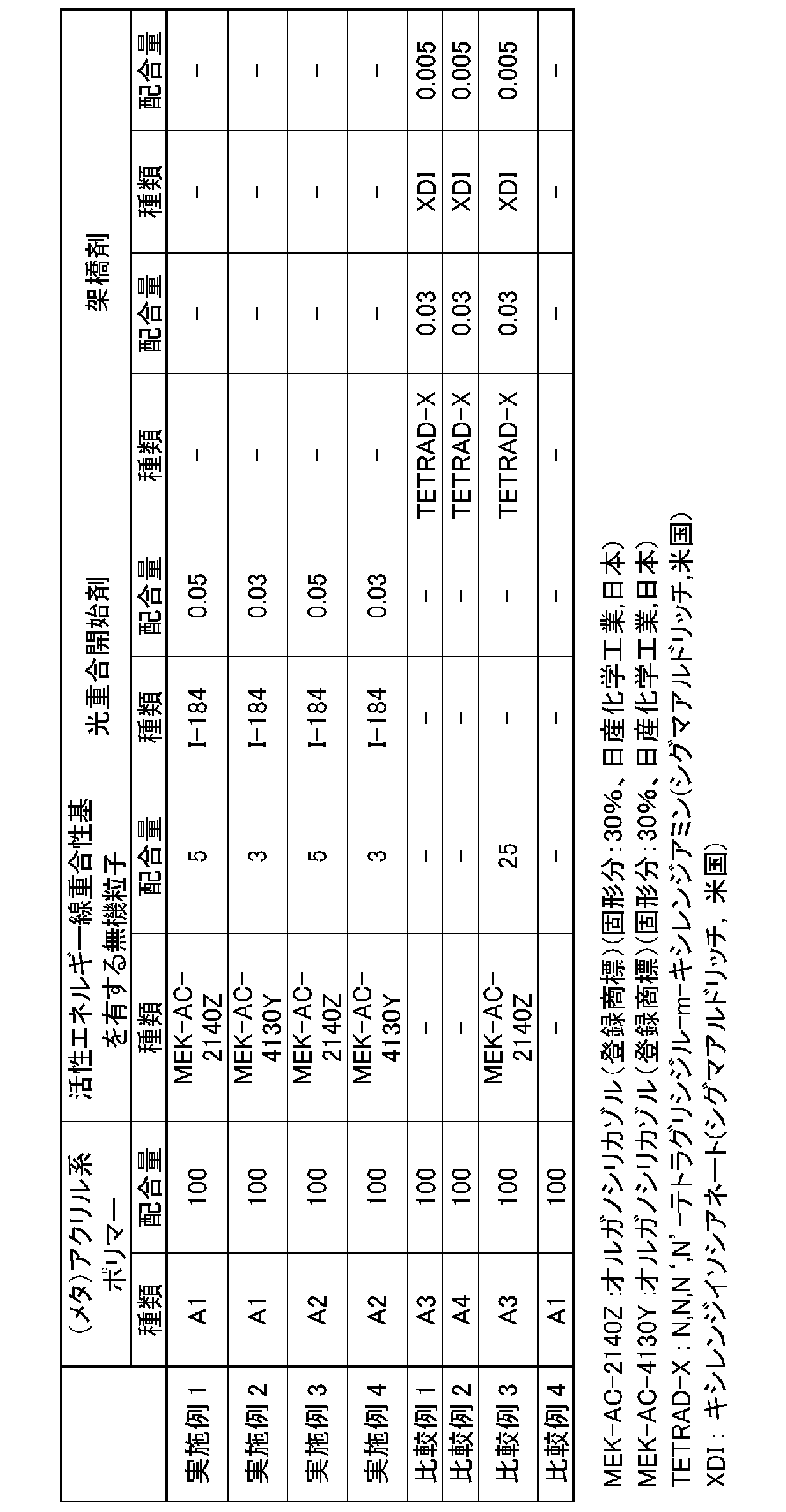
すなわち実施例1~4および比較例1~4の粘着剤組成物を、それぞれシリコン離型剤がコーティングされた剥離フィルムB(ポリエチレンテレフタレートフィルム、厚み38μm)上に厚みが25μmになるように塗布した。その上に剥離フィルムA(ポリエチレンテレフタレートフィルム、厚み38μm)を接合し、さらにUV照射を行うことにより、剥離フィルムA/粘着剤層/剥離フィルムBからなる粘着シートを作製した。この粘着シート(実施例1~4および比較例1~4の粘着シート)に対し、それぞれ80℃での貯蔵弾性率(G’)の測定を行うとともに、上述した評価基準に基づいて評価した。結果を表3に示す。
(2) 積層体の作製
さらに、実施例1~4および比較例1~4の粘着シートを用いて次に説明する積層構造からなる積層体を構成した。
さらに、実施例1~4および比較例1~4の粘着シートを用いて次に説明する積層構造からなる積層体を構成した。
[前面板]
前面板として、両面にハードコート層を有するポリイミドフィルム(縦177mm×横105mm、全体の厚み:70μm、各ハードコート層の厚み:10μm、ポリイミドフィルムの厚み:50μm)を準備した。以下、上記ポリイミドフィルムを「ウィンドウフィルム」とも記す。
前面板として、両面にハードコート層を有するポリイミドフィルム(縦177mm×横105mm、全体の厚み:70μm、各ハードコート層の厚み:10μm、ポリイミドフィルムの厚み:50μm)を準備した。以下、上記ポリイミドフィルムを「ウィンドウフィルム」とも記す。
[偏光子層]
(重合性液晶化合物)
重合性液晶化合物は、式(1-6)で表される重合性液晶化合物[以下、化合物(1-6)ともいう]と式(1-7)で表される重合性液晶化合物[以下、化合物(1-7)ともいう]とを用いた。
(重合性液晶化合物)
重合性液晶化合物は、式(1-6)で表される重合性液晶化合物[以下、化合物(1-6)ともいう]と式(1-7)で表される重合性液晶化合物[以下、化合物(1-7)ともいう]とを用いた。


化合物(1-6)および化合物(1-7)は、Lub et al.Recl.Trav.Chim.Pays-Bas、115、321-328(1996)記載の方法により合成した。
二色性色素には、下記式(2-1a)、(2-1b)、(2-3a)で示される特開2013-101328号公報の実施例に記載のアゾ色素を用いた。



(偏光子層形成用組成物)
偏光子層形成用組成物は、化合物(1-6)75部、化合物(1-7)25部、二色性染料としての上記式(2-1a)、(2-1b)、(2-3a)で示されるアゾ色素各2.5部、重合開始剤としての2-ジメチルアミノ-2-ベンジル-1-(4-モルホリノフェニル)ブタン-1-オン(Irgacure369、BASFジャパン社製)6重量部、およびレベリング剤としてのポリアクリレート化合物(BYK-361N、BYK-Chemie社製)1.2部を、溶剤のトルエン400部に混合し、得られた混合物を80℃で1時間攪拌することにより調製した。
偏光子層形成用組成物は、化合物(1-6)75部、化合物(1-7)25部、二色性染料としての上記式(2-1a)、(2-1b)、(2-3a)で示されるアゾ色素各2.5部、重合開始剤としての2-ジメチルアミノ-2-ベンジル-1-(4-モルホリノフェニル)ブタン-1-オン(Irgacure369、BASFジャパン社製)6重量部、およびレベリング剤としてのポリアクリレート化合物(BYK-361N、BYK-Chemie社製)1.2部を、溶剤のトルエン400部に混合し、得られた混合物を80℃で1時間攪拌することにより調製した。
(ポリマー1)
ポリマー1は、以下の構造単位からなる光反応性基を有するポリマーである。
ポリマー1は、以下の構造単位からなる光反応性基を有するポリマーである。

GPC測定より、得られたポリマー1の分子量は数平均分子量28200、Mw/Mn1.82を示し、モノマー含有量は0.5%であった。
(配向膜形成用組成物)
ポリマー1を濃度5質量%で、シクロペンタノンに溶解した溶液を配向膜形成用組成物として用いた。
ポリマー1を濃度5質量%で、シクロペンタノンに溶解した溶液を配向膜形成用組成物として用いた。
(円偏光板の作製)
基材(トリアセチルセルロースフィルム、厚み25μm)上に、上記配向膜形成用組成物をバーコート法により塗布し、80℃の乾燥オーブン中で1分間加熱乾燥することにより乾燥塗膜を得た。この乾燥塗膜に偏光UV照射処理を施して、第1配向膜(AL1)を形成した。偏光UV処理は、UV照射装置(「SPOT CURE SP-7」、ウシオ電機株式会社製)から照射される光を、ワイヤーグリッド(「UIS-27132##」、ウシオ電機株式会社製)を透過させて、波長365nmで測定した積算光量が100mJ/cm2である条件で行った。第1配向膜(AL1)の厚みは100nmであった。
基材(トリアセチルセルロースフィルム、厚み25μm)上に、上記配向膜形成用組成物をバーコート法により塗布し、80℃の乾燥オーブン中で1分間加熱乾燥することにより乾燥塗膜を得た。この乾燥塗膜に偏光UV照射処理を施して、第1配向膜(AL1)を形成した。偏光UV処理は、UV照射装置(「SPOT CURE SP-7」、ウシオ電機株式会社製)から照射される光を、ワイヤーグリッド(「UIS-27132##」、ウシオ電機株式会社製)を透過させて、波長365nmで測定した積算光量が100mJ/cm2である条件で行った。第1配向膜(AL1)の厚みは100nmであった。
上記第1配向膜(AL1)上に、上記偏光子層形成用組成物をバーコート法により塗布し、120℃の乾燥オーブンにて1分間加熱乾燥した後、室温まで冷却した。上記UV照射装置を用いて、積算光量1200mJ/cm2(365nm基準)で紫外線を、乾燥塗膜に照射することにより、偏光子層(pol)を形成した。得られた偏光子層の厚みは2μmであった。
上記偏光子層上に、ポリビニルアルコールと水とを含む組成物を、乾燥後の厚みが1μmとなるように塗工し、80℃で3分間乾燥することによりオーバーコート層を形成した。このオーバーコート層上に、厚み5μmのアクリル系粘着剤層を介して位相差フィルム(厚さ11μm、層構成:重合性液晶化合物が硬化した層および配向膜からなるλ/4板(厚さ3μm)/粘着剤層(アクリル系粘着剤層、厚さ5μm)/液晶化合物が硬化した層及び配向膜からなるポジティブCプレート(厚さ3μm))を貼合した。
このようにして、TACフィルム/第1配向膜(AL1)/偏光子層/オーバーコート層/粘着剤層/位相差フィルムの層構成からなる厚み44μm、縦177mm×横105mmの円偏光板を得、これを背面板として準備した。
以下の手順で積層体を製造した。
すなわち積層体を構成する第1粘着剤層として、上述の剥離フィルムA/粘着剤層/剥離フィルムBからなる上記粘着シート(実施例1~4および比較例1~4の粘着シートを)を準備した。この粘着シートの一方の剥離フィルムAを剥がした後、露出した粘着剤層にコロナ処理を施した。
すなわち積層体を構成する第1粘着剤層として、上述の剥離フィルムA/粘着剤層/剥離フィルムBからなる上記粘着シート(実施例1~4および比較例1~4の粘着シートを)を準備した。この粘着シートの一方の剥離フィルムAを剥がした後、露出した粘着剤層にコロナ処理を施した。
背面板におけるTACフィルム側の表面にコロナ処理を施した。コロナ処理をした面が貼合面になるように、上記露出した粘着剤層と背面板におけるTACフィルム側の表面とを貼り合わせた。
続いて上記粘着シートから剥離フィルムBを剥がし、露出した第1粘着剤層にコロナ処理を施した。ウィンドウフィルムの一方の面にコロナ処理を施した。コロナ処理をした面が貼合面になるように、第1粘着剤層とウィンドウフィルムとを貼り合わせた。
コロナ処理はいずれも以下の条件で行った。
周波数:20kHz/電圧:8.6kV/パワー:2.5kW/速度:6m/分。
周波数:20kHz/電圧:8.6kV/パワー:2.5kW/速度:6m/分。
このようにして、ウィンドウフィルム/第1粘着剤層/背面板(円偏光板)の積層構造からなる積層体を作製した。
上記積層体(実施例1~4および比較例1~4の積層体)に対し、それぞれ高温屈曲性および耐湿熱屈曲耐久性の測定を行うとともに、上述した評価基準に基づいて評価した。
結果を表3に示す。
結果を表3に示す。
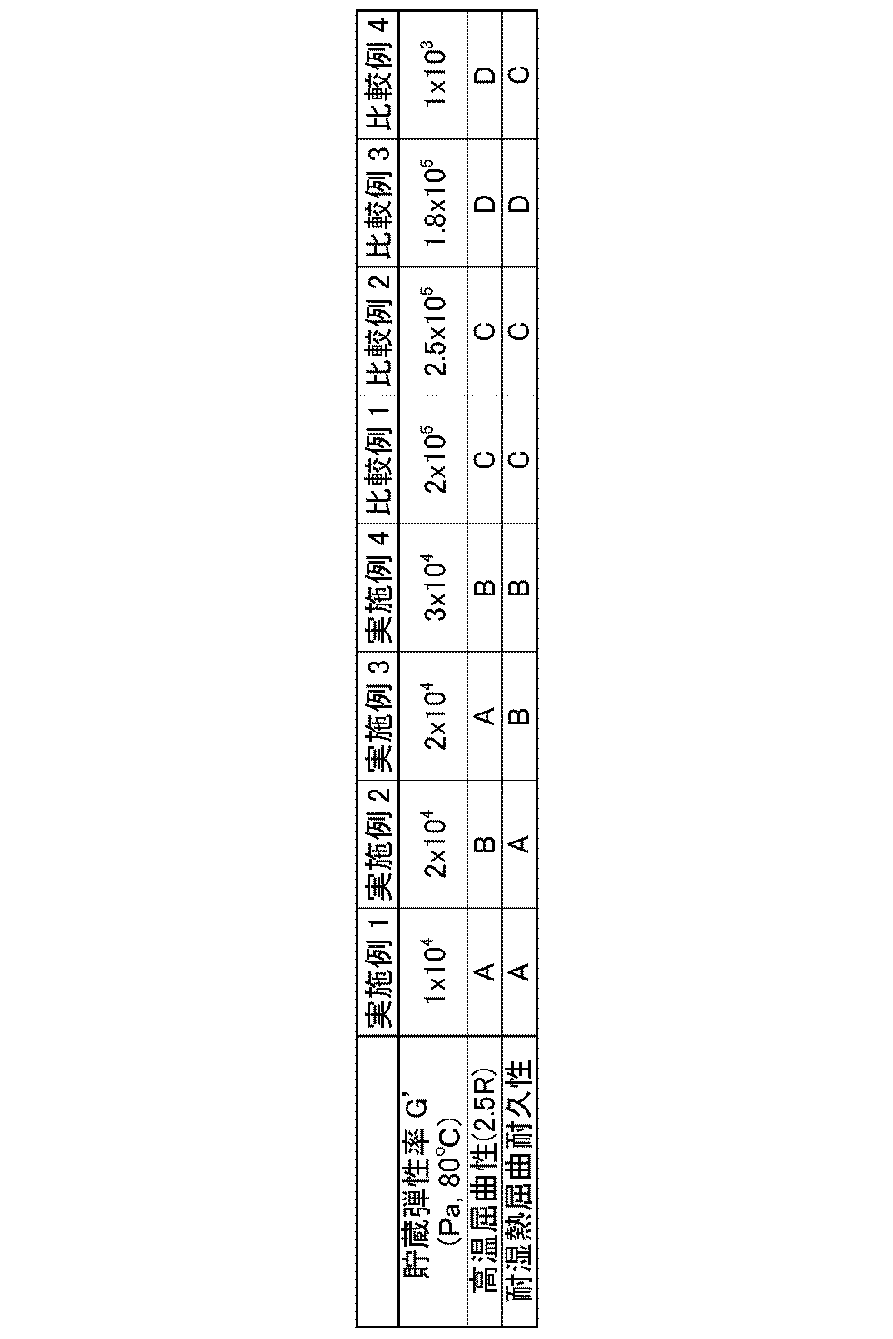
表3によれば、実施例1~実施例4の粘着シートおよび積層体は、高温時の屈曲性および耐久性に優れることが理解される。
100,200 積層体、101 前面板、102 第1粘着剤層、103 偏光子層、104,108,109 貼合層、105 背面板、106 第1位相差層、107 第2位相差層、501,502 ステージ。
Claims (5)
- 前面板、粘着剤層および背面板をこの順に含む積層体であって、
前記粘着剤層は、(メタ)アクリル系ポリマー、活性エネルギー線重合性基を有する無機粒子および光重合開始剤を含有する粘着剤組成物から形成され、
前記粘着剤層は、80℃での貯蔵弾性率(G’)が5×10³Pa以上1×10⁵Pa以下であり、
前記活性エネルギー線重合性基を有する無機粒子は、前記粘着剤層において(メタ)アクリル系ポリマー100質量部に対し、20質量部以下の比率で含まれる、積層体。 - 前記背面板は、偏光子層およびタッチセンサパネルからなる群より選ばれる少なくとも1種を含む、請求項1に記載の積層体。
- 請求項1または2に記載の積層体を含む、表示装置。
- 粘着剤組成物から形成される粘着剤層であって、
前記粘着剤組成物は、(メタ)アクリル系ポリマー、活性エネルギー線重合性基を有する無機粒子および光重合開始剤を含有し、
前記粘着剤層は、80℃での貯蔵弾性率(G’)が5×10³Pa以上1×10⁵Pa以下であり、
前記活性エネルギー線重合性基を有する無機粒子は、前記粘着剤層において(メタ)アクリル系ポリマー100質量部に対し、20質量部以下の比率で含まれる、粘着剤層。 - 基材と、前記基材上に形成される請求項4に記載の粘着剤層とを含む、粘着シート。
Priority Applications (2)
| Application Number | Priority Date | Filing Date | Title |
|---|---|---|---|
| KR1020217025580A KR20210128398A (ko) | 2019-02-20 | 2020-01-20 | 적층체, 점착제층 및 점착 시트 |
| CN202080014766.9A CN113453891A (zh) | 2019-02-20 | 2020-01-20 | 层叠体、粘合剂层和粘合片 |
Applications Claiming Priority (2)
| Application Number | Priority Date | Filing Date | Title |
|---|---|---|---|
| JP2019-028318 | 2019-02-20 | ||
| JP2019028318A JP7194042B2 (ja) | 2019-02-20 | 2019-02-20 | 積層体 |
Publications (1)
| Publication Number | Publication Date |
|---|---|
| WO2020170677A1 true WO2020170677A1 (ja) | 2020-08-27 |
Family
ID=72144858
Family Applications (1)
| Application Number | Title | Priority Date | Filing Date |
|---|---|---|---|
| PCT/JP2020/001703 Ceased WO2020170677A1 (ja) | 2019-02-20 | 2020-01-20 | 積層体、粘着剤層および粘着シート |
Country Status (5)
| Country | Link |
|---|---|
| JP (1) | JP7194042B2 (ja) |
| KR (1) | KR20210128398A (ja) |
| CN (1) | CN113453891A (ja) |
| TW (1) | TW202041638A (ja) |
| WO (1) | WO2020170677A1 (ja) |
Families Citing this family (1)
| Publication number | Priority date | Publication date | Assignee | Title |
|---|---|---|---|---|
| JPWO2022265077A1 (ja) * | 2021-06-18 | 2022-12-22 |
Citations (6)
| Publication number | Priority date | Publication date | Assignee | Title |
|---|---|---|---|---|
| KR20100013812A (ko) * | 2008-08-01 | 2010-02-10 | 동우 화인켐 주식회사 | 광확산 점착제 조성물, 이를 이용한 편광판 및액정표시장치 |
| JP2016108555A (ja) * | 2014-11-28 | 2016-06-20 | 三星エスディアイ株式会社Samsung SDI Co., Ltd. | 光学フィルム用粘着剤、光学フィルム用粘着剤層、光学部材および画像表示装置 |
| WO2016194715A1 (ja) * | 2015-06-02 | 2016-12-08 | 綜研化学株式会社 | 粘着剤層付偏光板 |
| WO2016199717A1 (ja) * | 2015-06-12 | 2016-12-15 | 昭和電工株式会社 | 架橋性粒子を含有する硬化性樹脂組成物 |
| JP2017095654A (ja) * | 2015-11-27 | 2017-06-01 | 三星エスディアイ株式会社Samsung SDI Co. | 光学フィルム用粘着剤、粘着剤層、光学部材および画像表示装置 |
| JP2017178992A (ja) * | 2016-03-28 | 2017-10-05 | 東亞合成株式会社 | プラスチック製フィルム又はシート用活性エネルギー線硬化型粘接着剤組成物及び積層体の製造方法 |
Family Cites Families (9)
| Publication number | Priority date | Publication date | Assignee | Title |
|---|---|---|---|---|
| JP6136093B2 (ja) * | 2011-05-31 | 2017-05-31 | 住友化学株式会社 | 複合偏光板および液晶表示装置 |
| WO2013022011A1 (ja) * | 2011-08-09 | 2013-02-14 | 三菱樹脂株式会社 | 透明積層フィルム |
| JP6705748B2 (ja) * | 2014-08-14 | 2020-06-03 | デンカ株式会社 | エネルギー線硬化性接着剤 |
| KR101622071B1 (ko) | 2014-11-01 | 2016-05-19 | 삼성에스디아이 주식회사 | 점착제 조성물, 이로부터 형성된 점착필름 및 이를 포함하는 디스플레이 부재 |
| US10227513B2 (en) * | 2014-11-01 | 2019-03-12 | Samsung Sdi Co., Ltd. | Adhesive composition, adhesive film prepared from the same and display member including the same |
| JP6388570B2 (ja) * | 2015-09-29 | 2018-09-12 | 富士フイルム株式会社 | 積層フィルムおよびその製造方法、偏光板、液晶パネル、ならびに液晶表示装置 |
| KR102840742B1 (ko) * | 2016-02-09 | 2025-08-01 | 다이니폰 인사츠 가부시키가이샤 | 광학 적층체 및 그의 제조 방법, 전면판, 그리고 화상 표시 장치 |
| KR102159485B1 (ko) * | 2016-07-28 | 2020-09-25 | 주식회사 엘지화학 | 폴더블(foldable) 디스플레이용 점착제 조성물 |
| CN109135593A (zh) * | 2018-08-29 | 2019-01-04 | 京东方科技集团股份有限公司 | 光学胶及其制造方法、显示装置 |
-
2019
- 2019-02-20 JP JP2019028318A patent/JP7194042B2/ja active Active
-
2020
- 2020-01-20 WO PCT/JP2020/001703 patent/WO2020170677A1/ja not_active Ceased
- 2020-01-20 CN CN202080014766.9A patent/CN113453891A/zh active Pending
- 2020-01-20 KR KR1020217025580A patent/KR20210128398A/ko not_active Abandoned
- 2020-01-31 TW TW109103068A patent/TW202041638A/zh unknown
Patent Citations (6)
| Publication number | Priority date | Publication date | Assignee | Title |
|---|---|---|---|---|
| KR20100013812A (ko) * | 2008-08-01 | 2010-02-10 | 동우 화인켐 주식회사 | 광확산 점착제 조성물, 이를 이용한 편광판 및액정표시장치 |
| JP2016108555A (ja) * | 2014-11-28 | 2016-06-20 | 三星エスディアイ株式会社Samsung SDI Co., Ltd. | 光学フィルム用粘着剤、光学フィルム用粘着剤層、光学部材および画像表示装置 |
| WO2016194715A1 (ja) * | 2015-06-02 | 2016-12-08 | 綜研化学株式会社 | 粘着剤層付偏光板 |
| WO2016199717A1 (ja) * | 2015-06-12 | 2016-12-15 | 昭和電工株式会社 | 架橋性粒子を含有する硬化性樹脂組成物 |
| JP2017095654A (ja) * | 2015-11-27 | 2017-06-01 | 三星エスディアイ株式会社Samsung SDI Co. | 光学フィルム用粘着剤、粘着剤層、光学部材および画像表示装置 |
| JP2017178992A (ja) * | 2016-03-28 | 2017-10-05 | 東亞合成株式会社 | プラスチック製フィルム又はシート用活性エネルギー線硬化型粘接着剤組成物及び積層体の製造方法 |
Also Published As
| Publication number | Publication date |
|---|---|
| JP2020131566A (ja) | 2020-08-31 |
| TW202041638A (zh) | 2020-11-16 |
| CN113453891A (zh) | 2021-09-28 |
| JP7194042B2 (ja) | 2022-12-21 |
| KR20210128398A (ko) | 2021-10-26 |
Similar Documents
| Publication | Publication Date | Title |
|---|---|---|
| JP7194041B2 (ja) | 積層体 | |
| CN113574423B (zh) | 层叠体和图像显示装置 | |
| JP6792657B2 (ja) | 積層体、粘着剤組成物および粘着シート | |
| CN111831170A (zh) | 层叠体和图像显示装置 | |
| JP7183207B2 (ja) | 積層体及び画像表示装置 | |
| CN114730036A (zh) | 光学层叠体和显示装置 | |
| JP2020060708A (ja) | 光学積層体及び表示装置 | |
| JP7469889B2 (ja) | 光学積層体、及び表示装置の製造方法 | |
| JP2021047394A (ja) | 光学積層体及び表示装置 | |
| CN114730037A (zh) | 光学层叠体和显示装置 | |
| JP2020187595A (ja) | 光学積層体及び表示装置 | |
| JP2022145565A (ja) | 光学積層体及び表示装置 | |
| JP7194042B2 (ja) | 積層体 | |
| CN113391391A (zh) | 光学层叠体和显示装置 | |
| WO2021149359A1 (ja) | 光学積層体及び表示装置 | |
| TW202039239A (zh) | 積層體及圖像顯示裝置 | |
| WO2021176853A1 (ja) | 光学積層体、フレキシブル画像表示装置 | |
| WO2021176870A1 (ja) | 光学積層体、フレキシブル画像表示装置 | |
| TW202134709A (zh) | 光學積層體 | |
| CN115280203A (zh) | 圆偏振片和光学层叠体 | |
| KR20210032303A (ko) | 광학 적층체 및 표시장치 | |
| JP7307754B2 (ja) | 積層体及び画像表示装置 | |
| JP2022059255A (ja) | フレキシブル積層体 | |
| CN113391390A (zh) | 光学层叠体和显示装置 | |
| CN113391389A (zh) | 光学层叠体和显示装置 |
Legal Events
| Date | Code | Title | Description |
|---|---|---|---|
| 121 | Ep: the epo has been informed by wipo that ep was designated in this application |
Ref document number: 20760087 Country of ref document: EP Kind code of ref document: A1 |
|
| NENP | Non-entry into the national phase |
Ref country code: DE |
|
| 122 | Ep: pct application non-entry in european phase |
Ref document number: 20760087 Country of ref document: EP Kind code of ref document: A1 |