WO2020166623A1 - 液晶配向剤、液晶配向膜及びそれを用いた液晶表示素子 - Google Patents
液晶配向剤、液晶配向膜及びそれを用いた液晶表示素子 Download PDFInfo
- Publication number
- WO2020166623A1 WO2020166623A1 PCT/JP2020/005398 JP2020005398W WO2020166623A1 WO 2020166623 A1 WO2020166623 A1 WO 2020166623A1 JP 2020005398 W JP2020005398 W JP 2020005398W WO 2020166623 A1 WO2020166623 A1 WO 2020166623A1
- Authority
- WO
- WIPO (PCT)
- Prior art keywords
- group
- liquid crystal
- formula
- repeating unit
- organic group
- Prior art date
- Legal status (The legal status is an assumption and is not a legal conclusion. Google has not performed a legal analysis and makes no representation as to the accuracy of the status listed.)
- Ceased
Links
- 0 C*N*(c1ccc(*)cc1)c(cc1)ccc1N Chemical compound C*N*(c1ccc(*)cc1)c(cc1)ccc1N 0.000 description 1
Classifications
-
- C—CHEMISTRY; METALLURGY
- C08—ORGANIC MACROMOLECULAR COMPOUNDS; THEIR PREPARATION OR CHEMICAL WORKING-UP; COMPOSITIONS BASED THEREON
- C08L—COMPOSITIONS OF MACROMOLECULAR COMPOUNDS
- C08L79/00—Compositions of macromolecular compounds obtained by reactions forming in the main chain of the macromolecule a linkage containing nitrogen with or without oxygen or carbon only, not provided for in groups C08L61/00 - C08L77/00
- C08L79/04—Polycondensates having nitrogen-containing heterocyclic rings in the main chain; Polyhydrazides; Polyamide acids or similar polyimide precursors
- C08L79/08—Polyimides; Polyester-imides; Polyamide-imides; Polyamide acids or similar polyimide precursors
-
- C—CHEMISTRY; METALLURGY
- C08—ORGANIC MACROMOLECULAR COMPOUNDS; THEIR PREPARATION OR CHEMICAL WORKING-UP; COMPOSITIONS BASED THEREON
- C08G—MACROMOLECULAR COMPOUNDS OBTAINED OTHERWISE THAN BY REACTIONS ONLY INVOLVING UNSATURATED CARBON-TO-CARBON BONDS
- C08G69/00—Macromolecular compounds obtained by reactions forming a carboxylic amide link in the main chain of the macromolecule
- C08G69/02—Polyamides derived from amino-carboxylic acids or from polyamines and polycarboxylic acids
- C08G69/26—Polyamides derived from amino-carboxylic acids or from polyamines and polycarboxylic acids derived from polyamines and polycarboxylic acids
-
- C—CHEMISTRY; METALLURGY
- C08—ORGANIC MACROMOLECULAR COMPOUNDS; THEIR PREPARATION OR CHEMICAL WORKING-UP; COMPOSITIONS BASED THEREON
- C08G—MACROMOLECULAR COMPOUNDS OBTAINED OTHERWISE THAN BY REACTIONS ONLY INVOLVING UNSATURATED CARBON-TO-CARBON BONDS
- C08G73/00—Macromolecular compounds obtained by reactions forming a linkage containing nitrogen with or without oxygen or carbon in the main chain of the macromolecule, not provided for in groups C08G12/00 - C08G71/00
- C08G73/06—Polycondensates having nitrogen-containing heterocyclic rings in the main chain of the macromolecule
- C08G73/10—Polyimides; Polyester-imides; Polyamide-imides; Polyamide acids or similar polyimide precursors
-
- C—CHEMISTRY; METALLURGY
- C08—ORGANIC MACROMOLECULAR COMPOUNDS; THEIR PREPARATION OR CHEMICAL WORKING-UP; COMPOSITIONS BASED THEREON
- C08G—MACROMOLECULAR COMPOUNDS OBTAINED OTHERWISE THAN BY REACTIONS ONLY INVOLVING UNSATURATED CARBON-TO-CARBON BONDS
- C08G73/00—Macromolecular compounds obtained by reactions forming a linkage containing nitrogen with or without oxygen or carbon in the main chain of the macromolecule, not provided for in groups C08G12/00 - C08G71/00
- C08G73/06—Polycondensates having nitrogen-containing heterocyclic rings in the main chain of the macromolecule
- C08G73/10—Polyimides; Polyester-imides; Polyamide-imides; Polyamide acids or similar polyimide precursors
- C08G73/1042—Copolyimides derived from at least two different tetracarboxylic compounds or two different diamino compounds
-
- G—PHYSICS
- G02—OPTICS
- G02F—OPTICAL DEVICES OR ARRANGEMENTS FOR THE CONTROL OF LIGHT BY MODIFICATION OF THE OPTICAL PROPERTIES OF THE MEDIA OF THE ELEMENTS INVOLVED THEREIN; NON-LINEAR OPTICS; FREQUENCY-CHANGING OF LIGHT; OPTICAL LOGIC ELEMENTS; OPTICAL ANALOGUE/DIGITAL CONVERTERS
- G02F1/00—Devices or arrangements for the control of the intensity, colour, phase, polarisation or direction of light arriving from an independent light source, e.g. switching, gating or modulating; Non-linear optics
- G02F1/01—Devices or arrangements for the control of the intensity, colour, phase, polarisation or direction of light arriving from an independent light source, e.g. switching, gating or modulating; Non-linear optics for the control of the intensity, phase, polarisation or colour
- G02F1/13—Devices or arrangements for the control of the intensity, colour, phase, polarisation or direction of light arriving from an independent light source, e.g. switching, gating or modulating; Non-linear optics for the control of the intensity, phase, polarisation or colour based on liquid crystals, e.g. single liquid crystal display cells
-
- G—PHYSICS
- G02—OPTICS
- G02F—OPTICAL DEVICES OR ARRANGEMENTS FOR THE CONTROL OF LIGHT BY MODIFICATION OF THE OPTICAL PROPERTIES OF THE MEDIA OF THE ELEMENTS INVOLVED THEREIN; NON-LINEAR OPTICS; FREQUENCY-CHANGING OF LIGHT; OPTICAL LOGIC ELEMENTS; OPTICAL ANALOGUE/DIGITAL CONVERTERS
- G02F1/00—Devices or arrangements for the control of the intensity, colour, phase, polarisation or direction of light arriving from an independent light source, e.g. switching, gating or modulating; Non-linear optics
- G02F1/01—Devices or arrangements for the control of the intensity, colour, phase, polarisation or direction of light arriving from an independent light source, e.g. switching, gating or modulating; Non-linear optics for the control of the intensity, phase, polarisation or colour
- G02F1/13—Devices or arrangements for the control of the intensity, colour, phase, polarisation or direction of light arriving from an independent light source, e.g. switching, gating or modulating; Non-linear optics for the control of the intensity, phase, polarisation or colour based on liquid crystals, e.g. single liquid crystal display cells
- G02F1/133—Constructional arrangements; Operation of liquid crystal cells; Circuit arrangements
- G02F1/1333—Constructional arrangements; Manufacturing methods
- G02F1/1337—Surface-induced orientation of the liquid crystal molecules, e.g. by alignment layers
-
- G—PHYSICS
- G02—OPTICS
- G02F—OPTICAL DEVICES OR ARRANGEMENTS FOR THE CONTROL OF LIGHT BY MODIFICATION OF THE OPTICAL PROPERTIES OF THE MEDIA OF THE ELEMENTS INVOLVED THEREIN; NON-LINEAR OPTICS; FREQUENCY-CHANGING OF LIGHT; OPTICAL LOGIC ELEMENTS; OPTICAL ANALOGUE/DIGITAL CONVERTERS
- G02F1/00—Devices or arrangements for the control of the intensity, colour, phase, polarisation or direction of light arriving from an independent light source, e.g. switching, gating or modulating; Non-linear optics
- G02F1/01—Devices or arrangements for the control of the intensity, colour, phase, polarisation or direction of light arriving from an independent light source, e.g. switching, gating or modulating; Non-linear optics for the control of the intensity, phase, polarisation or colour
- G02F1/13—Devices or arrangements for the control of the intensity, colour, phase, polarisation or direction of light arriving from an independent light source, e.g. switching, gating or modulating; Non-linear optics for the control of the intensity, phase, polarisation or colour based on liquid crystals, e.g. single liquid crystal display cells
- G02F1/133—Constructional arrangements; Operation of liquid crystal cells; Circuit arrangements
- G02F1/1333—Constructional arrangements; Manufacturing methods
- G02F1/1337—Surface-induced orientation of the liquid crystal molecules, e.g. by alignment layers
- G02F1/133711—Surface-induced orientation of the liquid crystal molecules, e.g. by alignment layers by organic films, e.g. polymeric films
- G02F1/133723—Polyimide, polyamide-imide
-
- G—PHYSICS
- G02—OPTICS
- G02F—OPTICAL DEVICES OR ARRANGEMENTS FOR THE CONTROL OF LIGHT BY MODIFICATION OF THE OPTICAL PROPERTIES OF THE MEDIA OF THE ELEMENTS INVOLVED THEREIN; NON-LINEAR OPTICS; FREQUENCY-CHANGING OF LIGHT; OPTICAL LOGIC ELEMENTS; OPTICAL ANALOGUE/DIGITAL CONVERTERS
- G02F1/00—Devices or arrangements for the control of the intensity, colour, phase, polarisation or direction of light arriving from an independent light source, e.g. switching, gating or modulating; Non-linear optics
- G02F1/01—Devices or arrangements for the control of the intensity, colour, phase, polarisation or direction of light arriving from an independent light source, e.g. switching, gating or modulating; Non-linear optics for the control of the intensity, phase, polarisation or colour
- G02F1/13—Devices or arrangements for the control of the intensity, colour, phase, polarisation or direction of light arriving from an independent light source, e.g. switching, gating or modulating; Non-linear optics for the control of the intensity, phase, polarisation or colour based on liquid crystals, e.g. single liquid crystal display cells
- G02F1/133—Constructional arrangements; Operation of liquid crystal cells; Circuit arrangements
- G02F1/1333—Constructional arrangements; Manufacturing methods
- G02F1/1343—Electrodes
Definitions
- the present invention relates to a liquid crystal alignment agent, a liquid crystal alignment film, and a liquid crystal display device using the same.
- liquid crystal devices have been widely used as display units for personal computers, mobile phones, smartphones, television receivers, and the like.
- the liquid crystal device includes, for example, a liquid crystal layer sandwiched between an element substrate and a color filter substrate, a pixel electrode and a common electrode that apply an electric field to the liquid crystal layer, an alignment film that controls the alignment of liquid crystal molecules in the liquid crystal layer, and a pixel.
- a thin film transistor (TFT) for switching an electric signal supplied to the electrode is provided.
- a vertical electric field method such as a TN method and a VA method
- a lateral electric field method such as an IPS method and an FFS (fringe field switching) method are known (for example, Patent Document 1).
- the liquid crystal alignment film which is a component of the liquid crystal display element, is a film for uniformly aligning the liquid crystal, but various properties are required in addition to the alignment uniformity of the liquid crystal. For example, charges are accumulated in the liquid crystal alignment film by the voltage for driving the liquid crystal, and the accumulated charges disturb the alignment of the liquid crystal, or are displayed as an afterimage or burn-in (hereinafter, referred to as an afterimage derived from residual DC).
- Patent Document 2 A liquid crystal aligning agent which overcomes these problems has been proposed (Patent Document 2) because it has a problem that it affects the display quality of the liquid crystal display device and remarkably lowers the display quality.
- Patent Document 3 specifies one polymer selected from the group consisting of a polyamic acid containing a specific tetracarboxylic dianhydride and a specific diamine and an imidized polymer thereof. And a liquid crystal aligning agent containing the compound.
- the element substrate can be easily recycled. That is, after forming a liquid crystal alignment film from a liquid crystal aligning agent, if defects such as alignment are inspected and checked, it is required that the rework step of removing the liquid crystal alignment film from the substrate and recovering the substrate can be easily performed. ing.
- the composition of the liquid crystal aligning agent proposed hitherto could not necessarily be said to be able to achieve all of the above problems. Further, when the liquid crystal aligning agents described in Patent Documents 2 and 3 are used, there is a problem that the transmittance of the obtained liquid crystal aligning film becomes low, and there is room for improvement.
- the present invention has been made based on the above circumstances, and an object thereof is to form a liquid crystal alignment film having a small amount of afterimages due to residual DC and AC afterimages, easy rework, and high transmittance. It is to provide a possible liquid crystal aligning agent.
- a liquid crystal aligning agent comprising the following component (A) and component (B).
- the repeating unit has a repeating unit, and the total content of the repeating unit represented by the following formula (2) and the repeating unit represented by the following formula (3) is 60 to 99.9 mol% of all the repeating units, and A polymer (B) in which the total content of the repeating unit represented by the following formula (4) and the repeating unit represented by the following formula (5) is 0.1 to 40 mol% of all repeating units.
- X 1 is a tetravalent organic group
- Y 1 is a divalent organic group.
- X 2 is a tetravalent organic group derived from an alicyclic acid dianhydride or an aliphatic acid dianhydride.
- Y 2 is represented by the following formula (m-1) or (m-2):
- R 2 is a hydrogen atom or an alkyl group having a carbon number of 1 to 4.
- Z 21 and Z 22 are each independently a hydrogen atom or a carbon number which may have a substituent.
- alkyl group of 1 to 10 an alkenyl group of 2 to 10 carbon atoms which may have a substituent, an alkynyl group of 2 to 10 carbon atoms which may have a substituent, a tert-butoxycarbonyl group, or 9- It is a fluorenylmethoxycarbonyl group.
- X 3 is a tetravalent organic group derived from an alicyclic acid dianhydride or an aliphatic acid dianhydride.
- Y 3 is a divalent organic group represented by the following formula (l), or the following formula A divalent organic group having a partial structure represented by (n), R 3 is a hydrogen atom or an alkyl group having 1 to 4 carbon atoms, and Z 31 and Z 32 are each independently hydrogen.
- Q 1 and Q 2 are an alkyl group having 1 to 3 carbon atoms
- Q 3 is a hydrogen atom or an alkyl group having 1 to 3 carbon atoms
- X 4 and X 5 are tetravalent organic groups derived from aromatic acid dianhydride.
- Y 4 has the same meaning as Y 2 in formula (2), and R 4 represents R in formula (2).
- R 4 represents R in formula (2).
- .Y 5 the same meaning as Z 21, Z 22 in the formula (2) has the same meaning as Y 3 of the formula (3)
- Z 51 and Z 52 are synonymous with Z 31 and Z 32 of the formula (3), respectively.
- liquid crystal aligning agent of the present invention it is possible to obtain a liquid crystal aligning film which is easy to rework and has a high transmittance.
- a liquid crystal display device having a high contrast in which an afterimage due to residual DC or an AC afterimage is unlikely to occur, and which has high contrast, can be obtained.
- the liquid crystal aligning agent of the present invention contains a polymer (A) having a repeating unit represented by the above formula (1). Accordingly, it is possible to obtain a liquid crystal alignment film having a low transmittance of AC and a high transmittance, and to obtain a liquid crystal display element in which a reduction in contrast is suppressed.
- X 1 and Y 1 are as defined above.
- Examples of X 1 in the formula (1) include tetravalent organic groups derived from tetracarboxylic acid dianhydride, and examples thereof include aromatic tetracarboxylic acid dianhydride, aliphatic tetracarboxylic acid dianhydride, and alicyclic ring. Examples include tetravalent organic groups derived from the formula tetracarboxylic dianhydride.
- Y 1 of the formula (1) is preferably a divalent organic group derived from a diamine compound.
- the aromatic tetracarboxylic dianhydride is an acid dianhydride obtained by intramolecular dehydration of four carboxyl groups including at least one carboxyl group bonded to an aromatic ring.
- the aliphatic tetracarboxylic acid dianhydride is an acid dianhydride obtained by intramolecular dehydration of four carboxyl groups bonded to a chain hydrocarbon structure.
- it does not need to be composed only of a chain hydrocarbon structure, and a part thereof may have an alicyclic structure or an aromatic ring structure.
- the alicyclic tetracarboxylic dianhydride is an acid dianhydride obtained by intramolecular dehydration of four carboxyl groups including at least one carboxyl group bonded to the alicyclic structure. However, none of these four carboxyl groups is bonded to the aromatic ring. Further, it is not necessary to be composed only of an alicyclic structure, and a part thereof may have a chain hydrocarbon structure or an aromatic ring structure.
- X 1 is a tetravalent organic group selected from the group consisting of the following formulas (4a) to (4n), the following formula (5a) and the following formula (6a). Preferably.
- X and y are each independently a single bond, ether (-O-), carbonyl (-CO-), ester (-COO-), alkanediyl group having 1 to 5 carbon atoms, 1,4-phenylene,
- a sulfonyl group or an amide group Z 1 to Z 6 each independently represent a hydrogen atom, a methyl group, an ethyl group, a propyl group, a chlorine atom or a benzene ring, and j is each independently 0 or 1. It is an integer.
- m is an integer of 1 to 5. * represents a bond.
- formula (4a) include structures represented by the following formulas (4a-1) to (4a-4).
- alkanediyl group having 1 to 5 carbon atoms in the formulas (5a) and (6a) examples include methylene, ethylene, 1,3-propanediyl, 1,4-butanediyl and 1,5-pentanediyl.
- X 1 in the formula (1) is selected from the formulas (4a) to (4h), (4j), (4l), and (4m) to (4n). It is preferable that it is a tetravalent organic group.
- the diamine that can be used for the polymer (A) is not particularly limited. Specific examples include aliphatic diamines such as metaxylylenediamine, ethylenediamine, 1,3-propanediamine, tetramethylenediamine, and hexamethylenediamine. Examples of the alicyclic diamine include p-cyclohexanediamine and 4,4'-methylenebis(cyclohexylamine).
- aromatic diamines examples include p-phenylenediamine, 4,4′-diaminodiphenylmethane, 4,4′-diaminodiphenyl ether, 4,4′-diaminoazobenzene, 3,5-diaminobenzoic acid and bis(4-aminophenyl).
- Q 11 is -NQCO-, -COO-, -OCO-, -NQCONQ-, -CONQ-, or -(CH 2 ) n- (n is an integer of 1 to 20), where n is 2 When it is up to 20, any —CH 2 — is not adjacent to each other under the condition that —O—, —COO—, —OCO—, —ND—, —NQCO—, —CONQ—, —NQCONQ—, —NQCOO.
- D represents a thermolabile group
- Q represents a hydrogen atom or a monovalent organic group
- Q 12 represents a single bond or a benzene ring
- Any hydrogen atom of may be replaced by a monovalent organic group.
- *1, *2 represent a bond, and when Q 12 is a single bond, *2 is bonded to a nitrogen atom in the amino group.
- Q 11 may be a single bond.
- Y 1 in the formula (1) is preferably a divalent organic group having a partial structure represented by the formula (H).
- R 4 in the formula (H) is a single bond
- *2 is bonded to the nitrogen atom in the imide ring.
- Y 1 in the above formula (1) is preferably a divalent organic group having a partial structure represented by any of the following formulas (H-1) to (H-14). (*1 and *2 represent a bond, and *2 bonds to the nitrogen atom in the imide ring.)
- Y 1 in the above formula (1) is a divalent organic group represented by any of the above formulas (H-1) to (H-14) or the following formula (MH-1) ) To (MH-2) are preferable divalent organic groups.
- (*1 binds to a nitrogen atom in the imide ring. Boc represents a tert-butoxycarbonyl group.
- the polymer (A) may have a repeating unit represented by the following formula (PA-1) in addition to the repeating unit represented by the above formula (1).
- R 1 is a hydrogen atom or an alkyl group having 1 to 5 carbon atoms.
- Z 11 and Z 12 are each independently a hydrogen atom, an alkyl group having 1 to 10 carbon atoms which may have a substituent, an alkenyl group having 2 to 10 carbon atoms which may have a substituent, and a substituent. It is an alkynyl group having 2 to 10 carbon atoms, which may have a group, a tert-butoxycarbonyl group, or a 9-fluorenylmethoxycarbonyl group.
- alkyl group having 1 to 5 carbon atoms of R 1 include methyl group, ethyl group, propyl group, i-propyl group, n-butyl group, i-butyl group, s-butyl group, t-butyl group. Group, n-pentyl group and the like. From the viewpoint of easiness of imidization by heating, R 1 is preferably a hydrogen atom or a methyl group.
- alkyl group having 1 to 10 carbon atoms of Z 11 and Z 12 include, in addition to the specific examples of the alkyl group having 1 to 5 carbon atoms exemplified for R 1 , a hexyl group, a heptyl group, an octyl group. , Nonyl group, decyl group and the like.
- alkenyl group having 2 to 10 carbon atoms of Z 11 and Z 12 include a vinyl group, a propenyl group, a butynyl group and the like, which may be linear or branched.
- alkynyl group having 2 to 10 carbon atoms for Z 11 and Z 12 include, for example, an ethynyl group, a 1-propynyl group, a 2-propynyl group and the like.
- Z 11 and Z 12 may have a substituent, and examples of the substituent include a halogen atom (fluorine atom, chlorine atom, bromine atom, iodine atom), a hydroxyl group, a cyano group, an alkoxy group and the like. .. From the viewpoint of less AC afterimage, Z 11 and Z 12 are preferably each independently a hydrogen atom or a methyl group. From the viewpoint of less AC afterimage, the polymer (A) preferably contains the repeating unit represented by the formula (1) in an amount of 10 to 95 mol% of all the repeating units of the polymer (A), and 15 to 95. More preferably, it contains mol %. At this time, the polymer (A) preferably contains 5 to 90 mol% of the repeating unit represented by the above formula (PA-1), and more preferably 5 to 85 mol %.
- PA-1 halogen atom
- the liquid crystal aligning agent of the present invention comprises a repeating unit represented by the above formula (2), a repeating unit represented by the above formula (3), a repeating unit represented by the above formula (4) and the above formula (5).
- the total amount of the repeating units represented by the above formula (2) and the repeating unit represented by the above formula (3) is 60 to 99.9 mol% of all the repeating units. It contains a polymer (B). With such a structure, a liquid crystal alignment film having excellent reworkability and reduced afterimage due to residual DC can be obtained.
- X 2 , X 3 , Y 2 , Y 3 , R 2 , R 3 , Z 21 , Z 22 , Z 31 , and Z 32 are as defined above.
- alkyl group having 1 to 5 carbon atoms for R 2 and R 3 include the structures exemplified for R 1 in the formula (PA-1). From the viewpoint of ease of imidization by heating, R 2 and R 3 are preferably each independently a hydrogen atom or a methyl group.
- R 21 , Z 22 , Z 31 , and Z 32 alkyl groups having 1 to 10 carbon atoms, alkenyl groups having 2 to 10 carbon atoms, and alkynyl groups having 2 to 10 carbon atoms include those represented by the formula (PA- the structure illustrated, and the like in Z 11, Z 12 1).
- Z 21 , Z 22 , Z 31 , and Z 32 may have a substituent, and examples of the substituent include the structures exemplified as Z 11 and Z 12 in the above formula (PA-1). .. From the viewpoint of less AC afterimage, Z 21 , Z 22 , Z 31 , and Z 32 are preferably each independently a hydrogen atom or a methyl group.
- Examples of the tetravalent organic group derived from the alicyclic tetracarboxylic dianhydride or the aliphatic tetracarboxylic dianhydride represented by X 2 and X 3 include the alicyclic tetracarboxylic dianhydride exemplified in the above X 1. And a tetravalent organic group derived from an aliphatic tetracarboxylic dianhydride. From the viewpoint of suppressing the AC afterimage, X 2 and X 3 are preferably a tetravalent organic group selected from the group consisting of the above formulas (4a) to (4n).
- Examples of the alkyl group having 1 to 3 carbon atoms of Q 1 , Q 2 and Q 3 in the above formula (l) or (n) include a methyl group, an ethyl group and a propyl group. From the viewpoint of enhancing the transmittance of the liquid crystal alignment film and suppressing the afterimage of AC and the afterimage of residual DC, it is preferable that Q 1 , Q 2 and Q 3 are methyl groups. In addition, any hydrogen atom of the benzene ring in the formula (n) may be substituted with a monovalent organic group.
- Examples of the monovalent organic group include an alkyl group, an alkenyl group, an alkoxy group, a fluoroalkyl group, a fluoroalkenyl group or a fluoroalkoxy group having 1 to 3 carbon atoms.
- the above formula (l) preferably has a structure represented by the following formula (1-1).
- the bonding position of —NQ 3 —Ph (Ph represents a phenylene group) is preferably bonded to the 3-position of the carbazole skeleton from the viewpoint of less steric hindrance.
- the divalent organic group having the partial structure represented by the formula (n) is selected from the group consisting of the following formulas (n-1) to (n-3) from the viewpoint of less residual image derived from residual DC. It is preferably a valent organic group.
- Q 2 and Q 3 are synonymous with Q 2 and Q 3 in formula (n), including preferred specific examples.
- Q 4 represents a single bond or the structure of the following formula (Ar), and n represents an integer of 1 to 3. * Represents a bond. Further, any hydrogen atom of the benzene ring may be substituted with a monovalent organic group, as in the case of the above formula (n).
- Q 5 is a single bond, —O—, —COO—, —OCO—, —(CH 2 ) 1 —, —O(CH 2 ) m O—, —CONQ—, and —NQCO— 2
- k represents an integer of 1 to 5
- Q represents hydrogen or a monovalent organic group
- l and m represent an integer of 1 to 5.
- *1 and *2 are bonds. Represents a hand, and * 1 is bonded to the benzene ring in the formulas (n-1) to (n-3).
- Examples of the monovalent organic group for Q in the formula (Ar) include alkyl groups having 1 to 3 carbon atoms.
- the divalent organic group having a partial structure represented by the formula (n) is a divalent organic group represented by any of the following formulas (cbz-1) to (cbz-7). It is preferable that it is the organic group of. * Represents a bond.
- the polymer (B) is a divalent organic compound represented by the above formula (1) in which Y 3 is a repeating unit represented by the above formula (3) from the viewpoint of less afterimages due to AC and residual DC. It is preferable to have a repeating unit that is a group and a repeating unit that is a divalent organic group in which Y 3 has the partial structure represented by the formula (n).
- the polymer (B) has a repeating unit represented by the following formula (4) and a repeating unit represented by the following formula (5) from the viewpoint of less residual image derived from residual DC.
- X 4 and X 5 are tetravalent organic groups derived from an aromatic tetracarboxylic dianhydride, and the aromatic tetracarboxylic acid exemplified by X 1 in the formula (1).
- a tetravalent organic group derived from an acid dianhydride can be mentioned.
- X 4 and X 5 are preferably a tetravalent organic group selected from the formulas (5a) and (6a) described in the preferable examples of X 1 .
- Y 4 has the same meaning as Y 2 of the formula (2), including the preferable embodiments.
- R 4 has the same meaning as R 2 of the above formula (2) including the preferable embodiment.
- Z 41 and Z 42 have the same meanings as Z 21 and Z 22 in the formula (2), including the preferable embodiments.
- Y 5 has the same meaning as Y 3 in the formula (3), including the preferable embodiments.
- R 5 is as defined, including preferred embodiments and R 3 in the formula (3).
- Z 51 and Z 52 have the same meanings as Z 31 and Z 32 in the formula (3), including the preferable embodiments.
- the total content of at least one repeating unit selected from the group consisting of the repeating unit represented by the above formula (2) and the repeating unit represented by the above formula (3) in the polymer (B) is high. From the viewpoint of obtaining the ratio, it is preferably 60 to 99.9 mol% of the total repeating units, and more preferably 65 to 90 mol %. Regarding the content ratio of the repeating unit represented by the above formula (2) and the repeating unit represented by the above formula (3), the former/latter mole% ratio is 10/90 to 50/50. Is preferred, and 15/85 to 50/50 is more preferred.
- the total content of at least one repeating unit selected from the group consisting of the repeating unit represented by the above formula (4) and the repeating unit represented by the above formula (5) is high. From the viewpoint of obtaining the ratio, it is preferably 0.1 to 40 mol% of all repeating units, and more preferably 10 to 35 mol %. Regarding the content ratio of the repeating unit represented by the above formula (4) and the repeating unit represented by the above formula (5), the former/latter mole% ratio is 10/90 to 50/50. Is preferable, and 15/85 to 50/50 is more preferable.
- the polymer (B) is represented by the repeating unit represented by the above formula (2), the repeating unit represented by the above formula (3), the repeating unit represented by the above formula (4), and the above formula (5).
- a repeating unit represented by the following formula (PA-2) may be contained.
- X 6 represents a tetravalent organic group
- Y 6 represents a divalent organic group.
- Y 6 is a group selected from the above formulas (m-1) to (m-2), a divalent organic group represented by the above formula (l) and a partial structure represented by the above formula (n). It does not contain a divalent organic group.
- R 6 has the same meaning as R 2 of the above formula (2) including the preferable embodiment.
- Ri, Z 61, Z 62 are the same, including the preferred embodiments and Z 61, Z 62 in the formula (2).
- X 6 are derived from the aromatic tetracarboxylic dianhydride, the aliphatic tetracarboxylic dianhydride, and the alicyclic tetracarboxylic dianhydride exemplified in X 1 of the above formula (1) 4 Valent organic groups.
- Y 6 in addition to the structure derived from the diamine exemplified in Y 1 of the above formula (1), a diamine having a pyrrole structure described in International Publication WO (hereinafter, also referred to as WO) 2017/126627.
- Represents a site for bonding to an amino group Ph represents a phenylene group, n represents 1 to 3), and a structure derived from a diamine having a pyrrole structure described in WO2018/062197, preferably the following formula (pn)
- the content ratio of the polymer (A) and the polymer (B) is 5/in the weight ratio of polymer (A)/polymer (B). It is preferably from 95 to 95/5. From the viewpoint of obtaining a liquid crystal alignment film having high reproducibility, the polymer (A)/polymer (B) is more preferably 10/90 to 90/10, and further preferably 20/80 to 80/20.
- the polyimide precursor polyamic acid used in the present invention can be synthesized by the following method. Specifically, tetracarboxylic dianhydride and diamine are reacted in the presence of an organic solvent at -20°C to 150°C, preferably 0°C to 50°C for 30 minutes to 24 hours, preferably 1 to 12 hours. Can be synthesized.
- the organic solvent used in the above reaction is preferably N,N-dimethylformamide, N-methyl-2-pyrrolidone, or ⁇ -butyrolactone in view of the solubility of the monomer and polymer, and these may be used alone or in combination of two or more. You may use.
- the concentration of the polymer is preferably from 1 to 30% by weight, more preferably from 5 to 20% by weight, from the viewpoint that the precipitation of the polymer does not easily occur and a high molecular weight polymer is easily obtained.
- the polyamic acid obtained as described above can be recovered by precipitating a polymer by injecting it into a poor solvent while stirring the reaction solution well.
- the precipitated polyamic acid powder can be obtained by performing precipitation several times, washing with a poor solvent, and then drying at room temperature or by heating and drying.
- the poor solvent is not particularly limited, and examples thereof include water, methanol, ethanol, hexane, butyl cellosolve, acetone, and toluene.
- the polyamic acid ester which is the polyimide precursor used in the present invention can be synthesized by, for example, the method (1), (2) or (3) shown below.
- (1) Synthesis from polyamic acid The polyamic acid ester can be synthesized by esterifying a polyamic acid obtained from tetracarboxylic dianhydride and diamine. Specifically, by reacting a polyamic acid and an esterifying agent in the presence of an organic solvent at -20°C to 150°C, preferably 0°C to 50°C for 30 minutes to 24 hours, preferably 1 to 4 hours. Can be synthesized.
- esterifying agent those which can be easily removed by purification are preferable, and N,N-dimethylformamide dimethylacetal, N,N-dimethylformamide di-t-butylacetal, 1-methyl-3-p-tolyltriazene, 4-(4,6-dimethoxy-1,3,5-triazin-2-yl)-4-methylmorpholinium chloride and the like can be mentioned.
- the amount of the esterifying agent used is preferably 2 to 6 molar equivalents with respect to 1 mole of the repeating unit of the polyamic acid.
- the solvent used in the above reaction is preferably N,N-dimethylformamide, N-methyl-2-pyrrolidone, or ⁇ -butyrolactone because of the solubility of the polymer, and these may be used as a mixture of two or more kinds.
- the concentration at the time of synthesis is preferably 1 to 30% by weight, more preferably 5 to 20% by weight, from the viewpoint that polymer precipitation is unlikely to occur and a high molecular weight product is easily obtained.
- the polyamic acid ester can be synthesized from tetracarboxylic acid diester dichloride and diamine. Specifically, tetracarboxylic acid diester dichloride and diamine are added in the presence of a base and an organic solvent at ⁇ 20° C. to 150° C., preferably 0° C. to 50° C. for 30 minutes to 24 hours, preferably 1 to 4 hours. It can be synthesized by reacting. Pyridine, triethylamine and the like can be used as the base, but pyridine is preferable because the reaction proceeds gently. The amount of the base used is preferably 2 to 4 times the molar amount of the tetracarboxylic acid diester dichloride from the viewpoints of easy removal and easily obtaining a high molecular weight product.
- the solvent used in the above reaction is preferably N-methyl-2-pyrrolidone or ⁇ -butyrolactone in view of the solubility of the monomer and polymer, and these may be used as a mixture of two or more kinds.
- the polymer concentration at the time of synthesis is preferably 1 to 30% by weight, more preferably 5 to 20% by weight, from the viewpoint that polymer precipitation is unlikely to occur and a high molecular weight polymer is easily obtained.
- the solvent used for the synthesis of the polyamic acid ester is preferably dehydrated as much as possible, and it is preferable to prevent the entry of outside air in a nitrogen atmosphere.
- the polyamic acid ester can be synthesized by polycondensing the tetracarboxylic acid diester and diamine. Specifically, tetracarboxylic acid diester and diamine are combined in the presence of a condensing agent, a base, and an organic solvent at 0° C. to 150° C., preferably 0° C. to 100° C. for 30 minutes to 24 hours, preferably 3 to 15 It can be synthesized by reacting for a time.
- the condensing agent examples include triphenyl phosphite, dicyclohexylcarbodiimide, 1-ethyl-3-(3-dimethylaminopropyl)carbodiimide hydrochloride, N,N′-carbonyldiimidazole, dimethoxy-1,3,5-triazine.
- Known compounds such as nylmethylmorpholinium can be used.
- a tertiary amine such as pyridine can be used.
- a high molecular weight polyamic acid ester can be obtained, and thus the method for producing (1) or (2) above is particularly preferable.
- the polyimide used in the present invention can be produced by imidizing the above polyamic acid ester or polyamic acid.
- chemical imidization by adding a basic catalyst to the polyamic acid ester solution or a polyamic acid solution obtained by dissolving the polyamic acid ester resin powder in an organic solvent is simple.
- Chemical imidation is preferable because the imidization reaction proceeds at a relatively low temperature and the decrease in the molecular weight of the polymer does not easily occur during the imidization process.
- the chemical imidization can be performed by stirring the polymer to be imidized in an organic solvent in the presence of a basic catalyst and an acid anhydride.
- a basic catalyst include pyridine, triethylamine, trimethylamine, tributylamine, trioctylamine and the like. Of these, pyridine is preferable because it has an appropriate basicity for proceeding the reaction.
- the acid anhydride include acetic anhydride, trimellitic anhydride, pyromellitic anhydride, and the like. Among them, acetic anhydride is preferable because purification after the reaction is easy.
- the temperature for the imidization reaction is ⁇ 20° C. to 140° C., preferably 0° C. to 100° C., and the reaction time can be 1 to 100 hours.
- the amount of the basic catalyst is 0.5 to 30 mol times, preferably 2 to 20 mol times that of the amic acid group, and the amount of the acid anhydride is 1 to 50 mol times, preferably 3 to 30 mol times, the amic acid group. Double.
- the imidation ratio of the obtained polymer can be controlled by adjusting the amount of catalyst, temperature, and reaction time. In the solution after imidization reaction of polyamic acid ester or polyamic acid, the added catalyst and the like remain, so by the means described below, the resulting imidized polymer is recovered and redissolved in an organic solvent. Therefore, the liquid crystal aligning agent of the present invention is preferable.
- the polymer can be precipitated by injecting the solution of the polyimide obtained as described above into a poor solvent while stirring well. Precipitation can be performed several times, washing with a poor solvent, and drying at room temperature or heat can yield a purified polyamic acid ester powder.
- the poor solvent is not particularly limited, and examples thereof include methanol, acetone, hexane, butyl cellosolve, heptane, methyl ethyl ketone, methyl isobutyl ketone, ethanol, toluene and benzene.
- the liquid crystal aligning agent of the present invention contains a polymer (A) and a polymer (B).
- the liquid crystal aligning agent of the present invention may contain other polymer in addition to the polymer (A) and the polymer (B).
- Other types of polymers include polyamic acid, polyimide, polyamic acid ester, polyester, polyamide, polyurea, polyorganosiloxane, cellulose derivative, polyacetal, polystyrene or its derivative, poly(styrene-phenylmaleimide) derivative, poly(meth) ) Acrylate etc. can be mentioned.
- the liquid crystal aligning agent is used for producing a liquid crystal aligning film, and takes the form of a coating liquid from the viewpoint of forming a uniform thin film.
- the liquid crystal aligning agent of the present invention is also preferably a coating liquid containing the above-mentioned polymer component and an organic solvent.
- the concentration of the polymer in the liquid crystal aligning agent can be appropriately changed by setting the thickness of the coating film to be formed. From the viewpoint of forming a uniform and defect-free coating film, 1% by weight or more is preferable, and from the viewpoint of storage stability of the solution, 10% by weight or less is preferable.
- a particularly preferred polymer concentration is 2 to 8% by weight.
- the organic solvent contained in the liquid crystal aligning agent is not particularly limited as long as the polymer component is uniformly dissolved therein. Specific examples thereof include N,N-dimethylformamide, N,N-dimethylacetamide, N-methyl-2-pyrrolidone, N-ethyl-2-pyrrolidone, dimethyl sulfoxide, ⁇ -butyrolactone and 1,3-dimethyl. -Imidazolidinone, methyl ethyl ketone, cyclohexanone, cyclopentanone, 3-methoxy-N,N-dimethylpropanamide, 3-butoxy-N,N-dimethylpropanamide and the like can be mentioned.
- N-methyl-2-pyrrolidone, N-ethyl-2-pyrrolidone, 3-methoxy-N,N-dimethylpropanamide, 3-butoxy-N,N-dimethylpropanamide or ⁇ -butyrolactone is preferable.
- the organic solvent contained in the liquid crystal aligning agent is preferably a mixed solvent in which, in addition to the above-mentioned solvents, a solvent which improves the coating property when applying the liquid crystal aligning agent and the surface smoothness of the coating film are used together.
- a solvent which improves the coating property when applying the liquid crystal aligning agent and the surface smoothness of the coating film are used together.
- Specific examples of the organic solvent used in combination are shown below, but the invention is not limited to these examples.
- diisobutyl carbinol, propylene glycol monobutyl ether, propylene glycol diacetate, diethylene glycol diethyl ether, dipropylene glycol monomethyl ether, dipropylene glycol dimethyl ether, 4-hydroxy-4-methyl-2-pentanone, ethylene glycol monobutyl ether, ethylene Glycol monobutyl ether acetate and diisobutyl ketone are preferred.
- the type and content of the solvent are appropriately selected according to the liquid crystal alignment agent coating device, coating conditions, coating environment, and the like.
- N-methyl-2-pyrrolidone and ethylene glycol monobutyl ether N-methyl-2-pyrrolidone and ⁇ -butyrolactone and ethylene glycol monobutyl ether
- N-methyl-2- Pyrrolidone, ⁇ -butyrolactone and propylene glycol monobutyl ether N-ethyl-2-pyrrolidone and propylene glycol monobutyl ether
- N-methyl-2-pyrrolidone and ⁇ -butyrolactone 4-hydroxy-4-methyl-2-pentanone and diethylene glycol diethyl Ether
- the poor solvent is preferably 1 to 80% by weight, more preferably 10 to 80% by weight, particularly preferably 20 to 70% by weight, based on the whole solvent contained in the liquid crystal aligning agent.
- the type and content of the solvent are appropriately selected depending on the apparatus for applying the liquid crystal aligning agent, the conditions, the environment, and the like.
- the liquid crystal aligning agent of the present invention may additionally contain components other than the polymer component and the organic solvent.
- additional component include an adhesion aid for increasing the adhesion between the liquid crystal alignment film and the substrate and the adhesion between the liquid crystal alignment film and the sealing material, and a compound for increasing the strength of the liquid crystal alignment film (hereinafter referred to as a cross-linking agent). (Also referred to as a polar compound)), a dielectric or a conductive substance for adjusting the dielectric constant or electric resistance of the liquid crystal alignment film.
- the crosslinkable compound includes an oxiranyl group, an oxetanyl group, a protected isocyanate group, a protected isothiocyanate group, a group containing an oxazoline ring structure, and a Meldrum's acid structure, from the viewpoint of less generation of AC afterimage and high effect of improving film strength.
- Group a compound having at least one group selected from the group consisting of a cyclocarbonate group and a group represented by the following formula (d), or a compound selected from a compound represented by the following formula (e) (hereinafter, these Are also collectively referred to as compound (C)).
- Q 31 is a hydrogen atom, an alkyl group having 1 to 3 carbon atoms or “*—CH 2 —OH”, and Q 32 and Q 33 are each independently a hydrogen atom and a C 1 to 3 carbon atom. It is an alkyl group or “*—CH 2 —OH”, * represents a bond, A represents a (m+n)-valent organic group having an aromatic ring, m represents an integer of 1 to 6, and n represents 0. Represents an integer of ⁇ 4.
- the compound having an oxiranyl group include compounds described in paragraph [0037] of JP-A-10-338880 and compounds having a triazine ring as a skeleton described in WO2017/170483.
- Examples include compounds having one or more oxiranyl groups.
- the compound having an oxetanyl group include, for example, compounds having two or more oxetanyl groups described in paragraphs [0170] to [0175] of WO2011/132751.
- the compound having a protected isocyanate group include, for example, compounds having two or more protected isocyanate groups described in JP-A No. 2014-224978, paragraphs [0046] to [0047], WO 2015/141598. Examples thereof include the compounds having three or more protected isocyanate groups described in paragraphs [0119] to [0120]. Of these, compounds represented by any of the following formulas (bi-1) to (bi-3) are preferable.
- Specific examples of the compound having a protected isothiocyanate group include compounds having two or more protected isothiocyanate groups described in JP-A-2016-200798.
- Specific examples of the compound having a group containing an oxazoline ring structure include the compounds containing two or more oxazoline structures described in paragraph [0115] of Japanese Patent Application Laid-Open No. 2007-286597.
- Specific examples of the compound having a group containing a Meldrum's acid structure include compounds having two or more Meldrum's acid structures described in WO2012/091088.
- Specific examples of the compound having a cyclocarbonate group include the compounds described in WO2011/155577.
- R 1 , R 2 , and R 3 alkyl groups having 1 to 3 carbon atoms represented by the formula (d) include the groups exemplified in the above formulas (1) and (n).
- Specific examples of the compound having a group represented by the formula (d) include the compound represented by the formula (d) described in WO2015/072554 and paragraph [0058] of Japanese Unexamined Patent Publication No. 2016-118753. Examples thereof include compounds having two or more groups represented, compounds described in JP-A-2016-200798, and the like. Of these, compounds represented by the following formulas (hd-1) to (hd-8) are preferable.
- Examples of the (m+n)-valent organic group having an aromatic ring in A of the formula (e) include a (m+n)-valent aromatic hydrocarbon group having 5 to 30 carbon atoms and an aromatic hydrocarbon group having 5 to 30 carbon atoms. Is an (m+n)-valent organic group bonded directly or via a linking group, or an (m+n)-valent group having an aromatic heterocycle.
- Examples of the aromatic hydrocarbon group include benzene and naphthalene.
- Examples of the aromatic heterocycle include pyrrole ring, imidazole ring, pyrazole ring, pyridine ring, pyrimidine ring, quinoline ring, isoquinoline ring, carbazole ring, pyridazine ring, pyrazine ring, benzimidazole ring, benzimidazole ring, indole ring, quinoxaline. Ring, acridine ring and the like.
- Examples of the linking group include an alkylene group having 1 to 10 carbon atoms, a group obtained by removing one hydrogen atom from the alkylene group, a divalent or trivalent cyclohexane ring, and the like.
- any hydrogen atom of the alkylene group may be substituted with a fluorine atom or an organic group such as a trifluoromethyl group.
- Specific examples include the compounds described in WO2010/074269.
- Preferred specific examples include the following formulas (e-1) to (e-11).
- the above compounds are examples of crosslinkable compounds and are not limited to these.
- components other than the above disclosed in [0105] to [0116] of WO2015/060357 may be mentioned.
- two or more kinds of the crosslinkable compounds contained in the liquid crystal aligning agent of the present invention may be combined.
- the content of the crosslinkable compound in the liquid crystal aligning agent of the present invention is preferably 0.5 to 20 parts by weight with respect to 100 parts by weight of the polymer component contained in the liquid crystal aligning agent, and the crosslinking reaction proceeds.
- the amount is more preferably 1 to 15 parts by weight from the viewpoint of exhibiting the intended effect and having a small AC afterimage characteristic.
- adhesion aid examples include 3-aminopropyltrimethoxysilane, 3-aminopropyltriethoxysilane, 3-aminopropyldiethoxymethylsilane, 2-aminopropyltrimethoxysilane, 2-aminopropyltriethoxysilane, N -(2-aminoethyl)-3-aminopropyltrimethoxysilane, N-(2-aminoethyl)-3-aminopropylmethyldimethoxysilane, 3-ureidopropyltrimethoxysilane, 3-ureidopropyltriethoxysilane, N -Ethoxycarbonyl-3-aminopropyltrimethoxysilane, N-ethoxycarbonyl-3-aminopropyltriethoxysilane, N-triethoxysilylpropyltriethylenetriamine, N-trimethoxysilylpropyltriethylenetriamine,
- the amount is preferably 0.1 to 30 parts by weight, more preferably 0 to 30 parts by weight, relative to 100 parts by weight of the polymer component contained in the liquid crystal aligning agent. 1 to 20 parts by weight.
- the liquid crystal alignment film is a film obtained by applying the above liquid crystal alignment agent on a substrate, drying and baking.
- the substrate to which the liquid crystal aligning agent is applied is not particularly limited as long as it is a highly transparent substrate, and a glass substrate, a silicon nitride substrate, a plastic substrate such as an acrylic substrate or a polycarbonate substrate, or the like can also be used. At that time, it is preferable to use a substrate on which an ITO electrode or the like for driving the liquid crystal is formed in terms of simplification of the process.
- an opaque material such as a silicon wafer can be used if only one side substrate is used, and in this case, a material that reflects light such as aluminum can also be used as an electrode.
- the method of applying the liquid crystal aligning agent on the substrate is not particularly limited, but industrially, a method such as screen printing, offset printing, flexo printing, or inkjet method is generally used. Other coating methods include a dip method, a roll coater method, a slit coater method, a spinner method or a spray method, and these may be used depending on the purpose.
- the solvent can be evaporated by a heating means such as a hot plate, a heat circulation type oven or an IR (infrared) type oven to form a liquid crystal aligning film.
- a heating means such as a hot plate, a heat circulation type oven or an IR (infrared) type oven to form a liquid crystal aligning film.
- Any temperature and time can be selected for the drying and baking steps after applying the liquid crystal aligning agent.
- the conditions are such that baking is performed at 50 to 120° C. for 1 to 10 minutes, and then baking is performed at 150 to 300° C. for 5 to 120 minutes. If the thickness of the liquid crystal alignment film after firing is too thin, the reliability of the liquid crystal display element may decrease, so that the thickness is preferably 5 to 300 nm, more preferably 10 to 200 nm.
- the method of aligning the liquid crystal alignment film obtained from the liquid crystal aligning agent of the present invention may be a rubbing treatment method or an optical alignment treatment method.
- the alignment treatment by the rubbing treatment or the photo-alignment treatment in order to improve the liquid crystal alignment property, it may be preferable to perform the heat treatment at a temperature of 150 to 250° C. before the alignment treatment.
- the orientation treatment may be performed while heating the substrate coated with the film at 50 to 250°C.
- the solvent used in the above contact treatment is not particularly limited, but specific examples include water, methanol, ethanol, 2-propanol, acetone, methyl ethyl ketone, 1-methoxy-2-propanol, 1-methoxy- Examples thereof include 2-propanol acetate, butyl cellosolve, ethyl lactate, methyl lactate, diacetone alcohol, methyl 3-methoxypropionate, ethyl 3-ethoxypropionate, propyl acetate, butyl acetate or cyclohexyl acetate.
- the liquid crystal alignment film of the present invention is suitable as a liquid crystal alignment film of a liquid crystal display device of a lateral electric field system such as an IPS system or an FFS system, and is particularly useful as a liquid crystal alignment film of a liquid crystal display device of an FFS system.
- a liquid crystal display device is obtained by using a liquid crystal cell prepared by a known method after obtaining a substrate with a liquid crystal alignment film obtained from the liquid crystal aligning agent of the present invention.
- a liquid crystal display element having a passive matrix structure As an example of a method for manufacturing a liquid crystal cell, a liquid crystal display element having a passive matrix structure will be described as an example.
- a liquid crystal display element having an active matrix structure in which a switching element such as a TFT (Thin Film Transistor) is provided in each pixel portion that constitutes image display may be used.
- a transparent glass substrate is prepared, a common electrode is provided on one substrate, and a segment electrode is provided on the other substrate.
- These electrodes can be, for example, ITO electrodes, and are patterned so that a desired image can be displayed.
- an insulating film is provided on each substrate so as to cover the common electrodes and the segment electrodes.
- the insulating film can be, for example, a SiO 2 —TiO 2 film formed by a sol-gel method.
- a liquid crystal alignment film is formed on each substrate, one substrate is overlaid with the other substrate so that the liquid crystal alignment film surfaces face each other, and the periphery is bonded with a sealant.
- a spacer is usually mixed in the sealant in order to control the substrate gap, and spacers for controlling the substrate gap are also scattered on the in-plane portion where the sealant is not provided.
- An opening that can be filled with liquid crystal from the outside is provided in part of the sealant.
- a liquid crystal material is injected into the space surrounded by the two substrates and the sealing agent through the opening provided in the sealing agent, and then the opening is sealed with an adhesive.
- a vacuum injection method may be used, or a method utilizing a capillary phenomenon in the atmosphere may be used.
- the liquid crystal material may be either a positive type liquid crystal material or a negative type liquid crystal material, but a negative type liquid crystal material is preferable.
- the polarizing plate is installed. Specifically, a pair of polarizing plates are attached to the surfaces of the two substrates opposite to the liquid crystal layer. As described above, by using the liquid crystal aligning agent of the present invention, it is possible to obtain a liquid crystal aligning film that is less likely to cause an afterimage due to residual DC or an AC afterimage, is easy to rework, and has a high transmittance.
- This solution was measured for proton NMR at 500 MHz with an NMR measuring device (JNW-ECA500) (manufactured by JEOL Datum).
- the deposit obtained by throwing in this reaction solution in 6500 g of methanol was separated by filtration. After washing this precipitate with methanol, it was dried under reduced pressure at a temperature of 80° C. to obtain a polyimide powder.
- the imidation ratio of this polyimide powder was 75%.
- 100.00 g of this polyimide powder was taken, 400.0 g of NMP was added, and the mixture was stirred and dissolved at 70° C. for 24 hours to dissolve the polyimide, and the solid content concentration was 20%.
- a solution of (PI-A-1) was obtained.
- the values in parentheses represent the compounding ratio (mol part) of each compound with respect to 100 mol parts of the total amount of diamines used in the synthesis for the tetracarboxylic acid component, and the diamine component was used for the synthesis.
- the compounding ratio (mol part) of each compound to 100 mol parts of the total amount of diamine is shown.
- the organic solvent the compounding ratio (parts by weight) of each organic solvent to 100 parts by weight of the total amount of the organic solvent used in the synthesis is shown.
- the compounding ratio of the compound (C-1) and the compound (D-1) is A liquid crystal aligning agent (1) having a solid content ratio of 3 parts by weight and 1 part by weight, respectively, was obtained (Table 2 below). No abnormalities such as turbidity and precipitation were observed in this liquid crystal aligning agent, and it was confirmed that the liquid crystal aligning agent was a uniform solution.
- Liquid crystal aligning agents (2) to (15) were obtained in the same manner as in Example 1 except that the polymers shown in Table 2 below and the compounds (C) and (D) were used.
- Table 2 the numerical values in parentheses are for the polymer and the compound (C) and the compound (D), respectively, based on 100 parts by weight of each of the polymer components used for the preparation of the liquid crystal aligning agent. ), and the compounding ratio (parts by weight) of the compound (D).
- the organic solvent the compounding ratio (parts by weight) of each organic solvent to the total amount of 100 parts by weight of the organic solvent used for preparing the liquid crystal aligning agent is shown.
- a liquid crystal cell having a configuration of a fringe field switching (FFS) mode liquid crystal display element is manufactured.
- a substrate with electrodes was prepared.
- the substrate is a glass substrate having a size of 30 mm ⁇ 50 mm and a thickness of 0.7 mm.
- a SiN (silicon nitride) film formed by the CVD method is formed on the first-layer counter electrode.
- the film thickness of the second-layer SiN film is 500 nm and functions as an interlayer insulating film.
- a comb-teeth-shaped pixel electrode formed by patterning an ITO film as a third layer is arranged on the second-layer SiN film to form two pixels, a first pixel and a second pixel. ing.
- the size of each pixel is 10 mm in length and about 5 mm in width.
- the counter electrode of the first layer and the pixel electrode of the third layer are electrically insulated by the action of the SiN film of the second layer.
- the pixel electrode of the third layer has a comb-tooth shape formed by arranging a plurality of V-shaped electrode elements whose central portion is bent.
- the width of each electrode element in the lateral direction is 3 ⁇ m, and the distance between the electrode elements is 6 ⁇ m.
- the pixel electrode that forms each pixel is configured by arranging a plurality of bent V-shaped electrode elements in the central portion, the shape of each pixel is not rectangular but the central portion is similar to the electrode element. It has a shape that bends and resembles a bold "dogleg". Then, each pixel is divided into upper and lower parts with a central bent portion as a boundary, and has a first region on the upper side and a second region on the lower side of the bent portion.
- the forming directions of the electrode elements of the pixel electrodes forming them are different. That is, when the rubbing direction of the liquid crystal alignment film described later is used as a reference, the electrode elements of the pixel electrodes are formed to form an angle (clockwise) of +10° in the first region of the pixel, and the pixel element is formed in the second region of the pixel.
- the electrode elements of the electrodes are formed so as to form an angle (clockwise) of ⁇ 10°. That is, in the first region and the second region of each pixel, the directions of the rotation operation (in-plane switching) of the liquid crystal induced by the voltage application between the pixel electrode and the counter electrode in the plane of the substrate are mutually different. It is configured to be in the opposite direction.
- Liquid crystal MLC-3019 manufactured by Merck & Co., Inc.
- the injection port was sealed to obtain an FFS type liquid crystal cell.
- the obtained liquid crystal cell was heated at 120° C. for 1 hour, left at 23° C. overnight, and then used for evaluation of liquid crystal alignment.
- a liquid crystal cell manufactured in the same manner as above (manufacture of liquid crystal cell) is placed between two polarizing plates arranged so that their polarization axes are orthogonal to each other, and the pixel electrode and the counter electrode are short-circuited. Then, while keeping the same potential, the LED backlight is irradiated from under the two polarizing plates so that the brightness of the LED backlight transmitted light measured on the two polarizing plates becomes the minimum. The angle of the liquid crystal cell was adjusted.
- VT curve voltage-transmittance curve
- an AC voltage having a relative transmittance of 23% was calculated as a driving voltage.
- an AC voltage having a frequency of 60 Hz at which the relative transmittance was 23% was applied to drive the liquid crystal cell, and at the same time, a DC voltage of 1 V was applied for 120 minutes. After that, only the application of the DC voltage was stopped, and the AC voltage alone was further driven for 15 minutes.
- the relative transmittance is relaxed to 25% or less by the time 10 minutes have passed since the application of the DC voltage was stopped, it is regarded as “good”, and the relative transmittance is reduced to 26% or less for 10 minutes or more. When required, it was defined as “poor” and evaluated. Then, the afterimage evaluation according to the above-described method was performed under the temperature condition in which the temperature of the liquid crystal cell was 40°C.
- the liquid crystal aligning agent of the present invention was applied to an ITO substrate by spin coating. After drying on a hot plate at 60° C. for 1 minute and 30 seconds, baking was performed at 230° C. for 20 minutes in a hot air circulation type oven to form a coating film having a film thickness of 100 nm. After that, the prepared substrate was immersed in a rework material (KR-31) heated to 35° C. for 600 seconds to develop it, and then washed with running ultrapure water for 30 seconds. Then, it was dried by air blow and the amount of remaining film was observed. At this time, when there was no residual film, it was evaluated as “good”, and when there was a residual film, it was evaluated as “poor”.
- KR-31 rework material
- the liquid crystal aligning agent of the present invention is useful for forming a liquid crystal aligning film in a wide variety of liquid crystal display devices such as an IPS driving system and an FFS driving system.
Landscapes
- Physics & Mathematics (AREA)
- Chemical & Material Sciences (AREA)
- Nonlinear Science (AREA)
- Medicinal Chemistry (AREA)
- Polymers & Plastics (AREA)
- Organic Chemistry (AREA)
- Chemical Kinetics & Catalysis (AREA)
- Health & Medical Sciences (AREA)
- Crystallography & Structural Chemistry (AREA)
- General Physics & Mathematics (AREA)
- Optics & Photonics (AREA)
- Mathematical Physics (AREA)
- Spectroscopy & Molecular Physics (AREA)
- Macromolecular Compounds Obtained By Forming Nitrogen-Containing Linkages In General (AREA)
- Liquid Crystal (AREA)
Abstract
残留DC由来の残像やAC残像の発生が少なく、リワークが容易で、且つ透過率の高い液晶配向膜を形成可能な液晶配向剤を提供する。 下記式(1)で表される繰り返し単位を有する重合体(A)と、下記式(2)で表される繰り返し単位、下記式(3)で表される繰り返し単位、下記式(4)で表される繰り返し及び下記式(5)で表される繰り返し単位を有する重合体(B)とを含有する液晶配向剤。 (式(l)中、X1は4価の有機基であり、Y1は2価の有機基である。式(2)~(5)中、X2は脂環式酸二無水物又は脂肪族酸二無水物に由来する4価の有機基であり、Y2は式(m-1)又は(m-2)で表される2価の有機基である。R2-5は水素原子、又は炭素数1~4のアルキル基である。Z21-51、Z22-52はそれぞれ独立して水素原子等であり、*は結合手を表す。X3は脂環式酸二無水物又は脂肪族酸二無水物に由来する4価の有機基である。Y3は式(l)又は式(n)で表される部分構造を有する2価の有機基である。式(l)、(n)中、Q1、Q2は炭素数1~3のアルキル基を表し、Q3は水素原子又は炭素数1~3のアルキル基を表す。X4、X5は芳香族酸二無水物に由来する4価の有機基である。Y4は式(2)のY2と同義であり、Y5は式(3)のY3と同義である。)
Description
本発明は、液晶配向剤、液晶配向膜及びそれを用いた液晶表示素子に関する。
従来から、液晶装置は、パーソナルコンピュータ、携帯電話、スマートフォン、テレビジョン受像機等の表示部として幅広く用いられている。液晶装置は、例えば、素子基板とカラーフィルタ基板との間に挟持された液晶層、液晶層に電界を印加する画素電極及び共通電極、液晶層の液晶分子の配向性を制御する配向膜、画素電極に供給される電気信号をスイッチングする薄膜トランジスタ(TFT)等を備えている。液晶分子の駆動方式としては、TN方式、VA方式等の縦電界方式や、IPS方式、FFS(フリンジフィールドスイッチング)方式等の横電界方式が知られている(例えば、特許文献1)。
一般に、基板の片側のみに電極を形成させ、基板と平行方向に電界を印加する横電界方式では、従来の上下基板に形成された電極に電圧を印加して液晶を駆動させる縦電界方式と比べ、広い視野角特性を有し、高品位な表示が可能な液晶表示素子として知られている。液晶を一定方向に配向させるための手法としては、基板上にポリイミド等の高分子膜を形成し、この表面を布で擦る、いわゆるラビング処理を行う方法があり、工業的にも広く用いられてきた。
液晶表示素子の構成部材である液晶配向膜は、液晶を均一に配列させるための膜であるが、液晶の配向均一性だけでなく種々の特性が必要とされる。例えば、液晶を駆動させる電圧によって液晶配向膜に電荷が蓄積し、これらの蓄積された電荷が液晶の配向を乱し、あるいは残像や焼き付き(以下、残留DC由来の残像と称する。)として表示に影響を与え、液晶表示素子の表示品位を著しく低下させたりする問題点があるため、これらの課題を克服する液晶配向剤が提案されている(特許文献2)。
また、IPS方式やFFS方式においては、液晶配向の安定性も重要となる。配向の安定性が小さいと、液晶を長時間駆動させた際に液晶が初期の状態に戻らなくなり、コントラストの低下や焼き付き(以下、AC残像と称する。)の原因となる。上記の課題を解決する手法として、特許文献3には特定のテトラカルボン酸二無水物と特定のジアミンを含有するポリアミック酸及びそのイミド化重合体よりなる群から選ばれる1種の重合体と特定の化合物とを含有する液晶配向剤が開示されている。
さらに、生産工程での経済性が非常に重要であることから、素子基板の再生利用が容易であることも必要とされている。すなわち、液晶配向剤から液晶配向膜を形成後、配向性等の検査を行い欠陥が生じていた場合、基板から液晶配向膜を除去し、基板を回収するリワーク工程が簡便に実施できることが求められている。
従来提案された液晶配向剤の構成は必ずしも上記の課題を全て達成できるものとはいえなかった。また、特許文献2や3に記載の液晶配向剤を用いた場合、得られる液晶配向膜の透過率が低くなるという問題があり、改善の余地があった。本発明は、以上のような事情に基づいてなされるものであり、その目的は、残留DC由来の残像やAC残像の発生が少なく、リワークが容易で、且つ透過率の高い液晶配向膜を形成可能な液晶配向剤を提供する事である。
本発明者は、鋭意研究を進めたところ、特定の成分を含有する液晶配向剤を使用することにより、上記課題を解決可能であることを見出し、本発明を完成するに至った。
本発明は、下記を要旨とするものである。
下記の(A)成分と(B)成分を含有することを特徴とする液晶配向剤。
(A)成分:下記式(1)で表される繰り返し単位を有する重合体(A)。
(B)成分:下記式(2)で表される繰り返し単位、下記式(3)で表される繰り返し単位、下記式(4)で表される繰り返し、及び下記式(5)で表される繰り返し単位を有し、下記式(2)で表される繰り返し単位及び下記式(3)で表される繰り返し単位の合計含有量が、全繰り返し単位の60~99.9モル%であり、かつ、下記式(4)で表される繰り返し単位及び下記式(5)で表される繰り返し単位の合計含有量が、全繰り返し単位の0.1~40モル%である重合体(B)。

(式(1)中、X1は4価の有機基であり、Y1は2価の有機基である。)

(X2は脂環式酸二無水物又は脂肪族酸二無水物に由来する4価の有機基である。Y2は下記式(m-1)又は(m-2)で表される2価の有機基である。R2は水素原子、又は炭素数1~4のアルキル基である。Z21、Z22は、それぞれ独立して、水素原子、置換基を有してもよい炭素数1~10のアルキル基、置換基を有してもよい炭素数2~10のアルケニル基、置換基を有してもよい炭素数2~10のアルキニル基、tert-ブトキシカルボニル基、又は9-フルオレニルメトキシカルボニル基である。)

(*は結合手を表す。)
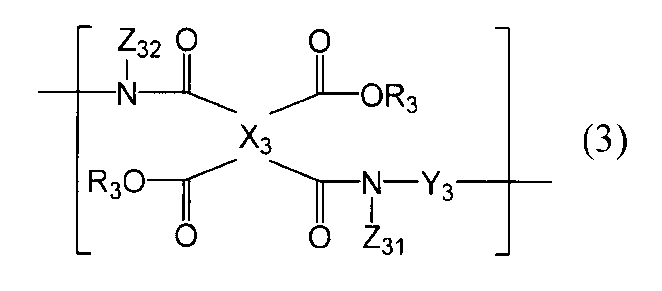
(X3は脂環式酸二無水物又は脂肪族酸二無水物に由来する4価の有機基である。Y3は下記式(l)で表される2価の有機基、又は下記式(n)で表される部分構造を有する2価の有機基である。R3は水素原子、又は炭素数1~4のアルキル基である。Z31、Z32は、それぞれ独立して、水素原子、置換基を有してもよい炭素数1~10のアルキル基、置換基を有してもよい炭素数2~10のアルケニル基、置換基を有してもよい炭素数2~10のアルキニル基、tert-ブトキシカルボニル基、又は9-フルオレニルメトキシカルボニル基である。)

(Q1、Q2は、炭素数1~3のアルキル基であり、Q3は水素原子又は炭素数1~3のアルキル基である。*は結合手を表す。)

(X4、X5は芳香族酸二無水物に由来する4価の有機基である。Y4は、式(2)のY2と同義であり、R4は前記式(2)のR2と同義である。Z41、Z42は、それぞれ、前記式(2)のZ21、Z22と同義である。Y5は、前記式(3)のY3と同義であり、R5は前記式(3)のR3と同義であり、Z51、Z52は、それぞれ、前記式(3)のZ31、Z32と同義である。)
本発明は、下記を要旨とするものである。
下記の(A)成分と(B)成分を含有することを特徴とする液晶配向剤。
(A)成分:下記式(1)で表される繰り返し単位を有する重合体(A)。
(B)成分:下記式(2)で表される繰り返し単位、下記式(3)で表される繰り返し単位、下記式(4)で表される繰り返し、及び下記式(5)で表される繰り返し単位を有し、下記式(2)で表される繰り返し単位及び下記式(3)で表される繰り返し単位の合計含有量が、全繰り返し単位の60~99.9モル%であり、かつ、下記式(4)で表される繰り返し単位及び下記式(5)で表される繰り返し単位の合計含有量が、全繰り返し単位の0.1~40モル%である重合体(B)。
本発明の液晶配向剤によれば、リワークが容易で、且つ透過率の高い液晶配向膜を得ることができる。また、得られる液晶配向膜を使用することにより、残留DC由来の残像やAC残像が発生しにくく、透過率が高い、コントラストに優れた液晶表示素子が得られる。
以下に、本発明の液晶配向剤に含まれる各成分、及び必要に応じて任意に配合されるその他の成分について説明する。
<重合体(A)>
本発明の液晶配向剤は、上記式(1)で表される繰り返し単位を有する重合体(A)を含有する。これにより、AC残像の発生が少なく、透過率の高い液晶配向膜を得ることができ、また、コントラストの低下が抑えられた液晶表示素子を得ることができる。上記式(1)において、X1、Y1は、上記に定義した通りである。式(1)のX1としては、テトラカルボン酸二無水物に由来する4価の有機基が挙げられ、例えば、芳香族テトラカルボン酸二無水物、脂肪族テトラカルボン酸二無水物、脂環式テトラカルボン酸二無水物に由来する4価の有機基が挙げられる。式(1)のY1はジアミン化合物に由来する2価の有機基が好ましい。
<重合体(A)>
本発明の液晶配向剤は、上記式(1)で表される繰り返し単位を有する重合体(A)を含有する。これにより、AC残像の発生が少なく、透過率の高い液晶配向膜を得ることができ、また、コントラストの低下が抑えられた液晶表示素子を得ることができる。上記式(1)において、X1、Y1は、上記に定義した通りである。式(1)のX1としては、テトラカルボン酸二無水物に由来する4価の有機基が挙げられ、例えば、芳香族テトラカルボン酸二無水物、脂肪族テトラカルボン酸二無水物、脂環式テトラカルボン酸二無水物に由来する4価の有機基が挙げられる。式(1)のY1はジアミン化合物に由来する2価の有機基が好ましい。
ここで、芳香族テトラカルボン酸二無水物とは、芳香環に結合する少なくとも1つのカルボキシル基を含めて4つのカルボキシル基が分子内脱水することにより得られる酸二無水物である。脂肪族テトラカルボン酸二無水物とは、鎖状炭化水素構造に結合する4つのカルボキシル基が分子内脱水することにより得られる酸二無水物である。但し、鎖状炭化水素構造のみで構成されている必要はなく、その一部に脂環式構造や芳香環構造を有していてもよい。脂環式テトラカルボン酸二無水物とは、脂環式構造に結合する少なくとも1つのカルボキシル基を含めて4つのカルボキシル基が分子内脱水することにより得られる酸二無水物である。但し、これら4つのカルボキシル基はいずれも芳香環には結合していない。また、脂環式構造のみで構成されている必要はなく、その一部に鎖状炭化水素構造や芳香環構造を有していてもよい。
重合体(A)の溶解性を高める観点において、X1は、下記式(4a)~(4n)、下記式(5a)及び下記式(6a)からなる群から選ばれる4価の有機基であることが好ましい。

(x及びyは、それぞれ独立に、単結合、エーテル(-O-)、カルボニル(-CO-)、エステル(-COO-)、炭素数1~5のアルカンジイル基、1,4-フェニレン、スルホニル又はアミド基である。Z1~Z6は、それぞれ独立して、水素原子、メチル基、エチル基、プロピル基、塩素原子又はベンゼン環を表す。jは、それぞれ独立に、0又は1の整数である。mは1~5の整数である。*は結合手を表す。)
AC残像が少ない観点において、前記式(4a)の好ましい具体例として、下記式(4a-1)~(4a-4)で表される構造が挙げられる。

前記式(5a)、(6a)における炭素数1~5のアルカンジイル基としては、メチレン、エチレン、1,3-プロパンジイル、1,4-ブタンジイル、1,5-ペンタンジイル等が挙げられる。
AC残像が少なく、溶解性を担保する観点において、前記式(1)のX1は、前記式(4a)~(4h)、(4j)、(4l)、(4m)~(4n)から選ばれる4価の有機基であることが好ましい。
AC残像が少なく、溶解性を担保する観点において、前記式(1)のX1は、前記式(4a)~(4h)、(4j)、(4l)、(4m)~(4n)から選ばれる4価の有機基であることが好ましい。
重合体(A)に用いることのできるジアミンとしては、特に限定されない。具体例としては、脂肪族ジアミンとして、例えばメタキシリレンジアミン、エチレンジアミン、1,3-プロパンジアミン、テトラメチレンジアミン、ヘキサメチレンジアミン等が挙げられる。脂環式ジアミンとして、例えばp-シクロヘキサンジアミン、4,4’-メチレンビス(シクロヘキシルアミン)等が挙げられる。
芳香族ジアミンとしては、p-フェニレンジアミン、4,4’-ジアミノジフェニルメタン、4,4’-ジアミノジフェニルエーテル、4,4’-ジアミノアゾベンゼン、3,5-ジアミノ安息香酸、ビス(4-アミノフェニル)アミン、N,N-ビス(4-アミノフェニル)メチルアミン、1,4-ビス(4-アミノフェニル)-ピペラジン、N,N’-ビス(4-アミノフェニル)-ベンジジン、2,2’-ジメチル-4,4’-ジアミノビフェニル、1,3-ビス(4-アミノフェノキシ)ベンゼン、1,4-ビス(4-アミノフェノキシ)ベンゼン、ビス[4-(4-アミノフェノキシ)フェニル]エーテル、4,4’-ビス(4-アミノフェノキシ)ビフェニル、4-(4-アミノフェノキシカルボニル)-1-(4-アミノフェニル)ピペリジン、4,4’-[4,4’-プロパン-1,3-ジイルビス(ピペリジン-1,4-ジイル)]ジアニリン、1,3-ビス(3-アミノプロピル)-テトラメチルジシロキサン、下記式(H)で表される部分構造を有する2価の有機基に2つのアミノ基が結合したジアミン等を挙げられる。

(Q11は、-NQCO-、-COO-、-OCO-、-NQCONQ-、-CONQ-、又は-(CH2)n-(nは1~20の整数である。)但し、nが2~20である場合は、任意の-CH2-はそれぞれ隣り合わない条件で-O-、-COO-、-OCO-、-ND-、-NQCO-、-CONQ-、-NQCONQ-、-NQCOO-、又は-OCOO-に置き換えられてもよい。Dは熱脱離性基を表し、Qは水素原子又は1価の有機基を表す。Q12は単結合又はベンゼン環であり、ベンゼン環上の任意の水素原子は1価の有機基で置き換えられてもよい。*1、*2は結合手を表し、Q12が単結合である場合、*2はアミノ基中の窒素原子に結合する。Q12がベンゼン環である場合は、Q11は単結合であってもよい。)
AC残像が少ない観点において、前記式(1)のY1は、前記式(H)で表される部分構造を有する2価の有機基であることが好ましい。この場合において、前記式(H)のR4が単結合である場合、*2はイミド環中の窒素原子に結合する。中でも、前記式(1)のY1は、下記式(H-1)~(H-14)のいずれかで表される部分構造を有する2価の有機基であることが好ましい。

(*1、*2は結合手を表し、*2はイミド環中の窒素原子と結合する。)
合成が容易である観点において、前記式(1)のY1は、前記式(H-1)~(H-14)のいずれかで表される2価の有機基又は下記式(MH-1)~(MH-2)で表される2価の有機基であることが好ましい。
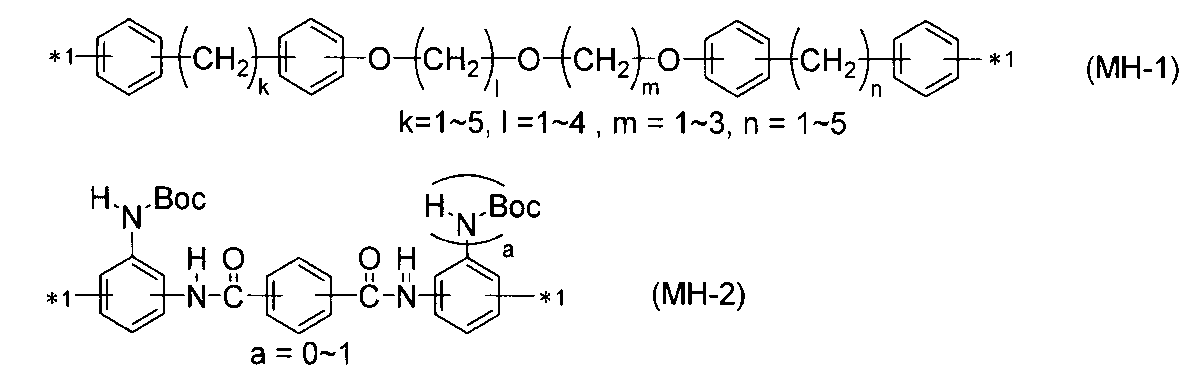
(*1はイミド環中の窒素原子と結合する。Bocは、tert-ブトキシカルボニル基を表す。)
重合体(A)は、上記式(1)で表される繰り返し単位以外に、下記式(PA-1)で表される繰り返し単位を有してもよい。
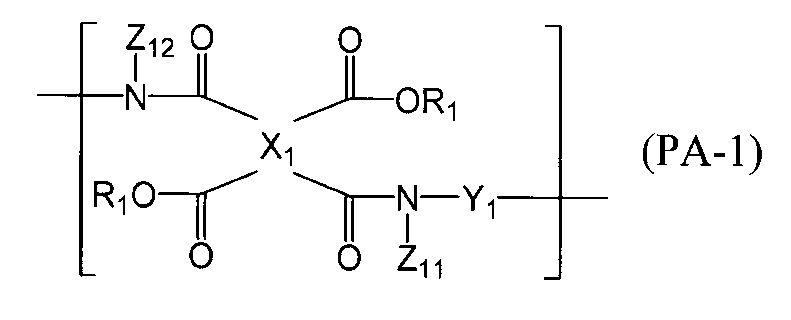
式(PA-1)中、X1及びY1は,それぞれ、好ましい態様も含めて式(1)のX1及びY1と同義である。R1は水素原子、又は炭素数1~5のアルキル基である。Z11、Z12は、それぞれ独立して、水素原子、置換基を有してもよい炭素数1~10のアルキル基、置換基を有してもよい炭素数2~10のアルケニル基、置換基を有してもよい炭素数2~10のアルキニル基、tert-ブトキシカルボニル基、又は9-フルオレニルメトキシカルボニル基である。
上記R1の炭素数1~5のアルキル基の具体例としては、メチル基、エチル基、プロピル基、i-プロピル基、n-ブチル基、i-ブチル基、s-ブチル基、t-ブチル基、n-ペンチル基などが挙げられる。加熱によるイミド化のしやすさの観点から、R1は、水素原子又はメチル基であることが好ましい。
上記Z11、Z12の炭素数1~10のアルキル基の具体例としては、上記R1で例示した炭素数1~5のアルキル基の具体例に加えて、ヘキシル基、ヘプチル基、オクチル基、ノニル基、デシル基等が挙げられる。Z11、Z12の炭素数2~10のアルケニル基の具体例としては、例えばビニル基、プロペニル基、ブチニル基等が挙げられ、これらは直鎖状でも分岐状でもよい。Z11、Z12の炭素数2~10のアルキニル基の具体例としては、例えばエチニル基、1-プロピニル基、2-プロピニル基等が挙げられる。
Z11、Z12は置換基を有していてもよく、当該置換基としては、例えばハロゲン原子(フッ素原子、塩素原子、臭素原子、ヨウ素原子)、水酸基、シアノ基、アルコキシ基などが挙げられる。
AC残像が少ない観点において、Z11、Z12はそれぞれ独立して、水素原子又はメチル基であることが好ましい。
AC残像が少ない観点から、重合体(A)は前記式(1)で表される繰り返し単位を、重合体(A)の有する全繰り返し単位の10~95モル%含むことが好ましく、15~95モル%を含むのがより好ましい。また、この際、重合体(A)は上記式(PA-1)で表される繰り返し単位を5~90モル%含むことが好ましく、5~85モル%含むのがより好ましい。
AC残像が少ない観点において、Z11、Z12はそれぞれ独立して、水素原子又はメチル基であることが好ましい。
AC残像が少ない観点から、重合体(A)は前記式(1)で表される繰り返し単位を、重合体(A)の有する全繰り返し単位の10~95モル%含むことが好ましく、15~95モル%を含むのがより好ましい。また、この際、重合体(A)は上記式(PA-1)で表される繰り返し単位を5~90モル%含むことが好ましく、5~85モル%含むのがより好ましい。
<重合体(B)>
本発明の液晶配向剤は、上記式(2)で表される繰り返し単位、上記式(3)で表される繰り返し単位、上記式(4)で表される繰り返し単位及び上記式(5)で表される繰り返し単位を有し、上記式(2)で表される繰り返し単位及び上記式(3)で表される繰り返し単位の合計量が、全繰り返し単位の60~99.9モル%である重合体(B)を含有する。このような構成とすることで、リワーク性に優れ、かつ残留DC由来の残像が低減された液晶配向膜が得られる。
上記式(2)、(3)において、X2、X3、Y2、Y3、R2、R3、Z21、Z22、Z31、Z32は、上記に定義した通りである。
本発明の液晶配向剤は、上記式(2)で表される繰り返し単位、上記式(3)で表される繰り返し単位、上記式(4)で表される繰り返し単位及び上記式(5)で表される繰り返し単位を有し、上記式(2)で表される繰り返し単位及び上記式(3)で表される繰り返し単位の合計量が、全繰り返し単位の60~99.9モル%である重合体(B)を含有する。このような構成とすることで、リワーク性に優れ、かつ残留DC由来の残像が低減された液晶配向膜が得られる。
上記式(2)、(3)において、X2、X3、Y2、Y3、R2、R3、Z21、Z22、Z31、Z32は、上記に定義した通りである。
上記R2、R3の炭素数1~5のアルキル基の具体例としては、上記式(PA-1)のR1で例示した構造が挙げられる。加熱によるイミド化のしやすさの観点から、R2及びR3はそれぞれ独立して、水素原子又はメチル基であることが好ましい。
上記Z21、Z22、Z31、Z32の炭素数1~10のアルキル基、炭素数2~10のアルケニル基、炭素数2~10のアルキニル基の具体例としては、上記式(PA-1)のZ11、Z12で例示した構造等が挙げられる。
Z21、Z22、Z31、Z32は置換基を有していてもよく、当該置換基としては、例えば上記式(PA-1)のZ11、Z12で例示した構造等が挙げられる。
AC残像が少ない観点において、Z21、Z22、Z31、Z32はそれぞれ独立して、水素原子又はメチル基であることが好ましい。
上記Z21、Z22、Z31、Z32の炭素数1~10のアルキル基、炭素数2~10のアルケニル基、炭素数2~10のアルキニル基の具体例としては、上記式(PA-1)のZ11、Z12で例示した構造等が挙げられる。
Z21、Z22、Z31、Z32は置換基を有していてもよく、当該置換基としては、例えば上記式(PA-1)のZ11、Z12で例示した構造等が挙げられる。
AC残像が少ない観点において、Z21、Z22、Z31、Z32はそれぞれ独立して、水素原子又はメチル基であることが好ましい。
上記X2、X3の脂環式テトラカルボン酸二無水物又は脂肪族テトラカルボン酸二無水物に由来する4価の有機基としては、上記X1で例示した脂環式テトラカルボン酸二無水物又は脂肪族テトラカルボン酸二無水物に由来する4価の有機基を挙げることができる。AC残像を抑制する観点において、X2、X3は上記式(4a)~(4n)からなる群から選ばれる4価の有機基であることが好ましい。
上記式(l)又は(n)におけるQ1、Q2、Q3の炭素数1~3のアルキル基としては、メチル基、エチル基、プロピル基等が挙げられる。液晶配向膜の透過率を高め、AC残像と残留DC由来の残像を抑制する観点から、Q1、Q2、Q3はメチル基であることが好ましい。尚、式(n)中のベンゼン環の任意の水素原子は、一価の有機基で置換されてもよい。該一価の有機基としては、炭素数1~3を有する、アルキル基、アルケニル基、アルコキシ基、フルオロアルキル基、フルオロアルケニル基若しくはフルオロアルコキシ基等が挙げられる。
AC残像が少ない観点において、上記式(l)は下記式(l-1)で表される構造が好ましい。

上記式(n)において、-NQ3-Ph(Phはフェニレン基を表す)の結合位置は立体障害が少ない観点から、カルバゾール骨格の3位に結合していることが好ましい。
残留DC由来の残像が少ない観点から、前記式(n)で表される部分構造を有する2価の有機基が、下記式(n-1)~(n-3)からなる群から選ばれる2価の有機基であることが好ましい。

残留DC由来の残像が少ない観点から、前記式(n)で表される部分構造を有する2価の有機基が、下記式(n-1)~(n-3)からなる群から選ばれる2価の有機基であることが好ましい。
式(n-1)~(n-3)中、Q2、Q3は、それぞれ、前記式(n)のQ2、Q3と好ましい具体例を含めて同義である。Q4は、単結合又は以下の式(Ar)の構造を表し、nは1~3の整数を表す。*は結合手を表す。更に、ベンゼン環の任意の水素原子は、上記式(n)の場合と同様に、一価の有機基で置換されていてもよい。

(Q5は、単結合、-O-、-COO-、-OCO-、-(CH2)l-、-O(CH2)mO-、-CONQ-、及び-NQCO-から選ばれる2価の有機基を表し、kは1~5の整数を表す。なお、Qは水素もしくは一価の有機基を表し、l、mは1~5の整数を表す。*1、*2は結合手を表し、*1は式(n-1)~式(n-3)中のベンゼン環と結合する。)
前記式(Ar)のQにおける一価の有機基としては、炭素数1~3のアルキル基が挙げられる。
前記式(Ar)のQにおける一価の有機基としては、炭素数1~3のアルキル基が挙げられる。
合成が容易である観点で、前記式(n)で表される部分構造を有する2価の有機基は、下記式(cbz-1)~(cbz-7)のいずれかで表される2価の有機基であることが好ましい。*は結合手を表す。


前記重合体(B)は、AC残像と残留DC由来の残像が少ない観点において、前記式(3)で表される繰り返し単位として、Y3が前記式(l)で表される2価の有機基である繰り返し単位と、Y3が前記式(n)で表される部分構造を有する2価の有機基である繰り返し単位とを有することが好ましい。
前記重合体(B)は、残留DC由来の残像が少ない観点から、下記式(4)で表される繰り返し単位及び下記式(5)で表される繰り返し単位を有する。

式(4)、(5)中、X4、X5は芳香族テトラカルボン酸二無水物に由来する4価の有機基であり、前記式(1)のX1で例示した芳香族テトラカルボン酸二無水物に由来する4価の有機基を挙げることができる。AC残像と残留DC由来の残像が少ない観点において、X4、X5は上記X1の好ましい例に記載の式(5a)、(6a)から選ばれる4価の有機基であることが好ましい。
Y4は、前記式(2)のY2と好ましい態様を含めて同義である。R4は前記式(2)のR2と好ましい態様を含めて同義である。Z41、Z42はそれぞれ前記式(2)のZ21、Z22と好ましい態様を含めて同義である。Y5は、前記式(3)のY3と好ましい態様を含めて同義である。R5は前記式(3)のR3と好ましい態様を含めて同義である。Z51、Z52はそれぞれ前記式(3)のZ31、Z32と好ましい態様を含めて同義である。
重合体(B)における、上記式(2)で表される繰り返し単位及び上記式(3)で表される繰り返し単位よりなる群から選ばれる少なくとも1種の繰り返し単位の合計含有量は、高い透過率が得られる観点から、全繰り返し単位の60~99.9モル%であることが好ましく、65~90モル%であることがより好ましい。
上記式(2)で表される繰り返し単位と上記式(3)で表される繰り返し単位との含有量の割合は、前者/後者のモル%比が、10/90~50/50であることが好ましく、 15/85~50/50であることがより好ましい。
重合体(B)における、上記式(4)で表される繰り返し単位及び上記式(5)で表される繰り返し単位よりなる群から選ばれる少なくとも1種の繰り返し単位の合計含有量は、高い透過率が得られる観点から、全繰り返し単位の0.1~40モル%であることが好ましく、10~35モル%であることがより好ましい。
上記式(4)で表される繰り返し単位と上記式(5)で表される繰り返し単位との含有量の割合は、前者/後者のモル%比が、10/90~50/50であることが好ましく、15/85~50/50であることがより好ましい。
上記式(2)で表される繰り返し単位と上記式(3)で表される繰り返し単位との含有量の割合は、前者/後者のモル%比が、10/90~50/50であることが好ましく、 15/85~50/50であることがより好ましい。
重合体(B)における、上記式(4)で表される繰り返し単位及び上記式(5)で表される繰り返し単位よりなる群から選ばれる少なくとも1種の繰り返し単位の合計含有量は、高い透過率が得られる観点から、全繰り返し単位の0.1~40モル%であることが好ましく、10~35モル%であることがより好ましい。
上記式(4)で表される繰り返し単位と上記式(5)で表される繰り返し単位との含有量の割合は、前者/後者のモル%比が、10/90~50/50であることが好ましく、15/85~50/50であることがより好ましい。
重合体(B)は、上記式(2)で表される繰り返し単位、上記式(3)で表される繰り返し単位、上記式(4)で表される繰り返し単位、上記式(5)で表される繰り返し単位以外に、下記式(PA-2)で表される繰り返し単位を有してもよい。
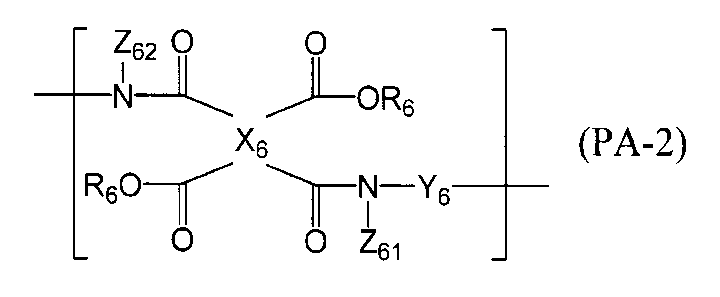
式(PA-2)中、X6は4価の有機基を表し、Y6は2価の有機基を表す。但し、Y6は上記式(m-1)~(m-2)から選ばれる基、上記式(l)で表される2価の有機基及び上記式(n)で表される部分構造を有する2価の有機基を含まない。R6は前記式(2)のR2と好ましい態様を含めて同義である。り、Z61、Z62は前記式(2)のZ61、Z62と好ましい態様を含めて同義である。
X6の具体例としては、上記式(1)のX1で例示した芳香族テトラカルボン酸二無水物、脂肪族テトラカルボン酸二無水物、脂環式テトラカルボン酸二無水物に由来する4価の有機基が挙げられる。Y6の具体例としては、上記式(1)のY1で例示したジアミンに由来する構造の他、国際公開公報(以下、WOともいう。)2017/126627号に記載のピロール構造を有するジアミンに由来する構造、好ましくは下式(pr)で表される構造を有するジアミンに由来する構造、

(式(pr)中、R1は水素原子、水素、フッ素原子、シアノ基、ヒドロキシ基、メチル基を表し、R2はそれぞれ独立して単結合又は基「*1-R3-Ph-*2」を表し、R3は単結合、-O-、-COO-、-OCO-、-(CH2)l-、-O(CH2)mO-、-CONH-、及び-NHCO-から選ばれる2価の有機基を表し(l、mは1~5の整数を表す)、*1は式(pr)中のベンゼン環と結合する部位を表し、*2は式(pr)中のアミノ基と結合する部位を表す。Phはフェニレン基を表す。nは1~3を表す。)、WO2018/062197号に記載のピロール構造を有するジアミンに由来する構造、好ましくは下式(pn)で表される構造を有するジアミンに由来する構造、
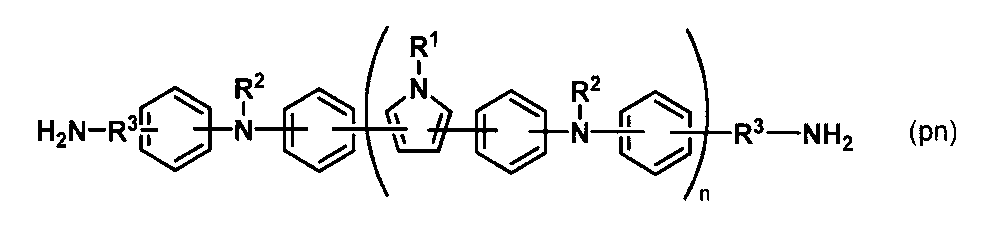
(式(pn)中、R1及びR2は水素原子又はメチル基を表し、R3はそれぞれ独立して単結合又は基「*1-R4-Ph-*2」を表し、R4は単結合、-O-、-COO-、-OCO-、-(CH2)l-、-O(CH2)mO-、-CONH-、及び-NHCO-から選ばれる2価の有機基を表し(l、mは1~5の整数を表す)、*1は式(pn)中のベンゼン環と結合する部位を表し、*2は式(pn)中のアミノ基と結合する部位を表す。Phはフェニレン基を表す。nは1~3を表す。)、WO2018/092759号に記載のチオフェン又はフラン構造を有するジアミンに由来する構造、好ましくは下式(sf)で表される構造を有するジアミンに由来する構造、
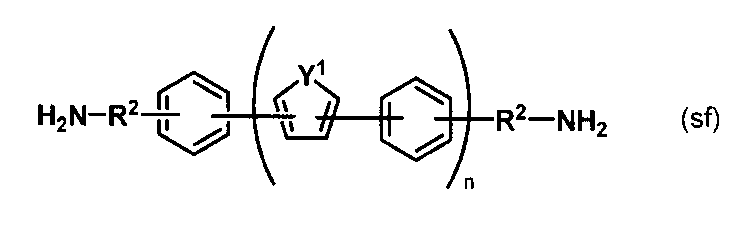
(式(sf)中、Y1は硫黄原子又は酸素原子を表し、R2はそれぞれ独立して単結合又は基「*1-R5-Ph-*2」を表し、R5は単結合、-O-、-COO-、-OCO-、-(CH2)l-、-O(CH2)mO-、-CONH-、及び-NHCO-から選ばれる2価の有機基を表し(l、mは1~5の整数を表す)、*1は式(pn)中のベンゼン環と結合する部位を表し、*2は式(pn)中のアミノ基と結合する部位を表す。Phはフェニレン基を表す。nは1~3を表す。)、WO2018-181566号の段落[0013]~[0030]に記載の2価の有機基等が挙げられる。
AC残像と残留DC由来の残像が少ない観点において、前記重合体(A)と前記重合体(B)との含有割合が、重合体(A)/重合体(B)の重量比で、5/95~95/5であることが好ましい。再現性の高い液晶配向膜が得られる観点から、上記重合体(A)/重合体(B)は、10/90~90/10がより好ましく、20/80~80/20がさらに好ましい。
<ポリアミック酸の製造方法>
本発明に用いられるポリイミド前駆体であるポリアミック酸は、以下に示す方法により合成することができる。
具体的には、テトラカルボン酸二無水物とジアミンとを有機溶媒の存在下で-20℃~150℃、好ましくは0℃~50℃において、30分~24時間、好ましくは1~12時間反応させることによって合成できる。
上記の反応に用いる有機溶媒は、モノマー及びポリマーの溶解性からN,N-ジメチルホルムアミド、N-メチル-2-ピロリドン、又はγ-ブチロラクトンが好ましく、これらは1種又は2種以上を混合して用いてもよい。ポリマーの濃度は、ポリマーの析出が起こりにくく、かつ高分子量体が得やすいという観点から、1~30重量%が好ましく、5~20重量%がより好ましい。
本発明に用いられるポリイミド前駆体であるポリアミック酸は、以下に示す方法により合成することができる。
具体的には、テトラカルボン酸二無水物とジアミンとを有機溶媒の存在下で-20℃~150℃、好ましくは0℃~50℃において、30分~24時間、好ましくは1~12時間反応させることによって合成できる。
上記の反応に用いる有機溶媒は、モノマー及びポリマーの溶解性からN,N-ジメチルホルムアミド、N-メチル-2-ピロリドン、又はγ-ブチロラクトンが好ましく、これらは1種又は2種以上を混合して用いてもよい。ポリマーの濃度は、ポリマーの析出が起こりにくく、かつ高分子量体が得やすいという観点から、1~30重量%が好ましく、5~20重量%がより好ましい。
上記のようにして得られたポリアミック酸は、反応溶液をよく撹拌させながら貧溶媒に注入することで、ポリマーを析出させて回収することができる。また、析出を数回行い、貧溶媒で洗浄後、常温あるいは加熱乾燥することで精製されたポリアミック酸の粉末を得ることができる。貧溶媒は、特に限定されないが、水、メタノール、エタノール、ヘキサン、ブチルセロソルブ、アセトン、トルエン等が挙げられる。
<ポリアミック酸エステルの製造方法>
本発明に用いられるポリイミド前駆体であるポリアミック酸エステルは、例えば、以下に示す(1)、(2)又は(3)の方法で合成することができる。
(1)ポリアミック酸から合成する場合
ポリアミック酸エステルは、テトラカルボン酸二無水物とジアミンから得られるポリアミック酸をエステル化することによって合成することができる。
具体的には、ポリアミック酸とエステル化剤を有機溶剤の存在下で-20℃~150℃、好ましくは0℃~50℃において、30分~24時間、好ましくは1~4時間反応させることによって合成することができる。
本発明に用いられるポリイミド前駆体であるポリアミック酸エステルは、例えば、以下に示す(1)、(2)又は(3)の方法で合成することができる。
(1)ポリアミック酸から合成する場合
ポリアミック酸エステルは、テトラカルボン酸二無水物とジアミンから得られるポリアミック酸をエステル化することによって合成することができる。
具体的には、ポリアミック酸とエステル化剤を有機溶剤の存在下で-20℃~150℃、好ましくは0℃~50℃において、30分~24時間、好ましくは1~4時間反応させることによって合成することができる。
エステル化剤としては、精製によって容易に除去できるものが好ましく、N,N-ジメチルホルムアミドジメチルアセタール、N,N-ジメチルホルムアミドジ-t-ブチルアセタール、1-メチル-3-p-トリルトリアゼン、4-(4,6-ジメトキシ-1,3,5-トリアジンー2-イル)-4-メチルモルホリニウムクロリドなどが挙げられる。エステル化剤の使用量は、ポリアミック酸の繰り返し単位1モルに対して、2~6モル当量が好ましい。
上記の反応に用いる溶媒は、ポリマーの溶解性からN,N-ジメチルホルムアミド、N-メチル-2-ピロリドン、又はγ-ブチロラクトンが好ましく、これらは2種以上を混合して用いてもよい。合成時の濃度は、ポリマーの析出が起こりにくく、かつ高分子量体が得やすいという観点から、1~30重量%が好ましく、5~20重量%がより好ましい。
上記の反応に用いる溶媒は、ポリマーの溶解性からN,N-ジメチルホルムアミド、N-メチル-2-ピロリドン、又はγ-ブチロラクトンが好ましく、これらは2種以上を混合して用いてもよい。合成時の濃度は、ポリマーの析出が起こりにくく、かつ高分子量体が得やすいという観点から、1~30重量%が好ましく、5~20重量%がより好ましい。
(2)テトラカルボン酸ジエステルジクロリドとジアミンとの反応により合成する場合
ポリアミック酸エステルは、テトラカルボン酸ジエステルジクロリドとジアミンから合成することができる。
具体的には、テトラカルボン酸ジエステルジクロリドとジアミンとを塩基と有機溶剤の存在下で-20℃~150℃、好ましくは0℃~50℃において、30分~24時間、好ましくは1~4時間反応させることによって合成することができる。
前記塩基には、ピリジン、トリエチルアミンなどが使用できるが、反応が穏和に進行するためにピリジンが好ましい。塩基の使用量は、除去が容易な量で、かつ高分子量体が得やすいという観点から、テトラカルボン酸ジエステルジクロリドに対して、2~4倍モルであることが好ましい。
ポリアミック酸エステルは、テトラカルボン酸ジエステルジクロリドとジアミンから合成することができる。
具体的には、テトラカルボン酸ジエステルジクロリドとジアミンとを塩基と有機溶剤の存在下で-20℃~150℃、好ましくは0℃~50℃において、30分~24時間、好ましくは1~4時間反応させることによって合成することができる。
前記塩基には、ピリジン、トリエチルアミンなどが使用できるが、反応が穏和に進行するためにピリジンが好ましい。塩基の使用量は、除去が容易な量で、かつ高分子量体が得やすいという観点から、テトラカルボン酸ジエステルジクロリドに対して、2~4倍モルであることが好ましい。
上記の反応に用いる溶媒は、モノマー及びポリマーの溶解性からN-メチル-2-ピロリドン、又はγ-ブチロラクトンが好ましく、これらはは2種以上を混合して用いてもよい。合成時のポリマー濃度は、ポリマーの析出が起こりにくく、かつ高分子量体が得やすいという観点から、1~30重量%が好ましく、5~20重量%がより好ましい。また、テトラカルボン酸ジエステルジクロリドの加水分解を防ぐため、ポリアミック酸エステルの合成に用いる溶媒はできるだけ脱水されていることが好ましく、窒素雰囲気中で、外気の混入を防ぐのが好ましい。
(3)テトラカルボン酸ジエステルとジアミンからポリアミック酸エステルを合成する場合
ポリアミック酸エステルは、テトラカルボン酸ジエステルとジアミンを重縮合することにより合成することができる。
具体的には、テトラカルボン酸ジエステルとジアミンを縮合剤、塩基、及び有機溶剤の存在下で0℃~150℃、好ましくは0℃~100℃において、30分~24時間、好ましくは3~15時間反応させることによって合成することができる。
ポリアミック酸エステルは、テトラカルボン酸ジエステルとジアミンを重縮合することにより合成することができる。
具体的には、テトラカルボン酸ジエステルとジアミンを縮合剤、塩基、及び有機溶剤の存在下で0℃~150℃、好ましくは0℃~100℃において、30分~24時間、好ましくは3~15時間反応させることによって合成することができる。
前記縮合剤には、トリフェニルホスファイト、ジシクロヘキシルカルボジイミド、1-エチル-3-(3-ジメチルアミノプロピル)カルボジイミド塩酸塩、N,N’-カルボニルジイミダゾール、ジメトキシ-1,3,5-トリアジニルメチルモルホリニウム、などの公知の化合物が使用できる。
前記塩基には、ピリジンなどの3級アミンが使用できる。
上記3つのポリアミック酸エステルの製造方法の中でも、高分子量のポリアミック酸エステルが得られるため、上記(1)又は上記(2)の製造方法が特に好ましい。
前記塩基には、ピリジンなどの3級アミンが使用できる。
上記3つのポリアミック酸エステルの製造方法の中でも、高分子量のポリアミック酸エステルが得られるため、上記(1)又は上記(2)の製造方法が特に好ましい。
<ポリイミドの製造方法>
本発明に用いられるポリイミドは、前記ポリアミック酸エステル又はポリアミック酸をイミド化することにより製造することができる。ポリアミック酸エステルからポリイミドを製造する場合、前記ポリアミック酸エステル溶液、又はポリアミック酸エステル樹脂粉末を有機溶媒に溶解させて得られるポリアミック酸溶液に塩基性触媒を添加する化学的イミド化が簡便である。化学的イミド化は、比較的低温でイミド化反応が進行し、イミド化の課程で重合体の分子量低下が起こりにくいので好ましい。
本発明に用いられるポリイミドは、前記ポリアミック酸エステル又はポリアミック酸をイミド化することにより製造することができる。ポリアミック酸エステルからポリイミドを製造する場合、前記ポリアミック酸エステル溶液、又はポリアミック酸エステル樹脂粉末を有機溶媒に溶解させて得られるポリアミック酸溶液に塩基性触媒を添加する化学的イミド化が簡便である。化学的イミド化は、比較的低温でイミド化反応が進行し、イミド化の課程で重合体の分子量低下が起こりにくいので好ましい。
化学的イミド化は、イミド化させたい重合体を、有機溶媒中において塩基性触媒と酸無水物の存在下で攪拌することにより行うことができる。有機溶媒としては前述した重合反応時に用いる溶媒を使用することができる。塩基性触媒としてはピリジン、トリエチルアミン、トリメチルアミン、トリブチルアミン、トリオクチルアミン等を挙げることができる。中でもピリジンは反応を進行させるのに適度な塩基性を持つので好ましい。また、酸無水物としては無水酢酸、無水トリメリット酸、無水ピロメリット酸等を挙げることができ、中でも無水酢酸を用いると反応終了後の精製が容易となるので好ましい。
イミド化反応を行うときの温度は、-20℃~140℃、好ましくは0℃~100℃であり、反応時間は1~100時間で行うことができる。塩基性触媒の量はアミック酸基の0.5~30モル倍、好ましくは2~20モル倍であり、酸無水物の量はアミック酸基の1~50モル倍、好ましくは3~30モル倍である。得られる重合体のイミド化率は、触媒量、温度、反応時間を調節することで制御することができる。
ポリアミック酸エステル又はポリアミック酸のイミド化反応後の溶液には、添加した触媒等が残存しているので、以下に述べる手段により、得られたイミド化重合体を回収し、有機溶媒で再溶解して、本発明の液晶配向剤とすることが好ましい。
ポリアミック酸エステル又はポリアミック酸のイミド化反応後の溶液には、添加した触媒等が残存しているので、以下に述べる手段により、得られたイミド化重合体を回収し、有機溶媒で再溶解して、本発明の液晶配向剤とすることが好ましい。
上記のようにして得られるポリイミドの溶液は、よく撹拌させながら貧溶媒に注入することで、重合体を析出させることができる。析出を数回行い、貧溶媒で洗浄後、常温あるいは加熱乾燥して精製されたポリアミック酸エステルの粉末を得ることができる。
前記貧溶媒は、特に限定されないが、メタノール、アセトン、ヘキサン、ブチルセルソルブ、ヘプタン、メチルエチルケトン、メチルイソブチルケトン、エタノール、トルエン、ベンゼン等が挙げられる。
前記貧溶媒は、特に限定されないが、メタノール、アセトン、ヘキサン、ブチルセルソルブ、ヘプタン、メチルエチルケトン、メチルイソブチルケトン、エタノール、トルエン、ベンゼン等が挙げられる。
<液晶配向剤>
本発明の液晶配向剤は、重合体(A)及び重合体(B)を含有する。本発明の液晶配向剤は、重合体(A)及び重合体(B)に加えて、その他の重合体を含有していてもよい。その他の重合体の種類としては、ポリアミック酸、ポリイミド、ポリアミック酸エステル、ポリエステル、ポリアミド、ポリウレア、ポリオルガノシロキサン、セルロース誘導体、ポリアセタール、ポリスチレン又はその誘導体、ポリ(スチレン-フェニルマレイミド)誘導体、ポリ(メタ)アクリレートなどを挙げることができる。
本発明の液晶配向剤は、重合体(A)及び重合体(B)を含有する。本発明の液晶配向剤は、重合体(A)及び重合体(B)に加えて、その他の重合体を含有していてもよい。その他の重合体の種類としては、ポリアミック酸、ポリイミド、ポリアミック酸エステル、ポリエステル、ポリアミド、ポリウレア、ポリオルガノシロキサン、セルロース誘導体、ポリアセタール、ポリスチレン又はその誘導体、ポリ(スチレン-フェニルマレイミド)誘導体、ポリ(メタ)アクリレートなどを挙げることができる。
液晶配向剤は、液晶配向膜を作製するために用いられるものであり、均一な薄膜を形成させるという観点から、塗布液の形態をとる。本発明の液晶配向剤においても前記した重合体成分と、有機溶媒とを含有する塗布液であることが好ましい。その際、液晶配向剤中の重合体の濃度は、形成させようとする塗膜の厚みの設定によって適宜変更することができる。均一で欠陥のない塗膜を形成させるという点から、1重量%以上が好ましく、溶液の保存安定性の点からは、10重量%以下が好ましい。特に好ましい重合体の濃度は、2~8重量%である。
液晶配向剤に含有される有機溶媒は、重合体成分が均一に溶解するものであれば特に限定されない。その具体例を挙げるならば、N,N-ジメチルホルムアミド、N,N-ジメチルアセトアミド、N-メチル-2-ピロリドン、N-エチル-2-ピロリドン、ジメチルスルホキシド、γ-ブチロラクトン、1,3-ジメチル-イミダゾリジノン、メチルエチルケトン、シクロヘキサノン、シクロペンタノン、3-メトキシ-N,N-ジメチルプロパンアミド、3-ブトキシ-N,N-ジメチルプロパンアミド、などを挙げることができる。なかでも、N-メチル-2-ピロリドン、N-エチル-2-ピロリドン、3-メトキシ-N,N-ジメチルプロパンアミド、3-ブトキシ-N,N-ジメチルプロパンアミド又はγ-ブチロラクトンが好ましい。
また、液晶配向剤に含有される有機溶媒は、上記のような溶媒に加えて液晶配向剤を塗布する際の塗布性や塗膜の表面平滑性を向上させる溶媒を併用した混合溶媒が好ましい。併用する有機溶媒の具体例を下記に挙げるが、これらの例に限定されるものではない。
例えば、ジイソプロピルエーテル、ジイソブチルエーテル、ジイソブチルカルビノール、エチレングリコールジメチルエーテル、エチレングリコールジエチルエーテル、エチレングリコールジブチルエーテル、1,2-ブトキシエタン、ジエチレングリコールジメチルエーテル、ジエチレングリコールジエチルエーテル、4-ヒドロキシ-4-メチル-2-ペンタノン、ジエチレングリコールメチルエチルエーテル、ジエチレングリコールジブチルエーテル、3-エトキシブチルアセテート、1-メチルペンチルアセタート、2-エチルブチルアセテート、2-エチルヘキシルアセテート、エチレングリコールモノアセテート、エチレングリコールジアセテート、プロピレンカーボネート、エチレンカーボネート、2-(メトキシメトキシ)エタノール、エチレングリコールモノブチルエーテル(ブチルセロソルブ)、エチレングリコールモノイソアミルエーテル、エチレングリコールモノヘキシルエーテル、2-(ヘキシルオキシ)エタノール、プロピレングリコールモノブチルエーテル、1-(ブトキシエトキシ)プロパノール、プロピレングリコールモノメチルエーテルアセテート、ジプロピレングリコールモノメチルエーテル、ジプロピレングリコールモノエチルエーテル、ジプロピレングリコールジメチルエーテル、エチレングリコールモノブチルエーテルアセテート(ブチルセロソルブアセテート)、エチレングリコールモノアセテート、エチレングリコールジアセテート、ジエチレングリコールモノエチルエーテルアセテート、ジエチレングリコールモノブチルエーテルアセテート、2-(2-エトキシエトキシ)エチルアセテート、ジエチレングリコールアセテート、プロピレングリコールジアセテート、酢酸n-ブチル、酢酸プロピレングリコールモノエチルエーテル、3-メトキシプロピオン酸メチル、3-エトキシプロピオン酸エチル、3-メトキシプロピオン酸エチル、3-メトキシプロピオン酸プロピル、3-メトキシプロピオン酸ブチル、乳酸n-ブチルエステル、乳酸イソアミルエステル、ジエチレングリコールモノエチルエーテル、ジイソブチルケトンなどを挙げることができる。
例えば、ジイソプロピルエーテル、ジイソブチルエーテル、ジイソブチルカルビノール、エチレングリコールジメチルエーテル、エチレングリコールジエチルエーテル、エチレングリコールジブチルエーテル、1,2-ブトキシエタン、ジエチレングリコールジメチルエーテル、ジエチレングリコールジエチルエーテル、4-ヒドロキシ-4-メチル-2-ペンタノン、ジエチレングリコールメチルエチルエーテル、ジエチレングリコールジブチルエーテル、3-エトキシブチルアセテート、1-メチルペンチルアセタート、2-エチルブチルアセテート、2-エチルヘキシルアセテート、エチレングリコールモノアセテート、エチレングリコールジアセテート、プロピレンカーボネート、エチレンカーボネート、2-(メトキシメトキシ)エタノール、エチレングリコールモノブチルエーテル(ブチルセロソルブ)、エチレングリコールモノイソアミルエーテル、エチレングリコールモノヘキシルエーテル、2-(ヘキシルオキシ)エタノール、プロピレングリコールモノブチルエーテル、1-(ブトキシエトキシ)プロパノール、プロピレングリコールモノメチルエーテルアセテート、ジプロピレングリコールモノメチルエーテル、ジプロピレングリコールモノエチルエーテル、ジプロピレングリコールジメチルエーテル、エチレングリコールモノブチルエーテルアセテート(ブチルセロソルブアセテート)、エチレングリコールモノアセテート、エチレングリコールジアセテート、ジエチレングリコールモノエチルエーテルアセテート、ジエチレングリコールモノブチルエーテルアセテート、2-(2-エトキシエトキシ)エチルアセテート、ジエチレングリコールアセテート、プロピレングリコールジアセテート、酢酸n-ブチル、酢酸プロピレングリコールモノエチルエーテル、3-メトキシプロピオン酸メチル、3-エトキシプロピオン酸エチル、3-メトキシプロピオン酸エチル、3-メトキシプロピオン酸プロピル、3-メトキシプロピオン酸ブチル、乳酸n-ブチルエステル、乳酸イソアミルエステル、ジエチレングリコールモノエチルエーテル、ジイソブチルケトンなどを挙げることができる。
なかでも、ジイソブチルカルビノール、プロピレングリコールモノブチルエーテル、プロピレングリコールジアセテート、ジエチレングリコールジエチルエーテル、ジプロピレングリコールモノメチルエーテル、ジプロピレングリコールジメチルエーテル、4-ヒドロキシ-4-メチル-2-ペンタノン、エチレングリコールモノブチルエーテル、エチレングリコールモノブチルエーテルアセテート、ジイソブチルケトンが好ましい。溶媒の種類及び含有量は、液晶配向剤の塗布装置、塗布条件、塗布環境などに応じて適宜選択される。
良溶媒と貧溶媒との好ましい溶媒の組み合わせとしては、N-メチル-2-ピロリドンとエチレングリコールモノブチルエーテル、N-メチル-2-ピロリドンとγ-ブチロラクトンとエチレングリコールモノブチルエーテル、N-メチル-2-ピロリドンとγ-ブチロラクトンとプロピレングリコールモノブチルエーテル、N-エチル-2-ピロリドンとプロピレングリコールモノブチルエーテル、N-メチル-2-ピロリドンとγ-ブチロラクトンと4-ヒドロキシ-4-メチル-2-ペンタノンとジエチレングリコールジエチルエーテル、N-メチル-2-ピロリドンとγ-ブチロラクトンとプロピレングリコールモノブチルエーテルと2,6-ジメチル-4-ヘプタノン、N-メチル-2-ピロリドンとγ-ブチロラクトンとプロピレングリコールモノブチルエーテルとジイソプロピルエーテル、N-メチル-2-ピロリドンとγ-ブチロラクトンとプロピレングリコールモノブチルエーテルと2,6-ジメチル-4-ヘプタノール、N-メチル-2-ピロリドンとγ-ブチロラクトンとジプロピレングリコールジメチルエーテル、N-メチル-2-ピロリドンとプロピレングリコールモノブチルエーテルとジプロピレングリコールジメチルエーテル、N-メチル-2-ピロリドンとγ-ブチロラクトンとエチレングリコールモノブチルエーテルとジプロピレングリコールモノメチルエーテル、N-メチル-2-ピロリドンとγ-ブチロラクトンとエチレングリコールモノブチルエーテルモノアセテート、N-メチル-2-ピロリドンとγ-ブチロラクトンとエチレングリコールモノブチルエーテルモノアセテートとジプロピレングリコールモノメチルエーテル、などを挙げることができる。貧溶媒は、液晶配向剤に含まれる溶媒全体の1~80重量%が好ましく、10~80重量%がより好ましく、20~70重量%が特に好ましい。溶媒の種類及び含有量は、液晶配向剤の塗布の装置、条件、環境などに応じて適宜選択される。
本発明の液晶配向剤は、重合体成分及び有機溶媒以外の成分を追加的に含有してもよい。このような追加成分としては、液晶配向膜と基板との密着性や液晶配向膜とシール材との密着性を高めるための密着助剤、液晶配向膜の強度を高めるための化合物(以下、架橋性化合物ともいう。)、液晶配向膜の誘電率や電気抵抗を調整するための誘電体や導電物質などが挙げられる。
前記架橋性化合物として、AC残像の発生が少なく、膜強度の改善効果が高い観点から、オキシラニル基、オキセタニル基、保護イソシアネート基、保護イソチオシアネート基、オキサゾリン環構造を含む基、メルドラム酸構造を含む基、シクロカーボネート基及び下記式(d)で表される基からなる群から選ばれる少なくとも1種の基を有する化合物、又は下記式(e)で表される化合物から選ばれる化合物(以下、これらを総称して、化合物(C)ともいう。)が好ましい。

(式中、Q31は、水素原子、炭素数1~3のアルキル基又は「*-CH2-OH」であり、Q32及びQ33は、それぞれ独立に水素原子、炭素数1~3のアルキル基又は「*-CH2-OH」である。*は結合手を示す。Aは芳香環を有する(m+n)価の有機基を表す。mは1~6の整数を表し、nは0~4の整数を表す。)
オキシラニル基を有する化合物の具体例としては、例えば、日本特開平10-338880号公報の段落[0037]に記載の化合物や、WO2017/170483号に記載のトリアジン環を骨格にもつ化合物などの、2個以上のオキシラニル基を有する化合物が挙げられる。これらのうち、N,N,N’,N’,-テトラグリシジル-m-キシレンジアミン、1,3-ビス(N,N-ジグリシジルアミノメチル)シクロヘキサン、N,N,N’,N’,-テトラグリシジル-4、4’-ジアミノジフェニルメタン、N,N,N’,N’-テトラグリシジル-p-フェニレンジアミン、下記式(r-1)~(r-3)のいずれかで表される化合物などの窒素原子を含有する化合物が特に好ましい。
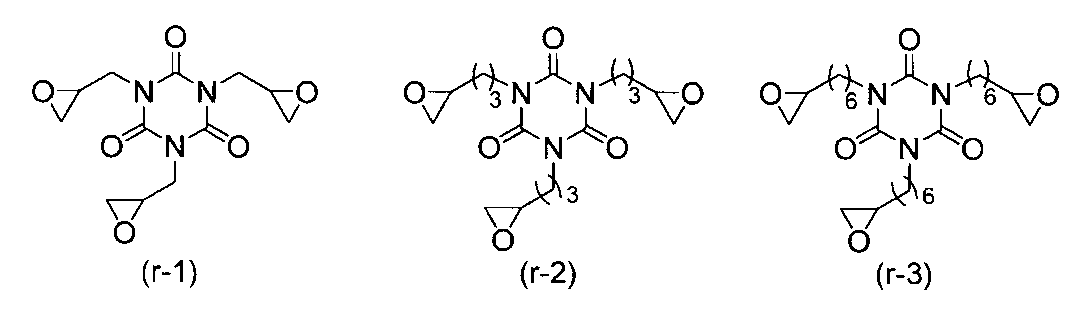
オキセタニル基を有する化合物の具体例としては、例えば、WO2011/132751号の段落[0170]~[0175]に記載の2個以上のオキセタニル基を有する化合物等が挙げられる。
保護イソシアネート基を有する化合物の具体例としては、例えば、日本特開2014-224978号公報の段落[0046]~[0047]に記載の2個以上の保護イソシアネート基を有する化合物、WO2015/141598号の段落[0119]~[0120]に記載の3個以上の保護イソシアネート基を有する化合物等が挙げられる。これらのうち、下記式(bi-1)~(bi-3)のいずれかで表される化合物が好ましい。

保護イソチオシアネート基を有する化合物の具体例としては、例えば、日本特開2016-200798号公報に記載の、2個以上の保護イソチオシアネート基を有する化合物が挙げられる。
オキサゾリン環構造を含む基を有する化合物の具体例としては、例えば、日本特開2007-286597号公報の段落[0115]に記載の、2個以上のオキサゾリン構造を含む化合物が挙げられる。
オキサゾリン環構造を含む基を有する化合物の具体例としては、例えば、日本特開2007-286597号公報の段落[0115]に記載の、2個以上のオキサゾリン構造を含む化合物が挙げられる。
メルドラム酸構造を含む基を有する化合物の具体例としては、例えば、WO2012/091088号に記載の、メルドラム酸構造を2個以上有する化合物が挙げられる。
シクロカーボネート基を有する化合物の具体例としては、例えば、WO2011/155577号に記載の化合物が挙げられる。
シクロカーボネート基を有する化合物の具体例としては、例えば、WO2011/155577号に記載の化合物が挙げられる。
前記式(d)で表される基のR1、R2、R3の炭素数1~3のアルキル基としては、上記式(l)、(n)で例示した基が挙げられる。
前記式(d)で表される基を有する化合物の具体例としては、例えば、WO2015/072554号や、日本特開2016-118753号公報の段落[0058]に記載の、前記式(d)で表される基を2個以上有する化合物、日本特開2016-200798号公報に記載の化合物等が挙げられる。これらのうち、下記式(hd-1)~(hd-8)で表される化合物が好ましい。

前記式(d)で表される基を有する化合物の具体例としては、例えば、WO2015/072554号や、日本特開2016-118753号公報の段落[0058]に記載の、前記式(d)で表される基を2個以上有する化合物、日本特開2016-200798号公報に記載の化合物等が挙げられる。これらのうち、下記式(hd-1)~(hd-8)で表される化合物が好ましい。
前記式(e)のAにおける芳香環を有する(m+n)価の有機基としては、炭素数5~30の(m+n)価の芳香族炭化水素基、炭素数5~30の芳香族炭化水素基が直接又は連結基を介して結合した(m+n)価の有機基、又は芳香族複素環を有する(m+n)価の基が挙げられる。前記芳香族炭化水素基としては、例えばベンゼン、ナフタレンなどが挙げられる。芳香族複素環としては、例えばピロール環、イミダゾール環、ピラゾール環、ピリジン環、ピリミジン環、キノリン環、イソキノリン環、カルバゾール環、ピリダジン環、ピラジン環、ベンズイミダゾール環、ベンゾイミダゾール環、インドール環、キノキサリン環、アクリジン環などが挙げられる。前記連結基としては、炭素数1~10のアルキレン基、又は前記アルキレン基から水素原子を一つ除いた基、2価又は3価のシクロヘキサン環等が挙げられる。尚、前記アルキレン基の任意の水素原子は、フッ素原子又はトリフルオロメチル基などの有機基で置換されてもよい。具体例を挙げるならば、WO2010/074269号に記載の化合物等が挙げられる。好ましい具体例としては、下記式(e-1)~(e-11)が挙げられる。
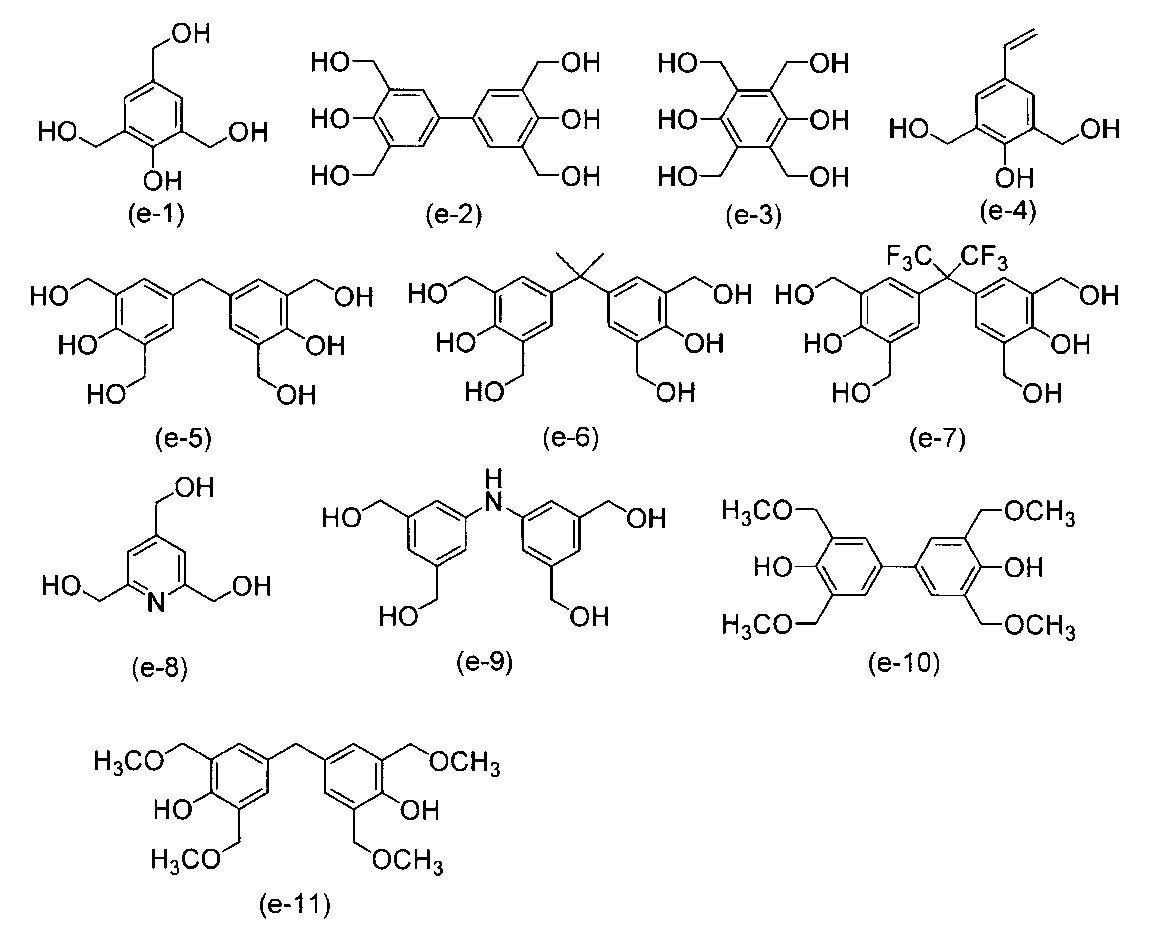
上記化合物は架橋性化合物の一例であり、これらに限定されるものではない。例えば、WO2015/060357号の[0105]~[0116]に開示されている上記以外の成分などが挙げられる。また、本発明の液晶配向剤に含有される架橋性化合物は、2種類以上組み合わせてもよい。
本発明の液晶配向剤における、架橋性化合物の含有量は、液晶配向剤に含まれる重合体成分100重量部に対して、0.5~20重量部であることが好ましく、架橋反応が進行し目的の効果を発現し、かつAC残像特性が少ない観点から、より好ましくは1~15重量部である。
本発明の液晶配向剤における、架橋性化合物の含有量は、液晶配向剤に含まれる重合体成分100重量部に対して、0.5~20重量部であることが好ましく、架橋反応が進行し目的の効果を発現し、かつAC残像特性が少ない観点から、より好ましくは1~15重量部である。
前記密着助剤としては、例えば3-アミノプロピルトリメトキシシラン、3-アミノプロピルトリエトキシシラン、3-アミノプロピルジエトキシメチルシラン、2-アミノプロピルトリメトキシシラン、2-アミノプロピルトリエトキシシラン、N-(2-アミノエチル)-3-アミノプロピルトリメトキシシラン、N-(2-アミノエチル)-3-アミノプロピルメチルジメトキシシラン、3-ウレイドプロピルトリメトキシシラン、3-ウレイドプロピルトリエトキシシラン、N-エトキシカルボニル-3-アミノプロピルトリメトキシシラン、N-エトキシカルボニル-3-アミノプロピルトリエトキシシラン、N-トリエトキシシリルプロピルトリエチレントリアミン、N-トリメトキシシリルプロピルトリエチレントリアミン、10-トリメトキシシリル-1,4,7-トリアザデカン、10-トリエトキシシリル-1,4,7-トリアザデカン、9-トリメトキシシリル-3,6-ジアザノニルアセテート、9-トリエトキシシリル-3,6-ジアザノニルアセテート、N-ベンジル-3-アミノプロピルトリメトキシシラン、N-ベンジル-3-アミノプロピルトリエトキシシラン、N-フェニル-3-アミノプロピルトリメトキシシラン、N-フェニル-3-アミノプロピルトリエトキシシラン、N-ビス(オキシエチレン)-3-アミノプロピルトリメトキシシラン、N-ビス(オキシエチレン)-3-アミノプロピルトリエトキシシラン、ビニルトリメトキシシラン、ビニルトリエトキシシラン、2-(3,4-エポキシシクロヘキシル)エチルトリメトキシシラン、3-グリシドキシプロピルメチルジメトキシシラン、3-グリシドキシプロピルトリメトキシシラン、3-グリシドキシプロピルメチルジエトキシシラン、3-グリシドキシプロピルトリエトキシシラン、p-スチリルトリメトキシシラン、3-メタクリロキシプロピルメチルジメトキシシラン、3-メタクリロキシプロピルトリメトキシシラン、3-メタクリロキシプロピルメチルジエトキシシラン、3-メタクリロキシプロピルトリエトキシシラン、3-アクリロキシプロピルトリメトキシシラン、トリス-(トリメトキシシリルプロピル)イソシアヌレート、3-メルカプトプロピルメチルジメトキシシラン、3-メルカプトプロピルトリメトキシシラン、3-イソシアネートプロピルトリエトキシシラン等のシランカップリング剤が挙げられる。これらシランカップリング剤を使用する場合は、AC残像が少ない観点から、液晶配向剤に含まれる重合体成分100重量部に対して0.1~30重量部であることが好ましく、より好ましくは0.1~20重量部である。
<液晶配向膜・液晶表示素子>
液晶配向膜は、上記の液晶配向剤を基板に塗布し、乾燥、焼成して得られる膜である。液晶配向剤を塗布する基板としては透明性の高い基板であれば特に限定されず、ガラス基板、窒化珪素基板、アクリル基板やポリカーボネート基板などのプラスチック基板等を用いることもできる。その際、液晶を駆動させるためのITO電極などが形成された基板を用いると、プロセスの簡素化の点から好ましい。また、反射型の液晶表示素子では、片側の基板のみにならばシリコンウエハーなどの不透明な物でも使用でき、この場合の電極にはアルミニウムなどの光を反射する材料も使用できる。
液晶配向膜は、上記の液晶配向剤を基板に塗布し、乾燥、焼成して得られる膜である。液晶配向剤を塗布する基板としては透明性の高い基板であれば特に限定されず、ガラス基板、窒化珪素基板、アクリル基板やポリカーボネート基板などのプラスチック基板等を用いることもできる。その際、液晶を駆動させるためのITO電極などが形成された基板を用いると、プロセスの簡素化の点から好ましい。また、反射型の液晶表示素子では、片側の基板のみにならばシリコンウエハーなどの不透明な物でも使用でき、この場合の電極にはアルミニウムなどの光を反射する材料も使用できる。
液晶配向剤の基板における塗布方法は、特に限定されないが、工業的には、スクリーン印刷、オフセット印刷、フレキソ印刷又はインクジェット法などで行う方法が一般的である。その他の塗布方法としては、ディップ法、ロールコータ法、スリットコータ法、スピンナー法又はスプレー法などがあり、目的に応じてこれらを用いてもよい。
液晶配向剤を基板上に塗布した後は、ホットプレート、熱循環型オーブン又はIR(赤外線)型オーブンなどの加熱手段により、溶媒を蒸発させて液晶配向膜とすることができる。液晶配向剤を塗布した後の乾燥、焼成工程は、任意の温度と時間を選択することができる。通常は、含有される溶媒を十分に除去するために50~120℃で1~10分焼成し、その後、150~300℃で5~120分焼成する条件が挙げられる。焼成後の液晶配向膜の厚みは、薄すぎると液晶表示素子の信頼性が低下する場合があるので、5~300nmが好ましく、10~200nmがより好ましい。
本発明の液晶配向剤から得られる液晶配向膜を配向処理する方法は、ラビング処理法でもよいが、光配向処理法を用いてもよい。
ラビング処理又は光配向処理による配向処理では、液晶配向性を改善するために、場合により、好ましくは、150~250℃の温度で加熱処理を行った後に配向処理してもよく、また、液晶配向膜が塗膜された基板を50~250℃で加熱しながら、配向処理をしてもよい。
ラビング処理又は光配向処理による配向処理では、液晶配向性を改善するために、場合により、好ましくは、150~250℃の温度で加熱処理を行った後に配向処理してもよく、また、液晶配向膜が塗膜された基板を50~250℃で加熱しながら、配向処理をしてもよい。
更に、前記の方法で、配向処理した液晶配向膜に、水や溶媒を用いて、接触処理を行い液晶配向膜に付着した不純物を除去することもできる。
上記接触処理に使用する溶媒としては、特に限定されるものではないが、具体例としては、水、メタノール、エタノール、2-プロパノール、アセトン、メチルエチルケトン、1-メトキシ-2-プロパノール、1-メトキシ-2-プロパノールアセテート、ブチルセロソルブ、乳酸エチル、乳酸メチル、ジアセトンアルコール、3-メトキシプロピオン酸メチル、3-エトキシプロピオン酸エチル、酢酸プロピル、酢酸ブチル又は酢酸シクロヘキシルなどが挙げられる。
上記接触処理に使用する溶媒としては、特に限定されるものではないが、具体例としては、水、メタノール、エタノール、2-プロパノール、アセトン、メチルエチルケトン、1-メトキシ-2-プロパノール、1-メトキシ-2-プロパノールアセテート、ブチルセロソルブ、乳酸エチル、乳酸メチル、ジアセトンアルコール、3-メトキシプロピオン酸メチル、3-エトキシプロピオン酸エチル、酢酸プロピル、酢酸ブチル又は酢酸シクロヘキシルなどが挙げられる。
本発明の液晶配向膜は、IPS方式やFFS方式などの横電界方式の液晶表示素子の液晶配向膜として好適であり、特に、FFS方式の液晶表示素子の液晶配向膜として有用である。液晶表示素子は、本発明の液晶配向剤から得られる液晶配向膜付きの基板を得た後、既知の方法で液晶セルを作製し、該液晶セルを使用して得られる。
液晶セルの作製方法の一例として、パッシブマトリクス構造の液晶表示素子を例にとり説明する。なお、画像表示を構成する各画素部分にTFT(Thin Film Transistor)などのスイッチング素子が設けられたアクティブマトリクス構造の液晶表示素子であってもよい。
具体的には、透明なガラス製の基板を準備し、一方の基板の上にコモン電極を、他方の基板の上にセグメント電極を設ける。これらの電極は、例えばITO電極とすることができ、所望の画像表示ができるようパターニングされている。次いで、各基板の上に、コモン電極とセグメント電極を被覆するようにして絶縁膜を設ける。絶縁膜は、例えば、ゾル-ゲル法によって形成されたSiO2-TiO2の膜とすることができる。
具体的には、透明なガラス製の基板を準備し、一方の基板の上にコモン電極を、他方の基板の上にセグメント電極を設ける。これらの電極は、例えばITO電極とすることができ、所望の画像表示ができるようパターニングされている。次いで、各基板の上に、コモン電極とセグメント電極を被覆するようにして絶縁膜を設ける。絶縁膜は、例えば、ゾル-ゲル法によって形成されたSiO2-TiO2の膜とすることができる。
次に、各基板の上に液晶配向膜を形成し、一方の基板に他方の基板を互いの液晶配向膜面が対向するようにして重ね合わせ、周辺をシール剤で接着する。シール剤には、基板間隙を制御するために、通常、スペーサーを混入しておき、また、シール剤を設けない面内部分にも、基板間隙制御用のスペーサーを散布しておくことが好ましい。シール剤の一部には、外部から液晶を充填可能な開口部を設けておく。次いで、シール剤に設けた開口部を通じて、2枚の基板とシール剤で包囲された空間内に液晶材料を注入し、その後、この開口部を接着剤で封止する。注入には、真空注入法を用いてもよいし、大気中で毛細管現象を利用した方法を用いてもよい。液晶材料は、ポジ型液晶材料やネガ型液晶材料のいずれを用いてもよいが、好ましいのは、ネガ型液晶材料である。次に、偏光板の設置を行う。具体的には、2枚の基板の液晶層とは反対側の面に一対の偏光板を貼り付ける。
上記のようにして、本発明の液晶配向剤を用いることで、残留DC由来の残像やAC残像の発生が少なく、リワークが容易で且つ透過率の高い液晶配向膜を得ることができる。
上記のようにして、本発明の液晶配向剤を用いることで、残留DC由来の残像やAC残像の発生が少なく、リワークが容易で且つ透過率の高い液晶配向膜を得ることができる。
以下に実施例を挙げ、本発明を更に具体的に説明するが、本発明はこれらに限定されるものではない。以下における化合物の略号及び各特性の測定方法は、次のとおりである。
(ジアミン)
l-1、n-1、DA-1~DA-7:それぞれ、下記式(l-1)、(n-1)、(DA-1)~(DA-7)で表される化合物
(テトラカルボン酸二無水物)
CA-1~CA-5:それぞれ、下記式(CA-1)~(CA-5)で表される化合物
(化合物C)
C-1:下記式(C-1)で表される化合物
(化合物D)
D-1:下記式(D-1)で表される化合物
(化合物E)
E-1:下記式(E-1)で表される化合物
(有機溶媒)
NMP:N-メチル-2-ピロリドン、 GBL:γ―ブチロラクトン、
BCS:ブチルセロソルブ、BCA:ブチルセロソルブアセテート
(ジアミン)
l-1、n-1、DA-1~DA-7:それぞれ、下記式(l-1)、(n-1)、(DA-1)~(DA-7)で表される化合物
(テトラカルボン酸二無水物)
CA-1~CA-5:それぞれ、下記式(CA-1)~(CA-5)で表される化合物
(化合物C)
C-1:下記式(C-1)で表される化合物
(化合物D)
D-1:下記式(D-1)で表される化合物
(化合物E)
E-1:下記式(E-1)で表される化合物
(有機溶媒)
NMP:N-メチル-2-ピロリドン、 GBL:γ―ブチロラクトン、
BCS:ブチルセロソルブ、BCA:ブチルセロソルブアセテート
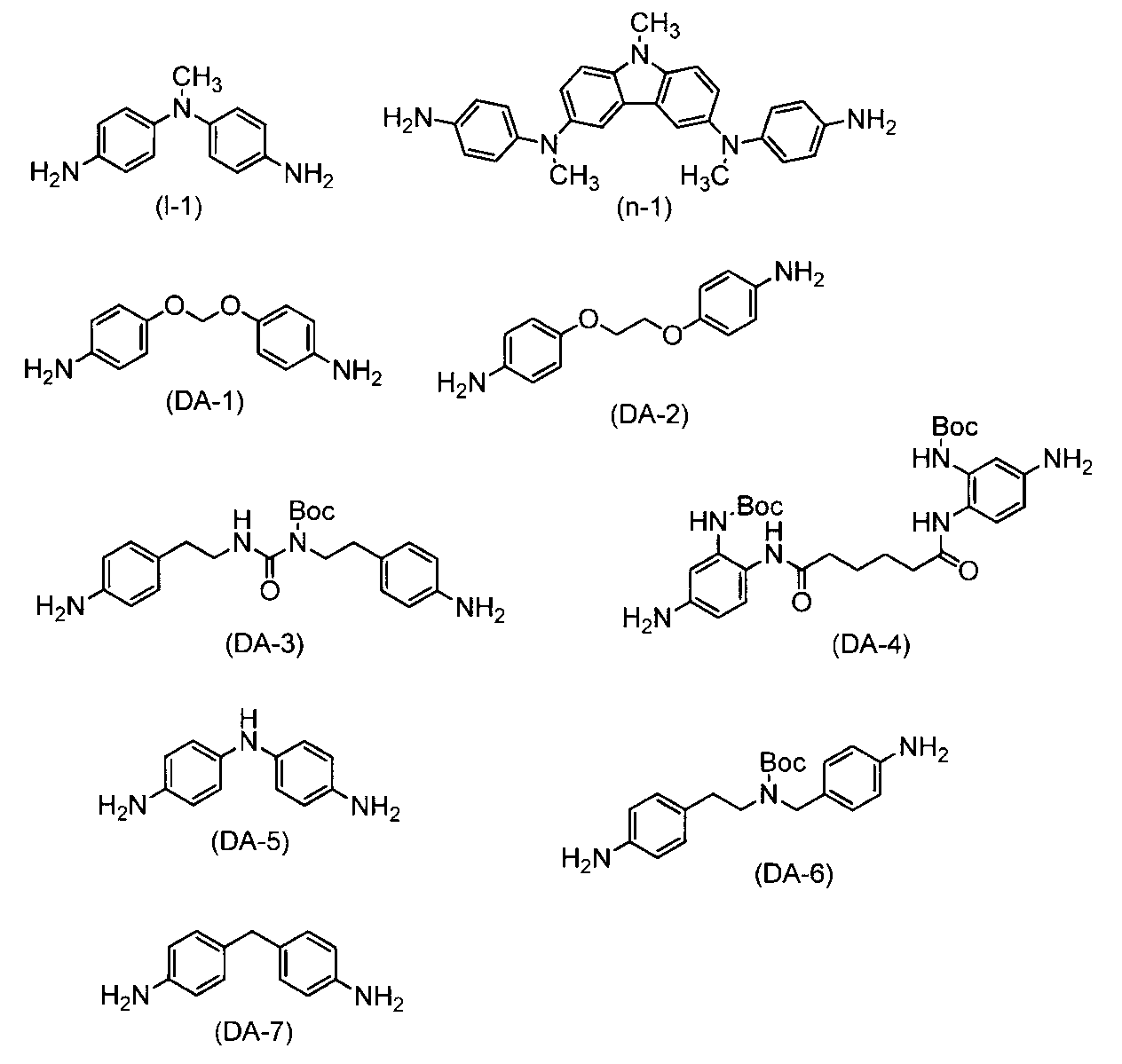
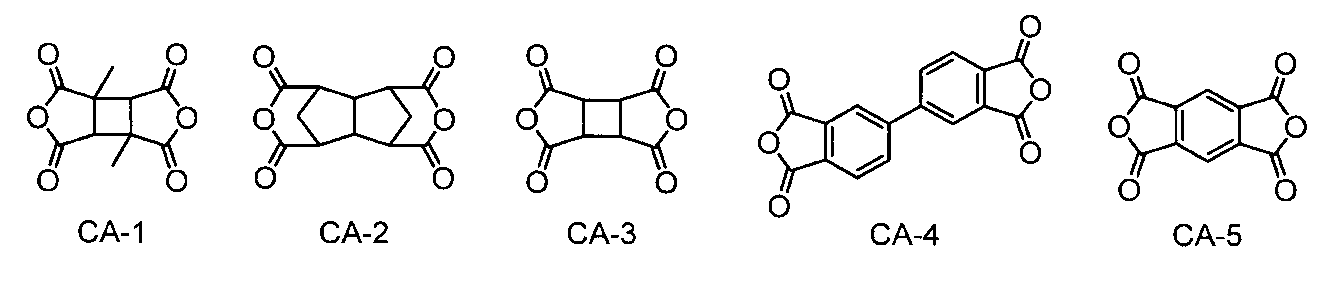

[粘度]
E型粘度計TVE-22H(東機産業社製)を用い、サンプル量1.1mL、コーンロータTE-1(1°34’、R24)、温度25℃で測定した。
E型粘度計TVE-22H(東機産業社製)を用い、サンプル量1.1mL、コーンロータTE-1(1°34’、R24)、温度25℃で測定した。
<イミド化率の測定>
ポリイミド粉末20mgをNMRサンプル管(NMRサンプリングチューブスタンダード,φ5(草野科学社製))に入れ、重水素化ジメチルスルホキシド(DMSO-d6,0.05%TMS(テトラメチルシラン)混合品)(0.53ml)を添加し、超音波をかけて完全に溶解させた。この溶液をNMR測定機(JNW-ECA500)(日本電子データム社製)にて500MHzのプロトンNMRを測定した。イミド化率は、イミド化前後で変化しない構造に由来するプロトンを基準プロトンとして決め、このプロトンのピーク積算値と、9.5ppm~10.0ppm付近に現れるアミド酸のNH基に由来するプロトンピーク積算値とを用い以下の式によって求めた。
イミド化率(%)=(1-α・x/y)×100
上記式において、xはアミド酸のNH基由来のプロトンピーク積算値、yは基準プロトンのピーク積算値、αはポリアミド酸(イミド化率が0%)の場合におけるアミド酸のNH基プロトン1個に対する基準プロトンの個数割合である。
ポリイミド粉末20mgをNMRサンプル管(NMRサンプリングチューブスタンダード,φ5(草野科学社製))に入れ、重水素化ジメチルスルホキシド(DMSO-d6,0.05%TMS(テトラメチルシラン)混合品)(0.53ml)を添加し、超音波をかけて完全に溶解させた。この溶液をNMR測定機(JNW-ECA500)(日本電子データム社製)にて500MHzのプロトンNMRを測定した。イミド化率は、イミド化前後で変化しない構造に由来するプロトンを基準プロトンとして決め、このプロトンのピーク積算値と、9.5ppm~10.0ppm付近に現れるアミド酸のNH基に由来するプロトンピーク積算値とを用い以下の式によって求めた。
イミド化率(%)=(1-α・x/y)×100
上記式において、xはアミド酸のNH基由来のプロトンピーク積算値、yは基準プロトンのピーク積算値、αはポリアミド酸(イミド化率が0%)の場合におけるアミド酸のNH基プロトン1個に対する基準プロトンの個数割合である。
[重合体の合成]
<合成例1>
撹拌装置及び窒素導入管付きの1Lの四つ口フラスコに、DA-2を46.35g(189.8mmol)、DA-4を28.81g(51.75mmol)、DA-3を41.25g(103.5mmol)量り取り、NMPを固形分濃度が15%となるように加え、窒素を送りながら撹拌して溶解させた。このジアミン溶液を水冷下で撹拌しながら、CA-1を50.27g(224.3mmol)添加し、さらにNMPを固形分濃度が18%となるように加え、窒素雰囲気下40℃で1時間撹拌した。その後水冷下で撹拌しながら、CA-3を14.21g(72.5mmol)添加し、さらにNMPを固形分濃度が18%となるように加え、窒素雰囲気下23℃で2時間撹拌し、ポリアミック酸溶液を得た。
撹拌子の入った3L三角フラスコに、上記で得られたポリアミック酸溶液を1000.0g分取し、NMPを500.0g、無水酢酸を105.99g、ピリジンを27.37g加え、室温で30分間撹拌した後、50℃で2時間反応させた。この反応溶液を6500gのメタノール中に投入し、得られた沈殿物を濾別した。この沈殿物をメタノールで洗浄した後、温度80℃で減圧乾燥し、ポリイミドの粉末を得た。このポリイミドの粉末のイミド化率は、75%であった。
撹拌子の入った1000mL三角フラスコに、このポリイミドの粉末を100.00g分取し、NMPを400.0g加えて、70℃にて24時間攪拌して溶解させ、固形分濃度が20%のポリイミド(PI-A-1)の溶液を得た。
<合成例1>
撹拌装置及び窒素導入管付きの1Lの四つ口フラスコに、DA-2を46.35g(189.8mmol)、DA-4を28.81g(51.75mmol)、DA-3を41.25g(103.5mmol)量り取り、NMPを固形分濃度が15%となるように加え、窒素を送りながら撹拌して溶解させた。このジアミン溶液を水冷下で撹拌しながら、CA-1を50.27g(224.3mmol)添加し、さらにNMPを固形分濃度が18%となるように加え、窒素雰囲気下40℃で1時間撹拌した。その後水冷下で撹拌しながら、CA-3を14.21g(72.5mmol)添加し、さらにNMPを固形分濃度が18%となるように加え、窒素雰囲気下23℃で2時間撹拌し、ポリアミック酸溶液を得た。
撹拌子の入った3L三角フラスコに、上記で得られたポリアミック酸溶液を1000.0g分取し、NMPを500.0g、無水酢酸を105.99g、ピリジンを27.37g加え、室温で30分間撹拌した後、50℃で2時間反応させた。この反応溶液を6500gのメタノール中に投入し、得られた沈殿物を濾別した。この沈殿物をメタノールで洗浄した後、温度80℃で減圧乾燥し、ポリイミドの粉末を得た。このポリイミドの粉末のイミド化率は、75%であった。
撹拌子の入った1000mL三角フラスコに、このポリイミドの粉末を100.00g分取し、NMPを400.0g加えて、70℃にて24時間攪拌して溶解させ、固形分濃度が20%のポリイミド(PI-A-1)の溶液を得た。
<合成例2>
下記表1に示す、ジアミン、テトラカルボン酸誘導体及び有機溶媒を使用し、それぞれ、合成例1と同様の手順で実施することにより、下記表1に示す組成のポリアミック酸を得た。そのようにして得られたポリアミック酸溶液1000.0gを分取し、化合物E-1を45.32g(207.63mmol)加えてさらに12時間撹拌した後、合成例1と同様に、NMPと無水酢酸とピリジンを用いて、ポリイミド(PI-A-2)の溶液を得た。表1中、括弧内の数値は、テトラカルボン酸成分については、合成に使用したジアミンの合計量100モル部に対する各化合物の配合割合(モル部)を表し、ジアミン成分については、合成に使用したジアミンの合計量100モル部に対する各化合物の配合割合(モル部)を表す。有機溶媒については、合成に使用した有機溶媒の合計量100重量部に対する各有機溶媒の配合割合(重量部)を表す。
下記表1に示す、ジアミン、テトラカルボン酸誘導体及び有機溶媒を使用し、それぞれ、合成例1と同様の手順で実施することにより、下記表1に示す組成のポリアミック酸を得た。そのようにして得られたポリアミック酸溶液1000.0gを分取し、化合物E-1を45.32g(207.63mmol)加えてさらに12時間撹拌した後、合成例1と同様に、NMPと無水酢酸とピリジンを用いて、ポリイミド(PI-A-2)の溶液を得た。表1中、括弧内の数値は、テトラカルボン酸成分については、合成に使用したジアミンの合計量100モル部に対する各化合物の配合割合(モル部)を表し、ジアミン成分については、合成に使用したジアミンの合計量100モル部に対する各化合物の配合割合(モル部)を表す。有機溶媒については、合成に使用した有機溶媒の合計量100重量部に対する各有機溶媒の配合割合(重量部)を表す。
<合成例3>
撹拌装置及び窒素導入管付きの1Lの四つ口フラスコに、DA-2を24.12g(98.8mmol)、DA-1を22.74g(98.8mmol)、l-1を42.12g(197.5mmol)を測りとり、固形分濃度が12%となるように、NMPを464.9g、GBLを185.7g加え、窒素を送りながら撹拌して溶解させた。このジアミン溶液を水冷下で撹拌しながら、脂肪族酸二無水物であるCA-3を50.0g(255.0mmol)をGBL237.7gとともに添加し、固形分濃度が13.5%となるように加え、窒素雰囲気下水冷下で2時間撹拌した。さらに、芳香族酸二無水物であるCA-5を25.84g(118.5mmol)添加し、さらにGBLを固形分濃度が15%となるように加え、窒素雰囲気下50℃で15時間撹拌し、固形分15%でNMP/GBL=50/50となるポリアミック酸(PAA-B-1)の溶液を得た。
撹拌装置及び窒素導入管付きの1Lの四つ口フラスコに、DA-2を24.12g(98.8mmol)、DA-1を22.74g(98.8mmol)、l-1を42.12g(197.5mmol)を測りとり、固形分濃度が12%となるように、NMPを464.9g、GBLを185.7g加え、窒素を送りながら撹拌して溶解させた。このジアミン溶液を水冷下で撹拌しながら、脂肪族酸二無水物であるCA-3を50.0g(255.0mmol)をGBL237.7gとともに添加し、固形分濃度が13.5%となるように加え、窒素雰囲気下水冷下で2時間撹拌した。さらに、芳香族酸二無水物であるCA-5を25.84g(118.5mmol)添加し、さらにGBLを固形分濃度が15%となるように加え、窒素雰囲気下50℃で15時間撹拌し、固形分15%でNMP/GBL=50/50となるポリアミック酸(PAA-B-1)の溶液を得た。
<合成例4~10>
下記表1に示す、ジアミン、テトラカルボン酸誘導体及び有機溶媒を使用し、それぞれ、合成例3と同様の手順で実施することにより、下記表1に示すポリアミック酸(PAA-B-2)~(PAA-B-8)の溶液を得た。表1中、括弧内の数値は、テトラカルボン酸成分については、合成に使用したジアミンの合計量を100モル部としたときの各化合物の配向割合(モル部)を表し、ジアミン成分については、合成に使用したジアミンの合計量100モル部に対する各化合物の配合割合(モル部)を表す。有機溶媒については、合成に使用した有機溶媒の合計量100重量部に対する各有機溶媒の配合割合(重量部)を表す。
下記表1に示す、ジアミン、テトラカルボン酸誘導体及び有機溶媒を使用し、それぞれ、合成例3と同様の手順で実施することにより、下記表1に示すポリアミック酸(PAA-B-2)~(PAA-B-8)の溶液を得た。表1中、括弧内の数値は、テトラカルボン酸成分については、合成に使用したジアミンの合計量を100モル部としたときの各化合物の配向割合(モル部)を表し、ジアミン成分については、合成に使用したジアミンの合計量100モル部に対する各化合物の配合割合(モル部)を表す。有機溶媒については、合成に使用した有機溶媒の合計量100重量部に対する各有機溶媒の配合割合(重量部)を表す。

<実施例1>
[液晶配向剤の調製]
合成例1で得られたポリイミド(PI-A-1)の溶液及び合成例3で得られたポリアミック酸(PAA-B-1)の溶液を用いて、NMP、GBL及びBCSにより希釈し、更に化合物(C-1)を全ての重合体100重量部に対して3重量部となるように、化合物(D-1)を全ての重合体100重量部に対して1重量部添加し室温で攪拌した。次いで、この得られた溶液を孔径0.5μmのフィルターでろ過することにより、重合体の成分比率が(PI-A-1):(PAA-B-1)=20:80(固形分換算重量比)、溶媒組成比が固形分:NMP:GBL:BCS=4.5:30:45.5:20(重量比)、化合物(C-1)と化合物(D-1)の配合割合が、それぞれ固形分比3重量部と1重量部となる液晶配向剤(1)を得た(下記の表2)。この液晶配向剤に、濁りや析出などの異常は見られず、均一な溶液であることが確認された。
[液晶配向剤の調製]
合成例1で得られたポリイミド(PI-A-1)の溶液及び合成例3で得られたポリアミック酸(PAA-B-1)の溶液を用いて、NMP、GBL及びBCSにより希釈し、更に化合物(C-1)を全ての重合体100重量部に対して3重量部となるように、化合物(D-1)を全ての重合体100重量部に対して1重量部添加し室温で攪拌した。次いで、この得られた溶液を孔径0.5μmのフィルターでろ過することにより、重合体の成分比率が(PI-A-1):(PAA-B-1)=20:80(固形分換算重量比)、溶媒組成比が固形分:NMP:GBL:BCS=4.5:30:45.5:20(重量比)、化合物(C-1)と化合物(D-1)の配合割合が、それぞれ固形分比3重量部と1重量部となる液晶配向剤(1)を得た(下記の表2)。この液晶配向剤に、濁りや析出などの異常は見られず、均一な溶液であることが確認された。
<実施例2~11、比較例1~4>
下記表2の重合体及び化合物(C)、化合物(D)を使用した以外は、実施例1と同様に実施することにより、液晶配向剤(2)~(15)を得た。表2中、括弧内の数値は、重合体及び化合物(C)、化合物(D)についてはそれぞれ液晶配向剤の調製に使用した重合体成分の合計100重量部に対する各重合体成分又は化合物(C)、化合物(D)の配合割合(重量部)を表す。有機溶媒については、液晶配向剤の調製に使用した有機溶媒の合計量100重量部に対する各有機溶媒の配合割合(重量部)を表す。
下記表2の重合体及び化合物(C)、化合物(D)を使用した以外は、実施例1と同様に実施することにより、液晶配向剤(2)~(15)を得た。表2中、括弧内の数値は、重合体及び化合物(C)、化合物(D)についてはそれぞれ液晶配向剤の調製に使用した重合体成分の合計100重量部に対する各重合体成分又は化合物(C)、化合物(D)の配合割合(重量部)を表す。有機溶媒については、液晶配向剤の調製に使用した有機溶媒の合計量100重量部に対する各有機溶媒の配合割合(重量部)を表す。
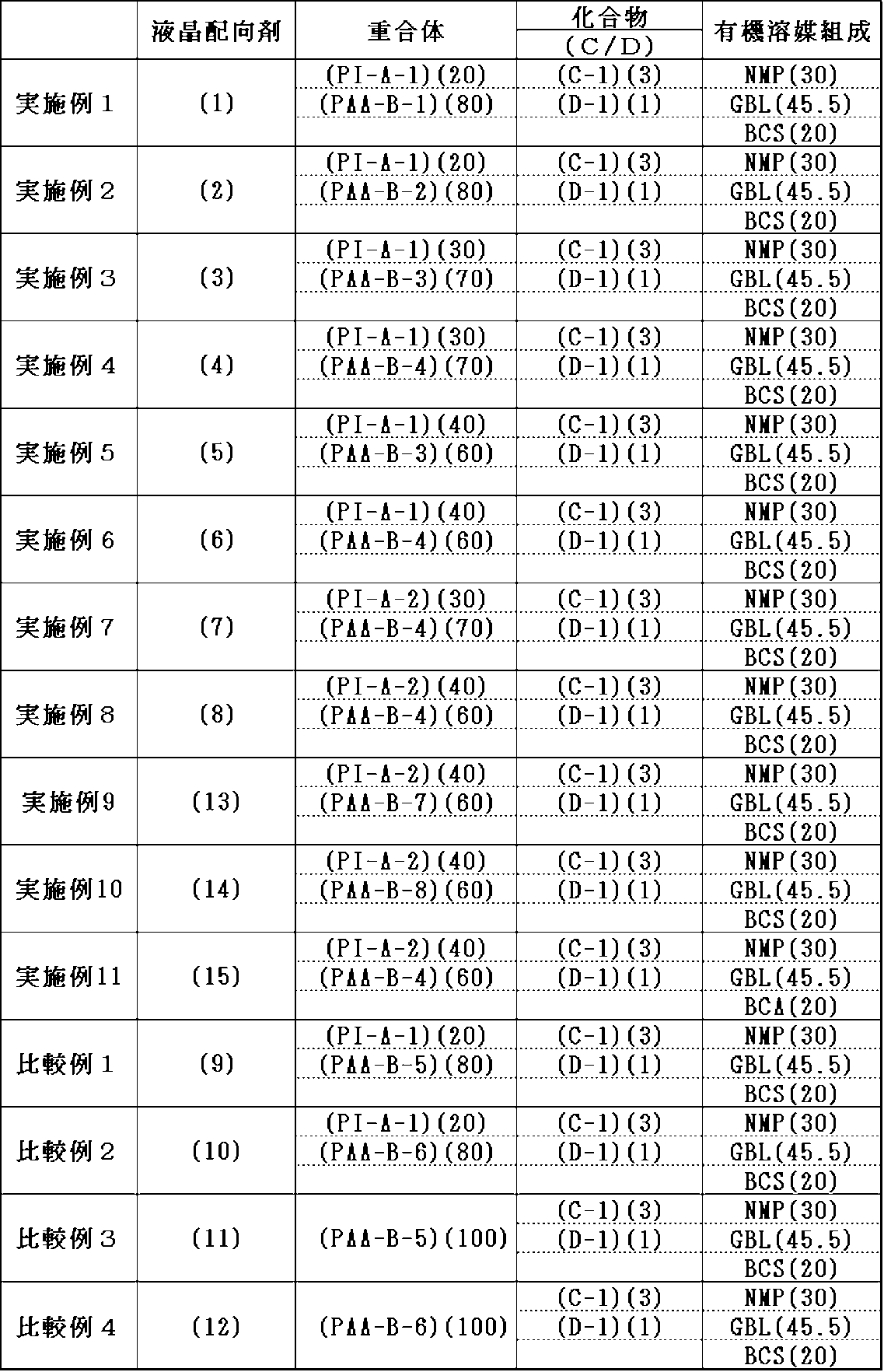
[液晶表示素子の作製]
フリンジフィールドスィッチング(Fringe Field Switching:FFS)モード液晶表示素子の構成を備えた液晶セルを作製する。
始めに、電極付きの基板を準備した。基板は、30mm×50mmの大きさで、厚さが0.7mmのガラス基板である。基板上には第1層目として対向電極を構成する、ベタ状のパターンを備えたITO電極が形成されている。第1層目の対向電極の上には第2層目として、CVD法により成膜されたSiN(窒化珪素)膜が形成されている。第2層目のSiN膜の膜厚は500nmであり、層間絶縁膜として機能する。第2層目のSiN膜の上には、第3層目としてITO膜をパターニングして形成された櫛歯状の画素電極が配置され、第1画素及び第2画素の2つの画素を形成している。各画素のサイズは、縦10mmで横約5mmである。このとき、第1層目の対向電極と第3層目の画素電極とは、第2層目のSiN膜の作用により電気的に絶縁されている。
フリンジフィールドスィッチング(Fringe Field Switching:FFS)モード液晶表示素子の構成を備えた液晶セルを作製する。
始めに、電極付きの基板を準備した。基板は、30mm×50mmの大きさで、厚さが0.7mmのガラス基板である。基板上には第1層目として対向電極を構成する、ベタ状のパターンを備えたITO電極が形成されている。第1層目の対向電極の上には第2層目として、CVD法により成膜されたSiN(窒化珪素)膜が形成されている。第2層目のSiN膜の膜厚は500nmであり、層間絶縁膜として機能する。第2層目のSiN膜の上には、第3層目としてITO膜をパターニングして形成された櫛歯状の画素電極が配置され、第1画素及び第2画素の2つの画素を形成している。各画素のサイズは、縦10mmで横約5mmである。このとき、第1層目の対向電極と第3層目の画素電極とは、第2層目のSiN膜の作用により電気的に絶縁されている。
第3層目の画素電極は、中央部分が屈曲したくの字形状の電極要素を複数配列して構成された櫛歯状の形状を有する。各電極要素の短手方向の幅は3μmであり、電極要素間の間隔は6μmである。各画素を形成する画素電極が、中央部分の屈曲したくの字形状の電極要素を複数配列して構成されているため、各画素の形状は長方形状ではなく、電極要素と同様に中央部分で屈曲する、太字の「くの字」に似た形状を備える。そして、各画素は、その中央の屈曲部分を境にして上下に分割され、屈曲部分の上側の第1領域と下側の第2領域を有する。
各画素の第1領域と第2領域とを比較すると、それらを構成する画素電極の電極要素の形成方向が異なるものとなっている。すなわち、後述する液晶配向膜のラビング方向を基準とした場合、画素の第1領域では画素電極の電極要素が+10°の角度(時計回り)をなすように形成され、画素の第2領域では画素電極の電極要素が-10°の角度(時計回り)をなすように形成されている。すなわち、各画素の第1領域と第2領域とでは、画素電極と対向電極との間の電圧印加によって誘起される液晶の、基板面内での回転動作(インプレーン・スイッチング)の方向が互いに逆方向となるように構成されている。
次に、液晶配向剤を孔径1.0μmのフィルターで濾過した後、準備された上記電極付き基板と裏面にITO膜が成膜されている高さ4μmの柱状スペーサーを有するガラス基板に、スピンコート塗布にて塗布した。80℃のホットプレート上で5分間乾燥させた後、230℃の熱風循環式オーブンで20分間焼成を行い、膜厚60nmのポリイミド膜を得た。このポリイミド膜をレーヨン布でラビング(ローラー直径:120mm、ローラー回転数:500rpm、移動速度:30mm/sec、押し込み長:0.3mm、ラビング方向:3層目IZO櫛歯電極に対して10°傾いた方向)した後、純水中にて1分間超音波照射をして洗浄を行い、エアブローにて水滴を除去した。その後、80℃で15分間乾燥して、液晶配向膜付き基板を得た。これら2枚の液晶配向膜付き基板を1組とし、基板上に液晶注入口を残した形でシール剤を印刷し、もう1枚の基板を、液晶配向膜面が向き合い、ラビング方向が逆平行になるようにして張り合わせた。その後、シール剤を硬化させて、セルギャップが4μmの空セルを作製した。この空セルに減圧注入法によって、液晶MLC-3019(メルク社製)を注入し、注入口を封止して、FFS方式の液晶セルを得た。その後、得られた液晶セルを120℃で1時間加熱し、23℃で一晩放置してから液晶配向性の評価に使用した。
[評価]
1.長期交流駆動による残像評価
上記した残像評価に使用した液晶セルと同様の構造の液晶セルを準備した。
この液晶セルを高輝度バックライトの上に置いた状態で、周波数60Hzで±5Vの交流電圧を168時間印加した。その後、液晶セルの画素電極と対向電極との間をショートさせた状態にし、そのまま室温に一日放置した。
放置の後、液晶セルを偏光軸が直交するように配置された2枚の偏光板の間に設置し、電圧無印加の状態でバックライトを点灯させておき、透過光の輝度が最も小さくなるように液晶セルの配置角度を調整した。そして、第1画素の第2領域が最も暗くなる角度から第1領域が最も暗くなる角度まで液晶セルを回転させたときの回転角度を角度Δとして算出した。第2画素でも同様に、第2領域と第1領域とを比較し同様の角度Δを算出した。
この角度Δが0.15°未満の時、良好な液晶配向性であるとした。評価結果を、表3に示す。
1.長期交流駆動による残像評価
上記した残像評価に使用した液晶セルと同様の構造の液晶セルを準備した。
この液晶セルを高輝度バックライトの上に置いた状態で、周波数60Hzで±5Vの交流電圧を168時間印加した。その後、液晶セルの画素電極と対向電極との間をショートさせた状態にし、そのまま室温に一日放置した。
放置の後、液晶セルを偏光軸が直交するように配置された2枚の偏光板の間に設置し、電圧無印加の状態でバックライトを点灯させておき、透過光の輝度が最も小さくなるように液晶セルの配置角度を調整した。そして、第1画素の第2領域が最も暗くなる角度から第1領域が最も暗くなる角度まで液晶セルを回転させたときの回転角度を角度Δとして算出した。第2画素でも同様に、第2領域と第1領域とを比較し同様の角度Δを算出した。
この角度Δが0.15°未満の時、良好な液晶配向性であるとした。評価結果を、表3に示す。
2.蓄積電荷の緩和速度測定
上記(液晶セルの作製)と同様にして作製した液晶セルを、偏光軸が直交するように配置された2枚の偏光板の間に設置し、画素電極と対向電極とを短絡して同電位にした状態で、2枚の偏光板の下からLEDバックライトを照射しておき、2枚の偏光板の上で測定するLEDバックライト透過光の輝度が最小となるように、液晶セルの角度を調節した。次に、この液晶セルに周波数60Hzの交流電圧を印加しながらV-Tカーブ(電圧-透過率曲線)を測定し、相対透過率が23%となる交流電圧を駆動電圧として算出した。
残像評価では、相対透過率が23%となる周波数60Hzの交流電圧を印加して液晶セルを駆動させながら、同時に1Vの直流電圧を印加し、120分間駆動させた。その後、直流電圧の印加のみを停止し、交流電圧のみでさらに15分駆動した。
直流電圧の印加を停止した時点から10分間が経過するまでに、相対透過率が25%以下に緩和した場合に、「良好」とし、相対透過率が26%以下に低下するまでに10分間以上を要した場合には、「不良」と定義して評価した。
そして、上述した方法に従う残像評価は、液晶セルの温度が40℃の状態の温度条件下で行った。
上記(液晶セルの作製)と同様にして作製した液晶セルを、偏光軸が直交するように配置された2枚の偏光板の間に設置し、画素電極と対向電極とを短絡して同電位にした状態で、2枚の偏光板の下からLEDバックライトを照射しておき、2枚の偏光板の上で測定するLEDバックライト透過光の輝度が最小となるように、液晶セルの角度を調節した。次に、この液晶セルに周波数60Hzの交流電圧を印加しながらV-Tカーブ(電圧-透過率曲線)を測定し、相対透過率が23%となる交流電圧を駆動電圧として算出した。
残像評価では、相対透過率が23%となる周波数60Hzの交流電圧を印加して液晶セルを駆動させながら、同時に1Vの直流電圧を印加し、120分間駆動させた。その後、直流電圧の印加のみを停止し、交流電圧のみでさらに15分駆動した。
直流電圧の印加を停止した時点から10分間が経過するまでに、相対透過率が25%以下に緩和した場合に、「良好」とし、相対透過率が26%以下に低下するまでに10分間以上を要した場合には、「不良」と定義して評価した。
そして、上述した方法に従う残像評価は、液晶セルの温度が40℃の状態の温度条件下で行った。
3.黒レベル評価
上記(液晶セルの作製)と同様にして作製した液晶セルを偏光軸が直交するように配置された2枚の偏光板の間に設置し、電圧無印加の状態でバックライトを点灯させておき、透過光の輝度が最も小さくなるように液晶セルの配置角度を調整した。その液晶セルを浜松ホトニクス社製のデジタルCCDカメラ「C8800-21C」を用いて観察を行い、撮り込んだ画像を同社の解析ソフト「ExDcam Image capture Software」を用いて輝度の数値化を行った。この液晶セルの輝度値が580以下であれば「良好」、それ以上は「不良」とした。
上記(液晶セルの作製)と同様にして作製した液晶セルを偏光軸が直交するように配置された2枚の偏光板の間に設置し、電圧無印加の状態でバックライトを点灯させておき、透過光の輝度が最も小さくなるように液晶セルの配置角度を調整した。その液晶セルを浜松ホトニクス社製のデジタルCCDカメラ「C8800-21C」を用いて観察を行い、撮り込んだ画像を同社の解析ソフト「ExDcam Image capture Software」を用いて輝度の数値化を行った。この液晶セルの輝度値が580以下であれば「良好」、それ以上は「不良」とした。
4.リワーク性の評価
本発明の液晶配向剤をITO基板にスピンコート塗布にて塗布した。60℃のホットプレート上で1分30秒間乾燥させた後、230℃の熱風循環式オーブンで20分間焼成を行い、膜厚100nmの塗膜を形成させた。その後、35℃に加熱したリワーク材(KR-31)に作製した基板を600秒間浸漬させて現像した後、超純水で30秒間流水洗浄を行った。その後、エアーブローで乾燥させ、残膜量を観察した。この時、残膜なしの場合に「良好」とし、残膜ありの場合に「不良」とした。
本発明の液晶配向剤をITO基板にスピンコート塗布にて塗布した。60℃のホットプレート上で1分30秒間乾燥させた後、230℃の熱風循環式オーブンで20分間焼成を行い、膜厚100nmの塗膜を形成させた。その後、35℃に加熱したリワーク材(KR-31)に作製した基板を600秒間浸漬させて現像した後、超純水で30秒間流水洗浄を行った。その後、エアーブローで乾燥させ、残膜量を観察した。この時、残膜なしの場合に「良好」とし、残膜ありの場合に「不良」とした。
上記1~4の実験における結果を表3に記載する。

本発明の液晶配向剤は、IPS駆動方式やFFS駆動方式などの広範な液晶表示素子における液晶配向膜の形成に有用である。
なお、2019年2月13日に出願された日本特許出願2019-023807号及び2019年4月23日に出願された日本特許出願2019-082233号の明細書、特許請求の範囲、図面、及び要約書の全内容をここに引用し、本発明の明細書の開示として、取り入れるものである。
なお、2019年2月13日に出願された日本特許出願2019-023807号及び2019年4月23日に出願された日本特許出願2019-082233号の明細書、特許請求の範囲、図面、及び要約書の全内容をここに引用し、本発明の明細書の開示として、取り入れるものである。
Claims (13)
- 下記の(A)成分と(B)成分を含有することを特徴とする液晶配向剤。
(A)成分:下記式(1)で表される繰り返し単位を有する重合体(A)。
(B)成分:下記式(2)で表される繰り返し単位、下記式(3)で表される繰り返し単位、下記式(4)で表される繰り返し、及び下記式(5)で表される繰り返し単位を有し、下記式(2)で表される繰り返し単位及び下記式(3)で表される繰り返し単位の合計含有量が、全繰り返し単位の60~99.9モル%であり、かつ、下記式(4)で表される繰り返し単位及び下記式(5)で表される繰り返し単位の合計含有量が、全繰り返し単位の0.1~40モル%である重合体(B)。

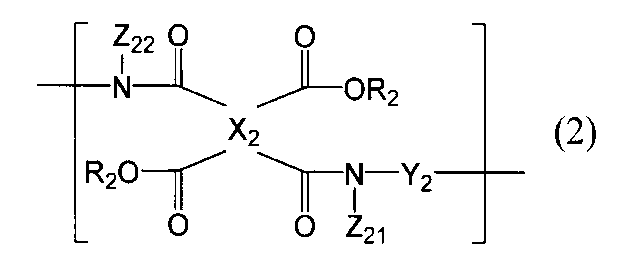

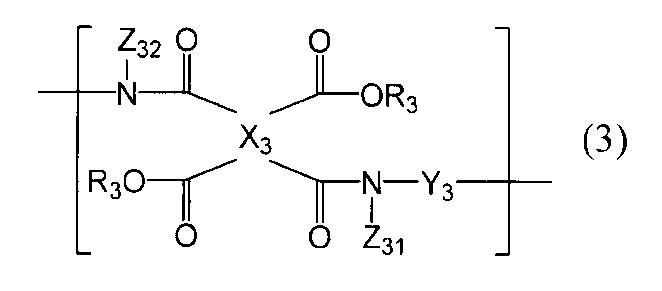
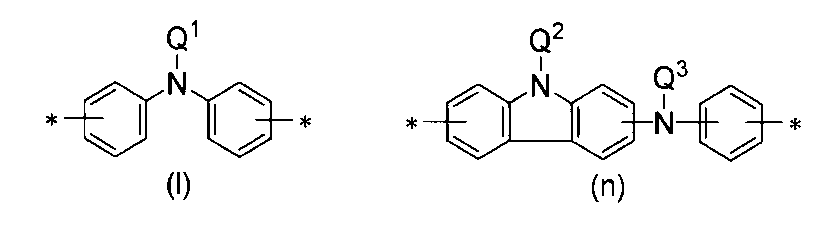
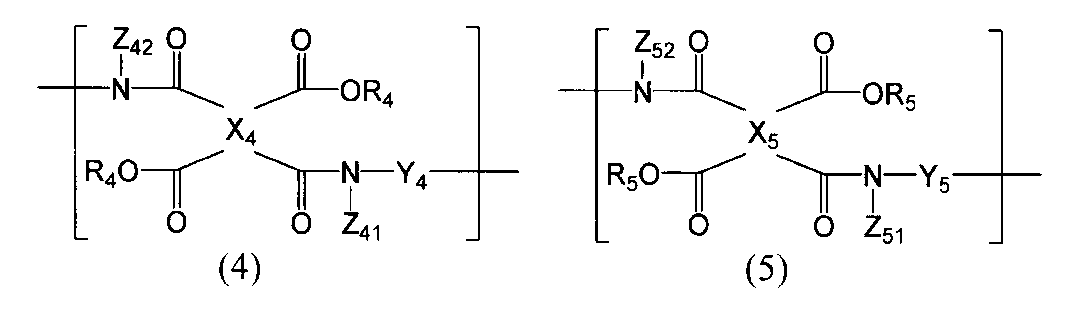
- 前記重合体(B)が、式(3)で表される繰り返し単位として、Y3が前記式(l)で表される2価の有機基である繰り返し単位と、Y3が前記式(n)で表される部分構造を有する2価の有機基である繰り返し単位とを有する、請求項1に記載の液晶配向剤。
- 前記式(n)で表される部分構造を有する2価の有機基が、下記式(n-1)~(n-3)のいずれかで表される2価の有機基である、請求項1又は2に記載の液晶配向剤。

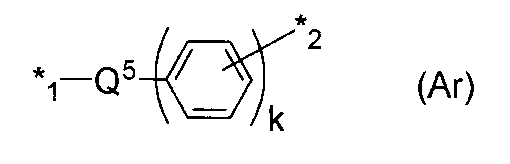
- 前記式(1)のY1が、下記式(H)で表される部分構造を有する2価の有機基である、請求項1~3のいずれか一項に記載の液晶配向剤。

- 前記式(1)のY1が、下記式(H-1)~(H-14)のいずれかで表される部分構造を有する2価の有機基である、請求項1~4のいずれか一項に記載の液晶配向剤。
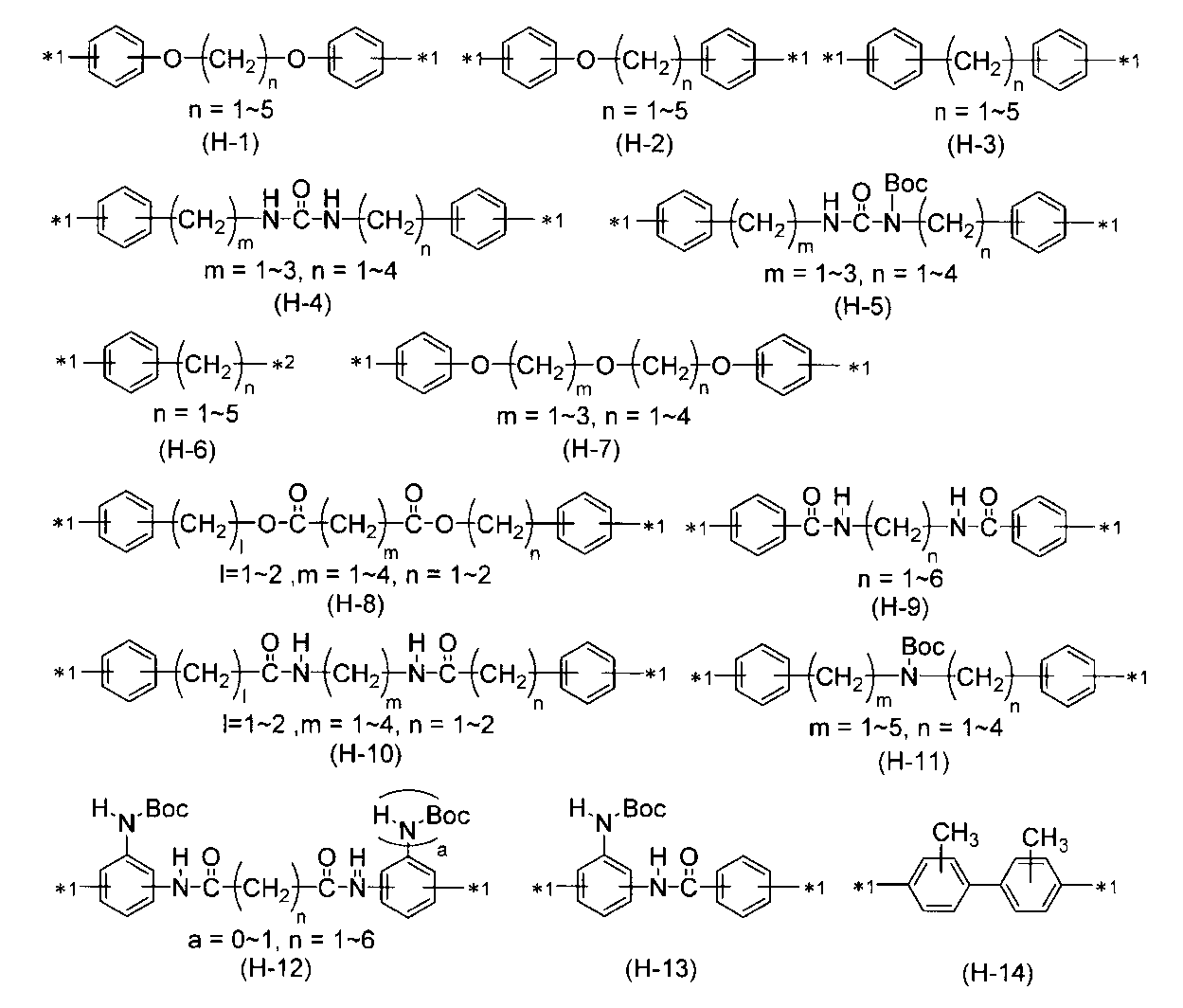
- 前記式(1)のY1が、上記式(H-1)~(H-14)のいずれかで表される2価の有機基、又は下記式(MH-1)~(MH-2)のいずれかで表される2価の有機基である、請求項1~5のいずれか一項に記載の液晶配向剤。
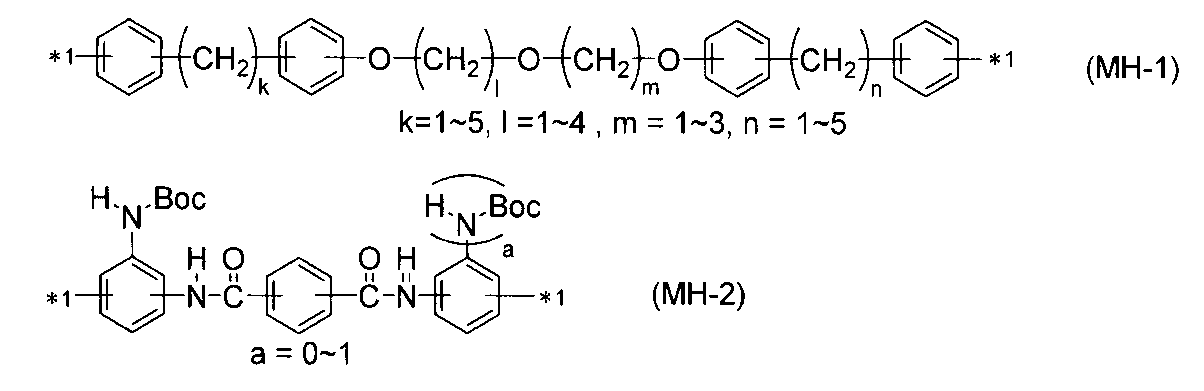
- 前記式(1)のX1が、下記式(4a)~(4l)、下記式(5a)及び下記式(6a)からなる群から選ばれる少なくとも1種である請求項1~6のいずれか一項に記載の液晶配向剤。
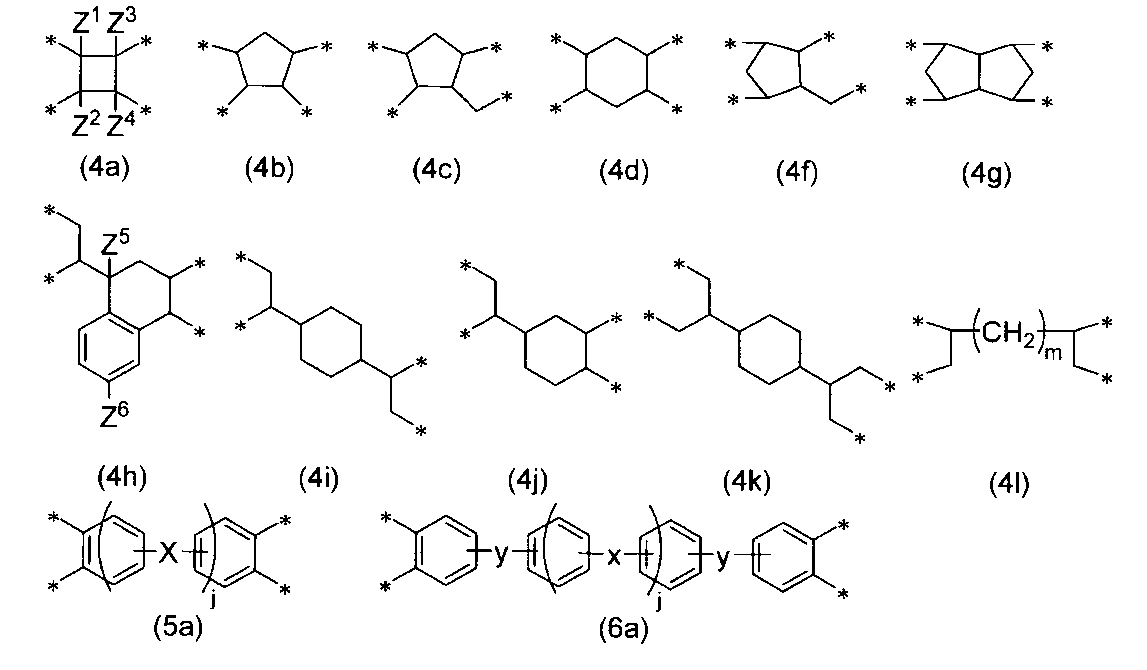
- 前記重合体(A)と前記重合体(B)との含有割合が、重合体(A)/重合体(B)の重量比で、5/95~95/5である、請求項1~7のいずれか一項に記載の液晶配向剤。
- さらに、オキシラニル基、オキセタニル基、保護イソシアネート基、保護イソチオシアネート基、オキサゾリン環構造を含む基、メルドラム酸構造を含む基、シクロカーボネート基、下記式(d)で表される基及び下記式(e)で表される部分構造を含む基よりなる群から選ばれる少なくとも1種の基を有する化合物(C)を含有する、請求項1~8のいずれか一項に記載の液晶配向剤。
に記載の液晶配向剤。

- 前記化合物(C)の含有量が、液晶配向剤に含まれる重合体成分100重量部に対して0.5~20重量部である、請求項9に記載の液晶配向剤。
- 請求項1~10のいずれか一項に記載の液晶配向剤から得られる液晶配向膜。
- 請求項11に記載の液晶配向膜を具備する液晶表示素子。
- 横電界駆動方式である請求項12に記載の液晶表示素子。
Priority Applications (3)
| Application Number | Priority Date | Filing Date | Title |
|---|---|---|---|
| JP2020572285A JP7428145B2 (ja) | 2019-02-13 | 2020-02-12 | 液晶配向剤、液晶配向膜及びそれを用いた液晶表示素子 |
| CN202080014448.2A CN113423763B (zh) | 2019-02-13 | 2020-02-12 | 液晶取向剂、液晶取向膜以及使用了该液晶取向膜的液晶显示元件 |
| KR1020217024383A KR102843972B1 (ko) | 2019-02-13 | 2020-02-12 | 액정 배향제, 액정 배향막 및 그것을 사용한 액정 표시 소자 |
Applications Claiming Priority (4)
| Application Number | Priority Date | Filing Date | Title |
|---|---|---|---|
| JP2019023807 | 2019-02-13 | ||
| JP2019-023807 | 2019-02-13 | ||
| JP2019082233 | 2019-04-23 | ||
| JP2019-082233 | 2019-04-23 |
Publications (1)
| Publication Number | Publication Date |
|---|---|
| WO2020166623A1 true WO2020166623A1 (ja) | 2020-08-20 |
Family
ID=72043862
Family Applications (1)
| Application Number | Title | Priority Date | Filing Date |
|---|---|---|---|
| PCT/JP2020/005398 Ceased WO2020166623A1 (ja) | 2019-02-13 | 2020-02-12 | 液晶配向剤、液晶配向膜及びそれを用いた液晶表示素子 |
Country Status (5)
| Country | Link |
|---|---|
| JP (1) | JP7428145B2 (ja) |
| KR (1) | KR102843972B1 (ja) |
| CN (1) | CN113423763B (ja) |
| TW (1) | TWI816022B (ja) |
| WO (1) | WO2020166623A1 (ja) |
Cited By (1)
| Publication number | Priority date | Publication date | Assignee | Title |
|---|---|---|---|---|
| WO2023286733A1 (ja) * | 2021-07-12 | 2023-01-19 | 日産化学株式会社 | 液晶配向剤、液晶配向膜、液晶表示素子の製造方法及び液晶表示素子 |
Families Citing this family (1)
| Publication number | Priority date | Publication date | Assignee | Title |
|---|---|---|---|---|
| TWI884287B (zh) * | 2021-07-09 | 2025-05-21 | 奇美實業股份有限公司 | 液晶配向劑、液晶配向膜及液晶顯示元件 |
Citations (3)
| Publication number | Priority date | Publication date | Assignee | Title |
|---|---|---|---|---|
| JP2015212807A (ja) * | 2014-04-14 | 2015-11-26 | Jnc株式会社 | 液晶配向剤、液晶配向膜および液晶表示素子 |
| WO2016152928A1 (ja) * | 2015-03-24 | 2016-09-29 | 日産化学工業株式会社 | 液晶配向剤、液晶配向膜及び液晶表示素子 |
| JP2018010108A (ja) * | 2016-07-13 | 2018-01-18 | Jnc株式会社 | 光配向用液晶配向膜を形成するための液晶配向剤、液晶配向膜およびこれを用いた液晶表示素子 |
Family Cites Families (14)
| Publication number | Priority date | Publication date | Assignee | Title |
|---|---|---|---|---|
| TW556029B (en) | 2000-10-16 | 2003-10-01 | Nissan Chemical Ind Ltd | Aligning agent for liquid crystal for in-plane switching, liquid-crystal alignment film, and liquid-crystal display element |
| JP5817972B2 (ja) * | 2011-06-30 | 2015-11-18 | Jnc株式会社 | ポリアミック酸、およびこれを用いた液晶配向剤、液晶配向膜、液晶表示素子 |
| JP5961880B2 (ja) | 2012-02-16 | 2016-08-03 | 株式会社ジャパンディスプレイ | 液晶表示装置 |
| JPWO2014010402A1 (ja) * | 2012-07-11 | 2016-06-20 | 日産化学工業株式会社 | ポリアミック酸エステルを含有する液晶配向剤、液晶配向膜、及び液晶表示素子 |
| WO2015050135A1 (ja) * | 2013-10-01 | 2015-04-09 | 日産化学工業株式会社 | 横電界駆動方式用の液晶配向剤、液晶配向膜、及びそれを用いた液晶表示素子 |
| JP6638886B2 (ja) | 2014-03-31 | 2020-01-29 | 日産化学株式会社 | 液晶配向処理剤、液晶配向膜及び液晶表示素子 |
| CN107077032B (zh) | 2014-10-20 | 2021-04-16 | 日产化学工业株式会社 | 液晶取向剂、液晶取向膜和使用了其的液晶表示元件 |
| WO2016080033A1 (ja) * | 2014-11-19 | 2016-05-26 | Jsr株式会社 | 液晶配向剤、液晶配向膜、液晶配向膜の製造方法、液晶表示素子、重合体及び化合物 |
| KR101748928B1 (ko) * | 2015-02-04 | 2017-07-03 | 주식회사 엘지화학 | 액정 배향막 조성물 및 액정 배향막 |
| KR102923089B1 (ko) * | 2016-01-22 | 2026-02-04 | 닛산 가가쿠 가부시키가이샤 | 액정 배향제, 액정 배향막 및 그것을 사용한 액정 표시 소자 |
| CN109791330B (zh) * | 2016-09-29 | 2022-05-31 | 日产化学株式会社 | 液晶取向剂、液晶取向膜和液晶表示元件 |
| KR102482055B1 (ko) * | 2016-11-15 | 2022-12-27 | 닛산 가가쿠 가부시키가이샤 | 액정 배향제, 액정 배향막 및 액정 표시 소자 |
| WO2018110354A1 (ja) * | 2016-12-15 | 2018-06-21 | 日産化学工業株式会社 | 液晶配向剤、液晶配向膜及びそれを用いた液晶表示素子 |
| KR102514165B1 (ko) | 2017-07-28 | 2023-03-24 | 닛산 가가쿠 가부시키가이샤 | 액정 배향제, 액정 배향막 및 액정 표시 소자 |
-
2020
- 2020-02-12 CN CN202080014448.2A patent/CN113423763B/zh active Active
- 2020-02-12 WO PCT/JP2020/005398 patent/WO2020166623A1/ja not_active Ceased
- 2020-02-12 KR KR1020217024383A patent/KR102843972B1/ko active Active
- 2020-02-12 JP JP2020572285A patent/JP7428145B2/ja active Active
- 2020-02-13 TW TW109104506A patent/TWI816022B/zh active
Patent Citations (3)
| Publication number | Priority date | Publication date | Assignee | Title |
|---|---|---|---|---|
| JP2015212807A (ja) * | 2014-04-14 | 2015-11-26 | Jnc株式会社 | 液晶配向剤、液晶配向膜および液晶表示素子 |
| WO2016152928A1 (ja) * | 2015-03-24 | 2016-09-29 | 日産化学工業株式会社 | 液晶配向剤、液晶配向膜及び液晶表示素子 |
| JP2018010108A (ja) * | 2016-07-13 | 2018-01-18 | Jnc株式会社 | 光配向用液晶配向膜を形成するための液晶配向剤、液晶配向膜およびこれを用いた液晶表示素子 |
Cited By (2)
| Publication number | Priority date | Publication date | Assignee | Title |
|---|---|---|---|---|
| WO2023286733A1 (ja) * | 2021-07-12 | 2023-01-19 | 日産化学株式会社 | 液晶配向剤、液晶配向膜、液晶表示素子の製造方法及び液晶表示素子 |
| JPWO2023286733A1 (ja) * | 2021-07-12 | 2023-01-19 |
Also Published As
| Publication number | Publication date |
|---|---|
| JP7428145B2 (ja) | 2024-02-06 |
| TWI816022B (zh) | 2023-09-21 |
| CN113423763A (zh) | 2021-09-21 |
| JPWO2020166623A1 (ja) | 2021-12-16 |
| TW202045586A (zh) | 2020-12-16 |
| CN113423763B (zh) | 2023-10-03 |
| KR20210126572A (ko) | 2021-10-20 |
| KR102843972B1 (ko) | 2025-08-07 |
Similar Documents
| Publication | Publication Date | Title |
|---|---|---|
| JP7096534B2 (ja) | 液晶配向剤、液晶配向膜及び液晶表示素子 | |
| JP7107220B2 (ja) | 液晶配向剤、液晶配向膜及び液晶表示素子 | |
| JP7414006B2 (ja) | 液晶配向剤、液晶配向膜、及び液晶表示素子 | |
| JP7409375B2 (ja) | 液晶配向剤、液晶配向膜及びそれを用いた液晶表示素子 | |
| JP7582305B2 (ja) | 液晶配向剤、液晶配向膜、及び液晶表示素子 | |
| TW202227532A (zh) | 液晶配向劑、液晶配向膜以及液晶顯示元件 | |
| JP7428145B2 (ja) | 液晶配向剤、液晶配向膜及びそれを用いた液晶表示素子 | |
| JP7768219B2 (ja) | 液晶配向剤、液晶配向膜及び液晶表示素子 | |
| WO2022176680A1 (ja) | 液晶配向剤、液晶配向膜及び液晶表示素子 | |
| JPWO2019198671A1 (ja) | 液晶配向剤、液晶配向膜及びそれを用いた液晶表示素子 | |
| JP7428138B2 (ja) | 液晶配向剤、液晶配向膜及び液晶表示素子 | |
| WO2020158819A1 (ja) | 液晶配向剤、液晶配向膜及び液晶表示素子 | |
| JP7544138B2 (ja) | 液晶配向剤、液晶配向膜及び液晶表示素子 | |
| JP7694561B2 (ja) | 新規ジアミン、重合体、液晶配向剤、液晶配向膜、及びそれを用いた液晶表示素子 | |
| WO2022181311A1 (ja) | 液晶配向剤、液晶配向膜及び液晶表示素子 |
Legal Events
| Date | Code | Title | Description |
|---|---|---|---|
| 121 | Ep: the epo has been informed by wipo that ep was designated in this application |
Ref document number: 20756289 Country of ref document: EP Kind code of ref document: A1 |
|
| ENP | Entry into the national phase |
Ref document number: 2020572285 Country of ref document: JP Kind code of ref document: A |
|
| NENP | Non-entry into the national phase |
Ref country code: DE |
|
| 122 | Ep: pct application non-entry in european phase |
Ref document number: 20756289 Country of ref document: EP Kind code of ref document: A1 |