WO2020166533A1 - 硬化性組成物、硬化物及び積層体 - Google Patents
硬化性組成物、硬化物及び積層体 Download PDFInfo
- Publication number
- WO2020166533A1 WO2020166533A1 PCT/JP2020/004970 JP2020004970W WO2020166533A1 WO 2020166533 A1 WO2020166533 A1 WO 2020166533A1 JP 2020004970 W JP2020004970 W JP 2020004970W WO 2020166533 A1 WO2020166533 A1 WO 2020166533A1
- Authority
- WO
- WIPO (PCT)
- Prior art keywords
- acrylate
- meth
- curable composition
- fine particles
- group
- Prior art date
- Legal status (The legal status is an assumption and is not a legal conclusion. Google has not performed a legal analysis and makes no representation as to the accuracy of the status listed.)
- Ceased
Links
Classifications
-
- B—PERFORMING OPERATIONS; TRANSPORTING
- B32—LAYERED PRODUCTS
- B32B—LAYERED PRODUCTS, i.e. PRODUCTS BUILT-UP OF STRATA OF FLAT OR NON-FLAT, e.g. CELLULAR OR HONEYCOMB, FORM
- B32B17/00—Layered products essentially comprising sheet glass, or glass, slag, or like fibres
- B32B17/06—Layered products essentially comprising sheet glass, or glass, slag, or like fibres comprising glass as the main or only constituent of a layer, next to another layer of a specific material
- B32B17/10—Layered products essentially comprising sheet glass, or glass, slag, or like fibres comprising glass as the main or only constituent of a layer, next to another layer of a specific material of synthetic resin
-
- B—PERFORMING OPERATIONS; TRANSPORTING
- B32—LAYERED PRODUCTS
- B32B—LAYERED PRODUCTS, i.e. PRODUCTS BUILT-UP OF STRATA OF FLAT OR NON-FLAT, e.g. CELLULAR OR HONEYCOMB, FORM
- B32B27/00—Layered products comprising a layer of synthetic resin
- B32B27/18—Layered products comprising a layer of synthetic resin characterised by the use of special additives
-
- B—PERFORMING OPERATIONS; TRANSPORTING
- B32—LAYERED PRODUCTS
- B32B—LAYERED PRODUCTS, i.e. PRODUCTS BUILT-UP OF STRATA OF FLAT OR NON-FLAT, e.g. CELLULAR OR HONEYCOMB, FORM
- B32B27/00—Layered products comprising a layer of synthetic resin
- B32B27/18—Layered products comprising a layer of synthetic resin characterised by the use of special additives
- B32B27/20—Layered products comprising a layer of synthetic resin characterised by the use of special additives using fillers, pigments, thixotroping agents
-
- B—PERFORMING OPERATIONS; TRANSPORTING
- B32—LAYERED PRODUCTS
- B32B—LAYERED PRODUCTS, i.e. PRODUCTS BUILT-UP OF STRATA OF FLAT OR NON-FLAT, e.g. CELLULAR OR HONEYCOMB, FORM
- B32B27/00—Layered products comprising a layer of synthetic resin
- B32B27/30—Layered products comprising a layer of synthetic resin comprising vinyl (co)polymers; comprising acrylic (co)polymers
-
- B—PERFORMING OPERATIONS; TRANSPORTING
- B32—LAYERED PRODUCTS
- B32B—LAYERED PRODUCTS, i.e. PRODUCTS BUILT-UP OF STRATA OF FLAT OR NON-FLAT, e.g. CELLULAR OR HONEYCOMB, FORM
- B32B27/00—Layered products comprising a layer of synthetic resin
- B32B27/38—Layered products comprising a layer of synthetic resin comprising epoxy resins
-
- B—PERFORMING OPERATIONS; TRANSPORTING
- B32—LAYERED PRODUCTS
- B32B—LAYERED PRODUCTS, i.e. PRODUCTS BUILT-UP OF STRATA OF FLAT OR NON-FLAT, e.g. CELLULAR OR HONEYCOMB, FORM
- B32B27/00—Layered products comprising a layer of synthetic resin
- B32B27/40—Layered products comprising a layer of synthetic resin comprising polyurethanes
-
- B—PERFORMING OPERATIONS; TRANSPORTING
- B32—LAYERED PRODUCTS
- B32B—LAYERED PRODUCTS, i.e. PRODUCTS BUILT-UP OF STRATA OF FLAT OR NON-FLAT, e.g. CELLULAR OR HONEYCOMB, FORM
- B32B9/00—Layered products comprising a layer of a particular substance not covered by groups B32B11/00 - B32B29/00
Definitions
- the present invention relates to a curable composition, a cured product and a laminate.
- a cured product obtained by curing a curable composition can be formed into a cured product of various shapes from the curable composition in a short time by (i) an imprint method, a cast molding method, or the like. It has advantages such as being difficult and (iii) being lighter than glass. Therefore, the cured product has been attracting attention as a material for an optical member that replaces glass.
- Patent Document 1 discloses a laminate in which a vapor deposition film layer of a metal oxide is provided on a cured product obtained by curing a curable composition containing a composite resin using (meth)acrylate, polyisocyanate, and silica fine particles. It is disclosed.
- Patent Document 2 silica fine particles surface-modified with a silane compound having an ethylenically unsaturated group, (meth)acrylate having no ring structure, (meth)acrylate having an alicyclic structure, and polymerization initiation
- a curable composition including an agent is disclosed.
- a cured product obtained by curing a conventional curable composition as in Patent Documents 1 and 2 does not have sufficient adhesion to an inorganic base material such as a glass substrate or an inorganic compound layer such as a metal oxide film, If it is used for a long time in a high temperature and high humidity environment, peeling may occur.
- the present invention has excellent adhesiveness with an inorganic base material or an inorganic compound layer, and a curable composition that gives a cured product that hardly peels off even when exposed to a high temperature and high humidity environment for a long time, and the curable composition. It is intended to provide a cured product and a laminate used.
- One embodiment of the present invention has a solid metal oxide fine particle A having no aromatic ring and a median diameter of 5 to 20 nm and an alicyclic condensed ring, and has a glass transition temperature of a homopolymer.
- (Meth)acrylate B having a temperature of 90 to 350° C.
- a compound C having a cationically polymerizable reactive group having an oxygen atom other than the (meth)acrylate B, an antioxidant, a cationic polymerization initiator, and radical polymerization
- a curable composition which further comprises a urethane (meth)acrylate D having no aromatic ring, which contains an initiator and excludes the (meth)acrylate B and the compound C.
- the antioxidant includes an antioxidant having a phenol moiety and an antioxidant having a sulfide moiety, or an antioxidant having a phenol moiety, an antioxidant having a sulfide moiety, and an antioxidant having a phenol moiety and a sulfide moiety. Or containing an antioxidant having a phenol moiety and a sulfide moiety, and the amount of the cationically polymerizable reactive group having an oxygen atom in the curable composition is 0.
- the curable composition has a concentration of 10 to 10 mmol/g.
- a curable composition having excellent adhesion to an inorganic base material or an inorganic compound layer, and a cured product that is less likely to be peeled off even when exposed to a high temperature and high humidity environment for a long time, the curable composition It is possible to provide a cured product and a laminate using the product.
- the "(meth)acryloyl group” is a general term for an acryloyl group and a methacryloyl group.
- “(Meth)acrylate” is a general term for acrylate and methacrylate.
- (Meth)acrylic acid” is a general term for acrylic acid and methacrylic acid.
- Light is a general term for ultraviolet rays, visible rays, infrared rays, electron beams and radiation.
- the organic content of the metal oxide fine particles A is a thermogravimetric reduction amount when the metal oxide fine particles A are heated from 10° C. to 500° C. at a rate of 25° C./min in a nitrogen atmosphere using a thermogravimetric measuring device. Is.
- the median diameter of the metal oxide fine particles in the curable composition is a value obtained by using a particle size distribution measuring device by a dynamic light scattering method.
- the median diameter of the metal oxide fine particles in the cured product is the diameter of a sufficient number (for example, 100 or more, preferably 200 or more) of metal oxide fine particles that can be confirmed by observing the thin piece with a transmission electron microscope. Is a value obtained by averaging them.
- the glass transition temperature of the homopolymer of (meth)acrylate was measured by the differential scanning calorimetry (in accordance with JIS K 7121-1987 (corresponding international standard ISO 3146) for the homopolymer for evaluation obtained by the method described in Examples. It is the midpoint glass transition temperature measured by the DSC method.
- the glass transition temperature of the homopolymer being 90 to 350° C. means that the glass transition temperature is observed at 350° C. or lower and the glass transition temperature is not observed at 350° C. or lower by the DSC method.
- the transmittance of the cured product for light having a wavelength of 400 nm is 400 nm according to the method described in JIS K 7361:1997 (ISO 13468-1:1996) for the cured product of the evaluation sample obtained by the method described in Examples. It is the value measured at 25° C. using the light of FIG. "-" showing a numerical range means including the numerical value described before and after that as a lower limit and an upper limit.
- the curable composition of the present invention essentially contains metal oxide fine particles A, (meth)acrylate B, compound C, an antioxidant, a cationic polymerization initiator, and a radical polymerization initiator.
- the curable composition of the present invention may further contain urethane (meth)acrylate D. Further, the curable composition of the present invention may contain other (meth)acrylates, additives, solvents and the like, if necessary.
- the metal oxide fine particles A are metal oxide fine particles having no aromatic ring and having a median diameter of 5 to 20 nm.
- the metal oxide fine particles A improve the Abbe number of the cured product. Further, the metal oxide fine particles A are unlikely to undergo alteration such as oxidative deterioration and shape change even under a high temperature and high humidity environment.
- the metal oxide fine particles A may be metal oxide fine particles whose surface is modified with an organic substance. "The metal oxide fine particles A do not have an aromatic ring” means the metal oxide fine particles A not surface-modified with an organic substance, or even if the metal oxide fine particles A are surface-modified with an organic substance, the organic substance has an aromatic ring. It means that the metal oxide fine particles A have no.
- the metal species of the metal oxide fine particles A include Si, Zr, Ti, Al, Ce, Fe, W, Zn and Y. From the viewpoint of compatibility with other components and availability, the metal species of the metal oxide fine particles A is at least selected from the group consisting of Si, Zr, Ti, Al, Ce, Fe, W, Zn and Y. One kind is preferable, and Si, Zr or Ti is more preferable.
- the metal oxide fine particles A examples include SiO 2 fine particles, ZrO 2 fine particles, TiO 2 fine particles, Al 2 O 3 fine particles, CeO 2 fine particles, Fe 3 O 4 fine particles, WO 3 fine particles, ZnO fine particles, and Y 2 O 3 fine particles. It can. From the viewpoint of compatibility with other components and availability, the metal oxide fine particles A include SiO 2 fine particles, ZrO 2 fine particles, TiO 2 fine particles, Al 2 O 3 fine particles, CeO 2 fine particles, and Fe 3 O 4 fine particles. , WO 3 fine particles, ZnO fine particles, and Y 2 O 3 fine particles are preferable, and SiO 2 fine particles, ZrO 2 fine particles, or TiO 2 fine particles are more preferable.
- the surface modification of the organic substance may be performed by coating the surface of the fine particles with an organic substance, electrostatic interaction, hydrogen bonding, or other intermolecular force.
- the adhesion of organic substances can be exemplified.
- the organic substance used for the surface modification of the metal oxide fine particles A include organic silicon compounds, organic phosphorus compounds, and organic sulfur compounds.
- the organic content of the metal oxide fine particles A is preferably 20% by mass or less, more preferably 10% by mass or less, and further preferably 5% by mass or less.
- the organic content of the metal oxide fine particles A is not more than the upper limit value, yellowing due to oxidation of the organic content under high temperature and high humidity is suppressed, and deterioration of transparency of the cured product is suppressed.
- the smaller the organic content of the metal oxide fine particles A, the better, and the lower limit of the organic content is 0% by mass.
- the metal oxide fine particles A may have a spherical shape, a chain shape, or any other shape. Among them, the spherical shape is preferable because the metal oxide fine particles A are less likely to aggregate and the decrease in transparency of the cured product is suppressed.
- the metal oxide fine particles A may be solid particles or hollow particles. Among them, solid metal oxide fine particles A are preferable because the refractive index is high and the loss of transmittance is small.
- the median diameter of the metal oxide fine particles A is 5 to 20 nm, preferably 6 to 15 nm, more preferably 7 to 10 nm.
- the median diameter of the metal oxide fine particles A is not less than the lower limit value of the above range, the handling property is good. Further, since the metal oxide fine particles A are less likely to aggregate, the transparency of the cured product becomes high.
- the median diameter of the metal oxide fine particles A is not more than the upper limit value of the above range, light scattering by the metal oxide fine particles A is small, and the transparency of the curable composition and the cured product is high.
- metal oxide fine particles A a commercially available product may be used.
- Commercially available metal oxide fine particles A include organosilica sol (MEK-ST-40, TOL-ST, IPA-ST, MEK-ST-UP, EG-ST, NPC-ST-30, etc., manufactured by Nissan Chemical Industries, Ltd. ), surface-modified zirconia particle dispersion liquid (Zircostar ZP-153-A manufactured by Nippon Shokubai Co., PCPR-50-ETA manufactured by pixelligent, etc.), and titania sol (Optolake 6320z (11RU-7.MK) manufactured by catalyst and chemical). Etc.) can be illustrated.
- the metal oxide fine particles A contained in the curable composition may be one kind or two or more kinds.
- the (meth)acrylate B is a (meth)acrylate having an alicyclic condensed ring and having a homopolymer glass transition temperature of 90 to 350°C. Since the (meth)acrylate B has an ethylenically unsaturated bond, it can be polymerized by light or heat.
- the (meth)acrylate B preferably does not contain an aromatic ring. Since the (meth)acrylate B does not contain an aromatic ring having a low Abbe number and has an alicyclic structure having a high Abbe number, the Abbe number of the cured product is improved.
- An alicyclic fused ring is a condensed alicyclic ring.
- the alicyclic condensed ring has a high bonding force between carbon atoms and is unlikely to undergo oxidation or bond cleavage under high temperature and high humidity. Therefore, since the (meth)acrylate B has an alicyclic condensed ring, the cured product is less likely to be colored, and the transparency is less likely to decrease.
- Examples of the alicyclic condensed ring include a norbornyl group, an isobornyl group, a tricyclodecanyl group, a dicyclopentanyl group, a tetracyclododecanyl group, a noradamantyl group, in view of availability of the (meth)acrylate B.
- a ring derived from at least one group selected from the group consisting of an adamantyl group and an amantyl group is preferable. Of these, an isobornyl group or a dicyclopentanyl group is preferable.
- the number of ethylenically unsaturated groups contained in the (meth)acrylate B is preferably 1 or 2 in view of easy availability and the ratio of the alicyclic condensed ring in the molecule. Particularly preferred.
- the glass transition temperature of the homopolymer of (meth)acrylate B is 90 to 350° C., preferably 150 to 350° C., more preferably 200 to 350° C., further preferably 250 to 350° C.
- the glass transition temperature of the homopolymer is equal to or higher than the lower limit of the above range, the cured product is less likely to soften under high temperature and high humidity, and various properties of the cured product are excellent. If the glass transition temperature of the homopolymer is equal to or lower than the upper limit value of the above range, (meth)acrylate B is easily available.
- Examples of (meth)acrylate B include dicyclopentanyl acrylate, dicyclopentanyl methacrylate, isobornyl acrylate, isobornyl methacrylate, 1-adamantyl methacrylate, 2-adamantyl acrylate, and tricyclodecane dimethanol diacrylate. ..
- the (meth)acrylate B contained in the curable composition may be one type or two or more types.
- Compound C is a compound having a cationically polymerizable reactive group having an oxygen atom (provided that (meth)acrylate B is excluded). Since the compound C contains a cationically polymerizable reactive group, it can be polymerized by light or heat in the presence of a cationic polymerization initiator. When the cationically polymerizable reactive group of the compound C reacts, a hydroxy group or an ether bond is generated, and the hydrophilicity of the cured product is improved. Therefore, the adhesion between the cured product and the inorganic base material and the inorganic compound layer is improved. Even if the inorganic base material is not pretreated, the adhesion strength between the cured product and the inorganic base material becomes sufficiently high. From the viewpoint that the Abbe number of the cured product can be suppressed from decreasing, it is preferable that the compound C does not have an aromatic ring.
- epoxy compound a compound having one or more epoxy groups in the molecule (hereinafter referred to as “epoxy compound”) and a compound having one or more oxetane groups in the molecule (hereinafter referred to as “oxetane compound”).
- epoxy compound an epoxy (meth)acrylate is preferable, which does not have an aromatic ring and has an ethylenically unsaturated group substance amount of 0.1 to 3.0 mmol/g (hereinafter, referred to as “epoxy (meth)acrylate”).
- Epoxy (meth)acrylate C1 is more preferable.
- the epoxy (meth)acrylate C1 is an epoxy compound to which (meth)acrylic acid is added (however, the (meth)acrylate B is excluded).
- Epoxy (meth)acrylate C1 has a hydroxyl group formed by ring opening of an epoxy group, and thus has good compatibility with the metal oxide fine particles A having a silanol group on the surface. It also has good compatibility with (meth)acrylate B. Therefore, in the curable composition containing the epoxy (meth)acrylate C1, the metal oxide fine particles A, the (meth)acrylate B, and the epoxy (meth)acrylate C1 are compatible, and as a result, the transparency of the cured product is increased. Get higher
- Epoxy (meth)acrylate C1 does not have an aromatic ring. Since the epoxy (meth)acrylate does not have an aromatic ring, a decrease in Abbe number of the cured product can be suppressed.
- the amount of the ethylenically unsaturated group in the epoxy (meth)acrylate C1 is 0.1 to 3.0 mmol/g, preferably 0.3 to 2.7 mmol/g, per 1 g of the epoxy (meth)acrylate C1. , 0.5 to 2.5 mmol/g is more preferable. When the amount of the substance of the ethylenically unsaturated group is at least the lower limit value of the above range, it can be sufficiently cured.
- the cured product is less likely to shrink when the curable composition is cured, and the cured product is less likely to be cracked. Therefore, the cured product can be preferably used as an optical member.
- epoxy (meth)acrylate C1 Commercially available products of epoxy (meth)acrylate C1 include NK oligos (EA-5311, EA-5511, etc.) manufactured by Shin-Nakamura Chemical Co., Ltd., and denacol acrylate (DA-722, DA-314, etc.) manufactured by Nagase Chemtex Co., Ltd. ), and an epoxy acrylate (MIRAMER PE230 etc.) manufactured by MIWON.
- an epoxy compound having no ethylenically unsaturated group may be used as the compound C.
- Commercially available products of epoxy compounds having no ethylenically unsaturated group include alicyclic epoxy compounds (X-40-2670, X-40-2678, etc.) manufactured by Shin-Etsu Chemical Co., Ltd., and celoxide manufactured by Daicel Chemical Industries, Ltd. (2021P etc.), alicyclic epoxy compounds (THI-DE etc.) manufactured by JX Nikko Nisseki Energy Co., Ltd., and ADEKA RESIN (EP-4088L etc.) manufactured by ADEKA can be exemplified.
- the oxetane compound is preferably oxetane (meth)acrylate.
- Oxetane (meth)acrylate is an oxetane compound to which (meth)acrylic acid is added (however, (meth)acrylate B is excluded).
- Examples of commercial products of oxetane (meth)acrylate include oxetane acrylate (OXE-10) and oxetane methacrylate (OXE-30) manufactured by Osaka Organic Chemical Industry.
- an oxetane compound having no ethylenically unsaturated group may be used.
- oxetane compounds having no ethylenically unsaturated group Aron oxetane (OXT-101, OXT-212, OXT-221 etc.) manufactured by Toagosei Co., Ltd., oxetane compound (EOXTVE) manufactured by Maruzen Petrochemical Co., Ltd. Can be illustrated.
- the compound C contained in the curable composition may be one type or two or more types.
- Urethane (meth)acrylate D is urethane (meth)acrylate which does not have an aromatic ring (however, (meth)acrylate B and compound C are excluded). Since urethane (meth)acrylate D does not have an aromatic ring that reduces the Abbe number, the reduction of the Abbe number of the cured product can be suppressed.
- Urethane (meth)acrylate D has a urethane bond and has two or more (meth)acryloyl groups.
- the urethane (meth)acrylate D has a urethane bond exhibiting a hydrogen bonding property, and thus has particularly good compatibility with the metal oxide fine particles A having a silanol group on the surface. It also has good compatibility with (meth)acrylate B and compound C. Therefore, in the curable composition containing urethane (meth)acrylate D, the metal oxide fine particles A, the (meth)acrylate B, the compound C, and the urethane (meth)acrylate D are compatible, and as a result, the cured product is transparent. Will be more likely.
- the crack resistance is increased.
- the effect becomes remarkable when the thickness of the cured product is 5 mm or more and when the volume of the cured product is 1 cm 3 or more.
- the thickness of the cured product is preferably 50 mm or less and the volume thereof is preferably 50 cm 3 or less.
- the amount of the ethylenically unsaturated group in the urethane (meth)acrylate D is 0.1 to 3.0 mmol/g, preferably 0.3 to 2.7 mmol/g, per 1 g of the urethane (meth)acrylate D. , 0.5 to 2.5 mmol/g is more preferable.
- the amount of such a substance is at least the lower limit value of the above range, it can be sufficiently cured.
- the amount of the substance is equal to or less than the upper limit value of the above range, the cured product is less likely to shrink when the curable composition is cured, and cracks are less likely to occur in the cured product. Therefore, the cured product can be preferably used as an optical member.
- urethane (meth)acrylate D Commercially available products of urethane (meth)acrylate D include NK oligos (UA-160TM, U-412A, UA-4200, UA-4400, UA-122P, etc.) manufactured by Shin-Nakamura Chemical Co., Ltd., manufactured by Daicel Ornex. EBECRYL (8402, 8807, 9260, etc.), KRM (8667, 8904, etc.) manufactured by Daicel Ornex, UA-306H, UA-306T, UA-306I, UA-510H manufactured by Kyoeisha Chemical Co., Ltd., Nippon Kayaku Co., Ltd. UX-3204, UX-4101, and UX-8101 can be exemplified.
- the urethane (meth)acrylate D contained in the curable composition may be one type or two or more types.
- the antioxidant includes an antioxidant having a phenol moiety and an antioxidant having a sulfide moiety, or an antioxidant having a phenol moiety, an antioxidant having a sulfide moiety, and an antioxidant having a phenol moiety and a sulfide moiety. Or an antioxidant having a phenol moiety and a sulfide moiety.
- An antioxidant having a phenol moiety traps radicals that cause coloring that occurs in the cured product, and improves the transparency of the cured product. Suppress the decline.
- the antioxidant having a sulfide moiety can regenerate the antioxidant having a phenol moiety that traps radicals. Therefore, by using the antioxidant having a phenol moiety and the antioxidant having a sulfide moiety together, it is possible to suppress deterioration of transparency of the cured product for a long period of time.
- antioxidants having a phenol moiety include IRGANOX (trade name) manufactured by BASF Japan (259, 1010, 1035, 1076, 1098, 1135, etc.) and ADEKA STAB (trade name) manufactured by ADEKA (trade name: AO- 50, AO-60, etc.).
- the antioxidant having a phenol moiety may be used alone or in combination of two or more.
- examples of commercially available antioxidants having a sulfide moiety include sulfur-based antioxidant T0205 manufactured by Tokyo Chemical Industry Co., Ltd. and ADEKA STAB (trade name) manufactured by ADEKA (AO-412S, AO-503, etc.).
- the antioxidant having a sulfide moiety may be used alone or in combination of two or more.
- the antioxidant may include an antioxidant having a phenol moiety, an antioxidant having a sulfide moiety, and an antioxidant other than the antioxidant having a phenol moiety and a sulfide moiety.
- the total proportion of the antioxidant having a phenol moiety and the antioxidant having a sulfide moiety in all the antioxidants is preferably 50% by mass or more, and particularly preferably 100% by mass.
- the proportion of the antioxidant having a phenol moiety in the total of the antioxidant having a phenol moiety and the antioxidant having a sulfide moiety is preferably 5 to 95% by mass, more preferably 10 to 90% by mass, and 15 to 85 mass% is more preferable.
- the antioxidant contained in the curable composition may be one type or two or more types.
- Examples of the cationic polymerization initiator include a photocationic polymerization initiator and a thermal cationic polymerization initiator. From the viewpoint of easy production of a cured product, a photocationic polymerization initiator is preferred.
- Examples of the cationic photopolymerization initiator include arylsulfonium salts, diarylsulfonium salts, triarylsulfonium salts, phenacylsulfonium salts, alkylbenzylsulfonium salts, diaryliodonium salts, and sulfonyldiazomethanes. Among these, an alkylbenzyl sulfonium salt and a triaryl sulfonium salt are preferable, and a triaryl sulfonium salt is more preferable, from the viewpoints of transparency and availability.
- thermal cationic polymerization initiator examples include benzylsulfonium salt, benzylammonium salt, phosphonium salt, arylsulfonium salt, diarylsulfonium salt and triarylsulfonium salt.
- the alkylbenzyl sulfonium salt, the aryl sulfonium salt, and the triaryl sulfonium salt are preferable, and the aryl sulfonium salt is more preferable, from the viewpoints of transparency and availability.
- the cationic polymerization initiator contained in the curable composition may be one type or two or more types.
- radical polymerization initiator examples include a photo radical polymerization initiator and a thermal radical polymerization initiator. From the viewpoint of easy production of a cured product, a photo radical polymerization initiator is preferable.
- the photo-radical polymerization initiator alkylphenone type, acylphosphine oxide type, titanocene type, oxime ester type, oxyphenylacetic acid ester type, benzoin type, benzophenone type, thioxanthone type, benzyl-(o-ethoxycarbonyl)- ⁇ - Examples thereof include monooxime, glyoxy ester, 3-ketocoumarin, 2-ethylanthraquinone, camphorquinone, tetramethylthiuram sulfide, azobisisobutyronitrile, benzoyl peroxide, dialkyl peroxide, and tert-butyl peroxypivalate. From the viewpoint of sensitivity and compatibility, an alkylphenone
- thermal radical polymerization initiator examples include 2,2′-azobisisobutyronitrile, benzoyl peroxide, tert-butyl hydroperoxide, cumene hydroperoxide, di-tert-butyl peroxide and dicumyl peroxide. From the viewpoint of decomposition temperature, 2,2'-azobisisobutyronitrile and benzoyl peroxide are preferable.
- the radical polymerization initiator contained in the curable composition may be one type or two or more types.
- the curable composition of the present invention includes a surfactant, a thixotropic agent, an antifoaming agent, a light stabilizer, an antigelling agent, a photosensitizer, a resin, a resin oligomer, a carbon compound, metal fine particles, and metal oxide particles. (However, the metal oxide fine particles A are excluded.), a silane coupling agent, an additive such as another organic compound may be included.
- the curable composition of the present invention may include a solvent. However, it is preferable to remove the solvent before curing the curable composition.
- a solvent any solvent can be used as long as it can dissolve the (meth)acrylate B, the compound C, the urethane (meth)acrylate D, the antioxidant, the cationic polymerization initiator and the radical polymerization initiator.
- a solvent having at least one of an ester structure, a ketone structure, a hydroxyl group, an aromatic hydrocarbon group and an ether structure is preferable.
- the solvent 1-methoxy-2-propanol, propylene glycol monomethyl ether acetate, methyl ethyl ketone, methyl isobutyl ketone, 2-propanol and toluene are preferable, and methyl ethyl ketone, 2-propanol and toluene are particularly preferable.
- the content of the solvent in the curable composition may be appropriately adjusted depending on the desired viscosity, coatability, desired film thickness and the like.
- the proportion of the metal oxide fine particles A in the curable composition is preferably 3 to 55% by mass based on the total mass of the metal oxide fine particles A, the (meth)acrylate B, the compound C and the urethane (meth)acrylate D. 5 to 51 mass% is more preferable, 15 to 50 mass% is further preferable, 15 to 40 mass% is particularly preferable, and 15 to 25 mass% is most preferable. If the ratio of the metal oxide fine particles A is at least the lower limit value of the above range, the Abbe number of the cured product will be high.
- the ratio of the metal oxide fine particles A is not more than the upper limit of the above range, the compatibility with other components is good, the metal oxide fine particles A are easily dispersed uniformly in the curable composition, and the transparency of the cured product is high. Excellent in. In addition, the cured product does not easily become brittle and cracks are less likely to occur in the cured product.
- the proportion of (meth)acrylate B in the curable composition is preferably 3 to 70% by mass based on the total mass of the metal oxide fine particles A, (meth)acrylate B, compound C and urethane (meth)acrylate D. 5 to 66 mass% is more preferable, 20 to 65 mass% is further preferable, 30 to 55 mass% is particularly preferable, and 45 to 50 mass% is most preferable.
- the ratio of (meth)acrylate B is at least the lower limit value of the above range, the curability of the curable composition will be good. If the ratio of (meth)acrylate B is at most the upper limit value of the above range, the Abbe number of the cured product will be high.
- the ratio of the compound C in the curable composition is preferably 3 to 80% by mass based on the total mass of the metal oxide fine particles A, the (meth)acrylate B, the compound C and the urethane (meth)acrylate D. Mass% is more preferable, 20 to 50 mass% is further preferable, 22 to 46 mass% is particularly preferable, and 24 to 42 mass% is most preferable.
- the ratio of the compound C is at least the lower limit value of the above range, the compatibility with other components is good and the cured product is excellent in transparency. If the ratio of the compound C is at most the upper limit value of the above range, the Abbe number of the cured product will be high.
- the amount of the cationically polymerizable reactive group having an oxygen atom in the curable composition is 0.10 to 10 mmol/g, preferably 0.3 to 8.0 mmol/g, per 1 g of the curable composition. More preferably, it is 0.5 to 6.0 mmol/g.
- the amount of the substance of the cationically polymerizable reactive group having an oxygen atom is at least the lower limit value of the above range, the adhesion between the cured product and the inorganic base material and the inorganic compound layer will be improved. If the amount of the substance of the cationically polymerizable reactive group having an oxygen atom is equal to or less than the upper limit value of the above range, the resin is unlikely to be deteriorated even in a high temperature and high humidity environment.
- Urethane (meth)acrylate D is optionally contained in the curable composition of the present invention.
- the proportion of the urethane (meth)acrylate D in the curable composition is preferably 0 to 60% by mass based on the total mass of the metal oxide fine particles A, the (meth)acrylate B, the compound C and the urethane (meth)acrylate D. 1 to 56% by mass is more preferable, and 3 to 52% by mass is further preferable.
- the proportion of urethane (meth)acrylate D is at least the lower limit value of the above range, the flexibility of the cured product can be improved, and the crack resistance will be high.
- the proportion of urethane (meth)acrylate D is at most the upper limit value of the above range, the Abbe number of the cured product will be high.
- the proportion of the antioxidant in the curable composition is 0. 0 with respect to 100 parts by mass of the total mass of the metal oxide fine particles A, the (meth)acrylate B, the epoxy (meth)acrylate C and the urethane (meth)acrylate D.
- the amount is preferably 1 to 10 parts by mass, more preferably 0.5 to 8 parts by mass, still more preferably 1 to 6 parts by mass.
- the proportion of the antioxidant is at least the lower limit value of the above range, it is possible to suppress deterioration of transparency of the cured product over a long period of time.
- the proportion of the antioxidant is not more than the upper limit value of the above range, deterioration of the curability of the cured product can be prevented.
- the ratio of the cationic polymerization initiator in the curable composition is 0.1 to 10 relative to 100 parts by mass of the total mass of the metal oxide fine particles A, the (meth)acrylate B, the compound C and the urethane (meth)acrylate D.
- a mass part is preferable, a 0.2 to 7 mass part is more preferable, and a 0.5 to 5 mass part is further more preferable.
- the ratio of the cationic polymerization initiator is at least the lower limit value of the above range, a cured product can be easily formed.
- the ratio of the cationic polymerization initiator is not more than the upper limit value of the above range, the mixture can be uniformly mixed, so that the amount of the cationic polymerization initiator remaining in the cured product decreases and the physical properties of the cured product are prevented from deteriorating.
- the ratio of the radical polymerization initiator in the curable composition is 0.1 to 10 relative to 100 parts by mass of the total mass of the metal oxide fine particles A, the (meth)acrylate B, the compound C and the urethane (meth)acrylate D.
- a mass part is preferable, a 0.2 to 7 mass part is more preferable, and a 0.5 to 5 mass part is further more preferable.
- the ratio of the radical polymerization initiator is at least the lower limit value of the above range, a cured product can be easily formed.
- the ratio of the radical polymerization initiator is at most the upper limit value of the above range, the radical polymerization initiator remaining in the cured product can be reduced and the physical properties of the cured product can be prevented from deteriorating because the radical polymerization initiator can be uniformly mixed.
- the total amount of other components such as additives is preferably 5 parts by mass or less based on 100 parts by mass of the total amount of the metal oxide fine particles A, the (meth)acrylate B, the compound C and the urethane (meth)acrylate D. It is more preferably 3 parts by mass or less.
- the curable composition of this invention does not contain urethane (meth)acrylate D
- the ratio of urethane (meth)acrylate D is 0 mass %
- the basis of calculation of the ratio of each component is substantially. It is the total of the metal oxide fine particles A, the (meth)acrylate B and the compound C.
- the cured product of the present invention is a cured product obtained by curing the curable composition of the present invention, and contains a matrix resin having an alicyclic condensed ring, and metal oxide fine particles dispersed in the matrix resin.
- the matrix resin is obtained by curing components other than the metal oxide fine particles A, such as (meth)acrylate B, epoxy (meth)acrylate C, and urethane (meth)acrylate D in the curable composition of the present invention. ..
- the proportion of the metal oxide fine particles in the cured product is preferably 3 to 55% by mass, more preferably 5 to 51% by mass, and further preferably 15 to 50% by mass, based on the total of the matrix resin and the metal oxide fine particles.
- the ratio of the metal oxide fine particles is at least the lower limit value of the above range, deterioration of the cured product such as oxidative deterioration and shape change is less likely to occur even in a high temperature and high humidity environment.
- the ratio of the metal oxide fine particles is at most the upper limit value of the above range, the cured product will have excellent transparency. In addition, the cured product does not easily become brittle and cracks are less likely to occur in the cured product.
- the proportion of the matrix resin in the cured product is preferably 45 to 97% by mass, more preferably 49 to 95% by mass, and further preferably 50 to 85% by mass, based on the total of the matrix resin and the metal oxide fine particles.
- the thickness of the cured product is not particularly limited and may be, for example, 0.05 to 10.0 mm.
- a method for forming a cured product the curable composition is cured in a state where a mold having a reverse pattern of a fine pattern and a curable composition are in contact with each other to form a cured product having a fine pattern on the surface.
- a method imprint method
- a method cast molding method of injecting a curable composition into the cavity of the mold and curing the curable composition to form a cured product may be used.
- the curing method may be photo-curing or heat-curing, and may be appropriately selected depending on the polymerization initiator. As the curing method, photocuring is preferable from the viewpoint of easy production of the cured product.
- the transmittance of light having a wavelength of 400 nm per 1 mm of thickness of a cured product obtained by curing the curable composition of the present invention is preferably 30% or more, more preferably 50% or more, and further preferably 88% or more.
- the transmittance is preferably 95% or less, more preferably 93% or less, further preferably 91% or less, and further preferably 90% or less.
- transparency is further excellent.
- the transmittance of light having a wavelength of 400 nm per 1 mm of the thickness of the cured product is obtained from the following formula 1.
- T T 1 ⁇ (1-r) 2 ...
- T is the transmittance of light having a wavelength of 400 nm per 1 mm of the thickness of the cured product.
- r ⁇ (n-1)/(n+1) ⁇ 2 .
- T 1 is the internal transmittance of light having a wavelength of 400 nm per 1 mm of the thickness of the cured product, and is calculated from the following formula 2.
- n is the refractive index of the cured product at 25° C. for light having a wavelength of 400 nm.
- T 1 (T Y /100) 1/Y ⁇ 100 (Equation 2)
- T Y is the internal transmittance of light having a wavelength of 400 nm per thickness Ymm of the cured product, and is calculated from the following formula 3.
- T Y (transmittance of light having wavelength of 400 nm per thickness Ymm of cured product)/(1-r) 2 ...
- Formula 3
- the internal transmittance of the light having a wavelength of 400 nm per 1 mm of the thickness of the cured product which is obtained from the formulas 2 and 3. Particularly preferred.
- the internal transmittance is at least the lower limit value of the above range, the transparency of the cured product will be particularly excellent. The higher the internal transmittance, the better, and the upper limit is 100%.
- the internal transmittance of light having a wavelength of 400 nm per 1 mm of thickness of the cured product is preferably 50% or more, more preferably 90% or more, and more preferably 95%, after being kept in an atmosphere of a temperature of 65° C. and a relative humidity of 90% for 1000 hours.
- the above is more preferable, and 96% or more is particularly preferable.
- the internal transmittance is at least the lower limit value of the above range, it is possible to suppress deterioration of transparency of the cured product over a long period of time.
- the curable composition of the present invention contains metal oxide fine particles A, (meth)acrylate B, compound C, a specific antioxidant, a cationic polymerization initiator, and a radical polymerization initiator, and contains oxygen.
- the substance amount of the cationically polymerizable reactive group having atoms is controlled within a specific range.
- a cationic polymerization initiator When the cationically polymerizable reactive group of the compound C is reacted with a cationic polymerization initiator, a hydroxyl group or an ether bond is generated and the hydrophilicity of the cured product is improved, so that the cured product, the inorganic base material and the inorganic compound layer Improves the adhesion.
- the glass transition temperature of the cured product is preferably 90 to 350°C, more preferably 100 to 350°C, further preferably 150 to 350°C, particularly preferably 200 to 350°C.
- the glass transition temperature of the cured product is at least the lower limit value, the cured product is less likely to soften under high temperature and high humidity.
- the glass transition temperature of the cured product is at most the upper limit value, the curable composition of the present invention is easily available.
- the refractive index of the cured product with respect to light having a wavelength of 589 nm is preferably 1.45 or more, more preferably 1.48 to 1.53.
- the refractive index is within the above range, Fresnel reflection is unlikely to occur even when combined with another member such as a glass substrate, and the loss of transmittance is small.
- the Abbe number obtained from the following equation 5 of the cured product is preferably 54 or more, more preferably 56 or more, still more preferably 58 or more. If the Abbe's number is at least the lower limit value of the above range, chromatic aberration is unlikely to occur. The higher the Abbe number, the better, and the upper limit is not particularly limited, but it is about 70 considering that it is an organic substance.
- ⁇ D (n D ⁇ 1)/(n F ⁇ n C )...Equation 5
- ⁇ D is the Abbe number.
- n D is a refractive index for light having a wavelength of 589 nm.
- n F is a refractive index for light having a wavelength of 486 nm.
- n C is a refractive index for light having a wavelength of 656 nm.
- the laminate of the present invention has a cured product obtained by curing the curable composition of the present invention, and an inorganic compound layer provided on the cured product.
- an inorganic base material for example, an inorganic base material, a cured product obtained by curing the curable composition of the present invention provided on the surface of the inorganic base material, and a cured product on the opposite side of the inorganic base material.
- a laminate having an inorganic compound layer provided on the surface can be exemplified.
- the thickness of the cured product in the laminate is not particularly limited, and may be 0.05 to 10.0 mm, for example.
- a method for forming a cured product the curable composition is cured in a state where a mold having a reverse pattern of a fine pattern and a curable composition are in contact with each other to form a cured product having a fine pattern on the surface.
- a method imprint method
- a method cast molding method of injecting a curable composition into the cavity of the mold and curing the curable composition to form a cured product may be used.
- the curing method may be photo-curing or heat-curing, and may be appropriately selected depending on the polymerization initiator. As the curing method, photocuring is preferable from the viewpoint of easy production of the cured product.
- the inorganic base material examples include base materials made of inorganic materials such as glass, quartz glass and metal.
- the inorganic base material may be a flat base material or a curved base material.
- the thickness of the inorganic substrate is not particularly limited, and can be 0.025 to 5.0 mm, for example.
- a metal compound can be exemplified as the inorganic compound forming the inorganic compound layer.
- the metal species of the metal compound include Si, Zn, Zr, Ti, Ta, Nb, In, Sn, Y, W, Al, Cr, and Ga.
- the metal species of the metal compound is at least one selected from the group consisting of Si, Zn, Zr, Ti, Ta, Nb, In, Sn, Y, W, Al, Cr and Ga.
- Si, Ti, Ta or Nb is more preferable.
- the inorganic compound forming the inorganic compound layer SiO 2 , SiC, ZnO, ZrO 2 , TiO 2 , Ta 2 O 5 , Nb 2 O 5 , In 2 O 3 , SnO 2 , Y 2 O 3 , WO 3 .
- Examples include Al 2 O 3 , TiC, TiN, Cr 2 O 3 and Ga 2 O 3 .
- the inorganic compounds include SiO 2 , SiC, ZnO, ZrO 2 , TiO 2 , Ta 2 O 5 , Nb 2 O 5 , In 2 O 3 , SnO 2 , Y 2 O 3 , and WO 3.
- Al 2 O 3 , TiC, TiN, Cr 2 O 3 and Ga 2 O 3 at least one kind is preferable, and SiO 2 , TiO 2 , Ta 2 O 5 or Nb 2 O 5 is more preferable.
- a metal compound vapor deposition film layer can be exemplified.
- the thickness of the inorganic compound layer is not particularly limited, and can be 10 to 5000 nm, for example.
- Examples of the method for forming the inorganic compound layer include vacuum vapor deposition method and sputtering method.
- the laminate of the present invention described above has a cured product obtained by curing the curable composition of the present invention, it has excellent adhesiveness between the cured product and the inorganic base material and the inorganic compound layer, and is long in a high temperature and high humidity environment. Peeling does not occur easily even if exposed for a period of time.
- Examples 1 to 5 and 7 are examples, and Example 6 is a comparative example.
- (Meth)acrylate or a curable composition was applied to the surface of the release-treated quartz glass substrate.
- the mold releasing slide glass substrate and the quartz glass substrate were opposed to each other via a spacer having a thickness of 100 ⁇ m, and the curable composition was sandwiched between them.
- the curable composition was irradiated with ultraviolet rays from a high pressure mercury lamp at an exposure dose of 3000 mJ/cm 2 .
- the release-treated quartz glass substrate was peeled off, the surface of the cured product was washed with ethanol, dried, and then heat-treated at 180° C. for 15 minutes. By peeling off the slide glass substrate, an evaluation sample I (cured product) having a thickness of 100 ⁇ m was obtained.
- Glass-transition temperature Using a differential scanning calorimeter (manufactured by TA Instruments, DSC-Q20), the evaluation sample I was heated from 10° C. to 350° C. at a rate of 20° C./min in a nitrogen atmosphere to determine the glass transition temperature. ..
- the 1 H-NMR spectrum of the epoxy acrylate or the curable composition was measured using an FT-NMR apparatus (JNM-AL300 manufactured by JEOL Ltd.) (300 MHz, solvent: CDCl 3 , reference: tetramethylsilane).
- the internal standard was 1,4-bis(trifluorobenzene), and the amount of the ethylenically unsaturated group around 6 ppm was calculated.
- the epoxy acrylates C-1 and C-2 are compounds in which the amount of the ethylenically unsaturated group and the amount of the epoxy group are the same, the method described in the above "substance amount of the ethylenically unsaturated group" The substance amount of the ethylenically unsaturated group calculated by the above was used as the substance amount of the cationically polymerizable reactive group.
- the measurement was performed at a temperature of 25° C. and a wavelength of 589 nm using an Abbe refractometer (manufactured by Atago, multi-wavelength Abbe refractometer DR-M2).
- n D (n D ⁇ 1)/(n F ⁇ n C )...Equation 5
- n F is a refractive index for light having a wavelength of 486 nm
- n C is a refractive index for light having a wavelength of 656 nm.
- the curable composition was applied to the surface of the release-treated quartz glass substrate.
- the slide glass substrate not subjected to the mold release treatment and the quartz glass substrate subjected to the mold release treatment were opposed to each other via a spacer having a thickness of 1 mm, and the curable composition was sandwiched between them.
- the curable composition was irradiated with ultraviolet rays from a high pressure mercury lamp at an exposure dose of 3000 mJ/cm 2 .
- the quartz glass substrate after the release treatment was peeled off, the surface of the cured product was washed with ethanol, dried, and then heat-treated at 180° C.
- Evaluation sample III was prepared in the same manner as evaluation sample II except that a slide glass substrate that had been treated with a primer was used in place of the slide glass substrate that had not been subjected to mold release treatment.
- the refractive index of the cured product of the evaluation sample I having a thickness of 100 ⁇ m at a temperature of 25° C. to a light having a wavelength of 473 nm, 594 nm and 658 nm was measured using a refractive index measuring device (prism coupler: 2010/M manufactured by US Metricon Co., Ltd.). Then, the refractive index with respect to the light having a wavelength of 589 nm was calculated using the Metricon Fit attached to the apparatus.
- the refractive index of the cured product of the evaluation sample I at each wavelength was calculated using the Metricon Fit attached to the refractive index measuring device, and the Abbe's number was calculated from the above equation 5.
- the transmittance for light having a wavelength of 400 nm was measured using an ultraviolet/visible/near-infrared spectrophotometer (Solid Spec-3700, manufactured by Shimadzu Corporation). ..
- the adhesive tape specified in JIS Z1522 was attached on the inorganic compound layer of the evaluation sample IV after the heat and humidity resistance test and then peeled off. Next, the appearance of the inorganic compound layer side was visually observed to confirm the peeling of the inorganic compound layer, and the adhesion with the inorganic compound layer was evaluated according to the following criteria. ⁇ : No peeling occurred. ⁇ : Some peeling occurred. X: Completely peeled off.
- Metal oxide fine particle A dispersion liquid Metal oxide fine particles A-1 dispersion: organosilica sol (manufactured by Nissan Chemical Industries, Ltd., MEK-ST-40, dispersion medium: methyl ethyl ketone, SiO 2 concentration: 40% by mass, particle shape: spherical, particle diameter (median diameter): 10 nm, organic content of fine particles: 3% by mass).
- Metal oxide fine particle A-2 dispersion organosilica sol (TOL-ST, manufactured by Nissan Chemical Industries, dispersion medium: toluene, SiO 2 concentration: 40 mass %, particle shape: spherical, particle diameter (median diameter): 10 nm, Organic content of fine particles: 5% by mass).
- Metal oxide fine particle A-3 dispersion liquid surface-modified zirconia particle dispersion liquid (manufactured by Nippon Shokubai Co., Zircostar (product name) ZP-153-A, dispersion medium: methyl ethyl ketone, ZrO 2 concentration: 70% by mass, particle diameter (median) Diameter): 11 nm, organic content of fine particles: 12% by mass).
- Metal oxide fine particle A-4 dispersion liquid surface modified zirconia particle dispersion liquid (manufactured by pixelligent, (product name) PCPR-50-ETA, dispersion medium: ethyl acetate, ZrO 2 concentration: 50 mass %, particle diameter (median diameter) ): 10 nm, organic content of fine particles: 17% by mass).
- Metal oxide fine particles A-5 dispersion liquid titania sol (manufactured by catalyst and chemical, (product name) Optolake 6320z (11RU-7 ⁇ MK), dispersion medium: propylene glycol monomethyl ether acetate, TiO 2 concentration: 20 mass %, particles Diameter (median diameter): 13 nm, organic content of fine particles: 8% by mass).
- ((Meth)acrylate B) Acrylate B-1: dicyclopentanyl acrylate (a compound represented by the following formula B-1. manufactured by Tokyo Chemical Industry Co., Ltd., glass transition temperature of homopolymer: 120° C.).
- Acrylate B-2 Isobornyl acrylate (a compound represented by the following formula B-2. manufactured by Tokyo Chemical Industry Co., Ltd., glass transition temperature of homopolymer: 90° C.).
- Methacrylate B-3 1-adamantyl methacrylate (a compound represented by the following formula B-3. ADMA, glass transition temperature of homopolymer: 250° C., manufactured by Osaka Organic Chemical Industry Co., Ltd.).
- Epoxy acrylate C-1 Epoxy acrylate (manufactured by Shin-Nakamura Chemical Co., Ltd., NK oligo EA-5311, a compound obtained by adding acrylic acid to a reaction product of trimethylolpropane and epichlorohydrin, the amount of an ethylenically unsaturated group : 2.8 mmol/g, amount of substance of cationically polymerizable reactive group: 2.8 mmol/g).
- Epoxy acrylate C-2 Epoxy acrylate (manufactured by Shin-Nakamura Chemical Co., Ltd., NK oligo EA-5511, compound in which acrylic acid is added to glycidyl ether, amount of ethylenically unsaturated group: 1.5 mmol/g, cationically polymerizable) Amount of substance of reactive group: 1.5 mmol/g).
- Epoxy compound C-3 alicyclic epoxy compound (Ceroxide 2021P, manufactured by Daicel Chemical Industries, Ltd., molecular weight: 252.3, amount of cation-polymerizable reactive group substance: 7.9 mmol/g).
- Oxetane compound C-4 Oxetane compound (manufactured by Toagosei Co., Ltd., Aron oxetane OXT-221, molecular weight: 214.3, amount of substance of cationic polymerizable reactive group: 9.3 mmol/g).
- Urethane (meth)acrylate D Urethane (meth)acrylate D-1: Urethane acrylate (manufactured by Shin-Nakamura Chemical Co., Ltd., UA-4200, mass average molecular weight: 1300, substance amount of ethylenically unsaturated group: 1.5 mmol/g).
- Antioxidant E-1 tetrakis[methylene-3-(3,5-di-tert-butyl-4-hydroxyphenyl)propionate]methane (a compound represented by the following formula E-1. IRGANOX manufactured by BASF Japan Ltd. (Product name) 1010).
- Antioxidant E-2 2,2′-thiodiethylbis(3-(3,5-di-tert-butyl-4-hydroxyphenyl)propionate (a compound represented by the following formula E-2. BASF Japan Ltd. Manufactured by IRGANOX (trade name) 1035).
- Antioxidant E-3 3,3′-didodecyl thiodipropionate (a compound represented by the following formula E-3, manufactured by Tokyo Chemical Industry Co., Ltd.).
- Photocationic polymerization initiator F-1 Triarylsulfonium salt-based photoacid generator (CPI-100P, manufactured by San-Apro).
- Thermal cationic polymerization initiator F-2 Arylsulfonium salt-based thermal acid cationic polymerization initiator (manufactured by Sanshin Chemical Industry Co., Ltd., SI-110).
- Radical polymerization initiator G-1 2-hydroxy-2-methylpropiophenone (Irgacure (trade name) 1173 manufactured by BASF Japan Ltd.).
- Radical polymerization initiator G-2 2,4,6-trimethylbenzoyl-diphenyl-phosphine oxide (Irgacure (trade name) TPO manufactured by BASF Japan Ltd.).
- Examples 1 to 7 Metal oxide fine particles A dispersion liquid, (meth)acrylate B, compound C, and urethane (meth)acrylate D were used as solvents such as methyl ethyl ketone, toluene, ethyl acetate or so that the ratio of solid content was as shown in Table 1.
- solvents such as methyl ethyl ketone, toluene, ethyl acetate or so that the ratio of solid content was as shown in Table 1.
- Propylene glycol monomethyl ether acetate was used alone or in admixture of two or more so as to be homogeneous, and the solvent was distilled off under reduced pressure at 40°C.
- an antioxidant, a cationic polymerization initiator and a radical polymerization initiator were added to the obtained mixture in the amounts shown in Table 1 to obtain a curable composition.
- the evaluation results of each example are shown in Tables 2 and 3.
- the amount was controlled within a specific range
- the adhesion between the cured product and the glass substrate and the inorganic compound layer was excellent.
- the transmittance after the wet heat resistance test was high.
- Example 6 containing no cationic polymerization initiator the adhesion between the cured product and the inorganic compound layer was poor, and the adhesion between the glass substrate not treated with the primer and the cured product was also poor.
Landscapes
- Polymerisation Methods In General (AREA)
- Laminated Bodies (AREA)
Abstract
無機基材や無機化合物層との密着性に優れ、高温高湿環境下に長期間晒されても剥がれが生じにくい硬化物が得られる硬化性組成物、及び前記硬化性組成物を用いた積層体を提供することを目的とする。 特定の金属酸化物微粒子Aと、特定の(メタ)アクリレートBと、酸素原子を有するカチオン重合性反応基を有する化合物Cと、特定の酸化防止剤と、カチオン重合開始剤と、ラジカル重合開始剤と、を含み、特定のウレタン(メタ)アクリレートDをさらに含んでいてもよく、酸素原子を有するカチオン重合性反応基の物質量が0.10~10mmol/gである、硬化性組成物。
Description
本発明は、硬化性組成物、硬化物及び積層体に関する。
硬化性組成物を硬化した硬化物は、(i)インプリント法、注型成形法等によって硬化性組成物から様々な形状の硬化物を短時間で形成できる、(ii)ガラスに比べて割れにくい、(iii)ガラスに比べて軽量である、等の利点を有する。そのため、前記硬化物はガラスに代わる光学部材用の材料として注目されている。
特許文献1には、(メタ)アクリレート等を用いた複合樹脂、ポリイソシアネート、及びシリカ微粒子を含む硬化性組成物を硬化した硬化物上に、金属酸化物の蒸着膜層を設けた積層体が開示されている。
特許文献2には、エチレン性不飽和基を有するシラン化合物で表面修飾されたシリカ微粒子と、環構造を有さない(メタ)アクリレートと、脂環式構造を有する(メタ)アクリレートと、重合開始剤とを含む硬化性組成物が開示されている。
特許文献2には、エチレン性不飽和基を有するシラン化合物で表面修飾されたシリカ微粒子と、環構造を有さない(メタ)アクリレートと、脂環式構造を有する(メタ)アクリレートと、重合開始剤とを含む硬化性組成物が開示されている。
しかし、特許文献1、2のような従来の硬化性組成物を硬化した硬化物は、ガラス基板等の無機基材や、金属酸化物膜等の無機化合物層との密着性が充分でなく、高温高湿環境下で長期にわたって使用されると剥がれが生じることがある。
本発明は、無機基材や無機化合物層との密着性に優れ、高温高湿環境下に長期間晒されても剥がれが生じにくい硬化物が得られる硬化性組成物、前記硬化性組成物を用いた硬化物及び積層体を提供することを目的とする。
本発明の一態様は、芳香族環を有さず、メディアン径が5~20nmである中実の金属酸化物微粒子Aと、脂環式縮合環を有し、単独重合体のガラス転移温度が90~350℃である(メタ)アクリレートBと、前記(メタ)アクリレートBを除く、酸素原子を有するカチオン重合性反応基を有する化合物Cと、酸化防止剤と、カチオン重合開始剤と、ラジカル重合開始剤と、を含み、前記(メタ)アクリレートB及び前記化合物Cを除く、芳香族環を有さないウレタン(メタ)アクリレートDをさらに含んでいてもよい硬化性組成物であって、前記酸化防止剤は、フェノール部位を有する酸化防止剤とスルフィド部位を有する酸化防止剤とを含むか、フェノール部位を有する酸化防止剤とスルフィド部位を有する酸化防止剤とフェノール部位とスルフィド部位を有する酸化防止剤とを含むか、又はフェノール部位とスルフィド部位を有する酸化防止剤を含み、前記硬化性組成物中の酸素原子を有するカチオン重合性反応基の物質量が、前記硬化性組成物1gあたり、0.10~10mmol/gである、硬化性組成物である。
本発明によれば、無機基材や無機化合物層との密着性に優れ、高温高湿環境下に長期間晒されても剥がれが生じにくい硬化物が得られる硬化性組成物、前記硬化性組成物を用いた硬化物及び積層体を提供できる。
[用語の意味]
「(メタ)アクリロイル基」とは、アクリロイル基及びメタクリロイル基の総称である。
「(メタ)アクリレート」とは、アクリレート及びメタクリレートの総称である。
「(メタ)アクリル酸」とは、アクリル酸及びメタクリル酸の総称である。
「光」とは、紫外線、可視光線、赤外線、電子線及び放射線の総称である。
金属酸化物微粒子Aの有機分は、熱重量測定装置を用いて、窒素雰囲気下で金属酸化物微粒子Aを10℃から500℃まで25℃/分の速度で昇温したときの熱重量減少量である。
硬化性組成物中の金属酸化物微粒子のメディアン径は、動的光散乱法による粒度分布測定器を用いて求めた値である。
硬化物中の金属酸化物微粒子のメディアン径は、薄片について透過型電子顕微鏡で観察し、この薄片で確認できる充分な数(例えば100個以上、好ましくは200個以上)の金属酸化物微粒子について直径を計測し、それらを平均した値である。
(メタ)アクリレートの単独重合体のガラス転移温度は、実施例に記載の方法で得られた評価用単独重合体についてJIS K 7121-1987(対応国際規格ISO 3146)に準じ、示差走査熱量測定(DSC)法で測定した中間点ガラス転移温度である。単独重合体のガラス転移温度が90~350℃であるとは、350℃以下にガラス転移温度が観測されるものの他に、DSC法によって350℃以下にガラス転移温度が観測されないものも含まれるとする。
硬化物の波長400nmの光の透過率は、実施例に記載の方法で得られた評価サンプルの硬化物について、JIS K 7361:1997(ISO 13468-1:1996)に記載された方法によって波長400nmの光を用いて25℃で測定された値である。
数値範囲を示す「~」は、その前後に記載された数値を下限値及び上限値として含むことを意味する。
「(メタ)アクリロイル基」とは、アクリロイル基及びメタクリロイル基の総称である。
「(メタ)アクリレート」とは、アクリレート及びメタクリレートの総称である。
「(メタ)アクリル酸」とは、アクリル酸及びメタクリル酸の総称である。
「光」とは、紫外線、可視光線、赤外線、電子線及び放射線の総称である。
金属酸化物微粒子Aの有機分は、熱重量測定装置を用いて、窒素雰囲気下で金属酸化物微粒子Aを10℃から500℃まで25℃/分の速度で昇温したときの熱重量減少量である。
硬化性組成物中の金属酸化物微粒子のメディアン径は、動的光散乱法による粒度分布測定器を用いて求めた値である。
硬化物中の金属酸化物微粒子のメディアン径は、薄片について透過型電子顕微鏡で観察し、この薄片で確認できる充分な数(例えば100個以上、好ましくは200個以上)の金属酸化物微粒子について直径を計測し、それらを平均した値である。
(メタ)アクリレートの単独重合体のガラス転移温度は、実施例に記載の方法で得られた評価用単独重合体についてJIS K 7121-1987(対応国際規格ISO 3146)に準じ、示差走査熱量測定(DSC)法で測定した中間点ガラス転移温度である。単独重合体のガラス転移温度が90~350℃であるとは、350℃以下にガラス転移温度が観測されるものの他に、DSC法によって350℃以下にガラス転移温度が観測されないものも含まれるとする。
硬化物の波長400nmの光の透過率は、実施例に記載の方法で得られた評価サンプルの硬化物について、JIS K 7361:1997(ISO 13468-1:1996)に記載された方法によって波長400nmの光を用いて25℃で測定された値である。
数値範囲を示す「~」は、その前後に記載された数値を下限値及び上限値として含むことを意味する。
[硬化性組成物]
本発明の硬化性組成物は、金属酸化物微粒子Aと、(メタ)アクリレートBと、化合物Cと、酸化防止剤と、カチオン重合開始剤と、ラジカル重合開始剤とを必須として含む。本発明の硬化性組成物は、ウレタン(メタ)アクリレートDをさらに含んでいてもよい。また、本発明の硬化性組成物は、必要に応じて他の(メタ)アクリレート、添加剤、溶媒等を含んでいてもよい。
本発明の硬化性組成物は、金属酸化物微粒子Aと、(メタ)アクリレートBと、化合物Cと、酸化防止剤と、カチオン重合開始剤と、ラジカル重合開始剤とを必須として含む。本発明の硬化性組成物は、ウレタン(メタ)アクリレートDをさらに含んでいてもよい。また、本発明の硬化性組成物は、必要に応じて他の(メタ)アクリレート、添加剤、溶媒等を含んでいてもよい。
金属酸化物微粒子Aは、芳香族環を有さず、メディアン径が5~20nmである金属酸化物微粒子である。金属酸化物微粒子Aによって硬化物のアッベ数が向上する。また、金属酸化物微粒子Aは、高温高湿環境下でも酸化劣化、形状変化等の変質が起こりにくい。
金属酸化物微粒子Aは、有機物で表面修飾されていている金属酸化物微粒子であってもよい。「金属酸化物微粒子Aが芳香族環を有さない」とは、有機物で表面修飾されていない金属酸化物微粒子Aであるか、有機物で表面修飾されていたとしても、当該有機物が芳香族環を有さない金属酸化物微粒子Aであることを意味する。
金属酸化物微粒子Aの金属種としては、Si、Zr、Ti、Al、Ce、Fe、W、Zn、Yを例示できる。他の成分との相溶性、及び入手性の点から、金属酸化物微粒子Aの金属種としては、Si、Zr、Ti、Al、Ce、Fe、W、Zn及びYからなる群から選ばれる少なくとも1種が好ましく、Si、Zr又はTiがより好ましい。
金属酸化物微粒子Aとしては、SiO2微粒子、ZrO2微粒子、TiO2微粒子、Al2O3微粒子、CeO2微粒子、Fe3O4微粒子、WO3微粒子、ZnO微粒子、Y2O3微粒子を例示できる。他の成分との相溶性、及び入手性の点から、金属酸化物微粒子Aとしては、SiO2微粒子、ZrO2微粒子、TiO2微粒子、Al2O3微粒子、CeO2微粒子、Fe3O4微粒子、WO3微粒子、ZnO微粒子、及びY2O3微粒子からなる群から選ばれる少なくとも1種が好ましく、SiO2微粒子、ZrO2微粒子又はTiO2微粒子がより好ましい。
金属酸化物微粒子Aが有機物で表面修飾されている場合、有機物の表面修飾としては、表面処理による微粒子表面への有機物の被覆、静電相互作用、水素結合等の分子間力による微粒子表面への有機物の付着を例示できる。
金属酸化物微粒子Aの表面修飾に用いる有機物としては、有機ケイ素化合物、有機リン化合物、有機硫黄化合物を例示できる。
金属酸化物微粒子Aの表面修飾に用いる有機物としては、有機ケイ素化合物、有機リン化合物、有機硫黄化合物を例示できる。
金属酸化物微粒子Aの有機分は、20質量%以下が好ましく、10質量%以下がより好ましく、5質量%以下がさらに好ましい。金属酸化物微粒子Aの有機分が前記上限値以下であれば、高温高湿下における有機分の酸化による黄変が抑えられ、硬化物の透明性の低下が抑えられる。金属酸化物微粒子Aの有機分は少なければ少ないほどよく、有機分の下限値は0質量%である。
金属酸化物微粒子Aの形状は、球状であってもよく、鎖状であってもよく、その他の形状でもよい。なかでも、金属酸化物微粒子Aが凝集しにくく、硬化物の透明性の低下が抑えられる点から、球状が好ましい。
金属酸化物微粒子Aは、中実の粒子であってもよく、中空の粒子であってもよい。なかでも、屈折率が高くなり、透過率の損失が少なくなる点から、中実の金属酸化物微粒子Aが好ましい。
金属酸化物微粒子Aは、中実の粒子であってもよく、中空の粒子であってもよい。なかでも、屈折率が高くなり、透過率の損失が少なくなる点から、中実の金属酸化物微粒子Aが好ましい。
金属酸化物微粒子Aのメディアン径は、5~20nmであり、6~15nmが好ましく、7~10nmがより好ましい。金属酸化物微粒子Aのメディアン径が前記範囲の下限値以上であれば、ハンドリング性がよい。また、金属酸化物微粒子Aが凝集しにくいため、硬化物の透明性が高くなる。金属酸化物微粒子Aのメディアン径が前記範囲の上限値以下であれば、金属酸化物微粒子Aによる光の散乱が小さく、硬化性組成物及び硬化物の透明性が高くなる。
金属酸化物微粒子Aとしては、市販品を用いてもよい。
金属酸化物微粒子Aの市販品としては、オルガノシリカゾル(日産化学工業社製のMEK-ST-40、TOL-ST、IPA-ST、MEK-ST-UP、EG-ST、NPC-ST-30等)、表面修飾ジルコニア粒子分散液(日本触媒社製のジルコスター ZP-153-A、pixelligent社製のPCPR-50-ETA等)、チタニアゾル(catalyst and chemical社製のOptolake 6320z(11RU-7・MK)等)を例示できる。
硬化性組成物に含まれる金属酸化物微粒子Aは、1種でもよく、2種以上でもよい。
金属酸化物微粒子Aの市販品としては、オルガノシリカゾル(日産化学工業社製のMEK-ST-40、TOL-ST、IPA-ST、MEK-ST-UP、EG-ST、NPC-ST-30等)、表面修飾ジルコニア粒子分散液(日本触媒社製のジルコスター ZP-153-A、pixelligent社製のPCPR-50-ETA等)、チタニアゾル(catalyst and chemical社製のOptolake 6320z(11RU-7・MK)等)を例示できる。
硬化性組成物に含まれる金属酸化物微粒子Aは、1種でもよく、2種以上でもよい。
(メタ)アクリレートBは、脂環式縮合環を有し、単独重合体のガラス転移温度が90~350℃である(メタ)アクリレートである。(メタ)アクリレートBは、エチレン性不飽和結合を有するため、光又は熱により重合できる。
(メタ)アクリレートBは、芳香族環を含まないことが好ましい。(メタ)アクリレートBがアッベ数の低い芳香族環を含まず、アッベ数の高い脂環式構造を有することで、硬化物のアッベ数が向上する。
(メタ)アクリレートBは、芳香族環を含まないことが好ましい。(メタ)アクリレートBがアッベ数の低い芳香族環を含まず、アッベ数の高い脂環式構造を有することで、硬化物のアッベ数が向上する。
脂環式縮合環は、複数の脂環式環が縮合したものである。脂環式縮合環は、炭素原子間の結合力が高く、高温高湿下における酸化や結合切断が起こりにくい。そのため、(メタ)アクリレートBが脂環式縮合環を有することで、硬化物は着色しにくくなり、透明性が低下しにくい。
脂環式縮合環としては、(メタ)アクリレートBの入手しやすさの点から、ノルボルニル基、イソボルニル基、トリシクロデカニル基、ジシクロペンタニル基、テトラシクロドデカニル基、ノルアダマンチル基、アダマンチル基及びアマンチル基からなる群から選ばれる少なくとも1種の基に由来する環が好ましい。なかでも、イソボルニル基又はジシクロペンタニル基が好ましい。
(メタ)アクリレートBが有するエチレン性不飽和基の数は、入手の容易さや、分子内に占める脂環式縮合環の割合の大きさの点から、1個又は2個が好ましく、1個が特に好ましい。
(メタ)アクリレートBの単独重合体のガラス転移温度は、90~350℃であり、150~350℃が好ましく、200~350℃がより好ましく、250~350℃がさらに好ましい。前記単独重合体のガラス転移温度が前記範囲の下限値以上であれば、高温高湿下で硬化物が軟化しにくく、硬化物の各種特性に優れる。前記単独重合体のガラス転移温度が前記範囲の上限値以下であれば、(メタ)アクリレートBを入手しやすい。
(メタ)アクリレートBとしては、ジシクロペンタニルアクリレート、ジシクロペンタニルメタクリレート、イソボルニルアクリレート、イソボルニルメタクリレート、1-アダマンチルメタクリレート、2-アダマンチルアクリレート、トリシクロデカンジメタノールジアクリレートを例示できる。
硬化性組成物に含まれる(メタ)アクリレートBは、1種でもよく、2種以上でもよい。
硬化性組成物に含まれる(メタ)アクリレートBは、1種でもよく、2種以上でもよい。
化合物Cは、酸素原子を有するカチオン重合性反応基を有する化合物(ただし、(メタ)アクリレートBを除く。)である。
化合物Cは、カチオン重合性反応基を含有するため、カチオン重合開始剤の存在下で光又は熱により重合できる。化合物Cのカチオン重合性反応基が反応すると、ヒドロキシ基やエーテル結合が発生し、硬化物の親水性が向上する。そのため、硬化物と無機基材及び無機化合物層との密着性が向上する。無機基材に前処理しなくても、硬化物と無機基材との密着強度が充分に高くなる。
硬化物のアッベ数の低下が抑えられる点から、化合物Cは芳香族環を有さないことが好ましい。
化合物Cは、カチオン重合性反応基を含有するため、カチオン重合開始剤の存在下で光又は熱により重合できる。化合物Cのカチオン重合性反応基が反応すると、ヒドロキシ基やエーテル結合が発生し、硬化物の親水性が向上する。そのため、硬化物と無機基材及び無機化合物層との密着性が向上する。無機基材に前処理しなくても、硬化物と無機基材との密着強度が充分に高くなる。
硬化物のアッベ数の低下が抑えられる点から、化合物Cは芳香族環を有さないことが好ましい。
化合物Cとしては、分子内にエポキシ基を1個以上有する化合物(以下、「エポキシ化合物」と記す。)、分子内にオキセタン基を1個以上有する化合物(以下、「オキセタン化合物)と記す。)が挙げられる。
エポキシ化合物としては、エポキシ(メタ)アクリレートが好ましく、芳香族環を有さず、エチレン性不飽和基の物質量が0.1~3.0mmol/gであるエポキシ(メタ)アクリレート(以下、「エポキシ(メタ)アクリレートC1」と記す。)がより好ましい。
エポキシ化合物としては、エポキシ(メタ)アクリレートが好ましく、芳香族環を有さず、エチレン性不飽和基の物質量が0.1~3.0mmol/gであるエポキシ(メタ)アクリレート(以下、「エポキシ(メタ)アクリレートC1」と記す。)がより好ましい。
エポキシ(メタ)アクリレートC1は、エポキシ化合物に(メタ)アクリル酸を付加させたもの(ただし、(メタ)アクリレートBを除く。)である。エポキシ(メタ)アクリレートC1は、エポキシ基の開環によって形成された水酸基を有するため、特に表面にシラノール基を有する金属酸化物微粒子Aとの相溶性がよい。また、(メタ)アクリレートBとも相溶性がよい。そのため、エポキシ(メタ)アクリレートC1を含む硬化性組成物中では、金属酸化物微粒子Aと(メタ)アクリレートBとエポキシ(メタ)アクリレートC1とが相溶し、その結果、硬化物の透明性が高くなる。
エポキシ(メタ)アクリレートC1は、芳香族環を有さない。エポキシ(メタ)アクリレートが芳香族環を有さないことで、硬化物のアッベ数の低下が抑えられる。
エポキシ(メタ)アクリレートC1におけるエチレン性不飽和基の物質量は、エポキシ(メタ)アクリレートC1の1gあたり、0.1~3.0mmol/gであり、0.3~2.7mmol/gが好ましく、0.5~2.5mmol/gがより好ましい。前記エチレン性不飽和基の物質量が前記範囲の下限値以上であれば、充分に硬化できる。エチレン性不飽和基の物質量が前記範囲の上限値以下であれば、硬化性組成物を硬化するときに硬化物が収縮しにくく、硬化物にクラックが発生しにくい。そのため、硬化物を光学部材として好適に使用できる。
エポキシ(メタ)アクリレートC1におけるエチレン性不飽和基の物質量は、エポキシ(メタ)アクリレートC1の1gあたり、0.1~3.0mmol/gであり、0.3~2.7mmol/gが好ましく、0.5~2.5mmol/gがより好ましい。前記エチレン性不飽和基の物質量が前記範囲の下限値以上であれば、充分に硬化できる。エチレン性不飽和基の物質量が前記範囲の上限値以下であれば、硬化性組成物を硬化するときに硬化物が収縮しにくく、硬化物にクラックが発生しにくい。そのため、硬化物を光学部材として好適に使用できる。
エポキシ(メタ)アクリレートC1の市販品としては、新中村化学工業社製のNKオリゴ(EA-5311、EA-5511等)、ナガセケムテックス社製のデナコールアクリレート(DA-722、DA-314等)、MIWON社製のエポキシアクリレート(Miramer PE230等)を例示できる。
化合物Cとしては、エチレン性不飽和基を有さないエポキシ化合物を用いてもよい。エチレン性不飽和基を有さないエポキシ化合物の市販品としては、信越化学工業社製の脂環式エポキシ化合物(X-40-2670、X-40-2678等)、ダイセル化学工業社製のセロキサイド(2021P等)、JX日鉱日石エネルギー社製の脂環式エポキシ化合物(THI-DE等)、ADEKA社製のアデカレジン(EP-4088L等)を例示できる。
オキセタン化合物としては、オキセタン(メタ)アクリレートが好ましい。オキセタン(メタ)アクリレートは、オキセタン化合物に(メタ)アクリル酸を付加させたもの(ただし、(メタ)アクリレートBを除く。)である。
オキセタン(メタ)アクリレートの市販品としては、大阪有機化学工業社製のオキセタンアクリレート(OXE-10)、オキセタンメタクリレート(OXE-30)を例示できる。
オキセタン(メタ)アクリレートの市販品としては、大阪有機化学工業社製のオキセタンアクリレート(OXE-10)、オキセタンメタクリレート(OXE-30)を例示できる。
化合物Cとしては、エチレン性不飽和基を有さないオキセタン化合物を用いてもよい。エチレン性不飽和基を有さないオキセタン化合物の市販品としては、東亞合成社製のアロンオキセタン(OXT-101、OXT-212、OXT-221等)、丸善石油化学社製のオキセタン化合物(EOXTVE)を例示できる。
硬化性組成物に含まれる化合物Cは、1種でもよく、2種以上でもよい。
硬化性組成物に含まれる化合物Cは、1種でもよく、2種以上でもよい。
ウレタン(メタ)アクリレートDは、芳香族環を有さないウレタン(メタ)アクリレート(ただし、(メタ)アクリレートB及び化合物Cを除く。)である。
ウレタン(メタ)アクリレートDはアッベ数を低下させる芳香族環を有さないため、硬化物のアッベ数の低下が抑えられる。
ウレタン(メタ)アクリレートDはアッベ数を低下させる芳香族環を有さないため、硬化物のアッベ数の低下が抑えられる。
ウレタン(メタ)アクリレートDは、ウレタン結合を有し、かつ(メタ)アクリロイル基を2つ以上有する。ウレタン(メタ)アクリレートDは、水素結合性を示すウレタン結合を有するため、特に表面にシラノール基を有する金属酸化物微粒子Aとの相溶性がよい。また、(メタ)アクリレートB及び化合物Cとも相溶性がよい。そのため、ウレタン(メタ)アクリレートDを含む硬化性組成物中では、金属酸化物微粒子Aと(メタ)アクリレートBと化合物Cとウレタン(メタ)アクリレートDが相溶し、その結果、硬化物の透明性が高くなる。さらに、水素結合性を示すウレタン結合を有しており、硬化物の柔軟性が向上するため、耐クラック性が高くなる。特に硬化物の厚みが5mm以上のときや硬化物の体積が1cm3以上となるときにその効果が顕著となる。評価サンプルの作製の簡便さの観点から、硬化物の厚みは50mm以下、体積は50cm3以下が好ましい。
ウレタン(メタ)アクリレートDにおけるエチレン性不飽和基の物質量は、ウレタン(メタ)アクリレートDの1gあたり、0.1~3.0mmol/gであり、0.3~2.7mmol/gが好ましく、0.5~2.5mmol/gがより好ましい。かかる物質量が前記範囲の下限値以上であれば、充分に硬化できる。かかる物質量が前記範囲の上限値以下であれば、硬化性組成物を硬化するときに硬化物が収縮しにくく、硬化物にクラックが発生しにくい。そのため、硬化物を光学部材として好適に使用できる。
ウレタン(メタ)アクリレートDの市販品としては、新中村化学工業社製のNKオリゴ(UA-160TM、U-412A、UA-4200、UA-4400、UA-122P等)、ダイセル・オルネクス社製のEBECRYL(8402、8807、9260等)、ダイセル・オルネクス社製のKRM(8667、8904等)、共栄社化学社製のUA-306H、UA-306T、UA-306I、UA-510H、日本化薬社製のUX-3204、UX-4101、UX-8101を例示できる。
硬化性組成物に含まれるウレタン(メタ)アクリレートDは、1種でもよく、2種以上でもよい。
硬化性組成物に含まれるウレタン(メタ)アクリレートDは、1種でもよく、2種以上でもよい。
酸化防止剤は、フェノール部位を有する酸化防止剤とスルフィド部位を有する酸化防止剤とを含むか、フェノール部位を有する酸化防止剤とスルフィド部位を有する酸化防止剤とフェノール部位とスルフィド部位を有する酸化防止剤とを含むか、又はフェノール部位とスルフィド部位を有する酸化防止剤を含む
フェノール部位を有する酸化防止剤は、硬化物中に発生した着色の原因となるラジカルを捕捉し、硬化物の透明性の低下を抑える。スルフィド部位を有する酸化防止剤は、ラジカルを捕捉したフェノール部位を有する酸化防止剤を再生できる。よって、フェノール部位を有する酸化防止剤とスルフィド部位を有する酸化防止剤とを併用することによって、長期にわたって硬化物の透明性の低下を抑制できる。
フェノール部位を有する酸化防止剤は、硬化物中に発生した着色の原因となるラジカルを捕捉し、硬化物の透明性の低下を抑える。スルフィド部位を有する酸化防止剤は、ラジカルを捕捉したフェノール部位を有する酸化防止剤を再生できる。よって、フェノール部位を有する酸化防止剤とスルフィド部位を有する酸化防止剤とを併用することによって、長期にわたって硬化物の透明性の低下を抑制できる。
フェノール部位を有する酸化防止剤の市販品としては、BASFジャパン社製のIRGANOX(商品名)(259、1010、1035、1076、1098、1135等)、ADEKA社製のアデカスタブ(商品名)(AO-50、AO-60等)を例示できる。フェノール部位を有する酸化防止剤は、1種を単独で用いてもよく、2種以上を併用してもよい。
スルフィド部位を有する酸化防止剤の市販品としては、東京化成工業社製の硫黄系酸化防止剤T0205、ADEKA社製のアデカスタブ(商品名)(AO-412S、AO-503等)を例示できる。スルフィド部位を有する酸化防止剤は、1種を単独で用いてもよく、2種以上を併用してもよい。
スルフィド部位を有する酸化防止剤の市販品としては、東京化成工業社製の硫黄系酸化防止剤T0205、ADEKA社製のアデカスタブ(商品名)(AO-412S、AO-503等)を例示できる。スルフィド部位を有する酸化防止剤は、1種を単独で用いてもよく、2種以上を併用してもよい。
酸化防止剤は、フェノール部位を有する酸化防止剤、スルフィド部位を有する酸化防止剤及びフェノール部位とスルフィド部位を有する酸化防止剤以外の酸化防止剤を含んでもよい。
全ての酸化防止剤のうちのフェノール部位を有する酸化防止剤及びスルフィド部位を有する酸化防止剤の合計の割合は、50質量%以上が好ましく、100質量%が特に好ましい。
フェノール部位を有する酸化防止剤及びスルフィド部位を有する酸化防止剤の合計のうちのフェノール部位を有する酸化防止剤の割合は、5~95質量%が好ましく、10~90質量%がより好ましく、15~85質量%がさらに好ましい。
硬化性組成物に含まれる酸化防止剤は、1種でもよく、2種以上でもよい。
全ての酸化防止剤のうちのフェノール部位を有する酸化防止剤及びスルフィド部位を有する酸化防止剤の合計の割合は、50質量%以上が好ましく、100質量%が特に好ましい。
フェノール部位を有する酸化防止剤及びスルフィド部位を有する酸化防止剤の合計のうちのフェノール部位を有する酸化防止剤の割合は、5~95質量%が好ましく、10~90質量%がより好ましく、15~85質量%がさらに好ましい。
硬化性組成物に含まれる酸化防止剤は、1種でもよく、2種以上でもよい。
カチオン重合開始剤としては、光カチオン重合開始剤、熱カチオン重合開始剤を例示できる。硬化物を製造しやすい点から、光カチオン重合開始剤が好ましい。
光カチオン重合開始剤としては、アリールスルホニウム塩、ジアリールスルホニウム塩、トリアリールスルホニウム塩、フェナシルスルホニウム塩、アルキルベンジルスルホニウム塩、ジアリールヨードニウム塩、スルホニルジアゾメタンを例示できる。これらの中でも、透明性及び入手性の点から、アルキルベンジルスルホニウム塩、トリアリールスルホニウム塩が好ましく、トリアリールスルホニウム塩がより好ましい。
光カチオン重合開始剤としては、アリールスルホニウム塩、ジアリールスルホニウム塩、トリアリールスルホニウム塩、フェナシルスルホニウム塩、アルキルベンジルスルホニウム塩、ジアリールヨードニウム塩、スルホニルジアゾメタンを例示できる。これらの中でも、透明性及び入手性の点から、アルキルベンジルスルホニウム塩、トリアリールスルホニウム塩が好ましく、トリアリールスルホニウム塩がより好ましい。
熱カチオン重合開始剤としては、ベンジルスルホニウム塩、ベンジルアンモニウム塩、ホスホニウム塩、アリールスルホニウム塩、ジアリールスルホニウム塩、トリアリールスルホルニウム塩を例示できる。これらの中でも、透明性及び入手性の点から、アルキルベンジルスルホニウム塩、アリールスルホニウム塩、トリアリールスルホニウム塩が好ましく、アリールスルホニウム塩がより好ましい。
硬化性組成物に含まれるカチオン重合開始剤は、1種でもよく、2種以上でもよい。
硬化性組成物に含まれるカチオン重合開始剤は、1種でもよく、2種以上でもよい。
ラジカル重合開始剤としては、光ラジカル重合開始剤、熱ラジカル重合開始剤を例示できる。硬化物を製造しやすい点から、光ラジカル重合開始剤が好ましい。
光ラジカル重合開始剤としては、アルキルフェノン系、アシルホスフィンオキシド系、チタノセン系、オキシムエステル系、オキシフェニル酢酸エステル系、ベンゾイン系、ベンゾフェノン系、チオキサントン系、ベンジル-(o-エトキシカルボニル)-α-モノオキシム、グリオキシエステル、3-ケトクマリン、2-エチルアンスラキノン、カンファーキノン、テトラメチルチウラムスルフィド、アゾビスイソブチロニトリル、ベンゾイルペルオキシド、ジアルキルペルオキシド、tert-ブチルペルオキシピバレートを例示できる。感度及び相溶性の点から、アルキルフェノン系、アシルホスフィンオキシド系、ベンゾイン系又はベンゾフェノン系が好ましい。
光ラジカル重合開始剤としては、アルキルフェノン系、アシルホスフィンオキシド系、チタノセン系、オキシムエステル系、オキシフェニル酢酸エステル系、ベンゾイン系、ベンゾフェノン系、チオキサントン系、ベンジル-(o-エトキシカルボニル)-α-モノオキシム、グリオキシエステル、3-ケトクマリン、2-エチルアンスラキノン、カンファーキノン、テトラメチルチウラムスルフィド、アゾビスイソブチロニトリル、ベンゾイルペルオキシド、ジアルキルペルオキシド、tert-ブチルペルオキシピバレートを例示できる。感度及び相溶性の点から、アルキルフェノン系、アシルホスフィンオキシド系、ベンゾイン系又はベンゾフェノン系が好ましい。
熱ラジカル重合開始剤としては、2,2’-アゾビスイソブチロニトリル、ベンゾイルペルオキシド、tert-ブチルヒドロペルオキシド、クメンヒドロペルオキシド、ジ-tert-ブチルペルオキシド、ジクミルペルオキシドを例示できる。分解温度の点から、2,2’-アゾビスイソブチロニトリル、ベンゾイルペルオキシドが好ましい。
硬化性組成物に含まれるラジカル重合開始剤は、1種でもよく、2種以上でもよい。
硬化性組成物に含まれるラジカル重合開始剤は、1種でもよく、2種以上でもよい。
本発明の硬化性組成物は、界面活性剤、チクソトロピック剤、消泡剤、光安定剤、ゲル化防止剤、光増感剤、樹脂、樹脂オリゴマー、炭素化合物、金属微粒子、金属酸化物粒子(ただし、金属酸化物微粒子Aを除く。)、シランカップリング剤、他の有機化合物等の添加剤を含んでいてもよい。
本発明の硬化性組成物は、溶媒を含んでもよい。ただし、硬化性組成物を硬化する前には、溶媒を除去することが好ましい。
溶媒としては、(メタ)アクリレートB、化合物C、ウレタン(メタ)アクリレートD、酸化防止剤、カチオン重合開始剤及びラジカル重合開始剤を溶解可能な溶媒であればいずれも使用できる。なかでも、エステル構造、ケトン構造、水酸基、芳香族炭化水素基、エーテル構造のいずれか1つ以上を有する溶媒が好ましい。溶媒としては、1-メトキシ-2-プロパノール、プロピレングリコールモノメチルエーテルアセテート、メチルエチルケトン、メチルイソブチルケトン、2-プロパノール、トルエンが好ましく、メチルエチルケトン、2-プロパノール、トルエンが特に好ましい。
本発明において溶媒を使用する場合、硬化性組成物中の溶媒の含有量は、目的の粘度、塗布性、目的とする膜厚等によって適宜調整すればよい。
溶媒としては、(メタ)アクリレートB、化合物C、ウレタン(メタ)アクリレートD、酸化防止剤、カチオン重合開始剤及びラジカル重合開始剤を溶解可能な溶媒であればいずれも使用できる。なかでも、エステル構造、ケトン構造、水酸基、芳香族炭化水素基、エーテル構造のいずれか1つ以上を有する溶媒が好ましい。溶媒としては、1-メトキシ-2-プロパノール、プロピレングリコールモノメチルエーテルアセテート、メチルエチルケトン、メチルイソブチルケトン、2-プロパノール、トルエンが好ましく、メチルエチルケトン、2-プロパノール、トルエンが特に好ましい。
本発明において溶媒を使用する場合、硬化性組成物中の溶媒の含有量は、目的の粘度、塗布性、目的とする膜厚等によって適宜調整すればよい。
硬化性組成物中の金属酸化物微粒子Aの割合は、金属酸化物微粒子A、(メタ)アクリレートB、化合物C及びウレタン(メタ)アクリレートDの合計質量のうち、3~55質量%が好ましく、5~51質量%がより好ましく、15~50質量%がさらに好ましく、15~40質量%が特に好ましく、15~25質量%が最も好ましい。金属酸化物微粒子Aの割合が前記範囲の下限値以上であれば、硬化物のアッベ数が高くなる。金属酸化物微粒子Aの割合が前記範囲の上限値以下であれば、他の成分との相溶性がよく、硬化性組成物において金属酸化物微粒子Aが均一に分散しやすく、硬化物の透明性に優れる。また、硬化物が脆くなりにくく、硬化物にクラックが発生しにくい。
硬化性組成物中の(メタ)アクリレートBの割合は、金属酸化物微粒子A、(メタ)アクリレートB、化合物C及びウレタン(メタ)アクリレートDの合計質量のうち、3~70質量%が好ましく、5~66質量%がより好ましく、20~65質量%がさらに好ましく、30~55質量%が特に好ましく、45~50質量%が最も好ましい。(メタ)アクリレートBの割合が前記範囲の下限値以上であれば、硬化性組成物の硬化性がよい。(メタ)アクリレートBの割合が前記範囲の上限値以下であれば、硬化物のアッベ数が高くなる。
硬化性組成物中の化合物Cの割合は、金属酸化物微粒子A、(メタ)アクリレートB、化合物C及びウレタン(メタ)アクリレートDの合計質量のうち、3~80質量%が好ましく、10~65質量%がより好ましく、20~50質量%がさらに好ましく、22~46質量%が特に好ましく、24~42質量%が最も好ましい。化合物Cの割合が前記範囲の下限値以上であれば、他の成分との相溶性がよく、硬化物の透明性に優れる。化合物Cの割合が前記範囲の上限値以下であれば、硬化物のアッベ数が高くなる。
硬化性組成物中の酸素原子を有するカチオン重合性反応基の物質量は、硬化性組成物1gあたり、0.10~10mmol/gであり、0.3~8.0mmol/gが好ましく、0.5~6.0mmol/gがより好ましい。酸素原子を有するカチオン重合性反応基の物質量が前記範囲の下限値以上であれば、硬化物と無機基材及び無機化合物層との密着性が向上する。酸素原子を有するカチオン重合性反応基の物質量が前記範囲の上限値以下であれば、高温高湿環境下でも樹脂の変質が起こりにくい。
ウレタン(メタ)アクリレートDは、本発明の硬化性組成物において必要に応じて含まれる。硬化性組成物中のウレタン(メタ)アクリレートDの割合は、金属酸化物微粒子A、(メタ)アクリレートB、化合物C及びウレタン(メタ)アクリレートDの合計質量のうち、0~60質量%が好ましく、1~56質量%がより好ましく、3~52質量%がさらに好ましい。ウレタン(メタ)アクリレートDの割合が前記範囲の下限値以上であれば、硬化物の柔軟性を向上させることができるため、耐クラック性が高くなる。ウレタン(メタ)アクリレートDの割合が前記範囲の上限値以下であれば、硬化物のアッベ数が高くなる。
硬化性組成物中の酸化防止剤の割合は、金属酸化物微粒子A、(メタ)アクリレートB、エポキシ(メタ)アクリレートC及びウレタン(メタ)アクリレートDの合計質量100質量部に対して、0.1~10質量部が好ましく、0.5~8質量部がより好ましく、1~6質量部がさらに好ましい。酸化防止剤の割合が前記範囲の下限値以上であれば、長期にわたって硬化物の透明性の低下を抑制できる。酸化防止剤の割合が前記範囲の上限値以下であれば、硬化物の硬化性の低下を防止できる。
硬化性組成物中のカチオン重合開始剤の割合は、金属酸化物微粒子A、(メタ)アクリレートB、化合物C及びウレタン(メタ)アクリレートDの合計質量100質量部に対して、0.1~10質量部が好ましく、0.2~7質量部がより好ましく、0.5~5質量部がさらに好ましい。カチオン重合開始剤の割合が前記範囲の下限値以上であれば、容易に硬化物を形成できる。カチオン重合開始剤の割合が前記範囲の上限値以下であれば、均一に混合できることから、硬化物に残存するカチオン重合開始剤が少なくなり、硬化物の物性の低下が抑えられる。
硬化性組成物中のラジカル重合開始剤の割合は、金属酸化物微粒子A、(メタ)アクリレートB、化合物C及びウレタン(メタ)アクリレートDの合計質量100質量部に対して、0.1~10質量部が好ましく、0.2~7質量部がより好ましく、0.5~5質量部がさらに好ましい。ラジカル重合開始剤の割合が前記範囲の下限値以上であれば、容易に硬化物を形成できる。ラジカル重合開始剤の割合が前記範囲の上限値以下であれば、均一に混合できることから、硬化物に残存するラジカル重合開始剤が少なくなり、硬化物の物性の低下が抑えられる。
添加剤等の他の成分の合計の量は、金属酸化物微粒子A、(メタ)アクリレートB、化合物C及びウレタン(メタ)アクリレートDの合計質量100質量部に対して、5質量部以下が好ましく、3質量部以下がより好ましい。
なお、本発明の硬化性組成物がウレタン(メタ)アクリレートDを含まない場合、各成分の割合の算定の基準は、ウレタン(メタ)アクリレートDの割合が0質量%のため、実質的には金属酸化物微粒子A、(メタ)アクリレートB及び化合物Cの合計となる。
[硬化物]
本発明の硬化物は、本発明の硬化性組成物を硬化した硬化物であり、脂環式縮合環を有するマトリックス樹脂と、マトリックス樹脂中に分散した金属酸化物微粒子とを含む。
マトリックス樹脂は、例えば、本発明の硬化性組成物における(メタ)アクリレートB、エポキシ(メタ)アクリレートC、ウレタン(メタ)アクリレートD等の、金属酸化物微粒子A以外の成分が硬化したものである。
本発明の硬化物は、本発明の硬化性組成物を硬化した硬化物であり、脂環式縮合環を有するマトリックス樹脂と、マトリックス樹脂中に分散した金属酸化物微粒子とを含む。
マトリックス樹脂は、例えば、本発明の硬化性組成物における(メタ)アクリレートB、エポキシ(メタ)アクリレートC、ウレタン(メタ)アクリレートD等の、金属酸化物微粒子A以外の成分が硬化したものである。
硬化物中の金属酸化物微粒子の割合は、マトリックス樹脂及び金属酸化物微粒子の合計のうち、3~55質量%が好ましく、5~51質量%がより好ましく、15~50質量%がさらに好ましい。金属酸化物微粒子の割合が前記範囲の下限値以上であれば、高温高湿環境下でも硬化物の酸化劣化、形状変化等の変質が起こりにくい。金属酸化物微粒子の割合が前記範囲の上限値以下であれば、硬化物の透明性に優れる。また、硬化物が脆くなりにくく、硬化物にクラックが発生しにくい。
硬化物中のマトリックス樹脂の割合は、マトリックス樹脂及び金属酸化物微粒子の合計のうち、45~97質量%が好ましく、49~95質量%がより好ましく、50~85質量%がさらに好ましい。
硬化物中のマトリックス樹脂の割合は、マトリックス樹脂及び金属酸化物微粒子の合計のうち、45~97質量%が好ましく、49~95質量%がより好ましく、50~85質量%がさらに好ましい。
硬化物の厚みは、特に限定されず、例えば、0.05~10.0mmにできる。
硬化物の形成方法としては、微細パターンの反転パターンを表面に有するモールドと硬化性組成物とを接触させた状態で前記硬化性組成物を硬化させ、微細パターンを表面に有する硬化物を形成する方法(インプリント法)を例示できる。また、モールドのキャビティ内に硬化性組成物を注入し、前記硬化性組成物を硬化させて硬化物を形成する方法(注型成形法)でもよい。
硬化方法は、光硬化又は熱硬化が挙げられ、重合開始剤に応じて適宜選択すればよい。硬化方法としては、硬化物の製造のしやすさの点から、光硬化が好ましい。
硬化物の形成方法としては、微細パターンの反転パターンを表面に有するモールドと硬化性組成物とを接触させた状態で前記硬化性組成物を硬化させ、微細パターンを表面に有する硬化物を形成する方法(インプリント法)を例示できる。また、モールドのキャビティ内に硬化性組成物を注入し、前記硬化性組成物を硬化させて硬化物を形成する方法(注型成形法)でもよい。
硬化方法は、光硬化又は熱硬化が挙げられ、重合開始剤に応じて適宜選択すればよい。硬化方法としては、硬化物の製造のしやすさの点から、光硬化が好ましい。
本発明の硬化性組成物を硬化した硬化物の厚み1mmあたりの波長400nmの光の透過率は、30%以上が好ましく、50%以上がより好ましく、88%以上がさらに好ましい。前記透過率が前記下限値以上であれば、硬化物の透明性がさらに優れる。また、前記透過率は、95%以下が好ましく、93%以下がより好ましく、91%以下がさらに好ましく、90%以下がさらにより好ましい。前記透過率が前記上限値以上であれば、透明性がさらに優れる。
硬化物の厚み1mmあたりの波長400nmの光の透過率は下式1から求める。
T=T1×(1-r)2 ・・・式1
ただし、Tは、硬化物の厚み1mmあたりの波長400nmの光の透過率である。r={(n-1)/(n+1)}2である。T1は、硬化物の厚み1mmあたりの波長400nmの光の内部透過率であり、下式2から求める。nは、硬化物の25℃における波長400nmの光に対する屈折率である。
T1=(TY/100)1/Y×100 ・・・式2
ただし、TYは、硬化物の厚みYmmあたりの波長400nmの光の内部透過率であり、下式3から求める。
TY=(硬化物の厚みYmmあたりの波長400nmの光の透過率)/(1-r)2 ・・・式3
T=T1×(1-r)2 ・・・式1
ただし、Tは、硬化物の厚み1mmあたりの波長400nmの光の透過率である。r={(n-1)/(n+1)}2である。T1は、硬化物の厚み1mmあたりの波長400nmの光の内部透過率であり、下式2から求める。nは、硬化物の25℃における波長400nmの光に対する屈折率である。
T1=(TY/100)1/Y×100 ・・・式2
ただし、TYは、硬化物の厚みYmmあたりの波長400nmの光の内部透過率であり、下式3から求める。
TY=(硬化物の厚みYmmあたりの波長400nmの光の透過率)/(1-r)2 ・・・式3
式2及び式3から求めた、硬化物の厚み1mmあたりの波長400nmの光の内部透過率は、50%以上が好ましく、90%以上がより好ましく、95%以上がさらに好ましく、97%以上が特に好ましい。前記内部透過率が前記範囲の下限値以上であれば、硬化物の透明性が特に優れる。前記内部透過率は高ければ高いほどよく、上限は100%である。
温度65℃、相対湿度90%の雰囲気で1000時間保持した後における、硬化物の厚み1mmあたりの波長400nmの光の内部透過率は、50%以上が好ましく、90%以上がより好ましく、95%以上がさらに好ましく、96%以上が特に好ましい。前記内部透過率が前記範囲の下限値以上であれば、長期にわたって硬化物の透明性の低下を抑制できる。
以上説明したように、本発明の硬化性組成物は、金属酸化物微粒子A、(メタ)アクリレートB、化合物C、特定の酸化防止剤、カチオン重合開始剤、及びラジカル重合開始剤を含み、酸素原子を有するカチオン重合性反応基の物質量が特定の範囲に制御されている。カチオン重合開始剤を用いて化合物Cのカチオン重合性反応基が反応させると、ヒドロキシ基やエーテル結合が発生して硬化物の親水性が向上するため、硬化物と無機基材及び無機化合物層との密着性が向上する。そのため、高温高湿環境下に長期間晒されても、硬化物と無機基材の間や、硬化物と無機化合物層との間で剥がれが生じにくくなる。
また、特定の金属酸化物微粒子A、(メタ)アクリレートB及び化合物C、又はさらに特定のウレタン(メタ)アクリレートDを組み合わせるため、形成される硬化物の透明性にも優れる。
また、特定の金属酸化物微粒子A、(メタ)アクリレートB及び化合物C、又はさらに特定のウレタン(メタ)アクリレートDを組み合わせるため、形成される硬化物の透明性にも優れる。
硬化物のガラス転移温度は、90~350℃が好ましく、100~350℃がより好ましく、150~350℃がさらに好ましく、200~350℃が特に好ましい。硬化物のガラス転移温度が下限値以上であれば、高温高湿下で硬化物が軟化しにくい。硬化物のガラス転移温度が上限値以下であれば、本発明の硬化性組成物を入手しやすい。
硬化物の波長589nmの光に対する屈折率は、1.45以上が好ましく、1.48~1.53がより好ましい。屈折率が前記範囲内であれば、ガラス基板等の他部材と組み合せた場合であってもフレネル反射が起こりにくく、透過率の損失が少ない。
硬化物の下式5から求めたアッベ数は、54以上が好ましく、56以上がより好ましく、58以上がさらに好ましい。アッベ数が前記範囲の下限値以上であれば、色収差が発生しにくい。アッベ数は高ければ高いほどよく、上限は特に限定されないが、有機物であることを考慮すると70程度である。
νD=(nD-1)/(nF-nC) ・・・式5
ただし、νDは、アッベ数である。nDは、波長589nmの光に対する屈折率である。nFは、波長486nmの光に対する屈折率である。nCは、波長656nmの光に対する屈折率である。
νD=(nD-1)/(nF-nC) ・・・式5
ただし、νDは、アッベ数である。nDは、波長589nmの光に対する屈折率である。nFは、波長486nmの光に対する屈折率である。nCは、波長656nmの光に対する屈折率である。
[積層体]
本発明の積層体は、本発明の硬化性組成物が硬化した硬化物と、前記硬化物上に設けられている無機化合物層とを有する。本発明の積層体としては、例えば、無機基材と、無機基材の表面に設けられた本発明の硬化性組成物が硬化した硬化物と、前記硬化物の前記無機基材の反対側の表面に設けられた無機化合物層とを有する積層体を例示できる。
本発明の積層体は、本発明の硬化性組成物が硬化した硬化物と、前記硬化物上に設けられている無機化合物層とを有する。本発明の積層体としては、例えば、無機基材と、無機基材の表面に設けられた本発明の硬化性組成物が硬化した硬化物と、前記硬化物の前記無機基材の反対側の表面に設けられた無機化合物層とを有する積層体を例示できる。
積層体における硬化物の厚みは、特に限定されず、例えば、0.05~10.0mmにできる。
硬化物の形成方法としては、微細パターンの反転パターンを表面に有するモールドと硬化性組成物とを接触させた状態で前記硬化性組成物を硬化させ、微細パターンを表面に有する硬化物を形成する方法(インプリント法)を例示できる。また、モールドのキャビティ内に硬化性組成物を注入し、前記硬化性組成物を硬化させて硬化物を形成する方法(注型成形法)でもよい。
硬化方法は、光硬化又は熱硬化が挙げられ、重合開始剤に応じて適宜選択すればよい。硬化方法としては、硬化物の製造のしやすさの点から、光硬化が好ましい。
硬化物の形成方法としては、微細パターンの反転パターンを表面に有するモールドと硬化性組成物とを接触させた状態で前記硬化性組成物を硬化させ、微細パターンを表面に有する硬化物を形成する方法(インプリント法)を例示できる。また、モールドのキャビティ内に硬化性組成物を注入し、前記硬化性組成物を硬化させて硬化物を形成する方法(注型成形法)でもよい。
硬化方法は、光硬化又は熱硬化が挙げられ、重合開始剤に応じて適宜選択すればよい。硬化方法としては、硬化物の製造のしやすさの点から、光硬化が好ましい。
無機基材としては、ガラス、石英ガラス、金属等の無機材料製基材を例示できる。無機基材は、平面状の基材であってもよく、曲面状の基材であってもよい。
無機基材の厚みは、特に限定されず、例えば、0.025~5.0mmにできる。
無機基材の厚みは、特に限定されず、例えば、0.025~5.0mmにできる。
無機化合物層を形成する無機化合物としては、金属化合物を例示できる。金属化合物の金属種としては、Si、Zn、Zr、Ti、Ta、Nb、In、Sn、Y、W、Al、Cr、Gaを例示できる。光学特性制御の点から、金属化合物の金属種としては、Si、Zn、Zr、Ti、Ta、Nb、In、Sn、Y、W、Al、Cr及びGaからなる群から選ばれる少なくとも1種が好ましく、Si、Ti、Ta又はNbがより好ましい。
無機化合物層を形成する無機化合物としては、SiO2、SiC、ZnO、ZrO2、TiO2、Ta2O5、Nb2O5、In2O3、SnO2、Y2O3、WO3、Al2O3、TiC、TiN、Cr2O3、Ga2O3を例示できる。光学特性制御の点から、無機化合物としては、SiO2、SiC、ZnO、ZrO2、TiO2、Ta2O5、Nb2O5、In2O3、SnO2、Y2O3、WO3、Al2O3、TiC、TiN、Cr2O3及びGa2O3からなる群から選ばれる少なくとも1種が好ましく、SiO2、TiO2、Ta2O5又はNb2O5がより好ましい。
無機化合物層としては、金属化合物の蒸着膜層を例示できる。
無機化合物層の厚みは、特に限定されず、例えば、10~5000nmにできる。
無機化合物層を形成する方法としては、真空蒸着法、スパッタリング法を例示できる。
無機化合物層の厚みは、特に限定されず、例えば、10~5000nmにできる。
無機化合物層を形成する方法としては、真空蒸着法、スパッタリング法を例示できる。
以上説明した本発明の積層体は、本発明の硬化性組成物を硬化した硬化物を有するため、硬化物と無機基材及び無機化合物層との密着性に優れ、高温高湿環境下に長期間晒されても剥がれが生じにくい。
以下、実施例によって本発明を具体的に説明するが、本発明は以下の記載によっては限定されない。例1~5、7は実施例であり、例6は比較例である。
[評価方法]
(金属酸化物微粒子のメディアン径)
動的光散乱法による粒度分布測定器(大塚電子社製、FPAR1000)を用いて求めた。
(金属酸化物微粒子のメディアン径)
動的光散乱法による粒度分布測定器(大塚電子社製、FPAR1000)を用いて求めた。
(評価サンプルIの作製)
離型処理した石英ガラス基板の表面に(メタ)アクリレート又は硬化性組成物を塗布した。離型処理したスライドガラス基板と石英ガラス基板とを厚み100μmのスペーサーを介して向かい合わせ、それらの間に硬化性組成物を挟み込んだ。その状態で、高圧水銀ランプから紫外線を露光量:3000mJ/cm2で硬化性組成物に照射した。離型処理した石英ガラス基板を剥がし、硬化物の表面をエタノールで洗浄し、乾燥させた後、180°Cで15分間熱処理した。スライドガラス基板を剥がすことで、厚み100μmの評価サンプルI(硬化物)を得た。
離型処理した石英ガラス基板の表面に(メタ)アクリレート又は硬化性組成物を塗布した。離型処理したスライドガラス基板と石英ガラス基板とを厚み100μmのスペーサーを介して向かい合わせ、それらの間に硬化性組成物を挟み込んだ。その状態で、高圧水銀ランプから紫外線を露光量:3000mJ/cm2で硬化性組成物に照射した。離型処理した石英ガラス基板を剥がし、硬化物の表面をエタノールで洗浄し、乾燥させた後、180°Cで15分間熱処理した。スライドガラス基板を剥がすことで、厚み100μmの評価サンプルI(硬化物)を得た。
(ガラス転移温度)
示差走査熱量計(TAインスツルメント社製、DSC-Q20)を用い、窒素雰囲気下で評価サンプルIを10℃から350℃まで20℃/分の速度で昇温し、ガラス転移温度を求めた。
示差走査熱量計(TAインスツルメント社製、DSC-Q20)を用い、窒素雰囲気下で評価サンプルIを10℃から350℃まで20℃/分の速度で昇温し、ガラス転移温度を求めた。
(エチレン性不飽和基の物質量)
FT-NMR装置(日本電子社製、JNM-AL300)を用いて、エポキシアクリレート又は硬化性組成物の1H-NMRスペクトルを測定した(300MHz、溶媒:CDCl3、基準:テトラメチルシラン)。内部標準を1,4-ビス(トリフルオロベンゼン)とし、6ppm付近のエチレン性不飽和基の物質量を算出した。ただし、エポキシアクリレートC-1及びC-2については、エチレン性不飽和基とエポキシ基の物質量が同等である化合物のため、前記の「エチレン性不飽和基の物質量」に記載の方法にて算出したエチレン性不飽和基の物質量をカチオン重合性反応基の物質量とした。
FT-NMR装置(日本電子社製、JNM-AL300)を用いて、エポキシアクリレート又は硬化性組成物の1H-NMRスペクトルを測定した(300MHz、溶媒:CDCl3、基準:テトラメチルシラン)。内部標準を1,4-ビス(トリフルオロベンゼン)とし、6ppm付近のエチレン性不飽和基の物質量を算出した。ただし、エポキシアクリレートC-1及びC-2については、エチレン性不飽和基とエポキシ基の物質量が同等である化合物のため、前記の「エチレン性不飽和基の物質量」に記載の方法にて算出したエチレン性不飽和基の物質量をカチオン重合性反応基の物質量とした。
(カチオン重合性反応基の物質量)
各原料のカチオン性重合性反応基数と分子量から、下式4によりカチオン重合性反応基の物質量を算出した。
カチオン性重合反応基=カチオン性重合性反応基数/分子量 ・・・式4
また、硬化性組成物中に含まれる各原料の割合から、硬化性組成物中のカチオン重合性反応基の物質量を算出した。
各原料のカチオン性重合性反応基数と分子量から、下式4によりカチオン重合性反応基の物質量を算出した。
カチオン性重合反応基=カチオン性重合性反応基数/分子量 ・・・式4
また、硬化性組成物中に含まれる各原料の割合から、硬化性組成物中のカチオン重合性反応基の物質量を算出した。
(硬化性組成物の屈折率)
アッベ屈折計(アタゴ社製、多波長アッベ屈折計DR-M2)を用い、温度25℃、波長589nmにおいて測定した。
アッベ屈折計(アタゴ社製、多波長アッベ屈折計DR-M2)を用い、温度25℃、波長589nmにおいて測定した。
(硬化性組成物のアッベ数)
アッベ屈折計(同上)を用い、温度25℃で、波長589nm、486nm及び656nmのそれぞれの屈折率を測定し、下式5から算出した。
νD=(nD-1)/(nF-nC) ・・・式5
ただし、νDは、アッベ数であり、nDは、波長589nmの光に対する屈折率である。nFは、波長486nmの光に対する屈折率である。nCは、波長656nmの光に対する屈折率である。
アッベ屈折計(同上)を用い、温度25℃で、波長589nm、486nm及び656nmのそれぞれの屈折率を測定し、下式5から算出した。
νD=(nD-1)/(nF-nC) ・・・式5
ただし、νDは、アッベ数であり、nDは、波長589nmの光に対する屈折率である。nFは、波長486nmの光に対する屈折率である。nCは、波長656nmの光に対する屈折率である。
(評価サンプルII、IIIの作製)
離型処理した石英ガラス基板の表面に硬化性組成物を塗布した。離型処理していないスライドガラス基板と離型処理した石英ガラス基板とを厚み1mmのスペーサーを介して向かい合わせ、それらの間に硬化性組成物を挟み込んだ。その状態で、高圧水銀ランプから紫外線を露光量:3000mJ/cm2で硬化性組成物に照射した。離型処理した石英ガラス基板を剥がし、硬化物の表面をエタノールで洗浄し、乾燥させた後、180℃で15分間熱処理して、スライドガラス基板の表面に厚み1mmの硬化物が形成された評価サンプルIIを得た。
評価サンプルIIIは、離型処理していないスライドガラス基板に代えて、プライマー処理したスライドガラス基板を用いる以外は評価サンプルIIと同様にして作製した。
離型処理した石英ガラス基板の表面に硬化性組成物を塗布した。離型処理していないスライドガラス基板と離型処理した石英ガラス基板とを厚み1mmのスペーサーを介して向かい合わせ、それらの間に硬化性組成物を挟み込んだ。その状態で、高圧水銀ランプから紫外線を露光量:3000mJ/cm2で硬化性組成物に照射した。離型処理した石英ガラス基板を剥がし、硬化物の表面をエタノールで洗浄し、乾燥させた後、180℃で15分間熱処理して、スライドガラス基板の表面に厚み1mmの硬化物が形成された評価サンプルIIを得た。
評価サンプルIIIは、離型処理していないスライドガラス基板に代えて、プライマー処理したスライドガラス基板を用いる以外は評価サンプルIIと同様にして作製した。
(評価サンプルIVの作製)
評価サンプルII又はIIIの硬化物上に、スパッタリングガス圧力0.30Pa、ArとO2の流量比1:9、成膜室内温度30℃で金属酸化物(SiO2、TiO2、Nb2O5、Ta2O5、ZrO2)をスパッタリング成膜し、膜厚200nmの無機化合物層を成膜した。
評価サンプルII又はIIIの硬化物上に、スパッタリングガス圧力0.30Pa、ArとO2の流量比1:9、成膜室内温度30℃で金属酸化物(SiO2、TiO2、Nb2O5、Ta2O5、ZrO2)をスパッタリング成膜し、膜厚200nmの無機化合物層を成膜した。
(硬化物の屈折率)
屈折率測定装置(米国メトリコン社製プリズムカプラ:2010/M)を用いて、温度:25℃で、評価サンプルIの厚み100μmの硬化物について、波長473nm、594nm及び658nmの光に対する屈折率を測定し、装置付属のMetricon Fitを用いて波長589nmの光に対する屈折率を算出した。
屈折率測定装置(米国メトリコン社製プリズムカプラ:2010/M)を用いて、温度:25℃で、評価サンプルIの厚み100μmの硬化物について、波長473nm、594nm及び658nmの光に対する屈折率を測定し、装置付属のMetricon Fitを用いて波長589nmの光に対する屈折率を算出した。
(硬化物のアッベ数)
前記屈折率測定装置付属のMetricon Fitを用いて各波長における評価サンプルIの硬化物の屈折率を算出し、前記式5からアッベ数を算出した。
前記屈折率測定装置付属のMetricon Fitを用いて各波長における評価サンプルIの硬化物の屈折率を算出し、前記式5からアッベ数を算出した。
(耐湿熱試験)
評価サンプルII、III、IVを温度65℃、相対湿度90%の雰囲気下で1000時間保持した。
評価サンプルII、III、IVを温度65℃、相対湿度90%の雰囲気下で1000時間保持した。
(透過率の測定)
耐湿熱試験の前後の評価サンプルII、IIIの硬化物について、紫外・可視・近赤外分光光度計(島津製作所社製、Solid Spec-3700)を用い、波長400nmの光に対する透過率を測定した。
耐湿熱試験の前後の評価サンプルII、IIIの硬化物について、紫外・可視・近赤外分光光度計(島津製作所社製、Solid Spec-3700)を用い、波長400nmの光に対する透過率を測定した。
(硬化物とスライドガラス基板との密着性)
耐湿熱試験後の評価サンプルII、IIIの硬化物について、下記の基準でスライドガラス基板との密着性を評価した。
〇:剥がれや浮きが発生しなかった。
×:剥がれや浮きが発生した。
耐湿熱試験後の評価サンプルII、IIIの硬化物について、下記の基準でスライドガラス基板との密着性を評価した。
〇:剥がれや浮きが発生しなかった。
×:剥がれや浮きが発生した。
(硬化物と無機化合物層との密着性)
JIS Z1522で規定されている粘着テープを、耐湿熱試験後の評価サンプルIVの無機化合物層上に貼り付けた後に剥離した。次いで、無機化合物層側の外観を目視し、無機化合物層の剥がれを確認して、下記の基準で無機化合物層との密着性の評価を行った。
〇:剥がれが一切発生しなかった。
△:一部剥がれが発生した。
×:完全に剥がれた。
JIS Z1522で規定されている粘着テープを、耐湿熱試験後の評価サンプルIVの無機化合物層上に貼り付けた後に剥離した。次いで、無機化合物層側の外観を目視し、無機化合物層の剥がれを確認して、下記の基準で無機化合物層との密着性の評価を行った。
〇:剥がれが一切発生しなかった。
△:一部剥がれが発生した。
×:完全に剥がれた。
[原料]
本実施例で使用した原料を以下に示す。
(金属酸化物微粒子A分散液)
金属酸化物微粒子A-1分散液:オルガノシリカゾル(日産化学工業社製、MEK-ST-40、分散媒:メチルエチルケトン、SiO2濃度:40質量%、粒子形状:球状、粒子径(メディアン径):10nm、微粒子の有機分:3質量%)。
金属酸化物微粒子A-2分散液:オルガノシリカゾル(日産化学工業社製、TOL-ST、分散媒:トルエン、SiO2濃度:40質量%、粒子形状:球状、粒子径(メディアン径):10nm、微粒子の有機分:5質量%)。
金属酸化物微粒子A-3分散液:表面修飾ジルコニア粒子分散液(日本触媒社製、ジルコスター(製品名)ZP-153-A、分散媒:メチルエチルケトン、ZrO2濃度:70質量%、粒子径(メディアン径):11nm、微粒子の有機分:12質量%)。
金属酸化物微粒子A-4分散液:表面修飾ジルコニア粒子分散液(pixelligent社製、(製品名)PCPR-50-ETA、分散媒:酢酸エチル、ZrO2濃度:50質量%、粒子径(メディアン径):10nm、微粒子の有機分:17質量%)。
金属酸化物微粒子A-5分散液:チタニアゾル(catalyst and chemical社製、(製品名)Optolake 6320z(11RU-7・MK)、分散媒:プロピレングリコールモノメチルエーテルアセテート、TiO2濃度:20質量%、粒子径(メディアン径):13nm、微粒子の有機分:8質量%)。
本実施例で使用した原料を以下に示す。
(金属酸化物微粒子A分散液)
金属酸化物微粒子A-1分散液:オルガノシリカゾル(日産化学工業社製、MEK-ST-40、分散媒:メチルエチルケトン、SiO2濃度:40質量%、粒子形状:球状、粒子径(メディアン径):10nm、微粒子の有機分:3質量%)。
金属酸化物微粒子A-2分散液:オルガノシリカゾル(日産化学工業社製、TOL-ST、分散媒:トルエン、SiO2濃度:40質量%、粒子形状:球状、粒子径(メディアン径):10nm、微粒子の有機分:5質量%)。
金属酸化物微粒子A-3分散液:表面修飾ジルコニア粒子分散液(日本触媒社製、ジルコスター(製品名)ZP-153-A、分散媒:メチルエチルケトン、ZrO2濃度:70質量%、粒子径(メディアン径):11nm、微粒子の有機分:12質量%)。
金属酸化物微粒子A-4分散液:表面修飾ジルコニア粒子分散液(pixelligent社製、(製品名)PCPR-50-ETA、分散媒:酢酸エチル、ZrO2濃度:50質量%、粒子径(メディアン径):10nm、微粒子の有機分:17質量%)。
金属酸化物微粒子A-5分散液:チタニアゾル(catalyst and chemical社製、(製品名)Optolake 6320z(11RU-7・MK)、分散媒:プロピレングリコールモノメチルエーテルアセテート、TiO2濃度:20質量%、粒子径(メディアン径):13nm、微粒子の有機分:8質量%)。
((メタ)アクリレートB)
アクリレートB-1:ジシクロペンタニルアクリレート(下式B-1で表される化合物。東京化成工業社製、単独重合体のガラス転移温度:120℃)。
アクリレートB-2:イソボルニルアクリレート(下式B-2で表される化合物。東京化成工業社製、単独重合体のガラス転移温度:90℃)。
メタクリレートB-3:1-アダマンチルメタクリレート(下式B-3で表される化合物。大阪有機化学工業社製、ADMA、単独重合体のガラス転移温度:250℃)。
アクリレートB-1:ジシクロペンタニルアクリレート(下式B-1で表される化合物。東京化成工業社製、単独重合体のガラス転移温度:120℃)。
アクリレートB-2:イソボルニルアクリレート(下式B-2で表される化合物。東京化成工業社製、単独重合体のガラス転移温度:90℃)。
メタクリレートB-3:1-アダマンチルメタクリレート(下式B-3で表される化合物。大阪有機化学工業社製、ADMA、単独重合体のガラス転移温度:250℃)。

(化合物C)
エポキシアクリレートC-1:エポキシアクリレート(新中村化学工業社製、NKオリゴEA-5311、トリメチロールプロパンとエピクロロヒドリンとの反応物にアクリル酸を付加した化合物、エチレン性不飽和基の物質量:2.8mmol/g、カチオン重合性反応基の物質量:2.8mmol/g)。
エポキシアクリレートC-2:エポキシアクリレート(新中村化学工業社製、NKオリゴEA-5511、グリシジルエーテルにアクリル酸を付加した化合物、エチレン性不飽和基の物質量:1.5mmol/g、カチオン重合性反応基の物質量:1.5mmol/g)。
エポキシ化合物C-3:脂環式エポキシ化合物(ダイセル化学工業社製、セロキサイド2021P、分子量:252.3、カチオン重合性反応基の物質量:7.9mmol/g)。
オキセタン化合物C-4:オキセタン化合物(東亞合成社製、アロンオキセタンOXT-221、分子量:214.3、カチオン性重合性反応基の物質量:9.3mmol/g)。
エポキシアクリレートC-1:エポキシアクリレート(新中村化学工業社製、NKオリゴEA-5311、トリメチロールプロパンとエピクロロヒドリンとの反応物にアクリル酸を付加した化合物、エチレン性不飽和基の物質量:2.8mmol/g、カチオン重合性反応基の物質量:2.8mmol/g)。
エポキシアクリレートC-2:エポキシアクリレート(新中村化学工業社製、NKオリゴEA-5511、グリシジルエーテルにアクリル酸を付加した化合物、エチレン性不飽和基の物質量:1.5mmol/g、カチオン重合性反応基の物質量:1.5mmol/g)。
エポキシ化合物C-3:脂環式エポキシ化合物(ダイセル化学工業社製、セロキサイド2021P、分子量:252.3、カチオン重合性反応基の物質量:7.9mmol/g)。
オキセタン化合物C-4:オキセタン化合物(東亞合成社製、アロンオキセタンOXT-221、分子量:214.3、カチオン性重合性反応基の物質量:9.3mmol/g)。
(ウレタン(メタ)アクリレートD)
ウレタンアクリレートD-1:ウレタンアクリレート(新中村化学工業社製、UA-4200、質量平均分子量:1300、エチレン性不飽和基の物質量:1.5mmol/g)。
ウレタンアクリレートD-1:ウレタンアクリレート(新中村化学工業社製、UA-4200、質量平均分子量:1300、エチレン性不飽和基の物質量:1.5mmol/g)。
(酸化防止剤)
酸化防止剤E-1:テトラキス〔メチレン-3-(3,5-ジ-tert-ブチル-4-ヒドロキシフェニル)プロピオネート〕メタン(下式E-1で表される化合物。BASFジャパン社製、IRGANOX(商品名)1010)。
酸化防止剤E-2:2、2’-チオジエチルビス(3-(3,5-ジ-tert-ブチル-4-ヒドロキシフェニル)プロピオナート(下式E-2で表される化合物。BASFジャパン社製、IRGANOX(商品名)1035)。
酸化防止剤E-3:3,3’-チオジプロピオン酸ジドデシル(下式E-3で表される化合物。東京化成工業社製)。
酸化防止剤E-1:テトラキス〔メチレン-3-(3,5-ジ-tert-ブチル-4-ヒドロキシフェニル)プロピオネート〕メタン(下式E-1で表される化合物。BASFジャパン社製、IRGANOX(商品名)1010)。
酸化防止剤E-2:2、2’-チオジエチルビス(3-(3,5-ジ-tert-ブチル-4-ヒドロキシフェニル)プロピオナート(下式E-2で表される化合物。BASFジャパン社製、IRGANOX(商品名)1035)。
酸化防止剤E-3:3,3’-チオジプロピオン酸ジドデシル(下式E-3で表される化合物。東京化成工業社製)。

(カチオン重合開始剤)
光カチオン重合開始剤F-1:トリアリールスルホニウム塩系光酸発生剤(サンアプロ社製、CPI―100P)。
熱カチオン重合開始剤F-2:アリールスルホニウム塩系熱酸カチオン重合開始剤(三新化学工業社製、SI―110)。
光カチオン重合開始剤F-1:トリアリールスルホニウム塩系光酸発生剤(サンアプロ社製、CPI―100P)。
熱カチオン重合開始剤F-2:アリールスルホニウム塩系熱酸カチオン重合開始剤(三新化学工業社製、SI―110)。
(ラジカル重合開始剤)
ラジカル重合開始剤G-1:2-ヒドロキシ-2-メチルプロピオフェノン(BASFジャパン社製、Irgacure(商品名)1173)。
ラジカル重合開始剤G-2:2,4,6-トリメチルベンゾイル-ジフェニル-フォスフィンオキサイド(BASFジャパン社製、Irgacure(商品名)TPO)。
ラジカル重合開始剤G-1:2-ヒドロキシ-2-メチルプロピオフェノン(BASFジャパン社製、Irgacure(商品名)1173)。
ラジカル重合開始剤G-2:2,4,6-トリメチルベンゾイル-ジフェニル-フォスフィンオキサイド(BASFジャパン社製、Irgacure(商品名)TPO)。
[例1~7]
固形分の割合が表1に示す割合となるように、金属酸化物微粒子A分散液、(メタ)アクリレートB、化合物C、及びウレタン(メタ)アクリレートDを、溶媒としてメチルエチルケトン、トルエン、酢酸エチル又はプロピレングリコールモノメチルエーテルアセテートを単独又は二種以上用いて均一になるように混合し、40℃で溶媒を減圧留去した。次いで、得られた混合物に、酸化防止剤、カチオン重合開始剤及びラジカル重合開始剤を表1に示す添加量で添加して硬化性組成物を得た。
各例の評価結果を表2及び表3に示す。
固形分の割合が表1に示す割合となるように、金属酸化物微粒子A分散液、(メタ)アクリレートB、化合物C、及びウレタン(メタ)アクリレートDを、溶媒としてメチルエチルケトン、トルエン、酢酸エチル又はプロピレングリコールモノメチルエーテルアセテートを単独又は二種以上用いて均一になるように混合し、40℃で溶媒を減圧留去した。次いで、得られた混合物に、酸化防止剤、カチオン重合開始剤及びラジカル重合開始剤を表1に示す添加量で添加して硬化性組成物を得た。
各例の評価結果を表2及び表3に示す。
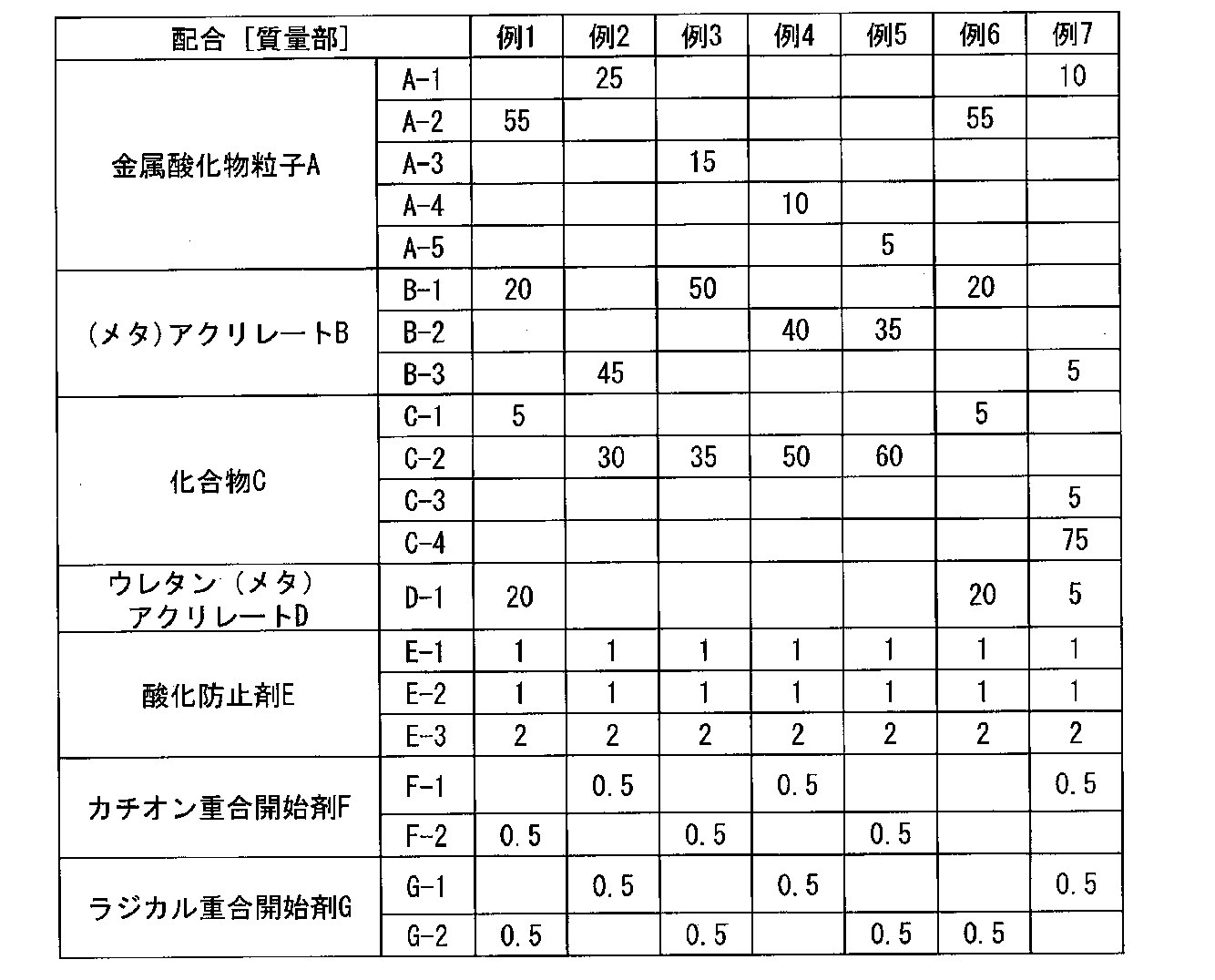

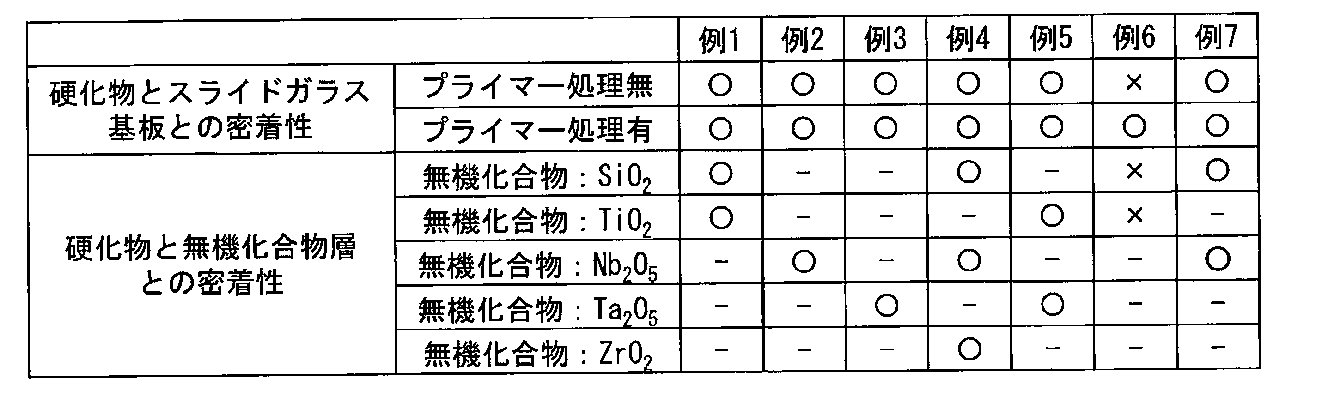
表3に示すように、金属酸化物微粒子A、(メタ)アクリレートB、化合物C、酸化防止剤、カチオン重合開始剤、及びラジカル重合開始剤を含み、酸素原子を有するカチオン重合性反応基の物質量が特定の範囲に制御された例1~5、7では、硬化物とガラス基材及び無機化合物層との密着性が優れていた。
上記成分に加えて、ウレタン(メタ)アクリレートDをさらに含む例1および7では、耐湿熱試験後の透過率が高かった。
一方、カチオン重合開始剤を含まない例6では、硬化物と無機化合物層との密着性が劣っており、プライマー処理してないガラス基材と硬化物との密着性も劣っていた。
上記成分に加えて、ウレタン(メタ)アクリレートDをさらに含む例1および7では、耐湿熱試験後の透過率が高かった。
一方、カチオン重合開始剤を含まない例6では、硬化物と無機化合物層との密着性が劣っており、プライマー処理してないガラス基材と硬化物との密着性も劣っていた。
なお、2019年2月15日に出願された日本特許出願2019-025667号の明細書、特許請求の範囲、図面、および要約書の全内容をここに引用し、本発明の明細書の開示として、取り入れるものである。
Claims (15)
- 芳香族環を有さず、メディアン径が5~20nmである金属酸化物微粒子Aと、
脂環式縮合環を有し、単独重合体のガラス転移温度が90~350℃である(メタ)アクリレートBと、
前記(メタ)アクリレートBを除く、酸素原子を有するカチオン重合性反応基を有する化合物Cと、
酸化防止剤と、
カチオン重合開始剤と、
ラジカル重合開始剤と、を含み、
前記(メタ)アクリレートB及び前記化合物Cを除く、芳香族環を有さないウレタン(メタ)アクリレートDをさらに含んでいてもよい硬化性組成物であって、
前記酸化防止剤は、フェノール部位を有する酸化防止剤とスルフィド部位を有する酸化防止剤とを含むか、フェノール部位を有する酸化防止剤とスルフィド部位を有する酸化防止剤とフェノール部位とスルフィド部位を有する酸化防止剤とを含むか、又はフェノール部位とスルフィド部位を有する酸化防止剤を含み、
前記硬化性組成物中の酸素原子を有するカチオン重合性反応基の物質量が、前記硬化性組成物1gあたり、0.10~10mmol/gである、硬化性組成物。 - 前記金属酸化物微粒子A、前記(メタ)アクリレートB、前記化合物C、及び前記ウレタン(メタ)アクリレートDの合計質量のうち、前記金属酸化物微粒子Aの割合が3~55質量%であり、前記(メタ)アクリレートBの割合が3~70質量%であり、前記化合物Cの割合が3~80質量%であり、前記ウレタン(メタ)アクリレートDの割合が0~80質量%であり、
前記金属酸化物微粒子A、前記(メタ)アクリレートB、前記化合物C、及び前記ウレタン(メタ)アクリレートDの合計質量100質量部に対して、前記酸化防止剤の割合が0.1~10質量部であり、前記カチオン重合開始剤の割合が0.1~10質量部であり、前記ラジカル重合開始剤の割合が0.1~10質量部である、請求項1に記載の硬化性組成物。 - 前記金属酸化物微粒子A、前記(メタ)アクリレートB、前記化合物C、及び前記ウレタン(メタ)アクリレートDの合計質量のうち、前記化合物Cの割合が10~80質量%である、請求項1又は2に記載の硬化性組成物。
- 前記(メタ)アクリレートBにおける脂環式縮合環が、ノルボルニル基、イソボルニル基、トリシクロデカニル基、ジシクロペンタニル基、テトラシクロドデカニル基、ノルアダマンチル基、アダマンチル基及びアマンチル基からなる群から選ばれる少なくとも1種の基に由来する環である、請求項1~3のいずれか一項に記載の硬化性組成物。
- 前期化合物Cが、分子内にエポキシ基を1個以上有する化合物、または分子内にオキセタン基を1個以上有する化合物である、請求項1~4のいずれか一項に記載の硬化性組成物。
- 前記化合物Cが、前記(メタ)アクリレートBを除く、芳香族環を有さず、エチレン性不飽和基の物質量が0.1~3.0mmol/gであるエポキシ(メタ)アクリレートである、請求項1~5のいずれか一項に記載の硬化性組成物。
- 前記金属酸化物微粒子Aの金属種が、Si、Zr、Ti、Al、Ce、Fe、W、Zn及びYからなる群から選ばれる少なくとも1種である、請求項1~6のいずれか一項に記載の硬化性組成物。
- 前記金属酸化物微粒子Aが、SiO2微粒子、ZrO2微粒子、TiO2微粒子、Al2O3微粒子、CeO2微粒子、Fe3O4微粒子、WO3微粒子、ZnO微粒子、及びY2O3微粒子からなる群から選ばれる少なくとも1種である、請求項1~7のいずれか一項に記載の硬化性組成物。
- 前記カチオン重合開始剤が、アリールスルホニウム塩、ジアリールスルホニウム塩、トリアリールスルホニウム塩、フェナシルスルホニウム塩、アルキルベンジルスルホニウム塩、ジアリールヨードニウム塩、およびスルホニルジアゾメタンから選択される光カチオン重合開始剤、および/またはベンジルスルホニウム塩、ベンジルアンモニウム塩、ホスホニウム塩、アリールスルホニウム塩、ジアリールスルホニウム塩、およびトリアリールスルホルニウム塩から選択される熱カチオン重合開始剤である、請求項1~8のいずれか一項に記載の硬化性組成物。
- 前記ラジカル重合開始剤が、アルキルフェノン系、アシルホスフィンオキシド系、チタノセン系、オキシムエステル系、オキシフェニル酢酸エステル系、ベンゾイン系、ベンゾフェノン系、チオキサントン系、ベンジル-(o-エトキシカルボニル)-α-モノオキシム、グリオキシエステル、3-ケトクマリン、2-エチルアンスラキノン、カンファーキノン、テトラメチルチウラムスルフィド、アゾビスイソブチロニトリル、ベンゾイルペルオキシド、ジアルキルペルオキシド、およびtert-ブチルペルオキシピバレートから選択される光ラジカル重合開始剤、および/または2,2’-アゾビスイソブチロニトリル、ベンゾイルペルオキシド、tert-ブチルヒドロペルオキシド、クメンヒドロペルオキシド、ジ-tert-ブチルペルオキシド、およびジクミルペルオキシドから選択される熱ラジカル重合開始剤である、請求項1~9のいずれか一項に記載の硬化性組成物。
- 前記硬化性組成物を硬化した硬化物の厚み1mmあたりの波長400nmの光の透過率が、30%以上である、請求項1~10のいずれか一項に記載の硬化性組成物。
- 請求項1~11のいずれか一項に記載の硬化性組成物が硬化した硬化物。
- 請求項1~11のいずれか一項に記載の硬化性組成物が硬化した硬化物と、前記硬化物上に設けられている無機化合物層とを有する、積層体。
- 前記無機化合物層を形成する無機化合物が、Si、Zn、Zr、Ti、Ta、Nb、In、Sn、Y、W、Al、Cr及びGaからなる群から選ばれる少なくとも1種の金属種を含む、請求項13に記載の積層体。
- 前記無機化合物層を形成する無機化合物が、SiO2、SiC、ZnO、ZrO2、TiO2、Ta2O5、Nb2O5、In2O3、SnO2、Y2O3、WO3、Al2O3、TiC、TiN、Cr2O3及びGa2O3からなる群から選ばれる少なくとも1種である、請求項13又は14に記載の積層体。
Applications Claiming Priority (2)
| Application Number | Priority Date | Filing Date | Title |
|---|---|---|---|
| JP2019025667A JP2022059093A (ja) | 2019-02-15 | 2019-02-15 | 硬化性組成物、硬化物及び積層体 |
| JP2019-025667 | 2019-02-15 |
Publications (1)
| Publication Number | Publication Date |
|---|---|
| WO2020166533A1 true WO2020166533A1 (ja) | 2020-08-20 |
Family
ID=72044362
Family Applications (1)
| Application Number | Title | Priority Date | Filing Date |
|---|---|---|---|
| PCT/JP2020/004970 Ceased WO2020166533A1 (ja) | 2019-02-15 | 2020-02-07 | 硬化性組成物、硬化物及び積層体 |
Country Status (2)
| Country | Link |
|---|---|
| JP (1) | JP2022059093A (ja) |
| WO (1) | WO2020166533A1 (ja) |
Cited By (1)
| Publication number | Priority date | Publication date | Assignee | Title |
|---|---|---|---|---|
| US20240111077A1 (en) * | 2022-09-16 | 2024-04-04 | Canon Kabushiki Kaisha | Optical element, optical apparatus, and image pickup apparatus |
Citations (6)
| Publication number | Priority date | Publication date | Assignee | Title |
|---|---|---|---|---|
| JP2000336127A (ja) * | 1999-05-28 | 2000-12-05 | Shin Etsu Chem Co Ltd | 光硬化性樹脂組成物並びに光ファイバー用被覆材及び光ファイバー |
| JP2009244860A (ja) * | 2008-03-10 | 2009-10-22 | Sumitomo Chemical Co Ltd | 偏光板、光学部材および液晶表示装置 |
| JP2014232206A (ja) * | 2013-05-29 | 2014-12-11 | 東洋インキScホールディングス株式会社 | 感光性樹脂組成物および硬化膜 |
| WO2015002269A1 (ja) * | 2013-07-04 | 2015-01-08 | 東洋インキScホールディングス株式会社 | 活性エネルギー線重合性樹脂組成物及び積層体 |
| WO2017099184A1 (ja) * | 2015-12-09 | 2017-06-15 | 旭硝子株式会社 | 硬化性組成物および硬化物 |
| WO2019069594A1 (ja) * | 2017-10-05 | 2019-04-11 | Agc株式会社 | 硬化性組成物及び硬化物 |
-
2019
- 2019-02-15 JP JP2019025667A patent/JP2022059093A/ja active Pending
-
2020
- 2020-02-07 WO PCT/JP2020/004970 patent/WO2020166533A1/ja not_active Ceased
Patent Citations (6)
| Publication number | Priority date | Publication date | Assignee | Title |
|---|---|---|---|---|
| JP2000336127A (ja) * | 1999-05-28 | 2000-12-05 | Shin Etsu Chem Co Ltd | 光硬化性樹脂組成物並びに光ファイバー用被覆材及び光ファイバー |
| JP2009244860A (ja) * | 2008-03-10 | 2009-10-22 | Sumitomo Chemical Co Ltd | 偏光板、光学部材および液晶表示装置 |
| JP2014232206A (ja) * | 2013-05-29 | 2014-12-11 | 東洋インキScホールディングス株式会社 | 感光性樹脂組成物および硬化膜 |
| WO2015002269A1 (ja) * | 2013-07-04 | 2015-01-08 | 東洋インキScホールディングス株式会社 | 活性エネルギー線重合性樹脂組成物及び積層体 |
| WO2017099184A1 (ja) * | 2015-12-09 | 2017-06-15 | 旭硝子株式会社 | 硬化性組成物および硬化物 |
| WO2019069594A1 (ja) * | 2017-10-05 | 2019-04-11 | Agc株式会社 | 硬化性組成物及び硬化物 |
Cited By (1)
| Publication number | Priority date | Publication date | Assignee | Title |
|---|---|---|---|---|
| US20240111077A1 (en) * | 2022-09-16 | 2024-04-04 | Canon Kabushiki Kaisha | Optical element, optical apparatus, and image pickup apparatus |
Also Published As
| Publication number | Publication date |
|---|---|
| JP2022059093A (ja) | 2022-04-13 |
Similar Documents
| Publication | Publication Date | Title |
|---|---|---|
| US11427696B2 (en) | Curable composition and cured product | |
| TWI409306B (zh) | Hard coating | |
| TWI488910B (zh) | 光硬化性樹脂組成物、使用其的光學膜的製造方法及含有其的光學膜 | |
| JP7396019B2 (ja) | 硬化性組成物、硬化物及び積層体 | |
| JP7000858B2 (ja) | 硬化性組成物および硬化物 | |
| KR101679137B1 (ko) | 수지 조성물, 그것을 사용한 터치 패널 센서용 투명막 및 터치 패널 | |
| JP6206188B2 (ja) | 指紋付着防止剤組成物、指紋付着防止剤の製造方法、ハードコート用組成物、ハードコート層を有する基材およびタッチパネル | |
| CN115305020B (zh) | 一种可紫外光固化封装薄膜用胶水及其使用方法 | |
| TW202007732A (zh) | 抗反射膜、具此抗反射膜之偏光板、及含此抗反射膜及/或含具此抗反射膜之偏光板的影像顯示裝置 | |
| WO2014157588A1 (ja) | コーティング組成物 | |
| JP2024510228A (ja) | 粘着剤組成物、これを用いて製造された粘着シート、光学部材および表示装置 | |
| WO2020101028A1 (ja) | 樹脂組成物、光ファイバ及び光ファイバの製造方法 | |
| CN117480412A (zh) | 硬涂膜、光学构件及图像显示装置 | |
| JP2022059093A (ja) | 硬化性組成物、硬化物及び積層体 | |
| JP4775603B2 (ja) | 反射防止用積層体およびその製造方法、ならびに硬化性組成物 | |
| JP5596920B2 (ja) | 透明被膜形成用塗料および透明被膜付基材 | |
| TWI895588B (zh) | 含鋯元素之樹脂組成物 | |
| CN111574663B (zh) | 固化性组合物、固化物及层叠体 | |
| JP4831377B2 (ja) | 反射防止用積層体およびその製造方法、ならびに硬化性組成物 | |
| KR101493233B1 (ko) | 플라스틱 표면 처리용 자외선 경화형 수지 조성물 및 이를 이용한 플라스틱 표면 처리방법 | |
| TWI900012B (zh) | 活性光線硬化性組成物及硬化膜 | |
| JP5827475B2 (ja) | 光学フィルム用基材及び光学フィルムの製造方法 | |
| KR102902454B1 (ko) | 차광용 자외선 경화성 조성물, 차광막, 및, 차광막을 갖는 물품을 제조하는 방법 | |
| WO2025211362A1 (ja) | 反射防止フィルム | |
| JP2017198797A (ja) | 光硬化性樹脂成形体、これを用いた偏光板および透過型液晶ディスプレイ |
Legal Events
| Date | Code | Title | Description |
|---|---|---|---|
| 121 | Ep: the epo has been informed by wipo that ep was designated in this application |
Ref document number: 20754882 Country of ref document: EP Kind code of ref document: A1 |
|
| NENP | Non-entry into the national phase |
Ref country code: DE |
|
| 122 | Ep: pct application non-entry in european phase |
Ref document number: 20754882 Country of ref document: EP Kind code of ref document: A1 |
|
| NENP | Non-entry into the national phase |
Ref country code: JP |