WO2020153425A1 - 硬化性組成物および硬化膜 - Google Patents
硬化性組成物および硬化膜 Download PDFInfo
- Publication number
- WO2020153425A1 WO2020153425A1 PCT/JP2020/002318 JP2020002318W WO2020153425A1 WO 2020153425 A1 WO2020153425 A1 WO 2020153425A1 JP 2020002318 W JP2020002318 W JP 2020002318W WO 2020153425 A1 WO2020153425 A1 WO 2020153425A1
- Authority
- WO
- WIPO (PCT)
- Prior art keywords
- curable composition
- group
- hydrogen atom
- mass
- alkyl group
- Prior art date
- Legal status (The legal status is an assumption and is not a legal conclusion. Google has not performed a legal analysis and makes no representation as to the accuracy of the status listed.)
- Ceased
Links
Classifications
-
- C—CHEMISTRY; METALLURGY
- C08—ORGANIC MACROMOLECULAR COMPOUNDS; THEIR PREPARATION OR CHEMICAL WORKING-UP; COMPOSITIONS BASED THEREON
- C08F—MACROMOLECULAR COMPOUNDS OBTAINED BY REACTIONS ONLY INVOLVING CARBON-TO-CARBON UNSATURATED BONDS
- C08F20/00—Homopolymers and copolymers of compounds having one or more unsaturated aliphatic radicals, each having only one carbon-to-carbon double bond, and only one being terminated by only one carboxyl radical or a salt, anhydride, ester, amide, imide or nitrile thereof
- C08F20/02—Monocarboxylic acids having less than ten carbon atoms, Derivatives thereof
- C08F20/10—Esters
- C08F20/34—Esters containing nitrogen, e.g. N,N-dimethylaminoethyl (meth)acrylate
- C08F20/36—Esters containing nitrogen, e.g. N,N-dimethylaminoethyl (meth)acrylate containing oxygen in addition to the carboxy oxygen, e.g. 2-N-morpholinoethyl (meth)acrylate or 2-isocyanatoethyl (meth)acrylate
Definitions
- the present invention relates to a curable composition and a cured film.
- composition that polymerizes and cures a polymerizable compound by light irradiation or heating is used in industrial applications such as coating materials, paints, printing inks, adhesives, optical materials, laminate materials for electronic products, electrical insulating materials, and resist materials. Widely used in.
- Patent Document 1 describes a curable composition containing a photopolymerizable compound containing an amine structure.
- curable compositions are required to retain their initial curability even after being stored for a long period of time.
- an object of the present invention is to provide a curable composition and a cured film having excellent curability after aging.
- the present inventors have conducted extensive studies to solve the above-mentioned problems, and as a result, a curable composition containing a compound represented by the formula (1) described later in an amount of more than 60.0 mass% in a solid content was found to be aged. It has been found that the curability of is excellent, and the present invention has been completed.
- the present invention is the following [1] to [4].
- [1] A curable composition containing more than 60.0 mass% of a compound represented by the formula (1) described below in the solid content.
- [2] The curable composition according to the above [1], wherein R 3 in the formula (1) is an alkyl group having 4 or less carbon atoms.
- [3] The curable composition according to the above [1] or [2], which contains more than 65.0% by mass of the compound represented by the formula (1) in the solid content.
- [4] A cured film obtained by curing the curable composition according to any one of the above [1] to [3].
- the range represented by “to” in this specification includes both ends of “to”.
- the range represented by “AB” includes A and B.
- the solid content means the components contained in the composition excluding the solvent, and is calculated as the solid content even if the property is liquid.
- the mechanism by which the curable composition of the present invention is excellent in curability after aging is not clear, but it is considered as follows. Since the compound represented by the formula (1) has a urethane moiety and forms a hydrogen bond between the monomers, decomposition by water is unlikely to occur, and decomposition due to reaction between the monomers is unlikely to occur. However, the effect of making this decomposition less likely to occur becomes stronger when the content of the compound represented by formula (1) in the curable composition is somewhat, specifically, more than 60.0% by mass. To do.
- the curable composition of the present invention contains the compound represented by formula (1) in an amount of more than 60.0% by mass in the solid content. ⁇ Compound represented by formula (1)>
- R 1 and R 2 each independently represent a hydrogen atom or an alkyl group, preferably a hydrogen atom or an alkyl group having 4 or less carbon atoms, more preferably a hydrogen atom or a methyl group, and a methyl group. It is more preferable that there is.
- examples of the alkyl group having 4 or less carbon atoms include methyl group, ethyl group, propyl group (n-propyl group), 1-methylethyl group (isopropyl group), butyl group (n-butyl group), 1-methyl Examples thereof include a propyl group (sec-butyl group), a 2-methylpropyl group (isobutyl group), and a 1,1-dimethylethyl group (tert-butyl group).
- R 1 is plural, R 1 may be different or may be the same as each other.
- R 2 is plural, plural R 2 may be the same as or different from each other.
- R 3 represents a hydrogen atom or a monovalent substituent, and is preferably a hydrogen atom, an alkyl group, an aryl group, or a group represented by the formula (X), and from the viewpoint of coatability and film surface state, More preferably, it is an alkyl group.
- the alkyl group is preferably an alkyl group having 12 or less carbon atoms, more preferably an alkyl group having 4 or less carbon atoms, and further preferably a methyl group.
- the alkyl group may be linear or branched. Examples of the alkyl group having 4 or less carbon atoms include those mentioned above.
- alkyl group having 5 to 12 carbon atoms examples include pentyl group (n-pentyl group), 2,2-dimethylpropyl group (neopentyl group), 3-methylbutyl group (isopentyl group), 1-methylbutyl group (sec- Pentyl group), 1-ethylpropyl group (3-pentyl group), 1,1-dimethylpropyl group (tert-pentyl group), hexyl group, heptyl group, octyl group, nonyl group, decyl group, undecyl group, and dodecyl group. Groups, but are not limited thereto.
- R 5 represents a hydrogen atom or an alkyl group, preferably a hydrogen atom or an alkyl group having 4 or less carbon atoms, and a hydrogen atom, a methyl group, an ethyl group, a propyl group, or a propan-2-yl group. Is more preferable, and a hydrogen atom or a methyl group is further preferable.
- R 1C represents an oxygen atom or —NR 103 —.
- R 103 represents a hydrogen atom or an alkyl group, preferably a hydrogen atom or an alkyl group having 4 or less carbon atoms, and a hydrogen atom, a methyl group, an ethyl group, a propyl group, or a propan-2-yl group. Is more preferable, a hydrogen atom or a methyl group is further preferable, and a hydrogen atom is further preferable.
- R 1C is preferably an oxygen atom (—O—) or —NH—, and more preferably an oxygen atom (—O—).
- L 5 contains a urethane bond and may contain —O— or —NR 301 —, a divalent aliphatic hydrocarbon group containing no ring structure, or a urethane bond, —O— or — NR 301 -may be included and represents a divalent hydrocarbon group containing an aromatic ring structure.
- R 301 represents a hydrogen atom or an alkyl group, preferably a hydrogen atom or an alkyl group having 4 or less carbon atoms, more preferably a hydrogen atom or a methyl group, and further preferably a hydrogen atom.
- R 1A and R 1B each independently represent an oxygen atom or —NR 101 —, and preferably an oxygen atom.
- R 101 represents a hydrogen atom or an alkyl group, preferably a hydrogen atom or an alkyl group having 4 or less carbon atoms, more preferably a hydrogen atom or a methyl group, and further preferably a hydrogen atom. Examples of the alkyl group having 4 or less carbon atoms include those mentioned above.
- R 1A is plural, R 1A may be different may be the same as each other.
- R 2A is a plurality, the plurality of R 2A may be different may be the same as each other.
- L 1 contains a urethane bond and may contain —O— or —NR 201 —, an a+1-valent aliphatic hydrocarbon group containing no ring structure, or a urethane bond, —O— or — NR 201 -may be included and represents an a+1-valent hydrocarbon group containing an aromatic ring structure.
- R 201 represents a hydrogen atom or an alkyl group, preferably a hydrogen atom or an alkyl group having 4 or less carbon atoms, more preferably a hydrogen atom or a methyl group, and further preferably a hydrogen atom.
- L 3 contains a urethane bond and may contain —O— or —NR 301 —, and contains a c+1-valent aliphatic hydrocarbon group containing no ring structure, or contains a urethane bond, —O— or — NR 301 -may be included and represents a c+1-valent hydrocarbon group containing an aromatic ring structure.
- R 301 represents a hydrogen atom or an alkyl group, preferably a hydrogen atom or an alkyl group having 4 or less carbon atoms, more preferably a hydrogen atom or a methyl group, and further preferably a hydrogen atom.
- R 1 , R 2 , R 1A , R 1B , and R 3 have the same meanings as the same symbols in formula (1).
- L 1 and L 3 are independently -(CH 2 ) p -[O-(CH 2 ) q ] r -. It is preferably NH—CO—O—(CH 2 ) s— [O—(CH 2 ) t ] u ⁇ .
- p, q, s, and t each independently represent an integer of 2 to 10, and preferably an integer of 2 to 3.
- r and u each independently represent an integer of 0 to 10, preferably an integer of 0 to 3.
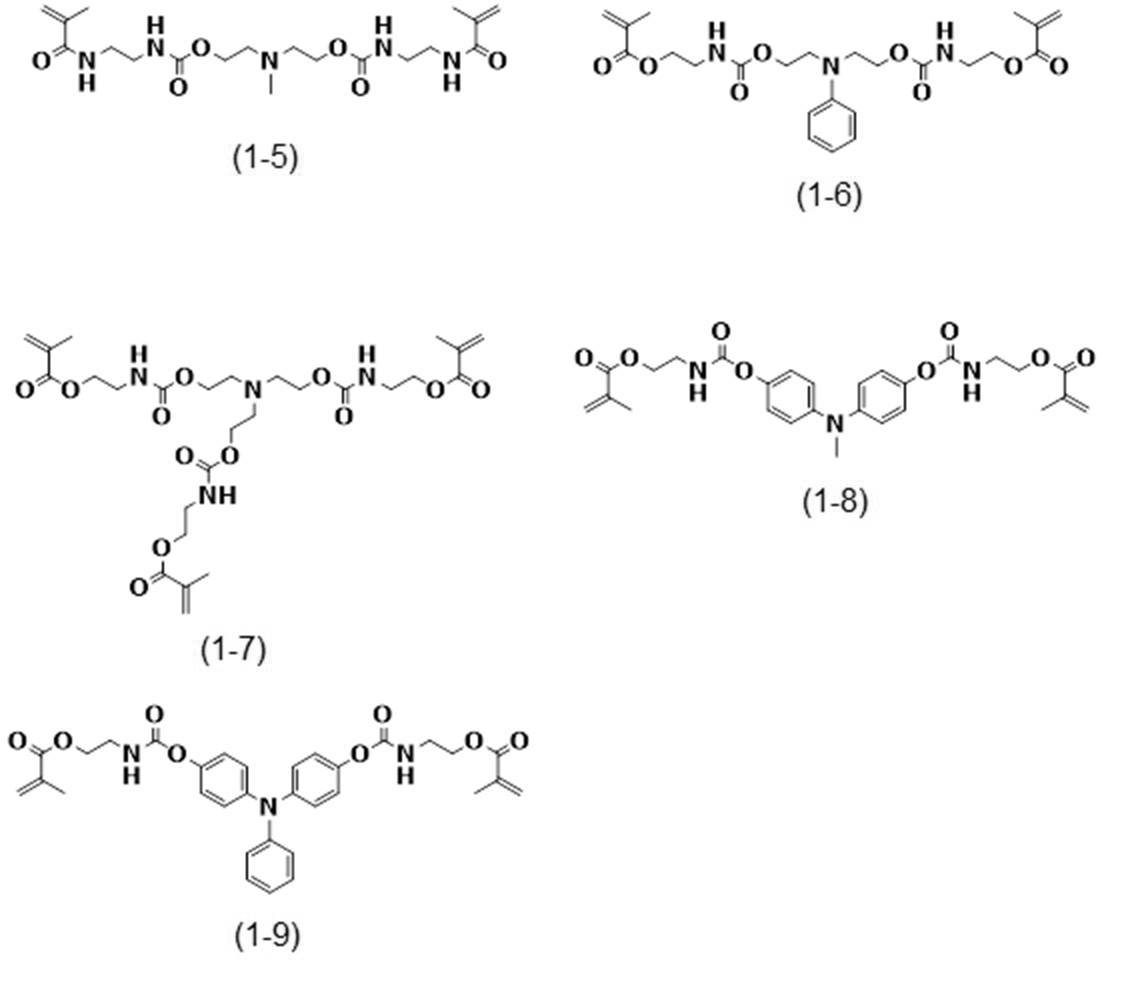
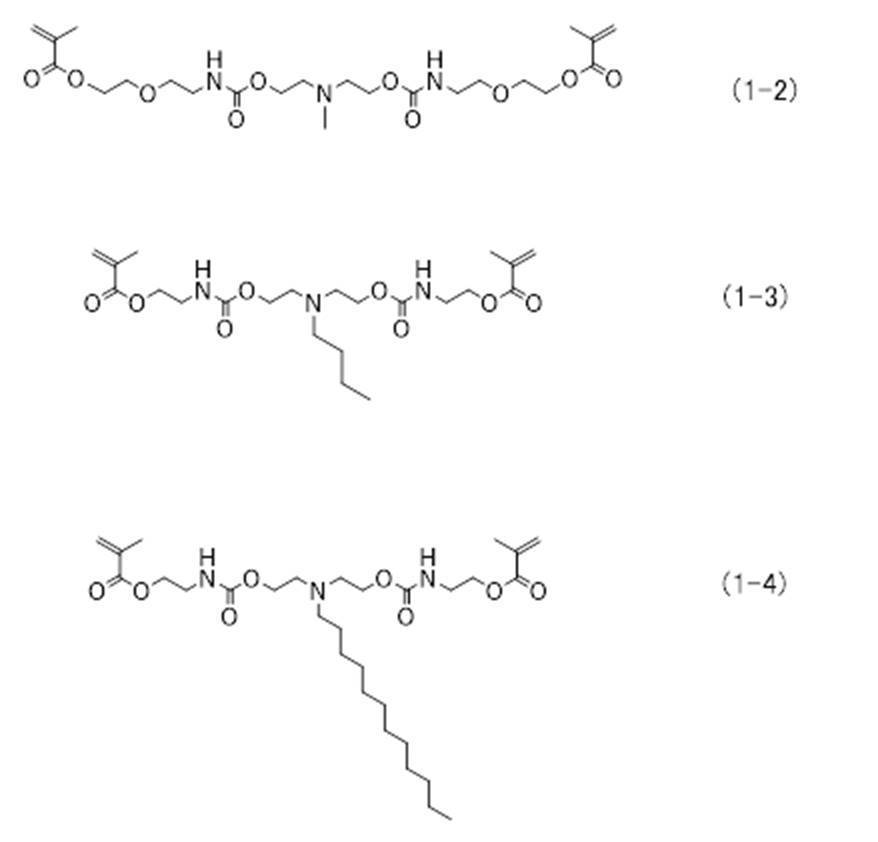
- Specific examples of the compound represented by the formula (1) include compounds represented by any one of the formulas (1-1) to (1-9), but are not limited thereto. Absent.
- the content of the compound represented by the formula (1) in the curable composition of the present invention should be more than 60.0 mass% in the solid content (based on the solid content) of the curable composition of the present invention. Although not particularly limited, it is preferably more than 65.0% by mass, more preferably 80.0% by mass or more, and further preferably 95.0% by mass or more. Although the upper limit is not particularly limited, for example, it is preferably less than 100% by mass, and more preferably 99.9% by mass or less.
- composition for forming a cured film of the present invention in addition to the above-described compound (1), other monomers, surfactants, polymerization initiators, polymerization inhibitors, solvents, etc., as long as they do not impair the effects of the present invention. You may further contain components other than a compound (1).
- ⁇ Other monomers In the curable composition, a commercially available monofunctional monomer and/or polyfunctional monomer is used in combination with the compound represented by the formula (1) for the purpose of adjusting the mechanical properties of the cured film (tensile strength, abrasion resistance, etc.). You may.
- the content of the other monomer in the curable composition is not particularly limited, but is 0.0% by mass relative to the solid content of the curable composition of the present invention. It is preferably less than 40.0% by mass.
- the content of the other monomer in the curable composition is 0.0% by mass with respect to the solid content of the curable composition, which means that the curable composition does not contain the other monomer. ..
- a commercially available surfactant may be added in order to adjust the wettability and leveling property of the curable composition to the substrate.
- the content of the surfactant in the curable composition when the curable composition contains a surfactant is not particularly limited, but is 0.0% by mass based on the solid content of the curable composition of the present invention. It is preferably 3.0% by mass or less.
- the content of the surfactant in the curable composition is 0.0% by mass based on the total mass of the solid content of the curable composition, and the curable composition does not contain the surfactant.
- the polymerization initiator is not particularly limited, for example, a photoradical polymerization initiator, a photopolymerization initiator such as a photocationic polymerization initiator and a photoanionic polymerization initiator, and a thermal radical polymerization initiator and a thermal cationic polymerization initiator.
- a thermal polymerization initiator may be used.
- the content of the polymerization initiator in the curable composition of the present invention when the curable composition of the present invention contains a polymerization initiator is not particularly limited, but with respect to the solid content of the curable composition of the present invention. 0.1 mass% to 10.0 mass% is preferable, 0.5 mass% to 8.0 mass% is more preferable, and 1.0 mass% to 5.0 mass% is preferable. Is more preferable.
- a commercially available polymerization inhibitor may be added to the curable composition in order to improve the storage stability of the compound represented by formula (1) and the curable composition.
- the content of the polymerization inhibitor in the curable composition is not particularly limited, 0.0005 mass% relative to the solid content of the curable composition of the present invention. It is preferably from about 1.0% by mass.
- solvent The solvent is not particularly limited, but alcohols, ketones, or mixed solvents thereof are preferable, and alcohols having 3 or less carbon atoms, ketones having 4 or less carbon atoms, or mixed solvents thereof are more preferable.
- the content of the solvent in the curable composition of the present invention when the curable composition of the present invention contains a solvent is not particularly limited, but is 10.0 with respect to the total mass of the curable composition of the present invention.
- the content is preferably 9% by mass to 95.0% by mass, more preferably 30.0% by mass to 90.0% by mass, and further preferably 50.0% by mass to 80.0% by mass.
- the curable composition of the present invention may further contain other additives, if necessary.
- the additives include tackifiers, chain transfer agents, sensitizing dyes, polymerization inhibition inhibitors, surface lubricants, leveling agents, antioxidants, corrosion inhibitors, light stabilizers, ultraviolet absorbers, silane coupling agents. Agents, fillers, metal powders and pigments.
- the additives are not limited to these. The kind and content of the additive can be appropriately selected.
- the cured film of the present invention is a cured film obtained by curing the curable composition of the present invention described above.
- the method for producing a cured film is not particularly limited, but it is preferable to dispose the curable composition of the present invention on a substrate to form a curable composition film and cure the curable composition film.
- the method of forming the curable composition film on the substrate is not particularly limited, and for example, gravure coater, comma coater, bar coater, knife coater, die coater, roll coater, spin coating, dipping, painting, or the like. There is a method.
- the method for curing the curable composition film is not particularly limited, but irradiation with light or heating is preferable, and irradiation with light is more preferable.
- the heat resistance of the substrate is low, it is preferable to cure it by irradiation with light.
- the light irradiation may be appropriately selected from visible rays, ultraviolet rays, electron beams, gamma rays and the like.
- the substrate is not particularly limited, but examples thereof include a glass substrate and a resin substrate.
- glass substrates include soda-lime glass substrates, borosilicate glass substrates, and quartz glass substrates.
- the shape of the glass substrate is not particularly limited, but a plate shape is preferable.
- the surface of the glass substrate may be coated or may be modified by plasma treatment or the like.
- the resin substrate include a polyester resin substrate, a polyimide resin substrate, an epoxy resin substrate, a polyether resin substrate, and a polystyrene resin substrate.
- the shape of the resin substrate is not particularly limited, but it is preferably a plate shape or a film shape.
- the surface of the resin base material may be coated or may be modified by plasma treatment or the like.
- composition of the present invention is suitable for use in pattern formation using a curing reaction such as photolithography.
- a curing reaction such as photolithography.
- printing applications such as planographic printing plates, flexographic printing plates and UV inkjet inks, and semiconductor resist material applications are preferable.
- the prepared curable composition was stored at 60° C. for 1 month.
- the curable composition after storage may be referred to as a curable composition after aging.
- the curable composition before and after aging was adjusted with a bar coater so that the thickness after drying was 5 ⁇ m, and an easily-adhesive PET (polyethylene terephthalate) film (Cosmoshine A4100, The product was applied onto Toyobo Co., Ltd.; thickness 100 ⁇ m) and dried to form a curable composition film. Then, the curable composition film was irradiated with ultraviolet rays using an ultraviolet exposure device (HMW-680GW, manufactured by Oak Manufacturing Co., Ltd.).
- HMW-680GW an ultraviolet exposure device
- the curability after aging was evaluated in three grades A to C.
- the evaluation results are shown in Table 1.
- TEGDMA triethylene glycol dimethacrylate, compound represented by the following formula; manufactured by Sigma-Aldrich
- Omnirad 2959 manufactured by IGM Resins
- Omnirad 1173 made by IGM Resins
- Minirad is a registered trademark.
- the curable compositions of Examples 1 to 7 had good curability after aging. From the comparison between Example 1 and Example 3 and the comparison between Example 6 and Example 7, the higher the content, the better the evaluation of the curability after aging, regardless of the type of the monomer. Was suggested. Further, it was suggested that the use of the compound (1-1) in which R 3 in the formula (1) has a small number of carbon atoms results in better curability after aging.
Landscapes
- Chemical & Material Sciences (AREA)
- Health & Medical Sciences (AREA)
- Chemical Kinetics & Catalysis (AREA)
- Medicinal Chemistry (AREA)
- Polymers & Plastics (AREA)
- Organic Chemistry (AREA)
- Polymerisation Methods In General (AREA)
Abstract
本発明は、経時後の硬化性に優れた硬化性組成物および硬化膜を提供する。本発明の硬化性組成物は、式(1)で表される化合物を固形分中に60.0質量%超含む。
Description
本発明は、硬化性組成物および硬化膜に関する。
光照射または加熱により重合性化合物を重合させて硬化する組成物は、コーティング材、塗料、印刷インク、接着剤、光学材料、電子製品の積層材料、電気絶縁材料、およびレジスト材などの工業的用途に幅広く利用されている。
例えば、特許文献1には、アミン構造を含む光重合性化合物を含む硬化性組成物が記載されている。
一方で、硬化性組成物には、長期間保存した後であっても、初期の硬化性を保持することが求められている。
そこで、本発明は、経時後の硬化性に優れた硬化性組成物および硬化膜を提供することを課題とする。
本発明者らは、上記課題を解決すべく鋭意検討を重ねた結果、後述する式(1)で表される化合物を固形分中に60.0質量%超含む硬化性組成物は、経時後の硬化性に優れることを知得し、本発明を完成させた。
すなわち、本発明は以下の[1]~[4]である。
[1] 後述する式(1)で表される化合物を固形分中に60.0質量%超含む硬化性組成物。
[2] 式(1)中のR3が炭素数4以下のアルキル基である、上記[1]に記載の硬化性組成物。
[3] 式(1)で表される化合物を固形分中に65.0質量%超含む、上記[1]または[2]に記載の硬化性組成物。
[4] 上記[1]~[3]のいずれか1つに記載の硬化性組成物を硬化して得られる硬化膜。
[1] 後述する式(1)で表される化合物を固形分中に60.0質量%超含む硬化性組成物。
[2] 式(1)中のR3が炭素数4以下のアルキル基である、上記[1]に記載の硬化性組成物。
[3] 式(1)で表される化合物を固形分中に65.0質量%超含む、上記[1]または[2]に記載の硬化性組成物。
[4] 上記[1]~[3]のいずれか1つに記載の硬化性組成物を硬化して得られる硬化膜。
本発明によれば、経時後の硬化性に優れた硬化性組成物および硬化膜を提供できる。
本明細書において「~」を用いて表される範囲には、「~」の両端を含むものとする。例えば、「A~B」と表される範囲には、AおよびBを含む。
本明細書において、固形分とは、溶媒を除いた組成物に含まれる成分を意図し、その性状が液状であっても固形分として計算する。
本発明の硬化性組成物が経時後の硬化性に優れるメカニズムは明らかではないが、次のように考えられる。
式(1)で表される化合物はウレタン部位を有しており、モノマー間で水素結合を形成しているため、水による分解が起こりにくく、かつ、モノマー同士が反応することによる分解も起こりにくくなることによるが、この分解を起こりにくくする効果は、硬化性組成物中の式(1)で表される化合物の含有量がある程度、具体的には60.0質量%超で、より強く発現する。
式(1)で表される化合物はウレタン部位を有しており、モノマー間で水素結合を形成しているため、水による分解が起こりにくく、かつ、モノマー同士が反応することによる分解も起こりにくくなることによるが、この分解を起こりにくくする効果は、硬化性組成物中の式(1)で表される化合物の含有量がある程度、具体的には60.0質量%超で、より強く発現する。
[硬化性組成物]
本発明の硬化性組成物は、式(1)で表される化合物を固形分中に60.0質量%超含む。
〈式(1)で表される化合物〉
本発明の硬化性組成物は、式(1)で表される化合物を固形分中に60.0質量%超含む。
〈式(1)で表される化合物〉

式(1)中、各記号の意味は以下のとおりである。
R1およびR2は、それぞれ独立に、水素原子またはアルキル基を表し、水素原子または炭素数4以下のアルキル基であることが好ましく、水素原子またはメチル基であることがより好ましく、メチル基であることがさらに好ましい。ここで、炭素数4以下のアルキル基としては、メチル基、エチル基、プロピル基(n-プロピル基)、1-メチルエチル基(イソプロピル基)、ブチル基(n-ブチル基)、1-メチルプロピル基(sec-ブチル基)、2-メチルプロピル基(イソブチル基)、および1,1-ジメチルエチル基(tert-ブチル基)が挙げられる。
R1が複数であるとき、複数のR1は互いに同じであってもよいし異なっていてもよい。
R2が複数であるとき、複数のR2は互いに同じであってもよいし異なっていてもよい。
R1およびR2は、それぞれ独立に、水素原子またはアルキル基を表し、水素原子または炭素数4以下のアルキル基であることが好ましく、水素原子またはメチル基であることがより好ましく、メチル基であることがさらに好ましい。ここで、炭素数4以下のアルキル基としては、メチル基、エチル基、プロピル基(n-プロピル基)、1-メチルエチル基(イソプロピル基)、ブチル基(n-ブチル基)、1-メチルプロピル基(sec-ブチル基)、2-メチルプロピル基(イソブチル基)、および1,1-ジメチルエチル基(tert-ブチル基)が挙げられる。
R1が複数であるとき、複数のR1は互いに同じであってもよいし異なっていてもよい。
R2が複数であるとき、複数のR2は互いに同じであってもよいし異なっていてもよい。
R3は、水素原子または1価の置換基を表し、水素原子、アルキル基、アリール基、または式(X)で表される基であることが好ましく、塗布性や膜面状の観点から、アルキル基であることがより好ましい。
アルキル基は、炭素数12以下のアルキル基であることが好ましく、炭素数4以下のアルキル基であることがより好ましく、メチル基であることがさらに好ましい。アルキル基は直鎖状であってもよいし、分岐鎖状であってもよい。
炭素数4以下のアルキル基としては、上述したものが挙げられる。
炭素数5~12のアルキル基としては、例えば、ペンチル基(n-ペンチル基)、2,2-ジメチルプロピル基(ネオペンチル基)、3-メチルブチル基(イソペンチル基)、1-メチルブチル基(sec-ペンチル基)、1-エチルプロピル基(3-ペンチル基)、1,1-ジメチルプロピル基(tert-ペンチル基)、ヘキシル基、ヘプチル基、オクチル基、ノニル基、デシル基、ウンデシル基、およびドデシル基が挙げられるが、これらに限定されるものではない。
炭素数4以下のアルキル基としては、上述したものが挙げられる。
炭素数5~12のアルキル基としては、例えば、ペンチル基(n-ペンチル基)、2,2-ジメチルプロピル基(ネオペンチル基)、3-メチルブチル基(イソペンチル基)、1-メチルブチル基(sec-ペンチル基)、1-エチルプロピル基(3-ペンチル基)、1,1-ジメチルプロピル基(tert-ペンチル基)、ヘキシル基、ヘプチル基、オクチル基、ノニル基、デシル基、ウンデシル基、およびドデシル基が挙げられるが、これらに限定されるものではない。
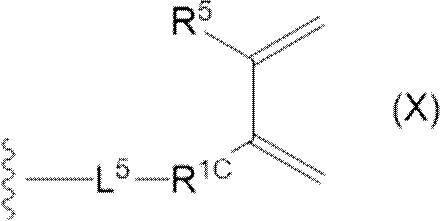
式(X)中、各記号の意味は以下のとおりである。
R5は、水素原子またはアルキル基を表し、水素原子または炭素数4以下のアルキル基であることが好ましく、水素原子、メチル基、エチル基、プロピル基、またはプロパン-2-イル基であることがより好ましく、水素原子またはメチル基であることがさらに好ましい。
R5は、水素原子またはアルキル基を表し、水素原子または炭素数4以下のアルキル基であることが好ましく、水素原子、メチル基、エチル基、プロピル基、またはプロパン-2-イル基であることがより好ましく、水素原子またはメチル基であることがさらに好ましい。
R1Cは、酸素原子または-NR103-を表す。R103は、水素原子またはアルキル基を表し、水素原子または炭素数4以下のアルキル基であることが好ましく、水素原子、メチル基、エチル基、プロピル基、またはプロパン-2-イル基であることがより好ましく、水素原子またはメチル基であることがさらに好ましく、水素原子であることがいっそう好ましい。R1Cは、酸素原子(-O-)または-NH-であることが好ましく、酸素原子(-O-)であることがより好ましい。
L5は、ウレタン結合を含み、-O-もしくは-NR301-を含んでいてもよく、環構造を含まない2価の脂肪族炭化水素基、または、ウレタン結合を含み、-O-もしくは-NR301-を含んでいてもよく、芳香族環構造を含む2価の炭化水素基を表す。
R301は水素原子またはアルキル基を表し、水素原子または炭素数4以下のアルキル基であることが好ましく、水素原子またはメチル基であることがより好ましく、水素原子であることがさらに好ましい。
R301は水素原子またはアルキル基を表し、水素原子または炭素数4以下のアルキル基であることが好ましく、水素原子またはメチル基であることがより好ましく、水素原子であることがさらに好ましい。
R1AおよびR1Bは、それぞれ独立に、酸素原子または-NR101-を表し、酸素原子であることが好ましい。
R101は水素原子またはアルキル基を表し、水素原子または炭素数4以下のアルキル基であることが好ましく、水素原子またはメチル基であることがより好ましく、水素原子であることがさらに好ましい。
炭素数4以下のアルキル基としては、上述したものが挙げられる。
R1Aが複数であるとき、複数のR1Aは互いに同じであってもよいし異なっていてもよい。
R2Aが複数であるとき、複数のR2Aは互いに同じであってもよいし異なっていてもよい。
R101は水素原子またはアルキル基を表し、水素原子または炭素数4以下のアルキル基であることが好ましく、水素原子またはメチル基であることがより好ましく、水素原子であることがさらに好ましい。
炭素数4以下のアルキル基としては、上述したものが挙げられる。
R1Aが複数であるとき、複数のR1Aは互いに同じであってもよいし異なっていてもよい。
R2Aが複数であるとき、複数のR2Aは互いに同じであってもよいし異なっていてもよい。
L1は、ウレタン結合を含み、-O-もしくは-NR201-を含んでいてもよく、環構造を含まないa+1価の脂肪族炭化水素基、または、ウレタン結合を含み、-O-もしくは-NR201-を含んでいてもよく、芳香族環構造を含むa+1価の炭化水素基を表す。
R201は水素原子またはアルキル基を表し、水素原子または炭素数4以下のアルキル基であることが好ましく、水素原子またはメチル基であることがより好ましく、水素原子であることがさらに好ましい。
R201は水素原子またはアルキル基を表し、水素原子または炭素数4以下のアルキル基であることが好ましく、水素原子またはメチル基であることがより好ましく、水素原子であることがさらに好ましい。
L3は、ウレタン結合を含み、-O-もしくは-NR301-を含んでいてもよく、環構造を含まないc+1価の脂肪族炭化水素基、または、ウレタン結合を含み、-O-もしくは-NR301-を含んでいてもよく、芳香族環構造を含むc+1価の炭化水素基を表す。
R301は水素原子またはアルキル基を表し、水素原子または炭素数4以下のアルキル基であることが好ましく、水素原子またはメチル基であることがより好ましく、水素原子であることがさらに好ましい。
R301は水素原子またはアルキル基を表し、水素原子または炭素数4以下のアルキル基であることが好ましく、水素原子またはメチル基であることがより好ましく、水素原子であることがさらに好ましい。
aおよびcは、それぞれ独立に、1~3の整数を表し、a=c=1であることが好ましい。a=c=1であるとき、式(1)は式(2)と一致する。

式(2)中、R1、R2、R1A、R1B、およびR3は、式(1)中の同一の記号と同じ意味である。L1およびL3は、式(1)中の同一の記号のa=c=1であるときと同じ意味である。
a=c=1であるときの式(1)、および式(2)において、L1およびL3は、それぞれ独立に、-(CH2)p-[O-(CH2)q]r-NH-CO-O-(CH2)s-[O-(CH2)t]u-であることが好ましい。ここで、p、q、s、およびtは、それぞれ独立に、2~10の整数を表し、2~3の整数であることが好ましい。rおよびuは、それぞれ独立に、0~10の整数を表し、0~3の整数であることが好ましい。
式(1)で表される化合物の具体例としては、式(1-1)~式(1-9)のいずれか1つで表される化合物が挙げられるが、これらに限定されるものではない。

〈式(1)で表される化合物の含有量〉
本発明の硬化性組成物中の式(1)で表される化合物の含有量は、本発明の硬化性組成物の固形分中(固形分に対して)、60.0質量%超であれば特に限定されないが、65.0質量%超であることが好ましく、80.0質量%以上であることがより好ましく、95.0質量%以上であることがさらに好ましい。上限は特に限定されないが、例えば、100質量%未満であることが好ましく、99.9質量%以下であることがより好ましい。
本発明の硬化性組成物中の式(1)で表される化合物の含有量は、本発明の硬化性組成物の固形分中(固形分に対して)、60.0質量%超であれば特に限定されないが、65.0質量%超であることが好ましく、80.0質量%以上であることがより好ましく、95.0質量%以上であることがさらに好ましい。上限は特に限定されないが、例えば、100質量%未満であることが好ましく、99.9質量%以下であることがより好ましい。
《化合物(1)の合成方法》
化合物(1)は、従来公知の方法によって、容易に合成することができる。
化合物(1)は、従来公知の方法によって、容易に合成することができる。
〈式(1)で表される化合物以外の成分〉
本発明の硬化膜形成用組成物は、本発明の作用効果を妨げない限り、上述した化合物(1)に加えて、他のモノマー、界面活性剤、重合開始剤、重合禁止剤および溶媒など、化合物(1)以外の成分をさらに含んでもよい。
本発明の硬化膜形成用組成物は、本発明の作用効果を妨げない限り、上述した化合物(1)に加えて、他のモノマー、界面活性剤、重合開始剤、重合禁止剤および溶媒など、化合物(1)以外の成分をさらに含んでもよい。
《他のモノマー》
硬化性組成物は、硬化膜の力学物性(引張強度や耐摩耗性など)を調整する目的で、市販の単官能モノマーおよび/または多官能モノマーを、式(1)で表される化合物と併用してもよい。
硬化性組成物は、硬化膜の力学物性(引張強度や耐摩耗性など)を調整する目的で、市販の単官能モノマーおよび/または多官能モノマーを、式(1)で表される化合物と併用してもよい。
(他のモノマーの含有量)
硬化性組成物が他のモノマーを含む場合の硬化性組成物中の他のモノマーの含有量は、特に限定されないが、本発明の硬化性組成物の固形分に対して、0.0質量%超40.0質量%未満であることが好ましい。なお、硬化性組成物中の他のモノマーの含有量が硬化性組成物の固形分に対して0.0質量%であるとは、硬化性組成物が他のモノマーを含まないことを意味する。
硬化性組成物が他のモノマーを含む場合の硬化性組成物中の他のモノマーの含有量は、特に限定されないが、本発明の硬化性組成物の固形分に対して、0.0質量%超40.0質量%未満であることが好ましい。なお、硬化性組成物中の他のモノマーの含有量が硬化性組成物の固形分に対して0.0質量%であるとは、硬化性組成物が他のモノマーを含まないことを意味する。
《界面活性剤》
硬化性組成物の基材への濡れ性やレベリング性を調整するために、市販の界面活性剤を添加してもよい。
硬化性組成物の基材への濡れ性やレベリング性を調整するために、市販の界面活性剤を添加してもよい。
(界面活性剤の含有量)
硬化性組成物が界面活性剤を含む場合の硬化性組成物中の界面活性剤の含有量は、特に限定されないが、本発明の硬化性組成物の固形分に対して、0.0質量%超3.0質量%以下であることが好ましい。なお、硬化性組成物中の界面活性剤の含有量が硬化性組成物の固形分の合計質量に対して0.0質量%であるとは、硬化性組成物が界面活性剤を含まないことを意味する。
硬化性組成物が界面活性剤を含む場合の硬化性組成物中の界面活性剤の含有量は、特に限定されないが、本発明の硬化性組成物の固形分に対して、0.0質量%超3.0質量%以下であることが好ましい。なお、硬化性組成物中の界面活性剤の含有量が硬化性組成物の固形分の合計質量に対して0.0質量%であるとは、硬化性組成物が界面活性剤を含まないことを意味する。
《重合開始剤》
重合開始剤は、特に限定されないが、例えば、光ラジカル重合開始剤、光カチオン重合開始剤および光アニオン重合開始剤などの光重合開始剤、ならびに熱ラジカル重合開始剤および熱カチオン重合開始剤などの熱重合開始剤が挙げられる。
重合開始剤は、特に限定されないが、例えば、光ラジカル重合開始剤、光カチオン重合開始剤および光アニオン重合開始剤などの光重合開始剤、ならびに熱ラジカル重合開始剤および熱カチオン重合開始剤などの熱重合開始剤が挙げられる。
(重合開始剤の含有量)
本発明の硬化性組成物が重合開始剤を含む場合の本発明の硬化性組成物中の重合開始剤の含有量は、特に限定されないが、本発明の硬化性組成物の固形分に対して、0.1質量%~10.0質量%であることが好ましく、0.5質量%~8.0質量%であることがより好ましく、1.0質量%~5.0質量%であることがさらに好ましい。
本発明の硬化性組成物が重合開始剤を含む場合の本発明の硬化性組成物中の重合開始剤の含有量は、特に限定されないが、本発明の硬化性組成物の固形分に対して、0.1質量%~10.0質量%であることが好ましく、0.5質量%~8.0質量%であることがより好ましく、1.0質量%~5.0質量%であることがさらに好ましい。
《重合禁止剤》
硬化性組成物には、式(1)で表される化合物および硬化性組成物の保存安定性を向上させるために、市販の重合禁止剤を添加してもよい。
硬化性組成物には、式(1)で表される化合物および硬化性組成物の保存安定性を向上させるために、市販の重合禁止剤を添加してもよい。
(重合禁止剤の含有量)
硬化性組成物が重合禁止剤を含む場合の硬化性組成物中の重合禁止剤の含有量は、特に限定されないが、本発明の硬化性組成物の固形分に対して、0.0005質量%~1.0質量%であることが好ましい。
硬化性組成物が重合禁止剤を含む場合の硬化性組成物中の重合禁止剤の含有量は、特に限定されないが、本発明の硬化性組成物の固形分に対して、0.0005質量%~1.0質量%であることが好ましい。
《溶媒》
溶媒は、特に限定されないが、アルコール、ケトンまたはこれらの混合溶媒が好ましく、炭素数3以下のアルコール、炭素数4以下のケトンまたはこれらの混合溶媒がより好ましい。
溶媒は、特に限定されないが、アルコール、ケトンまたはこれらの混合溶媒が好ましく、炭素数3以下のアルコール、炭素数4以下のケトンまたはこれらの混合溶媒がより好ましい。
(溶媒の含有量)
本発明の硬化性組成物が溶媒を含む場合の本発明の硬化性組成物中の溶媒の含有量は、特に限定されないが、本発明の硬化性組成物の全質量に対して、10.0質量%~95.0質量%であることが好ましく、30.0質量%~90.0質量%であることがより好ましく、50.0質量%~80.0質量%であることがさらに好ましい。
本発明の硬化性組成物が溶媒を含む場合の本発明の硬化性組成物中の溶媒の含有量は、特に限定されないが、本発明の硬化性組成物の全質量に対して、10.0質量%~95.0質量%であることが好ましく、30.0質量%~90.0質量%であることがより好ましく、50.0質量%~80.0質量%であることがさらに好ましい。
《その他の添加剤》
本発明の硬化性組成物は、必要に応じて、さらに、その他の添加剤を含んでもよい。
添加剤としては、例えば、粘着付与剤、連鎖移動剤、増感色素、重合阻害抑制剤、表面潤滑剤、レベリング剤、酸化防止剤、腐食防止剤、光安定剤、紫外線吸収剤、シランカップリング剤、充填剤、金属粉、および顔料が挙げられる。なお、添加剤は、これらに限定されるものではない。
添加剤の種類、含有量は、適宜選択することができる。
本発明の硬化性組成物は、必要に応じて、さらに、その他の添加剤を含んでもよい。
添加剤としては、例えば、粘着付与剤、連鎖移動剤、増感色素、重合阻害抑制剤、表面潤滑剤、レベリング剤、酸化防止剤、腐食防止剤、光安定剤、紫外線吸収剤、シランカップリング剤、充填剤、金属粉、および顔料が挙げられる。なお、添加剤は、これらに限定されるものではない。
添加剤の種類、含有量は、適宜選択することができる。
[硬化膜]
本発明の硬化膜は、上述した本発明の硬化性組成物を硬化して得られる硬化膜である。
本発明の硬化膜は、上述した本発明の硬化性組成物を硬化して得られる硬化膜である。
〈硬化膜の製造方法〉
硬化膜を製造する方法は、特に限定されないが、基材上に本発明の硬化性組成物を配置して、硬化性組成物膜を形成し、硬化性組成物膜を硬化させることが好ましい。
基材上に硬化性組成物膜を形成する方法は、特に限定されないが、例えば、グラビアコーター、コンマコーター、バーコーター、ナイフコーター、ダイコーター、ロールコーター、スピンコーティング、ディッピング、またはペインティングなどによる方法が挙げられる。
硬化性組成物膜を硬化させる方法は、特に限定されないが、光照射または加熱によることが好ましく、光照射によることがより好ましい。特に、基材の耐熱性が低い場合には、光照射により硬化させることが好ましい。光照射は、可視光線、紫外線、電子線、またはガンマ線など、適宜選択すればよい。
硬化膜を製造する方法は、特に限定されないが、基材上に本発明の硬化性組成物を配置して、硬化性組成物膜を形成し、硬化性組成物膜を硬化させることが好ましい。
基材上に硬化性組成物膜を形成する方法は、特に限定されないが、例えば、グラビアコーター、コンマコーター、バーコーター、ナイフコーター、ダイコーター、ロールコーター、スピンコーティング、ディッピング、またはペインティングなどによる方法が挙げられる。
硬化性組成物膜を硬化させる方法は、特に限定されないが、光照射または加熱によることが好ましく、光照射によることがより好ましい。特に、基材の耐熱性が低い場合には、光照射により硬化させることが好ましい。光照射は、可視光線、紫外線、電子線、またはガンマ線など、適宜選択すればよい。
〈基材〉
基材は、特に限定されないが、例えば、ガラス基材および樹脂基材が挙げられる。
ガラス基材の例は、ソーダ石灰ガラス製基材、ホウケイ酸ガラス製基材、および石英ガラス製基材が挙げられる。ガラス基材の形状は、特に限定されないが、板状であることが好ましい。ガラス基材の表面はコーティングされていてもよいし、プラズマ処理などにより改質されていてもよい。
樹脂基材の例は、ポリエステル系樹脂基材、ポリイミド系樹脂基材、エポキシ系樹脂基材、ポリエーテル系樹脂基材、およびポリスチレン系樹脂基材が挙げられる。樹脂基材の形状は、特に限定されないが、板状またはフィルム状であることが好ましい。樹脂基材の表面はコーティングされていてもよいし、プラズマ処理などにより改質されていてもよい。
基材は、特に限定されないが、例えば、ガラス基材および樹脂基材が挙げられる。
ガラス基材の例は、ソーダ石灰ガラス製基材、ホウケイ酸ガラス製基材、および石英ガラス製基材が挙げられる。ガラス基材の形状は、特に限定されないが、板状であることが好ましい。ガラス基材の表面はコーティングされていてもよいし、プラズマ処理などにより改質されていてもよい。
樹脂基材の例は、ポリエステル系樹脂基材、ポリイミド系樹脂基材、エポキシ系樹脂基材、ポリエーテル系樹脂基材、およびポリスチレン系樹脂基材が挙げられる。樹脂基材の形状は、特に限定されないが、板状またはフィルム状であることが好ましい。樹脂基材の表面はコーティングされていてもよいし、プラズマ処理などにより改質されていてもよい。
〈組成物の用途〉
本発明の組成物は、フォトリソグラフィーなど硬化反応を利用したパターン形成する用途に好適である。例えば、平版印刷版、フレキソ印刷版およびUVインクジェット用インクなどの印刷用途、並びに、半導体レジスト材料用途が好ましい。
本発明の組成物は、フォトリソグラフィーなど硬化反応を利用したパターン形成する用途に好適である。例えば、平版印刷版、フレキソ印刷版およびUVインクジェット用インクなどの印刷用途、並びに、半導体レジスト材料用途が好ましい。
以下では実施例によって本発明をより具体的に説明するが、本発明はこれらの実施例に限定されるものではない。
[合成例1]
1.式(1-1)で表される化合物〔化合物(1-1)〕の合成
N-メチルジエタノールアミン(7g、58.7mmol)、テトラヒドロフラン(100mL)、およびメタクリル酸2-イソシアナトエチル(19.6g、126mmol)を混合した。この混合液に、ネオスタンU600(377mg;日東化成社製)をテトラヒドロフラン(5mL)に希釈した溶液を発熱に注意しながら、滴下し、室温で12時間撹拌した。この反応の式は以下に示すとおりである。反応溶液を減圧濃縮し、得られた粗生成物をシリカゲルカラムクロマトグラフィー(溶出液:酢酸エチル~酢酸エチル:メタノール=9:1)に供することで精製し、化合物(1-1)(24g、収率95%)を得た。
1.式(1-1)で表される化合物〔化合物(1-1)〕の合成
N-メチルジエタノールアミン(7g、58.7mmol)、テトラヒドロフラン(100mL)、およびメタクリル酸2-イソシアナトエチル(19.6g、126mmol)を混合した。この混合液に、ネオスタンU600(377mg;日東化成社製)をテトラヒドロフラン(5mL)に希釈した溶液を発熱に注意しながら、滴下し、室温で12時間撹拌した。この反応の式は以下に示すとおりである。反応溶液を減圧濃縮し、得られた粗生成物をシリカゲルカラムクロマトグラフィー(溶出液:酢酸エチル~酢酸エチル:メタノール=9:1)に供することで精製し、化合物(1-1)(24g、収率95%)を得た。
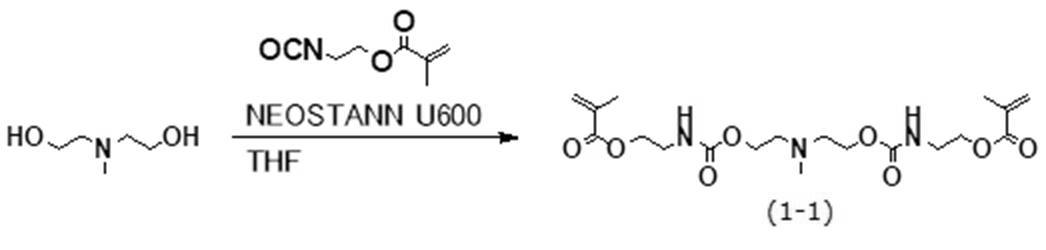
2.化合物(1-2)~化合物(1-4)の合成
化合物(1-1)の合成方法に従って、化合物(1-2)、化合物(1-3)および化合物(1-4)を合成した。
化合物(1-1)の合成方法に従って、化合物(1-2)、化合物(1-3)および化合物(1-4)を合成した。
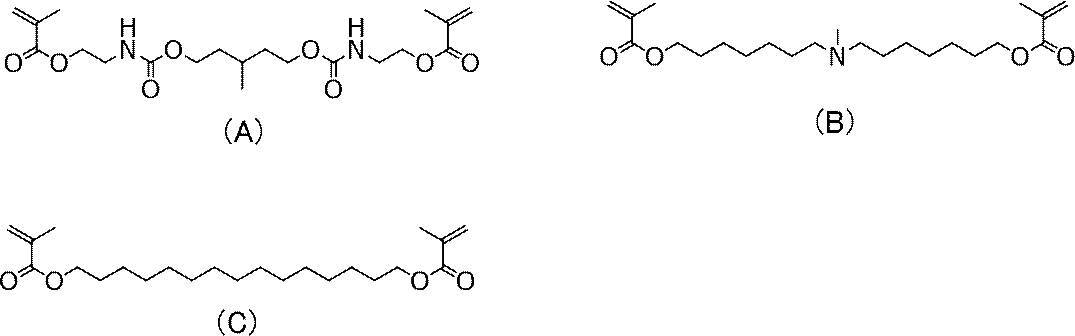
3.化合物(A)、化合物(B)および化合物(C)の合成
公知の方法により、化合物(A)、化合物(B)および化合物(C)を合成した。
公知の方法により、化合物(A)、化合物(B)および化合物(C)を合成した。
[実施例1~7、比較例1~4]
〈硬化性組成物の調製〉
表1に示す各成分を溶剤に溶解させ、固形分濃度が20質量%の硬化性組成物(実施例1~7、比較例1~4)を調製した。なお、硬化性組成物において、固形分とは、溶剤以外の全ての成分を意味する。固形分中の化合物(1)の含有量を表1の「化合物(1)の含有量(固形分中)[質量%]」欄に示す。
〈硬化性組成物の調製〉
表1に示す各成分を溶剤に溶解させ、固形分濃度が20質量%の硬化性組成物(実施例1~7、比較例1~4)を調製した。なお、硬化性組成物において、固形分とは、溶剤以外の全ての成分を意味する。固形分中の化合物(1)の含有量を表1の「化合物(1)の含有量(固形分中)[質量%]」欄に示す。
〈硬化膜の作製および経時後の硬化性の評価〉
調製した硬化性組成物を、60℃で1か月間保管した。なお、保管後の硬化性組成物を経時後の硬化性組成物という場合がある。
経時前および経時後の硬化性組成物を、バーコーターを用いて、乾燥後の厚さが5μmとなるようにクリアランスを調整して、易接着性PET(ポリエチレンテレフタラート)フィルム(コスモシャインA4100,東洋紡社製;厚み100μm)上に塗布し、乾燥させて硬化性組成物膜を形成した。
次いで、紫外線露光装置(HMW-680GW,オーク製作所社製)を用いて、硬化性組成物膜に、紫外線を照射した。この際に、硬化性組成物膜の表面を手で触れたときにべたつきを感じなくなるまでの時間を計測し、経時前と経時後の硬化性組成物膜のべたつきを感じなくなるまでの時間の差を以下の評価基準に従って、経時後の硬化性をA~Cの3段階で評価した。評価結果を表1に示す。
A:15秒未満
B:15秒以上20秒未満
C:20秒以上30秒未満
D:30秒以上
べたつきを感じなくなるまでの時間の差が短いほど、保管安定性に優れ、経時後の硬化性が優れている。
調製した硬化性組成物を、60℃で1か月間保管した。なお、保管後の硬化性組成物を経時後の硬化性組成物という場合がある。
経時前および経時後の硬化性組成物を、バーコーターを用いて、乾燥後の厚さが5μmとなるようにクリアランスを調整して、易接着性PET(ポリエチレンテレフタラート)フィルム(コスモシャインA4100,東洋紡社製;厚み100μm)上に塗布し、乾燥させて硬化性組成物膜を形成した。
次いで、紫外線露光装置(HMW-680GW,オーク製作所社製)を用いて、硬化性組成物膜に、紫外線を照射した。この際に、硬化性組成物膜の表面を手で触れたときにべたつきを感じなくなるまでの時間を計測し、経時前と経時後の硬化性組成物膜のべたつきを感じなくなるまでの時間の差を以下の評価基準に従って、経時後の硬化性をA~Cの3段階で評価した。評価結果を表1に示す。
A:15秒未満
B:15秒以上20秒未満
C:20秒以上30秒未満
D:30秒以上
べたつきを感じなくなるまでの時間の差が短いほど、保管安定性に優れ、経時後の硬化性が優れている。

表1中の各成分は以下のとおりである。
・モノマー
化合物(1-1) 合成例1で合成したもの
化合物(1-2) 合成例1で合成したもの
化合物(1-3) 合成例1で合成したもの
化合物(1-4) 合成例1で合成したもの
化合物(A) 合成例1で合成したもの
化合物(B) 合成例1で合成したもの
化合物(C) 合成例1で合成したもの
・モノマー
化合物(1-1) 合成例1で合成したもの
化合物(1-2) 合成例1で合成したもの
化合物(1-3) 合成例1で合成したもの
化合物(1-4) 合成例1で合成したもの
化合物(A) 合成例1で合成したもの
化合物(B) 合成例1で合成したもの
化合物(C) 合成例1で合成したもの
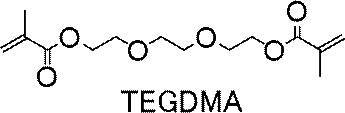
TEGDMA (トリエチレングリコールジメタクリレート,下記式で表される化合物;シグマアルドリッチ社製)
・重合開始剤
Omnirad 2959(IGM Resins社製)
Omnirad 1173(IGM Resins社製)
「Ominirad」は登録商標。
Omnirad 2959(IGM Resins社製)
Omnirad 1173(IGM Resins社製)
「Ominirad」は登録商標。
実施例1~7の硬化性組成物は、経時後の硬化性が良好であった。
また、実施例1と実施例3との対比および実施例6と実施例7との対比から、モノマーの種類によらず、含有量が多い方が経時後の硬化性の評価が良好であることが示唆された。
さらに、式(1)中のR3の炭素数が少ない化合物(1-1)を使用すると、経時後の硬化性がより良好なものとなることが示唆された。
また、実施例1と実施例3との対比および実施例6と実施例7との対比から、モノマーの種類によらず、含有量が多い方が経時後の硬化性の評価が良好であることが示唆された。
さらに、式(1)中のR3の炭素数が少ない化合物(1-1)を使用すると、経時後の硬化性がより良好なものとなることが示唆された。
Claims (4)
- 式(1)で表される化合物を固形分中に60.0質量%超含む硬化性組成物。
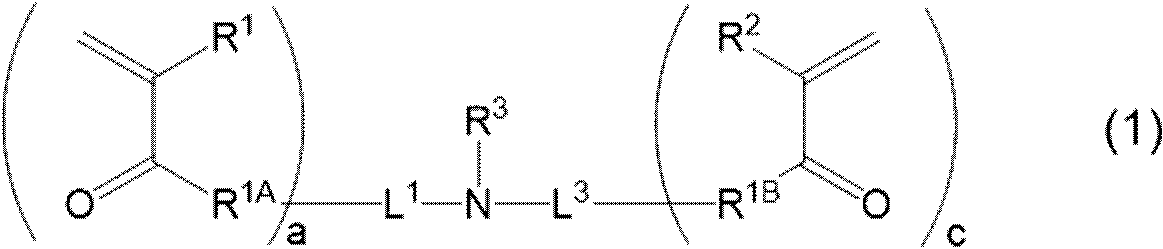
式(1)中、R1およびR2は、それぞれ独立に、水素原子またはアルキル基を表す。R1が複数であるとき、複数のR1は互いに同じであってもよいし異なっていてもよい。R2が複数であるとき、複数のR2は互いに同じであってもよいし異なっていてもよい。R3は、水素原子または1価の置換基を表す。R1AおよびR1Bは、それぞれ独立に、酸素原子または-NR101-を表す。R101は水素原子またはアルキル基を表す。R1Aが複数であるとき、複数のR1Aは互いに同じであってもよいし異なっていてもよい。R2Aが複数であるとき、複数のR2Aは互いに同じであってもよいし異なっていてもよい。L1は、ウレタン結合を含み、-O-もしくは-NR201-を含んでいてもよく、環構造を含まないa+1価の脂肪族炭化水素基、または、ウレタン結合を含み、-O-もしくは-NR201-を含んでいてもよく、芳香族環構造を含むa+1価の炭化水素基を表す。L3は、ウレタン結合を含み、-O-もしくは-NR301-を含んでいてもよく、環構造を含まないc+1価の脂肪族炭化水素基、または、ウレタン結合を含み、-O-もしくは-NR301-を含んでいてもよく、芳香族環構造を含むc+1価の炭化水素基を表す。R201は水素原子またはアルキル基を表す。R301は水素原子またはアルキル基を表す。aおよびcは、それぞれ独立に、1~3の整数を表す。 - 前記R3が炭素数4以下のアルキル基である、請求項1に記載の硬化性組成物。
- 前記式(1)で表される化合物を固形分中に65.0質量%超含む、請求項1または2に記載の硬化性組成物。
- 請求項1~3のいずれか1項に記載の硬化性組成物を硬化して得られる硬化膜。
Applications Claiming Priority (2)
| Application Number | Priority Date | Filing Date | Title |
|---|---|---|---|
| JP2019009528 | 2019-01-23 | ||
| JP2019-009528 | 2019-01-23 |
Publications (1)
| Publication Number | Publication Date |
|---|---|
| WO2020153425A1 true WO2020153425A1 (ja) | 2020-07-30 |
Family
ID=71736196
Family Applications (1)
| Application Number | Title | Priority Date | Filing Date |
|---|---|---|---|
| PCT/JP2020/002318 Ceased WO2020153425A1 (ja) | 2019-01-23 | 2020-01-23 | 硬化性組成物および硬化膜 |
Country Status (1)
| Country | Link |
|---|---|
| WO (1) | WO2020153425A1 (ja) |
Citations (3)
| Publication number | Priority date | Publication date | Assignee | Title |
|---|---|---|---|---|
| US4867680A (en) * | 1987-03-31 | 1989-09-19 | Dentsply Research & Development Corp. | Pre-loaded dental impression package and method of making |
| JP2013506718A (ja) * | 2009-08-28 | 2013-02-28 | スリーエム イノベイティブ プロパティズ カンパニー | 重合性イオン液体混合物を含む組成物及び物品並びに硬化方法 |
| JP2018178115A (ja) * | 2017-04-13 | 2018-11-15 | 東洋インキScホールディングス株式会社 | 多分岐ウレタン化合物含有重合性組成物 |
-
2020
- 2020-01-23 WO PCT/JP2020/002318 patent/WO2020153425A1/ja not_active Ceased
Patent Citations (3)
| Publication number | Priority date | Publication date | Assignee | Title |
|---|---|---|---|---|
| US4867680A (en) * | 1987-03-31 | 1989-09-19 | Dentsply Research & Development Corp. | Pre-loaded dental impression package and method of making |
| JP2013506718A (ja) * | 2009-08-28 | 2013-02-28 | スリーエム イノベイティブ プロパティズ カンパニー | 重合性イオン液体混合物を含む組成物及び物品並びに硬化方法 |
| JP2018178115A (ja) * | 2017-04-13 | 2018-11-15 | 東洋インキScホールディングス株式会社 | 多分岐ウレタン化合物含有重合性組成物 |
Similar Documents
| Publication | Publication Date | Title |
|---|---|---|
| JP5662929B2 (ja) | 感光性樹脂組成物 | |
| EP3486724B1 (en) | Mixed-type photosensitive resin and preparation method therefor | |
| JP6379390B2 (ja) | 無溶剤型光硬化性樹脂組成物 | |
| WO2018110179A1 (ja) | ペルオキシシンナメート誘導体、該化合物を含有する重合性組成物 | |
| JP7287628B2 (ja) | 活性エネルギー線硬化型組成物 | |
| KR102128799B1 (ko) | 경화막 형성용 수지 조성물 | |
| JP7725835B2 (ja) | 光硬化性組成物 | |
| WO2020153425A1 (ja) | 硬化性組成物および硬化膜 | |
| JP2024129072A (ja) | 活性エネルギー線硬化性剥離剤組成物、キャリア用剥離剤及びそれを用いた塗膜形成方法、剥離ライナー形成方法 | |
| WO2015146876A1 (ja) | グリシジル基含有(メタ)アクリルアミド | |
| KR20250172561A (ko) | 신규 아크릴아미드, 이것을 포함하는 조성물, 경화성 조성물, 접착제, 봉지재, 경화물, 반도체 장치 및 전자 부품 | |
| JPH08277321A (ja) | 光硬化性樹脂組成物 | |
| JPH11148045A (ja) | 活性エネルギー線硬化型塗料組成物及びそれを用いた被膜形成方法 | |
| JPWO2014034516A1 (ja) | 硬化膜形成組成物 | |
| JP6475131B2 (ja) | 硬化性組成物、硬化物 | |
| JP2019038977A (ja) | ワニス組成物、オフセット印刷インキ及び印刷物 | |
| JPH01123805A (ja) | 光硬化性樹脂組成物 | |
| JP2006241461A (ja) | 光硬化性組成物および光硬化性化合物 | |
| JPH03237113A (ja) | 活性エネルギー線重合性不飽和樹脂組成物及びそれを含む硬化性組成物 | |
| JPS62292867A (ja) | コ−テイング剤およびその製造方法 | |
| TW202112835A (zh) | 活性能量射線硬化型組成物 | |
| JP6377928B2 (ja) | アルカリ可溶性樹脂を含むレジスト組成物及びその保存方法 | |
| JPH08291214A (ja) | 新規多官能エポキシ樹脂組成物およびそれを用いた光硬化性樹脂組成物 | |
| JP7799057B2 (ja) | ラジカル重合性組成物及びその重合物 | |
| JPWO2019124190A1 (ja) | (メタ)アクリル系組成物の製造方法、(メタ)アクリル系組成物を含む塗料および硬化体 |
Legal Events
| Date | Code | Title | Description |
|---|---|---|---|
| 121 | Ep: the epo has been informed by wipo that ep was designated in this application |
Ref document number: 20744529 Country of ref document: EP Kind code of ref document: A1 |
|
| NENP | Non-entry into the national phase |
Ref country code: DE |
|
| 122 | Ep: pct application non-entry in european phase |
Ref document number: 20744529 Country of ref document: EP Kind code of ref document: A1 |
|
| NENP | Non-entry into the national phase |
Ref country code: JP |