WO2020138124A1 - 量子ドット含有被膜を製造する方法、及び量子ドット含有被膜形成用の組成物 - Google Patents
量子ドット含有被膜を製造する方法、及び量子ドット含有被膜形成用の組成物 Download PDFInfo
- Publication number
- WO2020138124A1 WO2020138124A1 PCT/JP2019/050718 JP2019050718W WO2020138124A1 WO 2020138124 A1 WO2020138124 A1 WO 2020138124A1 JP 2019050718 W JP2019050718 W JP 2019050718W WO 2020138124 A1 WO2020138124 A1 WO 2020138124A1
- Authority
- WO
- WIPO (PCT)
- Prior art keywords
- group
- substituent
- carbon atoms
- less
- quantum dot
- Prior art date
- Legal status (The legal status is an assumption and is not a legal conclusion. Google has not performed a legal analysis and makes no representation as to the accuracy of the status listed.)
- Ceased
Links
- 0 *N(C(N(*)C(N1*)=O)=O)C1=O Chemical compound *N(C(N(*)C(N1*)=O)=O)C1=O 0.000 description 5
- XDTMQSROBMDMFD-UHFFFAOYSA-N C1CCCCC1 Chemical compound C1CCCCC1 XDTMQSROBMDMFD-UHFFFAOYSA-N 0.000 description 1
Classifications
-
- C—CHEMISTRY; METALLURGY
- C09—DYES; PAINTS; POLISHES; NATURAL RESINS; ADHESIVES; COMPOSITIONS NOT OTHERWISE PROVIDED FOR; APPLICATIONS OF MATERIALS NOT OTHERWISE PROVIDED FOR
- C09K—MATERIALS FOR MISCELLANEOUS APPLICATIONS, NOT PROVIDED FOR ELSEWHERE
- C09K11/00—Luminescent materials, e.g. electroluminescent or chemiluminescent
- C09K11/08—Luminescent materials, e.g. electroluminescent or chemiluminescent containing inorganic luminescent materials
- C09K11/70—Luminescent materials, e.g. electroluminescent or chemiluminescent containing inorganic luminescent materials containing phosphorus
-
- C—CHEMISTRY; METALLURGY
- C09—DYES; PAINTS; POLISHES; NATURAL RESINS; ADHESIVES; COMPOSITIONS NOT OTHERWISE PROVIDED FOR; APPLICATIONS OF MATERIALS NOT OTHERWISE PROVIDED FOR
- C09K—MATERIALS FOR MISCELLANEOUS APPLICATIONS, NOT PROVIDED FOR ELSEWHERE
- C09K11/00—Luminescent materials, e.g. electroluminescent or chemiluminescent
- C09K11/02—Use of particular materials as binders, particle coatings or suspension media therefor
-
- C—CHEMISTRY; METALLURGY
- C09—DYES; PAINTS; POLISHES; NATURAL RESINS; ADHESIVES; COMPOSITIONS NOT OTHERWISE PROVIDED FOR; APPLICATIONS OF MATERIALS NOT OTHERWISE PROVIDED FOR
- C09K—MATERIALS FOR MISCELLANEOUS APPLICATIONS, NOT PROVIDED FOR ELSEWHERE
- C09K11/00—Luminescent materials, e.g. electroluminescent or chemiluminescent
- C09K11/02—Use of particular materials as binders, particle coatings or suspension media therefor
- C09K11/025—Use of particular materials as binders, particle coatings or suspension media therefor non-luminescent particle coatings or suspension media
-
- C—CHEMISTRY; METALLURGY
- C09—DYES; PAINTS; POLISHES; NATURAL RESINS; ADHESIVES; COMPOSITIONS NOT OTHERWISE PROVIDED FOR; APPLICATIONS OF MATERIALS NOT OTHERWISE PROVIDED FOR
- C09K—MATERIALS FOR MISCELLANEOUS APPLICATIONS, NOT PROVIDED FOR ELSEWHERE
- C09K11/00—Luminescent materials, e.g. electroluminescent or chemiluminescent
- C09K11/08—Luminescent materials, e.g. electroluminescent or chemiluminescent containing inorganic luminescent materials
-
- C—CHEMISTRY; METALLURGY
- C09—DYES; PAINTS; POLISHES; NATURAL RESINS; ADHESIVES; COMPOSITIONS NOT OTHERWISE PROVIDED FOR; APPLICATIONS OF MATERIALS NOT OTHERWISE PROVIDED FOR
- C09K—MATERIALS FOR MISCELLANEOUS APPLICATIONS, NOT PROVIDED FOR ELSEWHERE
- C09K11/00—Luminescent materials, e.g. electroluminescent or chemiluminescent
- C09K11/08—Luminescent materials, e.g. electroluminescent or chemiluminescent containing inorganic luminescent materials
- C09K11/56—Luminescent materials, e.g. electroluminescent or chemiluminescent containing inorganic luminescent materials containing sulfur
-
- C—CHEMISTRY; METALLURGY
- C09—DYES; PAINTS; POLISHES; NATURAL RESINS; ADHESIVES; COMPOSITIONS NOT OTHERWISE PROVIDED FOR; APPLICATIONS OF MATERIALS NOT OTHERWISE PROVIDED FOR
- C09K—MATERIALS FOR MISCELLANEOUS APPLICATIONS, NOT PROVIDED FOR ELSEWHERE
- C09K11/00—Luminescent materials, e.g. electroluminescent or chemiluminescent
- C09K11/08—Luminescent materials, e.g. electroluminescent or chemiluminescent containing inorganic luminescent materials
- C09K11/56—Luminescent materials, e.g. electroluminescent or chemiluminescent containing inorganic luminescent materials containing sulfur
- C09K11/562—Chalcogenides
- C09K11/565—Chalcogenides with zinc cadmium
-
- C—CHEMISTRY; METALLURGY
- C09—DYES; PAINTS; POLISHES; NATURAL RESINS; ADHESIVES; COMPOSITIONS NOT OTHERWISE PROVIDED FOR; APPLICATIONS OF MATERIALS NOT OTHERWISE PROVIDED FOR
- C09K—MATERIALS FOR MISCELLANEOUS APPLICATIONS, NOT PROVIDED FOR ELSEWHERE
- C09K11/00—Luminescent materials, e.g. electroluminescent or chemiluminescent
- C09K11/08—Luminescent materials, e.g. electroluminescent or chemiluminescent containing inorganic luminescent materials
- C09K11/88—Luminescent materials, e.g. electroluminescent or chemiluminescent containing inorganic luminescent materials containing selenium, tellurium or unspecified chalcogen elements
- C09K11/881—Chalcogenides
- C09K11/883—Chalcogenides with zinc or cadmium
-
- G—PHYSICS
- G02—OPTICS
- G02B—OPTICAL ELEMENTS, SYSTEMS OR APPARATUS
- G02B5/00—Optical elements other than lenses
- G02B5/20—Filters
-
- G—PHYSICS
- G03—PHOTOGRAPHY; CINEMATOGRAPHY; ANALOGOUS TECHNIQUES USING WAVES OTHER THAN OPTICAL WAVES; ELECTROGRAPHY; HOLOGRAPHY
- G03F—PHOTOMECHANICAL PRODUCTION OF TEXTURED OR PATTERNED SURFACES, e.g. FOR PRINTING, FOR PROCESSING OF SEMICONDUCTOR DEVICES; MATERIALS THEREFOR; ORIGINALS THEREFOR; APPARATUS SPECIALLY ADAPTED THEREFOR
- G03F7/00—Photomechanical, e.g. photolithographic, production of textured or patterned surfaces, e.g. printing surfaces; Materials therefor, e.g. comprising photoresists; Apparatus specially adapted therefor
- G03F7/004—Photosensitive materials
- G03F7/0047—Photosensitive materials characterised by additives for obtaining a metallic or ceramic pattern, e.g. by firing
-
- G—PHYSICS
- G03—PHOTOGRAPHY; CINEMATOGRAPHY; ANALOGOUS TECHNIQUES USING WAVES OTHER THAN OPTICAL WAVES; ELECTROGRAPHY; HOLOGRAPHY
- G03F—PHOTOMECHANICAL PRODUCTION OF TEXTURED OR PATTERNED SURFACES, e.g. FOR PRINTING, FOR PROCESSING OF SEMICONDUCTOR DEVICES; MATERIALS THEREFOR; ORIGINALS THEREFOR; APPARATUS SPECIALLY ADAPTED THEREFOR
- G03F7/00—Photomechanical, e.g. photolithographic, production of textured or patterned surfaces, e.g. printing surfaces; Materials therefor, e.g. comprising photoresists; Apparatus specially adapted therefor
- G03F7/004—Photosensitive materials
- G03F7/0048—Photosensitive materials characterised by the solvents or agents facilitating spreading, e.g. tensio-active agents
-
- G—PHYSICS
- G03—PHOTOGRAPHY; CINEMATOGRAPHY; ANALOGOUS TECHNIQUES USING WAVES OTHER THAN OPTICAL WAVES; ELECTROGRAPHY; HOLOGRAPHY
- G03F—PHOTOMECHANICAL PRODUCTION OF TEXTURED OR PATTERNED SURFACES, e.g. FOR PRINTING, FOR PROCESSING OF SEMICONDUCTOR DEVICES; MATERIALS THEREFOR; ORIGINALS THEREFOR; APPARATUS SPECIALLY ADAPTED THEREFOR
- G03F7/00—Photomechanical, e.g. photolithographic, production of textured or patterned surfaces, e.g. printing surfaces; Materials therefor, e.g. comprising photoresists; Apparatus specially adapted therefor
- G03F7/004—Photosensitive materials
- G03F7/027—Non-macromolecular photopolymerisable compounds having carbon-to-carbon double bonds, e.g. ethylenic compounds
-
- G—PHYSICS
- G03—PHOTOGRAPHY; CINEMATOGRAPHY; ANALOGOUS TECHNIQUES USING WAVES OTHER THAN OPTICAL WAVES; ELECTROGRAPHY; HOLOGRAPHY
- G03F—PHOTOMECHANICAL PRODUCTION OF TEXTURED OR PATTERNED SURFACES, e.g. FOR PRINTING, FOR PROCESSING OF SEMICONDUCTOR DEVICES; MATERIALS THEREFOR; ORIGINALS THEREFOR; APPARATUS SPECIALLY ADAPTED THEREFOR
- G03F7/00—Photomechanical, e.g. photolithographic, production of textured or patterned surfaces, e.g. printing surfaces; Materials therefor, e.g. comprising photoresists; Apparatus specially adapted therefor
- G03F7/004—Photosensitive materials
- G03F7/027—Non-macromolecular photopolymerisable compounds having carbon-to-carbon double bonds, e.g. ethylenic compounds
- G03F7/028—Non-macromolecular photopolymerisable compounds having carbon-to-carbon double bonds, e.g. ethylenic compounds with photosensitivity-increasing substances, e.g. photoinitiators
- G03F7/031—Organic compounds not covered by group G03F7/029
-
- G—PHYSICS
- G03—PHOTOGRAPHY; CINEMATOGRAPHY; ANALOGOUS TECHNIQUES USING WAVES OTHER THAN OPTICAL WAVES; ELECTROGRAPHY; HOLOGRAPHY
- G03F—PHOTOMECHANICAL PRODUCTION OF TEXTURED OR PATTERNED SURFACES, e.g. FOR PRINTING, FOR PROCESSING OF SEMICONDUCTOR DEVICES; MATERIALS THEREFOR; ORIGINALS THEREFOR; APPARATUS SPECIALLY ADAPTED THEREFOR
- G03F7/00—Photomechanical, e.g. photolithographic, production of textured or patterned surfaces, e.g. printing surfaces; Materials therefor, e.g. comprising photoresists; Apparatus specially adapted therefor
- G03F7/004—Photosensitive materials
- G03F7/038—Macromolecular compounds which are rendered insoluble or differentially wettable
- G03F7/0382—Macromolecular compounds which are rendered insoluble or differentially wettable the macromolecular compound being present in a chemically amplified negative photoresist composition
-
- G—PHYSICS
- G03—PHOTOGRAPHY; CINEMATOGRAPHY; ANALOGOUS TECHNIQUES USING WAVES OTHER THAN OPTICAL WAVES; ELECTROGRAPHY; HOLOGRAPHY
- G03F—PHOTOMECHANICAL PRODUCTION OF TEXTURED OR PATTERNED SURFACES, e.g. FOR PRINTING, FOR PROCESSING OF SEMICONDUCTOR DEVICES; MATERIALS THEREFOR; ORIGINALS THEREFOR; APPARATUS SPECIALLY ADAPTED THEREFOR
- G03F7/00—Photomechanical, e.g. photolithographic, production of textured or patterned surfaces, e.g. printing surfaces; Materials therefor, e.g. comprising photoresists; Apparatus specially adapted therefor
- G03F7/004—Photosensitive materials
- G03F7/038—Macromolecular compounds which are rendered insoluble or differentially wettable
- G03F7/0388—Macromolecular compounds which are rendered insoluble or differentially wettable with ethylenic or acetylenic bands in the side chains of the photopolymer
-
- G—PHYSICS
- G03—PHOTOGRAPHY; CINEMATOGRAPHY; ANALOGOUS TECHNIQUES USING WAVES OTHER THAN OPTICAL WAVES; ELECTROGRAPHY; HOLOGRAPHY
- G03F—PHOTOMECHANICAL PRODUCTION OF TEXTURED OR PATTERNED SURFACES, e.g. FOR PRINTING, FOR PROCESSING OF SEMICONDUCTOR DEVICES; MATERIALS THEREFOR; ORIGINALS THEREFOR; APPARATUS SPECIALLY ADAPTED THEREFOR
- G03F7/00—Photomechanical, e.g. photolithographic, production of textured or patterned surfaces, e.g. printing surfaces; Materials therefor, e.g. comprising photoresists; Apparatus specially adapted therefor
- G03F7/004—Photosensitive materials
- G03F7/075—Silicon-containing compounds
- G03F7/0755—Non-macromolecular compounds containing Si-O, Si-C or Si-N bonds
-
- B—PERFORMING OPERATIONS; TRANSPORTING
- B82—NANOTECHNOLOGY
- B82Y—SPECIFIC USES OR APPLICATIONS OF NANOSTRUCTURES; MEASUREMENT OR ANALYSIS OF NANOSTRUCTURES; MANUFACTURE OR TREATMENT OF NANOSTRUCTURES
- B82Y20/00—Nanooptics, e.g. quantum optics or photonic crystals
-
- B—PERFORMING OPERATIONS; TRANSPORTING
- B82—NANOTECHNOLOGY
- B82Y—SPECIFIC USES OR APPLICATIONS OF NANOSTRUCTURES; MEASUREMENT OR ANALYSIS OF NANOSTRUCTURES; MANUFACTURE OR TREATMENT OF NANOSTRUCTURES
- B82Y30/00—Nanotechnology for materials or surface science, e.g. nanocomposites
-
- B—PERFORMING OPERATIONS; TRANSPORTING
- B82—NANOTECHNOLOGY
- B82Y—SPECIFIC USES OR APPLICATIONS OF NANOSTRUCTURES; MEASUREMENT OR ANALYSIS OF NANOSTRUCTURES; MANUFACTURE OR TREATMENT OF NANOSTRUCTURES
- B82Y40/00—Manufacture or treatment of nanostructures
Definitions
- the present invention relates to a method for producing a film containing a quantum dot and a composition for forming a film containing a quantum dot, which can be preferably used in the method.
- quantum dots ultra-small particles formed to confine electrons
- application studies in various fields have been conducted.
- the size of one quantum dot is several nanometers to several tens of nanometers in diameter.
- JP 2006-216560 A JP, 2008-112154, A Korean Published Patent No. 10-2016-0004524
- a liquid composition containing a quantum dot and a base material component such as a resin or a curable compound is often used.
- a conventionally known dispersion liquid for forming a quantum dot-containing coating it may be difficult to obtain a desired quantum yield in the formed quantum dot-containing coating.
- the present invention has been made in view of the above problems, and is capable of forming a quantum dot-containing coating exhibiting a desired quantum yield, a method for producing a quantum dot-containing coating, and can be suitably used for the method.
- An object of the present invention is to provide a composition for forming a film containing quantum dots.
- the present inventors use a composition containing a quantum dot (A) containing a chalcogenide as a surface material, a substrate component (C), and a solvent (S).
- the quantum dot (A) containing chalcogenide is used as the surface material
- the organic solvent (S1) containing the chalcogen element is used as the solvent (S)
- the quantum dot-containing coating is heated under an oxygen concentration atmosphere lower than that in the atmosphere.
- the first aspect of the present invention is A method for producing a quantum dot-containing coating using a composition containing quantum dots (A), a base material component (C), and a solvent (S),
- the surface material of the quantum dots (A) contains chalcogenide
- a ligand may be bound to the surface of the quantum dot (A)
- the solvent (S) contains an organic solvent (S1) having a chalcogen element
- the method includes a heating step of heating the quantum dot-containing coating in an oxygen concentration atmosphere lower than that in the atmosphere.
- the second aspect of the present invention is A composition for forming a quantum dot-containing film, which comprises a quantum dot (A), a base material component (C), and an organic solvent (S),
- the surface material of the quantum dots (A) contains chalcogenide, A ligand may be bound to the surface of the quantum dot (A),
- the solvent (S) is a composition containing an organic solvent (S1) having a chalcogen element.
- a method for producing a quantum dot-containing coating capable of forming a quantum dot-containing coating exhibiting a desired quantum yield, and a composition for forming a quantum dot-containing coating suitable for use in the method Can be provided.
- a composition containing quantum dots (A), a base material component (C), and a solvent (S) is used for producing the quantum dot-containing coating.
- Such a method includes a heating step of heating the quantum dot-containing coating under an oxygen concentration atmosphere lower than that in the atmosphere.
- a ligand may be bound to the surface of the quantum dot (A). That is, the ligand is a substance that binds to the surface of the quantum dot (A), not a material that forms the surface of the quantum dot (A).
- the quantum dot (A) a quantum dot whose surface is made of a material containing a chalcogenide is used.
- the solvent (S) a solvent containing an organic solvent (S1) having a chalcogen element is used. After forming a coating film using a composition containing such a quantum dot (A) and a solvent (S) in combination, the coating film is heated in an atmosphere having an oxygen concentration lower than that in the atmosphere to obtain a desired film. Quantum dot-containing coatings exhibiting quantum yield can be formed.
- an oxygen concentration atmosphere lower than that in the atmosphere will also be referred to as a “low oxygen concentration atmosphere”.
- the quantum dot-containing coating when the quantum dot-containing coating is heated or exposed in an oxygen-rich atmosphere such as the atmosphere, it is often difficult to form a quantum dot-containing coating having a desired quantum yield.
- the quantum dot-containing coating produced by the above method even if the quantum yield is reduced by heating or exposing the quantum dot-containing coating in an oxygen-rich atmosphere, low The quantum yield can be recovered by heating the quantum dot-containing coating under an oxygen concentration atmosphere. It is considered that this is because the organic solvent (S1) containing the chalcogen element is attached to the quantum dots (A) contained in the quantum dot-containing coating having a reduced quantum yield.
- the chalcogenide on the surface of the quantum dots (A) contained in the quantum dot-containing coating with reduced quantum yield is oxidized.
- the quantum dots (A) are separated between the organic solvent (S1) having a chalcogen element and the oxidized quantum dots (A). It is considered that a reaction occurs in which oxygen in () is replaced with a chalcogen element, and as a result, the quantum yield of the quantum dot-containing coating is recovered to a high value.
- the low oxygen concentration atmosphere is an atmosphere having an oxygen concentration of less than 200,000 ppm, preferably 100,000 ppm or less, and more preferably 1 ppm or more and 300 ppm or less.
- the low oxygen concentration atmosphere examples include an inert gas atmosphere, a reduced pressure, and a vacuum.
- Preferable low oxygen concentration atmosphere includes nitrogen atmosphere, forming gas atmosphere, hydrogen atmosphere and the like.
- the heating temperature in the low oxygen concentration atmosphere is preferably 100°C or higher and 300°C or lower, more preferably 110°C or higher and 280°C or lower, further preferably 120°C or higher and 250°C or lower, and particularly preferably 130°C or higher and 200°C or lower. ..
- the heating time under a low oxygen concentration atmosphere is preferably 5 minutes or longer and 1 day or shorter, more preferably 10 minutes or longer and 12 hours or shorter, and particularly preferably 20 minutes or longer and 1 hour or shorter.
- composition used for forming the quantum dot-containing coating the method for forming the quantum dot-containing coating before heating, which is subjected to the above heating step, and the application of the quantum dot-containing coating will be described.
- the composition used for forming the quantum dot-containing coating contains the quantum dots (A), the base material component, and the solvent (S).
- a composition may be a light-sensitive composition or a heat-sensitive composition that can be modified by exposure or heating, or a composition that is not modified by exposure or heating.
- the modification by exposure or heating is not particularly limited, but is typically a change in solubility in an organic solvent or a basic solution.
- the composition may be a photosensitive composition that can be patterned by a photolithography method or a non-photosensitive composition to which patterning by a photolithography method cannot be applied.
- the composition used for forming the quantum dot-containing film has photosensitivity that can be applied to patterning by a photolithography method
- the composition of the composition contains the quantum dot (A) and photolithography.
- the composition of various conventionally known photo-sensitive compositions applied to patterning by the method can be adopted.
- the photosensitive composition is a negative-type composition that becomes insoluble in a developer upon exposure. It may be a composition or a positive type composition which is solubilized in a developing solution by exposure.
- a preferable typical example of the negative type composition is a composition containing an alkali-soluble resin as a base material component (C), a photopolymerizable monomer, and a photopolymerization initiator as a curing agent (D) described later.
- Suitable typical examples of the positive type composition include an acid generator that generates an acid upon irradiation with actinic rays or radiation, and a resin as the base component (C) that has increased solubility in alkali due to the action of acid And a composition containing.
- the essential and optional components that the composition may contain are described below.
- Quantum dots (A) The composition used for forming the quantum dot-containing coating contains quantum dots (A).
- the structure and constituent components of the quantum dot (A) are not particularly limited, as long as the quantum dot (A) is a fine particle that functions as a quantum dot and the surface material is a material containing a chalcogenide. ..
- the quantum dot (A) is a nanoscale material having a unique optical property (quantum confinement effect described later) according to quantum mechanics, and is generally a semiconductor nanoparticle.
- the quantum dot (A) is a quantum dot (having a shell structure described later) coated on the surface of the semiconductor nanoparticles to further improve the emission quantum yield, or a surface for stabilizing the quantum dots.
- the ligand and the like used for surface modification are treated as a material separate from the quantum dots (A).
- the chalcogen compound is not particularly limited as long as it is a compound containing an inorganic element and a chalcogen element, which are well known as components of quantum dots.
- the chalcogen element contained in the chalcogenide is a 6B group element (formerly IUPAC), and means S, Se, and Te.
- S and Se are more preferable.
- the structure of the quantum dots (A) may be a homogeneous structure composed of one kind of compound or a composite structure composed of two or more kinds of compounds.
- the structure of the quantum dots (A) is preferably a core-shell structure in which the core is covered with one or more shell layers, which is the material of the core. It is more preferable that the surface of the compound particles is epitaxially coated with a semiconductor material.
- particles in the process of manufacturing a quantum dot (A) having a core-shell structure are not included in the quantum dot (A).
- the coating layer (shell).
- the shell preferably has the same lattice constant as the material of the core. A combination of materials having a small difference in core-shell lattice constant is appropriately selected.
- Quantum dots (A) are considered to be semiconductor nanoparticles that absorb photons having an energy larger than the band gap (energy difference between the valence band and the conduction band) and emit light having a wavelength corresponding to the particle diameter.
- the element contained in the material of the quantum dot (A) include group II elements (groups 2A and 2B (formerly IUPAC)), group III elements (particularly group 3B (formerly IUPAC)), group IV elements (particularly 4B).
- Examples of compounds or elements preferable as the material of the quantum dots (A) include II-VI group compounds, III-V group compounds, IV-VI group compounds, IV group elements, IV group compounds, and combinations thereof.
- III-V group compound at least one compound selected from GaN, GaP, GaAs, GaSb, AlN, AlP, AlAs, AlSb, InN, InP, InAs, InSb, and a mixture thereof; GaNP, GaNAs, GaNSb, GaPAs, GaPSb, AlNP, AlNAs, AlNSb, AlPAs, AlPSb, InNP, InNAs, InNSb, InPAs, InPSb, GaAlNP and at least one compound selected from these; , GaInNSb, GaInPAs, GaInPSb, InAlNP, InAlNAs, InAlNSb, InAlPAs, InAlPSb and at least one compound selected from a mixture thereof.
- the group IV-VI compound at least one compound selected from SnS, SnSe, SnTe, PbS, PbSe, PbTe, and mixtures thereof; At least one compound selected from these mixtures; and at least one compound selected from SnPbSSe, SnPbSeTe, SnPbSTe and mixtures thereof.
- Each of these is a chalcogenide containing at least one selected from S, Se, and Te. Therefore, any of them can be used as a material forming the surface of the quantum dot (A).
- the group IV element includes at least one compound selected from Si, Ge and a mixture thereof.
- Examples of the group IV compound include at least one compound selected from SiC, SiGe, and a mixture thereof.
- the quantum dot (A) preferably contains a compound containing Cd or In as a constituent component, and more preferably a compound containing In as a constituent component in consideration of safety.
- the homogeneous structure type quantum dots (A) having no shell layer include AgInS 2 and Zn-doped AgInS 2 .
- the core-shell type quantum dots (A) include InP/ZnS, InP/ZnSSe, CuInS 2 /ZnS, and (ZnS/AgInS 2 ) solid solution/ZnS.
- the material of the core-shell type quantum dots (A) is described as (core material)/(shell layer material).
- the shell having a core-shell structure has a multi-layer structure, and it is more preferable that the shell has two layers.
- the material for the core is preferably at least one compound selected from the group consisting of InP, ZnS, and ZnSe, and more preferably contains InP.
- the content ratio of InP is 50% by mass or more and 100% by mass or less, preferably 60% by mass or more and 99% by mass or less, and more preferably 82% by mass or more and 95% by mass or less based on the total mass of the core.
- ZnS and/or ZnSe is 0% by mass or more and 50% by mass or less, preferably 1% by mass or more and 40% by mass or less, and more preferably 5% by mass or more and 18% by mass or less. preferable.
- the material of the first shell in the multilayer shell structure is preferably one or more selected from ZnS, ZnSe, and ZnSSe.
- the content ratio of one or more selected from ZnS, ZnSe, and ZnSSe is, for example, 50% by mass or more and 100% by mass or less, and 75% by mass or more and 98% by mass, based on the total mass of the first shell. The following is preferable, and 80% by mass or more and 97% by mass or less is more preferable.
- the mixing ratio is not particularly limited and is 1/99 or more and 99/1 or less, preferably 10/90 or more and 90/10 or less. is there.
- a second shell on the surface of the first shell In a multi-layer shell structure, grow a second shell on the surface of the first shell.
- the material of the second shell is preferably the same as the material of the first shell. However, the difference in the lattice constant with respect to the core is different in each material. That is, the case where each material is 99% or more homogeneous is excluded.
- the content ratio of one or more selected from ZnS, ZnSe, and ZnSSe is, for example, 50% by mass or more and 100% by mass or less, and 75% by mass or more and 98% by mass, based on the total mass of the second shell. The following is preferable, and 80% by mass or more and 97% by mass or less is more preferable.
- the mixing ratio is not particularly limited and is 1/99 or more and 99/1 or less, and 10/ It is 90 or more and 90/10 or less.
- the first shell and the second shell in the multilayer shell structure have a difference in lattice constant.
- the lattice constant difference between the core and the first shell is 2% or more and 8% or less, preferably 2% or more and 6% or less, and more preferably 3% or more and 5% or less.
- the lattice constant difference between the core and the second shell is 5% or more and 13% or less, preferably 5% or more and 12% or less, more preferably 7% or more and 10% or less, and 8% or more and 10% or less. Is more preferable.
- the difference in lattice constant between the first shell and the second shell is, for example, 3% or more and 9% or less, preferably 3% or more and 7% or less, and more preferably 4% or more and 6% or less.
- Quantum dots (A) with these core-multilayer shell structures can have an emission wavelength in the range of 400 nm or more and 800 nm or less.
- the emission wavelength range is preferably 470 nm or more and 650 nm or less, and more preferably 540 nm or more and 580 nm or less.
- quantum dots (A) having these core-multilayer shell structures include InP/ZnS/ZnSe and InP/ZnSe/ZnS.
- the quantum dots (A) may be surface-modified.
- phosphorus compounds such as phosphine, phosphine oxides and trialkylphosphines
- organic nitrogen compounds such as pyridine, aminoalkanes and tertiary amines
- organic sulfur such as mercapto alcohol, thiols, dialkyl sulfides and dialkyl sulfoxides.
- surface modifiers organic ligands
- the above quantum dots (A) may be used in combination of two or more kinds.
- the core-(multilayer) shell type quantum dots (A) and the homogeneous structure type quantum dots (A) may be used in combination.
- the average particle size of the quantum dots (A) is not particularly limited as long as it is within a range capable of functioning as quantum dots, and is preferably 0.5 nm or more and 20 nm or less, more preferably 1.0 nm or more and 15 nm or less, and 2 nm or more and 7 nm or less. Is more preferable.
- the size of the core is, for example, 0.5 nm or more and 10 nm or less, preferably 2 nm or more and 5 nm or less.
- the average thickness of the shell is preferably 0.4 nm or more and 2 nm or less, and more preferably 0.4 nm or more and 1.4 nm or less.
- the average thickness of the first shell is, for example, 0.2 nm or more and 1 nm or less, and preferably 0.2 nm or more and 0.7 nm or less.
- the average thickness of the second shell is, for example, 0.2 nm or more and 1 nm or less, preferably 0.2 nm or more and 0.7 nm or less, regardless of the average thickness of the first shell.
- the quantum dot (A) having an average particle diameter within such a range exerts a quantum confinement effect, functions well as a quantum dot, is easily prepared, and has stable fluorescence characteristics.
- the average particle diameter of the quantum dots (A) is, for example, a composition containing the quantum dots (A), which is applied to a substrate and dried to remove volatile components from the coating film, and then transmitted through the surface of the coating film. It can be defined by observing with a scanning electron microscope (TEM). Typically, this average particle diameter can be defined as the number average diameter of the equivalent circle diameters of each particle obtained by image analysis of a TEM image.
- the shape of the quantum dots (A) is not particularly limited.
- Examples of the shape of the quantum dot (A) include a spherical shape, an elliptic spherical shape, a cylindrical shape, a polygonal cylindrical shape, a disk shape, and a polyhedral shape.
- the spherical shape is preferable from the viewpoint of easy handling and easy availability.
- the quantum dot (A) is a compound (A1) having a fluorescence maximum in a wavelength range of 500 nm or more and 600 nm or less, and a fluorescence in a wavelength range of 600 nm or more and 700 nm or less. It preferably contains at least one selected from the group consisting of compounds (A2) having a maximum, and more preferably at least one selected from the group consisting of compound (A1) and compound (A2).
- the manufacturing method of the quantum dots (A) is not particularly limited. Quantum dots manufactured by various known methods can be used as the quantum dots (A). As a method for producing the quantum dots (A), for example, a method of thermally decomposing an organometallic compound in a coordinating organic solvent can be adopted.
- the core-shell structure type quantum dots (A) are produced by a method in which a homogeneous core is formed by a reaction and then a precursor of the shell layer is reacted in the presence of a dispersed core to form a shell layer. it can. Further, for example, the quantum dot (A) having the core-multilayer shell structure can be produced by the method described in WO2013/127662. Note that various commercially available quantum dots (A) can also be used.
- the composition comprises a base component (C).
- the base component (C) By including the base material component (C), the composition has film-forming properties.
- the base component (C) a resin material typically made of a polymer compound or a reactive low-molecular compound which is crosslinked by heating or exposure to give a polymer compound is used.
- the resin material used as the base material component (C) may have a functional group that is crosslinked by heating or exposure. That is, a thermosetting or photocurable resin can also be used as the base component (C).
- the resin material used as the base component (C) may be a resin material that is cured by firing.
- thermosetting or photocurable base material component is preferable because it is easy to form a molded article having excellent physical properties such as hardness and tensile elongation.
- specific examples of the base material component (C) will be described in order.
- the resin material used as the base material component (C) will be described.
- the resin material may be curable or non-curable.
- the curable resin material will be described later.
- Non-curable resin material is not particularly limited as long as it is a non-curable resin material that imparts shapeability such as film forming property to the composition.
- resin material include polyacetal resin, polyamide resin, polycarbonate resin, polyester resin (polybutylene terephthalate, polyethylene terephthalate, polyarylate, etc.), FR-AS resin, FR-ABS resin, AS resin, ABS resin, polyphenylene.
- Oxide resin polyphenylene sulfide resin, polysulfone resin, polyether sulfone resin, polyether ketone resin, fluorine resin, polyimide resin, polyamideimide resin, polyamide bismaleimide resin, polyetherimide resin, polybenzoxazole resin, polybenzothiazole
- resins polybenzimidazole resins, silicone resins, BT resins, polymethylpentene, ultra high molecular weight polyethylene, FR-polypropylene, (meth)acrylic resins (polymethylmethacrylate etc.), polystyrene and the like. These resin materials may be used in combination of two or more kinds.
- the above resin material is preferably dissolved in the composition.
- the above resin material may be, for example, a suspension such as latex as long as the object of the present invention is not impaired.
- the composition for forming the quantum dot-containing film is a negative type composition
- the composition preferably contains an alkali-soluble resin.
- the alkali-soluble resin is not particularly limited, and a conventionally known alkali-soluble resin can be used.
- This alkali-soluble resin may have an ethylenically unsaturated group, and may not have an ethylenically unsaturated group.
- the alkali-soluble resin means that a resin solution having a resin concentration of 20% by mass (solvent: propylene glycol monomethyl ether acetate) is used to form a resin film having a film thickness of 1 ⁇ m on a substrate, and the alkali-soluble resin is 2.38% by mass.
- TMAH tetramethylammonium hydroxide
- the alkali-soluble resin having an ethylenically unsaturated group for example, a resin obtained by reacting a reaction product of an epoxy compound and an unsaturated carboxylic acid with a polybasic acid anhydride can be used.
- a resin obtained by reacting a reaction product of an epoxy compound and an unsaturated carboxylic acid with a polybasic acid anhydride
- examples of such a resin include a compound represented by the formula (c7) described below, or a resin containing a structural unit derived from a reaction product obtained by reacting acrylic acid with a structural unit derived from glycidyl methacrylate described below, or the reaction.
- a resin containing a constitutional unit derived from a compound obtained by reacting a compound with a polybasic acid anhydride is preferable.
- polybasic acid anhydrides include maleic anhydride, succinic anhydride, itaconic anhydride, phthalic anhydride, tetrahydrophthalic anhydride, hexahydrophthalic anhydride, methylhexahydrophthalic anhydride, methyltetrahydrophthalic anhydride, Trimellitic anhydride, pyromellitic dianhydride, benzophenone tetracarboxylic dianhydride, 3-methylhexahydrophthalic anhydride, 4-methylhexahydrophthalic anhydride, 3-ethylhexahydrophthalic anhydride, 4-ethylhexa Examples thereof include hydrophthalic anhydride, tetrahydrophthalic anhydride, 3-methyltetrahydrophthalic anhydride, 4-methyltetrahydrophthalic anhydride, 3-ethyltetrahydrophthalic anhydride and 4-ethyltetrahydrophthalic anhydride.
- an alkali-soluble resin having an ethylenically unsaturated group by reacting an acrylic resin containing a structural unit having an epoxy group with an unsaturated carboxylic acid and then further reacting with a polybasic acid anhydride.
- a structural unit derived from glycidyl methacrylate is reacted with acrylic acid, a structural unit having a hydroxyl group shown in the following reaction formula is generated.
- a structural unit having such a hydroxyl group with a polybasic acid anhydride such as tetrahydrophthalic acid, a structural unit having a carboxy group and imparting alkali solubility to the resin is produced.
- the alkali-soluble resin having an ethylenically unsaturated group a polyester obtained by reacting (meth)acrylic acid with a polyester prepolymer obtained by condensing a polyhydric alcohol and a monobasic acid or a polybasic acid (Meth)acrylate; Polyurethane (meth)acrylate obtained by reacting polyol with a compound having two isocyanate groups and then reacting with (meth)acrylic acid; bisphenol A type epoxy resin, bisphenol F type epoxy resin , Bisphenol S type epoxy resin, phenol or cresol novolac type epoxy resin, resol type epoxy resin, triphenol methane type epoxy resin, polycarboxylic acid polyglycidyl ester, polyol polyglycidyl ester, aliphatic or alicyclic epoxy resin, amine epoxy It is also possible to use an epoxy (meth)acrylate resin obtained by reacting a resin or an epoxy resin such as a dihydroxybenzene type epoxy resin with (meth)acrylic acid
- the alkali-soluble resin having no ethylenically unsaturated group a resin obtained by copolymerizing an unsaturated carboxylic acid and another unsaturated compound can be used.
- the other unsaturated compound it is preferable to use at least one kind selected from an epoxy group-containing unsaturated compound and an alicyclic group-containing unsaturated compound.
- unsaturated carboxylic acids examples include (meth)acrylic acid and monocarboxylic acids such as crotonic acid; dicarboxylic acids such as maleic acid, fumaric acid, citraconic acid, mesaconic acid and itaconic acid; and anhydrides of these dicarboxylic acids.
- (meth)acrylic acid and maleic anhydride are preferable from the viewpoints of copolymerization reactivity, alkali solubility of the obtained resin, availability, and the like.
- These unsaturated carboxylic acids can be used alone or in combination of two or more.
- Examples of the epoxy group-containing unsaturated compound include an epoxy group-containing unsaturated compound having no alicyclic group and an epoxy group-containing unsaturated compound having an alicyclic group.
- Examples of the epoxy group-containing unsaturated compound having an alicyclic group include compounds represented by the formulas (c5-1) to (c5-15) described later.
- Examples of the epoxy group-containing unsaturated compound having no alicyclic group include (meth)acrylic acid ester having an epoxy group and having an epoxy group, and a chain aliphatic epoxy group, which will be described later regarding the epoxy group-containing resin.
- the aliphatic (meth)acrylic acid ester having can be preferably used.
- the unsaturated compound containing an alicyclic group is not particularly limited as long as it is an unsaturated compound having an alicyclic group.
- the alicyclic group may be monocyclic or polycyclic. Examples of the monocyclic alicyclic group include a cyclopentyl group and a cyclohexyl group. Further, examples of the polycyclic alicyclic group include an adamantyl group, a norbornyl group, an isobornyl group, a tricyclononyl group, a tricyclodecyl group, and a tetracyclododecyl group. Specific examples of the alicyclic group-containing unsaturated compound include compounds represented by the formulas (c6-1) to (c6-8) described below.
- a compound other than the above with the unsaturated carboxylic acid examples include (meth)acrylic acid esters, (meth)acrylamides, allyl compounds, vinyl ethers, vinyl esters, styrenes, and maleimides. These compounds can be used alone or in combination of two or more kinds.
- Examples of (meth)acrylic acid esters include linear or branched chains such as methyl (meth)acrylate, ethyl (meth)acrylate, propyl (meth)acrylate, amyl (meth)acrylate, and t-octyl (meth)acrylate.
- a copolymer having at least a structural unit having a polymerizable site with a photocurable low-molecular compound described later, or a structural unit derived from an unsaturated carboxylic acid can be preferably used as the alkali-soluble resin.
- the above-mentioned copolymer having a constitutional unit having a polymerizable site with the photocurable low-molecular compound is the above-mentioned (meth)acrylic acid ester, (meth)acrylamide, allyl compound, vinyl ether, vinyl ester. It may further have at least one structural unit derived from styrene, styrenes, maleimides and the like.
- the constituent unit having a site capable of polymerizing with the photocurable low-molecular compound is preferably a structural unit having an ethylenically unsaturated group as a site capable of polymerizing with the photocurable low-molecular compound.
- the copolymer having such a constitutional unit can be prepared by reacting at least a part of the carboxyl groups contained in the homopolymer of unsaturated carboxylic acid with the epoxy group-containing unsaturated compound. Photocuring can also be achieved by reacting an unsaturated carboxylic acid with at least a portion of the epoxy groups in the copolymer having a structural unit derived from an unsaturated carboxylic acid and a structural unit derived from an epoxy group-containing unsaturated compound. It is possible to prepare a copolymer having a constitutional unit having a site capable of polymerizing with a low-molecular-weight compound having an organic property.
- the proportion of the structural unit derived from the unsaturated carboxylic acid in the alkali-soluble resin is preferably 3% by mass or more and 25% by mass or less, and more preferably 5% by mass or more and 25% by mass or less. Further, the proportion of the constituent units derived from the epoxy group-containing unsaturated compound is preferably 30% by mass or more and 95% by mass or less, and more preferably 50% by mass or more and 90% by mass or less.
- the proportion of the structural unit derived from the alicyclic group-containing unsaturated compound is preferably 1% by mass or more and 30% by mass or less, more preferably 3% by mass or more and 25% by mass or less. It is more preferable that the content is not less than 20% by mass. Within the above range, the adhesiveness and strength of the quantum dot-containing coating to the substrate can be enhanced while the alkali solubility of the obtained resin is moderated.
- the weight average molecular weight of the alkali-soluble resin is preferably 1,000 or more and 40,000 or less, more preferably 2,000 or more and 30,000 or less. Within the above range, sufficient heat resistance and film strength can be obtained while obtaining good developability.
- the content of the alkali-soluble resin is preferably 5% by mass or more and 80% by mass or less, more preferably 15% by mass or more and 50% by mass or less, based on the solid content of the composition. Within the above range, the developability tends to be balanced.
- thermosetting low molecular weight compound examples of the thermosetting low molecular weight compound which is crosslinked by heating to produce a high molecular compound include an epoxy compound and an oxetane compound.
- a composition containing an epoxy compound or an oxetane compound as a base material component (C) is heated to a predetermined temperature or higher, the epoxy groups or oxetanyl groups of the epoxy compound or the oxetane compound are crosslinked with each other, resulting in heat resistance or mechanical properties. An excellent cured film can be obtained.
- An epoxy compound or an oxetane compound is basically used as a thermosetting base material component (C), but when an epoxy compound or an oxetane compound is used together with an onium salt (D2) described later, photocuring is possible.
- the epoxy compound and the oxetane compound described in JP-A-2018061034 can be preferably used.
- the epoxy compound and the oxetane compound are not limited to the compounds described in JP-A-2018061034.
- the epoxy compound is not particularly limited as long as it is an epoxy compound that can be cured by heating alone or by the action of a heat-sensitive curing agent or a photosensitive curing agent.
- the epoxy compound preferably has two or more epoxy groups.
- the epoxy compound preferably contains a cyclic structure other than the oxirane ring.
- the cyclic structure contained in the epoxy compound is not particularly limited.
- the cyclic structure may be a cyclic structure containing carbon as a ring-constituting element such as a hydrocarbon ring structure or a heterocyclic structure, or a ring not containing carbon as a ring-constituting element such as a cyclic siloxane structure. It may be a formula structure.
- the hetero atom that may be included in the heterocyclic structure include a nitrogen atom, an oxygen atom, a sulfur atom, a selenium atom and a silicon atom.
- the cyclic structure may be a monocyclic structure or a polycyclic structure.
- the cyclic structure containing carbon as a ring-constituting element may be an aromatic ring structure or an aliphatic ring structure, and is a polycyclic structure in which an aromatic ring and an aliphatic ring are condensed. Good.
- Examples of the ring that gives an aromatic ring structure or a ring structure containing an aromatic ring include a benzene ring, a naphthalene ring, an anthracene ring, a phenanthrene ring, a tetralin ring, an acenaphthene ring, and a fluorene ring.
- Examples of the ring that gives an aliphatic ring structure include a monocycloalkane ring, a bicycloalkane ring, a tricycloalkane ring, and a tetracycloalkane ring.
- cyclopentane ring examples include a cyclopentane ring, a cyclohexane ring, a cycloheptane ring, a cyclooctane and other monocycloalkane rings, and an adamantane ring, a norbornane ring, an isobornane ring, a tricyclodecane ring, and a tetracyclododecane ring.
- Examples of commonly used epoxy compounds that can be suitably used include bisphenol A type epoxy resin, bisphenol F type epoxy resin, bisphenol S type epoxy resin, bisphenol AD type epoxy resin, naphthalene type epoxy resin, and biphenyl type epoxy resin.
- Bifunctional epoxy resin 9,9-bis[4-(glycidyloxy)phenyl]-9H-fluorene, 9,9-bis[4-[2-(glycidyloxy)ethoxy]phenyl]-9H-fluorene, 9, 9-bis[4-[2-(glycidyloxy)ethyl]phenyl]-9H-fluorene, 9,9-bis[4-(glycidyloxy)-3-methylphenyl]-9H-fluorene, 9,9-bis Epoxy group-containing fluorene compounds such as [4-(glycidyloxy)-3,5-dimethylphenyl]-9H-fluorene and 9,9-bis(6-glycidyloxynaphthalen-2
- An example is a 1,2-epoxy-4-(2-oxiranyl)cyclohexane adduct of a functional epoxy resin 2,2-bis(hydroxymethyl)-1-butanol.
- a 1,2-epoxy-4-(2-oxiranyl)cyclohexane adduct of 2,2-bis(hydroxymethyl)-1-butanol is commercially available as EHPE-3150 (manufactured by Daicel).
- An oligomer or polymer type polyfunctional epoxy compound can also be preferably used.
- Typical examples are phenol novolac type epoxy compounds, brominated phenol novolac type epoxy compounds, orthocresol novolac type epoxy compounds, xylenol novolac type epoxy compounds, naphthol novolac type epoxy compounds, bisphenol A novolac type epoxy compounds, bisphenol AD novolac type compounds.
- Type epoxy compounds epoxidized dicyclopentadiene type phenolic resins, epoxidized naphthalene type phenolic resins, and the like.
- suitable epoxy compounds include polyfunctional alicyclic epoxy compounds having an alicyclic epoxy group.
- alicyclic epoxy compounds include 2-(3,4-epoxycyclohexyl-5,5-spiro-3,4-epoxy)cyclohexane-meta-dioxane and bis(3,4-epoxycyclohexylmethyl).
- Adipate bis(3,4-epoxy-6-methylcyclohexylmethyl) adipate, 3,4-epoxy-6-methylcyclohexyl-3′,4′-epoxy-6′-methylcyclohexanecarboxylate, ⁇ -caprolactone modified 3 ,4-Epoxycyclohexylmethyl-3',4'-epoxycyclohexanecarboxylate, trimethylcaprolactone modified 3,4-epoxycyclohexylmethyl-3',4'-epoxycyclohexanecarboxylate, ⁇ -methyl- ⁇ -valerolactone modified 3 ,4-Epoxycyclohexylmethyl-3',4'-epoxycyclohexanecarboxylate, methylenebis(3,4-epoxycyclohexane), ethylene glycol di(3,4-epoxycyclohexylmethyl) ether, ethylenebis(3,4-epoxycyclohexane
- Z represents a single bond or a linking group (a divalent group having one or more atoms).
- R c1 to R c18 are each independently a hydrogen atom, a halogen atom, and an organic group. It is a group selected from the group consisting of groups.
- linking group Z examples include a divalent hydrocarbon group, —O—, —O—CO—, —S—, —SO—, —SO 2 —, —CBr 2 —, —C(CBr 3 ) 2
- examples thereof include a divalent group selected from the group consisting of —, —C(CF 3 ) 2 —, and —R c19 —O—CO—, and a group in which a plurality of these groups are bonded.
- Examples of the divalent hydrocarbon group which is the linking group Z include a linear or branched alkylene group having 1 to 18 carbon atoms and a divalent alicyclic hydrocarbon group. it can.
- Examples of the linear or branched alkylene group having 1 to 18 carbon atoms include methylene group, methylmethylene group, dimethylmethylene group, dimethylene group, trimethylene group and the like.
- divalent alicyclic hydrocarbon group examples include 1,2-cyclopentylene group, 1,3-cyclopentylene group, cyclopentylidene group, 1,2-cyclohexylene group, 1,3- Examples thereof include cycloalkylene groups (including cycloalkylidene group) such as cyclohexylene group, 1,4-cyclohexylene group, and cyclohexylidene group.
- R c19 is an alkylene group having 1 to 8 carbon atoms and is preferably a methylene group or an ethylene group.
- R c1 to R c18 are groups selected from the group consisting of a hydrogen atom, a halogen atom, and an organic group.
- R c2 and R c10 are bonded to each other to form a ring.
- R c13 and R c16 may combine with each other to form a ring, and m c1 is 0 or 1.
- R c1 to R c10 are groups selected from the group consisting of a hydrogen atom, a halogen atom, and an organic group.
- R c2 and R c8 are bonded to each other to form a ring. You may.
- R c1 to R c12 are groups selected from the group consisting of a hydrogen atom, a halogen atom, and an organic group.
- R c2 and R c10 are bonded to each other to form a ring. You may.
- R c1 to R c12 are groups selected from the group consisting of hydrogen atoms, halogen atoms, and organic groups.
- R c1 to R c18 are organic groups
- the organic groups are not particularly limited as long as the object of the present invention is not impaired, and they may be hydrocarbon groups.
- the halogen atom include chlorine atom, bromine atom, iodine atom, and fluorine atom.
- a hydrocarbon group a group consisting of a carbon atom, a hydrogen atom, and an oxygen atom
- a halogenated hydrocarbon group a group consisting of a carbon atom, an oxygen atom, and a halogen atom, a carbon atom, a hydrogen atom.
- a group consisting of an oxygen atom and a halogen atom is preferable.
- the hydrocarbon group may be an aromatic hydrocarbon group, an aliphatic hydrocarbon group, or a group containing an aromatic skeleton and an aliphatic skeleton.
- the number of carbon atoms in the organic group is preferably 1 or more and 20 or less, more preferably 1 or more and 10 or less, and particularly preferably 1 or more and 5 or less.
- hydrocarbon group examples include methyl group, ethyl group, n-propyl group, isopropyl group, n-butyl group, isobutyl group, sec-butyl group, tert-butyl group, n-pentyl group, n-hexyl group.
- halogenated hydrocarbon group examples include chloromethyl group, dichloromethyl group, trichloromethyl group, bromomethyl group, dibromomethyl group, tribromomethyl group, fluoromethyl group, difluoromethyl group, trifluoromethyl group, 2,2 , 2-trifluoroethyl group, pentafluoroethyl group, heptafluoropropyl group, perfluorobutyl group, and perfluoropentyl group, perfluorohexyl group, perfluoroheptyl group, perfluorooctyl group, perfluorononyl group, and Halogenated chain alkyl group such as perfluorodecyl group; 2-chlorocyclohexyl group, 3-chlorocyclohexyl group, 4-chlorocyclohexyl group, 2,4-dichlorocyclohexyl group, 2-bromocyclohexyl group, 3-brobro
- Specific examples of the group consisting of a carbon atom, a hydrogen atom and an oxygen atom include hydroxy chain groups such as hydroxymethyl group, 2-hydroxyethyl group, 3-hydroxy-n-propyl group and 4-hydroxy-n-butyl group.
- R c1 to R c18 are each independently preferably a group selected from the group consisting of a hydrogen atom, a halogen atom, an alkyl group having 1 to 5 carbon atoms, and an alkoxy group having 1 to 5 carbon atoms, Particularly, it is more preferable that all of R c1 to R c18 are hydrogen atoms because a cured film having excellent mechanical properties can be easily formed.
- R c1 ⁇ R c18 are the same as R c1 ⁇ R c18 in formula (c1-1).
- R c2 and R c10 are bonded to each other, in formula (c1-2), R c13 and R c16 are bonded to each other, and
- the divalent group formed by bonding two groups is, for example, —CH 2 — or —C(CH 3 ) 2 —. Is mentioned.
- alicyclic epoxy compounds represented by the formula (c1-2) specific examples include a compound represented by the following formula (c1-2a) and a compound represented by the following formula (c1-2b). The compound to be mentioned is mentioned.
- alicyclic epoxy compounds represented by the formula (c1-3) specific examples include S-spiro[3-oxatricyclo[3.2.1.0 2,4 ]octane-6. , 2′-oxirane] and the like.
- alicyclic epoxy compounds represented by the formula (c1-4) specific examples include 4-vinylcyclohexene dioxide, dipentene dioxide, limonene dioxide, 1-methyl-4-(3 -Methyloxiran-2-yl)-7-oxabicyclo[4.1.0]heptane and the like.
- alicyclic epoxy compounds represented by the formula (c1-5) specific examples include 1,2,5,6-diepoxycyclooctane.
- the compound represented by the following formula (c1) can be suitably used as an epoxy compound.
- X c1 , X c2 , and X c3 are each independently a hydrogen atom or an organic group which may contain an epoxy group, and X c1 , X c2 , and X c3 have.
- the total number of epoxy groups is 2 or more.
- the compound represented by the above formula (c1) is preferably a compound represented by the following formula (c1-6).
- (C1-6) a group represented by R c 20 and E 1, R c21 and E 2, and R c22 and E 3, for example, at least two, respectively, represented by the following formula (c1-6a) Group represented by the following formula (c1-6a) is more preferable.
- the plural groups represented by formula (c1-6a) which are bonded to one compound are preferably the same groups.
- -L-C c (c1-6a) (In the formula (c1-6a), L is a linear, branched or cyclic alkylene group, an arylene group, —O—, —C( ⁇ O)—, —NH—, or a combination thereof.
- C c is an epoxy group.
- L and C c may combine to form a cyclic structure.)
- the linear, branched or cyclic alkylene group as L is preferably an alkylene group having 1 to 10 carbon atoms.
- the arylene group as L is preferably an arylene group having 5 to 10 carbon atoms.
- L is a linear alkylene group having 1 to 3 carbon atoms, a phenylene group, —O—, —C( ⁇ O)—, —NH—, and combinations thereof.
- a group is preferable, and at least one of a linear alkylene group having 1 to 3 carbon atoms such as a methylene group and a phenylene group, or a combination thereof with —O—, —C( ⁇ O)— and A group consisting of a combination with at least one NH- is preferred.
- examples of an epoxy compound having an oxiranyl group or an alicyclic epoxy group are shown as examples of the compound represented by the formula (c1-6), but are not limited thereto.
- siloxane compound As a compound that can be preferably used as the epoxy compound, a siloxane compound having two or more epoxy groups in the molecule (hereinafter, also simply referred to as “siloxane compound”) can be mentioned.
- the siloxane compound is a compound having a siloxane skeleton composed of a siloxane bond (Si—O—Si) and two or more glycidyl groups in the molecule.
- Examples of the siloxane skeleton in the siloxane compound include a cyclic siloxane skeleton and a cage-type or ladder-type polysilsesquioxane skeleton.
- the siloxane compound is preferably a compound having a cyclic siloxane skeleton represented by the following formula (c1-7) (hereinafter sometimes referred to as “cyclic siloxane”).
- R c24 and R c25 represent a monovalent group containing an epoxy group or an alkyl group. However, among the x1 amino R c24 and x1 amino R c25 in the compound represented by the formula (C1-7), at least two is a monovalent group containing an epoxy group. Further, x1 in the formula (c1-7) represents an integer of 3 or more. In addition, R c24 and R c25 in the compound represented by the formula (c1-7) may be the same or different. Further, the plurality of R c24 may be the same or different. A plurality of R c25 may be the same or different.
- the monovalent group containing an epoxy group is preferably a glycidyl ether group represented by —D—O—R c26 .
- D represents an alkylene group
- R c26 represents a glycidyl group.
- the alkylene group as D include, for example, a linear or branched alkylene group having 1 to 18 carbon atoms, such as a methylene group, a methylmethylene group, a dimethylmethylene group, a dimethylene group, and a trimethylene group. Can be mentioned.
- an alicyclic epoxy group-containing group represented by —D—R c27 is also preferable.
- R c27 is an epoxycycloalkyl group.
- D is an alkylene group.
- the epoxycycloalkyl group as R c27 is preferably a 2,3-epoxycyclopentyl group, a 3,4-epoxycyclohexyl group, and a 2,3-epoxycyclohexyl group.
- a 2-(3,4-epoxycyclohexyl)ethyl group is preferable.
- Preferred examples of the alkyl group as R c24, and R c25 is, for example, a methyl group, an ethyl group, a propyl group, a linear or branched alkyl group having 1 to 18 carbon atoms such as isopropyl Can be mentioned.
- the number of carbon atoms in the alkyl group is preferably 1 or more and 6 or less, and particularly preferably 1 or more and 3 or less.
- X1 in the formula (c1-7) represents an integer of 3 or more, and among them, an integer of 3 or more and 6 or less is preferable in terms of excellent cross-linking reactivity when forming a cured film.
- the number of epoxy groups in the molecule of the siloxane compound is 2 or more, and is preferably 2 or more and 6 or less, particularly preferably 2 or more and 4 or less, from the viewpoint of excellent crosslinking reactivity when forming a cured film. Is.
- the liquid composition includes, in addition to the siloxane compound represented by the formula (c1-7), an alicyclic epoxy group-containing cyclic siloxane, an alicyclic epoxy group-containing silicone resin described in JP-A-2008-248169, and A compound having a siloxane skeleton such as an organopolysilsesquioxane resin having at least two epoxy functional groups in one molecule described in JP-A-2008-19422 may be contained.
- examples of the siloxane compound include a cyclic siloxane represented by the following formula and having two or more epoxy groups in the molecule.
- examples of the siloxane compound include trade names “X-40-2670”, “X-40-2701”, “X-40-2728”, “X-40-2738”, and “X-40-2740”.
- Commercial products such as those manufactured by Shin-Etsu Chemical Co., Ltd. can be used.
- thermosetting polymer compound examples include resins that cause an aromatic ring formation reaction in the molecule and/or a crosslinking reaction between the molecules by heating, and a cured film by firing. Resins that generate When the composition contains a resin that causes an intramolecular aromatic ring forming reaction and/or an intermolecular cross-linking reaction, heating causes intramolecular aromatic ring forming reaction and/or intermolecular crosslinking reaction. From the viewpoint of accelerating the crosslinking reaction, the composition preferably contains the thermal imidazole generator described in JP-A-2016-145308 and the imidazole compound described in JP-A-2017-025226. When the composition contains a resin that forms a cured film by firing, the curing agent that can be contained in the composition will be described later.
- the structure of the molecular chains that make up the resin becomes rigid, and it is easy to obtain a cured film with excellent heat resistance and mechanical properties using the composition.
- preferable reactions include, for example, reactions represented by the following formulas (I) to (VI).
- the reaction in the following formula is only one example of the aromatic ring forming reaction, and the structure of the resin used as the base component (C) that causes the aromatic ring forming reaction in the molecule by heating is It is not limited to the structure of the precursor polymer shown in (1).
- the molecular chains that make up the resin are cross-linked to each other, forming a three-dimensional cross-linked structure. Therefore, when a composition containing a resin that causes a crosslinking reaction by heating as a base material component (C) is used, a cured film having excellent heat resistance and mechanical properties can be easily obtained.
- a resin that causes a cross-linking reaction between molecules by heating a resin having a group selected from a hydroxyl group, a carboxylic acid anhydride group, a carboxy group, and an epoxy group in the molecule is preferable.
- the following crosslinking occurs due to the action of the above-mentioned thermal imidazole generator or imidazole compound.
- crosslinking occurs due to dehydration condensation between hydroxyl groups between molecules contained in the resin.
- a resin having a carboxylic acid anhydride group carboxy groups produced by hydrolysis of the acid anhydride group are dehydrated and condensed to crosslink each other.
- crosslinking occurs due to dehydration condensation between carboxy groups between molecules contained in the resin.
- crosslinking occurs due to a polyaddition reaction between epoxy groups between molecules contained in the resin.
- a resin having a group selected from a hydroxyl group, a carboxylic acid anhydride group, a carboxyl group, and an epoxy group in a molecule, a polyamic acid, and a polybenzoxazole precursor are described in JP2018-061034A.
- the compounds described above can be preferably used. Note that these compounds are not limited to the compounds described in JP2018-061034A.
- Epoxy group-containing resin may be a polymer obtained by polymerizing a monomer having an epoxy group or a monomer mixture containing a monomer having an epoxy group.
- Epoxy group-containing resin is a resin in which an epoxy group is introduced using a compound having an epoxy group such as epichlorohydrin with respect to a polymer having a reactive functional group such as a hydroxyl group, a carboxy group, and an amino group. It may be. Since it is easy to obtain, prepare, adjust the amount of epoxy groups in the polymer, etc., the epoxy group-containing polymer is a monomer containing an epoxy group or a monomer containing an epoxy group. Polymers obtained by polymerizing a body mixture are preferred.
- the epoxy group-containing resin include novolac epoxy resins such as phenol novolac type epoxy resin, brominated phenol novolac type epoxy resin, orthocresol novolac type epoxy resin, bisphenol A novolac type epoxy resin, and bisphenol AD novolac type epoxy resin.
- a cycloaliphatic epoxy resin such as an epoxidized product of a dicyclopentadiene type phenolic resin; an aromatic epoxy resin such as an epoxidized product of a naphthalene type phenolic resin.
- epoxy group-containing resins since it is easy to prepare, etc., a homopolymer of an epoxy group-containing (meth)acrylic acid ester, or an epoxy group-containing (meth)acrylic acid ester and another monomer Copolymers with the body are preferred.
- the (meth)acrylic acid ester having an epoxy group is a (meth)acrylic acid ester having an alicyclic epoxy group as described below even if it is a (meth)acrylic acid ester having a chain aliphatic epoxy group. It may be. Moreover, the (meth)acrylic acid ester having an epoxy group may include an aromatic group. Among the (meth)acrylic acid ester having an epoxy group, an aliphatic (meth)acrylic acid ester having a chain aliphatic epoxy group and an aliphatic (meth)acrylic acid ester having an alicyclic epoxy group are preferable, An aliphatic (meth)acrylic acid ester having an alicyclic epoxy group is more preferable.
- Examples of the (meth)acrylic acid ester containing an aromatic group and having an epoxy group include 4-glycidyloxyphenyl(meth)acrylate, 3-glycidyloxyphenyl(meth)acrylate, and 2-glycidyloxyphenyl(meth)acrylate. , 4-glycidyloxyphenylmethyl (meth)acrylate, 3-glycidyloxyphenylmethyl (meth)acrylate, and 2-glycidyloxyphenylmethyl (meth)acrylate.
- Examples of the aliphatic (meth)acrylic acid ester having a chain aliphatic epoxy group include ester groups (—O—CO—) such as epoxyalkyl (meth)acrylate and epoxyalkyloxyalkyl (meth)acrylate.
- the chain aliphatic epoxy group contained in such a (meth)acrylic acid ester may contain one or more oxy groups (—O—) in the chain.
- the number of carbon atoms of the chain aliphatic epoxy group is not particularly limited, but is preferably 3 or more and 20 or less, more preferably 3 or more and 15 or less, and particularly preferably 3 or more and 10 or less.
- aliphatic (meth)acrylic acid ester having a chain aliphatic epoxy group examples include glycidyl (meth)acrylate, 2-methylglycidyl (meth)acrylate, 3,4-epoxybutyl (meth)acrylate, 6, Epoxyalkyl (meth)acrylates such as 7-epoxyheptyl (meth)acrylate; 2-glycidyloxyethyl (meth)acrylate, 3-glycidyloxy-n-propyl (meth)acrylate, 4-glycidyloxy-n-butyl (meth ) Epoxyalkyloxyalkyl(meth)acrylates such as acrylate, 5-glycidyloxy-n-hexyl(meth)acrylate, 6-glycidyloxy-n-hexyl(meth)acrylate.
- aliphatic (meth)acrylic acid ester having an alicyclic epoxy group examples include compounds represented by the following formulas (c5-1) to (c5-15). Among these, compounds represented by the following formulas (c5-1) to (c5-5) are preferable, and compounds represented by the following formulas (c5-1) to (c5-3) are more preferable.
- R c40 represents a hydrogen atom or a methyl group.
- R c41 represents a divalent saturated aliphatic hydrocarbon group having 1 to 6 carbon atoms.
- R c42 represents a divalent hydrocarbon group having 1 to 10 carbon atoms, and t represents an integer of 0 to 10.
- R c41 is preferably a linear or branched alkylene group such as a methylene group, an ethylene group, a propylene group, a tetramethylene group, an ethylethylene group, a pentamethylene group, or a hexamethylene group.
- R c42 is preferably, for example, a methylene group, an ethylene group, a propylene group, a tetramethylene group, an ethylethylene group, a pentamethylene group, a hexamethylene group, a phenylene group or a cyclohexylene group.
- both a homopolymer of a (meth)acrylic acid ester having an epoxy group and a copolymer of a (meth)acrylic acid ester having an epoxy group and another monomer are used. be able to.
- the content of the unit derived from the (meth)acrylic acid ester having an epoxy group in the polymer having an epoxy group is preferably 70% by mass or more, more preferably 80% by mass or more, and particularly preferably 90% by mass or more. Most preferably 100% by mass.
- the polymer having an epoxy group is a copolymer of a (meth)acrylic acid ester having an epoxy group and another monomer
- the other monomer has an unsaturated carboxylic acid or an epoxy group.
- the copolymerization of the (meth)acrylic acid ester having an epoxy group with another monomer The coalesce preferably does not contain units derived from unsaturated carboxylic acids.
- unsaturated carboxylic acids include (meth)acrylic acid; (meth)acrylic acid amide; crotonic acid; maleic acid, fumaric acid, citraconic acid, mesaconic acid, itaconic acid, and anhydrides of these dicarboxylic acids.
- Examples of the (meth)acrylic acid ester having no epoxy group include methyl (meth)acrylate, ethyl (meth)acrylate, propyl (meth)acrylate, amyl (meth)acrylate, t-octyl (meth)acrylate and the like.
- the alicyclic group constituting the alicyclic skeleton may be monocyclic or polycyclic.
- the monocyclic alicyclic group include a cyclopentyl group and a cyclohexyl group.
- examples of the polycyclic alicyclic group include a norbornyl group, an isobornyl group, a tricyclononyl group, a tricyclodecyl group, and a tetracyclododecyl group.
- Examples of the (meth)acrylic acid ester having a group having an alicyclic skeleton include compounds represented by the following formulas (c6-1) to (c6-8). Among these, compounds represented by the following formulas (c6-3) to (c6-8) are preferable, and compounds represented by the following formulas (c6-3) or (c6-4) are more preferable.
- R c43 represents a hydrogen atom or a methyl group.
- R c44 represents a single bond or a divalent saturated aliphatic hydrocarbon group having 1 to 6 carbon atoms.
- R c45 represents a hydrogen atom or an alkyl group having 1 to 5 carbon atoms.
- R c44 is preferably a single bond, a linear or branched alkylene group such as a methylene group, an ethylene group, a propylene group, a tetramethylene group, an ethylethylene group, a pentamethylene group or a hexamethylene group.
- R c45 is preferably a methyl group or an ethyl group.
- (meth)acrylamides include (meth)acrylamide, N-alkyl(meth)acrylamide, N-aryl(meth)acrylamide, N,N-dialkyl(meth)acrylamide, N,N-aryl(meth)acrylamide. , N-methyl-N-phenyl(meth)acrylamide, N-hydroxyethyl-N-methyl(meth)acrylamide and the like.
- allyl compound examples include allyl acetates, allyl caproates, allyl caprylate, allyl laurate, allyl palmitate, allyl stearate, allyl benzoate, allyl acetoacetate, allyl lactate and the like; allyloxyethanol; Etc.
- vinyl ethers include hexyl vinyl ether, octyl vinyl ether, decyl vinyl ether, ethylhexyl vinyl ether, methoxyethyl vinyl ether, ethoxyethyl vinyl ether, chloroethyl vinyl ether, 1-methyl-2,2-dimethylpropyl vinyl ether, 2-ethylbutyl vinyl ether, hydroxy.
- Aliphatic vinyl ethers such as ethyl vinyl ether, diethylene glycol vinyl ether, dimethylaminoethyl vinyl ether, diethylaminoethyl vinyl ether, butylaminoethyl vinyl ether, benzyl vinyl ether, tetrahydrofurfuryl vinyl ether; vinyl phenyl ether, vinyl tolyl ether, vinyl chlorophenyl ether, vinyl-2,4 -Vinyl aryl ethers such as dichlorophenyl ether, vinyl naphthyl ether and vinyl anthranyl ether; and the like.
- vinyl esters include vinyl butyrate, vinyl isobutyrate, vinyl trimethyl acetate, vinyl diethyl acetate, vinyl valerate, vinyl caproate, vinyl chloroacetate, vinyl dichloroacetate, vinyl methoxy acetate, vinyl butoxy acetate, Examples thereof include vinyl phenyl acetate, vinyl acetoacetate, vinyl lactate, vinyl- ⁇ -phenylbutyrate, vinyl benzoate, vinyl salicylate, vinyl chlorobenzoate, vinyl tetrachlorobenzoate and vinyl naphthoate.
- styrenes examples include styrene; methylstyrene, dimethylstyrene, trimethylstyrene, ethylstyrene, diethylstyrene, isopropylstyrene, butylstyrene, hexylstyrene, cyclohexylstyrene, decylstyrene, benzylstyrene, chloromethylstyrene, trifluoromethylstyrene.
- Alkylstyrene such as ethoxymethylstyrene and acetoxymethylstyrene; alkoxystyrene such as methoxystyrene, 4-methoxy-3-methylstyrene and dimethoxystyrene; chlorostyrene, dichlorostyrene, trichlorostyrene, tetrachlorostyrene, pentachlorostyrene, bromo Halostyrene such as styrene, dibromostyrene, iodostyrene, fluorostyrene, trifluorostyrene, 2-bromo-4-trifluoromethylstyrene and 4-fluoro-3-trifluoromethylstyrene; and the like.
- maleimides include carbons such as N-methylmaleimide, N-ethylmaleimide, Nn-propylmaleimide, N-isopropylmaleimide, Nn-butylmaleimide, Nn-pentylmaleimide and Nn-hexylmaleimide.
- N-arylmaleimide N-substituted with an aryl group having 6 to 20 carbon atoms;
- the molecular weight of the epoxy group-containing resin is not particularly limited as long as the object of the present invention is not impaired, but the polystyrene-equivalent weight average molecular weight is preferably 3,000 or more and 30,000 or less, and 5,000 or more and 15,000 or less. More preferable.
- the composition may contain a photopolymerizable low molecular weight compound (photopolymerizable monomer) as the base component (C).
- a photopolymerizable low molecular weight compound photopolymerizable monomer
- the composition preferably contains a photopolymerization initiator described below.
- Photopolymerizable low molecular weight compounds include monofunctional monomers and polyfunctional monomers. Hereinafter, the monofunctional monomer and the polyfunctional monomer will be described in order.
- monofunctional monomers include (meth)acrylamide, methylol (meth)acrylamide, methoxymethyl (meth)acrylamide, ethoxymethyl (meth)acrylamide, propoxymethyl (meth)acrylamide, butoxymethoxymethyl (meth)acrylamide, N-methylol ( (Meth)acrylamide, N-hydroxymethyl (meth)acrylamide, (meth)acrylic acid, fumaric acid, maleic acid, maleic anhydride, itaconic acid, itaconic anhydride, citraconic acid, citraconic anhydride, crotonic acid, 2-acrylamide- 2-Methylpropanesulfonic acid, tert-butylacrylamidesulfonic acid, methyl (meth)acrylate, ethyl (meth)acrylate, butyl (meth)acrylate, 2-ethylhexyl (meth)acrylate, cyclohexyl (meth)acrylate, 2-hydroxyethyl (Meth)acrylate,
- the composition may contain a photopolymerizable polymer compound as the base component (C).
- a resin containing an ethylenically unsaturated group is preferably used as the photopolymerizable polymer compound.
- the resin containing an ethylenically unsaturated group a resin obtained by further reacting a reaction product of an epoxy compound and an unsaturated group-containing carboxylic acid compound with a polybasic acid anhydride, or an unsaturated carboxylic acid Obtained by reacting at least a part of the carboxy group contained in the polymer containing the unit derived from the (meth)acrylic acid ester and/or (meth)acrylic acid epoxyalkyl ester having an alicyclic epoxy group.
- Resins (hereinafter, collectively referred to as "resin including a structural unit having an ethylenically unsaturated group") can be preferably used.
- the (meth)acryloyloxy group is preferable as the ethylenically unsaturated group in the constitutional unit having an ethylenically unsaturated group.
- a resin containing a constitutional unit having an ethylenically unsaturated group or a compound represented by the following formula (c7) is preferable.
- the compound represented by the formula (c7) is preferable because it has high photocurability.
- X c represents a group represented by the following general formula (c8).
- R c50's each independently represent a hydrogen atom, a hydrocarbon group having 1 to 6 carbon atoms, or a halogen atom.
- R c51's each independently represent a hydrogen atom or a methyl group.
- W represents a single bond or a group represented by the following structural formula (c9).
- "*" means the terminal of the bond of the divalent group.
- Y c represents a residue obtained by removing the acid anhydride group (—CO—O—CO—) from the dicarboxylic acid anhydride.
- dicarboxylic acid anhydrides include maleic anhydride, succinic anhydride, itaconic anhydride, phthalic anhydride, tetrahydrophthalic anhydride, hexahydrophthalic anhydride, methylendomethylenetetrahydrophthalic anhydride, chlorendic anhydride, methyltetrahydro. Examples thereof include phthalic anhydride and glutaric anhydride.
- Z c represents a residue obtained by removing two acid anhydride groups from tetracarboxylic acid dianhydride.
- examples of the tetracarboxylic dianhydride include pyromellitic dianhydride, benzophenonetetracarboxylic dianhydride, biphenyltetracarboxylic dianhydride, biphenylethertetracarboxylic dianhydride and the like.
- n c represents an integer of 0 or more and 20 or less.
- the acid value of the resin containing an ethylenically unsaturated group is preferably 10 mgKOH/g or more and 150 mgKOH/g or less, more preferably 70 mgKOH/g or more and 110 mgKOH/g or less in terms of resin solid content.
- the acid value is 10 mgKOH/g or more, it is easy to obtain a composition having sufficient solubility in a developing solution when imparting photolithographic properties to the composition, which is preferable.
- the acid value is 150 mgKOH/g or less, sufficient curability can be obtained and surface properties can be improved, which is preferable.
- the mass average molecular weight of the resin containing an ethylenically unsaturated group is preferably 1,000 or more and 40,000 or less, more preferably 2,000 or more and 30,000 or less. It is preferable to set the mass average molecular weight to 1,000 or more because it is easy to form a cured film having good heat resistance and film strength. Further, when the mass average molecular weight is 40,000 or less, good developability can be obtained, which is preferable.
- Examples of the resin that forms a cured film by firing include silicon-containing resins.
- the silicon-containing resin include one or more kinds selected from siloxane resin and polysilane.
- a quantum dot-containing coating containing a silicon-containing resin is obtained by applying a composition containing these silicon-containing resins, and a silica-based quantum dot-containing coating is obtained by baking the quantum dot-containing coating.
- the siloxane resin and the silicon-containing resin such as polysilane include the silicon-containing resins described in paragraphs [0022] to [0070] of JP-A-2018-109761.
- the content of the silicon-containing resin in the composition is not particularly limited, and may be set according to the desired film thickness. From the viewpoint of film formability, the content of the silicon-containing resin in the composition is preferably 1% by mass or more and 50% by mass or less, more preferably 5% by mass or more and 40% by mass or less, and 10% by mass or more and 35% by mass. The following are particularly preferred.
- the ratio is preferably 1:99, more preferably 90:10 to 10:90.
- the composition contains a component such as an epoxy compound or an oxetane compound, a photocurable component, or a silicon-containing resin as the base component (C), the composition cures the base component (C).
- a curing agent (D) is not particularly limited as long as it is a component capable of curing the base component (C).
- a so-called photopolymerization initiator and the like are also included in the curing agent (D) in the present specification.
- the base material component (C) contained in the composition has an epoxy compound or an oxetane compound having a functional group having reactivity with a carboxy group, a carboxylic acid anhydride group, an epoxy group such as an amino group, or an oxetanyl group. If, the composition does not necessarily contain a curing agent.
- the photopolymerization initiator (D1) is used together with the photocurable base material component (C) having an unsaturated double bond, and cures the photocurable base material component (C) by exposure.
- the photopolymerization initiator (D1) is not particularly limited, and a conventionally known photopolymerization initiator can be used.
- photopolymerization initiator (D1) specifically, 1-hydroxycyclohexyl phenyl ketone, 2-hydroxy-2-methyl-1-phenylpropan-1-one, 1-[4-(2-hydroxyethoxy)phenyl ]-2-Hydroxy-2-methyl-1-propan-1-one, 1-(4-isopropylphenyl)-2-hydroxy-2-methylpropan-1-one, 1-(4-dodecylphenyl)-2 -Hydroxy-2-methylpropan-1-one, 2,2-dimethoxy-1,2-diphenylethane-1-one, bis(4-dimethylaminophenyl)ketone, 2-methyl-1-[4-(methylthio )Phenyl]-2-morpholinopropan-1-one, 2-benzyl-2-dimethylamino-1-(4-morpholinophenyl)-butan-1-one, O-acetyl-1-[6-(2 -Methylbenzoyl
- an oxime-based photopolymerization initiator in terms of sensitivity.
- the oxime-based photopolymerization initiators particularly preferred are O-acetyl-1-[6-(2-methylbenzoyl)-9-ethyl-9H-carbazol-3-yl]ethanone oxime, O -Acetyl-1-[6-(2-methylbenzoyl)-9-ethyl-9H-carbazol-3-yl]ethanone oxime, and 1,2-octanedione, 1-[4-(phenylthio)-2,2 -(O-benzoyl oxime)].
- an oxime ester compound described later as a curing agent for a silicon-containing resin is also preferably used as a photopolymerization initiator.
- the content of the photopolymerization initiator (D1) is preferably 0.5 parts by mass or more and 30 parts by mass or less, and more preferably 1 part by mass or more and 20 parts by mass or less with respect to 100 parts by mass of the solid content of the composition.
- a photoinitiator aid may be combined with this photopolymerization initiator (D1).
- the photoinitiator triethanolamine, methyldiethanolamine, triisopropanolamine, methyl 4-dimethylaminobenzoate, ethyl 4-dimethylaminobenzoate, isoamyl 4-dimethylaminobenzoate, 2-dimethylaminobenzoic acid 2- Ethylhexyl, 2-dimethylaminoethyl benzoate, N,N-dimethylparatoluidine, 4,4′-bis(dimethylamino)benzophenone, 9,10-dimethoxyanthracene, 2-ethyl-9,10-dimethoxyanthracene, 9, 10-diethoxyanthracene, 2-ethyl-9,10-diethoxyanthracene, 2-mercaptobenzothiazole, 2-mercaptobenzoxazole, 2-mercaptobenzimidazole
- the onium salt (D2) can be used together with an epoxy group-containing resin, an epoxy compound, an oxetane compound, or the like, and accelerates the curing of the epoxy group-containing resin, the epoxy compound, the oxetane compound, or the like by the action of light or heat. ..
- Examples of onium salts include diazonium salts, ammonium salts, iodonium salts, sulfonium salts, phosphonium salts, and oxonium salts. Among these, sulfonium salts and iodonium salts are preferable from the viewpoints of easy availability and good curing.
- the onium salt (D2) is appropriately selected from conventionally known onium salts used for the purpose of curing an epoxy group-containing resin, an epoxy compound, an oxetane compound or the like.
- a preferable example of the onium salt (D2) is a sulfonium salt represented by the following formula (DI) (hereinafter, also referred to as “sulfonium salt (Q)”).
- R D1 and R D2 independently represent an alkyl group which may be substituted with a halogen atom or a group represented by the following formula (D-II), and R D1 and R D2 May combine with each other to form a ring together with the sulfur atom in the formula, and R D3 represents a group represented by the following formula (D-III) or a group represented by the following formula (D-IV).
- a D1 represents S, O, or Se
- X ⁇ represents a monovalent anion, provided that R D1 and R D2 are not an alkyl group which may be substituted with a halogen atom at the same time.
- ring Z D1 represents an aromatic hydrocarbon ring
- R D4 represents an alkyl group which may be substituted with a halogen atom, a hydroxy group, an alkoxy group, an alkylcarbonyl group, an alkoxycarbonyl group, Acyloxy group, alkylthio group, thienyl group, thienylcarbonyl group, furanyl group, furanylcarbonyl group, selenophenyl group, selenophenylcarbonyl group, heterocyclic aliphatic group, alkylsulfinyl group, alkylsulfonyl group, hydroxy(poly)alkylene
- An oxy group, an optionally substituted amino group, a cyano group, a nitro group, or a halogen atom is shown, and m1 is an integer of 0 or more.
- R D5 represents a hydroxy group, an alkoxy group, an alkylcarbonyl group, an arylcarbonyl group, an alkoxycarbonyl group, an aryloxycarbonyl group, an arylthiocarbonyl group, an acyloxy group, an arylthio group, an alkylthio group, aryl.
- R D6 is a hydroxy group, an alkoxy group, an alkylcarbonyl group, an arylcarbonyl group, an alkoxycarbonyl group, an aryloxy.
- R D7 and R D8 are independently a hydroxy group, an alkoxy group, an alkylcarbonyl group, an arylcarbonyl group, an alkoxycarbonyl group, an aryloxycarbonyl group, an arylthiocarbonyl group, an acyloxy group, an arylthio group.
- R D9 and R D10 may be bonded to each other to form a ring together with the sulfur atom in the formula
- a D3 is a single bond, S, O, a sulfinyl group, or a carbonyl group
- X ⁇ is as described above
- n2 is 0 or 1, provided that R D9 and R D10 are simultaneously substituted with a halogen atom. Not an alkyl group.
- ring Z D2 represents an aromatic hydrocarbon ring
- R D11 represents an alkyl group which may be substituted with a halogen atom, a hydroxy group, an alkoxy group, an alkylcarbonyl group, an arylcarbonyl group, Alkoxycarbonyl group, aryloxycarbonyl group, arylthiocarbonyl group, acyloxy group, arylthio group, alkylthio group, aryl group, heterocyclic group, aryloxy group, alkylsulfinyl group, arylsulfinyl group, alkylsulfonyl group, arylsulfonyl group , A hydroxy(poly)alkyleneoxy group, an optionally substituted amino group, a cyano group, a nitro group, or a halogen atom, and m2 represents an integer of 0 or more.
- ring Z D3 represents an aromatic hydrocarbon ring
- R D11 represents an alky
- the sulfonium salt (Q) will be described below.
- the sulfonium salt (Q) is characterized in that, in the benzene ring in the above formula (DI), a methyl group is bonded to a carbon atom in an ortho position with respect to a carbon atom to which A D1 is bonded. Since the sulfonium salt (Q) has a methyl group at the above position, it has higher sensitivity to active energy rays such as ultraviolet rays than conventional sulfonium salts.
- both R D1 and R D2 are preferably groups represented by the above formula (D-II).
- R D1 and R D2 may be the same or different from each other.
- the number of atoms constituting the formed ring is 3 or more, including the sulfur atom. It is preferably 10 or less, more preferably 5 or more and 7 or less.
- the ring formed may be a polycycle, and a polycycle in which a monocycle having 5 or more and 7 or less ring-constituting atoms is condensed is preferable.
- R D1 and R D2 are phenyl groups.
- R D3 is preferably a group represented by the above formula (D-III).
- a D1 is preferably S or O, and more preferably S.
- R D4 is an alkyl group which may be substituted with a halogen atom, a hydroxy group, an alkylcarbonyl group, a thienylcarbonyl group, a furanylcarbonyl group, a selenophenylcarbonyl group, or a substituted group.
- a good amino group or nitro group is preferable, and an alkyl group optionally substituted with a halogen atom, an alkylcarbonyl group, or a thienylcarbonyl group is more preferable.
- m1 can be selected according to the kind of the ring Z D1 and is, for example, an integer of 0 or more and 4 or less, preferably an integer of 0 or more and 3 or less, more preferably an integer of 0 or more and 2 or less. May be
- R D5 is an alkylene group; a hydroxy group, an optionally substituted amino group, or an alkylene group substituted with a nitro group; or a group represented by the above formula (DV) And is more preferably a group represented by the above formula (DV).
- R D6 is an alkyl group; a hydroxy group, an optionally substituted amino group, or an alkyl group substituted with a nitro group; or a group represented by the above formula (D-VI). And a group represented by the above formula (D-VI) is more preferable.
- a D2 is preferably S or O, and more preferably S.
- n1 is preferably 0.
- R D7 and R D8 are independently an alkylene group; a hydroxy group, an optionally substituted amino group, or an alkylene group substituted with a nitro group; or the above formula (DV) And a group represented by the above formula (DV) is more preferable.
- R D7 and R D8 may be the same or different from each other.
- both R D9 and R D10 are groups represented by the above formula (D-II).
- R D9 and R D10 may be the same or different from each other.
- the number of atoms constituting the ring formed is 3 or more, including the sulfur atom. 10 or less is preferable, and 5 or more and 7 or less is more preferable.
- the ring formed may be a polycycle, and a polycycle in which a monocycle having 5 or more and 7 or less ring-constituting atoms is condensed is preferable.
- a D3 is preferably S or O, and more preferably S.
- n2 is preferably 0.
- R D11 is preferably an alkyl group which may be substituted with a halogen atom, a hydroxy group, an amino group which may be substituted, or a nitro group, which is substituted with a halogen atom. More preferably, it is an optionally substituted alkyl group.
- m2 can be selected according to the kind of ring Z D2 , and is, for example, an integer of 0 or more and 4 or less, preferably an integer of 0 or more and 3 or less, more preferably an integer of 0 or more and 2 or less. May be
- R D12 is an alkyl group which may be substituted with a halogen atom, a hydroxy group, an alkylcarbonyl group, a thienylcarbonyl group, a furanylcarbonyl group, a selenophenylcarbonyl group, or a substituted group.
- a good amino group or nitro group is preferable, and an alkyl group optionally substituted with a halogen atom, an alkylcarbonyl group, or a thienylcarbonyl group is more preferable.
- m3 can be selected according to the kind of ring Z D3 , and is, for example, an integer of 0 or more and 4 or less, preferably an integer of 0 or more and 3 or less, more preferably an integer of 0 or more and 2 or less. May be
- X ⁇ is a monovalent anion.
- Suitable examples of X ⁇ include monovalent polyatomic anions, and MY a ⁇ , (Rf) b PF 6-b ⁇ , R x1 c BY 4-c ⁇ , R x1 c GaY 4-c ⁇ , R
- the anion represented by x2 SO 3 ⁇ , (R x2 SO 2 ) 3 C ⁇ , or (R x2 SO 2 ) 2 N ⁇ is more preferable.
- X ⁇ may be a halogen anion, and examples thereof include a fluoride ion, a chloride ion, a bromide ion, an iodide ion and the like.
- M represents a phosphorus atom, a boron atom, or an antimony atom.
- Y represents a halogen atom (preferably a fluorine atom).
- Rf represents an alkyl group in which 80 mol% or more of hydrogen atoms are substituted with fluorine atoms (preferably an alkyl group having 1 to 8 carbon atoms).
- alkyl group for Rf by fluorine substitution include a straight chain alkyl group (methyl, ethyl, propyl, butyl, pentyl, octyl, etc.), a branched chain alkyl group (isopropyl, isobutyl, sec-butyl, tert-butyl, etc.), and a cyclo group. Examples thereof include alkyl groups (cyclopropyl, cyclobutyl, cyclopentyl, cyclohexyl and the like).
- the proportion of hydrogen atoms of these alkyl groups substituted with fluorine atoms in Rf is preferably 80 mol% or more, and more preferably 90 mol% based on the number of moles of hydrogen atoms contained in the original alkyl group. % Or more, particularly preferably 100%.
- the substitution ratio by the fluorine atom is within these preferable ranges, the photosensitivity of the sulfonium salt (Q) is further improved.
- Particularly preferred Rf is CF 3 ⁇ , CF 3 CF 2 ⁇ , (CF 3 ) 2 CF ⁇ , CF 3 CF 2 CF 2 ⁇ , CF 3 CF 2 CF 2 CF 2 ⁇ , (CF 3 ) 2 CFCF 2 ⁇ . , CF 3 CF 2 (CF 3 )CF ⁇ and (CF 3 ) 3 C ⁇ .
- the b Rf's are independent of each other, and thus may be the same or different from each other.
- P represents a phosphorus atom and F represents a fluorine atom.
- R x1 represents a phenyl group in which a part of hydrogen atoms is substituted with at least one element or an electron withdrawing group.
- Examples of such one element include a halogen atom, and include a fluorine atom, a chlorine atom and a bromine atom.
- Examples of the electron-withdrawing group include a trifluoromethyl group, a nitro group and a cyano group.
- a phenyl group in which at least one hydrogen atom is substituted with a fluorine atom or a trifluoromethyl group is preferable.
- the c R x1's are independent of each other and thus may be the same or different from each other.
- B represents a boron atom and Ga represents a gallium atom.
- R x2 represents an alkyl group having 1 to 20 carbon atoms, a fluoroalkyl group having 1 to 20 carbon atoms or an aryl group having 6 to 20 carbon atoms, and the alkyl group and the fluoroalkyl group are linear. It may be branched or cyclic, and the alkyl group, fluoroalkyl group or aryl group may be unsubstituted or may have a substituent. Examples of the substituent include a hydroxy group, an optionally substituted amino group, and a nitro group. Examples of the amino group which may be substituted include the groups exemplified in the following description regarding the above formulas (D-II) to (D-VI).
- the carbon chain in the alkyl group, fluoroalkyl group or aryl group represented by R x2 may have a hetero atom such as an oxygen atom, a nitrogen atom or a sulfur atom.
- the carbon chain in the alkyl group or fluoroalkyl group represented by R x2 is a divalent functional group (eg, ether bond, carbonyl bond, ester bond, amino bond, amide bond, imide bond, sulfonyl bond, sulfonylamide). Bond, sulfonylimide bond, urethane bond, etc.).
- the alkyl group, fluoroalkyl group or aryl group represented by R x2 has the above-mentioned substituent, hetero atom or functional group
- the number of the substituent, hetero atom or functional group may be one. It may be two or more.
- S is a sulfur atom
- O is an oxygen atom
- C is a carbon atom
- N is a nitrogen atom.
- a represents an integer of 4 or more and 6 or less.
- b is preferably an integer of 1 or more and 5 or less, more preferably 2 or more and 4 or less, and particularly preferably 2 or 3.
- c is preferably an integer of 1 or more and 4 or less, and more preferably 4.
- Examples of the anion represented by MY a ⁇ include anions represented by SbF 6 ⁇ , PF 6 ⁇ or BF 4 ⁇ .
- Examples of the anion represented by (Rf) b PF 6-b ⁇ include (CF 3 CF 2 ) 2 PF 4 ⁇ , (CF 3 CF 2 ) 3 PF 3 ⁇ , and ((CF 3 ) 2 CF) 2 PF 4.
- R x1 c BY 4-c ⁇ is preferably R x1 c BY 4-c ⁇ .
- R x1 represents a phenyl group in which at least a part of hydrogen atoms is substituted with a halogen atom or an electron-withdrawing group
- Y represents a halogen atom
- c represents an integer of 1 or more and 4 or less.
- (C 6 F 5 ) 4 B ⁇ ((CF 3 ) 2 C 6 H 3 ) 4 B ⁇ , (CF 3 C 6 H 4 ) 4 B ⁇ , (C 6 F 5 ) 2 BF.
- Examples thereof include anions represented by 2 ⁇ , C 6 F 5 BF 3 ⁇ , or (C 6 H 3 F 2 ) 4 B ⁇ .
- the anion represented by (C 6 F 5 ) 4 B ⁇ or ((CF 3 ) 2 C 6 H 3 ) 4 B ⁇ is preferable.
- an anion represented by (C 6 F 5 ) 4 Ga ⁇ or ((CF 3 ) 2 C 6 H 3 ) 4 Ga ⁇ is more preferable.
- Examples of the anion represented by R x2 SO 3 ⁇ include trifluoromethanesulfonate anion, pentafluoroethanesulfonate anion, heptafluoropropanesulfonate anion, nonafluorobutanesulfonate anion, pentafluorophenylsulfonate anion, and p-toluene.
- Examples thereof include sulfonate anion, benzenesulfonate anion, camphorsulfonate anion, methanesulfonate anion, ethanesulfonate anion, propanesulfonate anion and butanesulfonate anion.
- trifluoromethanesulfonate anion nonafluorobutanesulfonate anion, methanesulfonate anion, butanesulfonate anion, camphorsulfonate anion, benzenesulfonate anion or p-toluenesulfonate anion is preferable.
- Examples of the anion represented by (R x2 SO 2 ) 3 C ⁇ include (CF 3 SO 2 ) 3 C ⁇ , (C 2 F 5 SO 2 ) 3 C ⁇ , and (C 3 F 7 SO 2 ) 3 C ⁇ .
- an anion represented by (C 4 F 9 SO 2 ) 3 C ⁇ and the like can be given.
- Examples of the anion represented by (R x2 SO 2 ) 2 N ⁇ include (CF 3 SO 2 ) 2 N ⁇ , (C 2 F 5 SO 2 ) 2 N ⁇ , and (C 3 F 7 SO 2 ) 2 N ⁇ .
- an anion represented by (C 4 F 9 SO 2 ) 2 N ⁇ and the like can be given.
- Examples of the monovalent polyatomic anion include MY a ⁇ , (Rf) b PF 6-b ⁇ , R x1 c BY 4-c ⁇ , R x1 c GaY 4-c ⁇ , R x2 SO 3 ⁇ , (R x2
- perhalogenate ion ClO 4 ⁇ , BrO 4 ⁇ etc.
- halogenated sulfonate ion FSO 3 ⁇ , ClSO 4 3 - and the like
- sulfate ion CH 3 SO 4 -, CF 3 SO 4 -, HSO 4 - , etc.
- carbonate ions HCO 3 -, CH 3 CO 3 -, etc.
- aluminate ions AlCl 4 -, AlF 4 -, etc.
- hexafluoro bismuthate ions hexafluoro bismuthate ions
- Anion represented by 3 C ⁇ is preferable, and SbF 6 ⁇ , PF 6 ⁇ , (CF 3 CF 2 ) 3 PF 3 ⁇ , (C 6 F 5 ) 4 B ⁇ , ((CF 3 ) 2 C 6 H 3 ) 4 B ⁇ , (C 6 F 5 ) 4 Ga ⁇ , ((CF 3 ) 2 C 6 H 3 ) 4 Ga ⁇ and (CF 3 SO 2 ) 3 C ⁇ are more preferable, and R x1 c BY 4 -c - it is more preferable.
- the aromatic hydrocarbon ring may be a benzene ring, a condensed polycyclic aromatic hydrocarbon ring [eg, a condensed bicyclic carbon ring].
- Hydrogen ring for example, C 8-20 fused bicyclic hydrocarbon ring such as naphthalene ring, preferably C 10-16 fused bicyclic hydrocarbon ring
- fused tricyclic aromatic hydrocarbon ring for example, anthracene ring
- Phenanthrene ring Phenanthrene ring, etc.
- condensed 2 to 4 ring aromatic hydrocarbon ring and the like.
- the aromatic hydrocarbon ring is preferably a benzene ring or a naphthalene ring, and more preferably a benzene ring.
- examples of the halogen atom include a fluorine atom, a chlorine atom, a bromine atom, and an iodine atom.
- the alkyl group is a linear alkyl group having 1 to 18 carbon atoms (methyl, ethyl, n-propyl, n-butyl, n-pentyl, n -Octyl, n-decyl, n-dodecyl, n-tetradecyl, n-hexadecyl, n-octadecyl, etc.), a branched chain alkyl group having 3 to 18 carbon atoms (isopropyl, isobutyl, sec-butyl, tert-butyl) , Isopentyl, neopentyl, tert-pentyl, isohexyl, and isooctadecyl), and a cycloalkyl group having 3 to 18 carbon atoms (such as cyclopropyl, cyclobutyl
- the alkyl group which may be substituted with a halogen atom means an alkyl group and a halogen atom. It means a substituted alkyl group.
- the alkyl group substituted with a halogen atom include a group in which at least one hydrogen atom in the above linear alkyl group, branched chain alkyl group or cycloalkyl group is substituted with a halogen atom (monofluoromethyl, difluoromethyl, trialkyl). Fluoromethyl etc.) and the like.
- a trifluoromethyl group is particularly preferable, and for R D4 , R D6 , R D11 or R D12 . Is particularly preferably a methyl group.
- the alkoxy group is a linear or branched alkoxy group having 1 to 18 carbon atoms (methoxy, ethoxy, propoxy, isopropoxy, butoxy, isobutoxy, sec. -Butoxy, tert-butoxy, hexyloxy, decyloxy, dodecyloxy, octadecyloxy, etc.) and the like.
- the alkyl group in the alkylcarbonyl group is a straight-chain alkyl group having 1 to 18 carbon atoms and a branched alkyl group having 3 to 18 carbon atoms.
- Group or a cycloalkyl group having 3 to 18 carbon atoms, and examples of the alkylcarbonyl group include linear, branched or cyclic alkylcarbonyl groups having 2 to 18 carbon atoms (acetyl, propionyl, butanoyl).
- examples of the arylcarbonyl group include arylcarbonyl groups having 7 to 11 carbon atoms (benzoyl, naphthoyl, etc.) and the like.
- the alkoxycarbonyl group is a linear or branched alkoxycarbonyl group having 2 to 19 carbon atoms (methoxycarbonyl, ethoxycarbonyl, propoxycarbonyl, isopropoxycarbonyl).
- examples of the aryloxycarbonyl group include aryloxycarbonyl groups having 7 to 11 carbon atoms (phenoxycarbonyl, naphthoxycarbonyl, etc.) and the like.
- examples of the arylthiocarbonyl group include arylthiocarbonyl groups having 7 to 11 carbon atoms (phenylthiocarbonyl, naphthoxythiocarbonyl, etc.) and the like.
- the acyloxy group is a linear or branched acyloxy group having 2 to 19 carbon atoms (acetoxy, ethylcarbonyloxy, propylcarbonyloxy, isopropylcarbonyloxy, Butylcarbonyloxy, isobutylcarbonyloxy, sec-butylcarbonyloxy, tert-butylcarbonyloxy, octylcarbonyloxy, tetradecylcarbonyloxy, octadecylcarbonyloxy, etc.) and the like.
- the arylthio group is an arylthio group having 6 to 20 carbon atoms (phenylthio, 2-methylphenylthio, 3-methylphenylthio, 4-methylphenylthio).
- the alkylthio group is a linear or branched alkylthio group having 1 to 18 carbon atoms (methylthio, ethylthio, propylthio, isopropylthio, butylthio, isobutylthio, sec-butylthio, tert-butylthio, pentylthio, isopentylthio, neopentylthio, tert-pentylthio, octylthio, decylthio, dodecylthio, isooctadecylthio, etc.) and the like.
- examples of the aryl group include aryl groups having 6 to 10 carbon atoms (phenyl, tolyl, dimethylphenyl, naphthyl, etc.) and the like.
- the heterocyclic aliphatic group is a heterocyclic group having 2 to 20 carbon atoms (preferably 4 to 20 carbon atoms) (pyrrolidinyl, tetrahydrofuranyl, tetrahydrothienyl, piperidinyl, tetrahydro). Pyranyl, tetrahydrothiopyranyl, morpholinyl, etc.) and the like.
- the heterocyclic group is a heterocyclic group having 4 to 20 carbon atoms (thienyl, furanyl, selenophenyl, pyranyl, pyrrolyl, oxazolyl, thiazolyl, Pyridyl, pyrimidyl, pyrazinyl, indolyl, benzofuranyl, benzothienyl, quinolyl, isoquinolyl, quinoxalinyl, quinazolinyl, carbazolyl, acridinyl, phenothiazinyl, phenazinyl, xanthenyl, thianthrenyl, phenoxazinyl, phenoxathinyl, chromanyl, isochromanyl, dibenzothienyl, dibenzothienyl, dibenzothienyl, dibenzothienyl.
- Thioxanthonyl isochromanyl, dibenzothieny
- examples of the aryloxy group include aryloxy groups having 6 to 10 carbon atoms (phenoxy, naphthyloxy, etc.) and the like.
- the alkylsulfinyl group is a linear or branched sulfinyl group having 1 to 18 carbon atoms (methylsulfinyl, ethylsulfinyl, propylsulfinyl, isopropylsulfinyl, butyl).
- Sulfinyl isobutylsulfinyl, sec-butylsulfinyl, tert-butylsulfinyl, pentylsulfinyl, isopentylsulfinyl, neopentylsulfinyl, tert-pentylsulfinyl, octylsulfinyl, isooctadecylsulfinyl, etc.) and the like.
- examples of the arylsulfinyl group include arylsulfinyl groups having 6 to 10 carbon atoms (phenylsulfinyl, tolylsulfinyl, naphthylsulfinyl, etc.) and the like.
- the alkylsulfonyl group is a linear or branched alkylsulfonyl group having 1 to 18 carbon atoms (methylsulfonyl, ethylsulfonyl, propylsulfonyl, isopropylsulfonyl, Butylsulfonyl, isobutylsulfonyl, sec-butylsulfonyl, tert-butylsulfonyl, pentylsulfonyl, isopentylsulfonyl, neopentylsulfonyl, tert-pentylsulfonyl, octylsulfonyl, octadecylsulfonyl, etc.) and the like.
- examples of the arylsulfonyl group include arylsulfonyl groups having 6 to 10 carbon atoms (phenylsulfonyl, tolylsulfonyl (tosyl group), naphthylsulfonyl, etc.) and the like. Can be mentioned.
- the hydroxy(poly)alkyleneoxy group is HO(AO) q- (in the formula, AO independently represents an ethyleneoxy group and/or a propyleneoxy group. , Q represents an integer of 1 or more and 5 or less), and a hydroxy(poly)alkyleneoxy group and the like.
- the optionally substituted amino group includes an amino group (—NH 2 ) and a substituted amino group having 1 to 15 carbon atoms (methylamino, dimethylamino).
- the alkylene group is a linear or branched alkylene group having 1 to 18 carbon atoms (methylene group, 1,2-ethylene group, 1,1- Ethylene group, propane-1,3-diyl group, propane-1,2-diyl group, propane-1,1-diyl group, propane-2,2-diyl group, butane-1,4-diyl group, butane- 1,3-diyl group, butane-1,2-diyl group, butane-1,1-diyl group, butane-2,2-diyl group, butane-2,3-diyl group, pentane-1,5-diyl Group, pentane-1,4-diyl group, hexane-1,6-diyl group, heptane-1,7-diyl group, octane-1,8-diyl group, 2-eth
- the sulfonium salt (Q) can be synthesized, for example, according to the following scheme. Specifically, 1-fluoro-2-methyl-4-nitrobenzene represented by the following formula (D-1) is represented by the following formula (D-2) in the presence of a base such as potassium hydroxide. To obtain a nitro compound represented by the following formula (D-3), and then reducing the nitro compound in the presence of reduced iron to give an amine compound represented by the following formula (D-4). obtain. This amine compound is reacted with MaNO 2 (in the formula, Ma represents a metal atom, for example, an alkali metal atom such as a sodium atom) (for example, sodium nitrite) to obtain a diazo compound.
- MaNO 2 in the formula, Ma represents a metal atom, for example, an alkali metal atom such as a sodium atom
- X' represents a halogen atom such as a bromine atom; the same applies hereinafter
- HX' a hydrogen halide represented by HX'.
- D-5 a halide represented by the following formula (D-5) is obtained.
- a Grignard reagent was prepared from this halide and magnesium, and then this Grignard reagent was reacted with a sulfoxide compound represented by the following formula (D-6) in the presence of chlorotrimethylsilane to give the following formula (D- The sulfonium salt represented by 7) can be obtained.
- this sulfonium salt is treated with Mb + X′′ ⁇ (wherein Mb + is a metal cation, for example, an alkali metal cation such as potassium ion, and X′′ ⁇ is a monovalent anion represented by X ⁇ (provided that A sulfonium salt represented by the following formula (D-8) can be obtained by performing salt exchange by reacting with a salt represented by (1) (excluding halogen anion).
- R D1 to R D3 and A D1 are the same as those in the formula (DI).
- Specific examples of the cation moiety of the sulfonium salt (Q) represented by the above formula (DI) include the following cations.
- Specific examples of the anion moiety of the sulfonium salt (Q) represented by the above formula (D-I), the X - can be exemplified anions such as mentioned in the description, conventionally known anionic.
- the sulfonium salt (Q) represented by the above formula (DI) can be synthesized according to the above scheme.
- the cation moiety can be combined with the desired anion moiety by further salt exchange, if desired. Particularly, a combination with an anion represented by R x1 c BY 4-c ⁇ is preferable.
- R x1 represents a phenyl group in which at least a part of hydrogen atoms is substituted with a halogen atom or an electron withdrawing group.
- Y represents a halogen atom.
- c represents an integer of 1 or more and 4 or less.
- cation moieties represented by the following formulas are more preferred.
- the onium salt (D2) may contain other onium salts other than the sulfonium salt (Q) in addition to the above sulfonium salt (Q).
- the content of the sulfonium salt (Q) in the onium salt (D2) is not particularly limited, but typically 70% by mass or more is preferable, 80% by mass or more is more preferable, and 90% by mass or more is particularly preferable. , 100 mass% is the most preferable.
- the cation portion of the onium salt is the cation portion of the sulfonium salt represented by the above formula (DI).
- the onium salt is not limited to the above, and may be an onium salt with a cation moiety which is mentioned in the other acid generators described later.
- the composition contains an onium salt containing a gallate anion and/or a borate anion as the onium salt (D2), various properties such as curability of the composition are good.
- onium salts As the other onium salt other than the sulfonium salt (Q), various onium salts conventionally used for the purpose of curing an epoxy compound and the like can be used without particular limitation.
- onium salts such as iodonium salts and sulfonium salts are preferable, and other sulfonium salts other than the sulfonium salt (Q) are more preferable.
- sulfonium salt (Q′) other sulfonium salts other than the sulfonium salt (Q) are also referred to as “sulfonium salt (Q′)”.
- the other sulfonium salt (Q′) is, like the sulfonium salt (Q), an anion represented by the above R x1 c BY 4-c ⁇ as the monovalent anion X ⁇ or the above R x1 c GaY 4-c ⁇ . It is preferable to include an anion represented by
- Examples of the sulfonium salt (Q′) having a monovalent anion represented by R x1 c BY 4-c ⁇ include a sulfonium salt represented by the following formula (DA).
- the sulfonium salt (Q′) having a monovalent anion represented by R x1 c GaY 4-c ⁇ is a sulfonium salt in which B in the following formula (DA) is replaced with Ga.
- R D1 , R D2 , R D3 , A D1 , R x1 , Y and c are as described above.
- Typical examples of the cation moiety of the sulfonium salt (Q′) also include the following cations.
- the content of the onium salt (D2) in the composition is not particularly limited as long as the curing of the composition proceeds well.
- the content of the onium salt (D2) in the composition is typically cured by an onium salt (D2) such as an epoxy group-containing resin, an epoxy compound, or an oxetane compound from the viewpoint of easily curing the composition well.
- It is 0.01 parts by mass or more and 50 parts by mass or less, preferably 0.01 parts by mass or more and 30 parts by mass or less, more preferably 0.01 parts by mass or more and 20 parts by mass or less, and 0.
- the amount is more preferably 05 parts by mass or more and 15 parts by mass or less, and particularly preferably 1 part by mass or more and 10 parts by mass or less.
- the curing agent (D3) for epoxy group-containing resin, epoxy compound or oxetane compound (hereinafter, also referred to as curing agent (D3)) is a curing agent other than the above-mentioned onium salt (D2) and is a conventionally known curing agent. Can be selected as appropriate.
- the curing agent (D3) may be used together with an epoxy group-containing resin, an epoxy compound or an oxetane compound, and contributes to curing by heating.
- Examples of the curing agent (D3) include a phenol-based curing agent, an acid anhydride-based curing agent, a polyvalent amine-based curing agent, and a catalyst-type curing agent.
- the amount of the phenol-based curing agent and the acid anhydride-based curing agent used is 100 parts by mass based on the total amount of the base component (C) in the composition, particularly the amount of the epoxy compound, and the amount of the oxetanyl compound.
- the amount is preferably 1 part by mass or more and 200 parts by mass or less, more preferably 50 parts by mass or more and 150 parts by mass or less, and particularly preferably 80 parts by mass or more and 120 parts by mass or less.
- the epoxy compound and the oxetanyl compound include an epoxy group- and/or oxetanyl group-containing resin.
- the phenol-based curing agent and the acid anhydride-based curing agent may be used alone or in combination of two or more kinds.
- the amount of the polyvalent amine curing agent used is 0.1 parts by mass or more based on 100 parts by mass of the total amount of the base component (C) in the composition, particularly the amount of the epoxy compound, and the amount of the oxetanyl compound.
- the amount is preferably 50 parts by mass or less, more preferably 0.5 parts by mass or more and 30 parts by mass or less, and particularly preferably 1 part by mass or more and 15 parts by mass or less.
- the epoxy compound and the oxetanyl compound include an epoxy group- and/or oxetanyl group-containing resin. These polyvalent amine curing agents may be used alone or in combination of two or more.
- the amount of the catalyst type curing agent used is 1 part by mass or more and 100 parts by mass or less based on 100 parts by mass of the amount of the base component (C) in the composition, particularly the amount of the epoxy compound, and the amount of the oxetanyl compound. Is more preferable, 1 part by mass or more and 80 parts by mass or less is more preferable, and 1 part by mass or more and 50 parts by mass or less is particularly preferable.
- the epoxy compound and the oxetanyl compound include an epoxy group- and/or oxetanyl group-containing resin. These catalyst type curing agents may be used alone or in combination of two or more kinds.
- the composition containing a silicon-containing resin as the substrate component (C) may contain a curing agent (D4) for silicon-containing resin (hereinafter, also referred to as a curing agent (D4)).
- a curing agent (D4) for silicon-containing resin hereinafter, also referred to as a curing agent (D4).
- a quantum dot-containing coating that is resistant to dissolution, swelling, or deformation by an organic solvent such as N-methyl-2-pyrrolidone and is excellent in organic solvent resistance is formed. Easy to form.
- Suitable examples of the curing agent (D4) include Bronsted acids such as hydrochloric acid, sulfuric acid, nitric acid, benzenesulfonic acid, and p-toluenesulfonic acid; imidazoles such as 2-methylimidazole and 2-ethyl-4-methylimidazole.
- PX 3 such as phosphorus trichloride, phosphorus tribromide, phosphorous acid, trimethyl phosphite, triethyl phosphite and tripropyl phosphite (in the formula) , X is a halogen atom, a hydroxyl group, or an alkoxy group having 1 to 6 carbon atoms; phosphorus oxytrichloride, phosphorus oxytribromide, phosphoric acid, trimethyl phosphate, phosphoric acid Phosphorus compounds represented by POX 3 (wherein X is a halogen atom, a hydroxyl group, or an alkoxy group having 1 to 6 carbon
- X is a halogen atom, a hydroxyl group, Or a phosphorus compound represented by an alkoxy group having 1 to 6 carbon atoms); dimethyl phosphite, diethyl phosphite, methylphosphonic acid, methylphosphonic acid dimethyl, methylphosphonic acid dichloride, phenylphosphonic acid, phenylphosphonic acid.
- R D0 POX 2 such as dichloride and diethyl benzylphosphonate (wherein R D0 is a hydrogen atom or an organic group having 1 to 30 carbon atoms, and the hydrogen atom in the organic group is substituted with a halogen atom)
- X is a halogen atom, a hydroxyl group, or an alkoxy group having 1 to 6 carbon atoms; tributylphosphine, triphenylphosphine, tris(p-tolyl)phosphine, tris(m -Tolyl)phosphine, tris(o-tolyl)phosphine, diphenylcyclohexylphosphine, tricyclohexylphosphine, tris(dimethoxyphenyl)phosphine, Organophosphorus compounds such as ethyltriphenylphosphonium bromide, benzyltriphenylphosphonium chloride and 1,4-bisdiphenyl
- R D0 represents a hydrogen atom
- it is an organic group having 1 to 30 carbon atoms, and the hydrogen atom in the organic group may be substituted with a halogen atom
- X is a halogen atom, a hydroxyl group, or an alkoxy group having 1 to 6 carbon atoms.
- the base material component (C) it is preferable to use a curing agent that generates a basic component by light or heat in addition to or alone in the curing agent (D4).
- thermo base generators As the curing agent that generates a basic component by heat, compounds conventionally used as thermal base generators can be used without particular limitation.
- 2-benzyl-2-dimethylamino-1-(4-morpholinophenyl)-butan-1-one can be used as an effect agent that generates a basic component by heat.
- 2-benzyl-2-dimethylamino-1-(4-morpholinophenyl)-butan-1-one also generates a base by the action of light.
- a compound that generates an imidazole compound by heating is preferably used as a curing agent.
- a thermal imidazole generator include a thermal imidazole generator described in JP-A-2016-145308 and an imidazole compound described in JP-A-2017-025226.
- oxime ester compound The oxime ester compound is decomposed by the action of light to generate a base.
- Suitable oxime ester compounds include compounds represented by the following formula (d01).
- R d01 represents an alkyl group having 1 to 10 carbon atoms, a phenyl group which may have a substituent, or a carbazolyl group which may have a substituent.
- t1 is 0 or 1.
- R d02 represents an alkyl group having 1 to 10 carbon atoms which may have a substituent, a phenyl group which may have a substituent, or a carbazolyl group which may have a substituent.
- R d03 represents a hydrogen atom, an alkyl group having 1 to 6 carbon atoms, or a phenyl group which may have a substituent.
- Rd01 is an alkyl group having 1 to 10 carbon atoms
- the alkyl group may be linear or branched.
- the number of carbon atoms in the alkyl group is preferably 1 or more and 8 or less, more preferably 1 or more and 5 or less.
- R d01 is a phenyl group which may have a substituent
- the kind of the substituent is not particularly limited as long as the object of the present invention is not impaired.
- the substituent that the phenyl group may have include an alkyl group, an alkoxy group, a cycloalkyl group, a cycloalkoxy group, a saturated aliphatic acyl group, an alkoxycarbonyl group, a saturated aliphatic acyloxy group, and a substituent.
- a phenyl group which may have a substituent a phenoxy group which may have a substituent, a benzoyl group which may have a substituent, a phenoxycarbonyl group which may have a substituent, and a substituent which may have a substituent.
- the number of carbon atoms is preferably 1 or more and 20 or less, more preferably 1 or more and 10 or less, still more preferably 1 or more and 6 or less, particularly preferably 1 or more and 3 or less, 1 is most preferred.
- the alkyl group may be linear or branched.
- the substituent which the phenyl group has is an alkyl group
- specific examples thereof include a methyl group, an ethyl group, an n-propyl group, an isopropyl group, an n-butyl group, an isobutyl group, a sec-butyl group, a tert-butyl group, n-pentyl group, isopentyl group, sec-pentyl group, tert-pentyl group, n-hexyl group, n-heptyl group, n-octyl group, isooctyl group, sec-octyl group, tert-octyl group, n-nonyl group , Isononyl group, n-decyl group, and isodecyl group.
- the alkyl group may contain an ether bond (-O-) in the carbon chain.
- examples of the substituent that the phenyl group has include an alkoxyalkyl group and an alkoxyalkoxyalkyl group.
- a group represented by —R d04 —O—R d05 is preferable.
- R d04 is an alkylene group having 1 to 10 carbon atoms which may be linear or branched.
- Rd05 is an alkyl group having 1 to 10 carbon atoms which may be linear or branched.
- the number of carbon atoms of Rd04 is preferably 1 or more and 8 or less, more preferably 1 or more and 5 or less, and particularly preferably 1 or more and 3 or less.
- the number of carbon atoms of Rd05 is preferably 1 or more and 8 or less, more preferably 1 or more and 5 or less, particularly preferably 1 or more and 3 or less, and most preferably 1.
- Examples of the alkyl group having an ether bond in the carbon chain include a methoxyethyl group, an ethoxyethyl group, a methoxyethoxyethyl group, an ethoxyethoxyethyl group, a propyloxyethoxyethyl group, and a methoxypropyl group.
- the number of carbon atoms is preferably 1 or more and 20 or less, more preferably 1 or more and 6 or less.
- the alkoxy group may be linear or branched.
- specific examples thereof include a methoxy group, an ethoxy group, an n-propyloxy group, an isopropyloxy group, an n-butyloxy group, an isobutyloxy group, a sec-butyloxy group and a tert-group.
- the alkoxy group may include an ether bond (—O—) in the carbon chain.
- alkoxy group having an ether bond in the carbon chain examples include methoxyethoxy group, ethoxyethoxy group, 2-methoxy-1-methylethoxy group, methoxyethoxyethoxy group, ethoxyethoxyethoxy group, propyloxyethoxyethoxy group, and A methoxypropyloxy group etc. are mentioned.
- the number of carbon atoms is preferably 3 or more and 10 or less, more preferably 3 or more and 6 or less.
- Specific examples of the case where the substituent that the phenyl group has is a cycloalkyl group include a cyclopropyl group, a cyclobutyl group, a cyclopentyl group, a cyclohexyl group, a cycloheptyl group, and a cyclooctyl group.
- substituent which the phenyl group has is a cycloalkoxy group include a cyclopropyloxy group, a cyclobutyloxy group, a cyclopentyloxy group, a cyclohexyloxy group, a cycloheptyloxy group, and a cyclooctyloxy group.
- the number of carbon atoms is preferably 2 or more and 20 or less, more preferably 2 or more and 7 or less.
- the substituent which the phenyl group has is a saturated aliphatic acyl group specific examples thereof include an acetyl group, a propanoyl group, an n-butanoyl group, a 2-methylpropanoyl group, an n-pentanoyl group and a 2,2-dimethylpropanoic group.
- the substituent which the phenyl group has is a saturated aliphatic acyloxy group
- specific examples thereof include acetyloxy group, propanoyloxy group, n-butanoyloxy group, 2-methylpropanoyloxy group, n-pentanoyloxy group.
- the number of carbon atoms is preferably 2 or more and 20 or less, more preferably 2 or more and 7 or less.
- substituent which the phenyl group has is an alkoxycarbonyl group specific examples thereof include a methoxycarbonyl group, an ethoxycarbonyl group, an n-propyloxycarbonyl group, an isopropyloxycarbonyl group, an n-butyloxycarbonyl group, an isobutyloxycarbonyl group.
- the number of carbon atoms is preferably 7 or more and 20 or less, more preferably 7 or more and 10 or less.
- the phenyl group has a naphthylalkyl group as the substituent the number of carbon atoms is preferably 11 or more and 20 or less, more preferably 11 or more and 14 or less.
- specific examples thereof include a benzyl group, a 2-phenylethyl group, a 3-phenylpropyl group, and a 4-phenylbutyl group.
- the substituent that the phenyl group has is a naphthylalkyl group include ⁇ -naphthylmethyl group, ⁇ -naphthylmethyl group, 2-( ⁇ -naphthyl)ethyl group, and 2-( ⁇ -naphthyl)ethyl group.
- the substituent that the phenyl group has is a phenylalkyl group or a naphthylalkyl group the substituent may further have a substituent on the phenyl group or the naphthyl group.
- the heterocyclyl group is a 5- or 6-membered monocycle containing one or more N, S, and O, such monocycles, or such monocycle and benzene. It is a heterocyclyl group in which a ring is fused.
- the heterocyclyl group is a condensed ring, the number of monocycles constituting the condensed ring is up to 3.
- the substituent that the phenyl group has is a heterocyclyl group
- the heterocyclyl group may further have a substituent.
- the substituent which the phenyl group has is an amino group substituted with an organic group having 1 or 2
- preferred examples of the organic group include an alkyl group having 1 to 20 carbon atoms and an alkyl group having 3 to 10 carbon atoms.
- Examples thereof include a naphthylalkyl group having 11 or more and 20 or less carbon atoms, and a heterocyclyl group.
- Specific examples of these suitable organic groups include the same groups as those described above for the substituents of the phenyl group.
- amino group substituted with 1 or 2 organic groups include methylamino group, ethylamino group, diethylamino group, n-propylamino group, di-n-propylamino group, isopropylamino group, n- Butylamino group, di-n-butylamino group, n-pentylamino group, n-hexylamino group, n-heptylamino group, n-octylamino group, n-nonylamino group, n-decylamino group, phenylamino group, Naphthylamino group, acetylamino group, propanoylamino group, n-butanoylamino group, n-pentanoylamino group, n-hexanoylamino group, n-heptanoylamino group, n-octanoylamin
- the substituent is an alkyl group having 1 to 6 carbon atoms, and 1 to 6 carbon atoms.
- Alkoxy group saturated aliphatic acyl group having 2 to 7 carbon atoms, alkoxycarbonyl group having 2 to 7 carbon atoms, saturated aliphatic acyloxy group having 2 to 7 carbon atoms, 1 to 6 carbon atoms
- Monoalkylamino group having the following alkyl group, dialkylamino group having an alkyl group having 1 to 6 carbon atoms, morpholin-1-yl group, piperazin-1-yl group, halogen, nitro group, cyano group, etc. Are listed.
- the number of the substituents is not limited as long as the object of the present invention is not impaired, but 1 or more and 4 The following are preferred.
- the phenyl group, the naphthyl group, and the heterocyclyl group contained in the substituent of the phenyl group have a plurality of substituents, the plurality of substituents may be the same or different.
- R d01 is a phenyl group which may have a substituent
- R d01 is a phenyl group which may have a substituent
- an alkyl group or an alkoxyalkyl group is preferable.
- R d01 is a phenyl group which may have a substituent
- the number of substituents and the bonding position of the substituent are not particularly limited as long as the object of the present invention is not impaired.
- the phenyl group which may have a substituent has an o- which may have a substituent in view of excellent base generation efficiency. It is preferably a tolyl group.
- R d01 is a carbazolyl group which may have a substituent
- the type of the substituent is not particularly limited as long as the object of the present invention is not impaired.
- suitable substituents that the carbazolyl group may have on a carbon atom include an alkyl group having 1 to 20 carbon atoms, an alkoxy group having 1 to 20 carbon atoms, and 3 to 10 carbon atoms.
- R d01 is a carbazolyl group which may have a substituent
- suitable substituent which the carbazolyl group may have on the nitrogen atom include an alkyl group having 1 to 20 carbon atoms and carbon.
- a naphthoyl group which may have a substituent a naphthoxycarbonyl group which may have a substituent, a naphthylalkyl group having 11 to 20 carbon atoms which may have a substituent, and a substituent.
- a heterocyclylcarbonyl group which may have a substituent and a heterocyclylcarbonyl group which may have a substituent.
- an alkyl group having 1 to 20 carbon atoms is preferable, an alkyl group having 1 to 6 carbon atoms is more preferable, and an ethyl group is particularly preferable.
- the substituent that the carbazolyl group may have include an alkyl group, an alkoxy group, a cycloalkyl group, a cycloalkoxy group, a saturated aliphatic acyl group, an alkoxycarbonyl group, a saturated aliphatic acyloxy group, and a substituent.
- An optionally substituted phenylalkyl group, an optionally substituted naphthylalkyl group, an optionally substituted heterocyclyl group, and an amino group substituted with 1 or 2 organic groups, R d01 is substituted When it is a phenyl group which may have a group, it is the same as the example of the substituent which the phenyl group has.
- examples of the substituent when the phenyl group, naphthyl group, and heterocyclyl group contained in the substituent of the carbazolyl group further have a substituent include an alkyl group having 1 to 6 carbon atoms; a carbon atom An alkoxy group having 1 to 6 carbon atoms; a saturated aliphatic acyl group having 2 to 7 carbon atoms; an alkoxycarbonyl group having 2 to 7 carbon atoms; a saturated aliphatic acyloxy group having 2 to 7 carbon atoms; phenyl A group; a naphthyl group; a benzoyl group; a naphthoyl group; a group selected from the group consisting of an alkyl group having 1 to 6 carbon atoms, a morpholin-1-yl group, a piperazin-1-yl group, and a phenyl group.
- Benzoyl group monoalkylamino group having an alkyl group having 1 to 6 carbon atoms; dialkylamino group having an alkyl group having 1 to 6 carbon atoms; morpholin-1-yl group; piperazin-1-yl group A halogen, a nitro group, and a cyano group.
- the number of the substituents is not limited as long as the object of the present invention is not impaired, but 1 or more and 4 or less. Is preferred.
- the phenyl group, naphthyl group, and heterocyclyl group have a plurality of substituents, the plurality of substituents may be the same or different.
- R d02 is an alkyl group having 1 to 10 carbon atoms which may have a substituent, a phenyl group which may have a substituent, or a carbazolyl group which may have a substituent.
- R d02 is an alkyl group having 1 to 10 carbon atoms which may have a substituent
- the alkyl group may be linear or branched.
- the number of carbon atoms in the alkyl group is preferably 1 or more and 8 or less, more preferably 1 or more and 5 or less.
- the substituent that the alkyl group, the phenyl group, or the carbazolyl group has is not particularly limited as long as the object of the present invention is not impaired.
- suitable substituents that the alkyl group may have on a carbon atom include alkoxy groups having 1 to 20 carbon atoms, cycloalkyl groups having 3 to 10 carbon atoms, and 3 to 10 carbon atoms.
- cycloalkoxy group a saturated aliphatic acyl group having 2 to 20 carbon atoms, an alkoxycarbonyl group having 2 to 20 carbon atoms, a saturated aliphatic acyloxy group having 2 to 20 carbon atoms, and a substituent
- phenyl group optionally substituted phenoxy group, optionally substituted phenylthio group, optionally substituted benzoyl group, optionally substituted phenoxycarbonyl Group
- Optionally naphthoxy group optionally substituted naphthoyl group, optionally substituted naphthoxycarbonyl group, optionally substituted naphthoyloxy group, optionally substituted A naphthylalkyl group having 11 to 20 carbon carbon atoms,
- Suitable substituents that the phenyl group and the carbazolyl group may have on the carbon atom include, in addition to the groups exemplified above as the suitable substituents that the alkyl group may have on the carbon atom. , And an alkyl group having 1 to 20 carbon atoms.
- alkyl group, the phenyl group, or the carbazolyl group may have include an alkyl group, an alkoxy group, a cycloalkyl group, a cycloalkoxy group, a saturated aliphatic acyl group, an alkoxycarbonyl group, and a saturated aliphatic acyloxy.
- a phenylalkyl group which may have a substituent a naphthylalkyl group which may have a substituent, a heterocyclyl group which may have a substituent, and an amino group substituted with 1 or 2 organic groups
- R d01 a phenyl group which may have a substituent
- examples of the substituent in the case where the phenyl group, the naphthyl group, and the heterocyclyl group included in the substituents of the alkyl group, the phenyl group, or the carbazolyl group further have a substituent have 1 to 6 carbon atoms.
- alkyl groups C1 to C6 alkoxy groups; C2 to C7 saturated aliphatic acyl groups; C2 to C7 alkoxycarbonyl groups; C2 to C7 A saturated aliphatic acyloxy group; a phenyl group; a naphthyl group; a benzoyl group; a naphthoyl group; an alkyl group having 1 to 6 carbon atoms, a morpholin-1-yl group, a piperazin-1-yl group, and a phenyl group.
- Benzoyl group substituted by a selected group monoalkylamino group having an alkyl group having 1 to 6 carbon atoms; dialkylamino group having an alkyl group having 1 to 6 carbon atoms; morpholin-1-yl group A piperazin-1-yl group; a halogen; a nitro group; a cyano group.
- the number of the substituents is not limited as long as the object of the present invention is not impaired. It is preferably 4 or more and 4 or less.
- the phenyl group, naphthyl group, and heterocyclyl group have a plurality of substituents, the plurality of substituents may be the same or different.
- R d02 is represented by the following formula (d02): And a group represented by the following formula (d03): The group represented by is preferable.
- R d06 and R d07 are each a monovalent organic group, and t2 is 0 or 1.
- R d08 is a group selected from the group consisting of a monovalent organic group, an amino group, a halogen, a nitro group, and a cyano group, A d is S or O, and t3 is 0. It is an integer of 4 or more and 4 or less.
- R d06 in the formula (d02) can be selected from various organic groups as long as the object of the present invention is not impaired .
- Preferable examples of R d06 include an alkyl group having 1 to 20 carbon atoms, a cycloalkyl group having 3 to 10 carbon atoms, a saturated aliphatic acyl group having 2 to 20 carbon atoms, and 2 carbon atoms. 20 or less alkoxycarbonyl group, a phenyl group which may have a substituent, a benzoyl group which may have a substituent, a phenoxycarbonyl group which may have a substituent, and a substituent which may have a substituent.
- Examples thereof include a naphthylalkyl group having 11 to 20 carbon atoms, which may have a heterocyclyl group which may have a substituent, and a heterocyclylcarbonyl group which may have a substituent.
- an alkyl group having 1 to 20 carbon atoms is preferable, an alkyl group having 1 to 6 carbon atoms is more preferable, and an ethyl group is particularly preferable.
- R d07 in formula (d02) is not particularly limited as long as the object of the present invention is not impaired , and can be selected from various organic groups.
- Specific examples of the group suitable as R d07 include an alkyl group having 1 to 20 carbon atoms, a phenyl group which may have a substituent, a naphthyl group which may have a substituent, and a substituent. And optionally includes a heterocyclyl group.
- R d07 a phenyl group which may have a substituent and a naphthyl group which may have a substituent are more preferable, and a 2-methylphenyl group and a naphthyl group are particularly preferable.
- the substituent in the case where the phenyl group, the naphthyl group, and the heterocyclyl group contained in R d06 or R d07 further have a substituent is an alkyl group having 1 to 6 carbon atoms, or a carbon atom having 1 to 6 carbon atoms.
- Alkoxy group saturated aliphatic acyl group having 2 to 7 carbon atoms, alkoxycarbonyl group having 2 to 7 carbon atoms, saturated aliphatic acyloxy group having 2 to 7 carbon atoms, 1 to 6 carbon atoms
- the number of the substituents is not limited as long as the object of the present invention is not impaired , but 1 or more and 4 or less. Is preferred.
- the phenyl group, naphthyl group, and heterocyclyl group contained in R d06 or R d07 have a plurality of substituents, the plurality of substituents may be the same or different.
- R d08 in formula (d03) is an organic group
- R d08 can be selected from various organic groups as long as the object of the present invention is not impaired .
- R d08 in the formula (d03) is an organic group
- preferred examples thereof include an alkyl group having 1 to 6 carbon atoms; an alkoxy group having 1 to 6 carbon atoms; and 2 to 7 carbon atoms.
- R d08 substituted with a group selected from the group consisting of a benzoyl group; a naphthoyl group; an alkyl group having 1 to 6 carbon atoms, a morpholin-1-yl group, a piperazin-1-yl group, and a phenyl group.
- a benzoyl group; a nitro group, and a benzoyl group; a naphthoyl group; a 2-methylphenylcarbonyl group; a 4-(piperazin-1-yl)phenylcarbonyl group; and a 4-(phenyl)phenylcarbonyl group are more preferable.
- t3 an integer of 0 or more and 3 or less is preferable, an integer of 0 or more and 2 or less is more preferable, and 0 or 1 is particularly preferable. If t3 is 1, binding position of R d08, to the bond to the phenyl group R d08 are attached is bound to a sulfur atom, it is preferably in the para position.
- R d03 is a hydrogen atom, an alkyl group having 1 to 6 carbon atoms, or a phenyl group which may have a substituent. When it is a phenyl group which may have a substituent, the substituent which the phenyl group may have is the same as when R d01 is a phenyl group which may have a substituent.
- R d03 is preferably a methyl group, an ethyl group or a phenyl group, more preferably a methyl group or a phenyl group.
- Examples of the compound represented by the above formula (d01) include compounds represented by the following formula (d04).
- R d09 is a group selected from the group consisting of a monovalent organic group, an amino group, a halogen, a nitro group, and a cyano group
- t4 is an integer of 0 or more and 4 or less
- R d010 is a hydrogen atom or It is an alkyl group having 1 to 6 carbon atoms.
- R d09 is not particularly limited as long as the object of the present invention is not impaired , and when it is an organic group, it is appropriately selected from various organic groups.
- R d09 include an alkyl group, an alkoxy group, a cycloalkyl group, a cycloalkoxy group, a saturated aliphatic acyl group, an alkoxycarbonyl group, a saturated aliphatic acyloxy group, and a phenyl group which may have a substituent, A phenoxy group which may have a substituent, a benzoyl group which may have a substituent, a phenoxycarbonyl group which may have a substituent, a benzoyloxy group which may have a substituent, and a substituent A phenylalkyl group that may have a substituent, a naphthyl group that may have a substituent, a naphthoxy group that may have a substituent, a
- Examples thereof include a substituted amino group, morpholin-1-yl group, piperazin-1-yl group, halogen, nitro group and cyano group.
- R d09 may be the same or different.
- the number of carbon atoms of the substituent does not include the number of carbon atoms of the substituent that the substituent further has.
- R d09 is an alkyl group, it preferably has 1 to 20 carbon atoms, and more preferably 1 to 6 carbon atoms. When Rd09 is an alkyl group, it may be linear or branched. When R d09 is an alkyl group, specific examples include a methyl group, an ethyl group, an n-propyl group, an isopropyl group, an n-butyl group, an isobutyl group, a sec-butyl group, a tert-butyl group, an n-pentyl group.
- R d09 is an alkyl group
- the alkyl group may include an ether bond (—O—) in the carbon chain.
- alkyl group having an ether bond in the carbon chain examples include a methoxyethyl group, an ethoxyethyl group, a methoxyethoxyethyl group, an ethoxyethoxyethyl group, a propyloxyethoxyethyl group, and a methoxypropyl group.
- R d09 When R d09 is an alkoxy group, it preferably has 1 to 20 carbon atoms, and more preferably 1 to 6 carbon atoms. When R d09 is an alkoxy group, it may be linear or branched. When R d09 is an alkoxy group, specific examples include methoxy group, ethoxy group, n-propyloxy group, isopropyloxy group, n-butyloxy group, isobutyloxy group, sec-butyloxy group, tert-butyloxy group, n.
- -Pentyloxy group isopentyloxy group, sec-pentyloxy group, tert-pentyloxy group, n-hexyloxy group, n-heptyloxy group, n-octyloxy group, isooctyloxy group, sec-octyloxy group , Tert-octyloxy group, n-nonyloxy group, isononyloxy group, n-decyloxy group, and isodecyloxy group.
- R d09 is an alkoxy group
- the alkoxy group may include an ether bond (—O—) in the carbon chain.
- alkoxy group having an ether bond in the carbon chain examples include a methoxyethoxy group, an ethoxyethoxy group, a methoxyethoxyethoxy group, an ethoxyethoxyethoxy group, a propyloxyethoxyethoxy group, and a methoxypropyloxy group.
- Rd09 is a cycloalkyl group or a cycloalkoxy group, it preferably has 3 or more and 10 or less carbon atoms, and more preferably 3 or more and 6 or less carbon atoms.
- R d09 is a cycloalkyl group include a cyclopropyl group, a cyclobutyl group, a cyclopentyl group, a cyclohexyl group, a cycloheptyl group, and a cyclooctyl group.
- R d09 is a cycloalkoxy group
- R d09 is a cycloalkoxy group
- R d09 is a cycloalkoxy group
- R d09 is a saturated aliphatic acyl group or a saturated aliphatic acyloxy group, it preferably has 2 or more and 20 or less carbon atoms, and more preferably 2 or more and 7 or less carbon atoms.
- R d09 is a saturated aliphatic acyl group
- specific examples thereof include acetyl group, propanoyl group, n-butanoyl group, 2-methylpropanoyl group, n-pentanoyl group, 2,2-dimethylpropanoyl group, n -Hexanoyl group, n-heptanoyl group, n-octanoyl group, n-nonanoyl group, n-decanoyl group, n-undecanoyl group, n-dodecanoyl group, n-tridecanoyl group, n-tetradecanoyl group, n-pentadeca Examples thereof
- R d09 is a saturated aliphatic acyloxy group
- specific examples thereof include acetyloxy group, propanoyloxy group, n-butanoyloxy group, 2-methylpropanoyloxy group, n-pentanoyloxy group, 2, 2-dimethylpropanoyloxy group, n-hexanoyloxy group, n-heptanoyloxy group, n-octanoyloxy group, n-nonanoyloxy group, n-decanoyloxy group, n-undecanoyloxy group, n Examples thereof include a -dodecanoyloxy group, an n-tridecanoyloxy group, an n-tetradecanoyloxy group, an n-pentadecanoyloxy group, and an n-hexadecanoyloxy group.
- R d09 is an alkoxycarbonyl group, it preferably has 2 or more and 20 or less carbon atoms, and more preferably 2 or more and 7 or less carbon atoms.
- R d09 is an alkoxycarbonyl group, specific examples thereof include methoxycarbonyl group, ethoxycarbonyl group, n-propyloxycarbonyl group, isopropyloxycarbonyl group, n-butyloxycarbonyl group, isobutyloxycarbonyl group, sec-butyl.
- Rd09 is a phenylalkyl group
- it preferably has 7 or more and 20 or less carbon atoms, and more preferably 7 or more and 10 or less carbon atoms.
- R d09 is a naphthylalkyl group
- it preferably has 11 or more and 20 or less carbon atoms, and more preferably 11 or more and 14 or less carbon atoms.
- Specific examples of the case where R d09 is a phenylalkyl group include a benzyl group, a 2-phenylethyl group, a 3-phenylpropyl group, and a 4-phenylbutyl group.
- R d09 is a naphthylalkyl group
- specific examples include an ⁇ -naphthylmethyl group, a ⁇ -naphthylmethyl group, a 2-( ⁇ -naphthyl)ethyl group, and a 2-( ⁇ -naphthyl)ethyl group. ..
- R d09 is a phenylalkyl group or a naphthylalkyl group
- R d09 may further have a substituent on the phenyl group or the naphthyl group.
- R d09 is a heterocyclyl group
- the heterocyclyl group is a 5- or 6-membered monocycle containing one or more N, S, and O, or such monocycles are condensed with each other or such monocycles and benzene rings are condensed. Is a heterocyclyl group.
- the heterocyclyl group is a condensed ring, the number of monocycles constituting the condensed ring is up to 3.
- the heterocyclic ring constituting the heterocyclyl group furan, thiophene, pyrrole, oxazole, isoxazole, thiazole, thiadiazole, isothiazole, imidazole, pyrazole, triazole, pyridine, pyrazine, pyrimidine, pyridazine, benzofuran, benzothiophene, indole, Examples include isoindole, indolizine, benzimidazole, benzotriazole, benzoxazole, benzothiazole, carbazole, purine, quinoline, isoquinoline, quinazoline, phthalazine, cinnoline, and quinoxaline.
- Rd09 is a heterocyclyl group
- the heterocyclyl group may further have a substituent.
- R d09 is an amino group substituted with an organic group having 1 or 2
- preferred examples of the organic group include an alkyl group having 1 to 20 carbon atoms, a cycloalkyl group having 3 to 10 carbon atoms, A saturated aliphatic acyl group having 2 to 20 carbon atoms, a phenyl group which may have a substituent, a benzoyl group which may have a substituent, and a carbon atom having 7 to 20 which may have a substituent
- Specific examples of these suitable organic groups are the same as R d09 .
- Specific examples of the amino group substituted with 1 or 2 organic groups include methylamino group, ethylamino group, diethylamino group, n-propylamino group, di-n-propylamino group, isopropylamino group, n-butyl.
- the substituent in the case where the phenyl group, the naphthyl group, and the heterocyclyl group contained in R d09 further have a substituent, an alkyl group having 1 to 6 carbon atoms, an alkoxy group having 1 to 6 carbon atoms, Saturated aliphatic acyl group having 2 to 7 carbon atoms, alkoxycarbonyl group having 2 to 7 carbon atoms, saturated aliphatic acyloxy group having 2 to 7 carbon atoms, alkyl group having 1 to 6 carbon atoms And a dialkylamino group having an alkyl group having 1 to 6 carbon atoms, a morpholin-1-yl group, a piperazin-1-yl group, a halogen, a nitro group, and a cyano group.
- the number of the substituents is not limited as long as the object of the present invention is not impaired , but is preferably 1 or more and 4 or less.
- the phenyl group, naphthyl group, and heterocyclyl group contained in R d09 have a plurality of substituents, the plurality of substituents may be the same or different.
- R d09 it is chemically stable, has few steric hindrance, and is easy to synthesize an oxime ester compound.
- a group selected from the group consisting of an alkoxy group having 6 to 6 carbon atoms and a saturated aliphatic acyl group having 2 to 7 carbon atoms is preferable, an alkyl group having 1 to 6 carbon atoms is more preferable, and a methyl group is particularly preferable. ..
- Position R D09 is bonded to the phenyl group, the phenyl group R D09 are attached to the position of the bond to the main chain of the phenyl group and the oxime ester compound as a 1-position, if the 2-position of the position of the methyl group
- 4-position or 5-position is preferable, and 5-position is more preferable.
- t4 is preferably an integer of 0 or more and 3 or less, more preferably an integer of 0 or more and 2 or less, and particularly preferably 0 or 1.
- R d010 in the above formula (d04) is a hydrogen atom or an alkyl group having 1 to 6 carbon atoms.
- R d010 a methyl group or an ethyl group is preferable, and a methyl group is more preferable.
- the compound represented by the following formula (d05) is also suitably used as the oxime ester compound.
- R d011 is a hydrogen atom, a nitro group or a monovalent organic group
- R d012 and R d013 are each a chain alkyl group which may have a substituent or a cyclic organic group which may have a substituent.
- R d012 and R d013 may be bonded to each other to form a ring
- R d014 is a monovalent organic group
- R d015 is a hydrogen atom or a substituent.
- t6 is an integer of 0 to 4 and t5 is 0 or 1.
- R d011 is a hydrogen atom, a nitro group or a monovalent organic group.
- R d011 is bonded to a 6-membered aromatic ring different from the 6-membered aromatic ring bonded to the group represented by —(CO) t5 — on the fluorene ring in the formula (d05).
- the bonding position of R d011 with respect to the fluorene ring is not particularly limited.
- the compound represented by the formula (d05) has one or more R d011 , one of the one or more R d011 is a fluorene ring because the compound represented by the formula (d05) is easily synthesized. It is preferable to bond to the 2-position of the inside. If R D011 is plural, R D011 may be different even in the same.
- R d011 is an organic group
- R d011 is not particularly limited as long as the object of the present invention is not impaired, and is appropriately selected from various organic groups.
- Preferable examples when R d011 is an organic group include an alkyl group, an alkoxy group, a cycloalkyl group, a cycloalkoxy group, a saturated aliphatic acyl group, an alkoxycarbonyl group, a saturated aliphatic acyloxy group, and a substituent.
- a heterocyclylcarbonyl group an amino group substituted with 1 or 2 organic groups, a morpholin-1-yl group, a piperazin-1-yl group and the like.
- R d011 is an alkyl group
- the number of carbon atoms in the alkyl group is preferably 1 or more and 20 or less, and more preferably 1 or more and 6 or less.
- R d011 is an alkyl group, it may be linear or branched.
- R d011 is an alkyl group
- specific examples include a methyl group, an ethyl group, an n-propyl group, an isopropyl group, an n-butyl group, an isobutyl group, a sec-butyl group, a tert-butyl group, an n-pentyl group.
- R d011 is an alkyl group
- the alkyl group may include an ether bond (—O—) in the carbon chain.
- alkyl group having an ether bond in the carbon chain examples include a methoxyethyl group, an ethoxyethyl group, a methoxyethoxyethyl group, an ethoxyethoxyethyl group, a propyloxyethoxyethyl group, and a methoxypropyl group.
- R d011 is an alkoxy group
- the number of carbon atoms in the alkoxy group is preferably 1 or more and 20 or less, and more preferably 1 or more and 6 or less.
- R d011 is an alkoxy group, it may be linear or branched.
- R d011 is an alkoxy group
- R d011 is an alkoxy group
- R d011 is an alkoxy group
- R d011 is an alkoxy group
- R d011 is an alkoxy group
- R d011 is an alkoxy group
- R d011 is an alkoxy group
- R d011 is an alkoxy group
- R d011 is an alkoxy group
- R d011 is an alkoxy group and the like.
- R d011 is an alkoxy group
- the alkoxy group may include an ether bond (—O—) in the carbon chain.
- the alkoxy group having an ether bond in the carbon chain include a methoxyethoxy group, an ethoxyethoxy group, a methoxyethoxyethoxy group, an ethoxyethoxyethoxy group, a propyloxyethoxyethoxy group, and a methoxypropyloxy group.
- R d011 is a cycloalkyl group or a cycloalkoxy group
- the cycloalkyl group or the cycloalkoxy group preferably has 3 or more and 10 or less carbon atoms, and more preferably has 3 or more and 6 or less carbon atoms.
- Specific examples of the case where R d011 is a cycloalkyl group include a cyclopropyl group, a cyclobutyl group, a cyclopentyl group, a cyclohexyl group, a cycloheptyl group, and a cyclooctyl group.
- R d011 is a cycloalkoxy group
- R d011 is a cycloalkoxy group
- R d011 is a cycloalkoxy group
- R d011 is a saturated aliphatic acyl group or a saturated aliphatic acyloxy group
- the saturated aliphatic acyl group or saturated aliphatic acyloxy group preferably has 2 or more and 21 or less carbon atoms, and more preferably has 2 or more and 7 or less carbon atoms.
- R d011 which is a saturated aliphatic acyl group
- R d011 which is a saturated aliphatic acyl group
- examples of R d011 which is a saturated aliphatic acyl group include acetyl group, propanoyl group, n-butanoyl group, 2-methylpropanoyl group, n-pentanoyl group, 2,2-dimethylpropanoyl group, n -Hexanoyl group, n-heptanoyl group, n-octanoyl group, n-nonanoyl group, n-decanoyl group, n-undecanoyl group, n-dodecanoyl group, n-tridecanoyl group, n-tetradecanoyl group, n-pentadeca Examples thereof include a noyl group and an n-hexadecanoyl group.
- R d011 is a saturated aliphatic acyloxy group
- specific examples thereof include acetyloxy group, propanoyloxy group, n-butanoyloxy group, 2-methylpropanoyloxy group, n-pentanoyloxy group, 2, 2-dimethylpropanoyloxy group, n-hexanoyloxy group, n-heptanoyloxy group, n-octanoyloxy group, n-nonanoyloxy group, n-decanoyloxy group, n-undecanoyloxy group, n Examples thereof include a -dodecanoyloxy group, an n-tridecanoyloxy group, an n-tetradecanoyloxy group, an n-pentadecanoyloxy group, and an n-hexadecanoyloxy group.
- R d011 is an alkoxycarbonyl group
- the number of carbon atoms in the alkoxycarbonyl group is preferably 2 or more and 20 or less, and more preferably 2 or more and 7 or less.
- R d011 is an alkoxycarbonyl group
- specific examples thereof include methoxycarbonyl group, ethoxycarbonyl group, n-propyloxycarbonyl group, isopropyloxycarbonyl group, n-butyloxycarbonyl group, isobutyloxycarbonyl group, sec-butyl.
- R d011 is a phenylalkyl group
- the number of carbon atoms in the phenylalkyl group is preferably 7 or more and 20 or less, more preferably 7 or more and 10 or less.
- R d011 is a naphthylalkyl group
- the number of carbon atoms in the naphthylalkyl group is preferably 11 or more and 20 or less, more preferably 11 or more and 14 or less.
- R d011 is a phenylalkyl group
- specific examples include a benzyl group, a 2-phenylethyl group, a 3-phenylpropyl group, and a 4-phenylbutyl group.
- R d011 is a naphthylalkyl group
- specific examples thereof include an ⁇ -naphthylmethyl group, a ⁇ -naphthylmethyl group, a 2-( ⁇ -naphthyl)ethyl group, and a 2-( ⁇ -naphthyl)ethyl group. ..
- R d011 is a phenylalkyl group or a naphthylalkyl group
- R d011 may further have a substituent on the phenyl group or the naphthyl group.
- R d011 is a heterocyclyl group
- the heterocyclyl group is a 5-membered or 6-membered monocycle containing one or more N, S, and O, or such monocycles are condensed with each other, or such monocycles are condensed with a benzene ring.
- the heterocyclyl group is a condensed ring, the number of monocycles constituting the condensed ring is up to 3.
- the heterocyclyl group may be an aromatic group (heteroaryl group) or a non-aromatic group.
- R d011 is a heterocyclyl group
- the heterocyclyl group may further have a
- R d011 is a heterocyclylcarbonyl group
- the heterocyclyl group contained in the heterocyclylcarbonyl group is the same as the case where R d011 is a heterocyclyl group.
- R d011 is an amino group substituted with an organic group having 1 or 2
- preferred examples of the organic group include an alkyl group having 1 to 20 carbon atoms, a cycloalkyl group having 3 to 10 carbon atoms, A saturated aliphatic acyl group having 2 to 21 carbon atoms, a phenyl group which may have a substituent, a benzoyl group which may have a substituent, and a carbon atom having 7 to 20 which may have a substituent
- Specific examples of these suitable organic groups are the same as R d011 .
- Specific examples of the amino group substituted with 1 or 2 organic groups include methylamino group, ethylamino group, diethylamino group, n-propylamino group, di-n-propylamino group, isopropylamino group, n- Butylamino group, di-n-butylamino group, n-pentylamino group, n-hexylamino group, n-heptylamino group, n-octylamino group, n-nonylamino group, n-decylamino group, phenylamino group, Naphthylamino group, acetylamino group, propanoylamino group, n-butanoylamino group, n-pentanoylamino group, n-hexanoylamino group, n-
- the substituent in the case where the phenyl group, naphthyl group, and heterocyclyl group contained in R d011 further have a substituent, an alkyl group having 1 to 6 carbon atoms, an alkoxy group having 1 to 6 carbon atoms, Saturated aliphatic acyl group having 2 to 7 carbon atoms, alkoxycarbonyl group having 2 to 7 carbon atoms, saturated aliphatic acyloxy group having 2 to 7 carbon atoms, alkyl group having 1 to 6 carbon atoms And a dialkylamino group having an alkyl group having 1 to 6 carbon atoms, a morpholin-1-yl group, a piperazin-1-yl group, a halogen, a nitro group, and a cyano group.
- the number of the substituents is not limited as long as the object of the present invention is not impaired , but is preferably 1 or more and 4 or less.
- the phenyl group, naphthyl group, and heterocyclyl group contained in R d011 have a plurality of substituents, the plurality of substituents may be the same or different.
- R d011 is a nitro group or a group represented by R d016 —CO— because the sensitivity tends to be improved.
- R d016 is not particularly limited as long as it does not hinder the object of the present invention, and can be selected from various organic groups. Examples of groups suitable as R d016 include an alkyl group having 1 to 20 carbon atoms, a phenyl group which may have a substituent, a naphthyl group which may have a substituent, and a substituent. And optionally includes a heterocyclyl group.
- R d016 is particularly preferably a 2-methylphenyl group, a thiophen-2-yl group, and an ⁇ -naphthyl group. It is also preferable that R d011 is a hydrogen atom. When R d011 is a hydrogen atom, R d014 is preferably a group represented by the formula (d07) described below.
- R d012 and R d013 are each a chain alkyl group which may have a substituent, a cyclic organic group which may have a substituent, or a hydrogen atom.
- R d012 and R d013 may combine with each other to form a ring.
- R d012 and R d013 are preferably chain alkyl groups which may have a substituent.
- the chain alkyl group may be a straight chain alkyl group or a branched chain alkyl group.
- R d012 and R d013 are chain alkyl groups having no substituent
- the number of carbon atoms of the chain alkyl group is preferably 1 or more and 20 or less, more preferably 1 or more and 10 or less, and particularly preferably 1 or more and 6 or less.
- R d012 and R d013 are chain alkyl groups
- specific examples thereof include a methyl group, an ethyl group, an n-propyl group, an isopropyl group, an n-butyl group, an isobutyl group, a sec-butyl group, and a tert-butyl group.
- N-pentyl group isopentyl group, sec-pentyl group, tert-pentyl group, n-hexyl group, n-heptyl group, n-octyl group, isooctyl group, sec-octyl group, tert-octyl group, n-nonyl group Group, isononyl group, n-decyl group, isodecyl group and the like.
- R d012 and R d013 are alkyl groups
- the alkyl groups may contain an ether bond (—O—) in the carbon chain.
- alkyl group having an ether bond in the carbon chain examples include a methoxyethyl group, an ethoxyethyl group, a methoxyethoxyethyl group, an ethoxyethoxyethyl group, a propyloxyethoxyethyl group, and a methoxypropyl group.
- R d012 and R d013 are chain alkyl groups having a substituent
- the number of carbon atoms of the chain alkyl group is preferably 1 or more and 20 or less, more preferably 1 or more and 10 or less, and particularly preferably 1 or more and 6 or less. ..
- the number of carbon atoms of the substituent is not included in the number of carbon atoms of the chain alkyl group.
- the chain alkyl group having a substituent is preferably linear.
- the substituent that the alkyl group may have is not particularly limited as long as the object of the present invention is not impaired.
- the substituent include a cyano group, a halogen atom, a cyclic organic group, and an alkoxycarbonyl group.
- the halogen atom include a fluorine atom, a chlorine atom, a bromine atom and an iodine atom. Among these, a fluorine atom, a chlorine atom and a bromine atom are preferable.
- the cyclic organic group include a cycloalkyl group, an aromatic hydrocarbon group and a heterocyclyl group. Specific examples of the cycloalkyl group are the same as the preferable examples when R d011 is a cycloalkyl group.
- the aromatic hydrocarbon group include a phenyl group, a naphthyl group, a biphenylyl group, an anthryl group, and a phenanthryl group.
- Specific examples of the heterocyclyl group are the same as the preferred examples when R d011 is a heterocyclyl group.
- R d011 is an alkoxycarbonyl group
- the alkoxy group contained in the alkoxycarbonyl group may be linear or branched, and is preferably linear.
- the number of carbon atoms of the alkoxy group contained in the alkoxycarbonyl group is preferably 1 or more and 10 or less, and more preferably 1 or more and 6 or less.
- the number of substituents is not particularly limited.
- the preferred number of substituents depends on the number of carbon atoms in the chain alkyl group.
- the number of substituents is typically 1 or more and 20 or less, preferably 1 or more and 10 or less, and more preferably 1 or more and 6 or less.
- the cyclic organic group may be an alicyclic group or an aromatic group.
- the cyclic organic group include an aliphatic cyclic hydrocarbon group, an aromatic hydrocarbon group, and a heterocyclyl group.
- the substituent that the cyclic organic group may have is the same as when R d012 and R d013 are chain alkyl groups.
- R d012 and R d013 are aromatic hydrocarbon groups
- the aromatic hydrocarbon group is a phenyl group or a group formed by binding or condensing a plurality of benzene rings
- the number of benzene rings contained in the aromatic hydrocarbon group is not particularly limited, 3 or less is preferable, 2 or less is more preferable, and 1 is particularly preferable.
- Preferable specific examples of the aromatic hydrocarbon group include a phenyl group, a naphthyl group, a biphenylyl group, an anthryl group, and a phenanthryl group.
- R d012 and R d013 are aliphatic cyclic hydrocarbon groups
- the aliphatic cyclic hydrocarbon group may be monocyclic or polycyclic.
- the number of carbon atoms of the aliphatic cyclic hydrocarbon group is not particularly limited, but is preferably 3 or more and 20 or less, more preferably 3 or more and 10 or less.
- Examples of monocyclic cyclic hydrocarbon groups include cyclopropyl group, cyclobutyl group, cyclopentyl group, cyclohexyl group, cycloheptyl group, cyclooctyl group, norbornyl group, isobornyl group, tricyclononyl group, tricyclodecyl group, Examples thereof include a tetracyclododecyl group and an adamantyl group.
- R d012 and R d013 are heterocyclyl groups
- the heterocyclyl group is a 5-membered or 6-membered monocycle containing one or more N, S, and O, such monocycles, or such monocycles and benzene rings. And is a condensed heterocyclyl group.
- the heterocyclyl group is a condensed ring, the number of monocycles constituting the condensed ring is up to 3.
- the heterocyclyl group may be an aromatic group (heteroaryl group) or a non-aromatic group.
- heterocyclic ring constituting the heterocyclyl group, furan, thiophene, pyrrole, oxazole, isoxazole, thiazole, thiadiazole, isothiazole, imidazole, pyrazole, triazole, pyridine, pyrazine, pyrimidine, pyridazine, benzofuran, benzothiophene, indole, Examples include isoindole, indolizine, benzimidazole, benzotriazole, benzoxazole, benzothiazole, carbazole, purine, quinoline, isoquinoline, quinazoline, phthalazine, cinnoline, quinoxaline, piperidine, piperazine, morpholine, piperidine, tetrahydropyran, and tetrahydrofuran.
- R d012 and R d013 may combine with each other to form a ring.
- the group consisting of the ring formed by R d23 and R d24 is preferably a cycloalkylidene group.
- the ring forming the cycloalkylidene group is preferably a 5-membered ring to 6-membered ring, and more preferably a 5-membered ring.
- the cycloalkylidene group may be condensed with one or more other rings.
- the ring which may be condensed with the cycloalkylidene group include a benzene ring, a naphthalene ring, a cyclobutane ring, a cyclopentane ring, a cyclohexane ring, a cycloheptane ring, a cyclooctane ring, a furan ring, a thiophene ring, a pyrrole ring and a pyridine ring. Ring, pyrazine ring, pyrimidine ring and the like.
- R d012 and R d013 examples include groups represented by the formula —A d1 —A d2 .
- a d1 is a linear alkylene group
- a d2 is an alkoxy group, a cyano group, a halogen atom, a halogenated alkyl group, a cyclic organic group, or an alkoxycarbonyl group.
- the number of carbon atoms of the linear alkylene group of A d1 is preferably 1 or more and 10 or less, more preferably 1 or more and 6 or less.
- a d2 is an alkoxy group
- the alkoxy group may be linear or branched, and is preferably linear.
- the number of carbon atoms in the alkoxy group is preferably 1 or more and 10 or less, more preferably 1 or more and 6 or less.
- a d2 is a halogen atom, a fluorine atom, a chlorine atom, a bromine atom and an iodine atom are preferable, and a fluorine atom, a chlorine atom and a bromine atom are more preferable.
- the halogen atom contained in the halogenated alkyl group is preferably a fluorine atom, a chlorine atom, a bromine atom or an iodine atom, more preferably a fluorine atom, a chlorine atom or a bromine atom.
- the halogenated alkyl group may be linear or branched, and is preferably linear.
- a d2 is a cyclic organic group
- examples of the cyclic organic group are the same as the cyclic organic groups which R d23 and R d24 have as a substituent.
- a d2 is an alkoxycarbonyl group
- examples of the alkoxycarbonyl group are the same as the alkoxycarbonyl group which R d012 and R d013 have as a substituent.
- R d012 and R d013 are alkyl groups such as ethyl group, n-propyl group, n-butyl group, n-hexyl group, n-heptyl group and n-octyl group; 2-methoxyethyl Group, 3-methoxy-n-propyl group, 4-methoxy-n-butyl group, 5-methoxy-n-pentyl group, 6-methoxy-n-hexyl group, 7-methoxy-n-heptyl group, 8-methoxy -N-octyl group, 2-ethoxyethyl group, 3-ethoxy-n-propyl group, 4-ethoxy-n-butyl group, 5-ethoxy-n-pentyl group, 6-ethoxy-n-hexyl group, 7- Alkoxyalkyl groups such as ethoxy-n-heptyl group and 8-ethoxy-
- R d012 and R d013 preferable groups among the above are ethyl group, n-propyl group, n-butyl group, n-pentyl group, 2-methoxyethyl group, 2-cyanoethyl group, 2-phenylethyl group, 2-cyclohexylethyl group, 2-methoxycarbonylethyl group, 2-chloroethyl group, 2-bromoethyl group, 3,3,3-trifluoropropyl group, and 3,3,4,4,5,5,5-hepta It is a fluoro-n-pentyl group.
- R d014 examples include an alkyl group, an alkoxy group, a cycloalkyl group, a cycloalkoxy group, a saturated aliphatic acyl group, an alkoxycarbonyl group, a saturated aliphatic acyloxy group, and a substituent, similar to R d011.
- R d014 is also preferably a cycloalkylalkyl group, a phenoxyalkyl group which may have a substituent on the aromatic ring, or a phenylthioalkyl group which may have a substituent on the aromatic ring.
- the substituents that the phenoxyalkyl group and the phenylthioalkyl group may have are the same as the substituents that the phenyl group contained in R d011 may have.
- R d014 is an alkyl group, a cycloalkyl group, a phenyl group which may have a substituent, a cycloalkylalkyl group or a phenylthio which may have a substituent on the aromatic ring.
- Alkyl groups are preferred.
- an alkyl group having 1 to 20 carbon atoms is preferable, an alkyl group having 1 to 8 carbon atoms is more preferable, an alkyl group having 1 to 4 carbon atoms is particularly preferable, and a methyl group is most preferable. preferable.
- a methylphenyl group is preferable, and a 2-methylphenyl group is more preferable.
- the number of carbon atoms of the cycloalkyl group contained in the cycloalkylalkyl group is preferably 5 or more and 10 or less, more preferably 5 or more and 8 or less, and particularly preferably 5 or 6.
- the number of carbon atoms of the alkylene group contained in the cycloalkylalkyl group is preferably 1 or more and 8 or less, more preferably 1 or more and 4 or less, and particularly preferably 2.
- the cyclopentylethyl group is preferred.
- the number of carbon atoms of the alkylene group contained in the phenylthioalkyl group which may have a substituent on the aromatic ring is preferably 1 or more and 8 or less, more preferably 1 or more and 4 or less, and particularly preferably 2.
- a 2-(4-chlorophenylthio)ethyl group is preferable.
- a d3 is a divalent organic group, preferably a divalent hydrocarbon group, and more preferably an alkylene group.
- a d4 is a monovalent organic group, and preferably a monovalent hydrocarbon group.
- a d3 is an alkylene group
- the alkylene group may be linear or branched, and is preferably linear.
- the number of carbon atoms in the alkylene group is preferably 1 or more and 10 or less, more preferably 1 or more and 6 or less, and particularly preferably 1 or more and 4 or less.
- a d4 include an alkyl group having 1 to 10 carbon atoms, an aralkyl group having 7 to 20 carbon atoms, and an aromatic hydrocarbon group having 6 to 20 carbon atoms.
- Preferable specific examples of A d4 include methyl group, ethyl group, n-propyl group, isopropyl group, n-butyl group, isobutyl group, sec-butyl group, tert-butyl group, n-pentyl group, n-hexyl group.
- Specific preferred examples of the group represented by —A d3 —CO—O—A d4 include 2-methoxycarbonylethyl group, 2-ethoxycarbonylethyl group, 2-n-propyloxycarbonylethyl group, and 2-n.
- R d014 preferably a group represented by the following formula (d06) or (d07).
- R d017 and R d018 are each an organic group
- t7 is an integer of 0 or more and 4 or less
- R d017 and R d018 are present at adjacent positions on the benzene ring.
- R d017 and R d018 may combine with each other to form a ring
- t8 is an integer of 1 or more and 8 or less
- t9 is an integer of 1 or more and 5 or less
- t10 is 0 or more (t9+3).
- the following integers and R d019 is an organic group.
- Examples of the organic groups for R d017 and R D018 in the formula (d06) is the same as R D011.
- R d017 an alkyl group or a phenyl group is preferable.
- R d017 is an alkyl group, the number of carbon atoms is preferably 1 or more and 10 or less, more preferably 1 or more and 5 or less, particularly preferably 1 or more and 3 or less, and most preferably 1. That is, it is most preferable that R d017 is a methyl group.
- the ring may be an aromatic ring or an aliphatic ring.
- Preferred examples of the group represented by the formula (d06) in which R d017 and R d018 form a ring include a naphthalen-1-yl group and 1,2,3,4- Examples thereof include a tetrahydronaphthalen-5-yl group.
- t7 is an integer of 0 or more and 4 or less, preferably 0 or 1, and more preferably 0.
- R d019 is an organic group.
- the organic group include the same groups as the organic groups described for R d011 .
- the alkyl group is preferred.
- the alkyl group may be linear or branched.
- the number of carbon atoms in the alkyl group is preferably 1 or more and 10 or less, more preferably 1 or more and 5 or less, and particularly preferably 1 or more and 3 or less.
- R d019 is preferably exemplified by a methyl group, an ethyl group, a propyl group, an isopropyl group, a butyl group and the like, and among these, a methyl group is more preferable.
- t9 is an integer of 1 or more and 5 or less, preferably an integer of 1 or more and 3 or less, and more preferably 1 or 2.
- t10 is 0 or more and (t9+3) or less, preferably an integer of 0 or more and 3 or less, more preferably an integer of 0 or more and 2 or less, and particularly preferably 0.
- t8 is an integer of 1 or more and 8 or less, preferably an integer of 1 or more and 5 or less, more preferably an integer of 1 or more and 3 or less, and particularly preferably 1 or 2.
- R d015 is a hydrogen atom, an alkyl group having 1 to 11 carbon atoms which may have a substituent, or an aryl group which may have a substituent.
- the substituent that may be possessed is preferably a phenyl group or a naphthyl group.
- R d011 is an aryl group, the substituent that it may have is preferably an alkyl group having 1 to 5 carbon atoms, an alkoxy group, a halogen atom and the like.
- R d015 is preferably exemplified by hydrogen atom, methyl group, ethyl group, n-propyl group, isopropyl group, n-butyl group, phenyl group, benzyl group, methylphenyl group, naphthyl group and the like. Of these, a methyl group or a phenyl group is more preferable.
- the method for producing the compound represented by the formula (d05) is not particularly limited and can be obtained by a known method.
- Suitable specific examples of the compound represented by the formula (d05) include the following compounds 1 to 41.
- the curing agent (D4) in the composition may contain two or more curing agents of different classifications or types.
- the content of the curing agent (D4) in the composition is typically 0.01% by mass or more and 40% by mass or less, preferably 0.1% by mass or more based on the mass of the solid content of the composition. 20 mass% or less is more preferable, and 1 mass% or more and 10 mass% or less is particularly preferable.
- the solvent (S) is a solvent contained in the composition for forming a film containing quantum dots.
- the solvent (S) includes an organic solvent (S1) having a chalcogen element.
- the chalcogen element is as described for the chalcogenide with respect to the quantum dot (A).
- the organic solvent (S1) is an organic compound containing a chalcogen element.
- organic compounds having a chalcogen element include sulfur-containing compounds, selenium-containing compounds, and tellurium-containing compounds. Among these, sulfur-containing compounds and selenium-containing compounds are preferable, and sulfur-containing compounds are particularly preferable, because they are easy to synthesize or obtain, and are inexpensive.
- the organic solvent (S1) exists as an organic solvent (S1) having a relatively low molecular weight, it tends to exert a desired action on the quantum dots (A). Therefore, it is preferable that the composition for forming a film containing a quantum dot does not contain a compound capable of being polymerized with the organic solvent (S1) by a condensation reaction, an addition reaction, a crosslinking reaction or the like. Moreover, the composition for forming a quantum dot-containing coating, which does not contain a compound capable of polymerizing with the organic solvent (S1), also has excellent stability during storage.
- Examples of the sulfur-containing compound as the organic solvent (S1) include thiol compounds, sulfide compounds, disulfide compounds, thiophene compounds, sulfoxide compounds, sulfone compounds, thioketone compounds, sulfonic acid compounds, sulfonic acid ester compounds, and sulfonic acid amide compounds. And other sulfur-containing compounds can be used.
- a thiol compound, a sulfide compound, and a disulfide compound are excellent in that they have an excellent affinity for the surface of the quantum dot (A) and can easily obtain a desired effect by using the organic solvent (S1). Is preferred.
- the selenium-containing compound as the organic solvent (S1) for example, a selenol compound, a selenide compound, a diselenide compound, a selenoxide compound, and a selenone compound can be used.
- a selenol compound, a selenide compound, and a diselenide compound are excellent in that they have an excellent affinity for the surface of the quantum dot (A) and can easily obtain a desired effect by using the organic solvent (S1). Is preferred.
- the tellurium-containing compound as the organic solvent (S01) for example, a tellurol compound, a telluride compound, and a ditelluride compound can be used.
- Examples of thiol compounds suitable as the organic solvent (S01) include compounds represented by the following formula (s1). R s01 -SH (s01) (In the formula (s01), R s01 represents a monovalent hydrocarbon group which may have a substituent.)
- Preferable examples of the monovalent hydrocarbon group as R s01 include an alkyl group which may have a substituent, a cycloalkyl group which may have a substituent, and an alkenyl group which may have a substituent. , An aryl group which may have a substituent, an aralkyl group which may have a substituent, and an alkylaryl group which may have a substituent.
- the number of carbon atoms of the alkyl group which may have a substituent is preferably 1 or more and 20 or less, more preferably 1 or more and 10 or less, still more preferably 1 or more and 6 or less.
- the number of carbon atoms of the cycloalkyl group which may have a substituent is preferably 3 or more and 20 or less, more preferably 3 or more and 10 or less, still more preferably 3 or more and 8 or less.
- the number of carbon atoms of the alkenyl group which may have a substituent is preferably 2 or more and 20 or less, more preferably 2 or more and 10 or less, still more preferably 2 or more and 6 or less.
- the number of carbon atoms of the aryl group which may have a substituent is preferably 6 or more and 20 or less, more preferably 6 or more and 10 or less, still more preferably 6 or more and 8 or less.
- the number of carbon atoms of the aralkyl group which may have a substituent is preferably 7 or more and 20 or less, more preferably 7 or more and 12 or less, and further preferably 7 or 8.
- the number of carbon atoms of the alkylaryl group which may have a substituent is preferably 7 or more and 20 or less, more preferably 7 or more and 12 or less, and further preferably 7 or 8.
- Examples of the substituent that these hydrocarbon groups may have include a hydroxyl group, a thiol group, a carboxy group, a halogen atom, and an amino group.
- the number of substituents contained in the hydrocarbon group may be 2 or more.
- thiol compound examples include thioglycerol, 2-mercaptoethanol, thioglycolic acid, 2,3-dimercapto-1-propanol, 1-propanethiol, 2-propanethiol, 2-methyl-2-propanethiol, 1 , 2-ethanedithiol, cyclohexanethiol, and 1-octanethiol, and other aliphatic thiol compounds, thiophenol, p-toluenethiol, and aromatic thiol compounds such as aminobenzenethiol.
- Suitable sulfide compounds as the organic solvent (S1) include, for example, compounds represented by the following formula (s02).
- R s02 -S-R s02 (s02) (In formula (s02), R s02 represents a monovalent hydrocarbon group which may have a substituent.)
- Suitable examples of monovalent hydrocarbon group as R s02 are the same as the preferred examples of the monovalent hydrocarbon group as R s01.
- the sulfide compound examples include dimethyl sulfide, diethyl sulfide, di-n-propyl sulfide, ethylmethyl sulfide, thioanisole, ethylthiobenzene, diphenyl sulfide, and dibenzyl sulfide.
- Examples of the disulfide compound suitable as the organic solvent (S1) include a compound represented by the following formula (s03).
- R s03 -SSR s03 (s03) (In formula (s03), R s03 represents a monovalent hydrocarbon group which may have a substituent.)
- Suitable examples of monovalent hydrocarbon group as R s03 are the same as the preferred examples of the monovalent hydrocarbon group as R s01.
- Specific examples of the disulfide compound include dialkyl disulfides having a linear or branched alkyl group having 1 to 10 carbon atoms.
- dialkyl disulfides examples include dimethyl disulfide, diethyl disulfide, di-n-propyl disulfide, diisopropyl disulfide, di-n-butyl disulfide, di-n-pentyl disulfide, and di-n-hexyl disulfide.
- disulfide compounds other than the above include diallyl disulfide, cyclohexyl disulfide, diphenyl disulfide, dibenzyl disulfide, di(p-tolyl) disulfide, 4,4′-dichlorodiphenyl sulfide, di(3,4-dichlorophenyl).
- Disulfide 2,2'-dithiobis(5-chloroaniline), di(2,4-xylyl)disulfide, di(2,3-xylyl)disulfide, di(3,5-xylyl)disulfide, 2,4-xylyl Examples include 2,2,6-xylyl disulfide, 2,2'-dithiosalicylic acid, and 2,2'-dithiobis(4-tert-butylphenol).
- the organic solvent (S1) for example, an ester compound in which an aliphatic polyhydric alcohol and an aliphatic carboxylic acid having a mercapto group and/or a selenol group are condensed is preferable. Such a compound has an ester bond and a mercapto group and/or a selenol group. Due to the presence of these bonds or functional groups, the organic solvent (S1) has excellent affinity for the surface of the quantum dots (A). Therefore, when the above ester compound is used as the organic solvent (S1), it is easy to obtain the desired effect brought about by the organic solvent (S1).
- aliphatic polyhydric alcohol examples include ethylene glycol, diethylene glycol, triethylene glycol, propylene glycol, dipropylene glycol, tripropylene glycol, glycerin, trimethylolpropane, pentaerythritol, dipentaerythritol, sorbitol, mannitol, sorbitan, Examples thereof include diglycerin, sucrose, glucose, mannose, fructose, and methyl glucoside.
- Preferred examples of the aliphatic carboxylic acid having a mercapto group and/or a selenol group include thioglycolic acid and 3-mercaptopropionic acid.
- ester compound examples include ethylene glycol di3-mercaptopropionate, diethylene glycol di3-mercaptopropionate, propylene glycol di3-mercaptopropionate and dipropylene glycol di-3-mercaptopropionate.
- TMMP trimethylolpropane tri-3-mercaptopropionate
- PEMP pentaerythritol tetra-3-mercaptopropionate
- the boiling point of the above organic solvent (S1) under atmospheric pressure is preferably 60°C or higher and 400°C or lower, more preferably 80°C or higher and 350°C or lower, and further preferably 100°C or higher and 300°C or lower.
- an organic solvent (S1) having a boiling point within such a range is used, it is easy to adjust the solid content concentration of the composition by concentration or the like, or an excessive organic solvent (S1) is used when a film is formed using the composition. ) Is easy to remove.
- the content of the organic solvent (S1) in the composition is not particularly limited as long as the desired effect is obtained.
- the content of the organic solvent (S1) in the composition is preferably 10 parts by mass or more and 2000 parts by mass or less, and 10 parts by mass or more and 1500 parts by mass or less with respect to 100 parts by mass of the quantum dots (A). Is more preferable, an amount of 30 parts by mass or more and 1200 parts by mass or less is still more preferable, and an amount of 50 parts by mass or more and 1000 parts by mass or less is particularly preferable.
- the ratio of the mass of the organic solvent (S1) to the total mass of the solvent (S) is not particularly limited.
- the ratio of the mass of the organic solvent (S1) to the total mass of the solvent (S) is preferably 50% by mass or more, and more preferably 70% by mass or more from the viewpoint of easily obtaining a desired effect by using the organic solvent (S1). 80 mass% or more is more preferable, 90 mass% or more is especially preferable, and 100 mass% is the most preferable.
- the mass ratio of the organic solvent (S1) to the total mass of the composition for forming the quantum dot-containing coating is preferably 50% by mass or more from the viewpoint of easily obtaining a desired effect by using the organic solvent (S1).
- the mass ratio of the organic solvent (S1) to the total mass of the composition for forming a quantum dot-containing coating may be 90 mass% or more, or 95 mass% or more.
- the solvent (S) may include an organic solvent (S2) that is a solvent other than the organic solvent (S1), in addition to the above organic solvent (S1), as long as the object of the present invention is not impaired.
- the organic solvent (S2) is a compound having a cyclic skeleton and containing a hydrogen atom, a carbon atom, and a hetero atom other than the atom of the chalcogen element.
- the solvent (S2a) is preferred.
- the organic solvent (S2a) is a hydrocarbon-containing solvent because it contains a hetero atom. Examples of the hetero atom that may be contained in the organic solvent (S2a) include N, O and P.
- the alicyclic skeleton is preferable as the cyclic skeleton contained in the organic solvent (S2a).
- the cyclic skeleton that does not exhibit aromaticity is referred to as an alicyclic skeleton.
- the organic solvent (S2a) has both an aromatic ring skeleton and an alicyclic skeleton like a tetralin ring, it is assumed that the organic solvent (S2a) has an alicyclic skeleton. The reason is not clear, but it is presumed that the alicyclic skeleton being somewhat bulky than the aromatic ring skeleton having a planar three-dimensional structure contributes favorably to the dispersion promotion and dispersion stabilization of the quantum dots (A). To be done.
- the organic solvent (S2a) includes an ester bond (-CO-O-), an amide bond (-CO-NH-), a carbonate bond (-O-CO-O-), and an ureido bond (-NH-CO-NH-). , And a urethane bond (—O—CO—NH—).
- an ester bond and an amide bond they mean a "carboxylic acid ester bond" and a "carboxylic acid amide bond", respectively.
- an organic group may be bonded to the nitrogen atom.
- the type of organic group is not particularly limited.
- an alkyl group is preferable, an alkyl group having 1 to 6 carbon atoms is more preferable, and a methyl group and an ethyl group are further preferable.
- the organic solvent (S2a) contains these bonds, the resin component and the monomer component are easily dissolved well in the composition for forming the quantum dot-containing coating.
- organic solvent (S2a) examples include anisole, phenetole, propylphenyl ether, butylphenyl ether, cresyl methyl ether, ethylbenzyl ether, diphenyl ether, dibenzyl ether, acetophenone, propiophenone, benzophenone, pyridine, pyrimidine, Aromatic solvents such as pyrazine and pyridazine; fats such as cyclopentanol, cyclohexanol, 1,4-cyclohexanediol, 1,3-cyclohexanediol, 1,4-cyclohexanedimethanol, and 1,3-cyclohexanedimethanol Cyclic alcohols; cycloaliphatic ethers such as cyclohexyl methyl ether, cyclohexyl ethyl ether, tetrahydrofuran, tetrahydropyr
- a cycloalkyl ester of carboxylic acid is preferable.
- the cycloalkyl ester of carboxylic acid has the following formula (s1): (In the formula (s1), R s1 is an alkyl group having 1 to 3 carbon atoms, R s2 is an alkyl group having 1 to 6 carbon atoms, and p is an integer of 1 to 6). Yes, q is an integer of 0 or more and (p+1) or less.) A cycloalkyl ester of carboxylic acid represented by is preferable.
- R s1 in the formula (s1) examples include a methyl group, an ethyl group, an n-propyl group, and an isopropyl group, and a methyl group is preferable.
- R s2 in the formula (s1) includes a methyl group, an ethyl group, an n-propyl group, an isopropyl group, an n-butyl group, an isobutyl group, a sec-butyl group, a tert-butyl group, an n-pentyl group, and n.
- a hexyl group examples include a methyl group, an ethyl group, an n-propyl group, an isopropyl group, an n-butyl group, an isobutyl group, a sec-butyl group, a tert-butyl group, an n-pentyl group, and n.
- alkyl group as R s2 a methyl group, an ethyl group, an n-propyl group, an isopropyl group, and an n-butyl group are preferable, and a methyl group and an ethyl group are more preferable.
- Preferred examples of the carboxylic acid cycloalkyl ester represented by the formula (s1) include cyclopropyl acetate, cyclobutyl acetate, cyclopentyl acetate, cyclohexyl acetate, cycloheptyl acetate, cyclooctyl acetate, cyclopropyl propionate, cyclobutyl. Included are propionate, cyclopentyl propionate, cyclohexyl propionate, cycloheptyl propionate, and cyclooctyl propionate. Among these, cyclopentyl acetate and cyclohexyl acetate are preferable because they are easily available and have a preferable boiling point.
- the carboxylic acid cycloalkyl ester represented by the formula (s1) is preferable, and cyclopentyl acetate and cyclohexyl acetate are particularly preferable.
- organic solvent (S2) other than the organic solvent (S2a) examples include alcohols such as methanol, ethanol, propanol and n-butanol; polyhydric alcohols such as ethylene glycol, diethylene glycol, propylene glycol and dipropylene glycol.
- Ketones such as acetone, methyl ethyl ketone, methyl-n-amyl ketone, methyl isoamyl ketone, 2-heptanone; compounds having an ester bond such as ethylene glycol monoacetate, diethylene glycol monoacetate, propylene glycol monoacetate or dipropylene glycol monoacetate
- An ether derivative of the polyhydric alcohol or the compound having an ester bond such as monomethyl ether, monoethyl ether, monopropyl ether, monobutyl ether, or monophenyl ether; methyl lactate, ethyl lactate, methyl acetate, ethyl acetate, acetic acid Butyl, methyl pyruvate, ethyl pyruvate, methyl methoxypropionate, ethyl ethoxypropionate, and other esters; pentane, hexane, heptane, octane,
- the amount of the solvent (S) used is not particularly limited as long as the solvent (S) contains a sufficient amount of the organic solvent (S1) to obtain a desired effect.
- the amount of the solvent (S) used is preferably such that the concentration of the quantum dots (A) in the composition for forming a film containing a quantum dot is 0.1% by mass or more and 70% by mass or less.
- the amount is preferably 1% by mass or more and 60% by mass or less, more preferably 5% by mass or more and 50% by mass or less.
- the composition may contain other components other than the quantum dots (A), the base material component (C), the curing agent (D), and the solvent (S) as long as the object of the present invention is not impaired.
- Other components include, for example, silane coupling agents, adhesion enhancers, dispersants, surfactants, UV absorbers, antioxidants, defoamers, viscosity modifiers, resins, rubber particles, and colorants. Can be mentioned. Further, when the composition contains rubber particles, elasticity is imparted to the formed quantum dot-containing coating, and the brittleness of the quantum dot-containing coating is easily eliminated.
- the composition preferably contains the ionic liquid (I) from the viewpoint of promoting dispersion of the quantum dots (A) and stabilizing dispersion.
- the composition preferably contains the above-mentioned organic solvent (S2a) together with the ionic liquid (I).
- the ionic liquid (I) ionic liquids used in the field of organic synthesis, electrolytes for batteries, etc. can be used without particular limitation.
- the ionic liquid (I) is typically a salt that can be melted in a temperature range of 140° C. or lower, and is preferably a stable salt that becomes a liquid at 140° C. or lower.
- the melting point of the ionic liquid (I) is 120° C. or less from the viewpoint of more reliably achieving the desired effect and the handleability of the ionic liquid (I) and the composition for forming a film containing quantum dots.
- the temperature is preferably 100° C. or lower, more preferably 80° C. or lower.
- the ionic liquid (I) is preferably composed of an organic cation and an anion.
- the ionic liquid (I) is preferably composed of a nitrogen-containing organic cation, a phosphorus-containing organic cation or a sulfur-containing organic cation and a counter anion, and is composed of a nitrogen-containing organic cation or a phosphorus-containing organic cation and a counter anion. Is more preferable.
- the organic cation constituting the ionic liquid (I) has a good affinity with the solvent (S), and therefore has a quaternary ammonium cation in an alkyl chain, a piperidinium cation, a pyrimidinium cation, a pyrrolidinium cation. It is preferably at least one selected from the group consisting of an imidazolium cation, a pyridinium cation, a pyrazolium cation, a guanidinium cation, a morpholinium cation, a phosphonium cation and a sulfonium cation, and an alkyl chain quaternary ammonium cation.
- a piperidinium cation, a pyrrolidinium cation, an imidazolium cation, a morpholinium cation, or a phosphonium cation is more preferable, and in view of the effect of the present invention, a pyrrolidinium cation, an imidazolium cation, or a phosphonium cation. Is more preferable.
- alkyl chain quaternary ammonium cation examples include a quaternary ammonium cation represented by the following formula (L1). Specifically, for example, tetramethylammonium cation, ethyltrimethylammonium cation, diethyldimethylammonium cation, triethylmethylammonium cation, tetraethylammonium cation, octyltrimethylammonium cation, hexyltrimethylammonium cation, methyltrioctylammonium cation and the like can be mentioned. ..
- piperidinium cation examples include a piperidinium cation represented by the following formula (L2). Specifically, for example, 1-propylpiperidinium cation, 1-pentylpiperidinium cation, 1,1-dimethylpiperidinium cation, 1-methyl-1-ethylpiperidinium cation, 1-methyl-1 -Propylpiperidinium cation, 1-methyl-1-butylpiperidinium cation, 1-methyl-1-pentylpiperidinium cation, 1-methyl-1-hexylpiperidinium cation, 1-methyl-1-heptyl Piperidinium cation, 1-ethyl-1-propylpiperidinium cation, 1-ethyl-1-butylpiperidinium cation, 1-ethyl-1-pentylpiperidinium cation, 1-ethyl-1-hexylpiperidi And a 1-ethyl-1-heptylpiperid
- pyrimidinium cation examples include, for example, 1,3-dimethyl-1,4,5,6-tetrahydropyrimidinium cation, 1,2,3-trimethyl-1,4,5,6-tetrahydro.
- pyrrolidinium cation examples include a pyrrolidinium cation represented by the following formula (L3), and more specifically, for example, 1,1-dimethylpyrrolidinium cation, 1-ethyl-1 -Methylpyrrolidinium cation, 1-methyl-1-propylpyrrolidinium cation, 1-methyl-1-butylpyrrolidinium cation, 1-methyl-1-pentylpyrrolidinium cation, 1-methyl-1-hexyl Pyrrolidinium cation, 1-methyl-1-heptylpyrrolidinium cation, 1-ethyl-1-propylpyrrolidinium cation, 1-ethyl-1-butylpyrrolidinium cation, 1-ethyl-1-pentylpyrrolidinium Aluminum cation, 1-ethyl-1-hexylpyrrolidinium cation, 1-ethyl-1-heptylpyrrolidinium
- imidazolium cation examples include imidazolium cations represented by the following formula (L5), and more specifically, for example, 1,3-dimethylimidazolium cation and 1,3-diethylimidazolium cation.
- pyridinium cation examples include a pyridinium cation represented by the following formula (L6), and more specifically, for example, 1-ethylpyridinium cation, 1-butylpyridinium cation, 1-hexylpyridinium cation, 1 -Butyl-3-methylpyridinium cation, 1-butyl-4-methylpyridinium cation, 1-hexyl-3-methylpyridinium cation, 1-butyl-3,4-dimethylpyridinium cation and the like can be mentioned.
- L6 pyridinium cation represented by the following formula (L6)
- pyrazonium cation examples include, for example, 1,3-dimethyl-1,4,5,6-tetrahydropyrimidinium cation, 1,2,3-trimethyl-1,4,5,6-tetrahydro.
- Pyrimidinium cation 1,2,3,4-tetramethyl-1,4,5,6-tetrahydro Pyrimidinium cation, 1,2,3,5-tetramethyl-1,4,5,6-tetrahydro Pyrimidinium cation, 1,3-dimethyl-1,4-dihydropyrimidinium cation, 1,3-dimethyl-1,6-dihydropyrimidinium cation, 1,2,3-trimethyl-1,4-dihydro Pyrimidinium cation, 1,2,3-trimethyl-1,6-dihydropyrimidinium cation, 1,2,3,4-tetramethyl-1,4-dihydropyrimidinium cation, 1,2,3 4-tetramethyl-1,6-di
- the phosphonium cation include a phosphonium cation represented by the following formula (L4).
- Specific examples thereof include tetraalkylphosphonium cations such as tetrabutylphosphonium cation, tributylmethylphosphonium cation, and tributylhexylphosphonium cation, and triethyl(methoxymethyl)phosphonium cation.
- sulfonium cation examples include triethylsulfonium cation, dimethylethylsulfonium cation, triethylsulfonium cation, ethylmethylpropylsulfonium cation, butyldimethylsulfonium cation, 1-methyltetrahydrothiopheniumone, 1-ethyltetrahydrothiophenium cation. , 1-propyltetrahydrothiophenium cation, 1-butyltetrahydrothiophenium cation, 1-methyl-[1,4]-thioxonium cation, and the like.
- the sulfonium cation is preferably a sulfonium cation having a cyclic structure such as a tetrahydrothiophenium-based or hexahydrothiopyrylium-based 5-membered ring or 6-membered ring, and an oxygen atom or the like in the cyclic structure. It may have a hetero atom.
- R L1 to R L4 are each independently an alkyl group having 1 to 20 carbon atoms, or an alkoxyalkyl represented by R L7 —O—(CH 2 ) Ln —.
- R L7 represents a methyl group or an ethyl group
- Ln represents an integer of 1 or more and 4 or less).
- R L1 to R L4 are each independently an alkyl group having 1 to 20 carbon atoms, an alkoxyalkyl group represented by R L7 —O—(CH 2 ) Ln — (R L7 is , A methyl group, or an ethyl group, and Ln represents an integer of 1 or more and 4 or less), or a hydrogen atom.
- R L1 to R L6 are each independently an alkyl group having 1 to 20 carbon atoms, an alkoxyalkyl group represented by R L7 —O—(CH 2 ) Ln — (where R L7 is , Ln represents an integer of 1 or more and 4 or less), and a hydrogen atom.
- the anion forming the ionic liquid (I) may be an organic anion or an inorganic anion.
- Organic anions are preferred because of their good affinity with the solvent (S) of the ionic liquid (I).
- the organic anion is at least one selected from the group consisting of a carboxylic acid type anion, an N-acyl amino acid ion, an acidic amino acid anion, a neutral amino acid anion, an alkylsulfate type anion, a fluorine-containing compound type anion and a phenol type anion.
- a carboxylic acid type anion or an N-acyl amino acid ion is more preferable.
- carboxylate type anion examples include acetate ion, decanoate ion, 2-pyrrolidone-5-carboxylate ion, formate ion, ⁇ -lipoate ion, lactate ion, tartrate ion, hippurate ion and N-methyl.
- hippurate ion examples include hippurate ion.
- acetate ion, 2-pyrrolidone-5-carboxylate ion, formate ion, lactate ion, tartrate ion, hippurate ion, N-methylhippurate ion are preferred, and acetate ion, N- Methyl hippurate ion and formate ion are more preferable.
- N-acyl amino acid ion examples include N-benzoylalanine ion, N-acetylphenylalanine ion, aspartate ion, glycine ion, N-acetylglycine ion, and the like.
- -Acetylphenylalanine ion and N-acetylglycine ion are preferable, and N-acetylglycine ion is more preferable.
- the acidic amino acid anion include aspartate ion and glutamate ion
- specific examples of the neutral amino acid anion include glycine ion, alanine ion, phenylalanine ion and the like.
- Specific examples of the alkylsulfate type anion include methanesulfonate ion and the like
- specific examples of the fluorine-containing compound type anion include trifluoromethanesulfonate ion, hexafluorophosphonate ion, trifluorotris(pentafluoro).
- Ethyl)phosphonate ion bis(fluoroalkylsulfonyl)imide ion (for example, bis(trifluoromethanesulfonyl)imide ion), trifluoroacetate ion, tetrafluoroborate ion and the like
- specific examples of the phenolic anion include Phenol ion, 2-methoxyphenol ion, 2,6-di-tert-butylphenol ion and the like can be mentioned.
- the inorganic anion is selected from the group consisting of F ⁇ , Cl ⁇ , Br ⁇ , I ⁇ , BF 4 ⁇ , PF 6 ⁇ and N(SO 2 F) 2 ⁇ . It is preferably at least one selected, more preferably BF 4 ⁇ , PF 6 ⁇ or N(SO 2 F) 2 ⁇ , and further preferably BF 4 ⁇ or PF 6 ⁇ .
- the ionic liquid (I) can be produced, for example, by the method disclosed in paragraph 0045 of WO 2014/178254.
- the ionic liquid (I) may be used alone or in combination of two or more kinds.
- the content of the ionic liquid (I) is 10 mass% per 100 mass parts of the quantum dot (A) because the effect of dispersing the quantum dot (A) in the composition for forming a quantum dot-containing coating is good. Parts or more and 500 parts by mass or less are preferable, 90 parts by mass or more and 400 parts by mass or less are more preferable, and 100 parts by mass or more and 300 parts by mass or less are further preferable.
- the method for producing the composition described above is not particularly limited.
- the above composition is not particularly limited as long as it can uniformly mix the quantum dots (A), the base material component (C), and the solvent (S) with other optional components, if necessary.
- the order of mixing the various components contained in the composition is not particularly limited.
- the quantum dots (A) are preferably heated to 50° C. or higher and 300° C. or lower in the presence of the organic solvent (S1) during or after the production of the composition.
- the heating temperature is preferably 70°C or higher and 270°C or lower, more preferably 100°C or lower and 250°C or lower.
- the quantum dot dispersion liquid contains the quantum dots (A) and the dispersion medium (B).
- the dispersion medium (B) the same organic solvent as the above-mentioned solvent (S) can be used.
- the dispersion medium (B) contains the above-mentioned organic solvent (S1) from the viewpoint of easily recovering the quantum yield of the quantum dot-containing coating to a desired degree by the heating step under the low oxygen concentration atmosphere. preferable.
- the method for producing the quantum dot dispersion liquid includes dispersing the quantum dots (A) in the dispersion medium (B).
- the method of dispersing the quantum dots (A) in the dispersion medium (B) is not particularly limited.
- the method of dispersing the quantum dots (A) in the dispersion medium (B) may be a method of dispersing the solid quantum dots (A) manufactured by a known method in the dispersion medium (B).
- the preliminary dispersion liquid is a preliminary dispersion liquid used for preparing a quantum dot dispersion liquid containing the quantum dots (A) and the dispersion medium (B).
- the method for preparing the preliminary dispersion liquid is not particularly limited.
- As the preliminary dispersion liquid a commercially available quantum dot dispersion liquid can be used as it is.
- the dispersion medium (B) is added to the residue containing the quantum dots (A), and the quantum dot (A) is added.
- the preliminary dispersion liquid can also be prepared by a method of dispersing a).
- the same solvent as the solvent (S2) other than the organic solvent (S1) described for the solvent (S) can be used.
- the concentration of the quantum dots (A) in the preliminary dispersion liquid is not particularly limited.
- the concentration of the quantum dots (A) in the preliminary dispersion liquid or the quantum dot dispersion liquid is preferably 0.1 mass% or more and 70 mass% or less.
- the amount is preferably 1% by mass or more and 60% by mass or less, more preferably 5% by mass or more and 50% by mass or less.
- the dispersion medium (B) As a preferred method for replacing the preliminary dispersion medium (pB) contained in the preliminary dispersion liquid with the dispersion medium (B), Removing at least a portion of the predispersion medium (pB) from the predispersion; After the preliminary dispersion medium (pB) is removed, the dispersion medium (B) is added to the mixture containing the quantum dots (A) and the remaining preliminary dispersion medium (pB), or the quantum dots (A). And a method including.
- the method for removing at least a part of the preliminary dispersion medium (pB) from the preliminary dispersion liquid (pB) is not particularly limited. Examples of such a method include a method of volatilizing a preliminary dispersion medium (pB).
- the method for volatilizing the preliminary dispersion medium (pB) is not particularly limited.
- the preliminary dispersion medium (pB) may be heated by heating under atmospheric pressure or reduced pressure.
- the removal of the preliminary dispersion medium (pB) may be performed, for example, by removing the preliminary dispersion medium (pB) as a supernatant after the quantum dots (A) are settled in the container by a method such as centrifugation. Good.
- the preliminary dispersion medium A method of volatilizing and removing pB is preferable.
- the amount of the preliminary dispersion medium (pB) removed is not particularly limited as long as the object of the present invention is not impaired. It may be 50% by mass or more, 70% by mass or more, 90% by mass or more, or 100% by mass of the mass of the preliminary dispersion medium (pB) before the removal.
- the dispersion medium (B) is added to the residue, and then the quantum dots (A) are dispersed in the dispersion medium (B).
- a quantum dot dispersion is prepared.
- the amount of the dispersion medium (B) used is not particularly limited. As described above, the amount of the dispersion medium (B) used is such that the content of the organic solvent (B1) in the quantum dot dispersion liquid is 10 parts by mass or more and 2000 parts by mass or less with respect to 100 parts by mass of the quantum dots (A).
- a certain amount is preferable, an amount of 10 parts by mass or more and 1500 parts by mass or less is more preferable, an amount of 30 parts by mass or more and 1200 parts by mass or less is even more preferable, and an amount of 50 parts by mass or more and 1000 parts by mass or less is particularly preferable. ..
- a method including removing the preliminary dispersion medium (pB) from the liquid containing the quantum dots (A), the dispersion medium (B), and the preliminary dispersion medium (pB) is also preferable. According to this method, while the dispersion medium (B) is added, the preliminary dispersion medium (pB) is distilled off, so that the preliminary dispersion medium (pB) is replaced with the dispersion medium (B).
- the removal of the preliminary dispersion medium (pB) from the liquid containing the quantum dots (A), the dispersion medium (B), and the preliminary dispersion medium (pB) may be the removal of only the preliminary dispersion medium (pB).
- the preliminary dispersion medium (pB) and the dispersion medium (B) may be removed. Removal of only the preliminary dispersion medium (pB) is generally difficult in many cases, and typically, the preliminary dispersion medium (pB) is removed together with the dispersion medium (B).
- the removal of the preliminary dispersion medium (pB) may be performed by any method as long as a desired amount of the preliminary dispersion medium (pB) can be removed. In terms of preventing an excessive decrease in the amount of the dispersion medium (B), the removal amount of the preliminary dispersion medium (pB) is smaller than the removal amount of the dispersion medium (B). It is preferable to carry out under many conditions.
- the preliminary dispersion medium (pB) when the boiling point of the preliminary dispersion medium (pB) is lower than the boiling point of the dispersion medium (B), the quantum dots (A ), the dispersion medium (B), and the preliminary dispersion medium (pB), the preliminary dispersion medium (pB) can be removed preferentially by a method such as heating a liquid.
- the liquid containing the quantum dots (A), the dispersion medium (B), and the preliminary dispersion medium (pB) is heated.
- the generated vapor is introduced into the condenser, and the vapor of the dispersion medium (B) is sufficiently condensed, but the condenser is cooled at a temperature at which the vapor of the preliminary dispersion medium (pB) is not easily condensed. , Reflux may be carried out.
- the condensed liquid rich in the dispersion medium (B) can be refluxed into the liquid containing the quantum dots (A).
- the vapor that is rich in the preliminary dispersion medium (pB) is distilled off.
- the above method is carried out while adding the dispersion medium (B) to the liquid containing the quantum dots (A). May be.
- molecules examples thereof include a membrane separation method utilizing a difference in size, a method utilizing a difference in freezing point, and a freeze dry method.
- the quantum dot dispersion liquid is obtained by removing the preliminary dispersion medium (pB) from the liquid containing the quantum dots (A), the dispersion medium (B), and the preliminary dispersion medium (pB) by the above method. can get.
- the preliminary dispersion medium The amount of (pB) removed is not particularly limited.
- the amount of the preliminary dispersion medium (pB) removed may be 50% by mass or more, 70% by mass or more, 90% by mass or more, or 100% by mass of the mass of the preliminary dispersion medium (pB) before the removal. May be.
- the quantum dots (A) are heated to 50° C. or higher and 300° C. or lower in the presence of the organic solvent (B1) during or after the production of the quantum dot dispersion liquid.
- the heating temperature is preferably 70°C or higher and 270°C or lower, more preferably 100°C or lower and 250°C or lower.
- the quantum dot-containing coating is formed by drying and/or curing the coating film made of the composition described above.
- a method for producing a quantum dot-containing coating is a quantum dot-containing coating by exposing or heating the quantum dot-containing coating. It is preferable to include changing the solubility of the organic solvent or the basic solution. Then, the quantum dot-containing coating can be developed and patterned by an organic solvent or a basic solution, or the quantum dot-containing coating can have improved resistance to the organic solvent or the basic solution.
- the exposure or heating of the quantum dot-containing coating for changing the solubility of the quantum dot-containing coating in an organic solvent or a basic solution may be performed before or after the heating step in a low oxygen concentration atmosphere.
- the curing method is not particularly limited, and may be heating, exposure, or a combination of heating and exposure.
- the quantum dot-containing coating may be directly formed on various functional layers in a laminated body or a light emitting display element panel or the like. You may let it be used. Further, the quantum dot-containing coating may be formed in a region surrounded by light-shielding partition walls that define pixels in a light emitting display element panel or the like.
- the composition is applied onto an arbitrary substrate, functional layer or the like to form a coating film.
- the coating method include a method using a contact transfer type coating apparatus such as a roll coater, a reverse coater and a bar coater, and a non-contact type coating apparatus such as a spinner (rotary coating apparatus), a slit coater and a curtain flow coater.
- the composition may be applied by a printing method such as an inkjet method or a screen printing method to form a coating film patterned into a desired shape. ..
- the drying method is not particularly limited, but for example, vacuum drying is performed at room temperature using a vacuum drying device (VCD), and then the temperature is 60° C. or higher and 120° C. or lower, preferably 70° C. or higher and 100° C. or lower on a hot plate. And a method of drying for 60 seconds or more and 180 seconds or less. After the coating film is formed in this manner, the coating film is exposed and/or heated.
- VCD vacuum drying device
- the exposure is performed by irradiating an active energy ray such as excimer laser light.
- Energy dose to be irradiated may differ depending on the composition of the composition, for example, 30 mJ / cm 2 or more 2000 mJ / cm 2 or less are preferred, 50 mJ / cm 2 or more 500 mJ / cm 2 or less being more preferred.
- a negative type the exposed part is cured, and when the composition is a positive type, the exposed part is easily dissolved in a developing solution such as a basic solution. ..
- the temperature at the time of heating is not particularly limited, and is preferably 180°C or higher and 280°C or lower, more preferably 200°C or higher and 260°C or lower, and particularly preferably 220°C or higher and 250°C or lower.
- the heating time is typically 1 minute or more and 60 minutes or less, more preferably 10 minutes or more and 50 minutes or less, and particularly preferably 20 minutes or more and 40 minutes or less.
- the atmosphere for performing the above heating is not particularly limited.
- the atmosphere for performing the above heating may be a low oxygen atmosphere.
- the coating film of the composition is baked to produce the quantum dot-containing coating.
- the material of the substrate is not particularly limited as long as it can withstand firing.
- the material of the substrate include inorganic materials such as metal, silicon and glass, and heat resistant materials such as polycarbonate, polyethylene terephthalate, polyether sulfone, polyimide resin and polyamideimide resin.
- the thickness of the substrate is not particularly limited, and the substrate may be a film or a sheet.
- the substrate provided with the coating film is then baked.
- the firing method is not particularly limited, but firing is typically performed using an electric furnace or the like.
- the firing temperature is typically preferably 300°C or higher, more preferably 350°C or higher.
- the upper limit is not particularly limited, but is 1000° C. or less, for example.
- the residue (impurities derived from silica film) in the quantum dot-containing coating, which is a silica film can be reduced even if the lower limit of the firing temperature is lowered to 200°C.
- the firing atmosphere is not particularly limited, and may be in an inert gas atmosphere such as a nitrogen atmosphere or an argon atmosphere, under vacuum, or under reduced pressure. It may be in the atmosphere or the oxygen concentration may be controlled appropriately.
- the thickness of the film containing the quantum dots is not particularly limited.
- the film thickness of the quantum dot-containing coating is typically 0.1 ⁇ m or more and 10 ⁇ m or less, preferably 0.2 ⁇ m or more and 5 ⁇ m or less, and more preferably 0.5 ⁇ m or more and 3 ⁇ m or less.
- the quantum dot-containing coating showing the desired quantum yield can be manufactured by subjecting the quantum dot-containing coating thus formed to the heating step under the low oxygen concentration atmosphere described above.
- the quantum dot-containing coating produced by the above method may or may not contain the organic solvent (S1).
- the quantum dot-containing coating can be recovered again by heating the quantum dot-containing coating in a low oxygen concentration atmosphere.
- the content of the organic solvent (S1) is not particularly limited.
- the quantum dot-containing coating preferably contains the organic solvent (S1) in an amount capable of improving the quantum yield by heating in a low oxygen concentration atmosphere.
- the quantum dot-containing coating is preferably used as an optical film for a light emitting display device.
- the thickness of the film containing the quantum dots is not particularly limited.
- the film thickness of the quantum dot-containing coating is typically 0.1 ⁇ m or more and 10 ⁇ m or less, preferably 0.2 ⁇ m or more and 5 ⁇ m or less, and more preferably 0.5 ⁇ m or more and 3 ⁇ m or less.
- the quantum dot-containing coating containing the quantum dots (A) formed by the method described above has a good quantum yield and thus has excellent fluorescence efficiency and can be suitably used as an optical film for a light emitting display device.
- the quantum dot-containing coating can be preferably used for manufacturing a laminate that is preferably used in a light emitting display device.
- the laminated body is a laminated body including the quantum dot-containing coating film produced by the above method.
- the laminated body may be a laminated body including only the quantum dot-containing coating containing the quantum dots (A), or may be a laminated body including the quantum dot-containing coating and another functional layer.
- ⁇ Laminate of film containing quantum dots> two or more quantum dot-containing coatings containing the quantum dots (A) dispersed in various matrix materials derived from the base material component (C) are laminated.
- a laminated body may be a laminated body in which only the quantum dot-containing coating formed by the above-mentioned method is laminated, and the quantum dot-containing coating formed by the above-mentioned method and a method other than the above-mentioned method. It may be a laminated body in which the other film containing the quantum dots (A) formed in (3) is laminated.
- the quantum dot-containing coating preferably includes a quantum dot that wavelength-converts the incident light from the light source to generate red light and a quantum dot that wavelength-converts the incident light from the light source to generate green light. It is also preferable to alternately stack the quantum dot-containing coating that produces red light and the quantum dot-containing coating that produces green light.
- the light emitting display device is not particularly limited as long as it is a device that displays an image by using the light emission of a light source, and a liquid crystal display device, an organic EL display device and the like can be mentioned.
- the quantum dot-containing coating formed by the method described above is also preferably laminated with another functional layer.
- the quantum dot-containing coating preferably includes a quantum dot that wavelength-converts the incident light from the light source to generate red light and a quantum dot that wavelength-converts the incident light from the light source to generate green light. Further, as the light source, typically, blue light or white light can be used.
- Other functional layers include a diffusion layer that diffuses light rays, a low-refractive index layer that has a lower refractive index than the quantum dot-containing coating, a reflective layer that reflects part of the light incident from the light source, and a light emitted from the light source. Examples thereof include a light guide plate that is incident on the body.
- voids may be provided in the laminate, if necessary. The voids may be, for example, a layer of air or a layer of inert gas such as nitrogen.
- various diffusion layers conventionally used in various display devices and optical devices can be used without particular limitation.
- the film contained inside is mentioned.
- the low refractive index layer is not particularly limited as long as it is a film having a refractive index lower than that of the quantum dot-containing coating described above, and films made of various materials can be used.
- the reflective layer examples include a reflective polarizing film, a film having a fine structure such as a prism provided on the surface so as to reflect a part of incident light, a metal foil, a multilayer optical film, and the like.
- the reflective layer preferably reflects 30% or more of the incident light, more preferably 40% or more, and particularly preferably 50% or more.
- the reflective layer is preferably provided so as to reflect light that has passed through the quantum dot-containing coating and cause the reflected light to enter the quantum dot-containing coating again.
- Light that has entered the quantum dot-containing coating from the reflective layer is reflected again in the direction of the reflective layer by a diffusion layer, etc., so that green light emitted from the quantum dot-containing coating and red are emitted, as compared to the case where the reflective layer is not used.
- the color purity of light can be increased.
- various light guide plates conventionally used for various display devices and optical devices can be used without particular limitation.
- Typical examples of preferable layer structure of the laminate including the quantum dot-containing coating and other functional layers include the following layer structures 1) to 8).
- the laminated body having the constitutions of 1) to 8 the light ray emitted from the light source is incident on the layer on the leftmost side, and the light ray whose wavelength is converted by the quantum dot-containing coating is taken out from the layer on the rightmost side.
- a display panel is provided so that the light rays extracted from the laminated body are made incident, and an image is displayed using red light, green light, and blue light having high color matching.
- Quantum dot-containing coating formed using the above composition, and the above-mentioned laminate is incorporated into various light emitting display element panels, red light with high color purity, green light, and blue light from the light emitted from the light source. It is preferably used for the purpose of taking out.
- the quantum dot-containing coating formed by using the above-mentioned composition and the above-mentioned laminated body are collectively referred to as “quantum-dot sheet”.
- a light emitting display element panel typically includes a backlight as a light source, a quantum dot sheet, and a display panel in combination.
- the quantum dot sheet includes a light guide plate
- a light source is typically provided so that a light beam is incident on the side surface of the light guide plate.
- the light rays that enter from the side surface of the light guide plate pass through the quantum dot sheet and enter the display panel.
- the quantum dot sheet does not include a light guide plate, a light ray is incident on the main surface of the quantum dot sheet from a surface light source, and the light ray that has passed through the quantum dot sheet is incident on the display panel.
- the type of display panel is not particularly limited as long as an image can be formed using a light beam that has passed through the quantum dot sheet, but is typically a liquid crystal display panel.
- the quantum dot sheet is preferably the above-mentioned laminated body because red light, green light, and blue light having particularly high color purity can be easily extracted from the light emitted from the light source.
- a preferable combination of the constitutions of the light emitting display element panel includes the following combinations a) to h). The combinations described in a) to h) below are stacked in the order described from the configuration described on the leftmost to form a light emitting display element panel.
- PEMP Pentaerythritol tetra-3-mercaptopropionate (boiling point 250°C)
- TMMP trimethylolpropane tri-3-mercaptopropionate (boiling point 220°C)
- a core made of InP contained quantum dots made of quantum dots (emission maximum 630 nm) in which ligands were coordinated, in a particle coated with a shell layer made of ZnS at a concentration of 20% by mass.
- 0.6 g of the predispersion was added to a glass container.
- the preliminary dispersion liquid was heated at 120° C. for 20 minutes in an inert gas atmosphere to distill off propylene glycol monomethyl ether acetate to obtain solid quantum dots in a glass container.
- 0.5 g of PEMP was added as an organic solvent (S1) and the quantum dots were dispersed in the organic solvent (S1) to obtain a quantum dot dispersion liquid.
- Preparation Example 4 In addition to changing the quantum dot used in Preparation Example 3 into a quantum dot composed of a particle in which a core made of InP is coated with a shell layer made of ZnS and a quantum dot coordinated with a ligand (emission maximum 620 nm). In the same manner as in Preparation Example 3, a quantum dot dispersion liquid was obtained.
- Preparation Example 5 In addition to changing the quantum dots used in Preparation Example 3 into quantum dots composed of quantum dots (emission maximum 530 nm) in which a core made of InP is coated with a shell layer made of ZnS and ligands are coordinated. In the same manner as in Preparation Example 3, a quantum dot dispersion liquid was obtained.
- a core made of InP contained quantum dots made of quantum dots (emission maximum 630 nm) in which ligands were coordinated, in a particle coated with a shell layer made of ZnS at a concentration of 20% by mass.
- the dispersion was used as is.
- the quantum yield was evaluated according to the following method. First, 0.6 g of the quantum dot dispersion liquid of the kind described in Table 1 was mixed with 0.5 g of the negative photosensitive composition to prepare a photosensitive film-forming composition containing quantum dots. ..
- a negative photosensitive composition 35 parts by mass of an alkali-soluble resin as a base component (C), 7 parts by mass of dipentaerythritol hexaacrylate, and a photopolymerization initiator having the following structure as a curing agent (D): A composition composed of 4 parts by mass, 0.7 parts by mass of 3-methacryloxypropyltrimethoxysilane, and 54 parts by mass of propylene glycol monomethyl ether acetate as the solvent (S) was used.
- the alkali-soluble resin a resin having the following structural units was used. For each structural unit, the value at the lower right of the bracket is the molar ratio of each structural unit in the resin.
- the obtained film-forming composition was applied onto a glass substrate by spin coating to form a coating film having a film thickness of 5 ⁇ m.
- the quantum yield of the formed coating film was measured using Quantaurus-QY C11347 (manufactured by Hamamatsu Photonics KK).
- the quantum yield of the coating film is shown in Table 1 as QY1.
- the coating film was baked in air at 100° C., and then the entire surface of the coating film was exposed with an exposure amount of 50 mJ/cm 2 to be cured.
- the quantum yield of the obtained cured film was measured.
- the quantum yield of the cured film is shown in Table 1 as QY2.
- the cured film was baked at 200° C. for 60 minutes in a nitrogen atmosphere.
- the quantum yield of the cured film after baking was measured.
- the quantum yield of the cured film after baking in a nitrogen atmosphere is shown in Table 1 as QY3.
Landscapes
- Chemical & Material Sciences (AREA)
- Physics & Mathematics (AREA)
- Engineering & Computer Science (AREA)
- Materials Engineering (AREA)
- Organic Chemistry (AREA)
- General Physics & Mathematics (AREA)
- Inorganic Chemistry (AREA)
- Spectroscopy & Molecular Physics (AREA)
- Ceramic Engineering (AREA)
- Optics & Photonics (AREA)
- Luminescent Compositions (AREA)
- Optical Filters (AREA)
Abstract
所望する量子収率を示す量子ドット含有被膜を形成し得る、量子ドット含有被膜を製造する方法と、当該方法に好適に使用し得る量子ドット含有被膜形成用の組成物とを提供する。 表面の材質としてカルコゲン化物を含む量子ドット(A)と、基材成分(C)と、溶媒(S)とを含む組成物を用いて量子ドット含有被膜を製造する方法において、表面の材質としてカルコゲン化物を含む量子ドット(A)を用い、溶媒(S)としてカルコゲン元素を有する有機溶媒(S1)を用い、大気中よりも低い酸素濃度雰囲気下で量子ドット含有被膜を加熱する加熱工程を実施する。
Description
本発明は、量子ドット含有被膜を製造する方法と、当該方法に好適に使用し得る量子ドット含有被膜形成用の組成物とに関する。
従来より、電子を閉じ込めるために形成された極小さな粒(ドット)が、量子ドットと称され、各種分野での適用検討がなされてきた。ここで、1粒の量子ドットの大きさは、直径数ナノメートルから数10ナノメートルである。
かかる量子ドットは、そのサイズを変える(バンドギャップを変える)ことで、発光する蛍光の色(発光波長)を変えることができるため、波長変換材料として用いることができる。このため、近年、量子ドットについて、波長変換材料として表示素子に適用することの検討が鋭意なされてきている(特許文献1、及び2を参照)。
また、種々の光学発光素子や、表示素子における量子ドットを含む光学フィルムの適用も検討されている。例えば、種々の高分子材料からなるマトリックス中に分散された量子ドットを含む量子ドットシートを光学フィルムとして用いることが提案されている(特許文献3を参照)。
例えば、液晶表示素子や有機EL表示素子等の光源の発光を用いて画像を表示する素子において、光源が発する光線を量子ドットを含む光学フィルムを透過させると、波長変換によって色純度の高い緑色光と赤色光を取り出すことができる。このため、色相の再現範囲を拡大することができる。
例えば、液晶表示素子や有機EL表示素子等の光源の発光を用いて画像を表示する素子において、光源が発する光線を量子ドットを含む光学フィルムを透過させると、波長変換によって色純度の高い緑色光と赤色光を取り出すことができる。このため、色相の再現範囲を拡大することができる。
分散された量子ドットを含む量子ドット含有被膜を形成するためには、樹脂や硬化性の化合物等の基材成分と量子ドットとを含む液状の組成物が用いられることが多い。しかしながら、従来知られる量子ドット含有被膜形成用の分散液を用いる場合、形成される量子ドット含有被膜において、所望する量子収率を得にくい場合があった。
本発明は、上記の課題に鑑みなされたものであって、所望する量子収率を示す量子ドット含有被膜を形成し得る、量子ドット含有被膜を製造する方法と、当該方法に好適に使用し得る量子ドット含有被膜形成用の組成物とを提供することを目的とする。
本発明者らは、表面の材質としてカルコゲン化物を含む量子ドット(A)と、基材成分(C)と、溶媒(S)とを含む組成物を用いて量子ドット含有被膜を製造する方法において、表面の材質としてカルコゲン化物を含む量子ドット(A)を用い、溶媒(S)としてカルコゲン元素を有する有機溶媒(S1)を用い、大気中よりも低い酸素濃度雰囲気下で量子ドット含有被膜を加熱する加熱工程を実施することにより上記の課題を解決できることを見出し、本発明を完成するに至った。具体的には、本発明は以下のものを提供する。
本発明の第1の態様は、
量子ドット(A)と、基材成分(C)と、溶媒(S)とを含む組成物を用いて量子ドット含有被膜を製造する方法であって、
量子ドット(A)の表面の材質が、カルコゲン化物を含み、
量子ドット(A)の表面には、リガンドが結合していてもよく、
溶媒(S)が、カルコゲン元素を有する有機溶媒(S1)を含み、
大気中よりも低い酸素濃度雰囲気下で量子ドット含有被膜を加熱する加熱工程を含む、方法である。
量子ドット(A)と、基材成分(C)と、溶媒(S)とを含む組成物を用いて量子ドット含有被膜を製造する方法であって、
量子ドット(A)の表面の材質が、カルコゲン化物を含み、
量子ドット(A)の表面には、リガンドが結合していてもよく、
溶媒(S)が、カルコゲン元素を有する有機溶媒(S1)を含み、
大気中よりも低い酸素濃度雰囲気下で量子ドット含有被膜を加熱する加熱工程を含む、方法である。
本発明の第2の態様は、
量子ドット(A)と、基材成分(C)と、有機溶媒(S)とを含む、量子ドット含有被膜形成用の組成物であって、
量子ドット(A)の表面の材質が、カルコゲン化物を含み、
量子ドット(A)の表面には、リガンドが結合していてもよく、
溶媒(S)が、カルコゲン元素を有する有機溶媒(S1)を含む、組成物である。
量子ドット(A)と、基材成分(C)と、有機溶媒(S)とを含む、量子ドット含有被膜形成用の組成物であって、
量子ドット(A)の表面の材質が、カルコゲン化物を含み、
量子ドット(A)の表面には、リガンドが結合していてもよく、
溶媒(S)が、カルコゲン元素を有する有機溶媒(S1)を含む、組成物である。
本発明によれば、所望する量子収率を示す量子ドット含有被膜を形成し得る、量子ドット含有被膜を製造する方法と、当該方法に好適に使用し得る量子ドット含有被膜形成用の組成物とを提供することができる。
≪量子ドット含有被膜を製造する方法≫
量子ドット含有被膜を製造する方法において、量子ドット(A)と、基材成分(C)と、溶媒(S)とを含む組成物を量子ドット含有被膜の製造に用いる。
かかる方法は、大気中よりも低い酸素濃度雰囲気下で量子ドット含有被膜を加熱する加熱工程を含む。量子ドット(A)の表面には、リガンドが結合していてもよい。つまり、リガンドは、量子ドット(A)の表面に対して結合する物質であって、量子ドット(A)の表面を構成する材料ではない。
量子ドット含有被膜を製造する方法において、量子ドット(A)と、基材成分(C)と、溶媒(S)とを含む組成物を量子ドット含有被膜の製造に用いる。
かかる方法は、大気中よりも低い酸素濃度雰囲気下で量子ドット含有被膜を加熱する加熱工程を含む。量子ドット(A)の表面には、リガンドが結合していてもよい。つまり、リガンドは、量子ドット(A)の表面に対して結合する物質であって、量子ドット(A)の表面を構成する材料ではない。
量子ドット(A)としては、その表面の材質が、カルコゲン化物を含む材質からなる量子ドットが使用される。
溶媒(S)としては、カルコゲン元素を有する有機溶媒(S1)を含む溶媒が使用される。
このような量子ドット(A)と、溶媒(S)とを組み合わせて含む組成物を用いて被膜を形成した後、当該被膜を大気中よりも低い酸素濃度雰囲気下で加熱することにより、所望する量子収率を示す量子ドット含有被膜を形成できる。以下、大気中よりも低い酸素濃度雰囲気について「低酸素濃度雰囲気」とも記す。
特に、量子ドット含有被膜が大気等の酸素リッチな雰囲気下に加熱されたり露光されたりする場合に、所望する量子収率を示す量子ドット含有被膜を形成しにくい場合が多い。
しかし、上記の方法によって製造される量子ドット含有被膜を製造すると、量子ドット含有被膜が酸素リッチな雰囲気下に加熱されたり露光されたりすることにより量子収率が低下した場合であっても、低酸素濃度雰囲気下に量子ドット含有被膜を加熱することによって量子収率を回復させ得る。
これは、量子収率が低下した量子ドット含有被膜に含まれる量子ドット(A)に、カルコゲン元素を有する有機溶媒(S1)が付随することに起因すると思われる。
量子収率が低下した量子ドット含有被膜に含まれる量子ドット(A)では、その表面のカルコゲン化物が酸化されていると考えられる。酸化された量子ドット(A)が、低酸素濃度雰囲気下で加熱されることにより、カルコゲン元素を有する有機溶媒(S1)と、酸化された量子ドット(A)との間で、量子ドット(A)中の酸素を、カルコゲン元素に置換する反応が生じ、その結果、量子ドット含有被膜が示す量子収率が、高い値に回復されると考えられる。
低酸素濃度雰囲気は、酸素濃度が200000ppm未満の雰囲気であり、好ましくは100000ppm以下であり、より好ましくは1ppm以上300ppm以下である。低酸素濃度雰囲気としては、不活性ガス雰囲気下、減圧下、又は真空下が挙げられる。好ましい、低酸素濃度雰囲気としては、窒素雰囲気、フォーミングガス雰囲気、及び水素雰囲気等が挙げられる。
低酸素濃度雰囲気下での加熱温度としては、100℃以上300℃以下が好ましく、110℃以上280℃以下がより好ましく、120℃以上250℃以下がさらに好ましく、130℃以上200℃以下が特に好ましい。
低酸素濃度雰囲気下での加熱時間としては、5分以上1日以下が好ましく、10分以上12時間以下がより好ましく、20分以上1時間以下が特に好ましい。
溶媒(S)としては、カルコゲン元素を有する有機溶媒(S1)を含む溶媒が使用される。
このような量子ドット(A)と、溶媒(S)とを組み合わせて含む組成物を用いて被膜を形成した後、当該被膜を大気中よりも低い酸素濃度雰囲気下で加熱することにより、所望する量子収率を示す量子ドット含有被膜を形成できる。以下、大気中よりも低い酸素濃度雰囲気について「低酸素濃度雰囲気」とも記す。
特に、量子ドット含有被膜が大気等の酸素リッチな雰囲気下に加熱されたり露光されたりする場合に、所望する量子収率を示す量子ドット含有被膜を形成しにくい場合が多い。
しかし、上記の方法によって製造される量子ドット含有被膜を製造すると、量子ドット含有被膜が酸素リッチな雰囲気下に加熱されたり露光されたりすることにより量子収率が低下した場合であっても、低酸素濃度雰囲気下に量子ドット含有被膜を加熱することによって量子収率を回復させ得る。
これは、量子収率が低下した量子ドット含有被膜に含まれる量子ドット(A)に、カルコゲン元素を有する有機溶媒(S1)が付随することに起因すると思われる。
量子収率が低下した量子ドット含有被膜に含まれる量子ドット(A)では、その表面のカルコゲン化物が酸化されていると考えられる。酸化された量子ドット(A)が、低酸素濃度雰囲気下で加熱されることにより、カルコゲン元素を有する有機溶媒(S1)と、酸化された量子ドット(A)との間で、量子ドット(A)中の酸素を、カルコゲン元素に置換する反応が生じ、その結果、量子ドット含有被膜が示す量子収率が、高い値に回復されると考えられる。
低酸素濃度雰囲気は、酸素濃度が200000ppm未満の雰囲気であり、好ましくは100000ppm以下であり、より好ましくは1ppm以上300ppm以下である。低酸素濃度雰囲気としては、不活性ガス雰囲気下、減圧下、又は真空下が挙げられる。好ましい、低酸素濃度雰囲気としては、窒素雰囲気、フォーミングガス雰囲気、及び水素雰囲気等が挙げられる。
低酸素濃度雰囲気下での加熱温度としては、100℃以上300℃以下が好ましく、110℃以上280℃以下がより好ましく、120℃以上250℃以下がさらに好ましく、130℃以上200℃以下が特に好ましい。
低酸素濃度雰囲気下での加熱時間としては、5分以上1日以下が好ましく、10分以上12時間以下がより好ましく、20分以上1時間以下が特に好ましい。
以下、量子ドット含有被膜の形成に用いられる組成物と、上記の加熱工程に供される、加熱前の量子ドット含有被膜の形成方法と、量子ドット含有被膜の用途と、について説明する。
<組成物>
前述の通り、量子ドット含有被膜の形成に用いられる組成物は、量子ドット(A)、基材成分、及び溶媒(S)を含む。
かかる組成物は、露光や加熱によって変性し得る光感応性組成物、又は熱感応性組成物であっても、露光や加熱によって変性しない組成物であってもよい。
露光や加熱による変性について特に限定されないが、典型的には、有機溶剤、又は塩基性溶液に対する溶解度の変化である。
また、組成物は、フォトリソグラフィー法によりパターニング可能な光感応性組成物であっても、フォトリソグラフィー法によるパターニングを適用できない非光感応性組成物であってもよい。
量子ドット含有被膜形成に用いられる組成物が、フォトリソグラフィー法によるパターニングに対応し得る光感応性を有する場合、当該組成物の組成として、量子ドット(A)を含有することの他は、フォトリソグラフィー法によるパターニングに適用されている、従来知られる種々の光感応性組成物の組成を採用することができる。
量子ドット含有被膜形成に用いられる組成物が、フォトリソグラフィー法によるパターニングに対応し得る光感応性組成物である場合、当該光感応性組成物は、露光により現像液に対して不溶化するネガ型の組成物であってもよく、露光により現像液に対して可溶化するポジ型の組成物であってもよい。
ネガ型の組成物の好適な典型例としては、基材成分(C)としてのアルカリ可溶性樹脂、及び光重合性モノマーと、後述する硬化剤(D)としての光重合開始剤とを含む組成物が挙げられる。
ポジ型の組成物の好適な典型例としては、活性光線又は放射線の照射により酸を発生する酸発生剤と、基材成分(C)としての、酸の作用によりアルカリに対する溶解性が増大する樹脂とを含む組成物が挙げられる。
以下、組成物が含み得る、必須、及び任意の成分について説明する。
前述の通り、量子ドット含有被膜の形成に用いられる組成物は、量子ドット(A)、基材成分、及び溶媒(S)を含む。
かかる組成物は、露光や加熱によって変性し得る光感応性組成物、又は熱感応性組成物であっても、露光や加熱によって変性しない組成物であってもよい。
露光や加熱による変性について特に限定されないが、典型的には、有機溶剤、又は塩基性溶液に対する溶解度の変化である。
また、組成物は、フォトリソグラフィー法によりパターニング可能な光感応性組成物であっても、フォトリソグラフィー法によるパターニングを適用できない非光感応性組成物であってもよい。
量子ドット含有被膜形成に用いられる組成物が、フォトリソグラフィー法によるパターニングに対応し得る光感応性を有する場合、当該組成物の組成として、量子ドット(A)を含有することの他は、フォトリソグラフィー法によるパターニングに適用されている、従来知られる種々の光感応性組成物の組成を採用することができる。
量子ドット含有被膜形成に用いられる組成物が、フォトリソグラフィー法によるパターニングに対応し得る光感応性組成物である場合、当該光感応性組成物は、露光により現像液に対して不溶化するネガ型の組成物であってもよく、露光により現像液に対して可溶化するポジ型の組成物であってもよい。
ネガ型の組成物の好適な典型例としては、基材成分(C)としてのアルカリ可溶性樹脂、及び光重合性モノマーと、後述する硬化剤(D)としての光重合開始剤とを含む組成物が挙げられる。
ポジ型の組成物の好適な典型例としては、活性光線又は放射線の照射により酸を発生する酸発生剤と、基材成分(C)としての、酸の作用によりアルカリに対する溶解性が増大する樹脂とを含む組成物が挙げられる。
以下、組成物が含み得る、必須、及び任意の成分について説明する。
〔量子ドット(A)〕
量子ドット含有被膜の形成に用いられる組成物は、量子ドット(A)を含む。
量子ドット(A)が量子ドットとしての機能を奏する微粒子であって、且つ、その表面の材質が、カルコゲン化物を含む材質からなる限りにおいて、量子ドット(A)の構造や構成成分は特に限定されない。量子ドット(A)は、量子力学に従う独特の光学特性(後述の量子閉じ込め効果)を有するナノスケールの材料であり、一般的に半導体ナノ粒子のことである。本明細書において、量子ドット(A)は、半導体ナノ粒子表面にさらに発光量子収率を向上させるために被覆されている量子ドット(後述のシェル構造を有するもの)や、安定化させるために表面修飾されている量子ドットも含む。
ただし、前述の通り、本出願の明細書において、表面修飾に用いられるリガンド等は、量子ドット(A)とは別個の材料として扱われる。
量子ドット含有被膜の形成に用いられる組成物は、量子ドット(A)を含む。
量子ドット(A)が量子ドットとしての機能を奏する微粒子であって、且つ、その表面の材質が、カルコゲン化物を含む材質からなる限りにおいて、量子ドット(A)の構造や構成成分は特に限定されない。量子ドット(A)は、量子力学に従う独特の光学特性(後述の量子閉じ込め効果)を有するナノスケールの材料であり、一般的に半導体ナノ粒子のことである。本明細書において、量子ドット(A)は、半導体ナノ粒子表面にさらに発光量子収率を向上させるために被覆されている量子ドット(後述のシェル構造を有するもの)や、安定化させるために表面修飾されている量子ドットも含む。
ただし、前述の通り、本出願の明細書において、表面修飾に用いられるリガンド等は、量子ドット(A)とは別個の材料として扱われる。
カルコゲン化物は、量子ドットの成分として周知の無機元素とカルコゲン元素とを含む化合物であれば特に限定されない。ここで、カルコゲン化物に含まれるカルコゲン元素は、6B族元素(旧IUPAC)であって、S、Se、及びTeをいう。カルコゲン元素としては、S、及びSeがより好ましい。
量子ドット(A)の構造は、1種の化合物からなる均質構造であってもよく、2種以上の化合物からなる複合構造であってもよい。上記化合物の発光量子収率を向上させるために、量子ドット(A)の構造は、コアが、1層以上のシェル層で被覆されたコア-シェル構造であることが好ましく、コアの材質となる化合物の粒子表面を半導体材料でエピタキシャルに被覆した構造であることがより好ましい。
なお、本出願の明細書、及び特許請求の範囲において、コア-シェル構造の量子ドット(A)の製造途中の粒子は、量子ドット(A)に含めない。
なお、本出願の明細書、及び特許請求の範囲において、コア-シェル構造の量子ドット(A)の製造途中の粒子は、量子ドット(A)に含めない。
例えば、コアの材質としてII族(2A族及び2B族(旧IUPAC))-VI族(6B族(旧IUPAC))のCdSeを用いた場合、その被覆層(シェル)としてZnS、ZnSSe等が用いられる。シェルについて、コアの材質と同じ格子定数であることが好ましい。コア-シェルの格子定数の差の小さい材料の組み合わせが適宜選択される。
量子ドット(A)は、バンドギャップ(価電子帯及び伝導帯のエネルギー差)よりも大きなエネルギーの光子を吸収し、その粒子径に応じた波長の光を放出する半導体ナノ粒子であるとされている。量子ドット(A)の材料に含まれる元素としては、例えば、II族元素(2A族及び2B族(旧IUPAC))、III族元素(特に3B族(旧IUPAC))、IV族元素(特に4B族(旧IUPAC))、V族元素(特に5B族(旧IUPAC))、及びVI族元素(特に6B族(旧IUPAC))からなる群から選択される1種以上が挙げられる。量子ドット(A)の材料として好ましい化合物又は元素としては、例えば、II-VI族化合物、III-V族化合物、IV-VI族化合物、IV族元素、IV族化合物及びこれらの組み合わせが挙げられる。
II-VI族化合物としては、CdSe、CdTe、ZnS、ZnSe、ZnTe、HgS、HgSe、HgTe、MgSe、MgS及びこれらの混合物からなる群から選ばれる少なくとも1種の化合物;CdSeS、CdSeTe、CdSTe、ZnSeS、ZnSeTe、ZnSTe、HgSeS、HgSeTe、HgSTe、CdZnS、CdZnSe、CdZnTe、CdHgS、CdHgSe、CdHgTe、HgZnS、HgZnSe、HgZnTe、MgZnSe、MgZnS及びこれらの混合物からなる群から選ばれる少なくとも1種の化合物;及びHgZnTeS、CdZnSeS、CdZnSeTe、CdZnSTe、CdHgSeS、CdHgSeTe、CdHgSTe、HgZnSeS、HgZnSeTe、HgZnSTe及びこれらの混合物からなる群から選ばれる少なくとも1種の化合物;が挙げられる。
これらは、いずれも、S、Se、及びTeから選ばれる少なくとも1種を含むカルコゲン化物である。このため、これらは、いずれも量子ドット(A)の表面を構成する材料として使用し得る。
これらは、いずれも、S、Se、及びTeから選ばれる少なくとも1種を含むカルコゲン化物である。このため、これらは、いずれも量子ドット(A)の表面を構成する材料として使用し得る。
これらの中では、CdSe、ZnS、ZnSe、HgS、HgSe、MgSe、MgS及びこれらの混合物からなる群から選ばれる少なくとも1種の化合物;CdSeS、CdSeTe、CdSTe、ZnSeS、ZnSeTe、ZnSTe、HgSeS、HgSeTe、HgSTe、CdZnS、CdZnSe、CdHgS、CdHgSe、HgZnS、HgZnSe、MgZnSe、MgZnS及びこれらの混合物からなる群から選ばれる少なくとも1種の化合物;及びHgZnTeS、CdZnSeS、CdZnSeTe、CdZnSTe、CdHgSeS、CdHgSeTe、CdHgSTe、HgZnSeS、HgZnSeTe、HgZnSTe及びこれらの混合物からなる群から選ばれる少なくとも1種の化合物が好ましい。
III-V族化合物としては、GaN、GaP、GaAs、GaSb、AlN、AlP、AlAs、AlSb、InN、InP、InAs、InSb及びこれらの混合物から選ばれる少なくとも1種の化合物;GaNP、GaNAs、GaNSb、GaPAs、GaPSb、AlNP、AlNAs、AlNSb、AlPAs、AlPSb、InNP、InNAs、InNSb、InPAs、InPSb、GaAlNP及びこれらの混合物から選ばれる少なくとも1種の化合物;及びGaAlNAs、GaAlNSb、GaAlPAs、GaAlPSb、GaInNP、GaInNAs、GaInNSb、GaInPAs、GaInPSb、InAlNP、InAlNAs、InAlNSb、InAlPAs、InAlPSb及びこれらの混合物から選ばれる少なくとも1種の化合物;が挙げられる。
IV-VI族化合物としては、SnS、SnSe、SnTe、PbS、PbSe、PbTe及びこれらの混合物から選ばれる少なくとも1種の化合物;SnSeS、SnSeTe、SnSTe、PbSeS、PbSeTe、PbSTe、SnPbS、SnPbSe、SnPbTe及びこれらの混合物から選ばれる少なくとも1種の化合物;及びSnPbSSe、SnPbSeTe、SnPbSTe及びこれらの混合物から選ばれる少なくとも1種の化合物;が挙げられる。
これらは、いずれも、S、Se、及びTeから選ばれる少なくとも1種を含むカルコゲン化物である。このため、これらは、いずれも量子ドット(A)の表面を構成する材料として使用し得る。
これらの中では、SnS、SnSe、PbS、PbSe及びこれらの混合物から選ばれる少なくとも1種の化合物;SnSeS、SnSeTe、SnSTe、PbSeS、PbSeTe、PbSTe、SnPbS、SnPbSe及びこれらの混合物から選ばれる少なくとも1種の化合物;及びSnPbSSe、SnPbSeTe、SnPbSTe及びこれらの混合物から選ばれる少なくとも1種の化合物;が好ましい。
これらは、いずれも、S、Se、及びTeから選ばれる少なくとも1種を含むカルコゲン化物である。このため、これらは、いずれも量子ドット(A)の表面を構成する材料として使用し得る。
これらの中では、SnS、SnSe、PbS、PbSe及びこれらの混合物から選ばれる少なくとも1種の化合物;SnSeS、SnSeTe、SnSTe、PbSeS、PbSeTe、PbSTe、SnPbS、SnPbSe及びこれらの混合物から選ばれる少なくとも1種の化合物;及びSnPbSSe、SnPbSeTe、SnPbSTe及びこれらの混合物から選ばれる少なくとも1種の化合物;が好ましい。
IV族元素としては、Si、Ge及びこれらの混合物から選ばれる少なくとも1種の化合物;が挙げられる。IV族化合物としては、SiC、SiGe及びこれらの混合物から選ばれる少なくとも1種の化合物;が挙げられる。
蛍光効率の点からは、量子ドット(A)が、Cd又はInを含む化合物を構成成分として含むのが好ましく、安全性を加味するとInを含む化合物を構成成分として含むのがより好ましい。
シェル層を持たない均質構造型の量子ドット(A)の好適な具体例としては、AgInS2、及びZnがドープされたAgInS2が挙げられる。
コア-シェル型の量子ドット(A)としては、InP/ZnS、InP/ZnSSe、CuInS2/ZnS、及び(ZnS/AgInS2)固溶体/ZnSが挙げられる。
なお、上記において、コア-シェル型の量子ドット(A)の材質は、(コアの材質)/(シェル層の材質)として記載されている。
コア-シェル型の量子ドット(A)としては、InP/ZnS、InP/ZnSSe、CuInS2/ZnS、及び(ZnS/AgInS2)固溶体/ZnSが挙げられる。
なお、上記において、コア-シェル型の量子ドット(A)の材質は、(コアの材質)/(シェル層の材質)として記載されている。
安全性と発光量子収率の向上の点で、コア―シェル構造のシェルを多層構造にすることが好ましく、2層にすることがより好ましい。
コア―多層シェル構造の場合、コアの材質として、InP、ZnS、ZnSeからなる群から選ばれる少なくとも1種の化合物であることが好ましく、InPを含むことがより好ましい。含有割合としては、コアの総質量のうちInPが50質量%以上100質量%以下であり、60質量%以上99質量%以下が好ましく、82質量%以上95質量%以下がより好ましい。また、コアの総質量のうち、ZnS及び/又はZnSeが0質量%以上50質量%以下であり、1質量%以上40質量%以下であることが好ましく、5質量%以上18質量%以下がより好ましい。
コア―多層シェル構造の場合、コアの材質として、InP、ZnS、ZnSeからなる群から選ばれる少なくとも1種の化合物であることが好ましく、InPを含むことがより好ましい。含有割合としては、コアの総質量のうちInPが50質量%以上100質量%以下であり、60質量%以上99質量%以下が好ましく、82質量%以上95質量%以下がより好ましい。また、コアの総質量のうち、ZnS及び/又はZnSeが0質量%以上50質量%以下であり、1質量%以上40質量%以下であることが好ましく、5質量%以上18質量%以下がより好ましい。
多層シェル構造における第1のシェルの材質は、ZnS、ZnSe、及びZnSSeから選択される1種以上であることが好ましい。ZnS、ZnSe、及びZnSSeから選択される1種以上の含有割合としては、第1のシェルの全質量を基準にして、例えば50質量%以上100質量%以下であり、75質量%以上98質量%以下が好ましく、80質量%以上97質量%以下がより好ましい。第1のシェルの材質がZnS及びZnSeの混合物である場合、混合比(質量比)は特に限定されず、1/99以上99/1以下であり、好ましくは10/90以上90/10以下である。
多層シェル構造において、第2のシェルを、第1のシェルの表面上に成長させる。第2のシェルの材質は、第1のシェルの材質と同等であることが好ましい。ただし、各材質において、コアに対する格子定数の差が異なる。つまり、各材質において99%以上同質である場合を除く。ZnS、ZnSe、及びZnSSeから選択される1種以上の含有割合としては、第2のシェルの全質量を基準にして、例えば50質量%以上100質量%以下であり、75質量%以上98質量%以下が好ましく、80質量%以上97質量%以下がより好ましい。第2のシェルの材質がZnS、ZnSe、及びZnSSeから選択される2種の混合物である場合、混合比(質量比)は特に限定されず、1/99以上99/1以下であり、10/90以上90/10以下である。
多層シェル構造における第1のシェルと第2のシェルとは、格子定数に差を有する。
例えば、コアと第1のシェルとの間の格子定数差は2%以上8%以下であり、2%以上6%以下が好ましく、3%以上5%以下がより好ましい。
また、コアと第2のシェルとの間の格子定数差は5%以上13%以下であり、5%以上12%以下が好ましく、7%以上10%以下がより好ましく、8%以上10%以下がさらに好ましい。
例えば、コアと第1のシェルとの間の格子定数差は2%以上8%以下であり、2%以上6%以下が好ましく、3%以上5%以下がより好ましい。
また、コアと第2のシェルとの間の格子定数差は5%以上13%以下であり、5%以上12%以下が好ましく、7%以上10%以下がより好ましく、8%以上10%以下がさらに好ましい。
また。第1のシェルと第2のシェルの格子定数の差は、例えば、3%以上9%以下であり、3%以上7%以下が好ましく、4%以上6%以下がより好ましい。
これらのコア―多層シェル構造による量子ドット(A)は、400nm以上800nm以下の範囲の発光波長(emission wavelength)を有することができる。発光波長の範囲は、470nm以上650nm以下の範囲が好ましく、特に540nm以上580nm以下の範囲がより好ましい。
これらのコア―多層シェル構造による量子ドット(A)としては、例えば、InP/ZnS/ZnSe、及びInP/ZnSe/ZnSが挙げられる。
また量子ドット(A)は表面修飾されていてもよい。例えば、ホスフィン、ホスフィン酸化物、トリアルキルホスフィン類等のリン化合物;ピリジン、アミノアルカン類、第三級アミン類等の有機窒素化合物;メルカプトアルコール、チオール、ジアルキルスルフィド類、ジアルキルスルホキシド類等の有機硫黄化合物;高級脂肪酸、アルコール類等の表面修飾剤(有機リガンド)が挙げられる。
上記の量子ドット(A)は、2種以上を組み合わせて用いてもよい。コア-(多層)シェル型の量子ドット(A)と、均質構造型の量子ドット(A)とを組み合わせて用いてもよい。
量子ドット(A)の平均粒子径は、量子ドットとして機能し得る範囲内であれば特に限定されず、0.5nm以上20nm以下が好ましく、1.0nm以上15nm以下がより好ましく、2nm以上7nm以下がさらに好ましい。
コア-(多層)シェル型の量子ドット(A)の場合、コアのサイズは、例えば0.5nm以上10nm以下であり、2nm以上5nm以下が好ましい。シェルの平均厚さは、0.4nm以上2nm以下が好ましく、0.4nm以上1.4nm以下がより好ましい。シェルが、第1のシェルと第2のシェルとからなる場合、第1のシェルの平均厚さは、例えば0.2nm以上1nm以下であり、0.2nm以上0.7nm以下が好ましい。第2のシェルの平均厚さは、第1のシェルの平均厚さによらず、例えば0.2nm以上1nm以下であり、0.2nm以上0.7nm以下が好ましい。
コア-(多層)シェル型の量子ドット(A)の場合、コアのサイズは、例えば0.5nm以上10nm以下であり、2nm以上5nm以下が好ましい。シェルの平均厚さは、0.4nm以上2nm以下が好ましく、0.4nm以上1.4nm以下がより好ましい。シェルが、第1のシェルと第2のシェルとからなる場合、第1のシェルの平均厚さは、例えば0.2nm以上1nm以下であり、0.2nm以上0.7nm以下が好ましい。第2のシェルの平均厚さは、第1のシェルの平均厚さによらず、例えば0.2nm以上1nm以下であり、0.2nm以上0.7nm以下が好ましい。
かかる範囲内の平均粒子径を有する量子ドット(A)は、量子閉じ込め効果を発揮し量子ドットとして良好に機能するとともに、調製が容易であり、安定な蛍光特性を有する。
なお、量子ドット(A)の平均粒子径は、例えば、量子ドット(A)を含む組成物を、基板上に塗布・乾燥させ、塗布膜から揮発成分を除いた後に、塗布膜の表面を透過型電子顕微鏡(TEM)で観察することによって定義することができる。典型的には、TEM画像の画像解析により得られる各粒子の円相当径の数平均径として、この平均粒子径を定義することができる。
なお、量子ドット(A)の平均粒子径は、例えば、量子ドット(A)を含む組成物を、基板上に塗布・乾燥させ、塗布膜から揮発成分を除いた後に、塗布膜の表面を透過型電子顕微鏡(TEM)で観察することによって定義することができる。典型的には、TEM画像の画像解析により得られる各粒子の円相当径の数平均径として、この平均粒子径を定義することができる。
量子ドット(A)の形状は特に限定されない。量子ドット(A)の形状の例としては、球状、楕円球状、円柱状、多角柱状、円盤状、及び多面体状等が挙げられる。
これらの中でも、取扱いの容易さ、入手容易性の観点から球状が好ましい。
これらの中でも、取扱いの容易さ、入手容易性の観点から球状が好ましい。
光学フィルムとしての特性や波長変換特性が良好である点から、量子ドット(A)は、500nm以上600nm以下の波長域に蛍光極大を有する化合物(A1)、及び600nm以上700nm以下の波長域に蛍光極大を有する化合物(A2)からなる群より選択される1種以上を含むのが好ましく、化合物(A1)及び化合物(A2)からなる群より選択される1種以上からなるのがより好ましい。
量子ドット(A)の製造方法は特に限定されない。周知の種々の方法で製造された量子ドットを、量子ドット(A)として用いることができる。量子ドット(A)の製造方法としては、例えば、配位性の有機溶媒中で有機金属化合物を熱分解する方法を採用ができる。
また、コア-シェル構造型の量子ドット(A)は、反応により均質なコアを形成した後に、分散されたコアの存在下にシェル層の前駆体を反応させてシェル層を形成する方法により製造できる。また例えば、上記コア―多層シェル構造を有する量子ドット(A)は、WO2013/127662号公報に記載の方法により製造することができる。
なお、市販されている種々の量子ドット(A)を用いることもできる。
また、コア-シェル構造型の量子ドット(A)は、反応により均質なコアを形成した後に、分散されたコアの存在下にシェル層の前駆体を反応させてシェル層を形成する方法により製造できる。また例えば、上記コア―多層シェル構造を有する量子ドット(A)は、WO2013/127662号公報に記載の方法により製造することができる。
なお、市販されている種々の量子ドット(A)を用いることもできる。
〔基材成分(C)〕
組成物は、基材成分(C)を含む。基材成分(C)を含むことにより、組成物は製膜性を有する。基材成分(C)としては、典型的には高分子化合物からなる樹脂材料や、加熱又は露光により架橋して高分子化合物を生じる反応性の低分子化合物が用いられる。また、基材成分(C)として使用される樹脂材料は、加熱又は露光により架橋する官能基を有してもよい。つまり、熱硬化性又は光硬化性の樹脂も基材成分(C)として使用できる。
さらに、基材成分(C)として使用される樹脂材料は、焼成により硬化する樹脂材料であってもよい。
組成物は、基材成分(C)を含む。基材成分(C)を含むことにより、組成物は製膜性を有する。基材成分(C)としては、典型的には高分子化合物からなる樹脂材料や、加熱又は露光により架橋して高分子化合物を生じる反応性の低分子化合物が用いられる。また、基材成分(C)として使用される樹脂材料は、加熱又は露光により架橋する官能基を有してもよい。つまり、熱硬化性又は光硬化性の樹脂も基材成分(C)として使用できる。
さらに、基材成分(C)として使用される樹脂材料は、焼成により硬化する樹脂材料であってもよい。
上記の基材成分(C)としては、硬度や引張伸度等の物理的特性に優れる成形体を形成しやすいことから、熱硬化性又は光硬化性の基材成分が好ましい。
以下、基材成分(C)の具体例について、順に説明する。
以下、基材成分(C)の具体例について、順に説明する。
[樹脂材料]
基材成分(C)として使用される樹脂材料について説明する。樹脂材料は、硬化性であっても、非硬化性であってもよい。硬化性の樹脂材料については後述する。
基材成分(C)として使用される樹脂材料について説明する。樹脂材料は、硬化性であっても、非硬化性であってもよい。硬化性の樹脂材料については後述する。
(非硬化性の樹脂材料)
非硬化性の樹脂材料は、組成物に成膜性等の賦形性を与える非硬化性の樹脂材料であれば特に限定されない。かかる樹脂材料の具体例としては、ポリアセタール樹脂、ポリアミド樹脂、ポリカーボネート樹脂、ポリエステル樹脂(ポリブチレンテレフタレート、ポリエチレンテレフタレート、ポリアリレート等)、FR-AS樹脂、FR-ABS樹脂、AS樹脂、ABS樹脂、ポリフェニレンオキサイド樹脂、ポリフェニレンサルファイド樹脂、ポリスルホン樹脂、ポリエーテルスルホン樹脂、ポリエーテルエーテルケトン樹脂、フッ素系樹脂、ポリイミド樹脂、ポリアミドイミド樹脂、ポリアミドビスマレイミド樹脂、ポリエーテルイミド樹脂、ポリベンゾオキサゾール樹脂、ポリベンゾチアゾール樹脂、ポリベンゾイミダゾール樹脂、シリコーン樹脂、BT樹脂、ポリメチルペンテン、超高分子量ポリエチレン、FR-ポリプロピレン、(メタ)アクリル樹脂(ポリメチルメタクリレート等)、及びポリスチレン等が挙げられる。
これらの樹脂材料は、2種以上を組み合わせて使用されてもよい。
非硬化性の樹脂材料は、組成物に成膜性等の賦形性を与える非硬化性の樹脂材料であれば特に限定されない。かかる樹脂材料の具体例としては、ポリアセタール樹脂、ポリアミド樹脂、ポリカーボネート樹脂、ポリエステル樹脂(ポリブチレンテレフタレート、ポリエチレンテレフタレート、ポリアリレート等)、FR-AS樹脂、FR-ABS樹脂、AS樹脂、ABS樹脂、ポリフェニレンオキサイド樹脂、ポリフェニレンサルファイド樹脂、ポリスルホン樹脂、ポリエーテルスルホン樹脂、ポリエーテルエーテルケトン樹脂、フッ素系樹脂、ポリイミド樹脂、ポリアミドイミド樹脂、ポリアミドビスマレイミド樹脂、ポリエーテルイミド樹脂、ポリベンゾオキサゾール樹脂、ポリベンゾチアゾール樹脂、ポリベンゾイミダゾール樹脂、シリコーン樹脂、BT樹脂、ポリメチルペンテン、超高分子量ポリエチレン、FR-ポリプロピレン、(メタ)アクリル樹脂(ポリメチルメタクリレート等)、及びポリスチレン等が挙げられる。
これらの樹脂材料は、2種以上を組み合わせて使用されてもよい。
上記の樹脂材料は、組成物中に溶解しているのが好ましい。上記の樹脂材料は、本発明の目的を阻害しない範囲で、例えば、ラテックスのような懸濁液であってもよい。
(アルカリ可溶性樹脂)
量子ドット含有被膜形成用の組成物がネガ型の組成物である場合、当該組成物は、アルカリ可溶性樹脂を含むのが好ましい。アルカリ可溶性樹脂としては、特に限定されず、従来公知のアルカリ可溶性樹脂を用いることができる。このアルカリ可溶性樹脂は、エチレン性不飽和基を有していてもよく、エチレン性不飽和基を有さなくてもよい。
なお、本明細書においてアルカリ可溶性樹脂とは、樹脂濃度20質量%の樹脂溶液(溶媒:プロピレングリコールモノメチルエーテルアセテート)により、膜厚1μmの樹脂膜を基板上に形成し、2.38質量%のテトラメチルアンモニウムヒドロキシド(TMAH)水溶液に1分間浸漬した際に、膜厚0.01μm以上溶解する樹脂をいう。
量子ドット含有被膜形成用の組成物がネガ型の組成物である場合、当該組成物は、アルカリ可溶性樹脂を含むのが好ましい。アルカリ可溶性樹脂としては、特に限定されず、従来公知のアルカリ可溶性樹脂を用いることができる。このアルカリ可溶性樹脂は、エチレン性不飽和基を有していてもよく、エチレン性不飽和基を有さなくてもよい。
なお、本明細書においてアルカリ可溶性樹脂とは、樹脂濃度20質量%の樹脂溶液(溶媒:プロピレングリコールモノメチルエーテルアセテート)により、膜厚1μmの樹脂膜を基板上に形成し、2.38質量%のテトラメチルアンモニウムヒドロキシド(TMAH)水溶液に1分間浸漬した際に、膜厚0.01μm以上溶解する樹脂をいう。
エチレン性不飽和基を有するアルカリ可溶性樹脂としては、例えば、エポキシ化合物と不飽和カルボン酸との反応物を、さらに多塩基酸無水物と反応させることにより得られる樹脂を用いることができる。このような樹脂としては、後述する式(c7)で表される化合物、又は後述のグリシジルメタクリレートに由来する構成単位に、アクリル酸を反応させた反応物に由来する構成単位を含む樹脂若しくは当該反応物に多塩基酸無水物を反応させて得られる化合物に由来する構成単位を含む樹脂が好ましい。
多塩基酸無水物の具体例としては、無水マレイン酸、無水コハク酸、無水イタコン酸、無水フタル酸、テトラヒドロ無水フタル酸、ヘキサヒドロ無水フタル酸、メチルヘキサヒドロ無水フタル酸、メチルテトラヒドロ無水フタル酸、無水トリメリット酸、無水ピロメリット酸、ベンゾフェノンテトラカルボン酸二無水物、3-メチルヘキサヒドロフタル酸無水物、4-メチルヘキサヒドロ無水フタル酸、3-エチルヘキサヒドロ無水フタル酸、4-エチルヘキサヒドロ無水フタル酸、テトラヒドロ無水フタル酸、3-メチルテトラヒドロ無水フタル酸、4-メチルテトラヒドロ無水フタル酸、3-エチルテトラヒドロ無水フタル酸、及び4-エチルテトラヒドロ無水フタル酸等が挙げられる。
エポキシ基を有する構成単位を含むアクリル樹脂に、不飽和カルボン酸を反応させた後に、さらに多塩基酸無水物を反応させることにより、エチレン性不飽和基を有するアルカリ可溶性樹脂を得ることもできる。
具体例としては、グリシジルメタクリレートに由来する構成単位に、アクリル酸を反応させると、下記反応式中に示される、水酸基を有する構成単位が生成する。かかる水酸基を有する構成単位に、テトラヒドロフタル酸等の多塩基酸無水物を反応させることにより、カルボキシ基を有する、樹脂にアルカリ可溶性を付与する構成単位が生成する。

具体例としては、グリシジルメタクリレートに由来する構成単位に、アクリル酸を反応させると、下記反応式中に示される、水酸基を有する構成単位が生成する。かかる水酸基を有する構成単位に、テトラヒドロフタル酸等の多塩基酸無水物を反応させることにより、カルボキシ基を有する、樹脂にアルカリ可溶性を付与する構成単位が生成する。
また、エチレン性不飽和基を有するアルカリ可溶性樹脂としては、多価アルコール類と一塩基酸又は多塩基酸とを縮合して得られるポリエステルプレポリマーに(メタ)アクリル酸を反応させて得られるポリエステル(メタ)アクリレート;ポリオールと2個のイソシアネート基を持つ化合物とを反応させた後、(メタ)アクリル酸を反応させて得られるポリウレタン(メタ)アクリレート;ビスフェノールA型エポキシ樹脂、ビスフェノールF型エポキシ樹脂、ビスフェノールS型エポキシ樹脂、フェノール又はクレゾールノボラック型エポキシ樹脂、レゾール型エポキシ樹脂、トリフェノールメタン型エポキシ樹脂、ポリカルボン酸ポリグリシジルエステル、ポリオールポリグリシジルエステル、脂肪族又は脂環式エポキシ樹脂、アミンエポキシ樹脂、ジヒドロキシベンゼン型エポキシ樹脂等のエポキシ樹脂と、(メタ)アクリル酸とを反応させて得られるエポキシ(メタ)アクリレート樹脂等を用いることもできる。
なお、本明細書において、「(メタ)アクリル酸」は、アクリル酸とメタクリル酸との両方を意味する。同様に、「(メタ)アクリレート」は、アクリレートとメタクリレートとの両方を意味する。
なお、本明細書において、「(メタ)アクリル酸」は、アクリル酸とメタクリル酸との両方を意味する。同様に、「(メタ)アクリレート」は、アクリレートとメタクリレートとの両方を意味する。
エチレン性不飽和基を有さないアルカリ可溶性樹脂としては、不飽和カルボン酸と、他の不飽和化合物とを共重合させて得られる樹脂を用いることができる。他の不飽和化合物としては、エポキシ基含有不飽和化合物、及び脂環式基含有不飽和化合物から選択される少なくとも1種を用いるのが好ましい。
不飽和カルボン酸としては、(メタ)アクリル酸、クロトン酸等のモノカルボン酸;マレイン酸、フマル酸、シトラコン酸、メサコン酸、イタコン酸等のジカルボン酸;これらジカルボン酸の無水物;等が挙げられる。これらの中でも、共重合反応性、得られる樹脂のアルカリ溶解性、入手の容易性等の点から、(メタ)アクリル酸及び無水マレイン酸が好ましい。これらの不飽和カルボン酸は、単独又は2種以上組み合わせて用いることができる。
エポキシ基含有不飽和化合物としては、脂環式基を有さないエポキシ基含有不飽和化合物と、脂環式基を有するエポキシ基含有不飽和化合物とが挙げられる。
脂環式基を有するエポキシ基含有不飽和化合物としては、後述する式(c5-1)~(c5-15)で表される化合物が挙げられる。
脂環式基を有さないエポキシ基含有不飽和化合物としては、エポキシ基含有樹脂について後述する、芳香族基を含み、エポキシ基を有する(メタ)アクリル酸エステルや、鎖状脂肪族エポキシ基を有する脂肪族(メタ)アクリル酸エステルを好ましく用いることができる。
脂環式基を有するエポキシ基含有不飽和化合物としては、後述する式(c5-1)~(c5-15)で表される化合物が挙げられる。
脂環式基を有さないエポキシ基含有不飽和化合物としては、エポキシ基含有樹脂について後述する、芳香族基を含み、エポキシ基を有する(メタ)アクリル酸エステルや、鎖状脂肪族エポキシ基を有する脂肪族(メタ)アクリル酸エステルを好ましく用いることができる。
脂環式基含有不飽和化合物としては、脂環式基を有する不飽和化合物であれば特に限定されない。脂環式基は、単環であっても多環であってもよい。単環の脂環式基としては、シクロペンチル基、シクロヘキシル基等が挙げられる。また、多環の脂環式基としては、アダマンチル基、ノルボルニル基、イソボルニル基、トリシクロノニル基、トリシクロデシル基、テトラシクロドデシル基等が挙げられる。具体的に、脂環式基含有不飽和化合物としては、例えば後述の式(c6-1)~(c6-8)で表される化合物が挙げられる。
不飽和カルボン酸に対して、上記以外の他の化合物をさらに重合させるのも好ましい。このような他の化合物としては、(メタ)アクリル酸エステル類、(メタ)アクリルアミド類、アリル化合物、ビニルエーテル類、ビニルエステル類、スチレン類、マレイミド類等が挙げられる。これらの化合物は、単独又は2種以上組み合わせて用いることができる。
(メタ)アクリル酸エステル類としては、メチル(メタ)アクリレート、エチル(メタ)アクリレート、プロピル(メタ)アクリレート、アミル(メタ)アクリレート、t-オクチル(メタ)アクリレート等の直鎖状又は分岐鎖状のアルキル(メタ)アクリレート;クロロエチル(メタ)アクリレート、2,2-ジメチルヒドロキシプロピル(メタ)アクリレート、2-ヒドロキシエチル(メタ)アクリレート、トリメチロールプロパンモノ(メタ)アクリレート、ベンジル(メタ)アクリレート、フルフリル(メタ)アクリレート;等が挙げられる。
(メタ)アクリルアミド類、アリル化合物、ビニルエーテル類、ビニルエステル類、スチレン類、及びマレイミド類の具体例については、エポキシ基含有樹脂を与える単量体として詳細に後述する。
また、不飽和カルボン酸に由来する構成単位とともに、後述する光硬化性の低分子化合物との重合可能部位を有する構成単位とを少なくとも有する共重合体、又は不飽和カルボン酸に由来する構成単位と、エポキシ基含有不飽和化合物に由来する構成単位と、後述する光重合性化合物との重合可能部位を有する構成単位とを少なくとも有する共重合体も、アルカリ可溶性樹脂として好適に使用することができる。
上記の光硬化性の低分子化合物との重合可能部位を有する構成単位を有する共重合体は、上述の(メタ)アクリル酸エステル類、(メタ)アクリルアミド類、アリル化合物、ビニルエーテル類、ビニルエステル類、スチレン類、及びマレイミド類等に由来する1種以上の構成単位をさらに有していてもよい。
光硬化性の低分子化合物との重合可能部位を有する構成単位は、光硬化性の低分子化合物との重合可能部位としてエチレン性不飽和基を有する構成単位であるのが好ましい。このような構成単位を有する共重合体は、不飽和カルボン酸の単独重合体に含まれるカルボキシル基の少なくとも一部と、エポキシ基含有不飽和化合物とを反応させることにより、調製することができる。
不飽和カルボン酸に由来する構成単位と、エポキシ基含有不飽和化合物に由来する構成単位とを有する共重合体におけるエポキシ基の少なくとも一部と、不飽和カルボン酸とを反応させることでも、光硬化性の低分子化合物との重合可能部位を有する構成単位を有する共重合体を調製することができる。
不飽和カルボン酸に由来する構成単位と、エポキシ基含有不飽和化合物に由来する構成単位とを有する共重合体におけるエポキシ基の少なくとも一部と、不飽和カルボン酸とを反応させることでも、光硬化性の低分子化合物との重合可能部位を有する構成単位を有する共重合体を調製することができる。
このアルカリ可溶性樹脂中における上記不飽和カルボン酸に由来する構成単位の割合は、3質量%以上25質量%以下であることが好ましく、5質量%以上25質量%以下であることがより好ましい。また、上記エポキシ基含有不飽和化合物に由来する構成単位の割合は、30質量%以上95質量%以下であることが好ましく、50質量%以上90質量%以下であることがより好ましい。また、上記脂環式基含有不飽和化合物に由来する構成単位の割合は、1質量%以上30質量%以下であることが好ましく、3質量%以上25質量%以下であることがより好ましく、5質量%以上20質量%以下であることがさらに好ましい。上記の範囲とすることにより、得られる樹脂のアルカリ溶解性を適度にしながら、量子ドット含有被膜の基板への密着性と強度とを高めることができる。
アルカリ可溶性樹脂の質量平均分子量は、1000以上40000以下であることが好ましく、2000以上30000以下であることがより好ましい。上記の範囲とすることにより、良好な現像性を得ながら、十分な耐熱性、膜強度を得ることができる。
アルカリ可溶性樹脂の含有量は、組成物の固形分に対して5質量%以上80質量%以下であることが好ましく、15質量%以上50質量%以下であることがより好ましい。上記の範囲とすることにより、現像性のバランスがとりやすい傾向がある。
[熱硬化性の低分子化合物]
基材成分(C)のうち、加熱により架橋して高分子化合物を生じる、熱硬化性の低分子化合物としては、エポキシ化合物、又はオキセタン化合物が挙げられる。エポキシ化合物やオキセタン化合物を基材成分(C)として含む組成物が所定の温度以上に加熱されると、エポキシ化合物やオキセタン化合物が有するエポキシ基やオキセタニル基同士が架橋され、耐熱性や機械的特性に優れる硬化膜が得られる。
基材成分(C)のうち、加熱により架橋して高分子化合物を生じる、熱硬化性の低分子化合物としては、エポキシ化合物、又はオキセタン化合物が挙げられる。エポキシ化合物やオキセタン化合物を基材成分(C)として含む組成物が所定の温度以上に加熱されると、エポキシ化合物やオキセタン化合物が有するエポキシ基やオキセタニル基同士が架橋され、耐熱性や機械的特性に優れる硬化膜が得られる。
エポキシ化合物やオキセタン化合物は基本的に熱硬化性の基材成分(C)として使用されるが、エポキシ化合物やオキセタン化合物を、後述するオニウム塩(D2)とともに用いる場合、光硬化が可能である。
エポキシ化合物、及びオキセタン化合物としては、特開2018-061034号公報に記載されているエポキシ化合物、及びオキセタン化合物を好適に用いることができる。
エポキシ化合物、及びオキセタン化合物は、特開2018-061034号公報に記載される化合物には限定されない。
エポキシ化合物、及びオキセタン化合物は、特開2018-061034号公報に記載される化合物には限定されない。
(エポキシ化合物)
エポキシ化合物は、単独での加熱や、感熱性の硬化剤又は感光性の硬化剤の作用により硬化可能なエポキシ化合物であれば特に限定されない。エポキシ化合物は、2以上のエポキシ基を有するのが好ましい。また、エポキシ化合物は、オキシラン環以外の環式構造を含むのが好ましい。
このような構造のエポキシ化合物を用いることにより、良好に分散された状態で量子ドット(A)を含有する、蛍光効率が良好な量子ドット含有被膜を形成しやすい。
エポキシ化合物は、単独での加熱や、感熱性の硬化剤又は感光性の硬化剤の作用により硬化可能なエポキシ化合物であれば特に限定されない。エポキシ化合物は、2以上のエポキシ基を有するのが好ましい。また、エポキシ化合物は、オキシラン環以外の環式構造を含むのが好ましい。
このような構造のエポキシ化合物を用いることにより、良好に分散された状態で量子ドット(A)を含有する、蛍光効率が良好な量子ドット含有被膜を形成しやすい。
エポキシ化合物が環式構造を有する場合、エポキシ化合物に含まれる環式構造は、特に限定されない。環式構造は、炭化水素環構造や複素環構造のような、環構成元素として炭素を含有する環式構造であってもよく、環状シロキサン構造のような、環構成元素として炭素を含有しない環式構造であってもよい。
複素環構造に含まれ得るヘテロ原子としては、窒素原子、酸素原子、硫黄原子、セレン原子、ケイ素原子等が挙げられる。
環式構造は、単環式構造であっても、多環式構造であってもよい。
環構成元素として炭素を含有する環式構造については、芳香族環構造であっても、脂肪族環構造であってもよく、芳香族環と脂肪族環とが縮合した多環構造であってもよい。
複素環構造に含まれ得るヘテロ原子としては、窒素原子、酸素原子、硫黄原子、セレン原子、ケイ素原子等が挙げられる。
環式構造は、単環式構造であっても、多環式構造であってもよい。
環構成元素として炭素を含有する環式構造については、芳香族環構造であっても、脂肪族環構造であってもよく、芳香族環と脂肪族環とが縮合した多環構造であってもよい。
芳香族環構造、又は芳香族環を含む環構造を与える環としては、ベンゼン環、ナフタレン環、アントラセン環、フェナントレン環、テトラリン環、アセナフテン環、及びフルオレン環等が挙げられる。
脂肪族環構造を与える環としては、モノシクロアルカン環、ビシクロアルカン環、トリシクロアルカン環、テトラシクロアルカン環等が挙げられる。
具体的には、シクロペンタン環、シクロヘキサン環、シクロヘプタン環、シクロオクタン等のモノシクロアルカン環や、アダマンタン環、ノルボルナン環、イソボルナン環、トリシクロデカン環、テトラシクロドデカン環が挙げられる。
脂肪族環構造を与える環としては、モノシクロアルカン環、ビシクロアルカン環、トリシクロアルカン環、テトラシクロアルカン環等が挙げられる。
具体的には、シクロペンタン環、シクロヘキサン環、シクロヘプタン環、シクロオクタン等のモノシクロアルカン環や、アダマンタン環、ノルボルナン環、イソボルナン環、トリシクロデカン環、テトラシクロドデカン環が挙げられる。
好適に使用できる汎用されるエポキシ化合物の例としては、ビスフェノールA型エポキシ樹脂、ビスフェノールF型エポキシ樹脂、ビスフェノールS型エポキシ樹脂、ビスフェノールAD型エポキシ樹脂、ナフタレン型エポキシ樹脂、及びビフェニル型エポキシ樹脂等の2官能エポキシ樹脂;9,9-ビス[4-(グリシジルオキシ)フェニル]-9H-フルオレン、9,9-ビス[4-[2-(グリシジルオキシ)エトキシ]フェニル]-9H-フルオレン、9,9-ビス[4-[2-(グリシジルオキシ)エチル]フェニル]-9H-フルオレン、9,9-ビス[4-(グリシジルオキシ)-3-メチルフェニル]-9H-フルオレン、9,9-ビス[4-(グリシジルオキシ)-3,5-ジメチルフェニル]-9H-フルオレン、及び9,9-ビス(6‐グリシジルオキシナフタレン-2-イル)-9H-フルオレン等のエポキシ基含有フルオレン化合物;テトラグリシジルアミノジフェニルメタン、トリグリシジル-p-アミノフェノール、テトラグリシジルメタキシリレンジアミン、及びテトラグリシジルビスアミノメチルシクロヘキサン等のグリシジルアミン型エポキシ樹脂;フロログリシノールトリグリシジルエーテル、トリヒドロキシビフェニルトリグリシジルエーテル、トリヒドロキシフェニルメタントリグリシジルエーテル、2-[4-(2,3-エポキシプロポキシ)フェニル]-2-[4-[1,1-ビス[4-(2,3-エポキシプロポキシ)フェニル]エチル]フェニル]プロパン、及び1,3-ビス[4-[1-[4-(2,3-エポキシプロポキシ)フェニル]-1-[4-[1-[4-(2,3-エポキシプロポキシ)フェニル]-1-メチルエチル]フェニル]エチル]フェノキシ]-2-プロパノール等の3官能型エポキシ樹脂;テトラヒドロキシフェニルエタンテトラグリシジルエーテル、テトラグリシジルベンゾフェノン、ビスレゾルシノールテトラグリシジルエーテル、及びテトラグリシドキシビフェニル等の4官能型エポキシ樹脂2,2-ビス(ヒドロキシメチル)-1-ブタノールの1,2-エポキシ-4-(2-オキシラニル)シクロヘキサン付加物が挙げられる。2,2-ビス(ヒドロキシメチル)-1-ブタノールの1,2-エポキシ-4-(2-オキシラニル)シクロヘキサン付加物は、EHPE-3150(ダイセル社製)として市販される。
オリゴマー又はポリマー型の多官能エポキシ化合物も、好ましく用いることができる。
典型的な例としては、フェノールノボラック型エポキシ化合物、臭素化フェノールノボラック型エポキシ化合物、オルソクレゾールノボラック型エポキシ化合物、キシレノールノボラック型エポキシ化合物、ナフトールノボラック型エポキシ化合物、ビスフェノールAノボラック型エポキシ化合物、ビスフェノールADノボラック型エポキシ化合物、ジシクロペンタジエン型フェノール樹脂のエポキシ化物、ナフタレン型フェノール樹脂のエポキシ化物等が挙げられる。
典型的な例としては、フェノールノボラック型エポキシ化合物、臭素化フェノールノボラック型エポキシ化合物、オルソクレゾールノボラック型エポキシ化合物、キシレノールノボラック型エポキシ化合物、ナフトールノボラック型エポキシ化合物、ビスフェノールAノボラック型エポキシ化合物、ビスフェノールADノボラック型エポキシ化合物、ジシクロペンタジエン型フェノール樹脂のエポキシ化物、ナフタレン型フェノール樹脂のエポキシ化物等が挙げられる。
好適なエポキシ化合物の他の例として、脂環式エポキシ基を有する多官能の脂環式エポキシ化合物が挙げられる。かかる脂環式エポキシ化合物の具体例としては、2-(3,4-エポキシシクロヘキシル-5,5-スピロ-3,4-エポキシ)シクロヘキサン-メタ-ジオキサン、ビス(3,4-エポキシシクロヘキシルメチル)アジペート、ビス(3,4-エポキシ-6-メチルシクロヘキシルメチル)アジペート、3,4-エポキシ-6-メチルシクロヘキシル-3’,4’-エポキシ-6’-メチルシクロヘキサンカルボキシレート、ε-カプロラクトン変性3,4-エポキシシクロヘキシルメチル-3’,4’-エポキシシクロヘキサンカルボキシレート、トリメチルカプロラクトン変性3,4-エポキシシクロヘキシルメチル-3’,4’-エポキシシクロヘキサンカルボキシレート、β-メチル-δ-バレロラクトン変性3,4-エポキシシクロヘキシルメチル-3’,4’-エポキシシクロヘキサンカルボキシレート、メチレンビス(3,4-エポキシシクロヘキサン)、エチレングリコールのジ(3,4-エポキシシクロヘキシルメチル)エーテル、エチレンビス(3,4-エポキシシクロヘキサンカルボキシレート)、及びトリシクロデセンオキサイド基を有する多官能エポキシ化合物や、下記式(c1-1)~(c1-5)で表される化合物が挙げられる。
これらの脂環式エポキシ化合物は単独で用いても2種以上混合して用いてもよい。
これらの脂環式エポキシ化合物は単独で用いても2種以上混合して用いてもよい。

連結基Zとしては、例えば、2価の炭化水素基、-O-、-O-CO-、-S-、-SO-、-SO2-、-CBr2-、-C(CBr3)2-、-C(CF3)2-、及び-Rc19-O-CO-からなる群より選択される2価の基及びこれらが複数個結合した基等を挙げることができる。
連結基Zである二価の炭化水素基としては、例えば、炭素原子数が1以上18以下の直鎖状又は分岐鎖状のアルキレン基、二価の脂環式炭化水素基等を挙げることができる。炭素原子数が1以上18以下の直鎖状又は分岐鎖状のアルキレン基としては、例えば、メチレン基、メチルメチレン基、ジメチルメチレン基、ジメチレン基、トリメチレン基等を挙げることができる。上記二価の脂環式炭化水素基としては、例えば、1,2-シクロペンチレン基、1,3-シクロペンチレン基、シクロペンチリデン基、1,2-シクロヘキシレン基、1,3-シクロヘキシレン基、1,4-シクロヘキシレン基、シクロヘキシリデン基等のシクロアルキレン基(シクロアルキリデン基を含む)等を挙げることができる。
Rc19は、炭素原子数1以上8以下のアルキレン基であり、メチレン基又はエチレン基であるのが好ましい。
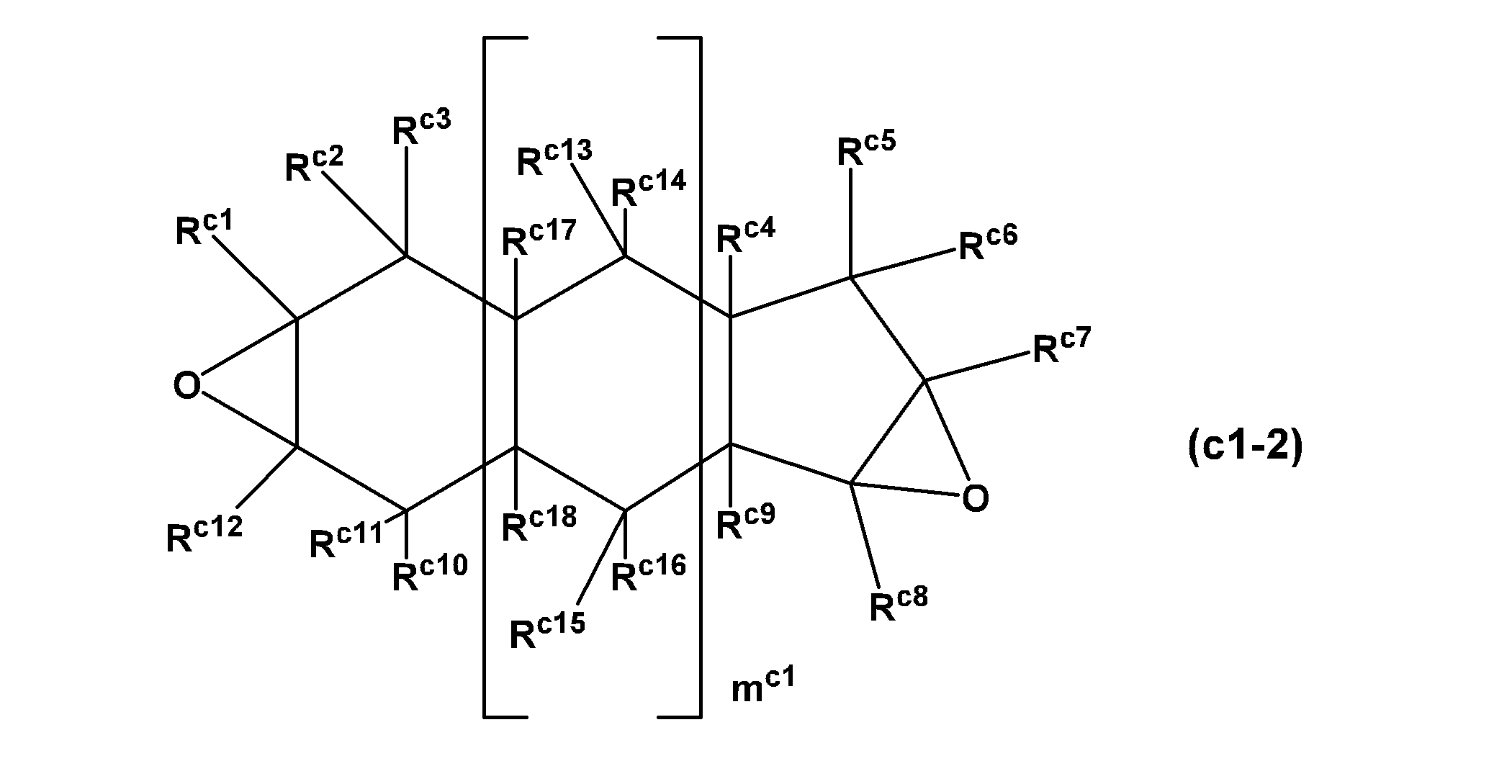
(式(c1-2)中、Rc1~Rc18は、水素原子、ハロゲン原子、及び有機基からなる群より選択される基である。Rc2及びRc10は互いに結合して環を形成してもよい。Rc13及びRc16は互いに結合して環を形成してもよい。mc1は、0又は1である。)
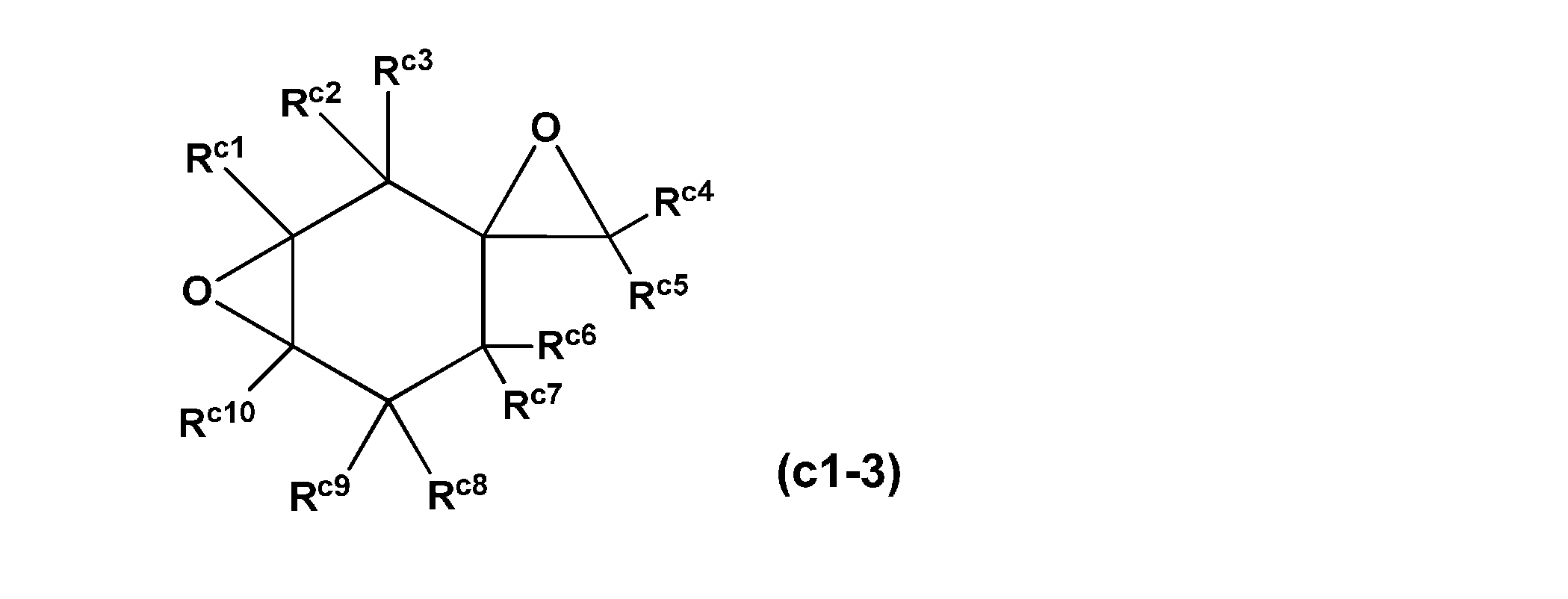

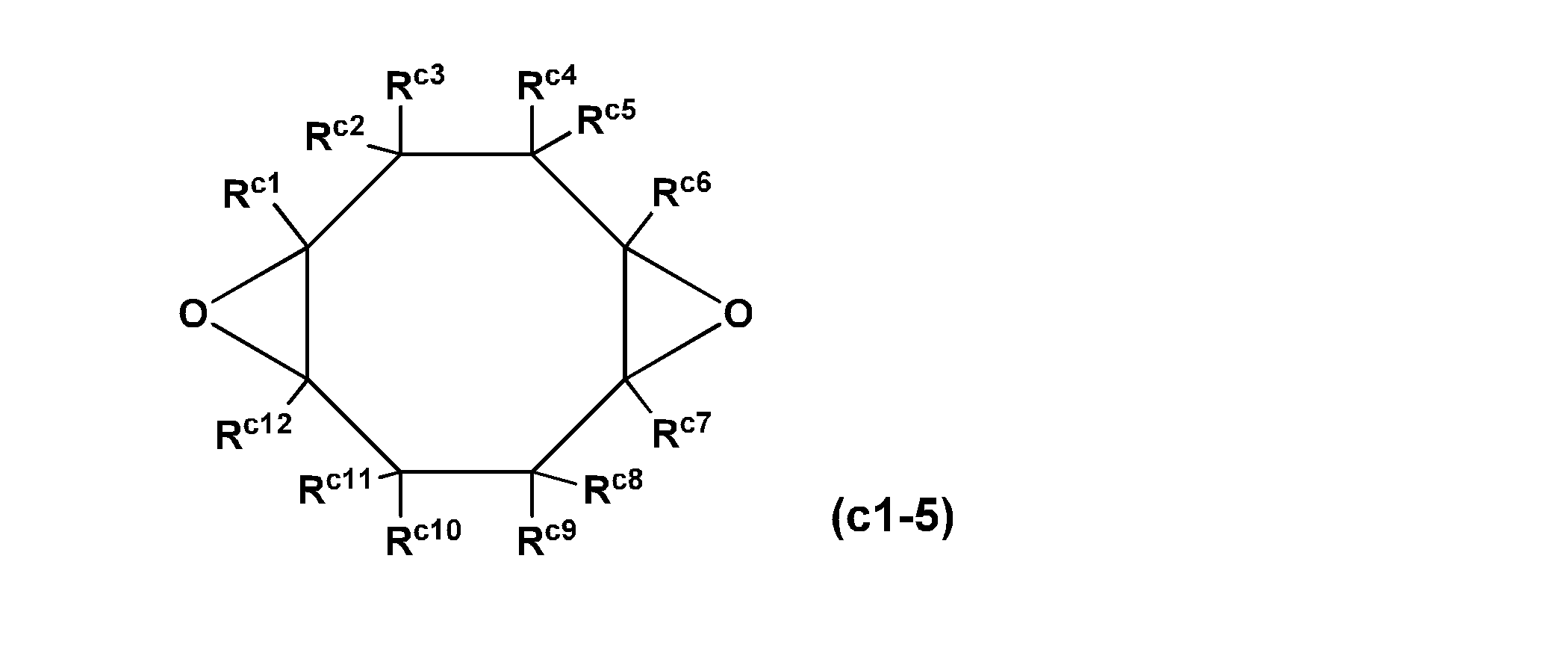
式(c1-1)~(c1-5)中、Rc1~Rc18が有機基である場合、有機基は本発明の目的を阻害しない範囲で特に限定されず、炭化水素基であっても、炭素原子とハロゲン原子とからなる基であっても、炭素原子及び水素原子とともにハロゲン原子、酸素原子、硫黄原子、窒素原子、ケイ素原子のようなヘテロ原子を含むような基であってもよい。ハロゲン原子の例としては、塩素原子、臭素原子、ヨウ素原子、及びフッ素原子等が挙げられる。
有機基としては、炭化水素基と、炭素原子、水素原子、及び酸素原子からなる基と、ハロゲン化炭化水素基と、炭素原子、酸素原子、及びハロゲン原子からなる基と、炭素原子、水素原子、酸素原子、及びハロゲン原子からなる基とが好ましい。有機基が炭化水素基である場合、炭化水素基は、芳香族炭化水素基でも、脂肪族炭化水素基でも、芳香族骨格と脂肪族骨格とを含む基でもよい。有機基の炭素原子数は1以上20以下が好ましく、1以上10以下がより好ましく、1以上5以下が特に好ましい。
炭化水素基の具体例としては、メチル基、エチル基、n-プロピル基、イソプロピル基、n-ブチル基、イソブチル基、sec-ブチル基、tert-ブチル基、n-ペンチル基、n-ヘキシル基、n-ヘプチル基、n-オクチル基、2-エチルヘキシル基、n-ノニル基、n-デシル基、n-ウンデシル基、n-トリデシル基、n-テトラデシル基、n-ペンタデシル基、n-ヘキサデシル基、n-ヘプタデシル基、n-オクタデシル基、n-ノナデシル基、及びn-イコシル基等の鎖状アルキル基;ビニル基、1-プロペニル基、2-n-プロペニル基(アリル基)、1-n-ブテニル基、2-n-ブテニル基、及び3-n-ブテニル基等の鎖状アルケニル基;シクロプロピル基、シクロブチル基、シクロペンチル基、シクロヘキシル基、及びシクロヘプチル基等のシクロアルキル基;フェニル基、o-トリル基、m-トリル基、p-トリル基、α-ナフチル基、β-ナフチル基、ビフェニル-4-イル基、ビフェニル-3-イル基、ビフェニル-2-イル基、アントリル基、及びフェナントリル基等のアリール基;ベンジル基、フェネチル基、α-ナフチルメチル基、β-ナフチルメチル基、α-ナフチルエチル基、及びβ-ナフチルエチル基等のアラルキル基が挙げられる。
ハロゲン化炭化水素基の具体例は、クロロメチル基、ジクロロメチル基、トリクロロメチル基、ブロモメチル基、ジブロモメチル基、トリブロモメチル基、フルオロメチル基、ジフルオロメチル基、トリフルオロメチル基、2,2,2-トリフルオロエチル基、ペンタフルオロエチル基、ヘプタフルオロプロピル基、パーフルオロブチル基、及びパーフルオロペンチル基、パーフルオロヘキシル基、パーフルオロヘプチル基、パーフルオロオクチル基、パーフルオロノニル基、及びパーフルオロデシル基等のハロゲン化鎖状アルキル基;2-クロロシクロヘキシル基、3-クロロシクロヘキシル基、4-クロロシクロヘキシル基、2,4-ジクロロシクロヘキシル基、2-ブロモシクロヘキシル基、3-ブロモシクロヘキシル基、及び4-ブロモシクロヘキシル基等のハロゲン化シクロアルキル基;2-クロロフェニル基、3-クロロフェニル基、4-クロロフェニル基、2,3-ジクロロフェニル基、2,4-ジクロロフェニル基、2,5-ジクロロフェニル基、2,6-ジクロロフェニル基、3,4-ジクロロフェニル基、3,5-ジクロロフェニル基、2-ブロモフェニル基、3-ブロモフェニル基、4-ブロモフェニル基、2-フルオロフェニル基、3-フルオロフェニル基、4-フルオロフェニル基等のハロゲン化アリール基;2-クロロフェニルメチル基、3-クロロフェニルメチル基、4-クロロフェニルメチル基、2-ブロモフェニルメチル基、3-ブロモフェニルメチル基、4-ブロモフェニルメチル基、2-フルオロフェニルメチル基、3-フルオロフェニルメチル基、4-フルオロフェニルメチル基等のハロゲン化アラルキル基である。
炭素原子、水素原子、及び酸素原子からなる基の具体例は、ヒドロキシメチル基、2-ヒドロキシエチル基、3-ヒドロキシ-n-プロピル基、及び4-ヒドロキシ-n-ブチル基等のヒドロキシ鎖状アルキル基;2-ヒドロキシシクロヘキシル基、3-ヒドロキシシクロヘキシル基、及び4-ヒドロキシシクロヘキシル基等のハロゲン化シクロアルキル基;2-ヒドロキシフェニル基、3-ヒドロキシフェニル基、4-ヒドロキシフェニル基、2,3-ジヒドロキシフェニル基、2,4-ジヒドロキシフェニル基、2,5-ジヒドロキシフェニル基、2,6-ジヒドロキシフェニル基、3,4-ジヒドロキシフェニル基、及び3,5-ジヒドロキシフェニル基等のヒドロキシアリール基;2-ヒドロキシフェニルメチル基、3-ヒドロキシフェニルメチル基、及び4-ヒドロキシフェニルメチル基等のヒドロキシアラルキル基;メトキシ基、エトキシ基、n-プロポキシ基、イソプロポキシ基、n-ブチルオキシ基、イソブチルオキシ基、sec-ブチルオキシ基、tert-ブチルオキシ基、n-ペンチルオキシ基、n-ヘキシルオキシ基、n-ヘプチルオキシ基、n-オクチルオキシ基、2-エチルヘキシルオキシ基、n-ノニルオキシ基、n-デシルオキシ基、n-ウンデシルオキシ基、n-トリデシルオキシ基、n-テトラデシルオキシ基、n-ペンタデシルオキシ基、n-ヘキサデシルオキシ基、n-ヘプタデシルオキシ基、n-オクタデシルオキシ基、n-ノナデシルオキシ基、及びn-イコシルオキシ基等の鎖状アルコキシ基;ビニルオキシ基、1-プロペニルオキシ基、2-n-プロペニルオキシ基(アリルオキシ基)、1-n-ブテニルオキシ基、2-n-ブテニルオキシ基、及び3-n-ブテニルオキシ基等の鎖状アルケニルオキシ基;フェノキシ基、o-トリルオキシ基、m-トリルオキシ基、p-トリルオキシ基、α-ナフチルオキシ基、β-ナフチルオキシ基、ビフェニル-4-イルオキシ基、ビフェニル-3-イルオキシ基、ビフェニル-2-イルオキシ基、アントリルオキシ基、及びフェナントリルオキシ基等のアリールオキシ基;ベンジルオキシ基、フェネチルオキシ基、α-ナフチルメチルオキシ基、β-ナフチルメチルオキシ基、α-ナフチルエチルオキシ基、及びβ-ナフチルエチルオキシ基等のアラルキルオキシ基;メトキシメチル基、エトキシメチル基、n-プロポキシメチル基、2-メトキシエチル基、2-エトキシエチル基、2-n-プロポキシエチル基、3-メトキシ-n-プロピル基、3-エトキシ-n-プロピル基、3-n-プロポキシ-n-プロピル基、4-メトキシ-n-ブチル基、4-エトキシ-n-ブチル基、及び4-n-プロポキシ-n-ブチル基等のアルコキシアルキル基;メトキシメトキシ基、エトキシメトキシ基、n-プロポキシメトキシ基、2-メトキシエトキシ基、2-エトキシエトキシ基、2-n-プロポキシエトキシ基、3-メトキシ-n-プロポキシ基、3-エトキシ-n-プロポキシ基、3-n-プロポキシ-n-プロポキシ基、4-メトキシ-n-ブチルオキシ基、4-エトキシ-n-ブチルオキシ基、及び4-n-プロポキシ-n-ブチルオキシ基等のアルコキシアルコキシ基;2-メトキシフェニル基、3-メトキシフェニル基、及び4-メトキシフェニル基等のアルコキシアリール基;2-メトキシフェノキシ基、3-メトキシフェノキシ基、及び4-メトキシフェノキシ基等のアルコキシアリールオキシ基;ホルミル基、アセチル基、プロピオニル基、ブタノイル基、ペンタノイル基、ヘキサノイル基、ヘプタノイル基、オクタノイル基、ノナノイル基、及びデカノイル基等の脂肪族アシル基;ベンゾイル基、α-ナフトイル基、及びβ-ナフトイル基等の芳香族アシル基;メトキシカルボニル基、エトキシカルボニル基、n-プロポキシカルボニル基、n-ブチルオキシカルボニル基、n-ペンチルオキシカルボニル基、n-ヘキシルカルボニル基、n-ヘプチルオキシカルボニル基、n-オクチルオキシカルボニル基、n-ノニルオキシカルボニル基、及びn-デシルオキシカルボニル基等の鎖状アルキルオキシカルボニル基;フェノキシカルボニル基、α-ナフトキシカルボニル基、及びβ-ナフトキシカルボニル基等のアリールオキシカルボニル基;ホルミルオキシ基、アセチルオキシ基、プロピオニルオキシ基、ブタノイルオキシ基、ペンタノイルオキシ基、ヘキサノイルオキシ基、ヘプタノイルオキシ基、オクタノイルオキシ基、ノナノイルオキシ基、及びデカノイルオキシ基等の脂肪族アシルオキシ基;ベンゾイルオキシ基、α-ナフトイルオキシ基、及びβ-ナフトイルオキシ基等の芳香族アシルオキシ基である。
Rc1~Rc18は、それぞれ独立に、水素原子、ハロゲン原子、炭素原子数1以上5以下のアルキル基、及び炭素原子数1以上5以下のアルコキシ基からなる群より選択される基が好ましく、特に機械的特性に優れる硬化膜を形成しやすいことから、Rc1~Rc18が全て水素原子であるのがより好ましい。
式(c1-2)~(c1-5)中、Rc1~Rc18は、式(c1-1)におけるRc1~Rc18と同様である。式(c1-2)及び式(c1-4)において、Rc2及びRc10が、互いに結合する場合、式(c1-2)において、Rc13及びRc16が、互いに結合する場合、及び式(c1-3)において、Rc2及びRc8が、互いに結合する場合、2つの基が結合して形成される2価の基としては、例えば、-CH2-、-C(CH3)2-が挙げられる。
式(c1-1)で表される脂環式エポキシ化合物のうち、好適な化合物の具体例としては、下記式(c1-1a)、式(c1-1b)、及び式(c1-1c)で表される脂環式エポキシ化合物や、2,2-ビス(3,4-エポキシシクロヘキサン-1-イル)プロパン[=2,2-ビス(3,4-エポキシシクロヘキシル)プロパン]等を挙げることができる。

式(c1-2)で表される脂環式エポキシ化合物のうち、好適な化合物の具体例としては、下記式(c1-2a)で表される化合物、及び下記式(c1-2b)で表される化合物が挙げられる。

式(c1-3)で表される脂環式エポキシ化合物のうち、好適な化合物の具体例としては、Sスピロ[3-オキサトリシクロ[3.2.1.02,4]オクタン-6,2’-オキシラン]等が挙げられる。
式(c1-4)で表される脂環式エポキシ化合物のうち、好適な化合物の具体例としては、4-ビニルシクロヘキセンジオキシド、ジペンテンジオキシド、リモネンジオキシド、1-メチル-4-(3-メチルオキシラン-2-イル)-7-オキサビシクロ[4.1.0]ヘプタン等が挙げられる。
式(c1-5)で表される脂環式エポキシ化合物のうち、好適な化合物の具体例としては、1,2,5,6-ジエポキシシクロオクタン等が挙げられる。
さらに、下記式(c1)で表される化合物をエポキシ化合物として好適に使用し得る。
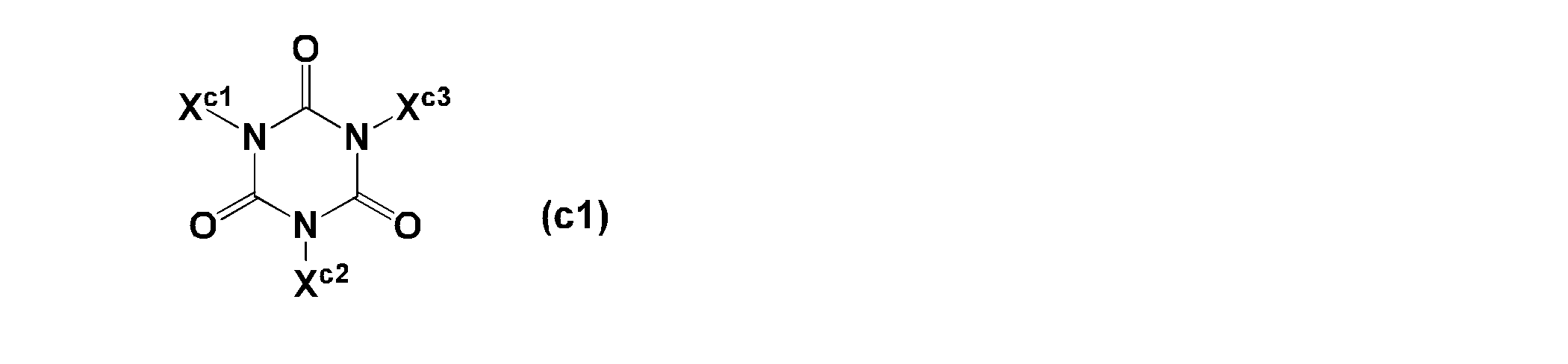
(式(c1)中、Xc1、Xc2、及びXc3は、それぞれ独立に、水素原子、又はエポキシ基を含んでいてもよい有機基であり、Xc1、Xc2、及びXc3が有するエポキシ基の総数が2以上である。)
上記式(c1)で表される化合物としては、下記式(c1-6)で表される化合物が好ましい。
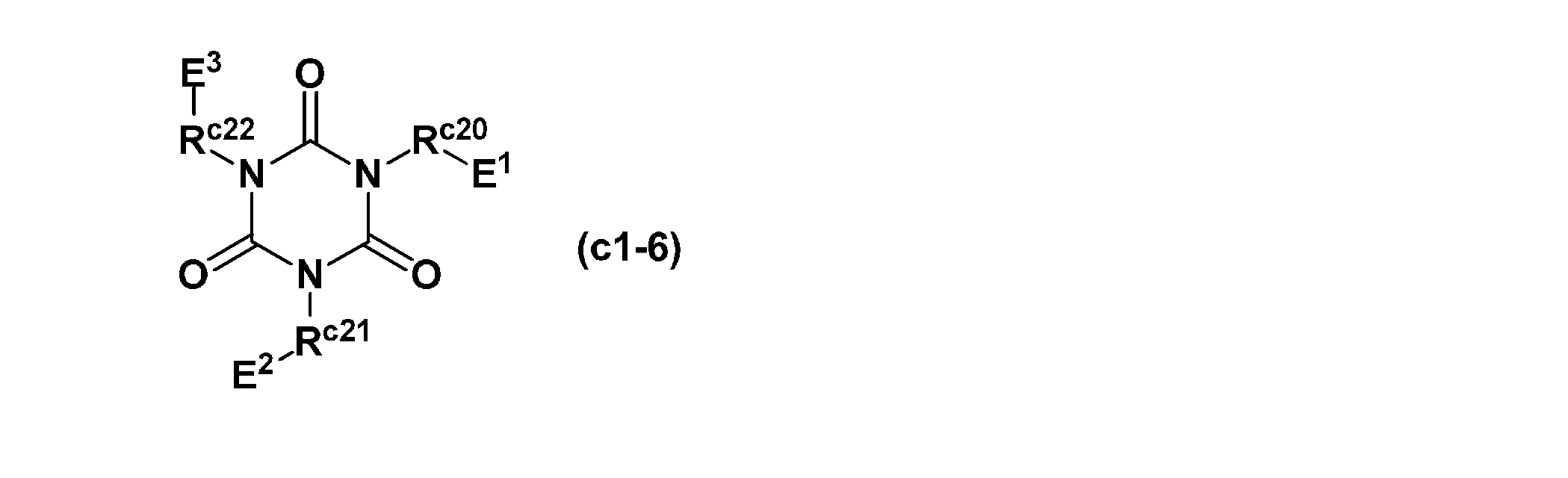
(式(c1-6)中、Rc20~Rc22は、直鎖状、分岐鎖状又は環状のアルキレン基、アリーレン基、-O-、-C(=O)-、-NH-及びこれらの組み合わせからなる基であり、それぞれ同一であってもよいし、異なっていてもよい。E1~E3は、エポキシ基、オキセタニル基、エチレン性不飽和基、アルコキシシリル基、イソシアネート基、ブロックイソシアネート基、チオール基、カルボキシ基、水酸基及びコハク酸無水物基からなる群より選択される少なくとも1種の置換基又は水素原子である。ただし、E1~E3のうち少なくとも2つは、エポキシ基及びオキセタニル基からなる群より選択される少なくとも1種である。)
式(c1-6)中、Rc20とE1、Rc21とE2、及びRc22とE3で示される基は、例えば、少なくとも2つが、それぞれ、下記式(c1-6a)で表される基であることが好ましく、いずれもが、それぞれ、下記式(c1-6a)で表される基であることがより好ましい。1つの化合物に結合する複数の式(c1-6a)で表される基は、同じ基であることが好ましい。
-L-Cc (c1-6a)
(式(c1-6a)中、Lは直鎖状、分岐鎖状又は環状のアルキレン基、アリーレン基、-O-、-C(=O)-、-NH-及びこれらの組み合わせからなる基であり、Ccはエポキシ基である。式(c1-6a)中、LとCcとが結合して環状構造を形成していてもよい。)
-L-Cc (c1-6a)
(式(c1-6a)中、Lは直鎖状、分岐鎖状又は環状のアルキレン基、アリーレン基、-O-、-C(=O)-、-NH-及びこれらの組み合わせからなる基であり、Ccはエポキシ基である。式(c1-6a)中、LとCcとが結合して環状構造を形成していてもよい。)
式(c1-6a)中、Lとしての直鎖状、分岐鎖状又は環状のアルキレン基としては、炭素原子数1以上10以下のアルキレン基が好ましい。Lとしてのアリーレン基としては、炭素原子数5以上10以下のアリーレン基が好ましい。式(c1-6a)中、Lは、直鎖状の炭素原子数1以上3以下のアルキレン基、フェニレン基、-O-、-C(=O)-、-NH-及びこれらの組み合わせからなる基であることが好ましく、メチレン基等の直鎖状の炭素原子数1以上3以下のアルキレン基及びフェニレン基の少なくとも1種、又は、これらと、-O-、-C(=O)-及びNH-の少なくとも1種との組み合わせからなる基が好ましい。
式(c1-6a)中、LとCcとが結合して環状構造を形成している場合としては、例えば、分岐鎖状のアルキレン基とエポキシ基とが結合して環状構造(脂環構造のエポキシ基を有する構造)を形成している場合、下記式(c1-6b)又は(c1-6c)で表される有機基が挙げられる。

(式(c1-6b)中、Rc23は、水素原子又はメチル基である。)
以下、式(c1-6)で表される化合物の例としてオキシラニル基、又は脂環式エポキシ基を有するエポキシ化合物の例を示すが、これらに限定されない。
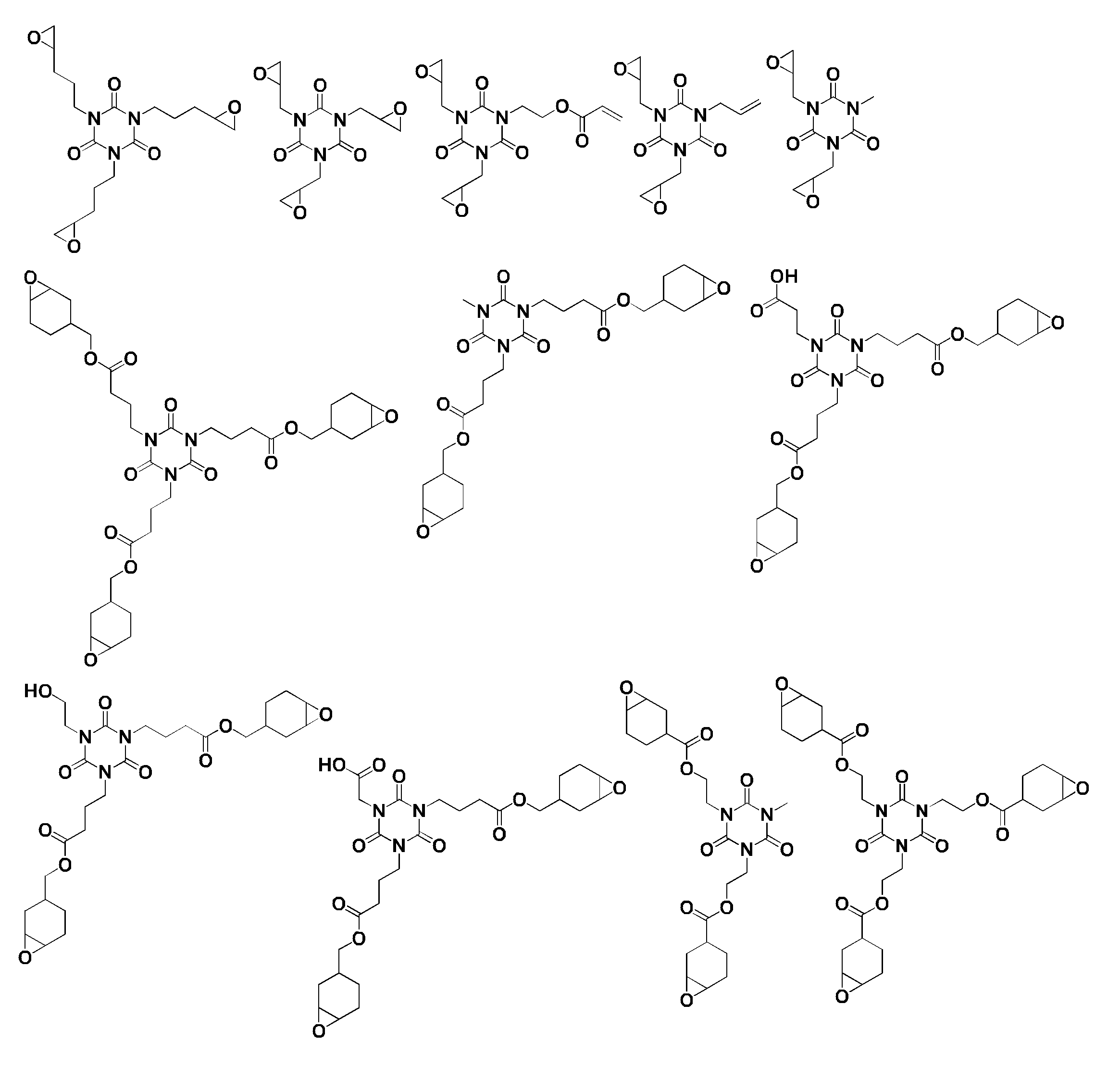
また、エポキシ化合物として好適に使用し得る化合物としては、分子内に2以上のエポキシ基を有するシロキサン化合物(以下、単に「シロキサン化合物」とも記す。)を挙げることができる。
シロキサン化合物は、シロキサン結合(Si-O-Si)により構成されたシロキサン骨格と、2以上のグリシジル基とを分子内に有する化合物である。
シロキサン化合物におけるシロキサン骨格としては、例えば、環状シロキサン骨格やかご型やラダー型のポリシルセスキオキサン骨格を挙げることができる。
シロキサン化合物におけるシロキサン骨格としては、例えば、環状シロキサン骨格やかご型やラダー型のポリシルセスキオキサン骨格を挙げることができる。
シロキサン化合物としては、なかでも、下記式(c1-7)で表される環状シロキサン骨格を有する化合物(以下、「環状シロキサン」という場合がある)が好ましい。

式(c1-7)中、Rc24、及びRc25は、エポキシ基を含有する一価の基又はアルキル基を示す。ただし、式(c1-7)で表される化合物におけるx1個のRc24及びx1個のRc25のうち、少なくとも2個はエポキシ基を含有する一価の基である。また、式(c1-7)中のx1は3以上の整数を示す。なお、式(c1-7)で表される化合物におけるRc24、Rc25は同一であってもよいし、異なっていてもよい。また、複数のRc24は同一であってもよいし、異なっていてもよい。複数のRc25も同一であってもよいし、異なっていてもよい。
上記エポキシ基を含有する一価の基としては、-D-O-Rc26で表されるグリシジルエーテル基が好ましい。Dはアルキレン基を示し、Rc26はグリシジル基を示す。上記Dとしてのアルキレン基としては、例えば、メチレン基、メチルメチレン基、ジメチルメチレン基、ジメチレン基、トリメチレン基等の炭素原子数が1以上18以下の直鎖状又は分岐鎖状のアルキレン基等を挙げることができる。
また、-D-Rc27で表される脂環式エポキシ基含有基も好ましい。Rc27は、エポキシシクロアルキル基である。Dは前述の通り、アルキレン基である。Dとしてのアルキレン基の好ましい例も、前述の通りである。Rc27としてのエポキシシクロアルキル基としては、2,3-エポキシシクロペンチル基、3,4-エポキシシクロヘキシル基、及び2,3-エポキシシクロヘキシル基が好ましい。-D-Rc27で表される基としては、2-(3,4-エポキシシクロヘキシル)エチル基が好ましい。
また、-D-Rc27で表される脂環式エポキシ基含有基も好ましい。Rc27は、エポキシシクロアルキル基である。Dは前述の通り、アルキレン基である。Dとしてのアルキレン基の好ましい例も、前述の通りである。Rc27としてのエポキシシクロアルキル基としては、2,3-エポキシシクロペンチル基、3,4-エポキシシクロヘキシル基、及び2,3-エポキシシクロヘキシル基が好ましい。-D-Rc27で表される基としては、2-(3,4-エポキシシクロヘキシル)エチル基が好ましい。
Rc24、及びRc25としてのアルキル基の好ましい例としては、例えば、メチル基、エチル基、プロピル基、イソプロピル基等の炭素原子数1以上18以下の直鎖状又は分岐鎖状のアルキル基を挙げることができる。アルキル基の炭素原子数は、好ましくは炭素原子数1以上6以下、特に好ましくは炭素原子数1以上3以下である。
式(c1-7)中のx1は3以上の整数を示し、なかでも、硬化膜を形成する際の架橋反応性に優れる点で3以上6以下の整数が好ましい。
シロキサン化合物が分子内に有するエポキシ基の数は2個以上であり、硬化膜を形成する際の架橋反応性に優れる点から2個以上6個以下が好ましく、特に好ましくは2個以上4個以下である。
液状組成物は、式(c1-7)で表されるシロキサン化合物以外にも、脂環式エポキシ基含有環状シロキサン、特開2008-248169号公報に記載の脂環式エポキシ基含有シリコーン樹脂、及び特開2008-19422号公報に記載の1分子中に少なくとも2個のエポキシ官能性基を有するオルガノポリシルセスキオキサン樹脂等のシロキサン骨格を有する化合物を含有していてもよい。
シロキサン化合物としては、より具体的には、下記式で表される、分子内に2以上のエポキシ基を有する環状シロキサン等を挙げることができる。また、シロキサン化合物としては、例えば、商品名「X-40-2670」、「X-40-2701」、「X-40-2728」、「X-40-2738」、「X-40-2740」(以上、信越化学工業社製)等の市販品を用いることができる。

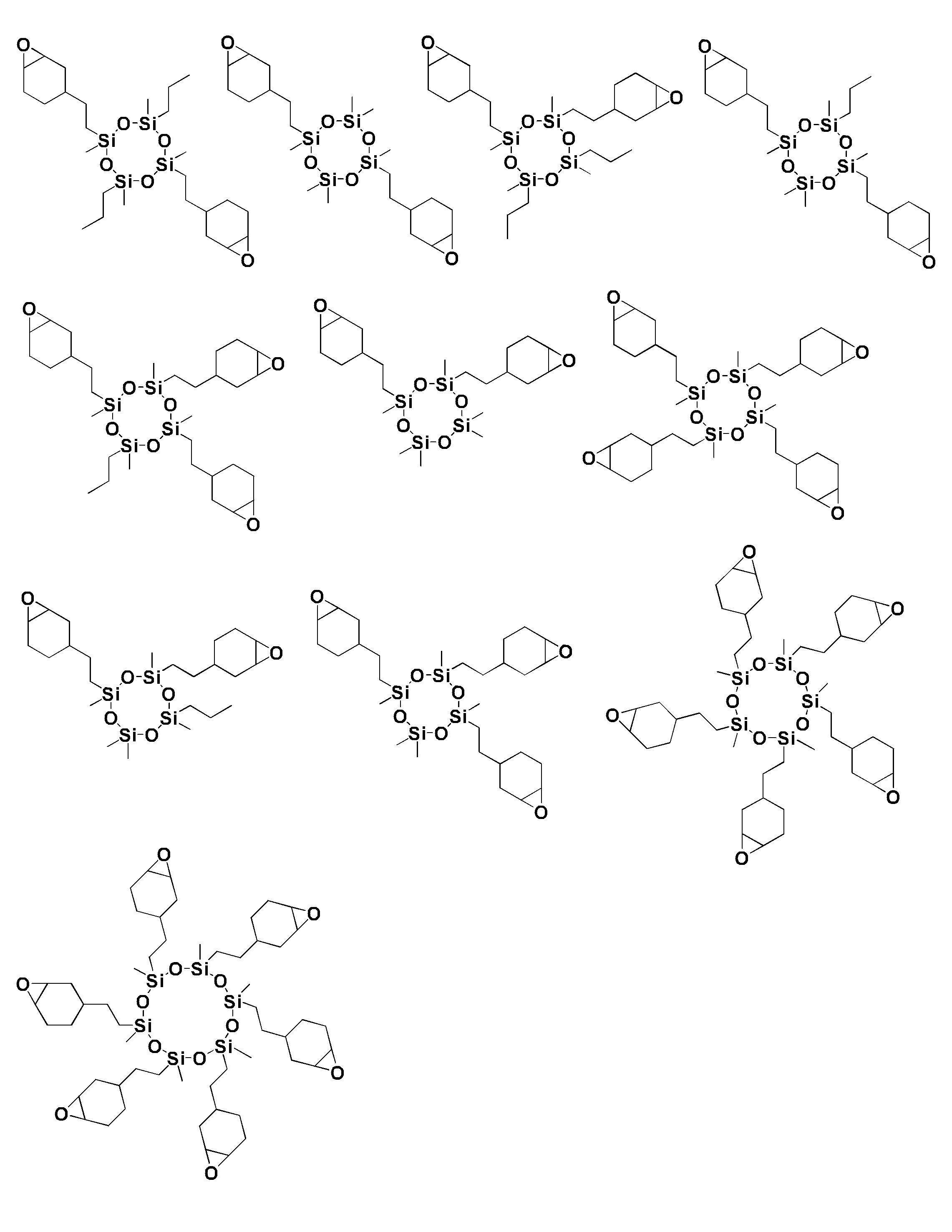
[熱硬化性の高分子化合物]
基材成分(C)として使用できる熱硬化性の高分子化合物としては、加熱により、分子内での芳香環形成反応、及び/又は分子間での架橋反応を生じさせる樹脂や、焼成により硬化膜を生成させる樹脂が挙げられる。
組成物が加熱により、分子内での芳香環形成反応、及び/又は分子間での架橋反応を生じさせる樹脂を含む場合、加熱による、分子内での芳香環形成反応及び/又は分子間での架橋反応を促進させる点から、組成物が、特開2016-145308号公報に記載される熱イミダゾール発生剤や、特開2017-025226号公報に記載のイミダゾール化合物を含むの好ましい。
組成物が焼成により硬化膜を生成させる樹脂を含む場合に、組成物が含みうる硬化剤については後述する。
基材成分(C)として使用できる熱硬化性の高分子化合物としては、加熱により、分子内での芳香環形成反応、及び/又は分子間での架橋反応を生じさせる樹脂や、焼成により硬化膜を生成させる樹脂が挙げられる。
組成物が加熱により、分子内での芳香環形成反応、及び/又は分子間での架橋反応を生じさせる樹脂を含む場合、加熱による、分子内での芳香環形成反応及び/又は分子間での架橋反応を促進させる点から、組成物が、特開2016-145308号公報に記載される熱イミダゾール発生剤や、特開2017-025226号公報に記載のイミダゾール化合物を含むの好ましい。
組成物が焼成により硬化膜を生成させる樹脂を含む場合に、組成物が含みうる硬化剤については後述する。
分子内での芳香環形成反応によれば、樹脂を構成する分子鎖の構造が剛直化し、組成物を用いて耐熱性及び機械的特性に優れる硬化膜を得やすい。分子内での芳香環形成反応のうち、好ましい反応としては、例えば、下式(I)~(VI)で示される反応が挙げられる。なお、下式中の反応は芳香環形成反応の一例にすぎず、基材成分(C)として使用される、加熱により分子内での芳香環形成反応を生じさせる樹脂の構造は、下式中に示される前駆体ポリマーの構造に限定されない。
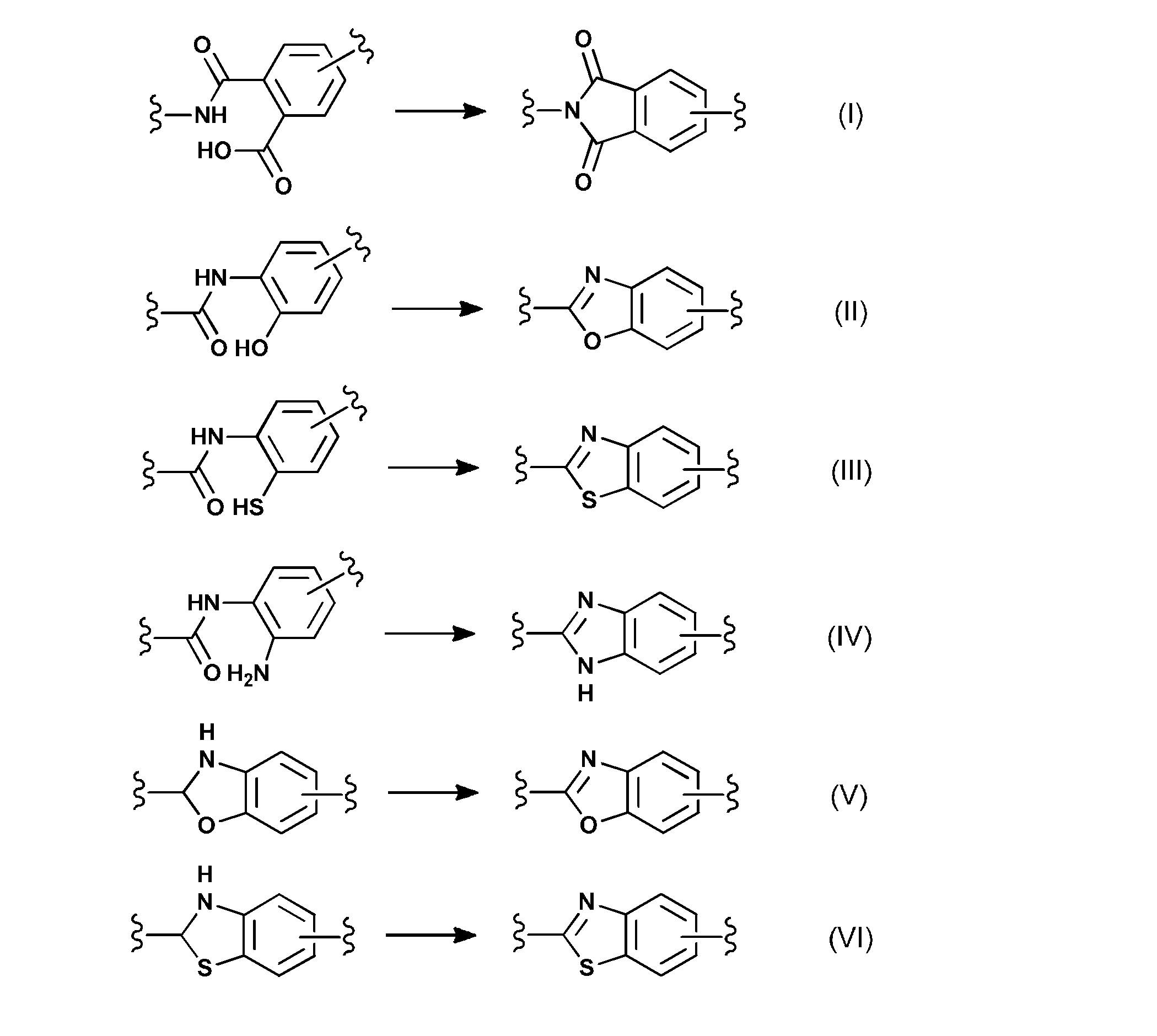
分子間での架橋反応によれば、樹脂を構成する分子鎖が相互に架橋され、三次元架橋構造が形成される。このため、加熱により架橋反応を生じさせる樹脂を基材成分(C)として含む組成物を用いると、耐熱性及び機械的特性に優れる硬化膜を得やすい。
加熱により分子間の架橋反応を生じさせる樹脂としては、分子中に、水酸基、カルボン酸無水物基、カルボキシ基、及びエポキシ基から選択される基を有する樹脂が好ましい。このような樹脂を用いる場合、例えば、前述の熱イミダゾール発生剤やイミダゾール化合物の作用によって、以下に記すような架橋が生じる。水酸基を有する樹脂を用いる場合、樹脂に含まれる分子間に水酸基間の脱水縮合による架橋が生じる。カルボン酸無水物基を有する樹脂を用いる場合、酸無水物基の加水分解により生じるカルボキシ基同士が脱水縮合して架橋する。カルボキシ基を有する樹脂を用いる場合、樹脂に含まれる分子間にカルボキシ基間の脱水縮合による架橋が生じる。エポキシ基を有する樹脂を用いる場合、樹脂に含まれる分子間にエポキシ基間の重付加反応による架橋が生じる。
このような加熱により分子内での芳香環形成反応や、分子間での架橋反応を生じさせる化合物の中では、耐熱性に優れる成形体を形成しやすいことから、ポリアミック酸、ポリベンゾオキサゾール前駆体、ポリベンゾチアゾール前駆体、ポリベンゾイミダゾール前駆体、スチレン-マレイン酸共重合体、及びエポキシ基含有樹脂が好ましい。
加熱により分子内での芳香環形成反応や、分子間での架橋反応を生じさせる化合物としての上記化合物としては、公知の材料を特に制限なく用いることができる。
例えば、分子中に、水酸基、カルボン酸無水物基、カルボキシル基、及びエポキシ基から選択される基を有する樹脂、ポリアミック酸、及びポリベンゾオキサゾール前駆体としては、特開2018-061034号公報に記載されている化合物を好適に用いることができる。
なお、これらの化合物は、特開2018-061034号公報に記載される化合物には限定されない。
加熱により分子内での芳香環形成反応や、分子間での架橋反応を生じさせる化合物としての上記化合物としては、公知の材料を特に制限なく用いることができる。
例えば、分子中に、水酸基、カルボン酸無水物基、カルボキシル基、及びエポキシ基から選択される基を有する樹脂、ポリアミック酸、及びポリベンゾオキサゾール前駆体としては、特開2018-061034号公報に記載されている化合物を好適に用いることができる。
なお、これらの化合物は、特開2018-061034号公報に記載される化合物には限定されない。
(エポキシ基含有樹脂)
エポキシ基含有樹脂は、エポキシ基を有する単量体又はエポキシ基を有する単量体を含む単量体混合物を重合させて得られる重合体であってもよい。エポキシ基含有樹脂は、水酸基、カルボキシ基、アミノ基等の反応性を有する官能基を有する重合体に対して、例えばエピクロルヒドリンのようなエポキシ基を有する化合物を用いてエポキシ基が導入された樹脂であってもよい。入手、調製、重合体中のエポキシ基の量の調整等が容易であることから、エポキシ基を有する重合体としては、エポキシ基を有する単量体又はエポキシ基を有する単量体を含む単量体混合物を重合させて得られる重合体が好ましい。
エポキシ基含有樹脂は、エポキシ基を有する単量体又はエポキシ基を有する単量体を含む単量体混合物を重合させて得られる重合体であってもよい。エポキシ基含有樹脂は、水酸基、カルボキシ基、アミノ基等の反応性を有する官能基を有する重合体に対して、例えばエピクロルヒドリンのようなエポキシ基を有する化合物を用いてエポキシ基が導入された樹脂であってもよい。入手、調製、重合体中のエポキシ基の量の調整等が容易であることから、エポキシ基を有する重合体としては、エポキシ基を有する単量体又はエポキシ基を有する単量体を含む単量体混合物を重合させて得られる重合体が好ましい。
エポキシ基含有樹脂の好ましい一例としては、フェノールノボラック型エポキシ樹脂、臭素化フェノールノボラック型エポキシ樹脂、オルソクレゾールノボラック型エポキシ樹脂、ビスフェノールAノボラック型エポキシ樹脂、及びビスフェノールADノボラック型エポキシ樹脂等のノボラックエポキシ樹脂;ジシクロペンタジエン型フェノール樹脂のエポキシ化物等の環式脂肪族エポキシ樹脂;ナフタレン型フェノール樹脂のエポキシ化物等の芳香族エポキシ樹脂が挙げられる。
また、エポキシ基含有樹脂の中では、調製が容易であること等から、エポキシ基を有する(メタ)アクリル酸エステルの単独重合体か、エポキシ基を有する(メタ)アクリル酸エステルと他の単量体との共重合体が好ましい。
エポキシ基を有する(メタ)アクリル酸エステルは、鎖状脂肪族エポキシ基を有する(メタ)アクリル酸エステルであっても、後述するような、脂環式エポキシ基を有する(メタ)アクリル酸エステルであってもよい。また、エポキシ基を有する(メタ)アクリル酸エステルは、芳香族基を含んでいてもよい。エポキシ基を有する(メタ)アクリル酸エステルの中では、鎖状脂肪族エポキシ基を有する脂肪族(メタ)アクリル酸エステルや、脂環式エポキシ基を有する脂肪族(メタ)アクリル酸エステルが好ましく、脂環式エポキシ基を有する脂肪族(メタ)アクリル酸エステルがより好ましい。
芳香族基を含み、エポキシ基を有する(メタ)アクリル酸エステルの例としては、4-グリシジルオキシフェニル(メタ)アクリレート、3-グリシジルオキシフェニル(メタ)アクリレート、2-グリシジルオキシフェニル(メタ)アクリレート、4-グリシジルオキシフェニルメチル(メタ)アクリレート、3-グリシジルオキシフェニルメチル(メタ)アクリレート、及び2-グリシジルオキシフェニルメチル(メタ)アクリレート等が挙げられる。
鎖状脂肪族エポキシ基を有する脂肪族(メタ)アクリル酸エステルの例としては、エポキシアルキル(メタ)アクリレート、及びエポキシアルキルオキシアルキル(メタ)アクリレート等のような、エステル基(-O-CO-)中のオキシ基(-O-)に鎖状脂肪族エポキシ基が結合する(メタ)アクリル酸エステルが挙げられる。このような(メタ)アクリル酸エステルが有する鎖状脂肪族エポキシ基は、鎖中に1又は複数のオキシ基(-O-)を含んでいてもよい。鎖状脂肪族エポキシ基の炭素原子数は、特に限定されないが、3以上20以下が好ましく、3以上15以下がより好ましく、3以上10以下が特に好ましい。
鎖状脂肪族エポキシ基を有する脂肪族(メタ)アクリル酸エステルの具体例としては、グリシジル(メタ)アクリレート、2-メチルグリシジル(メタ)アクリレート、3,4-エポキシブチル(メタ)アクリレート、6,7-エポキシヘプチル(メタ)アクリレート等のエポキシアルキル(メタ)アクリレート;2-グリシジルオキシエチル(メタ)アクリレート、3-グリシジルオキシ-n-プロピル(メタ)アクリレート、4-グリシジルオキシ-n-ブチル(メタ)アクリレート、5-グリシジルオキシ-n-ヘキシル(メタ)アクリレート、6-グリシジルオキシ-n-ヘキシル(メタ)アクリレート等のエポキシアルキルオキシアルキル(メタ)アクリレートが挙げられる。
脂環式エポキシ基を有する脂肪族(メタ)アクリル酸エステルの具体例としては、例えば下記式(c5-1)~(c5-15)で表される化合物が挙げられる。これらの中でも、下記式(c5-1)~(c5-5)で表される化合物が好ましく、下記式(c5-1)~(c5-3)で表される化合物がより好ましい。

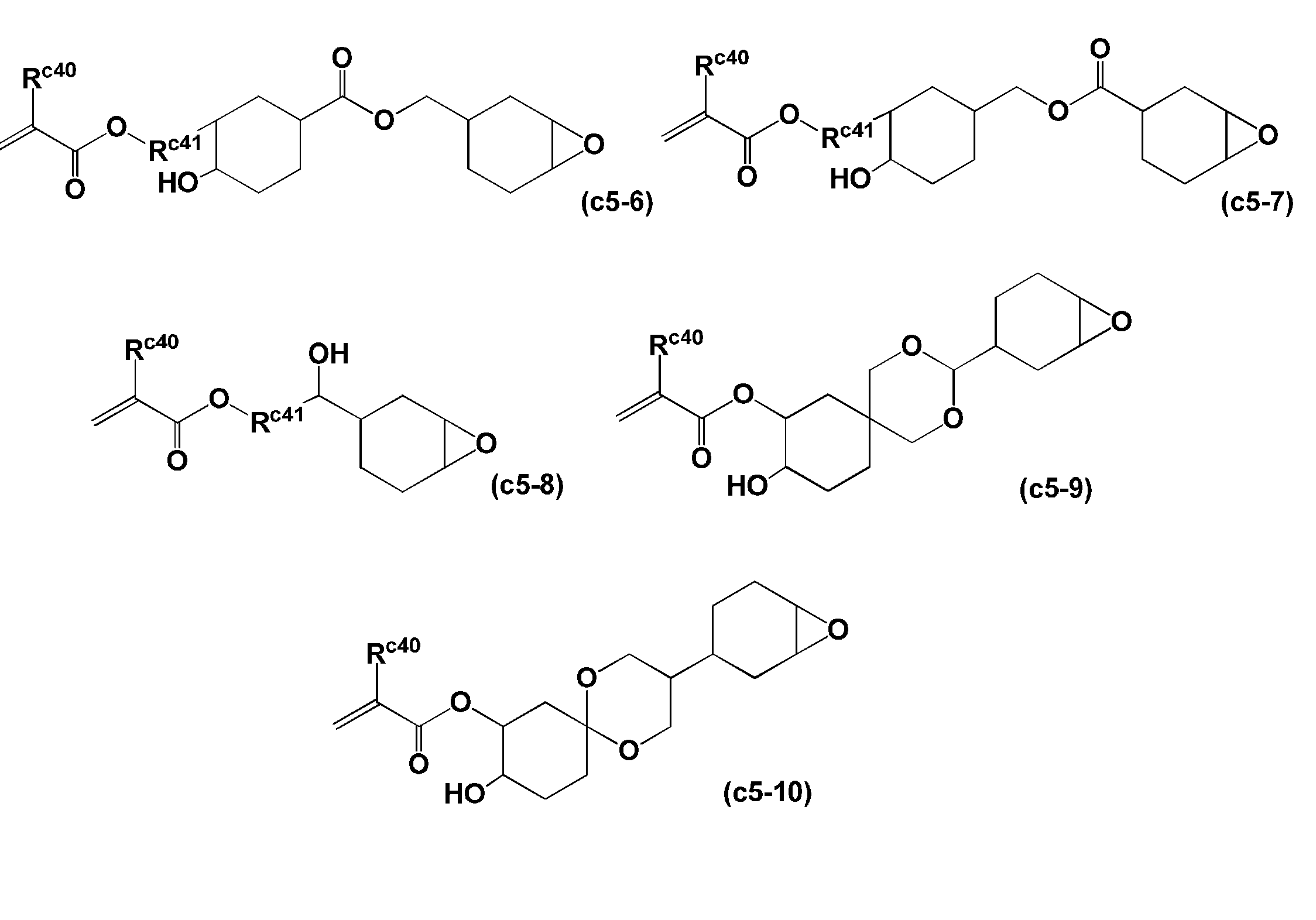

上記式中、Rc40は水素原子又はメチル基を示す。Rc41は炭素原子数1以上6以下の2価の脂肪族飽和炭化水素基を示す。Rc42は炭素原子数1以上10以下の2価の炭化水素基を示すtは0以上10以下の整数を示す。Rc41としては、直鎖状又は分枝鎖状のアルキレン基、例えばメチレン基、エチレン基、プロピレン基、テトラメチレン基、エチルエチレン基、ペンタメチレン基、ヘキサメチレン基が好ましい。Rc42としては、例えばメチレン基、エチレン基、プロピレン基、テトラメチレン基、エチルエチレン基、ペンタメチレン基、ヘキサメチレン基、フェニレン基、シクロヘキシレン基が好ましい。
エポキシ基を有する重合体としては、エポキシ基を有する(メタ)アクリル酸エステルの単独重合体、及びエポキシ基を有する(メタ)アクリル酸エステルと他の単量体との共重合体のいずれも用いることができる。エポキシ基を有する重合体中の、エポキシ基を有する(メタ)アクリル酸エステルに由来する単位の含有量は、70質量%以上が好ましく、80質量%以上がより好ましく、90質量%以上が特に好ましく、100質量%であるのが最も好ましい。
エポキシ基を有する重合体が、エポキシ基を有する(メタ)アクリル酸エステルと他の単量体との共重合体である場合、他の単量体としては、不飽和カルボン酸、エポキシ基を持たない(メタ)アクリル酸エステル、(メタ)アクリルアミド類、アリル化合物、ビニルエーテル類、ビニルエステル類、スチレン類、及びマレイミド類等が挙げられる。これらの化合物は、単独又は2種以上組み合わせて用いることができる。組成物の保存安定性や、組成物を用いて形成される硬化膜のアルカリ等に対する耐薬品性の点からは、エポキシ基を有する(メタ)アクリル酸エステルと他の単量体との共重合体は、不飽和カルボン酸に由来する単位を含まないのが好ましい。
不飽和カルボン酸の例としては、(メタ)アクリル酸;(メタ)アクリル酸アミド;クロトン酸;マレイン酸、フマル酸、シトラコン酸、メサコン酸、イタコン酸、これらジカルボン酸の無水物が挙げられる。
エポキシ基を持たない(メタ)アクリル酸エステルの例としては、メチル(メタ)アクリレート、エチル(メタ)アクリレート、プロピル(メタ)アクリレート、アミル(メタ)アクリレート、t-オクチル(メタ)アクリレート等の直鎖状又は分岐鎖状のアルキル(メタ)アクリレート;クロロエチル(メタ)アクリレート、2,2-ジメチルヒドロキシプロピル(メタ)アクリレート、2-ヒドロキシエチル(メタ)アクリレート、トリメチロールプロパンモノ(メタ)アクリレート、ベンジル(メタ)アクリレート、フルフリル(メタ)アクリレート;脂環式骨格を有する基を有する(メタ)アクリル酸エステルが挙げられる。エポキシ基を持たない(メタ)アクリル酸エステルの中では、脂環式骨格を有する基を有する(メタ)アクリル酸エステルが好ましい。
脂環式骨格を有する基を有する(メタ)アクリル酸エステルにおいて、脂環式骨格を構成する脂環式基は、単環であっても多環であってもよい。単環の脂環式基としては、シクロペンチル基、シクロヘキシル基等が挙げられる。また、多環の脂環式基としては、ノルボルニル基、イソボルニル基、トリシクロノニル基、トリシクロデシル基、テトラシクロドデシル基等が挙げられる。
脂環式骨格を有する基を有する(メタ)アクリル酸エステルとしては、例えば下記式(c6-1)~(c6-8)で表される化合物が挙げられる。これらの中では、下記式(c6-3)~(c6-8)で表される化合物が好ましく、下記式(c6-3)又は(c6-4)で表される化合物がより好ましい。


上記式中、Rc43は水素原子又はメチル基を示す。Rc44は単結合又は炭素原子数1以上6以下の2価の脂肪族飽和炭化水素基を示す。Rc45は水素原子又は炭素原子数1以上5以下のアルキル基を示す。Rc44としては、単結合、直鎖状又は分枝鎖状のアルキレン基、例えばメチレン基、エチレン基、プロピレン基、テトラメチレン基、エチルエチレン基、ペンタメチレン基、ヘキサメチレン基が好ましい。Rc45としては、メチル基、エチル基が好ましい。
(メタ)アクリルアミド類の例としては、(メタ)アクリルアミド、N-アルキル(メタ)アクリルアミド、N-アリール(メタ)アクリルアミド、N,N-ジアルキル(メタ)アクリルアミド、N,N-アリール(メタ)アクリルアミド、N-メチル-N-フェニル(メタ)アクリルアミド、N-ヒドロキシエチル-N-メチル(メタ)アクリルアミド等が挙げられる。
アリル化合物の例としては、酢酸アリル、カプロン酸アリル、カプリル酸アリル、ラウリン酸アリル、パルミチン酸アリル、ステアリン酸アリル、安息香酸アリル、アセト酢酸アリル、乳酸アリル等のアリルエステル類;アリルオキシエタノール;等が挙げられる。
ビニルエーテル類の例としては、ヘキシルビニルエーテル、オクチルビニルエーテル、デシルビニルエーテル、エチルヘキシルビニルエーテル、メトキシエチルビニルエーテル、エトキシエチルビニルエーテル、クロロエチルビニルエーテル、1-メチル-2,2-ジメチルプロピルビニルエーテル、2-エチルブチルビニルエーテル、ヒドロキシエチルビニルエーテル、ジエチレングリコールビニルエーテル、ジメチルアミノエチルビニルエーテル、ジエチルアミノエチルビニルエーテル、ブチルアミノエチルビニルエーテル、ベンジルビニルエーテル、テトラヒドロフルフリルビニルエーテル等の脂肪族ビニルエーテル;ビニルフェニルエーテル、ビニルトリルエーテル、ビニルクロロフェニルエーテル、ビニル-2,4-ジクロロフェニルエーテル、ビニルナフチルエーテル、ビニルアントラニルエーテル等のビニルアリールエーテル;等が挙げられる。
ビニルエステル類の例としては、ビニルブチレート、ビニルイソブチレート、ビニルトリメチルアセテート、ビニルジエチルアセテート、ビニルバレレート、ビニルカプロエート、ビニルクロロアセテート、ビニルジクロロアセテート、ビニルメトキシアセテート、ビニルブトキシアセテート、ビニルフェニルアセテート、ビニルアセトアセテート、ビニルラクテート、ビニル-β-フェニルブチレート、安息香酸ビニル、サリチル酸ビニル、クロロ安息香酸ビニル、テトラクロロ安息香酸ビニル、ナフトエ酸ビニル等が挙げられる。
スチレン類の例としては、スチレン;メチルスチレン、ジメチルスチレン、トリメチルスチレン、エチルスチレン、ジエチルスチレン、イソプロピルスチレン、ブチルスチレン、ヘキシルスチレン、シクロヘキシルスチレン、デシルスチレン、ベンジルスチレン、クロロメチルスチレン、トリフルオロメチルスチレン、エトキシメチルスチレン、アセトキシメチルスチレン等のアルキルスチレン;メトキシスチレン、4-メトキシ-3-メチルスチレン、ジメトキシスチレン等のアルコキシスチレン;クロロスチレン、ジクロロスチレン、トリクロロスチレン、テトラクロロスチレン、ペンタクロロスチレン、ブロモスチレン、ジブロモスチレン、ヨードスチレン、フルオロスチレン、トリフルオロスチレン、2-ブロモ-4-トリフルオロメチルスチレン、4-フルオロ-3-トリフルオロメチルスチレン等のハロスチレン;等が挙げられる。
マレイミド類としては、N-メチルマレイミド、N-エチルマレイミド、N-n-プロピルマレイミド、N-イソプロピルマレイミド、N-n-ブチルマレイミド、N-n-ペンチルマレイミド、N-n-ヘキシルマレイミド等の炭素原子数1~10のアルキル基でN置換されたマレイミド;N-シクロペンチルマレイミド、N-シクロヘキシルマレイミド、N-シクロヘプチルマレイミド等の炭素原子数3以上20以下の脂環式基でN置換されたマレイミド:N-フェニルマレイミド、N-α-ナフチルマレイミド、N-β-ナフチルマレイミド等の炭素原子数6以上20以下のアリール基でN置換されたN-アリールマレイミド;N-ベンジルマレイミド、N-フェネチルマレイミド等の炭素原子数7以上20以下のアラルキル基でN置換されたN-アラルキルマレイミドが挙げられる。
エポキシ基含有樹脂の分子量は、本発明の目的を阻害しない範囲で特に限定されないが、ポリスチレン換算の質量平均分子量として、3,000以上30,000以下が好ましく、5,000以上15,000以下がより好ましい。
[光硬化性の低分子化合物]
組成物は、基材成分(C)として光重合性の低分子化合物(光重合性モノマー)を含んでいてもよい。多官能の光重合性の低分子化合物を含む場合は、組成物が後述の光重合開始剤等を含むことが好ましい。光重合性の低分子化合物には、単官能モノマーと多官能モノマーとがある。以下、単官能モノマー、及び多官能モノマーについて順に説明する。
組成物は、基材成分(C)として光重合性の低分子化合物(光重合性モノマー)を含んでいてもよい。多官能の光重合性の低分子化合物を含む場合は、組成物が後述の光重合開始剤等を含むことが好ましい。光重合性の低分子化合物には、単官能モノマーと多官能モノマーとがある。以下、単官能モノマー、及び多官能モノマーについて順に説明する。
単官能モノマーとしては、(メタ)アクリルアミド、メチロール(メタ)アクリルアミド、メトキシメチル(メタ)アクリルアミド、エトキシメチル(メタ)アクリルアミド、プロポキシメチル(メタ)アクリルアミド、ブトキシメトキシメチル(メタ)アクリルアミド、N-メチロール(メタ)アクリルアミド、N-ヒドロキシメチル(メタ)アクリルアミド、(メタ)アクリル酸、フマル酸、マレイン酸、無水マレイン酸、イタコン酸、無水イタコン酸、シトラコン酸、無水シトラコン酸、クロトン酸、2-アクリルアミド-2-メチルプロパンスルホン酸、tert-ブチルアクリルアミドスルホン酸、メチル(メタ)アクリレート、エチル(メタ)アクリレート、ブチル(メタ)アクリレート、2-エチルヘキシル(メタ)アクリレート、シクロヘキシル(メタ)アクリレート、2-ヒドロキシエチル(メタ)アクリレート、2-ヒドロキシプロピル(メタ)アクリレート、2-ヒドロキシブチル(メタ)アクリレート、2-フェノキシ-2-ヒドロキシプロピル(メタ)アクリレート、2-(メタ)アクリロイルオキシ-2-ヒドロキシプロピルフタレート、グリセリンモノ(メタ)アクリレート、テトラヒドロフルフリル(メタ)アクリレート、N,N-ジメチル-2-アミノエチル(メタ)アクリレート、グリシジル(メタ)アクリレート、2,2,2-トリフルオロエチル(メタ)アクリレート、2,2,3,3-テトラフルオロプロピル(メタ)アクリレート、フタル酸誘導体のハーフ(メタ)アクリレート等が挙げられる。これらの単官能モノマーは、単独で用いてもよく、2種以上を組み合わせて用いてもよい。
多官能モノマーとしては、エチレングリコールジ(メタ)アクリレート、ジエチレングリコールジ(メタ)アクリレート、テトラエチレングリコールジ(メタ)アクリレート、プロピレングリコールジ(メタ)アクリレート、ポリプロピレングリコールジ(メタ)アクリレート、ブチレングリコールジ(メタ)アクリレート、ネオペンチルグリコールジ(メタ)アクリレート、1,6-ヘキサングリコールジ(メタ)アクリレート、トリメチロールプロパントリ(メタ)アクリレート、グリセリンジ(メタ)アクリレート、ペンタエリスリトールトリアクリレート、ペンタエリスリトールテトラアクリレート、ジペンタエリスリトールペンタアクリレート、ジペンタエリスリトールヘキサアクリレート、ペンタエリスリトールジ(メタ)アクリレート、ペンタエリスリトールトリ(メタ)アクリレート、ペンタエリスリトールテトラ(メタ)アクリレート、ジペンタエリスリトールペンタ(メタ)アクリレート、ジペンタエリスリトールヘキサ(メタ)アクリレート、2,2-ビス(4-(メタ)アクリロキシジエトキシフェニル)プロパン、2,2-ビス(4-(メタ)アクリロキシポリエトキシフェニル)プロパン、2-ヒドロキシ-3-(メタ)アクリロイルオキシプロピル(メタ)アクリレート、エチレングリコールジグリシジルエーテルジ(メタ)アクリレート、ジエチレングリコールジグリシジルエーテルジ(メタ)アクリレート、フタル酸ジグリシジルエステルジ(メタ)アクリレート、グリセリントリアクリレート、グリセリンポリグリシジルエーテルポリ(メタ)アクリレート、ウレタン(メタ)アクリレート(すなわち、トリレンジイソシアネート)、トリメチルヘキサメチレンジイソシアネートとヘキサメチレンジイソシアネートと2-ヒドロキシエチル(メタ)アクリレートとの反応物、メチレンビス(メタ)アクリルアミド、(メタ)アクリルアミドメチレンエーテル、多価アルコールとN-メチロール(メタ)アクリルアミドとの縮合物等の多官能モノマーや、トリアクリルホルマール等が挙げられる。これらの多官能モノマーは、単独で用いてもよく、2種以上を組み合わせて用いてもよい。
[光重合性の高分子化合物]
組成物は、基材成分(C)として光重合性の高分子化合物を含んでいてもよい。光重合性の高分子化合物としては、エチレン性不飽和基を含む樹脂が好適に使用される。
エチレン性不飽和基を含む樹脂としては、(メタ)アクリル酸、フマル酸、マレイン酸、フマル酸モノメチル、フマル酸モノエチル、2-ヒドロキシエチル(メタ)アクリレート、エチレングリコールモノメチルエーテル(メタ)アクリレート、エチレングリコールモノエチルエーテル(メタ)アクリレート、グリセロール(メタ)アクリレート、(メタ)アクリルアミド、アクリロニトリル、メタクリロニトリル、メチル(メタ)アクリレート、エチル(メタ)アクリレート、イソブチル(メタ)アクリレート、2-エチルヘキシル(メタ)アクリレート、ベンジル(メタ)アクリレート、エチレングリコールジ(メタ)アクリレート、ジエチレングリコールジ(メタ)アクリレート、トリエチレングリコールジ(メタ)アクリレート、テトラエチレングリコールジ(メタ)アクリレート、ブチレングリコールジ(メタ)アクリレート、プロピレングリコールジ(メタ)アクリレート、トリメチロールプロパントリ(メタ)アクリレート、テトラメチロールプロパンテトラ(メタ)アクリレート、ペンタエリスリトールトリ(メタ)アクリレート、ペンタエリスリトールテトラ(メタ)アクリレート、ジペンタエリスリトールペンタ(メタ)アクリレート、ジペンタエリスリトールヘキサ(メタ)アクリレート、1,6-ヘキサンジオールジ(メタ)アクリレート、カルドエポキシジアクリレート等が重合したオリゴマー類;多価アルコール類と一塩基酸又は多塩基酸とを縮合して得られるポリエステルプレポリマーに(メタ)アクリル酸を反応させて得られるポリエステル(メタ)アクリレート;ポリオールと2個のイソシアネート基を持つ化合物とを反応させた後、(メタ)アクリル酸を反応させて得られるポリウレタン(メタ)アクリレート;ビスフェノールA型エポキシ樹脂、ビスフェノールF型エポキシ樹脂、ビスフェノールS型エポキシ樹脂、フェノール又はクレゾールノボラック型エポキシ樹脂、レゾール型エポキシ樹脂、トリフェノールメタン型エポキシ樹脂、ポリカルボン酸ポリグリシジルエステル、ポリオールポリグリシジルエステル、脂肪族又は脂環式エポキシ樹脂、アミンエポキシ樹脂、ジヒドロキシベンゼン型エポキシ樹脂等のエポキシ樹脂と、(メタ)アクリル酸とを反応させて得られるエポキシ(メタ)アクリレート樹脂等が挙げられる。さらに、エポキシ(メタ)アクリレート樹脂に多塩基酸無水物を反応させた樹脂を好適に用いることができる。なお、本明細書において、「(メタ)アクリル」は、「アクリル又はメタクリル」を意味する。
組成物は、基材成分(C)として光重合性の高分子化合物を含んでいてもよい。光重合性の高分子化合物としては、エチレン性不飽和基を含む樹脂が好適に使用される。
エチレン性不飽和基を含む樹脂としては、(メタ)アクリル酸、フマル酸、マレイン酸、フマル酸モノメチル、フマル酸モノエチル、2-ヒドロキシエチル(メタ)アクリレート、エチレングリコールモノメチルエーテル(メタ)アクリレート、エチレングリコールモノエチルエーテル(メタ)アクリレート、グリセロール(メタ)アクリレート、(メタ)アクリルアミド、アクリロニトリル、メタクリロニトリル、メチル(メタ)アクリレート、エチル(メタ)アクリレート、イソブチル(メタ)アクリレート、2-エチルヘキシル(メタ)アクリレート、ベンジル(メタ)アクリレート、エチレングリコールジ(メタ)アクリレート、ジエチレングリコールジ(メタ)アクリレート、トリエチレングリコールジ(メタ)アクリレート、テトラエチレングリコールジ(メタ)アクリレート、ブチレングリコールジ(メタ)アクリレート、プロピレングリコールジ(メタ)アクリレート、トリメチロールプロパントリ(メタ)アクリレート、テトラメチロールプロパンテトラ(メタ)アクリレート、ペンタエリスリトールトリ(メタ)アクリレート、ペンタエリスリトールテトラ(メタ)アクリレート、ジペンタエリスリトールペンタ(メタ)アクリレート、ジペンタエリスリトールヘキサ(メタ)アクリレート、1,6-ヘキサンジオールジ(メタ)アクリレート、カルドエポキシジアクリレート等が重合したオリゴマー類;多価アルコール類と一塩基酸又は多塩基酸とを縮合して得られるポリエステルプレポリマーに(メタ)アクリル酸を反応させて得られるポリエステル(メタ)アクリレート;ポリオールと2個のイソシアネート基を持つ化合物とを反応させた後、(メタ)アクリル酸を反応させて得られるポリウレタン(メタ)アクリレート;ビスフェノールA型エポキシ樹脂、ビスフェノールF型エポキシ樹脂、ビスフェノールS型エポキシ樹脂、フェノール又はクレゾールノボラック型エポキシ樹脂、レゾール型エポキシ樹脂、トリフェノールメタン型エポキシ樹脂、ポリカルボン酸ポリグリシジルエステル、ポリオールポリグリシジルエステル、脂肪族又は脂環式エポキシ樹脂、アミンエポキシ樹脂、ジヒドロキシベンゼン型エポキシ樹脂等のエポキシ樹脂と、(メタ)アクリル酸とを反応させて得られるエポキシ(メタ)アクリレート樹脂等が挙げられる。さらに、エポキシ(メタ)アクリレート樹脂に多塩基酸無水物を反応させた樹脂を好適に用いることができる。なお、本明細書において、「(メタ)アクリル」は、「アクリル又はメタクリル」を意味する。
また、エチレン性不飽和基を含む樹脂としては、エポキシ化合物と不飽和基含有カルボン酸化合物との反応物を、さらに多塩基酸無水物と反応させることにより得られる樹脂や、不飽和カルボン酸に由来する単位を含む重合体に含まれるカルボキシ基の少なくとも一部と、脂環式エポキシ基を有する(メタ)アクリル酸エステル及び/又は(メタ)アクリル酸エポキシアルキルエステルとを反応させることにより得られる樹脂(以下、まとめて「エチレン性不飽和基を有する構成単位を含む樹脂」という)を好適に用いることができる。エチレン性不飽和基を有する構成単位におけるエチレン性不飽和基としては、(メタ)アクリロイルオキシ基が好ましい。
その中でも、エチレン性不飽和基を有する構成単位を含む樹脂又は下記式(c7)で表される化合物が好ましい。この式(c7)で表される化合物は、それ自体が、光硬化性が高い点で好ましい。
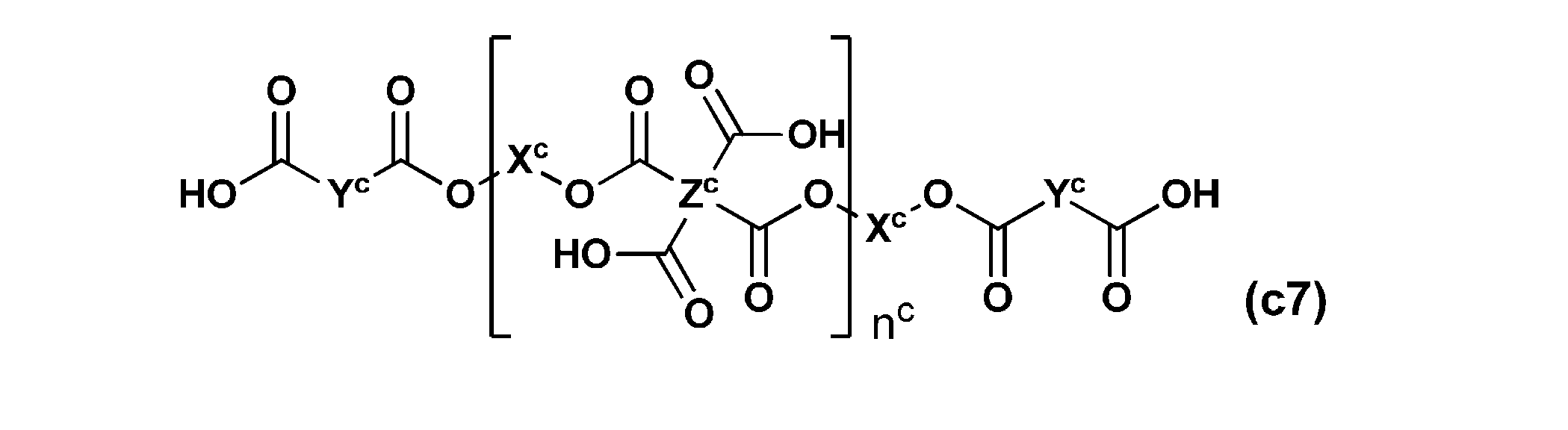
上記式(c7)中、Xcは、下記一般式(c8)で表される基を表す。

上記式(c8)中、Rc50は、それぞれ独立に水素原子、炭素原子数1以上6以下の炭化水素基、又はハロゲン原子を表す。Rc51は、それぞれ独立に水素原子、又はメチル基を表す。Wは、単結合、又は下記構造式(c9)で表される基を表す。式(c8)、及び式(c9)において「*」は、2価の基の結合手の末端を意味する。
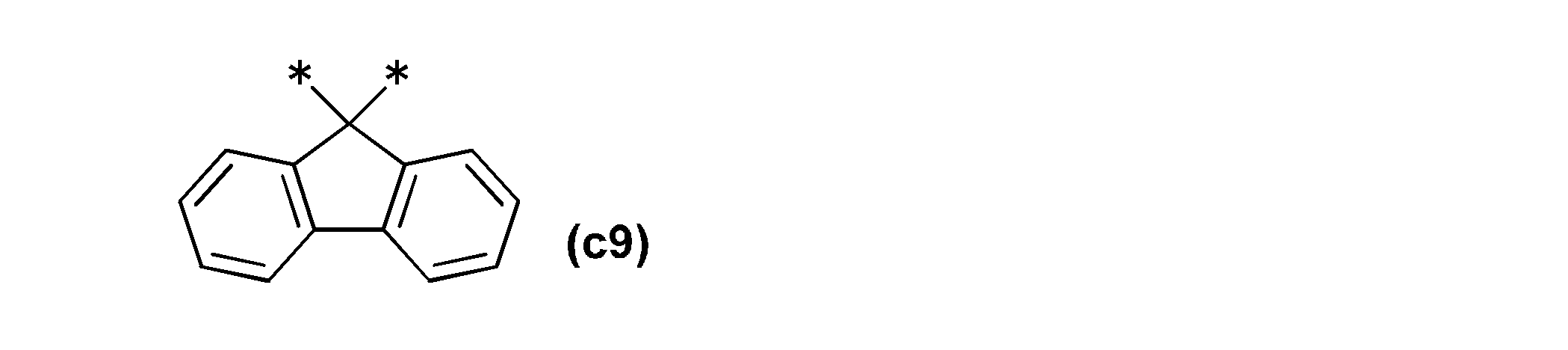
上記式(c7)中、Ycはジカルボン酸無水物から酸無水物基(-CO-O-CO-)を除いた残基を表す。ジカルボン酸無水物の例としては、無水マレイン酸、無水コハク酸、無水イタコン酸、無水フタル酸、無水テトラヒドロフタル酸、無水ヘキサヒドロフタル酸、無水メチルエンドメチレンテトラヒドロフタル酸、無水クロレンド酸、メチルテトラヒドロ無水フタル酸、無水グルタル酸等が挙げられる。
また、上記式(c7)中、Zcは、テトラカルボン酸二無水物から2個の酸無水物基を除いた残基を表す。テトラカルボン酸二無水物の例としては、無水ピロメリット酸、ベンゾフェノンテトラカルボン酸二無水物、ビフェニルテトラカルボン酸二無水物、ビフェニルエーテルテトラカルボン酸二無水物等が挙げられる。さらに、上記式(c7)中、ncは、0以上20以下の整数を表す。
エチレン性不飽和基を含む樹脂の酸価は、樹脂固形分で、10mgKOH/g以上150mgKOH/g以下が好ましく、70mgKOH/g以上110mgKOH/g以下がより好ましい。酸価を10mgKOH/g以上とすることにより、組成物にフォトリソ特性を付与する場合に、現像液に対する十分な溶解性を有する組成物を得やすいため好ましい。また、酸価を150mgKOH/g以下とすることにより、十分な硬化性を得ることができ、表面性を良好にすることができるので好ましい。
また、エチレン性不飽和基を含む樹脂の質量平均分子量は、1,000以上40,000以下が好ましく、2,000以上30,000以下がより好ましい。質量平均分子量を1,000以上とすることにより、良好な耐熱性と、膜強度とを有する硬化膜を形成しやすいので好ましい。また、質量平均分子量を40,000以下とすることにより、良好な現像性を得ることができるので好ましい。
〔焼成により硬化膜を生成させる樹脂〕
焼成により硬化膜を生成させる樹脂としては、例えば、ケイ素含有樹脂が挙げられる。ケイ素含有樹脂の好ましい例としては、シロキサン樹脂、及びポリシランから選択される1種以上が挙げられる。これらのケイ素含有樹脂を含む組成物を塗布することでケイ素含有樹脂を含む量子ドット含有被膜が得られ、当該量子ドット含有被膜が焼成されることでシリカ系の量子ドット含有被膜が得られる。
シロキサン樹脂、及びポリシラン等のケイ素含有樹脂の好適な例としては、特開2018-109761号公報の段落[0022]~段落[0070]に記載のケイ素含有樹脂が挙げられる。
焼成により硬化膜を生成させる樹脂としては、例えば、ケイ素含有樹脂が挙げられる。ケイ素含有樹脂の好ましい例としては、シロキサン樹脂、及びポリシランから選択される1種以上が挙げられる。これらのケイ素含有樹脂を含む組成物を塗布することでケイ素含有樹脂を含む量子ドット含有被膜が得られ、当該量子ドット含有被膜が焼成されることでシリカ系の量子ドット含有被膜が得られる。
シロキサン樹脂、及びポリシラン等のケイ素含有樹脂の好適な例としては、特開2018-109761号公報の段落[0022]~段落[0070]に記載のケイ素含有樹脂が挙げられる。
組成物中の、ケイ素含有樹脂の含有量は特に限定されず、所望の膜厚に応じて設定すればよい。製膜性の点からは、組成物中のケイ素含有樹脂の含有量は、1質量%以上50質量%以下が好ましく、5質量%以上40質量%以下がより好ましく、10質量%以上35質量%以下が特に好ましい。
組成物における基材成分(C)の含有量は、組成物に所望する量の量子ドット(A)が含まれる限り特に限定されず、質量比で(A):(C)=99:1~1:99であることが好ましく、90:10~10:90がより好ましい。
〔硬化剤(D)〕
組成物が、基材成分(C)として、エポキシ化合物やオキセタン化合物等の成分や、光硬化性の成分や、ケイ素含有樹脂を含む場合、組成物は、基材成分(C)を硬化させるための成分として、硬化剤(D)を含むのが好ましい。
ここで、本願明細書において、硬化剤(D)は、基材成分(C)を硬化させ得る成分であれば特に限定されない。例えば、所謂光重合開始剤等についても、本願明細書において硬化剤(D)に含まれる。
なお、組成物に含まれる基材成分(C)が、カルボキシ基、カルボン酸無水物基や、アミノ基のようなエポキシ基やオキセタニル基との反応性を有する官能基を有するエポキシ化合物又はオキセタン化合物である場合、組成物は、必ずしも、硬化剤を含有する必要はない。
組成物が、基材成分(C)として、エポキシ化合物やオキセタン化合物等の成分や、光硬化性の成分や、ケイ素含有樹脂を含む場合、組成物は、基材成分(C)を硬化させるための成分として、硬化剤(D)を含むのが好ましい。
ここで、本願明細書において、硬化剤(D)は、基材成分(C)を硬化させ得る成分であれば特に限定されない。例えば、所謂光重合開始剤等についても、本願明細書において硬化剤(D)に含まれる。
なお、組成物に含まれる基材成分(C)が、カルボキシ基、カルボン酸無水物基や、アミノ基のようなエポキシ基やオキセタニル基との反応性を有する官能基を有するエポキシ化合物又はオキセタン化合物である場合、組成物は、必ずしも、硬化剤を含有する必要はない。
[光重合開始剤(D1)]
光重合開始剤(D1)は、不飽和二重結合を有する光硬化性の基材成分(C)とともに使用され、露光により、光硬化性の基材成分(C)を硬化させる。光重合開始剤(D1)としては、特に限定されず、従来公知の光重合開始剤を用いることができる。
光重合開始剤(D1)は、不飽和二重結合を有する光硬化性の基材成分(C)とともに使用され、露光により、光硬化性の基材成分(C)を硬化させる。光重合開始剤(D1)としては、特に限定されず、従来公知の光重合開始剤を用いることができる。
光重合開始剤(D1)として、具体的には、1-ヒドロキシシクロヘキシルフェニルケトン、2-ヒドロキシ-2-メチル-1-フェニルプロパン-1-オン、1-〔4-(2-ヒドロキシエトキシ)フェニル〕-2-ヒドロキシ-2-メチル-1-プロパン-1-オン、1-(4-イソプロピルフェニル)-2-ヒドロキシ-2-メチルプロパン-1-オン、1-(4-ドデシルフェニル)-2-ヒドロキシ-2-メチルプロパン-1-オン、2,2-ジメトキシ-1,2-ジフェニルエタン-1-オン、ビス(4-ジメチルアミノフェニル)ケトン、2-メチル-1-〔4-(メチルチオ)フェニル〕-2-モルフォリノプロパン-1-オン、2-ベンジル-2-ジメチルアミノ-1-(4-モルフォリノフェニル)-ブタン-1-オン、O-アセチル-1-[6-(2-メチルベンゾイル)-9-エチル-9H-カルバゾール-3-イル]エタノンオキシム、(9-エチル-6-ニトロ-9H-カルバゾール-3-イル)[4-(2-メトキシ-1-メチルエトキシ)-2-メチルフェニル]メタノンO-アセチルオキシム、1,2-オクタンジオン,1-[4-(フェニルチオ)-,2-(O-ベンゾイルオキシム)]、2,4,6-トリメチルベンゾイルジフェニルホスフィンオキシド、4-ベンゾイル-4’-メチルジメチルスルフィド、4-ジメチルアミノ安息香酸、4-ジメチルアミノ安息香酸メチル、4-ジメチルアミノ安息香酸エチル、4-ジメチルアミノ安息香酸ブチル、4-ジメチルアミノ-2-エチルヘキシル安息香酸、4-ジメチルアミノ-2-イソアミル安息香酸、ベンジル-β-メトキシエチルアセタール、ベンジルジメチルケタール、1-フェニル-1,2-プロパンジオン-2-(O-エトキシカルボニル)オキシム、o-ベンゾイル安息香酸メチル、2,4-ジエチルチオキサントン、2-クロロチオキサントン、2,4-ジメチルチオキサントン、1-クロロ-4-プロポキシチオキサントン、チオキサンテン、2-クロロチオキサンテン、2,4-ジエチルチオキサンテン、2-メチルチオキサンテン、2-イソプロピルチオキサンテン、2-エチルアントラキノン、オクタメチルアントラキノン、1,2-ベンズアントラキノン、2,3-ジフェニルアントラキノン、アゾビスイソブチロニトリル、ベンゾイルパーオキシド、クメンヒドロペルオキシド、2-メルカプトベンゾイミダール、2-メルカプトベンゾオキサゾール、2-メルカプトベンゾチアゾール、2-(o-クロロフェニル)-4,5-ジ(m-メトキシフェニル)-イミダゾリル二量体、ベンゾフェノン、2-クロロベンゾフェノン、p,p’-ビスジメチルアミノベンゾフェノン、4,4’-ビスジエチルアミノベンゾフェノン、4,4’-ジクロロベンゾフェノン、3,3-ジメチル-4-メトキシベンゾフェノン、ベンジル、ベンゾイン、ベンゾインメチルエーテル、ベンゾインエチルエーテル、ベンゾインイソプロピルエーテル、ベンゾイン-n-ブチルエーテル、ベンゾインイソブチルエーテル、ベンゾインブチルエーテル、アセトフェノン、2,2-ジエトキシアセトフェノン、p-ジメチルアセトフェノン、p-ジメチルアミノプロピオフェノン、ジクロロアセトフェノン、トリクロロアセトフェノン、p-tert-ブチルアセトフェノン、p-ジメチルアミノアセトフェノン、p-tert-ブチルトリクロロアセトフェノン、p-tert-ブチルジクロロアセトフェノン、α,α-ジクロロ-4-フェノキシアセトフェノン、チオキサントン、2-メチルチオキサントン、2-イソプロピルチオキサントン、ジベンゾスベロン、ペンチル-4-ジメチルアミノベンゾエート、9-フェニルアクリジン、1,7-ビス-(9-アクリジニル)ヘプタン、1,5-ビス-(9-アクリジニル)ペンタン、1,3-ビス-(9-アクリジニル)プロパン、p-メトキシトリアジン、2,4,6-トリス(トリクロロメチル)-s-トリアジン、2-メチル-4,6-ビス(トリクロロメチル)-s-トリアジン、2-[2-(5-メチルフラン-2-イル)エテニル]-4,6-ビス(トリクロロメチル)-s-トリアジン、2-[2-(フラン-2-イル)エテニル]-4,6-ビス(トリクロロメチル)-s-トリアジン、2-[2-(4-ジエチルアミノ-2-メチルフェニル)エテニル]-4,6-ビス(トリクロロメチル)-s-トリアジン、2-[2-(3,4-ジメトキシフェニル)エテニル]-4,6-ビス(トリクロロメチル)-s-トリアジン、2-(4-メトキシフェニル)-4,6-ビス(トリクロロメチル)-s-トリアジン、2-(4-エトキシスチリル)-4,6-ビス(トリクロロメチル)-s-トリアジン、2-(4-n-ブトキシフェニル)-4,6-ビス(トリクロロメチル)-s-トリアジン、2,4-ビス-トリクロロメチル-6-(3-ブロモ-4-メトキシ)フェニル-s-トリアジン、2,4-ビス-トリクロロメチル-6-(2-ブロモ-4-メトキシ)フェニル-s-トリアジン、2,4-ビス-トリクロロメチル-6-(3-ブロモ-4-メトキシ)スチリルフェニル-s-トリアジン、2,4-ビス-トリクロロメチル-6-(2-ブロモ-4-メトキシ)スチリルフェニル-s-トリアジン等が挙げられる。これらの光重合開始剤(D1)は、単独又は2種以上組み合わせて用いることができる。
これらの中でも、オキシム系の光重合開始剤を用いることが、感度の面で特に好ましい。オキシム系の光重合開始剤の中で、特に好ましいものとしては、O-アセチル-1-[6-(2-メチルベンゾイル)-9-エチル-9H-カルバゾール-3-イル]エタノンオキシム、O-アセチル-1-[6-(2-メチルベンゾイル)-9-エチル-9H-カルバゾール-3-イル]エタノンオキシム、及び1,2-オクタンジオン,1-[4-(フェニルチオ)-,2-(O-ベンゾイルオキシム)]が挙げられる。
また、ケイ素含有樹脂用の硬化剤として後述するオキシムエステル化合物も、光重合開始剤として好ましく使用される。
また、ケイ素含有樹脂用の硬化剤として後述するオキシムエステル化合物も、光重合開始剤として好ましく使用される。
光重合開始剤(D1)の含有量は、組成物の固形分100質量部に対して0.5質量部以上30質量部以下が好ましく、1質量部以上20質量部以下がより好ましい。
また、この光重合開始剤(D1)に、光開始助剤を組み合わせてもよい。光開始助剤としては、トリエタノールアミン、メチルジエタノールアミン、トリイソプロパノールアミン、4-ジメチルアミノ安息香酸メチル、4-ジメチルアミノ安息香酸エチル、4-ジメチルアミノ安息香酸イソアミル、4-ジメチルアミノ安息香酸2-エチルヘキシル、安息香酸2-ジメチルアミノエチル、N,N-ジメチルパラトルイジン、4,4’-ビス(ジメチルアミノ)ベンゾフェノン、9,10-ジメトキシアントラセン、2-エチル-9,10-ジメトキシアントラセン、9,10-ジエトキシアントラセン、2-エチル-9,10-ジエトキシアントラセン、2-メルカプトベンゾチアゾール、2-メルカプトベンゾオキサゾール、2-メルカプトベンゾイミダゾール、2-メルカプト-5-メトキシベンゾチアゾール、3-メルカプトプロピオン酸、3-メルカプトプロピオン酸メチル、ペンタエリストールテトラメルカプトアセテート、3-メルカプトプロピオネート等のチオール化合物等が挙げられる。これらの光開始助剤は、単独又は2種以上組み合わせて用いることができる。
[オニウム塩(D2)]
オニウム塩(D2)は、エポキシ基含有樹脂、エポキシ化合物、又はオキセタン化合物等とともに使用することができ、光又は熱の作用により、エポキシ基含有樹脂、エポキシ化合物、又はオキセタン化合物等の硬化を促進させる。
オニウム塩としては、例えば、ジアゾニウム塩、アンモニウム塩、ヨードニウム塩、スルホニウム塩、ホスホニウム塩、オキソニウム塩等が挙げられる。これらの中では、入手の容易性や、良好な硬化の点から、スルホニウム塩、及びヨードニウム塩が好ましい。
オニウム塩(D2)は、エポキシ基含有樹脂、エポキシ化合物、又はオキセタン化合物等を硬化させる目的で使用されている従来知られるオニウム塩類から適宜選択される。
オニウム塩(D2)は、エポキシ基含有樹脂、エポキシ化合物、又はオキセタン化合物等とともに使用することができ、光又は熱の作用により、エポキシ基含有樹脂、エポキシ化合物、又はオキセタン化合物等の硬化を促進させる。
オニウム塩としては、例えば、ジアゾニウム塩、アンモニウム塩、ヨードニウム塩、スルホニウム塩、ホスホニウム塩、オキソニウム塩等が挙げられる。これらの中では、入手の容易性や、良好な硬化の点から、スルホニウム塩、及びヨードニウム塩が好ましい。
オニウム塩(D2)は、エポキシ基含有樹脂、エポキシ化合物、又はオキセタン化合物等を硬化させる目的で使用されている従来知られるオニウム塩類から適宜選択される。
以下、オニウム塩(D2)の好ましい例について説明する。
オニウム塩(D2)の好ましい一例としては、下記式(D-I)で表されるスルホニウム塩(以下、「スルホニウム塩(Q)」とも記す。)が挙げられる。
オニウム塩(D2)の好ましい一例としては、下記式(D-I)で表されるスルホニウム塩(以下、「スルホニウム塩(Q)」とも記す。)が挙げられる。




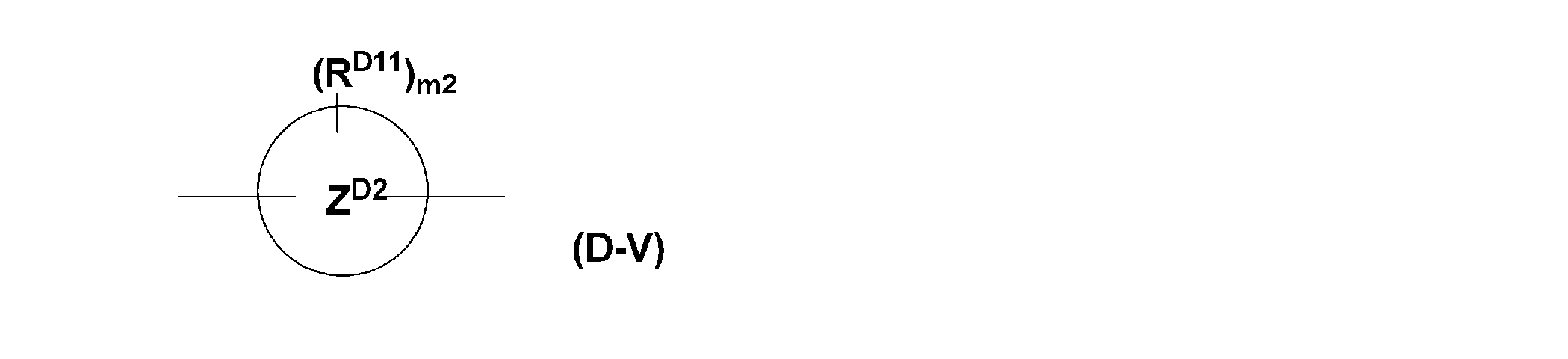

(スルホニウム塩(Q))
以下、スルホニウム塩(Q)について説明する。スルホニウム塩(Q)は、上記式(D-I)中のベンゼン環において、AD1が結合する炭素原子に対してオルト位の炭素原子にメチル基が結合していることを特徴とする。スルホニウム塩(Q)は、上記の位置にメチル基を有するため、従来のスルホニウム塩と比較して、紫外線等の活性エネルギー線に対する感度が高い。
以下、スルホニウム塩(Q)について説明する。スルホニウム塩(Q)は、上記式(D-I)中のベンゼン環において、AD1が結合する炭素原子に対してオルト位の炭素原子にメチル基が結合していることを特徴とする。スルホニウム塩(Q)は、上記の位置にメチル基を有するため、従来のスルホニウム塩と比較して、紫外線等の活性エネルギー線に対する感度が高い。
上記式(D-I)において、RD1及びRD2のいずれもが上記式(D-II)で表される基であることが好ましい。RD1及びRD2は互いに同一でも異なっていてもよい。
上記式(D-I)において、RD1及びRD2が相互に結合して式中の硫黄原子とともに環を形成する場合、形成される環を構成する原子数は、硫黄原子を含めて3以上10以下が好ましく、5以上7以下がより好ましい。形成される環は多環でもよく、環構成原子数が5以上7以下である単環が縮合した多環が好ましい。
上記式(D-I)において、RD1及びRD2が、ともにフェニル基であるのが好ましい。
上記式(D-I)において、RD3は上記式(D-III)で表される基であることが好ましい。
上記式(D-I)において、AD1は、S又はOであることが好ましく、Sであることがより好ましい。
上記式(D-I)において、RD1及びRD2が相互に結合して式中の硫黄原子とともに環を形成する場合、形成される環を構成する原子数は、硫黄原子を含めて3以上10以下が好ましく、5以上7以下がより好ましい。形成される環は多環でもよく、環構成原子数が5以上7以下である単環が縮合した多環が好ましい。
上記式(D-I)において、RD1及びRD2が、ともにフェニル基であるのが好ましい。
上記式(D-I)において、RD3は上記式(D-III)で表される基であることが好ましい。
上記式(D-I)において、AD1は、S又はOであることが好ましく、Sであることがより好ましい。
上記式(D-II)において、RD4は、ハロゲン原子で置換されていてもよいアルキル基、ヒドロキシ基、アルキルカルボニル基、チエニルカルボニル基、フラニルカルボニル基、セレノフェニルカルボニル基、置換されていてよいアミノ基、又はニトロ基であることが好ましく、ハロゲン原子で置換されていてもよいアルキル基、アルキルカルボニル基、又はチエニルカルボニル基であることがより好ましい。
上記式(D-II)において、m1は、環ZD1の種類に応じて選択でき、例えば、0以上4以下の整数、好ましくは0以上3以下の整数、より好ましくは0以上2以下の整数であってもよい。
上記式(D-II)において、m1は、環ZD1の種類に応じて選択でき、例えば、0以上4以下の整数、好ましくは0以上3以下の整数、より好ましくは0以上2以下の整数であってもよい。
上記式(D-III)において、RD5は、アルキレン基;ヒドロキシ基、置換されていてよいアミノ基、若しくはニトロ基で置換されたアルキレン基;又は上記式(D-V)で表される基であることが好ましく、上記式(D-V)で表される基であることがより好ましい。
上記式(D-III)において、RD6は、アルキル基;ヒドロキシ基、置換されていてよいアミノ基、若しくはニトロ基で置換されたアルキル基;又は上記式(D-VI)で表される基であることが好ましく、上記式(D-VI)で表される基であることがより好ましい。
上記式(D-III)において、AD2はS又はOであることが好ましく、Sであることがより好ましい。
上記式(D-III)において、n1は0であることが好ましい。
上記式(D-III)において、RD6は、アルキル基;ヒドロキシ基、置換されていてよいアミノ基、若しくはニトロ基で置換されたアルキル基;又は上記式(D-VI)で表される基であることが好ましく、上記式(D-VI)で表される基であることがより好ましい。
上記式(D-III)において、AD2はS又はOであることが好ましく、Sであることがより好ましい。
上記式(D-III)において、n1は0であることが好ましい。
上記式(D-IV)において、RD7及びRD8は独立に、アルキレン基;ヒドロキシ基、置換されていてよいアミノ基、若しくはニトロ基で置換されたアルキレン基;又は上記式(D-V)で表される基であることが好ましく、上記式(D-V)で表される基であることより好ましい。RD7及びRD8は互いに同一でも異なっていてもよい。
上記式(D-IV)において、RD9及びRD10のいずれもが上記式(D-II)で表される基であることが好ましい。RD9及びRD10は互いに同一でも異なっていてもよい。
上記式(D-IV)において、RD9及びRD10が相互に結合して式中の硫黄原子とともに環を形成する場合、形成される環を構成する原子数は、硫黄原子を含めて3以上10以下が好ましく、5以上7以下がより好ましい。形成される環は多環でもよく、環構成原子数が5以上7以下である単環が縮合した多環が好ましい。
上記式(D-IV)において、AD3は、S又はOであることが好ましく、Sであることがより好ましい。
上記式(D-IV)において、n2は0であることが好ましい。
上記式(D-IV)において、RD9及びRD10のいずれもが上記式(D-II)で表される基であることが好ましい。RD9及びRD10は互いに同一でも異なっていてもよい。
上記式(D-IV)において、RD9及びRD10が相互に結合して式中の硫黄原子とともに環を形成する場合、形成される環を構成する原子数は、硫黄原子を含めて3以上10以下が好ましく、5以上7以下がより好ましい。形成される環は多環でもよく、環構成原子数が5以上7以下である単環が縮合した多環が好ましい。
上記式(D-IV)において、AD3は、S又はOであることが好ましく、Sであることがより好ましい。
上記式(D-IV)において、n2は0であることが好ましい。
上記式(D-V)において、RD11は、ハロゲン原子で置換されていてもよいアルキル基、ヒドロキシ基、置換されていてよいアミノ基、又はニトロ基であることが好ましく、ハロゲン原子で置換されていてもよいアルキル基であることがより好ましい。
上記式(D-V)において、m2は、環ZD2の種類に応じて選択でき、例えば、0以上4以下の整数、好ましくは0以上3以下の整数、より好ましくは0以上2以下の整数であってもよい。
上記式(D-V)において、m2は、環ZD2の種類に応じて選択でき、例えば、0以上4以下の整数、好ましくは0以上3以下の整数、より好ましくは0以上2以下の整数であってもよい。
上記式(D-VI)において、RD12は、ハロゲン原子で置換されていてもよいアルキル基、ヒドロキシ基、アルキルカルボニル基、チエニルカルボニル基、フラニルカルボニル基、セレノフェニルカルボニル基、置換されていてよいアミノ基、又はニトロ基であることが好ましく、ハロゲン原子で置換されていてもよいアルキル基、アルキルカルボニル基、又はチエニルカルボニル基であることがより好ましい。
上記式(D-VI)において、m3は、環ZD3の種類に応じて選択でき、例えば、0以上4以下の整数、好ましくは0以上3以下の整数、より好ましくは0以上2以下の整数であってもよい。
上記式(D-VI)において、m3は、環ZD3の種類に応じて選択でき、例えば、0以上4以下の整数、好ましくは0以上3以下の整数、より好ましくは0以上2以下の整数であってもよい。
上記式(D-I)において、X-は1価のアニオンである。X-としては、1価の多原子アニオンが好適に挙げられ、MYa
-、(Rf)bPF6-b
-、Rx1
cBY4-c
-、Rx1
cGaY4-c
-、Rx2SO3
-、(Rx2SO2)3C-、又は(Rx2SO2)2N-で表されるアニオンがより好ましい。また、X-は、ハロゲンアニオンでもよく、例えば、フッ化物イオン、塩化物イオン、臭化物イオン、ヨウ化物イオン等が挙げられる。
Mは、リン原子、ホウ素原子、又はアンチモン原子を表す。
Yはハロゲン原子(フッ素原子が好ましい。)を表す。
Yはハロゲン原子(フッ素原子が好ましい。)を表す。
Rfは、水素原子の80モル%以上がフッ素原子で置換されたアルキル基(炭素原子数1以上8以下のアルキル基が好ましい。)を表す。フッ素置換によりRfとするアルキル基としては、直鎖アルキル基(メチル、エチル、プロピル、ブチル、ペンチル及びオクチル等)、分岐鎖アルキル基(イソプロピル、イソブチル、sec-ブチル及びtert-ブチル等)及びシクロアルキル基(シクロプロピル、シクロブチル、シクロペンチル及びシクロヘキシル等)等が挙げられる。Rfにおいてこれらのアルキル基の水素原子がフッ素原子に置換されている割合は、もとのアルキル基が有していた水素原子のモル数に基づいて、80モル%以上が好ましく、さらに好ましくは90%以上、特に好ましくは100%である。フッ素原子による置換割合がこれら好ましい範囲にあると、スルホニウム塩(Q)の光感応性がさらに良好となる。特に好ましいRfとしては、CF3-、CF3CF2
-、(CF3)2CF-、CF3CF2CF2
-、CF3CF2CF2CF2
-、(CF3)2CFCF2
-、CF3CF2(CF3)CF-及び(CF3)3C-が挙げられる。b個のRfは、相互に独立であり、従って、互いに同一でも異なっていてもよい。
Pはリン原子、Fはフッ素原子を表す。
Rx1は、水素原子の一部が少なくとも1個の元素又は電子求引基で置換されたフェニル基を表す。そのような1個の元素の例としては、ハロゲン原子が含まれ、フッ素原子、塩素原子及び臭素原子等が挙げられる。電子求引基としては、トリフルオロメチル基、ニトロ基及びシアノ基等が挙げられる。これらのうち、少なくとも1個の水素原子がフッ素原子又はトリフルオロメチル基で置換されたフェニル基が好ましい。c個のRx1は相互に独立であり、従って、互いに同一でも異なっていてもよい。
Bはホウ素原子、Gaはガリウム原子を表す。
Rx2は、炭素原子数1以上20以下のアルキル基、炭素原子数1以上20以下のフルオロアルキル基又は炭素原子数6以上20以下のアリール基を表し、アルキル基及びフルオロアルキル基は直鎖状、分岐鎖状又は環状のいずれでもよく、アルキル基、フルオロアルキル基、又はアリール基は無置換であっても、置換基を有していてもよい。上記置換基としては、例えば、ヒドロキシ基、置換されていてよいアミノ基、ニトロ基等が挙げられる。置換されていてよいアミノ基としては、例えば、上記式(D-II)~(D-VI)に関する後述の説明中で例示する基が挙げられる。
また、Rx2で表されるアルキル基、フルオロアルキル基又はアリール基における炭素鎖は、酸素原子、窒素原子、硫黄原子等のヘテロ原子を有していてもよい。特に、Rx2で表されるアルキル基又はフルオロアルキル基における炭素鎖は、2価の官能基(例えば、エーテル結合、カルボニル結合、エステル結合、アミノ結合、アミド結合、イミド結合、スルホニル結合、スルホニルアミド結合、スルホニルイミド結合、ウレタン結合等)を有していてもよい。
Rx2で表されるアルキル基、フルオロアルキル基又はアリール基が上記置換基、ヘテロ原子、又は官能基を有する場合、上記置換基、ヘテロ原子、又は官能基の個数は、1個であっても2個以上であってもよい。
また、Rx2で表されるアルキル基、フルオロアルキル基又はアリール基における炭素鎖は、酸素原子、窒素原子、硫黄原子等のヘテロ原子を有していてもよい。特に、Rx2で表されるアルキル基又はフルオロアルキル基における炭素鎖は、2価の官能基(例えば、エーテル結合、カルボニル結合、エステル結合、アミノ結合、アミド結合、イミド結合、スルホニル結合、スルホニルアミド結合、スルホニルイミド結合、ウレタン結合等)を有していてもよい。
Rx2で表されるアルキル基、フルオロアルキル基又はアリール基が上記置換基、ヘテロ原子、又は官能基を有する場合、上記置換基、ヘテロ原子、又は官能基の個数は、1個であっても2個以上であってもよい。
Sは硫黄原子、Oは酸素原子、Cは炭素原子、Nは窒素原子を表す。
aは4以上6以下の整数を表す。
bは、1以上5以下の整数が好ましく、さらに好ましくは2以上4以下の整数、特に好ましくは2又は3である。
cは、1以上4以下の整数が好ましく、さらに好ましくは4である。
aは4以上6以下の整数を表す。
bは、1以上5以下の整数が好ましく、さらに好ましくは2以上4以下の整数、特に好ましくは2又は3である。
cは、1以上4以下の整数が好ましく、さらに好ましくは4である。
MYa
-で表されるアニオンとしては、SbF6
-、PF6
-又はBF4
-で表されるアニオン等が挙げられる。
(Rf)bPF6-b
-で表されるアニオンとしては、(CF3CF2)2PF4
-、(CF3CF2)3PF3
-、((CF3)2CF)2PF4
-、((CF3)2CF)3PF3
-、(CF3CF2CF2)2PF4
-、(CF3CF2CF2)3PF3
-、((CF3)2CFCF2)2PF4
-、((CF3)2CFCF2)3PF3
-、(CF3CF2CF2CF2)2PF4
-又は(CF3CF2CF2CF2)3PF3
-で表されるアニオン等が挙げられる。これらのうち、(CF3CF2)3PF3
-、(CF3CF2CF2)3PF3
-、((CF3)2CF)3PF3
-、((CF3)2CF)2PF4
-、((CF3)2CFCF2)3PF3
-又は((CF3)2CFCF2)2PF4
-で表されるアニオンが好ましい。
Rx1
cBY4-c
-で表されるアニオンとしては、好ましくは
Rx1 cBY4-c -
(式中、Rx1は水素原子の少なくとも一部がハロゲン原子又は電子求引基で置換されたフェニル基を示し、Yはハロゲン原子を示し、cは1以上4以下の整数を示す。)
であり、例えば、(C6F5)4B-、((CF3)2C6H3)4B-、(CF3C6H4)4B-、(C6F5)2BF2 -、C6F5BF3 -又は(C6H3F2)4B-で表されるアニオン等が挙げられる。これらのうち、(C6F5)4B-又は((CF3)2C6H3)4B-で表されるアニオンが好ましい。
Rx1 cBY4-c -
(式中、Rx1は水素原子の少なくとも一部がハロゲン原子又は電子求引基で置換されたフェニル基を示し、Yはハロゲン原子を示し、cは1以上4以下の整数を示す。)
であり、例えば、(C6F5)4B-、((CF3)2C6H3)4B-、(CF3C6H4)4B-、(C6F5)2BF2 -、C6F5BF3 -又は(C6H3F2)4B-で表されるアニオン等が挙げられる。これらのうち、(C6F5)4B-又は((CF3)2C6H3)4B-で表されるアニオンが好ましい。
Rx1
cGaY4-c
-で表されるアニオンとしては、
テトラキス(ノナフルオロビフェニル-4-イル)ガレートアニオン、
テトラキス(ヘプタフルオロナフタレン-1-イル)ガレートアニオン、
テトラキス(ペンタフルオロフェニル)ガレートアニオン、
テトラキス(3,4,5-トリフルオロフェニル)ガレートアニオン、
テトラキス(ノナフルオロビフェニル-2-イル)ガレートアニオン、
テトラキス(ヘプタフルオロナフタレン-2-イル)ガレートアニオン、
テトラキス(ノナフルオロアントラセン-7-イル)ガレートアニオン、
テトラキス(4’-(メトキシ)オクタフルオロビフェニル-4-イル)ガレートアニオン、
テトラキス(2,4,6-トリス(トリフルオロメチル)フェニル)ガレートアニオン、
テトラキス(3,5-ビス(トリフルオロメチル)フェニル)ガレートアニオン、
テトラキス(2,3-ビス(ペンタフルオロエチル)ナフチル)ガレートアニオン、
テトラキス(2-イソプロポキシ-ヘキサフルオロナフチル)ガレートアニオン、
テトラキス(9,10-ビス(ヘプタフルオロプロピル)ヘプタフルオロアントリル)ガレートアニオン、
テトラキス(9-ノナフルオロフェナントリル)ガレートアニオン、
テトラキス(4-[トリ(イソプロピル)シリル]-テトラフルオロフェニル)ガレートアニオン、
テトラキス(9,10-ビス(p-トリル)-ヘプタフルオロフェナントリル)ガレートアニオン、
テトラキス(4-[ジメチル(t-ブチル)シリル]-テトラフルオロフェニル)ガレートアニオン、
モノフェニルトリス(ペンタフルオロフェニル)ガレートアニオン、及び
モノパーフルオロブチルトリス(ペンタフルオロフェニル)ガレートアニオン等が挙げられる。より好ましくは、(C6F5)4Ga-、((CF3)2C6H3)4Ga-、(CF3C6H4)4Ga-、(C6F5)2GaF2 -、C6F5GaF3 -又は(C6H3F2)4Ga-で表されるアニオン等が挙げられる。これらのうち、(C6F5)4Ga-又は((CF3)2C6H3)4Ga-で表されるアニオンがさらに好ましい。
テトラキス(ノナフルオロビフェニル-4-イル)ガレートアニオン、
テトラキス(ヘプタフルオロナフタレン-1-イル)ガレートアニオン、
テトラキス(ペンタフルオロフェニル)ガレートアニオン、
テトラキス(3,4,5-トリフルオロフェニル)ガレートアニオン、
テトラキス(ノナフルオロビフェニル-2-イル)ガレートアニオン、
テトラキス(ヘプタフルオロナフタレン-2-イル)ガレートアニオン、
テトラキス(ノナフルオロアントラセン-7-イル)ガレートアニオン、
テトラキス(4’-(メトキシ)オクタフルオロビフェニル-4-イル)ガレートアニオン、
テトラキス(2,4,6-トリス(トリフルオロメチル)フェニル)ガレートアニオン、
テトラキス(3,5-ビス(トリフルオロメチル)フェニル)ガレートアニオン、
テトラキス(2,3-ビス(ペンタフルオロエチル)ナフチル)ガレートアニオン、
テトラキス(2-イソプロポキシ-ヘキサフルオロナフチル)ガレートアニオン、
テトラキス(9,10-ビス(ヘプタフルオロプロピル)ヘプタフルオロアントリル)ガレートアニオン、
テトラキス(9-ノナフルオロフェナントリル)ガレートアニオン、
テトラキス(4-[トリ(イソプロピル)シリル]-テトラフルオロフェニル)ガレートアニオン、
テトラキス(9,10-ビス(p-トリル)-ヘプタフルオロフェナントリル)ガレートアニオン、
テトラキス(4-[ジメチル(t-ブチル)シリル]-テトラフルオロフェニル)ガレートアニオン、
モノフェニルトリス(ペンタフルオロフェニル)ガレートアニオン、及び
モノパーフルオロブチルトリス(ペンタフルオロフェニル)ガレートアニオン等が挙げられる。より好ましくは、(C6F5)4Ga-、((CF3)2C6H3)4Ga-、(CF3C6H4)4Ga-、(C6F5)2GaF2 -、C6F5GaF3 -又は(C6H3F2)4Ga-で表されるアニオン等が挙げられる。これらのうち、(C6F5)4Ga-又は((CF3)2C6H3)4Ga-で表されるアニオンがさらに好ましい。
Rx2SO3
-で表されるアニオンとしては、トリフルオロメタンスルホン酸アニオン、ペンタフルオロエタンスルホン酸アニオン、ヘプタフルオロプロパンスルホン酸アニオン、ノナフルオロブタンスルホン酸アニオン、ペンタフルオロフェニルスルホン酸アニオン、p-トルエンスルホン酸アニオン、ベンゼンスルホン酸アニオン、カンファースルホン酸アニオン、メタンスルホン酸アニオン、エタンスルホン酸アニオン、プロパンスルホン酸アニオン及びブタンスルホン酸アニオン等が挙げられる。これらのうち、トリフルオロメタンスルホン酸アニオン、ノナフルオロブタンスルホン酸アニオン、メタンスルホン酸アニオン、ブタンスルホン酸アニオン、カンファースルホン酸アニオン、ベンゼンスルホン酸アニオン又はp-トルエンスルホン酸アニオンが好ましい。
(Rx2SO2)3C-で表されるアニオンとしては、(CF3SO2)3C-、(C2F5SO2)3C-、(C3F7SO2)3C-又は(C4F9SO2)3C-で表されるアニオン等が挙げられる。
(Rx2SO2)2N-で表されるアニオンとしては、(CF3SO2)2N-、(C2F5SO2)2N-、(C3F7SO2)2N-又は(C4F9SO2)2N-で表されるアニオン等が挙げられる。
一価の多原子アニオンとしては、MYa
-、(Rf)bPF6-b
-、Rx1
cBY4-c
-、Rx1
cGaY4-c
-、Rx2SO3
-、(Rx2SO2)3C-又は(Rx2SO2)2N-で表されるアニオン以外に、過ハロゲン酸イオン(ClO4
-、BrO4
-等)、ハロゲン化スルホン酸イオン(FSO3
-、ClSO3
-等)、硫酸イオン(CH3SO4
-、CF3SO4
-、HSO4
-等)、炭酸イオン(HCO3
-、CH3CO3
-等)、アルミン酸イオン(AlCl4
-、AlF4
-等)、ヘキサフルオロビスマス酸イオン(BiF6
-)、カルボン酸イオン(CH3COO-、CF3COO-、C6H5COO-、CH3C6H4COO-、C6F5COO-、CF3C6H4COO-等)、アリールホウ酸イオン(B(C6H5)4
-、CH3CH2CH2CH2B(C6H5)3
-等)、チオシアン酸イオン(SCN-)及び硝酸イオン(NO3
-)等が使用できる。
これらのX-のうち、カチオン重合性能の点では、MYa
-、(Rf)bPF6-b
-、Rx1
cBY4-c
-、Rx1
cGaY4-c
-及び(Rx2SO2)3C-で表されるアニオンが好ましく、SbF6
-、PF6
-、(CF3CF2)3PF3
-、(C6F5)4B-、((CF3)2C6H3)4B-、(C6F5)4Ga-、((CF3)2C6H3)4Ga-及び(CF3SO2)3C-がより好ましく、Rx1
cBY4-c
-がさらに好ましい。
上記式(D-II)、(D-V)、及び(D-VI)において、芳香族炭化水素環としては、ベンゼン環、縮合多環式芳香族炭化水素環[例えば、縮合二環式炭化水素環(例えば、ナフタレン環等のC8-20縮合二環式炭化水素環、好ましくはC10-16縮合二環式炭化水素環)、縮合三環式芳香族炭化水素環(例えば、アントラセン環、フェナントレン環等)等の縮合2乃至4環式芳香族炭化水素環]等が挙げられる。芳香族炭化水素環は、ベンゼン環又はナフタレン環であることが好ましく、ベンゼン環であることがより好ましい。
上記式(D-I)~(D-VI)において、ハロゲン原子としては、フッ素原子、塩素原子、臭素原子、及びヨウ素原子等が挙げられる。
上記式(D-I)~(D-VI)において、アルキル基としては、炭素原子数1以上18以下の直鎖アルキル基(メチル、エチル、n-プロピル、n-ブチル、n-ペンチル、n-オクチル、n-デシル、n-ドデシル、n-テトラデシル、n-ヘキサデシル、及びn-オクタデシル等)、炭素原子数3以上18以下の分岐鎖アルキル基(イソプロピル、イソブチル、sec-ブチル、tert-ブチル、イソペンチル、ネオペンチル、tert-ペンチル、イソヘキシル、及びイソオクタデシル等)、並びに炭素原子数3以上18以下のシクロアルキル基(シクロプロピル、シクロブチル、シクロペンチル、シクロヘキシル、及び4-デシルシクロヘキシル等)等が挙げられる。特に、上記式(D-I)、(D-II)、及び(D-IV)~(D-VI)において、ハロゲン原子で置換されていてもよいアルキル基とは、アルキル基及びハロゲン原子で置換されたアルキル基を意味する。ハロゲン原子で置換されたアルキル基としては、上記の直鎖アルキル基、分岐鎖アルキル基、又はシクロアルキル基における少なくとも1個の水素原子をハロゲン原子で置換した基(モノフルオロメチル、ジフルオロメチル、トリフルオロメチル等)等が挙げられる。ハロゲン原子で置換されていてもよいアルキル基のうち、RD1、RD2、RD9、又はRD10については、トリフルオロメチル基が特に好ましく、RD4、RD6、RD11、又はRD12については、メチル基が特に好ましい。
上記式(D-II)~(D-VI)において、アルコキシ基としては、炭素原子数1以上18以下の直鎖又は分岐鎖アルコキシ基(メトキシ、エトキシ、プロポキシ、イソプロポキシ、ブトキシ、イソブトキシ、sec-ブトキシ、tert-ブトキシ、ヘキシルオキシ、デシルオキシ、ドデシルオキシ、及びオクタデシルオキシ等)等が挙げられる。
上記式(D-II)~(D-VI)において、アルキルカルボニル基におけるアルキル基としては、上述の炭素原子数1以上18以下の直鎖アルキル基、炭素原子数3以上18以下の分岐鎖アルキル基又は炭素原子数3以上18以下のシクロアルキル基が挙げられ、アルキルカルボニル基としては、炭素原子数2以上18以下の直鎖状、分岐鎖状又は環状のアルキルカルボニル基(アセチル、プロピオニル、ブタノイル、2-メチルプロピオニル、ヘプタノイル、2-メチルブタノイル、3-メチルブタノイル、オクタノイル、デカノイル、ドデカノイル、オクタデカノイル、シクロペンタノイル基、及びシクロヘキサノイル基等)等が挙げられる。
上記式(D-III)~(D-VI)において、アリールカルボニル基としては、炭素原子数7以上11以下のアリールカルボニル基(ベンゾイル及びナフトイル等)等が挙げられる。
上記式(D-II)~(D-VI)において、アルコキシカルボニル基としては、炭素原子数2以上19以下の直鎖又は分岐鎖アルコキシカルボニル基(メトキシカルボニル、エトキシカルボニル、プロポキシカルボニル、イソプロポキシカルボニル、ブトキシカルボニル、イソブトキシカルボニル、sec-ブトキシカルボニル、tert-ブトキシカルボニル、オクチルオキシカルボニル、テトラデシルオキシカルボニル、及びオクタデシルオキシカルボニル等)等が挙げられる。
上記式(D-III)~(D-VI)において、アリールオキシカルボニル基としては、炭素原子数7以上11以下のアリールオキシカルボニル基(フェノキシカルボニル及びナフトキシカルボニル等)等が挙げられる。
上記式(D-III)~(D-VI)において、アリールチオカルボニル基としては、炭素原子数7以上11以下のアリールチオカルボニル基(フェニルチオカルボニル及びナフトキシチオカルボニル等)等が挙げられる。
上記式(D-II)~(D-VI)において、アシロキシ基としては、炭素原子数2以上19以下の直鎖又は分岐鎖アシロキシ基(アセトキシ、エチルカルボニルオキシ、プロピルカルボニルオキシ、イソプロピルカルボニルオキシ、ブチルカルボニルオキシ、イソブチルカルボニルオキシ、sec-ブチルカルボニルオキシ、tert-ブチルカルボニルオキシ、オクチルカルボニルオキシ、テトラデシルカルボニルオキシ、及びオクタデシルカルボニルオキシ等)等が挙げられる。
上記式(D-III)~(D-VI)において、アリールチオ基としては、炭素原子数6以上20以下のアリールチオ基(フェニルチオ、2-メチルフェニルチオ、3-メチルフェニルチオ、4-メチルフェニルチオ、2-クロロフェニルチオ、3-クロロフェニルチオ、4-クロロフェニルチオ、2-ブロモフェニルチオ、3-ブロモフェニルチオ、4-ブロモフェニルチオ、2-フルオロフェニルチオ、3-フルオロフェニルチオ、4-フルオロフェニルチオ、2-ヒドロキシフェニルチオ、4-ヒドロキシフェニルチオ、2-メトキシフェニルチオ、4-メトキシフェニルチオ、1-ナフチルチオ、2-ナフチルチオ、4-[4-(フェニルチオ)ベンゾイル]フェニルチオ、4-[4-(フェニルチオ)フェノキシ]フェニルチオ、4-[4-(フェニルチオ)フェニル]フェニルチオ、4-(フェニルチオ)フェニルチオ、4-ベンゾイルフェニルチオ、4-ベンゾイル-2-クロロフェニルチオ、4-ベンゾイル-3-クロロフェニルチオ、4-ベンゾイル-3-メチルチオフェニルチオ、4-ベンゾイル-2-メチルチオフェニルチオ、4-(4-メチルチオベンゾイル)フェニルチオ、4-(2-メチルチオベンゾイル)フェニルチオ、4-(p-メチルベンゾイル)フェニルチオ、4-(p-エチルベンゾイル)フェニルチオ4-(p-イソプロピルベンゾイル)フェニルチオ、及び4-(p-tert-ブチルベンゾイル)フェニルチオ等)等が挙げられる。
上記式(D-II)~(D-VI)において、アルキルチオ基としては、炭素原子数1以上18以下の直鎖又は分岐鎖アルキルチオ基(メチルチオ、エチルチオ、プロピルチオ、イソプロピルチオ、ブチルチオ、イソブチルチオ、sec-ブチルチオ、tert-ブチルチオ、ペンチルチオ、イソペンチルチオ、ネオペンチルチオ、tert-ペンチルチオ、オクチルチオ、デシルチオ、ドデシルチオ、及びイソオクタデシルチオ等)等が挙げられる。
上記式(D-III)~(D-VI)において、アリール基としては、炭素原子数6以上10以下のアリール基(フェニル、トリル、ジメチルフェニル、及びナフチル等)等が挙げられる。
上記式(D-II)において、複素環式脂肪族基としては、炭素原子数2以上20以下(好ましくは4以上20以下)の複素環式基(ピロリジニル、テトラヒドロフラニル、テトラヒドロチエニル、ピペリジニル、テトラヒドロピラニル、テトラヒドロチオピラニル、モルホリニル、等)等が挙げられる。
上記式(D-III)~(D-VI)において、複素環式基としては、炭素原子数4以上20以下の複素環式基(チエニル、フラニル、セレノフェニル、ピラニル、ピロリル、オキサゾリル、チアゾリル、ピリジル、ピリミジル、ピラジニル、インドリル、ベンゾフラニル、ベンゾチエニル、キノリル、イソキノリル、キノキサリニル、キナゾリニル、カルバゾリル、アクリジニル、フェノチアジニル、フェナジニル、キサンテニル、チアントレニル、フェノキサジニル、フェノキサチイニル、クロマニル、イソクロマニル、ジベンゾチエニル、キサントニル、チオキサントニル、及びジベンゾフラニル等)等が挙げられる。
上記式(D-III)~(D-VI)において、アリールオキシ基としては、炭素原子数6以上10以下のアリールオキシ基(フェノキシ及びナフチルオキシ等)等が挙げられる。
上記式(D-II)~(D-VI)において、アルキルスルフィニル基としては、炭素原子数1以上18以下の直鎖又は分岐鎖スルフィニル基(メチルスルフィニル、エチルスルフィニル、プロピルスルフィニル、イソプロピルスルフィニル、ブチルスルフィニル、イソブチルスルフィニル、sec-ブチルスルフィニル、tert-ブチルスルフィニル、ペンチルスルフィニル、イソペンチルスルフィニル、ネオペンチルスルフィニル、tert-ペンチルスルフィニル、オクチルスルフィニル、及びイソオクタデシルスルフィニル等)等が挙げられる。
上記式(D-III)~(D-VI)において、アリールスルフィニル基としては、炭素原子数6以上10以下のアリールスルフィニル基(フェニルスルフィニル、トリルスルフィニル、及びナフチルスルフィニル等)等が挙げられる。
上記式(D-II)~(D-VI)において、アルキルスルホニル基としては、炭素原子数1以上18以下の直鎖又は分岐鎖アルキルスルホニル基(メチルスルホニル、エチルスルホニル、プロピルスルホニル、イソプロピルスルホニル、ブチルスルホニル、イソブチルスルホニル、sec-ブチルスルホニル、tert-ブチルスルホニル、ペンチルスルホニル、イソペンチルスルホニル、ネオペンチルスルホニル、tert-ペンチルスルホニル、オクチルスルホニル、及びオクタデシルスルホニル等)等が挙げられる。
上記式(D-III)~(D-VI)において、アリールスルホニル基としては、炭素原子数6以上10以下のアリールスルホニル基(フェニルスルホニル、トリルスルホニル(トシル基)、及びナフチルスルホニル等)等が挙げられる。
上記式(D-II)~(D-VI)において、ヒドロキシ(ポリ)アルキレンオキシ基としては、HO(AO)q-(式中、AOは独立にエチレンオキシ基及び/又はプロピレンオキシ基を表し、qは1以上5以下の整数を表す。)で表されるヒドロキシ(ポリ)アルキレンオキシ基等が挙げられる。
上記式(D-II)~(D-VI)において、置換されていてよいアミノ基としては、アミノ基(-NH2)及び炭素原子数1以上15以下の置換アミノ基(メチルアミノ、ジメチルアミノ、エチルアミノ、メチルエチルアミノ、ジエチルアミノ、n-プロピルアミノ、メチル-n-プロピルアミノ、エチル-n-プロピルアミノ、n-プロピルアミノ、イソプロピルアミノ、イソプロピルメチルアミノ、イソプロピルエチルアミノ、ジイソプロピルアミノ、フェニルアミノ、ジフェニルアミノ、メチルフェニルアミノ、エチルフェニルアミノ、n-プロピルフェニルアミノ、及びイソプロピルフェニルアミノ等)等が挙げられる。
上記式(D-III)及び(D-IV)において、アルキレン基としては、炭素原子数1以上18以下の直鎖又は分岐鎖アルキレン基(メチレン基、1,2-エチレン基、1,1-エチレン基、プロパン-1,3-ジイル基、プロパン-1,2-ジイル基、プロパン-1,1-ジイル基、プロパン-2,2-ジイル基、ブタン-1,4-ジイル基、ブタン-1,3-ジイル基、ブタン-1,2-ジイル基、ブタン-1,1-ジイル基、ブタン-2,2-ジイル基、ブタン-2,3-ジイル基、ペンタン-1,5-ジイル基、ペンタン-1,4-ジイル基、ヘキサン-1,6-ジイル基、ヘプタン-1,7-ジイル基、オクタン-1,8-ジイル基、2-エチルヘキサン-1,6-ジイル基、ノナン-1,9-ジイル基、デカン-1,10-ジイル基、ウンデカン-1,11-ジイル基、ドデカン-1,12-ジイル基、トリデカン-1,13-ジイル基、テトラデカン-1,14-ジイル基、ペンタデカン-1,15-ジイル基、及びヘキサデカン-1,16-ジイル基等)等が挙げられる。
スルホニウム塩(Q)は、例えば、下記スキームに従って合成することができる。具体的には、下記式(D-1)で表される1-フルオロ-2-メチル-4-ニトロベンゼンに、水酸化カリウム等の塩基の存在下で、下記式(D-2)で表される化合物を反応させて、下記式(D-3)で表されるニトロ化合物を得、次いで、還元鉄の存在下で還元を行って、下記式(D-4)で表されるアミン化合物を得る。このアミン化合物とMaNO2(式中、Maは金属原子、例えば、ナトリウム原子等のアルカリ金属原子を示す。)で表される亜硝酸塩(例えば、亜硝酸ナトリウム)とを反応させてジアゾ化合物を得、次いで、このジアゾ化合物とCuX’(式中、X’は臭素原子等のハロゲン原子を示す。以下、同じ)で表されるハロゲン化第一銅とHX’で表されるハロゲン化水素とを混合し、反応を進行させて、下記式(D-5)で表されるハロゲン化物を得る。このハロゲン化物及びマグネシウムからグリニャール試薬を調製し、次いで、クロロトリメチルシランの存在下で、このグリニャール試薬と下記式(D-6)で表されるスルホキシド化合物とを反応させて、下記式(D-7)で表されるスルホニウム塩を得ることができる。さらに、このスルホニウム塩をMb+X”-(式中、Mb+は金属カチオン、例えば、カリウムイオン等のアルカリ金属カチオンを示し、X”-はX-で表される1価のアニオン(但し、ハロゲンアニオンを除く。)を示す。)で表される塩と反応させて塩交換を行うことにより、下記式(D-8)で表されるスルホニウム塩を得ることができる。なお、下記式(D-2)~(D-8)において、RD1~RD3及びAD1は、上記式(D-I)と同様である。
<スキーム>
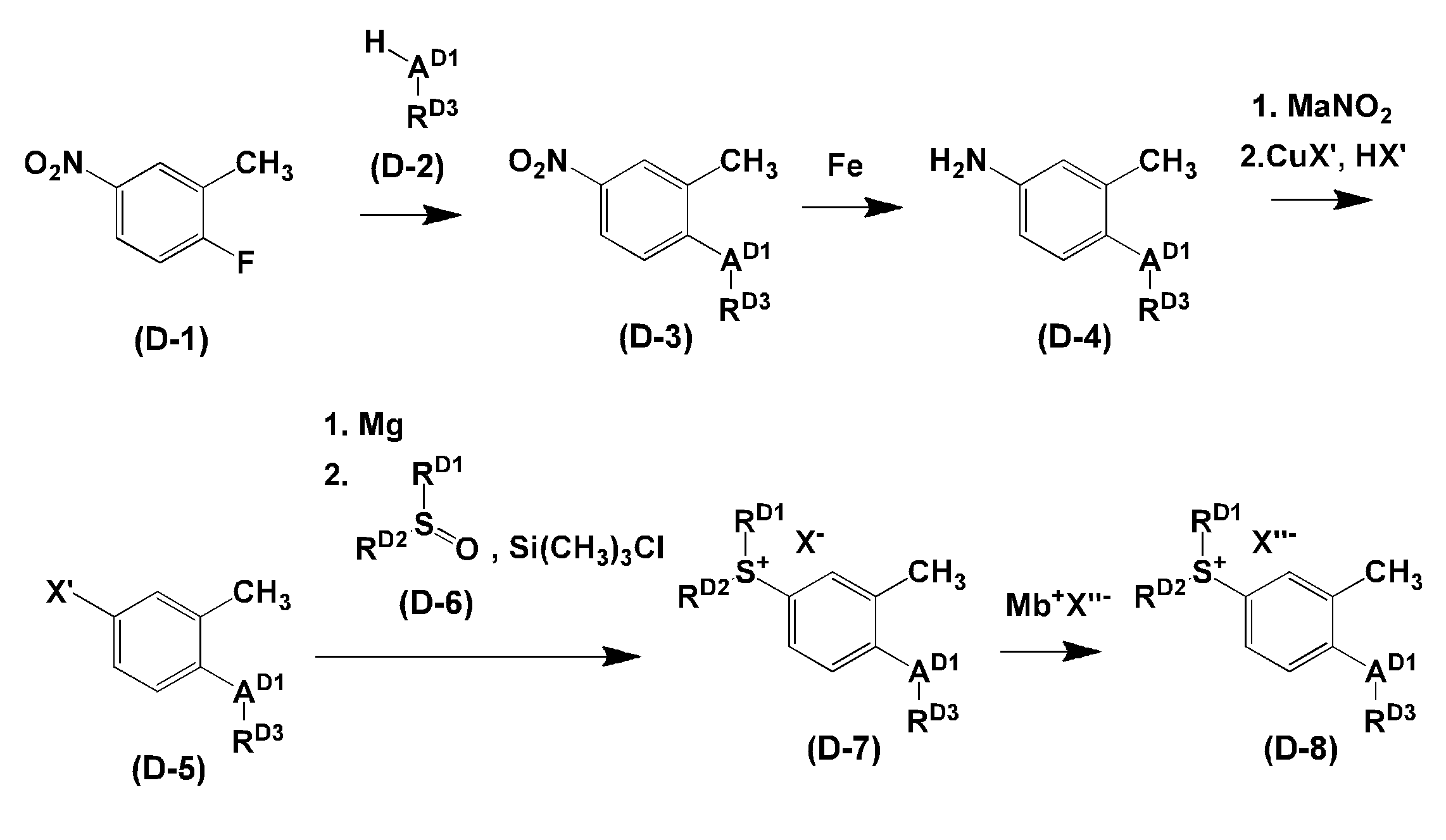
上記式(D-I)で表されるスルホニウム塩(Q)のカチオン部の具体例としては、以下のカチオンが挙げられる。上記式(D-I)で表されるスルホニウム塩(Q)のアニオン部の具体例としては、上記X-の説明で挙げたアニオン等、従来公知のアニオンを挙げることができる。上記式(D-I)で表されるスルホニウム塩(Q)は上記スキームに従って合成することができる。必要に応じさらに塩交換することにより、カチオン部を所望のアニオン部と組み合わせることができる。特に、Rx1
cBY4-c
-で表されるアニオンとの組み合わせが好ましい。式中、Rx1は水素原子の少なくとも一部がハロゲン原子又は電子求引基で置換されたフェニル基を示す。Yはハロゲン原子を示す。cは1以上4以下の整数を示す。

上記の好ましいカチオン部の群の中では、下記式で表されるカチオン部がより好ましい。

オニウム塩(D2)が上記のスルホニウム塩(Q)を含む場合、オニウム塩(D2)は、上記のスルホニウム塩(Q)以外とともに、スルホニウム塩(Q)以外のその他のオニウム塩を含んでいてもよい。
この場合、オニウム塩(D2)におけるスルホニウム塩(Q)の含有量は特に限定されないが、典型的には、70質量%以上が好ましく、80質量%以上がより好ましく、90質量%以上が特に好ましく、100質量%が最も好ましい。
組成物が、オニウム塩(D2)として、ガレートアニオン及び/又はボレートアニオンを含むオニウム塩を含む場合、当該オニウム塩のカチオン部は、上記式(D-I)で表されるスルホニウム塩のカチオン部に限定されず、後述のその他の酸発生剤に挙げるカチオン部とのオニウム塩であってもよい。組成物がオニウム塩(D2)としてガレートアニオン及び/又はボレートアニオンを含むオニウム塩を含むと、組成物の硬化性等の諸特性が良好である。
この場合、オニウム塩(D2)におけるスルホニウム塩(Q)の含有量は特に限定されないが、典型的には、70質量%以上が好ましく、80質量%以上がより好ましく、90質量%以上が特に好ましく、100質量%が最も好ましい。
組成物が、オニウム塩(D2)として、ガレートアニオン及び/又はボレートアニオンを含むオニウム塩を含む場合、当該オニウム塩のカチオン部は、上記式(D-I)で表されるスルホニウム塩のカチオン部に限定されず、後述のその他の酸発生剤に挙げるカチオン部とのオニウム塩であってもよい。組成物がオニウム塩(D2)としてガレートアニオン及び/又はボレートアニオンを含むオニウム塩を含むと、組成物の硬化性等の諸特性が良好である。
(その他のオニウム塩)
スルホニウム塩(Q)以外のその他のオニウム塩としては、従来からエポキシ化合物の硬化等の目的で使用されている種々のオニウム塩を特に制限なく使用することができる。
その他のオニウム塩としては、ヨードニウム塩やスルホニウム塩等のオニウム塩が好ましく、スルホニウム塩(Q)以外のその他のスルホニウム塩がより好ましい。
スルホニウム塩(Q)以外のその他のオニウム塩としては、従来からエポキシ化合物の硬化等の目的で使用されている種々のオニウム塩を特に制限なく使用することができる。
その他のオニウム塩としては、ヨードニウム塩やスルホニウム塩等のオニウム塩が好ましく、スルホニウム塩(Q)以外のその他のスルホニウム塩がより好ましい。
以下、スルホニウム塩(Q)以外のその他のスルホニウム塩について「スルホニウム塩(Q’)」とも記す。
その他のスルホニウム塩(Q’)は、スルホニウム塩(Q)と同じく、1価アニオンX-として上述のRx1 cBY4-c -で表されるアニオン又は上述のRx1 cGaY4-c -で表されるアニオン含むのが好ましい。
その他のスルホニウム塩(Q’)は、スルホニウム塩(Q)と同じく、1価アニオンX-として上述のRx1 cBY4-c -で表されるアニオン又は上述のRx1 cGaY4-c -で表されるアニオン含むのが好ましい。
Rx1
cBY4-c
-で表される1価のアニオンを有するスルホニウム塩(Q’)としては、例えば下記式(D-A)で表されるスルホニウム塩が挙げられる。Rx1
cGaY4-c
-で表される1価のアニオンを有するスルホニウム塩(Q’)としては下記式(D-A)におけるBをGaに置き換えたスルホニウム塩である。
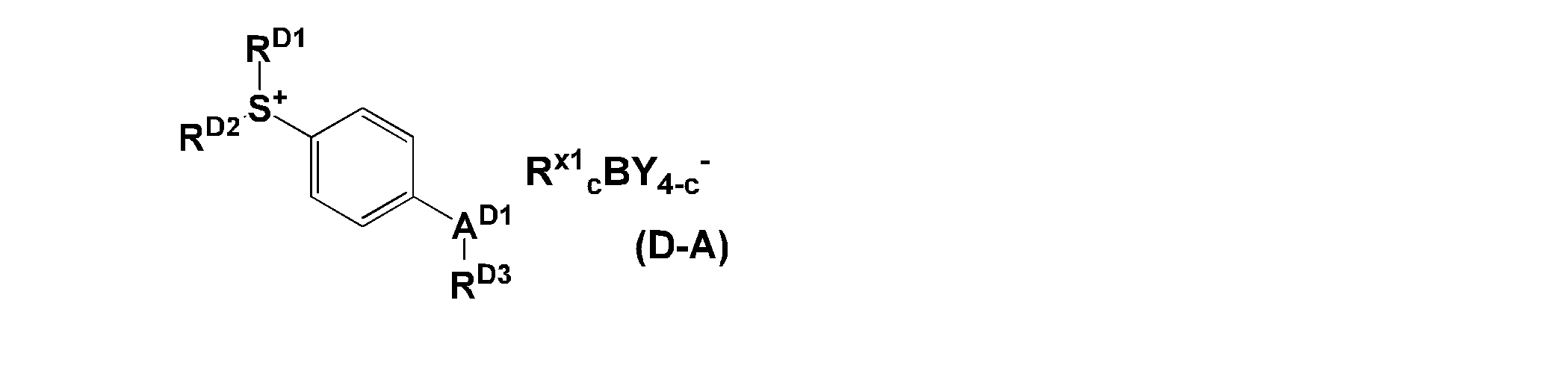
上記式(D-A)で表されるスルホニウム塩(Q’)のカチオン部の具体例としては、以下のカチオンが挙げられる。
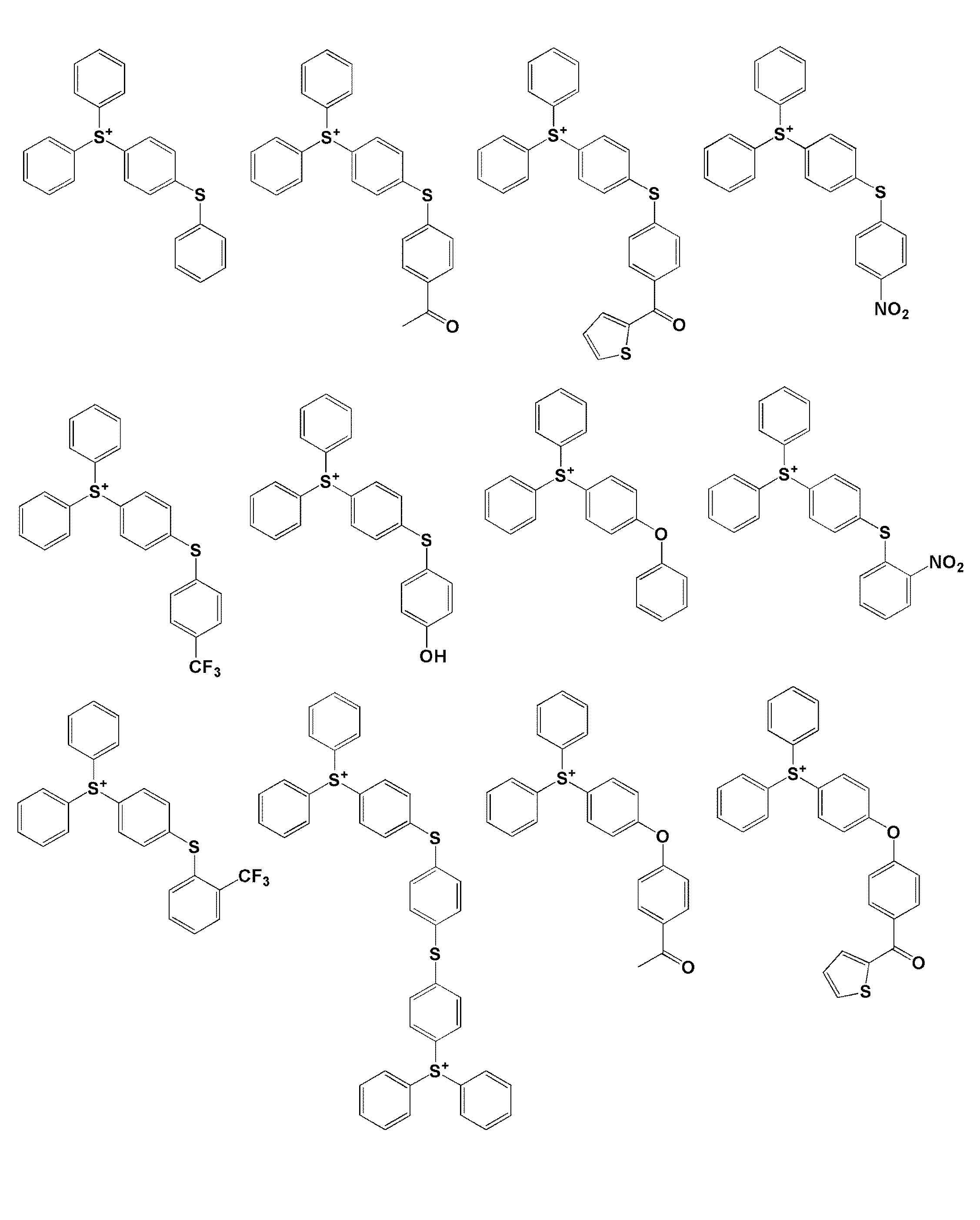
スルホニウム塩(Q’)のカチオン部の典型的な例としては、また、以下のカチオンが挙げられる。

組成物におけるオニウム塩(D2)の含有量は、組成物の硬化が良好に進行する限り特に限定されない。組成物を良好に硬化させやすい点から、組成物におけるオニウム塩(D2)の含有量は、典型的には、エポキシ基含有樹脂、エポキシ化合物、又はオキセタン化合物等のオニウム塩(D2)により硬化する材料100質量部に対して、0.01質量部以上50質量部以下であり、0.01質量部以上30質量部以下が好ましく、0.01質量部以上20質量部以下がより好ましく、0.05質量部以上15質量部以下がさらに好ましく、1質量部以上10質量部以下が特に好ましい。
[エポキシ基含有樹脂、エポキシ化合物又はオキセタン化合物用硬化剤(D3)]
エポキシ基含有樹脂、エポキシ化合物又はオキセタン化合物用硬化剤(D3)(以下、硬化剤(D3)とも記す。)は、上記のオニウム塩(D2)以外の硬化剤であって、従来公知の硬化剤から適宜選択することができる。硬化剤(D3)は、エポキシ基含有樹脂、エポキシ化合物又はオキセタン化合物とともに使用してもよく、加熱による硬化に寄与する。
エポキシ基含有樹脂、エポキシ化合物又はオキセタン化合物用硬化剤(D3)(以下、硬化剤(D3)とも記す。)は、上記のオニウム塩(D2)以外の硬化剤であって、従来公知の硬化剤から適宜選択することができる。硬化剤(D3)は、エポキシ基含有樹脂、エポキシ化合物又はオキセタン化合物とともに使用してもよく、加熱による硬化に寄与する。
硬化剤(D3)としては、例えば、フェノール系硬化剤、酸無水物系硬化剤、多価アミン系硬化剤、触媒型硬化剤が挙げられる。
フェノール系硬化剤、及び酸無水物系硬化剤の使用量は、組成物中の基材成分(C)の量、特にエポキシ化合物の量、及びオキセタニル化合物の量の合計100質量部に対して、1質量部以上200質量部以下が好ましく、50質量部以上150質量部以下がより好ましく、80質量部以上120質量部以下が特に好ましい。エポキシ化合物及びオキセタニル化合物には、エポキシ基及び/又はオキセタニル基含有樹脂が含まれる。フェノール系硬化剤、及び酸無水物系硬化剤は、それぞれ単独で用いられてもよく、2種以上を組み合わせて用いられてもよい。
多価アミン系硬化剤の使用量は、組成物中の基材成分(C)の量、特にエポキシ化合物の量、及びオキセタニル化合物の量の合計100質量部に対して、0.1質量部以上50質量部以下が好ましく、0.5質量部以上30質量部以下がより好ましく、1質量部以上15質量部以下が特に好ましい。エポキシ化合物及びオキセタニル化合物には、エポキシ基及び/又はオキセタニル基含有樹脂が含まれる。これらの多価アミン系硬化剤は、単独で用いられてもよく、2種以上を組み合わせて用いられてもよい。
触媒型硬化剤の使用量は、組成物中の基材成分(C)の量、特にエポキシ化合物の量、及びオキセタニル化合物の量の合計100質量部に対して、1質量部以上100質量部以下が好ましく、1質量部以上80質量部以下がより好ましく、1質量部以上50質量部以下が特に好ましい。エポキシ化合物及びオキセタニル化合物には、エポキシ基及び/又はオキセタニル基含有樹脂が含まれる。これらの触媒型硬化剤は、単独で用いられてもよく、2種以上を組み合わせて用いられてもよい。
フェノール系硬化剤、及び酸無水物系硬化剤の使用量は、組成物中の基材成分(C)の量、特にエポキシ化合物の量、及びオキセタニル化合物の量の合計100質量部に対して、1質量部以上200質量部以下が好ましく、50質量部以上150質量部以下がより好ましく、80質量部以上120質量部以下が特に好ましい。エポキシ化合物及びオキセタニル化合物には、エポキシ基及び/又はオキセタニル基含有樹脂が含まれる。フェノール系硬化剤、及び酸無水物系硬化剤は、それぞれ単独で用いられてもよく、2種以上を組み合わせて用いられてもよい。
多価アミン系硬化剤の使用量は、組成物中の基材成分(C)の量、特にエポキシ化合物の量、及びオキセタニル化合物の量の合計100質量部に対して、0.1質量部以上50質量部以下が好ましく、0.5質量部以上30質量部以下がより好ましく、1質量部以上15質量部以下が特に好ましい。エポキシ化合物及びオキセタニル化合物には、エポキシ基及び/又はオキセタニル基含有樹脂が含まれる。これらの多価アミン系硬化剤は、単独で用いられてもよく、2種以上を組み合わせて用いられてもよい。
触媒型硬化剤の使用量は、組成物中の基材成分(C)の量、特にエポキシ化合物の量、及びオキセタニル化合物の量の合計100質量部に対して、1質量部以上100質量部以下が好ましく、1質量部以上80質量部以下がより好ましく、1質量部以上50質量部以下が特に好ましい。エポキシ化合物及びオキセタニル化合物には、エポキシ基及び/又はオキセタニル基含有樹脂が含まれる。これらの触媒型硬化剤は、単独で用いられてもよく、2種以上を組み合わせて用いられてもよい。
[ケイ素含有樹脂用硬化剤(D4)]
ケイ素含有樹脂を基材成分(C)として含む組成物は、ケイ素含有樹脂用硬化剤(D4)(以下、硬化剤(D4)とも記す。)を含んでいてもよい。ケイ素含有樹脂を含む組成物が硬化剤(D4)を含む場合、N-メチル-2-ピロリドン等の有機溶媒により、溶解、膨潤、変形したりしにくい、有機溶媒耐性に優れる量子ドット含有被膜を形成しやすい。
ケイ素含有樹脂を基材成分(C)として含む組成物は、ケイ素含有樹脂用硬化剤(D4)(以下、硬化剤(D4)とも記す。)を含んでいてもよい。ケイ素含有樹脂を含む組成物が硬化剤(D4)を含む場合、N-メチル-2-ピロリドン等の有機溶媒により、溶解、膨潤、変形したりしにくい、有機溶媒耐性に優れる量子ドット含有被膜を形成しやすい。
硬化剤(D4)の好適な例としては、塩酸、硫酸、硝酸、ベンゼンスルホン酸、及びp-トルエンスルホ酸等のブレンステッド酸;2-メチルイミダゾール、2-エチル-4-メチルイミダゾール等のイミダゾール類;2,4,6-トリス(ジメチルアミノメチル)フェノール、ベンジルメチルアミン、DBU(1,8-ジアザビシクロ〔5.4.0〕-7-ウンデセン)、DCMU(3-(3,4-ジクロロフェニル)-1,1-ジメチル尿素)等の有機アミン類;三塩化リン、三臭化リン、亜リン酸、亜リン酸トリメチル、亜リン酸トリエチル、亜リン酸トリプロピル等のPX3(式中、Xはハロゲン原子、水酸基、又は炭素原子数1以上6以下のアルコキシ基である。)で表されるリン化合物;オキシ三塩化リン、オキシ三臭化リン、リン酸、リン酸トリメチル、リン酸トリエチル、リン酸トリプロピル等のPOX3(式中、Xはハロゲン原子、水酸基、又は炭素原子数1以上6以下のアルコキシ基である。)で表されるリン化合物;五酸化二リン;ポリリン酸やポリリン酸エステル等の、H(HPO3)xOH(式中、xは1以上の整数である。)で表されるリン化合物;メチルジクロロホスフィン、エチルジクロロホスフィン、メトキシジクロロホスフィン等のRD0PX2(式中、RD0は水素原子又は炭素原子数1以上30以下の有機基であり、該有機基中の水素原子はハロゲン原子で置換されていてもよい。Xはハロゲン原子、水酸基、又は炭素原子数1以上6以下のアルコキシ基である。)で表されるリン化合物;亜リン酸ジメチル、亜リン酸ジエチル、メチルホスホン酸、メチルホスホン酸ジメチル、メチルホスホン酸ジクロリド、フェニルホスホン酸、フェニルホスホン酸ジクロリド、ベンジルホスホン酸ジエチル等のRD0POX2(式中、RD0は水素原子又は炭素原子数1以上30以下の有機基であり、該有機基中の水素原子はハロゲン原子で置換されていてもよい。Xはハロゲン原子、水酸基、又は炭素原子数1以上6以下のアルコキシ基である。)で表されるリン化合物;トリブチルホスフィン、トリフェニルホスフィン、トリス(p-トリル)ホスフィン、トリス(m-トリル)ホスフィン、トリス(o-トリル)ホスフィン、ジフェニルシクロヘキシルホスフィン、トリシクロヘキシルホスフィン、トリス(ジメトキシフェニル)ホスフィン、エチルトリフェニルホスホニウムブロマイド、ベンジルトリフェニルホスホニウムクロライド、1,4-ビスジフェニルホスフィノブタン等の有機リン化合物;三フッ化ホウ素、三塩化ホウ素、ホウ酸、ホウ酸トリメチル、ホウ酸トリエチル、ホウ酸トリプロピル、ホウ酸トリブチル、ホウ酸トリアミル、ホウ酸トリヘキシル、ホウ酸トリシクロペンチル、ホウ酸トリシクロヘキシル、ホウ酸トリアリル、ホウ酸トリフェニル、ホウ酸エチルジメチル等のBX3(式中、Xはハロゲン原子、水酸基、又は炭素原子数1以上6以下のアルコキシ基である。)で表されるホウ素化合物;酸化ホウ素(B2O3);フェニルボロン酸、ジイソプロポキシ(メチル)ボラン、メチルボロン酸、シクロヘキシルボロン酸等のRD0BX2(式中、RD0は水素原子又は炭素原子数1以上30以下の有機基であり、該有機基中の水素原子はハロゲン原子で置換されていてもよい。Xはハロゲン原子、水酸基、又は炭素原子数1以上6以下のアルコキシ基である。)で表されるホウ素化合物;トリフェニルホスフィントリフェニルボラン、テトラフェニルホスホニウムテトラ-p-トリルボレート、テトラフェニルホスホニウムテトラフェニルボレート、テトラフェニルホスホニウムチオシアネート、テトラフェニルホスホニウムジシアナミド、n-ブチルトリフェニルホスホニウムジシアナミド等の有機リン化合物の複合体;三フッ化ホウ素等のルイス酸の有機アミン錯体(有機アミンとしては例えばピペリジン);アザビシクロウンデセン、ジアザビシクロウンデセントルエンスルホン酸塩、又はジアザビシクロウンデセンオクチル酸塩等のアミジン類;が挙げられる。
また、基材成分(C)として上記ポリシランを用いる場合、上記硬化剤(D4)に加えて又は単独で、光又は熱により塩基成分を発生する硬化剤を用いることが好ましい。
(熱により塩基成分を発生する硬化剤)
熱により塩基成分を発生する硬化剤としては、従来から熱塩基発生剤として使用されている化合物を特に限定なく用いることができる。
例えば、2-ベンジル-2-ジメチルアミノ-1-(4-モルフォリノフェニル)-ブタン-1-オンを、熱により塩基成分を発生する効果剤として用いることができる。なお、2-ベンジル-2-ジメチルアミノ-1-(4-モルフォリノフェニル)-ブタン-1-オンは光の作用によっても塩基を発生させる。
熱により塩基成分を発生する硬化剤としては、従来から熱塩基発生剤として使用されている化合物を特に限定なく用いることができる。
例えば、2-ベンジル-2-ジメチルアミノ-1-(4-モルフォリノフェニル)-ブタン-1-オンを、熱により塩基成分を発生する効果剤として用いることができる。なお、2-ベンジル-2-ジメチルアミノ-1-(4-モルフォリノフェニル)-ブタン-1-オンは光の作用によっても塩基を発生させる。
また、加熱によりイミダゾール化合物を発生させる化合物(以下、熱イミダゾール発生剤とも記す)も硬化剤として好ましく使用される。かかる熱イミダゾール発生剤としては、特開2016-145308号公報に記載される熱イミダゾール発生剤や、特開2017-025226号公報に記載のイミダゾール化合物が挙げられる。
(オキシムエステル化合物)
オキシムエステル化合物は、光の作用により分解して塩基を発生する。好適なオキシムエステル化合物としては、下記式(d01)で表される化合物が挙げられる。
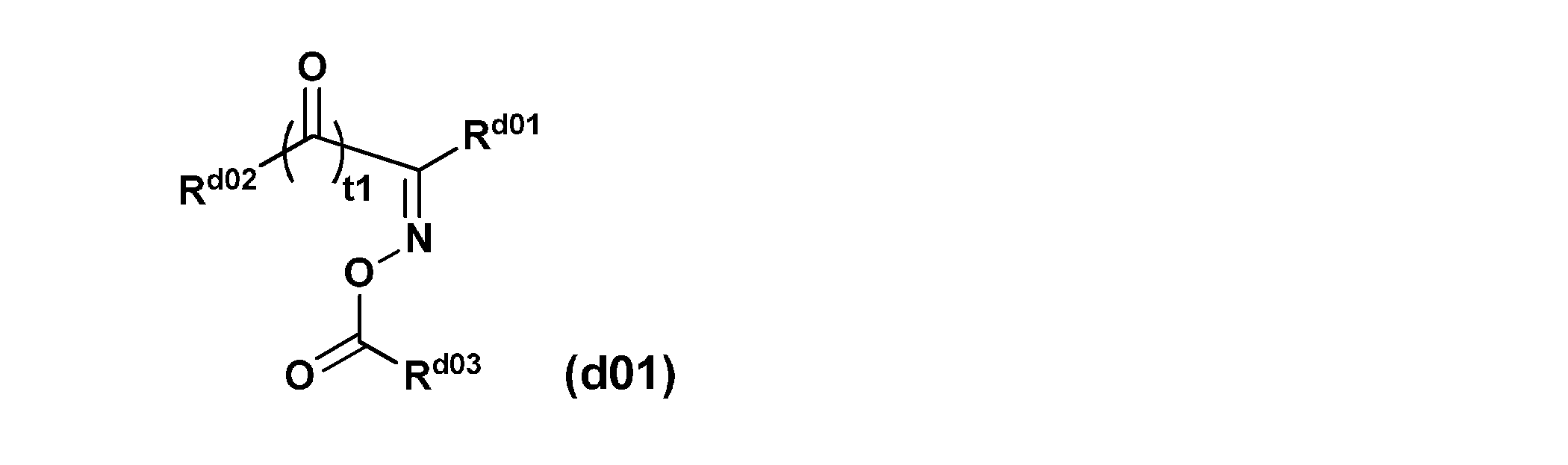
オキシムエステル化合物は、光の作用により分解して塩基を発生する。好適なオキシムエステル化合物としては、下記式(d01)で表される化合物が挙げられる。
上記式(d01)中、Rd01は、炭素原子数1以上10以下のアルキル基、置換基を有してもよいフェニル基、又は置換基を有してもよいカルバゾリル基を示す。t1は、0又は1である。Rd02は、置換基を有してもよい炭素原子数1以上10以下のアルキル基、置換基を有してもよいフェニル基、又は置換基を有してもよいカルバゾリル基を示す。Rd03は、水素原子、炭素原子数1以上6以下のアルキル基、又は置換基を有していてもよいフェニル基を示す。
Rd01が炭素原子数1以上10以下のアルキル基である場合、アルキル基は直鎖であっても分岐鎖であってもよい。この場合、アルキル基の炭素原子数は、1以上8以下が好ましく、1以上5以下がより好ましい。
Rd01が、置換基を有してもよいフェニル基である場合、置換基の種類は本発明の目的を阻害しない範囲で特に限定されない。フェニル基が有していてもよい置換基の好適な例としては、アルキル基、アルコキシ基、シクロアルキル基、シクロアルコキシ基、飽和脂肪族アシル基、アルコキシカルボニル基、飽和脂肪族アシルオキシ基、置換基を有してもよいフェニル基、置換基を有してもよいフェノキシ基、置換基を有してもよいベンゾイル基、置換基を有してもよいフェノキシカルボニル基、置換基を有してもよいベンゾイルオキシ基、置換基を有してもよいフェニルアルキル基、置換基を有してもよいナフチル基、置換基を有してもよいナフトキシ基、置換基を有してもよいナフトイル基、置換基を有してもよいナフトキシカルボニル基、置換基を有してもよいナフトイルオキシ基、置換基を有してもよいナフチルアルキル基、置換基を有してもよいヘテロシクリル基、アミノ基、1、又は2の有機基で置換されたアミノ基、モルホリン-1-イル基、及びピペラジン-1-イル基、ハロゲン、ニトロ基、及びシアノ基等が挙げられる。Rd01が、置換基を有してもよいフェニル基であり、フェニル基が複数の置換基を有する場合、複数の置換基は同一であっても異なっていてもよい。
フェニル基が有する置換基がアルキル基である場合、その炭素原子数は、1以上20以下が好ましく、1以上10以下がより好ましく、1以上6以下がさらに好ましく、1以上3以下が特に好ましく、1が最も好ましい。また、アルキル基は、直鎖であっても、分岐鎖であってもよい。フェニル基が有する置換基がアルキル基である場合の具体例としては、メチル基、エチル基、n-プロピル基、イソプロピル基、n-ブチル基、イソブチル基、sec-ブチル基、tert-ブチル基、n-ペンチル基、イソペンチル基、sec-ペンチル基、tert-ペンチル基、n-ヘキシル基、n-ヘプチル基、n-オクチル基、イソオクチル基、sec-オクチル基、tert-オクチル基、n-ノニル基、イソノニル基、n-デシル基、及びイソデシル基等が挙げられる。また、アルキル基は炭素鎖中にエーテル結合(-O-)を含んでいてもよい。この場合、フェニル基が有する置換基としては、例えば、アルコキシアルキル基、アルコキシアルコキシアルキル基が挙げられる。フェニル基が有する置換基がアルコキシアルキル基である場合、-Rd04-O-Rd05で表される基が好ましい。Rd04は、炭素原子数1以上10以下の直鎖でも分岐鎖であってもよいアルキレン基である。Rd05は、炭素原子数1以上10以下の直鎖でも分岐鎖であってもよいアルキル基である。Rd04の炭素原子数は、1以上8以下が好ましく、1以上5以下がより好ましく、1以上3以下が特に好ましい。Rd05の炭素原子数は、1以上8以下が好ましく、1以上5以下がより好ましく、1以上3以下が特に好ましく、1が最も好ましい。炭素鎖中にエーテル結合を有するアルキル基の例としては、メトキシエチル基、エトキシエチル基、メトキシエトキシエチル基、エトキシエトキシエチル基、プロピルオキシエトキシエチル基、及びメトキシプロピル基等が挙げられる。
フェニル基が有する置換基がアルコキシ基である場合、その炭素原子数は、1以上20以下が好ましく、1以上6以下がより好ましい。また、アルコキシ基は、直鎖であっても、分岐鎖であってもよい。フェニル基が有する置換基がアルコキシ基である場合の具体例としては、メトキシ基、エトキシ基、n-プロピルオキシ基、イソプロピルオキシ基、n-ブチルオキシ基、イソブチルオキシ基、sec-ブチルオキシ基、tert-ブチルオキシ基、n-ペンチルオキシ基、イソペンチルオキシ基、sec-ペンチルオキシ基、tert-ペンチルオキシ基、n-ヘキシルオキシ基、n-ヘプチルオキシ基、n-オクチルオキシ基、イソオクチルオキシ基、sec-オクチルオキシ基、tert-オクチルオキシ基、n-ノニルオキシ基、イソノニルオキシ基、n-デシルオキシ基、及びイソデシルオキシ基等が挙げられる。また、アルコキシ基は炭素鎖中にエーテル結合(-O-)を含んでいてもよい。炭素鎖中にエーテル結合を有するアルコキシ基の例としては、メトキシエトキシ基、エトキシエトキシ基、2-メトキシ-1-メチルエトキシ基、メトキシエトキシエトキシ基、エトキシエトキシエトキシ基、プロピルオキシエトキシエトキシ基、及びメトキシプロピルオキシ基等が挙げられる。
フェニル基が有する置換基がシクロアルキル基、又はシクロアルコキシ基である場合、その炭素原子数は、3以上10以下が好ましく、3以上6以下がより好ましい。フェニル基が有する置換基がシクロアルキル基である場合の具体例としては、シクロプロピル基、シクロブチル基、シクロペンチル基、シクロヘキシル基、シクロヘプチル基、及びシクロオクチル基等が挙げられる。フェニル基が有する置換基がシクロアルコキシ基である場合の具体例としては、シクロプロピルオキシ基、シクロブチルオキシ基、シクロペンチルオキシ基、シクロヘキシルオキシ基、シクロヘプチルオキシ基、及びシクロオクチルオキシ基等が挙げられる。
フェニル基が有する置換基が飽和脂肪族アシル基、又は飽和脂肪族アシルオキシ基である場合、その炭素原子数は、2以上20以下が好ましく、2以上7以下がより好ましい。フェニル基が有する置換基が飽和脂肪族アシル基である場合の具体例としては、アセチル基、プロパノイル基、n-ブタノイル基、2-メチルプロパノイル基、n-ペンタノイル基、2,2-ジメチルプロパノイル基、n-ヘキサノイル基、n-ヘプタノイル基、n-オクタノイル基、n-ノナノイル基、n-デカノイル基、n-ウンデカノイル基、n-ドデカノイル基、n-トリデカノイル基、n-テトラデカノイル基、n-ペンタデカノイル基、及びn-ヘキサデカノイル基等が挙げられる。フェニル基が有する置換基が飽和脂肪族アシルオキシ基である場合の具体例としては、アセチルオキシ基、プロパノイルオキシ基、n-ブタノイルオキシ基、2-メチルプロパノイルオキシ基、n-ペンタノイルオキシ基、2,2-ジメチルプロパノイルオキシ基、n-ヘキサノイルオキシ基、n-ヘプタノイルオキシ基、n-オクタノイルオキシ基、n-ノナノイルオキシ基、n-デカノイルオキシ基、n-ウンデカノイルオキシ基、n-ドデカノイルオキシ基、n-トリデカノイルオキシ基、n-テトラデカノイルオキシ基、n-ペンタデカノイルオキシ基、及びn-ヘキサデカノイルオキシ基等が挙げられる。
フェニル基が有する置換基がアルコキシカルボニル基である場合、その炭素原子数は、2以上20以下が好ましく、2以上7以下がより好ましい。フェニル基が有する置換基がアルコキシカルボニル基である場合の具体例としては、メトキシカルボニル基、エトキシカルボニル基、n-プロピルオキシカルボニル基、イソプロピルオキシカルボニル基、n-ブチルオキシカルボニル基、イソブチルオキシカルボニル基、sec-ブチルオキシカルボニル基、tert-ブチルオキシカルボニル基、n-ペンチルオキシカルボニル基、イソペンチルオキシカルボニル基、sec-ペンチルオキシカルボニル基、tert-ペンチルオキシカルボニル基、n-ヘキシルオキシカルボニル基、n-ヘプチルオキシカルボニル基、n-オクチルオキシカルボニル基、イソオクチルオキシカルボニル基、sec-オクチルオキシカルボニル基、tert-オクチルオキシカルボニル基、n-ノニルオキシカルボニル基、イソノニルオキシカルボニル基、n-デシルオキシカルボニル基、及びイソデシルオキシカルボニル基等が挙げられる。
フェニル基が有する置換基がフェニルアルキル基である場合、その炭素原子数は、7以上20以下が好ましく、7以上10以下がより好ましい。またフェニル基が有する置換基がナフチルアルキル基である場合、その炭素原子数は、11以上20以下が好ましく、11以上14以下がより好ましい。フェニル基が有する置換基がフェニルアルキル基である場合の具体例としては、ベンジル基、2-フェニルエチル基、3-フェニルプロピル基、及び4-フェニルブチル基が挙げられる。フェニル基が有する置換基がナフチルアルキル基である場合の具体例としては、α-ナフチルメチル基、β-ナフチルメチル基、2-(α-ナフチル)エチル基、及び2-(β-ナフチル)エチル基が挙げられる。フェニル基が有する置換基がフェニルアルキル基、又はナフチルアルキル基である場合、置換基は、フェニル基又はナフチル基上にさらに置換基を有していてもよい。
フェニル基が有する置換基がヘテロシクリル基である場合、ヘテロシクリル基は、1以上のN、S、Oを含む5員又は6員の単環であるか、かかる単環同士、又はかかる単環とベンゼン環とが縮合したヘテロシクリル基である。ヘテロシクリル基が縮合環である場合は、縮合環を構成する単環の数を3までとする。かかるヘテロシクリル基を構成する複素環としては、フラン、チオフェン、ピロール、オキサゾール、イソオキサゾール、チアゾール、チアジアゾール、イソチアゾール、イミダゾール、ピラゾール、トリアゾール、ピリジン、ピラジン、ピリミジン、ピリダジン、ベンゾフラン、ベンゾチオフェン、インドール、イソインドール、インドリジン、ベンゾイミダゾール、ベンゾトリアゾール、ベンゾオキサゾール、ベンゾチアゾール、カルバゾール、プリン、キノリン、イソキノリン、キナゾリン、フタラジン、シンノリン、及びキノキサリン等が挙げられる。フェニル基が有する置換基がヘテロシクリル基である場合、ヘテロシクリル基はさらに置換基を有していてもよい。
フェニル基が有する置換基が1又は2の有機基で置換されたアミノ基である場合、有機基の好適な例は、炭素原子数1以上20以下のアルキル基、炭素原子数3以上10以下のシクロアルキル基、炭素原子数2以上20以下の飽和脂肪族アシル基、炭素原子数2以上20以下の飽和脂肪族アシルオキシ基、置換基を有してもよいフェニル基、置換基を有してもよいベンゾイル基、置換基を有してもよい炭素原子数7以上20以下のフェニルアルキル基、置換基を有してもよいナフチル基、置換基を有してもよいナフトイル基、置換基を有してもよい炭素原子数11以上20以下のナフチルアルキル基、及びヘテロシクリル基等が挙げられる。これらの好適な有機基の具体例としては、フェニル基が有する置換基について上記した基と同様の基が挙げられる。1、又は2の有機基で置換されたアミノ基の具体例としては、メチルアミノ基、エチルアミノ基、ジエチルアミノ基、n-プロピルアミノ基、ジ-n-プロピルアミノ基、イソプロピルアミノ基、n-ブチルアミノ基、ジ-n-ブチルアミノ基、n-ペンチルアミノ基、n-ヘキシルアミノ基、n-ヘプチルアミノ基、n-オクチルアミノ基、n-ノニルアミノ基、n-デシルアミノ基、フェニルアミノ基、ナフチルアミノ基、アセチルアミノ基、プロパノイルアミノ基、n-ブタノイルアミノ基、n-ペンタノイルアミノ基、n-ヘキサノイルアミノ基、n-ヘプタノイルアミノ基、n-オクタノイルアミノ基、n-デカノイルアミノ基、ベンゾイルアミノ基、α-ナフトイルアミノ基、β-ナフトイルアミノ基、及びN-アセチル-N-アセチルオキシアミノ基等が挙げられる。
フェニル基が有する置換基に含まれる、フェニル基、ナフチル基、及びヘテロシクリル基がさらに置換基を有する場合の置換基としては、炭素原子数1以上6以下のアルキル基、炭素原子数1以上6以下のアルコキシ基、炭素原子数2以上7以下の飽和脂肪族アシル基、炭素原子数2以上7以下のアルコキシカルボニル基、炭素原子数2以上7以下の飽和脂肪族アシルオキシ基、炭素原子数1以上6以下のアルキル基を有するモノアルキルアミノ基、炭素原子数1以上6以下のアルキル基を有するジアルキルアミノ基、モルホリン-1-イル基、ピペラジン-1-イル基、ハロゲン、ニトロ基、及びシアノ基等が挙げられる。フェニル基が有する置換基に含まれる、フェニル基、ナフチル基、及びヘテロシクリル基がさらに置換基を有する場合、その置換基の数は、本発明の目的を阻害しない範囲で限定されないが、1以上4以下が好ましい。フェニル基が有する置換基に含まれる、フェニル基、ナフチル基、及びヘテロシクリル基が、複数の置換基を有する場合、複数の置換基は、同一であっても異なっていてもよい。
以上、Rd01が置換基を有してもよいフェニル基である場合の置換基について説明したが、これらの置換基の中では、アルキル基又はアルコキシアルキル基が好ましい。
Rd01が置換基を有してもよいフェニル基である場合、置換基の数と、置換基の結合位置とは、本発明の目的を阻害しない範囲で特に限定されない。Rd01が、置換基を有してもよいフェニル基である場合、塩基の発生効率に優れる点で、置換基を有してもよいフェニル基は、置換基を有していてもよいo-トリル基であるのが好ましい。
Rd01が置換基を有してもよいカルバゾリル基である場合、置換基の種類は本発明の目的を阻害しない範囲で特に限定されない。カルバゾリル基が炭素原子上に有してもよい好適な置換基の例としては、炭素原子数1以上20以下のアルキル基、炭素原子数1以上20以下のアルコキシ基、炭素原子数3以上10以下のシクロアルキル基、炭素原子数3以上10以下のシクロアルコキシ基、炭素原子数2以上20以下の飽和脂肪族アシル基、炭素原子数2以上20以下のアルコキシカルボニル基、炭素原子数2以上20以下の飽和脂肪族アシルオキシ基、置換基を有してもよいフェニル基、置換基を有してもよいフェノキシ基、置換基を有してもよいフェニルチオ基、置換基を有してもよいフェニルカルボニル基、置換基を有してもよいベンゾイル基、置換基を有してもよいフェノキシカルボニル基、置換基を有してもよいベンゾイルオキシ基、置換基を有してもよい炭素原子数7以上20以下のフェニルアルキル基、置換基を有してもよいナフチル基、置換基を有してもよいナフトキシ基、置換基を有してもよいナフチルカルボニル基、置換基を有してもよいナフトイル基、置換基を有してもよいナフトキシカルボニル基、置換基を有してもよいナフトイルオキシ基、置換基を有してもよい炭素原子数11以上20以下のナフチルアルキル基、置換基を有してもよいヘテロシクリル基、置換基を有してもよいヘテロシクリルカルボニル基、アミノ基、1又は2の有機基で置換されたアミノ基、モルホリン-1-イル基、及びピペラジン-1-イル基、ハロゲン、ニトロ基、及びシアノ基等が挙げられる。
Rd01が置換基を有してもよいカルバゾリル基である場合、カルバゾリル基が窒素原子上に有してもよい好適な置換基の例としては、炭素原子数1以上20以下のアルキル基、炭素原子数3以上10以下のシクロアルキル基、炭素原子数2以上20以下の飽和脂肪族アシル基、炭素原子数2以上20以下のアルコキシカルボニル基、置換基を有してもよいフェニル基、置換基を有してもよいベンゾイル基、置換基を有してもよいフェノキシカルボニル基、置換基を有してもよい炭素原子数7以上20以下のフェニルアルキル基、置換基を有してもよいナフチル基、置換基を有してもよいナフトイル基、置換基を有してもよいナフトキシカルボニル基、置換基を有してもよい炭素原子数11以上20以下のナフチルアルキル基、置換基を有してもよいヘテロシクリル基、及び置換基を有してもよいヘテロシクリルカルボニル基等が挙げられる。これらの置換基の中では、炭素原子数1以上20以下のアルキル基が好ましく、炭素原子数1以上6以下のアルキル基がより好ましく、エチル基が特に好ましい。
カルバゾリル基が有してもよい置換基の具体例について、アルキル基、アルコキシ基、シクロアルキル基、シクロアルコキシ基、飽和脂肪族アシル基、アルコキシカルボニル基、飽和脂肪族アシルオキシ基、置換基を有してもよいフェニルアルキル基、置換基を有してもよいナフチルアルキル基、置換基を有してもよいヘテロシクリル基、及び1又は2の有機基で置換されたアミノ基に関しては、Rd01が置換基を有してもよいフェニル基である場合の、フェニル基が有する置換基の例と同様である。
Rd01において、カルバゾリル基が有する置換基に含まれるフェニル基、ナフチル基、及びヘテロシクリル基がさらに置換基を有する場合の置換基の例としては、炭素原子数1以上6以下のアルキル基;炭素原子数1以上6以下のアルコキシ基;炭素原子数2以上7以下の飽和脂肪族アシル基;炭素原子数2以上7以下のアルコキシカルボニル基;炭素原子数2以上7以下の飽和脂肪族アシルオキシ基;フェニル基;ナフチル基;ベンゾイル基;ナフトイル基;炭素原子数1以上6以下のアルキル基、モルホリン-1-イル基、ピペラジン-1-イル基、及びフェニル基からなる群より選択される基により置換されたベンゾイル基;炭素原子数1以上6以下のアルキル基を有するモノアルキルアミノ基;炭素原子数1以上6以下のアルキル基を有するジアルキルアミノ基;モルホリン-1-イル基;ピペラジン-1-イル基;ハロゲン;ニトロ基;シアノ基が挙げられる。カルバゾリル基が有する置換基に含まれるフェニル基、ナフチル基、及びヘテロシクリル基がさらに置換基を有する場合、その置換基の数は、本発明の目的を阻害しない範囲で限定されないが、1以上4以下が好ましい。フェニル基、ナフチル基、及びヘテロシクリル基が、複数の置換基を有する場合、複数の置換基は、同一であっても異なっていてもよい。
Rd02は、置換基を有してもよい炭素原子数1以上10以下のアルキル基、置換基を有してもよいフェニル基、又は置換基を有してもよいカルバゾリル基である。
Rd02が置換基を有してもよい炭素原子数1以上10以下のアルキル基である場合、アルキル基は直鎖であっても分岐鎖であってもよい。この場合、アルキル基の炭素原子数は、1以上8以下が好ましく、1以上5以下がより好ましい。
Rd02において、アルキル基、フェニル基、又はカルバゾリル基が有する置換基は、本発明の目的を阻害しない範囲で特に限定されない。
アルキル基が炭素原子上に有してもよい好適な置換基の例としては、炭素原子数1以上20以下のアルコキシ基、炭素原子数3以上10以下のシクロアルキル基、炭素原子数3以上10以下のシクロアルコキシ基、炭素原子数2以上20以下の飽和脂肪族アシル基、炭素原子数2以上20以下のアルコキシカルボニル基、炭素原子数2以上20以下の飽和脂肪族アシルオキシ基、置換基を有してもよいフェニル基、置換基を有してもよいフェノキシ基、置換基を有してもよいフェニルチオ基、置換基を有してもよいベンゾイル基、置換基を有してもよいフェノキシカルボニル基、置換基を有してもよいベンゾイルオキシ基、置換基を有してもよい炭素原子数7以上20以下のフェニルアルキル基、置換基を有してもよいナフチル基、置換基を有してもよいナフトキシ基、置換基を有してもよいナフトイル基、置換基を有してもよいナフトキシカルボニル基、置換基を有してもよいナフトイルオキシ基、置換基を有してもよい炭素原子数11以上20以下のナフチルアルキル基、置換基を有してもよいヘテロシクリル基、置換基を有してもよいヘテロシクリルカルボニル基、アミノ基、1又は2の有機基で置換されたアミノ基、モルホリン-1-イル基、及びピペラジン-1-イル基、ハロゲン、ニトロ基、及びシアノ基等が挙げられる。
フェニル基、及びカルバゾリル基が炭素原子上に有してもよい好適な置換基の例としては、アルキル基が炭素原子上に有してもよい好適な置換基として上記で例示した基に加えて、炭素原子数1以上20以下のアルキル基が挙げられる。
アルキル基が炭素原子上に有してもよい好適な置換基の例としては、炭素原子数1以上20以下のアルコキシ基、炭素原子数3以上10以下のシクロアルキル基、炭素原子数3以上10以下のシクロアルコキシ基、炭素原子数2以上20以下の飽和脂肪族アシル基、炭素原子数2以上20以下のアルコキシカルボニル基、炭素原子数2以上20以下の飽和脂肪族アシルオキシ基、置換基を有してもよいフェニル基、置換基を有してもよいフェノキシ基、置換基を有してもよいフェニルチオ基、置換基を有してもよいベンゾイル基、置換基を有してもよいフェノキシカルボニル基、置換基を有してもよいベンゾイルオキシ基、置換基を有してもよい炭素原子数7以上20以下のフェニルアルキル基、置換基を有してもよいナフチル基、置換基を有してもよいナフトキシ基、置換基を有してもよいナフトイル基、置換基を有してもよいナフトキシカルボニル基、置換基を有してもよいナフトイルオキシ基、置換基を有してもよい炭素原子数11以上20以下のナフチルアルキル基、置換基を有してもよいヘテロシクリル基、置換基を有してもよいヘテロシクリルカルボニル基、アミノ基、1又は2の有機基で置換されたアミノ基、モルホリン-1-イル基、及びピペラジン-1-イル基、ハロゲン、ニトロ基、及びシアノ基等が挙げられる。
フェニル基、及びカルバゾリル基が炭素原子上に有してもよい好適な置換基の例としては、アルキル基が炭素原子上に有してもよい好適な置換基として上記で例示した基に加えて、炭素原子数1以上20以下のアルキル基が挙げられる。
アルキル基、フェニル基、又はカルバゾリル基が有してもよい置換基の具体例について、アルキル基、アルコキシ基、シクロアルキル基、シクロアルコキシ基、飽和脂肪族アシル基、アルコキシカルボニル基、飽和脂肪族アシルオキシ基、置換基を有してもよいフェニルアルキル基、置換基を有してもよいナフチルアルキル基、置換基を有してもよいヘテロシクリル基、及び1又は2の有機基で置換されたアミノ基に関しては、Rd01が置換基を有してもよいフェニル基である場合の、フェニル基が有する置換基の例と同様である。
Rd02において、アルキル基、フェニル基、又はカルバゾリル基が有する置換基に含まれるフェニル基、ナフチル基、及びヘテロシクリル基がさらに置換基を有する場合の置換基の例としては、炭素原子数1以上6以下のアルキル基;炭素原子数1以上6以下のアルコキシ基;炭素原子数2以上7以下の飽和脂肪族アシル基;炭素原子数2以上7以下のアルコキシカルボニル基;炭素原子数2以上7以下の飽和脂肪族アシルオキシ基;フェニル基;ナフチル基;ベンゾイル基;ナフトイル基;炭素原子数1以上6以下のアルキル基、モルホリン-1-イル基、ピペラジン-1-イル基、及びフェニル基からなる群より選択される基により置換されたベンゾイル基;炭素原子数1以上6以下のアルキル基を有するモノアルキルアミノ基;炭素原子数1以上6以下のアルキル基を有するジアルキルアミノ基;モルホリン-1-イル基;ピペラジン-1-イル基;ハロゲン;ニトロ基;シアノ基が挙げられる。アルキル基又はフェニル基が有する置換基に含まれるフェニル基、ナフチル基、及びヘテロシクリル基がさらに置換基を有する場合、その置換基の数は、本発明の目的を阻害しない範囲で限定されないが、1以上4以下が好ましい。フェニル基、ナフチル基、及びヘテロシクリル基が、複数の置換基を有する場合、複数の置換基は、同一であっても異なっていてもよい。
式(d01)で表される化合物の塩基発生効率の点から、Rd02としては、下記式(d02):

で表される基、及び下記式(d03):
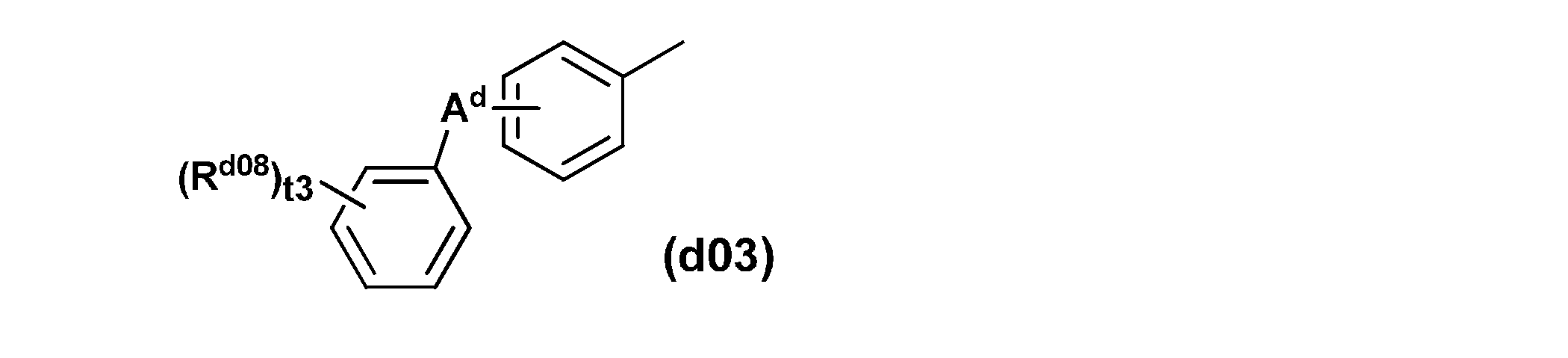
で表される基が好ましい。
式(d02)中、Rd06及びRd07は、それぞれ1価の有機基であり、t2は0又は1である。式(d03)中、Rd08は、1価の有機基、アミノ基、ハロゲン、ニトロ基、及びシアノ基からなる群より選択される基であり、AdはS又はOであり、t3は0以上4以下の整数である。
式(d02)におけるRd06は、本発明の目的を阻害しない範囲で、種々の有機基から選択できる。Rd06の好適な例としては、炭素原子数1以上20以下のアルキル基、炭素原子数3以上10以下のシクロアルキル基、炭素原子数2以上20以下の飽和脂肪族アシル基、炭素原子数2以上20以下のアルコキシカルボニル基、置換基を有してもよいフェニル基、置換基を有してもよいベンゾイル基、置換基を有してもよいフェノキシカルボニル基、置換基を有してもよい炭素原子数7以上20以下のフェニルアルキル基、置換基を有してもよいナフチル基、置換基を有してもよいナフトイル基、置換基を有してもよいナフトキシカルボニル基、置換基を有してもよい炭素原子数11以上20以下のナフチルアルキル基、置換基を有してもよいヘテロシクリル基、及び置換基を有してもよいヘテロシクリルカルボニル基等が挙げられる。
Rd06の中では、炭素原子数1以上20以下のアルキル基が好ましく、炭素原子数1以上6以下のアルキル基がより好ましく、エチル基が特に好ましい。
式(d02)におけるRd07は、本発明の目的を阻害しない範囲で特に限定されず、種々の有機基から選択できる。Rd07として好適な基の具体例としては、炭素原子数1以上20以下のアルキル基、置換基を有してもよいフェニル基、置換基を有してもよいナフチル基、及び置換基を有してもよいヘテロシクリル基が挙げられる。Rd07として、これらの基の中では置換基を有してもよいフェニル基、及び置換基を有してもよいナフチル基がより好ましく、2-メチルフェニル基及びナフチル基が特に好ましい。
Rd06又はRd07に含まれる、フェニル基、ナフチル基、及びヘテロシクリル基がさらに置換基を有する場合の置換基としては、炭素原子数1以上6以下のアルキル基、炭素原子数1以上6以下のアルコキシ基、炭素原子数2以上7以下の飽和脂肪族アシル基、炭素原子数2以上7以下のアルコキシカルボニル基、炭素原子数2以上7以下の飽和脂肪族アシルオキシ基、炭素原子数1以上6以下のアルキル基を有するモノアルキルアミノ基、炭素原子数1以上6以下のアルキル基を有するジアルキルアミノ基、モルホリン-1-イル基、ピペラジン-1-イル基、ハロゲン、ニトロ基、及びシアノ基等が挙げられる。Rd06又はRd07に含まれる、フェニル基、ナフチル基、及びヘテロシクリル基がさらに置換基を有する場合、その置換基の数は、本発明の目的を阻害しない範囲で限定されないが、1以上4以下が好ましい。Rd06又はRd07に含まれる、フェニル基、ナフチル基、及びヘテロシクリル基が、複数の置換基を有する場合、複数の置換基は、同一であっても異なっていてもよい。
式(d03)におけるRd08が有機基である場合、Rd08は、本発明の目的を阻害しない範囲で、種々の有機基から選択できる。式(d03)においてRd08が有機基である場合の好適な例としては、炭素原子数1以上6以下のアルキル基;炭素原子数1以上6以下のアルコキシ基;炭素原子数2以上7以下の飽和脂肪族アシル基;炭素原子数2以上7以下のアルコキシカルボニル基;炭素原子数2以上7以下の飽和脂肪族アシルオキシ基;フェニル基;ナフチル基;ベンゾイル基;ナフトイル基;炭素原子数1以上6以下のアルキル基、モルホリン-1-イル基、ピペラジン-1-イル基、及びフェニル基からなる群より選択される基により置換されたベンゾイル基;炭素原子数1以上6以下のアルキル基を有するモノアルキルアミノ基;炭素原子数1以上6以下のアルキル基を有するジアルキルアミノ基;モルホリン-1-イル基;ピペラジン-1-イル基;ハロゲン;ニトロ基;シアノ基;2-メチルフェニルカルボニル基;4-(ピペラジン-1-イル)フェニルカルボニル基;4-(フェニル)フェニルカルボニル基が挙げられる。
Rd08の中では、ベンゾイル基;ナフトイル基;炭素原子数1以上6以下のアルキル基、モルホリン-1-イル基、ピペラジン-1-イル基、及びフェニル基からなる群より選択される基により置換されたベンゾイル基;ニトロ基が好ましく、ベンゾイル基;ナフトイル基;2-メチルフェニルカルボニル基;4-(ピペラジン-1-イル)フェニルカルボニル基;4-(フェニル)フェニルカルボニル基がより好ましい。
また、式(d03)において、t3、0以上3以下の整数が好ましく、0以上2以下の整数がより好ましく、0又は1であるのが特に好ましい。t3が1である場合、Rd08の結合する位置は、Rd08が結合するフェニル基が硫黄原子と結合する結合手に対して、パラ位であるのが好ましい。
Rd03は、水素原子、炭素原子数1以上6以下のアルキル基、又は置換基を有していてもよいフェニル基である。置換基を有していてもよいフェニル基である場合、フェニル基が有していてもよい置換基は、Rd01が置換基を有していてもよいフェニル基である場合と同様である。Rd03としては、メチル基、エチル基、又はフェニル基が好ましく、メチル基又はフェニル基がより好ましい。
上記式(d01)で表される化合物としては、下記式(d04)で表される化合物が挙げられる。

上記式(d04)中、t1及びRd02は上記の通りである。Rd09は、1価の有機基、アミノ基、ハロゲン、ニトロ基、及びシアノ基からなる群より選択される基であり、t4は0以上4以下の整数であり、Rd010は、水素原子又は炭素原子数1以上6以下のアルキル基である。
上記式(d04)中、Rd09は、本発明の目的を阻害しない範囲で特に限定されず、有機基である場合、種々の有機基から適宜選択される。Rd09の好適な例としては、アルキル基、アルコキシ基、シクロアルキル基、シクロアルコキシ基、飽和脂肪族アシル基、アルコキシカルボニル基、飽和脂肪族アシルオキシ基、置換基を有してもよいフェニル基、置換基を有してもよいフェノキシ基、置換基を有してもよいベンゾイル基、置換基を有してもよいフェノキシカルボニル基、置換基を有してもよいベンゾイルオキシ基、置換基を有してもよいフェニルアルキル基、置換基を有してもよいナフチル基、置換基を有してもよいナフトキシ基、置換基を有してもよいナフトイル基、置換基を有してもよいナフトキシカルボニル基、置換基を有してもよいナフトイルオキシ基、置換基を有してもよいナフチルアルキル基、置換基を有してもよいヘテロシクリル基、アミノ基、1又は2の有機基で置換されたアミノ基、モルホリン-1-イル基、ピペラジン-1-イル基、ハロゲン、ニトロ基、及びシアノ基等が挙げられる。t4が2以上4以下の整数である場合、Rd09は同一であっても異なっていてもよい。また、置換基の炭素原子数には、置換基がさらに有する置換基の炭素原子数を含まない。
Rd09がアルキル基である場合、炭素原子数1以上20以下が好ましく、炭素原子数1以上6以下がより好ましい。また、Rd09がアルキル基である場合、直鎖であっても、分岐鎖であってもよい。Rd09がアルキル基である場合の具体例としては、メチル基、エチル基、n-プロピル基、イソプロピル基、n-ブチル基、イソブチル基、sec-ブチル基、tert-ブチル基、n-ペンチル基、イソペンチル基、sec-ペンチル基、tert-ペンチル基、n-ヘキシル基、n-ヘプチル基、n-オクチル基、イソオクチル基、sec-オクチル基、tert-オクチル基、n-ノニル基、イソノニル基、n-デシル基、及びイソデシル基等が挙げられる。また、Rd09がアルキル基である場合、アルキル基は炭素鎖中にエーテル結合(-O-)を含んでいてもよい。炭素鎖中にエーテル結合を有するアルキル基の例としては、メトキシエチル基、エトキシエチル基、メトキシエトキシエチル基、エトキシエトキシエチル基、プロピルオキシエトキシエチル基、及びメトキシプロピル基等が挙げられる。
Rd09がアルコキシ基である場合、炭素原子数1以上20以下が好ましく、炭素原子数1以上6以下がより好ましい。また、Rd09がアルコキシ基である場合、直鎖であっても、分岐鎖であってもよい。Rd09がアルコキシ基である場合の具体例としては、メトキシ基、エトキシ基、n-プロピルオキシ基、イソプロピルオキシ基、n-ブチルオキシ基、イソブチルオキシ基、sec-ブチルオキシ基、tert-ブチルオキシ基、n-ペンチルオキシ基、イソペンチルオキシ基、sec-ペンチルオキシ基、tert-ペンチルオキシ基、n-ヘキシルオキシ基、n-ヘプチルオキシ基、n-オクチルオキシ基、イソオクチルオキシ基、sec-オクチルオキシ基、tert-オクチルオキシ基、n-ノニルオキシ基、イソノニルオキシ基、n-デシルオキシ基、及びイソデシルオキシ基等が挙げられる。また、Rd09がアルコキシ基である場合、アルコキシ基は炭素鎖中にエーテル結合(-O-)を含んでいてもよい。炭素鎖中にエーテル結合を有するアルコキシ基の例としては、メトキシエトキシ基、エトキシエトキシ基、メトキシエトキシエトキシ基、エトキシエトキシエトキシ基、プロピルオキシエトキシエトキシ基、及びメトキシプロピルオキシ基等が挙げられる。
Rd09がシクロアルキル基又はシクロアルコキシ基である場合、炭素原子数3以上10以下が好ましく、炭素原子数3以上6以下がより好ましい。Rd09がシクロアルキル基である場合の具体例としては、シクロプロピル基、シクロブチル基、シクロペンチル基、シクロヘキシル基、シクロヘプチル基、及びシクロオクチル基等が挙げられる。Rd09がシクロアルコキシ基である場合の具体例としては、シクロプロピルオキシ基、シクロブチルオキシ基、シクロペンチルオキシ基、シクロヘキシルオキシ基、シクロヘプチルオキシ基、及びシクロオクチルオキシ基等が挙げられる。
Rd09が飽和脂肪族アシル基又は飽和脂肪族アシルオキシ基である場合、炭素原子数2以上20以下が好ましく、炭素原子数2以上7以下がより好ましい。Rd09が飽和脂肪族アシル基である場合の具体例としては、アセチル基、プロパノイル基、n-ブタノイル基、2-メチルプロパノイル基、n-ペンタノイル基、2,2-ジメチルプロパノイル基、n-ヘキサノイル基、n-ヘプタノイル基、n-オクタノイル基、n-ノナノイル基、n-デカノイル基、n-ウンデカノイル基、n-ドデカノイル基、n-トリデカノイル基、n-テトラデカノイル基、n-ペンタデカノイル基、及びn-ヘキサデカノイル基等が挙げられる。Rd09が飽和脂肪族アシルオキシ基である場合の具体例としては、アセチルオキシ基、プロパノイルオキシ基、n-ブタノイルオキシ基、2-メチルプロパノイルオキシ基、n-ペンタノイルオキシ基、2,2-ジメチルプロパノイルオキシ基、n-ヘキサノイルオキシ基、n-ヘプタノイルオキシ基、n-オクタノイルオキシ基、n-ノナノイルオキシ基、n-デカノイルオキシ基、n-ウンデカノイルオキシ基、n-ドデカノイルオキシ基、n-トリデカノイルオキシ基、n-テトラデカノイルオキシ基、n-ペンタデカノイルオキシ基、及びn-ヘキサデカノイルオキシ基等が挙げられる。
Rd09がアルコキシカルボニル基である場合、炭素原子数2以上20以下が好ましく、炭素原子数2以上7以下がより好ましい。Rd09がアルコキシカルボニル基である場合の具体例としては、メトキシカルボニル基、エトキシカルボニル基、n-プロピルオキシカルボニル基、イソプロピルオキシカルボニル基、n-ブチルオキシカルボニル基、イソブチルオキシカルボニル基、sec-ブチルオキシカルボニル基、tert-ブチルオキシカルボニル基、n-ペンチルオキシカルボニル基、イソペンチルオキシカルボニル基、sec-ペンチルオキシカルボニル基、tert-ペンチルオキシカルボニル基、n-ヘキシルオキシカルボニル基、n-ヘプチルオキシカルボニル基、n-オクチルオキシカルボニル基、イソオクチルオキシカルボニル基、sec-オクチルオキシカルボニル基、tert-オクチルオキシカルボニル基、n-ノニルオキシカルボニル基、イソノニルオキシカルボニル基、n-デシルオキシカルボニル基、及びイソデシルオキシカルボニル基等が挙げられる。
Rd09がフェニルアルキル基である場合、炭素原子数7以上20以下が好ましく、炭素原子数7以上10以下がより好ましい。またRd09がナフチルアルキル基である場合、炭素原子数11以上20以下が好ましく、炭素原子数11以上14以下がより好ましい。Rd09がフェニルアルキル基である場合の具体例としては、ベンジル基、2-フェニルエチル基、3-フェニルプロピル基、及び4-フェニルブチル基が挙げられる。Rd09がナフチルアルキル基である場合の具体例としては、α-ナフチルメチル基、β-ナフチルメチル基、2-(α-ナフチル)エチル基、及び2-(β-ナフチル)エチル基が挙げられる。Rd09が、フェニルアルキル基、又はナフチルアルキル基である場合、Rd09は、フェニル基、又はナフチル基上にさらに置換基を有していてもよい。
Rd09がヘテロシクリル基である場合、ヘテロシクリル基は、1以上のN、S、Oを含む5員又は6員の単環であるか、かかる単環同士、又はかかる単環とベンゼン環とが縮合したヘテロシクリル基である。ヘテロシクリル基が縮合環である場合は、縮合環を構成する単環の数を3までとする。かかるヘテロシクリル基を構成する複素環としては、フラン、チオフェン、ピロール、オキサゾール、イソオキサゾール、チアゾール、チアジアゾール、イソチアゾール、イミダゾール、ピラゾール、トリアゾール、ピリジン、ピラジン、ピリミジン、ピリダジン、ベンゾフラン、ベンゾチオフェン、インドール、イソインドール、インドリジン、ベンゾイミダゾール、ベンゾトリアゾール、ベンゾオキサゾール、ベンゾチアゾール、カルバゾール、プリン、キノリン、イソキノリン、キナゾリン、フタラジン、シンノリン、及びキノキサリン等が挙げられる。Rd09がヘテロシクリル基である場合、ヘテロシクリル基はさらに置換基を有していてもよい。
Rd09が1又は2の有機基で置換されたアミノ基である場合、有機基の好適な例は、炭素原子数1以上20以下のアルキル基、炭素原子数3以上10以下のシクロアルキル基、炭素原子数2以上20以下の飽和脂肪族アシル基、置換基を有してもよいフェニル基、置換基を有してもよいベンゾイル基、置換基を有してもよい炭素原子数7以上20以下のフェニルアルキル基、置換基を有してもよいナフチル基、置換基を有してもよいナフトイル基、置換基を有してもよい炭素原子数11以上20以下のナフチルアルキル基、及びヘテロシクリル基等が挙げられる。これらの好適な有機基の具体例は、Rd09と同様である。1又は2の有機基で置換されたアミノ基の具体例としては、メチルアミノ基、エチルアミノ基、ジエチルアミノ基、n-プロピルアミノ基、ジ-n-プロピルアミノ基、イソプロピルアミノ基、n-ブチルアミノ基、ジ-n-ブチルアミノ基、n-ペンチルアミノ基、n-ヘキシルアミノ基、n-ヘプチルアミノ基、n-オクチルアミノ基、n-ノニルアミノ基、n-デシルアミノ基、フェニルアミノ基、ナフチルアミノ基、アセチルアミノ基、プロパノイルアミノ基、n-ブタノイルアミノ基、n-ペンタノイルアミノ基、n-ヘキサノイルアミノ基、n-ヘプタノイルアミノ基、n-オクタノイルアミノ基、n-デカノイルアミノ基、ベンゾイルアミノ基、α-ナフトイルアミノ基、及びβ-ナフトイルアミノ基等が挙げられる。
Rd09に含まれる、フェニル基、ナフチル基、及びヘテロシクリル基がさらに置換基を有する場合の置換基としては、炭素原子数1以上6以下のアルキル基、炭素原子数1以上6以下のアルコキシ基、炭素原子数2以上7以下の飽和脂肪族アシル基、炭素原子数2以上7以下のアルコキシカルボニル基、炭素原子数2以上7以下の飽和脂肪族アシルオキシ基、炭素原子数1以上6以下のアルキル基を有するモノアルキルアミノ基、炭素原子数1以上6以下のアルキル基を有するジアルキルアミノ基、モルホリン-1-イル基、ピペラジン-1-イル基、ハロゲン、ニトロ基、及びシアノ基等が挙げられる。Rd09に含まれる、フェニル基、ナフチル基、及びヘテロシクリル基がさらに置換基を有する場合、その置換基の数は、本発明の目的を阻害しない範囲で限定されないが、1以上4以下が好ましい。Rd09に含まれる、フェニル基、ナフチル基、及びヘテロシクリル基が、複数の置換基を有する場合、複数の置換基は、同一であっても異なっていてもよい。
Rd09の中では、化学的に安定であることや、立体的な障害が少なく、オキシムエステル化合物の合成が容易であること等から、炭素原子数1以上6以下のアルキル基、炭素原子数1以上6以下のアルコキシ基、及び炭素原子数2以上7以下の飽和脂肪族アシル基からなる群より選択される基が好ましく、炭素原子数1以上6以下のアルキルがより好ましく、メチル基が特に好ましい。
Rd09がフェニル基に結合する位置は、Rd09が結合するフェニル基について、フェニル基とオキシムエステル化合物の主骨格との結合手の位置を1位とし、メチル基の位置を2位とする場合に、4位、又は5位が好ましく、5位がより好ましい。また、t4は、0以上3以下の整数が好ましく、0以上2以下の整数がより好ましく、0又は1が特に好ましい。
上記式(d04)におけるRd010は、水素原子又は炭素原子数1以上6以下のアルキル基である。Rd010としては、メチル基又はエチル基が好ましく、メチル基がより好ましい。
式(d01)で表されるオキシムエステル化合物として特に好適な化合物の具体例を以下に示す。

下式(d05)で表される化合物も、オキシムエステル化合物として好適に使用される。

(Rd011は水素原子、ニトロ基又は1価の有機基であり、Rd012及びRd013は、それぞれ、置換基を有してもよい鎖状アルキル基、置換基を有してもよい環状有機基、又は水素原子であり、Rd012及びRd013とは相互に結合して環を形成してもよく、Rd014は1価の有機基であり、Rd015は、水素原子、置換基を有してもよい炭素原子数1以上11以下のアルキル基、又は置換基を有してもよいアリール基であり、t6は0以上4以下の整数であり、t5は0又は1である。)
式(d05)中、Rd011は、水素原子、ニトロ基又は1価の有機基である。Rd011は、式(d05)中のフルオレン環上で、-(CO)t5-で表される基に結合する6員芳香環とは、異なる6員芳香環に結合する。式(d05)中、Rd011のフルオレン環に対する結合位置は特に限定されない。式(d05)で表される化合物が1以上のRd011を有する場合、式(d05)で表される化合物の合成が容易であること等から、1以上のRd011のうちの1つがフルオレン環中の2位に結合するのが好ましい。Rd011が複数である場合、複数のRd011は同一であっても異なっていてもよい。
Rd011が有機基である場合、Rd011は、本発明の目的を阻害しない範囲で特に限定されず、種々の有機基から適宜選択される。Rd011が有機基である場合の好適な例としては、アルキル基、アルコキシ基、シクロアルキル基、シクロアルコキシ基、飽和脂肪族アシル基、アルコキシカルボニル基、飽和脂肪族アシルオキシ基、置換基を有してもよいフェニル基、置換基を有してもよいフェノキシ基、置換基を有してもよいベンゾイル基、置換基を有してもよいフェノキシカルボニル基、置換基を有してもよいベンゾイルオキシ基、置換基を有してもよいフェニルアルキル基、置換基を有してもよいナフチル基、置換基を有してもよいナフトキシ基、置換基を有してもよいナフトイル基、置換基を有してもよいナフトキシカルボニル基、置換基を有してもよいナフトイルオキシ基、置換基を有してもよいナフチルアルキル基、置換基を有してもよいヘテロシクリル基、置換基を有してもよいヘテロシクリルカルボニル基、1、又は2の有機基で置換されたアミノ基、モルホリン-1-イル基、及びピペラジン-1-イル基等が挙げられる。
Rd011がアルキル基である場合、アルキル基の炭素原子数は、1以上20以下が好ましく、1以上6以下がより好ましい。また、Rd011がアルキル基である場合、直鎖であっても、分岐鎖であってもよい。Rd011がアルキル基である場合の具体例としては、メチル基、エチル基、n-プロピル基、イソプロピル基、n-ブチル基、イソブチル基、sec-ブチル基、tert-ブチル基、n-ペンチル基、イソペンチル基、sec-ペンチル基、tert-ペンチル基、n-ヘキシル基、n-ヘプチル基、n-オクチル基、イソオクチル基、sec-オクチル基、tert-オクチル基、n-ノニル基、イソノニル基、n-デシル基、及びイソデシル基等が挙げられる。また、Rd011がアルキル基である場合、アルキル基は炭素鎖中にエーテル結合(-O-)を含んでいてもよい。炭素鎖中にエーテル結合を有するアルキル基の例としては、メトキシエチル基、エトキシエチル基、メトキシエトキシエチル基、エトキシエトキシエチル基、プロピルオキシエトキシエチル基、及びメトキシプロピル基等が挙げられる。
Rd011がアルコキシ基である場合、アルコキシ基の炭素原子数は、1以上20以下が好ましく、1以上6以下がより好ましい。また、Rd011がアルコキシ基である場合、直鎖であっても、分岐鎖であってもよい。Rd011がアルコキシ基である場合の具体例としては、メトキシ基、エトキシ基、n-プロピルオキシ基、イソプロピルオキシ基、n-ブチルオキシ基、イソブチルオキシ基、sec-ブチルオキシ基、tert-ブチルオキシ基、n-ペンチルオキシ基、イソペンチルオキシ基、sec-ペンチルオキシ基、tert-ペンチルオキシ基、n-ヘキシルオキシ基、n-ヘプチルオキシ基、n-オクチルオキシ基、イソオクチルオキシ基、sec-オクチルオキシ基、tert-オクチルオキシ基、n-ノニルオキシ基、イソノニルオキシ基、n-デシルオキシ基、及びイソデシルオキシ基等が挙げられる。また、Rd011がアルコキシ基である場合、アルコキシ基は炭素鎖中にエーテル結合(-O-)を含んでいてもよい。炭素鎖中にエーテル結合を有するアルコキシ基の例としては、メトキシエトキシ基、エトキシエトキシ基、メトキシエトキシエトキシ基、エトキシエトキシエトキシ基、プロピルオキシエトキシエトキシ基、及びメトキシプロピルオキシ基等が挙げられる。
Rd011がシクロアルキル基又はシクロアルコキシ基である場合、シクロアルキル基又はシクロアルコキシ基の炭素原子数は、3以上10以下が好ましく、3以上6以下がより好ましい。Rd011がシクロアルキル基である場合の具体例としては、シクロプロピル基、シクロブチル基、シクロペンチル基、シクロヘキシル基、シクロヘプチル基、及びシクロオクチル基等が挙げられる。Rd011がシクロアルコキシ基である場合の具体例としては、シクロプロピルオキシ基、シクロブチルオキシ基、シクロペンチルオキシ基、シクロヘキシルオキシ基、シクロヘプチルオキシ基、及びシクロオクチルオキシ基等が挙げられる。
Rd011が飽和脂肪族アシル基又は飽和脂肪族アシルオキシ基である場合、飽和脂肪族アシル基又は飽和脂肪族アシルオキシ基の炭素原子数は、2以上21以下が好ましく、2以上7以下がより好ましい。Rd011が飽和脂肪族アシル基である場合の具体例としては、アセチル基、プロパノイル基、n-ブタノイル基、2-メチルプロパノイル基、n-ペンタノイル基、2,2-ジメチルプロパノイル基、n-ヘキサノイル基、n-ヘプタノイル基、n-オクタノイル基、n-ノナノイル基、n-デカノイル基、n-ウンデカノイル基、n-ドデカノイル基、n-トリデカノイル基、n-テトラデカノイル基、n-ペンタデカノイル基、及びn-ヘキサデカノイル基等が挙げられる。Rd011が飽和脂肪族アシルオキシ基である場合の具体例としては、アセチルオキシ基、プロパノイルオキシ基、n-ブタノイルオキシ基、2-メチルプロパノイルオキシ基、n-ペンタノイルオキシ基、2,2-ジメチルプロパノイルオキシ基、n-ヘキサノイルオキシ基、n-ヘプタノイルオキシ基、n-オクタノイルオキシ基、n-ノナノイルオキシ基、n-デカノイルオキシ基、n-ウンデカノイルオキシ基、n-ドデカノイルオキシ基、n-トリデカノイルオキシ基、n-テトラデカノイルオキシ基、n-ペンタデカノイルオキシ基、及びn-ヘキサデカノイルオキシ基等が挙げられる。
Rd011がアルコキシカルボニル基である場合、アルコキシカルボニル基の炭素原子数は、2以上20以下が好ましく、2以上7以下がより好ましい。Rd011がアルコキシカルボニル基である場合の具体例としては、メトキシカルボニル基、エトキシカルボニル基、n-プロピルオキシカルボニル基、イソプロピルオキシカルボニル基、n-ブチルオキシカルボニル基、イソブチルオキシカルボニル基、sec-ブチルオキシカルボニル基、tert-ブチルオキシカルボニル基、n-ペンチルオキシカルボニル基、イソペンチルオキシカルボニル基、sec-ペンチルオキシカルボニル基、tert-ペンチルオキシカルボニル基、n-ヘキシルオキシカルボニル基、n-ヘプチルオキシカルボニル基、n-オクチルオキシカルボニル基、イソオクチルオキシカルボニル基、sec-オクチルオキシカルボニル基、tert-オクチルオキシカルボニル基、n-ノニルオキシカルボニル基、イソノニルオキシカルボニル基、n-デシルオキシカルボニル基、及びイソデシルオキシカルボニル基等が挙げられる。
Rd011がフェニルアルキル基である場合、フェニルアルキル基の炭素原子数は、7以上20以下が好ましく、7以上10以下がより好ましい。また、Rd011がナフチルアルキル基である場合、ナフチルアルキル基の炭素原子数は、11以上20以下が好ましく、11以上14以下がより好ましい。Rd011がフェニルアルキル基である場合の具体例としては、ベンジル基、2-フェニルエチル基、3-フェニルプロピル基、及び4-フェニルブチル基が挙げられる。Rd011がナフチルアルキル基である場合の具体例としては、α-ナフチルメチル基、β-ナフチルメチル基、2-(α-ナフチル)エチル基、及び2-(β-ナフチル)エチル基が挙げられる。Rd011が、フェニルアルキル基、又はナフチルアルキル基である場合、Rd011は、フェニル基、又はナフチル基上にさらに置換基を有していてもよい。
Rd011がヘテロシクリル基である場合、ヘテロシクリル基は、1以上のN、S、Oを含む5員又は6員の単環であるか、かかる単環同士、又はかかる単環とベンゼン環とが縮合したヘテロシクリル基である。ヘテロシクリル基が縮合環である場合は、縮合環を構成する単環の数を3までとする。ヘテロシクリル基は、芳香族基(ヘテロアリール基)であっても、非芳香族基であってもよい。かかるヘテロシクリル基を構成する複素環としては、フラン、チオフェン、ピロール、オキサゾール、イソオキサゾール、チアゾール、チアジアゾール、イソチアゾール、イミダゾール、ピラゾール、トリアゾール、ピリジン、ピラジン、ピリミジン、ピリダジン、ベンゾフラン、ベンゾチオフェン、インドール、イソインドール、インドリジン、ベンゾイミダゾール、ベンゾトリアゾール、ベンゾオキサゾール、ベンゾチアゾール、カルバゾール、プリン、キノリン、イソキノリン、キナゾリン、フタラジン、シンノリン、キノキサリン、ピペリジン、ピペラジン、モルホリン、ピペリジン、テトラヒドロピラン、及びテトラヒドロフラン等が挙げられる。Rd011がヘテロシクリル基である場合、ヘテロシクリル基はさらに置換基を有していてもよい。
Rd011がヘテロシクリルカルボニル基である場合、ヘテロシクリルカルボニル基に含まれるヘテロシクリル基は、Rd011がヘテロシクリル基である場合と同様である。
Rd011が1又は2の有機基で置換されたアミノ基である場合、有機基の好適な例は、炭素原子数1以上20以下のアルキル基、炭素原子数3以上10以下のシクロアルキル基、炭素原子数2以上21以下の飽和脂肪族アシル基、置換基を有してもよいフェニル基、置換基を有してもよいベンゾイル基、置換基を有してもよい炭素原子数7以上20以下のフェニルアルキル基、置換基を有してもよいナフチル基、置換基を有してもよいナフトイル基、置換基を有してもよい炭素原子数11以上20以下のナフチルアルキル基、及びヘテロシクリル基等が挙げられる。これらの好適な有機基の具体例は、Rd011と同様である。1、又は2の有機基で置換されたアミノ基の具体例としては、メチルアミノ基、エチルアミノ基、ジエチルアミノ基、n-プロピルアミノ基、ジ-n-プロピルアミノ基、イソプロピルアミノ基、n-ブチルアミノ基、ジ-n-ブチルアミノ基、n-ペンチルアミノ基、n-ヘキシルアミノ基、n-ヘプチルアミノ基、n-オクチルアミノ基、n-ノニルアミノ基、n-デシルアミノ基、フェニルアミノ基、ナフチルアミノ基、アセチルアミノ基、プロパノイルアミノ基、n-ブタノイルアミノ基、n-ペンタノイルアミノ基、n-ヘキサノイルアミノ基、n-ヘプタノイルアミノ基、n-オクタノイルアミノ基、n-デカノイルアミノ基、ベンゾイルアミノ基、α-ナフトイルアミノ基、及びβ-ナフトイルアミノ基等が挙げられる。
Rd011に含まれる、フェニル基、ナフチル基、及びヘテロシクリル基がさらに置換基を有する場合の置換基としては、炭素原子数1以上6以下のアルキル基、炭素原子数1以上6以下のアルコキシ基、炭素原子数2以上7以下の飽和脂肪族アシル基、炭素原子数2以上7以下のアルコキシカルボニル基、炭素原子数2以上7以下の飽和脂肪族アシルオキシ基、炭素原子数1以上6以下のアルキル基を有するモノアルキルアミノ基、炭素原子数1以上6以下のアルキル基を有するジアルキルアミノ基、モルホリン-1-イル基、ピペラジン-1-イル基、ハロゲン、ニトロ基、及びシアノ基等が挙げられる。Rd011に含まれる、フェニル基、ナフチル基、及びヘテロシクリル基がさらに置換基を有する場合、その置換基の数は、本発明の目的を阻害しない範囲で限定されないが、1以上4以下が好ましい。Rd011に含まれる、フェニル基、ナフチル基、及びヘテロシクリル基が、複数の置換基を有する場合、複数の置換基は、同一であっても異なっていてもよい。
以上説明した基の中でも、Rd011としては、ニトロ基、又はRd016-CO-で表される基であると、感度が向上する傾向があり好ましい。Rd016は、本発明の目的を阻害しない範囲で特に限定されず、種々の有機基から選択できる。Rd016として好適な基の例としては、炭素原子数1以上20以下のアルキル基、置換基を有してもよいフェニル基、置換基を有してもよいナフチル基、及び置換基を有してもよいヘテロシクリル基が挙げられる。Rd016として、これらの基の中では、2-メチルフェニル基、チオフェン-2-イル基、及びα-ナフチル基が特に好ましい。
また、Rd011が水素原子であるのも好ましい。Rd011が水素原子である場合、Rd014が後述の式(d07)で表される基であるのが好ましい。
また、Rd011が水素原子であるのも好ましい。Rd011が水素原子である場合、Rd014が後述の式(d07)で表される基であるのが好ましい。
式(d05)中、Rd012及びRd013は、それぞれ、置換基を有してもよい鎖状アルキル基、置換基を有してもよい環状有機基、又は水素原子である。Rd012及びRd013とは相互に結合して環を形成してもよい。これらの基の中では、Rd012及びRd013として、置換基を有してもよい鎖状アルキル基が好ましい。Rd012及びRd013が置換基を有してもよい鎖状アルキル基である場合、鎖状アルキル基は直鎖アルキル基でも分岐鎖アルキル基でもよい。
Rd012及びRd013が置換基を持たない鎖状アルキル基である場合、鎖状アルキル基の炭素原子数は、1以上20以下が好ましく、1以上10以下がより好ましく、1以上6以下が特に好ましい。Rd012及びRd013が鎖状アルキル基である場合の具体例としては、メチル基、エチル基、n-プロピル基、イソプロピル基、n-ブチル基、イソブチル基、sec-ブチル基、tert-ブチル基、n-ペンチル基、イソペンチル基、sec-ペンチル基、tert-ペンチル基、n-ヘキシル基、n-ヘプチル基、n-オクチル基、イソオクチル基、sec-オクチル基、tert-オクチル基、n-ノニル基、イソノニル基、n-デシル基、及びイソデシル基等が挙げられる。また、Rd012及びRd013がアルキル基である場合、アルキル基は炭素鎖中にエーテル結合(-O-)を含んでいてもよい。炭素鎖中にエーテル結合を有するアルキル基の例としては、メトキシエチル基、エトキシエチル基、メトキシエトキシエチル基、エトキシエトキシエチル基、プロピルオキシエトキシエチル基、及びメトキシプロピル基等が挙げられる。
Rd012及びRd013が置換基を有する鎖状アルキル基である場合、鎖状アルキル基の炭素原子数は、1以上20以下が好ましく、1以上10以下がより好ましく、1以上6以下が特に好ましい。この場合、置換基の炭素原子数は、鎖状アルキル基の炭素原子数に含まれない。置換基を有する鎖状アルキル基は、直鎖状であるのが好ましい。
アルキル基が有してもよい置換基は、本発明の目的を阻害しない範囲で特に限定されない。置換基の好適な例としては、シアノ基、ハロゲン原子、環状有機基、及びアルコキシカルボニル基が挙げられる。ハロゲン原子としては、フッ素原子、塩素原子、臭素原子、ヨウ素原子が挙げられる。これらの中では、フッ素原子、塩素原子、臭素原子が好ましい。環状有機基としては、シクロアルキル基、芳香族炭化水素基、ヘテロシクリル基が挙げられる。シクロアルキル基の具体例としては、Rd011がシクロアルキル基である場合の好適な例と同様である。芳香族炭化水素基の具体例としては、フェニル基、ナフチル基、ビフェニリル基、アントリル基、及びフェナントリル基等が挙げられる。ヘテロシクリル基の具体例としては、Rd011がヘテロシクリル基である場合の好適な例と同様である。Rd011がアルコキシカルボニル基である場合、アルコキシカルボニル基に含まれるアルコキシ基は、直鎖状でも分岐鎖状でもよく、直鎖状が好ましい。アルコキシカルボニル基に含まれるアルコキシ基の炭素原子数は、1以上10以下が好ましく、1以上6以下がより好ましい。
アルキル基が有してもよい置換基は、本発明の目的を阻害しない範囲で特に限定されない。置換基の好適な例としては、シアノ基、ハロゲン原子、環状有機基、及びアルコキシカルボニル基が挙げられる。ハロゲン原子としては、フッ素原子、塩素原子、臭素原子、ヨウ素原子が挙げられる。これらの中では、フッ素原子、塩素原子、臭素原子が好ましい。環状有機基としては、シクロアルキル基、芳香族炭化水素基、ヘテロシクリル基が挙げられる。シクロアルキル基の具体例としては、Rd011がシクロアルキル基である場合の好適な例と同様である。芳香族炭化水素基の具体例としては、フェニル基、ナフチル基、ビフェニリル基、アントリル基、及びフェナントリル基等が挙げられる。ヘテロシクリル基の具体例としては、Rd011がヘテロシクリル基である場合の好適な例と同様である。Rd011がアルコキシカルボニル基である場合、アルコキシカルボニル基に含まれるアルコキシ基は、直鎖状でも分岐鎖状でもよく、直鎖状が好ましい。アルコキシカルボニル基に含まれるアルコキシ基の炭素原子数は、1以上10以下が好ましく、1以上6以下がより好ましい。
鎖状アルキル基が置換基を有する場合、置換基の数は特に限定されない。好ましい置換基の数は鎖状アルキル基の炭素原子数に応じて変わる。置換基の数は、典型的には、1以上20以下であり、1以上10以下が好ましく、1以上6以下がより好ましい。
Rd012及びRd013が環状有機基である場合、環状有機基は、脂環式基であっても、芳香族基であってもよい。環状有機基としては、脂肪族環状炭化水素基、芳香族炭化水素基、ヘテロシクリル基が挙げられる。Rd012及びRd013が環状有機基である場合に、環状有機基が有してもよい置換基は、Rd012及びRd013が鎖状アルキル基である場合と同様である。
Rd012及びRd013が芳香族炭化水素基である場合、芳香族炭化水素基は、フェニル基であるか、複数のベンゼン環が炭素-炭素結合を介して結合して形成される基であるか、複数のベンゼン環が縮合して形成される基であるのが好ましい。芳香族炭化水素基が、フェニル基であるか、複数のベンゼン環が結合又は縮合して形成される基である場合、芳香族炭化水素基に含まれるベンゼン環の環数は特に限定されず、3以下が好ましく、2以下がより好ましく、1が特に好ましい。芳香族炭化水素基の好ましい具体例としては、フェニル基、ナフチル基、ビフェニリル基、アントリル基、及びフェナントリル基等が挙げられる。
Rd012及びRd013が脂肪族環状炭化水素基である場合、脂肪族環状炭化水素基は、単環式であっても多環式であってもよい。脂肪族環状炭化水素基の炭素原子数は特に限定されないが、3以上20以下が好ましく、3以上10以下がより好ましい。単環式の環状炭化水素基の例としては、シクロプロピル基、シクロブチル基、シクロペンチル基、シクロヘキシル基、シクロヘプチル基、シクロオクチル基、ノルボルニル基、イソボルニル基、トリシクロノニル基、トリシクロデシル基、テトラシクロドデシル基、及びアダマンチル基等が挙げられる。
Rd012及びRd013がヘテロシクリル基である場合、ヘテロシクリル基は、1以上のN、S、Oを含む5員又は6員の単環であるか、かかる単環同士、又はかかる単環とベンゼン環とが縮合したヘテロシクリル基である。ヘテロシクリル基が縮合環である場合は、縮合環を構成する単環の数を3までとする。ヘテロシクリル基は、芳香族基(ヘテロアリール基)であっても、非芳香族基であってもよい。かかるヘテロシクリル基を構成する複素環としては、フラン、チオフェン、ピロール、オキサゾール、イソオキサゾール、チアゾール、チアジアゾール、イソチアゾール、イミダゾール、ピラゾール、トリアゾール、ピリジン、ピラジン、ピリミジン、ピリダジン、ベンゾフラン、ベンゾチオフェン、インドール、イソインドール、インドリジン、ベンゾイミダゾール、ベンゾトリアゾール、ベンゾオキサゾール、ベンゾチアゾール、カルバゾール、プリン、キノリン、イソキノリン、キナゾリン、フタラジン、シンノリン、キノキサリン、ピペリジン、ピペラジン、モルホリン、ピペリジン、テトラヒドロピラン、及びテトラヒドロフラン等が挙げられる。
Rd012及びRd013とは相互に結合して環を形成してもよい。Rd23及びRd24とが形成する環からなる基は、シクロアルキリデン基であるのが好ましい。Rd23及びRd24とが結合してシクロアルキリデン基を形成する場合、シクロアルキリデン基を構成する環は、5員環~6員環であるのが好ましく、5員環であるのがより好ましい。
Rd012及びRd013とが結合して形成する基がシクロアルキリデン基である場合、シクロアルキリデン基は、1以上の他の環と縮合していてもよい。シクロアルキリデン基と縮合していてもよい環の例としては、ベンゼン環、ナフタレン環、シクロブタン環、シクロペンタン環、シクロヘキサン環、シクロヘプタン環、シクロオクタン環、フラン環、チオフェン環、ピロール環、ピリジン環、ピラジン環、及びピリミジン環等が挙げられる。
以上説明したRd012及びRd013の中でも好適な基の例としては、式-Ad1-Ad2で表される基が挙げられる。式中、Ad1は直鎖アルキレン基であり、Ad2は、アルコキシ基、シアノ基、ハロゲン原子、ハロゲン化アルキル基、環状有機基、又はアルコキシカルボニル基である挙げられる。
Ad1の直鎖アルキレン基の炭素原子数は、1以上10以下が好ましく、1以上6以下がより好ましい。Ad2がアルコキシ基である場合、アルコキシ基は、直鎖状でも分岐鎖状でもよく、直鎖状が好ましい。アルコキシ基の炭素原子数は、1以上10以下が好ましく、1以上6以下がより好ましい。Ad2がハロゲン原子である場合、フッ素原子、塩素原子、臭素原子、ヨウ素原子が好ましく、フッ素原子、塩素原子、臭素原子がより好ましい。Ad2がハロゲン化アルキル基である場合、ハロゲン化アルキル基に含まれるハロゲン原子は、フッ素原子、塩素原子、臭素原子、ヨウ素原子が好ましく、フッ素原子、塩素原子、臭素原子がより好ましい。ハロゲン化アルキル基は、直鎖状でも分岐鎖状でもよく、直鎖状が好ましい。Ad2が環状有機基である場合、環状有機基の例は、Rd23及びRd24が置換基として有する環状有機基と同様である。Ad2がアルコキシカルボニル基である場合、アルコキシカルボニル基の例は、Rd012及びRd013が置換基として有するアルコキシカルボニル基と同様である。
Rd012及びRd013の好適な具体例としては、エチル基、n-プロピル基、n-ブチル基、n-ヘキシル基、n-ヘプチル基、及びn-オクチル基等のアルキル基;2-メトキシエチル基、3-メトキシ-n-プロピル基、4-メトキシ-n-ブチル基、5-メトキシ-n-ペンチル基、6-メトキシ-n-ヘキシル基、7-メトキシ-n-ヘプチル基、8-メトキシ-n-オクチル基、2-エトキシエチル基、3-エトキシ-n-プロピル基、4-エトキシ-n-ブチル基、5-エトキシ-n-ペンチル基、6-エトキシ-n-ヘキシル基、7-エトキシ-n-ヘプチル基、及び8-エトキシ-n-オクチル基等のアルコキシアルキル基;2-シアノエチル基、3-シアノ-n-プロピル基、4-シアノ-n-ブチル基、5-シアノ-n-ペンチル基、6-シアノ-n-ヘキシル基、7-シアノ-n-ヘプチル基、及び8-シアノ-n-オクチル基等のシアノアルキル基;2-フェニルエチル基、3-フェニル-n-プロピル基、4-フェニル-n-ブチル基、5-フェニル-n-ペンチル基、6-フェニル-n-ヘキシル基、7-フェニル-n-ヘプチル基、及び8-フェニル-n-オクチル基等のフェニルアルキル基;2-シクロヘキシルエチル基、3-シクロヘキシル-n-プロピル基、4-シクロヘキシル-n-ブチル基、5-シクロヘキシル-n-ペンチル基、6-シクロヘキシル-n-ヘキシル基、7-シクロヘキシル-n-ヘプチル基、8-シクロヘキシル-n-オクチル基、2-シクロペンチルエチル基、3-シクロペンチル-n-プロピル基、4-シクロペンチル-n-ブチル基、5-シクロペンチル-n-ペンチル基、6-シクロペンチル-n-ヘキシル基、7-シクロペンチル-n-ヘプチル基、及び8-シクロペンチル-n-オクチル基等のシクロアルキルアルキル基;2-メトキシカルボニルエチル基、3-メトキシカルボニル-n-プロピル基、4-メトキシカルボニル-n-ブチル基、5-メトキシカルボニル-n-ペンチル基、6-メトキシカルボニル-n-ヘキシル基、7-メトキシカルボニル-n-ヘプチル基、8-メトキシカルボニル-n-オクチル基、2-エトキシカルボニルエチル基、3-エトキシカルボニル-n-プロピル基、4-エトキシカルボニル-n-ブチル基、5-エトキシカルボニル-n-ペンチル基、6-エトキシカルボニル-n-ヘキシル基、7-エトキシカルボニル-n-ヘプチル基、及び8-エトキシカルボニル-n-オクチル基等のアルコキシカルボニルアルキル基;2-クロルエチル基、3-クロル-n-プロピル基、4-クロル-n-ブチル基、5-クロル-n-ペンチル基、6-クロル-n-ヘキシル基、7-クロル-n-ヘプチル基、8-クロル-n-オクチル基、2-ブロモエチル基、3-ブロモ-n-プロピル基、4-ブロモ-n-ブチル基、5-ブロモ-n-ペンチル基、6-ブロモ-n-ヘキシル基、7-ブロモ-n-ヘプチル基、8-ブロモ-n-オクチル基、3,3,3-トリフルオロプロピル基、及び3,3,4,4,5,5,5-ヘプタフルオロ-n-ペンチル基等のハロゲン化アルキル基が挙げられる。
Rd012及びRd013として、上記の中でも好適な基は、エチル基、n-プロピル基、n-ブチル基、n-ペンチル基、2-メトキシエチル基、2-シアノエチル基、2-フェニルエチル基、2-シクロヘキシルエチル基、2-メトキシカルボニルエチル基、2-クロロエチル基、2-ブロモエチル基、3,3,3-トリフルオロプロピル基、及び3,3,4,4,5,5,5-ヘプタフルオロ-n-ペンチル基である。
Rd014の好適な有機基の例としては、Rd011と同様に、アルキル基、アルコキシ基、シクロアルキル基、シクロアルコキシ基、飽和脂肪族アシル基、アルコキシカルボニル基、飽和脂肪族アシルオキシ基、置換基を有してもよいフェニル基、置換基を有してもよいフェノキシ基、置換基を有してもよいベンゾイル基、置換基を有してもよいフェノキシカルボニル基、置換基を有してもよいベンゾイルオキシ基、置換基を有してもよいフェニルアルキル基、置換基を有してもよいナフチル基、置換基を有してもよいナフトキシ基、置換基を有してもよいナフトイル基、置換基を有してもよいナフトキシカルボニル基、置換基を有してもよいナフトイルオキシ基、置換基を有してもよいナフチルアルキル基、置換基を有してもよいヘテロシクリル基、置換基を有してもよいヘテロシクリルカルボニル基、1、又は2の有機基で置換されたアミノ基、モルホリン-1-イル基、及びピペラジン-1-イル基等が挙げられる。これらの基の具体例は、Rd011について説明したこれらの基の具体例と同様である。また、Rd014としてはシクロアルキルアルキル基、芳香環上に置換基を有していてもよいフェノキシアルキル基、芳香環上に置換基を有していてもよいフェニルチオアルキル基、も好ましい。フェノキシアルキル基、及びフェニルチオアルキル基が有していてもよい置換基は、Rd011に含まれるフェニル基が有していてもよい置換基と同様である。
有機基の中でも、Rd014としては、アルキル基、シクロアルキル基、置換基を有していてもよいフェニル基、又はシクロアルキルアルキル基、芳香環上に置換基を有していてもよいフェニルチオアルキル基が好ましい。アルキル基としては、炭素原子数1以上20以下のアルキル基が好ましく、炭素原子数1以上8以下のアルキル基がより好ましく、炭素原子数1以上4以下のアルキル基が特に好ましく、メチル基が最も好ましい。置換基を有していてもよいフェニル基の中では、メチルフェニル基が好ましく、2-メチルフェニル基がより好ましい。シクロアルキルアルキル基に含まれるシクロアルキル基の炭素原子数は、5以上10以下が好ましく、5以上8以下がより好ましく、5又は6が特に好ましい。シクロアルキルアルキル基に含まれるアルキレン基の炭素原子数は、1以上8以下が好ましく、1以上4以下がより好ましく、2が特に好ましい。シクロアルキルアルキル基の中では、シクロペンチルエチル基が好ましい。芳香環上に置換基を有していてもよいフェニルチオアルキル基に含まれるアルキレン基の炭素原子数は、1以上8以下が好ましく、1以上4以下がより好ましく、2が特に好ましい。芳香環上に置換基を有していてもよいフェニルチオアルキル基の中では、2-(4-クロロフェニルチオ)エチル基が好ましい。
また、Rd014としては、-Ad3-CO-O-Ad4で表される基も好ましい。Ad3は、2価の有機基であり、2価の炭化水素基であるのが好ましく、アルキレン基であるのが好ましい。Ad4は、1価の有機基であり、1価の炭化水素基であるのが好ましい。
Ad3がアルキレン基である場合、アルキレン基は直鎖状でも分岐鎖状でもよく、直鎖状が好ましい。Ad3がアルキレン基である場合、アルキレン基の炭素原子数は1以上10以下が好ましく、1以上6以下がより好ましく、1以上4以下が特に好ましい。
Ad4の好適な例としては、炭素原子数1以上10以下のアルキル基、炭素原子数7以上20以下のアラルキル基、及び炭素原子数6以上20以下の芳香族炭化水素基が挙げられる。Ad4の好適な具体例としては、メチル基、エチル基、n-プロピル基、イソプロピル基、n-ブチル基、イソブチル基、sec-ブチル基、tert-ブチル基、n-ペンチル基、n-ヘキシル基、フェニル基、ナフチル基、ベンジル基、フェネチル基、α-ナフチルメチル基、及びβ-ナフチルメチル基等が挙げられる。
-Ad3-CO-O-Ad4で表される基の好適な具体例としては、2-メトキシカルボニルエチル基、2-エトキシカルボニルエチル基、2-n-プロピルオキシカルボニルエチル基、2-n-ブチルオキシカルボニルエチル基、2-n-ペンチルオキシカルボニルエチル基、2-n-ヘキシルオキシカルボニルエチル基、2-ベンジルオキシカルボニルエチル基、2-フェノキシカルボニルエチル基、3-メトキシカルボニル-n-プロピル基、3-エトキシカルボニル-n-プロピル基、3-n-プロピルオキシカルボニル-n-プロピル基、3-n-ブチルオキシカルボニル-n-プロピル基、3-n-ペンチルオキシカルボニル-n-プロピル基、3-n-ヘキシルオキシカルボニル-n-プロピル基、3-ベンジルオキシカルボニル-n-プロピル基、及び3-フェノキシカルボニル-n-プロピル基等が挙げられる。
以上、Rd014について説明したが、Rd014としては、下記式(d06)又は(d07)で表される基が好ましい。

(式(d06)及び(d07)中、Rd017及びRd018はそれぞれ有機基であり、t7は0以上4以下の整数であり、Rd017及びRd018がベンゼン環上の隣接する位置に存在する場合、Rd017とRd018とが互いに結合して環を形成してもよく、t8は1以上8以下の整数であり、t9は1以上5以下の整数であり、t10は0以上(t9+3)以下の整数であり、Rd019は有機基である。)
式(d06)中のRd017及びRd018についての有機基の例は、Rd011と同様である。Rd017としては、アルキル基又はフェニル基が好ましい。Rd017がアルキル基である場合、その炭素原子数は、1以上10以下が好ましく、1以上5以下がより好ましく、1以上3以下が特に好ましく、1が最も好ましい。つまり、Rd017はメチル基であるのが最も好ましい。Rd017とRd018とが結合して環を形成する場合、当該環は、芳香族環でもよく、脂肪族環でもよい。式(d06)で表される基であって、Rd017とRd018とが環を形成している基の好適な例としては、ナフタレン-1-イル基や、1,2,3,4-テトラヒドロナフタレン-5-イル基等が挙げられる。上記式(d06)中、t7は0以上4以下の整数であり、0又は1であるのが好ましく、0であるのがより好ましい。
上記式(d07)中、Rd019は有機基である。有機基としては、Rd011について説明した有機基と同様の基が挙げられる。有機基の中では、アルキル基が好ましい。アルキル基は直鎖状でも分岐鎖状でもよい。アルキル基の炭素原子数は1以上10以下が好ましく、1以上5以下がより好ましく、1以上3以下が特に好ましい。Rd019としては、メチル基、エチル基、プロピル基、イソプロピル基、ブチル基等が好ましく例示され、これらの中でも、メチル基であることがより好ましい。
上記式(d07)中、t9は1以上5以下の整数であり、1以上3以下の整数が好ましく、1又は2がより好ましい。上記式(d07)中、t10は0以上(t9+3)以下であり、0以上3以下の整数が好ましく、0以上2以下の整数がより好ましく、0が特に好ましい。上記式(d07)中、t8は1以上8以下の整数であり、1以上5以下の整数が好ましく、1以上3以下の整数がより好ましく、1又は2が特に好ましい。
式(d05)中、Rd015は、水素原子、置換基を有してもよい炭素原子数1以上11以下のアルキル基、又は置換基を有してもよいアリール基である。vがアルキル基である場合に有してもよい置換基としては、フェニル基、ナフチル基等が好ましく例示される。また、Rd011がアリール基である場合に有してもよい置換基としては、炭素原子数1以上5以下のアルキル基、アルコキシ基、ハロゲン原子等が好ましく例示される。
式(d05)中、Rd015としては、水素原子、メチル基、エチル基、n-プロピル基、イソプロピル基、n-ブチル基、フェニル基、ベンジル基、メチルフェニル基、ナフチル基等が好ましく例示され、これらの中でも、メチル基又はフェニル基がより好ましい。
式(d05)で表される化合物の製造方法は特に限定されず、公知の方法で得ることができる。
式(d05)で表される化合物の好適な具体例としては、以下の化合物1~化合物41が挙げられる。
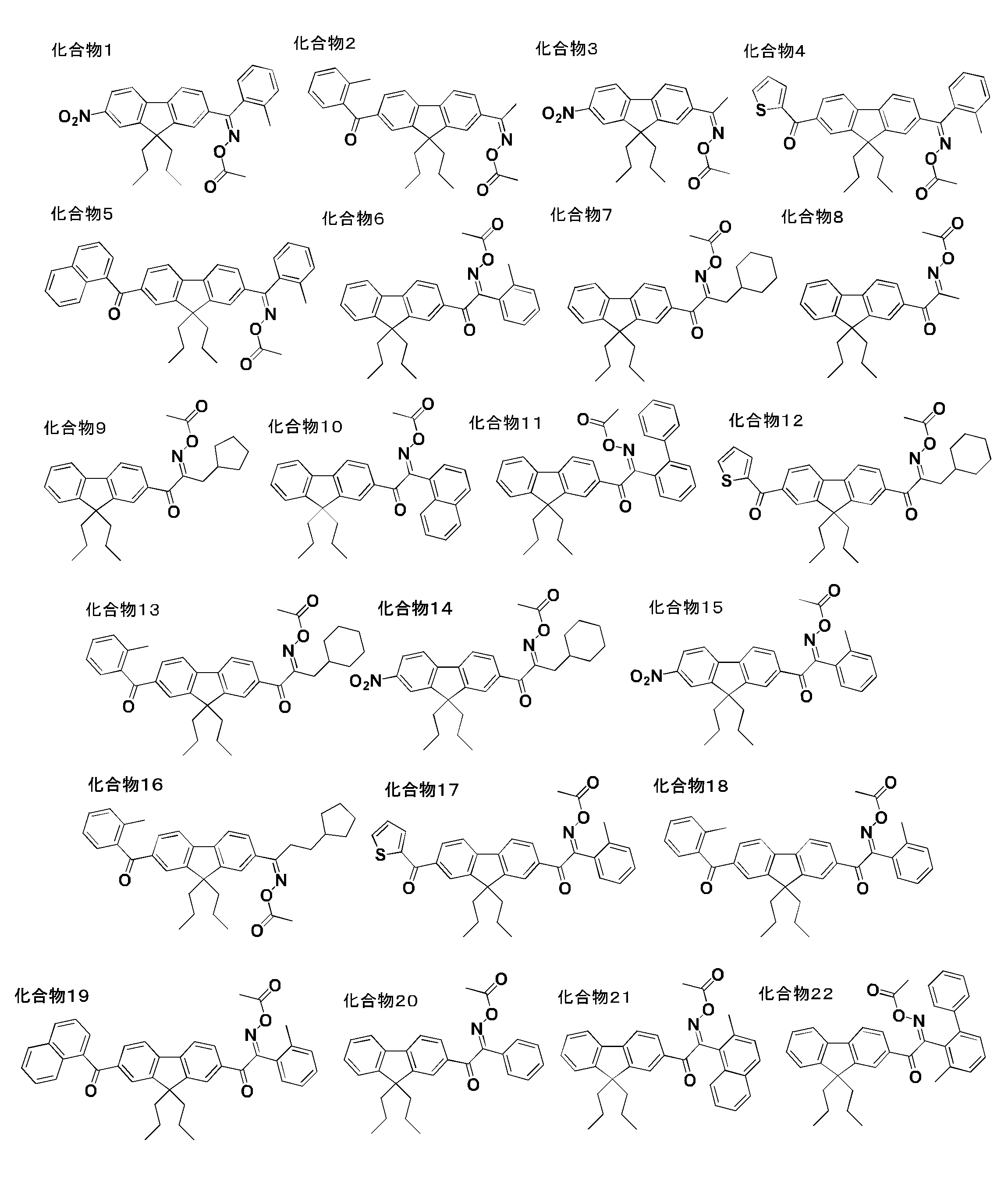
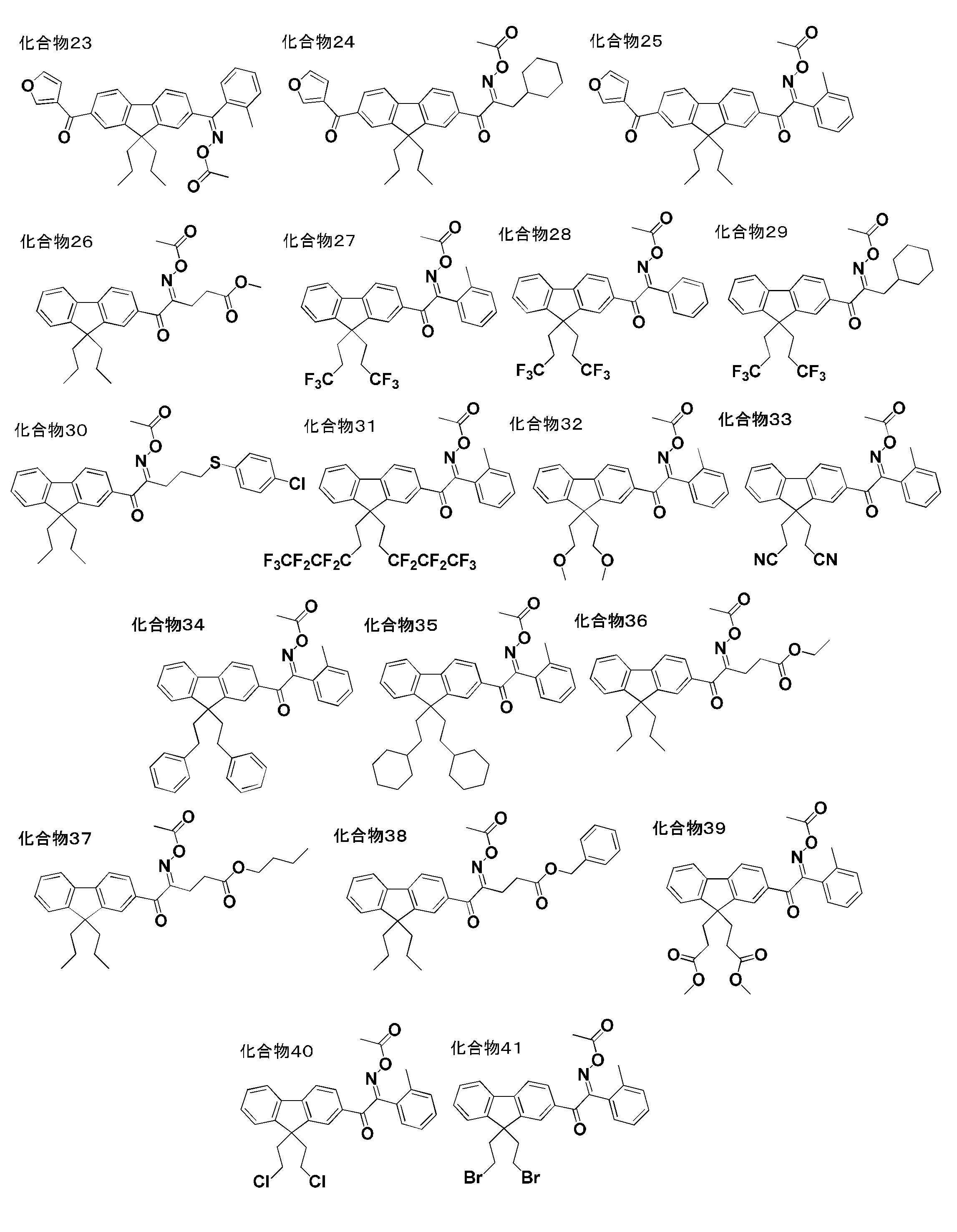
組成物中の硬化剤(D4)は、異なる分類又は種類の硬化剤を2種以上含んでいてもよい。
組成物中の、硬化剤(D4)の含有量は、典型的には、組成物の固形分の質量に対して、0.01質量%以上40質量%以下が好ましく、0.1質量%以上20質量%以下がより好ましく、1質量%以上10質量%以下が特に好ましい。
組成物中の、硬化剤(D4)の含有量は、典型的には、組成物の固形分の質量に対して、0.01質量%以上40質量%以下が好ましく、0.1質量%以上20質量%以下がより好ましく、1質量%以上10質量%以下が特に好ましい。
〔溶媒(S)〕
溶媒(S)は、量子ドット含有被膜形成用の組成物に含まれる溶媒である。溶媒(S)は、カルコゲン元素を有する有機溶媒(S1)を含む。カルコゲン元素については、量子ドット(A)に関してカルコゲン化物に関して説明した通りである。
溶媒(S)は、量子ドット含有被膜形成用の組成物に含まれる溶媒である。溶媒(S)は、カルコゲン元素を有する有機溶媒(S1)を含む。カルコゲン元素については、量子ドット(A)に関してカルコゲン化物に関して説明した通りである。
(有機溶媒(S1))
有機溶媒(S1)はカルコゲン元素を有する有機化合物である。カルコゲン元素を有する有機化合物としては、含硫黄化合物、含セレン化合物、及び含テルル化合物が挙げられる。これらの中では、合成又は入手が容易であることや、安価であること等から含硫黄化合物、及び含セレン化合物が好ましく、含硫黄化合物が特に好ましい。
有機溶媒(S1)はカルコゲン元素を有する有機化合物である。カルコゲン元素を有する有機化合物としては、含硫黄化合物、含セレン化合物、及び含テルル化合物が挙げられる。これらの中では、合成又は入手が容易であることや、安価であること等から含硫黄化合物、及び含セレン化合物が好ましく、含硫黄化合物が特に好ましい。
なお、有機溶媒(S1)は、比較的分子量の低い有機溶媒(S1)として存在することにより、量子ドット(A)に対する所望する作用を及ぼしやすい。このため、量子ドット含有被膜形成用の組成物は、縮合反応、付加反応、架橋反応等によって有機溶媒(S1)と重合し得る化合物を含まないのが好ましい。
また、有機溶媒(S1)と重合し得る化合物を含まない量子ドット含有被膜形成用の組成物は、保管時の安定性にも優れる。
また、有機溶媒(S1)と重合し得る化合物を含まない量子ドット含有被膜形成用の組成物は、保管時の安定性にも優れる。
有機溶媒(S1)としての含硫黄化合物としては、例えば、チオール化合物、スルフィド化合物、ジスルフィド化合物、チオフェン化合物、スルホキシド化合物、スルホン化合物、チオケトン化合物、スルホン酸化合物、スルホン酸エステル化合物、及びスルホン酸アミド化合物等の含硫黄化合物を用いることができる。
量子ドット(A)の表面に対する親和性に優れ、有機溶媒(S1)を用いることによる所望する効果を得やすい点からは、上記の含硫黄化合物の中では、チオール化合物、スルフィド化合物、及びジスルフィド化合物が好ましい。
量子ドット(A)の表面に対する親和性に優れ、有機溶媒(S1)を用いることによる所望する効果を得やすい点からは、上記の含硫黄化合物の中では、チオール化合物、スルフィド化合物、及びジスルフィド化合物が好ましい。
有機溶媒(S1)としての含セレン化合物としては、例えば、セレノール化合物、セレニド化合物、ジセレニド化合物、セレノキシド化合物、及びセレノン化合物等を用いることができる。
量子ドット(A)の表面に対する親和性に優れ、有機溶媒(S1)を用いることによる所望する効果を得やすい点からは、上記の含セレン化合物の中では、セレノール化合物、セレニド化合物、及びジセレニド化合物が好ましい。
量子ドット(A)の表面に対する親和性に優れ、有機溶媒(S1)を用いることによる所望する効果を得やすい点からは、上記の含セレン化合物の中では、セレノール化合物、セレニド化合物、及びジセレニド化合物が好ましい。
有機溶媒(S01)としての含テルル化合物としては、例えば、テルロール化合物、テルリド化合物、及びジテルリド化合物を用いることができる。
以下、有機溶媒(S01)として特に好ましい含硫黄化合物の具体例について説明する。
有機溶媒(S01)として好適なチオール化合物としては、例えば、下記式(s1)で表される化合物が挙げられる。
Rs01-SH (s01)
(式(s01)中、Rs01は、置換基を有していてもよい1価の炭化水素基を表す。)
Rs01-SH (s01)
(式(s01)中、Rs01は、置換基を有していてもよい1価の炭化水素基を表す。)
Rs01としての1価の炭化水素基の好適な例としては、置換基を有してもよいアルキル基、置換基を有してもよいシクロアルキル基、置換基を有してもよいアルケニル基、置換基を有してもよいアリール基、置換基を有してもよいアラルキル基、及び置換基を有してもよいアルキルアリール基が挙げられる。
置換基を有してもよいアルキル基の炭素原子数は、1以上20以下が好ましく、1以上10以下がより好ましく、1以上6以下がさらに好ましい。
置換基を有してもよいシクロアルキル基の炭素原子数は、3以上20以下が好ましく、3以上10以下がより好ましく、3以上8以下がさらに好ましい。
置換基を有してもよいアルケニル基の炭素原子数は、2以上20以下が好ましく、2以上10以下がより好ましく、2以上6以下がさらに好ましい。
置換基を有してもよいアリール基の炭素原子数は、6以上20以下が好ましく、6以上10以下がより好ましく、6以上8以下がさらに好ましい。
置換基を有してもよいアラルキル基の炭素原子数は、7以上20以下が好ましく、7以上12以下がより好ましく、7又は8がさらに好ましい。
置換基を有してもよいアルキルアリール基の炭素原子数は、7以上20以下が好ましく、7以上12以下がより好ましく、7又は8がさらに好ましい。
これらの炭化水素基が有してもよい置換基としては、水酸基、チオール基、カルボキシ基、ハロゲン原子、及びアミノ基等が挙げられる。炭化水素基が有する置換基の数は、2以上であってもよい。
置換基を有してもよいアルキル基の炭素原子数は、1以上20以下が好ましく、1以上10以下がより好ましく、1以上6以下がさらに好ましい。
置換基を有してもよいシクロアルキル基の炭素原子数は、3以上20以下が好ましく、3以上10以下がより好ましく、3以上8以下がさらに好ましい。
置換基を有してもよいアルケニル基の炭素原子数は、2以上20以下が好ましく、2以上10以下がより好ましく、2以上6以下がさらに好ましい。
置換基を有してもよいアリール基の炭素原子数は、6以上20以下が好ましく、6以上10以下がより好ましく、6以上8以下がさらに好ましい。
置換基を有してもよいアラルキル基の炭素原子数は、7以上20以下が好ましく、7以上12以下がより好ましく、7又は8がさらに好ましい。
置換基を有してもよいアルキルアリール基の炭素原子数は、7以上20以下が好ましく、7以上12以下がより好ましく、7又は8がさらに好ましい。
これらの炭化水素基が有してもよい置換基としては、水酸基、チオール基、カルボキシ基、ハロゲン原子、及びアミノ基等が挙げられる。炭化水素基が有する置換基の数は、2以上であってもよい。
チオール化合物の具体例としては、チオグリセロール、2-メルカプトエタノール、チオグリコール酸、2,3-ジメルカプト-1-プロパノール、1-プロパンチオール、2-プロパンチオール、2-メチル-2-プロパンチオール、1,2-エタンジチオール、シクロヘキサンチオール、及び1-オクタンチオール等の脂肪族チオール化合物、チオフェノール、p-トルエンチオール、及びアミノベンゼンチオール等の芳香族チオール化合物等が挙げられる。
有機溶媒(S1)として好適なスルフィド化合物としては、例えば、下記式(s02)で表される化合物が挙げられる。
Rs02-S-Rs02 (s02)
(式(s02)中、Rs02は、置換基を有していてもよい1価の炭化水素基を表す。)
Rs02としての1価の炭化水素基の好適な例としては、Rs01としての1価の炭化水素基の好適な例と同様である。
スルフィド化合物の具体例としては、ジメチルスルフィド、ジエチルスルフィド、ジ-n-プロピルスルフィド、エチルメチルスルフィド、チオアニソール、エチルチオベンゼン、ジフェニルスルフィド、及びジベンジルスルフィド等が挙げられる。
Rs02-S-Rs02 (s02)
(式(s02)中、Rs02は、置換基を有していてもよい1価の炭化水素基を表す。)
Rs02としての1価の炭化水素基の好適な例としては、Rs01としての1価の炭化水素基の好適な例と同様である。
スルフィド化合物の具体例としては、ジメチルスルフィド、ジエチルスルフィド、ジ-n-プロピルスルフィド、エチルメチルスルフィド、チオアニソール、エチルチオベンゼン、ジフェニルスルフィド、及びジベンジルスルフィド等が挙げられる。
有機溶媒(S1)として好適なジスルフィド化合物としては、例えば、下記式(s03)で表される化合物が挙げられる。
Rs03-S-S-Rs03 (s03)
(式(s03)中、Rs03は、置換基を有していてもよい1価の炭化水素基を表す。)
Rs03としての1価の炭化水素基の好適な例としては、Rs01としての1価の炭化水素基の好適な例と同様である。
ジスルフィド化合物の具体例としては、炭素原子数1以上10以下の直鎖状又は分岐鎖状のアルキル基を有するジアルキルジスルフィドが挙げられる。このようなジアルキルジスルフィドとしては、ジメチルジスルフィド、ジエチルジスルフィド、ジ-n-プロピルジスフルフィド、ジイソプロピルジスルフィド、ジ-n-ブチルジスルフィド、ジ-n-ペンチルジスルフィド、及びジ-n-ヘキシルジスルフィド等が挙げられる。
上記以外のジスルフィド化合物の好適な例としては、ジアリルジスルフィド、シクロヘキシルジスルフィド、ジフェニルジスルフィド、ジベンジルジスルフィド、ジ(p-トリル)ジスルフィド、4,4’-ジクロロジフェニルスルフィド、ジ(3,4-ジクロロフェニル)ジスルフィド、2,2’-ジチオビス(5-クロロアニリン)、ジ(2,4-キシリル)ジスルフィド、ジ(2,3-キシリル)ジスルフィド、ジ(3,5-キシリル)ジスルフィド、2,4-キシリル-2,6-キシリルジスルフィド、2,2’-ジチオサリチル酸、及び2,2’-ジチオビス(4-tert-ブチルフェノール)等が挙げられる。
Rs03-S-S-Rs03 (s03)
(式(s03)中、Rs03は、置換基を有していてもよい1価の炭化水素基を表す。)
Rs03としての1価の炭化水素基の好適な例としては、Rs01としての1価の炭化水素基の好適な例と同様である。
ジスルフィド化合物の具体例としては、炭素原子数1以上10以下の直鎖状又は分岐鎖状のアルキル基を有するジアルキルジスルフィドが挙げられる。このようなジアルキルジスルフィドとしては、ジメチルジスルフィド、ジエチルジスルフィド、ジ-n-プロピルジスフルフィド、ジイソプロピルジスルフィド、ジ-n-ブチルジスルフィド、ジ-n-ペンチルジスルフィド、及びジ-n-ヘキシルジスルフィド等が挙げられる。
上記以外のジスルフィド化合物の好適な例としては、ジアリルジスルフィド、シクロヘキシルジスルフィド、ジフェニルジスルフィド、ジベンジルジスルフィド、ジ(p-トリル)ジスルフィド、4,4’-ジクロロジフェニルスルフィド、ジ(3,4-ジクロロフェニル)ジスルフィド、2,2’-ジチオビス(5-クロロアニリン)、ジ(2,4-キシリル)ジスルフィド、ジ(2,3-キシリル)ジスルフィド、ジ(3,5-キシリル)ジスルフィド、2,4-キシリル-2,6-キシリルジスルフィド、2,2’-ジチオサリチル酸、及び2,2’-ジチオビス(4-tert-ブチルフェノール)等が挙げられる。
有機溶媒(S1)としては、例えば、脂肪族多価アルコールと、メルカプト基、及び/又はセレノール基を有する脂肪族カルボン酸とが縮合したエステル化合物が好ましい。かかる化合物は、エステル結合と、メルカプト基、及び/又はセレノール基とを有する。これらの結合又は官能基の存在により、有機溶媒(S1)は、量子ドット(A)の表面に対する親和性に優れる。このため、上記のエステル化合物を有機溶媒(S1)として用いる場合、有機溶媒(S1)がもたらす所望する効果を得やすい。
脂肪族多価アルコールの具体例としては、エチレングリコール、ジエチレングリコール、トリエチレングリコール、プロピレングリコール、ジプロピレングリコール、トリプロピレングリコール、グリセリン、トリメチロールプロパン、ペンタエリスリトール、ジペンタエリスリトール、ソルビトール、マンニトール、ソルビタン、ジグリセリン、ショ糖、グルコース、マンノース、フルクトース、及びメチルグルコシド等が挙げられる。
メルカプト基、及び/又はセレノール基を有する脂肪族カルボン酸の好適な例としては、チオグリコール酸、及び3-メルカプトプロピオン酸が挙げられる。
上記のエステル化合物の好ましい具体例としては、エチレングリコールジ3-メルカプトプロピオネート、ジエチレングリコールジ3-メルカプトプロピオネート、プロピレングリコールジ3-メルカプトプロピオネート、ジプロピレングリコールジ3-メルカプトプロピオネート、グリセリントリ3-メルカプトプロピオネート、トリメチロールプロパントリ3-メルカプトプロピオネート(TMMP)、及びペンタエリスリトールテトラ3-メルカプトプロピオネート(PEMP)が挙げられる。
上記の有機溶媒(S1)の大気圧下での沸点は、60℃以上400℃以下が好ましく、80℃以上350℃以下がより好ましく、100℃以上300℃以下がさらに好ましい。かかる範囲内の沸点を有する有機溶媒(S1)を用いる場合、濃縮等により組成物の固形分濃度の調製が容易であったり、組成物を用いて製膜を行う際の過剰な有機溶媒(S1)の除去が容易である。
組成物中の有機溶媒(S1)の含有量は、所望する効果が得られる限り特に限定されない。組成物中の有機溶媒(S1)の含有量は、量子ドット(A)100質量部に対して10質量部以上2000質量部以下である量が好ましく、10質量部以上1500質量部以下である量がより好ましく、30質量部以上1200質量部以下である量がさらにより好ましく、50質量部以上1000質量部以下である量が特に好ましい。
溶媒(S)の総質量における、有機溶媒(S1)の質量の比率は特に限定されない。溶媒(S)の総質量における、有機溶媒(S1)の質量の比率は、有機溶媒(S1)の使用による所望する効果を得やすい点から、50質量%以上が好ましく、70質量%以上がより好ましく、80質量%以上がさらに好ましく、90質量%以上が特に好ましく、100質量%が最も好ましい。
また、量子ドット含有被膜形成用の組成物の総質量における、有機溶媒(S1)の質量の比率は、有機溶媒(S1)の使用による所望する効果を得やすい点から、50質量%以上が好ましく、70質量%以上がより好ましく、80質量%以上がさらに好ましい。量子ドット含有被膜形成用の組成物の総質量における、有機溶媒(S1)の質量の比率は、90質量%以上であってもよく、95質量%以上であってもよい。
また、量子ドット含有被膜形成用の組成物の総質量における、有機溶媒(S1)の質量の比率は、有機溶媒(S1)の使用による所望する効果を得やすい点から、50質量%以上が好ましく、70質量%以上がより好ましく、80質量%以上がさらに好ましい。量子ドット含有被膜形成用の組成物の総質量における、有機溶媒(S1)の質量の比率は、90質量%以上であってもよく、95質量%以上であってもよい。
(有機溶媒(S2))
溶媒(S)は、本発明の目的を阻害しない限りにおいて、上記の有機溶媒(S1)とともに、有機溶媒(S1)以外の溶媒である有機溶媒(S2)を含んでいてもよい。
溶媒(S)は、本発明の目的を阻害しない限りにおいて、上記の有機溶媒(S1)とともに、有機溶媒(S1)以外の溶媒である有機溶媒(S2)を含んでいてもよい。
量子ドット(A)の分散安定化の点からは、有機溶媒(S2)として、環式骨格を有し、且つ水素原子、炭素原子、及びカルコゲン元素の原子以外のヘテロ原子を含む化合物である有機溶媒(S2a)が好ましい。
前述の通り、有機溶媒(S2a)は、ヘテロ原子を含むため被炭化水素溶媒である。有機溶媒(S2a)が含んでいてもよいヘテロ原子としては、N、O、P等が挙げられる。
前述の通り、有機溶媒(S2a)は、ヘテロ原子を含むため被炭化水素溶媒である。有機溶媒(S2a)が含んでいてもよいヘテロ原子としては、N、O、P等が挙げられる。
有機溶媒(S2a)の使用によって、量子ドット(A)の分散促進や分散安定化の効果が得られる理由は定かではない。
例えば、有機溶媒(S2a)が有する環式骨格が、量子ドット(A)に対する凝集阻害の効果を奏していると推測される。
例えば、有機溶媒(S2a)が有する環式骨格が、量子ドット(A)に対する凝集阻害の効果を奏していると推測される。
有機溶媒(S2a)が有する環式骨格としては、脂環式骨格が好ましい。ここで、芳香族性を示さない環式骨格を脂環式骨格とする。また、有機溶媒(S2a)が、テトラリン環のように芳香族環骨格と脂環式骨格との双方を有する場合、有機溶媒(S2a)が脂環式骨格を有するとする。
理由は定かではないが、平面的な立体構造を有する芳香族環骨格よりも、脂環式骨格がある程度かさ高いことが、量子ドット(A)の分散促進や分散安定化に良好に寄与すると推測される。
理由は定かではないが、平面的な立体構造を有する芳香族環骨格よりも、脂環式骨格がある程度かさ高いことが、量子ドット(A)の分散促進や分散安定化に良好に寄与すると推測される。
有機溶媒(S2a)は、エステル結合(-CO-O-)、アミド結合(-CO-NH-)、カーボネート結合(-O-CO-O-)、ウレイド結合(-NH-CO-NH-)、及びウレタン結合(-O-CO-NH-)からなる群より選択される1種以上の結合を有するのが好ましい。
本願明細書において、単にエステル結合、及びアミド結合と記載する場合、それぞれ「カルボン酸エステル結合」、及び「カルボン酸アミド結合」を意味する。
アミド結合、ウレイド結合、及びウレタン結合において、窒素原子には有機基が結合していてもよい。有機基の種類は特に限定されない。有機基としては、アルキル基が好ましく、炭素原子数1以上6以下のアルキル基がより好ましく、メチル基及びエチル基がさらに好ましい。
また、有機溶媒(S2a)がこれらの結合を含む場合、量子ドット含有被膜形成用の組成物において、樹脂成分やモノマー成分を良好に溶解させやすい。
本願明細書において、単にエステル結合、及びアミド結合と記載する場合、それぞれ「カルボン酸エステル結合」、及び「カルボン酸アミド結合」を意味する。
アミド結合、ウレイド結合、及びウレタン結合において、窒素原子には有機基が結合していてもよい。有機基の種類は特に限定されない。有機基としては、アルキル基が好ましく、炭素原子数1以上6以下のアルキル基がより好ましく、メチル基及びエチル基がさらに好ましい。
また、有機溶媒(S2a)がこれらの結合を含む場合、量子ドット含有被膜形成用の組成物において、樹脂成分やモノマー成分を良好に溶解させやすい。
有機溶媒(S2a)の好ましい例としては、アニソール、フェネトール、プロピルフェニルエーテル、ブチルフェニルエーテル、クレジルメチルエーテル、エチルベンジルエーテル、ジフェニルエーテル、ジベンジルエーテル、アセトフェノン、プロピオフェノン、ベンゾフェノン、ピリジン、ピリミジン、ピラジン、及びピリダジン等の芳香族溶媒;シクロペンタノール、シクロヘキサノール、1,4-シクロヘキサンジオール、1,3-シクロヘキサンジオール、1,4-シクロヘキサンジメタノール、及び1,3-シクロヘキサンジメタノール等の脂環式アルコール;シクロヘキシルメチルエーテル、シクロヘキシルエチルエーテル、テトラヒドロフラン、テトラヒドロピラン、及びジオキサン等の脂環式エーテル類;シクロペンタノン、シクロヘキサノン、シクロヘプタノン、2-メチルシクロヘキサノン、1,4-シクロペンタンジオン、及び1,3-シクロペンタンジオン等の脂環式ケトン類;β-プロピオラクトン、γ-ブチロラクトン、β-メチル-γ-ブチロラクトン、δ-バレロラクトン、ε-バレロラクトン、ε-カプロラクトン、α-メチル-ε-カプロラクトン、及びε-メチル-ε-カプロラクトン等のラクトン類;N-メチル-2-ピロリドン、N-エチル-2-ピロリドン、1,3-ジメチル-2-イミダゾリジノン、及びN,N-ジメチルプロピレン尿素等の環状アミド類又は環状尿素類;炭酸エチレン、及び炭酸プロピレン等の環状カーボネート類等が挙げられる。
また、有機溶媒(S2a)としては、カルボン酸のシクロアルキルエステルが好ましい。カルボン酸のシクロアルキルエステルとしては、下式(s1):
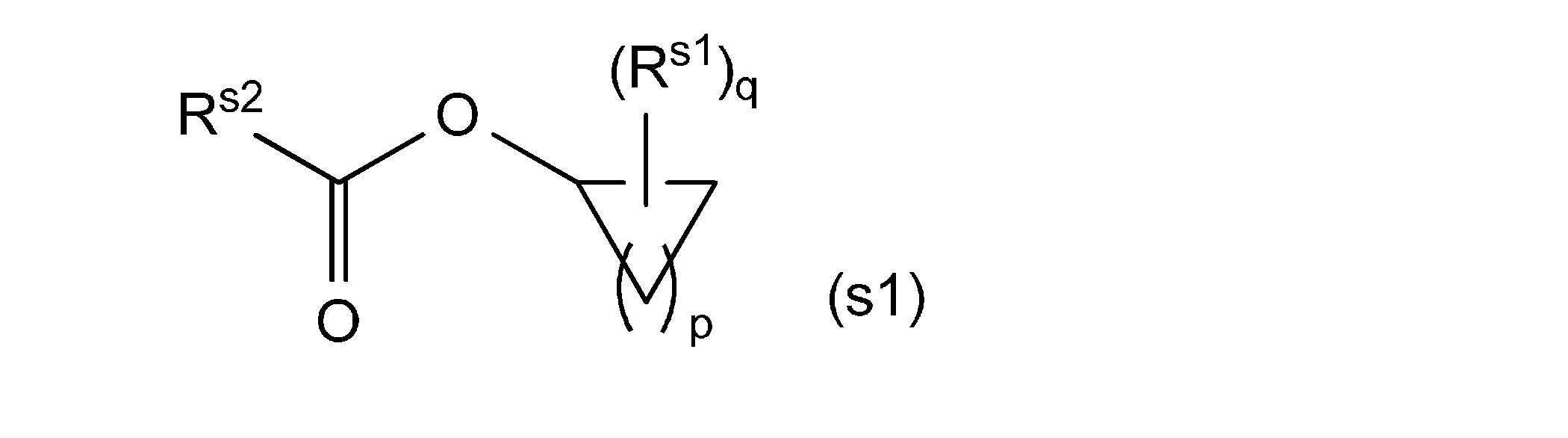
(式(s1)中、Rs1は、炭素原子数1以上3以下のアルキル基であり、Rs2は、炭素原子数1以上6以下のアルキル基であり、pは1以上6以下の整数であり、qは0以上(p+1)以下の整数である。)
で表される、カルボン酸のシクロアルキルエステルが好ましい。
で表される、カルボン酸のシクロアルキルエステルが好ましい。
式(s1)中のRs1としては、メチル基、エチル基、n-プロピル基、及びイソプロピル基が挙げられ、メチル基が好ましい。
式(s1)中のRs2としては、メチル基、エチル基、n-プロピル基、イソプロピル基、n-ブチル基、イソブチル基、sec-ブチル基、tert-ブチル基、n-ペンチル基、及びn-ヘキシル基が挙げられる。Rs2としてのアルキル基としては、メチル基、エチル基、n-プロピル基、イソプロピル基、及びn-ブチル基が好ましく、メチル基、及びエチル基がより好ましい。
式(s1)中のRs2としては、メチル基、エチル基、n-プロピル基、イソプロピル基、n-ブチル基、イソブチル基、sec-ブチル基、tert-ブチル基、n-ペンチル基、及びn-ヘキシル基が挙げられる。Rs2としてのアルキル基としては、メチル基、エチル基、n-プロピル基、イソプロピル基、及びn-ブチル基が好ましく、メチル基、及びエチル基がより好ましい。
式(s1)で表されるカルボン酸シクロアルキルエステルの好適な例としては、シクロプロピルアセテート、シクロブチルアセテート、シクロペンチルアセテート、シクロヘキシルアセテート、シクロヘプチルアセテート、シクロオクチルアセテート、シクロプロピルプロピオネート、シクロブチルプロピオネート、シクロペンチルプロピオネート、シクロヘキシルプロピオネート、シクロヘプチルプロピオネート、及びシクロオクチルプロピオネートが挙げられる。これらの中では、入手が容易であり、好ましい沸点を有することから、シクロペンチルアセテート、及びシクロヘキシルアセテートが好ましい。
以上説明した有機溶媒(S2a)の中では、式(s1)で表されるカルボン酸シクロアルキルエステルが好ましく、シクロペンチルアセテート、及びシクロヘキシルアセテートが特に好ましい。
有機溶媒(S2)の、有機溶媒(S2a)以外の例とては、メタノール、エタノール、プロパノール、n-ブタノール等のアルコール類;エチレングリコール、ジエチレングリコール、プロピレングリコール、ジプロピレングリコール等の多価アルコール類;アセトン、メチルエチルケトン、メチル-n-アミルケトン、メチルイソアミルケトン、2-ヘプタノン等のケトン類;エチレングリコールモノアセテート、ジエチレングリコールモノアセテート、プロピレングリコールモノアセテート、又はジプロピレングリコールモノアセテート等のエステル結合を有する化合物;前記多価アルコール類又は前記エステル結合を有する化合物のモノメチルエーテル、モノエチルエーテル、モノプロピルエーテル、モノブチルエーテル、又はモノフェニルエーテル等のエーテル誘導体;乳酸メチル、乳酸エチル、酢酸メチル、酢酸エチル、酢酸ブチル、ピルビン酸メチル、ピルビン酸エチル、メトキシプロピオン酸メチル、エトキシプロピオン酸エチル等のエステル類;ペンタン、ヘキサン、ヘプタン、オクタン等の脂肪族炭化水素系有機溶媒;エチルベンゼン、ジエチルベンゼン、アミルベンゼン、イソプロピルベンゼン、トルエン、キシレン、シメン、メシチレン等の芳香族系有機溶媒;N,N,N’,N’-テトラメチルウレア、N,N,2-トリメチルプロピオンアミド、N,N-ジメチルアセトアミド、N,N-ジメチルホルムアミド、N,N-ジエチルアセトアミド、N,N-ジエチルホルムアミド、N-エチルピロリドン等の窒素含有有機溶媒;が挙げられる。これらの有機溶媒は、2種以上組み合わせて使用してもよい。
溶媒(S)の使用量は、溶媒(S)に所望する効果を得るために十分な量の有機溶媒(S1)が含まれている限り特に限定されない。
溶媒(S)の使用量は、量子ドット含有被膜形成用の組成物における量子ドット(A)の濃度が0.1質量%以上70質量%以下である量が好ましく。1質量%以上60質量%以下である量がより好ましく、5質量%以上50質量%以下である量がさらに好ましい。
溶媒(S)の使用量は、量子ドット含有被膜形成用の組成物における量子ドット(A)の濃度が0.1質量%以上70質量%以下である量が好ましく。1質量%以上60質量%以下である量がより好ましく、5質量%以上50質量%以下である量がさらに好ましい。
<その他の成分>
組成物は、本発明の目的を阻害しない範囲で、量子ドット(A)、基材成分(C)、硬化剤(D)、及び溶媒(S)以外のその他の成分を含んでいてもよい。
その他の成分としては、例えば、シランカップリング剤、密着増強剤、分散剤、界面活性剤、紫外線吸収剤、酸化防止剤、消泡剤、粘度調整剤、樹脂、ゴム粒子、及び着色剤等が挙げられる。
また、組成物がゴム粒子を含む場合、形成される量子ドット含有被膜に弾性が付与され、量子ドット含有被膜の脆さを解消しやすい。
組成物は、本発明の目的を阻害しない範囲で、量子ドット(A)、基材成分(C)、硬化剤(D)、及び溶媒(S)以外のその他の成分を含んでいてもよい。
その他の成分としては、例えば、シランカップリング剤、密着増強剤、分散剤、界面活性剤、紫外線吸収剤、酸化防止剤、消泡剤、粘度調整剤、樹脂、ゴム粒子、及び着色剤等が挙げられる。
また、組成物がゴム粒子を含む場合、形成される量子ドット含有被膜に弾性が付与され、量子ドット含有被膜の脆さを解消しやすい。
また、組成物は、量子ドット(A)の分散促進や、分散安定化の点からは、イオン液体(I)を含むのが好ましい。組成物がイオン液体(I)を含む場合、組成物は、イオン液体(I)とともに、前述の有機溶媒(S2a)を含むの好ましい。量子ドット含有被膜形成用の組成物が、イオン液体(I)と、有機溶媒(S2a)とを組み合わせて含むことにより、量子ドット(A)の分散促進や、分散安定化の効果がより高められやすい。
イオン液体(I)は、有機合成分野や、電池用の電解質等に使用されれているイオン液体を特に制限なく用いることができる。イオン液体(I)は、典型的には、140℃以下の温度領域で融解しうる塩であり、140℃以下で液体となる安定な塩であることが好ましい。
イオン液体(I)の融点は、所望する効果をより確実に達成する観点、及び、イオン性液体(I)や量子ドット含有被膜形成用の組成物の取り扱い性の観点等から、120℃以下が好ましく、100℃以下がより好ましく、80℃以下がさらに好ましい。
イオン液体(I)は、有機カチオンと、アニオンとから構成されることが好ましい。
イオン液体(I)は、窒素含有有機カチオン、リン含有有機カチオン、又は硫黄含有有機カチオンと、対アニオンとからなるのが好ましく、窒素含有有機カチオン、又はリン含有有機カチオンと、対アニオンとからなるのがより好ましい。
イオン液体(I)は、窒素含有有機カチオン、リン含有有機カチオン、又は硫黄含有有機カチオンと、対アニオンとからなるのが好ましく、窒素含有有機カチオン、又はリン含有有機カチオンと、対アニオンとからなるのがより好ましい。
イオン液体(I)を構成する有機カチオンとしては、溶媒(S)との親和性が良好であること等から、アルキル鎖四級アンモニウムカチオン、ピペリジニウムカチオン、ピリミジニウムカチオン、ピロリジニウムカチオン、イミダゾリウムカチオン、ピリジニウムカチオン、ピラゾリウムカチオン、グアニジニウムカチオン、モルホリニウムカチオン、ホスホニウムカチオン及びスルホニウムカチオンからなる群より選択される少なくとも1種であることが好ましく、アルキル鎖四級アンモニウムカチオン、ピペリジニウムカチオン、ピロリジニウムカチオン、イミダゾリウムカチオン、モルホリニウムカチオン、又はホスホニウムカチオンであることがより好ましく、本発明の効果の点で、ピロリジニウムカチオン、イミダゾリウムカチオン、又はホスホニウムカチオンであることがさらに好ましい。
上記アルキル鎖四級アンモニウムカチオンの具体例としては下記式(L1)で表される四級アンモニウムカチオンが挙げられる。具体的には、例えば、テトラメチルアンモニウムカチオン、エチルトリメチルアンモニウムカチオン、ジエチルジメチルアンモニウムカチオン、トリエチルメチルアンモニウムカチオン、テトラエチルアンモニウムカチオン、オクチルトリメチルアンモニウムカチオン、ヘキシルトリメチルアンモニウムカチオン、メチルトリオクチルアンモニウムカチオン等が挙げられる。
上記ピペリジニウムカチオンの具体例としては下記式(L2)で表されるピペリジニウムカチオンが挙げられる。具体的には、例えば、1-プロピルピペリジニウムカチオン、1-ペンチルピペリジニウムカチオン、1,1-ジメチルピペリジニウムカチオン、1-メチル-1-エチルピペリジニウムカチオン、1-メチル-1-プロピルピペリジニウムカチオン、1-メチル-1-ブチルピペリジニウムカチオン、1-メチル-1-ペンチルピペリジニウムカチオン、1-メチル-1-ヘキシルピペリジニウムカチオン、1-メチル-1-ヘプチルピペリジニウムカチオン、1-エチル-1-プロピルピペリジニウムカチオン、1-エチル-1-ブチルピペリジニウムカチオン、1-エチル-1-ペンチルピペリジニウムカチオン、1-エチル-1-ヘキシルピペリジニウムカチオン、1-エチル-1-ヘプチルピペリジニウムカチオン、1,1-ジプロピルピペリジニウムカチオン、1-プロピル-1-ブチルピペリジニウムカチオン、1,1-ジブチルピペリジニウムカチオン等が挙げられる。
上記ピリミジニウムカチオンの具体例としては、例えば、1,3-ジメチル-1,4,5,6-テトラヒドロピリミジニウムカチオン、1,2,3-トリメチル-1,4,5,6-テトラヒドロピリミジニウムカチオン、1,2,3,4-テトラメチル-1,4,5,6-テトラヒドロピリミジニウムカチオン、1,2,3,5-テトラメチル-1,4,5,6-テトラヒドロピリミジニウムカチオン、1,3-ジメチル-1,4-ジヒドロピリミジニウムカチオン、1,3-ジメチル-1,6-ジヒドロピリミジニウムカチオン、1,2,3-トリメチル-1,4-ジヒドロピリミジニウムカチオン、1,2,3-トリメチル-1,6-ジヒドロピリミジニウムカチオン、1,2,3,4-テトラメチル-1,4-ジヒドロピリミジニウムカチオン、1,2,3,4-テトラメチル-1,6-ジヒドロピリミジニウムカチオン等が挙げられる。
上記ピペリジニウムカチオンの具体例としては下記式(L2)で表されるピペリジニウムカチオンが挙げられる。具体的には、例えば、1-プロピルピペリジニウムカチオン、1-ペンチルピペリジニウムカチオン、1,1-ジメチルピペリジニウムカチオン、1-メチル-1-エチルピペリジニウムカチオン、1-メチル-1-プロピルピペリジニウムカチオン、1-メチル-1-ブチルピペリジニウムカチオン、1-メチル-1-ペンチルピペリジニウムカチオン、1-メチル-1-ヘキシルピペリジニウムカチオン、1-メチル-1-ヘプチルピペリジニウムカチオン、1-エチル-1-プロピルピペリジニウムカチオン、1-エチル-1-ブチルピペリジニウムカチオン、1-エチル-1-ペンチルピペリジニウムカチオン、1-エチル-1-ヘキシルピペリジニウムカチオン、1-エチル-1-ヘプチルピペリジニウムカチオン、1,1-ジプロピルピペリジニウムカチオン、1-プロピル-1-ブチルピペリジニウムカチオン、1,1-ジブチルピペリジニウムカチオン等が挙げられる。
上記ピリミジニウムカチオンの具体例としては、例えば、1,3-ジメチル-1,4,5,6-テトラヒドロピリミジニウムカチオン、1,2,3-トリメチル-1,4,5,6-テトラヒドロピリミジニウムカチオン、1,2,3,4-テトラメチル-1,4,5,6-テトラヒドロピリミジニウムカチオン、1,2,3,5-テトラメチル-1,4,5,6-テトラヒドロピリミジニウムカチオン、1,3-ジメチル-1,4-ジヒドロピリミジニウムカチオン、1,3-ジメチル-1,6-ジヒドロピリミジニウムカチオン、1,2,3-トリメチル-1,4-ジヒドロピリミジニウムカチオン、1,2,3-トリメチル-1,6-ジヒドロピリミジニウムカチオン、1,2,3,4-テトラメチル-1,4-ジヒドロピリミジニウムカチオン、1,2,3,4-テトラメチル-1,6-ジヒドロピリミジニウムカチオン等が挙げられる。
上記ピロリジニウムカチオンの具体例としては下記式(L3)で表されるピロリジニウムカチオンが挙げられ、より具体的には、例えば、1,1-ジメチルピロリジニウムカチオン、1-エチル-1-メチルピロリジニウムカチオン、1-メチル-1-プロピルピロリジニウムカチオン、1-メチル-1-ブチルピロリジニウムカチオン、1-メチル-1-ペンチルピロリジニウムカチオン、1-メチル-1-ヘキシルピロリジニウムカチオン、1-メチル-1-ヘプチルピロリジニウムカチオン、1-エチル-1-プロピルピロリジニウムカチオン、1-エチル-1-ブチルピロリジニウムカチオン、1-エチル-1-ペンチルピロリジニウムカチオン、1-エチル-1-ヘキシルピロリジニウムカチオン、1-エチル-1-ヘプチルピロリジニウムカチオン、1,1-ジプロピルピロリジニウムカチオン、1-プロピル-1-ブチルピロリジニウムカチオン、1,1-ジブチルピロリジニウムカチオン等が挙げられる。
上記イミダゾリウムカチオンの具体例としては下記式(L5)で表されるイミダゾリウムカチオンが挙げられ、より具体的には、例えば、1,3-ジメチルイミダゾリウムカチオン、1,3-ジエチルイミダゾリウムカチオン、1-エチル-3-メチルイミダゾリウムカチオン、1-プロピル-3-メチルイミダゾリウムカチオン、1-ブチル-3-メチルイミダゾリウムカチオン、1-ヘキシル-3-メチルイミダゾリウムカチオン、1-オクチル-3-メチルイミダゾリウムカチオン、1-デシル-3-メチルイミダゾリウムカチオン、1-ドデシル-3-メチルイミダゾリウムカチオン、1-テトラデシル-3-メチルイミダゾリウムカチオン、1,2-ジメチル-3-プロピルイミダゾリウムカチオン、1-エチル-2,3-ジメチルイミダゾリウムカチオン、1-ブチル-2,3-ジメチルイミダゾリウムカチオン、1-ヘキシル-2,3-ジメチルイミダゾリウムカチオン等が挙げられる。
上記ピリジニウムカチオンの具体例としては下記式(L6)で表されるピリジニウムカチオンが挙げられ、より具体的には、例えば、1-エチルピリジニウムカチオン、1-ブチルピリジニウムカチオン、1-ヘキシルピリジニウムカチオン、1-ブチル-3-メチルピリジニウムカチオン、1-ブチル-4-メチルピリジニウムカチオン、1-ヘキシル-3-メチルピリジニウムカチオン、1-ブチル-3,4-ジメチルピリジニウムカチオン等が挙げられる。
上記イミダゾリウムカチオンの具体例としては下記式(L5)で表されるイミダゾリウムカチオンが挙げられ、より具体的には、例えば、1,3-ジメチルイミダゾリウムカチオン、1,3-ジエチルイミダゾリウムカチオン、1-エチル-3-メチルイミダゾリウムカチオン、1-プロピル-3-メチルイミダゾリウムカチオン、1-ブチル-3-メチルイミダゾリウムカチオン、1-ヘキシル-3-メチルイミダゾリウムカチオン、1-オクチル-3-メチルイミダゾリウムカチオン、1-デシル-3-メチルイミダゾリウムカチオン、1-ドデシル-3-メチルイミダゾリウムカチオン、1-テトラデシル-3-メチルイミダゾリウムカチオン、1,2-ジメチル-3-プロピルイミダゾリウムカチオン、1-エチル-2,3-ジメチルイミダゾリウムカチオン、1-ブチル-2,3-ジメチルイミダゾリウムカチオン、1-ヘキシル-2,3-ジメチルイミダゾリウムカチオン等が挙げられる。
上記ピリジニウムカチオンの具体例としては下記式(L6)で表されるピリジニウムカチオンが挙げられ、より具体的には、例えば、1-エチルピリジニウムカチオン、1-ブチルピリジニウムカチオン、1-ヘキシルピリジニウムカチオン、1-ブチル-3-メチルピリジニウムカチオン、1-ブチル-4-メチルピリジニウムカチオン、1-ヘキシル-3-メチルピリジニウムカチオン、1-ブチル-3,4-ジメチルピリジニウムカチオン等が挙げられる。
上記ピラゾニウムカチオンの具体例としては、例えば、1,3-ジメチル-1,4,5,6-テトラヒドロピリミジニウムカチオン、1,2,3-トリメチル-1,4,5,6-テトラヒドロピリミジニウムカチオン、1,2,3,4-テトラメチル-1,4,5,6-テトラヒドロピリミジニウムカチオン、1,2,3,5-テトラメチル-1,4,5,6-テトラヒドロピリミジニウムカチオン、1,3-ジメチル-1,4-ジヒドロピリミジニウムカチオン、1,3-ジメチル-1,6-ジヒドロピリミジニウムカチオン、1,2,3-トリメチル-1,4-ジヒドロピリミジニウムカチオン、1,2,3-トリメチル-1,6-ジヒドロピリミジニウムカチオン、1,2,3,4-テトラメチル-1,4-ジヒドロピリミジニウムカチオン、1,2,3,4-テトラメチル-1,6-ジヒドロピリミジニウムカチオン等が挙げられる。
上記ホスホニウムカチオンの具体例としては下記式(L4)で表されるホスホニウムカチオンが挙げられる。具体的には、テトラブチルホスホニウムカチオン、トリブチルメチルホスホニウムカチオン、トリブチルヘキシルホスホニウムカチオン等のテトラアルキルホスホニウムカチオンや、トリエチル(メトキシメチル)ホスホニウムカチオン等が挙げられる。
上記スルホニウムカチオンの具体例としては、トリエチルスルホニウムカチオン、ジメチルエチルスルホニウムカチオン、トリエチルスルホニウムカチオン、エチルメチルプロピルスルホニウムカチオン、ブチルジメチルスルホニウムカチオン、1‐メチルテトラヒドロチオフェニウムオン、1‐エチルテトラヒドロチオフェニウムカチオン、1-プロピルテトラヒドロチオフェニウムカチオン、1-ブチルテトラヒドロチオフェニウムカチオン、又は1-メチル-[1,4]‐チオキソニウムカチオン等が挙げられる。中でも、上記スルホニウムカチオンとしては、テトラヒドロチオフェニウム系又はヘキサヒドロチオピリリウム系の5員環又は6員環等の環状構造を有しているスルホニウムカチオンが好ましく、環状構造中に酸素原子等のヘテロ原子を有していてもよい。
上記スルホニウムカチオンの具体例としては、トリエチルスルホニウムカチオン、ジメチルエチルスルホニウムカチオン、トリエチルスルホニウムカチオン、エチルメチルプロピルスルホニウムカチオン、ブチルジメチルスルホニウムカチオン、1‐メチルテトラヒドロチオフェニウムオン、1‐エチルテトラヒドロチオフェニウムカチオン、1-プロピルテトラヒドロチオフェニウムカチオン、1-ブチルテトラヒドロチオフェニウムカチオン、又は1-メチル-[1,4]‐チオキソニウムカチオン等が挙げられる。中でも、上記スルホニウムカチオンとしては、テトラヒドロチオフェニウム系又はヘキサヒドロチオピリリウム系の5員環又は6員環等の環状構造を有しているスルホニウムカチオンが好ましく、環状構造中に酸素原子等のヘテロ原子を有していてもよい。
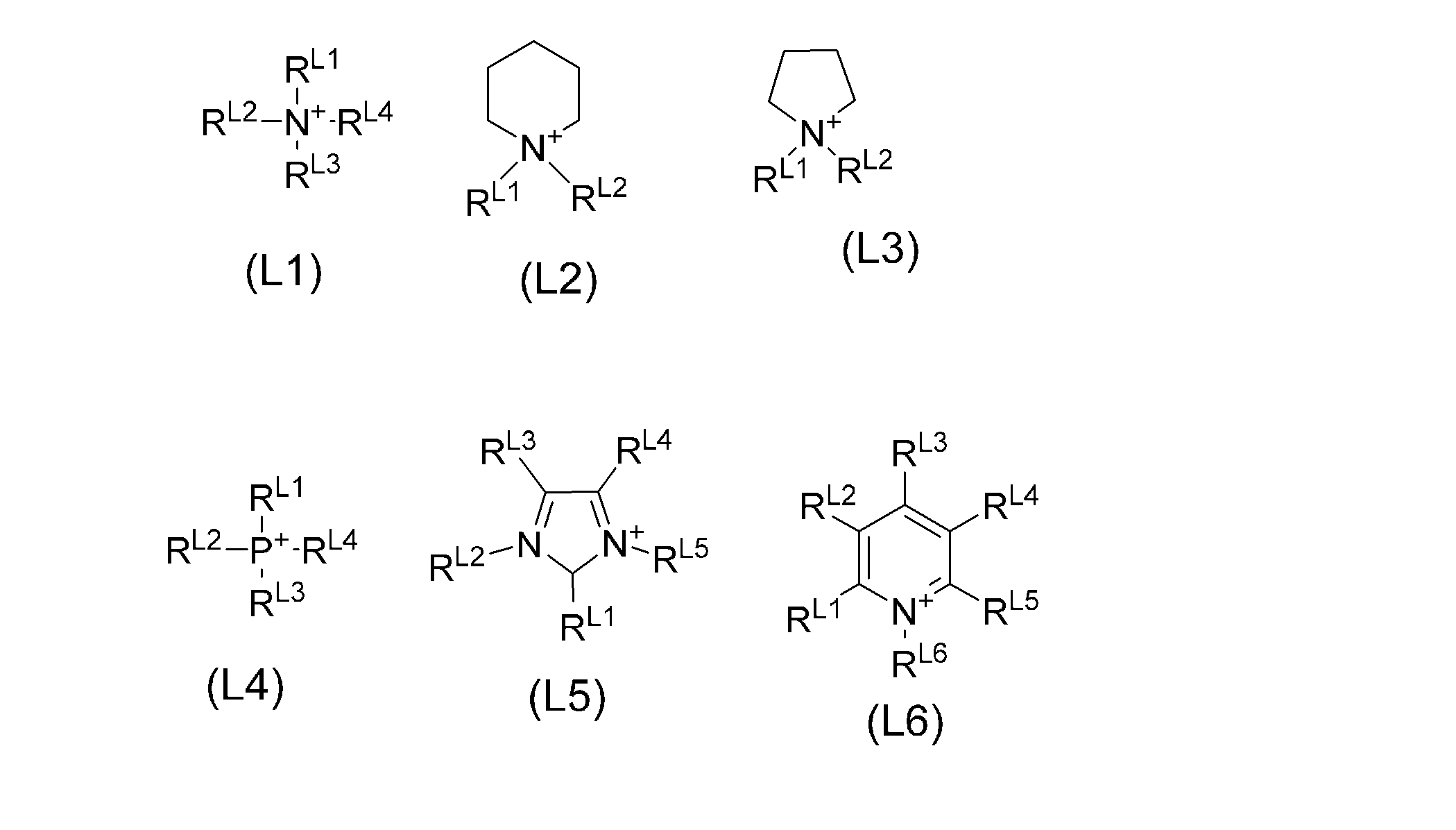
式(L1)~(L4)中、RL1~RL4は、それぞれ独立に、炭素原子数が1以上20以下のアルキル基、又はRL7-O-(CH2)Ln-で表わされるアルコキシアルキル基(RL7は、メチル基、又はエチル基を示し、Lnは1以上4以下の整数を表す。)である。
式(L5)中、RL1~RL4は、各々独立に、炭素原子数が1以上20以下のアルキル基、RL7-O-(CH2)Ln-で表わされるアルコキシアルキル基(RL7は、メチル基、又はエチル基を示し、Lnは1以上4以下の整数を表す。)、又は水素原子である。
式(L6)中、RL1~RL6は、各々独立に、炭素原子数が1以上20以下のアルキル基、RL7-O-(CH2)Ln-で表わされるアルコキシアルキル基(RL7は、メチル基、又はエチル基を示し、Lnは1以上4以下の整数を表す)、水素原子である。
式(L5)中、RL1~RL4は、各々独立に、炭素原子数が1以上20以下のアルキル基、RL7-O-(CH2)Ln-で表わされるアルコキシアルキル基(RL7は、メチル基、又はエチル基を示し、Lnは1以上4以下の整数を表す。)、又は水素原子である。
式(L6)中、RL1~RL6は、各々独立に、炭素原子数が1以上20以下のアルキル基、RL7-O-(CH2)Ln-で表わされるアルコキシアルキル基(RL7は、メチル基、又はエチル基を示し、Lnは1以上4以下の整数を表す)、水素原子である。
イオン液体(I)を構成するアニオンとしては、有機アニオンであっても、無機アニオンであってもよい。イオン液体(I)の溶媒(S)との親和性が良好であることから、有機アニオンが好ましい。
有機アニオンとして、カルボン酸系アニオン、N-アシルアミノ酸イオン、酸性アミノ酸アニオン、中性アミノ酸アニオン、アルキル硫酸系アニオン、含フッ素化合物系アニオン及びフェノール系アニオンからなる群より選択される少なくとも1種であることが好ましく、カルボン酸系アニオン又はN-アシルアミノ酸イオンであることがより好ましい。
有機アニオンとして、カルボン酸系アニオン、N-アシルアミノ酸イオン、酸性アミノ酸アニオン、中性アミノ酸アニオン、アルキル硫酸系アニオン、含フッ素化合物系アニオン及びフェノール系アニオンからなる群より選択される少なくとも1種であることが好ましく、カルボン酸系アニオン又はN-アシルアミノ酸イオンであることがより好ましい。
上記カルボン酸系アニオンの具体例としては、酢酸イオン、デカン酸イオン、2-ピロリドン-5-カルボン酸イオン、ギ酸イオン、α-リポ酸イオン、乳酸イオン、酒石酸イオン、馬尿酸イオン、N-メチル馬尿酸イオン等が挙げられ、中でも、酢酸イオン、2-ピロリドン-5-カルボン酸イオン、ギ酸イオン、乳酸イオン、酒石酸イオン、馬尿酸イオン、N-メチル馬尿酸イオンが好ましく、酢酸イオン、N-メチル馬尿酸イオン、ギ酸イオンがより好ましい。
上記N-アシルアミノ酸イオンの具体例としては、N-ベンゾイルアラニンイオン、N-アセチルフェニルアラニンイオン、アスパラギン酸イオン、グリシンイオン、N-アセチルグリシンイオン等が挙げられ、中でも、N-ベンゾイルアラニンイオン、N-アセチルフェニルアラニンイオン、N-アセチルグリシンイオンが好ましく、N-アセチルグリシンイオンがより好ましい。
上記N-アシルアミノ酸イオンの具体例としては、N-ベンゾイルアラニンイオン、N-アセチルフェニルアラニンイオン、アスパラギン酸イオン、グリシンイオン、N-アセチルグリシンイオン等が挙げられ、中でも、N-ベンゾイルアラニンイオン、N-アセチルフェニルアラニンイオン、N-アセチルグリシンイオンが好ましく、N-アセチルグリシンイオンがより好ましい。
上記酸性アミノ酸アニオンの具体例としては、アスパラギン酸イオン、グルタミン酸イオン等が挙げられ、上記中性アミノ酸アニオンの具体例としては、グリシンイオン、アラニンイオン、フェニルアラニンイオン等が挙げられる。
上記アルキル硫酸系アニオンの具体例としては、メタンスルホン酸イオン等が挙げられ、上記含フッ素化合物系アニオンの具体例としては、トリフルオロメタンスルホン酸イオン、ヘキサフルオロホスホン酸イオン、トリフルオロトリス(ペンタフルオロエチル)ホスホン酸イオン、ビス(フルオロアルキルスルホニル)イミドイオン(例えば、ビス(トリフルオロメタンスルホニル)イミドイオン)、トリフルオロ酢酸イオン、テトラフルオロホウ酸イオン等が挙げられ、上記フェノール系アニオンの具体例としては、フェノールイオン、2-メトキシフェノールイオン、2,6-ジ-tert-ブチルフェノールイオン等が挙げられる。
上記アルキル硫酸系アニオンの具体例としては、メタンスルホン酸イオン等が挙げられ、上記含フッ素化合物系アニオンの具体例としては、トリフルオロメタンスルホン酸イオン、ヘキサフルオロホスホン酸イオン、トリフルオロトリス(ペンタフルオロエチル)ホスホン酸イオン、ビス(フルオロアルキルスルホニル)イミドイオン(例えば、ビス(トリフルオロメタンスルホニル)イミドイオン)、トリフルオロ酢酸イオン、テトラフルオロホウ酸イオン等が挙げられ、上記フェノール系アニオンの具体例としては、フェノールイオン、2-メトキシフェノールイオン、2,6-ジ-tert-ブチルフェノールイオン等が挙げられる。
上記無機アニオンとして、本発明の効果をより確実に達成する観点から、F-、Cl-、Br-、I-、BF4
-、PF6
-及びN(SO2F)2
-からなる群より選択される少なくとも1種であることが好ましく、BF4
-、PF6
-又はN(SO2F)2
-であることがより好ましく、BF4
-又はPF6
-であることがさらに好ましい。
イオン液体(I)は、例えば、国際公開第2014/178254号の段落0045に開示された手法等によって製造することができる。
イオン液体(I)は単独で用いても2種以上混合して用いてもよい。
イオン液体(I)の含有量は、量子ドット含有被膜形成用の組成物において量子ドット(A)を分散させる効果が良好であることから、量子ドット(A)100質量部に対して、10質量部以上500質量部以下が好ましく、90質量部以上400質量部以下がより好ましく、100質量部以上300質量部以下がさらに好ましい。
イオン液体(I)は単独で用いても2種以上混合して用いてもよい。
イオン液体(I)の含有量は、量子ドット含有被膜形成用の組成物において量子ドット(A)を分散させる効果が良好であることから、量子ドット(A)100質量部に対して、10質量部以上500質量部以下が好ましく、90質量部以上400質量部以下がより好ましく、100質量部以上300質量部以下がさらに好ましい。
〔組成物の製造方法〕
以上説明した組成物の製造方法は特に限定されない。上記の組成物は、量子ドット(A)、基材成分(C)、及び溶媒(S)と、必要に応じてその他の任意成分とを均一に混合できれば特に限定されない。組成物に含まれる、各種成分を混合する順序は特に限定されない。
以上説明した組成物の製造方法は特に限定されない。上記の組成物は、量子ドット(A)、基材成分(C)、及び溶媒(S)と、必要に応じてその他の任意成分とを均一に混合できれば特に限定されない。組成物に含まれる、各種成分を混合する順序は特に限定されない。
前述の組成物の製造において、組成物の製造中、又は製造後に、有機溶媒(S1)の存在下に、量子ドット(A)が、50℃以上300℃以下に加熱されるのが好ましい。加熱温度は、70℃以上270℃以下が好ましく、100℃以下250℃以下がより好ましい。そうすることにより、量子ドット(A)が良好に分散した組成物を製造しやすい。
組成物の製造方法としては、予め調製された量子ドット分散液を、他の成分と混合する方法が好ましい。この場合、量子ドット分散液は、量子ドット(A)と、分散媒(B)とを含む。分散媒(B)としては、前述の溶媒(S)と同様の有機溶媒を用いることができる。また、前述の低酸素濃度雰囲気下での加熱工程により量子ドット含有被膜の量子収率を所望する程度に回復させやすい点から、分散媒(B)が前述の有機溶媒(S1)を含むのが好ましい。
量子ドット分散液の製造方法は、量子ドット(A)を、分散媒(B)に分散させることを含む。量子ドット(A)を分散媒(B)に分散させる方法は特に限定されない。例えば、量子ドット(A)を分散媒(B)に分散させる方法は、周知の方法により製造された固体の量子ドット(A)を、分散媒(B)中に分散させる方法であってよい。
量子ドット(A)を分散媒(B)に分散させる方法の好ましい一例としては、
量子ドット(A)と、予備分散媒(pB)を含む予備分散液を準備することと、
予備分散液に含まれる予備分散媒(pB)の、分散媒(B)への置換とを含む方法が挙げられる。
量子ドット(A)と、予備分散媒(pB)を含む予備分散液を準備することと、
予備分散液に含まれる予備分散媒(pB)の、分散媒(B)への置換とを含む方法が挙げられる。
ここで、予備分散液は、量子ドット(A)と、分散媒(B)とを含む量子ドット分散液の調製に用いられる、予備的な分散液である。
予備分散液を準備する方法は特に限定されない。予備分散液としては、市販の量子ドット分散液をそのまま用いることができる。また、市販の量子ドット分散液から、予備分散媒(pB)を揮発させる等の方法により除いた後、量子ドット(A)を含む残渣に、分散媒(B)を加えて、量子ドット(A)を分散させる方法によっても予備分散液を調製することができる。
予備分散液を準備する方法は特に限定されない。予備分散液としては、市販の量子ドット分散液をそのまま用いることができる。また、市販の量子ドット分散液から、予備分散媒(pB)を揮発させる等の方法により除いた後、量子ドット(A)を含む残渣に、分散媒(B)を加えて、量子ドット(A)を分散させる方法によっても予備分散液を調製することができる。
予備分散媒(pB)としては、溶媒(S)について説明した、有機溶媒(S1)以外の他の溶媒(S2)と同種の溶媒を用いることができる。
予備分散液における量子ドット(A)の濃度は特に限定されない。予備分散液又は量子ドット分散液における量子ドット(A)の濃度は、0.1質量%以上70質量%以下となる量が好ましく。1質量%以上60質量%以下となる量がより好ましく、5質量%以上50質量%以下となる量がさらに好ましい。
予備分散液に含まれる予備分散媒(pB)の、分散媒(B)への置換の好ましい方法としては、
予備分散液から予備分散媒(pB)の少なくとも一部を除去することと、
予備分散媒(pB)が除去された後に、量子ドット(A)と残余の予備分散媒(pB)とを含む混合物、又は量子ドット(A)に対して分散媒(B)を添加することと、を含む方法が挙げられる。
予備分散液から予備分散媒(pB)の少なくとも一部を除去することと、
予備分散媒(pB)が除去された後に、量子ドット(A)と残余の予備分散媒(pB)とを含む混合物、又は量子ドット(A)に対して分散媒(B)を添加することと、を含む方法が挙げられる。
予備分散液(pB)から、予備分散媒(pB)の少なくとも一部を除去する方法は特に限定されない。かかる方法の例としては、予備分散媒(pB)を揮発させる方法が挙げら獲る。予備分散媒(pB)を揮発させる方法は特に限定されない。
例えば、予備分散媒(pB)は、大気圧下、又は減圧下での加熱により行われてよい。また、予備分散媒(pB)の除去は、例えば、遠沈等の方法により量子ドット(A)を容器内に沈降させた後、予備分散媒(pB)を上澄みとして取り除く方法により除去されてもよい。
例えば、予備分散媒(pB)は、大気圧下、又は減圧下での加熱により行われてよい。また、予備分散媒(pB)の除去は、例えば、遠沈等の方法により量子ドット(A)を容器内に沈降させた後、予備分散媒(pB)を上澄みとして取り除く方法により除去されてもよい。
量子ドット(A)の材質や粒子径によっては、量子ドット(A)を沈降させることが難しい場合があるため、予備分散媒(pB)の少なくとも一部を除去する方法としては、予備分散媒(pB)を揮発させて除去する方法が好ましい。
予備分散媒(pB)の少なくとも一部を除去する場合、予備分散媒(pB)の除去量は、本発明の目的を阻害しない範囲で特に限定されない。除去の前の予備分散媒(pB)の質量の50質量%以上でもよく、70質量%以上でもよく、90質量%以上でもよく、100質量%であってもよい。
このようにして予備分散媒(pB)の少なくとも一部を除去した後に、残渣に分散媒(B)を添加し、次いで、分散媒(B)中に量子ドット(A)を分散させることにより、量子ドット分散液が調製される。
分散媒(B)の使用量は特に限定されない。分散媒(B)の使用量は、前述の通り、量子ドット分散液中の有機溶媒(B1)の含有量が、量子ドット(A)100質量部に対して10質量部以上2000質量部以下である量が好ましく、10質量部以上1500質量部以下である量がより好ましく、30質量部以上1200質量部以下である量がさらにより好ましく、50質量部以上1000質量部以下である量が特に好ましい。
分散媒(B)の使用量は特に限定されない。分散媒(B)の使用量は、前述の通り、量子ドット分散液中の有機溶媒(B1)の含有量が、量子ドット(A)100質量部に対して10質量部以上2000質量部以下である量が好ましく、10質量部以上1500質量部以下である量がより好ましく、30質量部以上1200質量部以下である量がさらにより好ましく、50質量部以上1000質量部以下である量が特に好ましい。
また、上記の置換の方法としては、
予備分散液に対して分散媒(B)を添加して、量子ドット(A)と、分散媒(B)と、予備分散媒(pB)とを含む液を調製することと、
量子ドット(A)と、分散媒(B)と、予備分散媒(pB)とを含む液から、予備分散媒(pB)を除去することと、を含む方法も好ましい。
かかる方法によれば、分散媒(B)が加えられる一方で、予備分散媒(pB)が留去されるため、予備分散媒(pB)が分散媒(B)に置換される。
予備分散液に対して分散媒(B)を添加して、量子ドット(A)と、分散媒(B)と、予備分散媒(pB)とを含む液を調製することと、
量子ドット(A)と、分散媒(B)と、予備分散媒(pB)とを含む液から、予備分散媒(pB)を除去することと、を含む方法も好ましい。
かかる方法によれば、分散媒(B)が加えられる一方で、予備分散媒(pB)が留去されるため、予備分散媒(pB)が分散媒(B)に置換される。
量子ドット(A)と、分散媒(B)と、予備分散媒(pB)とを含む液からの予備分散媒(pB)の除去は、予備分散媒(pB)のみの除去であってもよく、予備分散媒(pB)と分散媒(B)との除去であってもよい。予備分散媒(pB)のみの除去は、一般的に困難である場合が多く、典型的には、予備分散媒(pB)は分散媒(B)とともに除去される。
予備分散媒(pB)の除去は、所望する量の予備分散媒(pB)を除去できる限り、どのような方法で行われてもよい。分散媒(B)の量の過度の減少を防ぐことができる点で、予備分散媒(pB)の除去は、分散媒(B)の除去量よりも、予備分散媒(pB)の除去量が多い条件にて行われるのが好ましい。
予備分散媒(pB)の除去は、所望する量の予備分散媒(pB)を除去できる限り、どのような方法で行われてもよい。分散媒(B)の量の過度の減少を防ぐことができる点で、予備分散媒(pB)の除去は、分散媒(B)の除去量よりも、予備分散媒(pB)の除去量が多い条件にて行われるのが好ましい。
例えば、予備分散媒(pB)の沸点が、分散媒(B)の沸点よりも低い場合、予備分散媒(pB)の沸点以上、分散媒(B)の沸点未満の温度で、量子ドット(A)と、分散媒(B)と、予備分散媒(pB)とを含む液を加熱する方法等によって、予備分散媒(pB)を優先的に除去することができる。
また、予備分散媒(pB)の沸点が、分散媒(B)の沸点よりも高い場合、量子ドット(A)と、分散媒(B)と、予備分散媒(pB)とを含む液を加熱して発生した蒸気をコンデンサーに導入し、分散媒(B)の蒸気が十分に凝縮するが、予備分散媒(pB)の蒸気が十分に凝縮しにくい温度にて、コンデンサーでの冷却を行って、還流を実施すればよい。そうすることにより、分散媒(B)リッチな凝縮液を、量子ドット(A)を含む液中に還流させることができる。一方、予備分散媒(pB)リッチな蒸気は、留去される。
予備分散媒(pB)とともに留去される分散媒(B)の量が多すぎる場合には、量子ドット(A)を含む液に分散媒(B)を追加しながら、上記の方法を実施してもよい。
量子ドット(A)と、分散媒(B)と、予備分散媒(pB)とを含む液から予備分散媒(pB)を除去するための、上記以外の他の方法としては、遠心分離、分子サイズの差を利用する膜分離方法、凝固点の差を利用する方法、フリーズドライ法等が挙げられる。
上記のような方法により、量子ドット(A)と、分散媒(B)と、予備分散媒(pB)とを含む液から、予備分散媒(pB)を除去することにより、量子ドット分散液が得られる。
この場合、量子ドット分散液中の量子ドット(A)の濃度が所望する範囲内であり、所望する量の有機溶媒(B1)が量子ドット分散液中に存在する限りにおいって、予備分散媒(pB)の除去量は特に限定されない。
予備分散媒(pB)の除去量は、除去の前の予備分散媒(pB)の質量の50質量%以上でもよく、70質量%以上でもよく、90質量%以上でもよく、100質量%であってもよい。
この場合、量子ドット分散液中の量子ドット(A)の濃度が所望する範囲内であり、所望する量の有機溶媒(B1)が量子ドット分散液中に存在する限りにおいって、予備分散媒(pB)の除去量は特に限定されない。
予備分散媒(pB)の除去量は、除去の前の予備分散媒(pB)の質量の50質量%以上でもよく、70質量%以上でもよく、90質量%以上でもよく、100質量%であってもよい。
以上説明した量子ドット分散液の製造方法において、量子ドット分散液の製造中、又は製造後に、有機溶媒(B1)の存在下に、量子ドット(A)が、50℃以上300℃以下に加熱されるのが好ましい。加熱温度は、70℃以上270℃以下が好ましく、100℃以下250℃以下がより好ましい。そうすることにより、量子ドット(A)が良好に分散した量子ドット分散液を製造しやすい。
<低酸素濃度雰囲気下での加熱工程に供される、加熱前の量子ドット含有被膜の形成方法>
以上説明した組成物からなる塗布膜を、乾燥及び/又は硬化させることにより量子ドット含有被膜が形成される。
また、量子ドット含有被膜形成用の組成物が、光感応性又は熱感応性である場合、量子ドット含有被膜を製造する方法は、量子ドット含有被膜を露光又は加熱することにより、量子ドット含有被膜の有機溶媒又は塩基性溶液に対する溶解度を変化させることを含むのが好ましい。
そうすると、量子ドット含有被膜の有機溶剤又は塩基性溶液による現像・パターニングが可能となったり、量子ドット含有被膜の有機溶剤又は塩基性溶液に対する耐性が向上したりする。
量子ドット含有被膜の有機溶媒又は塩基性溶液に対する溶解度を変化させるための量子ドット含有被膜を露光又は加熱は、低酸素濃度雰囲気下での加熱工程の前及び後のいずれで行われてもよい。
以上説明した組成物からなる塗布膜を、乾燥及び/又は硬化させることにより量子ドット含有被膜が形成される。
また、量子ドット含有被膜形成用の組成物が、光感応性又は熱感応性である場合、量子ドット含有被膜を製造する方法は、量子ドット含有被膜を露光又は加熱することにより、量子ドット含有被膜の有機溶媒又は塩基性溶液に対する溶解度を変化させることを含むのが好ましい。
そうすると、量子ドット含有被膜の有機溶剤又は塩基性溶液による現像・パターニングが可能となったり、量子ドット含有被膜の有機溶剤又は塩基性溶液に対する耐性が向上したりする。
量子ドット含有被膜の有機溶媒又は塩基性溶液に対する溶解度を変化させるための量子ドット含有被膜を露光又は加熱は、低酸素濃度雰囲気下での加熱工程の前及び後のいずれで行われてもよい。
組成物を硬化させる場合、硬化方法は、特に限定されず、加熱であっても、露光であってもよく、加熱と露光とを組み合わせて行ってもよい。
低酸素濃度雰囲気下での加熱工程に供される量子ドット含有被膜の製造方法の典型例を以下説明する。
量子ドット含有被膜は、積層体や、発光表示素子パネル等において種々の機能層上に直接形成されてもよく、金属基板やガラス基板等の任意の材質の基板上に形成した後、基板から剥離させて使用されてもよい。
また、量子ドット含有被膜は、発光表示素子パネル等において画素を画定する遮光性の隔壁に囲まれた領域内に形成されてもよい。
量子ドット含有被膜は、積層体や、発光表示素子パネル等において種々の機能層上に直接形成されてもよく、金属基板やガラス基板等の任意の材質の基板上に形成した後、基板から剥離させて使用されてもよい。
また、量子ドット含有被膜は、発光表示素子パネル等において画素を画定する遮光性の隔壁に囲まれた領域内に形成されてもよい。
まず、任意の基板や機能層等の上に、組成物を塗布して塗布膜を形成する。塗布方法としては、ロールコータ、リバースコーター、バーコーター等の接触転写型塗布装置や、スピンナー(回転式塗布装置)、スリットコーター、カーテンフローコーター等の非接触型塗布装置を用いる方法が挙げられる。
また、組成物の粘度を適切な範囲に調整したうえで、インクジェット法、スクリーン印刷法等の印刷法によって組成物の塗布を行って、所望の形状にパターニングされた塗布膜を形成してもよい。
また、組成物の粘度を適切な範囲に調整したうえで、インクジェット法、スクリーン印刷法等の印刷法によって組成物の塗布を行って、所望の形状にパターニングされた塗布膜を形成してもよい。
次いで、必要に応じて、溶媒(S)等の揮発成分を除去して塗布膜を乾燥させる。乾燥方法は特に限定されないが、例えば、真空乾燥装置(VCD)を用いて室温にて減圧乾燥し、その後、ホットプレートにて60℃以上120℃以下、好ましくは70℃以上100℃以下の温度にて60秒以上180秒以下の間乾燥する方法が挙げられる。
このようにして塗布膜を形成した後、塗布膜に対して露光及び/又は加熱を施す。
このようにして塗布膜を形成した後、塗布膜に対して露光及び/又は加熱を施す。
露光は、エキシマレーザー光等の活性エネルギー線を照射して行う。照射するエネルギー線量は、組成物の組成によっても異なるが、例えば30mJ/cm2以上2000mJ/cm2以下が好ましく、50mJ/cm2以上500mJ/cm2以下がより好ましい。
かかる露光によれば、組成物がネガ型である場合には、露光部が硬化し、組成物がポジ型である場合には、露光部が塩基性溶液等の現像液に対して易溶化する。
かかる露光によれば、組成物がネガ型である場合には、露光部が硬化し、組成物がポジ型である場合には、露光部が塩基性溶液等の現像液に対して易溶化する。
加熱を行う際の温度は特に限定されず、180℃以上280℃以下が好ましく、200℃以上260℃以下がより好ましく、220℃以上250℃以下が特に好ましい。加熱時間は、典型的には、1分以上60分以下が好ましく、10分以上50分以下がより好ましく、20分以上40分以下が特に好ましい。
上記の加熱を行う際の雰囲気は特に限定されない。上記の加熱を行う際の雰囲気は、低酸素雰囲気であってもよい。
上記の加熱を行う際の雰囲気は特に限定されない。上記の加熱を行う際の雰囲気は、低酸素雰囲気であってもよい。
組成物が基材成分(C)としてケイ素含有樹脂を含む場合、量子ドット含有被膜を製造するために、組成物の塗布膜が焼成される。
この場合、基板の材質は、焼成に耐えられる材質であれば特に限定されない。基板の材質の好適な例としては、金属、シリコン、ガラス等の無機材料や、ポリカーボネート、ポリエチレンテレフタレート、ポリエーテルスルフォン、ポリイミド樹脂、ポリアミドイミド樹脂等の耐熱性の材料が挙げられる。基板の厚さは特に限定されず、基板は、フィルムやシートであってもよい。
この場合、基板の材質は、焼成に耐えられる材質であれば特に限定されない。基板の材質の好適な例としては、金属、シリコン、ガラス等の無機材料や、ポリカーボネート、ポリエチレンテレフタレート、ポリエーテルスルフォン、ポリイミド樹脂、ポリアミドイミド樹脂等の耐熱性の材料が挙げられる。基板の厚さは特に限定されず、基板は、フィルムやシートであってもよい。
塗布膜を備える基板は、次いで焼成される。焼成方法は特に限定されないが、典型的には電気炉等を用いて焼成が行われる。焼成温度は、典型的には300℃以上が好ましく、350℃以上がより好ましい。上限は特に限定されないが、例えば、1000℃以下である。組成物が前述の硬化剤(D4)を含む場合、焼成温度の下限値を200℃に下げてもシリカフィルムである量子ドット含有被膜中の残渣(シリカフィルム由来の不純物)を低減できる。焼成雰囲気は特に限定されず、窒素雰囲気又はアルゴン雰囲気等の不活性ガス雰囲下、真空下、又は減圧下であってもよい。大気下であってもよいし、酸素濃度を適宜コントロールしてもよい。
量子ドット含有被膜の膜厚は特に限定されない。量子ドット含有被膜の膜厚は、典型的には、0.1μm以上10μm以下であり、0.2μm以上5μm以下が好ましく、0.5μm以上3μm以下がより好ましい。
このようにして形成された量子ドット含有被膜に対して、前述の低酸素濃度雰囲気下での加熱工程を施すことにより、所望する量子収率を示す量子ドット含有被膜を製造できる。
≪量子ドット含有被膜≫
上記の方法により製造された量子ドット含有被膜は、有機溶媒(S1)を含んでいてもよく、含んでいなくてもよい。量子ドット含有被膜の量子収率が低下した場合に、再度、低酸素濃度雰囲気下で量子ドット含有被膜を加熱することにより量子収率を回復させ得る点から、量子ドット含有被膜は有機溶媒(S1)を含んでいるのが好ましい。
有機溶媒(S1)の含有量は、特に限定されない。量子ドット含有被膜は、低酸素濃度雰囲気下での加熱により量子収率が向上し得る量の有機溶媒(S1)を含んでいるのが好ましい。
量子ドット含有被膜は、発光表示素子用の光学フィルムとして好適に使用される。
上記の方法により製造された量子ドット含有被膜は、有機溶媒(S1)を含んでいてもよく、含んでいなくてもよい。量子ドット含有被膜の量子収率が低下した場合に、再度、低酸素濃度雰囲気下で量子ドット含有被膜を加熱することにより量子収率を回復させ得る点から、量子ドット含有被膜は有機溶媒(S1)を含んでいるのが好ましい。
有機溶媒(S1)の含有量は、特に限定されない。量子ドット含有被膜は、低酸素濃度雰囲気下での加熱により量子収率が向上し得る量の有機溶媒(S1)を含んでいるのが好ましい。
量子ドット含有被膜は、発光表示素子用の光学フィルムとして好適に使用される。
量子ドット含有被膜の膜厚は特に限定されない。量子ドット含有被膜の膜厚は、典型的には、0.1μm以上10μm以下であり、0.2μm以上5μm以下が好ましく、0.5μm以上3μm以下がより好ましい。
以上説明した方法により形成される量子ドット(A)を含む量子ドット含有被膜は、良好な量子収率を示すため蛍光効率に優れ発光表示素子用の光学フィルムとして好適に使用できる。また、量子ドット含有被膜は、発光表示素子において好適に用いられる積層体の製造に好適に使用できる。
≪積層体≫
積層体は、上記の方法により製造された量子ドット含有被膜を含む積層体である。かかる積層体は、量子ドット(A)を含有する量子ドット含有被膜のみからなる積層体であってもよく、量子ドット含有被膜と、他の機能層とからなる積層体であってもよい。
積層体は、上記の方法により製造された量子ドット含有被膜を含む積層体である。かかる積層体は、量子ドット(A)を含有する量子ドット含有被膜のみからなる積層体であってもよく、量子ドット含有被膜と、他の機能層とからなる積層体であってもよい。
<量子ドット含有被膜の積層体>
積層体において、例えば、基材成分(C)に由来する種々のマトリックス材中に分散された量子ドット(A)を含む量子ドット含有被膜が2層以上積層されている。
かかる積層体は、前述の方法により形成された量子ドット含有被膜だけが積層された積層体であってもよく、前述の方法により形成された量子ドット含有被膜と、前述の方法以外の他の方法で形成された、量子ドット(A)を含む他の膜とが積層された積層体であってもよい。
積層体において、例えば、基材成分(C)に由来する種々のマトリックス材中に分散された量子ドット(A)を含む量子ドット含有被膜が2層以上積層されている。
かかる積層体は、前述の方法により形成された量子ドット含有被膜だけが積層された積層体であってもよく、前述の方法により形成された量子ドット含有被膜と、前述の方法以外の他の方法で形成された、量子ドット(A)を含む他の膜とが積層された積層体であってもよい。
量子ドット含有被膜は、光源からの入射光を波長変換して赤色光を生ずる量子ドットと、光源からの入射光を波長変換して緑色光を生ずる量子ドットを含むのが好ましい。
また、赤色光を生ずる量子ドット含有被膜と、緑色光を生ずる量子ドット含有被膜とを交互に積層するのも好ましい。
このような構成の積層体を発光表示素子パネルに適用することにより、波長変換によって色純度の高い緑色光と赤色光を取り出すことができるため、発光表示素子パネルを備える発光表示装置の色相の再現範囲を拡大することができる。
なお、光源としては、典型的には、青色光や白色光を利用することができる。かかる光源と、上記の積層体とを組み合わせて用いることにより、色純度の高い、赤色光、緑色光、及び青色光を取り出すことができ、良好な色相の鮮明な画像を表示することができる。
また、赤色光を生ずる量子ドット含有被膜と、緑色光を生ずる量子ドット含有被膜とを交互に積層するのも好ましい。
このような構成の積層体を発光表示素子パネルに適用することにより、波長変換によって色純度の高い緑色光と赤色光を取り出すことができるため、発光表示素子パネルを備える発光表示装置の色相の再現範囲を拡大することができる。
なお、光源としては、典型的には、青色光や白色光を利用することができる。かかる光源と、上記の積層体とを組み合わせて用いることにより、色純度の高い、赤色光、緑色光、及び青色光を取り出すことができ、良好な色相の鮮明な画像を表示することができる。
発光表示装置としては、光源の発光を用いて画像を表示する装置であれば特に限定されず、液晶表示装置や、有機EL表示装置等が挙げられる。
<量子ドット含有被膜と、他の機能層とを含む積層体>
前述の方法により形成された量子ドット含有被膜は、他の機能層と積層されるのも好ましい。
量子ドット含有被膜は、光源からの入射光を波長変換して赤色光を生ずる量子ドットと、光源からの入射光を波長変換して緑色光を生ずる量子ドットを含むのが好ましい。
また、光源としては、典型的には、青色光や白色光を利用することができる。
前述の方法により形成された量子ドット含有被膜は、他の機能層と積層されるのも好ましい。
量子ドット含有被膜は、光源からの入射光を波長変換して赤色光を生ずる量子ドットと、光源からの入射光を波長変換して緑色光を生ずる量子ドットを含むのが好ましい。
また、光源としては、典型的には、青色光や白色光を利用することができる。
他の機能層としては、光線を拡散させる拡散層、量子ドット含有被膜よりも低い屈折率を有する低屈折率層、光源から入射する光の一部を反射させる反射層、光源の発する光を積層体に入射させる導光板等が挙げられる。
また、必要に応じて、積層体内に空隙が設けられてもよい。空隙は、例えば、空気の層や、窒素等の不活性ガスの層であってよい。
また、必要に応じて、積層体内に空隙が設けられてもよい。空隙は、例えば、空気の層や、窒素等の不活性ガスの層であってよい。
拡散層としては、従来、種々の表示装置や光学装置に用いられている種々の拡散層を、特に制限なく用いることができる。典型的な例としては、表面にプリズム等の微細構造が設けられたフィルム、表面にビーズが散布又は埋没されたフィルム、及び微粒子や、光線を散乱させるように構造化された界面又は空隙等を内部に含むフィルムが挙げられる。
低屈折率層は、前述の量子ドット含有被膜よりも低い屈折率を有するフィルムであれば特に限定されず、種々の材質からなるフィルムを用いることができる。
反射層としては、反射性の偏光フィルム、入射光のうちの一部を反射できるように、表面にプリズム等の微細構造が設けられたフィルム、金属箔、多層光学フィルム等が挙げられる。反射層は、入射光の30%以上を反射させるのが好ましく、40%以上を反射させるのがより好ましく、50%以上を反射させるのが特に好ましい。
反射層は、量子ドット含有被膜を通過した光を反射して、反射光を再度、量子ドット含有被膜に入射させるように設けられるのが好ましい。反射層から量子ドット含有被膜に入射した光を、拡散層等により、反射層の方向へ再度反射させることにより、反射層を用いない場合よりも、量子ドット含有被膜から発せられる緑色光、及び赤色光の色純度を高めることができる。
反射層は、量子ドット含有被膜を通過した光を反射して、反射光を再度、量子ドット含有被膜に入射させるように設けられるのが好ましい。反射層から量子ドット含有被膜に入射した光を、拡散層等により、反射層の方向へ再度反射させることにより、反射層を用いない場合よりも、量子ドット含有被膜から発せられる緑色光、及び赤色光の色純度を高めることができる。
導光板としては、従来、種々の表示装置や光学装置に用いられている種々の導光板を、特に制限なく用いることができる。
量子ドット含有被膜と、他の機能層とを含む積層体の好ましい層構成の典型例としては、以下の1)~8)の層構成が挙げられる。なお1)~8)の構成の積層体では、最も左に記載された層に光源が発する光線を入射させ、最も右に記載された層から量子ドット含有被膜により波長変換された光線を取り出す。
通常、積層体から取り出された光線を入射させるようにディスプレイパネルが設けられ、色準との高い赤色光、緑色光、及び青色光を利用して画像の表示が行われる。
1)拡散層/量子ドット含有被膜/低屈折率層/反射層
2)導光板/拡散層/量子ドット含有被膜/低屈折率層/反射層
3)低屈折率層/量子ドット含有被膜/空隙/反射層
4)導光板/低屈折率層/量子ドット含有被膜/空隙/反射層
5)低屈折率層/量子ドット含有被膜/低屈折率層/反射層
6)導光板/低屈折率層/量子ドット含有被膜/低屈折率層/反射層
7)反射層/低屈折率層/量子ドット含有被膜/低屈折率層/反射層
8)導光板/反射層/低屈折率層/量子ドット含有被膜/低屈折率層/反射層
通常、積層体から取り出された光線を入射させるようにディスプレイパネルが設けられ、色準との高い赤色光、緑色光、及び青色光を利用して画像の表示が行われる。
1)拡散層/量子ドット含有被膜/低屈折率層/反射層
2)導光板/拡散層/量子ドット含有被膜/低屈折率層/反射層
3)低屈折率層/量子ドット含有被膜/空隙/反射層
4)導光板/低屈折率層/量子ドット含有被膜/空隙/反射層
5)低屈折率層/量子ドット含有被膜/低屈折率層/反射層
6)導光板/低屈折率層/量子ドット含有被膜/低屈折率層/反射層
7)反射層/低屈折率層/量子ドット含有被膜/低屈折率層/反射層
8)導光板/反射層/低屈折率層/量子ドット含有被膜/低屈折率層/反射層
≪発光表示素子パネル、及び発光表示装置≫
前述の組成物を用いて形成された量子ドット含有被膜や、前述の積層体は、種々の発光表示素子パネルに組み込まれ、光源が発する光線から色純度の高い赤色光、緑色光、及び青色光を取り出す目的で好ましく使用される。
ここでは、前述の組成物を用いて形成された量子ドット含有被膜や、前述の積層体の総称について「量子ドットシート」と記載する。
前述の組成物を用いて形成された量子ドット含有被膜や、前述の積層体は、種々の発光表示素子パネルに組み込まれ、光源が発する光線から色純度の高い赤色光、緑色光、及び青色光を取り出す目的で好ましく使用される。
ここでは、前述の組成物を用いて形成された量子ドット含有被膜や、前述の積層体の総称について「量子ドットシート」と記載する。
発光表示素子パネルは、典型的には、光源であるバックライトと、量子ドットシートと、ディスプレイパネルとを組み合わせて含む。
量子ドットシートが導光板を備える場合、典型的には、導光板の側面に光線を入射させるように光源が設けられる。導光板の側面から入射した光線は、量子ドットシート内を通過し、ディスプレイパネルに入射する。
量子ドットシートが導光板を備えない場合、面光源から量子ドットシートの主面に光線を入射させ、量子ドットシート内を通過した光線をディスプレイパネルに入射させる。
ディスプレイパネルの種類は、量子ドットシートを通過した光線を用いて画像形成可能であれば特に限定されないが、典型的には液晶ディスプレイパネルである。
量子ドットシートが導光板を備える場合、典型的には、導光板の側面に光線を入射させるように光源が設けられる。導光板の側面から入射した光線は、量子ドットシート内を通過し、ディスプレイパネルに入射する。
量子ドットシートが導光板を備えない場合、面光源から量子ドットシートの主面に光線を入射させ、量子ドットシート内を通過した光線をディスプレイパネルに入射させる。
ディスプレイパネルの種類は、量子ドットシートを通過した光線を用いて画像形成可能であれば特に限定されないが、典型的には液晶ディスプレイパネルである。
光源が発する光線から特に色純度の高い赤色光、緑色光、及び青色光を取り出しやすいことから、量子ドットシートは、前述の積層体であるのが好ましい。
量子ドットシートが積層体である場合の、発光表示素子パネルが備える構成の好ましい組み合わせとしては、以下a)~h)の組み合わせが挙げられる。
下記a)~h)に記載の組み合わせについて、最も左に記載の構成から、記載されている順に積み上げられ、発光表示素子パネルが形成される。
a)面光源/拡散層/量子ドットシート/低屈折率層/反射層/ディスプレイパネル
b)光源付導光板/拡散層/量子ドットシート/低屈折率層/反射層/ディスプレイパネル
c)面光源/低屈折率層/量子ドットシート/空隙/反射層/ディスプレイパネル
d)光源付導光板/低屈折率層/量子ドットシート/空隙/反射層/ディスプレイパネル
e)面光源/低屈折率層/量子ドットシート/低屈折率層/反射層/ディスプレイパネル
f)光源付導光板/低屈折率層/量子ドットシート/低屈折率層/反射層/ディスプレイパネル
g)面光源/反射層/低屈折率層/量子ドットシート/低屈折率層/反射層/ディスプレイパネル
h)光源付導光板/反射層/低屈折率層/量子ドットシート/低屈折率層/反射層/ディスプレイパネル
量子ドットシートが積層体である場合の、発光表示素子パネルが備える構成の好ましい組み合わせとしては、以下a)~h)の組み合わせが挙げられる。
下記a)~h)に記載の組み合わせについて、最も左に記載の構成から、記載されている順に積み上げられ、発光表示素子パネルが形成される。
a)面光源/拡散層/量子ドットシート/低屈折率層/反射層/ディスプレイパネル
b)光源付導光板/拡散層/量子ドットシート/低屈折率層/反射層/ディスプレイパネル
c)面光源/低屈折率層/量子ドットシート/空隙/反射層/ディスプレイパネル
d)光源付導光板/低屈折率層/量子ドットシート/空隙/反射層/ディスプレイパネル
e)面光源/低屈折率層/量子ドットシート/低屈折率層/反射層/ディスプレイパネル
f)光源付導光板/低屈折率層/量子ドットシート/低屈折率層/反射層/ディスプレイパネル
g)面光源/反射層/低屈折率層/量子ドットシート/低屈折率層/反射層/ディスプレイパネル
h)光源付導光板/反射層/低屈折率層/量子ドットシート/低屈折率層/反射層/ディスプレイパネル
以上説明した発光表示素子パネルを用いることで、色相の再現範囲が広く、良好な色相であり鮮明な画像を表示可能な発光表示装置を製造することができる。
以下、本発明を実施例によりさらに詳細に説明するが、本発明はこれらの実施例に限定されない。
以下、実施例において、有機溶媒(S1)としては、以下のPEMPとTMMPとを用いた。PEMP、及びTMMPの大気圧下での沸点を以下に記す。
PEMP:ペンタエリスリトールテトラ3-メルカプトプロピオネート(沸点250℃)
TMMP:トリメチロールプロパントリ3-メルカプトプロピオネート(沸点220℃)
PEMP:ペンタエリスリトールテトラ3-メルカプトプロピオネート(沸点250℃)
TMMP:トリメチロールプロパントリ3-メルカプトプロピオネート(沸点220℃)
〔調製例1〕
プロピレングリコールモノメチルエーテルアセテート中に、InPからなるコアが、ZnSからなるシェル層で被覆された粒子に、リガンドが配位した量子ドット(発光極大630nm)からなる量子ドットを濃度20質量%で含む、予備分散液0.6gをガラス容器中に加えた。不活性ガス雰囲気下に、予備分散液を120℃で20分間加熱してプロピレングリコールモノメチルエーテルアセテートを留去して、ガラス容器内に固形の量子ドットを得た。
固形の量子ドット0.12gを含むガラス容器内に、有機溶媒(S1)としてPEMP0.5gを加え、有機溶媒(S1)中に量子ドットを分散させて、量子ドット分散液を得た。
プロピレングリコールモノメチルエーテルアセテート中に、InPからなるコアが、ZnSからなるシェル層で被覆された粒子に、リガンドが配位した量子ドット(発光極大630nm)からなる量子ドットを濃度20質量%で含む、予備分散液0.6gをガラス容器中に加えた。不活性ガス雰囲気下に、予備分散液を120℃で20分間加熱してプロピレングリコールモノメチルエーテルアセテートを留去して、ガラス容器内に固形の量子ドットを得た。
固形の量子ドット0.12gを含むガラス容器内に、有機溶媒(S1)としてPEMP0.5gを加え、有機溶媒(S1)中に量子ドットを分散させて、量子ドット分散液を得た。
〔調製例2〕
プロピレングリコールモノメチルエーテルアセテート中に、InPからなるコアが、ZnSからなるシェル層で被覆された粒子に、リガンドが配位した量子ドット(発光極大630nmからなる量子ドットを濃度20質量%で含む、予備分散液0.6gをガラス容器中に加えた。次いで、ガラス容器中に、有機溶媒(B1)として、PEMP0.5gを加えた。
ガラス容器内の液を、200℃で1時間加熱してプロピレングリコールモノメチルエーテルアセテートを留去させることにより、PEMP0.5g中に量子ドット0.12gを含む量子ドット分散液を得た。
プロピレングリコールモノメチルエーテルアセテート中に、InPからなるコアが、ZnSからなるシェル層で被覆された粒子に、リガンドが配位した量子ドット(発光極大630nmからなる量子ドットを濃度20質量%で含む、予備分散液0.6gをガラス容器中に加えた。次いで、ガラス容器中に、有機溶媒(B1)として、PEMP0.5gを加えた。
ガラス容器内の液を、200℃で1時間加熱してプロピレングリコールモノメチルエーテルアセテートを留去させることにより、PEMP0.5g中に量子ドット0.12gを含む量子ドット分散液を得た。
〔調製例3〕
PEMPをTMMPに変えることの他は、調製例2と同様にして量子ドット分散液を得た。
PEMPをTMMPに変えることの他は、調製例2と同様にして量子ドット分散液を得た。
〔調製例4〕
調製例3で用いた量子ドットを、InPからなるコアが、ZnSからなるシェル層で被覆された粒子に、リガンドが配位した量子ドット(発光極大620nm)からなる量子ドットに変更することの他は、調製例3と同様にして量子ドット分散液を得た。
調製例3で用いた量子ドットを、InPからなるコアが、ZnSからなるシェル層で被覆された粒子に、リガンドが配位した量子ドット(発光極大620nm)からなる量子ドットに変更することの他は、調製例3と同様にして量子ドット分散液を得た。
〔調製例5〕
調製例3で用いた量子ドットを、InPからなるコアが、ZnSからなるシェル層で被覆された粒子に、リガンドが配位した量子ドット(発光極大530nm)からなる量子ドットに変更することの他は、調製例3と同様にして量子ドット分散液を得た。
調製例3で用いた量子ドットを、InPからなるコアが、ZnSからなるシェル層で被覆された粒子に、リガンドが配位した量子ドット(発光極大530nm)からなる量子ドットに変更することの他は、調製例3と同様にして量子ドット分散液を得た。
〔調製例6〕
プロピレングリコールモノメチルエーテルアセテート中に、InPからなるコアが、ZnSからなるシェル層で被覆された粒子に、リガンドが配位した量子ドット(発光極大630nm)からなる量子ドットを濃度20質量%で含む、分散液をそのまま用いた。
プロピレングリコールモノメチルエーテルアセテート中に、InPからなるコアが、ZnSからなるシェル層で被覆された粒子に、リガンドが配位した量子ドット(発光極大630nm)からなる量子ドットを濃度20質量%で含む、分散液をそのまま用いた。
上記の調製例の量子ドット分散液を用いて、以下の方法に従って、量子収率の評価を行った。
まず、表1に記載の種類の量子ドット分散液0.6gを、ネガ型の光感応性組成物0.5gに混合して、量子ドットを含む光感応性の膜形成用組成物を調製した。
ネガ型の光感応性組成物として、基材成分(C)としてのアルカリ可溶性樹脂35質量部、及びジペンタエリスリトールヘキサアクリレート7質量部と、硬化剤(D)としての下記構造の光重合開始剤4質量部と、3-メタクリロキシプロピルトリメトキシシラン0.7質量部と、溶剤(S)としてのプロピレングリコールモノメチルエーテルアセテート54質量部とからなる組成物を用いた。
アルカリ可溶性樹脂としては、下記の構成単位からなる樹脂を用いた。各構成単位について、括弧の右下の値は、樹脂中の各構成単位のモル比率である。

まず、表1に記載の種類の量子ドット分散液0.6gを、ネガ型の光感応性組成物0.5gに混合して、量子ドットを含む光感応性の膜形成用組成物を調製した。
ネガ型の光感応性組成物として、基材成分(C)としてのアルカリ可溶性樹脂35質量部、及びジペンタエリスリトールヘキサアクリレート7質量部と、硬化剤(D)としての下記構造の光重合開始剤4質量部と、3-メタクリロキシプロピルトリメトキシシラン0.7質量部と、溶剤(S)としてのプロピレングリコールモノメチルエーテルアセテート54質量部とからなる組成物を用いた。
アルカリ可溶性樹脂としては、下記の構成単位からなる樹脂を用いた。各構成単位について、括弧の右下の値は、樹脂中の各構成単位のモル比率である。

得られた膜形成用組成物を、ガラス基板上にスピンコート法により塗布し、膜厚5μmの塗布膜を形成した。形成された塗布膜について、Quantaurus-QY C11347(浜松フォトニクス社製)を用いて量子収率を測定した。塗布膜の量子収率についてQY1として表1に記す。
次いで塗布膜を空気中で100℃でベークした後、露光量50mJ/cm2で塗布膜を全面露光し硬化させた。得られた硬化膜について、量子収率を測定した。硬化膜の量子収率についてQY2として表1に記す。
さらに、硬化膜を、窒素雰囲気下で200℃60分間ベークした。ベーク後の硬化膜の量子収率を測定した。窒素雰囲気下でのベーク後の硬化膜の量子収率をQY3として表1に記す。
次いで塗布膜を空気中で100℃でベークした後、露光量50mJ/cm2で塗布膜を全面露光し硬化させた。得られた硬化膜について、量子収率を測定した。硬化膜の量子収率についてQY2として表1に記す。
さらに、硬化膜を、窒素雰囲気下で200℃60分間ベークした。ベーク後の硬化膜の量子収率を測定した。窒素雰囲気下でのベーク後の硬化膜の量子収率をQY3として表1に記す。
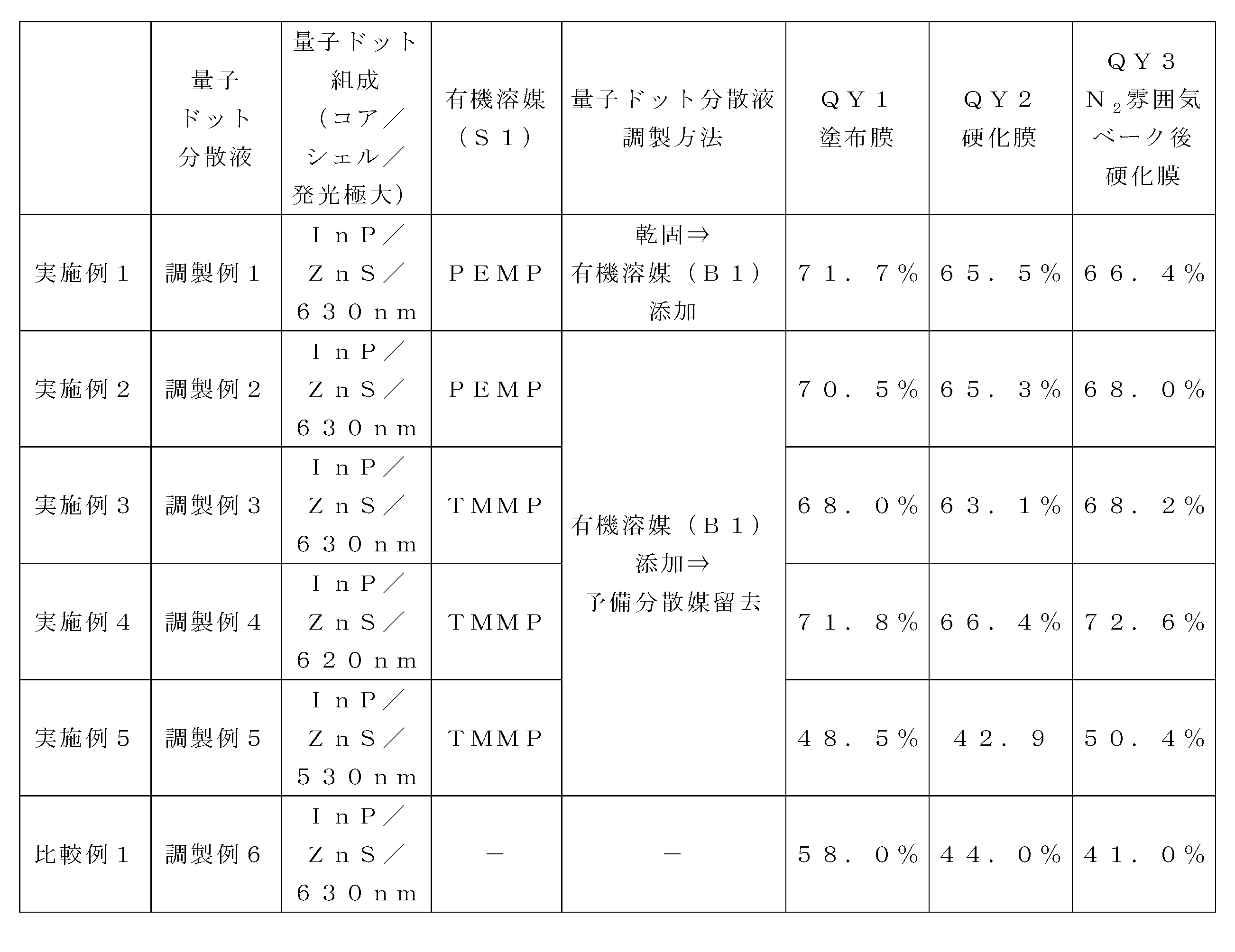
表1によれば、QY1とQY2との比較から、空気中でのベーク及び露光により量子収率が低下することが分かる。しかし、カルコゲン元素を有する有機溶媒(S1)を用いて量子ドット含有被膜形成用の組成物を調製したいずれの実施例でも、窒素雰囲気下で硬化膜をベークすることにより量子収率が回復した。
他方、カルコゲン元素を有する有機溶媒(S1)を含まない量子ドット分散液を用いて調製された量子ドット含有被膜形成用の組成物に関する比較例1では、窒素雰囲気下で硬化膜をベークしても、空気中でのベーク及び露光により低下した量子収率は回復しなかった。
他方、カルコゲン元素を有する有機溶媒(S1)を含まない量子ドット分散液を用いて調製された量子ドット含有被膜形成用の組成物に関する比較例1では、窒素雰囲気下で硬化膜をベークしても、空気中でのベーク及び露光により低下した量子収率は回復しなかった。
Claims (8)
- 量子ドット(A)と、基材成分(C)と、溶媒(S)とを含む組成物を用いて量子ドット含有被膜を製造する方法であって、
前記量子ドット(A)の表面の材質が、カルコゲン化物を含み、
前記量子ドット(A)の表面には、リガンドが結合していてもよく、
前記溶媒(S)が、カルコゲン元素を有する有機溶媒(S1)を含み、
大気中よりも低い酸素濃度雰囲気下で前記量子ドット含有被膜を加熱する加熱工程を含む、方法。 - 前記組成物の調製中、又は調製後に前記有機溶媒(S1)の存在下に、量子ドット(A)が、50℃以上300℃以下に加熱される、請求項1に記載の量子ドット含有被膜の製造方法。
- 前記組成物における、前記有機溶媒(S1)の含有量が、前記量子ドット(A)100質量部に対して、10質量部以上2000質量部以下である、請求項1又は2に記載の量子ドット含有被膜の製造方法。
- 前記溶媒(S1)の大気圧下での沸点が、60℃以上400℃以下である、請求項1~3のいずれか1項に記載の量子ドット含有被膜の製造方法。
- 前記組成物が、光感応性又は熱感応性であり、
前記量子ドット含有被膜の有機溶媒又は塩基性溶液に対する溶解度を、露光又は加熱により変化させることを含む、請求項1~4のいずれか1項に記載の量子ドット含有被膜の製造方法。 - 量子ドット(A)と、基材成分(C)と、有機溶媒(S)とを含む、量子ドット含有被膜形成用の組成物であって、
前記量子ドット(A)の表面の材質が、カルコゲン化物を含み、
前記量子ドット(A)の表面には、リガンドが結合していてもよく、
前記溶媒(S)が、カルコゲン元素を有する有機溶媒(S1)を含む、組成物。 - 前記有機溶媒(S1)の含有量が、前記量子ドット(A)100質量部に対して、10質量部以上2000質量部以下である、請求項6に記載の量子ドット含有被膜形成用の組成物。
- 前記有機溶媒(S1)の大気圧下での沸点が、60℃以上400℃以下である、請求項6又は7に記載の量子ドット含有被膜形成用の組成物。
Priority Applications (1)
| Application Number | Priority Date | Filing Date | Title |
|---|---|---|---|
| US17/418,053 US20220073817A1 (en) | 2018-12-25 | 2019-12-24 | Method for producing quantum dot-containing film and composition for producing quantum dot-containing film |
Applications Claiming Priority (2)
| Application Number | Priority Date | Filing Date | Title |
|---|---|---|---|
| JP2018241671A JP7289650B2 (ja) | 2018-12-25 | 2018-12-25 | 量子ドット含有被膜を製造する方法、及び量子ドット含有被膜形成用の組成物 |
| JP2018-241671 | 2018-12-25 |
Publications (1)
| Publication Number | Publication Date |
|---|---|
| WO2020138124A1 true WO2020138124A1 (ja) | 2020-07-02 |
Family
ID=71126668
Family Applications (1)
| Application Number | Title | Priority Date | Filing Date |
|---|---|---|---|
| PCT/JP2019/050718 Ceased WO2020138124A1 (ja) | 2018-12-25 | 2019-12-24 | 量子ドット含有被膜を製造する方法、及び量子ドット含有被膜形成用の組成物 |
Country Status (3)
| Country | Link |
|---|---|
| US (1) | US20220073817A1 (ja) |
| JP (1) | JP7289650B2 (ja) |
| WO (1) | WO2020138124A1 (ja) |
Cited By (4)
| Publication number | Priority date | Publication date | Assignee | Title |
|---|---|---|---|---|
| US20210040385A1 (en) * | 2018-02-15 | 2021-02-11 | Osaka University | Core-shell semiconductor nanoparticles, production method thereof, and light-emitting device |
| WO2022055109A1 (ko) * | 2020-09-08 | 2022-03-17 | 삼성에스디아이 주식회사 | 감광성 수지 조성물, 이를 이용하여 제조된 감광성 수지막 및 컬러필터 |
| WO2022230326A1 (ja) * | 2021-04-28 | 2022-11-03 | 住友化学株式会社 | 硬化膜及び表示装置 |
| JP2023552260A (ja) * | 2020-09-28 | 2023-12-15 | 昭栄化学工業株式会社 | ペンダント型可溶化部分を有する熱安定性ポリチオールリガンド |
Families Citing this family (4)
| Publication number | Priority date | Publication date | Assignee | Title |
|---|---|---|---|---|
| CN111040514A (zh) * | 2019-12-06 | 2020-04-21 | 深圳市华星光电半导体显示技术有限公司 | 量子点墨水、显示面板制作方法及显示面板 |
| WO2021240655A1 (ja) * | 2020-05-26 | 2021-12-02 | シャープ株式会社 | 発光素子及び発光素子の製造方法 |
| WO2022162841A1 (ja) * | 2021-01-28 | 2022-08-04 | シャープ株式会社 | 量子ドット、電界発光素子及びその製造方法、発光装置、表示装置及びその制御方法 |
| USD1085109S1 (en) | 2021-06-01 | 2025-07-22 | Armin MIRALRIO | Display screen or portion thereof with graphical user interface |
Citations (5)
| Publication number | Priority date | Publication date | Assignee | Title |
|---|---|---|---|---|
| WO2015098906A1 (ja) * | 2013-12-24 | 2015-07-02 | 富士フイルム株式会社 | 光学シート部材及び表示装置 |
| JP2017025201A (ja) * | 2015-07-22 | 2017-02-02 | 国立大学法人名古屋大学 | 半導体ナノ粒子およびその製造方法 |
| JP2017137451A (ja) * | 2016-02-05 | 2017-08-10 | 大日本印刷株式会社 | 光波長変換組成物、波長変換部材、光波長変換シート、バックライト装置、および画像表示装置 |
| JP2017214486A (ja) * | 2016-05-31 | 2017-12-07 | 大日本印刷株式会社 | 光波長変換組成物、光波長変換粒子、光波長変換部材、光波長変換シート、バックライト装置、および画像表示装置 |
| JP2019123866A (ja) * | 2018-01-11 | 2019-07-25 | 三星電子株式会社Samsung Electronics Co.,Ltd. | カドミウムフリー系量子ドット、その製造方法、これを含む組成物と複合体、及び表示素子 |
Family Cites Families (2)
| Publication number | Priority date | Publication date | Assignee | Title |
|---|---|---|---|---|
| US6576155B1 (en) * | 1998-11-10 | 2003-06-10 | Biocrystal, Ltd. | Fluorescent ink compositions comprising functionalized fluorescent nanocrystals |
| JP6161838B2 (ja) * | 2014-04-02 | 2017-07-12 | スリーエム イノベイティブ プロパティズ カンパニー | チオエーテルリガンドを含む複合ナノ粒子 |
-
2018
- 2018-12-25 JP JP2018241671A patent/JP7289650B2/ja active Active
-
2019
- 2019-12-24 WO PCT/JP2019/050718 patent/WO2020138124A1/ja not_active Ceased
- 2019-12-24 US US17/418,053 patent/US20220073817A1/en not_active Abandoned
Patent Citations (5)
| Publication number | Priority date | Publication date | Assignee | Title |
|---|---|---|---|---|
| WO2015098906A1 (ja) * | 2013-12-24 | 2015-07-02 | 富士フイルム株式会社 | 光学シート部材及び表示装置 |
| JP2017025201A (ja) * | 2015-07-22 | 2017-02-02 | 国立大学法人名古屋大学 | 半導体ナノ粒子およびその製造方法 |
| JP2017137451A (ja) * | 2016-02-05 | 2017-08-10 | 大日本印刷株式会社 | 光波長変換組成物、波長変換部材、光波長変換シート、バックライト装置、および画像表示装置 |
| JP2017214486A (ja) * | 2016-05-31 | 2017-12-07 | 大日本印刷株式会社 | 光波長変換組成物、光波長変換粒子、光波長変換部材、光波長変換シート、バックライト装置、および画像表示装置 |
| JP2019123866A (ja) * | 2018-01-11 | 2019-07-25 | 三星電子株式会社Samsung Electronics Co.,Ltd. | カドミウムフリー系量子ドット、その製造方法、これを含む組成物と複合体、及び表示素子 |
Cited By (9)
| Publication number | Priority date | Publication date | Assignee | Title |
|---|---|---|---|---|
| US20210040385A1 (en) * | 2018-02-15 | 2021-02-11 | Osaka University | Core-shell semiconductor nanoparticles, production method thereof, and light-emitting device |
| US12221574B2 (en) * | 2018-02-15 | 2025-02-11 | Osaka University | Core-shell semiconductor nanoparticles, production method thereof, and light-emitting device |
| WO2022055109A1 (ko) * | 2020-09-08 | 2022-03-17 | 삼성에스디아이 주식회사 | 감광성 수지 조성물, 이를 이용하여 제조된 감광성 수지막 및 컬러필터 |
| US12578642B2 (en) | 2020-09-08 | 2026-03-17 | Samsung Sdi Co., Ltd. | Photosensitive resin composition, and photosensitive resin film and colour filter manufactured by using same |
| JP2023552260A (ja) * | 2020-09-28 | 2023-12-15 | 昭栄化学工業株式会社 | ペンダント型可溶化部分を有する熱安定性ポリチオールリガンド |
| WO2022230326A1 (ja) * | 2021-04-28 | 2022-11-03 | 住友化学株式会社 | 硬化膜及び表示装置 |
| JP2022170673A (ja) * | 2021-04-28 | 2022-11-10 | 住友化学株式会社 | 硬化膜及び表示装置 |
| CN117203246A (zh) * | 2021-04-28 | 2023-12-08 | 住友化学株式会社 | 固化膜和显示装置 |
| US20240218244A1 (en) * | 2021-04-28 | 2024-07-04 | Sumitomo Chemical Company, Limited | Cured film and display device |
Also Published As
| Publication number | Publication date |
|---|---|
| JP7289650B2 (ja) | 2023-06-12 |
| JP2020101769A (ja) | 2020-07-02 |
| US20220073817A1 (en) | 2022-03-10 |
Similar Documents
| Publication | Publication Date | Title |
|---|---|---|
| JP7289650B2 (ja) | 量子ドット含有被膜を製造する方法、及び量子ドット含有被膜形成用の組成物 | |
| WO2021044879A1 (ja) | 硬化性組成物、フィルム、発光表示素子用の光学フィルム、発光表示素子パネル、及び発光表示装置 | |
| JP7152940B2 (ja) | 硬化性組成物、フィルム、光学フィルム、発光表示素子パネル、及び発光表示装置 | |
| US10829662B2 (en) | Curable composition, cured product, cured film, display panel, and method for producing cured product | |
| JP7459320B2 (ja) | 波長変換膜、波長変換膜形成用組成物、及びクラスター含有量子ドットの製造方法 | |
| WO2013047786A1 (ja) | 重合性無機粒子分散剤、該重合性無機粒子分散剤を含む無機有機複合粒子、および無機有機樹脂複合材 | |
| JP2019113759A (ja) | 波長変換基材の製造方法 | |
| JP7119087B2 (ja) | 液状組成物、量子ドット含有膜、光学フィルム、発光表示素子パネル、及び発光表示装置 | |
| WO2021220919A1 (ja) | 改質金属酸化物微粒子の製造方法、改質金属酸化物微粒子分散液の製造方法、及び固体物品の製造方法 | |
| KR20230022124A (ko) | 경화성 조성물, 경화물, 경화막, 표시 패널, 및 경화막의 제조 방법 | |
| WO2021220920A1 (ja) | 表面改質金属酸化物微粒子の製造方法、表面改質金属酸化物微粒子、表面改質金属酸化物微粒子分散液、固体物品、表面改質金属酸化物微粒子分散液の製造方法、及び固体物品の製造方法 | |
| JP2021092758A (ja) | ネガ型感光性樹脂組成物及び硬化膜の製造方法 | |
| TW202231583A (zh) | 硬化性液狀組成物、粒子狀填料,及化合物 | |
| JP2022097376A (ja) | 硬化性液状組成物、粒子状フィラー、及び化合物 |
Legal Events
| Date | Code | Title | Description |
|---|---|---|---|
| 121 | Ep: the epo has been informed by wipo that ep was designated in this application |
Ref document number: 19904389 Country of ref document: EP Kind code of ref document: A1 |
|
| NENP | Non-entry into the national phase |
Ref country code: DE |
|
| 122 | Ep: pct application non-entry in european phase |
Ref document number: 19904389 Country of ref document: EP Kind code of ref document: A1 |