WO2020137310A1 - 熱硬化性組成物及びその硬化物 - Google Patents
熱硬化性組成物及びその硬化物 Download PDFInfo
- Publication number
- WO2020137310A1 WO2020137310A1 PCT/JP2019/046093 JP2019046093W WO2020137310A1 WO 2020137310 A1 WO2020137310 A1 WO 2020137310A1 JP 2019046093 W JP2019046093 W JP 2019046093W WO 2020137310 A1 WO2020137310 A1 WO 2020137310A1
- Authority
- WO
- WIPO (PCT)
- Prior art keywords
- compound
- group
- resin
- phenolic hydroxyl
- hydrocarbon group
- Prior art date
- Legal status (The legal status is an assumption and is not a legal conclusion. Google has not performed a legal analysis and makes no representation as to the accuracy of the status listed.)
- Ceased
Links
- PFYOKZAFMIWTQL-UHFFFAOYSA-N Cc1cc(O)c(C)cc1C(c(cc1)ccc1O)c(cc1C)c(C)cc1O Chemical compound Cc1cc(O)c(C)cc1C(c(cc1)ccc1O)c(cc1C)c(C)cc1O PFYOKZAFMIWTQL-UHFFFAOYSA-N 0.000 description 1
Images







Classifications
-
- C—CHEMISTRY; METALLURGY
- C08—ORGANIC MACROMOLECULAR COMPOUNDS; THEIR PREPARATION OR CHEMICAL WORKING-UP; COMPOSITIONS BASED THEREON
- C08G—MACROMOLECULAR COMPOUNDS OBTAINED OTHERWISE THAN BY REACTIONS ONLY INVOLVING UNSATURATED CARBON-TO-CARBON BONDS
- C08G59/00—Polycondensates containing more than one epoxy group per molecule; Macromolecules obtained by polymerising compounds containing more than one epoxy group per molecule using curing agents or catalysts which react with the epoxy groups
- C08G59/18—Macromolecules obtained by polymerising compounds containing more than one epoxy group per molecule using curing agents or catalysts which react with the epoxy groups ; e.g. general methods of curing
- C08G59/40—Macromolecules obtained by polymerising compounds containing more than one epoxy group per molecule using curing agents or catalysts which react with the epoxy groups ; e.g. general methods of curing characterised by the curing agents used
- C08G59/62—Alcohols or phenols
-
- C—CHEMISTRY; METALLURGY
- C08—ORGANIC MACROMOLECULAR COMPOUNDS; THEIR PREPARATION OR CHEMICAL WORKING-UP; COMPOSITIONS BASED THEREON
- C08G—MACROMOLECULAR COMPOUNDS OBTAINED OTHERWISE THAN BY REACTIONS ONLY INVOLVING UNSATURATED CARBON-TO-CARBON BONDS
- C08G8/00—Condensation polymers of aldehydes or ketones with phenols only
- C08G8/28—Chemically modified polycondensates
- C08G8/30—Chemically modified polycondensates by unsaturated compounds, e.g. terpenes
-
- G—PHYSICS
- G03—PHOTOGRAPHY; CINEMATOGRAPHY; ANALOGOUS TECHNIQUES USING WAVES OTHER THAN OPTICAL WAVES; ELECTROGRAPHY; HOLOGRAPHY
- G03F—PHOTOMECHANICAL PRODUCTION OF TEXTURED OR PATTERNED SURFACES, e.g. FOR PRINTING, FOR PROCESSING OF SEMICONDUCTOR DEVICES; MATERIALS THEREFOR; ORIGINALS THEREFOR; APPARATUS SPECIALLY ADAPTED THEREFOR
- G03F7/00—Photomechanical, e.g. photolithographic, production of textured or patterned surfaces, e.g. printing surfaces; Materials therefor, e.g. comprising photoresists; Apparatus specially adapted therefor
- G03F7/004—Photosensitive materials
-
- G—PHYSICS
- G03—PHOTOGRAPHY; CINEMATOGRAPHY; ANALOGOUS TECHNIQUES USING WAVES OTHER THAN OPTICAL WAVES; ELECTROGRAPHY; HOLOGRAPHY
- G03F—PHOTOMECHANICAL PRODUCTION OF TEXTURED OR PATTERNED SURFACES, e.g. FOR PRINTING, FOR PROCESSING OF SEMICONDUCTOR DEVICES; MATERIALS THEREFOR; ORIGINALS THEREFOR; APPARATUS SPECIALLY ADAPTED THEREFOR
- G03F7/00—Photomechanical, e.g. photolithographic, production of textured or patterned surfaces, e.g. printing surfaces; Materials therefor, e.g. comprising photoresists; Apparatus specially adapted therefor
- G03F7/004—Photosensitive materials
- G03F7/022—Quinonediazides
- G03F7/023—Macromolecular quinonediazides; Macromolecular additives, e.g. binders
-
- H—ELECTRICITY
- H10—SEMICONDUCTOR DEVICES; ELECTRIC SOLID-STATE DEVICES NOT OTHERWISE PROVIDED FOR
- H10W—GENERIC PACKAGES, INTERCONNECTIONS, CONNECTORS OR OTHER CONSTRUCTIONAL DETAILS OF DEVICES COVERED BY CLASS H10
- H10W74/00—Encapsulations, e.g. protective coatings
- H10W74/10—Encapsulations, e.g. protective coatings characterised by their shape or disposition
-
- H—ELECTRICITY
- H10—SEMICONDUCTOR DEVICES; ELECTRIC SOLID-STATE DEVICES NOT OTHERWISE PROVIDED FOR
- H10W—GENERIC PACKAGES, INTERCONNECTIONS, CONNECTORS OR OTHER CONSTRUCTIONAL DETAILS OF DEVICES COVERED BY CLASS H10
- H10W74/00—Encapsulations, e.g. protective coatings
- H10W74/40—Encapsulations, e.g. protective coatings characterised by their materials
Definitions
- the present invention relates to a thermosetting composition and a cured product thereof.
- Phenolic resins are used in a wide range of fields such as adhesives, molding materials, paints, photoresist materials, and color-developing materials. Due to the excellent heat resistance and excellent humidity resistance of phenol resins, semiconductor encapsulants and printed wiring It is often used in electrical and electronic fields such as insulating materials for plates.
- the encapsulating material for power semiconductors is a field that is expected to expand due to the recent trend of energy saving.
- SiC devices For power semiconductors, SiC devices have been increasingly adopted for higher current, smaller size, and higher efficiency. However, since SiC devices can operate at high temperatures, they are used as encapsulants for power semiconductors. Higher heat resistance than ever before is required.
- a semiconductor encapsulating material is generally a curable resin composition mainly composed of an epoxy resin and a phenol resin and an inorganic filler which is cured and integrally molded, a phenol resin having high heat resistance is required. Has been.
- triphenylmethane type phenol resin Patent Document 1
- the triphenylmethane type phenolic resin has a higher crosslink density than general novolac type phenolic resin, and due to the symmetry and rigidity of the skeleton, the heat resistance improving effect can be expected when it is made into an epoxy resin cured product. ..
- the heat resistance does not satisfy the level required in recent years.
- the problem to be solved by the present invention is to provide a thermosetting resin composition capable of obtaining a cured product having high heat resistance and high stress relaxation property.
- thermosetting resin composition containing as a curing agent a phenolic hydroxyl group-containing resin, which is a reaction product of a novolak resin intermediate that uses an aldehyde compound as an essential reaction raw material, and an alkene compound having 6 to 20 carbon atoms, has a high heat resistance. It was found that a cured product having good property and high stress relaxation property can be obtained, and the present invention was completed.
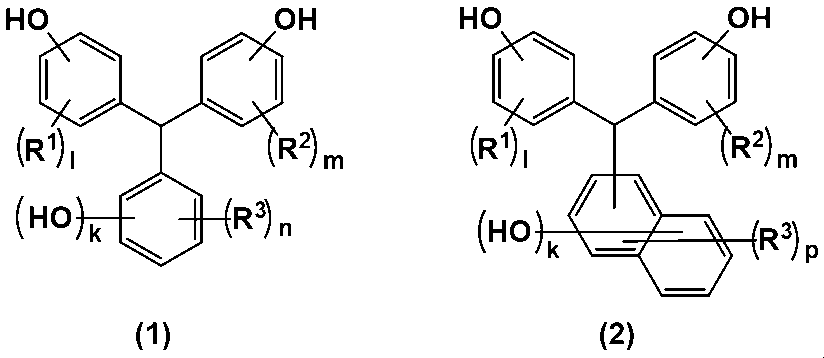
- the present invention is a thermosetting resin composition containing a curing agent (A), a cross-linking agent (B) and a curing catalyst (C), wherein the curing agent (A) is represented by the following formula (1) or ( A triarylmethane type compound (A1) represented by 2), a phenol compound (A2) having a phenol or an aliphatic hydrocarbon group having 1 to 20 carbon atoms, and an aldehyde compound (A3) are used as essential reaction raw materials.
- the present invention relates to a thermosetting resin composition which is a phenolic hydroxyl group-containing resin which is a reaction product of a novolak resin intermediate (M) and an alkene compound (A4) having 6 to 20 carbon atoms.
- R 1 is an aliphatic hydrocarbon group, an aromatic ring-containing hydrocarbon group, an alkoxy group, or a halogen atom.
- R 2 is an aliphatic hydrocarbon group, an aromatic ring-containing hydrocarbon group, an alkoxy group, or a halogen atom.
- R 3 is an aliphatic hydrocarbon group, an aromatic ring-containing hydrocarbon group, an alkoxy group, or a halogen atom.
- k is an integer of 0 to 2.
- l is an integer of 0 to 4.
- m is an integer of 0 to 4.
- n is an integer of 0 to 5.
- p is an integer of 0 to 7.
- thermosetting resin composition capable of obtaining a cured product having high heat resistance and high stress relaxation property.
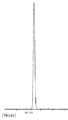
- FIG. 3 is a 13 C-NMR chart diagram of triarylmethane obtained in Synthesis Example 1.
- FIG. 3 is a GPC chart diagram of a novolac-type phenol resin intermediate (M-1) obtained in Synthesis Example 2.
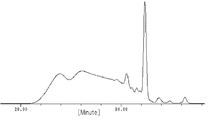
- FIG. 6 is a GPC chart diagram of a novolac-type phenol resin intermediate (M-2) obtained in Synthesis Example 3.
- FIG. 7 is a GPC chart diagram of a novolac-type phenol resin intermediate (M-3) obtained in Synthesis Example 4.
- FIG. 3 is a GPC chart of the phenolic hydroxyl group-containing resin (A-1) obtained in Production Example 1.
- FIG. 3 is a GPC chart of the phenolic hydroxyl group-containing resin (A-2) obtained in Production Example 2.
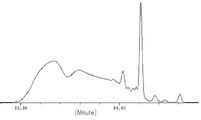
- FIG. 7 is a GPC chart of the phenolic hydroxyl group-containing resin (A-3) obtained in Production Example 3.
- FIG. 6 is a GPC chart of the phenolic hydroxyl group-containing resin (A-4) obtained in Production Example 4.
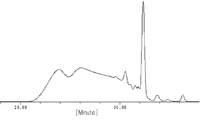
- FIG. 6 is a GPC chart of the phenolic hydroxyl group-containing resin (A-5) obtained in Production Example 5.
- FIG. 3 is a GPC chart of the phenolic hydroxyl group-containing resin (A-1′) obtained in Comparative Production Example 1.
- FIG. 6 is a GPC chart of a phenolic hydroxyl group-containing resin (A2′) obtained in Comparative Production Example 2.
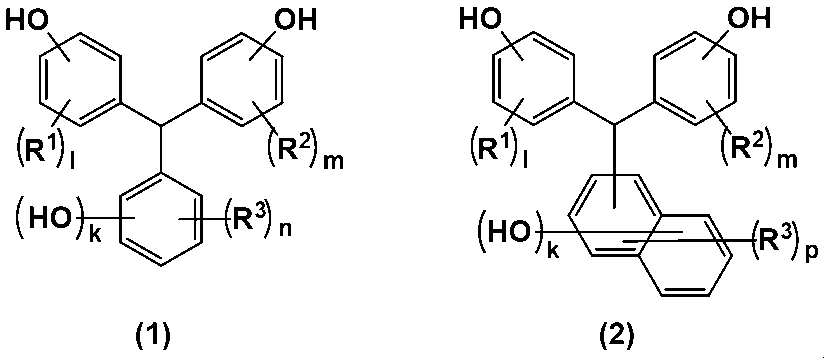
- the thermosetting resin composition of the present invention contains a curing agent (A), a crosslinking agent (B) and a curing catalyst (C), and the curing agent (A) is represented by the following formula (1) or (2).
- Novolak resin intermediate using as an essential reaction raw material a triarylmethane type compound (A1), a phenol compound (A2) having a phenol or an aliphatic hydrocarbon group having 1 to 20 carbon atoms, and an aldehyde compound (A3)
- a phenolic hydroxyl group-containing resin which is a reaction product of (M) and an alkene compound (A4) having 6 to 20 carbon atoms.
- R 1 is an aliphatic hydrocarbon group, an aromatic ring-containing hydrocarbon group, an alkoxy group, or a halogen atom.
- R 2 is an aliphatic hydrocarbon group, an aromatic ring-containing hydrocarbon group, an alkoxy group, or a halogen atom.
- R 3 is an aliphatic hydrocarbon group, an aromatic ring-containing hydrocarbon group, an alkoxy group, or a halogen atom.
- k is an integer of 0 to 2.
- l is an integer of 0 to 4.
- m is an integer of 0 to 4.
- n is an integer of 0 to 5.
- p is an integer of 0 to 7.
- thermosetting resin composition of the present invention Since the phenolic hydroxyl group-containing resin has a highly symmetrical and rigid structural site derived from the formula (1) or (2) as a repeating unit and has a phenolic hydroxyl group at a high density, The cured product obtained from the curable resin composition can exhibit high heat resistance. Further, a cured product obtained from the thermosetting resin composition of the present invention by introducing an alkene compound (A4) having 6 to 20 carbon atoms into the phenolic hydroxyl group-containing resin maintains high heat resistance. It can also exhibit high stress relaxation property. In general, the introduction of a long-chain aliphatic hydrocarbon group into the resin structure has an effect of improving the stress relaxation property, but it is always the case that the heat resistance is reduced due to the decrease in the functional group density. In the thermosetting resin composition (1), such effect trade-off does not occur, and a cured product excellent in both heat resistance and stress relaxation property can be obtained.
- each component contained in the thermosetting resin composition of the present invention will be described.
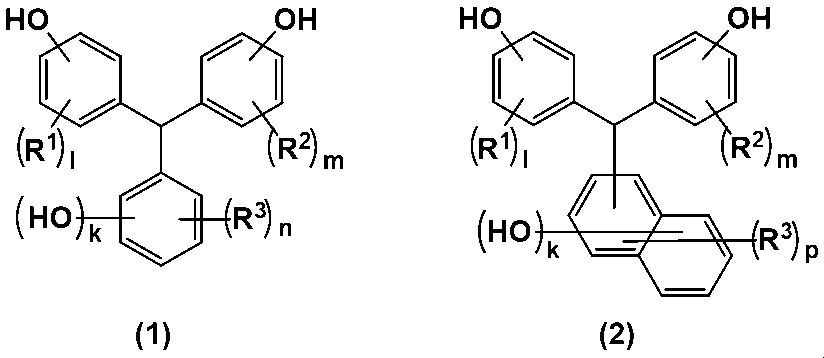
- the curing agent (A) is a triarylmethane type compound (A1) represented by the following formula (1) or (2), phenol or a phenol compound (A2) having an aliphatic hydrocarbon group having 1 to 20 carbon atoms. And a phenolic hydroxyl group-containing resin which is a reaction product of a novolak resin intermediate (M) containing aldehyde compound (A3) as an essential reaction raw material and an alkene compound (A4) having 6 to 20 carbon atoms.
- A1 triarylmethane type compound represented by the following formula (1) or (2)
- phenol or a phenol compound (A2) having an aliphatic hydrocarbon group having 1 to 20 carbon atoms and a phenolic hydroxyl group-containing resin which is a reaction product of a novolak resin intermediate (M) containing aldehyde compound (A3) as an essential reaction raw material and an alkene compound (A4) having 6 to 20 carbon atoms.
- R 1 is an aliphatic hydrocarbon group, an aromatic ring-containing hydrocarbon group, an alkoxy group, or a halogen atom.
- R 2 is an aliphatic hydrocarbon group, an aromatic ring-containing hydrocarbon group, an alkoxy group, or a halogen atom.
- R 3 is an aliphatic hydrocarbon group, an aromatic ring-containing hydrocarbon group, an alkoxy group, or a halogen atom.
- k is an integer of 0 to 2.
- l is an integer of 0 to 4.
- m is an integer of 0 to 4.
- n is an integer of 0 to 5.
- p is an integer of 0 to 7.
- R 2 When R 2 are a plurality, the plurality of R 2 may be the same or different. If there are a plurality of R 3, a plurality of R 3 may be the same or different.
- the hydroxyl group, R 3 which is a substituent on the naphthalene ring in the formula (2), may be bonded to any ring of the naphthalene ring, and the bonding position with the carbon atom is not limited. It shows that there is no.
- the aliphatic hydrocarbon group represented by R 1 , R 2 and R 3 may be a straight-chain type or a branched type, and has an unsaturated group in the structure. It doesn't matter whether you have one or not.
- the number of carbon atoms of the aliphatic hydrocarbon group is not particularly limited, and may be either a short chain having 1 to 6 carbon atoms or a relatively long chain having 7 or more carbon atoms.
- aliphatic hydrocarbon group of R 1 , R 2 and R 3 include methyl group, ethyl group, propyl group, isopropyl group, butyl group, t-butyl group, pentyl group, hexyl group and cyclohexyl group.
- the aromatic ring-containing hydrocarbon group of R 1 , R 2 and R 3 is not particularly limited as long as it is a substituent containing an aromatic ring.
- Specific examples of the aromatic ring-containing hydrocarbon group of R 1 , R 2 and R 3 include aryl groups such as phenyl group, tolyl group, xylyl group, naphthyl group and anthryl group; benzyl group, phenylethyl group, phenylpropyl group. And aralkyl groups such as naphthylmethyl group.
- alkoxy group of R 1 , R 2 and R 3 include a methoxy group, an ethoxy group, a propyloxy group, a butoxy group, a pentyloxy group, a hexyloxy group and a cyclohexyloxy group.
- halogen atom represented by R 1 , R 2 and R 3 include a fluorine atom, a chlorine atom, a bromine atom and an iodine atom.
- 1 and m are preferably integers of 2 to 3, respectively.
- 1 and m are each an integer of 2
- two R 1 and two R 2 are each independently an alkyl group having 1 to 3 carbon atoms.
- two R 1 and two R 2 are preferably bonded to the 2,5-position of the phenolic hydroxyl group, respectively.
- n is preferably an integer of 0-2.
- p is preferably an integer of 0 to 3.
- k is preferably 1.
- the bonding positions of the three phenolic hydroxyl groups in the molecular structure are preferably in the para position with respect to the methine group that links the three aromatic rings.
- the formula (2) when k is 1, it may be bonded to any ring of the naphthalene ring.
- triarylmethane type compound (A1) those having the same structure may be used alone, or a plurality of compounds having different molecular structures may be used in combination.
- the triarylmethane type compound (A1) represented by the formula (1) is preferable because it is a phenolic hydroxyl group-containing resin having an excellent balance of heat resistance and stress relaxation property.
- the triarylmethane type compound (A1) is obtained, for example, by a condensation reaction of the phenol compound (a1) and the aromatic aldehyde compound (a2).
- the phenol compound (a1) include phenol and compounds in which one or more hydrogen atoms on the aromatic nucleus of phenol are substituted with an alkyl group, an alkoxy group, a halogen atom, or the like. These may be used alone or in combination of two or more. Since the phenol compound (a1) is a phenolic hydroxyl group-containing resin having excellent heat resistance, an aliphatic hydrocarbon group, an aromatic ring-containing hydrocarbon group, an alkoxy group or a halogen atom is respectively added to the 2,5-position of phenol.
- the compound having it is preferable, the compound having an alkyl group having 1 to 3 carbon atoms at the 2,5-position is preferable, and 2,5-xylenol is particularly preferable.
- the aromatic aldehyde compound (a2) is, for example, a compound having a formyl group on the aromatic nucleus such as benzene, naphthalene, phenol, resorcin, naphthol, dihydroxynaphthalene, etc., in addition to the formyl group, an alkyl group, an alkoxy group, a halogen atom, etc. And a compound having These may be used alone or in combination of two or more. Among them, a resin having a benzene ring structure is preferable because it is a phenolic hydroxyl group-containing resin having an excellent balance between heat resistance and developability.
- aromatic aldehyde compound (a2) examples include benzaldehyde, salicylaldehyde, m-hydroxybenzaldehyde and p-hydroxybenzaldehyde, with salicylaldehyde, m-hydroxybenzaldehyde and p-hydroxybenzaldehyde being preferred.
- the reaction molar ratio [(a1)/(a2)] of the phenol compound (a1) and the aromatic aldehyde compound (a2) is such that the target triarylmethane type compound (A1) can be obtained in high yield and high purity. Therefore, the range of 1/0.2 to 1/0.5 is preferable, and the range of 1/0.25 to 1/0.45 is more preferable.
- the reaction between the phenol compound (a1) and the aromatic aldehyde compound (a2) is preferably carried out in the presence of an acid catalyst.
- an acid catalyst used here include acetic acid, oxalic acid, sulfuric acid, hydrochloric acid, phenolsulfonic acid, paratoluenesulfonic acid, zinc acetate and manganese acetate. These acid catalysts may be used alone or in combination of two or more kinds. Among these, sulfuric acid and paratoluenesulfonic acid are preferable because of their excellent catalytic activity.
- the reaction between the phenol compound (a1) and the aromatic aldehyde compound (a2) may be carried out in an organic solvent, if necessary.
- organic solvent used here include monoalcohols such as methanol, ethanol and propanol; ethylene glycol, 1,2-propanediol, 1,3-propanediol, 1,4-butanediol, 1,5-pentanediol, Polyols such as 1,6-hexanediol, 1,7-heptanediol, 1,8-octanediol, 1,9-nonanediol, trimethylene glycol, diethylene glycol, polyethylene glycol and glycerin; 2-ethoxyethanol, ethylene glycol monomethyl Glycol ethers such as ether, ethylene glycol monoethyl ether, ethylene glycol monopropyl ether, ethylene glycol monobutyl ether, ethylene glycol monopentyl ether,
- the reaction between the phenol compound (a1) and the aromatic aldehyde compound (a2) may be carried out, for example, in the temperature range of 60 to 140° C. for 0.5 to 20 hours.
- the reaction product is put into a poor solvent (S1) of the triarylmethane type compound (A1) to separate the precipitate by filtration, and then the solubility of the triarylmethane type compound (A1) is reduced.
- An unreacted phenol compound (a1) or aromatic aldehyde compound (a2) is obtained from the reaction product by a method of re-dissolving the obtained precipitate in a solvent (S2) which is expensive and miscible with the poor solvent (S1).
- the acid catalyst used can be removed to obtain a purified triarylmethane type compound (A1).
- the reaction product is heated to 80° C. or higher to produce the triarylmethane.
- an aromatic hydrocarbon solvent such as toluene or xylene
- the purity of the triarylmethane type compound (A1) calculated from the GPC chart is preferably 90% or more, more preferably 94% or more, and particularly preferably 98% or more.
- the purity of the triarylmethane type compound (A1) can be determined from the area ratio of the gel permeation chromatography (GPC) chart.
- GPC measurement conditions are as follows.
- Measuring device "HLC-8220 GPC” manufactured by Tosoh Corporation Column: Showa Denko KK “Shodex KF802" (8.0mm ⁇ 300mm) + Showa Denko KK “Shodex KF802” (8.0mm ⁇ 300mm) + Showa Denko KK “Shodex KF803" (8.0mm ⁇ 300mm) + Showa Denko KK “Shodex KF804" (8.0mm ⁇ 300mm)
- Data processing "GPC-8020 model II version 4.30" manufactured by Tosoh Corporation Developing solvent: Tetrahydrofuran Flow rate: 1.0 ml/min Sample: A 0.5% by mass solution of tetrahydrofuran in terms of resin solid content filtered through a microfilter Injection volume: 0.1 ml Standard sample: Monodisperse polystyrene shown
- the poor solvent (S1) used for purifying the triarylmethane type compound (A1) is, for example, water; monoalcohol such as methanol, ethanol, propanol, ethoxyethanol; n-hexane, n-heptane, n-octane, cyclohexane, etc. Aliphatic hydrocarbons; aromatic hydrocarbons such as toluene and xylene. These may be used alone or in combination of two or more. Among them, water, methanol, and ethoxyethanol are preferable because they have excellent solubility of the acid catalyst.
- the solvent (S2) is, for example, a monoalcohol such as methanol, ethanol or propanol; ethylene glycol, 1,2-propanediol, 1,3-propanediol, 1,4-butanediol, 1,5-pentanediol, 1 ,6-hexanediol, 1,7-heptanediol, 1,8-octanediol, 1,9-nonanediol, trimethylene glycol, diethylene glycol, polyethylene glycol, glycerin and other polyols; 2-ethoxyethanol, ethylene glycol monomethyl ether , Ethylene glycol monoethyl ether, ethylene glycol monopropyl ether, ethylene glycol monobutyl ether, ethylene glycol monopentyl ether, ethylene glycol dimethyl ether, ethylene glycol ethyl methyl ether, ethylene glycol monophenyl ether and
- the aliphatic hydrocarbon group having 1 to 20 carbon atoms may be either a straight chain type one or a branched one.
- the structure may or may not have an unsaturated group in the structure.
- the phenol compound (A2) is preferably a phenol having an aliphatic hydrocarbon group having 1 to 7 carbon atoms, because it is a phenolic hydroxyl group-containing resin having an excellent balance of heat resistance and stress relaxation property, and 1 to 4 carbon atoms.
- the phenol having an alkyl group is more preferable, and the phenol having a methyl group is further preferable.
- the substitution position of the aliphatic hydrocarbon group is preferably a meta position with respect to the phenolic hydroxyl group.
- Specific examples of the phenol compound (A2) include m-cresol.
- the reaction ratio between the triarylmethane type compound (A1) and the phenol compound (A2) is appropriately changed depending on the desired resin performance, intended use and the like. Since it is a phenolic hydroxyl group-containing resin having an excellent balance of heat resistance and stress relaxation property, the molar ratio [(A1)/(A2)] of the triarylmethane type compound (A1) and the phenol compound (A2) is 90/10.
- the range is preferably from 30 to 70/70, more preferably from 80/20 to 40/60.
- the aldehyde compound (A3) may be any compound that can undergo a condensation reaction with the triarylmethane type compound (A1) and the phenol compound (A2) to form a novolac type phenolic hydroxyl group-containing resin.
- Specific examples of the aldehyde compound (A3) include formaldehyde, paraformaldehyde, 1,3,5-trioxane, acetaldehyde, propionaldehyde, tetraoxymethylene, polyoxymethylene, chloral, hexamethylenetetramine, furfural, glyoxal, n-butyl.
- Aldehyde, caproaldehyde, allyl aldehyde, crotonaldehyde, acrolein, etc. are mentioned. It is preferable to use one or more selected from formaldehyde and paraformaldehyde because of their excellent reactivity. These may be used alone or in combination of two or more.
- formaldehyde When formaldehyde is used as the formaldehyde compound (A3), the formaldehyde may be used as formalin in an aqueous solution state or as paraformaldehyde in a solid state. When formaldehyde and other aldehyde compounds are used in combination as the formaldehyde compound (A3), it is preferable to use the other aldehyde compounds in a ratio of 0.05 to 1.0 mol with respect to 1 mol of formaldehyde. ..
- the novolak resin intermediate (M) contains a triarylmethane type compound (A), a phenol compound (A2) and an aldehyde compound (A3) as essential reaction raw materials.
- the novolak resin intermediate (M) may be prepared by using the triarylmethane type compound (A), the phenol compound (A2) and the aldehyde compound (A3) as essential reaction raw materials, and further reacting with other phenolic hydroxyl group-containing compounds. Good as raw material
- Examples of the other phenolic hydroxyl group-containing compounds include dihydroxybenzene, phenylphenol, bisphenol, naphthol, dihydroxynaphthalene and the like. These may be used alone or in combination of two or more.
- the other phenolic hydroxyl group-containing compound is used, the effect of the present invention is sufficiently exerted, so that triaryl is contained in 100 parts by mass of the total amount of the phenolic hydroxyl group-containing compound raw material of the novolak resin intermediate (M).
- the total amount of the methane type compound (A1) and the phenol compound (A2) is preferably 50 parts by mass or more, more preferably 80 parts by mass or more.
- the reaction molar ratio [[(A1)+(A2)]/(A3)] of the triarylmethane type compound (A1), the phenol compound (A2) and the aldehyde compound (A3) is excessively high in molecular weight (gelation). Is preferable, and a phenolic hydroxyl group-containing resin having a suitable molecular weight as a resist composition can be obtained. Therefore, the range of 1/0.5 to 1/1.2 is preferable, and 1/0.6 to 1 The range of /0.9 is more preferable.
- the reaction molar ratio [(P)/(A3)] of the total of the phenolic hydroxyl group-containing compound raw material (P) and the aldehyde compound (A3) is 1/ It is preferably in the range of 0.5 to 1/1.2, and more preferably in the range of 1/0.6 to 1/0.9.
- the reaction of the triarylmethane type compound (A1), the phenol compound (A2) and the aldehyde compound (A3) is preferably carried out under acid catalyst conditions.
- the acid catalyst used here include acetic acid, oxalic acid, sulfuric acid, hydrochloric acid, phenolsulfonic acid, paratoluenesulfonic acid, zinc acetate and manganese acetate. These acid catalysts may be used alone or in combination of two or more kinds. Among these, sulfuric acid and paratoluenesulfonic acid are preferable because of their excellent catalytic activity.
- the reaction of the triarylmethane type compound (A1), the phenol compound (A2) and the aldehyde compound (A3) may be carried out in an organic solvent, if necessary.
- the solvent used here include monoalcohols such as methanol, ethanol and propanol; ethylene glycol, 1,2-propanediol, 1,3-propanediol, 1,4-butanediol, 1,5-pentanediol, 1 ,6-hexanediol, 1,7-heptanediol, 1,8-octanediol, 1,9-nonanediol, trimethylene glycol, diethylene glycol, polyethylene glycol, glycerin and other polyols; 2-ethoxyethanol, ethylene glycol monomethyl ether , Ethylene glycol monoethyl ether, ethylene glycol monopropyl ether, ethylene glycol monobutyl ether, ethylene glyco
- the reaction of the triarylmethane type compound (A1), the phenol compound (A2) and the aldehyde compound (A3) may be carried out at a temperature range of 60 to 140° C. for 0.5 to 20 hours.
- the novolak resin intermediate (M) can be obtained by adding water to the reaction product and performing reprecipitation operation.
- the weight average molecular weight (Mw) of the novolak resin intermediate (M) thus obtained has an excellent balance of heat resistance and stress relaxation property, and a phenolic hydroxyl group-containing resin suitable for a resist material can be obtained. It is preferably in the range of 000 to 50,000.
- the polydispersity (Mw/Mn) of the novolak resin intermediate (M) is preferably in the range of 3-10.
- the weight average molecular weight (Mw) and the polydispersity (Mw/Mn) are values measured by GPC under the following conditions.
- GPC measurement conditions Measuring device: "HLC-8220 GPC” manufactured by Tosoh Corporation Column: Showa Denko KK “Shodex KF802" (8.0 mm ⁇ 300 mm) + Showa Denko KK “Shodex KF802” (8.0 mm ⁇ 300 mm) + Showa Denko KK “Shodex KF803" (8.0 mm ⁇ 300 mm) + Showa Denko KK “SHOdex KF804" (8.0 mm ⁇ 300 mm) Column temperature: 40°C Detector: RI (differential refractometer) Data processing: "GPC-8020 model II version 4.30" manufactured by Tosoh Corporation Developing solvent: Tetrahydrofuran Flow rate: 1.0 mL/min Sample: 0.5% by mass tetrahydrofuran
- the alkene compound (A4) having 6 to 20 carbon atoms is not particularly limited in molecular structure as long as it has an ethylenic double bond site capable of reacting with the novolak resin intermediate (M).
- Examples of the alkene compound (A4) having 6 to 20 carbon atoms include compounds represented by the following formula (3).
- the alkene compound (A4) having 6 to 20 carbon atoms one type may be used alone, or two or more types may be used in combination.
- R 7 is an aliphatic hydrocarbon group having 4 to 18 carbon atoms.
- R 7 in the above formula (3) may be either a straight-chain type or a branched one having a branched structure as long as it is an aliphatic hydrocarbon group having 4 to 18 carbon atoms. It may be either with or without.
- R 7 is preferably a straight-chain alkyl group, and particularly preferably has a carbon atom number in the range of 4 to 18, because it is a phenolic hydroxyl group-containing resin that is particularly excellent in stress relaxation.
- the reaction ratio between the novolak resin intermediate (M) and the alkene compound having 6 to 20 carbon atoms (A4) is a phenolic hydroxyl group-containing resin having an excellent balance of heat resistance and stress relaxation property.
- the proportion of the alkene compound (A4) having 6 to 20 carbon atoms is 0.5 to 30% by mass based on the total mass of (M) and the alkene compound (A4) having 6 to 20 carbon atoms. preferable.
- the reaction between the novolak resin intermediate (M) and the alkene compound having 6 to 20 carbon atoms (A4) is preferably carried out in the presence of an acid catalyst.
- an acid catalyst used here include acetic acid, oxalic acid, sulfuric acid, hydrochloric acid, phenolsulfonic acid, paratoluenesulfonic acid, zinc acetate and manganese acetate. These acid catalysts may be used alone or in combination of two or more kinds. Among these, sulfuric acid is preferable because of its excellent catalytic activity.
- the reaction between the novolak resin intermediate (M) and the alkene compound having 6 to 20 carbon atoms (A4) may be carried out in an organic solvent, if necessary.
- Solvents used here are, for example, monoalcohols such as methanol, ethanol, propanol; ethylene glycol, 1,2-propanediol, 1,3-propanediol, 1,4-butanediol, 1,5-pentanediol, 1 ,6-hexanediol, 1,7-heptanediol, 1,8-octanediol, 1,9-nonanediol, trimethylene glycol, diethylene glycol, polyethylene glycol, glycerin and other polyols; 2-ethoxyethanol, ethylene glycol monomethyl ether , Ethylene glycol monoethyl ether, ethylene glycol monopropyl ether, ethylene glycol monobutyl ether, ethylene glyco
- the reaction between the novolak resin intermediate (M) and the alkene compound having 6 to 20 carbon atoms (A4) may be carried out, for example, in the temperature range of 60 to 140° C. for 0.5 to 20 hours.
- the desired phenolic hydroxyl group-containing resin can be obtained by adding water to the reaction product to carry out a reprecipitation operation and appropriately washing with an organic solvent or the like.
- the weight average molecular weight (Mw) of the phenolic hydroxyl group-containing resin thus obtained is preferably in the range of 3,500 to 50,000 because it has an excellent balance of heat resistance and stress relaxation property.
- the polydispersity (Mw/Mn) of the phenolic hydroxyl group-containing resin is preferably in the range of 3-10.
- the phenolic hydroxyl group-containing resin that is the curing agent (A) preferably has a structural moiety ( ⁇ ) represented by the following formula (4) or (5) and a structural moiety ( ⁇ ) represented by the following formula (6). Is a resin having as a repeating unit.
- R 1 is an aliphatic hydrocarbon group, an aromatic ring-containing hydrocarbon group, an alkoxy group, or a halogen atom.
- R 2 is an aliphatic hydrocarbon group, an aromatic ring-containing hydrocarbon group, an alkoxy group, or a halogen atom.
- R 3 is an aliphatic hydrocarbon group, an aromatic ring-containing hydrocarbon group, an alkoxy group, or a halogen atom.
- R 4 is a hydrogen atom or an aliphatic hydrocarbon group having 1 to 7 carbon atoms.
- R 5 is a hydrogen atom or an aliphatic hydrocarbon group having 6 to 20 carbon atoms.
- R 101 is a hydrogen atom, an aliphatic hydrocarbon group, or an aromatic ring-containing hydrocarbon group.
- k is an integer of 0 to 2.
- l is an integer of 0 to 4.
- m is an integer of 0 to 4.
- n is an integer of 0 to 5.
- p is an integer of 0 to 7.
- R 1 is a plurality
- the plurality of R 1 may be the same or different.
- R 2 are a plurality
- the plurality of R 2 may be the same or different. If there are a plurality of R 3, a plurality of R 3 may be the same or different.
- at least one of R 1 , R 2 , R 3 and R 5 is an aliphatic hydrocarbon group having 6 to 20 carbon atoms.
- the aliphatic hydrocarbon group represented by R 101 in formulas (4), (5) and (6) is, for example, a methyl group, an ethyl group, a propyl group, an isopropyl group, a butyl group, a t-butyl group, a pentyl group or a hexyl group.
- the aromatic ring-containing hydrocarbon group of R 101 in formulas (4), (5) and (6) is, for example, a phenyl group, a tolyl group, a xylyl group, a naphthyl group, an anthryl group, and an alkyl group on the aromatic nucleus thereof. , An alkoxy group, a substituted or unsubstituted aryl group substituted with a halogen atom and the like.
- R 101 in the formulas (4), (5) and (6) is a phenolic hydroxyl group-containing resin having excellent heat resistance and stress relaxation property, it is a hydrogen atom or an alkyl group having 1 to 6 carbon atoms. Is preferred, and a hydrogen atom is more preferred.
- the aliphatic hydrocarbon group having 1 to 7 carbon atoms represented by R 4 in the formula (6) may be a straight-chain type or a branched type, and may or may not have an unsaturated group in the structure. Either one can be used.
- the aliphatic hydrocarbon group having 1 to 7 carbon atoms represented by R 4 is preferably an alkyl group having 1 to 7 carbon atoms, more preferably an alkyl group having 1 to 4 carbon atoms, and a methyl group. And more preferable.
- the substitution position of R 4 is preferably a meta position with respect to the phenolic hydroxyl group.
- R 1 , R 2 , R 3 and R 5 is an aliphatic hydrocarbon group having 6 to 20 carbon atoms, and the number of carbon atoms is 6 or less.
- the aliphatic hydrocarbon groups Nos. 20 to 20 may be straight-chain or branched-chain, and may or may not have an unsaturated group in the structure.
- the aliphatic hydrocarbon group having 6 to 20 carbon atoms is preferably an alkyl group having 6 to 20 carbon atoms, and more preferably an alkyl group having 8 to 18 carbon atoms.
- * in the formulas (4) and (5) is a bonding point with any of the three aromatic rings illustrated in the formulas (4) and (5), and two * are They may be bonded to the same aromatic ring, or may be bonded to different aromatic rings.
- Examples of the structural moiety represented by the structural formula (4) include structural moieties represented by any of the following formulas (4-1) to (4-4).
- Examples of the structural moiety represented by the above formula (5) include structural moieties represented by any of the following formulas (5-1) to (5-4).
- all structural sites ( ⁇ ) existing in the resin may have the same structure, or may have a plurality of different structures. Since it is a phenolic hydroxyl group-containing resin having an excellent balance of heat resistance and stress relaxation property, it is preferable to have a structural site represented by formula (4). Further, the value of k in the formulas (4) and (5) is preferably 1. For example, when k is 1, it is preferable that the bonding positions of the three phenolic hydroxyl groups in the formula (1) are all para to the methine group that links the three aromatic rings.
- the abundance ratio of the structural part ( ⁇ ) and the structural part ( ⁇ ) may be appropriately changed according to the desired resin performance, application, etc. Since it is a phenolic hydroxyl group-containing resin that has an excellent balance of heat resistance and stress relaxation properties, the abundance ratio [( ⁇ )/( ⁇ )] of structural sites ( ⁇ ) and structural sites ( ⁇ ) is 90/10 to 30 The range of /70 is preferable, and the range of 80/20 to 40/60 is more preferable.
- the phenolic hydroxyl group-containing resin Since the abundance ratio of the aliphatic hydrocarbon group having 6 to 20 carbon atoms in the phenolic hydroxyl group-containing resin is a phenolic hydroxyl group-containing resin having an excellent balance of heat resistance and stress relaxation property, the phenolic hydroxyl group-containing resin is In the resin, the proportion of the aliphatic hydrocarbon group having 6 to 20 carbon atoms is preferably 0.5 to 30% by mass.
- Cross-linking agent (B) examples include phenol resin, urea resin, melamine resin, furan resin, xylene resin, epoxy resin, unsaturated polyester resin, thermosetting polyimide, and thermosetting polyamide-imide. It is preferably one or more selected from curable polyimide and thermosetting polyamide-imide.
- the epoxy resin include bisphenol A type epoxy resin, bisphenol F type epoxy resin, bisphenol S type epoxy resin, bisphenol AD type epoxy resin and the like; orthocresol novolac type epoxy resin, phenol novolac type Epoxy resin, naphthol novolac type epoxy resin, bisphenol A novolac type epoxy resin, brominated phenol novolac type epoxy resin, alkylphenol novolac type epoxy resin, bisphenol S novolac type epoxy resin, alkoxy group-containing novolac type epoxy resin, brominated phenol novolac type Novolac type epoxy resins such as epoxy resins; phenol aralkyl type epoxy resins (commonly known as epoxies of Zyloc resin), diglycidyl ether of resorcin, diglycidyl ether of hydroquinone, diglycidyl ether of catechol, biphenyl type epoxy resin, tetramethylbiphenyl type Bifunctional epoxy resin such as epoxy resin, sulfur-containing epoxy resin, stilbene type epoxy resin,
- the bis(hydroxynaphthalene) type epoxy resin is, for example, a resin containing a compound represented by any one of the following structural formulas (7-1) to (7-4) as an essential reaction raw material.
- R 14 is an alkyl group, an aryl group, an aralkyl group, a substituent in which one or more hydrogen atoms contained therein are substituted with an alkoxy group or a halogen atom, an alkoxy group, or a halogen atom. If R 14 is plural, R 14 may be the same or different.
- m is 0 or an integer of 1 to 6.
- n is 0 or an integer of 1 to 5.
- the compound represented by any of the structural formulas (7-1) to (7-4) is obtained by, for example, reacting a corresponding naphthol compound or dihydroxynaphthalene compound with formaldehyde under an alkaline catalyst condition. It can be produced by a method of converting a product into a polyglycidyl ether.
- cross-linking agent (B) for example, a melamine compound, a guanamine compound, a glycoluril compound, a urea compound, a resole resin, an epoxy compound substituted with one or more groups selected from a methylol group, an alkoxymethyl group and an acyloxymethyl group.
- an isocyanate compound, an azide compound, a compound containing a double bond such as an alkenyl ether group, an acid anhydride, an oxazoline compound and the like can be used.
- the melamine compound examples include hexamethylolmelamine, hexamethoxymethylmelamine, a compound in which 1 to 6 methylol groups of hexamethylolmelamine are methoxymethylated, hexamethoxyethylmelamine, hexaacyloxymethylmelamine, and hexamethylolmelamine.
- Examples thereof include compounds in which 1 to 6 methylol groups are acyloxymethylated.
- guanamine compound examples include, for example, tetramethylolguanamine, tetramethoxymethylguanamine, tetramethoxymethylbenzoguanamine, a compound in which 1 to 4 methylol groups of tetramethylolguanamine are methoxymethylated, tetramethoxyethylguanamine, tetraacyloxyguanamine, Examples thereof include compounds in which 1 to 4 methylol groups of tetramethylolguanamine are acyloxymethylated.
- glycoluril compound examples include 1,3,4,6-tetrakis(methoxymethyl)glycoluril, 1,3,4,6-tetrakis(butoxymethyl)glycoluril, 1,3,4,6-tetrakis. (Hydroxymethyl)glycoluril and the like can be mentioned.
- urea compound examples include 1,3-bis(hydroxymethyl)urea, 1,1,3,3-tetrakis(butoxymethyl)urea and 1,1,3,3-tetrakis(methoxymethyl)urea. Can be mentioned.
- resol resin examples include phenol, alkylphenols such as cresol and xylenol, phenylphenol, resorcinol, biphenyl, bisphenols such as bisphenol A and bisphenol F, naphthol, phenolic hydroxyl group-containing compounds such as dihydroxynaphthalene, and aldehyde compounds.
- alkylphenols such as cresol and xylenol
- phenylphenol phenylphenol
- resorcinol biphenyl
- bisphenols such as bisphenol A and bisphenol F
- naphthol phenolic hydroxyl group-containing compounds
- dihydroxynaphthalene examples of aldehyde compounds.
- aldehyde compounds examples include polymers obtained by reacting under alkaline catalyst conditions.
- epoxy compound examples include tris(2,3-epoxypropyl)isocyanurate, trimethylolmethane triglycidyl ether, trimethylolpropane triglycidyl ether, triethylolethane triglycidyl ether, and the like.
- isocyanate compound examples include tolylene diisocyanate, diphenylmethane diisocyanate, hexamethylene diisocyanate, cyclohexane diisocyanate, and the like.
- azide compound examples include 1,1'-biphenyl-4,4'-bisazide, 4,4'-methylidene bisazide, 4,4'-oxybisazide and the like.
- Examples of the compound having a double bond such as the alkenyl ether group include ethylene glycol divinyl ether, triethylene glycol divinyl ether, 1,2-propanediol divinyl ether, 1,4-butanediol divinyl ether, and tetramethylene glycol divinyl ether.
- Vinyl ether neopentyl glycol divinyl ether, trimethylolpropane trivinyl ether, hexanediol divinyl ether, 1,4-cyclohexanediol divinyl ether, pentaerythritol trivinyl ether, pentaerythritol tetravinyl ether, sorbitol tetravinyl ether, sorbitol pentavinyl ether, trimethylolpropane trivinyl ether. Vinyl ether etc. are mentioned.
- the acid anhydride examples include phthalic anhydride, trimellitic anhydride, pyromellitic anhydride, 3,3′,4,4′-benzophenonetetracarboxylic dianhydride, biphenyltetracarboxylic dianhydride, and 4 ,4'-(Isopropylidene)diphthalic anhydride, 4,4'-(hexafluoroisopropylidene)diphthalic anhydride, and other aromatic acid anhydrides; tetrahydrophthalic anhydride, methyltetrahydrophthalic anhydride, hexahydroanhydride Examples thereof include alicyclic carboxylic acid anhydrides such as phthalic acid, methylhexahydrophthalic anhydride, endomethylenetetrahydrophthalic anhydride, dodecenylsuccinic anhydride, and trialkyltetrahydrophthalic anhydride.
- the crosslinking agents may be used alone or in combination of two or more.
- the content of the crosslinking agent (B) in the thermosetting resin composition of the present invention is 0.1 to 50 parts by mass with respect to 100 parts by mass of the phenolic hydroxyl group-containing resin which is the curing agent (A).
- the amount is preferably 0.1 to 30 parts by mass, more preferably 0.5 to 30 parts by mass.
- Examples of the curing catalyst (C) include amine-based curing catalysts and phosphine-based curing catalysts.
- Examples of the amine-based curing catalyst include 2,4-diamino-6-[2′-methylimidazolyl-(1′)]ethyl-s-triazine and 1,8-diazabicyclo[5,4,0]undecene-7( DBU), triethylenediamine, benzyldimethylamine, triethanolamine, imidazole, 2-methylimidazole, 2-ethylimidazole, 2-ethyl-4-methylimidazole, 2-phenylimidazole, 4-phenylimidazole, 1-cyanoethyl-2.
- phosphine-based curing catalyst examples include triphenylphosphine, tributylphosphine, tri(p-methylphenyl)phosphine, tri(nonylphenyl)phosphine, and the like.
- the curing catalyst may be used alone or in combination of two or more.
- the content of the curing catalyst (C) in the thermosetting resin composition of the present invention is 0.1 to 3.0 parts by mass with respect to 100 parts by mass of the phenolic hydroxyl group-containing resin which is the curing agent (A). It is preferable to have.
- thermosetting resin composition of the present invention may or may not contain the photosensitizer (D).
- thermosetting resin composition of the present invention contains the photosensitizer (D)
- it can be used as a thermosetting photoresist composition.
- Examples of the photosensitizer (D) include compounds having a quinonediazide group.
- Specific examples of the compound having a quinonediazide group include ester compounds or amidated compounds of an aromatic (poly)hydroxy compound and a sulfonic acid compound having a quinonediazide group.
- the ester compound also includes a partial ester compound, and the amidation product includes a partial amidation product.
- the sulfonic acid compound having a quinonediazide group include naphthoquinone-1,2-diazide-5-sulfonic acid, naphthoquinone-1,2-diazide-4-sulfonic acid, orthoanthraquinonediazidesulfonic acid, 1,2- Examples thereof include naphthoquinone-2-diazide-5-sulfonic acid.
- a halide further substituted with halogen can be used as a specific example of the sulfonic acid compound having a quinonediazide group.
- aromatic (poly)hydroxy compound examples include 2,3,4-trihydroxybenzophenone, 2,4,4′-trihydroxybenzophenone, 2,4,6-trihydroxybenzophenone and 2,3,6- Trihydroxybenzophenone, 2,3,4-trihydroxy-2'-methylbenzophenone, 2,3,4,4'-tetrahydroxybenzophenone, 2,2',4,4'-tetrahydroxybenzophenone, 2,3',4,4',6-pentahydroxybenzophenone,2,2',3,4,4'-pentahydroxybenzophenone,2,2',3,4,5-pentahydroxybenzophenone,2,3',4 Polyhydroxybenzophenone compounds such as 4′,5′,6-hexahydroxybenzophenone and 2,3,3′,4,4′,5′-hexahydroxybenzophenone; Bis(2,4-dihydroxyphenyl)methane, bis(2,3,4-trihydroxyphenyl)methane, 2-(4-hydroxyphenyl)-2-(4'-Tri
- the photosensitizer (D) may be used alone or in combination of two or more.
- the content of the photosensitizing agent (D) is a thermosetting photoresist composition having excellent photosensitivity.
- the total solid content is preferably 3.0 to 50 parts by mass, and more preferably 5.0 to 15 parts by mass, based on 100 parts by mass.
- the thermosetting resin composition of the present invention preferably contains a filler (E), and examples of the filler (E) include inorganic fillers, organic fillers, inorganic fibers, and organic fibers.
- Examples of the inorganic filler include inorganic fine particles.
- Examples of the inorganic fine particles include those having excellent heat resistance such as alumina, magnesia, titania, zirconia, silica (quartz, fumed silica, precipitated silica, anhydrous silicic acid, fused silica, crystalline silica, no ultrafine powder). (Typical silica, etc.); boron nitride, aluminum nitride, alumina oxide, titanium oxide, magnesium oxide, zinc oxide, silicon oxide, diamond, etc.
- Photocatalytic metals such as silver, molybdenum, strontium, chromium, barium and lead, composites of the above metals, oxides thereof, etc.; those having excellent wear resistance include metals such as silica, alumina, zirconia and magnesium oxide, And their composites and oxides; those having excellent conductivity, such as metals such as silver and copper, tin oxide, indium oxide, etc.; those having excellent insulating properties, such as silica; those having excellent ultraviolet shielding. , Titanium oxide, zinc oxide and the like. These inorganic fine particles may be appropriately selected depending on the application, and may be used alone or in combination of two or more.
- silica is used as the inorganic fine particles
- known silica fine particles such as powdery silica and colloidal silica can be used.
- powdery silica fine particles include, for example, Aerosil 50, 200 manufactured by Nippon Aerosil Co., Ltd., Sildex H31, H32, H51, H52, H121, H122 manufactured by Asahi Glass Co., Ltd. E220A manufactured by Nippon Silica Industry Co., Ltd. , E220, SYLYSIA470 manufactured by Fuji Silysia Ltd., SG flakes manufactured by Nippon Sheet Glass Co., Ltd., and the like.
- colloidal silica examples include methanol silica sol manufactured by Nissan Chemical Industries, Ltd., IPA-ST, MEK-ST, NBA-ST, XBA-ST, DMAC-ST, ST-UP, ST-OUP, ST-. 20, ST-40, ST-C, ST-N, ST-O, ST-50, ST-OL and the like can be mentioned.
- silica When silica is used as the inorganic fine particles, surface-modified silica fine particles may be used.
- those obtained by surface-treating the silica fine particles with a reactive silane coupling agent having a hydrophobic group or (meth)acryloyl Examples thereof include those modified with a compound having a group.
- Examples of commercially available powdery silica modified with a compound having a (meth)acryloyl group include Aerosil RM50 and R711 manufactured by Nippon Aerosil Co., Ltd., and commercially available colloidal silica modified with a compound having a (meth)acryloyl group. Examples include MIBK-SD manufactured by Nissan Chemical Industries, Ltd.
- the shape of the silica fine particles is not particularly limited, and spherical, hollow, porous, rod-shaped, plate-shaped, fibrous, or irregular shapes can be used.
- the primary particle diameter is preferably in the range of 5 to 200 nm. If it is less than 5 nm, the dispersion of the inorganic fine particles in the dispersion becomes insufficient, and if the diameter exceeds 200 nm, the cured product may not be able to retain sufficient strength.
- titanium oxide not only an extender pigment but also an ultraviolet light responsive photocatalyst can be used.
- anatase type titanium oxide, rutile type titanium oxide, brookite type titanium oxide and the like can be used.
- particles designed to be doped with a different element in the crystal structure of titanium oxide so as to respond to visible light As an element to be doped into titanium oxide, an anion element such as nitrogen, sulfur, carbon, fluorine or phosphorus, or a cation element such as chromium, iron, cobalt or manganese is preferably used.
- a powder, a sol or a slurry dispersed in an organic solvent or in water can be used.
- powdery titanium oxide fine particles include Aerosil P-25 manufactured by Nippon Aerosil Co., Ltd., ATM-100 manufactured by Teika Co., Ltd., and the like.
- titanium oxide fine particles in slurry form include TKD-701 manufactured by Teika Co., Ltd.
- the inorganic fibers include carbon fibers, glass fibers, boron fibers, alumina fibers, silicon carbide fibers, carbon fibers, activated carbon fibers, graphite fibers, glass fibers, tungsten carbide fibers, silicon carbide fibers (silicon carbide fibers), ceramic fibers, alumina. Examples thereof include fibers, natural fibers, basalt, boron fibers, boron nitride fibers, boron carbide fibers and the like.
- examples of the inorganic fibers include metal fibers, and examples of the metal fibers include aluminum fibers, copper fibers, brass fibers, stainless fibers, and steel fibers.
- organic fibers examples include synthetic fibers made of resin materials such as polybenzazole, aramid, PBO (polyparaphenylenebenzoxazole), polyphenylene sulfide, polyester, acryl, polyamide, polyolefin, polyvinyl alcohol, polyarylate; cellulose, pulp, cotton. , Natural fibers such as wool and silk; regenerated fibers such as proteins, polypeptides and alginic acid.
- resin materials such as polybenzazole, aramid, PBO (polyparaphenylenebenzoxazole), polyphenylene sulfide, polyester, acryl, polyamide, polyolefin, polyvinyl alcohol, polyarylate; cellulose, pulp, cotton.
- Natural fibers such as wool and silk
- regenerated fibers such as proteins, polypeptides and alginic acid.
- the inorganic fiber and the organic fiber may be an aggregate of fibers, the fibers may be continuous or discontinuous, and may be woven or non-woven. .. Further, the inorganic fibers and the organic fibers may be fiber bundles in which the fibers are aligned in one direction, may be in the form of a sheet in which the fiber bundles are arranged, or a three-dimensional shape in which an aggregate of fibers has a thickness. May be
- the filler (E) may be used alone or in combination of two or more.
- the content of the filler (E) is 10 to 10 parts by mass with respect to 100 parts by mass of the phenolic hydroxyl group-containing resin which is the curing agent (A).
- the amount is preferably 2000 parts by mass, more preferably 50 to 1500 parts by mass.
- the thermosetting resin composition of the present invention is preferably prepared by dissolving the curing agent (A) in the organic solvent (F).
- the organic solvent (F) include alkylene glycol monoalkyl ethers such as ethylene glycol monomethyl ether, ethylene glycol monoethyl ether, ethylene glycol monopropyl ether, ethylene glycol monobutyl ether propylene glycol monomethyl ether; diethylene glycol dimethyl ether, diethylene glycol diethyl ether, Dialkylene glycol dialkyl ethers such as diethylene glycol dipropyl ether and diethylene glycol dibutyl ether; alkylene glycol alkyl ether acetates such as ethylene glycol monomethyl ether acetate, ethylene glycol monoethyl ether acetate, propylene glycol monomethyl ether acetate; acetone, methyl ethyl ketone, cyclohexanone, methyl amyl
- the content of the organic solvent (F) in the thermosetting resin composition of the present invention is not particularly limited, and for example, it may be set to an amount capable of dissolving all the phenolic hydroxyl group-containing resin that is the curing agent (A).
- the thermosetting resin composition of the present invention may include the curing agent (A), the crosslinking agent (B) and the curing catalyst (C), and the curing agent (A), the crosslinking agent (B) and the curing catalyst (C). And optionally photosensitizer (D), filler (E), organic solvent (F) and components other than components (A) to (F) (eg coupling agent, dissolution accelerator, dissolution inhibitor, surfactant) , A leveling agent, and a stabilizer) and may contain inevitable impurities as long as the effects of the present invention are not impaired.
- photosensitizer D
- filler E
- organic solvent F
- components other than components (A) to (F) eg coupling agent, dissolution accelerator, dissolution inhibitor, surfactant
- a leveling agent, and a stabilizer may contain inevitable impurities as long as the effects of the present invention are not impaired.
- thermosetting resin composition of the present invention for example, 80% by mass or more, 90% by mass or more, 95% by mass or more, 98% by mass or more or 100% by mass excluding the solvent (F) is a curing agent (A ), a crosslinking agent (B) and a curing catalyst (C), and optionally a photosensitizer (D), a filler (E) and components other than components (A) to (F).
- thermosetting resin composition of the present invention can be prepared by blending the above components and mixing with a stirrer or the like.
- the thermosetting resin composition of the present invention contains the filler (E), it may be prepared using a dispersing device such as a dissolver, a homogenizer, or a three roll mill.
- the cured product of the present invention is obtained by curing the thermosetting resin composition of the present invention, and the cured product of the present invention is suitable as a resist material.
- the form of the cured product of the present invention is preferably a resin film, and the resin film can be produced, for example, by applying the thermosetting resin composition of the present invention onto a substrate and drying the applied film on the substrate. ..
- the substrate examples include a glass substrate, a semiconductor substrate such as a Si substrate, a TiO 2 substrate, a metal oxide insulator substrate such as a SiO 2 substrate, and a synthetic resin film such as polyethylene, polypropylene, polycarbonate, and polyethylene terephthalate.
- the coating method is not particularly limited, but it can be applied using a spinner or the like. Drying can be performed using a hot plate, oven, or the like. After drying at a drying temperature of 100 to 200° C., it is preferable to heat cure at 250 to 400° C.
- the thickness of the resin film is preferably 1 to 500 ⁇ m, more preferably 5 to 300 ⁇ m.
- the cured product of the present invention can be suitably used as a wiring resist, a bump forming resist, a build-up film, an interlayer insulating film, and an OLED bank agent.
- the number average molecular weight (Mn), weight average molecular weight (Mw), and polydispersity (Mw/Mn) of the resin synthesized below are measured under the following GPC measurement conditions.
- GPC measurement conditions Measuring device: "HLC-8220 GPC” manufactured by Tosoh Corporation Column: Showa Denko KK “Shodex KF802" (8.0 mm ⁇ 300 mm) + Showa Denko KK “Shodex KF802" (8.0 mm ⁇ 300 mm) + Showa Denko KK “Shodex KF803" (8.0 mm ⁇ 300 mm) + Showa Denko KK “SHOdex KF804" (8.0 mm ⁇ 300 mm) Column temperature: 40°C Detector: RI (differential refractometer) Data processing: "GPC-8020 model II version 4.30" manufactured by Tosoh Corporation Developing solvent: Tetrahydrofuran Flow rate: 1.0 mL/min Sample: A
- the 13 C-NMR spectrum of the obtained triarylmethane type compound was measured, and as a result, it was confirmed to be a compound represented by the following structural formula.
- the purity (GPC purity) calculated from the GPC chart was 98.2%.
- a GPC chart and a 13 C-NMR chart of the triarylmethane type compound are shown in FIG. 1 and FIG. 2, respectively.
- the obtained novolak type phenol resin intermediate (M-2) had a number average molecular weight (Mn) of 2,018, a weight average molecular weight (Mw) of 11,486, and a polydispersity (Mw/Mn) of 5.69. there were.
- a GPC chart of the novolac type phenol resin intermediate (M-2) is shown in FIG.
- phenolic hydroxyl group-containing resin (A-1) had a number average molecular weight (Mn) of 1,827, a weight average molecular weight (Mw) of 12,209, and a polydispersity (Mw/Mn) of 6.68. It was A GPC chart of the phenolic hydroxyl group-containing resin (A-1) is shown in FIG.
- Production Example 2 Production of Phenolic Hydroxyl Group-Containing Resin (A-2) The same operation as in Production Example 1 was carried out except that 1.5 g of 1-octadecene was used as a fatty chain introducing agent instead of 1-octene, to give a red powder. 27 g of a phenolic hydroxyl group-containing resin (A-2) was obtained. The obtained phenolic hydroxyl group-containing resin (A2) had a number average molecular weight (Mn) of 1,860, a weight average molecular weight (Mw) of 13,740 and a polydispersity (Mw/Mn) of 7.39.
- Mn number average molecular weight
- Mw weight average molecular weight
- Mw/Mn polydispersity
- Production Example 3 Production of Phenolic Hydroxyl Group-Containing Resin (A-3) 30 g of novolak type phenol resin (M-2) was used in place of the novolak type phenol resin (M-1), and 1-octene was used as the fatty chain introducing agent. The same operation as in Production Example 1 was carried out except that 1-dodecene (3.0 g) was used in the above to obtain 30 g of a red powdery phenolic hydroxyl group-containing resin (A-3).
- the obtained phenolic hydroxyl group-containing resin (A-3) had a number average molecular weight (Mn) of 2,010, a weight average molecular weight (Mw) of 10,756, and a polydispersity (Mw/Mn) of 5.35. It was A GPC chart of the phenolic hydroxyl group-containing resin (A-3) is shown in FIG.
- Production Example 4 Production of Phenolic Hydroxyl Group-Containing Resin (A-4) 30 g of novolak type phenolic resin (M-3) was used instead of novolac type phenolic resin (M-1), and 1-octene was used as a fatty chain introducing agent. The same operation as in Production Example 1 was carried out except that 1 g of 1-dodecene was used in the above to obtain 28 g of a red powdery phenolic hydroxyl group-containing resin (A-4).
- the obtained phenolic hydroxyl group-containing resin (A4) had a number average molecular weight (Mn) of 1,572, a weight average molecular weight (Mw) of 6,784, and a polydispersity (Mw/Mn) of 4.32.
- Mn number average molecular weight
- Mw weight average molecular weight
- Mw/Mn polydispersity
- the obtained phenolic hydroxyl group-containing resin (A-5) had a number average molecular weight (Mn) of 1,586, a weight average molecular weight (Mw) of 6,829 and a polydispersity (Mw/Mn) of 4.31. It was A GPC chart of the phenolic hydroxyl group-containing resin (A-5) is shown in FIG.
- the obtained phenolic hydroxyl group-containing resin (A-1') had a number average molecular weight (Mn) of 1,450, a weight average molecular weight (Mw) of 10,316, and a polydispersity (Mw/Mn) of 7.12. there were.
- Mn number average molecular weight
- Mw weight average molecular weight
- Mw/Mn polydispersity
- Example 1 Preparation of Thermosetting Photoresist Composition 28 parts by mass of phenolic hydroxyl group-containing resin (A-1) synthesized in Preparation Example 1, 18 parts by mass of bisphenol A type epoxy resin (Epiclon 850 manufactured by DIC Corporation), Further, as a curing catalyst, 0.1 part by mass of 2-ethyl-4-methylimidazole (2E4MZ manufactured by Wako Pure Chemical Industries, Ltd.) is dissolved in 70 parts by mass of propylene glycol monomethyl ether acetate (hereinafter abbreviated as “PGMEA”). To obtain a solution. To this solution, 3.0 parts by mass of the photosensitizer was added and dissolved.
- PGMEA propylene glycol monomethyl ether acetate
- thermosetting photoresist composition As the photosensitizer, P-200 (4,4′-[1-[4-[1-(4-hydroxyphenyl)-1methylethyl]phenyl]ethylidene]bisphenol 1 manufactured by Toyo Gosei Co., Ltd. was used. Mol and 1,2-naphthoquinone-2-diazide-5-sulfonyl chloride 2 mol) were used.
- thermosetting photoresist composition The following evaluation was performed on the obtained thermosetting photoresist composition and heat resistance test composition. The results are shown in Tables 1 and 2.
- thermosetting photoresist composition was applied onto a 5-inch silicon wafer by a spin coater so as to have a thickness of about 1 ⁇ m, and dried on a hot plate at 110° C. for 60 seconds to form a resin film on the silicon wafer. Formed. Two wafers were prepared, and one of them was used as a "non-exposure sample”. After irradiating 100 mJ/cm 2 ghi rays using a ghi ray lamp (“Multi Light” manufactured by Ushio Inc.) as the “exposed sample”, heat treatment was performed at 140° C. for 60 seconds. ..
- Both the “non-exposed sample” and the “exposed sample” were immersed in an alkaline developer (2.38% tetramethylammonium hydroxide aqueous solution) for 60 seconds, and then dried on a hot plate at 110° C. for 60 seconds.
- the film thickness of the resin film before and after the immersion in the developing solution of each sample was measured, and the value obtained by dividing the difference by 60 was taken as the alkali developability [ADR ( ⁇ /s)].
- thermosetting photoresist composition was applied onto a 5-inch silicon wafer by a spin coater so as to have a thickness of about 1 ⁇ m, and dried on a hot plate at 110° C. for 60 seconds to form a resin film on the silicon wafer. Formed. A line-and-space is 1:1 on this wafer, and a mask corresponding to a resist pattern having a line width of 1 to 10 ⁇ m is set for each 1 ⁇ m, and then a ghi line lamp (“Multi Light” manufactured by Ushio Inc. )) was used to irradiate ghi rays, and heat treatment was performed at 140° C. for 60 seconds.
- a ghi line lamp (“Multi Light” manufactured by Ushio Inc. )
- the exposure dose capable of faithfully reproducing the line width of 3 ⁇ m when the ghi ray exposure dose was increased from 30 mJ/cm 2 to 5 mJ/cm 2 was evaluated.
- thermosetting photoresist composition was applied onto a 5-inch silicon wafer by a spin coater so as to have a thickness of about 1 ⁇ m, and dried on a hot plate at 110° C. for 60 seconds to form a resin film on the silicon wafer. Formed. A photomask was placed on the obtained wafer, and a ghi ray of 200 mJ/cm 2 was irradiated in the same manner as in the above-mentioned evaluation of alkali developability to perform an alkali develop operation.
- the prepared composition for heat resistance test was applied on a 5-inch silicon wafer by a spin coater so as to have a thickness of about 1 ⁇ m, and dried on a hot plate at 110° C. for 60 seconds to form a resin film on the silicon wafer. did.
- the resin film was scraped from the obtained wafer, and the glass transition temperature (Tg) of the resin film was measured.
- the glass transition temperature (Tg) was measured by using a differential scanning calorimeter (DSC) (“Q100” manufactured by TA Instruments Co., Ltd.) under a nitrogen atmosphere in a temperature range of ⁇ 100 to 250° C. and a temperature rising temperature of 10° C./ It went under the condition of minute.
- DSC differential scanning calorimeter
- the prepared thermosetting photoresist composition was applied on a 5-inch silicon wafer by a spin coater so as to have a thickness of about 50 ⁇ m, and dried on a hot plate at 110° C. for 300 seconds to form a resin film on the silicon wafer. Formed.
- the surface of the obtained wafer was observed using a laser microscope (“VK-X200” manufactured by Keyence Corporation), and the case of no crack was evaluated as ⁇ , and the case of crack was evaluated as ⁇ .
- the prepared thermosetting photoresist composition was applied on a 5-inch silicon wafer by a spin coater to a thickness of about 100 ⁇ m, dried on a hot plate at 110° C. for 300 seconds, and a resin was applied on the silicon wafer. A film was formed.
- the surface of the obtained wafer was observed using a laser microscope (“VK-X200” manufactured by Keyence Corporation), and the case of no crack was evaluated as ⁇ , and the case of crack was evaluated as ⁇ .
- thermosetting photoresist composition was applied on a polyimide film having a thickness of 50 ⁇ m by a spin coater so as to have a thickness of about 5 ⁇ m, dried on a hot plate at 110° C. for 300 seconds, and a resin was applied on the polyimide film. A film was formed. The obtained laminated film was bent at 180 degrees, and the state of the bent portion was observed using a laser microscope (“VK-X200” manufactured by Keyence Corporation). When there was no crack, ⁇ , when there was crack, ⁇ Evaluated as.
- Example 2-5 and Comparative Example 1-3 As the phenolic hydroxyl group-containing resin, a thermosetting photoresist composition and a thermosetting photoresist composition were prepared in the same manner as in Example 1 except that the phenolic hydroxyl group-containing resin shown in Table 1 was used instead of the phenolic hydroxyl group-containing resin (A-1). A composition for heat resistance test was prepared and evaluated. The results are shown in Table 1.
- thermosetting resin Composition 140 parts by mass of the phenolic hydroxyl group-containing resin (A-1) synthesized in Manufacturing Example 1, 180 parts by mass of bisphenol A type epoxy resin (Epiclon 850 manufactured by DIC Corporation), and curing As a catalyst, 12 parts by mass of 2-ethyl-4-methylimidazole (2E4MZ manufactured by Wako Pure Chemical Industries, Ltd.) was dissolved in 250 parts by mass of methyl ethyl ketone to obtain a thermosetting resin composition. The following evaluation was performed about the obtained thermosetting resin composition. The results are shown in Table 2.
- thermosetting resin composition thus obtained was impregnated into the following base material and molded under the following conditions to obtain a laminated board.
- Base material Glass cloth (“#2116” manufactured by Nitto Boseki Co., Ltd. (210 mm ⁇ 280 mm))
- Number of plies 6
- Copper foil 35 ⁇ m (manufactured by Furukawa Electric Co., Ltd.)
- Prepreg forming condition 160° C. for 4 minutes
- Curing condition 200° C., 40 kg/cm 2 for 1.5 hours
- Thickness after molding 1.2 mm
- the copper foil of the obtained laminated plate was peeled off with an etching solution (H-1000A manufactured by Sunhayato Co., Ltd.), and the laminated plate from which the copper foil was peeled off was cut into a size of 5 mm in width and 54 mm in length to prepare a test piece.
- the obtained test piece was subjected to elasticity using a viscoelasticity measuring device (DMA: solid viscoelasticity measuring device “RSAII” manufactured by Rheometric Co., rectangular tension method: frequency 1 Hz, room temperature to 350° C., speed 3° C./min).
- DMA solid viscoelasticity measuring device “RSAII” manufactured by Rheometric Co., rectangular tension method: frequency 1 Hz, room temperature to 350° C., speed 3° C./min).
- the temperature at which the rate change is maximum was evaluated as the glass transition temperature.
- thermosetting resin composition thus obtained was impregnated into the following base material and molded under the following conditions to produce a laminated plate, which was used as a test piece.
- Base material Glass cloth (“#2116” manufactured by Nitto Boseki Co., Ltd. (210 mm ⁇ 280 mm))
- Number of plies 6
- Copper foil 35 ⁇ m (manufactured by Furukawa Electric Co., Ltd.)
- Prepreg forming condition 160° C. for 4 minutes
- Curing condition 200° C., 40 kg/cm 2 for 1.5 hours
- Thickness after molding 1.2 mm
- test piece was allowed to cool to room temperature, Wet heat treatment was performed.
- the peel strength and the delamination strength of the test piece before and after the wet heat treatment were measured according to JIS-K6481 (1996).
- thermosetting resin composition was applied on a polyimide film with a bar coater to a thickness of about 50 ⁇ m, dried on a hot plate at 110° C. for 10 minutes, and then cured at 180° C. for 10 minutes. Treatment was performed to form a resin cured film having a thickness of 20 ⁇ m. After winding the obtained laminated film with a diameter of 3 mm, the state of the wound portion was observed with a laser microscope (“VK-X200” manufactured by Keyence Corporation), and when there was no crack or peeling, ⁇ , crack or peeling When there was, it was evaluated as x.
- VK-X200 manufactured by Keyence Corporation
- thermosetting resin composition was prepared in the same manner as in Example 6 except that the phenolic hydroxyl group-containing resin shown in Table 2 was used instead of the phenolic hydroxyl group-containing resin (A-1). And evaluated. The results are shown in Table 2.
Landscapes
- Chemical & Material Sciences (AREA)
- Physics & Mathematics (AREA)
- General Physics & Mathematics (AREA)
- Health & Medical Sciences (AREA)
- Chemical Kinetics & Catalysis (AREA)
- Medicinal Chemistry (AREA)
- Polymers & Plastics (AREA)
- Organic Chemistry (AREA)
- General Chemical & Material Sciences (AREA)
- Spectroscopy & Molecular Physics (AREA)
- Phenolic Resins Or Amino Resins (AREA)
- Epoxy Resins (AREA)
Abstract
高い耐熱性と高い応力緩和性を有する硬化物が得られる熱硬化性樹脂組成物を提供することを目的とする。具体的には、硬化剤(A)、架橋剤(B)及び硬化触媒(C)を含む熱硬化性樹脂組成物であって、前記硬化剤(A)が、下記式(1)又は(2)で表されるトリアリールメタン型化合物(A1)、フェノール又は炭素原子数1~20の脂肪族炭化水素基を有するフェノール化合物(A2)、及びアルデヒド化合物(A3)を必須の反応原料とするノボラック樹脂中間体(M)と、炭素原子数6~20のアルケン化合物(A4)との反応物であるフェノール性水酸基含有樹脂である。
Description
本発明は、熱硬化性組成物及びその硬化物に関する。
フェノール樹脂は、接着剤、成形材料、塗料、フォトレジスト材料、顕色材料等の幅広い分野に用いられており、フェノール樹脂の優れた耐熱性や優れた耐湿性から、半導体封止材やプリント配線板用絶縁材料等の電気・電子分野でよく用いられている。
電気・電子分野のなかでも、車載用パワーモジュールに代表されるパワー半導体向け封止材では、近年の省エネの流れから、市場の拡大が予想されている分野である。パワー半導体では更なる大電流化、小型化、高効率化のため、SiCデバイスの採用が進んできているが、SiCデバイスは高温での動作が可能であるため、パワー半導体の封止材にはこれまで以上の高耐熱化が必要である。
半導体の封止材料は、エポキシ樹脂とフェノール樹脂を主成分とした硬化性樹脂組成物と無機充填剤とを硬化・一体成形したものが一般的であるため、高い耐熱性を有するフェノール樹脂が求められている。
上記要求に対応するために、例えば、トリフェニルメタン型フェノール樹脂(特許文献1)などが、耐熱性等の技術課題を解決するものとして提案されている。当該トリフェニルメタン型フェノール樹脂は、一般的なノボラック型フェノール樹脂と比較して、架橋密度が高く、骨格の対称性と剛直性から、エポキシ樹脂硬化物とした際に耐熱性改良効果が期待できる。しかしながら、耐熱性については近年要求されるレベルを満足するものではなかった。また、上記の車載用途等のパワー半導体デバイスの配線層、及び先端半導体の高密度実装配線層では、耐熱性のみならず、繰り返される昇降温ストレスに晒されるため、応力緩和する機構が必須となる。高い耐熱性と高い応力緩和性の両方を示すことができる材料が求められている。
本発明が解決しようとする課題は、高い耐熱性と高い応力緩和性を有する硬化物が得られる熱硬化性樹脂組成物を提供することである。
本発明者らは、上記課題を解決するため鋭意検討を行った結果、特定の構造を有するトリアリールメタン型化合物;フェノール又は炭素原子数1~20の脂肪族炭化水素基を有するフェノール化合物;及びアルデヒド化合物を必須の反応原料とするノボラック樹脂中間体と、炭素原子数6~20のアルケン化合物との反応物であるフェノール性水酸基含有樹脂を硬化剤として含む熱硬化性樹脂組成物は、高い耐熱性と高い応力緩和性を有する硬化物が得られることを見出し、本発明を完成させた。
すなわち、本発明は、硬化剤(A)、架橋剤(B)及び硬化触媒(C)を含む熱硬化性樹脂組成物であって、前記硬化剤(A)が、下記式(1)又は(2)で表されるトリアリールメタン型化合物(A1)、フェノール又は炭素原子数1~20の脂肪族炭化水素基を有するフェノール化合物(A2)、及びアルデヒド化合物(A3)を必須の反応原料とするノボラック樹脂中間体(M)と、炭素原子数6~20のアルケン化合物(A4)との反応物であるフェノール性水酸基含有樹脂である、熱硬化性樹脂組成物に関するものである。
R1は、脂肪族炭化水素基、芳香環含有炭化水素基、アルコキシ基、又はハロゲン原子である。
R2は、脂肪族炭化水素基、芳香環含有炭化水素基、アルコキシ基、又はハロゲン原子である。
R3は、脂肪族炭化水素基、芳香環含有炭化水素基、アルコキシ基、又はハロゲン原子である。
kは、0~2の整数である。
lは、0~4の整数である。
mは、0~4の整数である。
nは、0~5の整数である。
pは、0~7の整数である。
R1が複数ある場合、複数のR1は互いに同じでも異なってもよい。
R2が複数ある場合、複数のR2は互いに同じでも異なってもよい。
R3が複数ある場合、複数のR3は互いに同じでも異なってもよい。)
本発明により、高い耐熱性と高い応力緩和性を有する硬化物が得られる熱硬化性樹脂組成物が提供できる。
以下、本発明の一実施形態について説明する。本発明は、以下の実施形態に限定されるものではなく、本発明の効果を損なわない範囲で適宜変更を加えて実施することができる。
本発明の熱硬化性樹脂組成物は、硬化剤(A)、架橋剤(B)及び硬化触媒(C)を含み、前記硬化剤(A)が、下記式(1)又は(2)で表されるトリアリールメタン型化合物(A1)、フェノール又は炭素原子数1~20の脂肪族炭化水素基を有するフェノール化合物(A2)、及びアルデヒド化合物(A3)を必須の反応原料とするノボラック樹脂中間体(M)と、炭素原子数6~20のアルケン化合物(A4)との反応物であるフェノール性水酸基含有樹脂である。
R1は、脂肪族炭化水素基、芳香環含有炭化水素基、アルコキシ基、又はハロゲン原子である。
R2は、脂肪族炭化水素基、芳香環含有炭化水素基、アルコキシ基、又はハロゲン原子である。
R3は、脂肪族炭化水素基、芳香環含有炭化水素基、アルコキシ基、又はハロゲン原子である。
kは、0~2の整数である。
lは、0~4の整数である。
mは、0~4の整数である。
nは、0~5の整数である。
pは、0~7の整数である。
R1が複数ある場合、複数のR1は互いに同じでも異なってもよい。
R2が複数ある場合、複数のR2は互いに同じでも異なってもよい。
R3が複数ある場合、複数のR3は互いに同じでも異なってもよい。)
前記フェノール性水酸基含有樹脂は、前記式(1)又は(2)に由来する対称性が高く剛直な構造部位を繰り返し単位として有し、フェノール性水酸基を高密度で有することから、本発明の熱硬化性樹脂組成物から得られる硬化物は、高い耐熱性を示すことができる。また、前記フェノール性水酸基含有樹脂に炭素原子数6~20のアルケン化合物(A4)を導入することにより、本発明の熱硬化性樹脂組成物から得られる硬化物は、高い耐熱性を維持したまま、高い応力緩和性も示すことができる。
一般に、樹脂構造中に長鎖の脂肪族炭化水素基を導入すると応力緩和性の向上に効果を有するものの、官能基密度の低下に伴う耐熱性の低下が生じることが常であるが、本発明の熱硬化性樹脂組成物ではこのような効果のトレードオフが生じず、耐熱性と応力緩和性の両方に優れる硬化物が得られる。
以下、本発明の熱硬化性樹脂組成物が含む各成分について説明する。
一般に、樹脂構造中に長鎖の脂肪族炭化水素基を導入すると応力緩和性の向上に効果を有するものの、官能基密度の低下に伴う耐熱性の低下が生じることが常であるが、本発明の熱硬化性樹脂組成物ではこのような効果のトレードオフが生じず、耐熱性と応力緩和性の両方に優れる硬化物が得られる。
以下、本発明の熱硬化性樹脂組成物が含む各成分について説明する。
[硬化剤(A)]
硬化剤(A)は、下記式(1)又は(2)で表されるトリアリールメタン型化合物(A1)、フェノール又は炭素原子数1~20の脂肪族炭化水素基を有するフェノール化合物(A2)、及びアルデヒド化合物(A3)を必須の反応原料とするノボラック樹脂中間体(M)と、炭素原子数6~20のアルケン化合物(A4)との反応物であるフェノール性水酸基含有樹脂である。
硬化剤(A)は、下記式(1)又は(2)で表されるトリアリールメタン型化合物(A1)、フェノール又は炭素原子数1~20の脂肪族炭化水素基を有するフェノール化合物(A2)、及びアルデヒド化合物(A3)を必須の反応原料とするノボラック樹脂中間体(M)と、炭素原子数6~20のアルケン化合物(A4)との反応物であるフェノール性水酸基含有樹脂である。
R1は、脂肪族炭化水素基、芳香環含有炭化水素基、アルコキシ基、又はハロゲン原子である。
R2は、脂肪族炭化水素基、芳香環含有炭化水素基、アルコキシ基、又はハロゲン原子である。
R3は、脂肪族炭化水素基、芳香環含有炭化水素基、アルコキシ基、又はハロゲン原子である。
kは、0~2の整数である。
lは、0~4の整数である。
mは、0~4の整数である。
nは、0~5の整数である。
pは、0~7の整数である。
R1が複数ある場合、複数のR1は互いに同じでも異なってもよい。
R2が複数ある場合、複数のR2は互いに同じでも異なってもよい。
R3が複数ある場合、複数のR3は互いに同じでも異なってもよい。)
なお、式(2)におけるナフタレン環上の置換基である水酸基、R3についてはナフタレン環のいずれの環上に結合していてもよく、また炭素原子との結合位置についても限定されるものではないことを示している。
式(1)及び(2)において、R1、R2及びR3の脂肪族炭化水素基としては、直鎖型のもの、分岐構造を有するもののどちらでもよく、構造中に不飽和基を有するもの、有さないもののどちらでもよい。脂肪族炭化水素基の炭素原子数は特に限定されず、炭素原子数1~6の短鎖のもの、炭素原子数7以上の比較的長鎖のもの、いずれでもよい。
R1、R2及びR3の脂肪族炭化水素基の具体例としては、メチル基、エチル基、プロピル基、イソプロピル基、ブチル基、t-ブチル基、ペンチル基、へキシル基、シクロへキシル基、ヘプチル基、オクチル基、ノニル基等の、炭素原子数1~9アルキル基及び炭素原子数3~9のシクロアルキル基等が挙げれる
R1、R2及びR3の脂肪族炭化水素基の具体例としては、メチル基、エチル基、プロピル基、イソプロピル基、ブチル基、t-ブチル基、ペンチル基、へキシル基、シクロへキシル基、ヘプチル基、オクチル基、ノニル基等の、炭素原子数1~9アルキル基及び炭素原子数3~9のシクロアルキル基等が挙げれる
式(1)及び(2)において、R1、R2及びR3の芳香環含有炭化水素基は、芳香環を含有する置換基であれば特に限定されない。
R1、R2及びR3の芳香環含有炭化水素基の具体例としては、フェニル基、トリル基、キシリル基、ナフチル基、アントリル基等のアリール基;ベンジル基、フェニルエチル基、フェニルプロピル基、ナフチルメチル基等のアラルキル基等が挙げられる。
R1、R2及びR3の芳香環含有炭化水素基の具体例としては、フェニル基、トリル基、キシリル基、ナフチル基、アントリル基等のアリール基;ベンジル基、フェニルエチル基、フェニルプロピル基、ナフチルメチル基等のアラルキル基等が挙げられる。
R1、R2及びR3のアルコキシ基の具体例としては、メトキシ基、エトキシ基、プロピルオキシ基、ブトキシ基、ペンチルオキシ基、へキシルオキシ基、シクロへキシルオキシ基等が挙げられる。
式(1)及び(2)において、R1、R2及びR3のハロゲン原子の具体例としては、フッ素原子、塩素原子、臭素原子、ヨウ素原子が挙げられる。
式(1)及び(2)において、l及びmは、それぞれ好ましくは2~3の整数である。
l及びmがそれぞれ2の整数である場合、2つのR1及び2つのR2が、それぞれ独立に、炭素原子数1~3のアルキル基であると好ましい。この時、2つR1及び2つR2は、それぞれフェノール性水酸基の2,5-位に結合していることが好ましい。
l及びmがそれぞれ2の整数である場合、2つのR1及び2つのR2が、それぞれ独立に、炭素原子数1~3のアルキル基であると好ましい。この時、2つR1及び2つR2は、それぞれフェノール性水酸基の2,5-位に結合していることが好ましい。
式(1)において、nは、好ましくは0~2の整数である。
式(2)において、pは、好ましくは0~3の整数である。
式(2)において、pは、好ましくは0~3の整数である。
式(1)及び(2)において、kは1であることが好ましい。
式(1)において、kが1の場合、分子構造中の3つのフェノール性水酸基の結合位置は、3つの芳香環を結節するメチン基に対しパラ位であることが好ましい。
式(2)において、kが1の場合、ナフタレン環のいずれの環に結合していてもよい。
式(1)において、kが1の場合、分子構造中の3つのフェノール性水酸基の結合位置は、3つの芳香環を結節するメチン基に対しパラ位であることが好ましい。
式(2)において、kが1の場合、ナフタレン環のいずれの環に結合していてもよい。
トリアリールメタン型化合物(A1)は、同一構造のものを単独で用いてもよいし、異なる分子構造を有する複数の化合物を併用してもよい。耐熱性、応力緩和性のバランスに優れるフェノール性水酸基含有樹脂となることから、前記式(1)で表されるトリアリールメタン型化合物(A1)が好ましい。
トリアリールメタン型化合物(A1)は、例えば、フェノール化合物(a1)と芳香族アルデヒド化合物(a2)との縮合反応により得られる。
フェノール化合物(a1)としては、例えば、フェノールや、フェノールの芳香核上の水素原子の1以上がアルキル基、アルコキシ基、ハロゲン原子等で置換された化合物が挙げられる。これらはそれぞれ単独で用いてもよいし、2種類以上を併用してもよい。
フェノール化合物(a1)は、耐熱性に優れるフェノール性水酸基含有樹脂となることから、フェノールの2,5-位に、それぞれ脂肪族炭化水素基、芳香環含有炭化水素基、アルコキシ基又はハロゲン原子を有する化合物が好ましく、2,5-位にそれぞれ炭素原子数1~3のアルキル基を有する化合物が好ましく、2,5-キシレノールが特に好ましい。
フェノール化合物(a1)としては、例えば、フェノールや、フェノールの芳香核上の水素原子の1以上がアルキル基、アルコキシ基、ハロゲン原子等で置換された化合物が挙げられる。これらはそれぞれ単独で用いてもよいし、2種類以上を併用してもよい。
フェノール化合物(a1)は、耐熱性に優れるフェノール性水酸基含有樹脂となることから、フェノールの2,5-位に、それぞれ脂肪族炭化水素基、芳香環含有炭化水素基、アルコキシ基又はハロゲン原子を有する化合物が好ましく、2,5-位にそれぞれ炭素原子数1~3のアルキル基を有する化合物が好ましく、2,5-キシレノールが特に好ましい。
芳香族アルデヒド化合物(a2)は、例えば、ベンゼン、ナフタレン、フェノール、レゾルシン、ナフトール、ジヒドロキシナフタレン等の芳香核上にホルミル基を有する化合物、ホルミル基の他に更にアルキル基、アルコキシ基、ハロゲン原子等を有する化合物が挙げられる。これらはそれぞれ単独で用いてもよいし、2種類以上を併用してもよい。中でも、耐熱性と現像性とのバランスに優れるフェノール性水酸基含有樹脂となることからベンゼン環構造を有するものが好ましい。
芳香族アルデヒド化合物(a2)の具体例としては、ベンズアルデヒド、サリチルアルデヒド、m-ヒドロキシベンズアルデヒド、p-ヒドロキシベンズアルデヒドが挙げられ、サリチルアルデヒド、m-ヒドロキシベンズアルデヒド、p-ヒドロキシベンズアルデヒドが好ましい。
芳香族アルデヒド化合物(a2)の具体例としては、ベンズアルデヒド、サリチルアルデヒド、m-ヒドロキシベンズアルデヒド、p-ヒドロキシベンズアルデヒドが挙げられ、サリチルアルデヒド、m-ヒドロキシベンズアルデヒド、p-ヒドロキシベンズアルデヒドが好ましい。
フェノール化合物(a1)と芳香族アルデヒド化合物(a2)との反応モル比率[(a1)/(a2)]は、目的のトリアリールメタン型化合物(A1)を高収率かつ高純度で得られることから、1/0.2~1/0.5の範囲であることが好ましく、1/0.25~1/0.45の範囲であることがより好ましい。
フェノール化合物(a1)と芳香族アルデヒド化合物(a2)との反応は、酸触媒存在下で行うことが好ましい。ここで用いる酸触媒は、例えば、酢酸、シュウ酸、硫酸、塩酸、フェノールスルホン酸、パラトルエンスルホン酸、酢酸亜鉛、酢酸マンガン等が挙げられる。これらの酸触媒は、それぞれ単独で用いてもよいし、2種以上併用してもよい。これらの中でも、触媒活性に優れる点から硫酸、パラトルエンスルホン酸が好ましい。
フェノール化合物(a1)と芳香族アルデヒド化合物(a2)との反応は、必要に応じて有機溶媒中で行ってもよい。ここで用いる有機溶媒は、例えば、メタノール、エタノール、プロパノール等のモノアルコール;エチレングリコール、1,2-プロパンジオール、1,3-プロパンジオール、1,4-ブタンジオール、1,5-ペンタンジオール、1,6-ヘキサンジオール、1,7-ヘプタンジオール、1,8-オクタンジオール、1,9-ノナンジオール、トリメチレングリコール、ジエチレングリコール、ポリエチレングリコール、グリセリン等のポリオール;2-エトキシエタノール、エチレングリコールモノメチルエーテル、エチレングリコールモノエチルエーテル、エチレングリコールモノプロピルエーテル、エチレングリコールモノブチルエーテル、エチレングリコールモノペンチルエーテル、エチレングリコールジメチルエーテル、エチレングリコールエチルメチルエーテル、エチレングリコールモノフェニルエーテル等のグリコールエーテル;1,3-ジオキサン、1,4-ジオキサン、テトラヒドロフラン等の環状エーテル;エチレングリコールアセテート等のグリコールエステル;アセトン、メチルエチルケトン、メチルイソブチルケトン等のケトンなどが挙げられる。
これらの溶媒は、1種単独で用いてもよいし、2種類以上の混合溶媒として用いてもよい。
これらの溶媒は、1種単独で用いてもよいし、2種類以上の混合溶媒として用いてもよい。
前記フェノール化合物(a1)と芳香族アルデヒド化合物(a2)との反応は、例えば、60~140℃の温度範囲で、0.5~20時間かけて行うとよい。
反応終了後は、例えば、反応生成物をトリアリールメタン型化合物(A1)の貧溶媒(S1)に投入して沈殿物を濾別し、次いで、トリアリールメタン型化合物(A1)の溶解性が高く、かつ、前記貧溶媒(S1)と混和する溶媒(S2)に得られた沈殿物を再溶解させる方法により、反応生成物から未反応のフェノール化合物(a1)や芳香族アルデヒド化合物(a2)、用いた酸触媒を除去し、精製されたトリアリールメタン型化合物(A1)を得ることができる。
フェノール化合物(a1)と芳香族アルデヒド化合物(a2)との反応をトルエン、キシレン等の芳香族炭化水素溶媒中で行った場合には、反応生成物を80℃以上まで加熱して前記トリアリールメタン型化合物(A1)を芳香族炭化水素溶媒に溶解し、そのまま冷却することにより前記トリアリールメタン型化合物(A1)の結晶を析出させることができる。
トリアリールメタン型化合物(A1)は、GPCチャート図から算出される純度が90%以上であることが好ましく、94%以上であることがより好ましく、98%以上であることが特に好ましい。トリアリールメタン型化合物(A1)の純度はゲルパーミエーションクロマトグラフィー(GPC)のチャート図の面積比から求めることができる。
本発明において、GPCの測定条件は下記の通りである。
[GPCの測定条件]
測定装置:東ソー株式会社製「HLC-8220 GPC」
カラム:昭和電工株式会社製「Shodex KF802」(8.0mmФ×300mm)
+昭和電工株式会社製「Shodex KF802」(8.0mmФ×300mm)
+昭和電工株式会社製「Shodex KF803」(8.0mmФ×300mm)
+昭和電工株式会社製「Shodex KF804」(8.0mmФ×300mm)
カラム温度:40℃
検出器:RI(示差屈折計)
データ処理:東ソー株式会社製「GPC-8020モデルIIバージョン4.30」
展開溶媒:テトラヒドロフラン
流速:1.0ml/分
試料:樹脂固形分換算で0.5質量%のテトラヒドロフラン溶液をマイクロフィルターでろ過したもの
注入量:0.1ml
標準試料:下記単分散ポリスチレン
(標準試料:単分散ポリスチレン)
東ソー株式会社製「A-500」
東ソー株式会社製「A-2500」
東ソー株式会社製「A-5000」
東ソー株式会社製「F-1」
東ソー株式会社製「F-2」
東ソー株式会社製「F-4」
東ソー株式会社製「F-10」
東ソー株式会社製「F-20」
[GPCの測定条件]
測定装置:東ソー株式会社製「HLC-8220 GPC」
カラム:昭和電工株式会社製「Shodex KF802」(8.0mmФ×300mm)
+昭和電工株式会社製「Shodex KF802」(8.0mmФ×300mm)
+昭和電工株式会社製「Shodex KF803」(8.0mmФ×300mm)
+昭和電工株式会社製「Shodex KF804」(8.0mmФ×300mm)
カラム温度:40℃
検出器:RI(示差屈折計)
データ処理:東ソー株式会社製「GPC-8020モデルIIバージョン4.30」
展開溶媒:テトラヒドロフラン
流速:1.0ml/分
試料:樹脂固形分換算で0.5質量%のテトラヒドロフラン溶液をマイクロフィルターでろ過したもの
注入量:0.1ml
標準試料:下記単分散ポリスチレン
(標準試料:単分散ポリスチレン)
東ソー株式会社製「A-500」
東ソー株式会社製「A-2500」
東ソー株式会社製「A-5000」
東ソー株式会社製「F-1」
東ソー株式会社製「F-2」
東ソー株式会社製「F-4」
東ソー株式会社製「F-10」
東ソー株式会社製「F-20」
トリアリールメタン型化合物(A1)の精製に用いる貧溶媒(S1)は、例えば、水;メタノール、エタノール、プロパノール、エトキシエタノール等のモノアルコール;n-ヘキサン、n-ヘプタン、n-オクタン、シクロヒキサン等の脂肪族炭化水素;トルエン、キシレン等の芳香族炭化水素が挙げられる。これらはそれぞれ単独で用いてもよいし、2種類以上を併用してもよい。中でも、酸触媒の溶解性に優れることから水、メタノール、エトキシエタノールが好ましい。
溶媒(S2)は、例えば、メタノール、エタノール、プロパノール等のモノアルコール;エチレングリコール、1,2-プロパンジオール、1,3-プロパンジオール、1,4-ブタンジオール、1,5-ペンタンジオール、1,6-ヘキサンジオール、1,7-ヘプタンジオール、1,8-オクタンジオール、1,9-ノナンジオール、トリメチレングリコール、ジエチレングリコール、ポリエチレングリコール、グリセリン等のポリオール;2-エトキシエタノール、エチレングリコールモノメチルエーテル、エチレングリコールモノエチルエーテル、エチレングリコールモノプロピルエーテル、エチレングリコールモノブチルエーテル、エチレングリコールモノペンチルエーテル、エチレングリコールジメチルエーテル、エチレングリコールエチルメチルエーテル、エチレングリコールモノフェニルエーテル等のグリコールエーテル;1,3-ジオキサン、1,4-ジオキサン等の環状エーテル;エチレングリコールアセテート等のグリコールエステル;アセトン、メチルエチルケトン、メチルイソブチルケトン等のケトンなどが挙げられる。貧溶媒(S1)として水やモノアルコールを用いた場合には、溶媒(S2)としてアセトンを用いることが好ましい。
これらの溶媒は1種単独で用いてもよいし、2種類以上の混合溶媒として用いてもよい。
これらの溶媒は1種単独で用いてもよいし、2種類以上の混合溶媒として用いてもよい。
フェノール又は炭素原子数1~20の脂肪族炭化水素基を有するフェノール化合物(A2)について、炭素原子数1~20の脂肪族炭化水素基は、直鎖型のもの、分岐構造を有するもののどちらでも良く、構造中に不飽和基を有するもの、有さないもののどちらでもよい。
耐熱性及び応力緩和性のバランスに優れるフェノール性水酸基含有樹脂となることから、フェノール化合物(A2)は炭素原子数1~7の脂肪族炭化水素基を有するフェノールが好ましく、炭素原子数1~4のアルキル基を有するフェノールがより好ましく、メチル基を有するフェノールがさらに好ましい。また、脂肪族炭化水素基の置換位置は、フェノール性水酸基に対しメタ位であることが好ましい。
フェノール化合物(A2)の具体例としては、m-クレゾールが挙げられる。
耐熱性及び応力緩和性のバランスに優れるフェノール性水酸基含有樹脂となることから、フェノール化合物(A2)は炭素原子数1~7の脂肪族炭化水素基を有するフェノールが好ましく、炭素原子数1~4のアルキル基を有するフェノールがより好ましく、メチル基を有するフェノールがさらに好ましい。また、脂肪族炭化水素基の置換位置は、フェノール性水酸基に対しメタ位であることが好ましい。
フェノール化合物(A2)の具体例としては、m-クレゾールが挙げられる。
トリアリールメタン型化合物(A1)とフェノール化合物(A2)との反応割合は、所望の樹脂性能や用途等に応じて適宜変更される。耐熱性及び応力緩和性のバランスに優れるフェノール性水酸基含有樹脂となることから、トリアリールメタン型化合物(A1)とフェノール化合物(A2)のモル比[(A1)/(A2)]が90/10~30/70の範囲であることが好ましく、80/20~40/60の範囲であることがより好ましい。
アルデヒド化合物(A3)は、トリアリールメタン型化合物(A1)及びフェノール化合物(A2)と縮合反応を生じてノボラック型フェノール性水酸基含有樹脂を形成し得るものであればよい。
アルデヒド化合物(A3)の具体例としては、ホルムアルデヒド、パラホルムアルデヒド、1,3,5-トリオキサン、アセトアルデヒド、プロピオンアルデヒド、テトラオキシメチレン、ポリオキシメチレン、クロラール、ヘキサメチレンテトラミン、フルフラール、グリオキザール、n-ブチルアルデヒド、カプロアルデヒド、アリルアルデヒド、クロトンアルデヒド、アクロレイン等が挙げられる。反応性に優れることからホルムアルデヒド及びパラホルムアルデヒドから選択される1以上を用いることが好ましい。
これらは1種単独で用いてもよいし、2種類以上を併用してもよい。
アルデヒド化合物(A3)の具体例としては、ホルムアルデヒド、パラホルムアルデヒド、1,3,5-トリオキサン、アセトアルデヒド、プロピオンアルデヒド、テトラオキシメチレン、ポリオキシメチレン、クロラール、ヘキサメチレンテトラミン、フルフラール、グリオキザール、n-ブチルアルデヒド、カプロアルデヒド、アリルアルデヒド、クロトンアルデヒド、アクロレイン等が挙げられる。反応性に優れることからホルムアルデヒド及びパラホルムアルデヒドから選択される1以上を用いることが好ましい。
これらは1種単独で用いてもよいし、2種類以上を併用してもよい。
ホルムアルデヒド化合物(A3)として、ホルムアルデヒドを用いる場合、ホルムアルデヒドは水溶液の状態であるホルマリンとして用いても、固形の状態であるパラホルムアルデヒドとして用いても、どちらでもよい。
また、ホルムアルデヒド化合物(A3)として、ホルムアルデヒドとその他のアルデヒド化合物とを併用する場合には、ホルムアルデヒド1モルに対して、その他のアルデヒド化合物を0.05~1.0モルの割合で用いることが好ましい。
また、ホルムアルデヒド化合物(A3)として、ホルムアルデヒドとその他のアルデヒド化合物とを併用する場合には、ホルムアルデヒド1モルに対して、その他のアルデヒド化合物を0.05~1.0モルの割合で用いることが好ましい。
ノボラック樹脂中間体(M)は、トリアリールメタン型化合物(A)、フェノール化合物(A2)及びアルデヒド化合物(A3)を必須の反応原料とする。
ノボラック樹脂中間体(M)は、トリアリールメタン型化合物(A)、フェノール化合物(A2)及びアルデヒド化合物(A3)を必須の反応原料とすればよく、その他のフェノール性水酸基含有化合物等をさらに反応原料としてもよい
ノボラック樹脂中間体(M)は、トリアリールメタン型化合物(A)、フェノール化合物(A2)及びアルデヒド化合物(A3)を必須の反応原料とすればよく、その他のフェノール性水酸基含有化合物等をさらに反応原料としてもよい
前記その他のフェノール性水酸基含有化合物は、例えば、ジヒドロキシベンゼン、フェニルフェノール、ビスフェノール、ナフトール、ジヒドロキシナフタレン等が挙げられる。これらはそれぞれ単独で用いてもよいし、2種類以上を併用してもよい。
前記その他のフェノール性水酸基含有化合物を用いる場合には、本発明の効果が十分に発揮されることから、ノボラック樹脂中間体(M)のフェノール性水酸基含有化合物原料の合計100質量部中、トリアリールメタン型化合物(A1)とフェノール化合物(A2)とを合計で50質量部以上用いることが好ましく、80質量部以上用いることがより好ましい。
前記その他のフェノール性水酸基含有化合物を用いる場合には、本発明の効果が十分に発揮されることから、ノボラック樹脂中間体(M)のフェノール性水酸基含有化合物原料の合計100質量部中、トリアリールメタン型化合物(A1)とフェノール化合物(A2)とを合計で50質量部以上用いることが好ましく、80質量部以上用いることがより好ましい。
トリアリールメタン型化合物(A1)、フェノール化合物(A2)及びアルデヒド化合物(A3)の反応モル比率[〔(A1)+(A2)〕/(A3)]は、過剰な高分子量化(ゲル化)を抑制でき、レジスト用組成物として適当な分子量のフェノール性水酸基含有樹脂が得られることから、1/0.5~1/1.2の範囲であることが好ましく、1/0.6~1/0.9の範囲であることがより好ましい。
前記その他のフェノール性水酸基含有化合物を併用する場合には、フェノール性水酸基含有化合物原料の合計(P)とアルデヒド化合物(A3)との反応モル比率[(P)/(A3)]が、1/0.5~1/1.2の範囲であることが好ましく、1/0.6~1/0.9の範囲であることがより好ましい。
トリアリールメタン型化合物(A1)、フェノール化合物(A2)及びアルデヒド化合物(A3)の反応は、酸触媒条件下で行うことが好ましい。ここで用いる酸触媒は、例えば、酢酸、シュウ酸、硫酸、塩酸、フェノールスルホン酸、パラトルエンスルホン酸、酢酸亜鉛、酢酸マンガン等が挙げられる。これらの酸触媒は、それぞれ単独で用いてもよいし、2種以上併用してもよい。これらの中でも、触媒活性に優れる点から硫酸、パラトルエンスルホン酸が好ましい。
前記トリアリールメタン型化合物(A1)、前記フェノール化合物(A2)及び前記アルデヒド化合物(A3)の反応は、必要に応じて有機溶媒中で行ってもよい。
ここで用いる溶媒として、例えば、メタノール、エタノール、プロパノール等のモノアルコール;エチレングリコール、1,2-プロパンジオール、1,3-プロパンジオール、1,4-ブタンジオール、1,5-ペンタンジオール、1,6-ヘキサンジオール、1,7-ヘプタンジオール、1,8-オクタンジオール、1,9-ノナンジオール、トリメチレングリコール、ジエチレングリコール、ポリエチレングリコール、グリセリン等のポリオール;2-エトキシエタノール、エチレングリコールモノメチルエーテル、エチレングリコールモノエチルエーテル、エチレングリコールモノプロピルエーテル、エチレングリコールモノブチルエーテル、エチレングリコールモノペンチルエーテル、エチレングリコールジメチルエーテル、エチレングリコールエチルメチルエーテル、エチレングリコールモノフェニルエーテル等のグリコールエーテル;1,3-ジオキサン、1,4-ジオキサン、テトラヒドロフラン等の環状エーテル;エチレングリコールアセテート等のグリコールエステル;アセトン、メチルエチルケトン、メチルイソブチルケトン等のケトンなどが挙げられる。これらの溶媒は、それぞれ単独で用いてもよいし、2種類以上の混合溶媒として用いてもよい。
ここで用いる溶媒として、例えば、メタノール、エタノール、プロパノール等のモノアルコール;エチレングリコール、1,2-プロパンジオール、1,3-プロパンジオール、1,4-ブタンジオール、1,5-ペンタンジオール、1,6-ヘキサンジオール、1,7-ヘプタンジオール、1,8-オクタンジオール、1,9-ノナンジオール、トリメチレングリコール、ジエチレングリコール、ポリエチレングリコール、グリセリン等のポリオール;2-エトキシエタノール、エチレングリコールモノメチルエーテル、エチレングリコールモノエチルエーテル、エチレングリコールモノプロピルエーテル、エチレングリコールモノブチルエーテル、エチレングリコールモノペンチルエーテル、エチレングリコールジメチルエーテル、エチレングリコールエチルメチルエーテル、エチレングリコールモノフェニルエーテル等のグリコールエーテル;1,3-ジオキサン、1,4-ジオキサン、テトラヒドロフラン等の環状エーテル;エチレングリコールアセテート等のグリコールエステル;アセトン、メチルエチルケトン、メチルイソブチルケトン等のケトンなどが挙げられる。これらの溶媒は、それぞれ単独で用いてもよいし、2種類以上の混合溶媒として用いてもよい。
トリアリールメタン型化合物(A1)、フェノール化合物(A2)及びアルデヒド化合物(A3)の反応は、例えば、60~140℃の温度範囲で、0.5~20時間かけて行うとよい。
反応終了後は、反応生成物に水を加えて再沈殿操作を行うなどして、ノボラック樹脂中間体(M)を得ることができる。このようにして得られるノボラック樹脂中間体(M)の重量平均分子量(Mw)は、耐熱性及び応力緩和性のバランスに優れ、レジスト材料に好適なフェノール性水酸基含有樹脂が得られることから3,000~50,000の範囲であることが好ましくい。
また、ノボラック樹脂中間体(M)の多分散度(Mw/Mn)は3~10の範囲であることが好ましい。
また、ノボラック樹脂中間体(M)の多分散度(Mw/Mn)は3~10の範囲であることが好ましい。
なお、本発明において重量平均分子量(Mw)及び多分散度(Mw/Mn)は、下記条件のGPCにて測定される値である。
(GPCの測定条件)
測定装置:東ソー株式会社製「HLC-8220 GPC」
カラム:昭和電工株式会社製「Shodex KF802」(8.0mmФ×300mm)+昭和電工株式会社製「Shodex KF802」(8.0mmФ×300mm)
+昭和電工株式会社製「Shodex KF803」(8.0mmФ×300mm)+昭和電工株式会社製「Shodex KF804」(8.0mmФ×300mm)
カラム温度:40℃
検出器: RI(示差屈折計)
データ処理:東ソー株式会社製「GPC-8020モデルIIバージョン4.30」
展開溶媒:テトラヒドロフラン
流速:1.0mL/分
試料:樹脂固形分換算で0.5質量%のテトラヒドロフラン溶液をマイクロフィルターでろ過したもの(100μl)
標準試料:下記単分散ポリスチレン
(標準試料:単分散ポリスチレン)
東ソー株式会社製「A-500」
東ソー株式会社製「A-2500」
東ソー株式会社製「A-5000」
東ソー株式会社製「F-1」
東ソー株式会社製「F-2」
東ソー株式会社製「F-4」
東ソー株式会社製「F-10」
東ソー株式会社製「F-20」
(GPCの測定条件)
測定装置:東ソー株式会社製「HLC-8220 GPC」
カラム:昭和電工株式会社製「Shodex KF802」(8.0mmФ×300mm)+昭和電工株式会社製「Shodex KF802」(8.0mmФ×300mm)
+昭和電工株式会社製「Shodex KF803」(8.0mmФ×300mm)+昭和電工株式会社製「Shodex KF804」(8.0mmФ×300mm)
カラム温度:40℃
検出器: RI(示差屈折計)
データ処理:東ソー株式会社製「GPC-8020モデルIIバージョン4.30」
展開溶媒:テトラヒドロフラン
流速:1.0mL/分
試料:樹脂固形分換算で0.5質量%のテトラヒドロフラン溶液をマイクロフィルターでろ過したもの(100μl)
標準試料:下記単分散ポリスチレン
(標準試料:単分散ポリスチレン)
東ソー株式会社製「A-500」
東ソー株式会社製「A-2500」
東ソー株式会社製「A-5000」
東ソー株式会社製「F-1」
東ソー株式会社製「F-2」
東ソー株式会社製「F-4」
東ソー株式会社製「F-10」
東ソー株式会社製「F-20」
炭素原子数6~20のアルケン化合物(A4)は、ノボラック樹脂中間体(M)と反応し得るエチレン性二重結合部位を有していれば、それ以外の分子構造は特に限定されない。
炭素原子数6~20のアルケン化合物(A4)は、例えば、下記式(3)で表される化合物が挙げられる。炭素原子数6~20のアルケン化合物(A4)は一種類を単独で用いてもよいし、2種類以上を併用してもよい。
炭素原子数6~20のアルケン化合物(A4)は、例えば、下記式(3)で表される化合物が挙げられる。炭素原子数6~20のアルケン化合物(A4)は一種類を単独で用いてもよいし、2種類以上を併用してもよい。

前記式(3)中のR7は、炭素原子数4~18の脂肪族炭化水素基であれば、直鎖型のもの、分岐構造を有するもののどちらでもよく、また、構造中に不飽和基を有するもの、有さないもののどちらでもよい。応力緩和性に特に優れるフェノール性水酸基含有樹脂となることから、R7は直鎖のアルキル基であることが好ましく、炭素原子数は4~18の範囲であることが特に好ましい。
ノボラック樹脂中間体(M)と炭素原子数6~20のアルケン化合物(A4)との反応割合は、耐熱性、応力緩和性のバランスに優れるフェノール性水酸基含有樹脂となることから、ノボラック樹脂中間体(M)と炭素原子数6~20のアルケン化合物(A4)との合計質量に対し、炭素原子数6~20のアルケン化合物(A4)が0.5~30質量%となる割合であることが好ましい。
ノボラック樹脂中間体(M)と炭素原子数6~20のアルケン化合物(A4)との反応は、酸触媒存在下で行うことが好ましい。ここで用いる酸触媒は、例えば、酢酸、シュウ酸、硫酸、塩酸、フェノールスルホン酸、パラトルエンスルホン酸、酢酸亜鉛、酢酸マンガン等が挙げられる。これらの酸触媒は、それぞれ単独で用いてもよいし、2種以上併用してもよい。これらの中でも、触媒活性に優れる点から硫酸が好ましい。
ノボラック樹脂中間体(M)と炭素原子数6~20のアルケン化合物(A4)との反応は、必要に応じて有機溶媒中で行ってもよい。ここで用いる溶媒は、例えば、メタノール、エタノール、プロパノール等のモノアルコール;エチレングリコール、1,2-プロパンジオール、1,3-プロパンジオール、1,4-ブタンジオール、1,5-ペンタンジオール、1,6-ヘキサンジオール、1,7-ヘプタンジオール、1,8-オクタンジオール、1,9-ノナンジオール、トリメチレングリコール、ジエチレングリコール、ポリエチレングリコール、グリセリン等のポリオール;2-エトキシエタノール、エチレングリコールモノメチルエーテル、エチレングリコールモノエチルエーテル、エチレングリコールモノプロピルエーテル、エチレングリコールモノブチルエーテル、エチレングリコールモノペンチルエーテル、エチレングリコールジメチルエーテル、エチレングリコールエチルメチルエーテル、エチレングリコールモノフェニルエーテル等のグリコールエーテル;1,3-ジオキサン、1,4-ジオキサン、テトラヒドロフラン等の環状エーテル;エチレングリコールアセテート等のグリコールエステル;アセトン、メチルエチルケトン、メチルイソブチルケトン等のケトンなどが挙げられる。これらの溶媒は、それぞれ単独で用いてもよいし、2種類以上の混合溶媒として用いてもよい。
ノボラック樹脂中間体(M)と炭素原子数6~20のアルケン化合物(A4)との反応は、例えば、60~140℃の温度範囲で、0.5~20時間かけて行うとよい。
反応終了後は、反応生成物に水を加えて再沈殿操作を行い、適宜有機溶剤等で洗浄するなどして、目的のフェノール性水酸基含有樹脂を得ることができる。このようにして得られるフェノール性水酸基含有樹脂の重量平均分子量(Mw)は、耐熱性及び応力緩和性のバランスに優れることから3,500~50,000の範囲であることが好ましい。また、フェノール性水酸基含有樹脂の多分散度(Mw/Mn)は3~10の範囲であることが好ましい。
硬化剤(A)であるフェノール性水酸基含有樹脂は、好ましくは下記式(4)又は(5)で表される構造部位(α)と下記式(6)で表される構造部位(β)とを繰り返し単位として有する樹脂である。
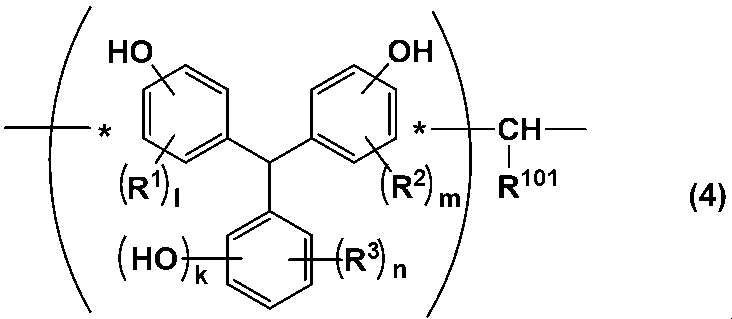
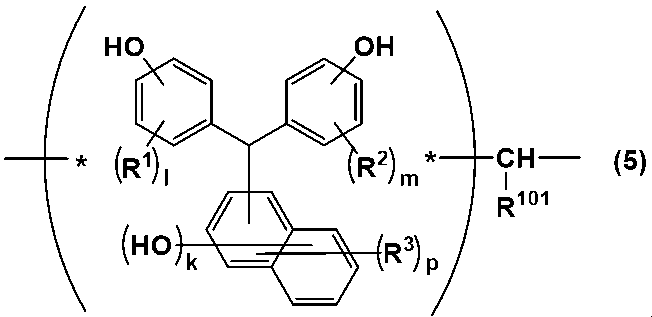
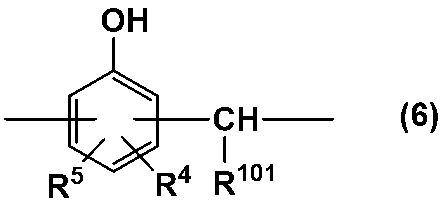
R1は、脂肪族炭化水素基、芳香環含有炭化水素基、アルコキシ基、又はハロゲン原子である。
R2は、脂肪族炭化水素基、芳香環含有炭化水素基、アルコキシ基、又はハロゲン原子である。
R3は、脂肪族炭化水素基、芳香環含有炭化水素基、アルコキシ基、又はハロゲン原子である。
R4は、水素原子又は炭素原子数1~7の脂肪族炭化水素基である。
R5は、水素原子又は炭素原子数6~20の脂肪族炭化水素基である。
R101は、水素原子、脂肪族炭化水素基、又は芳香環含有炭化水素基である。
kは、0~2の整数である。
lは、0~4の整数である。
mは、0~4の整数である。
nは、0~5の整数である。
pは、0~7の整数である。
R1が複数ある場合、複数のR1は互いに同じでも異なってもよい。
R2が複数ある場合、複数のR2は互いに同じでも異なってもよい。
R3が複数ある場合、複数のR3は互いに同じでも異なってもよい。
ただし、R1、R2、R3及びR5の少なくとも1つは炭素原子数6~20の脂肪族炭化水素基である。)
式(4)及び(5)のR1、R2及びR3の各置換基、k、l、m、n及びpの各数値は、式(1)及び(2)と同じである。
式(4)、(5)及び(6)のR101の脂肪族炭化水素基は、例えば、メチル基、エチル基、プロピル基、イソプロピル基、ブチル基、t-ブチル基、ペンチル基、へキシル基、シクロへキシル基、ヘプチル基、オクチル基、ノニル基等の、炭素原子数1~9アルキル基及び炭素原子数3~9のシクロアルキル基等が挙げれる。
式(4)、(5)及び(6)のR101の芳香環含有炭化水素基は、例えば、フェニル基、トリル基、キシリル基、ナフチル基、アントリル基、及びこれらの芳香核上にアルキル基、アルコキシ基、ハロゲン原子等が置換した置換もしくは無置換のアリール基が挙げられる。
式(4)、(5)及び(6)のR101は、耐熱性及び応力緩和性に優れるフェノール性水酸基含有樹脂となることから、水素原子又は炭素原子数1~6のアルキル基であることが好ましく、水素原子であることがより好ましい。
式(6)のR4の炭素原子数1~7の脂肪族炭化水素基は、直鎖型のもの、分岐構造を有するもののどちらでもよく、構造中に不飽和基を有するもの、有さないもののどちらでもよい。
R4の炭素原子数1~7の脂肪族炭化水素基は、炭素原子数1~7のアルキル基であると好ましく、炭素原子数1~4のアルキル基であるとより好ましく、メチル基であるとさらに好ましい。
R4の置換位置はフェノール性水酸基に対しメタ位であることが好ましい。
R4の炭素原子数1~7の脂肪族炭化水素基は、炭素原子数1~7のアルキル基であると好ましく、炭素原子数1~4のアルキル基であるとより好ましく、メチル基であるとさらに好ましい。
R4の置換位置はフェノール性水酸基に対しメタ位であることが好ましい。
式(4)、(5)及び(6)において、R1、R2、R3及びR5の少なくとも1つは炭素原子数6~20の脂肪族炭化水素基であり、前記炭素原子数6~20の脂肪族炭化水素基は、直鎖型のもの、分岐構造を有するもののどちらでもよく、構造中に不飽和基を有するもの、有さないもののどちらでもよい。
前記炭素原子数6~20の脂肪族炭化水素基は、炭素原子数6~20のアルキル基であると好ましく、炭素原子数8~18のアルキル基であるとより好ましい。
前記炭素原子数6~20の脂肪族炭化水素基は、炭素原子数6~20のアルキル基であると好ましく、炭素原子数8~18のアルキル基であるとより好ましい。
構造部位(α)について、式(4)及び(5)中の*は、式(4)及び(5)中に図示された3つの芳香環の何れかとの結合点であり、2つの*は同一の芳香環に結合していてもよいし、それぞれ異なる芳香環に結合していてもよい。前記構造式(4)で表される構造部位は、例えば下記式(4-1)~(4-4)のいずれかで表される構造部位が挙げられる。また、前記式(5)で表される構造部位は、例えば下記式(5-1)~(5-4)のいずれかで表される構造部位が挙げられる。
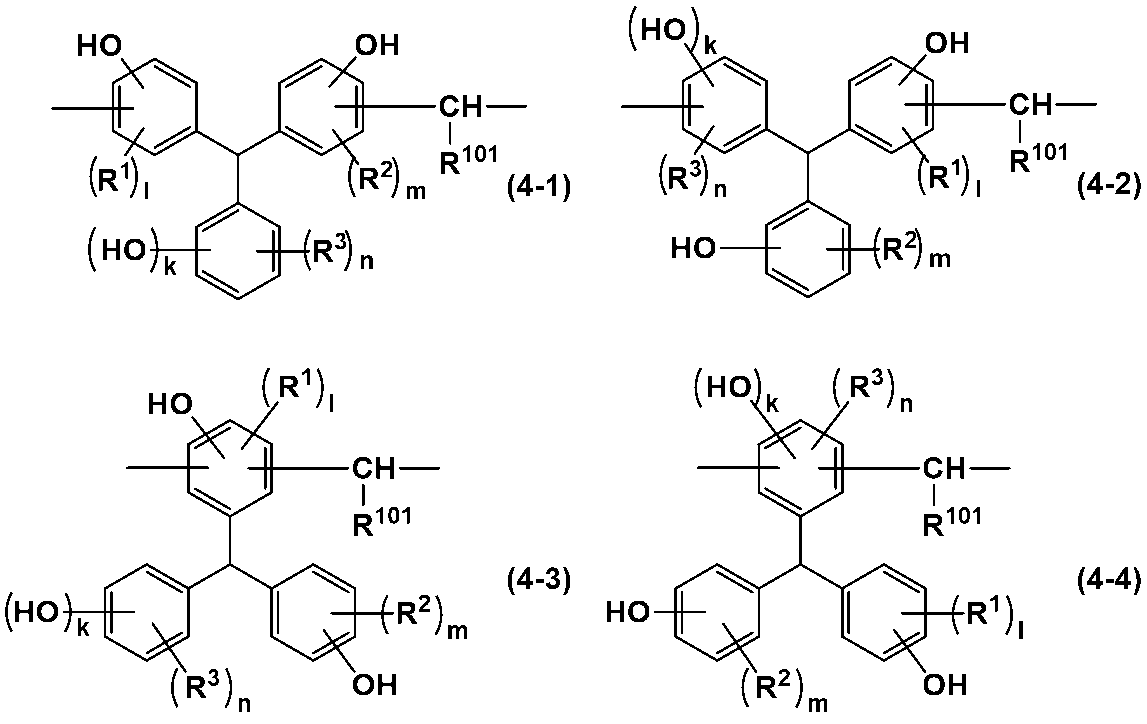
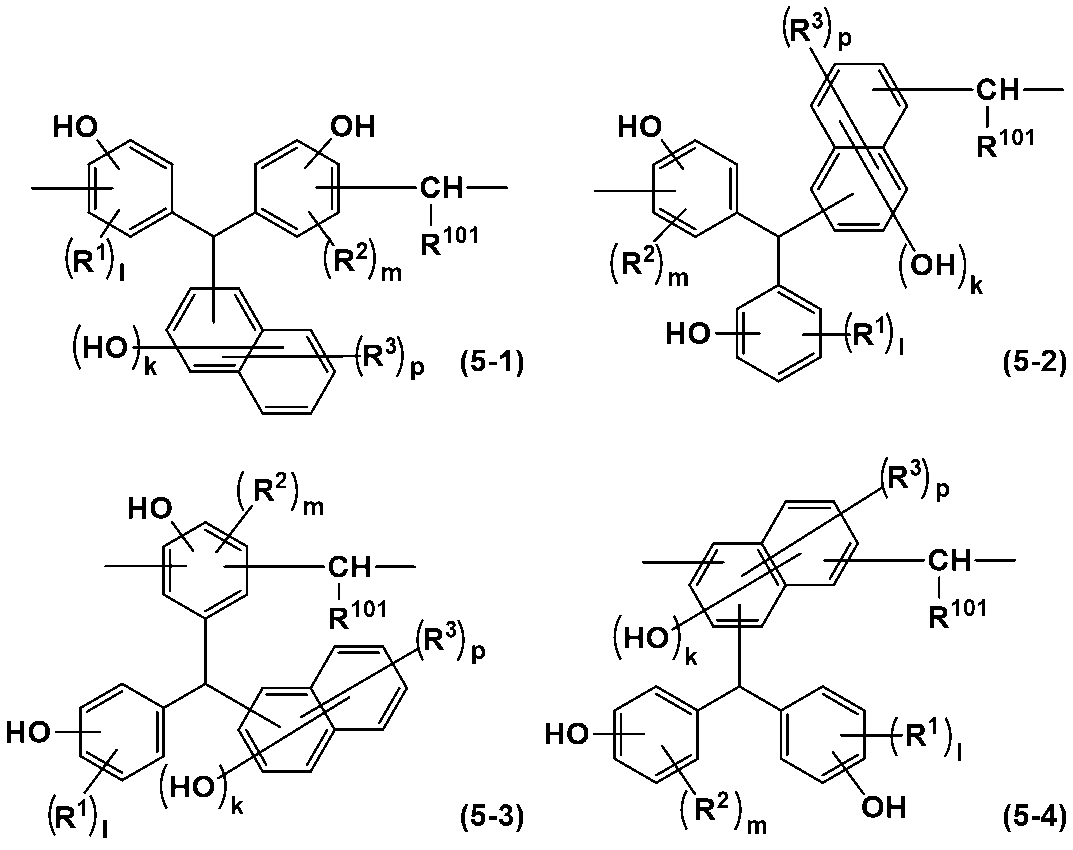
前記式(5-1)~(5-4)中のR1、R2、R3、R101、k、l、m及びpは、前記式(5)のR1、R2、R3、R101、k、l、m及びpと同じである。)
前記フェノール性水酸基含有樹脂は、樹脂中に存在する構造部位(α)の全てが同一構造であってもよいし、異なる複数の構造を有していてもよい。耐熱性及び応力緩和性のバランスに優れるフェノール性水酸基含有樹脂となることから、式(4)で表される構造部位を有することが好ましい。また、式(4)及び(5)中のkの値はそれぞれ1であることが好ましい。例えばkが1の場合、式(1)中の3つのフェノール性水酸基の結合位置は、3つの芳香環を結節するメチン基に対しいずれもパラ位であることが好ましい。
前記フェノール性水酸基含有樹脂において、構造部位(α)と構造部位(β)との存在比率は、所望の樹脂性能や用途等に応じて適宜変更するとよい。耐熱性、応力緩和性のバランスに優れるフェノール性水酸基含有樹脂となることから、構造部位(α)と構造部位(β)の存在比率[(α)/(β)]は、90/10~30/70の範囲であることが好ましく、80/20~40/60の範囲であることがより好ましい。
前記フェノール性水酸基含有樹脂における前記炭素原子数6~20の脂肪族炭化水素基の存在割合は、耐熱性及び応力緩和性のバランスに優れるフェノール性水酸基含有樹脂となることから、前記フェノール性水酸基含有樹脂において、前記炭素原子数6~20の脂肪族炭化水素基が0.5~30質量%となる割合であることが好ましい。
[架橋剤(B)]
架橋剤(B)としては、フェノール樹脂、ユリア樹脂、メラミン樹脂、フラン樹脂、キシレン樹脂、エポキシ樹脂、不飽和ポリエステル樹脂、熱硬化性ポリイミド、熱硬化性ポリアミドイミド等が挙げられ、エポキシ樹脂、熱硬化性ポリイミド及び熱硬化性ポリアミドイミドから選択される1以上であると好ましい。
架橋剤(B)としては、フェノール樹脂、ユリア樹脂、メラミン樹脂、フラン樹脂、キシレン樹脂、エポキシ樹脂、不飽和ポリエステル樹脂、熱硬化性ポリイミド、熱硬化性ポリアミドイミド等が挙げられ、エポキシ樹脂、熱硬化性ポリイミド及び熱硬化性ポリアミドイミドから選択される1以上であると好ましい。
前記エポキシ樹脂の具体例としては、ビスフェノールA型エポキシ樹脂、ビスフェノールF型エポキシ樹脂、ビスフェノールS型エポキシ樹脂、ビスフェノールAD型エポキシ樹脂、等のビスフェノール型エポキシ樹脂;オルソクレゾールノボラック型エポキシ樹脂、フェノールノボラック型エポキシ樹脂、ナフトールノボラック型エポキシ樹脂、ビスフェノールAノボラック型エポキシ樹脂、臭素化フェノールノボラック型エポキシ樹脂、アルキルフェノールノボラック型エポキシ樹脂、ビスフェノールSノボラック型エポキシ樹脂、アルコキシ基含有ノボラック型エポキシ樹脂、ブロム化フェノールノボラック型エポキシ樹脂等のノボラック型エポキシ樹脂;フェノールアラルキル型エポキシ樹脂(通称ザイロック樹脂のエポキシ化物)、レゾルシンのジグリシジルエーテル、ハイドロキノンのジグリシジルエーテル、カテコールのジグリシジルエーテル、ビフェニル型エポキシ樹脂、テトラメチルビフェニル型エポキシ樹脂、硫黄含有エポキシ樹脂、スチルベン型エポキシ樹脂、ジヒドロキシナフタレン型エポキシ樹脂等の2官能型エポキシ樹脂;水素添加ビスフェノールA型エポキシ樹脂等の脂環式エポキシ樹脂、トリグリシジルシソシアヌレート、トリフェニルメタン型エポキシ樹脂、テトラフェニルエタン型エポキシ樹脂、ジシクロペンタジエン-フェノール付加反応型エポキシ樹脂、ビス(ヒドロキシナフタレン)型エポキシ樹脂、ビフェニル変性ノボラック型エポキシ樹脂(ビスメチレン基でフェノール核が連結された多価フェノール樹脂のエポキシ化物)、アルコキシ基含有ノボラック型エポキシ樹脂、テトラブロモビスフェノールA型エポキシ樹脂等が挙げられる。
前記エポキシ樹脂の具体例は1種単独で用いてもよく、2種以上を混合してもよい。
前記エポキシ樹脂の具体例は1種単独で用いてもよく、2種以上を混合してもよい。
前記ビス(ヒドロキシナフタレン)型エポキシ樹脂は、例えば、下記構造式(7-1)~(7-4)の何れかで表される化合物を必須の反応原料とする樹脂である。
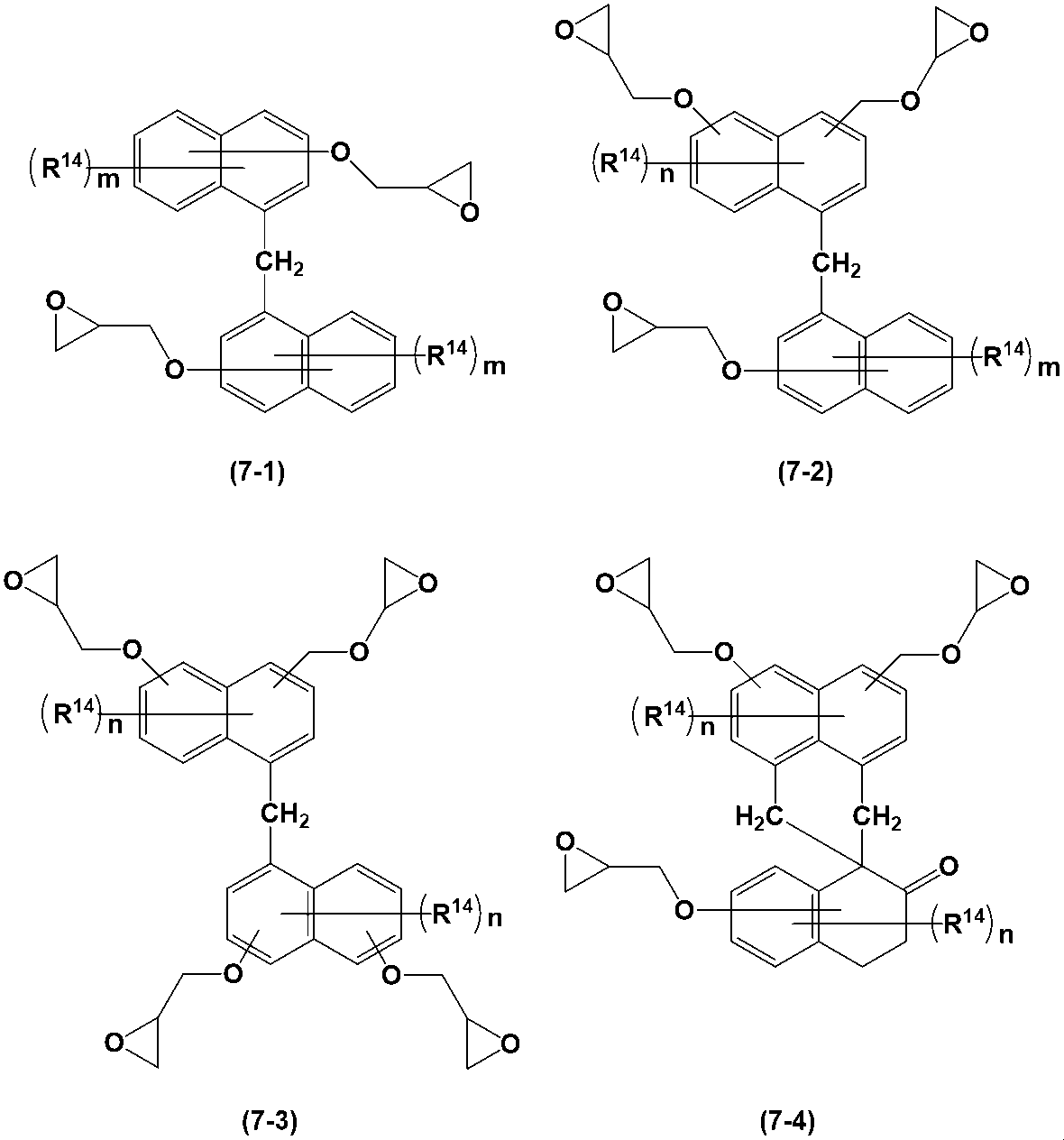
R14は、アルキル基、アリール基、アラルキル基、これらが有する1以上の水素原子がアルコキシ基又はハロゲン原子で置換された置換基、アルコキシ基、又はハロゲン原子である。
R14が複数ある場合、複数のR14は互いに同じでも異なってもよい。
mは0又は1~6の整数である。
nは0又は1~5の整数である。)
前記構造式(7-1)~(7-4)の何れかで表される化合物は、例えば、対応するナフトール化合物又はジヒドロキシナフタレン化合物とホルムアルデヒドとをアルカリ触媒条件下で反応させ、得られた反応物をポリグリシジルエーテル化する方法にて製造することができる。
架橋剤(B)として、例えば、メチロール基、アルコキシメチル基及びアシロキシメチル基から選択される1以上の基で置換されたメラミン化合物、グアナミン化合物、グリコールウリル化合物、ウレア化合物、レゾール樹脂、エポキシ化合物、イソシアネート化合物、アジド化合物、アルケニルエーテル基等の二重結合を含む化合物、酸無水物、オキサゾリン化合物等も用いることができる。
前記メラミン化合物としては、例えば、ヘキサメチロールメラミン、ヘキサメトキシメチルメラミン、ヘキサメチロールメラミンの1~6個のメチロール基がメトキシメチル化した化合物、ヘキサメトキシエチルメラミン、ヘキサアシロキシメチルメラミン、ヘキサメチロールメラミンのメチロール基の1~6個がアシロキシメチル化した化合物等が挙げられる。
前記グアナミン化合物としては、例えば、テトラメチロールグアナミン、テトラメトキシメチルグアナミン、テトラメトキシメチルベンゾグアナミン、テトラメチロールグアナミンの1~4個のメチロール基がメトキシメチル化した化合物、テトラメトキシエチルグアナミン、テトラアシロキシグアナミン、テトラメチロールグアナミンの1~4個のメチロール基がアシロキシメチル化した化合物等が挙げられる。
前記グリコールウリル化合物としては、例えば、1,3,4,6-テトラキス(メトキシメチル)グリコールウリル、1,3,4,6-テトラキス(ブトキシメチル)グリコールウリル、1,3,4,6-テトラキス(ヒドロキシメチル)グリコールウリル等が挙げられる。
前記ウレア化合物としては、例えば、1,3-ビス(ヒドロキシメチル)尿素、1,1,3,3-テトラキス(ブトキシメチル)尿素及び1,1,3,3-テトラキス(メトキシメチル)尿素等が挙げられる。
前記レゾール樹脂としては、例えば、フェノール、クレゾールやキシレノール等のアルキルフェノール、フェニルフェノール、レゾルシノール、ビフェニル、ビスフェノールAやビスフェノールF等のビスフェノール、ナフトール、ジヒドロキシナフタレン等のフェノール性水酸基含有化合物と、アルデヒド化合物とをアルカリ性触媒条件下で反応させて得られる重合体が挙げられる。
前記エポキシ化合物としては、例えば、トリス(2,3-エポキシプロピル)イソシアヌレート、トリメチロールメタントリグリシジルエーテル、トリメチロールプロパントリグリシジルエーテル、トリエチロールエタントリグリシジルエーテル等が挙げられる。
前記イソシアネート化合物としては、例えば、トリレンジイソシアネート、ジフェニルメタンジイソシアネート、ヘキサメチレンジイソシアネート、シクロヘキサンジイソシアネート等が挙げられる。
前記アジド化合物としては、例えば、1,1’-ビフェニル-4,4’-ビスアジド、4,4’-メチリデンビスアジド、4,4’-オキシビスアジド等が挙げられる。
前記アルケニルエーテル基等の二重結合を含む化合物としては、例えば、エチレングリコールジビニルエーテル、トリエチレングリコールジビニルエーテル、1,2-プロパンジオールジビニルエーテル、1,4-ブタンジオールジビニルエーテル、テトラメチレングリコールジビニルエーテル、ネオペンチルグリコールジビニルエーテル、トリメチロールプロパントリビニルエーテル、ヘキサンジオールジビニルエーテル、1,4-シクロヘキサンジオールジビニルエーテル、ペンタエリスリトールトリビニルエーテル、ペンタエリスリトールテトラビニルエーテル、ソルビトールテトラビニルエーテル、ソルビトールペンタビニルエーテル、トリメチロールプロパントリビニルエーテル等が挙げられる。
前記酸無水物としては、例えば、無水フタル酸、無水トリメリット酸、無水ピロメリット酸、3,3’,4,4’-ベンゾフェノンテトラカルボン酸二無水物、ビフェニルテトラカルボン酸二無水物、4,4’-(イソプロピリデン)ジフタル酸無水物、4,4’-(ヘキサフルオロイソプロピリデン)ジフタル酸無水物等の芳香族酸無水物;無水テトラヒドロフタル酸、無水メチルテトラヒドロフタル酸、無水ヘキサヒドロフタル酸、無水メチルヘキサヒドロフタル酸、無水エンドメチレンテトラヒドロフタル酸無水ドデセニルコハク酸、無水トリアルキルテトラヒドロフタル酸等の脂環式カルボン酸無水物等が挙げられる。
前記架橋剤は1種単独で用いてもよく、2種以上を併用してもよい。
本発明の熱硬化性樹脂組成物中の架橋剤(B)の含有量は、硬化剤(A)であるフェノール性水酸基含有樹脂100質量部に対して、0.1~50質量部であると好ましく、0.1~30質量部であるとより好ましく、0.5~30質量部であるとさらに好ましい。
本発明の熱硬化性樹脂組成物中の架橋剤(B)の含有量は、硬化剤(A)であるフェノール性水酸基含有樹脂100質量部に対して、0.1~50質量部であると好ましく、0.1~30質量部であるとより好ましく、0.5~30質量部であるとさらに好ましい。
[硬化触媒(C)]
硬化触媒(C)としては、アミン系硬化触媒、ホスフィン系硬化触媒等が挙げられる。
前記アミン系硬化触媒としては、2,4-ジアミノ-6-〔2’―メチルイミダゾリル-(1’)〕エチル-s-トリアジン、1,8-ジアザビシクロ[5,4,0]ウンデセン-7(DBU)、トリエチレンジアミン、ベンジルジメチルアミン、トリエタノールアミン、イミダゾール、2-メチルイミダゾール、2-エチルイミダゾール、2-エチル-4-メチルイミダゾール、2-フェニルイミダゾール、4-フェニルイミダゾール、1-シアノエチル-2-フェニルイミダゾール、1-(2-シアノエチル)-2-エチル-4-メチルイミダゾール、ジシアンジアミド、ベンジルジメチルアミン、4-(ジメチルアミノ)-N,N-ジメチルベンジルアミン、4-メトキシ-N,N-ジメチルベンジルアミン、4-メチル-N,N-ジメチルベンジルアミン等が挙げられる。
前記ホスフィン系硬化触媒としては、トリフェニルホスフィン、トリブチルホスフィン、トリ(p-メチルフェニル)ホスフィン、トリ(ノニルフェニル)ホスフィン等が挙げられる。
硬化触媒(C)としては、アミン系硬化触媒、ホスフィン系硬化触媒等が挙げられる。
前記アミン系硬化触媒としては、2,4-ジアミノ-6-〔2’―メチルイミダゾリル-(1’)〕エチル-s-トリアジン、1,8-ジアザビシクロ[5,4,0]ウンデセン-7(DBU)、トリエチレンジアミン、ベンジルジメチルアミン、トリエタノールアミン、イミダゾール、2-メチルイミダゾール、2-エチルイミダゾール、2-エチル-4-メチルイミダゾール、2-フェニルイミダゾール、4-フェニルイミダゾール、1-シアノエチル-2-フェニルイミダゾール、1-(2-シアノエチル)-2-エチル-4-メチルイミダゾール、ジシアンジアミド、ベンジルジメチルアミン、4-(ジメチルアミノ)-N,N-ジメチルベンジルアミン、4-メトキシ-N,N-ジメチルベンジルアミン、4-メチル-N,N-ジメチルベンジルアミン等が挙げられる。
前記ホスフィン系硬化触媒としては、トリフェニルホスフィン、トリブチルホスフィン、トリ(p-メチルフェニル)ホスフィン、トリ(ノニルフェニル)ホスフィン等が挙げられる。
前記硬化触媒は、1種単独で用いてもよく、2種以上を併用してもよい。
本発明の熱硬化性樹脂組成物中の硬化触媒(C)の含有量は、硬化剤(A)であるフェノール性水酸基含有樹脂100質量部に対して、0.1~3.0質量部であると好ましい。
本発明の熱硬化性樹脂組成物中の硬化触媒(C)の含有量は、硬化剤(A)であるフェノール性水酸基含有樹脂100質量部に対して、0.1~3.0質量部であると好ましい。
[感光剤(D)]
本発明の熱硬化性樹脂組成物は、感光剤(D)を含んでも、含まなくてもよい。
本発明の熱硬化性樹脂組成物が、感光剤(D)を含む場合、熱硬化性フォトレジスト組成物とすることができる。
本発明の熱硬化性樹脂組成物は、感光剤(D)を含んでも、含まなくてもよい。
本発明の熱硬化性樹脂組成物が、感光剤(D)を含む場合、熱硬化性フォトレジスト組成物とすることができる。
感光剤(D)としては、例えば、キノンジアジド基を有する化合物が挙げられる。
前記キノンジアジド基を有する化合物の具体例としては、芳香族(ポリ)ヒドロキシ化合物とキノンジアジド基を有するスルホン酸化合物とのエステル化合物又はアミド化物が挙げられる。尚、前記エステル化合物は部分エステル化合物も含む意味であり、前記アミド化物は部分アミド化物を含む意味である。
前記キノンジアジド基を有する化合物の具体例としては、芳香族(ポリ)ヒドロキシ化合物とキノンジアジド基を有するスルホン酸化合物とのエステル化合物又はアミド化物が挙げられる。尚、前記エステル化合物は部分エステル化合物も含む意味であり、前記アミド化物は部分アミド化物を含む意味である。
前記キノンジアジド基を有するスルホン酸化合物の具体例としては、ナフトキノン-1,2-ジアジド-5-スルホン酸、ナフトキノン-1,2-ジアジド-4-スルホン酸、オルトアントラキノンジアジドスルホン酸、1,2-ナフトキノン-2-ジアジド-5-スルホン酸等が挙げられる。
前記キノンジアジド基を有するスルホン酸化合物の具体例は、ハロゲンがさらに置換したハロゲン化物も使用できる。
前記キノンジアジド基を有するスルホン酸化合物の具体例は、ハロゲンがさらに置換したハロゲン化物も使用できる。
前記芳香族(ポリ)ヒドロキシ化合物としては、例えば、2,3,4-トリヒドロキシベンゾフェノン、2,4,4’-トリヒドロキシベンゾフェノン、2,4,6-トリヒドロキシベンゾフェノン、2,3,6-トリヒドロキシベンゾフェノン、2,3,4-トリヒドロキシ-2’-メチルベンゾフェノン、2,3,4,4’-テトラヒドロキシベンゾフェノン、2,2’,4,4’-テトラヒドロキシベンゾフェノン、2,3’,4,4’,6-ペンタヒドロキシベンゾフェノン、2,2’,3,4,4’-ペンタヒドロキシベンゾフェノン、2,2’,3,4,5-ペンタヒドロキシベンゾフェノン、2,3’,4,4’,5’,6-ヘキサヒドロキシベンゾフェノン、2,3,3’,4,4’,5’-ヘキサヒドロキシベンゾフェノン等のポリヒドロキシベンゾフェノン化合物;
ビス(2,4-ジヒドロキシフェニル)メタン、ビス(2,3,4-トリヒドロキシフェニル)メタン、2-(4-ヒドロキシフェニル)-2-(4’-ヒドロキシフェニル)プロパン、2-(2,4-ジヒドロキシフェニル)-2-(2’,4’-ジヒドロキシフェニル)プロパン、2-(2,3,4-トリヒドロキシフェニル)-2-(2’,3’,4’-トリヒドロキシフェニル)プロパン、4,4’-{1-[4-〔2-(4-ヒドロキシフェニル)-2-プロピル〕フェニル]エチリデン}ビスフェノール,3,3’-ジメチル-{1-[4-〔2-(3-メチル-4-ヒドロキシフェニル)-2-プロピル〕フェニル]エチリデン}ビスフェノール等のビス[(ポリ)ヒドロキシフェニル]アルカン化合物;
トリス(4-ヒドロキシフェニル)メタン、ビス(4-ヒドロキシ-3、5-ジメチルフェニル)-4-ヒドロキシフェニルメタン、ビス(4-ヒドロキシ-2,5-ジメチルフェニル)-4-ヒドロキシフェニルメタン、ビス(4-ヒドロキシ-3,5-ジメチルフェニル)-2-ヒドロキシフェニルメタン、ビス(4-ヒドロキシ-2,5-ジメチルフェニル)-2-ヒドロキシフェニルメタン、ビス(4-ヒドロキシ-2,5-ジメチルフェニル)-3,4-ジヒドロキシフェニルメタン、ビス(4-ヒドロキシ-3,5-ジメチルフェニル)-3,4-ジヒドロキシフェニルメタン等のトリス(ヒドロキシフェニル)メタン化合物又はそのメチル置換体;
ビス(3-シクロヘキシル-4-ヒドロキシフェニル)-3-ヒドロキシフェニルメタン,ビス(3-シクロヘキシル-4-ヒドロキシフェニル)-2-ヒドロキシフェニルメタン,ビス(3-シクロヘキシル-4-ヒドロキシフェニル)-4-ヒドロキシフェニルメタン,ビス(5-シクロヘキシル-4-ヒドロキシ-2-メチルフェニル)-2-ヒドロキシフェニルメタン,ビス(5-シクロヘキシル-4-ヒドロキシ-2-メチルフェニル)-3-ヒドロキシフェニルメタン、ビス(5-シクロヘキシル-4-ヒドロキシ-2-メチルフェニル)-4-ヒドロキシフェニルメタン、ビス(3-シクロヘキシル-2-ヒドロキシフェニル)-3-ヒドロキシフェニルメタン、ビス(5-シクロヘキシル-4-ヒドロキシ-3-メチルフェニル)-4-ヒドロキシフェニルメタン、ビス(5-シクロヘキシル-4-ヒドロキシ-3-メチルフェニル)-3-ヒドロキシフェニルメタン、ビス(5-シクロヘキシル-4-ヒドロキシ-3-メチルフェニル)-2-ヒドロキシフェニルメタン、ビス(3-シクロヘキシル-2-ヒドロキシフェニル)-4-ヒドロキシフェニルメタン、ビス(3-シクロヘキシル-2-ヒドロキシフェニル)-2-ヒドロキシフェニルメタン、ビス(5-シクロヘキシル-2-ヒドロキシ-4-メチルフェニル)-2-ヒドロキシフェニルメタン、ビス(5-シクロヘキシル-2-ヒドロキシ-4-メチルフェニル)-4-ヒドロキシフェニルメタンなどの、ビス(シクロヘキシルヒドロキシフェニル)(ヒドロキシフェニル)メタン化合物又はそのメチル置換体等が挙げられる。
ビス(2,4-ジヒドロキシフェニル)メタン、ビス(2,3,4-トリヒドロキシフェニル)メタン、2-(4-ヒドロキシフェニル)-2-(4’-ヒドロキシフェニル)プロパン、2-(2,4-ジヒドロキシフェニル)-2-(2’,4’-ジヒドロキシフェニル)プロパン、2-(2,3,4-トリヒドロキシフェニル)-2-(2’,3’,4’-トリヒドロキシフェニル)プロパン、4,4’-{1-[4-〔2-(4-ヒドロキシフェニル)-2-プロピル〕フェニル]エチリデン}ビスフェノール,3,3’-ジメチル-{1-[4-〔2-(3-メチル-4-ヒドロキシフェニル)-2-プロピル〕フェニル]エチリデン}ビスフェノール等のビス[(ポリ)ヒドロキシフェニル]アルカン化合物;
トリス(4-ヒドロキシフェニル)メタン、ビス(4-ヒドロキシ-3、5-ジメチルフェニル)-4-ヒドロキシフェニルメタン、ビス(4-ヒドロキシ-2,5-ジメチルフェニル)-4-ヒドロキシフェニルメタン、ビス(4-ヒドロキシ-3,5-ジメチルフェニル)-2-ヒドロキシフェニルメタン、ビス(4-ヒドロキシ-2,5-ジメチルフェニル)-2-ヒドロキシフェニルメタン、ビス(4-ヒドロキシ-2,5-ジメチルフェニル)-3,4-ジヒドロキシフェニルメタン、ビス(4-ヒドロキシ-3,5-ジメチルフェニル)-3,4-ジヒドロキシフェニルメタン等のトリス(ヒドロキシフェニル)メタン化合物又はそのメチル置換体;
ビス(3-シクロヘキシル-4-ヒドロキシフェニル)-3-ヒドロキシフェニルメタン,ビス(3-シクロヘキシル-4-ヒドロキシフェニル)-2-ヒドロキシフェニルメタン,ビス(3-シクロヘキシル-4-ヒドロキシフェニル)-4-ヒドロキシフェニルメタン,ビス(5-シクロヘキシル-4-ヒドロキシ-2-メチルフェニル)-2-ヒドロキシフェニルメタン,ビス(5-シクロヘキシル-4-ヒドロキシ-2-メチルフェニル)-3-ヒドロキシフェニルメタン、ビス(5-シクロヘキシル-4-ヒドロキシ-2-メチルフェニル)-4-ヒドロキシフェニルメタン、ビス(3-シクロヘキシル-2-ヒドロキシフェニル)-3-ヒドロキシフェニルメタン、ビス(5-シクロヘキシル-4-ヒドロキシ-3-メチルフェニル)-4-ヒドロキシフェニルメタン、ビス(5-シクロヘキシル-4-ヒドロキシ-3-メチルフェニル)-3-ヒドロキシフェニルメタン、ビス(5-シクロヘキシル-4-ヒドロキシ-3-メチルフェニル)-2-ヒドロキシフェニルメタン、ビス(3-シクロヘキシル-2-ヒドロキシフェニル)-4-ヒドロキシフェニルメタン、ビス(3-シクロヘキシル-2-ヒドロキシフェニル)-2-ヒドロキシフェニルメタン、ビス(5-シクロヘキシル-2-ヒドロキシ-4-メチルフェニル)-2-ヒドロキシフェニルメタン、ビス(5-シクロヘキシル-2-ヒドロキシ-4-メチルフェニル)-4-ヒドロキシフェニルメタンなどの、ビス(シクロヘキシルヒドロキシフェニル)(ヒドロキシフェニル)メタン化合物又はそのメチル置換体等が挙げられる。
感光剤(D)は、1種単独で用いてもよく、2種以上を併用してもよい。
本発明の熱硬化性樹脂組成物が感光剤(D)を含む場合、感光剤(D)の含有量は、光感度に優れる熱硬化性フォトレジスト組成物となることから、樹脂組成物の樹脂固形分合計100質量部に対し、3.0~50質量部であると好ましく、5.0~15質量部であるとより好ましい。
本発明の熱硬化性樹脂組成物が感光剤(D)を含む場合、感光剤(D)の含有量は、光感度に優れる熱硬化性フォトレジスト組成物となることから、樹脂組成物の樹脂固形分合計100質量部に対し、3.0~50質量部であると好ましく、5.0~15質量部であるとより好ましい。
[充填剤(E)]
本発明の熱硬化性樹脂組成物は、好ましくは充填剤(E)を含み、当該充填剤(E)としては、無機フィラー、有機フィラー、無機繊維、有機繊維等が挙げられる。
本発明の熱硬化性樹脂組成物は、好ましくは充填剤(E)を含み、当該充填剤(E)としては、無機フィラー、有機フィラー、無機繊維、有機繊維等が挙げられる。
無機フィラーとしては、例えば無機微粒子が挙げられる。
前記無機微粒子としては、例えば、耐熱性に優れるものとしては、アルミナ、マグネシア、チタニア、ジルコニア、シリカ(石英、ヒュームドシリカ、沈降性シリカ、無水ケイ酸、溶融シリカ、結晶性シリカ、超微粉無定型シリカ等)等;熱伝導に優れるものとしては、窒化ホウ素、窒化アルミ、酸化アルミナ、酸化チタン、酸化マグネシウム、酸化亜鉛、酸化ケイ素、ダイヤモンド等;導電性に優れるものとしては、金属単体又は合金(例えば、鉄、銅、マグネシウム、アルミニウム、金、銀、白金、亜鉛、マンガン、ステンレスなど)を用いた金属フィラー及び/又は金属被覆フィラー、;バリア性に優れるものとしては、マイカ、クレイ、カオリン、タルク、ゼオライト、ウォラストナイト、スメクタイト等の鉱物等やチタン酸カリウム、硫酸マグネシウム、セピオライト、ゾノライト、ホウ酸アルミニウム、炭酸カルシウム、酸化チタン、硫酸バリウム、酸化亜鉛、水酸化マグネシウム;屈折率が高いものとしては、チタン酸バリウム、酸化ジルコニア、酸化チタン等;光触媒性を示すものとしては、チタン、セリウム、亜鉛、銅、アルミニウム、錫、インジウム、リン、炭素、イオウ、テリウム、ニッケル、鉄、コバルト、銀、モリブデン、ストロンチウム、クロム、バリウム、鉛等の光触媒金属、前記金属の複合物、それらの酸化物等;耐摩耗性に優れるものとしては、シリカ、アルミナ、ジルコニア、酸化マグネシウム等の金属、及びそれらの複合物及び酸化物等;導電性に優れるものとしては、銀、銅などの金属、酸化錫、酸化インジウム等;絶縁性に優れるものとしては、シリカ等;紫外線遮蔽に優れるものとしては、酸化チタン、酸化亜鉛等である。
これらの無機微粒子は、用途によって適時選択すればよく、1種単独で使用しても、複数種組み合わせて使用してもよい。
前記無機微粒子としては、例えば、耐熱性に優れるものとしては、アルミナ、マグネシア、チタニア、ジルコニア、シリカ(石英、ヒュームドシリカ、沈降性シリカ、無水ケイ酸、溶融シリカ、結晶性シリカ、超微粉無定型シリカ等)等;熱伝導に優れるものとしては、窒化ホウ素、窒化アルミ、酸化アルミナ、酸化チタン、酸化マグネシウム、酸化亜鉛、酸化ケイ素、ダイヤモンド等;導電性に優れるものとしては、金属単体又は合金(例えば、鉄、銅、マグネシウム、アルミニウム、金、銀、白金、亜鉛、マンガン、ステンレスなど)を用いた金属フィラー及び/又は金属被覆フィラー、;バリア性に優れるものとしては、マイカ、クレイ、カオリン、タルク、ゼオライト、ウォラストナイト、スメクタイト等の鉱物等やチタン酸カリウム、硫酸マグネシウム、セピオライト、ゾノライト、ホウ酸アルミニウム、炭酸カルシウム、酸化チタン、硫酸バリウム、酸化亜鉛、水酸化マグネシウム;屈折率が高いものとしては、チタン酸バリウム、酸化ジルコニア、酸化チタン等;光触媒性を示すものとしては、チタン、セリウム、亜鉛、銅、アルミニウム、錫、インジウム、リン、炭素、イオウ、テリウム、ニッケル、鉄、コバルト、銀、モリブデン、ストロンチウム、クロム、バリウム、鉛等の光触媒金属、前記金属の複合物、それらの酸化物等;耐摩耗性に優れるものとしては、シリカ、アルミナ、ジルコニア、酸化マグネシウム等の金属、及びそれらの複合物及び酸化物等;導電性に優れるものとしては、銀、銅などの金属、酸化錫、酸化インジウム等;絶縁性に優れるものとしては、シリカ等;紫外線遮蔽に優れるものとしては、酸化チタン、酸化亜鉛等である。
これらの無機微粒子は、用途によって適時選択すればよく、1種単独で使用しても、複数種組み合わせて使用してもよい。
前記無機微粒子としてシリカを用いる場合、特に限定はなく粉末状のシリカやコロイダルシリカなど公知のシリカ微粒子を使用することができる。
市販の粉末状のシリカ微粒子としては、例えば、日本アエロジル(株)製アエロジル50、200、旭硝子(株)製シルデックスH31、H32、H51、H52、H121、H122、日本シリカ工業(株)製E220A、E220、富士シリシア(株)製SYLYSIA470、日本板硝子(株)製SGフレ-ク等を挙げることができる。
市販のコロイダルシリカとしては、例えば、日産化学工業(株)製メタノ-ルシリカゾル、IPA-ST、MEK-ST、NBA-ST、XBA-ST、DMAC-ST、ST-UP、ST-OUP、ST-20、ST-40、ST-C、ST-N、ST-O、ST-50、ST-OL等を挙げることができる。
市販の粉末状のシリカ微粒子としては、例えば、日本アエロジル(株)製アエロジル50、200、旭硝子(株)製シルデックスH31、H32、H51、H52、H121、H122、日本シリカ工業(株)製E220A、E220、富士シリシア(株)製SYLYSIA470、日本板硝子(株)製SGフレ-ク等を挙げることができる。
市販のコロイダルシリカとしては、例えば、日産化学工業(株)製メタノ-ルシリカゾル、IPA-ST、MEK-ST、NBA-ST、XBA-ST、DMAC-ST、ST-UP、ST-OUP、ST-20、ST-40、ST-C、ST-N、ST-O、ST-50、ST-OL等を挙げることができる。
前記無機微粒子としてシリカを用いる場合、表面修飾をしたシリカ微粒子を用いてもよく、例えば、前記シリカ微粒子を、疎水性基を有する反応性シランカップリング剤で表面処理したものや、(メタ)アクリロイル基を有する化合物で修飾したものがあげられる。(メタ)アクリロイル基を有する化合物で修飾した市販の粉末状のシリカとしては、日本アエロジル(株)製アエロジルRM50、R711等、(メタ)アクリロイル基を有する化合物で修飾した市販のコロイダルシリカとしては、日産化学工業(株)製MIBK-SD等が挙げられる。
前記シリカ微粒子の形状は特に限定はなく、球状、中空状、多孔質状、棒状、板状、繊維状、または不定形状のものを用いることができる。また一次粒子径は、5~200nmの範囲が好ましい。5nm未満であると、分散体中の無機微粒子の分散が不十分となり、200nmを超える径では、硬化物の十分な強度が保持できないおそれがある。
前記酸化チタンは、体質顔料のみならず紫外光応答型光触媒が使用でき、例えばアナターゼ型酸化チタン、ルチル型酸化チタン、ブルッカイト型酸化チタンなどが使用できる。
前記酸化チタンとしては、酸化チタンの結晶構造中に異種元素をドーピングさせて可視光に応答させるように設計された粒子についても用いることができる。酸化チタンにドーピングさせる元素としては、窒素、硫黄、炭素、フッ素、リン等のアニオン元素や、クロム、鉄、コバルト、マンガン等のカチオン元素が好適に用いられる。また、形態としては、粉末、有機溶媒中もしくは水中に分散させたゾルもしくはスラリーを用いることができる。市販の粉末状の酸化チタン微粒子としては、例えば、日本アエロジル(株)製アエロジルP-25、テイカ(株)製ATM-100等を挙げることができる。また、市販のスラリー状の酸化チタン微粒子としては、例えば、テイカ(株)TKD-701等が挙げられる。
前記酸化チタンとしては、酸化チタンの結晶構造中に異種元素をドーピングさせて可視光に応答させるように設計された粒子についても用いることができる。酸化チタンにドーピングさせる元素としては、窒素、硫黄、炭素、フッ素、リン等のアニオン元素や、クロム、鉄、コバルト、マンガン等のカチオン元素が好適に用いられる。また、形態としては、粉末、有機溶媒中もしくは水中に分散させたゾルもしくはスラリーを用いることができる。市販の粉末状の酸化チタン微粒子としては、例えば、日本アエロジル(株)製アエロジルP-25、テイカ(株)製ATM-100等を挙げることができる。また、市販のスラリー状の酸化チタン微粒子としては、例えば、テイカ(株)TKD-701等が挙げられる。
無機繊維としては、カーボン繊維、ガラス繊維、ボロン繊維、アルミナ繊維、炭化ケイ素繊維、炭素繊維、活性炭繊維、黒鉛繊維、ガラス繊維、タングステンカーバイド繊維、シリコンカーバイド繊維(炭化ケイ素繊維)、セラミックス繊維、アルミナ繊維、天然繊維、玄武岩、ボロン繊維、窒化ホウ素繊維、炭化ホウ素繊維等が挙げられる。
また、無機繊維として、金属繊維を挙げることができ、当該金属繊維としては、アルミニウム繊維、銅繊維、黄銅繊維、ステンレス繊維、スチール繊維等を挙げることができる。
また、無機繊維として、金属繊維を挙げることができ、当該金属繊維としては、アルミニウム繊維、銅繊維、黄銅繊維、ステンレス繊維、スチール繊維等を挙げることができる。
有機繊維としては、ポリベンザゾール、アラミド、PBO(ポリパラフェニレンベンズオキサゾール)、ポリフェニレンスルフィド、ポリエステル、アクリル、ポリアミド、ポリオレフィン、ポリビニルアルコール、ポリアリレート等の樹脂材料からなる合成繊維;セルロース、パルプ、綿、羊毛、絹等の天然繊維;タンパク質、ポリペプチド、アルギン酸等の再生繊維等を挙げることができる。
前記無機繊維及び前記有機繊維は、繊維の集合体であってもよく、繊維が連続している、もしくは不連続であってもよく、織布状であっても、不織布状であってもよい。また、前記無機繊維及び前記有機繊維は、繊維が一方方向に整列した繊維束でもよく、繊維束を並べたシート状であってもよく、又は、繊維の集合体に厚みを持たせた立体形状であってもよい。
充填剤(E)は、1種単独で用いてもよく、2種以上を併用してもよい。
本発明の熱硬化性樹脂組成物が充填剤(E)を含む場合、充填剤(E)の含有量は、硬化剤(A)であるフェノール性水酸基含有樹脂100質量部に対して、10~2000質量部であると好ましく、50~1500質量部であるとより好ましい。
本発明の熱硬化性樹脂組成物が充填剤(E)を含む場合、充填剤(E)の含有量は、硬化剤(A)であるフェノール性水酸基含有樹脂100質量部に対して、10~2000質量部であると好ましく、50~1500質量部であるとより好ましい。
[有機溶媒(F)]
本発明の熱硬化性樹脂組成物は、硬化剤(A)を有機溶媒(F)に溶解させた状態とすると好ましい。
有機溶媒(F)としては、例えば、エチレングリコールモノメチルエーテル、エチレングリコールモノエチルエーテル、エチレングリコールモノプロピルエーテル、エチレングリコールモノブチルエーテルプロピレングリコールモノメチルエーテル等のアルキレングリコールモノアルキルエーテル;ジエチレングリコールジメチルエーテル、ジエチレングリコールジエチルエーテル、ジエチレングリコールジプロピルエーテル、ジエチレングリコールジブチルエーテル等のジアルキレングリコールジアルキルエーテル;エチレングリコールモノメチルエーテルアセテート、エチレングリコールモノエチルエーテルアセテート、プロピレングリコールモノメチルエーテルアセテート等のアルキレングリコールアルキルエーテルアセテート;アセトン、メチルエチルケトン、シクロヘキサノン、メチルアミルケトン等のケトン化合物;ジオキサン等の環式エーテル;2-ヒドロキシプロピオン酸メチル、2-ヒドロキシプロピオン酸エチル、2-ヒドロキシ-2-メチルプロピオン酸エチル、エトキシ酢酸エチル、オキシ酢酸エチル、2-ヒドロキシ-3-メチルブタン酸メチル、3-メトキシブチルアセテート、3-メチル-3-メトキシブチルアセテート、蟻酸エチル、酢酸エチル、酢酸ブチル、アセト酢酸メチル、アセト酢酸エチル等のエステル化合物が挙げられる。
有機溶媒(F)は、1種単独で用いてもよく、2種以上を併用してもよい。
本発明の熱硬化性樹脂組成物は、硬化剤(A)を有機溶媒(F)に溶解させた状態とすると好ましい。
有機溶媒(F)としては、例えば、エチレングリコールモノメチルエーテル、エチレングリコールモノエチルエーテル、エチレングリコールモノプロピルエーテル、エチレングリコールモノブチルエーテルプロピレングリコールモノメチルエーテル等のアルキレングリコールモノアルキルエーテル;ジエチレングリコールジメチルエーテル、ジエチレングリコールジエチルエーテル、ジエチレングリコールジプロピルエーテル、ジエチレングリコールジブチルエーテル等のジアルキレングリコールジアルキルエーテル;エチレングリコールモノメチルエーテルアセテート、エチレングリコールモノエチルエーテルアセテート、プロピレングリコールモノメチルエーテルアセテート等のアルキレングリコールアルキルエーテルアセテート;アセトン、メチルエチルケトン、シクロヘキサノン、メチルアミルケトン等のケトン化合物;ジオキサン等の環式エーテル;2-ヒドロキシプロピオン酸メチル、2-ヒドロキシプロピオン酸エチル、2-ヒドロキシ-2-メチルプロピオン酸エチル、エトキシ酢酸エチル、オキシ酢酸エチル、2-ヒドロキシ-3-メチルブタン酸メチル、3-メトキシブチルアセテート、3-メチル-3-メトキシブチルアセテート、蟻酸エチル、酢酸エチル、酢酸ブチル、アセト酢酸メチル、アセト酢酸エチル等のエステル化合物が挙げられる。
有機溶媒(F)は、1種単独で用いてもよく、2種以上を併用してもよい。
本発明の熱硬化性樹脂組成物中の有機溶媒(F)の含有量は特に限定されず、例えば硬化剤(A)であるフェノール性水酸基含有樹脂を全て溶解できる量に設定するとよい。
本発明の熱硬化性樹脂組成物は、硬化剤(A)、架橋剤(B)及び硬化触媒(C)を含めばよく、硬化剤(A)、架橋剤(B)及び硬化触媒(C)、並びに任意に感光剤(D)、充填剤(E)、有機溶媒(F)及び成分(A)~(F)以外の成分(例えばカップリング剤、溶解促進剤、溶解阻害剤、界面活性剤、レベリング剤、安定化剤から選択される1以上)を含んでもよく、本発明の効果を損なわない範囲で不可避不純物を含んでもよい。
本発明の熱硬化性樹脂組成物は、例えば、溶媒(F)を除いた、80質量%以上、90質量%以上、95質量%以上、98質量%以上又は100質量%が、硬化剤(A)、架橋剤(B)及び硬化触媒(C)、並びに任意に感光剤(D)、充填剤(E)及び成分(A)~(F)以外の成分からなっていてもよい。
本発明の熱硬化性樹脂組成物は、例えば、溶媒(F)を除いた、80質量%以上、90質量%以上、95質量%以上、98質量%以上又は100質量%が、硬化剤(A)、架橋剤(B)及び硬化触媒(C)、並びに任意に感光剤(D)、充填剤(E)及び成分(A)~(F)以外の成分からなっていてもよい。
本発明の熱硬化性樹脂組成物は、上記成分を配合し、攪拌機等を用いて混合することにより調製できる。本発明の熱硬化性樹脂組成物が充填剤(E)を含む場合には、ディゾルバー、ホモジナイザー、3本ロールミル等の分散装置を用いて調製するとよい。
本発明の硬化物は、本発明の熱硬化性樹脂組成物を硬化することにより得られ、本発明の硬化物はレジスト材料として好適である。
本発明の硬化物の形態は好ましくは樹脂膜であり、当該樹脂膜は、例えば、本発明の熱硬化性樹脂組成物を基板上に塗布し、基板上の塗布膜を乾燥することにより製造できる。
本発明の硬化物の形態は好ましくは樹脂膜であり、当該樹脂膜は、例えば、本発明の熱硬化性樹脂組成物を基板上に塗布し、基板上の塗布膜を乾燥することにより製造できる。
基板としては、ガラス基板、Si基板等の半導体基板、TiO2基板、SiO2基板等の金属酸化物絶縁体基板、ポリエチレン、ポリプロピレン、ポリカーボネート、ポリエチレンテレフタレート等の合成樹脂フィルムなどが挙げられる。
塗布の方法に特に制限はないが、スピナー等を用いて行うことができる。
乾燥は、ホットプレート、オーブン等を用いて行うことができる。乾燥温度は100~200℃で乾燥させた後、250~400℃で加熱硬化させると好ましい。
塗布の方法に特に制限はないが、スピナー等を用いて行うことができる。
乾燥は、ホットプレート、オーブン等を用いて行うことができる。乾燥温度は100~200℃で乾燥させた後、250~400℃で加熱硬化させると好ましい。
樹脂膜の膜厚は、1~500μmが好ましく、5~300μmがより好ましい。
本発明の硬化物は、配線レジスト、バンプ形成用レジスト、ビルドアップフィルム、層間絶縁膜、OLEDバンク剤として好適に用いることができる。
以下、実施例と比較例とにより、本発明を具体的に説明する。
以下で合成した樹脂の数平均分子量(Mn)、重量平均分子量(Mw)、及び多分散度(Mw/Mn)は、下記のGPCの測定条件で測定したものである。
[GPCの測定条件]
測定装置:東ソー株式会社製「HLC-8220 GPC」
カラム:昭和電工株式会社製「Shodex KF802」(8.0mmФ×300mm)+昭和電工株式会社製「Shodex KF802」(8.0mmФ×300mm)
+昭和電工株式会社製「Shodex KF803」(8.0mmФ×300mm)+昭和電工株式会社製「Shodex KF804」(8.0mmФ×300mm)
カラム温度:40℃
検出器:RI(示差屈折計)
データ処理:東ソー株式会社製「GPC-8020モデルIIバージョン4.30」
展開溶媒:テトラヒドロフラン
流速:1.0mL/分
試料:樹脂固形分換算で0.5質量%のテトラヒドロフラン溶液をマイクロフィルターでろ過したもの
注入量:0.1mL
標準試料:下記単分散ポリスチレン
(標準試料:単分散ポリスチレン)
東ソー株式会社製「A-500」
東ソー株式会社製「A-2500」
東ソー株式会社製「A-5000」
東ソー株式会社製「F-1」
東ソー株式会社製「F-2」
東ソー株式会社製「F-4」
東ソー株式会社製「F-10」
東ソー株式会社製「F-20」
[GPCの測定条件]
測定装置:東ソー株式会社製「HLC-8220 GPC」
カラム:昭和電工株式会社製「Shodex KF802」(8.0mmФ×300mm)+昭和電工株式会社製「Shodex KF802」(8.0mmФ×300mm)
+昭和電工株式会社製「Shodex KF803」(8.0mmФ×300mm)+昭和電工株式会社製「Shodex KF804」(8.0mmФ×300mm)
カラム温度:40℃
検出器:RI(示差屈折計)
データ処理:東ソー株式会社製「GPC-8020モデルIIバージョン4.30」
展開溶媒:テトラヒドロフラン
流速:1.0mL/分
試料:樹脂固形分換算で0.5質量%のテトラヒドロフラン溶液をマイクロフィルターでろ過したもの
注入量:0.1mL
標準試料:下記単分散ポリスチレン
(標準試料:単分散ポリスチレン)
東ソー株式会社製「A-500」
東ソー株式会社製「A-2500」
東ソー株式会社製「A-5000」
東ソー株式会社製「F-1」
東ソー株式会社製「F-2」
東ソー株式会社製「F-4」
東ソー株式会社製「F-10」
東ソー株式会社製「F-20」
以下で合成した化合物及び樹脂に対する13C-NMRスペクトルの測定は、日本電子(株)製「AL-400」を用い、試料のDMSO-d6溶液を分析して構造解析を行った。以下に、13C-NMRスペクトルの測定条件を示す。
[13C-NMRスペクトル測定条件]
測定モード:SGNNE(NOE消去の1H完全デカップリング法)
パルス角度:45℃パルス
試料濃度:30wt%
積算回数:10000回
[13C-NMRスペクトル測定条件]
測定モード:SGNNE(NOE消去の1H完全デカップリング法)
パルス角度:45℃パルス
試料濃度:30wt%
積算回数:10000回
合成例1 トリアリールメタン型化合物の製造
冷却管を設置した3000mlの4口フラスコに2,5-キシレノール586.4g(4.8mol)、4-ヒドロキシベンズアルデヒド244g(2mol)を仕込み、2-エトキシエタノール1000mlに溶解させた。氷浴中で冷却しながら硫酸30mlを添加した後、マントルヒーターで100℃まで加熱し、2時間攪拌しながら反応させた。反応終了後、得られた溶液に水を加えて粗生成物を再沈殿させた。粗生成物をアセトンに再溶解し、さらに水で再沈殿させた後、沈殿物を濾別して真空乾燥を行い、白色結晶のトリアリールメタン型化合物421gを得た。
冷却管を設置した3000mlの4口フラスコに2,5-キシレノール586.4g(4.8mol)、4-ヒドロキシベンズアルデヒド244g(2mol)を仕込み、2-エトキシエタノール1000mlに溶解させた。氷浴中で冷却しながら硫酸30mlを添加した後、マントルヒーターで100℃まで加熱し、2時間攪拌しながら反応させた。反応終了後、得られた溶液に水を加えて粗生成物を再沈殿させた。粗生成物をアセトンに再溶解し、さらに水で再沈殿させた後、沈殿物を濾別して真空乾燥を行い、白色結晶のトリアリールメタン型化合物421gを得た。
得られたトリアリールメタン型化合物について、13C-NMRスペクトルの測定を行った結果、下記構造式で表される化合物であることを確認した。また、GPCチャート図から算出される純度(GPC純度)は98.2%であった。トリアリールメタン型化合物のGPCチャートを図1に、13C-NMRチャートを図2に示す。
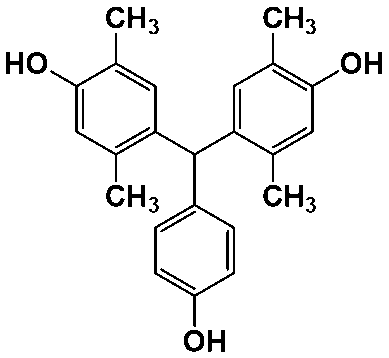
合成例2 ノボラック型フェノール樹脂中間体(M-1)の製造
冷却管を設置した3000mlの4口フラスコに合成例1で調製したトリアリールメタン型化合物174g(0.5mol)、m-クレゾール54g(0.5mol)を仕込んだ後、2-エトキシエタノール500ml及び酢酸500mlの混合溶媒に溶解させた。氷浴中で冷却しながら硫酸50mlを添加した後、92%パラホルムアルデヒド33g(1mol)を仕込んだ。オイルバスで80℃まで加熱し、10時間攪拌しながら反応させた。反応終了後、得られた溶液に水を加えて粗生成物を再沈殿させた。粗生成物をアセトンに再溶解し、さらに水で再沈殿させた後、沈殿物を濾別して真空乾燥を行い、赤色粉末のノボラック樹脂中間体(M-1)213gを得た。
得られたノボラック型フェノール樹脂中間体(M-1)の数平均分子量(Mn)は1,937、重量平均分子量(Mw)は12,822、多分散度(Mw/Mn)は6.62であった。ノボラック型フェノール樹脂中間体(M-1)のGPCチャートを図3に示す。
冷却管を設置した3000mlの4口フラスコに合成例1で調製したトリアリールメタン型化合物174g(0.5mol)、m-クレゾール54g(0.5mol)を仕込んだ後、2-エトキシエタノール500ml及び酢酸500mlの混合溶媒に溶解させた。氷浴中で冷却しながら硫酸50mlを添加した後、92%パラホルムアルデヒド33g(1mol)を仕込んだ。オイルバスで80℃まで加熱し、10時間攪拌しながら反応させた。反応終了後、得られた溶液に水を加えて粗生成物を再沈殿させた。粗生成物をアセトンに再溶解し、さらに水で再沈殿させた後、沈殿物を濾別して真空乾燥を行い、赤色粉末のノボラック樹脂中間体(M-1)213gを得た。
得られたノボラック型フェノール樹脂中間体(M-1)の数平均分子量(Mn)は1,937、重量平均分子量(Mw)は12,822、多分散度(Mw/Mn)は6.62であった。ノボラック型フェノール樹脂中間体(M-1)のGPCチャートを図3に示す。
合成例3 ノボラック型フェノール樹脂中間体(M-2)の製造
冷却管を設置した3000mlの4口フラスコに合成例1で調製したトリアリールメタン型化合物249g(0.72mol)、m-クレゾール31g(0.28mol)を仕込んだ後、2-エトキシエタノール500ml及び酢酸500mlの混合溶媒に溶解させた。氷浴中で冷却しながら硫酸50mlを添加した後、92%パラホルムアルデヒド33g(1mol)を仕込んだ。オイルバスで80℃まで加熱し、10時間攪拌しながら反応させた。反応終了後、得られた溶液に水を加えて粗生成物を再沈殿させた。粗生成物をアセトンに再溶解し、さらに水で再沈殿させた後、沈殿物を濾別して真空乾燥を行い、赤色粉末のノボラック型フェノール樹脂中間体(M-2)266gを得た。
得られたノボラック型フェノール樹脂中間体(M-2)の数平均分子量(Mn)は2,018、重量平均分子量(Mw)は11,486、多分散度(Mw/Mn)は5.69であった。ノボラック型フェノール樹脂中間体(M-2)のGPCチャートを図4に示す。
冷却管を設置した3000mlの4口フラスコに合成例1で調製したトリアリールメタン型化合物249g(0.72mol)、m-クレゾール31g(0.28mol)を仕込んだ後、2-エトキシエタノール500ml及び酢酸500mlの混合溶媒に溶解させた。氷浴中で冷却しながら硫酸50mlを添加した後、92%パラホルムアルデヒド33g(1mol)を仕込んだ。オイルバスで80℃まで加熱し、10時間攪拌しながら反応させた。反応終了後、得られた溶液に水を加えて粗生成物を再沈殿させた。粗生成物をアセトンに再溶解し、さらに水で再沈殿させた後、沈殿物を濾別して真空乾燥を行い、赤色粉末のノボラック型フェノール樹脂中間体(M-2)266gを得た。
得られたノボラック型フェノール樹脂中間体(M-2)の数平均分子量(Mn)は2,018、重量平均分子量(Mw)は11,486、多分散度(Mw/Mn)は5.69であった。ノボラック型フェノール樹脂中間体(M-2)のGPCチャートを図4に示す。
合成例4 ノボラック型フェノール樹脂中間体(M-3)の製造
冷却管を設置した3000mlの4口フラスコに調製したトリアリールメタン型化合物174g(0.5mol)、m-クレゾール54g(0.5mol)を仕込んだ後、2-エトキシエタノール500ml及び酢酸500mlの混合溶媒に溶解させた。氷浴中で冷却しながら硫酸50mlを添加した後、92%パラホルムアルデヒド30g(0.9mol)を仕込んだ。オイルバスで80℃まで加熱し、8時間攪拌しながら反応させた。反応終了後、得られた溶液に水を加えて粗生成物を再沈殿させた。粗生成物をアセトンに再溶解し、さらに水で再沈殿させた後、沈殿物を濾別して真空乾燥を行い、赤色粉末のノボラック型フェノール樹脂(M-3)218gを得た。
得られたノボラック型フェノール樹脂(M-3)の数平均分子量(Mn)は1,538、重量平均分子量(Mw)は6,508、多分散度(Mw/Mn)は4.23であった。ノボラック型フェノール樹脂中間体(M-3)のGPCチャートを図5に示す。
冷却管を設置した3000mlの4口フラスコに調製したトリアリールメタン型化合物174g(0.5mol)、m-クレゾール54g(0.5mol)を仕込んだ後、2-エトキシエタノール500ml及び酢酸500mlの混合溶媒に溶解させた。氷浴中で冷却しながら硫酸50mlを添加した後、92%パラホルムアルデヒド30g(0.9mol)を仕込んだ。オイルバスで80℃まで加熱し、8時間攪拌しながら反応させた。反応終了後、得られた溶液に水を加えて粗生成物を再沈殿させた。粗生成物をアセトンに再溶解し、さらに水で再沈殿させた後、沈殿物を濾別して真空乾燥を行い、赤色粉末のノボラック型フェノール樹脂(M-3)218gを得た。
得られたノボラック型フェノール樹脂(M-3)の数平均分子量(Mn)は1,538、重量平均分子量(Mw)は6,508、多分散度(Mw/Mn)は4.23であった。ノボラック型フェノール樹脂中間体(M-3)のGPCチャートを図5に示す。
製造例1 フェノール性水酸基含有樹脂(A-1)の製造
冷却管を設置した300mlの4口フラスコにノボラック型フェノール樹脂(M-1)30g、脂肪鎖導入剤として1-オクテン3.0gを仕込んだ後、2-エトキシエタノール100mlに溶解させた。氷浴中で冷却しながら硫酸10mlを添加した後、オイルバスで80℃まで加熱し、6時間攪拌しながら反応させた。反応終了後、得られた溶液に水を加えて粗生成物を再沈殿させた。次いで、粗生成物をメタノールに溶解させた後、さらにヘキサンを加えて再沈殿させ、沈殿物を濾別して真空乾燥を行い、赤色粉末のフェノール性水酸基含有樹脂(A-1)29gを得た。
得られたフェノール性水酸基含有樹脂(A-1)の数平均分子量(Mn)は1,827、重量平均分子量(Mw)は12,209、多分散度(Mw/Mn)は6.68であった。フェノール性水酸基含有樹脂(A-1)のGPCチャートを図6に示す。
冷却管を設置した300mlの4口フラスコにノボラック型フェノール樹脂(M-1)30g、脂肪鎖導入剤として1-オクテン3.0gを仕込んだ後、2-エトキシエタノール100mlに溶解させた。氷浴中で冷却しながら硫酸10mlを添加した後、オイルバスで80℃まで加熱し、6時間攪拌しながら反応させた。反応終了後、得られた溶液に水を加えて粗生成物を再沈殿させた。次いで、粗生成物をメタノールに溶解させた後、さらにヘキサンを加えて再沈殿させ、沈殿物を濾別して真空乾燥を行い、赤色粉末のフェノール性水酸基含有樹脂(A-1)29gを得た。
得られたフェノール性水酸基含有樹脂(A-1)の数平均分子量(Mn)は1,827、重量平均分子量(Mw)は12,209、多分散度(Mw/Mn)は6.68であった。フェノール性水酸基含有樹脂(A-1)のGPCチャートを図6に示す。
製造例2 フェノール性水酸基含有樹脂(A-2)の製造
1-オクテンの代わりに脂肪鎖導入剤として1-オクタデセン1.5gを用いた以外は製造例1と同様の操作を行い、赤色粉末のフェノール性水酸基含有樹脂(A-2)27gを得た。
得られたフェノール性水酸基含有樹脂(A2)の数平均分子量(Mn)は1,860、重量平均分子量(Mw)は13,740、多分散度(Mw/Mn)は7.39であった。フェノール性水酸基含有樹脂(A-2)のGPCチャートを図7に示す。
1-オクテンの代わりに脂肪鎖導入剤として1-オクタデセン1.5gを用いた以外は製造例1と同様の操作を行い、赤色粉末のフェノール性水酸基含有樹脂(A-2)27gを得た。
得られたフェノール性水酸基含有樹脂(A2)の数平均分子量(Mn)は1,860、重量平均分子量(Mw)は13,740、多分散度(Mw/Mn)は7.39であった。フェノール性水酸基含有樹脂(A-2)のGPCチャートを図7に示す。
製造例3 フェノール性水酸基含有樹脂(A-3)の製造
ノボラック型フェノール樹脂(M-1)の代わりにノボラック型フェノール樹脂(M-2)30gを用い、脂肪鎖導入剤として1-オクテンの代わりに1-ドデセン3.0gを用いた以外は製造例1と同様の操作を行い、赤色粉末のフェノール性水酸基含有樹脂(A-3)30gを得た。
得られたフェノール性水酸基含有樹脂(A-3)の数平均分子量(Mn)は2,010、重量平均分子量(Mw)は10,756、多分散度(Mw/Mn)は5.35であった。フェノール性水酸基含有樹脂(A-3)のGPCチャートを図8に示す。
ノボラック型フェノール樹脂(M-1)の代わりにノボラック型フェノール樹脂(M-2)30gを用い、脂肪鎖導入剤として1-オクテンの代わりに1-ドデセン3.0gを用いた以外は製造例1と同様の操作を行い、赤色粉末のフェノール性水酸基含有樹脂(A-3)30gを得た。
得られたフェノール性水酸基含有樹脂(A-3)の数平均分子量(Mn)は2,010、重量平均分子量(Mw)は10,756、多分散度(Mw/Mn)は5.35であった。フェノール性水酸基含有樹脂(A-3)のGPCチャートを図8に示す。
製造例4 フェノール性水酸基含有樹脂(A-4)の製造
ノボラック型フェノール樹脂(M-1)の代わりにノボラック型フェノール樹脂(M-3)30gを用い、脂肪鎖導入剤として1-オクテンの代わりに1-ドデセン1.5gを用いた以外は製造例1と同様の操作を行い、赤色粉末のフェノール性水酸基含有樹脂(A-4)28gを得た。
得られたフェノール性水酸基含有樹脂(A4)の数平均分子量(Mn)は1,572、重量平均分子量(Mw)は6,784、多分散度(Mw/Mn)は4.32であった。フェノール性水酸基含有樹脂(A-4)のGPCチャートを図9に示す。
ノボラック型フェノール樹脂(M-1)の代わりにノボラック型フェノール樹脂(M-3)30gを用い、脂肪鎖導入剤として1-オクテンの代わりに1-ドデセン1.5gを用いた以外は製造例1と同様の操作を行い、赤色粉末のフェノール性水酸基含有樹脂(A-4)28gを得た。
得られたフェノール性水酸基含有樹脂(A4)の数平均分子量(Mn)は1,572、重量平均分子量(Mw)は6,784、多分散度(Mw/Mn)は4.32であった。フェノール性水酸基含有樹脂(A-4)のGPCチャートを図9に示す。
製造例5 フェノール性水酸基含有樹脂(A5)の製造
ノボラック型フェノール樹脂(M-1)の代わりにノボラック型フェノール樹脂(M-3)30gを用い、脂肪鎖導入剤として1-オクテンの代わりにリニアレン148(出光興産株式会社製、1-テトラデセン:1-ヘキサデセン:1-オクタデセン=35:37:28(モル比)の混合物1.5gを用いた以外は製造例1と同様の操作を行い、赤色粉末のフェノール性水酸基含有樹脂(A-5)29gを得た。
得られたフェノール性水酸基含有樹脂(A-5)の数平均分子量(Mn)は1,586、重量平均分子量(Mw)は6,829、多分散度(Mw/Mn)は4.31であった。フェノール性水酸基含有樹脂(A-5)のGPCチャートを図10に示す。
ノボラック型フェノール樹脂(M-1)の代わりにノボラック型フェノール樹脂(M-3)30gを用い、脂肪鎖導入剤として1-オクテンの代わりにリニアレン148(出光興産株式会社製、1-テトラデセン:1-ヘキサデセン:1-オクタデセン=35:37:28(モル比)の混合物1.5gを用いた以外は製造例1と同様の操作を行い、赤色粉末のフェノール性水酸基含有樹脂(A-5)29gを得た。
得られたフェノール性水酸基含有樹脂(A-5)の数平均分子量(Mn)は1,586、重量平均分子量(Mw)は6,829、多分散度(Mw/Mn)は4.31であった。フェノール性水酸基含有樹脂(A-5)のGPCチャートを図10に示す。
比較製造例1 フェノール性水酸基含有樹脂(A-1’)の製造
攪拌機、温度計を備えた2Lの4つ口フラスコに、m-クレゾール648g(6mol)、p-クレゾール432g(4mol)、シュウ酸2.5g(0.2mol)、42%ホルムアルデヒド492gを仕込み、100℃まで加熱して反応させた。常圧で200℃まで加熱して脱水及び蒸留し、更に230℃で6時間減圧蒸留を行い、淡黄色固形のフェノール性水酸基含有樹脂(A-1’)736gを得た。
得られたフェノール性水酸基含有樹脂(A-1’)の数平均分子量(Mn)は1,450、重量平均分子量(Mw)は10,316、多分散度(Mw/Mn)は7.12であった。フェノール性水酸基含有樹脂(A-1’)のGPCチャートを図11に示す。
攪拌機、温度計を備えた2Lの4つ口フラスコに、m-クレゾール648g(6mol)、p-クレゾール432g(4mol)、シュウ酸2.5g(0.2mol)、42%ホルムアルデヒド492gを仕込み、100℃まで加熱して反応させた。常圧で200℃まで加熱して脱水及び蒸留し、更に230℃で6時間減圧蒸留を行い、淡黄色固形のフェノール性水酸基含有樹脂(A-1’)736gを得た。
得られたフェノール性水酸基含有樹脂(A-1’)の数平均分子量(Mn)は1,450、重量平均分子量(Mw)は10,316、多分散度(Mw/Mn)は7.12であった。フェノール性水酸基含有樹脂(A-1’)のGPCチャートを図11に示す。
比較例製造例2 フェノール性水酸基含有樹脂(A-2’)の製造
冷却管を設置した300mlの4口フラスコにm-クレゾール13.0g(0.12mol)、p-クレゾール8.6g(0.08mol)、3-ペンタデシルフェノール6.1g(0.02mol)を仕込んだ後、2-エトキシエタノール15ml及び酢酸15mlの混合溶媒に溶解させた。氷浴中で冷却しながら硫酸10mlを添加した後、92%パラホルムアルデヒド6.5g(0.2mol)を仕込んだ。オイルバスで80℃まで加熱し、10時間攪拌しながら反応させた。反応終了後、得られた溶液に水を加えて粗生成物を再沈殿させた。粗生成物をアセトンに再溶解し、さらに水で再沈殿させた後、沈殿物を濾別して真空乾燥を行い、黄色粉末のフェノール性水酸基含有樹脂(A-2’)24.6gを得た。
得られたフェノール性水酸基含有樹脂(A-2’)の数平均分子量(Mn)は1,792、重量平均分子量(Mw)は11,701、多分散度(Mw/Mn)は6.53であったフェノール性水酸基含有樹脂(A2’)のGPCチャートを図12に示す。
冷却管を設置した300mlの4口フラスコにm-クレゾール13.0g(0.12mol)、p-クレゾール8.6g(0.08mol)、3-ペンタデシルフェノール6.1g(0.02mol)を仕込んだ後、2-エトキシエタノール15ml及び酢酸15mlの混合溶媒に溶解させた。氷浴中で冷却しながら硫酸10mlを添加した後、92%パラホルムアルデヒド6.5g(0.2mol)を仕込んだ。オイルバスで80℃まで加熱し、10時間攪拌しながら反応させた。反応終了後、得られた溶液に水を加えて粗生成物を再沈殿させた。粗生成物をアセトンに再溶解し、さらに水で再沈殿させた後、沈殿物を濾別して真空乾燥を行い、黄色粉末のフェノール性水酸基含有樹脂(A-2’)24.6gを得た。
得られたフェノール性水酸基含有樹脂(A-2’)の数平均分子量(Mn)は1,792、重量平均分子量(Mw)は11,701、多分散度(Mw/Mn)は6.53であったフェノール性水酸基含有樹脂(A2’)のGPCチャートを図12に示す。
実施例1 熱硬化性フォトレジスト組成物の調製
製造例1で合成したフェノール性水酸基含有樹脂(A-1)28質量部、ビスフェノールA型エポキシ樹脂(DIC株式会社製、エピクロン850)18質量部、及び硬化触媒として2-エチルー4-メチルイミダゾール(和光純薬工業株式会社製、2E4MZ)0.1質量部をプロピレングリコールモノメチルエーテルアセテート(以下、「PGMEA」と略記する。)70質量部に溶解させて溶液を得た。この溶液に感光剤3.0質量部を加えて溶解させた。0.2μmメンブランフィルターを用いてこの溶液を濾過し、熱硬化性フォトレジスト組成物を得た。
尚、前記感光剤としては、東洋合成工業株式会社製のP-200(4,4’-[1-[4-[1-(4-ヒドロキシフェニル)-1メチルエチル]フェニル]エチリデン]ビスフェノール1モルと1,2-ナフトキノン-2-ジアジド-5-スルホニルクロリド2モルとの縮合物)を用いた。
製造例1で合成したフェノール性水酸基含有樹脂(A-1)28質量部、ビスフェノールA型エポキシ樹脂(DIC株式会社製、エピクロン850)18質量部、及び硬化触媒として2-エチルー4-メチルイミダゾール(和光純薬工業株式会社製、2E4MZ)0.1質量部をプロピレングリコールモノメチルエーテルアセテート(以下、「PGMEA」と略記する。)70質量部に溶解させて溶液を得た。この溶液に感光剤3.0質量部を加えて溶解させた。0.2μmメンブランフィルターを用いてこの溶液を濾過し、熱硬化性フォトレジスト組成物を得た。
尚、前記感光剤としては、東洋合成工業株式会社製のP-200(4,4’-[1-[4-[1-(4-ヒドロキシフェニル)-1メチルエチル]フェニル]エチリデン]ビスフェノール1モルと1,2-ナフトキノン-2-ジアジド-5-スルホニルクロリド2モルとの縮合物)を用いた。
耐熱性試験用組成物の調製
製造例1で合成したフェノール性水酸基含有樹脂(A-1)25質量部をプロピレングリコールモノメチルエーテルアセテート(以下、「PGMEA」と略記する。)75量部に溶解させて溶液を得た。0.2μmメンブランフィルターを用いてこの溶液を濾過し、耐熱性試験用組成物を得た。
製造例1で合成したフェノール性水酸基含有樹脂(A-1)25質量部をプロピレングリコールモノメチルエーテルアセテート(以下、「PGMEA」と略記する。)75量部に溶解させて溶液を得た。0.2μmメンブランフィルターを用いてこの溶液を濾過し、耐熱性試験用組成物を得た。
得られた熱硬化性フォトレジスト組成物及び耐熱試験用組成物について、以下の評価を行った。結果を表1及び表2に示す。
(アルカリ現像性)
調製した熱硬化性フォトレジスト組成物を5インチシリコンウェハー上に約1μmの厚さになるようにスピンコーターで塗布し、110℃のホットプレート上で60秒乾燥させ、シリコンウェハー上に樹脂膜を形成した。このウェハーを2枚用意し、一方を「露光なしサンプル」とした。他方を「露光有サンプル」としてghi線ランプ(ウシオ電機株式会社製「マルチライト」)を用いて100mJ/cm2のghi線を照射したのち、140℃、60秒間の条件で加熱処理を行った。
「露光なしサンプル」と「露光有サンプル」の両方をアルカリ現像液(2.38%水酸化テトラメチルアンモニウム水溶液)に60秒間浸漬した後、110℃のホットプレート上で60秒乾燥させた。各サンプルの現像液浸漬前後の樹脂膜の膜厚を測定し、その差分を60で除した値をアルカリ現像性[ADR(Å/s)]とした。
調製した熱硬化性フォトレジスト組成物を5インチシリコンウェハー上に約1μmの厚さになるようにスピンコーターで塗布し、110℃のホットプレート上で60秒乾燥させ、シリコンウェハー上に樹脂膜を形成した。このウェハーを2枚用意し、一方を「露光なしサンプル」とした。他方を「露光有サンプル」としてghi線ランプ(ウシオ電機株式会社製「マルチライト」)を用いて100mJ/cm2のghi線を照射したのち、140℃、60秒間の条件で加熱処理を行った。
「露光なしサンプル」と「露光有サンプル」の両方をアルカリ現像液(2.38%水酸化テトラメチルアンモニウム水溶液)に60秒間浸漬した後、110℃のホットプレート上で60秒乾燥させた。各サンプルの現像液浸漬前後の樹脂膜の膜厚を測定し、その差分を60で除した値をアルカリ現像性[ADR(Å/s)]とした。
(感度)
調製した熱硬化性フォトレジスト組成物を5インチシリコンウェハー上に約1μmの厚さになるようにスピンコーターで塗布し、110℃のホットプレート上で60秒乾燥させ、シリコンウェハー上に樹脂膜を形成した。このウェハー上にラインアンドスペースが1:1であり、ライン幅が1~10μmまで1μmごとに設定されたレジストパターン対応のマスクを密着させた後、ghi線ランプ(ウシオ電機株式会社製「マルチライト」)を用いてghi線を照射し、140℃、60秒間の条件で加熱処理を行った。次いで、アルカリ現像液(2.38%水酸化テトラメチルアンモニウム水溶液)に60秒間浸漬した後、110℃のホットプレート上で60秒乾燥させた。
ghi線露光量を30mJ/cm2から5mJ/cm2毎に増加させた場合の、ライン幅3μmを忠実に再現することのできる露光量(Eop露光量)を評価した。
調製した熱硬化性フォトレジスト組成物を5インチシリコンウェハー上に約1μmの厚さになるようにスピンコーターで塗布し、110℃のホットプレート上で60秒乾燥させ、シリコンウェハー上に樹脂膜を形成した。このウェハー上にラインアンドスペースが1:1であり、ライン幅が1~10μmまで1μmごとに設定されたレジストパターン対応のマスクを密着させた後、ghi線ランプ(ウシオ電機株式会社製「マルチライト」)を用いてghi線を照射し、140℃、60秒間の条件で加熱処理を行った。次いで、アルカリ現像液(2.38%水酸化テトラメチルアンモニウム水溶液)に60秒間浸漬した後、110℃のホットプレート上で60秒乾燥させた。
ghi線露光量を30mJ/cm2から5mJ/cm2毎に増加させた場合の、ライン幅3μmを忠実に再現することのできる露光量(Eop露光量)を評価した。
(解像度)
調製した熱硬化性フォトレジスト組成物を5インチシリコンウェハー上に約1μmの厚さになるようにスピンコーターで塗布し、110℃のホットプレート上で60秒乾燥させ、シリコンウェハー上に樹脂膜を形成した。得られたウェハー上にフォトマスクを乗せ、先のアルカリ現像性評価の場合と同様の方法でghi線200mJ/cm2を照射し、アルカリ現像操作を行った。レーザーマイクロスコープ(株式会社キーエンス製「VK-X200」)を用いてパターン状態を確認し、L/S=5μmで解像できているものを○、L/S=5μmで解像できていないものを×として評価した。
調製した熱硬化性フォトレジスト組成物を5インチシリコンウェハー上に約1μmの厚さになるようにスピンコーターで塗布し、110℃のホットプレート上で60秒乾燥させ、シリコンウェハー上に樹脂膜を形成した。得られたウェハー上にフォトマスクを乗せ、先のアルカリ現像性評価の場合と同様の方法でghi線200mJ/cm2を照射し、アルカリ現像操作を行った。レーザーマイクロスコープ(株式会社キーエンス製「VK-X200」)を用いてパターン状態を確認し、L/S=5μmで解像できているものを○、L/S=5μmで解像できていないものを×として評価した。
(耐熱性)
調製した耐熱性試験用組成物を5インチシリコンウェハー上に約1μmの厚さになるようにスピンコーターで塗布し、110℃のホットプレート上で60秒乾燥させ、シリコンウェハー上に樹脂膜を形成した。得られたウェハーから樹脂膜をかきとり、樹脂膜のガラス転移温度(Tg)を測定した。ガラス転移温度(Tg)の測定は示差走査熱量計(DSC)(株式会社TAインスツルメント製「Q100」)を用いて、窒素雰囲気下、温度範囲-100~250℃、昇温温度10℃/分の条件で行った。
調製した耐熱性試験用組成物を5インチシリコンウェハー上に約1μmの厚さになるようにスピンコーターで塗布し、110℃のホットプレート上で60秒乾燥させ、シリコンウェハー上に樹脂膜を形成した。得られたウェハーから樹脂膜をかきとり、樹脂膜のガラス転移温度(Tg)を測定した。ガラス転移温度(Tg)の測定は示差走査熱量計(DSC)(株式会社TAインスツルメント製「Q100」)を用いて、窒素雰囲気下、温度範囲-100~250℃、昇温温度10℃/分の条件で行った。
(基板追従性)
調製した熱硬化性フォトレジスト組成物を5インチシリコンウェハー上に約50μmの厚さになるようにスピンコーターで塗布し、110℃のホットプレート上で300秒乾燥させ、シリコンウェハー上に樹脂膜を形成した。得られたウェハーの表面をレーザーマイクロスコープ(株式会社キーエンス製「VK-X200」)を用いて観察し、クラックが無い場合を○、クラックがある場合を×として評価した。
また、調製した熱硬化性フォトレジスト組成物を5インチシリコンウェハー上に約100μmの厚さになるようにスピンコーターで塗布し、110℃のホットプレート上で300秒乾燥させ、シリコンウェハー上に樹脂膜を形成した。得られたウェハーの表面をレーザーマイクロスコープ(株式会社キーエンス製「VK-X200」)を用いて観察し、クラックが無い場合を○、クラックがある場合を×として評価した。
調製した熱硬化性フォトレジスト組成物を5インチシリコンウェハー上に約50μmの厚さになるようにスピンコーターで塗布し、110℃のホットプレート上で300秒乾燥させ、シリコンウェハー上に樹脂膜を形成した。得られたウェハーの表面をレーザーマイクロスコープ(株式会社キーエンス製「VK-X200」)を用いて観察し、クラックが無い場合を○、クラックがある場合を×として評価した。
また、調製した熱硬化性フォトレジスト組成物を5インチシリコンウェハー上に約100μmの厚さになるようにスピンコーターで塗布し、110℃のホットプレート上で300秒乾燥させ、シリコンウェハー上に樹脂膜を形成した。得られたウェハーの表面をレーザーマイクロスコープ(株式会社キーエンス製「VK-X200」)を用いて観察し、クラックが無い場合を○、クラックがある場合を×として評価した。
(柔軟性)
調製した熱硬化性フォトレジスト組成物を厚さ50μmのポリイミドフィルム上に約5μmの厚さになるようにスピンコーターで塗布し、110℃のホットプレート上で300秒乾燥させ、ポリイミドフィルム上に樹脂膜を形成した。得られた積層フィルムを180度に折り曲げて、折り曲げ箇所の状態をレーザーマイクロスコープ(株式会社キーエンス製「VK-X200」)を用いて観察し、クラックが無い場合を○、クラックがある場合を×として評価した。
調製した熱硬化性フォトレジスト組成物を厚さ50μmのポリイミドフィルム上に約5μmの厚さになるようにスピンコーターで塗布し、110℃のホットプレート上で300秒乾燥させ、ポリイミドフィルム上に樹脂膜を形成した。得られた積層フィルムを180度に折り曲げて、折り曲げ箇所の状態をレーザーマイクロスコープ(株式会社キーエンス製「VK-X200」)を用いて観察し、クラックが無い場合を○、クラックがある場合を×として評価した。
実施例2-5及び比較例1-3
フェノール性水酸基含有樹脂として、フェノール性水酸基含有樹脂(A-1)の代わりに表1に示すフェノール性水酸基含有樹脂を用いた以外は、実施例1と同様にして熱硬化性フォトレジスト組成物及び耐熱性試験用組成物を調製し、評価した。結果を表1に示す。
フェノール性水酸基含有樹脂として、フェノール性水酸基含有樹脂(A-1)の代わりに表1に示すフェノール性水酸基含有樹脂を用いた以外は、実施例1と同様にして熱硬化性フォトレジスト組成物及び耐熱性試験用組成物を調製し、評価した。結果を表1に示す。
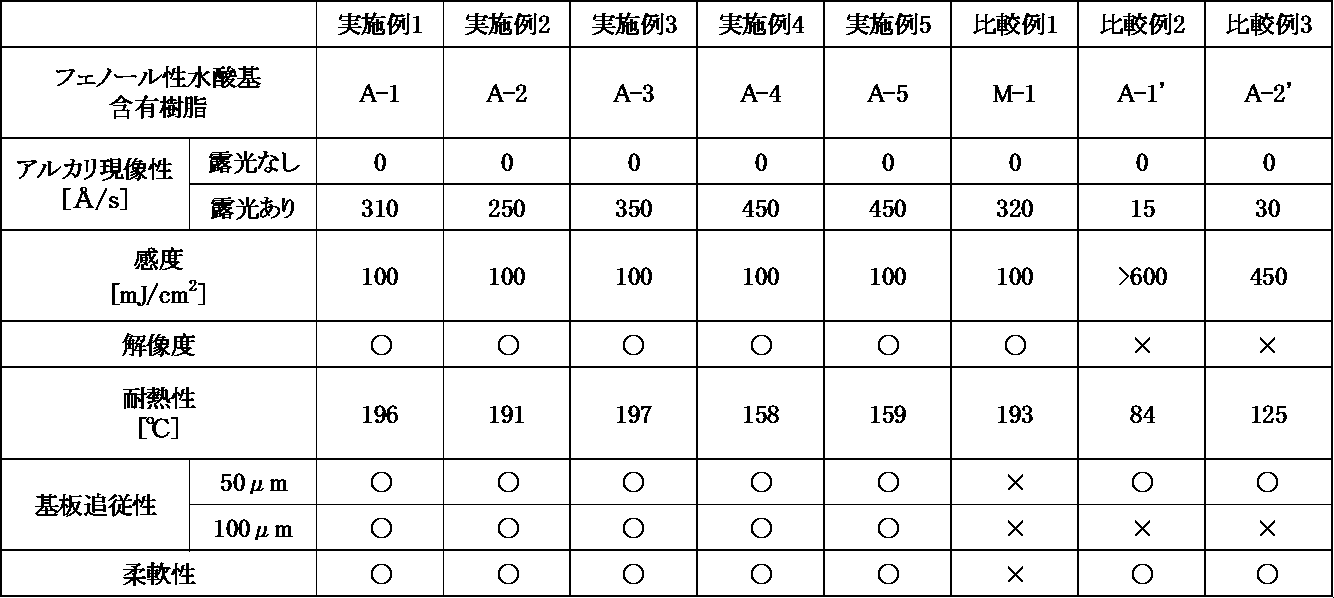
実施例6 熱硬化性樹脂組成物の調製
製造例1で合成したフェノール性水酸基含有樹脂(A-1)140質量部、ビスフェノールA型エポキシ樹脂(DIC株式会社製エピクロン850)180質量部、及び硬化触媒として2-エチルー4-メチルイミダゾール(和光純薬工業株式会社製、2E4MZ)12質量部をメチルエチルケトン250質量部に溶解させ熱硬化性樹脂組成物を得た。
得られた熱硬化性樹脂組成物について、以下の評価を行った。結果を表2に示す。
製造例1で合成したフェノール性水酸基含有樹脂(A-1)140質量部、ビスフェノールA型エポキシ樹脂(DIC株式会社製エピクロン850)180質量部、及び硬化触媒として2-エチルー4-メチルイミダゾール(和光純薬工業株式会社製、2E4MZ)12質量部をメチルエチルケトン250質量部に溶解させ熱硬化性樹脂組成物を得た。
得られた熱硬化性樹脂組成物について、以下の評価を行った。結果を表2に示す。
(耐熱性)
得られた熱硬化性樹脂組成物を下記基材に含浸させて、下記の条件で成形することにより積層板を得た。
基材 :ガラスクロス(「#2116」日東紡績株式会社製(210mm×280mm))
プライ数 :6
銅箔 :35μm(古川電工株式会社製)
プリプレグ化条件:160℃で4分
硬化条件 :200℃、40kg/cm2で1.5時間、
成型後板厚:1.2mm
得られた熱硬化性樹脂組成物を下記基材に含浸させて、下記の条件で成形することにより積層板を得た。
基材 :ガラスクロス(「#2116」日東紡績株式会社製(210mm×280mm))
プライ数 :6
銅箔 :35μm(古川電工株式会社製)
プリプレグ化条件:160℃で4分
硬化条件 :200℃、40kg/cm2で1.5時間、
成型後板厚:1.2mm
得られた積層板の銅箔をエッチング液(サンハヤト株式会社製H-1000A)で剥離し、銅箔を剥離した積層板を幅5mm、長さ54mmのサイズに切り出し試験片を作製した。
得られた試験片について、粘弾性測定装置(DMA:レオメトリック社製固体粘弾性測定装置「RSAII」、レクタンギュラーテンション法:周波数1Hz、室温~350℃、速度3℃/分)を用いて、弾性率変化が最大となる(tanδ変化率が最も大きい)温度をガラス転移温度として評価した。
得られた試験片について、粘弾性測定装置(DMA:レオメトリック社製固体粘弾性測定装置「RSAII」、レクタンギュラーテンション法:周波数1Hz、室温~350℃、速度3℃/分)を用いて、弾性率変化が最大となる(tanδ変化率が最も大きい)温度をガラス転移温度として評価した。
(耐湿熱密着性)
得られた熱硬化性樹脂組成物を下記基材に含浸させて、下記の条件で成形することにより積層板を製造し、これを試験片とした。
基材 :ガラスクロス(「#2116」日東紡績株式会社製(210mm×280mm))
プライ数 :6
銅箔 :35μm(古川電工株式会社製)
プリプレグ化条件:160℃で4分
硬化条件 :200℃、40kg/cm2で1.5時間、
成型後板厚:1.2mm
得られた熱硬化性樹脂組成物を下記基材に含浸させて、下記の条件で成形することにより積層板を製造し、これを試験片とした。
基材 :ガラスクロス(「#2116」日東紡績株式会社製(210mm×280mm))
プライ数 :6
銅箔 :35μm(古川電工株式会社製)
プリプレグ化条件:160℃で4分
硬化条件 :200℃、40kg/cm2で1.5時間、
成型後板厚:1.2mm
プレッシャークッカー試験機を用いて、121℃、2.1気圧、100%RHの条件で耐熱性の評価の際に製造した試験片を2時間保持した後、その試験片を室温まで放冷し、湿熱処理を行った。湿熱処理前後の試験片についてJIS-K6481(1996)に準拠してピール強度と層間剥離強度の測定を行った。
(柔軟性)
調製した熱硬化性樹脂組成物をバーコーターを用いてポリイミドフィルム上に約50μmの厚さになるように塗布し、110℃のホットプレート上で10分間乾燥させた後、180℃10分間の硬化処理を行い、20μmの樹脂硬化膜を形成した。得られた積層フィルムを直径3mmの巻き付けた後、巻き付け箇所の状態をレーザーマイクロスコープ(株式会社キーエンス製「VK-X200」)を用いて観察し、クラック及び剥がれが無い場合を○、クラック又は剥がれがある場合を×として評価した。
調製した熱硬化性樹脂組成物をバーコーターを用いてポリイミドフィルム上に約50μmの厚さになるように塗布し、110℃のホットプレート上で10分間乾燥させた後、180℃10分間の硬化処理を行い、20μmの樹脂硬化膜を形成した。得られた積層フィルムを直径3mmの巻き付けた後、巻き付け箇所の状態をレーザーマイクロスコープ(株式会社キーエンス製「VK-X200」)を用いて観察し、クラック及び剥がれが無い場合を○、クラック又は剥がれがある場合を×として評価した。
実施例7-10及び比較例4-6
フェノール性水酸基含有樹脂として、フェノール性水酸基含有樹脂(A-1)の代わりに表2に示すフェノール性水酸基含有樹脂を用いた以外は、実施例6と同様にして熱硬化性樹脂組成物を調製し、評価した。結果を表2に示す。
フェノール性水酸基含有樹脂として、フェノール性水酸基含有樹脂(A-1)の代わりに表2に示すフェノール性水酸基含有樹脂を用いた以外は、実施例6と同様にして熱硬化性樹脂組成物を調製し、評価した。結果を表2に示す。

Claims (6)
- 硬化剤(A)、架橋剤(B)及び硬化触媒(C)を含む熱硬化性樹脂組成物であって、
前記硬化剤(A)が、下記式(1)又は(2)で表されるトリアリールメタン型化合物(A1)、フェノール又は炭素原子数1~20の脂肪族炭化水素基を有するフェノール化合物(A2)、及びアルデヒド化合物(A3)を必須の反応原料とするノボラック樹脂中間体(M)と、炭素原子数6~20のアルケン化合物(A4)との反応物であるフェノール性水酸基含有樹脂である、熱硬化性樹脂組成物。

R1は、脂肪族炭化水素基、芳香環含有炭化水素基、アルコキシ基、又はハロゲン原子である。
R2は、脂肪族炭化水素基、芳香環含有炭化水素基、アルコキシ基、又はハロゲン原子である。
R3は、脂肪族炭化水素基、芳香環含有炭化水素基、アルコキシ基、又はハロゲン原子である。
kは、0~2の整数である。
lは、0~4の整数である。
mは、0~4の整数である。
nは、0~5の整数である。
pは、0~7の整数である。
R1が複数ある場合、複数のR1は互いに同じでも異なってもよい。
R2が複数ある場合、複数のR2は互いに同じでも異なってもよい。
R3が複数ある場合、複数のR3は互いに同じでも異なってもよい。) - 前記架橋剤(B)が、エポキシ樹脂、熱硬化性ポリイミド及び熱硬化性ポリアミドイミドから選択される1以上である請求項1に記載の熱硬化性樹脂組成物。
- 前記硬化触媒(C)が、アミン系硬化触媒及びホスフィン系硬化触媒から選択される1以上である請求項1又は2に記載の熱硬化性樹脂組成物。
- 感光剤(D)を含む請求項1~3のいずれかに記載の熱硬化性樹脂組成物。
- 請求項1~4のいずれかに記載の熱硬化性樹脂組成物の硬化物。
- 請求項1~4のいずれかに記載の熱硬化性樹脂組成物を用いたレジスト材料。
Applications Claiming Priority (2)
| Application Number | Priority Date | Filing Date | Title |
|---|---|---|---|
| JP2018242835 | 2018-12-26 | ||
| JP2018-242835 | 2018-12-26 |
Publications (1)
| Publication Number | Publication Date |
|---|---|
| WO2020137310A1 true WO2020137310A1 (ja) | 2020-07-02 |
Family
ID=71127171
Family Applications (1)
| Application Number | Title | Priority Date | Filing Date |
|---|---|---|---|
| PCT/JP2019/046093 Ceased WO2020137310A1 (ja) | 2018-12-26 | 2019-11-26 | 熱硬化性組成物及びその硬化物 |
Country Status (2)
| Country | Link |
|---|---|
| TW (1) | TW202033588A (ja) |
| WO (1) | WO2020137310A1 (ja) |
Citations (3)
| Publication number | Priority date | Publication date | Assignee | Title |
|---|---|---|---|---|
| JP2014091784A (ja) * | 2012-11-02 | 2014-05-19 | Meiwa Kasei Kk | ノボラック型フェノール樹脂、及びその用途 |
| WO2017094516A1 (ja) * | 2015-12-02 | 2017-06-08 | Dic株式会社 | フェノール性水酸基含有樹脂及びレジスト膜 |
| WO2018066373A1 (ja) * | 2016-10-07 | 2018-04-12 | Dic株式会社 | フェノール性水酸基含有樹脂及びレジスト材料 |
-
2019
- 2019-11-26 WO PCT/JP2019/046093 patent/WO2020137310A1/ja not_active Ceased
- 2019-12-19 TW TW108146611A patent/TW202033588A/zh unknown
Patent Citations (3)
| Publication number | Priority date | Publication date | Assignee | Title |
|---|---|---|---|---|
| JP2014091784A (ja) * | 2012-11-02 | 2014-05-19 | Meiwa Kasei Kk | ノボラック型フェノール樹脂、及びその用途 |
| WO2017094516A1 (ja) * | 2015-12-02 | 2017-06-08 | Dic株式会社 | フェノール性水酸基含有樹脂及びレジスト膜 |
| WO2018066373A1 (ja) * | 2016-10-07 | 2018-04-12 | Dic株式会社 | フェノール性水酸基含有樹脂及びレジスト材料 |
Also Published As
| Publication number | Publication date |
|---|---|
| TW202033588A (zh) | 2020-09-16 |
Similar Documents
| Publication | Publication Date | Title |
|---|---|---|
| JP6187731B1 (ja) | フェノール性水酸基含有樹脂及びレジスト膜 | |
| JP6341348B1 (ja) | フェノール性水酸基含有樹脂及びレジスト材料 | |
| JP6123967B1 (ja) | ノボラック型フェノール性水酸基含有樹脂及びレジスト膜 | |
| JP6156591B2 (ja) | ノボラック型フェノール性水酸基含有樹脂及びレジスト膜 | |
| JP6274366B1 (ja) | ノボラック型樹脂及びレジスト材料 | |
| WO2020137310A1 (ja) | 熱硬化性組成物及びその硬化物 | |
| JP6269904B1 (ja) | ノボラック型樹脂の製造方法 | |
| JP6590084B2 (ja) | フェノール性水酸基含有樹脂及びレジスト材料 | |
| TWI864366B (zh) | 含有酚性羥基之樹脂及其製造方法 | |
| JP7700560B2 (ja) | エポキシ樹脂、感光性樹脂組成物、レジスト膜、硬化性組成物および硬化膜 | |
| JP6328350B2 (ja) | ノボラック型樹脂及びレジスト材料 | |
| WO2017204206A1 (ja) | 樹脂組成物及びレジスト膜 | |
| JP2019135279A (ja) | レジスト材料 | |
| WO2018105346A1 (ja) | フェノール性水酸基含有樹脂及びレジスト材料 |
Legal Events
| Date | Code | Title | Description |
|---|---|---|---|
| 121 | Ep: the epo has been informed by wipo that ep was designated in this application |
Ref document number: 19906442 Country of ref document: EP Kind code of ref document: A1 |
|
| NENP | Non-entry into the national phase |
Ref country code: DE |
|
| 122 | Ep: pct application non-entry in european phase |
Ref document number: 19906442 Country of ref document: EP Kind code of ref document: A1 |
|
| NENP | Non-entry into the national phase |
Ref country code: JP |