WO2020121979A1 - 液晶配向剤、液晶配向膜及び液晶表示素子 - Google Patents
液晶配向剤、液晶配向膜及び液晶表示素子 Download PDFInfo
- Publication number
- WO2020121979A1 WO2020121979A1 PCT/JP2019/047920 JP2019047920W WO2020121979A1 WO 2020121979 A1 WO2020121979 A1 WO 2020121979A1 JP 2019047920 W JP2019047920 W JP 2019047920W WO 2020121979 A1 WO2020121979 A1 WO 2020121979A1
- Authority
- WO
- WIPO (PCT)
- Prior art keywords
- liquid crystal
- formula
- diamine
- crystal aligning
- aligning agent
- Prior art date
- Legal status (The legal status is an assumption and is not a legal conclusion. Google has not performed a legal analysis and makes no representation as to the accuracy of the status listed.)
- Ceased
Links
- UHOVQNZJYSORNB-UHFFFAOYSA-N c1ccccc1 Chemical compound c1ccccc1 UHOVQNZJYSORNB-UHFFFAOYSA-N 0.000 description 2
- 0 O=C(*1(CCC(O2)=O)C2=O)OC1=O Chemical compound O=C(*1(CCC(O2)=O)C2=O)OC1=O 0.000 description 1
Classifications
-
- C—CHEMISTRY; METALLURGY
- C09—DYES; PAINTS; POLISHES; NATURAL RESINS; ADHESIVES; COMPOSITIONS NOT OTHERWISE PROVIDED FOR; APPLICATIONS OF MATERIALS NOT OTHERWISE PROVIDED FOR
- C09K—MATERIALS FOR MISCELLANEOUS APPLICATIONS, NOT PROVIDED FOR ELSEWHERE
- C09K19/00—Liquid crystal materials
- C09K19/52—Liquid crystal materials characterised by components which are not liquid crystals, e.g. additives with special physical aspect: solvents, solid particles
- C09K19/54—Additives having no specific mesophase characterised by their chemical composition
- C09K19/56—Aligning agents
-
- C—CHEMISTRY; METALLURGY
- C08—ORGANIC MACROMOLECULAR COMPOUNDS; THEIR PREPARATION OR CHEMICAL WORKING-UP; COMPOSITIONS BASED THEREON
- C08G—MACROMOLECULAR COMPOUNDS OBTAINED OTHERWISE THAN BY REACTIONS ONLY INVOLVING UNSATURATED CARBON-TO-CARBON BONDS
- C08G73/00—Macromolecular compounds obtained by reactions forming a linkage containing nitrogen with or without oxygen or carbon in the main chain of the macromolecule, not provided for in groups C08G12/00 - C08G71/00
- C08G73/06—Polycondensates having nitrogen-containing heterocyclic rings in the main chain of the macromolecule
- C08G73/10—Polyimides; Polyester-imides; Polyamide-imides; Polyamide acids or similar polyimide precursors
-
- G—PHYSICS
- G02—OPTICS
- G02F—OPTICAL DEVICES OR ARRANGEMENTS FOR THE CONTROL OF LIGHT BY MODIFICATION OF THE OPTICAL PROPERTIES OF THE MEDIA OF THE ELEMENTS INVOLVED THEREIN; NON-LINEAR OPTICS; FREQUENCY-CHANGING OF LIGHT; OPTICAL LOGIC ELEMENTS; OPTICAL ANALOGUE/DIGITAL CONVERTERS
- G02F1/00—Devices or arrangements for the control of the intensity, colour, phase, polarisation or direction of light arriving from an independent light source, e.g. switching, gating or modulating; Non-linear optics
- G02F1/01—Devices or arrangements for the control of the intensity, colour, phase, polarisation or direction of light arriving from an independent light source, e.g. switching, gating or modulating; Non-linear optics for the control of the intensity, phase, polarisation or colour
- G02F1/13—Devices or arrangements for the control of the intensity, colour, phase, polarisation or direction of light arriving from an independent light source, e.g. switching, gating or modulating; Non-linear optics for the control of the intensity, phase, polarisation or colour based on liquid crystals, e.g. single liquid crystal display cells
- G02F1/133—Constructional arrangements; Operation of liquid crystal cells; Circuit arrangements
- G02F1/1333—Constructional arrangements; Manufacturing methods
- G02F1/1337—Surface-induced orientation of the liquid crystal molecules, e.g. by alignment layers
-
- G—PHYSICS
- G02—OPTICS
- G02F—OPTICAL DEVICES OR ARRANGEMENTS FOR THE CONTROL OF LIGHT BY MODIFICATION OF THE OPTICAL PROPERTIES OF THE MEDIA OF THE ELEMENTS INVOLVED THEREIN; NON-LINEAR OPTICS; FREQUENCY-CHANGING OF LIGHT; OPTICAL LOGIC ELEMENTS; OPTICAL ANALOGUE/DIGITAL CONVERTERS
- G02F1/00—Devices or arrangements for the control of the intensity, colour, phase, polarisation or direction of light arriving from an independent light source, e.g. switching, gating or modulating; Non-linear optics
- G02F1/01—Devices or arrangements for the control of the intensity, colour, phase, polarisation or direction of light arriving from an independent light source, e.g. switching, gating or modulating; Non-linear optics for the control of the intensity, phase, polarisation or colour
- G02F1/13—Devices or arrangements for the control of the intensity, colour, phase, polarisation or direction of light arriving from an independent light source, e.g. switching, gating or modulating; Non-linear optics for the control of the intensity, phase, polarisation or colour based on liquid crystals, e.g. single liquid crystal display cells
- G02F1/133—Constructional arrangements; Operation of liquid crystal cells; Circuit arrangements
- G02F1/1333—Constructional arrangements; Manufacturing methods
- G02F1/1337—Surface-induced orientation of the liquid crystal molecules, e.g. by alignment layers
- G02F1/133711—Surface-induced orientation of the liquid crystal molecules, e.g. by alignment layers by organic films, e.g. polymeric films
- G02F1/133723—Polyimide, polyamide-imide
Definitions
- the present invention relates to a liquid crystal alignment agent, a liquid crystal alignment film, and a liquid crystal display device.
- a liquid crystal display element is composed by sandwiching a liquid crystal layer between a pair of transparent substrates provided with electrodes.
- an organic film made of an organic material is used as a liquid crystal alignment film so that the liquid crystal has a desired alignment state between the substrates. That is, the liquid crystal alignment film is a component of a liquid crystal display element, is formed on a surface of a substrate holding the liquid crystal in contact with the liquid crystal, and plays a role of aligning the liquid crystal in a certain direction between the substrates. Further, the pretilt angle of the liquid crystal can be controlled by the liquid crystal alignment film.
- a method of reducing the pretilt angle by mainly selecting a structure of polyimide see Patent Documents 1 and 2) and the like are known.
- liquid crystal display devices in addition to applications such as large-screen and high-definition LCD TVs, in-vehicle use, for example, car navigation systems and meter panels, monitoring cameras and medical camera monitors.
- Liquid crystal display elements are used in such applications, and due to the demand for viewing angle characteristics, a rubbing alignment film is required to have a lower pretilt angle than before.
- liquid crystal aligning agent having the following constitution is most suitable for achieving the above-mentioned object, and completed the present invention.
- a liquid crystal aligning agent containing a polyimide which is a reaction product of a tetracarboxylic dianhydride derivative component consisting of at least one selected from aliphatic tetracarboxylic dianhydride and alicyclic tetracarboxylic dianhydride and a diamine component.
- the diamine component contains at least one selected from diamines having the structure of the following formula [A], and the imidization ratio of the polyimide is 70% or more.
- X 1 and X 2 are each independently an oxygen atom or a sulfur atom
- R is represented by [-((CH 2 ) 2 O) p (CH 2 ) 2 -] and p is an integer from 1 to 3. Is.
- liquid crystal aligning agent of the present invention it is possible to obtain a liquid crystal aligning film which satisfies various characteristics required for a liquid crystal aligning film and gives a low pretilt angle of 1 degree or less.
- the polyimide contained in the liquid crystal aligning agent of the present invention is a tetracarboxylic dianhydride derivative component and a specific diamine consisting of at least one selected from aliphatic tetracarboxylic dianhydride and alicyclic tetracarboxylic dianhydride. It is obtained by imidizing a polyimide precursor obtained from a diamine component containing (hereinafter, also referred to as a specific polymer).
- a specific polymer containing
- the tetracarboxylic acid derivative used in the production of the polyimide precursor is not only tetracarboxylic acid dianhydride, but its derivative, tetracarboxylic acid, tetracarboxylic acid dihalide compound, tetracarboxylic acid dialkyl ester, tetracarboxylic acid dialkyl Ester dihalide may be mentioned.
- aliphatic or alicyclic tetracarboxylic acid dianhydride or its derivative those represented by the following formula (4) are preferable.
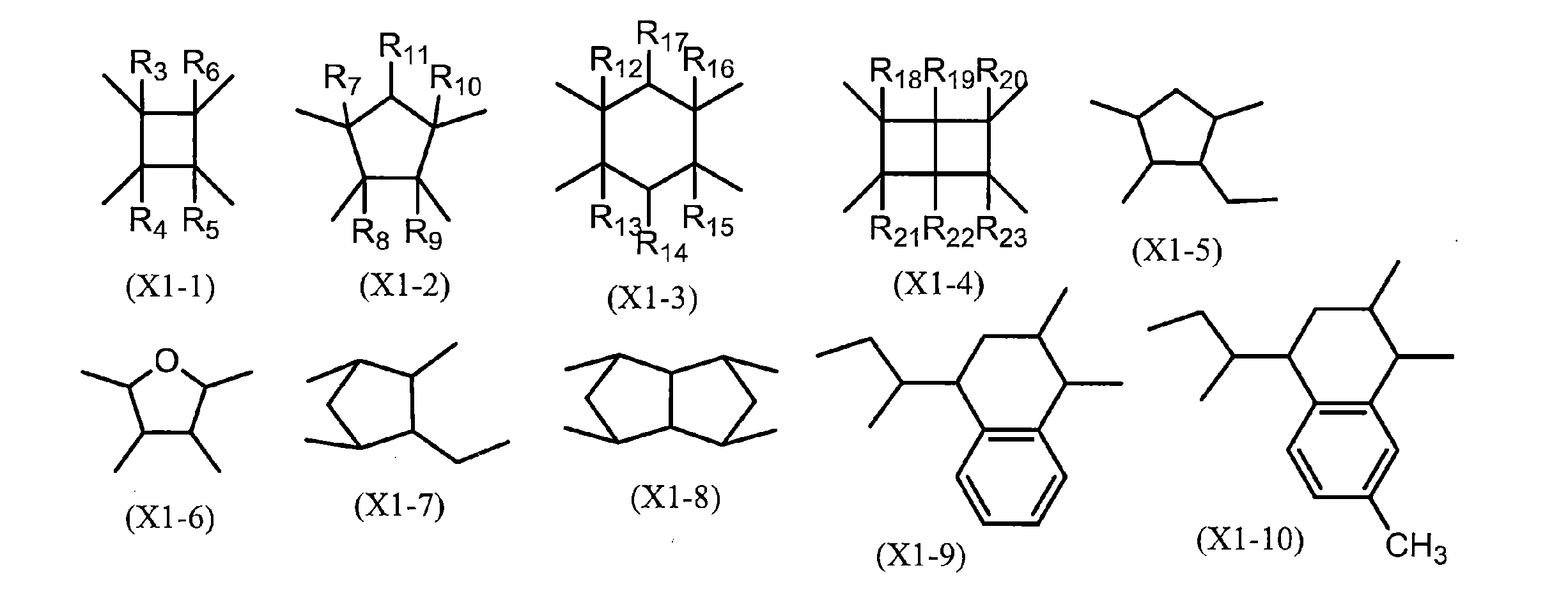
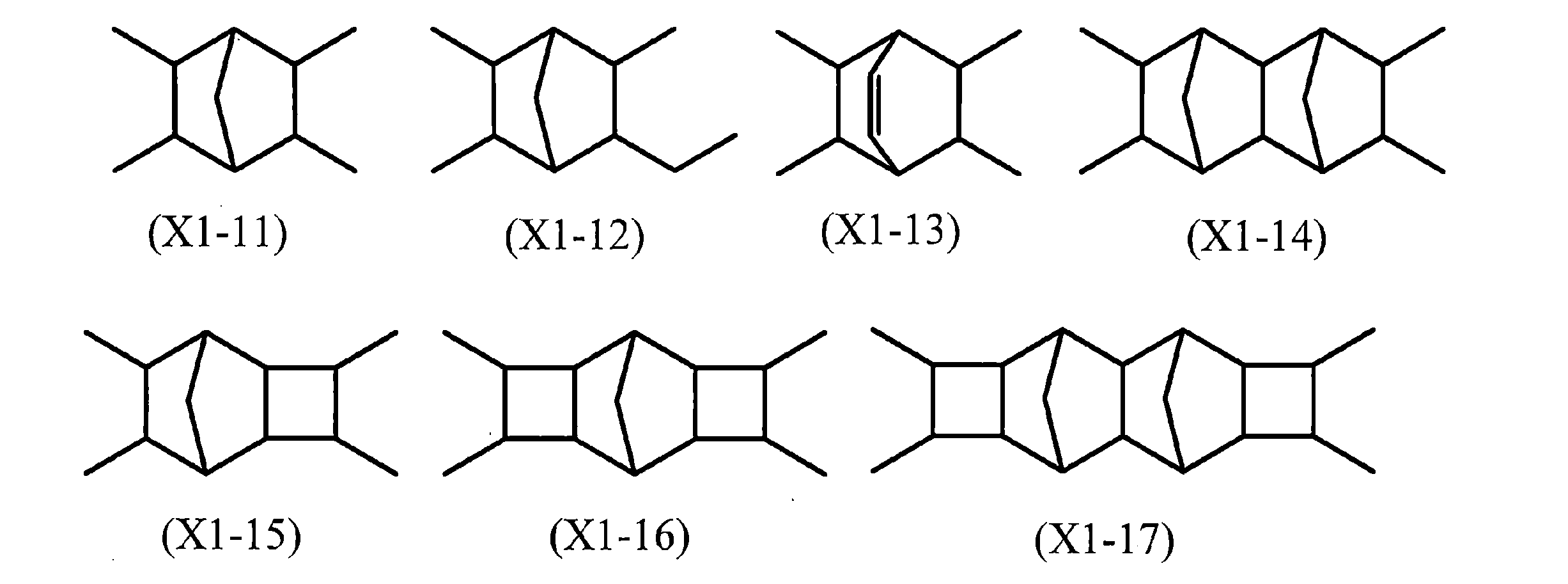
- X 1 preferred structures include the following formulas (X1-1) to (X1-24).
- R 3 to R 23 are each independently a hydrogen atom, a halogen atom, an alkyl group having 1 to 6 carbon atoms, an alkenyl group having 2 to 6 carbon atoms, An alkynyl group having 2 to 6 carbon atoms, a monovalent organic group having 1 to 6 carbon atoms containing a fluorine atom, or a phenyl group.
- R 3 to R 23 are preferably hydrogen atom, halogen atom, methyl group or ethyl group, and more preferably hydrogen atom or methyl group.
- (X1-1) examples include the following formulas (X1-1-1) to (X1-1-6). From the viewpoint of enhancing the liquid crystal alignment, (X1-1-1) is particularly preferable. ..
- X 1 is the above formula (X1-1-1), (X1-1-2), (X1-9), (X1-10), (X1-21), X1-24) is more preferable.
- the compound represented by the formula (4) may be two or more, and wherein X 1 is the formula (X1-1) (4), X 1 is the formula (Xl-2) ⁇ ( Formula (4) which is any of X1-24).
- the diamine component used for producing the polyimide contained in the liquid crystal aligning agent of the present invention contains at least one selected from diamines having a structure of the following formula [A].
- X 1 and X 2 are each independently an oxygen atom or a sulfur atom
- R is represented by [-((CH 2 ) 2 O) p (CH 2 ) 2 -] and p is an integer from 1 to 3. Is.
- [A] include diamines of the following formulas [A-1] to [A-4]. These may be used alone or in combination.
- the preferable content of the diamine having the structure of the above formula [A] is preferably 40% to 80% of the total diamine component, more preferably 40% to 70%, and further preferably 40% to 60%.
- a 1 and A 2 are each independently a hydrogen atom, an alkyl group having 1 to 5 carbon atoms, an alkenyl group having 2 to 5 carbon atoms, or an alkynyl group having 2 to 5 carbon atoms. is there.
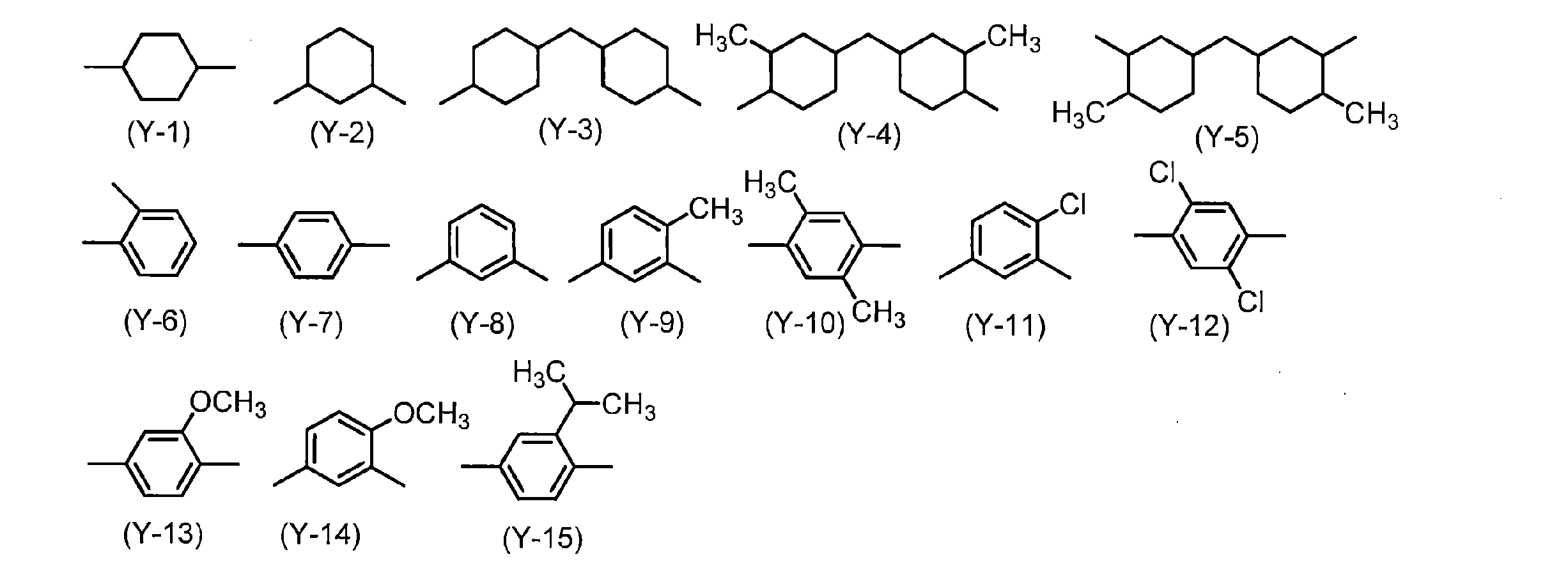
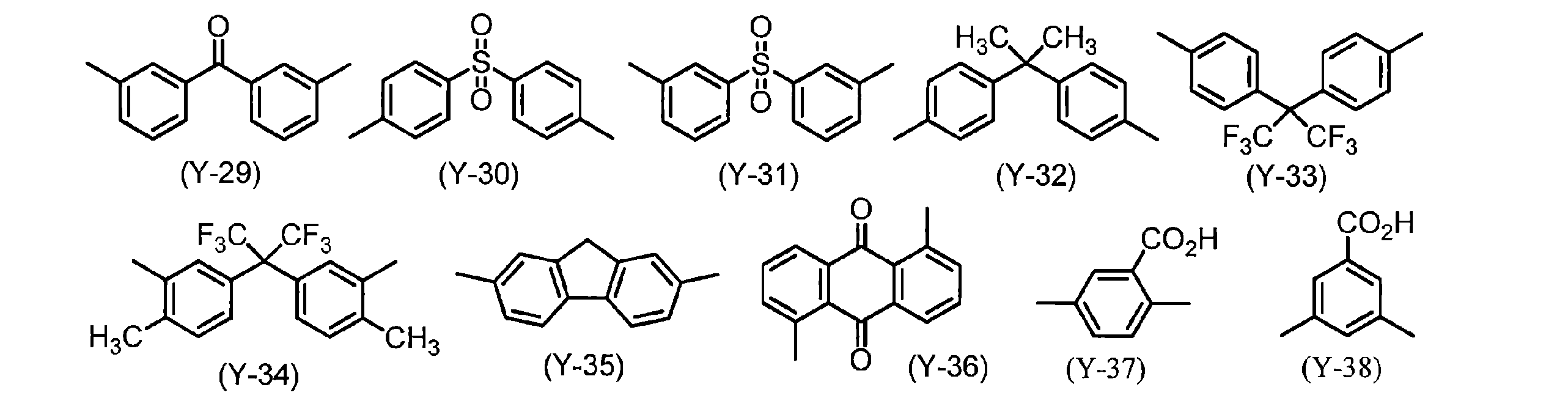
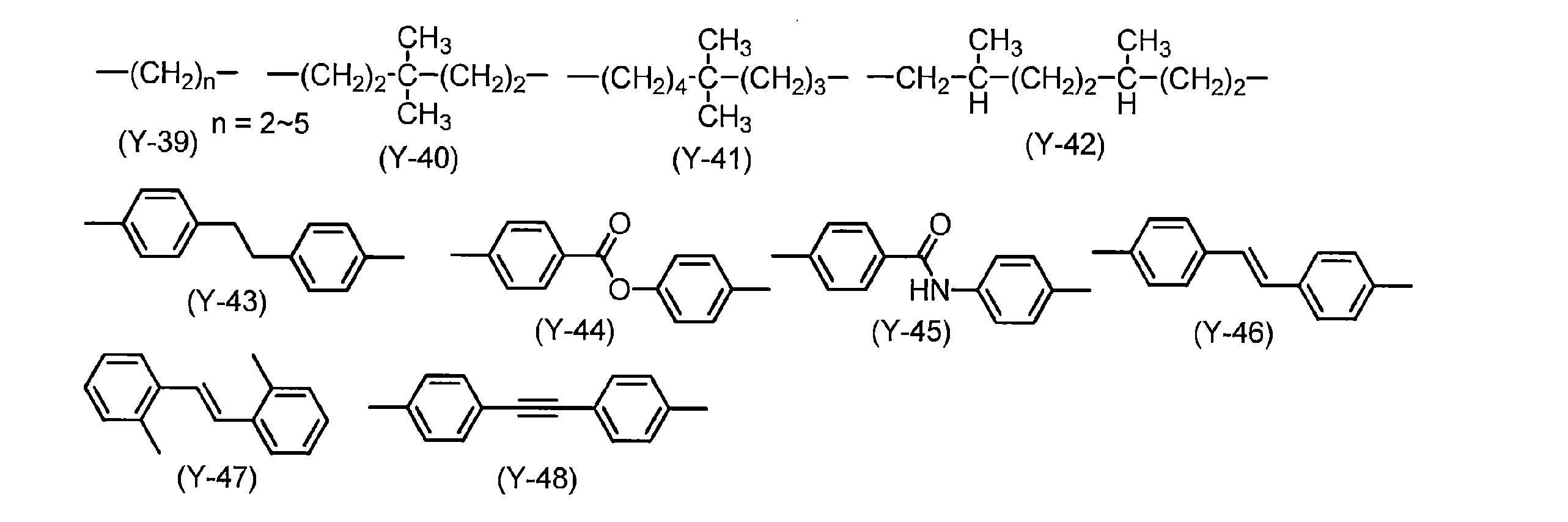
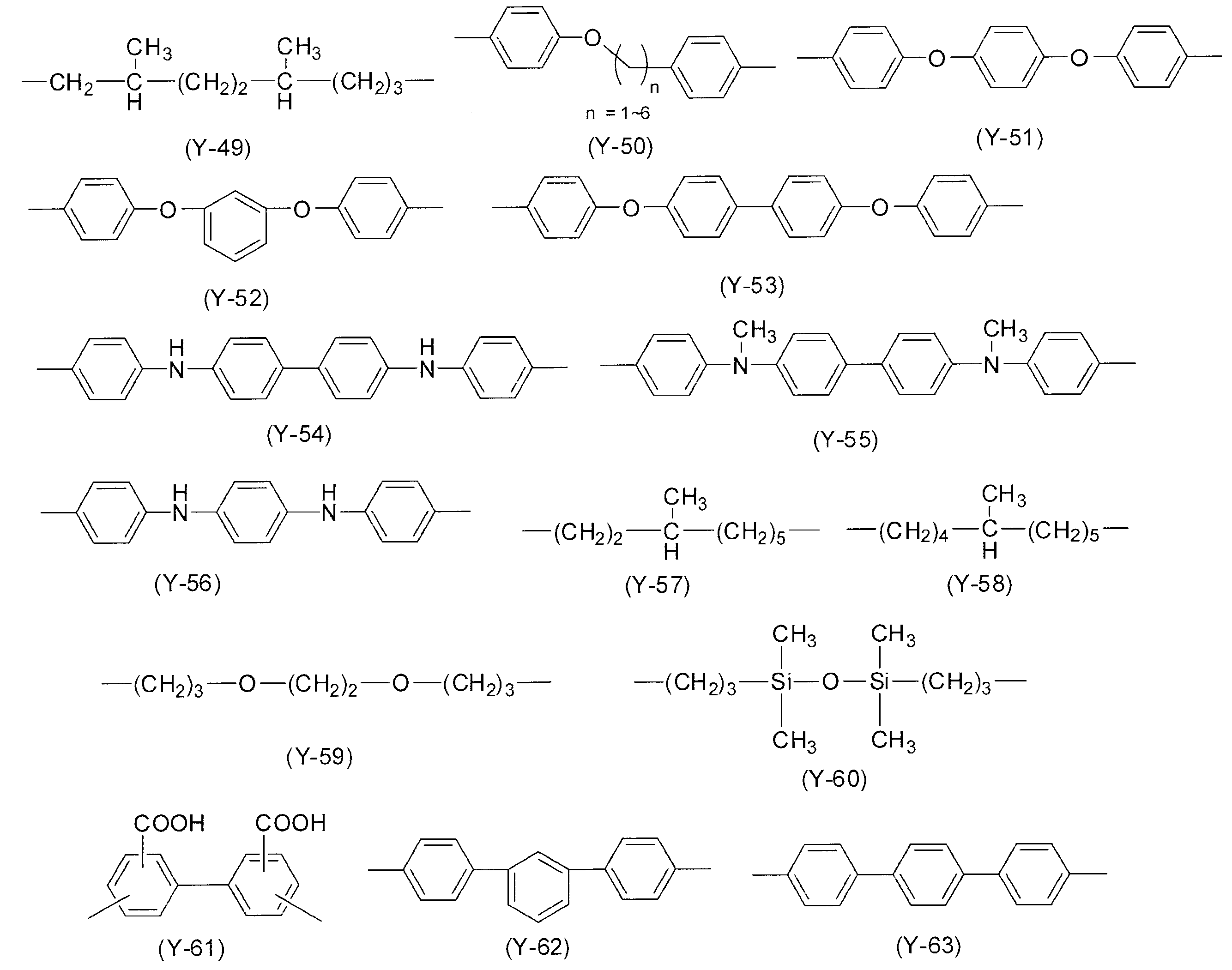
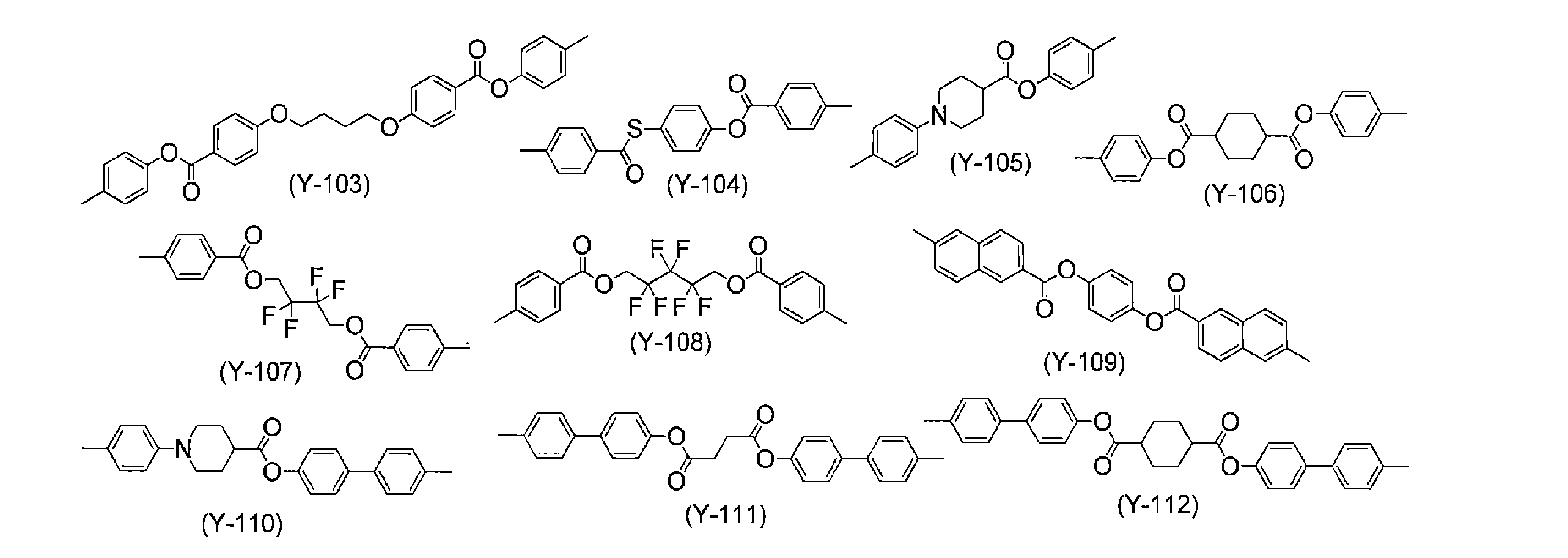
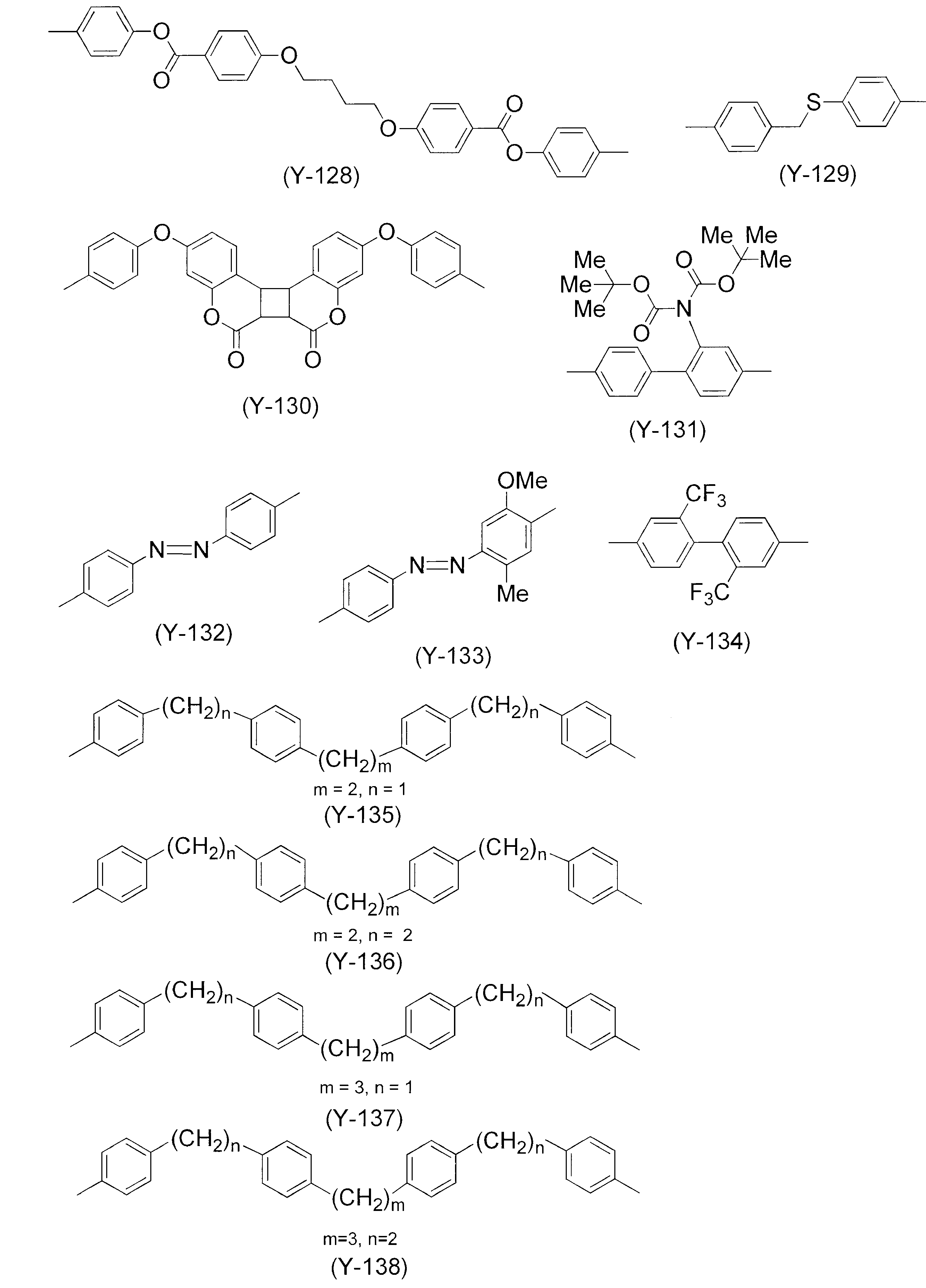
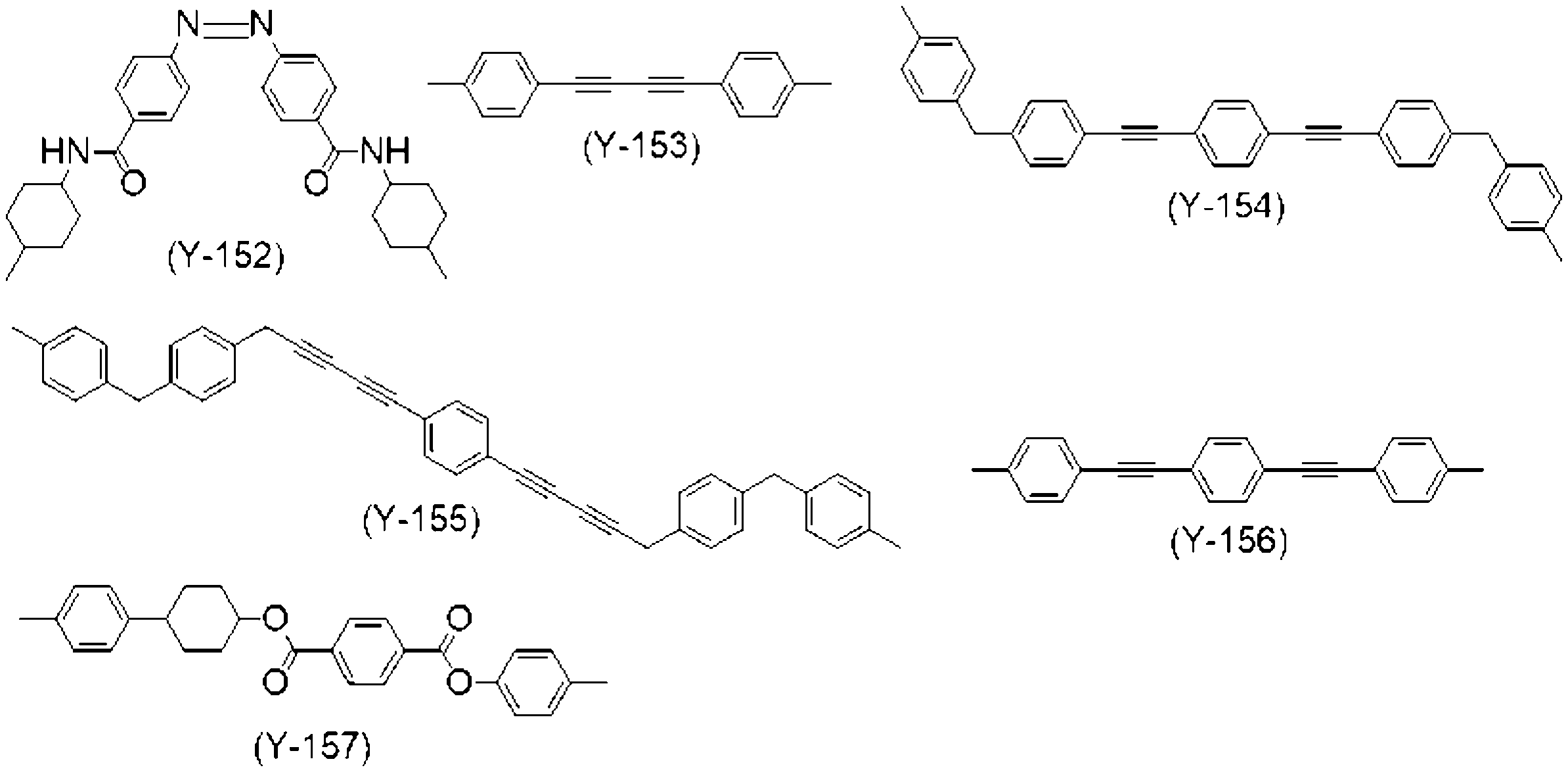
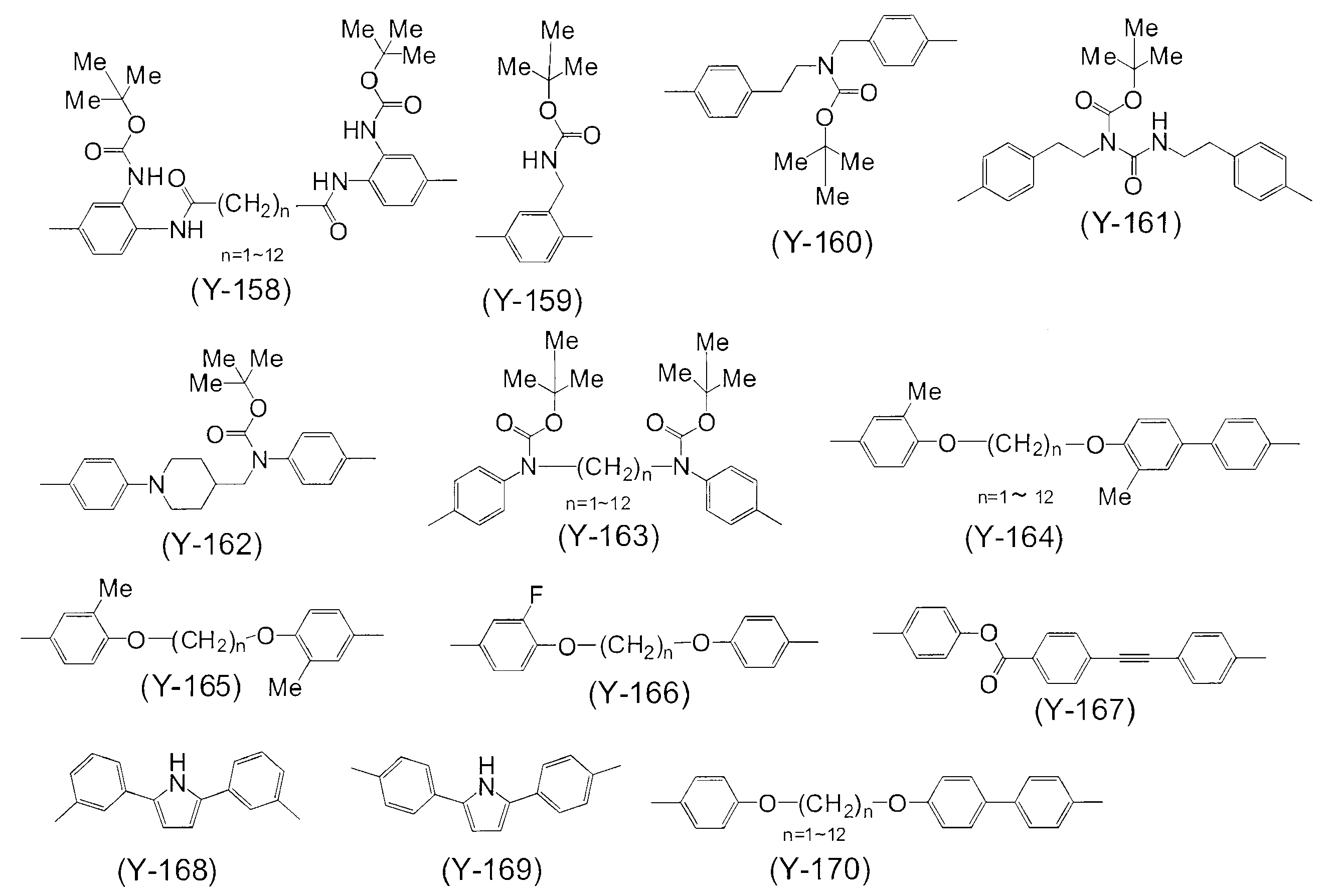
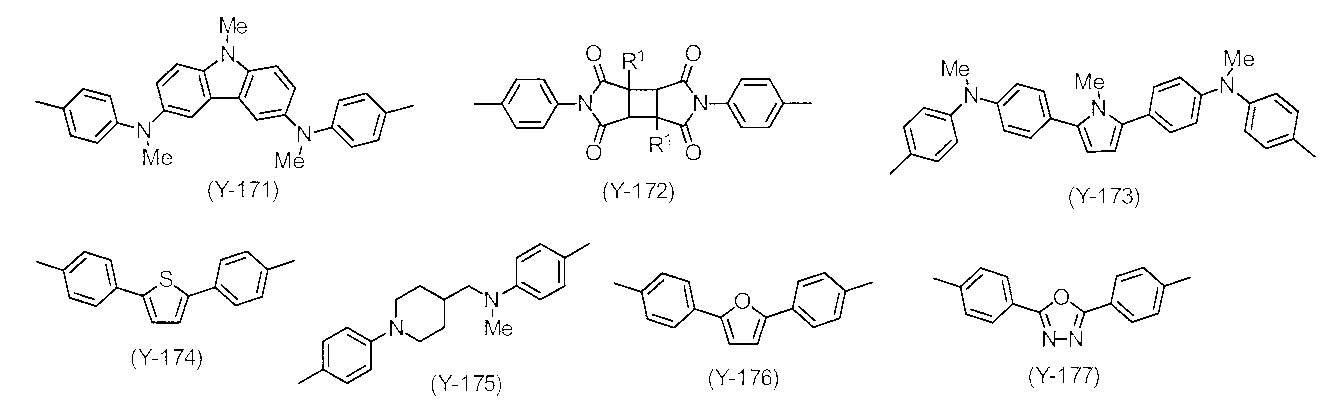
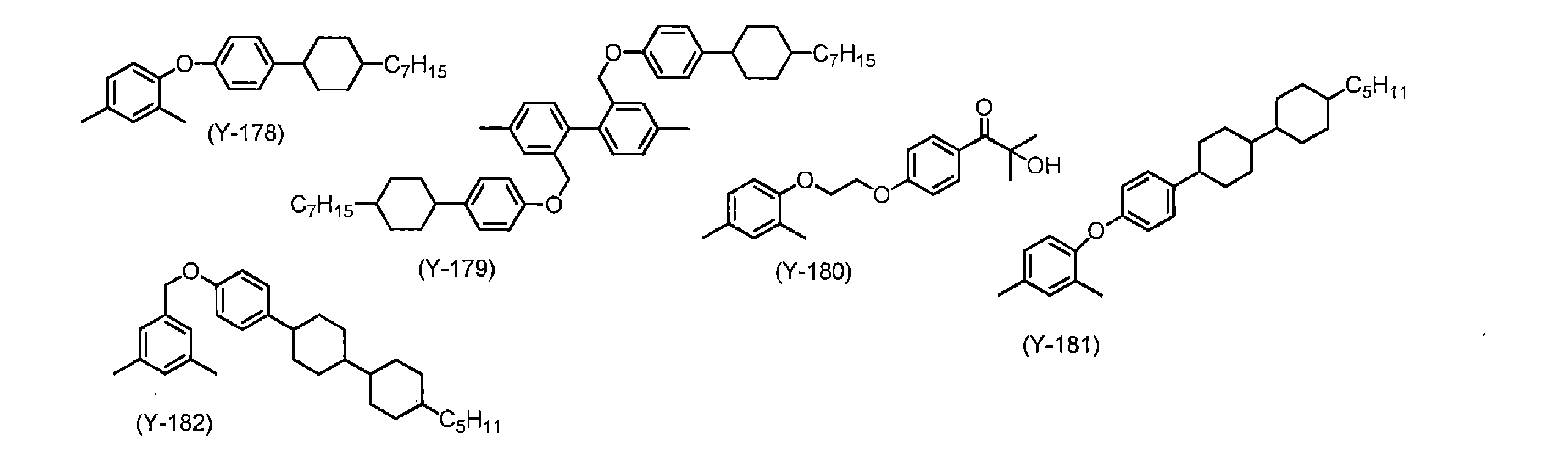
- Y 1 is not particularly limited. Preferred structures include (Y-1) to (Y-182) below.
- Me represents a methyl group
- R 1 represents a hydrogen atom or a hydrocarbon group having 1 to 5 carbon atoms.
- any Y 1 contains a structure represented by the following formula (6).
- D is a thermolabile group that is eliminated at 150° C. to 230° C., more preferably 180° C. to 230° C., and replaces a hydrogen atom.
- Y containing the structure represented by the above formula (6) include (Y-124), (Y-131), and (Y-158) to (Y-163).
- the polyimide precursor polyamic acid used in the present invention is specified as a tetracarboxylic dianhydride derivative component consisting of at least one selected from aliphatic tetracarboxylic dianhydride and alicyclic tetracarboxylic dianhydride. It is a polyimide precursor obtained from a diamine component containing a diamine, and can be produced by the method described below.
- a tetracarboxylic dianhydride derivative component consisting of at least one selected from an aliphatic tetracarboxylic dianhydride and an alicyclic tetracarboxylic dianhydride and a diamine component containing a specific diamine are organic. It can be synthesized by reacting in the presence of a solvent at ⁇ 20° C. to 150° C., preferably 0° C. to 50° C. for 30 minutes to 24 hours, preferably 1 hour to 12 hours. ..
- the organic solvent used in the above reaction is preferably N,N-dimethylformamide, N-methyl-2-pyrrolidone or ⁇ -butyrolactone in view of the solubility of the monomer and the polymer, and these may be used alone or in combination of two or more. You may use.
- the concentration of the polymer is preferably 1% by mass to 30% by mass, and more preferably 5% by mass to 20% by mass, from the viewpoint that the precipitation of the polymer is less likely to occur and a high molecular weight product is easily obtained.
- the polyamic acid obtained as described above can be recovered by precipitating a polymer by injecting it into a poor solvent while stirring the reaction solution well.
- the powder of purified polyamic acid can be obtained by performing precipitation several times, washing with a poor solvent, and drying at room temperature or by heating.
- the poor solvent is not particularly limited, and examples thereof include water, methanol, ethanol, hexane, butyl cellosolve, acetone, and toluene.
- the polyamic acid ester which is one of the polyimide precursors used in the present invention can be produced by the method (I), (II) or (III) shown below.
- the polyamic acid ester can be synthesized by esterifying a polyamic acid obtained from tetracarboxylic dianhydride and diamine. Specifically, the polyamic acid and the esterifying agent are reacted in the presence of an organic solvent at ⁇ 20° C. to 150° C., preferably 0° C. to 50° C. for 30 minutes to 24 hours, preferably 1 hour to 4 hours.
- an organic solvent at ⁇ 20° C. to 150° C., preferably 0° C. to 50° C. for 30 minutes to 24 hours, preferably 1 hour to 4 hours.
- esterifying agent those which can be easily removed by purification are preferable, and N,N-dimethylformamide dimethyl acetal, N,N-dimethylformamide diethyl acetal, N,N-dimethylformamide dipropyl acetal, N,N-dimethylformamide Dineopentylbutyl acetal, N,N-dimethylformamide di-t-butyl acetal, 1-methyl-3-p-tolyltriazene, 1-ethyl-3-p-tolyltriazene, 1-propyl-3-p -Tolyltriazene, 4-(4,6-dimethoxy-1,3,5-triazin-2-yl)-4-methylmorpholinium chloride and the like can be mentioned.
- the amount of the esterifying agent used is preferably 2 to 6 molar equivalents based on 1 mole of the repeating unit of the polyamic acid.
- the solvent used in the above reaction is preferably N,N-dimethylformamide, N-methyl-2-pyrrolidone, or ⁇ -butyrolactone because of the solubility of the polymer, and these may be used alone or in combination of two or more. Good.
- the concentration of the polymer in the reaction solution is preferably 1% by mass to 30% by mass, more preferably 5% by mass to 20% by mass, from the viewpoints that the precipitation of the polymer is less likely to occur and a high molecular weight product is easily obtained.
- pyridine triethylamine, 4-dimethylaminopyridine and the like can be used, but pyridine is preferable because the reaction proceeds gently.
- the amount of the base used is preferably 2 times to 4 times the mol of the tetracarboxylic acid diester dichloride from the viewpoints of easy removal and easily obtaining a high molecular weight product.
- the solvent used in the above reaction is preferably N-methyl-2-pyrrolidone or ⁇ -butyrolactone in view of the solubility of the monomer and polymer, and these may be used alone or in combination of two or more.
- the polymer concentration in the reaction solution is preferably 1% by mass to 30% by mass, and more preferably 5% by mass to 20% by mass, from the viewpoint that polymer precipitation is unlikely to occur and a high molecular weight polymer is easily obtained.
- the solvent used for the synthesis of the polyamic acid ester is preferably dehydrated as much as possible, and it is preferable to prevent the entry of outside air in a nitrogen atmosphere.
- the polyamic acid ester can be produced by polycondensing the tetracarboxylic acid diester and diamine. Specifically, tetracarboxylic acid diester and diamine are combined in the presence of a condensing agent, a base, and an organic solvent at 0° C. to 150° C., preferably 0° C. to 100° C. for 30 minutes to 24 hours, preferably 3 hours to It can be produced by reacting for 15 hours.
- condensing agent examples include triphenyl phosphite, dicyclohexylcarbodiimide, 1-ethyl-3-(3-dimethylaminopropyl)carbodiimide hydrochloride, N,N′-carbonyldiimidazole, dimethoxy-1,3,5-triazine.
- Nylmethylmorpholinium O-(benzotriazol-1-yl)-N,N,N',N'-tetramethyluronium tetrafluoroborate, O-(benzotriazol-1-yl)-N,N , N',N'-tetramethyluronium hexafluorophosphate, diphenyl (2,3-dihydro-2-thioxo-3-benzoxazolyl)phosphonate and the like can be used.
- the amount of the condensing agent added is preferably 2 times to 3 times the mol of the tetracarboxylic acid diester.
- Tertiary amines such as pyridine and triethylamine can be used as the base.
- the amount of the base used is preferably 2 times to 4 times the mol of the diamine component from the viewpoints of easy removal and easily obtaining a high molecular weight product.
- the reaction proceeds efficiently by adding Lewis acid as an additive.
- Lewis acid lithium halides such as lithium chloride and lithium bromide are preferable.
- the Lewis acid is preferably added in an amount of 0 times to 1.0 times the molar amount of the diamine component.
- the above (I) is particularly preferably the above production method (II).
- the polymer can be precipitated by injecting the solution of the polyamic acid ester obtained as described above into a poor solvent while stirring well. Precipitation can be performed several times, washing with a poor solvent, and drying at room temperature or heat can yield a purified polyamic acid ester powder.
- the poor solvent is not particularly limited, and examples thereof include water, methanol, ethanol, hexane, butyl cellosolve, acetone, and toluene.
- the polyimide used in the present invention can be produced by imidizing the polyamic acid or polyamic acid ester.
- the imidization ratio of the polyimide used in the present invention is preferably 70% to 99% from the viewpoint of electrical characteristics.
- chemical imidization by adding a basic catalyst to the polyamic acid ester solution or the polyamic acid solution obtained by dissolving the polyamic acid ester resin powder in an organic solvent is simple.
- Chemical imidization is preferable because the imidization reaction proceeds at a relatively low temperature and the decrease in the molecular weight of the polymer does not easily occur in the process of imidization.
- the chemical imidization can be performed by stirring the polyamic acid or polyamic acid ester to be imidized in an organic solvent in the presence of a basic catalyst and an acid anhydride.
- a basic catalyst include pyridine, triethylamine, trimethylamine, tributylamine, trioctylamine and the like. Of these, pyridine is preferable because it has a proper basicity for proceeding the reaction.
- the acid anhydride include acetic anhydride, trimellitic anhydride, pyromellitic anhydride and the like. Among them, acetic anhydride is preferable because purification after the reaction is easy.
- the temperature for the imidization reaction is, for example, ⁇ 20° C. to 120° C., preferably 0° C. to 100° C., and the reaction time can be 1 hour to 100 hours.
- the amount of the basic catalyst is 0.5 times to 30 times mol, preferably 2 times to 20 times mol of the amic acid group, and the amount of the acid anhydride is 1 time to 50 times mol of the amic acid group, It is preferably 3 times to 30 times mol.
- the imidation ratio of the obtained polymer can be controlled by adjusting the amount of catalyst, temperature, and reaction time.
- the liquid crystal aligning agent of the present invention is preferable.
- the polymer can be precipitated by injecting the polyimide solution obtained as described above into a poor solvent while stirring well. Precipitation can be performed several times, washing with a poor solvent, and drying at room temperature or heat can yield a purified polyamic acid ester powder.
- the poor solvent is not particularly limited, but examples thereof include methanol, acetone, hexane, butyl cellosolve, heptane, methyl ethyl ketone, methyl isobutyl ketone, ethanol, toluene and benzene.
- the liquid crystal aligning agent of the present invention has a form of a solution in which a polymer containing a specific polymer is dissolved in an organic solvent.
- the weight average molecular weight of the polyimide precursor and the polyimide according to the present invention is preferably 2,000 to 500,000, more preferably 5,000 to 300,000, and further preferably 10,000 to 100. 1,000.
- the number average molecular weight is preferably 1,000 to 250,000, more preferably 2,500 to 150,000, and further preferably 5,000 to 50,000.
- the content of the specific polymer in the liquid crystal aligning agent of the present invention is preferably 2% by mass to 10% by mass, more preferably 3% by mass to 8% by mass in the liquid crystal aligning agent.
- the liquid crystal aligning agent of the present invention may contain a polyamic acid which is a reaction product of an arbitrary tetracarboxylic acid derivative component and an arbitrary diamine component.
- the proportion thereof is preferably 10 parts by mass to 900 parts by mass, more preferably 25 parts by mass to 700 parts by mass, relative to 100 parts by mass of the polyimide.
- Other polymers may be mixed with all the polymer components in the liquid crystal aligning agent of the present invention.
- examples of other polymers include cellulosic polymers, acrylic polymers, methacrylic polymers, polystyrene, polyamides, polysiloxanes and the like.
- the content of the other polymers is preferably 0.5 parts by mass to 15 parts by mass, and more preferably 1 part by mass to 10 parts by mass, based on 100 parts by mass in total of the polyimide and the polyamic acid.
- the concentration of the polymer of the liquid crystal aligning agent used in the present invention can be appropriately changed depending on the setting of the thickness of the coating film to be formed, but it is 1% by weight from the viewpoint of forming a uniform and defect-free coating film. % Or more, and preferably 10% by weight or less from the viewpoint of storage stability of the solution.
- the solvent in the liquid crystal alignment agent of the present invention is a solvent that dissolves the polyimide precursor and the polyimide (also referred to as a good solvent), or a solvent that improves the coating property and surface smoothness of the liquid crystal alignment film when the liquid crystal alignment agent is applied. (Also referred to as a poor solvent) is preferably used. Specific examples of other solvents are shown below, but the invention is not limited to these examples.
- the good solvent examples include N-methyl-2-pyrrolidone, N-ethyl-2-pyrrolidone, N-butyl-2-pyrrolidone, ⁇ -butyrolactone, ⁇ -valerolactone, 1,3-dimethylimidazolidinone, N,N-dimethylformamide, N,N-dimethylacetamide, dimethyl sulfoxide, methyl ethyl ketone, cyclohexanone, cyclopentanone, 3-methoxy-N,N-dimethylpropanamide, 4-hydroxy-4-methyl-2-pentanone and the like can be mentioned. be able to.
- the poor solvent include 1-butoxy-2-propanol, 2-butoxy-1-propanol, 2-propoxyethanol, 2-(2-propoxyethoxy)ethanol, 1-propoxy-2-propanolethanol, isopropyl alcohol.
- a solvent represented by the following formula, and diisobutylcarbinol, for example, is also preferably used.
- R 24 and R 25 are each independently a linear or branched alkyl group having 1 to 8 carbon atoms. However, the total number of carbon atoms of R 24 and R 25 is an integer greater than 3.
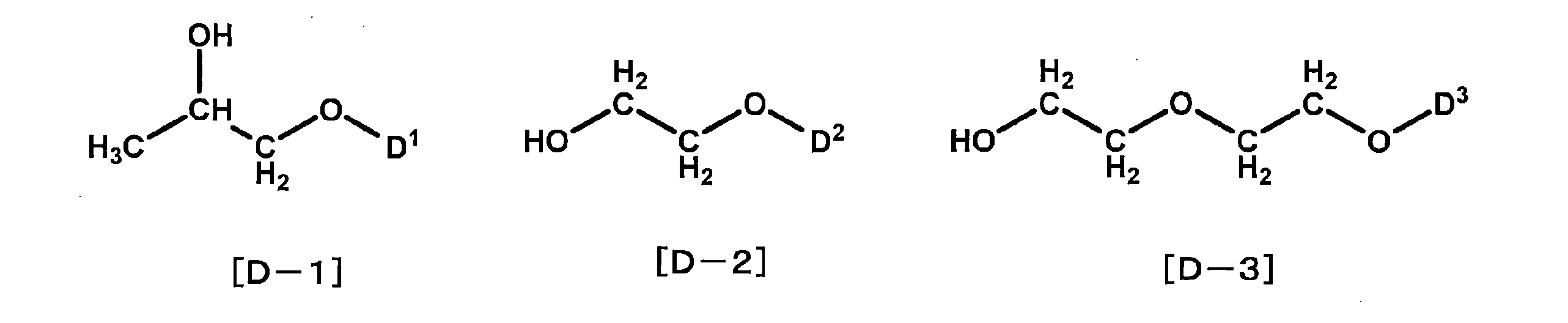
- solvents represented by the following formulas [D-1] to [D-3] are preferable. ..
- D 1 represents an alkyl group having 1 to 3 carbon atoms
- D 2 represents an alkyl group having 1 to 3 carbons
- D 3 represents an alkyl group having 1 to 4 carbon atoms.
- N-methyl-2-pyrrolidone and ethylene glycol monobutyl ether N-methyl-2-pyrrolidone, ⁇ -butyrolactone and ethylene glycol monobutyl ether are used.
- N-methyl-2-pyrrolidone and ⁇ -butyrolactone and propylene glycol monobutyl ether N-ethyl-2-pyrrolidone and propylene glycol monobutyl ether, N-methyl-2-pyrrolidone and ⁇ -butyrolactone and 4-hydroxy-4-methyl -2-Pentanone and diethylene glycol diethyl ether, N-methyl-2-pyrrolidone and ⁇ -butyrolactone and propylene glycol monobutyl ether and 2,6-dimethyl-4-heptanone, N-methyl-2-pyrrolidone and ⁇ -butyrolactone and propylene glycol Monobutyl ether and diisopropyl ether, N-methyl-2-pyrrolidone and ⁇ -butyrolactone and propylene glycol monobutyl ether and 2,6-dimethyl-4-heptanol, N-methyl-2-pyrrolidone and ⁇ -butyrolactone and prop
- the amount of these poor solvents is preferably 1 to 80% by weight, more preferably 10 to 80% by weight, and particularly preferably 20 to 70% by weight, based on the whole solvent contained in the liquid crystal aligning agent.
- the type and content of the solvent are appropriately selected depending on the application device of the liquid crystal aligning agent, the application conditions, the application environment and the like.
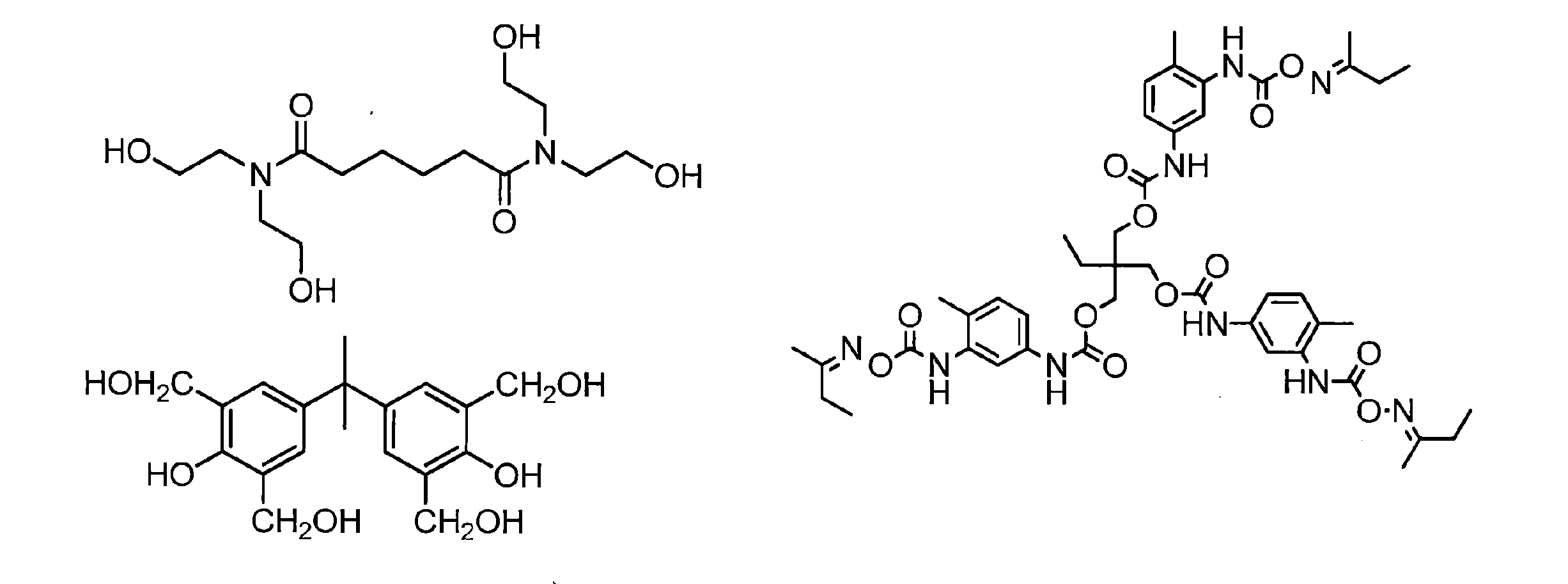
- the liquid crystal aligning agent of the present invention is at least one substituent selected from the group consisting of a crosslinkable compound having an epoxy group, an isocyanate group, an oxetane group or a cyclocarbonate group, a hydroxyl group, a hydroxyalkyl group and a lower alkoxyalkyl group. It may contain a crosslinkable compound having a group or a crosslinkable compound having a polymerizable unsaturated bond.
- crosslinkable compound various known compounds can be used depending on the purpose.
- the following compounds are preferably used.
- the content of the crosslinkable compound is preferably 0.1 parts by mass to 150 parts by mass with respect to 100 parts by mass of all the polymer components. Among them, 0.1 part by mass to 100 parts by mass is preferable, and 1 part by mass to 50 parts by mass is more preferable, in order to allow the crosslinking reaction to proceed and to exhibit the intended effect.
- the liquid crystal aligning agent of the present invention may contain a compound that improves the film thickness uniformity and the surface smoothness of the liquid crystal aligning film when the liquid crystal aligning agent is applied.
- Compounds that improve the film thickness uniformity and surface smoothness of the liquid crystal alignment film include fluorine-based surfactants, silicone-based surfactants and nonion-based surfactants.
- the amount of the surfactant used is preferably 0.01 parts by mass to 2 parts by mass, more preferably 0.01 parts by mass to 1 part by mass, relative to 100 parts by mass of all the polymer components contained in the liquid crystal aligning agent. It is a department.
- silane coupling agent for the purpose of improving the adhesion between the liquid crystal alignment film and the substrate and an imidization accelerator for the purpose of efficiently promoting imidization by heating the polyimide precursor when firing the coating film.
- the silane coupling agent include 3-aminopropyltrimethoxysilane, 3-aminopropyltriethoxysilane, 3-aminopropyldiethoxymethylsilane, 2-aminopropyltrimethoxysilane, 2-aminopropyltriethoxysilane, N-(2-aminoethyl)-3-aminopropyltrimethoxysilane, N-(2-aminoethyl)-3-aminopropylmethyldimethoxysilane, 3-ureidopropyltrimethoxysilane, 3-ureidopropyltriethoxysilane, N-ethoxycarbonyl-3-aminopropyltrimethoxy
- the amount of these silane coupling agents used is preferably 0.1 to 30 parts by mass, and 0.1 to 20 parts by mass, based on 100 parts by mass of the polymer component contained in the liquid crystal aligning agent, from the viewpoint of enhancing the liquid crystal aligning property.
- the mass part is more preferable.
- the liquid crystal alignment film of the present invention is a film obtained by applying the above liquid crystal alignment agent to a substrate, drying and baking.
- the substrate to which the liquid crystal aligning agent of the present invention is applied is not particularly limited as long as it is a highly transparent substrate, and a glass substrate, a silicon nitride substrate, a plastic substrate such as an acrylic substrate or a polycarbonate substrate, or the like can also be used. At that time, it is preferable to use a substrate on which an ITO electrode or the like for driving the liquid crystal is formed, from the viewpoint of simplifying the process.
- an opaque material such as a silicon wafer can be used if only one substrate is used, and in this case, a material that reflects light such as aluminum can be used for the electrode.
- a coating method of the liquid crystal aligning agent industrially, a method of performing screen printing, offset printing, flexographic printing or an inkjet method is generally used, and other coating methods include a dip method, a roll coater method and a slit coater. The method, spinner method, spray method and the like are known.
- the solvent can be evaporated by a heating means such as a hot plate, a heat circulation type oven or an IR (infrared) type oven to form a liquid crystal aligning film.
- a heating means such as a hot plate, a heat circulation type oven or an IR (infrared) type oven to form a liquid crystal aligning film.
- Any temperature and time can be selected for the drying and baking steps after applying the liquid crystal aligning agent.
- the conditions are such that baking is performed at 50° C. to 120° C. for 1 minute to 10 minutes, and then baking is performed at 150° C. to 300° C. for 5 minutes to 120 minutes. If the thickness of the liquid crystal alignment film after firing is too thin, the reliability of the liquid crystal display element may decrease, and therefore, the thickness is preferably 5 nm to 300 nm, more preferably 10 nm to 200 nm.
- the liquid crystal aligning agent of the present invention can be used as a liquid crystal aligning film without applying alignment treatment such as rubbing treatment or photo-alignment treatment after being applied on a substrate and baked, and for vertical alignment use.
- alignment treatment such as rubbing treatment or photo-alignment treatment
- Known methods and apparatuses can be used for the alignment treatment such as the rubbing treatment and the photo-alignment treatment.
- a liquid crystal display element having a passive matrix structure As an example of a method for manufacturing a liquid crystal cell, a liquid crystal display element having a passive matrix structure will be described as an example.
- a liquid crystal display element having an active matrix structure in which a switching element such as a TFT (Thin Film Transistor) is provided in each pixel portion that constitutes image display may be used.
- TFT Thin Film Transistor
- a transparent glass substrate is prepared, a common electrode is provided on one substrate, and a segment electrode is provided on the other substrate.
- These electrodes can be, for example, ITO electrodes and are patterned so that a desired image can be displayed.
- an insulating film is provided on each substrate so as to cover the common electrodes and the segment electrodes.
- the insulating film can be, for example, a SiO 2 —TiO 2 film formed by a sol-gel method.
- a liquid crystal alignment film is formed on each substrate, one substrate is overlaid with the other liquid crystal alignment film surfaces facing each other, and the periphery is bonded with a sealant. It is preferable that a spacer is usually mixed in the sealant in order to control the substrate gap, and spacers for controlling the substrate gap are also scattered on the in-plane portion where the sealant is not provided. An opening that can be filled with liquid crystal from the outside is provided in part of the sealant. Next, a liquid crystal material is injected into the space surrounded by the two substrates and the sealing agent through the opening provided in the sealing agent, and then the opening is sealed with an adhesive.
- a vacuum injection method may be used, or a method utilizing a capillary phenomenon in the atmosphere may be used.
- the liquid crystal material may be either a positive type liquid crystal material or a negative type liquid crystal material, but a negative type liquid crystal material is preferable.
- a polarizing plate is installed. Specifically, a pair of polarizing plates are attached to the surfaces of the two substrates opposite to the liquid crystal layer.
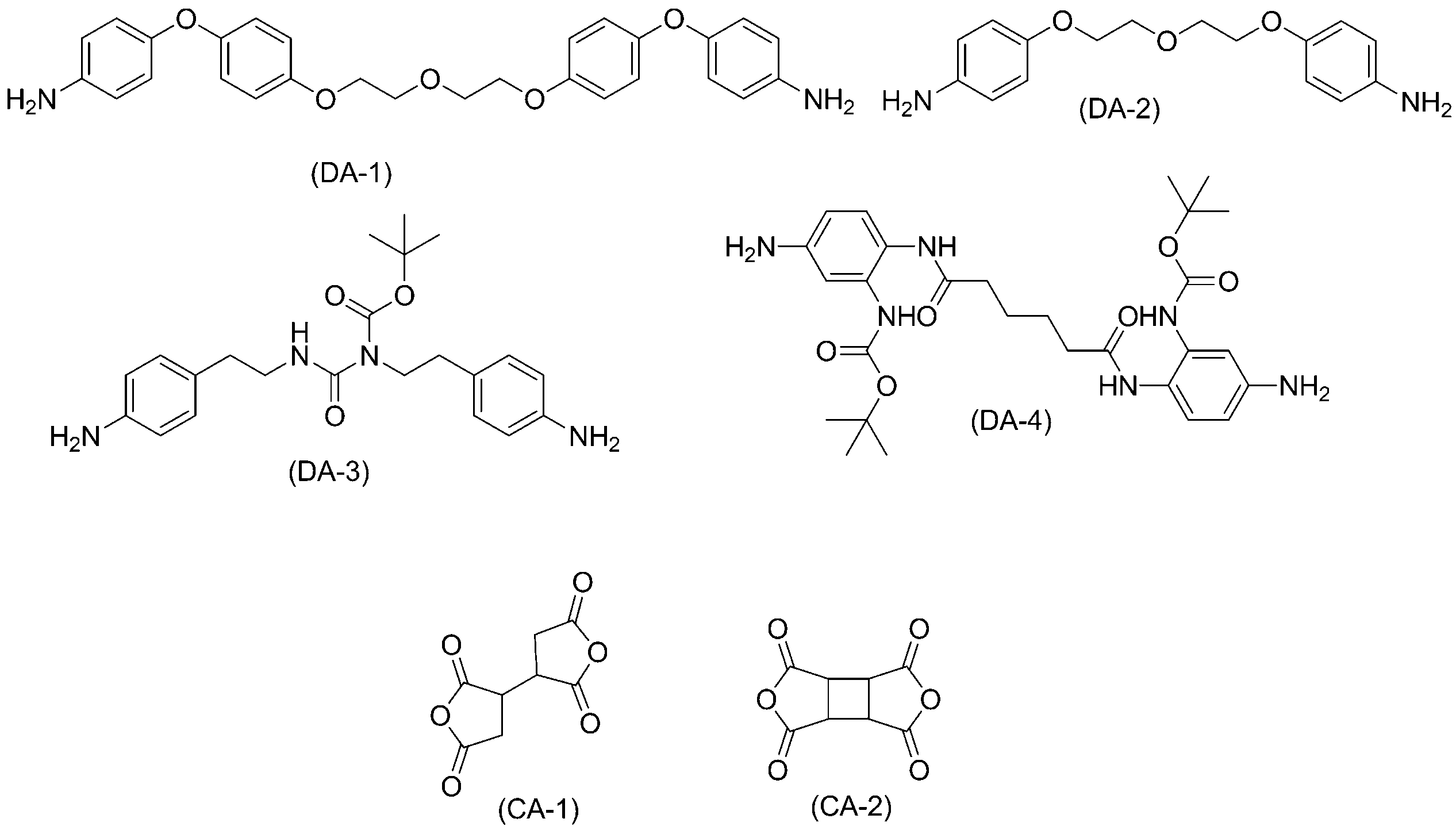
- DA-1 a compound represented by the following structural formula.
- DA-2 a compound represented by the following structural formula.
- DA-3 a compound represented by the following structural formula.
- DA-4 a compound represented by the following structural formula.
- CA-1 a compound represented by the following structural formula.
- CA-2 a compound represented by the following structural formula.
- CBDA 1,2,3,4-cyclobutanetetracarboxylic dianhydride
- AD-1 3-glycidoxypropyltriethoxysilane
- the imidization ratio of the polyimide in the synthesis example was measured as follows. 30 mg of polyimide powder was placed in an NMR (nuclear magnetic resonance) sample tube (NMR sampling tube standard, ⁇ 5 (Kusano Scientific Co., Ltd.)), and deuterated dimethyl sulfoxide (DMSO-d6, 0.05 mass% TMS (tetramethylsilane)) was added. (Mixture) (0.53 ml) was added, and ultrasonic waves were applied to completely dissolve. This solution was measured for proton NMR at 500 MHz with an NMR measuring device (JNW-ECA500) (manufactured by JEOL Datum).
- NMR nuclear magnetic resonance
- the imidization ratio is determined by using a proton derived from a structure that does not change before and after imidization as a reference proton, and the integrated peak value of this proton and the proton peak derived from the NH group of amic acid that appears near 9.5 ppm to 10.0 ppm. It was calculated by the following formula using the integrated value.
- Imidization rate (%) (1- ⁇ x/y) ⁇ 100
- x is the proton peak integrated value derived from the NH group of amic acid
- y is the peak integrated value of the reference proton
- ⁇ is one NH group proton of the amic acid in the case of polyamic acid (imidization ratio is 0%). Is the ratio of the number of reference protons to.
- Example 1 and 2 An NMP solution containing 1% by weight of NMP, GBL, BCS, and AD-1 was added to the polyimide solutions obtained in Synthesis Examples 2 and 3 with stirring so as to have the composition shown in Table 1 below.
- the liquid crystal aligning agents of Examples 1 and 2 were obtained by stirring at room temperature for 2 hours.
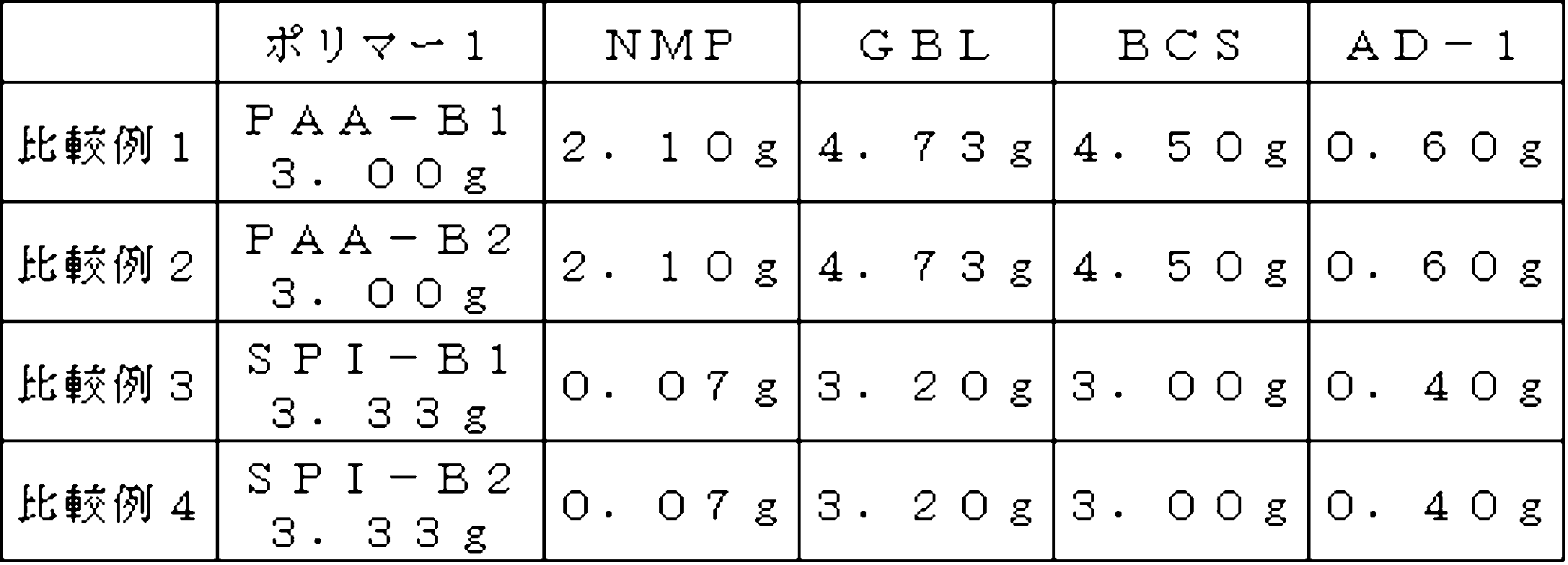
- Comparative Examples 1 to 4 An NMP solution containing 1% by weight of NMP, GBL, BCS and AD-1 in the solution of the polyamic acid obtained in Synthesis Examples 2 and 3 and the solution of the polyimide obtained in Synthesis Examples 4 and 5 is shown in the table below.
- the liquid crystal aligning agents of Comparative Examples 1 to 4 were obtained by adding while stirring to obtain the composition shown in 2 and further stirring at room temperature for 2 hours.
- the method for producing a liquid crystal cell for evaluating the pretilt angle will be described below.
- a substrate with electrodes was prepared.
- the substrate is a glass substrate having a size of 30 mm ⁇ 40 mm and a thickness of 1.1 mm.
- An ITO electrode having a film thickness of 35 nm is formed on the substrate, and the electrode has a stripe pattern of 40 mm in length and 10 mm in width.
- the liquid crystal aligning agent was filtered with a filter having a pore size of 1.0 ⁇ m, and then applied on the prepared substrate with electrodes by spin coating. After drying for 2 minutes on a hot plate at 80° C., baking was performed for 20 minutes in an IR oven at 230° C. to form a coating film with a film thickness of 100 nm to obtain a substrate with a liquid crystal alignment film.
- the liquid crystal alignment film was rubbed with a rayon cloth (roller diameter: 120 mm, roller rotation speed: 1000 rpm, moving speed: 20 mm/sec, indentation length: 0.4 mm), and then ultrasonicated in pure water for 1 minute.
- the substrate was washed with water, and after removing water drops by air blow, it was dried at 80° C. for 10 minutes to obtain a substrate with a liquid crystal alignment film.
- Prepare two substrates with this liquid crystal alignment film spray a spacer of 4 ⁇ m on the surface of one liquid crystal alignment film, print a sealant on it, and rub the other substrate in the opposite direction.
- the sealing agent was cured to prepare an empty cell.
- Liquid crystal MLC-3019 manufactured by Merck Ltd.
- Pretilt angle> The pretilt angle in the liquid crystal cell 1 was evaluated using an AxoScan Muller matrix polarimeter manufactured by Optometrics.
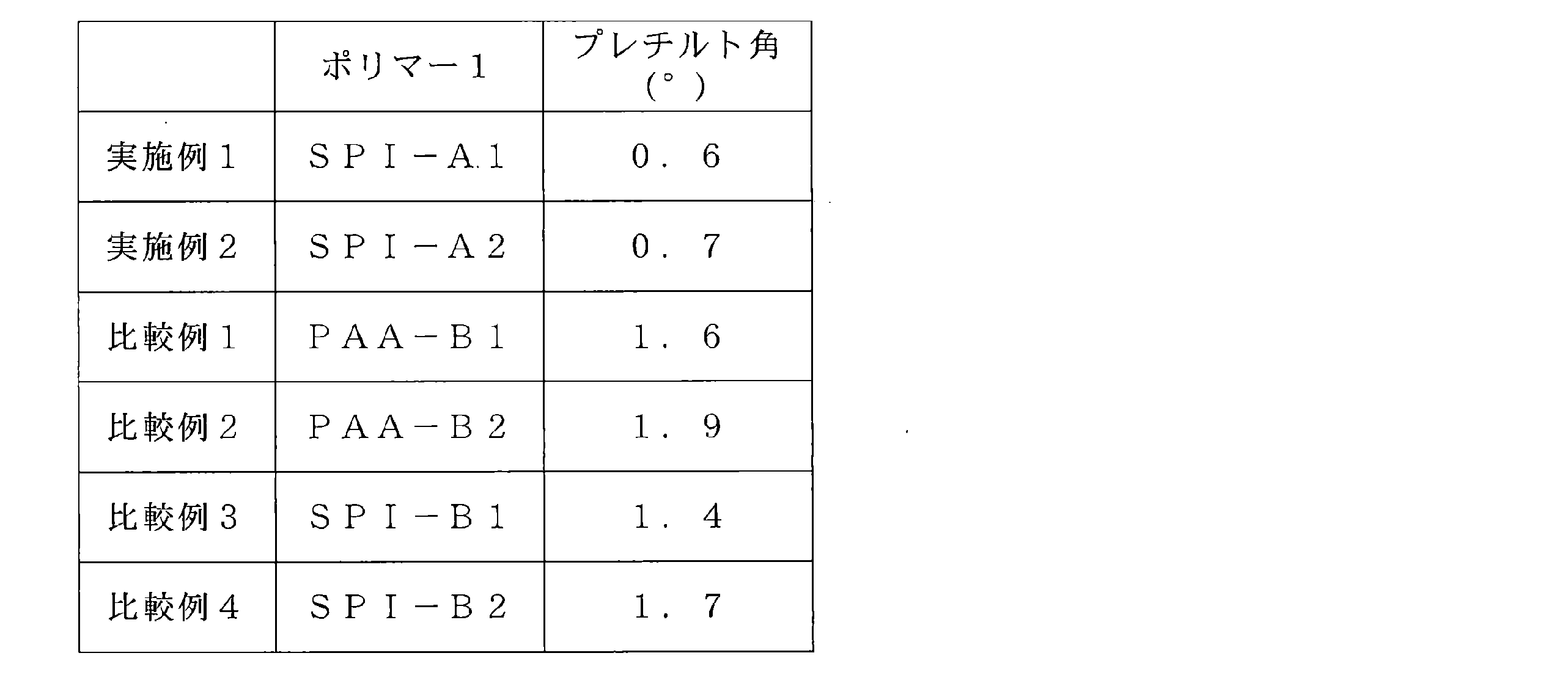
- Table 3 below shows the results of the pretilt angles performed as described above for the liquid crystal display devices using the liquid crystal aligning agents of Examples 1 and 2 and Comparative Examples 1 to 4 above.
- the liquid crystal display device using the liquid crystal aligning agent of the example of the present invention has a low pretilt angle and excellent viewing angle characteristics.
- liquid crystal aligning agent of the present invention it is possible to obtain a liquid crystal aligning film which satisfies various characteristics required for a liquid crystal aligning film and gives a low pretilt angle of 1 degree or less.
Landscapes
- Physics & Mathematics (AREA)
- Chemical & Material Sciences (AREA)
- Nonlinear Science (AREA)
- Organic Chemistry (AREA)
- Crystallography & Structural Chemistry (AREA)
- Spectroscopy & Molecular Physics (AREA)
- Chemical Kinetics & Catalysis (AREA)
- Medicinal Chemistry (AREA)
- Polymers & Plastics (AREA)
- Mathematical Physics (AREA)
- Health & Medical Sciences (AREA)
- General Physics & Mathematics (AREA)
- Optics & Photonics (AREA)
- Engineering & Computer Science (AREA)
- Materials Engineering (AREA)
- Liquid Crystal (AREA)
- Macromolecular Compounds Obtained By Forming Nitrogen-Containing Linkages In General (AREA)
Abstract
Description
脂肪族テトラカルボン酸二無水物及び脂環式テトラカルボン酸二無水物から選ばれる少なくとも1種からなるテトラカルボン酸二無水物誘導体成分とジアミン成分との反応物であるポリイミドを含有する液晶配向剤であり、ジアミン成分が、下記式[A]の構造を有するジアミンから選ばれる少なくとも1種を含有し、ポリイミドのイミド化率が70%以上である、液晶配向剤。

本発明の液晶配向剤に含有されるポリイミドは、脂肪族テトラカルボン酸二無水物及び脂環式テトラカルボン酸二無水物から選ばれる少なくとも1種からなるテトラカルボン酸二無水物誘導体成分と特定ジアミンを含有するジアミン成分から得られるポリイミド前駆体をイミド化することにより得られる(以下、特定重合体とも称する)。以下に、用いられる材料の具体例及び製造方法を詳述する。



本発明の液晶配向剤に含有されるポリイミドの製造に用いられるジアミン成分は、下記式[A]の構造を有するジアミンから選ばれる少なくとも1種を含有する。


本発明の液晶配向剤に含有されるポリイミドの製造に用いられるジアミン成分は、上記式[A]の構造を有するジアミンに加え、求められる液晶配向剤の特性に応じ、種々のジアミンを用いることが出来る。












本発明に用いられるポリイミド前駆体であるポリアミック酸は、脂肪族テトラカルボン酸二無水物及び脂環式テトラカルボン酸二無水物から選ばれる少なくとも1種からなるテトラカルボン酸二無水物誘導体成分と特定ジアミンを含有するジアミン成分から得られるポリイミド前駆体であり、以下に示す方法で製造できる。
本発明に用いられるポリイミド前駆体の一つであるポリアミック酸エステルは、以下に示す(I)、(II)又は(III)の方法で製造できる。
ポリアミック酸エステルは、テトラカルボン酸二無水物とジアミンから得られるポリアミック酸をエステル化することによって合成できる。具体的には、ポリアミック酸とエステル化剤を有機溶剤の存在下で-20℃~150℃、好ましくは0℃~50℃において、30分~24時間、好ましくは1時間~4時間反応させることによって合成できる。
ポリアミック酸エステルは、テトラカルボン酸ジエステルジクロリドとジアミンから製造できる。具体的には、テトラカルボン酸ジエステルジクロリドとジアミンとを塩基と有機溶剤の存在下で-20℃~150℃、好ましくは0℃~50℃において、30分~24時間、好ましくは1時間~4時間反応させることによって合成することができる。
ポリアミック酸エステルは、テトラカルボン酸ジエステルとジアミンを重縮合することにより製造できる。具体的には、テトラカルボン酸ジエステルとジアミンを縮合剤、塩基、及び有機溶剤の存在下で0℃~150℃、好ましくは0℃~100℃において、30分~24時間、好ましくは3時間~15時間反応させることによって製造できる。
本発明に用いられるポリイミドは、前記ポリアミック酸又はポリアミック酸エステルをイミド化することにより製造できる。本発明で用いられるポリイミドのイミド化率は電気特性の観点から70%~99%が好ましい。ポリアミック酸エステルからポリイミドを製造する場合、前記ポリアミック酸エステル溶液、又はポリアミック酸エステル樹脂粉末を有機溶媒に溶解させて得られるポリアミック酸溶液に塩基性触媒を添加する化学的イミド化が簡便である。化学的イミド化は、比較的低温でイミド化反応が進行し、イミド化の過程で重合体の分子量低下が起こりにくいので好ましい。
本発明の液晶配向剤は、特定重合体を含む重合体が有機溶媒中に溶解された溶液の形態を有する。本発明に記載のポリイミド前駆体及びポリイミドの分子量は、重量平均分子量で2,000~500,000が好ましく、より好ましくは5,000~300,000であり、さらに好ましくは、10,000~100,000である。また、数平均分子量は、好ましくは、1,000~250,000であり、より好ましくは、2,500~150,000であり、さらに好ましくは、5,000~50,000である。

上記シランカップリング剤としては、例えば3-アミノプロピルトリメトキシシラン、3-アミノプロピルトリエトキシシラン、3-アミノプロピルジエトキシメチルシラン、2-アミノプロピルトリメトキシシラン、2-アミノプロピルトリエトキシシラン、N-(2-アミノエチル)-3-アミノプロピルトリメトキシシラン、N-(2-アミノエチル)-3-アミノプロピルメチルジメトキシシラン、3-ウレイドプロピルトリメトキシシラン、3-ウレイドプロピルトリエトキシシラン、N-エトキシカルボニル-3-アミノプロピルトリメトキシシラン、N-エトキシカルボニル-3-アミノプロピルトリエトキシシラン、N-トリエトキシシリルプロピルトリエチレントリアミン、N-トリメトキシシリルプロピルトリエチレントリアミン、N-ビス(オキシエチレン)-3-アミノプロピルトリメトキシシラン、N-ビス(オキシエチレン)-3-アミノプロピルトリエトキシシラン、ビニルトリメトキシシラン、ビニルトリエトキシシラン、2-(3,4-エポキシシクロヘキシル)エチルトリメトキシシラン、3-グリシドキシプロピルメチルジメトキシシラン、3-グリシドキシプロピルトリメトキシシラン、3-グリシドキシプロピルメチルジエトキシシラン、3-グリシドキシプロピルトリエトキシシラン、p-スチリルトリメトキシシラン、3-メタクリロキシプロピルメチルジメトキシシラン、3-メタクリロキシプロピルトリメトキシシラン、3-メタクリロキシプロピルメチルジエトキシシラン、3-メタクリロキシプロピルトリエトキシシラン、3-アクリロキシプロピルトリメトキシシラン、トリス-(トリメトキシシリルプロピル)イソシアヌレート、3-メルカプトプロピルメチルジメトキシシラン、3-メルカプトプロピルトリメトキシシラン、3-イソシアネートプロピルトリエトキシシラン等のシランカップリング剤が挙げられる。これらシランカップリング剤の使用量は、液晶配向性を高める点から、液晶配向剤に含有される重合体成分100質量部に対して、0.1~30質量部が好ましく、0.1~20質量部がより好ましい。
本発明の液晶配向膜は、上記の液晶配向剤を基板に塗布し、乾燥、焼成して得られる膜である。本発明の液晶配向剤を塗布する基板としては透明性の高い基板であれば特に限定されず、ガラス基板、窒化珪素基板、アクリル基板やポリカーボネート基板などのプラスチック基板等を用いることもできる。その際、液晶を駆動させるためのITO電極などが形成された基板を用いると、プロセスの簡素化の点から好ましい。また、反射型の液晶表示素子では、片側の基板のみにならばシリコンウエハーなどの不透明な物でも使用でき、この場合の電極にはアルミニウムなどの光を反射する材料も使用できる。
NMP:N-メチル-2-ピロリドン
GBL:γ-ブチロラクトン
BCS:ブチルセロソルブ
DA-1:下記構造式に示す化合物。 (式(1)の化合物)
DA-2:下記構造式に示す化合物。 (式(2)の化合物)
DA-3:下記構造式に示す化合物。
DA-4:下記構造式に示す化合物。
CA-1:下記構造式に示す化合物。
(BDA:1,2,3,4-ブタンテトラカルボン酸二無水物)
CA-2:下記構造式に示す化合物。
(CBDA:1,2,3,4,-シクロブタンテトラカルボン酸二無水物)
AD-1:3-グリシドキシプロピルトリエトキシシラン
合成例において、重合体溶液の粘度は、E型粘度計TVE-22H(東機産業社製)を用い、サンプル量1.1mL、コーンロータTE-1(1°34’、R24)、温度25℃で測定した。
合成例におけるポリイミドのイミド化率は次のようにして測定した。ポリイミド粉末30mgをNMR(核磁気共鳴)サンプル管(NMRサンプリングチューブスタンダード,φ5(草野科学社製))に入れ、重水素化ジメチルスルホキシド(DMSO-d6,0.05質量%TMS(テトラメチルシラン)混合品)(0.53ml)を添加し、超音波をかけて完全に溶解させた。この溶液をNMR測定機(JNW-ECA500)(日本電子データム社製)にて500MHzのプロトンNMRを測定した。イミド化率は、イミド化前後で変化しない構造に由来するプロトンを基準プロトンとして決め、このプロトンのピーク積算値と、9.5ppm~10.0ppm付近に現れるアミド酸のNH基に由来するプロトンピーク積算値とを用い以下の式によって求めた。
上記式において、xはアミド酸のNH基由来のプロトンピーク積算値、yは基準プロトンのピーク積算値、αはポリアミド酸(イミド化率が0%)の場合におけるアミド酸のNH基プロトン1個に対する基準プロトンの個数割合である。
以下の反応式に従い、化合物[1]、化合物[2]を経て、化合物[DA-1]を合成した。

ジメチルホルムアミド(400g)中、4-フルオロニトロベンゼン(50.0g,354mmol)、ヒドロキノン(78.0g)、炭酸カリウム(73.4g)、を加え、80℃で2時間撹拌した。室温まで冷却した後、純水(800g)中に反応液を流し入れながら撹拌し、結晶を析出させた。結晶を濾過した後、濾物にメタノール(1200g)を加えて撹拌し、濾過して濾液を濃縮することで粗体(40g)を得た。粗体に対し、エタノール(320g)を加えて80℃で加熱撹拌した後、純水(400g)を加えて撹拌し、結晶を析出させた。結晶を濾過、濾物を乾燥させることで、化合物[1]を得た(収量:34.5g、収率:42%、黄土色結晶)。
1H-NMR(400MHz, DMSO-d6, δppm):9.60(br, 1H), 8.22(d, 2H, J = 9.6 Hz), 7.04(d, 2H, J = 9.6 Hz), 7.02(d, 2H, J = 9.0 Hz), 6.85(d, 2H, J = 9.0 Hz).
ジメチルホルムアミド(276g)中、ジエチレングリコールジトシラート(30.2g、72.8mmol)、化合物[1](34.5g)、炭酸カリウム(30.2g)を加え、80℃で15時間撹拌した。室温まで冷却した後、純水(552g)を加えて撹拌したところ、フラスコ底部に粘性体が生じた。上澄みをデカンテーションで除去した後、メタノール(100g)を加えて撹拌し、再度上澄みをデカンテーションで除去した。残った粘性体にメタノール(100g)を加えて撹拌したところ、粘性体が次第に固化した。塊を砕いて撹拌し、濾過、濾物を乾燥させることで粗体(35.5g)を得た。粗体に対し、ジメチルホルムアミド(71g)を加え、80℃で加熱撹拌した後、メタノール(142g)を加えて結晶を析出させた。室温まで冷却し、濾過、濾物を乾燥させた。得られた結晶を再度ジメチルホルムアミド-メタノールで再結晶操作し、濾物をメタノール(100g)でスラリー洗浄した後、濾過、濾物を乾燥させることで化合物[2]を得た(収量:24.9g、収率:64%、薄茶色結晶)。
1H-NMR(400MHz, DMSO-d6, δppm):8.23(d, 4H, J = 9.6 Hz), 7.14(d, 4H, J= 9.2 Hz), 7.16-7.04(m, 8H), 4.17-4.14(m, 4H), 3.86-3.83(m, 4H).
テトラヒドロフラン(200g)中、化合物[2](24.9g、46.8mmol)と5%パラジウムカーボン(2.5g)を加え、水素雰囲気下、室温で18時間した後、40℃で6時間撹拌した。窒素置換した後、触媒を濾過し、濾液を濃縮することで粗体(22.3g)を得た。粗体に対し、酢酸エチル(23g)を加え、70℃で加熱溶解させた後、ヘキサン(45g)を加えて室温まで冷却させたところ、オイルアウトした後に固化した。塊を砕いたうえで、撹拌、濾過、濾物を乾燥させることで、化合物[DA-1]を得た(収量:21.2g、収率:96%、白色結晶)。
1H-NMR(400MHz, DMSO-d6, δppm):6.88(d, 4H, J = 9.2 Hz), 6.80(d, 4H, J = 9.2 Hz), 6.70(d, 4H, J = 9.2 Hz), 6.55(d, 4H, J = 9.2 Hz), 4.91(br, 4H), 4.06-4.03(m, 4H), 3.79-3.76(m, 4H).
(実施例)
撹拌装置及び窒素導入管付きの50mLのナスフラスコに、DA-1を3.90g(8.3mmol)、DA-3を1.79g(4.5mmol)、DA-4を1.25g(2.3mmol)量り取り、NMPを27.3g加え、窒素を送りながら撹拌して溶解させた。このジアミン溶液を水冷下で撹拌しながら、CA-1を1.93g(9.8mmol)添加し、さらにNMPを7.7g加え、窒素雰囲気下50℃で6時間撹拌した。さらに、CA-2を1.0g(5.1mmol)添加し、さらにNMPを3.8g加え、窒素雰囲気下23℃で2時間撹拌し、ポリアミック酸の溶液(粘度:440mPa・s)PAA-B1を得た。
(実施例)
撹拌装置及び窒素導入管付きの100mLのナスフラスコに、DA-2を5.55g(19.3mmol)、DA-3を4.18g(10.5mmol)、DA-4を2.92g(5.3mmol)量り取り、NMPを50.6g加え、窒素を送りながら撹拌して溶解させた。このジアミン溶液を水冷下で撹拌しながら、CA-1を4.51g(22.8mmol)添加し、さらにNMPを18.0g加え、窒素雰囲気下50℃で6時間撹拌した。さらに、CA-2を2.26g(11.5mmol)添加し、さらにNMPを8.8g加え、窒素雰囲気下23℃で2時間撹拌し、ポリアミック酸の溶液(粘度:1230mPa・s)PAA-B2を得た。
(比較例)
合成例2で得られたポリアミック酸の溶液PAA-B1を20.0g分取し、NMPを13.3g、無水酢酸を1.86g、ピリジンを0.48g加え、室温で30分間撹拌した後、55℃で1時間30分反応させた。この反応溶液を125gのメタノール中に投入し、得られた沈殿物を濾別した。この沈殿物をメタノールで洗浄した後、温度80℃で減圧乾燥し、ポリイミドの粉末(イミド化率:55%)を得た。
(比較例)
合成例2で得られたポリアミック酸の溶液PAA-B1を30.0g分取し、NMPを20.0g、無水酢酸を3.31g、ピリジンを0.86g加え、室温で30分間撹拌した後、55℃で1時間30分反応させた。この反応溶液を190gのメタノール中に投入し、得られた沈殿物を濾別した。この沈殿物をメタノールで洗浄した後、温度80℃で減圧乾燥し、ポリイミドの粉末(イミド化率:54%)を得た。
合成例2、3で得られたポリイミドの溶液に、NMP、GBL、BCS、AD-1を1重量%含むNMP溶液を、下記の表1に示す組成になるように、攪拌しながら加え、更に室温で2時間撹拌することにより実施例1、2の液晶配向剤を得た。
合成例2、3で得られたポリアミック酸の溶液、及び合成例4、5で得られたポリイミドの溶液に、NMP、GBL、BCS、AD-1を1重量%含むNMP溶液を、下記の表2に示す組成になるように、攪拌しながら加え、更に室温で2時間撹拌することにより比較例1~4の液晶配向剤を得た。

[液晶セルの作製]
始めに電極付きの基板を準備した。基板は、30mm×40mmの大きさで、厚さが1.1mmのガラス基板である。基板上には膜厚35nmのITO電極が形成されており、電極は縦40mm、横10mmのストライプパターンである。
オプトメトリクス社製AxoScanミュラーマトリクスポーラリメーターを用い、上記液晶セル1内のプレチルト角を評価した。
Claims (9)
- 脂肪族テトラカルボン酸二無水物及び脂環式テトラカルボン酸二無水物から選ばれる少なくとも1種からなるテトラカルボン酸二無水物誘導体成分とジアミン成分との反応物であるポリイミドを含有する液晶配向剤であり、ジアミン成分が、下記式[A]の構造を有するジアミンから選ばれる少なくとも1種を含有し、ポリイミドのイミド化率が70%以上である、液晶配向剤。

- 前記式[A]の構造を有するジアミンが、下記式[A-1]~式[A-4]から選ばれる少なくとも1種である、請求項1に記載の液晶配向剤。

- 前記式[A]の構造を有するジアミンが、全ジアミン成分の40%~80%である、請求項1または請求項2に記載の液晶配向剤。
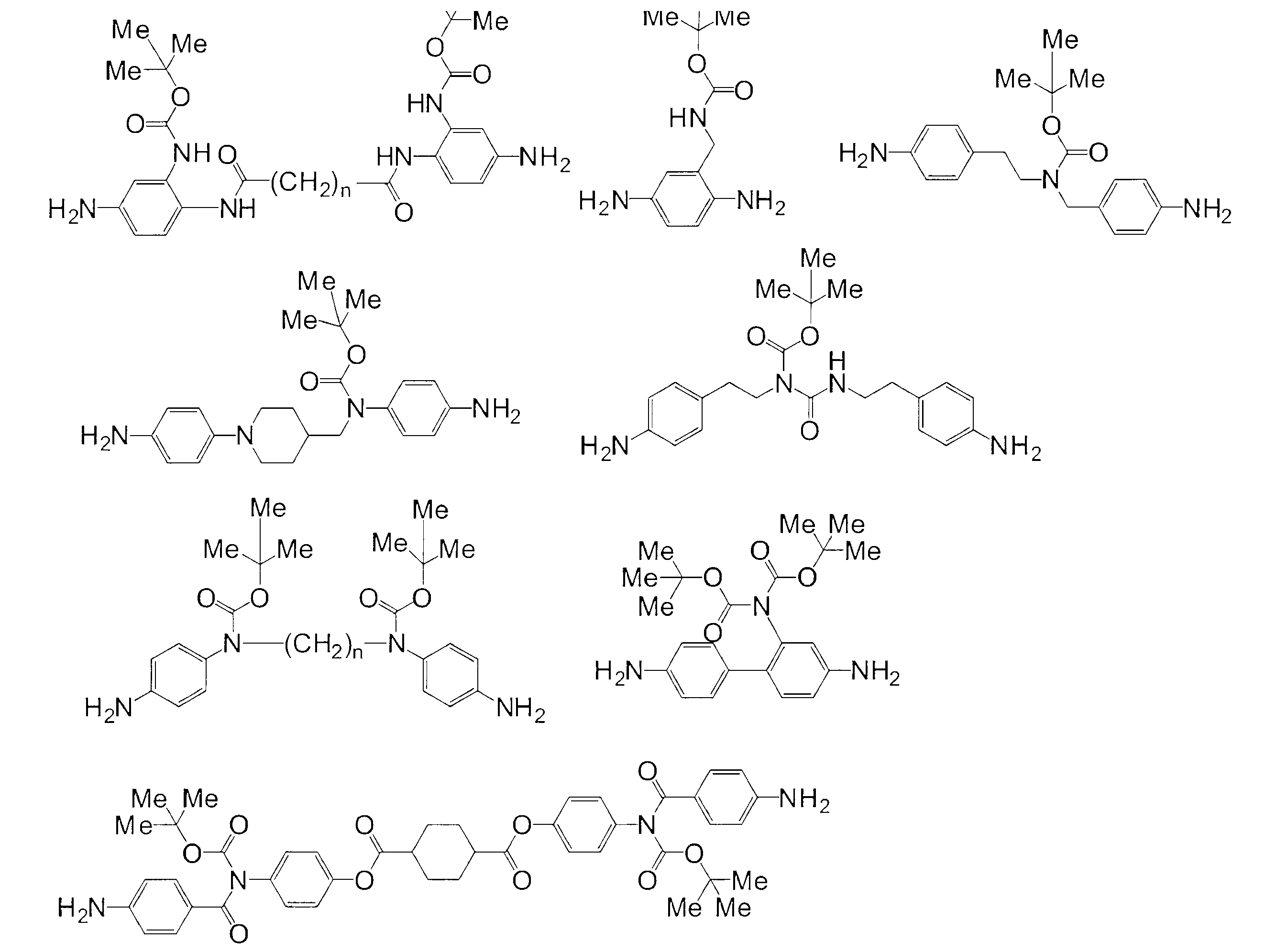
- 前記ジアミン成分がさらに、その構造中に下記式(6)の構造を有するジアミンを含む、請求項1から請求項3のいずれか1項に記載の液晶配向剤。

- 上記式(6)の構造を有するジアミンが、下記のジアミンから選ばれる少なくとも1種である、請求項4に記載の液晶配向剤。
- 脂肪族テトラカルボン酸二無水物及び脂環式テトラカルボン酸二無水物が、下記式(4)で表される、請求項1から請求項5のいずれか1項に記載の液晶配向剤。


- 更に、テトラカルボン酸二無水物誘導体とジアミンとの反応物であるポリアミック酸を含有する、請求項1から請求項6のいずれか1項に記載の液晶配向剤。
- 請求項1から請求項7のいずれか1項に記載の液晶配向剤から得られる液晶配向膜。
- 請求項8の液晶配向膜を具備する液晶表示素子。
Priority Applications (3)
| Application Number | Priority Date | Filing Date | Title |
|---|---|---|---|
| KR1020217021367A KR102785435B1 (ko) | 2018-12-10 | 2019-12-06 | 액정 배향제, 액정 배향막 및 액정 표시 소자 |
| JP2020560072A JP7448891B2 (ja) | 2018-12-10 | 2019-12-06 | 液晶配向剤、液晶配向膜及び液晶表示素子 |
| CN201980081826.6A CN113227890B (zh) | 2018-12-10 | 2019-12-06 | 液晶取向剂、液晶取向膜以及液晶显示元件 |
Applications Claiming Priority (2)
| Application Number | Priority Date | Filing Date | Title |
|---|---|---|---|
| JP2018231138 | 2018-12-10 | ||
| JP2018-231138 | 2018-12-10 |
Publications (1)
| Publication Number | Publication Date |
|---|---|
| WO2020121979A1 true WO2020121979A1 (ja) | 2020-06-18 |
Family
ID=71076885
Family Applications (1)
| Application Number | Title | Priority Date | Filing Date |
|---|---|---|---|
| PCT/JP2019/047920 Ceased WO2020121979A1 (ja) | 2018-12-10 | 2019-12-06 | 液晶配向剤、液晶配向膜及び液晶表示素子 |
Country Status (5)
| Country | Link |
|---|---|
| JP (1) | JP7448891B2 (ja) |
| KR (1) | KR102785435B1 (ja) |
| CN (1) | CN113227890B (ja) |
| TW (1) | TWI743617B (ja) |
| WO (1) | WO2020121979A1 (ja) |
Citations (3)
| Publication number | Priority date | Publication date | Assignee | Title |
|---|---|---|---|---|
| JP2013185032A (ja) * | 2012-03-07 | 2013-09-19 | Jnc Corp | ジアミン、これを用いた液晶配向剤、およびこれを用いた液晶表示素子 |
| JP2015215462A (ja) * | 2014-05-09 | 2015-12-03 | Jsr株式会社 | 液晶表示素子及びその製造方法 |
| JP2016117861A (ja) * | 2014-12-23 | 2016-06-30 | Jsr株式会社 | 重合体組成物、樹脂膜、液晶配向剤、液晶配向膜、液晶配向膜の製造方法及び液晶表示素子 |
Family Cites Families (6)
| Publication number | Priority date | Publication date | Assignee | Title |
|---|---|---|---|---|
| US5731404A (en) | 1995-11-01 | 1998-03-24 | E. I. Du Pont De Nemours And Company | Polyimide film from pyromellitic dianhydride and a bis(4-aminophenoxy) aromatic compound as an alignment layer for liquid crystal displays |
| JP3169062B2 (ja) | 1996-07-11 | 2001-05-21 | 日産化学工業株式会社 | 液晶セル用配向処理剤 |
| CN102893209B (zh) * | 2010-03-15 | 2015-05-06 | 日产化学工业株式会社 | 含有聚酰胺酸酯的液晶取向剂和液晶取向膜 |
| CN103154808B (zh) * | 2010-06-30 | 2015-08-19 | 日产化学工业株式会社 | 液晶取向处理剂、液晶取向膜及使用该液晶取向膜的液晶显示元件 |
| JP6750627B2 (ja) * | 2015-09-16 | 2020-09-02 | 日産化学株式会社 | 液晶配向剤、液晶配向膜および液晶表示素子 |
| WO2018159733A1 (ja) * | 2017-03-02 | 2018-09-07 | 日産化学株式会社 | 液晶配向剤、液晶配向膜及び液晶表示素子 |
-
2019
- 2019-12-06 KR KR1020217021367A patent/KR102785435B1/ko active Active
- 2019-12-06 JP JP2020560072A patent/JP7448891B2/ja active Active
- 2019-12-06 CN CN201980081826.6A patent/CN113227890B/zh active Active
- 2019-12-06 WO PCT/JP2019/047920 patent/WO2020121979A1/ja not_active Ceased
- 2019-12-10 TW TW108145039A patent/TWI743617B/zh active
Patent Citations (3)
| Publication number | Priority date | Publication date | Assignee | Title |
|---|---|---|---|---|
| JP2013185032A (ja) * | 2012-03-07 | 2013-09-19 | Jnc Corp | ジアミン、これを用いた液晶配向剤、およびこれを用いた液晶表示素子 |
| JP2015215462A (ja) * | 2014-05-09 | 2015-12-03 | Jsr株式会社 | 液晶表示素子及びその製造方法 |
| JP2016117861A (ja) * | 2014-12-23 | 2016-06-30 | Jsr株式会社 | 重合体組成物、樹脂膜、液晶配向剤、液晶配向膜、液晶配向膜の製造方法及び液晶表示素子 |
Also Published As
| Publication number | Publication date |
|---|---|
| TW202033755A (zh) | 2020-09-16 |
| KR102785435B1 (ko) | 2025-03-21 |
| CN113227890B (zh) | 2024-11-12 |
| KR20210099110A (ko) | 2021-08-11 |
| TWI743617B (zh) | 2021-10-21 |
| JPWO2020121979A1 (ja) | 2021-10-28 |
| JP7448891B2 (ja) | 2024-03-13 |
| CN113227890A (zh) | 2021-08-06 |
Similar Documents
| Publication | Publication Date | Title |
|---|---|---|
| JP6669161B2 (ja) | 液晶配向剤、液晶配向膜及び液晶表示素子 | |
| JP6638396B2 (ja) | 液晶配向剤、液晶配向膜、及び液晶表示素子 | |
| JP7276666B2 (ja) | 液晶配向剤、液晶配向膜及び液晶表示素子 | |
| US9976086B2 (en) | Liquid crystal aligning agent containing polyimide precursor having thermally-leaving group and/or polyimide | |
| JP2019194720A (ja) | 液晶配向剤、液晶配向膜、及び液晶配向素子 | |
| JP7259328B2 (ja) | 液晶配向剤、液晶配向膜、及び液晶表示素子 | |
| TWI772371B (zh) | 液晶配向劑、液晶配向膜及液晶顯示元件 | |
| JP7173194B2 (ja) | 液晶配向剤、液晶配向膜及びそれを用いた液晶表示素子 | |
| JP7652237B2 (ja) | 化合物 | |
| WO2018030489A1 (ja) | 液晶配向剤、液晶配向膜及び液晶表示素子 | |
| JP7435469B2 (ja) | 液晶配向剤、液晶配向膜及びそれを用いた液晶表示素子 | |
| WO2018066607A1 (ja) | ジアミン、重合体、液晶配向剤、液晶配向膜及び液晶表示素子 | |
| JP7448891B2 (ja) | 液晶配向剤、液晶配向膜及び液晶表示素子 | |
| JP7193782B2 (ja) | 液晶配向剤、液晶配向膜及び液晶表示素子 | |
| CN112969959B (zh) | 液晶取向剂、液晶取向膜及液晶表示元件 | |
| JP7256472B2 (ja) | 液晶配向剤、液晶配向膜及び液晶表示素子 | |
| WO2020184373A1 (ja) | 機能性高分子膜形成用塗布液及び機能性高分子膜 | |
| WO2019181878A1 (ja) | 液晶配向剤、液晶配向膜及び液晶表示素子 |
Legal Events
| Date | Code | Title | Description |
|---|---|---|---|
| 121 | Ep: the epo has been informed by wipo that ep was designated in this application |
Ref document number: 19895547 Country of ref document: EP Kind code of ref document: A1 |
|
| ENP | Entry into the national phase |
Ref document number: 2020560072 Country of ref document: JP Kind code of ref document: A |
|
| NENP | Non-entry into the national phase |
Ref country code: DE |
|
| ENP | Entry into the national phase |
Ref document number: 20217021367 Country of ref document: KR Kind code of ref document: A |
|
| 122 | Ep: pct application non-entry in european phase |
Ref document number: 19895547 Country of ref document: EP Kind code of ref document: A1 |