WO2020111007A1 - 積層体、有機半導体デバイスおよびそれらの製造方法、並びに、組成物およびその組成物のキット - Google Patents
積層体、有機半導体デバイスおよびそれらの製造方法、並びに、組成物およびその組成物のキット Download PDFInfo
- Publication number
- WO2020111007A1 WO2020111007A1 PCT/JP2019/046010 JP2019046010W WO2020111007A1 WO 2020111007 A1 WO2020111007 A1 WO 2020111007A1 JP 2019046010 W JP2019046010 W JP 2019046010W WO 2020111007 A1 WO2020111007 A1 WO 2020111007A1
- Authority
- WO
- WIPO (PCT)
- Prior art keywords
- group
- layer
- protective layer
- organic
- conductive layer
- Prior art date
- Legal status (The legal status is an assumption and is not a legal conclusion. Google has not performed a legal analysis and makes no representation as to the accuracy of the status listed.)
- Ceased
Links
Images
Classifications
-
- H—ELECTRICITY
- H05—ELECTRIC TECHNIQUES NOT OTHERWISE PROVIDED FOR
- H05B—ELECTRIC HEATING; ELECTRIC LIGHT SOURCES NOT OTHERWISE PROVIDED FOR; CIRCUIT ARRANGEMENTS FOR ELECTRIC LIGHT SOURCES, IN GENERAL
- H05B33/00—Electroluminescent light sources
- H05B33/10—Apparatus or processes specially adapted to the manufacture of electroluminescent light sources
-
- H—ELECTRICITY
- H05—ELECTRIC TECHNIQUES NOT OTHERWISE PROVIDED FOR
- H05B—ELECTRIC HEATING; ELECTRIC LIGHT SOURCES NOT OTHERWISE PROVIDED FOR; CIRCUIT ARRANGEMENTS FOR ELECTRIC LIGHT SOURCES, IN GENERAL
- H05B33/00—Electroluminescent light sources
- H05B33/12—Light sources with substantially two-dimensional [2D] radiating surfaces
- H05B33/26—Light sources with substantially two-dimensional [2D] radiating surfaces characterised by the composition or arrangement of the conductive material used as an electrode
-
- H—ELECTRICITY
- H10—SEMICONDUCTOR DEVICES; ELECTRIC SOLID-STATE DEVICES NOT OTHERWISE PROVIDED FOR
- H10D—INORGANIC ELECTRIC SEMICONDUCTOR DEVICES
- H10D30/00—Field-effect transistors [FET]
- H10D30/60—Insulated-gate field-effect transistors [IGFET]
- H10D30/67—Thin-film transistors [TFT]
-
- H—ELECTRICITY
- H10—SEMICONDUCTOR DEVICES; ELECTRIC SOLID-STATE DEVICES NOT OTHERWISE PROVIDED FOR
- H10D—INORGANIC ELECTRIC SEMICONDUCTOR DEVICES
- H10D64/00—Electrodes of devices having potential barriers
- H10D64/01—Manufacture or treatment
- H10D64/011—Manufacture or treatment of electrodes ohmically coupled to a semiconductor
-
- H—ELECTRICITY
- H10—SEMICONDUCTOR DEVICES; ELECTRIC SOLID-STATE DEVICES NOT OTHERWISE PROVIDED FOR
- H10P—GENERIC PROCESSES OR APPARATUS FOR THE MANUFACTURE OR TREATMENT OF DEVICES COVERED BY CLASS H10
- H10P14/00—Formation of materials, e.g. in the shape of layers or pillars
- H10P14/40—Formation of materials, e.g. in the shape of layers or pillars of conductive or resistive materials
-
- H—ELECTRICITY
- H10—SEMICONDUCTOR DEVICES; ELECTRIC SOLID-STATE DEVICES NOT OTHERWISE PROVIDED FOR
- H10K—ORGANIC ELECTRIC SOLID-STATE DEVICES
- H10K30/00—Organic devices sensitive to infrared radiation, light, electromagnetic radiation of shorter wavelength or corpuscular radiation
- H10K30/50—Photovoltaic [PV] devices
-
- H—ELECTRICITY
- H10—SEMICONDUCTOR DEVICES; ELECTRIC SOLID-STATE DEVICES NOT OTHERWISE PROVIDED FOR
- H10K—ORGANIC ELECTRIC SOLID-STATE DEVICES
- H10K50/00—Organic light-emitting devices
- H10K50/10—OLEDs or polymer light-emitting diodes [PLED]
-
- Y—GENERAL TAGGING OF NEW TECHNOLOGICAL DEVELOPMENTS; GENERAL TAGGING OF CROSS-SECTIONAL TECHNOLOGIES SPANNING OVER SEVERAL SECTIONS OF THE IPC; TECHNICAL SUBJECTS COVERED BY FORMER USPC CROSS-REFERENCE ART COLLECTIONS [XRACs] AND DIGESTS
- Y02—TECHNOLOGIES OR APPLICATIONS FOR MITIGATION OR ADAPTATION AGAINST CLIMATE CHANGE
- Y02E—REDUCTION OF GREENHOUSE GAS [GHG] EMISSIONS, RELATED TO ENERGY GENERATION, TRANSMISSION OR DISTRIBUTION
- Y02E10/00—Energy generation through renewable energy sources
- Y02E10/50—Photovoltaic [PV] energy
- Y02E10/549—Organic PV cells
-
- Y—GENERAL TAGGING OF NEW TECHNOLOGICAL DEVELOPMENTS; GENERAL TAGGING OF CROSS-SECTIONAL TECHNOLOGIES SPANNING OVER SEVERAL SECTIONS OF THE IPC; TECHNICAL SUBJECTS COVERED BY FORMER USPC CROSS-REFERENCE ART COLLECTIONS [XRACs] AND DIGESTS
- Y02—TECHNOLOGIES OR APPLICATIONS FOR MITIGATION OR ADAPTATION AGAINST CLIMATE CHANGE
- Y02P—CLIMATE CHANGE MITIGATION TECHNOLOGIES IN THE PRODUCTION OR PROCESSING OF GOODS
- Y02P70/00—Climate change mitigation technologies in the production process for final industrial or consumer products
- Y02P70/50—Manufacturing or production processes characterised by the final manufactured product
Definitions
- the present invention relates to a laminate including an organic layer and a conductive layer, and a method for manufacturing the laminate.
- the present invention also relates to an organic semiconductor device including this laminate and a method for manufacturing the organic semiconductor device.
- the present invention also relates to a composition used for forming the laminate and a kit of the composition.
- organic semiconductor devices In recent years, electronic devices using organic semiconductors (organic semiconductor devices) have been widely used.
- the organic semiconductor device has an advantage that it can be manufactured by a simple process as compared with a conventional electronic device using an inorganic semiconductor such as silicon. Further, the material properties of the organic semiconductor can be easily changed by changing its molecular structure. In addition, it is considered that there are abundant variations in materials, and it will be possible to realize functions and devices that could not be achieved with inorganic semiconductors.
- Organic semiconductors can be applied to electronic devices such as organic solar cells, organic electroluminescent displays, organic photodetectors, organic field effect transistors, organic electroluminescent devices, gas sensors, organic rectifiers, organic inverters, and information recording devices. There is a nature.
- Patent Document 1 describes a method of forming a plurality of separated metal electrode layers on an organic semiconductor layer by a vacuum vapor deposition method using a shadow mask.
- the film formation method using the shadow mask may not be able to cope with the recent miniaturization of patterns.
- the conductive layer adjacent to the organic semiconductor layer is patterned by the conventional method by the lithography method in order to miniaturize the pattern, there is a problem that the organic semiconductor layer is deteriorated or damaged. Was done.
- the present invention has been made in view of the above problems, even if the conductive layer is adjacent to the organic layer, while suppressing the adverse effect on the organic layer, a laminate capable of forming a fine pattern on the conductive layer, And it aims at providing the manufacturing method of this laminated body.
- Another object of the present invention is to provide an organic semiconductor device having the above laminate and a method for manufacturing the organic semiconductor device.
- Another object of the present invention is to provide a kit containing at least one composition used for forming the above laminate and a plurality of compositions used for forming the above laminate.
- the above problem can be solved by providing a protective layer on the conductive layer in a laminate including an organic layer and the conductive layer.
- the above problem has been solved by the following means ⁇ 1>, and preferably by means of ⁇ 2> and thereafter.
- ⁇ 1> Having a base material, an organic layer, a conductive layer, a protective layer for protecting the surface of the conductive layer, and a photosensitive layer in this order,
- the conductive layer is in contact with the organic layer, and is a target to be wet-etched, A laminate in which the rate of dissolution of the photosensitive layer in a developer is changed by the action of at least one of light and radiation.
- the protective layer contacts the conductive layer, The laminate according to ⁇ 1>.
- the ratio t1/t2 of the total thickness t1 of the photosensitive layer and the protective layer to the thickness t2 of the photosensitive layer is 1.2 or more, The laminate according to ⁇ 1> or ⁇ 2>.
- the dissolution rate of the protective layer in water at 23° C. is 1 nm/s or less, The laminate according to any one of ⁇ 1> to ⁇ 3>.
- the protective layer contains at least one selected from the group consisting of a polyparaxylylene derivative having a structure represented by the following formula (PX), a nitride different from the conductive layer, an oxide, and a metal.
- R 1 to R 8 each independently represent a hydrogen atom, a halogen atom or an alkyl group having 1 to 100 carbon atoms.
- the protective layer includes a first protective layer on the conductive layer side and a second protective layer on the photosensitive layer side of the first protective layer, The laminated body according to any one of ⁇ 1> to ⁇ 5>.
- the first protective layer contains at least one selected from the group consisting of a polyparaxylylene derivative having a structure represented by the following formula (PX), a nitride different from the conductive layer, an oxide, and a metal.
- R 1 to R 8 each independently represent a hydrogen atom, a halogen atom or an alkyl group having 1 to 100 carbon atoms.
- R 1 to R 8 each independently represent a hydrogen atom, a halogen atom or an alkyl group having 1 to 100 carbon atoms.
- the solubility of the second protective layer in a solvent composed of at least one of water and a fluorine-based solvent at 23° C. is 5000 mg/100 g of the solvent or more.
- the second protective layer has polyvinyl alcohol having a structure represented by the following formula (1), polyvinylpyrrolidone having a structure represented by the formula (2), cellulose having a structure represented by the formula (3), and Containing at least one resin of the group consisting of pullulan having a structure represented by formula (4),
- R a is —(CH 2 CH 2 O) ma H, —CH 2 COONa, or a hydrogen atom, and ma is 1 or 2.
- the organic layer contains an organic semiconductor, The laminated body according to any one of ⁇ 1> to ⁇ 9>.
- the conductive layer includes gold, silver, copper, aluminum and an alloy containing at least two of these, and at least one selected from the group consisting of conductive oxides.
- the photosensitive layer has been partially removed by development, The protective layer is exposed in the removed portion of the photosensitive layer, The laminated body according to any one of ⁇ 1> to ⁇ 11>.
- the photosensitive layer has been partially removed by development, The protective layer is etched corresponding to the removed portion of the photosensitive layer, The conductive layer is exposed in the removed portion of the photosensitive layer and the etched portion of the protective layer, The laminated body according to any one of ⁇ 1> to ⁇ 11>.
- ⁇ 14> A base material, an organic layer, a conductive layer, and a protective layer that protects the surface of the conductive layer and is the outermost layer in this order,
- the conductive layer is in contact with the organic layer, and is a target to be wet-etched,
- the conductive layer is exposed at the etched portion of the protective layer,
- ⁇ 16> The laminate according to ⁇ 14> or ⁇ 15>, which is obtained by etching the protective layer in the laminate according to ⁇ 12> from the photosensitive layer side.
- ⁇ 17> After exposing at least one of light and radiation to a part of the photosensitive layer in the laminate according to any one of ⁇ 1> to ⁇ 11>, the photosensitive layer is developed, Etching the protective layer using the developed photosensitive layer as a mask, A method for manufacturing a laminate, which comprises wet-etching a conductive layer using the etched protective layer as a mask.
- An organic semiconductor device comprising the laminate produced by the method according to ⁇ 17>, wherein the organic layer contains an organic semiconductor.
- a method for producing an organic semiconductor device which includes the method for producing a laminate according to ⁇ 17> as a step, and the organic layer includes an organic semiconductor.
- ⁇ 20> A composition used for forming a protective layer in the laminate according to any one of ⁇ 1> to ⁇ 13>.
- ⁇ 21> A composition used for forming a photosensitive layer in the laminate according to any one of ⁇ 1> to ⁇ 13>.
- ⁇ 22> A kit comprising the composition used for forming the protective layer in the laminate according to any one of ⁇ 1> to ⁇ 13>, and the composition used for forming the photosensitive layer.
- the laminate of the present invention and the method for manufacturing the same, even if the conductive layer is adjacent to the organic layer, it is possible to form a fine pattern on the conductive layer while suppressing adverse effects on the organic layer.
- a numerical range represented by using a symbol “to” means a range including the numerical values before and after “to” as a lower limit value and an upper limit value.
- process includes not only an independent process but also a process that cannot be clearly distinguished from other processes as long as the intended action of the process can be achieved.
- notation that does not indicate substituted or unsubstituted is meant to include not only those having no substituent but also those having a substituent.
- alkyl group when simply described as “alkyl group”, this includes both an alkyl group having no substituent (unsubstituted alkyl group) and an alkyl group having a substituent (substituted alkyl group). Is the meaning.
- the term "exposure” as used herein means not only drawing using light but also drawing using particle beams.
- the energy rays used for the exposure generally, a bright line spectrum of a mercury lamp, active rays such as deep ultraviolet rays represented by excimer laser, extreme ultraviolet rays (EUV light) and X-rays, and electron rays and ion rays are used.
- Particle beam such as.
- (meth)acrylate means both “acrylate” and “methacrylate”, or either
- (meth)acrylic means both “acrylic” and “methacrylic”, or
- (Meth)acryloyl means both “acryloyl” and “methacryloyl”, or either.
- the concentration of the solid content in the composition is represented by the mass percentage of the other components excluding the solvent with respect to the total mass of the composition.
- the temperature refers to 23° C. unless otherwise specified.
- the weight average molecular weight (Mw) and the number average molecular weight (Mn) are defined as polystyrene equivalent values according to gel permeation chromatography (GPC measurement), unless otherwise specified.
- the weight average molecular weight (Mw) and the number average molecular weight (Mn) are, for example, HLC-8220 (manufactured by Tosoh Corporation), and the columns are guard columns HZ-L, TSKgel Super HZM-M, TSKgel Super HZ4000, and TSKgel. It can be determined by using Super HZ3000 and TSKgel Super HZ2000 (manufactured by Tosoh Corporation).
- THF tetrahydrofuran
- UV ray ultraviolet ray
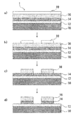
- the first stacked body 1 is a laminated body having a base material 10, an organic layer 12, a conductive layer 14, a protective layer 16 for protecting the surface of the conductive layer 14, and a photosensitive layer 18 in this order, and the conductive layer is It is a laminate that is in contact with the organic layer and is subject to wet etching, and the dissolution rate of the photosensitive layer in a developing solution is changed by the action of at least one of light and radiation.
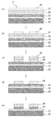
- FIG. 1 is a schematic view showing a process of exposing, developing and etching the first laminate 1 to form a pattern on the conductive layer 14.
- FIG. 1a shows the first stack 1 before being exposed and developed, that is, before a pattern is formed.
- FIG. 1B shows a state in which the first laminate 1 is exposed and developed, that is, the photosensitive layer 18 is partially removed by the development, and the protective layer 16 is removed from the photosensitive layer 18. The exposed state is shown in the open part.
- FIG. 1C shows a state in which the protective layer 16 is etched in the first stacked body 1, that is, the protective layer 16 is etched corresponding to the removed portion of the photosensitive layer 18, and the conductive layer 14 is formed. Shows the exposed state in the etched portion of the protective layer 16.
- the photosensitive layer 18 may be present on the protective layer 16 in a state of being partially removed by development.
- the first laminate 1 has a base material 10, an organic layer 12, a conductive layer 14, a protective layer 16 for protecting the surface of the conductive layer 14, and a photosensitive layer 18 in this order.
- the conductive layer 14 is in contact with the organic layer 12.
- the protective layer 16 is not necessarily in contact with the conductive layer 14 as long as it is between the conductive layer 14 and the photosensitive layer 18, but the protective layer 16 is preferably in contact with the conductive layer 14.
- the conductive layer is in contact with the organic layer means that the conductive layer is adjacent to the upper side of the organic layer, and the conductive layer is in contact with the organic layer over the entire surface, or in an island shape, This also includes the case where the conductive layer is partially in contact with the organic layer due to the presence of inclusions at a partial position such as a stripe shape or a lattice shape. That is, the present invention is effective if the conductive layer is in contact with at least a part of the organic layer, and as the contact ratio between the conductive layer and the organic layer increases, for example, to 50%, 70%, or 90%, the present invention The usefulness of will increase.
- the photosensitive layer 18, which is the outermost layer of the first laminate 1 is exposed and developed, and is partially removed to form a pattern on the photosensitive layer 18.
- the protective layer 16 is partially removed by, for example, dry etching using the patterned photosensitive layer 18 as a mask.
- the conductive layer 14 is partially removed by wet etching using the patterned protective layer 16 as a mask.
- the protective layer 16 between the conductive layer 14 and the photosensitive layer 18 it is possible to prevent the solvent as described above from penetrating the thin conductive layer and coming into contact with the lower organic layer. ing. As a result, even if the conductive layer is adjacent to the organic layer, it is possible to form a fine pattern on the conductive layer while suppressing the adverse effect of the solvent on the organic layer.
- each layer constituting the first laminated body 1 The details (materials, film forming method, processing method, etc.) of each layer constituting the first laminated body 1 will be described below.
- the material of the base material 10 for example, various materials such as silicon, quartz, ceramics, glass, polyester films such as polyethylene naphthalate (PEN) and polyethylene terephthalate (PET), and polyimide films can be used. Any substrate may be selected depending on the. Also, the shape and thickness of the base material are not particularly limited.
- the shape of the base material can be various shapes such as a flat plate shape, a curved plate shape, a columnar shape, a spherical shape, and a disk shape. Further, the base material itself may have a laminated structure such as a silicon substrate with a thermal oxide film and a laminated resin film.
- an adhesion layer that improves the adhesion between a predetermined substrate and a layer formed on this substrate, a planarization that flattens the surface of a predetermined substrate.
- the adhesion layer as described above is composed of, for example, a self-assembled monolayer (SAM) such as hexamethyldisilazane (HMDS) or a silane compound (alkylsilane or alkoxysilane).
- SAM self-assembled monolayer
- HMDS hexamethyldisilazane
- silane compound alkylsilane or alkoxysilane
- Such an adhesion layer is effective not only for improving the adhesion between the substrate and the organic layer, but also for controlling the orientation of the organic material in the organic layer.
- the thickness of the entire base material is, for example, preferably 0.1 ⁇ m to 2.8 mm, more preferably 0.3 ⁇ m to 2.1 mm, and further preferably 0.5 ⁇ m to 1.8 mm ⁇ m. ..
- a silicon substrate with a thermal oxide film or a substrate on which a gate electrode and a gate insulating layer are formed can be used.
- a flexible substrate made of the above resin or the like can be used, and when the laminated body is used for a light emitting device, a transparent substrate with a lower electrode can be used.
- the organic layer 12 is a layer containing an organic material.
- the specific organic material is appropriately selected according to the use and function of the organic layer. Assumed functions of the organic layer include, for example, semiconductor characteristics, light emission characteristics, photoelectric conversion characteristics, light absorption characteristics, electrical insulation, ferroelectricity, transparency, and insulation.
- a material containing at least one organic semiconductor as described below can be used as the organic material.
- quantum dots surface-modified with an organic ligand can be used as the organic material in addition to the organic semiconductor.
- the organic ligands are, for example, pyridine, mercapto alcohol, thiols, phosphines and phosphine oxides
- the quantum dots are, for example, CdSe, CdTe, CdS, ZnSe, ZnTe, ZnS, HgS, HgSe, HgTe, and other II-VI group.
- the compounds are group III-V compounds such as GaAs, GaP, GaN, GaSb, InN, InAs, InP, InSb.
- a fullerene derivative or phthalocyanine can be used as the organic material.
- organic pigments and dyes such as diketopyrrolopyrrole and quinacridone can be used as the organic material.
- the organic material include organic insulators such as epoxy resin, silicone resin, phenol resin, polyimide resin, polyamide resin, polycarbonate resin, polystyrene resin, acrylic resin, and fluororesin.
- a resin material containing at least one of can be used.
- the organic material for example, at least one organic ferroelectric such as polyvinylidene fluoride resin and copolymer resin of vinylidene fluoride and ethylene trifluoride is included.
- a resin material can be used.
- acrylic resin, polyethylene terephthalate, polycarbonate, polyvinyl chloride or the like can be used.
- a styrene-based, olefin/alkene-based, vinyl chloride-based, urethane-based, amide-based, or silicone-based elastomer can be used.
- the present invention is more effective when the organic layer contains the organic semiconductor and the organic ligand. Further, since the alteration or damage of the organic semiconductor has a great influence on the deterioration of the semiconductor characteristics, the present invention is particularly effective when the organic layer is an organic semiconductor layer containing an organic semiconductor.
- the organic semiconductor layer is an organic layer containing an organic semiconductor, and the organic semiconductor is an organic compound exhibiting semiconductor characteristics.
- Organic semiconductors include p-type semiconductors that conduct holes as carriers and carriers and n-type semiconductors that conduct electrons as carriers, as in the case of semiconductors made of inorganic compounds.
- Ease of carrier flow in the organic semiconductor layer is represented by carrier mobility ⁇ .
- the carrier mobility is high, preferably 10 ⁇ 7 cm 2 /Vs or higher, more preferably 10 ⁇ 6 cm 2 /Vs or higher, and more preferably 10 ⁇ 5 cm 2 /Vs or more is more preferable.
- the carrier mobility can be obtained based on the characteristics when a field effect transistor (FET) element is manufactured and the measurement value of the time-of-flight (TOF) method.
- FET field effect transistor
- TOF time-of-flight
- the p-type organic semiconductor that can be used for the organic semiconductor layer, any material having a hole transporting property may be used.
- the p-type organic semiconductor is preferably any of p-type ⁇ -conjugated polymer, condensed polycyclic compound, triarylamine compound, hetero 5-membered ring compound, phthalocyanine compound, porphyrin compound, carbon nanotube, and graphene. Further, as the p-type organic semiconductor, a plurality of kinds of these compounds may be used in combination.
- the p-type organic semiconductor is more preferably at least one of p-type ⁇ -conjugated polymer, condensed polycyclic compound, triarylamine compound, hetero 5-membered ring compound, phthalocyanine compound, and porphyrin compound, and further preferably It is at least one of a p-type ⁇ -conjugated polymer and a condensed polycyclic compound.
- the p-type ⁇ -conjugated polymer is, for example, a substituted or unsubstituted polythiophene (eg, poly(3-hexylthiophene) (P3HT, manufactured by Sigma-Aldrich Japan LLC), polyselenophene, polypyrrole, polyparaphenylene, poly Examples include paraphenylene vinylene, polythiophene vinylene, and polyaniline.
- the condensed polycyclic compound is, for example, substituted or unsubstituted anthracene, tetracene, pentacene, anthradidithiophene, hexabenzocoronene and the like.
- triarylamine compound examples include m-MTDATA (4,4′,4′′-Tris[(3-methylphenyl)phenylamino]triphenylamine) and 2-TNATA(4,4′,4′′-Tris[2- naphthyl(phenyl)amino]triphenylamine), NPD(N,N'-Di(1-naphthyl)-N,N'-diphenyl-(1,1'-biphenyl)-4,4'-diamine), TPD(N) , N'-Diphenyl-N, N'-di(m-tolyl)benzidine), mCP(1,3-bis(9-carbazolyl)benzone), CBP(4,4'-bis(9-carbazolyl)-2 , 2'-biphenyl) and the like.
- m-MTDATA (4,4′,4′′-Tris[(3-methylphenyl)phenylamino]triphenylamine
- the hetero 5-membered ring compound is, for example, a substituted or unsubstituted oligothiophene, TTF (Tetrathiafulvalene), or the like.
- Phthalocyanine compounds include substituted or unsubstituted phthalocyanines having various central metals, naphthalocyanines, anthracyanins, tetrapyrazinoporphyrazine, etc.
- the porphyrin compound is a substituted or unsubstituted porphyrin having various central metals.
- the carbon nanotube may be a carbon nanotube whose surface is modified with a semiconductor polymer.
- n-type organic semiconductor As the n-type organic semiconductor that can be used in the organic semiconductor layer, any material having an electron transporting property may be used.
- the n-type organic semiconductor is preferably a fullerene compound, an electron-deficient phthalocyanine compound, a condensed ring polycyclic compound (naphthalene tetracarbonyl compound, perylene tetracarbonyl compound, etc.), TCNQ compound (tetracyanoquinodimethane compound), n-type ⁇ It is either a conjugated polymer or graphene. Further, as the n-type organic semiconductor, plural kinds of compounds among these compounds may be used in combination.
- the n-type organic semiconductor is more preferably at least one kind of fullerene compound, electron-deficient phthalocyanine compound, condensed polycyclic compound, and n-type ⁇ -conjugated polymer, and particularly preferably fullerene compound, condensed polycyclic compound. It is at least one of a compound and an n-type ⁇ -conjugated polymer.
- the fullerene compound means a substituted or unsubstituted fullerene, and the fullerene is C 60 , C 70 , C 76 , C 78 , C 80 , C 82 , C 84 , C 86 , C 88 , C 90 , C 96. , C 116 , C 180 , C 240 , C 540 and the like.
- the fullerene compound is preferably a substituted or unsubstituted C 60 , C 70 , C 86 fullerene, particularly preferably PCBM ([6,6]-phenyl-C61-butyric acid methyl ester, manufactured by Sigma-Aldrich Japan GK.
- Etc. and analogs thereof (for example, those in which the C 60 moiety is substituted with C 70 , C 86, etc., those in which the benzene ring of the substituent is substituted with another aromatic ring or hetero ring, methyl ester is n-butyl ester, i-butyl ester and the like).
- the electron-deficient phthalocyanine compound is a substituted or unsubstituted phthalocyanine, naphthalocyanine, anthracyanine, tetrapyrazinoporphyrazine or the like having four or more electron-withdrawing groups bonded and having various central metals.
- Examples of the electron-deficient phthalocyanine compound include fluorinated phthalocyanine (F 16 MPc) and chlorinated phthalocyanine (Cl 16 MPc).
- F 16 MPc fluorinated phthalocyanine
- Cl 16 MPc chlorinated phthalocyanine
- M represents a central metal
- Pc represents a phthalocyanine.
- naphthalene tetracarbonyl compound may be used, but naphthalene tetracarboxylic acid anhydride (NTCDA), naphthalene bisimide compound (NTCDI), perinone pigments (Pigment Orange 43, Pigment Red 194, etc.) are preferable.
- NTCDA naphthalene tetracarboxylic acid anhydride
- NTCDI naphthalene bisimide compound
- PTCDA perylene tetracarboxylic acid anhydride
- PTCDI perylene bisimide compound
- PV benzimidazole condensed ring
- a TCNQ compound is a substituted or unsubstituted TCNQ and a compound in which the benzene ring portion of TCNQ is replaced with another aromatic ring or hetero ring.
- TCNQ compound include TCNQ, TCNAQ (tetracyanoanthraquinodimethane), TCN3T(2,2′-((2E,2′′E)-3′,4′-Alkyl substituted-5H, 5′′H. -[2,2':5',2"-tertiophene]-5,5"-diylidene) dimethylonitride derivatives) and the like.
- R in the formula may be any, but is a hydrogen atom, or a substituted or unsubstituted branched or straight-chain alkyl group (preferably having 1 to 18 carbon atoms, more preferably 1 to 12 carbon atoms, and further preferably 1 to 12 carbon atoms). 1 to 8), or a substituted or unsubstituted aryl group (preferably having 6 to 30 carbon atoms, more preferably 6 to 20 carbon atoms, further preferably 6 to 14 carbon atoms).
- Me is a methyl group.
- the organic semiconductor contained in the organic semiconductor layer may be one kind or two or more kinds. Further, the organic semiconductor layer may be a laminated layer or a mixed layer of a p-type layer and an n-type layer.
- the method of forming the organic layer may be a vapor phase method or a liquid phase method.
- a physical vapor deposition (PVD) method such as a vapor deposition method (a vacuum vapor deposition method, a molecular beam epitaxy method), a sputtering method, an ion plating method, or a chemical vapor phase such as a plasma polymerization method.
- PVD physical vapor deposition
- a growth (CVD) method can be used, and a vapor deposition method is particularly preferable.
- the organic material is usually blended in a solvent to form a composition that forms an organic layer (organic layer forming composition). Then, this composition is supplied onto a substrate and dried to form an organic layer.
- a supply method coating is preferable.
- supply method include slit coating method, casting method, blade coating method, wire bar coating method, spray coating method, dipping (immersion) coating method, bead coating method, air knife coating method, curtain coating method, inkjet method, Examples thereof include a spin coating method, a Langmuir-Blodgett (LB) method, and an edge casting method (for details, see Japanese Patent No. 6179930). It is more preferable to use a casting method, a spin coating method, and an inkjet method. By such a process, it becomes possible to produce an organic layer having a smooth surface and a large area at a low cost.
- LB Langmuir-Blodgett
- the solvent used in the composition for forming an organic layer is preferably an organic solvent.
- the organic solvent include hydrocarbon solvents such as hexane, octane, decane, toluene, xylene, ethylbenzene, 1-methylnaphthalene and 1,2-dichlorobenzene; for example, acetone, methylethylketone, methylisobutylketone, cyclohexanone and the like.
- Ketone-based solvent halogenated hydrocarbon solvent such as dichloromethane, chloroform, tetrachloromethane, dichloroethane, trichloroethane, tetrachloroethane, chlorobenzene, dichlorobenzene, chlorotoluene; ester such as ethyl acetate, butyl acetate, amyl acetate Solvents; for example, alcohol solvents such as methanol, propanol, butanol, pentanol, hexanol, cyclohexanol, methyl cellosolve, ethyl cellosolve, ethylene glycol; ether solvents such as dibutyl ether, tetrahydrofuran, dioxane, anisole; , N,N-dimethylformamide, N,N-dimethylacetamide, 1-methyl-2-pyrrolidone, 1-methyl-2-imidazolidinone, di
- a resin binder may be added to the organic layer forming composition.
- the material forming the film and the binder resin are dissolved or dispersed in the above-mentioned suitable solvent to prepare a coating solution, and the thin film can be formed by various coating methods.
- resin binder insulating polymers such as polystyrene, polycarbonate, polyarylate, polyester, polyamide, polyimide, polyurethane, polysiloxane, polysulfone, polymethylmethacrylate, polymethylacrylate, cellulose, polyethylene and polypropylene, and their copolymers
- insulating polymers such as polystyrene, polycarbonate, polyarylate, polyester, polyamide, polyimide, polyurethane, polysiloxane, polysulfone, polymethylmethacrylate, polymethylacrylate, cellulose, polyethylene and polypropylene, and their copolymers
- examples thereof include a polymer, a photoconductive polymer such as polyvinylcarbazole and polysilane, and a conductive polymer such as polythiophene, polypyrrole, polyaniline, and polyparaphenylenevinylene.
- the resin binders may be used alone or in combination of two or more.
- a resin binder having a high glass transition temperature is preferable, and considering charge mobility, a resin binder made of a photoconductive polymer or a conductive polymer having a structure containing no polar group is preferable.
- the blending amount is preferably 0.1 to 30% by mass in the organic layer.
- the resin binder may be used alone or in combination of two or more. When two or more kinds are used, it is preferable that the total amount thereof is within the above range.
- the organic layer may be a blend film composed of a plurality of material types, which may be used alone or as a mixed solution containing various organic materials and additives depending on the application.
- a mixed solution using a plurality of types of semiconductor materials can be used.
- the base material may be heated or cooled during film formation, and by changing the temperature of the base material, it is possible to control the film quality and the packing of molecules in the film.
- the temperature of the base material is not particularly limited, but is preferably ⁇ 200° C. to 400° C., more preferably ⁇ 100° C. to 300° C., further preferably 0° C. to 200° C.
- the characteristics of the formed organic layer can be adjusted by post-treatment. For example, the properties can be improved by changing the morphology of the film and the packing of molecules in the film by heat treatment or exposure to a vaporized solvent. Further, the carrier density in the film can be adjusted by exposing to an oxidizing or reducing gas, a solvent, a substance or the like, or by using these methods together to cause an oxidizing or reducing reaction.
- the thickness of the organic layer is not particularly limited and varies depending on the type of electronic device used and the like, but is preferably 1 nm to 50 ⁇ m, more preferably 1 nm to 5 ⁇ m, and further preferably 1 nm to 500 nm.
- the conductive layer 14 is a conductive layer containing a conductive material.
- the conductive layer 14 functions as an electrode in an electronic device, for example.
- the conductive layer can function as a source/drain electrode, and if the electronic device is a light emitting diode or a photodetector, the conductive layer can function as a transparent electrode.
- the conductive material is not particularly limited, and both a conductive inorganic material and a conductive organic material can be used.
- the conductive inorganic material is, for example, an inorganic conductor or an inorganic semiconductor.
- the inorganic conductor is, for example, a metal (Au, Ag, Cu, Al, Mo, Ti, W, Mg, Ni, etc.), an alloy containing at least two of these metals (TiW, etc.), a metal nitride ( TiN, etc.), graphite, etc.
- the inorganic semiconductor is, for example, a conductive oxide (ITO, IGO, FTO, AZO, SnO, IGZO, ITZO, etc.).
- the conductive organic material is, for example, a conductive polymer (PEDOT/PSS, polyacetylene, etc.), and a charge transfer complex.
- the method for forming the conductive layer is appropriately selected depending on the material, such as physical vapor deposition (PVD) method such as vapor deposition method (vacuum vapor deposition method, molecular beam epitaxy method), sputtering method, ion plating method, or plasma deposition method.
- PVD physical vapor deposition
- a chemical vapor deposition (CVD) method such as a chemical method can be used, and a vapor deposition method is particularly preferable.
- the thickness of the conductive layer is not particularly limited and varies depending on the type of electronic device used and the like, but is preferably 1 nm to 50 ⁇ m, more preferably 2 nm to 5 ⁇ m, and further preferably 5 nm to 500 nm. Further, the conductive layer may have a laminated structure, and in this case, it is preferable that the total thickness satisfies the above numerical range.
- the conductive layer is used as, for example, an electrode, it is formed into a pattern by wet etching after the film formation using the patterned protective layer as a mask. That is, the conductive layer is the target to be wet etched, that is, the layer that is patterned through the mask.
- the protective layer has conductivity, the protective layer is only a mask and is not treated as a target for wet etching, but the remaining protective layer should be used as an electrode in the device together with the conductive layer. Is acceptable.
- the etching liquid (etchant) used in the wet etching is usually an acidic compound (HCl, HNO 3 , H 3 PO 4 , FeCl 3, etc.), an alkaline compound (NaOH, KOH, etc.), and an alkali metal halide (potassium iodide). Etc.) and is appropriately selected according to the material of the conductive layer. For example, the materials to be etched and the corresponding etchant combinations are shown in Table 1 below.
- the immersion time when the conductive layer is wet-etched is appropriately adjusted depending on the material of the conductive layer, the thickness and the type, concentration, and temperature of the etchant, and is, for example, 1 to 1000 seconds.
- the protective layer 16 is a layer formed between the conductive layer 14 and the photosensitive layer 18. It can be said that the protective layer 16 functions as a hard mask, for example. Since the protective layer is present on the organic layer and the conductive layer, the organic solvent in the composition for forming a photosensitive layer applied when forming the photosensitive layer on the conductive layer, and used when developing the photosensitive layer It is possible to prevent a solvent such as an organic solvent in the developer from coming into contact with the lower organic layer and deteriorating or damaging the organic layer. Although the process of contact of the solvent with the organic layer is not clear, it is possible that the solvent may reach the organic layer through the thin conductive layer. Therefore, it is considered that the deterioration of the organic layer and the damage to the organic layer are suppressed by providing the protective layer between the conductive layer and the photosensitive layer.
- the protective layer need only be present between the conductive layer and the photosensitive layer, and need not be in direct contact with the conductive layer and/or the photosensitive layer.
- the laminate of the present invention may have another layer other than the protective layer between the conductive layer and the protective layer, and may have another layer between the protective layer and the photosensitive layer, Further, it may have another layer at each position between them at the same time. Details of layers other than the protective layer will be described later in ⁇ Other Embodiments>.
- the protective layer has properties such as "hardly soluble in water”, “can block organic solvent”, and “can be formed and patterned without using organic solvent”.
- “hardly soluble” means that the dissolution rate of the protective layer in water at 23° C. is 1 nm/s or less.
- the dissolution rate of the protective layer in water at 23° C. is preferably 0.5 nm/s or less, more preferably 0.1 nm/s or less, and further preferably 0.01 nm/s or less.
- the material contained in the protective layer may be a material for vapor phase film formation or a material for liquid phase film formation, and is preferably a material for vapor phase film formation.
- the protective layer preferably contains 50% by mass or more, more preferably 70% by mass or more, and further preferably 90% by mass or more, of a material satisfying the above properties.
- the material for vapor phase film formation is, for example, a polyparaxylylene derivative (including polyparaxylylene) having a structure represented by the following formula (PX), a nitride, an oxide, or a metal different from the conductive layer. It is preferable that at least one kind is contained from the group consisting of, and it is particularly preferable that the polyparaxylylene derivative is contained.
- the protective layer may be made of the same material as the material that can be used for the conductive layer as long as it is different from the material for the conductive layer, and is not particularly limited.
- the nitride is preferably SiN or TiN
- the oxide is preferably SiO 2 , Al 2 O 3 , HfO 2 or the like
- the metal is preferably Mo, W or Ti.
- R 1 to R 8 each independently represent a hydrogen atom, a halogen atom or an alkyl group having 1 to 100 carbon atoms.
- the halogen atom is preferably a fluorine atom or a chlorine atom, and more preferably a fluorine atom.
- the alkyl group is preferably a methyl group, an ethyl group or a propyl group, more preferably a methyl group.
- the method for forming the protective layer in the vapor phase may be a vapor deposition method (a vacuum vapor deposition method, a molecular beam epitaxy method or the like), a sputtering method, a physical vapor deposition (PVD) method such as an ion plating method, or the like, depending on the material.
- Chemical vapor deposition (CVD) method such as plasma polymerization method can be used, and vapor deposition method is particularly preferable.
- the material for liquid phase film formation of the protective layer is, for example, a fluoropolymer or a water-based crosslinking material.
- Fluorine-based polymers are difficult to dissolve in the organic solvent contained in the composition for forming the photosensitive layer, so the performance of protecting the organic semiconductor is improved. Further, the fluorine-based polymer is also preferable in that it can be applied using a fluorine-based solvent that has a smaller effect on the organic semiconductor than other organic solvents.
- the proportion of fluorine atoms in the fluoropolymer is preferably 1 to 80%, more preferably 20 to 70%.
- the ratio of fluorine atoms in the fluorine-based polymer is represented by (the number of fluorine atoms forming the fluorine-containing polymer/the total number of atoms forming the fluorine-containing polymer) ⁇ 100(%).
- the fluorine-based polymer is preferably a resin composed only of fluorine atoms, carbon atoms, oxygen atoms and hydrogen atoms.
- the weight average molecular weight of the fluoropolymer is preferably 2,000 to 200,000, more preferably 3,000 to 100,000.
- the dispersity (weight average molecular weight/number average molecular weight) of the fluoropolymer is preferably 1.0 to 5.0, and more preferably 2.0 to 4.0. With such a range, the generation of cracks can be suppressed more effectively.
- a preferred embodiment of the fluoropolymer is a resin containing a structural unit represented by the following formula (F).
- R 1's each independently represent a hydrogen atom or a fluorine atom.
- R 2's each independently represent a hydrogen atom, a fluorine atom, or an alkyl group having 1 to 5 carbon atoms, which is substituted with at least one fluorine atom. At least one of R 1 and R 2 contains a fluorine atom, and two R 2 may be bonded to each other to form a ring structure.
- R 1 is preferably a fluorine atom.
- R 2 is preferably a fluorine atom or an alkyl group having 1 to 5 carbon atoms substituted with at least one fluorine atom, and having 1 to 5 carbon atoms substituted with at least one fluorine atom. It is more preferably an alkyl group, further preferably a methyl group or an ethyl group substituted with at least one fluorine atom, and a perfluoromethyl group or an ethyl group substituted with at least three fluorine atoms. More preferred is a perfluoromethyl group, and even more preferred is a perfluoromethyl group. Further, it is preferable that the two R 2 do not form a ring structure.
- the fluoropolymer may include both a structural unit represented by the above formula (F) and a structural unit other than the structural unit represented by the above formula (F).
- the fluoropolymer contains the other structural unit, it is preferable that the other structural unit also contains a fluorine atom.
- the above-mentioned other structural unit is preferably an alkylene group which may be substituted with at least one fluorine atom, and more preferably an alkylene group substituted with at least one fluorine atom.
- alkylene group include alkylene groups having 1 to 3 carbon atoms, and ethylene group is preferable.
- the other structural unit is particularly preferably a perfluoroethylene group.
- the molar ratio of the structural unit represented by the formula (F) to the other structural unit in the fluoropolymer is preferably 50 to 95:50 to 5, and 55 to 90:45 to 10. Is more preferable.
- fluorine-based polymer examples include Teflon (registered trademark) and AF-1600X manufactured by Mitsui DuPont Fluorochemicals.
- fluorine-based solvent used for dissolving the fluorine-based polymer examples include perfluorocarbon (PFC), hydrochlorofluorocarbon (HCFC), hydrofluorocarbon (HFC), cyclic fluorine-based solvent, hydrofluoroether (HFE), and the like. ..
- the aqueous crosslinking material for liquid phase film formation of the protective layer is, for example, an aqueous resin composition containing a water-soluble resin, a crosslinking agent, an acid generator and a solvent.
- the water-soluble resin is, for example, polyvinyl alcohol (PVA), resol type phenol resin, polyethylene oxide, polyacrylamide and carboxymethyl cellulose.
- PVA polyvinyl alcohol
- resol type phenol resin polyethylene oxide
- polyacrylamide polyacrylamide
- the cross-linking agent various curing agents other than polynuclear phenols can be used.
- the aqueous resin composition is cured at a lower temperature to form a protective layer.
- polynuclear phenols examples include binuclear phenols such as 4,4′-biphenyldiol, 4,4′-methylenebisphenol, 4,4′-ethylidenebisphenol, and bisphenol A; 4,4′,4′′- Trinuclear phenols such as methylidene trisphenol, 4,4'-[1-[4-[1-(4-hydroxyphenyl)-1-methylethyl]phenyl]ethylidene]bisphenol; polyphenols such as novolac is there.
- binuclear phenols such as 4,4′-biphenyldiol, 4,4′-methylenebisphenol, 4,4′-ethylidenebisphenol, and bisphenol A
- 4,4′,4′′- Trinuclear phenols such as methylidene trisphenol, 4,4'-[1-[4-[1-(4-hydroxyphenyl)-1-methylethyl]phenyl]eth
- 4,4'-[1-[4-[1-(4-hydroxyphenyl)-1-methylethyl]phenyl]ethylidene]bisphenol and novolak are preferable.
- These polynuclear phenols may be used alone or in admixture of two or more.
- curing agent examples include 2,3-tolylene diisocyanate, 2,4-tolylene diisocyanate, 3,4-tolylene diisocyanate, 3,5-tolylene diisocyanate, and 4,4′-diphenylmethane diene.
- Diisocyanates such as isocyanate, hexamethylene diisocyanate, and 1,4-cyclohexane diisocyanate.
- Epicoats 812, 815, 826, 828, 834, 836, 871, 1001, 1004, 1007, 1009, 1031 above, Yuka Shell Epoxy
- Araldite 6600, 6700, 6800, 502, 6071, 6084, 6097, 6099 aboveve, manufactured by Ciba Geigy
- 667 above, manufactured by Dow Chemical
- Cymel 1123, 1123-10, 1128, Mycoat 102, 105, 106, 130 above, Benzoguanamine-based curing agents such as Mitsui Cyanamid
- glycoluril-based curing agents such as Cymel 1170, 1172 (above, manufactured by Mitsui Cyanamid), MX-279, Nicalac N-2702 (manufactured by Sanwa Chemical Co., Ltd.) and the like can also be used.
- melamine type curing agents and glycoluril type curing agents are preferable, and 1,3,4,6-tetrakis(methoxymethyl)glycoluril is more preferable.
- These curing agents may be used alone or in admixture of two or more. Further, a polynuclear phenol and a curing agent may be used in combination as a crosslinking agent.
- the content of the crosslinking agent is preferably 1 to 50 parts by mass, more preferably 2 to 30 parts by mass, and particularly preferably 5 to 20 parts by mass with respect to 100 parts by mass of the water-soluble resin.
- the total amount of them is preferably within the above range.
- the acid generator is a component that generates an acid when exposed to light or heated.
- a poisoning problem basic substances such as OH-, CH 3 -, NH 2 -, etc. generated from the underlayer of the photosensitive layer diffuse into the photosensitive layer, and such a substance is present in the photosensitive layer. It is possible to eliminate the problem of deactivating the acid and causing a defect in the pattern shape. That is, the acid generator in the protective layer reacts with the basic substance to prevent the basic substance from diffusing into the photosensitive layer.
- examples of the acid generator that generates an acid upon exposure include the compounds described in paragraphs 0076 to 0081 of WO2007/105776. The contents of which are incorporated herein.
- diphenyliodonium trifluoromethanesulfonate diphenyliodonium nonafluoro-n-butanesulfonate, diphenyliodonium pyrenesulfonate, diphenyliodonium n-dodecylbenzenesulfonate, diphenyliodonium 10-camphorsulfonate, diphenyliodonium naphthalenesulfonate, Bis(4-t-butylphenyl)iodonium trifluoromethanesulfonate, bis(4-t-butylphenyl)iodonium nonafluoro-n-butanesulfonate, bis(4-t-butylphenyl)iodonium n-dodecylbenzenesulfonate, bis( 4-t-butylphenyl)iodonium 10-camphor sulf
- acid generators that generate an acid by heating include, for example, 2,4,4,6-tetrabromocyclohexadienone, benzoin tosylate, 2-nitrobenzyl tosylate, alkyl sulfonates and the like. These thermal acid generators can be used alone or in admixture of two or more. As the acid generator, a photo acid generator and a thermal acid generator may be used in combination.
- the content of the acid generator is preferably 0.1 to 30 parts by mass, more preferably 0.5 to 25 parts by mass, and particularly preferably 1 to 20 parts by mass with respect to 100 parts by mass of the water-soluble resin.
- the total amount thereof is preferably within the above range.
- the solvent for the water-based resin composition contains, for example, 85% by mass or more, preferably 90% by mass or more of water.
- the solvent may also contain a small amount of water-soluble organic solvent.
- the content of the water-soluble organic solvent is, for example, 0.001 to 5% by mass, preferably 0.01 to 2% by mass, based on all the solvents.
- the formation of the protective layer in the liquid phase is performed, for example, by supplying a composition obtained by mixing the material of the protective layer and a solvent onto the conductive layer and drying the composition.
- the solvent in the composition and the method for supplying the composition are the same as the solvent and the method for supplying the organic layer by the liquid phase method.
- additives When forming the protective layer in the liquid phase, additives may be added to the above composition.
- the additive include a surfactant, a defoaming agent, an adhesion aid and a storage stabilizer.
- the protective layer may have a laminated structure composed of a plurality of layers, as described in the second embodiment described later.
- the protective layer in the case where the protective layer has a laminated structure, the protective layer as a whole has only to exhibit a desired function, so that there is also an advantage that the range of material selection is widened.
- the thickness of the protective layer when the protective layer has a laminated structure, the thickness of the protective layer means the thickness of the entire laminated structure.
- the thickness of the protective layer is not particularly limited and varies depending on the type of electronic device used and the like, but from the viewpoint of solvent blocking performance, it is preferably 50 nm or more, more preferably 70 nm or more, and further preferably 100 nm or more. .. Further, the thickness of the protective layer is preferably 5000 nm or less, more preferably 4000 nm or less, still more preferably 3500 nm or less, from the viewpoint of shortening the etching time and the stability of the pattern. Further, the ratio t1/t2 of the total thickness t1 of the photosensitive layer and the protective layer to the thickness t2 of the photosensitive layer suppresses distortion, deviation, unevenness, etc. of the final pattern and improves pattern formability. Therefore, it is preferably 1.2 or more, more preferably 1.3 or more, still more preferably 1.5 or more, preferably 50 or less, more preferably 40 or less, still more preferably 20 or less.
- the protective layer is formed in a pattern by etching such as dry etching using the patterned photosensitive layer as a mask.
- etching conditions for the protective layer are appropriately selected depending on the material of the protective layer, but for example, dry etching using O 2 as an etching gas is preferable.
- the photosensitive layer 18 is typically a resist layer in a lithography method, and its dissolution rate in a developing solution is changed by the action of at least one of light and radiation.
- the photosensitive layer is formed, for example, by applying a composition containing a resin material to be the photosensitive layer and drying the applied film.
- the thickness of the photosensitive layer is not particularly limited, but is, for example, preferably 0.01 to 3 ⁇ m, more preferably 0.02 to 3 ⁇ m, and further preferably 0.05 to 2.5 ⁇ m. .. If the thickness of the photosensitive layer is within the above range, it functions sufficiently as a mask in dry etching of the protective layer, and at the end of dry etching of the protective layer, the photosensitive layer is sufficiently thin or dry etching is performed. All have been removed by. If there is a residue on the photosensitive layer after completion of dry etching, the residue can be removed by washing with a known solvent, for example.
- the composition (composition for forming a photosensitive layer) used for forming such a photosensitive layer is typically a resist composition, and has a negative development (solubility in a developing solution when exposed). Even in the resin used for the development, in which the exposed portion remains as a pattern and the unexposed portion is removed), positive development (the solubility increases in the developing solution when exposed, and the unexposed portion is removed). It may be a resin used for development in which an exposed portion remains as a pattern is removed), but a resin used for negative development is preferable.
- the composition for forming the photosensitive layer is a composition used for organic solvent development (development using an organic developer containing an organic solvent) or a composition used for alkali development (development using an alkaline developer). But it's okay. For example, as a composition for developing with an organic solvent, the composition for forming a photosensitive layer is typically a chemically amplified resist composition.
- composition for forming a photosensitive layer for example, a resin composition containing "a resin whose polarity increases by the action of an acid and whose solubility in a developer containing an organic solvent decreases" can be used (resin Composition (I)).
- resin composition (II) a resin composition containing a resin and a crosslinking agent.
- the resin composition (I) has a polarity increasing due to the action of an acid and has a developing solution containing an organic solvent. It also contains a resin whose solubility in water decreases (hereinafter, also referred to as “acid-decomposable resin” or “resin (A)”).
- the acid-decomposable resin is a resin having a structure in which a polar group is protected by a leaving group (hereinafter, also referred to as “acid-decomposable group”) that decomposes and leaves by the action of an acid.
- Examples of the resin (A) include resins having an acid-decomposable group in the main chain or side chain of the resin, or in both the main chain and the side chain.
- the acid-decomposable group preferably has a structure protected by a group that decomposes and releases a polar group by the action of an acid.
- the polar group is not particularly limited as long as it is a group that is hardly soluble or insoluble in a developing solution containing an organic solvent, but is a carboxyl group, an acidic group such as a sulfonic acid group, a hydroxyl group (alcoholic hydroxyl group, phenolic hydroxyl group, etc.), etc. Is mentioned.
- the alcoholic hydroxyl group is a hydroxyl group bonded to a hydrocarbon group and is a hydroxyl group other than a hydroxyl group directly bonded to an aromatic ring (phenolic hydroxyl group). Aliphatic alcohols substituted with an attractive group (for example, fluorinated alcohol groups (hexafluoroisopropanol group, etc.)) are excluded.
- the alcoholic hydroxyl group is preferably a hydroxyl group having a pKa of 12 or more and 20 or less.
- a preferred group as the acid-decomposable group is a group in which the hydrogen atom of these groups is substituted with a group capable of leaving with an acid.
- Examples of the group capable of leaving with an acid include —C(R 36 )(R 37 )(R 38 ), —C(R 36 )(R 37 )(OR 39 ), —C(R 01 )(R 02 ) (OR 39 ) and the like.
- R 36 to R 39 each independently represent an alkyl group, a cycloalkyl group, an aryl group, an arylalkyl group or an alkenyl group.
- R 36 and R 37 may combine with each other to form a ring.
- R 01 and R 02 each independently represent a hydrogen atom, an alkyl group, a cycloalkyl group, an aryl group, an arylalkyl group or an alkenyl group.
- the alkyl group of R 36 to R 39 , R 01 and R 02 is preferably an alkyl group having 1 to 8 carbon atoms, and examples thereof include a methyl group, an ethyl group, a propyl group, an n-butyl group, a sec-butyl group and hexyl. Group, octyl group and the like.
- the cycloalkyl group of R 36 to R 39 , R 01 and R 02 may be monocyclic or polycyclic.
- the monocyclic type is preferably a cycloalkyl group having a carbon number of 3 to 8, and examples thereof include a cyclopropyl group, a cyclobutyl group, a cyclopentyl group, a cyclohexyl group and a cyclooctyl group.
- a cycloalkyl group having 6 to 20 carbon atoms is preferable, and examples thereof include an adamantyl group, a norbornyl group, an isobornyl group, a camphanyl group, a dicyclopentyl group, an ⁇ -pinenyl group, a tricyclodecanyl group, and tetracyclododecyl Group, androstanyl group and the like.
- At least one carbon atom in the cycloalkyl group may be substituted with a hetero atom such as an oxygen atom.
- the aryl group of R 36 to R 39 , R 01 and R 02 is preferably an aryl group having a carbon number of 6 to 10, and examples thereof include a phenyl group, a naphthyl group and an anthryl group.
- the arylalkyl group of R 36 to R 39 , R 01 and R 02 is preferably an arylalkyl group having a carbon number of 7 to 12, and examples thereof include a benzyl group, a phenethyl group and a naphthylmethyl group.
- the alkenyl group of R 36 to R 39 , R 01 and R 02 is preferably an alkenyl group having a carbon number of 2 to 8, and examples thereof include a vinyl group, an allyl group, a butenyl group and a cyclohexenyl group.
- the ring formed by combining R 36 and R 37 is preferably a cycloalkyl group (monocyclic or polycyclic).
- the cycloalkyl group is preferably a monocyclic cycloalkyl group such as a cyclopentyl group or a cyclohexyl group, a norbornyl group, a tetracyclodecanyl group, a tetracyclododecanyl group, a polycyclic cycloalkyl group such as an adamantyl group.
- a monocyclic cycloalkyl group having 5 to 6 carbon atoms is more preferable, and a monocyclic cycloalkyl group having 5 carbon atoms is particularly preferable.
- the repeating unit having an acid-decomposable group contained in the resin (A) is preferably a repeating unit represented by the following general formula (III).
- R 0 represents a hydrogen atom or a linear or branched alkyl group.
- R 1 to R 3 each independently represent a linear or branched alkyl group or a monocyclic or polycyclic cycloalkyl group. Two of R 1 to R 3 may combine with each other to form a monocyclic or polycyclic cycloalkyl group.
- the linear or branched alkyl group for R 0 may have a substituent, and is preferably a linear or branched alkyl group having 1 to 4 carbon atoms, such as a methyl group, an ethyl group and n- Examples thereof include propyl group, isopropyl group, n-butyl group, isobutyl group, t-butyl group and the like.
- the substituent include a hydroxyl group and a halogen atom (for example, a fluorine atom).
- R 0 is preferably a hydrogen atom, a methyl group, a trifluoromethyl group or a hydroxymethyl group.
- the alkyl group of R 1 to R 3 is preferably an alkyl group having 1 to 4 carbon atoms such as a methyl group, an ethyl group, an n-propyl group, an isopropyl group, an n-butyl group, an isobutyl group and a t-butyl group.
- the cycloalkyl group of R 1 to R 3 is a monocyclic cycloalkyl group such as a cyclopentyl group or a cyclohexyl group, and a polycyclic cycloalkyl group such as a norbornyl group, a tetracyclodecanyl group, a tetracyclododecanyl group or an adamantyl group. Cycloalkyl groups are preferred.
- the cycloalkyl group formed by combining two members of R 1 to R 3 includes a monocyclic cycloalkyl group such as a cyclopentyl group and a cyclohexyl group, and a norbornyl group, a tetracyclodecanyl group, a tetracyclododecanyl group.
- a polycyclic cycloalkyl group such as adamantyl group is preferred.
- a monocyclic cycloalkyl group having 5 or 6 carbon atoms is particularly preferable.
- One of the preferable embodiments is an embodiment in which R 1 is a methyl group or an ethyl group, and R 2 and R 3 are bonded to each other to form the above cycloalkyl group.
- Each of the above groups may have a substituent, and examples of the substituent include a hydroxyl group, a halogen atom (for example, a fluorine atom), an alkyl group (having 1 to 4 carbon atoms) and a cycloalkyl group (having 3 carbon atoms).
- a halogen atom for example, a fluorine atom
- an alkyl group having 1 to 4 carbon atoms
- a cycloalkyl group having 3 carbon atoms.
- an alkoxy group having 1 to 4 carbon atoms
- carboxyl group having 1 to 4 carbon atoms
- an alkoxycarbonyl group having 2 to 6 carbon atoms
- the like with 8 or less carbon atoms being preferred.
- R 1 , R 2 and R 3 each independently represent a linear or branched alkyl group.
- the linear or branched alkyl group for R 1 , R 2 and R 3 is preferably an alkyl group having 1 to 4 carbon atoms, such as a methyl group, an ethyl group, an n-propyl group and isopropyl group.
- R 1 is preferably a methyl group, an ethyl group, an n-propyl group or an n-butyl group, more preferably a methyl group or an ethyl group, and particularly preferably a methyl group.
- R 2 is preferably a methyl group, an ethyl group, an n-propyl group, an isopropyl group or an n-butyl group, more preferably a methyl group or an ethyl group, and particularly preferably a methyl group.
- R 3 is preferably a methyl group, an ethyl group, an n-propyl group, an isopropyl group, an n-butyl group, an isobutyl group or a tert-butyl group, more preferably a methyl group, an ethyl group, an isopropyl group or an isobutyl group, and a methyl group.
- a group, an ethyl group and an isopropyl group are particularly preferable.
- R x represents a hydrogen atom, CH 3 , CF 3 , or CH 2 OH.
- Rxa and Rxb each represent an alkyl group having 1 to 4 carbon atoms.
- Z represents a substituent, and when a plurality of Zs are present, the plurality of Zs may be the same as or different from each other.
- p represents zero or a positive integer.
- Specific examples and preferable examples of Z are the same as the specific examples and preferable examples of the substituent that each group such as R 1 to R 3 may have.
- the repeating unit having an acid-decomposable group is also preferably a repeating unit having a residue in which a carboxy group is protected with an acetal, or a residue in which a carboxy group is protected with a ketal. Further, it is also preferable that the carboxy group is a residue protected by an acetal or a ketal represented by the following general formula (a1-1).
- the carboxy group is a residue protected by an acetal or a ketal represented by the following general formula (a1-1).
- the residue as a whole has —(C ⁇ O)—O—CR 1 R 2 It has a structure of (OR 3 ).
- R 1 and R 2 each independently represent a hydrogen atom or an alkyl group, provided that both R 1 and R 2 are not hydrogen atoms.
- R 3 represents an alkyl group.
- R 1 or R 2 and R 3 may combine to form a cyclic ether.
- R 1 , R 2 and R 3 represent an alkyl group
- the alkyl group may be linear, branched or cyclic.
- the linear or branched alkyl group preferably has 1 to 12 carbon atoms, more preferably 1 to 6 carbon atoms, and further preferably 1 to 4 carbon atoms.
- methyl group, ethyl group, n-propyl group, i-propyl group, n-butyl group, i-butyl group, sec-butyl group, t-butyl group, n-pentyl group, neopentyl group, n examples thereof include a hexyl group, a texyl group (2,3-dimethyl-2-butyl group), an n-heptyl group, an n-octyl group, a 2-ethylhexyl group, an n-nonyl group and an n-decyl group.
- the cycloalkyl group preferably has 3 to 12 carbon atoms, more preferably 4 to 8 carbon atoms, and further preferably 4 to 6 carbon atoms.
- Examples of the cycloalkyl group include a cyclopropyl group, a cyclobutyl group, a cyclopentyl group, a cyclohexyl group, a cycloheptyl group, a cyclooctyl group, a norbornyl group and an isobornyl group.
- the alkyl group may have a substituent, and examples of the substituent include a halogen atom, an aryl group and an alkoxy group.
- R 1 , R 2 and R 3 are haloalkyl groups
- R 1 , R 2 and R 3 are arylalkyl groups.
- halogen atom examples include a fluorine atom, a chlorine atom, a bromine atom and an iodine atom, and among these, a fluorine atom or a chlorine atom is preferable.
- the aryl group is preferably an aryl group having 6 to 20 carbon atoms, more preferably 6 to 12 carbon atoms, and specific examples thereof include a phenyl group, an ⁇ -methylphenyl group and a naphthyl group.
- Examples of the entire alkyl group substituted with an aryl group, that is, an arylalkyl group include a benzyl group, an ⁇ -methylbenzyl group, a phenethyl group, and a naphthylmethyl group.
- the alkoxy group is preferably an alkoxy group having 1 to 6 carbon atoms, more preferably 1 to 4 carbon atoms, and more preferably a methoxy group or an ethoxy group.
- the cycloalkyl group may have a straight-chain or branched-chain alkyl group having 1 to 10 carbon atoms as a substituent, and the alkyl group may be straight-chain or When it is a branched chain alkyl group, it may have a cycloalkyl group having 3 to 12 carbon atoms as a substituent.
- R 1 , R 2 and R 3 represent an aryl group
- the aryl group preferably has 6 to 12 carbon atoms, and more preferably 6 to 10 carbon atoms. ..
- the aryl group may have a substituent, and the substituent is preferably an alkyl group having 1 to 6 carbon atoms. Examples of the aryl group include a phenyl group, a tolyl group, a silyl group, a cumenyl group and a 1-naphthyl group.
- R 1 , R 2 and R 3 can also be linked together to form a ring with the carbon atom to which they are bound.
- the ring structure in the case where R 1 and R 2 , R 1 and R 3 or R 2 and R 3 are bonded is, for example, a cyclobutyl group, a cyclopentyl group, a cyclohexyl group, a cycloheptyl group, a tetrahydrofuranyl group, an adamantyl group or tetrahydropyrani And the like.
- R 1 or R 2 is a hydrogen atom or a methyl group.
- the monomer unit (a1-1) having a residue in which a carboxy group is protected with an acid-decomposable group include the following monomer units.
- R represents a hydrogen atom or a methyl group.
- the repeating unit having an acid-decomposable group of the resin (A) may be only one type, or two or more types may be used in combination.
- the content (preferably the total of the repeating units represented by the general formula (III)) having an acid-decomposable group is the organic system of the exposed area. From the viewpoint of sufficiently lowering the solubility in the developing solution and sufficiently maintaining the solubility of the unexposed area and improving the dissolution contrast, the content is 20 to 90 mol% with respect to all the repeating units in the resin (A). It is preferably 30 to 80 mol %, more preferably 40 to 70 mol %, and most preferably 40 to 60 mol %.
- the resin (A) may contain a repeating unit represented by the following general formula (I) in all the repeating units in the resin (A).
- Xa represents a hydrogen atom or a linear or branched alkyl group.
- Rx represents a hydrogen atom or a group capable of decomposing and leaving by the action of an acid.
- Specific examples and preferable examples of the linear or branched alkyl group for Xa include the same as those described above as the specific examples and the preferable examples of the linear or branched alkyl group for R0 in the general formula (III). Can be mentioned.
- Specific examples and preferable examples of the group of Rx which is decomposed and eliminated by the action of an acid include decomposition and elimination by the action of an acid which protects the polar group constituting the acid-decomposable group in the resin (A).
- Specific examples and preferable examples of the group include the same groups as described above.
- the content of the repeating unit represented by the general formula (I) (when plural kinds are contained, the total thereof) sufficiently lowers the solubility of the exposed part in the organic developer, From the viewpoint of sufficiently maintaining the solubility of the exposed area and improving the dissolution contrast, it is preferably 30 mol% or less, and more preferably 10 mol% or less, based on all the repeating units in the resin (A). It is more preferably 5 mol% or less, and ideally 0 mol%, that is, it is particularly preferable that the repeating unit is not contained.
- the repeating unit represented by the general formula (I) is present in an amount of 30 mol% or more based on all the repeating units in the resin (A), it is excessively dissolved in an organic solvent to obtain pattern resolution and rectangularity. There is no tendency.
- the resin (A) preferably has a repeating unit having a non-phenolic aromatic group other than the repeating unit represented by the general formula (I).
- a repeating unit having a non-phenolic aromatic group other than the repeating unit represented by the general formula (I) has a phenolic hydroxyl group such as the repeating unit represented by the general formula (I).
- a repeating unit having an aromatic group and an aromatic group having a group derived from a phenolic hydroxyl group for example, a group protected by a group in which the phenolic hydroxyl group is decomposed and eliminated by the action of an acid
- the non-phenolic aromatic group is preferably an aryl group having 6 to 10 carbon atoms.
- Such an aryl group is, for example, a phenyl group or a naphthyl group, and these may have a substituent.
- This substituent is not particularly limited as long as it is not a phenolic hydroxyl group, and is a linear or branched alkyl group having 1 to 4 carbon atoms, a cycloalkyl group having 3 to 10 carbon atoms, or a 6 to 10 carbon atom.
- Examples thereof include an aryl group, a halogen atom such as a fluorine atom, a cyano group, an amino group, a nitro group and a carboxyl group.
- the linear or branched alkyl group having 1 to 4 carbon atoms, the cycloalkyl group having 3 to 10 carbon atoms, and the aryl group having 6 to 10 carbon atoms as the substituent may further have a substituent.
- such additional substituents include halogen atoms such as fluorine atoms.
- the non-phenolic aromatic group is a phenyl group and the phenyl group has a substituent, it is preferable to substitute the substituent at the 4-position of the phenyl group.
- non-phenolic aromatic group a phenyl group which may have a substituent is preferable from the viewpoint of etching resistance.
- the repeating unit having a non-phenolic aromatic group other than the repeating unit represented by the general formula (I) is preferably the repeating unit represented by the following general formula (II).
- R 01 represents a hydrogen atom or a linear or branched alkyl group.
- X represents a single bond or a divalent linking group.
- Ar represents a non-phenolic aromatic group.
- R 4 represents a single bond or an alkylene group.
- linear or branched alkyl group for R 01 are the same as those described above as specific examples and preferred examples of the linear or branched alkyl group for R 0 in the general formula (III).
- X is preferably a divalent linking group.
- the divalent linking group preferably includes —COO—, —CONH— and the like.
- non-phenolic aromatic group Ar includes the same as those mentioned above as specific examples and preferred examples of the non-phenolic aromatic group.
- the alkylene group for R 4 is preferably an alkylene group having 1 to 4 carbon atoms.
- Such an alkylene group is, for example, a methylene group, an ethylene group, a propylene group or the like, and these may have a substituent.
- substituents that the alkylene group for R 4 may have include an alkyl group having 1 to 4 carbon atoms and a halogen atom such as a fluorine atom.
- the substituent that the alkylene group for R 4 may have and the substituent that the non-phenolic aromatic group Ar may have may combine to form a ring, and the group forming the ring may be an alkylene group.
- an ethylene group and a propylene group can be mentioned.
- R 4 is preferably a single bond or a methylene group which may be substituted with a substituent.
- the content (repeating unit represented by the general formula (II)) of the repeating unit having a non-phenolic aromatic group is From the viewpoints of sufficiently lowering the solubility in an organic developing solution, while sufficiently maintaining the solubility of the unexposed area, improving the dissolution contrast, and imparting etching resistance, all repeating units in the resin (A) are On the other hand, it is preferably 10 to 70 mol %, more preferably 20 to 60 mol %, and particularly preferably 30 to 50 mol %.
- the resin (A) may further have a repeating unit having a lactone structure.
- the repeating unit having a lactone structure is preferably a repeating unit represented by the following general formula (AII).
- Rb 0 represents a hydrogen atom, a halogen atom or an optionally substituted alkyl group (preferably having a carbon number of 1 to 4).
- Preferred substituents which the alkyl group of Rb 0 may have include a hydroxyl group and a halogen atom.
- Examples of the halogen atom of Rb 0 include a fluorine atom, a chlorine atom, a bromine atom and an iodine atom.
- Rb 0 is preferably a hydrogen atom, a methyl group, a hydroxymethyl group or a trifluoromethyl group, and a hydrogen atom or a methyl group is particularly preferable.
- Ab represents a single bond, an alkylene group, a divalent linking group having a monocyclic or polycyclic cycloalkyl structure, an ether bond, an ester bond, a carbonyl group, or a divalent linking group combining these.
- Ab is preferably a single bond or a divalent linking group represented by -Ab 1 -CO 2 -.
- Ab 1 is a linear or branched alkylene group or a monocyclic or polycyclic cycloalkylene group, preferably a methylene group, an ethylene group, a cyclohexylene group, an adamantylene group or a norbornylene group.
- V represents a group having a lactone structure.
- any group having a lactone structure can be used, but it is preferably a 5- to 7-membered ring lactone structure, and a bicyclo structure or a spiro structure is added to the 5- to 7-membered ring lactone structure. It is preferable that the other ring structure is condensed in the formed form. It is more preferable to have a repeating unit having a lactone structure represented by any of the following general formulas (LC1-1) to (LC1-17). Further, the lactone structure may be directly bonded to the main chain. Preferred lactone structures are (LC1-1), (LC1-4), (LC1-5), (LC1-6), (LC1-8), (LC1-13) and (LC1-14).
- the lactone structure moiety may or may not have a substituent (Rb 2 ).
- Preferred substituents (Rb 2 ) are alkyl groups having 1 to 8 carbon atoms, monovalent cycloalkyl groups having 4 to 7 carbon atoms, alkoxy groups having 1 to 8 carbon atoms, and alkoxycarbonyl groups having 2 to 8 carbon atoms.
- n 2 represents an integer of 0 to 4. When n 2 is 2 or more, the plural substituents (Rb 2 ) may be the same or different, and the plural substituents (Rb 2 ) may be bonded to each other to form a ring. ..
- the repeating unit having a lactone group usually has optical isomers, but any optical isomer may be used. Moreover, one optical isomer may be used alone, or a plurality of optical isomers may be mixed and used. When one type of optical isomer is mainly used, its optical purity (ee) is preferably 90% or more, more preferably 95% or more.
- the resin (A) may or may not contain a repeating unit having a lactone structure, but when the resin (A) contains a repeating unit having a lactone structure, the content of this repeating unit in the resin (A) is It is preferably in the range of 0.5 to 50 mol %, more preferably in the range of 1 to 40 mol %, and still more preferably in the range of 3 to 30 mol %, based on the repeating unit.
- This repeating unit may be used alone or in combination of two or more.
- Rx represents H, CH 3 , CH 2 OH, or CF 3 .
- the resin (A) may have a repeating unit having an acid group.
- the acid group include a carboxyl group, a sulfonamide group, a sulfonylimide group, a bissulfonylimide group, and an aliphatic alcohol in which the ⁇ -position is substituted with an electron-withdrawing group (for example, a hexafluoroisopropanol group), which has a carboxyl group. It is more preferable to have a repeating unit. By containing the repeating unit having an acid group, the resolution in contact hole applications is increased.
- the repeating unit having an acid group is a repeating unit in which an acid group is directly bonded to the main chain of a resin such as a repeating unit of acrylic acid or methacrylic acid, or an acid group in the main chain of a resin through a linking group.
- the repeating unit in which is bonded is mentioned.
- the linking group may have a monocyclic or polycyclic cyclic hydrocarbon structure.
- the repeating unit having an acid group is particularly preferably a repeating unit of acrylic acid or methacrylic acid.
- a polymerization initiator having an acid group or a chain transfer agent may be used at the time of polymerization to introduce the group having an acid group into the end of the polymer chain.
- Rx represents H, CH 3 , CH 2 OH, or CF 3 .
- the resin (A) may or may not contain a repeating unit having an acid group, but when the resin (A) contains a repeating unit having an acid group, the content of this repeating unit is It is preferably from 1 to 25 mol %, more preferably from 1 to 20 mol %, further preferably from 3 to 15 mol %, based on all repeating units in ().
- the resin (A) may be a repeating unit other than the above-mentioned repeating unit, and may further have a repeating unit having a hydroxyl group or a cyano group. This makes it possible to improve the substrate adhesion and the developer affinity.
- the repeating unit having a hydroxyl group or a cyano group is preferably a repeating unit having an alicyclic hydrocarbon structure substituted with a hydroxyl group or a cyano group, and preferably has no acid-decomposable group.
- the alicyclic hydrocarbon structure substituted with a hydroxyl group or a cyano group is preferably an adamantyl group, a diamantyl group or a norbornane group, more preferably an adamantyl group. Further, it is preferably substituted with a hydroxyl group, and more preferably contains a repeating unit having an adamantyl group substituted with at least one hydroxyl group.
- the resin (A) most preferably contains a repeating unit having a hydroxyadamantyl group or a dihydroxyadamantyl group from the viewpoint of suppressing the diffusion of the generated acid.
- the alicyclic hydrocarbon structure substituted with a hydroxyl group or a cyano group is preferably a partial structure represented by the following general formulas (VIIa) to (VIId), more preferably a partial structure represented by the following general formula (VIIa). ..
- R 2 c to R 4 c each independently represent a hydrogen atom, a hydroxyl group or a cyano group. However, at least one of R 2 c to R 4 c represents a hydroxyl group or a cyano group. Preferably, one or two of R 2 c to R 4 c are hydroxyl groups, and the rest are hydrogen atoms. In formula (VIIa), it is more preferable that two members out of R 2 c to R 4 c are a hydroxyl group and the remaining is a hydrogen atom.
- repeating units having the partial structures represented by the general formulas (VIIa) to (VIId) include the repeating units represented by the following general formulas (AIIa) to (AIId).
- R 1 c represents a hydrogen atom, a methyl group, a trifluoromethyl group or a hydroxymethyl group.
- R 2 c ⁇ R 4 c is in the general formula (VIIa) ⁇ (VIIc), the same meanings as R 2 c ⁇ R 4 c.
- repeating unit having a hydroxyl group or a cyano group are shown below, but the present invention is not limited thereto.
- the resin (A) may or may not contain a repeating unit having a hydroxyl group or a cyano group, but when the resin (A) contains a repeating unit having a hydroxyl group or a cyano group, this repeating unit
- the content of the unit is preferably 1 to 40 mol %, more preferably 1 to 30 mol %, and further preferably 3 to 20 mol% based on all the repeating units in the resin (A).
- the resin (A) further has an alicyclic hydrocarbon structure having no polar group (for example, the above-mentioned acid group, hydroxyl group, cyano group), and may have a repeating unit which does not exhibit acid decomposability. This makes it possible to appropriately adjust the solubility of the resin during development using a developing solution containing an organic solvent.
- a repeating unit include a repeating unit represented by the general formula (IV).
- R 5 represents a hydrocarbon group having at least one cyclic structure and having no polar group.
- Ra represents a hydrogen atom, an alkyl group or a CH 2 —O—Ra 2 group.
- Ra 2 represents a hydrogen atom, an alkyl group or an acyl group.
- Ra is preferably a hydrogen atom, a methyl group, a hydroxymethyl group or a trifluoromethyl group, and particularly preferably a hydrogen atom or a methyl group.
- the cyclic structure contained in R 5 includes a monocyclic hydrocarbon group and a polycyclic hydrocarbon group.
- the monocyclic hydrocarbon group include a cycloalkyl group having 3 to 12 carbon atoms such as cyclopentyl group, cyclohexyl group, cycloheptyl group, cyclooctyl group, and cycloalkenyl group having 3 to 12 carbon atoms such as cyclohexenyl group.
- the preferred monocyclic hydrocarbon group is a monocyclic hydrocarbon group having 3 to 7 carbon atoms, and more preferred are cyclopentyl group and cyclohexyl group.
- the polycyclic hydrocarbon group includes a ring-assembled hydrocarbon group and a cross-linked cyclic hydrocarbon group, and examples of the ring-assembled hydrocarbon group include a bicyclohexyl group and a perhydronaphthalenyl group.
- crosslinked cyclic hydrocarbon ring for example, a bicyclic type such as pinane, bornane, norpinane, norbornane, bicyclooctane ring (bicyclo[2.2.2]octane ring, bicyclo[3.2.1]octane ring, etc.) Hydrocarbon ring, tricyclic hydrocarbon ring such as homobredan, adamantane, tricyclo[5.2.1.0 2,6 ]decane, tricyclo[4.3.1.1 2,5 ]undecane ring, tetracyclo[ 4.4.0.1 2,5 .
- bicyclic type such as pinane, bornane, norpinane, norbornane, bicyclooctane ring (bicyclo[2.2.2]octane ring, bicyclo[3.2.1]octane ring, etc.)
- Hydrocarbon ring tricyclic hydrocarbon ring such as homobredan, adamantane, tricyclo
- the bridged cyclic hydrocarbon ring includes a condensed cyclic hydrocarbon ring, for example, perhydronaphthalene (decalin), perhydroanthracene, perhydrophenanthrene, perhydroacenaphthene, perhydrofluorene, perhydroindene, perhydro. It also includes a condensed ring in which a plurality of 5- to 8-membered cycloalkane rings such as a phenalene ring are condensed.
- Examples of the preferable crosslinked cyclic hydrocarbon ring include a norbornyl group, an adamantyl group, a bicyclooctanyl group, and a tricyclo[5,2,1,0 2,6 ]decanyl group. More preferable crosslinked cyclic hydrocarbon rings include a norbornyl group and an adamantyl group.
- These alicyclic hydrocarbon groups may have a substituent, and preferable examples of the substituent include a halogen atom, an alkyl group, a hydroxyl group substituted with a hydrogen atom, and an amino group substituted with a hydrogen atom.
- Preferred halogen atoms include bromine, chlorine and fluorine atoms
- preferred alkyl groups include methyl, ethyl, butyl and t-butyl groups.
- the above alkyl group may further have a substituent, and as the substituent which may further have a halogen atom, an alkyl group, a hydroxyl group substituted with a hydrogen atom, an amino group substituted with a hydrogen atom. Can be mentioned.
- Examples of the hydrogen atom substituent include an alkyl group, a cycloalkyl group, an arylalkyl group, a substituted methyl group, a substituted ethyl group, an alkoxycarbonyl group, and an arylalkyloxycarbonyl group.
- the preferred alkyl group is an alkyl group having 1 to 4 carbon atoms
- the preferred substituted methyl group is methoxymethyl, methoxythiomethyl, benzyloxymethyl, t-butoxymethyl, 2-methoxyethoxymethyl group
- the preferred substituted ethyl group is , 1-Ethoxyethyl, 1-methyl-1-methoxyethyl
- preferable acyl groups include formyl, acetyl, propionyl, butyryl, isobutyryl, valeryl, pivaloyl groups and the like, aliphatic acyl groups having 1 to 6 carbon atoms, and alkoxycarbonyl. Examples of the group include an alkoxycarbonyl group having 1 to 4 carbon atoms.
- the resin (A) has an alicyclic hydrocarbon structure having no polar group and may or may not contain a repeating unit which does not exhibit acid decomposability, but the resin (A) does not have a polar group.
- the content of the repeating unit is preferably 1 to 40 mol% based on all repeating units in the resin (A), It is preferably 1 to 20 mol %.
- Ra represents H, CH 3 , CH 2 OH, or CF 3 .
- the resin (A) includes, in addition to the repeating structural units described above, dry etching resistance, standard developer suitability, adhesiveness, resist profile, and resolution, heat resistance, which are generally required properties of the resin composition (I), Various repeating structural units may be included for the purpose of adjusting sensitivity and the like.
- repeating structural units include, but are not limited to, repeating structural units corresponding to the following monomers.
- Such a monomer examples include addition-polymerizable compounds selected from acrylic acid esters, methacrylic acid esters, acrylamides, methacrylamides, allyl compounds, vinyl ethers, vinyl esters, styrenes, crotonic acid esters, and the like.
- the compound etc. which have one unsaturated bond can be mentioned.
- any addition-polymerizable unsaturated compound that can be copolymerized with the monomers corresponding to the above various repeating structural units may be copolymerized.
- the content molar ratio of each repeating structural unit is such that the dry etching resistance of the resin composition (I), suitability for standard developer, adhesion, resist profile, and resist It is appropriately set in order to adjust the resolution, heat resistance, sensitivity, etc., which are the general required performances of.
- the form of the resin (A) may be any of random type, block type, comb type, and star type.
- the resin (A) can be synthesized, for example, by radical, cation, or anionic polymerization of an unsaturated monomer corresponding to each structure. It is also possible to obtain the target resin by polymerizing an unsaturated monomer corresponding to the precursor of each structure and then conducting a polymer reaction.
- the resin (A) can be synthesized according to a conventional method (for example, radical polymerization method).
- a conventional method for example, radical polymerization method.
- a general synthesis method a batch polymerization method in which a monomer species and an initiator are dissolved in a solvent and polymerized by heating, and a solution of the monomer species and the initiator is dropped into a heating solvent over 1 to 10 hours.
- a dropping polymerization method and the like are added, and the dropping polymerization method is preferable.
- reaction solvent examples include ethers such as tetrahydrofuran, 1,4-dioxane and diisopropyl ether, ketones such as methyl ethyl ketone and methyl isobutyl ketone, ester solvents such as ethyl acetate, amide solvents such as dimethylformamide and dimethylacetamide, Furthermore, solvents such as propylene glycol monomethyl ether acetate, propylene glycol monomethyl ether, and cyclohexanone described later can be mentioned. More preferably, polymerization is performed using the same solvent as that used for the resin composition (I). As a result, generation of particles during storage can be suppressed.
- ethers such as tetrahydrofuran, 1,4-dioxane and diisopropyl ether
- ketones such as methyl ethyl ketone and methyl isobutyl ketone
- ester solvents such as ethyl acetate
- the polymerization reaction is preferably carried out in an atmosphere of an inert gas such as nitrogen or argon.
- an inert gas such as nitrogen or argon.
- a commercially available radical initiator azo type initiator, peroxide, etc.
- an azo initiator is preferable, and an azo initiator having an ester group, a cyano group or a carboxyl group is preferable.
- Preferred initiators include azobisisobutyronitrile, azobisdimethylvaleronitrile, dimethyl 2,2'-azobis(2-methylpropionate) and the like.
- an initiator is added or added in portions, and after completion of the reaction, the reaction mixture is put into a solvent and the desired polymer is recovered by a method such as powder or solid recovery.
- the reaction concentration is 5 to 50% by mass, preferably 10 to 30% by mass.
- the reaction temperature is generally 10°C-150°C, preferably 30°C-120°C, more preferably 60-100°C.
- the solvent (precipitation or reprecipitation solvent) used in the precipitation or reprecipitation operation from the polymer solution may be a poor solvent for this polymer, and depending on the type of polymer, hydrocarbons, halogenated hydrocarbons, nitro It can be appropriately selected from compounds, ethers, ketones, esters, carbonates, alcohols, carboxylic acids, water, mixed solvents containing these solvents, and the like.
- the amount of the precipitation or reprecipitation solvent used can be appropriately selected in consideration of efficiency, yield and the like, but generally 100 to 10000 parts by mass, preferably 200 to 2000 parts by mass, relative to 100 parts by mass of the polymer solution, More preferably, it is 300 to 1000 parts by mass.
- the temperature for precipitation or reprecipitation can be appropriately selected in consideration of efficiency and operability, but is usually about 0 to 50° C., preferably around room temperature (for example, about 20 to 35° C.).
- the precipitation or reprecipitation operation can be performed by a known method such as a batch system or a continuous system using a commonly used mixing vessel such as a stirring tank.
- the precipitated or reprecipitated polymer is usually subjected to conventional solid-liquid separation such as filtration and centrifugation, dried and then used.
- the filtration is carried out using a solvent-resistant filter medium, preferably under pressure. Drying is carried out under atmospheric pressure or reduced pressure (preferably under reduced pressure) at a temperature of about 30 to 100°C, preferably about 30 to 50°C.
- the resin may be dissolved again in a solvent to prepare a solution, and this solution may be brought into contact with a solvent in which the resin is sparingly soluble or insoluble. That is, after the completion of the radical polymerization reaction, a solvent in which the polymer is sparingly soluble or insoluble is brought into contact with the reaction solution to precipitate the resin (step a), the resin is separated from the solution (step b), and the resin is again used as the solvent.
- a resin solution A is prepared by dissolving (step c), and then a solvent in which the resin is hardly soluble or insoluble is added to the resin solution A in a volume amount less than 10 times that of the resin solution A (preferably 5 times or less) ), a resin solid may be precipitated by contacting (step d), and the precipitated resin may be separated (step e).
- the synthesized resin is dissolved in a solvent to prepare a solution, and the solution is A step of heating at about 30 to 90° C. for about 30 minutes to 4 hours may be added.
- the weight average molecular weight of the resin (A) is preferably 1,000 to 200,000, more preferably 2,000 to 100,000, still more preferably 3,000 to 70,000, and particularly preferably 5,000 to 50,000 in terms of polystyrene equivalent by GPC method.
- the weight average molecular weight is preferably 1,000 to 200,000, more preferably 2,000 to 100,000, still more preferably 3,000 to 70,000, and particularly preferably 5,000 to 50,000 in terms of polystyrene equivalent by GPC method.
- the dispersity (weight average molecular weight/number average molecular weight) is usually 1.0 to 3.0, preferably 1.0 to 2.6, more preferably 1.2 to 2.4, and particularly preferably 1. Those in the range of 4-2.2 are used. When the dispersity is within the above range, the resolution and the resist shape are excellent, the side wall of the resist pattern is smooth, and the roughness is excellent.
- the resin (A) may be used alone or in combination of two or more. Further, the compounding ratio of the resin (A) in the entire composition is preferably 30 to 99% by mass, more preferably 60 to 95% by mass based on the total solid content. Here, the compounding ratio is the total compounding ratio of the resin (A) when two or more kinds are used in combination.
- the resin composition (I) further includes a compound (B) that generates an acid by irradiation with actinic rays or radiation (hereinafter, also referred to as “acid generator”). .) is preferably contained.
- the compound (B) that generates an acid upon irradiation with actinic rays or radiation is more preferably a compound that generates an organic acid upon irradiation with actinic rays or radiation.
- a photoinitiator for photocationic polymerization a photoinitiator for photoradical polymerization, a photodecoloring agent for dyes, a photochromic agent, or a microresist can be used.
- Known compounds that generate the above and mixtures thereof can be appropriately selected and used.
- Examples include oxime sulfonate, sulfonium salt, diazonium salt, phosphonium salt, iodonium salt, imide sulfonate, diazodisulfone, disulfone, and o-nitrobenzyl sulfonate.
- the acid generator (B) preferably contains an oxime sulfonate compound represented by the following formula (b1).
- R 5 represents an alkyl group, a cycloalkyl group or an aryl group
- R 1 and R 2 each represent a substituent, and may be bonded to each other to form a ring.
- the alkyl group for R 5 is preferably a linear or branched alkyl group having 1 to 10 carbon atoms.
- the alkyl group of R 5 is an aryl group having 6 to 11 carbon atoms, an alkoxy group having 1 to 10 carbon atoms, or a cycloalkyl group (such as a bridged-type fat such as 7,7-dimethyl-2-oxonorbornyl group). Ring groups, preferably bicycloalkyl groups, etc.).
- the aryl group for R 5 is preferably an aryl group having 6 to 11 carbon atoms, and more preferably a phenyl group or a naphthyl group.
- the aryl group of R 5 may be substituted with a lower alkyl group, an alkoxy group or a halogen atom.
- the oxime sulfonate compound represented by the formula (b1) is preferably an oxime sulfonate compound represented by the formula (OS-3), the formula (OS-4) or the formula (OS-5).
- R 1 represents an alkyl group, an aryl group or a heteroaryl group
- R 2 independently represents a hydrogen atom, an alkyl group, an aryl group or a halogen atom.
- R 6 each independently represents a halogen atom, an alkyl group, an alkyloxy group, a sulfonic acid group, an aminosulfonyl group or an alkoxysulfonyl group
- X represents O or S
- n represents 1 or 2
- m represents It represents an integer of 0 to 6.
- the alkyl group, aryl group or heteroaryl group for R 1 may have a substituent.
- the alkyl group for R 1 is preferably an alkyl group having 1 to 30 carbon atoms which may have a substituent.
- Examples of the substituent which the alkyl group in R 1 may have include a halogen atom, an alkyloxy group, an aryloxy group, an alkylthio group, an arylthio group, an alkyloxycarbonyl group, an aryloxycarbonyl group and an aminocarbonyl group. ..
- alkyl group for R 1 examples include a methyl group, an ethyl group, an n-propyl group, an i-propyl group, an n-butyl group, an s-butyl group, a t-butyl group, an n-pentyl group, an n-hexyl group, and an n-hexyl group.
- -Octyl group n-decyl group, n-dodecyl group, trifluoromethyl group, perfluoropropyl group, perfluorohexyl group, benzyl group, phenoxyethyl group, methylthioethyl group, phenylthioethyl group, ethoxycarbonylethyl group, Examples thereof include a phenoxycarbonylethyl group and a dimethylaminocarbonylethyl group.
- methyl group, ethyl group, n-propyl group, i-propyl group, n-butyl group, s-butyl group, t-butyl group, n-pentyl group, n-hexyl group, n-octyl group Preferred are n-decyl group, n-dodecyl group, trifluoromethyl group, perfluoropropyl group, perfluorohexyl group and benzyl group.
- the aryl group for R 1 is preferably an aryl group having 6 to 30 carbon atoms which may have a substituent.
- the substituent which the aryl group in R 1 may have is a halogen atom, an alkyl group, an alkyloxy group, an aryloxy group, an alkylthio group, an arylthio group, an alkyloxycarbonyl group, an aryloxycarbonyl group, an aminocarbonyl group.
- Examples of the aryl group for R 1 include phenyl group, p-methylphenyl group, p-chlorophenyl group, pentachlorophenyl group, pentafluorophenyl group, o-methoxyphenyl group, p-phenoxyphenyl group, p-methylthiophenyl group, p -Phenylthiophenyl group, p-ethoxycarbonylphenyl group, p-phenoxycarbonylphenyl group, p-dimethylaminocarbonylphenyl group.
- a phenyl group, a p-methylphenyl group, a p-chlorophenyl group, a pentachlorophenyl group, a pentafluorophenyl group, an o-methoxyphenyl group and a p-phenoxyphenyl group are preferable.
- the heteroaryl group for R 1 is preferably a heteroaryl group having 4 to 30 carbon atoms which may have a substituent.
- the substituent which the heteroaryl group for R 1 may have is a halogen atom, an alkyl group, an alkyloxy group, an aryloxy group, an alkylthio group, an arylthio group, an alkyloxycarbonyl group, an aryloxycarbonyl group, an aminocarbonyl.
- a sulfonic acid group, an aminosulfonyl group, and an alkoxysulfonyl group is a halogen atom, an alkyl group, an alkyloxy group, an aryloxy group, an alkylthio group, an arylthio group, an alkyloxycarbonyl group, an aryloxycarbonyl group, an aminocarbonyl.
- the heteroaryl group for R 1 may have at least one ring that is a heteroaromatic ring.
- a heteroaromatic ring and a benzene ring may be condensed. Good.
- the heteroaryl group for R 1 is selected from the group consisting of a thiophene ring, a pyrrole ring, a thiazole ring, an imidazole ring, a furan ring, a benzothiophene ring, a benzothiazole ring, and a benzimidazole ring, which may have a substituent.
- a group in which one hydrogen atom has been removed from the selected ring can be mentioned.
- R 2 is preferably a hydrogen atom, an alkyl group or an aryl group, and more preferably a hydrogen atom or an alkyl group.
- one or two of R 2 existing in two or more in the compound are an alkyl group, an aryl group or a halogen atom, and one is an alkyl group, It is more preferably an aryl group or a halogen atom, and it is particularly preferable that one is an alkyl group and the rest are hydrogen atoms.
- the alkyl group or aryl group for R 2 may have a substituent.
- Examples of the substituent that the alkyl group or aryl group for R 2 may have include the same groups as the substituents that the alkyl group or aryl group for R 1 may have.
- the alkyl group for R 2 is preferably an alkyl group having 1 to 12 carbon atoms which may have a substituent, and an alkyl group having 1 to 6 carbon atoms which may have a substituent. More preferable.
- alkyl group for R 2 examples include methyl group, ethyl group, n-propyl group, i-propyl group, n-butyl group, i-butyl group, s-butyl group, t-butyl group, allyl group, n-pentyl group, n-hexyl group, n-octyl group, n-decyl group, n-dodecyl group, perfluorohexyl group, chloromethyl group, bromomethyl group, methoxymethyl group, benzyl group, phenoxyethyl group, methylthioethyl Group, phenylthioethyl group, ethoxycarbonylethyl group, phenoxycarbonylethyl group, dimethylaminocarbonylethyl group.
- methyl group, ethyl group, n-propyl group, i-propyl group, n-butyl group, i-butyl group, s-butyl group, n-hexyl group, allyl group, chloromethyl group, bromomethyl group, Methoxymethyl group and benzyl group are preferable, methyl group, ethyl group, n-propyl group, i-propyl group, n-butyl group, i-butyl group, s-butyl group and n-hexyl group are more preferable, and methyl group , Ethyl group, n-propyl group, n-butyl group and n-hexyl group are more preferable, and methyl group is particularly preferable.
- the aryl group for R 2 is preferably an aryl group having 6 to 30 carbon atoms which may have a substituent.
- aryl group for R 2 examples include phenyl group, p-methylphenyl group, o-chlorophenyl group, p-chlorophenyl group, o-methoxyphenyl group, p-phenoxyphenyl group, p-methylthiophenyl group, p- Examples thereof include a phenylthiophenyl group, a p-ethoxycarbonylphenyl group, a p-phenoxycarbonylphenyl group and a p-dimethylaminocarbonylphenyl group.
- a phenyl group, a p-methylphenyl group, an o-chlorophenyl group, a p-chlorophenyl group, an o-methoxyphenyl group and a p-phenoxyphenyl group are preferable.
- halogen atom for R 2 examples include a fluorine atom, a chlorine atom, a bromine atom and an iodine atom. Among these, chlorine atom and bromine atom are preferable.
- X represents O or S, and is preferably O.
- the ring containing X as a ring member is a 5-membered ring or a 6-membered ring.
- n 1 or 2
- X O
- n is preferably 1.
- X S
- n 2 Is preferred.
- the alkyl group and alkyloxy group for R 6 may have a substituent.
- the alkyl group for R 6 is preferably an alkyl group having 1 to 30 carbon atoms which may have a substituent.
- Examples of the substituent which the alkyl group in R 6 may have include a halogen atom, an alkyloxy group, an aryloxy group, an alkylthio group, an arylthio group, an alkyloxycarbonyl group, an aryloxycarbonyl group and an aminocarbonyl group. ..
- alkyl group for R 6 examples include a methyl group, an ethyl group, an n-propyl group, an i-propyl group, an n-butyl group, an s-butyl group, a t-butyl group, an n-pentyl group, an n-hexyl group, and an n-hexyl group.
- -Octyl group n-decyl group, n-dodecyl group, trifluoromethyl group, perfluoropropyl group, perfluorohexyl group, benzyl group, phenoxyethyl group, methylthioethyl group, phenylthioethyl group, ethoxycarbonylethyl group, Examples thereof include a phenoxycarbonylethyl group and a dimethylaminocarbonylethyl group.
- methyl group, ethyl group, n-propyl group, i-propyl group, n-butyl group, s-butyl group, t-butyl group, n-pentyl group, n-hexyl group, n-octyl group Preferred are n-decyl group, n-dodecyl group, trifluoromethyl group, perfluoropropyl group, perfluorohexyl group and benzyl group.
- the alkyloxy group for R 6 is preferably an alkyloxy group having 1 to 30 carbon atoms which may have a substituent.
- Examples of the substituent which the alkyloxy group in R 6 may have include a halogen atom, an alkyloxy group, an aryloxy group, an alkylthio group, an arylthio group, an alkyloxycarbonyl group, an aryloxycarbonyl group and an aminocarbonyl group. Be done.
- alkyloxy group for R 6 examples include methyloxy group, ethyloxy group, butyloxy group, hexyloxy group, phenoxyethyloxy group, trichloromethyloxy group, ethoxyethyloxy group, methylthioethyloxy group, phenylthioethyloxy group, ethoxy.
- alkyloxy group for R 6 examples include a carbonylethyloxy group, a phenoxycarbonylethyloxy group, and a dimethylaminocarbonylethyloxy group.
- a methyloxy group, an ethyloxy group, a butyloxy group, a hexyloxy group, a phenoxyethyloxy group, a trichloromethyloxy group, or an ethoxyethyloxy group is preferable.
- examples of the aminosulfonyl group for R 6 include a methylaminosulfonyl group, a dimethylaminosulfonyl group, a phenylaminosulfonyl group, a methylphenylaminosulfonyl group, and an aminosulfonyl group. ..
- examples of the alkoxysulfonyl group for R 6 include a methoxysulfonyl group, an ethoxysulfonyl group, a propyloxysulfonyl group, and a butyloxysulfonyl group.
- m represents an integer of 0 to 6, preferably an integer of 0 to 2, more preferably 0 or 1, and even 0. Is particularly preferable.
- the compound containing the oxime sulfonate compound represented by the formula (b1) is particularly preferably an oxime sulfonate compound represented by any of the following formulas (OS-6) to (OS-11).
- R 1 represents an alkyl group, an aryl group or a heteroaryl group
- R 7 represents a hydrogen atom or a bromine atom
- R 8 represents a hydrogen atom or a carbon number of 1 ⁇ 8 alkyl group, halogen atom, chloromethyl group, bromomethyl group, bromoethyl group, methoxymethyl group, phenyl group or chlorophenyl group
- R 9 represents a hydrogen atom, a halogen atom, a methyl group or a methoxy group
- R 10 Represents a hydrogen atom or a methyl group.
- R 1 in formulas (OS-6) to (OS-11) has the same meaning as R 1 in formulas (OS-3) to (OS-5), and the preferred embodiments are also the same.
- R 7 in formula (OS-6) is preferably a hydrogen atom.
- R 8 in formulas (OS-6) to (OS-11) is preferably an alkyl group having 1 to 8 carbon atoms, a halogen atom or a phenyl group, and more preferably an alkyl group having 1 to 8 carbon atoms.
- an alkyl group having 1 to 6 carbon atoms is more preferable, and a methyl group is particularly preferable.
- R 9 in formula (OS-8) and formula (OS-9) is preferably a hydrogen atom.
- R 10 in formulas (OS-8) to (OS-11) is preferably a hydrogen atom.
- the oxime stereostructure (E, Z) may be either one or a mixture.
- oxime sulfonate compound represented by the formula (OS-3) to the formula (OS-5) include the following exemplified compounds, but the present invention is not limited thereto.
- the acid generator (B) also preferably contains a compound represented by the formula (OS-1).
- R 1 represents a hydrogen atom, an alkyl group, an alkenyl group, an alkoxy group, an alkoxycarbonyl group, an acyl group, a carbamoyl group, a sulfamoyl group, a sulfo group, a cyano group, an aryl group, or a heteroaryl group.
- R 2 represents an alkyl group or an aryl group.
- X represents —O—, —S—, —NH—, —NR 5 —, —CH 2 —, —CR 6 H—, or CR 6 R 7 —, and R 5 to R 7 are alkyl groups or aryl Represents a group.
- R 21 to R 24 are each independently a hydrogen atom, a halogen atom, an alkyl group, an alkenyl group, an alkoxy group, an amino group, an alkoxycarbonyl group, an alkylcarbonyl group, an arylcarbonyl group, an amide group, a sulfo group, a cyano group, Alternatively, it represents an aryl group.
- Two of R 21 to R 24 may be bonded to each other to form a ring.
- R 21 to R 24 a hydrogen atom, a halogen atom and an alkyl group are preferable, and an embodiment in which at least two of R 21 to R 24 are bonded to each other to form an aryl group is also preferable. Above all, it is preferable from the viewpoint of sensitivity that R 21 to R 24 are all hydrogen atoms.
- Any of the above-mentioned functional groups may further have a substituent.
- the compound represented by the formula (OS-1) is preferably a compound represented by the following formula (OS-2).
- R 1 , R 2 , and R 21 to R 24 have the same meanings as in formula (OS-1), and the preferred examples are also the same.
- R 1 in formula (OS-1) and formula (OS-2) is a cyano group or an aryl group
- R 1 is a cyano group represented by formula (OS-2).
- Most preferred is an phenyl group or naphthyl group.
- the oxime and the benzothiazole ring may each have either one of three-dimensional structures (E, Z, etc.) or a mixture thereof.
- b-9, b-16, b-31 and b-33 are preferable from the viewpoint of compatibility of sensitivity and stability.
- the acid generator (B) contains an oxime sulfonate compound represented by the following formula (b2).
- R 5 represents an alkyl group or an aryl group
- X represents an alkyl group, an alkoxy group, or a halogen atom
- m represents an integer of 0 to 3
- m represents 2 or 3
- plural Xs may be the same or different.
- the alkyl group as X is preferably a linear or branched alkyl group having 1 to 4 carbon atoms.
- the alkoxy group as X is preferably a linear or branched alkoxy group having 1 to 4 carbon atoms.
- the halogen atom as X is preferably a chlorine atom or a fluorine atom.
- m is preferably 0 or 1.
- m is 1
- X is a methyl group
- substitution position of X is the ortho position
- R 5 is a linear alkyl group having 1 to 10 carbon atoms, 7,7-dimethyl-
- a compound which is a 2-oxonorbornylmethyl group or a p-tolyl group is particularly preferable.
- the acid generator (B) contains an oxime sulfonate compound represented by the formula (b3).
- R B1 represents an alkyl group, an alkoxy group, or a halogen atom
- R B2 represents an alkyl group or an aryl group.
- R B1 is preferably an alkoxy group, preferably an alkoxy group having 1 to 5 carbon atoms, and more preferably a methoxy group.
- an alkyl group is preferable, and a methyl group, an ethyl group, an n-propyl group, an n-butyl group, an n-octyl group, a trifluoromethyl group, a pentafluoroethyl group, a perfluoro-n-propyl group, a perfluoro-n-propyl group, A fluoro-n-butyl group, a p-tolyl group, a 4-chlorophenyl group or a pentafluorophenyl group is more preferable.
- preferable oxime sulfonate compounds include the following compounds (i) to (viii) and the like, and they can be used alone or in combination of two or more. Compounds (i) to (viii) can be obtained as commercial products.
- the acid generator (B) it is also preferable to use a combination of the oxime sulfonate compound and an acid generator other than the oxime sulfonate compound.
- the acid generator other than the oxime sulfonate compound include sulfonium salts and the like as described above.
- the acid generator (B) can be synthesized by a known method, for example, according to the method described in JP2007-161707A. This content is incorporated herein.
- the content of the acid generator (B) in the resin composition (I) is preferably 0.1 to 30% by mass, more preferably 0.5 to 30% by mass based on the total solid content of the resin composition. It is 25% by mass, more preferably 1 to 20% by mass, and particularly preferably 2 to 15% by mass. When the acid generator (B) contains two or more kinds, the total amount thereof is preferably within the above range.
- the resin composition (I) may contain a basic compound.
- a basic compound for example, an effect of reducing a performance change with time from exposure to heating can be obtained.
- the basic compound for example, the compound represented by the formula (c1) can be used.
- the compound represented by the formula (c1) in combination with the acid generator (B), high adhesion to the underlying film can be achieved.
- R 1 and R 2 each independently have an optionally branched alkyl group having 1 to 10 carbon atoms, an aryl group which may have a substituent, or a substituent which may have a substituent. Represents a good cycloalkyl group or a morpholino group.
- R 3 represents an oxygen atom or a sulfur atom, and A represents a divalent linking group.
- R 1 is preferably an aryl group which may have a substituent, a cycloalkyl group which may have a substituent, or a morpholino group, more preferably a morpholino group.
- R 1 is an aryl group
- a phenyl group and a naphthyl group are exemplified, and a phenyl group is more preferable.
- the aryl group may have a substituent, but preferably has no substituent.
- R 1 is a cycloalkyl group, a 5- or 6-membered cycloalkyl group is preferable, and a 6-membered cycloalkyl group is more preferable.
- the cycloalkyl group may have a substituent, but preferably has no substituent.
- R 2 is preferably an optionally branched alkyl group having 1 to 10 carbon atoms, an aryl group which may have a substituent, or a cycloalkyl group which may have a substituent.
- R 2 is an alkyl group, an alkyl group having 1 to 8 carbon atoms is preferable.
- R 2 is an aryl group, a phenyl group and a naphthyl group are exemplified, and a phenyl group is more preferable.
- the aryl group may have a substituent, but preferably has no substituent.
- R 2 is a cycloalkyl group
- a 5-membered or 6-membered cycloalkyl group is preferable, and a 6-membered cycloalkyl group is more preferable.
- the cycloalkyl group may have a substituent, but preferably has no substituent.
- A represents a divalent linking group, an alkylene group (for example, a methylene group, an ethylene group, a propylene group, etc.), a cycloalkylene group (for example, a cyclohexylene group, a cyclopentylene group, etc.), an arylene group (for example, 1 , 2-phenylene group, 1,3-phenylene group, 1,4-phenylene group, naphthylene group, etc.), ether group, carbonyl group, ester group, amide group and combinations thereof are preferred, and alkylene group, ether More preferred are groups and groups consisting of these.
- the compound represented by the formula (c1) is preferably a compound represented by the formula (c2).
- R 1 and R 2 each independently have an optionally branched alkyl group having 1 to 10 carbon atoms, an aryl group which may have a substituent, or a substituent which may have a substituent.
- A represents a divalent linking group.
- R 1 , R 2 and A have the same meanings as R 1 , R 2 and A in the above formula (c1), respectively, and the preferred ranges are also the same.
- the compound represented by the formula (c1) is more preferably the compound represented by the formula (c3).
- A represents a divalent linking group.
- A has the same meaning as A in formula (c1) above, and the preferred range also has the same meaning.
- the compound represented by the formula (c1) is preferably contained in a proportion of 0.01 to 2.50% by mass, and preferably 0.03 to 2.00% by mass, based on the total solid content of the resin composition. More preferably, it is contained in a ratio. Within the above numerical range, high adhesion to the underlying film during development can be achieved.
- R 200 , R 201 and R 202 may be the same or different and each is a hydrogen atom, an alkyl group (preferably having a carbon number of 1 to 20), a cycloalkyl group (preferably having a carbon number of 3 to 20) or an aryl group (having a carbon number of). 6 to 20), wherein R 201 and R 202 may be bonded to each other to form a ring.
- R 203 , R 204 , R 205 and R 206 which may be the same or different, each represents an alkyl group having 1 to 20 carbon atoms.
- the alkyl group having a substituent is preferably an aminoalkyl group having 1 to 20 carbon atoms, a hydroxyalkyl group having 1 to 20 carbon atoms, or a cyanoalkyl group having 1 to 20 carbon atoms.
- alkyl groups in these general formulas (A) and (E) are more preferably unsubstituted.
- Preferred basic compounds include guanidine, aminopyrrolidine, pyrazole, pyrazoline, piperazine, aminomorpholine, aminoalkylmorpholine, piperidine and the like, and more preferred compounds include an imidazole structure, a diazabicyclo structure, an onium hydroxide structure, an onium. Examples thereof include a compound having a carboxylate structure, a trialkylamine structure, an aniline structure or a pyridine structure, an alkylamine derivative having a hydroxyl group and/or an ether bond, and an aniline derivative having a hydroxyl group and/or an ether bond.
- Examples of compounds having an imidazole structure include imidazole, 2,4,5-triphenylimidazole, benzimidazole and the like (eg, 2-phenyl-1H-benzimidazole).
- Examples of the compound having a diazabicyclo structure include 1,4-diazabicyclo[2,2,2]octane, 1,5-diazabicyclo[4,3,0]non-5-ene and 1,8-diazabicyclo[5,4,4]. 0] Undeca 7-ene and the like.
- Examples of the compound having an onium hydroxide structure include triarylsulfonium hydroxide, phenacylsulfonium hydroxide, sulfonium hydroxide having a 2-oxoalkyl group, specifically triphenylsulfonium hydroxide and tris(t-butylphenyl). Examples thereof include sulfonium hydroxide, bis(t-butylphenyl)iodonium hydroxide, phenacylthiophenium hydroxide, and 2-oxopropylthiophenium hydroxide.
- the compound having an onium carboxylate structure is a compound having an onium hydroxide structure in which the anion part is a carboxylate, and examples thereof include acetate, adamantane-1-carboxylate, and perfluoroalkylcarboxylate.
- Examples of the compound having a trialkylamine structure include tri(n-butyl)amine and tri(n-octyl)amine.
- Examples of the compound having an aniline structure include 2,6-diisopropylaniline, N,N-dimethylaniline, N,N-dibutylaniline and N,N-dihexylaniline.
- alkylamine derivative having a hydroxyl group and/or an ether bond examples include ethanolamine, diethanolamine, triethanolamine and tris(methoxyethoxyethyl)amine.
- aniline derivative having a hydroxyl group and/or an ether bond examples include N,N-bis(hydroxyethyl)aniline.
- the basic compound examples include an amine compound having a phenoxy group, an ammonium salt compound having a phenoxy group, an amine compound having a sulfonic acid ester group, and an ammonium salt compound having a sulfonic acid ester group.
- the amine compound having a phenoxy group, the ammonium salt compound having a phenoxy group, the amine compound having a sulfonate group and the ammonium salt compound having a sulfonate group have at least one alkyl group bonded to a nitrogen atom. preferable. Further, it is preferable that the alkyl chain has an oxygen atom to form an oxyalkylene group.
- the number of oxyalkylene groups is 1 or more in the molecule, preferably 3 to 9, more preferably 4 to 6. -CH 2 CH 2 O Among the oxyalkylene group -, - CH (CH 3) CH 2 O- or -CH 2 CH 2 CH 2 O- structure is preferred.
- amine compound having a phenoxy group examples include US Patent Application Publication No. 2007/0224539.
- Compounds (C1-1) to (C3-3) exemplified in [0066] of the above are mentioned, but the invention is not limited thereto.
- the molecular weight of the basic compound is preferably 250 to 2000, more preferably 400 to 1000. From the viewpoint of further reducing pattern collapse and improving pattern rectangularity, the molecular weight of the basic compound is preferably 400 or more, more preferably 500 or more, and further preferably 600 or more.
- the amount of the basic compound used is preferably 0.001 to 20% by mass, and more preferably 0.01 to 10% by mass, based on the solid content of the resin composition (I). These basic compounds may be used alone or in combination of two or more. When the basic compound includes two or more kinds, the total amount thereof is preferably within the above range.
- the acid generator/basic compound (molar ratio) is more preferably 5.0 to 200, further preferably 7.0 to 150.
- solvents examples include alkylene glycol monoalkyl ether carboxylate, alkylene glycol monoalkyl ether, alkyl lactate ester, alkyl alkoxypropionate, and cyclic. Examples thereof include lactones (preferably having 4 to 10 carbon atoms), monoketone compounds which may have a ring (preferably having 4 to 10 carbon atoms), organic solvents such as alkylene carbonate, alkyl alkoxyacetate and alkyl pyruvate. Specific examples of these solvents include those described in US Patent Application Publication No. 2008/0187860, [0441] to [0455], the contents of which are incorporated herein.
- a mixed solvent obtained by mixing a solvent having a hydroxyl group in the structure with a solvent having no hydroxyl group may be used as the organic solvent.
- the above-exemplified compounds can be appropriately selected as the solvent containing a hydroxyl group and the solvent not containing a hydroxyl group, but as the solvent containing a hydroxyl group, alkylene glycol monoalkyl ether, alkyl lactate and the like are preferable, and propylene glycol monomethyl ether ( PGME (also known as 1-methoxy-2-propanol) and ethyl lactate are more preferred.
- PGME also known as 1-methoxy-2-propanol
- the solvent containing no hydroxyl group is preferably an alkylene glycol monoalkyl ether acetate, an alkylalkoxypropionate, a monoketone compound which may contain a ring, a cyclic lactone, an alkyl acetate or the like, and among these, propylene glycol monomethyl ether.
- Acetate also known as 1-methoxy-2-acetoxypropane
- ethylethoxypropionate 2-heptanone
- ⁇ -butyrolactone cyclohexanone
- the mixing ratio (mass) of the solvent containing a hydroxyl group and the solvent not containing a hydroxyl group is 1/99 to 99/1, preferably 10/90 to 90/10, more preferably 20/80 to 60/40. ..
- a mixed solvent containing 50% by mass or more of a solvent containing no hydroxyl group is particularly preferable from the viewpoint of coating uniformity.
- the solvent preferably contains propylene glycol monomethyl ether acetate, and is preferably a single solvent of propylene glycol monomethyl ether acetate or a mixed solvent of two or more kinds containing propylene glycol monomethyl ether acetate.
- the resin composition (I) may further contain a surfactant.
- the resin composition (I) is either a fluorine-based and/or silicon-based surfactant (fluorine-based surfactant, silicon-based surfactant, surfactant having both fluorine atom and silicon atom), Alternatively, it is more preferable to contain two or more kinds.
- the resin composition (I) contains a surfactant, it gives a resist pattern with good sensitivity and resolution and little adhesion and development defects when an exposure light source using a wavelength of 250 nm or less, particularly 220 nm or less is used. It becomes possible.
- fluorine-based and/or silicon-based surfactants examples include the surfactants described in [0276] of US Patent Application Publication No. 2008/0248425.
- Ftop EF301 and EF303 Shin-Akita Kasei Co., Ltd.
- Manufactured by Sumitomo 3M Co., Ltd. Megafac F171, F173, F176, F189, F113, F110, F177, F120, R08 (manufactured by Dainippon Ink and Chemicals, Inc.), Surflon.
- PF6520 manufactured by OMNOVA
- FTX-204G, 208G, 218G, 230G, 204D, 208D, 212D, 218D, 222D manufactured by Neos Co., Ltd.
- polysiloxane polymer KP-341 manufactured by Shin-Etsu Chemical Co., Ltd.
- a fluoroaliphatic compound produced by a telomerization method also called telomer method
- an oligomerization method also called oligomer method
- the fluoroaliphatic compound can be synthesized by the method described in JP-A-2002-090991. These descriptions are incorporated herein.
- a surfactant other than the fluorine-based and/or silicon-based surfactant described in [0280] of US Patent Application Publication No. 2008/0248425 may be used. These descriptions are incorporated herein.
- surfactants may be used alone or in some combination.
- the amount of the surfactant used is usually 0.001 to 5 mass% with respect to the total amount of the resin composition (excluding the solvent), and preferably 0.
- the amount is 0.005 to 2% by mass, and more preferably 0.01 to 0.5% by mass.
- the surfactant contains two or more kinds, the total amount thereof is preferably within the above range.
- the resin composition (I) may further contain additives.
- additives include onium carboxylic acid salts.
- carboxylic acid onium salt include those described in US Patent Application Publication No. 2008/0187860 [0605] to [0606]. These descriptions are incorporated herein.
- carboxylic acid onium salts can be synthesized by reacting sulfonium hydroxide, iodonium hydroxide, ammonium hydroxide and carboxylic acid with silver oxide in a suitable solvent.
- the content thereof is generally 0.1 to 20% by mass, preferably 0.5 to 10% by mass based on the total solid content of the resin composition. %, and more preferably 1 to 7% by weight.
- the resin composition may further include a dye, a pigment, a plasticizer, a photosensitizer, a light absorber, an alkali-soluble resin, a dissolution inhibitor, and a compound that promotes solubility in a developing solution (for example, a molecular weight of 1000 or less).
- a dye for example, a molecular weight of 1000 or less.
- Such a phenol compound having a molecular weight of 1000 or less can be prepared by the method described in, for example, JP-A-04-122938, JP-A-02-028531, US Pat. No. 4,916,210, European Patent No. 219294, etc. For reference, it can be easily synthesized by those skilled in the art. These descriptions are incorporated herein.
- alicyclic or aliphatic compound having a carboxyl group examples include carboxylic acid derivatives having a steroid structure such as cholic acid, deoxycholic acid and lithocholic acid, adamantanecarboxylic acid derivatives, adamantanedicarboxylic acid, cyclohexanecarboxylic acid and cyclohexane. Examples thereof include, but are not limited to, dicarboxylic acids.
- the resin composition (II) as the photosensitive layer forming composition contains a resin and a crosslinking agent. That is, the resin composition (II) can be used for forming a "photosensitive layer in which the crosslinking points increase due to the action of the crosslinking agent and the solubility in a developing solution containing an organic solvent decreases.” By performing pattern exposure on the photosensitive layer formed from the resin composition (II), a crosslinking reaction between the resin and the crosslinking agent can be performed in the exposed area.
- a resin composition (II) is, for example, a resin composition containing a conjugated diene polymer or copolymer or a cyclized product thereof, and a crosslinking agent.
- the resin composition (II) contains a conjugated diene polymer or copolymer (hereinafter simply referred to as “conjugated diene-based polymer”) or a cyclized product thereof. To do.
- the conjugated diene-based polymer or a cyclized product thereof is preferably a cyclized product of a conjugated diene-based polymer.
- the cyclized product of the conjugated diene-based polymer is preferably a cyclized product of a polymer or copolymer having a repeating unit represented by the following general formula in the polymer chain.
- R 1 , R 2 , R 3 , R 4 , R 5 and R 6 are each independently a hydrogen atom, an alkyl group (for example, an alkyl group having 1 to 5 carbon atoms such as a methyl group, an ethyl group, a propyl group) or an aryl group. Represents a group (eg, phenyl group, naphthyl group, etc.).
- cis-1,4-butadiene unit trans-1,4-butadiene unit, cis-1,4-isoprene unit, trans-1,4-isoprene unit, cis-1,4-pentadiene unit, trans A polymer having a 1,4-pentadiene unit, a 1,4-diphenylbutadiene unit, a 1,2-butadiene unit, a 3,4-isoprene unit, a 1,2-pentadiene unit, a 1,4-diphenylbutadiene unit, Alternatively, a conjugated diene unit and an unsaturated compound unit, for example, a vinyl aromatic compound unit such as a styrene unit, an ⁇ -methylstyrene unit and a paramethylstyrene unit, and an olefin compound unit such as an ethylene unit, a propylene unit and an isobutylene unit are included. Examples thereof include cyclized products of the copoly
- the method for producing the cyclized product of the conjugated diene-based polymer is not particularly limited, but as described in, for example, JP-B-60-057584 and JP-B-57-044682, a conjugated diene-based polymer is used.
- the combined product was subjected to the general formula CF n H 3-n SO 3 R in an inert solvent. It can be obtained by contacting with a fluorine-containing substituted sulfonic acid compound represented by and cyclizing.
- R is a hydrogen atom, an alkyl group or CF n H 3-n SO 2
- n is 1, 2 or 3.
- the fluorine-containing substituted sulfonic acid compound is preferably trifluoromethanesulfonic acid, or an anhydride, methyl ester, ethyl ester or acid chloride of this acid, with trifluoromethanesulfonic acid being particularly preferred.
- the conjugated diene polymer is first dissolved in an inert solvent, and then contacted with a fluorine-containing substituted sulfonic acid compound to cyclize, and as a solvent used in the production of the cyclized product, an inert hydrocarbon (for example, pentane, Hexane, heptanone, benzene, toluene, xylene, etc.) and inert halogenated hydrocarbons (eg, methylene dichloride, chlorobenzene, etc.) are preferred.
- an inert hydrocarbon for example, pentane, Hexane, heptanone, benzene, toluene, xylene, etc.
- inert halogenated hydrocarbons eg, methylene dichloride, chlorobenzene, etc.
- the form of mixing two or more kinds of these solvents is also preferable from the viewpoint of coating properties and the like.
- the amount of the fluorine-containing substituted sulfonic acid compound used during the production of the cyclized product is preferably 1/6000 to 1/10, and 1/5000 to 1/20, in terms of molar ratio, per unit of lump of the conjugated diene polymer. More preferably.
- the cyclization reaction is usually carried out under normal pressure in the temperature range of 40° C. to the boiling point of the solvent, but of course, it may be carried out under pressure.
- the solvent is xylene
- This cyclization reaction is very fast, and it is considered that the reaction is almost completed immediately after the catalyst is added, and the cyclization rate is usually almost the same as that after 10 minutes and that after 1 hour. Absent.
- the cyclization rate of the cyclized product of the conjugated diene polymer is not particularly limited, but is preferably 50% or more, more preferably 50 to 95%, further preferably 60 to 75%. ..
- the weight average molecular weight (Mw) of the conjugated diene polymer or its cyclized product is not particularly limited, but is preferably 10,000 to 280,000, more preferably 10,000 to 100,000.
- the dispersity (weight average molecular weight/number average molecular weight) is not particularly limited, but is preferably 1.9 or less.
- the conjugated diene polymer or its cyclized compound may be used alone or in combination of two or more kinds.
- the content of the conjugated diene polymer or its cyclized product is preferably 30 to 99% by mass, more preferably 60 to 95% by mass, based on the total solid content of the resin composition (II). More preferably 70 to 90% by mass.
- the conjugated diene polymer or the cyclized product thereof contains two or more kinds, the total amount thereof is preferably within the above range.
- cross-linking agent is a compound that cross-links the above-mentioned conjugated diene-based polymer or a cyclized product thereof. Or the compound which bridge
- a photocrosslinking agent that crosslinks the conjugated diene polymer or the cyclized product thereof by irradiation with actinic rays or radiation is preferable.
- the crosslinking agent is preferably an azide compound, and more preferably a diazide compound (bisazide compound).
- aromatic azide compound examples include azidobenzene, 4,4′-diazidodiphenyl (also known as p-phenylene-bisazide), azidoanisole, azidonitrobenzene, azidodimethylaniline, diazidobenzophenone (eg, 4,4′).
- diazidodiphenylmethane eg 4,4'-diazidodiphenylmethane
- diazidodiphenyl ether diazidodiphenyl sulfone
- diazidodiphenyl sulfide diazidostilbene (eg 4,4'-diazidostilbene)
- azidochalcone diazidechalcone (eg, 4,4′-diazidochalcone)
- diazidobenzalacetone 2,6-di(azidobenzal)cyclohexanone, 2,6-di(azidobenzal)-4-methylcyclohexanone , 3-(4-(p-1-azidophenyl)-1,3-butadienyl)-5,5-dimethyl-2-cyclohexan-1-one and the like.
- cross-linking agent the compounds described in US Pat. No. 2,940,853 may also be mentioned. These descriptions are incorporated herein.
- the content of the crosslinking agent is preferably 0.01 to 15% by mass, more preferably 0.1 to 10% by mass, and more preferably 0.1 to 10% by mass based on the total solid content of the resin composition (II). It is more preferably 5 to 5% by mass.
- the cross-linking agent used in the present invention may be used in combination of two or more, if necessary. When the cross-linking agent contains two or more kinds, the total amount thereof is preferably within the above range.
- the resin composition (II) may contain a polymerization initiator. Thereby, the crosslinking reaction of the photosensitive crosslinking agent can be promoted.
- the polymerization initiator for example, a thermal polymerization initiator may be used, but it is preferable to use a photopolymerization initiator.
- a photopolymerization initiator for example, a compound that generates a radical or an acid by ultraviolet rays or visible rays can be used.
- photopolymerization initiator examples include benzoin, benzyl methyl ketal, benzophenone, biacetyl, acetophenone, Michler's ketone, benzyl, benzyl isobutyl ether, tetramethyl thiuram mono(di)sulfide, 2,2-azobisisobutyronitrile, 2,2-azobis-2,4-dimethylvaleronitrile, benzoyl peroxide, di-tert-butyl peroxide, 1-hydroxycyclohexyl phenyl ketone, 2-hydroxy-2-methyl-1-phenyl-propan-1-one , 1-(4-isopropylphenyl)-2-hydroxy-2-methylpropan-1-one, thioxanthone, 2-chlorothioxanthone, 2-methylthioxanthone, 2,4-diethylthioxanthone, methylbenzoyl formate, 2,2 -Diethoxyacetophen
- the polymerization initiators used in the present invention may be used in combination of two or more, if necessary.
- the content of the polymerization initiator (the total content in the case of two or more kinds) is 0.01 to the total solid content of the resin composition (II). It is preferably 50% by mass, more preferably 0.1 to 20% by mass, and most preferably 0.5 to 10% by mass.
- the resin composition (II) preferably contains a solvent (usually an organic solvent).
- the solvent is not particularly limited as long as it satisfies the solubility and coating property of each component.
- Suitable organic solvents include inert hydrocarbons (eg pentane, hexane, heptanone, benzene, toluene, xylene etc.) and inert halogenated hydrocarbons (eg methylene dichloride, chlorobenzene etc.).
- inert hydrocarbons eg pentane, hexane, heptanone, benzene, toluene, xylene etc.
- inert halogenated hydrocarbons eg methylene dichloride, chlorobenzene etc.
- the form of mixing two or more kinds of these solvents is also preferable from the viewpoint of coating properties and the like.
- the content of the solvent in the resin composition (II) is preferably such that the total solid content concentration of the resin composition (II) is 3 to 60% by mass, and 5 to 50% by mass. % Is more preferable, and 8 to 40% by mass is particularly preferable.
- the solvent contains two or more kinds, the total amount thereof is preferably within the above range.
- the resin composition (I) may contain a color material.
- the coloring material include dyes and pigments, and dyes are preferable from the viewpoint of effects. Color materials such as dyes and pigments sometimes function as sensitizing dyes.
- the sensitizing dye can improve the crosslinking reaction of the photosensitive crosslinking agent.
- Colorants such as dyes and pigments include naphthalazine (1,2-bis(1-naphthylmethylene)hydrazine), p-hydroxy-p-dimethylaminoazobenzene, Varifast Yellow (Orient Chemical), Sumiplast Yellow (Sumitomo Chemical), Macrolex Yellow (Bayer), Seres Blue GN01 (Bayer), product name "Hostalx KCB” from Clariant, product name "OB-1" from Eastman, and product "OB” from Ciba Specialty Chemicals.
- the coloring materials may be used alone or in combination of two or more.
- the content of the coloring material is preferably 0.01 to 10% by mass based on the total solid content of the resin composition (I), and is 0.05 It is more preferably from 5 to 5% by mass, and most preferably from 0.1 to 1% by mass.
- the coloring material contains two or more kinds, it is preferable that the total amount of them is within the above range.
- the resin composition (II) may contain an antioxidant in order to prevent oxidation of the crosslinkable resin and the like.
- antioxidants include phenolic antioxidants, phosphorus antioxidants, and sulfur antioxidants.
- phenolic antioxidant examples include 2,6-di-t-butyl-4-methylphenol and n-octadecyl-3-(3',5'-di-t-butyl-4'-hydroxyphenyl.
- Propionate tetrakis[methylene-3-(3,5-di-t-butyl-4-hydroxyphenyl)propionate]methane, tris(3,5-di-t-butyl-4-hydroxybenzyl)isocyanurate, 4 ,4'-butylidene bis-(3-methyl-6-t-butylphenol), triethylene glycol-bis[3-(3-t-butyl-4-hydroxy-5-methylphenyl)propionate], 3,9-bis ⁇ 2-[3-(3-t-Butyl-4-hydroxy-5-methylphenyl)propionyloxy]-1,1-dimethylethyl ⁇ -2,4,8,10-tetraoxaspiro[5,5] Und
- phenolic antioxidants include Irganox 1010, Irganox 1035, Irganox 1076, Irganox 1135, Irganox 245, Irganox 259, Irganox 295, and Irganox 3114 (all of which are manufactured by BASF Corporation. Made), Adeka Stab AO-20, Adeka Stab AO-30, Adeka Stab AO-40, Adeka Stub AO-50, Adeka Stub AO-60, Adeka Stub AO-70, Adeka Stub AO-80, Adeka Stub AO-90, and Adeka Stub AO-330 (above).
- phosphorus-based antioxidants include trisnonylphenyl phosphite, tris(2,4-di-t-butylphenyl)phosphite, distearyl pentaerythritol diphosphite, bis(2,4-di-t).
- ADEKA STAB 1178 manufactured by ADEKA
- Sumilizer TNP manufactured by Sumitomo Chemical Co., Ltd.
- JP-135 manufactured by Johoku Chemical Co., Ltd.
- ADEKA STAB 2112 ADEKA (stock).
- JPP-2000 manufactured by Johoku Chemical Co., Ltd.
- Weston 618 manufactured by GE
- ADEKA STAB PEP-24G manufactured by ADEKA Corporation
- ADEKA STAB PEP-36 manufactured by ADEKA Corporation
- ADEKA STAB HP manufactured by ADEKA STAB HP.
- sulfur antioxidant examples include dilauryl-3,3'-thiodipropionate, dimyristyl-3,3'-thiodipropionate, distearyl-3,3'-thiodipropionate, pentaerythritol. Tetrakis (3-lauryl thiopropionate) and the like can be mentioned.
- sulfur-based antioxidants include Sumilizer TPL (Sumitomo Chemical Co., Ltd.), Yoshinox DLTP (Yoshitomi Pharmaceutical Co., Ltd.), Antiox L (NOF CORPORATION), Sumilizer TPM (Sumitomo Chemical Co., Ltd.) Co., Ltd.), Yoshinox DMTP (manufactured by Yoshitomi Pharmaceutical Co., Ltd.), Antiox M (manufactured by NOF CORPORATION), Sumilizer TPS (manufactured by Sumitomo Chemical Co., Ltd.), Yoshinox DSTP (manufactured by Yoshitomi Pharmaceutical Co., Ltd.) , Antiox S (manufactured by NOF Corporation), ADEKA STAB AO-412S (manufactured by ADEKA Corporation), SEENOX 412S (manufactured by Cipro Kasei Co., Ltd.), Sumilizer TDP (manufactured by Sumitom
- the content of the antioxidant is preferably about 0.01 to about 5 mass% with respect to the total solid content of the resin composition (II).
- the antioxidants used in the present invention may be used in combination of two or more, if necessary. When the antioxidant contains two or more kinds, the total amount thereof is preferably within the above range.
- surfactant Various surfactants may be added to the resin composition (II) from the viewpoint of further improving coatability. Specific examples, preferable examples, and amounts of the surfactants are the same as the specific examples, preferable examples, and amounts of the surfactants described above for the resin composition (I).
- the resin composition (II) may further contain the same additives as those described for the resin composition (I).
- resin composition (II) for example, commercially available products such as OMR-83 (trade name, manufactured by Tokyo Ohka Co., Ltd.), Way Coat (trade name, manufactured by Hunt Chemical Co., Ltd.), KMR (trade name, manufactured by Kodak Co., Ltd.) are used. You can also do it.
- the step of forming the pattern of the photosensitive layer includes a step of exposing the photosensitive layer formed on the substrate in a pattern (exposure step) and a step of developing and removing the unexposed portion or the exposed portion (development step). And) are included. As a result, a photosensitive layer having a pattern shape is formed.
- the development may be negative or positive development, preferably negative development. In the following description of exposure and development, a negative type will be described as an example.
- the photosensitive layer on the base material can be pattern-exposed by using an exposure device such as a stepper through a mask having a predetermined mask pattern. Thereby, for example, the exposed portion can be cured.
- ultraviolet rays having a wavelength of 300 to 450 nm such as g-line (436 nm) and i-line (365 nm) are preferable, and i-line is particularly preferable.
- Irradiation dose exposure dose
- the exposure illuminance can be appropriately set, and can be selected from the range of usually 1000 W/m 2 to 100000 W/m 2 (for example, 5000 W/m 2 , 15000 W/m 2 , 35000 W/m 2 ).
- the oxygen concentration at the time of exposure can be appropriately selected.
- a low oxygen atmosphere having an oxygen concentration of 19% by volume or less (for example, 15% by volume, 5% by volume, substantially It may be exposed to oxygen-free) or may be exposed to a high oxygen atmosphere in which the oxygen concentration exceeds 21% by volume (for example, 22% by volume, 30% by volume, 50% by volume).
- Oxygen concentration and exposure illuminance may appropriately combined conditions, for example, illuminance 10000 W / m 2 at an oxygen concentration of 10 vol%, oxygen concentration of 35 vol% can be such illuminance 20000W / m 2.
- the non-exposed portion is developed and removed to form a pattern.
- the development removal of the non-exposed portion can be performed using a developing solution.
- the developer may be either an alkaline developer or an organic solvent, preferably an organic solvent.
- the temperature of the developing solution is, for example, 15 to 35° C., preferably 17 to 33° C., more preferably 20 to 30° C.
- the development time is preferably 20 to 180 seconds, more preferably 20 to 90 seconds.
- the organic developer preferably contains 50% by mass or more of an organic solvent, more preferably 70% by mass or more, and further preferably 90% by mass or more.
- the organic solvent used for the developing solution is the same as the organic solvent that can be used for the composition for forming an organic semiconductor layer, and is appropriately selected according to the resin.
- the organic solvent may be one kind or two or more kinds. When two or more kinds of organic solvents are contained, it is preferable that the total of them is in the above range.
- sp value of the organic solvent is preferably less than 19 MPa 1/2, and more preferably 18 MPa 1/2 or less.
- the organic solvent a ketone solvent, an ester solvent, a polar solvent such as an amide solvent, and a hydrocarbon solvent can be appropriately used.
- ketone solvent examples include 1-octanone, 2-octanone, 1-nonanone, 2-nonanone, 2-heptanone (methyl amyl ketone), 4-heptanone, 1-hexanone, 2-hexanone, diisobutyl ketone, cyclohexanone, Examples thereof include methylcyclohexanone, phenylacetone, methylethylketone, methylisobutylketone, acetylacetone, acetonylacetone, ionone, diacetonyl alcohol, acetylcarbinol, acetophenone, methylnaphthylketone, isophorone and propylene carbonate.
- ester solvent examples include methyl acetate, butyl acetate, ethyl acetate, isopropyl acetate, pentyl acetate, isopentyl acetate, amyl acetate, propylene glycol monomethyl ether acetate, ethylene glycol monoethyl ether acetate, diethylene glycol monobutyl ether acetate, diethylene glycol monoethyl acetate.
- amide solvent examples include N-methyl-2-pyrrolidone, N,N-dimethylacetamide, N,N-dimethylformamide, hexamethylphosphoric triamide, 1,3-dimethyl-2-imidazolidinone and the like. Can be used.
- hydrocarbon solvent examples include aromatic hydrocarbon solvents such as toluene and xylene, and aliphatic hydrocarbon solvents such as pentane, hexane, octane and decane.
- the above solvents may be used alone or in combination of two or more. Moreover, you may use it, mixing with a solvent other than the above.
- the water content of the developer as a whole is preferably less than 10% by mass, and more preferably substantially free of water.
- substantially here means that the water content of the entire developer is 3% by mass or less, and more preferably, it is below the measurement limit.
- the amount of the organic solvent used with respect to the organic developer is preferably 90% by mass or more and 100% by mass or less, and more preferably 95% by mass or more and 100% by mass or less, based on the total amount of the developing solution.
- the organic developer is preferably a developer containing at least one organic solvent selected from the group consisting of a ketone solvent, an ester solvent and an amide solvent.
- the organic developing solution may contain an appropriate amount of a basic compound, if necessary.
- the basic compound can be arbitrarily selected and used from those used in the chemically amplified resist. Examples include aliphatic amines, aromatic amines, heterocyclic amines, quaternary ammonium hydroxides, and quaternary ammonium salts of carboxylic acids.
- aliphatic amine examples include trimethylamine, diethylamine, triethylamine, di-n-propylamine, tri-n-propylamine, di-n-pentylamine, tri-n-pentylamine, diethanolamine, triethanolamine, dicyclohexylamine. , Dicyclohexylmethylamine and the like.
- aromatic amines examples include aniline, benzylamine, N,N-dimethylaniline, diphenylamine and the like.
- heterocyclic amine examples include pyridine, 2-methylpyridine, 4-methylpyridine, 2-ethylpyridine, 4-ethylpyridine, 2-phenylpyridine, 4-phenylpyridine, N-methyl-4-phenylpyridine, 4-dimethylaminopyridine, imidazole, benzimidazole, 4-methylimidazole, 2-phenylbenzimidazole, 2,4,5-triphenylimidazole, nicotine, nicotinic acid, nicotinic acid amide, quinoline, 8-oxyquinoline, pyrazine, Pyrazole, pyridazine, purine, pyrrolidine, piperidine, cyclohexylmorpholinoethylthiourea, piperazine, morpholine, 4-methylmorpholine, 1,5-diazabicyclo[4.3.0]-5-nonene, 1,8-diazabicyclo[5.3] .0]-7-undecene and the
- Examples of the quaternary ammonium hydroxide include tetraethylammonium hydroxide, tetra-n-butylammonium hydroxide, tetra-n-hexylammonium hydroxide and the like.
- Examples of the quaternary ammonium salt of carboxylic acid include tetramethylammonium acetate, tetramethylammonium benzoate, tetra-n-butylammonium acetate and tetra-n-butylammonium benzoate.
- the vapor pressure of the organic developer at 20° C. is preferably 5 kPa or less, more preferably 3 kPa or less, and particularly preferably 2 kPa or less.
- organic developer having a vapor pressure of 5 kPa or less examples include 1-octanone, 2-octanone, 1-nonanone, 2-nonanone, 2-heptanone (methyl amyl ketone), 4-heptanone, 2- Hexanone, diisobutyl ketone, cyclohexanone, methyl cyclohexanone, phenylacetone, methyl isobutyl ketone and other ketone solvents, butyl acetate, pentyl acetate, isopentyl acetate, amyl acetate, propylene glycol monomethyl ether acetate, ethylene glycol monoethyl ether acetate, diethylene glycol monobutyl ether Acetates, diethylene glycol monoethyl ether acetate, ethyl-3-ethoxypropionate, 3-methoxybutyl acetate, 3-methyl-3-methoxybutyl acetate, butyl
- N-methyl-2-pyrrolidone N,N-dimethylacetamide, N,N-dimethylformamide amide-based solvent, toluene, xylene, and other aromatic hydrocarbon solvents, octane, decane, and other aliphatic hydrocarbons
- aromatic hydrocarbon solvents octane, decane, and other aliphatic hydrocarbons
- system solvents include system solvents.
- Specific examples having a vapor pressure of 2 kPa or less, which is a particularly preferable range, include 1-octanone, 2-octanone, 1-nonanone, 2-nonanone, 4-heptanone, 2-hexanone, diisobutyl ketone, cyclohexanone, and methylcyclohexanone.
- Ketone solvents such as phenylacetone, butyl acetate, amyl acetate, propylene glycol monomethyl ether acetate, ethylene glycol monoethyl ether acetate, diethylene glycol monobutyl ether acetate, diethylene glycol monoethyl ether acetate, ethyl-3-ethoxypropionate, 3- Of ester solvents such as methoxybutyl acetate, 3-methyl-3-methoxybutyl acetate, ethyl lactate, butyl lactate, propyl lactate, N-methyl-2-pyrrolidone, N,N-dimethylacetamide, N,N-dimethylformamide Examples thereof include amide solvents, aromatic hydrocarbon solvents such as xylene, and aliphatic hydrocarbon solvents such as octane and decane.
- heating and/or exposure may be further performed.
- curing of the film is further advanced, and a film that is more strongly cured can be manufactured. Therefore, for example, since the durability against dry etching is improved, it is possible to reduce the thickness of the photosensitive layer.
- the heating temperature (maximum heating temperature) in the heating step is preferably 50 to 500°C, more preferably 50 to 400°C, further preferably 55 to 300°C, and further preferably 60 to 200°C.
- the second laminate 2 according to the second embodiment will be described with reference to FIG.
- the second embodiment is different from the first embodiment in that the protective layer is composed of a first protective layer and a second protective layer. Therefore, of the configurations of the second embodiment, detailed description of configurations similar to those of the first embodiment will be omitted unless particularly necessary.
- FIG. 2 is a schematic view showing a process of exposing, developing and etching the second laminate 2 to form a pattern on the conductive layer 24.
- FIG. 2a shows the second stack 2 in a state before being exposed and developed, that is, before a pattern is formed.
- the second laminated body 2 includes a base material 20, an organic layer 22, a conductive layer 24, a first protective layer 26 and a second protective layer 27 for protecting the surfaces of the conductive layer 24, And a photosensitive layer 28 in this order.
- the conductive layer 24 is in contact with the organic layer 22 and the first protective layer 26 is in contact with the conductive layer 24.
- the first protective layer 26 is between the conductive layer 24 and the photosensitive layer 28, it is not always necessary. It does not have to be in contact with the conductive layer 24.
- the photosensitive layer 28, which is the outermost layer of the second laminate 2 is exposed and developed, and is partially removed to form a pattern on the photosensitive layer 28.
- the first protective layer 26 and the second protective layer 27 are partially removed by, for example, dry etching using the patterned photosensitive layer 28 as a mask.
- the second protective layer 27 is then flushed with a solvent (eg, water) and removed, as shown in FIG. 2d.
- the remaining photosensitive layer 28 is also removed together.
- the conductive layer 24 is partially removed by wet etching using the patterned first protective layer 26 as a mask.
- a protective layer exists between the conductive layer 24 and the photosensitive layer 28.
- the protective layer includes a first protective layer and a second protective layer. Further, the protective layer may have a laminated structure of three or more layers.
- the protective layer preferably has properties such as "not easily dissolved in water”, “can block organic solvent”, and “can be formed and patterned without using organic solvent”. ..
- the material of each layer constituting the protective layer may be a material for vapor phase film formation or a material for liquid phase film formation, as long as it is a material that can realize such properties as the entire protective layer. ..
- the second protective layer has a "organic solvent blocking” property
- the underlying first protective layer need not have a "organic solvent blocking” property.
- the first protective layer is a layer on the conductive layer side of the protective layer.
- the first protective layer may include at least one selected from the group consisting of a polyparaxylylene derivative having a structure represented by the following formula (PX), a nitride different from the conductive layer, an oxide, and a metal. It is particularly preferable to include a polyparaxylylene derivative.
- the first protective layer instead of the material for vapor phase film formation as described above, contains the material for liquid phase film formation such as the fluorine-based polymer or the water-based cross-linking material exemplified in the first embodiment. But it's okay.
- the first protective layer preferably contains 50% by mass or more of the above materials, preferably 70% by mass or more, and more preferably 90% by mass or more.
- R 1 to R 8 each independently represent a hydrogen atom, a halogen atom, or an alkyl group having 1 to 100 carbon atoms.
- the preferable halogen atom and alkyl group are the same as those in the first embodiment.
- the thickness of the first protective layer is not particularly limited, but is preferably 3 nm or more, more preferably 5 nm or more, still more preferably 10 nm or more, from the viewpoint of functionality as a mask during development of the conductive layer. Further, the thickness of the first protective layer is preferably 3000 nm or less, more preferably 2000 nm or less, still more preferably 1500 nm or less, from the viewpoint of shortening the etching time and the stability of the pattern.
- the first protective layer is formed by a physical vapor deposition (PVD) method such as a vapor deposition method (vacuum vapor deposition method, molecular beam epitaxy method), a sputtering method, an ion plating method, or the like, depending on the material.
- PVD physical vapor deposition
- CVD chemical vapor deposition
- the second protective layer is a layer of the protective layer, which is closer to the photosensitive layer than the first protective layer.
- the second protective layer is a protective layer that can be dissolved by a solvent composed of at least one of water and a fluorine-based solvent.
- the solubility of the second protective layer in the solvent at 23° C. is 1 mg/100 g of the solvent or more. Accordingly, after etching the protective layer, the second protective layer can be washed with the solvent. Then, at this time, the photosensitive layer remaining on the protective layer can be simultaneously removed, and the stability of the manufacturing process is improved.
- the solubility of the second protective layer at 23° C. is preferably 3 mg/solvent 100 g or more, more preferably 5 mg/solvent 100 g or more, particularly preferably 10 mg/solvent 100 g or more, from the viewpoint of sufficiently cleaning the second protective layer. Is. There is no particular need to set an upper limit, but in practice it is about 20 mg/100 g of solvent.
- the thickness of the second protective layer is not particularly limited, but from the viewpoint of blocking the solvent, it is preferably 100 nm or more, more preferably 150 nm or more, and further preferably 200 nm or more. Further, the thickness of the second protective layer is preferably 4000 nm or less, more preferably 3000 nm or less, further preferably 2500 nm or less from the viewpoint of shortening the etching time and the stability of the pattern.
- the ratio of the thickness of the first protective layer to the thickness of the second protective layer is preferably 0.01 or more, more preferably It is 0.05 or more, more preferably 0.06 or more, preferably 10 or less, more preferably 3 or less, still more preferably 2 or less.
- this ratio is within the above range, there is an advantage that the thickness of the first protective layer after removing the second protective layer can be kept uniform and the stability of the manufacturing process is improved.
- the ratio t1/t2 of the total thickness t1 of the photosensitive layer and the protective layer to the thickness t2 of the photosensitive layer suppresses the final pattern distortion, deviation, unevenness, and the like. From the viewpoint of improving the pattern formability, it is preferably 1.2 or more, more preferably 1.3 or more, still more preferably 1.5 or more, preferably 50 or less, more preferably 40 or less, still more preferably 20. It is below.
- the second protective layer preferably contains a water-soluble resin.
- the water-soluble resin is a resin in which the amount of resin dissolved in 100 g of water at 23° C. is 1 g or more.
- the second protective layer preferably contains the water-soluble resin in an amount of 50% by mass or more, preferably 70% by mass or more, and more preferably 90% by mass or more.
- the second protective layer containing a water-soluble resin (also referred to as "water-soluble resin layer”) has a solubility of the photosensitive layer-forming composition in a solvent of 1% or less, and preferably 0.5% or less. It is preferably 0.1% or less, more preferably 0.01% or less. Although there is no particular lower limit, it is practical that the lower limit is 0.05% or more.
- the "solubility" of the composition for forming the photosensitive layer in a solvent means that a film made of a water-soluble resin is formed on a substrate such as a wafer and a glass plate, and the solvent is dropped on the film to be measured. Then, after 1 minute of nitrogen blowing, the film was dried at 100° C. for 60 seconds, and then the film thickness was measured, which is expressed as a reduction rate from the initial film thickness, and specifically calculated by the following mathematical formula 1. Is the value to be set. (Initial film thickness-measured film thickness)/initial film thickness x 100% (Formula 1)
- the initial film thickness is the thickness of the film to be measured before the test. Further, the initial film thickness and the measured film thickness are arithmetic mean values at five different points on the substrate surface. When two or more kinds of solvents are mixed and used, the value tested by the mixed solvent is adopted.
- an alcohol-soluble resin can also be used as the water-soluble resin.
- the alcohol-soluble resin include polyvinyl acetal.
- a commonly used alcohol may be selected, and for example, isopropyl alcohol can be used.
- the alcohol-soluble resin means a resin having a solubility of 1 g or more in 100 g of alcohol at 20° C., preferably a resin having a solubility of 5 g or more, and more preferably 10 g or more. There is no upper limit, but it is practical that the amount is 20 g or less. Unless otherwise specified, in the present invention, the alcohol-soluble resin is defined as being included in the water-soluble resin.
- the water-soluble resin is preferably a resin having a hydrophilic group, and examples of the hydrophilic group include a hydroxyl group, a carboxyl group, an amide group and an imide group.
- water-soluble resin examples include polyvinylpyrrolidone (PVP), polyvinyl alcohol (PVA), water-soluble polysaccharides (water-soluble cellulose (methyl cellulose, hydroxyethyl cellulose, hydroxypropyl cellulose, hydroxyethyl methyl cellulose, hydroxypropyl methyl cellulose, etc. ), pullulan or pullulan derivatives, starch, hydroxypropyl starch, carboxymethyl starch, chitosan, cyclodextrin), polyethylene oxide, polyethyloxazoline and the like, PVP and PVA are preferable, and PVA is more preferable. Further, from among these, two or more kinds having different main chain structures may be selected and used, or may be used as a copolymer.
- PVP polyvinylpyrrolidone
- PVA polyvinyl alcohol
- water-soluble polysaccharides water-soluble cellulose (methyl cellulose, hydroxyethyl cellulose, hydroxypropyl cellulose,
- water-soluble resin examples include polyvinyl alcohol having a structure represented by the following formula (1), polyvinylpyrrolidone having a structure represented by the formula (2), cellulose having a structure represented by the formula (3), and At least one resin of pullulan having a structure represented by the formula (4) is preferable.
- R a is —(CH 2 CH 2 O) ma H, —CH 2 COONa, or a hydrogen atom, and ma is 1 or 2.
- the weight average molecular weight of the water-soluble resin is not particularly limited, but is preferably 10,000 or more, more preferably 20,000 or more, and further preferably 30,000 or more.
- the upper limit is preferably 1,000,000 or less, more preferably 600,000 or less, and further preferably 500000 or less.
- the dispersity is preferably 1.0 to 5.0, more preferably 2.0 to 4.0.
- the water-soluble resin layer is preferably formed from a water-soluble resin composition.
- the water-soluble resin composition preferably contains a resin and a solvent. Further, other additives may be included within the scope of the present invention. Specific examples include the surfactants and light-shielding agents described below.
- the content of the water-soluble resin in the water-soluble resin composition may be appropriately adjusted as necessary, but is preferably 31% by mass or less, more preferably 26% by mass or less, and 20% by mass or less. It is more preferable that there is.
- the lower limit is preferably 0.5% by mass or more, more preferably 1.0% by mass or more, and further preferably 2.0% by mass or more.
- the water-soluble resin composition may contain only one type of water-soluble resin, or may contain two or more types. When two or more kinds are contained, the total amount thereof is preferably within the above range.
- the solvent that dissolves the water-soluble resin is water, but it may be a mixed solvent with a water-soluble solvent such as alcohol.
- a mixed solvent of water and an organic solvent compatible with water may be referred to as an aqueous solvent.
- a mixed solvent of an organic solvent having a solubility in water at 20° C. of 1 g or more and water is defined as an aqueous solvent, preferably 5 g or more, and more preferably 20 g or more.
- the content of the solvent in the water-soluble resin composition may be appropriately adjusted as necessary, but is preferably 99% by mass or less, more preferably 95% by mass or less, and 90% by mass or less. Is more preferable.
- the lower limit is preferably 1% by mass or more, more preferably 5% by mass or more, and further preferably 10% by mass or more.
- the water-soluble resin composition may contain only one type of solvent, or may contain two or more types. When two or more kinds are contained, the total amount thereof is preferably within the above range.
- the thickness of the water-soluble resin layer is preferably 0.1 ⁇ m or more, more preferably 0.5 ⁇ m or more, further preferably 1.0 ⁇ m or more, and further preferably 2.0 ⁇ m or more.
- the upper limit of the thickness of the water-soluble resin layer is preferably 10 ⁇ m or less, more preferably 5.0 ⁇ m or less, and further preferably 3.0 ⁇ m or less.
- the water-soluble resin layer can be formed, for example, by supplying the above-mentioned water-soluble resin composition onto the first protective layer and drying it.
- the solid content concentration of the water-soluble resin composition is preferably 0.5 to 30% by mass, more preferably 1.0 to 20% by mass, and further preferably 2.0 to 14% by mass. preferable. By setting the solid content concentration within the above range, the water-soluble resin composition can be applied uniformly.
- Coating is the preferred method of supplying the above composition.
- Examples of supply method include slit coating method, casting method, blade coating method, wire bar coating method, spray coating method, dipping (dipping) coating method, bead coating method, air knife coating method, curtain coating method, inkjet method, Examples thereof include a spin coating method and a Langmuir-Blodgett (LB) method. It is more preferable to use a casting method, a spin coating method, and an inkjet method. By such a process, it becomes possible to produce a large-area water-soluble resin layer having a smooth surface at low cost.
- LB Langmuir-Blodgett
- the water-soluble resin composition further contains a surfactant for improving the coating property.
- the surfactant may be any one, such as nonionic, anionic, amphoteric fluorine-based, as long as it lowers the surface tension of the water-soluble resin composition.
- examples of the surfactant include polyoxyethylene lauryl ether, polyoxyethylene cetyl ether, polyoxyethylene stearyl ether, and other polyoxyethylene alkyl ethers, polyoxyethylene octyl phenyl ether, polyoxyethylene nonyl phenyl ether, and the like.
- Oxyethylene alkylaryl ethers such as polyoxyethylene stearate, sorbitan monolaurate, sorbitan monostearate, sorbitan distearate, sorbitan monooleate, sorbitan sesquioleate, sorbitan trioleate, etc.
- Nonionic surfactants such as sorbitan alkyl esters, glycerol monostearate, monoglyceride alkyl esters such as glycerol monooleate, oligomers containing fluorine or silicon, acetylene glycol, ethylene oxide adducts of acetylene glycol, etc.; Alkylbenzenesulfonates such as sodium dodecylbenzenesulfonate, sodium butylnaphthalenesulfonate, sodium pentylnaphthalenesulfonate, sodium hexylnaphthalenesulfonate, alkylnaphthalenesulfonates such as sodium octylnaphthalenesulfonate, alkyl sulfates such as sodium lauryl sulfate
- Anionic surfactants such as salts, alkyl sulfonates such as sodium dodecyl sulfonate
- R 91 and R 92 are each independently an alkyl group having 3 to 15 carbon atoms which may have a substituent, and an aromatic hydrocarbon group having 6 to 15 carbon atoms which may have a substituent. Or a heteroaromatic ring group having 4 to 15 carbon atoms which may have a substituent.
- the substituent is, for example, an alkyl group having 1 to 20 carbon atoms, an aromatic hydrocarbon group having 6 to 15 carbon atoms, an arylalkyl group having 7 to 17 carbon atoms, an alkoxyl group having 1 to 20 carbon atoms, or a carbon atom.
- the amount of the surfactant added is preferably 0.05 to 20% by mass, more preferably 0.07 to 15% by mass, and further preferably 0,% of the solid content. It is an amount contained in a ratio of 1 to 10% by mass.
- surfactants may be used alone or in combination of two or more.
- the second protective layer may also include a resin soluble in a fluorine-based solvent.
- the resin soluble in a fluorine-based solvent refers to a resin having an amount of 1 g or more dissolved in 100 g of the fluorine-based solvent at 23°C.
- the second protective layer preferably contains the resin in an amount of 50% by mass or more, preferably 70% by mass or more, and more preferably 90% by mass or more.
- the second protective layer containing a resin soluble in a fluorine-based solvent (also referred to as “soluble resin layer (F)”) has a solubility of the photosensitive layer forming composition in a solvent of 1% or less, It is preferably 5% or less, more preferably 0.1% or less, and further preferably 0.01% or less. Although there is no particular lower limit, it is practical that the lower limit is 0.05% or more. Here, the calculation method of the solubility is the same as that for the water-soluble resin layer.
- the resin that dissolves in the fluorine-based solvent for example, the same resin as the fluorine-based polymer described as the material for the liquid phase film formation of the protective layer can be used.
- the fluorine-based solvent for example, the same solvent as the fluorine-based solvent that can be used for the fluorine-based polymer for liquid phase film formation of the protective layer can be used.
- the soluble resin layer (F) is prepared by supplying a composition (soluble resin composition (F)) obtained by mixing a resin soluble in a fluorine-based solvent and a fluorine-based solvent onto the first protective layer, and then supplying the composition. It can be formed by drying.
- the solid content concentration of the soluble resin composition (F) is preferably 0.5 to 30% by mass, more preferably 1.0 to 20% by mass, and 2.0 to 14% by mass. Is more preferable. By setting the solid content concentration within the above range, more uniform coating can be achieved.
- the method for supplying the composition is preferably coating, and the specific method is the same as that for the water-soluble resin layer.
- the laminate of the present invention may include a layer other than the protective layer between the conductive layer and the photosensitive layer.
- a layer include an adhesion layer for improving adhesion between the conductive layer and the protective layer or between the protective layer and the photosensitive layer, and a flattening layer for flattening the surface of the conductive layer. ..
- the material of such other layers is, for example, hexamethyldisilazane (HMDS) or silane compound (alkylsilane or alkoxysilane) capable of forming SAM.
- HMDS hexamethyldisilazane
- silane compound alkylsilane or alkoxysilane
- the method of forming the other layer for example, liquid phase film formation such as spin coating or vapor phase film formation such as CVD or vacuum vapor deposition is possible.
- the thickness of the other layers is not particularly limited and varies depending on the type of electronic device used and the like, but is preferably 1 nm to 2 ⁇ m, more preferably 1 nm to 1.5 ⁇ m, and further preferably 1 nm to 700 nm.
- the organic semiconductor device of the present invention is an organic semiconductor device having the laminate of the present invention.
- the laminate of the present invention is, for example, an electronic device such as an organic solar cell, an organic electroluminescent display, an organic photodetector, an organic field effect transistor, an organic electroluminescent element, a gas sensor, an organic rectifying element, an organic inverter, an information recording element and an organic actuator. It can be applied to equipment.
- the laminate of the present invention can be produced. it can. Therefore, by preparing the above composition used for forming the protective layer in the present invention and the above composition used for forming the photosensitive layer as one kit, it is troublesome to produce the laminate of the present invention. Can be reduced.
- Example 1 500 top contact type thin film transistors (TFTs) each having a part of a wet-etched conductive layer on the organic semiconductor layer as a source electrode and another part as a drain electrode were manufactured based on the following steps. did. First, an organic semiconductor layer, a conductive layer, a first protective layer, a second protective layer and a photosensitive layer were sequentially formed on a conductive silicon substrate with a thermal oxide film, and then the photosensitive layer was exposed and developed. Then, the first protective layer and the second protective layer were dry-etched using the developed photosensitive layer as a mask, and the second protective layer was washed off with water. After that, the conductive layer was wet-etched using the etched first protective layer as a mask. This produced a laminate as shown in FIG. 2e. Details of each step are as follows.
- the thickness of the conductive layer is 50 nm.
- the conductive layer was formed by a vacuum vapor deposition method.
- first protective layer As a material for the first protective layer, polyparaxylylene (PPX) having the following structure was used. The thickness of the first protective layer is 700 nm. The first protective layer was formed by the CVD method.
- PPX polyparaxylylene
- the dry thickness of the second protective layer is 1500 nm.
- the second protective layer was formed by applying the coating liquid prepared by the following method on the first protective layer by spin coating and heating and drying for 90 seconds on a hot plate at 75°C. Preparation method of coating liquid In a three-necked flask with a capacity of 1000 mL, 700 g of ultrapure water and a stirrer were placed, a reflux tube and a thermometer were connected, and the flask was heated with a magnetic stirrer with a mantle heater so that the temperature of the liquid became 95°C. Was heated.
- Polyvinyl alcohol (PVA-203, manufactured by Kuraray Co., Ltd.) was added to 150.24 g of the flask, and stirring was continued for 60 minutes while maintaining the temperature at 95°C. After visually confirming that the polyvinyl alcohol was sufficiently dissolved in water, the flask was allowed to cool until the liquid temperature reached room temperature while continuing stirring. Further, 0.76 g of a surfactant (acetylenol E00, manufactured by Kawaken Fine Chemical Co., Ltd.) was added to the flask, and then ultrapure water was added to the flask so that the total weight of the liquid was 1000 g, and the mixture was stirred again at room temperature. Then, a 3M ZetaPlus EC8PI-150GN depth filter (corresponding to 0.8 ⁇ m) was used for filtration to obtain a coating liquid for forming the second protective layer.
- a surfactant acetylenol E00, manufactured by Kawaken Fine Chemical Co., Ltd.
- the following compositions were used as the photosensitive layer forming composition.
- the dry thickness of the photosensitive layer is 700 nm. Therefore, the ratio t1/t2 of the total thickness t1 of the photosensitive layer and the protective layer to the thickness t2 of the photosensitive layer is 1.3.
- the method for forming the photosensitive layer is as follows.
- Photo acid generator (Compound X)
- the compound Y is a thiourea derivative represented by the following formula.
- composition for forming a photosensitive layer was applied by a spin coater (2000 rpm, 30 sec) and then baked at 75° C. for 60 seconds.
- Example 2 instead of the step of forming the first protective layer in Example 1, the following step of forming the first protective layer was performed.
- the second embodiment is the same as the first embodiment in other points. That is, Example 2 is different from Example 1 in the first protective layer.
- ⁇ Step of forming first protective layer>> PVA and a crosslinking agent were used as materials for the first protective layer.
- the dry thickness of the first protective layer is 1000 nm.
- the method for forming the first protective layer is as follows. First, the following components were mixed in the following ratio to prepare a coating liquid. Then, this coating solution was applied onto the conductive layer by spin coating and dried by heating on a hot plate at 100° C. for 300 seconds to form a first protective layer.
- ⁇ Ultrapure water 92.90% ⁇ PVA (PVA-203, made by Kuraray Co., Ltd.) 5.00% ⁇ Crosslinking agent (VS-C, in-house) 2.00% ⁇ Photopolymerization initiator (V-501, Fujifilm Wako Pure Chemical Industries, Ltd.) 0.05% ⁇ Surfactant (Acetylenol E00, manufactured by Kawaken Fine Chemical Co., Ltd.) 0.05%
- Example 3 is different from Example 1 in that the step of forming the second protective layer was not performed and the photosensitive layer was directly formed on the first protective layer.
- the third embodiment is the same as the first embodiment in other points. That is, the manufacturing process of the laminated body in Example 3 is as follows. First, an organic semiconductor layer, a conductive layer, a first protective layer, and a photosensitive layer were sequentially formed on a conductive silicon substrate with a thermal oxide film, and then the photosensitive layer was exposed and developed. Then, the first protective layer was dry-etched using the developed photosensitive layer as a mask. After that, the conductive layer was wet-etched using the etched first protective layer as a mask. This produced a laminate as shown in FIG. 1d.
- Example 4 is different from Example 3 in that the thickness of the first protective layer was changed to 100 nm and the thickness of the photosensitive layer was changed to 550 nm.
- Example 4 is the same as Example 3 in other points.
- Examples 5 to 8 In Examples 5 to 8, the value of the ratio t1/t2 was changed from that of Example 1 as shown in Table 2. Other than that, the fifth to eighth embodiments are similar to the first embodiment.
- Example 9 to 11 the first protective layer was changed as shown in Table 2 as compared with Example 1.
- the SiN layer was formed by the plasma enhanced CVD (PECVD) method
- the SiO 2 layer was formed by the PECVD method
- the Mo layer was formed by the sputtering method. Except for these points, Examples 9 to 11 are the same as Example 1, respectively.
- Example 12 to 15 compared with Example 1, the material of the second protective layer was changed as shown in Table 2.
- the steps of forming the second protective layer for each material are as follows. Except for those points, Examples 12 to 15 are similar to Example 1, respectively.
- polyvinylpyrrolidone (PVP) polyvinylpyrrolidone K90, manufactured by Tokyo Kasei Co., Ltd., average molecular weight 360,000
- PVP polyvinylpyrrolidone K90, manufactured by Tokyo Kasei Co., Ltd., average molecular weight 360,000
- cellulose Metalroze SM-4, manufactured by Shin-Etsu Chemical Co., Ltd., average molecular weight
- pullulan Pullulan, manufactured by Hayashibara, average molecular weight 420000
- water-soluble phenolic resin G-1364, manufactured by DIC.
- the dry thickness of the second protective layer is 1500 nm.
- the method for forming the second protective layer is as follows.
- this coating solution was applied onto the first protective layer by spin coating and heated and dried for 90 seconds on a hot plate at 75° C. to form a second protective layer.
- ⁇ Ultrapure water (in-house purified product) 84.900% -The above water-soluble resin 15.024% ⁇ Surfactant (Acetylenol E00, manufactured by Kawaken Fine Chemical Co., Ltd.) 0.076%
- Example 16 As compared with Example 1, the material of the organic semiconductor was changed. The steps of forming the organic semiconductor layer are as follows. Example 16 is the same as Example 1 in other points.
- C8-[1]benzothieno[3,2-b]benzothiophene was used instead of TBBT. That is, a 30 nm C8-BTBT layer and a 4 nm F4-TCNQ layer were sequentially formed on the substrate by a vacuum evaporation method.
- Example 17 compared with Example 1, the material of the conductive layer was changed.
- the conductive layer forming step and the wet etching step are as follows.
- Example 17 is the same as Example 1 in other points.
- the thickness of the conductive layer is 50 nm.
- the conductive layer was formed by a vacuum vapor deposition method.
- Example 18 As compared with Example 1, a substrate with a lower electrode was used instead of the conductive silicon substrate with a thermal oxide film, the organic semiconductor layer was changed, and aluminum (Al) was used as a conductive layer. A light emitting diode (LED) using a wet-etched conductive layer on an organic semiconductor layer as an electrode was produced. The steps of forming the organic semiconductor layer, forming the conductive layer, and wet-etching are as follows. Example 18 is the same as Example 1 in other points.
- a laminated organic semiconductor layer was formed on a substrate with an ITO electrode, and then a Li 2 O electron injection layer (thickness 1.5 nm) was formed.
- the thickness of the conductive layer is 100 nm.
- the conductive layer was formed by a vacuum vapor deposition method.
- Example 19 In Example 19, as compared with Example 18, an organic semiconductor layer and a conductive layer were changed to manufacture a photodetector (PD). The steps of forming the organic semiconductor layer, forming the conductive layer, and wet-etching are as follows. Example 19 is the same as Example 18 in other points. ⁇ Process of forming organic semiconductor layer>> An organic semiconductor coating solution having the following composition was spin-coated and dried at 130° C. for 10 minutes to form an organic semiconductor film. The film thickness was 150 nm.
- ITO indium tin oxide
- the thickness of the conductive layer is 50 nm.
- the conductive layer was formed by a sputtering method.
- Comparative Example 1 As compared with Example 1, the steps of forming the first protective layer and the second protective layer were not performed. Comparative Example 1 is the same as Example 1 in other points. That is, the manufacturing process of the laminated body in Comparative Example 1 is as follows. First, an organic semiconductor layer, a conductive layer, and a photosensitive layer similar to the organic semiconductor layer, the conductive layer, and the photosensitive layer formed in Example 1 are sequentially formed on the conductive silicon substrate with a thermal oxide film, and then the photosensitive layer is formed. Was exposed and developed. Then, the conductive layer was wet-etched using the developed photosensitive layer as a mask to form 500 TFTs on the substrate.
- the pattern formability of the conductive layer was evaluated by observing the conductive layer after the wet etching using an optical microscope (BX60, manufactured by Olympus Corporation) and evaluating whether or not there is unevenness in the pattern shape of the conductive layer.
- the effect on the organic layer is to observe the organic semiconductor layer after wet etching using AFM (Dimension Edge, manufactured by Bruker), and the organic semiconductor layer has a crack (a crack having a length of 0.2 ⁇ m or more). It was evaluated based on whether or not.
- the number of cracks is an average value obtained by observing 5 places.
- B Within the observation range of 10 ⁇ 10 ⁇ m, the number of cracks was more than 5 and 20 or less.
- C The number of cracks was more than 20 in the observation range of 10 ⁇ 10 ⁇ m.
- the residue of the photosensitive layer when the second protective layer is present, the layered product of the second protective layer after washing with water is observed, and when the second protective layer is not present, the photosensitive layer after development is masked.
- the laminated body after etching was observed and evaluated based on whether or not the residue of the photosensitive layer was present on the protective layer.
- a stylus film thickness meter (DektakXT, manufactured by Bruker) was used.
- B The number of TFTs in which a residue was observed was more than 1 and 10% or less.
- C The number of TFTs in which a residue was found was more than 10%.
- carrier mobility was measured at a plurality of points for each of the TFT type example and the comparative example, and comprehensive evaluation was performed on the basis of the average value of the measured values and the result of variation at each place.
- the carrier mobility was measured using a semiconductor parameter analyzer (Agilent, 4156C) under atmospheric pressure and atmospheric pressure.
- C The average mobility was less than 0.3 cm 2 /Vs.
- Table 2 shows the layer configurations of the examples and comparative examples.
- Table 3 shows the evaluation results of Examples and Comparative Examples. As shown in Table 3, in Examples 1 to 19 of the present invention, even if the conductive layer is adjacent to the organic layer, it is possible to form a fine pattern on the conductive layer while suppressing the adverse effect of the solvent on the organic layer. I found out. Further, it was also found that the protective layer having the water-soluble second protective layer can further reduce the residue of the photosensitive layer and contribute to the improvement of process stability (Examples 1 to 2, 5 to 8). (Comparison with Examples 3-4).
Landscapes
- Engineering & Computer Science (AREA)
- Manufacturing & Machinery (AREA)
- Thin Film Transistor (AREA)
- Laminated Bodies (AREA)
- Light Receiving Elements (AREA)
- Electroluminescent Light Sources (AREA)
- Electrodes Of Semiconductors (AREA)
Abstract
積層体は、基材、有機層、導電層、導電層の表面を保護する保護層、および感光層をこの順に有し、導電層が、有機層に接し、かつ、ウェットエッチングされる対象である。感光層は、感光層の現像液に対する溶解速度が、光および放射線の少なくとも一方の作用により変化する材料を含む。また、本発明は、この積層体の製造方法に関する。また、本発明は、この積層体を有する有機半導体デバイス、およびこの有機半導体デバイスの製造方法に関する。さらに、本発明は、この積層体の形成に使用される組成物およびこの組成物を含むキットに関する。
Description
本発明は、有機層と導電層を含む積層体およびこの積層体の製造方法に関する。また、本発明は、この積層体を含む有機半導体デバイスおよびこの有機半導体デバイスの製造方法に関する。また、本発明は、その積層体の形成に使用される組成物およびその組成物のキットに関する。
近年、有機半導体を用いた電子デバイス(有機半導体デバイス)が広く用いられている。有機半導体デバイスは、従来のシリコンなどの無機半導体を用いた電子デバイスと比べて簡単なプロセスにより製造できるというメリットがある。さらに、有機半導体は、その分子構造を変化させることで容易に材料特性を変化させることが可能である。また、材料のバリエーションが豊富であり、無機半導体では成し得なかったような機能や素子を実現することが可能になると考えられている。有機半導体は、例えば、有機太陽電池、有機エレクトロルミネッセンスディスプレイ、有機光ディテクター、有機電界効果トランジスタ、有機電界発光素子、ガスセンサ、有機整流素子、有機インバータ、情報記録素子等の電子機器に応用される可能性がある。
有機半導体デバイスにおいては、有機半導体層の上に、電極となる導電層を形成することがある。例えば、特許文献1には、シャドウマスクを用いた真空蒸着法により、有機半導体層の上に、分離された複数の金属電極層を形成する方法が記載されている。
しかしながら、シャドウマスクを用いた成膜方法では、近年のパターンの微細化に対応できない場合がある。また、パターンを微細化するために、有機半導体層に隣接する導電層をリソグラフィー法により従来の手順でパターニングした場合には、有機半導体層が変質したりダメージを受けたりする問題が、今回見出された。
そこで、導電層が有機半導体層に隣接していても、有機半導体層への影響を抑えつつ、有機半導体層上の導電層に微細なパターンを形成できる手法が望まれる。そして、このような課題は、導電層が有機半導体層に隣接する場合に限定されず、一般に、有機材料からなる有機層に導電層が隣接する場合についても、同様に起こりうる。
本発明は上記課題に鑑みてなされたものであり、導電層が有機層に隣接していても、有機層への悪影響を抑えつつ、導電層への微細なパターン形成を可能にする積層体、およびこの積層体の製造方法の提供を目的とする。
また、本発明は、上記積層体を有する有機半導体デバイス、およびこの有機半導体デバイスの製造方法の提供を目的とする。
また、本発明は、上記積層体の形成に使用される少なくとも1種の組成物、および、上記積層体の形成に使用される複数の組成物を含むキットの提供を目的とする。
上記課題は、有機層と導電層を含む積層体において、導電層の上に保護層を設けることにより、解決できる。具体的には、下記の<1>の手段により、好ましくは<2>以降の手段により、上記課題は解決された。
<1>
基材、有機層、導電層、導電層の表面を保護する保護層、および感光層をこの順に有し、
導電層が、有機層に接し、かつ、ウェットエッチングされる対象であり、
感光層の現像液に対する溶解速度が、光および放射線の少なくとも一方の作用により変化する、積層体。
<2>
保護層が導電層に接する、
<1>に記載の積層体。
<3>
感光層の厚さt2に対する感光層と保護層の合計の厚さt1の比t1/t2が1.2以上である、
<1>または<2>に記載の積層体。
<4>
23℃の水に対する保護層の溶解速度が1nm/s以下である、
<1>~<3>のいずれか1つに記載の積層体。
<5>
保護層が、下記式(PX)で表される構造を有するポリパラキシリレン誘導体、導電層とは異なる窒化物、酸化物、金属からなる群の少なくとも1種を含む、
<1>~<4>のいずれか1つに記載の積層体;

式(PX)中、R1~R8は、それぞれ独立に、水素原子、ハロゲン原子または炭素数1~100のアルキル基を表す。
<6>
保護層が、導電層側にある第1の保護層と、第1の保護層よりも感光層側にある第2の保護層を含む、
<1>~<5>のいずれか1つに記載の積層体。
<7>
第1の保護層が、下記式(PX)で表される構造を有するポリパラキシリレン誘導体、導電層とは異なる窒化物、酸化物、金属からなる群の少なくとも1種を含む、
<6>に記載の積層体;
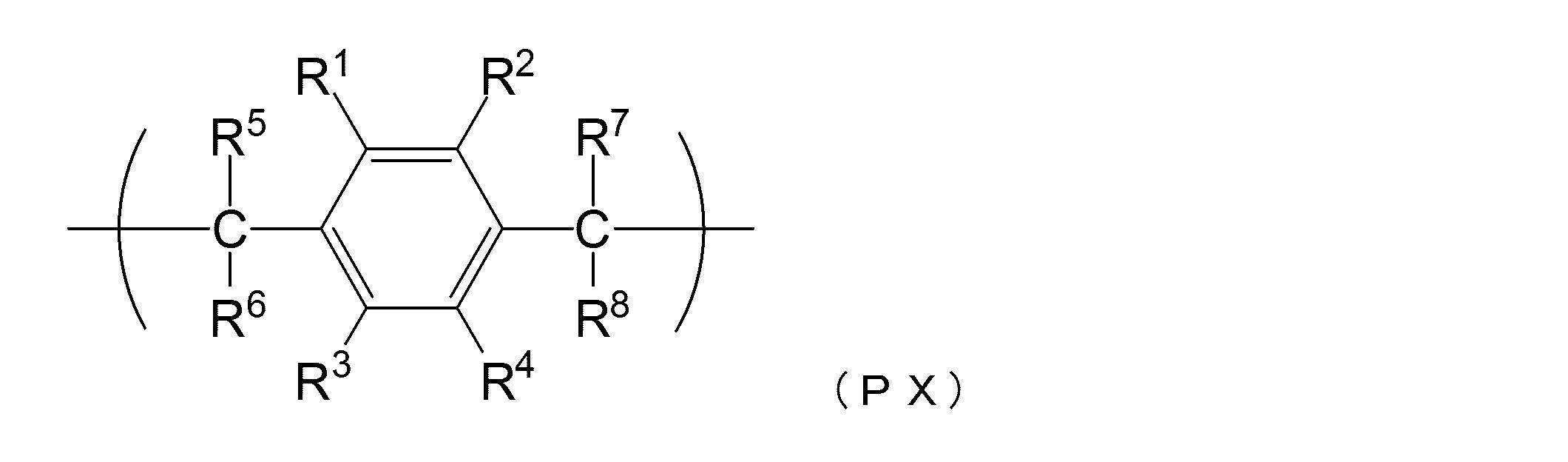
式(PX)中、R1~R8は、それぞれ独立に、水素原子、ハロゲン原子または炭素数1~100のアルキル基を表す。
<8>
水およびフッ素系溶剤の少なくとも1種からなる溶剤に対する第2の保護層の23℃における溶解度が、5000mg/溶剤100g以上である、
<6>または<7>に記載の積層体。
<9>
第2の保護層が、下記式(1)で表される構造を有するポリビニルアルコール、式(2)で表される構造を有するポリビニルピロリドン、式(3)で表される構造を有するセルロース、および式(4)で表される構造を有するプルランからなる群の少なくとも1種の樹脂を含有する、
<6>~<8>のいずれか1つに記載の積層体;

式中、Raは-(CH2CH2O)maH、-CH2COONa、または水素原子であり、maは1または2である。
<10>
有機層が、有機半導体を含む、
<1>~<9>のいずれか1つに記載の積層体。
<11>
導電層が、金、銀、銅、アルミニウムおよびこれらの少なくとも2種を含む合金、ならびに、導電性酸化物からなる群の少なくとも1種を含む、
<1>~<10>のいずれか1つに記載の積層体。
<12>
感光層が、現像により部分的に除去されており、
保護層が、感光層の除去された部分において露出している、
<1>~<11>のいずれか1つに記載の積層体。
<13>
感光層が、現像により部分的に除去されており、
保護層が、感光層の除去された部分に対応してエッチングされており、
導電層が、感光層の除去された部分および保護層のエッチングされた部分において露出している、
<1>~<11>のいずれか1つに記載の積層体。
<14>
基材、有機層、導電層、および導電層の表面を保護しかつ最表層である保護層をこの順に有し、
導電層が、有機層に接し、かつ、ウェットエッチングされる対象であり、
保護層が部分的にエッチングされている、積層体。
<15>
導電層が、保護層のエッチングされた部分において露出している、
<14>に記載の積層体。
<16>
<12>に記載の積層体における保護層を感光層側からエッチングすることにより得られた<14>または<15>に記載の積層体。
<17>
光および放射線の少なくとも一方を作用させて、<1>~<11>のいずれか1つに記載の積層体における感光層の一部を露光した後、この感光層を現像し、
現像された感光層をマスクとして保護層をエッチングし、
エッチングされた保護層をマスクとして導電層をウェットエッチングする、積層体の製造方法。
<18>
<17>に記載の方法により製造された積層体を含み、有機層が、有機半導体を含む、有機半導体デバイス。
<19>
<17>に記載の積層体の製造方法を工程として含み、かつ、有機層が有機半導体を含む、有機半導体デバイスの製造方法。
<20>
<1>~<13>のいずれか1つに記載の積層体における保護層の形成に使用される組成物。
<21>
<1>~<13>のいずれか1つに記載の積層体における感光層の形成に使用される組成物。
<22>
<1>~<13>のいずれか1つに記載の積層体における保護層の形成に使用される組成物と、感光層の形成に使用される組成物とを含むキット。
<1>
基材、有機層、導電層、導電層の表面を保護する保護層、および感光層をこの順に有し、
導電層が、有機層に接し、かつ、ウェットエッチングされる対象であり、
感光層の現像液に対する溶解速度が、光および放射線の少なくとも一方の作用により変化する、積層体。
<2>
保護層が導電層に接する、
<1>に記載の積層体。
<3>
感光層の厚さt2に対する感光層と保護層の合計の厚さt1の比t1/t2が1.2以上である、
<1>または<2>に記載の積層体。
<4>
23℃の水に対する保護層の溶解速度が1nm/s以下である、
<1>~<3>のいずれか1つに記載の積層体。
<5>
保護層が、下記式(PX)で表される構造を有するポリパラキシリレン誘導体、導電層とは異なる窒化物、酸化物、金属からなる群の少なくとも1種を含む、
<1>~<4>のいずれか1つに記載の積層体;
<6>
保護層が、導電層側にある第1の保護層と、第1の保護層よりも感光層側にある第2の保護層を含む、
<1>~<5>のいずれか1つに記載の積層体。
<7>
第1の保護層が、下記式(PX)で表される構造を有するポリパラキシリレン誘導体、導電層とは異なる窒化物、酸化物、金属からなる群の少なくとも1種を含む、
<6>に記載の積層体;
<8>
水およびフッ素系溶剤の少なくとも1種からなる溶剤に対する第2の保護層の23℃における溶解度が、5000mg/溶剤100g以上である、
<6>または<7>に記載の積層体。
<9>
第2の保護層が、下記式(1)で表される構造を有するポリビニルアルコール、式(2)で表される構造を有するポリビニルピロリドン、式(3)で表される構造を有するセルロース、および式(4)で表される構造を有するプルランからなる群の少なくとも1種の樹脂を含有する、
<6>~<8>のいずれか1つに記載の積層体;
<10>
有機層が、有機半導体を含む、
<1>~<9>のいずれか1つに記載の積層体。
<11>
導電層が、金、銀、銅、アルミニウムおよびこれらの少なくとも2種を含む合金、ならびに、導電性酸化物からなる群の少なくとも1種を含む、
<1>~<10>のいずれか1つに記載の積層体。
<12>
感光層が、現像により部分的に除去されており、
保護層が、感光層の除去された部分において露出している、
<1>~<11>のいずれか1つに記載の積層体。
<13>
感光層が、現像により部分的に除去されており、
保護層が、感光層の除去された部分に対応してエッチングされており、
導電層が、感光層の除去された部分および保護層のエッチングされた部分において露出している、
<1>~<11>のいずれか1つに記載の積層体。
<14>
基材、有機層、導電層、および導電層の表面を保護しかつ最表層である保護層をこの順に有し、
導電層が、有機層に接し、かつ、ウェットエッチングされる対象であり、
保護層が部分的にエッチングされている、積層体。
<15>
導電層が、保護層のエッチングされた部分において露出している、
<14>に記載の積層体。
<16>
<12>に記載の積層体における保護層を感光層側からエッチングすることにより得られた<14>または<15>に記載の積層体。
<17>
光および放射線の少なくとも一方を作用させて、<1>~<11>のいずれか1つに記載の積層体における感光層の一部を露光した後、この感光層を現像し、
現像された感光層をマスクとして保護層をエッチングし、
エッチングされた保護層をマスクとして導電層をウェットエッチングする、積層体の製造方法。
<18>
<17>に記載の方法により製造された積層体を含み、有機層が、有機半導体を含む、有機半導体デバイス。
<19>
<17>に記載の積層体の製造方法を工程として含み、かつ、有機層が有機半導体を含む、有機半導体デバイスの製造方法。
<20>
<1>~<13>のいずれか1つに記載の積層体における保護層の形成に使用される組成物。
<21>
<1>~<13>のいずれか1つに記載の積層体における感光層の形成に使用される組成物。
<22>
<1>~<13>のいずれか1つに記載の積層体における保護層の形成に使用される組成物と、感光層の形成に使用される組成物とを含むキット。
本発明の積層体およびその製造方法により、導電層が有機層に隣接していても、有機層への悪影響を抑えつつ、導電層への微細なパターン形成が可能になる。
以下、本発明の代表的な実施形態について説明する。各構成要素は、便宜上、この代表的な実施形態に基づいて説明されるが、本発明は、そのような実施形態に限定されるものではない。
本明細書において「~」という記号を用いて表される数値範囲は、「~」の前後に記載される数値を下限値および上限値として含む範囲を意味する。
本明細書において「工程」との語は、独立した工程だけではなく、その工程の所期の作用が達成できる限りにおいて、他の工程と明確に区別できない工程も含む意味である。
本明細書における基(原子団)の表記について、置換および無置換を記していない表記は、置換基を有さないものと共に、置換基を有するものをも包含する意味である。例えば、単に「アルキル基」と記載した場合には、これは、置換基を有さないアルキル基(無置換アルキル基)、および、置換基を有するアルキル基(置換アルキル基)の両方を包含する意味である。
本明細書において「露光」とは、特に断らない限り、光を用いた描画のみならず、粒子線を用いた描画も含む意味である。また、露光に用いられるエネルギー線としては、一般的に、水銀灯の輝線スペクトル、エキシマレーザーに代表される遠紫外線、極紫外線(EUV光)およびX線などの活性光線、ならびに、電子線およびイオン線などの粒子線が挙げられる。
本明細書において、「(メタ)アクリレート」は、「アクリレート」および「メタクリレート」の両方、または、いずれかを意味し、「(メタ)アクリル」は、「アクリル」および「メタクリル」の両方、または、いずれかを意味し、「(メタ)アクリロイル」は、「アクリロイル」および「メタクリロイル」の両方、または、いずれかを意味する。
本明細書において、組成物中の固形分の濃度は、その組成物の総質量に対する、溶剤を除く他の成分の質量百分率によって表される。また、温度は、特に述べない限り23℃を指すものとする。
本明細書において、重量平均分子量(Mw)および数平均分子量(Mn)は、特に述べない限り、ゲル浸透クロマトグラフィ(GPC測定)に従い、ポリスチレン換算値として定義される。この重量平均分子量(Mw)および数平均分子量(Mn)は、例えば、HLC-8220(東ソー(株)製)を用い、カラムとしてガードカラムHZ-L、TSKgel Super HZM-M、TSKgel Super HZ4000、TSKgel Super HZ3000およびTSKgel Super HZ2000(東ソー(株)製)を用いることによって求めることができる。また、特に述べない限り、溶離液としてTHF(テトラヒドロフラン)を用いて測定したものとする。また、特に述べない限り、GPC測定における検出には、UV線(紫外線)の波長254nm検出器を使用したものとする。
本明細書において、積層体を構成する各層の位置関係について、「上」または「下」と記載したときには、注目している複数の層のうち基準となる層の上側または下側に他の層があればよい。すなわち、基準となる層と上記他の層の間に、さらに第3の層や要素が介在していてもよく、基準となる層と上記他の層は接している必要はない。また、特に断らない限り、基材に対し層が積み重なっていく方向を「上」と称し、または、感光層がある場合には、基材から感光層へ向かう方向を「上」と称し、その反対方向を「下」と称する。なお、このような上下方向の設定は、本明細書中における便宜のためであり、実際の態様においては、本明細書における「上」方向は、鉛直上向きと異なることもありうる。
<第1の実施形態>
図1を用いて、第1の実施形態である第1の積層体1について説明する。第1の積層体1は、基材10、有機層12、導電層14、導電層14の表面を保護する保護層16、および感光層18をこの順に有する積層体であって、導電層が、有機層に接し、かつ、ウェットエッチングされる対象であり、感光層の現像液に対する溶解速度が、光および放射線の少なくとも一方の作用により変化する積層体である。図1は、第1の積層体1に露光、現像およびエッチングを施して、導電層14にパターンを形成する工程を示す概略図である。図1aは、露光および現像される前、つまりパターンが形成される前の状態の第1の積層体1を示している。また、図1bは、第1の積層体1において、露光および現像が実施された状態、つまり、感光層18が現像により部分的に除去されており、保護層16が、感光層18の除去された部分において露出している状態を示している。また、図1cは、第1の積層体1において、保護層16がエッチングされた状態、つまり、保護層16が、感光層18の除去された部分に対応してエッチングされており、導電層14が、保護層16のエッチングされた部分において露出している状態を示している。図1cの状態のとき、感光層18は、現像により部分的に除去された状態で、保護層16の上に存在してもよい。
図1を用いて、第1の実施形態である第1の積層体1について説明する。第1の積層体1は、基材10、有機層12、導電層14、導電層14の表面を保護する保護層16、および感光層18をこの順に有する積層体であって、導電層が、有機層に接し、かつ、ウェットエッチングされる対象であり、感光層の現像液に対する溶解速度が、光および放射線の少なくとも一方の作用により変化する積層体である。図1は、第1の積層体1に露光、現像およびエッチングを施して、導電層14にパターンを形成する工程を示す概略図である。図1aは、露光および現像される前、つまりパターンが形成される前の状態の第1の積層体1を示している。また、図1bは、第1の積層体1において、露光および現像が実施された状態、つまり、感光層18が現像により部分的に除去されており、保護層16が、感光層18の除去された部分において露出している状態を示している。また、図1cは、第1の積層体1において、保護層16がエッチングされた状態、つまり、保護層16が、感光層18の除去された部分に対応してエッチングされており、導電層14が、保護層16のエッチングされた部分において露出している状態を示している。図1cの状態のとき、感光層18は、現像により部分的に除去された状態で、保護層16の上に存在してもよい。
図1aに示されるように、第1の積層体1は、基材10、有機層12、導電層14、導電層14の表面を保護する保護層16、および感光層18をこの順に有する。導電層14は有機層12に接している。保護層16は、導電層14と感光層18の間にあれば、必ずしも導電層14に接している必要はないが、保護層16は導電層14に接していることが好ましい。本明細書において、導電層が有機層に「接する」とは、導電層が有機層の上側に隣接することを意味し、導電層が有機層に全面で接している場合の他、島状、ストライプ状または格子状などの部分的な位置に介在物が存在することにより、導電層が有機層に部分的に接触している場合も含む意味である。つまり、本発明は、導電層が少なくとも一部で有機層に接していれば効果を奏し、導電層と有機層の接触割合が例えば50%、70%さらには90%と増加するほど、本発明の有用性は増加する。
図1bに示されるように、この第1の積層体1の最表層である感光層18が露光および現像され、部分的に除去されることで、感光層18にパターンが形成される。そして、図1cに示されるように、パターン化された感光層18をマスクとして、例えばドライエッチングによって、保護層16が部分的に除去される。その後、図1dに示されるように、パターン化された保護層16をマスクとして、ウェットエッチングによって、導電層14が部分的に除去される。
今回、有機層に隣接する導電層をリソグラフィー法により従来の手順でパターニングした場合には、有機層が変質したりダメージを受けたりする問題が見出された。この原因の1つは、導電層上に感光層を形成する際に塗布する感光層形成用組成物中の有機溶剤、感光層を現像する際に使用する現像液中の有機溶剤などの溶剤が、薄い導電層を透過して下層の有機層に接触し、有機層と反応することであると推定している。
そこで、本発明においては、導電層14と感光層18の間に保護層16を設けることにより、上記のような溶剤が、薄い導電層を透過して下層の有機層に接触することを抑制している。その結果、導電層が有機層に隣接していても、溶剤による有機層への悪影響を抑えつつ、導電層への微細なパターン形成が可能になる。
以下、第1の積層体1を構成する各層の詳細(材料、成膜方法および加工方法など)について説明する。
<<基材>>
基材10の材料としては、例えば、シリコン、石英、セラミック、ガラス、ポリエチレンナフタレート(PEN)、ポリエチレンテレフタレート(PET)などのポリエステルフィルム、ポリイミドフィルムなどの種々の材料を使用することができ、用途に応じて、いかなる基材を選択してもよい。また、基材の形状および厚さも、特に限定されない。基材の形状は、例えば、平板状、湾曲した板状、柱状、球状、円盤状など、種々の形状となりうる。また、基材自体が、熱酸化膜付シリコン基板およびラミネート樹脂フィルムのように、積層構造を有していてもよい。このほか、基材の積層構造に含むことができる層としては、例えば、所定の基板とこの基板上に形成する層との密着性を向上させる密着層、所定の基板表面を平坦化する平坦化層、発光デバイス用の下部電極層、ならびに、トランジスタ用のゲート電極およびゲート絶縁層などがある。上記のような密着層は、例えば、ヘキサメチルジシラザン(HMDS)やシラン化合物(アルキルシランやアルコキシシラン)などの自己組織化単分子層(SAM)からなる。このような密着層は、基材と有機層の密着性の向上に加えて、有機層中の有機材料の配向制御にも有効である。基材全体の厚さは、例えば、0.1μm~2.8mmであることが好ましく、0.3μm~2.1mmであることがより好ましく、0.5μm~1.8mmμmであることがさらに好ましい。
基材10の材料としては、例えば、シリコン、石英、セラミック、ガラス、ポリエチレンナフタレート(PEN)、ポリエチレンテレフタレート(PET)などのポリエステルフィルム、ポリイミドフィルムなどの種々の材料を使用することができ、用途に応じて、いかなる基材を選択してもよい。また、基材の形状および厚さも、特に限定されない。基材の形状は、例えば、平板状、湾曲した板状、柱状、球状、円盤状など、種々の形状となりうる。また、基材自体が、熱酸化膜付シリコン基板およびラミネート樹脂フィルムのように、積層構造を有していてもよい。このほか、基材の積層構造に含むことができる層としては、例えば、所定の基板とこの基板上に形成する層との密着性を向上させる密着層、所定の基板表面を平坦化する平坦化層、発光デバイス用の下部電極層、ならびに、トランジスタ用のゲート電極およびゲート絶縁層などがある。上記のような密着層は、例えば、ヘキサメチルジシラザン(HMDS)やシラン化合物(アルキルシランやアルコキシシラン)などの自己組織化単分子層(SAM)からなる。このような密着層は、基材と有機層の密着性の向上に加えて、有機層中の有機材料の配向制御にも有効である。基材全体の厚さは、例えば、0.1μm~2.8mmであることが好ましく、0.3μm~2.1mmであることがより好ましく、0.5μm~1.8mmμmであることがさらに好ましい。
具体的には、例えば、積層体を薄膜トランジスタに用いる場合には、熱酸化膜付シリコン基板や、ゲート電極およびゲート絶縁層が形成された基板を用いることができる。そして、例えば、積層体をフレキシブルデバイスに用いる場合には、上記樹脂などからなるフレキシブル基板を用いることができ、積層体を発光デバイスに用いる場合には、下部電極付透明基板を用いることができる。
<<有機層>>
有機層12は、有機材料を含む層である。具体的な有機材料は、有機層の用途や機能に応じて、適宜選択される。有機層の想定される機能としては、例えば、半導体特性、発光特性、光電変換特性、光吸収特性、電気絶縁性、強誘電性、透明性、絶縁性などが挙げられる。
有機層12は、有機材料を含む層である。具体的な有機材料は、有機層の用途や機能に応じて、適宜選択される。有機層の想定される機能としては、例えば、半導体特性、発光特性、光電変換特性、光吸収特性、電気絶縁性、強誘電性、透明性、絶縁性などが挙げられる。
例えば、有機層の半導体特性を利用する場合には、有機材料として、後述するような有機半導体を少なくとも1種含む材料が使用できる。また、例えば、有機層の発光特性を利用する場合には、有機材料として、有機半導体に加えて、有機リガンドで表面修飾された量子ドットが使用できる。有機リガンドは、例えば、ピリジン、メルカプトアルコール、チオール、ホスフィンおよびホスフィン酸化物であり、量子ドットは、例えば、CdSe、CdTe、CdS、ZnSe、ZnTe、ZnS、HgS、HgSe、HgTeなどのII-VI族化合物、GaAs、GaP、GaN、GaSb、InN、InAs、InP、InSbなどのIII-V族化合物である。
また、有機層の光電変換特性を利用する場合には、有機材料として、例えば、フラーレン誘導体やフタロシアニンを用いることができる。有機層の光吸収特性を利用する場合には、有機材料として、例えば、ジケトピロロピロールやキナクリドンなどの有機顔料および染料を用いることができる。有機層の電気絶縁性を利用する場合には、有機材料として、例えば、エポキシ樹脂、シリコーン樹脂、フェノール樹脂、ポリイミド樹脂、ポリアミド樹脂、ポリカーボネート樹脂、ポリスチレン樹脂、アクリル樹脂、フッ素樹脂などの有機絶縁体を少なくとも1種含む樹脂材料が使用できる。有機層の強誘電性を利用する場合には、有機材料として、例えば、ポリフッ化ビニリデン樹脂、および、フッ化ビニリデンと三フッ化エチレンの共重合体樹脂などの有機強誘電体を少なくとも1種含む樹脂材料を用いることができる。有機層の透明性を利用する場合には、有機材料として、例えば、アクリル樹脂、ポリエチレンテレフタレート、ポリカーボネート、ポリ塩化ビニルなどを用いることができる。そして、有機層の接着性を利用する場合には、スチレン系、オレフィン/アルケン系、塩化ビニル系、ウレタン系、アミド系、シリコーン系などのエラストマーを用いることができる。
有機半導体や有機リガンドは有機溶剤の影響を受けやすいため、本発明は、有機層が有機半導体や有機リガンドを含む場合に、より有効である。さらに、有機半導体の変質やダメージはその半導体特性の劣化に大きく影響するため、本発明は、有機層が、有機半導体を含む有機半導体層である場合に、特に有効である。
有機半導体層は、有機半導体を含む有機層であり、有機半導体は、半導体の特性を示す有機化合物である。有機半導体には、無機化合物からなる半導体の場合と同様に、ホール(正孔)をキャリアとして伝導するp型半導体と、電子をキャリアとして伝導するn型半導体がある。有機半導体層中のキャリアの流れやすさはキャリア移動度μで表される。用途にもよるが、一般にキャリア移動度は高い方がよく、10-7cm2/Vs以上であることが好ましく、10-6cm2/Vs以上であることがより好ましく、10-5cm2/Vs以上であることがさらに好ましい。キャリア移動度は、電界効果トランジスタ(FET)素子を作製したときの特性や飛行時間計測(TOF)法の測定値に基づいて求めることができる。
有機半導体層に使用し得るp型有機半導体としては、ホール輸送性を有する材料であれば、いかなる材料を用いてもよい。p型有機半導体は、好ましくは、p型π共役高分子、縮合多環化合物、トリアリールアミン化合物、ヘテロ5員環化合物、フタロシアニン化合物、ポルフィリン化合物、カーボンナノチューブ、およびグラフェンのいずれかである。また、p型有機半導体として、これらの化合物のうち複数種の化合物を組み合わせて使用してもよい。p型有機半導体は、より好ましくは、p型π共役高分子、縮合多環化合物、トリアリールアミン化合物、ヘテロ5員環化合物、フタロシアニン化合物、およびポルフィリン化合物の少なくとも1種であり、さらに好ましくは、p型π共役高分子および縮合多環化合物の少なくとも1種である。
p型π共役高分子は、例えば、置換または無置換のポリチオフェン(例えば、ポリ(3-ヘキシルチオフェン)(P3HT、シグマ アルドリッチ ジャパン合同会社製)など)、ポリセレノフェン、ポリピロール、ポリパラフェニレン、ポリパラフェニレンビニレン、ポリチオフェンビニレン、ポリアニリンなどである。縮合多環化合物は、例えば、置換または無置換のアントラセン、テトラセン、ペンタセン、アントラジチオフェン、ヘキサベンゾコロネンなどである。
トリアリールアミン化合物は、例えば、m-MTDATA(4,4’,4’’-Tris[(3-methylphenyl)phenylamino]triphenylamine)、2-TNATA(4,4’,4’’-Tris[2-naphthyl(phenyl)amino]triphenylamine)、NPD(N,N’-Di(1-naphthyl)-N,N’-diphenyl-(1,1’-biphenyl)-4,4’-diamine)、TPD(N,N’-Diphenyl-N,N’-di(m-tolyl)benzidine)、mCP(1,3-bis(9-carbazolyl)benzene)、CBP(4,4’-bis(9-carbazolyl)-2,2’-biphenyl)などである。
ヘテロ5員環化合物は、例えば、置換または無置換のオリゴチオフェン、TTF(Tetrathiafulvalene)などである。
フタロシアニン化合物は、各種中心金属を有する置換または無置換のフタロシアニン、ナフタロシアニン、アントラシアニン、テトラピラジノポルフィラジンなどである。ポルフィリン化合物は、各種中心金属を有する置換または無置換のポルフィリンである。また、カーボンナノチューブは、半導体ポリマーが表面に修飾されたカーボンナノチューブでもよい。
有機半導体層に使用し得るn型有機半導体としては、電子輸送性を有する材料であれば、いかなる材料を用いてもよい。n型有機半導体は、好ましくは、フラーレン化合物、電子欠乏性フタロシアニン化合物、縮環多環化合物(ナフタレンテトラカルボニル化合物、ペリレンテトラカルボニル化合物など)、TCNQ化合物(テトラシアノキノジメタン化合物)、n型π共役高分子、およびグラフェンのいずれかである。また、n型有機半導体として、これらの化合物のうち複数種の化合物を組み合わせて使用してもよい。n型有機半導体は、より好ましくは、フラーレン化合物、電子欠乏性フタロシアニン化合物、縮環多環化合物、およびn型π共役高分子の少なくとも1種であり、特に好ましくは、フラーレン化合物、縮環多環化合物およびn型π共役高分子の少なくとも1種である。
フラーレン化合物とは、置換または無置換のフラーレンを意味し、フラーレンとしてはC60、C70、C76、C78、C80、C82、C84、C86、C88、C90、C96、C116、C180、C240、C540などで表されるフラーレンのいずれでもよい。フラーレン化合物は、好ましくは、置換または無置換のC60、C70、C86フラーレンであり、特に好ましくは、PCBM([6,6]-フェニル-C61-酪酸メチルエステル、シグマ アルドリッチ ジャパン合同会社製など)およびその類縁体(例えば、C60部分をC70、C86等に置換したもの、置換基のベンゼン環を他の芳香環またはヘテロ環に置換したもの、メチルエステルをn-ブチルエステル、i-ブチルエステル等に置換したもの)である。
電子欠乏性フタロシアニン化合物とは、電子求引性基が4つ以上結合しかつ各種中心金属を有する置換または無置換のフタロシアニン、ナフタロシアニン、アントラシアニン、テトラピラジノポルフィラジンなどである。電子欠乏性フタロシアニン化合物は、例えば、フッ素化フタロシアニン(F16MPc)、および塩素化フタロシアニン(Cl16MPc)などである。ここで、Mは中心金属を、Pcはフタロシアニンを表す。
ナフタレンテトラカルボニル化合物としてはいかなるものでもよいが、好ましくはナフタレンテトラカルボン酸無水物(NTCDA)、ナフタレンビスイミド化合物(NTCDI)、ペリノン顔料(Pigment Orange 43、Pigment Red 194など)である。ペリレンテトラカルボニル化合物としてはいかなるものでもよいが、好ましくはペリレンテトラカルボン酸無水物(PTCDA)、ペリレンビスイミド化合物(PTCDI)、ベンゾイミダゾール縮環体(PV)である。
TCNQ化合物とは、置換または無置換のTCNQおよび、TCNQのベンゼン環部分を別の芳香環やヘテロ環に置き換えたものである。TCNQ化合物は、例えば、TCNQ、TCNAQ(テトラシアノアントラキノジメタン)、TCN3T(2,2’-((2E,2’’E)-3’,4’-Alkyl substituted-5H,5’’H-[2,2’:5’,2’’-terthiophene]-5,5’’-diylidene)dimalononitrile derivatives)などである。
本発明において、n型有機半導体材料の特に好ましい例を以下に示す。なお、式中のRとしては、いかなるものでも構わないが、水素原子、置換または無置換で分岐または直鎖のアルキル基(好ましくは炭素数1~18、より好ましくは1~12、さらに好ましくは1~8のもの)、置換または無置換のアリール基(好ましくは炭素数6~30、より好ましくは6~20、さらに好ましくは6~14のもの)のいずれかであることが好ましい。Meはメチル基である。
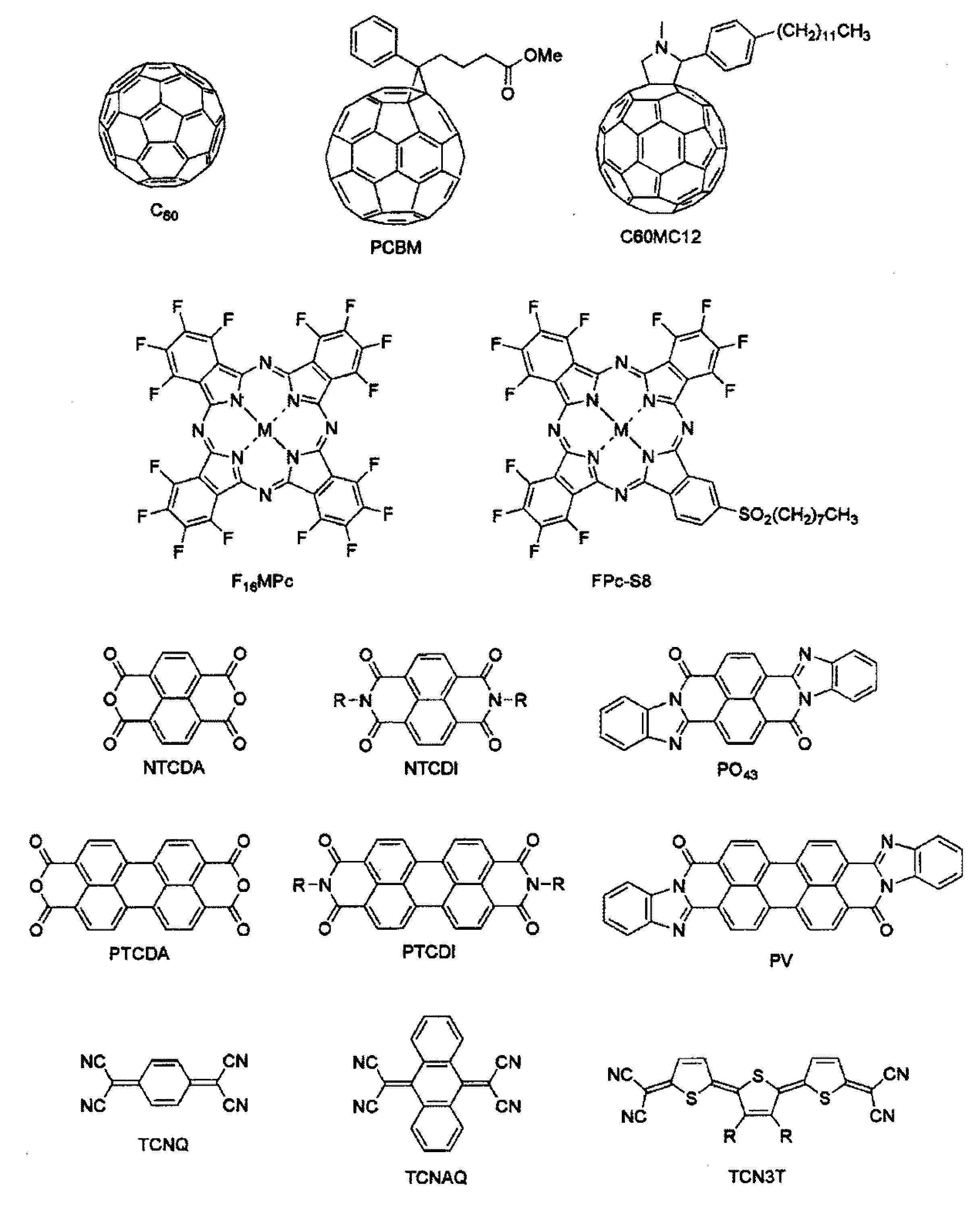
有機半導体層に含まれる有機半導体は、1種でもよいし、2種以上であってもよい。また、有機半導体層は、p型の層とn型の層の積層または混合層でもよい。
有機層の形成方法は、気相法でも液相法でもよい。気相法の場合には、蒸着法(真空蒸着法、分子線エピタキシー法など)、スパッタリング法、およびイオンプレーティング法などの物理気相成長(PVD)法や、プラズマ重合法などの化学気相成長(CVD)法が使用でき、特に蒸着法が好ましい。
一方、液相法の場合には、有機材料は、通常、溶剤中に配合され、有機層を形成する組成物(有機層形成用組成物)とされる。そして、この組成物を基材上に供給し乾燥して、有機層が成膜される。供給方法としては、塗布が好ましい。供給方法の例としては、スリットコート法、キャスト法、ブレードコーティング法、ワイヤーバーコーティング法、スプレーコーティング法、ディッピング(浸漬)コーティング法、ビードコーティング法、エアーナイフコーティング法、カーテンコーティング法、インクジェット法、スピンコート法、ラングミュア-ブロジェット(Langmuir-Blodgett)(LB)法、エッジキャスト法(詳細は、特許第6179930号公報)などを挙げることができる。キャスト法、スピンコート法、およびインクジェット法を用いることがさらに好ましい。このようなプロセスにより、表面が平滑で大面積の有機層を低コストで生産することが可能となる。
また、有機層形成用組成物に使用する溶剤としては、有機溶剤が好ましい。有機溶剤としては、例えば、ヘキサン、オクタン、デカン、トルエン、キシレン、エチルベンゼン、1-メチルナフタレン、1,2-ジクロロベンゼン等の炭化水素系溶剤;例えば、アセトン、メチルエチルケトン、メチルイソブチルケトン、シクロヘキサノン等のケトン系溶剤;例えば、ジクロロメタン、クロロホルム、テトラクロロメタン、ジクロロエタン、トリクロロエタン、テトラクロロエタン、クロロベンゼン、ジクロロベンゼン、クロロトルエン等のハロゲン化炭化水素系溶剤;例えば、酢酸エチル、酢酸ブチル、酢酸アミル等のエステル系溶剤;例えば、メタノール、プロパノール、ブタノール、ペンタノール、ヘキサノール、シクロヘキサノール、メチルセロソルブ、エチルセロソルブ、エチレングリコール等のアルコール系溶剤;例えば、ジブチルエーテル、テトラヒドロフラン、ジオキサン、アニソール等のエーテル系溶剤;例えば、N,N-ジメチルホルムアミド、N,N-ジメチルアセトアミド、1-メチル-2-ピロリドン、1-メチル-2-イミダゾリジノン、ジメチルスルフォキサイド等の極性溶剤などが挙げられる。これらの溶剤は1種のみを用いてもよいし、2種以上を用いてもよい。有機層形成用組成物における有機材料の割合は、好ましくは1~95質量%、より好ましくは5~90質量%であり、これにより任意の厚さの膜を形成できる。
また、有機層形成用組成物には、樹脂バインダーを配合してもよい。この場合、膜を形成する材料とバインダー樹脂とを前述の適当な溶剤に溶解させ、または分散させて塗布液とし、各種の塗布法により薄膜を形成することができる。樹脂バインダーとしては、ポリスチレン、ポリカーボネート、ポリアリレート、ポリエステル、ポリアミド、ポリイミド、ポリウレタン、ポリシロキサン、ポリスルフォン、ポリメチルメタクリレート、ポリメチルアクリレート、セルロース、ポリエチレン、ポリプロピレン等の絶縁性ポリマー、およびこれらの共重合体、ポリビニルカルバゾール、ポリシラン等の光伝導性ポリマー、ポリチオフェン、ポリピロール、ポリアニリン、ポリパラフェニレンビニレン等の導電性ポリマーなどを挙げることができる。樹脂バインダーは、単独で使用してもよく、あるいは複数併用してもよい。薄膜の機械的強度を考慮するとガラス転移温度の高い樹脂バインダーが好ましく、電荷移動度を考慮すると極性基を含まない構造の光伝導性ポリマーまたは導電性ポリマーよりなる樹脂バインダーが好ましい。
樹脂バインダーを配合する場合、その配合量は、有機層中、好ましくは0.1~30質量%で用いられる。樹脂バインダーは、1種のみ用いても、2種以上用いてもよい。2種以上用いる場合、それらの合計量が上記範囲にあることが好ましい。
有機層は、用途によっては単独および種々の有機材料や添加剤を添加した混合溶液を用いた、複数の材料種からなるブレンド膜でもよい。例えば、光電変換層を作製する場合、複数種の半導体材料を使用した混合溶液を用いることなどができる。
また、成膜の際、基材を加熱または冷却してもよく、基材の温度を変化させることで膜質や膜中での分子のパッキングを制御することが可能である。基材の温度としては特に制限はないが、好ましくは-200℃~400℃、より好ましくは-100℃~300℃、さらに好ましくは0℃~200℃である。
形成された有機層は、後処理により特性を調整することができる。例えば、加熱処理や蒸気化した溶剤に暴露することにより膜のモルホロジーや膜中での分子のパッキングを変化させることで特性を向上させることが可能である。また、酸化性または還元性のガスや溶剤、物質などにさらす、あるいはこれらの手法を併用することで酸化あるいは還元反応を起こし、膜中でのキャリア密度などを調整することができる。
有機層の厚さは、特に制限されず、用いられる電子デバイスの種類などにより異なるが、好ましくは1nm~50μm、より好ましくは1nm~5μm、さらに好ましくは1nm~500nmである。
<<導電層>>
導電層14は、導電性材料を含む導電性の層である。導電層14は、例えば、電子デバイスにおいて電極として機能する。例えば、電子デバイスが薄膜トランジスタであれば、導電層はソース・ドレイン電極として機能し、電子デバイスが発光ダイオードや光ディテクターであれば、導電層は透明電極として機能することができる。導電性材料は、特に限定されず、導電性無機材料および導電性有機材料のどちらも使用できる。導電性無機材料は、例えば、無機導体や無機半導体である。そして、無機導体は、例えば、金属(Au、Ag、Cu、Al、Mo、Ti、W、Mg、Niなど)、これらの金属のうち少なくとも2種を含む合金(TiWなど)、金属窒化物(TiNなど)、グラファイトなどである。また、無機半導体は、例えば、導電性酸化物(ITO、IGO、FTO、AZO、SnO、IGZO、ITZOなど)である。一方、導電性有機材料は、例えば、導電性高分子(PEDOT/PSS、ポリアセチレンなど)、および電荷移動錯体である。
導電層14は、導電性材料を含む導電性の層である。導電層14は、例えば、電子デバイスにおいて電極として機能する。例えば、電子デバイスが薄膜トランジスタであれば、導電層はソース・ドレイン電極として機能し、電子デバイスが発光ダイオードや光ディテクターであれば、導電層は透明電極として機能することができる。導電性材料は、特に限定されず、導電性無機材料および導電性有機材料のどちらも使用できる。導電性無機材料は、例えば、無機導体や無機半導体である。そして、無機導体は、例えば、金属(Au、Ag、Cu、Al、Mo、Ti、W、Mg、Niなど)、これらの金属のうち少なくとも2種を含む合金(TiWなど)、金属窒化物(TiNなど)、グラファイトなどである。また、無機半導体は、例えば、導電性酸化物(ITO、IGO、FTO、AZO、SnO、IGZO、ITZOなど)である。一方、導電性有機材料は、例えば、導電性高分子(PEDOT/PSS、ポリアセチレンなど)、および電荷移動錯体である。
導電層の形成方法は、材料に応じて、適宜、蒸着法(真空蒸着法、分子線エピタキシー法など)、スパッタリング法、およびイオンプレーティング法などの物理気相成長(PVD)法や、プラズマ重合法などの化学気相成長(CVD)法などが使用でき、特に蒸着法が好ましい。
導電層の厚さは、特に制限されず、用いられる電子デバイスの種類などにより異なるが、好ましくは1nm~50μm、より好ましくは2nm~5μm、さらに好ましくは5nm~500nmである。また、導電層は、積層構造を有していてもよく、この場合、全体の厚さが上記数値範囲を満たすことが好ましい。
そして、導電層は、例えば電極として使用されるため、成膜後、パターン形成された保護層をマスクとして、ウェットエッチングによりパターン状に形成される。つまり、導電層は、ウェットエッチングされる対象、つまり、マスクを通してパターン形成される層である。なお、保護層が導電性を有する場合には、保護層はあくまでマスクであり、ウェットエッチングされる対象としては扱わないが、残った保護層を導電層と一緒に素子中の電極として使用することは許容される。ウェットエッチングで使用するエッチング液(エッチャント)は、通常、酸性化合物(HCl、HNO3、H3PO4、FeCl3など)、アルカリ化合物(NaOH、KOHなど)、およびハロゲン化アルカリ金属(ヨウ化カリウムなど)などの水溶液であり、導電層の材料に応じて、適宜選択される。例えば、エッチング対象の材料およびこれに対応するエッチャントの組み合わせは、下記表1のとおりである。
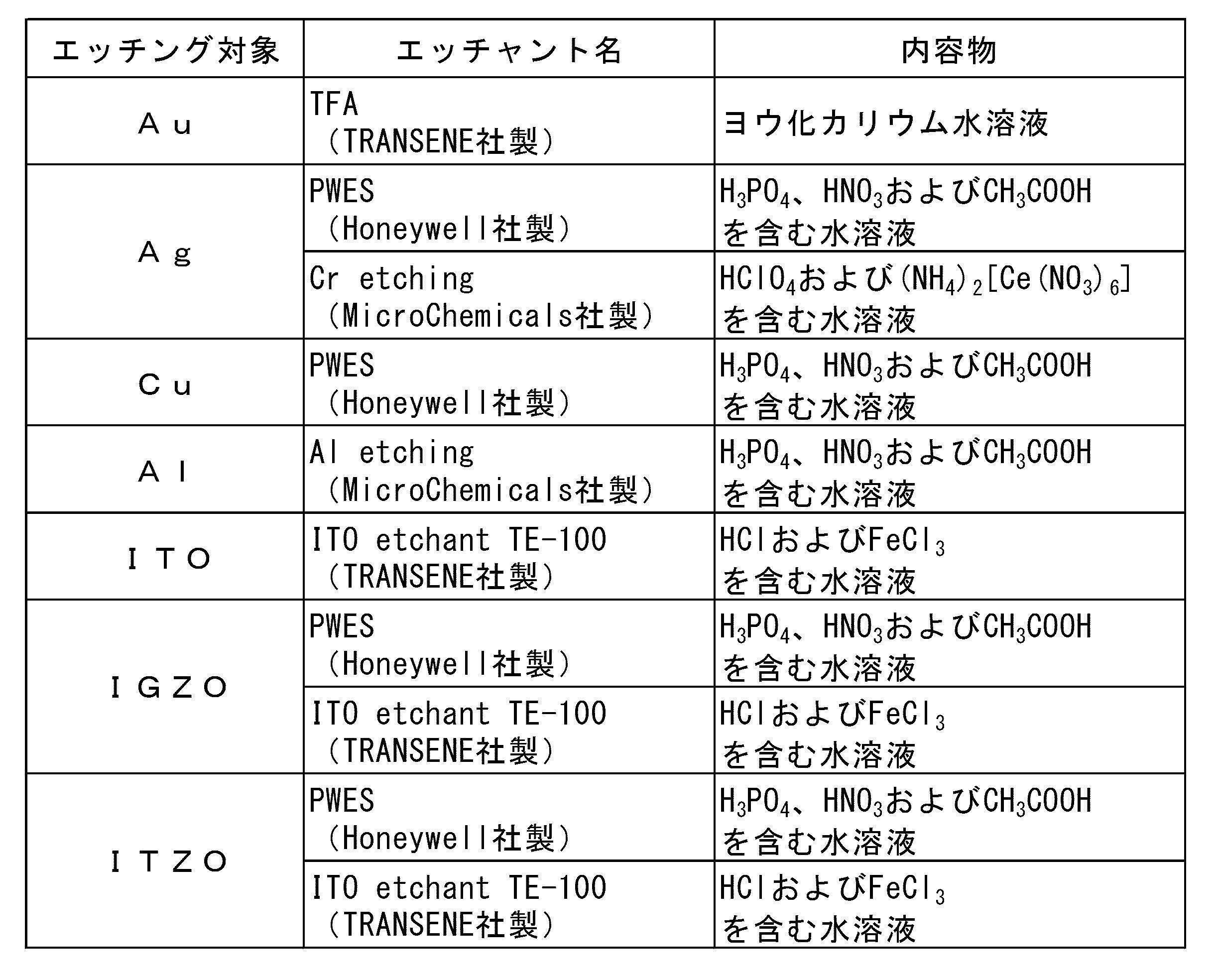
導電層をウェットエッチングする際の浸漬時間は、導電層の材料、厚さおよびエッチャントの種類、濃度、温度に応じて適宜調整されるが、例えば、1~1000秒である。
<<保護層>>
保護層16は、導電層14と感光層18の間に形成される層である。保護層16は、例えばハードマスクとして機能するといえる。保護層が、有機層および導電層の上に存在することにより、導電層上に感光層を形成する際に塗布する感光層形成用組成物中の有機溶剤、感光層を現像する際に使用する現像液中の有機溶剤などの溶剤が、下層の有機層に接触し、有機層が変質したりダメージを受けたりすることを抑制できる。溶剤が有機層に接触する過程は定かではないが、溶剤が薄い導電層を透過して有機層まで到達している可能性が考えられる。したがって、保護層を導電層と感光層の間に設けることで、有機層の変質や有機層へのダメージが抑制されると考えられる。
保護層16は、導電層14と感光層18の間に形成される層である。保護層16は、例えばハードマスクとして機能するといえる。保護層が、有機層および導電層の上に存在することにより、導電層上に感光層を形成する際に塗布する感光層形成用組成物中の有機溶剤、感光層を現像する際に使用する現像液中の有機溶剤などの溶剤が、下層の有機層に接触し、有機層が変質したりダメージを受けたりすることを抑制できる。溶剤が有機層に接触する過程は定かではないが、溶剤が薄い導電層を透過して有機層まで到達している可能性が考えられる。したがって、保護層を導電層と感光層の間に設けることで、有機層の変質や有機層へのダメージが抑制されると考えられる。
保護層は、導電層と感光層の間に存在していればよく、導電層および/または感光層に直接接している必要はない。本発明の積層体は、導電層と保護層の間に、保護層以外の他の層を有していてもよく、保護層と感光層の間に他の層を有していてもよく、さらには、これらの間のそれぞれの位置に同時に他の層を有していてもよい。保護層以外の他の層の詳細については、<他の実施形態>において後述する。
保護層は、保護層の上記のような機能の観点から、「水に溶解しにくい」、「有機溶剤を遮断できる」、および「有機溶剤を用いずに成膜およびパターニングできる」といった性質を有することが好ましい。ここで、「溶解しにくい」とは、23℃の水に対する保護層の溶解速度が1nm/s以下であることを意味する。23℃の水に対する保護層の溶解速度は、好ましくは0.5nm/s以下であり、より好ましくは0.1nm/s以下であり、さらに好ましくは0.01nm/s以下である。
保護層に含まれる材料は、気相成膜用の材料であっても、液相成膜用の材料であってもよく、好ましくは気相成膜用の材料である。保護層は、上記のような性質を満たす材料を50質量%以上含有することが好ましく、70質量%以上含有することがより好ましく、90質量%以上含有することがさらに好ましい。
気相成膜用の材料は、例えば、下記式(PX)で表される構造を有するポリパラキシリレン誘導体(ポリパラキシリレンを含む。)、導電層とは異なる窒化物、酸化物、金属からなる群のうち、少なくとも1種を含むことが好ましく、特にポリパラキシリレン誘導体を含むことが好ましい。ここで、保護層は、導電層と異なる材料であれば、導電層として使用できる材料と同様の材料を使用することもでき、特に制限されない。上記窒化物としては、例えばSiN、TiNなどが好ましく、上記酸化物としては、例えばSiO2、Al2O3、HfO2などが好ましく、上記金属としては、例えばMo、W、Tiが好ましい。

式中、R1~R8は、それぞれ独立に、水素原子、ハロゲン原子または炭素数1~100のアルキル基を表す。
ハロゲン原子としては、好ましくは、フッ素原子、塩素原子であり、より好ましくはフッ素原子である。アルキル基としては、好ましくは、メチル基、エチル基、プロピル基であり、より好ましくは、メチル基である。
保護層の気相による形成方法は、材料に応じて、適宜、蒸着法(真空蒸着法、分子線エピタキシー法など)、スパッタリング法、およびイオンプレーティング法などの物理気相成長(PVD)法や、プラズマ重合法などの化学気相成長(CVD)法が使用でき、特に蒸着法が好ましい。
一方、保護層の液相成膜用の材料は、例えば、フッ素系ポリマーや水系架橋材料である。
フッ素系ポリマーは、感光層形成用組成物中に含まれる有機溶剤に溶けにくいため、有機半導体の保護性能が向上する。また、フッ素系ポリマーは、他の有機溶剤に比べて有機半導体に与える影響が小さいフッ素系溶剤を用いて塗布することができる点でも好ましい。フッ素系ポリマーにおけるフッ素原子の割合は、1~80%であることが好ましく、20~70%であることがより好ましい。フッ素系ポリマー中におけるフッ素原子の割合は、(フッ素系ポリマーを構成するフッ素原子の数/フッ素系ポリマーを構成する全原子の数)×100(%)で示される。
フッ素系ポリマーは、フッ素原子と炭素原子と酸素原子と水素原子のみから構成される樹脂であることが好ましい。
フッ素系ポリマーの重量平均分子量は2000~200000であることが好ましく、3000~100000であることがより好ましい。また、フッ素系ポリマーの分散度(重量平均分子量/数平均分子量)は、1.0~5.0が好ましく、2.0~4.0がより好ましい。このような範囲とすることにより、より効果的にクラックの発生を抑制することができる。
フッ素系ポリマーの好ましい実施形態として、下記式(F)で表される構成単位を含む樹脂が挙げられる。
式(F)
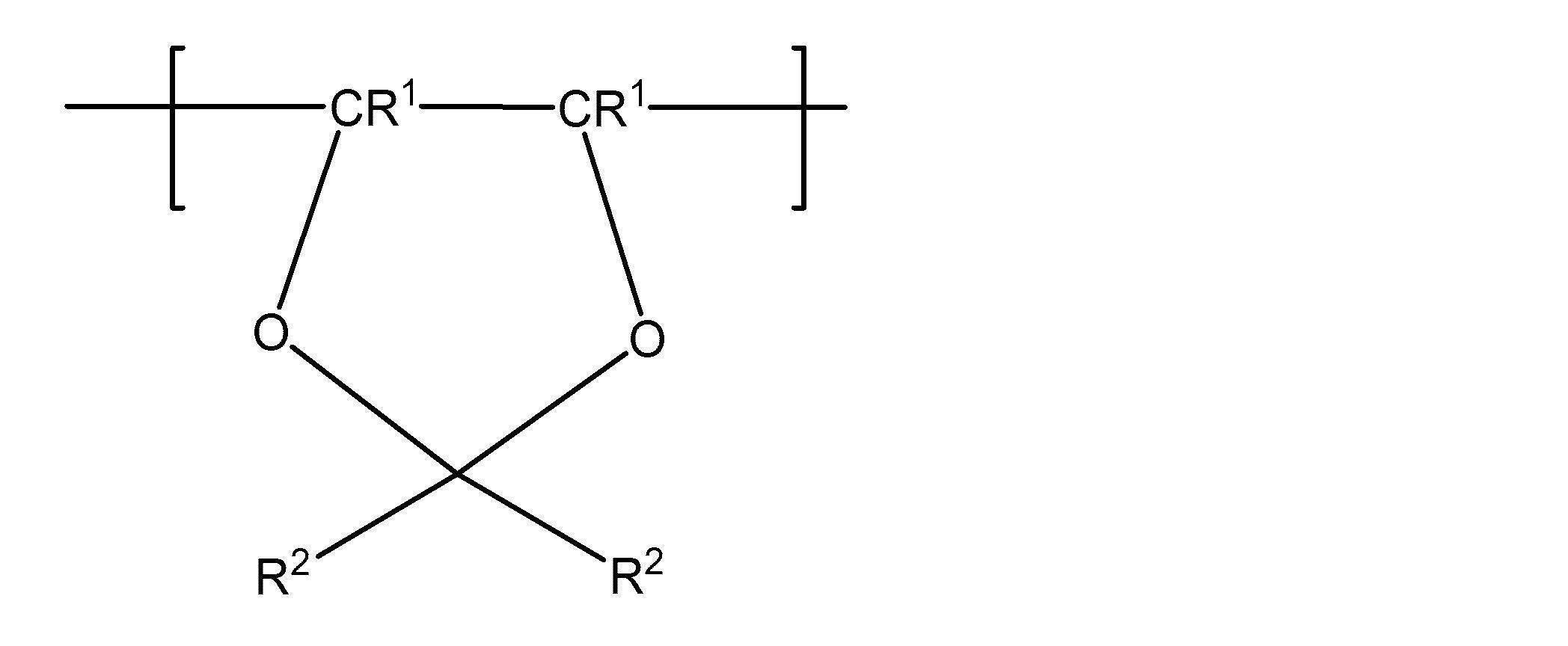
式(F)中、R1は、それぞれ独立に、水素原子またはフッ素原子を表す。R2は、それぞれ独立に、水素原子、フッ素原子または、少なくとも1つのフッ素原子で置換された、炭素原子数1~5のアルキル基を表す。R1およびR2の少なくとも1つは、フッ素原子を含み、かつ、2つのR2は互いに結合して、環構造を形成していてもよい。
式(F)中、R1は、フッ素原子であることが好ましい。R2は、フッ素原子または、少なくとも1つのフッ素原子で置換された、炭素原子数1~5のアルキル基であることが好ましく、少なくとも1つのフッ素原子で置換された、炭素原子数1~5のアルキル基であることがより好ましく、少なくとも1つのフッ素原子で置換されたメチル基またはエチル基であることがさらに好ましく、パーフルオロメチル基または少なくとも3つのフッ素原子で置換されたエチル基であることが一層好ましく、パーフルオロメチル基であることがより一層好ましい。また、2つのR2は環構造を形成していない方が好ましい。
フッ素系ポリマーは、上記式(F)で表される構成単位、および上記式(F)で表される構成単位以外の他の構成単位の両方を含んでもよい。フッ素系ポリマーがこの他の構成単位を含む場合には、他の構成単位もフッ素原子を含んでいることが好ましい。
上記他の構成単位としては、少なくとも1つのフッ素原子で置換されていてもよい、アルキレン基が好ましく、少なくとも1つのフッ素原子で置換されているアルキレン基であることがより好ましい。アルキレン基としては、炭素原子数1~3のアルキレン基が例示され、エチレン基が好ましい。上記他の構成単位は、パーフルオロエチレン基が特に好ましい。
上記式(F)で表される構成単位と上記他の構成単位のフッ素系ポリマー中におけるモル比率は、50~95:50~5であることが好ましく、55~90:45~10であることがより好ましい。
フッ素系ポリマーの具体例としては、三井・デュポンフロロケミカル社製、テフロン(登録商標)、AF-1600X等が例示される。
フッ素系ポリマーの溶解に使用するフッ素系溶剤は、例えば、パーフルオロカーボン(PFC)、ハイドロクロロフルオロカーボン(HCFC)、ハイドロフルオロカーボン(HFC)、環状のフッ素系溶剤、ハイドロフルオロエーテル(HFE)等が挙げられる。具体的には、1,4-ジフルオロベンゼン、1,1,2,2-テトラクロロジフルオロエタン、テトラフルオロプロパノール、トリフルオロアセト酢酸エチル、パーフルオロヘプタン、ヘキサフルオロイソプロパノール、パーフルオロブチルエタノール、ペンタフルオロプロパノール、ヘキサフルオロベンゼン、パーフルオロブチルテトラヒドロフラン、パーフルオロポリエーテル類、および、フルオロフェノールなどを例示することができる。
また、保護層の液相成膜用の水系架橋材料は、例えば、水溶性樹脂、架橋剤、酸発生剤および溶剤を含む水系樹脂組成物である。
水溶性樹脂は、例えば、ポリビニルアルコール(PVA)、レゾール型フェノール樹脂、ポリエチレンオキシド、ポリアクリルアミドおよびカルボキシメチルセルロースなどである。水溶性樹脂は、特に、PVAであることが好ましい。
架橋剤としては、多核フェノール類の他、種々の硬化剤を使用することができる。このような架橋剤を使用することにより、水系樹脂組成物は、より低温で硬化して保護層となる。
上記多核フェノール類は、例えば、4,4’-ビフェニルジオール、4,4’-メチレンビスフェノール、4,4’-エチリデンビスフェノール、ビスフェノールA等の2核フェノール類;4,4’,4’’-メチリデントリスフェノール、4,4’-[1-[4-[1-(4-ヒドロキシフェニル)-1-メチルエチル]フェニル]エチリデン]ビスフェノール等の3核フェノール類;ノボラック等のポリフェノール類等である。これらの中でも、4,4’-[1-[4-[1-(4-ヒドロキシフェニル)-1-メチルエチル]フェニル]エチリデン]ビスフェノール、ノボラックが好ましい。これらの多核フェノール類は、単独でまたは2種以上を混合して使用することができる。
上記硬化剤は、例えば、2,3-トリレンジイソシアナート、2,4-トリレンジイソシアナート、3,4-トリレンジイソシアナート、3,5-トリレンジイソシアナート、4,4’-ジフェニルメタンジイソシアナート、ヘキサメチレンジイソシアナート、1,4-シクロヘキサンジイソシアナート等のジイソシアナート類である。その他、市販品として入手可能な硬化剤として、エピコート812、同815、同826、同828、同834、同836、同871、同1001、同1004、同1007、同1009、同1031(以上、油化シェルエポキシ製)、アラルダイト6600、同6700、同6800、同502、同6071、同6084、同6097、同6099(以上、チバガイギー製)、DER331、同332、同333、同661、同644、同667(以上、ダウケミカル製)等のエポキシ化合物;サイメル300、同301、同303、同350、同370、同771、同325、同327、同703、同712、同701、同272、同202、マイコート506、同508(以上、三井サイアナミッド製)等のメラミン系硬化剤;サイメル1123、同1123-10、同1128、マイコート102、同105、同106、同130(以上、三井サイアナミッド製)等のベンゾグアナミン系硬化剤;サイメル1170、同1172(以上、三井サイアナミッド製)、MX-279、ニカラックN-2702(三和ケミカル製)等のグリコールウリル系硬化剤等も使用できる。これらの中でも、メラミン系硬化剤、グリコールウリル系硬化剤が好ましく、1,3,4,6-テトラキス(メトキシメチル)グリコールウリルがより好ましい。これらの硬化剤は、単独でまたは2種以上を混合して使用することができる。また、架橋剤として、多核フェノール類と硬化剤を併用することもできる。
架橋剤の含有量は、水溶性樹脂100質量部に対して、1~50質量部が好ましく、2~30質量部がさらに好ましく、5~20質量部が特に好ましい。架橋剤を2種以上含む場合には、それらの合計量が上記範囲にあることが好ましい。架橋剤の含有量を上記範囲とすることで、水系樹脂組成物から形成される保護層の所定の性能を低下させることなく、上述した効果を発揮させることが可能となる。
酸発生剤は、露光または加熱により酸を発生する成分である。酸発生剤を含有させることにより、ポイゾニング問題(感光層の下地から発生した例えばOH-、CH3-、NH2-等の塩基物質が、感光層へ拡散し、このような物質が感光層中の酸を失活させ、パターン形状に欠陥をもたらす問題)を解消することが可能となる。つまり、保護層中の酸発生剤が塩基物質と反応することにより、塩基物質の感光層への拡散を防ぐことが可能となる。
酸発生剤のうち、露光により酸を発生する酸発生剤(以下、「光酸発生剤」ともいう。)は、例えば、国際公開第2007/105776号の段落0076~0081に記載の化合物が例示され、これらの内容は本明細書に組み込まれる。
これらの光酸発生剤の中でも、ジフェニルヨードニウムトリフルオロメタンスルホネート、ジフェニルヨードニウムノナフルオロ-n-ブタンスルホネート、ジフェニルヨードニウムピレンスルホネート、ジフェニルヨードニウムn-ドデシルベンゼンスルホネート、ジフェニルヨードニウム10-カンファースルホネート、ジフェニルヨードニウムナフタレンスルホネート、ビス(4-t-ブチルフェニル)ヨードニウムトリフルオロメタンスルホネート、ビス(4-t-ブチルフェニル)ヨードニウムノナフルオロ-n-ブタンスルホネート、ビス(4-t-ブチルフェニル)ヨードニウムn-ドデシルベンゼンスルホネート、ビス(4-t-ブチルフェニル)ヨードニウム10-カンファースルホネート、および、ビス(4-t-ブチルフェニル)ヨードニウムナフタレンスルホネートが好ましく、ビス(4-t-ブチルフェニル)ヨードニウムノナフルオロ-n-ブタンスルホネートがより好ましい。なお、これらの光酸発生剤は、単独でまたは2種以上を混合して使用することができる。
酸発生剤のうち、加熱により酸を発生する酸発生剤(以下、「熱酸発生剤」ともいう。)は、例えば、2,4,4,6-テトラブロモシクロヘキサジエノン、ベンゾイントシレート、2-ニトロベンジルトシレート、および、アルキルスルホネート類等である。これらの熱酸発生剤は、単独でまたは2種以上を混合して使用することができる。酸発生剤として、光酸発生剤と熱酸発生剤を併用することもできる。
酸発生剤の含有量は、水溶性樹脂100質量部に対して、0.1~30質量部が好ましく、0.5~25質量部がさらに好ましく、1~20質量部が特に好ましい。酸発生剤を2種以上含む場合には、それらの合計量が上記範囲にあることが好ましい。酸発生剤の含有量を上記範囲とすることで、水系樹脂組成物は上述の効果を良好に発揮できる。
水系樹脂組成物用の溶剤は、例えば、85質量%以上、好ましくは90質量%以上の水を含む。また、この溶剤は、少量の水溶性有機溶剤を含んでもよい。この水溶性有機溶剤の含有量は、例えば、全溶剤に対して、0.001~5質量%、好ましくは0.01~2質量%である。
保護層の液相による形成は、例えば、保護層の材料と溶剤とを混合した組成物を導電層上に供給し、これを乾燥させることにより行う。組成物中の溶剤および組成物の供給方法は、有機層を液相法により形成する際の溶剤および供給方法と同様である。
保護層を液相で形成する場合には、上記組成物に添加剤を入れてもよい。添加剤としては、例えば、界面活性剤、消泡剤、接着助剤および保存安定剤などである。
保護層は、後述する第2の実施形態で説明するように、複数の層から構成される積層構造を有していてもよい。保護層が、積層構造を有する場合には、保護層全体として所望の機能を発揮すればよいため、材料選択の幅が広がるという利点もある。また、本発明において、保護層が積層構造を有する場合には、保護層の厚さは、その積層構造全体の厚さを意味する。
保護層の厚さは、特に制限されず、用いられる電子デバイスの種類などにより異なるが、溶剤を遮断する性能の観点から、好ましくは50nm以上、より好ましくは70nm以上、さらに好ましくは100nm以上である。また、保護層の厚さは、エッチング時間の短縮やパターンの安定性の観点から、好ましくは5000nm以下、より好ましくは4000nm以下、さらに好ましくは3500nm以下である。さらに、感光層の厚さt2に対する感光層と保護層の合計の厚さt1の比t1/t2は、最終的なパターンの歪みやズレ、ムラなどを抑制し、パターンの形成性を向上させる観点から、好ましくは1.2以上、より好ましくは1.3以上、さらに好ましくは1.5以上であり、好ましくは50以下、より好ましくは40以下、さらに好ましくは20以下である。
そして、保護層は、成膜後、パターン形成された感光層をマスクとして、例えばドライエッチングなどのエッチングによりパターン状に形成される。保護層のエッチング条件は、保護層の材料に応じて、適宜選択されるが、例えばエッチングガスとしてO2を用いたドライエッチングが好ましい。
<<感光層>>
感光層18は、典型的にはリソグラフィー法におけるレジスト層であり、光および放射線の少なくとも一方の作用により現像液に対するその溶解速度が変化する。感光層は、例えば、感光層となる樹脂材料を含む組成物を塗布し、この塗布膜を乾燥することで形成される。
感光層18は、典型的にはリソグラフィー法におけるレジスト層であり、光および放射線の少なくとも一方の作用により現像液に対するその溶解速度が変化する。感光層は、例えば、感光層となる樹脂材料を含む組成物を塗布し、この塗布膜を乾燥することで形成される。
感光層の厚さは、特に制限されないが、例えば、0.01~3μmであることが好ましく、0.02~3μmであることがより好ましく、0.05~2.5μmであることがさらに好ましい。感光層の厚さが、上記の範囲であれば、保護層のドライエッチングにおけるマスクとして充分に機能し、かつ、保護層のドライエッチング終了時には、感光層が十分に薄くなっているか、またはドライエッチングによりすべて除去されている。ドライエッチング終了後に感光層の残渣がある場合には、例えば、公知の溶剤で洗い流すことによって残渣を除去することができる。
このような感光層の形成に使用される組成物(感光層形成用組成物)は、典型的にはレジスト組成物であり、ネガ型の現像(露光されると現像液に対して溶解性が減少し、露光部がパターンとして残り、未露光部が除去される現像)に使用される樹脂でも、ポジ型の現像(露光されると現像液に対して溶解性が増加し、未露光部がパターンとして残り、露光部が除去される現像)に使用される樹脂でもよいが、ネガ型の現像に使用される樹脂が好ましい。また、感光層形成用組成物は、有機溶剤現像(有機溶剤を含む有機系現像液を用いた現像)に用いられる組成物でも、アルカリ現像(アルカリ性現像液を用いた現像)に用いられる組成物でもよい。例えば、有機溶剤現像用の組成物としては、典型的には、感光層形成用組成物は、化学増幅型のレジスト組成物である。
感光層形成用組成物としては、例えば、「酸の作用により極性が増大して、有機溶剤を含む現像液に対する溶解性が減少する樹脂」を含有する樹脂組成物を使用することができる(樹脂組成物(I))。また、感光層形成用組成物としては、例えば、樹脂と架橋剤を含む樹脂組成物を使用することができる(樹脂組成物(II))。
<<<樹脂組成物(I)>>>
[1]酸の作用により極性が増大して、有機溶剤を含む現像液に対する溶解性が減少する樹脂
樹脂組成物(I)は、酸の作用により極性が増大して、有機溶剤を含む現像液に対する溶解性が減少する樹脂(以下、「酸分解性樹脂」または「樹脂(A)」ともいう。)を含有する。酸分解性樹脂は、極性基が酸の作用により分解し脱離する脱離基(以下、「酸分解性基」ともいう。)で保護された構造を有する樹脂である。
[1]酸の作用により極性が増大して、有機溶剤を含む現像液に対する溶解性が減少する樹脂
樹脂組成物(I)は、酸の作用により極性が増大して、有機溶剤を含む現像液に対する溶解性が減少する樹脂(以下、「酸分解性樹脂」または「樹脂(A)」ともいう。)を含有する。酸分解性樹脂は、極性基が酸の作用により分解し脱離する脱離基(以下、「酸分解性基」ともいう。)で保護された構造を有する樹脂である。
樹脂(A)としては、例えば、樹脂の主鎖または側鎖、あるいは、主鎖および側鎖の両方に、酸分解性基を有する樹脂を挙げることができる。酸分解性基は、極性基を酸の作用により分解し脱離する基で保護された構造を有することが好ましい。
極性基としては、有機溶剤を含む現像液中で難溶化または不溶化する基であれば特に限定されないが、カルボキシル基、スルホン酸基等の酸性基、水酸基(アルコール性水酸基、フェノール性水酸基など)等が挙げられる。
なお、アルコール性水酸基とは、炭化水素基に結合した水酸基であって、芳香環上に直接結合した水酸基(フェノール性水酸基)以外の水酸基をいい、酸基としてα位がフッ素原子などの電子求引性基で置換された脂肪族アルコール(例えば、フッ素化アルコール基(ヘキサフルオロイソプロパノール基など))は除くものとする。アルコール性水酸基としては、pKaが12以上且つ20以下の水酸基であることが好ましい。
酸分解性基として好ましい基は、これらの基の水素原子を酸で脱離する基で置換した基である。
酸で脱離する基としては、例えば、-C(R36)(R37)(R38)、-C(R36)(R37)(OR39)、-C(R01)(R02)(OR39)等を挙げることができる。
上記一般式中、R36~R39は、各々独立に、アルキル基、シクロアルキル基、アリール基、アリールアルキル基またはアルケニル基を表す。R36とR37とは、互いに結合して環を形成してもよい。
R01およびR02は、各々独立に、水素原子、アルキル基、シクロアルキル基、アリール基、アリールアルキル基またはアルケニル基を表す。
R36~R39、R01およびR02のアルキル基は、炭素数1~8のアルキル基が好ましく、例えば、メチル基、エチル基、プロピル基、n-ブチル基、sec-ブチル基、へキシル基、オクチル基等を挙げることができる。
R36~R39、R01およびR02のシクロアルキル基は、単環型でも、多環型でもよい。単環型としては、炭素数3~8のシクロアルキル基が好ましく、例えば、シクロプロピル基、シクロブチル基、シクロペンチル基、シクロへキシル基、シクロオクチル基等を挙げることができる。多環型としては、炭素数6~20のシクロアルキル基が好ましく、例えば、アダマンチル基、ノルボルニル基、イソボルニル基、カンファニル基、ジシクロペンチル基、α-ピネニル基、トリシクロデカニル基、テトラシクロドデシル基、アンドロスタニル基等を挙げることができる。なお、シクロアルキル基中の少なくとも1つの炭素原子が酸素原子等のヘテロ原子によって置換されていてもよい。
R36~R39、R01およびR02のアリール基は、炭素数6~10のアリール基が好ましく、例えば、フェニル基、ナフチル基、アントリル基等を挙げることができる。
R36~R39、R01およびR02のアリールアルキル基は、炭素数7~12のアリールアルキル基が好ましく、例えば、ベンジル基、フェネチル基、ナフチルメチル基等を挙げることができる。
R36~R39、R01およびR02のアルケニル基は、炭素数2~8のアルケニル基が好ましく、例えば、ビニル基、アリル基、ブテニル基、シクロへキセニル基等を挙げることができる。
R36とR37とが結合して形成される環としては、シクロアルキル基(単環若しくは多環)であることが好ましい。シクロアルキル基としては、シクロペンチル基、シクロヘキシル基などの単環のシクロアルキル基、ノルボルニル基、テトラシクロデカニル基、テトラシクロドデカニル基、アダマンチル基などの多環のシクロアルキル基が好ましい。炭素数5~6の単環のシクロアルキル基がより好ましく、炭素数5の単環のシクロアルキル基が特に好ましい。
〔酸分解性基を有する繰り返し単位〕
樹脂(A)が含有する酸分解性基を有する繰り返し単位としては、下記一般式(III)で表される繰り返し単位であることが好ましい。
樹脂(A)が含有する酸分解性基を有する繰り返し単位としては、下記一般式(III)で表される繰り返し単位であることが好ましい。

上記一般式(III)中、
R0は、水素原子または直鎖若しくは分岐のアルキル基を表す。
R1~R3は、それぞれ独立に、直鎖若しくは分岐のアルキル基、または単環若しくは多環のシクロアルキル基を表す。
R1~R3の2つが結合して、単環若しくは多環のシクロアルキル基を形成してもよい。
R0についての直鎖若しくは分岐のアルキル基としては置換基を有していてもよく、炭素数1~4の直鎖若しくは分岐のアルキル基であることが好ましく、メチル基、エチル基、n-プロピル基、イソプロピル基、n-ブチル基、イソブチル基、t-ブチル基などが挙げられる。置換基としては、水酸基、ハロゲン原子(例えば、フッ素原子)などが挙げられる。
R0としては水素原子、メチル基、トリフルオロメチル基またはヒドロキシメチル基であることが好ましい。
R1~R3のアルキル基としては、メチル基、エチル基、n-プロピル基、イソプロピル基、n-ブチル基、イソブチル基、t-ブチル基などの炭素数1~4のものが好ましい。
R1~R3のシクロアルキル基としては、シクロペンチル基、シクロヘキシル基などの単環のシクロアルキル基、および、ノルボルニル基、テトラシクロデカニル基、テトラシクロドデカニル基、アダマンチル基などの多環のシクロアルキル基が好ましい。
R1~R3の2つが結合して形成されるシクロアルキル基としては、シクロペンチル基、シクロヘキシル基などの単環のシクロアルキル基、および、ノルボルニル基、テトラシクロデカニル基、テトラシクロドデカニル基、アダマンチル基などの多環のシクロアルキル基が好ましい。炭素数5または6の単環のシクロアルキル基が特に好ましい。
R0は、水素原子または直鎖若しくは分岐のアルキル基を表す。
R1~R3は、それぞれ独立に、直鎖若しくは分岐のアルキル基、または単環若しくは多環のシクロアルキル基を表す。
R1~R3の2つが結合して、単環若しくは多環のシクロアルキル基を形成してもよい。
R0についての直鎖若しくは分岐のアルキル基としては置換基を有していてもよく、炭素数1~4の直鎖若しくは分岐のアルキル基であることが好ましく、メチル基、エチル基、n-プロピル基、イソプロピル基、n-ブチル基、イソブチル基、t-ブチル基などが挙げられる。置換基としては、水酸基、ハロゲン原子(例えば、フッ素原子)などが挙げられる。
R0としては水素原子、メチル基、トリフルオロメチル基またはヒドロキシメチル基であることが好ましい。
R1~R3のアルキル基としては、メチル基、エチル基、n-プロピル基、イソプロピル基、n-ブチル基、イソブチル基、t-ブチル基などの炭素数1~4のものが好ましい。
R1~R3のシクロアルキル基としては、シクロペンチル基、シクロヘキシル基などの単環のシクロアルキル基、および、ノルボルニル基、テトラシクロデカニル基、テトラシクロドデカニル基、アダマンチル基などの多環のシクロアルキル基が好ましい。
R1~R3の2つが結合して形成されるシクロアルキル基としては、シクロペンチル基、シクロヘキシル基などの単環のシクロアルキル基、および、ノルボルニル基、テトラシクロデカニル基、テトラシクロドデカニル基、アダマンチル基などの多環のシクロアルキル基が好ましい。炭素数5または6の単環のシクロアルキル基が特に好ましい。
好ましい態様の1つとしては、R1がメチル基またはエチル基であり、R2とR3とが結合して上記のシクロアルキル基を形成している態様が挙げられる。
上記各基は、置換基を有していてもよく、置換基としては、例えば、水酸基、ハロゲン原子(例えば、フッ素原子)、アルキル基(炭素数1~4)、シクロアルキル基(炭素数3~8)、アルコキシ基(炭素数1~4)、カルボキシル基、アルコキシカルボニル基(炭素数2~6)などが挙げられ、炭素数8以下が好ましい。
一般式(III)で表される繰り返し単位の特に好ましい態様としては、R1、R2およびR3は、各々独立に、直鎖または分岐のアルキル基を表す態様である。
この態様において、R1、R2およびR3についての直鎖または分岐のアルキル基としては、炭素数1~4のアルキル基であることが好ましく、メチル基、エチル基、n-プロピル基、イソプロピル基、n-ブチル基、イソブチル基、tert-ブチル基が挙げられる。
R1としては、メチル基、エチル基、n-プロピル基、n-ブチル基が好ましく、メチル基、エチル基がより好ましく、メチル基が特に好ましい。
R2としては、メチル基、エチル基、n-プロピル基、イソプロピル基、n-ブチル基が好ましく、メチル基、エチル基がより好ましく、メチル基が特に好ましい。
R3としては、メチル基、エチル基、n-プロピル基、イソプロピル基、n-ブチル基、イソブチル基、tert-ブチル基が好ましく、メチル基、エチル基、イソプロピル基、イソブチル基がより好ましく、メチル基、エチル基、イソプロピル基が特に好ましい。
酸分解性基を有する繰り返し単位の好ましい具体例を以下に示すが、本発明は、これらに限定されるものではない。
具体例中、Rxは、水素原子、CH3、CF3、またはCH2OHを表す。Rxa、Rxbはそれぞれ炭素数1~4のアルキル基を表す。Zは、置換基を表し、複数存在する場合、複数のZは互いに同じであっても異なっていてもよい。pはゼロまたは正の整数を表す。Zの具体例および好ましい例は、R1~R3などの各基が有し得る置換基の具体例および好ましい例と同様である。
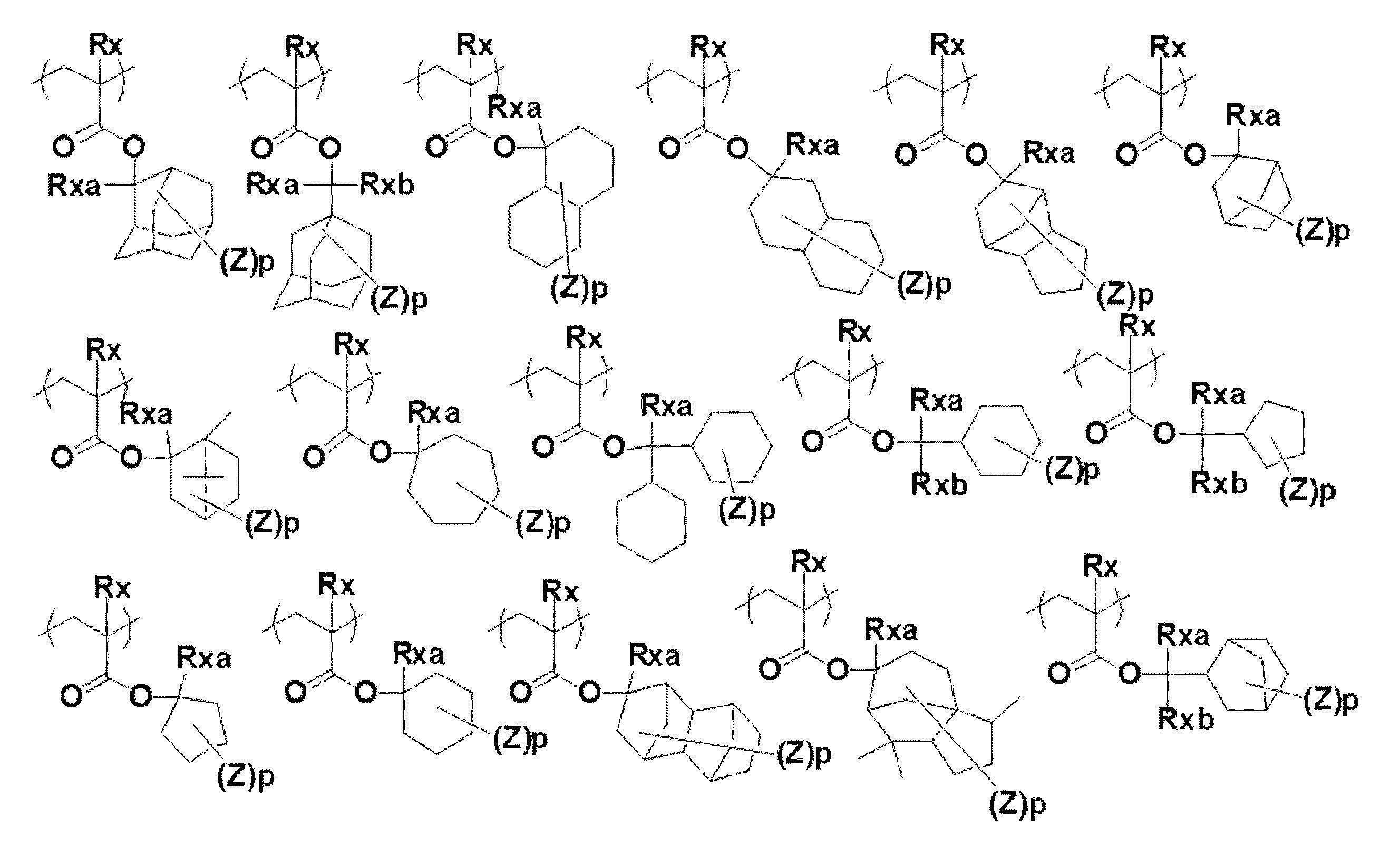

酸分解性基を有する繰り返し単位は、カルボキシ基がアセタールで保護された残基、または、カルボキシ基がケタールで保護された残基を有する繰り返し単位であることも好ましい。さらに、カルボキシ基が下記一般式(a1-1)で表されるアセタールまたはケタールで保護された残基であることも好ましい。なお、カルボキシ基が下記一般式(a1-1)で表されるアセタールまたはケタールで保護された残基である場合、残基の全体としては、-(C=O)-O-CR1R2(OR3)の構造となっている。

上記一般式(a1-1)中、R1およびR2は、それぞれ独立に水素原子またはアルキル基を表し、但し、R1とR2とが共に水素原子の場合を除く。R3は、アルキル基を表す。R1またはR2と、R3とが連結して環状エーテルを形成してもよい。
式(a1-1)において、R1、R2およびR3がアルキル基を表す場合、アルキル基は直鎖状、分岐鎖状または環状のいずれであってもよい。直鎖状または分岐鎖状のアルキル基としては、炭素数1~12であることが好ましく、炭素数1~6であることがより好ましく、炭素数1~4であることがさらに好ましい。具体的には、メチル基、エチル基、n-プロピル基、i-プロピル基、n-ブチル基、i-ブチル基、sec-ブチル基、t-ブチル基、n-ペンチル基、ネオペンチル基、n-ヘキシル基、テキシル基(2,3-ジメチル-2-ブチル基)、n-ヘプチル基、n-オクチル基、2-エチルヘキシル基、n-ノニル基、n-デシル基等を挙げることができる。
シクロアルキル基としては、炭素数3~12であることが好ましく、炭素数4~8であることがより好ましく、炭素数4~6であることがさらに好ましい。シクロアルキル基としては、例えばシクロプロピル基、シクロブチル基、シクロペンチル基、シクロヘキシル基、シクロヘプチル基、シクロオクチル基、ノルボルニル基、イソボルニル基等を挙げることができる。
アルキル基は、置換基を有していてもよく、置換基としては、ハロゲン原子、アリール基、アルコキシ基が例示できる。置換基としてハロゲン原子を有する場合、R1、R2、R3はハロアルキル基となり、置換基としてアリール基を有する場合、R1、R2、R3はアリールアルキル基となる。
ハロゲン原子としては、フッ素原子、塩素原子、臭素原子、ヨウ素原子が例示され、これらの中でもフッ素原子または塩素原子が好ましい。
また、アリール基としては、炭素数6~20のアリール基が好ましく、より好ましくは炭素数6~12であり、具体的には、フェニル基、α-メチルフェニル基、ナフチル基等が例示でき、アリール基で置換されたアルキル基全体、すなわち、アリールアルキル基としては、ベンジル基、α-メチルベンジル基、フェネチル基、ナフチルメチル基等が例示できる。
アルコキシ基としては、炭素数1~6のアルコキシ基が好ましく、より好ましくは炭素数1~4であり、メトキシ基またはエトキシ基がより好ましい。
また、アルキル基がシクロアルキル基である場合、シクロアルキル基は置換基として炭素数1~10の直鎖状または分岐鎖状のアルキル基を有していてもよく、アルキル基が直鎖状または分岐鎖状のアルキル基である場合には、置換基として炭素数3~12のシクロアルキル基を有していてもよい。
これらの置換基は、上記置換基でさらに置換されていてもよい。
上記一般式(a1-1)において、R1、R2およびR3がアリール基を表す場合、アリール基は炭素数6~12であることが好ましく、炭素数6~10であることがより好ましい。アリール基は置換基を有していてもよく、置換基としては炭素数1~6のアルキル基が好ましく例示できる。アリール基としては、例えば、フェニル基、トリル基、シリル基、クメニル基、1-ナフチル基等が例示できる。
また、R1、R2およびR3は互いに結合して、それらが結合している炭素原子と一緒になって環を形成することができる。R1とR2、R1とR3またはR2とR3が結合した場合の環構造としては、例えばシクロブチル基、シクロペンチル基、シクロヘキシル基、シクロヘプチル基、テトラヒドロフラニル基、アダマンチル基およびテトラヒドロピラニル基等を挙げることができる。
なお、式(a1-1)において、R1およびR2のいずれか一方が、水素原子またはメチル基であることが好ましい。
カルボキシ基が酸分解性基で保護された残基を有するモノマー単位(a1-1)の好ましい具体例としては、下記のモノマー単位が例示できる。なお、Rは水素原子またはメチル基を表す。
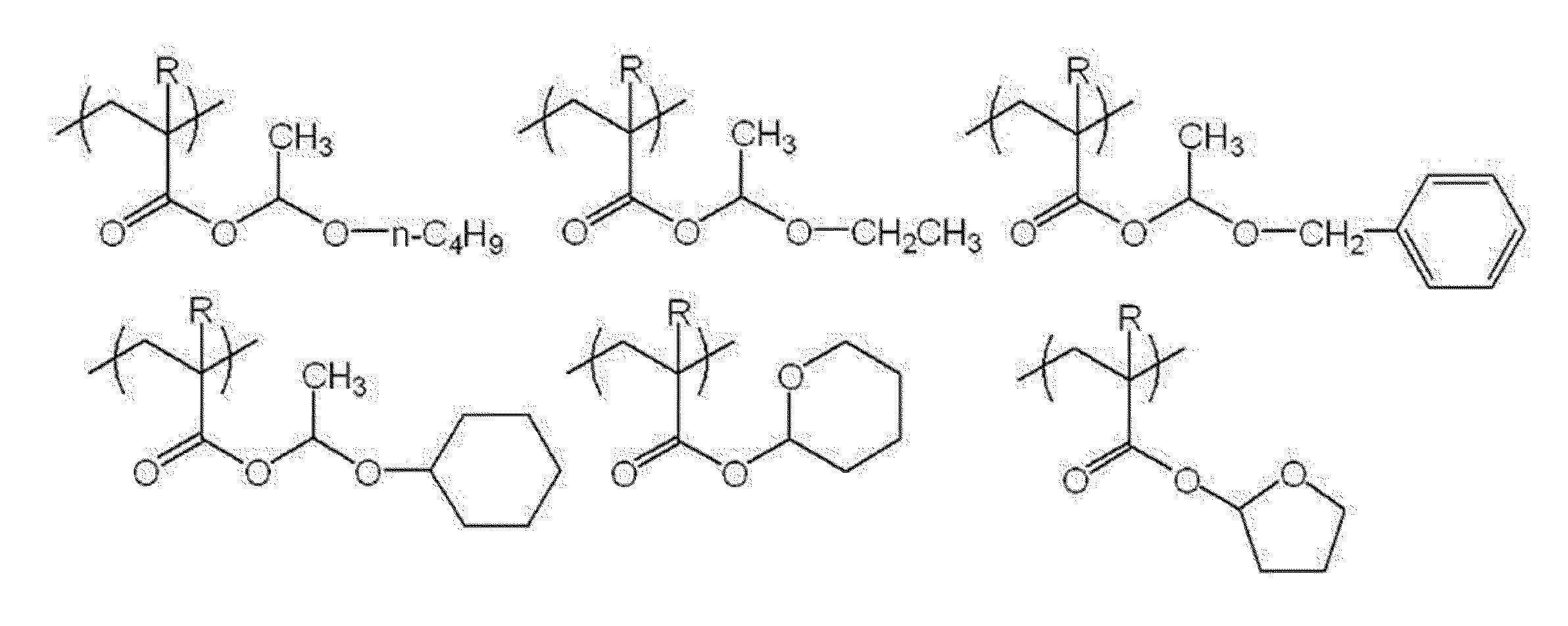
樹脂(A)の酸分解性基を有する繰り返し単位は、1種のみであってもよいし、2種以上を併用してもよい。
樹脂(A)において、酸分解性基を有する繰り返し単位(好ましくは、一般式(III)で表される繰り返し単位)の含有量(複数種含有する場合はその合計)は、露光部の有機系現像液に対する溶解性を十分に低下させる一方、未露光部の溶解性を十分に保ち、溶解コントラストを向上させる観点から、樹脂(A)中の全繰り返し単位に対して20~90モル%であることが好ましく、30~80モル%であることがより好ましく、40~70モル%であることが特に好ましく、40~60モル%であることが最も好ましい。
〔一般式(I)で表される繰り返し単位〕
樹脂(A)は、樹脂(A)中の全繰り返し単位の中に、下記一般式(I)で表される繰り返し単位を含有していてもよい。
樹脂(A)は、樹脂(A)中の全繰り返し単位の中に、下記一般式(I)で表される繰り返し単位を含有していてもよい。
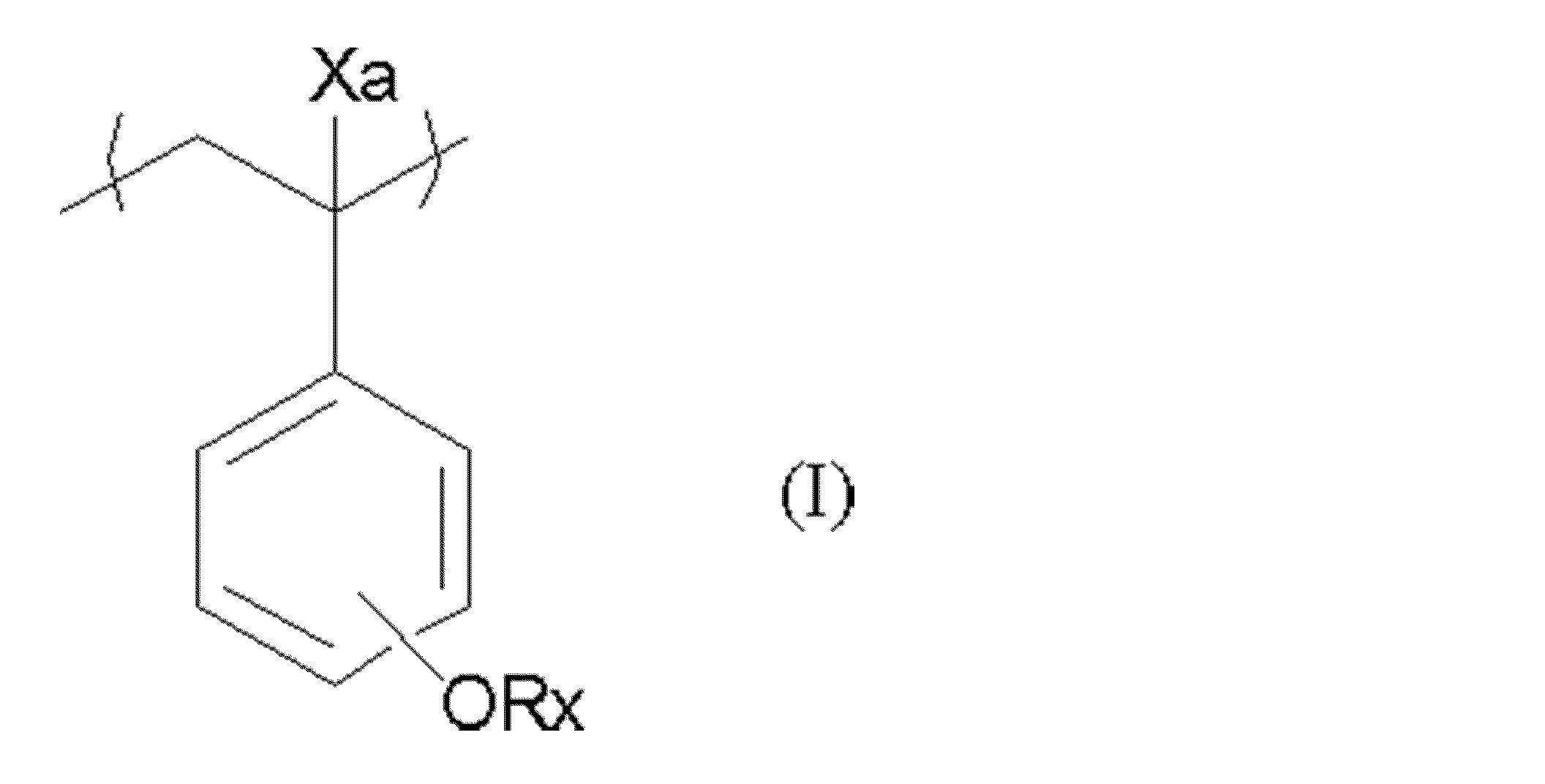
上記一般式(I)中、
Xaは水素原子または直鎖若しくは分岐のアルキル基を表す。
Rxは水素原子または酸の作用により分解し脱離する基を表す。
Xaについての直鎖若しくは分岐のアルキル基の具体例および好ましい例としては、一般式(III)におけるR0についての直鎖若しくは分岐のアルキル基の具体例および好ましい例として前述したものと同様のものが挙げられる。
Xaは水素原子または直鎖若しくは分岐のアルキル基を表す。
Rxは水素原子または酸の作用により分解し脱離する基を表す。
Xaについての直鎖若しくは分岐のアルキル基の具体例および好ましい例としては、一般式(III)におけるR0についての直鎖若しくは分岐のアルキル基の具体例および好ましい例として前述したものと同様のものが挙げられる。
Rxについての酸の作用により分解し脱離する基の具体例および好ましい例としては、樹脂(A)における酸分解性基を構成する極性基を保護している酸の作用により分解し脱離する基の具体例および好ましい例として前述したものと同様のものが挙げられる。
樹脂(A)において、一般式(I)で表される繰り返し単位の含有量(複数種含有する場合はその合計)は、露光部の有機系現像液に対する溶解性を十分に低下させる一方、未露光部の溶解性を十分に保ち、溶解コントラストを向上させる観点から、樹脂(A)中の全繰り返し単位に対して、30モル%以下であることが好ましく、10モル%以下であることがより好ましく、5モル%以下であることがさらに好ましく、理想的には0モル%であること、すなわち、上記繰り返し単位を含有しないことが特に好ましい。一般式(I)で表される繰り返し単位が、樹脂(A)中の全繰り返し単位に対して30モル%以上存在すると有機溶剤に対して溶解しすぎパターンの解像性および矩形性が得られない傾向にある。
〔一般式(I)で表される繰り返し単位以外の非フェノール系芳香族基を有する繰り返し単位〕
本発明において、樹脂(A)は、一般式(I)で表される繰り返し単位以外の非フェノール系芳香族基を有する繰り返し単位を有することが好ましい。
本発明において、樹脂(A)は、一般式(I)で表される繰り返し単位以外の非フェノール系芳香族基を有する繰り返し単位を有することが好ましい。
ここで、「一般式(I)で表される繰り返し単位以外の非フェノール系芳香族基を有する繰り返し単位」とは、一般式(I)で表される繰り返し単位などの、フェノール性水酸基を有する芳香族基を有する繰り返し単位、フェノール性水酸基から誘導される基(例えば、フェノール性水酸基が酸の作用により分解し脱離する基で保護された基など)を有する芳香族基を有する繰り返し単位以外のフェノール性水酸基を有しない芳香族基を有する繰り返し単位をいう。
非フェノール系芳香族基は、炭素数6~10のアリール基であることが好ましい。このようなアリール基は、例えば、フェニル基、ナフチル基であり、これらは置換基を有していてもよい。
この置換基としては、フェノール性水酸基ではない限り特に制限はなく、炭素数1~4の直鎖状若しくは分枝状のアルキル基、炭素数3~10のシクロアルキル基、炭素数6~10のアリール基、フッ素原子などのハロゲン原子、シアノ基、アミノ基、ニトロ基、カルボキシル基などが挙げられる。この置換基としての炭素数1~4の直鎖状若しくは分枝状のアルキル基、炭素数3~10のシクロアルキル基、炭素数6~10のアリール基はさらに置換基を有していてもよく、そのような更なる置換基としては、フッ素原子などのハロゲン原子などが挙げられる。
非フェノール系芳香族基がフェニル基であり、フェニル基が置換基を有する場合、置換基はフェニル基の4位に置換することが好ましい。
非フェノール系芳香族基としては、エッチング耐性の点から、置換基を有していてもよいフェニル基が好ましい。
本発明において、一般式(I)で表される繰り返し単位以外の非フェノール系芳香族基を有する繰り返し単位が下記一般式(II)で表される繰り返し単位であることが好ましい。

上記一般式(II)中、
R01は、水素原子または直鎖若しくは分岐のアルキル基を表す。
Xは単結合または2価の連結基を表す。
Arは非フェノール系芳香族基を表す。
R4は、単結合またはアルキレン基を表す。
R01は、水素原子または直鎖若しくは分岐のアルキル基を表す。
Xは単結合または2価の連結基を表す。
Arは非フェノール系芳香族基を表す。
R4は、単結合またはアルキレン基を表す。
R01についての直鎖若しくは分岐のアルキル基の具体例および好ましい例としては、一般式(III)におけるR0についての直鎖若しくは分岐のアルキル基の具体例および好ましい例として前述したものと同様のものが挙げられる。
Xは、2価の連結基が好ましい。この2価の連結基としては、好ましくは-COO-、-CONH-などが挙げられる。
Xは、2価の連結基が好ましい。この2価の連結基としては、好ましくは-COO-、-CONH-などが挙げられる。
非フェノール系芳香族基Arの具体例および好ましい例としては、非フェノール系芳香族基の具体例および好ましい例として前述したものと同様のものが挙げられる。
R4についてのアルキレン基は、炭素数1~4のアルキレン基であることが好ましい。このようなアルキレン基は、例えば、メチレン基、エチレン基、プロピレン基などであり、これらは置換基を有していてもよい。R4についてのアルキレン基が有し得る置換基としては、炭素数1~4のアルキル基、フッ素原子などのハロゲン原子などが挙げられる。
R4についてのアルキレン基が有し得る置換基と非フェノール系芳香族基Arが有し得る置換基とが結合して環を形成していてもよく、環を形成する基としては、アルキレン基(例えば、エチレン基、プロピレン基)を挙げることができる。
R4としては、パターン形成における樹脂の好適なガラス転移温度(Tg)の観点から、単結合、または置換基で置換されていてよいメチレン基であることが好ましい。
樹脂(A)において、非フェノール系芳香族基を有する繰り返し単位(好ましくは、一般式(II)で表される繰り返し単位)の含有量(複数種含有する場合はその合計)は、露光部の有機系現像液に対する溶解性を十分に低下させる一方、未露光部の溶解性を十分に保ち、溶解コントラストを向上させる観点およびエッチング耐性を付与する観点から、樹脂(A)中の全繰り返し単位に対して10~70モル%であることが好ましく、20~60モル%であることがより好ましく、30~50モル%であることが特に好ましい。
〔その他の繰り返し単位〕
樹脂(A)は、さらに、ラクトン構造を有する繰り返し単位を有していてもよい。ラクトン構造を有する繰り返し単位としては、下記一般式(AII)で表される繰り返し単位が好ましい。
樹脂(A)は、さらに、ラクトン構造を有する繰り返し単位を有していてもよい。ラクトン構造を有する繰り返し単位としては、下記一般式(AII)で表される繰り返し単位が好ましい。
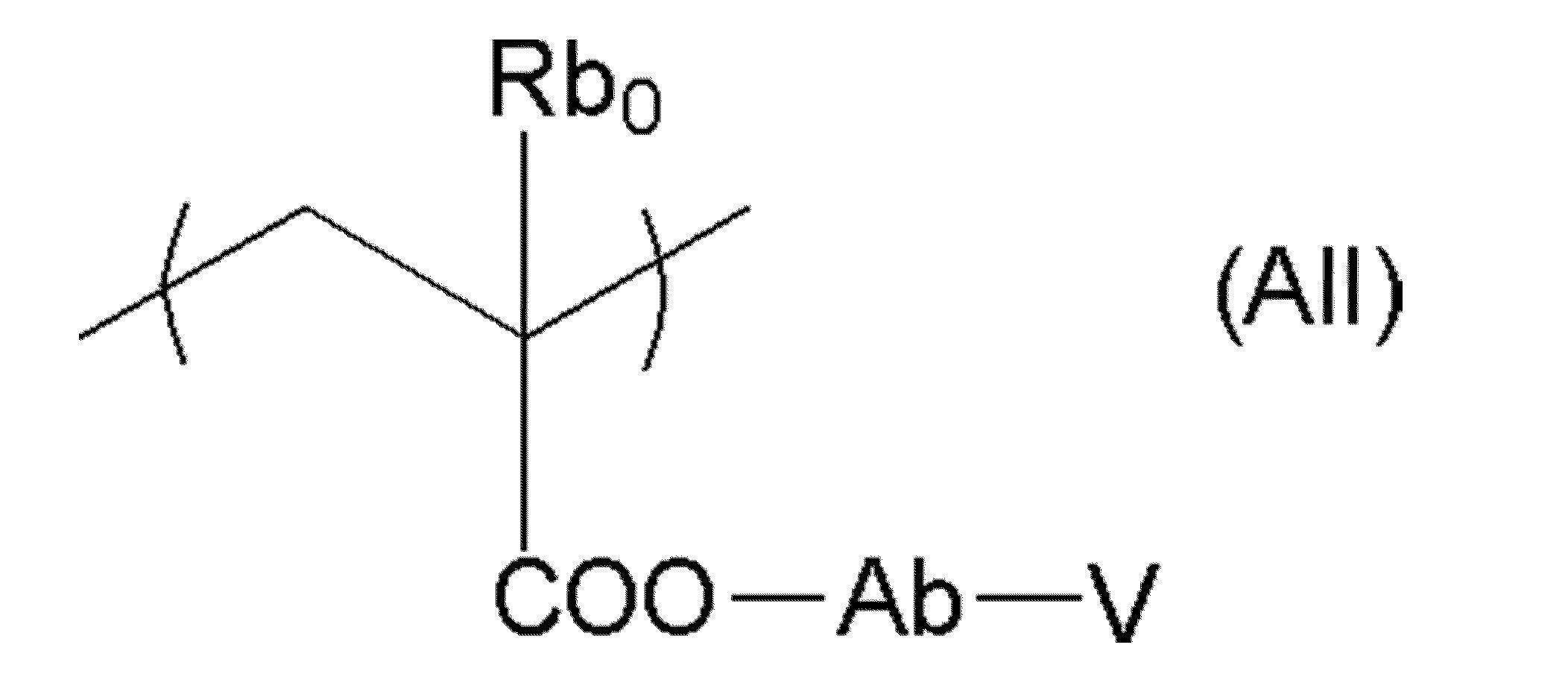
一般式(AII)中、
Rb0は、水素原子、ハロゲン原子または置換基を有していてもよいアルキル基(好ましくは炭素数1~4)を表す。
Rb0のアルキル基が有していてもよい好ましい置換基としては、水酸基、ハロゲン原子が挙げられる。Rb0のハロゲン原子としては、フッ素原子、塩素原子、臭素原子、ヨウ素原子を挙げることができる。Rb0として、好ましくは、水素原子、メチル基、ヒドロキシメチル基、トリフルオロメチル基であり、水素原子、メチル基が特に好ましい。
Rb0は、水素原子、ハロゲン原子または置換基を有していてもよいアルキル基(好ましくは炭素数1~4)を表す。
Rb0のアルキル基が有していてもよい好ましい置換基としては、水酸基、ハロゲン原子が挙げられる。Rb0のハロゲン原子としては、フッ素原子、塩素原子、臭素原子、ヨウ素原子を挙げることができる。Rb0として、好ましくは、水素原子、メチル基、ヒドロキシメチル基、トリフルオロメチル基であり、水素原子、メチル基が特に好ましい。
Abは、単結合、アルキレン基、単環または多環のシクロアルキル構造を有する2価の連結基、エーテル結合、エステル結合、カルボニル基、またはこれらを組み合わせた2価の連結基を表す。Abは、好ましくは、単結合、-Ab1-CO2-で表される2価の連結基である。
Ab1は、直鎖または分岐アルキレン基、単環または多環のシクロアルキレン基であり、好ましくはメチレン基、エチレン基、シクロヘキシレン基、アダマンチレン基、ノルボルニレン基である。
Vは、ラクトン構造を有する基を表す。
Ab1は、直鎖または分岐アルキレン基、単環または多環のシクロアルキレン基であり、好ましくはメチレン基、エチレン基、シクロヘキシレン基、アダマンチレン基、ノルボルニレン基である。
Vは、ラクトン構造を有する基を表す。
ラクトン構造を有する基としては、ラクトン構造を有していればいずれでも用いることができるが、好ましくは5~7員環ラクトン構造であり、5~7員環ラクトン構造にビシクロ構造、スピロ構造を形成する形で他の環構造が縮環しているものが好ましい。下記一般式(LC1-1)~(LC1-17)のいずれかで表されるラクトン構造を有する繰り返し単位を有することがより好ましい。また、ラクトン構造が主鎖に直接結合していてもよい。好ましいラクトン構造としては(LC1-1)、(LC1-4)、(LC1-5)、(LC1-6)、(LC1-8)、(LC1-13)、(LC1-14)である。

ラクトン構造部分は、置換基(Rb2)を有していても有していなくてもよい。好ましい置換基(Rb2)としては、炭素数1~8のアルキル基、炭素数4~7の1価のシクロアルキル基、炭素数1~8のアルコキシ基、炭素数2~8のアルコキシカルボニル基、カルボキシル基、ハロゲン原子、水酸基、シアノ基、酸分解性基などが挙げられる。より好ましくは炭素数1~4のアルキル基、シアノ基、酸分解性基である。n2は、0~4の整数を表す。n2が2以上の時、複数存在する置換基(Rb2)は、同一でも異なっていてもよく、また、複数存在する置換基(Rb2)同士が結合して環を形成してもよい。
ラクトン基を有する繰り返し単位は、通常光学異性体が存在するが、いずれの光学異性体を用いてもよい。また、1種の光学異性体を単独で用いても、複数の光学異性体を混合して用いてもよい。1種の光学異性体を主に用いる場合、その光学純度(ee)が90%以上のものが好ましく、より好ましくは95%以上である。
樹脂(A)はラクトン構造を有する繰り返し単位を含有しても含有しなくてもよいが、ラクトン構造を有する繰り返し単位を含有する場合、樹脂(A)中のこの繰り返し単位の含有量は、全繰り返し単位に対して、0.5~50モル%の範囲が好ましく、より好ましくは1~40モル%の範囲であり、さらに好ましくは3~30モル%の範囲である。この繰り返し単位は1種のみであってもよいし、2種以上を組み合わせて用いてもよい。特定のラクトン構造を用いることでパターンの解像性が向上し、矩形プロファイルが良好になる。
以下に、樹脂(A)中のラクトン構造を有する繰り返し単位の具体例を示すが、本発明はこれらに限定されるものではない。式中、Rxは、H,CH3,CH2OH,またはCF3を表す。
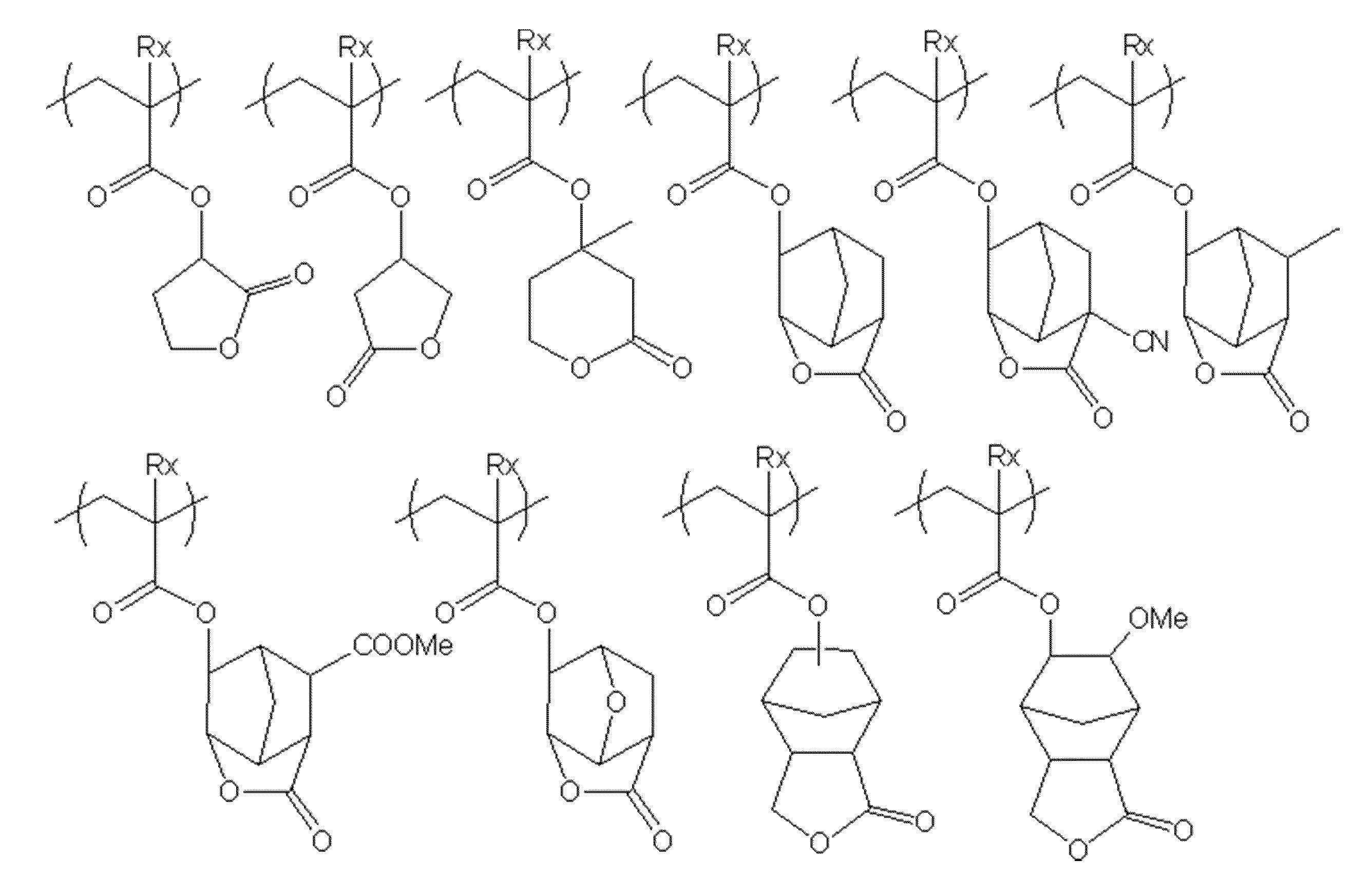
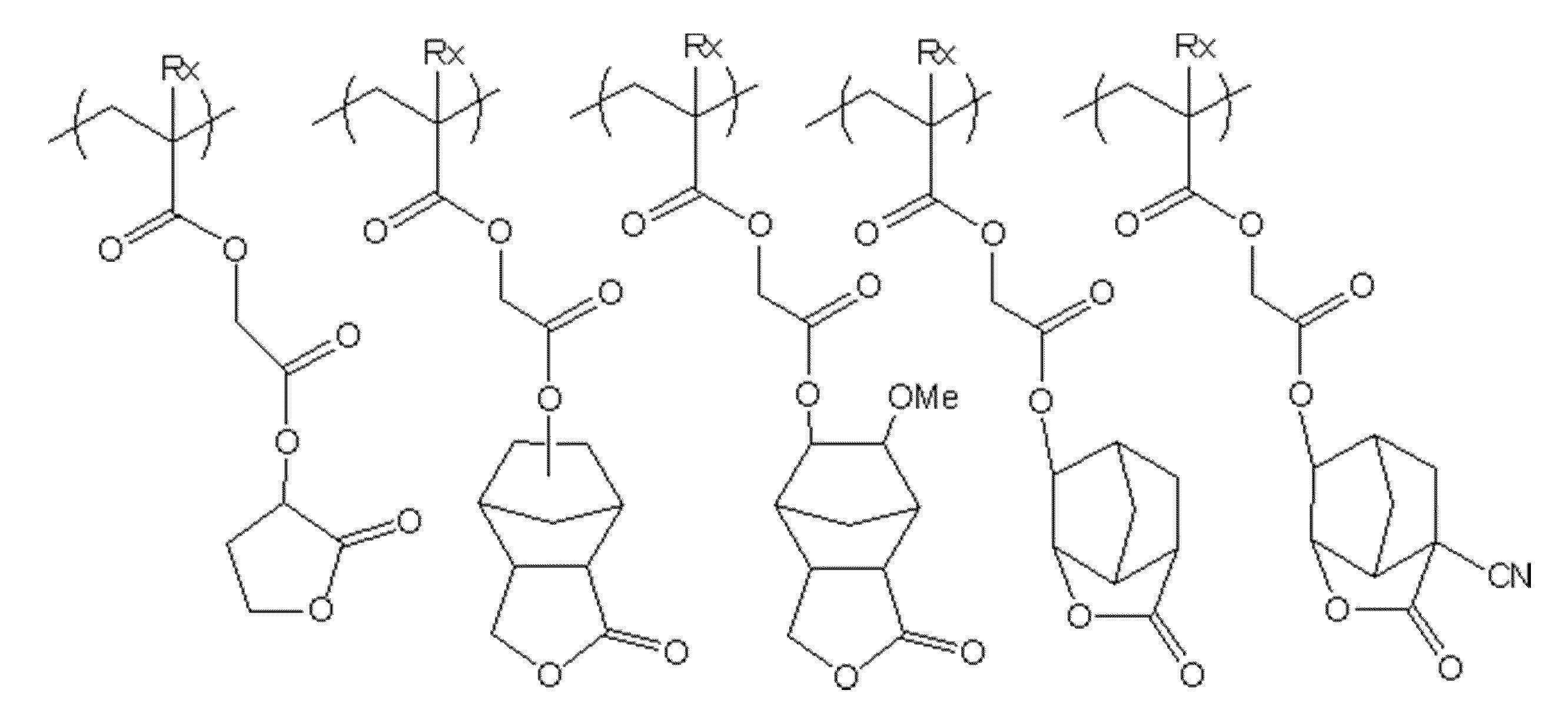
樹脂(A)は、酸基を有する繰り返し単位を有してもよい。酸基としてはカルボキシル基、スルホンアミド基、スルホニルイミド基、ビススルホニルイミド基、α位が電子求引性基で置換された脂肪族アルコール(例えばヘキサフロロイソプロパノール基)が挙げられ、カルボキシル基を有する繰り返し単位を有することがより好ましい。酸基を有する繰り返し単位を含有することによりコンタクトホール用途などでの解像性が増す。酸基を有する繰り返し単位としては、アクリル酸、メタクリル酸による繰り返し単位のような樹脂の主鎖に直接酸基が結合している繰り返し単位、あるいは、連結基を介して樹脂の主鎖に酸基が結合している繰り返し単位が挙げられる。連結基は単環または多環の環状炭化水素構造を有していてもよい。酸基を有する繰り返し単位は、特に好ましくはアクリル酸、メタクリル酸による繰り返し単位である。さらには、酸基を有する重合開始剤や連鎖移動剤を重合時に用いて、酸基を有する基をポリマー鎖の末端に導入してもよい。
酸基を有する繰り返し単位の具体例を以下に示すが、本発明は、これらに限定されるものではない。具体例中、RxはH,CH3,CH2OH,またはCF3を表す。

樹脂(A)は、酸基を有する繰り返し単位を含有してもしなくても良いが、樹脂(A)が酸基を有する繰り返し単位を含有する場合、この繰り返し単位の含有量は、樹脂(A)中の全繰り返し単位に対し、1~25モル%が好ましく、より好ましくは1~20モル%、さらに好ましくは3~15モル%である。
樹脂(A)は、上記した繰り返し単位以外の繰り返し単位であって、水酸基またはシアノ基を有する繰り返し単位をさらに有していてもよい。これにより基材密着性、現像液親和性を向上させることができる。水酸基またはシアノ基を有する繰り返し単位は、水酸基またはシアノ基で置換された脂環炭化水素構造を有する繰り返し単位であることが好ましく、酸分解性基を有さないことが好ましい。水酸基またはシアノ基で置換された脂環炭化水素構造に於ける、脂環炭化水素構造としては、アダマンチル基、ジアマンチル基、ノルボルナン基が好ましく、アダマンチル基がより好ましい。また、水酸基で置換されていることが好ましく、少なくとも一つの水酸基で置換されたアダマンチル基を有する繰り返し単位を含有することがより好ましい。
特に、樹脂(A)は、発生酸の拡散を抑制する観点から、ヒドロキシアダマンチル基またはジヒドロキシアダマンチル基を有する繰り返し単位を含有することが最も好ましい。水酸基またはシアノ基で置換された脂環炭化水素構造としては、下記一般式(VIIa)~(VIId)で表される部分構造が好ましく、下記一般式(VIIa)で表される部分構造がより好ましい。

一般式(VIIa)~(VIIc)に於いて、
R2c~R4cは、各々独立に、水素原子、水酸基またはシアノ基を表す。ただし、R2c~R4cの内の少なくとも1つは、水酸基またはシアノ基を表す。好ましくは、R2c~R4cの内の1つまたは2つが、水酸基で、残りが水素原子である。一般式(VIIa)に於いて、さらに好ましくは、R2c~R4cの内の2つが、水酸基で、残りが水素原子である。
R2c~R4cは、各々独立に、水素原子、水酸基またはシアノ基を表す。ただし、R2c~R4cの内の少なくとも1つは、水酸基またはシアノ基を表す。好ましくは、R2c~R4cの内の1つまたは2つが、水酸基で、残りが水素原子である。一般式(VIIa)に於いて、さらに好ましくは、R2c~R4cの内の2つが、水酸基で、残りが水素原子である。
一般式(VIIa)~(VIId)で表される部分構造を有する繰り返し単位としては、下記一般式(AIIa)~(AIId)で表される繰り返し単位を挙げることができる。

一般式(AIIa)~(AIId)に於いて、
R1cは、水素原子、メチル基、トリフロロメチル基またはヒドロキシメチル基を表す。
R1cは、水素原子、メチル基、トリフロロメチル基またはヒドロキシメチル基を表す。
R2c~R4cは、一般式(VIIa)~(VIIc)に於ける、R2c~R4cと同義である。
水酸基またはシアノ基を有する繰り返し単位の具体例を以下に挙げるが、本発明はこれらに限定されない。
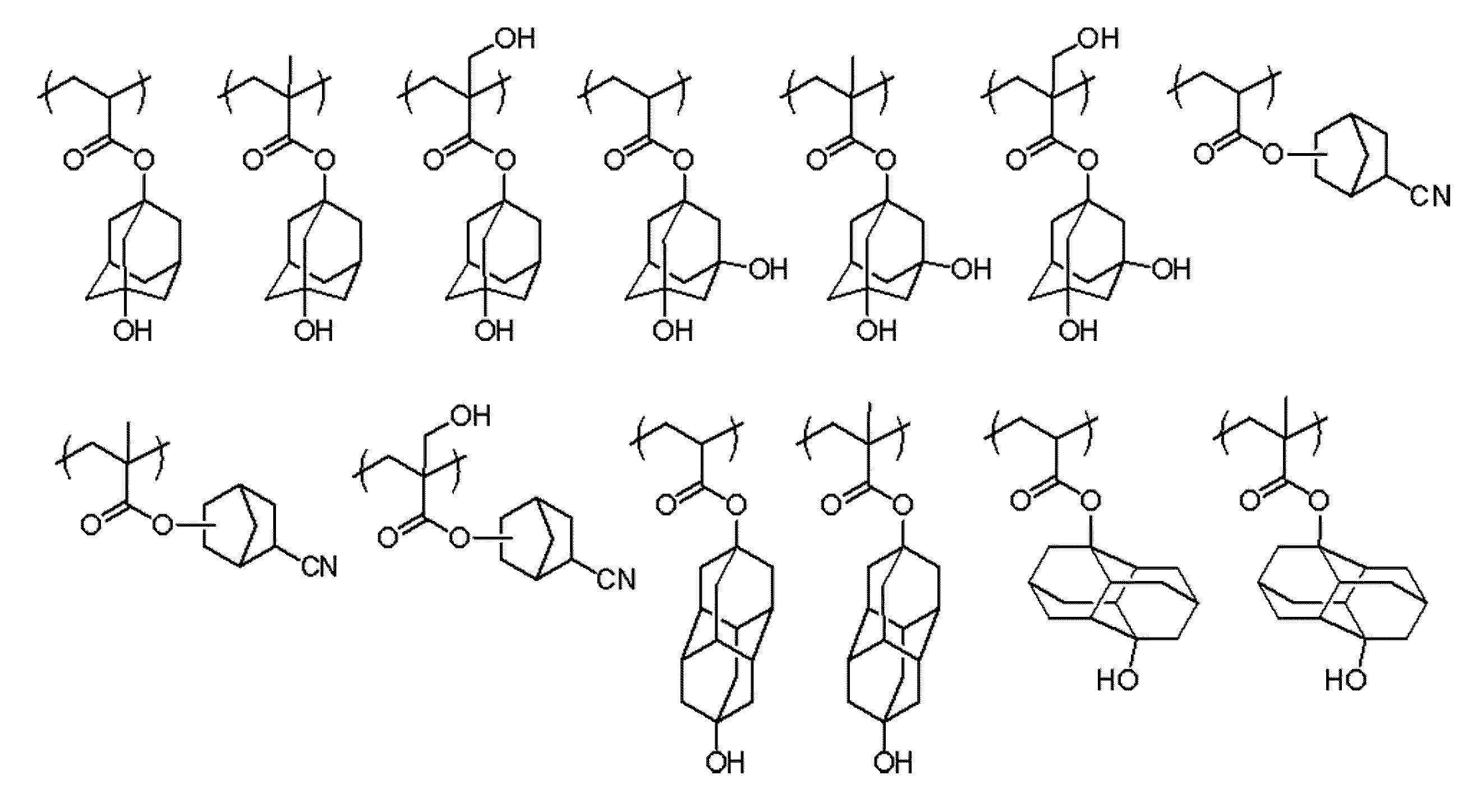
樹脂(A)は、水酸基またはシアノ基を有する繰り返し単位を含有していても、含有していなくてもよいが、樹脂(A)が水酸基またはシアノ基を有する繰り返し単位を含有する場合、この繰り返し単位の含有量は、樹脂(A)中の全繰り返し単位に対し、1~40モル%が好ましく、より好ましくは1~30モル%、さらに好ましくは3~20モル%である。
樹脂(A)は、さらに極性基(例えば、上記した酸基、水酸基、シアノ基)を持たない脂環炭化水素構造を有し、酸分解性を示さない繰り返し単位を有することができる。これにより、有機溶剤を含む現像液を用いた現像の際に樹脂の溶解性を適切に調整することができる。このような繰り返し単位としては、一般式(IV)で表される繰り返し単位が挙げられる。

一般式(IV)中、R5は少なくとも一つの環状構造を有し、極性基を有さない炭化水素基を表す。
Raは水素原子、アルキル基またはCH2-O-Ra2基を表す。式中、Ra2は、水素原子、アルキル基またはアシル基を表す。Raは、水素原子、メチル基、ヒドロキシメチル基、トリフルオロメチル基が好ましく、水素原子、メチル基が特に好ましい。
R5が有する環状構造には、単環式炭化水素基および多環式炭化水素基が含まれる。単環式炭化水素基としては、例えば、シクロペンチル基、シクロヘキシル基、シクロへプチル基、シクロオクチル基などの炭素数3~12のシクロアルキル基、シクロへキセニル基など炭素数3~12のシクロアルケニル基が挙げられる。好ましい単環式炭化水素基としては、炭素数3~7の単環式炭化水素基であり、より好ましくは、シクロペンチル基、シクロヘキシル基が挙げられる。
多環式炭化水素基には環集合炭化水素基、架橋環式炭化水素基が含まれ、環集合炭化水素基の例としては、ビシクロヘキシル基、パーヒドロナフタレニル基などが含まれる。架橋環式炭化水素環として、例えば、ピナン、ボルナン、ノルピナン、ノルボルナン、ビシクロオクタン環(ビシクロ[2.2.2]オクタン環、ビシクロ[3.2.1]オクタン環等)などの2環式炭化水素環および、ホモブレダン、アダマンタン、トリシクロ[5.2.1.02,6]デカン、トリシクロ[4.3.1.12,5]ウンデカン環などの3環式炭化水素環、テトラシクロ[4.4.0.12,5.17,10]ドデカン、パーヒドロ-1,4-メタノ-5,8-メタノナフタレン環などの4環式炭化水素環などが挙げられる。また、架橋環式炭化水素環には、縮合環式炭化水素環、例えば、パーヒドロナフタレン(デカリン)、パーヒドロアントラセン、パーヒドロフェナントレン、パーヒドロアセナフテン、パーヒドロフルオレン、パーヒドロインデン、パーヒドロフェナレン環などの5~8員シクロアルカン環が複数個縮合した縮合環も含まれる。
好ましい架橋環式炭化水素環として、ノルボルニル基、アダマンチル基、ビシクロオクタニル基、トリシクロ[5、2、1、02,6]デカニル基などが挙げられる。より好ましい架橋環式炭化水素環としてノルボルニル基、アダマンチル基が挙げられる。
これらの脂環式炭化水素基は置換基を有していても良く、好ましい置換基としてはハロゲン原子、アルキル基、水素原子が置換された水酸基、水素原子が置換されたアミノ基などが挙げられる。好ましいハロゲン原子としては臭素、塩素、フッ素原子、好ましいアルキル基としてはメチル、エチル、ブチル、t-ブチル基が挙げられる。上記のアルキル基はさらに置換基を有していても良く、さらに有していてもよい置換基としては、ハロゲン原子、アルキル基、水素原子が置換された水酸基、水素原子が置換されたアミノ基を挙げることができる。
上記水素原子の置換基としては、例えばアルキル基、シクロアルキル基、アリールアルキル基、置換メチル基、置換エチル基、アルコキシカルボニル基、アリールアルキルオキシカルボニル基が挙げられる。好ましいアルキル基としては、炭素数1~4のアルキル基、好ましい置換メチル基としてはメトキシメチル、メトキシチオメチル、ベンジルオキシメチル、t-ブトキシメチル、2-メトキシエトキシメチル基、好ましい置換エチル基としては、1-エトキシエチル、1-メチル-1-メトキシエチル、好ましいアシル基としては、ホルミル、アセチル、プロピオニル、ブチリル、イソブチリル、バレリル、ピバロイル基などの炭素数1~6の脂肪族アシル基、アルコキシカルボニル基としては炭素数1~4のアルコキシカルボニル基などが挙げられる。
樹脂(A)は、極性基を持たない脂環炭化水素構造を有し、酸分解性を示さない繰り返し単位を含有してもしなくてもよいが、樹脂(A)が極性基を持たない脂環炭化水素構造を有し、酸分解性を示さない繰り返し単位を含有する場合、この繰り返し単位の含有率は、樹脂(A)中の全繰り返し単位に対し、1~40モル%が好ましく、より好ましくは1~20モル%である。
極性基を持たない脂環炭化水素構造を有し、酸分解性を示さない繰り返し単位の具体例を以下に挙げるが、本発明はこれらに限定されない。式中、Raは、H、CH3、CH2OH、またはCF3を表す。

樹脂(A)は、上記の繰り返し構造単位以外に、ドライエッチング耐性や標準現像液適性、密着性、レジストプロファイル、さらに樹脂組成物(I)の一般的に必要な特性である解像力、耐熱性、感度等を調節する目的で様々な繰り返し構造単位を有することができる。
このような繰り返し構造単位としては、下記の単量体に相当する繰り返し構造単位を挙げることができるが、これらに限定されるものではない。
これにより、樹脂組成物(I)に用いられる樹脂に要求される性能、特に、
(1)塗布溶剤に対する溶解性、
(2)成膜性(ガラス転移点)、
(3)膜べり(親疎水性、アルカリ可溶性基選択)、
(4)未露光部の下地への密着性、
(5)ドライエッチング耐性等の微調整が可能となる。
(1)塗布溶剤に対する溶解性、
(2)成膜性(ガラス転移点)、
(3)膜べり(親疎水性、アルカリ可溶性基選択)、
(4)未露光部の下地への密着性、
(5)ドライエッチング耐性等の微調整が可能となる。
このような単量体として、例えばアクリル酸エステル類、メタクリル酸エステル類、アクリルアミド類、メタクリルアミド類、アリル化合物、ビニルエーテル類、ビニルエステル類、スチレン類、クロトン酸エステル類等から選ばれる付加重合性不飽和結合を1個有する化合物等を挙げることができる。
その他にも、上記種々の繰り返し構造単位に相当する単量体と共重合可能である付加重合性の不飽和化合物であれば、共重合されていてもよい。
その他にも、上記種々の繰り返し構造単位に相当する単量体と共重合可能である付加重合性の不飽和化合物であれば、共重合されていてもよい。
樹脂組成物(I)に用いられる樹脂(A)において、各繰り返し構造単位の含有モル比は、樹脂組成物(I)のドライエッチング耐性や標準現像液適性、密着性、レジストプロファイル、さらにはレジストの一般的な必要性能である解像力、耐熱性、感度等を調節するために適宜設定される。
樹脂(A)の形態としては、ランダム型、ブロック型、クシ型、スター型のいずれの形態でもよい。樹脂(A)は、例えば、各構造に対応する不飽和モノマーのラジカル、カチオン、またはアニオン重合により合成することができる。また各構造の前駆体に相当する不飽和モノマーを用いて重合した後に、高分子反応を行うことにより目的とする樹脂を得ることも可能である。
樹脂(A)は、常法(例えばラジカル重合法)に従って合成することができる。例えば、一般的合成方法としては、モノマー種および開始剤を溶剤に溶解させ、加熱することにより重合を行う一括重合法、加熱溶剤にモノマー種と開始剤の溶液を1~10時間かけて滴下して加える滴下重合法などが挙げられ、滴下重合法が好ましい。反応溶剤としては、例えばテトラヒドロフラン、1,4-ジオキサン、ジイソプロピルエーテルなどのエーテル類やメチルエチルケトン、メチルイソブチルケトンのようなケトン類、酢酸エチルのようなエステル溶剤、ジメチルホルムアミド、ジメチルアセトアミドなどのアミド溶剤、さらには後述のプロピレングリコールモノメチルエーテルアセテート、プロピレングリコールモノメチルエーテル、シクロヘキサノンのような溶剤が挙げられる。より好ましくは樹脂組成物(I)に用いられる溶剤と同一の溶剤を用いて重合することが好ましい。これにより保存時のパーティクルの発生が抑制できる。
重合反応は窒素やアルゴンなど不活性ガス雰囲気下で行われることが好ましい。重合開始剤としては市販のラジカル開始剤(アゾ系開始剤、パーオキサイドなど)を用いて重合を開始させる。ラジカル開始剤としてはアゾ系開始剤が好ましく、エステル基、シアノ基、カルボキシル基を有するアゾ系開始剤が好ましい。好ましい開始剤としては、アゾビスイソブチロニトリル、アゾビスジメチルバレロニトリル、ジメチル2,2’-アゾビス(2-メチルプロピオネート)などが挙げられる。所望により開始剤を追加、あるいは分割で添加し、反応終了後、溶剤に投入して粉体あるいは固形回収等の方法で所望のポリマーを回収する。反応の濃度は5~50質量%であり、好ましくは10~30質量%である。反応温度は、通常10℃~150℃であり、好ましくは30℃~120℃、さらに好ましくは60~100℃である。
反応終了後、室温まで放冷し、樹脂(A)を精製する。精製は、水洗や適切な溶剤を組み合わせることにより残留単量体やオリゴマー成分を除去する液々抽出法、特定の分子量以下のもののみを抽出除去する限外ろ過等の溶液状態での精製方法や、樹脂溶液を貧溶剤へ滴下することで樹脂を貧溶剤中に凝固させることにより残留単量体等を除去する再沈殿法やろ別した樹脂スラリーを貧溶剤で洗浄する等の固体状態での精製方法等の通常の方法を適用できる。例えば、上記樹脂が難溶或いは不溶の溶剤(貧溶剤)を、上記反応終了後の溶液の10倍以下の体積量、好ましくは10~5倍の体積量で、この溶液に接触させることにより樹脂を固体として析出させる。
ポリマー溶液からの沈殿または再沈殿操作の際に用いる溶剤(沈殿または再沈殿溶剤)としては、このポリマーの貧溶剤であればよく、ポリマーの種類に応じて、炭化水素、ハロゲン化炭化水素、ニトロ化合物、エーテル、ケトン、エステル、カーボネート、アルコール、カルボン酸、水、これらの溶剤を含む混合溶剤等の中から適宜選択して使用できる。
沈殿または再沈殿溶剤の使用量は、効率や収率等を考慮して適宜選択できるが、一般には、ポリマー溶液100質量部に対して、100~10000質量部、好ましくは200~2000質量部、さらに好ましくは300~1000質量部である。
沈殿または再沈殿する際の温度としては、効率や操作性を考慮して適宜選択できるが、通常0~50℃程度、好ましくは室温付近(例えば20~35℃程度)である。沈殿または再沈殿操作は、撹拌槽などの慣用の混合容器を用い、バッチ式、連続式等の公知の方法により行うことができる。
沈殿または再沈殿したポリマーは、通常、濾過、遠心分離等の慣用の固液分離に付し、乾燥して使用に供される。濾過は、耐溶剤性の濾材を用い、好ましくは加圧下で行われる。乾燥は、常圧または減圧下(好ましくは減圧下)、30~100℃程度、好ましくは30~50℃程度の温度で行われる。
なお、一度、樹脂を析出させて分離した後に、再びこの樹脂を溶剤に溶解させて溶液を作製し、この溶液と、その樹脂が難溶或いは不溶の溶剤とを接触させてもよい。即ち、上記ラジカル重合反応終了後、ポリマーが難溶或いは不溶の溶剤を反応溶液に接触させて、樹脂を析出させ(工程a)、樹脂を溶液から分離し(工程b)、改めて樹脂を溶剤に溶解させて樹脂溶液Aを調製し(工程c)、その後、樹脂溶液Aに、樹脂が難溶或いは不溶の溶剤を、樹脂溶液Aの10倍未満の体積量(好ましくは5倍以下の体積量)で、接触させることにより樹脂固体を析出させ(工程d)、析出した樹脂を分離する(工程e)ことを含む方法でもよい。
また、組成物の調製後に樹脂が凝集することなどを抑制するために、例えば、特開2009-037108号公報に記載のように、合成された樹脂を溶剤に溶解して溶液とし、その溶液を30℃~90℃程度で30分~4時間程度加熱するような工程を加えてもよい。
樹脂(A)の重量平均分子量は、GPC法によりポリスチレン換算値として、好ましくは1000~200000であり、より好ましくは2000~100000、さらにより好ましくは3000~70000、特に好ましくは5000~50000である。重量平均分子量を、1000~200000とすることにより、耐熱性やドライエッチング耐性の劣化を防ぐことができ、かつ現像性が劣化したり、粘度が高くなって成膜性が劣化することを防ぐことができる。
分散度(重量平均分子量/数平均分子量)は、通常1.0~3.0であり、好ましくは1.0~2.6、さらに好ましくは1.2~2.4、特に好ましくは1.4~2.2の範囲のものが使用される。分散度が上記範囲を満たしていると、解像度、レジスト形状が優れ、かつ、レジストパターンの側壁がスムーズであり、ラフネス性に優れる。
樹脂組成物(I)において、樹脂(A)は、1種で使用してもよいし、2種以上併用してもよい。また、樹脂(A)の組成物全体中の配合率は、全固形分中30~99質量%であることが好ましく、より好ましくは60~95質量%である。ここで、配合率は、2種以上併用する場合には、樹脂(A)の合計の配合率である。
[2]活性光線または放射線の照射により酸を発生する化合物
樹脂組成物(I)は、さらに、活性光線または放射線の照射により酸を発生する化合物(B)(以下、「酸発生剤」ともいう。)を含有することが好ましい。
樹脂組成物(I)は、さらに、活性光線または放射線の照射により酸を発生する化合物(B)(以下、「酸発生剤」ともいう。)を含有することが好ましい。
活性光線または放射線の照射により酸を発生する化合物(B)としては、活性光線または放射線の照射により有機酸を発生する化合物であることがより好ましい。
酸発生剤としては、光カチオン重合の光開始剤、光ラジカル重合の光開始剤、色素類の光消色剤、光変色剤、あるいはマイクロレジスト等が使用できる、活性光線または放射線の照射により酸を発生する公知の化合物およびそれらの混合物を適宜に選択して使用することができる。
例えば、オキシムスルホネート、スルホニウム塩、ジアゾニウム塩、ホスホニウム塩、ヨードニウム塩、イミドスルホネート、ジアゾジスルホン、ジスルホン、o-ニトロベンジルスルホネートを挙げることができる。
本発明において、酸発生剤(B)は、下記式(b1)で表されるオキシムスルホネート化合物を含むことが好ましい。
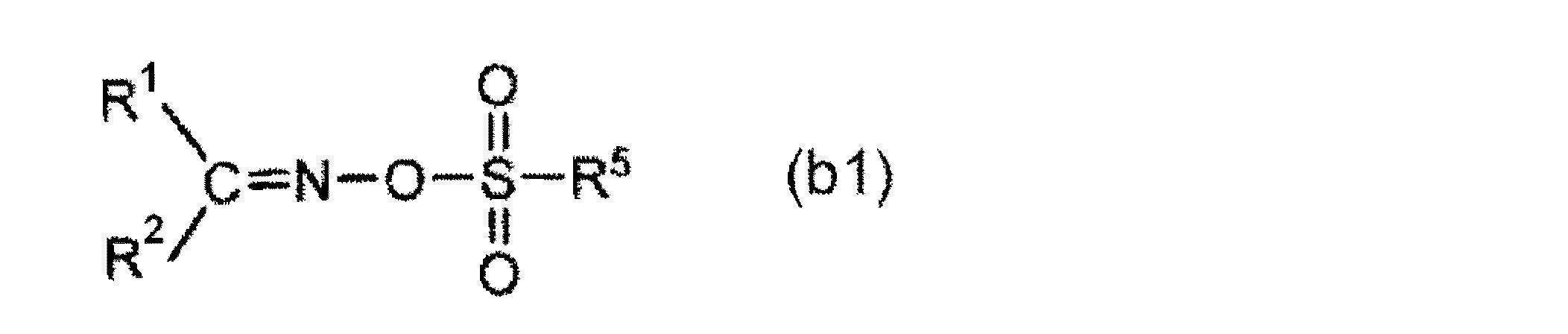
式(b1)中、R5は、アルキル基、シクロアルキル基またはアリール基を表し、R1およびR2は、それぞれ置換基を示し、互いに結合して、環を形成していてもよい。
R5のアルキル基としては、炭素数1~10の、直鎖状または分岐状アルキル基が好ましい。R5のアルキル基は、炭素数6~11のアリール基、炭素数1~10のアルコキシ基、または、シクロアルキル基(7,7-ジメチル-2-オキソノルボルニル基などの有橋式脂環基を含む、好ましくはビシクロアルキル基等)で置換されてもよい。
R5のアリール基としては、炭素数6~11のアリール基が好ましく、フェニル基またはナフチル基がより好ましい。R5のアリール基は、低級アルキル基、アルコキシ基あるいはハロゲン原子で置換されてもよい。
式(b1)で表されるオキシムスルホネート化合物としては、式(OS-3)、式(OS-4)または式(OS-5)で表されるオキシムスルホネート化合物であることが好ましい。
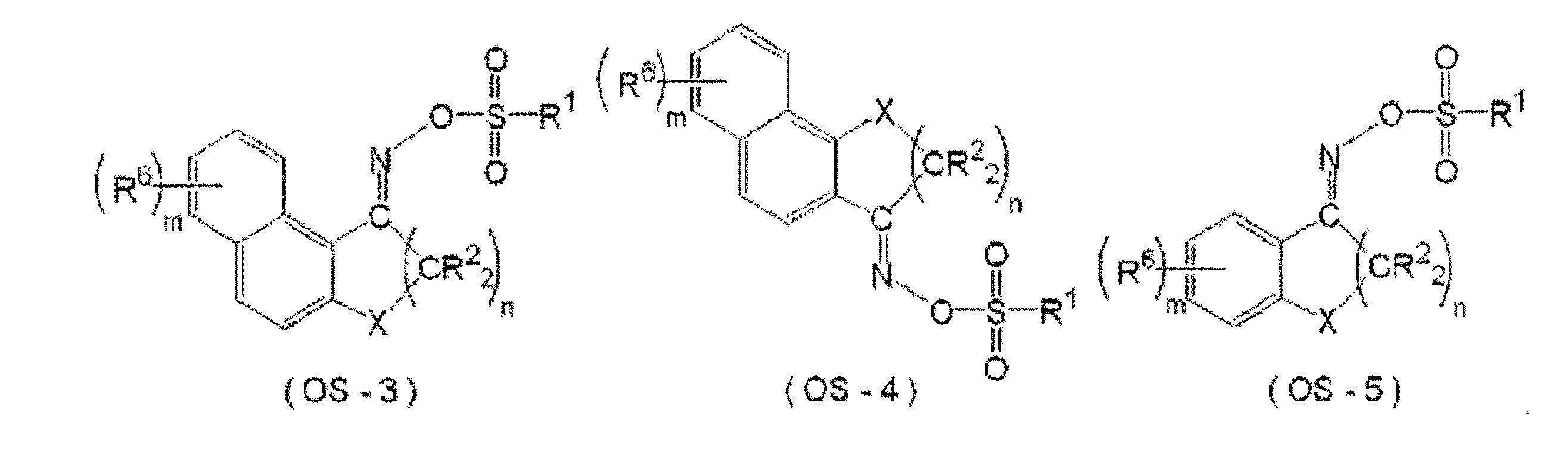
式(OS-3)~式(OS-5)中、R1はアルキル基、アリール基またはヘテロアリール基を表し、R2はそれぞれ独立に、水素原子、アルキル基、アリール基またはハロゲン原子を表し、R6はそれぞれ独立に、ハロゲン原子、アルキル基、アルキルオキシ基、スルホン酸基、アミノスルホニル基またはアルコキシスルホニル基を表し、XはOまたはSを表し、nは1または2を表し、mは0~6の整数を表す。
式(OS-3)~(OS-5)中、R1におけるアルキル基、アリール基またはヘテロアリール基は、置換基を有していてもよい。式(OS-3)~(OS-5)中、R1におけるアルキル基としては、置換基を有していてもよい炭素数1~30のアルキル基であることが好ましい。
R1におけるアルキル基が有していてもよい置換基としては、ハロゲン原子、アルキルオキシ基、アリールオキシ基、アルキルチオ基、アリールチオ基、アルキルオキシカルボニル基、アリールオキシカルボニル基、アミノカルボニル基が挙げられる。
R1におけるアルキル基としては、メチル基、エチル基、n-プロピル基、i-プロピル基、n-ブチル基、s-ブチル基、t-ブチル基、n-ペンチル基、n-ヘキシル基、n-オクチル基、n-デシル基、n-ドデシル基、トリフルオロメチル基、パーフルオロプロピル基、パーフルオロヘキシル基、ベンジル基、フェノキシエチル基、メチルチオエチル基、フェニルチオエチル基、エトキシカルボニルエチル基、フェノキシカルボニルエチル基、ジメチルアミノカルボニルエチル基が挙げられる。これらの中でも、メチル基、エチル基、n-プロピル基、i-プロピル基、n-ブチル基、s-ブチル基、t-ブチル基、n-ペンチル基、n-ヘキシル基、n-オクチル基、n-デシル基、n-ドデシル基、トリフルオロメチル基、パーフルオロプロピル基、パーフルオロヘキシル基、ベンジル基が好ましい。
また、式(OS-3)~(OS-5)中、R1におけるアリール基としては、置換基を有してもよい炭素数6~30のアリール基が好ましい。
R1におけるアリール基が有していてもよい置換基としては、ハロゲン原子、アルキル基、アルキルオキシ基、アリールオキシ基、アルキルチオ基、アリールチオ基、アルキルオキシカルボニル基、アリールオキシカルボニル基、アミノカルボニル基、スルホン酸基、アミノスルホニル基、アルコキシスルホニル基が挙げられる。
R1におけるアリール基としては、フェニル基、p-メチルフェニル基、p-クロロフェニル基、ペンタクロロフェニル基、ペンタフルオロフェニル基、o-メトキシフェニル基、p-フェノキシフェニル基、p-メチルチオフェニル基、p-フェニルチオフェニル基、p-エトキシカルボニルフェニル基、p-フェノキシカルボニルフェニル基、p-ジメチルアミノカルボニルフェニル基が挙げられる。これらの中でも、フェニル基、p-メチルフェニル基、p-クロロフェニル基、ペンタクロロフェニル基、ペンタフルオロフェニル基、o-メトキシフェニル基、p-フェノキシフェニル基が好ましい。
また、式(OS-3)~(OS-5)中、R1におけるヘテロアリール基としては、置換基を有してもよい炭素数4~30のヘテロアリール基が好ましい。
R1におけるヘテロアリール基が有していてもよい置換基としては、ハロゲン原子、アルキル基、アルキルオキシ基、アリールオキシ基、アルキルチオ基、アリールチオ基、アルキルオキシカルボニル基、アリールオキシカルボニル基、アミノカルボニル基、スルホン酸基、アミノスルホニル基、アルコキシスルホニル基が挙げられる。
式(OS-3)~(OS-5)中、R1におけるヘテロアリール基は、少なくとも1つの環が複素芳香環であればよく、例えば、複素芳香環とベンゼン環とが縮環していてもよい。
R1におけるヘテロアリール基としては、置換基を有していてもよい、チオフェン環、ピロール環、チアゾール環、イミダゾール環、フラン環、ベンゾチオフェン環、ベンゾチアゾール環、およびベンゾイミダゾール環よりなる群から選ばれた環から1つの水素原子を除いた基が挙げられる。
式(OS-3)~(OS-5)中、R2は、水素原子、アルキル基またはアリール基であることが好ましく、水素原子またはアルキル基であることがより好ましい。
式(OS-3)~(OS-5)中、化合物中に2以上存在するR2のうち、1つまたは2つがアルキル基、アリール基またはハロゲン原子であることが好ましく、1つがアルキル基、アリール基またはハロゲン原子であることがより好ましく、1つがアルキル基であり、かつ残りが水素原子であることが特に好ましい。
式(OS-3)~(OS-5)中、R2におけるアルキル基またはアリール基は、置換基を有していてもよい。
R2におけるアルキル基またはアリール基が有していてもよい置換基としては、R1におけるアルキル基またはアリール基が有していてもよい置換基と同様の基が例示できる。R2におけるアルキル基としては、置換基を有してもよい炭素数1~12のアルキル基であることが好ましく、置換基を有してもよい炭素数1~6のアルキル基であることがより好ましい。
R2におけるアルキル基として具体的には、メチル基、エチル基、n-プロピル基、i-プロピル基、n-ブチル基、i-ブチル基、s-ブチル基、t-ブチル基、アリル基、n-ペンチル基、n-ヘキシル基、n-オクチル基、n-デシル基、n-ドデシル基、パーフルオロヘキシル基、クロロメチル基、ブロモメチル基、メトキシメチル基、ベンジル基、フェノキシエチル基、メチルチオエチル基、フェニルチオエチル基、エトキシカルボニルエチル基、フェノキシカルボニルエチル基、ジメチルアミノカルボニルエチル基が挙げられる。これらの中でも、メチル基、エチル基、n-プロピル基、i-プロピル基、n-ブチル基、i-ブチル基、s-ブチル基、n-ヘキシル基、アリル基、クロロメチル基、ブロモメチル基、メトキシメチル基、ベンジル基が好ましく、メチル基、エチル基、n-プロピル基、i-プロピル基、n-ブチル基、i-ブチル基、s-ブチル基、n-ヘキシル基がより好ましく、メチル基、エチル基、n-プロピル基、n-ブチル基、n-ヘキシル基がさらに好ましく、メチル基が特に好ましい。
R2におけるアリール基としては、置換基を有してもよい炭素数6~30のアリール基であることが好ましい。
R2におけるアリール基として具体的には、フェニル基、p-メチルフェニル基、o-クロロフェニル基、p-クロロフェニル基、o-メトキシフェニル基、p-フェノキシフェニル基、p-メチルチオフェニル基、p-フェニルチオフェニル基、p-エトキシカルボニルフェニル基、p-フェノキシカルボニルフェニル基、p-ジメチルアミノカルボニルフェニル基が挙げられる。これらの中でも、フェニル基、p-メチルフェニル基、o-クロロフェニル基、p-クロロフェニル基、o-メトキシフェニル基、p-フェノキシフェニル基が好ましい。
R2におけるハロゲン原子としては、フッ素原子、塩素原子、臭素原子、ヨウ素原子が挙げられる。これらの中でも、塩素原子、臭素原子が好ましい。
式(OS-3)~(OS-5)中、XはOまたはSを表し、Oであることが好ましい。式(OS-3)~(OS-5)において、Xを環員として含む環は、5員環または6員環である。
式(OS-3)~(OS-5)中、nは1または2を表し、XがOである場合、nは1であることが好ましく、また、XがSである場合、nは2であることが好ましい。
式(OS-3)~(OS-5)中、R6におけるアルキル基およびアルキルオキシ基は、置換基を有していてもよい。R6におけるアルキル基としては、置換基を有していてもよい炭素数1~30のアルキル基であることが好ましい。
R6におけるアルキル基が有していてもよい置換基としては、ハロゲン原子、アルキルオキシ基、アリールオキシ基、アルキルチオ基、アリールチオ基、アルキルオキシカルボニル基、アリールオキシカルボニル基、アミノカルボニル基が挙げられる。
R6におけるアルキル基としては、メチル基、エチル基、n-プロピル基、i-プロピル基、n-ブチル基、s-ブチル基、t-ブチル基、n-ペンチル基、n-ヘキシル基、n-オクチル基、n-デシル基、n-ドデシル基、トリフルオロメチル基、パーフルオロプロピル基、パーフルオロヘキシル基、ベンジル基、フェノキシエチル基、メチルチオエチル基、フェニルチオエチル基、エトキシカルボニルエチル基、フェノキシカルボニルエチル基、ジメチルアミノカルボニルエチル基が挙げられる。これらの中でも、メチル基、エチル基、n-プロピル基、i-プロピル基、n-ブチル基、s-ブチル基、t-ブチル基、n-ペンチル基、n-ヘキシル基、n-オクチル基、n-デシル基、n-ドデシル基、トリフルオロメチル基、パーフルオロプロピル基、パーフルオロヘキシル基、ベンジル基が好ましい。
式(OS-3)~(OS-5)中、R6におけるアルキルオキシ基としては、置換基を有してもよい炭素数1~30のアルキルオキシ基であることが好ましい。
R6におけるアルキルオキシ基が有していてもよい置換基としては、ハロゲン原子、アルキルオキシ基、アリールオキシ基、アルキルチオ基、アリールチオ基、アルキルオキシカルボニル基、アリールオキシカルボニル基、アミノカルボニル基が挙げられる。
R6におけるアルキルオキシ基としては、メチルオキシ基、エチルオキシ基、ブチルオキシ基、ヘキシルオキシ基、フェノキシエチルオキシ基、トリクロロメチルオキシ基、エトキシエチルオキシ基、メチルチオエチルオキシ基、フェニルチオエチルオキシ基、エトキシカルボニルエチルオキシ基、フェノキシカルボニルエチルオキシ基、ジメチルアミノカルボニルエチルオキシ基が挙げられる。これらの中でも、メチルオキシ基、エチルオキシ基、ブチルオキシ基、ヘキシルオキシ基、フェノキシエチルオキシ基、トリクロロメチルオキシ基、または、エトキシエチルオキシ基が好ましい。
式(OS-3)~(OS-5)中、R6におけるアミノスルホニル基としては、メチルアミノスルホニル基、ジメチルアミノスルホニル基、フェニルアミノスルホニル基、メチルフェニルアミノスルホニル基、アミノスルホニル基が挙げられる。
式(OS-3)~(OS-5)中、R6におけるアルコキシスルホニル基としては、メトキシスルホニル基、エトキシスルホニル基、プロピルオキシスルホニル基、ブチルオキシスルホニル基が挙げられる。
また、式(OS-3)~(OS-5)中、mは0~6の整数を表し、0~2の整数であることが好ましく、0または1であることがより好ましく、0であることが特に好ましい。
また、式(b1)で表されるオキシムスルホネート化合物を含有する化合物は、下記式(OS-6)~(OS-11)のいずれかで表されるオキシムスルホネート化合物であることが特に好ましい。
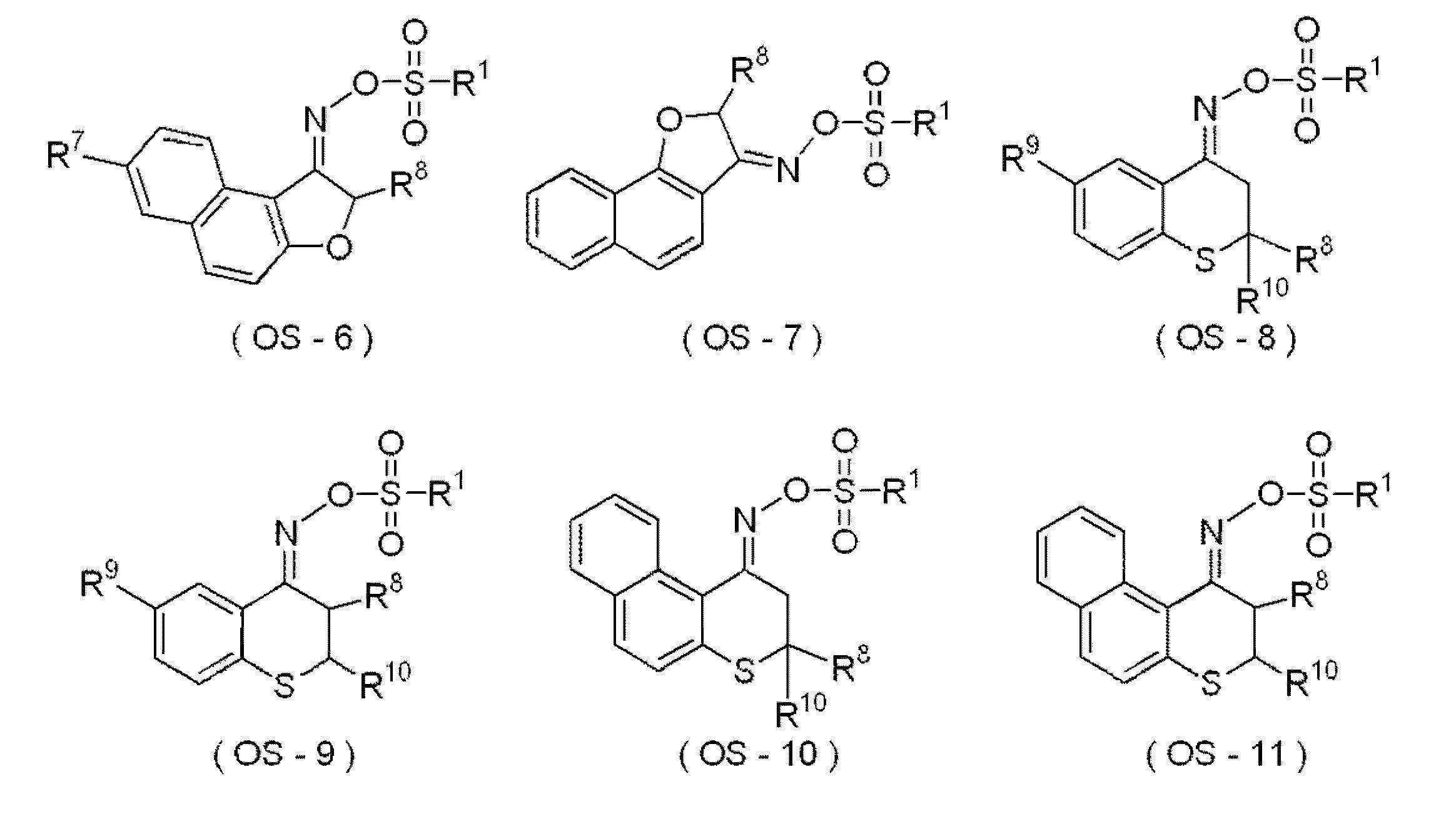
式(OS-6)~(OS-11)中、R1はアルキル基、アリール基またはヘテロアリール基を表し、R7は、水素原子または臭素原子を表し、R8は水素原子、炭素数1~8のアルキル基、ハロゲン原子、クロロメチル基、ブロモメチル基、ブロモエチル基、メトキシメチル基、フェニル基またはクロロフェニル基を表し、R9は水素原子、ハロゲン原子、メチル基またはメトキシ基を表し、R10は水素原子またはメチル基を表す。
式(OS-6)~(OS-11)におけるR1は、式(OS-3)~(OS-5)におけるR1と同義であり、好ましい態様も同様である。
式(OS-6)におけるR7は、水素原子であることが好ましい。
式(OS-6)~(OS-11)におけるR8は、炭素数1~8のアルキル基、ハロゲン原子またはフェニル基であることが好ましく、炭素数1~8のアルキル基であることがより好ましく、炭素数1~6のアルキル基であることがさらに好ましく、メチル基であることが特に好ましい。
式(OS-8)および式(OS-9)におけるR9は、水素原子であることが好ましい。
式(OS-8)~(OS-11)におけるR10は、水素原子であることが好ましい。
また、オキシムスルホネート化合物において、オキシムの立体構造(E,Z)については、どちらか一方であっても、混合物であってもよい。
式(OS-3)~式(OS-5)で表されるオキシムスルホネート化合物の具体例としては、下記例示化合物が挙げられるが、本発明は、これらに限定されるものではない。
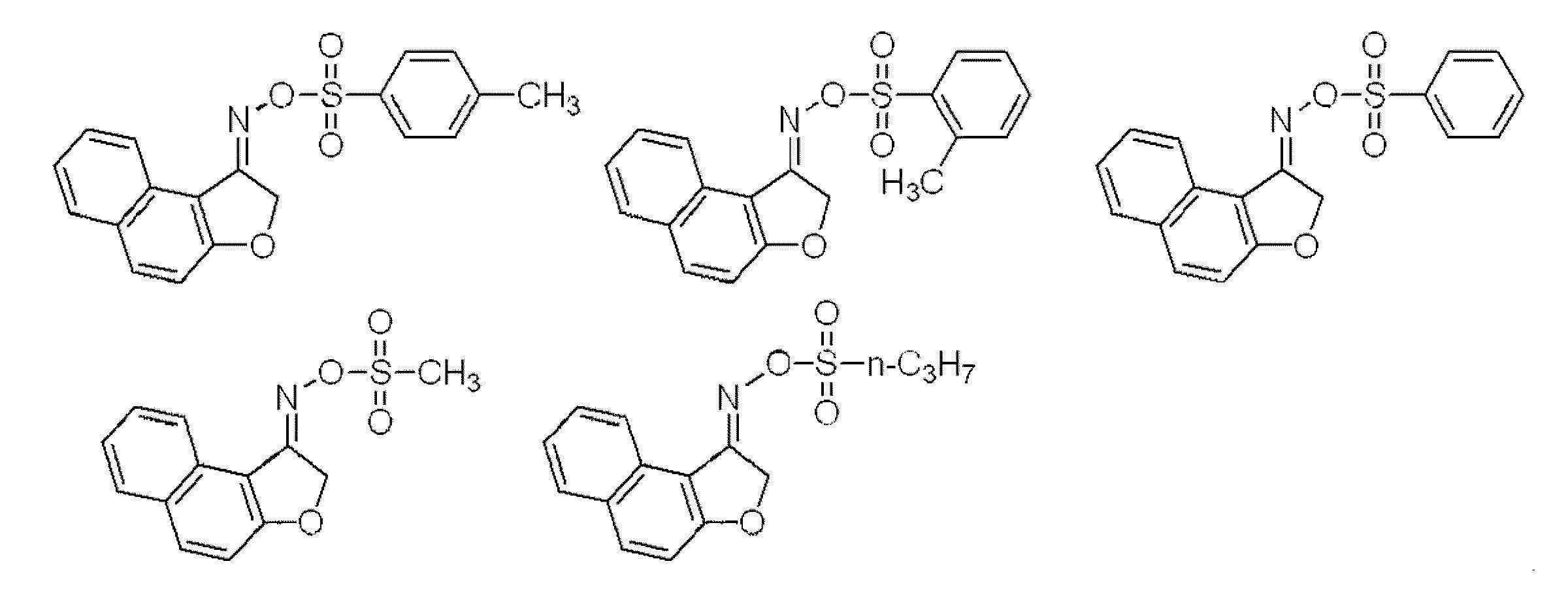
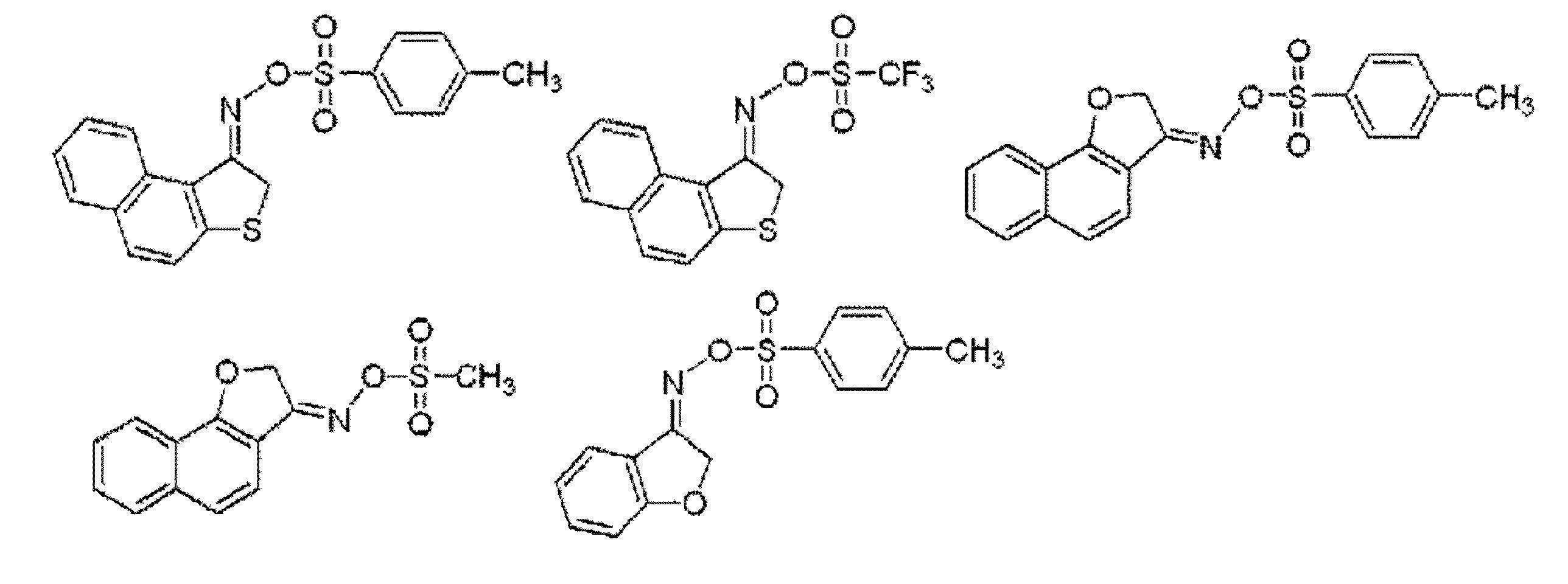
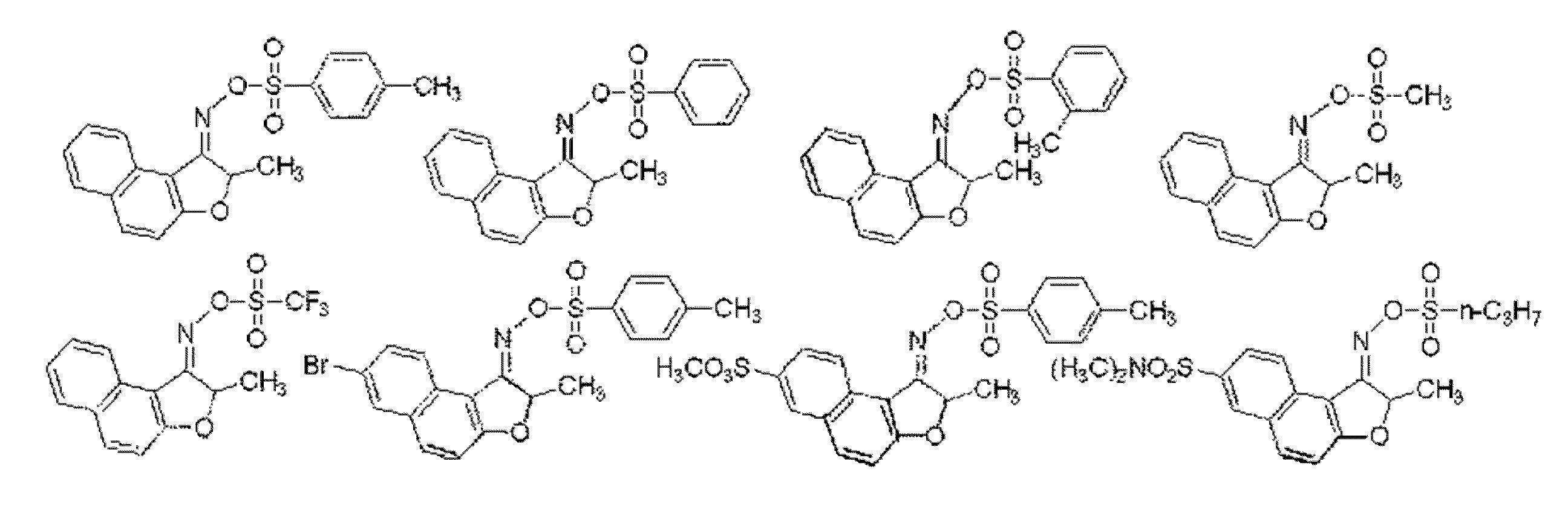
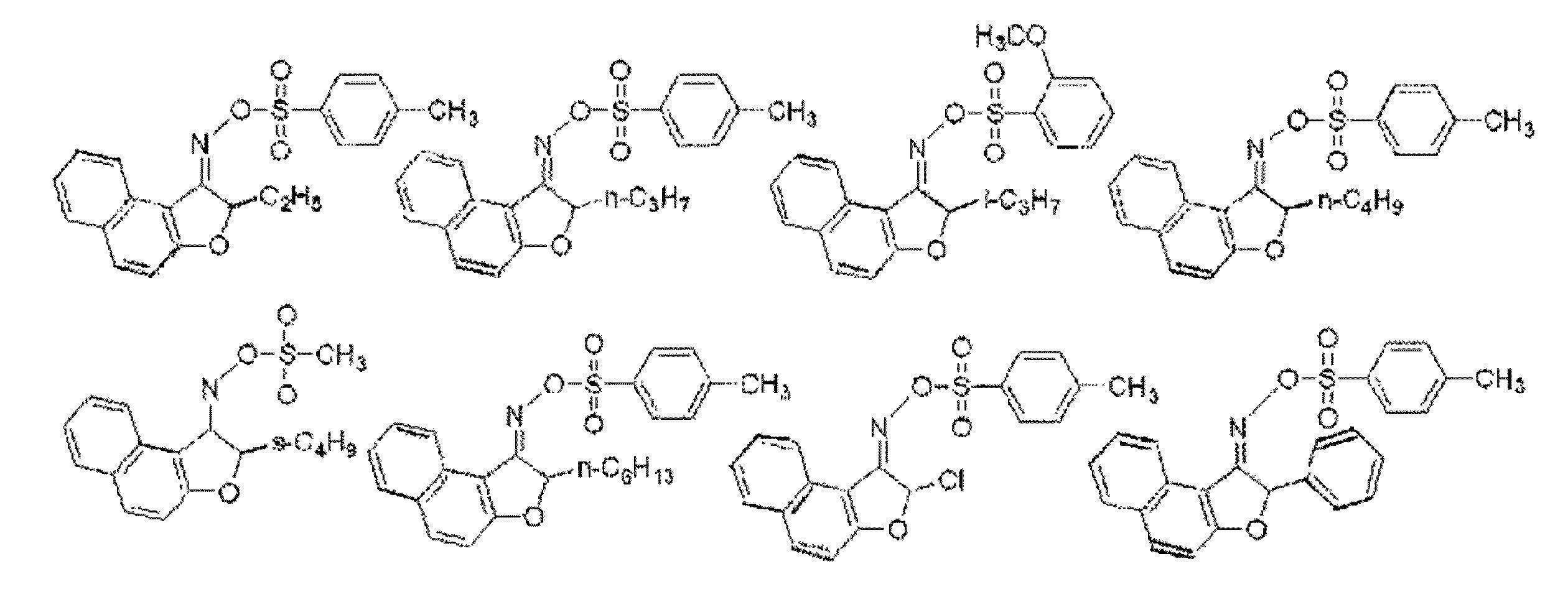


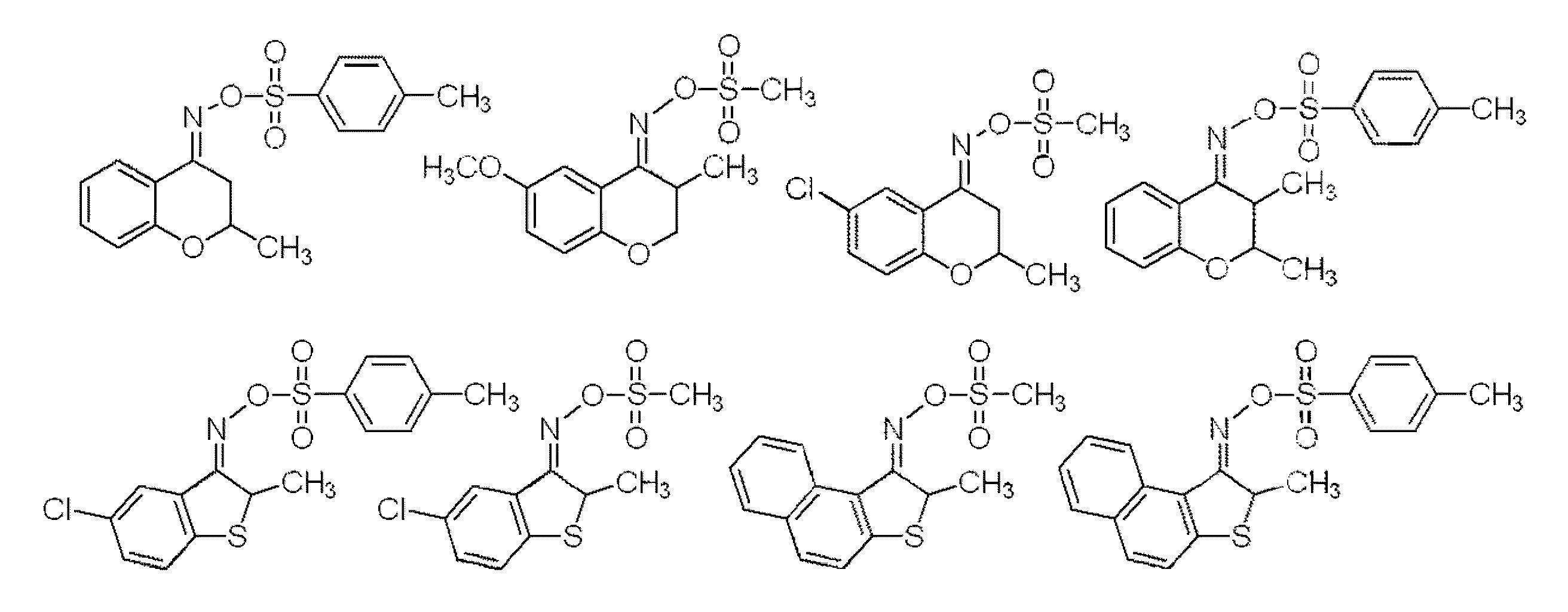
本発明において、酸発生剤(B)は、式(OS-1)で表される化合物を含むことも好ましい。
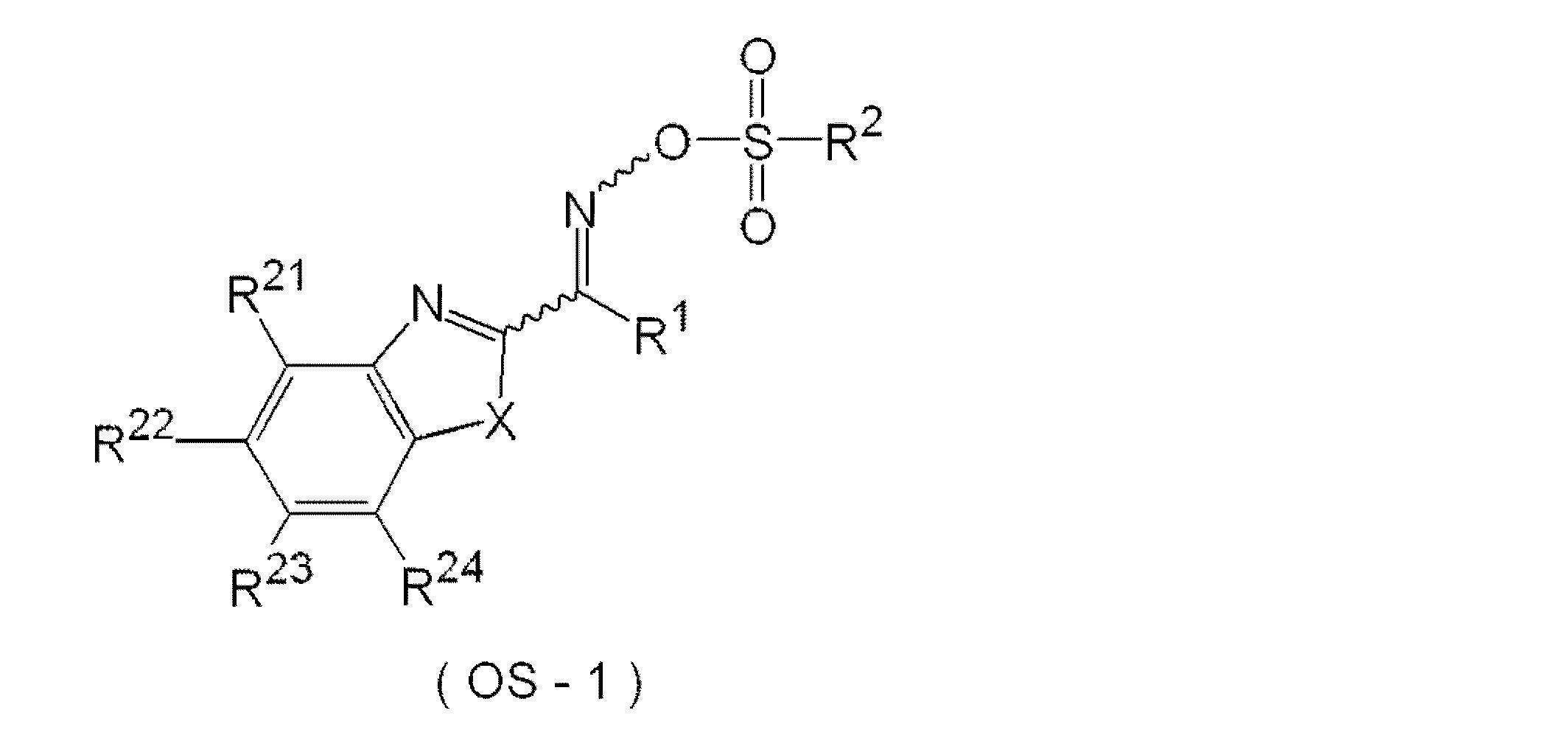
式(OS-1)中、R1は、水素原子、アルキル基、アルケニル基、アルコキシ基、アルコキシカルボニル基、アシル基、カルバモイル基、スルファモイル基、スルホ基、シアノ基、アリール基、またはヘテロアリール基を表す。R2は、アルキル基、または、アリール基を表す。
Xは-O-、-S-、-NH-、-NR5-、-CH2-、-CR6H-、またはCR6R7-を表し、R5~R7はアルキル基、またはアリール基を表す。
R21~R24は、それぞれ独立に、水素原子、ハロゲン原子、アルキル基、アルケニル基、アルコキシ基、アミノ基、アルコキシカルボニル基、アルキルカルボニル基、アリールカルボニル基、アミド基、スルホ基、シアノ基、または、アリール基を表す。R21~R24のうち2つは、それぞれ互いに結合して環を形成してもよい。
Xは-O-、-S-、-NH-、-NR5-、-CH2-、-CR6H-、またはCR6R7-を表し、R5~R7はアルキル基、またはアリール基を表す。
R21~R24は、それぞれ独立に、水素原子、ハロゲン原子、アルキル基、アルケニル基、アルコキシ基、アミノ基、アルコキシカルボニル基、アルキルカルボニル基、アリールカルボニル基、アミド基、スルホ基、シアノ基、または、アリール基を表す。R21~R24のうち2つは、それぞれ互いに結合して環を形成してもよい。
R21~R24としては、水素原子、ハロゲン原子、および、アルキル基が好ましく、また、R21~R24のうち少なくとも2つが互いに結合してアリール基を形成する態様もまた、好ましく挙げられる。中でも、R21~R24がいずれも水素原子である態様が感度の観点から好ましい。
既述の官能基は、いずれも、さらに置換基を有していてもよい。
式(OS-1)で表される化合物は、下記式(OS-2)で表される化合物であることが好ましい。

式(OS-2)中、R1、R2、R21~R24は、それぞれ式(OS-1)におけるのと同義であり、好ましい例もまた同様である。
これらの中でも、式(OS-1)および式(OS-2)におけるR1がシアノ基、または、アリール基である態様がより好ましく、式(OS-2)で表され、R1がシアノ基、フェニル基またはナフチル基である態様が最も好ましい。
また、オキシムスルホネート化合物において、オキシムやベンゾチアゾール環の立体構造(E,Z等)についてはそれぞれ、どちらか一方であっても、混合物であってもよい。
以下に、本発明に好適に用いうる式(OS-1)で表される化合物の具体例(例示化合物b-1~b-34)を示すが、本発明はこれらに限定されない。なお、Meはメチル基を表し、Etはエチル基を表し、Bnはベンジル基を表し、Phはフェニル基を表す。
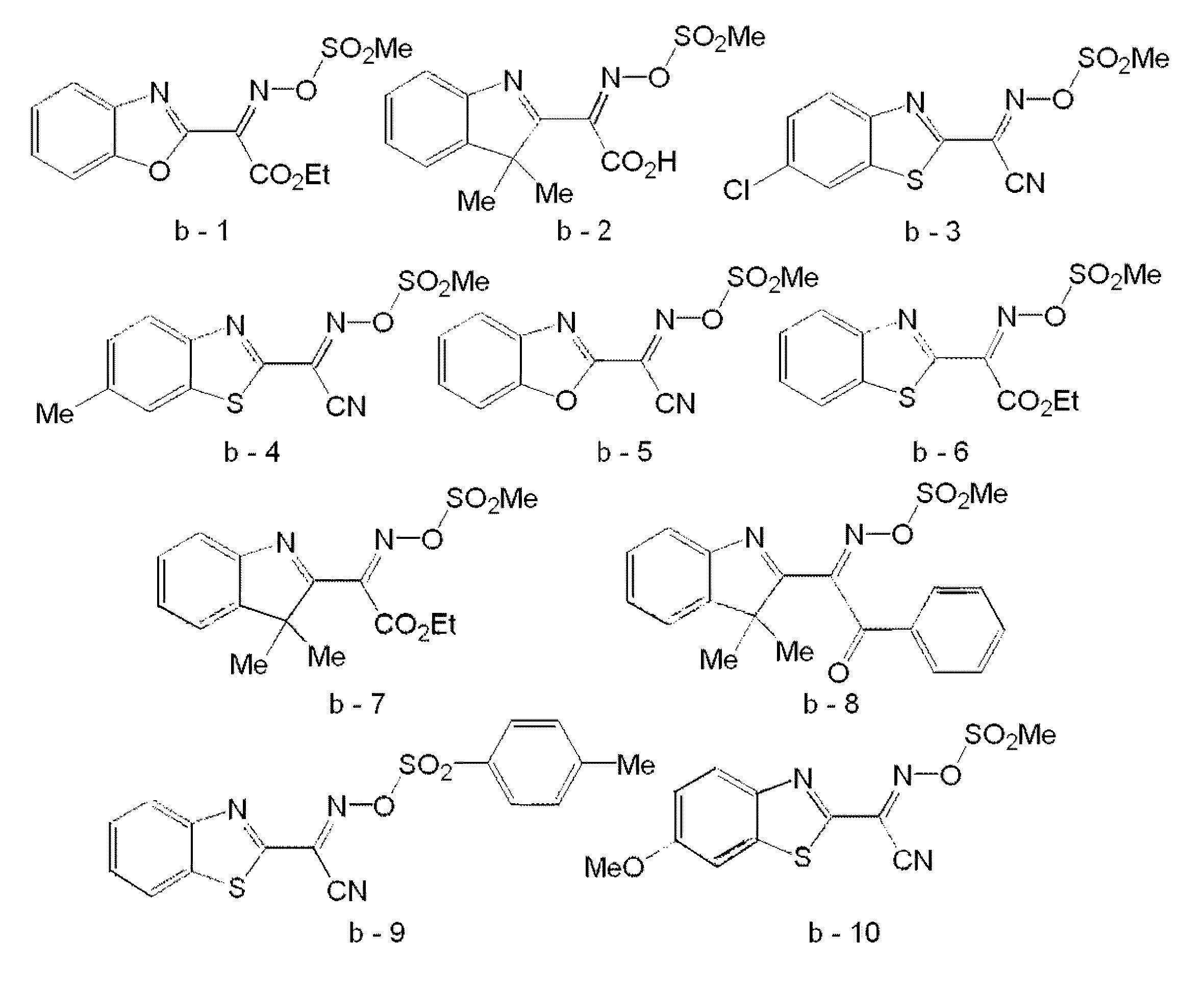

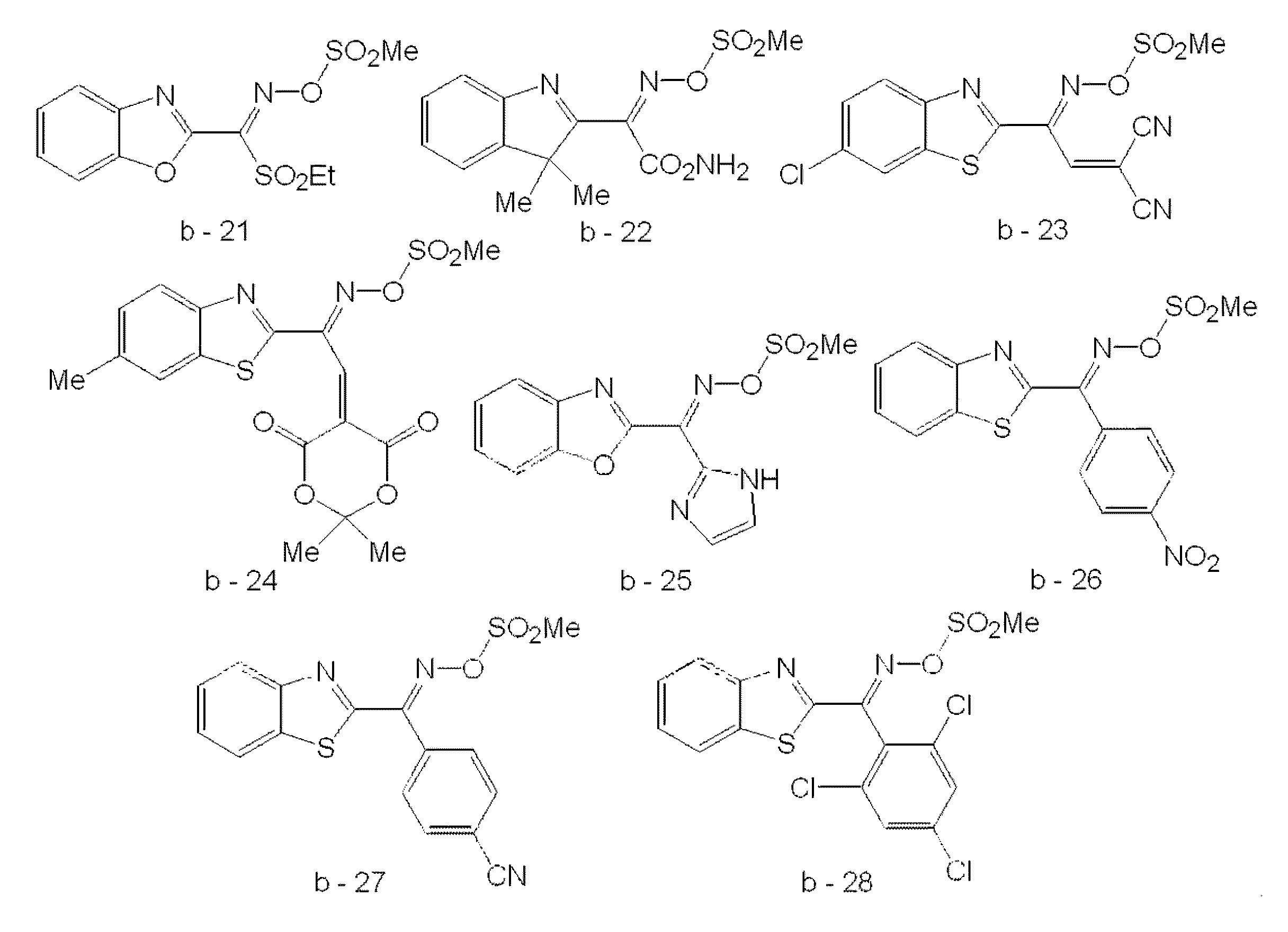

上記化合物の中でも、感度と安定性との両立の観点から、b-9、b-16、b-31、b-33が好ましい。
本発明において、酸発生剤(B)は、下記式(b2)で表されるオキシムスルホネート化合物を含むことも好ましい。

式(b2)中、R5は、アルキル基またはアリール基を表し、Xは、アルキル基、アルコキシ基、または、ハロゲン原子を表し、mは、0~3の整数を表し、mが2または3であるとき、複数のXは同一でも異なっていてもよい。
Xとしてのアルキル基は、炭素数1~4の直鎖状または分岐状アルキル基が好ましい。Xとしてのアルコキシ基は、炭素数1~4の直鎖状または分岐状アルコキシ基が好ましい。Xとしてのハロゲン原子は、塩素原子またはフッ素原子が好ましい。mは、0または1が好ましい。
式(b2)中、mが1であり、Xがメチル基であり、Xの置換位置がオルト位であり、R5が炭素数1~10の直鎖状アルキル基、7,7-ジメチル-2-オキソノルボルニルメチル基、またはp-トリル基である化合物が特に好ましい。
本発明において、酸発生剤(B)は、式(b3)で表されるオキシムスルホネート化合物を含むことも好ましい。
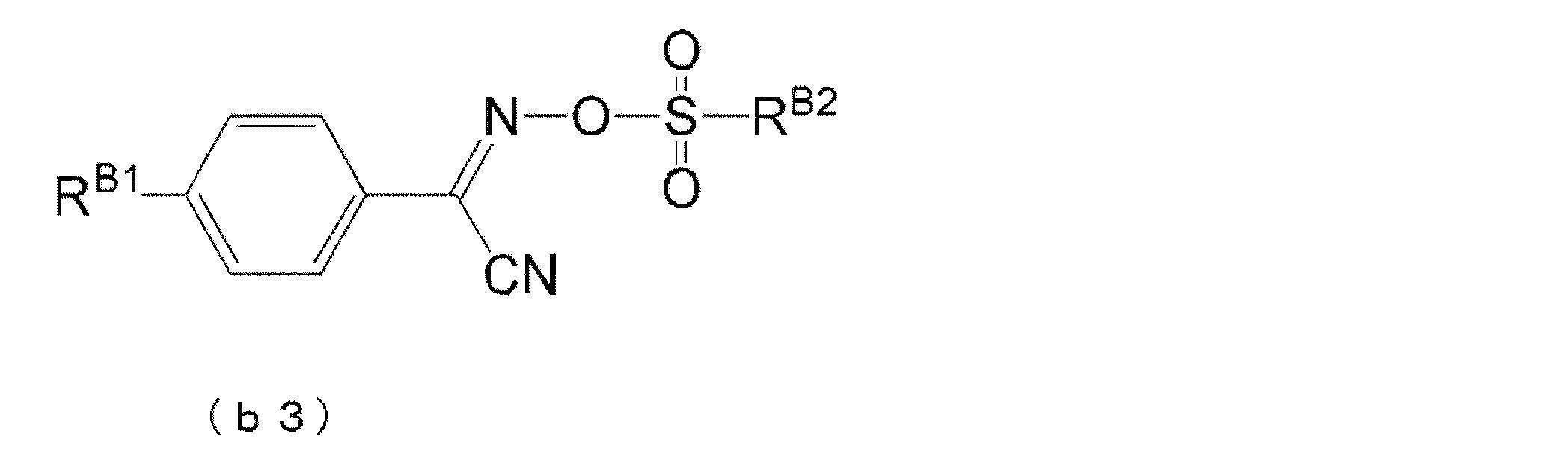
式中、RB1はアルキル基、アルコキシ基、または、ハロゲン原子を表し、RB2はアルキル基またはアリール基を表す。
RB1は、アルコキシ基が好ましく、炭素数1~5のアルコキシ基が好ましく、メトキシ基がより好ましい。
RB2としては、アルキル基が好ましく、メチル基、エチル基、n-プロピル基、n-ブチル基、n-オクチル基、トリフルオロメチル基、ペンタフルオロエチル基、パーフルオロ-n-プロピル基、パーフルオロ-n-ブチル基、p-トリル基、4-クロロフェニル基またはペンタフルオロフェニル基がより好ましい。
好ましいオキシムスルホネート化合物の具体例としては、下記化合物(i)~(viii)等が挙げられ、1種単独で使用したり、または、2種以上を併用することができる。化合物(i)~(viii)は、市販品として、入手することができる。

また、酸発生剤(B)としては、上記オキシムスルホネート化合物と、上記オキシムスルホネート化合物以外の酸発生剤とを組み合わせて使用することも好ましい。上記オキシムスルホネート化合物以外の酸発生剤としては、上記のように、スルホニウム塩等が挙げられる。
以下、酸発生剤(B)としてのスルホニウム塩を例示するが、本発明はこれらに限定されるものではない。
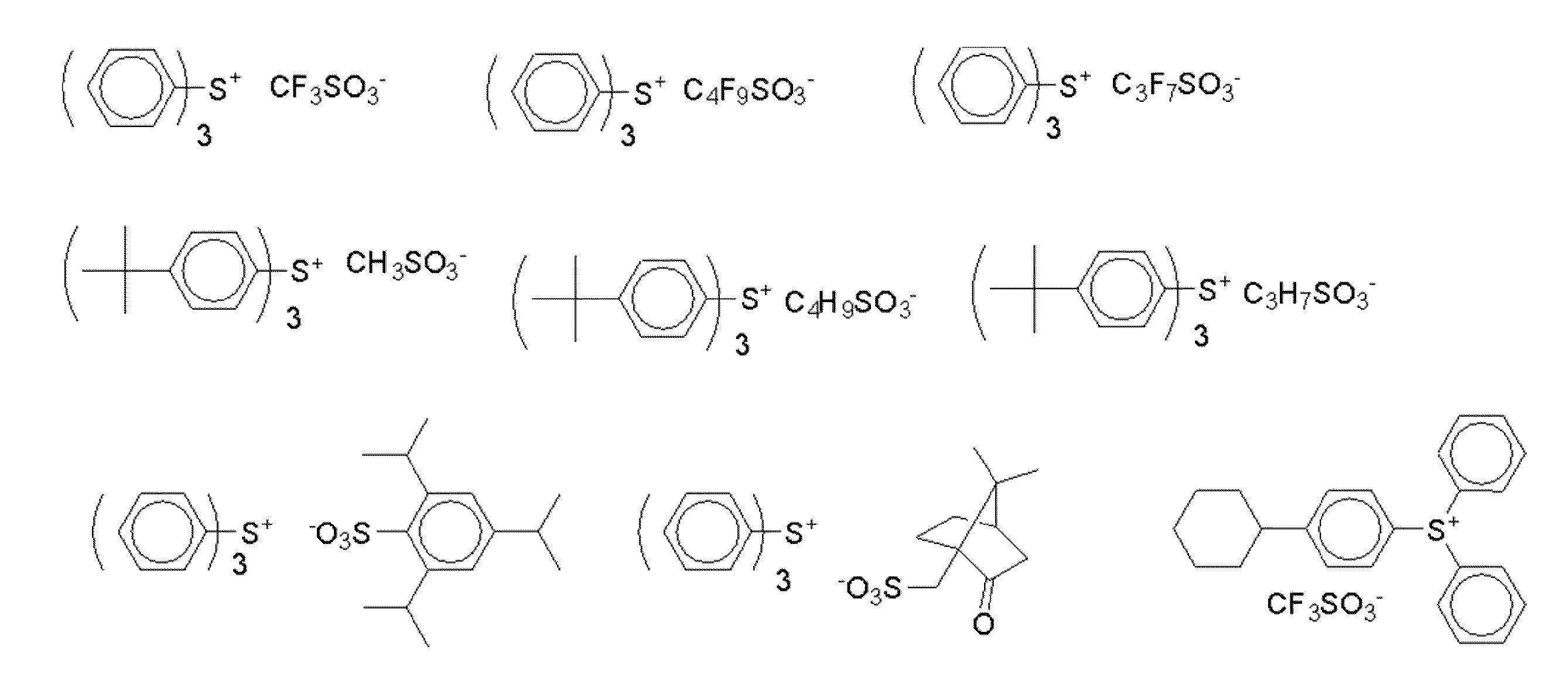
酸発生剤(B)は、公知の方法で合成することができ、例えば、特開2007-161707号公報に記載の方法に準じて合成することができる。この内容は本明細書に組み込まれる。
酸発生剤(B)の樹脂組成物(I)中の含有量は、樹脂組成物の全固形分を基準として、0.1~30質量%であることが好ましく、より好ましくは0.5~25質量%、さらに好ましくは1~20質量%、特に好ましくは2~15質量%である。酸発生剤(B)が2種以上を含む場合には、それらの合計量が上記範囲内であることが好ましい。
[3]塩基性化合物
樹脂組成物(I)は、塩基性化合物を含有していてもよい。これにより、例えば、露光から加熱までの経時による性能変化を低減する効果が得られる。
塩基性化合物としては、例えば、式(c1)で表される化合物を用いることができる。式(c1)で表される化合物を上記酸発生剤(B)と併用することにより、下地の膜との高い密着性を達成できる。
樹脂組成物(I)は、塩基性化合物を含有していてもよい。これにより、例えば、露光から加熱までの経時による性能変化を低減する効果が得られる。
塩基性化合物としては、例えば、式(c1)で表される化合物を用いることができる。式(c1)で表される化合物を上記酸発生剤(B)と併用することにより、下地の膜との高い密着性を達成できる。
式(c1)

式(c1)中、R1およびR2は、それぞれ独立に、炭素数1~10の分岐していてもよいアルキル基、置換基を有してもよいアリール基、置換基を有してもよいシクロアルキル基、またはモルホリノ基を表す。R3は酸素原子または硫黄原子を表し、Aは2価の連結基を表す。
R1は、置換基を有してもよいアリール基、置換基を有してもよいシクロアルキル基、またはモルホリノ基が好ましく、モルホリノ基がさらに好ましい。R1がアリール基である場合、フェニル基およびナフチル基が例示され、フェニル基がより好ましい。アリール基は置換基を有していても良いが、置換基を有さない方が好ましい。R1がシクロアルキル基である場合、5員環または6員環のシクロアルキル基が好ましく、6員環のシクロアルキル基がさらに好ましい。シクロアルキル基は置換基を有していても良いが、置換基を有さない方が好ましい。
R2は、炭素数1~10の分岐していてもよいアルキル基、置換基を有してもよいアリール基、または置換基を有してもよいシクロアルキル基が好ましい。R2がアルキル基である場合、炭素数1~8のアルキル基が好ましい。R2がアリール基である場合、フェニル基およびナフチル基が例示され、フェニル基がより好ましい。アリール基は置換基を有していても良いが、置換基を有さない方が好ましい。R2がシクロアルキル基である場合、5員環または6員環のシクロアルキル基が好ましく、6員環のシクロアルキル基がさらに好ましい。シクロアルキル基は置換基を有していても良いが、置換基を有さない方が好ましい。
Aは2価の連結基を示し、アルキレン基(例えば、メチレン基、エチレン基、プロピレン基等)、シクロアルキレン基(例えば、シクロへキシレン基、シクロペンチレン基等)、アリーレン基(例えば、1,2-フェニレン基、1,3-フェニレン基、1,4-フェニレン基、ナフチレン基等)、エーテル基、カルボニル基、エステル基、アミド基およびこれらの組み合わせからなる基が好ましく、アルキレン基、エーテル基およびこれらの組み合わせからなる基がさらに好ましい。
式(c1)で表される化合物は、好ましくは、式(c2)で表される化合物である。
式(c2)

式(c2)中、R1およびR2は、それぞれ独立に、炭素数1~10の分岐していてもよいアルキル基、置換基を有してもよいアリール基、置換基を有してもよいシクロアルキル基、またはモルホリノ基を表す。Aは2価の連結基を表す。
R1、R2、Aは、それぞれ、上記式(c1)におけるR1、R2、Aと同義であり、好ましい範囲も同義である。
式(c1)で表される化合物は、より好ましくは、式(c3)で表される化合物である。
式(c3)
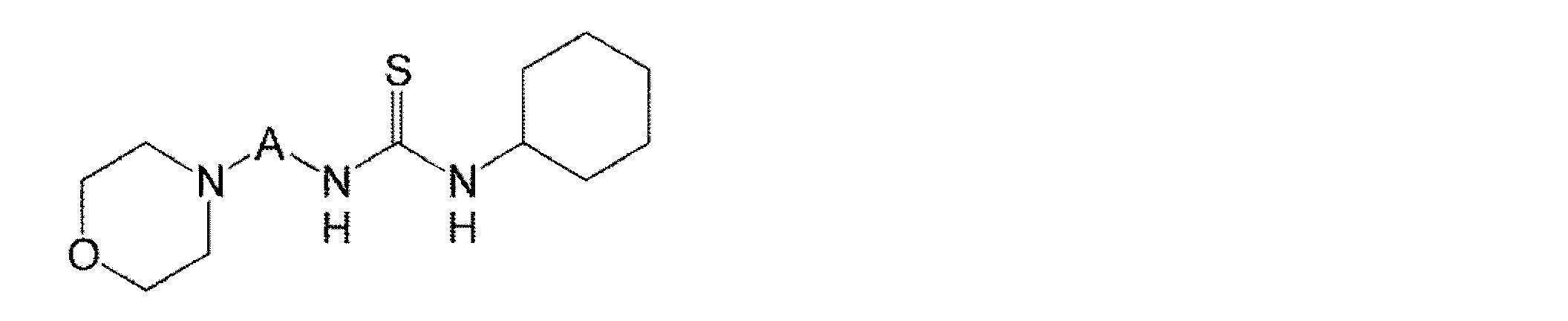
式(c3)中、Aは2価の連結基を表す。Aは、上記式(c1)におけるAと同義であり、好ましい範囲も同義である。
式(c1)で表される化合物は、樹脂組成物全固形分に対し、0.01~2.50質量%の割合で含まれていることが好ましく、0.03~2.00質量%の割合で含まれていることがより好ましい。上記の数値の範囲内であると、現像時の下地の膜との高い密着性を達成できる。
また、その他の塩基性化合物として、好ましくは、下記式(A)~(E)で示される構造を有する化合物を挙げることができる。

一般式(A)と(E)において、
R200、R201およびR202は、同一でも異なってもよく、水素原子、アルキル基(好ましくは炭素数1~20)、シクロアルキル基(好ましくは炭素数3~20)またはアリール基(炭素数6~20)を表し、ここで、R201とR202は、互いに結合して環を形成してもよい。R203、R204、R205およびR206は、同一でも異なってもよく、炭素数1~20個のアルキル基を表す。
R200、R201およびR202は、同一でも異なってもよく、水素原子、アルキル基(好ましくは炭素数1~20)、シクロアルキル基(好ましくは炭素数3~20)またはアリール基(炭素数6~20)を表し、ここで、R201とR202は、互いに結合して環を形成してもよい。R203、R204、R205およびR206は、同一でも異なってもよく、炭素数1~20個のアルキル基を表す。
上記アルキル基について、置換基を有するアルキル基としては、炭素数1~20のアミノアルキル基、炭素数1~20のヒドロキシアルキル基または炭素数1~20のシアノアルキル基が好ましい。
これら一般式(A)と(E)中のアルキル基は、無置換であることがより好ましい。
好ましい塩基性化合物として、グアニジン、アミノピロリジン、ピラゾール、ピラゾリン、ピペラジン、アミノモルホリン、アミノアルキルモルフォリン、ピペリジン等を挙げることができ、さらに好ましい化合物として、イミダゾール構造、ジアザビシクロ構造、オニウムヒドロキシド構造、オニウムカルボキシレート構造、トリアルキルアミン構造、アニリン構造またはピリジン構造を有する化合物、水酸基および/またはエーテル結合を有するアルキルアミン誘導体、水酸基および/またはエーテル結合を有するアニリン誘導体等を挙げることができる。
イミダゾール構造を有する化合物としては、イミダゾール、2、4、5-トリフェニルイミダゾール、ベンズイミダゾール等が挙げられる(例えば、2-フェニル-1H-ベンゾイミダゾールなど)。ジアザビシクロ構造を有する化合物としては、1、4-ジアザビシクロ[2,2,2]オクタン、1、5-ジアザビシクロ[4,3,0]ノナ-5-エン、1、8-ジアザビシクロ[5,4,0]ウンデカー7-エン等が挙げられる。オニウムヒドロキシド構造を有する化合物としては、トリアリールスルホニウムヒドロキシド、フェナシルスルホニウムヒドロキシド、2-オキソアルキル基を有するスルホニウムヒドロキシド、具体的にはトリフェニルスルホニウムヒドロキシド、トリス(t-ブチルフェニル)スルホニウムヒドロキシド、ビス(t-ブチルフェニル)ヨードニウムヒドロキシド、フェナシルチオフェニウムヒドロキシド、2-オキソプロピルチオフェニウムヒドロキシド等が挙げられる。オニウムカルボキシレート構造を有する化合物としては、オニウムヒドロキシド構造を有する化合物のアニオン部がカルボキシレートになったものであり、例えばアセテート、アダマンタン-1-カルボキシレート、パーフロロアルキルカルボキシレート等が挙げられる。トリアルキルアミン構造を有する化合物としては、トリ(n-ブチル)アミン、トリ(n-オクチル)アミン等を挙げることができる。アニリン構造を有する化合物としては、2,6-ジイソプロピルアニリン、N,N-ジメチルアニリン、N,N-ジブチルアニリン、N,N-ジヘキシルアニリン等を挙げることができる。水酸基および/またはエーテル結合を有するアルキルアミン誘導体としては、エタノールアミン、ジエタノールアミン、トリエタノールアミン、トリス(メトキシエトキシエチル)アミン等を挙げることができる。水酸基および/またはエーテル結合を有するアニリン誘導体としては、N,N-ビス(ヒドロキシエチル)アニリン等を挙げることができる。
好ましい塩基性化合物として、さらに、フェノキシ基を有するアミン化合物、フェノキシ基を有するアンモニウム塩化合物、スルホン酸エステル基を有するアミン化合物およびスルホン酸エステル基を有するアンモニウム塩化合物を挙げることができる。
フェノキシ基を有するアミン化合物、フェノキシ基を有するアンモニウム塩化合物、スルホン酸エステル基を有するアミン化合物およびスルホン酸エステル基を有するアンモニウム塩化合物は、少なくとも1つのアルキル基が窒素原子に結合していることが好ましい。また、アルキル鎖中に、酸素原子を有し、オキシアルキレン基が形成されていることが好ましい。オキシアルキレン基の数は、分子内に1つ以上、好ましくは3~9個、さらに好ましくは4~6個である。オキシアルキレン基の中でも-CH2CH2O-、-CH(CH3)CH2O-若しくは-CH2CH2CH2O-の構造が好ましい。
フェノキシ基を有するアミン化合物、フェノキシ基を有するアンモニウム塩化合物、スルホン酸エステル基を有するアミン化合物およびスルホン酸エステル基を有するアンモニウム塩化合物の具体例としては、米国特許出願公開第2007/0224539号明細書の[0066]に例示されている化合物(C1-1)~(C3-3)が挙げられるが、これらに限定されるものではない。
塩基性化合物の分子量は、250~2000であることが好ましく、さらに好ましくは400~1000である。パターン倒れのさらなる低減およびパターンの矩形性改善などの観点からは、塩基性化合物の分子量は、400以上であることが好ましく、500以上であることがより好ましく、600以上であることがさらに好ましい。
塩基性化合物の使用量は、樹脂組成物(I)の固形分を基準として、0.001~20質量%であることが好ましく、0.01~10質量%であることがより好ましい。これらの塩基性化合物は、1種単独で使用してもよく、2種以上を併用してもよい。塩基性化合物が2種以上を含む場合には、それらの合計量が上記範囲内であることが好ましい。
酸発生剤と塩基性化合物の組成物中の使用割合は、酸発生剤/塩基性化合物(モル比)=2.5~300であることが好ましい。即ち、感度、解像度の点からモル比が2.5以上が好ましく、露光後加熱処理までの経時でのレジストパターンの太りによる解像度の低下抑制の点から300以下が好ましい。酸発生剤/塩基性化合物(モル比)は、より好ましくは5.0~200、さらに好ましくは7.0~150である。
[4]溶剤
樹脂組成物(I)を調製する際に使用することができる溶剤としては、例えば、アルキレングリコールモノアルキルエーテルカルボキシレート、アルキレングリコールモノアルキルエーテル、乳酸アルキルエステル、アルコキシプロピオン酸アルキル、環状ラクトン(好ましくは炭素数4~10)、環を有しても良いモノケトン化合物(好ましくは炭素数4~10)、アルキレンカーボネート、アルコキシ酢酸アルキル、ピルビン酸アルキル等の有機溶剤を挙げることができる。これらの溶剤の具体例は、米国特許出願公開第2008/0187860号明細書[0441]~[0455]に記載のものを挙げることができ、これらの記載内容は本明細書に組み込まれる。
樹脂組成物(I)を調製する際に使用することができる溶剤としては、例えば、アルキレングリコールモノアルキルエーテルカルボキシレート、アルキレングリコールモノアルキルエーテル、乳酸アルキルエステル、アルコキシプロピオン酸アルキル、環状ラクトン(好ましくは炭素数4~10)、環を有しても良いモノケトン化合物(好ましくは炭素数4~10)、アルキレンカーボネート、アルコキシ酢酸アルキル、ピルビン酸アルキル等の有機溶剤を挙げることができる。これらの溶剤の具体例は、米国特許出願公開第2008/0187860号明細書[0441]~[0455]に記載のものを挙げることができ、これらの記載内容は本明細書に組み込まれる。
本発明においては、有機溶剤として構造中に水酸基を含有する溶剤と、水酸基を含有しない溶剤とを混合した混合溶剤を使用してもよい。水酸基を含有する溶剤、水酸基を含有しない溶剤としては前述の例示化合物が適宜選択可能であるが、水酸基を含有する溶剤としては、アルキレングリコールモノアルキルエーテル、乳酸アルキル等が好ましく、プロピレングリコールモノメチルエーテル(PGME、別名1-メトキシ-2-プロパノール)、乳酸エチルがより好ましい。また、水酸基を含有しない溶剤としては、アルキレングリコールモノアルキルエーテルアセテート、アルキルアルコキシプロピオネート、環を含有しても良いモノケトン化合物、環状ラクトン、酢酸アルキルなどが好ましく、これらの内でもプロピレングリコールモノメチルエーテルアセテート(PGMEA、別名1-メトキシ-2-アセトキシプロパン)、エチルエトキシプロピオネート、2-ヘプタノン、γ-ブチロラクトン、シクロヘキサノン、酢酸ブチルが特に好ましく、プロピレングリコールモノメチルエーテルアセテート、エチルエトキシプロピオネート、2-ヘプタノンが最も好ましい。水酸基を含有する溶剤と水酸基を含有しない溶剤との混合比(質量)は、1/99~99/1、好ましくは10/90~90/10、さらに好ましくは20/80~60/40である。水酸基を含有しない溶剤を50質量%以上含有する混合溶剤が塗布均一性の点で特に好ましい。
溶剤は、プロピレングリコールモノメチルエーテルアセテートを含むことが好ましく、プロピレングリコールモノメチルエーテルアセテート単独溶剤またはプロピレングリコールモノメチルエーテルアセテートを含有する2種以上の混合溶剤であることが好ましい。
[5]界面活性剤
樹脂組成物(I)は、さらに界面活性剤を含有してもよい。この場合、樹脂組成物(I)は、フッ素および/またはシリコン系界面活性剤(フッ素系界面活性剤、シリコン系界面活性剤、フッ素原子と珪素原子の両方を有する界面活性剤)のいずれか、あるいは2種以上を含有することがより好ましい。
樹脂組成物(I)は、さらに界面活性剤を含有してもよい。この場合、樹脂組成物(I)は、フッ素および/またはシリコン系界面活性剤(フッ素系界面活性剤、シリコン系界面活性剤、フッ素原子と珪素原子の両方を有する界面活性剤)のいずれか、あるいは2種以上を含有することがより好ましい。
樹脂組成物(I)が界面活性剤を含有することにより、250nm以下、特に220nm以下の波長を用いる露光光源の使用時に、良好な感度および解像度で、密着性および現像欠陥の少ないレジストパターンを与えることが可能となる。
フッ素系および/またはシリコン系界面活性剤として、米国特許出願公開第2008/0248425号明細書の[0276]に記載の界面活性剤が挙げられ、例えばエフトップEF301、EF303(新秋田化成(株)製)、フロラードFC430、431、4430(住友スリーエム(株)製)、メガファックF171、F173、F176、F189、F113、F110、F177、F120、R08(大日本インキ化学工業(株)製)、サーフロンS-382、S-393、SC101、SC102、SC103、SC104、SC105、SC106、KH-20(AGCセイミケミカル(株)製)、トロイゾルS-366(トロイケミカル(株)製)、GF-300、GF-150(東亞合成化学(株)製)、エフトップEF121、EF122A、EF122B、RF122C、EF125M、EF135M、EF351、EF352、EF801、EF802、EF601((株)ジェムコ製)、PF636、PF656、PF6320、PF6520(OMNOVA社製)、FTX-204G、208G、218G、230G、204D、208D、212D、218D、222D((株)ネオス製)等である。またポリシロキサンポリマーKP-341(信越化学工業(株)製)もシリコン系界面活性剤として用いることができる。
また、界面活性剤としては、上記に示すような公知のものの他に、テロメリゼーション法(テロマー法ともいわれる)若しくはオリゴメリゼーション法(オリゴマー法ともいわれる)により製造されたフルオロ脂肪族化合物から導かれたフルオロ脂肪族基を有する重合体を用いた界面活性剤を用いることができる。フルオロ脂肪族化合物は、特開2002-090991号公報に記載された方法によって合成することができる。これらの記載内容は本明細書に組み込まれる。
上記に該当する界面活性剤として、メガファックF178、F-470、F-473、F-475、F-476、F-472(大日本インキ化学工業(株)製)、C6F13基を有するアクリレート(またはメタクリレート)と(ポリ(オキシアルキレン))アクリレート(またはメタクリレート)との共重合体、C3F7基を有するアクリレート(またはメタクリレート)と(ポリ(オキシエチレン))アクリレート(またはメタクリレート)と(ポリ(オキシプロピレン))アクリレート(またはメタクリレート)との共重合体等を挙げることができる。
また、本発明では、米国特許出願公開第2008/0248425号明細書の[0280]に記載の、フッ素系および/またはシリコン系界面活性剤以外の他の界面活性剤を使用することもできる。これらの記載内容は本明細書に組み込まれる。
これらの界面活性剤は単独で使用してもよいし、また、いくつかの組み合わせで使用してもよい。
樹脂組成物(I)が界面活性剤を含有する場合、界面活性剤の使用量は、樹脂組成物全量(溶剤を除く)に対して、通常0.001~5質量%であり、好ましくは0.005~2質量%であり、より好ましくは0.01~0.5質量%である。界面活性剤が2種以上を含む場合には、それらの合計量が上記範囲内であることが好ましい。
[6]その他添加剤
樹脂組成物(I)は、その他に、添加剤を含有していてもよい。このような添加剤としては、例えば、カルボン酸オニウム塩が挙げられる。カルボン酸オニウム塩は、米国特許出願公開第2008/0187860号明細書[0605]~[0606]に記載のものを挙げることができる。これらの記載内容は本明細書に組み込まれる。
樹脂組成物(I)は、その他に、添加剤を含有していてもよい。このような添加剤としては、例えば、カルボン酸オニウム塩が挙げられる。カルボン酸オニウム塩は、米国特許出願公開第2008/0187860号明細書[0605]~[0606]に記載のものを挙げることができる。これらの記載内容は本明細書に組み込まれる。
これらのカルボン酸オニウム塩は、スルホニウムヒドロキシド、ヨードニウムヒドロキシド、アンモニウムヒドロキシドとカルボン酸を適当な溶剤中酸化銀と反応させることによって合成できる。
樹脂組成物(I)がカルボン酸オニウム塩を含有する場合、その含有量は、樹脂組成物の全固形分に対し、一般的には0.1~20質量%、好ましくは0.5~10質量%、さらに好ましくは1~7質量%である。
樹脂組成物には、必要に応じてさらに染料、顔料、可塑剤、光増感剤、光吸収剤、アルカリ可溶性樹脂、溶解阻止剤および現像液に対する溶解性を促進させる化合物(例えば、分子量1000以下のフェノール化合物、カルボキシル基を有する脂環族、または脂肪族化合物)等を含有させることができる。
このような分子量1000以下のフェノール化合物は、例えば、特開平04-122938号公報、特開平02-028531号公報、米国特許第4916210号明細書、欧州特許第219294号明細書等に記載の方法を参考にして、当業者において容易に合成することができる。これらの記載内容は本明細書に組み込まれる。
カルボキシル基を有する脂環族、または脂肪族化合物の具体例としてはコール酸、デオキシコール酸、リトコール酸などのステロイド構造を有するカルボン酸誘導体、アダマンタンカルボン酸誘導体、アダマンタンジカルボン酸、シクロヘキサンカルボン酸、シクロヘキサンジカルボン酸などが挙げられるが、これらに限定されるものではない。
<<<樹脂組成物(II)>>>
感光層形成用組成物としての樹脂組成物(II)は、樹脂と架橋剤を含む。つまり、樹脂組成物(II)は、「架橋剤の作用により架橋点が増加して、有機溶剤を含む現像液に対する溶解性が減少する感光層」の形成に使用できる。樹脂組成物(II)から形成された感光層に対してパターン露光を行うことにより、露光部において樹脂および架橋剤の架橋反応が行われ得る。このような樹脂組成物(II)は、例えば、共役ジエン重合体若しくは共重合体またはその環化物、および架橋剤を含有する樹脂組成物である。
感光層形成用組成物としての樹脂組成物(II)は、樹脂と架橋剤を含む。つまり、樹脂組成物(II)は、「架橋剤の作用により架橋点が増加して、有機溶剤を含む現像液に対する溶解性が減少する感光層」の形成に使用できる。樹脂組成物(II)から形成された感光層に対してパターン露光を行うことにより、露光部において樹脂および架橋剤の架橋反応が行われ得る。このような樹脂組成物(II)は、例えば、共役ジエン重合体若しくは共重合体またはその環化物、および架橋剤を含有する樹脂組成物である。
[1]共役ジエン重合体若しくは共重合体またはその環化物
樹脂組成物(II)は、共役ジエン重合体若しくは共重合体(以下単に「共役ジエン系重合体」という。)またはその環化物を含有する。
樹脂組成物(II)は、共役ジエン重合体若しくは共重合体(以下単に「共役ジエン系重合体」という。)またはその環化物を含有する。
共役ジエン系重合体またはその環化物としては、共役ジエン系重合体の環化物であることが好ましい。
共役ジエン系重合体の環化物は、ポリマー鎖に下記一般式で表わされる繰り返し単位を持つ重合体または共重合体の環化物であることが好ましい。

上記一般式中、
R1、R2、R3、R4、R5およびR6は各々独立に水素原子、アルキル基(例えばメチル基、エチル基、プロピル基などの炭素数1~5のアルキル基)、またはアリール基(例えば、フェニル基、ナフチル基など)を表す。
R1、R2、R3、R4、R5およびR6は各々独立に水素原子、アルキル基(例えばメチル基、エチル基、プロピル基などの炭素数1~5のアルキル基)、またはアリール基(例えば、フェニル基、ナフチル基など)を表す。
具体例としてはシス-1,4-ブタジエン単位、トランス-1,4-ブタジエン単位、シス-1,4-イソプレン単位、トランス-1,4-イソプレン単位、シス-1,4-ペンタジエン単位、トランス-1,4-ペンタジエン単位、1,4-ジフェニルブタジエン単位、1,2-ブタジエン単位、3,4-イソプレン単位、1,2-ペンタジエン単位、1,4-ジフェニルブタジエン単位などを有する重合体、またはこれらの共役ジエン単位と不飽和化合物単位、例えば、スチレン単位、α-メチルスチレン単位、パラメチルスチレン単位などのビニル芳香族化合物単位、エチレン単位、プロピレン単位、イソブチレン単位などのオレフィン化合物単位とを有する共重合体の環化物を挙げることができる。もちろん天然ゴムの環化物も用いることができる。
共役ジエン系重合体の環化物の製造方法は特に限定されるものではないが、例えば、特公昭60-057584号公報、特公昭57-044682号公報等に記載されているように共役ジエン系重合体を不活性溶剤中で、一般式
CFnH3-nSO3R
で表わされるフッ素含有置換スルホン酸化合物と接触させて環化することによって得ることができる。ここで、Rは水素原子、アルキル基またはCFnH3-nSO2であり、nは1、2または3である。
CFnH3-nSO3R
で表わされるフッ素含有置換スルホン酸化合物と接触させて環化することによって得ることができる。ここで、Rは水素原子、アルキル基またはCFnH3-nSO2であり、nは1、2または3である。
フッ素含有置換スルホン酸化合物としては、トリフルオロメタンスルホン酸、またはこの酸の無水物、メチルエステル、エチルエステル若しくは酸クロリドなどが好ましく、トリフルオロメタンスルホン酸が特に好ましい。
共役ジエン系重合体は、まず不活性溶剤に溶解し、ついでフッ素含有置換スルホン酸化合物と接触させて環化させるが、環化物製造時に用いられる溶剤としては、不活性炭化水素(例えば、ペンタン、ヘキサン、ヘプタノン、ベンゼン、トルエン、キシレン等)、不活性ハロゲン化炭化水素(例えば、二塩化メチレン、クロロベンゼンなど)が好適に挙げられる。
これらの溶剤は、塗布性などの観点から、2種以上を混合する形態も好ましい。
環化物製造時のフッ素含有置換スルホン酸化合物の使用量は、共役ジエン系重合体のこり返し単位当り、モル比で1/6000~1/10であることが好ましく、1/5000~1/20であることがより好ましい。
環化反応は、通常、常圧下40℃~溶剤沸点の温度範囲で行うが、勿論、加圧下で行ってもよい。例えば、溶剤がキシレンの場合、通常、常圧下60~120℃の温度で行う。なお、この環化反応は非常に速い反応であり、触媒添加直後に、ほぼ反応が完了すると考えられ、その環化率は、通常、10分後のものと1時間後のものとはほとんど変わらない。
共役ジエン系重合体の環化物の環化率としては特に制限はないが、50%以上であることが好ましく、50~95%であることがより好ましく、60~75%であることがさらに好ましい。
なお、環化率は、1H-NMR分析により、原料として用いた共役ジエン系重合体の環化反応前後における二重結合由来のプロトンのピーク面積をそれぞれ測定し、環化反応前を100としたときの環化反応後の環化物に残存する二重結合の割合を求め、計算式=(100-環化物中に残存する二重結合の割合)により表される値(%)である。
共役ジエン系重合体またはその環化物の重量平均分子量(Mw)としては特に制限はないが、10000~280000であることが好ましく、10000~100000であることがより好ましい。また、分散度(重量平均分子量/数平均分子量)としても特に制限はないが、1.9以下であることが好ましい。
共役ジエン系重合体またはその環化物は単独で用いても2種以上を混合して用いてもよい。
共役ジエン系重合体またはその環化物の含有量は、樹脂組成物(II)の全固形分に対して、30~99質量%であることが好ましく、60~95質量%であることがより好ましく、70~90質量%であることがさらに好ましい。共役ジエン系重合体またはその環化物が2種以上を含む場合には、それらの合計量が上記範囲内であることが好ましい。
[2]架橋剤
架橋剤は、前述の共役ジエン系重合体またはその環化物を架橋する化合物であり、活性光線若しくは放射線の照射、または、ラジカル若しくは酸の作用により、前述の共役ジエン系重合体またはその環化物を架橋する化合物が挙げられる。活性光線若しくは放射線の照射により、前述の共役ジエン系重合体またはその環化物を架橋する光架橋剤であることが好ましい。
架橋剤は、前述の共役ジエン系重合体またはその環化物を架橋する化合物であり、活性光線若しくは放射線の照射、または、ラジカル若しくは酸の作用により、前述の共役ジエン系重合体またはその環化物を架橋する化合物が挙げられる。活性光線若しくは放射線の照射により、前述の共役ジエン系重合体またはその環化物を架橋する光架橋剤であることが好ましい。
架橋剤としては、アジド化合物であることが好ましく、ジアジド化合物(ビスアジド化合物)であることがより好ましい。
芳香族アジド化合物の具体例としては、アジドベンゼン、4,4’-ジアジドジフェニル(別名p-フェニレン-ビスアジド)、アジドアニソール、アジドニトロベンゼン、アジドジメチルアニリン、ジアジドベンゾフェノン(例えば、4,4’-ジアジドベンゾフェノン)、ジアジドジフェニルメタン(例えば、4,4’-ジアジドジフェニルメタン)、ジアジドジフェニルエーテル、ジアジドジフェニルスルホン、ジアジドジフェニルスルフィド、ジアジドスチルベン(例えば、4,4’-ジアジドスチルベン)、アジドカルコン、ジアジドカルコン(例えば、4,4’-ジアジドカルコン)、ジアジドベンザルアセトン、2,6-ジ(アジドベンザル)シクロヘキサノン、2,6-ジ(アジドベンザル)-4-メチルシクロヘキサノン、3-(4-(p-1-アジドフェニル)-1,3-ブタジエニル)-5,5-ジメチル-2-シクロヘキサン-1-オンなどを挙げることができる。
架橋剤としては米国特許第2940853号明細書に記載されている化合物も挙げられる。これらの記載内容は本明細書に組み込まれる。
架橋剤の含有量は、樹脂組成物(II)の全固形分に対して、0.01~15質量%であることが好ましく、0.1~10質量%であることがより好ましく、0.5~5質量%であることがさらに好ましい。本発明に用いられる架橋剤は、必要に応じて2種以上を組み合わせて使用してもよい。架橋剤が2種以上を含む場合には、それらの合計量が上記範囲内であることが好ましい。
[3]重合開始剤
樹脂組成物(II)は、重合開始剤を含有していてもよい。これにより、感光性架橋剤の架橋反応を促進することができる。
樹脂組成物(II)は、重合開始剤を含有していてもよい。これにより、感光性架橋剤の架橋反応を促進することができる。
重合開始剤は、例えば熱重合開始剤を用いてもよいが、光重合開始剤を用いることが好ましい。光重合開始剤としては、例えば、紫外線または可視光線によってラジカルまたは酸を発生させる化合物を使用しうる。光重合開始剤の例を挙げると、ベンゾイン、ベンジルメチルケタール、ベンゾフェノン、ビアセチル、アセトフェノン、ミヒラーケトン、ベンジル、ベンジルイソブチルエーテル、テトラメチルチウラムモノ(ジ)スルフィド、2,2-アゾビスイソブチロニトリル、2,2-アゾビス-2,4-ジメチルバレロニトリル、ベンゾイルパーオキサイド、ジ-tert-ブチルパーオキサイド、1-ヒドロキシシクロヘキシルフェニルケトン、2-ヒドロキシ-2-メチル-1-フェニル-プロパン-1-オン、1-(4-イソプロピルフェニル)-2-ヒドロキシ-2-メチルプロパン-1-オン、チオキサントン、2-クロロチオキサントン、2-メチルチオキサントン、2,4-ジエチルチオキサントン、メチルベンゾイルフォーメート、2,2-ジエトキシアセトフェノン、β-アイオノン、β-ブロモスチレン、ジアゾアミノベンゼン、α-アミルシンナックアルデヒド、p-ジメチルアミノアセトフェノン、p-ジメチルアミノプロピオフェノン、2-クロロベンゾフェノン、p,p′-ジクロロベンゾフェノン、p,p′-ビスジエチルアミノベンゾフェノン、ベンゾインエチルエーテル、ベンゾインイソプロピルエーテル、ベンゾインn-プロピルエーテル、ベンゾインn-ブチルエーテル、ジフェニルスルフィド、ビス(2,6-メトキシベンゾイル)-2,4,4-トリメチル-ペンチルフォスフィンオキサイド、2,4,6-トリメチルベンゾイルジフェニル-フォスフィンオキサイド、ビス(2,4,6-トリメチルベンゾイル)-フェニルフォスフィンオキサイド、2-メチル-1[4-(メチルチオ)フェニル]-2-モルフォリノプロパン-1-オン、2-ベンジル-2-ジメチルアミノ-1-(4-モルフォリノフェニル)-ブタン-1-オン、アントラセンベンゾフェノン、α-クロロアントラキノン、ジフェニルジスルフィド、ヘキサクロロブタジエン、ペンタクロロブタジエン、オクタクロロブテン、1-クロロメチルナフタリン、1,2-オクタンジオン,1-[4-(フェニルチオ)-2-(O-ベンゾイルオキシム)]や1-[9-エチル-6-(2-メチルベンゾイル)-9H-カルバゾール-3-イル]エタノン1-(o-アセチルオキシム)などのカルバゾールオキシム化合物、(4-メチルフェニル)[4-(2-メチルプロピル)フェニル]ヨードニウムヘキサフルオロフォスフェート、3-メチル-2-ブチニルテトラメチルスルホニウムヘキサフルオロアンチモネート、ジフェニル-(p-フェニルチオフェニル)スルホニウムヘキサフルオロアンチモネート等が挙げられる。
本発明に用いられる重合開始剤は、必要に応じて2種以上を組み合わせて使用してもよい。
樹脂組成物(II)が重合開始剤を含有する場合、重合開始剤の含有量(2種以上の場合は総含有量)は、樹脂組成物(II)の全固形分に対し0.01~50質量%であることが好ましく、0.1~20質量%であることがより好ましく、0.5~10質量%であることが最も好ましい。
[4]溶剤
樹脂組成物(II)は、溶剤(通常、有機溶剤)を含有することが好ましい。溶剤は、各成分の溶解性や塗布性を満足すれば基本的には特に制限はない。
樹脂組成物(II)は、溶剤(通常、有機溶剤)を含有することが好ましい。溶剤は、各成分の溶解性や塗布性を満足すれば基本的には特に制限はない。
有機溶剤としては、不活性炭化水素(例えば、ペンタン、ヘキサン、ヘプタノン、ベンゼン、トルエン、キシレン等)、不活性ハロゲン化炭化水素(例えば、二塩化メチレン、クロロベンゼンなど)が好適に挙げられる。
これらの溶剤は、塗布性などの観点から、2種以上を混合する形態も好ましい。
樹脂組成物(II)中における溶剤の含有量は、塗布性の観点から、樹脂組成物(II)の全固形分濃度が3~60質量%になる量とすることが好ましく、5~50質量%であることがさらに好ましく、8~40質量%であることが特に好ましい。溶剤が2種以上を含む場合には、それらの合計量が上記範囲内であることが好ましい。
[5]色材
樹脂組成物(I)は、色材を含有していてもよい。色材としては染料、顔料等が挙げられ、効果の観点からは染料であることが好ましい。染料、顔料等の色材は増感色素として機能することがある。増感色素は、感光性架橋剤の架橋反応を向上し得る。
樹脂組成物(I)は、色材を含有していてもよい。色材としては染料、顔料等が挙げられ、効果の観点からは染料であることが好ましい。染料、顔料等の色材は増感色素として機能することがある。増感色素は、感光性架橋剤の架橋反応を向上し得る。
染料ないし顔料等の色材としては、ナフタラジン(1,2‐ビス(1‐ナフチルメチレン)ヒドラジン)、p-ヒドロキシ-p-ジメチルアミノアゾベンゼン、バリファーストイエロー(オリエント化学製)、スミプラストイエロー(住友化学製)、マクロレクスイエロー(バイエル製)、Seres Blue GN01(バイエル製)、クラリアント社から商品名「ホスタルックス KCB」、イーストマン社から商品名「OB-1」、チバスペシャリティケミカルズ社から「OB」、住友精化社から商品名「TBO」、日本曹達社から商品名「ケイコール」、日本化薬社から商品名「カヤライト」、「カヤセットイエロー」および「カヤクリルローダミンFB」、BASF社から商品名「Lumogen F Yellow083」、「Lumogen F Yellow170」、「Lumogen F Orange240」、「Lumogen F Pink285」、「Lumogen F Red305」、「Lumogen F Violet570」、「Lumogen F Blue650」および「Lumogen F Green850」、シンロイヒ社から商品名「FZ-2801」、「FZ-2802」、「FZ-2803」、「FZ-2817」、「FZ-2808」、「FZ-SB」、「FZ-5009」、「FX-301」、「FX-303」、「FX-307」および「FX-327」、デイグロ社から商品名「ZQ-19」、「ZQ-18」、「ZQ-19」、「IPO-13」、「IPO-18」、「IPO-19」、「NX-13」、「GPL-11」、「GPL-13」、「Z-11」および「Z-13」、猪名川顔料社から商品名「ローダミンBレーキ」にて市販されている。
色材は、1種単独で使用しても、2種以上を併用してもよい。
樹脂組成物(I)が色材を含有する場合、色材の含有量は、樹脂組成物(I)の全固形分に対し、0.01~10質量%であることが好ましく、0.05~5質量%であることがより好ましく、0.1~1質量%であることが最も好ましい。色材が2種以上を含む場合には、それらの合計量が上記範囲内であることが好ましい。
[6]酸化防止剤
樹脂組成物(II)には、架橋性樹脂等の酸化を防止するために、酸化防止剤を含有していてもよい。例えば、酸化防止剤としては、フェノール系酸化防止剤、リン系酸化防止剤、およびイオウ系酸化防止剤等が挙げられる。
樹脂組成物(II)には、架橋性樹脂等の酸化を防止するために、酸化防止剤を含有していてもよい。例えば、酸化防止剤としては、フェノール系酸化防止剤、リン系酸化防止剤、およびイオウ系酸化防止剤等が挙げられる。
フェノール系酸化防止剤の具体例としては、2,6-ジ-t-ブチル-4-メチルフェノール、n-オクタデシル-3-(3’,5’-ジ-t-ブチル-4’-ヒドロキシフェニル)プロピオネート、テトラキス〔メチレン-3-(3,5-ジ-t-ブチル-4-ヒドロキシフェニル)プロピオネート〕メタン、トリス(3,5-ジ-t-ブチル-4-ヒドロキシベンジル)イソシアヌレート、4,4’-ブチリデンビス-(3-メチル-6-t-ブチルフェノール)、トリエチレングリコール-ビス〔3-(3-t-ブチル-4-ヒドロキシ-5-メチルフェニル)プロピオネート〕、3,9-ビス{2-〔3-(3-t-ブチル-4-ヒドロキシ-5-メチルフェニル)プロピオニルオキシ〕-1,1-ジメチルエチル}-2,4,8,10-テトラオキサスピロ〔5,5〕ウンデカン等が挙げられる。
フェノール系酸化防止剤の市販品としては、イルガノックス1010、イルガノックス1035、イルガノックス1076、イルガノックス1135、イルガノックス245、イルガノックス259、イルガノックス295、およびイルガノックス3114(以上、いずれもBASF社製)、アデカスタブ AO-20、アデカスタブ AO-30、アデカスタブ AO-40、アデカスタブ AO-50、アデカスタブ AO-60、アデカスタブ AO-70、アデカスタブ AO-80、アデカスタブ AO-90、およびアデカスタブ AO-330(以上、いずれも(株)ADEKA製)、スミライザー BHT、スミライザー BP-101、スミライザー GA-80、スミライザー MDP-S、スミライザー BBM-S、スミライザー GM、スミライザー GS(F)、およびスミライザー GP(以上、いずれも住友化学工業社製)、HOSTANOX O10、HOSTANOX O16、HOSTANOX O14、およびHOSTANOX O3(以上、いずれもクラリアント社製)、アンテージ BHT、アンテージ W-300、アンテージ W-400、およびアンテージ W500(以上、いずれも川口化学工業社製)、並びにSEENOX 224M、およびSEENOX 326M(以上、いずれもシプロ化成社製)、ヨシノックスBHT、ヨシノックスBB、トミノックスTT、トミノックス917(以上、いずれも吉富製薬(株)製)、TTHP(東レ(株)製)等が挙げられる。
リン系酸化防止剤の具体例としては、トリスノニルフェニルホスファイト、トリス(2,4-ジ-t-ブチルフェニル)ホスファイト、ジステアリルペンタエリスリトールジホスファイト、ビス(2,4-ジ-t-ブチルフェニル)ペンタエリスリトールホスファイト、ビス(2,6-ジ-t-ブチル-4-メチルフェニル)ペンタエリスリトールホスファイト、2,2-メチレンビス(4,6-ジ-t-ブチルフェニル)オクチルホスファイト、テトラキス(2,4-ジ-t-ブチルフェニル)-4,4-ビフェニレン-ジ-ホスホナイト等が挙げられる。リン系酸化防止剤の市販品としては、アデカスタブ1178(ADEKA(株)製)、スミライザーTNP(住友化学(株)製)、JP-135(城北化学(株)製)、アデカスタブ2112(ADEKA(株)製)、JPP-2000(城北化学(株)製)、Weston 618(GE社製)、アデカスタブPEP-24G(ADEKA(株)製)、アデカスタブPEP-36(ADEKA(株)製)、アデカスタブHP-10(ADEKA(株)製)、SandstabP-EPQ(サンド(株)製)、フォスファイト168(チバ・スペシャルティ・ケミカルズ(株)製)等が挙げられる。
イオウ系酸化防止剤の具体例としては、ジラウリル-3,3’-チオジプロピオネート、ジミリスチル-3,3’-チオジプロピオネート、ジステアリル-3,3’-チオジプロピオネート、ペンタエリスリトールテトラキス(3-ラウリルチオプロピオネート)等が挙げられる。イオウ系酸化防止剤の市販品としては、スミライザーTPL(住友化学(株)製)、ヨシノックスDLTP(吉富製薬(株)製)、アンチオックスL(日油(株)製)、スミライザーTPM(住友化学(株)製)、ヨシノックスDMTP(吉富製薬(株)製)、アンチオックスM(日油(株)製)、スミライザーTPS(住友化学(株)製)、ヨシノックスDSTP(吉富製薬(株)製)、アンチオックスS(日油(株)製)、アデカスタブAO-412S(ADEKA(株)製)、SEENOX 412S(シプロ化成(株)製)、スミライザーTDP(住友化学(株)製)等が挙げられる。
酸化防止剤の含有量は、樹脂組成物(II)の全固形分に対して、約0.01~約5質量%であることが好ましい。本発明に用いられる酸化防止剤は、必要に応じて2種以上を組み合わせて使用してもよい。酸化防止剤が2種以上を含む場合には、それらの合計量が上記範囲内であることが好ましい。
[7]界面活性剤
樹脂組成物(II)には、塗布性をより向上させる観点から、各種の界面活性剤を添加してもよい。界面活性剤の具体例、好ましい例、使用量については、樹脂組成物(I)について前述した界面活性剤の具体例、好ましい例、使用量と同様である。
樹脂組成物(II)には、塗布性をより向上させる観点から、各種の界面活性剤を添加してもよい。界面活性剤の具体例、好ましい例、使用量については、樹脂組成物(I)について前述した界面活性剤の具体例、好ましい例、使用量と同様である。
[8]その他添加剤
樹脂組成物(II)は、その他に、樹脂組成物(I)について説明した添加剤と同様の添加剤を含有していてもよい。
樹脂組成物(II)は、その他に、樹脂組成物(I)について説明した添加剤と同様の添加剤を含有していてもよい。
樹脂組成物(II)として、例えば、OMR-83(商品名、東京応化社製)、Way Coat(商品名、ハントケミカル社製)、KMR(商品名、コダック社製)などの市販品を使用することもできる。
<<<露光および現像>>>
感光層のパターンを形成する工程は、基材上に形成された感光層をパターン状に露光する工程(露光工程)と、非露光部または露光部を現像除去してパターンを形成する工程(現像工程)と、を含むことが好ましい。この結果として、パターン形状を有する感光層が形成される。現像は、ネガ型でもポジ型でもよく、好ましくはネガ型である。なお、以下の露光および現像に関する説明では、特に、ネガ型を例にとって説明する。
感光層のパターンを形成する工程は、基材上に形成された感光層をパターン状に露光する工程(露光工程)と、非露光部または露光部を現像除去してパターンを形成する工程(現像工程)と、を含むことが好ましい。この結果として、パターン形状を有する感光層が形成される。現像は、ネガ型でもポジ型でもよく、好ましくはネガ型である。なお、以下の露光および現像に関する説明では、特に、ネガ型を例にとって説明する。
露光工程では、例えば、基材上の感光層に対し、ステッパー等の露光装置を用いて、所定のマスクパターンを有するマスクを介して露光することで、パターン露光することができる。これにより、例えば、露光部分を硬化することができる。
露光に際して用いることができる放射線(光)としては、g線(436nm)、i線(365nm)などの波長300~450nmを有する紫外線が好ましく、特に好ましくはi線である。照射量(露光量)は、例えば、0.03~2.5J/cm2であることが好ましく、0.05~1.0J/cm2であることがより好ましい。
露光照度は適宜設定することが可能であり、通常1000W/m2~100000W/m2(例えば、5000W/m2、15000W/m2、35000W/m2)の範囲から選択することができる。また、露光時における酸素濃度については適宜選択することができ、大気下で行う他に、例えば酸素濃度が19体積%以下の低酸素雰囲気下(例えば、15体積%、5体積%、実質的に無酸素)で露光してもよく、酸素濃度が21体積%を超える高酸素雰囲気下(例えば、22体積%、30体積%、50体積%)で露光してもよい。酸素濃度と露光照度は適宜条件を組み合わせてよく、例えば、酸素濃度10体積%で照度10000W/m2、酸素濃度35体積%で照度20000W/m2などとすることができる。
次に、例えば、非露光部を現像除去してパターンを形成する。非露光部の現像除去は、現像液を用いて行うことができる。これにより、露光工程における非露光部の組成物層が現像液に溶出し、光硬化した部分だけが残る。現像液としては、アルカリ性現像液および有機溶剤のどちらでもよく、好ましくは有機溶剤である。現像液の温度は、例えば、15~35℃、好ましくは17~33℃、より好ましくは20~30℃である。現像時間は、20~180秒であることが好ましく、20~90秒であることがより好ましい。
有機系現像液は、有機溶剤を50質量%以上含むことが好ましく、70質量%以上含むことがより好ましく、90質量%以上含むことがより好ましい。現像液に用いる有機溶剤としては、有機半導体層形成用組成物に使用できる有機溶剤と同様であり、樹脂に応じて適宜選択される。有機溶剤は1種でもよいし、2種以上でもよい。有機溶剤を2種以上含有する場合は、それらの合計が上記範囲であることが好ましい。
現像液が有機溶剤を含む場合、有機溶剤のsp値は、19MPa1/2未満であることが好ましく、18MPa1/2以下であることがより好ましい。有機溶剤としては、ケトン系溶剤、エステル系溶剤、アミド系溶剤等の極性溶剤、および炭化水素系溶剤を適宜使い分けることができる。
ケトン系溶剤としては、例えば、1-オクタノン、2-オクタノン、1-ノナノン、2-ノナノン、2-ヘプタノン(メチルアミルケトン)、4-ヘプタノン、1-ヘキサノン、2-ヘキサノン、ジイソブチルケトン、シクロヘキサノン、メチルシクロヘキサノン、フェニルアセトン、メチルエチルケトン、メチルイソブチルケトン、アセチルアセトン、アセトニルアセトン、イオノン、ジアセトニルアルコール、アセチルカービノール、アセトフェノン、メチルナフチルケトン、イソホロン、プロピレンカーボネート等を挙げることができる。
エステル系溶剤としては、例えば、酢酸メチル、酢酸ブチル、酢酸エチル、酢酸イソプロピル、酢酸ペンチル、酢酸イソペンチル、酢酸アミル、プロピレングリコールモノメチルエーテルアセテート、エチレングリコールモノエチルエーテルアセテート、ジエチレングリコールモノブチルエーテルアセテート、ジエチレングリコールモノエチルエーテルアセテート、エチル-3-エトキシプロピオネート、3-メトキシブチルアセテート、3-メチル-3-メトキシブチルアセテート、蟻酸メチル、蟻酸エチル、蟻酸ブチル、蟻酸プロピル、乳酸エチル、乳酸ブチル、乳酸プロピル等を挙げることができる。
アミド系溶剤としては、例えば、N-メチル-2-ピロリドン、N,N-ジメチルアセトアミド、N,N-ジメチルホルムアミド、ヘキサメチルホスホリックトリアミド、1,3-ジメチル-2-イミダゾリジノン等が使用できる。
炭化水素系溶剤としては、例えば、トルエン、キシレン等の芳香族炭化水素系溶剤、ペンタン、ヘキサン、オクタン、デカン等の脂肪族炭化水素系溶剤が挙げられる。
上記の溶剤は、1種のみでも、2種以上を混合して用いてもよい。また、上記以外の溶剤と混合し使用してもよい。但し、本発明の効果を十二分に奏するためには、現像液全体としての含水率が10質量%未満であることが好ましく、実質的に水分を含有しないことがより好ましい。ここでの実質的とは、例えば、現像液全体としての含水率が3質量%以下であり、より好ましくは測定限界以下であることをいう。
すなわち、有機系現像液に対する有機溶剤の使用量は、現像液の全量に対して、90質量%以上100質量%以下であることが好ましく、95質量%以上100質量%以下であることが好ましい。
特に、有機系現像液は、ケトン系溶剤、エステル系溶剤およびアミド系溶剤からなる群より選択される少なくとも1種の有機溶剤を含む現像液であるのが好ましい。
また、有機系現像液は、必要に応じて塩基性化合物を適当量含有していてもよい。塩基性化合物としては、化学増幅レジストで用いられるものの中から任意に選択して使用することができる。例えば、脂肪族アミン、芳香族アミン、複素環式アミン、第四級アンモニウムヒドロキシド、および、カルボン酸の第四級アンモニウム塩等が挙げられる。
脂肪族アミンとしては、例えば、トリメチルアミン、ジエチルアミン、トリエチルアミン、ジ-n-プロピルアミン、トリ-n-プロピルアミン、ジ-n-ペンチルアミン、トリ-n-ペンチルアミン、ジエタノールアミン、トリエタノールアミン、ジシクロヘキシルアミン、ジシクロヘキシルメチルアミンなどが挙げられる。
芳香族アミンとしては、例えば、アニリン、ベンジルアミン、N,N-ジメチルアニリン、ジフェニルアミンなどが挙げられる。
複素環式アミンとしては、例えば、ピリジン、2-メチルピリジン、4-メチルピリジン、2-エチルピリジン、4-エチルピリジン、2-フェニルピリジン、4-フェニルピリジン、N-メチル-4-フェニルピリジン、4-ジメチルアミノピリジン、イミダゾール、ベンズイミダゾール、4-メチルイミダゾール、2-フェニルベンズイミダゾール、2,4,5-トリフェニルイミダゾール、ニコチン、ニコチン酸、ニコチン酸アミド、キノリン、8-オキシキノリン、ピラジン、ピラゾール、ピリダジン、プリン、ピロリジン、ピペリジン、シクロヘキシルモルホリノエチルチオウレア、ピペラジン、モルホリン、4-メチルモルホリン、1,5-ジアザビシクロ[4.3.0]-5-ノネン、1,8-ジアザビシクロ[5.3.0]-7-ウンデセンなどが挙げられる。
第四級アンモニウムヒドロキシドとしては、例えば、テトラエチルアンモニウムヒドロキシド、テトラ-n-ブチルアンモニウムヒドロキシド、テトラ-n-ヘキシルアンモニウムヒドロキシドなどが挙げられる。
カルボン酸の第四級アンモニウム塩としては、例えば、テトラメチルアンモニウムアセテート、テトラメチルアンモニウムベンゾエート、テトラ-n-ブチルアンモニウムアセテート、テトラ-n-ブチルアンモニウムベンゾエートなどが挙げられる。
有機系現像液の蒸気圧は、20℃に於いて、5kPa以下が好ましく、3kPa以下がさらに好ましく、2kPa以下が特に好ましい。有機系現像液の蒸気圧を5kPa以下にすることにより、現像液の基材上あるいは現像カップ内での蒸発が抑制され、基材面内の温度均一性が向上し、結果として基材面内の寸法均一性が改善する。
5kPa以下の蒸気圧を有する有機系現像液の具体的な例としては、1-オクタノン、2-オクタノン、1-ノナノン、2-ノナノン、2-ヘプタノン(メチルアミルケトン)、4-ヘプタノン、2-ヘキサノン、ジイソブチルケトン、シクロヘキサノン、メチルシクロヘキサノン、フェニルアセトン、メチルイソブチルケトン等のケトン系溶剤、酢酸ブチル、酢酸ペンチル、酢酸イソペンチル、酢酸アミル、プロピレングリコールモノメチルエーテルアセテート、エチレングリコールモノエチルエーテルアセテート、ジエチレングリコールモノブチルエーテルアセテート、ジエチレングリコールモノエチルエーテルアセテート、エチル-3-エトキシプロピオネート、3-メトキシブチルアセテート、3-メチル-3-メトキシブチルアセテート、蟻酸ブチル、蟻酸プロピル、乳酸エチル、乳酸ブチル、乳酸プロピル等のエステル系溶剤、N-メチル-2-ピロリドン、N,N-ジメチルアセトアミド、N,N-ジメチルホルムアミドのアミド系溶剤、トルエン、キシレン等の芳香族炭化水素系溶剤、オクタン、デカン等の脂肪族炭化水素系溶剤が挙げられる。
特に好ましい範囲である2kPa以下の蒸気圧を有する具体的な例としては、1-オクタノン、2-オクタノン、1-ノナノン、2-ノナノン、4-ヘプタノン、2-ヘキサノン、ジイソブチルケトン、シクロヘキサノン、メチルシクロヘキサノン、フェニルアセトン等のケトン系溶剤、酢酸ブチル、酢酸アミル、プロピレングリコールモノメチルエーテルアセテート、エチレングリコールモノエチルエーテルアセテート、ジエチレングリコールモノブチルエーテルアセテート、ジエチレングリコールモノエチルエーテルアセテート、エチル-3-エトキシプロピオネート、3-メトキシブチルアセテート、3-メチル-3-メトキシブチルアセテート、乳酸エチル、乳酸ブチル、乳酸プロピル等のエステル系溶剤、N-メチル-2-ピロリドン、N,N-ジメチルアセトアミド、N,N-ジメチルホルムアミドのアミド系溶剤、キシレン等の芳香族炭化水素系溶剤、オクタン、デカン等の脂肪族炭化水素系溶剤が挙げられる。
現像がアルカリ現像の場合、アルカリ性現像液の詳細は、特開2016-151753号公報の段落0110の記載を参酌でき、これらの記載内容は本明細書に組み込まれる。
現像後、さらに、加熱および/または露光を行ってもよい。この態様によれば、膜の硬化をさらに進行して、より強固に硬化した膜を製造できる。したがって、例えば、ドライエッチングに対する耐久性が向上するため、感光層の厚さを薄くすることも可能となる。加熱工程における加熱温度(最高加熱温度)としては、50~500℃が好ましく、50~400℃がより好ましく、55~300℃がさらに好ましく、60~200℃が一層好ましい。
<第2の実施形態>
図2を用いて、第2の実施形態である第2の積層体2について説明する。第2の実施形態は、保護層が第1の保護層および第2の保護層からなる点で、第1の実施形態とは異なる。したがって、第2の実施形態の構成のうち、第1の実施形態と同様の構成についての詳細な説明は、特に必要がない限り省略する。
図2を用いて、第2の実施形態である第2の積層体2について説明する。第2の実施形態は、保護層が第1の保護層および第2の保護層からなる点で、第1の実施形態とは異なる。したがって、第2の実施形態の構成のうち、第1の実施形態と同様の構成についての詳細な説明は、特に必要がない限り省略する。
図2は、第2の積層体2に露光、現像およびエッチングを施して、導電層24にパターンを形成する工程を示す概略図である。特に図2aは、露光および現像される前、つまりパターンが形成される前の状態の第2の積層体2を示している。
図2aに示されるように、第2の積層体2は、基材20、有機層22、導電層24、導電層24の表面を保護する第1の保護層26と第2の保護層27、および感光層28をこの順に有する。例えば、導電層24は有機層22に接し、第1の保護層26は導電層24に接しているが、第1の保護層26は、導電層24と感光層28の間にあれば、必ずしも導電層24に接している必要はない。
図2bに示されるように、この第2の積層体2の最表層である感光層28が露光および現像され、部分的に除去されることで、感光層28にパターンが形成される。そして、図2cに示されるように、パターン化された感光層28をマスクとして、例えばドライエッチングによって、第1の保護層26および第2の保護層27が部分的に除去される。次に、図2dに示されるように、第2の保護層27が溶剤(例えば、水)によって流されて除去される。このとき、残存していた感光層28も一緒に除去される。その後、図2eに示されるように、パターン化された第1の保護層26をマスクとして、ウェットエッチングによって、導電層24が部分的に除去される。
本実施形態においても、導電層24と感光層28の間に保護層が存在する。その結果、導電層が有機層に隣接していても、溶剤による有機層への悪影響を抑えつつ、導電層への微細なパターン形成が可能になる。
<<保護層>>
本実施形態において、保護層は、第1の保護層および第2の保護層を含む。また、保護層は、3層以上の積層構造を有していてもよい。
本実施形態において、保護層は、第1の保護層および第2の保護層を含む。また、保護層は、3層以上の積層構造を有していてもよい。
保護層は、第1の実施形態と同様に、「水に溶解しにくい」、「有機溶剤を遮断できる」、および「有機溶剤を用いずに成膜およびパターニングできる」といった性質を有することが好ましい。保護層を構成する各層の材料は、保護層全体としてこのような性質を実現できる材料であれば、気相成膜用の材料であっても、液相成膜用の材料であってもよい。例えば、第2の保護層が、「有機溶剤を遮断できる」性質を有する場合、その下側にある第1の保護層は、「有機溶剤を遮断できる」性質を有する必要はない。
<<<第1の保護層>>>
第1の保護層は、保護層のうち導電層側にある層である。第1の保護層は、下記式(PX)で表される構造を有するポリパラキシリレン誘導体、導電層とは異なる窒化物、酸化物、金属からなる群のうち、少なくとも1種を含むことが好ましく、特にポリパラキシリレン誘導体を含むことが好ましい。また、上記のような気相成膜用の材料に替えて、第1の保護層は、第1の実施形態で例示したフッ素系ポリマーや水系架橋材料などの液相成膜用の材料を含んでもよい。第1の保護層は、上記の材料を50質量%以上含有することが好ましく、70質量%以上含有することが好ましく、90質量%以上含有することが好ましい。
第1の保護層は、保護層のうち導電層側にある層である。第1の保護層は、下記式(PX)で表される構造を有するポリパラキシリレン誘導体、導電層とは異なる窒化物、酸化物、金属からなる群のうち、少なくとも1種を含むことが好ましく、特にポリパラキシリレン誘導体を含むことが好ましい。また、上記のような気相成膜用の材料に替えて、第1の保護層は、第1の実施形態で例示したフッ素系ポリマーや水系架橋材料などの液相成膜用の材料を含んでもよい。第1の保護層は、上記の材料を50質量%以上含有することが好ましく、70質量%以上含有することが好ましく、90質量%以上含有することが好ましい。
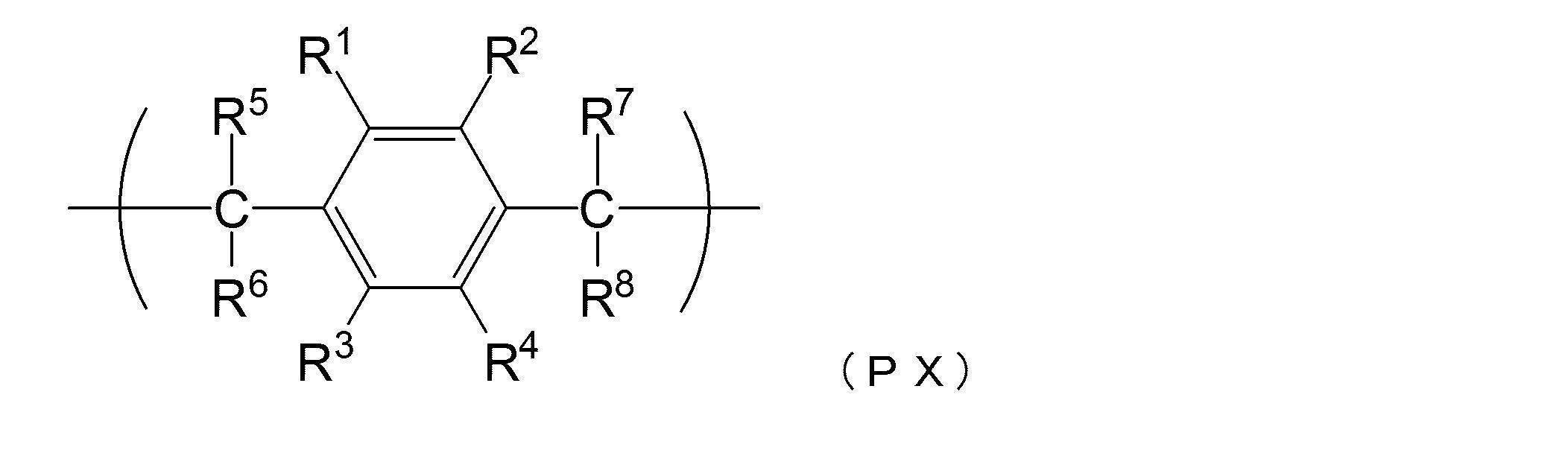
式(PX)中、R1~R8は、それぞれ独立に、水素原子、ハロゲン原子、炭素数1~100のアルキル基を表す。好ましいハロゲン原子やアルキル基については、第1の実施形態と同様である。
第1の保護層の厚さは、特に制限されないが、導電層現像時のマスクとしての機能性の観点から、好ましくは3nm以上、より好ましくは5nm以上、さらに好ましくは10nm以上である。また、第1の保護層の厚さは、エッチング時間の短縮やパターンの安定性の観点から、好ましくは3000nm以下、より好ましくは2000nm以下、さらに好ましくは1500nm以下である。
第1の保護層の形成方法は、材料に応じて、適宜、蒸着法(真空蒸着法、分子線エピタキシー法など)、スパッタリング法、およびイオンプレーティング法などの物理気相成長(PVD)法や、プラズマ重合法などの化学気相成長(CVD)法が使用できる。
<<<第2の保護層>>>
第2の保護層は、保護層のうち、第1の保護層よりも感光層側にある層である。第2の保護層は、本実施形態において、水およびフッ素系溶剤の少なくとも1種からなる溶剤によって、溶解することができる保護層である。具体的には、本実施形態において、上記溶剤に対する第2の保護層の23℃における溶解度が、1mg/溶剤100g以上である。これにより、保護層をエッチング後に、上記溶剤により第2の保護層を洗浄することができる。そして、このとき、保護層上に残存していた感光層を同時に除去することができ、製造プロセスの安定性が向上する。
第2の保護層は、保護層のうち、第1の保護層よりも感光層側にある層である。第2の保護層は、本実施形態において、水およびフッ素系溶剤の少なくとも1種からなる溶剤によって、溶解することができる保護層である。具体的には、本実施形態において、上記溶剤に対する第2の保護層の23℃における溶解度が、1mg/溶剤100g以上である。これにより、保護層をエッチング後に、上記溶剤により第2の保護層を洗浄することができる。そして、このとき、保護層上に残存していた感光層を同時に除去することができ、製造プロセスの安定性が向上する。
第2の保護層の23℃における溶解度は、充分に第2の保護層を洗浄する観点から、好ましくは3mg/溶剤100g以上、より好ましくは5mg/溶剤100g以上、特に好ましくは10mg/溶剤100g以上である。上限を設ける必要は特にないが、実際上、20mg/溶剤100g程度である。
第2の保護層の厚さは、特に制限されないが、溶剤を遮断する観点から、好ましくは100nm以上、より好ましくは150nm以上、さらに好ましくは200nm以上である。また、第2の保護層の厚さは、エッチング時間の短縮やパターンの安定性の観点から、好ましくは4000nm以下、より好ましくは3000nm以下、さらに好ましくは2500nm以下である。
第2の保護層の厚さに対する第1の保護層の厚さの比[第1の保護層の厚さ/第2の保護層の厚さ]は、好ましくは0.01以上、より好ましくは0.05以上、さらに好ましくは0.06以上であり、好ましくは10以下、より好ましくは3以下、さらに好ましくは2以下である。この比が、上記範囲内であれば、第2の保護層を除去した後の第1の保護層の厚さを均一に保つことができ、製造プロセスの安定性が向上するという利点がある。
本実施形態のような場合においても、感光層の厚さt2に対する感光層と保護層の合計の厚さt1の比t1/t2は、最終的なパターンの歪みやズレ、ムラなどを抑制し、パターンの形成性を向上させる観点から、好ましくは1.2以上、より好ましくは1.3以上、さらに好ましくは1.5以上であり、好ましくは50以下、より好ましくは40以下、さらに好ましくは20以下である。
[1]水溶性樹脂
第2の保護層は、特に、水溶性樹脂を含むことが好ましい。水溶性樹脂とは、23℃における水100gに対して樹脂の溶解量が1g以上である樹脂をいう。さらに、第2の保護層は、上記水溶性樹脂を50質量%以上含有することが好ましく、70質量%以上含有することが好ましく、90質量%以上含有することが好ましい。
第2の保護層は、特に、水溶性樹脂を含むことが好ましい。水溶性樹脂とは、23℃における水100gに対して樹脂の溶解量が1g以上である樹脂をいう。さらに、第2の保護層は、上記水溶性樹脂を50質量%以上含有することが好ましく、70質量%以上含有することが好ましく、90質量%以上含有することが好ましい。
水溶性樹脂を含む第2の保護層(「水溶性樹脂層」ともいう。)は、感光層形成用組成物の溶剤に対する溶解度合が1%以下であり、0.5%以下であることが好ましく、0.1%以下であることがより好ましく、0.01%以下であることがさらに好ましい。下限値は特にないが、0.05%以上であることが実際的である。
ここで、感光層形成用組成物の溶剤に対する「溶解度合」は、ウェハおよびガラス板などの基板上に、水溶性樹脂からなる膜を形成し、この測定対象となる膜の上に溶剤を滴下し、1分後に窒素ブローを行った後に100℃、60秒間乾燥し、その後、その膜厚を測定した場合における、初期膜厚からの減少率として表され、具体的には下記数式1によって算出される値である。
(初期膜厚-測定膜厚)/初期膜厚×100% (数式1)
ここで、初期膜厚とは、測定対象となる膜の試験前の厚さである。また、初期膜厚および測定膜厚は、基板面内の異なる5点での算術平均値とする。なお、2種以上溶剤を混合して用いるような場合は、その混合溶剤により試験した値を採用するものとする。
(初期膜厚-測定膜厚)/初期膜厚×100% (数式1)
ここで、初期膜厚とは、測定対象となる膜の試験前の厚さである。また、初期膜厚および測定膜厚は、基板面内の異なる5点での算術平均値とする。なお、2種以上溶剤を混合して用いるような場合は、その混合溶剤により試験した値を採用するものとする。
また、本発明においては、水溶性樹脂として、アルコール溶解性の樹脂も用いることができる。アルコール溶解性の樹脂としては、ポリビニルアセタールを挙げることができる。溶剤として利用できるアルコールとして、通常用いられるものを選定すればよいが、例えば、イソプロピルアルコールが挙げられる。アルコール溶解性樹脂とは、20℃におけるアルコール100gに対する溶解度が1g以上である樹脂をいい、5g以上である樹脂が好ましく、10g以上であることがより好ましい。上限はないが、20g以下であることが実際的である。なお、特に断らない限り、本発明においては、アルコール溶解性樹脂を水溶性樹脂に含めて定義することとする。
水溶性樹脂は、親水基を有する樹脂が好ましく、親水基としては、水酸基、カルボキシル基、アミド基およびイミド基が例示される。
水溶性樹脂としては、具体的には、ポリビニルピロリドン(PVP)、ポリビニルアルコール(PVA)、水溶性多糖類(水溶性のセルロース(メチルセルロース、ヒドロキシエチルセルロース、ヒドロキシプロピルセルロース、ヒドロキシエチルメチルセルロース、ヒドロキシプロピルメチルセルロース等)、プルランまたはプルラン誘導体、デンプン、ヒドロキシプロピルデンプン、カルボキシメチルデンプン、キトサン、シクロデキストリン)、ポリエチレンオキシド、ポリエチルオキサゾリン等を挙げることができ、PVPおよびPVAが好ましく、PVAがより好ましい。また、これらの中から、主鎖構造が相違する2種以上を選択して使用してもよく、共重合体として使用してもよい。
水溶性樹脂は、例えば、下記式(1)で表される構造を有するポリビニルアルコール、式(2)で表される構造を有するポリビニルピロリドン、式(3)で表される構造を有するセルロース、および式(4)で表される構造を有するプルランの少なくとも1種の樹脂であることが好ましい。

式中、Raは-(CH2CH2O)maH、-CH2COONa、または水素原子であり、maは1または2である。
水溶性樹脂については、国際公開第2016/175220号に記載の樹脂を引用し、本明細書に組み込まれる。
水溶性樹脂の重量平均分子量は特に限定されないが、10000以上であることが好ましく、20000以上であることがより好ましく、30000以上であることがさらに好ましい。上限としては、1000000以下であることが好ましく、600000以下であることがより好ましく、500000以下であることがさらに好ましい。分散度(重量平均分子量/数平均分子量)は、1.0~5.0が好ましく、2.0~4.0より好ましい。
水溶性樹脂層は、好ましくは、水溶性樹脂組成物から形成される。
水溶性樹脂組成物は、樹脂と溶剤を含むことが好ましい。さらに、本発明の趣旨を逸脱しない範囲で他の添加剤を含んでいてもよい。具体的には、後述する界面活性剤や遮光剤が例示される。
水溶性樹脂組成物における水溶性樹脂の含有量は必要に応じて適宜調節すればよいが、31質量%以下であることが好ましく、26質量%以下であることがより好ましく、20質量%以下であることがさらに好ましい。下限としては、0.5質量%以上であることが好ましく、1.0質量%以上であることがより好ましく、2.0質量%以上であることがさらに好ましい。
水溶性樹脂組成物は、水溶性樹脂を1種のみ含んでいてもよく、2種以上含んでいてもよい。2種以上含む場合、それらの合計量が上記範囲にあることが好ましい。
水溶性樹脂を溶解する溶剤は水であるが、アルコール等の水溶性溶剤との混合溶剤であってもよい。以下、このような水および水と相溶する有機溶剤の混合溶剤を水系溶剤と呼ぶことがある。さらに具体的には、20℃における水への溶解度が1g以上の有機溶剤と水との混合溶剤を水系溶剤と定義し、5g以上が好ましく、20g以上がより好ましい。
水溶性樹脂組成物における溶剤の含有量は、必要に応じて適宜調整すればよいが、99質量%以下であることが好ましく、95質量%以下であることがより好ましく、90質量%以下であることがさらに好ましい。下限としては、1質量%以上であることが好ましく、5質量%以上であることがより好ましく、10質量%以上であることがさらに好ましい。
水溶性樹脂組成物は、溶剤を1種のみ含んでいてもよく、2種以上含んでいてもよい。2種以上含む場合、それらの合計量が上記範囲にあることが好ましい。
水溶性樹脂層の厚さは、0.1μm以上であることが好ましく、0.5μm以上であることがより好ましく、1.0μm以上であることがさらに好ましく、2.0μm以上が一層好ましい。水溶性樹脂層の厚さの上限値としては、10μm以下が好ましく、5.0μm以下がより好ましく、3.0μm以下がさらに好ましい。
水溶性樹脂層は、例えば、上記水溶性樹脂組成物を第1の保護層の上に供給し、これを乾燥させることよって形成することができる。
水溶性樹脂組成物の固形分濃度は、0.5~30質量%であることが好ましく、1.0~20質量%であることがより好ましく、2.0~14質量%であることがさらに好ましい。固形分濃度を上記範囲とすることでより、水溶性樹脂組成物を均一に塗布することができる。
上記組成物の供給方法としては、塗布が好ましい。供給方法の例としては、スリットコート法、キャスト法、ブレードコーティング法、ワイヤーバーコーティング法、スプレーコーティング法、ディッピング(浸漬)コーティング法、ビードコーティング法、エアーナイフコーティング法、カーテンコーティング法、インクジェット法、スピンコート法、ラングミュア-ブロジェット(Langmuir-Blodgett)(LB)法などを挙げることができる。キャスト法、スピンコート法、およびインクジェット法を用いることがさらに好ましい。このようなプロセスにより、表面が平滑で大面積の水溶性樹脂層を低コストで生産することが可能となる。
水溶性樹脂組成物にはさらに塗布性を向上させるための界面活性剤を含有させることが好ましい。
界面活性剤としては、水溶性樹脂組成物の表面張力を低下させるものであれば、ノニオン系、アニオン系、両性フッ素系など、どのようなものでもかまわない。界面活性剤としては、例えば、ポリオキシエチレンラウリルエーテル、ポリオキシエチレンセチルエーテル、ポリオキシエチレンステアリルエーテル等のポリオキシエチレンアルキルエーテル類、ポリオキシエチレンオクチルフェニルエーテル、ポリオキシエチレンノニルフェニルエーテル等のポリオキシエチレンアルキルアリールエーテル類、ポリオキシエチレンステアレート等のポリオキシエチレンアルキルエステル類、ソルビタンモノラウレート、ソルビタンモノステアレート、ソルビタンジステアレート、ソルビタンモノオレエート、ソルビタンセスキオレエート、ソルビタントリオレエート等のソルビタンアルキルエステル類、グリセロールモノステアレート、グリセロールモノオレエート等のモノグリセリドアルキルエステル類等、フッ素あるいはケイ素を含有するオリゴマー等、アセチレングリコール、アセチレングリコールのエチレンオキシド付加物等の、ノニオン系界面活性剤;ドデシルベンゼンスルホン酸ナトリウム等のアルキルベンゼンスルホン酸塩類、ブチルナフタレンスルホン酸ナトリウム、ペンチルナフタレンスルホン酸ナトリウム、ヘキシルナフタレンスルホン酸ナトリウム、オクチルナフタレンスルホン酸ナトリウム等のアルキルナフタレンスルホン酸塩類、ラウリル硫酸ナトリウム等のアルキル硫酸塩類、ドデシルスルホン酸ナトリウム等のアルキルスルホン酸塩類、ジラウリルスルホコハク酸ナトリウム等のスルホコハク酸エステル塩類等の、アニオン系界面活性剤;ラウリルベタイン、ステアリルベタイン等のアルキルベタイン類、アミノ酸類等の、両性界面活性剤が使用可能であるが、特に好ましいのは、有機半導体の電気特性に影響を及ぼす金属イオンの含有量が少なく、かつ消泡性にも優れる、下記式(9)で示されるアセチレン骨格を有するノニオン系界面活性剤である。

式中、R91、R92はそれぞれ独立して、置換基を有してもよい炭素数3~15のアルキル基、置換基を有してもよい炭素数6~15の芳香族炭化水素基、または置換基を有してもよい炭素数4~15の複素芳香族環基を示す。ここで、置換基は、例えば、炭素数1~20のアルキル基、炭素数6~15の芳香族炭化水素基、炭素数7~17のアリールアルキル基、炭素数1~20のアルコキシル基、炭素数2~20のアルコキシカルボニル基、および、炭素数2~15のアシル基である。
水溶性樹脂組成物が界面活性剤を含む場合、界面活性剤の添加量は、固形分中、好ましくは0.05~20質量%、より好ましくは0.07~15質量%、さらに好ましくは0.1~10質量%の割合で含まれる量である。これらの界面活性剤は、1種のみを用いてもよいし、2種以上を用いてもよい。
[2]フッ素系溶剤に溶解する樹脂
また、第2の保護層は、フッ素系溶剤に溶解する樹脂を含んでもよい。フッ素系溶剤に溶解する樹脂とは、23℃におけるフッ素系溶剤100gに対して樹脂の溶解量が1g以上である樹脂をいう。さらに、第2の保護層は、上記樹脂を50質量%以上含有することが好ましく、70質量%以上含有することが好ましく、90質量%以上含有することが好ましい。
また、第2の保護層は、フッ素系溶剤に溶解する樹脂を含んでもよい。フッ素系溶剤に溶解する樹脂とは、23℃におけるフッ素系溶剤100gに対して樹脂の溶解量が1g以上である樹脂をいう。さらに、第2の保護層は、上記樹脂を50質量%以上含有することが好ましく、70質量%以上含有することが好ましく、90質量%以上含有することが好ましい。
フッ素系溶剤に溶解する樹脂を含む第2の保護層(「溶解性樹脂層(F)」ともいう。)は、感光層形成用組成物の溶剤に対する溶解度合が1%以下であり、0.5%以下であることが好ましく、0.1%以下であることがより好ましく、0.01%以下であることがさらに好ましい。下限値は特にないが、0.05%以上であることが実際的である。ここで、溶解度合の算出方法は、水溶性樹脂層の場合と同様である。
フッ素系溶剤に溶解する樹脂としては、例えば、保護層の液相成膜用の材料として説明したフッ素系ポリマーと同様の樹脂を使用できる。また、フッ素系溶剤も、例えば、保護層の液相成膜用のフッ素系ポリマーに使用できるフッ素系溶剤と同様の溶剤を使用できる。
溶解性樹脂層(F)は、フッ素系溶剤に溶解する樹脂とフッ素系溶剤を混合した組成物(溶解性樹脂組成物(F))を、第1の保護層の上に供給し、これを乾燥させることよって形成することができる。
溶解性樹脂組成物(F)の固形分濃度は、0.5~30質量%であることが好ましく、1.0~20質量%であることがより好ましく、2.0~14質量%であることがさらに好ましい。固形分濃度を上記範囲とすることでより均一に塗布することができる。上記組成物の供給方法は、塗布が好ましく、具体的な手法は、水溶性樹脂層の場合と同様である。
<他の実施形態>
本発明の積層体は、導電層および感光層の間に、保護層以外の他の層を含むこともできる。このような層としては、例えば、導電層と保護層の間または保護層と感光層の間の密着性を向上させるための密着層や、導電層表面を平坦化する平坦化層などが挙げられる。
本発明の積層体は、導電層および感光層の間に、保護層以外の他の層を含むこともできる。このような層としては、例えば、導電層と保護層の間または保護層と感光層の間の密着性を向上させるための密着層や、導電層表面を平坦化する平坦化層などが挙げられる。
このような他の層の材料は、例えば、SAMを形成可能なヘキサメチルジシラザン(HMDS)やシラン化合物(アルキルシランやアルコキシシラン)などである。特にフッ素系ポリマーを保護材料として用いる場合、導電層と保護層の良好な接着のために、このような層を用いることが好ましい。
他の層の形成方法は、例えば、スピンコートなどの液相成膜やCVDや真空蒸着のような気相成膜が可能である。他の層の厚さは、特に制限されず、用いられる電子デバイスの種類などにより異なるが、好ましくは1nm~2μm、より好ましくは1nm~1.5μm、さらに好ましくは1nm~700nmである。
<半導体デバイス>
本発明の有機半導体デバイスは、本発明の積層体を有する有機半導体デバイスである。本発明の積層体は、例えば、有機太陽電池、有機エレクトロルミネッセンスディスプレイ、有機光ディテクター、有機電界効果トランジスタ、有機電界発光素子、ガスセンサ、有機整流素子、有機インバータ、情報記録素子および有機アクチュエーター等の電子機器に応用できる。
本発明の有機半導体デバイスは、本発明の積層体を有する有機半導体デバイスである。本発明の積層体は、例えば、有機太陽電池、有機エレクトロルミネッセンスディスプレイ、有機光ディテクター、有機電界効果トランジスタ、有機電界発光素子、ガスセンサ、有機整流素子、有機インバータ、情報記録素子および有機アクチュエーター等の電子機器に応用できる。
<組成物のキット>
上記のとおり、本発明における保護層の形成に使用される上記組成物と、感光層の形成に使用される上記組成物とを組み合わせて使用することで、本発明の積層体を製造することができる。したがって、本発明における保護層の形成に使用される上記組成物と、感光層の形成に使用される上記組成物とを1つのキットとすることにより、本発明の積層体を製造する際の手間を軽減することができる。
上記のとおり、本発明における保護層の形成に使用される上記組成物と、感光層の形成に使用される上記組成物とを組み合わせて使用することで、本発明の積層体を製造することができる。したがって、本発明における保護層の形成に使用される上記組成物と、感光層の形成に使用される上記組成物とを1つのキットとすることにより、本発明の積層体を製造する際の手間を軽減することができる。
以下に実施例を挙げて本発明をさらに具体的に説明する。以下の実施例に示す材料、使用量、割合、処理内容、処理手順等は、本発明の趣旨を逸脱しない限り、適宜、変更することができる。したがって、本発明の範囲は以下に示す具体例に限定されるものではない。「部」、「%」は特に述べない限り、質量基準である。
<実施例1>
実施例1では、下記工程に基づき、有機半導体層上のウェットエッチングされた導電層の一部をソース電極とし、他の一部をドレイン電極とするトップコンタクト型の薄膜トランジスタ(TFT)を500個作製した。まず、熱酸化膜付導電性シリコン基板上に、有機半導体層、導電層、第1の保護層、第2の保護層および感光層を順次形成し、その後、感光層を露光および現像した。そして、現像された感光層をマスクとして第1の保護層および第2の保護層をドライエッチングし、第2の保護層を水で洗い流した。その後、エッチングされた第1の保護層をマスクとして導電層をウェットエッチングした。これにより、図2eに示すような積層体が作製された。各工程について、詳細は下記のとおりである。
実施例1では、下記工程に基づき、有機半導体層上のウェットエッチングされた導電層の一部をソース電極とし、他の一部をドレイン電極とするトップコンタクト型の薄膜トランジスタ(TFT)を500個作製した。まず、熱酸化膜付導電性シリコン基板上に、有機半導体層、導電層、第1の保護層、第2の保護層および感光層を順次形成し、その後、感光層を露光および現像した。そして、現像された感光層をマスクとして第1の保護層および第2の保護層をドライエッチングし、第2の保護層を水で洗い流した。その後、エッチングされた第1の保護層をマスクとして導電層をウェットエッチングした。これにより、図2eに示すような積層体が作製された。各工程について、詳細は下記のとおりである。
<<有機半導体層の形成工程>>
有機半導体として、チエノ[3,2-f:4,5-f’]ビス[1]ベンゾチオフェン(TBBT)を、電荷注入アクセプターとして2,3,5,6-テトラフルオロ-7,7,8,8-テトラシアノキノジメタン(F4-TCNQ)を使用した。真空蒸着法により、30nmのTBBT層および4nmのF4-TCNQ層を基板上に順に形成した。
有機半導体として、チエノ[3,2-f:4,5-f’]ビス[1]ベンゾチオフェン(TBBT)を、電荷注入アクセプターとして2,3,5,6-テトラフルオロ-7,7,8,8-テトラシアノキノジメタン(F4-TCNQ)を使用した。真空蒸着法により、30nmのTBBT層および4nmのF4-TCNQ層を基板上に順に形成した。
<<導電層の形成工程>>
導電性材料として、金(Au)を使用した。導電層の厚さは50nmである。導電層の形成は、真空蒸着法により行った。
導電性材料として、金(Au)を使用した。導電層の厚さは50nmである。導電層の形成は、真空蒸着法により行った。
<<第1の保護層の形成工程>>
第1の保護層の材料として、下記構造を有するポリパラキシリレン(PPX)を使用した。第1の保護層の厚さは700nmである。第1の保護層はCVD法により形成した。
第1の保護層の材料として、下記構造を有するポリパラキシリレン(PPX)を使用した。第1の保護層の厚さは700nmである。第1の保護層はCVD法により形成した。

<<第2の保護層の形成工程>>
第2の保護層の材料として、水溶性樹脂であるポリビニルアルコール(PVA)を使用した。第2の保護層の乾燥時の厚さは1500nmである。第2の保護層は、下記方法により作製した塗布液をスピンコート法により第1の保護層上に塗布し、75℃のホットプレートで90秒間加熱乾燥することにより、形成された。
塗布液の作製方法
容量1000mLの三口フラスコに超純水700gおよび撹拌子を入れ、還流管および温度計を接続した後、磁気撹拌機で撹拌しながら液温が95℃になるようマントルヒーターでフラスコを加熱した。ポリビニルアルコール(PVA-203、クラレ社製)を150.24gフラスコに加え、温度を95℃に維持したまま60分間撹拌を継続した。ポリビニルアルコールが水に十分に溶解したのを目視で確認した後、撹拌を継続しながら液温が室温になるまでフラスコを放冷した。さらに、界面活性剤(アセチレノールE00、川研ファインケミカル社製)を0.76gフラスコに加え、その後、液の総重量が1000gとなるようにフラスコに超純水を加え、室温で再度撹拌した。次いで、3M ZetaPlus EC8PI-150GN デプスフィルター(0.8μm相当)を用いて、ろ過することで第2の保護層形成用の塗布液を得た。
第2の保護層の材料として、水溶性樹脂であるポリビニルアルコール(PVA)を使用した。第2の保護層の乾燥時の厚さは1500nmである。第2の保護層は、下記方法により作製した塗布液をスピンコート法により第1の保護層上に塗布し、75℃のホットプレートで90秒間加熱乾燥することにより、形成された。
塗布液の作製方法
容量1000mLの三口フラスコに超純水700gおよび撹拌子を入れ、還流管および温度計を接続した後、磁気撹拌機で撹拌しながら液温が95℃になるようマントルヒーターでフラスコを加熱した。ポリビニルアルコール(PVA-203、クラレ社製)を150.24gフラスコに加え、温度を95℃に維持したまま60分間撹拌を継続した。ポリビニルアルコールが水に十分に溶解したのを目視で確認した後、撹拌を継続しながら液温が室温になるまでフラスコを放冷した。さらに、界面活性剤(アセチレノールE00、川研ファインケミカル社製)を0.76gフラスコに加え、その後、液の総重量が1000gとなるようにフラスコに超純水を加え、室温で再度撹拌した。次いで、3M ZetaPlus EC8PI-150GN デプスフィルター(0.8μm相当)を用いて、ろ過することで第2の保護層形成用の塗布液を得た。
<<感光層の形成工程>>
感光層形成用組成物として、下記の組成物を使用した。感光層の乾燥時の厚さは700nmである。したがって、感光層の厚さt2に対する感光層と保護層の合計の厚さt1の比t1/t2は1.3である。感光層の形成方法は次のとおりである。
感光層形成用組成物
・下記に示す方法で合成した感光性樹脂 29.25%
・光酸発生剤(下記の化合物X、ダイトーケミックス社製) 0.60%
・塩基性化合物(下記の化合物Y、DSP五協フード&ケミカル社製)
0.06%
・界面活性剤(製造元:OMNOVA社製、品番:PF-6320)
0.09%
・有機溶剤(プロピレングリコールモノメチルエーテルアセテート)
70.00%
感光層形成用組成物として、下記の組成物を使用した。感光層の乾燥時の厚さは700nmである。したがって、感光層の厚さt2に対する感光層と保護層の合計の厚さt1の比t1/t2は1.3である。感光層の形成方法は次のとおりである。
感光層形成用組成物
・下記に示す方法で合成した感光性樹脂 29.25%
・光酸発生剤(下記の化合物X、ダイトーケミックス社製) 0.60%
・塩基性化合物(下記の化合物Y、DSP五協フード&ケミカル社製)
0.06%
・界面活性剤(製造元:OMNOVA社製、品番:PF-6320)
0.09%
・有機溶剤(プロピレングリコールモノメチルエーテルアセテート)
70.00%
感光性樹脂の合成方法
窒素導入管および冷却管を取り付けた200mL三口フラスコにPGMEA(32.62g)を入れ、86℃に昇温した。ここに、BzMA(ベンジルメタクリレート)(16.65g)、THFAA(テトラヒドロフラン-2-イル アクリレート)(19.19g)、t-BuMA(t-ブチルメタクリレート)(5.76g)、およびV-601(ジメチル 2,2’-アゾビス(2-メチルプロピオネート)(富士フイルム和光純薬社製))(0.8082g、モノマーに対して1.30モル%)をPGMEA(32.62g)に溶解したものを2時間かけて滴下した。その後、反応液を2時間撹拌し、反応を終了させた。反応液をヘプタン中に再沈することで生じた白色粉体をろ過により回収することで、感光性樹脂を得た。重量平均分子量(Mw)は30000であった。
窒素導入管および冷却管を取り付けた200mL三口フラスコにPGMEA(32.62g)を入れ、86℃に昇温した。ここに、BzMA(ベンジルメタクリレート)(16.65g)、THFAA(テトラヒドロフラン-2-イル アクリレート)(19.19g)、t-BuMA(t-ブチルメタクリレート)(5.76g)、およびV-601(ジメチル 2,2’-アゾビス(2-メチルプロピオネート)(富士フイルム和光純薬社製))(0.8082g、モノマーに対して1.30モル%)をPGMEA(32.62g)に溶解したものを2時間かけて滴下した。その後、反応液を2時間撹拌し、反応を終了させた。反応液をヘプタン中に再沈することで生じた白色粉体をろ過により回収することで、感光性樹脂を得た。重量平均分子量(Mw)は30000であった。
光酸発生剤(化合物X)
化合物Xは、下記式OS-107においてR11=トリル基およびR18=メチル基を満たす化合物である。
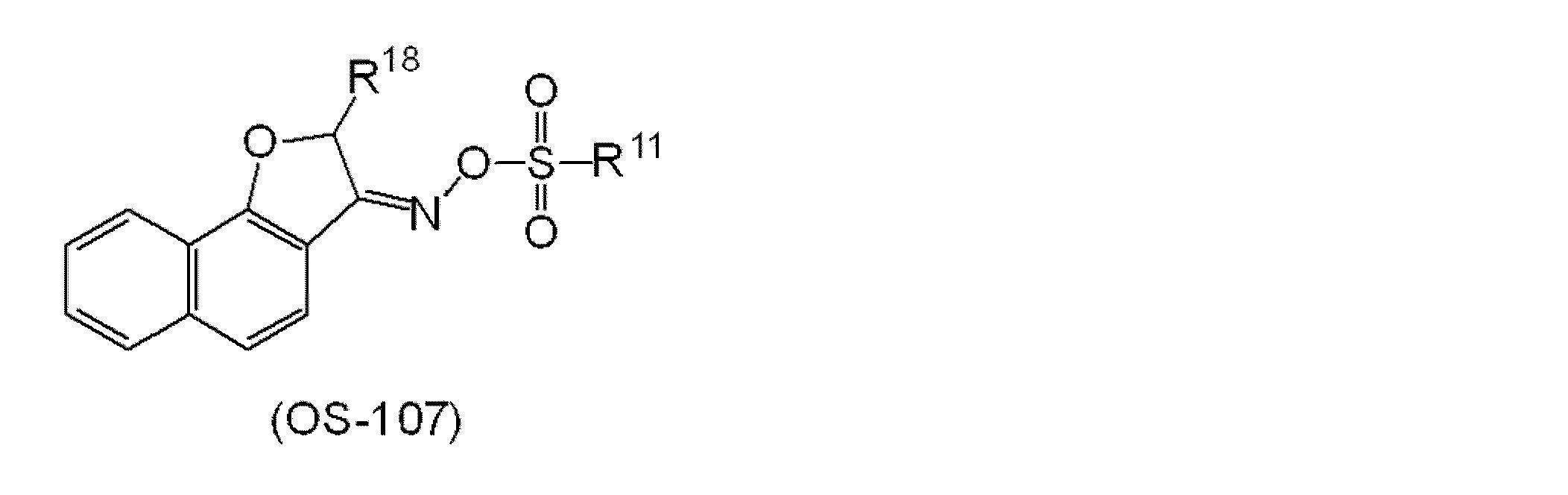
化合物Xは、下記式OS-107においてR11=トリル基およびR18=メチル基を満たす化合物である。
塩基性化合物(化合物Y)
化合物Yは、下記式で示されるチオ尿素誘導体である。

化合物Yは、下記式で示されるチオ尿素誘導体である。
感光層の形成方法
感光層形成用組成物をスピンコーター(2000rpm、30sec)により塗布した後、75℃で60秒間ベークした。
感光層形成用組成物をスピンコーター(2000rpm、30sec)により塗布した後、75℃で60秒間ベークした。
<<感光層の露光・現像工程>>
感光層の露光および現像の条件は、下記のとおりである。
・装置:NSR2005i9C(ニコン社製)
・露光波長:i線
・露光量:500mJ/cm2
・ポストベーク:75℃、30秒
・現像液:酢酸ブチル
・現像時間:30秒
感光層の露光および現像の条件は、下記のとおりである。
・装置:NSR2005i9C(ニコン社製)
・露光波長:i線
・露光量:500mJ/cm2
・ポストベーク:75℃、30秒
・現像液:酢酸ブチル
・現像時間:30秒
<<第1および第2の保護層のエッチング工程>>
下記の条件で第1および第2の保護層のドライエッチングを行った。
・エッチングガス:CF4(流量200ml/min)、Ar(流量800ml/min)、O2(流量50ml/min)
・ソースパワー:800W
・ウェハバイアス:600W
・アンテナバイアス:100W
・ESC電圧:400V
・時間:60sec
下記の条件で第1および第2の保護層のドライエッチングを行った。
・エッチングガス:CF4(流量200ml/min)、Ar(流量800ml/min)、O2(流量50ml/min)
・ソースパワー:800W
・ウェハバイアス:600W
・アンテナバイアス:100W
・ESC電圧:400V
・時間:60sec
<<第2の保護層の水洗工程>>
第2の保護層の水洗は、純水に30秒間浸漬することにより行った。
第2の保護層の水洗は、純水に30秒間浸漬することにより行った。
<<導電層のウェットエッチング工程>>
導電層のウェットエッチング条件は、下記のとおりである。
・エッチャント:TFA
・浸漬時間:30秒
導電層のウェットエッチング条件は、下記のとおりである。
・エッチャント:TFA
・浸漬時間:30秒
<実施例2>
実施例2では、実施例1における第1の保護層の形成工程に替えて、下記に示す第1の保護層の形成工程を実施した。実施例2は、それ以外の点では、実施例1と同様である。すなわち、実施例2は、第1の保護層の点で、実施例1と異なる。
実施例2では、実施例1における第1の保護層の形成工程に替えて、下記に示す第1の保護層の形成工程を実施した。実施例2は、それ以外の点では、実施例1と同様である。すなわち、実施例2は、第1の保護層の点で、実施例1と異なる。
<<第1の保護層の形成工程>>
第1の保護層の材料として、PVAおよび架橋剤を使用した。第1の保護層の乾燥時の厚さは1000nmである。第1の保護層の形成方法は次のとおりである。まず、下記成分を下記割合で混合して塗布液を作製した。そして、スピンコートによりこの塗布液を導電層上に塗布し、100℃のホットプレートで300秒間加熱乾燥して、第1の保護層を形成した。
・超純水(自社精製品) 92.90%
・PVA(PVA-203,クラレ社製) 5.00%
・架橋剤(VS-C,自社製) 2.00%
・光重合開始剤(V-501,富士フイルム和光純薬社製) 0.05%
・界面活性剤(アセチレノールE00,川研ファインケミカル社製)
0.05%
第1の保護層の材料として、PVAおよび架橋剤を使用した。第1の保護層の乾燥時の厚さは1000nmである。第1の保護層の形成方法は次のとおりである。まず、下記成分を下記割合で混合して塗布液を作製した。そして、スピンコートによりこの塗布液を導電層上に塗布し、100℃のホットプレートで300秒間加熱乾燥して、第1の保護層を形成した。
・超純水(自社精製品) 92.90%
・PVA(PVA-203,クラレ社製) 5.00%
・架橋剤(VS-C,自社製) 2.00%
・光重合開始剤(V-501,富士フイルム和光純薬社製) 0.05%
・界面活性剤(アセチレノールE00,川研ファインケミカル社製)
0.05%
<実施例3>
実施例3は、実施例1と比較して、第2の保護層の形成工程を実施せず、第1の保護層の上に直接感光層を形成した点で異なる。実施例3は、それ以外の点では、実施例1と同様である。すなわち、実施例3における積層体の作製工程は、次のとおりである。まず、熱酸化膜付導電性シリコン基板上に、有機半導体層、導電層、第1の保護層および感光層を順次形成し、その後、感光層を露光および現像した。そして、現像された感光層をマスクとして第1の保護層をドライエッチングした。その後、エッチングされた第1の保護層をマスクとして導電層をウェットエッチングした。これにより、図1dに示すような積層体が作製された。
実施例3は、実施例1と比較して、第2の保護層の形成工程を実施せず、第1の保護層の上に直接感光層を形成した点で異なる。実施例3は、それ以外の点では、実施例1と同様である。すなわち、実施例3における積層体の作製工程は、次のとおりである。まず、熱酸化膜付導電性シリコン基板上に、有機半導体層、導電層、第1の保護層および感光層を順次形成し、その後、感光層を露光および現像した。そして、現像された感光層をマスクとして第1の保護層をドライエッチングした。その後、エッチングされた第1の保護層をマスクとして導電層をウェットエッチングした。これにより、図1dに示すような積層体が作製された。
<実施例4>
実施例4は、実施例3と比較して、第1の保護層の厚さが100nmに変更され、感光層の厚さが550nmに変更された点で異なる。実施例4は、それ以外の点では、実施例3と同様である。
実施例4は、実施例3と比較して、第1の保護層の厚さが100nmに変更され、感光層の厚さが550nmに変更された点で異なる。実施例4は、それ以外の点では、実施例3と同様である。
<実施例5~8>
実施例5~8では、実施例1に対して、比t1/t2の値を、表2のとおりそれぞれ変更した。実施例5~8は、それ以外の点では、実施例1と同様である。
実施例5~8では、実施例1に対して、比t1/t2の値を、表2のとおりそれぞれ変更した。実施例5~8は、それ以外の点では、実施例1と同様である。
<実施例9~11>
実施例9~11では、実施例1と比較して、第1の保護層が、表2のとおりそれぞれ変更された。第1の保護層の形成工程において、SiN層はプラズマ増強CVD(PECVD)法により形成し、SiO2層はPECVD法により形成し、Mo層はスパッタリング法により形成した。実施例9~11はそれぞれ、それら以外の点では、実施例1と同様である。
実施例9~11では、実施例1と比較して、第1の保護層が、表2のとおりそれぞれ変更された。第1の保護層の形成工程において、SiN層はプラズマ増強CVD(PECVD)法により形成し、SiO2層はPECVD法により形成し、Mo層はスパッタリング法により形成した。実施例9~11はそれぞれ、それら以外の点では、実施例1と同様である。
<実施例12~15>
実施例12~15では、実施例1と比較して、第2の保護層の材料が、表2のとおりそれぞれ変更された。各材料について、第2の保護層の形成工程は、下記のとおりである。実施例12~15はそれぞれ、それら以外の点では、実施例1と同様である。
実施例12~15では、実施例1と比較して、第2の保護層の材料が、表2のとおりそれぞれ変更された。各材料について、第2の保護層の形成工程は、下記のとおりである。実施例12~15はそれぞれ、それら以外の点では、実施例1と同様である。
<<第2の保護層の形成工程>>
第2の保護層の材料として、それぞれ、水溶性樹脂であるポリビニルピロリドン(PVP)(ポリビニルピロリドンK90,東京化成社製,平均分子量360000)、セルロース(メトローズSM-4,信越化学社製,平均分子量25000)、プルラン(プルラン,林原社製,平均分子量420000)、および、水溶性フェノール樹脂(GA-1364、DIC社製)を使用した。各材料について、第2の保護層の乾燥時の厚さは1500nmである。第2の保護層の形成方法は次のとおりである。まず、下記成分を下記割合で混合して塗布液を作製した。そして、スピンコートによりこの塗布液を第1の保護層上に塗布し、75℃のホットプレートで90秒間加熱乾燥して、第2の保護層を形成した。
・超純水(自社精製品) 84.900%
・上記の水溶性樹脂 15.024%
・界面活性剤(アセチレノールE00,川研ファインケミカル社製)
0.076%
第2の保護層の材料として、それぞれ、水溶性樹脂であるポリビニルピロリドン(PVP)(ポリビニルピロリドンK90,東京化成社製,平均分子量360000)、セルロース(メトローズSM-4,信越化学社製,平均分子量25000)、プルラン(プルラン,林原社製,平均分子量420000)、および、水溶性フェノール樹脂(GA-1364、DIC社製)を使用した。各材料について、第2の保護層の乾燥時の厚さは1500nmである。第2の保護層の形成方法は次のとおりである。まず、下記成分を下記割合で混合して塗布液を作製した。そして、スピンコートによりこの塗布液を第1の保護層上に塗布し、75℃のホットプレートで90秒間加熱乾燥して、第2の保護層を形成した。
・超純水(自社精製品) 84.900%
・上記の水溶性樹脂 15.024%
・界面活性剤(アセチレノールE00,川研ファインケミカル社製)
0.076%
<実施例16>
実施例16では、実施例1と比較して、有機半導体の材料が変更された。有機半導体層の形成工程は、下記のとおりである。実施例16は、それ以外の点では、実施例1と同様である。
実施例16では、実施例1と比較して、有機半導体の材料が変更された。有機半導体層の形成工程は、下記のとおりである。実施例16は、それ以外の点では、実施例1と同様である。
<<有機半導体層の形成工程>>
有機半導体として、TBBTに替えて、C8-[1]ベンゾチエノ[3,2-b]ベンゾチオフェン(C8-BTBT)を使用した。つまり、30nmのC8-BTBT層および4nmのF4-TCNQ層を真空蒸着法により基板上に順に形成した。
有機半導体として、TBBTに替えて、C8-[1]ベンゾチエノ[3,2-b]ベンゾチオフェン(C8-BTBT)を使用した。つまり、30nmのC8-BTBT層および4nmのF4-TCNQ層を真空蒸着法により基板上に順に形成した。
<実施例17>
実施例17では、実施例1と比較して、導電層の材料が変更された。導電層の形成工程およびウェットエッチング工程は、下記のとおりである。実施例17は、それ以外の点では、実施例1と同様である。
実施例17では、実施例1と比較して、導電層の材料が変更された。導電層の形成工程およびウェットエッチング工程は、下記のとおりである。実施例17は、それ以外の点では、実施例1と同様である。
<<導電層の形成工程>>
導電性材料として、銅(Cu)を使用した。導電層の厚さは50nmである。導電層の形成は、真空蒸着法により行った。
導電性材料として、銅(Cu)を使用した。導電層の厚さは50nmである。導電層の形成は、真空蒸着法により行った。
<<導電層のウェットエッチング工程>>
導電層のウェットエッチング条件は、下記のとおりである。
・エッチャント:PWES
・浸漬時間:15秒
導電層のウェットエッチング条件は、下記のとおりである。
・エッチャント:PWES
・浸漬時間:15秒
<実施例18>
実施例18では、実施例1と比較して、熱酸化膜付導電性シリコン基板に替えて、下部電極付基板を使用し、有機半導体層を変更し、導電層としてアルミニウム(Al)を使用し、有機半導体層上のウェットエッチングされた導電層を電極とする発光ダイオード(LED)を作製した。有機半導体層の形成工程、導電層の形成工程およびウェットエッチング工程は、下記のとおりである。実施例18は、それ以外の点では、実施例1と同様である。
実施例18では、実施例1と比較して、熱酸化膜付導電性シリコン基板に替えて、下部電極付基板を使用し、有機半導体層を変更し、導電層としてアルミニウム(Al)を使用し、有機半導体層上のウェットエッチングされた導電層を電極とする発光ダイオード(LED)を作製した。有機半導体層の形成工程、導電層の形成工程およびウェットエッチング工程は、下記のとおりである。実施例18は、それ以外の点では、実施例1と同様である。
<<有機半導体層の形成工程>>
下記のとおり、ITO電極付基板上に、積層有機半導体層を形成し、その後、Li2O電子注入層(厚さ1.5nm)を形成した。
ITO電極付基板/NPB(厚さ25nm)/CBPとIr(ppy)3の混合層(Ir(ppy)3の混合割合:8.6質量%、混合層の厚さ:35nm)/BCP(厚さ10nm)/Alq3(厚さ40nm)/Li2O
・NPB:N,N’-ジ-[(1-ナフチル)-N,N’-ジフェニル]-1,1’-ビフェニル)-4,4’-ジアミン
・CBP:4,4’-ビス(N-カルバゾリル)-1,1’-ビフェニル
・Ir(ppy)3:トリス[2-フェニルピリジナート-C2,N]イリジウム(III)
・BCP:バソクプロイン
・Alq3:トリス(8-ヒドロキシキノリン)アルミニウム
下記のとおり、ITO電極付基板上に、積層有機半導体層を形成し、その後、Li2O電子注入層(厚さ1.5nm)を形成した。
ITO電極付基板/NPB(厚さ25nm)/CBPとIr(ppy)3の混合層(Ir(ppy)3の混合割合:8.6質量%、混合層の厚さ:35nm)/BCP(厚さ10nm)/Alq3(厚さ40nm)/Li2O
・NPB:N,N’-ジ-[(1-ナフチル)-N,N’-ジフェニル]-1,1’-ビフェニル)-4,4’-ジアミン
・CBP:4,4’-ビス(N-カルバゾリル)-1,1’-ビフェニル
・Ir(ppy)3:トリス[2-フェニルピリジナート-C2,N]イリジウム(III)
・BCP:バソクプロイン
・Alq3:トリス(8-ヒドロキシキノリン)アルミニウム
<<導電層の形成工程>>
導電性材料として、アルミニウムを使用した。導電層の厚さは100nmである。導電層の形成は、真空蒸着法により行った。
導電性材料として、アルミニウムを使用した。導電層の厚さは100nmである。導電層の形成は、真空蒸着法により行った。
<<導電層のウェットエッチング工程>>
導電層のウェットエッチング条件は、下記のとおりである。
・エッチャント:Al etching
・浸漬時間:60秒
導電層のウェットエッチング条件は、下記のとおりである。
・エッチャント:Al etching
・浸漬時間:60秒
<実施例19>
実施例19では、実施例18と比較して、有機半導体層、導電層を変更して光ディテクター(PD)を作製した。有機半導体層の形成工程、導電層の形成工程およびウェットエッチング工程は下記のとおりである。実施例19は、それ以外の点では、実施例18と同様である。
<<有機半導体層の形成工程>>
以下の組成からなる有機半導体塗布液をスピンコートし、130℃で10分乾燥させることで有機半導体膜を成膜した。膜厚は150nmであった。
有機半導体塗布液の組成
・P3HT(シグマ アルドリッチ ジャパン合同会社製) 10質量%
・PCBM(シグマ アルドリッチ ジャパン合同会社製) 10質量%
・クロロホルム(富士フイルム和光純薬社製) 80質量%
実施例19では、実施例18と比較して、有機半導体層、導電層を変更して光ディテクター(PD)を作製した。有機半導体層の形成工程、導電層の形成工程およびウェットエッチング工程は下記のとおりである。実施例19は、それ以外の点では、実施例18と同様である。
<<有機半導体層の形成工程>>
以下の組成からなる有機半導体塗布液をスピンコートし、130℃で10分乾燥させることで有機半導体膜を成膜した。膜厚は150nmであった。
有機半導体塗布液の組成
・P3HT(シグマ アルドリッチ ジャパン合同会社製) 10質量%
・PCBM(シグマ アルドリッチ ジャパン合同会社製) 10質量%
・クロロホルム(富士フイルム和光純薬社製) 80質量%
<<導電層の形成工程>>
導電性材料として、ITO(インジウム酸化スズ)を使用した。導電層の厚さは50nmである。導電層の形成は、スパッタリング法により行った。
導電性材料として、ITO(インジウム酸化スズ)を使用した。導電層の厚さは50nmである。導電層の形成は、スパッタリング法により行った。
<<導電層のウェットエッチング工程>>
導電層のウェットエッチング条件は、下記のとおりである。
・エッチャント:ITO etchant TE-100
・浸漬時間:30秒
導電層のウェットエッチング条件は、下記のとおりである。
・エッチャント:ITO etchant TE-100
・浸漬時間:30秒
<比較例1>
比較例1では、実施例1と比較して、第1の保護層および第2の保護層の形成工程を実施しなかった。比較例1は、それ以外の点では、実施例1と同様である。すなわち、比較例1における積層体の作製工程は、次のとおりである。まず、熱酸化膜付導電性シリコン基板上に、実施例1で形成した有機半導体層、導電層および感光層とそれぞれ同様の有機半導体層、導電層および感光層を順次形成し、その後、感光層を露光および現像した。そして、現像された感光層をマスクとして導電層をウェットエッチングし500個のTFTを基板上に形成した。
比較例1では、実施例1と比較して、第1の保護層および第2の保護層の形成工程を実施しなかった。比較例1は、それ以外の点では、実施例1と同様である。すなわち、比較例1における積層体の作製工程は、次のとおりである。まず、熱酸化膜付導電性シリコン基板上に、実施例1で形成した有機半導体層、導電層および感光層とそれぞれ同様の有機半導体層、導電層および感光層を順次形成し、その後、感光層を露光および現像した。そして、現像された感光層をマスクとして導電層をウェットエッチングし500個のTFTを基板上に形成した。
<評価>
導電層のパターン形成性、有機層への影響、感光層の残渣、およびデバイス特性の4つの項目について、評価を行った。各項目の評価方法は、下記のとおりである。
導電層のパターン形成性、有機層への影響、感光層の残渣、およびデバイス特性の4つの項目について、評価を行った。各項目の評価方法は、下記のとおりである。
<<導電層のパターン形成性>>
導電層のパターン形成性は、光学顕微鏡(BX60、オリンパス社製)を用いて、ウェットエッチング後の導電層を観察し、導電層のパターン形状にムラが存在するか否かに基づいて評価した。
A:95%以上のTFTが所望のTFT形状であった。
B:80%以上95%未満のTFTが所望のTFT形状であった。
C:所望のTFT形状が得られたTFTが80%未満であった。
導電層のパターン形成性は、光学顕微鏡(BX60、オリンパス社製)を用いて、ウェットエッチング後の導電層を観察し、導電層のパターン形状にムラが存在するか否かに基づいて評価した。
A:95%以上のTFTが所望のTFT形状であった。
B:80%以上95%未満のTFTが所望のTFT形状であった。
C:所望のTFT形状が得られたTFTが80%未満であった。
<<有機層への影響>>
有機層への影響は、AFM(Dimension Edge,Bruker社製)を用いて、ウェットエッチング後の有機半導体層を観察し、有機半導体層中にクラック(長さ0.2μm以上の亀裂)が存在するか否かに基づいて評価した。クラック数は、5か所を観察した平均値である。
A:10×10μmの観測範囲内においてクラック数が5個以下であった。
B:10×10μmの観測範囲内においてクラック数が5個超20個以下であった。
C:10×10μmの観測範囲内においてクラック数が20個超であった。
有機層への影響は、AFM(Dimension Edge,Bruker社製)を用いて、ウェットエッチング後の有機半導体層を観察し、有機半導体層中にクラック(長さ0.2μm以上の亀裂)が存在するか否かに基づいて評価した。クラック数は、5か所を観察した平均値である。
A:10×10μmの観測範囲内においてクラック数が5個以下であった。
B:10×10μmの観測範囲内においてクラック数が5個超20個以下であった。
C:10×10μmの観測範囲内においてクラック数が20個超であった。
<<感光層の残渣>>
感光層の残渣は、第2の保護層がある場合には、第2の保護層の水洗後の積層体を観察し、第2の保護層がない場合には、現像後の感光層をマスクとしたエッチング後の積層体を観察し、保護層上に感光層の残渣が存在するか否かに基づいて評価した。観察には、触針膜厚計(DektakXT、Bruker社製)を用いた。
A:残渣が見られたTFT数が1%以下であった。
B:残渣が見られたTFT数が1超10%以下であった。
C:残渣が見られたTFT数が10%超であった。
感光層の残渣は、第2の保護層がある場合には、第2の保護層の水洗後の積層体を観察し、第2の保護層がない場合には、現像後の感光層をマスクとしたエッチング後の積層体を観察し、保護層上に感光層の残渣が存在するか否かに基づいて評価した。観察には、触針膜厚計(DektakXT、Bruker社製)を用いた。
A:残渣が見られたTFT数が1%以下であった。
B:残渣が見られたTFT数が1超10%以下であった。
C:残渣が見られたTFT数が10%超であった。
<<デバイス特性>>
デバイス特性は、TFTタイプの実施例および比較例のそれぞれについて、複数個所でキャリア移動度を測定し、その測定値の平均値および場所ごとのばらつきの結果に基づいて総合的に評価した。キャリア移動度の測定は、半導体パラメーターアナライザー(Agilent製、4156C)を用いて、常圧・大気下で行った。
A:平均移動度が1.0cm2/Vs以上であった。
B:平均移動度が0.3cm2/Vs以上1.0cm2/Vs未満であった。
C:平均移動度が0.3cm2/Vs未満であった。
デバイス特性は、TFTタイプの実施例および比較例のそれぞれについて、複数個所でキャリア移動度を測定し、その測定値の平均値および場所ごとのばらつきの結果に基づいて総合的に評価した。キャリア移動度の測定は、半導体パラメーターアナライザー(Agilent製、4156C)を用いて、常圧・大気下で行った。
A:平均移動度が1.0cm2/Vs以上であった。
B:平均移動度が0.3cm2/Vs以上1.0cm2/Vs未満であった。
C:平均移動度が0.3cm2/Vs未満であった。
実施例および比較例それぞれの層構成を表2に示す。また、実施例および比較例それぞれの評価結果を表3に示す。表3に示すとおり、本発明の実施例1~19では、導電層が有機層に隣接していても、溶剤による有機層への悪影響を抑えつつ、導電層への微細なパターン形成が可能になることがわかった。さらに、保護層が水溶性の第2の保護層を有することで、感光層の残渣をより低減でき、プロセスの安定性向上に寄与することもわかった(実施例1~2,5~8と実施例3~4との比較による)。
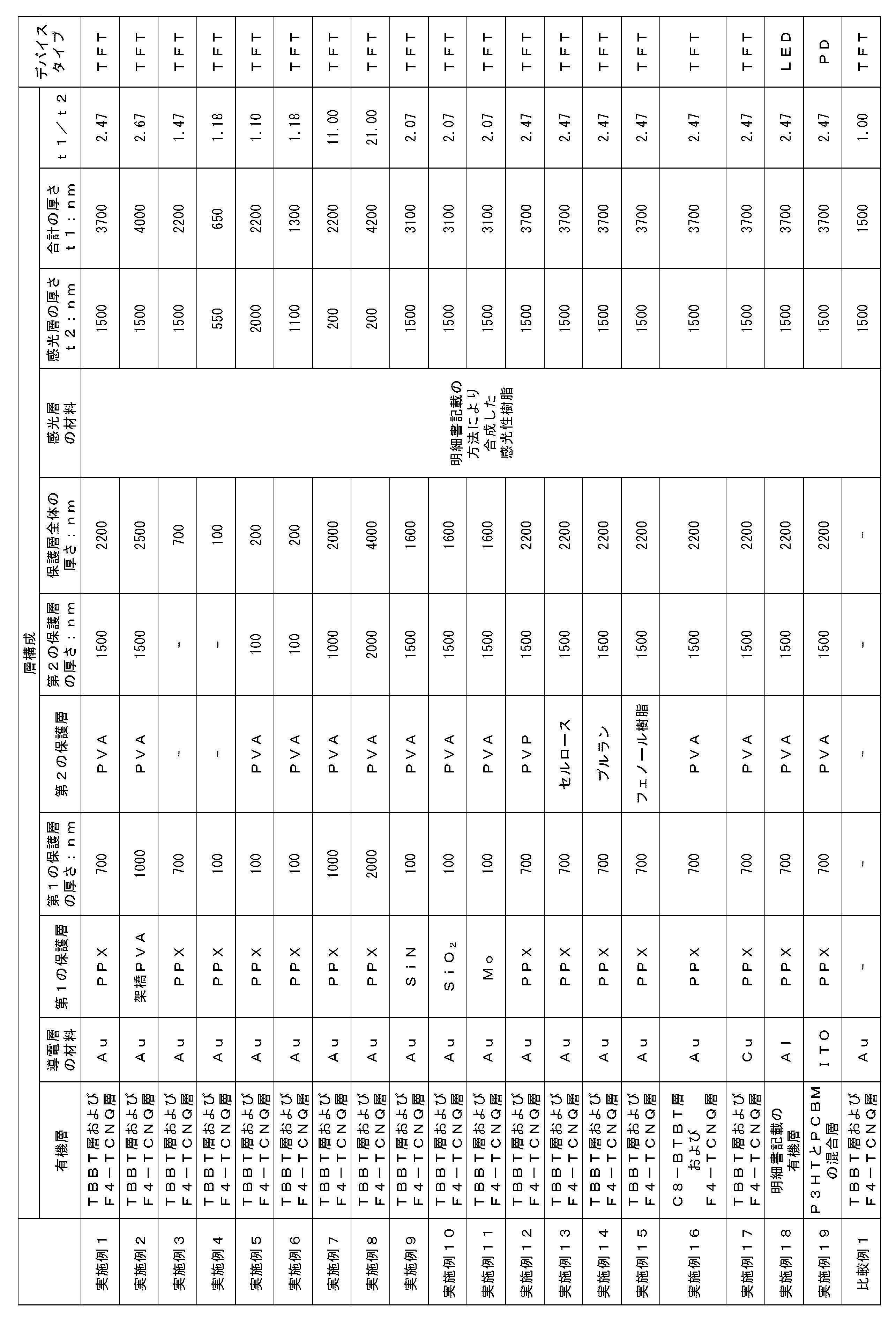
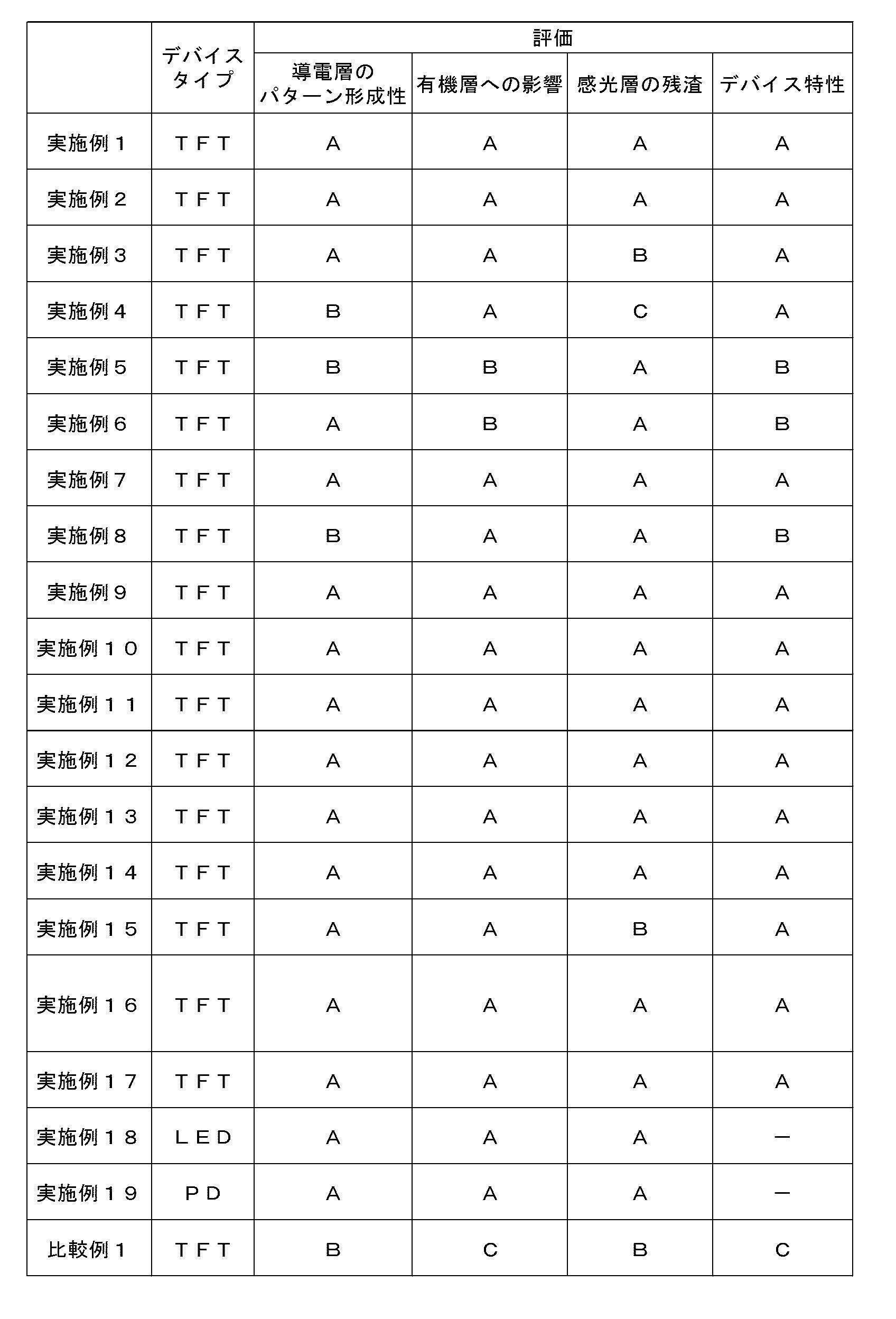
1 第1の積層体
2 第2の積層体
10,20 基材
12,22 有機層
14,24 導電層
16 保護層
18,28 感光層
26 第1の保護層
27 第2の保護層
2 第2の積層体
10,20 基材
12,22 有機層
14,24 導電層
16 保護層
18,28 感光層
26 第1の保護層
27 第2の保護層
Claims (22)
- 基材、有機層、導電層、前記導電層の表面を保護する保護層、および感光層をこの順に有し、
前記導電層が、前記有機層に接し、かつ、ウェットエッチングされる対象であり、
前記感光層の現像液に対する溶解速度が、光および放射線の少なくとも一方の作用により変化する、積層体。 - 前記保護層が前記導電層に接する、
請求項1に記載の積層体。 - 前記感光層の厚さt2に対する前記感光層と前記保護層の合計の厚さt1の比t1/t2が1.2以上である、
請求項1または2に記載の積層体。 - 23℃の水に対する前記保護層の溶解速度が1nm/s以下である、
請求項1~3のいずれか1項に記載の積層体。 - 前記保護層が、下記式(PX)で表される構造を有するポリパラキシリレン誘導体、前記導電層とは異なる窒化物、酸化物、金属からなる群の少なくとも1種を含む、
請求項1~4のいずれか1項に記載の積層体;

- 前記保護層が、前記導電層側にある第1の保護層と、前記第1の保護層よりも感光層側にある第2の保護層を含む、
請求項1~5のいずれか1項に記載の積層体。 - 前記第1の保護層が、下記式(PX)で表される構造を有するポリパラキシリレン誘導体、前記導電層とは異なる窒化物、酸化物、金属からなる群の少なくとも1種を含む、
請求項6に記載の積層体;
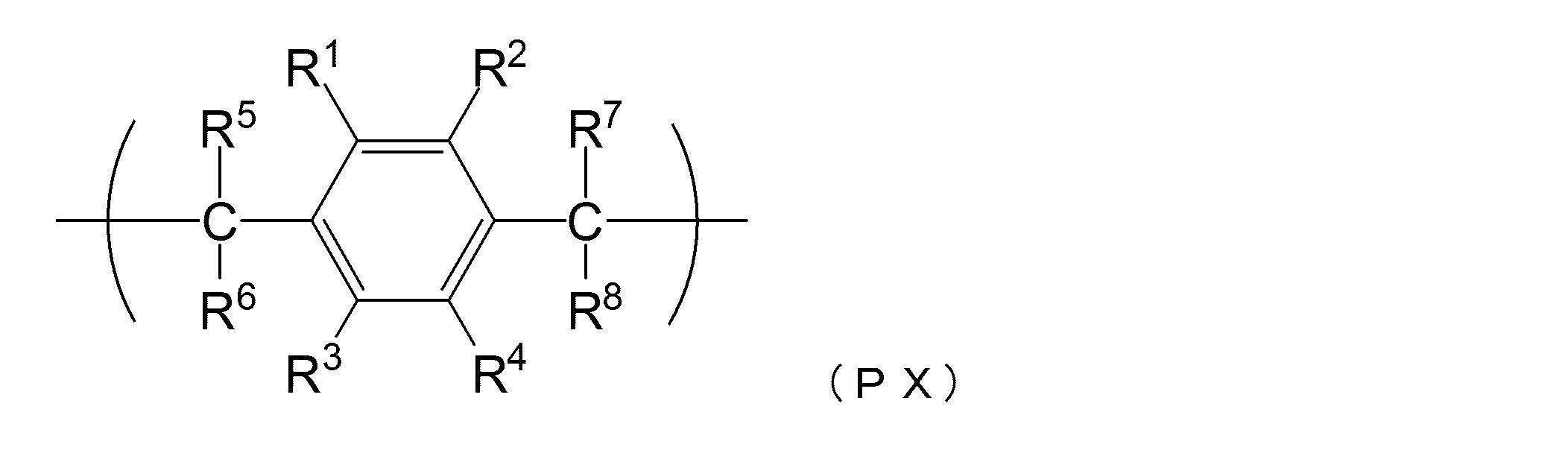
- 水およびフッ素系溶剤の少なくとも1種からなる溶剤に対する前記第2の保護層の23℃における溶解度が、5000mg/溶剤100g以上である、
請求項6または7に記載の積層体。 - 前記第2の保護層が、下記式(1)で表される構造を有するポリビニルアルコール、式(2)で表される構造を有するポリビニルピロリドン、式(3)で表される構造を有するセルロース、および式(4)で表される構造を有するプルランからなる群の少なくとも1種の樹脂を含有する、
請求項6~8のいずれか1項に記載の積層体;
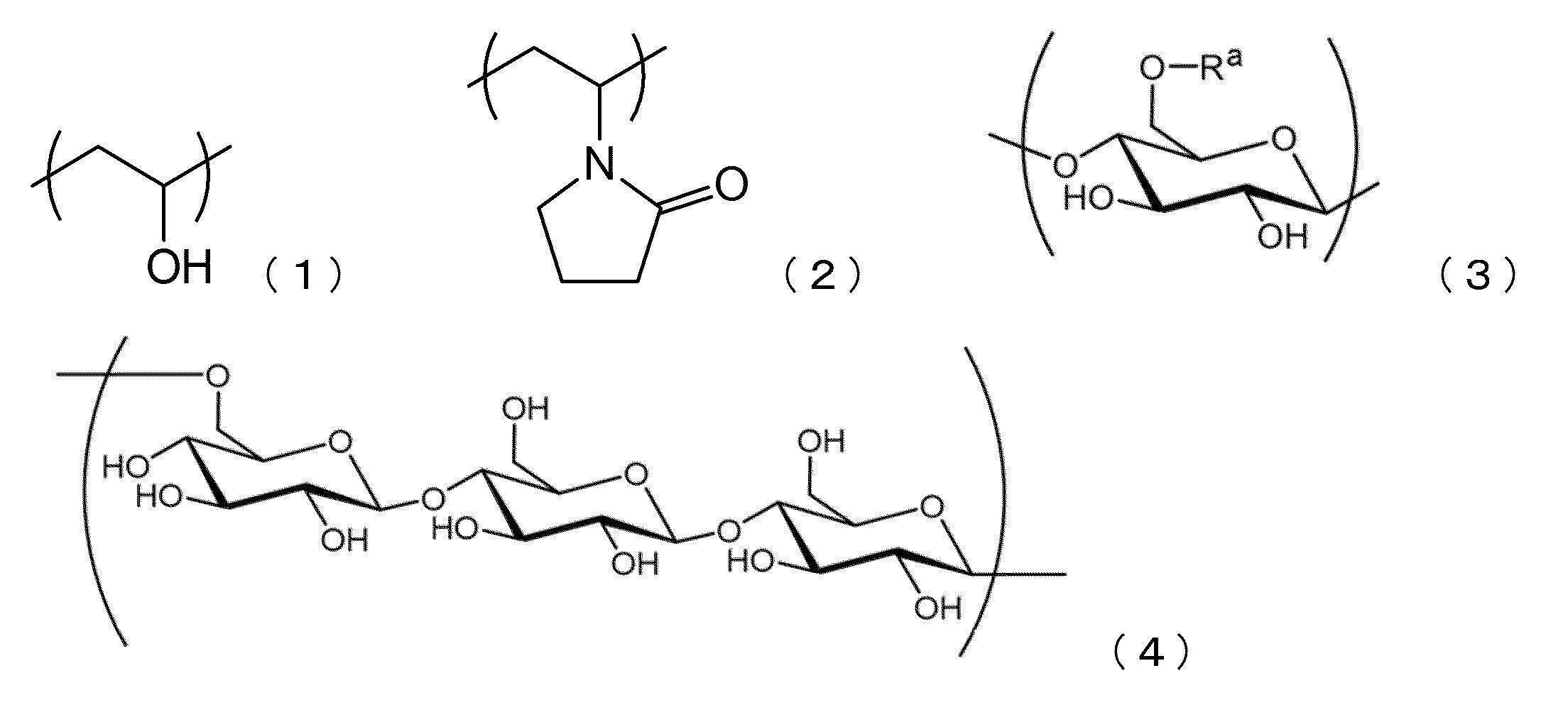
- 前記有機層が、有機半導体を含む、
請求項1~9のいずれか1項に記載の積層体。 - 前記導電層が、金、銀、銅、アルミニウムおよびこれらの少なくとも2種を含む合金、ならびに、導電性酸化物からなる群のうち、少なくとも1種を含む、
請求項1~10のいずれか1項に記載の積層体。 - 前記感光層が、現像により部分的に除去されており、
前記保護層が、前記感光層の除去された部分において露出している、
請求項1~11のいずれか1項に記載の積層体。 - 前記感光層が、現像により部分的に除去されており、
前記保護層が、前記感光層の除去された部分に対応してエッチングされており、
前記導電層が、前記感光層の除去された部分および前記保護層のエッチングされた部分において露出している、
請求項1~11のいずれか1項に記載の積層体。 - 基材、有機層、導電層、および前記導電層の表面を保護しかつ最表層である保護層をこの順に有し、
前記導電層が、前記有機層に接し、かつ、ウェットエッチングされる対象であり、
前記保護層が部分的にエッチングされている、積層体。 - 前記導電層が、前記保護層のエッチングされた部分において露出している、
請求項14に記載の積層体。 - 請求項12に記載の積層体における前記保護層を前記感光層側からエッチングすることにより得られた請求項14または15に記載の積層体。
- 光および放射線の少なくとも一方を作用させて、請求項1~11のいずれか1項に記載の積層体における前記感光層の一部を露光した後、当該感光層を現像し、
現像された前記感光層をマスクとして前記保護層をエッチングし、
エッチングされた前記保護層をマスクとして前記導電層をウェットエッチングする、積層体の製造方法。 - 請求項17に記載の方法により製造された積層体を含み、前記有機層が、有機半導体を含む、有機半導体デバイス。
- 請求項17に記載の積層体の製造方法を工程として含み、かつ、前記有機層が有機半導体を含む、有機半導体デバイスの製造方法。
- 請求項1~13のいずれか1項に記載の積層体における前記保護層の形成に使用される組成物。
- 請求項1~13のいずれか1項に記載の積層体における前記感光層の形成に使用される組成物。
- 請求項1~13のいずれか1項に記載の積層体における前記保護層の形成に使用される組成物と、前記感光層の形成に使用される組成物とを含むキット。
Applications Claiming Priority (2)
| Application Number | Priority Date | Filing Date | Title |
|---|---|---|---|
| JP2018225226A JP2022028980A (ja) | 2018-11-30 | 2018-11-30 | 積層体、有機半導体デバイスおよびそれらの製造方法、並びに、組成物およびその組成物のキット |
| JP2018-225226 | 2018-11-30 |
Publications (2)
| Publication Number | Publication Date |
|---|---|
| WO2020111007A1 true WO2020111007A1 (ja) | 2020-06-04 |
| WO2020111007A8 WO2020111007A8 (ja) | 2020-07-30 |
Family
ID=70852246
Family Applications (1)
| Application Number | Title | Priority Date | Filing Date |
|---|---|---|---|
| PCT/JP2019/046010 Ceased WO2020111007A1 (ja) | 2018-11-30 | 2019-11-25 | 積層体、有機半導体デバイスおよびそれらの製造方法、並びに、組成物およびその組成物のキット |
Country Status (3)
| Country | Link |
|---|---|
| JP (1) | JP2022028980A (ja) |
| TW (1) | TW202039250A (ja) |
| WO (1) | WO2020111007A1 (ja) |
Cited By (2)
| Publication number | Priority date | Publication date | Assignee | Title |
|---|---|---|---|---|
| CN115000303A (zh) * | 2022-05-20 | 2022-09-02 | 苏州大学 | 二维有机半导体单晶薄膜、有机场效应晶体管的制备方法 |
| US12022668B2 (en) | 2021-09-22 | 2024-06-25 | Kioxia Corporation | Semiconductor device and method of manufacturing the same |
Families Citing this family (2)
| Publication number | Priority date | Publication date | Assignee | Title |
|---|---|---|---|---|
| TWI858211B (zh) * | 2020-12-25 | 2024-10-11 | 律勝科技股份有限公司 | 積層板及其製造方法 |
| TWI892796B (zh) * | 2024-08-13 | 2025-08-01 | 新應材股份有限公司 | 微細圖案形成用材料、感光性樹脂組成物、圖案處理組成物以及微細圖案的形成方法 |
Citations (4)
| Publication number | Priority date | Publication date | Assignee | Title |
|---|---|---|---|---|
| JP2006261408A (ja) * | 2005-03-17 | 2006-09-28 | Ricoh Co Ltd | 半導体装置及びそれを用いた画像表示装置 |
| JP2010251574A (ja) * | 2009-04-17 | 2010-11-04 | Sony Corp | 薄膜トランジスタの製造方法および薄膜トランジスタ |
| JP2011254091A (ja) * | 2011-07-25 | 2011-12-15 | Sony Corp | 有機半導体装置及びその製造方法 |
| JP2014209593A (ja) * | 2013-03-22 | 2014-11-06 | 株式会社半導体エネルギー研究所 | 薄膜の加工方法、半導体装置の作製方法 |
-
2018
- 2018-11-30 JP JP2018225226A patent/JP2022028980A/ja active Pending
-
2019
- 2019-11-25 WO PCT/JP2019/046010 patent/WO2020111007A1/ja not_active Ceased
- 2019-11-28 TW TW108143473A patent/TW202039250A/zh unknown
Patent Citations (4)
| Publication number | Priority date | Publication date | Assignee | Title |
|---|---|---|---|---|
| JP2006261408A (ja) * | 2005-03-17 | 2006-09-28 | Ricoh Co Ltd | 半導体装置及びそれを用いた画像表示装置 |
| JP2010251574A (ja) * | 2009-04-17 | 2010-11-04 | Sony Corp | 薄膜トランジスタの製造方法および薄膜トランジスタ |
| JP2011254091A (ja) * | 2011-07-25 | 2011-12-15 | Sony Corp | 有機半導体装置及びその製造方法 |
| JP2014209593A (ja) * | 2013-03-22 | 2014-11-06 | 株式会社半導体エネルギー研究所 | 薄膜の加工方法、半導体装置の作製方法 |
Cited By (2)
| Publication number | Priority date | Publication date | Assignee | Title |
|---|---|---|---|---|
| US12022668B2 (en) | 2021-09-22 | 2024-06-25 | Kioxia Corporation | Semiconductor device and method of manufacturing the same |
| CN115000303A (zh) * | 2022-05-20 | 2022-09-02 | 苏州大学 | 二维有机半导体单晶薄膜、有机场效应晶体管的制备方法 |
Also Published As
| Publication number | Publication date |
|---|---|
| TW202039250A (zh) | 2020-11-01 |
| JP2022028980A (ja) | 2022-02-17 |
| WO2020111007A8 (ja) | 2020-07-30 |
Similar Documents
| Publication | Publication Date | Title |
|---|---|---|
| US9601706B2 (en) | Resin composition for forming protective film, protective film, pattern forming method, method for manufacturing electronic device, and electronic device | |
| US10833272B2 (en) | Laminate and kit | |
| JP6167016B2 (ja) | 積層体、有機半導体製造用キットおよび有機半導体製造用レジスト組成物 | |
| JP6284849B2 (ja) | 積層体 | |
| TW202039250A (zh) | 積層體、有機半導體元件及它們的製造方法、以及組成物及所述組成物的套組 | |
| KR20200115609A (ko) | 적층체, 수용성 수지 조성물, 키트 | |
| CN113631597B (zh) | 层叠体、组合物及层叠体形成用套组 | |
| CN115244470A (zh) | 去除液、套组及半导体器件 | |
| JP6591579B2 (ja) | 積層体 | |
| JP2021110796A (ja) | 感光性樹脂組成物、層状膜、感光層、積層体、キット及び半導体デバイス | |
| CN111819494A (zh) | 感光层、层叠体、感光性树脂组合物、试剂盒 | |
| CN111758074A (zh) | 感光层、层叠体、感光性树脂组合物、试剂盒及感光性树脂组合物的制造方法 | |
| JP2022110237A (ja) | パターン化有機層の製造方法、保護層形成用組成物、キット及び半導体デバイスの製造方法 |
Legal Events
| Date | Code | Title | Description |
|---|---|---|---|
| 121 | Ep: the epo has been informed by wipo that ep was designated in this application |
Ref document number: 19890565 Country of ref document: EP Kind code of ref document: A1 |
|
| NENP | Non-entry into the national phase |
Ref country code: DE |
|
| 122 | Ep: pct application non-entry in european phase |
Ref document number: 19890565 Country of ref document: EP Kind code of ref document: A1 |
|
| NENP | Non-entry into the national phase |
Ref country code: JP |