WO2020105530A1 - ガスシールドアーク溶接用フラックス入りワイヤ - Google Patents
ガスシールドアーク溶接用フラックス入りワイヤInfo
- Publication number
- WO2020105530A1 WO2020105530A1 PCT/JP2019/044644 JP2019044644W WO2020105530A1 WO 2020105530 A1 WO2020105530 A1 WO 2020105530A1 JP 2019044644 W JP2019044644 W JP 2019044644W WO 2020105530 A1 WO2020105530 A1 WO 2020105530A1
- Authority
- WO
- WIPO (PCT)
- Prior art keywords
- mass
- flux
- less
- content
- wire
- Prior art date
- Legal status (The legal status is an assumption and is not a legal conclusion. Google has not performed a legal analysis and makes no representation as to the accuracy of the status listed.)
- Ceased
Links
Images

Classifications
-
- B—PERFORMING OPERATIONS; TRANSPORTING
- B23—MACHINE TOOLS; METAL-WORKING NOT OTHERWISE PROVIDED FOR
- B23K—SOLDERING OR UNSOLDERING; WELDING; CLADDING OR PLATING BY SOLDERING OR WELDING; CUTTING BY APPLYING HEAT LOCALLY, e.g. FLAME CUTTING; WORKING BY LASER BEAM
- B23K35/00—Rods, electrodes, materials, or media, for use in soldering, welding, or cutting
- B23K35/22—Rods, electrodes, materials, or media, for use in soldering, welding, or cutting characterised by the composition or nature of the material
- B23K35/24—Selection of soldering or welding materials proper
- B23K35/30—Selection of soldering or welding materials proper with the principal constituent melting at less than 1550°C
-
- B—PERFORMING OPERATIONS; TRANSPORTING
- B23—MACHINE TOOLS; METAL-WORKING NOT OTHERWISE PROVIDED FOR
- B23K—SOLDERING OR UNSOLDERING; WELDING; CLADDING OR PLATING BY SOLDERING OR WELDING; CUTTING BY APPLYING HEAT LOCALLY, e.g. FLAME CUTTING; WORKING BY LASER BEAM
- B23K35/00—Rods, electrodes, materials, or media, for use in soldering, welding, or cutting
- B23K35/22—Rods, electrodes, materials, or media, for use in soldering, welding, or cutting characterised by the composition or nature of the material
- B23K35/36—Selection of non-metallic compositions, e.g. coatings or fluxes; Selection of soldering or welding materials, conjoint with selection of non-metallic compositions, both selections being of interest
- B23K35/368—Selection of non-metallic compositions of core materials either alone or conjoint with selection of soldering or welding materials
-
- C—CHEMISTRY; METALLURGY
- C22—METALLURGY; FERROUS OR NON-FERROUS ALLOYS; TREATMENT OF ALLOYS OR NON-FERROUS METALS
- C22C—ALLOYS
- C22C38/00—Ferrous alloys, e.g. steel alloys
-
- C—CHEMISTRY; METALLURGY
- C22—METALLURGY; FERROUS OR NON-FERROUS ALLOYS; TREATMENT OF ALLOYS OR NON-FERROUS METALS
- C22C—ALLOYS
- C22C38/00—Ferrous alloys, e.g. steel alloys
- C22C38/60—Ferrous alloys, e.g. steel alloys containing lead, selenium, tellurium, or antimony, or more than 0.04% by weight of sulfur
Definitions
- the present invention relates to a flux-cored wire for gas shield arc welding.
- boiler flue ducts casings, heat exchangers, basket materials for rotary regenerative air preheaters and heat transfer element plates, dehumidifying towers, smoke exhaust equipment such as bag filters and chimneys, and steel plating pickling tanks.
- a corrosion resistant steel is used as a material for a welded structure used in a sulfuric acid and hydrochloric acid environment.
- the above-mentioned welded structure is generally manufactured by welding and joining steel materials, but if there is a difference in corrosion resistance between the weld metal and the base material, the one with poorer corrosion resistance is more selective. Corrosion of the structure significantly shortens the life of the structure. Further, when the weld metal is selectively corroded, stress concentration occurs in the corrosion holes, and in extreme cases, the welded structure may be destroyed. As described above, in the use of the welded structure, when the corrosion deterioration cannot be ignored, it is necessary to sufficiently secure not only the base material but also the corrosion resistance of the welded portion.
- a welding material exclusively for sulfuric acid dew point corrosion steel a material containing Cu alone as a corrosion resistance element and a material containing Cu-Cr are known.
- the weld metal obtained by using these welding materials shows sufficiently excellent corrosion resistance in the sulfuric acid dew point corrosion environment generated in the plant smoke exhaust system of the heavy oil burning boiler, but the coal burning boiler and refuse incineration or dust In a gasification and melting facility, etc., sulfuric acid dew point corrosion and hydrochloric acid dew point corrosion occur simultaneously, so there is a problem that sufficient corrosion resistance cannot be obtained.
- Patent Document 1 describes that Sb is an element coexisting with Cu to improve the sulfuric acid resistance and the hydrochloric acid resistance.
- the present invention has been made in view of the above-mentioned situation, is suitable for welding hydrochloric acid dew-point corrosion resistant steel, and contains a flux for gas shielded arc welding capable of obtaining a weld metal having excellent hydrochloric acid corrosion resistance.
- the purpose is to provide a wire.
- a flux-cored wire for gas shield arc welding is a flux-cored wire in which flux is filled in a steel outer shell, Per total wire mass, C: 0.02 mass% or more and 0.10 mass% or less, Si: 0.05 mass% or more and 1.00 mass% or less, Mn: 1.5% by mass or more and 3.0% by mass or less, S: 0.003 mass% or more and 0.030 mass% or less, Cu: 0.05% by mass or more and 0.50% by mass or less, Ni: 0.05% by mass or more and 0.50% by mass or less, Mo: 0.05% by mass or more and 0.35% by mass or less, Co: 0.005 mass% or more and 0.300 mass% or less, Sb: 0.01% by mass or more and 0.20% by mass or less, Containing P: 0.030 mass% or less, Cr: 0.05 mass% or less, Limited to It is characterized by satisfying the following formula (1).
- the above flux-cored wire for gas shield arc welding preferably further contains Ti: 2.0% by mass or more and 4.5% by mass or less based on the total mass of the wire.
- the flux-cored wire for gas shield arc welding further contains a slag forming agent, and the total content of Na, K, Li, Mg and F in the slag forming agent is 0.010 mass per the total mass of the wire. % Or more and 1.500 mass% or less is preferable.
- the gas-shielded arc welding flux-cored wire further contains at least one selected from Nb, Zr, and V, and the total content of Nb, Zr, and V is more than 0 mass% based on the total mass of the wire. It is preferably 0.50 mass% or less.
- the above flux-cored wire for gas shield arc welding preferably further contains B: more than 0 mass% and 0.0080 mass% or less based on the total mass of the wire.
- a flux-cored wire for gas shielded arc welding which is suitable for welding hydrochloric acid dew-point corrosion resistant steel and can obtain a weld metal having excellent hydrochloric acid corrosion resistance.
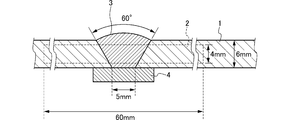
- FIG. 1A is a schematic view showing a test piece sampling position of a joint test piece to be subjected to a hydrochloric acid corrosion resistance test.
- FIG. 1B is a schematic diagram showing a test piece sampling position of a reference test piece used in a hydrochloric acid corrosion resistance test.
- the inventors of the present invention have excellent hydrochloric acid corrosion resistance even if the content of Sb that causes surface cracks in the weld metal is controlled in a low range and control of the average particle diameter of Sb is unnecessary.
- the present inventors have earnestly studied a flux-cored wire for gas shield arc welding (hereinafter, also simply referred to as “wire” or the like) capable of obtaining a weld metal. As a result, it is effective to contain Mo and Co in an appropriate amount in the wire and to control the ratio of both in a predetermined range to improve the hydrochloric acid corrosion resistance of the weld metal. I found it.
- the chemical components have a predetermined content with respect to the total mass of the wire, and the content of some of the chemical components satisfies the predetermined relational expression.
- the flux-cored wire according to the present embodiment will be described.
- the flux-cored wire according to the present embodiment has a steel hoop filled with flux.
- the flux-cored wire according to the present embodiment includes a tubular steel outer shell and a flux filled inside (inner side) of the outer shell.
- the flux-cored wire may be in any form such as a seamless type having no seamless outer skin, or a seam type having a seamless outer skin such as a C cross section and a lap cross section. Further, the flux-cored wire may or may not be plated with Cu or the like on the wire surface (outside of the outer skin).
- the thickness of the steel shell and the wire diameter (diameter) of the flux-cored wire according to the present embodiment are not particularly limited, but from the viewpoint of wire feeding stability, the preferable wire diameter is 0. It is 8 to 4.0 mm, and more preferable wire diameter is 1.2 to 2.4 mm.
- the reason for adding the components and the reason for limiting the composition will be described in detail.
- Each element for obtaining the weld metal having the required characteristics may be added from either the steel shell or the filling flux. Therefore, unless otherwise specified in the following description, the amount of each component in the flux-cored wire is the total amount of the components contained in the steel shell and the flux, the total wire mass (steel shell and inside the shell). The total amount of flux) is defined as the content.
- the elements shown below are added in the steel shell or flux in various forms such as oxides, simple substances, compounds and alloys, but in the present embodiment, the elements are added in any form.
- the origin of the raw material does not matter. Therefore, the content of the element shown below is the total amount of various elements such as elemental elements, oxides, compounds and alloys converted as elemental elements.
- C improves the strength of the weld metal, but is also an element that increases the hot crack sensitivity of the weld metal. If the C content is less than 0.02% by mass, the amount of C dissolved in the weld metal is insufficient and the strength is not improved. Therefore, C in the steel shell and the flux is set to 0.02% by mass or more, preferably 0.03%. It should be at least mass%. On the other hand, if the C content exceeds 0.10% by mass, the amount of C dissolved in the weld metal becomes excessive and the hot cracking susceptibility becomes high. Therefore, the C in the steel shell and the flux should be 0.10% by mass or less.
- the C source in addition to those added to the steel shell, iron powder or alloy powder with a large amount of carbon added to flux, simple carbon such as graphite, graphite, carbon nanotubes, starch, corn starch, etc. Examples include organic substances.
- Si is an essential element for deoxidizing the weld metal. If the Si content is less than 0.05% by mass, the amount of Si that dissolves in the weld metal will be insufficient and the deoxidizing effect will not be sufficient, so the Si content in the steel shell and flux should be 0.05% by mass or more. , Preferably 0.20 mass% or more. On the other hand, when the Si content exceeds 1.00 mass%, the hot cracking sensitivity becomes high. Therefore, in order to reduce the hot cracking sensitivity, the amount of alloying elements such as Mn and Ni in the weld metal is added to the wire. Will be required.
- Si in the steel shell and the flux is 1.00 mass% or less, preferably 0.90 mass% or less.
- Si is added to the flux as a Si oxide such as SiO 2 or may be added to the wire in the form of a Fe—Si alloy or Si metal.
- the content of Si oxide, Si metal, and Si alloy is defined by a value converted into Si, and this converted value is simply referred to as Si content.
- Mn deoxidizes the weld metal and improves the strength and toughness of the weld metal. Further, since it forms a compound with S that increases hot cracking susceptibility, it is an essential element for suppressing hot cracking. If the Mn content is less than 1.5% by mass, the amount of Mn dissolved in the weld metal will be insufficient, the effects of deoxidation and suppression of hot cracking will not be sufficiently obtained, and the strength and toughness will not improve, so the steel outer shell
- the Mn content in the flux is 1.5% by mass or more, and preferably 1.8% by mass or more.
- Mn in the steel shell and the flux is 3.0 mass% or less, preferably 2.8 mass% or less.
- Mn oxide such as MnO and MnO 2
- Mn metal, and Mn alloy are defined by values converted into Mn, and this converted value is simply referred to as Mn content.
- S is an element that improves the flow of droplets during welding, but is also an element that reduces the toughness of the weld metal and increases the hot crack susceptibility. If the S content is less than 0.003 mass%, the viscosity of the droplets during welding becomes high and the flow of the droplets is impeded, so the S content in the steel shell and the flux is 0.003 mass% or more. And preferably 0.004 mass% or more.
- the S content exceeds 0.030% by mass, the amount of S dissolved in the weld metal becomes excessive, the toughness of the weld metal decreases, and the hot cracking susceptibility increases, so that S in the steel outer shell and flux is increased.
- the content is 0.030 mass% or less, preferably 0.025 mass% or less.
- the S source include sulfides such as iron sulfide and copper sulfide, and sulfates added to the flux, in addition to those added to the steel shell. Further, examples of the S source include S compounds applied to the wire surface.
- Cu is an element that improves the corrosion resistance of the weld metal.
- the Cu content in the steel shell and the flux is 0. It is made into 05 mass% or more, preferably 0.10 mass% or more.
- the Cu content in the steel shell and flux is 0.50.
- the content is set to not more than mass%, preferably not more than 0.40 mass%.
- Cu is mainly added to the wire in the form of Fe—Cu alloy, Cu metal, etc.
- Cu may be added to the flux as Cu oxide such as Cu 2 O and CuO.
- the contents of Cu alloy, Cu metal, and Cu oxide are defined by the value converted into Cu, and this converted value is simply referred to as the Cu content.
- Ni is an element that reduces the hot cracking susceptibility of the weld metal and improves the corrosion resistance.
- Ni content is less than 0.05% by mass, the amount of Ni that dissolves in the weld metal is insufficient, and the effect of suppressing hot cracking of the weld metal and the effect of improving corrosion resistance cannot be sufficiently obtained, so that the steel shell and
- the Ni content in the flux is 0.05 mass% or more, and preferably 0.10 mass% or more.
- Ni content in the outer shell and flux is 0.50 mass% or less, preferably 0.40 mass% or less.
- Ni source in addition to those added to the steel shell, simple metal or alloy powder added to the flux can be cited.
- Mo 0.05% by mass or more and 0.35% by mass or less> Mo, together with Co and Cu, is an element that significantly improves the hydrochloric acid resistance of the weld metal, and its effect is further increased by the combined addition of Cu and Sb. If the Mo content is less than 0.05% by mass, the effect of improving the hydrochloric acid resistance of the weld metal cannot be sufficiently obtained, so the Mo content in the steel shell and the flux is 0.05% by mass or more. And preferably 0.10 mass% or more, more preferably 0.12 mass% or more.
- the Mo content in the steel shell and the flux is 0.35% by mass or less, preferably 0.30% by mass. % Or less, more preferably 0.28 mass% or less.
- the optimum addition amount of Mo is 0.15% by mass.
- Co is an element that, when added together with Mo and Cu, significantly improves the hydrochloric acid resistance of the weld metal and also improves the toughness as seen in the characteristics of nickel-cobalt-molybdenum steel (Ni-Co-Mo). .. If the Co content is less than 0.005% by mass, the effect of improving the hydrochloric acid resistance and toughness of the weld metal cannot be sufficiently obtained. Therefore, the Co content in the steel shell and the flux is 0.005 mass% or more, preferably 0.010 mass% or more, and more preferably 0.020 mass% or more.
- the Co content in the steel shell and the flux is set to 0.300% by mass or less, preferably 0.
- the amount is 250 mass% or less, and more preferably 0.200 mass% or less.
- the optimum addition amount of Co is 0.050% by mass.
- the value calculated by the left side of the above formula (1) is less than 15, a weld metal having excellent hydrochloric acid resistance cannot be obtained, so the value calculated by the left side of the formula (1) becomes 15 or more.
- the Mo content and the Co content are controlled within a predetermined range.
- the value calculated by the left side of the formula (1) is preferably 16 or more, more preferably 18 or more, and further preferably 20 or more.
- the value calculated by the left side of the formula (1) is preferably 86 or less, more preferably 72 or less, and further preferably 60 or less. ..
- Sb is an element that coexists with Cu to further improve the sulfuric acid resistance and the hydrochloric acid resistance. If the Sb content is less than 0.01% by mass, sufficient corrosion resistance may not be obtained. Therefore, the Sb content in the steel shell and the flux is 0.01% by mass or more, preferably 0.05% by mass or more. On the other hand, if the Sb content exceeds 0.20% by mass, surface cracking and segregation may occur. Therefore, the Sb content in the steel shell and the flux is 0.20% by mass or less, preferably 0. 15 mass% or less.
- Cr 0.05% by mass or less (including 0% by mass)>
- Cr improves the corrosion resistance in an oxidizing sulfuric acid dew point corrosion environment that occurs particularly in a plant with a high sulfur oxide content in the exhaust gas, it is an element that impairs hydrochloric acid resistance, so the Cr content should be reduced as much as possible. Is preferred. If the Cr content exceeds 0.05% by mass, the hydrochloric acid resistance may decrease. Therefore, the Cr content in the steel shell and the flux is limited to 0.05 mass% or less.
- the flux-cored wire according to the present embodiment preferably further contains Ti: 2.0 mass% or more and 4.5 mass% or more as an optional component.
- Ti is an element that improves the stability of the arc during welding and the encapsulation of slag and improves the weldability in all positions. Further, when added as Ti to the wire, it is an element having a function of deoxidizing the weld metal. When the Ti content is 2.0 mass% or more, there is an effect of improving the stability of the arc during welding and the slag encapsulation property.
- the Ti content is preferably 2.0% by mass or more, more preferably 2.5% by mass or more, and 2.8% by mass. It is more preferable that the amount is not less than 3.0%, and further preferably 3.0% by mass or more.
- Ti is mainly added to the flux as Ti oxide such as TiO 2, it may be added to the wire in the form of Fe—Ti alloy, Ti metal or the like.
- the content of Ti oxide, Ti metal and Ti alloy is defined by the value converted to Ti, and this converted value is simply referred to as the Ti content.
- the flux-cored wire according to this embodiment preferably further contains a slag forming agent as an optional component.
- the slag forming agent is a component having an action of removing impurities (such as oxygen) in the weld metal, and in the present embodiment, it is preferable that the wire contains at least one slag forming agent.
- the slag forming agent contained in the wire is not limited to a specific type, but may be alkali metals such as Na, K, Li and Mg, alkaline earth metals and their compounds, SiO 2 , ZrO 2 and Al. Oxides such as 2 O 3 , MnO and MgO, fluorides such as CaF 2 , BaF 2 , MgF and LiF, CaCO 3 and carbonates such as BaCO 3 can be used.
- the total amount of these elements relative to the total mass of the wire is preferably 0.010 mass% or more, more preferably 0.020 mass% or more, and further preferably 0.030 mass% or more. ..
- the total amount is 1.500% by mass or less, the water content in the wire can be maintained at a low level and hydrogen cracking can be suppressed. Therefore, the total amount of these elements with respect to the total mass of the wire is preferably 1.500% by mass or less, and more preferably 1.000% by mass or less.
- the flux-cored wire according to the present embodiment preferably further contains, as an optional component, a total of at least one selected from Nb, Zr and V: 0.50 mass% or less. This is because oxides composed of these elements are stable, and by containing these elements in the wire, a high deoxidizing effect can be easily obtained.
- the total amount of these elements is preferably 0.50 mass% or less, more preferably 0.40 mass% or less.
- the flux-cored wire according to the present embodiment preferably further contains B: more than 0 mass% and 0.0080 mass% or less as an optional component.
- B can improve the hardenability of the weld metal.
- B is added to the weld metal through the wire even if the B content is very small, and the strength of the weld metal can be improved by the quenching effect. Therefore, when B is contained in the steel shell and the flux, the B content is preferably more than 0 mass% and more preferably 0.0040 mass% or more.
- the B content is 0.0080 mass% or less, it is possible to suppress the deterioration of the toughness of the weld metal and reduce the hot cracking susceptibility. Therefore, when B is contained in the steel shell and the flux, the B content is preferably 0.0080 mass% or less, and more preferably 0.0075 mass% or less.
- the flux-cored wire according to the present embodiment preferably further contains Bi: 0.010 mass% or more and 0.100 mass% or less as an optional component.
- Bi is an essential element for improving the peelability of the welding slag that occurs during welding.
- the Bi content is preferably 0.010 mass% or more, and more preferably 0.015 mass% or more.
- Bi is 0.100 mass% or less, the hot crack sensitivity of the weld metal can be lowered.
- the Bi content is preferably 0.100 mass% or less, and more preferably 0.080 mass% or less.
- Bi is mainly added to the flux as an oxide such as Bi 2 O 3, it may be added to the wire in the form of Fe—Bi alloy, Bi metal or the like.
- the content of Bi oxide, Bi metal and Bi alloy is defined by the value converted into Bi, and this Bi converted value is simply referred to as Bi content.
- Fe 85% by mass or more> Fe is the main component of the flux-cored wire.
- the Fe content is preferably 85% by mass or more, more preferably 87% by mass or more, and 95% by mass or less based on the total amount of the wire in view of the amount of welding and the composition of other components. It is preferably 93% by mass or less.
- the balance of the flux-cored wire according to the present embodiment contains inevitable impurities. Then, in the flux-cored wire according to the present embodiment, Al, Ta, W, Sn, F, K, Mg, a rare earth element (REM), and Ca are added in addition to the above-mentioned wire components, if necessary. It may have been done. Even if Sn is contained in the wire as an additive or an unavoidable impurity, it does not hinder the hydrochloric acid dew point corrosion resistance of the weld metal, but if the Sn content exceeds 0.05% by mass, In order to significantly reduce the toughness of the joint, it is preferable to limit the Sn content in the steel shell and the flux to 0.05% by mass or less.
- REM rare earth element
- the total amount of the above-specified content elements, Fe, and the remaining elements be 94% by mass or more, and 95% by mass based on the total mass of the wire.
- the above content is more preferable, and the content is more preferably 96 mass% or more.
- Other components include oxide oxygen and nitrogen. For example, it is practical for oxygen to be in the range of 1-5% by weight.
- the method of manufacturing the flux-cored wire according to the present embodiment is not particularly limited, but the flux-cored wire can be manufactured by, for example, the method described below.
- a steel strip that constitutes the steel shell is prepared, and is formed by a forming roll while feeding the steel strip in the longitudinal direction to form a U-shaped open tube.
- the steel shell is filled with a flux mixed with various raw materials so as to have a predetermined component composition, and then processed to have a circular cross section.
- the wire is drawn by cold working to obtain a flux-cored wire having a wire diameter of 1.2 to 2.4 mm, for example. Note that annealing may be performed during the cold working.
- any structure of a seamless wire in which a seam of a steel outer shell formed in the manufacturing process is welded and a wire in which the seam is not welded and remains as a gap can be adopted.
- a flux having a wire diameter of 1.2 mm was produced by filling a flux made by appropriately mixing raw materials into a steel shell so that the ratio of the flux to the total mass of the wire was 15% by mass.
- Tables 1 and 2 below show the content (% by mass) of the chemical components in the flux-cored wires of the invention example and the comparative example. The content of each chemical component shown in Table 1 or Table 2 is the content (mass%) per the total mass of the wire. The balance is unavoidable impurities. Further, “57 [Mo] +221 [Co]” shown in Table 1 indicates a value calculated by the left side of Expression (1). Further, in Tables 1 and 2, the notation "-" in each component composition means less than 0.005 mass%.
- FIG. 1A is a schematic diagram showing a test piece sampling position of a joint test piece to be subjected to a hydrochloric acid corrosion resistance test.
- FIG. 1B is a schematic diagram showing a test piece sampling position of a reference test piece used in a hydrochloric acid corrosion resistance test.
- two steel plates 1 each having a plate thickness of 6 mm are used, and after forming a groove so that a groove angle is 60 °, the root interval is set to 5 mm, and the welding is performed.
- the backing material 4 was arranged on the back surface opposite to the surface.
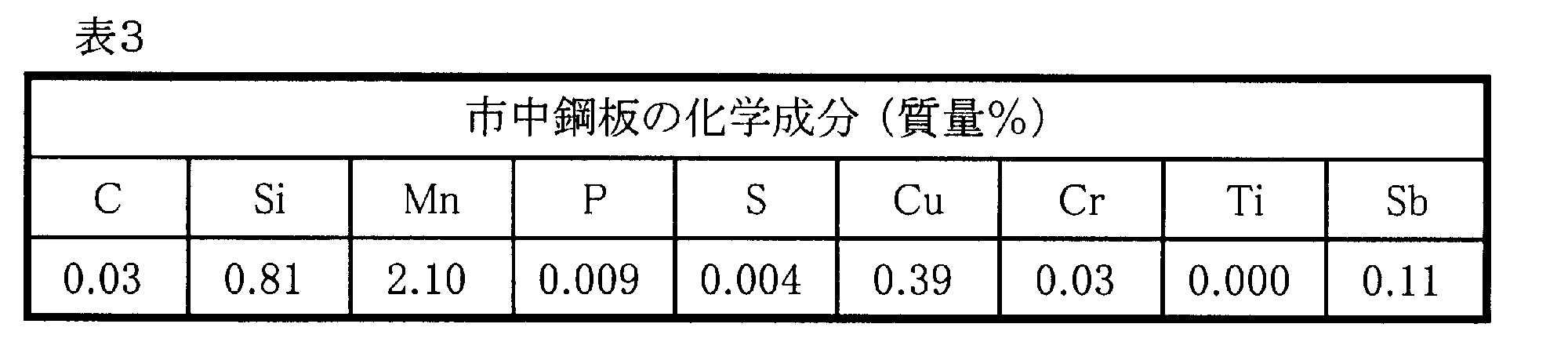
- Steel sheet 1 is commercially available as sulfuric acid / hydrochloric acid dew point steel (so-called commercial steel sheet), and main chemical components other than Fe and their contents are as shown in Table 3 below. After that, two steel plates 1 were butt-welded under the welding conditions shown in Table 4 below, and the front and back surfaces of the joined steel plates 1 were each ground by 1 mm. Further, the front surface and the back surface of the obtained weld metal 3 were appropriately polished, and then the side surface was cut to manufacture a joint test piece 2 having a width of 25 mm, a length of 60 mm and a thickness of 4 mm.
- a front surface and a back surface of a steel plate 11 having a plate thickness of 6 mm were polished by 1 mm each. Further, by cutting the side surface, a reference test piece 12 having a width of 25 mm, a length of 60 mm and a thickness of 4 mm was produced.
- the steel plate 11 used for the reference test piece 12 is also as shown in Table 3 below, like the steel plate 1.
- the corrosion rate ratio calculated in each test and the evaluation results are shown in Table 6 below. It should be noted that the lower the corrosion rate ratio, the more the corrosion is not progressing. As evaluation criteria, less than 0.85 is evaluation A (excellent), 0.85 or more and less than 0.95 is evaluation B (good), 0.95 or more and less than 1.00 is evaluation C (somewhat good), 1.00 The above was set as evaluation D (defective).
- the Mo content and the Co content are within the numerical range of the present invention, but since the formula (1) is not satisfied, a weld metal excellent in hydrochloric acid corrosion resistance cannot be obtained, and the corrosion test is evaluated. The result was D (bad).
- Test No. which is a comparative example. No. 10 the Mo content and the Co content are less than the lower limit of the numerical range of the present invention, the formula (1) is not satisfied, and the Sb content is less than the lower limit of the numerical range of the present invention. Since the content exceeds the upper limit of the numerical range of the present invention, the evaluation result of the corrosion test was extremely poor (evaluation result D, corrosion rate ratio: 1.15).
- Test No. which is an example of the invention. Nos. 4, 6, 7, 9, and 11 to 13 all satisfy the numerical range specified in the present invention, and therefore weld metals excellent in hydrochloric acid corrosion resistance (evaluation results A to C) can be obtained. It was The test No. In Nos. 12 and 13, the Mo content and the Co content were relatively high, and the value calculated by the left side of the formula (1) was a large value of 20 or more. The results A and B) could be obtained.
Landscapes
- Engineering & Computer Science (AREA)
- Mechanical Engineering (AREA)
- Chemical & Material Sciences (AREA)
- Materials Engineering (AREA)
- Metallurgy (AREA)
- Organic Chemistry (AREA)
- Nonmetallic Welding Materials (AREA)
Abstract
耐塩酸露点腐食鋼の溶接に好適であって、耐塩酸腐食性が優れた溶接金属を得ることができるガスシールドアーク溶接用フラックス入りワイヤを提供する。鋼製外皮にフラックスが充填された、ガスシールドアーク溶接用フラックス入りワイヤは、ワイヤ全質量あたり、C、Si、Mn、S、Cu、Ni、Sb、P及びCrをそれぞれ所定範囲で含有するとともに、Mo:0.05質量%以上0.35質量%以下、Co:0.005質量%以上0.300質量%以下、を含有し、下記式(1)を満足する。57×[Mo]+221×[Co]≧(15)・・・(1)ただし、[Mo]は、ワイヤ全質量に対する鋼製外皮及びフラックス中のMo含有量(質量%)を示し、[Co]は、ワイヤ全質量に対する鋼製外皮及びフラックス中のCo含有量(質量%)を示す。
Description
本発明は、ガスシールドアーク溶接用フラックス入りワイヤに関する。
一般的に、重油、石炭などの化石燃料、液化天然ガスなどのガス燃料、都市ごみなどの一般廃棄物、及び木工屑、繊維屑、廃油、プラスチック、排タイヤ、医療廃棄物などの産業廃棄物及び下水汚泥などを燃焼させるボイラの排煙設備は、排ガス中の三酸化硫黄及び塩化水素に晒され、硫酸露点腐食又は塩酸露点腐食が発生しやすい環境下で使用される。
また、塩酸等の酸洗液を収容する鋼製めっき酸洗漕においても、長時間塩酸に晒されることにより、塩酸露点腐食が発生しやすい。したがって、ボイラの煙道ダクト、ケーシング、熱交換器、回転再生式空気予熱器のバスケット材及び伝熱エレメント板、減温塔、バグフィルター及び煙突等の排煙設備、並びに鋼製めっき酸洗漕等のように、硫酸及び塩酸環境下で使用される溶接構造物の材料としては、耐腐食鋼が使用されている。
また、塩酸等の酸洗液を収容する鋼製めっき酸洗漕においても、長時間塩酸に晒されることにより、塩酸露点腐食が発生しやすい。したがって、ボイラの煙道ダクト、ケーシング、熱交換器、回転再生式空気予熱器のバスケット材及び伝熱エレメント板、減温塔、バグフィルター及び煙突等の排煙設備、並びに鋼製めっき酸洗漕等のように、硫酸及び塩酸環境下で使用される溶接構造物の材料としては、耐腐食鋼が使用されている。
上記溶接構造物は、鋼材同士を溶接して接合することにより製造されることが一般的であるが、溶接金属と母材との間で耐食性に差異があると、耐食性の劣る方が選択的に腐食され、構造物の寿命が著しく短くなる。また、溶接金属が選択的に腐食されると、腐食孔に応力集中が生じ、極端な場合は溶接構造物の破壊を招くおそれもある。このように、溶接構造物の利用において、腐食劣化が無視できない用途の場合には、母材のみならず、溶接部の耐食性も十分に確保する必要がある。
耐硫酸露点腐食鋼専用の溶接材料としては、耐食性元素としてCuを単独で含む材料や、Cu-Crを含む材料が公知である。しかしながら、これらの溶接材料を使用して得られる溶接金属は、重油専焼ボイラのプラント排煙装置で生じる硫酸露点腐食環境においては十分に優れた耐食性を示すが、石炭焚きボイラやごみ焼却またはごみのガス化溶融施設などでは、硫酸露点腐食と塩酸露点腐食が同時に生じるため、十分な耐食性を得ることができないという問題点がある。
そこで、溶接金属の耐硫酸露点腐食性及び耐塩酸露点腐食性の向上を目的として、鋼製外皮中または充填フラックス中の一方又は両方に、0.01~0.5質量%のSbを含有させたフラックス入りワイヤが提案されている(特許文献1を参照)。特許文献1には、SbはCuと共存して耐硫酸性及び耐塩酸性を向上させる元素であることが記載されている。
しかしながら、SbはCuと同様に表面割れを誘起する元素であるため、耐塩酸性を向上させるためにワイヤ中のSb含有量を増加させると、溶接金属の表面割れが発生するおそれがある。また、フラックス中にSbを添加する場合に、添加するSbの平均粒径が制御されていないと、溶接作業中におけるアーク安定性、及びスラグの粘性が低下するとともに、フラックス中でSbが偏析することにより製造安定性が低下するという問題点がある。
したがって、フラックス中のSbの平均粒径を制御する必要がなく、また、ワイヤ中のSb含有量を従来技術と比較して低い範囲で制御した場合であっても、良好な耐塩酸露点腐食性を有する溶接金属を得ることができるフラックス入りワイヤの開発が求められている。
したがって、フラックス中のSbの平均粒径を制御する必要がなく、また、ワイヤ中のSb含有量を従来技術と比較して低い範囲で制御した場合であっても、良好な耐塩酸露点腐食性を有する溶接金属を得ることができるフラックス入りワイヤの開発が求められている。
本発明は、上述した状況に鑑みてなされたものであり、耐塩酸露点腐食鋼の溶接に好適であって、耐塩酸腐食性が優れた溶接金属を得ることができるガスシールドアーク溶接用フラックス入りワイヤを提供することを目的とする。
本発明の一態様に係るガスシールドアーク溶接用フラックス入りワイヤは、鋼製外皮にフラックスが充填されたフラックス入りワイヤであって、
ワイヤ全質量あたり、
C :0.02質量%以上0.10質量%以下、
Si:0.05質量%以上1.00質量%以下、
Mn:1.5質量%以上3.0質量%以下、
S :0.003質量%以上0.030質量%以下、
Cu:0.05質量%以上0.50質量%以下、
Ni:0.05質量%以上0.50質量%以下、
Mo:0.05質量%以上0.35質量%以下、
Co:0.005質量%以上0.300質量%以下、
Sb:0.01質量%以上0.20質量%以下、
を含有し、
P :0.030質量%以下、
Cr:0.05質量%以下、
に制限するとともに、
下記式(1)を満足することを特徴とする。
57×[Mo]+221×[Co]≧15 ・・・(1)
ただし、[Mo]は、ワイヤ全質量に対する前記鋼製外皮及び前記フラックス中のMo含有量(質量%)を示し、[Co]は、ワイヤ全質量に対する前記鋼製外皮及び前記フラックス中のCo含有量(質量%)を示す。
ワイヤ全質量あたり、
C :0.02質量%以上0.10質量%以下、
Si:0.05質量%以上1.00質量%以下、
Mn:1.5質量%以上3.0質量%以下、
S :0.003質量%以上0.030質量%以下、
Cu:0.05質量%以上0.50質量%以下、
Ni:0.05質量%以上0.50質量%以下、
Mo:0.05質量%以上0.35質量%以下、
Co:0.005質量%以上0.300質量%以下、
Sb:0.01質量%以上0.20質量%以下、
を含有し、
P :0.030質量%以下、
Cr:0.05質量%以下、
に制限するとともに、
下記式(1)を満足することを特徴とする。
57×[Mo]+221×[Co]≧15 ・・・(1)
ただし、[Mo]は、ワイヤ全質量に対する前記鋼製外皮及び前記フラックス中のMo含有量(質量%)を示し、[Co]は、ワイヤ全質量に対する前記鋼製外皮及び前記フラックス中のCo含有量(質量%)を示す。
上記ガスシールドアーク溶接用フラックス入りワイヤは、さらに、ワイヤ全質量あたり、Ti:2.0質量%以上4.5質量%以下を含有することが好ましい。
上記ガスシールドアーク溶接用フラックス入りワイヤは、さらに、スラグ形成剤を含有し、ワイヤ全質量あたり、前記スラグ形成剤中のNa、K、Li、Mg及びFの含有量の合計が0.010質量%以上1.500質量%以下であることが好ましい。
上記ガスシールドアーク溶接用フラックス入りワイヤは、さらに、Nb、Zr及びVから選択された少なくとも1種を含有し、ワイヤ全質量あたり、前記Nb、Zr及びVの含有量の合計が0質量%超0.50質量%以下であることが好ましい。
上記ガスシールドアーク溶接用フラックス入りワイヤは、さらに、ワイヤ全質量あたり、B:0質量%超0.0080質量%以下を含有することが好ましい。
本発明によれば、耐塩酸露点腐食鋼の溶接に好適であって、耐塩酸腐食性が優れた溶接金属を得ることができるガスシールドアーク溶接用フラックス入りワイヤを提供することができる。
以下、本発明を実施するための形態(本実施形態)について詳細に説明する。なお、本発明は、以下に説明する実施形態に限定されるものではなく、本発明の要旨を逸脱しない範囲において、任意に変更して実施することができる。
本発明者らは、溶接金属の表面割れの原因となるSbの含有量を低い範囲で制御し、Sbの平均粒径の制御を不要とした場合であっても、耐塩酸腐食性が優れた溶接金属を得ることができるガスシールドアーク溶接用フラックス入りワイヤ(以下において、単に「ワイヤ」等とも言う)について鋭意検討を行った。その結果、ワイヤ中に適切な含有量でMo及びCoを含有させるとともに、両者の比率を所定の範囲に制御することが、溶接金属の耐塩酸腐食性の向上に対して効果的であることを見出した。
すなわち、本実施形態に係るフラックス入りワイヤは、ワイヤ全質量に対して化学成分が所定の含有量となるとともに、一部の化学成分の含有量については、所定の関係式を満たすものである。以下、本実施形態に係るフラックス入りワイヤについて説明する。
〔フラックス入りワイヤ〕
本実施形態のフラックス入りワイヤは、鋼製外皮(フープ)内にフラックスが充填されたものである。詳細には、本実施形態に係るフラックス入りワイヤは、筒状を呈する鋼製外皮と、その外皮の内部(内側)に充填されるフラックスとからなる。なお、フラックス入りワイヤは、外皮に継目のないシームレスタイプ、C断面、重ね断面等のように外皮に継目のあるシームタイプのいずれの形態であってもよい。また、フラックス入りワイヤは、ワイヤ表面(外皮の外側)にCuなどのメッキなどが施されていても、施されていなくてもよい。
本実施形態のフラックス入りワイヤは、鋼製外皮(フープ)内にフラックスが充填されたものである。詳細には、本実施形態に係るフラックス入りワイヤは、筒状を呈する鋼製外皮と、その外皮の内部(内側)に充填されるフラックスとからなる。なお、フラックス入りワイヤは、外皮に継目のないシームレスタイプ、C断面、重ね断面等のように外皮に継目のあるシームタイプのいずれの形態であってもよい。また、フラックス入りワイヤは、ワイヤ表面(外皮の外側)にCuなどのメッキなどが施されていても、施されていなくてもよい。
なお、本実施形態に係るフラックス入りワイヤの鋼製外皮の厚さ、及びワイヤ径(直径)は、特に限定されるものではないが、ワイヤ送給安定性の観点から、好ましいワイヤ径は0.8~4.0mmであり、より好ましいワイヤ径は1.2~2.4mmである。
次に、本実施形態に係るフラックス入りワイヤの組成について、その成分添加理由及び組成限定理由について詳細に説明する。なお、所要の特性を有する溶接金属を得るための各元素は、鋼製外皮、充填フラックスのいずれから添加されていても良い。したがって、以下の説明において特に断りのない限り、フラックス入りワイヤ中の各成分量は鋼製外皮中及びフラックス中に含有される成分の合計量を、ワイヤ全質量(鋼製外皮と、外皮内のフラックスの合計量)あたりの含有量とした値で規定される。
また、以下に示す元素は、酸化物、単体、化合物及び合金等の種々の形態で、鋼製外皮中又はフラックス中に添加されるが、本実施形態においては、どのような形態で元素が添加されているかを特定するものではなく、原料の由来は問わない。したがって、以下に示す元素の含有量とは、単体元素、酸化物、化合物及び合金等の種々の形態を単体元素として換算したものの合計量とする。
<C:0.02質量%以上0.10質量%以下>
Cは、溶接金属の強度を向上させるが、溶接金属の高温割れ感受性を高める原因にもなる元素である。
C含有量が0.02質量%未満では、溶接金属中に溶け込むCが不足して強度が向上しないため、鋼製外皮及びフラックス中のCは0.02質量%以上とし、好ましくは0.03質量%以上とする。
一方、C含有量が0.10質量%を超えると、溶接金属中に溶け込むCが過多となり、高温割れ感受性が高くなることから、鋼製外皮及びフラックス中のCは0.10質量%以下とし、好ましくは0.08質量%以下とする。
なお、C源としては、鋼製外皮に添加されるもののほか、フラックスに添加される、炭素量の多い鉄粉や合金粉、グラファイト、黒鉛、カーボンナノチューブのような炭素単体、デンプン、コーンスターチのような有機物などが挙げられる。
Cは、溶接金属の強度を向上させるが、溶接金属の高温割れ感受性を高める原因にもなる元素である。
C含有量が0.02質量%未満では、溶接金属中に溶け込むCが不足して強度が向上しないため、鋼製外皮及びフラックス中のCは0.02質量%以上とし、好ましくは0.03質量%以上とする。
一方、C含有量が0.10質量%を超えると、溶接金属中に溶け込むCが過多となり、高温割れ感受性が高くなることから、鋼製外皮及びフラックス中のCは0.10質量%以下とし、好ましくは0.08質量%以下とする。
なお、C源としては、鋼製外皮に添加されるもののほか、フラックスに添加される、炭素量の多い鉄粉や合金粉、グラファイト、黒鉛、カーボンナノチューブのような炭素単体、デンプン、コーンスターチのような有機物などが挙げられる。
<Si:0.05質量%以上1.00質量%以下>
Siは、溶接金属の脱酸のために不可欠な元素である。
Si含有量が0.05質量%未満では、溶接金属中に溶け込むSiが不足して脱酸の効果が十分に得られないため、鋼製外皮及びフラックス中のSiは0.05質量%以上とし、好ましくは0.20質量%以上とする。
一方、Si含有量が1.00質量%を超えると、高温割れ感受性が高くなるため、高温割れ感受性を低減させるために、Mn及びNi等の溶接金属中の合金元素量をワイヤ中に添加することが必要となる。しかし、Mn及びNi等の添加により高温割れ感受性を低減させた場合には、溶接金属の靱性が低下するとともに、溶接金属中の水素が起因する低温割れ感受性が高くなる。したがって、鋼製外皮及びフラックス中のSiは1.00質量%以下とし、好ましくは0.90質量%以下とする。
なお、SiはSiO2等のSi酸化物としてフラックスに添加される他、Fe-Si合金やSi金属等の形態でワイヤ中に添加されていてもよい。本実施形態においては、Si酸化物、Si金属及びSi合金の含有量をSiに換算した値で規定し、この換算値を単にSi含有量と記載する。
Siは、溶接金属の脱酸のために不可欠な元素である。
Si含有量が0.05質量%未満では、溶接金属中に溶け込むSiが不足して脱酸の効果が十分に得られないため、鋼製外皮及びフラックス中のSiは0.05質量%以上とし、好ましくは0.20質量%以上とする。
一方、Si含有量が1.00質量%を超えると、高温割れ感受性が高くなるため、高温割れ感受性を低減させるために、Mn及びNi等の溶接金属中の合金元素量をワイヤ中に添加することが必要となる。しかし、Mn及びNi等の添加により高温割れ感受性を低減させた場合には、溶接金属の靱性が低下するとともに、溶接金属中の水素が起因する低温割れ感受性が高くなる。したがって、鋼製外皮及びフラックス中のSiは1.00質量%以下とし、好ましくは0.90質量%以下とする。
なお、SiはSiO2等のSi酸化物としてフラックスに添加される他、Fe-Si合金やSi金属等の形態でワイヤ中に添加されていてもよい。本実施形態においては、Si酸化物、Si金属及びSi合金の含有量をSiに換算した値で規定し、この換算値を単にSi含有量と記載する。
<Mn:1.5質量%以上3.0質量%以下>
Mnは、溶接金属を脱酸し、かつ溶接金属の強度及び靱性を向上させる。また、高温割れ感受性を増大させるSと化合物を形成することから、高温割れを抑制するために不可欠の元素である。
Mn含有量が1.5質量%未満では、溶接金属中に溶け込むMnが不足して、脱酸及び高温割れ抑制の効果を十分に得られず、かつ強度及び靱性が向上しないため、鋼製外皮及びフラックス中のMn含有量は1.5質量%以上とし、好ましくは1.8質量%以上とする。
一方、Mn含有量が3.0質量%を超えると、溶接金属中に溶け込むMnが過多となり、溶接金属の靱性が低下し、かつ溶接金属中の水素が起因する低温割れ感受性が高くなるため、鋼製外皮及びフラックス中のMnは3.0質量%以下とし、好ましくは2.8質量%以下とする。
なお、MnはMnO、MnO2等のMn酸化物としてフラックスに添加される他、Fe-Mn合金やMn金属等の形態でワイヤ中に添加されていてもよい。本実施形態においては、Mn酸化物、Mn金属及びMn合金の含有量をMnに換算した値で規定し、この換算値を単にMn含有量と記載する。
Mnは、溶接金属を脱酸し、かつ溶接金属の強度及び靱性を向上させる。また、高温割れ感受性を増大させるSと化合物を形成することから、高温割れを抑制するために不可欠の元素である。
Mn含有量が1.5質量%未満では、溶接金属中に溶け込むMnが不足して、脱酸及び高温割れ抑制の効果を十分に得られず、かつ強度及び靱性が向上しないため、鋼製外皮及びフラックス中のMn含有量は1.5質量%以上とし、好ましくは1.8質量%以上とする。
一方、Mn含有量が3.0質量%を超えると、溶接金属中に溶け込むMnが過多となり、溶接金属の靱性が低下し、かつ溶接金属中の水素が起因する低温割れ感受性が高くなるため、鋼製外皮及びフラックス中のMnは3.0質量%以下とし、好ましくは2.8質量%以下とする。
なお、MnはMnO、MnO2等のMn酸化物としてフラックスに添加される他、Fe-Mn合金やMn金属等の形態でワイヤ中に添加されていてもよい。本実施形態においては、Mn酸化物、Mn金属及びMn合金の含有量をMnに換算した値で規定し、この換算値を単にMn含有量と記載する。
<S:0.003質量%以上0.030質量%以下>
Sは、溶接時の液滴の流れを改善する元素であるが、溶接金属の靱性を低下させ、かつ、高温割れ感受性を高める原因になる元素でもある。
S含有量が0.003質量%未満では、溶接時の液滴の粘性が高くなり、液滴の流れが阻害されるため、鋼製外皮及びフラックス中のS含有量は0.003質量%以上とし、好ましくは、0.004質量%以上とする。
一方、S含有量が0.030質量%を超えると、溶接金属中に溶け込むSが過多となり、溶接金属の靱性が低下し、かつ高温割れ感受性が高くなるため、鋼製外皮及びフラックス中のS含有量は0.030質量%以下とし、好ましくは0.025質量%以下とする。
なお、S源としては、鋼製外皮に添加されるもののほか、フラックスに添加される、硫化鉄や硫化銅などの硫化物、硫酸塩などが挙げられる。さらに、S源としては、ワイヤ表面に塗布されるS化合物なども挙げられる。
Sは、溶接時の液滴の流れを改善する元素であるが、溶接金属の靱性を低下させ、かつ、高温割れ感受性を高める原因になる元素でもある。
S含有量が0.003質量%未満では、溶接時の液滴の粘性が高くなり、液滴の流れが阻害されるため、鋼製外皮及びフラックス中のS含有量は0.003質量%以上とし、好ましくは、0.004質量%以上とする。
一方、S含有量が0.030質量%を超えると、溶接金属中に溶け込むSが過多となり、溶接金属の靱性が低下し、かつ高温割れ感受性が高くなるため、鋼製外皮及びフラックス中のS含有量は0.030質量%以下とし、好ましくは0.025質量%以下とする。
なお、S源としては、鋼製外皮に添加されるもののほか、フラックスに添加される、硫化鉄や硫化銅などの硫化物、硫酸塩などが挙げられる。さらに、S源としては、ワイヤ表面に塗布されるS化合物なども挙げられる。
<Cu:0.05質量%以上0.50質量%以下>
Cuは、溶接金属の耐食性を改善する元素である。
Cu含有量が0.05質量%未満では、溶接金属中に溶け込むCuが不足して、溶接金属の耐食性を向上させる効果が得られないため、鋼製外皮及びフラックス中のCu含有量は0.05質量%以上とし、好ましくは、0.10質量%以上とする。
一方、Cu含有量が0.50質量%を超えると、溶接金属中に溶け込むCuが過多となり、溶接金属の高温割れ感受性が高くなるため、鋼製外皮及びフラックス中のCu含有量は0.50質量%以下とし、好ましくは0.40質量%以下とする。
なお、Cuは主にFe-Cu合金やCu金属等の形態でワイヤ中に添加されるが、Cu2O、CuO等のCu酸化物としてフラックスに添加されていてもよい。本実施形態においては、Cu合金、Cu金属及びCu酸化物の含有量をCuに換算した値で規定し、この換算値を単にCu含有量と記載する。
Cuは、溶接金属の耐食性を改善する元素である。
Cu含有量が0.05質量%未満では、溶接金属中に溶け込むCuが不足して、溶接金属の耐食性を向上させる効果が得られないため、鋼製外皮及びフラックス中のCu含有量は0.05質量%以上とし、好ましくは、0.10質量%以上とする。
一方、Cu含有量が0.50質量%を超えると、溶接金属中に溶け込むCuが過多となり、溶接金属の高温割れ感受性が高くなるため、鋼製外皮及びフラックス中のCu含有量は0.50質量%以下とし、好ましくは0.40質量%以下とする。
なお、Cuは主にFe-Cu合金やCu金属等の形態でワイヤ中に添加されるが、Cu2O、CuO等のCu酸化物としてフラックスに添加されていてもよい。本実施形態においては、Cu合金、Cu金属及びCu酸化物の含有量をCuに換算した値で規定し、この換算値を単にCu含有量と記載する。
<Ni:0.05質量%以上0.50質量%以下>
Niは、溶接金属の高温割れ感受性を低減し、かつ、耐食性を改善する元素である。
Ni含有量が0.05質量%未満では、溶接金属中に溶け込むNiが不足して、溶接金属の高温割れ抑制の効果及び耐食性を改善させる効果を十分に得ることができないため、鋼製外皮及びフラックス中のNi含有量は0.05質量%以上とし、好ましくは0.10質量%以上とする。
一方、Ni含有量が0.50質量%を超えると、溶接金属中に溶け込むNiが過多となり、高温割れ感受性が高くなるとともに、溶接金属の強度が高くなり、水素割れ感受性が高くなるため、鋼製外皮及びフラックス中のNi含有量は0.50質量%以下とし、好ましくは0.40質量%以下とする。
なお、また、Ni源としては、鋼製外皮に添加されるもののほか、フラックスに添加される、単体金属や合金粉などが挙げられる。
Niは、溶接金属の高温割れ感受性を低減し、かつ、耐食性を改善する元素である。
Ni含有量が0.05質量%未満では、溶接金属中に溶け込むNiが不足して、溶接金属の高温割れ抑制の効果及び耐食性を改善させる効果を十分に得ることができないため、鋼製外皮及びフラックス中のNi含有量は0.05質量%以上とし、好ましくは0.10質量%以上とする。
一方、Ni含有量が0.50質量%を超えると、溶接金属中に溶け込むNiが過多となり、高温割れ感受性が高くなるとともに、溶接金属の強度が高くなり、水素割れ感受性が高くなるため、鋼製外皮及びフラックス中のNi含有量は0.50質量%以下とし、好ましくは0.40質量%以下とする。
なお、また、Ni源としては、鋼製外皮に添加されるもののほか、フラックスに添加される、単体金属や合金粉などが挙げられる。
<Mo:0.05質量%以上0.35質量%以下>
Moは、Co、Cuとともに、溶接金属の耐塩酸性を著しく向上させる元素であり、その効果はCu-Sbとの複合添加で更に増大する。
Mo含有量が0.05質量%未満であると、溶接金属の耐塩酸性を向上させる効果を十分に得ることができないことから、鋼製外皮及びフラックス中のMo含有量は0.05質量%以上とし、好ましくは0.10質量%以上、より好ましくは0.12質量%以上とする。
一方、Mo含有量が0.35質量%を超えると、溶着金属の引張強度が高くなるため、鋼製外皮及びフラックス中のMo含有量は0.35質量%以下とし、好ましくは0.30質量%以下、より好ましくは0.28質量%以下とする。なお、Moの最適添加量は0.15質量%である。
Moは、Co、Cuとともに、溶接金属の耐塩酸性を著しく向上させる元素であり、その効果はCu-Sbとの複合添加で更に増大する。
Mo含有量が0.05質量%未満であると、溶接金属の耐塩酸性を向上させる効果を十分に得ることができないことから、鋼製外皮及びフラックス中のMo含有量は0.05質量%以上とし、好ましくは0.10質量%以上、より好ましくは0.12質量%以上とする。
一方、Mo含有量が0.35質量%を超えると、溶着金属の引張強度が高くなるため、鋼製外皮及びフラックス中のMo含有量は0.35質量%以下とし、好ましくは0.30質量%以下、より好ましくは0.28質量%以下とする。なお、Moの最適添加量は0.15質量%である。
<Co:0.005質量%以上0.300質量%以下>
Coは、Mo、Cuとともに添加することにより、溶接金属の耐塩酸性を著しく向上させるとともに、ニッケル-コバルト-モリブデン鋼(Ni-Co-Mo)の特徴に見られるように靭性を向上させる元素である。
Co含有量が0.005質量%未満であると、溶接金属の耐塩酸性及び靱性を向上させる効果を十分に得ることができない。したがって、鋼製外皮及びフラックス中のCo含有量は0.005質量%以上とし、好ましくは0.010質量%以上、より好ましくは0.020質量%以上とする。
一方、Co含有量が0.300質量%を超えると、溶着金属の引張強度が高くなりすぎるため、鋼製外皮及びフラックス中のCo含有量は0.300質量%以下とし、好ましくは、0.250質量%以下、より好ましくは0.200質量%以下とする。なお、Coの最適な添加量は0.050質量%である。
Coは、Mo、Cuとともに添加することにより、溶接金属の耐塩酸性を著しく向上させるとともに、ニッケル-コバルト-モリブデン鋼(Ni-Co-Mo)の特徴に見られるように靭性を向上させる元素である。
Co含有量が0.005質量%未満であると、溶接金属の耐塩酸性及び靱性を向上させる効果を十分に得ることができない。したがって、鋼製外皮及びフラックス中のCo含有量は0.005質量%以上とし、好ましくは0.010質量%以上、より好ましくは0.020質量%以上とする。
一方、Co含有量が0.300質量%を超えると、溶着金属の引張強度が高くなりすぎるため、鋼製外皮及びフラックス中のCo含有量は0.300質量%以下とし、好ましくは、0.250質量%以下、より好ましくは0.200質量%以下とする。なお、Coの最適な添加量は0.050質量%である。
<Mo含有量とCo含有量の関係:57×[Mo]+221×[Co]≧15>
本発明者らは、種々の比率でMo及びCoを含有させたフラックス入りワイヤを使用してガスシールドアーク溶接を行い、得られた溶接金属の化学成分を分析して、分析値と溶接金属の腐食速度比との対応を回帰分析した。その結果、ワイヤ中のMo含有量及びCo含有量をパラメータとして、下記式(1)を満足することが、優れた耐塩酸性を有する溶接金属を得るための指標になることを見出した。
57×[Mo]+221×[Co]≧15 ・・・(1)
ただし、[Mo]は、ワイヤ全質量に対する鋼製外皮及びフラックス中のMo含有量(質量%)を示し、[Co]は、ワイヤ全質量に対する鋼製外皮及びフラックス中のCo含有量(質量%)を示す。
本発明者らは、種々の比率でMo及びCoを含有させたフラックス入りワイヤを使用してガスシールドアーク溶接を行い、得られた溶接金属の化学成分を分析して、分析値と溶接金属の腐食速度比との対応を回帰分析した。その結果、ワイヤ中のMo含有量及びCo含有量をパラメータとして、下記式(1)を満足することが、優れた耐塩酸性を有する溶接金属を得るための指標になることを見出した。
57×[Mo]+221×[Co]≧15 ・・・(1)
ただし、[Mo]は、ワイヤ全質量に対する鋼製外皮及びフラックス中のMo含有量(質量%)を示し、[Co]は、ワイヤ全質量に対する鋼製外皮及びフラックス中のCo含有量(質量%)を示す。
上記式(1)の左辺により算出される値が15未満であると、優れた耐塩酸性を有する溶接金属を得ることができないため、式(1)の左辺により算出される値が15以上となるように、Mo含有量及びCo含有量を所定の範囲に制御するものとする。なお、式(1)の左辺により算出される値は16以上であることが好ましく、18以上であることがより好ましく、20以上であることが更に好ましい。一方、溶接金属における強度とのバランスを考慮すると、式(1)の左辺により算出される値は86以下であることが好ましく、72以下であることがより好ましく、60以下であることが更に好ましい。
<Sb:0.01質量%以上0.20質量%以下>
Sbは、Cuと共存して耐硫酸性及び耐塩酸性を更に向上させる元素である。
Sb含有量が0.01質量%未満であると、十分な耐食性を得ることができないおそれがある。したがって、鋼製外皮及びフラックス中のSb含有量は0.01質量%以上とし、好ましくは0.05質量%以上とする。
一方、Sb含有量が0.20質量%を超えると、表面割れ及び偏析が発生するおそれがあるため、鋼製外皮及びフラックス中のSb含有量は0.20質量%以下とし、好ましくは0.15質量%以下とする。
Sbは、Cuと共存して耐硫酸性及び耐塩酸性を更に向上させる元素である。
Sb含有量が0.01質量%未満であると、十分な耐食性を得ることができないおそれがある。したがって、鋼製外皮及びフラックス中のSb含有量は0.01質量%以上とし、好ましくは0.05質量%以上とする。
一方、Sb含有量が0.20質量%を超えると、表面割れ及び偏析が発生するおそれがあるため、鋼製外皮及びフラックス中のSb含有量は0.20質量%以下とし、好ましくは0.15質量%以下とする。
<P:0.030質量%以下(0質量%を含む)>
Pは、不可避的不純物としてワイヤ中に存在し、溶接金属の靱性を低下させる元素であるため、P含有量はできるだけ低減させることが好ましい。
P含有量が0.030質量%を超えると、溶接金属中に溶け込むPが過多となり、溶接金属の靱性が低下するおそれがある。したがって、鋼製外皮及びフラックス中のP含有量は0.030質量%以下に制限するものとする。
Pは、不可避的不純物としてワイヤ中に存在し、溶接金属の靱性を低下させる元素であるため、P含有量はできるだけ低減させることが好ましい。
P含有量が0.030質量%を超えると、溶接金属中に溶け込むPが過多となり、溶接金属の靱性が低下するおそれがある。したがって、鋼製外皮及びフラックス中のP含有量は0.030質量%以下に制限するものとする。
<Cr:0.05質量%以下(0質量%を含む)>
Crは、特に排ガス中の硫黄酸化物含有量の多いプラントで生じる酸化性の硫酸露点腐食環境での耐食性を向上させるが、耐塩酸性を阻害する元素であるため、Cr含有量はできるだけ低減させることが好ましい。
Cr含有量が0.05質量%を超えると、耐塩酸性が低下するおそれがある。したがって、鋼製外皮及びフラックス中のCr含有量は0.05質量%以下に制限するものとする。
Crは、特に排ガス中の硫黄酸化物含有量の多いプラントで生じる酸化性の硫酸露点腐食環境での耐食性を向上させるが、耐塩酸性を阻害する元素であるため、Cr含有量はできるだけ低減させることが好ましい。
Cr含有量が0.05質量%を超えると、耐塩酸性が低下するおそれがある。したがって、鋼製外皮及びフラックス中のCr含有量は0.05質量%以下に制限するものとする。
<Ti:2.0質量%以上4.5質量%>
本実施形態に係るフラックス入りワイヤは、さらに、任意成分として、Ti:2.0質量%以上4.5質量%を含有することが好ましい。Tiは、溶接時のアークの安定性及びスラグの被包性を向上させて、全姿勢溶接性を良好にする元素である。また、金属Tiとしてワイヤ中に添加された場合には、溶接金属を脱酸する働きを有する元素である。
Ti含有量が2.0質量%以上では、溶接時のアークの安定性及びスラグの被包性を向上する効果がある。したがって、鋼製外皮及びフラックス中にTiが含まれる場合のTi含有量は、2.0質量%以上であることが好ましく、2.5質量%以上であることがより好ましく、2.8質量%以上であることが更に好ましく、3.0質量%以上であることがより更に好ましい。
なお、Tiは主にTiO2等のTi酸化物としてフラックスに添加されるが、Fe-Ti合金やTi金属等の形態でワイヤ中に添加されていてもよい。本実施形態においては、Ti酸化物、Ti金属及びTi合金の含有量をTiに換算した値で規定し、この換算値を単にTi含有量と記載する。
本実施形態に係るフラックス入りワイヤは、さらに、任意成分として、Ti:2.0質量%以上4.5質量%を含有することが好ましい。Tiは、溶接時のアークの安定性及びスラグの被包性を向上させて、全姿勢溶接性を良好にする元素である。また、金属Tiとしてワイヤ中に添加された場合には、溶接金属を脱酸する働きを有する元素である。
Ti含有量が2.0質量%以上では、溶接時のアークの安定性及びスラグの被包性を向上する効果がある。したがって、鋼製外皮及びフラックス中にTiが含まれる場合のTi含有量は、2.0質量%以上であることが好ましく、2.5質量%以上であることがより好ましく、2.8質量%以上であることが更に好ましく、3.0質量%以上であることがより更に好ましい。
なお、Tiは主にTiO2等のTi酸化物としてフラックスに添加されるが、Fe-Ti合金やTi金属等の形態でワイヤ中に添加されていてもよい。本実施形態においては、Ti酸化物、Ti金属及びTi合金の含有量をTiに換算した値で規定し、この換算値を単にTi含有量と記載する。
<スラグ形成剤中のNa、K、Li、Mg及びFの合計:0.010質量%以上1.500質量%以下>
本実施形態に係るフラックス入りワイヤは、さらに、任意成分として、スラグ形成剤を含有することが好ましい。スラグ形成剤は、溶接金属中の不純物(酸素等)を除去する作用を有する成分であり、本実施形態においては、ワイヤ中に少なくとも1種のスラグ形成剤を含有することが好ましい。なお、ワイヤ中に含有されるスラグ形成剤としては、特定の種類に限定しないが、Na、K、Li及びMg等のアルカリ金属、アルカリ土類金属及びこれらの化合物、SiO2、ZrO2、Al2O3、MnO及びMgO等の酸化物、CaF2、BaF2、MgF及びLiF等のフッ化物、CaCO3、並びにBaCO3等の炭酸塩を使用できる。
本実施形態に係るフラックス入りワイヤは、さらに、任意成分として、スラグ形成剤を含有することが好ましい。スラグ形成剤は、溶接金属中の不純物(酸素等)を除去する作用を有する成分であり、本実施形態においては、ワイヤ中に少なくとも1種のスラグ形成剤を含有することが好ましい。なお、ワイヤ中に含有されるスラグ形成剤としては、特定の種類に限定しないが、Na、K、Li及びMg等のアルカリ金属、アルカリ土類金属及びこれらの化合物、SiO2、ZrO2、Al2O3、MnO及びMgO等の酸化物、CaF2、BaF2、MgF及びLiF等のフッ化物、CaCO3、並びにBaCO3等の炭酸塩を使用できる。
なお、スラグ形成剤中のNa、K、Li、Mg及びFの含有量の合計が0.010質量%以上であると、溶接時のアーク安定性が向上する。したがって、ワイヤ全質量に対するこれらの元素の合計量は0.010質量%以上であることが好ましく、0.020質量%以上とすることがより好ましく、0.030質量%以上とすることがより好ましい。
一方、上記合計量が1.500質量%以下の場合、ワイヤ中の水分量を低水準で維持でき、水素割れの発生を抑制できる。したがって、ワイヤ全質量に対するこれらの元素の合計量は1.500質量%以下とすることが好ましく、1.000質量%以下とすることがより好ましい。
一方、上記合計量が1.500質量%以下の場合、ワイヤ中の水分量を低水準で維持でき、水素割れの発生を抑制できる。したがって、ワイヤ全質量に対するこれらの元素の合計量は1.500質量%以下とすることが好ましく、1.000質量%以下とすることがより好ましい。
<Nb、Zr及びVから選択された少なくとも1種の合計:0質量%超0.50質量%以下>
本実施形態に係るフラックス入りワイヤは、さらに、任意成分として、Nb、Zr及びVから選択された少なくとも1種の合計:0.50質量%以下で含有することが好ましい。これらの元素からなる酸化物は安定であり、ワイヤ中にこれらの元素が含まれることで、高い脱酸効果が得られやすいからである。これらの元素の合計量は0.50質量%以下とすることが好ましく、0.40質量%以下とすることがより好ましい。
本実施形態に係るフラックス入りワイヤは、さらに、任意成分として、Nb、Zr及びVから選択された少なくとも1種の合計:0.50質量%以下で含有することが好ましい。これらの元素からなる酸化物は安定であり、ワイヤ中にこれらの元素が含まれることで、高い脱酸効果が得られやすいからである。これらの元素の合計量は0.50質量%以下とすることが好ましく、0.40質量%以下とすることがより好ましい。
<B:0質量%超0.0080質量%以下>
本実施形態に係るフラックス入りワイヤは、さらに、任意成分として、B:0質量%超0.0080質量%以下を含有することが好ましい。Bは、溶接金属の焼入れ性を向上させることができる。
ワイヤ中にBが含有されていると、B含有量が微量であっても、ワイヤを介して溶接金属にBが添加され、焼入れ効果により溶接金属の強度を向上させることができる。したがって、鋼製外皮及びフラックス中にBが含まれる場合のB含有量は、0質量%超であることが好ましく、0.0040質量%以上であることがより好ましい。
一方、B含有量が0.0080質量%以下の場合、溶接金属の靱性の低下を抑制し、かつ高温割れ感受性を低くすることができる。したがって、鋼製外皮及びフラックス中にBが含まれる場合のB含有量は、0.0080質量%以下とすることが好ましく、0.0075質量%以下とすることがより好ましい。
本実施形態に係るフラックス入りワイヤは、さらに、任意成分として、B:0質量%超0.0080質量%以下を含有することが好ましい。Bは、溶接金属の焼入れ性を向上させることができる。
ワイヤ中にBが含有されていると、B含有量が微量であっても、ワイヤを介して溶接金属にBが添加され、焼入れ効果により溶接金属の強度を向上させることができる。したがって、鋼製外皮及びフラックス中にBが含まれる場合のB含有量は、0質量%超であることが好ましく、0.0040質量%以上であることがより好ましい。
一方、B含有量が0.0080質量%以下の場合、溶接金属の靱性の低下を抑制し、かつ高温割れ感受性を低くすることができる。したがって、鋼製外皮及びフラックス中にBが含まれる場合のB含有量は、0.0080質量%以下とすることが好ましく、0.0075質量%以下とすることがより好ましい。
<Bi:0.010質量%以上0.100質量%以下>
本実施形態に係るフラックス入りワイヤは、さらに、任意成分として、Bi:0.010質量%以上0.100質量%以下を含有することが好ましい。Biは、溶接の際に発生する溶接スラグの剥離性を改善するために不可欠の元素である。
上記Biが0.010質量%以上の場合、溶接スラグの剥離性を改善する効果がある。したがって、鋼製外皮及びフラックス中にBiが含まれる場合のBi含有量は0.010質量%以上であることが好ましく、0.015質量%以上であることがより好ましい。
一方、Biが0.100質量%以下の場合、溶接金属の高温割れ感受性を低くすることができる。したがって、鋼製外皮及びフラックス中にBが含まれる場合のBi含有量は0.100質量%以下とすることが好ましく、0.080質量%以下とすることがより好ましい。
なお、Biは主にBi2O3等の酸化物としてフラックスに添加されるが、Fe-Bi合金やBi金属等の形態でワイヤ中に添加されていてもよい。本実施形態においては、Bi酸化物、Bi金属及びBi合金の含有量をBiに換算した値で規定し、このBi換算値を単にBi含有量と記載する。
本実施形態に係るフラックス入りワイヤは、さらに、任意成分として、Bi:0.010質量%以上0.100質量%以下を含有することが好ましい。Biは、溶接の際に発生する溶接スラグの剥離性を改善するために不可欠の元素である。
上記Biが0.010質量%以上の場合、溶接スラグの剥離性を改善する効果がある。したがって、鋼製外皮及びフラックス中にBiが含まれる場合のBi含有量は0.010質量%以上であることが好ましく、0.015質量%以上であることがより好ましい。
一方、Biが0.100質量%以下の場合、溶接金属の高温割れ感受性を低くすることができる。したがって、鋼製外皮及びフラックス中にBが含まれる場合のBi含有量は0.100質量%以下とすることが好ましく、0.080質量%以下とすることがより好ましい。
なお、Biは主にBi2O3等の酸化物としてフラックスに添加されるが、Fe-Bi合金やBi金属等の形態でワイヤ中に添加されていてもよい。本実施形態においては、Bi酸化物、Bi金属及びBi合金の含有量をBiに換算した値で規定し、このBi換算値を単にBi含有量と記載する。
<Fe:85質量%以上>
Feは、フラックス入りワイヤの主要成分である。溶着量や、他の成分組成の関係から、Feの含有量は、ワイヤ全質量あたり85質量%以上であることが好ましく、87質量%以上であることが好ましく、また、95質量%以下であることが好ましく、93質量%以下であることが好ましい。
Feは、フラックス入りワイヤの主要成分である。溶着量や、他の成分組成の関係から、Feの含有量は、ワイヤ全質量あたり85質量%以上であることが好ましく、87質量%以上であることが好ましく、また、95質量%以下であることが好ましく、93質量%以下であることが好ましい。
<残部>
本実施形態に係るフラックス入りワイヤの残部は、不可避的不純物が含まれる。そして、本実施形態に係るフラックス入りワイヤは、上記したワイヤの成分の他、更に必要に応じて、Al、Ta、W、Sn、F、K、Mg、希土類元素(REM)、及びCaが添加されていてもよい。なお、Snは、添加または不可避的不純物としてワイヤ中に含有されていても、溶接金属の耐塩酸露点腐食性を阻害するものではないが、Sn含有量が0.05質量%を超えると、溶接継手の靭性を著しく低下させるため、鋼製外皮及びフラックス中のSn含有量は0.05質量%以下に制限することが好ましい。
なお、本実施形態に係るフラックス入りワイヤは、上述の含有量を規定した元素、Fe、及び上記残部の元素を合計で、ワイヤ全質量に対し94質量%以上とすることが好ましく、95質量%以上とすることがより好ましく、96質量%以上とすることがさらに好ましい。その他の成分としては、酸化物の酸素及び窒素等である。例えば、酸素は、1~5質量%の範囲であることが実際的である。
本実施形態に係るフラックス入りワイヤの残部は、不可避的不純物が含まれる。そして、本実施形態に係るフラックス入りワイヤは、上記したワイヤの成分の他、更に必要に応じて、Al、Ta、W、Sn、F、K、Mg、希土類元素(REM)、及びCaが添加されていてもよい。なお、Snは、添加または不可避的不純物としてワイヤ中に含有されていても、溶接金属の耐塩酸露点腐食性を阻害するものではないが、Sn含有量が0.05質量%を超えると、溶接継手の靭性を著しく低下させるため、鋼製外皮及びフラックス中のSn含有量は0.05質量%以下に制限することが好ましい。
なお、本実施形態に係るフラックス入りワイヤは、上述の含有量を規定した元素、Fe、及び上記残部の元素を合計で、ワイヤ全質量に対し94質量%以上とすることが好ましく、95質量%以上とすることがより好ましく、96質量%以上とすることがさらに好ましい。その他の成分としては、酸化物の酸素及び窒素等である。例えば、酸素は、1~5質量%の範囲であることが実際的である。
<その他:フラックス充填率>
本実施形態に係るフラックス入りワイヤのフラックス充填率(=フラックス質量/ワイヤ全質量×100)は、特に限定されない。
ただし、フラックス充填率が10質量%未満であると、アークの安定性が悪くなるとともにスパッタ発生量が増加し、溶接作業性が低下することがあるため、フラックス充填率は好ましくは10質量%以上とし、より好ましくは12質量%以上とする。
一方、フラックス充填率が30質量%を超えると、ワイヤの断線が発生したり、フラックスの充填中に粉がこぼれ落ちたりする等、生産性が低下することから、フラックス充填率は好ましくは30質量%以下とし、より好ましくは25質量%以下とする。
本実施形態に係るフラックス入りワイヤのフラックス充填率(=フラックス質量/ワイヤ全質量×100)は、特に限定されない。
ただし、フラックス充填率が10質量%未満であると、アークの安定性が悪くなるとともにスパッタ発生量が増加し、溶接作業性が低下することがあるため、フラックス充填率は好ましくは10質量%以上とし、より好ましくは12質量%以上とする。
一方、フラックス充填率が30質量%を超えると、ワイヤの断線が発生したり、フラックスの充填中に粉がこぼれ落ちたりする等、生産性が低下することから、フラックス充填率は好ましくは30質量%以下とし、より好ましくは25質量%以下とする。
[フラックス入りワイヤの製造方法]
本実施形態に係るフラックス入りワイヤの製造方法としては、特に限定されるものではないが、例えば、以下に示す方法で製造することができる。
まず、鋼製外皮を構成する鋼帯を準備し、この鋼帯を長手方向に送りながら成形ロールにより成形して、U字状のオープン管にする。次に、所定の成分組成となるように、各種原料を配合したフラックスを鋼製外皮に充填し、その後、断面が円形になるように加工する。その後、冷間加工により伸線し、例えば1.2~2.4mmのワイヤ径のフラックス入りワイヤとする。
なお、冷間加工途中に焼鈍を施してもよい。また、製造の過程で成形した鋼製外皮の合わせ目を溶接した継ぎ目が無いワイヤと、前記合わせ目を溶接せず隙間のまま残すワイヤのいずれの構造も採用することができる。
本実施形態に係るフラックス入りワイヤの製造方法としては、特に限定されるものではないが、例えば、以下に示す方法で製造することができる。
まず、鋼製外皮を構成する鋼帯を準備し、この鋼帯を長手方向に送りながら成形ロールにより成形して、U字状のオープン管にする。次に、所定の成分組成となるように、各種原料を配合したフラックスを鋼製外皮に充填し、その後、断面が円形になるように加工する。その後、冷間加工により伸線し、例えば1.2~2.4mmのワイヤ径のフラックス入りワイヤとする。
なお、冷間加工途中に焼鈍を施してもよい。また、製造の過程で成形した鋼製外皮の合わせ目を溶接した継ぎ目が無いワイヤと、前記合わせ目を溶接せず隙間のまま残すワイヤのいずれの構造も採用することができる。
以下、発明例及び比較例を挙げて本発明についてより詳細に説明するが、本発明はこれらに限定されるものではない。
原料を適宜配合したフラックスを、鋼製外皮中に充填し、ワイヤ全質量に対するフラックスの割合が15質量%となるようにして、ワイヤ径1.2mmのフラックス入りワイヤを作製した。下記表1及び表2に、発明例及び比較例のフラックス入りワイヤ中の化学成分の含有量(質量%)を示す。
なお、表1又は表2に示す各化学成分の含有量は、ワイヤ全質量あたりの含有量(質量%)である。また、残部は不可避的不純物である。さらに、表1に示す「57[Mo]+221[Co]」は、式(1)の左辺により算出される値を示す。
また、表1及び表2において、各成分組成における“-”なる表記は、0.005質量%未満を意味する。
なお、表1又は表2に示す各化学成分の含有量は、ワイヤ全質量あたりの含有量(質量%)である。また、残部は不可避的不純物である。さらに、表1に示す「57[Mo]+221[Co]」は、式(1)の左辺により算出される値を示す。
また、表1及び表2において、各成分組成における“-”なる表記は、0.005質量%未満を意味する。
続いて、図1Aは、耐塩酸腐食性試験に供する継手試験片の試験片採取位置を示す模式図である。また、図1Bは、耐塩酸腐食性試験に供する基準試験片の試験片採取位置を示す模式図である。図1Aに示すように、板厚が6mmである2枚の鋼板1を使用し、開先角度が60°となるように開先を形成した後、ルート間隔を5mmとして突き合せ、溶接を行う面とは反対側の裏面に裏当て材4を配置した。鋼板1は耐硫酸・塩酸露点鋼として市販されているもの(いわゆる、市中鋼板)であり、Fe以外の主な化学成分及びその含有量は、下記表3に示す通りである。
その後、下記表4に示す溶接条件により2枚の鋼板1を突き合せ溶接し、接合された鋼板1の表面及び裏面をそれぞれ1mmずつ研磨した。さらに、得られた溶接金属3の表面及び裏面も適宜研磨した後、側面を切断することにより、幅が25mm、長さが60mm、厚さが4mmである継手試験片2を作製した。
その後、下記表4に示す溶接条件により2枚の鋼板1を突き合せ溶接し、接合された鋼板1の表面及び裏面をそれぞれ1mmずつ研磨した。さらに、得られた溶接金属3の表面及び裏面も適宜研磨した後、側面を切断することにより、幅が25mm、長さが60mm、厚さが4mmである継手試験片2を作製した。
また、図1Bに示すように、板厚が6mmである鋼板11に対し、その表面及び裏面をそれぞれ1mmずつ研磨した。さらに、側面を切断することにより、幅が25mm、長さが60mm、厚さが4mmである基準試験片12を作製した。なお、基準試験片12に用いられた鋼板11についても、上記鋼板1と同様、下記表3に示す通りのものである。
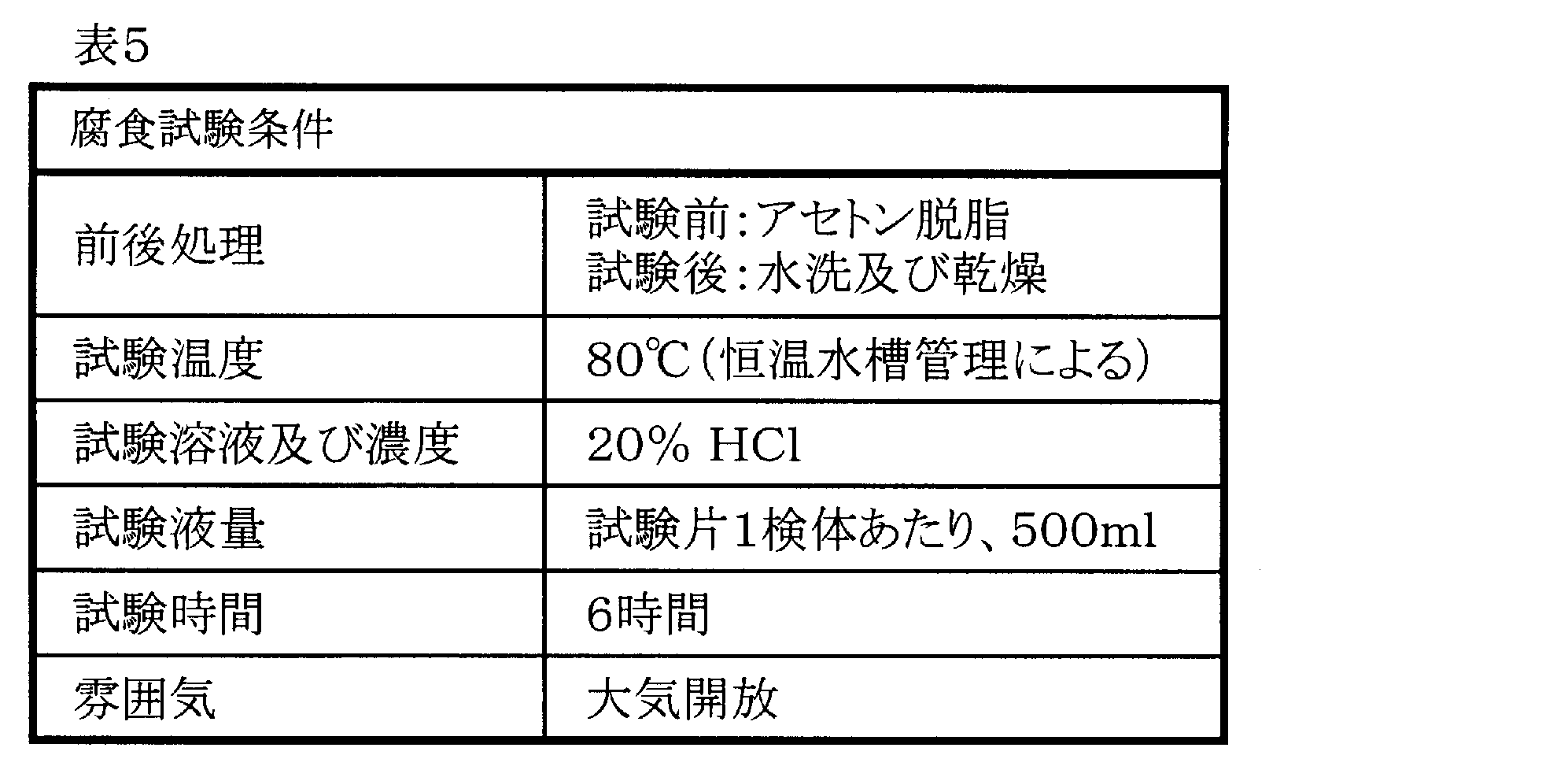
その後、下記表5に示す腐食試験条件により、継手試験片2及び基準試験片12を試験溶液に浸漬する腐食試験を実施し、腐食試験前後の重量差及び腐食前表面積から、腐食速度(mg/cm2/hr)を算出した。ただし、腐食速度は1試験毎に変動するのが一般的であるため、1回の腐食試験毎に、基準試験片12についても同等の腐食試験を実施し、基準試験片12の腐食速度に対する継手試験片2の腐食速度を、腐食速度比として算出した。すなわち、腐食速度比が1.00であることは、溶接金属の腐食速度が、溶接していない基準試験片12(すなわち、市中鋼板)の腐食速度と同等であることを示している。
各試験において算出された腐食速度比及び評価結果を、下記表6に示す。なお、腐食速度比は低い値であるほど、腐食が進行していないことを示している。評価基準としては、0.85未満を評価A(優良)、0.85以上0.95未満を評価B(良好)、0.95以上1.00未満を評価C(やや良好)、1.00以上を評価D(不良)とした。



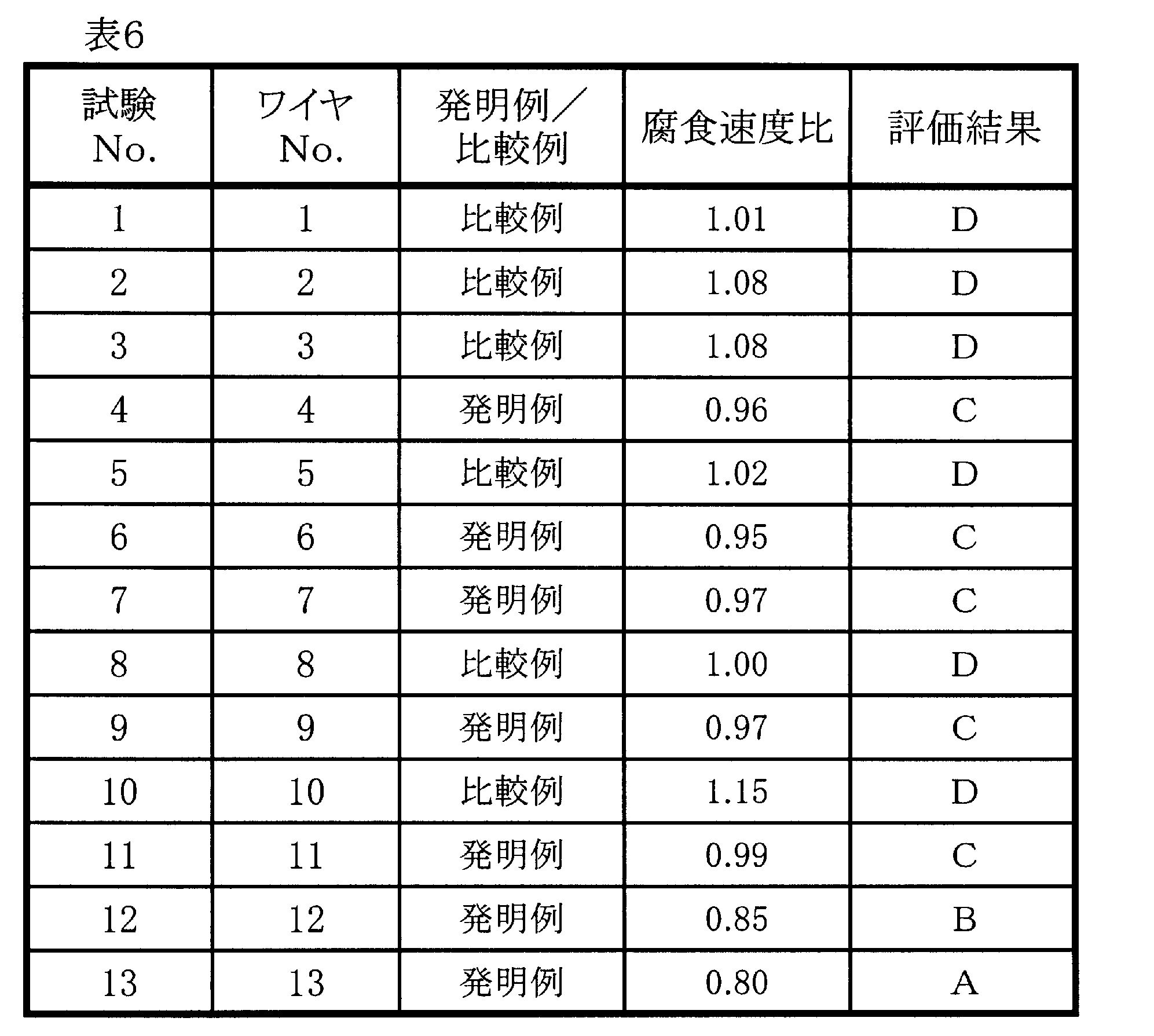
上記表6に示すように、比較例である試験No.1及び2は、Mo含有量及びCo含有量が本発明の数値範囲の下限未満であるとともに、57×[Mo]+221×[Co]≧15(すなわち、式(1))を満足しないため、耐塩酸腐食性が優れた溶接金属を得ることができず、腐食試験の評価結果がD(不良)であった。
比較例である試験No.3及び8は、Co含有量が本発明の数値範囲の下限未満であるとともに、式(1)を満足しないため、耐塩酸腐食性が優れた溶接金属を得ることができず、腐食試験の評価結果がD(不良)であった。
比較例である試験No.3及び8は、Co含有量が本発明の数値範囲の下限未満であるとともに、式(1)を満足しないため、耐塩酸腐食性が優れた溶接金属を得ることができず、腐食試験の評価結果がD(不良)であった。
比較例である試験No.5は、Mo含有量及びCo含有量が本発明の数値範囲内であるが、式(1)を満足しないため、耐塩酸腐食性が優れた溶接金属を得ることができず、腐食試験の評価結果がD(不良)であった。
比較例である試験No.10は、Mo含有量及びCo含有量が本発明の数値範囲の下限未満であり、式(1)を満足しないとともに、Sb含有量が本発明の数値範囲の下限未満であり、更には、Cr含有量が本発明の数値範囲の上限を超えているため、腐食試験の評価結果が極めて悪い結果(評価結果D、腐食速度比:1.15)となった。
比較例である試験No.10は、Mo含有量及びCo含有量が本発明の数値範囲の下限未満であり、式(1)を満足しないとともに、Sb含有量が本発明の数値範囲の下限未満であり、更には、Cr含有量が本発明の数値範囲の上限を超えているため、腐食試験の評価結果が極めて悪い結果(評価結果D、腐食速度比:1.15)となった。
これに対し、発明例である試験No.4、6、7、9、11~13は、いずれも本発明で規定する数値範囲を全て満たしているため、耐塩酸腐食性が優れた溶接金属(評価結果A~C)を得ることができた。
なお、試験No.12及び13は、Mo含有量及びCo含有量が比較的高く、式(1)の左辺により算出される値が20以上の大きな値となったため、耐塩酸腐食性が著しく優れた溶接金属(評価結果A、B)を得ることができた。
なお、試験No.12及び13は、Mo含有量及びCo含有量が比較的高く、式(1)の左辺により算出される値が20以上の大きな値となったため、耐塩酸腐食性が著しく優れた溶接金属(評価結果A、B)を得ることができた。
以上詳述したように、本発明によれば、耐塩酸腐食性が優れた溶接金属を得ることができるガスシールドアーク溶接用フラックス入りワイヤを得ることができる。
以上、図面を参照しながら各種の実施の形態について説明したが、本発明はかかる例に限定されないことは言うまでもない。当業者であれば、特許請求の範囲に記載された範疇内において、各種の変更例又は修正例に想到し得ることは明らかであり、それらについても当然に本発明の技術的範囲に属するものと了解される。また、発明の趣旨を逸脱しない範囲において、上記実施の形態における各構成要素を任意に組み合わせてもよい。
なお、本出願は、2018年11月22日出願の日本特許出願(特願2018-219177)に基づくものであり、その内容は本出願の中に参照として援用される。
Claims (5)
- 鋼製外皮にフラックスが充填された、ガスシールドアーク溶接用フラックス入りワイヤであって、
ワイヤ全質量あたり、
C :0.02質量%以上0.10質量%以下、
Si:0.05質量%以上1.00質量%以下、
Mn:1.5質量%以上3.0質量%以下、
S :0.003質量%以上0.030質量%以下、
Cu:0.05質量%以上0.50質量%以下、
Ni:0.05質量%以上0.50質量%以下、
Mo:0.05質量%以上0.35質量%以下、
Co:0.005質量%以上0.300質量%以下、
Sb:0.01質量%以上0.20質量%以下、
を含有し、
P :0.030質量%以下、
Cr:0.05質量%以下、
に制限するとともに、
下記式(1)を満足することを特徴とするフラックス入りワイヤ。
57×[Mo]+221×[Co]≧15 ・・・(1)
ただし、[Mo]は、ワイヤ全質量に対する前記鋼製外皮及び前記フラックス中のMo含有量(質量%)を示し、[Co]は、ワイヤ全質量に対する前記鋼製外皮及び前記フラックス中のCo含有量(質量%)を示す。 - さらに、ワイヤ全質量あたり、Ti:2.0質量%以上4.5質量%以下を含有する、請求項1に記載のフラックス入りワイヤ。
- さらに、スラグ形成剤を含有し、ワイヤ全質量あたり、前記スラグ形成剤中のNa、K、Li、Mg及びFの含有量の合計が0.010質量%以上1.500質量%以下である、請求項1又は2に記載のフラックス入りワイヤ。
- さらに、Nb、Zr及びVから選択された少なくとも1種を含有し、ワイヤ全質量あたり、前記Nb、Zr及びVの含有量の合計が0質量%超0.50質量%以下である、請求項1又は2に記載のフラックス入りワイヤ。
- さらに、ワイヤ全質量あたり、B:0質量%超0.0080質量%以下を含有する、請求項1又は2に記載のフラックス入りワイヤ。
Priority Applications (1)
| Application Number | Priority Date | Filing Date | Title |
|---|---|---|---|
| SG11202104049SA SG11202104049SA (en) | 2018-11-22 | 2019-11-14 | Flux-cored wire for gas shielded arc welding |
Applications Claiming Priority (2)
| Application Number | Priority Date | Filing Date | Title |
|---|---|---|---|
| JP2018219177A JP7007253B2 (ja) | 2018-11-22 | 2018-11-22 | ガスシールドアーク溶接用フラックス入りワイヤ |
| JP2018-219177 | 2018-11-22 |
Publications (1)
| Publication Number | Publication Date |
|---|---|
| WO2020105530A1 true WO2020105530A1 (ja) | 2020-05-28 |
Family
ID=70774445
Family Applications (1)
| Application Number | Title | Priority Date | Filing Date |
|---|---|---|---|
| PCT/JP2019/044644 Ceased WO2020105530A1 (ja) | 2018-11-22 | 2019-11-14 | ガスシールドアーク溶接用フラックス入りワイヤ |
Country Status (3)
| Country | Link |
|---|---|
| JP (1) | JP7007253B2 (ja) |
| SG (1) | SG11202104049SA (ja) |
| WO (1) | WO2020105530A1 (ja) |
Cited By (2)
| Publication number | Priority date | Publication date | Assignee | Title |
|---|---|---|---|---|
| CN117161607A (zh) * | 2023-10-19 | 2023-12-05 | 燕山大学 | 一种屈服强度不小于370MPa的原油储罐钢内底板焊接用焊条 |
| CN118237798A (zh) * | 2024-04-23 | 2024-06-25 | 江苏九洲新材料科技有限公司 | 一种高氮低镍高温药芯焊丝及制备方法 |
Families Citing this family (1)
| Publication number | Priority date | Publication date | Assignee | Title |
|---|---|---|---|---|
| JP7485594B2 (ja) * | 2020-12-18 | 2024-05-16 | 株式会社神戸製鋼所 | フラックス入りワイヤ及びガスシールドアーク溶接方法 |
Citations (4)
| Publication number | Priority date | Publication date | Assignee | Title |
|---|---|---|---|---|
| JP2004090042A (ja) * | 2002-08-30 | 2004-03-25 | Nippon Steel Corp | 耐塩酸性および耐硫酸性に優れた低合金鋼のガスシールドアーク溶接用フラックス入りワイヤ |
| JP2006281223A (ja) * | 2005-03-31 | 2006-10-19 | Kobe Steel Ltd | 低合金鋼溶接金属及びフラックス入りワイヤ |
| JP2008126279A (ja) * | 2006-11-21 | 2008-06-05 | Nippon Steel Corp | ガスシールドアーク溶接用フラックス入りワイヤ |
| JP2016523714A (ja) * | 2013-05-08 | 2016-08-12 | ホバート ブラザーズ カンパニー | 低マンガン溶接合金のためのシステム及び方法 |
-
2018
- 2018-11-22 JP JP2018219177A patent/JP7007253B2/ja active Active
-
2019
- 2019-11-14 SG SG11202104049SA patent/SG11202104049SA/en unknown
- 2019-11-14 WO PCT/JP2019/044644 patent/WO2020105530A1/ja not_active Ceased
Patent Citations (4)
| Publication number | Priority date | Publication date | Assignee | Title |
|---|---|---|---|---|
| JP2004090042A (ja) * | 2002-08-30 | 2004-03-25 | Nippon Steel Corp | 耐塩酸性および耐硫酸性に優れた低合金鋼のガスシールドアーク溶接用フラックス入りワイヤ |
| JP2006281223A (ja) * | 2005-03-31 | 2006-10-19 | Kobe Steel Ltd | 低合金鋼溶接金属及びフラックス入りワイヤ |
| JP2008126279A (ja) * | 2006-11-21 | 2008-06-05 | Nippon Steel Corp | ガスシールドアーク溶接用フラックス入りワイヤ |
| JP2016523714A (ja) * | 2013-05-08 | 2016-08-12 | ホバート ブラザーズ カンパニー | 低マンガン溶接合金のためのシステム及び方法 |
Cited By (2)
| Publication number | Priority date | Publication date | Assignee | Title |
|---|---|---|---|---|
| CN117161607A (zh) * | 2023-10-19 | 2023-12-05 | 燕山大学 | 一种屈服强度不小于370MPa的原油储罐钢内底板焊接用焊条 |
| CN118237798A (zh) * | 2024-04-23 | 2024-06-25 | 江苏九洲新材料科技有限公司 | 一种高氮低镍高温药芯焊丝及制备方法 |
Also Published As
| Publication number | Publication date |
|---|---|
| JP7007253B2 (ja) | 2022-02-10 |
| SG11202104049SA (en) | 2021-06-29 |
| JP2020082124A (ja) | 2020-06-04 |
Similar Documents
| Publication | Publication Date | Title |
|---|---|---|
| JP6809533B2 (ja) | フラックス入りワイヤ、溶接継手の製造方法、及び溶接継手 | |
| JP6766866B2 (ja) | フラックス入りワイヤ、溶接継手の製造方法、及び溶接継手 | |
| JP3476125B2 (ja) | 2相ステンレス鋼溶接用フラックス入りワイヤ | |
| JP6901868B2 (ja) | エレクトロスラグ溶接用ワイヤ、エレクトロスラグ溶接用フラックス及び溶接継手 | |
| JP6953869B2 (ja) | ガスシールドアーク溶接用フラックス入りワイヤ、及び溶接継手の製造方法 | |
| US10870178B2 (en) | Flux-cored wire for arc welding of duplex stainless steel and weld metal | |
| JP6453178B2 (ja) | ガスシールドアーク溶接用フラックス入りワイヤ | |
| CN108698174A (zh) | 药芯焊丝、焊接接头的制造方法和焊接接头 | |
| JP6801494B2 (ja) | ガスシールドアーク溶接用フラックス入りワイヤ、および溶接継手の製造方法 | |
| JP6953789B2 (ja) | ガスシールドアーク溶接用フラックス入りワイヤ、及び溶接継手の製造方法 | |
| JP4970802B2 (ja) | Ni基合金フラックス入りワイヤ | |
| JP6953870B2 (ja) | ガスシールドアーク溶接用フラックス入りワイヤ、及び溶接継手の製造方法 | |
| JP2017013118A (ja) | ステンレス鋼溶接用フラックス入りワイヤ、ステンレス鋼溶接継手、及び、その製造方法 | |
| WO2021002259A1 (ja) | オーステナイト系ステンレス鋼フラックス入りワイヤ、溶接金属及び溶接方法 | |
| JP7007253B2 (ja) | ガスシールドアーク溶接用フラックス入りワイヤ | |
| KR20230162714A (ko) | 플럭스 코어드 와이어 및 용접 조인트의 제조 방법 | |
| JP6953930B2 (ja) | ガスシールドアーク溶接用フラックス入りワイヤ、及び溶接継手の製造方法 | |
| JP6953931B2 (ja) | ガスシールドアーク溶接用フラックス入りワイヤ、及び溶接継手の製造方法 | |
| JP6958139B2 (ja) | ガスシールドアーク溶接用フラックス入りワイヤ、及び溶接継手の製造方法 | |
| CN106794559B (zh) | 气体保护电弧焊用药芯焊丝 | |
| KR102730726B1 (ko) | Ni기 합금 플럭스 코어드 와이어 | |
| JP3892781B2 (ja) | 耐塩酸性および耐硫酸性に優れた低合金鋼のガスシールドアーク溶接用フラックス入りワイヤ | |
| JP3930782B2 (ja) | 耐硫酸性および耐塩酸性に優れる低合金鋼溶接用の被覆アーク溶接棒 | |
| JP2008126279A (ja) | ガスシールドアーク溶接用フラックス入りワイヤ | |
| CN111886110A (zh) | 药芯焊丝 |
Legal Events
| Date | Code | Title | Description |
|---|---|---|---|
| 121 | Ep: the epo has been informed by wipo that ep was designated in this application |
Ref document number: 19886623 Country of ref document: EP Kind code of ref document: A1 |
|
| NENP | Non-entry into the national phase |
Ref country code: DE |
|
| 122 | Ep: pct application non-entry in european phase |
Ref document number: 19886623 Country of ref document: EP Kind code of ref document: A1 |