WO2020105402A1 - 接続モジュール - Google Patents
接続モジュールInfo
- Publication number
- WO2020105402A1 WO2020105402A1 PCT/JP2019/043019 JP2019043019W WO2020105402A1 WO 2020105402 A1 WO2020105402 A1 WO 2020105402A1 JP 2019043019 W JP2019043019 W JP 2019043019W WO 2020105402 A1 WO2020105402 A1 WO 2020105402A1
- Authority
- WO
- WIPO (PCT)
- Prior art keywords
- wiring
- bus bar
- connection module
- holding
- power storage
- Prior art date
- Legal status (The legal status is an assumption and is not a legal conclusion. Google has not performed a legal analysis and makes no representation as to the accuracy of the status listed.)
- Ceased
Links
Images




Classifications
-
- H—ELECTRICITY
- H01—ELECTRIC ELEMENTS
- H01M—PROCESSES OR MEANS, e.g. BATTERIES, FOR THE DIRECT CONVERSION OF CHEMICAL ENERGY INTO ELECTRICAL ENERGY
- H01M50/00—Constructional details or processes of manufacture of the non-active parts of electrochemical cells other than fuel cells, e.g. hybrid cells
- H01M50/50—Current conducting connections for cells or batteries
- H01M50/502—Interconnectors for connecting terminals of adjacent batteries; Interconnectors for connecting cells outside a battery casing
- H01M50/507—Interconnectors for connecting terminals of adjacent batteries; Interconnectors for connecting cells outside a battery casing comprising an arrangement of two or more busbars within a container structure, e.g. busbar modules
-
- H—ELECTRICITY
- H01—ELECTRIC ELEMENTS
- H01M—PROCESSES OR MEANS, e.g. BATTERIES, FOR THE DIRECT CONVERSION OF CHEMICAL ENERGY INTO ELECTRICAL ENERGY
- H01M50/00—Constructional details or processes of manufacture of the non-active parts of electrochemical cells other than fuel cells, e.g. hybrid cells
- H01M50/50—Current conducting connections for cells or batteries
-
- H—ELECTRICITY
- H01—ELECTRIC ELEMENTS
- H01M—PROCESSES OR MEANS, e.g. BATTERIES, FOR THE DIRECT CONVERSION OF CHEMICAL ENERGY INTO ELECTRICAL ENERGY
- H01M50/00—Constructional details or processes of manufacture of the non-active parts of electrochemical cells other than fuel cells, e.g. hybrid cells
- H01M50/50—Current conducting connections for cells or batteries
- H01M50/502—Interconnectors for connecting terminals of adjacent batteries; Interconnectors for connecting cells outside a battery casing
- H01M50/519—Interconnectors for connecting terminals of adjacent batteries; Interconnectors for connecting cells outside a battery casing comprising printed circuit boards [PCB]
-
- H—ELECTRICITY
- H05—ELECTRIC TECHNIQUES NOT OTHERWISE PROVIDED FOR
- H05K—PRINTED CIRCUITS; CASINGS OR CONSTRUCTIONAL DETAILS OF ELECTRIC APPARATUS; MANUFACTURE OF ASSEMBLAGES OF ELECTRICAL COMPONENTS
- H05K1/00—Printed circuits
- H05K1/02—Details
- H05K1/0277—Bendability or stretchability details
- H05K1/028—Bending or folding regions of flexible printed circuits
-
- H—ELECTRICITY
- H05—ELECTRIC TECHNIQUES NOT OTHERWISE PROVIDED FOR
- H05K—PRINTED CIRCUITS; CASINGS OR CONSTRUCTIONAL DETAILS OF ELECTRIC APPARATUS; MANUFACTURE OF ASSEMBLAGES OF ELECTRICAL COMPONENTS
- H05K1/00—Printed circuits
- H05K1/02—Details
- H05K1/0296—Conductive pattern lay-out details not covered by sub groups H05K1/02 - H05K1/0295
- H05K1/0298—Multilayer circuits
-
- H—ELECTRICITY
- H05—ELECTRIC TECHNIQUES NOT OTHERWISE PROVIDED FOR
- H05K—PRINTED CIRCUITS; CASINGS OR CONSTRUCTIONAL DETAILS OF ELECTRIC APPARATUS; MANUFACTURE OF ASSEMBLAGES OF ELECTRICAL COMPONENTS
- H05K2201/00—Indexing scheme relating to printed circuits covered by H05K1/00
- H05K2201/10—Details of components or other objects attached to or integrated in a printed circuit board
- H05K2201/10007—Types of components
- H05K2201/10037—Printed or non-printed battery
-
- H—ELECTRICITY
- H05—ELECTRIC TECHNIQUES NOT OTHERWISE PROVIDED FOR
- H05K—PRINTED CIRCUITS; CASINGS OR CONSTRUCTIONAL DETAILS OF ELECTRIC APPARATUS; MANUFACTURE OF ASSEMBLAGES OF ELECTRICAL COMPONENTS
- H05K2201/00—Indexing scheme relating to printed circuits covered by H05K1/00
- H05K2201/10—Details of components or other objects attached to or integrated in a printed circuit board
- H05K2201/10227—Other objects, e.g. metallic pieces
- H05K2201/10272—Busbars, i.e. thick metal bars mounted on the printed circuit board [PCB] as high-current conductors
-
- Y—GENERAL TAGGING OF NEW TECHNOLOGICAL DEVELOPMENTS; GENERAL TAGGING OF CROSS-SECTIONAL TECHNOLOGIES SPANNING OVER SEVERAL SECTIONS OF THE IPC; TECHNICAL SUBJECTS COVERED BY FORMER USPC CROSS-REFERENCE ART COLLECTIONS [XRACs] AND DIGESTS
- Y02—TECHNOLOGIES OR APPLICATIONS FOR MITIGATION OR ADAPTATION AGAINST CLIMATE CHANGE
- Y02E—REDUCTION OF GREENHOUSE GAS [GHG] EMISSIONS, RELATED TO ENERGY GENERATION, TRANSMISSION OR DISTRIBUTION
- Y02E60/00—Enabling technologies; Technologies with a potential or indirect contribution to GHG emissions mitigation
- Y02E60/10—Energy storage using batteries
Definitions
- connection module The technology disclosed in this specification relates to a connection module.
- a battery module for an electric vehicle or a hybrid vehicle includes a battery block composed of a plurality of battery cells, and a connection module attached to the battery block and connecting a plurality of single batteries.
- a connection module there is known a flexible printed wiring board with a bus bar, which includes a flexible printed circuit board (FPC) and a plurality of bus bars connected to the flexible printed circuit board and connecting electrode terminals of adjacent power storage elements (Patent). Reference 1).
- a connection module disclosed in the present specification is a connection module that is attached to a power storage element group configured by a plurality of power storage elements including electrode terminals to connect the plurality of power storage elements, and has a plurality of wiring paths.
- a flexible printed circuit board and a plurality of connecting members that are connected to the wiring path and connect the electrode terminals of the adjacent power storage elements to each other;
- the routing paths of are laminated to form a laminated portion.
- the width of the wiring route can be made smaller than that in the case where the wirings corresponding to all the connection members are housed in the wiring route of one layer.
- the routing route can be accommodated in the limited routing space.
- connection module may include a holding member that holds the plurality of connection members and the laminated portion.
- connection module it is possible to collectively hold a plurality of connecting members together with a plurality of connecting members in a state where a plurality of wiring routes are stacked, and to collectively set them at a predetermined position on the storage element group. As a result, workability of assembling the connection module to the power storage element group can be improved.
- the routing path can be accommodated within the limited routing space on the storage element group.
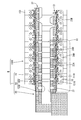
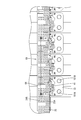
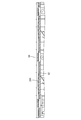
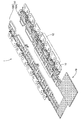
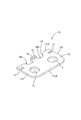
- FIG. 1 Perspective view of the electricity storage module of the embodiment
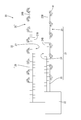
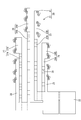
- the perspective view of the bus bar of the embodiment The top view of the flexible printed circuit board of embodiment Development view of the flexible printed circuit board of the embodiment
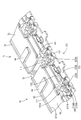
- the perspective view of the resin protector of the embodiment Partial enlarged view of frame R3 in FIG. In the resin protector, the partial expansion perspective view which expands and shows the circumference
- connection module 1 of the present embodiment constitutes an electricity storage module M used as a drive source for vehicles such as electric vehicles and hybrid vehicles. As shown in FIG. 1, the connection module 1 is attached to a power storage element group 150G in which a plurality of power storage elements 150 are arranged in a line, and connects the plurality of power storage elements 150 in series.
- the power storage element 150 is, for example, a secondary battery. As shown in FIG. 1, each power storage element 150 has a flat rectangular parallelepiped shape, and has an electrode placement surface 150F (upper surface in FIG. 1) perpendicular to a surface facing the adjacent power storage element 150. ing.
- the electrode terminals 151A and 151B are arranged on the electrode arrangement surface 150F.
- One of the electrode terminals 151A and 151B is the positive electrode terminal 151A, and the other is the negative electrode terminal 151B.
- Each of the electrode terminals 151A and 151B has a columnar shape, and although not shown in detail, the outer peripheral surface is threaded.
- a plurality of power storage elements 150 are arranged in a line to form a power storage element group 150G.
- two adjacent power storage elements 150 have electrode terminals 151A and 151B of different polarities adjacent to each other (that is, the positive electrode terminal 151A of one power storage element 150 and another adjacent to this).
- the negative electrode terminal 151B of the power storage element 150 is arranged so as to be adjacent to each other.
- connection module 1 is a module that is assembled to the surface (upper surface in FIG. 1) formed by the electrode placement surface 150F of each power storage element 150 in the power storage element group 150G. As shown in FIG. 2, the connection module 1 is connected to the flexible printed circuit board 20 (hereinafter, referred to as “FPC20”) and the FPC20 to connect the positive electrode terminal 151A and the negative electrode terminal 151B of the adjacent power storage elements 150.
- FPC20 flexible printed circuit board 20
- a plurality of bus bars 10 (corresponding to a connecting member) and a resin protector 50 (corresponding to a holding member) that holds the bus bar 10 and the FPC 20 are provided.
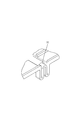
- Each of the plurality of bus bars 10 is made of metal, and as shown in FIG. 7, an electrode connecting portion 11 that connects the positive electrode terminal 151 ⁇ / b> A and the negative electrode terminal 151 ⁇ / b> B of the adjacent power storage elements 150, and from this electrode connecting portion 11. It is provided with an FPC connection piece 15 that is continuous and is connected to the FPC 20, and a locking wall 16 that is continuous from the FPC connection piece 15.
- the electrode connection portion 11 is a rectangular plate-shaped portion as a whole, and has two electrode insertion holes 12 through which the electrode terminals 151A and 151B can be inserted and two engagement recesses for engaging the resin protector 50. 13 and 13.
- One electrode insertion hole 12 is arranged at a position close to one short side 11S of the electrode connecting portion 11, and one is arranged at a position close to the other short side 11S.
- One of the two engaging recesses 13 is a recess recessed from one short side 11S of the electrode connecting part 11, and the other is a recess recessed from the other short side 11S.
- the electrode connecting portion 11 has a connection recess 14 that is recessed from one long side 11LA of the pair of long sides 11LA and 11LB.
- the connection recess 14 is a recess defined by a first inner edge 14A parallel to the long side 11LA and a pair of first side edges 14B connecting both ends of the first inner edge 14A and the long side 11LA. ..
- the FPC connection piece 15 is a rectangular plate piece-shaped portion extending from the first inner edge 14A in the same plane as the electrode connection portion 11.
- the locking wall 16 is a short plate wall-shaped portion that extends vertically from the tip of the FPC connection piece 15.
- the FPC 20 is a member for electrically connecting the plurality of bus bars 10 and the ECU (electronic control unit: not shown). Although not shown in detail, the FPC 20 has a plurality of conductive paths formed of copper foil. , And an insulating resin film that covers both surfaces of the conductive path. As shown in FIG. 9, the FPC 20 includes an FPC main body 21 and a plurality of first movable portions 41 connected from the FPC main body 21 and connected to the plurality of bus bars 10, respectively.
- the FPC main body 21 includes an external connection portion 22 connected to the ECU and six wiring portions (first wiring portion 23, second wiring portion 24, third wiring portion) connected to the external connection portion 22.
- the 1st wiring part 23 is provided with the 1st expansion-contraction part 23A extended from the external connection part 22, and the 1st bus-bar arrangement
- positioning part 23B which continues from the extension end of the 1st expansion-contraction part 23A, and is an elongated strip-shaped part as a whole. is there.
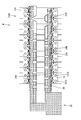
- the first stretchable portion 23A is lightly bent along a plurality of folding lines 29, so that the first stretchable portion 23A is bent into a gentle corrugated shape in which mountain-shaped portions and valley-shaped portions are alternately arranged (see also FIG. 6). See also), and it can be expanded and contracted by changing the folding angle. As a result, the displacement of the first bus bar arranging portion 23B in the direction toward and away from the external connecting portion 22 is allowed.
- the second wiring portion 24 includes a second stretchable portion 24A extending from the external connection portion 22 and a second bus bar arrangement portion 24B connected from the extended end of the second stretchable portion 24A.
- the fourth wiring portion 26 includes a fourth expansion / contraction portion 26A extending from the external connection portion 22 and a fourth bus bar arrangement portion 26B continuous from the extending end of the fourth expansion / contraction portion 26A.
- the fifth wiring portion 27 includes a fifth expansion / contraction portion 27A extending from the external connection portion 22 and a fifth bus bar arrangement portion 27B continuous from the extending end of the fifth expansion / contraction portion 27A.
- the configurations of the second stretchable portion 24A, the fourth stretchable portion 26A, and the fifth stretchable portion 27A are the same as the first stretchable portion 23A, except that the lengths are different.
- the third wiring portion 25 and the sixth wiring portion 28 extend from the external connection portion 22.
- the third wiring portion 25 is different from the above four wiring portions 23, 24, 26 and 27 in that it does not have a stretchable portion.
- the six wiring portions 23, 24, 25, 26, 27, 28 extend in the same direction from the external connection portion 22 and are arranged in parallel.
- the first movable portion 41 is an S-shaped wire spring-shaped portion that is continuous from the FPC main body 21. As shown in FIG. 9, a part of the plurality of first movable parts 41 is connected to the third wiring part 25, another part is connected to the sixth wiring part 28, and the rest is a plurality of parts. Each of them is connected from each of the four bus bar arrangement portions 23B, 24B, 26B, 27B.
- the tip end of the first movable portion 41 is a joining piece in which a part of the conductive path is exposed as a joining land (not shown), and the FPC connecting piece 15 is connected thereto by soldering.
- the external connection portion 22 is folded along the mountain fold line shown by the broken line in FIG. 9 and the valley fold line shown by the alternate long and short dash line.
- the first wiring portion 23, the second wiring portion 24, and the third wiring portion 25 form a set of stacked portions (first stacked portion 31), and the fourth wiring The portion 26, the fifth wiring portion 27, and the sixth wiring portion 28 form another set of laminated portions (second laminated portion 32).
- the first laminated portion 31 includes a second layer formed by the first wiring portion 23 on a first layer formed by the second wiring portion 24 and the third wiring portion 25. It has a stacked two-layer structure.
- the third wiring portion 25, the second bus bar arrangement portion 24B, and the first bus bar arrangement portion 23B are arranged in a line in this order from the side closer to the external connection portion 22, and the third wiring
- the plurality of first movable portions 41 connected to the portion 25, the second bus bar arrangement portion 24B, and the first bus bar arrangement portion 23B are also arranged in a line.
- the second layer formed by the fourth wiring portion 26 is stacked on the first layer formed by the fifth wiring portion 27 and the sixth wiring portion 28. It has a layered structure.
- the sixth wiring section 28, the fifth bus bar arranging section 27B, and the fourth bus bar arranging section 26B are arranged in a line in this order from the side closer to the external connection section 22.
- the plurality of first movable portions 41 connected to the portion 28, the fifth bus bar arrangement portion 27B, and the fourth bus bar arrangement portion 26B are also arranged in a line.
- the first busbar placement part 23B is allowed to be displaced in the direction of approaching / separating from the second busbar placement part 24B arranged adjacently.
- the second bus bar disposition part 24B is allowed to be displaced in a direction in which the second bus bar disposition part 24B approaches and separates from the first bus bar disposition part 23B and the third wiring part 25 which are arranged adjacently.
- the fourth busbar disposition part 26B is allowed to be displaced in the direction of approaching / separating with respect to the adjacent fifth busbar disposition part 27B.
- the fifth bus bar arrangement part 27B is allowed to be displaced in the direction of approaching / separating from the fourth bus bar disposing part 26B and the sixth wiring part 28 which are arranged adjacently. There is. Accordingly, it is possible to cope with the positional deviation of the electrode terminals 151A and 151B due to the dimensional tolerance of the storage element group 150G.
- the resin protector 50 is made of synthetic resin, and as shown in FIG. 10, is composed of a first protector 50A holding the first laminated portion 31 and a second protector 50B holding the second laminated portion 32. There is.
- the configuration of the second protector 50B is substantially the same as the configuration of the first protector 50A except for details such as the locking structure for the second laminated portion 32, and therefore the first protector 50A will be described below as an example.
- the first protector 50A is a member that holds the first laminated portion 31, and as shown in FIG. 10, a first FPC holding portion 51 that holds the FPC main body 21 and a plurality of bus bar holding portions 121 that hold the bus bar 10. , 131.
- the first FPC holding unit 51 includes three holding units (first holding unit 61, second holding unit 71, third holding unit 81) and adjacent holding units 61, 71.
- Two first connecting portions 91 for connecting 81 are provided, and the overall shape is an elongated rectangular plate having a size substantially equal to that of the first stacking portion 31.
- the first holding unit 61 is a unit that holds the third wiring portion 25, the second stretchable portion 24A, and the portion of the first stretchable portion 23A that overlaps the third wiring portion 25.
- the second holding unit 71 is a unit that holds the second bus bar arrangement portion 24B and a portion of the first expansion / contraction portion 23A that overlaps the second bus bar arrangement portion 24B.
- the third holding unit 81 is a unit that holds the first bus bar placement portion 23B.
- the first holding unit 61 includes a first mounting plate 62, first side ribs 63 that stand up from the first mounting plate 62, and a plurality of pressing members that are continuous from the first side ribs 63. And a piece 64.
- the first mounting plate 62 is a rectangular plate-shaped portion as a whole, as shown in FIG.
- the first side rib 63 is a stripe-shaped portion that projects from one of the long sides 62LA, 62LB of the first mounting plate 62 (upper side in FIG. 11).
- each of the plurality of pressing pieces 64 is an elongated plate piece-shaped portion that extends from the first side rib 63 in parallel with the first mounting plate 62, and is a part of the first mounting plate 62.
- the first laminated portion 31 can be sandwiched and held between them.
- the second holding unit 71 includes a second mounting plate 72, second side ribs 73 rising from the second mounting plate 72, and a plurality of holding pieces 64 connected from the second side ribs 73.
- the third holding unit 81 includes a third mounting plate 82, a third side rib 83 that rises from the third mounting plate 82, and a plurality of pressing pieces 84 that are continuous from the third side rib 83.
- Each of the two first connecting portions 91 is a leaf spring-shaped portion bent in a W shape, as shown in FIG.
- one first connecting portion 91 is a portion that connects the first placing plate 62 and the second placing plate 72, and one end of the W-shape is the first placing part.
- the short side 62S of the plate 62 is connected to the short side 72S of the second mounting plate 72 at the other end.
- the other first connecting portion 91 similarly connects the second mounting plate 72 and the third mounting plate 82.
- one of the first holding unit 61 located at the end opposite to the second holding unit 71 and the second holding unit 81 of the second holding unit 81 is a fixed bus bar holding part 131, and the other is a movable bus bar holding part 121 connected to the holding units 61, 71, 81 via the second movable part 111. Is.
- the 2nd movable part 111 which connects with the 1st holding
- the same configurations are denoted by the same reference numerals and description thereof will be omitted.
- the first mounting plate 62 has a plurality of spring recesses 101 that are recessed inward from the other (lower side in FIG. 11) long side 62LB of the pair of long sides 62LA and 62LB. ..
- Each spring recess 101 is a recess defined by a second inner edge 101A parallel to the long side 62LB and a pair of second side edges 101B connecting both ends of the second inner edge 101A and the long side 62LB. ..
- the second movable portion 111 is a leaf spring-shaped portion that extends while bending from the second inner edge 101A, extends perpendicularly to the first mounting plate 62, and is then folded back. And an S-shape that extends so as to approach the first mounting plate 62, is folded back, and extends away from the first mounting plate 62.
- Two adjacent two of the second movable portions 111 form a pair and are connected to one movable bus bar holding portion 121.
- the movable bus bar holding portion 121 includes a back plate portion 122 continuous from the second movable portion 111, a bottom plate portion 123 continuous from the back plate portion 122, and an extension piece 125 extending from the bottom plate portion 123.
- the first bus bar locking piece 126 and the two second bus bar locking pieces 127 are provided.
- the back plate part 122 is a plate-shaped part arranged in a posture perpendicular to the first mounting plate 62, and is provided at the tip of each of the pair of second movable parts 111. It is connected.
- the bottom plate portion 123 is a plate-shaped portion that extends vertically from the back plate portion 122 in a direction opposite to the first mounting plate 62, and has two slits 124. ing. Each of the two slits 124 extends from the extended end of the bottom plate portion 123 toward the back plate portion 122, and the slits cause the bottom plate portion 123 to have end plate portions 123A at both ends and a center portion. It is divided into a plate portion 123B. As shown in FIG. 14, the extension piece 125 is a plate-like portion that extends from the extending end of the middle plate portion 123B on the same plane as the bottom plate portion 123.
- the first bus bar locking piece 126 extends from the middle plate portion 123B and is arranged with a gap from the back plate portion 122, and the first bending piece 126A and the first bending piece 126A.
- a first locking claw 126B that projects from the extending end in the direction opposite to the back plate 122 is provided.
- the first bending piece 126A is slightly inclined so as to be farther from the back plate portion 122 as it is farther from the middle plate portion 123B.
- Each of the two second bus bar locking pieces 127 extends from each of the two end plate portions 123A, as shown in FIG. Although not shown in detail, each of the second bus bar locking pieces 127 faces the back plate portion 122 from the second bending piece that extends vertically from the extended end of the two end plate portions 123A and the tip of the second bending piece. And a second locking claw that protrudes.
- the fixed busbar holding portion 131 does not have the second movable portion 111, and is similar to the movable busbar holding portion 121 except that the back plate portion extends from the long side 62LB of the first mounting plate 62.
- the same parts as those of the movable bus bar holding part 121 are designated by the same reference numerals and the description thereof will be omitted.
- the plurality of bus bar holding portions 121 and 131 are arranged in a line as shown in FIG. 10, and the movable bus bar holding portions 121 adjacent to each other are connected by a U-shaped second connecting portion 141 as shown in FIG. It is connected. Similarly, the fixed bus bar holding part 131 and the movable bus bar holding part 121 which are adjacent to each other are also connected by the second connecting part 141.
- connection module 1 An example of a procedure for assembling the connection module 1 having the above configuration will be described below.
- each bus bar 10 connects multiple bus bars 10 to the FPC 20.
- the FPC connecting piece 15 of each bus bar 10 is overlaid on each joining piece of the FPC 20 and joined by reflow soldering.
- Each bus bar 10 is in a state of being connected to the FPC main body 21 via the first movable portion 41, and by the deformation of the first movable portion 41, each bus bar 10 is free to some extent with respect to the FPC main body 21. Can be displaced.
- the joined body of the FPC 20 and the plurality of bus bars 10 is assembled to the resin protector 50.
- the first laminated portion 31 is assembled to the first protector 50A.
- the first stacked unit 31 is stacked on the mounting plates 62, 72, 82 so as to be inserted into the gaps between the pressing pieces 64, 84 and held by the first FPC holding unit 51.
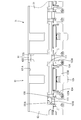
- the height of the pressing piece 64 from the first mounting plate 62 is larger than the thickness of the first laminated portion 31, and as shown in FIG. 4, the second elastic portion 24A is allowed to bend to some extent. In this state, it is sandwiched and held between the pressing piece 64 and the first mounting plate 62.
- the first expansion / contraction portion 23A is also held in a state in which the bending deformation is allowed to some extent.
- the second laminated portion 32 is similarly assembled to the second protector 50B.
- each bus bar 10 is assembled to each bus bar holding portion 121, 131. While bending the first bus bar locking piece 126 and the second bus bar locking piece 127, the electrode connecting portion 11 is pushed toward the bottom plate portion 123. When the electrode connecting portion 11 comes into contact with the bottom plate portion 123, as shown in FIG. 6, the first bus bar locking piece 126 elastically returns, and the locking wall 16 becomes the middle plate portion 123B and the first locking claw 126B. Sandwiched between. Further, the second bus bar locking piece 127 is inserted into the engaging recess 13 and engages with the electrode connecting portion 11. In this way, each bus bar 10 is fixed to each bus bar holding portion 121, 131.
- the first movable portion 41 of the bus bar 10 is allowed to be displaced to some extent with respect to the FPC main body 21, so that the bus bar 10 can be easily assembled to the bus bar holding portions 121 and 131. It can be carried out. Further, by simply pushing the bus bar 10 toward the bottom plate portion 123, it can be easily assembled to the bus bar holding portions 121 and 131.
- connection module 1 Assembly of Connection Module 1 to Storage Element Group 150G
- An example of a procedure for assembling the connection module 1 having the above configuration to the storage element group 150G will be described below.
- connection module 1 is arranged at a predetermined position on the storage element group 150G, and the electrode terminals 151A and 151B are inserted into the electrode insertion holes 12 of each bus bar 10. After that, nuts (not shown) are screwed onto the electrode terminals 151A and 151B to connect the electrode terminals 151A and 151B and the bus bar 10.
- the first protector 50A is assembled along one of the two columns of the electrode terminals 151A and 151B (the lower right column in FIG. 1) to form the first laminated portion 31.
- the bus bar 10 connected to the first wiring portion 23, the second wiring portion 24, and the third wiring portion 25 is connected to the electrode terminals 151A and 151B forming one row.
- the second protector 50B is assembled along the other column of the electrode terminals 151A and 151B (upper left column in FIG. 1), and the fourth wiring portion 26 and the fifth wiring portion 27 that form the second laminated portion 32.
- the bus bar 10 connected to the sixth wiring portion 28 is connected to the electrode terminals 151A and 151B forming the other row.
- the first laminated portion 31 assembled to one row of the electrode terminals 151A and 151B is formed by laminating a plurality of wiring portions 23, 24, 25.
- each wiring part is provided. It is possible to reduce the widths of the wirings 23, 24 and 25 and the width of the first laminated portion 31 formed by the wiring portions 23, 24 and 25. The same applies to the second laminated portion 32. As a result, the wiring route can be accommodated in the limited wiring space on the storage element group 150G.
- connection module 1 includes a resin protector 50
- the resin protector 50 includes a first protector 50A and a second protector 50B.
- the first protector 50A holds the first laminated portion 31 and the bus bar 10 connected to the wiring portions 23, 24, 25 forming the first laminated portion 31.
- the first protector 50A holds the plurality of wiring portions 23, 24, and 25 together and holds the plurality of bus bars 10 together, and collectively holds the plurality of bus bars 10 at a predetermined position on the storage element group 150G. Can be set to.
- the second protector 50B the plurality of wiring portions 26, 27, 28 can be collectively held together with the plurality of bus bars 10 in a stacked state, and can be collectively set at a predetermined position on the storage element group 150G. it can. As a result, workability of assembling the connection module 1 to the power storage element group 150G can be improved.
- the displacement between the first bus bar arrangement portion 23B, the second bus bar arrangement portion 24B and the third wiring portion 25 is allowed. Accordingly, it is possible to cope with the positional deviation of the electrode terminals 151A and 151B due to the dimensional tolerance of the storage element group 150G.
- the first expansion / contraction portion 23A is bent to reduce the length, and the first bus bar arrangement portion 23B and the second The distance from the bus bar placement portion 24B can be reduced.
- the second expansion / contraction portion 24A can be bent to reduce its length, and the distance between the second bus bar arrangement portion 24B and the third wiring portion 25 can be reduced.
- the first expansion / contraction portion 23A is extended to form the first bus bar arrangement portion 23B and the second bus bar arrangement portion 24B. The distance can be increased.
- the second expansion / contraction part 24A can be extended to increase the distance between the second bus bar placement part 24B and the third wiring part 25. The same applies to the second laminated portion 32.
- the distance between the three holding units 61, 71 and 81 in the first protector 50A varies. Since it is allowed, the first protector 50A does not hinder the displacement between the first bus bar arrangement portion 23B, the second bus bar arrangement portion 24B, and the third wiring portion 25. The same applies to the second protector 50B.
- the connection module 1 is a module that is attached to the storage element group 150G configured by the plurality of storage elements 150 including the electrode terminals 151A and 151B to connect the plurality of storage elements 150. Therefore, the FPC 20 including the plurality of wiring portions 23, 24, 25, 26, 27, 28 and the electrode terminal 151A of the adjacent power storage element 150 connected to the wiring portions 23, 24, 25, 26, 27, 28. , 151B for connecting each other, and the FPC 20 being folded, the plurality of wiring portions 23, 24, 25 are laminated to form the first laminated portion 31, and the plurality of wiring portions 23, 24, 25 are formed. The wiring portions 26, 27, 28 are laminated to form a second laminated portion 32.
- the wiring portions 23, 24, 25, 26, 27, 28 of the wiring portions 23, 24, 25, 26, 27, 28 are compared with the case where the wirings (conductive paths) corresponding to all the bus bars 10 are housed in the wiring route of one layer. Since the width can be reduced, the wiring route can be accommodated in the limited wiring space on the storage element group 150G.
- connection module 1 also includes a resin protector 50 that holds the plurality of bus bars 10, the first laminated portion 31, and the second laminated portion 32.
- the plurality of wiring portions 23, 24, 25, 26, 27, 28 are stacked and held together with the plurality of bus bars 10 and are collectively set on the power storage element group 150G. Can be set in position. As a result, the workability of assembling the connection module 1 to the power storage element group 150G can be improved.
- the technology disclosed in the present specification is not limited to the embodiments described by the above description and the drawings, and includes various aspects such as the following.
- the first laminated portion 31 is composed of the three wiring portions 23, 24, 25, but the laminated portion may be composed of two or four or more wiring routes. Absent.
- the first laminated portion 31 has a two-layer structure, but the laminated portion may be composed of three or more layers.
- the first layer is composed of the second wiring part 24 and the third wiring part 25, and the second layer is composed of the first wiring part 23.
- one layer is three or more. It may be configured by the wiring route of.
- the method of folding the flexible printed circuit board to form the laminated portion is not limited to the above embodiment, and for example, a long flexible printed circuit board is folded along a fold line perpendicular to the side edge. It doesn't matter.
- the resin protector 50 includes the pressing pieces 64 and 84.
- the holding member is not limited to the above-described embodiment in the configuration for holding the flexible printed circuit board, and the holding member is provided in the holding member, for example.
- the pin may be inserted into a pin hole provided on the flexible printed board, or the flexible printed board may be engaged with a locking piece provided on the holding member.
- Connection module 10 ... Bus bar (connection member) 20 ... FPC (flexible printed circuit board) 23 ... 1st wiring part (wiring route) 24 ... Second wiring part (routed route) 25 ... Third wiring section (routed route) 26 ... 4th wiring part (wiring route) 27 ... Fifth wiring section (routed route) 28 ... 6th wiring part (wiring route) 31 ... First laminated portion (laminated portion) 32 ... Second laminated portion (laminated portion) 50 ... Resin protector (holding member) 150 ... Storage element 150G ... Storage element group 151A ... Positive electrode terminal (electrode terminal) 151B ... Negative electrode terminal (electrode terminal)
Landscapes
- Engineering & Computer Science (AREA)
- Microelectronics & Electronic Packaging (AREA)
- Chemical & Material Sciences (AREA)
- Chemical Kinetics & Catalysis (AREA)
- Electrochemistry (AREA)
- General Chemical & Material Sciences (AREA)
- Connection Of Batteries Or Terminals (AREA)
- Battery Mounting, Suspending (AREA)
Priority Applications (2)
| Application Number | Priority Date | Filing Date | Title |
|---|---|---|---|
| CN201980073308.XA CN112997352B (zh) | 2018-11-22 | 2019-11-01 | 连接模块 |
| US17/296,035 US20220013867A1 (en) | 2018-11-22 | 2019-11-01 | Connection module |
Applications Claiming Priority (2)
| Application Number | Priority Date | Filing Date | Title |
|---|---|---|---|
| JP2018219300A JP6985240B2 (ja) | 2018-11-22 | 2018-11-22 | 接続モジュール |
| JP2018-219300 | 2018-11-22 |
Publications (1)
| Publication Number | Publication Date |
|---|---|
| WO2020105402A1 true WO2020105402A1 (ja) | 2020-05-28 |
Family
ID=70773640
Family Applications (1)
| Application Number | Title | Priority Date | Filing Date |
|---|---|---|---|
| PCT/JP2019/043019 Ceased WO2020105402A1 (ja) | 2018-11-22 | 2019-11-01 | 接続モジュール |
Country Status (4)
| Country | Link |
|---|---|
| US (1) | US20220013867A1 (enExample) |
| JP (1) | JP6985240B2 (enExample) |
| CN (1) | CN112997352B (enExample) |
| WO (1) | WO2020105402A1 (enExample) |
Families Citing this family (2)
| Publication number | Priority date | Publication date | Assignee | Title |
|---|---|---|---|---|
| KR102511521B1 (ko) * | 2021-03-10 | 2023-03-20 | (주) 래트론 | 평판형 방염 시스템 하네스 및 이를 가지는 배터리 모듈 |
| CN116706445A (zh) * | 2022-02-25 | 2023-09-05 | 莫仕连接器(成都)有限公司 | 电池连接模组 |
Citations (4)
| Publication number | Priority date | Publication date | Assignee | Title |
|---|---|---|---|---|
| WO2011024477A1 (ja) * | 2009-08-31 | 2011-03-03 | 三洋電機株式会社 | バッテリモジュール、バッテリシステムおよび電動車両 |
| JP2011049158A (ja) * | 2009-07-29 | 2011-03-10 | Sanyo Electric Co Ltd | バッテリモジュール、バッテリシステムおよび電動車両 |
| JP2019029173A (ja) * | 2017-07-28 | 2019-02-21 | 株式会社デンソー | 監視装置 |
| JP2019192336A (ja) * | 2018-04-18 | 2019-10-31 | 株式会社オートネットワーク技術研究所 | 配線モジュール |
Family Cites Families (7)
| Publication number | Priority date | Publication date | Assignee | Title |
|---|---|---|---|---|
| JP3606278B2 (ja) * | 2003-03-11 | 2005-01-05 | 日産自動車株式会社 | 電池の端子接続構造 |
| JP2013080621A (ja) * | 2011-10-04 | 2013-05-02 | Auto Network Gijutsu Kenkyusho:Kk | 電池用配線モジュール |
| JP2013105522A (ja) * | 2011-11-10 | 2013-05-30 | Auto Network Gijutsu Kenkyusho:Kk | 電池用配線モジュール |
| JP2014022236A (ja) * | 2012-07-19 | 2014-02-03 | Sanyo Electric Co Ltd | バッテリシステム |
| JP6051753B2 (ja) * | 2012-10-10 | 2016-12-27 | 株式会社オートネットワーク技術研究所 | 蓄電モジュール |
| WO2017014049A1 (ja) * | 2015-07-17 | 2017-01-26 | 株式会社オートネットワーク技術研究所 | 配線モジュール、及び蓄電モジュール |
| WO2018124751A1 (ko) * | 2016-12-27 | 2018-07-05 | 주식회사 유라코퍼레이션 | 연성회로기판 및 이를 포함하는 프레임 조립체 |
-
2018
- 2018-11-22 JP JP2018219300A patent/JP6985240B2/ja active Active
-
2019
- 2019-11-01 CN CN201980073308.XA patent/CN112997352B/zh active Active
- 2019-11-01 WO PCT/JP2019/043019 patent/WO2020105402A1/ja not_active Ceased
- 2019-11-01 US US17/296,035 patent/US20220013867A1/en not_active Abandoned
Patent Citations (4)
| Publication number | Priority date | Publication date | Assignee | Title |
|---|---|---|---|---|
| JP2011049158A (ja) * | 2009-07-29 | 2011-03-10 | Sanyo Electric Co Ltd | バッテリモジュール、バッテリシステムおよび電動車両 |
| WO2011024477A1 (ja) * | 2009-08-31 | 2011-03-03 | 三洋電機株式会社 | バッテリモジュール、バッテリシステムおよび電動車両 |
| JP2019029173A (ja) * | 2017-07-28 | 2019-02-21 | 株式会社デンソー | 監視装置 |
| JP2019192336A (ja) * | 2018-04-18 | 2019-10-31 | 株式会社オートネットワーク技術研究所 | 配線モジュール |
Also Published As
| Publication number | Publication date |
|---|---|
| JP6985240B2 (ja) | 2021-12-22 |
| JP2020087667A (ja) | 2020-06-04 |
| US20220013867A1 (en) | 2022-01-13 |
| CN112997352A (zh) | 2021-06-18 |
| CN112997352B (zh) | 2023-12-29 |
Similar Documents
| Publication | Publication Date | Title |
|---|---|---|
| JP7212504B2 (ja) | 接続モジュール | |
| WO2020105401A1 (ja) | 接続モジュール | |
| JP6793690B2 (ja) | コネクタ付き回路体、及び、バスバモジュール | |
| JP7041098B2 (ja) | バスバモジュール | |
| JP6642696B2 (ja) | 電源装置 | |
| JP7022345B2 (ja) | 接続モジュール | |
| JP2020205177A (ja) | バスバモジュール | |
| JP2013105698A (ja) | 電源装置 | |
| JPWO2015099080A1 (ja) | バスバーモジュール及び電池パック | |
| JP2020205176A (ja) | 回路体、基板と回路体との接続構造、及び、バスバモジュール | |
| JP7177109B2 (ja) | 導電モジュール | |
| JP6837042B2 (ja) | 電池導電接続シート及び電池導電接続モジュール | |
| JP6985240B2 (ja) | 接続モジュール | |
| CN113131058B (zh) | 电池组 | |
| JP2010244760A (ja) | 二次電池集合体 | |
| JP2014157731A (ja) | 電源装置 | |
| KR102895437B1 (ko) | 전지 모듈 | |
| JP7308328B2 (ja) | 接続モジュール | |
| JP2024115604A (ja) | バッテリ装置 | |
| JP6115265B2 (ja) | 電池モジュールおよび電池モジュールの製造方法 | |
| JP7613563B2 (ja) | バッテリモジュール、及び、バッテリシステム | |
| JP2002186141A (ja) | ジャンクションボックスおよび該ジャンクションボックス内に収容する積層回路の形成方法 | |
| JP2026001582A (ja) | バスバーモジュール |
Legal Events
| Date | Code | Title | Description |
|---|---|---|---|
| 121 | Ep: the epo has been informed by wipo that ep was designated in this application |
Ref document number: 19886070 Country of ref document: EP Kind code of ref document: A1 |
|
| NENP | Non-entry into the national phase |
Ref country code: DE |
|
| 122 | Ep: pct application non-entry in european phase |
Ref document number: 19886070 Country of ref document: EP Kind code of ref document: A1 |