WO2020095952A1 - 吸収性物品 - Google Patents
吸収性物品 Download PDFInfo
- Publication number
- WO2020095952A1 WO2020095952A1 PCT/JP2019/043518 JP2019043518W WO2020095952A1 WO 2020095952 A1 WO2020095952 A1 WO 2020095952A1 JP 2019043518 W JP2019043518 W JP 2019043518W WO 2020095952 A1 WO2020095952 A1 WO 2020095952A1
- Authority
- WO
- WIPO (PCT)
- Prior art keywords
- skin
- absorbent article
- linear
- sheet
- side sheet
- Prior art date
- Legal status (The legal status is an assumption and is not a legal conclusion. Google has not performed a legal analysis and makes no representation as to the accuracy of the status listed.)
- Ceased
Links
Images



Classifications
-
- A—HUMAN NECESSITIES
- A61—MEDICAL OR VETERINARY SCIENCE; HYGIENE
- A61F—FILTERS IMPLANTABLE INTO BLOOD VESSELS; PROSTHESES; DEVICES PROVIDING PATENCY TO, OR PREVENTING COLLAPSING OF, TUBULAR STRUCTURES OF THE BODY, e.g. STENTS; ORTHOPAEDIC, NURSING OR CONTRACEPTIVE DEVICES; FOMENTATION; TREATMENT OR PROTECTION OF EYES OR EARS; BANDAGES, DRESSINGS OR ABSORBENT PADS; FIRST-AID KITS
- A61F13/00—Bandages or dressings; Absorbent pads
- A61F13/15—Absorbent pads, e.g. sanitary towels, swabs or tampons for external or internal application to the body; Supporting or fastening means therefor; Tampon applicators
- A61F13/53—Absorbent pads, e.g. sanitary towels, swabs or tampons for external or internal application to the body; Supporting or fastening means therefor; Tampon applicators characterised by the absorbing medium
- A61F13/534—Absorbent pads, e.g. sanitary towels, swabs or tampons for external or internal application to the body; Supporting or fastening means therefor; Tampon applicators characterised by the absorbing medium having an inhomogeneous composition through the thickness of the pad
- A61F13/535—Absorbent pads, e.g. sanitary towels, swabs or tampons for external or internal application to the body; Supporting or fastening means therefor; Tampon applicators characterised by the absorbing medium having an inhomogeneous composition through the thickness of the pad inhomogeneous in the plane of the pad, e.g. core absorbent layers being of different sizes
- A61F13/536—Absorbent pads, e.g. sanitary towels, swabs or tampons for external or internal application to the body; Supporting or fastening means therefor; Tampon applicators characterised by the absorbing medium having an inhomogeneous composition through the thickness of the pad inhomogeneous in the plane of the pad, e.g. core absorbent layers being of different sizes having discontinuous areas of compression
-
- A—HUMAN NECESSITIES
- A61—MEDICAL OR VETERINARY SCIENCE; HYGIENE
- A61F—FILTERS IMPLANTABLE INTO BLOOD VESSELS; PROSTHESES; DEVICES PROVIDING PATENCY TO, OR PREVENTING COLLAPSING OF, TUBULAR STRUCTURES OF THE BODY, e.g. STENTS; ORTHOPAEDIC, NURSING OR CONTRACEPTIVE DEVICES; FOMENTATION; TREATMENT OR PROTECTION OF EYES OR EARS; BANDAGES, DRESSINGS OR ABSORBENT PADS; FIRST-AID KITS
- A61F13/00—Bandages or dressings; Absorbent pads
- A61F13/15—Absorbent pads, e.g. sanitary towels, swabs or tampons for external or internal application to the body; Supporting or fastening means therefor; Tampon applicators
- A61F13/51—Absorbent pads, e.g. sanitary towels, swabs or tampons for external or internal application to the body; Supporting or fastening means therefor; Tampon applicators characterised by the outer layers of the pads
- A61F13/511—Topsheet, i.e. the permeable cover or layer facing the skin
-
- A—HUMAN NECESSITIES
- A61—MEDICAL OR VETERINARY SCIENCE; HYGIENE
- A61F—FILTERS IMPLANTABLE INTO BLOOD VESSELS; PROSTHESES; DEVICES PROVIDING PATENCY TO, OR PREVENTING COLLAPSING OF, TUBULAR STRUCTURES OF THE BODY, e.g. STENTS; ORTHOPAEDIC, NURSING OR CONTRACEPTIVE DEVICES; FOMENTATION; TREATMENT OR PROTECTION OF EYES OR EARS; BANDAGES, DRESSINGS OR ABSORBENT PADS; FIRST-AID KITS
- A61F13/00—Bandages or dressings; Absorbent pads
- A61F13/15—Absorbent pads, e.g. sanitary towels, swabs or tampons for external or internal application to the body; Supporting or fastening means therefor; Tampon applicators
- A61F13/53—Absorbent pads, e.g. sanitary towels, swabs or tampons for external or internal application to the body; Supporting or fastening means therefor; Tampon applicators characterised by the absorbing medium
- A61F13/531—Absorbent pads, e.g. sanitary towels, swabs or tampons for external or internal application to the body; Supporting or fastening means therefor; Tampon applicators characterised by the absorbing medium having a homogeneous composition through the thickness of the pad
- A61F13/532—Absorbent pads, e.g. sanitary towels, swabs or tampons for external or internal application to the body; Supporting or fastening means therefor; Tampon applicators characterised by the absorbing medium having a homogeneous composition through the thickness of the pad inhomogeneous in the plane of the pad
- A61F13/533—Absorbent pads, e.g. sanitary towels, swabs or tampons for external or internal application to the body; Supporting or fastening means therefor; Tampon applicators characterised by the absorbing medium having a homogeneous composition through the thickness of the pad inhomogeneous in the plane of the pad having discontinuous areas of compression
-
- A—HUMAN NECESSITIES
- A61—MEDICAL OR VETERINARY SCIENCE; HYGIENE
- A61F—FILTERS IMPLANTABLE INTO BLOOD VESSELS; PROSTHESES; DEVICES PROVIDING PATENCY TO, OR PREVENTING COLLAPSING OF, TUBULAR STRUCTURES OF THE BODY, e.g. STENTS; ORTHOPAEDIC, NURSING OR CONTRACEPTIVE DEVICES; FOMENTATION; TREATMENT OR PROTECTION OF EYES OR EARS; BANDAGES, DRESSINGS OR ABSORBENT PADS; FIRST-AID KITS
- A61F13/00—Bandages or dressings; Absorbent pads
- A61F13/15—Absorbent pads, e.g. sanitary towels, swabs or tampons for external or internal application to the body; Supporting or fastening means therefor; Tampon applicators
- A61F13/53—Absorbent pads, e.g. sanitary towels, swabs or tampons for external or internal application to the body; Supporting or fastening means therefor; Tampon applicators characterised by the absorbing medium
- A61F13/534—Absorbent pads, e.g. sanitary towels, swabs or tampons for external or internal application to the body; Supporting or fastening means therefor; Tampon applicators characterised by the absorbing medium having an inhomogeneous composition through the thickness of the pad
- A61F13/537—Absorbent pads, e.g. sanitary towels, swabs or tampons for external or internal application to the body; Supporting or fastening means therefor; Tampon applicators characterised by the absorbing medium having an inhomogeneous composition through the thickness of the pad characterised by a layer facilitating or inhibiting flow in one direction or plane, e.g. a wicking layer
Definitions
- the present invention relates to absorbent articles.
- the present invention has been made in view of the above conventional problems, and an object thereof is to provide an absorbent article having a good feel to the skin.
- the main invention for achieving the above-mentioned object is to include a longitudinal direction, a width direction, and a thickness direction that are orthogonal to each other, an absorber, and a skin-side sheet disposed on the skin side of the absorber in the thickness direction.
- An absorbent article having a plurality of linear compression parts that compress at least the skin-side sheet in the thickness direction, and a first inner region surrounded by a plurality of the linear compression parts, and A second inner region adjacent to the first inner region, and a boundary line common to the first inner region and the second inner region at a boundary between the first inner region and the second inner region.
- the absorbent article is characterized in that a squeezing section is provided and the boundary line squeezing section is a curve.
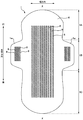
- FIG. 1 is a plan view of the sanitary napkin 1 viewed from the skin side.
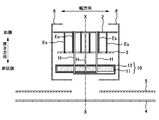
- FIG. 2 is a plan view of the napkin 1 viewed from the non-skin side.
- FIG. 3 is a schematic sectional view of the napkin 1 taken along the line AA in FIG.
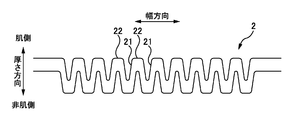
- FIG. 4 is a diagram showing a cross-sectional shape of a part of the skin side sheet 2.
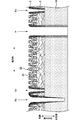
- FIG. 5 is an enlarged view of the central portion 1B.
- FIG. 6 is a diagram illustrating the boundary-line squeezed portion Es12.
- FIG. 7 is a view for explaining a cross section of a portion shown by the arrow BB in FIG. It is a figure explaining the cross section of the part shown by CC in FIG. 9A and 9B are diagrams showing modified examples of the linear pressing portion Es.
- An absorbent article comprising a longitudinal direction, a width direction, and a thickness direction orthogonal to each other, having an absorber and a skin-side sheet arranged on the skin side of the absorber in the thickness direction, at least A plurality of linear compression portions that compress the skin-side sheet in the thickness direction, a first inner region surrounded by the plurality of linear compression portions, and a second inner region adjacent to the first inner region. And a boundary line squeezing section common to the first inner region and the second inner region is provided at a boundary between the first inner region and the second inner region, and the boundary line
- the absorbent article is characterized in that the compressed portion is curved.
- the boundary-line squeezed portions forming the contours of the inner regions U1 and U2 are curved, a shadow is formed when the inner regions U1, U2 project and deform toward the skin. Easy and looks like a softer quilted fabric when viewed from the skin side.
- the amount of liquid (excrement) that can be temporarily retained in the boundary-line squeezed portion is larger than that in the case where the boundary-line squeezed portion is straight. Therefore, it is possible to prevent the excrement from widely spreading on the surface of the skin-side sheet, and to improve the touch.
- the boundary line squeezing section meanders between an end on one side in the longitudinal direction and an end on the other side in the longitudinal direction.
- the skin-side sheet includes a recessed portion that is recessed on the skin side in the thickness direction and a protrusion portion that is protruded on the skin side in the thickness direction. It is preferable that the concave portions and the convex portions are alternately arranged in the width direction.
- the air permeability between the absorbent article and the wearer's skin can be enhanced by the recesses and protrusions extending in the longitudinal direction.
- the excrement is less likely to stay in a part of the skin-side sheet, and the wearer's skin is rashed or causes discomfort. Can be suppressed.
- the boundary line squeezing portion has a portion that intersects with the convex portion and the concave portion, respectively.
- the non-skin of the boundary line-shaped compressed portion in the thickness direction is more than the distance between the non-skin side end of the concave portion and the skin side end of the convex portion in the thickness direction. It is desirable that the distance between the side edge and the skin side edge be larger.
- the liquid (excretion) that moves along the concave portion and the convex portion moves from the concave portion (convex portion) side with a small height difference to the linear compressed portion side with a large height difference. It will be easier. This makes it easier for the liquid (excretion) to move to the absorbent body side through the linear squeezing section, and makes it difficult to wet the surface of the skin-side sheet.
- Such an absorbent article which has an intermediate sheet disposed between the absorber and the skin-side sheet in the thickness direction, and the recesses and the protrusions are provided only on the skin-side sheet. Therefore, it is preferable that the boundary line squeezing portion is provided so as to squeeze the skin side sheet and the intermediate sheet.
- the intermediate sheet is not squeezed by the concave portions and the convex portions, it is possible to prevent the skin-side sheet from becoming hard at the portions where the concave portions and the convex portions are formed.
- the linear compression unit compresses the skin-side sheet and the intermediate sheet, excrement can be easily diffused from the skin-side sheet to the intermediate sheet in the thickness direction. Therefore, it is possible to improve the touch when wearing the absorbent article.
- the linear compression unit arranged at a position facing the boundary compression unit in the first inner region, and the boundary compression unit facing in the second inner region. It is desirable that the linear squeezing portion arranged at the position to have the same shape.
- the linear compressed portions forming the contour have the same shape, the shapes of the adjacent inner regions become the same shape, and the surface of the absorbent article has a quilted cloth-like shape. You can see it.
- the adjacent inner regions have the same shape, the inner regions are easily deformed to be convexly deformed to the skin side in the thickness direction, and the touch of the absorbent article can be further improved.
- the boundary line compressed portion does not have an intersection with another line compressed portion.
- the linear squeezed portion has a discontinuous portion that is discontinuous, and in the discontinuous portion, the linear It is desirable that a compression unit different from the compression unit is provided.
- the excrement collected in the vicinity of the discontinuous portion along the linear compressed portion is easily moved to the absorber side in the thickness direction by the compressed portion different from the linear compressed portion. be able to. This makes it easier to prevent the surface of the skin-side sheet from getting wet.
- the skin side sheet easily absorbs moisture in the excrement quickly, and the skin side sheet easily realizes a soft touch.
- the moisture absorption performance of the skin side sheet is further enhanced, and it is possible to easily improve the contact of the wearer's body with the skin.
- the skin-side sheet is provided on the most skin-side in the thickness direction.
- the linear compression section has a plurality of dot compression sections arranged along the curve.
- side sheets that cover the absorber and the skin side sheet from the skin side in the thickness direction are provided on both sides in the width direction.
- the edges on both sides in the width direction of the skin-side sheet are not exposed, and the edges are prevented from biting into the wearer's skin during wearing.
- the side sheet looks like bordering both ends of the skin side sheet, and the design of the linearly squeezed portions arranged geometrically is complemented, and the user can feel a sense of luxury. ..
- a sanitary napkin as an example of the absorbent article according to the present invention, but not limited to a sanitary napkin, such as a panty liner, or a light incontinence pad, for the user's clothing. Any absorbent article that is fixed and used may be used.
- FIG. 1 is a plan view of a sanitary napkin 1 (hereinafter referred to as “napkin”) viewed from the skin side.
- FIG. 2 is a plan view of the napkin 1 viewed from the non-skin side.
- FIG. 3 is a schematic sectional view of the napkin 1 taken along the line AA in FIG.
- the napkin 1 has a longitudinal direction, a width direction, and a thickness direction that are orthogonal to each other.
- the side in contact with the lower abdomen of the user is called “front side”
- the side in contact with the buttocks of the user is called “rear side”.
- the side in contact with the buttocks of the user is called “rear side”.
- the side in contact with the buttocks of the user is called “rear side”.
- the side in contact with the user's skin is referred to as “skin side”
- the opposite side is referred to as “non-skin side”.
- the line XX in the figure is the center line in the width direction.
- the napkin 1 has a pair of wing portions 1W extending from the central portion in the longitudinal direction to both outer sides in the width direction.
- a portion provided with the wing portion 1W is referred to as a central portion 1B
- a portion forward of the central portion 1B is referred to as a front side portion 1A
- a portion rearward of the central portion 1B is referred to as a rear side portion 1C.
- a skin side sheet 2, an intermediate sheet 3, an absorbent body 10, a non-skin side sheet 4, and a side sheet 6 are provided in the widthwise central portion of the napkin 1.
- the skin side sheet 2, the intermediate sheet 3, the absorber 10 and the non-skin side sheet 4 are laminated in this order from the skin side in the thickness direction, and the side sheet 6 is a width side end of the skin side surface of the skin side sheet 2. From the portion to the widthwise end of the non-skin side surface of the absorber 10. That is, the side sheet 6 is arranged so as to sandwich the respective members 2, 3 and 10 in the thickness direction.
- the side seat 6 may be configured by one sheet member as shown in FIG. 3, or may be a double configuration in which one sheet member is folded back.
- the skin-side sheet 2, the intermediate sheet 3, the absorber 10, the non-skin-side sheet 4, and the side sheet 6 are bonded and fixed using an adhesive such as a hot melt adhesive.
- the adhesive is applied in an arbitrary application pattern over the skin surface side and the non-skin surface side of each member, and can be selected from application patterns such as ⁇ pattern, spiral pattern, and stripe pattern. Note that, in FIG. 3 and the like, the adhesive is omitted for the sake of convenience.
- the skin side sheet 2 is a liquid permeable sheet member and is a cotton sheet.
- the skin-side sheet 2 is a portion that directly contacts the wearer's skin during wearing. Therefore, by using cotton, which is a hydrophilic natural fiber, for the skin-side sheet 2, it is possible to further improve the feel of the wearer.
- the wearer's skin tends to be sensitive during the period of menstruation when wearing a sanitary napkin.
- cotton for the skin-side sheet 2 of the napkin 1 it is possible to reduce irritation to the wearer's skin and to easily reduce the possibility of itching or rash of the wearer's skin, or to visually It is easy to give the impression that it looks soft, and you can feel the luxury.
- FIG. 4 is a diagram showing a cross-sectional shape of a part of the skin side sheet 2.
- the skin-side sheet 2 has a concave portion 21 concave on the skin side in the thickness direction and a convex portion 22 convex on the skin side in the thickness direction in the width direction. They are provided alternately.
- Each of the concave portion 21 and the convex portion 22 is continuously provided along the longitudinal direction, and when the napkin 1 is worn, the convex portion 22 is mainly in contact with the wearer's skin, and the concave portion 21 is in contact with the wearer's skin.
- a space is formed between the skin side sheet 2 and the wearer's body (skin) without making contact. Therefore, it becomes easier for air to pass through the recess 21 along the longitudinal direction, and the air permeability when the napkin 1 is worn can be improved.
- excreted liquid such as menstrual blood is easily moved in the longitudinal direction along the concave portion 21 (convex portion 22), it is difficult for the excreted liquid to stay in one place, and the wearer's skin is rashed or discomfort occurs. Can be suppressed.
- the concave portion 21 and the convex portion 22 are, for example, arranged on the skin side and the non-skin side in the thickness direction, and between the pair of gear rolls (not shown) that rotate around the rotation axis along the longitudinal direction. Can be formed by passing through (so-called gear shaping).
- the intermediate sheet 3 is a liquid-permeable sheet member, and examples thereof include air-through nonwoven fabric and spunbond nonwoven fabric.
- Each of the wing sheet 5 and the side sheet 6 is a hydrophobic sheet member, and examples thereof include an air-through nonwoven fabric and a spunbond nonwoven fabric.
- the non-skin side sheet 4 is a liquid impermeable sheet member, and a polyethylene (PE) resin film or the like can be exemplified.
- the non-skin side sheet 4 has a plane size larger than that of the absorber 10 and covers the entire plane of the absorber 10.
- the wing portion 1W is formed by a wing sheet 5 and a non-skin side sheet 4 which extend outward from both widthwise side portions of the skin side sheet 2 and the like.
- the napkin 1 may not have the wing portion 1W.
- the absorber 10 is a member that absorbs excrement and holds it inside.
- the absorbent body 10 has an absorbent core 11 and a cover sheet 12 that covers the absorbent core 11.
- the absorbent core 11 is formed into a predetermined shape by adding a liquid-absorbent granular material such as a super-absorbent polymer (so-called SAP) to a liquid-absorbent fiber such as pulp fiber or cellulosic absorbent fiber. It is a thing.
- SAP super-absorbent polymer
- the cover sheet 12 is a liquid-permeable sheet and can be exemplified by a tissue or the like.
- the non-skin side surface of the napkin 1 (that is, the non-skin side surface of the non-skin side sheet 4) is provided with a central adhesive portion 8 to which an adhesive is applied.
- the eleven rectangular central adhesive portions 8 having long sides in the longitudinal direction are arranged at intervals in the width direction, but the central adhesive portion 8 has a shape, number, and The arrangement is not limited to this.
- the central adhesive portion 8 is attached to the skin side surface of clothing such as underwear when the napkin 1 is used, so that the napkin 1 is fixed to the underwear or the like.
- a wing adhesive section 9 is provided on the non-skin side surface (non-skin side cotton of the non-skin side sheet 4) in the thickness direction of each wing section 1W.
- the wing adhesive portions 9 are four rectangular wing adhesive portions 9 having long sides in the longitudinal direction and are arranged at intervals in the width direction. And the arrangement is not limited to this.
- the napkin 1 is used, the wing portion 1W is bent to the non-skin side, and the wing adhesive portion 9 is attached to the non-skin side surface such as underwear. As a result, the wing portion 1W is fixed to underwear or the like.
- the napkin 1 has a plurality of linear compressed portions Es, a plurality of main body compressed portions Eb, and a plurality of holes H. As shown in FIGS. 1 and 5, when the napkin 1 is viewed from the side of the skin, the linear compressed portion Es, the main body compressed portion Eb, and the hole H can be visually recognized.
- FIG. 5 is an enlarged view of the central portion 1B.
- FIG. 6 is a diagram illustrating the boundary-line squeezed portion Es12.
- FIG. 7 is a view for explaining a cross section of a portion shown by the arrow BB in FIG. FIG.
- FIG. 8 is a diagram illustrating a cross section of a portion shown by the arrow CC in FIG.
- the central portion 1B both wing portions 1W are omitted, and the central portion in the width direction of the napkin 1 is shown enlarged.
- the concave portions 21 and the convex portions 22 are partially omitted for convenience of illustration.
- 7 and 8 show the cross-sections of the skin-side sheet 2, the intermediate sheet 3, and the absorber 10 in each cross-section, and the non-skin-side sheet 4 and the like are omitted for convenience.
- the plurality of linear squeezing portions Es are arranged in substantially the entire area where the skin-side sheet 2 and the intermediate sheet 3 are overlapped with each other, and are formed by subjecting at least the skin-side sheet 2 to squeezing in the thickness direction. ing.
- one linear compressed portion Es compresses the skin-side sheet 2 and the intermediate sheet 3 in the thickness direction to form one linear compressed portion.
- it is a compression unit having two ends, one end and the other end, and having a predetermined length in the longitudinal direction and the width direction, while compressing the skin side sheet 2 and the intermediate sheet 3. It is a portion where the absorber 10 is not squeezed.
- the linear compressed portion Es of the napkin 1 is linear due to a set of dot-shaped (circular) compressed portions, it is not limited to this.
- it may be a linear compression unit Es having a linear compression unit.
- the linear compressed portion Es formed by a set of dot-shaped (circular shaped) compressed portions like the napkin 1 as compared with the case of a continuous linear compressed portion, the skin-side sheet 2 and the intermediate sheet It is possible to reduce the risk that 3 becomes excessively hard, and to improve the touch when worn.
- the plurality of holes H are arranged in a substantially zigzag pattern at the center in the longitudinal direction and the center in the width direction of the napkin 1, as shown in FIGS. 3 and 7, the holes H are arranged from the skin side. It is a hole that is circular in plan view and penetrates the skin-side sheet 2, the intermediate sheet 3, and the absorber 10.
- the hole H of the napkin 1 is formed by piercing a pin or the like from the skin side surface to the absorber 10, and the hole H is larger than the size of one circular compressed portion that constitutes the linear compressed portion Es in plan view. Is larger in size.
- the hole H of the napkin 1 has a depth that reaches the non-skin side surface of the absorbent body 10, but is not limited to this. The depth of the hole H may be such that it penetrates the skin-side sheet 2 and the intermediate sheet 3 from the skin side and reaches the absorber 10.
- the main body squeezing portion Eb is provided in a shape that surrounds an area where the wearer's vaginal opening is supposed to come into contact with when worn. As shown in FIG. 7, the main body squeezing portion Eb is a squeezing portion formed into a desired shape by subjecting the skin-side sheet 2, the intermediate sheet 3, and the absorber 10 to a squeezing process in the thickness direction. Due to the pressing, the fiber density of the skin-side sheet 2, the fiber density of the intermediate sheet 3, and the fiber density of the absorber 10 are higher than those of the unpressed portion.
- the linear compression part Es, the main body compression part Eb, and the hole H can be formed as follows. First, the skin-side sheet 2 and the intermediate sheet 3 bonded with an adhesive are placed in a roll gap between a convex roller (not shown) having a plurality of convex portions and an anvil roller (not shown) having a flat surface.
- the linear compression portion Es is formed by performing compression processing from the skin side surface of the skin side sheet 2 through.
- the skin side sheet 2 and the intermediate sheet 3 on which the linear compressed portion Es is formed are overlapped and bonded with an adhesive to form the hole portion H and the main body compressed portion Eb.
- the hole H and the main body squeezing portion Eb are formed by passing through a roll gap between a convex roller (not shown) having a plurality of convex portions and a anvil roller (not shown).
- the convex roller for forming the hole portion H and the main body compressed portion Eb has a pin portion having a sharper pin shape than the convex portion of the convex roller for forming the linear compressed portion Es in order to form the hole portion Hb.
- the convex portion having the protruding length that is longer than the convex portion of the convex roller that forms the linear compressed portion Es is provided.
- the napkin 1 can be obtained by laminating the non-skin side sheet 4 and the like on the non-skin side of the absorber 10.
- Each member such as the skin-side sheet 2 and the intermediate sheet 3 may be a continuous sheet in which a plurality of sheets are continuously formed, and through the above-described processing, are individually cut to form the napkin 1. ..
- the hole H and the main body squeezing portion Eb do not necessarily have to be formed on the same roller at the same time, and may be formed separately.
- the napkin 1 absorbs excrement in a worn state
- the skin-side sheet 2 using cotton having high liquid absorbency and moisture retention tends to absorb more excrement.
- the excrement was diffused in the layers, and it was difficult for the excrement to reach the intermediate sheet 3 and the absorbent body 10. Therefore, excrement is likely to remain on the skin-side surface of the napkin 1, and the excrement is likely to be in contact with the skin of the wearer, which may cause discomfort, itching, and rashes.
- the napkin 1 is provided with the linear compressed portion Es to increase the fiber densities of the skin-side sheet 2 and the intermediate sheet 3 so that the linear compressed portion Es is formed by the capillary phenomenon.
- the excrement can be easily absorbed. That is, since the excrement received by the skin-side sheet 2 can be easily retained by the linear compression portion Es, the linear compression portion Es can suppress continuous diffusion in the layer of the skin-side sheet 2. When the diffusion is suppressed by the linear compressed portion Es, the amount of excrement per unit area near the portion where the linear compressed portion Es is provided increases.
- the excrement having a large amount per unit area enters the hole H so as to fall into the hole H, it absorbs the excrement that has entered the hole H before spreading to a wide range of the skin-side sheet 2 and the intermediate sheet 3. It can be absorbed by the body 10.
- the hole H is formed of a pin or the like, the fiber density of the skin-side sheet 2, the intermediate sheet 3 and the absorbent body 10 around the hole H is higher, so that the hole is formed by the capillary phenomenon. H is more likely to absorb excrement.
- the linear squeezed portion Es is a concave portion
- the excrement can be easily moved to the linear squeezed portion Es, and due to the higher fiber density of the linear squeezed portion Es, the excrement is on the skin side. It becomes easy to diffuse in the thickness direction from the sheet 2 to the intermediate sheet 3, and it becomes easy to guide excrement to the absorbent body 10. It is also considered that if the linear compressed portion Es is formed deeper and compressed to the absorbent body 10, the excrement can be diffused more easily in the thickness direction.
- the linear compressed portion Es is compressed deeply until it reaches the absorbent body 10, the absorbent body 10 and the napkin 1 become hard due to the rigidity of the linear compressed portion Es, and the feel at the time of wearing is reduced, and the napkin 1 is not worn at the time of wearing. There is a risk of giving a pleasant feeling. Therefore, it is preferable that only the skin side sheet 2 and the intermediate sheet 3 are squeezed in the linear squeezing portion Es.
- a plurality of inner regions U that are regions surrounded by the plurality of linear squeezing portions Es are formed. That is, as shown in FIG. 5, it has a plurality of substantially rhombus-shaped inner regions U surrounded by four linear compression portions Es on all sides, and has substantially the same shape and substantially the same size.
- the inner area U having the linear squeezed portions Es on all sides makes it easier to keep the excrement inside the inner area U, and to reduce the risk of the excrement being spread on the skin-side sheet 2 in a planar manner.
- the central portions of the plurality of inner regions U each have a convex shape protruding toward the skin side.
- the center portion in the longitudinal direction (and width direction) of the inner region U formed by compression of the skin side sheet 2 and the intermediate sheet 3 has a shape protruding toward the skin side.
- the four linear compression parts Es forming the contour of the inner area U are curved. That is, the linear compressed portion Es located at the boundary between two adjacent inner regions U, U is a curve.
- a boundary line-shaped compressed portion Es12 common to the first inner region U1 and the second inner region U2 is provided. ..
- the borderline squeezed portion Es12 has a curved locus between the end P1 and the end P2. It is arranged as you draw.
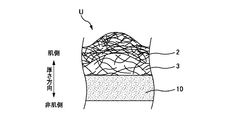
- the boundary-shaped compressed portion Es12 forming the contour of the inner region U is a curve, when the inner region U projects to the skin side as shown in FIG. Looks like a soft quilted fabric.
- the height protruding to the skin side tends to change depending on the position, so that the contact with the skin becomes non-uniform and the pressure at the time of wearing is dispersed, and the touch can be softened.
- the feel of the borderline compressed portion Es12 is less likely to be recognized when worn, and thus the wearer is less likely to feel uncomfortable.
- the boundary line compressed portion Es12 is a curve, the locus connecting the end P1 and the end P2 becomes long, so that the amount of excrement that can be temporarily retained in the boundary line compressed portion Es12 increases. Therefore, even when cotton is used for the skin-side sheet 2, the excrement is prevented from being excessively diffused in the longitudinal direction and the width direction, and the excrement is absorbed through the holes H and the like. Can be easily absorbed.
- the boundary-shaped compressed portion Es12 meanders between the end P1 and the end P2. That is, the boundary-line squeezed portion Es12 has an S-shape having a portion that is convex on at least one side and a portion that is convex on the other side in the direction orthogonal to the straight line connecting the ends P1 and P2. It is a curved curve. Since the boundary-shaped compressed portion Es12 meanders in this way, a complicated shadow is formed in the inner region U, and a soft impression can be produced by the user. In addition, since the trajectory of the borderline compressed portion Es12 becomes longer between the end P1 and the end P2, the volume of excrement that can be held in the borderline compressed portion Es12 increases, and it is easy to suppress the diffusion of the excrement. Become.
- the boundary line squeezing portion Es12 has portions that respectively intersect the concave portion 21 and the convex portion 22 provided on the skin-side sheet 2.
- the concave portion 21 and the convex portion 22 have a function of moving excrement along the longitudinal direction.
- the excrement can be moved along the concave portion 21 and the convex portion 22 indefinitely, the excrement excessively diffuses along the longitudinal direction of the skin-side sheet, and the ventral side end or the dorsal side end in the longitudinal direction. Excretion may leak from the area.
- the excrement moving along the concave portion 21 and the convex portion 22 moves to the boundary line pressing portion Es12 side at the intersection with the boundary line pressing portion Es12 (the linear pressing portion Es).
- the boundary-shaped squeezing portion Es12 blocks the movement of the excrement along the concave portion 21 and the convex portion 22, and suppresses the diffusion of the excrement in the longitudinal direction.
- the concave portion 21 and the convex portion 22 intersect with the plurality of linear compressed portions Es, respectively, diffusion of excrement in the longitudinal direction can be suppressed more easily. Therefore, in the napkin 1, it is possible to suppress the excrement from being excessively diffused in the longitudinal direction while suppressing the excrement from staying in a partial area of the skin-side sheet 2. As a result, it becomes easy to realize good touch.
- the distance in the thickness direction is greater than the distance between the non-skin side end of the concave portion 21 and the skin side end of the convex portion 22 in the thickness direction of the napkin 1 (that is, the height difference of the unevenness).
- the distance between the non-skin side end and the skin side end of the boundary line compressed portion Es12 (the linear compressed portion Es) (that is, the depth of the linear compressed portion Es) is larger. Therefore, the excrement moving in the longitudinal direction along the concave portion 21 (and the convex portion 22) is from the concave portion 21 side having a small height difference at the portion intersecting the boundary line compressed portion Es12 (the linear compressed portion Es). It becomes easy to move to the linear compression part Es side where the height difference is large.
- the concave portion 21 and the convex portion 22 are formed only on the skin side sheet 2. That is, the concave portion 21 and the convex portion 22 are not formed in the intermediate sheet 3 laminated with the skin-side sheet 2.
- the concave portion 21 and the convex portion 22 are provided over the entire skin-side sheet. Therefore, if the skin-side sheet 2 and the intermediate sheet 3 are formed so as to be squeezed together, the rigidity of the skin-side sheet 2 is increased as a whole, and when the wearer wears the napkin 1, There is a possibility that a pleasant sensation may occur.
- the concave portion 21 and the convex portion 22 are provided only on the skin-side sheet 2, the skin-side sheet 2 does not become hard and it is difficult for the wearer to feel discomfort.
- the linear compression portion Es is formed by compressing the skin side sheet 2 and the intermediate sheet 3 as described above.
- the intermediate sheet 3 By compressing the intermediate sheet 3 in addition to the skin side sheet 2, excrement can be easily diffused from the skin side sheet 2 to the intermediate sheet 3 in the thickness direction.
- the linear compressed portion Es since the linear compressed portion Es is not compressed to reach the absorber 10, it is possible to prevent the linear compressed portion Es from increasing the rigidity of the absorbent body 10, and it is easy to realize good touch. Become.
- the linear squeezed portions Es forming the contour of the inner region U are curves having the same shape. That is, the linear compressed portion Es arranged at a position (side) facing the boundary compressed portion Es12 in the first inner region U1, and the position opposed to the boundary compressed portion Es12 in the second inner region U2 ( The linear squeezed portion Es arranged on the side) has the same shape.
- a region adjacent to the first inner region U1 on the side opposite to the second inner region U2 is defined as a third inner region U3, and the first inner region U1 and the first inner region U1.
- Boundary line squeezing portion Es located at the boundary with the third inner region U3 that is, the linear squeezing portion Es arranged at a position facing the boundary line squeezing portion Es12 in the first inner region U1) Part Es13.
- a region adjacent to the second inner region U2 on the opposite side of the first inner region U1 is referred to as a fourth inner region U4, and a linear line located at the boundary between the second inner region U2 and the fourth inner region U4.
- the compressed portion Es (that is, the linear compressed portion Es arranged at a position facing the boundary compressed portion Es12 in the second inner region U2) is referred to as a boundary compressed portion Es24.
- the boundary-line compressed portion Es13 and the boundary-line compressed portion Es24 have the same shape.
- the adjacent inner regions U (U1 to U4) also have the same shape, which makes the surface of the napkin 1 beautiful. A geometric pattern is formed that makes it look like a fine quilted fabric. Further, since the adjacent inner regions U, U have the same shape, distortion is unlikely to occur when each inner region U is deformed into a convex shape protruding to the skin side as shown in FIG. It is suppressed that they interfere with each other. This makes it easy to form a neat and convex shape, and the touch of the entire napkin 1 can be further improved.
- the two linear compression parts Es which are arranged adjacent to each other, do not intersect each other. That is, a certain linear compressed portion Es does not have an intersection with another linear compressed portion Es.
- the first inner region U1 is formed by sequentially arranging the four linear pressing portions Es12, Es15, Es13, and Es16 in the clockwise direction.
- each of the linear compressed portions Es12, Es15, Es13, Es16 does not have an intersection with another linear compressed portion Es. More specifically, an end P1 on the front side in the longitudinal direction of the boundary line compressed portion Es12 and a rear end P6 in the longitudinal direction of the boundary line compressed portion Es16 adjacent to the front side in the longitudinal direction of the boundary line compressed portion Es12. And are located in different positions.
- the linear compression part Es is discontinuous.
- the part (the part where the linear compression parts Es do not intersect) is also called the discontinuous part N (see FIG. 6).
- discontinuous portion N in which the linear compressed portions Es are not continuous in this way it is possible to suppress the excrement that diffuses along the linear compressed portions Es from diffusing into the other linear compressed portions Es adjacent to each other. can do. That is, it is possible to prevent the excrement from moving so as to propagate through the plurality of linear squeezing portions Es and spreading in a wide range.
- the dot-shaped compressed portion constituting the linear compressed portion Es is not provided, but in the non-continuous portion N, the linear compressed Other squeezing parts different from the squeezing parts Es (for example, a main body squeezing part Eb and a hole H, not shown in FIG. 6) may be provided.
- the squeezing parts different from the squeezing parts Es for example, a main body squeezing part Eb and a hole H, not shown in FIG. 6
- the excrement since the excrement moves along the linear compressed portions Es, the excrement is likely to collect at both ends of each linear compressed portion Es. Therefore, in the vicinity of the discontinuous portion N, the amount of excrement accumulated per unit area is larger than in other regions, and the surface of the skin-side sheet 2 is easily wet.
- the accumulated excrement can be easily moved to the non-skin side (the absorbent body 10 side) in the thickness direction along the other compressed portion. .. By doing so, the amount of excrement per unit area in the discontinuous portion N decreases, and it is possible to prevent the surface of the skin-side sheet 2 from getting wet.
- the use of cotton as the skin side sheet 2 improves the touch when wearing the napkin 1, but in addition to cotton, natural fibers such as hemp and silk, rayon, It is also possible to use recycled fibers such as cupra or a mixed sheet of cotton and air-through nonwoven fabric. All of these fibers are hydrophilic fibers having excellent hygroscopicity, and when they come into direct contact with the skin of the wearer, they easily suppress stickiness and stuffiness.
- the skin-side sheet 2 preferably contains 50% or more of hydrophilic fibers in the total weight of the skin-side sheet 2.
- the hygroscopicity can be improved as the weight% of the hydrophilic fiber is larger, it is possible that 100% of the total weight of the skin-side sheet 2 of the present embodiment is the hydrophilic fiber. More desirable.
- the skin side sheet 2 formed of 100% cotton may be used. By using such a skin side sheet 2, it is possible to further improve the skin contact with the wearer's body.
- the skin side sheet 2 having high hydrophilicity is provided on the most skin side in the thickness direction as described above. Therefore, even if the skin-side sheet 2 comes into direct contact with the skin of the wearer when the napkin 1 is worn, it is difficult to irritate the skin of the wearer, and good touch can be realized. Further, since the skin side sheet 2 formed of cotton or the like is visible on the skin side surface of the napkin 1, it is possible for the user to feel the soft texture and high-class feeling peculiar to cotton.
- side sheets 6 are provided on both sides of the absorbent body 10 (skin side sheet 2) in the width direction on the skin side of the napkin 1 (see FIGS. 1 and 3). As described above, since both widthwise ends of the skin-side sheet 2 are covered with the side sheets 6 from the skin side, both edges in the width direction of the skin-side sheet 2 and the absorbent body 10 are not exposed. The edges are prevented from biting into the wearer's skin when the napkin 1 is worn. Further, the side sheets 6 extending in the longitudinal direction are arranged on both sides of the skin side sheet 2 in the width direction, so that the side sheet 6 looks like edging both ends of the skin side sheet. .. Therefore, the side sheet 6 functions like a frame of a painting, and the design of the linearly compressed portion Es and the body compressed portion Eb geometrically arranged on the skin side sheet 2 is enhanced, and the user feels high-class. Can be realized.
- the boundary line-shaped compressed portion Es12 (linear compressed portion Es) provided on the napkin 1 is a meandering curve, but the shape of the curved line is not limited to the example shown in FIGS. Absent.
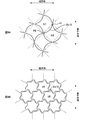
- 9A and 9B are diagrams showing modified examples of the linear pressing portion Es.
- 9A and 9B are schematic plan views showing a state in which a part of the skin side surface (the surface on the topsheet 2 side) of the napkin 1 is enlarged, and the shape of the linear squeezing portion Es is indicated by a solid line. ..
- the boundary-line squeezed portion Es12 has one side in a direction orthogonal to a straight line (shown by a broken line in FIG. 9A) that connects the end P1 on one side and the end P2 on the other side.
- the curve may have a convex portion only on the side. That is, the boundary line squeezed portion Es12 may have at least one curved portion between the end P1 and the end P2. Even with such a curve, the amount of excrement that can be held is larger than that in the case of a straight line, and therefore excessive diffusion of excrement on the surface of the skin-side sheet 2 can be suppressed.
- the borderline squeezing portion Es12 may be a curve having a larger number of meandering times than in the case of FIG.
- FIG. 9B illustrates an example in which the hexagonal inner region U is formed by the six linear pressing portions Es. Even in such a case, the boundary line-shaped compressed portion Es12 of the first inner region U1 and the second inner region U2, which are adjacent to each other, is a curve, and thus the same effect as described above can be obtained.
- a plurality of linear compression parts Es, main body compression parts Eb, and holes H are arranged, but the invention is not limited to this.
- One of each may be arranged, or the number of each may be appropriately changed depending on the degree of touch of the napkin 1 and the amount of excrement.
- the shapes and sizes of the linear compression portion Es, the main body compression portion Eb, and the hole portion H can be changed as appropriate.
- the shape and size of the inner region U can also be changed as appropriate.
- the absorbent core 11 formed by molding the liquid absorbent fiber to which the super absorbent polymer is added is used, but the invention is not limited to this.
- the absorbent core 11 may be a sheet material made of only a super absorbent polymer, or the absorbent core 11 may be made of a liquid absorbent fiber only. Further, it is not always necessary to use the cover sheet, and the absorbent core 10 may be formed only by the absorbent core 11.
- 1 napkins (absorbent articles), 1A front side part, 1B center part, 1C rear side part, 1W wing part, 2 skin side sheet, 3 middle sheet, 4 Non-skin side sheet, 5 wing sheet, 6 side seats, 8 central adhesive part, 9 wing adhesive part, 10 absorbent body, 11 absorbent core, 12 cover sheet, 21 concave portions, 22 convex portions, Es linear compression unit, Eb main compression unit, Es12 boundary line compression unit, H hole part, N discontinuous part, U inner region, U1 first inner region, U2 second inner region, W body compression area
Landscapes
- Health & Medical Sciences (AREA)
- Epidemiology (AREA)
- Engineering & Computer Science (AREA)
- Biomedical Technology (AREA)
- Heart & Thoracic Surgery (AREA)
- Vascular Medicine (AREA)
- Life Sciences & Earth Sciences (AREA)
- Animal Behavior & Ethology (AREA)
- General Health & Medical Sciences (AREA)
- Public Health (AREA)
- Veterinary Medicine (AREA)
- Absorbent Articles And Supports Therefor (AREA)
Abstract
吸収体(10)と、吸収体(10)より肌側に配置された肌側シート(2)と、を有する吸収性物品(1)であって、少なくとも肌側シート(2)を厚さ方向に圧搾する線状圧搾部(Es)を複数有し、複数の線状圧搾部(Es)によって囲まれた第1内側領域(U1)と、第1内側領域(U2)に隣接する第2内側領域(U2)とを有し、第1内側領域(U1)と前記第2内側領域(U2)との境界には、第1内側領域(U1)及び第2内側領域(U2)に共通の境界線状圧搾部(Es12)が設けられており、境界線状圧搾部(Es12)が曲線である
Description
本発明は、吸収性物品に関する。
着用者の着衣に固定して使用する吸収性物品として、液吸収性の吸収体及び表面シートを備えた生理用ナプキン、パンティーライナー、及び吸収パッド等が知られている。例えば、特許文献1には、表面シートに波状に蛇行しながら一方向に延びる線状のエンボスを設けることによって、表面シートから吸収体へ経血等の液体をスムーズに移行させて肌触りを良くした吸収性物品が開示されている。
しかしながら、特許文献1の吸収性物品では、表面シートに設けられたエンボスが一方向に連なって延びていることにより、当該エンボスに沿って液体が表面シート上を一方向に長く拡散してしまい、表面シートの広い範囲がべたつき、肌触りが悪化する場合があった。また、一方向に長く延びたエンボスが着用者の肌に触れるため、着用者は該エンボスによる硬さを感じやすく、十分に良好な肌触りを実現できないおそれがあった。
本発明は、上記のような従来の問題に鑑みてなされたものであって、その目的は、肌触りが良好な吸収性物品を提供することにある。
上記目的を達成するための主たる発明は、互いに直交する長手方向、幅方向、及び厚さ方向を備え、吸収体と、前記厚さ方向において前記吸収体より肌側に配置された肌側シートと、を有する吸収性物品であって、少なくとも前記肌側シートを前記厚さ方向に圧搾する線状圧搾部を複数有し、複数の前記線状圧搾部によって囲まれた第1内側領域と、前記第1内側領域に隣接する第2内側領域とを有し、前記第1内側領域と前記第2内側領域との境界には、前記第1内側領域及び前記第2内側領域に共通の境界線状圧搾部が設けられており、前記境界線状圧搾部が曲線である、ことを特徴とする吸収性物品である。
本発明の他の特徴については、本明細書及び添付図面の記載により明らかにする。
本発明の他の特徴については、本明細書及び添付図面の記載により明らかにする。
本発明によれば、肌触りが良好な吸収性物品を提供することができる。
本明細書及び添付図面の記載により、少なくとも以下の事項が明らかとなる。
互いに直交する長手方向、幅方向、及び厚さ方向を備え、吸収体と、前記厚さ方向において前記吸収体より肌側に配置された肌側シートと、を有する吸収性物品であって、少なくとも前記肌側シートを前記厚さ方向に圧搾する線状圧搾部を複数有し、複数の前記線状圧搾部によって囲まれた第1内側領域と、前記第1内側領域に隣接する第2内側領域とを有し、前記第1内側領域と前記第2内側領域との境界には、前記第1内側領域及び前記第2内側領域に共通の境界線状圧搾部が設けられており、前記境界線状圧搾部が曲線である、ことを特徴とする吸収性物品である。
互いに直交する長手方向、幅方向、及び厚さ方向を備え、吸収体と、前記厚さ方向において前記吸収体より肌側に配置された肌側シートと、を有する吸収性物品であって、少なくとも前記肌側シートを前記厚さ方向に圧搾する線状圧搾部を複数有し、複数の前記線状圧搾部によって囲まれた第1内側領域と、前記第1内側領域に隣接する第2内側領域とを有し、前記第1内側領域と前記第2内側領域との境界には、前記第1内側領域及び前記第2内側領域に共通の境界線状圧搾部が設けられており、前記境界線状圧搾部が曲線である、ことを特徴とする吸収性物品である。
このような吸収性物品によれば、内側領域U1及びU2の輪郭を形成する境界線状圧搾部が曲線であることにより、内側領域U1,U2が肌側に突出変形する際に陰影が形成されやすく、肌側から視認したときにより柔らかなキルティング生地のように見える。また、境界線状圧搾部が直線である場合と比較して、該境界線状圧搾部に一時的に保持可能な液体(排泄物)の量が多くなる。したがって、排泄物が肌側シートの表面に広く拡散してしまうことが抑制され、肌触りを良好なものとすることができる。
かかる吸収性物品であって、前記境界線状圧搾部は、前記長手方向における一方側の端と前記長手方向における他方側の端との間で蛇行している、ことが望ましい。
このような吸収性物品によれば、内側領域により複雑な陰影が形成され、より柔らかな印象を生じさせることができる。また、境界線状圧搾部の軌跡が長くなるため、該境界線状圧搾部に保持可能な液体(排泄物)の容量が増え、排泄物の拡散をより抑制しやすくなる。
かかる吸収性物品であって、前記肌側シートには、前記厚さ方向の肌側に凹となった凹部と、前記厚さ方向の肌側に凸となった凸部とが、前記長手方向に沿って連続して設けられており、前記幅方向において、前記凹部と前記凸部とが交互に配置されている、ことが望ましい。
このような吸収性物品によれば、長手方向に延びる凹部と凸部によって、吸収性物品と着用者の肌との間の通気性を高めることができる。また、凹部と凸部に沿って排泄物等の液体を拡散させることにより、排泄物が肌側シートの一部の領域に滞留しにくくなり、着用者の肌がかぶれたり不快感を生じさせたりすることを抑制することができる。
かかる吸収性物品であって、前記境界線状圧搾部は、前記凸部及び前記凹部とそれぞれ交差する部分を有している、ことが望ましい。
このような吸収性物品によれば、凹部及び凸部に沿って移動する液体(排泄物)の一部が境界線状圧搾部と交差する部分において境界線状圧搾部に移動しやすくなり、排泄物の長手方向への拡散が抑制される。これにより、排泄物が肌側シートの一部の領域に滞留することを抑制しつつ、長手方向に過度に拡散することが抑制され、良好な肌触りを実現しやすくなる。
かかる吸収性物品であって、前記厚さ方向における前記凹部の非肌側端と前記凸部の肌側端との間の距離よりも、前記厚さ方向における前記境界線状圧搾部の非肌側端と肌側端との間の距離の方が大きい、ことが望ましい。
このような吸収性物品によれば、凹部及び凸部に沿って移動する液体(排泄物)が、高低差の小さい凹部(凸部)側から高低差の大きい線状圧搾部側へと移動しやすくなる。これにより、液体(排泄物)が線状圧搾部を介して吸収体側に移動しやすくなり、肌側シートの表面を濡れ難くすることができる。
かかる吸収性物品であって、前記厚さ方向において、前記吸収体と前記肌側シートの間に配置された中間シートを有し、前記凹部及び前記凸部は、前記肌側シートにのみ設けられており、前記境界線状圧搾部は、前記肌側シート及び前記中間シートを圧搾するように設けられている、ことが望ましい。
このような吸収性物品によれば、凹部及び凸部によって中間シートが圧搾されていないため、該凹部及び凸部が形成されている部分において肌側シートが固くなってしまうことが抑制される。また、線状圧搾部が肌側シート及び中間シートを圧搾していることにより、排泄物を肌側シートから中間シートへと厚さ方向に拡散させやすくすることができる。したがって、吸収性物品着用時の肌触りを向上させることができる。
かかる吸収性物品であって、前記第1内側領域において前記境界線状圧搾部と対向する位置に配置されている前記線状圧搾部と、前記第2内側領域において前記境界線状圧搾部と対向する位置に配置されている前記線状圧搾部と、が同じ形状である、ことが望ましい。
このような吸収性物品によれば、輪郭を形成する線状圧搾部が同形状であることにより、隣接する内側領域同士の形状が同形状となり、吸収性物品の表面が、キルティング生地のように見えるようになる。また、隣接する内側領域同士が同じ形状であることにより、該内側領域が厚さ方向の肌側にきれいに凸変形しやすくなり、吸収性物品の肌触りをより向上させることができる。
かかる吸収性物品であって、前記境界線状圧搾部は、他の前記線状圧搾部との交点を有していない、ことが望ましい。
このような吸収性物品によれば、線状圧搾部同士が交わっていないことにより、排泄物(液体)が複数の線状圧搾部間を伝播するように移動して広範囲に拡散してしまうことを抑制することができる。
かかる吸収性物品であって、隣り合う2つの前記線状圧搾部の間で、前記線状圧搾部が非連続となっている非連続部を有し、前記非連続部には、前記線状圧搾部とは異なる圧搾部が設けられている、ことが望ましい。
このような吸収性物品によれば、線状圧搾部に沿って非連続部の近傍に集まった排泄物を、線状圧搾部とは異なる圧搾部によって厚さ方向の吸収体側に移動させやすくすることができる。これにより、肌側シートの表面が濡れてしまうのを抑制しやすくなる。
かかる吸収性物品であって、前記肌側シートは、全体の重量の50%以上が親水性繊維である、ことが望ましい。
このような吸収性物品によれば、肌側シートが、排泄物中の水分を素早く吸着しやすくなり、該肌側シートにおいてさらさらとした肌触りを実現しやすくなる。
かかる吸収性物品であって、前記肌側シートは、全体の重量の100%が親水性繊維である、ことが望ましい。
このような吸収性物品によれば、肌側シートの吸湿性能がより高くなり、着用者の身体に対する肌当たりを向上させやすくすることができる。
かかる吸収性物品であって、前記肌側シートは、前記厚さ方向において最も肌側に設けられている、ことが望ましい。
このような吸収性物品によれば、吸収性物品の着用時において、親水性の高い肌側シートが着用者の肌と直接接触しても着用者の肌に刺激を与えにくく、良好な肌触りを実現できる。また、吸収性物品の肌側表面において綿等によって形成された肌側シートが視認可能となるため、使用者に対して柔らかな風合いや高級感を実感させることができる。
かかる吸収性物品であって、前記線状圧搾部は、前記曲線に沿って並ぶ複数のドット状圧搾部を有している、ことが望ましい。
このような吸収性物品によれば、ドット状の圧搾部の集合によって線状圧搾部を構成することにより、連続した線によって線状圧搾部が構成される場合と比較して、肌側シート等が過度に硬くなってしまうことが抑制されやすく、着用時の肌触りを向上させやすくなる。
かかる吸収性物品であって、前記幅方向の両側には、前記吸収体及び前記肌側シートを、前記厚さ方向の肌側から覆うサイドシートが設けられている、ことが望ましい。
このような吸収性物品によれば、肌側シートの幅方向両側のエッジが露出せず、着用時に該エッジが着用者の肌に食い込んでしまうことが抑制される。また、サイドシートが肌側シートの両端部を縁取っているように見え、幾何学的に配置された線状圧搾部等のデザイン性が引き立てられ、使用者に高級感を実感させることができる。
===第1実施形態===
以下、本発明に係る吸収性物品として生理用ナプキンを例に挙げて実施形態を説明するが、生理用ナプキンに限らず、パンティーライナー、又は軽失禁用パッド等のように、使用者の着衣に固定して使用する吸収性物品であればよい。
以下、本発明に係る吸収性物品として生理用ナプキンを例に挙げて実施形態を説明するが、生理用ナプキンに限らず、パンティーライナー、又は軽失禁用パッド等のように、使用者の着衣に固定して使用する吸収性物品であればよい。
<<生理用ナプキン1の基本構成>>
図1は、生理用ナプキン1(以下「ナプキン」という)を肌側から見た平面図である。図2は、ナプキン1を非肌側から見た平面図である。図3は、図1中のA-A線におけるナプキン1の概略断面図である。
図1は、生理用ナプキン1(以下「ナプキン」という)を肌側から見た平面図である。図2は、ナプキン1を非肌側から見た平面図である。図3は、図1中のA-A線におけるナプキン1の概略断面図である。
ナプキン1は、互いに直交する長手方向、幅方向、及び厚さ方向を有する。ナプキン1の長手方向において、使用者の下腹部に当接する側を「前側」といい、使用者の臀部に当接する側を「後側」という。また、ナプキン1の厚さ方向において、使用者の肌に当接する側を「肌側」といい、その反対側を「非肌側」という。図中のX-X線は幅方向における中心線である。
ナプキン1は、長手方向の中央部から幅方向の両外側に延出した一対のウイング部1Wを有している。以下、ナプキン1の長手方向において、ウイング部1Wが設けられた部分を中央部1B、中央部1Bより前側の部分を前側部1A、中央部1Bより後側の部分を後側部1Cという。
また、ナプキン1の幅方向の中央部には、肌側シート2、中間シート3、吸収体10、非肌側シート4、及びサイドシート6を有している。厚さ方向の肌側から順に、肌側シート2、中間シート3、吸収体10及び非肌側シート4が積層されており、サイドシート6は、肌側シート2の肌側面の幅方向の端部から吸収体10の非肌側面の幅方向の端部に亘って配置されている。つまり、サイドシート6は、それぞれ各部材2、3、10を厚さ方向に挟むように配置されている。なお、サイドシート6は、図3に示すように、1枚のシート部材で構成してもよいし、また、1枚のシート部材を折り返した2重の構成であってもよい。肌側シート2、中間シート3、吸収体10、非肌側シート4、及びサイドシート6はそれぞれホットメルト接着剤等の接着剤を用いて接合固定されている。接着剤は、各部材の肌面側及び非肌面側のそれぞれに亘って任意の塗布パターンで塗布されており、Ωパターンやスパイラルパターン、ストライプパターン等の塗布パターンから選択することができる。なお、図3等において、便宜上、接着剤を省略して示している。
肌側シート2は、液透過性のシート部材であり、綿のシートである。肌側シート2は、着用中において着用者の肌に直接接触する部分である。そのため、肌側シート2に親水性の天然繊維である綿を用いることで、着用者が感じる肌触りをより向上させることができる。特に、生理用ナプキンを着用する生理期間中は、着用者の肌は敏感になりやすいことが知られている。この点、ナプキン1の肌側シート2に綿を用いることで、着用者の肌への刺激を軽減し、着用者の肌の痒みやかぶれ等が起こるおそれを軽減させやすくしたり、視覚的に柔らかそうな印象を与えやすくなり、高級感を実感させたりすることができる。
また、本実施形態において、肌側シート2の表面には、長手方向に沿った凹凸が形成されている。図4は、肌側シート2の一部について断面形状を表す図である。同図2に示されるように、肌側シート2には、厚さ方向の肌側に凹となった凹部21と、厚さ方向の肌側に凸となった凸部22とが幅方向に交互に並んで設けられている。各々の凹部21及び凸部22は長手方向に沿って連続的に設けられており、ナプキン1の着用時には、主に凸部22が着用者の肌と接触し、凹部21は着用者の肌と接触せず、肌側シート2と着用者の身体(肌)との間に空間を形成する。したがって、当該凹部21において長手方向に沿って空気を通過させやすくなり、ナプキン1着用時における通気性を高めることができる。また、経血等の排泄液を凹部21(凸部22)に沿って長手方向に移動させやすくなるため、排泄液が一箇所に留まりにくくなり、着用者の肌がかぶれたり不快感を生じさせたりすることを抑制できる。なお、凹部21及び凸部22は、例えば厚さ方向の肌側と非肌側に配置され、長手方向に沿った回転軸周りに回転する一対のギアロール(不図示)の間に肌側シート2を通過させることによって形成することができる(所謂、ギア賦型)。
中間シート3は、液透過性のシート部材であり、エアスルー不織布、スパンボンド不織布等を例示できる。ウイングシート5及びサイドシート6は、それぞれ疎水性のシート部材であり、エアスルー不織布、スパンボンド不織布等を例示できる。非肌側シート4は、液不透過性のシート部材であり、ポリエチレン(PE)の樹脂フィルム等を例示できる。非肌側シート4は、平面サイズが吸収体10よりも大きく、吸収体10の平面全体を覆っている。
ウイング部1Wは、肌側シート2等の幅方向の両側部から外側に延出しているウイングシート5及び非肌側シート4によって形成されている。なお、ナプキン1がウイング部1Wを有さない形態であってもよい。
吸収体10は、排泄物を吸収して内部に保持する部材である。図3に示すように、吸収体10は、吸収性コア11と、吸収性コア11を覆うカバーシート12とを有している。吸収性コア11は、液体吸収性繊維であるパルプ繊維やセルロース系吸収性繊維等に、液体吸収性粒状物である高吸収性ポリマー(所謂SAP)等が加えられ、所定の形状に成形されたものである。カバーシート12は、液透過性のシートであり、ティッシュ等を例示できる。
ナプキン1の非肌側面(つまり、非肌側シート4の非肌側面)には、接着剤が塗布される等した中央粘着部8が設けられている。中央粘着部8は、図2では長手方向に長辺を有する長方形状の11個の中央粘着部8が幅方向に間隔を空けて配置されているが、中央粘着部8の形状、数、及び配置はこれに限られない。中央粘着部8がナプキン1の使用時に下着等の着衣の肌側面に貼り付けられることで、ナプキン1は下着等に固定される。
同様に、各ウイング部1Wの厚さ方向の非肌側面(非肌側シート4の非肌側綿)には、ウイング粘着部9が設けられている。ウイング粘着部9は、図2では、長手方向に長辺を有する長方形状の4個のウイング粘着部9が幅方向に間隔を空けて配置されているが、ウイング粘着部9の形状、数、及び配置はこれに限られない。ナプキン1の使用時にウイング部1Wは非肌側に折り曲げられ、ウイング粘着部9は、下着等の非肌側面に貼り付けられる。これにより、ウイング部1Wは下着等に固定される。
<<線状圧搾部Es、本体圧搾部Eb、孔部Hについて>>
ナプキン1は、複数の線状圧搾部Es、複数の本体圧搾部Eb、及び複数の孔部Hを有している。図1及び図5に示すように、ナプキン1を肌側面から見ると、線状圧搾部Es、本体圧搾部Eb、及び孔部Hを視認することができる。図5は、中央部1Bを拡大した図である。図6は、境界線状圧搾部Es12について説明する図である。図7は、図5中のB-B矢視で示す部分の断面を説明する図である。図8は、図5中のC-C矢視で示す部分の断面を説明する図である。図5において、中央部1Bのうち、両ウイング部1Wを省略し、ナプキン1の幅方向の中央部を拡大して示している。また、図5では、便宜上、凹部21及び凸部22の一部を省略して表示している。図7、図8は、便宜上、各断面のうち、肌側シート2、中間シート3、及び吸収体10の部分の断面について図示し、非肌側シート4等は省略している。
ナプキン1は、複数の線状圧搾部Es、複数の本体圧搾部Eb、及び複数の孔部Hを有している。図1及び図5に示すように、ナプキン1を肌側面から見ると、線状圧搾部Es、本体圧搾部Eb、及び孔部Hを視認することができる。図5は、中央部1Bを拡大した図である。図6は、境界線状圧搾部Es12について説明する図である。図7は、図5中のB-B矢視で示す部分の断面を説明する図である。図8は、図5中のC-C矢視で示す部分の断面を説明する図である。図5において、中央部1Bのうち、両ウイング部1Wを省略し、ナプキン1の幅方向の中央部を拡大して示している。また、図5では、便宜上、凹部21及び凸部22の一部を省略して表示している。図7、図8は、便宜上、各断面のうち、肌側シート2、中間シート3、及び吸収体10の部分の断面について図示し、非肌側シート4等は省略している。
複数の線状圧搾部Esは、肌側シート2と中間シート3とが重ねられた領域の略全域に配置され、少なくとも肌側シート2に対して厚さ方向から圧搾加工を施すことによって形成されている。本実施形態では、図3及び図7に示すように、1つの線状圧搾部Esが、肌側シート2及び中間シート3を厚さ方向から圧搾することによって1本の線状の圧搾部が形成されている。具体的には、一端と他端の2つの端を有し、長手方向及び幅方向に所定の長さを有する圧搾部であり、肌側シート2と中間シート3とを圧搾している一方で、吸収体10を圧搾していない部分である。圧搾によって、肌側シート2の繊維密度と中間シート3の繊維密度が、圧搾をしていない部分よりもそれぞれ高くなっている。なお、ナプキン1の線状圧搾部Esは、ドット状(円形状)の圧搾部の集合によって線状となっているが、これに限られない。例えば、線状の圧搾部を有する線状圧搾部Esであってもよい。但し、ナプキン1のようにドット状(円形状)の圧搾部の集合による線状圧搾部Esとすることで、連続した線状の圧搾部の場合と比較して、肌側シート2及び中間シート3が過度に硬くなってしまうおそれを軽減し、着用時の肌触りを向上させることができる。
複数の孔部Hは、ナプキン1の長手方向の中央部及び幅方向の中央部に、略千鳥状に配置されている、図3及び図7に示すように、孔部Hは、肌側から肌側シート2と中間シート3及び吸収体10を貫通した平面視円形の孔である。ナプキン1の孔部Hは、肌側面から吸収体10までピン等を突き刺すことによって形成されており、平面視において線状圧搾部Esを構成する1つの円形圧搾部の大きさよりも、孔部Hの大きさの方が大きい。なお、ナプキン1の孔部Hは、吸収体10の非肌側面に達するぐらいの深さを有しているが、これに限られない。孔部Hの深さは、肌側から肌側シート2と中間シート3を貫通し、吸収体10まで達していればよい。
本体圧搾部Ebは、着用状態において着用者の膣口が当接すると考えられる領域を囲むような形状に設けられている。図7に示すように、本体圧搾部Ebは、肌側シート2と中間シート3と吸収体10を厚さ方向から圧搾加工を施して、所望の形状に形成された圧搾部である。圧搾によって、肌側シート2の繊維密度と中間シート3の繊維密度、及び吸収体10の繊維密度が、圧搾をしていない部分よりそれぞれ大きくなっている。
線状圧搾部Es、本体圧搾部Eb及び孔部Hは、以下のように形成することができる。まず、接着剤を用いて接合した肌側シート2と中間シート3を、複数の凸部を有する凸ローラー(不図示)と、表面が平らなアンビルローラー(不図示)との間のロール間隙に通して、肌側シート2の肌側面から圧搾加工を行うことで線状圧搾部Esを形成する。
続いて、吸収体10の肌側面に、線状圧搾部Esを形成した肌側シート2と中間シート3を重ねて、接着剤を用いて接合し、孔部Hと本体圧搾部Ebを形成するための複数の凸部を有する凸ローラー(不図示)と、アンビルローラー(不図示)との間のロール間隙に通して、孔部Hと本体圧搾部Ebを形成する。孔部Hと本体圧搾部Ebを形成するための凸ローラーは、孔部Hを形成するために、線状圧搾部Esを形成する凸ローラーの凸部よりも鋭利なピン形状のピン部を有し、本体圧搾部Esを形成するために、線状圧搾部Esを形成する凸ローラーの凸部よりも突出長さが長い凸部を有している。
その後、吸収体10の非肌側に非肌側シート4等を積層させることで、ナプキン1を得ることができる。なお、肌側シート2や中間シート3等の各部材は、複数の各シートが連続した連続シートを用いて、上記加工を経て、個別に切断してナプキン1を形成するものであってもよい。また、孔部Hと本体圧搾部Ebは、必ずしも同じローラー上で同時に形成する必要はなく、別々に形成してもよい。
従来、着用状態において、ナプキン1に排泄物を吸収させると、吸液性及び保湿性が高い綿を用いた肌側シート2がより多くの排泄物を吸収しようとするため、肌側シート2の層で排泄物を拡散してしまい、中間シート3や吸収体10に排泄物が達しにくい場合があった。そのため、ナプキン1の肌側の面に排泄物が留まりつづけやすくなるため、着用者の肌に排泄物が接した状態になりやすく、不快感や痒み、かぶれを感じさせやすいおそれがあった。
この点、図7に示すように、ナプキン1は、線状圧搾部Esを設けて、肌側シート2と中間シート3の繊維密度をより高くすることで、毛細管現象によって線状圧搾部Esに排泄物が吸収されやすくすることができる。つまり、肌側シート2で受けた排泄物を線状圧搾部Esで留めやすくなるため、肌側シート2の層で拡散し続けることを線状圧搾部Esが抑制することができる。そして、線状圧搾部Esによって拡散が抑制されると、線状圧搾部Esが設けられた部分の付近の単位面積当たりの排泄物の量が多くなる。この単位面積当たりの量が多くなった排泄物が孔部Hに落ちるように入り込むため、肌側シート2や中間シート3の広い範囲に拡散する前に、孔部Hに入った排泄物を吸収体10に吸収させることができる。孔部Hがピン等によって形成された場合には、孔部Hの周囲の肌側シート2、中間シート3及び吸収体10の各繊維密度がより高くなっているため、毛細管現象によって、孔部Hは排泄物を吸収しやすくなる。これによって、肌触りを向上させたり、視覚的に柔らかそうな印象を与えるために、肌側シート2に綿を用いた場合でも、肌側シート2で表面的に排泄物が拡散して、ナプキン1から排泄物が漏れてしまったり、排泄物が肌に接触し続けることによる不快感を軽減させることができる。
また、図7等に示すように、線状圧搾部Esは凹部であるため、排泄物を線状圧搾部Esに移動させやすく、線状圧搾部Esのより高い繊維密度によって排泄物を肌側シート2から中間シート3へと厚さ方向に拡散させやすくなり、排泄物を吸収体10まで導きやすくなる。なお、線状圧搾部Esをより深く形成して吸収体10まで圧搾すれば、より排泄物を厚さ方向に拡散させやすくなるとも考えられる。しかし、線状圧搾部Esを吸収体10に達するまで深く圧搾すると、吸収体10やナプキン1が線状圧搾部Esの剛性によって硬くなってしまい、着用時の肌触りが低下したり、着用時に不快感を与えてしまったりするおそれがある。そのため、線状圧搾部Esは、肌側シート2と中間シート3のみを圧搾したものとすることがよい。
そして、本実施形態のナプキン1では、複数の線状圧搾部Esによって囲まれた領域である内側領域Uが複数形成されている。すなわち、図5に示すように、4つの線状圧搾部Esによって四方を囲まれた複数の略ひし形の内側領域Uを有し、略同じ形状、略同じ大きさを有している。
線状圧搾部Esを四方に有する内側領域Uによって、排泄物を内側領域Uの内側に留めやすくなり、肌側シート2で排泄物が平面的に拡散してしまうおそれを軽減させやすくなる。また、複数の内側領域Uの中央部がそれぞれ肌側に突出した凸形状を有することが好ましい。具体的には、図8に示すように、肌側シート2と中間シート3の圧縮による内側領域Uの長手方向(及び幅方向)の中央部が肌側に突出した形状をしていることが好ましい。これを肌側から視認すると、キルティング生地のように見えるため、着用者に対して柔らかそうな印象を与えやすくなる。
さらに、本実施形態では、内側領域Uの輪郭を構成する4つの線状圧搾部Esが曲線となっている。すなわち、隣接する2つの内側領域U,Uの境界に位置する線状圧搾部Esが曲線となっている。図6では、互いに隣接する第1内側領域U1と、第2内側領域U2との境界において、第1内側領域U1及び前記第2内側領域U2に共通の境界線状圧搾部Es12が設けられている。そして、境界線状圧搾部Es12の長手方向における前側の端を端P1、後側の端を端P2とすると、境界線状圧搾部Es12は、端P1と端P2との間でカーブした軌跡を描くように配置されている。
内側領域Uの輪郭を形成する境界線状圧搾部Es12が曲線であることにより、内側領域Uが図8のように肌側に突出する際に陰影が形成されやすく、肌側から視認したときにより柔らかなキルティング生地のように見える。また、実際に、肌側に突出する高さが位置によって変化しやすくなるため、肌当たりが不均一になると共に着用時における圧力が分散し、肌触りを柔らかくすることができる。そして、境界線状圧搾部Es12が直線である場合と比較して、着用時において該境界線状圧搾部Es12の感触が認識されにくくなるため、着用者に不快感を与え難くなる。また、境界線状圧搾部Es12が曲線であることにより端P1と端P2とを結ぶ軌跡が長くなるため、該境界線状圧搾部Es12に一時的に保持可能な排泄物の量が多くなる。したがって、肌側シート2に綿を用いた場合であっても、排泄物が長手方向及び幅方向に過度に拡散してしまうことが抑制され、孔部H等を介して排泄物を吸収体10に吸収させやすくすることができる。
なお、図6に示されるように、境界線状圧搾部Es12は端P1と端P2との間で蛇行している。すなわち、境界線状圧搾部Es12は、端P1と端P2とを結んだ直線と直行する方向において、少なくとも一方側に凸となった部分と、他方側に凸となった部分とを有するS字カーブ状の曲線である。このように境界線状圧搾部Es12が蛇行していることにより、内側領域Uにより複雑な陰影が形成され、使用者により柔らかな印象を生じさせることができる。また、端P1と端P2との間で境界線状圧搾部Es12の軌跡が長くなるため、該境界線状圧搾部Es12に保持可能な排泄物の容量が増え、排泄物の拡散を抑制しやすくなる。
また、境界線状圧搾部Es12は、肌側シート2に設けられた凹部21及び凸部22とそれぞれ交差する部分を有している。上述したように、凹部21及び凸部22は、排泄物を長手方向に沿って移動させる機能を有している。しかしながら、排泄物が凹部21及び凸部22に沿って無制限に移動可能であると、肌側シートの長手方向に沿って排泄物が過度に拡散し、長手方向の腹側端部若しくは背側端部から排泄物が漏れてしまうおそれがある。これに対して、本実施形態では、凹部21及び凸部22に沿って移動する排泄物が境界線状圧搾部Es12(線状圧搾部Es)との交点において境界線状圧搾部Es12側に移動する。すなわち、境界線状圧搾部Es12によって、凹部21及び凸部22に沿った排泄物の移動が堰き止められ、長手方向への排泄物の拡散が抑制される。さらに、図5から明らかなように、凹部21及び凸部22はそれぞれ複数の線状圧搾部Esと交差していることにより、長手方向への排泄物の拡散がより抑制されやすくなっている。したがって、ナプキン1では、肌側シート2の一部の領域に排泄物が滞留することを抑制しつつ、長手方向に過度に拡散してしまうことも抑制することができる。これにより、良好な肌触りを実現しやすくなる。
なお、図7に示されるように、ナプキン1の厚さ方向における凹部21の非肌側端と凸部22の肌側端との間の距離(すなわち凹凸の高低差)よりも、厚さ方向における境界線状圧搾部Es12(線状圧搾部Es)の非肌側端と肌側端との間の距離(すなわち線状圧搾部Esの深さ)の方が大きくなっている。したがって、凹部21(及び凸部22)に沿って長手方向に移動する排泄物は、境界線状圧搾部Es12(線状圧搾部Es)と交差する部分にて、高低差の小さい凹部21側から高低差の大きい線状圧搾部Es側へと移動しやすくなる。これにより、排泄物が凹部21(及び凸部22)に沿って長手方向に過度に拡散することが抑制されやすくなると共に、線状圧搾部Esを介して排泄物が厚さ方向の非肌側(すなわち吸収体10側)に移動しやすくなる。したがって、肌側シート2の表面が濡れ難くなる。
また、本実施形態において凹部21及び凸部22は肌側シート2にのみ形成されている。すなわち、凹部21及び凸部22は、肌側シート2と積層された中間シート3には形成されていない。この凹部21及び凸部22は、肌側シートの全体に亘って設けられている。そのため、仮に、肌側シート2と中間シート3とを合わせて圧搾するように形成されていた場合、肌側シート2の剛性が全体的に高くなり、着用者がナプキン1を着用した際に不快感を生じさせやすくなるおそれがある。本実施形態では、凹部21及び凸部22が肌側シート2のみに設けられていることにより、肌側シート2が固くならず、着用者に不快感を生じさせにくい。
一方、本実施形態において、線状圧搾部Esは上述のように肌側シート2及び中間シート3を圧搾して形成されている。肌側シート2に加えて、中間シート3を圧搾することにより、排泄物を肌側シート2から中間シート3へと厚さ方向に拡散させやすくすることができる。また、線状圧搾部Esは吸収体10に達するほどには圧搾されていないため、線状圧搾部Esによって吸収体10の剛性が高くなってしまうことが抑制され、良好な肌触りを実現しやすくなる。
また、内側領域Uの輪郭を構成している線状圧搾部Esは、いずれも同じ形状を有する曲線である。すなわち、第1内側領域U1において境界線状圧搾部Es12と対向する位置(辺)に配置されている線状圧搾部Esと、第2内側領域U2において境界線状圧搾部Es12と対向する位置(辺)に配置されている線状圧搾部Esとが同じ形状を有している。例えば、図6に示される複数の内側領域Uのうち、第2内側領域U2と反対側で第1内側領域U1と隣接している領域を第3内側領域U3とし、第1内側領域U1と第3内側領域U3との境界に位置する線状圧搾部Es(つまり、第1内側領域U1において境界線状圧搾部Es12と対向する位置に配置されている線状圧搾部Es)を境界線状圧搾部Es13とする。同様に、第1内側領域U1と反対側で第2内側領域U2と隣接している領域を第4内側領域U4とし、第2内側領域U2と第4内側領域U4との境界に位置する線状圧搾部Es(つまり、第2内側領域U2において境界線状圧搾部Es12と対向する位置に配置されている線状圧搾部Es)を境界線状圧搾部Es24とする。このとき、境界線状圧搾部Es13と境界線状圧搾部Es24とが同じ形状である。
各々の線状圧搾部Es(境界線状圧搾部Es12,13,24)が同形状であることにより、隣接する内側領域U(U1~U4)の形状も同形状となり、ナプキン1の表面に美しい幾何学模様が形成され、高級なキルティング生地のように見えるようになる。また、隣接する内側領域U,U同士が同じ形状であることにより、各々の内側領域Uが図8のような肌側に突出した凸形状に変形する際に歪が生じ難く、また互いの変形を干渉し合うようなことが抑制される。これによりきれいに揃った凸形状が形成されやすくなり、ナプキン1全体の肌触りをより向上させることができる。
また、隣り合って配置されている2つの線状圧搾部Es,Es同士は互いに交わっていない。すなわち、或る線状圧搾部Esは、他の線状圧搾部Esとの交点を有していない。例えば、図6において、4つの線状圧搾部Es12、Es15、Es13、Es16が時計まわりの方向に順に並ぶことによって第1内側領域U1が形成されているものとする。このとき、各々の線状圧搾部Es12、Es15、Es13、Es16はそれぞれ他の線状圧搾部Esとの交点を有していない。より具体的には、境界線状圧搾部Es12の長手方向における前側の端P1と、境界線状圧搾部Es12の長手方向前側に隣り合う境界線状圧搾部Es16の長手方向における後側の端P6とが異なる位置に配置されている。以下、隣り合う線状圧搾部Es,Esの間(例えば、境界線状圧搾部Es12の端P1と境界線状圧搾部Es16の端P6との間)で、線状圧搾部Esが非連続となっている部分(線状圧搾部Es同士が交わっていない部分)を非連続部N(図6参照)とも呼ぶ。
このように線状圧搾部Esが連続していない非連続部Nを設けることで、線状圧搾部Esに沿って拡散する排泄物が隣り合う他の線状圧搾部Esに拡散することを抑制することができる。すなわち、排泄物が複数の線状圧搾部Esを伝播するように移動して広範囲に拡散してしまうことを抑制することができる。
なお、隣り合う線状圧搾部Es,Esの間の非連続部Nには、該線状圧搾部Esを構成するドット状圧搾部が設けられていないが、当該非連続部Nにおいて、線状圧搾部Esとは異なる他の圧搾部(例えば、図6では不図示の本体圧搾部Ebや孔部H、)が設けられていてもよい。上述したように、ナプキン1では、排泄物が線状圧搾部Esに沿って移動することから、各々の線状圧搾部Esの両端部において排泄物が集まりやすい。したがって、非連続部Nの近傍では、他の領域と比較して単位面積当たりに滞留する排泄物の量が多くなり、肌側シート2の表面が濡れやすくなる。そこで、非連続部Nに他の圧搾部を設けることにより、滞留した排泄物を当該他の圧搾部に沿って厚さ方向の非肌側(吸収体10側)に移動させやすくすることができる。このようにすれば、非連続部Nにおける単位面積当たりの排泄物量が少なくなり、肌側シート2の表面が濡れてしまうのを抑制することができる。
また、本実施形態において、肌側シート2として綿を使用することにより、ナプキン1着用時における肌触りを向上させることを説明したが、綿以外にも、麻、絹等の天然繊維や、レーヨン、キュプラ等の再生繊維、若しくは綿とエアスルー不織布の混合シート等を使用することも可能である。これらの繊維はいずれも吸湿性に優れた親水性繊維であり、着用者の肌と直接接触した際に、べたつきや蒸れを抑制しやすい。そして、肌側シート2は、肌側シート2の全体の重量のうち50%以上の親水性繊維を含んでいることが望ましい。肌側シート2としてこのようなシート部材を使用することにより、排泄物中の水分を素早く吸着することが可能となり、肌側シート2においてさらさらとした肌触りを実現しやすくなる。
なお、親水性繊維の重量%が大きいほど、吸湿性を向上させることが可能であることから、本実施形態の肌側シート2では、全体の重量のうち100%が親水性繊維であることがより望ましい。例えば、100%綿によって形成された肌側シート2を使用するとよい。このような肌側シート2を使用することによって着用者の身体に対する肌当たりをより向上させることができる。
また、本実施形態のナプキン1では、上述のように親水性の高い肌側シート2が、厚さ方向の最も肌側に設けられている。したがって、ナプキン1の着用時に当該肌側シート2が着用者の肌と直接接触しても着用者の肌に刺激を与えにくく、良好な肌触りを実現できる。さらに、ナプキン1の肌側表面において綿等によって形成された肌側シート2が視認可能となるため、使用者に対して綿特有の柔らかな風合いや高級感を実感させることができる
また、ナプキン1の肌側面において吸収体10(肌側シート2)の幅方向の両側にはサイドシート6が設けられている(図1及び図3参照)。このように、肌側シート2の幅方向両端部がサイドシート6によって肌側から覆われていることにより、肌側シート2及び吸収体10の幅方向両側の端縁(エッジ)が露出せず、ナプキン1の着用時に該エッジが着用者の肌に食い込んでしまうことが抑制される。また、肌側シート2の幅方向の両側において、長手方向に延びるサイドシート6が配置されていることにより、該サイドシート6が肌側シートの両端部を縁取っているように見えるようになる。したがって、サイドシート6が絵画の額縁のように機能して、肌側シート2に幾何学的に配置された線状圧搾部Esや本体圧搾部Ebのデザイン性が引き立てられ、使用者に高級感を実感させることができる。
<変形例>
上述したように、ナプキン1に設けられる境界線状圧搾部Es12(線状圧搾部Es)は蛇行する曲線であるが、曲線の形状は、図1や図6等に示される例には限られない。図9A及び図9Bは、線状圧搾部Esの変形例を示す図である。同図9A及び図9Bは、ナプキン1の肌側面(トップシート2側の面)の一部を拡大した状態について表す概略平面図であり、線状圧搾部Esの形状を実線で表示している。
上述したように、ナプキン1に設けられる境界線状圧搾部Es12(線状圧搾部Es)は蛇行する曲線であるが、曲線の形状は、図1や図6等に示される例には限られない。図9A及び図9Bは、線状圧搾部Esの変形例を示す図である。同図9A及び図9Bは、ナプキン1の肌側面(トップシート2側の面)の一部を拡大した状態について表す概略平面図であり、線状圧搾部Esの形状を実線で表示している。
図9Aに示されるように、境界線状圧搾部Es12は、一方側の端P1と他方側の端P2とを結んだ直線(図9Aでは破線で示されている)と直行する方向において、一方側にのみ凸となった部分を有する曲線であってもよい。すなわち、境界線状圧搾部Es12は、端P1と端P2との間で少なくとも1箇所曲線となる部分を有していればよい。このような曲線であっても、直線である場合と比較して、排泄物を保持可能な量が多くなるため、肌側シート2の表面における排泄物の過度な拡散を抑制できる。また、内側領域U1,U2が肌側に突出する際に陰影が形成されやすく、柔らかなキルティング生地のように見えるようになる。もちろん、境界線状圧搾部Es12が、図6の場合よりも蛇行回数の多い曲線であってもよい。
また、上述の例では4つの線状圧搾部Esを輪郭とする内側領域Uが形成されていたが、内側領域Uの輪郭を形成する線状圧搾部Esの数が4つ以外であってもよい。図9Bは、6つの線状圧搾部Esによって、6角形状の内側領域Uが形成されている例について表している。このような場合であっても、互いに隣接する第1内側領域U1及び第2内側領域U2の境界線状圧搾部Es12が曲線であることにより、上述と同様の効果を得ることができる。
===その他の実施の形態===
以上、本発明の実施形態について説明したが、上記の実施形態は、本発明の理解を容易にするためのものであり、本発明を限定して解釈するためのものではない。また、本発明は、その趣旨を逸脱することなく、変更や改良され得るとともに、本発明にはその等価物が含まれるのはいうまでもない。例えば、以下に示すような変形が可能である。
以上、本発明の実施形態について説明したが、上記の実施形態は、本発明の理解を容易にするためのものであり、本発明を限定して解釈するためのものではない。また、本発明は、その趣旨を逸脱することなく、変更や改良され得るとともに、本発明にはその等価物が含まれるのはいうまでもない。例えば、以下に示すような変形が可能である。
上述の実施形態においては、線状圧搾部Es、本体圧搾部Eb、及び孔部Hをそれぞれ複数配置したが、これに限られない。それぞれ1つずつ配置してもよいし、又はそれぞれの数をナプキン1の肌触りの度合いや排泄物の量に応じて適宜変更してもよい。同様に、線状圧搾部Es、本体圧搾部Eb、及び孔部Hの形状や大きさについても適宜変更可能である。内側領域Uの形状や大きさについても適宜変更可能である。
上述の実施形態においては、高吸収性ポリマーが加えられた液体吸収性繊維を成形した吸収性コア11を用いたが、これに限られない。例えば、高吸収性ポリマーのみからなるシート材の吸収性コア11であってもよいし、液体吸収性繊維のみからなる吸収性コア11であってもよい。また、必ずしもカバーシートを用いる必要はなく、吸収性コア11だけで吸収体10を形成するものであってもよい。
1 ナプキン(吸収性物品)、
1A 前側部、1B 中央部、1C 後側部、1W ウイング部、
2 肌側シート、3 中間シート、
4 非肌側シート、5 ウイングシート、
6 サイドシート、
8 中央粘着部、9 ウイング粘着部、
10 吸収体、11 吸収性コア、12 カバーシート、
21 凹部、22 凸部、
Es 線状圧搾部、Eb 本体圧搾部、
Es12 境界線状圧搾部、
H 孔部、N 非連続部、
U 内側領域、U1 第1内側領域、U2 第2内側領域、
W 本体圧搾領域
1A 前側部、1B 中央部、1C 後側部、1W ウイング部、
2 肌側シート、3 中間シート、
4 非肌側シート、5 ウイングシート、
6 サイドシート、
8 中央粘着部、9 ウイング粘着部、
10 吸収体、11 吸収性コア、12 カバーシート、
21 凹部、22 凸部、
Es 線状圧搾部、Eb 本体圧搾部、
Es12 境界線状圧搾部、
H 孔部、N 非連続部、
U 内側領域、U1 第1内側領域、U2 第2内側領域、
W 本体圧搾領域
Claims (14)
- 互いに直交する長手方向、幅方向、及び厚さ方向を備え、
吸収体と、
前記厚さ方向において前記吸収体より肌側に配置された肌側シートと、を有する吸収性物品であって、
少なくとも前記肌側シートを前記厚さ方向に圧搾する線状圧搾部を複数有し、
複数の前記線状圧搾部によって囲まれた第1内側領域と、前記第1内側領域に隣接する第2内側領域とを有し、
前記第1内側領域と前記第2内側領域との境界には、前記第1内側領域及び前記第2内側領域に共通の境界線状圧搾部が設けられており、
前記境界線状圧搾部が曲線である、ことを特徴とする吸収性物品。 - 請求項1に記載の吸収性物品であって、
前記境界線状圧搾部は、前記長手方向における一方側の端と前記長手方向における他方側の端との間で蛇行している、ことを特徴とする吸収性物品。 - 請求項1または2に記載の吸収性物品であって、
前記肌側シートには、前記厚さ方向の肌側に凹となった凹部と、前記厚さ方向の肌側に凸となった凸部とが、前記長手方向に沿って連続して設けられており、
前記幅方向において、前記凹部と前記凸部とが交互に配置されている、ことを特徴とする吸収性物品。 - 請求項3に記載の吸収性物品であって、
前記境界線状圧搾部は、前記凸部及び前記凹部とそれぞれ交差する部分を有している、ことを特徴とする吸収性物品。 - 請求項3または4に記載の吸収性物品であって、
前記厚さ方向における前記凹部の非肌側端と前記凸部の肌側端との間の距離よりも、
前記厚さ方向における前記境界線状圧搾部の非肌側端と肌側端との間の距離の方が大きい、ことを特徴とする吸収性物品。 - 請求項3~5のいずれか1項に記載の吸収性物品であって、
前記厚さ方向において、前記吸収体と前記肌側シートの間に配置された中間シートを有し、
前記凹部及び前記凸部は、前記肌側シートにのみ設けられており、
前記境界線状圧搾部は、前記肌側シート及び前記中間シートを圧搾するように設けられている、ことを特徴とする吸収性物品。 - 請求項1~6のいずれか1項に記載の吸収性物品であって、
前記第1内側領域において前記境界線状圧搾部と対向する位置に配置されている前記線状圧搾部と、
前記第2内側領域において前記境界線状圧搾部と対向する位置に配置されている前記線状圧搾部と、が同じ形状である、ことを特徴とする吸収性物品。 - 請求項1~7のいずれか1項に記載の吸収性物品であって、
前記境界線状圧搾部は、他の前記線状圧搾部との交点を有していない、ことを特徴とする吸収性物品。 - 請求項8に記載の吸収性物品であって、
隣り合う2つの前記線状圧搾部の間で、前記線状圧搾部が非連続となっている非連続部を有し、
前記非連続部には、前記線状圧搾部とは異なる圧搾部が設けられている、ことを特徴とする吸収性物品。 - 請求項1~9のいずれか1項に記載の吸収性物品であって、
前記肌側シートは、全体の重量の50%以上が親水性繊維である、ことを特徴とする吸収性物品。 - 請求項10に記載の吸収性物品であって、
前記肌側シートは、全体の重量の100%が親水性繊維である、ことを特徴とする吸収性物品。 - 請求項1~11のいずれか1項に記載の吸収性物品であって、
前記肌側シートは、前記厚さ方向において最も肌側に設けられている、ことを特徴とする吸収性物品。 - 請求項1~12のいずれか1項に記載の吸収性物品であって、
前記線状圧搾部は、前記曲線に沿って並ぶ複数のドット状圧搾部を有している、ことを特徴とする吸収性物品。 - 請求項1~13のいずれか1項に記載の吸収性物品であって、
前記幅方向の両側には、前記吸収体及び前記肌側シートを、前記厚さ方向の肌側から覆うサイドシートが設けられている、ことを特徴とする吸収性物品。
Priority Applications (1)
| Application Number | Priority Date | Filing Date | Title |
|---|---|---|---|
| JP2020555548A JPWO2020095952A1 (ja) | 2018-11-08 | 2019-11-06 | 吸収性物品 |
Applications Claiming Priority (2)
| Application Number | Priority Date | Filing Date | Title |
|---|---|---|---|
| CN201811323709.XA CN111150558B (zh) | 2018-11-08 | 2018-11-08 | 吸收性物品 |
| CN201811323709.X | 2018-11-08 |
Publications (1)
| Publication Number | Publication Date |
|---|---|
| WO2020095952A1 true WO2020095952A1 (ja) | 2020-05-14 |
Family
ID=70554774
Family Applications (1)
| Application Number | Title | Priority Date | Filing Date |
|---|---|---|---|
| PCT/JP2019/043518 Ceased WO2020095952A1 (ja) | 2018-11-08 | 2019-11-06 | 吸収性物品 |
Country Status (3)
| Country | Link |
|---|---|
| JP (1) | JPWO2020095952A1 (ja) |
| CN (1) | CN111150558B (ja) |
| WO (1) | WO2020095952A1 (ja) |
Cited By (2)
| Publication number | Priority date | Publication date | Assignee | Title |
|---|---|---|---|---|
| CN113813110A (zh) * | 2020-06-19 | 2021-12-21 | 尤妮佳股份有限公司 | 吸收性物品的包装体以及吸收性物品的包装体的制造方法 |
| EP4403149A4 (en) * | 2021-12-20 | 2025-01-01 | Unicharm Corporation | ABSORBENT ARTICLES |
Citations (5)
| Publication number | Priority date | Publication date | Assignee | Title |
|---|---|---|---|---|
| JP2009148328A (ja) * | 2007-12-19 | 2009-07-09 | Daio Paper Corp | 吸収性物品 |
| JP2016077900A (ja) * | 2014-10-17 | 2016-05-16 | 花王株式会社 | 吸収性物品 |
| JP2016106991A (ja) * | 2014-12-10 | 2016-06-20 | 王子ホールディングス株式会社 | 吸収性物品 |
| JP2016112155A (ja) * | 2014-12-15 | 2016-06-23 | 花王株式会社 | 吸収性物品 |
| JP2016214404A (ja) * | 2015-05-15 | 2016-12-22 | 王子ホールディングス株式会社 | 吸収性物品 |
Family Cites Families (7)
| Publication number | Priority date | Publication date | Assignee | Title |
|---|---|---|---|---|
| JP3609361B2 (ja) * | 2000-10-12 | 2005-01-12 | 花王株式会社 | 立体シート材料 |
| JP4108050B2 (ja) * | 2004-03-01 | 2008-06-25 | 花王株式会社 | 立体シート |
| JP4974524B2 (ja) * | 2005-12-27 | 2012-07-11 | 花王株式会社 | 吸収性物品 |
| JP2010148730A (ja) * | 2008-12-25 | 2010-07-08 | Kao Corp | 吸収性物品の表面シート |
| JP5268662B2 (ja) * | 2009-01-09 | 2013-08-21 | 花王株式会社 | 吸収性物品の表面シート |
| NZ732546A (en) * | 2014-12-10 | 2018-05-25 | Oji Holdings Corp | Absorbent article |
| JP6158992B2 (ja) * | 2015-08-17 | 2017-07-05 | 大王製紙株式会社 | 吸収性物品 |
-
2018
- 2018-11-08 CN CN201811323709.XA patent/CN111150558B/zh active Active
-
2019
- 2019-11-06 WO PCT/JP2019/043518 patent/WO2020095952A1/ja not_active Ceased
- 2019-11-06 JP JP2020555548A patent/JPWO2020095952A1/ja active Pending
Patent Citations (5)
| Publication number | Priority date | Publication date | Assignee | Title |
|---|---|---|---|---|
| JP2009148328A (ja) * | 2007-12-19 | 2009-07-09 | Daio Paper Corp | 吸収性物品 |
| JP2016077900A (ja) * | 2014-10-17 | 2016-05-16 | 花王株式会社 | 吸収性物品 |
| JP2016106991A (ja) * | 2014-12-10 | 2016-06-20 | 王子ホールディングス株式会社 | 吸収性物品 |
| JP2016112155A (ja) * | 2014-12-15 | 2016-06-23 | 花王株式会社 | 吸収性物品 |
| JP2016214404A (ja) * | 2015-05-15 | 2016-12-22 | 王子ホールディングス株式会社 | 吸収性物品 |
Cited By (2)
| Publication number | Priority date | Publication date | Assignee | Title |
|---|---|---|---|---|
| CN113813110A (zh) * | 2020-06-19 | 2021-12-21 | 尤妮佳股份有限公司 | 吸收性物品的包装体以及吸收性物品的包装体的制造方法 |
| EP4403149A4 (en) * | 2021-12-20 | 2025-01-01 | Unicharm Corporation | ABSORBENT ARTICLES |
Also Published As
| Publication number | Publication date |
|---|---|
| JPWO2020095952A1 (ja) | 2021-09-24 |
| CN111150558A (zh) | 2020-05-15 |
| CN111150558B (zh) | 2022-11-29 |
Similar Documents
| Publication | Publication Date | Title |
|---|---|---|
| JP3640475B2 (ja) | 吸収性物品 | |
| US7122713B2 (en) | Absorbent article with flexible hinge | |
| CN100360101C (zh) | 具有纵长压缩槽的吸收性物品 | |
| US7550646B2 (en) | Absorbent article with resilient portion and method for manufacturing the same | |
| US20050148971A1 (en) | Elongated absorbent article | |
| JPH11342154A (ja) | 体液吸収性物品 | |
| CN111727027B (zh) | 吸收性物品 | |
| JP6641559B2 (ja) | 吸収性物品 | |
| TW200304366A (en) | Absorbent article | |
| TWI660719B (zh) | 吸收性物品 | |
| TWM479121U (zh) | 吸收性物品 | |
| JP7129382B2 (ja) | 吸収性物品 | |
| CN111150558B (zh) | 吸收性物品 | |
| CN111587102B (zh) | 吸收性物品 | |
| JP2018000332A (ja) | 吸収性物品 | |
| WO2020095953A1 (ja) | 吸収性物品 | |
| JP2020075085A (ja) | 吸収性物品 | |
| JP7526582B2 (ja) | 外面シート及び吸収性物品 | |
| JP2006181080A (ja) | 吸収性物品 | |
| WO2023074193A1 (ja) | 吸収性物品 | |
| JP7786018B2 (ja) | 吸収性物品 | |
| JP2017086578A (ja) | 吸収性物品 | |
| JPWO2018029785A1 (ja) | 吸収性物品 | |
| JP6923174B2 (ja) | 吸収性物品 | |
| JP4145692B2 (ja) | 吸収性物品 |
Legal Events
| Date | Code | Title | Description |
|---|---|---|---|
| 121 | Ep: the epo has been informed by wipo that ep was designated in this application |
Ref document number: 19881710 Country of ref document: EP Kind code of ref document: A1 |
|
| ENP | Entry into the national phase |
Ref document number: 2020555548 Country of ref document: JP Kind code of ref document: A |
|
| NENP | Non-entry into the national phase |
Ref country code: DE |
|
| 122 | Ep: pct application non-entry in european phase |
Ref document number: 19881710 Country of ref document: EP Kind code of ref document: A1 |