WO2020075748A1 - 環状ホスファゼン化合物、樹脂用難燃剤、それを含む樹脂組成物、及びその成形体 - Google Patents
環状ホスファゼン化合物、樹脂用難燃剤、それを含む樹脂組成物、及びその成形体 Download PDFInfo
- Publication number
- WO2020075748A1 WO2020075748A1 PCT/JP2019/039796 JP2019039796W WO2020075748A1 WO 2020075748 A1 WO2020075748 A1 WO 2020075748A1 JP 2019039796 W JP2019039796 W JP 2019039796W WO 2020075748 A1 WO2020075748 A1 WO 2020075748A1
- Authority
- WO
- WIPO (PCT)
- Prior art keywords
- resin
- resin composition
- cyclic phosphazene
- phosphazene compound
- compound
- Prior art date
- Legal status (The legal status is an assumption and is not a legal conclusion. Google has not performed a legal analysis and makes no representation as to the accuracy of the status listed.)
- Ceased
Links
Classifications
-
- C—CHEMISTRY; METALLURGY
- C07—ORGANIC CHEMISTRY
- C07F—ACYCLIC, CARBOCYCLIC OR HETEROCYCLIC COMPOUNDS CONTAINING ELEMENTS OTHER THAN CARBON, HYDROGEN, HALOGEN, OXYGEN, NITROGEN, SULFUR, SELENIUM OR TELLURIUM
- C07F9/00—Compounds containing elements of Groups 5 or 15 of the Periodic Table
- C07F9/02—Phosphorus compounds
- C07F9/547—Heterocyclic compounds, e.g. containing phosphorus as a ring hetero atom
- C07F9/6564—Heterocyclic compounds, e.g. containing phosphorus as a ring hetero atom having phosphorus atoms, with or without nitrogen, oxygen, sulfur, selenium or tellurium atoms, as ring hetero atoms
- C07F9/6581—Heterocyclic compounds, e.g. containing phosphorus as a ring hetero atom having phosphorus atoms, with or without nitrogen, oxygen, sulfur, selenium or tellurium atoms, as ring hetero atoms having phosphorus and nitrogen atoms with or without oxygen or sulfur atoms, as ring hetero atoms
- C07F9/65812—Cyclic phosphazenes [P=N-]n, n>=3
- C07F9/65818—Cyclic phosphazenes [P=N-]n, n>=3 n > 4
-
- C—CHEMISTRY; METALLURGY
- C08—ORGANIC MACROMOLECULAR COMPOUNDS; THEIR PREPARATION OR CHEMICAL WORKING-UP; COMPOSITIONS BASED THEREON
- C08K—Use of inorganic or non-macromolecular organic substances as compounding ingredients
- C08K5/00—Use of organic ingredients
- C08K5/49—Phosphorus-containing compounds
- C08K5/5399—Phosphorus bound to nitrogen
-
- C—CHEMISTRY; METALLURGY
- C08—ORGANIC MACROMOLECULAR COMPOUNDS; THEIR PREPARATION OR CHEMICAL WORKING-UP; COMPOSITIONS BASED THEREON
- C08L—COMPOSITIONS OF MACROMOLECULAR COMPOUNDS
- C08L101/00—Compositions of unspecified macromolecular compounds
-
- C—CHEMISTRY; METALLURGY
- C09—DYES; PAINTS; POLISHES; NATURAL RESINS; ADHESIVES; COMPOSITIONS NOT OTHERWISE PROVIDED FOR; APPLICATIONS OF MATERIALS NOT OTHERWISE PROVIDED FOR
- C09K—MATERIALS FOR MISCELLANEOUS APPLICATIONS, NOT PROVIDED FOR ELSEWHERE
- C09K21/00—Fireproofing materials
- C09K21/06—Organic materials
- C09K21/12—Organic materials containing phosphorus
-
- H—ELECTRICITY
- H05—ELECTRIC TECHNIQUES NOT OTHERWISE PROVIDED FOR
- H05K—PRINTED CIRCUITS; CASINGS OR CONSTRUCTIONAL DETAILS OF ELECTRIC APPARATUS; MANUFACTURE OF ASSEMBLAGES OF ELECTRICAL COMPONENTS
- H05K1/00—Printed circuits
- H05K1/02—Details
- H05K1/03—Use of materials for the substrate
-
- H—ELECTRICITY
- H10—SEMICONDUCTOR DEVICES; ELECTRIC SOLID-STATE DEVICES NOT OTHERWISE PROVIDED FOR
- H10W—GENERIC PACKAGES, INTERCONNECTIONS, CONNECTORS OR OTHER CONSTRUCTIONAL DETAILS OF DEVICES COVERED BY CLASS H10
- H10W74/00—Encapsulations, e.g. protective coatings
- H10W74/40—Encapsulations, e.g. protective coatings characterised by their materials
- H10W74/47—Encapsulations, e.g. protective coatings characterised by their materials comprising organic materials, e.g. plastics or resins
Definitions
- the present invention relates to a cyclic phosphazene compound, a flame retardant for resins, a resin composition containing the same, and a molded product thereof.
- Resin molded products are lightweight and have excellent electrical insulation, thermal insulation, chemical resistance, mechanical strength, etc., depending on the type of resin, so they are used in many fields such as electrical and electronic parts and automobile parts.
- many resin moldings are flammable, and strict flame retardation is required from the viewpoint of disaster prevention.
- flame retardants are being added to resins.
- the more flame retardant is added the higher flame retardancy can be exhibited in the resin molded body.
- Patent Document 1 As a method of expressing high flame retardancy while maintaining the mechanical strength derived from the resin of the resin molding, for example, a polypropylene resin composition, a filler, a halogen-based flame retardant, a flame retardant aid, and a polytetrafluoroethylene resin (Patent Document 1), a method of adding a halogen-free flame retardant, a polyhydroxy polyurethane resin, and a silicon compound to the polyurethane resin composition (Patent Document 2), and a phosphorus-containing epoxy resin added to the polyester resin composition.
- Patent Document 3 a method of adding a halogen-free flame retardant, a polyhydroxy polyurethane resin, and a silicon compound to the polyurethane resin composition.
- Patent Document 3 The method (Patent Document 3) and the like can be mentioned.
- Patent Documents 1 to 3 have a constraint that a specific resin must be used or a specific component other than the resin and the flame retardant must be used, and the physical properties of the resin molded body may significantly change. It is not useful because it is.
- An object of the present invention is to provide a resin composition having high flame retardancy while maintaining the mechanical strength derived from the resin and a molded product thereof.
- the present inventor produced a molded product from a resin composition in which a cyclic phosphazene compound represented by the formula (1) was blended, so that the resulting molded product has a mechanical strength derived from the resin. While maintaining it, they found that they have high flame retardancy, and completed the present invention.
- the present invention includes a cyclic phosphazene compound, a flame retardant for a resin, a resin composition containing the same, and a molded product thereof, which are shown in the following items 1 to 12.
- At least the resin is selected from the group consisting of epoxy resin, thermosetting acrylic resin, diallyl phthalate resin, unsaturated polyester resin, styrene resin, polyester resin, polycarbonate resin, polyphenylene ether resin, and polyamide resin.
- a flame retardant for a resin which comprises a cyclic phosphazene compound represented by the formula (1).
- the molded article produced from the resin composition has high flame retardancy while maintaining the mechanical strength derived from the resin. Can be expressed. Further, the resin composition of the present invention is advantageous because it is not restricted by components other than the resin and the cyclic phosphazene compound represented by the formula (1), and there is no fear of significantly changing the properties of the molded article. . Therefore, the molded product of the present invention can be suitably used particularly for electric or electronic parts.
- inclusion is a concept that includes both “comprise”, “consistently essentially of”, and “consistent of”. is there.
- numerical range is indicated by “A to B”, it means A or more and B or less unless otherwise specified.
- the compound represented by the formula (1) (hereinafter, sometimes referred to as “compound (1)”) is a decachlorocyclopentaphosphazene represented by the formula (2) (hereinafter, also referred to as “compound (2)”). It can be produced by reacting a certain) with 2,2′-biphenolate.
- the amount of 2,2'-biphenolate used is preferably 5 to 7.5 mol, more preferably 5.3 to 5.8 mol, relative to 1 mol of the compound (2).
- a solvent examples include halogen solvents such as monochlorobenzene, o-dichlorobenzene, m-dichlorobenzene, dichloromethane, 1,2-dichloroethane, 1,1-dichloroethane, sym-tetrachloroethane; n-pentane, n-hexane and the like.
- halogen solvents such as monochlorobenzene, o-dichlorobenzene, m-dichlorobenzene, dichloromethane, 1,2-dichloroethane, 1,1-dichloroethane, sym-tetrachloroethane; n-pentane, n-hexane and the like.
- Aliphatic hydrocarbon solvent benzene, toluene, o-xylene, m-xylene, etc.
- aromatic hydrocarbon solvent dimethyl carbonate, diethyl carbon
- Nitro compound-based solvents acetone, methyl isobutyl ketone, cyclopentanone, ketone solvents such as cyclohexanone, ethyl acetate, methyl propionate, and ester solvents such as ethyl propionate.
- halogen solvents are preferable, monochlorobenzene, o-dichlorobenzene, and m-dichlorobenzene are more preferable, and monochlorobenzene is particularly preferable.
- the amount of the solvent used is preferably 1 to 20 parts by mass, more preferably 1.5 to 15 parts by mass, relative to 1 part by mass of the compound (2).
- the reaction temperature is preferably about 20 to 140 ° C, more preferably 25 to 135 ° C.
- the reaction time is preferably about 0.5 to 20 hours, more preferably 1 to 12 hours.
- the compound (2) is produced by a known method described in, for example, JP-A-57-3705 and JP-A-57-77012, to produce a cyclic chlorophosphazene oligomer represented by the formula (3), Then, it can be obtained by performing an isolation operation such as distillation.
- the compound (2) is a compound in which m is 5 in the formula (3).
- the 2,2'-biphenolate may be a commercially available product or may be one produced by a conventionally known method.
- Examples of the method for producing 2,2'-biphenolate include a method in which 2,2'-biphenol and a base are reacted in the presence or absence of a solvent.
- Examples of the base include alkali metal salts and amine compounds, and alkali metal salts such as lithium hydroxide, sodium hydroxide, potassium hydroxide, lithium carbonate, sodium carbonate and potassium carbonate are preferable.
- the amount of the base used is preferably 1.8 to 4 mol, more preferably 2 to 3 mol, based on 1 mol of 2,2'-biphenol.
- the solvent can be used without particular limitation as long as it does not affect the reaction.
- the same solvents as those mentioned in the above-mentioned production reaction of compound (1) can be mentioned.
- reaction mixture is subjected to known isolation operations such as extraction and washing to obtain 2,2'-biphenolate.
- isolation operations such as extraction and washing to obtain 2,2'-biphenolate.
- the 2,2'-biphenolate may be reacted with the compound (2) in the reaction mixture state without isolation.
- the compound (1) can be produced by directly reacting the commercially available 2,2′-biphenolate or the 2,2′-biphenolate synthesized by the above-mentioned method with the compound (2). You can In addition, 2,2'-biphenol, a base and a compound (2) are reacted in the same system to prepare a 2,2'-biphenolate in the reaction system, and then reacted with the compound (2). You can also do it.
- the amount of 2,2'-biphenol used is preferably 5 to 7.5 mol, more preferably 5.3 to 5.8 mol, relative to 1 mol of the compound (2).
- the amount of the base used is preferably 9 to 20 mol, more preferably 10 to 12 mol, based on 1 mol of the compound (2).
- the solvent that can be used in this method the same solvent as in the above-mentioned method of directly reacting 2,2′-biphenolate and compound (2) can be mentioned.
- ether solvents and ketone solvents are preferable, and tetrahydrofuran and acetone are particularly preferable.
- a solvent when used, its amount is preferably 1 to 20 parts by mass, more preferably 1.5 to 15 parts by mass, relative to 1 part by mass of the compound (2).
- reaction temperature and reaction time in this method are the same as those in the above method in which the 2,2'-biphenolate and the compound (2) are directly reacted.
- the obtained compound (1) can be purified by a known purification method.
- the purification method include column chromatography and extraction.
- a cyclic chlorophosphazene oligomer represented by the above formula (3) is used instead of the compound (2), and the reaction product is reacted with 2,2′-biphenolate in the same manner as above. It can also be obtained by isolation by chromatography or the like.
- the flame retardant for resins of the present invention contains the cyclic phosphazene compound represented by the above formula (1).
- applicable resins include epoxy resins, thermosetting acrylic resins, diallyl phthalate resins, unsaturated polyester resins, styrene resins, polyester resins, polycarbonate resins, polyphenylene ether resins, and polyamide resins.
- the flame retardant for resin of the present invention may contain other flame retardant in addition to the cyclic phosphazene compound represented by the above formula (1).
- Other flame retardants include hexaphenoxycyclotriphosphazene, hexa (p-hydroxyphenoxy) cyclotriphosphazene, tetraaminodiphenoxycyclotriphosphazene, tris (o-allylphenoxy) -tris (phenoxy) cyclotriphosphazene, tridioxy.
- the resin flame retardant of the present invention may include other additives that can be added to the resin composition described later.
- the resin composition of the present invention contains a resin and a cyclic phosphazene compound represented by the formula (1).
- the flame retardant for resin of the present invention contains the cyclic phosphazene compound represented by the formula (1)
- the aspect in which the flame retardant for resin is contained in the resin composition is also the resin composition of the present invention. Included in.
- the resin constituting the resin composition of the present invention is not particularly limited, and those obtained by a conventionally known method or commercially available products can be used. Specific examples include thermosetting resins and thermoplastic resins. In the present invention, rubber and elastomer are included in “resin”. Moreover, you may use together a thermosetting resin and a thermoplastic resin.
- thermosetting resin examples include epoxy resin, phenol resin, melamine resin, urea resin, silicone resin, polyurethane resin, unsaturated polyester resin, diallyl phthalate resin, thermosetting acrylic resin, thermosetting polyimide resin, polycarbodiimide.
- Resin natural rubber, isoprene rubber, styrene butadiene rubber, butadiene rubber, butyl rubber, ethylene propylene diene rubber, acrylonitrile butadiene rubber, styrene isoprene butadiene rubber, chloroprene rubber and the like can be mentioned. One of these can be used alone, or two or more can be used in combination.
- thermoplastic resin examples include polyolefin resin (polyethylene resin, polypropylene resin, polyisoprene resin, polybutylene resin, cyclic polyolefin (COP) resin, cyclic olefin copolymer (COC) resin, etc.), chlorinated polyolefin resin (polyvinyl chloride).
- polyolefin resin polyethylene resin, polypropylene resin, polyisoprene resin, polybutylene resin, cyclic polyolefin (COP) resin, cyclic olefin copolymer (COC) resin, etc.
- chlorinated polyolefin resin polyvinyl chloride
- polystyrene resin polystyrene resin, high impact polystyrene (HIPS) resin, syndiotactic polystyrene (SPS) resin, acrylonitrile-butadiene-styrene copolymer (ABS resin), acrylonitrile-styrene copolymer)
- AS resin methyl methacrylate-butadiene-styrene copolymer
- MMS resin methyl methacrylate-acrylonitrile-butadiene-styrene copolymer
- MABS resin acrylo Trilyl-acrylic rubber-styrene copolymer
- AAS resin polymethylmethacrylate
- PMMA polyvinyl alcohol
- polyester resin polyethylene terephthalate resin, polybutylene terephthalate resin, polymethylene terephthalate resin, polyethylene naphthalate resin, polycyclotactic polystyrene (SPS) resin
- ABS resin
- epoxy resin is particularly preferable.
- an epoxy resin is a reaction product of an epoxy compound and a curing agent.
- the epoxy compound examples include novolak-type epoxy compounds obtained by reaction of a reaction product of phenols and formaldehyde with epichlorohydrin such as epichlorohydrin or 2-methylepichlorohydrin; phenol type epoxy compounds obtained by reaction of phenols with epichlorohydrin Epoxy compound; Aliphatic epoxy compound obtained by reaction of alcohol such as trimethylolpropane, oligopropylene glycol, hydrogenated bisphenol-A and epichlorohydrin; Hexahydrophthalic acid, tetrahydrophthalic acid or phthalic acid, and epichlorohydrin Glycidyl ester-based epoxy compound obtained by the reaction; obtained by reacting an amine such as diaminodiphenylmethane or aminophenol with epichlorohydrin And the like, and heterocyclic epoxy compounds obtained by the reaction of a polyamine with epichlorohydrin such as isocyanuric acid; which glycidyl amine-based epoxy compound.
- novolac type epoxy compounds examples include phenol novolac type epoxy compounds, brominated phenol novolac type epoxy compounds, orthocresol novolac type epoxy compounds and naphthol novolac type epoxy compounds.
- phenol type epoxy compound bisphenol-A type epoxy compound, brominated bisphenol-A type epoxy compound, bisphenol-F type epoxy compound, bisphenol-AD type epoxy compound, bisphenol-S type epoxy compound, alkyl-substituted biphenol type epoxy compound , Tris (hydroxyphenyl) methane type epoxy compounds and the like.
- phenol novolac type epoxy compounds orthocresol novolac type epoxy compounds, bisphenol-A type epoxy compounds, and bisphenol-F type epoxy compounds are preferable. These compounds may be used alone or in combination of two or more, and it is also possible to produce an epoxy resin in the composition.
- an epoxy resin can be obtained by adding an epoxy compound and a curing agent to the composition and heating the composition to form a resin.
- the epoxy resin can be modified by adding a monofunctional epoxy compound or a polyfunctional epoxy compound to the above epoxy compound.
- monofunctional epoxy compounds include butyl glycidyl ether, phenyl glycidyl ether, cresyl glycidyl ether, allyl glycidyl ether, alcohol glycidyl ether, and the like.
- the polyfunctional epoxy compound includes a bifunctional epoxy compound and a trifunctional or higher functional epoxy compound.
- bifunctional epoxy compound examples include ethylene glycol diglycidyl ether, propylene glycol diglycidyl ether, tripropylene glycol diglycidyl ether, 1,6-hexanediol diglycidyl ether, bisphenol A diglycidyl ether, and butadiene.
- trifunctional or higher functional epoxy compound examples include, for example, triglycidyl ether of p-aminophenol, polyallylglycidyl ether, 1,3,5-tri (1,2-epoxyethyl) benzene, 2,2 ′, 4,4′-Tetraglycidoxybenzophenone, polyglycidyl ether of phenol formaldehyde novolac, triglycidyl ether of trimethylolpropane, triglycidyl ether of trimethylolpropane and the like can be mentioned.
- Each of these monofunctional epoxy compounds and polyfunctional epoxy compounds can be used alone or in combination of two or more.
- the curing agent examples include a dicyandiamide (DICY) compound, a novolac type phenol resin, an amino-modified novolac type phenol resin, a polyvinylphenol resin, an organic acid hydrazide, a diaminomaleonitrile compound, a melamine compound, an amine imide, a polyamine salt, a molecular sieve, an amine compound.
- DICY dicyandiamide
- a novolac type phenol resin an amino-modified novolac type phenol resin
- a polyvinylphenol resin an organic acid hydrazide
- a diaminomaleonitrile compound a melamine compound
- an amine imide a polyamine salt
- a molecular sieve an amine compound.
- These curing agents may be used alone or in combination of two or more.
- the compounding amount of the curing agent may be appropriately adjusted based on the epoxy equivalent of the epoxy compound, the active hydrogen equivalent of the curing agent, or the amine equivalent (equivalent of the active hydrogen of the amine curing agent) based on the number of functional groups of the epoxy compound and the curing agent. Good.
- a curing aid may be added to facilitate curing.
- the curing aid those known in this field can be widely used.
- the curing aid include tertiary amine, imidazole, aromatic amine, triphenylphosphine and the like. These curing aids may be used alone or in combination of two or more.
- the amount of the curing aid compounded is not particularly limited and may be generally 10 parts by mass or less, preferably 5 parts by mass or less, relative to 100 parts by mass of the epoxy resin.
- the cyclic phosphazene compound represented by the formula (1) is usually used in an amount of 0.01 to 50 parts by mass, preferably 0.5 to 40 parts by mass, relative to 100 parts by mass of the resin. More preferably, it may be contained in an amount of about 1.5 to 35 parts by mass, particularly preferably about 10 to 30 parts by mass.
- the flame retardant for resin is usually used in an amount of 0.01 to 50 parts by mass, preferably 0.5 to 40 parts by mass, and more preferably 1.5 to 100 parts by mass of the resin. It may be contained in an amount of about 35 parts by mass, particularly preferably about 10 to 30 parts by mass.
- the resin composition of the present invention may be mixed with a fluororesin, an inorganic filler or the like for the purpose of further improving the flame retardancy thereof, particularly the performance of preventing dripping (spreading due to dropping during combustion). be able to. Any of these can be blended alone, or both can be blended simultaneously.
- fluororesins can be used.
- the fluororesin include polytetrafluoroethylene (PTFE), tetrafluoroethylene-hexafluoropropylene copolymer (FEP), tetrafluoroethylene-perfluoroalkyl vinyl ether copolymer (PFA), tetrafluoroethylene-ethylene copolymer Combined (ETFE), poly (trifluorochloroethylene) (CTFE), polyfluorovinylidene (PVdF) and the like can be mentioned.
- PTFE polytetrafluoroethylene
- FEP tetrafluoroethylene-hexafluoropropylene copolymer
- PFA tetrafluoroethylene-perfluoroalkyl vinyl ether copolymer
- ETFE tetrafluoroethylene-ethylene copolymer Combined
- CTFE poly (trifluorochloroethylene)
- PVdF polyfluorovinylidene
- the blending amount of the fluororesin is not particularly limited, and is usually about 0.01 to 2.5 parts by mass, preferably about 0.1 to 1.2 parts by mass, relative to 100 parts by mass of the resin.
- the inorganic filler not only enhances the dripping prevention effect, but also has mechanical strength, electrical performance (for example, insulation, conductivity, anisotropic conductivity, dielectricity, moisture resistance, etc.) and thermal performance of the resin composition.
- electrical performance for example, insulation, conductivity, anisotropic conductivity, dielectricity, moisture resistance, etc.
- thermal performance of the resin composition for example, heat resistance, solder heat resistance, thermal conductivity, low heat shrinkability, low thermal expansion, low stress, thermal shock resistance, heat cycle resistance, reflow crack resistance, storage stability, temperature cycle property, etc.
- Workability or moldability fluidity, curability, adhesiveness, tackiness, pressure bonding, adhesion, underfill, void-free property, wear resistance, lubricity, releasability, high elasticity, low elasticity, acceptable Flexibility, flexibility, etc.
- the inorganic filler there is no particular limitation on the inorganic filler, and known inorganic fillers can be used.
- the inorganic filler for example, mica, kaolin, talc, fused silica, crystalline silica, alumina, clay, barium sulfate, barium carbonate, calcium carbonate, calcium sulfate, aluminum hydroxide, magnesium hydroxide, calcium silicate, titanium oxide, oxidation.
- the inorganic filler for improving mechanical strength those having shape anisotropy such as fibrous material, flaky shape, or plate shape are preferable, and fibrous alkali metal titanate salt, wallast.
- Night fiber, zonotolite fiber, basic magnesium sulfate fiber, fibrous borate, zinc oxide fiber, calcium silicate fiber, flaky titanate, flaky titanium oxide, mica, mica, sericite, illite, talc, kaolinite , Montmorillonite, boehmite, smectite, vermiculite and the like are particularly preferable.
- fused silica, crystalline silica, alumina, talc, aluminum nitride, boron nitride, silicon nitride, titanium oxide, sulfuric acid Spherical or powdery substances such as barium are preferable, and spherical or powdery substances such as fused silica, crystalline silica, alumina and aluminum nitride are particularly preferable.
- These inorganic fillers can be used alone or in combination of two or more.
- the surface of the inorganic filler may be coated with a silane coupling agent or titanium coupling agent for surface treatment.
- the compounding amount of the inorganic filler can be usually about 0.01 to 90 parts by mass, preferably about 1 to 80 parts by mass with respect to 100 parts by mass of the resin.
- additives may be added to the resin composition of the present invention as long as the preferable characteristics are not impaired.
- Other additives include various flame retardants and the like.
- the flame retardant is not particularly limited, and examples thereof include an inorganic flame retardant, a halogen flame retardant, and a phosphorus flame retardant.
- the resin composition of the present invention may be mixed with general resin additives within a range that does not impair the preferable characteristics.
- the resin additive is not particularly limited, and examples thereof include ultraviolet absorbers (benzophenone-based, benzotriazole-based, cyanoacrylate-based, triazine-based, salicylate-based, etc.), light stabilizers (hindered amine-based, etc.), antioxidants ( Hindered phenol type, amine type, copper type, organic phosphorus type peroxide decomposer, organic sulfur type peroxide decomposer, etc.), light-shielding agent (rutile titanium oxide, chromium oxide, cerium oxide, etc.), metal inactive Agents (benzotriazoles, etc.), quenchers (organic nickel, etc.), natural waxes, synthetic waxes, higher fatty acids, metal salts of higher fatty acids, antifogging agents, antifungal agents, antibacterial agents, deodorants, plasticizers, Antistatic agent, surfactant,
- the resin composition of the present invention can be obtained by weighing various raw materials in a predetermined amount or an appropriate amount and mixing or kneading them by a known method. For example, a mixture of each component in the form of powder, beads, flakes or pellets, an extruder such as a single-screw extruder, a twin-screw extruder, a Banbury mixer, a pressure kneader, a two-roll, a three-roll kneader, etc.
- the resin composition of the present invention can be obtained by kneading with.
- the resin composition of the present invention a flame retardant for the resin of the present invention, and, if necessary, prepare a masterbatch resin composition containing a high concentration of other additives, if necessary mix other components Alternatively, it can be obtained by kneading.
- the resin composition of the present invention can be formed into a single layer or a plurality of layers by a known molding method such as cast molding, injection molding, compression molding, transfer molding, insert molding, RIM molding, extrusion molding, inflation molding and blow molding.
- a known molding method such as cast molding, injection molding, compression molding, transfer molding, insert molding, RIM molding, extrusion molding, inflation molding and blow molding.
- the resin plate, sheet, film, fiber, round bar, square bar, spherical shape, rectangular shape, pipe, tube, deformed product or the like of any shape can be used.
- the resin composition of the present invention can be applied in all fields in which resin components can be used.
- Usable fields include, for example, electric, electronic or communication equipment, precision equipment, transportation equipment such as automobiles, textile products, various manufacturing machinery, food packaging films, containers, agriculture, forestry and fisheries, construction materials, medical supplies, furniture. And the like.
- the molded product made from the resin composition of the present invention is preferably used in electric, electronic or communication devices.
- electric, electronic or communication devices include printers, computers, word processors, keyboards, small information terminals (PDAs), telephones, mobile terminals (cell phones, smartphones, tablet terminals, etc.), facsimiles, copiers, electronic devices.
- OA equipment such as cash register (ECR), calculator, electronic organizer, electronic dictionary, washing machine, refrigerator, rice cooker, vacuum cleaner, microwave oven, lighting equipment, air conditioner, iron, household appliances such as kotatsu, TV, tuner, VTR, video camera, camcorder, digital still camera, radio-cassette recorder, tape recorder, MD player, CD player, DVD player, LD player, HDD (hard disk drive), speaker, car navigation, liquid crystal display and its driver, EL display, plastic Cases for housing housings for AV products such as mat displays, materials that make up part or all of mechanical parts or structural parts, coating resistance for electric wires, cables, thermostats, thermal fuses, and other electrical elements. Examples thereof include materials that form a part or all of sliding parts such as bearings, spacers, and wire guides for dot printers.
- the molded body of the present invention is particularly preferably used for electric or electronic parts used for these, for example, sealing materials for various semiconductor elements, substrate materials for wiring boards, and the like.
- sealing the semiconductor element or the like conventionally known methods can be widely adopted.
- active elements such as semiconductor chips, transistors, diodes, light emitting diodes (LEDs), thyristors, etc. on support members such as lead frames, pre-wired tape carriers, wiring boards, glass, silicon wafers, capacitors, resistors, coils, etc.
- It is possible to manufacture an electronic component by mounting a semiconductor element such as a passive element of, connecting to a preformed circuit pattern, and sealing a necessary portion with a solution or paste of the resin composition of the present invention. it can.
- the mounting method there is no particular limitation on the mounting method, and for example, a lead frame package, a surface mounting package [SOP (small outline package), SOJ (small outline j-leaded package), QFP (quad flat package), BGA (ball clear), etc. ], A method such as CSP (chip size / scale package) can be adopted.
- SOP small outline package
- SOJ small outline j-leaded package
- QFP quad flat package
- BGA ball clear
- CSP chip size / scale package
- connection method with the circuit pattern is not particularly limited, and known methods such as wire bonding, TAB (tape automated bonding) connection, and flip chip connection can be adopted.
- the low-pressure transfer molding method is the most common sealing method, but injection molding method, compression molding method, casting method, etc. may be used.
- the composition of the resin composition of the present invention may be appropriately changed according to various conditions such as a type of a supporting member for mounting an element, a type of an element to be mounted, a mounting method, a connecting method, and a sealing method. it can.
- the resin composition of the present invention may be used as an adhesive in order to mount components such as a semiconductor element, a solder ball, a lead frame, a heat spreader and a stiffener on a support member.
- the resin composition of the present invention can be formed into a film in advance, and this film can be used as a sealing material for secondary mounting, for example.
- a TCP tape carrier package
- active elements such as semiconductor chips, integrated circuits, large-scale integrated circuits, transistors, diodes, thyristors, etc., which are connected to wiring formed on a wiring board or glass by wire bonding, flip chip bonding, soldering, etc.
- a COB module, a hybrid integrated circuit, a multi-chip module, etc. in which passive elements such as resistors and coils are sealed with the resin composition of the present invention can be mentioned.
- the resin composition of the present invention When used as a substrate material for a wiring board, it may be carried out in the same manner as the conventional method.
- the resin composition of the present invention is impregnated into a substrate such as paper, glass fiber cloth, aramid fiber cloth, etc., and semi-cured by a method of drying at a temperature of about 90 to 220 ° C. for about 1 to 5 minutes.
- a prepreg is manufactured by using the prepreg and the prepreg may be used as a substrate material for a wiring board.
- the resin composition of the present invention can be formed into a film, and this film can be used as a substrate material for a wiring board.
- a conductive substance or a dielectric substance is blended, it becomes a functional film such as a conductive layer, an anisotropic conductive layer, a conductivity control layer, a dielectric layer, an anisotropic dielectric layer, or a dielectric constant control layer. You can also do it.
- the resin composition of the present invention can also be used as an adhesive when a prepreg or a film is laminated to manufacture a wiring board. At this time, as in the case of forming a film, a conductive inorganic substance, a dielectric inorganic substance or the like may be contained.
- a wiring board may be produced only from a film obtained by forming a prepreg obtained by impregnating a base material with the resin composition of the present invention and / or a resin composition of the present invention, or together with these, conventional wiring boards. You may use together the prepreg for wiring boards, and / or a film.
- the wiring board is not particularly limited and may be, for example, a rigid type or a flexible type, and the shape can be appropriately selected from a sheet shape or a film shape to a plate shape. For example, a metal foil-clad laminate, a printed wiring board, a bonding sheet, a resin film with a carrier, etc. can be mentioned.
- the metal foil-clad laminate examples include a copper-clad laminate, a composite copper-clad laminate, and a flexible copper-clad laminate.
- These metal foil-clad laminates can be manufactured in the same manner as conventional methods. For example, one or a plurality of the above-mentioned prepregs are stacked, a metal (copper, aluminum, etc.) foil having a thickness of about 2 to 70 ⁇ m is arranged on one or both surfaces thereof, and the temperature is set by using a multi-stage press machine, a continuous molding machine, or the like.
- a metal foil-clad laminate can be produced by laminating at a temperature of about 180 to 350 ° C., a heating time of about 100 to 300 minutes, and a surface pressure of about 20 to 100 kg / cm 2 .
- printed wiring boards include build-up type multilayer printed wiring boards and flexible printed wiring boards. These printed wiring boards can be manufactured in the same manner as conventional methods. For example, an inner substrate is prepared by performing an etching process on the surface of a metal foil-clad laminate to form an inner layer circuit, stacking several prepregs on the surface of the inner layer circuit, and laminating a metal foil for an exterior circuit on the outer side of the prepreg. Then, it is integrally molded by heating and pressing to obtain a multilayer laminate. A hole is made in the obtained multi-layer laminate, and a plated metal film is formed on the wall surface of the hole to electrically connect the metal foil for the inner layer circuit and the outer layer circuit. Further, a printed wiring board can be manufactured by subjecting the metal foil for the outer layer circuit to an etching treatment to form the outer layer circuit.
- Bonding sheets can be made in the same way as conventional methods. For example, a solution prepared by dissolving the resin composition of the present invention in a solvent is applied to a support material of a peelable plastic film such as a polyethylene film or a polypropylene film by using a roll coater, a comma coater, etc.
- a bonding sheet can be prepared by heat-treating at about 160 ° C. for about 1 to 20 minutes and pressure bonding with a roll or the like.
- the resin film with carrier can be manufactured in the same manner as the conventional method.
- a solution prepared by dissolving the resin composition of the present invention in a solvent is applied to a support material of a releasable plastic film such as a polyethylene film or a polypropylene film with a bar coder, a doctor blade or the like, and the temperature is about 80 to 200 ° C.
- a resin film with a carrier can be produced by drying at a temperature for about 1 to 180 minutes.
- precision equipment examples include materials constituting a part of or all of housings such as watches, microscopes and cameras, and mechanical or structural parts.
- transportation equipment include ships such as yachts and boats, trains, automobiles, bicycles, motorcycles, bodies of automobiles, mechanical parts or structural parts (frames, pipes, shafts, convertible tops, door trims, sun visors, wheel covers, etc.).
- a sling, a sling band, etc. and a material forming a part or all of the interior parts (armrest, package tray, sun visor, mattress cover, etc.) of various transportation equipment. .
- manufacturing equipment include robot arms, rolls, roll shafts, spacers, insulators, gaskets, thrust washers, gears, bobbins, piston members, cylinder members, pulleys, pump members, bearings, shaft members, leaf springs, and honeycomb structures.
- Materials, masking jigs, distribution boards, materials that make up part or all of mechanical parts or structural parts such as waterproof pans, water tanks, septic tanks, industrial tanks such as low tanks or pipes, resin molds, helmets, etc. The material which comprises a part or all is mentioned.
- household items include sports such as badminton or tennis racket frames, golf club shafts or heads, hockey sticks, ski poles or plates, snowboard plates, skateboard plates, fishing rods, bats, tent stanchions, etc. Or leisure materials, bathtubs, washbasins, toilet bowls, sanitary equipment such as accessories, sheets, buckets, hoses, etc. Examples thereof include body materials, furniture, and decorative materials such as cabinets.
- civil engineering construction materials include interior and exterior materials for various structures, roofing materials, flooring materials, wallpaper, window glass, window glass sealing materials, concrete structures (concrete piers, concrete columns, etc.) or concrete. Reinforcement materials for structures (concrete columns, wall surfaces, roads, etc.), pipeline repair materials such as sewer pipes, etc. can be mentioned.
- Example 1 Preparation of cyclic phosphazene compound represented by formula (1) 1-1.
- Production of decachlorocyclopentaphosphazene Phosphorus pentachloride (0.51 g, 2.4 mmol), ammonium chloride (0.14 g, 2.62 mmol) and monochlorobenzene (5 ml) were placed in a round bottom flask equipped with a reflux condenser. Refluxed for 5 hours. After refluxing, residual ammonium chloride was removed by filtration, the filtrate was concentrated under reduced pressure, and dried to obtain a cyclic chlorophosphazene oligomer (0.251 g) containing a trace amount of an oily substance in transparent crystals. The resulting cyclic chlorophosphazene oligomer was distilled to isolate only decachlorocyclopentaphosphazene to obtain solid decachlorocyclopentaphosphazene.
- Example 2 and Comparative Examples 1 to 4 Preparation of Resin Molded Articles The amounts of the components shown in Table 1 were measured and mixed at a uniform temperature while heating at 120 ° C. Then, the mixture was poured into a molding plate having a thickness of 4 mm, and deaeration under reduced pressure was performed at 120 ° C. and 10 mmHg or less. After deaeration, it was heated at 150 ° C. for 1 hour and at 200 ° C. for 2 hours to be cured, and the obtained cured product was cooled to room temperature to prepare an epoxy resin molded body.
- Example 2 (Flame retardancy test) It was measured and evaluated according to UL94.
- the test piece As the test piece, the molded body of Example 2 and Comparative Example 1 produced by the above method was processed into a size of 80 ⁇ 10 ⁇ 4 mm and used. Table 2 shows the judgment criteria.
- Example 2 was V-0, and in Comparative Example 1, all the test pieces burned to the clamp.
- the molded product containing the cyclic phosphazene compound represented by the formula (1) exhibits high flame retardancy while maintaining the mechanical strength derived from the resin.
- the present invention can provide a resin composition having high flame retardancy while maintaining the mechanical strength derived from the resin, and a molded product thereof.
Landscapes
- Chemical & Material Sciences (AREA)
- Organic Chemistry (AREA)
- Health & Medical Sciences (AREA)
- Engineering & Computer Science (AREA)
- Chemical Kinetics & Catalysis (AREA)
- Polymers & Plastics (AREA)
- Medicinal Chemistry (AREA)
- General Health & Medical Sciences (AREA)
- Molecular Biology (AREA)
- Biochemistry (AREA)
- Life Sciences & Earth Sciences (AREA)
- Materials Engineering (AREA)
- Microelectronics & Electronic Packaging (AREA)
- Compositions Of Macromolecular Compounds (AREA)
- Structures Or Materials For Encapsulating Or Coating Semiconductor Devices Or Solid State Devices (AREA)
- Fireproofing Substances (AREA)
Abstract
本発明に係る樹脂組成物及びその成形体は、樹脂及び式(1)で表される環状ホスファゼン化合物を含む。このような構成を採用することで、樹脂由来の機械強度を維持しつつ、高い難燃性を有する樹脂組成物及びその成形体を提供することができる。
Description
本発明は、環状ホスファゼン化合物、樹脂用難燃剤、それを含む樹脂組成物、及びその成形体に関する。
樹脂成形体は、軽量で、樹脂種によっては、電気絶縁性、熱絶縁性、耐薬品性、機械強度等に優れることから、電気電子部品、自動車部品等の多くの分野で使用されている。しかし、多くの樹脂成形体は可燃性であり、防災の観点から、厳しい難燃化が要求されている。
上記問題を解決するために、難燃剤を樹脂に添加することが行われている。この場合、難燃剤の添加量を増やせば増やすほど、樹脂成形体に高い難燃性を発現させることができる。
しかし、樹脂に難燃剤を多量に添加すると、樹脂成形体の機械強度の低下が懸念されるため、樹脂由来の機械強度を維持したまま、高い難燃性を発現させる手法が望まれている。
樹脂成形体の樹脂由来の機械強度を維持したまま、高い難燃性を発現させる手法としては、例えば、ポリプロピレン樹脂組成物にフィラー、ハロゲン系難燃剤、難燃助剤、及びポリテトラフルオロエチレン樹脂を添加する手法(特許文献1)、ポリウレタン樹脂組成物に非ハロゲン系難燃剤、ポリヒドロキシポリウレタン樹脂、及びケイ素化合物を添加する手法(特許文献2)、ポリエステル樹脂組成物にリン含有エポキシ樹脂を添加する手法(特許文献3)等が挙げられる。
特許文献1~3のような手法は、特定樹脂を使用するか、又は、樹脂及び難燃剤以外の特定成分を使用しなければならないという制約があり、樹脂成形体の物性が大きく変化するおそれがあるため、有用ではない。
本発明は、樹脂由来の機械強度を維持しつつ、高い難燃性を有する樹脂組成物及びその成形体を提供することを課題とする。
本発明者は、種々検討した結果、樹脂に式(1)で表される環状ホスファゼン化合物を配合した樹脂組成物から成形体を作製することで、得られた成形体は樹脂由来の機械強度を維持しつつ、高い難燃性を有することを見出し、本発明を完成させるに至った。
すなわち、本発明は、下記項1~12に示す、環状ホスファゼン化合物、樹脂用難燃剤、及びそれらを含む樹脂組成物及びその成形体等を包含する。
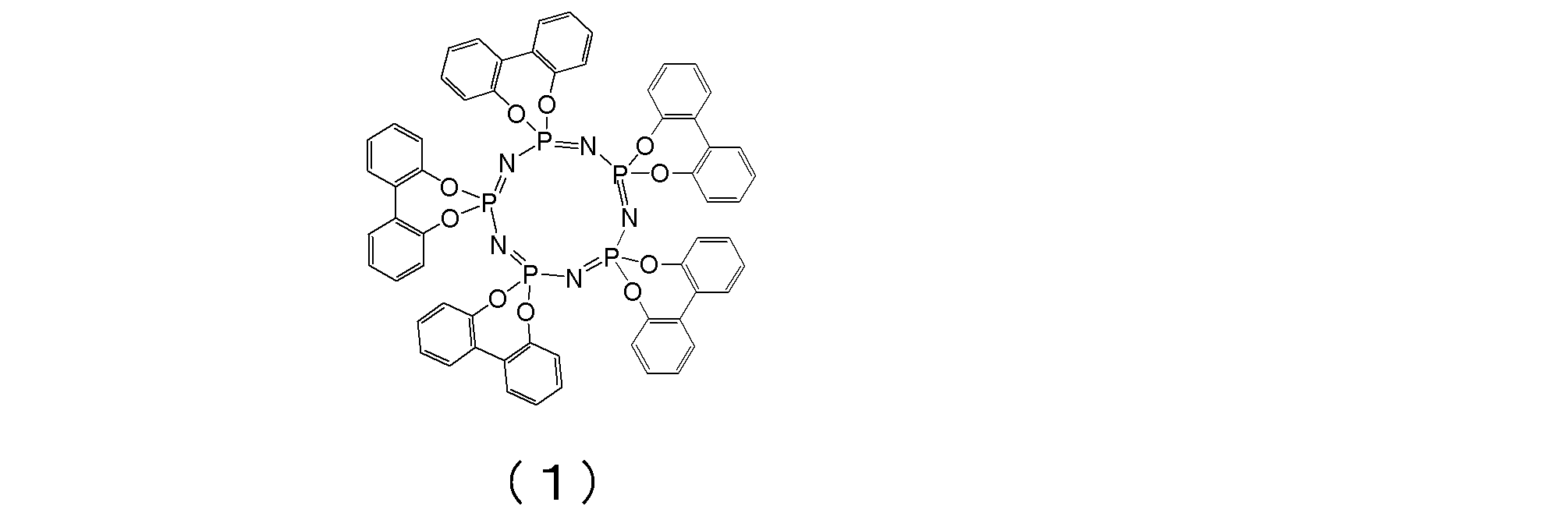
(項1)式(1)で表される環状ホスファゼン化合物。

(項2)樹脂及び式(1)で表される環状ホスファゼン化合物を含む樹脂組成物。
(項3)前記環状ホスファゼン化合物が、樹脂100質量部に対して、0.01~50質量部含まれる、項2に記載の樹脂組成物。
(項4)前記樹脂が、エポキシ樹脂、熱硬化性アクリル樹脂、ジアリルフタレート樹脂、不飽和ポリエステル樹脂、スチレン系樹脂、ポリエステル樹脂、ポリカーボネート樹脂、ポリフェニレンエーテル系樹脂、ポリアミド樹脂からなる群から選ばれる少なくとも1種である、項2又は3に記載の樹脂組成物。
(項5)項2~4のいずれか一項に記載の樹脂組成物を用いて作製された成形体。
(項6)項2~4のいずれか一項に記載の樹脂組成物を用いて作製された電気又は電子部品。
(項7)項2~4のいずれか一項に記載の樹脂組成物を含む半導体素子用封止材。
(項8)項2~4のいずれか一項に記載の樹脂組成物を用いて作製された基板材料。
(項9)デカクロロシクロペンタホスファゼンと2,2’-ビフェノラートとを反応させる、式(1)で表される環状ホスファゼン化合物の製造方法。

(項10)式(1)で表される環状ホスファゼン化合物を含む樹脂用難燃剤。
(項11)樹脂及び項10に記載の樹脂用難燃剤を含む樹脂組成物。
(項12)前記樹脂用難燃剤が、樹脂100質量部に対して、0.01~50質量部含まれる、項11に記載の樹脂組成物。
本発明の樹脂組成物は、式(1)で表される環状ホスファゼン化合物を含有するため、該樹脂組成物から作製された成形体は、樹脂由来の機械強度を維持しつつ、高い難燃性を発現することができる。また、本発明の樹脂組成物は、樹脂及び式(1)で表される環状ホスファゼン化合物以外の成分による制約を受けないことから、成形体の性質を大きく変化させるおそれがない点で有利である。よって、本発明の成形体は、特に電気又は電子部品に好適に使用することができる。
以下、本発明について詳細に説明する。
なお、本明細書において、「含有」は、「含む(comprise)」、「実質的にのみからなる(consist essentially of)」、及び「のみからなる(consist of)」のいずれも包含する概念である。また、本明細書において、数値範囲を「A~B」で示す場合、特に制限のない限りA以上B以下を意味する。
(式(1)で表される環状ホスファゼン化合物)
本発明の環状ホスファゼン化合物は、式(1)で表される。
本発明の環状ホスファゼン化合物は、式(1)で表される。
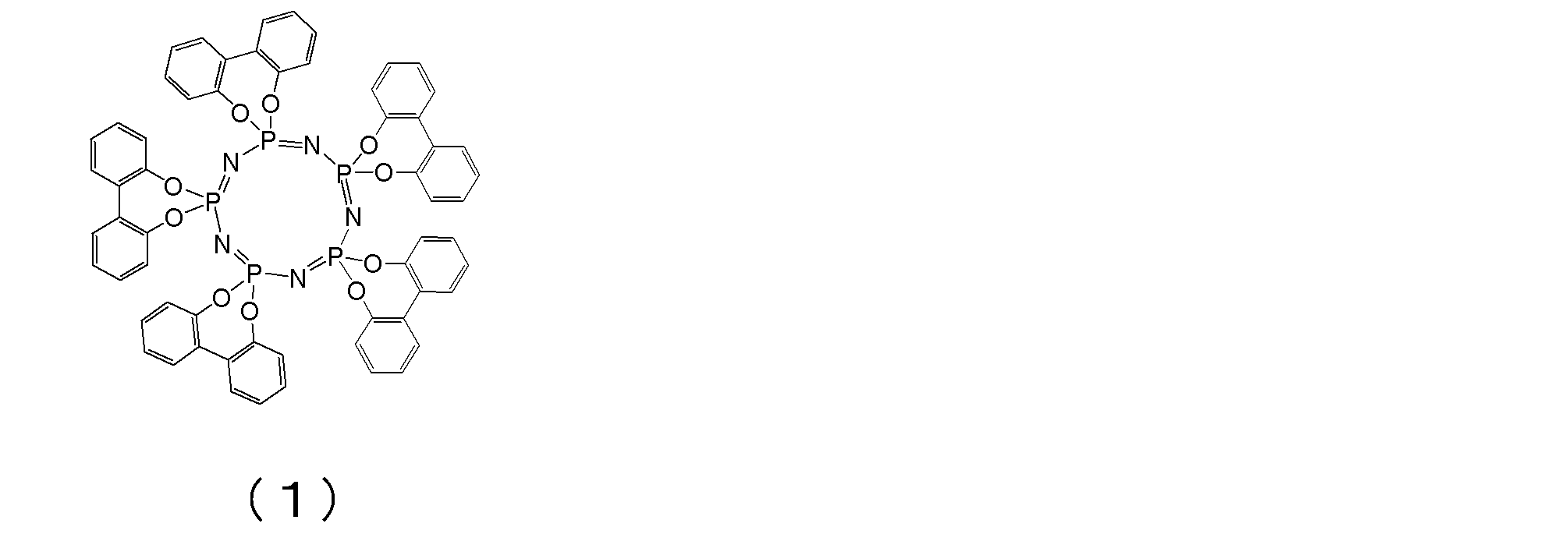
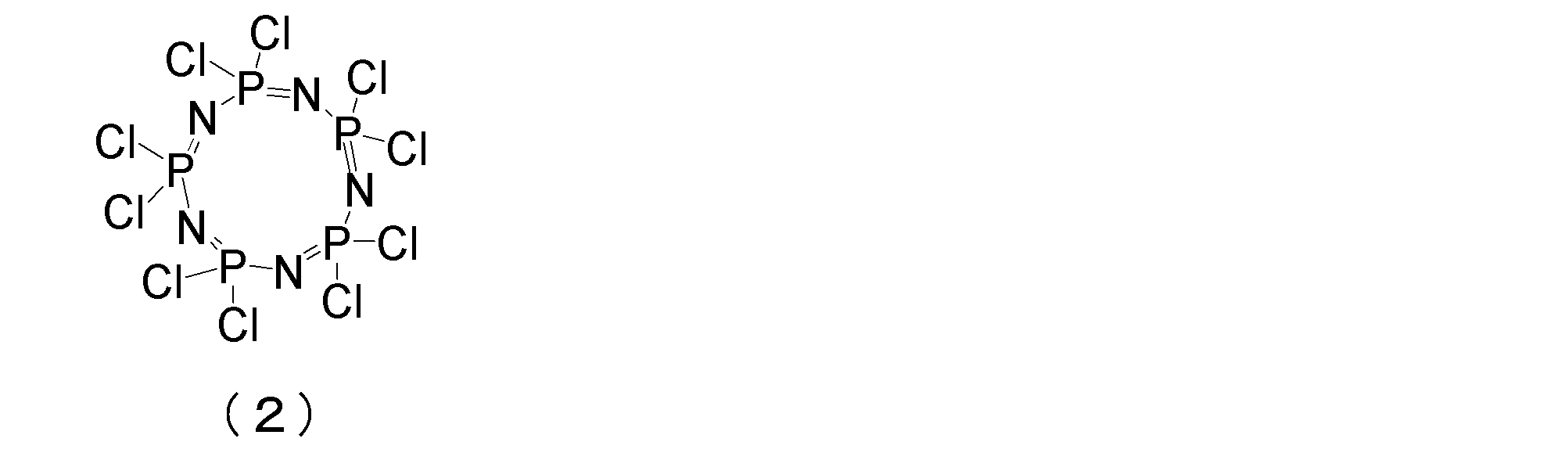
式(1)で表される化合物(以下、「化合物(1)」という場合もある)は、式(2)で表されるデカクロロシクロペンタホスファゼン(以下、「化合物(2)」という場合もある)と2,2’-ビフェノラートとを反応させることにより製造することができる。
2,2’-ビフェノラートの使用量は、化合物(2)1molに対して、5~7.5molが好ましく、5.3~5.8molが更に好ましい。
本反応は、溶媒中で行うことが好ましい。前記溶媒としては、モノクロロベンゼン、o-ジクロロベンゼン、m-ジクロロベンゼン、ジクロロメタン、1,2-ジクロロエタン、1,1-ジクロロエタン、sym-テトラクロロエタン等のハロゲン系溶媒;n-ペンタン、n-ヘキサン等の脂肪族炭化水素系溶媒;ベンゼン、トルエン、o-キシレン、m-キシレン等の芳香族炭化水素系溶媒;炭酸ジメチル、炭酸ジエチル、炭酸プロピレン等のカーボネート系溶媒;ジエチルエーテル、メチルエチルエーテル、シクロペンチルメチルエーテル、トリエチレングリコールジメチルエーテル、1,4-ジオキサン、1,3-ジオキサン、テトラヒドロフラン等のエーテル系溶媒;アセトニトリル、ブチロニトリル、ベンゾニトリル等のニトリル系溶媒;ニトロメタン、ニトロベンゼン等のニトロ化合物系溶媒;アセトン、メチルイソブチルケトン、シクロペンタノン、シクロヘキサノン等のケトン系溶媒;酢酸エチル、プロピオン酸メチル、プロピオン酸エチル等のエステル系溶媒等が挙げられる。これらの中でも、ハロゲン系溶媒が好ましく、モノクロロベンゼン、o-ジクロロベンゼン、及びm-ジクロロベンゼンがより好ましく、特にモノクロロベンゼンが好ましい。溶媒を用いる場合、溶媒の使用量としては、化合物(2)1質量部に対して、1~20質量部が好ましく、1.5~15質量部が更に好ましい。
反応温度は、20~140℃程度が好ましく、25~135℃が更に好ましい。
反応時間は、0.5~20時間程度が好ましく、1~12時間が更に好ましい。
化合物(2)は、例えば、特開昭57-3705号公報、特開昭57-77012号公報等に記載の公知の方法に従って、式(3)で表される環状クロロホスファゼンオリゴマーを製造し、その後、蒸留等の単離操作を行うことにより得ることができる。なお、化合物(2)は、式(3)において、mが5である化合物である。

(mは、3~15の整数を示す)
2,2’-ビフェノラートは、市販品でもよく、又は従来公知の方法で製造したものであってもよい。
2,2’-ビフェノラートの製造方法として、例えば、2,2’-ビフェノールと塩基とを、溶媒の存在下又は非存在下で反応させる方法が挙げられる。
前記塩基としては、アルカリ金属塩、アミン化合物等が挙げられ、水酸化リチウム、水酸化ナトリウム、水酸化カリウム、炭酸リチウム、炭酸ナトリウム、炭酸カリウム等のアルカリ金属塩が好ましい。塩基の使用量としては、2,2’-ビフェノール1molに対して、1.8~4molが好ましく、2~3molが更に好ましい。
溶媒を使用する場合、溶媒としては、反応に影響を与えない溶媒であれば特に制限されることなく使用することができる。このような溶媒として、上述した化合物(1)の製造反応において挙げられた溶媒と同様のものが挙げられる。
上記反応が終了した後、反応混合物に対して、抽出、洗浄等の公知の単離操作を行うことにより、2,2’-ビフェノラートを得ることができる。あるいは、2,2’-ビフェノラートを単離することなく、反応混合物の状態で化合物(2)と反応させてもよい。
このように、化合物(1)は、市販品の2,2’-ビフェノラート又は上述した方法で合成した2,2’-ビフェノラートと、化合物(2)とを直接反応させる方法で製造することができる。また、2,2’-ビフェノールと塩基と化合物(2)とを同一系内で反応させ、反応系中で2,2’-ビフェノラートを調製して、化合物(2)と反応させる方法によって製造することもできる。
この場合の2,2’-ビフェノールの使用量は、化合物(2)1molに対して、5~7.5molが好ましく、5.3~5.8molが更に好ましい。また、塩基の使用量は、化合物(2)1molに対して、9~20molが好ましく、10~12molが更に好ましい。
当該方法で使用可能な溶媒として、上述した2,2’-ビフェノラートと化合物(2)とを直接反応させる方法と同じ溶媒を挙げることができる。その中でも、エーテル系溶媒及びケトン系溶媒が好ましく、テトラヒドロフラン及びアセトンが特に好ましい。溶媒を使用する場合、その使用量としては、化合物(2)1質量部に対して、1~20質量部が好ましく、1.5~15質量部が更に好ましい。
当該方法における反応温度及び反応時間は、上述した2,2’-ビフェノラートと化合物(2)とを直接反応させる方法と同様である。
化合物(1)の製造方法としては、2,2’-ビフェノラートと化合物(2)とを直接反応させる方法が好ましい。
得られた化合物(1)は、公知の精製方法により精製することができる。精製方法としては、カラムクロマトグラフィー、抽出等が挙げられる。
また、化合物(1)は、化合物(2)の代わりに上記式(3)で表される環状クロロホスファゼンオリゴマーを用い、上記と同様に2,2’-ビフェノラートと反応させ、反応生成物をクロマトグラフィー等で単離することにより得ることもできる。
(樹脂用難燃剤)
本発明の樹脂用難燃剤は、前記式(1)で表される環状ホスファゼン化合物を含む。適用される樹脂としては、エポキシ樹脂、熱硬化性アクリル樹脂、ジアリルフタレート樹脂、不飽和ポリエステル樹脂、スチレン系樹脂、ポリエステル樹脂、ポリカーボネート樹脂、ポリフェニレンエーテル系樹脂、及びポリアミド樹脂等が挙げられる。
本発明の樹脂用難燃剤は、前記式(1)で表される環状ホスファゼン化合物を含む。適用される樹脂としては、エポキシ樹脂、熱硬化性アクリル樹脂、ジアリルフタレート樹脂、不飽和ポリエステル樹脂、スチレン系樹脂、ポリエステル樹脂、ポリカーボネート樹脂、ポリフェニレンエーテル系樹脂、及びポリアミド樹脂等が挙げられる。
本発明の樹脂用難燃剤は、前記式(1)で表される環状ホスファゼン化合物の他に、その他の難燃剤を含んでもよい。その他の難燃剤としては、ヘキサフェノキシシクロトリホスファゼン、ヘキサ(p-ヒドロキシフェノキシ)シクロトリホスファゼン、テトラアミノジフェノキシシクロトリホスファゼン、トリス(o-アリルフェノキシ)-トリス(フェノキシ)シクロトリホスファゼン、トリジオキシビフェニルシクロトリホスファゼン、テトラジオキシビフェニルシクロテトラホスファゼン、アニリノジフェニルホスフェート、ジ-o-クレジルフェニルアミノホスフェート、シクロヘキシルアミノジフェニルホスフェート、ホスホルアミド酸-1,4-フェニレンビス-テトラキス(2,6-ジメチルフェニル)エステル、リン酸一アンモニウム、リン酸二アンモニウム、リン酸三アンモニウム、ポリリン酸アンモニウム、ポリリン酸メラニン、レゾルシノールポリ(ジ-2,6-キシリル)ホスフェート、レゾルシノールポリフェニルホスフェート等が挙げられる。また、式(4)で表される環状ホスファゼンオリゴマー(nが6以上、好ましくは6~15)を含んでいてもよい。
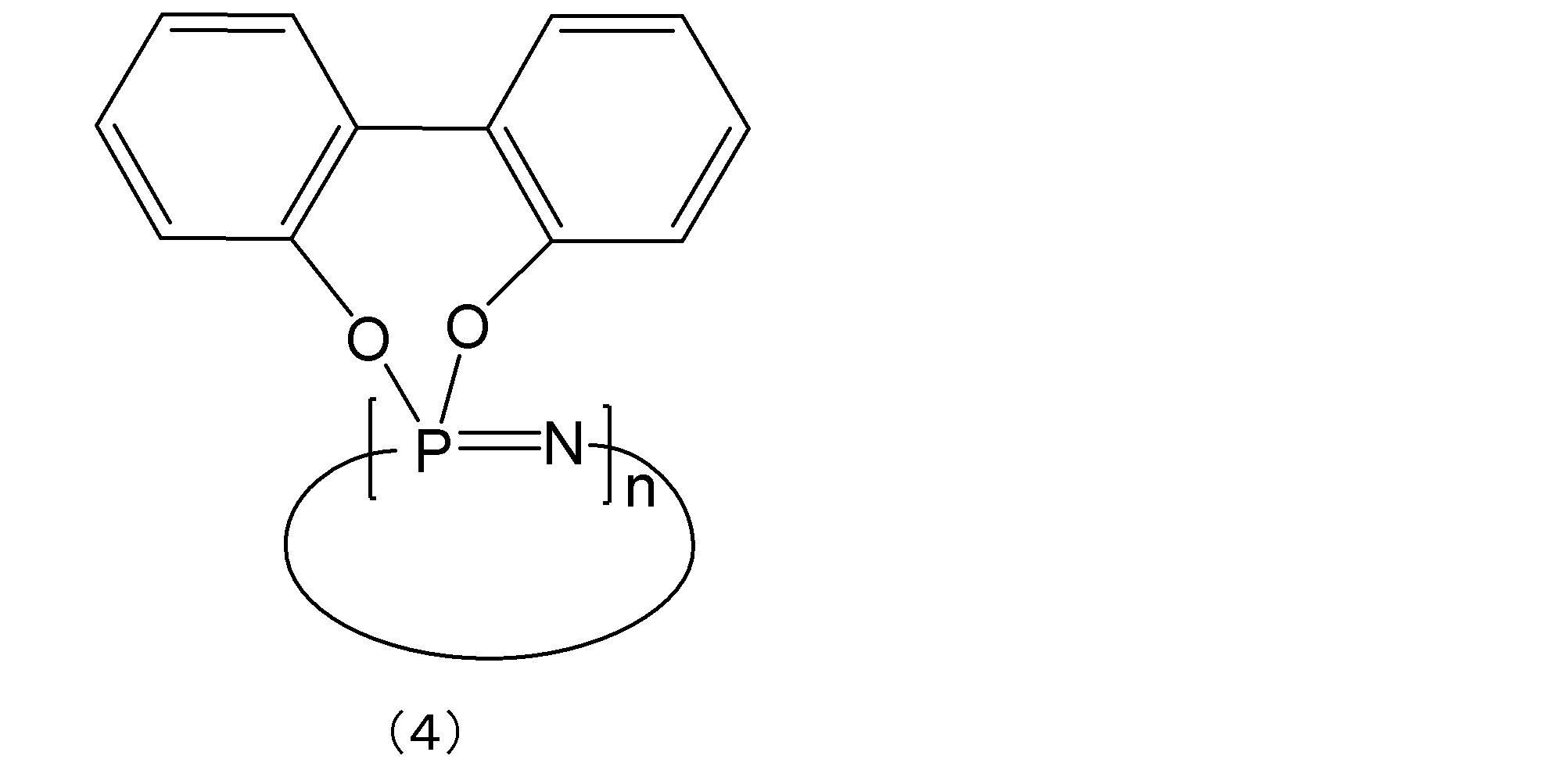
(nは、6以上の整数を示す)
本発明の樹脂用難燃剤は、後述する樹脂組成物に添加することができる、その他の添加剤を含んでもよい。
(樹脂組成物)
本発明の樹脂組成物は、樹脂、及び式(1)で表される環状ホスファゼン化合物を含む。
本発明の樹脂組成物は、樹脂、及び式(1)で表される環状ホスファゼン化合物を含む。
上述したように、本発明の樹脂用難燃剤は、式(1)で表される環状ホスファゼン化合物を含むことから、樹脂組成物に樹脂用難燃剤が含まれる態様も、本発明の樹脂組成物に包含される。
本発明の樹脂組成物を構成する樹脂としては、特に制限されず、従来公知の方法によって得られるもの、又は市販品を用いることができる。具体的には、熱硬化性樹脂、及び熱可塑性樹脂を挙げることができる。なお、本発明において、ゴム及びエラストマーは、「樹脂」に含まれるものとする。また、熱硬化性樹脂と、熱可塑性樹脂とを併用してもよい。
熱硬化性樹脂としては、例えば、エポキシ樹脂、フェノール樹脂、メラミン樹脂、尿素樹脂、シリコーン樹脂、ポリウレタン樹脂、不飽和ポリエステル樹脂、ジアリルフタレート樹脂、熱硬化性アクリル樹脂、熱硬化性ポリイミド樹脂、ポリカルボジイミド樹脂、天然ゴム、イソプレンゴム、スチレンブタジエンゴム、ブタジエンゴム、ブチルゴム、エチレンプロピレンジエンゴム、アクリロニトリルブタジエンゴム、スチレンイソプレンブタジエンゴム、クロロプレンゴム等が挙げられる。これらのうち1種を単独で、又は2種以上を組み合わせて用いることができる。
熱可塑性樹脂としては、例えば、ポリオレフィン樹脂(ポリエチレン樹脂、ポリプロピレン樹脂、ポリイソプレン樹脂、ポリブチレン樹脂、環状ポリオレフィン(COP)樹脂、環状オレフィン・コポリマー(COC)樹脂等)、塩素化ポリオレフィン樹脂(ポリ塩化ビニル樹脂、ポリ塩化ビニリデン等)、スチレン系樹脂(ポリスチレン樹脂、耐衝撃性ポリスチレン(HIPS)樹脂、シンジオタクチックポリスチレン(SPS)樹脂、アクリロニトリル-ブタジエン-スチレン共重合体(ABS樹脂)、アクリロニトリル-スチレン共重合体(AS樹脂)、メチルメタクリレート-ブタジエン-スチレン共重合体(MBS樹脂)、メチルメタクリレート-アクリロニトリル-ブタジエン-スチレン共重合体(MABS樹脂)、アクリロニトリル-アクリルゴム-スチレン共重合体(AAS樹脂)等)、ポリメチルメタクリレート(PMMA)、ポリビニルアルコール、ポリエステル樹脂(ポリエチレンテレフタレート樹脂、ポリブチレンテレフタレート樹脂、ポリメチレンテレフタレート樹脂、ポリエチレンナフタレート樹脂、ポリシクロヘキシレン・ジメチレン・テレフタレート樹脂、ポリ乳酸樹脂等)、脂肪族ポリアミド樹脂(ポリアミド6樹脂、ポリアミド66樹脂、ポリアミド11樹脂、ポリアミド12樹脂、ポリアミド46樹脂、ポリアミド6樹脂とポリアミド66樹脂との共重合体(ポリアミド6/66樹脂)、ポリアミド6樹脂とポリアミド12樹脂との共重合体(ポリアミド6/12樹脂)等)、半芳香族ポリアミド樹脂(ポリアミドMXD6樹脂、ポリアミド6T樹脂、ポリアミド9T樹脂、ポリアミド10T樹脂等の芳香環を有する構造単位と芳香環を有さない構造単位からなる樹脂)、ポリアセタール(POM)樹脂、ポリカーボネート樹脂、フェノキシ樹脂、ポリフェニレンエーテル系樹脂、ポリスルホン系樹脂、ポリエーテルスルホン樹脂、ポリフェニレンサルファイド樹脂、ポリエーテルニトリル樹脂、ポリチオエーテルスルホン樹脂、ポリアリレート樹脂、ポリアミドイミド樹脂、ポリエーテルイミド樹脂、ポリエーテル芳香族ケトン樹脂(ポリエーテルケトン樹脂、ポリエーテルケトンケトン樹脂、ポリエーテルエーテルケトンケトン樹脂、ポリエーテルエーテルケトン樹脂等)、熱可塑性ポリイミド(TPI)樹脂、液晶ポリマー(LCP)樹脂(液晶ポリエステル樹脂等)、ポリアミド系熱可塑性エラストマー、ポリエステル系熱可塑性エラストマー、ポリベンズイミダゾール樹脂等が挙げられる。これらのうち1種を単独で、又は2種以上を組み合わせて用いることができる。
これらの樹脂の中でも、エポキシ樹脂、熱硬化性アクリル樹脂、ジアリルフタレート樹脂、不飽和ポリエステル樹脂、スチレン系樹脂、ポリエステル樹脂、ポリカーボネート樹脂、ポリフェニレンエーテル系樹脂、及びポリアミド樹脂から選ばれる少なくとも1種又は2種以上が好ましく、その中でも、エポキシ樹脂が特に好ましい。
本明細書において、エポキシ樹脂とは、エポキシ化合物と硬化剤との反応物である。
エポキシ化合物としては、例えば、フェノール類とホルムアルデヒドとの反応物とエピクロルヒドリン又は2-メチルエピクロルヒドリンなどのエピクロルヒドリン類との反応により得られるノボラック型エポキシ化合物;フェノール類とエピクロルヒドリン類との反応により得られるフェノール型エポキシ化合物;トリメチロールプロパン、オリゴプロピレングリコール、水添ビスフェノール-A等のアルコールとエピクロルヒドリン類との反応により得られる脂肪族エポキシ化合物;ヘキサヒドロフタル酸、テトラヒドロフタル酸又はフタル酸と、エピクロルヒドリン類との反応により得られるグリシジルエステル系エポキシ化合物;ジアミノジフェニルメタン、アミノフェノール等のアミンとエピクロルヒドリン類との反応により得られるグリシジルアミン系エポキシ化合物;及びイソシアヌル酸等のポリアミンとエピクロルヒドリン類との反応により得られる複素環式エポキシ化合物等を挙げることができる。
前記ノボラック型エポキシ化合物として、フェノールノボラック型エポキシ化合物、臭素化フェノールノボラック型エポキシ化合物、オルトクレゾールノボラック型エポキシ化合物及びナフトールノボラック型エポキシ化合物等が挙げられる。
前記フェノール型エポキシ化合物として、ビスフェノール-A型エポキシ化合物、臭素化ビスフェノール-A型エポキシ化合物、ビスフェノール-F型エポキシ化合物、ビスフェノール-AD型エポキシ化合物、ビスフェノール-S型エポキシ化合物、アルキル置換ビフェノール型エポキシ化合物、トリス(ヒドロキシフェニル)メタン型エポキシ化合物等が挙げられる。
これらの中でも、フェノールノボラック型エポキシ化合物、オルトクレゾールノボラック型エポキシ化合物、ビスフェノール-A型エポキシ化合物、及びビスフェノール-F型エポキシ化合物が好ましい。これらの化合物は、1種単独で又は2種以上を混合して使用することができ、組成物中においてエポキシ樹脂を製造することも可能である。例えば、組成物にエポキシ化合物と硬化剤とを添加し、加熱することで、樹脂化させ、エポキシ樹脂を得ることができる。
また、上記エポキシ化合物に、単官能性のエポキシ化合物、又は、多官能性のエポキシ化合物を加えることで、エポキシ樹脂を変性することができる。
単官能性のエポキシ化合物の具体例として、例えば、ブチルグリシジルエーテル、フェニルグリシジルエーテル、クレジルグリシジルエーテル、アリルグリシジルエーテル、アルコールのグリシジルエーテル等が挙げられる。
多官能性のエポキシ化合物には、2官能性のエポキシ化合物、及び3官能性以上のエポキシ化合物が含まれる。
2官能性のエポキシ化合物の具体例として、例えば、エチレングリコールジグリシジルエーテル、プロピレングリコールジグリシジルエーテル、トリプロピレングリコールジグリシジルエーテル、1,6-ヘキサンジオールジグリシジルエーテル、ビスフェノールAのジグリシジルエーテル、ブタジエンジエポキシド、3,4-エポキシシクロヘキシルメチル-(3,4-エポキシ)シクロヘキサンカルボキシレート、ビニルシクロヘキサンジオキシド、4,4’-ジ(1,2-エポキシエチル)ジフェニルエーテル、4,4’-(1,2-エポキシエチル)ビフェニル、2,2-ビス(3,4-エポキシシクロヘキシル)プロパン、レゾルシンのグリシジルエーテル、フロログルシンのジグリシジルエーテル、メチルフロログルシンのジグリシジルエーテル、ビス(2,3’-エポキシシクロペンチル)エーテル、2-(3,4-エポキシ)シクロヘキサン-5,5-スピロ(3,4-エポキシ)シクロヘキサン-m-ジオキサン、ビス(3,4-エポキシ-6-メチルシクロヘキシル)アジペート、N,N’-m-フェニレンビス(4,5-エポキシ-1,2-シクロヘキサン)ジカルボキシイミド等を挙げることができる。
3官能性以上のエポキシ化合物の具体例として、例えば、p-アミノフェノールのトリグリシジルエーテル、ポリアリルグリシジルエーテル、1,3,5-トリ(1,2-エポキシエチル)ベンゼン、2,2’,4,4’-テトラグリシドキシベンゾフェノン、フェノールホルムアルデヒドノボラックのポリグリシジルエーテル、トリメチロールプロパンのトリグリシジルエーテル、トリメチロールプロパンのトリグリシジルエーテル等を挙げることができる。
これらの単官能性のエポキシ化合物、又は多官能性のエポキシ化合物は、それぞれ1種を単独で、又は2種以上を併用することができる。
硬化剤としては、この分野で公知のものを広く使用することができる。硬化剤として、例えば、ジシアンジアミド(DICY)化合物、ノボラック型フェノール樹脂、アミノ変性ノボラック型フェノール樹脂、ポリビニルフェノール樹脂、有機酸ヒドラジド、ジアミノマレオニトリル化合物、メラミン化合物、アミンイミド、ポリアミン塩、モレキュラーシーブ、アミン化合物(ジアミノジフェニルスルフォン、m-キシリレンジアミン、N-アミノエチルピペラジン、ジエチレントリアミン等)、酸無水物、ポリアミド、イミダゾール、光又は紫外線硬化剤等を挙げることができる。
これらの硬化剤は、1種単独で又は2種以上を混合して使用することができる。
硬化剤の配合量は、エポキシ化合物のエポキシ当量、硬化剤の活性水素当量又はアミン当量(アミン系硬化剤の活性水素の当量)等より、エポキシ化合物及び硬化剤の官能基数に基づいて適宜調整すればよい。
また、硬化を促進させやすくするために、硬化助剤を添加してもよい。硬化助剤としては、この分野で公知のものを広く使用することができる。硬化助剤として、例えば、第三級アミン、イミダゾール、芳香族アミン及びトリフェニルホスフィン等を挙げることができる。これらの硬化助剤は、1種単独で又は2種以上混合して使用することができる。硬化助剤の配合量は特に制限されず、通常、エポキシ樹脂100質量部に対して、10質量部以下、好ましくは5質量部以下であり得る。
本発明の樹脂組成物において、樹脂100質量部に対して、式(1)で表される環状ホスファゼン化合物が、通常0.01~50質量部程度、好ましくは0.5~40質量部程度、更に好ましくは1.5~35質量部程度、特に好ましくは10~30質量部程度含まれ得る。
本発明の樹脂組成物において、樹脂100質量部に対して、樹脂用難燃剤が、通常0.01~50質量部程度、好ましくは0.5~40質量部程度、更に好ましくは1.5~35質量部程度、特に好ましくは10~30質量部程度含まれ得る。
本発明の樹脂組成物には、必要に応じて、その難燃性能、特にドリッピング(燃焼時の滴下による延焼)防止性能をより一層向上させる目的で、フッ素樹脂、無機充填材等を配合することができる。これらは、いずれかを単独で配合することができ、又は両方を同時に配合することができる。
フッ素樹脂としては公知のものを使用することができる。フッ素樹脂として、例えば、ポリテトラフルオロエチレン(PTFE)、テトラフルオロエチレン-ヘキサフルオロプロピレン共重合体(FEP)、テトラフルオロエチレン-パーフルオロアルキルビニルエーテル共重合体(PFA)、テトラフルオロエチレン-エチレン共重合体(ETFE)、ポリ(トリフルオロクロロエチレン)(CTFE)、ポリフルオロビニリデン(PVdF)等が挙げられる。これらの中でも、PTFEが好ましい。フッ素樹脂は1種を単独で使用することができ、又は2種以上を併用することができる。
フッ素樹脂の配合量は特に制限されず、樹脂100質量部に対し、通常、0.01~2.5質量部程度であり、好ましくは、0.1~1.2質量部程度であり得る。
無機充填材は、ドリッピング防止効果を増強させるとともに、樹脂組成物の機械的強度、電気的性能(例えば、絶縁性、導電性、異方導電性、誘電性、耐湿性等)、熱的性能(例えば、耐熱性、ハンダ耐熱性、熱伝導性、低熱収縮性、低熱膨張性、低応力性、耐熱衝撃性、耐ヒートサイクル性、耐リフロークラック性、保存安定性、温度サイクル性等)、作業性又は成形性(流動性、硬化性、接着性、粘着性、圧着性、密着性、アンダーフィル性、ボイドフリー性、耐摩耗性、潤滑性、離型性、高弾性、低弾性、可とう性、屈曲性等)も向上させることができる。
無機充填材としては、特に制限はなく、公知の無機充填材を使用することができる。無機充填材として、例えば、マイカ、カオリン、タルク、溶融シリカ、結晶シリカ、アルミナ、クレー、硫酸バリウム、炭酸バリウム、炭酸カルシウム、硫酸カルシウム、水酸化アルミニウム、水酸化マグネシウム、珪酸カルシウム、酸化チタン、酸化亜鉛、ホウ酸亜鉛、窒化アルミニウム、窒化ホウ素、窒化珪素、ガラスビーズ、ガラスバルーン、ガラスフレーク、ガラスファイバー、繊維状チタン酸アルカリ金属塩(チタン酸カリウム繊維、チタン酸ナトリウム繊維等)、繊維状ホウ酸塩(ホウ酸アルミニウム繊維、ホウ酸マグネシウム繊維、ホウ酸亜鉛繊維等)、酸化亜鉛繊維、酸化チタン繊維、酸化マグネシウム繊維、石膏繊維、珪酸アルミニウム繊維、珪酸カルシウム繊維、炭化珪素繊維、炭化チタン繊維、窒化珪素繊維、窒化チタン繊維、炭素繊維、炭化ケイ素繊維、アルミナ繊維、アルミナ-シリカ繊維、ジルコニア繊維、石英繊維、薄片状チタン酸塩、薄片状酸化チタン等が挙げられる。
これらの中でも、機械的強度を向上させるための無機充填材としては、繊維状物、薄片状、又は板状等の形状異方性を有するものが好ましく、繊維状チタン酸アルカリ金属塩、ワラストナイト繊維、ゾノトライト繊維、塩基性硫酸マグネシウム繊維、繊維状ホウ酸塩、酸化亜鉛繊維、珪酸カルシウム繊維、薄片状チタン酸塩、薄片状酸化チタン、雲母、マイカ、セリサイト、イライト、タルク、カオリナイト、モンモリナイト、ベーマイト、スメクタイト、バーミキュライト等が特に好ましい。また、電気的性能、熱的性能、作業性又は成形性等を向上させるための無機充填材としては、溶融シリカ、結晶シリカ、アルミナ、タルク、窒化アルミニウム、窒化ホウ素、窒化珪素、酸化チタン、硫酸バリウム等の球状物又は粉末状物が好ましく、溶融シリカ、結晶シリカ、アルミナ、窒化アルミニウム等の球状物又は粉末状物が特に好ましい。
これらの無機充填材は、1種を単独で使用することができ、又は2種以上を併用することができる。
また、樹脂成分の劣化を抑える目的で、無機充填材の表面を表面処理用のシランカップリング剤、チタンカップリング剤等を用いて被覆したものを用いてもよい。
無機充填材の配合量は、樹脂100質量部に対し、通常0.01~90質量部程度、好ましくは1~80質量部程度であり得る。
本発明の樹脂組成物には、その好ましい特性を損なわない範囲で、その他の添加剤を配合することができる。その他の添加剤として、各種難燃剤等を挙げることができる。難燃剤としては特に制限されず、例えば、無機系難燃剤、ハロゲン系難燃剤、リン系難燃剤等が挙げられる。具体的には、水酸化アルミニウム、水酸化マグネシウム、三酸化アンチモン、五酸化アンチモン、テトラブロモビスフェノールAエポキシオリゴマー、テトラブロモビスフェノールAエポキシポリマー、テトラブロモビスフェノールA、テトラブロモビスフェノールA誘導体、テトラブロモビスフェノールAポリカーボネート、テトラブロモビスフェノールAカーボネートオリゴマー、トリブロモビスフェノールAビス(ジブロモプロピルエーテル)、トリブロモビスフェノールAビス(アリールエーテル)、ビス(ペンタブロモフェニル)エタン、1,2-ビス(2,4,6-トリブロモフェノキシ)エタン、2,4,6-トリス(2,4,6-トリブロモフェノキシ)トリアジン、ジブロモフェノールノボラック、デカブロモジフェニルエーテル、ブロモ化ポリスチレン、ブロモ化スチレン化合物、エチレンビステトラブロモフタルイミド、ヘキサブロモシクロドデカン、ヘキサブロモベンゼン、ペンタブロモベンジルアクリレート、ペンタブロモベンジルアクリレートポリマー、ヘキサフェノキシシクロトリホスファゼン、ヘキサ(p-ヒドロキシフェノキシ)シクロトリホスファゼン、テトラアミノジフェノキシシクロトリホスファゼン、トリス(o-アリルフェノキシ)-トリス(フェノキシ)シクロトリホスファゼン、トリジオキシビフェニルシクロトリホスファゼン、テトラジオキシビフェニルシクロテトラホスファゼン、式(4)で表される環状ホスファゼンオリゴマー、アニリノジフェニルホスフェート、ジ-o-クレジルフェニルアミノホスフェート、シクロヘキシルアミノジフェニルホスフェート、ホスホルアミド酸-1,4-フェニレンビス-テトラキス(2,6-ジメチルフェニル)エステル、リン酸一アンモニウム、リン酸二アンモニウム、リン酸三アンモニウム、ポリリン酸アンモニウム、ポリリン酸メラニン、レゾルシノールポリ(ジ-2,6-キシリル)ホスフェート、レゾルシノールポリフェニルホスフェート等が挙げられる。これらは、1種を単独で使用することができ、又は2種以上を併用することができる。
更に本発明の樹脂組成物には、その好ましい特性を損なわない範囲で、一般的な樹脂添加剤を配合することができる。該樹脂添加剤としては、特に制限はなく、例えば、紫外線吸収剤(ベンゾフェノン系、ベンゾトリアゾール系、シアノアクリレート系、トリアジン系、サリシレート系等)、光安定剤(ヒンダードアミン系等)、酸化防止剤(ヒンダードフェノール系、アミン系、銅系、有機リン系過酸化物分解剤、有機硫黄系過酸化物分解剤等)、遮光剤(ルチル型酸化チタン、酸化クロム、酸化セリウム等)、金属不活性剤(ベンゾトリアゾール系等)、消光剤(有機ニッケル等)、天然ワックス類、合成ワックス類、高級脂肪酸、高級脂肪酸の金属塩、防曇剤、防黴剤、抗菌剤、防臭剤、可塑剤、帯電防止剤、界面活性剤、重合禁止剤、架橋剤、染料、着色剤(カーボンブラック、酸化チタン、ベンガラ等の顔料、染料等)、増感剤、硬化促進剤、希釈剤、流動性調整剤、消泡剤、発泡剤、レベリング剤、接着剤、粘着剤、粘着性付与剤、滑剤、離型剤、潤滑剤、固体潤滑剤(ポリテトラフルオロエチレン、低密度ポリエチレン、直鎖状低密度ポリエチレン、中密度ポリエチレン、高密度ポリエチレン、超高分子量ポリエチレン等のポリオレフィン樹脂、グラファイト、二硫化モリブテン、二硫化タングステン、窒化ホウ素等)、核剤、強化剤、相溶化剤、導電材(炭素系、金属系、金属酸化物系等)、アンチブロッキング剤、アンチトラッキング剤、畜光剤、各種安定剤等が挙げられる。
(樹脂組成物の製造方法)
本発明の樹脂組成物は、各種原材料を所定量又は適量秤量して、公知の方法で混合又は混練することにより得ることができる。例えば、粉末、ビーズ、フレーク又はペレット状の各成分の混合物を、1軸押出機、2軸押出機等の押出機、バンバリーミキサー、加圧ニーダー、2本ロール、3本ロール等の混練機等を用いて混練することにより本発明の樹脂組成物を得ることができる。また、液体を配合する必要のある場合には、公知の液体注入装置を用い、上記の押出機又は混練機等で混練することができる。各種原材料を予め混合機(タンブラー、ヘンシェルミキサ等)で予備混合してから用いてもよい。
本発明の樹脂組成物は、各種原材料を所定量又は適量秤量して、公知の方法で混合又は混練することにより得ることができる。例えば、粉末、ビーズ、フレーク又はペレット状の各成分の混合物を、1軸押出機、2軸押出機等の押出機、バンバリーミキサー、加圧ニーダー、2本ロール、3本ロール等の混練機等を用いて混練することにより本発明の樹脂組成物を得ることができる。また、液体を配合する必要のある場合には、公知の液体注入装置を用い、上記の押出機又は混練機等で混練することができる。各種原材料を予め混合機(タンブラー、ヘンシェルミキサ等)で予備混合してから用いてもよい。
また、本発明の樹脂組成物は、本発明の樹脂用難燃剤、及び、必要に応じて、その他添加剤を高濃度に含んだマスターバッチ樹脂組成物を調製し、必要により他の成分を混合又は混練することにより得ることができる。
(成形体)
本発明の樹脂組成物は、例えば、注型成形、射出成形、圧縮成形、トランスファー成形、インサート成形、RIM成形、押出成形、インフレーション成形、ブロー成形等の公知の成形方法により、単一層又は複数層の樹脂板、シート、フィルム、繊維、丸棒、角棒、球状、方状、パイプ、チューブ、異形品等の任意の形状の成形体とすることができる。
本発明の樹脂組成物は、例えば、注型成形、射出成形、圧縮成形、トランスファー成形、インサート成形、RIM成形、押出成形、インフレーション成形、ブロー成形等の公知の成形方法により、単一層又は複数層の樹脂板、シート、フィルム、繊維、丸棒、角棒、球状、方状、パイプ、チューブ、異形品等の任意の形状の成形体とすることができる。
本発明の樹脂組成物は、樹脂成分が使用可能なあらゆる分野で適用することができる。使用可能な分野として、例えば、電気、電子又は通信機器、精密機器、自動車等の輸送機器、繊維製品、各種製造機械類、食品包装フィルム、容器、農林水産分野、建設用資材、医療用品、家具類の構成部品等が挙げられる。
特に、樹脂成分として、エポキシ樹脂を使用した場合、本発明の樹脂組成物から作製される成形体は、電気、電子又は通信機器での使用が好ましい。電気、電子又は通信機器としては、例えば、プリンタ、コンピュータ、ワードプロセッサー、キーボード、小型情報端末機(PDA)、電話機、携帯端末(携帯電話、スマートフォン、タブレット型端末等)、ファクシミリ、複写機、電子式金銭登録機(ECR)、電卓、電子手帳、電子辞書等のOA機器、洗濯機、冷蔵庫、炊飯器、掃除機、電子レンジ、照明器具、エアコン、アイロン、こたつ等の家電製品、テレビ、チューナー、VTR、ビデオカメラ、カムコーダー、デジタルスチルカメラ、ラジカセ、テープレコーダー、MDプレーヤー、CDプレーヤー、DVDプレーヤー、LDプレーヤー、HDD(ハードディスクドライブ)、スピーカー、カーナビゲーション、液晶ディスプレイ及びそのドライバー、ELディスプレイ、プラズマディスプレイ等のAV製品等のハウジング、機構部品又は構造部品の一部又は全部を構成する材料、電線、ケーブル等の被覆抵抗、サーモスタット、温度ヒューズ等の電気素子を収納するためのケース、モーター用ベアリング、スペーサー、ドットプリンター用ワイヤーガイド等の摺動部品の一部又は全部を構成する材料等が挙げられる。
電気、電子又は通信機器の中でも、本発明の成形体は、これらに使用される電気又は電子部品、例えば、各種半導体素子の封止材、配線板の基板材料等への使用が特に好ましい。半導体素子等を封止するに当たっては、従来公知の方法を広く採用することができる。例えば、リードフレーム、配線済みのテープキャリア、配線板、ガラス、シリコンウエハ等の支持部材に、半導体チップ、トランジスタ、ダイオード、発光ダイオード(LED)、サイリスタ等の能動素子、コンデンサ、抵抗体、コイル等の受動素子等の半導体素子を実装し、予め形成されている回路パターンに接続し、必要な部分を本発明の樹脂組成物の溶液又はペーストで封止することにより、電子部品を製造することができる。
実装方法としては特に制限はなく、例えば、リードフレームパッケージ、面実装パッケージ〔SOP(small outline package)、SOJ(small outline j-leaded package)、QFP(quad flat package)、BGA(ball grid array)等〕、CSP(chip size/scale package)等の方法を採用することができる。
回路パターンとの接続方法も特に制限されず、例えば、ワイヤボンディング、TAB(tape automated bonding)接続、フリップチップ接続等の公知の方法を採用することができる。
封止方法としては低圧トランスファー成形法が最も一般的であるが、インジェクション成形法、圧縮成形法、注型法等を用いてもよい。この際、素子を実装する支持部材の種類、実装する素子の種類、実装方法、接続方法、封止方法等の各種の条件に応じて、本発明の樹脂組成物の組成を適宜変更することができる。また、支持部材に半導体素子、ハンダボール、リードフレーム、ヒートスプレッダー、スティフナ等の部品を実装するために、本発明の樹脂組成物を接着剤として用いてもよい。
更に本発明の樹脂組成物を予めフィルム状に成形し、このフィルムを、例えば二次実装用封止材として用いることもできる。このような方法で製造される電子部品としては、例えば、テープキャリアにバンプで接続した半導体チップを、本発明の樹脂組成物で封止したTCP(tape carrier package)を挙げることができる。また、配線板又はガラス上に形成した配線に、ワイヤボンディング、フリップチップボンディング、はんだ等で接続した半導体チップ、集積回路、大規模集積回路、トランジスタ、ダイオード、サイリスタ等の能動素子及び/又はコンデンサ、抵抗体、コイル等の受動素子を、本発明の樹脂組成物で封止したCOBモジュール、ハイブリッド集積回路、マルチチップモジュール等を挙げることができる。
本発明の樹脂組成物を配線板用の基板材料として用いる場合も、従来の方法と同様に実施すればよい。例えば、本発明の樹脂組成物を、紙、ガラス繊維布、アラミド繊維布等の基材に含浸させて、90~220℃程度の温度で1~5分間程度乾燥させる方法等で半硬化させることによりプリプレグを製造し、このプリプレグを配線板用の基板材料とすればよい。また、本発明の樹脂組成物をフィルム状に成形し、このフィルムを配線板用の基板材料として用いることもできる。この時、導電性物質又は誘電性物質を配合すれば、導電性層、異方導電性層、導電率制御層、誘電性層、異方誘電性層、誘電率制御層等の機能性膜とすることもできる。
更に、樹脂製バンプ又はスルーホール内側に形成する導電性層として用いることもできる。プリプレグ又はフィルムを積層して配線板を製造する際に、本発明の樹脂組成物を接着剤として用いることもできる。この時にも、フィルム化する場合と同様に、導電性無機物質、誘電性無機物質等が含まれていてもよい。
本発明では、本発明の樹脂組成物を基材に含浸させてなるプリプレグ及び/又は本発明の樹脂組成物を成形してなるフィルムのみで配線板を製造してもよいし、これらと共に従来の配線板用プリプレグ及び/又はフィルムを併用してもよい。配線板としては特に制限されず、例えば、リジットタイプ又はフレキシブルタイプのものであってもよいし、形状もシート状又はフィルム状から板状のものまで適宜選択することができる。例えば、金属箔張積層板、プリント配線板、ボンディングシート、キャリア付き樹脂フィルム等を挙げることができる。
金属箔張積層板として、より具体的には、銅張積層板、コンポジット銅張積層板、フレキシブル銅張積層板等が挙げられる。これらの金属箔張積層板は、従来の方法と同様に作製することができる。例えば、上述したプリプレグを1枚で又は複数枚重ね、その片面又は両面に厚み2~70μm程度の金属(銅、アルミニウム等)箔を配置し、多段プレス機、連続成形機等を用いて、温度180~350℃程度、加熱時間100~300分間程度、及び面圧20~100kg/cm2程度で積層成形することにより、金属箔張積層板を作製することができる。
プリント配線板として、より具体的には、ビルドアップ型多層プリント配線板、フレキシブルプリント配線板等が挙げられる。これらのプリント配線板は、従来の方法と同様に作製することができる。例えば、金属箔張積層板の表面にエッチング処理を施し、内層回路を形成することにより内装基板を作製し、内層回路の表面にプリプレグを数枚重ね、その外側に外装回路用の金属箔を積層し、加熱及び加圧することで一体成型して多層の積層体を得る。得られた多層の積層体に穴をあけ、この穴の壁面に内層回路と外層回路用の金属箔とを導通させるめっき金属皮膜を形成する。さらに、外層回路用の金属箔にエッチング処理を施し、外層回路を形成することにより、プリント配線板を作製することができる。
ボンディングシートは、従来の方法と同様に作製することができる。例えば、本発明の樹脂組成物を溶剤に溶解させた溶液を、ロールコーター、コンマコーター等を用いて、ポリエチレンフィルム、ポリプロピレンフィルム等の剥離可能なプラスチックフィルムの支持材に塗布し、これを40~160℃程度で1~20分間程度加熱処理し、ロール等で圧着することによりボンディングシートを作製することができる。
キャリア付き樹脂フィルムは、従来の方法と同様に作製することができる。例えば、本発明の樹脂組成物を溶剤に溶解させた溶液を、ポリエチレンフィルム、ポリプロピレンフィルム等の剥離可能なプラスチックフィルムの支持材に、バーコーダー、ドクターブレード等で塗布し、80~200℃程度の温度で1~180分間程度乾燥することによりキャリア付き樹脂フィルムを作製することができる。
その他の用途としては、精密機器、輸送機器、製造機器、家庭用品、土木建設資材等が挙げられる。精密機器の具体例としては、時計、顕微鏡、カメラ等のハウジング、機構部品又は構造部品の一部又は全部を構成する材料が挙げられる。輸送機器の具体例としては、ヨット、ボート等の船舶、電車、自動車、自転車、オートバイ、航空機等の車体、機構部品又は構造部品(フレーム、パイプ、シャフト、コンバーチブルトップ、ドアトリム、サンバイザー、ホイールカバー、吊り手、吊り手帯等)の一部又は全部を構成する材料、各種輸送機器の内装部品(アームレスト、パッケージトレイ、サンバイザー、マットレスカバー等)の一部又は全部を構成する材料が挙げられる。製造機器の具体例としては、ロボットアーム、ロール、ロール軸、スペーサー、インシュレータ、ガスケット、スラストワッシャー、ギヤ、ボビン、ピストン部材、シリンダ部材、プーリー、ポンプ部材、軸受け、軸部材、板バネ、ハニカム構造材、マスキング治具、分電盤、防水パン等の機構部品又は構造部品の一部又は全部を構成する材料、水槽、浄化槽、ロータンク等の工業用タンク類又はパイプ類、樹脂型、ヘルメット等の一部又は全部を構成する材料が挙げられる。家庭用品の具体例としては、バトミントン又はテニスのラケットフレーム、ゴルフクラブのシャフト又はヘッド、ホッケーのスティック、スキーのポール又は板、スノーボード板、スケートボード板、釣竿ロッド、バット、テントの支柱等のスポーツ又はレジャー用品、浴槽、洗面器、便器、これらの付属品等の衛生機器、シート、バケツ、ホース等の一部又は全部を構成する材料、家具の天板又はテーブル等の表面に設けられる耐熱積層体材料、家具、キャビネット等の化粧材等が挙げられる。土木建設資材の具体例としては、各種建造物の内外装材、屋根材、床材、壁紙、窓ガラス、窓ガラスのシーリング材、コンクリート構造建築物(コンクリート製橋脚、コンクリート製支柱等)又はコンクリート構造物(コンクリート製柱、壁面、道路等)の補強材、下水管等の管路補修材等が挙げられる。
以下に、実施例及び比較例によって本発明を具体的に説明するが、本発明はこれらによって何ら限定されるものではない。
実施例1:式(1)で表される環状ホスファゼン化合物の製造
1-1.デカクロロシクロペンタホスファゼンの製造
還流冷却器を取り付けたナスフラスコに、五塩化リン(0.51g,2.4mmol)と塩化アンモニウム(0.14g,2.62mmol)とモノクロロベンゼン(5ml)とを入れ、5時間還流した。還流後、残存している塩化アンモニウムをろ過により除去し、ろ液を減圧濃縮し、乾燥させることで、透明結晶に微量の油状物を含む環状クロロホスファゼンオリゴマー(0.251g)が得た。得られた環状クロロホスファゼンオリゴマーを蒸留により、デカクロロシクロペンタホスファゼンのみを単離させて、固体のデカクロロシクロペンタホスファゼンを得た。
1-1.デカクロロシクロペンタホスファゼンの製造
還流冷却器を取り付けたナスフラスコに、五塩化リン(0.51g,2.4mmol)と塩化アンモニウム(0.14g,2.62mmol)とモノクロロベンゼン(5ml)とを入れ、5時間還流した。還流後、残存している塩化アンモニウムをろ過により除去し、ろ液を減圧濃縮し、乾燥させることで、透明結晶に微量の油状物を含む環状クロロホスファゼンオリゴマー(0.251g)が得た。得られた環状クロロホスファゼンオリゴマーを蒸留により、デカクロロシクロペンタホスファゼンのみを単離させて、固体のデカクロロシクロペンタホスファゼンを得た。
1-2.2,2’-ビフェノラートの製造
ディーンスターク装置を取り付けた5Lのフラスコに、2,2’-ビフェノール(491.09g,2.62mol)及びクロロベンゼン(2.3L)を入れ、窒素雰囲気下で、60℃で加熱撹拌し、2,2’-ビフェノールを溶解した。その後、48質量%水酸化ナトリウム水溶液(446.52g,5.30mol)を加え、水を除きながら135℃で5時間加熱還流し、反応を行い、ジソジウム2,2’-ビフェノラートを製造した。
ディーンスターク装置を取り付けた5Lのフラスコに、2,2’-ビフェノール(491.09g,2.62mol)及びクロロベンゼン(2.3L)を入れ、窒素雰囲気下で、60℃で加熱撹拌し、2,2’-ビフェノールを溶解した。その後、48質量%水酸化ナトリウム水溶液(446.52g,5.30mol)を加え、水を除きながら135℃で5時間加熱還流し、反応を行い、ジソジウム2,2’-ビフェノラートを製造した。
1-3.式(1)で表される環状ホスファゼン化合物の製造
1-2で得られた反応液を100℃まで冷却した後、27質量%デカクロロシクロペンタホスファゼンのクロロベンゼン溶液(1064.68g,2.5unit※1mol)を1時間かけて滴下して加えた。反応液を12時間加熱還流させた後、水を加え、分液した。得られた有機層を濃縮し、乾燥させ、これを逆相シリカゲルカラムクロマトグラフィー(展開溶媒としてアセトニトリルを使用)にて精製し、固体の式(1)で表される環状ホスファゼン化合物を得た(413.88g)。
1H-NMR(500.13MHz,CDCl3,σppm):7.05-7.59(multi-plet)
31P-NMR(202.46MHz,CDCl3,σppm):0.91
MSスペクトルデータ:C60H40N5O10P5(m/z=1146.4:[M+H]+),Theoretical mass(m/z=1145.15:M+)
※1:unit;環状クロロホスファゼン化合物の最小構成単位(PNCl2)を示す。
1-2で得られた反応液を100℃まで冷却した後、27質量%デカクロロシクロペンタホスファゼンのクロロベンゼン溶液(1064.68g,2.5unit※1mol)を1時間かけて滴下して加えた。反応液を12時間加熱還流させた後、水を加え、分液した。得られた有機層を濃縮し、乾燥させ、これを逆相シリカゲルカラムクロマトグラフィー(展開溶媒としてアセトニトリルを使用)にて精製し、固体の式(1)で表される環状ホスファゼン化合物を得た(413.88g)。
1H-NMR(500.13MHz,CDCl3,σppm):7.05-7.59(multi-plet)
31P-NMR(202.46MHz,CDCl3,σppm):0.91
MSスペクトルデータ:C60H40N5O10P5(m/z=1146.4:[M+H]+),Theoretical mass(m/z=1145.15:M+)
※1:unit;環状クロロホスファゼン化合物の最小構成単位(PNCl2)を示す。
実施例2及び比較例1~4:樹脂成形体の作製
表1に記載の各成分の量を測りとり、120℃で温めながら均一になるように混合した。その後、厚み4mmの成形版に混合物を流し込み、120℃、10mmHg以下で減圧脱気を行った。脱気後、150℃で1時間、及び200℃で2時間加熱し、硬化させ、得られた硬化物を室温まで冷却させてエポキシ樹脂成形体を作製した。
表1に記載の各成分の量を測りとり、120℃で温めながら均一になるように混合した。その後、厚み4mmの成形版に混合物を流し込み、120℃、10mmHg以下で減圧脱気を行った。脱気後、150℃で1時間、及び200℃で2時間加熱し、硬化させ、得られた硬化物を室温まで冷却させてエポキシ樹脂成形体を作製した。
(曲げ試験)
JIS K7171に準拠して、測定を行った。試験片は、上記方法で作製した成形体を寸法80×10×4mmになるように加工し、それを用いた。単位はMpaである。評価結果を表1に示す。
JIS K7171に準拠して、測定を行った。試験片は、上記方法で作製した成形体を寸法80×10×4mmになるように加工し、それを用いた。単位はMpaである。評価結果を表1に示す。
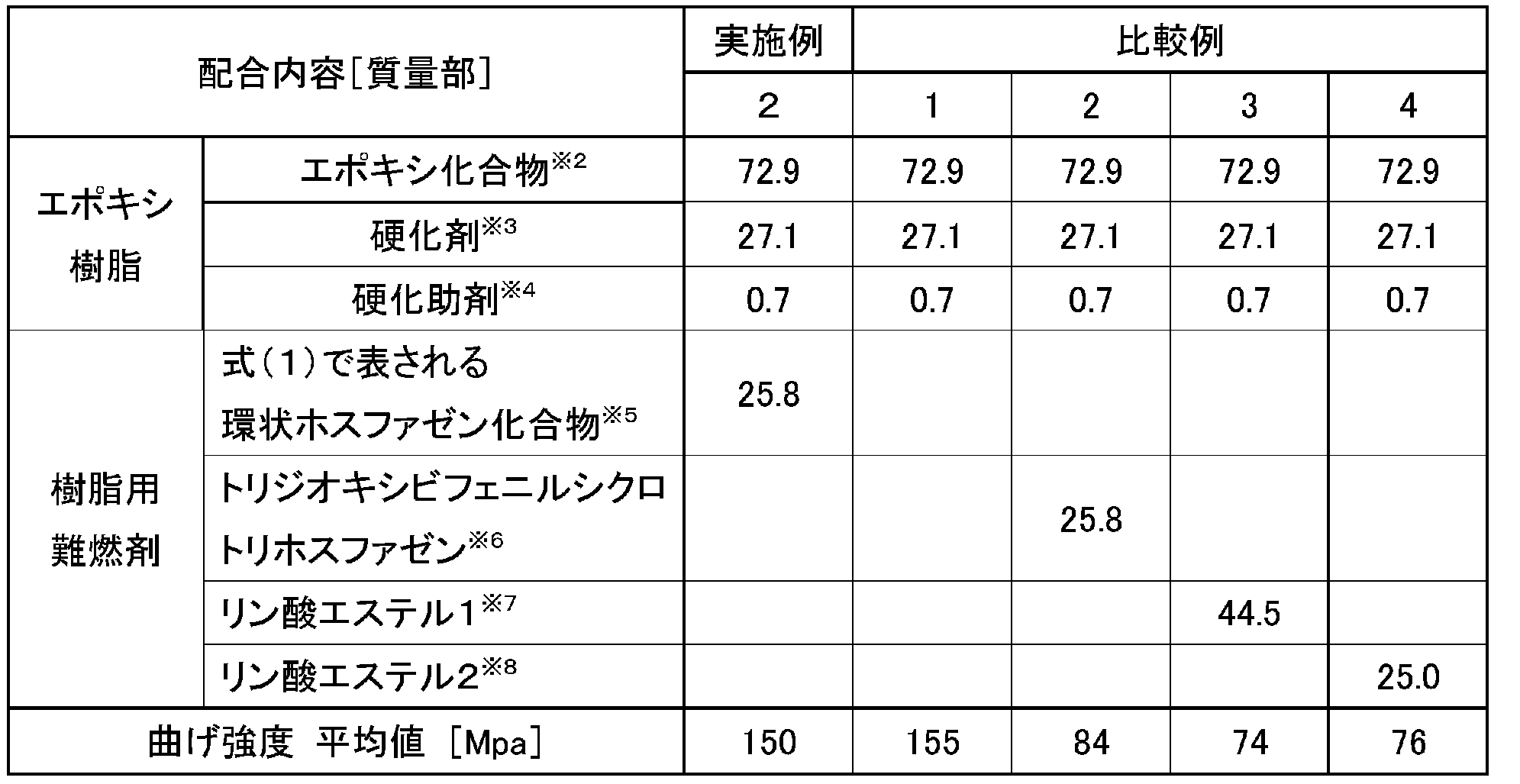
※2:ビスフェノールF型エポキシ化合物;三菱ケミカル株式会社製、エピコート806
※3:ジアミノジフェニルスルフォン;東京化成工業株式会社製
※4:トリフェニルホスフィン;和光純薬工業株式会社製
※5:実施例1で製造した化合物
※6:トリジオキシビフェニルシクロトリホスファゼン;米国特許3356769号公報
※7:レゾルシノールポリ(ジ-2,6-キシリル)ホスフェート;大八化学工業株式会社製、PX-200
※8:レゾルシノールポリフェニルホスフェート;株式会社ADEKA社製、FP-700
※3:ジアミノジフェニルスルフォン;東京化成工業株式会社製
※4:トリフェニルホスフィン;和光純薬工業株式会社製
※5:実施例1で製造した化合物
※6:トリジオキシビフェニルシクロトリホスファゼン;米国特許3356769号公報
※7:レゾルシノールポリ(ジ-2,6-キシリル)ホスフェート;大八化学工業株式会社製、PX-200
※8:レゾルシノールポリフェニルホスフェート;株式会社ADEKA社製、FP-700
(難燃性試験)
UL94に準拠して測定し、評価した。試験片は、上記方法で作製した、実施例2及び比較例1の成形体を寸法80×10×4mmになるように加工して用いた。
判断基準を表2に示す。
UL94に準拠して測定し、評価した。試験片は、上記方法で作製した、実施例2及び比較例1の成形体を寸法80×10×4mmになるように加工して用いた。
判断基準を表2に示す。

評価の結果、実施例2はV-0であり、比較例1は試験片がすべてクランプまで燃焼した。
上記曲げ試験及び難燃性試験の結果から、式(1)で表される環状ホスファゼン化合物を含む成形体は、樹脂由来の機械強度を維持しつつ、高い難燃性を発現することが分かる。
本発明は、樹脂由来の機械強度を維持しつつ、高い難燃性を有する樹脂組成物及びその成形体を提供することができる。
Claims (10)
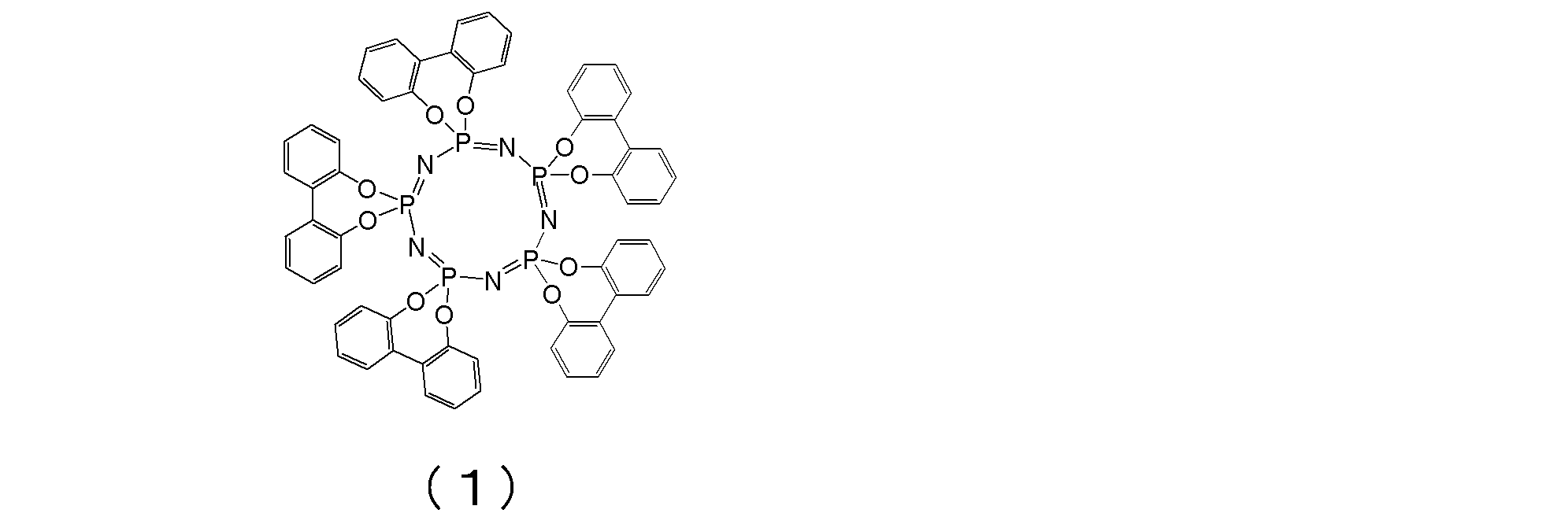
- 式(1)で表される環状ホスファゼン化合物。

- 樹脂及び請求項1に記載の環状ホスファゼン化合物を含む樹脂組成物。
- 前記環状ホスファゼン化合物が、前記樹脂100質量部に対して、0.01~50質量部含まれる、請求項2に記載の樹脂組成物。
- 前記樹脂が、エポキシ樹脂、熱硬化性アクリル樹脂、ジアリルフタレート樹脂、不飽和ポリエステル樹脂、スチレン系樹脂、ポリエステル樹脂、ポリカーボネート樹脂、ポリフェニレンエーテル系樹脂、ポリアミド樹脂からなる群から選ばれる少なくとも1種である、請求項2又は3に記載の樹脂組成物。
- 請求項2~4のいずれか一項に記載の樹脂組成物を用いて作製された成形体。
- 請求項2~4のいずれか一項に記載の樹脂組成物を用いて作製された電気又は電子部品。
- 請求項2~4のいずれか一項に記載の樹脂組成物を含む半導体素子用封止材。
- 請求項2~4のいずれか一項に記載の樹脂組成物を用いて作製された基板材料。
- デカクロロシクロペンタホスファゼンと2,2’-ビフェノラートとを反応させる、式(1)で表される環状ホスファゼン化合物の製造方法。
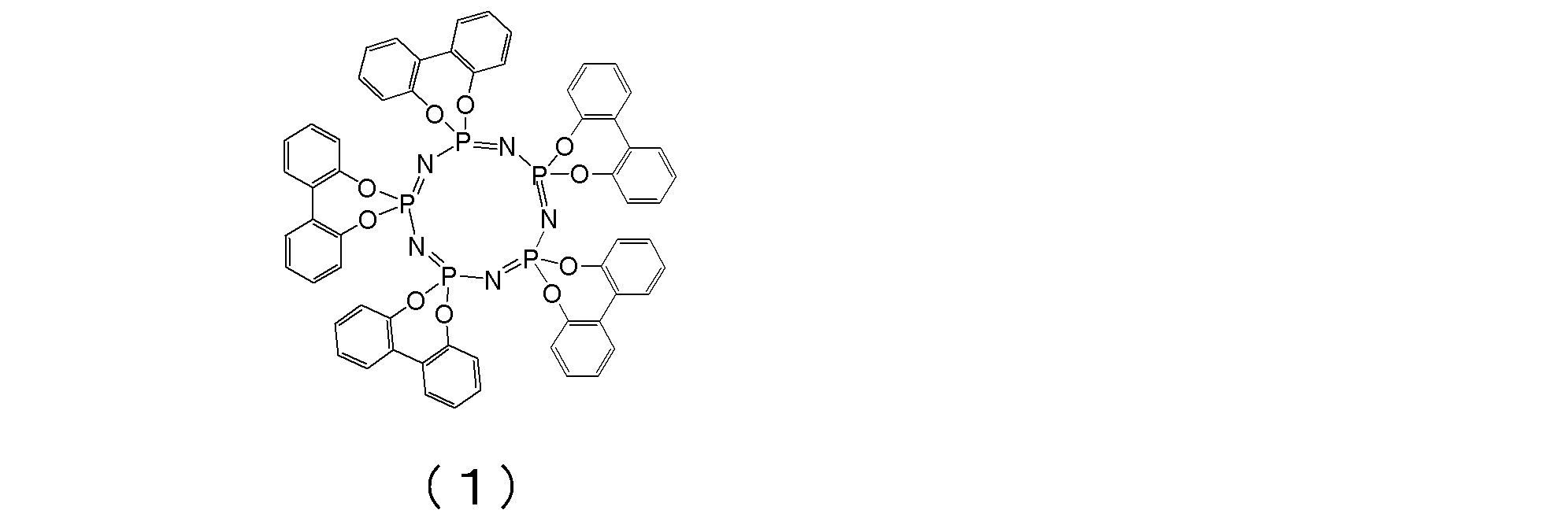
- 式(1)で表される環状ホスファゼン化合物を含む樹脂用難燃剤。
Priority Applications (3)
| Application Number | Priority Date | Filing Date | Title |
|---|---|---|---|
| US17/283,484 US20210395488A1 (en) | 2018-10-09 | 2019-10-09 | Cyclic phosphazene compound, flame retardant for resin, resin composition including same, and molding of said resin composition |
| JP2020551191A JP7453917B2 (ja) | 2018-10-09 | 2019-10-09 | 環状ホスファゼン化合物、樹脂用難燃剤、それを含む樹脂組成物、及びその成形体 |
| CN201980065718.XA CN112839949B (zh) | 2018-10-09 | 2019-10-09 | 环状磷腈化合物、树脂用阻燃剂、包含其的树脂组合物、及其成型体 |
Applications Claiming Priority (2)
| Application Number | Priority Date | Filing Date | Title |
|---|---|---|---|
| JP2018-190779 | 2018-10-09 | ||
| JP2018190779 | 2018-10-09 |
Publications (1)
| Publication Number | Publication Date |
|---|---|
| WO2020075748A1 true WO2020075748A1 (ja) | 2020-04-16 |
Family
ID=70164516
Family Applications (1)
| Application Number | Title | Priority Date | Filing Date |
|---|---|---|---|
| PCT/JP2019/039796 Ceased WO2020075748A1 (ja) | 2018-10-09 | 2019-10-09 | 環状ホスファゼン化合物、樹脂用難燃剤、それを含む樹脂組成物、及びその成形体 |
Country Status (5)
| Country | Link |
|---|---|
| US (1) | US20210395488A1 (ja) |
| JP (1) | JP7453917B2 (ja) |
| CN (1) | CN112839949B (ja) |
| TW (1) | TWI813790B (ja) |
| WO (1) | WO2020075748A1 (ja) |
Cited By (2)
| Publication number | Priority date | Publication date | Assignee | Title |
|---|---|---|---|---|
| JP2025509512A (ja) * | 2022-03-18 | 2025-04-11 | スリーディー グラス ソリューションズ,インク | ガラス内のオーバーモールド構造体 |
| WO2026058337A1 (ja) * | 2024-09-10 | 2026-03-19 | 株式会社レゾナック | 樹脂組成物、プリプレグ、樹脂フィルム、金属張積層板、プリント配線板、及び半導体パッケージ |
Families Citing this family (5)
| Publication number | Priority date | Publication date | Assignee | Title |
|---|---|---|---|---|
| JP6830586B1 (ja) | 2020-07-22 | 2021-02-17 | 株式会社伏見製薬所 | オキサホスホリン環含有構造を有する環状ホスファゼン化合物 |
| US20220163180A1 (en) * | 2020-11-23 | 2022-05-26 | Lyondellbasell Advanced Polymers Inc. | Thermoset polyester bmc formula for direct metallized forward lighting reflector |
| JP7713840B2 (ja) * | 2021-09-29 | 2025-07-28 | 株式会社ジェイテクトシーリングテクノ | シール用ゴム組成物、及び密封部材 |
| CN114231036B (zh) * | 2022-01-07 | 2023-07-21 | 广州市白云化工实业有限公司 | 一种高强度协效阻燃室温硫化硅橡胶及其制备方法 |
| CN116003987A (zh) * | 2023-01-09 | 2023-04-25 | 南亚新材料科技股份有限公司 | 一种树脂组合物及其制备方法和应用 |
Citations (3)
| Publication number | Priority date | Publication date | Assignee | Title |
|---|---|---|---|---|
| US4405738A (en) * | 1982-03-05 | 1983-09-20 | Akzona Incorporated | Flame retardant additives and flame retardant polyester compositions |
| JP2002037979A (ja) * | 2000-07-25 | 2002-02-06 | Toshiba Chem Corp | 封止用樹脂組成物および半導体封止装置 |
| JP2007153749A (ja) * | 2005-11-30 | 2007-06-21 | Fushimi Pharm Co Ltd | 反応性基含有環状ホスファゼン化合物およびその製造方法 |
Family Cites Families (12)
| Publication number | Priority date | Publication date | Assignee | Title |
|---|---|---|---|---|
| US3356769A (en) * | 1964-07-13 | 1967-12-05 | American Cyanamid Co | Phosphonitrilic halide derivatives and adducts thereof |
| JP3821870B2 (ja) * | 1994-10-07 | 2006-09-13 | スリーエム カンパニー | 難燃性熱硬化性樹脂組成物 |
| JPH1165010A (ja) * | 1997-08-20 | 1999-03-05 | Konica Corp | ハロゲン化銀写真乳剤及びその製造方法、並びにハロゲン化銀写真感光材料とその処理方法及び画像形成方法 |
| JP2001192392A (ja) * | 2000-01-11 | 2001-07-17 | Chemiprokasei Kaisha Ltd | 環状ホスファゼン化合物、環状ホスファゼン混合組成物、ホスファゼン組成物、それを有効成分とする難燃剤およびそれを含む難燃性組成物 |
| CN1324083C (zh) * | 2001-06-27 | 2007-07-04 | 宝理塑料株式会社 | 阻燃性树脂组合物 |
| CN1223635C (zh) * | 2001-06-27 | 2005-10-19 | 宝理塑料株式会社 | 阻燃性树脂组合物 |
| JP2005225795A (ja) * | 2004-02-12 | 2005-08-25 | Asahi Kasei Chemicals Corp | ホスホニトリル酸エステルの洗浄方法 |
| JP2011502196A (ja) * | 2007-11-02 | 2011-01-20 | ダウ グローバル テクノロジーズ インコーポレイティド | 置換ホスファゼン化合物および有機ポリマー用難燃剤としてのその使用 |
| JP5553245B2 (ja) * | 2012-01-07 | 2014-07-16 | 株式会社伏見製薬所 | 環状ホスファゼン化合物 |
| EP2881433B1 (en) * | 2012-07-30 | 2018-10-24 | Toray Industries, Inc. | Flame-retardant thermoplastic polyester resin composition and molded article |
| JP6124176B2 (ja) * | 2013-03-26 | 2017-05-10 | 株式会社伏見製薬所 | 樹脂成形体用組成物 |
| JP6762933B2 (ja) * | 2015-05-28 | 2020-09-30 | 大塚化学株式会社 | アリルフェノキシシクロホスファゼン化合物及びその製造方法 |
-
2019
- 2019-10-09 TW TW108136723A patent/TWI813790B/zh active
- 2019-10-09 WO PCT/JP2019/039796 patent/WO2020075748A1/ja not_active Ceased
- 2019-10-09 US US17/283,484 patent/US20210395488A1/en not_active Abandoned
- 2019-10-09 CN CN201980065718.XA patent/CN112839949B/zh active Active
- 2019-10-09 JP JP2020551191A patent/JP7453917B2/ja active Active
Patent Citations (3)
| Publication number | Priority date | Publication date | Assignee | Title |
|---|---|---|---|---|
| US4405738A (en) * | 1982-03-05 | 1983-09-20 | Akzona Incorporated | Flame retardant additives and flame retardant polyester compositions |
| JP2002037979A (ja) * | 2000-07-25 | 2002-02-06 | Toshiba Chem Corp | 封止用樹脂組成物および半導体封止装置 |
| JP2007153749A (ja) * | 2005-11-30 | 2007-06-21 | Fushimi Pharm Co Ltd | 反応性基含有環状ホスファゼン化合物およびその製造方法 |
Cited By (2)
| Publication number | Priority date | Publication date | Assignee | Title |
|---|---|---|---|---|
| JP2025509512A (ja) * | 2022-03-18 | 2025-04-11 | スリーディー グラス ソリューションズ,インク | ガラス内のオーバーモールド構造体 |
| WO2026058337A1 (ja) * | 2024-09-10 | 2026-03-19 | 株式会社レゾナック | 樹脂組成物、プリプレグ、樹脂フィルム、金属張積層板、プリント配線板、及び半導体パッケージ |
Also Published As
| Publication number | Publication date |
|---|---|
| CN112839949A (zh) | 2021-05-25 |
| TWI813790B (zh) | 2023-09-01 |
| CN112839949B (zh) | 2023-07-18 |
| JPWO2020075748A1 (ja) | 2021-09-16 |
| JP7453917B2 (ja) | 2024-03-21 |
| TW202021975A (zh) | 2020-06-16 |
| US20210395488A1 (en) | 2021-12-23 |
Similar Documents
| Publication | Publication Date | Title |
|---|---|---|
| JP7453917B2 (ja) | 環状ホスファゼン化合物、樹脂用難燃剤、それを含む樹脂組成物、及びその成形体 | |
| CN109535715B (zh) | 一种阻燃型树脂组合物及使用其制备的半固化片和层压板 | |
| KR100750972B1 (ko) | 난연제 및 난연성 수지 조성물 및 성형물 및 전자부품 | |
| JP7212323B2 (ja) | 硬化性樹脂組成物 | |
| TWI698443B (zh) | 烯丙基苯氧基環膦氮烯化合物及其製造方法 | |
| JP7176623B2 (ja) | 硬化性樹脂組成物 | |
| JP7116934B2 (ja) | 硬化性樹脂組成物 | |
| JP3479884B2 (ja) | 難燃性エポキシ樹脂組成物及び電子部品 | |
| CN100384903C (zh) | 含磷环氧树脂和树脂组合物及其制造方法,以及密封材料和层积板 | |
| JP5190910B2 (ja) | シアナト基含有環状ホスフィネート化合物およびその製造方法 | |
| JPWO2019198766A1 (ja) | エポキシ樹脂組成物及びその成型体 | |
| JP2021021004A (ja) | 樹脂用分散剤、樹脂組成物及びその成形体 | |
| JP7198419B2 (ja) | 硬化性樹脂組成物 | |
| JP3723899B2 (ja) | エポキシ樹脂、難燃剤、難燃性樹脂組成物及び難燃性樹脂成形体 | |
| CN101679602B (zh) | 阻燃性环氧树脂、以该环氧树脂作为必要组分的环氧树脂组合物及其固化物 | |
| JPWO2020013263A1 (ja) | ブリードアウト抑制剤、樹脂用難燃剤、樹脂組成物、及びその成形体 | |
| JP3726189B2 (ja) | ホスファゼン変性フェノール樹脂、難燃剤、難燃性樹脂組成物及び難燃性樹脂成形体 | |
| WO2021020553A1 (ja) | 熱硬化性ポリイミド樹脂組成物及びその成形体 | |
| JP2022099861A (ja) | ビスマレイミド系樹脂組成物及びその成形体 | |
| CN118103425A (zh) | 硬化性组合物、其硬化物、预浸体、电路基板、增层膜、半导体密封材及半导体装置 | |
| WO2026034266A1 (ja) | 樹脂組成物、プリプレグ、樹脂シート、プリント配線板、半導体パッケージ、及び半導体装置 | |
| HK1247205B (zh) | 烯丙基苯氧基环磷腈化合物及其制造方法 | |
| JP2004323864A (ja) | ホスファゼン変性フェノール樹脂の製造方法 |
Legal Events
| Date | Code | Title | Description |
|---|---|---|---|
| 121 | Ep: the epo has been informed by wipo that ep was designated in this application |
Ref document number: 19872022 Country of ref document: EP Kind code of ref document: A1 |
|
| ENP | Entry into the national phase |
Ref document number: 2020551191 Country of ref document: JP Kind code of ref document: A |
|
| NENP | Non-entry into the national phase |
Ref country code: DE |
|
| 122 | Ep: pct application non-entry in european phase |
Ref document number: 19872022 Country of ref document: EP Kind code of ref document: A1 |