WO2020071494A1 - 環状オレフィンポリマーの製造方法 - Google Patents
環状オレフィンポリマーの製造方法Info
- Publication number
- WO2020071494A1 WO2020071494A1 PCT/JP2019/039165 JP2019039165W WO2020071494A1 WO 2020071494 A1 WO2020071494 A1 WO 2020071494A1 JP 2019039165 W JP2019039165 W JP 2019039165W WO 2020071494 A1 WO2020071494 A1 WO 2020071494A1
- Authority
- WO
- WIPO (PCT)
- Prior art keywords
- group
- norbornene
- cyclic olefin
- based compound
- olefin polymer
- Prior art date
- Legal status (The legal status is an assumption and is not a legal conclusion. Google has not performed a legal analysis and makes no representation as to the accuracy of the status listed.)
- Ceased
Links
Classifications
-
- C—CHEMISTRY; METALLURGY
- C08—ORGANIC MACROMOLECULAR COMPOUNDS; THEIR PREPARATION OR CHEMICAL WORKING-UP; COMPOSITIONS BASED THEREON
- C08F—MACROMOLECULAR COMPOUNDS OBTAINED BY REACTIONS ONLY INVOLVING CARBON-TO-CARBON UNSATURATED BONDS
- C08F232/00—Copolymers of cyclic compounds containing no unsaturated aliphatic radicals in a side chain, and having one or more carbon-to-carbon double bonds in a carbocyclic ring system
- C08F232/02—Copolymers of cyclic compounds containing no unsaturated aliphatic radicals in a side chain, and having one or more carbon-to-carbon double bonds in a carbocyclic ring system having no condensed rings
- C08F232/04—Copolymers of cyclic compounds containing no unsaturated aliphatic radicals in a side chain, and having one or more carbon-to-carbon double bonds in a carbocyclic ring system having no condensed rings having one carbon-to-carbon double bond
-
- C—CHEMISTRY; METALLURGY
- C08—ORGANIC MACROMOLECULAR COMPOUNDS; THEIR PREPARATION OR CHEMICAL WORKING-UP; COMPOSITIONS BASED THEREON
- C08F—MACROMOLECULAR COMPOUNDS OBTAINED BY REACTIONS ONLY INVOLVING CARBON-TO-CARBON UNSATURATED BONDS
- C08F32/00—Homopolymers and copolymers of cyclic compounds having no unsaturated aliphatic radicals in a side chain, and having one or more carbon-to-carbon double bonds in a carbocyclic ring system
-
- C—CHEMISTRY; METALLURGY
- C08—ORGANIC MACROMOLECULAR COMPOUNDS; THEIR PREPARATION OR CHEMICAL WORKING-UP; COMPOSITIONS BASED THEREON
- C08F—MACROMOLECULAR COMPOUNDS OBTAINED BY REACTIONS ONLY INVOLVING CARBON-TO-CARBON UNSATURATED BONDS
- C08F32/00—Homopolymers and copolymers of cyclic compounds having no unsaturated aliphatic radicals in a side chain, and having one or more carbon-to-carbon double bonds in a carbocyclic ring system
- C08F32/02—Homopolymers and copolymers of cyclic compounds having no unsaturated aliphatic radicals in a side chain, and having one or more carbon-to-carbon double bonds in a carbocyclic ring system having no condensed rings
- C08F32/04—Homopolymers and copolymers of cyclic compounds having no unsaturated aliphatic radicals in a side chain, and having one or more carbon-to-carbon double bonds in a carbocyclic ring system having no condensed rings having one carbon-to-carbon double bond
-
- C—CHEMISTRY; METALLURGY
- C07—ORGANIC CHEMISTRY
- C07C—ACYCLIC OR CARBOCYCLIC COMPOUNDS
- C07C7/00—Purification; Separation; Use of additives
- C07C7/12—Purification; Separation; Use of additives by adsorption, i.e. purification or separation of hydrocarbons with the aid of solids, e.g. with ion-exchangers
Definitions
- the present invention relates to a method for producing a cyclic olefin polymer.
- Cyclic olefin polymers such as cyclic olefin homopolymers and cyclic olefin copolymers have low hygroscopicity and high transparency, and are used in various applications including the field of optical materials such as optical disc substrates, optical films, and optical fibers. It is used.
- As a typical cyclic olefin copolymer there is a copolymer of cyclic olefin and ethylene widely used as a transparent resin.
- the glass transition temperature of the copolymer of cyclic olefin and ethylene can be changed according to the copolymer composition of cyclic olefin and ethylene. Therefore, it is possible to produce a copolymer whose glass transition temperature (Tg) is adjusted in a wide temperature range.
- a copolymer having a high Tg generally has good heat resistance (for example, see Non-Patent Document 1).
- copolymers of cyclic olefins and ethylene copolymers of cyclic olefins and ⁇ -olefins other than ethylene are known.
- a copolymer of cyclic olefin and ethylene has a good balance between heat resistance and mechanical properties.
- mechanical properties may be deteriorated.
- copolymerizing a cyclic olefin and an ⁇ -olefin other than ethylene it is possible to improve the balance between heat resistance and mechanical properties, which are issues with a copolymer of a cyclic olefin and ethylene.
- synthesis of a cyclic olefin polymer such as a cyclic olefin homopolymer and a cyclic olefin copolymer is generally performed using a catalyst typified by a metallocene-based transition metal catalyst.
- a metallocene-based transition metal catalyst Not only metallocene-based transition metal catalysts and half-metallocene-based transition metal catalysts but also metallocene-based transition metal catalysts are generally expensive, so reducing the amount of catalyst used reduces the cost of the entire production of the cyclic olefin polymer. Therefore, development of a catalyst that can produce a large amount of a cyclic olefin polymer with a small amount of a catalyst is an important issue.
- a method for synthesizing a cyclic olefin copolymer with a small amount of a catalyst at least a cyclic olefin monomer (A) derived from norbornene and a C4-C12 ⁇ -olefin are used in the presence of a metallocene-based transition metal catalyst.
- a method including a polymerization step of polymerizing an ⁇ -olefin monomer (B) to obtain a copolymer has been proposed (see Patent Documents 1 and 2).
- the present invention has been made in view of the above problems, and when a cyclic olefin polymer is produced using a transition metal complex catalyst such as a metallocene catalyst, the yield is expected to be consistent with the polymerization conditions, and is stable. It is an object of the present invention to provide a method for producing a cyclic olefin polymer, which can produce a cyclic olefin polymer by heating.
- the present inventors have proposed a method for producing a cyclic olefin polymer by polymerizing a monomer containing a norbornene-based compound containing an epoxide impurity in the presence of a transition metal catalyst.
- a hybrid adsorbent consisting of a mixture of alumina and zeolite
- epoxide impurities in the monomer are reduced, and as a result, the content of epoxide impurities in the total mass of the polymerization solution used for polymerization is reduced.
- the inventors have found that the above problem can be solved by setting the ratio (mass ppm / mass ppm) of the amount to the catalyst content to 6 or less, and completed the present invention. More specifically, the present invention provides the following.
- a method for producing a cyclic olefin polymer by polymerizing a monomer containing a norbornene-based compound containing an epoxide impurity, Contacting a crude norbornene-based compound containing epoxide impurities with an adsorbent to obtain a purified norbornene-based compound; Polymerizing a monomer containing a purified norbornene-based compound in the presence of a transition metal complex catalyst,
- the norbornene-based compound is composed of norbornene and the following formula (I): (Wherein, R 1 to R 12 may be the same or different and each is selected from the group consisting of a hydrogen atom, a halogen atom, and a saturated aliphatic hydrocarbon group, an aralkyl group, and an aromatic hydrocarbon group.
- At least one compound selected from the group consisting of substituted norbornenes represented by The epoxide impurity is an epoxy compound in which the carbon-carbon unsaturated double bond in 2,3-epoxynorbornane and / or the substituted norbornene represented by the formula (I) is oxidized
- the adsorbent is a hybrid adsorbent consisting of a mixture of activated alumina and zeolite, The ratio (mass ppm / mass ppm) of the content of the epoxide impurity and the content of the catalyst to the total mass of the polymerization solution used for the polymerization is 6 or less,
- the production method wherein the total mass of the polymerization solution is the total mass of the raw materials used for producing the cyclic olefin polymer.
- the ratio (mass ppm / mass ppm) of the content of the ketone impurity derived from the norbornene-based compound to the content of the catalyst relative to the total mass of the polymerization solution used for the polymerization is 2 or less, (1) Or the method for producing a cyclic olefin polymer according to (2).
- a cyclic olefin polymer when a cyclic olefin polymer is produced using a transition metal complex catalyst such as a metallocene catalyst, a cyclic olefin polymer can be produced stably with an expected yield suitable for the polymerization conditions.
- a method for making the polymer can be provided.
- a cyclic olefin polymer is produced by polymerizing a monomer containing a norbornene-based compound containing an epoxide impurity.
- the manufacturing method is Contacting a crude norbornene-based compound containing epoxide impurities with an adsorbent to obtain a purified norbornene-based compound; Polymerizing a monomer containing a purified norbornene-based compound in the presence of a transition metal complex catalyst.
- the amount of epoxide impurities in the monomer subjected to polymerization is significantly reduced by treating a crude norbornene-based compound with a specific adsorbent described below as an adsorbent to obtain a purified norbornene-based compound. can do.
- the ratio (mass ppm / mass ppm) of the content of the epoxide impurity and the content of the catalyst to the total mass of the polymerization solution used for the polymerization can be set to a low value of 6 or less.
- the ratio (mass ppm / mass ppm) of the content of the epoxide impurity to the content of the catalyst in the polymerization solution used for the polymerization is equal to or less than the above-mentioned predetermined amount, a decrease in the activity of the transition metal complex catalyst is suppressed. It is considered that the cyclic olefin polymer can be stably produced at a desired yield.
- the “total mass of the polymerization solution used for the polymerization” is the total mass of the raw materials used for producing the cyclic olefin polymer.
- the “total mass of the polymerization solution used for polymerization” is the mass of “the monomer containing the purified norbornene-based compound”, the mass of “the transition metal complex catalyst”, and the catalyst together with the transition metal complex catalyst. It is the sum of the mass of the "promoter” and the mass of the "solvent” that constitute the composition.
- the mass of the other material is also included in the “total mass of the polymerization solution subjected to polymerization”.
- the norbornene-based compound contained in the monomer is at least one compound selected from the group consisting of norbornene and a substituted norbornene represented by the following formula (I).
- Such norbornene compounds correspond to monoene compounds.
- the monomer used for producing the cyclic olefin polymer contains an epoxide impurity derived from a norbornene-based compound.
- Epoxide impurities are generated by oxidation of norbornene-based compounds.
- the epoxide impurity is an epoxy compound in which the carbon-carbon unsaturated double bond in 2,3-epoxynorbornane and / or the substituted norbornene represented by the above formula (I) is oxidized.
- adsorbent used for the purification of the crude norbornene compound a hybrid adsorbent composed of a mixture of activated alumina and zeolite is used.
- epoxide impurities can be easily removed satisfactorily while preventing generation of impurities that may adversely affect the activity of the transition metal complex catalyst.
- the content of epoxide impurities in the monomer subjected to polymerization is preferably 200 ppm by mass or less based on the mass of the norbornene-based compound.
- obtaining a purified norbornene-based compound by bringing a crude norbornene-based compound containing an epoxide impurity into contact with an adsorbent is also referred to as a “purification step”.
- Polymerizing a monomer containing a purified norbornene-based compound in the presence of a transition metal complex catalyst is also referred to as a “polymerization step”.
- the steps included in the method for producing a cyclic olefin polymer will be described.
- ⁇ Purification process> In the purification step, a crude norbornene-based compound containing an epoxide impurity is brought into contact with an adsorbent to obtain a purified norbornene-based compound.
- the object of purification in the purification step is a crude monomer product containing a norbornene-based compound to be subjected to polymerization in the polymerization step described below. More specifically, at least a crude norbornene-based compound among the crude monomer products is purified.
- the crude norbornene-based compound is a norbornene-based compound that contains an epoxide impurity and has not been treated with an adsorbent described below.
- the norbornene-based compound is at least one compound selected from the group consisting of norbornene and substituted norbornene. As the norbornene-based compound, norbornene is preferable.
- the epoxide impurity is an epoxy compound in which the carbon-carbon unsaturated double bond in 2,3-epoxynorbornane and / or the substituted norbornene represented by the formula (I) is oxidized.
- the amount of the epoxide impurity in the crude norbornene-based compound is determined by the ratio (mass ppm / mass ppm) of the content of the epoxide impurity and the content of the catalyst to the total mass of the polymerization solution to be subjected to the polymerization by the purification using the adsorbent. There is no particular limitation as long as it can be reduced to 6 or less.
- the amount of the epoxide impurity in the crude norbornene-based compound is 200 mass ppm or more, 300 mass ppm or more, or 500 mass ppm or more with respect to the mass of the norbornene-based compound. It may be 1500 ppm by mass or more.
- the amount of the epoxide impurity in the crude norbornene-based compound is preferably 5000 mass ppm or less, more preferably 3000 mass ppm or less, or 2000 mass ppm or less in that the crude norbornene-based compound is easily purified. .
- R 1 to R 12 in the formula (I) may be the same or different, and are selected from the group consisting of a hydrogen atom, a halogen atom, and a hydrocarbon group.
- R 1 to R 8 include, for example, a hydrogen atom; a halogen atom such as fluorine, chlorine, and bromine; an alkyl group having 1 to 20 carbon atoms. These may be different from each other, may be partially different, or may be all the same.
- R 9 to R 12 include, for example, a hydrogen atom; a halogen atom such as fluorine, chlorine, and bromine; an alkyl group having 1 to 20 carbon atoms; a cycloalkyl group such as a cyclohexyl group; a phenyl group, a tolyl group; Substituted or unsubstituted aromatic hydrocarbon groups such as an ethylphenyl group, an isopropylphenyl group, a naphthyl group, and an anthryl group; a benzyl group, a phenethyl group, and other aralkyl groups in which an alkyl group is substituted with an aryl group. These may be different from each other, may be partially different, or may be all the same.
- a halogen atom such as fluorine, chlorine, and bromine
- a cycloalkyl group such as a
- the formed ring may be a monocyclic or polycyclic ring, or may be a cross-linked polycyclic ring. Alternatively, the ring may be a combination of these rings. These rings may have a substituent such as a methyl group.
- the saturated aliphatic hydrocarbon ring that can be formed by bonding two groups selected from R 9 to R 12 to each other include a cyclobutane ring, a cyclopentane ring, a cyclohexane ring, and a cycloheptane ring.
- the aromatic hydrocarbon ring which can be formed by combining two groups selected from R 9 to R 12 include a benzene ring and a naphthalene ring.
- substituted norbornene represented by the general formula (I) include 5-methyl-bicyclo [2.2.1] hepta-2-ene and 5,5-dimethyl-bicyclo [2.2.1] hepta- 2-ene, 5-ethyl-bicyclo [2.2.1] hepta-2-ene, 5-butyl-bicyclo [2.2.1] hepta-2-ene, 5-hexyl-bicyclo [2.2.
- Bicyclic cyclic olefins such as hepta-2-ene, 5-octyl-bicyclo [2.2.1] hepta-2-ene and 5-octadecyl-bicyclo [2.2.1] hepta-2-ene ; Tricyclo [4.3.0.1 2,5 ] dec-3-ene; tricyclo [4.4.0.1 2,5 ] undec-3-ene; 5-cyclopentyl-bicyclo [2.2.1] Hept-2-ene, 5-cyclohexyl-bicyclo [2.2.1] hept-2-ene, 5-cyclohexenylbicyclo [2.2.1] hept-2-ene, 5-phenyl-bicyclo [2.
- tricyclic olefins such as hepta-2-ene; Tetracyclo [4.4.0.1 2,5 . 1 7,10 ] dodec-3-ene (also simply referred to as tetracyclododecene), 8-methyltetracyclo [4.4.0.1 2,5 . 1 7,10] dodeca-3-ene, 8-ethyl tetracyclo [4.4.0.1 2, 5. 1 7,10 ] dodec-3-ene, 8-methylidenetetracyclo [4.4.0.1 2,5 . 1 7,10 ] dodec-3-ene, 8-ethylidenetetracyclo [4.4.0.1 2,5 .
- alkyl-substituted norbornenes for example, bicyclo [2.2.1] hept-2-ene substituted with one or more alkyl groups
- alkylidene-substituted norbornenes are preferable.
- the crude norbornene-based compound may be brought into contact with the adsorbent alone.
- the monomer contains a monomer other than the norbornene-based compound together with the norbornene-based compound, a mixture containing the crude norbornene-based compound and another monomer may be brought into contact with the adsorbent.
- the other monomer is not particularly limited as long as it is a monomer compound copolymerizable with the norbornene-based compound, and is typically an ⁇ -olefin.
- the ⁇ -olefin may be substituted with at least one substituent such as a halogen atom.
- ⁇ -olefins are preferably C2-C12 ⁇ -olefins.
- the ⁇ -olefin of C2 to C12 is not particularly limited.
- 1-hexene, 1-octene and 1-decene are preferred.
- the monomer preferably contains, together with the norbornene-based compound, at least one selected from the group consisting of ethylene, 1-hexene, and 1-octene. More preferably, the monomer comprises a norbornene-based compound and at least one selected from the group consisting of ethylene, 1-hexene, and 1-octene.
- the amount of norbornene in the monomer should be 30 mol% or more and less than 70 mol% in order to obtain a cyclic olefin polymer having a good balance between mechanical properties and thermal properties. preferable.
- norbornene is used in combination with 1-octene, 1-hexene, or a mixture thereof, a cyclic olefin having good mechanical properties is easily obtained, so that the glass transition temperature of the cyclic olefin polymer can be increased.
- the amount of norbornene in the monomer is preferably at least 70 mol%.
- adsorbent By contacting the crude norbornene-based compound contained in the monomer described above, a treatment for reducing epoxide impurities contained in the crude norbornene-based compound is performed.
- a hybrid adsorbent composed of a mixture of activated alumina and zeolite is used.
- the hybrid adsorbent is typically in powder or pellet form, preferably in pellet form.
- the activated alumina site and the zeolite site are inseparably complexed in the particles constituting the powder or the pellet.
- the hybrid adsorbent has both adsorption sites as activated alumina and adsorption sites as zeolite in the same particle.
- the hybrid adsorbent may be a mixture of activated alumina in powder or pellet form and zeolite in powder or pellet form as long as desired adsorption hardening for epoxide impurities is obtained.
- the activated alumina portion and the hybrid adsorbent in which the zeolite portion is inseparably compounded are powdered or pelletized activated alumina and powdered or pelletized zeolite mixed.
- the adsorption performance of the epoxide impurity and the below-described ketone impurity and aldehyde impurity is better than that of the mixture.
- the content of activated alumina and the content of zeolite are preferably 20% by mass or more and 80% by mass or less, respectively, based on the sum of the mass of activated alumina and the mass of zeolite. , 30% by mass or more and 70% by mass or less.
- hybrid adsorbents can be used as the hybrid adsorbent.
- a commercially available product may be used.
- Examples of commercially available hybrid adsorbents include, for example, AZ-300 (manufactured by UOP or Union Showa). In the commercial product AZ-300, the activated alumina site and the zeolite site are inseparably compounded.
- Activated alumina is porous aluminum oxide particles having an adsorption ability.
- Activated aluminum can be produced by transferring alumina hydroxide to porous aluminum oxide with low crystallinity.
- the pore diameter of the activated alumina site in the hybrid adsorbent is preferably 1 nm or more and 100 nm or less, more preferably 1 nm or more and 80 nm or less from the viewpoint of the ability to adsorb epoxide impurities.
- the pore diameter of the zeolite site in the hybrid adsorbent is preferably 0.2 nm or more and 1 nm or less, more preferably 0.5 nm or more and 1 nm or less from the viewpoint of the ability to adsorb epoxide impurities.
- Preferred zeolites include zeolite X, zeolite Y, and zeolite A. Among these, zeolite X is preferred.
- the shape of the hybrid adsorbent is not particularly limited, and is preferably a pellet as described above.
- the shape of the pellet is not particularly limited.
- the shape of the pellet of the agent is preferably spherical or substantially spherical.
- the hybrid adsorbent Before the hybrid adsorbent is used in the purification step, the hybrid adsorbent may be subjected to an activation treatment by heating for the purpose of increasing the adsorbing ability or the like.
- the activation treatment is usually performed under an inert gas atmosphere.
- the heating temperature in the activation treatment is preferably from 100 ° C to 650 ° C, more preferably from 200 ° C to 600 ° C, further preferably from 300 ° C to 600 ° C, particularly preferably from 400 ° C to 600 ° C.
- the heating time is preferably from 0.1 to 100 hours, more preferably from 0.5 to 50 hours, even more preferably from 1 to 25 hours.
- the entire amount of the crude norbornene-based compound used for producing the cyclic olefin polymer may be subjected to treatment with the adsorbent, and a part of the crude norbornene-based compound used for producing the cyclic olefin polymer is treated with the adsorbent. May be provided.
- the purified norbornene-based compound and the remaining crude norbornene-based compound not treated with the adsorbent are mixed and subjected to polymerization.
- Crude norbornene-based compound treated with an adsorbent as long as a polymerization solution having a ratio (mass ppm / mass ppm) of the epoxide impurity content to the catalyst content to the total mass of the polymerization solution (mass ppm / mass ppm) of 6 or less can be prepared. Is not particularly limited. Since the amount of the epoxide impurity in the monomer subjected to the polymerization is easily reduced to a desired amount or less, it is preferable that the entire amount of the crude norbornene-based compound used in the production of the cyclic olefin polymer is subjected to the treatment with the adsorbent. .
- the crude norbornene-based compound usually comes in contact with the adsorbent in a liquid state.
- a liquid may be a melt of a crude norbornene-based compound or a mixture containing a crude norbornene-based compound and another monomer, and may be a crude norbornene-based compound or a crude norbornene-based compound and another monomer. May be dissolved in a solvent.
- the kind of the solvent for dissolving the crude norbornene-based compound or the crude norbornene-based compound and another monomer is not particularly limited as long as the adsorption of the epoxide impurity by the adsorbent is not hindered.
- Preferred solvents include hydrocarbon solvents such as pentane, hexane, heptane, octane, cyclohexane, mineral oil, benzene, toluene, and xylene, and halogenated hydrocarbon solvents such as chloroform, methylene chloride, dichloroethane, and chlorobenzene. .
- the concentration of the crude norbornene-based compound in the solution or the melt is not particularly limited.
- the concentration of the crude norbornene-based compound in the solution or the melt is preferably from 1% by mass to 100% by mass, more preferably from 10% by mass to 100% by mass.
- the contact between the crude norbornene-based compound and the adsorbent may be performed by a batch method or a continuous method.
- the method for bringing the crude norbornene-based compound into contact with the adsorbent is not particularly limited. For example, after charging a liquid containing a crude norbornene-based compound and an adsorbent in a container, the liquid containing the crude norbornene-based compound in the container, and the adsorbent are allowed to stand or stir for a predetermined time. You may.
- the contact between the crude norbornene compound and the adsorbent under stirring is preferable in that the contact efficiency between the two is good.
- the contact between the crude norbornene-based compound and the adsorbent under standing is preferable in that it is easy to prevent impurities derived from the adsorbent from being mixed into the monomer and the cyclic olefin polymer due to abrasion of the adsorbent or the like.
- a liquid containing a crude norbornene-based compound may be passed through a container such as a column filled with an adsorbent.
- a circulating treatment is performed in which the liquid containing the crude norbornene-based compound that has flowed out of the vessel such as the column is again flowed into the vessel such as the column. You may.
- the contact time between the crude norbornene-based compound and the adsorbent is preferably 0.01 hours or more and 50 hours or less, from the viewpoint of achieving a balance between a large treatment amount of the crude norbornene-based compound and a high removal efficiency of epoxide impurities. 1 hour or more and 40 hours or less, more preferably 1 hour or more and 30 hours or less.
- the amount of the adsorbent is preferably not less than 1 part by mass, more preferably not less than 10 parts by mass, and more preferably not less than 20 parts by mass with respect to 100 parts by mass of the crude norbornene-based compound, from the viewpoint of easy removal of the epoxide impurity part. More preferred.
- the upper limit of the amount of the adsorbent is not particularly limited, but is preferably 80 parts by mass or less based on 100 parts by mass of the crude norbornene-based compound from the viewpoint of suppressing the cost of the adsorbent and not requiring an excessively large apparatus for the purification treatment. , 60 parts by mass or less, more preferably 40 parts by mass or less.
- the content of aldehyde impurities derived from the norbornene-based compound in the monomer subjected to polymerization is preferably 50 mass ppm or less, more preferably 30 mass ppm or less, based on the mass of the norbornene-based compound. It is more preferably at most 20 mass ppm.
- the content of ketone impurities derived from the norbornene-based compound in the monomer subjected to polymerization is preferably 50 mass ppm or less, more preferably 30 mass ppm or less, based on the mass of the norbornene-based compound. It is more preferably at most 20 mass ppm.
- the aldehyde impurity and the ketone impurity are impurities that can be generated due to oxidation of the norbornene-based compound. There is a possibility that these impurities may be factors in lowering the polymerization yield when producing a cyclic olefin polymer.
- the method for reducing the aldehyde impurity amount and the ketone impurity amount is not particularly limited.
- the amount of aldehyde impurities and the amount of ketone impurities contained in the purified norbornene-based compound tend to be low.
- the amounts of aldehyde impurities and ketone impurities can be reduced.
- the purified norbornene-based compound obtained by performing the treatment described above is then provided to a “polymerization step”.
- the purified norbornene-based compound is a solution
- the purified norbornene-based compound may be subjected to the polymerization step as it is, or may be subjected to the polymerization step in a state of being isolated from the solution.
- a monomer containing the purified norbornene-based compound obtained in the above purification step is polymerized in the presence of a transition metal complex catalyst to produce a cyclic olefin polymer.
- the monomer may be supplied all at once in the polymerization apparatus, may be supplied in several divided portions, or may be supplied continuously.
- the method of the polymerization reaction is not particularly limited, and may be a batch type or a continuous type.
- the ratio (mass ppm / mass ppm) of the content of the epoxide impurity to the content of the catalyst relative to the total mass of the polymerization solution is 6 or less, preferably 5 or less, more preferably 4 or less, and still more preferably 3 or less. It is adjusted as follows. By the ratio of the content of the epoxide impurity and the content of the catalyst to the total mass of the polymerization solution provided to the polymer is within the above range, in a yield expected according to the polymerization conditions, stably Cyclic olefin polymers can be produced.
- the lower limit of the ratio between the content of the epoxide impurity and the content of the catalyst relative to the total mass in the polymerization solution is not particularly limited, but may be 0.1 or more, and may be 1 or more from the viewpoint of easiness of the purification operation. May be.
- the polymerization reaction in the polymerization step may be living polymerization or non-living polymerization.
- non-living polymerization which is a chain polymerization in which a chain transfer reaction is intentionally repeated repeatedly, is generally preferred.
- the chain transfer agent is not particularly limited, and a known compound having a chain transfer ability can be used.
- Typical chain transfer agents generally include alkyl aluminum compounds, alkyl zinc compounds or hydrogen.
- the alkylaluminum compound may be contained in the aluminoxane, or may be appropriately added.
- Whether the polymerization has proceeded by non-living polymerization or living polymerization can be determined by the molecular weight distribution (weight average molecular weight (Mw) / number average molecular weight (Mn)) of the obtained polymer.
- Mw weight average molecular weight
- Mn number average molecular weight
- a polymer having a molecular weight distribution of 1.1 or less is produced by living polymerization, and a polymer having a molecular weight distribution of more than 1.1 is produced by non-living polymerization.
- the molecular weight distribution often exceeds 1.5 and is about 2.
- transition metal complex catalyst is not particularly limited as long as it can catalyze a polymerization reaction of a monomer containing a norbornene-based compound.
- Preferred transition metal complex catalysts include metallocene catalysts.
- the metallocene catalyst (a) for example, a transition metal complex containing a ligand containing a cyclopentadiene ring and a transition metal of Group IV of the periodic table is preferable.
- the metallocene catalyst (a) preferably contains a metal atom selected from the group consisting of Ti, Zr, and Hf as a central metal.
- a transition metal complex represented by the following formula (1) is preferable. (Cp) (ZR 01 m ) n (A) r ML p L ′ q (1)
- (ZR 01 m ) n is a divalent group that binds Cp and A.
- Z is C, Si, Ge, N, or P.
- R 01 is a hydrogen atom, an aryl group having 6 to 20 carbon atoms, an alkylaryl group having 7 to 20 carbon atoms, an aralkyl group having 7 to 20 carbon atoms, or a linear group.
- An aliphatic hydrocarbon group having 1 to 20 carbon atoms which may be branched or may have a cyclic skeleton and may have an unsaturated bond.
- the plurality of R 01 may be the same or different.
- Cp is a cyclopentadienyl group which may have a substituent or a cyclic group containing a cyclopentadiene ring which may have a substituent.
- A is the same group as Cp, or is -O-, -S-, or -N (R 02 )-.
- R 02 is a hydrogen atom, a linear or branched chain, or may have a cyclic skeleton, and may have an unsaturated bond and has 1 to 20 carbon atoms.
- M is a metal atom selected from the group consisting of Ti, Zr, and Hf.
- L represents an aryl group having 6 to 20 carbon atoms, an alkylaryl group having 7 to 20 carbon atoms, an aralkyl group having 7 to 20 carbon atoms, and a branched chain even if linear.
- L may include one or more Si atoms or Ge atoms. When L is plural, plural Ls may be the same or different, and are preferably the same.
- R 03 is a hydrogen atom, a heteroatom-containing aryl group having 6 to 20 carbon atoms, an alkylaryl group having 7 to 20 carbon atoms, an aralkyl group having 7 to 20 carbon atoms, It is an aliphatic hydrocarbon group having 1 to 20 carbon atoms, which may have a cyclic skeleton, may have a cyclic skeleton, and may have an unsaturated bond.
- R 03 When a plurality of R 03 are present, they may be the same or different.
- the plurality of L's may be the same or different.
- m is 1 or 2. More specifically, when Z is N or P, m is 1, and when Z is C, Si, or Ge, m is 2.
- n is an integer of 0 or more and 4 or less.
- r is 0 or 1.
- n is 0.
- p is an integer of 0 or more and 3 or less.
- q is an integer of 0 or more and 3 or less.
- p + q is equal to the oxidation state of the metal M minus 2 (the oxidation state of the metal M-2) when r is 1.
- p + q is equal to the oxidation state of the metal M minus 1 (the oxidation state of the metal M-1) when r is 0.
- p + q is less than 4.
- the divalent crosslinking group is more preferably Si (CH 3 ) 2 , SiPh 2 , CH 2 , (CH 2 ) 2 , (CH 2 ) 3 , C (CH 3 ) 2 , or CPh 2 .
- Ph is a phenyl group.
- m is 1 or 2
- n is an integer of 0 or more and 4 or less.
- the ligand Cp that ⁇ -bonds to the metal M is a cyclopentadienyl group that may have a substituent or a cyclic group that includes a cyclopentadiene ring that may have a substituent.
- Cp include cyclopentadienyl group, methylcyclopentadienyl group, dimethylcyclopentadienyl group, trimethylcyclopentadienyl group, tetramethylcyclopentadienyl group, and 4-tert-butylcyclopentane.
- A is the same group as Cp, or is -O-, -S-, or -N (R 02 )-.
- A is preferably the same group as Cp.
- the metal M is Ti, Zr or Hf.
- L is preferably a group selected from the group consisting of a methyl group, an ethyl group, an n-butyl group, a sec-butyl group, a phenyl group, a benzyl group, and —CH 2 Si (CH 3 ) 3 .
- a methyl group is more preferred.
- N is an integer of 0 or more and 4 or less, preferably 0 or more and 2 or less.
- transition metal complex represented by the formula (1) when n is 0 and r is 0, specific examples include CpdMCl 2 (O-2,6- (t-Bu) 2 -C 6 H 3 ), CpdMMe 2 (O-2,6- (t-Bu) 2 -C 6 H 3 ), CpdMMeCl (O-2,6- (t-Bu) 2 -C 6 H 3 ), tet-CpdMCl 2 (O-2,6- (t-Bu) 2 -C 6 H 3 ), tet-CpdMMe 2 (O-2,6- (t-Bu) 2 -C 6 H 3 ), tet-CpdMMeCl (O- 2,6- (t-Bu) 2 -C 6 H 3 ), CpdMCl 2 (O-2,6- (i-Pr) 2 -C 6 H 3 ), CpdMMe 2 (O-2,6- (i -Pr) 2 -C 6 H 3)
- Me is a methyl group
- t-Bu is a tert-butyl group
- i-Pr is an iso-propyl group
- Cpd is a cyclopentadienyl group
- tet-Cpd is tetramethyl A cyclopentadienyl group.
- M is as described for equation (1).
- Zr, Ti, or Hf is preferable, and Ti is more preferable.
- n is 0, specific examples of when r is 1, (Me 3 Cpd) 2 MCl 2, (Me 3 Cpd) 2 MMe 2, ( Me 3 Cpd) 2 MMeCl, ( Me 3 Cpd) 2 MPh 2, (Me 3 Cpd) 2 MBz 2, (Me 4 Cpd) 2 MCl 2, (Me 4 Cpd) 2 MMe 2, (Me 5 Cpd) 2 MCl 2, (Me 5 Cpd) 2 MPh 2, (Me 5 Cpd) 2 MBz 2, (EtMe 4 Cpd) 2 MCl 2, [(Ph) Me 4 Cpd] 2 MCl 2, (Et 5 Cpd) 2 MCl 2, (Ind) 2 MCl 2 , (Ind) 2 MMeCl, (Ind) 2 MPh 2 , (Ind) 2 MMe 2 , (Ind) 2 MMeCl, (H 4 Ind) 2
- Me is a methyl group
- Et is an ethyl group
- Cpd is a cyclopentadienyl group
- Ind is an indenyl group
- H 4 Ind is 4,5,6,7, -tetrahydro It is an indenyl group
- Ph is a phenyl group
- Bz is a benzyl group.
- M is as described for equation (1). As M, Zr, Ti, or Hf is preferable, and Zr is more preferable.
- transition metal complex represented by the formula (1) when n is 1 or 2 and r is 1, specific examples include Me 2 C (Cp) (Ind) MCl 2 and Me 2 C (Cp ) (Ind) MMe 2 , Me 2 C (Cp) (Ind) MPh 2 , Me 2 C (Cp) (Ind) MBz 2 , Me 2 C (Cp) (Ind) MMeCl, Ph 2 C (Cp) (Ind) ) MCl 2 , Ph 2 C (Cp) (Ind) MMe 2 , Ph 2 C (Cp) (Ind) MPh 2 , Ph 2 C (Cp) (Ind) MBz 2 , Ph 2 C (Cp) (Ind) MMeCl , Me 2 Si (Me 4 Cpd) 2 MCl 2 , Me 2 Si (Me 4 Cpd) 2 MMe 2 , Me 2 Si (Me 4 Cpd) 2 MPh 2 , Me 2 Si (Me 4
- Me is a methyl group
- Cpd is a cyclopentadienyl group
- tet-Cpd is a tetramethylcyclopentadienyl group
- Ind is an indenyl group
- H 4 Ind is 4,5 , 6,7, -tetrahydroindenyl group
- Flu is a fluorenyl group
- Ph is a phenyl group
- Bz is a benzyl group.
- M is as described for equation (1).
- Zr, Ti, or Hf is preferable, and Zr is more preferable.
- Me 2 C (Flu) (Cpd) ZrCl 2 , Me 2 C (Flu) (Cpd) ZrMe 2 , Me 2 C (Flu) ( Cpd) ZrPh 2 , Me 2 C (Flu) (Cpd) ZrBz 2 , Ph 2 C (Flu) (Cpd) ZrCl 2 , Ph 2 C (Flu) (Cpd) ZrMe 2 , Ph 2 C (Flu) (Cpd) ZrPh 2 and Ph 2 C (Flu) (Cpd) ZrBz 2 are preferably used for copolymerization of a norbornene-based compound described below with ethylene, and more preferably used for copolymerization of norbornene and ethylene.
- metallocene compound represented by the formula (1) examples include a compound represented by the following formula (a1).
- R a1 , R a2 , R a3 , and R a4 are each independently a hydrocarbon group having 1 to 20 carbon atoms which may contain a hetero atom.
- R a1 and R a2 are each bonded to a silicon atom by a C—Si bond, an O—Si bond, a Si—Si bond, or an N—Si bond.
- Ra3 binds to a nitrogen atom by a CN bond, an ON bond, a Si-N bond, or an NN bond.
- R a5 and R a6 are each independently an organic substituent having 1 to 20 carbon atoms or an inorganic substituent which may contain a hetero atom, and p and q are each independently 0 or more and 4 or less. Is an integer. When each of R a5 and R a6 is plural, the plurality of R a5 and R a6 may be different groups. When two of the plurality of R a5 , or two of the plurality of R a6 are bonded to adjacent positions on the aromatic ring, the two groups are bonded to each other to form a ring; Is also good.
- M is a Group IV transition metal of the periodic table, and is preferably Ti, Zr, or Hf.
- the metal atom M in the formula (a1) can take an arbitrary coordination form with a ligand having a fluorene skeleton in a range of 1 to 5 hapto number.
- R a1 , R a2 , R a3 , and R a4 are each independently a hydrocarbon group having 1 to 20 carbon atoms which may contain a hetero atom.
- the type of the hetero atom is not particularly limited as long as the object of the present invention is not hindered.
- Specific examples of the hetero atom include an oxygen atom, a nitrogen atom, a sulfur atom, a phosphorus atom, a silicon atom, a selenium atom, and a halogen atom.
- R a1 and R a2 are each bonded to a silicon atom by a C—Si bond, an O—Si bond, a Si—Si bond, or an N—Si bond.
- R a1 and R a2 bonded to the silicon atom by Si-Si bonds, -SiR a7 3, -Si (OR a7) R a7 2, -Si (OR a7) 2 R a7, and -Si A group represented by ( ORa7 ) 3 ;
- each of the above Ra7 is a hydrocarbon group.
- Ra3 binds to a nitrogen atom by a CN bond, an ON bond, a Si-N bond, or an NN bond.
- each of the above Ra7 is a hydrocarbon group.
- R a1 and R a2 are the same group because the compound to be used as a ligand can be easily prepared and obtained.
- a hydrocarbon group containing no hetero atom is preferable because of excellent chemical stability.
- examples of such a hydrocarbon group include a linear or branched alkyl group, a linear or branched unsaturated aliphatic hydrocarbon group which may have a double bond and / or a triple bond, and cycloalkyl.
- Groups, cycloalkylalkyl groups, aromatic hydrocarbon groups, and aralkyl groups are preferred.
- linear or branched alkyl group examples include methyl, ethyl, n-propyl, isopropyl, n-butyl, isobutyl, sec-butyl, tert-butyl, n- Pentyl group, isopentyl group, tert-pentyl group, n-hexyl group, n-heptyl group, n-octyl group, 2-ethylhexyl group, n-nonyl group, n-decyl group, n-undecyl group, n-dodecyl group , N-tridecyl, n-tetradecyl, n-pentadecyl, n-hexadecyl, n-heptadecyl, n-octadecyl, n-nonadecyl, and n-icosyl groups.
- Preferred examples of the linear or branched unsaturated aliphatic hydrocarbon group which may have a double bond and / or a triple bond include specific examples of a linear or branched alkyl group. And a group in which one or more single bonds are replaced with a double bond and / or a triple bond. More preferred are a vinyl group, an allyl group, a 1-propenyl group, a 3-butenyl group, a 2-butenyl group, a 1-butenyl group, an ethenyl group, and a propargyl group.
- cycloalkyl group examples include cyclopropyl group, cyclobutyl group, cyclopentyl group, cyclohexyl group, cycloheptyl group, cyclooctyl group, cyclononyl group, cyclodecyl group, cycloundecyl group, cyclododecyl group, cyclotridecyl group, Cyclotetradecyl, cyclopentadecyl, cyclohexadecyl, cycloheptadecyl, cyclooctadecyl, cyclononadecyl, and cycloicosyl groups.
- cycloalkylalkyl group examples include a cyclopropylmethyl group, a cyclobutylmethyl group, a cyclopentylmethyl group, a cyclohexylmethyl group, a cycloheptylmethyl group, a cyclooctylmethyl group, a cyclononylmethyl group, a cyclodecylmethyl group, and a cyclounyl group.
- Decylmethyl group cyclododecylmethyl group, cyclotridecylmethyl group, cyclotetradecylmethyl group, cyclopentadecylmethyl group, cyclohexadecylmethyl group, cycloheptadecylmethyl group, cyclooctadecylmethyl group, cyclononadecylmethyl group, 2-cyclopropylethyl group, 2-cyclobutylethyl group, 2-cyclopentylethyl group, 2-cyclohexylethyl group, 2-cycloheptylethyl group, 2-cyclooctylethyl group, 2-cyclononylethyl group, 2 Cyclodecylethyl group, 2-cycloundecylethyl group, 2-cyclododecylethyl group, 2-cyclotridecylethyl group, 2-cyclotetradecylethyl group, 2-cyclopen
- aromatic hydrocarbon group examples include phenyl group, o-tolyl group, m-tolyl group, p-tolyl group, 2,3-dimethylphenyl group, 2,4-dimethylphenyl group, 2,5-dimethyl Phenyl group, 2,6-dimethylphenyl group, 3,4-dimethylphenyl group, 3,5-dimethylphenyl group, 2,3,4-trimethylphenyl group, 2,3,5-trimethylphenyl group, 2,3 2,6-trimethylphenyl group, 2,4,5-trimethylphenyl group, 2,4,6-trimethylphenyl group, 3,4,5-trimethylphenyl group, o-ethylphenyl group, m-ethylphenyl group, p -Ethylphenyl group, o-isopropylphenyl group, m-isopropylphenyl group, p-isopropylphenyl group, o-tert-butyl
- aralkyl group examples include benzyl, phenethyl, 1-phenylethyl, 3-phenylpropyl, 2-phenylpropyl, 1-phenylpropyl, 2-phenyl-1-methylethyl, Phenyl-1-methylethyl group (cumyl group), 4-phenylbutyl group, 3-phenylbutyl group, 2-phenylbutyl group, 1-phenylbutyl group, 3-phenyl-2-methylpropyl group, 3-phenyl- 1-methylpropyl group, 2-phenyl-1-methylpropyl group, 2-methyl-1-phenylpropyl group, 2-phenyl-1,1-dimethylethyl group, 2-phenyl-2,2-dimethylethyl group, ⁇ -naphthylmethyl group, ⁇ -naphthylmethyl group, 2- ⁇ -naphthylethyl group, 2- ⁇ -naphthylethyl group
- an alkyl group having 1 to 20 carbon atoms and an aromatic hydrocarbon group having 6 to 20 carbon atoms are preferable, and an alkyl group having 1 to 10 carbon atoms and a carbon atom number are preferable.
- An aromatic hydrocarbon group having 6 to 10 carbon atoms is more preferable, an alkyl group having 1 to 6 carbon atoms and a phenyl group are further preferable, and an alkyl group having 1 to 4 carbon atoms is particularly preferable.
- an alkyl group having 1 to 20 carbon atoms a cycloalkyl group having 3 to 20 carbon atoms, an aromatic hydrocarbon group having 6 to 20 carbon atoms, and a carbon atom having 7 to 20 carbon atoms. are preferred.
- Ra4 is an alkyl group having 1 to 20 carbon atoms, an alkenyl group having 2 to 20 carbon atoms, a cycloalkyl group having 3 to 20 carbon atoms, or an aromatic carbon group having 6 to 20 carbon atoms.
- a hydrogen group and an aralkyl group having 7 to 20 carbon atoms are preferred.
- R a5 and R a6 are each independently an organic substituent having 1 to 20 carbon atoms or an inorganic substituent which may contain a hetero atom, and p and q are respectively It is independently an integer of 0 or more and 4 or less. When each of R a5 and R a6 is plural, the plurality of R a5 and R a6 may be different groups.
- Examples of the organic substituent include an alkyl group having 1 to 20 carbon atoms, an alkoxy group having 1 to 20 carbon atoms, a cycloalkyl group having 3 to 20 carbon atoms, and a cycloalkyl group having 2 to 20 carbon atoms.
- Examples thereof include an aliphatic acyl group, a benzoyl group, an ⁇ -naphthylcarbonyl group, a ⁇ -naphthylcarbonyl group, an aromatic hydrocarbon group having 6 to 20 carbon atoms, and an aralkyl group having 7 to 20 carbon atoms.
- an alkyl group having 1 to 6 carbon atoms, an alkoxy group having 1 to 6 carbon atoms, a cycloalkyl group having 3 to 8 carbon atoms, and 2 to 6 carbon atoms are preferably an aliphatic acyl group, a benzoyl group, a phenyl group, a benzyl group, and a phenethyl group.
- the inorganic substituent is not particularly limited as long as it is an inorganic group which is conventionally known to be capable of substituting on an aromatic ring and does not inhibit the reaction of forming the metallocene compound represented by the above formula (a1). .
- Specific examples of the inorganic group include a halogen atom, a nitro group, and a cyano group.
- Such a ring is a condensed ring condensed with the aromatic ring contained in the fluorene skeleton in the formula (a1).
- the condensed ring may be an aromatic ring or an aliphatic ring, preferably an aliphatic ring.
- the condensed ring may have a hetero atom such as an oxygen atom, a nitrogen atom, and a sulfur atom in the ring.
- fluorene skeleton having a fused ring formed by two R a5 and / or two R a6 include a skeleton represented by the following formula.
- M is a transition metal of Group IV of the periodic table, preferably Ti, Zr, or Hf, and more preferably Ti.
- metallocene compound represented by the formula (a1) described above include a metallocene compound having the following structure.
- the metallocene compound represented by the above formula (a1) is preferably used for homopolymerization of a norbornene-based compound or copolymerization of a norbornene-based compound with 1-octene, 1-hexene, or a mixture thereof. And 1-octene, 1-hexene, or a mixture thereof.
- the solvent contained in the solution is not particularly limited.
- Preferred solvents include hydrocarbon solvents such as pentane, hexane, heptane, octane, cyclohexane, mineral oil, benzene, toluene, and xylene, and halogenated hydrocarbon solvents such as chloroform, methylene chloride, dichloroethane, and chlorobenzene.
- the concentration of the metallocene catalyst (a) in the solution of the metallocene catalyst (a) is not particularly limited.
- the concentration of the metallocene catalyst (a) is, for example, preferably from 0.1 mmol / L to 0.5 mol / L, more preferably from 1 mmol / L to 0.25 mol / L.
- the metallocene catalyst (a) described above is preferably used as a catalyst composition as described below.
- the catalyst composition is typically produced by a method of mixing a solution of the metallocene catalyst (a) with at least one selected from the group consisting of aluminoxanes (b1) and ionic compounds (b2).
- the ionic compound (b2) is a compound that generates a cationic transition metal compound by reacting with the metallocene catalyst (a).
- the mixture of the solution of the metallocene catalyst (a) and one or more selected from the group consisting of the aluminoxane (b1) and the ionic compound (b2) for preparing the catalyst composition includes a polymerization reaction before the polymerization.
- the reaction may be performed in a separate device from the tank, or in the polymerization reaction tank before the polymerization or during the polymerization.
- aluminoxane (b1) As the aluminoxane (b1), various aluminoxanes conventionally used as cocatalysts in the polymerization of various olefins can be used without particular limitation. Typically, the aluminoxane is an organic aluminoxane. In the production of the catalyst composition, one type of aluminoxane (b1) may be used alone, or two or more types may be used in combination.
- an alkylaluminoxane is preferably used.
- the alkylaluminoxane include a compound represented by the following formula (b1-1) or (b1-2).
- the alkylaluminoxane represented by the following formula (b1-1) or (b1-2) is a product obtained by reacting a trialkylaluminum with water.
- R represents an alkyl group having 1 to 4 carbon atoms
- n represents an integer of 0 to 40, preferably 2 to 30.
- alkylaluminoxane examples include methylaluminoxane and modified methylaluminoxane obtained by substituting a part of the methyl group of methylaluminoxane with another alkyl group.
- modified methylaluminoxane for example, a modified methylaluminoxane having an alkyl group having 2 to 4 carbon atoms such as an ethyl group, a propyl group, an isopropyl group, a butyl group and an isobutyl group as an alkyl group after substitution is preferable.
- Modified methylaluminoxane in which a part of the group is substituted with an isobutyl group is more preferred.
- alkylaluminoxane examples include methylaluminoxane, ethylaluminoxane, propylaluminoxane, butylaluminoxane, isobutylaluminoxane, methylethylaluminoxane, methylbutylaluminoxane, methylisobutylaluminoxane and the like. Among them, methylaluminoxane and methylisobutylaluminoxane are preferable.
- the alkylaluminoxane can be prepared by a known method.
- a commercially available product may be used as the alkylaluminoxane.
- Commercially available alkylaluminoxanes include, for example, MMAO-3A, TMAO-200 series, TMAO-340 series (all manufactured by Tosoh Finechem Co., Ltd.) and methylaluminoxane solution (Albemarle).
- the ionic compound (b2) is a compound that generates a cationic transition metal compound by reacting with the metallocene catalyst (a).
- examples of such an ionic compound include an anion of tetrakis (pentafluorophenyl) borate, an amine cation having an active proton such as (CH 3 ) 2 N (C 6 H 5 ) H + , and (C 6 H 5 ) 3 C +
- An ionic compound such as a trisubstituted carbonium cation, a carborane cation, a metal carborane cation, and a ferrocenium cation having a transition metal can be used.
- solvent The metallocene catalyst (a), aluminoxane (b1), and ionic compound (b2) described above are usually used in a state of being dissolved or suspended, preferably dissolved in a solvent.
- the type of the solvent is not particularly limited as long as the object of the present invention is not hindered.
- Preferred solvents include hydrocarbon solvents such as pentane, hexane, heptane, octane, cyclohexane, mineral oil, benzene, toluene, and xylene, and halogenated hydrocarbon solvents such as chloroform, methylene chloride, dichloroethane, and chlorobenzene. .
- the amount of the solvent used is not particularly limited as long as a catalyst composition having desired performance can be produced.
- the concentrations of the metallocene catalyst (a), the aluminoxane (b1), and the ionic compound (b2) are preferably 0.00000001 to 100 mol / L, more preferably 0.00000005 to 50 mol / L, and particularly preferably.
- An amount of solvent that is between 0.0000001 and 20 mol / L is used.
- the number of moles of transition metal elements in the metallocene catalyst (a) and M a, the number of moles of aluminum in the aluminoxane (b1) and M b1, ionic compounds (b2 the number of moles in the case of the M b2) of, as is (M b1 + M b2) / value of M a is preferably 1 to 200000 and more preferably 100 to 100,000, particularly preferably 1,000 to 80,000, catalyst It is preferable that liquids containing the raw materials of the composition are mixed.
- the temperature at which the liquid containing the raw material for the catalyst composition is mixed is not particularly limited, but is preferably -100 to 100 ° C, more preferably -50 to 50 ° C.
- the polymerization conditions are not particularly limited as long as a desired cyclic olefin polymer is obtained, and known conditions can be used.
- the polymerization temperature, polymerization pressure, polymerization time and the like are appropriately adjusted.
- the amount of each monomer component used is exemplified as follows.
- the addition amount of the other monomer to 1 mol of the norbornene-based compound is preferably from 0.001 mol to 30 mol, and more preferably from 0.01 mol to 20 mol.
- the amount of the catalyst composition used is derived from the amount of the transition metal complex catalyst used for its preparation.
- the amount of the catalyst composition used is preferably 0.00000001 mol or more and 0.005 mol or less, more preferably 0.0000000001 mol or more and 0.005 mol or less per 1 mol of the norbornene-based compound, as the amount of the transition metal complex catalyst used for the preparation. It is more preferably at most 0005 mol.
- the polymerization temperature is not particularly limited as long as the polymerization reaction proceeds at a desired rate.
- the polymerization temperature is typically from 0 ° C to 120 ° C, preferably from 10 ° C to 100 ° C, more preferably from 20 ° C to 90 ° C.
- the polymerization time is not particularly limited, and the polymerization is carried out until the desired yield is reached or the molecular weight of the polymer increases to a desired degree.
- the polymerization time varies depending on the temperature, the composition of the catalyst composition, and the monomer composition, but is typically 0.01 to 120 hours, preferably 0.1 to 80 hours, and is preferably 0 to 80 hours. 2 hours or more and 10 hours or less are more preferable.
- the norbornene-based compound, or the polymerization system containing the norbornene-based compound and other monomers before adding the catalyst composition, aluminoxane, and alkyl aluminum
- one or more selected from compounds are present.
- the aluminoxane is as described in the method for producing the catalyst composition.
- the alkylaluminum compound those conventionally used for polymerization of olefins and the like can be used without particular limitation.
- the alkyl aluminum compound include a compound represented by the following general formula (II). (R 10 ) z AlX 3-z (II) (In the formula (II), R 10 is an alkyl group having 1 to 15 carbon atoms, preferably 1 to 8 carbon atoms, X is a halogen atom or a hydrogen atom, and z is an integer of 1 to 3 is there.)
- alkyl group having 1 to 15 carbon atoms examples include a methyl group, an ethyl group, an n-propyl group, an isopropyl group, an n-butyl group, an isobutyl group, and an n-octyl group.
- alkylaluminum compound examples include trialkylaluminums such as trimethylaluminum, triethylaluminum, triisopropylaluminum, trin-butylaluminum, triisobutylaluminum, trisec-butylaluminum, and trin-octylaluminum; dimethylaluminum chloride; Dialkylaluminum halides such as diisobutylaluminum chloride; dialkylaluminum hydrides such as diisobutylaluminum hydride; and dialkylaluminum alkoxides such as dimethylaluminum methoxide.
- trialkylaluminums such as trimethylaluminum, triethylaluminum, triisopropylaluminum, trin-butylaluminum, triisobutylaluminum, trisec-butylaluminum, and trin-octylaluminum
- the alkyl aluminum compound acts as a chain transfer agent and promotes the chain polymerization catalyzed by the above-mentioned catalyst composition.
- the amount used when adding aluminoxane to the polymerization system is preferably from 10 mol to 1,000,000 mol, more preferably from 100 mol to 100,000 mol, as the number of mols of aluminum in the aluminoxane per mol of the transition metal complex catalyst. The following is more preferred.
- the amount used when the alkylaluminum compound is added to the polymerization system is preferably from 5 mol to 500,000 mol, and more preferably from 50 mol to 50,000 mol, as the number of mols of aluminum per mol of the transition metal complex catalyst. Is more preferred.
- At least a part, preferably all of the catalyst composition is continuously added to the polymerization system.
- continuously adding the catalyst composition continuous production of the cyclic olefin polymer becomes possible, and the production cost of the cyclic olefin polymer can be reduced.
- a crude norbornene-based compound containing an epoxide impurity is treated with a hybrid adsorbent composed of a mixture of activated alumina and zeolite to reduce epoxide impurities in a monomer.
- a hybrid adsorbent composed of a mixture of activated alumina and zeolite to reduce epoxide impurities in a monomer.
- the ratio (mass ppm / mass ppm) of the content of the epoxide impurity to the content of the catalyst with respect to the total mass of the polymerization solution to be subjected to the polymerization is set to 6 or less, whereby the expectation meeting the polymerization conditions is obtained. It is possible to stably produce a cyclic olefin polymer at a given yield.
- Examples 1 to 3 Comparative Example 1, Comparative Example 2, and Reference Example 1
- the epoxide impurity was 2,3-epoxynorbornane.
- the norbornene-based compound was norbornene.
- the contents of the glass container were allowed to stand at room temperature for 24 hours to perform an epoxide impurity adsorption treatment.
- adsorbents shown in Table 1 are as follows.
- AB1 Hybrid adsorbent composed of activated alumina and zeolite (AZ-300, manufactured by Union Showa)
- AB2 Molecular sieve (MS-4A)
- the impurities described in Table 1 are as follows.
- EP epoxide impurity (2,3-epoxynorbornane)
- AL aldehyde impurity derived from norbornene
- KE ketone impurity derived from norbornene
- the amount of impurities shown in Table 1 before the treatment with the adsorbent is the amount (ppm by mass) of each impurity with respect to the mass of the norbornene compound in the toluene solution of the norbornene compound.
- the amount (mass ppm) of each impurity relative to the mass of the norbornene-based compound in the toluene solution of the norbornene-based compound was measured using the following apparatus under the following conditions.
- Measurement mode Scan method Solvent waiting time: 5.5 min Scan range 15 to 650 m / z Ion source temperature: 230 ° C Quad temperature: 150 ° C
- Qualitative method Measure EP standard sample and judge from retention time and MS spectrum.
- Quantitative method A calibration curve was prepared from the EP standard sample and quantified. AL and KE were also quantified from the EP calibration curve, assuming that the sensitivity was about the same as the EP sensitivity.
- a toluene solution of a metallocene catalyst having a concentration of 7.3 mmol / L was prepared.
- the structure of the metallocene catalyst is as follows. Then, using a toluene solution of the metallocene catalyst, norbornene (2-norbornene) and 1-hexene were copolymerized according to the following method.
- a mixture of 2-norbornene and 1-hexene was added as a toluene solution having a concentration of 54% by mass to a dry 200 mL two-necked glass reactor kept under a nitrogen atmosphere.
- the molar ratio of the mixture was 36/64 as 2-norbornene / 1-hexene.
- MMAO-3A and TMAO-211 were added to the glass reactor so that the molar ratio of MMAO-3A / metallocene catalyst became 1250 and that of TMAO-211 / metallocene catalyst became 1100, respectively.
- polymerization was started by adding a toluene solution of a metallocene catalyst into the glass reactor.
- EP AL in a “polymerization solution” comprising 2-norbornene and 1-hexene as monomers, toluene as a solvent, two types of MAO as cocatalysts, and a metallocene catalyst.
- KE content ppm by mass
- the impurity content / catalyst content ratio (mass ppm / mass ppm) in the polymerization solution was determined based on the calculated value of the content (mass ppm) of the metallocene catalyst in the “polymerization solution”.
- Table 1 shows the ratio of impurity content / catalyst content (ppm by mass / ppm by mass) in the polymerization solution.
- MMAO-3A is a toluene containing methylisobutylaluminoxane represented by [(CH 3 ) 0.7 (iso-C 4 H 9 ) 0.3 AlO] n at an Al atom content of 6.5% by mass.
- Solution manufactured by Tosoh Finechem Co., Ltd.
- TMAO-211 is a toluene solution (manufactured by Tosoh Finechem Co., Ltd.) containing 9.0% by mass (as Al atom content) of methylaluminoxane at a concentration of 9.0% by mass as Al atom content.
- MMAO-3A contains 6 mol% of trimethylaluminum based on the total Al.
- TMAO-211 contains 26 mol% of trimethylaluminum based on the total Al.
- ND means that the impurity amount was below the detection limit
- Impurity ND means that the impurity amount was below the detection limit. Means that the ratio of / catalyst amount was not calculated.
- the use of the hybrid adsorbent (AB1) composed of a mixture of activated alumina and zeolite as the adsorbent allows the epoxy impurity (EP) to be satisfactorily converted from norbornene containing the epoxy impurity (EP). It can be seen that can be removed. According to Examples 1 to 3, if the ratio (mass ppm / mass ppm) of the content of the epoxide impurity (EP) and the content of the catalyst to the polymerization solution used for the polymerization is 6 or less. It can be seen that a cyclic olefin polymer can be obtained with a good yield.
- Comparative Example 1 Comparative Example 2, and Reference Example 1, when molecular sieve (AB2) is used as the adsorbent, the aldehyde impurity (AL) and the ketone impurity (KE) are treated during the treatment with the adsorbent. It can be seen that this can occur. According to a comparison between Example 1 and Reference Example 1 in which the amount of epoxy impurities (EP) in the toluene solution after the adsorbent treatment is close, the aldehyde impurities (AL) and the ketone impurities (KE) are cyclic olefins. It is presumed that this may be a factor in lowering the polymerization yield of the polymer.
- AB2 molecular sieve
Landscapes
- Chemical & Material Sciences (AREA)
- Health & Medical Sciences (AREA)
- Chemical Kinetics & Catalysis (AREA)
- Medicinal Chemistry (AREA)
- Polymers & Plastics (AREA)
- Organic Chemistry (AREA)
- Addition Polymer Or Copolymer, Post-Treatments, Or Chemical Modifications (AREA)
- Organic Low-Molecular-Weight Compounds And Preparation Thereof (AREA)
- Polymerisation Methods In General (AREA)
Abstract
メタロセン触媒等の遷移金属錯体触媒を用いて環状オレフィンポリマーを製造する場合に、重合条件に見合った期待される収率で、安定して環状オレフィンポリマーを製造できる、環状オレフィンポリマーの製造法を提供すること。 エポキシド不純物を含むノルボルネン系化合物を含有する単量体を遷移金属触媒の存在下に重合させることによる環状オレフィンポリマーの製造方法において、エポキシド不純物を含む粗製ノルボルネン系化合物を、活性アルミナとゼオライトとの混合物からなるハイブリッド系吸着剤を用いて処理することによって、単量体中のエポキシド不純物を低減させ、その結果として、重合に供される重合溶液の全質量に対するエポキシド不純物の含有量と触媒の含有量との比率(質量ppm/質量ppm)を、6以下とする。
Description
本発明は、環状オレフィンポリマーの製造方法に関する。
環状オレフィン単独重合体及び環状オレフィン共重合体等の環状オレフィンポリマーは、低吸湿性及び高透明性を有し、光ディスク基板、光学フィルム、光学ファイバー等の光学材料の分野をはじめ、様々な用途に使用されている。
代表的な環状オレフィン共重合体として、透明樹脂として広く使用される、環状オレフィンとエチレンとの共重合体がある。環状オレフィンとエチレンとの共重合体は、そのガラス転移温度を環状オレフィンとエチレンとの共重合組成に応じて変えることが可能である。このため、広い温度領域でガラス転移温度(Tg)が調整された共重合体を製造することができる。高いTgの共重合体は一般的に耐熱性も良好である(例えば、非特許文献1を参照)。
代表的な環状オレフィン共重合体として、透明樹脂として広く使用される、環状オレフィンとエチレンとの共重合体がある。環状オレフィンとエチレンとの共重合体は、そのガラス転移温度を環状オレフィンとエチレンとの共重合組成に応じて変えることが可能である。このため、広い温度領域でガラス転移温度(Tg)が調整された共重合体を製造することができる。高いTgの共重合体は一般的に耐熱性も良好である(例えば、非特許文献1を参照)。
環状オレフィンとエチレンとの共重合体以外にも、環状オレフィンとエチレン以外のα-オレフィンとの共重合体が知られている。環状オレフィンとエチレンとの共重合体は、耐熱性と機械的特性のバランスが良好である。しかし、共重合体の耐熱性を高めると、機械的特性が悪化する場合がある。環状オレフィンとエチレン以外のα―オレフィンとを共重合することにより、環状オレフィンとエチレンとの共重合体で課題である耐熱性と機械的特性とのバランスを改善することができる。
このような環状オレフィンポリマーの製造方法に関して、環状オレフィンとエチレンの共重合反応と、環状オレフィンとエチレン以外のα-オレフィンとの共重合反応とは、大きく異なっている。具体的には、環状オレフィンとエチレンとの共重合反応で好適に使用されるジルコノセン系のメタロセン系遷移金属触媒を、環状オレフィンとα-オレフィンとの共重合において用いる場合、α-オレフィンに起因する連鎖移動反応が生じるため、高分子量体が得られにくいことがこれまで知られていた(例えば、非特許文献2を参照)。
そのため、環状オレフィンとα-オレフィンとのコポリマーを効率良く製造可能な触媒の研究開発が盛んに行われてきた。研究を通じて、従来使用されてきたジルコノセン系のメタロセン系遷移金属触媒とは異なった、いわゆるハーフメタロセン(ポストメタロセン)と通称される、チタノセン系のメタロセン系遷移金属触媒により、環状オレフィンとα-オレフィンとのコポリマーを効率よく製造可能であることがわかった。以上のように、目的とする環状オレフィンポリマーを与えるモノマーの構造に応じて、適切なメタロセン触媒を選択する必要があった(例えば、非特許文献3を参照)。
上述のように、環状オレフィン単独重合体及び環状オレフィン共重合体のような環状オレフィンポリマーの合成は、一般に、メタロセン系遷移金属触媒に代表される触媒を用いて行われる。メタロセン系遷移金属触媒、及びハーフメタロセン系遷移金属触媒に限らず、一般に、メタロセン系遷移金属触媒は高価であるため、触媒使用量の低減は、環状オレフィンポリマーの製造全体に占めるコストを低減させる。そのため、少ない触媒量で多量の環状オレフィンポリマーを製造し得る触媒の開発は、重要な課題である。
例えば、少ない触媒量で環状オレフィン共重合体を合成する方法として、メタロセン系遷移金属触媒の存在下で、少なくとも、ノルボルネンから誘導される環状オレフィンモノマー(A)とC4~C12のα―オレフィンから誘導されるα―オレフィンモノマー(B)とを重合させて共重合体を得る重合工程を含む方法が提案されている(特許文献1及び特許文献2を参照)。
例えば、少ない触媒量で環状オレフィン共重合体を合成する方法として、メタロセン系遷移金属触媒の存在下で、少なくとも、ノルボルネンから誘導される環状オレフィンモノマー(A)とC4~C12のα―オレフィンから誘導されるα―オレフィンモノマー(B)とを重合させて共重合体を得る重合工程を含む方法が提案されている(特許文献1及び特許文献2を参照)。
Incoronata,Trittoら、Coordination Chemistry Reviews,2006年、第250巻、p.212-241
Jung,H. Y.ら、Polyhedron,2005年、第24巻、p.1269-1273
塩野毅ら、Macromolecules,2008年、第41巻、p.8292-8294
しかしながら、メタロセン触媒等の遷移金属錯体触媒を用いて環状オレフィンポリマーを製造する場合、共通の条件で複数回の重合反応を行っているにもかかわらず、当該共通の条件において期待される重合収率よりも、低い収率でしか環状オレフィンポリマーが得られないことがしばしばある。
本発明は、上記の課題に鑑みなされたものであって、メタロセン触媒等の遷移金属錯体触媒を用いて環状オレフィンポリマーを製造する場合に、重合条件に見合った期待される収率で、安定して環状オレフィンポリマーを製造できる、環状オレフィンポリマーの製造法を提供することを目的とする。
本発明者らは、エポキシド不純物を含むノルボルネン系化合物を含有する単量体を遷移金属触媒の存在下に重合させることによる環状オレフィンポリマーの製造方法において、エポキシド不純物を含む粗製ノルボルネン系化合物を、活性アルミナとゼオライトとの混合物からなるハイブリッド系吸着剤を用いて処理することによって、単量体中のエポキシド不純物を低減させ、その結果として、重合に供される重合溶液の全質量に対するエポキシド不純物の含有量と触媒の含有量との比率(質量ppm/質量ppm)を、6以下とすることにより上記の課題を解決できることを見出し、本発明を完成するに至った。
より具体的には、本発明は以下のものを提供する。
より具体的には、本発明は以下のものを提供する。
(1)エポキシド不純物を含むノルボルネン系化合物を含有する単量体を重合させることによる環状オレフィンポリマーの製造方法であって、
エポキシド不純物を含む粗製ノルボルネン系化合物を吸着剤と接触させることにより、精製ノルボルネン系化合物を得ることと、
精製ノルボルネン系化合物を含有する単量体を、遷移金属錯体触媒の存在下に重合させることと、を含み、
ノルボルネン系化合物が、ノルボルネン、及び下記式(I):

(式中、R1~R12は、それぞれ同一でも異なっていてもよく、水素原子、ハロゲン原子、及び、飽和脂肪族炭化水素基、アラルキル基、及び芳香族炭化水素基からなる群より選ばれる原子又は基であり、
R9~R12より選択される2つの基は、互いに結合して、飽和脂肪族炭化水素環、又は芳香族炭化水素環を形成してもよく、
nは、0又は正の整数を示し、
nが2以上の場合には、R5~R8は、それぞれの繰り返し単位の中で、それぞれ同一でも異なっていてもよく、
ただし、n=0の場合、R1~R4及びR9~R12の少なくとも1個は、水素原子ではない。)
で表される置換ノルボルネンからなる群より選択される1種以上の化合物であり、
エポキシド不純物が、2,3-エポキシノルボルナン、及び/又は式(I)で表される置換ノルボルネンにおける、炭素-炭素不飽和二重結合が酸化されたエポキシ化合物であり、
吸着剤が、活性アルミナとゼオライトとの混合物からなるハイブリッド系吸着剤であり、
重合に供される重合溶液の全質量に対するエポキシド不純物の含有量と触媒の含有量との比率(質量ppm/質量ppm)が、6以下であり、
重合溶液の全質量は、環状オレフィンポリマーの製造に使用される原料の質量の総量である、製造方法。
エポキシド不純物を含む粗製ノルボルネン系化合物を吸着剤と接触させることにより、精製ノルボルネン系化合物を得ることと、
精製ノルボルネン系化合物を含有する単量体を、遷移金属錯体触媒の存在下に重合させることと、を含み、
ノルボルネン系化合物が、ノルボルネン、及び下記式(I):
R9~R12より選択される2つの基は、互いに結合して、飽和脂肪族炭化水素環、又は芳香族炭化水素環を形成してもよく、
nは、0又は正の整数を示し、
nが2以上の場合には、R5~R8は、それぞれの繰り返し単位の中で、それぞれ同一でも異なっていてもよく、
ただし、n=0の場合、R1~R4及びR9~R12の少なくとも1個は、水素原子ではない。)
で表される置換ノルボルネンからなる群より選択される1種以上の化合物であり、
エポキシド不純物が、2,3-エポキシノルボルナン、及び/又は式(I)で表される置換ノルボルネンにおける、炭素-炭素不飽和二重結合が酸化されたエポキシ化合物であり、
吸着剤が、活性アルミナとゼオライトとの混合物からなるハイブリッド系吸着剤であり、
重合に供される重合溶液の全質量に対するエポキシド不純物の含有量と触媒の含有量との比率(質量ppm/質量ppm)が、6以下であり、
重合溶液の全質量は、環状オレフィンポリマーの製造に使用される原料の質量の総量である、製造方法。
(2)重合に供される重合溶液の全質量に対するノルボルネン系化合物に由来するアルデヒド不純物の含有量と触媒の含有量との比率(質量ppm/質量ppm)が、2以下である、(1)に記載の環状オレフィンポリマーの製造方法。
(3)重合に供される重合溶液の全質量に対するノルボルネン系化合物に由来するケトン不純物の含有量と触媒の含有量との比率(質量ppm/質量ppm)が、2以下である、(1)又は(2)に記載の環状オレフィンポリマーの製造方法。
(4)吸着剤の量が、粗製ノルボルネン系化合物100質量部に対して、1質量部以上である、(1)~(3)のいずれか1つに記載の環状オレフィンポリマーの製造方法。
(5)遷移金属錯体触媒がメタロセン触媒である、(1)~(4)のいずれか1つに記載の環状オレフィンポリマーの製造方法。
(6)メタロセン触媒が、シクロペンタジエン環を含む配位子と、周期律表第IV族遷移金属とを含む遷移金属錯体である、(5)に記載の環状オレフィンポリマーの製造方法。
(7)メタロセン触媒を、アルミノキサン(b1)、及びイオン化合物(b2)からなる群より選択される1種以上と反応させて、カチオン性遷移金属化合物を生成させる、請求(6)に記載の環状オレフィンポリマーの製造方法。
(8)周期律表第IV族遷移金属が、Ti、Zr、又はHfである、(6)又は(7)に記載の環状オレフィンポリマーの製造方法。
(9)単量体が、ノルボルネン系化合物とともに、エチレン、1-ヘキセン、及び1-オクテンからなる群より選択される1種以上を含む、(1)~(8)の環状オレフィンポリマーの製造方法。
本発明によれば、メタロセン触媒等の遷移金属錯体触媒を用いて環状オレフィンポリマーを製造する場合に、重合条件に見合った期待される収率で、安定して環状オレフィンポリマーを製造できる、環状オレフィンポリマーの製造法を提供することができる。
≪環状オレフィンポリマーの製造方法≫
環状オレフィンポリマーの製造方法において、エポキシド不純物を含むノルボルネン系化合物を含有する単量体を重合させることにより、環状オレフィンポリマーが製造される。
環状オレフィンポリマーの製造方法において、エポキシド不純物を含むノルボルネン系化合物を含有する単量体を重合させることにより、環状オレフィンポリマーが製造される。
当該製造方法は、
エポキシド不純物を含む粗製ノルボルネン系化合物を吸着剤と接触させることにより、精製ノルボルネン系化合物を得ることと、
精製ノルボルネン系化合物を含有する単量体を、遷移金属錯体触媒の存在下に重合させることと、を含む。
かかる方法において、吸着剤として後述する特定の吸着剤を用いて粗製ノルボルネン系化合物を処理して精製ノルボルネン系化合物を得ることにより、重合に供される単量体におけるエポキシド不純物の量を大幅に低減することができる。
その結果として、重合に供される重合溶液の全質量に対するエポキシド不純物の含有量と触媒の含有量との比率(質量ppm/質量ppm)を、6以下の低い値にすることができる。
重合に供される重合溶液におけるエポキシド不純物の含有量と触媒の含有量との比率(質量ppm/質量ppm)が上記の所定の量以下であることにより、遷移金属錯体触媒の活性の低下が抑制され、所望する収率で、安定して環状オレフィンポリマーを製造できると考えられる。
「重合に供される重合溶液の全質量」とは、環状オレフィンポリマーの製造に使用される原料の質量の総量である。典型的に、「重合に供される重合溶液の全質量」は、「精製ノルボルネン系化合物を含有する単量体」の質量と、「遷移金属錯体触媒」の質量と、遷移金属錯体触媒とともに触媒組成物を構成する「助触媒」の質量と、「溶媒」の質量との合計である。環状オレフィンポリマーの製造に、これらの材料以外の他の材料が用いられる場合、当該他の材料の質量も「重合に供される重合溶液の全質量」に含まれる。
エポキシド不純物を含む粗製ノルボルネン系化合物を吸着剤と接触させることにより、精製ノルボルネン系化合物を得ることと、
精製ノルボルネン系化合物を含有する単量体を、遷移金属錯体触媒の存在下に重合させることと、を含む。
かかる方法において、吸着剤として後述する特定の吸着剤を用いて粗製ノルボルネン系化合物を処理して精製ノルボルネン系化合物を得ることにより、重合に供される単量体におけるエポキシド不純物の量を大幅に低減することができる。
その結果として、重合に供される重合溶液の全質量に対するエポキシド不純物の含有量と触媒の含有量との比率(質量ppm/質量ppm)を、6以下の低い値にすることができる。
重合に供される重合溶液におけるエポキシド不純物の含有量と触媒の含有量との比率(質量ppm/質量ppm)が上記の所定の量以下であることにより、遷移金属錯体触媒の活性の低下が抑制され、所望する収率で、安定して環状オレフィンポリマーを製造できると考えられる。
「重合に供される重合溶液の全質量」とは、環状オレフィンポリマーの製造に使用される原料の質量の総量である。典型的に、「重合に供される重合溶液の全質量」は、「精製ノルボルネン系化合物を含有する単量体」の質量と、「遷移金属錯体触媒」の質量と、遷移金属錯体触媒とともに触媒組成物を構成する「助触媒」の質量と、「溶媒」の質量との合計である。環状オレフィンポリマーの製造に、これらの材料以外の他の材料が用いられる場合、当該他の材料の質量も「重合に供される重合溶液の全質量」に含まれる。
単量体に含まれるノルボルネン系化合物は、ノルボルネン、及び後述する式(I)で表される置換ノルボルネンからなる群より選択される1種以上の化合物である。
かかるノルボルネン系化合物は、モノエン化合物に該当する。
かかるノルボルネン系化合物は、モノエン化合物に該当する。
環状オレフィンポリマーの製造に用いられる単量体は、ノルボルネン系化合物に由来するエポキシド不純物を含有する。エポキシド不純物は、ノルボルネン系化合物の酸化により生成する。
エポキシド不純物は、2,3-エポキシノルボルナン、及び/又は上記式(I)で表される置換ノルボルネンにおける、炭素-炭素不飽和二重結合が酸化されたエポキシ化合物である。
エポキシド不純物は、2,3-エポキシノルボルナン、及び/又は上記式(I)で表される置換ノルボルネンにおける、炭素-炭素不飽和二重結合が酸化されたエポキシ化合物である。
粗製ノルボルネン系化合物の精製に用いられる吸着剤としては、活性アルミナとゼオライトとの混合物からなるハイブリッド系吸着剤が用いられる。
かかるハイブリッド系吸着剤を用いることにより、遷移金属錯体触媒の活性に悪影響を与え得る不純物の発生を防ぎつつ、良好にエポキシド不純物を除去しやすい。
かかるハイブリッド系吸着剤を用いることにより、遷移金属錯体触媒の活性に悪影響を与え得る不純物の発生を防ぎつつ、良好にエポキシド不純物を除去しやすい。
重合に供される前記単量体における、エポキシド不純物の含有量は、ノルボルネン系化合物の質量に対して200質量ppm以下であるのが好ましい。エポキシド不純物の含有量がかかる範囲内である単量体を用いることにより、重合に供される重合溶液の全質量に対するエポキシド不純物の含有量と触媒の含有量との比率(質量ppm/質量ppm)を、6以下とすることが容易である。その結果、所望する収率で、安定して環状オレフィンポリマーを製造できる。
以下、エポキシド不純物を含む粗製ノルボルネン系化合物を吸着剤と接触させることにより、精製ノルボルネン系化合物を得ることを、「精製工程」とも記す。
精製ノルボルネン系化合物を含有する単量体を、遷移金属錯体触媒の存在下に重合させることを、「重合工程」とも記す。
以下、環状オレフィンポリマーの製造方法に含まれる工程について説明する。
精製ノルボルネン系化合物を含有する単量体を、遷移金属錯体触媒の存在下に重合させることを、「重合工程」とも記す。
以下、環状オレフィンポリマーの製造方法に含まれる工程について説明する。
<精製工程>
精製工程では、エポキシド不純物を含む粗製ノルボルネン系化合物を吸着剤と接触させることにより、精製ノルボルネン系化合物を得る。
精製工程では、エポキシド不純物を含む粗製ノルボルネン系化合物を吸着剤と接触させることにより、精製ノルボルネン系化合物を得る。
[単量体]
精製工程における精製対象は、後述する重合工程において重合に供されるノルボルネン系化合物を含む単量体の粗製品である。より具体的には、少なくとも、単量体の粗製品のうち粗製ノルボルネン系化合物が精製される。
精製工程における精製対象は、後述する重合工程において重合に供されるノルボルネン系化合物を含む単量体の粗製品である。より具体的には、少なくとも、単量体の粗製品のうち粗製ノルボルネン系化合物が精製される。
粗製ノルボルネン系化合物は、エポキシド不純物を含み、且つ後述する吸着剤による処理が施されていないノルボルネン系化合物である。
ノルボルネン系化合は、ノルボルネン、及び置換ノルボルネンからなる群より選択される1種以上の化合物である。ノルボルネン系化合物としては、ノルボルネンが好ましい。
ノルボルネン系化合は、ノルボルネン、及び置換ノルボルネンからなる群より選択される1種以上の化合物である。ノルボルネン系化合物としては、ノルボルネンが好ましい。
置換ノルボルネンは、下記式(I):
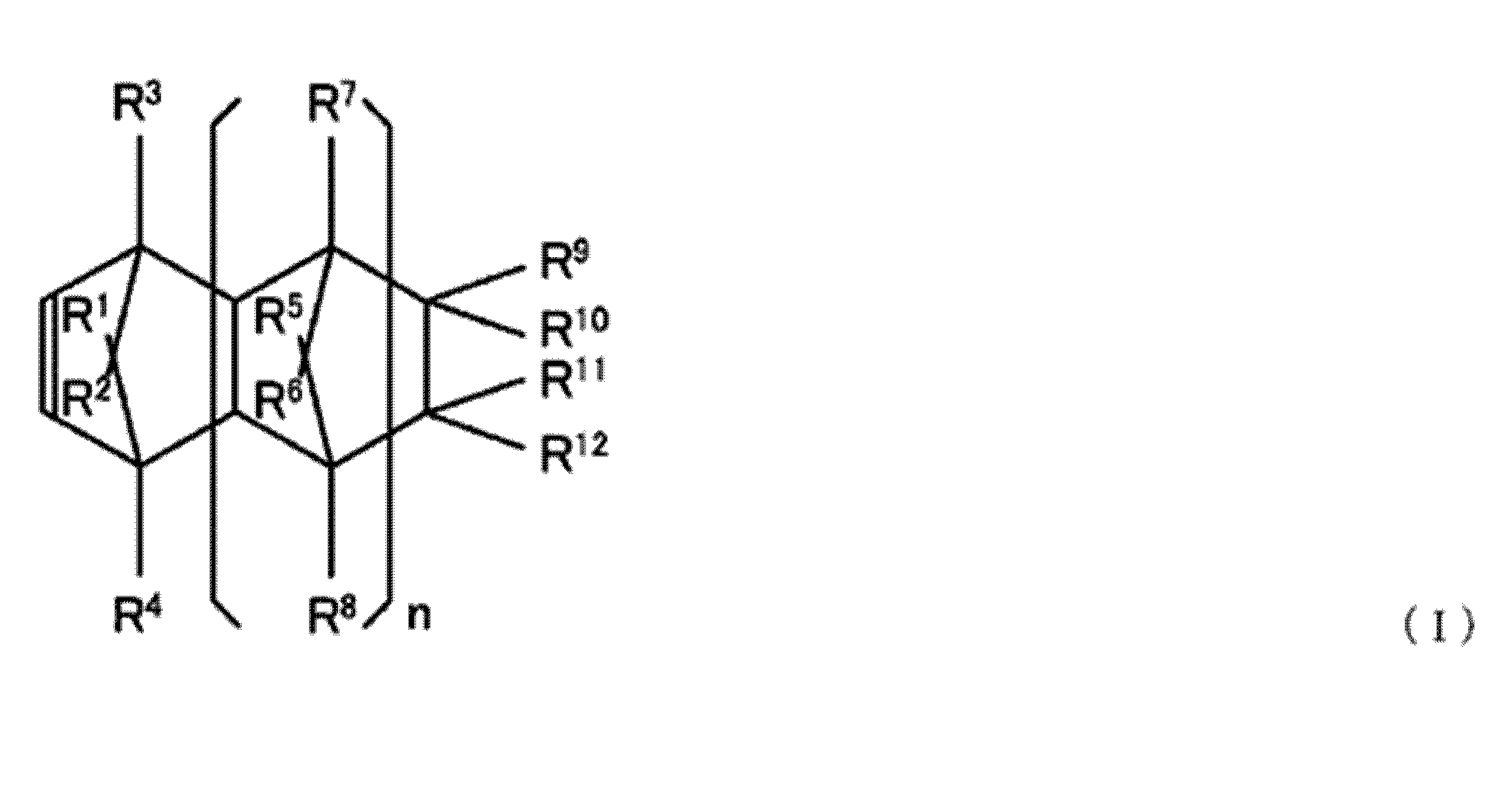
(式中、R1~R12は、それぞれ同一でも異なっていてもよく、水素原子、ハロゲン原子、及び、飽和脂肪族炭化水素基、アラルキル基、及び芳香族炭化水素基からなる群より選ばれる原子又は基であり、
R9~R12より選択される2つの基は、互いに結合して、飽和脂肪族炭化水素環、又は芳香族炭化水素環を形成してもよく、
nは、0又は正の整数を示し、
nが2以上の場合には、R5~R8は、それぞれの繰り返し単位の中で、それぞれ同一でも異なっていてもよく、
ただし、n=0の場合、R1~R4及びR9~R12の少なくとも1個は、水素原子ではない。)
で表される化合物である。
R9~R12より選択される2つの基は、互いに結合して、飽和脂肪族炭化水素環、又は芳香族炭化水素環を形成してもよく、
nは、0又は正の整数を示し、
nが2以上の場合には、R5~R8は、それぞれの繰り返し単位の中で、それぞれ同一でも異なっていてもよく、
ただし、n=0の場合、R1~R4及びR9~R12の少なくとも1個は、水素原子ではない。)
で表される化合物である。
エポキシド不純物は、2,3-エポキシノルボルナン、及び/又は前記式(I)で表される置換ノルボルネンにおける、炭素-炭素不飽和二重結合が酸化されたエポキシ化合物である。
粗製ノルボルネン系化合物におけるエポキシド不純物の量は、吸着剤による精製によって、重合に供される重合溶液の全質量に対するエポキシド不純物の含有量と触媒の含有量との比率(質量ppm/質量ppm)を、6以下にできれば特に限定されない。
典型的には、粗製ノルボルネン系化合物におけるエポキシド不純物の量は、ノルボルネン系化合物の質量に対して、200質量ppm以上であり、300質量ppm以上であってもよく、500質量ppm以上であってもよく、1500質量ppm以上であってもよい。
粗製ノルボルネン系化合物におけるエポキシド不純物の量は、粗製ノルボルネン系化合物の精製が容易である点で、5000質量ppm以下が好ましく、3000質量ppm以下であってもよく、2000質量ppm以下であってもよい。
典型的には、粗製ノルボルネン系化合物におけるエポキシド不純物の量は、ノルボルネン系化合物の質量に対して、200質量ppm以上であり、300質量ppm以上であってもよく、500質量ppm以上であってもよく、1500質量ppm以上であってもよい。
粗製ノルボルネン系化合物におけるエポキシド不純物の量は、粗製ノルボルネン系化合物の精製が容易である点で、5000質量ppm以下が好ましく、3000質量ppm以下であってもよく、2000質量ppm以下であってもよい。
以下、式(I)で示される置換ノルボルネンについて説明する。式(I)におけるR1~R12は、それぞれ同一でも異なっていてもよく、水素原子、ハロゲン原子、及び、炭化水素基からなる群より選ばれる。
R1~R8の好適な具体例としては、例えば、水素原子;フッ素、塩素、臭素等のハロゲン原子;炭素数1以上20以下のアルキル基等を挙げることができる。これらはそれぞれ異なっていてもよく、部分的に異なっていてもよく、全部が同一であってもよい。
R9~R12の具体例としては、例えば、水素原子;フッ素、塩素、臭素等のハロゲン原子;炭素数1以上20以下のアルキル基;シクロヘキシル基等のシクロアルキル基;フェニル基、トリル基、エチルフェニル基、イソプロピルフェニル基、ナフチル基、アントリル基等の置換又は無置換の芳香族炭化水素基;ベンジル基、フェネチル基、その他アルキル基にアリール基が置換したアラルキル基等を挙げることができる。これらはそれぞれ異なっていてもよく、部分的に異なっていてもよく、全部が同一であってもよい。
R9~R12より選択される2つの基が互いに結合して環を形成する場合には、形成される環は単環でも多環であってもよく、架橋を有する多環であってもよく、これらの環の組み合わせからなる環であってもよい。これらの環はメチル基等の置換基を有していてもよい。
R9~R12より選択される2つの基が互いに結合して形成し得る飽和脂肪族炭化水素環としては、シクロブタン環、シクロペンタン環、シクロヘキサン環、及びシクロヘプタン環等が挙げられる。
R9~R12より選択される2つの基が互いに結合して形成し得る芳香族炭化水素環としては、ベンゼン環、及びナフタレン環等が挙げられる。
R9~R12より選択される2つの基が互いに結合して形成し得る飽和脂肪族炭化水素環としては、シクロブタン環、シクロペンタン環、シクロヘキサン環、及びシクロヘプタン環等が挙げられる。
R9~R12より選択される2つの基が互いに結合して形成し得る芳香族炭化水素環としては、ベンゼン環、及びナフタレン環等が挙げられる。
一般式(I)で示される置換ノルボルネンの具体例としては、5-メチル-ビシクロ[2.2.1]ヘプタ-2-エン、5,5-ジメチル-ビシクロ[2.2.1]ヘプタ-2-エン、5-エチル-ビシクロ[2.2.1]ヘプタ-2-エン、5-ブチル-ビシクロ[2.2.1]ヘプタ-2-エン、5-ヘキシル-ビシクロ[2.2.1]ヘプタ-2-エン、5-オクチル-ビシクロ[2.2.1]ヘプタ-2-エン、5-オクタデシル-ビシクロ[2.2.1]ヘプタ-2-エン等の2環の環状オレフィン;
トリシクロ[4.3.0.12,5]デカ-3-エン;トリシクロ[4.4.0.12,5]ウンデカ-3-エン;5-シクロペンチル-ビシクロ[2.2.1]ヘプタ-2-エン、5-シクロヘキシル-ビシクロ[2.2.1]ヘプタ-2-エン、5-シクロヘキセニルビシクロ[2.2.1]ヘプタ-2-エン、5-フェニル-ビシクロ[2.2.1]ヘプタ-2-エンといった3環の環状オレフィン;
テトラシクロ[4.4.0.12,5.17,10]ドデカ-3-エン(単にテトラシクロドデセンともいう)、8-メチルテトラシクロ[4.4.0.12,5.17,10]ドデカ-3-エン、8-エチルテトラシクロ[4.4.0.12,5.17,10]ドデカ-3-エン、8-メチリデンテトラシクロ[4.4.0.12,5.17,10]ドデカ-3-エン、8-エチリデンテトラシクロ[4.4.0.12,5.17,10]ドデカ-3-エン、8-ビニルテトラシクロ[4,4.0.12,5.17,10]ドデカ-3-エン、8-プロペニル-テトラシクロ[4.4.0.12,5.17,10]ドデカ-3-エンといった4環の環状オレフィン;
8-シクロペンチル-テトラシクロ[4.4.0.12,5.17,10]ドデカ-3-エン、8-シクロヘキシル-テトラシクロ[4.4.0.12,5.17,10]ドデカ-3-エン、8-シクロヘキセニル-テトラシクロ[4.4.0.12,5.17,10]ドデカ-3-エン、8-フェニル-シクロペンチル-テトラシクロ[4.4.0.12,5.17,10]ドデカ-3-エン;ペンタシクロ[6.6.1.13,6.02,7.09,14]-4-ヘキサデセン、ペンタシクロ[6.5.1.13,6.02,7.09,13]-4-ペンタデセン、ペンタシクロ[7.4.0.02,7.13,6.110,13]-4-ペンタデセン;ヘプタシクロ[8.7.0.12,9.14,7.111,17.03,8.012,16]-5-エイコセン、ヘプタシクロ[8.7.0.12,9.03,8.14,7.012,17.113,l6]-14-エイコセン;等の多環の環状オレフィンを挙げることができる。
トリシクロ[4.3.0.12,5]デカ-3-エン;トリシクロ[4.4.0.12,5]ウンデカ-3-エン;5-シクロペンチル-ビシクロ[2.2.1]ヘプタ-2-エン、5-シクロヘキシル-ビシクロ[2.2.1]ヘプタ-2-エン、5-シクロヘキセニルビシクロ[2.2.1]ヘプタ-2-エン、5-フェニル-ビシクロ[2.2.1]ヘプタ-2-エンといった3環の環状オレフィン;
テトラシクロ[4.4.0.12,5.17,10]ドデカ-3-エン(単にテトラシクロドデセンともいう)、8-メチルテトラシクロ[4.4.0.12,5.17,10]ドデカ-3-エン、8-エチルテトラシクロ[4.4.0.12,5.17,10]ドデカ-3-エン、8-メチリデンテトラシクロ[4.4.0.12,5.17,10]ドデカ-3-エン、8-エチリデンテトラシクロ[4.4.0.12,5.17,10]ドデカ-3-エン、8-ビニルテトラシクロ[4,4.0.12,5.17,10]ドデカ-3-エン、8-プロペニル-テトラシクロ[4.4.0.12,5.17,10]ドデカ-3-エンといった4環の環状オレフィン;
8-シクロペンチル-テトラシクロ[4.4.0.12,5.17,10]ドデカ-3-エン、8-シクロヘキシル-テトラシクロ[4.4.0.12,5.17,10]ドデカ-3-エン、8-シクロヘキセニル-テトラシクロ[4.4.0.12,5.17,10]ドデカ-3-エン、8-フェニル-シクロペンチル-テトラシクロ[4.4.0.12,5.17,10]ドデカ-3-エン;ペンタシクロ[6.6.1.13,6.02,7.09,14]-4-ヘキサデセン、ペンタシクロ[6.5.1.13,6.02,7.09,13]-4-ペンタデセン、ペンタシクロ[7.4.0.02,7.13,6.110,13]-4-ペンタデセン;ヘプタシクロ[8.7.0.12,9.14,7.111,17.03,8.012,16]-5-エイコセン、ヘプタシクロ[8.7.0.12,9.03,8.14,7.012,17.113,l6]-14-エイコセン;等の多環の環状オレフィンを挙げることができる。
中でも、アルキル置換ノルボルネン(例えば、1個以上のアルキル基で置換されたビシクロ[2.2.1]ヘプタ-2-エン)、アルキリデン置換ノルボルネンが好ましい。
精製工程において、粗製ノルボルネン系化合物を単独で吸着剤と接触させてもよい。単量体が、ノルボルネン系化合物とともに、ノルボルネン系化合物以外の他の単量体を含む場合、粗製ノルボルネン系化合物と他の単量体とを含む混合物を吸着剤と接触させてもよい。
他の単量体としては、ノルボルネン系化合物と共重合可能な単量体化合物であれば特に限定されず、典型的にはα-オレフィンである。α-オレフィンは、ハロゲン原子等の少なくとも1種の置換基で置換されていてもよい。
α-オレフィンとしては、C2~C12のα-オレフィンが好ましい。C2~C12のα-オレフィンは特に限定されないが、例えば、エチレン、プロピレン、1-ブテン、1-ペンテン、1-ヘキセン、3-メチル-1-ブテン、3-メチル-1-ペンテン、3-エチル-1-ペンテン、4-メチル-1-ペンテン、4-メチル-1-ヘキセン、4,4-ジメチル-1-ヘキセン、4,4-ジメチル-1-ペンテン、4-エチル-1-ヘキセン、3-エチル-1-ヘキセン、1-オクテン、1-デセン、及び1-ドデセン等が挙げられる。中でも、1-ヘキセン、1-オクテン、1-デセンが好ましい。
環状オレフィンポリマーを製造する際の単量体の組み合わせとしては、単量体の入手容易性、機械的特性、熱的特性、製造性等のバランスに優れることから、ノルボルネンとエチレンとの組み合わせと、ノルボルネンと、1-オクテン、1-ヘキセン、又はこれらの混合物との組み合わせが好ましい。
つまり、単量体が、ノルボルネン系化合物とともに、エチレン、1-ヘキセン、及び1-オクテンからなる群より選択される1種以上を含むのが好ましい。単量体は、ノルボルネン系化合物と、エチレン、1-ヘキセン、及び1-オクテンからなる群より選択される1種以上とからなるのがより好ましい。
つまり、単量体が、ノルボルネン系化合物とともに、エチレン、1-ヘキセン、及び1-オクテンからなる群より選択される1種以上を含むのが好ましい。単量体は、ノルボルネン系化合物と、エチレン、1-ヘキセン、及び1-オクテンからなる群より選択される1種以上とからなるのがより好ましい。
ノルボルネンと、エチレンとを組み合わせて用いる場合、機械的特性と熱的特性とのバランスが良好である環状オレフィンポリマーを得るため、単量体中のノルボルネンの量は30モル%以上70モル%未満が好ましい。
ノルボルネンと、1-オクテン、1-ヘキセン、又はこれらの混合物とを組み合わせて用いる場合、良好な機械的特性を有する環状オレフィンが得られやすいことから、環状オレフィンポリマーのガラス転移温度を上げることができ、単量体中のノルボルネンの量は70モル%以上が好ましい。
ノルボルネンと、1-オクテン、1-ヘキセン、又はこれらの混合物とを組み合わせて用いる場合、良好な機械的特性を有する環状オレフィンが得られやすいことから、環状オレフィンポリマーのガラス転移温度を上げることができ、単量体中のノルボルネンの量は70モル%以上が好ましい。
[吸着剤]
以上説明した単量体に含まれる粗製ノルボルネン系化合物を接触させることにより、粗製ノルボルネン系化合物に含まれるエポキシド不純物を低減させる処理が行なわれる。
吸着剤としては、活性アルミナ及びゼオライトの混合物からなる、ハイブリッド系吸着剤が使用される。
ハイブリッド吸着剤は、典型的には、粉末又はペレット状であり、好ましくはペレット状である。
ハイブリッド系吸着剤では、粉末又はペレットを構成する粒子内において、活性アルミナ部位と、ゼオライト部位とが不可分に複合化されているのが好ましい。この場合、ハイブリッド系吸着剤は、同一粒子内に、活性アルミナとしての吸着サイトと、ゼオライトとしての吸着サイトとを併せ持つ。
ハイブリッド系吸着剤は、エポキシド不純物に対する所望する吸着硬化が得られる限りにおいて、粉末又はペレット状の活性アルミナと、粉末又はペレット状のゼオライトとが混合された混合物であってもよい。
粉末又はペレットを構成する粒子内において、活性アルミナ部位と、ゼオライト部位とが不可分に複合化されているハイブリッド吸着剤は、粉末又はペレット状の活性アルミナと、粉末又はペレット状のゼオライトとが混合された混合物よりも、エポキシド不純物と、後述するケトン不純物とアルデヒド不純物との吸着性能が良好である。
以上説明した単量体に含まれる粗製ノルボルネン系化合物を接触させることにより、粗製ノルボルネン系化合物に含まれるエポキシド不純物を低減させる処理が行なわれる。
吸着剤としては、活性アルミナ及びゼオライトの混合物からなる、ハイブリッド系吸着剤が使用される。
ハイブリッド吸着剤は、典型的には、粉末又はペレット状であり、好ましくはペレット状である。
ハイブリッド系吸着剤では、粉末又はペレットを構成する粒子内において、活性アルミナ部位と、ゼオライト部位とが不可分に複合化されているのが好ましい。この場合、ハイブリッド系吸着剤は、同一粒子内に、活性アルミナとしての吸着サイトと、ゼオライトとしての吸着サイトとを併せ持つ。
ハイブリッド系吸着剤は、エポキシド不純物に対する所望する吸着硬化が得られる限りにおいて、粉末又はペレット状の活性アルミナと、粉末又はペレット状のゼオライトとが混合された混合物であってもよい。
粉末又はペレットを構成する粒子内において、活性アルミナ部位と、ゼオライト部位とが不可分に複合化されているハイブリッド吸着剤は、粉末又はペレット状の活性アルミナと、粉末又はペレット状のゼオライトとが混合された混合物よりも、エポキシド不純物と、後述するケトン不純物とアルデヒド不純物との吸着性能が良好である。
かかるハイブリッド系吸着剤において、通常、活性アルミナの含有量と、ゼオライトの含有量とは、それぞれ、活性アルミナの質量とゼオライトの質量との合計に対して、20質量%以上80質量%以下が好ましく、30質量%以上70質量%以下がより好ましい。
ハイブリッド系吸着剤としては、従来から知られる吸着剤を用いることができる。ハイブリッド系吸着剤は、市販品を用いてもよい。ハイブリッド系吸着剤の市販品の例としては、例えば、AZ-300(UOP社、又はユニオン昭和製)が挙げられる。市販品であるAZ-300では、活性アルミナ部位と、ゼオライト部位とが不可分に複合化されている。
活性アルミナとは、吸着能を有する多孔質の酸化アルミニウム粒子である。活性アルミは、水酸化アルミナを、結晶性が低い多孔質の酸化アルミニウムへ転移させることにより生成し得る。
ハイブリッド系吸着剤における活性アルミナ部位の細孔径は、エポキシド不純物の吸着能の点から、1nm以上100nm以下が好ましく、1nm以上80nm以下がより好ましい。
ハイブリッド系吸着剤における活性アルミナ部位の細孔径は、エポキシド不純物の吸着能の点から、1nm以上100nm以下が好ましく、1nm以上80nm以下がより好ましい。
ハイブリッド系吸着剤におけるゼオライト部位の細孔径は、エポキシド不純物の吸着能の点から、0.2nm以上1nm以下が好ましく、0.5nm以上1nm以下がより好ましい。
好ましいゼオライトとしては、ゼオライトX、ゼオライトY、及びゼオライトA等が挙げられる。これらの中では、ゼオライトXが好ましい。
好ましいゼオライトとしては、ゼオライトX、ゼオライトY、及びゼオライトA等が挙げられる。これらの中では、ゼオライトXが好ましい。
ハイブリッド系吸着剤の形状は特に限定されず、前述の通りペレット状が好ましい。ペレットの形状としては特に限定されない。粗製ノルボルネン系化合物と、ハイブリッド系吸着剤とを接触させる際に、ハイブリッド系吸着剤のペレットの摩耗等により生じる不純物の、単量体及び環状オレフィンポリマーへの混入を防ぎやすい点で、ハイブリッド系吸着剤のペレットの形状としては、球状又は略球状が好ましい。
ハイブリッド系吸着剤が精製工程において使用される前に、吸着能を高める目的等で、ハイブリッド系吸着剤に対して加熱による活性化処理が施されてもよい。
活性化処理は、通常、不活性ガス雰囲気下で行われる。活性化処理における加熱温度は、100℃以上650℃以下が好ましく、200℃以上600℃以下がより好ましく、300℃以上600℃以下がさらに好ましく、400℃以上600℃以下が特に好ましい。
加熱時間は、0.1時間以上100時間以下が好ましく、0.5時間以上50時間以下がより好ましく、1時間以上25時間以下がさらに好ましい。
活性化処理は、通常、不活性ガス雰囲気下で行われる。活性化処理における加熱温度は、100℃以上650℃以下が好ましく、200℃以上600℃以下がより好ましく、300℃以上600℃以下がさらに好ましく、400℃以上600℃以下が特に好ましい。
加熱時間は、0.1時間以上100時間以下が好ましく、0.5時間以上50時間以下がより好ましく、1時間以上25時間以下がさらに好ましい。
[精製工程の操作]
精製工程において、環状オレフィンポリマーの製造に用いられる粗製ノルボルネン系化合物の全量が吸着剤による処理に供されてもよく、環状オレフィンポリマーの製造に用いられる粗製ノルボルネン系化合物の一部が吸着剤による処理に供されてもよい。
粗製ノルボルネン系化合物の一部を吸着剤により処理する場合、後述する重合工程において、精製ノルボルネン系化合物と、吸着剤により処理されなかった残余の粗製ノルボルネン系化合物とを混合して、重合に供される重合溶液の全質量に対するエポキシド不純物の含有量と触媒の含有量との比率(質量ppm/質量ppm)が6以下である重合溶液を調製できる限りにおいて、吸着剤により処理される粗製ノルボルネン系化合物の量は特に限定されない。
重合に供される単量体におけるエポキシド不純物の量を、確実に所望の量以下としやすいことから、環状オレフィンポリマーの製造に用いられる粗製ノルボルネン系化合物の全量を吸着剤による処理に供するのが好ましい。
精製工程において、環状オレフィンポリマーの製造に用いられる粗製ノルボルネン系化合物の全量が吸着剤による処理に供されてもよく、環状オレフィンポリマーの製造に用いられる粗製ノルボルネン系化合物の一部が吸着剤による処理に供されてもよい。
粗製ノルボルネン系化合物の一部を吸着剤により処理する場合、後述する重合工程において、精製ノルボルネン系化合物と、吸着剤により処理されなかった残余の粗製ノルボルネン系化合物とを混合して、重合に供される重合溶液の全質量に対するエポキシド不純物の含有量と触媒の含有量との比率(質量ppm/質量ppm)が6以下である重合溶液を調製できる限りにおいて、吸着剤により処理される粗製ノルボルネン系化合物の量は特に限定されない。
重合に供される単量体におけるエポキシド不純物の量を、確実に所望の量以下としやすいことから、環状オレフィンポリマーの製造に用いられる粗製ノルボルネン系化合物の全量を吸着剤による処理に供するのが好ましい。
粗製ノルボルネン系化合物は、通常、液体の状態で吸着剤と接触する。かかる液体は、粗製ノルボルネン系化合物、又は粗製ノルボルネン系化合物と他の単量体とを含む混合物の融液であってもよく、粗製ノルボルネン系化合物、又は粗製ノルボルネン系化合物と他の単量体とを溶媒に溶解させた溶液であってもよい。
低粘度であり、吸着剤との接触効率が良好である点や、温度低下による粗製ノルボルネン系化合物の固化のおそれがない点等から、粗製ノルボルネン系化合物、又は粗製ノルボルネン系化合物と他の単量体とを溶媒に溶解させた溶液を吸着剤と接触させるのが好ましい。
低粘度であり、吸着剤との接触効率が良好である点や、温度低下による粗製ノルボルネン系化合物の固化のおそれがない点等から、粗製ノルボルネン系化合物、又は粗製ノルボルネン系化合物と他の単量体とを溶媒に溶解させた溶液を吸着剤と接触させるのが好ましい。
粗製ノルボルネン系化合物、又は粗製ノルボルネン系化合物と他の単量体とを溶解させる溶媒の種類は、吸着剤によるエポキシド不純物の吸着が阻害されない限り特に限定されない。
好ましい溶媒としては、ペンタン、ヘキサン、ヘプタン、オクタン、シクロヘキサン、ミネラルオイル、ベンゼン、トルエン、及びキシレン等の炭化水素溶媒や、クロロホルム、メチレンクロライド、ジクロロエタン、及びクロロベンゼン等のハロゲン化炭化水素溶媒が挙げられる。
好ましい溶媒としては、ペンタン、ヘキサン、ヘプタン、オクタン、シクロヘキサン、ミネラルオイル、ベンゼン、トルエン、及びキシレン等の炭化水素溶媒や、クロロホルム、メチレンクロライド、ジクロロエタン、及びクロロベンゼン等のハロゲン化炭化水素溶媒が挙げられる。
粗製ノルボルネン系化合物を溶液又は融液として吸着剤と接触させる場合、当該溶液又は当該融液中の粗製ノルボルネン系化合物の濃度は、特に限定されない。
典型的には、溶液又は融液中の粗製ノルボルネン系化合物の濃度は、1質量%以上100質量%以下が好ましく、10質量%以上100質量%以下がより好ましい。
典型的には、溶液又は融液中の粗製ノルボルネン系化合物の濃度は、1質量%以上100質量%以下が好ましく、10質量%以上100質量%以下がより好ましい。
粗製ノルボルネン系化合物と、吸着剤との接触は、バッチ式で行われてもよく、連続式で行われてもよい。
粗製ノルボルネン系化合物と、吸着剤とを接触させる方法は特に限定されない。
例えば、容器内に、粗製ノルボルネン系化合物を含む液と、吸着剤とを仕込んだのちに、容器内の粗製ノルボルネン系化合物を含む液と、吸着剤とを、所定の時間、静置又は撹拌してもよい。
撹拌下での粗製ノルボルネン系化合物と吸着剤との接触は、両者の接触効率が良好である点で好ましい。他方、静置下での粗製ノルボルネン系化合物と吸着剤との接触は、吸着剤等の摩耗による、単量体及び環状オレフィンポリマーへの吸着剤由来の不純物の混入を防ぎやすい点で好ましい。
粗製ノルボルネン系化合物と、吸着剤とを接触させる方法は特に限定されない。
例えば、容器内に、粗製ノルボルネン系化合物を含む液と、吸着剤とを仕込んだのちに、容器内の粗製ノルボルネン系化合物を含む液と、吸着剤とを、所定の時間、静置又は撹拌してもよい。
撹拌下での粗製ノルボルネン系化合物と吸着剤との接触は、両者の接触効率が良好である点で好ましい。他方、静置下での粗製ノルボルネン系化合物と吸着剤との接触は、吸着剤等の摩耗による、単量体及び環状オレフィンポリマーへの吸着剤由来の不純物の混入を防ぎやすい点で好ましい。
吸着剤が内部に充填されたカラム等の容器内に、粗製ノルボルネン系化合物を含む液を流通させてもよい。この場合、粗製ノルボルネン系化合物と、吸着剤との接触時間を延長させる目的で、カラム等の容器から流出した粗製ノルボルネン系化合物を含む液を、再度、カラム等の容器に流入させる循環処理を行ってもよい。
粗製ノルボルネン系化合物の処理量の多さと、エポキシド不純物の除去効率の高さとの両立の点て、粗製ノルボルネン系化合物と吸着剤との接触時間は、0.01時間以上50時間以下が好ましく、0.1時間以上40時間以下がより好ましく、1時間以上30時間以下が特に好ましい。
吸着剤の量は、エポキシド不純部の除去が容易である点等から、粗製ノルボルネン系化合物100質量部に対して、1質量部以上が好ましく、10質量部以上がより好ましく、20質量部以上がさらに好ましい。
吸着剤の量の上限は特にないが、吸着剤のコストの抑制や、精製処理に過度に大きな装置が必要でない点等から、粗製ノルボルネン系化合物100質量部に対して、80質量部以下が好ましく、60質量部以下がより好ましく、40質量部以下がさらに好ましい。
吸着剤の量の上限は特にないが、吸着剤のコストの抑制や、精製処理に過度に大きな装置が必要でない点等から、粗製ノルボルネン系化合物100質量部に対して、80質量部以下が好ましく、60質量部以下がより好ましく、40質量部以下がさらに好ましい。
後述する重合工程において、重合に供される単量体における、ノルボルネン系化合物に由来するアルデヒド不純物の含有量は、ノルボルネン系化合物の質量に対して50質量ppm以下が好ましく、30質量ppm以下がより好ましく、20質量ppm以下がさらに好ましい。
後述する重合工程において、重合に供される単量体における、ノルボルネン系化合物に由来するケトン不純物の含有量は、ノルボルネン系化合物の質量に対して50質量ppm以下が好ましく、30質量ppm以下がより好ましく、20質量ppm以下がさらに好ましい。
ここで、アルデヒド不純物と、ケトン不純物とは、それぞれ、ノルボルネン系化合物の酸化に起因して生成し得る不純物である。これらの不純物について、環状オレフィンポリマーを製造する際の重合収率の悪化の要因である可能性がある。
アルデヒド不純物量と、ケトン不純物量とを低減する方法は特に限定されない。吸着剤として、上記のハイブリッド系吸着剤を用いる場合、精製ノルボルネン系化合物に含まれるアルデヒド不純物量と、ケトン不純物量とが低い傾向にある。
粗製ノルボルネン系化合物と、精製ノルボルネン系化合物とが、極力酸素と接触しないようにすることによっても、アルデヒド不純物量と、ケトン不純物量とを低減し得る。
後述する重合工程において、重合に供される単量体における、ノルボルネン系化合物に由来するケトン不純物の含有量は、ノルボルネン系化合物の質量に対して50質量ppm以下が好ましく、30質量ppm以下がより好ましく、20質量ppm以下がさらに好ましい。
ここで、アルデヒド不純物と、ケトン不純物とは、それぞれ、ノルボルネン系化合物の酸化に起因して生成し得る不純物である。これらの不純物について、環状オレフィンポリマーを製造する際の重合収率の悪化の要因である可能性がある。
アルデヒド不純物量と、ケトン不純物量とを低減する方法は特に限定されない。吸着剤として、上記のハイブリッド系吸着剤を用いる場合、精製ノルボルネン系化合物に含まれるアルデヒド不純物量と、ケトン不純物量とが低い傾向にある。
粗製ノルボルネン系化合物と、精製ノルボルネン系化合物とが、極力酸素と接触しないようにすることによっても、アルデヒド不純物量と、ケトン不純物量とを低減し得る。
以上説明した処理を行うことにより得られる精製ノルボルネン系化合物は、次いで、「重合工程」に供される。
精製ノルボルネン系化合物が溶液である場合、精製ノルボルネン系化合物は、溶液のまま重合工程に供されてもよく、溶液から単離された状態で重合工程に供されてもよい。
精製ノルボルネン系化合物が溶液である場合、精製ノルボルネン系化合物は、溶液のまま重合工程に供されてもよく、溶液から単離された状態で重合工程に供されてもよい。
<重合工程>
重合工程では、上記の精製工程で得られた精製ノルボルネン系化合物を含有する単量体を、遷移金属錯体触媒の存在下に重合させて、環状オレフィンポリマーを製造する。
ここで、単量体は、重合装置内に、一度で全量供給されてもよく、数度に分けて分割して供給されてもよく、連続的に供給されてもよい。
重合反応の方法は特に限定されず、バッチ式であっても連続式であってもよい。
重合工程では、上記の精製工程で得られた精製ノルボルネン系化合物を含有する単量体を、遷移金属錯体触媒の存在下に重合させて、環状オレフィンポリマーを製造する。
ここで、単量体は、重合装置内に、一度で全量供給されてもよく、数度に分けて分割して供給されてもよく、連続的に供給されてもよい。
重合反応の方法は特に限定されず、バッチ式であっても連続式であってもよい。
重合工程において、重合溶液の全質量に対するエポキシド不純物の含有量と触媒の含有量との比率(質量ppm/質量ppm)は、6以下、好ましくは5以下、より好ましくは4以下、さらに好ましくは3以下に調整される。
重合体に供される重合溶液の全質量に対するエポキシド不純物の含有量と触媒の含有量との比率が上記の範囲内であることによって、重合条件に応じて期待される収率で、安定して環状オレフィンポリマーを製造することができる。
重合溶液中の全質量に対するエポキシド不純物の含有量と触媒の含有量との比率の下限は特に限定されないが、精製操作の容易さの点から、0.1以上であってよく、1以上であってよい。
重合体に供される重合溶液の全質量に対するエポキシド不純物の含有量と触媒の含有量との比率が上記の範囲内であることによって、重合条件に応じて期待される収率で、安定して環状オレフィンポリマーを製造することができる。
重合溶液中の全質量に対するエポキシド不純物の含有量と触媒の含有量との比率の下限は特に限定されないが、精製操作の容易さの点から、0.1以上であってよく、1以上であってよい。
重合工程における重合反応は、リビング重合であっても、非リビング重合であってもよい。より少ない触媒量で、より多くの環状オレフィンポリマーを得たい場合は、連鎖移動反応を意図的に繰り返し進行させる連鎖重合である非リビング重合が一般に好ましい。
連鎖重合を進行させるためには、適切な連鎖移動能を有する化合物を反応系内に存在させることが必要である。連鎖移動剤は特に限定されず、連鎖移動能を有する公知の化合物を用いることができる。典型的な連鎖移動剤としては、一般にアルキルアルミニウム化合物、アルキル亜鉛化合物あるいは水素が挙げられる。アルキルアルミニウム化合物は、アルミノキサンに含有されていてもよいし、適宜添加されてもよい。
重合が非リビング重合により進行したか、又はリビング重合により進行したかは、得られた重合体の分子量分布(重量平均分子量(Mw)/数平均分子量(Mn))により判別することができる。典型的には、分子量分布が1.1以下である重合体はリビング重合により生成しており、分子量分布が1.1超である重合体は非リビング重合により生成する。
非リビング重合では、分子量分布が1.5を超え2程度であることも多い。
非リビング重合では、分子量分布が1.5を超え2程度であることも多い。
[遷移金属錯体触媒]
遷移金属錯体触媒としては、ノルボルネン系化合物を含む単量体の重合反応を触媒し得る限り特に限定されない。好ましい遷移金属錯体触媒としては、メタロセン触媒が挙げられる。
遷移金属錯体触媒としては、ノルボルネン系化合物を含む単量体の重合反応を触媒し得る限り特に限定されない。好ましい遷移金属錯体触媒としては、メタロセン触媒が挙げられる。
メタロセン触媒(a)としては、例えば、シクロペンタジエン環を含む配位子と、周期律表第IV族遷移金属とを含む遷移金属錯体が好ましい。かかるメタロセン触媒(a)は、Ti、Zr、及びHfからなる群より選択される金属原子を中心金属として含むのが好ましい。
メタロセン触媒(a)としては、例えば、下記式(1)で表される遷移金属錯体が好ましい。
(Cp)(ZR01 m)n(A)rMLpL’q・・・(1)
メタロセン触媒(a)としては、例えば、下記式(1)で表される遷移金属錯体が好ましい。
(Cp)(ZR01 m)n(A)rMLpL’q・・・(1)
式(1)中、(ZR01
m)nはCpとAを結合する二価の基である。
ZはC、Si、Ge、N、又はPである。
R01は、水素原子、炭素原子数6以上20以下のアリール基、炭素原子数7以上20以下のアルキルアリール基、炭素原子数7以上20以下のアラルキル基、又は直鎖状であっても、分岐鎖状であっても、環式骨格を含んでいてもよく、不飽和結合を有してもよい炭素原子数1以上20以下の脂肪族炭化水素基である。
(ZR01 m)中のR01が複数である場合、複数のR01は同一であっても異なっていてもよい。
(ZR01 m)が複数繰り返される場合、複数の(ZR01 m)は同一であっても異なっていてもよい。
Cpは、置換基を有してもよいシクロペンタジエニル基、又は置換基を有してもよいシクロペンタジエン環を含む環式基である。
AはCpと同様の基であるか、-O-、-S-、又は-N(R02)-である。
R02は、水素原子、直鎖状であっても、分岐鎖状であっても、環式骨格を含んでいてもよく、不飽和結合を有してもよい炭素原子数1以上20以下の脂肪族炭化水素基、炭素原子数6以上20以下のアリール基、炭素原子数7以上20以下のアルキルアリール基、又は炭素原子数7以上20以下のアラルキル基である。
Mは、Ti、Zr、及びHfからなる群より選択される金属原子である。
Lは、炭素原子数6以上20以下のアリール基、炭素原子数7以上20以下のアルキルアリール基、炭素原子数7以上20以下のアラルキル基、及び直鎖状であっても、分岐鎖状であっても、環式骨格を含んでいてもよく、不飽和結合を有してもよい炭素原子数1以上20以下の脂肪族炭化水素基からなる群より選択されるモノアニオンシグマリガンドである。
Lは、1以上のSi原子、又はGe原子を含んでいてもよい。
Lが複数である場合、複数のLは同一であっても異なっていてもよく、同一であるのが好ましい。
L’は、ハロゲン原子、-OR03、又は-N=C(R03)R03である。
R03は、水素原子、ヘテロ原子を含んでもよい、炭素原子数6以上20以下のアリール基、炭素原子数7以上20以下のアルキルアリール基、炭素原子数7以上20以下のアラルキル基、又は直鎖状であっても、分岐鎖状であっても、環式骨格を含んでいてもよく、不飽和結合を有してもよい炭素原子数1以上20以下の脂肪族炭化水素基である。R03が複数の場合、同一であっても異なっていてもよい。
L’が複数である場合、複数のL’は同一であっても異なっていてもよい。
mは1又は2である。より詳細には、ZがN、又はPである場合、mは1であり、ZがC、Si、又はGeである場合、mは2である。
nは0以上4以下の整数である。
rは0又は1である。rが0である場合、nは0である。
pは0以上3以下の整数である。
qは0以上3以下の整数である。
p+qは、rが1である場合に、金属Mの酸化状態マイナス2(金属Mの酸化状態-2)に等しい。
p+qは、rが0である場合に、金属Mの酸化状態マイナス1(金属Mの酸化状態-1)に等しい。
p+qは4未満である。
ZはC、Si、Ge、N、又はPである。
R01は、水素原子、炭素原子数6以上20以下のアリール基、炭素原子数7以上20以下のアルキルアリール基、炭素原子数7以上20以下のアラルキル基、又は直鎖状であっても、分岐鎖状であっても、環式骨格を含んでいてもよく、不飽和結合を有してもよい炭素原子数1以上20以下の脂肪族炭化水素基である。
(ZR01 m)中のR01が複数である場合、複数のR01は同一であっても異なっていてもよい。
(ZR01 m)が複数繰り返される場合、複数の(ZR01 m)は同一であっても異なっていてもよい。
Cpは、置換基を有してもよいシクロペンタジエニル基、又は置換基を有してもよいシクロペンタジエン環を含む環式基である。
AはCpと同様の基であるか、-O-、-S-、又は-N(R02)-である。
R02は、水素原子、直鎖状であっても、分岐鎖状であっても、環式骨格を含んでいてもよく、不飽和結合を有してもよい炭素原子数1以上20以下の脂肪族炭化水素基、炭素原子数6以上20以下のアリール基、炭素原子数7以上20以下のアルキルアリール基、又は炭素原子数7以上20以下のアラルキル基である。
Mは、Ti、Zr、及びHfからなる群より選択される金属原子である。
Lは、炭素原子数6以上20以下のアリール基、炭素原子数7以上20以下のアルキルアリール基、炭素原子数7以上20以下のアラルキル基、及び直鎖状であっても、分岐鎖状であっても、環式骨格を含んでいてもよく、不飽和結合を有してもよい炭素原子数1以上20以下の脂肪族炭化水素基からなる群より選択されるモノアニオンシグマリガンドである。
Lは、1以上のSi原子、又はGe原子を含んでいてもよい。
Lが複数である場合、複数のLは同一であっても異なっていてもよく、同一であるのが好ましい。
L’は、ハロゲン原子、-OR03、又は-N=C(R03)R03である。
R03は、水素原子、ヘテロ原子を含んでもよい、炭素原子数6以上20以下のアリール基、炭素原子数7以上20以下のアルキルアリール基、炭素原子数7以上20以下のアラルキル基、又は直鎖状であっても、分岐鎖状であっても、環式骨格を含んでいてもよく、不飽和結合を有してもよい炭素原子数1以上20以下の脂肪族炭化水素基である。R03が複数の場合、同一であっても異なっていてもよい。
L’が複数である場合、複数のL’は同一であっても異なっていてもよい。
mは1又は2である。より詳細には、ZがN、又はPである場合、mは1であり、ZがC、Si、又はGeである場合、mは2である。
nは0以上4以下の整数である。
rは0又は1である。rが0である場合、nは0である。
pは0以上3以下の整数である。
qは0以上3以下の整数である。
p+qは、rが1である場合に、金属Mの酸化状態マイナス2(金属Mの酸化状態-2)に等しい。
p+qは、rが0である場合に、金属Mの酸化状態マイナス1(金属Mの酸化状態-1)に等しい。
p+qは4未満である。
式(1)で表される遷移金属錯体において、2価の架橋基(ZR01
m)nは、CR01
2、(CR01
2)2、(CR01
2)3、SiR01
2、GeR01
2、NR01、及びPR01からなる群より選択されるのが好ましい。
2価の架橋基は、Si(CH3)2、SiPh2、CH2、(CH2)2、(CH2)3、C(CH3)2、又はCPh2がより好ましい。Phはフェニル基である。
mは1又は2であり、nは0以上4以下の整数である。
2価の架橋基は、Si(CH3)2、SiPh2、CH2、(CH2)2、(CH2)3、C(CH3)2、又はCPh2がより好ましい。Phはフェニル基である。
mは1又は2であり、nは0以上4以下の整数である。
金属Mにπ結合するリガンドCpは、置換基を有してもよいシクロペンタジエニル基、又は置換基を有してもよいシクロペンタジエン環を含む環式基である。
Cpの好適な例としては、シクロペンタジエニル基、メチルシクロペンタジエニル基、ジメチルシクロペンタジエニル基、トリメチルシクロペンタジエニル基、テトラメチルシクロペンタジエニル基、4-tert-ブチルシクロペンタジエニル基、4-アダマンチルシクロペンタジエニル基、モノメチルインデニル基、ジメチルインデニル基、トリメチルインデニル基、テトラメチルインデニル基、4,5,6,7-テトラヒドロインデニル基、フルオレニル基、5,10-ジヒドロインデノ[1,2-b]インドール-10-イル基、N-メチル-5,10-ジヒドロインデノ[1,2-b]インドール-10-イル基、N-フェニル-5,10-ジヒドロインデノ[1,2-b]インドール-10-イル基、5,6-ジヒドロインデノ[2,1-b]インドール-6-イル;N-メチル-5,6-ジヒドロインデノ[2,1-b]インドール-6-イル、及びN-フェニル-5,6-ジヒドロインデノ[2,1-b]インドール-6-イルが挙げられる。
Cpの好適な例としては、シクロペンタジエニル基、メチルシクロペンタジエニル基、ジメチルシクロペンタジエニル基、トリメチルシクロペンタジエニル基、テトラメチルシクロペンタジエニル基、4-tert-ブチルシクロペンタジエニル基、4-アダマンチルシクロペンタジエニル基、モノメチルインデニル基、ジメチルインデニル基、トリメチルインデニル基、テトラメチルインデニル基、4,5,6,7-テトラヒドロインデニル基、フルオレニル基、5,10-ジヒドロインデノ[1,2-b]インドール-10-イル基、N-メチル-5,10-ジヒドロインデノ[1,2-b]インドール-10-イル基、N-フェニル-5,10-ジヒドロインデノ[1,2-b]インドール-10-イル基、5,6-ジヒドロインデノ[2,1-b]インドール-6-イル;N-メチル-5,6-ジヒドロインデノ[2,1-b]インドール-6-イル、及びN-フェニル-5,6-ジヒドロインデノ[2,1-b]インドール-6-イルが挙げられる。
AはCpと同様の基であるか、-O-、-S-、又は-N(R02)-である。Aは、Cpと同様の基であるのが好ましい。
金属Mは、Ti、Zr又はHfである。
Lとしては、メチル基、エチル基、n-ブチル基、sec-ブチル基、フェニル基、ベンジル基、及び-CH2Si(CH3)3、からなる群より選択される基が好ましく、その中でもメチル基がより好ましい。
L’としては、ハロゲン、-OR03(R03は前述の通りである)、又は-N=C(R03)R03からなる群より選択される基が好ましく、その中でも-Cl、-O-2,6-(t-Bu)2-C6H3、又は-N=C(t-Bu)2がより好ましい。
L’としては、ハロゲン、-OR03(R03は前述の通りである)、又は-N=C(R03)R03からなる群より選択される基が好ましく、その中でも-Cl、-O-2,6-(t-Bu)2-C6H3、又は-N=C(t-Bu)2がより好ましい。
nは0以上4以下の整数であり、0以上2以下が好ましい。
式(1)で表される遷移金属錯体について、nが0であり、rが0である場合の具体例としては、CpdMCl2(O-2,6-(t-Bu)2-C6H3)、CpdMMe2(O-2,6-(t-Bu)2-C6H3)、CpdMMeCl(O-2,6-(t-Bu)2-C6H3)、tet-CpdMCl2(O-2,6-(t-Bu)2-C6H3)、tet-CpdMMe2(O-2,6-(t-Bu)2-C6H3)、tet-CpdMMeCl(O-2,6-(t-Bu)2-C6H3)、CpdMCl2(O-2,6-(i-Pr)2-C6H3)、CpdMMe2(O-2,6-(i-Pr)2-C6H3)、CpdMMeCl(O-2,6-(i-Pr)2-C6H3)、tet-CpdMCl2(O-2,6-(i-Pr)2-C6H3)、tet-CpdMMe2(O-2,6-(i-Pr)2-C6H3)、tet-CpdMMeCl(O-2,6-(i-Pr)2-C6H3)、CpdMCl2(N=C(t-Bu)2)、CpdMMe2(N=C(t-Bu)2)、CpdMMeCl(N=C(t-Bu)2)、(t-BuC5H4)MCl2(N=C(t-Bu)2)、(t-BuC5H4)MMe2(N=C(t-Bu)2)、(t-BuC5H4)MMeCl(N=C(t-Bu)2)、tet-CpdMCl2(N=C(t-Bu)2)、tet-CpdMMe2(N=C(t-Bu)2)、tet-CpdMMeCl(N=C(t-Bu)2)、CpdMCl2(N=C-(t-Bu-N-CH=CH-N-t-Bu)2)、CpdMMe2(N=C-(t-Bu-N-CH=CH-N-t-Bu)2)、CpdMMeCl(N=C-(t-Bu-N-CH=CH-N-t-Bu)2)、tet-CpdMCl2(N=C-(t-Bu-N-CH=CH-N-t-Bu)2)、tet-CpdMMe2(N=C-(t-Bu-N-CH=CH-N-t-Bu)2)、tet-CpdMMeCl(N=C-(t-Bu-N-CH=CH-N-t-Bu)2)が挙げられる。
上記の例示において、Meはメチル基であり、t-Buはtert-ブチル基であり、i-Prはiso-プロピル基であり、Cpdはシクロペンタジエニル基であり、tet-Cpdはテトラメチルシクロペンタジエニル基である。Mは、式(1)について説明した通りである。Mとしては、Zr、Ti、又はHfが好ましく、Tiがより好ましい。
上記の例示において、Meはメチル基であり、t-Buはtert-ブチル基であり、i-Prはiso-プロピル基であり、Cpdはシクロペンタジエニル基であり、tet-Cpdはテトラメチルシクロペンタジエニル基である。Mは、式(1)について説明した通りである。Mとしては、Zr、Ti、又はHfが好ましく、Tiがより好ましい。
式(1)で表される遷移金属錯体について、nが0であり、rが1である場合の具体例としては、(Me3Cpd)2MCl2、(Me3Cpd)2MMe2、(Me3Cpd)2MMeCl、(Me3Cpd)2MPh2、(Me3Cpd)2MBz2、(Me4Cpd)2MCl2、(Me4Cpd)2MMe2、(Me5Cpd)2MCl2、(Me5Cpd)2MPh2、(Me5Cpd)2MBz2、(EtMe4Cpd)2MCl2、[(Ph)Me4Cpd]2MCl2、(Et5Cpd)2MCl2、(Ind)2MCl2、(Ind)2MMeCl、(Ind)2MPh2、(Ind)2MMe2、(Ind)2MMeCl、(H4Ind)2MCl2、(H4Ind)2MMe2、(H4Ind)2MPh2、及び(Me4Cpd)(Me5Cpd)MCl2が挙げられる。
上記の例示において、Meはメチル基であり、Etはエチル基であり、Cpdはシクロペンタジエニル基であり、Indはインデニル基であり、H4Indは4,5,6,7,-テトラヒドロインデニル基であり、Phはフェニル基であり、Bzはベンジル基である。Mは、式(1)について説明した通りである。Mとしては、Zr、Ti、又はHfが好ましく、Zrがより好ましい。
上記の例示において、Meはメチル基であり、Etはエチル基であり、Cpdはシクロペンタジエニル基であり、Indはインデニル基であり、H4Indは4,5,6,7,-テトラヒドロインデニル基であり、Phはフェニル基であり、Bzはベンジル基である。Mは、式(1)について説明した通りである。Mとしては、Zr、Ti、又はHfが好ましく、Zrがより好ましい。
式(1)で表される遷移金属錯体について、nが1又は2であり、rが1である場合の具体例としては、Me2C(Cp)(Ind)MCl2、Me2C(Cp)(Ind)MMe2、Me2C(Cp)(Ind)MPh2、Me2C(Cp)(Ind)MBz2、Me2C(Cp)(Ind)MMeCl、Ph2C(Cp)(Ind)MCl2、Ph2C(Cp)(Ind)MMe2、Ph2C(Cp)(Ind)MPh2、Ph2C(Cp)(Ind)MBz2、Ph2C(Cp)(Ind)MMeCl、Me2Si(Me4Cpd)2MCl2、Me2Si(Me4Cpd)2MMe2、Me2Si(Me4Cpd)2MPh2、Me2Si(Me4Cpd)2MBz2、Me2Si(Me4Cpd)2MMeCl、Me2C(Me4Cpd)(MeCpd)MCl2、Me2C(Me4Cpd)(MeCpd)MMe2、Me2Si(Ind)2MCl2、Me2Si(Ind)2MMe2、Me2Si(Ind)2MPh2、Me2Si(Ind)2MBz2、Me2Si(Ind)2MMeCl、Me2Si(Me4Cpd)2MCl2、Me2Si(Me4Cpd)2MMe2、C2H4(Ind)2MMe2、C2H4(Ind)2MPh2、C2H4(Ind)2MBz2、C2H4(H4Ind)2MMe2、Ph(Me)Si(Ind)2MMe2、Ph2Si(Ind)2MMe2、Me2C(Flu)(Cpd)MCl2、Me2C(Flu)(Cpd)MMe2、Me2C(Flu)(Cpd)MPh2、Me2C(Flu)(Cpd)MBz2、Ph2C(Flu)(Cpd)MCl2、Ph2C(Flu)(Cpd)MMe2、Ph2C(Flu)(Cpd)MPh2、Ph2C(Flu)(Cpd)MBz2、C2H4(Me4Cpd)2MCl2、C2H4(Me4Cpd)2MMe2、C2Me4(Ind)2MCl2、C2Me4(Ind)2MMe2、Me2SiCH2(Ind)2MCl2、Me2SiCH2(Ind)2MMe2、Me2SiCH2(Ind)2MPh2、Me2SiCH2(Ind)2MBz2、Me2SiCH2(Ind)2MMeCl、C2H4(2-MeInd)2MCl2、C2H4(2-MeInd)2MMe2、C2H4(3-MeInd)2MCl2、C2H4(3-MeInd)2MMe2、C2H4(4,7-Me2Ind)2MCl2、C2H4(4,7-Me2Ind)2MMe2、C2H4(5,6-Me2Ind)2MCl2、C2H4(5,6-Me2Ind)2MMe2、C2H4(2-MeH4Ind)2MCl2、Me2C(H4Ind)2MCl2、Me2C(H4Ind)2MMe2、Me2C(H4Ind)2MPh2、Me2C(H4Ind)2MBz2、Me2C(H4Ind)2MMeCl、Ph2C(H4Ind)2MCl2、Ph2C(H4Ind)2MMe2、Ph2C(H4Ind)2MPh2、Ph2C(H4Ind)2MBz2、Ph2C(H4Ind)2MMeCl、C2H4(2-MeH4Ind)2MMe2、C2H4(2,4,7-Me3H4Ind)2MCl2、C2H4(2,4,7-Me3H4Ind)2MMe2、C2H4(4,7-Me2H4Ind)2MCl2、C2H4(4,7-Me2H4Ind)2MMe2、C2H4(2,4,7-Me3Ind)2MCl2、C2H4(2,4,7-Me3Ind)2MMe2、C2H4(2-Me-Benz〔e〕Ind)2MCl2、C2H4(2-Me-Benz〔e〕Ind)2MMe2、C2H4(Benz〔e〕Ind)2MCl2、C2H4(Benz〔e〕Ind)2MMe2、Me2Si(2-MeInd)2MCl2、Me2Si(2-MeInd)2MMe2、Me2Si(4,7-Me2Ind)2MCl2、Me2Si(4,7-Me2Ind)2MMe2、Me2Si(5,6-Me2Ind)2MCl2、Me2Si(5,6-Me2Ind)2MMe2、Me2Si(2,4,7-Me3Ind)2MCl2、Me2Si(2,4,7-Me3Ind)2MMe2、Me2Si(2-MeH4Ind)2MCl2、Me2Si(2-MeH4Ind)2MMe2、Me2Si(4,7-Me2H4Ind)2MCl2、Me2Si(4,7-Me2H4Ind)2MMe2、Me2Si(2,4,7-Me3H4Ind)2MCl2、Me2Si(2,4,7-Me3H4Ind)2MMe2、(t-BuNSiMe2)(tet―Cpd)MCl2、(t-BuNSiMe2)(tet―Cpd)MMe2、(t-BuNSiMe2)(tet―Cpd)MPh2、(t-BuNSiMe2)(tet―Cpd)MBz2、(t-BuNSiMe2)(tet―Cpd)MMeCl、1,1’-(Me2C)2-2,2’-(Me2C)2(Cpd)2MCl2、1,1’-(Me2C)2-2,2’-(Me2C)2(Cpd)2MMe2が挙げられる。
上記の例示において、Meはメチル基であり、Cpdはシクロペンタジエニル基であり、tet-Cpdはテトラメチルシクロペンタジエニル基であり、Indはインデニル基であり、H4Indは4,5,6,7,-テトラヒドロインデニル基であり、Fluはフルオレニル基であり、Phはフェニル基であり、Bzはベンジル基である。Mは、式(1)について説明した通りである。Mとしては、Zr、Ti、又はHfが好ましく、Zrがより好ましい。
上記の例示において、Meはメチル基であり、Cpdはシクロペンタジエニル基であり、tet-Cpdはテトラメチルシクロペンタジエニル基であり、Indはインデニル基であり、H4Indは4,5,6,7,-テトラヒドロインデニル基であり、Fluはフルオレニル基であり、Phはフェニル基であり、Bzはベンジル基である。Mは、式(1)について説明した通りである。Mとしては、Zr、Ti、又はHfが好ましく、Zrがより好ましい。
以上説明した式(1)で表されるメタロセン化合物の中では、例えば、Me2C(Flu)(Cpd)ZrCl2、Me2C(Flu)(Cpd)ZrMe2、Me2C(Flu)(Cpd)ZrPh2、Me2C(Flu)(Cpd)ZrBz2、Ph2C(Flu)(Cpd)ZrCl2、Ph2C(Flu)(Cpd)ZrMe2、Ph2C(Flu)(Cpd)ZrPh2、及びPh2C(Flu)(Cpd)ZrBz2が、後述するノルボルネン系化合物とエチレンとの共重合に好ましく使用され、ノルボルネンとエチレンとの共重合により好ましく使用される。
式(1)で表されるメタロセン化合物の他の好ましい例としては、下記式(a1)で表される化合物が挙げられる。

式(a1)中、Ra1、Ra2、Ra3、及びRa4は、それぞれ独立に、ヘテロ原子を含んでいてもよい炭素原子数1以上20以下の炭化水素基である。
Ra1及びRa2は、それぞれC-Si結合、O-Si結合、Si-Si結合、又はN-Si結合によりケイ素原子に結合する。
Ra3はC-N結合、O-N結合、Si-N結合、又はN-N結合により窒素原子に結合する。
Ra4はC-M結合により金属原子Mに結合する。
Ra5及びRa6は、それぞれ独立に、ヘテロ原子を含んでいてもよい炭素原子数1以上20以下の有機置換基、又は無機置換基であり、p及びqは、それぞれ独立に0以上4以下の整数である。
Ra5及びRa6がそれぞれ複数である場合、複数のRa5及びRa6は異なる基であってもよい。
複数のRa5のうちの2つの基、又は複数のRa6のうちの2つの基が芳香環上の隣接する位置に結合する場合、当該2つの基が相互に結合して環を形成してもよい。
Mは、周期律表第IV族遷移金属であり、Ti、Zr、又はHfが好ましい。
Ra1及びRa2は、それぞれC-Si結合、O-Si結合、Si-Si結合、又はN-Si結合によりケイ素原子に結合する。
Ra3はC-N結合、O-N結合、Si-N結合、又はN-N結合により窒素原子に結合する。
Ra4はC-M結合により金属原子Mに結合する。
Ra5及びRa6は、それぞれ独立に、ヘテロ原子を含んでいてもよい炭素原子数1以上20以下の有機置換基、又は無機置換基であり、p及びqは、それぞれ独立に0以上4以下の整数である。
Ra5及びRa6がそれぞれ複数である場合、複数のRa5及びRa6は異なる基であってもよい。
複数のRa5のうちの2つの基、又は複数のRa6のうちの2つの基が芳香環上の隣接する位置に結合する場合、当該2つの基が相互に結合して環を形成してもよい。
Mは、周期律表第IV族遷移金属であり、Ti、Zr、又はHfが好ましい。
式(a1)中の金属原子Mは、ハプト数1以上5以下の範囲において、フルオレン骨格を有する配位子と、任意の配位形式をとることができる。
Ra1、Ra2、Ra3、及びRa4は、それぞれ独立に、ヘテロ原子を含んでいてもよい炭素原子数1以上20以下の炭化水素基である。
ヘテロ原子を含んでいてもよい炭素原子数1以上20以下の炭化水素基については、炭化水素基がヘテロ原子を含む場合、ヘテロ原子の種類は本発明の目的を阻害しない範囲で特に限定されない。ヘテロ原子の具体例としては、酸素原子、窒素原子、硫黄原子、リン原子、ケイ素原子、セレン原子、及びハロゲン原子等が挙げられる。
Ra1及びRa2は、それぞれC-Si結合、O-Si結合、Si-Si結合、又はN-Si結合によりケイ素原子に結合する。
O-Si結合によりケイ素原子に結合するRa1及びRa2の好適な例としては、-ORa7、及び-O-C(=O)-Ra7で表される基が挙げられる。
Si-Si結合によりケイ素原子に結合するRa1及びRa2の好適な例としては、-SiRa7 3、-Si(ORa7)Ra7 2、-Si(ORa7)2Ra7、及び-Si(ORa7)3で表される基が挙げられる。
N-Si結合によりケイ素原子に結合するRa1及びRa2の好適な例としては、-NHRa7、及び-NRa7 2で表される基が挙げられる。
ここで、上記のRa7はいずれも炭化水素基である。
O-Si結合によりケイ素原子に結合するRa1及びRa2の好適な例としては、-ORa7、及び-O-C(=O)-Ra7で表される基が挙げられる。
Si-Si結合によりケイ素原子に結合するRa1及びRa2の好適な例としては、-SiRa7 3、-Si(ORa7)Ra7 2、-Si(ORa7)2Ra7、及び-Si(ORa7)3で表される基が挙げられる。
N-Si結合によりケイ素原子に結合するRa1及びRa2の好適な例としては、-NHRa7、及び-NRa7 2で表される基が挙げられる。
ここで、上記のRa7はいずれも炭化水素基である。
Ra3は、C-N結合、O-N結合、Si-N結合、又はN-N結合により窒素原子に結合する。
O-N結合により窒素原子に結合するRa3の好適な例としては、-ORa7、及び-O-C(=O)-Ra7で表される基が挙げられる。
Si-N結合により窒素原子に結合するRa3の好適な例としては、-SiRa7 3、-Si(ORa7)Ra7 2、-Si(ORa7)2Ra7、及び-Si(ORa7)3で表される基が挙げられる。
N-N結合により窒素原子に結合するRa3の好適な例としては、-NHRa7、及び-NRa7 2で表される基が挙げられる。
ここで、上記のRa7はいずれも炭化水素基である。
O-N結合により窒素原子に結合するRa3の好適な例としては、-ORa7、及び-O-C(=O)-Ra7で表される基が挙げられる。
Si-N結合により窒素原子に結合するRa3の好適な例としては、-SiRa7 3、-Si(ORa7)Ra7 2、-Si(ORa7)2Ra7、及び-Si(ORa7)3で表される基が挙げられる。
N-N結合により窒素原子に結合するRa3の好適な例としては、-NHRa7、及び-NRa7 2で表される基が挙げられる。
ここで、上記のRa7はいずれも炭化水素基である。
配位子として使用する化合物の調製や入手が容易であることから、Ra1とRa2とは同一の基であるのが好ましい。
Ra1、Ra2、Ra3、及びRa4としては、化学的な安定性に優れることから、ヘテロ原子を含まない炭化水素基が好ましい。
かかる炭化水素基としては、直鎖状又は分岐鎖状のアルキル基、二重結合及び/又は三重結合を有してもよい直鎖状又は分岐鎖状の不飽和脂肪族炭化水素基、シクロアルキル基、シクロアルキルアルキル基、芳香族炭化水素基、及びアラルキル基が好ましい。
かかる炭化水素基としては、直鎖状又は分岐鎖状のアルキル基、二重結合及び/又は三重結合を有してもよい直鎖状又は分岐鎖状の不飽和脂肪族炭化水素基、シクロアルキル基、シクロアルキルアルキル基、芳香族炭化水素基、及びアラルキル基が好ましい。
直鎖状又は分岐鎖状のアルキル基の具体例としては、メチル基、エチル基、n-プロピル基、イソプロピル基、n-ブチル基、イソブチル基、sec-ブチル基、tert-ブチル基、n-ペンチル基、イソペンチル基、tert-ペンチル基、n-ヘキシル基、n-ヘプチル基、n-オクチル基、2-エチルヘキシル基、n-ノニル基、n-デシル基、n-ウンデシル基、n-ドデシル基、n-トリデシル基、n-テトラデシル基、n-ペンタデシル基、n-ヘキサデシル基、n-ヘプタデシル基、n-オクタデシル基、n-ノナデシル基、及びn-イコシル基が挙げられる。
二重結合及び/又は三重結合を有してもよい直鎖状又は分岐鎖状の不飽和脂肪族炭化水素基の好ましい例としては、直鎖状又は分岐鎖状のアルキル基の具体例として挙げた基において、1以上の単結合を二重結合及び/又は三重結合に置き換えた基が挙げられる。
より好ましくは、ビニル基、アリル基、1-プロペニル基、3-ブテニル基、2-ブテニル基、1-ブテニル基、エテニル基、及びプロパルギル基が挙げられる。
より好ましくは、ビニル基、アリル基、1-プロペニル基、3-ブテニル基、2-ブテニル基、1-ブテニル基、エテニル基、及びプロパルギル基が挙げられる。
シクロアルキル基の具体例としては、シクロプロピル基、シクロブチル基、シクロペンチル基、シクロヘキシル基、シクロヘプチル基、シクロオクチル基、シクロノニル基、シクロデシル基、シクロウンデシル基、シクロドデシル基、シクロトリデシル基、シクロテトラデシル基、シクロペンタデシル基、シクロヘキサデシル基、シクロヘプタデシル基、シクロオクタデシル基、シクロノナデシル基、及びシクロイコシル基が挙げられる。
シクロアルキルアルキル基の具体例としては、シクロプロピルメチル基、シクロブチルメチル基、シクロペンチルメチル基、シクロヘキシルメチル基、シクロヘプチルメチル基、シクロオクチルメチル基、シクロノニルメチル基、シクロデシルメチル基、シクロウンデシルメチル基、シクロドデシルメチル基、シクロトリデシルメチル基、シクロテトラデシルメチル基、シクロペンタデシルメチル基、シクロヘキサデシルメチル基、シクロヘプタデシルメチル基、シクロオクタデシルメチル基、シクロノナデシルメチル基、2-シクロプロピルエチル基、2-シクロブチルエチル基、2-シクロペンチルエチル基、2-シクロヘキシルエチル基、2-シクロヘプチルエチル基、2-シクロオクチルエチル基、2-シクロノニルエチル基、2-シクロデシルエチル基、2-シクロウンデシルエチル基、2-シクロドデシルエチル基、2-シクロトリデシルエチル基、2-シクロテトラデシルエチル基、2-シクロペンタデシルエチル基、2-シクロヘキサデシルエチル基、2-シクロヘプタデシルエチル基、2-シクロオクタエチルデシル基、3-シクロプロピルプロピル基、3-シクロブチルプロピル基、3-シクロペンチルプロピル基、3-シクロヘキシルプロピル基、3-シクロヘプチルプロピル基、3-シクロオクチルプロピル基、3-シクロノニルプロピル基、3-シクロデシルプロピル基、3-シクロウンデシルプロピル基、3-シクロドデシルプロピル基、3-シクロトリデシルプロピル基、3-シクロテトラデシルプロピル基、3-シクロペンタデシルプロピル基、3-シクロヘキサデシルプロピル基、3-シクロヘプタデシルプロピル基、4-シクロプロピルブチル基、4-シクロブチルブチル基、4-シクロペンチルブチル基、4-シクロヘキシルブチル基、4-シクロヘプチルブチル基、4-シクロオクチルブチル基、4-シクロノニルブチル基、4-シクロデシルブチル基、4-シクロドデシルブチル基、4-シクロトリデシルブチル基、4-シクロテトラデシルブチル基、4-シクロペンタデシルブチル基、及び4-シクロヘキサデシルブチル基が挙げられる。
芳香族炭化水素基の具体例としては、フェニル基、o-トリル基、m-トリル基、p-トリル基、2,3-ジメチルフェニル基、2,4-ジメチルフェニル基、2,5-ジメチルフェニル基、2,6-ジメチルフェニル基、3,4-ジメチルフェニル基、3,5-ジメチルフェニル基、2,3,4-トリメチルフェニル基、2,3,5-トリメチルフェニル基、2,3,6-トリメチルフェニル基、2,4,5-トリメチルフェニル基、2,4,6-トリメチルフェニル基、3,4,5-トリメチルフェニル基、o-エチルフェニル基、m-エチルフェニル基、p-エチルフェニル基、o-イソプロピルフェニル基、m-イソプロピルフェニル基、p-イソプロピルフェニル基、o-tert-ブチルフェニル基、2,3-ジイソプロピルフェニル基、2,4-ジイソプロピルフェニル基、2,5-ジイソプロピルフェニル基、2,6-ジイソプロピルフェニル基、3,4-ジイソプロピルフェニル基、3,5-ジイソプロピルフェニル基、2,6-ジ-tert-ブチルフェニル基、2,6-ジ-tert-ブチル-4-メチルフェニル基、α-ナフチル基、β-ナフチル基、ビフェニル-4-イル基、ビフェニル-3-イル基、ビフェニル-2-イル基、アントラセン-1-イル基、アントラセン-2-イル基、アントラセン-9-イル基、フェナントレン-1-イル基、フェナントレン-2-イル基、フェナントレン-3-イル基、フェナントレン-4-イル基、フェナントレン-9-イル基、ピレン-1-イル基、ピレン-2-イル基、ピレン-3-イル基、及びピレン-4-イル基が挙げられる。
アラルキル基の具体例としては、ベンジル基、フェネチル基、1-フェニルエチル基、3-フェニルプロピル基、2-フェニルプロピル基、1-フェニルプロピル基、2-フェニル-1-メチルエチル基、1-フェニル-1-メチルエチル基(クミル基)、4-フェニルブチル基、3-フェニルブチル基、2-フェニルブチル基、1-フェニルブチル基、3-フェニル-2-メチルプロピル基、3-フェニル-1-メチルプロピル基、2-フェニル-1-メチルプロピル基、2-メチル-1-フェニルプロピル基、2-フェニル-1,1-ジメチルエチル基、2-フェニル-2,2-ジメチルエチル基、α-ナフチルメチル基、β-ナフチルメチル基、2-α-ナフチルエチル基、2-β-ナフチルエチル基、1-α-ナフチルエチル基、及び1-β-ナフチルエチル基が挙げられる。
Ra1、及びRa2としては、炭素原子数1以上20以下のアルキル基及び炭素原子数6以上20以下の芳香族炭化水素基が好ましく、炭素原子数1以上10以下のアルキル基及び炭素原子数6以上10以下の芳香族炭化水素基がより好ましく、炭素原子数1以上6以下のアルキル基及びフェニル基がさらに好ましく、炭素原子数1以上4以下のアルキル基が特に好ましい。
Ra3としては、炭素原子数1以上20以下のアルキル基、炭素原子数3以上20以下のシクロアルキル基、炭素原子数6以上20以下の芳香族炭化水素基、及び炭素原子数7以上20以下のアラルキル基が好ましい。
Ra4としては、炭素原子数1以上20以下のアルキル基、炭素原子数2以上20以下のアルケニル基、炭素原子数3以上20以下のシクロアルキル基、炭素原子数6以上20以下の芳香族炭化水素基、及び炭素原子数7以上20以下のアラルキル基が好ましい。
式(a1)中、Ra5及びRa6は、それぞれ独立に、ヘテロ原子を含んでいてもよい炭素原子数1以上20以下の有機置換基、又は無機置換基であり、p及びqは、それぞれ独立に0以上4以下の整数である。
Ra5及びRa6がそれぞれ複数である場合、複数のRa5及びRa6は異なる基であってもよい。
Ra5及びRa6がそれぞれ複数である場合、複数のRa5及びRa6は異なる基であってもよい。
有機置換基としては、例えば、炭素原子数1以上20以下のアルキル基、炭素原子数1以上20以下のアルコキシ基、炭素原子数3以上20以下のシクロアルキル基、炭素原子数2以上20以下の脂肪族アシル基、ベンゾイル基、α-ナフチルカルボニル基、β-ナフチルカルボニル基、炭素原子数6以上20以下の芳香族炭化水素基、及び炭素原子数7以上20以下のアラルキル基が挙げられる。
これらの有機置換基の中では、炭素原子数1以上6以下のアルキル基、炭素原子数1以上6以下のアルコキシ基、炭素原子数3以上8以下のシクロアルキル基、炭素原子数2以上6以下の脂肪族アシル基、ベンゾイル基、フェニル基、ベンジル基、及びフェネチル基が好ましい。
有機置換基の中では、メチル基、エチル基、n-プロピル基、イソプロピル基、n-ブチル基、イソブチル基、sec-ブチル基、tert-ブチル基、メトキシ基、エトキシ基、n-プロピルオキシ基、イソプロピルオキシ基、n-ブチルオキシ基、イソブチルオキシ基、sec-ブチルオキシ基、tert-ブチルオキシ基、アセチル基、プロピオニル基、ブタノイル基、及びフェニル基がより好ましい。
無機置換基としては、従来芳香環上に置換し得ることが知られている無機基であって、上記式(a1)で表されるメタロセン化合物の生成反応を阻害しない基であれば特に限定されない。
無機基の具体例としては、ハロゲン原子、ニトロ基、及びシアノ基等が挙げられる。
無機基の具体例としては、ハロゲン原子、ニトロ基、及びシアノ基等が挙げられる。
複数のRa5のうちの2つの基、又は複数のRa6のうちの2つの基が芳香環上の隣接する位置に結合する場合、当該2つの基が相互に結合して環を形成してもよい。かかる環は、式(a1)中のフルオレン骨格に含まれる芳香環と縮合する、縮合環である。縮合環は、芳香環でもよく、脂肪族環でもよく、脂肪族環が好ましい。縮合環は、酸素原子、窒素原子、及び硫黄原子等のヘテロ原子を環中に有していてもよい。
2つのRa5及び/又は2つのRa6により形成された縮合環を備えるフルオレン骨格の具体例は、下式の骨格が挙げられる。
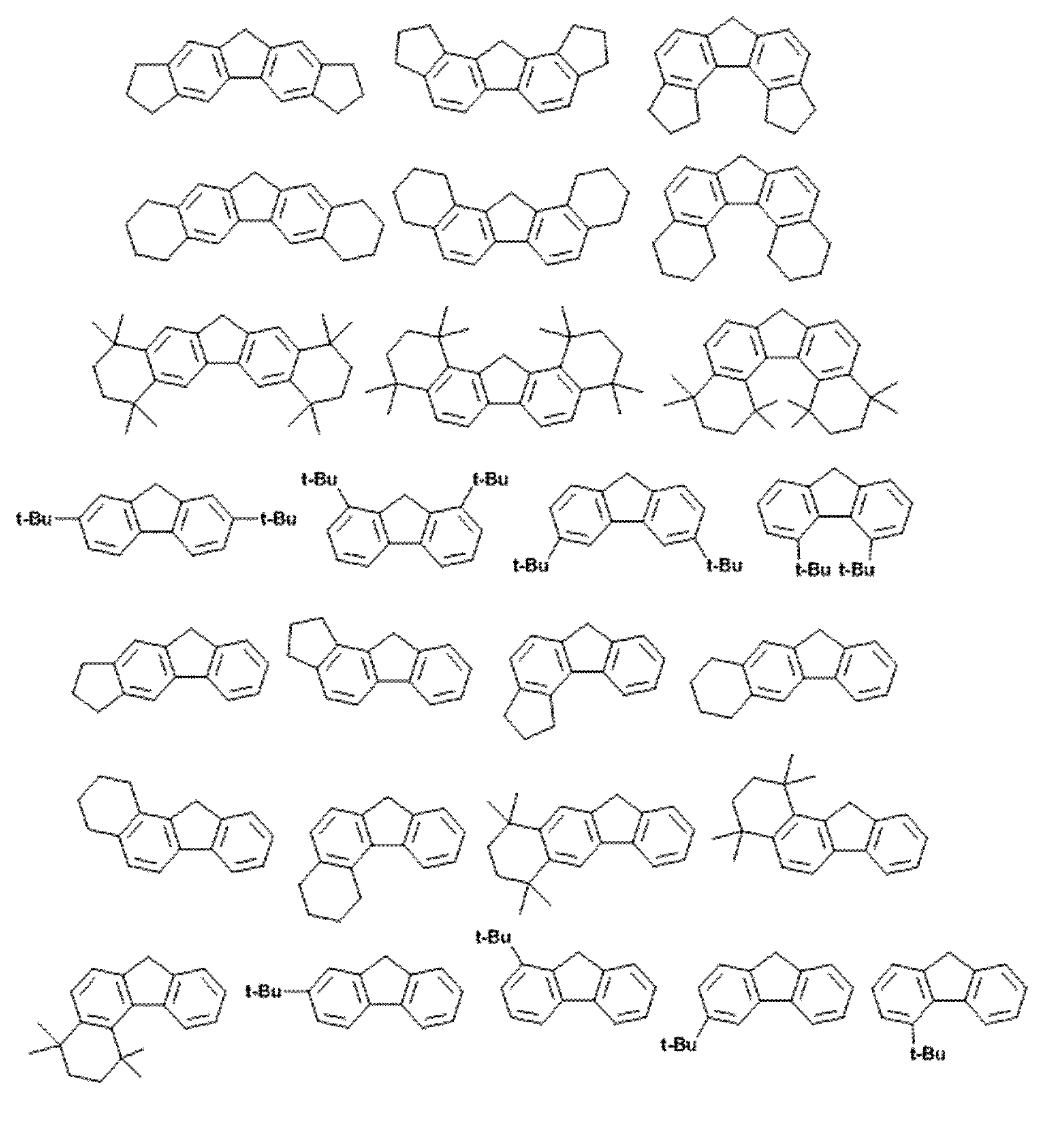
式(a1)中、Mは、周期律表第IV族遷移金属であり、Ti、Zr、又はHfが好ましく、Tiがより好ましい。
以上説明した式(a1)で表されるメタロセン化合物の好適な例としては、以下の構造のメタロセン化合物が挙げられる。

上記の式(a1)で表されるメタロセン化合物は、ノルボルネン系化合物体の単独重合や、ノルボルネン系化合物と、1-オクテン、1-ヘキセン、又はこれらの混合物との共重合に好ましく使用され、ノルボルネンと、1-オクテン、1-ヘキセン、又はこれらの混合物との共重合により好ましく使用される。
以上説明したメタロセン触媒(a)が溶媒である場合、当該溶液に含まれる溶媒は、特に限定されない。好ましい溶媒としては、ペンタン、ヘキサン、ヘプタン、オクタン、シクロヘキサン、ミネラルオイル、ベンゼン、トルエン、及びキシレン等の炭化水素溶媒や、クロロホルム、メチレンクロライド、ジクロロエタン、及びクロロベンゼン等のハロゲン化炭化水素溶媒が挙げられる。
メタロセン触媒(a)の溶液における、メタロセン触媒(a)の濃度は特に限定されない。メタロセン触媒(a)の濃度は、例えば、0.1mmol/L以上0.5mol/L以下が好ましく、1mmol/L以上0.25mol/L以下がより好ましい。
メタロセン触媒(a)の溶液における、メタロセン触媒(a)の濃度は特に限定されない。メタロセン触媒(a)の濃度は、例えば、0.1mmol/L以上0.5mol/L以下が好ましく、1mmol/L以上0.25mol/L以下がより好ましい。
[触媒組成物]
以上説明したメタロセン触媒(a)は、下記のように触媒組成物として使用されるのが好ましい。
触媒組成物は、典型的には、メタロセン触媒(a)の溶液を、アルミノキサン(b1)、及びイオン化合物(b2)からなる群より選択される1種以上と混合する方法により製造される。
ここで、イオン化合物(b2)が、メタロセン触媒(a)との反応によりカチオン性遷移金属化合物を生成する化合物である。
以上説明したメタロセン触媒(a)は、下記のように触媒組成物として使用されるのが好ましい。
触媒組成物は、典型的には、メタロセン触媒(a)の溶液を、アルミノキサン(b1)、及びイオン化合物(b2)からなる群より選択される1種以上と混合する方法により製造される。
ここで、イオン化合物(b2)が、メタロセン触媒(a)との反応によりカチオン性遷移金属化合物を生成する化合物である。
触媒組成物を調製するための、メタロセン触媒(a)の溶液と、アルミノキサン(b1)、及びイオン化合物(b2)からなる群より選択される1種以上との混合は、重合前に、重合反応槽とは別の装置内で行われてもよく、重合反応槽において、重合前、又は重合中に行われてもよい。
以下、触媒組成物の調製に使用される材料や、触媒組成物の調製条件について説明する。
[アルミノキサン(b1)]
アルミノキサン(b1)としては、従来より種々のオレフィンの重合に置いて助触媒等として使用されている種々のアルミノキサンを特に制限なく用いることができる。典型的には、アルミノキサンは有機アルミノキサンである。
触媒組成物の製造に際して、アルミノキサン(b1)は1種を単独で用いてもよく、2種以上を組み合わせて用いてもよい。
アルミノキサン(b1)としては、従来より種々のオレフィンの重合に置いて助触媒等として使用されている種々のアルミノキサンを特に制限なく用いることができる。典型的には、アルミノキサンは有機アルミノキサンである。
触媒組成物の製造に際して、アルミノキサン(b1)は1種を単独で用いてもよく、2種以上を組み合わせて用いてもよい。
アルミノキサン(b1)としては、アルキルアルミノキサンが好ましく用いられる。アルキルアルミノキサンとしては、例えば、下記式(b1-1)又は(b1-2)で表される化合物が挙げられる。下記式(b1-1)又は(b1-2)で表されるアルキルアルミノキサンは、トリアルキルアルミニウムと水との反応により得られる生成物である。

アルキルアルミノキサンとしては、メチルアルミノキサン及びメチルアルミノキサンのメチル基の一部を他のアルキル基で置換した修飾メチルアルミノキサンが挙げられる。修飾メチルアルミノキサンとしては、例えば、置換後のアルキル基として、エチル基、プロピル基、イソプロピル基、ブチル基、イソブチル基等の炭素数2~4のアルキル基を有する修飾メチルアルミノキサンが好ましく、特に、メチル基の一部をイソブチル基で置換した修飾メチルアルミノキサンがより好ましい。アルキルアルミノキサンの具体例としては、メチルアルミノキサン、エチルアルミノキサン、プロピルアルミノキサン、ブチルアルミノキサン、イソブチルアルミノキサン、メチルエチルアルミノキサン、メチルブチルアルミノキサン、メチルイソブチルアルミノキサン等が挙げられ、中でも、メチルアルミノキサン及びメチルイソブチルアルミノキサンが好ましい。
アルキルアルミノキサンは、公知の方法で調製することができる。アルキルアルミノキサンとしては、市販品を用いてもよい。アルキルアルミノキサンの市販品としては、例えば、MMAO-3A、TMAO-200シリーズ、TMAO-340シリーズ(いずれも東ソー・ファインケム(株)製)やメチルアルミノキサン溶液(アルベマール社製)等が挙げられる。
[イオン化合物(b2)]
イオン化合物(b2)は、メタロセン触媒(a)との反応によりカチオン性遷移金属化合物を生成する化合物である。
かかるイオン性化合物としては、テトラキス(ペンタフルオロフェニル)ボレートのアニオン、(CH3)2N(C6H5)H+のような活性プロトンを有するアミンカチオン、(C6H5)3C+のような三置換カルボニウムカチオン、カルボランカチオン、メタルカルボランカチオン、遷移金属を有するフェロセニウムカチオン等のイオン化合物を用いることができる。
イオン化合物(b2)は、メタロセン触媒(a)との反応によりカチオン性遷移金属化合物を生成する化合物である。
かかるイオン性化合物としては、テトラキス(ペンタフルオロフェニル)ボレートのアニオン、(CH3)2N(C6H5)H+のような活性プロトンを有するアミンカチオン、(C6H5)3C+のような三置換カルボニウムカチオン、カルボランカチオン、メタルカルボランカチオン、遷移金属を有するフェロセニウムカチオン等のイオン化合物を用いることができる。
[溶媒]
以上説明したメタロセン触媒(a)、アルミノキサン(b1)、及びイオン化合物(b2)は、通常、溶媒に溶解又は懸濁、好ましくは溶解した状態で用いられる。
溶媒の種類は、本発明の目的を阻害しない範囲で特に限定されない。
好ましい溶媒としては、ペンタン、ヘキサン、ヘプタン、オクタン、シクロヘキサン、ミネラルオイル、ベンゼン、トルエン、及びキシレン等の炭化水素溶媒や、クロロホルム、メチレンクロライド、ジクロロエタン、及びクロロベンゼン等のハロゲン化炭化水素溶媒が挙げられる。
以上説明したメタロセン触媒(a)、アルミノキサン(b1)、及びイオン化合物(b2)は、通常、溶媒に溶解又は懸濁、好ましくは溶解した状態で用いられる。
溶媒の種類は、本発明の目的を阻害しない範囲で特に限定されない。
好ましい溶媒としては、ペンタン、ヘキサン、ヘプタン、オクタン、シクロヘキサン、ミネラルオイル、ベンゼン、トルエン、及びキシレン等の炭化水素溶媒や、クロロホルム、メチレンクロライド、ジクロロエタン、及びクロロベンゼン等のハロゲン化炭化水素溶媒が挙げられる。
溶媒の使用量は、所望する性能の触媒組成物を製造できる限り特に限定されない。典型的には、メタロセン触媒(a)、アルミノキサン(b1)、及びイオン化合物(b2)の濃度が、好ましくは0.00000001~100mol/L、より好ましくは0.00000005~50mol/L、特に好ましくは0.0000001~20mol/Lである量の溶媒が使用される。
触媒組成物の原料を含む液を混合する際、メタロセン触媒(a)中の遷移金属元素のモル数をMaとし、アルミノキサン(b1)中のアルミニウムのモル数をMb1とし、イオン化合物(b2)のモル数をMb2とする場合において、(Mb1+Mb2)/Maの値が、好ましくは1~200000、より好ましくは100~100000、特に好ましくは1000~80000であるように、触媒組成物の原料を含む液が混合されるのが好ましい。
触媒組成物の原料を含む液を混合する温度は特に限定されないが、-100~100℃が好ましく、-50~50℃がより好ましい。
[重合条件]
重合条件は、所望の環状オレフィンポリマーが得られる限り、特に限定されず、公知の条件を用いることができる。重合温度、重合圧力、及び重合時間等は適宜調整される。ノルボルネン系化合物と他の単量体とを共重合する場合の各単量体成分の使用量は、以下のように例示される。
ノルボルネン系化合物1モルに対する他の単量体の添加量として、0.001モル以上30モル以下が好ましく、0.01モル以上20モル以下がより好ましい。
触媒組成物の使用量は、その調製に用いられる遷移金属錯体触媒の使用量から導出される。触媒組成物の使用量は、その調製に用いられた遷移金属錯体触媒の量として、ノルボルネン系化合物1モルに対し、0.000000001モル以上0.005モル以下が好ましく、0.00000001モル以上0.0005モル以下がより好ましい。
重合条件は、所望の環状オレフィンポリマーが得られる限り、特に限定されず、公知の条件を用いることができる。重合温度、重合圧力、及び重合時間等は適宜調整される。ノルボルネン系化合物と他の単量体とを共重合する場合の各単量体成分の使用量は、以下のように例示される。
ノルボルネン系化合物1モルに対する他の単量体の添加量として、0.001モル以上30モル以下が好ましく、0.01モル以上20モル以下がより好ましい。
触媒組成物の使用量は、その調製に用いられる遷移金属錯体触媒の使用量から導出される。触媒組成物の使用量は、その調製に用いられた遷移金属錯体触媒の量として、ノルボルネン系化合物1モルに対し、0.000000001モル以上0.005モル以下が好ましく、0.00000001モル以上0.0005モル以下がより好ましい。
重合温度は、所望する速度で重合反応が進行する限り特に限定されない。重合温度は、典型的には、0℃以上120℃以下であり、10℃以上100℃以下が好ましく、20℃以上90℃以下がより好ましい。
重合時間は特に限定されず、所望する収率に達するか、重合体の分子量が所望する程度に上昇するまで重合が行われる。
重合時間は、温度や、触媒組成物の組成や、単量体組成によっても異なるが、典型的には0.01時間以上120時間以下であり、0.1時間以上80時間以下が好ましく、0.2時間以上10時間以下がより好ましい。
重合時間は特に限定されず、所望する収率に達するか、重合体の分子量が所望する程度に上昇するまで重合が行われる。
重合時間は、温度や、触媒組成物の組成や、単量体組成によっても異なるが、典型的には0.01時間以上120時間以下であり、0.1時間以上80時間以下が好ましく、0.2時間以上10時間以下がより好ましい。
良好な収率で環状オレフィンポリマーを製造しやすい点から、ノルボルネン系化合物、又はノルボルネン系化合物と他の単量体とを含む重合系には、触媒組成物を加える前に、アルミノキサン、及びアルキルアルミニウム化合物から選択される1種以上を存在させるのが好ましい。
アルミノキサンについては、触媒組成物の製造方法において説明した通りである。
アルキルアルミニウム化合物としては、オレフィン類の重合等に従来より用いられているものを特に限定なく使用できる。アルキルアルミニウム化合物としては、例えば、下記一般式(II)で示される化合物が挙げられる。
(R10)zAlX3-z (II)
(式(II)中、R10は炭素原子数が1以上15以下、好ましくは1以上8以下のアルキル基であり、Xはハロゲン原子又は水素原子であり、zは1以上3以下の整数である。)
アルキルアルミニウム化合物としては、オレフィン類の重合等に従来より用いられているものを特に限定なく使用できる。アルキルアルミニウム化合物としては、例えば、下記一般式(II)で示される化合物が挙げられる。
(R10)zAlX3-z (II)
(式(II)中、R10は炭素原子数が1以上15以下、好ましくは1以上8以下のアルキル基であり、Xはハロゲン原子又は水素原子であり、zは1以上3以下の整数である。)
炭素原子数が1以上15以下のアルキル基としては、例えば、メチル基、エチル基、n-プロピル基、イソプロピル基、n-ブチル基、イソブチル基、n-オクチル基等が挙げられる。
アルキルアルミニウム化合物の具体例としては、トリメチルアルミニウム、トリエチルアルミニウム、トリイソプロピルアルミニウム、トリn-ブチルアルミニウム、トリイソブチルアルミニウム、トリsec-ブチルアルミニウム、トリn-オクチルアルミニウム等のトリアルキルアルミニウム;ジメチルアルミニウムクロリド、ジイソブチルアルミニウムクロリド等のジアルキルアルミニウムハライド;ジイソブチルアルミニウムハイドライド等のジアルキルアルミニウムハイドライド;ジメチルアルミニウムメトキシド等のジアルキルアルミニウムアルコキシドが挙げられる。
かかるアルキルアルミニウム化合物は連鎖移動剤として作用し、前述の触媒組成物により触媒される連鎖重合を促進させる。
触媒組成物を加える前に、重合系にアルミノキサンを加える場合の使用量は、遷移金属錯体触媒1モルに対するアルミノキサン中のアルミニウムのモル数として、10モル以上1000000モル以下が好ましく、100モル以上100000モル以下がより好ましい。
触媒組成物を加える前に、重合系にアルキルアルミニウム化合物を加える場合の使用量は、遷移金属錯体触媒1モルに対するアルミニウムのモル数として、5モル以上500000モル以下が好ましく、50モル以上50000モル以下がより好ましい。
触媒組成物を加える前に、重合系にアルキルアルミニウム化合物を加える場合の使用量は、遷移金属錯体触媒1モルに対するアルミニウムのモル数として、5モル以上500000モル以下が好ましく、50モル以上50000モル以下がより好ましい。
触媒組成物の少なくとも一部、好ましくは全部は、重合系に、連続的に添加されるのが好ましい。
触媒組成物を連続的に添加することにより、環状オレフィンポリマーの連続製造が可能になり、環状オレフィンポリマーの製造コストを低減させることが可能になる。
触媒組成物を連続的に添加することにより、環状オレフィンポリマーの連続製造が可能になり、環状オレフィンポリマーの製造コストを低減させることが可能になる。
以上説明した方法によれば、エポキシド不純物を含む粗製ノルボルネン系化合物を、活性アルミナとゼオライトとの混合物からなるハイブリッド系吸着剤を用いて処理することによって、単量体中のエポキシド不純物を低減させることができる。その結果として、重合に供される重合溶液の全質量に対するエポキシド不純物の含有量と触媒の含有量との比率(質量ppm/質量ppm)を、6以下とすることにより、重合条件に見合った期待される収率で、安定して環状オレフィンポリマーを製造することができる。
以下、実施例を示し、本発明を具体的に説明するが、本発明はこれらの実施例に限定されるものではない。
〔実施例1~3、比較例1、比較例2、及び参考例1〕
表1に記載の量のエポキシド不純物を含むノルボルネン系化合物を、濃度75質量%で含むトルエン溶液と、ノルボルネン系化合物の質量に対して20質量%の表1に記載の種類の吸着剤とを、不活性ガス雰囲気のガラス容器中で混合した。エポキシド不純物は2,3-エポキシノルボルナンであった。ノルボルネン系化合物はノルボルネンであった。次いで、ガラス容器の内容物を、室温にて24時間静置して、エポキシド不純物の吸着処理を行った。
表1に記載の量のエポキシド不純物を含むノルボルネン系化合物を、濃度75質量%で含むトルエン溶液と、ノルボルネン系化合物の質量に対して20質量%の表1に記載の種類の吸着剤とを、不活性ガス雰囲気のガラス容器中で混合した。エポキシド不純物は2,3-エポキシノルボルナンであった。ノルボルネン系化合物はノルボルネンであった。次いで、ガラス容器の内容物を、室温にて24時間静置して、エポキシド不純物の吸着処理を行った。
表1に記載の吸着剤は以下の通りである。
AB1:活性アルミナとゼオライトとからなるハイブリッド系吸着剤(AZ-300、ユニオン昭和製)
AB2:モレキュラーシーブ(MS-4A)
表1に記載の不純物について以下の通りである。
EP:エポキシド不純物(2,3-エポキシノルボルナン)
AL:ノルボルネンに由来するアルデヒド不純物
KE:ノルボルネンに由来するケトン不純物
AB1:活性アルミナとゼオライトとからなるハイブリッド系吸着剤(AZ-300、ユニオン昭和製)
AB2:モレキュラーシーブ(MS-4A)
表1に記載の不純物について以下の通りである。
EP:エポキシド不純物(2,3-エポキシノルボルナン)
AL:ノルボルネンに由来するアルデヒド不純物
KE:ノルボルネンに由来するケトン不純物
表1に記載の、吸着剤処理前の不純物量は、ノルボルネン系化合物のトルエン溶液中での、ノルボルネン系化合物の質量に対する各不純物の量(質量ppm)である。
ノルボルネン系化合物のトルエン溶液中での、ノルボルネン系化合物の質量に対する各不純物の量(質量ppm)は、以下の装置を用い、以下の条件に従い測定した。
<不純物量測定装置及び測定条件>
[装置]
分析装置: GC/MS(7890A/5975C)
インジェクタ: 7683B
注入量: 1μl
キャリアガス: He
[GC(ガスクロマトグラフ)情報]
(注入口)
モード: スプリット
スプリット比: 30:1
ヒーター温度: 300℃
(カラム)
カラム名: FRONTIER UltraALLOY+-5
寸法: 30m×250μm×0.25μm
流量: 1mL/min.
[MS(質量分析装置)情報]
測定モード: スキャン法
溶媒待ち時間: 5.5min
スキャン範囲 15~650m/z
イオン源温度: 230℃
四重極温度: 150℃
定性法: EP標準サンプルを測定し、リテンションタイム・MSスペクトルより判断。
定量法: EP標準サンプルより検量線を作製し、定量した。AL、KEについても、EP感度と同程度と仮定しEP検量線より定量を行った。
ノルボルネン系化合物のトルエン溶液中での、ノルボルネン系化合物の質量に対する各不純物の量(質量ppm)は、以下の装置を用い、以下の条件に従い測定した。
<不純物量測定装置及び測定条件>
[装置]
分析装置: GC/MS(7890A/5975C)
インジェクタ: 7683B
注入量: 1μl
キャリアガス: He
[GC(ガスクロマトグラフ)情報]
(注入口)
モード: スプリット
スプリット比: 30:1
ヒーター温度: 300℃
(カラム)
カラム名: FRONTIER UltraALLOY+-5
寸法: 30m×250μm×0.25μm
流量: 1mL/min.
[MS(質量分析装置)情報]
測定モード: スキャン法
溶媒待ち時間: 5.5min
スキャン範囲 15~650m/z
イオン源温度: 230℃
四重極温度: 150℃
定性法: EP標準サンプルを測定し、リテンションタイム・MSスペクトルより判断。
定量法: EP標準サンプルより検量線を作製し、定量した。AL、KEについても、EP感度と同程度と仮定しEP検量線より定量を行った。
吸着剤による24時間処理後のノルボルネン系化合物のトルエン溶液中での、ノルボルネン系化合物の質量に対する各不純物の量(質量ppm)についても、処理前のトルエン容器と同様に測定した。
測定結果を表1に記す。
測定結果を表1に記す。
次いで、濃度7.3mmol/Lのメタロセン触媒のトルエン溶液を調製した。メタロセン触媒の構造は、下記の通りである。その後、メタロセン触媒のトルエン溶液を用いて、以下の方法に従い、ノルボルネン(2-ノルボルネン)と、1-ヘキセンとの共重合を行った。

窒素雰囲気下に保たれた、乾燥した200mL二口ガラス反応器に、2-ノルボルネンと、1-ヘキセンとの混合物を、濃度54質量%のトルエン溶液として添加した。混合物のモル比は、2-ノルボルネン/1-ヘキセンとして36/64であった。
MMAO-3AとTMAO-211を、それぞれモル比として、MMAO-3A/メタロセン触媒が1250になり、TMAO-211/メタロセン触媒が1100になるようにガラス反応器に加えた。ガラス反応器を40℃の水浴に十分浸した後、メタロセン触媒のトルエン溶液をガラス反応器内に添加することで重合を開始させた。
重合の開始時に、単量体としての2-ノルボルネン及び1-ヘキセンと、溶媒としてのトルエンと、助触媒としての2種のMAOと、メタロセン触媒とからなる「重合溶液」中の、EP、AL、及びKEの含有量(質量ppm)を、前述の方法に従い測定した。「重合溶液中」のメタロセン触媒の含有量(質量ppm)の計算値に基づいて、重合溶液中における不純物含有量/触媒含有量の比率(質量ppm/質量ppm)を求めた。重合溶液中における不純物含有量/触媒含有量の比率(質量ppm/質量ppm)を、表1に記す。
MMAO-3AとTMAO-211を、それぞれモル比として、MMAO-3A/メタロセン触媒が1250になり、TMAO-211/メタロセン触媒が1100になるようにガラス反応器に加えた。ガラス反応器を40℃の水浴に十分浸した後、メタロセン触媒のトルエン溶液をガラス反応器内に添加することで重合を開始させた。
重合の開始時に、単量体としての2-ノルボルネン及び1-ヘキセンと、溶媒としてのトルエンと、助触媒としての2種のMAOと、メタロセン触媒とからなる「重合溶液」中の、EP、AL、及びKEの含有量(質量ppm)を、前述の方法に従い測定した。「重合溶液中」のメタロセン触媒の含有量(質量ppm)の計算値に基づいて、重合溶液中における不純物含有量/触媒含有量の比率(質量ppm/質量ppm)を求めた。重合溶液中における不純物含有量/触媒含有量の比率(質量ppm/質量ppm)を、表1に記す。
5時間の重合時間後、2-プロパノールを添加して反応を終了させた。次いで、得られた重合反応液を多量の塩酸酸性アセトンに注いで重合体を完全に析出させ、濾別及び洗浄を行った。洗浄された析出物を、110℃で1日間以上減圧乾燥して共重合体を得た。
共重合体の収量より、重合後の収率を求めた。収率を表1に記す。
共重合体の収量より、重合後の収率を求めた。収率を表1に記す。
MMAO-3Aは、[(CH3)0.7(iso-C4H9)0.3AlO]nで表されるメチルイソブチルアルミノキサンをAl原子の含有量として濃度6.5質量%で含むトルエン溶液(東ソー・ファインケム(株)製)である。TMAO-211は、濃度9.0質量%(Al原子の含有量として)のメチルアルミノキサンをAl原子の含有量として濃度9.0質量%で含むトルエン溶液(東ソー・ファインケム(株)製)である。MMAO-3Aは、全Alに対して6mol%のトリメチルアルミニウムを含む。TMAO-211は、全Alに対して26mol%のトリメチルアルミニウムを含む。
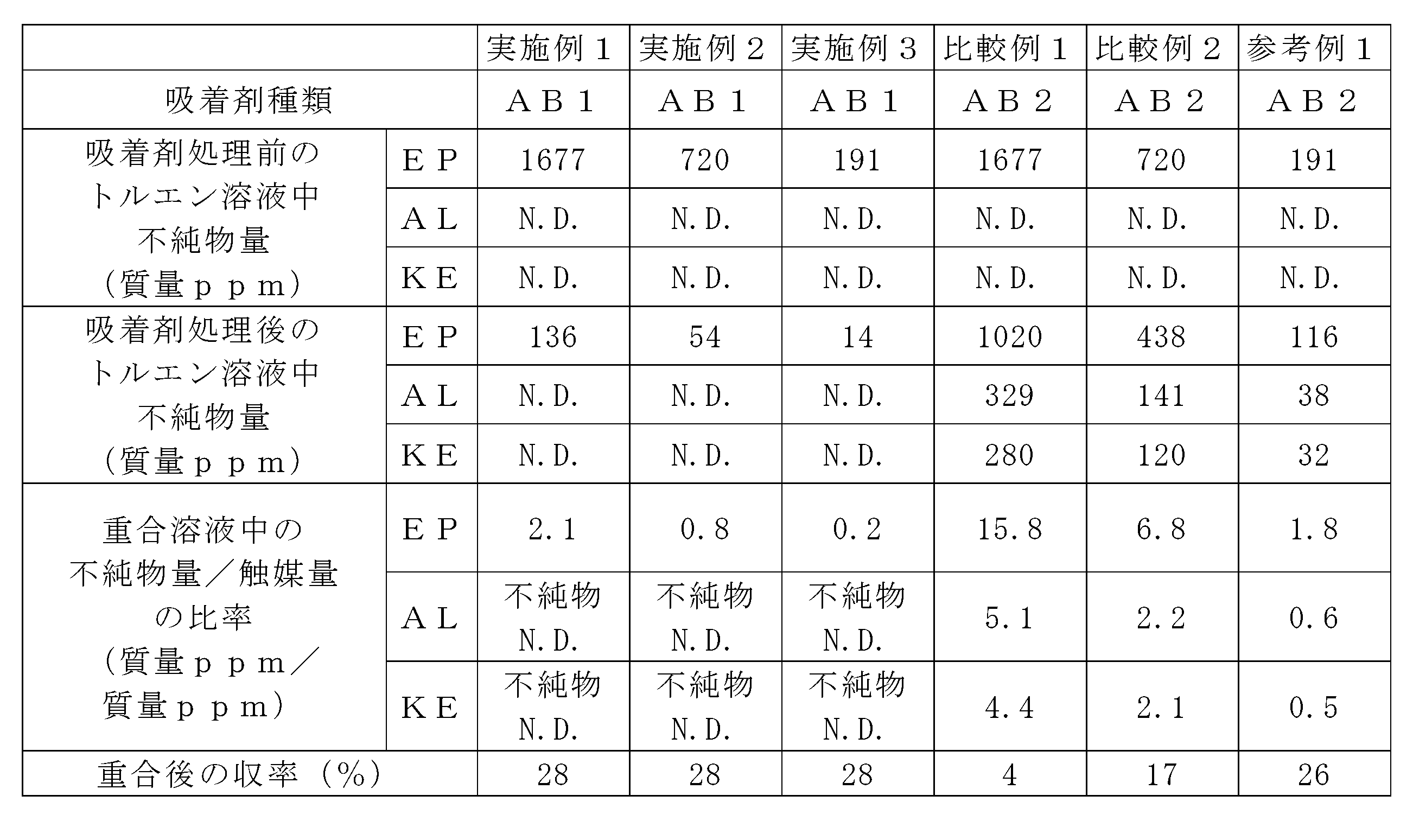
実施例1~3によれば、吸着剤として、活性アルミナとゼオライトとの混合物からなるハイブリッド系吸着剤(AB1)を用いることによって、エポキシ不純物(EP)を含むノルボルネンから良好にエポキシ不純物(EP)を除去できることが分かる。
また、実施例1~3によれば、重合に供される重合溶液に対する、エポキシド不純物(EP)の含有量と触媒の含有量との比率(質量ppm/質量ppm)が、6以下であれば、良好な収率で、環状オレフィンポリマーが得られることが分かる。
また、実施例1~3によれば、重合に供される重合溶液に対する、エポキシド不純物(EP)の含有量と触媒の含有量との比率(質量ppm/質量ppm)が、6以下であれば、良好な収率で、環状オレフィンポリマーが得られることが分かる。
他方、比較例1及び比較例2によれば、モレキュラーシーブ(AB2)を吸着剤として用いる場合、エポキシ不純物(EP)を含むノルボルネンから良好にエポキシ不純物(EP)を除去しにくいため、重合溶液に対する、エポキシド不純物(EP)の含有量と触媒の含有量との比率(質量ppm/質量ppm)が高く、その結果、良好な収率で環状オレフィンポリマーを得にくいことが分かる。
また、比較例1、比較例2、及び参考例1によれば、吸着剤としてモレキュラーシーブ(AB2)を用いる場合、アルデヒド不純物(AL)と、ケトン不純物(KE)とが吸着剤による処理中に発生し得ることが判る。
吸着剤処理後のトルエン溶液中のエポキシ不純物(EP)量が近い、実施例1と、参考例1との比較によれば、アルデヒド不純物(AL)と、ケトン不純物(KE)とが、環状オレフィンポリマーの重合収率の低下の要因となり得ることが推察される。
吸着剤処理後のトルエン溶液中のエポキシ不純物(EP)量が近い、実施例1と、参考例1との比較によれば、アルデヒド不純物(AL)と、ケトン不純物(KE)とが、環状オレフィンポリマーの重合収率の低下の要因となり得ることが推察される。
Claims (9)
- エポキシド不純物を含むノルボルネン系化合物を含有する単量体を重合させることによる環状オレフィンポリマーの製造方法であって、
前記エポキシド不純物を含む粗製ノルボルネン系化合物を吸着剤と接触させることにより、精製ノルボルネン系化合物を得ることと、
前記精製ノルボルネン系化合物を含有する前記単量体を、遷移金属錯体触媒の存在下に重合させることと、を含み、
前記ノルボルネン系化合物が、ノルボルネン、及び下記式(I):

R9~R12より選択される2つの基は、互いに結合して、飽和脂肪族炭化水素環、又は芳香族炭化水素環を形成してもよく、
nは、0又は正の整数を示し、
nが2以上の場合には、R5~R8は、それぞれの繰り返し単位の中で、それぞれ同一でも異なっていてもよく、
ただし、n=0の場合、R1~R4及びR9~R12の少なくとも1個は、水素原子ではない。)
で表される置換ノルボルネンからなる群より選択される1種以上の化合物であり、
前記エポキシド不純物が、2,3-エポキシノルボルナン、及び/又は前記式(I)で表される置換ノルボルネンにおける、炭素-炭素不飽和二重結合が酸化されたエポキシ化合物であり、
前記吸着剤が、活性アルミナとゼオライトとの混合物からなるハイブリッド系吸着剤であり、
重合に供される重合溶液の全質量に対する前記エポキシド不純物の含有量と触媒の含有量との比率(質量ppm/質量ppm)が、6以下であり、
前記重合溶液の全質量は、前記環状オレフィンポリマーの製造に使用される原料の質量の総量である、製造方法。 - 前記重合溶液の全質量に対する前記ノルボルネン系化合物に由来するアルデヒド不純物の含有量と触媒の含有量との比率(質量ppm/質量ppm)が、2以下である、請求項1に記載の環状オレフィンポリマーの製造方法。
- 前記重合溶液の全質量に対する前記ノルボルネン系化合物に由来するケトン不純物の含有量と触媒の含有量との比率(質量ppm/質量ppm)が、2以下である、請求項1又は2に記載の環状オレフィンポリマーの製造方法。
- 前記吸着剤の量が、前記粗製ノルボルネン系化合物100質量部に対して、1質量部以上である、請求項1~3のいずれか1項に記載の環状オレフィンポリマーの製造方法。
- 前記遷移金属錯体触媒がメタロセン触媒である、請求項1~4のいずれか1項に記載の環状オレフィンポリマーの製造方法。
- 前記メタロセン触媒が、シクロペンタジエン環を含む配位子と、周期律表第IV族遷移金属とを含む遷移金属錯体である、請求項5に記載の環状オレフィンポリマーの製造方法。
- 前記メタロセン触媒を、アルミノキサン(b1)、及びイオン化合物(b2)からなる群より選択される1種以上と反応させて、カチオン性遷移金属化合物を生成させる、請求項6に記載の環状オレフィンポリマーの製造方法。
- 前記周期律表第IV族遷移金属が、Ti、Zr、又はHfである、請求項6又は7に記載の環状オレフィンポリマーの製造方法。
- 前記単量体が、前記ノルボルネン系化合物とともに、エチレン、1-ヘキセン、及び1-オクテンからなる群より選択される1種以上を含む、請求項1~8の環状オレフィンポリマーの製造方法。
Applications Claiming Priority (2)
| Application Number | Priority Date | Filing Date | Title |
|---|---|---|---|
| JP2018190432A JP6886955B2 (ja) | 2018-10-05 | 2018-10-05 | 環状オレフィンポリマーの製造方法 |
| JP2018-190432 | 2018-10-05 |
Publications (1)
| Publication Number | Publication Date |
|---|---|
| WO2020071494A1 true WO2020071494A1 (ja) | 2020-04-09 |
Family
ID=70055260
Family Applications (1)
| Application Number | Title | Priority Date | Filing Date |
|---|---|---|---|
| PCT/JP2019/039165 Ceased WO2020071494A1 (ja) | 2018-10-05 | 2019-10-03 | 環状オレフィンポリマーの製造方法 |
Country Status (2)
| Country | Link |
|---|---|
| JP (1) | JP6886955B2 (ja) |
| WO (1) | WO2020071494A1 (ja) |
Families Citing this family (2)
| Publication number | Priority date | Publication date | Assignee | Title |
|---|---|---|---|---|
| WO2020204188A1 (ja) * | 2019-04-04 | 2020-10-08 | ポリプラスチックス株式会社 | 環状オレフィン共重合体の製造方法 |
| JP2023005379A (ja) * | 2021-06-29 | 2023-01-18 | 三井化学株式会社 | 環状オレフィン系共重合体組成物の製造方法、環状オレフィン系共重合体組成物、成形体、成形体の製造方法および光学レンズ |
Citations (4)
| Publication number | Priority date | Publication date | Assignee | Title |
|---|---|---|---|---|
| JPH05132523A (ja) * | 1991-11-11 | 1993-05-28 | Idemitsu Kosan Co Ltd | 環状オレフイン系重合体の製造方法 |
| JP2000204120A (ja) * | 1999-01-18 | 2000-07-25 | Mitsui Chemicals Inc | ノルボルネン系重合体の製造方法 |
| JP2005145855A (ja) * | 2003-11-13 | 2005-06-09 | Mitsui Chemicals Inc | 環状オレフィン組成物および環状オレフィン系重合体の製造方法 |
| JP2016522309A (ja) * | 2013-06-25 | 2016-07-28 | エクソンモービル ケミカル パテンツ インコーポレイテッド | オレフィン重合における触媒抑制の軽減 |
-
2018
- 2018-10-05 JP JP2018190432A patent/JP6886955B2/ja active Active
-
2019
- 2019-10-03 WO PCT/JP2019/039165 patent/WO2020071494A1/ja not_active Ceased
Patent Citations (4)
| Publication number | Priority date | Publication date | Assignee | Title |
|---|---|---|---|---|
| JPH05132523A (ja) * | 1991-11-11 | 1993-05-28 | Idemitsu Kosan Co Ltd | 環状オレフイン系重合体の製造方法 |
| JP2000204120A (ja) * | 1999-01-18 | 2000-07-25 | Mitsui Chemicals Inc | ノルボルネン系重合体の製造方法 |
| JP2005145855A (ja) * | 2003-11-13 | 2005-06-09 | Mitsui Chemicals Inc | 環状オレフィン組成物および環状オレフィン系重合体の製造方法 |
| JP2016522309A (ja) * | 2013-06-25 | 2016-07-28 | エクソンモービル ケミカル パテンツ インコーポレイテッド | オレフィン重合における触媒抑制の軽減 |
Non-Patent Citations (1)
| Title |
|---|
| "UOP LLC, UOP Adsorbents; Purification of olefin and polymer process streams", 20 July 2011 (2011-07-20), XP055699386, Retrieved from the Internet <URL:https://www.uop.com/wp-content/uploads/2012/12/UOP-Adsorbents-for-purification-of-olefin-and-polymer-process-stream> * |
Also Published As
| Publication number | Publication date |
|---|---|
| JP2020059779A (ja) | 2020-04-16 |
| JP6886955B2 (ja) | 2021-06-16 |
Similar Documents
| Publication | Publication Date | Title |
|---|---|---|
| JP4689829B2 (ja) | オレフィンの共重合用の架橋されたメタロセン | |
| JP6076910B2 (ja) | 溶液重合方法及びそれに有用な前駆触媒担体系 | |
| JP5795119B2 (ja) | オレフィン重合体の製造方法 | |
| KR101207294B1 (ko) | 담지된 비-메탈로센 촉매 및 이의 제조방법 | |
| JP6511151B2 (ja) | ポリオレフィンの製造方法 | |
| KR102100134B1 (ko) | 신규한 전이금속 화합물, 이를 포함하는 촉매 조성물, 및 이를 이용한 에틸렌 단독중합체 또는 에틸렌과 α-올레핀의 공중합체의 제조방법 | |
| CN115734975A (zh) | 环状烯烃共聚物的制造方法、和降冰片烯单体与乙烯的共聚用的催化剂组合物 | |
| KR102028736B1 (ko) | 혼성 담지 메탈로센 촉매의 제조방법 및 이를 이용하여 제조된 혼성 담지 메탈로센 촉매 | |
| KR20160067508A (ko) | 혼성 담지 메탈로센 촉매의 제조방법 및 이를 이용하여 제조된 혼성 담지 메탈로센 촉매 | |
| WO2020071494A1 (ja) | 環状オレフィンポリマーの製造方法 | |
| WO2020204188A1 (ja) | 環状オレフィン共重合体の製造方法 | |
| JP7150428B2 (ja) | 環状オレフィン重合用の触媒組成物の製造方法、及び環状オレフィン樹脂組成物の製造方法 | |
| JP7101063B2 (ja) | メタロセン触媒の触媒活性の検定方法、オレフィンモノマー重合用の触媒組成物の製造方法、及びポリマーの製造方法 | |
| JP2013510908A (ja) | 担持型非メタロセン触媒、その製造方法およびその使用 | |
| JP5750271B2 (ja) | オレフィン重合体の製造方法 | |
| KR20120007033A (ko) | Oh 기의 분포가 제어되어 있는 활성화 지지체 | |
| JP7073100B2 (ja) | 環状オレフィン樹脂組成物の製造方法 | |
| CN106632751A (zh) | 一种催化剂的制备方法和制得的催化剂及其应用 | |
| CN113788862B (zh) | 一种双核茂金属化合物及其制备方法和应用 | |
| US7666961B2 (en) | Olefin polymerization process | |
| EP2500364B1 (en) | Supported non-metallocene catalyst preparation method and application thereof | |
| JP7329720B1 (ja) | 環状オレフィン共重合体の製造方法及び触媒組成物 | |
| KR20190063721A (ko) | 생산성이 향상된 폴리올레핀의 제조 방법 | |
| CN118852509A (zh) | 一种烯烃聚合用催化剂组合物、聚合方法及其应用 | |
| CN1268073A (zh) | 预聚合的烯烃聚合催化剂的制备和使用方法 |
Legal Events
| Date | Code | Title | Description |
|---|---|---|---|
| 121 | Ep: the epo has been informed by wipo that ep was designated in this application |
Ref document number: 19868931 Country of ref document: EP Kind code of ref document: A1 |
|
| NENP | Non-entry into the national phase |
Ref country code: DE |
|
| 122 | Ep: pct application non-entry in european phase |
Ref document number: 19868931 Country of ref document: EP Kind code of ref document: A1 |