WO2020056599A1 - 粘合胶与柔性显示面板 - Google Patents
粘合胶与柔性显示面板 Download PDFInfo
- Publication number
- WO2020056599A1 WO2020056599A1 PCT/CN2018/106290 CN2018106290W WO2020056599A1 WO 2020056599 A1 WO2020056599 A1 WO 2020056599A1 CN 2018106290 W CN2018106290 W CN 2018106290W WO 2020056599 A1 WO2020056599 A1 WO 2020056599A1
- Authority
- WO
- WIPO (PCT)
- Prior art keywords
- adhesive
- ambient temperature
- flexible
- display panel
- flexible display
- Prior art date
- Legal status (The legal status is an assumption and is not a legal conclusion. Google has not performed a legal analysis and makes no representation as to the accuracy of the status listed.)
- Ceased
Links
Images
Classifications
-
- H—ELECTRICITY
- H10—SEMICONDUCTOR DEVICES; ELECTRIC SOLID-STATE DEVICES NOT OTHERWISE PROVIDED FOR
- H10K—ORGANIC ELECTRIC SOLID-STATE DEVICES
- H10K59/00—Integrated devices, or assemblies of multiple devices, comprising at least one organic light-emitting element covered by group H10K50/00
- H10K59/80—Constructional details
- H10K59/87—Passivation; Containers; Encapsulations
- H10K59/871—Self-supporting sealing arrangements
-
- H—ELECTRICITY
- H10—SEMICONDUCTOR DEVICES; ELECTRIC SOLID-STATE DEVICES NOT OTHERWISE PROVIDED FOR
- H10K—ORGANIC ELECTRIC SOLID-STATE DEVICES
- H10K59/00—Integrated devices, or assemblies of multiple devices, comprising at least one organic light-emitting element covered by group H10K50/00
- H10K59/80—Constructional details
- H10K59/87—Passivation; Containers; Encapsulations
- H10K59/871—Self-supporting sealing arrangements
- H10K59/8722—Peripheral sealing arrangements, e.g. adhesives, sealants
Definitions
- the present application relates to the field of flexible display technology, and in particular, to an adhesive and a flexible display panel.
- the flexible display panel includes multiple layers of flexible film materials, such as a flexible cover plate, a flexible touch panel, a flexible polarizer, and a flexible OLED panel.
- flexible film materials such as a flexible cover plate, a flexible touch panel, a flexible polarizer, and a flexible OLED panel.
- the present application provides an adhesive and a flexible display panel to effectively improve the bending resistance of the flexible display panel.
- the adhesive of the embodiment of the present application is used for a flexible display panel.
- the adhesive includes acrylate, polyethylene glycol, and additives.
- the weight ratios of the acrylate, polyethylene glycol and additives to the adhesive are respectively 30% to 80% of acrylate, 19% to 65% of polyethylene glycol, and 0.1% to 5% of additives.
- the adhesive of the embodiment of the present application has excellent mechanical properties.
- the adhesive can better absorb the stress of the flexible display panel when it is bent to make it flexible.
- the display panel has better bending characteristics and reduces the stress on the flexible film, thereby protecting the performance and appearance of the flexible display panel.
- the flexible display panel according to the embodiment of the present application includes at least two layers of flexible film material and the above-mentioned adhesive glue, and the adhesive glue bonds two adjacent flexible film materials.
- the adhesive in the flexible display panel of the embodiment of the present application has excellent mechanical properties.
- the adhesive can better absorb the bending of the flexible display panel.
- the stress of the flexible display panel has better bending characteristics, reduces the stress on the flexible film material, and thus increases the service life of the flexible display panel.
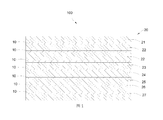
- FIG. 1 is a schematic cross-sectional view of a flexible display panel according to an embodiment of the present application.
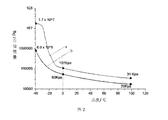
- FIG. 2 is a schematic diagram of a storage modulus of an adhesive glue according to an embodiment of the present application and a storage modulus of a conventional optical glue.
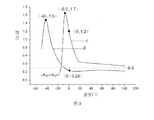
- FIG. 3 is a schematic diagram of the damping of the adhesive glue and the damping of the conventional optical glue according to the embodiment of the present application.
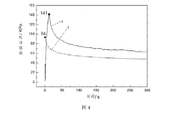
- FIG. 4 is a schematic diagram of a loss modulus of an adhesive glue according to an embodiment of the present application and a loss modulus of a conventional optical glue.
- FIG. 5 is a schematic diagram of the loss modulus of the adhesive according to the embodiment of the present application at different temperatures.
- first and second are used for descriptive purposes only, and cannot be understood as indicating or implying relative importance or implicitly indicating the number of technical features indicated. Therefore, the features defined as “first” and “second” may explicitly or implicitly include one or more of the features. In the description of the present application, the meaning of "a plurality" is two or more, unless specifically defined otherwise.
- the "first" or “under” of the second feature may include the first and second features in direct contact, and may also include the first and second features. Not directly, but through another characteristic contact between them.
- the first feature is “above”, “above”, and “above” the second feature, including that the first feature is directly above and obliquely above the second feature, or merely indicates that the first feature is higher in level than the second feature.
- the first feature is “below”, “below”, and “below” of the second feature, including the fact that the first feature is directly below and obliquely below the second feature, or merely indicates that the first feature is less horizontal than the second feature.
- this application provides an adhesive 10 and a flexible display panel 100.
- the flexible display panel 100 can be applied to a flexible display device.
- Flexible display devices include, but are not limited to, smart terminals and display devices such as smart phones, smart computers, smart watches, and wearable smart products.
- the adhesive 10 is used for a flexible display panel 100, wherein the adhesive 10 includes acrylate, polyethylene glycol, and additives.
- the weight ratios of the acrylate, polyethylene glycol and additives to the adhesive are respectively 30% to 80% of acrylate, 19% to 65% of polyethylene glycol, and 0.1% to 5% of additives.
- the storage modulus of the adhesive 10 is 20Kpa to 800Kpa.
- the storage modulus of the adhesive 10 decreases as the ambient temperature increases;
- the loss modulus of the adhesive 10 is 4Kpa ⁇ 12Kpa, the loss modulus of the adhesive 10 decreases as the ambient temperature increases.
- the adhesive 10 of the embodiment of the present application has excellent mechanical properties.
- the adhesive 10 can better absorb the bending of the flexible display panel 100. Stress, and the adhesive 10 itself has better deformation ability, so that the flexible display panel 100 has better bending characteristics, reduces the stress on the flexible film 20, and thereby protects the performance and appearance of the flexible display panel 100. normal.
- the adhesive glue 10 may be liquid or solid.
- the components of the adhesive 10 provided in the present application are mixed to obtain the adhesive 10 in a liquid state.
- the raw materials of the adhesive 10 are stirred at a temperature of 20 to 60 ° C. for 1 to 5 hours, and then evacuated and left to stand.
- the rotation speed can be controlled between 30 and 500 r / min.
- the stirring time is selected according to the stirring rate and the stirring amount. After the stirring is completed, a vacuum is drawn. After the vacuum is left, the uncured adhesive 10 is obtained.
- Example 1 of the present application the weight percentages of the specific components of the adhesive 10 are:
- Acrylate 30%, polyethylene glycol: 65%, additives: 5%. Among them, ethylenediamine is used as an additive.
- the components of the adhesive 10 provided in the above embodiments are mixed in the above proportions and then cured and formed to obtain a solid adhesive 10. Specifically, the raw materials of the adhesive 10 are stirred at a temperature of 20-60 ° C. for 1-5 hours, and then left to stand after being evacuated, and then coated and cured.
- the storage modulus of the optical adhesive 10 obtained in the above Example 1 is 50 Kpa to 800 Kpa, the loss modulus is 6 Kpa to 12 Kpa, the damping range is 0.5 to 1.5, and the relaxation modulus is 500 Kpa to 800 Kpa.
- Example 2 of the present application the weight percentages of the specific components of the adhesive 10 are:
- Acrylate 69%, polyethylene glycol: 30%, additive: 1%. Among them, ethylenediamine is used as an additive.
- the components of the adhesive 10 provided in the above embodiments are mixed and cured to obtain a solid adhesive 10. Specifically, the raw materials of the adhesive 10 are stirred at a temperature of 20-60 ° C. for 1-5 hours, and then left to stand after being evacuated, and then coated and cured.
- the storage modulus of the optical adhesive 10 obtained in the above Example 2 is 20 Kpa to 750 Kpa, the loss modulus is 4 Kpa to 11 Kpa, the damping range is 0.24 to 1.4, and the relaxation modulus is 400 Kpa to 750 Kpa.
- Example 3 of the present application the weight percentages of the specific components of the adhesive 10 are:
- Acrylate 80%, polyethylene glycol: 19.9%, additives: 0.1%. Among them, ethylenediamine is used as an additive.
- the components of the adhesive 10 provided in the above embodiments are mixed and cured to obtain a solid adhesive 10. Specifically, the raw materials of the adhesive 10 are stirred at a temperature of 20-60 ° C. for 1-5 hours, and then left to stand after being evacuated, and then coated and cured.
- the storage modulus of the optical adhesive 10 obtained in the above Example 3 is 80 Kpa to 800 Kpa, the loss modulus is 7 Kpa to 12 Kpa, the damping range is 0.4 to 1.5, and the relaxation modulus is 400 Kpa to 750 Kpa.
- controlling the temperature within a certain range during the mixing of the components of the adhesive 10 can improve the uniformity and the mixing rate of the mixture on the one hand, and prevent the temperature of the adhesive 10 from being too high on the other hand. Make an impact.
- an ultraviolet irradiation method may be adopted in the curing molding process, and the ultraviolet wavelength is 100-450 nm.
- the components of the uniformly mixed adhesive 10 can absorb energy of a certain wavelength to generate free radicals, cations, etc., and then trigger monomer polymerization, crosslinking, and curing to obtain a stable and uniform adhesive 10 .
- the additive may be a mixture of a dispersant and an adhesive. Further, at an ambient temperature of 0 to 100 ° C., the storage modulus of the adhesive 10 ranges from 50 Kpa to 40 Kpa, and the loss modulus of the adhesive 10 ranges from 10 Kpa to 8 Kpa.
- acrylate is a monomer for manufacturing adhesives, synthetic resins, special rubbers, and plastics, and is the main material of the adhesive 10.
- Polyethylene glycol is non-toxic, non-irritating, good water solubility, excellent lubricity, moisturizing, dispersing, adhesive, antistatic and other characteristics, and has good compatibility with many organic components, Polyethylene glycol with different relative molecular mass fractions can be selected to change the viscosity and tissue structure of the product, which is suitable for use as a wetting agent and a consistency regulator, and can adjust the viscosity of the formed adhesive 10.
- the adhesive 10 according to the embodiment of the present application can be directly used for bonding adjacent flexible film materials 20, and the adhesive 10 can also be coated on a substrate (such as paper, cloth, and plastic film). Use, can be selected specifically in specific embodiments.
- the adhesive 10 is a viscoelastic material, and the bending characteristics of the viscoelastic material can be determined by the storage modulus, the loss modulus, the damping (tan ⁇ ), and the relaxation of the viscoelastic material. Modulus (Relaxation Modulus) and other physical quantities.
- the storage modulus represents the energy stored in the viscoelastic material due to elastic deformation during the deformation process, and represents the solid mechanical properties of the viscoelastic material.
- the loss modulus represents the viscoelastic material's viscous deformation (irreversible) when the viscoelastic material is deformed.
- the amount of energy lost represents the hydrodynamic properties of the viscoelastic material; damping is the ratio of the loss modulus to the storage modulus, that is, the ratio of the viscosity to the elasticity of the viscoelastic material; the relaxation modulus indicates the viscoelastic material under certain deformation The stress conditions to which it is subjected.
- the elastic modulus of the viscoelastic material is large, the energy stored in the viscoelastic material due to elastic deformation will be larger, and the greater the energy released when the viscoelastic material recovers from deformation, it is easy to cause Destruction of the material bound by the viscoelastic material; if the loss modulus of the viscoelastic material is large, that is, the viscosity of the viscoelastic material is large, the energy required to deform the viscoelastic material is large, which is not conducive to the bending of the viscoelastic material. Fold deformation.
- the elastic modulus, loss modulus, damping and relaxation modulus of the viscoelastic material are smaller, which is more suitable for bending deformation, that is, the adhesive 10 Small elastic modulus, loss modulus, damping and relaxation modulus are more suitable for bending deformation.
- the storage modulus of the adhesive is less than 50 Kpa, and the loss modulus of the adhesive is less than 15 Kpa.
- Curve a in FIG. 2 is a change curve of a storage modulus of a conventional optical adhesive
- curve b in FIG. 2 is a change curve of a storage modulus of the adhesive 10 according to an embodiment of the present application.
- the storage modulus of the adhesive glue 10 according to the embodiment of the present application is smaller than that of the conventional optical glue.
- the storage modulus of conventional optical adhesives at an ambient temperature of 20 ° C reaches 100Kpa, and the loss modulus reaches more than 50Kpa, and the storage modulus of traditional optical adhesives increases with decreasing temperature.
- the storage modulus of the adhesive 10 according to the embodiment of the present application at an ambient temperature of 20 ° C is greatly reduced compared to the storage modulus of a conventional optical adhesive. At an ambient temperature of 0 ° C or higher, the storage modulus is approximately conventional optical
- the storage modulus of the glue is half, the storage modulus is less than 50Kpa, and the loss modulus is less than 15Kpa at 20 ° C.
- the adhesive glue 10 according to the embodiment of the present application has better mechanical properties than the conventional optical glue, so that the adhesive glue 10 has better bending characteristics, and can better absorb the stress from both sides of the adhesive glue 10 Therefore, the stress applied to other flexible film materials 20 is reduced, and the bending characteristics of the overall flexible display panel 100 are improved.
- the storage modulus of the adhesive 10 is less than 800 Kpa, and the loss modulus of the adhesive 10 is less than 1000 Kpa.
- the storage modulus of the adhesive 10 is less than 100Kpa, and the loss modulus of the adhesive 10 is less than 120Kpa. In this way, the adhesive 10 has better mechanical properties, that is, has better bending characteristics.
- the damping of the adhesive 10 reaches a peak value at an ambient temperature of -40 ° C.
- the adhesive 10 according to the embodiment of the present application has more adaptable temperature and better mechanical characteristics, and can perform better bending deformation at a lower temperature.
- the glass transition temperature Tg of the adhesive 10 is less than -40 ° C.
- the glass transition temperature (Tg) is the temperature at which the amorphous polymer transitions between the glassy state and the highly elastic state, and its corresponding transition temperature is the glass transition temperature.
- Amorphous polymers have three mechanical states: glassy, highly elastic, and viscous.
- the material of the amorphous polymer is a rigid solid, similar to glass, and undergoes small deformation under the external force.
- This state is the glass state:
- the amorphous The deformation of the polymer material significantly increased, and the deformation was relatively stable in the subsequent certain temperature interval.
- This state is a high elastic state.
- the amount of deformation gradually increases, and the material of the amorphous polymer gradually becomes a viscous fluid. At this time, the deformation cannot be restored. This state is a viscous flow state.
- the adhesive 10 is converted from a glass state with a low storage modulus to a high elastic state with a large loss modulus. At this time, the loss modulus of the adhesive 10 reaches a maximum value. .
- the glass transition temperature of the adhesive 10 is less than -42 ° C.
- the damping range of the adhesive 10 is [0.24,1.5] at an ambient temperature of -40 to 0 ° C.
- the damping of the adhesive 10 rises with the ambient temperature. High and lower; at an ambient temperature of 0 to 100 ° C, the damping of the adhesive 10 is less than 0.3.
- Curve d in FIG. 3 is a damping variation curve of the adhesive 10 according to the embodiment of the present application
- curve c in FIG. 3 is a damping variation curve of the conventional optical adhesive.
- the damping of the adhesive 10 may be equal to 0.24 or may be equal to 1.5.
- the damping range of the adhesive 10 is [0.24, 1.2]; in the ambient temperature of 0 to 100 ° C, the damping of the adhesive 10 is less than 0.2. In this way, the adhesive 10 has better mechanical properties, that is, has better bending characteristics.
- the curve e in FIG. 4 is a variation curve of the relaxation modulus of the conventional optical adhesive
- the curve f in FIG. 4 is a variation curve of the relaxation modulus of the adhesive 10 according to the embodiment of the present application.
- the stress on the adhesive 10 is less than that on the traditional optical adhesive, and the adhesive 10 can be
- the absorbed stress from the adhesive surface of the adhesive 10 is more, that is, the adhesive 10 according to the embodiment of the present application has better bending characteristics and can better protect the flexible display panel 100.
- the range of the relaxation modulus of the adhesive 10 is (400Kpa, 800Kpa), wherein the relaxation modulus of the adhesive 10 decreases as the ambient temperature increases.
- the relaxation modulus of the adhesive 10 is less than 300Kpa at an ambient temperature of -20 ° C; the relaxation modulus of the adhesive 10 is less than 150Kpa at an ambient temperature of 0 ° C; at an ambient temperature of 10 ° C
- the relaxation modulus of the adhesive 10 is less than 135Kpa; the relaxation modulus of the adhesive 10 is less than 100Kpa at an ambient temperature of 20 ° C; the relaxation modulus of the adhesive 10 is less than 90Kpa at an ambient temperature of 30 ° C;
- the relaxation modulus of the adhesive 10 is less than 70Kpa; at an ambient temperature of 50 ° C, the relaxation modulus of the adhesive 10 is less than 60Kpa; at an ambient temperature of 60 ° C, the adhesive 10
- the relaxation modulus of the adhesive 10 is less than 55Kpa at an ambient temperature of 70 ° C; the relaxation modulus of the adhesive 10 is less than 45Kpa at an ambient temperature of 80 ° C. In this way, the adhesive 10 has better
- the degree of deformation of the adhesive 10 is 5%. In more embodiments, the degree of deformation of the adhesive 10 may be different.
- the adhesive 10 includes an adhesive, and the adhesive includes an optical adhesive and a pressure-sensitive adhesive.
- adhesives are natural or synthetic, organic, or inorganic types that can connect two or more pieces or materials together through surface adhesion and cohesion.
- Substance has the characteristics of continuous stress distribution, light weight, low process temperature, etc.
- the adhesive bonding is suitable for the connection of different materials, different thicknesses, ultra-thin specifications and complex components.
- Optical glue is a kind of high-molecular substance with excellent bonding performance.
- Optical glue has the following advantages: the light transmittance in the specified light wave band is greater than 90%; the bonding strength is good and the modulus of the glue in the use temperature range Low, large elongation after curing and small curing shrinkage, will not cause changes in the surface of the connecting component; cold and thermal shock resistance, vibration resistance, oil resistance, solvent resistance, light aging resistance, wet heat aging resistance, etc .; small moisture absorption, good operating performance In the maintenance, it can be separated by simple methods, harmless to human body or low toxicity.
- Pressure-sensitive adhesive is a kind of pressure-sensitive adhesive. Natural rubber-based pressure-sensitive adhesives have the advantages of low curing temperature, good viscosity, and good temperature resistance. Silicone rubber and silicone resin As a component, the silicone pressure-sensitive adhesive has the advantage of strong anti-peeling performance.
- the adhesive 10 When the adhesive 10 satisfies the ranges of the storage modulus, loss modulus, damping and relaxation modulus mentioned above, the adhesive 10 can have better bending characteristics and can better absorb the bonded
- the stress of the flexible film material 20 on both sides improves the bending characteristics of the flexible film material 20.
- materials with large elastic modulus such as the flexible touch panel 22, the TFT substrate 24, and the OLED substrate 25, the stress to which the flexible substrate is subjected during bending can be reduced, and the bending characteristics of the flexible film materials 20 of the flexible display panel 100 can be improved.
- the cumulative increase in stress of the multilayer flexible film materials 20 can easily lead to the failure of the functions of the flexible film materials 20, and between the multilayer flexible film materials 20 more Many uses of the adhesive 10 can absorb the stress on the flexible film 20 bonded to both sides of the adhesive 10 and reduce the stacking stress accumulation of the entire flexible display panel 100.
- the adhesive 10 is made of one of an acrylic compound, a silica gel compound, or a rubber compound.
- acrylic compounds such as cellulose esters, olefinic polymers (polyvinyl acetate, polyvinyl alcohol, perchloroethylene, polyisobutylene, etc.), polyesters, polyethers, polyamides, polyacrylates, a-cyanide Acrylates, polyvinyl acetals, ethylene-vinyl acetate copolymers, etc .; silica gel compounds such as organic silica gel and inorganic silica gel, etc .; rubber compounds such as neoprene, styrene butadiene rubber, butyl rubber, sodium butadiene rubber, Isoprene rubber, polysulfide rubber, polyurethane rubber, chlorosulfonated polyethylene elastomer, silicone rubber, etc.
- olefinic polymers polyvinyl acetate, polyvinyl alcohol, perchloroethylene, polyisobutylene, etc.
- polyesters polyethers, polyamides, polyacrylates
- the above materials are easy to obtain, and the adhesive 10 can be produced with good adhesion effect and excellent bending characteristics.
- a flexible display panel 100 includes a multi-layer flexible film 20 and an adhesive 10 according to any one of the foregoing embodiments.
- the adhesive 10 bonds two adjacent flexible films 20.
- the adhesive 10 in the flexible display panel 100 has excellent mechanical properties.
- the adhesive 10 can better absorb The stress when the flexible display panel 100 is bent causes the flexible display panel 100 to have better bending characteristics, thereby protecting the performance and appearance of the flexible display panel 100 to be normal.
- the flexible film 20 of the flexible display panel 100 includes a flexible cover plate 21, a flexible touch panel 22, a polarizer 23, and a TFT that are sequentially stacked and fixed by an adhesive 10.
- the transmittance of visible light to the flexible cover 21 and the flexible touch panel 22 is greater than 90%, which is beneficial to the flexible display panel 100 to better display the content effect.
- the flexible touch panel 22 is mainly used to receive an input signal generated when a user touches the flexible cover 21 and is transmitted to the flexible touch panel 22 and transmits it to a processor (not shown) for data processing, so as to obtain the user touching the flexible cover. 21 specific locations.
- the polarizer 23 can ensure normal imaging and display of the flexible display panel 100.
- the materials of the TFT substrate 24 and the OLED substrate 25 are relatively fragile. Therefore, the support film 26 is provided to provide a carrier for the TFT substrate 24 and the OLED substrate 25 and to isolate the influence of gas and moisture on the flexible touch panel 22 and the like, while improving the flexible display panel. 100 strength. Due to the self-luminous effect of the OLED substrate 25, it is easy to cause light scattering in the flexible display panel 100 and affect the use of the flexible display panel 100.
- the blocking layer 27 is used to block the light emitted by the OLED substrate 25 and is the flexible display panel 100. Provide some support strength.
- the flexible cover 21 may be made of 3D glass.
- 3D glass has the advantages of light, thin, transparent and clean, anti-fingerprint, anti-glare, hard, scratch-resistant, good weather resistance and so on. To improve the appearance and experience of the flexible display panel 100. It can be understood that the flexible cover 21 is not limited to the above-mentioned 3D glass, and may be specifically selected in the specific implementation embodiments.
- the support film 26 is made of a polyimide film.
- polyimide (PI) films have excellent heat resistance, excellent mechanical properties, good chemical stability, moisture and heat resistance, good radiation resistance, and good dielectric properties.
- polyimide has the characteristics of low temperature resistance, low expansion coefficient, flame retardancy, and good biocompatibility, which can better isolate the influence of moisture on the internal structure of the flexible display panel 100, and improve the flexible display panel. 100 strength.
- the supporting film 26 is not limited to the above-mentioned PI film, and may be specifically selected in specific implementation embodiments.
- the shielding layer 27 is made of graphene.
- Graphene has better optical characteristics, can better absorb light emitted from the OLED substrate 25, and the material of the graphene is transparent, which can enhance the light-emitting effect of the flexible display panel 100.
- Graphene also has the advantages of stable structure, high strength, high toughness and flexibility, excellent electrical conductivity and thermal conductivity. It can be understood that the shielding layer 27 is not limited to the above-mentioned graphene, and may be specifically selected in specific implementation embodiments.
- the external form of the flexible touch panel 22 is different, and the number of layers of the adhesive 10 is also different.
- the plug-in form of the flexible touch panel 22 includes a G / G structure, a G / F / F structure, a GF or GTM structure, and an OGS structure.
- G / G structure Adhesive glass is bonded to ITO glass through traditional optical glue.
- the advantages are high accuracy, good light transmission, good handwriting effect, and support true multi-touch
- G / G F / F structure Flexible cover glass (glass) is bonded to the PET substrate film with ITO through traditional optical glue, and then bonded to the PET substrate film with ITO through traditional optical glue.
- the advantages are high accuracy, good handwriting effect, support for true multi-touch, touch sensors can be made into a special shape, low cost of film opening, and strong anti-interference ability.
- GF or GTM structure The flexible cover glass (glass) is bonded to the PET substrate film provided with ITO through traditional optical glue, which has the advantages of low cost, good light transmission and thinner overall thickness.
- OGS structure an ITO conductive sensor is formed directly under the flexible cover glass (glass), and a layer of PET substrate protective film is provided for protection.
- the flexible cover glass and the ITO conductive sensor are combined to form a flexible touch panel 22, which has the advantages that Saves cost, reduces overall weight and increases light transmission.
- all the adhesives required in the flexible display panel 100 can be replaced with the adhesive 10 according to the embodiment of the present application, and at the same time, the multilayer flexible touch panel 22 (such as the two-layer flexible touch panel 22), the TFT can be used.
- An additional layer of adhesive 10 is adhered between the substrate 24 and the OLED substrate 25 to absorb stress, thereby improving the bending characteristics of the flexible display panel 100.
- All or as many stacked structures in the flexible display panel 100 according to the embodiment of the present application are bonded with the adhesive 10 to achieve stress absorption when the entire flexible display panel 100 is bent, and the thickness of the adhesive 10 is between
- the specific selection may be made on the premise of ensuring the thickness and bending characteristics of the flexible display panel 100.
Landscapes
- Adhesives Or Adhesive Processes (AREA)
- Laminated Bodies (AREA)
- Electroluminescent Light Sources (AREA)
Abstract
本申请提供一种粘合胶(10)与柔性显示面板(100)。本申请实施方式的粘合胶(10)用于柔性显示面板(100),粘合胶(10)包括丙烯酸酯、聚乙二醇和添加剂,丙烯酸酯、聚乙二醇和添加剂所占粘合胶(10)的重量比例分别为:丙烯酸酯30%~80%、聚乙二醇19%~65%和添加剂0.1%~5%。
Description
本申请涉及柔性显示技术领域,尤其涉及一种粘合胶与柔性显示面板。
柔性显示面板包括堆叠设置的多层柔性膜材,例如柔性盖板、柔性触摸面板、柔性偏光片和柔性OLED面板等。柔性显示面板在形变时,多层柔性膜材的形变所产生的应力叠加,导致柔性显示面板所受到的应力较大,而部分柔性膜材的材质脆度较大,在受到较大的应力时容易受损破裂,导致柔性显示面板的外观变形甚至是性能的损坏。
发明内容
有鉴于此,本申请提供一种粘合胶与柔性显示面板,有效提高柔性显示面板的耐弯折性。
本申请实施方式的粘合胶用于柔性显示面板,粘合胶包括丙烯酸酯、聚乙二醇和添加剂。丙烯酸酯、聚乙二醇和添加剂所占粘合胶的重量比例分别为:丙烯酸酯30%~80%、聚乙二醇19%~65%和添加剂0.1%~5%。
本申请实施方式的粘合胶具备优良的力学性质,用粘合胶粘合柔性显示面板的多层柔性膜材时,粘合胶能够更好的吸收柔性显示面板弯折时的应力,使柔性显示面板具有更好弯折特性,减少柔性膜材受到的应力,从而保护柔性显示面板的性能和外观的正常。
本申请实施方式的柔性显示面板,包括至少两层柔性膜材和上述粘合胶,粘合胶粘结相邻的两层柔性膜材。
本申请实施方式的柔性显示面板中的粘合胶具备优良的力学性质,用粘合胶粘合柔性显示面板的多层柔性膜材时,粘合胶能够更好的吸收柔性显示面板 弯折时的应力,使柔性显示面板具有更好的弯折特性,减少柔性膜材受到的应力,从而增加柔性显示面板的使用寿命。
本申请的附加方面和优点将在下面的描述中部分给出,部分将从下面的描述中变得明显,或通过本申请的实践了解到。
本申请的上述和/或附加的方面和优点从结合下面附图对实施方式的描述中将变得明显和容易理解,其中:
图1是本申请实施方式的柔性显示面板的剖面示意图。
图2是本申请实施方式的粘合胶的存储模量与传统光学胶的存储模量的示意图。
图3是本申请实施方式的粘合胶的阻尼与传统光学胶的阻尼的示意图。
图4是本申请实施方式的粘合胶的损耗模量与传统光学胶的损耗模量的示意图。
图5是本申请实施方式的粘合胶在不同温度下的损耗模量的示意图。
主要元件符号说明:粘合胶10,柔性膜材20,柔性盖板21,柔性触摸面板22,偏光片23,TFT基板24,OLED基板25,支撑膜26,遮挡层27,柔性显示面板100。
下面详细描述本申请的实施方式,所述实施方式的示例在附图中示出,其中自始至终相同或类似的标号表示相同或类似的元件或具有相同或类似功能的元件。下面通过参考附图描述的实施方式是示例性的,仅用于解释本申请,而不能理解为对本申请的限制。
在本申请的描述中,需要理解的是,术语“中心”、“纵向”、“横向”、“长度”、 “宽度”、“厚度”、“上”、“下”、“前”、“后”、“左”、“右”、“竖直”、“水平”、“顶”、“底”、“内”、“外”、“顺时针”、“逆时针”等指示的方位或位置关系为基于附图所示的方位或位置关系,仅是为了便于描述本申请和简化描述,而不是指示或暗示所指的装置或元件必须具有特定的方位、以特定的方位构造和操作,因此不能理解为对本申请的限制。此外,术语“第一”、“第二”仅用于描述目的,而不能理解为指示或暗示相对重要性或者隐含指明所指示的技术特征的数量。由此,限定有“第一”、“第二”的特征可以明示或者隐含地包括一个或者更多个所述特征。在本申请的描述中,“多个”的含义是两个或两个以上,除非另有明确具体的限定。
在本申请的描述中,需要说明的是,除非另有明确的规定和限定,术语“安装”、“相连”、“连接”应做广义理解,例如,可以是固定连接,也可以是可拆卸连接,或一体地连接;可以是机械连接,也可以是电连接或可以相互通讯;可以是直接相连,也可以通过中间媒介间接相连,可以是两个元件内部的连通或两个元件的相互作用关系。对于本领域的普通技术人员而言,可以根据具体情况理解上述术语在本申请中的具体含义。
在本申请中,除非另有明确的规定和限定,第一特征在第二特征之“上”或之“下”可以包括第一和第二特征直接接触,也可以包括第一和第二特征不是直接接触而是通过它们之间的另外的特征接触。而且,第一特征在第二特征“之上”、“上方”和“上面”包括第一特征在第二特征正上方和斜上方,或仅仅表示第一特征水平高度高于第二特征。第一特征在第二特征“之下”、“下方”和“下面”包括第一特征在第二特征正下方和斜下方,或仅仅表示第一特征水平高度小于第二特征。
下文的公开提供了许多不同的实施方式或例子用来实现本申请的不同结构。为了简化本申请的公开,下文中对特定例子的部件和设置进行描述。当然,它们仅仅为示例,并且目的不在于限制本申请。此外,本申请可以在不同例子中重复参考数字和/或参考字母,这种重复是为了简化和清楚的目的,其本身不指 示所讨论各种实施方式和/或设置之间的关系。此外,本申请提供了的各种特定的工艺和材料的例子,但是本领域普通技术人员可以意识到其他工艺的应用和/或其他材料的使用。
请参图1,本申请提供一种粘合胶10与柔性显示面板100,柔性显示面板100可应用至柔性显示装置。柔性显示装置包括但不限于智能手机、智能电脑、智能手表、可穿戴式智能产品等智能终端与显示设备。
本申请实施方式的粘合胶10用于柔性显示面板100,其中,粘合胶10包括丙烯酸酯、聚乙二醇和添加剂。丙烯酸酯、聚乙二醇和添加剂所占粘合胶的重量比例分别为:丙烯酸酯30%~80%、聚乙二醇19%~65%和添加剂0.1%~5%。
在-40~100℃的环境温度中,粘合胶10的存储模量为20Kpa~800Kpa,粘合胶10的存储模量随环境温度增大而减小;粘合胶10的损耗模量为4Kpa~12Kpa,粘合胶10的损耗模量随环境温度增大而减小。
本申请实施方式的粘合胶10具备优良的力学性质,用粘合胶10粘合柔性显示面板100的多层柔性膜材20时,粘合胶10能够更好的吸收柔性显示面板100弯折时的应力,且粘合胶10本身也具有更优秀的形变能力,使柔性显示面板100具有更好弯折特性,减少柔性膜材20受到的应力,从而保护柔性显示面板100的性能和外观的正常。
可以理解,本申请实施方式的粘合胶10可以为液态或固态。
将本申请提供的粘合胶10的组成成分混合后得到呈液态的粘合胶10。具体地,将上述粘合胶10的原料在20~60℃的温度条件下搅拌1~5h,然后抽真空,静置。搅拌过程中可以控制转速为30~500r/min之间,搅拌时间依据搅拌速率和搅拌量进行选择,搅拌完成之后抽真空,抽完真空后静置即得到未固化的粘合胶10。
在本说明书中,将以固态的粘合胶10为具体说明。
在本申请的实施例1中,粘合胶10的具体组分的重量百分比为:
丙烯酸酯:30%,聚乙二醇:65%,添加剂:5%。其中,添加剂采用乙二胺。
将上述实施例所提供的粘合胶10的组成成分按以上比例混合后固化成型得到呈固态的粘合胶10。具体地,将上述粘合胶10的原料在20-60℃的温度条件下搅拌1-5h,抽真空后静置,然后涂布并固化成型。
上述实施例1所得到的光学胶10的存储模量为50Kpa~800Kpa,损耗模量为6Kpa~12Kpa,阻尼范围为0.5~1.5,松弛模量范围为500Kpa~800Kpa。
在本申请的实施例2中,粘合胶10的具体组分的重量百分比为:
丙烯酸酯:69%,聚乙二醇:30%,添加剂:1%。其中,添加剂采用乙二胺。
将上述实施例所提供的粘合胶10的组成成分混合后固化成型得到呈固态的粘合胶10。具体地,将上述粘合胶10的原料在20-60℃的温度条件下搅拌1-5h,抽真空后静置,然后涂布并固化成型。
上述实施例2所得到的光学胶10的存储模量为20Kpa~750Kpa,损耗模量为4Kpa~11Kpa,阻尼范围为0.24~1.4,松弛模量范围为400Kpa~750Kpa。
在本申请的实施例3中,粘合胶10具体组分的重量百分比为:
丙烯酸酯:80%,聚乙二醇:19.9%,添加剂:0.1%。其中,添加剂采用乙二胺。
将上述实施例所提供的粘合胶10的组成成分混合后固化成型得到呈固态的粘合胶10。具体地,将上述粘合胶10的原料在20-60℃的温度条件下搅拌1-5h,抽真空后静置,然后涂布并固化成型。
上述实施例3所得到的光学胶10的存储模量为80Kpa~800Kpa,损耗模量为7Kpa~12Kpa,阻尼范围为0.4~1.5,松弛模量范围为400Kpa~750Kpa。
具体地,在粘合胶10的组成成分的混合过程中将温度控制在一定范围内,一方面可以提升混合的均匀度和混合速率,一方面还要防止温度过高对粘合胶10的性能造成影响。
具体地,在固化成型过程中可采用紫外线照射的方式,且紫外线波长为100~450nm。将混合均匀后的粘合胶10的组分在紫外线照射的条件下,能够吸收一定波长的能量而产生自由基、阳离子等,进而引发单体聚合交联固化,得到稳定均匀的粘合胶10。
更多地,添加剂还可以为分散剂与胶黏剂等的混合物。进一步地,在0~100℃的环境温度中,粘合胶10的存储模量的范围为50Kpa~40Kpa,粘合胶10的损耗模量的范围为10Kpa~8Kpa。
具体地,丙烯酸酯是制造胶粘剂、合成树脂、特种橡胶和塑料的单体,为粘合胶10的主要材料。聚乙二醇有着无毒、无刺激性,良好的水溶性、优良的润滑性、保湿性、分散性、粘接剂、抗静电剂等特点,并与许多有机物组份有良好的相溶性,可选取不同相对分子质量级分的聚乙二醇改变制品的粘度和组织结构,适于用作润湿剂和稠度调节剂,可调节所形成的粘合胶10的粘性。
可以理解,本申请实施方式的粘合胶10可直接用于粘合相邻的柔性膜材20,也可将粘合胶10涂布于基材上(如纸、布和塑料薄膜等材料)使用,在具体的实施方式中具体选择即可。
值得注意的是,本申请中提到的在某些环境温度下,可以指本申请实施方式的粘合胶10所处的环境温度,也可以指的是本申请实施方式的粘合胶10自身的温度。
具体地,粘合胶10为一种黏弹性材料,而黏弹性材料的弯折特性可通过黏弹性材料的存储模量(Storage modulus)、损耗模量(Loss modulus)、阻尼(tanδ)与松弛模量(Relaxation modulus)等物理量进行表示。
存储模量表示黏弹性材料在形变过程中由于弹性形变而存储的能量,表示黏弹性材料的固体力学性质;损耗模量表示黏弹性材料在发生形变时,由于黏弹性材料的粘性形变(不可逆)而损耗的能量大小,表示黏弹性材料的流体力学性质;阻尼为损耗模量与存储模量的比值,即黏弹性材料中粘性相对弹性的比值;松弛模量表示黏弹性材料在一定形变情况下所承受的应力状况。
可以理解,如果黏弹性材料的弹性模量较大,则黏弹性材料内由于弹性形变而存储的能量就越大,那么黏弹性材料回复形变时所释放出的能量也就越大,容易造成对黏弹性材料所粘合的材料的破坏;如果黏弹性材料的损耗模量较大,即黏弹性材料的粘性较大,使黏弹性材料形变所需的能量较大,不利于黏弹性材料的弯折形变。
因此,为了保证黏弹性材料的弯折特性,在一定的范围内,黏弹性材料的弹性模量、损耗模量、阻尼与松弛模量较小则较适合弯折形变,即粘合胶10的弹性模量、损耗模量、阻尼与松弛模量较小则较适合弯折形变。
在某些实施方式中,在20℃的环境温度中,粘合胶的存储模量小于50Kpa,粘合胶的损耗模量小于15Kpa。
请参阅图2,图2中曲线a为传统光学胶的存储模量的变化曲线,图2中曲线b为本申请实施方式的粘合胶10的存储模量的变化曲线。如图2所示,在同一环境温度下,本申请实施方式的粘合胶10的存储模量比传统的光学胶的存储模量小。例如,传统光学胶在20℃的环境温度中对应的存储模量达到100Kpa,损耗模量达到50Kpa以上,且随着温度的降低传统光学胶的存储模量的增幅较大。
而本申请实施方式的粘合胶10在20℃的环境温度中的存储模量相比于传统光学胶的存储模量大幅度降低,在0℃以上的环境温度中存储模量大约为传统光学胶的存储模量的一半,在20℃时存储模量小于50Kpa,损耗模量小于15Kpa。
可以理解,本申请实施方式的粘合胶10比传统光学胶有着更好的力学性质,使得粘合胶10具有更好的弯折特性,还可以较好的吸收来自粘合胶10两边的应力,从而减少其他柔性膜材20受到的应力,进而提高整体柔性显示面板100的弯折特性。
请进一步参阅图2,在某些实施方式中,在-40℃的环境温度中,粘合胶10的存储模量小于800Kpa,粘合胶10的损耗模量小于1000Kpa。
进一步地,在-40℃的环境温度中,粘合胶10的存储模量小于100Kpa,粘合胶10的损耗模量小于120Kpa。如此,粘合胶10具备较好的力学性能,即具备较好的弯折特性。
在某些实施方式中,在-40℃的环境温度下,粘合胶10的阻尼达到峰值。
如此,相比于传统光学胶,本申请实施方式的粘合胶10有着更多的适应温度和更好的力学特性,能在更低的温度下进行更好的弯折形变。
在某些实施方式中,粘合胶10的玻璃转化温度Tg小于-40℃。
玻璃转化温度(Glass Transition Temperature,Tg)是非晶聚物在玻璃态和高弹态之间相互转化的温度,它所对应的转化温度即是玻璃转化温度。
非晶聚物有三种力学状态为玻璃态、高弹态和粘流态。在温度较低时,非晶聚物的材料为刚性固体状,与玻璃相似,在外力作用下发生较小的形变,此状态即为玻璃态:当温度继续升高到一定范围后,非晶聚物的材料的形变明显地增加,并在随后的一定温度区间形变相对稳定,此状态即为高弹态。温度继续升高形变量又逐渐增大,非晶聚物的材料逐渐变成粘性的流体,此时形变不可能恢复,此状态即为粘流态。
可以理解,粘合胶10在-40℃的环境温度下,由存储模量较低的玻璃态转化为损耗模量较大的高弹态,此时粘合胶10的损耗模量达到最大值。优选地,粘合胶10的玻璃转化温度小于-42℃。
请参阅图3,在某些实施方式中,在-40~0℃的环境温度中,粘合胶10的阻尼范围为[0.24,1.5],粘合胶10的阻尼随着所述环境温度升高而降低;在0~100℃的环境温度中,粘合胶10的阻尼小于0.3。
图3中曲线d为本申请实施方式的粘合胶10的阻尼变化曲线,图3中曲线c为传统光学胶的阻尼变化曲线。可以理解,在-40~0℃的环境温度中,粘合胶10的阻尼可以等于0.24或可以等于1.5。优选地,在-40~0℃的环境温度中,粘合胶10的阻尼范围为[0.24,1.2];在0~100℃的环境温度中,粘合胶10的阻尼小于0.2。如此,粘合胶10具备较好的力学性能,即具备较好的弯折特 性。
请参阅图4,图4中曲线e为传统光学胶的松弛模量的变化曲线,图4中曲线f为本申请实施方式的粘合胶10的松弛模量的变化曲线。在相同的形变程度(例如5%)和相同的环境温度(例如30℃)下,粘合胶10所受到的应力比传统光学胶所受到的应力小,且在相同时间内粘合胶10可吸收的来自粘合胶10的粘合面的应力更多,即本申请实施方式的粘合胶10具备更好的弯折特性,可更好的保护柔性显示面板100。
请参阅图5,在某些实施方式中,当粘合胶10的形变程度为5%时,在-40~100℃的环境温度中,粘合胶10的松弛模量的范围为(400Kpa,800Kpa),其中,粘合胶10的松弛模量随着所述环境温度升高而降低。
更多地,在-20℃的环境温度中,粘合胶10的松弛模量小于300Kpa;在0℃的环境温度中,粘合胶10的松弛模量小于150Kpa;在10℃的环境温度中,粘合胶10的松弛模量小于135Kpa;在20℃的环境温度中,粘合胶10的松弛模量小于100Kpa;在30℃的环境温度中,粘合胶10的松弛模量小于90Kpa;在40℃的环境温度中,粘合胶10的松弛模量小于70Kpa;在50℃的环境温度中,粘合胶10的松弛模量小于60Kpa;在60℃的环境温度中,粘合胶10的松弛模量小于55Kpa;在70℃的环境温度中,粘合胶10的松弛模量小于50Kpa;在80℃的环境温度中,粘合胶10的松弛模量小于45Kpa。如此,粘合胶10具备较好的力学性能,即具备较好的弯折特性。
本申请实施方式以粘合胶10的形变程度为5%作为例子,在更多的实施例中,粘合胶10的形变程度可有不同。
在某些实施方式中,粘合胶10包括胶黏剂,胶黏剂包括光学胶与压敏胶。
具体地,胶黏剂(Adhesive)是通过表面的黏附和内聚等作用,能使两种或两种以上的制件或材料连接在一起的天然的或合成的、有机的或无机的一类物质,具有应力分布连续、重量轻、工艺温度低等特点,胶黏剂的粘合适用于不同材质、不同厚度、超薄规格和复杂构件的连接。
光学胶是一种具有优良胶接性能的高分子物质,光学胶有着以下优点:在指定的光波波段内的光透过率大于90%;在使用温度范围内胶接强度良好、胶的模量低,固化后延伸率大同时固化收缩率小,不会引起连接元件表面的变化;耐冷热冲击、耐振动、耐油、耐溶剂、耐光老化、耐湿热老化等;吸湿性小、操作性能好、在维修时可用简单的方法分离、对人体无害或低毒性等。
压敏胶是具有对压力有敏感性的胶粘剂的一种,以天然橡胶为主的橡胶类型的压敏胶有着固化温度低、粘性好、耐温性好等优点,而以硅橡胶和硅树脂为成份的有机硅压敏胶,则有着抗剥离性能强的优点。
当粘合胶10满足上述提到的存储模量、损耗模量、阻尼与松弛模量的范围时,粘合胶10可具备较好的弯折特性,且可以较好的吸收所贴合的两面柔性膜材20的应力,提高柔性膜材20的弯折特性。对于柔性触摸面板22、TFT基板24、OLED基板25等弹性模量大的材料,可降低弯折时所承受的应力,提高柔性显示面板100的柔性膜材20堆叠在一起后的弯折特性。
对于多层柔性膜材20堆叠而成的结构来说,因多层的柔性膜材20应力会累积增加很容易导致柔性膜材20的功能失效,而在多层的柔性膜材20之间更多的使用粘合胶10除了可吸收粘合胶10的两面所贴合的柔性膜材20所受到的应力外,还可以降低整个柔性显示面板100的堆叠应力累加。
因此,将柔性显示面板100的柔性膜材20全部采用粘合胶10粘接固定以及合理的增加粘合胶10的胶层数,有利于解决柔性显示面板100中多层柔性膜材20堆叠而应力叠加的问题,提高整体柔性显示面板100的弯折特性。
在某些实施方式中,粘合胶10采用丙烯酸系化合物、硅胶系化合物或橡胶系化合物的其中一种制成。
具体地,丙烯酸系化合物如纤维素酯、烯类聚合物(聚乙酸乙烯酯、聚乙烯醇、过氯乙烯、聚异丁烯等)、聚酯、聚醚、聚酰胺、聚丙烯酸酯、a-氰基丙烯酸酯、聚乙烯醇缩醛、乙烯-乙酸乙烯酯共聚物等;硅胶系化合物如有机硅胶与无机硅胶等;橡胶系化合物如氯丁橡胶、丁苯橡胶、丁基橡胶、丁钠橡胶、 异戊橡胶、聚硫橡胶、聚氨酯橡胶、氯磺化聚乙烯弹性体、硅橡胶等类。
以上材料易于获取,制作成型为粘合胶10可具备较好的粘合效果以及优良的弯折特性。
请参阅图1,本申请实施方式的柔性显示面板100包括多层柔性膜材20和上述任一实施方式的粘合胶10,粘合胶10粘结相邻的两层柔性膜材20。
本申请实施方式的柔性显示面板100中的粘合胶10具备优良的力学性质,用粘合胶10粘合柔性显示面板100的多层柔性膜材20时,粘合胶10能够更好的吸收柔性显示面板100弯折时的应力,使柔性显示面板100具有更好弯折特性,从而保护柔性显示面板100的性能和外观的正常。
请进一步参阅图1,在某些实施方式中,柔性显示面板100的柔性膜材20包括依次堆叠并通过粘合胶10贴合固定的柔性盖板21、柔性触摸面板22、偏光片23、TFT基板24、OLED基板25、支撑膜26与遮挡层27。
具体地,优选柔性盖板21和柔性触摸面板22对可见光的透光率大于90%,有利于柔性显示面板100较好地展现内容效果。柔性触摸面板22主要用于接收用户在触碰柔性盖板21并传导至柔性触摸面板22时产生的输入信号并传送到处理器(图未示)进行数据处理,从而获得用户触碰柔性盖板21的具体位置。偏光片23可以保证柔性显示面板100正常的成像和显示。
TFT基板24与OLED基板25等结构的材质较脆,因此设置支撑膜26为TFT基板24与OLED基板25的设置提供载体并隔绝气体和水分对柔性触摸面板22等的影响,同时提升柔性显示面板100的强度。由于OLED基板25的自发光作用,容易在柔性显示面板100中造成光的散射而影响柔性显示面板100的使用,遮挡层27用于遮挡住OLED基板25所散发的光线,并且为柔性显示面板100提供一定的支撑强度。
在一个实施例中,柔性盖板21可采用3D玻璃制成。
3D玻璃有着轻薄、透明洁净、抗指纹、防眩光、坚硬、耐刮伤、耐候性佳等优点,并且可塑型做出多种形状的3D外观,使成型后的产品更美观出色并 存在差异化,提升柔性显示面板100的外观和体验感。可以理解,柔性盖板21并不限于上述提到的3D玻璃制成,可在具体实施的实施方式中具体选择。
在一个实施例中,支撑膜26采用聚酰亚胺薄膜制成。
具体地,聚酰亚胺(Polyimide Film,PI)薄膜具备优异的耐热性、优异的机械性能、良好的化学稳定性、耐湿热性、良好的耐辐射性能和良好的介电性能,除此之外,聚酰亚胺还具有耐低温、膨胀系数低、阻燃以及良好的生物相容性等特性,能够较好的隔绝水气对柔性显示面板100内部结构的影响,并提升柔性显示面板100的强度。可以理解,支撑膜26并不限于上述提到的PI膜制成,可在具体实施的实施方式中具体选择。
在一个实施例中,遮挡层27采用石墨烯制成。
石墨烯具备较好的光学特性,可较好的吸收由OLED基板25散发出的光线,并且石墨烯的材料透明,可增强柔性显示面板100的发光效果。石墨烯还有着结构稳定、强度较高、韧性较高可弯曲、优良的导电性和热传导性等优点。可以理解,遮挡层27并不限于上述提到的石墨烯制成,可在具体实施的实施方式中具体选择。
在某些实施方式中,柔性触摸面板22的外挂形式不同,粘合胶10的层数也不同。
具体地,柔性触摸面板22的外挂形式包括G/G结构、G/F/F结构、GF或GTM结构和OGS结构,其中设有ITO的载体如玻璃、基材薄膜等所形成的结构即柔性触摸面板22。
G/G结构:在柔性盖板玻璃(glass)通过传统光学胶与ITO玻璃(glass)粘合,优点为准确度高、透光性好、手写效果好并支持真实多点触控;G/F/F结构:柔性盖板玻璃(glass)通过传统光学胶与设有ITO的PET基材薄膜(film)粘合,再通过传统光学胶与设有ITO的PET基材薄膜(film)粘合,优点为准确度较高、手写效果好、支持真实多点触控、触摸传感器可以做成异形、开膜成本低和抗干扰能力强等。
GF或GTM结构:柔性盖板玻璃(glass)通过传统光学胶与设有ITO的PET基材薄膜(film)粘合,优点为成本低、透光性好和整体厚度较薄等。
OGS结构:在柔性盖板玻璃(glass)下直接形成ITO导电传感器(sensor),并设置一层PET基材保护膜保护,其中柔性盖板玻璃与ITO导电传感器组合形成柔性触摸面板22,优点为节约贴合成本、降低整体重量和增加透光度等。
具体地,将柔性显示面板100内所需的胶黏剂都可以替换为本申请实施方式的粘合胶10,同时可以在多层的柔性触摸面板22(如两层柔性触摸面板22)、TFT基板24与OLED基板25之间增加一层粘合胶10贴合用于吸收应力,从而提高柔性显示面板100的弯折特性。
本申请实施方式的柔性显示面板100内的堆叠结构全部或尽可能多的使用粘合胶10贴合,以达到整个柔性显示面板100弯折时的应力吸收,而粘合胶10的厚度则在保证柔性显示面板100的厚度与弯折特性的前提下具体选择即可。
在本说明书的描述中,参考术语“一个实施方式”、“某些实施方式”、“示意性实施方式”、“示例”、“具体示例”、或“一些示例”等的描述意指结合所述实施方式或示例描述的具体特征、结构、材料或者特点包含于本申请的至少一个实施方式或示例中。在本说明书中,对上述术语的示意性表述不一定指的是相同的实施方式或示例。而且,描述的具体特征、结构、材料或者特点可以在任何的一个或多个实施方式或示例中以合适的方式结合。
尽管已经示出和描述了本申请的实施方式,本领域的普通技术人员可以理解:在不脱离本申请的原理和宗旨的情况下可以对这些实施方式进行多种变化、修改、替换和变型,本申请的范围由权利要求及其等同物限定。
Claims (11)
- 一种粘合胶,用于柔性显示面板,其特征在于,所述粘合胶包括丙烯酸酯、聚乙二醇和添加剂,所述丙烯酸酯、所述聚乙二醇和所述添加剂所占所述粘合胶的重量比例分别为:所述丙烯酸酯30%~80%、所述聚乙二醇19%~65%和所述添加剂0.1%~5%。
- 如权利要求1所述的粘合胶,其特征在于,在-40~100℃的环境温度中,所述粘合胶的存储模量为20Kpa~800Kpa,所述粘合胶的存储模量随环境温度增大而减小;所述粘合胶的损耗模量为4Kpa~12Kpa,所述粘合胶的损耗模量随环境温度的增大而减小。
- 如权利要求1所述的粘合胶,其特征在于,在20℃的环境温度中,所述粘合胶的存储模量小于50Kpa,所述粘合胶的损耗模量小于15Kpa。
- 如权利要求1所述的粘合胶,其特征在于,在-40℃的环境温度中,所述粘合胶的存储模量小于800Kpa,所述粘合胶的损耗模量小于1000Kpa。
- 如权利要求1所述的粘合胶,其特征在于,所述粘合胶的玻璃转换温度小于-40℃。
- 如权利要求1所述的粘合胶,其特征在于,在-40~0℃的环境温度中,所述粘合胶的阻尼范围为[0.24,1.5],所述粘合胶的阻尼随着所述环境温度升高而降低;在0~100℃的环境温度中,所述粘合胶的阻尼小于0.3。
- 如权利要求1所述的粘合胶,其特征在于,当所述粘合胶的形变程度为 5%时,在-40~100℃的环境温度中,所述粘合胶的松弛模量范围为(400Kpa,800Kpa),其中,所述粘合胶的松弛模量随着所述环境温度升高而降低。
- 一种柔性显示面板,其特征在于,包括:至少两层柔性膜材;和粘合胶,所述粘合胶粘结相邻的两层所述柔性膜材,所述粘合胶包括丙烯酸酯、聚乙二醇和添加剂,所述丙烯酸酯、所述聚乙二醇和所述添加剂所占所述粘合胶的重量比例分别为:所述丙烯酸酯30%~80%、所述聚乙二醇19%~65%和所述添加剂0.1%~5%。
- 如权利要求8所述的柔性显示面板,其特征在于,所述至少两层柔性膜材包括有机发光二极管基板与形成于所述有机发光二极管基板上的薄膜晶体管基板,所述粘合胶粘合所述有机发光二极管基板与所述薄膜晶体管基板。
- 如权利要求9所述的柔性显示面板,其特征在于,所述至少两层柔性膜材还包括设置于所述薄膜晶体管基板上的偏光片、设置于所述偏光片上的触控层与覆盖所述触控层的柔性盖板,所述粘合胶粘合所述偏光片与所述薄膜晶体管基板,所述粘合胶粘合所述触控层与所述偏光片,所述粘合胶粘合所述柔性盖板与所述触控层。
- 如权利要求9所述的柔性显示面板,其特征在于,所述至少两层柔性膜材还包括覆盖所述有机发光二极管基板的下表面的支撑膜与贴附于所述支撑膜的下表面的遮挡层,所述粘合胶粘合所述有机发光二极管基板与所述支撑膜,所述粘合胶粘合所述支撑膜与所述遮挡层。
Priority Applications (2)
| Application Number | Priority Date | Filing Date | Title |
|---|---|---|---|
| PCT/CN2018/106290 WO2020056599A1 (zh) | 2018-09-18 | 2018-09-18 | 粘合胶与柔性显示面板 |
| CN201880094157.1A CN112640116A (zh) | 2018-09-18 | 2018-09-18 | 粘合胶与柔性显示面板 |
Applications Claiming Priority (1)
| Application Number | Priority Date | Filing Date | Title |
|---|---|---|---|
| PCT/CN2018/106290 WO2020056599A1 (zh) | 2018-09-18 | 2018-09-18 | 粘合胶与柔性显示面板 |
Publications (1)
| Publication Number | Publication Date |
|---|---|
| WO2020056599A1 true WO2020056599A1 (zh) | 2020-03-26 |
Family
ID=69888095
Family Applications (1)
| Application Number | Title | Priority Date | Filing Date |
|---|---|---|---|
| PCT/CN2018/106290 Ceased WO2020056599A1 (zh) | 2018-09-18 | 2018-09-18 | 粘合胶与柔性显示面板 |
Country Status (2)
| Country | Link |
|---|---|
| CN (1) | CN112640116A (zh) |
| WO (1) | WO2020056599A1 (zh) |
Cited By (2)
| Publication number | Priority date | Publication date | Assignee | Title |
|---|---|---|---|---|
| CN114038346A (zh) * | 2021-11-26 | 2022-02-11 | 武汉华星光电半导体显示技术有限公司 | 显示模组及移动终端 |
| US20230311462A1 (en) * | 2020-11-27 | 2023-10-05 | Huawei Technologies Co., Ltd. | Screen Cover Plate, Display Apparatus, and Electronic Device |
Citations (3)
| Publication number | Priority date | Publication date | Assignee | Title |
|---|---|---|---|---|
| CN101165938A (zh) * | 2006-10-19 | 2008-04-23 | 三星Sdi株式会社 | 有机薄膜晶体管、其制法及包括其的平板显示器 |
| US20090123746A1 (en) * | 2007-11-12 | 2009-05-14 | Lintec Corporation | Adhesive sheet |
| CN101930991A (zh) * | 2010-03-09 | 2010-12-29 | 电子科技大学 | 一种有源驱动有机电致发光器件及其制备方法 |
Family Cites Families (8)
| Publication number | Priority date | Publication date | Assignee | Title |
|---|---|---|---|---|
| DE1922942C3 (de) * | 1969-05-06 | 1975-05-15 | Th. Goldschmidt Ag, 4300 Essen | Verwendung eines linearen, wärmehärtbaren Copolymerisats zur Oberflächenvergütung von Holzwerkstoffplatten |
| WO2010092995A1 (ja) * | 2009-02-16 | 2010-08-19 | 綜研化学株式会社 | 光学部材用放射線硬化型粘着剤組成物および粘着型光学部材 |
| CN101928541B (zh) * | 2010-05-19 | 2012-07-04 | 江苏和成化学材料有限公司 | 一种uv光固化胶粘剂 |
| CN103608927B (zh) * | 2011-06-15 | 2016-03-09 | 陶氏环球技术有限责任公司 | 柔性光伏制品 |
| KR101335913B1 (ko) * | 2012-06-14 | 2013-12-02 | 한국기계연구원 | 금속 배선이 매립된 기판을 포함하는 유기발광다이오드 및 이의 제조방법 |
| JP6069053B2 (ja) * | 2013-03-19 | 2017-01-25 | 日東電工株式会社 | 緩衝材およびシール材 |
| CN103320022B (zh) * | 2013-06-07 | 2015-02-18 | 烟台德邦科技有限公司 | 用于半导体芯片封装的低模量丙烯酸酯导电胶及制备方法 |
| JP2016069529A (ja) * | 2014-09-30 | 2016-05-09 | 日立化成株式会社 | 画像表示装置用粘着シート、画像表示装置の製造方法及び画像表示装置 |
-
2018
- 2018-09-18 WO PCT/CN2018/106290 patent/WO2020056599A1/zh not_active Ceased
- 2018-09-18 CN CN201880094157.1A patent/CN112640116A/zh active Pending
Patent Citations (3)
| Publication number | Priority date | Publication date | Assignee | Title |
|---|---|---|---|---|
| CN101165938A (zh) * | 2006-10-19 | 2008-04-23 | 三星Sdi株式会社 | 有机薄膜晶体管、其制法及包括其的平板显示器 |
| US20090123746A1 (en) * | 2007-11-12 | 2009-05-14 | Lintec Corporation | Adhesive sheet |
| CN101930991A (zh) * | 2010-03-09 | 2010-12-29 | 电子科技大学 | 一种有源驱动有机电致发光器件及其制备方法 |
Cited By (5)
| Publication number | Priority date | Publication date | Assignee | Title |
|---|---|---|---|---|
| US20230311462A1 (en) * | 2020-11-27 | 2023-10-05 | Huawei Technologies Co., Ltd. | Screen Cover Plate, Display Apparatus, and Electronic Device |
| US12601941B2 (en) * | 2020-11-27 | 2026-04-14 | Huawei Technologies Co., Ltd. | Screen cover plate, display apparatus, and electronic device |
| CN114038346A (zh) * | 2021-11-26 | 2022-02-11 | 武汉华星光电半导体显示技术有限公司 | 显示模组及移动终端 |
| WO2023092650A1 (zh) * | 2021-11-26 | 2023-06-01 | 武汉华星光电半导体显示技术有限公司 | 显示模组及移动终端 |
| US12604448B2 (en) | 2021-11-26 | 2026-04-14 | Wuhan China Star Optoelectronics Semiconductor Display Technology Co., Ltd. | Display module, manufacturing method thereof, and mobile terminal |
Also Published As
| Publication number | Publication date |
|---|---|
| CN112640116A (zh) | 2021-04-09 |
Similar Documents
| Publication | Publication Date | Title |
|---|---|---|
| KR101645066B1 (ko) | 점착필름 및 이를 포함하는 광학표시장치 | |
| JP6416263B2 (ja) | 硬化性イソブチレン接着性コポリマー | |
| CN106715624B (zh) | 光学粘合片 | |
| KR102267829B1 (ko) | 광학 적층체와, 이를 갖는 화상 표시 장치의 전면판, 화상 표시 장치, 저항막식 터치 패널 및 정전 용량식 터치 패널 | |
| KR101748011B1 (ko) | 편광판용 점착제 조성물, 이로부터 형성된 편광판용 점착필름, 이를 포함하는 편광판 및 이를 포함하는 광학표시장치 | |
| KR101721744B1 (ko) | 점착필름 및 이를 포함하는 디스플레이 부재 | |
| KR101758420B1 (ko) | 점착제 조성물, 이로부터 형성된 점착 필름 및 이를 포함하는 광학표시장치 | |
| CN102464955A (zh) | 光学级复合感压胶及具有光学级复合感压胶的装置 | |
| JP2014502293A (ja) | タッチパネル用粘着剤組成物、粘着フィルム及びタッチパネル | |
| KR101780542B1 (ko) | 점착 필름 및 이를 포함하는 플렉시블 디스플레이 장치 | |
| KR20210016124A (ko) | 표시 장치 | |
| JP2020530141A (ja) | タッチパネル用低誘電粘着フィルム | |
| KR20140090737A (ko) | 개선된 광학 특성을 갖는 터치스크린용 점착 수지 조성물 및 점착필름 | |
| KR101623771B1 (ko) | 저유전율을 갖는 터치스크린 패널용 점착 수지 조성물 및 이를 이용한 점착필름 | |
| CN218274593U (zh) | 显示模组和显示装置 | |
| WO2020056599A1 (zh) | 粘合胶与柔性显示面板 | |
| CN110651017A (zh) | 粘合剂组合物 | |
| KR102552214B1 (ko) | 터치 센서 및 이를 포함하는 표시 장치 | |
| JP2021047394A5 (zh) | ||
| CN116052530B (zh) | 复合膜及其制备方法、盖板组件、显示屏及电子装置 | |
| KR101906638B1 (ko) | 터치패널용 점착제 조성물, 점착 필름 및 터치 패널 | |
| KR102796425B1 (ko) | 표시 장치 | |
| KR20160127531A (ko) | 비산 방지 필름 및 이의 제조방법 | |
| CN203876331U (zh) | 一种具有防雾和防眩光双重功能的硬化膜 | |
| KR20200107583A (ko) | 광학 적층체 |
Legal Events
| Date | Code | Title | Description |
|---|---|---|---|
| 121 | Ep: the epo has been informed by wipo that ep was designated in this application |
Ref document number: 18934346 Country of ref document: EP Kind code of ref document: A1 |
|
| NENP | Non-entry into the national phase |
Ref country code: DE |
|
| 122 | Ep: pct application non-entry in european phase |
Ref document number: 18934346 Country of ref document: EP Kind code of ref document: A1 |