WO2020054878A1 - 植物の耐塩性向上剤 - Google Patents
植物の耐塩性向上剤 Download PDFInfo
- Publication number
- WO2020054878A1 WO2020054878A1 PCT/JP2019/036863 JP2019036863W WO2020054878A1 WO 2020054878 A1 WO2020054878 A1 WO 2020054878A1 JP 2019036863 W JP2019036863 W JP 2019036863W WO 2020054878 A1 WO2020054878 A1 WO 2020054878A1
- Authority
- WO
- WIPO (PCT)
- Prior art keywords
- salt
- plant
- compound
- salt tolerance
- ring
- Prior art date
- Legal status (The legal status is an assumption and is not a legal conclusion. Google has not performed a legal analysis and makes no representation as to the accuracy of the status listed.)
- Ceased
Links
Images


Classifications
-
- A—HUMAN NECESSITIES
- A01—AGRICULTURE; FORESTRY; ANIMAL HUSBANDRY; HUNTING; TRAPPING; FISHING
- A01H—NEW PLANTS OR NON-TRANSGENIC PROCESSES FOR OBTAINING THEM; PLANT REPRODUCTION BY TISSUE CULTURE TECHNIQUES
- A01H1/00—Processes for modifying genotypes ; Plants characterised by associated natural traits
- A01H1/12—Processes for modifying agronomic input traits, e.g. crop yield
- A01H1/122—Processes for modifying agronomic input traits, e.g. crop yield for stress resistance, e.g. heavy metal resistance
- A01H1/1225—Processes for modifying agronomic input traits, e.g. crop yield for stress resistance, e.g. heavy metal resistance for drought, cold or salt resistance
-
- A—HUMAN NECESSITIES
- A01—AGRICULTURE; FORESTRY; ANIMAL HUSBANDRY; HUNTING; TRAPPING; FISHING
- A01G—HORTICULTURE; CULTIVATION OF VEGETABLES, FLOWERS, RICE, FRUIT, VINES, HOPS OR SEAWEED; FORESTRY; WATERING
- A01G7/00—Botany in general
-
- A—HUMAN NECESSITIES
- A01—AGRICULTURE; FORESTRY; ANIMAL HUSBANDRY; HUNTING; TRAPPING; FISHING
- A01N—PRESERVATION OF BODIES OF HUMANS OR ANIMALS OR PLANTS OR PARTS THEREOF; BIOCIDES, e.g. AS DISINFECTANTS, AS PESTICIDES OR AS HERBICIDES; PEST REPELLANTS OR ATTRACTANTS; PLANT GROWTH REGULATORS
- A01N43/00—Biocides, pest repellants or attractants, or plant growth regulators containing heterocyclic compounds
- A01N43/48—Biocides, pest repellants or attractants, or plant growth regulators containing heterocyclic compounds having rings with two nitrogen atoms as the only ring hetero atoms
- A01N43/50—1,3-Diazoles; Hydrogenated 1,3-diazoles
-
- A—HUMAN NECESSITIES
- A01—AGRICULTURE; FORESTRY; ANIMAL HUSBANDRY; HUNTING; TRAPPING; FISHING
- A01N—PRESERVATION OF BODIES OF HUMANS OR ANIMALS OR PLANTS OR PARTS THEREOF; BIOCIDES, e.g. AS DISINFECTANTS, AS PESTICIDES OR AS HERBICIDES; PEST REPELLANTS OR ATTRACTANTS; PLANT GROWTH REGULATORS
- A01N43/00—Biocides, pest repellants or attractants, or plant growth regulators containing heterocyclic compounds
- A01N43/48—Biocides, pest repellants or attractants, or plant growth regulators containing heterocyclic compounds having rings with two nitrogen atoms as the only ring hetero atoms
- A01N43/54—1,3-Diazines; Hydrogenated 1,3-diazines
-
- A—HUMAN NECESSITIES
- A01—AGRICULTURE; FORESTRY; ANIMAL HUSBANDRY; HUNTING; TRAPPING; FISHING
- A01H—NEW PLANTS OR NON-TRANSGENIC PROCESSES FOR OBTAINING THEM; PLANT REPRODUCTION BY TISSUE CULTURE TECHNIQUES
- A01H3/00—Processes for modifying phenotypes, e.g. symbiosis with bacteria
- A01H3/04—Processes for modifying phenotypes, e.g. symbiosis with bacteria by treatment with chemicals
Definitions
- the present invention relates to an agent for improving salt tolerance of a plant, which enables cultivation in a high salt concentration environment, and a method for improving the salt tolerance of a plant by treating the plant with the agent for improving salt tolerance. More specifically, the present invention provides a compound represented by the following formula (I):
- Ring A represents a benzene ring, a naphthalene ring or a 6-membered nitrogen-containing aromatic heterocyclic ring, each of which may be further substituted;
- X represents a single bond or NR (wherein, R represents a hydrogen atom or an optionally substituted phenyl group); and n represents 0 or 1. However, when X represents a single bond, n is 1.
- a salt thereof, or a salt thereof, or a solvate thereof and a method for improving the salt tolerance of a plant by treating the plant with the salt tolerance improving agent.
- a method for increasing the salt tolerance of a plant there is a method of introducing a gene involved in the salt tolerance mechanism using a genetic recombination technique. For example, there are halophytes that have acquired osmotic resistance by accumulating osmolyte (proline or betaine) in plant cells. It has been reported that the transgenic plant into which the gene for accumulating osmolyte has been introduced has acquired salt tolerance.
- the intracellular sodium ion concentration in a plant is mainly determined by a non-selective cation channel (NSCC) that controls uptake into cells, and a cell membrane-type Na + that controls extracellular efflux.
- NSCC non-selective cation channel
- Patent Literature 1 discloses that in a transformed plant overexpressing the SOS1 gene identified from a salt-tolerant plant, Telungiella halophilia, excretion of sodium ions out of cells is promoted, Is reported to have improved.
- Patent Literature 2 reports that a transformed plant overexpressing the SOS2 gene, which is a protein kinase constituting the SOS pathway, also has improved salt tolerance.
- Patent Document 3 discloses that in a transformed plant in which the vacuole-type Na + / H + antiporter (HvNHX1) gene of barley (Hordeum vulgare) is overexpressed, uptake of sodium ions into vacuoles is promoted, and salt tolerance is improved. Is reported to have improved.
- HvNHX1 vacuole-type Na + / H + antiporter
- Non-Patent Document 2 discloses that in a transgenic plant in which the HKT gene of Arabidopsis thaliana is overexpressed, the accumulation of sodium ions in roots is increased, the salt concentration of shoots is suppressed, and the whole plant is reduced. It has been reported that salt tolerance has been improved. However, since the crops produced in this way are genetically modified crops, some countries may not be able to cultivate them at agricultural sites due to regulations.
- the present invention provides a method for improving the salt tolerance of a plant so that cultivation can be performed in a high salt concentration environment without using a genetic recombination technique, and a plant that can be used in the method.
- An object of the present invention is to provide a salt resistance improver.
- Ring A represents a benzene ring, a naphthalene ring or a 6-membered nitrogen-containing aromatic heterocyclic ring, each of which may be further substituted;
- X represents a single bond or NR (wherein, R represents a hydrogen atom or an optionally substituted phenyl group); and n represents 0 or 1. However, when X represents a single bond, n is 1.
- R represents a hydrogen atom or an optionally substituted phenyl group
- n represents 0 or 1.
- n represents 0 or 1.
- the compound represented by the formula (I) or a salt thereof, or a solvate thereof can improve or improve the salt tolerance of a plant, and have completed the present invention.
- Ring A represents a benzene ring, a naphthalene ring or a 6-membered nitrogen-containing aromatic heterocyclic ring, each of which may be further substituted;
- X represents a single bond or NR (wherein, R represents a hydrogen atom or an optionally substituted phenyl group); and n represents 0 or 1. However, when X represents a single bond, n is 1.
- compound (I) also referred to as “compound (I)” or a salt thereof, or a solvate thereof, a plant salt tolerance improving agent.
- the plant salt tolerance improving agent containing the compound (I) or a salt thereof or a solvate thereof according to the present invention can improve or improve the salt tolerance of a plant originally having low salt tolerance. Therefore, by treating the plant with the salt tolerance improving agent for the plant, the plant can be cultivated even in an environment where the concentration of sodium chloride is high. Further, according to the present invention, a plant having improved salt tolerance can be produced by treating a plant with the salt tolerance improving agent for the plant.
- the plant can grow even in a high-concentration NaCl solution by adding a salt tolerance improver.
- FIG. 1 is a view showing the growth situation after the transformed Arabidopsis thaliana (P35SP-AtPERK13) was treated with each compound of Examples 1 to 4 and then grown for 3 weeks in the presence of a NaCl solution (Example compound 1 was added).
- Growth photograph in the case, growth photograph when the example compound 2 is added, growth photograph when the example compound 3 is added, growth photograph when the example compound 4 is added, and the case where no example compound is added as a control Growth photo).
- FIG. 2 is a graph showing leaf weights after growing tomato seeds for 2 weeks in the presence of a NaCl solution after treating each of the tomato seeds with each of the compounds of Examples 1 to 4 and a photograph showing growth conditions (Example compounds as a control).
- plant salt tolerance improver refers to a compound containing compound (I) or a salt thereof, or a solvate thereof, and improving or improving the salt tolerance of a plant, particularly a plant originally having a low salt tolerance. It is an agent to do. Therefore, the plant treated with the “plant salt tolerance improving agent” of the present invention can be cultivated even in an environment having a high sodium chloride concentration.
- the “plant salt tolerance improver” may be composed of only the compound (I) or a salt thereof, or a solvate thereof, but may optionally contain other components.
- the "plant salt tolerance improving agent" of the present invention may be prepared by formulating compound (I) or a salt thereof, or a solvate thereof together with a carrier (inert carrier). Specifically, compound (I) or a salt thereof, or a solvate thereof is mixed with a suitable inert carrier in an appropriate ratio together with an auxiliary, if necessary, and dissolved, suspended or mixed. , Impregnated, adsorbed, adhered, etc. and formulated into appropriate dosage forms, such as suspensions, milk suspensions, emulsions, solutions, wettable powders, wettable powders, granules, powders, tablets, jumbo, etc. It may be used after conversion.
- the inert carrier that can be blended with the “plant salt tolerance improver” may be any of a solid and a liquid.
- Solid inert carriers include, for example, plant powders (eg, soybean flour, cereal flour, wood flour, bark flour, saw flour, tobacco stem flour, walnut husk flour, bran, fibrous powder, etc.), crushed synthesis Synthetic polymers such as resins, clays (eg, kaolin, bentonite, acid clay), talcs (eg, talc, pyrophyllite, etc.), silicas (eg, diatomaceous earth, silica sand, mica, etc.), activated carbon, natural minerals (Eg, sulfur powder, pumice, attapulgite, zeolite, etc.), calcined diatomaceous earth, brick crushed material, fly ash, sand, plastic carrier (eg, polyethylene, polypropylene, polyvinylidene chloride, etc.), inorganic mineral powder (eg, carbonic acid) Calcium
- liquid inert carrier examples include water, alcohols (eg, methanol, ethanol, isopropyl alcohol, butanol, ethylene glycol, etc.) and ketones (eg, acetone, methyl ethyl ketone, methyl isobutyl ketone, diisobutyl ketone, cyclohexanone, etc.).
- alcohols eg, methanol, ethanol, isopropyl alcohol, butanol, ethylene glycol, etc.
- ketones eg, acetone, methyl ethyl ketone, methyl isobutyl ketone, diisobutyl ketone, cyclohexanone, etc.
- Ethers eg, ethyl ether, dioxane, cellosolve, dipropyl ether, tetrahydrofuran, etc.
- aliphatic hydrocarbons eg, kerosene, mineral oil, etc.
- aromatic hydrocarbons eg, benzene, toluene, xylene, sorbent
- halogenated hydrocarbons eg, dichloroethane, chloroform, carbon tetrachloride, etc.
- esters eg, ethyl acetate, diisopropyl phthalate, dibutyl phthalate, geo) Chirufutareto etc.
- nitriles e.g., acetonitrile
- dimethyl sulfoxide and the like, which can be used in the form of a single, or a mixture of two or more.
- Examples of the adjuvants that can be added to the “plant salt tolerance improver” include the following. If necessary, they can be used alone or in combination of two or more.
- a surfactant can be used as an auxiliary agent for emulsifying, dispersing, solubilizing, etc. the compound (I) or a salt thereof, or a solvate thereof.
- the surfactant for example, polyoxyethylene alkyl ether, polyoxyethylene alkyl aryl ether, polyoxyethylene higher fatty acid ester, polyoxyethylene resin acid ester, polyoxyethylene sorbitan alkylate, polyoxyethylene sorbitan monolaurate, Examples include, but are not limited to, polyoxyethylene sorbitan monooleate, alkylaryl sulfonates, naphthalene sulfonic acid condensates, lignin sulfonates, higher alcohol sulfates, and the like.
- starch methylcellulose, carboxymethylcellulose, gum arabic, polyvinyl alcohol, pine oil, bran oil, bentonite, lignin for dispersion stabilization, adhesion, binding and the like of compound (I) or a salt thereof or a solvate thereof.
- Sulfonates and the like can be used as adjuvants.
- waxes, stearate salts, alkyl phosphate esters and the like can be used as adjuvants.
- an antifoaming agent for example, silicone oil or the like can be used as an auxiliary agent.
- the "plant salt tolerance improving agent" of the present invention is used in combination with one or more substances having a biological (non-environmental) stress tolerance improving activity, a substance having an environmental stress tolerance improving activity, a plant growth regulating activity, etc. You can also.
- Biological stress includes pests, pathogens and the like. Examples of the environmental stress include salt stress, drought stress, osmotic stress, water stress, high temperature stress, low temperature stress, strong light stress, metal stress and the like.
- the substance having an activity of improving environmental stress resistance is not particularly limited, and a substance known in the art can be appropriately selected and added.
- the substance having a biological stress tolerance improving activity is not particularly limited, and examples thereof include a substance having an elicitor activity.
- the elicitor activity is an action that induces the synthesis of an antibacterial substance such as phytoalexin in a plant.
- an antibacterial substance such as phytoalexin in a plant.
- various substances unique to plants are known, and may be appropriately selected according to the target plant.
- exogenous elicita such as chymotrypsin hydrolyzate of casein protein
- endogenous elicita such as oligogalacturonic acid, hexose, uronic acid, pentose, deoxyhexose, etc.
- sucrose ester, carboxymethyl cellulose, carrageenan, Fungal hypha decomposed products, seaweed extracts, and the like are preferable, and those that are water-soluble and can be stably supplied are preferable.
- the substance having a plant growth regulating activity may be appropriately selected depending on the target plant.
- auxin antagonist such as uniconazole, indolebutyric acid, 1-naphthylacetamide, parachloroform Auxin agents such as phenoxyacetic acid (4-CPA), cytokinins such as forchlorphenuron, gibberellins such as gibberellins, dwarfing agents such as daminogit, transpiration inhibitors such as paraffin, choline agents, etc.
- Biologically-derived plant growth regulators such as chlorella extract agents, and ethylene agents such as ethephon agents.
- the compounding ratio of the compound (I) or a salt thereof, or a solvate thereof to the whole plant salt tolerance enhancer is not particularly limited. However, it may be, for example, about 0.01 to about 90% by mass.
- the target plant for improving the salt tolerance in the present invention is not particularly limited.
- the PERK13 gene or its homolog gene which is originally known to play a part in the control mechanism of sodium ion concentration, is originally contained in genomic DNA.
- the plant may be an angiosperm, an gymnosperm, a fern or a moss, a monocotyledon or a dicotyledon.
- the plant is, for example, a plant of the family Poaceae such as rice, corn, sorghum, wheat, barley, rye, barley, millet; a plant of the family Solanaceae such as tomato, eggplant, paprika, pepper, potato, and tobacco.
- a cruciferous plant such as Arabidopsis, oilseed rape, rape, Japanese radish, cabbage, purple cabbage, mekabetsu (petit ver), Chinese cabbage, chingensai, kale, watercress, komatsuna, broccoli, cauliflower, turnip, wasabi, mustard, etc .; Cucurbitaceous plants such as squash, pumpkin, melon, watermelon, etc .; Grapeaceous plants such as grape; Rutaceae plants such as lemon, orange, navel orange, grapefruit, mandarin, lime, sudachi, yuzu, shikuwasha, tankan; apple , Cherry, plum, peach, strawberry Rosaceae plants such as loquat, apricot, plum (plum), prunes, almonds, pears, pears, raspberries, blackberries, cassis, cranberries, blueberries; soybeans, kidney beans, peas, broad beans, soybeans, green beans, chickpeas, etc.
- Leguminous plants such as lotus; lotus plants such as lotus; sesame plants such as sesame; spinach, beet, sugar beet, quinoa, hinyu, amaranthus, celosia etc .; date palm, oil palm, coconut palm Palmaceae plants, such as acai; Acai plants; Musaceae plants, such as banana, bamboo, and manila; Malvaceae plants, such as cotton and okra; Eucalyptus, etc .; Plants of Euphoraceae, etc .; Is mentioned.
- “treating a plant with a salt tolerance enhancer” means that the salt tolerance enhancer (that is, the compound (I) or a salt thereof, or a solvate thereof) reaches a target plant. . Therefore, for example, an effective amount for inducing salt tolerance in the target plant may be applied to the target plant or the cultivation carrier of the target plant, as it is, or the salt-tolerant improver may be diluted with water or the like as appropriate. Specific examples include application methods such as direct application to a target plant, plant treatment, crop treatment, and soil admixture, and an application method in which a hydroponic solution in hydroponics is treated with a salt tolerance improver.
- a method of applying the salt tolerance improver of the present invention to a cultivation carrier that is, an application method such as stock plant treatment, crop treatment, soil mixing, hydroponic solution treatment, etc.
- a cultivation carrier that is, an application method such as stock plant treatment, crop treatment, soil mixing, hydroponic solution treatment, etc.
- hydroponic liquid treatment in hydroponic cultivation is preferable.
- the salt resistance improver according to the present invention can be used as a solution dissolved in water, a solvent, or the like.
- the solution may further contain sodium chloride.
- the salt tolerance improver according to the present invention can be applied to soil or a hydroponic solution. In order to increase the contact efficiency between the salt tolerance improver and the plant, it is preferable to directly contact at least a part of the plant.
- the salt tolerance improver according to the present invention may be applied to plant seedlings or to plant roots. Particularly in hydroponic cultivation, when the salt tolerance enhancer is directly sprayed on the cultivation solution, the salt tolerance enhancer is diluted, and it is difficult to apply the salt tolerance enhancer to the plant by the water flow. It is preferred that the salt resistance improver be directly applied to at least a part of the root in order to make the root act.
- the seedlings may be brought into contact with the seedlings planted in a hydroponic bed or soil, or may be planted after bringing the salt tolerance improver into contact with at least a part of the roots.
- the contact time between the salt tolerance improving agent and the plant may be any time as long as the plant can be salified, and can be appropriately adjusted depending on the type and concentration of the salt resistant agent.
- the lower limit is preferably 1 minute, 10 minutes, 30 minutes, 1 hour, 2 hours, 4 hours, 8 hours, 12 hours, or 24 hours or more.
- the upper limit is preferably, for example, within 7 days, 5 days, 3 days, 24 hours, 12 hours, 8 hours, 4 hours, 2 hours, or 1 hour.
- ⁇ ⁇ ⁇ Tomatoes in the early stage of growth are less resistant to environmental stress than grown tomatoes.
- the processes of rooting and germination are very sensitive to salt concentration.
- many tomatoes fail to acquire salt tolerance and die due to high salt stress due to high salt stress.
- it is preferable that the tomato is grown in an environment with a low salt concentration at an early stage of the growth, and after a certain degree of growth, treatment with a salt tolerance improving agent is performed.
- the term "to a certain extent” refers to a point in time when the seedling has been grown for at least one week, preferably two weeks, more preferably about three weeks after germination.
- the ratio of tomatoes to which salt tolerance is imparted by the salt tolerance imparting treatment can be significantly increased, and seedlings that can be cultivated in a high salt concentration environment can be efficiently grown.
- the switching timing is not particularly limited as long as it is within an arbitrary period after the salt resistance imparting, but it is desirable to switch immediately after the salt resistance imparting process.
- the term “cultivation carrier” means a support for cultivating a plant, and may be any material capable of growing a plant. For example, it contains so-called various soils, seedling raising mats, water and the like.
- solid cultivation carriers include sand, vermiculite, cotton, paper, diatomaceous earth, agar, gel-like substances, polymer substances, rock wool, glass wool, wood chips, bark, pumice stone, and the like.
- the liquid cultivation carrier include, for example, various nutrients necessary for plant growth (for example, nitrogen, phosphorus, potassium, calcium, magnesium, sulfur, iron, manganese, copper, molybdenum, boron, aluminum, silicon, and the like).
- aqueous carriers containing salts as salts can be mentioned as aqueous carriers containing salts as salts.
- a solution obtained by adding insufficient salts such as sodium chloride to a commercially available liquid fertilizer A solution obtained by diluting a commercially available concentrated liquid fertilizer with seawater instead of water can be used.
- a solution in which insufficient salts such as phosphorus are appropriately added to seawater can be used.
- Such a liquid cultivation carrier preferably contains magnesium chloride in addition to sodium chloride, more preferably contains 0.5% by mass or less of magnesium chloride, and 0.1 to 0.5% by mass. More preferably, it contains magnesium chloride.
- Hydroponic cultivation that can be suitably used in the method for improving or improving salt tolerance of the present invention can be performed by a general hydroponic cultivation method.
- a general hydroponic cultivation method For example, it may be performed by a flooding type hydroponic method in which a relatively large amount of a cultivation solution is accumulated in a cultivation tank, or may be performed by a thin film hydroponic method in which a culture solution flows down little by little on a flat surface having a gentle slope. Good.
- the amount of the salt-tolerant used depends on the compounding ratio of compound (I) or a salt thereof or a solvate thereof as an active ingredient, weather conditions, formulation, application time, application method, Depending on the application site, the target plant, etc., it is usually sufficient to appropriately select and apply the compound (I) or a salt thereof, or a solvate thereof from a range of about 0.01 g to about 10 g per are. Preferably, the range is from about 0.1 to about 5 g.
- the concentration of the compound (I) or a salt thereof, or a solvate thereof is, for example, about 0.01 to about 2000 ⁇ M, preferably about 0.1 to about 2000 ⁇ M. It is about 1000 ⁇ M, more preferably about 1 to about 300 ⁇ M.
- “improving or improving salt tolerance” means that the plant grows even in an environment having a salt concentration (sodium ion concentration) at which only 10 to 50% of a plant can grow without using a salt tolerance improving agent. It is preferable that the salt tolerance is improved or improved to the extent possible. When no salt tolerance enhancer is used, the plant can grow even under an environment having a sodium ion concentration that allows only 10 to 30% of the plant to grow. It is more preferable that the salt tolerance is improved or improved, and the salt tolerance is increased to such an extent that it can grow even in an environment having a sodium ion concentration such that only 10% or less of a plant can grow without using a salt tolerance enhancer. A state that can be improved or improved is more preferable.
- the salt tolerance improving agent of the present invention it is possible to cultivate a plant by hydroponic cultivation using a cultivation solution having a high sodium ion concentration or soil cultivation using a soil having a high sodium ion concentration.
- the hydroponic solution used in the method for improving the salt tolerance of a plant according to the present invention may be a fresh water containing no sodium chloride, a sodium chloride-containing solution, or the like, and may be switched according to the purpose.
- the concentration when sodium chloride is contained may be 0.1% by mass or more, and can be appropriately adjusted according to the purpose of cultivation, the salt tolerance of the plant to be cultivated, and the like.
- the cultivation solution used in the present invention preferably has a sodium chloride concentration of 0.5, 1, 1.5, 2, or 2.5% by mass or more, preferably 4, 3.5, 3, 2,.
- the content is preferably 5 or 2% by mass or less.
- the method for evaluating the salt tolerance of a plant in the present invention is not particularly limited, but can be performed, for example, by the following means. That is, a plant of interest is prepared by adding a compound (I) or a salt thereof, or a solvate thereof, in a medium or soil to which a salt is added at an appropriate concentration in the presence or absence of the compound (I) or a solvate thereof. By growing under the conditions of the growth temperature and the growth period of the state, and comparing the growth state and the greening state, it is possible to comprehensively evaluate salt tolerance.
- 6-membered nitrogen-containing aromatic heterocycle refers to a 6-membered nitrogen-containing aromatic ring having 1 to 4 heteroatoms selected from nitrogen, sulfur and oxygen in addition to carbon. Which contains at least one or more nitrogen atoms as ring-constituting atoms.
- the "6-membered nitrogen-containing aromatic heterocycle” include pyridyl, pyrazinyl, pyrimidinyl, pyridazinyl, triazinyl and the like.
- halogen atom refers to a fluorine atom, a chlorine atom, a bromine atom or an iodine atom.
- alkyl means a linear or branched monovalent saturated hydrocarbon group.
- C 1-6 alkyl means a linear or branched monovalent saturated hydrocarbon group having 1 to 6 carbon atoms.
- Examples of the “C 1-6 alkyl” include methyl, ethyl, propyl, isopropyl, butyl, isobutyl, sec-butyl, tert-butyl, pentyl, isopentyl, neopentyl, 4-methylpentyl, hexyl and the like.
- haloalkyl means a group in which one or more hydrogen atoms in the “alkyl” group have been substituted with halogen. Specifically, for example, trifluoromethyl, 2-chloroethyl, 2-bromoethyl, 2-iodoethyl, 2-fluoroethyl, 2,2-difluoroethyl, 2,2,2-trifluoroethyl, pentafluoroethyl, , 2,3,3-tetrafluoropropyl, 3,3,3-trifluoropropyl, 4,4,4-trifluorobutyl, 5,5,5-trifluoropentyl, 6,6,6-trifluorohexyl And the like. Among them, “halo C 1-3 alkyl” is preferable.
- C 1-6 alkoxy means a group in which the above “C 1-6 alkyl” group is bonded to an oxygen atom, that is, a linear or branched alkoxy group having 1 to 6 carbon atoms.
- Examples of the “C 1-6 alkoxy” include methoxy, ethoxy, propoxy, isopropoxy, butoxy, isobutoxy, sec-butoxy, tert-butoxy, pentyloxy, isopentyloxy, neopentyloxy, hexyloxy and the like.
- C 1-3 alkoxy is preferable.
- C 3-8 cycloalkyl means a monovalent group derived from a saturated hydrocarbon ring having 3 to 8 carbon atoms. Further, the C 3-8 cycloalkyl may be crosslinked. Examples of the “C 3-6 cycloalkyl” include cyclopropyl, cyclobutyl, cyclopentyl, cyclohexyl, cycloheptyl, cyclooctyl, bicyclo [1,1,1] pentane and the like. Among them, “C 3-6 cycloalkyl” is preferable.
- acyl means a monovalent group formed by removing a hydroxyl group from a carboxy group of a carboxylic acid.
- acyl preferably, for example, formyl, C 1-6 alkyl-carbonyl (eg, acetyl, propionyl, butyryl, isobutyryl, pentanoyl, hexanoyl, heptanoyl, etc.), halo C 1-6 alkyl-carbonyl (eg, , Trifluoroacetyl, etc.), C 3-8 cycloalkyl-carbonyl (eg, cyclopropylcarbonyl, cyclopentylcarbonyl, cyclohexylcarbonyl, etc.), C 6-14 aryl-carbonyl (eg, benzoyl, etc.), C 6-14 aryl C 1-6 alkyl - carbonyl (e.g., benzylcarbonyl, etc.), C
- C 6-14 aryl means an aromatic hydrocarbon group having 6 to 14 carbon atoms.
- Examples of the “C 6-14 aryl” include phenyl, naphthyl (eg, 1-naphthyl, 2-naphthyl), acenaphthylenyl, azulenyl, anthryl, phenanthryl and the like.
- C 6-10 aryl is preferable, and phenyl is particularly preferable.
- C 1-6 alkylsulfanyl refers to a group in which the above “C 1-6 alkyl” group is bonded to a sulfur atom, that is, a linear or branched alkylsulfanyl group having 1 to 6 carbon atoms. means.
- C 1-6 alkylsulfanyl includes, for example, methylsulfanyl, ethylsulfanyl, propylsulfanyl, isopropylsulfanyl, butylsulfanyl, isobutylsulfanyl, sec-butylsulfanyl, tert-butylsulfanyl, pentylsulfanyl, isopentylsulfanyl, neopentyl Pentylsulfanyl, 1-ethylpropylsulfanyl, hexylsulfanyl and the like can be mentioned. Among them, “C 1-3 alkylsulfanyl” is preferable.
- C 1-6 alkylsulfinyl refers to a group in which the above “C 1-6 alkyl” group is bonded to a sulfinyl group, that is, a linear or branched alkylsulfinyl group having 1 to 6 carbon atoms. means.
- C 1-6 alkylsulfinyl examples include, for example, methylsulfinyl, ethylsulfinyl, propylsulfinyl, isopropylsulfinyl, butylsulfinyl, isobutylsulfinyl, sec-butylsulfinyl, tert-butylsulfinyl, pentylsulfinyl, isopentylsulfinyl, neopentyl Pentylsulfinyl, 1-ethylpropylsulfinyl, hexylsulfinyl and the like can be mentioned. Among them, “C 1-3 alkylsulfinyl” is preferable.
- C 1-6 alkylsulfonyl refers to a group in which the above “C 1-6 alkyl” group is bonded to a sulfonyl group, that is, a linear or branched alkylsulfonyl group having 1 to 6 carbon atoms. means.
- C 1-6 alkylsulfonyl examples include, for example, methylsulfonyl, ethylsulfonyl, propylsulfonyl, isopropylsulfonyl, butylsulfonyl, isobutylsulfonyl, sec-butylsulfonyl, tert-butylsulfonyl, pentylsulfonyl, isopentylsulfonyl, neopentyl Pentylsulfonyl, 1-ethylpropylsulfonyl, hexylsulfonyl and the like can be mentioned. Among them, “C 1-3 alkylsulfonyl” is preferable.
- “optionally substituted amino” includes, for example, C 1-6 alkyl, halo C 1-6 alkyl, C 3-8 cycloalkyl, C 6-14 aryl, C 6-14 aryl C 1-6 alkyl, formyl, C 1-6 alkyl-carbonyl, C 6-14 aryl-carbonyl, C 6-14 aryl C 1-6 alkyl-carbonyl, C 1-6 alkoxy-carbonyl, carbamoyl, mono- or Examples thereof include an amino group optionally having one or two substituents selected from di-C 1-6 alkyl-carbamoyl, C 1-6 alkylsulfonyl and C 6-14 arylsulfonyl.
- amino which may be substituted, amino, mono- - or di -C 1-6 alkylamino (e.g., methylamino, dimethylamino, ethylamino, diethylamino, propylamino, dibutylamino), a mono - Or di-halo C 1-6 alkylamino (eg, trifluoromethylamino), mono- or di-C 3-8 cycloalkylamino (eg, cyclopropylamino, cyclohexylamino), mono- or di-C 6- 14 arylamino (eg, phenylamino), mono- or di-C 6-14 arylC 1-6 alkylamino (eg, benzylamino, dibenzylamino), formylamino, mono- or di-C 1-6 alkyl - carbonylamino (e.g., acetylamino, propionylamino), mono- - -
- substituents in ring A or R means unsubstituted or 1-3 substituted.
- each substituent may be the same or different.
- substituents include a halogen atom, hydroxy, optionally substituted amino (eg, amino, methylamino, dimethylamino, trifluoromethylamino, acetylamino), carboxy, cyano, nitro, C 1-6 alkyl ( For example, methyl, ethyl, propyl), halo C 1-6 alkyl (for example, trifluoroalkyl), C 3-8 cycloalkyl (for example, cyclopropyl, cyclobutyl, cyclopentyl, cyclohexyl), C 1-6 alkoxy (for example, Methoxy, ethoxy), sulfanyl, C 1-6 alkylsulfanyl (eg, methylsulfanyl), C
- Ring A represents a benzene ring, a naphthalene ring or a 6-membered nitrogen-containing aromatic heterocycle, each of which may be further substituted.
- Ring A is preferably a benzene ring, a naphthalene ring or a pyrimidine ring, each of which may be further substituted.
- Examples of the “optionally substituted” substituent in ring A include the groups described above, and more preferably a halogen atom, hydroxy, C 1-6 alkyl (eg, methyl), halo C 1-6 Alkyl (eg, trifluoromethyl), or C 1-6 alkoxy (eg, methoxy).
- X represents a single bond or NR (wherein, R represents a hydrogen atom or a phenyl group which may be substituted). X is preferably a single bond or NH.
- R represents a hydrogen atom or a phenyl group which may be substituted
- X is preferably a single bond or NH.
- R represents a hydrogen atom or a phenyl group which may be substituted
- X is preferably a single bond or NH.
- R represents a hydrogen atom or a phenyl group which may be substituted
- X is preferably a single bond or NH.
- R represents a hydrogen atom or a phenyl group which may be substituted
- X is preferably a single bond or NH.
- R represents a hydrogen atom or a phenyl group which may be substituted
- X is preferably a single bond or NH.
- R represents a hydrogen atom or a phenyl group which may be substitute
- n 0 or 1. However, when X represents a single bond, n is 1.
- Suitable compounds (I) include the following compounds.
- Ring A is a 6-membered nitrogen-containing aromatic heterocyclic ring which may be further substituted;
- X is NH; and
- n is 0; Compound (I).
- Ring A is a pyrimidine ring which may be further substituted; X is NH; and n is 0; Compound (I).
- Ring A is a benzene ring or a naphthalene ring, each of which may be further substituted; X is a single bond; and n is 1.
- Compound (I) is a benzene ring or a naphthalene ring, each of which may be further substituted; X is a single bond; and n is 1.
- Ring A is a naphthalene ring which may be further substituted; X is a single bond; and n is 1.
- Compound (I) is a naphthalene ring which may be further substituted; X is a single bond; and n is 1.
- Ring A is a benzene ring which may be further substituted;
- X is NR (where R represents a phenyl group which may be substituted); and
- n is 1.
- compound (I) examples include, for example, naphazoline (Example 1), moxonidine (Example 2), phentolamine (Example 3), trazoline (Example 4), and the like described in the following Examples. And a compound selected from the group consisting of salts.
- the compound (I) of the present invention can be produced by applying various known production methods utilizing characteristics based on the basic skeleton or the type of the substituent.
- Known methods include, for example, “ORGANIC FUNCTIONAL GROUP PREPARATIONS”, 2nd edition, ACADEMIC PRESS, INC. 1989, “Comprehensive Organic Transformations”, VCH Publishers Inc. , 1989, and the like.
- it is effective in production technology to protect the functional group with an appropriate protecting group at the stage of a raw material or an intermediate, or to replace the functional group with a group that can be easily converted to the functional group. It may be.
- Examples of such a functional group include an amino group, a hydroxyl group, a carboxyl group, and the like.
- W. Greene and P.M. G. FIG. Wuts, "Protective Groups in Organic Synthesis (3rd edition, 1999)" includes a protecting group, which may be appropriately selected and used according to these reaction conditions. According to such a method, a desired compound can be obtained by introducing the substituent and carrying out the reaction, and then removing the protective group or converting it to a desired group, if necessary.
- ring A is as defined above, and P represents a protecting group such as an acyl group (eg, formyl, acetyl, propionyl, butyryl, etc.))
- P represents a protecting group such as an acyl group (eg, formyl, acetyl, propionyl, butyryl, etc.)
- Step 1 is a step of producing compound (3) by reacting compound (1) with compound (2) in the presence of phosphorus oxychloride (POCl 3 ).
- This step can be carried out using an excess amount of phosphorus oxychloride as a reactant / solvent, and can also be carried out in the presence of phosphorus oxychloride in a solvent that does not affect the reaction.
- the amount of phosphorus oxychloride to be used is generally 1.0 to 100 mol, preferably 2.0 to 50 mol, more preferably 5.0 to 50 mol, per 1 mol of compound (1).
- the amount of compound (2) to be used is generally 1.0 to 10 mol, preferably 1.1 to 3 mol, more preferably 1.1 to 2 mol, per 1 mol of compound (1).
- This reaction is preferably performed in an excessive amount of phosphorus oxychloride, but can be performed in a solvent that does not affect the reaction.
- the reaction solvent for example, diethyl ether, tetrahydrofuran (hereinafter abbreviated as THF), 1,2-dimethoxyethane, dichloromethane, chloroform, toluene, a mixed solvent thereof, or the like can be used, and preferably, dichloromethane is used. It is.
- the reaction temperature can usually be arbitrarily selected from 20 ° C to 106 ° C, and is preferably from 50 ° C to 100 ° C.
- the reaction time is usually about 1 to 70 hours.
- Step 2 This step is a step of producing a compound (I) by removing the protecting group P from the compound (3).
- This step can be performed in a solvent that does not affect the reaction.
- Conditions for deprotection of the protecting group P include, for example, T.I. W. Greene and P.M. G. FIG. Wuts, "Protective Groups in Organic Synthesis (3rd edition, 1999)" may be used by appropriately selecting the deprotection conditions.
- (Production method B) (Production method of compound (I-3) and compound (I-4))
- R 1 represents an alkyl group (eg, methyl, ethyl, etc.)
- Step 3 is a step of producing a compound (5) by reacting the compound (4) with a cyanoacetate.
- This step can be performed in the presence of a base and a metal catalyst in a solvent that does not affect the reaction.
- the base used is not particularly limited, but is preferably potassium carbonate, sodium carbonate, cesium carbonate or sodium hydride.
- the metal catalyst to be used include a monovalent copper catalyst and the like, and among them, copper iodide is preferable.
- the amount of the cyanoacetate to be used is generally 1.0 to 10 mol, preferably 1.0 to 3.0 mol, per 1 mol of compound (4).
- the amount of the base to be used is generally 1.0 to 10 mol, preferably 1.0 to 3.0 mol, per 1 mol of compound (4).
- the amount of the metal catalyst to be used is generally 0.001 to 1.0 mol, preferably 0.01 to 0.5 mol, more preferably 0.05 to 0.2 mol, per 1 mol of compound (1). It is.
- reaction can be carried out in a solvent that does not affect the reaction.
- the reaction solvent is not particularly limited, but is preferably dimethyl sulfoxide, 1,4-dioxane or hexamethylphosphoric triamide.
- the reaction temperature is usually from 70 ° C to 170 ° C, preferably from 90 ° C to 140 ° C.
- the reaction time is usually about 0.5 to 12 hours.
- Step 4 is a step of producing a compound (6) by a hydrolysis reaction of the compound (5) under acidic conditions or basic conditions, followed by a decarboxylation reaction. This step can also be carried out by heating in a mixed solvent of dimethyl sulfoxide and water in the presence of lithium chloride or sodium chloride.
- the acid used is not particularly limited, but concentrated sulfuric acid is preferred.
- the base used is not particularly limited, but potassium hydroxide or sodium hydroxide is preferable.
- the reaction solvent is not particularly limited, but preferably, under acidic conditions, ethyl acetate and a 50% acetic acid aqueous solution are used. It is a mixed solvent, and is a mixed solvent of ethanol and water under basic conditions.
- the reaction temperature is usually from 60 ° C to 100 ° C, preferably from 80 ° C to 90 ° C.
- the reaction time is usually about 8 to 60 hours.
- the amount of lithium chloride or sodium chloride used is as follows: 5) Usually 0.5 to 10 mol, preferably 1.0 to 5.0 mol, per 1 mol.
- the reaction temperature is usually from 60 ° C to 180 ° C, preferably from 80 ° C to 160 ° C.
- the reaction time is usually about 4 to 60 hours.
- Step 5 is a step of producing a compound (I) by reacting the compound (6) with ethylenediamine under heating conditions.
- This step can be performed in the presence of a catalytic amount of thioacetamide in ethylenediamine or in a solvent that does not affect the reaction.
- the amount of thioacetamide to be used is generally 0.01 to 0.2 mol, preferably 0.01 to 0.1 mol, per 1 mol of compound (6).
- the amount of ethylenediamine to be used is generally 1.0 to 100 mol, preferably 1.2 to 20 mol, per 1 mol of compound (6).
- This reaction is preferably carried out using an excess amount of ethylenediamine as a reaction solvent, but can also be carried out in a solvent that does not affect the reaction.
- a reaction solvent is ethanol.
- the reaction temperature is generally from 60 ° C to 170 ° C, preferably from 70 ° C to 140 ° C.
- the reaction time is usually about 0.5 to 24 hours.
- rings A and R are as defined above, and Y is a halogen atom (fluorine atom, chlorine atom, bromine atom, iodine atom) or an alkylsulfonyloxy group optionally substituted with a halogen atom (for example, leaving groups such as methanesulfonyloxy, ethanesulfonyloxy, propanesulfonyloxy, trifluoromethanesulfonyloxy, and arylsulfonyloxy groups (for example, phenylsulfonyloxy, tolylsulfonyloxy, etc.) are shown.)
- Step 6 In this step, after reacting compound (7) and compound (8) under heating conditions, water and an organic solvent are added to stop the reaction, the aqueous layer is cooled, and the compound is crystallized.
- the amount of compound (8) to be used is generally 1.0 to 2 mol, preferably 1.0 to 1.2 mol, per 1 mol of compound (7).
- This reaction is preferably performed without a solvent.
- the reaction temperature is usually 100 ° C to 180 ° C, preferably 150 ° C, and the crystallization temperature is usually -10 ° C to 10 ° C, preferably -10 ° C to 0 ° C. is there.
- the reaction time is usually about 4 to 24 hours.
- the salt of compound (I) can be converted into a basic salt or an acidic salt by reacting with a base or an acid according to a known method.
- the solvate of compound (I) or a salt thereof can be produced by performing crystallization or the like after mixing with a solvent according to a known method.
- the salt of compound (I) indicates a basic salt or an acidic salt of compound (I).
- the “basic salt” of the compound (I) of the present invention includes, for example, alkali metal salts such as sodium salt, potassium salt and lithium salt; alkaline earth metal salts such as magnesium salt and calcium salt; N-methyl Organic base salts such as morpholine salt, triethylamine salt, tributylamine salt, diisopropylethylamine salt, dicyclohexylamine salt, N-methylpiperidine salt, pyridine salt, 4-pyrrolidinopyridine salt, picoline salt; glycine salt, lysine salt, arginine Examples include salts, amino acids such as ornithine, glutamate and aspartate, and are preferably alkali metal salts (eg, sodium salt).
- acid salt of the compound (I) of the present invention
- hydrohalides such as hydrofluoride, hydrochloride, hydrobromide, hydroiodide, nitrate, perchlorate
- Inorganic salts such as acid salts, sulfates and phosphates
- alkanesulfonates such as methanesulfonate, trifluoromethanesulfonate and ethanesulfonate, benzenesulfonate and p-toluenesulfonate.
- Organic salts such as arylsulfonate, acetate, malate, fumarate, succinate, citrate, ascorbate, tartrate, oxalate and maleate; glycine salts;
- Examples include amino acid salts such as lysine salt, arginine salt, ornithine salt, glutamate, and aspartate, and are preferably hydrohalides (eg, hydrochloride).
- the solvate of the compound (I) or a salt thereof is a compound in which a solvent molecule is coordinated with the compound (I) or a salt thereof.
- the compound (I) of the present invention or a salt thereof or a solvate thereof produced by the above-mentioned method can be obtained by a known method such as extraction, precipitation, distillation, chromatography, fractional recrystallization, recrystallization and the like. Can be separated and purified. Further, the chemical structure of the compound (I) of the present invention or a salt thereof, or a solvate thereof is represented by 1 H-NMR, 13 C-NMR, HPLC, high-resolution liquid chromatography / mass spectrometry (LC-MS / MS). ) Can be identified using conventional instrumental analysis methods.
- Examples of the compound (I) or a salt thereof used in Test Example 1 below which are commercially available products, include nafazoline hydrochloride (Example 1; manufactured by Tokyo Chemical Industry Co., Ltd.) and moxonidine (Example 2). Sigma-Aldrich), phentolamine hydrochloride (Example 3; Fujifilm Wako Pure Chemical Industries, Ltd.), and tolazoline hydrochloride (Example 4; Fujifilm Wako Pure Chemical Industries, Ltd.) were used as they were.
- Test Example 1 transformed Arabidopsis thaliana (P35SP-AtPERK13) into which the PERK13 gene had been introduced was used as a plant to which the test compound was administered.
- the PERK13 gene is known to be involved in the control of sodium ion influx into plants, and it is possible to evaluate the salt tolerance of a test compound in more detail by using a plant into which the gene has been introduced. Become. Here, it is suggested that compounds having salt tolerance are involved in PERK13.
- the translated region of the Arabidopsis PERK13 gene was cloned and introduced into pBigs, an overexpression vector (pBigs: AtPERK13). This was introduced into Agrobacterium strain GV3101. (Selection of transformants) Arabidopsis thaliana grown for 6 weeks was infected with Agrobacterium by the floral dip method. Thereafter, the infected plants were cultivated for 8 weeks and the seeds were harvested. The obtained seeds were sown on an MS medium (Murashige and Skoog medium, Sigma-Aldrich) containing a selection marker, kanamycin (manufactured by Fuji Film Wako Pure Chemical Industries, Ltd.), and a transformant was selected.
- MS medium Merashige and Skoog medium, Sigma-Aldrich
- NaCl solution aqueous sodium chloride solution (hereinafter referred to as NaCl solution) 200 ⁇ L (final concentration: 200 mM) of a 1 M NaCl solution was added to the wells cultured for 2 days after the addition of each of the compounds of Examples 1 to 4 and DMSO (control sample). After the addition, the petri dish was wrapped with parafilm after addition in order to suppress the volatilization of water due to long-term culture, and cultured for 16 hours in the light period at about 22 ° C. for about 2 to 3 weeks.
- NaCl solution aqueous sodium chloride solution
- a pot containing a sucrose-containing MS medium (agar medium obtained by adding 0.5% (w / v) sucrose to an MS medium) was prepared in a container containing sterilized water. The bottom surface was immersed in sterile water, but the top surface was not soaked. The above seeds were sown on these pots and grown in an incubator at 25 ° C. for 16 hours in the light period and 8 hours in the dark period for 10 to 14 days.
- Test Example 2 Three days after the addition of each of the compounds of Examples 1 to 4 and DMSO (control sample), sterilized water soaked in the bottom of the pot was sterilized so that the final concentration of sodium chloride was 1.5% by mass. A 5M aqueous sodium chloride solution and liquid fertilizer (Hyponica A and B solutions were diluted 500-fold) were added. One week later, a sterilized 5M aqueous sodium chloride solution was added so that the final concentration of sodium chloride was 3.0% by mass. Thereafter, the pot was cultured for 14 days. The weight of the cultivated tomato leaves was measured, and a significant difference test was performed. In addition, the results of Test Example 2 were evaluated as growth evaluation values obtained by integrating the degree of growth and greening, based on the five-level evaluation criteria of Test Example 1.
- FIG. 2 and Table 3 show the results. According to the graph of FIG. 2, it was confirmed that the weight of the leaves of the compound-added groups of Examples 1 to 4 was significantly higher than that of the control sample. Further, according to the photograph of FIG. 2, good growth and greening were observed in all of the compound-added groups of Examples 1 to 4, but in the control, the leaves were withered and the growth was stopped. In addition, according to Table 3, it was confirmed that the growth evaluation values of the compound-added groups of Examples 1 to 4 significantly increased as compared with the control samples. From these results, it was confirmed that the addition of compound (I) of the present invention or a salt thereof significantly improved the salt tolerance of tomato.
- a pot containing a sucrose-containing MS medium (agar medium obtained by adding 0.5% (w / v) sucrose to an MS medium) was prepared in a container containing sterilized water. The bottom surface was immersed in sterile water, but the top surface was not soaked. The above seeds were sown on these pots and grown in an incubator at 25 ° C. for 16 hours in the light period and 8 hours in the dark period for 10 to 14 days.
- the amount of chlorophyll was measured by a chlorophyll meter (SPAD-502plus, manufactured by Konica Minolta).
- the results of Test Example 3 were evaluated as growth evaluation values obtained by integrating the degree of growth and greening, based on the five-level evaluation criteria of Test Example 1.
- Table 4 shows the results. According to Table 4, the ratio of the number of surviving leaves (survival rate) and the growth evaluation value of the compound-added groups of Examples 1 to 4 can be significantly increased as compared with the control sample. confirmed.
- the plant salt tolerance improving agent containing the compound (I) or a salt thereof or a solvate thereof according to the present invention can improve or improve the salt tolerance of a plant originally having low salt tolerance.
- ADVANTAGE OF THE INVENTION According to this invention, the salt tolerance improving agent which can cultivate a plant even under the environment where sodium chloride concentration is high can be provided. Further, according to the present invention, a plant having improved salt tolerance can be produced by treating a plant with the salt tolerance improving agent for the plant.
Landscapes
- Life Sciences & Earth Sciences (AREA)
- Environmental Sciences (AREA)
- Health & Medical Sciences (AREA)
- General Health & Medical Sciences (AREA)
- Botany (AREA)
- Genetics & Genomics (AREA)
- Dentistry (AREA)
- Plant Pathology (AREA)
- Wood Science & Technology (AREA)
- Zoology (AREA)
- Pest Control & Pesticides (AREA)
- Engineering & Computer Science (AREA)
- Agronomy & Crop Science (AREA)
- Developmental Biology & Embryology (AREA)
- Biodiversity & Conservation Biology (AREA)
- Forests & Forestry (AREA)
- Ecology (AREA)
- Agricultural Chemicals And Associated Chemicals (AREA)
- Breeding Of Plants And Reproduction By Means Of Culturing (AREA)
Abstract
本発明は、高塩濃度環境下での栽培を可能にするための、植物の耐塩性向上剤を提供することを目的とする。本発明は、下記式(I): [式中の各記号は、明細書に記載のとおりである。]で表される化合物若しくはその塩、又はそれらの溶媒和物を含有する植物の耐塩性向上剤に関する。
Description
本発明は、高塩濃度環境下での栽培を可能にするための、植物の耐塩性向上剤、及び該耐塩性向上剤で植物を処理することにより植物の耐塩性を向上させる方法に関する。より詳細には、本発明は、下記式(I):

[式中、
環Aは、それぞれさらに置換されていてもよい、ベンゼン環、ナフタレン環または6員の含窒素芳香族複素環を示し;
Xは、単結合またはNR(式中、Rは、水素原子または置換されていてもよいフェニル基を示す。)を示し;および
nは、0または1を示す。
但し、Xが単結合を示す場合は、nは、1である。]
で表される化合物若しくはその塩、又はそれらの溶媒和物を含有する植物の耐塩性向上剤、及び該耐塩性向上剤で植物を処理することにより植物の耐塩性を向上させる方法に関する。
環Aは、それぞれさらに置換されていてもよい、ベンゼン環、ナフタレン環または6員の含窒素芳香族複素環を示し;
Xは、単結合またはNR(式中、Rは、水素原子または置換されていてもよいフェニル基を示す。)を示し;および
nは、0または1を示す。
但し、Xが単結合を示す場合は、nは、1である。]
で表される化合物若しくはその塩、又はそれらの溶媒和物を含有する植物の耐塩性向上剤、及び該耐塩性向上剤で植物を処理することにより植物の耐塩性を向上させる方法に関する。
近年、世界各国における人口増加による食糧生産量の増大により、大量の農業用水が必要とされ、水不足が深刻な問題となっている。地球上に最も多く存在する水資源は海水であり、海水を農業用水として利用できれば、この問題を解決できる。ただし、植物の多くは、高塩濃度下では、浸透圧による吸水阻害とナトリウムイオンによる細胞内酵素の阻害により、育成することができない。本来耐塩性の低い植物について、海水の塩濃度程度にまで耐塩性を高めることができれば、海水を用いて栽培可能となることが期待できる。
植物の耐塩性を高める方法としては、遺伝子組換え技術を用いて、塩耐性機構に関与する遺伝子を導入する方法が挙げられる。例えば、植物細胞内にオスモライト(プロリンやベタイン)を蓄積させることによって浸透圧に対する耐性を獲得している塩生植物が存在している。このオスモライトを蓄積させる遺伝子を導入した組み換え植物は、耐塩性を獲得していることが報告されている。
また、植物における細胞内ナトリウムイオン濃度は、主に、細胞内への取り込みを制御する非選択性陽イオンチャネル(Non−selective cation channel;NSCC)、細胞外への排出を制御する細胞膜型Na+/H+アンチポーター(Salt Overly Sensitive 1;SOS1)を含むSOS経路、液胞への取り込みを制御する液胞型Na+/H+アンチポーター、及び導管からカリウムイオンと共にナトリウムイオンを流入させる高親和性カリウムトランスポーター(High affinity K Transporter;HKT)により制御されている(非特許文献1参照)。例えば、特許文献1には、耐塩性植物であるテランギエラ・ハロフィリア(Thellungiella halophila)から同定されたSOS1遺伝子を過剰発現させた形質転換植物では、細胞外へのナトリウムイオンの排出が促進され、耐塩性が向上したことが報告されている。特許文献2には、SOS経路を構成する蛋白質キナーゼであるSOS2遺伝子を過剰発現させた形質転換植物でも耐塩性が向上したことが報告されている。特許文献3には、オオムギ(Hordeum vulgare)の液胞型Na+/H+アンチポーター(HvNHX1)遺伝子を過剰発現させた形質転換植物では、液胞へのナトリウムイオンの取り込みが促進され、耐塩性が向上したことが報告されている。非特許文献2には、シロイヌナズナ(Arabidopsis thaliana)のHKT遺伝子を過剰発現させた形質転換植物では、根でのナトリウムイオンの蓄積が増大し、シュートの塩濃度の増大が抑えられ、植物体全体の耐塩性が向上したことが報告されている。しかし、そのようにして作出される作物は遺伝子組換え作物となるため、国によっては規制により農業現場で栽培できない場合もある。
遺伝子組換え技術を使用せずに植物の耐塩性を高める方法としては、植物体への耐塩性付与効果を有する薬剤や微生物を植物体に投与する方法が検討されてきている。耐塩性付与効果を有する薬剤としては、例えば、ピロロキノリンキノン(特許文献4参照)、ファルネソール酸メチル(特許文献5参照)、ベンゾピラン誘導体(特許文献6参照)、ヒストンデアセチラーゼ阻害化合物(特許文献7参照)、植物ホルモンのストリゴラクトン等が知られている。また、耐塩性付与効果を有する微生物としては、例えば、パエニバチルス属の微生物(Paenibacillus fukuinensis)(特許文献8参照)等が知られている。
これまでに、イミダゾリン構造を有する化合物を含有する耐塩性向上剤に関する報告例はない。
Takeda and Matsuoka,Nature Reviews Genetics,2008.Vol.9,p.444−457.
Moller,et.al.,The Plant Cell,2009,Vol.21,p.2163−2178.
前記したように、植物体への耐塩性付与効果を有する薬剤や微生物はいくつか見出されているが、いずれについても、効果やコストの面で改善の余地が残されていた。本発明は、遺伝子組換え技術を使用せずに、高塩濃度環境下での栽培が可能となるように、植物体の耐塩性を向上させるための方法、及び当該方法に使用し得る植物の耐塩性向上剤を提供することを目的とする。
本発明者らは、上記課題を解決するために鋭意研究した結果、下記式(I):

[式中、
環Aは、それぞれさらに置換されていてもよい、ベンゼン環、ナフタレン環または6員の含窒素芳香族複素環を示し;
Xは、単結合またはNR(式中、Rは、水素原子または置換されていてもよいフェニル基を示す。)を示し;および
nは、0または1を示す。
但し、Xが単結合を示す場合は、nは、1である。]
で表される化合物若しくはその塩、又はそれらの溶媒和物が、植物の耐塩性を向上または改善できることを見出し、本発明を完成するに至った。
環Aは、それぞれさらに置換されていてもよい、ベンゼン環、ナフタレン環または6員の含窒素芳香族複素環を示し;
Xは、単結合またはNR(式中、Rは、水素原子または置換されていてもよいフェニル基を示す。)を示し;および
nは、0または1を示す。
但し、Xが単結合を示す場合は、nは、1である。]
で表される化合物若しくはその塩、又はそれらの溶媒和物が、植物の耐塩性を向上または改善できることを見出し、本発明を完成するに至った。
すなわち、本発明は以下の通りである。
[1]式(I):
[1]式(I):
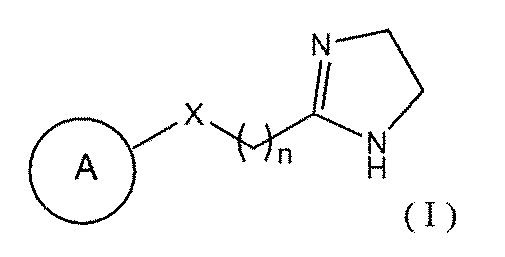
[式中、
環Aは、それぞれさらに置換されていてもよい、ベンゼン環、ナフタレン環または6員の含窒素芳香族複素環を示し;
Xは、単結合またはNR(式中、Rは、水素原子または置換されていてもよいフェニル基を示す。)を示し;および
nは、0または1を示す。
但し、Xが単結合を示す場合は、nは、1である。]
で表される化合物(以下、「化合物(I)」と称することもある。)若しくはその塩、又はそれらの溶媒和物を含有する、植物の耐塩性向上剤。
[2]式(I)において、環Aが、それぞれさらに置換されていてもよい、ナフタレン環またはピリミジン環である、前記[1]に記載の耐塩性向上剤。
[3]式(I)で表される化合物またはその塩が、ナファゾリン、フェントラミン、モキソニジン、トラゾリン、およびそれらの塩からなる群より選択される、前記[1]に記載の耐塩性向上剤。
[4]前記[1]~[3]のいずれかに記載の耐塩性向上剤で植物を処理することにより、植物の耐塩性を向上または改善させる方法。
[5]前記[1]~[3]のいずれかに記載の耐塩性向上剤で植物を処理する工程を含む、耐塩性が向上した植物の製造方法。
環Aは、それぞれさらに置換されていてもよい、ベンゼン環、ナフタレン環または6員の含窒素芳香族複素環を示し;
Xは、単結合またはNR(式中、Rは、水素原子または置換されていてもよいフェニル基を示す。)を示し;および
nは、0または1を示す。
但し、Xが単結合を示す場合は、nは、1である。]
で表される化合物(以下、「化合物(I)」と称することもある。)若しくはその塩、又はそれらの溶媒和物を含有する、植物の耐塩性向上剤。
[2]式(I)において、環Aが、それぞれさらに置換されていてもよい、ナフタレン環またはピリミジン環である、前記[1]に記載の耐塩性向上剤。
[3]式(I)で表される化合物またはその塩が、ナファゾリン、フェントラミン、モキソニジン、トラゾリン、およびそれらの塩からなる群より選択される、前記[1]に記載の耐塩性向上剤。
[4]前記[1]~[3]のいずれかに記載の耐塩性向上剤で植物を処理することにより、植物の耐塩性を向上または改善させる方法。
[5]前記[1]~[3]のいずれかに記載の耐塩性向上剤で植物を処理する工程を含む、耐塩性が向上した植物の製造方法。
本発明に係る化合物(I)若しくはその塩、又はそれらの溶媒和物を含有する、植物の耐塩性向上剤は、元々耐塩性が低い植物体の耐塩性を向上または改善させることができる。それ故、当該植物の耐塩性向上剤で植物体を処理することにより、塩化ナトリウム濃度が高い環境下でも栽培できるようになる。また、本発明によれば、当該植物の耐塩性向上剤で植物体を処理することにより、耐塩性が向上した植物を製造することができる。
本発明に係る化合物によれば、耐塩性向上剤を添加することにより高濃度のNaCl溶液においても植物が生育できる。
本発明について以下に詳細に説明する。
本明細書中に用いられる用語および各記号の定義について、以下に説明する。
本明細書において、「植物の耐塩性向上剤」とは、化合物(I)若しくはその塩、又はそれらの溶媒和物を含有し、植物、特に元々耐塩性が低い植物の耐塩性を改善又は向上するための剤である。よって、本発明の「植物の耐塩性向上剤」で処理された植物体は、塩化ナトリウム濃度が高い環境下でも栽培できるようになる。
前記「植物の耐塩性向上剤」は、化合物(I)若しくはその塩、又はそれらの溶媒和物のみで構成されていてもよいが、必要に応じて、他の成分を配合してもよい。例えば、本発明の「植物の耐塩性向上剤」は、化合物(I)若しくはその塩、又はそれらの溶媒和物を、担体(不活性担体)と共に製剤化してもよい。具体的には、化合物(I)若しくはその塩、又はそれらの溶媒和物を、適当な不活性担体に、必要に応じて補助剤と一緒に適当な割合で配合して溶解、懸濁、混合、含浸、吸着、付着等させ、適切な剤型、例えば、懸濁剤、乳懸濁剤、乳剤、液剤、水和剤、顆粒水和剤、粒剤、粉剤、錠剤、ジャンボ剤等に製剤化して使用してもよい。
前記「植物の耐塩性向上剤」に配合し得る不活性担体は、固体および液体のいずれであってもよい。固体の不活性担体としては、例えば、植物質粉末類(例えば、ダイズ粉、穀物粉、木粉、樹皮粉、鋸粉、タバコ茎粉、クルミ殻粉、ふすま、繊維素粉末等)、粉砕合成樹脂等の合成重合体、粘土類(例えば、カオリン、ベントナイト、酸性白土等)、タルク類(例えば、タルク、ピロフィライト等)、シリカ類(例えば、珪藻土、珪砂、雲母等)、活性炭、天然鉱物質類(例えば、イオウ粉末、軽石、アタパルジャイト、ゼオライト等)、焼成珪藻土、レンガ粉砕物、フライアッシュ、砂、プラスチック担体(例えば、ポリエチレン、ポリプロピレン、ポリ塩化ビニリデン等)、無機鉱物性粉末(例えば、炭酸カルシウム、燐酸カルシウム等)、化学肥料(例えば、硫安、燐安、硝安、尿素、塩安等)、堆肥等を挙げることができ、これらは単独、若しくは二種以上の混合物の形で使用することができる。
液体の不活性担体としては、例えば、水、アルコール類(例えば、メタノール、エタノール、イソプロピルアルコール、ブタノール、エチレングリコール等)、ケトン類(例えば、アセトン、メチルエチルケトン、メチルイソブチルケトン、ジイソブチルケトン、シクロヘキサノン等)、エーテル類(例えば、エチルエーテル、ジオキサン、セロソルブ、ジプロピルエーテル、テトラヒドロフラン等)、脂肪族炭化水素類(例えば、ケロシン、鉱油等)、芳香族炭化水素類(例えば、ベンゼン、トルエン、キシレン、ソルベントナフサ、アルキルナフタレン等)、ハロゲン化炭化水素類(例えば、ジクロロエタン、クロロホルム、四塩化炭素等)、エステル類(例えば、酢酸エチル、ジイソプロピルフタレート、ジブチルフタレート、ジオクチルフタレート等)、ニトリル類(例えば、アセトニトリル等)、ジメチルスルホキシド類等を挙げることができ、これらは単独、若しくは二種以上の混合物の形で使用することができる。
前記「植物の耐塩性向上剤」に配合し得る補助剤としては、以下のものが挙げられ、必要に応じて、単独で、若しくは二種以上を組み合わせて使用することができる。
化合物(I)若しくはその塩、又はそれらの溶媒和物の乳化、分散、可溶化等のために界面活性剤を補助剤として使用することができる。界面活性剤としては、例えば、ポリオキシエチレンアルキルエーテル、ポリオキシエチレンアルキルアリールエーテル、ポリオキシエチレン高級脂肪酸エステル、ポリオキシエチレン樹脂酸エステル、ポリオキシエチレンソルビタンアルキレート、ポリオキシエチレンソルビタンモノラウレート、ポリオキシエチレンソルビタンモノオレエート、アルキルアリールスルホン酸塩、ナフタレンスルホン酸縮合物、リグニンスルホン酸塩、高級アルコール硫酸エステル等が挙げられるが、これらに限定されるものではない。
化合物(I)若しくはその塩、又はそれらの溶媒和物の分散安定化、粘着、結合等のために、例えば、澱粉、メチルセルロース、カルボキシメチルセルロース、アラビアゴム、ポリビニルアルコール、松根油、糠油、ベントナイト、リグニンスルホン酸塩等を補助剤として使用することができる。固体製品の流動性改良のために、例えば、ワックス、ステアリン酸塩、燐酸アルキルエステル等を補助剤として使用することができる。消泡剤として、例えば、シリコーン油等を補助剤として使用することができる。
本発明の「植物の耐塩性向上剤」は、生物(非環境)ストレス耐性向上活性を有する物質、環境ストレス耐性向上活性を有する物質、植物生長調節活性を有する物質等の一種以上と組み合わせて使用することもできる。
生物ストレスとしては、害虫、病原体等が挙げられる。
環境ストレスとしては、塩ストレス、乾燥ストレス、浸透圧ストレス、水ストレス、高温ストレス、低温ストレス、強光ストレス、金属ストレス等が挙げられる。
環境ストレス耐性向上活性を有する物質は、特に限定されず、当該技術分野において公知のものを適宜選択して添加することができる。
生物ストレス耐性向上活性を有する物質は、特に限定されず、例えば、エリシタ活性を有する物質が挙げられる。
エリシタ活性とは、植物体内におけるファイトアレキシン等の抗菌性物質の合成を誘発する作用である。
エリシタ活性を有する物質は、植物に固有の物質が種々知られており、対象とする植物に応じて適宜選択すればよいが、例えば、グルカンオリゴ糖、キチンオリゴ糖、キトサンオリゴ糖、ヘプタ−β−グルコシド、システミン、カゼインタンパクのキモトリプシン分解物等の外因性エリシタ、オリゴガラクチュロン酸、ヘキソース、ウロン酸、ペントース、デオキシヘキソース等の内因性エリシタ、その他に、ショ糖エステル、カルボキシメチルセルロース、カラギーナン、真菌類の菌糸分解物、海藻抽出物等が挙げられ、水溶性で安定供給可能なものが好ましい。
植物生長調節活性を有する物質は、対象とする植物に応じて適宜選択すればよいが、例えば、マレイン酸ヒドラジド剤、ウニコナゾール剤等のオーキシン拮抗剤、インドール酪酸剤、1−ナフチルアセトアミド剤、パラクロロフェノキシ酢酸(4−CPA)等のオーキシン剤、ホルクロルフェニュロン剤等のサイトカイニン剤、ジベレリン剤等のジベレリン剤、ダミノジット剤等の矮化剤、パラフィン剤等の蒸散抑制剤、コリン剤等、クロレラ抽出物剤等の生物由来の植物生長調節剤、エテホン剤等のエチレン剤が挙げられる。
生物ストレスとしては、害虫、病原体等が挙げられる。
環境ストレスとしては、塩ストレス、乾燥ストレス、浸透圧ストレス、水ストレス、高温ストレス、低温ストレス、強光ストレス、金属ストレス等が挙げられる。
環境ストレス耐性向上活性を有する物質は、特に限定されず、当該技術分野において公知のものを適宜選択して添加することができる。
生物ストレス耐性向上活性を有する物質は、特に限定されず、例えば、エリシタ活性を有する物質が挙げられる。
エリシタ活性とは、植物体内におけるファイトアレキシン等の抗菌性物質の合成を誘発する作用である。
エリシタ活性を有する物質は、植物に固有の物質が種々知られており、対象とする植物に応じて適宜選択すればよいが、例えば、グルカンオリゴ糖、キチンオリゴ糖、キトサンオリゴ糖、ヘプタ−β−グルコシド、システミン、カゼインタンパクのキモトリプシン分解物等の外因性エリシタ、オリゴガラクチュロン酸、ヘキソース、ウロン酸、ペントース、デオキシヘキソース等の内因性エリシタ、その他に、ショ糖エステル、カルボキシメチルセルロース、カラギーナン、真菌類の菌糸分解物、海藻抽出物等が挙げられ、水溶性で安定供給可能なものが好ましい。
植物生長調節活性を有する物質は、対象とする植物に応じて適宜選択すればよいが、例えば、マレイン酸ヒドラジド剤、ウニコナゾール剤等のオーキシン拮抗剤、インドール酪酸剤、1−ナフチルアセトアミド剤、パラクロロフェノキシ酢酸(4−CPA)等のオーキシン剤、ホルクロルフェニュロン剤等のサイトカイニン剤、ジベレリン剤等のジベレリン剤、ダミノジット剤等の矮化剤、パラフィン剤等の蒸散抑制剤、コリン剤等、クロレラ抽出物剤等の生物由来の植物生長調節剤、エテホン剤等のエチレン剤が挙げられる。
本発明の「植物の耐塩性向上剤」が、他の成分を含有する場合、植物の耐塩性向上剤全体に対する化合物(I)若しくはその塩、又はそれらの溶媒和物の配合割合は特に限定されないが、例えば、約0.01~約90質量%程度であってもよい。
本発明において耐塩性を向上させる対象植物としては、特に限定されないが、例えば、元々ゲノムDNA中に、ナトリウムイオン濃度の制御メカニズムの一端を担うことが知られているPERK13遺伝子又はそのホモログ遺伝子を有している植物等が挙げられる。当該植物は、被子植物であってもよく、裸子植物であってもよく、シダ類やコケ類であってもよく、また、単子葉植物であってもよく、双子葉植物であってもよい。当該植物は、具体的には、例えば、イネ、トウモロコシ、モロコシ、コムギ、オオムギ、ライムギ、ヒエ、アワ等のイネ科の植物;トマト、ナス、パプリカ、ピーマン、ジャガイモ、タバコ等のナス科の植物;シロイヌナズナ、セイヨウアブラナ、ナズナ、ダイコン、キャベツ、紫キャベツ、メキャベツ(プチヴェール)、ハクサイ、チンゲンサイ、ケール、クレソン、小松菜、ブロッコリー、カリフラワー、カブ、ワサビ、マスタード等のアブラナ科の植物;キュウリ、ニガウリ、カボチャ、メロン、スイカ、等のウリ科の植物;ブドウ等のブドウ科の植物;レモン、オレンジ、ネーブルオレンジ、グレープフルーツ、ミカン、ライム、スダチ、ユズ、シイクワシャー、タンカン等のミカン科の植物;リンゴ、サクラ、ウメ、モモ、イチゴ、ビワ、アンズ、プラム(スモモ)、プルーン、アーモンド、ナシ、洋ナシ、ラズベリー、ブラックベリー、カシス、クランベリー、ブルーベリー等のバラ科の植物;ダイズ、インゲンマメ、エンドウマメ、ソラマメ、エダマメ、リョクトウ、ヒヨコマメ等のマメ科の植物;ハス(レンコン)等のハス科の植物;ゴマ等のゴマ科の植物;ホウレンソウ、ビート、テンサイ、キヌア、ヒユ、アマランサス、ケイトウ等のアカザ科の植物;ナツメヤシ、アブラヤシ、ココヤシ、アサイー等のヤシ科の植物;バナナ、バショウ、マニラアサ等のバショウ科の植物;ワタ、オクラ等のアオイ科の植物;ユーカリ等のフトモモ科の植物;フウチョウソウ、セイヨウフウチョウソウ等のフウチョウソウ科の植物等が挙げられる。
本明細書において、「耐塩性向上剤で植物を処理する」とは、耐塩性向上剤(すなわち、化合物(I)若しくはその塩、又はそれらの溶媒和物)を対象植物に到達させることをいう。したがって、例えば、耐塩性向上剤をそのまま、または水等で適宜希釈して、対象植物に耐塩性を誘導するための有効量を対象植物または対象植物の栽培担体に施用すればよい。具体的には、対象植物への直接散布、株元処理、作条処理、土壌混和等の施用方法や水耕栽培における水耕液を耐塩性向上剤で処理する施用方法が挙げられる。本発明の耐塩性を向上または改善させる方法としては、栽培担体に本発明の耐塩性向上剤を施用する方法、すなわち、株元処理、作条処理、土壌混和、水耕液処理等の施用方法が挙げられ、中でも、水耕栽培における水耕液処理が好ましい。
本発明に係る耐塩性向上剤は、水や溶媒等に溶解させた溶液として使用することができる。前記溶液はさらに塩化ナトリウムを含有しても良い。
本願発明に係る耐塩性向上剤は、土壌や水耕栽培溶液中に散布されることができる。耐塩性向上剤と植物の接触効率を高めるために、植物の少なくとも一部に直接接触させることが好ましい。
本願発明に係る耐塩性向上剤は、土壌や水耕栽培溶液中に散布されることができる。耐塩性向上剤と植物の接触効率を高めるために、植物の少なくとも一部に直接接触させることが好ましい。
本発明に係る耐塩性向上剤は、植物の苗に適用しても良いし、植物の根に適用しても良い。特に水耕栽培においては、耐塩性向上剤を栽培溶液に直接散布すると、耐塩性向上剤が希釈されること、水流によって植物への付与がしにくい等の点から、耐塩性向上剤を効果的に作用させるために耐塩性向上剤を根の少なくとも一部に直接作用させることが好ましい。苗は水耕栽培ベットや土壌に定植された苗に耐塩性向上剤を接触させても良いし、根の少なくとも一部に耐塩性向上剤を接触させた後に定植しても良い。
本発明において、耐塩性向上剤と植物の接触時間は、植物を耐塩化できる時間であれば良く、耐塩化剤の種類や濃度等によって適宜調節することができる。例えば、下限としては、1分、10分、30分、1時間、2時間、4時間、8時間、12時間、若しくは24時間以上が好ましい。上限としては、例えば、7日間、5日間、3日間、24時間、12時間、8時間、4時間、2時間、若しくは1時間以内が好ましい。上記時間、耐塩性向上剤と植物を接触させることによって耐塩性を十分に付与することができる。
生育の初期段階のトマトは、生育したトマトよりも環境ストレスに対する耐性が低い。特に、発根や発芽の工程は、塩濃度に非常に敏感である。このため、種子や球根の段階から高塩濃度環境下で生育させた場合には、高い塩ストレスにより、耐塩性処理を施しても耐塩性を獲得できずに枯死してしまうトマトが多い。本発明に係るトマトの製造方法では、生育の初期段階では低塩濃度環境下で生育させ、ある程度生育させた後に耐塩性向上剤による処理を行うことが好ましい。ここで、ある程度とは、幼苗を発芽後、少なくとも1週間、好ましくは2週間、より好ましくは3週間程度生育させた時点をいう。これにより、耐塩性付与処理によって耐塩性が付与されるトマトの割合を顕著に増大させることができ、高塩濃度環境下で栽培することが可能な苗を効率よく育成することができる。また耐塩性付与剤を無駄にしない、耐塩性付与失敗による栽培のやり直しの工数、コスト削減効果等が得られる。
耐塩性付与処理をした後は、栽培溶液を高塩濃度溶液に切り替えることが望ましい。前記切り替えるタイミングは耐塩性付与後の任意の期間内であれば特に限定されないが、耐塩性付与処理直後に切り替えることが望ましい。
本明細書において、「栽培担体」とは、植物を栽培するための支持体を意味し、植物が生育しうる材質であればよい。例えば、いわゆる各種土壌、育苗マット、水等を含むものである。固体の栽培担体としては、例えば、砂、バーミキュライト、綿、紙、珪藻土、寒天、ゲル状物質、高分子物質、ロックウール、グラスウール、木材チップ、バーク、軽石等を挙げることができる。また、液体の栽培担体としては、例えば、植物体の生育に必要な各種栄養成分(例えば、窒素、リン、カリウム、カルシウム、マグネシウム、硫黄、鉄、マンガン、銅、モリブデン、ホウ素、アルミニウム、珪素等の植物体の生育に必要な元素)を塩類として含有する水性担体等を挙げることができ、具体的には、市販されている液肥に塩化ナトリウムをはじめとする不足の塩類を添加した溶液や、市販されている濃縮された液肥を、水に代えて海水で希釈した溶液を用いることができる。また、海水に、リン等の不足の塩類を適宜添加した溶液を用いることもできる。そのような液体の栽培用担体としては、塩化ナトリウムに加えて塩化マグネシウムを含むことが好ましく、0.5質量%以下の塩化マグネシウムを含有することがより好ましく、0.1~0.5質量%の塩化マグネシウムを含有することがさらに好ましい。
本発明の耐塩性を向上または改善させる方法に好適に使用し得る水耕栽培は、一般的な水耕栽培方法によって行うことができる。例えば、比較的多量の栽培用溶液を栽培用槽にためる湛液型水耕法で行ってもよく、緩やかな傾斜を持つ平面上に培養液を少量ずつ流下させる薄膜水耕法で行ってもよい。
耐塩性向上剤の使用量(施用量、処理量)は、有効成分である化合物(I)若しくはその塩、又はそれらの溶媒和物の配合割合、気象条件、製剤形態、施用時期、施用方法、施用場所、対象植物等により異なるが、通常、化合物(I)若しくはその塩、又はそれらの溶媒和物として、1アール当たり約0.01g~約10gの範囲から適宜選択して施用すればよく、好ましくは、約0.1~約5gの範囲である。
また、耐塩性向上剤を栽培担体に施用する際の化合物(I)若しくはその塩、又はそれらの溶媒和物の濃度は、例えば、約0.01~約2000μM、好ましくは、約0.1~約1000μM、さらに好ましくは、約1~約300μMである。
本明細書において、「耐塩性を向上または改善させる」とは、耐塩性向上剤を使用しない場合に植物体の10~50%しか生育できない程度の塩濃度(ナトリウムイオン濃度)の環境下でも生育可能な程度にまで耐塩性を向上または改善させられる状態が好ましく、耐塩性向上剤を使用しない場合に植物体の10~30%しか生育できない程度のナトリウムイオン濃度の環境下でも生育可能な程度にまで耐塩性を向上または改善させられる状態がより好ましく、耐塩性向上剤を使用しない場合に植物体の10%以下しか生育できない程度のナトリウムイオン濃度の環境下でも生育可能な程度にまで耐塩性を向上または改善させられる状態がさらに好ましい。
本発明の耐塩性向上剤を使用することにより、ナトリウムイオン濃度が高い栽培用溶液を用いた水耕栽培や、ナトリウムイオン濃度が高い土壌を用いた土耕栽培により植物体を栽培することができる。例えば、本発明に係る植物体の耐塩性向上方法に用いられる水耕栽培溶液は、塩化ナトリウムを含有しない淡水、塩化ナトリウム含有溶液等を適宜用い、また目的に応じて切り替えることができる。塩化ナトリウムを含有する場合の濃度は、0.1質量%以上であればよく、栽培の目的や栽培する植物体の耐塩性等に応じて適宜調節することができる。本発明において用いられる栽培溶液としては、塩化ナトリウム濃度が、0.5、1、1.5、2、若しくは2.5質量%以上であることが好ましく、4、3.5、3、2.5、若しくは2質量%以下であることが好ましい。
本発明における植物の耐塩性の評価方法は、特に限定されないが、例えば、以下の手段により行うことができる。すなわち、対象となる植物を、化合物(I)若しくはその塩、又はそれらの溶媒和物の存在下又は非存在下で、適当な濃度で塩を添加した培地又は土壌中で、該植物にとって好適な状態の生育温度及び生育期間の条件で生育させ、その生育状況及び緑化状況を比較することにより、耐塩性を総合的に評価することが可能である。
(各基の定義)
本明細書において、「6員の含窒素芳香族複素環」とは、環構成原子として炭素原子以外に窒素原子、硫黄原子および酸素原子から選ばれる1~4個のヘテロ原子を含有する6員の芳香族複素環基であって、環構成原子として少なくとも1個以上の窒素原子を含有するものである。
該「6員の含窒素芳香族複素環」の好適な例としては、ピリジル、ピラジニル、ピリミジニル、ピリダジニル、トリアジニル等が挙げられる。
本明細書において、「6員の含窒素芳香族複素環」とは、環構成原子として炭素原子以外に窒素原子、硫黄原子および酸素原子から選ばれる1~4個のヘテロ原子を含有する6員の芳香族複素環基であって、環構成原子として少なくとも1個以上の窒素原子を含有するものである。
該「6員の含窒素芳香族複素環」の好適な例としては、ピリジル、ピラジニル、ピリミジニル、ピリダジニル、トリアジニル等が挙げられる。
本明細書において、「ハロゲン原子」とは、フッ素原子、塩素原子、臭素原子またはヨウ素原子をいう。
本明細書において、「アルキル」は、直鎖状または分岐鎖状の1価の飽和炭化水素基を意味する。
本明細書において、「C1−6アルキル」は、炭素数が1~6の直鎖状または分岐鎖状の1価の飽和炭化水素基を意味する。該「C1−6アルキル」としては、例えば、メチル、エチル、プロピル、イソプロピル、ブチル、イソブチル、sec−ブチル、tert−ブチル、ペンチル、イソペンチル、ネオペンチル、4−メチルペンチル、ヘキシル等が挙げられる。
本明細書において、「ハロアルキル」は、前記「アルキル」基中の1以上の水素原子がハロゲンで置換された基を意味する。具体的には、例えば、トリフルオロメチル、2−クロロエチル、2−ブロモエチル、2−ヨードエチル、2−フルオロエチル、2,2−ジフルオロエチル、2,2,2−トリフルオロエチル、ペンタフルオロエチル、2,2,3,3−テトラフルオロプロピル、3,3,3−トリフルオロプロピル、4,4,4−トリフルオロブチル、5,5,5−トリフルオロペンチル、6,6,6−トリフルオロヘキシル等が挙げられる。中でも、「ハロC1−3アルキル」が好ましい。
本明細書において、「C1−6アルコキシ」は、酸素原子に前記「C1−6アルキル」基が結合した基、すなわち、炭素数が1~6の直鎖または分岐鎖アルコキシ基を意味する。該「C1−6アルコキシ」としては、例えば、メトキシ、エトキシ、プロポキシ、イソプロポキシ、ブトキシ、イソブトキシ、sec−ブトキシ、tert−ブトキシ、ペンチルオキシ、イソペンチルオキシ、ネオペンチルオキシ、ヘキシルオキシ等が挙げられる。中でも、「C1−3アルコキシ」が好ましい。
本明細書において、「C3−8シクロアルキル」は、炭素数が3~8の飽和炭化水素環から誘導される一価の基を意味する。また、該C3−8シクロアルキルは、架橋していてもよい。該「C3−6シクロアルキル」としては、例えば、シクロプロピル、シクロブチル、シクロペンチル、シクロヘキシル、シクロヘプチル、シクロオクチル、ビシクロ[1,1,1]ペンタン等が挙げられる。中でも、「C3−6シクロアルキル」が好ましい。
本明細書において、「アシル」とは、カルボン酸のカルボキシ基から水酸基を除いてできる一価の基を意味する。該「アシル」としては、好ましくは、例えば、ホルミル、C1−6アルキル−カルボニル(例、アセチル、プロピオニル、ブチリル、イソブチリル、ペンタノイル、ヘキサノイル、ヘプタノイル等)、ハロC1−6アルキル−カルボニル(例、トリフルオロアセチル等)、C3−8シクロアルキル−カルボニル(例、シクロプロピルカルボニル、シクロペンチルカルボニル、シクロヘキシルカルボニル等)、C6−14アリール−カルボニル(例、ベンゾイル等)、C6−14アリールC1−6アルキル−カルボニル(例、ベンジルカルボニル等)、C1−6アルコキシ−カルボニル(例、メトキシカルボニル、エトキシカルボニル、プロポキシカルボニル、ブトキシカルボニル等)、カルバモイル、モノまたはジ−C1−6アルキル−カルバモイル(例、メチルカルバモイル、ジメチルカルバモイル、エチルカルバモイル、プロピルカルバモイル、イソプロピルカルバモイル、ブチルカルバモイル、イソブチルカルバモイル等)、チオカルバモイル、モノまたはジ−C1−6アルキル−チオカルバモイル(例、メチルチオカルバモイル、エチルチオカルバモイル、プロピルチオカルバモイル、イソプロピルチオカルバモイル、ブチルチオカルバモイル、イソブチルチオカルバモイル、ジメチルチオカルバモイル、ジエチルチオカルバモイル等)等が挙げられる。
本明細書において、「C6−14アリール」は、炭素数が6~14の芳香族炭化水素基を意味する。該「C6−14アリール」としては、例えば、フェニル、ナフチル(例、1−ナフチル、2−ナフチル)、アセナフチレニル、アズレニル、アントリル、フェナントリル等が挙げられる。中でも、C6−10アリールが好ましく、フェニルが特に好ましい。
本明細書において、「C1−6アルキルスルファニル」は、硫黄原子に前記「C1−6アルキル」基が結合した基、すなわち、炭素数が1~6の直鎖または分岐鎖アルキルスルファニル基を意味する。該「C1−6アルキルスルファニル」としては、例えば、メチルスルファニル、エチルスルファニル、プロピルスルファニル、イソプロピルスルファニル、ブチルスルファニル、イソブチルスルファニル、sec−ブチルスルファニル、tert−ブチルスルファニル、ペンチルスルファニル、イソペンチルスルファニル、ネオペンチルスルファニル、1−エチルプロピルスルファニル、ヘキシルスルファニル等が挙げられる。中でも、「C1−3アルキルスルファニル」が好ましい。
本明細書において、「C1−6アルキルスルフィニル」は、スルフィニル基に前記「C1−6アルキル」基が結合した基、すなわち、炭素数が1~6の直鎖または分岐鎖アルキルスルフィニル基を意味する。該「C1−6アルキルスルフィニル」としては、例えば、メチルスルフィニル、エチルスルフィニル、プロピルスルフィニル、イソプロピルスルフィニル、ブチルスルフィニル、イソブチルスルフィニル、sec−ブチルスルフィニル、tert−ブチルスルフィニル、ペンチルスルフィニル、イソペンチルスルフィニル、ネオペンチルスルフィニル、1−エチルプロピルスルフィニル、ヘキシルスルフィニル等が挙げられる。中でも、「C1−3アルキルスルフィニル」が好ましい。
本明細書において、「C1−6アルキルスルホニル」は、スルホニル基に前記「C1−6アルキル」基が結合した基、すなわち、炭素数が1~6の直鎖または分岐鎖アルキルスルホニル基を意味する。該「C1−6アルキルスルホニル」としては、例えば、メチルスルホニル、エチルスルホニル、プロピルスルホニル、イソプロピルスルホニル、ブチルスルホニル、イソブチルスルホニル、sec−ブチルスルホニル、tert−ブチルスルホニル、ペンチルスルホニル、イソペンチルスルホニル、ネオペンチルスルホニル、1−エチルプロピルスルホニル、ヘキシルスルホニル等が挙げられる。中でも、「C1−3アルキルスルホニル」が好ましい。
本明細書において、「置換されていてもよいアミノ」としては、例えば、C1−6アルキル、ハロC1−6アルキル、C3−8シクロアルキル、C6−14アリール、C6−14アリールC1−6アルキル、ホルミル、C1−6アルキル−カルボニル、C6−14アリール−カルボニル、C6−14アリールC1−6アルキル−カルボニル、C1−6アルコキシ−カルボニル、カルバモイル、モノ−またはジ−C1−6アルキル−カルバモイル、C1−6アルキルスルホニルおよびC6−14アリールスルホニルから選ばれる1または2個の置換基を有していてもよいアミノ基が挙げられる。
置換されていてもよいアミノの好適な例としては、アミノ、モノ−またはジ−C1−6アルキルアミノ(例、メチルアミノ、ジメチルアミノ、エチルアミノ、ジエチルアミノ、プロピルアミノ、ジブチルアミノ)、モノ−またはジ−ハロC1−6アルキルアミノ(例、トリフルオロメチルアミノ)、モノ−またはジ−C3−8シクロアルキルアミノ(例、シクロプロピルアミノ、シクロヘキシルアミノ)、モノ−またはジ−C6−14アリールアミノ(例、フェニルアミノ)、モノ−またはジ−C6−14アリールC1−6アルキルアミノ(例、ベンジルアミノ、ジベンジルアミノ)、ホルミルアミノ、モノ−またはジ−C1−6アルキル−カルボニルアミノ(例、アセチルアミノ、プロピオニルアミノ)、モノ−またはジ−C6−14アリール−カルボニルアミノ(例、ベンゾイルアミノ)、モノ−またはジ−C6−14アリールC1−6アルキル−カルボニルアミノ(例、ベンジルカルボニルアミノ)、カルバモイルアミノ、(モノ−またはジ−C1−6アルキル−カルバモイル)アミノ基(例、メチルカルバモイルアミノ)、C1−6アルキルスルホニルアミノ基(例、メチルスルホニルアミノ、エチルスルホニルアミノ)、ハロゲン又はC1−3アルキルで置換されていてもよいC6−14アリールスルホニルアミノ基(例、フェニルスルホニルアミノ、p−トルエンスルホニルアミノ)等が挙げられる。
置換されていてもよいアミノの好適な例としては、アミノ、モノ−またはジ−C1−6アルキルアミノ(例、メチルアミノ、ジメチルアミノ、エチルアミノ、ジエチルアミノ、プロピルアミノ、ジブチルアミノ)、モノ−またはジ−ハロC1−6アルキルアミノ(例、トリフルオロメチルアミノ)、モノ−またはジ−C3−8シクロアルキルアミノ(例、シクロプロピルアミノ、シクロヘキシルアミノ)、モノ−またはジ−C6−14アリールアミノ(例、フェニルアミノ)、モノ−またはジ−C6−14アリールC1−6アルキルアミノ(例、ベンジルアミノ、ジベンジルアミノ)、ホルミルアミノ、モノ−またはジ−C1−6アルキル−カルボニルアミノ(例、アセチルアミノ、プロピオニルアミノ)、モノ−またはジ−C6−14アリール−カルボニルアミノ(例、ベンゾイルアミノ)、モノ−またはジ−C6−14アリールC1−6アルキル−カルボニルアミノ(例、ベンジルカルボニルアミノ)、カルバモイルアミノ、(モノ−またはジ−C1−6アルキル−カルバモイル)アミノ基(例、メチルカルバモイルアミノ)、C1−6アルキルスルホニルアミノ基(例、メチルスルホニルアミノ、エチルスルホニルアミノ)、ハロゲン又はC1−3アルキルで置換されていてもよいC6−14アリールスルホニルアミノ基(例、フェニルスルホニルアミノ、p−トルエンスルホニルアミノ)等が挙げられる。
本明細書において、環AまたはRにおける「置換されていてもよい」とは、無置換又は1~3置換である。2又は3置換の場合、各置換基は同一であっても異なっていてもよい。
該置換基としては、ハロゲン原子、ヒドロキシ、置換されていてもよいアミノ(例、アミノ、メチルアミノ、ジメチルアミノ、トリフルオロメチルアミノ、アセチルアミノ)、カルボキシ、シアノ、ニトロ、C1−6アルキル(例、メチル、エチル、プロピル)、ハロC1−6アルキル(例、トリフルオロアルキル)、C3−8シクロアルキル(例、シクロプロピル、シクロブチル、シクロペンチル、シクロヘキシル)、C1−6アルコキシ(例、メトキシ、エトキシ)、スルファニル、C1−6アルキルスルファニル(例、メチルスルファニル)、C1−6アルキルスルフィニル(例、メチルスルフィニル)、C1−6アルキルスルホニル(例、メチルスルホニル)、アシル(例、ホルミル、アセチル、プロピオニル、ブチリル、トリフルオロアセチル、メトキシカルボニル、エトキシカルボニル、ベンゾイル、カルバモイル、メチルカルバモイル)等が挙げられる。
該置換基としては、ハロゲン原子、ヒドロキシ、置換されていてもよいアミノ(例、アミノ、メチルアミノ、ジメチルアミノ、トリフルオロメチルアミノ、アセチルアミノ)、カルボキシ、シアノ、ニトロ、C1−6アルキル(例、メチル、エチル、プロピル)、ハロC1−6アルキル(例、トリフルオロアルキル)、C3−8シクロアルキル(例、シクロプロピル、シクロブチル、シクロペンチル、シクロヘキシル)、C1−6アルコキシ(例、メトキシ、エトキシ)、スルファニル、C1−6アルキルスルファニル(例、メチルスルファニル)、C1−6アルキルスルフィニル(例、メチルスルフィニル)、C1−6アルキルスルホニル(例、メチルスルホニル)、アシル(例、ホルミル、アセチル、プロピオニル、ブチリル、トリフルオロアセチル、メトキシカルボニル、エトキシカルボニル、ベンゾイル、カルバモイル、メチルカルバモイル)等が挙げられる。
(化合物(I))
以下、前記式(I)中の各記号の定義について詳述する。
環Aは、それぞれさらに置換されていてもよい、ベンゼン環、ナフタレン環または6員の含窒素芳香族複素環を示す。
環Aは、好ましくは、それぞれさらに置換されていてもよい、ベンゼン環、ナフタレン環またはピリミジン環である。
環Aにおける「さらに置換されていてもよい」置換基としては、前記した基が挙げられるが、より好ましくは、ハロゲン原子、ヒドロキシ、C1−6アルキル(例、メチル)、ハロC1−6アルキル(例、トリフルオロメチル)、またはC1−6アルコキシ(例、メトキシ)である。
以下、前記式(I)中の各記号の定義について詳述する。
環Aは、それぞれさらに置換されていてもよい、ベンゼン環、ナフタレン環または6員の含窒素芳香族複素環を示す。
環Aは、好ましくは、それぞれさらに置換されていてもよい、ベンゼン環、ナフタレン環またはピリミジン環である。
環Aにおける「さらに置換されていてもよい」置換基としては、前記した基が挙げられるが、より好ましくは、ハロゲン原子、ヒドロキシ、C1−6アルキル(例、メチル)、ハロC1−6アルキル(例、トリフルオロメチル)、またはC1−6アルコキシ(例、メトキシ)である。
Xは、単結合またはNR(式中、Rは、水素原子または置換されていてもよいフェニル基を示す。)を示す。
Xは、好ましくは、単結合またはNHである。
Rにおける「置換されていてもよいフェニル基」の「置換されていてもよい」置換基としては、前記した基が挙げられるが、より好ましくは、ハロゲン原子、ヒドロキシ、C1−6アルキル(例、メチル)、ハロC1−6アルキル(例、トリフルオロメチル)、またはC1−6アルコキシ(例、メトキシ)である。
Xは、好ましくは、単結合またはNHである。
Rにおける「置換されていてもよいフェニル基」の「置換されていてもよい」置換基としては、前記した基が挙げられるが、より好ましくは、ハロゲン原子、ヒドロキシ、C1−6アルキル(例、メチル)、ハロC1−6アルキル(例、トリフルオロメチル)、またはC1−6アルコキシ(例、メトキシ)である。
nは、0または1を示す。
但し、Xが単結合を示す場合は、nは、1である。
但し、Xが単結合を示す場合は、nは、1である。
好適な化合物(I)としては、以下の化合物が挙げられる。
[化合物(I−1)]
環Aが、さらに置換されていてもよい6員の含窒素芳香族複素環であり;
Xが、NHであり;且つ
nが、0である;
化合物(I)。
[化合物(I−1)]
環Aが、さらに置換されていてもよい6員の含窒素芳香族複素環であり;
Xが、NHであり;且つ
nが、0である;
化合物(I)。
[化合物(I−2)]
環Aが、さらに置換されていてもよいピリミジン環であり;
Xが、NHであり;且つ
nが、0である;
化合物(I)。
環Aが、さらに置換されていてもよいピリミジン環であり;
Xが、NHであり;且つ
nが、0である;
化合物(I)。
[化合物(I−3)]
環Aが、それぞれさらに置換されていてもよい、ベンゼン環またはナフタレン環であり;
Xが、単結合であり;且つ
nが、1である;
化合物(I)。
環Aが、それぞれさらに置換されていてもよい、ベンゼン環またはナフタレン環であり;
Xが、単結合であり;且つ
nが、1である;
化合物(I)。
[化合物(I−4)]
環Aが、さらに置換されていてもよいナフタレン環であり;
Xが、単結合であり;且つ
nが、1である;
化合物(I)。
環Aが、さらに置換されていてもよいナフタレン環であり;
Xが、単結合であり;且つ
nが、1である;
化合物(I)。
[化合物(I−5)]
環Aが、さらに置換されていてもよいベンゼン環であり;
Xが、NR(式中、Rは、置換されていてもよいフェニル基を示す。)であり;且つ
nが、1である;
化合物(I)。
環Aが、さらに置換されていてもよいベンゼン環であり;
Xが、NR(式中、Rは、置換されていてもよいフェニル基を示す。)であり;且つ
nが、1である;
化合物(I)。
化合物(I)の好ましい具体例としては、例えば、下記実施例に記載のナファゾリン(実施例1)、モキソニジン(実施例2)、フェントラミン(実施例3)、トラゾリン(実施例4)、およびそれらの塩からなる群より選択される化合物が挙げられる。
(化合物(I)の製造方法)
本発明の化合物(I)は、その基本骨格あるいは置換基の種類に基づく特徴を利用し、各種の公知の製造方法を適用して製造することができる。公知の方法としては、例えば、「ORGANIC FUNCTIONAL GROUP PREPARATIONS」、第2版、ACADEMIC PRESS,INC.、1989年、「Comprehensive Organic Transformations」、VCHPublishers Inc.、1989年等に記載された方法がある。その際、官能基の種類によっては、当該官能基を原料ないし中間体の段階で適当な保護基で保護、又は当該官能基に容易に転化可能な基に置き換えておくことが製造技術上効果的な場合がある。
このような官能基としては、例えば、アミノ基、水酸基、カルボキシル基等があり、それらの保護基としては、例えば、T.W.Greene及びP.G.Wuts著、「Protective Groups in Organic Synthesis(第3版、1999年)」に記載の保護基があり、これらの反応条件に応じて適宜選択して用いればよい。このような方法によれば、当該置換基を導入して反応を行った後、必要に応じて保護基を除去、あるいは所望の基に転化することにより、所望の化合物を得ることができる。
本発明の化合物(I)は、その基本骨格あるいは置換基の種類に基づく特徴を利用し、各種の公知の製造方法を適用して製造することができる。公知の方法としては、例えば、「ORGANIC FUNCTIONAL GROUP PREPARATIONS」、第2版、ACADEMIC PRESS,INC.、1989年、「Comprehensive Organic Transformations」、VCHPublishers Inc.、1989年等に記載された方法がある。その際、官能基の種類によっては、当該官能基を原料ないし中間体の段階で適当な保護基で保護、又は当該官能基に容易に転化可能な基に置き換えておくことが製造技術上効果的な場合がある。
このような官能基としては、例えば、アミノ基、水酸基、カルボキシル基等があり、それらの保護基としては、例えば、T.W.Greene及びP.G.Wuts著、「Protective Groups in Organic Synthesis(第3版、1999年)」に記載の保護基があり、これらの反応条件に応じて適宜選択して用いればよい。このような方法によれば、当該置換基を導入して反応を行った後、必要に応じて保護基を除去、あるいは所望の基に転化することにより、所望の化合物を得ることができる。
以下に本発明の化合物の製造方法について述べる。ただし、製造方法は、下記の方法に何ら限定されるものではない。
なお、各反応における原料化合物は、具体的製法を述べない場合、市販されているものを容易に入手して用いることができるか、または自体公知の方法、またはそれに準ずる方法(例えば、ドイツ特許出願公開第2849537号公報、米国特許第4323570号公報、特開平10−218773号公報、米国特許第2503059号公報、国際公開第2012/008565号等に記載の方法)に従って製造することもできる。
なお、各反応における原料化合物は、具体的製法を述べない場合、市販されているものを容易に入手して用いることができるか、または自体公知の方法、またはそれに準ずる方法(例えば、ドイツ特許出願公開第2849537号公報、米国特許第4323570号公報、特開平10−218773号公報、米国特許第2503059号公報、国際公開第2012/008565号等に記載の方法)に従って製造することもできる。
(製法A)(前記化合物(I−1)及び化合物(I−2)の製法)

(式中、環Aは、前記と同意義であり、Pは、アシル基(例えば、ホルミル、アセチル、プロピオニル、ブチリル等)等の保護基を示す。)
工程1:本工程は、オキシ塩化リン(POCl3)存在下で、化合物(1)と化合物(2)とを反応させることによって化合物(3)を製造する工程である。本工程は、過剰量のオキシ塩化リンを反応剤兼溶媒として使用して行うことができ、また、オキシ塩化リン存在下、反応に影響を及ぼさない溶媒中で行なうこともできる。
オキシ塩化リンの使用量は、化合物(1)1モルに対して通常1.0~100モル、好ましくは、2.0~50モル、より好ましくは、5.0~50モルである。
化合物(2)の使用量は、化合物(1)1モルに対して通常1.0~10モル、好ましくは、1.1~3モル、より好ましくは、1.1~2モルである。
オキシ塩化リンの使用量は、化合物(1)1モルに対して通常1.0~100モル、好ましくは、2.0~50モル、より好ましくは、5.0~50モルである。
化合物(2)の使用量は、化合物(1)1モルに対して通常1.0~10モル、好ましくは、1.1~3モル、より好ましくは、1.1~2モルである。
本反応は、過剰量のオキシ塩化リン中で行うことが好ましいが、反応に影響を及ぼさない溶媒中でも行なうことができる。反応溶媒としては、例えば、ジエチルエーテル、テトラヒドロフラン(以下、THFと略称する。)、1,2−ジメトキシエタン、ジクロロメタン、クロロホルム、トルエン、これらの混合溶媒等を使用することができ、好ましくは、ジクロロメタンである。
反応温度としては、通常、20℃~106℃から任意に選択することができ、好ましくは、50℃~100℃である。
反応時間は、通常、1~70時間程度である。
反応時間は、通常、1~70時間程度である。
工程2:本工程は、化合物(3)から保護基Pを除去することにより、化合物(I)を製造する工程である。本工程は、反応に影響を及ぼさない溶媒中で行なうことができる。
保護基Pの脱保護条件としては、例えば、T.W.Greene及びP.G.Wuts著、「Protective Groups in Organic Synthesis(第3版、1999年)」に記載の脱保護条件を適宜選択して用いればよい。
(製法B)(前記化合物(I−3)及び化合物(I−4)の製法)
保護基Pの脱保護条件としては、例えば、T.W.Greene及びP.G.Wuts著、「Protective Groups in Organic Synthesis(第3版、1999年)」に記載の脱保護条件を適宜選択して用いればよい。
(製法B)(前記化合物(I−3)及び化合物(I−4)の製法)
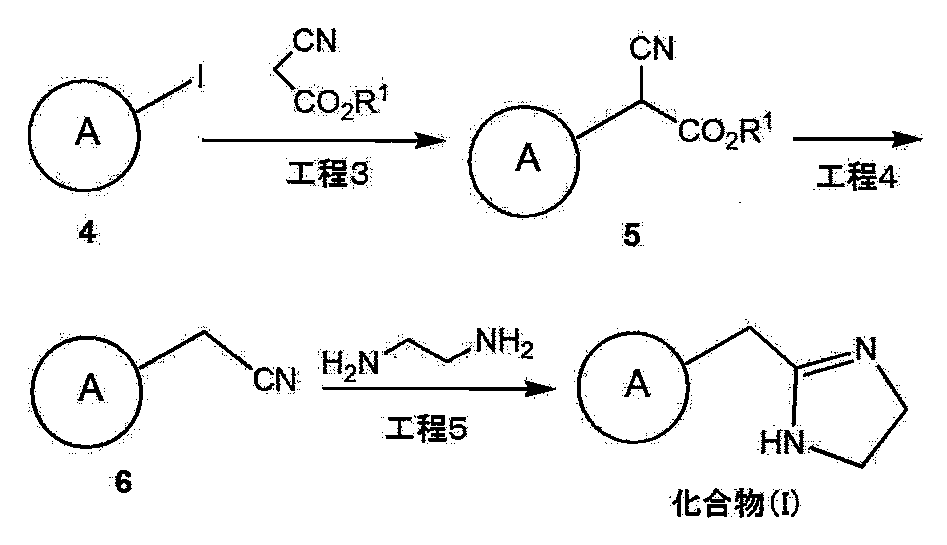
(式中、環Aは、前記と同意義であり、R1は、アルキル基(例えば、メチル、エチル等)を示す。)
工程3:本工程は、化合物(4)とシアノ酢酸エステルとを反応させることによって化合物(5)を製造する工程である。本工程は、塩基及び金属触媒存在下で、反応に影響を及ぼさない溶媒中で行なうことができる。
使用する塩基としては、特に限定されないが、炭酸カリウム、炭酸ナトリウム、炭酸セシウム又は水素化ナトリウムが好ましい。
使用する金属触媒としては、1価の銅触媒等が挙げられ、中でもヨウ化銅が好ましい。
シアノ酢酸エステルの使用量は、化合物(4)1モルに対して通常1.0~10モル、好ましくは、1.0~3.0モルである。
塩基の使用量は、化合物(4)1モルに対して通常1.0~10モル、好ましくは、1.0~3.0モルである。
金属触媒の使用量は、化合物(1)1モルに対して通常0.001~1.0モル、好ましくは、0.01~0.5モル、より好ましくは、0.05~0.2モルである。
使用する塩基としては、特に限定されないが、炭酸カリウム、炭酸ナトリウム、炭酸セシウム又は水素化ナトリウムが好ましい。
使用する金属触媒としては、1価の銅触媒等が挙げられ、中でもヨウ化銅が好ましい。
シアノ酢酸エステルの使用量は、化合物(4)1モルに対して通常1.0~10モル、好ましくは、1.0~3.0モルである。
塩基の使用量は、化合物(4)1モルに対して通常1.0~10モル、好ましくは、1.0~3.0モルである。
金属触媒の使用量は、化合物(1)1モルに対して通常0.001~1.0モル、好ましくは、0.01~0.5モル、より好ましくは、0.05~0.2モルである。
本反応は、反応に影響を及ぼさない溶媒中で行なうことができる。反応溶媒としては、特に限定されないが、好ましくは、ジメチルスルホキシド、1,4−ジオキサン又はヘキサメチルリン酸トリアミドである。
反応温度としては、通常、70℃~170℃であり、好ましくは、90℃~140℃である。
反応時間は、通常、0.5~12時間程度である。
反応時間は、通常、0.5~12時間程度である。
工程4:本工程は、化合物(5)を酸性条件下又は塩基性条件下における加水分解反応と続く脱炭酸反応により、化合物(6)を製造する工程である。本工程は、また、塩化リチウム又は塩化ナトリウムの存在下で、ジメチルスルホキシドと水の混合溶媒中で加熱することによっても行なうことができる。
酸性条件下における加水分解反応において、使用する酸としては、特に限定されないが、濃硫酸が好ましい。
塩基条件下における加水分解反応において、使用する塩基としては、特に限定されないが、水酸化カリウム又は水酸化ナトリウムが好ましい。
酸性条件下における加水分解反応において、使用する酸としては、特に限定されないが、濃硫酸が好ましい。
塩基条件下における加水分解反応において、使用する塩基としては、特に限定されないが、水酸化カリウム又は水酸化ナトリウムが好ましい。
化合物(5)の加水分解反応と続く脱炭酸反応により化合物(6)を製造する場合、反応溶媒としては、特に限定されないが、好ましくは、酸性条件下においては、酢酸エチルと50%酢酸水溶液の混合溶媒であり、塩基性条件下においては、エタノールと水の混合溶媒である。
反応温度としては、通常、60℃~100℃であり、好ましくは、80℃~90℃である。
反応時間は、通常、8~60時間程度である。
反応温度としては、通常、60℃~100℃であり、好ましくは、80℃~90℃である。
反応時間は、通常、8~60時間程度である。
化合物(5)を、塩化リチウム又は塩化ナトリウムの存在下で、ジメチルスルホキシドと水の混合溶媒中で加熱することにより化合物(6)を製造する場合、塩化リチウム又は塩化ナトリウムの使用量は、化合物(5)1モルに対して通常0.5~10モル、好ましくは、1.0~5.0モルである。
反応温度としては、通常、60℃~180℃であり、好ましくは、80℃~160℃である。
反応時間は、通常、4~60時間程度である。
反応温度としては、通常、60℃~180℃であり、好ましくは、80℃~160℃である。
反応時間は、通常、4~60時間程度である。
工程5:本工程は、化合物(6)とエチレンジアミンとを加熱条件下で反応させることによって化合物(I)を製造する工程である。本工程は、触媒量のチオアセトアミドの存在下で、エチレンジアミン中、又は反応に影響を及ぼさない溶媒中で行なうことができる。
チオアセトアミドの使用量は、化合物(6)1モルに対して通常0.01~0.2モル、好ましくは、0.01~0.1モルである。
エチレンジアミンの使用量は、化合物(6)1モルに対して通常1.0~100モル、好ましくは、1.2~20モルである。
チオアセトアミドの使用量は、化合物(6)1モルに対して通常0.01~0.2モル、好ましくは、0.01~0.1モルである。
エチレンジアミンの使用量は、化合物(6)1モルに対して通常1.0~100モル、好ましくは、1.2~20モルである。
本反応は、過剰量のエチレンジアミンを反応溶媒として使用することが好ましいが、反応に影響を及ぼさない溶媒中でも行なうことができる。そのような反応溶媒としては、例えば、エタノールである。
反応温度としては、通常、60℃~170℃であり、好ましくは、70℃~140℃である。
反応時間は、通常、0.5~24時間程度である。
反応時間は、通常、0.5~24時間程度である。
(製法B)(前記化合物(I−5)の製法)
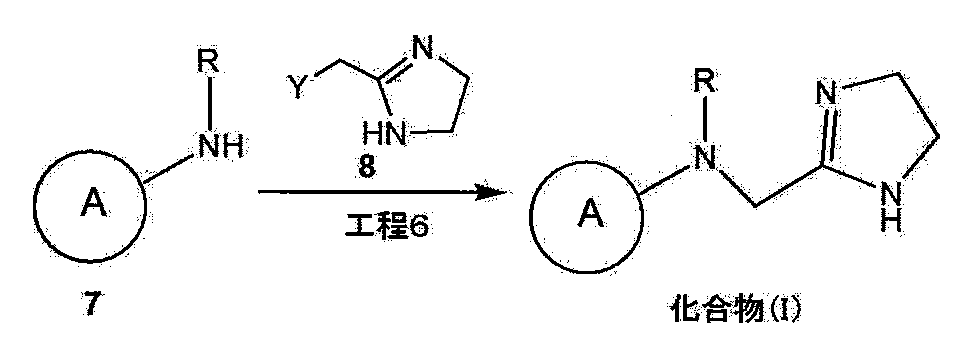
(式中、環A及びRは、前記と同意義であり、Yは、ハロゲン原子(フッ素原子、塩素原子、臭素原子、ヨウ素原子)またはハロゲン原子で置換されていてもよいアルキルスルホニルオキシ基(例えば、メタンスルホニルオキシ、エタンスルホニルオキシ、プロパンスルホニルオキシ、トリフルオロメタンスルホニルオキシ等)、アリールスルホニルオキシ基(例えば、フェニルスルホニルオキシ、トリルスルホニルオキシ等)等の脱離基を示す。)
工程6:本工程は、化合物(7)と化合物(8)とを加熱条件下で反応させた後、水と有機溶媒を加えて反応を止め、水層を冷却し、晶析することによって化合物(I)を製造する工程である。
化合物(8)の使用量は、化合物(7)1モルに対して通常1.0~2モル、好ましくは、1.0~1.2モルである。
化合物(8)の使用量は、化合物(7)1モルに対して通常1.0~2モル、好ましくは、1.0~1.2モルである。
本反応は、無溶媒で行うことが好ましい。
反応温度としては、通常、100℃~180℃であり、好ましくは、150℃であり、晶析温度としては、通常、−10℃~10℃であり、好ましくは、−10℃~0℃である。
反応時間は、通常、4~24時間程度である。
反応時間は、通常、4~24時間程度である。
化合物(I)の塩は、化合物(I)が酸性基または塩基性基を有する場合に、公知の方法に従い、塩基又は酸と反応させることにより、塩基性塩又は酸性塩に変換することができる。また、化合物(I)若しくはその塩の溶媒和物は、公知の方法に従い、溶媒と混合後に晶析等を行うことにより製造することができる。
本明細書において、化合物(I)の塩とは、化合物(I)の塩基性塩又は酸性塩を示す。
本発明の化合物(I)の「塩基性塩」としては、例えば、ナトリウム塩、カリウム塩、リチウム塩のようなアルカリ金属塩;マグネシウム塩、カルシウム塩のようなアルカリ土類金属塩;N−メチルモルホリン塩、トリエチルアミン塩、トリブチルアミン塩、ジイソプロピルエチルアミン塩、ジシクロヘキシルアミン塩、N−メチルピペリジン塩、ピリジン塩、4−ピロリジノピリジン塩、ピコリン塩のような有機塩基塩類;グリシン塩、リジン塩、アルギニン塩、オルニチン塩、グルタミン酸塩、アスパラギン酸塩のようなアミノ酸塩等が挙げられ、好ましくは、アルカリ金属塩(例、ナトリウム塩)である。
本発明の化合物(I)の「塩基性塩」としては、例えば、ナトリウム塩、カリウム塩、リチウム塩のようなアルカリ金属塩;マグネシウム塩、カルシウム塩のようなアルカリ土類金属塩;N−メチルモルホリン塩、トリエチルアミン塩、トリブチルアミン塩、ジイソプロピルエチルアミン塩、ジシクロヘキシルアミン塩、N−メチルピペリジン塩、ピリジン塩、4−ピロリジノピリジン塩、ピコリン塩のような有機塩基塩類;グリシン塩、リジン塩、アルギニン塩、オルニチン塩、グルタミン酸塩、アスパラギン酸塩のようなアミノ酸塩等が挙げられ、好ましくは、アルカリ金属塩(例、ナトリウム塩)である。
本発明の化合物(I)の「酸性塩」としては、例えば、フッ化水素酸塩、塩酸塩、臭化水素酸塩、ヨウ化水素酸塩のようなハロゲン化水素酸塩、硝酸塩、過塩素酸塩、硫酸塩、リン酸塩等の無機酸塩;メタンスルホン酸塩、トリフルオロメタンスルホン酸塩、エタンスルホン酸塩のようなアルカンスルホン酸塩、ベンゼンスルホン酸塩、p−トルエンスルホン酸塩のようなアリ−ルスルホン酸塩、酢酸塩、リンゴ酸塩、フマール酸塩、コハク酸塩、クエン酸塩、アスコルビン酸塩、酒石酸塩、シュウ酸塩、マレイン酸塩等の有機酸塩;グリシン塩、リジン塩、アルギニン塩、オルニチン塩、グルタミン酸塩、アスパラギン酸塩のようなアミノ酸塩等が挙げられ、好ましくは、ハロゲン化水素酸塩(例、塩酸塩)である。
本明細書において、化合物(I)若しくはその塩の溶媒和物とは、化合物(I)若しくはその塩に溶媒の分子が配位したものであり、例えば、本発明の化合物若しくはその塩の水和物、エタノール和物、ジメチルスルホキシド和物等が挙げられる。
上記の方法で製造された本発明の化合物(I)若しくはその塩、又はそれらの溶媒和物は、公知の方法、例えば、抽出、沈殿、蒸留、クロマトグラフィー、分別再結晶、再結晶等により単離、精製することができる。また、本発明の化合物(I)若しくはその塩、又はそれらの溶媒和物の化学構造は、1H−NMR、13C−NMR、HPLC、高分解能液体クロマトグラフ質量分析装置(LC−MS/MS)等の慣用の機器分析法を用いて同定することができる。
以下、実施例、参考例、及び試験例を挙げて本発明を具体的に説明するが、本発明は、これらの実施例、参考例、及び試験例のみに限定されるものではない。
以下の試験例1に使用した化合物(I)若しくはその塩である実施例化合物としては、いずれも市販品の、ナファゾリン塩酸塩(実施例1;東京化成工業株式会社製)、モキソニジン(実施例2;シグマアルドリッチ社製)、フェントラミン塩酸塩(実施例3;富士フィルム和光純薬株式会社製)、及びトラゾリン塩酸塩(実施例4;富士フィルム和光純薬株式会社製)をそのまま使用した。
また、以下の試験例1では、被験化合物の投与対象となる植物体として、PERK13遺伝子が導入された形質転換シロイヌナズナ(P35SP−AtPERK13)を使用した。PERK13遺伝子は植物体内へのナトリウムイオンの流入の制御に関与していることが知られ、当該遺伝子が導入された植物体を用いることにより被験化合物の耐塩性をより詳細に評価することが可能となる。ここで耐塩性が認められる化合物は、PERK13への関与が示唆される。
以下の試験例1に使用した化合物(I)若しくはその塩である実施例化合物としては、いずれも市販品の、ナファゾリン塩酸塩(実施例1;東京化成工業株式会社製)、モキソニジン(実施例2;シグマアルドリッチ社製)、フェントラミン塩酸塩(実施例3;富士フィルム和光純薬株式会社製)、及びトラゾリン塩酸塩(実施例4;富士フィルム和光純薬株式会社製)をそのまま使用した。
また、以下の試験例1では、被験化合物の投与対象となる植物体として、PERK13遺伝子が導入された形質転換シロイヌナズナ(P35SP−AtPERK13)を使用した。PERK13遺伝子は植物体内へのナトリウムイオンの流入の制御に関与していることが知られ、当該遺伝子が導入された植物体を用いることにより被験化合物の耐塩性をより詳細に評価することが可能となる。ここで耐塩性が認められる化合物は、PERK13への関与が示唆される。
(参考例)
形質転換シロイヌナズナ(P35SP−AtPERK13)の作製方法
以下の試験例1で使用した形質転換シロイヌナズナ(P35SP−AtPERK13)は、Coughらの方法(Plant J.,1998,Vol.16,p.735)に準じて、以下の手順により作製した。
形質転換シロイヌナズナ(P35SP−AtPERK13)の作製方法
以下の試験例1で使用した形質転換シロイヌナズナ(P35SP−AtPERK13)は、Coughらの方法(Plant J.,1998,Vol.16,p.735)に準じて、以下の手順により作製した。
(発現ベクター構築と形質転換)
シロイヌナズナのPERK13遺伝子の翻訳領域をクローニングし、過剰発現ベクターであるpBigsに導入した(pBigs:AtPERK13)。これをアグロバクテリウム系統GV3101に導入した。
(形質転換体の選抜)
6週間栽培したシロイヌナズナに対して、フローラルディップ法によりアグロバクテリウムを感染させた。その後、感染させた植物体を8週間栽培し、種子を収穫した。得られた種子を選抜マーカーのカナマイシン(富士フィルム和光純薬株式会社製)を含むMS培地(Murashige and Skoog medium,シグマアルドリッチ社製)へ播種し、形質転換体の選抜を行なった。選抜された個体を鉢上げし、栽培を継続した。
(種子検定)
形質転換体個体からDNA抽出を行ない、内在性遺伝子領域のプライマーと導入遺伝子領域のプライマー(CaMV 35S−F:atcgttgaagatgcctctgccgac(配列番号1),AtPERK13−585−R:tgcgtgggaactgttacgtggc(配列番号2))によりPCRを行なうことで検定した。
シロイヌナズナのPERK13遺伝子の翻訳領域をクローニングし、過剰発現ベクターであるpBigsに導入した(pBigs:AtPERK13)。これをアグロバクテリウム系統GV3101に導入した。
(形質転換体の選抜)
6週間栽培したシロイヌナズナに対して、フローラルディップ法によりアグロバクテリウムを感染させた。その後、感染させた植物体を8週間栽培し、種子を収穫した。得られた種子を選抜マーカーのカナマイシン(富士フィルム和光純薬株式会社製)を含むMS培地(Murashige and Skoog medium,シグマアルドリッチ社製)へ播種し、形質転換体の選抜を行なった。選抜された個体を鉢上げし、栽培を継続した。
(種子検定)
形質転換体個体からDNA抽出を行ない、内在性遺伝子領域のプライマーと導入遺伝子領域のプライマー(CaMV 35S−F:atcgttgaagatgcctctgccgac(配列番号1),AtPERK13−585−R:tgcgtgggaactgttacgtggc(配列番号2))によりPCRを行なうことで検定した。
(試験例1)
本発明の化合物(I)若しくはその塩によるシロイヌナズナの耐塩性評価
(播種)
形質転換シロイヌナズナ(P35SP−AtPERK13)の種子を滅菌した。滅菌処理された24穴シャーレの各ウェルに、1mLの1×MS培地(表1の組成の培地)を添加した。滅菌処理された形質転換シロイヌナズナ種子を、1ウェルあたり約10粒ずつ播種した。播種後のシャーレは、サージカルテープを巻き、明期16時間、22℃の環境で1週間培養した。
本発明の化合物(I)若しくはその塩によるシロイヌナズナの耐塩性評価
(播種)
形質転換シロイヌナズナ(P35SP−AtPERK13)の種子を滅菌した。滅菌処理された24穴シャーレの各ウェルに、1mLの1×MS培地(表1の組成の培地)を添加した。滅菌処理された形質転換シロイヌナズナ種子を、1ウェルあたり約10粒ずつ播種した。播種後のシャーレは、サージカルテープを巻き、明期16時間、22℃の環境で1週間培養した。

(化合物(I)若しくはその塩の添加)
播種後1週間目のシロイヌナズナ実生に、前記実施例1~4の各化合物の25μL(終濃度:250μM)を培地に添加した。添加の際はシロイヌナズナに化合物溶液が直接かからないよう注意して添加した。化合物添加後はシロイヌナズナへの浸透を考慮して、シャーレはサージカルテープを巻いた後に明期16時間、22℃の環境下で2日間培養した。対照サンプルとして、実施例化合物無添加で同量のDMSOを培地に添加したものを調製した。
播種後1週間目のシロイヌナズナ実生に、前記実施例1~4の各化合物の25μL(終濃度:250μM)を培地に添加した。添加の際はシロイヌナズナに化合物溶液が直接かからないよう注意して添加した。化合物添加後はシロイヌナズナへの浸透を考慮して、シャーレはサージカルテープを巻いた後に明期16時間、22℃の環境下で2日間培養した。対照サンプルとして、実施例化合物無添加で同量のDMSOを培地に添加したものを調製した。
(塩化ナトリウム水溶液(以下、NaCl溶液という。)の添加)
実施例1~4の各化合物、並びにDMSO(対照サンプル)の添加後に2日間培養したウェルに、1M NaCl溶液を200μL(終濃度:200mM)ずつ添加した。長期培養による水分の揮発を抑制するために添加後にシャーレをパラフィルムで巻き、明期16時間、22℃の環境下で約2~3週間培養した。
実施例1~4の各化合物、並びにDMSO(対照サンプル)の添加後に2日間培養したウェルに、1M NaCl溶液を200μL(終濃度:200mM)ずつ添加した。長期培養による水分の揮発を抑制するために添加後にシャーレをパラフィルムで巻き、明期16時間、22℃の環境下で約2~3週間培養した。
(検定、評価)
実施例1~4の各化合物、並びにDMSO(対照サンプル)の添加から3週間後(NaCl溶液添加から19日目)にシロイヌナズナの生育状況を確認した(図1参照)。生育していないウェルは「−」とし、生育が継続していたウェルは、生育及び緑化の程度を総合した生育評価値として、以下の5段階の評価基準に基づいて評価した。
<評価基準>
5:非常に良好に生育し、非常に良好に緑化した。
4:良好に生育し、良好に緑化した。
3:生育し、白化は見られなかった。
2:少し生育したが、一部(30%未満)白化した。
1:少し生育したが、多く(30%以上、70%未満)が白化した。
−:生育せず、ほぼ枯死(70%以上)した。
実施例1~4の各化合物、並びにDMSO(対照サンプル)の添加から3週間後(NaCl溶液添加から19日目)にシロイヌナズナの生育状況を確認した(図1参照)。生育していないウェルは「−」とし、生育が継続していたウェルは、生育及び緑化の程度を総合した生育評価値として、以下の5段階の評価基準に基づいて評価した。
<評価基準>
5:非常に良好に生育し、非常に良好に緑化した。
4:良好に生育し、良好に緑化した。
3:生育し、白化は見られなかった。
2:少し生育したが、一部(30%未満)白化した。
1:少し生育したが、多く(30%以上、70%未満)が白化した。
−:生育せず、ほぼ枯死(70%以上)した。

(結果)
上記表2に結果を示した。表2によれば、実施例1の化合物は、生育評価値が5を示し、実施例2の化合物は、生育評価値が4を示し、実施例3及び4の化合物は、生育評価値が2を示した。これに対し、対照では、全てのウェルで生育が認められず、枯死した。これらの結果から、本発明の化合物(I)若しくはその塩を含む耐塩性向上剤を添加することにより高塩濃度のNaCl溶液を添加しても植物が生育することが分かった。
上記表2に結果を示した。表2によれば、実施例1の化合物は、生育評価値が5を示し、実施例2の化合物は、生育評価値が4を示し、実施例3及び4の化合物は、生育評価値が2を示した。これに対し、対照では、全てのウェルで生育が認められず、枯死した。これらの結果から、本発明の化合物(I)若しくはその塩を含む耐塩性向上剤を添加することにより高塩濃度のNaCl溶液を添加しても植物が生育することが分かった。
(試験例2)
本発明の化合物(I)若しくはその塩によるトマトの耐塩性評価
本発明の化合物(I)若しくはその塩によるトマトの耐塩性評価
(種子の準備)
トマトの種子は、1%次亜塩素酸に浸漬させた状態で1分間撹拌をすることによって表面を滅菌した後、遠心分離処理により次亜塩素酸を除いた。次亜塩素酸処理後の種子は、滅菌水にて3回水洗した後、室温で24時間暗所にて吸水させた。
トマトの種子は、1%次亜塩素酸に浸漬させた状態で1分間撹拌をすることによって表面を滅菌した後、遠心分離処理により次亜塩素酸を除いた。次亜塩素酸処理後の種子は、滅菌水にて3回水洗した後、室温で24時間暗所にて吸水させた。
(植物体の水耕栽培)
滅菌水を入れた容器に、スクロース含有MS培地(MS培地に0.5%(w/v)スクロースを加えた寒天培地)を含んだポットを用意した。底面は滅菌水に浸っているが天面は浸っていない状態となるように設置した。これらのポットの上部に上記種子を播種し、25℃、明期16時間と暗期8時間の長日条件のインキュベーター内で10日から14日間育成した。
滅菌水を入れた容器に、スクロース含有MS培地(MS培地に0.5%(w/v)スクロースを加えた寒天培地)を含んだポットを用意した。底面は滅菌水に浸っているが天面は浸っていない状態となるように設置した。これらのポットの上部に上記種子を播種し、25℃、明期16時間と暗期8時間の長日条件のインキュベーター内で10日から14日間育成した。
(化合物(I)若しくはその塩の添加)
播種後2週間目のトマト実生に、前記実施例1~4の各化合物を、DMSOに100mMになるように溶解し、その溶液100μL(終濃度:250μM)を培地に添加した。対照サンプルとして、実施例化合物無添加で同量のDMSOを培地に添加したものを調製した。
播種後2週間目のトマト実生に、前記実施例1~4の各化合物を、DMSOに100mMになるように溶解し、その溶液100μL(終濃度:250μM)を培地に添加した。対照サンプルとして、実施例化合物無添加で同量のDMSOを培地に添加したものを調製した。
(検定、評価)
実施例1~4の各化合物、並びにDMSO(対照サンプル)の添加から3日後に、当該ポットの底面を浸した滅菌水を塩化ナトリウムの最終濃度が1.5質量%となるように滅菌済の5M塩化ナトリウム水溶液と液肥(ハイポニカAおよびB液を500倍希釈)を添加した。さらに1週間後に、塩化ナトリウムの最終濃度が3.0質量%となるように滅菌済の5M塩化ナトリウム水溶液添加した。その後、当該ポットを14日間培養した。栽培したトマトの葉の重量を測定し、有意差検定を行なった。また、本試験例2の結果を生育及び緑化の程度を総合した生育評価値として、前記試験例1の5段階の評価基準に基づいて評価した。
実施例1~4の各化合物、並びにDMSO(対照サンプル)の添加から3日後に、当該ポットの底面を浸した滅菌水を塩化ナトリウムの最終濃度が1.5質量%となるように滅菌済の5M塩化ナトリウム水溶液と液肥(ハイポニカAおよびB液を500倍希釈)を添加した。さらに1週間後に、塩化ナトリウムの最終濃度が3.0質量%となるように滅菌済の5M塩化ナトリウム水溶液添加した。その後、当該ポットを14日間培養した。栽培したトマトの葉の重量を測定し、有意差検定を行なった。また、本試験例2の結果を生育及び緑化の程度を総合した生育評価値として、前記試験例1の5段階の評価基準に基づいて評価した。
(結果)
図2及び表3に結果を示した。図2のグラフによれば、実施例1~4の化合物添加群の葉の重量は、いずれも対照サンプルと比較して、顕著に高いことが確認された。また、図2の写真によれば、実施例1~4の化合物添加群では、いずれも良好な生育と緑化が観測されたが、対照では、葉が萎れて生長が停止した。また、表3によれば、実施例1~4の化合物添加群の生育評価値についても、対照サンプルと比較して有意に増加することが確認された。これらの結果から、本発明の化合物(I)若しくはその塩の添加によりトマトの耐塩性が顕著に向上することが確認された。
図2及び表3に結果を示した。図2のグラフによれば、実施例1~4の化合物添加群の葉の重量は、いずれも対照サンプルと比較して、顕著に高いことが確認された。また、図2の写真によれば、実施例1~4の化合物添加群では、いずれも良好な生育と緑化が観測されたが、対照では、葉が萎れて生長が停止した。また、表3によれば、実施例1~4の化合物添加群の生育評価値についても、対照サンプルと比較して有意に増加することが確認された。これらの結果から、本発明の化合物(I)若しくはその塩の添加によりトマトの耐塩性が顕著に向上することが確認された。

(試験例3)
本発明の化合物(I)若しくはその塩によるイネの耐塩性評価
本発明の化合物(I)若しくはその塩によるイネの耐塩性評価
(種子の準備)
籾殻を取り除いたイネの種子を、1%次亜塩素酸に浸漬させた状態で1分間撹拌をすることによって表面を滅菌した後、遠心分離処理により次亜塩素酸を除いた。次亜塩素酸処理後の種子は、滅菌水にて3回水洗した後、室温で24時間暗所にて吸水させた。
籾殻を取り除いたイネの種子を、1%次亜塩素酸に浸漬させた状態で1分間撹拌をすることによって表面を滅菌した後、遠心分離処理により次亜塩素酸を除いた。次亜塩素酸処理後の種子は、滅菌水にて3回水洗した後、室温で24時間暗所にて吸水させた。
(植物体の水耕栽培)
滅菌水を入れた容器に、スクロース含有MS培地(MS培地に0.5%(w/v)スクロースを加えた寒天培地)を含んだポットを用意した。底面は滅菌水に浸っているが天面は浸っていない状態となるように設置した。これらのポットの上部に上記種子を播種し、25℃、明期16時間と暗期8時間の長日条件のインキュベーター内で10日から14日間育成した。
滅菌水を入れた容器に、スクロース含有MS培地(MS培地に0.5%(w/v)スクロースを加えた寒天培地)を含んだポットを用意した。底面は滅菌水に浸っているが天面は浸っていない状態となるように設置した。これらのポットの上部に上記種子を播種し、25℃、明期16時間と暗期8時間の長日条件のインキュベーター内で10日から14日間育成した。
(化合物(I)若しくはその塩の添加)
播種後2週間目のイネ実生に、前記実施例1~4の各化合物を、DMSOに100mMになるように溶解し、その溶液10μL(終濃度:250μM)を培地に添加した。対照サンプルとして、実施例化合物無添加で同量のDMSOを培地に添加したものを調製した。
播種後2週間目のイネ実生に、前記実施例1~4の各化合物を、DMSOに100mMになるように溶解し、その溶液10μL(終濃度:250μM)を培地に添加した。対照サンプルとして、実施例化合物無添加で同量のDMSOを培地に添加したものを調製した。
(検定、評価)
実施例1~4の各化合物、並びにDMSO(対照サンプル)の添加から3日後に、当該ポットの底面を浸した滅菌水を塩化ナトリウムの最終濃度が1.0質量%となるように滅菌済の5M塩化ナトリウム水溶液と液肥(ハイポニカAおよびB液を500倍希釈)を添加した。その後、当該ポットを14日間培養した。その後、当該ポットを14日間培養した。栽培したイネの葉の全体数と枯れた葉の数から生存している葉(クロロフィル量(SPAD値)20以上)の数の割合(生存率)を算出し、有意差検定を行なった。クロロフィル量は葉緑素計(SPAD−502plus,コニカミノルタ社製)により測定した。また、本試験例3の結果を生育及び緑化の程度を総合した生育評価値として、前記試験例1の5段階の評価基準に基づいて評価した。
実施例1~4の各化合物、並びにDMSO(対照サンプル)の添加から3日後に、当該ポットの底面を浸した滅菌水を塩化ナトリウムの最終濃度が1.0質量%となるように滅菌済の5M塩化ナトリウム水溶液と液肥(ハイポニカAおよびB液を500倍希釈)を添加した。その後、当該ポットを14日間培養した。その後、当該ポットを14日間培養した。栽培したイネの葉の全体数と枯れた葉の数から生存している葉(クロロフィル量(SPAD値)20以上)の数の割合(生存率)を算出し、有意差検定を行なった。クロロフィル量は葉緑素計(SPAD−502plus,コニカミノルタ社製)により測定した。また、本試験例3の結果を生育及び緑化の程度を総合した生育評価値として、前記試験例1の5段階の評価基準に基づいて評価した。
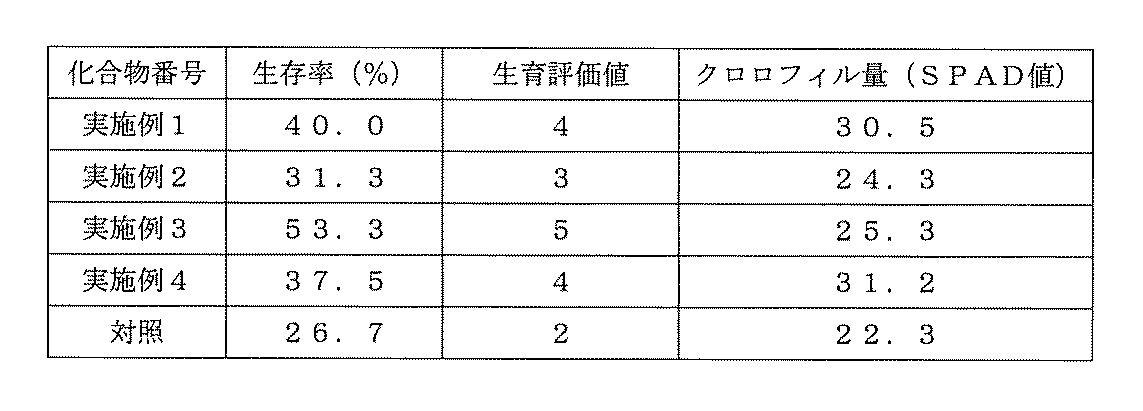
(結果)
上記表4に結果を示した。表4によれば、実施例1~4の化合物添加群の生存している葉の数の割合(生存率)及び生育評価値は、いずれも対照サンプルと比較して、有意に増加することが確認された。
上記表4に結果を示した。表4によれば、実施例1~4の化合物添加群の生存している葉の数の割合(生存率)及び生育評価値は、いずれも対照サンプルと比較して、有意に増加することが確認された。
本発明に係る化合物(I)若しくはその塩、又はそれらの溶媒和物を含有する、植物の耐塩性向上剤は、元々耐塩性が低い植物体の耐塩性を向上または改善させることができる。本発明によれば、塩化ナトリウム濃度が高い環境下でも植物体を栽培することが可能な耐塩性向上剤を提供することができる。また、本発明によれば、当該植物の耐塩性向上剤で植物体を処理することにより、耐塩性が向上した植物を製造することができる。
本出願は、特願2018−172179を基礎としており、その内容は本明細書に全て包含されるものである。
Claims (5)
- 式(I)

環Aは、それぞれさらに置換されていてもよい、ベンゼン環、ナフタレン環または6員の含窒素芳香族複素環を示し;
Xは、単結合またはNR(式中、Rは、水素原子または置換されていてもよいフェニル基を示す。)を示し;および
nは、0または1を示す。
但し、Xが単結合を示す場合は、nは、1である。]
で表される化合物若しくはその塩、又はそれらの溶媒和物を含有する、植物の耐塩性向上剤。 - 式(I)において、環Aが、それぞれさらに置換されていてもよい、ナフタレン環またはピリミジン環である、請求項1に記載の耐塩性向上剤。
- 式(I)で表される化合物またはその塩が、ナファゾリン、フェントラミン、モキソニジン、トラゾリン、およびそれらの塩からなる群より選択される、請求項1に記載の耐塩性向上剤。
- 請求項1~3のいずれか一項に記載の耐塩性向上剤で植物を処理することにより、植物の耐塩性を向上または改善させる方法。
- 請求項1~3のいずれか一項に記載の耐塩性向上剤で植物を処理する工程を含む、耐塩性が向上した植物の製造方法。
Priority Applications (1)
| Application Number | Priority Date | Filing Date | Title |
|---|---|---|---|
| JP2020546245A JP7325429B2 (ja) | 2018-09-14 | 2019-09-12 | 植物の耐塩性向上剤 |
Applications Claiming Priority (2)
| Application Number | Priority Date | Filing Date | Title |
|---|---|---|---|
| JP2018172179 | 2018-09-14 | ||
| JP2018-172179 | 2018-09-14 |
Publications (1)
| Publication Number | Publication Date |
|---|---|
| WO2020054878A1 true WO2020054878A1 (ja) | 2020-03-19 |
Family
ID=69776555
Family Applications (1)
| Application Number | Title | Priority Date | Filing Date |
|---|---|---|---|
| PCT/JP2019/036863 Ceased WO2020054878A1 (ja) | 2018-09-14 | 2019-09-12 | 植物の耐塩性向上剤 |
Country Status (2)
| Country | Link |
|---|---|
| JP (1) | JP7325429B2 (ja) |
| WO (1) | WO2020054878A1 (ja) |
Citations (8)
| Publication number | Priority date | Publication date | Assignee | Title |
|---|---|---|---|---|
| JPS51106739A (en) * | 1975-03-12 | 1976-09-21 | Takeda Chemical Industries Ltd | Satsuchu satsudanizai |
| WO2006059782A1 (ja) * | 2004-11-30 | 2006-06-08 | Riken | 植物環境ストレス耐性用組成物 |
| JP2008540441A (ja) * | 2005-05-03 | 2008-11-20 | バイエル・クロツプサイエンス・アクチエンゲゼルシヤフト | 殺虫性の置換されたアミノアルキル複素環式及びヘテロアリール誘導体 |
| CN104388538A (zh) * | 2014-11-18 | 2015-03-04 | 中国人民解放军第三军医大学 | 一种组蛋白去乙酰化酶抑制剂的筛选方法 |
| JP2016069380A (ja) * | 2014-09-29 | 2016-05-09 | 国立研究開発法人理化学研究所 | 植物の耐塩性向上剤 |
| JP2017128564A (ja) * | 2016-01-18 | 2017-07-27 | 国立研究開発法人理化学研究所 | 植物の耐塩性向上剤 |
| JP2018052893A (ja) * | 2016-09-30 | 2018-04-05 | 国立研究開発法人理化学研究所 | 植物の耐塩性向上剤 |
| WO2018147440A1 (ja) * | 2017-02-10 | 2018-08-16 | 株式会社 メニコン | 植物浸透圧ストレス耐性誘導剤及び乾燥ストレス緩和方法 |
-
2019
- 2019-09-12 JP JP2020546245A patent/JP7325429B2/ja active Active
- 2019-09-12 WO PCT/JP2019/036863 patent/WO2020054878A1/ja not_active Ceased
Patent Citations (8)
| Publication number | Priority date | Publication date | Assignee | Title |
|---|---|---|---|---|
| JPS51106739A (en) * | 1975-03-12 | 1976-09-21 | Takeda Chemical Industries Ltd | Satsuchu satsudanizai |
| WO2006059782A1 (ja) * | 2004-11-30 | 2006-06-08 | Riken | 植物環境ストレス耐性用組成物 |
| JP2008540441A (ja) * | 2005-05-03 | 2008-11-20 | バイエル・クロツプサイエンス・アクチエンゲゼルシヤフト | 殺虫性の置換されたアミノアルキル複素環式及びヘテロアリール誘導体 |
| JP2016069380A (ja) * | 2014-09-29 | 2016-05-09 | 国立研究開発法人理化学研究所 | 植物の耐塩性向上剤 |
| CN104388538A (zh) * | 2014-11-18 | 2015-03-04 | 中国人民解放军第三军医大学 | 一种组蛋白去乙酰化酶抑制剂的筛选方法 |
| JP2017128564A (ja) * | 2016-01-18 | 2017-07-27 | 国立研究開発法人理化学研究所 | 植物の耐塩性向上剤 |
| JP2018052893A (ja) * | 2016-09-30 | 2018-04-05 | 国立研究開発法人理化学研究所 | 植物の耐塩性向上剤 |
| WO2018147440A1 (ja) * | 2017-02-10 | 2018-08-16 | 株式会社 メニコン | 植物浸透圧ストレス耐性誘導剤及び乾燥ストレス緩和方法 |
Also Published As
| Publication number | Publication date |
|---|---|
| JP7325429B2 (ja) | 2023-08-14 |
| JPWO2020054878A1 (ja) | 2021-09-16 |
Similar Documents
| Publication | Publication Date | Title |
|---|---|---|
| UA127503C2 (uk) | Оксадіазоли, призначені для використання у контролі фітопатогенних грибів | |
| CN106749080B (zh) | 高抗逆性的植物生长调节剂及其制法和用途 | |
| WO2009095098A2 (en) | Use of benzothiadiazoles | |
| JP5915982B2 (ja) | イミダゾール誘導体 | |
| US5211738A (en) | Adenine derivatives and their use as a plant growth regulator | |
| KR20180038463A (ko) | 식물 생장 조절제 화합물 | |
| KR20200131841A (ko) | 식물 생장 조절제 화합물 | |
| JP7325429B2 (ja) | 植物の耐塩性向上剤 | |
| CN108059613B (zh) | 一种吡唑酰胺类化合物及应用 | |
| JP6902748B2 (ja) | 植物成長調整剤 | |
| AU595269B2 (en) | Plant growth promotion | |
| JP6842082B2 (ja) | 植物成長調整剤 | |
| JP5366474B2 (ja) | D−アロースを有効成分とする植物のジベレリンシグナル経路抑制剤およびその利用 | |
| CN106749044B (zh) | 增强植物抗逆性的aba类似物 | |
| CN112625029B (zh) | 芳烃基氮(氧)乙酰吡唑类hppd抑制剂、制备方法及用途 | |
| JP5205924B2 (ja) | 細胞が有する植物由来のサイトカイニン受容体からの細胞内信号伝達を阻害する活性を有する薬剤 | |
| JP5082474B2 (ja) | 新規なキナゾリン誘導体 | |
| JPS63303973A (ja) | トリアゾール化合物、該化合物の製法及び該化合物を含有する植物生長調整剤並びに該化合物を用いた植物生長調整法 | |
| KR0146504B1 (ko) | 아졸아미드 유도체 | |
| RU2683535C1 (ru) | Способ повышения урожайности томатов | |
| US4718936A (en) | 6-(3-thienylmethylamino)-purine, its preparation and its use | |
| WO2018008717A1 (ja) | 植物成長調整剤 | |
| EA050399B1 (ru) | Гербицидная активность алкилфосфинатов | |
| WO2007102615A1 (ja) | 植物生長促進剤 | |
| CN111484466A (zh) | 哌嗪酰胺衍生物及其制备方法、根寄生杂草种子萌发促进剂以及防治根寄生杂草的方法 |
Legal Events
| Date | Code | Title | Description |
|---|---|---|---|
| 121 | Ep: the epo has been informed by wipo that ep was designated in this application |
Ref document number: 19861125 Country of ref document: EP Kind code of ref document: A1 |
|
| ENP | Entry into the national phase |
Ref document number: 2020546245 Country of ref document: JP Kind code of ref document: A |
|
| NENP | Non-entry into the national phase |
Ref country code: DE |
|
| 122 | Ep: pct application non-entry in european phase |
Ref document number: 19861125 Country of ref document: EP Kind code of ref document: A1 |