WO2020049994A1 - 電子密度推定方法、電子密度推定装置、及び電子密度推定プログラム - Google Patents
電子密度推定方法、電子密度推定装置、及び電子密度推定プログラム Download PDFInfo
- Publication number
- WO2020049994A1 WO2020049994A1 PCT/JP2019/032350 JP2019032350W WO2020049994A1 WO 2020049994 A1 WO2020049994 A1 WO 2020049994A1 JP 2019032350 W JP2019032350 W JP 2019032350W WO 2020049994 A1 WO2020049994 A1 WO 2020049994A1
- Authority
- WO
- WIPO (PCT)
- Prior art keywords
- electron density
- density
- input data
- electron
- predictor
- Prior art date
- Legal status (The legal status is an assumption and is not a legal conclusion. Google has not performed a legal analysis and makes no representation as to the accuracy of the status listed.)
- Ceased
Links
Images







Classifications
-
- G—PHYSICS
- G06—COMPUTING OR CALCULATING; COUNTING
- G06N—COMPUTING ARRANGEMENTS BASED ON SPECIFIC COMPUTATIONAL MODELS
- G06N3/00—Computing arrangements based on biological models
- G06N3/02—Neural networks
- G06N3/08—Learning methods
- G06N3/084—Backpropagation, e.g. using gradient descent
-
- G—PHYSICS
- G06—COMPUTING OR CALCULATING; COUNTING
- G06N—COMPUTING ARRANGEMENTS BASED ON SPECIFIC COMPUTATIONAL MODELS
- G06N20/00—Machine learning
-
- G—PHYSICS
- G16—INFORMATION AND COMMUNICATION TECHNOLOGY [ICT] SPECIALLY ADAPTED FOR SPECIFIC APPLICATION FIELDS
- G16C—COMPUTATIONAL CHEMISTRY; CHEMOINFORMATICS; COMPUTATIONAL MATERIALS SCIENCE
- G16C10/00—Computational theoretical chemistry, i.e. ICT specially adapted for theoretical aspects of quantum chemistry, molecular mechanics, molecular dynamics or the like
-
- G—PHYSICS
- G16—INFORMATION AND COMMUNICATION TECHNOLOGY [ICT] SPECIALLY ADAPTED FOR SPECIFIC APPLICATION FIELDS
- G16C—COMPUTATIONAL CHEMISTRY; CHEMOINFORMATICS; COMPUTATIONAL MATERIALS SCIENCE
- G16C60/00—Computational materials science, i.e. ICT specially adapted for investigating the physical or chemical properties of materials or phenomena associated with their design, synthesis, processing, characterisation or utilisation
-
- G—PHYSICS
- G16—INFORMATION AND COMMUNICATION TECHNOLOGY [ICT] SPECIALLY ADAPTED FOR SPECIFIC APPLICATION FIELDS
- G16C—COMPUTATIONAL CHEMISTRY; CHEMOINFORMATICS; COMPUTATIONAL MATERIALS SCIENCE
- G16C20/00—Chemoinformatics, i.e. ICT specially adapted for the handling of physicochemical or structural data of chemical particles, elements, compounds or mixtures
- G16C20/30—Prediction of properties of chemical compounds, compositions or mixtures
-
- G—PHYSICS
- G16—INFORMATION AND COMMUNICATION TECHNOLOGY [ICT] SPECIALLY ADAPTED FOR SPECIFIC APPLICATION FIELDS
- G16C—COMPUTATIONAL CHEMISTRY; CHEMOINFORMATICS; COMPUTATIONAL MATERIALS SCIENCE
- G16C20/00—Chemoinformatics, i.e. ICT specially adapted for the handling of physicochemical or structural data of chemical particles, elements, compounds or mixtures
- G16C20/70—Machine learning, data mining or chemometrics
Definitions
- the present disclosure relates to a technology for estimating the electron density of a substance.
- Non-Patent Document 1 a technique called a density functional method for calculating a convergence value of the electron density by repeating a calculation for updating the electron density in a substance based on the laws of physics has been developed (for example, Non-Patent Document 1). Further, a technique for developing a catalyst using a density functional theory is also known (for example, Patent Document 1). Thus, the density functional theory is used as a tool for developing a new material.
- Non-Patent Document 2 discloses a method for estimating an electron density from a potential in a substance. Specifically, in Non-Patent Document 2, for a specific substance, the convergence value of the electron density is calculated by the density functional theory while changing a plurality of interatomic distances and angles, and the calculated convergence value of the electron density is used. A technique is disclosed in which a predictor that predicts an electron density is trained, and the obtained predictor is used to predict an electron density with respect to any interatomic distance and angle.
- Non-Patent Document 3 discloses a method for estimating electron energy from a potential in a substance. Specifically, Non-Patent Document 3 discloses a technique for estimating the electron energy obtained by solving the Schrodinger equation from a two-dimensional random potential or a well-type potential using a deep neural network.
- the present disclosure solves the above-described problem, and an object of the present disclosure is to provide a technique for learning an electron density predictor without using a convergence value of the electron density.
- An electron density estimating method is an electron density estimating method in an electron density estimating apparatus that estimates an electron density of a substance from substance information regarding the composition and structure of the substance, Computer of the electron density estimation device, (A1) obtaining first input data from a learning database storing the substance information, (A2) calculating a first electron density by inputting the first input data to an electron density estimator; (A3) performing a numerical simulation using the first input data and the first electron density to calculate a second electron density, wherein the numerical simulation calculates the first input data and the first electron density It is a process of setting the initial value and updating the electron density using the density functional method at least once, and the second electron density is not a convergence value obtained by using the density functional method, (A4) learning the electron density predictor by calculating a parameter of the electron density predictor that minimizes a difference between the first electron density and the second electron density; (A5) obtaining second input data from a test database storing the substance information, inputting the second input data to the electron density predictor in
- the electron density prediction is performed so that the output value of the electron density predictor approaches the electron density convergence value obtained by the density functional method without using the electron density convergence value obtained by the density functional method. You can train the vessel.
- Diagram showing the transition of learning when the number of learning data items is changed for a class classification problem using a natural image data set called Cifar10 1 is a block diagram illustrating a configuration of an electron density estimation system according to an embodiment of the present disclosure.
- FIG. 7 is a block diagram showing a detailed configuration of the electron density update unit in FIG.
- 4 is a flowchart illustrating an overall flow of a process of the electron density estimation device according to the first embodiment of the present disclosure.
- FIG. 15 is a flowchart for explaining details of the process of the electron density update unit in step S102 in FIG.
- Fig. 4 illustrates a process according to a second embodiment of the present disclosure.
- Fig. 4 illustrates a process according to a second embodiment of the present disclosure.
- Flowchart showing an example of processing according to Embodiment 2 of the present disclosure Diagram showing unit cell vector, atomic coordinates, atomic number, atomic radius, and the like regarding Al 2 O 3 Diagram showing an example of an Al crystal descriptor expressed by combining first input data with an atomic number or an atomic radius
- Non-Patent Document 2 discloses a technique in which an electron density predictor is learned using a convergence value of an electron density calculated by a density functional theory method for a substance having a specific structure.
- Non-Patent Document 2 since a predictor is trained only for a substance having a specific structure such as a perovskite structure, an accurate electron density is predicted for an unknown substance having a different structure from the learned substance. There is a problem that cannot be done.
- Non-Patent Document 2 that obtains a convergence value by the density functional method has a problem that it takes an enormous amount of time to collect teacher data.
- Non-Patent Document 3 discloses a technique for estimating the electron energy obtained by solving the Schrodinger equation using a deep neural network.
- Non-Patent Document 3 has a problem that a large amount of learning data is required for deep neural network learning, so that it takes a lot of time to prepare the learning data.
- Non-Patent Document 3 does not disclose learning a deep neural network without using a convergence value obtained by a density functional method.
- Non-Patent Document 1 is a prior art document that discloses the basic technology of the density functional method, and does not disclose learning a predictor by machine learning. Further, Patent Document 1 merely discloses that the density functional theory method described in Non-Patent Document 1 is used to calculate the comparative binding energy between the anchor particles and the noble metal particles at 900 ° C. There is no disclosure of training a predictor in. Further, Non-Patent Documents 4 and 5 are prior art documents that disclose the technology described below.
- the present inventors considered the calculation for obtaining the update value of the electron density in the density functional theory method and the update of the parameter of the electron density predictor by machine learning.
- the electron density convergence value obtained by the density functional method without using the electron density convergence value obtained by the density functional method. They have found that a density predictor can be learned, and have come to the present disclosure.
- the present disclosure does not use the electron density convergence value obtained by the density functional method, but learns the electron density estimator so that the output value of the electron density estimator approaches the convergence value obtained by the density functional method.
- the purpose of the present invention is to provide a technology that can be used.
- An electron density estimating method is an electron density estimating method in an electron density estimating apparatus that estimates an electron density of a substance from substance information regarding the composition and structure of the substance, Computer of the electron density estimation device, (A1) obtaining first input data from a learning database storing the substance information, (A2) calculating a first electron density by inputting the first input data to an electron density estimator; (A3) performing a numerical simulation using the first input data and the first electron density to calculate a second electron density, wherein the numerical simulation calculates the first input data and the first electron density It is a process of setting the initial value and updating the electron density using the density functional method at least once, and the second electron density is not a convergence value obtained by using the density functional method, (A4) learning the electron density predictor by calculating a parameter of the electron density predictor that minimizes a difference between the first electron density and the second electron density; (A5) obtaining second input data from a test database storing the substance information, inputting the second input data to the electron density predictor in
- a numerical simulation is performed in which the first input data and the first electron density are set to the initial values, and the processing for updating the electron density using the density functional theory is performed one or more times.
- the electron density estimator is learned so that the difference between the second electron density and the first electron density obtained by the numerical simulation is minimized.
- the second electron density is not a convergence value obtained using the density functional theory.
- the electron density estimator is learned using the second electron density, which is the updated value obtained by the numerical simulation. Therefore, this configuration can make the electron density predictor learn without using the convergence value. As a result, learning data can be prepared without enormous time and effort, and the cost required for generating the electron density estimator can be reduced.
- (a5) may be performed after the processes from (a1) to (a4) are repeated a predetermined number of times.
- the electron density predictor can be learned while updating the second electron density by the numerical simulation, the numerical simulation and the learning of the electron density predictor can be efficiently performed.
- the second electron density is updated after the first electron density approaches the second electron density to some extent.
- the predetermined condition is that the second difference between the first electron density and the fourth electron density updated in (a2) is equal to the second difference between the first electron density updated in (a2) and the first difference. 5 is larger than the third difference from the electron density,
- the fourth electron density is the first electron density used for calculating the second electron density updated in (b1),
- the fifth electron density may be the second electron density updated in (b1).
- the updated first electron density is the fifth electron density that is a second electron density that is updated more than the fourth electron density that is the first electron density used for updating the second electron density.
- the second electron density can be updated on the condition that the second electron density is approached. Therefore, the number of times of performing the numerical simulation can be suppressed, and the electron density predictor can be efficiently learned.
- the substance information may be information described using a common crystallographic data format.
- the substance information is described using the existing data format, the first input data can be easily mounted on the computer.
- the electron density estimator may be learned using the second electron density as teacher data.
- the electron density estimator can be made to learn such that the first electron density approaches the second electron density.
- an image indicating the third electron density may be displayed on a display.
- the user can visually recognize the third electron density.
- the operation and effect of the above-described electron density estimating method can be similarly realized in the electron density estimating apparatus and the electron density estimating program.
- FIG. 1 is a diagram showing an example of specific values of the electron density.
- the unit cell is divided into a plurality of 24 ⁇ 24 ⁇ 24 three-dimensional cells, and each cell holds a real value indicating the electron density.
- the unit lattice is, for example, a body-centered cubic lattice or a face-centered cubic lattice, and these unit lattices are divided into 24 ⁇ 24 ⁇ 24 three-dimensional cells.
- each point in the space is represented by one cell, and it is considered that each cell holds a charge, and the magnitude of the electron density of each cell is obtained.
- the number of cells of each dimension when dividing the unit cell is not limited to 24, and an arbitrary value other than 24 may be adopted. Further, a different value may be employed for each dimension as the number of cells of each dimension when dividing the unit cell.
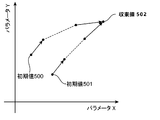
- FIG. 2 is a diagram schematically showing a state in which the electron density is updated by repeating the calculation for updating the electron density in the density functional theory method.
- the vertical axis indicates the parameter Y
- the horizontal axis indicates the parameter X.
- FIG. 2 shows a state in which the electron density of two of the 24 ⁇ 24 ⁇ 24 cells described above is updated by repeating the calculation for updating the electron density.
- Parameter X indicates the electron density of one of the two cells
- parameter Y indicates the electron density of the other of the two cells. Therefore, each point in the graph of FIG. 2 is constituted by a set of electron densities of two cells.
- the number of cells is 24 ⁇ 24 ⁇ 24, and in this case, each point in the graph of FIG. 2 is constituted by a set of 24 ⁇ 24 ⁇ 24 electron densities. These are the same in FIGS. 3, 4, and 5.
- the convergence value 502 represents the electron density finally obtained by the density functional theory. That is, the convergence value 502 is a value obtained by repeating the calculation for updating the electron density in the density functional theory to converge the electron density. As shown in FIG. 2, the density functional theory converges the initial values 500 and 501 to the same convergence value 502 even if the initial values of the electron densities at the time of repeating the calculation for updating the electron densities are different theoretically. Can be done. Note that the method of FIG. 2 is a method of repeatedly calculating the electron density in the density functional method to converge the electron density, that is, calculating the convergence value 502 by the density functional method. This corresponds to the first method.
- FIG. 3 is a diagram showing a difference calculated when learning the electron density estimator.
- the predicted value 600 represents the output of the electron density predictor.
- the difference 601 represents the difference between the convergence value 502 and the predicted value 600.
- RMSE Root ⁇ Mean ⁇ Square ⁇ Error
- the parameters of the electron density predictor are updated so as to minimize the difference 601 between the predicted value 600 and the convergence value 502, that is, so that the predicted value 600 approaches the convergence value 502.
- the method of FIG. 3 differs from the method of the present disclosure because the convergence value 502 of the electron density predictor is calculated by the density functional method and corresponds to the method of Non-Patent Documents 2 and 3.
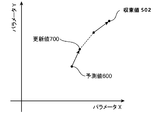
- FIG. 4 is a schematic diagram showing how the electron density is updated by setting the predicted value 600 obtained by the electron density estimator as the initial electron density in the density functional theory and repeating the calculation for updating the electron density.
- FIG. The update value 700 is an electron density obtained by performing a single calculation to update the electron density in the density functional theory using the predicted value 600.
- the initial values 500 and 501 can be made to converge to the same convergence value 502. Therefore, even if the prediction value 600 shown in FIG. 4 is used as the initial electron density in the density functional theory, the prediction value 600 converges to the convergence value 502 by repeating the calculation for updating the electron density in the density functional theory. Can be.
- the method of FIG. 4 uses the predicted value 600 obtained by the electron density predictor as an initial value electron density in the density functional theory, and repeats the calculation for updating the electron density in the density functional theory to obtain the convergence value 502. It is a technique to obtain. Therefore, the method of FIG. 4 differs from the method of the present disclosure in that the convergence value 502 is calculated by the density functional method.
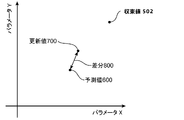
- FIG. 5 is a diagram illustrating an example in which the calculation of updating the electron density in the density functional theory is performed once using the predicted value 600 to obtain the updated value 700, and the obtained updated value 700 is used as the teacher data to learn the electron density predictor. It is the schematic diagram shown about making it do.
- the update value 700 is an electron density obtained by performing a single calculation for updating the electron density in the density functional method, and is not a convergence value of the electron density obtained by the density functional method.
- FIG. 5 corresponds to the technique of the present disclosure.
- the difference 800 is a difference between the updated value 700 and the predicted value 600. By updating the parameters of the electron density predictor so as to minimize the difference 800, the electron density predictor can be trained so that the predicted value 600 approaches the updated value 700.
- the update value 700 is a value that updates the predicted value 600 toward the convergence value 502 by the density functional theory method. By making the electron density predictor learn so that the predicted value 600 approaches the updated value 700, the electron density predictor can output a predicted value closer to the convergence value 502.
- the method of FIG. 5 differs from the methods of FIGS. 2 to 4 in that the density functional method is used, but the convergence value 502 is not calculated by the density functional method, and the updated value 700 Is calculated. Then, while repeating the calculation of updating the electron density in the density functional theory by using the updated value 700 as the teaching data to train the electron density predictor, the electron density predictor 600 gradually approaches the convergence value 502 while repeating the calculation. Learning of the density estimator is performed. Therefore, the electron density estimator can be learned without using the convergence value 502. As a result, the number of times of performing the calculation for updating the electron density in the density functional theory method is reduced, so that an electron density predictor that can accurately calculate the electron density can be generated while reducing the calculation cost.
- T ⁇ of the comparative example First, the required time T ⁇ of the comparative example will be described.
- P is the number of learning data
- Q is the number of times one piece of learning data is used during learning
- R is the number of calculations for updating the electron density when a convergence value is obtained by the density functional method.
- T be the time required for one calculation for updating the electron density
- L be the time required for learning of the electron density predictor per learning data.
- the convergence value obtained by the density functional theory method is prepared as learning data, and then the required time T ⁇ when learning of the electron density predictor is performed is calculated as follows.
- this comparative example obtains P pieces of learning data by performing the update calculation of the electron density R times by the density functional method for each of the P kinds of materials, and obtains the electron density prediction for each of the P pieces of the learning data.
- the learning of the vessel is performed Q times.
- T ⁇ T ⁇ R ⁇ P + L ⁇ Q ⁇ P T ⁇ R ⁇ P in the first term on the right side is the time required for the density functional theory method. Since the time required for one update calculation of the electron density is T and the number of update calculations for the electron density is R, the time required for calculating one learning data is T ⁇ R. Therefore, the time required for all calculations of the learning data number P is T ⁇ R ⁇ P.
- Equation (1) The left side of equation (1) is defined based on the atomic arrangement and periodic structure of the substance to be calculated, and the wave function ⁇ i (r) is obtained by solving equation (1). Note that the left side of the equation (1)
- ⁇ xc (n (r)) are functions depending on the substance. Further, ⁇ i on the right side of the equation (1) is the orbital energy corresponding to the wave function ⁇ i (r), and is obtained by solving the equation of the equation (1).
- the electron density n (r) is calculated from the wave function ⁇ i (r) by equation (2).
- electron density n (r) is required for the definition of the left side of equation (1), and equation (1) cannot be solved as it is. Therefore, an appropriate initial value is given to the electron density n (r), and the initial value of the given electron density is substituted into the equation (1), and the equations (1) and (2) are solved to obtain the electron density. Is updated. Then, the left side of Expression (1) is defined again using the updated electron density, and the electron density is updated. Such calculation for updating the electron density is repeated until the electron density n (r) converges, and the electron density corresponding to the atomic arrangement and the periodic structure of the substance to be calculated is obtained.
- the “calculation for updating the electron density once in the density functional method” means “calculating ⁇ i (r) from the known electron density and equation (1), and newly calculating ⁇ i (r) and equation (2). High electron density. " That is, "using a known electron density, the equation (1) is used once, and the equation (2) is used once, to find a new electron density”.
- LL ⁇ Q ⁇ P in the second term of the required time T ⁇ is the required time required for learning of the electron density predictor.
- the number of times one piece of learning data is used is Q, and the time required for learning one piece of learning data is L, so the time required for learning one piece of learning data is L ⁇ Q. Therefore, the time required for learning the P pieces of learning data is L ⁇ Q ⁇ P.
- the method of the present disclosure described below is a process of performing an update calculation of the electron density in the density functional theory once for each of the P types of substances to obtain P pieces of learning data, and for each of the P pieces of learning data.
- the processing set including the processing of learning the learning device once is repeated Q times. That is, since one update calculation of the electron density and one learning process are performed for one piece of learning data, the number R of update calculations of the electron density is equal to the number Q of use of the learning data.
- T ⁇ (RQ) ⁇ P Therefore, when the number of updates R of the electron density in the density functional theory is larger than the number of uses Q of the learning data of the electron density predictor, T ⁇ (RQ) ⁇ P becomes positive, and the required time T ⁇ of the present disclosure is obtained. Is shorter than the required time T ⁇ of the comparative example.
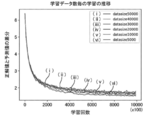
- FIG. 6 is a diagram illustrating a transition of learning when the number of learning data is changed in a class classification problem using a natural image data set called Cifar10.
- the vertical axis represents the difference between the correct value and the predicted value, and when the difference converges, the learning of the electron density predictor ends.
- the horizontal axis represents the number of times of learning.
- FIG. 6 shows how the differences converge using six graphs corresponding to data sizes of 5000, 10,000, 20,000, 30,000, 40000, and 50,000.
- the data size indicates the number of learning data.
- the number of update calculations R of the electron density depends on the target substance, but requires about 40 update calculations of the electron density on average. In addition, the number R of update calculations of the electron density needs to be increased as more accurate calculation is performed.
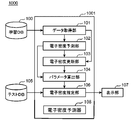
- FIG. 7 is a block diagram illustrating a configuration of the electron density estimation system 1000 according to the embodiment of the present disclosure.
- the electron density estimation system 1000 illustrated in FIG. 7 includes an electron density estimation device 1001, a learning database (DB) 100, a test database (DB) 105, and a display unit 107.
- DB learning database
- DB test database
- the electron density estimation device 1001 includes a data acquisition unit 101, an electron density estimation unit 102, an electron density update unit 103, a parameter calculation unit 104, an electron density estimation unit 106, and an electron density estimator 108.
- the electron density estimating apparatus 1001 is realized by a processor such as a CPU executing an electron density estimating program that causes a computer to function as the electron density estimating apparatus 1001.
- the learning database 100 and the test database 105 are configured by nonvolatile memories.
- the learning database 100 previously stores first input data including substance information such as the composition and structure of each of one or more substances.
- the first input data includes, for example, substance information described in a crystallographic common data format (CIF).
- CIF crystallographic common data format
- the description format of the substance information is not limited to the CIF data format, but may be a description format such as a composition formula, a crystal structure, a space group, and a lattice vector that can be used to update the electron density in the density functional theory. Any description format may be used.
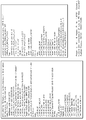
- FIG. 9 is a diagram illustrating an example of first input data described in a format called CIF.
- CIF substance information is described by a composition formula, a length of a unit cell vector, an angle at which atoms intersect, an arrangement of atoms in the unit cell, and the like.
- FIG. 9 shows substance information on the substance “Al 2 O 3 ”.
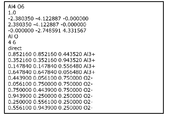
- FIG. 10 is a diagram showing an example of first input data described in a format called POSCAR.
- substance information is described by a composition formula, a unit cell vector, an arrangement of atoms in the unit cell, and the like.
- the description shown in FIG. 9 is cited from Non-Patent Documents 4 and 6.
- the data acquisition unit 101 acquires the first input data from the learning database 100 and outputs the first input data to the electron density prediction unit 102 and the electron density update unit 103.
- the electron density prediction unit 102 acquires the first input data from the data acquisition unit 101, and calculates a descriptor from the first input data. Then, the electron density prediction unit 102 sends the calculated descriptor to the electron density predictor 108.
- the electron density estimator 108 inputs the descriptor to the input layer of the electron density estimator 108, the electron density estimator 108 calculates the first electron density, and calculates the first electron density from the output layer of the electron density estimator 108. Output.
- the electron density estimator 108 sends the first electron density to the electron density estimating unit 102.
- the electron density prediction unit 102 outputs the first electron density to the electron density update unit 103 and the parameter calculation unit 104.
- the descriptor is represented by a vector that can be calculated from the first input data, or a two-dimensional or three-dimensional matrix.
- the descriptor may be expressed by combining the first input data of the constituent element and the physical property value of the element.
- the descriptor is shown in FIG. 1, Non-Patent Document 3, FIG. As shown in FIG. 1, it may be constituted by a potential.
- the descriptor may be composed of the initial electron density in the density functional theory.
- FIG. 20 is a diagram showing a unit cell vector, atomic coordinates, atomic number, atomic radius, and the like regarding Al 2 O 3 .
- Descriptor Al 2 O 3 is 1-dimensional vectors listed unit lattice vector of the Al 2 O 3, relative coordinates of Al atoms, relative coordinates of O atoms, Al and O represent atomic number, atomic radii.
- (Al 2 O 3 descriptor) (4.805027 0 0 -2.40251 4.161275 0 0 0 13.11625 0 0 0.352096 8 146.2014 0 0 0.647904 8 146.2014).
- the arrangement order of the elements included in the vector may be arbitrarily determined.
- FIG. 21 is a diagram showing an example of an Al crystal descriptor expressed by combining the first input data with an atomic number or an atomic radius.
- an Al crystal it is considered that the electron density exists in a Gaussian distribution centering on the atomic coordinates of the face-centered cubic lattice, and the value of 24 ⁇ 24 ⁇ 24 cells is calculated as shown by the following equation. Is done.
- Atomic radius / 3 may be used for ⁇ of the Gaussian distribution.
- the longest value among the diagonal lines of the unit cell may be used as the predetermined radius.
- the electronegativity or ionized energy of each atom may be used instead of the atomic number.
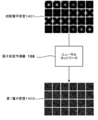
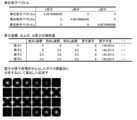
- FIG. 12 is a diagram showing an example of the initial electron density, the first electron density, and the electron density estimator.
- FIG. 1 shows the electron density of 24 ⁇ 24 ⁇ 24 cells.
- FIG. 1 shows 24 images, and each of the 24 images may be considered to represent 24 ⁇ 24 pixels.
- Each of the 24 ⁇ 24 pixels has a pixel value, and it may be considered that the pixel value of one pixel corresponds to the electron density of one cell.
- the number of units of the input layer of the electron density predictor 108 in FIG. 12 may be 24 ⁇ 24 ⁇ 24.
- the initial electron density 1401 is a descriptor generated by the electron density prediction unit 102.
- the pixels of the 24 images indicated as the initial electron density 1401 and the units of the input layer of the electron density estimator 108 correspond one-to-one.
- the number of units in the output layer of the electron density predictor 108 in FIG. 12 may be 24 ⁇ 24 ⁇ 24.
- the pixels of the 24 images indicated as the first electron density 1403 and the units of the output layer of the electron density estimator 108 correspond one to one.
- the initial electron density 1401 is the electron density when it is assumed that electrons exist near the nucleus.
- the initial electron density 1401 when the electron density of each cell of 24 ⁇ 24 ⁇ 24 is represented by 24 images of 24 ⁇ 24 for an Al single crystal is shown.
- the electron density estimator 108 receives an initial electron density 1401 (a descriptor generated by the electron density estimating unit 102) and outputs a first electron density 1403.
- the electron density estimator 108 is based on FIG. 2 may be configured.
- the electron density predictor 108 may be configured by a random forest or a support vector machine that learns a 24 ⁇ 24 ⁇ 24-dimensional regression problem.
- a set of the descriptor and the initial electron density in FIG. 11 may be input to the electron density estimator 108.
- the electron density estimating apparatus 1001 may not include the electron density estimator 108, and an external server may include the electron density estimator 108. In this case, the electron density estimation device 1001 and the external server may exchange data by wire and / or wirelessly.
- the electron density update unit 103 acquires the first input data from the data acquisition unit 101, acquires the first electron density from the electron density prediction unit 102, and performs a numerical simulation using the first input data and the first electron density. The calculation is performed to calculate the second electron density, and the second electron density is output to the parameter calculation unit 104.
- the numerical simulation is a process of performing a single calculation for updating the electron density in the density functional theory using the first input data and the first electron density.
- the second electron density is an electron density updated by a numerical simulation.
- the numerical simulation may be performed one or more times. That is, first, "the calculation of updating the electron density in the density functional theory is performed once using the first input data and the first electron density to obtain the first provisional two-electron density", and then the "first Using one input data and the first provisional two-electron density, a calculation for updating the electron density in the density functional theory is performed once to obtain a second provisional two-electron density. ” Using the one input data and the (n ⁇ 1) -th provisional two-electron density, the calculation for updating the electron density in the density functional theory is performed once to obtain the n-th provisional two-electron density. ”
- the provisional two electron density of n may be the second electron density described above.
- the number of updates of the electron density is not the number of times the limit value of the electron density is obtained by the density functional method. Note that n may be 5 or less.
- the stability of the result obtained by the numerical simulation can be improved.
- the update history of the electron density is recorded about five times in the past, and the past electron density and the updated electron density are added at an appropriate ratio to stabilize the numerical simulation. ing.
- the numerical simulation is performed one or more times with the upper limit being five times, so that the numerical simulation when updating the electron density can be stabilized.
- the time required by the method of the present disclosure can be shorter than that of the method of the comparative example.
- the number of times of the numerical simulation is a number of times that the stability of the result obtained by the numerical simulation can be achieved, and the number of times that the numerical simulation can be completed in a shorter time than the time of obtaining the limit value by the numerical simulation.
- FIG. 13 is a diagram illustrating an example of a process of calculating the second electron density from the first electron density.
- the electron density updating unit 103 substitutes the first electron density 1403 into the equation (1) and obtains the first electron density from the first input data.
- the electron density update unit 103 substitutes the obtained wave function ⁇ i (r) into Expression (2), and calculates the obtained electron density n (r) as the second electron density 1501. Since the equation (1) includes the atomic coordinates, even if a random electron coordinate such as the first electron density 1403 is set as the initial value, the second electron is calculated in principle by calculating the Kornsham equation. As in a density 1501, an electron density reflecting the atomic coordinates is obtained.
- the parameter calculation unit 104 obtains the first electron density from the electron density prediction unit 102 and obtains the second electron density from the electron density update unit 103. Then, the parameter calculation unit 104 calculates a first difference that is a difference between the first electron density and the second electron density, calculates a parameter of the electron density predictor that minimizes the first difference, and calculates the calculated parameter. Output to the electron density estimating unit 106.
- the RMSE described above can be used as the first difference.
- the first difference may be calculated using any method that can evaluate an error such as MAE (Mean ⁇ Absolute ⁇ Error).
- MAE Mean ⁇ Absolute ⁇ Error
- back propagation can be used to calculate the parameter that minimizes the first difference.
- the parameter updating equation by back propagation is represented by, for example, the following equation.
- W_t + 1 W_t ⁇ dD (W_t) / dW_t W_t indicates a value before updating the parameter, W_t + 1 indicates a value after updating the parameter, D (W_t) indicates a first difference, and ⁇ indicates a learning coefficient.
- the value of the learning coefficient for example, 0.01 can be adopted.
- All of the first input data stored in the learning database 100 may be used for updating the parameter W_t using the above update formula.
- the parameter calculation unit 104 acquires a part of the first input data from the learning database 100, updates the parameter W_t with respect to the acquired part of the first input data using the above update formula, and then again acquires the learning database.
- the update of the parameter W_t may be repeated while sequentially changing the first input data acquired from the learning database 100, such as acquiring another part of the first input data from the learning database 100.
- the calculation of the parameter of the electron density predictor 108 that minimizes the first difference by the parameter calculation unit 104 means that the following processes (P1) to (P4) are executed and the k-th parameter is specified. You may think.
- the descriptor generated by the electron density prediction unit 102 based on the first input data is input to the electron density predictor 108 in which the first parameter is set, and the electron density predictor 108 calculates the first electron density D11. And output.
- the electron density updating unit 103 performs one or more calculations for updating the electron density using the density functional method, and calculates the second electron density.
- the one or more calculations include a calculation using a density functional method based on the first input data and the first electron density D11.
- the second electron density is not a convergence value obtained using the density functional method.
- the generated descriptor is input to the electron density predictor 108 in which the i-th parameter is set, and the electron density predictor 108 calculates and outputs the first electron density D1i.
- i 2 to n
- i is a natural number
- n is a natural number
- n is 2 or more.
- the parameter calculation unit 104 calculates a first difference DF1j that is a difference between the first electron density D1j and the two electron density. j is a natural number. Thereby, the first difference DF11 to the first difference DF1n are obtained.
- the first parameter corresponds to the first difference DF11, and the nth parameter corresponds to the first difference DF1n.
- the parameter calculation unit 104 detects the smallest first difference DF1k from the first difference DF11 to the first difference DF1n, and specifies the k-th parameter corresponding to the first difference DF1k. 1 ⁇ k ⁇ n, where k is a natural number. This concludes the description of (P1) to (P4).
- the parameters may be as shown below.
- the electron density estimator 108 may include an input layer, one or more hidden layers, and an output layer. Each layer of the input layer and one or more hidden layers has a plurality of units corresponding to neurons. The output layer has one or more units.
- W1 [w11, w12,...]
- Wz [wz1, wz2,.
- the test database 105 stores in advance second input data including substance information such as the composition and structure of each of one or more substances.
- the second input data contains, for example, material information in a common crystallographic data format (CIF).
- CIF crystallographic data format
- the description format of the substance information is not limited to the CIF data format, but any description format that can be calculated by the density functional theory, such as the composition formula, crystal structure, space group, and lattice vector. It may be in the form.
- the second input data is described with contents as shown in FIGS. 9 and 10 similarly to the first input data.
- the description format of the second input data is the same as that of the first input data. Therefore, the learning database 100 and the test database 105 may be constructed from the same database. In this case, some input data stored in this database may be adopted as first input data, and the remaining input data may be adopted as second input data.
- the electron density estimating unit 106 acquires the updated parameters from the parameter calculating unit 104, and sets the acquired parameters in the electron density estimator 108. Then, the electron density estimating unit 106 acquires the second input data from the test database 105, and calculates a descriptor from the acquired second input data. Then, the electron density estimating unit 106 sends the calculated descriptor to the electron density estimator 108.
- the electron density estimator 108 inputs the descriptor to the input layer of the electron density estimator 108, the electron density estimator 108 calculates a third electron density, and calculates the third electron density from the output layer of the electron density estimator 108. Output.
- the electron density estimator 108 sends the third electron density to the electron density estimating unit 106.
- the electron density estimating unit 106 outputs the third electron density to the display unit 107.
- the method of calculating the descriptor and the third electron density is the same as the method of calculating the descriptor and the first electron density in the electron density prediction unit 102. Calculation of the third electron density may be referred to as estimation of the third electron density.
- FIG. 14 is a diagram illustrating an example of a process of estimating the third electron density.
- the initial electron density 1601 is an electron density obtained as a descriptor of the second input data.
- a third electron density 1602 is obtained.
- the third electron density 1602 is different from the initial electron density 1601 in that the electron density localized at the center and the four corners of each image decreases, and instead, the electron is delocalized at an intermediate position between the center and the four corners. The density appears, indicating that the electron density is accurately estimated.
- the display unit 107 includes, for example, a display device such as a liquid crystal panel, and displays an image indicating the third electron density estimated by the electron density estimation unit 106.
- the display unit 107 is an example of an output unit that outputs the third electron density.
- the image indicating the third electron density for example, an image displaying the third electron density 1602 shown in FIG. 14 or an image displaying a group of numerical values indicating the third electron density may be used. Good.
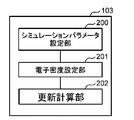
- FIG. 8 is a block diagram showing a detailed configuration of the electron density updating unit 103 in FIG.
- the electron density update unit 103 illustrated in FIG. 8 includes a simulation parameter setting unit 200, an electron density setting unit 201, and an update calculation unit 202.
- the simulation parameter setting unit 200 acquires the first input data from the data acquisition unit 101, and sets the first input data as calculation conditions for a numerical simulation.
- the functions of ⁇ (r) and ⁇ xc (n (r)) in Equation (1) are set.
- the electron density setting unit 201 acquires the first electron density from the electron density prediction unit 102 and sets the first electron density as the initial electron density for the numerical simulation. Thereby, the electron density n (r) in the equation (1) is set.
- the update calculation unit 202 performs one or more calculations for updating the electron density in the density functional theory, updates the initial electron density, calculates the second electron density, and sends the calculated second electron density to the parameter calculation unit 104. Output.
- one or more update calculations using the equations (1) and (2) are performed, and the second electron density 1501 is calculated from the first electron density 1403 as shown in FIG. Note that the number of update calculations is not the number of times the limit value of the electron density is obtained by the density functional method.
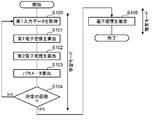
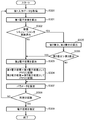
- FIG. 15 is a flowchart illustrating an overall flow of a process of the electron density estimation device 1001 according to Embodiment 1 of the present disclosure.
- Step S100 The data acquisition unit 101 acquires first input data from the learning database 100, and outputs the acquired first input data to the electron density prediction unit 102 and the electron density update unit 103.
- the electron density prediction unit 102 calculates a descriptor from the first input data, and sends the calculated descriptor to the electron density predictor 108.
- the electron density estimator 108 calculates the first electron density and sends it to the electron density estimator 102. Calculate the density.
- the electron density prediction unit 102 outputs the first electron density to the electron density update unit 103.
- Step S102 The electron density update unit 103 calculates a second electron density by performing a numerical simulation by a density functional method using the first input data obtained in step S100 and the first electron density calculated in step S101. , To the parameter calculation unit 104.
- the electron density update unit 103 performs the calculation of the numerical simulation once in one loop of steps S100 to S104. That is, the calculation for updating the electron density in the density functional theory method is performed once.
- the total number of numerical simulations is k if the number of loops in steps S100 to S104 is k (k is an integer of 1 or more).
- the total number k of update calculations is not the number of times the limit value of the electron density is obtained by the density functional theory.
- the electron density updating unit 103 may execute the calculation of the numerical simulation m (m is plural) times in one loop. That is, the calculation for updating the electron density in the density functional theory method may be performed m times. In this case, the total number of numerical simulations is k ⁇ m. The total number of update calculations k ⁇ m is not the number of times the limit value of the electron density is obtained by the density functional method.
- the parameter calculation unit 104 calculates a first difference from the first electron density and the second electron density, and uses a technique such as back propagation so as to minimize the first difference. To update.
- Step S104 If the number of times the parameter has been updated exceeds the predetermined number (YES in step S104), parameter calculating section 104 outputs the updated parameter to electron density estimating section 106, and the process proceeds to step S105.
- a learned parameter that minimizes the parameter W_t of the electron density predictor is obtained, and the learning of the electron density predictor ends.
- the parameter calculating unit 104 returns the process to step S100, and repeats the processes from step S100 to step S103.
- the predetermined number of times is, as described with reference to FIG. 6, a predetermined number of times that the first difference is expected to converge from the number of first input data used for learning of the electron density predictor 108. Can be adopted. However, this is an example, and the processing from step S100 to step S103 may be repeated until the first difference converges to a predetermined value or less.
- Step S105 The electron density estimating unit 106 acquires the learned parameters from the parameter calculating unit 104, and sets the acquired parameters in the electron density estimator 108. Then, the electron density estimating unit 106 obtains the second input data from the test database 105, calculates a descriptor from the obtained second input data, and sends the calculated descriptor to the electron density estimator 108. The electron density predictor 108 calculates a third electron density and sends the third electron density to the electron density estimating unit 106. The electron density estimating unit 106 outputs the third electron density to the display unit 107.
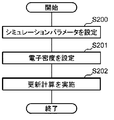
- FIG. 16 is a flowchart illustrating details of the process of the electron density updating unit 103 in step S102 in FIG.
- Step S200 The simulation parameter setting unit 200 of the electron density update unit 103 sets the first input data acquired from the data acquisition unit 101 as calculation conditions of the density functional theory.
- the calculation conditions include ⁇ (r) and ⁇ xc (n (r)) shown in Expression (1), and these functions are calculated from the first input data and set in Expression (1). Is done.
- Step S201 The electron density setting unit 201 sets the first electron density acquired from the electron density prediction unit 102 as an initial electron density in the density functional theory.
- the first electron density obtained from the electron density predictor is set as the initial value of the electron density n (r) in equation (1), and the equation in equation (1) can be solved.
- ⁇ i (r) and orbital energy ⁇ i can be calculated.
- Step S202 The update calculation unit 202 performs a calculation for updating the electron density in the density functional theory one or more times, updates the first electron density set as the initial electron density to calculate the second electron density, and sends the parameter calculation unit 104 Output.
- the number of update calculations is not the number of times the limit value of the electron density is obtained by the density functional method.
- the electron density update unit 103 calculates the second electron density by performing the processing from step S200 to step S202.
- the electron density estimator is trained using the second electron density, which is the update value obtained by one or more electron density update calculations in the numerical simulation, as the learning data. Can be done.
- the number of update calculations is not the number of times the limit value of the electron density is obtained by the density functional method. Therefore, with this configuration, the electron density predictor can be learned without using the convergence value of the electron density obtained by the density functional method. As a result, learning data can be prepared without enormous time and effort, and the cost required for generating the electron density estimator can be reduced.
- FIG. 17 is a diagram illustrating a process according to the second embodiment of the present disclosure.
- FIG. 17 schematically illustrates a distance relationship between the first electron density, the fourth electron density, and the fifth electron density in a state where the second difference 1703 is smaller than the third difference 1704.
- the vertical and horizontal axes are the same as those in FIG.
- the fourth electron density 1700 is the first electron density output by the electron density predictor when the numerical simulation was last performed.
- the first electron density 1702 is the current output of the electron density estimator.
- the second difference 1703 is a difference between the first electron density 1702 and the fourth electron density 1700, and represents a change in the output of the electron density predictor with respect to the progress of the learning.
- the third difference 1704 is a difference between the fifth electron density and the first electron density 1702 and, like the second difference 1703, indicates a change in the output of the electron density predictor with respect to the progress of the learning.
- the fifth electron density 1701 is the second electron density updated by a numerical simulation using the fourth electron density 1700 as the initial electron density.
- the fifth electron density 1701 is located on the convergence value 1705 side when viewed from the fourth electron density 1700. Therefore, the fifth electron density 1701 indicates the approximate direction of the convergence value 1705 when viewed from the fourth electron density 1700. Therefore, by learning the electron density predictor using the fifth electron density 1701 as teacher data, the electron density predictor can be trained toward the convergence value 1705.
- the convergence value 1702 is a value obtained by repeating calculation for updating the electron density in the density functional theory to converge the electron density.
- the direction H1 from the fourth electron density 1700 to the fifth electron density 1701 and the direction H2 from the first electron density 1702 to the fifth electron density 1701 are approximately one. I do. Therefore, in this state, by updating the parameters of the electron density predictor so as to minimize the third difference 1704, the first electron density 1702, which is the output of the electron density predictor, can approach the convergence value 1705. At this time, in the present embodiment, since the numerical simulation is skipped, the calculation time can be reduced.
- FIG. 18 is a diagram illustrating a process according to the second embodiment of the present disclosure.
- FIG. 18 shows the first electron density and the fourth electron density in the case where the learning of the electron density estimator is continued without performing the numerical simulation even when the second difference 1703 becomes larger than the third difference 1704 in FIG.
- FIG. 9 is a diagram schematically illustrating a distance relationship between an electron density and a fifth electron density, and illustrates a comparative example of the present disclosure.
- the vertical and horizontal axes are the same as those in FIG.
- the electron density using the fifth electron density 1701 as the teacher data is not updated by the numerical simulation without updating the second electron density. If learning of the predictor is continued, the direction H2 and the direction H1 cannot be said to match.
- the parameter calculator 104 performs a numerical simulation.
- the second electron density 1706 is updated, the updated second electron density is set as the fifth electron density, and learning of the electron density estimator is performed. That is, when the directions of the direction H2 and the direction H1 move away from each other, the second electron density 1706 is updated, and the electron density predictor can be made to learn by directing the direction H2 toward the convergence value 1705. As a result, efficient learning can be realized.
- FIG. 19 is a flowchart illustrating an example of a process according to the second embodiment of the present disclosure.
- the process of learning the electron density predictor while skipping the numerical simulation will be described with reference to FIG.
- step S300 to step S301 is the same as the processing from step S100 to S101 in FIG. 15, and a description thereof will be omitted.
- Step S302 The electron density update unit 103 determines whether a numerical simulation has been performed on the first input data. If the numerical simulation has not been performed (NO in step S302), the process proceeds to step S303. If the numerical simulation has been performed (YES in step S302), the process proceeds to step S305.
- NO is determined in step S302 corresponds to a case in which the numerical simulation by the density functional method has not been performed even once, for example, immediately after the start of the flow in FIG. 19.
- Step S303 The electron density update unit 103 sets the first electron density calculated in S301 as the initial electron density of the density functional theory, and sets the first input density input to the electron density estimator when calculating the first electron density.
- the data is set as calculation conditions of the density functional theory, and a numerical simulation by the density functional theory is executed to calculate the second electron density.
- the electron density updating unit 103 performs the calculation of the numerical simulation once in one loop of steps S100 to S104. That is, the calculation for updating the electron density in the density functional theory method is performed once. However, this is an example, and a plurality of calculations may be performed in one loop.
- Step S304 The electron density updating unit 103 records the first electron density used in calculating the second electron density in the last numerical simulation, that is, the process of step S303, as a fourth electron density in the memory. Further, the electron density update unit 103 records the second electron density obtained when the last numerical simulation, that is, the processing of step S303 is performed, as the fifth electron density in the memory.
- Step S305 The electron density updating unit 103 calculates a second difference that is a difference between the first electron density and the fourth electron density. Further, the parameter calculator 104 calculates a third difference that is a difference between the first electron density and the fifth electron density.
- the first electron density refers to the latest first electron density calculated in step S301.
- RMSE can be adopted as in the first difference.
- the second difference and the third difference may be calculated using any method that can evaluate an error such as MAE (Mean Absolute Error).
- Step S306 The parameter calculator 104 determines whether the second difference is larger than the third difference. If the second difference is greater than the third difference (YES in step S306), the process proceeds to step S303, and if the second difference is equal to or less than the third difference (NO in step S306), the process proceeds to step S307.
- the condition that the second difference is larger than the third difference corresponds to an example of a predetermined condition.
- Step S307 Immediately after the second electron density is updated in step S304, the parameter calculation unit 104 determines the second electron density (fifth electron density) and the second electron density used for calculating the second electron density, as in step S103. A first difference from one electron density (fourth electron density) is calculated, and the parameter W_t of the electron density predictor is updated so that the first difference is minimized.
- the parameter calculation unit 104 updates the parameter W_t of the electron density predictor such that the third difference calculated in step S305 is minimized.
- step S305 to step S306 are the same as the processes from step S104 to step S105 in FIG.
- step S302 NO is determined in step S302 because the numerical simulation has not been performed, and the numerical simulation is performed in step S303 to calculate the second electron density.
- step S303 a loop of YES in S302, NO in S305, NO in S306, NO in S307, and NO in S308 is repeated, and learning of the electron density predictor is performed.
- the first electron density approaches the second electron density calculated by the last numerical simulation, that is, the fifth electron density.
- step S304 YES is determined in step S306, and the second electron density is updated by the numerical simulation in step S304.
- the loop of YES in S302, NO in S305, NO in S306, NO in S307, and NO in S308 is repeated.
- the second electron density is updated when the second difference becomes larger than the third difference, but the present disclosure is not limited to this.
- the second electron density may be updated when the second difference is larger than a value obtained by subtracting a predetermined value from the third difference.
- the second electron density may be updated when the second difference is larger than a value obtained by adding a predetermined value to the third difference.
- the electron density estimating apparatus 1001 has been described based on the embodiments, the present disclosure is not limited to these embodiments. Unless departing from the gist of the present disclosure, various modifications conceivable by those skilled in the art may be applied to the present embodiment, and forms configured by combining components in different embodiments are also included in the scope of the present disclosure. .
- the above-described electron density estimation device 1001 may be specifically configured by a computer system including a microprocessor, a ROM, a RAM, a hard disk drive, a display unit, a keyboard, a mouse, and the like.
- An electron density estimation program is stored in the RAM or the hard disk drive.
- the electron density estimation device 1001 achieves its function.
- the electron density estimating program is configured by combining a plurality of instruction codes indicating instructions to a computer in order to achieve a predetermined function.
- the system LSI is an ultra-multifunctional LSI manufactured by integrating a plurality of components on one chip, and is specifically a computer system including a microprocessor, a ROM, a RAM, and the like. .
- a computer program is stored in the RAM. When the microprocessor operates according to the computer program, the system LSI achieves its function.
- the components constituting the electron density estimating apparatus 1001 may be constituted by an IC card detachable to a computer or a single module.
- the IC card or the module is a computer system including a microprocessor, a ROM, a RAM, and the like.
- the IC card or the module may include the above-mentioned super-multifunctional LSI.
- the IC card or module achieves its functions by the microprocessor operating according to the computer program.
- the IC card or the module may have tamper resistance.
- the present disclosure may be an electron density estimating method executed by the above-described electron density estimating apparatus 1001. Further, the electron density estimation method may be realized by a computer executing an electron density estimation program, or may be realized by a digital signal including the electron density estimation program.
- the present disclosure may be configured by a non-transitory recording medium that can read the electronic density estimation program or the digital signal by computer.
- the recording medium include a flexible disk, a hard disk, a CD-ROM, an MO, a DVD, a DVD-ROM, a DVD-RAM, a BD (Blu-ray (registered trademark) @Disc), and a semiconductor memory.
- the electron density estimation program may be constituted by the digital signal recorded on a non-temporary recording medium.
- the present disclosure may be configured by transmitting the electronic density estimation program or the digital signal via a telecommunication line, a wireless or wired communication line, a network represented by the Internet, or a data broadcast or the like. Good.
- the present disclosure is also a computer system including a microprocessor and a memory, wherein the memory stores an electron density estimation program, and the microprocessor may operate according to the electron density estimation program.
- the present electron density estimating system may include a server and a terminal owned by a user connected to the server via a network.
- the electron density estimation device 1001, the learning database 100, and the test database 105 are configured by a server
- the display unit 107 is configured by a terminal.
- the electron density estimating unit 106 obtains a calculation request of the electron density for a predetermined substance from the terminal via the network
- the electron density estimating unit 106 obtains the second input data of the corresponding substance from the test database 105 and learns the second input data.
- the server may transmit the estimated electron density to the terminal using the communication device, and display the electronic density on the display unit 107 of the terminal.
- the present disclosure is useful for predicting the characteristics of an unknown material in a situation where learning of an electron density predictor is possible without learning data and large-scale learning data cannot be prepared.
- REFERENCE SIGNS LIST 100 learning database 101 data acquisition unit 102 electron density prediction unit 103 electron density update unit 104 parameter calculation unit 105 test database 106 electron density estimation unit 108 electron density estimator 1000 electron density estimation system 1001 electron density estimation device
Landscapes
- Engineering & Computer Science (AREA)
- Theoretical Computer Science (AREA)
- Computing Systems (AREA)
- Software Systems (AREA)
- Physics & Mathematics (AREA)
- Life Sciences & Earth Sciences (AREA)
- Data Mining & Analysis (AREA)
- General Engineering & Computer Science (AREA)
- Artificial Intelligence (AREA)
- Mathematical Physics (AREA)
- Evolutionary Computation (AREA)
- General Physics & Mathematics (AREA)
- Bioinformatics & Cheminformatics (AREA)
- Bioinformatics & Computational Biology (AREA)
- Computer Vision & Pattern Recognition (AREA)
- Medical Informatics (AREA)
- Health & Medical Sciences (AREA)
- General Health & Medical Sciences (AREA)
- Spectroscopy & Molecular Physics (AREA)
- Biomedical Technology (AREA)
- Biophysics (AREA)
- Computational Linguistics (AREA)
- Molecular Biology (AREA)
- Analysing Materials By The Use Of Radiation (AREA)
Priority Applications (3)
| Application Number | Priority Date | Filing Date | Title |
|---|---|---|---|
| CN201980032737.2A CN112119466B (zh) | 2018-09-03 | 2019-08-20 | 电子密度推定方法、电子密度推定装置及电子密度推定程序 |
| JP2020541109A JP7442055B2 (ja) | 2018-09-03 | 2019-08-20 | 電子密度推定方法、電子密度推定装置、及び電子密度推定プログラム |
| US17/128,298 US20210110307A1 (en) | 2018-09-03 | 2020-12-21 | Electron density estimation method, electron density estimation apparatus, and recording medium |
Applications Claiming Priority (2)
| Application Number | Priority Date | Filing Date | Title |
|---|---|---|---|
| JP2018164752 | 2018-09-03 | ||
| JP2018-164752 | 2018-09-03 |
Related Child Applications (1)
| Application Number | Title | Priority Date | Filing Date |
|---|---|---|---|
| US17/128,298 Continuation US20210110307A1 (en) | 2018-09-03 | 2020-12-21 | Electron density estimation method, electron density estimation apparatus, and recording medium |
Publications (1)
| Publication Number | Publication Date |
|---|---|
| WO2020049994A1 true WO2020049994A1 (ja) | 2020-03-12 |
Family
ID=69722489
Family Applications (1)
| Application Number | Title | Priority Date | Filing Date |
|---|---|---|---|
| PCT/JP2019/032350 Ceased WO2020049994A1 (ja) | 2018-09-03 | 2019-08-20 | 電子密度推定方法、電子密度推定装置、及び電子密度推定プログラム |
Country Status (4)
| Country | Link |
|---|---|
| US (1) | US20210110307A1 (https=) |
| JP (1) | JP7442055B2 (https=) |
| CN (1) | CN112119466B (https=) |
| WO (1) | WO2020049994A1 (https=) |
Cited By (2)
| Publication number | Priority date | Publication date | Assignee | Title |
|---|---|---|---|---|
| CN113517032A (zh) * | 2021-05-24 | 2021-10-19 | 西安空间无线电技术研究所 | 一种基于第一性原理的二次电子产额的计算方法 |
| WO2024034688A1 (ja) * | 2022-08-10 | 2024-02-15 | 株式会社Preferred Networks | 学習装置、推論装置及びモデル作成方法 |
Families Citing this family (3)
| Publication number | Priority date | Publication date | Assignee | Title |
|---|---|---|---|---|
| US12587274B2 (en) | 2023-03-28 | 2026-03-24 | Quantum Generative Materials Llc | Satellite optimization management system based on natural language input and artificial intelligence |
| US12368503B2 (en) | 2023-12-27 | 2025-07-22 | Quantum Generative Materials Llc | Intent-based satellite transmit management based on preexisting historical location and machine learning |
| US12603701B2 (en) | 2023-12-27 | 2026-04-14 | Quantum Generative Materials Llc | Distributed satellite constellation management and control system |
Citations (6)
| Publication number | Priority date | Publication date | Assignee | Title |
|---|---|---|---|---|
| JPH08208136A (ja) * | 1995-02-06 | 1996-08-13 | Fujitec Co Ltd | エレベータ呼び割当て用ニューラルネットの学習方法 |
| US6587845B1 (en) * | 2000-02-15 | 2003-07-01 | Benjamin B. Braunheim | Method and apparatus for identification and optimization of bioactive compounds using a neural network |
| US20080104001A1 (en) * | 2006-10-27 | 2008-05-01 | Kipp James E | Algorithm for estimation of binding equlibria in inclusion complexation, host compounds identified thereby and compositions of host compound and pharmaceutical |
| WO2012028962A2 (en) * | 2010-09-01 | 2012-03-08 | Bioquanta Sa | Pharmacophore toxicity screening |
| JP2016006617A (ja) * | 2014-06-20 | 2016-01-14 | ヤフー株式会社 | 学習装置、学習方法及び学習プログラム |
| JP2016139336A (ja) * | 2015-01-28 | 2016-08-04 | 一般財団法人電力中央研究所 | 予測装置、予測方法および予測プログラム |
Family Cites Families (11)
| Publication number | Priority date | Publication date | Assignee | Title |
|---|---|---|---|---|
| US8369937B2 (en) * | 1999-11-16 | 2013-02-05 | Cardiac Pacemakers, Inc. | System and method for prioritizing medical conditions |
| WO2004077023A2 (en) * | 2003-02-27 | 2004-09-10 | University Of Georgia Research Foundation, Inc. | High-throughput structure and electron density determination |
| JP5224280B2 (ja) * | 2008-08-27 | 2013-07-03 | 株式会社デンソーアイティーラボラトリ | 学習データ管理装置、学習データ管理方法及び車両用空調装置ならびに機器の制御装置 |
| US9009009B2 (en) * | 2011-06-27 | 2015-04-14 | The Research Foundation For The State University Of New York | Method for predicting optimized crystal structures |
| KR101313036B1 (ko) * | 2011-10-06 | 2013-10-01 | 주식회사 켐에쎈 | 순수한 화합물의 기체점성도를 예측하는 svrc 모형 |
| JP6233423B2 (ja) * | 2014-02-17 | 2017-11-22 | 東芝三菱電機産業システム株式会社 | 圧延プロセスの学習制御装置 |
| WO2016017402A1 (ja) * | 2014-07-30 | 2016-02-04 | 株式会社 日立メディコ | データ処理方法、データ処理装置、及びx線ct装置 |
| US10452989B2 (en) * | 2015-05-05 | 2019-10-22 | Kyndi, Inc. | Quanton representation for emulating quantum-like computation on classical processors |
| JP6985005B2 (ja) * | 2015-10-14 | 2021-12-22 | パナソニック インテレクチュアル プロパティ コーポレーション オブ アメリカPanasonic Intellectual Property Corporation of America | 感情推定方法、感情推定装置、及び、プログラムを記録した記録媒体 |
| JP6662715B2 (ja) * | 2016-06-07 | 2020-03-11 | 日本電信電話株式会社 | 予測装置、予測方法及びプログラム |
| CN107019496A (zh) * | 2017-04-12 | 2017-08-08 | 上海联影医疗科技有限公司 | 电子密度信息获取方法、装置及设备 |
-
2019
- 2019-08-20 JP JP2020541109A patent/JP7442055B2/ja active Active
- 2019-08-20 WO PCT/JP2019/032350 patent/WO2020049994A1/ja not_active Ceased
- 2019-08-20 CN CN201980032737.2A patent/CN112119466B/zh active Active
-
2020
- 2020-12-21 US US17/128,298 patent/US20210110307A1/en not_active Abandoned
Patent Citations (6)
| Publication number | Priority date | Publication date | Assignee | Title |
|---|---|---|---|---|
| JPH08208136A (ja) * | 1995-02-06 | 1996-08-13 | Fujitec Co Ltd | エレベータ呼び割当て用ニューラルネットの学習方法 |
| US6587845B1 (en) * | 2000-02-15 | 2003-07-01 | Benjamin B. Braunheim | Method and apparatus for identification and optimization of bioactive compounds using a neural network |
| US20080104001A1 (en) * | 2006-10-27 | 2008-05-01 | Kipp James E | Algorithm for estimation of binding equlibria in inclusion complexation, host compounds identified thereby and compositions of host compound and pharmaceutical |
| WO2012028962A2 (en) * | 2010-09-01 | 2012-03-08 | Bioquanta Sa | Pharmacophore toxicity screening |
| JP2016006617A (ja) * | 2014-06-20 | 2016-01-14 | ヤフー株式会社 | 学習装置、学習方法及び学習プログラム |
| JP2016139336A (ja) * | 2015-01-28 | 2016-08-04 | 一般財団法人電力中央研究所 | 予測装置、予測方法および予測プログラム |
Non-Patent Citations (2)
| Title |
|---|
| BROCKHERDE, F. ET AL.: "Bypassing the Kohn-Sham equations with machine learning", NATURE COMMUNICATION, vol. 8, no. 1, 11 October 2017 (2017-10-11), pages 872, XP055691842 * |
| SATO, FUMITOSHI: "Protein all-electron simulation by density functional theory", SUPERCOMPUTER NEWS, vol. 11, no. 1, February 2009 (2009-02-01), pages 1 - 33, ISSN: 1344-9567 * |
Cited By (2)
| Publication number | Priority date | Publication date | Assignee | Title |
|---|---|---|---|---|
| CN113517032A (zh) * | 2021-05-24 | 2021-10-19 | 西安空间无线电技术研究所 | 一种基于第一性原理的二次电子产额的计算方法 |
| WO2024034688A1 (ja) * | 2022-08-10 | 2024-02-15 | 株式会社Preferred Networks | 学習装置、推論装置及びモデル作成方法 |
Also Published As
| Publication number | Publication date |
|---|---|
| CN112119466B (zh) | 2024-03-22 |
| JPWO2020049994A1 (ja) | 2021-09-02 |
| CN112119466A (zh) | 2020-12-22 |
| US20210110307A1 (en) | 2021-04-15 |
| JP7442055B2 (ja) | 2024-03-04 |
Similar Documents
| Publication | Publication Date | Title |
|---|---|---|
| JP7442055B2 (ja) | 電子密度推定方法、電子密度推定装置、及び電子密度推定プログラム | |
| US12033728B2 (en) | Simulating electronic structure with quantum annealing devices and artificial neural networks | |
| Xu et al. | A comparison of different continuum approaches in modeling mixed-type dislocations in Al | |
| JP2022517100A (ja) | クラスタ収縮を使用するハイブリッドアルゴリズムのためのシステム及び方法 | |
| CN115797571B (zh) | 3d风格化场景的新视角合成方法 | |
| Logé et al. | Linking plastic deformation to recrystallization in metals using digital microstructures | |
| US11748645B2 (en) | Optimization apparatus and control method thereof | |
| US20250061608A1 (en) | Auto-regressive video generation neural networks | |
| Takahashi et al. | Linearized machine-learning interatomic potentials for non-magnetic elemental metals: Limitation of pairwise descriptors and trend of predictive power | |
| US20140373031A1 (en) | Method, Device and Computer Program For Visualizing Risk Assessment Values in Event Sequences | |
| US20160239597A1 (en) | Apparatus and method for performing finite element computation | |
| US10810795B2 (en) | Isogeometric analysis and computer-aided design using S-splines | |
| JP7633521B2 (ja) | プログラム、推論方法および情報処理装置 | |
| Messner et al. | A crystal plasticity model for slip in hexagonal close packed metals based on discrete dislocation simulations | |
| WO2024108532A1 (zh) | 一种可形变对象的操作方法、装置、电子设备及存储介质 | |
| Fan et al. | Review of Large-Scale Simulation Optimization: W.-W. Fan et al. | |
| Akpabio et al. | Uncertainty quantification of machine learning models: on conformal prediction | |
| Igual et al. | Level-3 BLAS on a GPU: Picking the low hanging fruit | |
| CN103782290A (zh) | 建议值的生成 | |
| CN118940644B (zh) | 基于ccnn的sph模拟外力驱动场景流的方法及装置 | |
| Luo et al. | Interatomic force fields for zirconium based on the embedded atom method and the tabulated Gaussian Approximation Potential | |
| Suwa | Geometrically Constructed Markov Chain Monte Carlo Study of Quantum Spin-phonon Complex Systems | |
| Kelany et al. | Quantum annealing approaches to the phase-unwrapping problem in synthetic-aperture radar imaging | |
| CN114998814B (zh) | 目标视频生成方法、装置、计算机设备和存储介质 | |
| US20150205889A1 (en) | Method and apparatus of fluid simulation |
Legal Events
| Date | Code | Title | Description |
|---|---|---|---|
| 121 | Ep: the epo has been informed by wipo that ep was designated in this application |
Ref document number: 19858366 Country of ref document: EP Kind code of ref document: A1 |
|
| DPE1 | Request for preliminary examination filed after expiration of 19th month from priority date (pct application filed from 20040101) | ||
| ENP | Entry into the national phase |
Ref document number: 2020541109 Country of ref document: JP Kind code of ref document: A |
|
| NENP | Non-entry into the national phase |
Ref country code: DE |
|
| 122 | Ep: pct application non-entry in european phase |
Ref document number: 19858366 Country of ref document: EP Kind code of ref document: A1 |