WO2020049957A1 - 化合物、組成物、硬化物、光学異方体、反射膜 - Google Patents
化合物、組成物、硬化物、光学異方体、反射膜 Download PDFInfo
- Publication number
- WO2020049957A1 WO2020049957A1 PCT/JP2019/031630 JP2019031630W WO2020049957A1 WO 2020049957 A1 WO2020049957 A1 WO 2020049957A1 JP 2019031630 W JP2019031630 W JP 2019031630W WO 2020049957 A1 WO2020049957 A1 WO 2020049957A1
- Authority
- WO
- WIPO (PCT)
- Prior art keywords
- group
- general formula
- compound
- composition
- ring
- Prior art date
- Legal status (The legal status is an assumption and is not a legal conclusion. Google has not performed a legal analysis and makes no representation as to the accuracy of the status listed.)
- Ceased
Links
- BBDWMDOODIRLDS-UHFFFAOYSA-N CCC(O)OC(CC1C)=CC=C1OC Chemical compound CCC(O)OC(CC1C)=CC=C1OC BBDWMDOODIRLDS-UHFFFAOYSA-N 0.000 description 1
Classifications
-
- C—CHEMISTRY; METALLURGY
- C07—ORGANIC CHEMISTRY
- C07D—HETEROCYCLIC COMPOUNDS
- C07D321/00—Heterocyclic compounds containing rings having two oxygen atoms as the only ring hetero atoms, not provided for by groups C07D317/00 - C07D319/00
- C07D321/02—Seven-membered rings
- C07D321/10—Seven-membered rings condensed with carbocyclic rings or ring systems
-
- C—CHEMISTRY; METALLURGY
- C07—ORGANIC CHEMISTRY
- C07C—ACYCLIC OR CARBOCYCLIC COMPOUNDS
- C07C255/00—Carboxylic acid nitriles
- C07C255/01—Carboxylic acid nitriles having cyano groups bound to acyclic carbon atoms
- C07C255/32—Carboxylic acid nitriles having cyano groups bound to acyclic carbon atoms having cyano groups bound to acyclic carbon atoms of a carbon skeleton containing at least one six-membered aromatic ring
- C07C255/41—Carboxylic acid nitriles having cyano groups bound to acyclic carbon atoms having cyano groups bound to acyclic carbon atoms of a carbon skeleton containing at least one six-membered aromatic ring the carbon skeleton being further substituted by carboxyl groups, other than cyano groups
-
- C—CHEMISTRY; METALLURGY
- C07—ORGANIC CHEMISTRY
- C07C—ACYCLIC OR CARBOCYCLIC COMPOUNDS
- C07C49/00—Ketones; Ketenes; Dimeric ketenes; Ketonic chelates
- C07C49/20—Unsaturated compounds containing keto groups bound to acyclic carbon atoms
- C07C49/227—Unsaturated compounds containing keto groups bound to acyclic carbon atoms containing halogen
- C07C49/233—Unsaturated compounds containing keto groups bound to acyclic carbon atoms containing halogen containing six-membered aromatic rings
- C07C49/235—Unsaturated compounds containing keto groups bound to acyclic carbon atoms containing halogen containing six-membered aromatic rings having unsaturation outside the aromatic rings
-
- C—CHEMISTRY; METALLURGY
- C07—ORGANIC CHEMISTRY
- C07C—ACYCLIC OR CARBOCYCLIC COMPOUNDS
- C07C49/00—Ketones; Ketenes; Dimeric ketenes; Ketonic chelates
- C07C49/76—Ketones containing a keto group bound to a six-membered aromatic ring
- C07C49/84—Ketones containing a keto group bound to a six-membered aromatic ring containing ether groups, groups, groups, or groups
-
- C—CHEMISTRY; METALLURGY
- C07—ORGANIC CHEMISTRY
- C07C—ACYCLIC OR CARBOCYCLIC COMPOUNDS
- C07C69/00—Esters of carboxylic acids; Esters of carbonic or haloformic acids
- C07C69/76—Esters of carboxylic acids having a carboxyl group bound to a carbon atom of a six-membered aromatic ring
- C07C69/84—Esters of carboxylic acids having a carboxyl group bound to a carbon atom of a six-membered aromatic ring of monocyclic hydroxy carboxylic acids, the hydroxy groups and the carboxyl groups of which are bound to carbon atoms of a six-membered aromatic ring
- C07C69/92—Esters of carboxylic acids having a carboxyl group bound to a carbon atom of a six-membered aromatic ring of monocyclic hydroxy carboxylic acids, the hydroxy groups and the carboxyl groups of which are bound to carbon atoms of a six-membered aromatic ring with etherified hydroxyl groups
-
- C—CHEMISTRY; METALLURGY
- C07—ORGANIC CHEMISTRY
- C07D—HETEROCYCLIC COMPOUNDS
- C07D321/00—Heterocyclic compounds containing rings having two oxygen atoms as the only ring hetero atoms, not provided for by groups C07D317/00 - C07D319/00
-
- C—CHEMISTRY; METALLURGY
- C07—ORGANIC CHEMISTRY
- C07D—HETEROCYCLIC COMPOUNDS
- C07D321/00—Heterocyclic compounds containing rings having two oxygen atoms as the only ring hetero atoms, not provided for by groups C07D317/00 - C07D319/00
- C07D321/02—Seven-membered rings
- C07D321/04—Seven-membered rings not condensed with other rings
- C07D321/06—1,3-Dioxepines; Hydrogenated 1,3-dioxepines
-
- C—CHEMISTRY; METALLURGY
- C07—ORGANIC CHEMISTRY
- C07D—HETEROCYCLIC COMPOUNDS
- C07D405/00—Heterocyclic compounds containing both one or more hetero rings having oxygen atoms as the only ring hetero atoms, and one or more rings having nitrogen as the only ring hetero atom
- C07D405/02—Heterocyclic compounds containing both one or more hetero rings having oxygen atoms as the only ring hetero atoms, and one or more rings having nitrogen as the only ring hetero atom containing two hetero rings
- C07D405/06—Heterocyclic compounds containing both one or more hetero rings having oxygen atoms as the only ring hetero atoms, and one or more rings having nitrogen as the only ring hetero atom containing two hetero rings linked by a carbon chain containing only aliphatic carbon atoms
-
- C—CHEMISTRY; METALLURGY
- C07—ORGANIC CHEMISTRY
- C07D—HETEROCYCLIC COMPOUNDS
- C07D407/00—Heterocyclic compounds containing two or more hetero rings, at least one ring having oxygen atoms as the only ring hetero atoms, not provided for by group C07D405/00
- C07D407/02—Heterocyclic compounds containing two or more hetero rings, at least one ring having oxygen atoms as the only ring hetero atoms, not provided for by group C07D405/00 containing two hetero rings
- C07D407/06—Heterocyclic compounds containing two or more hetero rings, at least one ring having oxygen atoms as the only ring hetero atoms, not provided for by group C07D405/00 containing two hetero rings linked by a carbon chain containing only aliphatic carbon atoms
-
- C—CHEMISTRY; METALLURGY
- C08—ORGANIC MACROMOLECULAR COMPOUNDS; THEIR PREPARATION OR CHEMICAL WORKING-UP; COMPOSITIONS BASED THEREON
- C08F—MACROMOLECULAR COMPOUNDS OBTAINED BY REACTIONS ONLY INVOLVING CARBON-TO-CARBON UNSATURATED BONDS
- C08F220/00—Copolymers of compounds having one or more unsaturated aliphatic radicals, each having only one carbon-to-carbon double bond, and only one being terminated by only one carboxyl radical or a salt, anhydride ester, amide, imide or nitrile thereof
- C08F220/02—Monocarboxylic acids having less than ten carbon atoms; Derivatives thereof
- C08F220/10—Esters
- C08F220/26—Esters containing oxygen in addition to the carboxy oxygen
- C08F220/30—Esters containing oxygen in addition to the carboxy oxygen containing aromatic rings in the alcohol moiety
-
- C—CHEMISTRY; METALLURGY
- C09—DYES; PAINTS; POLISHES; NATURAL RESINS; ADHESIVES; COMPOSITIONS NOT OTHERWISE PROVIDED FOR; APPLICATIONS OF MATERIALS NOT OTHERWISE PROVIDED FOR
- C09K—MATERIALS FOR MISCELLANEOUS APPLICATIONS, NOT PROVIDED FOR ELSEWHERE
- C09K19/00—Liquid crystal materials
- C09K19/52—Liquid crystal materials characterised by components which are not liquid crystals, e.g. additives with special physical aspect: solvents, solid particles
- C09K19/58—Dopants or charge transfer agents
- C09K19/586—Optically active dopants; chiral dopants
-
- G—PHYSICS
- G02—OPTICS
- G02B—OPTICAL ELEMENTS, SYSTEMS OR APPARATUS
- G02B5/00—Optical elements other than lenses
- G02B5/30—Polarising elements
-
- C—CHEMISTRY; METALLURGY
- C09—DYES; PAINTS; POLISHES; NATURAL RESINS; ADHESIVES; COMPOSITIONS NOT OTHERWISE PROVIDED FOR; APPLICATIONS OF MATERIALS NOT OTHERWISE PROVIDED FOR
- C09K—MATERIALS FOR MISCELLANEOUS APPLICATIONS, NOT PROVIDED FOR ELSEWHERE
- C09K19/00—Liquid crystal materials
- C09K19/04—Liquid crystal materials characterised by the chemical structure of the liquid crystal components, e.g. by a specific unit
-
- C—CHEMISTRY; METALLURGY
- C09—DYES; PAINTS; POLISHES; NATURAL RESINS; ADHESIVES; COMPOSITIONS NOT OTHERWISE PROVIDED FOR; APPLICATIONS OF MATERIALS NOT OTHERWISE PROVIDED FOR
- C09K—MATERIALS FOR MISCELLANEOUS APPLICATIONS, NOT PROVIDED FOR ELSEWHERE
- C09K19/00—Liquid crystal materials
- C09K19/52—Liquid crystal materials characterised by components which are not liquid crystals, e.g. additives with special physical aspect: solvents, solid particles
-
- C—CHEMISTRY; METALLURGY
- C09—DYES; PAINTS; POLISHES; NATURAL RESINS; ADHESIVES; COMPOSITIONS NOT OTHERWISE PROVIDED FOR; APPLICATIONS OF MATERIALS NOT OTHERWISE PROVIDED FOR
- C09K—MATERIALS FOR MISCELLANEOUS APPLICATIONS, NOT PROVIDED FOR ELSEWHERE
- C09K19/00—Liquid crystal materials
- C09K19/04—Liquid crystal materials characterised by the chemical structure of the liquid crystal components, e.g. by a specific unit
- C09K2019/0444—Liquid crystal materials characterised by the chemical structure of the liquid crystal components, e.g. by a specific unit characterized by a linking chain between rings or ring systems, a bridging chain between extensive mesogenic moieties or an end chain group
- C09K2019/0448—Liquid crystal materials characterised by the chemical structure of the liquid crystal components, e.g. by a specific unit characterized by a linking chain between rings or ring systems, a bridging chain between extensive mesogenic moieties or an end chain group the end chain group being a polymerizable end group, e.g. -Sp-P or acrylate
-
- C—CHEMISTRY; METALLURGY
- C09—DYES; PAINTS; POLISHES; NATURAL RESINS; ADHESIVES; COMPOSITIONS NOT OTHERWISE PROVIDED FOR; APPLICATIONS OF MATERIALS NOT OTHERWISE PROVIDED FOR
- C09K—MATERIALS FOR MISCELLANEOUS APPLICATIONS, NOT PROVIDED FOR ELSEWHERE
- C09K19/00—Liquid crystal materials
- C09K19/52—Liquid crystal materials characterised by components which are not liquid crystals, e.g. additives with special physical aspect: solvents, solid particles
- C09K2019/528—Surfactants
-
- C—CHEMISTRY; METALLURGY
- C09—DYES; PAINTS; POLISHES; NATURAL RESINS; ADHESIVES; COMPOSITIONS NOT OTHERWISE PROVIDED FOR; APPLICATIONS OF MATERIALS NOT OTHERWISE PROVIDED FOR
- C09K—MATERIALS FOR MISCELLANEOUS APPLICATIONS, NOT PROVIDED FOR ELSEWHERE
- C09K2219/00—Aspects relating to the form of the liquid crystal [LC] material, or by the technical area in which LC material are used
- C09K2219/03—Aspects relating to the form of the liquid crystal [LC] material, or by the technical area in which LC material are used in the form of films, e.g. films after polymerisation of LC precursor
Definitions
- the present invention relates to a compound, a composition, a cured product, an optically anisotropic material, and a reflective film.
- a compound exhibiting liquid crystallinity can be applied to various uses.
- a liquid crystal compound is applied to the production of an optically anisotropic body typified by a retardation film, or the production of a reflective film in which a cholesteric liquid crystal phase is fixed.
- a cholesteric liquid crystal phase is formed by adding a chiral compound to a nematic liquid crystal.
- Non-Patent Document 1 discloses a chiral compound having a helical twisting power (HTP: Helical twisting power) for a liquid crystal compound.
- the present inventors have studied the chiral compound described in Non-Patent Document 1, and found that the chiral compound described in Non-Patent Document 1 exhibits a degree of HTP intensity change caused by exposure (hereinafter, “HTP change rate”). ”) Has not yet reached the desired level.
- HTP change rate a degree of HTP intensity change caused by exposure
- an object of the present invention is to provide a compound having an excellent rate of change of HTP due to exposure.
- Another object of the present invention is to provide a composition, a cured product, an optically anisotropic material, and a reflective film using the above compound.
- the present inventors have conducted intensive studies to solve the above-mentioned problems, and as a result, have found that the above-mentioned problems can be solved by a compound represented by the following general formula (1), and have completed the present invention. That is, the inventors have found that the above-described problems can be solved by the following configuration.
- a compound represented by the following general formula (1) [2] The compound according to [1], wherein A 1 represents an aromatic hydrocarbon ring group or an aromatic heterocyclic group. [3] The compound according to [1] or [2], wherein X 1 and X 2 are bonded to each other to form a ring.
- At least one of X 1 , X 3 and X 5 represents a group represented by the following general formula (2), and at least one of X 2 , X 4 and X 6 represents a group represented by the general formula (2)
- At least one of X 3 to X 6 represents a group represented by the general formula (2)
- at least one of X 1 and X 2 represents a group represented by the following general formula (A); 1]
- [6] The compound according to any one of [1] to [5], wherein the group represented by the general formula (2) is a group represented by the following general formula (3).
- [7] A composition comprising the compound according to any one of [1] to [6]. [8] The composition according to [7], further comprising a liquid crystal compound. [9] The composition according to [8], wherein the liquid crystal compound has two polymerizable groups. [10] A cured product obtained by curing the composition according to any one of [7] to [9]. [11] [8] An optically anisotropic body obtained by curing the composition according to [9]. [12] [8] A reflective film obtained by curing the composition according to [9].
- the compound excellent in the rate of change of HTP by exposure can be provided. Further, according to the present invention, it is possible to provide a composition, a cured product, an optically anisotropic material, and a reflective film using the above compound.
- a numerical range represented by using “to” means a range including numerical values described before and after “to” as a lower limit and an upper limit.
- (meth) acryloyloxy group is a notation representing both an acryloyloxy group and a methacryloyloxy group.
- the notation of not indicating substituted or unsubstituted includes a group having a substituent as well as a group having no substituent.
- the “alkyl group” includes not only an alkyl group having no substituent (unsubstituted alkyl group) but also an alkyl group having a substituent (substituted alkyl group).
- examples of the substituent include the following substituent T.
- substituent T examples include a halogen atom (such as a fluorine atom, a chlorine atom, a bromine atom, and an iodine atom), an alkyl group, a cycloalkyl group, an alkenyl group, a cycloalkenyl group, an alkynyl group, an aryl group, a heterocyclic group, and a cyano group.
- a halogen atom such as a fluorine atom, a chlorine atom, a bromine atom, and an iodine atom
- acyloxy group carbamoyloxy group, amino group (including alkylamino group and anilino group), acylamino group, aminocarbonyl Amino group, alkoxycarbonylamino group, aryloxycarbonylamino group, sulfamoylamino group, alkyl or arylsulfonylamino group, mercapto group, alkylthio group, arylthio group, heterocyclic thio group, sulfamoyl group, sulfamoyl group, alkyl or aryl Rufinyl group, alkyl or arylsulfonyl group, acyl group, aryloxycarbonyl group, alkoxycarbonyl group, carbamoyl group, aryl or heterocyclic azo group, imide
- those having a hydrogen atom may have the hydrogen atom portion in the substituent further substituted with any of the above substituents.
- a feature of the compound of the present invention is that the compound has a structure in which a condensed ring is connected, and further, a group represented by the general formula (2) is connected to the condensed ring.
- a group represented by the general formula (2) is connected to the condensed ring.
- the compound of the present invention is a compound represented by the general formula (1).
- a portion where a solid line and a broken line are parallel represents a single bond or a double bond.
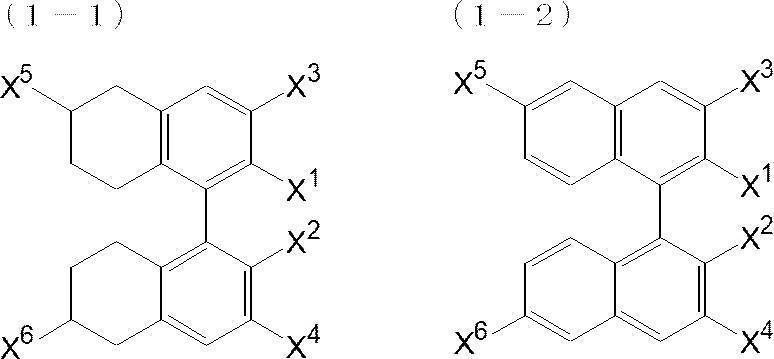
- the compound represented by the general formula (1) corresponds to the compound represented by the following general formula (1-1) when the portion where the solid line and the broken line are parallel is a single bond, In the case where the portion where is parallel to the broken line is a double bond, it corresponds to the compound represented by the following general formula (1-2).
- the compound represented by the general formula (1-2) is preferable.
- general formula (1-1) and X 1 ⁇ X 6 in the general formula (1-2) and X 1 ⁇ X 6 in the general formula (1), and the same meaning.
- X 1 to X 6 each independently represent a hydrogen atom or a substituent.
- at least one of X 1 to X 6 represents a group represented by the following general formula (2).
- X 1 and X 2 may combine with each other to form a ring.
- a 1 represents a hydrocarbon ring group or a heterocyclic group
- n represents an integer of 0 or more
- R 1 represents a substituent
- * represents a condensed ring in the general formula (1). It represents a bonding position to a carbon atom C x is bound to the carbon atom in a 1.
- the number of groups represented by the general formula (2) in X 1 to X 6 is 1 to 6, preferably 2 or 4, and more preferably 2.
- at least one of X 1 , X 3 and X 5 is a group represented by the general formula (2)
- at least one of X 2 , X 4 and X 6 is represented by the general formula (2)
- one of X 1 , X 3 and X 5 is a group represented by the general formula (2)
- one of X 2 , X 4 and X 6 is a group represented by the general formula (2) More preferably, it is a group represented.
- both groups are groups represented by the general formula (2).
- n represents an integer of 0 or more.
- n is preferably an integer of 0 to 2, more preferably 0 or 1, and still more preferably 1.
- a 1 represents a hydrocarbon ring group or a heterocyclic group.
- the hydrocarbon ring group include an aliphatic hydrocarbon ring group and an aromatic hydrocarbon ring group.
- the number of ring members of the hydrocarbon ring constituting the hydrocarbon ring group is not particularly limited, but is preferably 5 to 10.
- the aliphatic hydrocarbon ring constituting the aliphatic hydrocarbon ring group may have either a monocyclic structure or a polycyclic structure. When the aliphatic hydrocarbon ring has a polycyclic structure, it is preferable that at least one of the rings contained in the polycyclic structure is a 5-membered ring or more.
- the number of carbon atoms in the aliphatic hydrocarbon ring is not particularly limited, but is preferably 5 to 12, more preferably 5 to 10, and still more preferably 5 or 6.
- Specific examples of the aliphatic hydrocarbon ring include a cyclopentane ring, a cyclohexane ring, a cycloheptane ring, a cyclooctane ring, a norbornene ring, and an adamantane ring. Among them, a cyclopentane ring or a cyclohexane ring is preferable.
- the aromatic hydrocarbon ring constituting the aromatic hydrocarbon ring group may have either a monocyclic structure or a polycyclic structure.
- the aromatic hydrocarbon ring has a polycyclic structure
- the number of carbon atoms in the aromatic hydrocarbon ring is not particularly limited, but is preferably from 6 to 18, and more preferably from 6 to 10.
- Specific examples of the aromatic hydrocarbon ring include a benzene ring, a naphthalene ring, an anthracene ring, a phenanthrene ring, and a fluorene ring. Among them, a benzene ring or a naphthalene ring is preferable, and a benzene ring is more preferable.
- heterocyclic group examples include an aliphatic heterocyclic group and an aromatic heterocyclic group.
- the number of ring members of the heterocyclic ring constituting the heterocyclic group is not particularly limited, but is often 5 to 10.
- the aliphatic heterocyclic ring constituting the aliphatic heterocyclic group may have either a monocyclic structure or a polycyclic structure.
- the aliphatic heterocycle has a polycyclic structure, it is preferable that at least one of the rings included in the polycyclic structure is a 5-membered ring or more.
- the hetero atom contained in the aliphatic heterocyclic ring include a nitrogen atom, an oxygen atom and a sulfur atom.
- the number of ring members of the aliphatic heterocycle is not particularly limited, but is preferably 5 to 10.
- Specific examples of the aliphatic heterocycle include an oxolan ring, an oxane ring, a piperidine ring, and a piperazine ring.
- the aliphatic heterocyclic ring may be one in which -CH 2- constituting the ring is substituted with -CO-, and examples thereof include a phthalimide ring.
- the aromatic heterocyclic ring constituting the aromatic heterocyclic group may have either a monocyclic structure or a polycyclic structure.
- the aromatic heterocycle has a polycyclic structure
- it is preferable that at least one of the rings included in the polycyclic structure is a 5-membered ring or more.
- the hetero atom contained in the aromatic heterocyclic group include a nitrogen atom, an oxygen atom and a sulfur atom.
- the number of ring members of the aromatic heterocycle is not particularly limited, but is preferably 5 to 18.
- Specific examples of the aromatic heterocycle include a pyridine ring, a pyridazine ring, a pyrimidine ring, a pyrazine ring, a triazine ring, a thiophene ring, a thiazole ring, and an imidazole ring.
- a 1 is preferably an aromatic hydrocarbon ring group or an aromatic heterocyclic group, more preferably a benzene ring group or a naphthalene ring group, and further preferably a benzene ring group.
- a 1 is an aromatic hydrocarbon ring group or an aromatic heterocyclic group
- the compound of the present invention has a longer conjugated system containing a condensed ring, and absorbs light of a longer wavelength (particularly light of a wavelength of 365 nm). The efficiency is improved, and photoisomerization upon exposure is likely to occur.
- R 1 in the general formula (2) represents a substituent.
- n 2 or more, a plurality of R 1 may be the same or different.
- the substituent represented by R 1 include a halogen atom, a hydroxyl group, an alkoxy group, an alkyl group, an acyloxy group, an alkoxycarbonyl group, a phenoxycarbonyl group, a hydrocarbon ring group, a heterocyclic group, and a combination thereof. Groups.
- the definition of the hydrocarbon ring group and the aromatic heterocyclic group as the substituent represented by R 1 is the same as the definition of the hydrocarbon ring group and the heterocyclic group described for A 1 described above.
- the substituent represented by R 1 in the general formula (2) may be further substituted with a substituent.
- the substituent represented by R 1 may be further substituted with a polymerizable group.
- the polymerizable group is not particularly limited as long as it is a known polymerizable group, and includes, for example, a (meth) acryloyloxy group, a vinyl group, a maleimide group, an acetyl group, a styryl group, an allyl group, an epoxy group, an oxetane group, and And groups containing these groups.
- R 1 is preferably bonded to the carbonyl group in the general formula (2) at the para position.
- the carbon atom C x in the general formula (2) is preferably bonded to the 2-position, and R 1 is preferably bonded at the 5- to 7-positions.
- the group represented by the general formula (2) is represented by the general formula (3) because the HTP of the compound before the HTP is changed by exposure or the like (hereinafter, also referred to as “initial HTP”) is more excellent. Groups are preferred.
- R 2- (A 3 -Z 1 ) m -A 2 -C x O-CH CH- * (3)
- the positional relationship between the group represented by “R 2- (A 3 -Z 1 ) m -A 2 -C x O-” and the bonding position represented by “-*” Is not particularly limited, and the trans-form (the group represented by “R 2 — (A 3 —Z 1 ) m —A 2 —C x O—” and the bond position represented by “— *”
- the bond position represented by “-*” is disposed on the same side with respect to the double bond
- m represents an integer of 1 or 2, and 1 is preferable.
- * represents a bonding position with the condensed ring in the general formula (1).
- the carbon atoms C x is bound to the carbon atom in A 2.
- R 2 represents a hydrogen atom or a substituent.
- substituent represented by R 2 include a halogen atom, a hydroxyl group, an alkoxy group, and an alkyl group. Among them, a hydroxyl group or an alkoxy group is preferable.
- a 2 and A 3 each independently represent a hydrocarbon ring group or a heterocyclic group.
- a 2 and A 3 are preferably an aromatic hydrocarbon ring group, and more preferably a phenylene group.
- the definition of the hydrocarbon ring group and the heterocyclic group represented by A 2 and A 3 in the general formula (3) is the hydrocarbon ring group and the heterocyclic group described for A 1 in the general formula (2). Is the same as the definition.
- the hydrocarbon ring group and the heterocyclic group represented by A 2 and A 3 are constituted by removing two hydrogen atoms from the hydrocarbon ring and the hetero ring.
- a plurality of Z 1 and A 3 may be the same or different.
- the compound represented by the general formula (1) may have a substituent other than the group represented by the general formula (2) or the general formula (3) as X 1 to X 6 .
- the substituent other than the group represented by the general formula (2) or (3) is not particularly limited, and examples thereof include a halogen atom, a hydroxyl group, —CHO, an alkoxy group, an alkyl group, and a group represented by the general formula (A
- a group represented by the formula (A) is preferable, and a group represented by the formula (A) is more preferably a hydroxyl group, -CHO, an alkoxy group, or a group represented by the formula (A). preferable.
- k represents an integer of 1 or more, preferably an integer of 1 to 5, more preferably an integer of 1 to 3.
- * represents a bonding position with the condensed ring in the general formula (1).
- R 3 represents a hydrogen atom or a substituent.
- substituent represented by R 3 include a halogen atom, a hydroxyl group, an alkoxy group, and an alkyl group, and among them, an alkoxy group is preferable.
- a 4 represents a hydrocarbon ring group or a heterocyclic group.
- a 4 preferably an aromatic hydrocarbon ring group, a phenylene group is more preferable.
- the definition of the hydrocarbon ring group and the heterocyclic group represented by A 4 in the general formula (A) is the same as the definition of the hydrocarbon ring group and the heterocyclic group described for A 1 in the general formula (2). Is the same.
- hydrocarbon ring group and the heterocyclic group represented by A 4 is constituted by two hydrogen atoms from a hydrocarbon ring and heterocyclic are removed.
- a plurality of Z 2 and A 4 may be the same or different.
- a plurality of groups selected from X 1 to X 6 may be bonded to each other to form a ring.
- a plurality of combinations of the above two groups may exist in X 1 to X 6 .
- X 1 and X 3 may be bonded to each other to form a ring, and simultaneously, X 2 and X 4 may be bonded to each other to form a ring.
- any combination of X 1 and X 3 , X 1 and X 2 , and X 2 and X 4 is preferable, and the initial HTP is excellent.
- X 1 and X 2 are preferably bonded to each other to form a ring.
- the group formed by combining two groups selected from X 1 to X 6 with each other is not particularly limited, and includes, for example, a single bond and a divalent linking group.
- the divalent linking group include —O—, —CO—, —COO—, —CO—S—, —SO 2 —, and —NR— (R represents a hydrogen atom or an alkyl group. )
- X 1 and X 2 are bonded to each other to form “—O-alkylene group (preferably having 1 to 3 carbon atoms) —O—” or “—OCO-arylene group (preferably phenylene group) —COO—” It is more preferable to form “—O-alkylene group (preferably having 1 to 3 carbon atoms) —O—”.
- At least one of X 3 to X 6 is a group represented by the general formula (2), and X 1 and X 2 are not bonded to each other to form a ring
- At least one of X 1 and X 2 is preferably a hydroxyl group, an alkoxy group, or a group represented by the above general formula (A).
- at least one of X 3 to X 6 is preferably a group represented by the general formula (2) (preferably, at least one of X 5 and X 6 is a group in which the entire structure of the compound becomes longer and the initial HTP is further improved).
- a group represented by the general formula (2)), and at least one of X 1 and X 2 is a group represented by the above general formula (A); Is more preferably 2 or more.
- k preferably represents an integer of 2 to 5, more preferably 2 or 3.
- R 3 is preferably a hydroxyl group or an alkoxy group, and more preferably an alkoxy group having 1 to 3 carbon atoms.
- a 4 preferably an aromatic hydrocarbon ring group, a phenylene group is more preferable.
- the compound of the present invention can be synthesized by a known method.
- the compound of the present invention may be an R-form or an S-form, or may be a mixture of an R-form and an S-form.
- the compound of the present invention can be applied to various uses, and is suitably used as a so-called chiral compound.
- a cholesteric liquid crystal phase can be formed by using a composition obtained by mixing the compound of the present invention and a liquid crystal compound.
- the composition will be described in detail.
- the composition of the present invention is a composition containing the compound of the present invention.
- the composition of the present invention is preferably a composition further containing a liquid crystal compound (liquid crystal composition).
- liquid crystal composition a liquid crystal compound
- compositions of the present invention include a compound of the present invention.
- the compounds of the present invention are as described above.
- the content of the compound of the present invention in the composition is not particularly limited, it is preferably 1 to 20% by mass, more preferably 2 to 15% by mass, based on the total mass of the liquid crystal compound in the composition. -10% by mass is more preferred.
- the liquid crystal compound will be described later.
- one compound of the present invention may be used alone, or two or more compounds may be used. When two or more kinds are used, the total content is preferably within the above range.
- the composition of the present invention contains a liquid crystal compound.
- the liquid crystal compound means a compound having liquid crystallinity, which is a compound other than the compound of the present invention.
- a compound having liquid crystallinity means that the compound has a property of exhibiting an intermediate phase between a crystalline phase (low temperature side) and an isotropic phase (high temperature side) when the temperature is changed. .
- the optical anisotropy and fluidity derived from the liquid crystal phase were confirmed. it can.
- the liquid crystal compound is not particularly limited as long as it has a liquid crystal property, and examples thereof include a rod-shaped nematic liquid crystal compound.
- the rod-like nematic liquid crystal compound include, for example, azomethines, azoxys, cyanobiphenyls, cyanophenyl esters, benzoic esters, cyclohexanecarboxylic acid phenyl esters, cyanophenylcyclohexanes, cyano-substituted phenylpyrimidines, and alkoxy-substituted compounds
- Examples include phenylpyrimidines, phenyldioxane, tolans, and alkenylcyclohexylbenzonitrile. Note that not only a low-molecular liquid crystal compound but also a high-molecular liquid crystal compound can be used.
- the liquid crystal compound may be polymerizable or non-polymerizable, and is preferably polymerizable.
- a liquid crystal compound having one or more polymerizable groups is preferable in that the cholesteric liquid crystal phase can be fixed, and a liquid crystal compound having two or more polymerizable groups is more preferable. Liquid crystal compounds having a group are more preferred.
- the rod-shaped liquid crystalline compound having no polymerizable group is described in various documents (for example, Y. Goto et. Al., Mol. Cryst. Liq. Cryst. 1995, Vol. 260, pp. 23-28). ing.
- the polymerizable rod-like liquid crystalline compound can be obtained by introducing a polymerizable group into the rod-like liquid crystalline compound.
- the polymerizable group include an unsaturated polymerizable group, an epoxy group, and an aziridinyl group, preferably an unsaturated polymerizable group, and more preferably an ethylenically unsaturated polymerizable group.
- the polymerizable group can be introduced into the molecule of the rod-shaped liquid crystalline compound by various methods.
- the number of polymerizable groups contained in the polymerizable rod-shaped liquid crystalline compound is preferably 1 to 6, more preferably 1 to 3, and still more preferably 2.
- Two or more polymerizable rod-like liquid crystalline compounds may be used in combination. When two or more polymerizable rod-like liquid crystal compounds are used in combination, the alignment temperature can be lowered.
- liquid crystal compound a compound represented by the following general formula (4) is preferable.
- P 11 and P 12 each independently represent a hydrogen atom or a polymerizable group. However, at least one of P 11 and P 12 represents a polymerizable group.
- L 11 and L 12 each independently represent a single bond or a divalent linking group.
- a 11 to A 15 each independently represent an aromatic hydrocarbon ring group or an aromatic heterocyclic group which may have a substituent.
- Z 11 ⁇ Z 14 each independently represent a single bond or a divalent linking group.
- m 3 and m 4 each independently represent an integer of 0 or 1.
- the polymerizable groups represented by P 11 and P 12 are not particularly limited, but preferred specific examples are represented by the following general formulas (P-1) to (P-20).
- P-1) to (P-20) Polymerizable group.
- P-1 to (P-20) Polymerizable group.
- P-20 Polymerizable group.
- * shows the point of attachment to the L 11 or L 12.
- Ra represents a hydrogen atom or a methyl group.
- Me represents a methyl group and Et represents an ethyl group.
- P 11 and P 12 is preferably representative of at least one one of polymerizable group, and more preferably both P 11 and P 12 represents a polymerizable group.
- the divalent linking groups represented by L 11 and L 12 are not particularly limited, but each is independently a linear or branched alkylene group having 1 to 20 carbon atoms, or , One or more —CH 2 — in a linear or branched alkylene group having 1 to 20 carbon atoms is —O—, —S—, —NH—, —N (CH 3 ) —, —CO— And a divalent linking group substituted with one or more groups selected from the group consisting of -COO-.
- the divalent linking groups represented by L 11 and L 12 are each independently a linear or branched alkylene group having 1 to 20 carbon atoms in which one or more —CH 2 — is —O— Are preferred.
- a 11 to A 15 each independently represent an aromatic hydrocarbon ring group which may have a substituent, or an aromatic heterocyclic group which may have a substituent.
- aromatic hydrocarbon ring group and the aromatic heterocyclic group are the same as defined for the aromatic hydrocarbon ring group and the aromatic heterocyclic group described for A 1 and A 2 described above.
- the above-mentioned hydrocarbon ring group and heterocyclic group may or may not have a substituent.
- the number of substituents may be one or more.
- a fluorine atom, a chlorine atom, a fluoroalkyl group, an alkoxy group, or an alkyl group is preferable as the substituent, in terms of further improving the solubility of the compound represented by the general formula (4), and a fluoroalkyl group , An alkoxy group or an alkyl group is more preferred.
- the number of carbon atoms in the fluoroalkyl group and the alkyl group, and the number of carbon atoms in the alkyl group in the alkoxy group are not particularly limited, but are preferably 1 to 10, more preferably 1 to 5, still more preferably 1 to 3. Is particularly preferred.
- a fluoroalkyl group is a group in which at least one hydrogen atom in an alkyl group is substituted with a fluorine atom, and all hydrogen atoms are preferably substituted with a fluorine atom (a so-called perfluoroalkyl group). Is preferred).
- a 11 to A 15 are preferably an aromatic hydrocarbon ring group which may have a substituent, and more preferably a phenylene group bonded at the 1-position and the 4-position.
- the divalent linking group represented by Z 11 to Z 14 is not particularly limited.
- n 3 and m 4 each independently represent an integer of 0 or 1, and 0 is preferable.
- the compound represented by the general formula (4) can be synthesized by a known method. Hereinafter, specific examples of the liquid crystal compound will be described.
- the content of the liquid crystal compound in the composition is not particularly limited, but is preferably from 5 to 99% by mass, more preferably from 25 to 98% by mass, and preferably from 75 to 98% by mass, based on the total mass of the solids in the composition. % Is more preferred.
- a solid content intends components other than the solvent in a composition. If it is not a solvent, it is regarded as a solid even if the property is a liquid component.
- one kind of the liquid crystal compound may be used alone, or two or more kinds thereof may be used. When two or more kinds are used, the total content is preferably within the above range.
- the composition may include a polymerization initiator.
- the polymerization initiator include a photopolymerization initiator and a thermal polymerization initiator. Among them, a photopolymerization initiator capable of initiating a polymerization reaction by ultraviolet irradiation is preferable.
- the photopolymerization initiator include alkylphenone compounds, ⁇ -carbonyl compounds, acyloin ethers, ⁇ -hydrocarbon-substituted aromatic acyloin compounds, polynuclear quinone compounds, phenazine compounds, and oxadiazole compounds.
- the content of the polymerization initiator in the composition is not particularly limited, but is preferably 0.1 to 20% by mass, and preferably 1 to 8% by mass based on the total mass of the liquid crystal compound. % Is more preferred.
- the composition may use one polymerization initiator alone, or two or more polymerization initiators. When two or more kinds are used, the total content is preferably within the above range.
- the composition may include a surfactant that contributes to the formation of a stable or rapid liquid crystal phase (eg, a nematic phase, a cholesteric phase).
- a surfactant that contributes to the formation of a stable or rapid liquid crystal phase (eg, a nematic phase, a cholesteric phase).
- the surfactant include fluorine-containing (meth) acrylate polymers, compounds represented by formulas (X1) to (X3) described in WO2011 / 162291, and paragraphs 0082 to 0090 of JP-A-2014-119605. And the compounds described in paragraphs 0020 to 0031 of JP-A-2013-47204 (Japanese Patent No. 5774518). These compounds can reduce the tilt angle of the molecules of the liquid crystal compound at the air interface of the layer, or can substantially horizontally align the liquid crystal compound.
- horizontal alignment refers to the molecular axis of the liquid crystal compound (which corresponds to the long axis of the liquid crystal compound when the liquid crystal compound is a rod-shaped liquid crystal compound) and the surface of the composition layer ( (Film surface) is parallel, but it is not required to be strictly parallel, and in the present specification, it means an orientation with an inclination angle of less than 20 degrees with the film surface.
- the molecules of the liquid crystalline compound are oriented at a large tilt angle with respect to the film surface, for example, in the case of a cholesteric phase, the helical axis deviates from the normal to the film surface, causing a decrease in reflectance or fingerprint. Since a pattern may be generated and haze may be increased or diffractive, the pattern may not be preferable.
- the fluorinated (meth) acrylate-based polymer that can be used as a surfactant include those described in paragraphs 0018 to 0043 of JP-A-2007-272185.
- the content of the surfactant is not particularly limited, but is preferably 0.001 to 10% by mass, more preferably 0.05 to 3% by mass based on the total mass of the liquid crystal compound. preferable.
- the composition may use one surfactant alone or two or more surfactants. When two or more kinds are used, the total content is preferably within the above range.
- the composition may include a solvent. It is preferable that the solvent can dissolve each component of the composition. For example, methyl ethyl ketone, cyclohexanone, a mixed solvent thereof and the like can be mentioned.
- the content of the solvent in the composition is preferably such that the solid content concentration of the composition is 5 to 50% by mass, more preferably 10 to 40% by mass.
- the composition may use one kind of solvent alone or two or more kinds of solvents. When two or more kinds are used, the total content is preferably within the above range.
- the composition includes an antioxidant, an ultraviolet absorber, a sensitizer, a stabilizer, a plasticizer, a chain transfer agent, a polymerization inhibitor, an antifoaming agent, a leveling agent, a thickener, a flame retardant, and a dispersant.
- Agents, polymerizable monomers, and other additives such as coloring materials such as dyes and pigments.
- the present invention also includes a cured product obtained by curing the above-described composition.
- the method for curing (polymerizing and curing) the composition is not particularly limited, and a known method can be employed.
- a step X of forming a composition layer on a substrate by contacting a predetermined substrate with the composition, a step Y of exposing the composition layer, and a step Z of performing a curing treatment on the composition layer Has an aspect.
- the composition is a liquid crystal composition containing a liquid crystal compound
- the liquid crystal compound can be fixed in an oriented state, and a so-called optically anisotropic substance, or a cholesteric liquid crystal phase is fixed. Can be formed.
- the steps X to Z in the case of using the composition (liquid crystal composition) of the present invention in a form containing a liquid crystal compound will be described in detail.
- Step X is a step of contacting the substrate with the composition to form a composition layer on the substrate.
- the type of substrate to be used is not particularly limited, and includes known substrates (for example, a resin substrate, a glass substrate, a ceramic substrate, a semiconductor substrate, and a metal substrate).
- the method for bringing the substrate into contact with the composition is not particularly limited, and examples thereof include a method of applying the composition on the substrate and a method of immersing the substrate in the composition. After the substrate and the composition are brought into contact with each other, a drying treatment may be performed, if necessary, to remove the solvent from the composition layer on the substrate. Further, heat treatment may be performed in order to promote the alignment of the liquid crystal compound and bring the compound into a liquid crystal phase state.
- Step Y is a step of subjecting the composition layer to an exposure treatment using i-rays (wavelength 365 nm) or the like. It is preferable that the compound of the present invention causes photoisomerization by exposure treatment, and changes its HTP. In this exposure processing, the degree of change in HTP can be adjusted by appropriately adjusting the exposure amount and / or the exposure wavelength. After the exposure, a heat treatment may be further performed to promote the orientation of the liquid crystalline compound and bring it into a liquid crystal phase state.
- the helical pitch of the liquid crystal phase (and thus the selective reflection wavelength or the like) obtained here reflects the HTP adjusted in the above-described exposure processing.
- Step Z is a step of subjecting the composition layer after step Y (preferably, a composition layer in a liquid crystal phase) to a curing treatment.
- the method of the curing treatment is not particularly limited, and includes, for example, a light curing treatment and a heat curing treatment. Among them, a photo-curing treatment is preferable.
- the composition preferably contains a photopolymerization initiator. It is preferable that the wavelength of the light irradiated in the photo-curing process is different from the wavelength of the light used in the above-described exposure process, and the photopolymerization initiator is sensitive to the wavelength of the light used in the exposure process. Preferably do not show
- the cured product obtained by the above treatment is preferably a layer in which a liquid crystal phase is fixed.
- a layer formed by fixing a cholesteric liquid crystal phase is formed.
- These layers no longer need to exhibit liquid crystallinity.
- the state in which the cholesteric liquid crystal phase is “fixed” is the most typical and preferable mode in which the orientation of the liquid crystal compound in the cholesteric liquid crystal phase is maintained.
- the layer has no fluidity in a temperature range of usually 0 to 50 ° C., and in a temperature range of ⁇ 30 to 70 ° C. under severer conditions, and causes a change in the orientation form by an external field or an external force.
- the state is such that the fixed alignment mode can be maintained stably.
- Optical anisotropic body, reflective film A cured product is obtained by subjecting the composition to a curing treatment as described above.
- the cured product obtained by curing the composition of the present invention can be applied to various uses, for example, an optically anisotropic material and a reflective film.
- an optically anisotropic body or a reflection film obtained by curing the above composition is a preferred embodiment.
- a substance having optical anisotropy is intended as an optically anisotropic substance.
- the reflective film corresponds to a layer in which the above-mentioned cholesteric liquid crystal phase is fixed, and is a layer that can reflect light in a predetermined reflection band.
- the reaction solution was treated with aqueous sodium hydrogen sulfite (21.7 g of sodium hydrogen sulfite (manufactured by Wako Pure Chemical Industries, Ltd., 290 mL of water)), water (325 mL), and aqueous sodium hydrogen carbonate (sodium hydrogen carbonate (manufactured by Wako Pure Chemical Industries, Ltd.) ) (13.0 g, water 300 mL), and the obtained solution was dried over magnesium sulfate. Then, the solvent was distilled off from the solution under reduced pressure.
- Compounds CD-2 to CD-16 were synthesized with reference to the above method.
- the HTPs of the obtained compounds CD-1 to CD-16 were evaluated as described below.
- Compounds CE-1 to CE-4 were synthesized as comparative compounds. The method of synthesizing each compound was referred to in “The 5th Edition Experimental Chemistry Lecture 16”, pages 35 to 70, edited by The Chemical Society of Japan.
- Compound CE-1 is compound (R) -XII described in Non-Patent Document 1, and was synthesized according to the method described in Non-Patent Document 1.
- Compound CE-2 is a compound described in Molecular Crystals and Liquid Crystals (2004, Vol. 425, pp. 153-158), and was synthesized according to the method described in the above literature.
- Compound CE-4 is a compound described in Advanced Synthesis & Catalysis (2004, 346, pp. 1728-1732), and was synthesized according to the method described in the above literature.
- the structures of compounds CD-1 to CD-16 and CE-1 to CE-4 are shown below.
- a polyimide alignment film material SE-130 (manufactured by Nissan Chemical Industries, Ltd.) was applied on the washed glass substrate to form a coating film. After baking the obtained coating film, a rubbing treatment was performed to prepare a substrate with an alignment film. 40 ⁇ L of the above composition was spin-coated on the rubbed surface of this alignment film at 1500 rpm for 10 seconds, and then heated and dried at 90 ° C. for 1 minute to form a composition layer.
- the center reflection wavelength of the obtained composition layer was measured at room temperature (23 ° C.) using a microscope (manufactured by Nikon Corporation, ECLIPSE E600-POL) and a spectrophotometer (manufactured by Shimadzu Corporation, UV-3100 (PC)).
- HTP initial HTP was calculated according to the following equation.
- HTP (average refractive index of liquid crystal compound) / ⁇ (concentration of chiral compound to liquid crystal compound (% by mass)) ⁇ (center reflection wavelength) ⁇ [ ⁇ m ⁇ 1 ] The calculation was made assuming that the average refractive index of the liquid crystal compound was 1.55.
- HTP change rate
- the initial HTP and the HTP change rate were evaluated based on the following criteria. In each case, the A rating is most preferable.
- HTP change rate is 60% or more.
- B HTP change rate is 50% or more and less than 60%.
- C HTP change rate is 40% or more and less than 50%.
- D HTP change rate is 30% or more and less than 40%.
- E HTP change rate is less than 30%.
- the following table shows the evaluation results of the examples using the compositions prepared by adding each compound.
- the column of “general formula (2)” is represented by the general formula (2) among X 1 to X 6 when the compound used in each example is applied to the general formula (1). Indicates the position of the group.
- the column “A 1 ” indicates whether or not A 1 is an aromatic hydrocarbon ring group in the group represented by the general formula (2) among X 1 to X 6 . The case where this requirement was satisfied was designated as A, and the case where this requirement was not met was designated as B.
- the column of “X 1 , X 2 linked ring” indicates whether X 1 and X 2 are bonded to each other to form a ring when the compound used in each Example is applied to the general formula (1). Indicates The case where this requirement was satisfied was designated as A, and the case where this requirement was not met was designated as B.
- the compound represented by B in the column of “X 1 , X 2 linking ring” is represented by the formula (2) in which at least one of X 3 to X 6 is represented by the formula (2).
- at least one of X 1 and X 2 is a group represented by the general formula (A)
- k in the general formula (A) is 2 or more.
- Example 1 Comparison of Example 1 with Examples 13 and 14).
- X 1 and X 2 were bonded to each other to form a ring, it was confirmed that the initial HTP and the HTP change rate were more excellent (Examples 1 and 3 and Examples 7 to 9). Comparison).
- at least one of X 3 to X 6 is a group represented by the general formula (2), and X 1 and X 2 are not bonded to each other to form a ring, at least one of X 1 and X 2
- one is a group represented by the general formula (A) and k in the general formula (A) is 2 or more, it was confirmed that the initial HTP was more excellent (Example 9 and Example Comparison with Examples 7 and 8).
- Surfactant S-1 is a compound described in Japanese Patent No. 5774518 and has the following structure.
- Polymerization initiator X IRGACURE 907 (manufactured by BASF)
- a polyimide alignment film material SE-130 (manufactured by Nissan Chemical Industries, Ltd.) was applied on the washed glass substrate to form a coating film. After baking the obtained coating film, a rubbing treatment was performed to prepare a substrate with an alignment film. On the rubbed surface of the alignment film, 40 ⁇ L of the liquid crystal composition was spin-coated at 1500 rpm for 10 seconds to form a composition layer, and dried (aged) at 90 ° C. for 1 minute to obtain a composition. The liquid crystal compound in the material layer was oriented (in other words, a cholesteric liquid crystal phase was formed).
- the composition layer is irradiated with ultraviolet rays (310 nm) at a dose of 500 mJ / cm 2 in a nitrogen atmosphere at 25 ° C. to perform a curing treatment, and a reflection film (cholesteric) is formed.
- a reflection film (cholesteric) is formed.
Landscapes
- Chemical & Material Sciences (AREA)
- Organic Chemistry (AREA)
- Physics & Mathematics (AREA)
- Chemical Kinetics & Catalysis (AREA)
- Optics & Photonics (AREA)
- Health & Medical Sciences (AREA)
- General Physics & Mathematics (AREA)
- Medicinal Chemistry (AREA)
- Polymers & Plastics (AREA)
- Crystallography & Structural Chemistry (AREA)
- Engineering & Computer Science (AREA)
- Materials Engineering (AREA)
- Organic Low-Molecular-Weight Compounds And Preparation Thereof (AREA)
- Polarising Elements (AREA)
- Addition Polymer Or Copolymer, Post-Treatments, Or Chemical Modifications (AREA)
Abstract
本発明は、露光によるHTPの変化率に優れる化合物を提供する。また、本発明は、上記化合物を用いた組成物、硬化物、光学異方体、及び、反射膜を提供する。 本発明の化合物は、下記一般式(1)で表される化合物である。
Description
本発明は、化合物、組成物、硬化物、光学異方体、及び、反射膜に関する。
液晶性を示す化合物(以後、「液晶性化合物」ともいう。)は、種々の用途に適用できる。例えば、液晶性化合物は、位相差膜に代表される光学異方体の製造、又は、コレステリック液晶相を固定してなる反射膜の製造に適用される。
一般的に、コレステリック液晶相は、ネマチック液晶にキラル化合物を添加することにより形成される。非特許文献1には、液晶性化合物に対する螺旋捻じり力(HTP:Helical twisting power)を有するキラル化合物が開示されている。
一般的に、コレステリック液晶相は、ネマチック液晶にキラル化合物を添加することにより形成される。非特許文献1には、液晶性化合物に対する螺旋捻じり力(HTP:Helical twisting power)を有するキラル化合物が開示されている。
Anna Kickova et al. Chemical Papers、2013年、67巻、101-109頁
一方、近年、一定の処理をすることで任意にHTPを変化させられるキラル化合物が求められている。例えば、露光によってHTPの強度を大きく変化させるキラル化合物が望まれている。
本発明者らは、非特許文献1に記載されたキラル化合物について検討したところ、非特許文献1に記載されたキラル化合物は、露光によって生じるHTPの強度変化の程度(以下、「HTPの変化率」ともいう)が現在望まれるレベルに達していないことを知見した。
そこで、本発明は、露光によるHTPの変化率に優れる化合物を提供することを課題とする。
また、本発明は、上記化合物を用いた組成物、硬化物、光学異方体、及び、反射膜を提供することを課題とする。
また、本発明は、上記化合物を用いた組成物、硬化物、光学異方体、及び、反射膜を提供することを課題とする。
本発明者らは、上記課題を解決すべく鋭意検討した結果、後述する一般式(1)で表される化合物により上記課題が解決できることを見出し、本発明を完成させた。
すなわち、以下の構成により上記課題を解決できることを見出した。
すなわち、以下の構成により上記課題を解決できることを見出した。
〔1〕
後述する一般式(1)で表される化合物。
〔2〕
A1が芳香族炭化水素環基又は芳香族複素環基を表す、〔1〕に記載の化合物。
〔3〕
X1及びX2が互いに結合して環を形成する、〔1〕又は〔2〕に記載の化合物。
〔4〕
X1、X3、及びX5の少なくとも1つが後述する一般式(2)で表される基を表し、かつ、X2、X4、及びX6の少なくとも1つが一般式(2)で表される基を表す、〔1〕~〔3〕のいずれかに記載の化合物。
〔5〕
X3~X6の少なくとも1つが一般式(2)で表される基を表し、かつ、X1及びX2の少なくとも1つが、後述する一般式(A)で表される基を表す、〔1〕、〔2〕及び〔4〕のいずれかに記載の化合物。
〔6〕
一般式(2)で表される基が、後述する一般式(3)で表される基である、〔1〕~〔5〕のいずれかに記載の化合物。
〔7〕
〔1〕~〔6〕のいずれかに記載の化合物を含む、組成物。
〔8〕
液晶性化合物を更に含む、〔7〕に記載の組成物。
〔9〕
液晶性化合物が、2つの重合性基を有する、〔8〕に記載の組成物。
〔10〕
〔7〕~〔9〕のいずれかに記載の組成物を硬化してなる硬化物。
〔11〕
〔8〕又は〔9〕に記載の組成物を硬化してなる光学異方体。
〔12〕
〔8〕又は〔9〕に記載の組成物を硬化してなる反射膜。
後述する一般式(1)で表される化合物。
〔2〕
A1が芳香族炭化水素環基又は芳香族複素環基を表す、〔1〕に記載の化合物。
〔3〕
X1及びX2が互いに結合して環を形成する、〔1〕又は〔2〕に記載の化合物。
〔4〕
X1、X3、及びX5の少なくとも1つが後述する一般式(2)で表される基を表し、かつ、X2、X4、及びX6の少なくとも1つが一般式(2)で表される基を表す、〔1〕~〔3〕のいずれかに記載の化合物。
〔5〕
X3~X6の少なくとも1つが一般式(2)で表される基を表し、かつ、X1及びX2の少なくとも1つが、後述する一般式(A)で表される基を表す、〔1〕、〔2〕及び〔4〕のいずれかに記載の化合物。
〔6〕
一般式(2)で表される基が、後述する一般式(3)で表される基である、〔1〕~〔5〕のいずれかに記載の化合物。
〔7〕
〔1〕~〔6〕のいずれかに記載の化合物を含む、組成物。
〔8〕
液晶性化合物を更に含む、〔7〕に記載の組成物。
〔9〕
液晶性化合物が、2つの重合性基を有する、〔8〕に記載の組成物。
〔10〕
〔7〕~〔9〕のいずれかに記載の組成物を硬化してなる硬化物。
〔11〕
〔8〕又は〔9〕に記載の組成物を硬化してなる光学異方体。
〔12〕
〔8〕又は〔9〕に記載の組成物を硬化してなる反射膜。
本発明によれば、露光によるHTPの変化率に優れる化合物を提供できる。
また、本発明によれば、上記化合物を用いた組成物、硬化物、光学異方体、及び、反射膜を提供できる。
また、本発明によれば、上記化合物を用いた組成物、硬化物、光学異方体、及び、反射膜を提供できる。
以下、本発明について詳細に説明する。
以下に記載する構成要件の説明は、本発明の代表的な実施態様に基づいてなされることがあるが、本発明はそのような実施態様に限定されるものではない。
なお、本明細書において、「~」を用いて表される数値範囲は、「~」の前後に記載される数値を下限値及び上限値として含む範囲を意味する。
また、本明細書において、「(メタ)アクリロイルオキシ基」とは、アクリロイルオキシ基及びメタクリロイルオキシ基の両方を表す表記である。
以下に記載する構成要件の説明は、本発明の代表的な実施態様に基づいてなされることがあるが、本発明はそのような実施態様に限定されるものではない。
なお、本明細書において、「~」を用いて表される数値範囲は、「~」の前後に記載される数値を下限値及び上限値として含む範囲を意味する。
また、本明細書において、「(メタ)アクリロイルオキシ基」とは、アクリロイルオキシ基及びメタクリロイルオキシ基の両方を表す表記である。
本明細書における基(原子団)の表記において、置換及び無置換を記していない表記は、置換基を有さない基と共に置換基を有する基をも包含する。例えば、「アルキル基」とは、置換基を有さないアルキル基(無置換アルキル基)のみならず、置換基を有するアルキル基(置換アルキル基)をも包含する。
本明細書において、単に置換基という場合、置換基としては、例えば、下記置換基Tが挙げられる。
本明細書において、単に置換基という場合、置換基としては、例えば、下記置換基Tが挙げられる。
(置換基T)
置換基Tとしては、ハロゲン原子(フッ素原子、塩素原子、臭素原子、及び、ヨウ素原子等)、アルキル基、シクロアルキル基、アルケニル基、シクロアルケニル基、アルキニル基、アリール基、ヘテロ環基、シアノ基、水酸基、ニトロ基、カルボキシル基、アルコキシ基、アリールオキシ基、シリルオキシ基、ヘテロ環オキシ基、アシルオキシ基、カルバモイルオキシ基、アミノ基(アルキルアミノ基及びアニリノ基を含む)、アシルアミノ基、アミノカルボニルアミノ基、アルコキシカルボニルアミノ基、アリールオキシカルボニルアミノ基、スルファモイルアミノ基、アルキル又はアリールスルホニルアミノ基、メルカプト基、アルキルチオ基、アリールチオ基、ヘテロ環チオ基、スルファモイル基、スルホ基、アルキル又はアリールスルフィニル基、アルキル又はアリールスルホニル基、アシル基、アリールオキシカルボニル基、アルコキシカルボニル基、カルバモイル基、アリール又はヘテロ環アゾ基、イミド基、ホスフィノ基、ホスフィニル基、ホスフィニルオキシ基、ホスフィニルアミノ基、及び、シリル基等が挙げられる。
置換基Tとしては、ハロゲン原子(フッ素原子、塩素原子、臭素原子、及び、ヨウ素原子等)、アルキル基、シクロアルキル基、アルケニル基、シクロアルケニル基、アルキニル基、アリール基、ヘテロ環基、シアノ基、水酸基、ニトロ基、カルボキシル基、アルコキシ基、アリールオキシ基、シリルオキシ基、ヘテロ環オキシ基、アシルオキシ基、カルバモイルオキシ基、アミノ基(アルキルアミノ基及びアニリノ基を含む)、アシルアミノ基、アミノカルボニルアミノ基、アルコキシカルボニルアミノ基、アリールオキシカルボニルアミノ基、スルファモイルアミノ基、アルキル又はアリールスルホニルアミノ基、メルカプト基、アルキルチオ基、アリールチオ基、ヘテロ環チオ基、スルファモイル基、スルホ基、アルキル又はアリールスルフィニル基、アルキル又はアリールスルホニル基、アシル基、アリールオキシカルボニル基、アルコキシカルボニル基、カルバモイル基、アリール又はヘテロ環アゾ基、イミド基、ホスフィノ基、ホスフィニル基、ホスフィニルオキシ基、ホスフィニルアミノ基、及び、シリル基等が挙げられる。
上記の置換基の中で、水素原子を有するものは、置換基中の水素原子の部分が、更に、上記いずれかの置換基で置換されていてもよい。
本明細書において表記される2価の基の結合方向は、特に断らない限り制限されない。例えば、「L-M-N」なる一般式で表される化合物中の、Mが-OCO-C(CN)=CH-である場合、L側に結合している位置を*1、N側に結合している位置を*2とすると、Mは、*1-OCO-C(CN)=CH-*2であってもよく、*1-CH=C(CN)-COO-*2であってもよい。
〔本発明の化合物〕
本発明の化合物の特徴点としては、縮合環が連結し、更に、その縮合環に一般式(2)で表される基が連結してなる構造を有することにある。
以下、本発明の化合物について説明する。
本発明の化合物の特徴点としては、縮合環が連結し、更に、その縮合環に一般式(2)で表される基が連結してなる構造を有することにある。
以下、本発明の化合物について説明する。
本発明の化合物は、一般式(1)で表される化合物である。
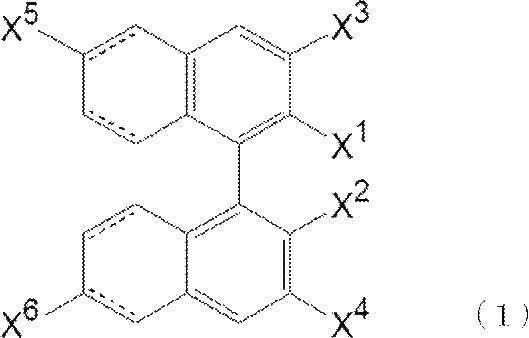
一般式(1)中、実線と破線が平行している部分は、一重結合又は二重結合を表す。例えば、一般式(1)で表される化合物は、実線と破線とが平行している部分が一重結合の場合には、下記一般式(1-1)で表される化合物に該当し、実線と破線とが平行している部分が二重結合の場合には、下記一般式(1-2)で表される化合物に該当する。
中でも、一般式(1-2)で表される化合物が好ましい。
なお、一般式(1-1)及び一般式(1-2)中のX1~X6は、一般式(1)中のX1~X6と、それぞれ同義である。
中でも、一般式(1-2)で表される化合物が好ましい。
なお、一般式(1-1)及び一般式(1-2)中のX1~X6は、一般式(1)中のX1~X6と、それぞれ同義である。
一般式(1)中、X1~X6は、それぞれ独立に、水素原子又は置換基を表す。ただし、X1~X6の少なくとも1つは、下記一般式(2)で表される基を表す。X1及びX2は、互いに結合して環を形成していてもよい。
(R1)n-A1-CxO-CH=CH-* (2)
なお、一般式(2)において、「(R1)n-A1-CxO-」で表される基と「-*」で表される結合位置との位置関係は特に制限されず、トランス型(「(R1)n-A1-CxO-」で表される基と「-*」で表される結合位置とが、二重結合に対して反対側に配置されている。)であってもよく、シス型(「(R1)n-A1-CxO-」で表される基と「-*」で表される結合位置とが、二重結合に対して同じ側に配置されている。)であってもよい。
(R1)n-A1-CxO-CH=CH-* (2)
なお、一般式(2)において、「(R1)n-A1-CxO-」で表される基と「-*」で表される結合位置との位置関係は特に制限されず、トランス型(「(R1)n-A1-CxO-」で表される基と「-*」で表される結合位置とが、二重結合に対して反対側に配置されている。)であってもよく、シス型(「(R1)n-A1-CxO-」で表される基と「-*」で表される結合位置とが、二重結合に対して同じ側に配置されている。)であってもよい。
一般式(2)中、A1は、炭化水素環基又は複素環基を表し、nは0以上の整数を表し、R1は置換基を表し、*は一般式(1)中の縮合環との結合位置を表し、炭素原子CxはA1中の炭素原子と結合している。
X1~X6中の一般式(2)で表される基の数は1~6であり、2又は4が好ましく、2がより好ましい。
中でも、X1、X3及びX5の少なくとも1つが一般式(2)で表される基であり、かつ、X2、X4及びX6の少なくとも1つが一般式(2)で表される基であることが好ましく、X1、X3及びX5の1つが一般式(2)で表される基であり、かつ、X2、X4及びX6の1つが一般式(2)で表される基であることがより好ましい。
例えば、X1及びX2の組合せ、X3及びX4の組合せ、並びに、X5及びX6の組合せからなる群より選択される少なくとも1つの組合せにおいて、少なくとも一方が一般式(2)で表される基であることが好ましく、両方が一般式(2)で表される基であることがより好ましい。
中でも、X1、X3及びX5の少なくとも1つが一般式(2)で表される基であり、かつ、X2、X4及びX6の少なくとも1つが一般式(2)で表される基であることが好ましく、X1、X3及びX5の1つが一般式(2)で表される基であり、かつ、X2、X4及びX6の1つが一般式(2)で表される基であることがより好ましい。
例えば、X1及びX2の組合せ、X3及びX4の組合せ、並びに、X5及びX6の組合せからなる群より選択される少なくとも1つの組合せにおいて、少なくとも一方が一般式(2)で表される基であることが好ましく、両方が一般式(2)で表される基であることがより好ましい。
以下、一般式(2)で表される基について詳しく説明する。
一般式(2)中、nは、0以上の整数を表す。中でも、nは、0~2の整数が好ましく、0又は1がより好ましく、1が更に好ましい。
一般式(2)中、nは、0以上の整数を表す。中でも、nは、0~2の整数が好ましく、0又は1がより好ましく、1が更に好ましい。
一般式(2)中、A1は、炭化水素環基又は複素環基を表す。
上記炭化水素環基としては、例えば、脂肪族炭化水素環基及び芳香族炭化水素環基が挙げられる。炭化水素環基を構成する炭化水素環の環員数は、特に制限されないが、5~10が好ましい。
脂肪族炭化水素環基を構成する脂肪族炭化水素環としては、単環構造及び多環構造のいずれであってもよい。なお、脂肪族炭化水素環が多環構造の場合、多環構造に含まれる環の少なくとも1つが5員環以上であることが好ましい。
上記脂肪族炭化水素環の炭素数は特に制限されないが、5~12が好ましく、5~10がより好ましく、5又は6が更に好ましい。脂肪族炭化水素環の具体例としては、シクロペンタン環、シクロヘキサン環、シクロヘプタン環、シクロオクタン環、ノルボルネン環、及び、アダマンタン環が挙げられる。中でも、シクロペンタン環又はシクロヘキサン環が好ましい。
芳香族炭化水素環基を構成する芳香族炭化水素環としては、単環構造及び多環構造のいずれであってもよい。なお、芳香族炭化水素環が多環構造の場合、多環構造に含まれる環の少なくとも1つが5員環以上であることが好ましい。
上記芳香族炭化水素環の炭素数は特に制限されないが、6~18が好ましく、6~10がより好ましい。芳香族炭化水素環の具体例としては、ベンゼン環、ナフタレン環、アントラセン環、フェナントレン環、及び、フルオレン環が挙げられる。中でも、ベンゼン環又はナフタレン環が好ましく、ベンゼン環がより好ましい。
上記炭化水素環基としては、例えば、脂肪族炭化水素環基及び芳香族炭化水素環基が挙げられる。炭化水素環基を構成する炭化水素環の環員数は、特に制限されないが、5~10が好ましい。
脂肪族炭化水素環基を構成する脂肪族炭化水素環としては、単環構造及び多環構造のいずれであってもよい。なお、脂肪族炭化水素環が多環構造の場合、多環構造に含まれる環の少なくとも1つが5員環以上であることが好ましい。
上記脂肪族炭化水素環の炭素数は特に制限されないが、5~12が好ましく、5~10がより好ましく、5又は6が更に好ましい。脂肪族炭化水素環の具体例としては、シクロペンタン環、シクロヘキサン環、シクロヘプタン環、シクロオクタン環、ノルボルネン環、及び、アダマンタン環が挙げられる。中でも、シクロペンタン環又はシクロヘキサン環が好ましい。
芳香族炭化水素環基を構成する芳香族炭化水素環としては、単環構造及び多環構造のいずれであってもよい。なお、芳香族炭化水素環が多環構造の場合、多環構造に含まれる環の少なくとも1つが5員環以上であることが好ましい。
上記芳香族炭化水素環の炭素数は特に制限されないが、6~18が好ましく、6~10がより好ましい。芳香族炭化水素環の具体例としては、ベンゼン環、ナフタレン環、アントラセン環、フェナントレン環、及び、フルオレン環が挙げられる。中でも、ベンゼン環又はナフタレン環が好ましく、ベンゼン環がより好ましい。
上記複素環基としては、脂肪族複素環基及び芳香族複素環基が挙げられる。複素環基を構成する複素環の環員数は特に制限されないが、5~10の場合が多い。
脂肪族複素環基を構成する脂肪族複素環としては、単環構造及び多環構造のいずれであってもよい。なお、脂肪族複素環が多環構造の場合、多環構造に含まれる環の少なくとも1つが5員環以上であることが好ましい。
上記脂肪族複素環が含むヘテロ原子としては、例えば、窒素原子、酸素原子及び硫黄原子が挙げられる。上記脂肪族複素環の環員数は特に制限されないが、5~10が好ましい。上記脂肪族複素環の具体例としては、例えば、オキソラン環、オキサン環、ピぺリジン環、及び、ピペラジン環が挙げられる。なお、脂肪族複素環としては、環を構成する-CH2-が-CO-で置換されたものであってもよく、例えば、フタルイミド環等が挙げられる。
芳香族複素環基を構成する芳香族複素環としては、単環構造及び多環構造のいずれであってもよい。なお、芳香族複素環が多環構造の場合、多環構造に含まれる環の少なくとも1つが5員環以上であることが好ましい。
上記芳香族複素環基が含むヘテロ原子としては、例えば、窒素原子、酸素原子及び硫黄原子が挙げられる。芳香族複素環の環員数は特に制限されないが、5~18が好ましい。上記芳香族複素環の具体例としては、例えば、ピリジン環、ピリダジン環、ピリミジン環、ピラジン環、トリアジン環、チオフェン環、チアゾール環、及び、イミダゾール環が挙げられる。
上記の炭化水素環又は複素環からR1で表される置換基の個数nに応じた(n+1)個の水素原子が取り除れることにより、A1で表される炭化水素環基又は複素環基となる。
脂肪族複素環基を構成する脂肪族複素環としては、単環構造及び多環構造のいずれであってもよい。なお、脂肪族複素環が多環構造の場合、多環構造に含まれる環の少なくとも1つが5員環以上であることが好ましい。
上記脂肪族複素環が含むヘテロ原子としては、例えば、窒素原子、酸素原子及び硫黄原子が挙げられる。上記脂肪族複素環の環員数は特に制限されないが、5~10が好ましい。上記脂肪族複素環の具体例としては、例えば、オキソラン環、オキサン環、ピぺリジン環、及び、ピペラジン環が挙げられる。なお、脂肪族複素環としては、環を構成する-CH2-が-CO-で置換されたものであってもよく、例えば、フタルイミド環等が挙げられる。
芳香族複素環基を構成する芳香族複素環としては、単環構造及び多環構造のいずれであってもよい。なお、芳香族複素環が多環構造の場合、多環構造に含まれる環の少なくとも1つが5員環以上であることが好ましい。
上記芳香族複素環基が含むヘテロ原子としては、例えば、窒素原子、酸素原子及び硫黄原子が挙げられる。芳香族複素環の環員数は特に制限されないが、5~18が好ましい。上記芳香族複素環の具体例としては、例えば、ピリジン環、ピリダジン環、ピリミジン環、ピラジン環、トリアジン環、チオフェン環、チアゾール環、及び、イミダゾール環が挙げられる。
上記の炭化水素環又は複素環からR1で表される置換基の個数nに応じた(n+1)個の水素原子が取り除れることにより、A1で表される炭化水素環基又は複素環基となる。
一般式(2)中、A1としては、芳香族炭化水素環基又は芳香族複素環基が好ましく、ベンゼン環基又はナフタレン環基がより好ましく、ベンゼン環基が更に好ましい。A1が芳香族炭化水素環基又は芳香族複素環基であることにより、本発明の化合物において、縮合環を含む共役系がより長くなり、長波長の光(特に波長365nmの光)の吸収効率が向上し、露光された際の光異性化が生じやすくなる。
一般式(2)中のR1は、置換基を表す。nが2以上の場合、複数のR1は同一であっても異なっていてもよい。
R1で表される置換基としては、例えば、ハロゲン原子、水酸基、アルコキシ基、アルキル基、アシルオキシ基、アルコキシカルボニル基、フェノキシカルボニル基、炭化水素環基、複素環基、及び、これらを組み合わせた基が挙げられる。
また、R1で表される置換基としての炭化水素環基及び芳香族複素環基の定義は、上述したA1で説明した炭化水素環基及び複素環基の定義と同じである。
一般式(2)中のR1で表される置換基は、更に置換基で置換されていてもよい。例えば、R1で表される置換基は、更に重合性基で置換されていてもよい。重合性基としては、公知の重合性基であれば特に制限されず、例えば、(メタ)アクリロイルオキシ基、ビニル基、マレイミド基、アセチル基、スチリル基、アリル基、エポキシ基、オキセタン基、及び、これらの基を含む基が挙げられる。
一般式(2)中、A1がベンゼン環基であり、かつ、nが1以上である場合、R1は、一般式(2)中のカルボニル基に対してパラ位で結合することが好ましい。A1がナフタレン環基である場合は、一般式(2)中の炭素原子Cxが2位に結合し、R1が5位~7位で結合することが好ましい。
R1で表される置換基としては、例えば、ハロゲン原子、水酸基、アルコキシ基、アルキル基、アシルオキシ基、アルコキシカルボニル基、フェノキシカルボニル基、炭化水素環基、複素環基、及び、これらを組み合わせた基が挙げられる。
また、R1で表される置換基としての炭化水素環基及び芳香族複素環基の定義は、上述したA1で説明した炭化水素環基及び複素環基の定義と同じである。
一般式(2)中のR1で表される置換基は、更に置換基で置換されていてもよい。例えば、R1で表される置換基は、更に重合性基で置換されていてもよい。重合性基としては、公知の重合性基であれば特に制限されず、例えば、(メタ)アクリロイルオキシ基、ビニル基、マレイミド基、アセチル基、スチリル基、アリル基、エポキシ基、オキセタン基、及び、これらの基を含む基が挙げられる。
一般式(2)中、A1がベンゼン環基であり、かつ、nが1以上である場合、R1は、一般式(2)中のカルボニル基に対してパラ位で結合することが好ましい。A1がナフタレン環基である場合は、一般式(2)中の炭素原子Cxが2位に結合し、R1が5位~7位で結合することが好ましい。
露光等によりHTPを変化させる前の化合物のHTP(以後、「初期HTP」ともいう)がより優れる点から、一般式(2)で表される基としては、一般式(3)で表される基が好ましい。
R2-(A3-Z1)m-A2-CxO-CH=CH-* (3)
なお、一般式(3)において、「R2-(A3-Z1)m-A2-CxO-」で表される基と「-*」で表される結合位置との位置関係は特に制限されず、トランス型(「R2-(A3-Z1)m-A2-CxO-」で表される基と「-*」で表される結合位置とが、二重結合に対して反対側に配置されている。)であってもよく、シス型(「R2-(A3-Z1)m-A2-CxO-」で表される基と「-*」で表される結合位置とが、二重結合に対して同じ側に配置されている。)であってもよい。
R2-(A3-Z1)m-A2-CxO-CH=CH-* (3)
なお、一般式(3)において、「R2-(A3-Z1)m-A2-CxO-」で表される基と「-*」で表される結合位置との位置関係は特に制限されず、トランス型(「R2-(A3-Z1)m-A2-CxO-」で表される基と「-*」で表される結合位置とが、二重結合に対して反対側に配置されている。)であってもよく、シス型(「R2-(A3-Z1)m-A2-CxO-」で表される基と「-*」で表される結合位置とが、二重結合に対して同じ側に配置されている。)であってもよい。
一般式(3)中、mは、1又は2の整数を表し、1が好ましい。
一般式(3)中、*は、一般式(1)中の縮合環との結合位置を表す。
一般式(3)中、炭素原子Cxは、A2中の炭素原子と結合している。
一般式(3)中、*は、一般式(1)中の縮合環との結合位置を表す。
一般式(3)中、炭素原子Cxは、A2中の炭素原子と結合している。
一般式(3)中、R2は、水素原子又は置換基を表す。
R2で表される置換基としては、例えば、ハロゲン原子、水酸基、アルコキシ基、及び、アルキル基が挙げられる。中でも、水酸基、又は、アルコキシ基が好ましい。
R2で表される置換基としては、例えば、ハロゲン原子、水酸基、アルコキシ基、及び、アルキル基が挙げられる。中でも、水酸基、又は、アルコキシ基が好ましい。
一般式(3)中、Z1は、単結合、-O-、-S-、-CH2O-、-CO-、-COO-、-CO-S-、-O-CO-O-、-CO-NH-、-CH2S-、-CF2O-、-CF2S-、-CH=CH-COO-、-CH=CH-OCO-、-OCO-C(CN)=CH-、-COO-CH2CH2-、-OCO-CH2CH2-、-COO-CH2-、-OCO-CH2-、-CH=CH-、-N=N-、-CH=N-N=CH-、-CF=CF-、又は、-C≡C-を表す。
Z1が複数ある場合は、複数のZ1は同一であっても異なっていてもよい。
中でも、Z1は、単結合、-COO-又は-CH=CH-COO-が好ましい。
Z1が複数ある場合は、複数のZ1は同一であっても異なっていてもよい。
中でも、Z1は、単結合、-COO-又は-CH=CH-COO-が好ましい。
一般式(3)中、A2及びA3は、それぞれ独立に、炭化水素環基、又は、複素環基を表す。中でも、A2及びA3としては、芳香族炭化水素環基が好ましく、フェニレン基がより好ましい。
一般式(3)中のA2及びA3によって表される炭化水素環基及び複素環基の定義は、上述した一般式(2)中のA1で説明した炭化水素環基及び複素環基の定義と同じである。ただし、A2及びA3によって表される炭化水素環基及び複素環基は、炭化水素環及び複素環から2つの水素原子が取り除かれることにより構成される。
一般式(3)中のA2及びA3によって表される炭化水素環基及び複素環基の定義は、上述した一般式(2)中のA1で説明した炭化水素環基及び複素環基の定義と同じである。ただし、A2及びA3によって表される炭化水素環基及び複素環基は、炭化水素環及び複素環から2つの水素原子が取り除かれることにより構成される。
mが2である場合、複数のZ1及びA3はそれぞれ同一であってもよく、異なっていてもよい。
一般式(1)で表わされる化合物は、X1~X6として、一般式(2)又は一般式(3)で表される基以外の置換基を有していてもよい。
一般式(2)又は一般式(3)で表される基以外の置換基としては、特に制限されないが、例えば、ハロゲン原子、水酸基、-CHO、アルコキシ基、アルキル基、及び、一般式(A)で表される基が挙げられ、水酸基、-CHO、アルコキシ基、又は、一般式(A)で表される基が好ましく、アルコキシ基、又は、一般式(A)で表される基がより好ましい。
一般式(2)又は一般式(3)で表される基以外の置換基としては、特に制限されないが、例えば、ハロゲン原子、水酸基、-CHO、アルコキシ基、アルキル基、及び、一般式(A)で表される基が挙げられ、水酸基、-CHO、アルコキシ基、又は、一般式(A)で表される基が好ましく、アルコキシ基、又は、一般式(A)で表される基がより好ましい。
R3-(A4-Z2)k-* (A)
一般式(A)中、kは、1以上の整数を表し、1~5の整数が好ましく、1~3の整数がより好ましい。
一般式(A)中、*は、一般式(1)中の縮合環との結合位置を表す。
一般式(A)中、kは、1以上の整数を表し、1~5の整数が好ましく、1~3の整数がより好ましい。
一般式(A)中、*は、一般式(1)中の縮合環との結合位置を表す。
一般式(A)中、R3は、水素原子又は置換基を表す。
R3で表される置換基としては、例えば、ハロゲン原子、水酸基、アルコキシ基、及び、アルキル基が挙げられ、中でもアルコキシ基が好ましい。
R3で表される置換基としては、例えば、ハロゲン原子、水酸基、アルコキシ基、及び、アルキル基が挙げられ、中でもアルコキシ基が好ましい。
一般式(A)中、Z2は、単結合、-O-、-S-、-CH2O-、-CO-、-COO-、-CO-S-、-O-CO-O-、-CO-NH-、-CH2S-、-CF2O-、-CF2S-、-CH=CH-COO-、-CH=CH-OCO-、-OCO-C(CN)=CH-、-COO-CH2CH2-、-OCO-CH2CH2-、-COO-CH2-、-OCO-CH2-、-CH=CH-、-N=N-、-CH=N-N=CH-、-CF=CF-、又は、-C≡C-を表す。
Z2は、単結合、-COO-、-CH=CH-COO-、又は、-OCO-C(CN)=CH-が好ましい。
Z2は、単結合、-COO-、-CH=CH-COO-、又は、-OCO-C(CN)=CH-が好ましい。
一般式(A)中、A4は、炭化水素環基、又は、複素環基を表す。中でも、A4としては、芳香族炭化水素環基が好ましく、フェニレン基がより好ましい。
一般式(A)中のA4によって表される炭化水素環基及び複素環基の定義は、上述した一般式(2)中のA1で説明した炭化水素環基及び複素環基の定義と同じである。ただし、A4によって表される炭化水素環基及び複素環基は、炭化水素環及び複素環から2つの水素原子が取り除かれることにより構成される。
一般式(A)中のA4によって表される炭化水素環基及び複素環基の定義は、上述した一般式(2)中のA1で説明した炭化水素環基及び複素環基の定義と同じである。ただし、A4によって表される炭化水素環基及び複素環基は、炭化水素環及び複素環から2つの水素原子が取り除かれることにより構成される。
kが2以上である場合、複数のZ2及びA4はそれぞれ同一であってもよく、異なっていてもよい。
一般式(1)中、X1~X6から選択される複数の基は、互いに結合して環を形成していてもよい。例えば、X1~X6から選択される2つの基が、互いに結合して環を形成することが好ましい。この場合、X1~X6のうちに、上記2つの基の組み合わせが複数存在していてもよい。例えば、X1とX3とが互いに結合して環を形成すると同時に、X2とX4とが互いに結合して環を形成していてもよい。
中でも、X1~X6から選択される2つの基の組み合わせとしては、X1とX3、X1とX2、及び、X2とX4のいずれかの組み合わせが好ましく、初期HTPが優れる点から、X1とX2とが互いに結合して環を形成することが好ましい。
中でも、X1~X6から選択される2つの基の組み合わせとしては、X1とX3、X1とX2、及び、X2とX4のいずれかの組み合わせが好ましく、初期HTPが優れる点から、X1とX2とが互いに結合して環を形成することが好ましい。
X1~X6から選択される2つの基の組み合わせが互いに結合して形成する基としては、特に制限はなく、例えば、単結合及び2価の連結基が挙げられる。
上記2価の連結基としては、例えば、-O-、-CO-、-COO-、-CO-S-、-SO2-、-NR-(Rは、水素原子、又は、アルキル基を表す)、2価の炭化水素基(例えば、アルキレン基、アルケニレン基(例:-CH=CH-)、アルキニレン基(例:-C≡C-)、及び、アリーレン基)、及び、これらを組み合わせた基が挙げられる。
中でも、X1とX2とが互いに結合して、「-O-アルキレン基(好ましくは炭素数1~3)-O-」又は「-OCO-アリーレン基(好ましくはフェニレン基)-COO-」を形成することが好ましく、「-O-アルキレン基(好ましくは炭素数1~3)-O-」を形成することがより好ましい。
上記2価の連結基としては、例えば、-O-、-CO-、-COO-、-CO-S-、-SO2-、-NR-(Rは、水素原子、又は、アルキル基を表す)、2価の炭化水素基(例えば、アルキレン基、アルケニレン基(例:-CH=CH-)、アルキニレン基(例:-C≡C-)、及び、アリーレン基)、及び、これらを組み合わせた基が挙げられる。
中でも、X1とX2とが互いに結合して、「-O-アルキレン基(好ましくは炭素数1~3)-O-」又は「-OCO-アリーレン基(好ましくはフェニレン基)-COO-」を形成することが好ましく、「-O-アルキレン基(好ましくは炭素数1~3)-O-」を形成することがより好ましい。
一般式(1)中、X3~X6の少なくとも1つが一般式(2)で表される基であり、かつ、X1とX2とが互いに結合して環を形成していない場合、X1及びX2の少なくとも1つが、水酸基、アルコキシ基、又は、上述の一般式(A)で表される基であることが好ましい。
中でも、化合物の全体構造が長くなり、初期HTPがより向上する点から、X3~X6の少なくとも1つが一般式(2)で表される基(好ましくはX5及びX6の少なくとも1つが一般式(2)で表される基)であり、かつ、X1及びX2の少なくとも1つが、上述の一般式(A)で表される基であって、かつ、一般式(A)中のkが2以上であることが、より好ましい。
中でも、化合物の全体構造が長くなり、初期HTPがより向上する点から、X3~X6の少なくとも1つが一般式(2)で表される基(好ましくはX5及びX6の少なくとも1つが一般式(2)で表される基)であり、かつ、X1及びX2の少なくとも1つが、上述の一般式(A)で表される基であって、かつ、一般式(A)中のkが2以上であることが、より好ましい。
X1及びX2が一般式(A)で表される基である場合、kは、2~5の整数を表すことが好ましく、2又は3を表すことがより好ましい。
また、X1及びX2が一般式(A)で表される基である場合におけるR3、複数存在してもよいZ2、及び、複数存在してもよいA4については、上述したとおりである。
ただし、R3としては、水酸基、又は、アルコキシ基が好ましく、炭素数1~3のアルコキシ基がより好ましい。
また、Z2としては、-COO-、又は、-OCO-C(CN)=CH-が好ましい。
また、A4としては、芳香族炭化水素環基が好ましく、フェニレン基がより好ましい。
また、X1及びX2が一般式(A)で表される基である場合におけるR3、複数存在してもよいZ2、及び、複数存在してもよいA4については、上述したとおりである。
ただし、R3としては、水酸基、又は、アルコキシ基が好ましく、炭素数1~3のアルコキシ基がより好ましい。
また、Z2としては、-COO-、又は、-OCO-C(CN)=CH-が好ましい。
また、A4としては、芳香族炭化水素環基が好ましく、フェニレン基がより好ましい。
本発明の化合物は、公知の方法で合成できる。
なお、本発明の化合物は、R体であってもS体であってもよく、R体とS体との混合物であってもよい。
なお、本発明の化合物は、R体であってもS体であってもよく、R体とS体との混合物であってもよい。
以下に、本発明の化合物の具体例を示す。
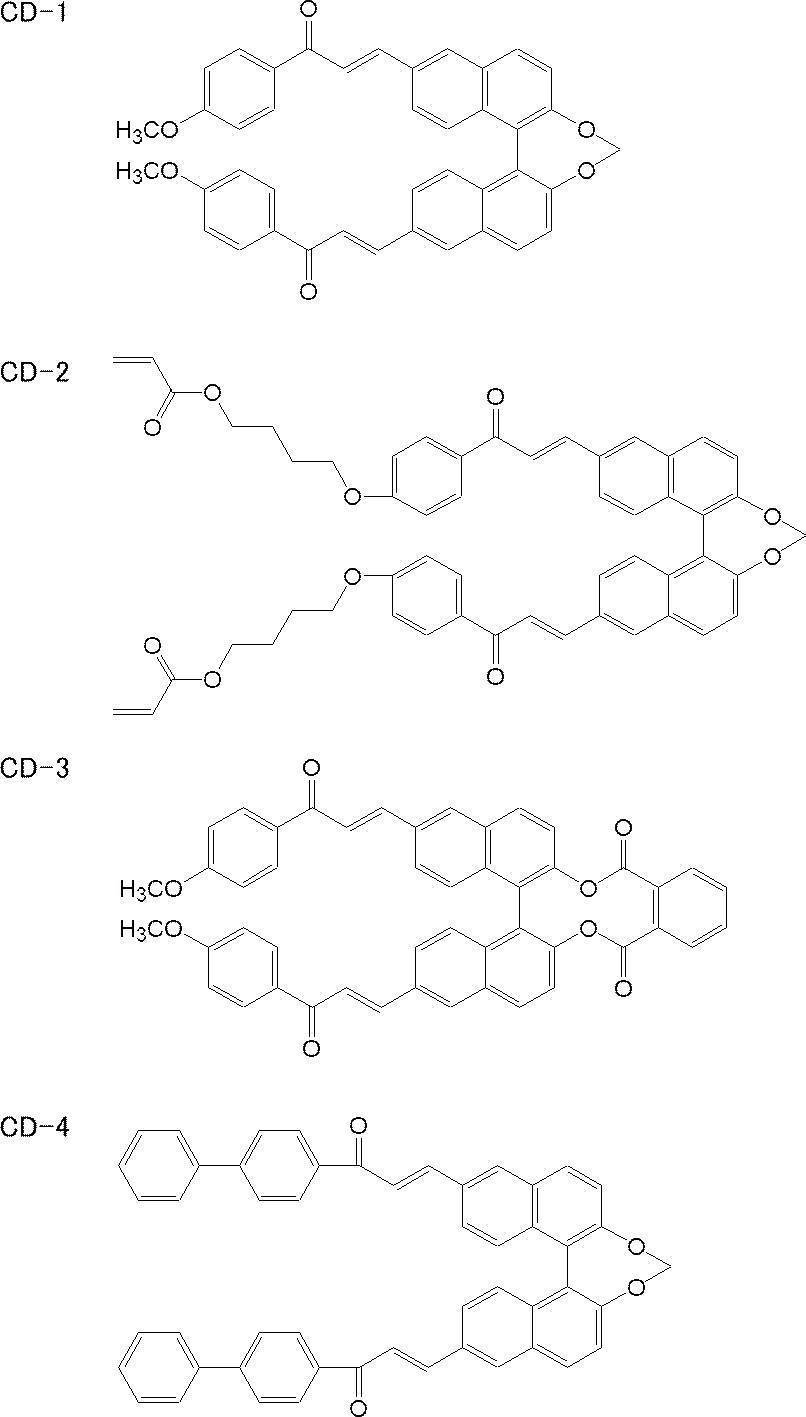

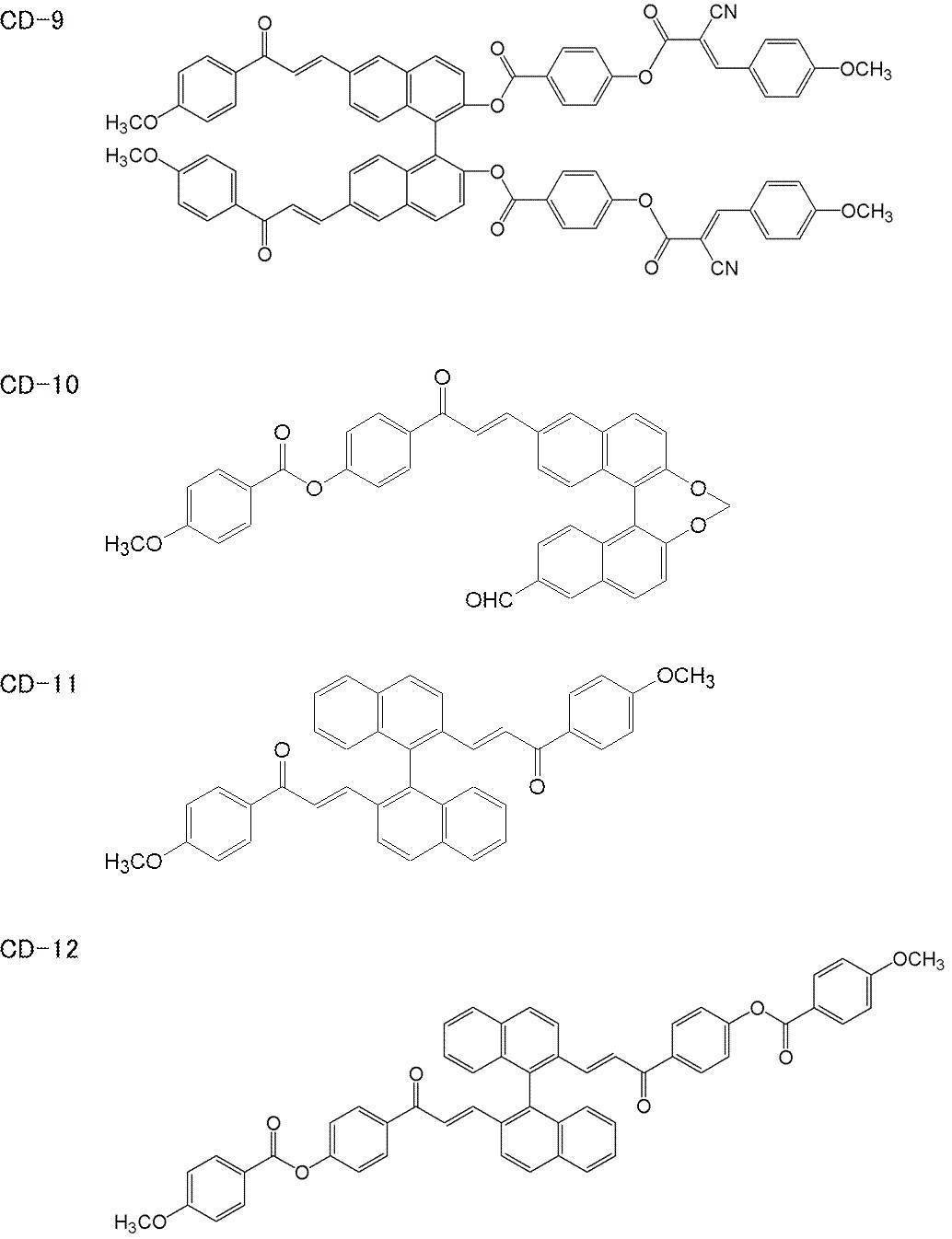


本発明の化合物は、種々の用途に適用でき、いわゆるキラル化合物として好適に用いられる。例えば、本発明の化合物と液晶性化合物とを混合して得られる組成物を用いることにより、コレステリック液晶相を形成できる。
以下では、組成物について詳述する。
以下では、組成物について詳述する。
〔組成物〕
次に、本発明の組成物について説明する。
本発明の組成物は、本発明の化合物を含む組成物である。
本発明の組成物は、更に液晶性化合物を含む組成物(液晶組成物)であることが好ましい。
以下に、本発明の組成物が液晶組成物である場合における、組成物に含まれる各成分について説明する。
次に、本発明の組成物について説明する。
本発明の組成物は、本発明の化合物を含む組成物である。
本発明の組成物は、更に液晶性化合物を含む組成物(液晶組成物)であることが好ましい。
以下に、本発明の組成物が液晶組成物である場合における、組成物に含まれる各成分について説明する。
<本発明の化合物>
本発明の組成物は、本発明の化合物を含む。本発明の化合物は、上述したとおりである。
組成物中での本発明の化合物の含有量は特に制限されないが、組成物中の液晶性化合物の全質量に対して、1~20質量%が好ましく、2~15質量%がより好ましく、2~10質量%が更に好ましい。液晶性化合物については後段で説明する。
組成物は、本発明の化合物を1種単独で使用してもよく、2種以上使用してもよい。2種以上使用する場合は、その合計含有量が上記範囲内であることが好ましい。
本発明の組成物は、本発明の化合物を含む。本発明の化合物は、上述したとおりである。
組成物中での本発明の化合物の含有量は特に制限されないが、組成物中の液晶性化合物の全質量に対して、1~20質量%が好ましく、2~15質量%がより好ましく、2~10質量%が更に好ましい。液晶性化合物については後段で説明する。
組成物は、本発明の化合物を1種単独で使用してもよく、2種以上使用してもよい。2種以上使用する場合は、その合計含有量が上記範囲内であることが好ましい。
<液晶性化合物>
本発明の組成物が液晶組成物である場合、本発明の組成物は液晶性化合物を含む。
上記液晶性化合物は、本発明の化合物以外の化合物である、液晶性を示す化合物を意味する。
なお、化合物が液晶性を示すとは、温度を変化させたときに、結晶相(低温側)と等方相(高温側)の間に中間相を発現する性質を化合物が有することを意図する。具体的な観察方法としては、メトラートレド社製ホットステージシステムFP90等で化合物を加熱又は降温しながら、偏光顕微鏡下で観察することで、液晶相に由来する光学性異方性と流動性を確認できる。
本発明の組成物が液晶組成物である場合、本発明の組成物は液晶性化合物を含む。
上記液晶性化合物は、本発明の化合物以外の化合物である、液晶性を示す化合物を意味する。
なお、化合物が液晶性を示すとは、温度を変化させたときに、結晶相(低温側)と等方相(高温側)の間に中間相を発現する性質を化合物が有することを意図する。具体的な観察方法としては、メトラートレド社製ホットステージシステムFP90等で化合物を加熱又は降温しながら、偏光顕微鏡下で観察することで、液晶相に由来する光学性異方性と流動性を確認できる。
液晶性化合物としては、液晶性を有していれば特に制限されず、例えば、棒状ネマチック液晶性化合物等が挙げられる。
棒状ネマチック液晶性化合物としては、例えば、アゾメチン類、アゾキシ類、シアノビフェニル類、シアノフェニルエステル類、安息香酸エステル類、シクロヘキサンカルボン酸フェニルエステル類、シアノフェニルシクロヘキサン類、シアノ置換フェニルピリミジン類、アルコキシ置換フェニルピリミジン類、フェニルジオキサン類、トラン類、及び、アルケニルシクロヘキシルベンゾニトリル類が挙げられる。なお、低分子液晶性化合物だけではなく、高分子液晶性化合物も用いることができる。
棒状ネマチック液晶性化合物としては、例えば、アゾメチン類、アゾキシ類、シアノビフェニル類、シアノフェニルエステル類、安息香酸エステル類、シクロヘキサンカルボン酸フェニルエステル類、シアノフェニルシクロヘキサン類、シアノ置換フェニルピリミジン類、アルコキシ置換フェニルピリミジン類、フェニルジオキサン類、トラン類、及び、アルケニルシクロヘキシルベンゾニトリル類が挙げられる。なお、低分子液晶性化合物だけではなく、高分子液晶性化合物も用いることができる。
液晶性化合物は、重合性であっても非重合性であってもよく、重合性であることが好ましい。
液晶性化合物としては、コレステリック液晶相を固定できる点で、1つ以上の重合性基を有する液晶性化合物が好ましく、2つ以上の重合性基を有する液晶性化合物がより好ましく、2つの重合性基を有する液晶性化合物が更に好ましい。
液晶性化合物としては、コレステリック液晶相を固定できる点で、1つ以上の重合性基を有する液晶性化合物が好ましく、2つ以上の重合性基を有する液晶性化合物がより好ましく、2つの重合性基を有する液晶性化合物が更に好ましい。
重合性基を有しない棒状液晶性化合物については、様々な文献(例えば、Y. Goto et.al., Mol. Cryst. Liq. Cryst. 1995, Vol. 260, pp.23-28)に記載されている。
一方、重合性棒状液晶性化合物は、重合性基を棒状液晶性化合物に導入することで得られる。重合性基としては、不飽和重合性基、エポキシ基、及び、アジリジニル基が挙げられ、不飽和重合性基が好ましく、エチレン性不飽和重合性基がより好ましい。重合性基は種々の方法で、棒状液晶性化合物の分子中に導入できる。重合性棒状液晶性化合物が有する重合性基の個数は、1~6が好ましく、1~3がより好ましく、2が更に好ましい。2種類以上の重合性棒状液晶性化合物を併用してもよい。2種類以上の重合性棒状液晶性化合物を併用すると、配向温度を低下させることができる。
一方、重合性棒状液晶性化合物は、重合性基を棒状液晶性化合物に導入することで得られる。重合性基としては、不飽和重合性基、エポキシ基、及び、アジリジニル基が挙げられ、不飽和重合性基が好ましく、エチレン性不飽和重合性基がより好ましい。重合性基は種々の方法で、棒状液晶性化合物の分子中に導入できる。重合性棒状液晶性化合物が有する重合性基の個数は、1~6が好ましく、1~3がより好ましく、2が更に好ましい。2種類以上の重合性棒状液晶性化合物を併用してもよい。2種類以上の重合性棒状液晶性化合物を併用すると、配向温度を低下させることができる。
液晶性化合物としては、下記一般式(4)で表される化合物が好ましい。

一般式(4)中、P11及びP12は、それぞれ独立に、水素原子又は重合性基を表す。ただし、P11及びP12の少なくとも一方が重合性基を表す。L11及びL12は、それぞれ独立に、単結合又は2価の連結基を表す。A11~A15は、それぞれ独立に、置換基を有していてもよい、芳香族炭化水素環基又は芳香族複素環基を表す。Z11~Z14は、それぞれ独立に、単結合又は2価の連結基を表す。m3及びm4は、それぞれ独立に、0又は1の整数を表す。
一般式(4)中、P11及びP12で表される重合性基としては特に制限されないが、好適な具体例として、以下の一般式(P-1)~(P-20)で表される重合性基が挙げられる。なお、以下式中の*はL11又はL12との結合位置を表す。また、Raは、水素原子又はメチル基を表す。また、Meはメチル基、Etはエチル基を表す。

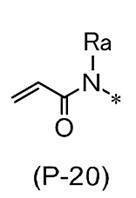
P11及びP12は、少なくともいずれか1つが重合性基を表すことが好ましく、P11及びP12がいずれも重合性基を表すことがより好ましい。
一般式(4)中、L11及びL12で表される2価の連結基としては特に制限されないが、それぞれ独立に、炭素数1~20の直鎖状若しくは分岐鎖状のアルキレン基、又は、炭素数1~20の直鎖状若しくは分岐鎖状のアルキレン基における1つ以上の-CH2-が-O-、-S-、-NH-、-N(CH3)-、-CO-、及び、-COO-からなる群から選択される1種以上の基で置換された2価の連結基が挙げられる。
L11及びL12で表される2価の連結基としては、それぞれ独立に、炭素数1~20の直鎖状若しくは分岐鎖状のアルキレン基において1つ以上の-CH2-が-O-で置換された基が好ましい。
L11及びL12で表される2価の連結基としては、それぞれ独立に、炭素数1~20の直鎖状若しくは分岐鎖状のアルキレン基において1つ以上の-CH2-が-O-で置換された基が好ましい。
一般式(4)中、A11~A15は、それぞれ独立に、置換基を有していてもよい芳香族炭化水素環基、又は、置換基を有していてもよい芳香族複素環基を表す。
芳香族炭化水素環基及び芳香族複素環基の定義は、上述したA1及びA2で説明した芳香族炭化水素環基及び芳香族複素環基の定義と同じである。
上述の炭化水素環基及び複素環基は、置換基を有していてもよいし、有していなくてもよい。置換基の数は1つでも、複数であってもよい。
中でも、一般式(4)で表される化合物の溶解性がより向上する点で、置換基としては、フッ素原子、塩素原子、フルオロアルキル基、アルコキシ基、又は、アルキル基が好ましく、フルオロアルキル基、アルコキシ基、又は、アルキル基がより好ましい。
上記フルオロアルキル基及びアルキル基中の炭素数、並びに、アルコキシ基中のアルキル基の炭素数は特に制限されないが、1~10が好ましく、1~5がより好ましく、1~3が更に好ましく、1が特に好ましい。
なお、フルオロアルキル基とは、アルキル基中の少なくとも1つの水素原子がフッ素原子で置換された基であり、全ての水素原子がフッ素原子で置換されていることが好ましい(いわゆる、パーフルオロアルキル基が好ましい)。
上述の炭化水素環基及び複素環基は、置換基を有していてもよいし、有していなくてもよい。置換基の数は1つでも、複数であってもよい。
中でも、一般式(4)で表される化合物の溶解性がより向上する点で、置換基としては、フッ素原子、塩素原子、フルオロアルキル基、アルコキシ基、又は、アルキル基が好ましく、フルオロアルキル基、アルコキシ基、又は、アルキル基がより好ましい。
上記フルオロアルキル基及びアルキル基中の炭素数、並びに、アルコキシ基中のアルキル基の炭素数は特に制限されないが、1~10が好ましく、1~5がより好ましく、1~3が更に好ましく、1が特に好ましい。
なお、フルオロアルキル基とは、アルキル基中の少なくとも1つの水素原子がフッ素原子で置換された基であり、全ての水素原子がフッ素原子で置換されていることが好ましい(いわゆる、パーフルオロアルキル基が好ましい)。
A11~A15としては、置換基を有していてもよい芳香族炭化水素環基が好ましく、1位と4位とで結合するフェニレン基がより好ましい。
一般式(4)中、Z11~Z14で表される2価の連結基としては特に制限されないが、例えば、上述したZ1及びZ2で説明した2価の連結基(Z1及びZ2で説明した基のうちの単結合以外の基)と同様のものが挙げられる。Z11~Z14としては、中でも、-COO-、又は、-CH=CH-が好ましい。
一般式(4)中、m3及びm4は、それぞれ独立に、0又は1の整数を表し、0が好ましい。
一般式(4)で表される化合物は、公知の方法で合成できる。
以下に、液晶性化合物の具体例を示す。
以下に、液晶性化合物の具体例を示す。
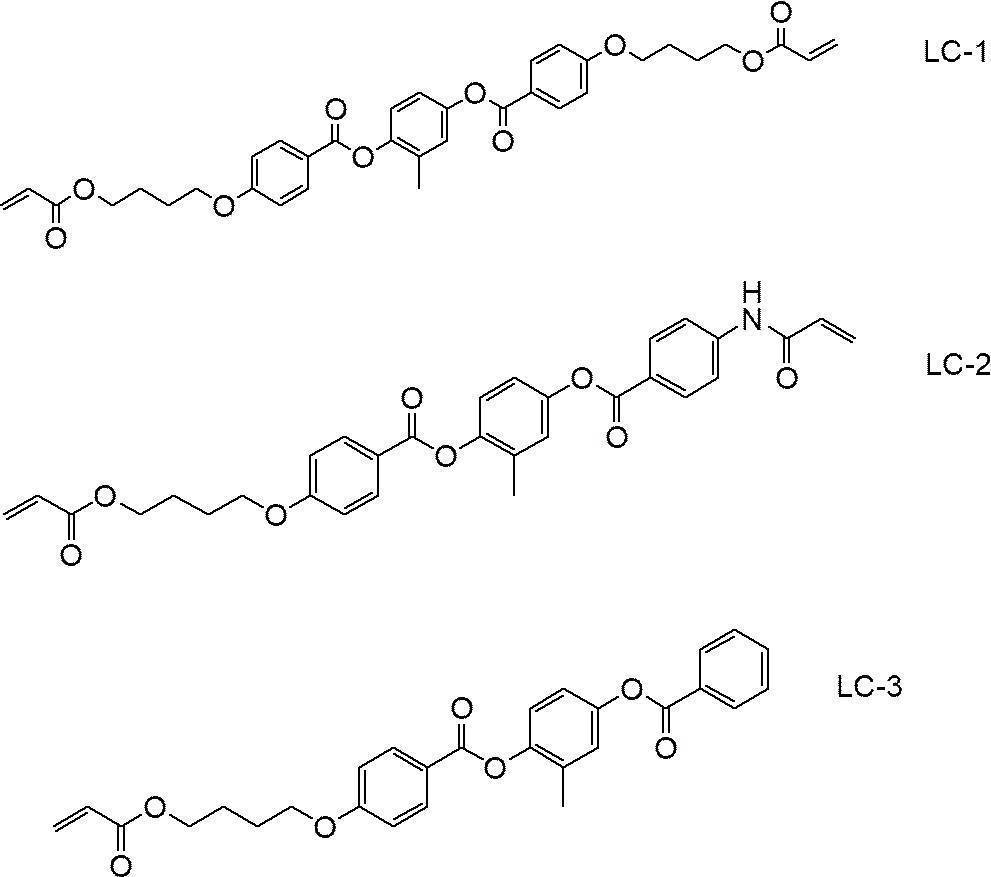
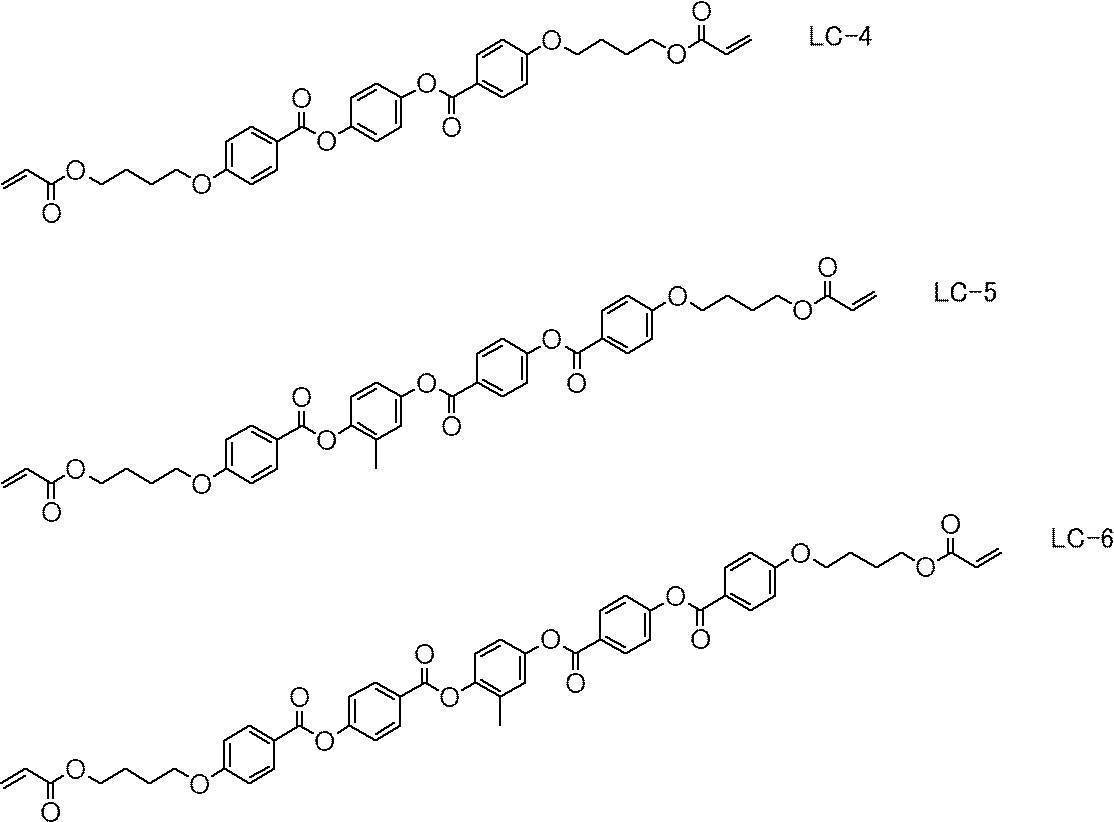
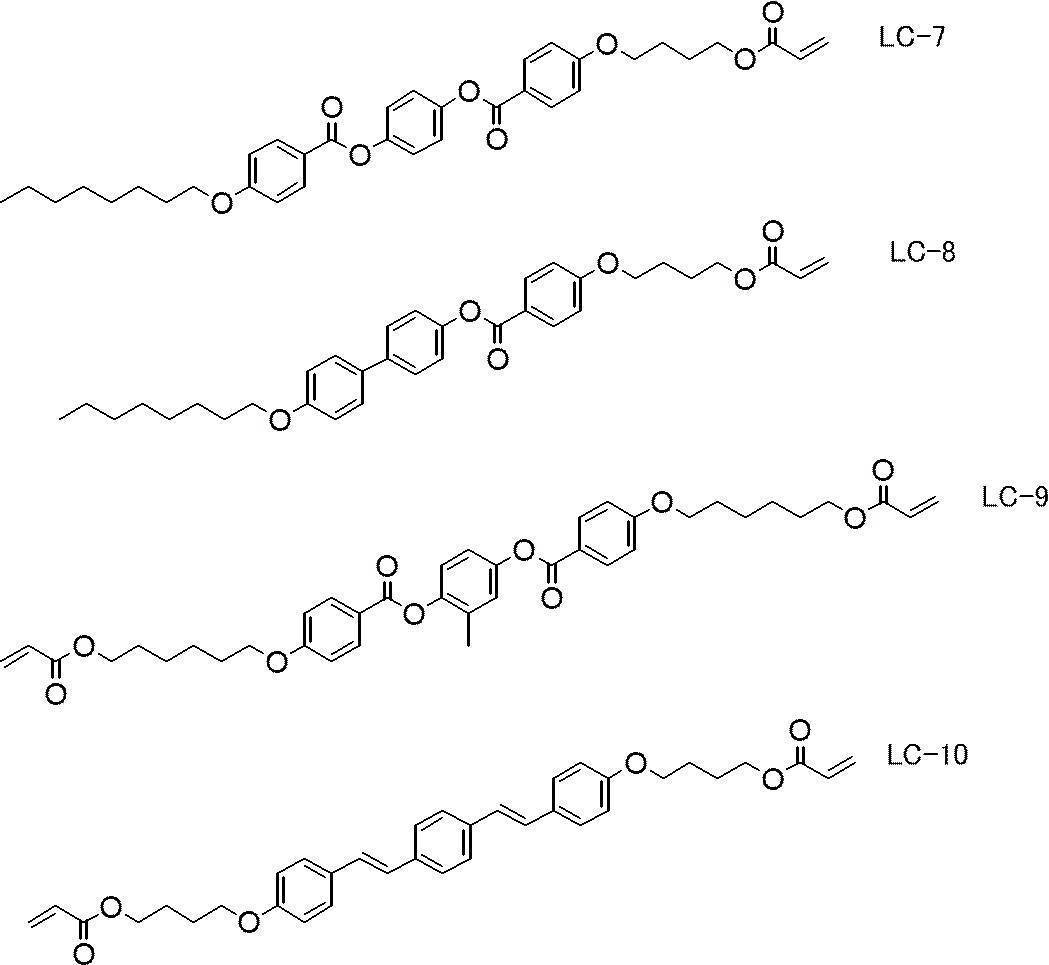
組成物中での液晶性化合物の含有量は特に制限されないが、組成物中の固形分の全質量に対して、5~99質量%が好ましく、25~98質量%がより好ましく、75~98質量%が更に好ましい。
なお、固形分とは、組成物中の溶剤以外の成分を意図する。溶剤以外であれば、その性状が液体状の成分であっても固形分とみなす。
組成物は、液晶性化合物を1種単独で使用してもよく、2種以上使用してもよい。2種以上使用する場合は、その合計含有量が上記範囲内であることが好ましい。
なお、固形分とは、組成物中の溶剤以外の成分を意図する。溶剤以外であれば、その性状が液体状の成分であっても固形分とみなす。
組成物は、液晶性化合物を1種単独で使用してもよく、2種以上使用してもよい。2種以上使用する場合は、その合計含有量が上記範囲内であることが好ましい。
<重合開始剤>
組成物は、重合開始剤を含んでいてもよい。
重合開始剤としては、光重合開始剤及び熱重合開始剤等が挙げられ、中でも、紫外線照射によって重合反応を開始可能な光重合開始剤が好ましい。光重合開始剤としては、例えば、アルキルフェノン化合物、α-カルボニル化合物、アシロインエーテル、α-炭化水素置換芳香族アシロイン化合物、多核キノン化合物、フェナジン化合物、及び、オキサジアゾール化合物が挙げられる。
組成物が重合開始剤を含む場合、組成物中での重合開始剤の含有量は特に制限されないが、液晶性化合物全質量に対して、0.1~20質量%が好ましく、1~8質量%がより好ましい。
組成物は、重合開始剤を1種単独で使用してもよく、2種以上使用してもよい。2種以上使用する場合は、その合計含有量が上記範囲内であることが好ましい。
組成物は、重合開始剤を含んでいてもよい。
重合開始剤としては、光重合開始剤及び熱重合開始剤等が挙げられ、中でも、紫外線照射によって重合反応を開始可能な光重合開始剤が好ましい。光重合開始剤としては、例えば、アルキルフェノン化合物、α-カルボニル化合物、アシロインエーテル、α-炭化水素置換芳香族アシロイン化合物、多核キノン化合物、フェナジン化合物、及び、オキサジアゾール化合物が挙げられる。
組成物が重合開始剤を含む場合、組成物中での重合開始剤の含有量は特に制限されないが、液晶性化合物全質量に対して、0.1~20質量%が好ましく、1~8質量%がより好ましい。
組成物は、重合開始剤を1種単独で使用してもよく、2種以上使用してもよい。2種以上使用する場合は、その合計含有量が上記範囲内であることが好ましい。
<界面活性剤>
組成物は、安定的又は迅速な液晶相(例えば、ネマチック相、コレステリック相)の形成に寄与する界面活性剤を含んでいてもよい。
界面活性剤としては、例えば、含フッ素(メタ)アクリレート系ポリマー、WO2011/162291号に記載の一般式(X1)~(X3)で表される化合物、特開2014-119605号の段落0082~0090に記載の一般式(I)で表される化合物、及び、特開2013-47204号(特許第5774518号)の段落0020~0031に記載の化合物が挙げられる。これらの化合物は、層の空気界面において、液晶性化合物の分子のチルト角を低減させる、又は、液晶性化合物を実質的に水平配向させることができる。
なお、本明細書で「水平配向」とは、液晶性化合物の分子軸(液晶性化合物が棒状液晶性化合物である場合、液晶性化合物の長軸に該当。)と組成物の層の表面(膜面)が平行であることをいうが、厳密に平行であることを要求するものではなく、本明細書では、膜面とのなす傾斜角が20度未満の配向を意味するものとする。液晶性化合物が空気界面付近で水平配向する場合、配向欠陥が生じ難いため、可視光領域での透明性が高くなる。一方、液晶性化合物の分子が膜面に対して大きなチルト角で配向すると、例えば、コレステリック相とする場合、その螺旋軸が膜面法線からずれることにより、反射率が低下したり、フィンガープリントパターンが発生し、ヘイズの増大又は回折性を示すことがあるため、好ましくない場合がある。
界面活性剤として利用可能な含フッ素(メタ)アクリレート系ポリマーとしては、特開2007-272185号の段落0018~0043に記載されるポリマーも挙げられる。
組成物が界面活性剤を含む場合、界面活性剤の含有量は特に制限されないが、液晶性化合物全質量に対して、0.001~10質量%が好ましく、0.05~3質量%がより好ましい。
組成物は、界面活性剤を1種単独で使用してもよく、2種以上使用してもよい。2種以上使用する場合は、その合計含有量が上記範囲内であることが好ましい。
組成物は、安定的又は迅速な液晶相(例えば、ネマチック相、コレステリック相)の形成に寄与する界面活性剤を含んでいてもよい。
界面活性剤としては、例えば、含フッ素(メタ)アクリレート系ポリマー、WO2011/162291号に記載の一般式(X1)~(X3)で表される化合物、特開2014-119605号の段落0082~0090に記載の一般式(I)で表される化合物、及び、特開2013-47204号(特許第5774518号)の段落0020~0031に記載の化合物が挙げられる。これらの化合物は、層の空気界面において、液晶性化合物の分子のチルト角を低減させる、又は、液晶性化合物を実質的に水平配向させることができる。
なお、本明細書で「水平配向」とは、液晶性化合物の分子軸(液晶性化合物が棒状液晶性化合物である場合、液晶性化合物の長軸に該当。)と組成物の層の表面(膜面)が平行であることをいうが、厳密に平行であることを要求するものではなく、本明細書では、膜面とのなす傾斜角が20度未満の配向を意味するものとする。液晶性化合物が空気界面付近で水平配向する場合、配向欠陥が生じ難いため、可視光領域での透明性が高くなる。一方、液晶性化合物の分子が膜面に対して大きなチルト角で配向すると、例えば、コレステリック相とする場合、その螺旋軸が膜面法線からずれることにより、反射率が低下したり、フィンガープリントパターンが発生し、ヘイズの増大又は回折性を示すことがあるため、好ましくない場合がある。
界面活性剤として利用可能な含フッ素(メタ)アクリレート系ポリマーとしては、特開2007-272185号の段落0018~0043に記載されるポリマーも挙げられる。
組成物が界面活性剤を含む場合、界面活性剤の含有量は特に制限されないが、液晶性化合物全質量に対して、0.001~10質量%が好ましく、0.05~3質量%がより好ましい。
組成物は、界面活性剤を1種単独で使用してもよく、2種以上使用してもよい。2種以上使用する場合は、その合計含有量が上記範囲内であることが好ましい。
<溶剤>
組成物は溶剤を含んでいてもよい。溶剤は、組成物の各成分を溶解できることが好ましい。例えば、メチルエチルケトン、シクロヘキサノン、及び、これらの混合溶剤などが挙げられる。
組成物が溶剤を含む場合、組成物中の溶剤の含有量は、組成物の固形分濃度を5~50質量%とする量が好ましく、10~40質量%とする量がより好ましい。
組成物は、溶剤を1種単独で使用してもよく、2種以上使用してもよい。2種以上使用する場合は、その合計含有量が上記範囲内であることが好ましい。
組成物は溶剤を含んでいてもよい。溶剤は、組成物の各成分を溶解できることが好ましい。例えば、メチルエチルケトン、シクロヘキサノン、及び、これらの混合溶剤などが挙げられる。
組成物が溶剤を含む場合、組成物中の溶剤の含有量は、組成物の固形分濃度を5~50質量%とする量が好ましく、10~40質量%とする量がより好ましい。
組成物は、溶剤を1種単独で使用してもよく、2種以上使用してもよい。2種以上使用する場合は、その合計含有量が上記範囲内であることが好ましい。
上記以外にも、組成物は、酸化防止剤、紫外線吸収剤、増感剤、安定剤、可塑剤、連鎖移動剤、重合禁止剤、消泡剤、レベリング剤、増粘剤、難燃剤、分散剤、重合性モノマー、並びに、染料及び顔料等の色材等の他の添加剤を含んでいてもよい。
〔硬化物〕
本発明は、上述したような組成物を硬化してなる硬化物も含む。
本発明は、上述したような組成物を硬化してなる硬化物も含む。
<硬化方法及び硬化物>
上記組成物を硬化(重合硬化)する方法は特に制限されず、公知の方法を採用できる。例えば、所定の基板と組成物とを接触させて、基板上に組成物層を形成する工程Xと、組成物層に露光を行う工程Yと、組成物層に硬化処理を施す工程Zとを有する態様が挙げられる。
特に組成物が、液晶性化合物を含む液晶組成物である場合、本態様によれば、液晶性化合物を配向させた状態で固定化でき、いわゆる光学異方体、又は、コレステリック液晶相を固定化してなる層を形成できる。
以下、液晶性化合物を含む形態の本発明の組成物(液晶組成物)を用いた場合における、工程X~Zの手順について詳述する。
上記組成物を硬化(重合硬化)する方法は特に制限されず、公知の方法を採用できる。例えば、所定の基板と組成物とを接触させて、基板上に組成物層を形成する工程Xと、組成物層に露光を行う工程Yと、組成物層に硬化処理を施す工程Zとを有する態様が挙げられる。
特に組成物が、液晶性化合物を含む液晶組成物である場合、本態様によれば、液晶性化合物を配向させた状態で固定化でき、いわゆる光学異方体、又は、コレステリック液晶相を固定化してなる層を形成できる。
以下、液晶性化合物を含む形態の本発明の組成物(液晶組成物)を用いた場合における、工程X~Zの手順について詳述する。
工程Xは、基板と組成物とを接触させて、基板上に組成物層を形成する工程である。使用される基板の種類は特に制限されず、公知の基板(例えば、樹脂基板、ガラス基板、セラミック基板、半導体基板、及び、金属基板)が挙げられる。
基板と組成物とを接触させる方法は特に制限されず、例えば、基板上に組成物を塗布する方法、及び、組成物中に基板を浸漬する方法が挙げられる。
なお、基板と組成物とを接触させた後、必要に応じて、基板上の組成物層から溶剤を除去するために、乾燥処理を実施してもよい。また、液晶性化合物の配向を促し液晶相の状態とするために、加熱処理を実施してもよい。
基板と組成物とを接触させる方法は特に制限されず、例えば、基板上に組成物を塗布する方法、及び、組成物中に基板を浸漬する方法が挙げられる。
なお、基板と組成物とを接触させた後、必要に応じて、基板上の組成物層から溶剤を除去するために、乾燥処理を実施してもよい。また、液晶性化合物の配向を促し液晶相の状態とするために、加熱処理を実施してもよい。
工程Yは、組成物層に対して、i線(波長365nm)等を用いた露光処理を行う工程である。
本発明の化合物は、露光処理によって光異性化を生じ、そのHTPに変化が生じることが好ましい。この露光処理において、露光量、及び/又は、露光波長等を適宜調整することで、HTPの変化の程度も調整できる。
露光後は、更に、液晶性化合物の配向を促し液晶相の状態とするために、加熱処理を実施してもよい。
ここで得られる液晶相の螺旋ピッチ(ひいては選択反射波長等)は、上述の露光処理において調整されたHTPが反映される。
本発明の化合物は、露光処理によって光異性化を生じ、そのHTPに変化が生じることが好ましい。この露光処理において、露光量、及び/又は、露光波長等を適宜調整することで、HTPの変化の程度も調整できる。
露光後は、更に、液晶性化合物の配向を促し液晶相の状態とするために、加熱処理を実施してもよい。
ここで得られる液晶相の螺旋ピッチ(ひいては選択反射波長等)は、上述の露光処理において調整されたHTPが反映される。
工程Zは、工程Yを経た組成物層(好ましくは、液晶相の状態である組成物層)に硬化処理を施す工程である。
硬化処理の方法は特に制限されず、例えば、光硬化処理及び熱硬化処理が挙げられる。中でも、光硬化処理が好ましい。
硬化処理として光硬化処理を行う場合は、組成物は、光重合開始剤を含むことが好ましい。光硬化処理における照射される光の波長は、上述の露光処理に用いられた光の波長とは異なることが好ましく、また、光重合開始剤は、露光処理に用いられた光の波長に感応性を示さないことが好ましい。
硬化処理の方法は特に制限されず、例えば、光硬化処理及び熱硬化処理が挙げられる。中でも、光硬化処理が好ましい。
硬化処理として光硬化処理を行う場合は、組成物は、光重合開始剤を含むことが好ましい。光硬化処理における照射される光の波長は、上述の露光処理に用いられた光の波長とは異なることが好ましく、また、光重合開始剤は、露光処理に用いられた光の波長に感応性を示さないことが好ましい。
上記処理により得られる硬化物は、液晶相を固定してなる層であることが好ましい。特に、本発明の組成物を硬化してなる硬化物においては、典型的には、コレステリック液晶相を固定してなる層が形成される。
なお、これらの層は、もはや液晶性を示す必要はない。より具体的には、例えば、コレステリック液晶相を「固定化した」状態は、コレステリック液晶相となっている液晶性化合物の配向が保持された状態が最も典型的、且つ、好ましい態様である。より具体的には、通常0~50℃、より過酷な条件下では-30~70℃の温度範囲において、層に流動性が無く、また、外場又は外力によって配向形態に変化を生じさせることなく、固定化された配向形態を安定に保ち続けることができる状態であることが好ましい。
なお、これらの層は、もはや液晶性を示す必要はない。より具体的には、例えば、コレステリック液晶相を「固定化した」状態は、コレステリック液晶相となっている液晶性化合物の配向が保持された状態が最も典型的、且つ、好ましい態様である。より具体的には、通常0~50℃、より過酷な条件下では-30~70℃の温度範囲において、層に流動性が無く、また、外場又は外力によって配向形態に変化を生じさせることなく、固定化された配向形態を安定に保ち続けることができる状態であることが好ましい。
〔光学異方体、反射膜〕
上記のように組成物に硬化処理を施すことにより、硬化物が得られる。
本発明の組成物を硬化してなる硬化物は、種々の用途に適用でき、例えば、光学異方体及び反射膜が挙げられる。言い換えると、上記組成物を硬化してなる光学異方体又は反射膜が好適態様として挙げられる。
なお、光学異方体とは、光学異方性を有する物質を意図する。
また、反射膜とは、上述したコレステリック液晶相を固定してなる層に相当し、所定の反射帯域の光を反射できる層である。
上記のように組成物に硬化処理を施すことにより、硬化物が得られる。
本発明の組成物を硬化してなる硬化物は、種々の用途に適用でき、例えば、光学異方体及び反射膜が挙げられる。言い換えると、上記組成物を硬化してなる光学異方体又は反射膜が好適態様として挙げられる。
なお、光学異方体とは、光学異方性を有する物質を意図する。
また、反射膜とは、上述したコレステリック液晶相を固定してなる層に相当し、所定の反射帯域の光を反射できる層である。
以下に実施例に基づいて本発明を更に詳細に説明する。以下の実施例に示す材料、使用量、割合、処理内容、及び、処理手順等は、本発明の趣旨を逸脱しない限り適宜変更できる。従って、本発明の範囲は以下に示す実施例により限定的に解釈されるべきものではない。
〔化合物の合成〕
<化合物CD-1の合成>
下記スキームに従って化合物CD-1を合成した。
<化合物CD-1の合成>
下記スキームに従って化合物CD-1を合成した。
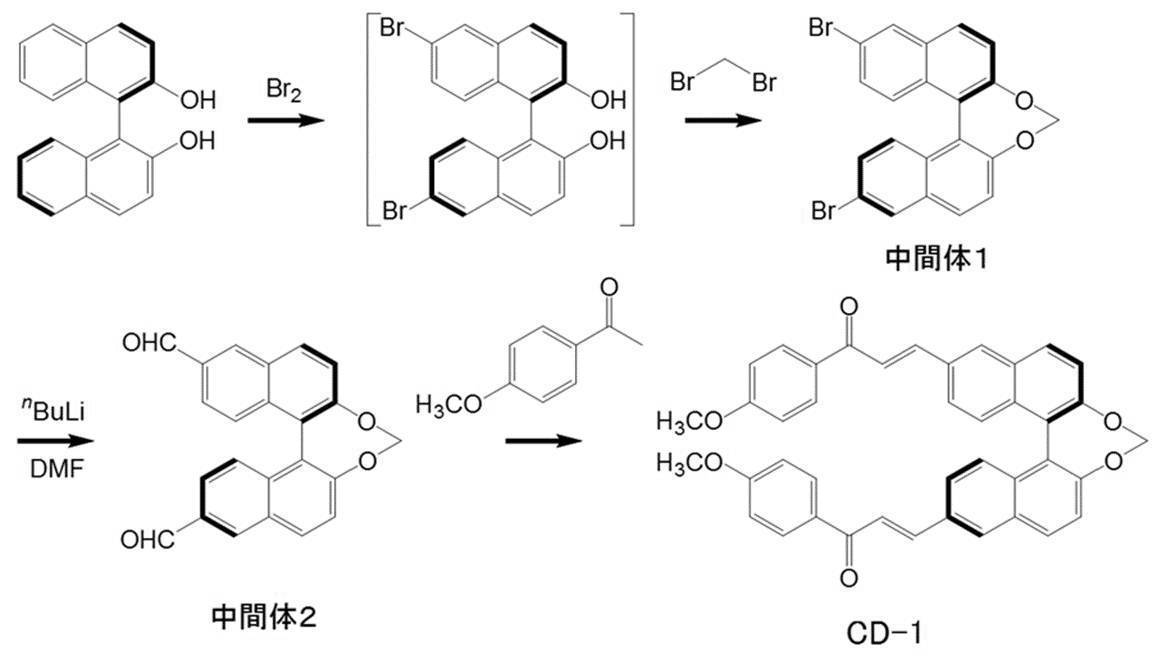
(中間体1の合成)
(R)-ビナフトール(関東化学製)65.0g、及び、酢酸ブチル(和光純薬製)500mLを三口フラスコ(容量2L)に入れて混合液を得た。混合液を0℃に降温し、臭素(和光純薬製)100gを滴下した後、得られた反応液を5時間撹拌した。攪拌終了後、反応液を、亜硫酸水素ナトリウム水(亜硫酸水素ナトリウム(和光純薬製)21.7g、水290mL)、水(325mL)、及び、炭酸水素ナトリウム水(炭酸水素ナトリウム(和光純薬製)13.0g、水300mL)でそれぞれ洗浄し、得られた溶液を硫酸マグネシウムで乾燥した後、溶液から溶媒を減圧留去した。
得られた残渣、N,N-ジメチルホルムアミド(DMF)(和光純薬製)80.2g、炭酸カリウム(和光純薬製)78.0g、及び、酢酸ブチル(和光純薬製)75gを三口フラスコに入れて混合液を得た。混合液に、ジブロモメタン(和光純薬製)43.5gを滴下した後、90℃で4時間撹拌した。得られた反応液を室温に降温した後、反応液中の無機塩をろ別した。得られたろ液に、酢酸エチル(和光純薬製)170mLを加えた後、45℃でメタノール(和光純薬製)550mLを加え、生じた固体をろ取した。ろ取した固体を、40℃で12時間送風乾燥し、中間体1(66.0g、収率75%)を得た。
(R)-ビナフトール(関東化学製)65.0g、及び、酢酸ブチル(和光純薬製)500mLを三口フラスコ(容量2L)に入れて混合液を得た。混合液を0℃に降温し、臭素(和光純薬製)100gを滴下した後、得られた反応液を5時間撹拌した。攪拌終了後、反応液を、亜硫酸水素ナトリウム水(亜硫酸水素ナトリウム(和光純薬製)21.7g、水290mL)、水(325mL)、及び、炭酸水素ナトリウム水(炭酸水素ナトリウム(和光純薬製)13.0g、水300mL)でそれぞれ洗浄し、得られた溶液を硫酸マグネシウムで乾燥した後、溶液から溶媒を減圧留去した。
得られた残渣、N,N-ジメチルホルムアミド(DMF)(和光純薬製)80.2g、炭酸カリウム(和光純薬製)78.0g、及び、酢酸ブチル(和光純薬製)75gを三口フラスコに入れて混合液を得た。混合液に、ジブロモメタン(和光純薬製)43.5gを滴下した後、90℃で4時間撹拌した。得られた反応液を室温に降温した後、反応液中の無機塩をろ別した。得られたろ液に、酢酸エチル(和光純薬製)170mLを加えた後、45℃でメタノール(和光純薬製)550mLを加え、生じた固体をろ取した。ろ取した固体を、40℃で12時間送風乾燥し、中間体1(66.0g、収率75%)を得た。
(中間体2の合成)
中間体1(3.00g)を三口フラスコ(容量300mL)に加え、窒素雰囲気下で、テトロヒドロフラン(THF)(和光純薬製)65mLを更に加えて、混合液を得た。混合液を-78℃まで降温した後、1.6Mノルマルブチルリチウムヘキサン溶液(和光純薬製)17mLを混合液に滴下した。得られた反応液を-78℃で4時間撹拌した後、DMF(和光純薬製)3.5mLを反応液に滴下して、更に、反応液を-60℃で30分間撹拌した。水200mL、及び、35%塩酸水(和光純薬製)2mLを三角フラスコ(容量1L)に加え、0℃まで降温した後、反応液を注加した。三角フラスコ内に酢酸エチル(和光純薬製)170mLを更に加え、得られた溶液を飽和食塩水で洗浄し、硫酸マグネシウムで乾燥した後、得られた溶液から溶媒を減圧留去した。得られた残渣を、酢酸エチル/ノルマルヘキサン(体積比4:6)を展開溶媒とするシリカゲルカラムクロマトグラフィーにより精製し、分取した溶液から溶媒を減圧留去して、中間体2(1.27g、収率54%)を得た。
中間体1(3.00g)を三口フラスコ(容量300mL)に加え、窒素雰囲気下で、テトロヒドロフラン(THF)(和光純薬製)65mLを更に加えて、混合液を得た。混合液を-78℃まで降温した後、1.6Mノルマルブチルリチウムヘキサン溶液(和光純薬製)17mLを混合液に滴下した。得られた反応液を-78℃で4時間撹拌した後、DMF(和光純薬製)3.5mLを反応液に滴下して、更に、反応液を-60℃で30分間撹拌した。水200mL、及び、35%塩酸水(和光純薬製)2mLを三角フラスコ(容量1L)に加え、0℃まで降温した後、反応液を注加した。三角フラスコ内に酢酸エチル(和光純薬製)170mLを更に加え、得られた溶液を飽和食塩水で洗浄し、硫酸マグネシウムで乾燥した後、得られた溶液から溶媒を減圧留去した。得られた残渣を、酢酸エチル/ノルマルヘキサン(体積比4:6)を展開溶媒とするシリカゲルカラムクロマトグラフィーにより精製し、分取した溶液から溶媒を減圧留去して、中間体2(1.27g、収率54%)を得た。
(化合物CD-1の合成)
中間体2(4.50g)、4-メトキシアセトフェノン(和光純薬製)4.20g、及び、THF(和光純薬製)135mLを、三口フラスコ(容量300mL)に入れて混合液を得た。混合液を0℃に冷却し、28%ナトリウムメトキシドメタノール溶液(東京化成工業製)4.90gを混合液に滴下した後、得られた反応液を0℃で3時間半撹拌した。反応液に、1N塩酸10mL、酢酸エチル30mL、及び、水90mLを加え、得られた溶液を飽和食塩水で洗浄し、硫酸マグネシウムで乾燥した後、得られた溶液から溶媒を減圧留去した。得られた粗生成物を酢酸エチル/ノルマルヘキサン(体積比4:6)を展開溶媒とするシリカゲルカラムクロマトグラフィーにより精製し、分取した溶液から溶媒を減圧留去して、化合物CD-1(1.60g、収率20%)を得た。
化合物CD-1を1H NMR(Nuclear Magnetic Resonance)(重溶媒:DMSO-d6)により同定した結果を下記に示す。
1H NMR(DMSO-d6):δ 8.52(2H、s)、8.22(6H、m)、8.07(4H、m)、7.89(2H、d)、7.66(2H、d)、7.38(2H、d)、7.10(4H、d)、5.78(2H、s)、3.87(6H、s)
中間体2(4.50g)、4-メトキシアセトフェノン(和光純薬製)4.20g、及び、THF(和光純薬製)135mLを、三口フラスコ(容量300mL)に入れて混合液を得た。混合液を0℃に冷却し、28%ナトリウムメトキシドメタノール溶液(東京化成工業製)4.90gを混合液に滴下した後、得られた反応液を0℃で3時間半撹拌した。反応液に、1N塩酸10mL、酢酸エチル30mL、及び、水90mLを加え、得られた溶液を飽和食塩水で洗浄し、硫酸マグネシウムで乾燥した後、得られた溶液から溶媒を減圧留去した。得られた粗生成物を酢酸エチル/ノルマルヘキサン(体積比4:6)を展開溶媒とするシリカゲルカラムクロマトグラフィーにより精製し、分取した溶液から溶媒を減圧留去して、化合物CD-1(1.60g、収率20%)を得た。
化合物CD-1を1H NMR(Nuclear Magnetic Resonance)(重溶媒:DMSO-d6)により同定した結果を下記に示す。
1H NMR(DMSO-d6):δ 8.52(2H、s)、8.22(6H、m)、8.07(4H、m)、7.89(2H、d)、7.66(2H、d)、7.38(2H、d)、7.10(4H、d)、5.78(2H、s)、3.87(6H、s)
上記手法を参照して、化合物CD-2~CD-16を合成した。
得られた化合物CD-1~CD-16のHTPについて、後述の通り評価した。
また、比較用化合物として、化合物CE-1~CE-4を合成した。
各化合物の合成法としては、日本化学会編 「第五版 実験化学講座 16」p.35~70を参考にした。
化合物CE-1は、非特許文献1に記載の化合物(R)-XIIであり、非特許文献1に記載の方法に従って合成した。
化合物CE-2は、Molecular Crystals and Liquid Crystals(2004年、425巻、153-158ページ)に記載の化合物であり、上記文献に記載の方法に従って合成した。
化合物CE-4は、Advanced Synthesis & Catalysis(2004年、346巻、1728-1732ページ)に記載の化合物であり、上記文献に記載の方法に従って合成した。
化合物CD-1~CD-16及びCE-1~CE-4の構造を下記に示す。
得られた化合物CD-1~CD-16のHTPについて、後述の通り評価した。
また、比較用化合物として、化合物CE-1~CE-4を合成した。
各化合物の合成法としては、日本化学会編 「第五版 実験化学講座 16」p.35~70を参考にした。
化合物CE-1は、非特許文献1に記載の化合物(R)-XIIであり、非特許文献1に記載の方法に従って合成した。
化合物CE-2は、Molecular Crystals and Liquid Crystals(2004年、425巻、153-158ページ)に記載の化合物であり、上記文献に記載の方法に従って合成した。
化合物CE-4は、Advanced Synthesis & Catalysis(2004年、346巻、1728-1732ページ)に記載の化合物であり、上記文献に記載の方法に従って合成した。
化合物CD-1~CD-16及びCE-1~CE-4の構造を下記に示す。


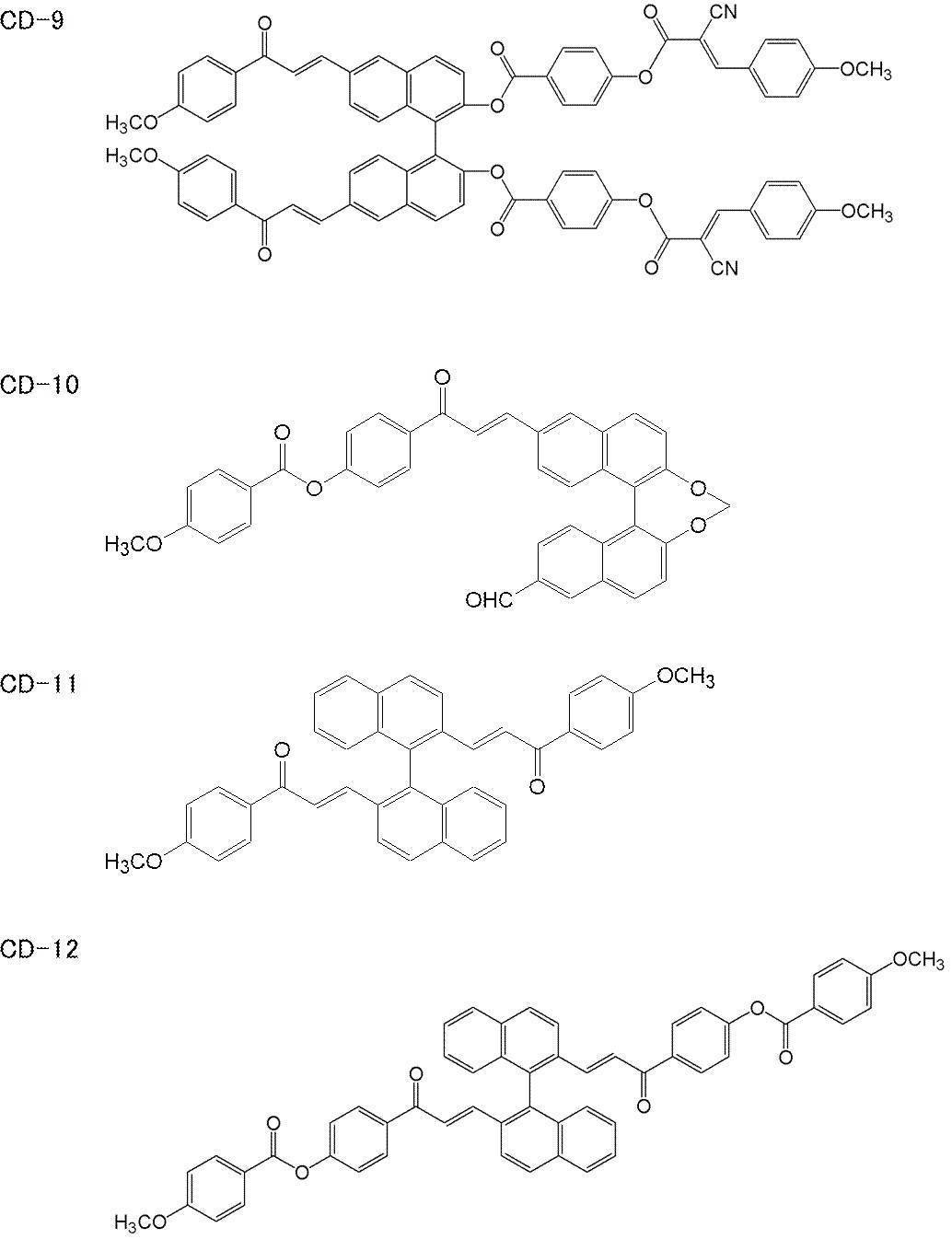


〔評価〕
<螺旋捻じり力(HTP)、及び、露光によるHTPの変化率の評価>
下記に示す配合で、評価用の組成物を各種調製した。
<螺旋捻じり力(HTP)、及び、露光によるHTPの変化率の評価>
下記に示す配合で、評価用の組成物を各種調製した。
-------------------------
・化合物CD-1~CD-16、CE-1~CE-4のいずれか:5質量部
・下記に示す液晶性化合物LC-1:100質量部
・溶剤(メチルエチルケトン/シクロヘキサノン=90/10(質量比)):組成物の固形分濃度が30質量%となる量
-------------------------
・化合物CD-1~CD-16、CE-1~CE-4のいずれか:5質量部
・下記に示す液晶性化合物LC-1:100質量部
・溶剤(メチルエチルケトン/シクロヘキサノン=90/10(質量比)):組成物の固形分濃度が30質量%となる量
-------------------------

(液晶層1の作製)
洗浄したガラス基板上にポリイミド配向膜材料SE-130(日産化学社製)を塗布して塗膜を形成した。得られた塗膜を焼成した後、ラビング処理することにより、配向膜付き基板を作製した。
この配向膜のラビング処理面に、上記組成物40μLを、1500rpm、10秒間の条件でスピンコートしてから90℃で1分間加熱乾燥し、組成物層を形成した。
得られた組成物層について、顕微鏡(ニコン社製、ECLIPSE E600-POL)と分光光度計(株式会社島津製作所製、UV-3100(PC))を用いて、室温(23℃)で中心反射波長を測定し、下記式に従ってHTP(初期HTP)を算出した。
HTP =(液晶性化合物の平均屈折率)/{(液晶性化合物に対するキラル化合物の濃度(質量%))×(中心反射波長)}[μm-1]
なお、液晶性化合物の平均屈折率は、1.55であると仮定して計算した。
洗浄したガラス基板上にポリイミド配向膜材料SE-130(日産化学社製)を塗布して塗膜を形成した。得られた塗膜を焼成した後、ラビング処理することにより、配向膜付き基板を作製した。
この配向膜のラビング処理面に、上記組成物40μLを、1500rpm、10秒間の条件でスピンコートしてから90℃で1分間加熱乾燥し、組成物層を形成した。
得られた組成物層について、顕微鏡(ニコン社製、ECLIPSE E600-POL)と分光光度計(株式会社島津製作所製、UV-3100(PC))を用いて、室温(23℃)で中心反射波長を測定し、下記式に従ってHTP(初期HTP)を算出した。
HTP =(液晶性化合物の平均屈折率)/{(液晶性化合物に対するキラル化合物の濃度(質量%))×(中心反射波長)}[μm-1]
なお、液晶性化合物の平均屈折率は、1.55であると仮定して計算した。
更に、組成物層に、365nmの波長の光を露光(露光量:150mJ/cm2)した後、再び中心反射波長を測定し、上記初期HTPを算出するために用いた計算式と同様に計算して、露光後のHTPを算出した。得られた初期HTPと露光後のHTPとから、下記式に従ってHTP変化率を算出した。
HTP変化率 =|{(初期HTP)-(露光後のHTP)}/(初期HTP)×100|[%]
HTP変化率 =|{(初期HTP)-(露光後のHTP)}/(初期HTP)×100|[%]
初期HTPと、HTP変化率とを、それぞれ下記基準に基づいて評価した。いずれもA評価が最も好ましい。
(初期HTPの評価基準)
A:初期HTPが90μm-1以上。
B:初期HTPが80μm-1以上90μm-1未満。
C:初期HTPが60μm-1以上80μm-1未満。
D:初期HTPが40μm-1以上60μm-1未満。
E:初期HTPが40μm-1未満。
A:初期HTPが90μm-1以上。
B:初期HTPが80μm-1以上90μm-1未満。
C:初期HTPが60μm-1以上80μm-1未満。
D:初期HTPが40μm-1以上60μm-1未満。
E:初期HTPが40μm-1未満。
(HTP変化率の評価基準)
A:HTP変化率が60%以上。
B:HTP変化率が50%以上60%未満。
C:HTP変化率が40%以上50%未満。
D:HTP変化率が30%以上40%未満。
E:HTP変化率が30%未満。
A:HTP変化率が60%以上。
B:HTP変化率が50%以上60%未満。
C:HTP変化率が40%以上50%未満。
D:HTP変化率が30%以上40%未満。
E:HTP変化率が30%未満。
〔結果〕
下記表に、各化合物を添加して作製した組成物を用い実施例の評価結果を示す。
表中、「一般式(2)」の欄は、各実施例で用いた化合物を一般式(1)に当てはめた場合において、X1~X6のうち、一般式(2)で表される基の位置を示す。
「A1」の欄は、X1~X6のうち、一般式(2)で表される基において、A1が芳香族炭化水素環基であるか否かを示す。本要件を満たす場合をAとし、満たさない場合をBとした。
「X1、X2連結環」の欄は、各実施例で用いた化合物を一般式(1)に当てはめた場合において、X1とX2とが互いに結合して環を形成しているか否かを示す。本要件を満たす場合をAとし、満たさない場合をBとした。
「一般式(A)、k≧2」の欄は、「X1、X2連結環」の欄においてBとした化合物が、X3~X6の少なくとも1つが前記一般式(2)で表される基を有するものであって、「X1及びX2の少なくとも一方が一般式(A)で表される基であり、かつ、一般式(A)中のkが2以上である」との要件を満たすか否かを示す。本要件を満たす場合をAとし、満たさない場合をBとした。
「一般式(3)」の欄は、各実施例で用いた化合物を一般式(1)に当てはめた場合において、X1~X6のうち一般式(2)で表される基が、一般式(3)で表される基であるか否かを示す。本要件を満たす場合Aとし、満たさない場合はBと記載した。
下記表に、各化合物を添加して作製した組成物を用い実施例の評価結果を示す。
表中、「一般式(2)」の欄は、各実施例で用いた化合物を一般式(1)に当てはめた場合において、X1~X6のうち、一般式(2)で表される基の位置を示す。
「A1」の欄は、X1~X6のうち、一般式(2)で表される基において、A1が芳香族炭化水素環基であるか否かを示す。本要件を満たす場合をAとし、満たさない場合をBとした。
「X1、X2連結環」の欄は、各実施例で用いた化合物を一般式(1)に当てはめた場合において、X1とX2とが互いに結合して環を形成しているか否かを示す。本要件を満たす場合をAとし、満たさない場合をBとした。
「一般式(A)、k≧2」の欄は、「X1、X2連結環」の欄においてBとした化合物が、X3~X6の少なくとも1つが前記一般式(2)で表される基を有するものであって、「X1及びX2の少なくとも一方が一般式(A)で表される基であり、かつ、一般式(A)中のkが2以上である」との要件を満たすか否かを示す。本要件を満たす場合をAとし、満たさない場合をBとした。
「一般式(3)」の欄は、各実施例で用いた化合物を一般式(1)に当てはめた場合において、X1~X6のうち一般式(2)で表される基が、一般式(3)で表される基であるか否かを示す。本要件を満たす場合Aとし、満たさない場合はBと記載した。
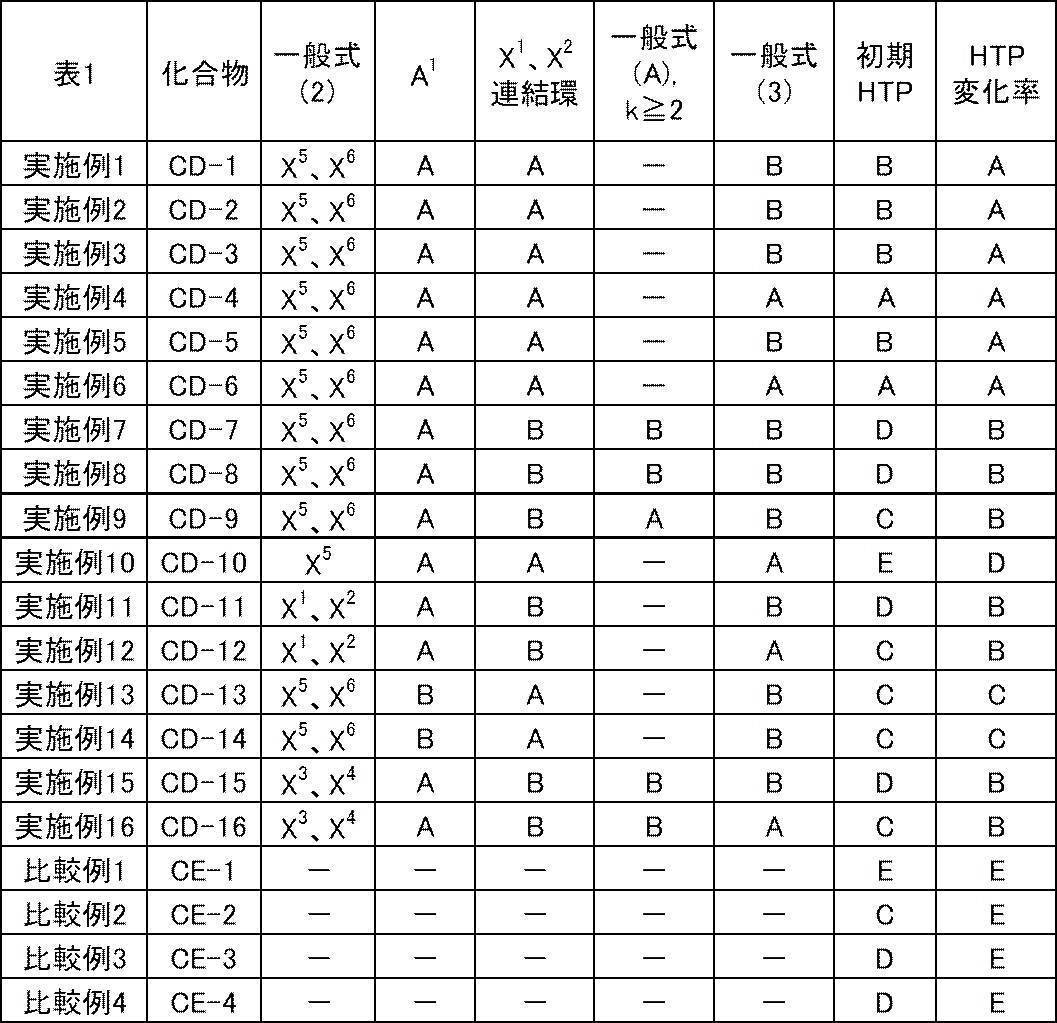
表に示す結果より、本発明の化合物は露光によるHTPの変化率に優れていることが確認された。
また、X1、X3、及び、X5のうち、少なくとも1つが一般式(2)で表される基であり、かつ、X2、X4、及び、X6のうち、少なくとも1つが一般式(2)で表される基である場合、初期HTP及びHTP変化率のそれぞれがより優れることが確認された(実施例6と、実施例10との比較)。
X1~X6のうち一般式(2)で表される基において、A1が芳香族炭化水素環基である場合、初期HTP及びHTP変化率のそれぞれがより優れることが確認された(実施例1と、実施例13及び14との比較)。
X1とX2とが互いに結合して環を形成している場合、初期HTP及びHTP変化率のそれぞれがより優れることが確認された(実施例1及び3と、実施例7~9との比較)。
X3~X6の少なくとも1つが一般式(2)で表される基であり、かつ、X1とX2とが互いに結合して環を形成していない場合、X1及びX2の少なくとも1つが一般式(A)で表される基であって、かつ、一般式(A)中のkが2以上であるとき、初期HTPがより優れることが確認された(実施例9と、実施例7及び8との比較)。
X1~X6のうち一般式(2)で表される基が一般式(3)で表される基である場合、初期HTPがより優れることが確認された(実施例4及び6と実施例1~3及び5との比較、実施例12と実施例11との比較、実施例16と実施例15との比較)。
また、X1、X3、及び、X5のうち、少なくとも1つが一般式(2)で表される基であり、かつ、X2、X4、及び、X6のうち、少なくとも1つが一般式(2)で表される基である場合、初期HTP及びHTP変化率のそれぞれがより優れることが確認された(実施例6と、実施例10との比較)。
X1~X6のうち一般式(2)で表される基において、A1が芳香族炭化水素環基である場合、初期HTP及びHTP変化率のそれぞれがより優れることが確認された(実施例1と、実施例13及び14との比較)。
X1とX2とが互いに結合して環を形成している場合、初期HTP及びHTP変化率のそれぞれがより優れることが確認された(実施例1及び3と、実施例7~9との比較)。
X3~X6の少なくとも1つが一般式(2)で表される基であり、かつ、X1とX2とが互いに結合して環を形成していない場合、X1及びX2の少なくとも1つが一般式(A)で表される基であって、かつ、一般式(A)中のkが2以上であるとき、初期HTPがより優れることが確認された(実施例9と、実施例7及び8との比較)。
X1~X6のうち一般式(2)で表される基が一般式(3)で表される基である場合、初期HTPがより優れることが確認された(実施例4及び6と実施例1~3及び5との比較、実施例12と実施例11との比較、実施例16と実施例15との比較)。
〔反射膜の作製〕
<液晶組成物の調製>
下記に示す配合で、液晶組成物を調製した。
-------------------------
・化合物CD-1:5質量部
・上記に示した液晶性化合物LC-1:100質量部
・下記に示す界面活性剤S-1:0.1質量部
・下記に示す重合開始剤X:3質量部
・溶剤(メチルエチルケトン/シクロヘキサノン=90:10(質量比)):組成物の固形分濃度が30質量%となる量
-------------------------
<液晶組成物の調製>
下記に示す配合で、液晶組成物を調製した。
-------------------------
・化合物CD-1:5質量部
・上記に示した液晶性化合物LC-1:100質量部
・下記に示す界面活性剤S-1:0.1質量部
・下記に示す重合開始剤X:3質量部
・溶剤(メチルエチルケトン/シクロヘキサノン=90:10(質量比)):組成物の固形分濃度が30質量%となる量
-------------------------
界面活性剤S-1は特許第5774518号に記載された化合物であり、下記構造を有する。
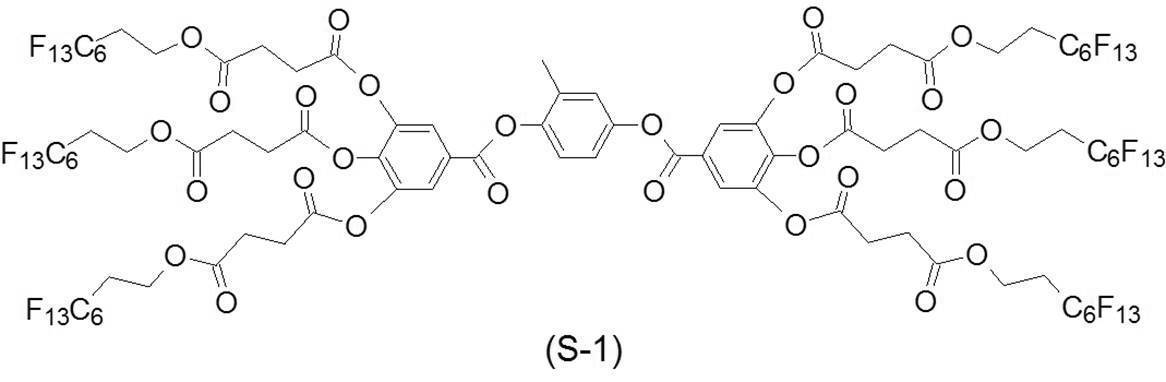
重合開始剤X:IRGACURE 907(BASF製)
(反射膜の作製)
洗浄したガラス基板上にポリイミド配向膜材料SE-130(日産化学社製)を塗布して塗膜を形成した。得られた塗膜を焼成した後、ラビング処理することにより、配向膜付き基板を作製した。この配向膜のラビング処理面に、上記液晶組成物40μLを回転数1500rpm、10秒間の条件でスピンコートすることにより、組成物層を形成し、90℃で1分間乾燥(熟成)して、組成物層中の液晶性化合物を配向させた(言い換えると、コレステリック液晶相の状態とした)。
次に、液晶性化合物を配向させた組成物層に対して、開口部を有するマスクを介して、光源(UVP社製、2UV・トランスイルミネーター)より波長365nmの光を0.4mW/cm2の照射強度で1分間照射した(CD-1のHTPを変化させる処理に該当)。マスクの開口部と非開口部との差異によって、組成物層は、波長365nmの光を照射された箇所と、照射されていない箇所とが存在する状態である。
続いて、組成物層に対して、マスクを外した状態で、25℃、窒素雰囲気下で500mJ/cm2の照射量で紫外線(310nm)を照射して硬化処理を実施し、反射膜(コレステリック液晶相を固定化してなる層に該当)とした。
得られた反射膜は、波長365nmの光を照射された箇所と、照射されていない箇所とで、選択反射波長が異なること(コレステリック層の螺旋のピッチが異なること)が確認された。
洗浄したガラス基板上にポリイミド配向膜材料SE-130(日産化学社製)を塗布して塗膜を形成した。得られた塗膜を焼成した後、ラビング処理することにより、配向膜付き基板を作製した。この配向膜のラビング処理面に、上記液晶組成物40μLを回転数1500rpm、10秒間の条件でスピンコートすることにより、組成物層を形成し、90℃で1分間乾燥(熟成)して、組成物層中の液晶性化合物を配向させた(言い換えると、コレステリック液晶相の状態とした)。
次に、液晶性化合物を配向させた組成物層に対して、開口部を有するマスクを介して、光源(UVP社製、2UV・トランスイルミネーター)より波長365nmの光を0.4mW/cm2の照射強度で1分間照射した(CD-1のHTPを変化させる処理に該当)。マスクの開口部と非開口部との差異によって、組成物層は、波長365nmの光を照射された箇所と、照射されていない箇所とが存在する状態である。
続いて、組成物層に対して、マスクを外した状態で、25℃、窒素雰囲気下で500mJ/cm2の照射量で紫外線(310nm)を照射して硬化処理を実施し、反射膜(コレステリック液晶相を固定化してなる層に該当)とした。
得られた反射膜は、波長365nmの光を照射された箇所と、照射されていない箇所とで、選択反射波長が異なること(コレステリック層の螺旋のピッチが異なること)が確認された。
Claims (12)
- 下記一般式(1)で表される化合物。
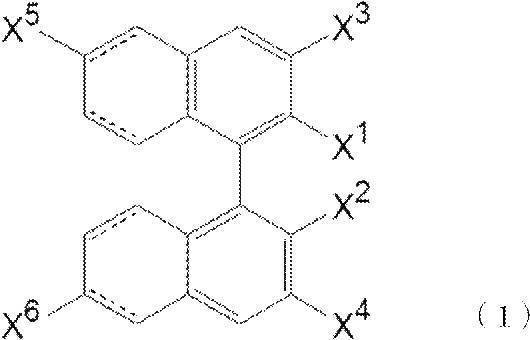
一般式(1)中、X1~X6は、それぞれ独立に、水素原子又は置換基を表す。X1~X6の少なくとも1つは、下記一般式(2)で表される基を表す。X1~X6から選択される複数の基は、互いに結合して環を形成していてもよい。
(R1)n-A1-CxO-CH=CH-* (2)
一般式(2)中、A1は、炭化水素環基又は複素環基を表す。nは、0以上の整数を表す。R1は、置換基を表す。*は一般式(1)中の縮合環との結合位置を表す。炭素原子CxはA1中の炭素原子と結合している。 - A1が芳香族炭化水素環基又は芳香族複素環基を表す、請求項1に記載の化合物。
- X1及びX2が互いに結合して環を形成する、請求項1又は2に記載の化合物。
- X1、X3、及びX5の少なくとも1つが前記一般式(2)で表される基を表し、かつ、X2、X4、及びX6の少なくとも1つが前記一般式(2)で表される基を表す、請求項1~3のいずれか1項に記載の化合物。
- X3~X6の少なくとも1つが前記一般式(2)で表される基を表し、かつ、X1及びX2の少なくとも1つが、下記一般式(A)で表される基を表す、請求項1、2及び4のいずれか1項に記載の化合物。
R3-(A4-Z2)k-* (A)
一般式(A)中、kは、2以上の整数を表す。R3は、水素原子又は置換基を表す。Z2は、単結合、-O-、-S-、-CH2O-、-CO-、-COO-、-CO-S-、-O-CO-O-、-CO-NH-、-CH2S-、-CF2O-、-CF2S-、-CH=CH-COO-、-CH=CH-OCO-、-OCO-C(CN)=CH-、-COO-CH2CH2-、-OCO-CH2CH2-、-COO-CH2-、-OCO-CH2-、-CH=CH-、-N=N-、-CH=N-N=CH-、-CF=CF-、又は、-C≡C-を表す。A4は、炭化水素環基又は複素環基を表す。*は、一般式(1)中の縮合環との結合位置を表す。 - 前記一般式(2)で表される基が、下記一般式(3)で表される基である、請求項1~5のいずれか1項に記載の化合物。
R2-(A3-Z1)m-A2-CxO-CH=CH-* (3)
一般式(3)中、mは、1又は2の整数を表す。R2は、水素原子又は置換基を表す。Z1は、単結合、-O-、-S-、-CH2O-、-CO-、-COO-、-CO-S-、-O-CO-O-、-CO-NH-、-CH2S-、-CF2O-、-CF2S-、-CH=CH-COO-、-CH=CH-OCO-、-OCO-C(CN)=CH-、-COO-CH2CH2-、-OCO-CH2CH2-、-COO-CH2-、-OCO-CH2-、-CH=CH-、-N=N-、-CH=N-N=CH-、-CF=CF-、又は、-C≡C-を表す。A2及びA3は、それぞれ独立に、炭化水素環基又は複素環基を表す。*は、一般式(1)中の縮合環との結合位置を表す。炭素原子CxはA2中の炭素原子と結合している。 - 請求項1~6のいずれか1項に記載の化合物を含む、組成物。
- 液晶性化合物を更に含む、請求項7に記載の組成物。
- 前記液晶性化合物が、2つの重合性基を有する、請求項8に記載の組成物。
- 請求項7~9のいずれか1項に記載の組成物を硬化してなる硬化物。
- 請求項8又は9に記載の組成物を硬化してなる光学異方体。
- 請求項8又は9に記載の組成物を硬化してなる反射膜。
Priority Applications (2)
| Application Number | Priority Date | Filing Date | Title |
|---|---|---|---|
| JP2020541091A JP7181301B2 (ja) | 2018-09-06 | 2019-08-09 | 化合物、組成物、硬化物、光学異方体、反射膜 |
| US17/193,394 US12054468B2 (en) | 2018-09-06 | 2021-03-05 | Compound, composition, cured product, optically anisotropic body, and reflective film |
Applications Claiming Priority (2)
| Application Number | Priority Date | Filing Date | Title |
|---|---|---|---|
| JP2018-167217 | 2018-09-06 | ||
| JP2018167217 | 2018-09-06 |
Related Child Applications (1)
| Application Number | Title | Priority Date | Filing Date |
|---|---|---|---|
| US17/193,394 Continuation US12054468B2 (en) | 2018-09-06 | 2021-03-05 | Compound, composition, cured product, optically anisotropic body, and reflective film |
Publications (1)
| Publication Number | Publication Date |
|---|---|
| WO2020049957A1 true WO2020049957A1 (ja) | 2020-03-12 |
Family
ID=69722494
Family Applications (1)
| Application Number | Title | Priority Date | Filing Date |
|---|---|---|---|
| PCT/JP2019/031630 Ceased WO2020049957A1 (ja) | 2018-09-06 | 2019-08-09 | 化合物、組成物、硬化物、光学異方体、反射膜 |
Country Status (3)
| Country | Link |
|---|---|
| US (1) | US12054468B2 (ja) |
| JP (1) | JP7181301B2 (ja) |
| WO (1) | WO2020049957A1 (ja) |
Cited By (2)
| Publication number | Priority date | Publication date | Assignee | Title |
|---|---|---|---|---|
| WO2021020114A1 (ja) * | 2019-07-29 | 2021-02-04 | 富士フイルム株式会社 | 化合物、液晶組成物、硬化物、光学異方体、反射膜 |
| WO2026070956A1 (ja) * | 2024-09-30 | 2026-04-02 | 富士フイルム株式会社 | 組成物、反射膜、積層体、化合物 |
Citations (4)
| Publication number | Priority date | Publication date | Assignee | Title |
|---|---|---|---|---|
| JP2002179670A (ja) * | 2000-12-14 | 2002-06-26 | Fuji Photo Film Co Ltd | 光学活性化合物、光反応型キラル剤、液晶組成物、液晶の螺旋構造を変化させる方法、液晶の螺旋構造を固定化する方法、液晶カラーフィルタ、光学フィルムおよび記録媒体 |
| JP2002302487A (ja) * | 2000-12-14 | 2002-10-18 | Fuji Photo Film Co Ltd | 光学活性化合物、光反応型キラル剤、液晶組成物、液晶の螺旋構造を変化させる方法、液晶の螺旋構造を固定化する方法、液晶カラーフィルター、光学フィルムおよび記録媒体 |
| JP2003055315A (ja) * | 2001-08-15 | 2003-02-26 | Fuji Photo Film Co Ltd | ビナフトール誘導体及びその製造方法 |
| WO2018194157A1 (ja) * | 2017-04-20 | 2018-10-25 | 富士フイルム株式会社 | 化合物、液晶組成物、硬化物、光学異方体、及び反射膜 |
Family Cites Families (1)
| Publication number | Priority date | Publication date | Assignee | Title |
|---|---|---|---|---|
| TWI480652B (zh) * | 2012-12-12 | 2015-04-11 | Ind Tech Res Inst | 液晶顯示器 |
-
2019
- 2019-08-09 WO PCT/JP2019/031630 patent/WO2020049957A1/ja not_active Ceased
- 2019-08-09 JP JP2020541091A patent/JP7181301B2/ja active Active
-
2021
- 2021-03-05 US US17/193,394 patent/US12054468B2/en active Active
Patent Citations (4)
| Publication number | Priority date | Publication date | Assignee | Title |
|---|---|---|---|---|
| JP2002179670A (ja) * | 2000-12-14 | 2002-06-26 | Fuji Photo Film Co Ltd | 光学活性化合物、光反応型キラル剤、液晶組成物、液晶の螺旋構造を変化させる方法、液晶の螺旋構造を固定化する方法、液晶カラーフィルタ、光学フィルムおよび記録媒体 |
| JP2002302487A (ja) * | 2000-12-14 | 2002-10-18 | Fuji Photo Film Co Ltd | 光学活性化合物、光反応型キラル剤、液晶組成物、液晶の螺旋構造を変化させる方法、液晶の螺旋構造を固定化する方法、液晶カラーフィルター、光学フィルムおよび記録媒体 |
| JP2003055315A (ja) * | 2001-08-15 | 2003-02-26 | Fuji Photo Film Co Ltd | ビナフトール誘導体及びその製造方法 |
| WO2018194157A1 (ja) * | 2017-04-20 | 2018-10-25 | 富士フイルム株式会社 | 化合物、液晶組成物、硬化物、光学異方体、及び反射膜 |
Cited By (3)
| Publication number | Priority date | Publication date | Assignee | Title |
|---|---|---|---|---|
| WO2021020114A1 (ja) * | 2019-07-29 | 2021-02-04 | 富士フイルム株式会社 | 化合物、液晶組成物、硬化物、光学異方体、反射膜 |
| US11965125B2 (en) | 2019-07-29 | 2024-04-23 | Fujifilm Corporation | Compound, liquid crystal composition, cured product, optically anisotropic body, and reflective film |
| WO2026070956A1 (ja) * | 2024-09-30 | 2026-04-02 | 富士フイルム株式会社 | 組成物、反射膜、積層体、化合物 |
Also Published As
| Publication number | Publication date |
|---|---|
| US20210198230A1 (en) | 2021-07-01 |
| JPWO2020049957A1 (ja) | 2021-09-24 |
| JP7181301B2 (ja) | 2022-11-30 |
| US12054468B2 (en) | 2024-08-06 |
Similar Documents
| Publication | Publication Date | Title |
|---|---|---|
| JP5219583B2 (ja) | 組成物、光学フィルムとその製造方法、光学部材及び表示装置 | |
| CN105960392B (zh) | 聚合性化合物、聚合性组合物、高分子和光学各向异性体 | |
| JP5443720B2 (ja) | 組成物、光学フィルム及びその製造方法、光学部材ならびに表示装置 | |
| JP6858251B2 (ja) | 化合物、液晶組成物、硬化物、光学異方体、及び反射膜 | |
| JP6681992B2 (ja) | 化合物、組成物、硬化物、光学異方体、反射膜 | |
| JP2009108152A (ja) | 重合性化合物および光学フィルム | |
| JP7064575B2 (ja) | 化合物、組成物、硬化物、光学異方体、反射膜 | |
| US12054468B2 (en) | Compound, composition, cured product, optically anisotropic body, and reflective film | |
| US10907099B2 (en) | Compound, composition, cured object, optically anisotropic body, and reflective film | |
| JP5292778B2 (ja) | 化合物及び光学フィルム | |
| US20210189243A1 (en) | Compound, mixture, liquid crystal composition, cured product, optically anisotropic body, and reflective film | |
| US11905449B2 (en) | Compound, liquid crystal composition, cured product, optically anisotropic body, and reflective film | |
| US11959005B2 (en) | Liquid crystal compounds | |
| KR102789343B1 (ko) | 화합물, 액정 조성물 | |
| JP7340608B2 (ja) | 化合物、液晶組成物、硬化物、光学異方体、反射膜 | |
| JP2003064032A (ja) | 重合性化合物、液晶性組成物、及びその重合体 | |
| KR20240127872A (ko) | 화합물, 조성물, 막, 적층체 및 표시 장치 |
Legal Events
| Date | Code | Title | Description |
|---|---|---|---|
| 121 | Ep: the epo has been informed by wipo that ep was designated in this application |
Ref document number: 19856650 Country of ref document: EP Kind code of ref document: A1 |
|
| ENP | Entry into the national phase |
Ref document number: 2020541091 Country of ref document: JP Kind code of ref document: A |
|
| NENP | Non-entry into the national phase |
Ref country code: DE |
|
| 122 | Ep: pct application non-entry in european phase |
Ref document number: 19856650 Country of ref document: EP Kind code of ref document: A1 |