WO2020045004A1 - 分離膜のファウリング防止剤及びファウリング防止方法 - Google Patents
分離膜のファウリング防止剤及びファウリング防止方法 Download PDFInfo
- Publication number
- WO2020045004A1 WO2020045004A1 PCT/JP2019/031164 JP2019031164W WO2020045004A1 WO 2020045004 A1 WO2020045004 A1 WO 2020045004A1 JP 2019031164 W JP2019031164 W JP 2019031164W WO 2020045004 A1 WO2020045004 A1 WO 2020045004A1
- Authority
- WO
- WIPO (PCT)
- Prior art keywords
- water
- membrane
- separation membrane
- phosphonic acid
- treated
- Prior art date
- Legal status (The legal status is an assumption and is not a legal conclusion. Google has not performed a legal analysis and makes no representation as to the accuracy of the status listed.)
- Ceased
Links
- 0 CN(C*)*N(C*)** Chemical compound CN(C*)*N(C*)** 0.000 description 1
Images
Classifications
-
- B—PERFORMING OPERATIONS; TRANSPORTING
- B01—PHYSICAL OR CHEMICAL PROCESSES OR APPARATUS IN GENERAL
- B01D—SEPARATION
- B01D61/00—Processes of separation using semi-permeable membranes, e.g. dialysis, osmosis or ultrafiltration; Apparatus, accessories or auxiliary operations specially adapted therefor
- B01D61/14—Ultrafiltration; Microfiltration
-
- B—PERFORMING OPERATIONS; TRANSPORTING
- B01—PHYSICAL OR CHEMICAL PROCESSES OR APPARATUS IN GENERAL
- B01D—SEPARATION
- B01D65/00—Accessories or auxiliary operations, in general, for separation processes or apparatus using semi-permeable membranes
- B01D65/08—Prevention of membrane fouling or of concentration polarisation
-
- C—CHEMISTRY; METALLURGY
- C02—TREATMENT OF WATER, WASTE WATER, SEWAGE, OR SLUDGE
- C02F—TREATMENT OF WATER, WASTE WATER, SEWAGE, OR SLUDGE
- C02F1/00—Treatment of water, waste water, or sewage
- C02F1/44—Treatment of water, waste water, or sewage by dialysis, osmosis or reverse osmosis
-
- Y—GENERAL TAGGING OF NEW TECHNOLOGICAL DEVELOPMENTS; GENERAL TAGGING OF CROSS-SECTIONAL TECHNOLOGIES SPANNING OVER SEVERAL SECTIONS OF THE IPC; TECHNICAL SUBJECTS COVERED BY FORMER USPC CROSS-REFERENCE ART COLLECTIONS [XRACs] AND DIGESTS
- Y02—TECHNOLOGIES OR APPLICATIONS FOR MITIGATION OR ADAPTATION AGAINST CLIMATE CHANGE
- Y02A—TECHNOLOGIES FOR ADAPTATION TO CLIMATE CHANGE
- Y02A20/00—Water conservation; Efficient water supply; Efficient water use
- Y02A20/124—Water desalination
- Y02A20/131—Reverse-osmosis
Definitions
- the present invention relates to an anti-fouling agent and an anti-fouling method for a separation membrane that is an ultrafiltration (UF) membrane or a microfiltration (MF) membrane.
- the present invention particularly relates to fouling for preventing membrane contamination or membrane blockage by humic substances in the water to be treated, when the water to be treated containing polyvalent metal ions and humic substances is subjected to membrane separation treatment with a UF membrane or an MF membrane.
- the present invention relates to an inhibitor and a method for preventing fouling.
- UF membranes or MF membranes are widely used as filtration membranes for removing SS and colloidal substances in raw water.
- UF film contamination fouling
- Fouling is a phenomenon in which a substance to be separated, etc., present in the membrane feed water adheres and accumulates on the membrane surface or in pores. Fouling includes deposition of suspended particles on the membrane surface, layer formation by adsorption on the membrane; gelation of soluble polymer on the membrane surface, adsorption, precipitation, and blockage inside the pores of the membrane; and bubbles Blocking of pores (clogging) by the pores, as well as blockage of the flow path in the module.
- UFouling is likely to occur in UF membranes or MF membranes that treat surface water or groundwater for the following reasons.
- humic substances such as humic acid and fulvic acid are contained in soil, these humic substances are contained in surface water, groundwater, etc., which are raw water for fresh water production systems.
- Organic compounds having a carboxyl group or a phenolic hydroxy group, such as humic acid or fulvic acid, have extremely high membrane contamination. For this reason, the separation membrane used for the treatment of water containing these humic substances tends to cause fouling and further blockage of the membrane.
- Patent Document 1 discloses a dispersion for an organic compound having a phenolic hydroxy group, which comprises, as an active ingredient, a polymer compound having a carbonyl group and a structure in which a carbonyl carbon and a nitrogen atom are bonded, such as polyvinylpyrrolidone and polyacrylamide. Agents have been proposed. Further development of new drugs is desired in order to increase the degree of freedom of drug selection and the diversity for practical use.
- phosphonic acids such as hydroxyethylidene diphosphonic acid and phosphonobutane tricarboxylic acid are effective for preventing calcium-based scale of a reverse osmosis (RO) membrane (for example, Patent Document 2).
- RO reverse osmosis
- phosphonic acids are effective for preventing fouling of organic compounds, especially humic substances, on UF membranes or MF membranes.
- the present invention can effectively prevent fouling of a UF membrane or an MF membrane, particularly a UF membrane or an MF membrane used for membrane separation of water to be treated containing polyvalent metal ions and humic substances.
- An object of the present invention is to provide a fouling inhibitor and a method for preventing fouling of a separation membrane.
- the present inventor has conducted intensive studies to solve the above problems, and as a result, phosphonic acid compounds are excellent in the dispersing effect of humic substances in the water to be treated in which polyvalent metal ions coexist, and the humic substances on the separation membrane surface It has been found that the adhesion can be effectively suppressed and the film has an excellent effect of preventing fouling.
- the present invention has been achieved based on such knowledge, and has the following gist.
- An agent for preventing fouling of a separation membrane which is an ultrafiltration membrane or a microfiltration membrane, which comprises a phosphonic acid compound.
- RIn the formula, R represents a phosphate group.
- n is an integer of 1 or more.
- the separation membrane contains polyvalent metal ions of 0.1 mg / L or more and humic substances, and UV260 and nonvolatile organic carbon
- An antifouling agent for a separation membrane wherein the agent is an ultrafiltration membrane or a microfiltration membrane used for treating water to be treated, the ratio of which to NPOC (unit: mg / L) satisfies the following formula (2): .
- UV260 measurement method Absorbance (abs (50 mm cell)) at a wavelength of 260 nm was measured with a 50 mm cell using a UV-visible spectrophotometer for the filtered water obtained by filtering the water to be treated with a filter having a pore size of 0.45 ⁇ m. I do. UV260 / NPOC> 0.025 (2)
- a method for preventing fouling of a separation membrane during water treatment with a separation membrane that is an ultrafiltration membrane or a microfiltration membrane comprising adding a phosphonic acid compound to water to be treated of the separation membrane.
- a method for preventing fouling of a separation membrane comprising adding a phosphonic acid compound to water to be treated of the separation membrane.
- RIn the formula, R represents a phosphate group.
- n is an integer of 1 or more.
- UF membrane or MF membrane especially fouling of UF membrane or MF membrane used for membrane separation treatment of water to be treated containing polyvalent metal ions and humic substances, and furthermore, effect of membrane blocking Can be prevented. Therefore, according to the present invention, a stable and efficient membrane separation process can be performed for a long period of time.
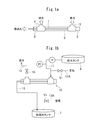
- FIGS. 1A and 1B are configuration diagrams showing an external pressure type mini-module test apparatus used in the embodiment.
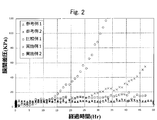
- FIG. 2 is a graph showing the results of Examples 1 and 2, Reference Examples 1 and 2, and Comparative Example 1.
- the antifouling agent for a separation membrane of the present invention is an agent for preventing fouling of a separation membrane that is a UF membrane or an MF membrane, and is characterized by containing a phosphonic acid compound.
- the method for preventing fouling of a separation membrane of the present invention is a method for preventing fouling of the separation membrane during water treatment with a separation membrane, which is a UF membrane or an MF membrane, wherein a phosphonic acid-based It is characterized by adding a compound.
- the present inventors have studied the mechanism of membrane blocking in the case of treating wastewater containing organic compounds such as humic substances in a membrane separation system using a UF membrane or MF membrane. As a result, it was clarified that the membrane was not clogged with humic substances alone, and the membrane was clogged when polyvalent metal ions such as Ca, Mg, Sr, Ba, Al, and Fe coexisted. Therefore, regarding the water supply to UF membrane or MF membrane containing polyvalent metal ions and containing organic compounds such as humic substances, it is possible to suppress the increase in the transmembrane pressure as a result of adding the phosphonic acid compound from just before the membrane. I found it.
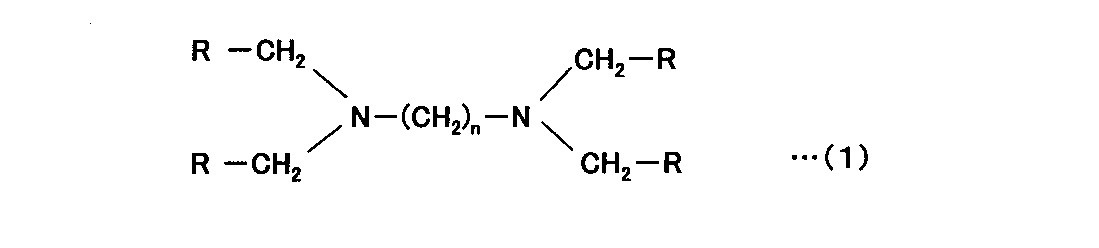
- an aminophosphonic acid represented by the following formula (1) can more effectively increase the transmembrane pressure difference. We found that it could be suppressed.
- the aminophosphonic acid represented by the formula (1) has four phosphoric acid groups and two amino groups, so that the carboxyl group of humic substances and the polyvalent metal ion form an electrostatic charge. It is excellent in the effect of reducing the attractive force, suppressing cross-linking and polymerization. For this reason, polymerization of the organic compound and fouling of the film due to adhesion of the polymerized organic compound are prevented.
- the phosphonic acid-based compound used as an active ingredient for preventing fouling of the UF membrane or the MF membrane includes hexametaphosphoric acid, 2-phosphonobutane-1,2,4-tricarboxylic acid, hydroxyethanephosphonic acid, aminotrimethylenephosphone Acid, 2-aminoethylphosphonic acid, ethylenediaminetetramethylenephosphonic acid, hexamethylenediaminetetramethylenephosphonic acid, diethylenetriaminepentamethylenephosphonic acid, phytic acid and the like.
- aminophosphonic acids such as aminotrimethylenephosphonic acid, diethylenetriaminepentamethylenephosphonic acid, and hexamethylenediaminetetramethylenephosphonic acid.
- an aminophosphonic acid containing four phosphate groups represented by the following formula (1), specifically, ethylenediaminetetramethylenephosphonic acid, hexamethylenediaminetetramethylenephosphone Acids and the like are preferred.
- RIn the formula, R represents a phosphate group.
- n is an integer of 1 or more.
- the molecular weight of the phosphonic acid compound used in the present invention is preferably from 100 to 1,000, particularly preferably from 100 to 800.
- the molecular weight of a phosphonic acid compound is the sum of the atomic weights in the molecular formula.
- the repeating number n of the methylene group in the above formula (1) is preferably an integer of 1 to 6, and more preferably 1 to 3.
- the phosphonic acid compound may be used alone or in combination of two or more.
- the phosphonic acid compound may be used in the form of a salt such as sodium.
- the antifouling agent of the separation membrane of the present invention may be any one containing the above-mentioned phosphonic acid compound, and may be one containing a scale inhibitor or slime control agent other than the phosphonic acid compound.
- the antifouling agent for the separation membrane of the present invention is particularly a UF membrane or a UF membrane for treating water to be treated containing polyvalent metal ions and humic substances (hereinafter sometimes referred to as “membrane water supply of the present invention”). Effectively applied to MF films.
- Examples of the polyvalent metal ion include one or more metal cations such as Ca, Mg, Sr, Ba, Al, and Fe.
- Humic substances include humic acid and fulvic acid.
- the carboxyl group of the humic substance may be in the form of a salt such as sodium.
- the molecular weight (in the case of low molecular weight) or weight average molecular weight (in the case of high molecular weight) of the humic substance is usually from 200 to 1,000,000, preferably from 1,000 to 500,000, more preferably from 1,000 to 100,000.
- the molecular weight or the weight average molecular weight of the humic substance is about 200 to 1,000,000, preferably about 1,000 to 100,000, it can be efficiently dispersed by the antifouling agent of the separation membrane of the present invention.
- the weight average molecular weight is a value converted to pullulan, which is measured by a GPC method and calculated using a calibration curve based on standard pullulan.
- the membrane water of the present invention contains polyvalent metal ions of 0.1 mg / L or more, preferably 10 to 200 mg / L, and contains humic substances. It is preferable that the ratio of water to carbon (NPOC, unit: mg / L) satisfies the following formula (2), since the effects of the present invention can be more effectively exerted.
- UV260 measurement method Absorbance (abs (50 mm cell)) at a wavelength of 260 nm was measured with a 50 mm cell using a UV-visible spectrophotometer for the filtered water obtained by filtering the water to be treated with a filter having a pore size of 0.45 ⁇ m. I do. UV260 / NPOC> 0.025 (2)
- UV 260 is a value that is an index of the concentration of humic substances in the membrane feed water of the present invention.
- NPOC can be measured by a combustion oxidation method or the like.
- the membrane water supply of the present invention is particularly preferably water having a UV260 / NPOC of 0.05 to 1.0.
- Examples of such water quality membrane water supply include surface water containing humic substances and groundwater.
- the amount of the addition varies depending on the quality of the water to be treated.
- the amount is preferably 0.01 to 20 mg / L, particularly preferably 0.01 to 10 mg / L. If the addition amount of the phosphonic acid compound is too small, the antifouling effect of the phosphonic acid compound cannot be sufficiently obtained. If the amount of the phosphonic acid compound is too large, the phosphonic acid compound itself may cause membrane contamination.
- the material and the pore size of the MF membrane are not particularly limited as long as they are used for ordinary drainage treatment or fresh water treatment.
- test device an external pressure type mini module test device shown in FIGS. 1a and 1b (external pressure type hollow fiber UF membrane, pore size: 0.02 ⁇ m, membrane length: 7.5 cm, membrane area: 10.6 cm 2 , membrane material polyhedral) (Vinylidene chloride) was used.
- 1 is a hollow fiber membrane
- 2 is a potting agent
- 3 is a raw water inlet
- 4 is a drain.
- Reference numeral 5 denotes a module housing in which the hollow fiber membrane 1 is loaded. Raw water is introduced into the housing 5 through the inlet 3, and permeated water that has passed through the hollow fiber membrane 1 is taken out of the hollow fiber membrane 1 and out of the housing 5.
- the valves V 1 and V 2 are opened, the valve V 3 is closed, air is sent from the pipe 11A to the pipe 11, and the water in the module 10 is discharged from the pipe 12. Let it. Air from the pipes 11A and 13A was supplied at 0.15 MPa. Water filling time, the valve V 2 is opened, introducing the closed valves V 1, V 3, the water in the water supply tank 6 into module 10 by operating the pump P.
- PI is a pressure gauge.
- humic acid sodium humate manufactured by Sigma-Aldrich Company, hereinafter referred to as “Na humate”
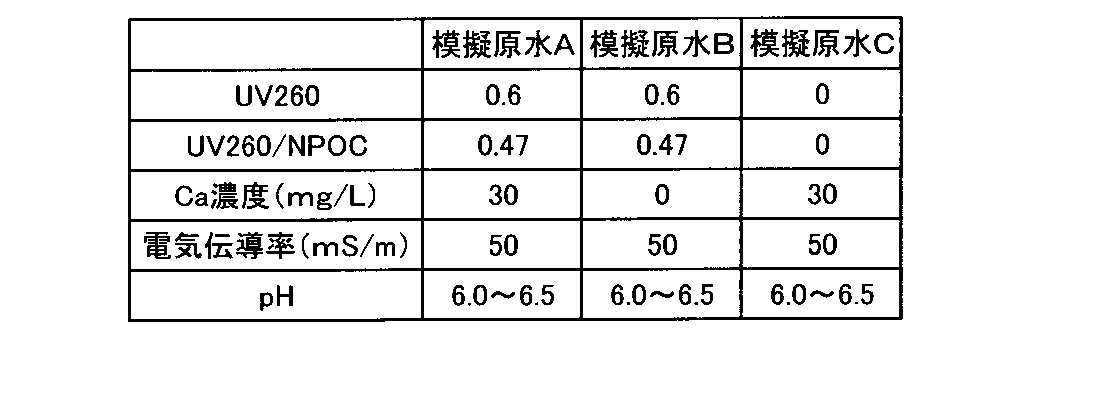
- the following simulated raw waters A to C were prepared and subjected to the test.
- the electric conductivity was adjusted to 50 mS / m with sodium chloride
- the pH was adjusted to 6.0 to 6.5 with a small amount of aqueous sodium hydroxide or sulfuric acid.
- Simulated raw water A Water in which sodium humate was added to pure water so that UV260 became 0.6 and calcium chloride was added so as to have a concentration of 30 mg-Ca / L
- Simulated raw water B Na humate in pure water
- C water obtained by adding calcium chloride to pure water at a concentration of 30 mg-Ca / L.
- Test UF membrane As a test UF membrane, a UF membrane “PBUF-TD” manufactured by Kuraray Co., Ltd. made of polyvinylidene fluoride was used.
- Example 1 To the simulated raw water A, 2-phosphonobutane-1,2,4-tricarboxylic acid was added at 0.75 mg / L (as pure content) to conduct the above water flow test, and to examine the change over time of the transmembrane pressure difference. 2 is shown.
- Example 2 0.75 mg / L (as pure content) of ethylenediaminetetramethylenephosphonic acid was added to the simulated raw water A, and the above water-passing test was performed. The time-dependent change in the transmembrane pressure difference was examined. The results are shown in FIG.
- the transmembrane pressure does not increase in the simulated raw water B containing only Na humate and the simulated raw water C containing only the hardness component Ca (Reference Examples 1 and 2).
- Example 1 in which phosphonobutanetricarboxylic acid was added to such simulated raw water A, the increase in the transmembrane pressure can be suppressed by the scale prevention effect of the phosphonic acid group.
- Example 2 in which ethylenediaminetetramethylenephosphonic acid, which is an aminophosphonic acid, was added, the crosslinking action between Na humate and Ca 2+ was suppressed, and these were effectively prevented from adhering to the film surface. The increase in the transmembrane pressure can be further effectively prevented.
Landscapes
- Chemical & Material Sciences (AREA)
- Engineering & Computer Science (AREA)
- Water Supply & Treatment (AREA)
- Chemical Kinetics & Catalysis (AREA)
- Life Sciences & Earth Sciences (AREA)
- Hydrology & Water Resources (AREA)
- Environmental & Geological Engineering (AREA)
- Organic Chemistry (AREA)
- Separation Using Semi-Permeable Membranes (AREA)
Abstract
多価金属イオンと、腐植物質とを含む被処理水の膜分離処理に使用されるUF膜又はMF膜のファウリングを効果的に防止することができる分離膜のファウリング防止剤及びファウリング防止方法が提供される。ホスホン酸系化合物を含有するUF膜又はMF膜のファウリング防止剤。UF膜又はMF膜の膜分離被処理水にホスホン酸系化合物を添加する分離膜のファウリング防止方法。
Description
本発明は、限外濾過(UF)膜又は精密濾過(MF)膜である分離膜のファウリング防止剤及びファウリング防止方法に関する。本発明は、特に多価金属イオンと、腐植物質とを含む被処理水をUF膜又はMF膜で膜分離処理する際に、被処理水中の腐植物質による膜汚染ないし膜閉塞を防止するファウリング防止剤とファウリング防止方法に関する。
排水処理システムや造水システムにおいて、原水中のSSやコロイド物質等を除去する濾過膜としてUF膜又はMF膜が広く用いられている。UF膜又はMF膜による水処理では、原水に含まれる汚染物質による膜汚染(ファウリング)の問題がある。
ファウリングは、膜給水中に存在する分離対象物質などが膜表面や細孔内に付着、堆積する現象である。ファウリングには、懸濁粒子の膜面への堆積、膜への吸着による層形成;溶解性高分子物質の膜面でのゲル化、膜細孔内部での吸着、析出、閉塞;及び気泡による細孔のブロッキング(目詰まり);並びにモジュール内での流路閉塞;などが含まれる。
表層水や地下水を処理するUF膜又はMF膜では、以下の理由によりファウリングを引き起こし易い。
土壌中には、フミン酸やフルボ酸などの腐植物質が含まれているため、造水システムの原水となる表層水や地下水等には、これらの腐植物質が含まれる。フミン酸やフルボ酸のように、カルボキシル基やフェノール性ヒドロキシ基を有する有機化合物は、膜汚染性が非常に高い。このため、これらの腐植物質を含む水の処理に用いた分離膜はファウリング、更には膜閉塞を引き起こし易い。
膜分離処理の前段階で凝集・吸着処理を行って腐植物質を除去する場合、以下の欠点がある。凝集処理では、フルボ酸等の比較的低分子量の有機化合物の除去効果が低い。吸着処理では吸着剤の交換が定期的に必要となる。
このため、このような前処理ではなく、膜給水に添加して、フルボ酸等の腐植物質による膜のファウリングを防止する水処理薬品が望まれる。
従来、膜用水処理薬品として、被処理水中の炭酸カルシウムや硫酸カルシウム等のスケール成分によるスケール障害に対応するものは多く提案されている。しかし、腐植物質による膜汚染に対する水処理薬品の提案は殆どなされていない。
特許文献1には、ポリビニルピロリドンやポリアクリルアミドといった、カルボニル基を有し、カルボニル炭素と窒素原子とが結合した構造を有する高分子化合物を有効成分とする、フェノール性ヒドロキシ基を有する有機化合物用分散剤が提案されている。
薬品選択の自由度や、実用化に向けた多様性の拡大のために、更なる新規薬品の開発が望まれる。
薬品選択の自由度や、実用化に向けた多様性の拡大のために、更なる新規薬品の開発が望まれる。
ヒドロキシエチリデンジホスホン酸やホスホノブタントリカルボン酸などのホスホン酸類が逆浸透(RO)膜のカルシウム系スケールの防止に有効であることは知られている(例えば、特許文献2の背景技術)。しかし、ホスホン酸類が、有機化合物、中でも腐植物質のUF膜又はMF膜に対するファウリングの防止効果に有効であることは従来知られていない。
本発明は、UF膜又はMF膜、特に多価金属イオンと、腐植物質とを含む被処理水の膜分離処理に使用されるUF膜又はMF膜のファウリングを効果的に防止することができる分離膜のファウリング防止剤及びファウリング防止方法を提供することを目的とする。
本発明者は上記課題を解決すべく鋭意検討を重ねた結果、ホスホン酸系化合物が、多価金属イオンが共存する被処理水中の腐植物質の分散効果に優れ、分離膜表面への腐植物質の付着を効果的に抑制することができ、膜のファウリング防止効果に優れることを見出した。
本発明はこのような知見に基づいて達成されたものであり、以下を要旨とする。
本発明はこのような知見に基づいて達成されたものであり、以下を要旨とする。
[1] 限外濾過膜又は精密濾過膜である分離膜のファウリングを防止する薬剤であって、ホスホン酸系化合物を含有することを特徴とする分離膜のファウリング防止剤。
[2] [1]において、前記ホスホン酸系化合物がアミノホスホン酸及び/又はその塩であることを特徴とする分離膜のファウリング防止剤。
[3] [2]において、前記アミノホスホン酸が下記式(1)で表されることを特徴とする分離膜のファウリング防止剤。
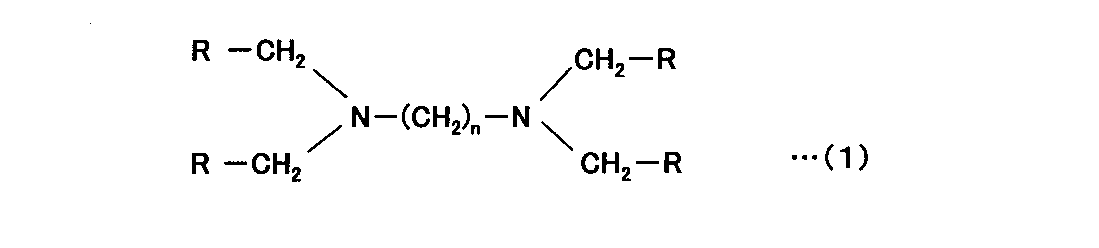
式中、Rはリン酸基を表す。nは1以上の整数である。
[4] [1]ないし[3]のいずれかにおいて、前記ホスホン酸系化合物の分子量が100~1000であることを特徴とする分離膜のファウリング防止剤。
[1]ないし[4]のいずれかにおいて、前記分離膜が、多価金属イオン0.1mg/L以上と、腐植物質とを含有し、かつ下記方法で測定されるUV260と不揮発性有機炭素(NPOC、単位:mg/L)との比が下記式(2)を満たす被処理水の処理に使用される限外濾過膜又は精密濾過膜であることを特徴とする分離膜のファウリング防止剤。
UV260測定方法:該被処理水を孔径0.45μmのフィルターで濾過して得られた濾過水について、紫外可視分光光度計を用いて50mmセルで波長260nmの吸光度(abs(50mmセル))を測定する。
UV260/NPOC>0.025 …(2)
UV260測定方法:該被処理水を孔径0.45μmのフィルターで濾過して得られた濾過水について、紫外可視分光光度計を用いて50mmセルで波長260nmの吸光度(abs(50mmセル))を測定する。
UV260/NPOC>0.025 …(2)
[6] 限外濾過膜又は精密濾過膜である分離膜による水処理時に該分離膜のファウリングを防止する方法であって、該分離膜の被処理水にホスホン酸系化合物を添加することを特徴とする分離膜のファウリング防止方法。
[7] [6]において、前記ホスホン酸系化合物がアミノホスホン酸及び/又はその塩であることを特徴とする分離膜のファウリング防止方法。
[8] [7]において、前記アミノホスホン酸が下記式(1)で表されることを特徴とする分離膜のファウリング防止方法。

式中、Rはリン酸基を表す。nは1以上の整数である。
[9] [6]ないし[8]のいずれかにおいて、前記ホスホン酸系化合物の分子量が100~1000であることを特徴とする分離膜のファウリング防止方法。
[10] [6]ないし[9]のいずれかにおいて、前記被処理水が、多価金属イオン0.1mg/L以上と、腐植物質とを含有し、かつ下記方法で測定されるUV260と不揮発性有機炭素(NPOC、単位:mg/L)との比が下記式(2)を満たす被処理水であることを特徴とする分離膜のファウリング防止方法。
UV260測定方法:該被処理水を孔径0.45μmのフィルターで濾過して得られた濾過水について、紫外可視分光光度計を用いて50mmセルで波長260nmの吸光度(abs(50mmセル))を測定する。
UV260/NPOC>0.025 …(2)
UV260測定方法:該被処理水を孔径0.45μmのフィルターで濾過して得られた濾過水について、紫外可視分光光度計を用いて50mmセルで波長260nmの吸光度(abs(50mmセル))を測定する。
UV260/NPOC>0.025 …(2)
[11] [6]ないし[10]のいずれかにおいて、前記被処理水に前記ホスホン酸系化合物を0.01~20mg/Lの濃度で添加することを特徴とする分離膜のファウリング防止方法。
本発明によれば、UF膜又はMF膜、特に多価金属イオンと、腐植物質とを含む被処理水の膜分離処理に使用されるUF膜又はMF膜のファウリング、更には膜閉塞を効果的に防止することができる。このため、本発明によれば、長期に亘り、安定かつ効率的な膜分離処理を行うことができる。
以下に本発明の実施の形態を詳細に説明する。
本発明の分離膜のファウリング防止剤は、UF膜又はMF膜である分離膜のファウリングを防止する薬剤であって、ホスホン酸系化合物を含有することを特徴とする。
本発明の分離膜のファウリング防止方法は、UF膜又はMF膜である分離膜による水処理時に該分離膜のファウリングを防止する方法であって、該分離膜の被処理水にホスホン酸系化合物を添加することを特徴とする。
本発明者は、UF膜又はMF膜を用いた膜分離システムにおいて、腐植物質等の有機化合物が存在する排水を処理した場合の膜閉塞のメカニズムについて検討した。その結果、腐植物質単独では膜は閉塞せず、Ca、Mg、Sr、Ba、Al、Fe等の多価金属イオンが共存することで膜閉塞が発生することが明らかとなった。そこで、多価金属イオンを含有し、かつ腐植物質等の有機化合物を含むUF膜又はMF膜給水について、ホスホン酸系化合物を膜の手前から添加した結果、膜間差圧の上昇を抑制できることを見出した。さらに、ホスホン酸系化合物の中でファウリング防止効果に優れるものについて検討した結果、後述の式(1)で表されるアミノホスホン酸を用いることで膜間差圧の上昇をより一層効果的に抑制できることを見出した。
式(1)で表されるアミノホスホン酸による優れたファウリング防止効果のメカニズムの詳細は明らかではないが、次のように推定される。
多価金属イオン共存下での腐植物質等の有機化合物によるUF膜又はMF膜のファウリングでは、カルシウムやマグネシウム等の多価金属イオンと、腐植物質のカルボキシル基等が架橋することによって、該有機化合物が多価金属イオンの硬度成分を巻き込んで高分子化し、これが膜に付着することで膜のファウリング、更には膜閉塞に到る。ホスホン酸系化合物の中でも式(1)で表されるアミノホスホン酸は、4個のリン酸基と2個のアミノ基を有することで、腐植物質のカルボキシル基と多価金属イオンとの静電引力を低減し、これらが架橋して高分子化を抑制する効果に優れる。このため、有機化合物の高分子化、高分子化した有機化合物の付着による膜のファウリングが防止される。
多価金属イオン共存下での腐植物質等の有機化合物によるUF膜又はMF膜のファウリングでは、カルシウムやマグネシウム等の多価金属イオンと、腐植物質のカルボキシル基等が架橋することによって、該有機化合物が多価金属イオンの硬度成分を巻き込んで高分子化し、これが膜に付着することで膜のファウリング、更には膜閉塞に到る。ホスホン酸系化合物の中でも式(1)で表されるアミノホスホン酸は、4個のリン酸基と2個のアミノ基を有することで、腐植物質のカルボキシル基と多価金属イオンとの静電引力を低減し、これらが架橋して高分子化を抑制する効果に優れる。このため、有機化合物の高分子化、高分子化した有機化合物の付着による膜のファウリングが防止される。
本発明において、UF膜又はMF膜のファウリング防止の有効成分として用いるホスホン酸系化合物としては、ヘキサメタリン酸、2-ホスホノブタン-1,2,4-トリカルボン酸、ヒドロキシエタンホスホン酸、アミノトリメチレンホスホン酸、2-アミノエチルホスホン酸、エチレンジアミンテトラメチレンホスホン酸、ヘキサメチレンジアミンテトラメチレンホスホン酸、ジエチレントリアミンペンタメチレンホスホン酸、フィチン酸等が挙げられる。好ましくはアミノトリメチレンホスホン酸、ジエチレントリアミンペンタメチレンホスホン酸、ヘキサメチレンジアミンテトラメチレンホスホン酸等のアミノホスホン酸である。特に下記式(1)で表されるリン酸基(-P(O)(OH)2)を4個含有するアミノホスホン酸、具体的には、エチレンジアミンテトラメチレンホスホン酸、ヘキサメチレンジアミンテトラメチレンホスホン酸等が好ましい。

式中、Rはリン酸基を表す。nは1以上の整数である。
本発明で用いるホスホン酸系化合物の分子量は、100~1000、特に100~800であることが好ましい。ホスホン酸系化合物の分子量は、その分子式における原子量の合計である。
上記式(1)におけるメチレン基の繰り返し数nは好ましくは1~6の整数であり、より好ましくは1~3である。
ホスホン酸系化合物の分子量や式(1)におけるnが上記範囲内であると、腐植物質の分散効果に優れたものとなる。
本発明において、ホスホン酸系化合物は1種のみを用いてもよく、2種以上を併用してもよい。ホスホン酸系化合物はナトリウム等の塩形として用いてもよい。
本発明の分離膜のファウリング防止剤は、上記のホスホン酸系化合物を含むものであればよく、ホスホン酸系化合物以外の他のスケール防止剤やスライムコントロール剤を含むものであってもよい。
本発明の分離膜のファウリング防止剤は、特に多価金属イオンと、腐植物質とを含む被処理水(以下、「本発明の膜給水」と称す場合がある。)を処理するUF膜又はMF膜に有効に適用される。
多価金属イオンとしては、Ca、Mg、Sr、Ba、Al、Fe等の1種又は2種以上の金属カチオンが挙げられる。
腐植物質としてはフミン酸、フルボ酸などが挙げられる。腐植物質のカルボキシル基は、ナトリウム等の塩の形をとってもよい。
腐植物質としてはフミン酸、フルボ酸などが挙げられる。腐植物質のカルボキシル基は、ナトリウム等の塩の形をとってもよい。
腐植物質の分子量(低分子の場合)又は重量平均分子量(高分子の場合)は、通常200~1000000であり、1000~500000が好ましく、1000~100000がより好ましい。腐植物質の分子量又は重量平均分子量が200~1000000、好ましくは1000~100000程度であれば、本発明の分離膜のファウリング防止剤により効率的に分散させることが可能となる。
腐植物質が高分子の場合の重量平均分子量は、GPC法で測定し、標準プルランによる検量線を用いて算出した、プルラン換算の値である。
腐植物質が高分子の場合の重量平均分子量は、GPC法で測定し、標準プルランによる検量線を用いて算出した、プルラン換算の値である。
本発明の膜給水は、多価金属イオンを0.1mg/L以上、好ましくは10~200mg/L含有し、かつ、腐植物質を含有することで、下記方法で測定されるUV260と不揮発性有機炭素(NPOC、単位:mg/L)との比が下記式(2)を満たす水であることが、本発明の効果をより一層有効に発揮させることができ、好ましい。
UV260測定方法:該被処理水を孔径0.45μmのフィルターで濾過して得られた濾過水について、紫外可視分光光度計を用いて50mmセルで波長260nmの吸光度(abs(50mmセル))を測定する。
UV260/NPOC>0.025 …(2)
UV260/NPOC>0.025 …(2)
UV260は、本発明の膜給水中の腐植物質の濃度の指標となる値である。
NPOCは燃焼式酸化法等によって測定することができる。
本発明の膜給水は、特にUV260/NPOCが0.05~1.0の水であることが好ましい。
NPOCは燃焼式酸化法等によって測定することができる。
本発明の膜給水は、特にUV260/NPOCが0.05~1.0の水であることが好ましい。
このような水質の膜給水としては、腐植物質を含む表層水及び地下水が挙げられる。
本発明の分離膜のファウリング防止剤を、UF膜又はMF膜の被処理水に添加する場合、その添加量は、被処理水の水質によっても異なるが、ホスホン酸系化合物の濃度として、0.01~20mg/L、特に0.01~10mg/Lとなるような量とすることが好ましい。ホスホン酸系化合物の添加量が少な過ぎるとホスホン酸系化合物によるファウリング防止効果を十分に得ることができない。ホスホン酸系化合物の添加量が多過ぎるとホスホン酸系化合物自体が膜汚染を引き起こす可能性がある。
本発明において、MF膜の材質や孔径等には特に制限はなく、通常の排水処理や造水処理に用いられるものであればよい。
以下に実施例を挙げて本発明をより具体的に説明する。
[試験装置]
試験装置としては、図1a,1bに示す外圧式ミニモジュール試験装置(外圧式中空糸UF膜、孔径:0.02μm、膜長さ:7.5cm、膜面積:10.6cm2、膜素材ポリフッ化ビニリデン)を用いた。
試験装置としては、図1a,1bに示す外圧式ミニモジュール試験装置(外圧式中空糸UF膜、孔径:0.02μm、膜長さ:7.5cm、膜面積:10.6cm2、膜素材ポリフッ化ビニリデン)を用いた。
図1a中、1は中空糸膜、2はポッティング剤、3は原水導入口、4は排水口である。5はモジュールハウジングであり、内部に中空糸膜1が装填されている。原水は導入口3からハウジング5内に導入され、中空糸膜1を透過した透過水が中空糸膜1の膜内からハウジング5外へ取り出される。
この外圧式中空糸ミニモジュール10に図1bの通り配管を接続して外圧式ミニモジュール試験装置とした。
この試験装置では、原水の処理時は、バルブV1,V2,V3を閉として、ポンプPを作動させて、給水タンク6から配管11を経て原水を外圧式ミニモジュール10に導入し、透過水を配管13を経て処理水タンク7に送給するデッドエンド通水方式で膜濾過を行う。
膜の逆洗浄を行う際は、ポンプPを停止し、バルブV1を閉、V2,V3を開として、配管13Aより空気を配管13に送気し、配管13内の水を中空糸膜1の内側(2次側)から外側(1次側)へ透過させる。
排水時は、ポンプPを停止した状態で、バルブV1,V2を開、バルブV3を閉として、配管11Aから空気を配管11に送気し、配管12よりモジュール10内の水を排出させる。
配管11A,13Aからの空気は0.15MPaで送気した。水張り時は、バルブV2を開、バルブV1,V3を閉として、ポンプPを作動させて給水タンク6内の水をモジュール10内に導入する。PIは圧力計である。
この試験装置では、原水の処理時は、バルブV1,V2,V3を閉として、ポンプPを作動させて、給水タンク6から配管11を経て原水を外圧式ミニモジュール10に導入し、透過水を配管13を経て処理水タンク7に送給するデッドエンド通水方式で膜濾過を行う。
膜の逆洗浄を行う際は、ポンプPを停止し、バルブV1を閉、V2,V3を開として、配管13Aより空気を配管13に送気し、配管13内の水を中空糸膜1の内側(2次側)から外側(1次側)へ透過させる。
排水時は、ポンプPを停止した状態で、バルブV1,V2を開、バルブV3を閉として、配管11Aから空気を配管11に送気し、配管12よりモジュール10内の水を排出させる。
配管11A,13Aからの空気は0.15MPaで送気した。水張り時は、バルブV2を開、バルブV1,V3を閉として、ポンプPを作動させて給水タンク6内の水をモジュール10内に導入する。PIは圧力計である。
通水試験では、後述の通水試験条件で通水し、配管11に設けた圧力計PIで膜間差圧を測定した。
[模擬原水]
腐植物質としてフミン酸ナトリウム(シグマアルドリッチ社製 以下「フミン酸Na」と記す)を用い、以下の模擬原水A~Cを調製して試験に供した。
いずれの模擬原水も塩化ナトリウムで電気伝導率を50mS/mに調整すると共に、少量の水酸化ナトリウム水溶液又は硫酸水溶液でpHを6.0~6.5に調整した。
腐植物質としてフミン酸ナトリウム(シグマアルドリッチ社製 以下「フミン酸Na」と記す)を用い、以下の模擬原水A~Cを調製して試験に供した。
いずれの模擬原水も塩化ナトリウムで電気伝導率を50mS/mに調整すると共に、少量の水酸化ナトリウム水溶液又は硫酸水溶液でpHを6.0~6.5に調整した。
模擬原水A:純水にフミン酸NaをUV260が0.6になるように添加すると共に、塩化カルシウムを30mg-Ca/L濃度となるように添加した水
模擬原水B:純水にフミン酸NaをUV260が0.6になるように添加した水
模擬原水C:純水に塩化カルシウムを30mg-Ca/L濃度となるように添加した水
模擬原水B:純水にフミン酸NaをUV260が0.6になるように添加した水
模擬原水C:純水に塩化カルシウムを30mg-Ca/L濃度となるように添加した水
模擬原水A~Cの水質は表1に示す通りである。
[供試UF膜]
供試UF膜としては、クラレ社製ポリフッ化ビニリデン製UF膜「PBUF-TD」を用いた。
供試UF膜としては、クラレ社製ポリフッ化ビニリデン製UF膜「PBUF-TD」を用いた。
[通水試験条件]
試験はいずれも、水張り:30秒、通水:28分、空気逆洗:10秒、排水:10秒を1サイクルとして繰り返し通水試験を行った。通水時の膜フラックスは4m3/(m2・D)とした。水温は24~25℃とした。
試験はいずれも、水張り:30秒、通水:28分、空気逆洗:10秒、排水:10秒を1サイクルとして繰り返し通水試験を行った。通水時の膜フラックスは4m3/(m2・D)とした。水温は24~25℃とした。
[実施例1]
模擬原水Aに2-ホスホノブタン-1,2,4-トリカルボン酸を0.75mg/L(純分として)添加して上記通水試験を行い、膜間差圧の経時変化を調べ、結果を図2に示した。
模擬原水Aに2-ホスホノブタン-1,2,4-トリカルボン酸を0.75mg/L(純分として)添加して上記通水試験を行い、膜間差圧の経時変化を調べ、結果を図2に示した。
[実施例2]
模擬原水Aにエチレンジアミンテトラメチレンホスホン酸を0.75mg/L(純分として)添加して上記通水試験を行い、膜間差圧の経時変化を調べ、結果を図2に示した。
模擬原水Aにエチレンジアミンテトラメチレンホスホン酸を0.75mg/L(純分として)添加して上記通水試験を行い、膜間差圧の経時変化を調べ、結果を図2に示した。
[比較例1]
模擬原水Aに薬剤を添加することなく上記通水試験を行い、膜間差圧の経時変化を調べ、結果を図2に示した。
模擬原水Aに薬剤を添加することなく上記通水試験を行い、膜間差圧の経時変化を調べ、結果を図2に示した。
[参考例1]
模擬原水Bに薬剤を添加することなく上記通水試験を行い、膜間差圧の経時変化を調べ、結果を図2に示した。
模擬原水Bに薬剤を添加することなく上記通水試験を行い、膜間差圧の経時変化を調べ、結果を図2に示した。
[参考例2]
模擬原水Cに薬剤を添加することなく上記通水試験を行い、膜間差圧の経時変化を調べ、結果を図2に示した。
模擬原水Cに薬剤を添加することなく上記通水試験を行い、膜間差圧の経時変化を調べ、結果を図2に示した。
図2より明らかなように、フミン酸Naのみを含む模擬原水B、硬度成分であるCaのみを含む模擬原水Cでは膜間差圧は上昇しない(参考例1、参考例2)。
フミン酸NaとCaが共存する模擬原水Aでは膜間差圧の上昇が激しい(比較例1)。
このような模擬原水Aに対して、ホスホノブタントリカルボン酸を添加した実施例1では、ホスホン酸基によるスケール防止効果で膜間差圧の上昇を抑制することができる。
特に、アミノホスホン酸であるエチレンジアミンテトラメチレンホスホン酸を添加した実施例2では、フミン酸NaとCa2+との架橋作用を抑制し、これらが膜面に付着することを効果的に防止することで膜間差圧の上昇をより一層有効に更に防止することができる。
特に、アミノホスホン酸であるエチレンジアミンテトラメチレンホスホン酸を添加した実施例2では、フミン酸NaとCa2+との架橋作用を抑制し、これらが膜面に付着することを効果的に防止することで膜間差圧の上昇をより一層有効に更に防止することができる。
本発明を特定の態様を用いて詳細に説明したが、本発明の意図と範囲を離れることなく様々な変更が可能であることは当業者に明らかである。
本出願は、2018年8月31日付で出願された日本特許出願2018-163323に基づいており、その全体が引用により援用される。
本出願は、2018年8月31日付で出願された日本特許出願2018-163323に基づいており、その全体が引用により援用される。
1 中空糸膜
2 ポッティング剤
3 原水導入口
4 排水口
5 モジュールハウジング
6 給水タンク
7 処理水タンク
10 外圧式中空糸ミニモジュール
2 ポッティング剤
3 原水導入口
4 排水口
5 モジュールハウジング
6 給水タンク
7 処理水タンク
10 外圧式中空糸ミニモジュール
Claims (11)
- 限外濾過膜又は精密濾過膜である分離膜のファウリングを防止する薬剤であって、ホスホン酸系化合物を含有することを特徴とする分離膜のファウリング防止剤。
- 請求項1において、前記ホスホン酸系化合物がアミノホスホン酸及び/又はその塩であることを特徴とする分離膜のファウリング防止剤。
- 請求項2において、前記アミノホスホン酸が下記式(1)で表されることを特徴とする分離膜のファウリング防止剤。

- 請求項1ないし3のいずれか1項において、前記ホスホン酸系化合物の分子量が100~1000であることを特徴とする分離膜のファウリング防止剤。
- 請求項1ないし4のいずれか1項において、前記分離膜が、多価金属イオン0.1mg/L以上と、腐植物質とを含有し、かつ下記方法で測定されるUV260と不揮発性有機炭素(NPOC、単位:mg/L)との比が下記式(2)を満たす被処理水の処理に使用される限外濾過膜又は精密濾過膜であることを特徴とする分離膜のファウリング防止剤。
UV260測定方法:該被処理水を孔径0.45μmのフィルターで濾過して得られた濾過水について、紫外可視分光光度計を用いて50mmセルで波長260nmの吸光度(abs(50mmセル))を測定する。
UV260/NPOC>0.025 …(2) - 限外濾過膜又は精密濾過膜である分離膜による水処理時に該分離膜のファウリングを防止する方法であって、該分離膜の被処理水にホスホン酸系化合物を添加することを特徴とする分離膜のファウリング防止方法。
- 請求項6において、前記ホスホン酸系化合物がアミノホスホン酸及び/又はその塩であることを特徴とする分離膜のファウリング防止方法。
- 請求項7において、前記アミノホスホン酸が下記式(1)で表されることを特徴とする分離膜のファウリング防止方法。
- 請求項6ないし8のいずれか1項において、前記ホスホン酸系化合物の分子量が100~1000であることを特徴とする分離膜のファウリング防止方法。
- 請求項6ないし9のいずれか1項において、前記被処理水が、多価金属イオン0.1mg/L以上と、腐植物質とを含有し、かつ下記方法で測定されるUV260と不揮発性有機炭素(NPOC、単位:mg/L)との比が下記式(2)を満たす被処理水であることを特徴とする分離膜のファウリング防止方法。
UV260測定方法:該被処理水を孔径0.45μmのフィルターで濾過して得られた濾過水について、紫外可視分光光度計を用いて50mmセルで波長260nmの吸光度(abs(50mmセル))を測定する。
UV260/NPOC>0.025 …(2) - 請求項6ないし10のいずれか1項において、前記被処理水に前記ホスホン酸系化合物を0.01~20mg/Lの濃度で添加することを特徴とする分離膜のファウリング防止方法。
Applications Claiming Priority (2)
| Application Number | Priority Date | Filing Date | Title |
|---|---|---|---|
| JP2018163323A JP7200552B2 (ja) | 2018-08-31 | 2018-08-31 | 分離膜のファウリング防止剤及びファウリング防止方法 |
| JP2018-163323 | 2018-08-31 |
Publications (1)
| Publication Number | Publication Date |
|---|---|
| WO2020045004A1 true WO2020045004A1 (ja) | 2020-03-05 |
Family
ID=69644857
Family Applications (1)
| Application Number | Title | Priority Date | Filing Date |
|---|---|---|---|
| PCT/JP2019/031164 Ceased WO2020045004A1 (ja) | 2018-08-31 | 2019-08-07 | 分離膜のファウリング防止剤及びファウリング防止方法 |
Country Status (3)
| Country | Link |
|---|---|
| JP (1) | JP7200552B2 (ja) |
| TW (1) | TW202019834A (ja) |
| WO (1) | WO2020045004A1 (ja) |
Cited By (1)
| Publication number | Priority date | Publication date | Assignee | Title |
|---|---|---|---|---|
| WO2021235079A1 (ja) * | 2020-05-19 | 2021-11-25 | 栗田工業株式会社 | 分離膜のファウリング防止剤及びファウリング防止方法 |
Citations (3)
| Publication number | Priority date | Publication date | Assignee | Title |
|---|---|---|---|---|
| JP2008229418A (ja) * | 2007-03-16 | 2008-10-02 | Kurita Water Ind Ltd | 工業用水の処理方法および処理装置 |
| JP2015142903A (ja) * | 2013-12-26 | 2015-08-06 | 栗田工業株式会社 | 逆浸透膜装置の運転方法、及び逆浸透膜装置 |
| JP2016209842A (ja) * | 2015-05-12 | 2016-12-15 | 栗田工業株式会社 | 有機性排水の処理方法 |
Family Cites Families (2)
| Publication number | Priority date | Publication date | Assignee | Title |
|---|---|---|---|---|
| JP5867532B2 (ja) | 2014-03-18 | 2016-02-24 | 栗田工業株式会社 | 水処理用分散剤及び水処理方法 |
| US10793586B2 (en) | 2017-10-05 | 2020-10-06 | Innovative Water Care, Llc | Quaternary ammonium etidronates |
-
2018
- 2018-08-31 JP JP2018163323A patent/JP7200552B2/ja active Active
-
2019
- 2019-08-07 WO PCT/JP2019/031164 patent/WO2020045004A1/ja not_active Ceased
- 2019-08-19 TW TW108129406A patent/TW202019834A/zh unknown
Patent Citations (3)
| Publication number | Priority date | Publication date | Assignee | Title |
|---|---|---|---|---|
| JP2008229418A (ja) * | 2007-03-16 | 2008-10-02 | Kurita Water Ind Ltd | 工業用水の処理方法および処理装置 |
| JP2015142903A (ja) * | 2013-12-26 | 2015-08-06 | 栗田工業株式会社 | 逆浸透膜装置の運転方法、及び逆浸透膜装置 |
| JP2016209842A (ja) * | 2015-05-12 | 2016-12-15 | 栗田工業株式会社 | 有機性排水の処理方法 |
Cited By (1)
| Publication number | Priority date | Publication date | Assignee | Title |
|---|---|---|---|---|
| WO2021235079A1 (ja) * | 2020-05-19 | 2021-11-25 | 栗田工業株式会社 | 分離膜のファウリング防止剤及びファウリング防止方法 |
Also Published As
| Publication number | Publication date |
|---|---|
| TW202019834A (zh) | 2020-06-01 |
| JP7200552B2 (ja) | 2023-01-10 |
| JP2020032395A (ja) | 2020-03-05 |
Similar Documents
| Publication | Publication Date | Title |
|---|---|---|
| Norberg et al. | Surface characterization and performance evaluation of commercial fouling resistant low-pressure RO membranes | |
| US8101083B2 (en) | Pre-treatment reverse osmosis water recovery method for brine retentate metals removal | |
| TW201043579A (en) | Slime control agent for activated carbon, method of passing water through activated-carbon device, and method and apparatus for treating organic-containing water | |
| US20090050563A1 (en) | Treatment method for reverse osmosis filtration systems | |
| JP5807634B2 (ja) | 逆浸透膜処理方法 | |
| JP2013111559A (ja) | 膜を用いて海水中の塩分を脱塩もしくは濃縮する装置に供給する前処理装置 | |
| CN1659104A (zh) | 降低高盐度液体中硼浓度的方法 | |
| Tessaro et al. | Investigation of some aspects related to the degradation of polyamide membranes: aqueous chlorine oxidation catalyzed by aluminum and sodium laurel sulfate oxidation during cleaning | |
| JP2022176325A (ja) | 脱塩装置の運転方法 | |
| CN110382089A (zh) | 逆渗透膜装置的运转管理方法以及逆渗透膜处理系统 | |
| KR20240064748A (ko) | 살생물제 조성물 및 방법 | |
| WO2020045004A1 (ja) | 分離膜のファウリング防止剤及びファウリング防止方法 | |
| WO2020203527A1 (ja) | 逆浸透膜用スケール防止剤及び逆浸透膜処理方法 | |
| US12391593B2 (en) | Water treatment method and water treatment apparatus | |
| JP2005224761A (ja) | 純水又は超純水の製造方法 | |
| CN110290859B (zh) | 膜用水处理药品以及膜处理方法 | |
| KR102549065B1 (ko) | 막용 수처리 약품 및 막 처리 방법 | |
| TW201402198A (zh) | 逆滲透膜處理方法及逆滲透膜處理裝置 | |
| JP3312483B2 (ja) | 逆浸透処理方法および造水方法 | |
| JP7744212B2 (ja) | 水処理方法およびシリカ系スケール抑制剤 | |
| JPH10128075A (ja) | 逆浸透膜装置および逆浸透膜を用いた処理方法 | |
| Costa et al. | Coagulation/flocculation/ultrafiltration for natural organic matter removal in drinking water production | |
| Jung | Optimization and improvement of pressure-driven membrane performance for desalinated water production | |
| TW202508980A (zh) | 水處理裝置及水處理方法 | |
| TW202144298A (zh) | 分離膜的積垢防止劑及積垢防止方法 |
Legal Events
| Date | Code | Title | Description |
|---|---|---|---|
| 121 | Ep: the epo has been informed by wipo that ep was designated in this application |
Ref document number: 19855392 Country of ref document: EP Kind code of ref document: A1 |
|
| NENP | Non-entry into the national phase |
Ref country code: DE |
|
| 122 | Ep: pct application non-entry in european phase |
Ref document number: 19855392 Country of ref document: EP Kind code of ref document: A1 |