WO2020039631A1 - 生分解性化合物、脂質粒子、脂質粒子を含む組成物、およびキット - Google Patents
生分解性化合物、脂質粒子、脂質粒子を含む組成物、およびキット Download PDFInfo
- Publication number
- WO2020039631A1 WO2020039631A1 PCT/JP2019/010681 JP2019010681W WO2020039631A1 WO 2020039631 A1 WO2020039631 A1 WO 2020039631A1 JP 2019010681 W JP2019010681 W JP 2019010681W WO 2020039631 A1 WO2020039631 A1 WO 2020039631A1
- Authority
- WO
- WIPO (PCT)
- Prior art keywords
- compound
- lipid
- formula
- bond
- lipid particles
- Prior art date
- Legal status (The legal status is an assumption and is not a legal conclusion. Google has not performed a legal analysis and makes no representation as to the accuracy of the status listed.)
- Ceased
Links
Images




Classifications
-
- C—CHEMISTRY; METALLURGY
- C07—ORGANIC CHEMISTRY
- C07D—HETEROCYCLIC COMPOUNDS
- C07D211/00—Heterocyclic compounds containing hydrogenated pyridine rings, not condensed with other rings
- C07D211/04—Heterocyclic compounds containing hydrogenated pyridine rings, not condensed with other rings with only hydrogen or carbon atoms directly attached to the ring nitrogen atom
- C07D211/06—Heterocyclic compounds containing hydrogenated pyridine rings, not condensed with other rings with only hydrogen or carbon atoms directly attached to the ring nitrogen atom having no double bonds between ring members or between ring members and non-ring members
- C07D211/08—Heterocyclic compounds containing hydrogenated pyridine rings, not condensed with other rings with only hydrogen or carbon atoms directly attached to the ring nitrogen atom having no double bonds between ring members or between ring members and non-ring members with hydrocarbon or substituted hydrocarbon radicals directly attached to ring carbon atoms
- C07D211/10—Heterocyclic compounds containing hydrogenated pyridine rings, not condensed with other rings with only hydrogen or carbon atoms directly attached to the ring nitrogen atom having no double bonds between ring members or between ring members and non-ring members with hydrocarbon or substituted hydrocarbon radicals directly attached to ring carbon atoms with radicals containing only carbon and hydrogen atoms attached to ring carbon atoms
- C07D211/14—Heterocyclic compounds containing hydrogenated pyridine rings, not condensed with other rings with only hydrogen or carbon atoms directly attached to the ring nitrogen atom having no double bonds between ring members or between ring members and non-ring members with hydrocarbon or substituted hydrocarbon radicals directly attached to ring carbon atoms with radicals containing only carbon and hydrogen atoms attached to ring carbon atoms with hydrocarbon or substituted hydrocarbon radicals attached to the ring nitrogen atom
-
- A—HUMAN NECESSITIES
- A61—MEDICAL OR VETERINARY SCIENCE; HYGIENE
- A61K—PREPARATIONS FOR MEDICAL, DENTAL OR TOILETRY PURPOSES
- A61K31/00—Medicinal preparations containing organic active ingredients
- A61K31/70—Carbohydrates; Sugars; Derivatives thereof
- A61K31/7088—Compounds having three or more nucleosides or nucleotides
- A61K31/7105—Natural ribonucleic acids, i.e. containing only riboses attached to adenine, guanine, cytosine or uracil and having 3'-5' phosphodiester links
-
- A—HUMAN NECESSITIES
- A61—MEDICAL OR VETERINARY SCIENCE; HYGIENE
- A61K—PREPARATIONS FOR MEDICAL, DENTAL OR TOILETRY PURPOSES
- A61K31/00—Medicinal preparations containing organic active ingredients
- A61K31/70—Carbohydrates; Sugars; Derivatives thereof
- A61K31/7088—Compounds having three or more nucleosides or nucleotides
- A61K31/711—Natural deoxyribonucleic acids, i.e. containing only 2'-deoxyriboses attached to adenine, guanine, cytosine or thymine and having 3'-5' phosphodiester links
-
- A—HUMAN NECESSITIES
- A61—MEDICAL OR VETERINARY SCIENCE; HYGIENE
- A61K—PREPARATIONS FOR MEDICAL, DENTAL OR TOILETRY PURPOSES
- A61K45/00—Medicinal preparations containing active ingredients not provided for in groups A61K31/00 - A61K41/00
-
- A—HUMAN NECESSITIES
- A61—MEDICAL OR VETERINARY SCIENCE; HYGIENE
- A61K—PREPARATIONS FOR MEDICAL, DENTAL OR TOILETRY PURPOSES
- A61K47/00—Medicinal preparations characterised by the non-active ingredients used, e.g. carriers or inert additives; Targeting or modifying agents chemically bound to the active ingredient
- A61K47/06—Organic compounds, e.g. natural or synthetic hydrocarbons, polyolefins, mineral oil, petrolatum or ozokerite
- A61K47/16—Organic compounds, e.g. natural or synthetic hydrocarbons, polyolefins, mineral oil, petrolatum or ozokerite containing nitrogen, e.g. nitro-, nitroso-, azo-compounds, nitriles, cyanates
- A61K47/18—Amines; Amides; Ureas; Quaternary ammonium compounds; Amino acids; Oligopeptides having up to five amino acids
-
- A—HUMAN NECESSITIES
- A61—MEDICAL OR VETERINARY SCIENCE; HYGIENE
- A61K—PREPARATIONS FOR MEDICAL, DENTAL OR TOILETRY PURPOSES
- A61K47/00—Medicinal preparations characterised by the non-active ingredients used, e.g. carriers or inert additives; Targeting or modifying agents chemically bound to the active ingredient
- A61K47/06—Organic compounds, e.g. natural or synthetic hydrocarbons, polyolefins, mineral oil, petrolatum or ozokerite
- A61K47/22—Heterocyclic compounds, e.g. ascorbic acid, tocopherol or pyrrolidones
-
- A—HUMAN NECESSITIES
- A61—MEDICAL OR VETERINARY SCIENCE; HYGIENE
- A61K—PREPARATIONS FOR MEDICAL, DENTAL OR TOILETRY PURPOSES
- A61K47/00—Medicinal preparations characterised by the non-active ingredients used, e.g. carriers or inert additives; Targeting or modifying agents chemically bound to the active ingredient
- A61K47/06—Organic compounds, e.g. natural or synthetic hydrocarbons, polyolefins, mineral oil, petrolatum or ozokerite
- A61K47/24—Organic compounds, e.g. natural or synthetic hydrocarbons, polyolefins, mineral oil, petrolatum or ozokerite containing atoms other than carbon, hydrogen, oxygen, halogen, nitrogen or sulfur, e.g. cyclomethicone or phospholipids
-
- A—HUMAN NECESSITIES
- A61—MEDICAL OR VETERINARY SCIENCE; HYGIENE
- A61K—PREPARATIONS FOR MEDICAL, DENTAL OR TOILETRY PURPOSES
- A61K48/00—Medicinal preparations containing genetic material which is inserted into cells of the living body to treat genetic diseases; Gene therapy
-
- A—HUMAN NECESSITIES
- A61—MEDICAL OR VETERINARY SCIENCE; HYGIENE
- A61K—PREPARATIONS FOR MEDICAL, DENTAL OR TOILETRY PURPOSES
- A61K9/00—Medicinal preparations characterised by special physical form
- A61K9/10—Dispersions; Emulsions
- A61K9/127—Synthetic bilayered vehicles, e.g. liposomes or liposomes with cholesterol as the only non-phosphatidyl surfactant
- A61K9/1271—Non-conventional liposomes, e.g. PEGylated liposomes or liposomes coated or grafted with polymers
-
- A—HUMAN NECESSITIES
- A61—MEDICAL OR VETERINARY SCIENCE; HYGIENE
- A61K—PREPARATIONS FOR MEDICAL, DENTAL OR TOILETRY PURPOSES
- A61K9/00—Medicinal preparations characterised by special physical form
- A61K9/10—Dispersions; Emulsions
- A61K9/127—Synthetic bilayered vehicles, e.g. liposomes or liposomes with cholesterol as the only non-phosphatidyl surfactant
- A61K9/1271—Non-conventional liposomes, e.g. PEGylated liposomes or liposomes coated or grafted with polymers
- A61K9/1272—Non-conventional liposomes, e.g. PEGylated liposomes or liposomes coated or grafted with polymers comprising non-phosphatidyl surfactants as bilayer-forming substances, e.g. cationic lipids or non-phosphatidyl liposomes coated or grafted with polymers
-
- A—HUMAN NECESSITIES
- A61—MEDICAL OR VETERINARY SCIENCE; HYGIENE
- A61P—SPECIFIC THERAPEUTIC ACTIVITY OF CHEMICAL COMPOUNDS OR MEDICINAL PREPARATIONS
- A61P43/00—Drugs for specific purposes, not provided for in groups A61P1/00-A61P41/00
-
- C—CHEMISTRY; METALLURGY
- C07—ORGANIC CHEMISTRY
- C07C—ACYCLIC OR CARBOCYCLIC COMPOUNDS
- C07C229/00—Compounds containing amino and carboxyl groups bound to the same carbon skeleton
- C07C229/02—Compounds containing amino and carboxyl groups bound to the same carbon skeleton having amino and carboxyl groups bound to acyclic carbon atoms of the same carbon skeleton
- C07C229/04—Compounds containing amino and carboxyl groups bound to the same carbon skeleton having amino and carboxyl groups bound to acyclic carbon atoms of the same carbon skeleton the carbon skeleton being acyclic and saturated
- C07C229/24—Compounds containing amino and carboxyl groups bound to the same carbon skeleton having amino and carboxyl groups bound to acyclic carbon atoms of the same carbon skeleton the carbon skeleton being acyclic and saturated having more than one carboxyl group bound to the carbon skeleton, e.g. aspartic acid
-
- C—CHEMISTRY; METALLURGY
- C07—ORGANIC CHEMISTRY
- C07C—ACYCLIC OR CARBOCYCLIC COMPOUNDS
- C07C229/00—Compounds containing amino and carboxyl groups bound to the same carbon skeleton
- C07C229/02—Compounds containing amino and carboxyl groups bound to the same carbon skeleton having amino and carboxyl groups bound to acyclic carbon atoms of the same carbon skeleton
- C07C229/30—Compounds containing amino and carboxyl groups bound to the same carbon skeleton having amino and carboxyl groups bound to acyclic carbon atoms of the same carbon skeleton the carbon skeleton being acyclic and unsaturated
-
- C—CHEMISTRY; METALLURGY
- C07—ORGANIC CHEMISTRY
- C07D—HETEROCYCLIC COMPOUNDS
- C07D233/00—Heterocyclic compounds containing 1,3-diazole or hydrogenated 1,3-diazole rings, not condensed with other rings
- C07D233/02—Heterocyclic compounds containing 1,3-diazole or hydrogenated 1,3-diazole rings, not condensed with other rings having no double bonds between ring members or between ring members and non-ring members
-
- C—CHEMISTRY; METALLURGY
- C07—ORGANIC CHEMISTRY
- C07D—HETEROCYCLIC COMPOUNDS
- C07D241/00—Heterocyclic compounds containing 1,4-diazine or hydrogenated 1,4-diazine rings
- C07D241/02—Heterocyclic compounds containing 1,4-diazine or hydrogenated 1,4-diazine rings not condensed with other rings
- C07D241/04—Heterocyclic compounds containing 1,4-diazine or hydrogenated 1,4-diazine rings not condensed with other rings having no double bonds between ring members or between ring members and non-ring members
-
- C—CHEMISTRY; METALLURGY
- C07—ORGANIC CHEMISTRY
- C07D—HETEROCYCLIC COMPOUNDS
- C07D243/00—Heterocyclic compounds containing seven-membered rings having two nitrogen atoms as the only ring hetero atoms
- C07D243/06—Heterocyclic compounds containing seven-membered rings having two nitrogen atoms as the only ring hetero atoms having the nitrogen atoms in positions 1 and 4
- C07D243/08—Heterocyclic compounds containing seven-membered rings having two nitrogen atoms as the only ring hetero atoms having the nitrogen atoms in positions 1 and 4 not condensed with other rings
-
- C—CHEMISTRY; METALLURGY
- C07—ORGANIC CHEMISTRY
- C07D—HETEROCYCLIC COMPOUNDS
- C07D251/00—Heterocyclic compounds containing 1,3,5-triazine rings
- C07D251/02—Heterocyclic compounds containing 1,3,5-triazine rings not condensed with other rings
- C07D251/04—Heterocyclic compounds containing 1,3,5-triazine rings not condensed with other rings having no double bonds between ring members or between ring members and non-ring members
-
- C—CHEMISTRY; METALLURGY
- C07—ORGANIC CHEMISTRY
- C07D—HETEROCYCLIC COMPOUNDS
- C07D295/00—Heterocyclic compounds containing polymethylene-imine rings with at least five ring members, 3-azabicyclo [3.2.2] nonane, piperazine, morpholine or thiomorpholine rings, having only hydrogen atoms directly attached to the ring carbon atoms
- C07D295/04—Heterocyclic compounds containing polymethylene-imine rings with at least five ring members, 3-azabicyclo [3.2.2] nonane, piperazine, morpholine or thiomorpholine rings, having only hydrogen atoms directly attached to the ring carbon atoms with substituted hydrocarbon radicals attached to ring nitrogen atoms
- C07D295/12—Heterocyclic compounds containing polymethylene-imine rings with at least five ring members, 3-azabicyclo [3.2.2] nonane, piperazine, morpholine or thiomorpholine rings, having only hydrogen atoms directly attached to the ring carbon atoms with substituted hydrocarbon radicals attached to ring nitrogen atoms substituted by singly or doubly bound nitrogen atoms
- C07D295/125—Heterocyclic compounds containing polymethylene-imine rings with at least five ring members, 3-azabicyclo [3.2.2] nonane, piperazine, morpholine or thiomorpholine rings, having only hydrogen atoms directly attached to the ring carbon atoms with substituted hydrocarbon radicals attached to ring nitrogen atoms substituted by singly or doubly bound nitrogen atoms with the ring nitrogen atoms and the substituent nitrogen atoms attached to the same carbon chain, which is not interrupted by carbocyclic rings
- C07D295/13—Heterocyclic compounds containing polymethylene-imine rings with at least five ring members, 3-azabicyclo [3.2.2] nonane, piperazine, morpholine or thiomorpholine rings, having only hydrogen atoms directly attached to the ring carbon atoms with substituted hydrocarbon radicals attached to ring nitrogen atoms substituted by singly or doubly bound nitrogen atoms with the ring nitrogen atoms and the substituent nitrogen atoms attached to the same carbon chain, which is not interrupted by carbocyclic rings to an acyclic saturated chain
-
- C—CHEMISTRY; METALLURGY
- C07—ORGANIC CHEMISTRY
- C07D—HETEROCYCLIC COMPOUNDS
- C07D295/00—Heterocyclic compounds containing polymethylene-imine rings with at least five ring members, 3-azabicyclo [3.2.2] nonane, piperazine, morpholine or thiomorpholine rings, having only hydrogen atoms directly attached to the ring carbon atoms
- C07D295/04—Heterocyclic compounds containing polymethylene-imine rings with at least five ring members, 3-azabicyclo [3.2.2] nonane, piperazine, morpholine or thiomorpholine rings, having only hydrogen atoms directly attached to the ring carbon atoms with substituted hydrocarbon radicals attached to ring nitrogen atoms
- C07D295/14—Heterocyclic compounds containing polymethylene-imine rings with at least five ring members, 3-azabicyclo [3.2.2] nonane, piperazine, morpholine or thiomorpholine rings, having only hydrogen atoms directly attached to the ring carbon atoms with substituted hydrocarbon radicals attached to ring nitrogen atoms substituted by carbon atoms having three bonds to hetero atoms with at the most one bond to halogen, e.g. ester or nitrile radicals
- C07D295/145—Heterocyclic compounds containing polymethylene-imine rings with at least five ring members, 3-azabicyclo [3.2.2] nonane, piperazine, morpholine or thiomorpholine rings, having only hydrogen atoms directly attached to the ring carbon atoms with substituted hydrocarbon radicals attached to ring nitrogen atoms substituted by carbon atoms having three bonds to hetero atoms with at the most one bond to halogen, e.g. ester or nitrile radicals with the ring nitrogen atoms and the carbon atoms with three bonds to hetero atoms attached to the same carbon chain, which is not interrupted by carbocyclic rings
- C07D295/15—Heterocyclic compounds containing polymethylene-imine rings with at least five ring members, 3-azabicyclo [3.2.2] nonane, piperazine, morpholine or thiomorpholine rings, having only hydrogen atoms directly attached to the ring carbon atoms with substituted hydrocarbon radicals attached to ring nitrogen atoms substituted by carbon atoms having three bonds to hetero atoms with at the most one bond to halogen, e.g. ester or nitrile radicals with the ring nitrogen atoms and the carbon atoms with three bonds to hetero atoms attached to the same carbon chain, which is not interrupted by carbocyclic rings to an acyclic saturated chain
-
- A—HUMAN NECESSITIES
- A61—MEDICAL OR VETERINARY SCIENCE; HYGIENE
- A61K—PREPARATIONS FOR MEDICAL, DENTAL OR TOILETRY PURPOSES
- A61K31/00—Medicinal preparations containing organic active ingredients
- A61K31/70—Carbohydrates; Sugars; Derivatives thereof
- A61K31/7088—Compounds having three or more nucleosides or nucleotides
Definitions
- the present invention relates to a biodegradable compound having a structure that can be degraded in cells, and a lipid particle containing the same.
- the invention also relates to compositions and kits for use in delivering active agents, such as nucleic acids, comprising the lipid particles.
- Liposomes for the treatment of various diseases are being studied.
- Liposomes are microscopic capsules composed of lipids and having a particle size on the order of nanometers.
- Various liposomes can be encapsulated inside the liposomes, and they have excellent biocompatibility. It is an ideal material for selectively delivering an agent to a target site in a living body.
- a giant unilamellar liposome (LUV) having an average particle diameter of 100 nm or more is generally used, and various materials have been developed as materials constituting the membrane.
- LUV giant unilamellar liposome
- Such liposomes can be composed of a single lipid.
- the lipid used is a phospholipid having a head and a hydrophobic part bonded thereto, and the lipid associates to form a membrane to form a microcapsule capable of containing an active agent and the like.
- a lipid mixture in order to impart excellent properties to the liposome, it is common to use a lipid mixture to construct it.
- the lipid mixture contains a combination of a lipid having excellent biodegradability, a lipid that suppresses aggregation of the formed liposome, a lipid that has an effect of suppressing leakage of inclusions, and a lipid that has a membrane fusion effect.
- a medical liposome specialized for gene transfer preferably satisfies high biodegradability, high biocompatibility, high active agent introduction, and low cytotoxicity. desirable.
- lipids have been developed as such lipids, but there are a wide variety of biological conditions to be applied and diseases to be treated. It is desirable to increase the types of lipids that can be selected according to these conditions. Further, there is a need for a lipid capable of constituting a liposome having characteristics exceeding conventional liposomes.
- the present embodiment provides a novel compound as a lipid capable of constituting a liposome, and a lipid particle, a composition and a kit using the same.
- the lipid particle according to the embodiment is characterized by containing the above-mentioned compound.
- composition according to the embodiment includes the lipid particles and a carrier.
- the kit according to the embodiment includes the composition containing the lipid particles and an agent for introducing the lipid particles into cells.
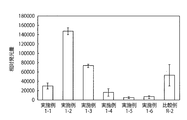
- FIG. 4 is a graph showing enzyme activity when lipid particles are used in MCF-7 cells according to Examples and Comparative Examples.
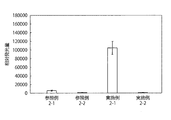
- FIG. 4 is a graph showing enzyme activities when lipid particles are used in Huh-7 cells according to Examples and Comparative Examples.
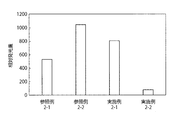
- FIG. 4 is a graph showing enzyme activity when lipid particles are used in Jurkat cells according to an example.
- FIG. FIG. 3 is a graph showing enzyme activity when lipid particles are used in peripheral blood mononuclear cells (PBMC) according to an example.
- PBMC peripheral blood mononuclear cells
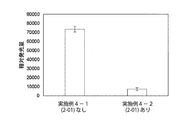
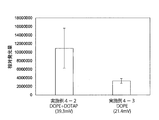
- 7 is a graph showing enzyme activity when lipid particles are used in MCF-7 cells, for comparison between Example 4-1 and Example 4-2.
- 7 is a graph showing enzyme activity when using lipid particles in Huh-7 cells, for comparison between Example 4-1 and Example 4-2.
- 7 is a graph showing enzyme activity when lipid particles are used in Jurkat cells, for comparison between Example 4-1 and Example 4-2.
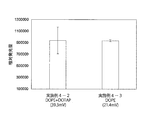
- 7 is a graph showing enzyme activity when lipid particles are used in MCF-7 cells for comparison between Example 4-2 and Example 4-3.
- 7 is a graph showing enzyme activity when using lipid particles in Huh-7 cells, for comparison between Example 4-2 and Example 4-3.
- C x ⁇ C y" and “C x" means the number of carbons in the molecule or substituent.
- C 1 -C 6 alkyl means an alkyl having 1 or more and 6 or less carbons.
- the alkyl halide refers to one in which one or more hydrogens in the alkyl are replaced by halogen such as fluorine.
- fluoroaryl means that one or more hydrogens in the aryl is replaced by fluorine This is what has been replaced.
- alkyl means a monovalent group obtained by removing one hydrogen from any carbon of an alkane.
- alkyl encompasses straight or branched chain alkyl.
- cycloalkyl means alkyl containing a cyclic structure. A cyclic structure in which a linear or branched alkyl is substituted is also referred to as cycloalkyl.
- ⁇ ⁇ Alkele means a monovalent group obtained by removing one hydrogen from any carbon of an alkene.
- the hydrocarbon group means a group containing monovalent or divalent or more carbon and hydrogen, and if necessary, oxygen or nitrogen.
- the aliphatic group is a hydrocarbon group containing no aromatic ring, and may have any of a chain, branched or cyclic structure, and a combination thereof. Unless otherwise specified, the aliphatic group may contain an unsaturated bond. Further, unless otherwise limited, the aliphatic group may include a hetero atom such as nitrogen, oxygen, sulfur, selenium, fluorine, chlorine, and bromine. Further, the aliphatic group may be a monovalent group or a polyvalent group.
- the aromatic hydrocarbon group includes an aromatic ring, and has an aliphatic hydrocarbon group as a substituent as necessary.
- Tertiary nitrogen means nitrogen to which three carbons are bonded. Therefore, the tertiary nitrogen forms a tertiary amine structure having an electron donating property.
- the compound according to the embodiment is a compound suitable as a lipid constituting the liposome. And it has a biodegradable group in its hydrophobic part and functions as a biodegradable lipid compound.
- the head does not contain a cationic group, and when applied to a living body, has the characteristics of suppressing protein binding in cells and having low toxicity.
- the liposome is composed of this lipid compound, the surface of the liposome becomes non-cationic, so that the liposome is less harmful to cells and the introduction rate of active agents such as nucleic acids is increased.
- Such a lipid compound is represented by the following general formula (1).
- Q in the formula may be referred to as a head and R may be referred to as a hydrophobic group.
- head Q contains more than one tertiary nitrogen and no oxygen. Nitrogen constituting unsubstituted amino, quaternary ammonium or the like may be further contained as long as the effects of the embodiment are not impaired, but nitrogen other than the tertiary nitrogen is preferably not contained.
- the head Q does not contain oxygen. Therefore, the head Q does not include structures such as oxy, hydroxy, carboxy, alkoxy, and carboxylate. Further, the head Q may contain an ionic group, but is preferably a neutral group containing no polar group.
- Q can be represented by the following general formula (1-Q).
- R Q1 is each independently alkyl
- R Q2 is each independently hydrogen or alkyl
- Any two of R Q1 and R Q2 may combine to form a nitrogen-containing alicyclic ring
- q1 is a number of 1 to 4
- q2 is a number from 0 to 4
- the alkyl is preferably a C 1 -C 3 alkyl.
- any two of R Q1 and R Q2 can combine to form a nitrogen-containing alicyclic ring.
- the number of members of the nitrogen-containing alicyclic ring is not particularly limited, it is preferably 4 to 10, and more preferably 5 to 8.
- the nitrogen-containing alicyclic ring constituted includes piperidine, piperazine, pyrrolidine, imidazolidine, hexamethyleneimine, homopiperazine, heptamethyleneimine and the like.
- Such Q has, for example, the following structure. (In the formula, * represents the bonding position to —CHR 2 )
- R represents a hydrophobic group, and two Rs may be the same or different.
- the hydrophobic group contains a relatively long hydrocarbon chain.
- These linking groups function as biodegradable groups when the compounds according to the embodiments are used in liposomes.
- LR1 and LR2 may have a branched chain structure or a cyclic structure, but if they have a branched structure, the LR1 and LR2 preferably have a small number of side chains, and most preferably have a linear structure.
- L R1 and L R2 are preferably represented by the following formulas (1-R1) and (1-R2), respectively.
- -(CH 2 ) r1- (1-R1) —CH 2 —CH CH— (CH 2 ) r2 —H (1-R2) (wherein r1 is a number from 1 to 10, r2 is a number from 1 to 10)
- r1 is preferably a number of 4 to 8, and the longest molecular chain contained in the hydrophobic group R is 8 atoms or more. Is preferred.
- each part of the compound according to the embodiment has a structure as described above, but the compound according to the embodiment preferably has a structure represented by the following formulas (1-01) to (1-21). .
- (1-01) and (1-02) are particularly preferable because excellent properties can be exhibited when used in liposomes.
- the compounds according to the invention can be prepared by any method.
- compounds (1-01) and (1-02) can be produced, for example, according to the following process chart.
- a lipid particle is provided.
- a typical example of the lipid particle is a liposome, but is not limited thereto, and includes a lipoplex complexed with a nucleic acid or the like.
- the liposome may be a unilamellar liposome or a multilamellar liposome.
- the lipid particle according to the embodiment contains the compound represented by the above formula (1). Further, it desirably further contains a lipid that forms a membrane and a lipid that can reduce aggregation.
- any lipid generally used in liposomes can be used.
- This lipid is preferably a lipid having excellent biodegradability.
- lipids forming such a membrane include diacylphosphatidylcholine, diacylphosphatidylethanolamine, ceramide, sphingomyelin, dihydrosphingomyelin, kephalin, and cerebroside.
- the lipid forming the membrane used for the lipid particles is appropriately selected in consideration of the size of the target liposome, the stability of the liposome in a living body, and the like. Of these, diacylphosphatidylcholine and diacylphosphatidylethanolamine are preferred.
- the length of the hydrocarbon chain of the acyl group contained in the lipid is preferably 10 to 20. This hydrocarbon chain may be a saturated hydrocarbon group or an unsaturated hydrocarbon group.
- lipids are known to form such a membrane, for example, 1,2-dioleoyl-sn-glycero-3-phosphoethanolamine (DOPE), 1,2-stearoyl-sn-glycero-3-phosphoethanolamine (DSPE), 1,2-dipalmitoyl-sn-glycero-3-phosphatidylcholine (DPPC), 1-palmitoyl-2-oleoyl-sn-glycero-3-phosphatidylcholine (POPC), 1,2-di-O-octadecyl-3-trimethylammonium propane (DOTMA), 1,2-dioleoyl-3-dimethylammonium propane (DODAP), 1,2-dimyristoyl-3-dimethylammonium propane (14: 0 DAP), 1,2-dipalmitoyl-3-dimethylammonium propane (16: 0 DAP), 1,2-distearoyl-3-dimethylammonium propane (18: 0 DAP), N- (4
- DOPE, DOTAP or cholesterol is more preferred, and a combination of DOPE and cholesterol, a combination of DOTAP and cholesterol, and a combination of DOPE, DOTAP and cholesterol are particularly preferred. These can exert a membrane fusion effect in addition to the function of forming a membrane such as a liposome.
- the lipid capable of reducing aggregation used in the embodiment exerts a function including aggregation of particles during the preparation of lipid particles.
- Various lipids are known as such lipids, and any lipid lipid according to the embodiment can be selected and used.
- examples of such lipids include polyethylene glycol (PEG) modified lipids, polyamide oligomers derived from omega-amino (oligoethylene glycol) alkanoic acid monomers (US Pat. No. 6,320,017), monosialogangliosides, and the like. Is mentioned. More specifically, ATTA lipids such as ATTA8-DPSE listed in US Pat. No. 6,320,017, US Pat. Nos. 5,820,873, 5,534,499, and The polyethylene glycol lipid conjugate described in US Pat. No. 5,885,613 can be used.
- the PEG-modified lipid can form an anchoring lipid moiety on the surface of the lipid particle when the lipid particle is formed.
- PEG-modified lipids include PEG-modified phosphatidylethanolamine, PEG-modified phosphatidic acid, PEG-ceramide conjugates (eg, C14 @ PEG-Cer or C20 @ PEG-Cer described in Japanese Patent No. 3,920,330).
- PEG-modified dialkylamine PEG-modified 1,2-diacyloxypropan-3-amine
- PEG-modified diacylglycerol eg, 1,2-dimyristoyl-sn-glycerol-methoxypolyethylene glycol; PEG-DMG
- PEG-modified dialkyl Glycerol PEG-modified diacylglycerol and PEG-modified dialkylglycerol are particularly preferred.
- lipid particles suitable for the purpose can be obtained. For example, it is possible to lose lipid particles faster by shortening the modifying group in the PEG-modified lipid, or to increase the residence time in plasma by increasing the modifying group. As a result, delivery of lipid particles to the target tissue may be improved in some cases.
- the lipid particles can further contain other lipids.
- Such other lipids can be arbitrarily selected from those commonly used in lipid particles. For example, relatively less toxic lipids can be combined to adjust toxicity.
- a lipid having a specific structure can be combined to introduce a functional group for binding a ligand to the lipid particles.
- lipid particles when lipid particles are used as liposomes, sterols, for example, cholesterol, may be contained as lipids for suppressing leakage of the inclusions.
- a target agent can be coupled to the lipid particles.
- any conventionally known method can be adopted.
- the lipid particles according to the embodiment have the following formula (2): P- [XWYW'-Z] 2 (2) (Where P is alkyleneoxy containing one or more ether bonds in the main chain, X is each independently a divalent linking group containing a tertiary amine structure; W is each independently C 1 -C 6 alkylene; Y is each independently a divalent linking group selected from the group consisting of a single bond, an ether bond, a carboxylate bond, a thiocarboxylate bond, a thioester bond, an amide bond, a carbamate bond, and a urea bond; W ′ is each independently a single bond or C 1 -C 6 alkylene, and Z is each independently a fat-soluble vitamin residue, a sterol residue, or a C 12 -C 22 aliphatic hydrocarbon group.
- a compound containing at least one biodegradable group selected from the group consisting of a carboxylate bond, a thiocarboxylate bond, a dithiocarboxylic acid bond, an amide bond, a carbamate bond, a carboxydioxy bond, and a urea bond.
- a biodegradable group selected from the group consisting of a carboxylate bond, a thiocarboxylate bond, a dithiocarboxylic acid bond, an amide bond, a carbamate bond, a carboxydioxy bond, and a urea bond.
- it further includes.
- the compound represented by the formula (2) is also a biodegradable lipid compound.
- the compound of the formula (1) By combining the compound of the formula (1) with the compound of the formula (2), it becomes possible to express a new function. For example, when the compound of formula (2) is applied to liposomes, the amount of nucleic acid encapsulated can be increased, and when the compound of formula (1) and the compound of formula (2) are applied to liposomes, gene therapy Or nucleic acid medicine, genomic diagnosis, etc.
- P in formula (2) contains an ether linkage. That is, P contains at least one oxygen, which is bonded to two carbons.
- the number of oxygens contained in P is not particularly limited, but preferably contains 1 to 2 oxygens.
- the number of carbon atoms contained in P is not particularly limited, but the hydrocarbon chain contained in P preferably has 1 to 3 carbon atoms, and the total number of carbon atoms contained in P is 3 to 8 carbon atoms. preferable.
- Preferred P includes the following.
- X is a divalent linking group containing a tertiary amine structure, and is preferably selected from the group consisting of methylimino, 1,2-pyrrolidinediyl, and 1,3-pyrrolidinediyl.
- this compound is used for the construction of liposomes, high cell membrane permeability is exhibited by the tertiary amine structure.
- -WY-W'-Z forms a hydrophobic portion.
- This hydrophobic part contains a biodegradable group.
- the biodegradable group may be present in the structure as Y, or may be included in Z in some cases. That is, Z is a group derived from fat-soluble vitamins and sterols, and the carboxylic acid ester group or the like may be included in the structure. Further, the biodegradable group may be contained in both Z and Y, or either one may contain two or more biodegradable groups.
- 'Y and W' are divalent groups connecting W and Z.
- Y is a divalent linking group selected from the group consisting of a single bond, an ether bond, a carboxylic acid ester bond, a thiocarboxylic acid ester bond, a thioester bond, an amide bond, a carbamate bond, and a urea bond.
- W ′ is a single bond or C 1 -C 6 alkylene.
- Z is a fat-soluble vitamin residue, a sterol residue, or a C 12 -C 22 aliphatic hydrocarbon group. Of these, fat-soluble vitamin residues or sterol residues are preferred, and fat-soluble vitamin residues are more preferred.
- a fat-soluble vitamin residue is a group derived from a fat-soluble vitamin.
- Fat-soluble vitamins include, for example, retinol, retinal, ergosterol, 7-dehydrocholesterol, calciferol, corcalciferol, dihydroergocalciferol, dihydrotaxosterol, tocopherol, and tocotrienol. These fat-soluble vitamins have a terminal hydroxy.
- One example of a fat-soluble vitamin residue is one in which hydrogen has been eliminated from these hydroxys.
- a group derived from a fat-soluble vitamin derivative can also be used.
- the fat-soluble vitamin derivative is a compound in which the hydroxy contained in the fat-soluble vitamin is substituted with thiohydroxy, carboxy, thiocarboxy, or dithiocarboxy.
- Particularly preferred among the fat-soluble vitamin residues are groups derived from retinol (vitamin A), tocopherol (vitamin E), or their carboxylic acid derivatives.
- a sterol residue is a group derived from a sterol.
- Sterols include, for example, cholesterol, stigmasterol, ⁇ -sitosterol, lanosterol, and ergosterol.
- One example of a sterol residue is one in which hydrogen has been eliminated from the hydroxy of these sterols.
- the sterol residue may have the same terminal group as the group derived from the fat-soluble vitamin derivative described above.
- Particularly preferred sterol residues are groups derived from sterol, cholesterol, or their carboxylic acid derivatives.
- the C 12 -C 22 aliphatic hydrocarbon group may be linear or branched, and may have a cyclic structure.
- the aliphatic hydrocarbon group may contain an unsaturated bond, and if so, generally contains 6 or less, preferably 3 or less unsaturated bonds.
- the aliphatic hydrocarbon group preferably has 12 to 18 carbon atoms, and more preferably 13 to 17 carbon atoms.
- the compound of the formula (2) contains two [XWYW'-Z], and each of X, W, Y, W 'and Z is independent and may be the same. Although they may be different, it is preferable that they are the same and that the structure of the compound is the object.
- Each site of the compound according to the embodiment has a structure as described above, and the compound according to the embodiment preferably has a structure represented by the following formulas (2-01) to (2-12). .
- (2-01) to (2-04) are particularly preferable because excellent properties can be exhibited when used in combination with the compound of the formula (1) for liposomes.
- the compound of the formula (2) can be produced, for example, according to the following process chart.
- lipids are combined to form lipid particles, but the mixing ratio of each lipid constituting the lipid particles is adjusted according to the purpose and is not limited. However, based on the total number of moles of lipid used in the lipid particles, generally, A total of 25 to 75 mol% of the lipid compounds represented by the formulas (1) and (2), 25-75 mol% of lipid forming the membrane, 1 ⁇ 10mol% lipid which can reduce aggregation In general, a total of 30 to 60 mol% of the lipid compounds represented by the formulas (1) and (2) 30-65 mol% of lipid forming the membrane, 1 to 10 mol%, for example 2.5 mol%, of lipid capable of reducing aggregation It is.
- the compounding ratio of the compound of the formula (1) or (2) to the lipid forming the membrane is preferably 1: 0.5 to 1: 3 on a molar basis, and 1: 0.75. More preferably, it is 1 : 1: 2.1.
- any of the compounds represented by Formula (1) or (2) also functions as a lipid that forms a membrane, but in the embodiment, the “lipid that forms a membrane” is represented by Formula (1) or ( It does not include the compound of 2).
- the lipid particles according to the embodiment may further include an active agent.
- an active agent is a substance that can have a particular effect on a cell, tissue, organ, or subject. The specific effect may be any of a biological, physiological, or cosmetic effect.
- Various active agents can be delivered to a target site in a living body by using the lipid particles according to the embodiments.
- the active agent may be encapsulated inside the lipid particle, bound to the outer or inner lipid surface, or located within the lipid layer.
- a typical example of an active agent is a nucleic acid, for example, a nucleic acid selected from the group consisting of a plasmid, an oligonucleotide, a polynucleotide, a small interfering RNA (siRNA), a microRNA (miRNA), a DNA, an aptamer, and a ribozyme.
- a nucleic acid selected from the group consisting of a plasmid, an oligonucleotide, a polynucleotide, a small interfering RNA (siRNA), a microRNA (miRNA), a DNA, an aptamer, and a ribozyme.
- antisense oligonucleotides antagomirs, aDNAs, plasmids, ribosomal RNAs (rRNAs), transfer RNAs (tRNAs), small nuclear RNAs (snRNAs), mRNAs and the like can also
- the nucleic acid is an oligonucleotide having 15 to 50 or 20 to 30 linked nucleotide units.
- the siRNA can be, for example, one containing 16 to 30 nucleotide units and having a double-stranded region.
- the nucleic acid is an immunostimulatory oligonucleotide, a decoy oligonucleotide, a supermir, a miRNA mimetic, or a miRNA inhibitor.
- Supermir is RNA or deoxyribonucleic acid DNA, or both, or a single-stranded, double-stranded, or partially double-stranded oligomer or polymer thereof, which is a denatured product thereof.
- a miRNA mimic represents a group of molecules that can be used to mimic the gene silencing ability of one or more miRNAs.
- miRNA mimic refers to a synthetic non-coding RNA that can enter the RNAi pathway and regulate gene expression (ie, a miRNA mimic is obtained by purifying from a source of endogenous miRNA). Is not obtained).
- the form of the nucleic acids is not particularly limited.
- the nucleic acid can be, for example, a single-stranded DNA or RNA, a double-stranded DNA or RNA, or a DNA-RNA hybrid. Examples of double-stranded RNA include siRNA.
- Single-stranded nucleic acids include, for example, antisense oligonucleotides, riboenzymes, miRNAs, and triple-stranded oligonucleotides.
- the lipid particle may further include a compound that binds to the nucleic acid.
- a compound that binds to the nucleic acid include basic proteins or basic peptides, and preferably include protamine, histone, and salts thereof.
- histones and their salts have the property of binding to nucleic acids and folding nucleic acid molecules.
- Protamine has a property of binding to a nucleic acid and further involving the nucleic acid. Therefore, these compounds are effective for encapsulating nucleic acids in lipid particles.
- the lipid particles according to the embodiment may further include a compound that regulates the expression of a nucleic acid in a cell. Adjusting the expression of the nucleic acid in the cell is preferable because the effect of visualization and cell death can be obtained for the cell to which the liposome has been delivered.
- a compound that regulates the expression of a nucleic acid in a cell is preferable because the effect of visualization and cell death can be obtained for the cell to which the liposome has been delivered.
- Such compounds include retinoic acid, cyclic adenosine monophosphate (cAMP), ascorbic acid, and the like.
- the lipid particles according to the embodiment may contain lipoprotein, apolipoprotein, and the like.
- therapeutic agents can be used as the active agent.
- therapeutic agents include peptides, polypeptides, cytokines, growth factors, apoptosis factors, differentiation-inducing factors, cell surface receptors and their ligands, hormones, and the like. More specifically, therapeutic agents include anti-inflammatory compounds, antidepressants, stimulants, analgesics, antibiotics, contraceptives, antipyretics, vasodilators, angiogenesis inhibitors, cytovascular agents, Signaling inhibitors, cardiovascular drugs, oncology drugs, hormones, and steroids.
- the active agent is introduced into the lipid particles at a higher introduction rate. It is also preferred that cell death due to cytotoxicity dependent on lipid properties is low.
- nucleic acid was introduced using conventionally known lipid particles, the introduction rate was generally low and the rate of cell death due to cytotoxicity was high.
- the nucleic acid introduction rate is high, and cell death can be reduced.
- the introduction rate is about 10%, and the cell death by electroporation is 60 to 70%, whereas when the lipid particles according to the embodiment are used, It is reduced to 70% or more and 30% or less.
- the lipid particles according to the embodiment can be formed in any size according to the purpose. However, when the lipid particles according to the embodiment are to be used for medical applications, the lipid particles are generally nano-sized particles. Specifically, the average particle diameter of the lipid particles according to the embodiment is generally 50 nm to 300 nm, preferably 50 nm to 200 nm.
- the size of the lipid particles can be adjusted by any method. For example, sonication can reduce lipid particles. Also, the size can be adjusted by separating the lipid particles through a polycarbonate membrane or a ceramic membrane. In the embodiment, the average particle diameter of the lipid particles can be measured by, for example, a Zetasizer using a dynamic light scattering method.
- the in vivo half-life (t 1/2 ) of the lipid particles according to embodiments is generally less than 3 hours, preferably less than 2 hours, particularly preferably less than 1 hour.
- the in vivo half-life means, for example, the half-life in the liver, spleen, or plasma.
- the compound of the formula (1) constituting the lipid has a biodegradable group
- the compound has a half-life of, for example, less than 10% as compared with a lipid particle made of a lipid not containing a biodegradable group. Has become.
- the lipid particles according to the embodiment can be manufactured by any conventionally known method.
- Known methods for producing lipid particles and liposomes include a bang gum method, an organic solvent extraction method, a surfactant removal method, and a freeze-thaw method. These methods can also be employed.
- a compound represented by the formula (1), a lipid forming a membrane, and a lipid capable of reducing aggregation are introduced into an organic solvent such as alcohol, and spontaneously generated by adding an aqueous buffer.
- lipid particles can be formed. By combining an activator with this aqueous buffer, it is possible to introduce the activator into the lipid particles.
- Lipid particles according to this embodiment can be used to deliver an active agent to cells.
- delivery of active agents, such as nucleic acids, to cells is used in all fields, including genetic engineering, production of recombinant proteins, and medical techniques known as gene therapy and cytodiagnosis.
- a composition for delivering an active agent to a cell comprising a lipid particle according to the embodiment, and a carrier.
- a lipid particle according to an embodiment is provided for delivering an active agent to a cell.
- a method for delivering an active agent to a cell comprising contacting a lipid particle according to an embodiment comprising the active agent with a cell (eg, administering the lipid particle to a subject).
- a method is provided that includes:
- the lipid particles comprise both a compound of the formula (1) and a compound of the formula (2), preferably the content of the compound of the formula (1) relative to the content of the compound of the formula (1) The molar ratio of the content of the compounds is less than 1.
- the cells are tumor cells.
- the subject is preferably an animal in need of such treatment, more preferably a mammal, and most preferably a human.
- composition The lipid particles according to the present embodiment can be used as a composition.
- a composition comprising the lipid particles of the present embodiment and a carrier is provided.
- Such a composition is also applicable for pharmaceutical use.
- the carrier can be arbitrarily selected from conventionally known carriers, and examples thereof include water, saline such as physiological saline, glycine aqueous solution, and buffer. Further, in addition to these carriers, glycoproteins such as albumin, lipoprotein, apolipoprotein, globulin and the like may be combined for the purpose of improving stability and the like.
- compositions according to embodiments can be prepared by standard methods.
- a physiological saline is generally used.
- the carrier is preferably added after formation of the lipid particles.
- an active agent such as a nucleic acid
- compositions according to the embodiment may include an adjuvant as needed.
- a pharmaceutically acceptable auxiliary agent such as a pH adjuster, a buffering agent, and a tonicity adjuster may be included as an auxiliary agent to bring the pharmaceutical composition closer to a physiological state. it can.
- the auxiliary having such a function include sodium acetate, sodium lactate, sodium chloride, potassium chloride, calcium chloride, and hydroxyethylpiperazineethanesulfonic acid (HEPES).
- HEPES hydroxyethylpiperazineethanesulfonic acid
- compositions according to embodiments can also include a lipid protectant to improve storage stability.
- Such protective agents include lipophilic free radical quencher, such as ⁇ -tocopherol, which suppresses damage by free radicals, and water-soluble chelators, such as ferrioxamine, which suppress peroxidation damage of lipids.
- the above-mentioned activators and the like can be added to the composition.
- the activator may be the same as or different from the activator combined with the lipid particles.
- a compound that binds to the nucleic acid or a compound that regulates the expression of the nucleic acid can be added to the composition.
- the concentration of the lipid particles contained in the composition according to the embodiment is not particularly limited, and the content of the lipid particles contained in the composition is generally 0.01 to 30% by mass, preferably 0.05 to 10% by mass. %.
- the concentration of the lipid particles can be appropriately selected depending on the purpose.
- compositions according to embodiments can be sterilized by conventional and well-known methods.
- the sterilized composition can be packaged as a preparation that can be administered as it is, or can be dried and packaged.
- the dried composition can be made into an administrable preparation by combining it with a sterile aqueous solution immediately prior to administration.
- compositions according to embodiments can also be in kit form.
- the kit according to the embodiment includes the above-described lipid particles and an introducing agent for introducing the lipid particles into cells, but the form is arbitrary.
- a kit containing an active agent and a dispersion in which an active agent-free lipid particle is dispersed in a carrier and a kit containing the active agent in a separate container a kit containing the dried lipid particles, the active agent and the carrier in a separate container, and the like.
- the dried lipid particles or lipid particle dispersion and the active agent can be made into separate products, so that the user can select each product according to the purpose. Reagents used for nucleic acid introduction can be combined with the kit.
- the composition can be used for treating or diagnosing various diseases of humans or animals.
- a therapeutic agent as an active agent to be combined with lipid particles
- the therapeutic agent can be delivered to target cells, thereby enabling treatment.
- nucleic acids can be delivered to cells and brought into contact with them to prevent or treat diseases.
- nucleic acids include oligonucleotides, siRNA, plasmids, antisense, or ribozymes.
- the lipid compounds according to these embodiments can efficiently and rapidly incorporate these nucleic acids. For example, it has been conventionally difficult to introduce RNA into lipid particles in a short time and safely, but by using the lipid compound according to the embodiment, it can be easily performed.
- More effective cell targeting can be achieved by appropriately combining a lipid compound used for preparing lipid particles and a compound forming a membrane.
- the combination of compound (1-01), compound (2-01), DOPE and cholesterol is useful for delivery to hepatoma cells by compound (1-01) or compound (1-02), DOTAP, and A combination of cholesterol can be suitably used for delivery to T cell leukemia cells, and a combination of compound (1-01), compound (2-01), DOTAP, DOPE and cholesterol can be suitably used for delivery to breast cancer cells. .
- lipid compound used for preparing lipid particles and a compound forming a membrane by appropriately combining a lipid compound used for preparing lipid particles and a compound forming a membrane, more effective diagnosis, treatment and prevention can be performed.
- the combination of compound (1-01), compound (2-01), DOPE and cholesterol is useful for diagnosing, treating and preventing liver cancer by compound (1-01) or compound (1-02), DOTAP And cholesterol are suitable for the diagnosis, treatment and prevention of T cell leukemia, and the combination of compound (1-01), compound (2-01), DOTAP, DOPE and cholesterol are suitable for the diagnosis, treatment and prevention of breast cancer Can be used.
- the delivery of the nucleic acid can be performed either in vitro or in vivo.
- the pharmaceutical composition is preferably administered parenterally, ie, intraarticular, intravenous, intraperitoneal, subcutaneous, or intramuscular.
- Intravenous or intraperitoneal administration of a pharmaceutical composition can also be by bolus injection.
- the pharmaceutical preparation according to the embodiment can be applied directly to the target tissue to bring the pharmaceutical composition into contact with the target tissue.
- administration to the meninges or the like by infusion or administration using an endoscopic instrument is also possible.
- treatment with the pharmaceutical composition is generally performed at physiological temperature (about 37 ° C) for a period of 1 to 24 hours, preferably 2 to 8 hours.
- the target cells are not particularly limited. For example, it may be a vertebrate cell, an invertebrate cell, or a plant cell. However, in a preferred embodiment, the cells are animal cells, more preferably mammalian cells, and most preferably human cells.
- Synthesis Example 1 Synthesis of Compound (1-01) Compound (1-01) was synthesized according to the above-described production process. Specifically, the following operation was performed.
- the Grignard reagent was added dropwise to a 1000 mL four-necked flask charged with ethyl formate (12.04 g, 162.49 mol, 1 eq.) And diethyl ether (165 mL) at 0 ° C. or lower over 1.5 hours.
- Step 2 Under an argon atmosphere, the intermediate (1-01-1) (41.1 g, 146.53 mmol, 1 eq.) Dissolved in dichloromethane (330 mL) was charged into a 1000 mL flask, and triethylamine (59.31 g, 586.12 mmol, 4 eq.) And 4-dimethylaminopyridine (1.79 g, 14.65 mmol, 0.1 eq.) Were added. At ⁇ 5 ° C., methanesulfonyl chloride (33.57 g, 293.06 mmol, 2 eq.) was added dropwise.
- a saturated aqueous ammonium chloride solution (1200 mL) was added to the reaction solution, stirred for 20 minutes, and 10% sulfuric acid (450 mL) was added to separate the layers. Subsequently, extraction was performed twice with diethyl ether (500 mL). The extracted organic layer was washed with a saturated aqueous solution of sodium hydrogencarbonate (500 mL) and a saturated saline solution (500 mL), and dried over sodium sulfate. After filtration and concentration, 25.3 g (89% yield) of intermediate (1-01-4) was obtained as a yellow oil.
- the aqueous layer was extracted with dichloromethane (100 mL x 2), and a saturated saline solution (230 mL) was added to the combined organic layer, and 3% sodium sulfide was added dropwise until the color changed. 1 M hydrochloric acid was added until acidic, and the layers were separated. The organic layer was dried with sodium sulfate.
- the crude product (14.7 g) obtained by filtration and concentration was purified by column chromatography (silica gel: 300 g, developing: chloroform ⁇ 2% methanol / 98% chloroform) to give the intermediate (1-01-7) as a pale yellow oil. 0.73 g (49% yield) was obtained.
- the crude product (3.7 g) obtained by filtration and concentration was purified by column chromatography (silica gel 37 g, developing: hexane ⁇ 5% ethyl acetate / 95% hexane), and the intermediate (1-01-8) was converted into a pale yellow oil 1.62 g (yield 36%).
- the aqueous layer was extracted three times with dichloromethane (20 mL), and the combined organic layers were dried over sodium sulfate.
- the crude product (2.3 g) obtained by filtration and concentration was purified by column chromatography (silica gel: 25 g, developing: chloroform ⁇ 5% methanol / 95% chloroform) to give the target compound (1-01). 21 g (72% yield) were obtained.
- Synthesis Example 2 Synthesis of Compound (2-01) Compound (2-01) was synthesized according to the above-described production process. Specifically, the following operation was performed.
- the crude product was purified by column chromatography (15 g of NH silica gel, developing solution 50% hexane / chloroform) to obtain 348 mg of an intermediate (2-01-2 ) as a pale yellow transparent oil (yield 43%). ).
- a core complex consisting of the vector DNA-DNA condensed peptide was prepared.
- a vector DNA a plasmid into which a cytomegalovirus early promoter / enhancer, an Nluc gene, and a transcription termination signal were incorporated was used.
- mHP-1 RQRQR-YY-RQRQR-GG-RRRRRR: SEQ ID NO: 1
- mHP-2 RRRRRR-YY-RQRQR-GG-RRRRRR: SEQ ID NO: 2
- a DNA condensed peptide solution (0.24 mg / ml, 10 mM HEPES, pH 7.3) was dispensed into a microtube (Proteosave SS (trade name) 1.5 ml, manufactured by Sumitomo Bakelite Co., Ltd.). While stirring the dispensed peptide solution with a vortex mixer (1,500 rpm) (MSV-3500 (trade name), manufactured by BIOSAN), 200 ⁇ l of the vector DNA solution (0.15 mg / ml, 10 mM @HEPES, pH 7.3) was added. The mixture was added dropwise.
- ⁇ ⁇ ⁇ ⁇ ⁇ ⁇ Liposome encapsulating the core complex was prepared by ethanol injection. 50 ⁇ l of each lipid solution having the mixing ratio shown in Table 1 was dispensed into a microtube (Proteo Save SS (trade name) 1.5 ml, manufactured by Sumitomo Bakelite Co., Ltd.). Here, a compound represented by the formula (R-01) was used as a compound used for comparison.
- the fluorescence intensity (excitation wavelength: 485 nm, fluorescence wavelength: 530 nm) of the solution was measured with a microtiter plate reader: Mitras LB-940 (trade name, manufactured by Bertole).
- the DNA concentration was quantified using a calibration curve prepared with known concentrations of ⁇ DNA. From the obtained numerical values, the amount of liposome-encapsulated DNA was calculated as the amount of DNA per 1 mL of solution ( ⁇ g DNA / mL). The results are as shown in Table 2.
- the liposome containing the compound of the formula (1-01) had a higher amount of encapsulated DNA than the liposome containing the compound of the formula (R-01). It was also confirmed that when the compound of the formula (2) was combined as a lipid compound, the amount of encapsulated DNA was increased.
- the surface charge (zeta potential) of the liposome was measured with a Zetasizer (Zetasizer Nano ZS (trade name), manufactured by Malvern PANalytical). 30 ⁇ l of the liposome solution was dispensed into a cell for measuring zeta potential (DTS-1070 (trade name), manufactured by Malvern Panical), 870 ⁇ l of distilled water was added and mixed, and the cell was set on a Zetasizer to measure the zeta potential. did. The results obtained are as shown in Table 2.
- the introduction of vector DNA into cells by liposomes was quantified by expression of the Nluc gene on the vector DNA.
- the expression of the NLuc gene was evaluated by measuring the amount of luminescence with a microtiter plate reader: infinite F200 (product name, manufactured by Tecan).
- the cells used were human T-cell leukemia cell line Jurkat, human breast cancer-derived cell line MCF-7, and human liver cancer-derived cell line Huh-7 (purchased from American Type Culture Collection). After 100 ⁇ L of a cell suspension at 1 ⁇ 10 6 cells / mL was seeded on a 96-well culture plate, 1 ⁇ L of a liposome solution shown in Table 1 was added.
- the cells were cultured in an incubator at 37 ° C. in a 5% CO 2 atmosphere for 48 hours, and then the enzyme activity of NLuc was measured.
- the enzyme activity of NLuc was measured using a NanoGlo Luciferase Assay System (product name, Promega) with a luminometer according to the manual attached to the kit. The obtained results were as shown in FIG. 1 (Jurkat), FIG. 2 (MCF-7), and FIG. 3 (Huh-7).
- Nluc gene taken into cells by liposomes can be more easily taken up by adherent cells than by floating compounds by combining the compound of formula (2) with the lipid compound of formula (1). Indicated. Furthermore, by controlling the surface charge in the presence or absence of DOTAP, it was found that there was directivity to cells having different growth modes.
- Synthesis Example 3 Synthesis of Compound (1-02) Compound (1-02) was synthesized according to the above-described production process. Specifically, the following operation was performed.
- the Grignard reagent was added dropwise to a 1000 mL four-necked flask charged with ethyl formate (12.04 g, 162.49 mmol, 1.00 eq.) And diethyl ether (165 mL) at 0 ° C. or lower over 1.5 hours. After reacting at room temperature for 1 hour, acetone (100 mL) was added, and water (200 mL) and 10% sulfuric acid (267 mL) were sequentially added to carry out liquid separation. The aqueous layer was extracted with diethyl ether (300 mL), and the organic layer was dried over Na 2 SO 4 .
- Step 2 Under an argon atmosphere, the intermediate (1-02-1) (41.1 g, 146.53 mmol, 1.00 eq.) Dissolved in dichloromethane (330 mL) was introduced into a 1000 mL flask, and tritylamine (59 .31 g, 586.12 mmol, 4.00 eq.) And 4-dimethylaminopyridine (1.79 g, 14.65 mmol, 0.10 eq.) Were added. At ⁇ 5 ° C., methanesulfonyl chloride (33.57 g, 293.06 mmol, 2.00 eq.) was added dropwise.
- the crude product (30.3 g) obtained by filtration and concentration was purified by column chromatography (silica gel 304 g, developing: 5% ethyl acetate / 95% hexane) to obtain 22 (intermediate (1-02-5)) as a pale yellow oil. .13 g (87% yield) were obtained.
- Step 6 Under an argon atmosphere, the intermediate (1-02-5) (22.13 g, 75.14 mmol, 1.00 eq.) was dissolved in dichloromethane (220 mL) in a 1000 mL flask, and tetrabromomethane (29.90 g, 90 .17 mmol, 1.20 eq.). At 0 ° C., triphenylphosphine (29.56 g, 112.71 mmol, 1.50 eq.) Dissolved in dichloromethane (63 mL) was added dropwise.
- reaction solution was extracted with ethyl acetate (200 mL ⁇ 3 times), washed sequentially with a saturated aqueous NaHCO 3 solution (90 mL) and a saturated saline solution (90 mL), and the organic layer was dried over Na 2 SO 4 . After filtration and concentration, 7.31 g (66% yield) of intermediate (1-02-7) was obtained as an orange oil.
- the extracted organic layer was washed with water (50 mL) and a saturated saline solution (50 mL), and dried over Na 2 SO 4 .
- the crude product (11.4 g) obtained by filtration and concentration was purified by column chromatography (silica gel 100 g, eluant: hexane ⁇ 5% ethyl acetate / 95% hexane) to give the intermediate (1-02-11) as a colorless oil. 3.6 g (yield 90%) was obtained.
- the crude product (3.17 g) obtained by filtration and concentration was purified by column chromatography (silica gel 32 g, developing: 5% ethyl acetate / 95% hexane) to give the intermediate (1-02-13) as a pale yellow oil. 1.12 g (35% yield) was obtained.
- the crude product (1.92 g) obtained by filtration and concentration was purified by column chromatography (silica gel 20 g, eluant: hexane ⁇ 2% ethyl acetate / 98% hexane), and the intermediate (1-02-16) was slightly yellow oil. 77 mg (yield 5%) was obtained.
- a core complex consisting of the vector DNA-DNA condensed peptide was prepared.
- a vector DNA a plasmid into which a cytomegalovirus early promoter / enhancer, an Nluc gene, and a transcription termination signal were incorporated was used.
- mHP-1 RQRQR-YY-RQRQR-GG-RRRRRR: SEQ ID NO: 1
- mHP-2 RRRRRR-YY-RQRQR-GG-RRRRRR: SEQ ID NO: 2
- a DNA condensed peptide solution (0.255 mg / ml, 10 mM HEPES, pH 7.3) was dispensed into a microtube (Proteo Save SS (trade name) 1.5 ml, manufactured by Sumitomo Bakelite Co., Ltd.).
- 200 ⁇ l of the vector DNA solution (0.15 mg / ml, 10 mM HEPES, pH 7.3) while stirring the dispensed peptide solution with a vortex mixer (1, 500 rpm) (MSV-3500 (trade name), manufactured by BIOSAN). was added dropwise and mixed.
- ⁇ ⁇ ⁇ ⁇ ⁇ ⁇ Liposome encapsulating the core complex was prepared by ethanol injection. 50 ⁇ l of a lipid solution having a mixing ratio shown in Table 3 was dispensed into a microtube (Proteo Save SS (trade name) 1.5 ml, manufactured by Sumitomo Bakelite Co., Ltd.). Reference Examples 2-1 and 2-2 in Table 3 are separate preparations having the same formulation as in Examples 1-2 and 1-4 described above.
- the fluorescence intensity (excitation wavelength: 485 nm, fluorescence wavelength: 530 nm) of the solution was measured with a microtiter plate reader: Mitras LB-940 (trade name, manufactured by Bertole).
- the DNA concentration was quantified using a calibration curve prepared with known concentrations of ⁇ DNA. From the obtained numerical values, the amount of liposome-encapsulated DNA was calculated as the amount of DNA per 1 mL of solution ( ⁇ g DNA / mL). The results are as shown in Table 4. It was revealed that the liposome containing the compound of the formula (1-02) exhibited the same amount of the included DNA as the liposome containing the compound of the formula (1-01). It was also confirmed that when the compound of the formula (2-01) was combined, the amount of encapsulated DNA was increased.
- the surface charge (zeta potential) of the liposome was measured with a Zetasizer (Zetasizer Nano ZS (trade name), manufactured by Malvern PANalytical). 10 ⁇ l of the liposome solution is dispensed into a cell for measuring zeta potential (DTS-1070 (trade name), manufactured by Malvern Panasonic), 890 ⁇ l of distilled water is added and mixed, and the cell is set on a Zetasizer to measure the zeta potential. did. The results obtained are as shown in Table 4.
- the neutral lipid DOPE is used as the lipid forming the membrane (Reference Example 2-2 and Example 2-2), and the cationic lipid DOTAP is used for DOPE (Reference Example 2). -1 and Example 2-1), it was found that the latter can shift the zeta potential more positively.
- the introduction of vector DNA into cells by liposomes was quantified by expression of the Nluc gene on the vector DNA.
- the expression of the NLuc gene was evaluated by measuring the amount of luminescence thereof using a microtiter plate reader: infinite F200 (product name, manufactured by Tecan).
- the cells used were human T-cell leukemia cell line Jurkat (purchased from American Type Culture Collection) and human peripheral blood mononuclear cell PBMC (purchased from Lonza Japan Co., Ltd.).
- Jurkat was seeded on a 96-well culture plate with 100 ⁇ L of a cell suspension of 1 ⁇ 10 6 cells / mL, and PBMC was seeded with 100 ⁇ L of a cell suspension of 5 ⁇ 10 6 cells / mL. The solution was added so that the DNA amount was 0.8 ⁇ g / well. After the addition, the cells were cultured in an incubator at 37 ° C. in a 5% CO 2 atmosphere for 48 hours, and then the enzyme activity of NLuc was measured. The enzyme activity of NLuc was measured using a NanoGlo Luciferase Assay System (product name, Promega) with a luminometer according to the manual attached to the kit. The obtained results were as shown in FIG.
- a NanoGlo Luciferase Assay System product name, Promega
- lipid compound of the formula (1-02) was confirmed to exhibit higher Nluc gene expression efficiency in Jurkat cells than the formula (1-01). Further, when the lipid compound of the formula (1-01) is selected from the formula (2-01) and DOPE as the lipid compound forming the membrane, the Nluc gene expression efficiency in PBMC cells is higher than that of the formula (1-02). It was confirmed that it showed.
- RNA-encapsulated liposome containing lipid compound As a messenger RNA (mRNA), mRNA (OZ Biosciences) of a green fluorescent protein GFP which is a reporter gene was used. The RNA-encapsulated liposome was prepared by adding a GFP mRNA solution to a lipid solution having the mixing ratio shown in Table 5, suspending the solution by pipetting, gently adding 10 mM HEPES (pH 7.3), and centrifuging the solution. It was adjusted by washing and concentration by ultrafiltration. Here, a compound represented by the formula (R-01) was used as a compound used for comparison. Comparative Example R-3 is another preparation having the same formulation as Comparative Example R-1.
- RNA-encapsulated RNA The amount of RNA encapsulated in the liposome was measured with a QuantiFluor RNA System kit (Promega). The measurement was performed according to the manual attached to the kit. Table 6 shows the measurement results of the RNA inclusion amount. In the RNA-encapsulated liposomes prepared with the lipid solutions having the mixing ratios shown in Table 5, no remarkable difference was observed in the amount of RNA included in the liposomes.
- the surface charge (zeta potential) of the RNA-encapsulated liposome was measured using a Zetasizer (Zetasizer Nano ZS, manufactured by Malvern PANalytical).
- the liposome solution was added to a cell for measuring zeta potential (DTS-1070, manufactured by Malvern Panalytical), diluted and mixed with distilled water, and then the cell was set at a predetermined position on a Zetasizer to measure the zeta potential.
- the amount of encapsulated RNA and the average zeta potential of the RNA-encapsulated liposomes prepared in Table 5 were as shown in Table 6.
- RNA introduction amount by liposome Introduction of RNA into cells by liposomes was quantified by expression of the GFP gene encoded by the RNA.
- the expression of the GFP gene was evaluated by measuring the amount of fluorescence with a flow cytometer (FACSVerse, manufactured by BD Biosciences).
- the cells used were a human T-cell leukemia cell line: Jurkat (purchased from American Type Culture Collection).
- Jurkat cultured in a TexMACS medium manufactured by Gibco was collected by centrifugation, and then suspended in fresh TexMACS to 0.65 ⁇ 10 7 cells.
- RNA introduction method As an RNA introduction method used for comparison, a lipofection using a lipofectamine reagent (Lipofectamine 3000, manufactured by Invitrogen) and an RNA introduction method by electroporation were performed. Introduction by lipofection was performed according to the manual attached to the reagent.
- Jurkat was collected by centrifugation, OptiMEM (Gibco) was added, washed, and then collected by centrifugation again.
- the collected cells were suspended in OptiMEM at 1.0 ⁇ 10 7 cells / mL, and then 0.5 ⁇ g of GFP RNA was added to 100 ⁇ L of the cell suspension, transferred to a cuvette electrode, and electroporated. .
- Electroporation was performed using CUY21 EDIT II (BEX) under the following conditions.
- FIG. 6 is a graph showing the measurement results. The vertical axis of the graph is relative fluorescence intensity.
- the RNA-encapsulated liposomes prepared using the lipid solutions of Examples 3-1 and 3-2 exhibited a higher transfection amount than other RNA transfection methods, namely, transfection by lipofection and transfection by electroporation.
- the liposome containing the lipid solution of Example 3-1 exhibited the highest transfection amount.
- the introduction of vector DNA into cells by liposomes was quantified by expression of the Nluc gene on the vector DNA.
- the expression of the NLuc gene was evaluated by measuring the amount of luminescence with a microtiter plate reader: infinite F200 (product name, manufactured by Tecan).
- the cells used were human T-cell leukemia cell line Jurkat, human breast cancer-derived cell line MCF-7, and human liver cancer-derived cell line Huh-7 (purchased from American Type Culture Collection). After 100 ⁇ L of a cell suspension of 1 ⁇ 10 6 cells / mL was seeded on a 96-well culture plate, 1 ⁇ L of a liposome solution shown in Table 7 was added. After the addition, the cells were cultured in an incubator at 37 ° C.
- FIGS. 7 to 9 are graphs comparing Example 4-1 and Example 4-2.
- FIG. 7 shows breast cancer cells (cell line MCF-7), and
- FIG. 8 shows liver cancer cells (cell line Huh- 7),
- FIG. 9 shows the expression efficiency of Nluc gene in leukemia cells (T-lymphocytes, cell line Jurkat).
- the results shown in FIGS. 7 to 9 indicate that the compound (2-01) allows the vector DNA contained in the liposome to be more easily taken up by adherent cells than by floating cells.
- FIGS. 10 and 11 are graphs comparing Example 4-2 and Example 4-3, wherein FIG. 10 shows breast cancer cells (cell line MCF-7), and FIG. 11 shows liver cancer cells (cell line Huh- 7 shows the expression efficiency of the Nluc gene in 7). From the results shown in FIGS. 10 and 11, it can be seen that in the liposome containing the combination of the compound (1-01) and the compound (2-01), cells having different growth modes depend on whether or not DOTAP is used to control the surface charge. It was found that directivity could be imparted to the liposome.
Landscapes
- Chemical & Material Sciences (AREA)
- Organic Chemistry (AREA)
- Health & Medical Sciences (AREA)
- Life Sciences & Earth Sciences (AREA)
- Public Health (AREA)
- Veterinary Medicine (AREA)
- Medicinal Chemistry (AREA)
- Pharmacology & Pharmacy (AREA)
- Animal Behavior & Ethology (AREA)
- General Health & Medical Sciences (AREA)
- Epidemiology (AREA)
- Engineering & Computer Science (AREA)
- Molecular Biology (AREA)
- Chemical Kinetics & Catalysis (AREA)
- General Chemical & Material Sciences (AREA)
- Oil, Petroleum & Natural Gas (AREA)
- Dispersion Chemistry (AREA)
- Biophysics (AREA)
- Biochemistry (AREA)
- Genetics & Genomics (AREA)
- Biotechnology (AREA)
- Bioinformatics & Cheminformatics (AREA)
- Nuclear Medicine, Radiotherapy & Molecular Imaging (AREA)
- Proteomics, Peptides & Aminoacids (AREA)
- Medicinal Preparation (AREA)
- Pharmaceuticals Containing Other Organic And Inorganic Compounds (AREA)
- Organic Low-Molecular-Weight Compounds And Preparation Thereof (AREA)
- Micro-Organisms Or Cultivation Processes Thereof (AREA)
- Peptides Or Proteins (AREA)
- Fats And Perfumes (AREA)
- Medicines That Contain Protein Lipid Enzymes And Other Medicines (AREA)
Abstract
下記式(1): Q-CHR2 (1) (式中、 Qは、3級窒素を2つ以上含み、酸素を含まない含窒素脂肪族基であり、 Rは、生分解性基を含む脂肪族基である) で表される化合物が開示される。この化合物は、その他の脂質、凝集を低減できる脂質と組わせて脂質粒子とすることができる。さらにこの脂質粒子は、細胞に活性剤を送達する医薬組成物に適用することができる。
Description
本発明は、細胞内で分解される構造を有する生分解性化合物と、それを含む脂質粒子に関する。また、本発明はその脂質粒子を含む、核酸のような活性剤の送達のために使用される組成物およびキットにも関する。
各種の疾病治療を目的としたリポソームの検討が進められている。リポソームは、脂質で構成されるナノメーターオーダーの粒径を有する微小なカプセルであり、その内部に種々の化合物等を内包でき、また生体適合性などにも優れていることから、治療薬や活性剤を、生体内の標的部位に選択的に送達するのに理想的な材料である。このような目的には、一般的に平均粒子径が100nm以上の、巨大な一枚膜リポソーム(LUV)が用いられるが、その膜を構成する材料については、種々の材料が開発されている。
このようなリポソームは、単一の脂質で構成することが可能である。このような場合、例えば脂質は頭部とそれに結合した疎水性部とを有するリン脂質が用いられ、この脂質が会合して膜を形成して、活性剤等を内包できる微小なカプセルを構成する。しかしながら、リポソームに優れた特性を付与するために、それを構成するために脂質混合物が用いられるのが一般的である。そして、この脂質混合物は、生分解性に優れた脂質、形成されるリポソームの凝集を抑制する脂質、内包物の漏出抑制効果を有する脂質、膜融合効果を有する脂質などの組み合わせを含んでいる。
そして、リポソームの特性をより向上させるために、それぞれの脂質について検討がなされている。例えば、遺伝子導入に特化された医療向けリポソームには、高い生分解性、高い生体適合性、高い活性剤導入性、および低い細胞毒性を満たすことが好ましく、そのようなリポソームを構成できる脂質が望ましい。
このような脂質として種々の化合物が開発されているが、適用する生体の状態や治療しようとする疾病は多岐にわたっている。これらの条件に応じて、選択できる脂質の種類を増やすことが望ましい。さらには、従来のリポソームを超える特性を有するリポソームを構成できる脂質が求められている。
上記の課題に対して、本実施形態は、リポソームを構成することができる脂質として、新規な化合物と、それを用いた脂質粒子ならびに組成物およびキットを提供するものである。
本実施形態による化合物は、下記式(1):
Q-CHR2 (1)
(式中、
Qは、3級窒素を2つ以上含み、酸素を含まない含窒素脂肪族基であり、
Rは、それぞれ独立にC12~C24の脂肪族基であり、少なくとも一つのRは、その主鎖中または側鎖中に、-C(=O)-O-、-O-C(=O)-、-O-C(=O)-O-、-S-C(=O)-、-C(=O)-S-、-C(=O)-NH-、および-NH-C(=O)-からなる群から選択される連結基LRを含む)
で表されることを特徴とするものである。
Q-CHR2 (1)
(式中、
Qは、3級窒素を2つ以上含み、酸素を含まない含窒素脂肪族基であり、
Rは、それぞれ独立にC12~C24の脂肪族基であり、少なくとも一つのRは、その主鎖中または側鎖中に、-C(=O)-O-、-O-C(=O)-、-O-C(=O)-O-、-S-C(=O)-、-C(=O)-S-、-C(=O)-NH-、および-NH-C(=O)-からなる群から選択される連結基LRを含む)
で表されることを特徴とするものである。
また、実施形態による脂質粒子は、前記の化合物を含むことを特徴とするものである。
また、実施形態による組成物は、前記脂質粒子と、担体とを含むことを特徴とするものである。
また、実施形態によるキットは、前記脂質粒子と、細胞に前記脂質粒子を導入する導入剤を含む組成物を含むものである。
[定義]
本実施形態において、~を用いて数値範囲を示した場合、特に限定されない限り、これらは両方の端点を含み、単位は共通である。例えば、10~25モル%は、10モル%以上25モル%以下を意味する。
本実施形態において、~を用いて数値範囲を示した場合、特に限定されない限り、これらは両方の端点を含み、単位は共通である。例えば、10~25モル%は、10モル%以上25モル%以下を意味する。
本実施形態において、「Cx~Cy」および「Cx」などの記載は、分子または置換基中の炭素の数を意味する。例えば、C1~C6アルキルは、1以上6以下の炭素を有するアルキルを意味する。また、本実施形態においてハロゲン化アルキルとは、アルキル中の1つ以上の水素がフッ素などのハロゲンに置き換えられたものをいい、例えばフルオロアリールとは、アリール中の1つ以上の水素がフッ素に置き換えられたものをいう。
本実施形態において、特に限定されない限り、アルキルとはアルカンの任意の炭素から一個の水素を除去した一価基を意味する。そしてアルキルとの用語は直鎖状または分岐鎖状アルキルを包含する。さらに、シクロアルキルとは環状構造を含むアルキルを意味する。環状構造に直鎖状または分岐鎖状アルキルが置換したものもシクロアルキルと称する。
また、アルケルとはアルケンの任意の炭素から一個の水素を除去した一価基を意味する。
また、炭化水素基とは、1価または2価以上の、炭素および水素を含み、必要に応じて、酸素または窒素を含む基を意味する。そして、脂肪族基とは、芳香環を含まない炭化水素基であって、鎖状、分岐鎖状、または環状のいずれの構造をとってもよく、またそれらの組み合わせであってもよい。また、特に限定されない限り、脂肪族記は不飽和結合を含んでいてもよい。さらに、特に限定されない限り、脂肪族基は、窒素、酸素、硫黄、セレン、フッ素、塩素、臭素などのヘテロ原子を含んでいてもよい。また、脂肪族基は、1価基であっても、多価基であってもよい。また、芳香族炭化水素基とは、芳香環を含み、必要に応じて脂肪族炭化水素基を置換基として有する。
また、3級窒素とは、3つの炭素が結合している窒素を意味する。したがって、3級窒素は電子供与性を有する3級アミン構造を構成する。
また、3級窒素とは、3つの炭素が結合している窒素を意味する。したがって、3級窒素は電子供与性を有する3級アミン構造を構成する。
[生分解性脂質化合物]
実施形態による化合物は、リポソームを構成する脂質として適切な化合物である。そして、その疎水部に生分解性基を有しており、生分解性脂質化合物として機能するものである。そして、その頭部にはカチオン性基を含んでおらず、生体に適用した場合には細胞内でのタンパク質の結合が抑制され、毒性が低いという特徴を有している。また、リポソームがこの脂質化合物によって構成されると、リポソームの表面が非カチオン性となるため、細胞への障害性が低くなり、核酸等の活性剤の導入率が高くなる。
実施形態による化合物は、リポソームを構成する脂質として適切な化合物である。そして、その疎水部に生分解性基を有しており、生分解性脂質化合物として機能するものである。そして、その頭部にはカチオン性基を含んでおらず、生体に適用した場合には細胞内でのタンパク質の結合が抑制され、毒性が低いという特徴を有している。また、リポソームがこの脂質化合物によって構成されると、リポソームの表面が非カチオン性となるため、細胞への障害性が低くなり、核酸等の活性剤の導入率が高くなる。
このような脂質化合物は、下記一般式(1)で表されるものである。以下、式中のQを頭部、Rを疎水性基と称することがある。
Q-CHR2 (1)
(式中、
Qは、3級窒素を2つ以上含み、酸素を含まない含窒素脂肪族基であり、
Rは、それぞれ独立にC12~C24の脂肪族基であり、少なくとも一つのRは、その主鎖中または側鎖中に、-C(=O)-O-、-O-C(=O)-、-O-C(=O)-O-、-S-C(=O)-、-C(=O)-S-、-C(=O)-NH-、および-NH-C(=O)-からなる群から選択される連結基LRを含む)
Q-CHR2 (1)
(式中、
Qは、3級窒素を2つ以上含み、酸素を含まない含窒素脂肪族基であり、
Rは、それぞれ独立にC12~C24の脂肪族基であり、少なくとも一つのRは、その主鎖中または側鎖中に、-C(=O)-O-、-O-C(=O)-、-O-C(=O)-O-、-S-C(=O)-、-C(=O)-S-、-C(=O)-NH-、および-NH-C(=O)-からなる群から選択される連結基LRを含む)
実施形態による化合物のひとつの特徴は、頭部Qが3級窒素を2つ以上含み、酸素を含まないことである。
実施形態の効果を損なわない範囲で、非置換アミノや、4級アンモニウムなどを構成する窒素をさらに含んでいてもよいが、その3級窒素以外の窒素は含まないことが好ましい。また、頭部Qは酸素を含まない。従って、頭部Qには、オキシ、ヒドロキシ、カルボキシ、アルコキシ、カルボキシラトなどの構造が含まれない。また、頭部Qはイオン性基を含むこともできるが、極性基を含まない中性基であることが好ましい。
実施形態の効果を損なわない範囲で、非置換アミノや、4級アンモニウムなどを構成する窒素をさらに含んでいてもよいが、その3級窒素以外の窒素は含まないことが好ましい。また、頭部Qは酸素を含まない。従って、頭部Qには、オキシ、ヒドロキシ、カルボキシ、アルコキシ、カルボキシラトなどの構造が含まれない。また、頭部Qはイオン性基を含むこともできるが、極性基を含まない中性基であることが好ましい。
好ましいQの一例は、下記一般式(1-Q)で表すことができる。
RQ1 2N-(CRQ2 2)q1-NRQ1-(CRQ2 2)q2-* (1-Q)
(式中、
RQ1は、それぞれ独立に、アルキルであり、
RQ2は、それぞれ独立に、水素またはアルキルであり、
RQ1およびRQ2のうちのいずれか二つが結合して含窒素脂環を形成してもよく、q1は、1~4の数であり、
q2は、0~4の数であり、
*は、-CHR2への結合位置を表す)
ここで、アルキルはC1~C3アルキルであることが好ましい。
RQ1 2N-(CRQ2 2)q1-NRQ1-(CRQ2 2)q2-* (1-Q)
(式中、
RQ1は、それぞれ独立に、アルキルであり、
RQ2は、それぞれ独立に、水素またはアルキルであり、
RQ1およびRQ2のうちのいずれか二つが結合して含窒素脂環を形成してもよく、q1は、1~4の数であり、
q2は、0~4の数であり、
*は、-CHR2への結合位置を表す)
ここで、アルキルはC1~C3アルキルであることが好ましい。
また、RQ1およびRQ2のうちのいずれか二つが結合して含窒素脂環を形成することができる。含窒素脂環の構成員数は特に限定されないが、4~10であることが好ましく、5~8であることが好ましい。典型的には、構成される含窒素脂環は、ピペリジン、ピペラジン、ピロリジン、イミダゾリジン、ヘキサメチレンイミン、ホモピペラジン、ヘプタメチレンイミンなどが挙げられる。
このようなQは、例えば、以下のような構造を有している。
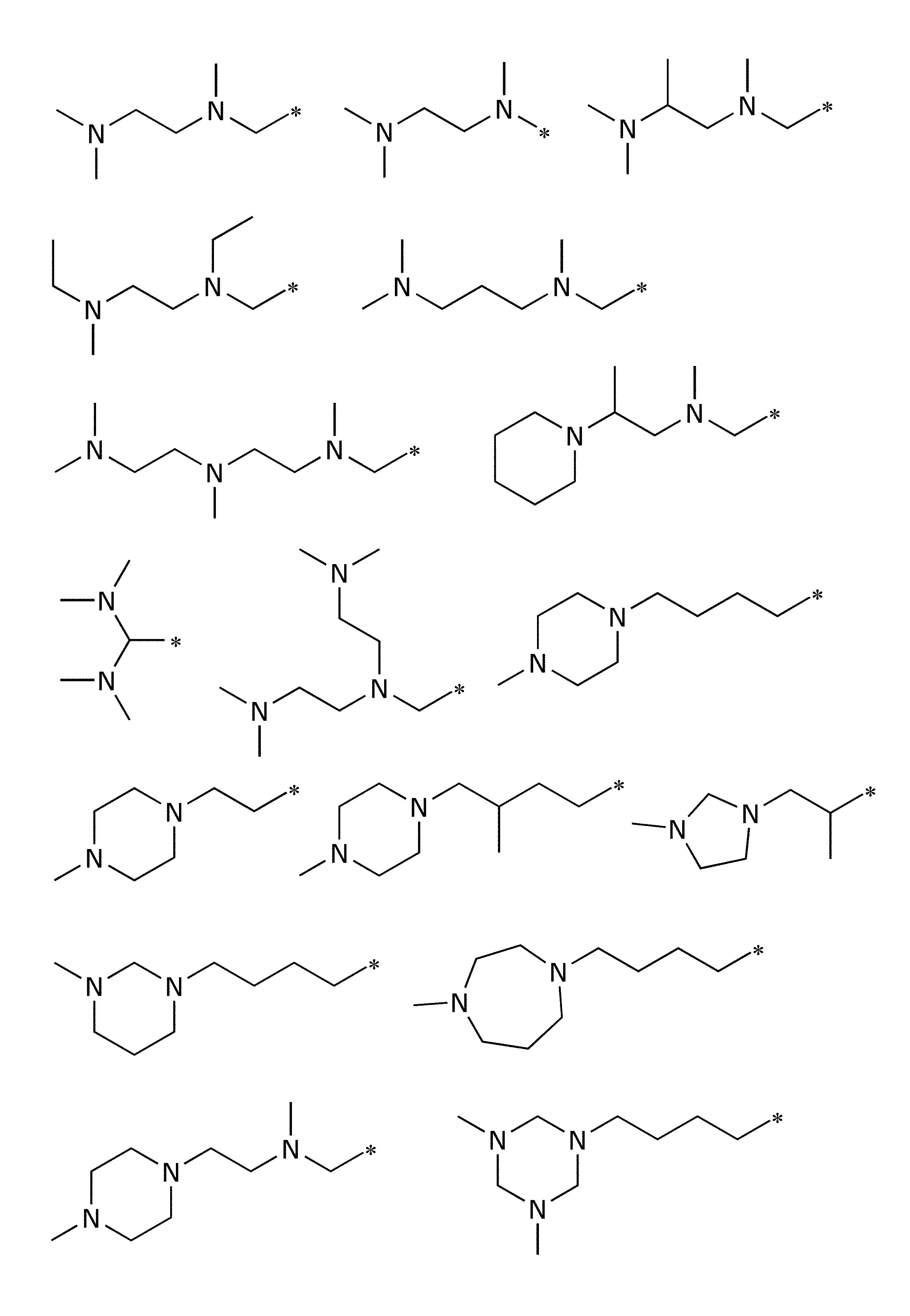
(式中、*は-CHR2への結合位置を表す)
実施形態による化合物は、頭部に結合した、-CHR2を有している。ここでRは疎水性基を表し、二つのRは同一であっても異なっていてもよい。疎水性基は、比較的長い炭化水素鎖を含むものが一般的である。そして、その一部にカルボキシラト等を含む連結基、具体的には-C(=O)-O-、-O-C(=O)-、-O-C(=O)-O-、-S-C(=O)-、-C(=O)-S-、-C(=O)-NH-、および-NH-C(=O)-からなる群から選択される連結基を含む。これらの連結基は、実施形態による化合物がリポソームに利用された場合に、生分解性基として機能する。
好ましい疎水性基Rの一例は、下記式(1-R)で表すことができる。
-LR1-C(=O)-O-LR2 (1-R)
(式中、
LR1はアルキレンであり、
LR2はアルケニルである)
-LR1-C(=O)-O-LR2 (1-R)
(式中、
LR1はアルキレンであり、
LR2はアルケニルである)
LR1およびLR2は、分岐鎖構造や環状構造を有していてもよいが、分岐構造を有する場合には側鎖は少ないことが好ましく、直鎖状であることが最も好ましい。
より具体的には、LR1およびLR2が、それぞれ下記式(1-R1)および(1-R2)で表されるものであることが好ましい。
-(CH2)r1- (1-R1)
-CH2-CH=CH-(CH2)r2-H (1-R2)(式中、
r1は、1~10の数であり、
r2は、1~10の数である)
-(CH2)r1- (1-R1)
-CH2-CH=CH-(CH2)r2-H (1-R2)(式中、
r1は、1~10の数であり、
r2は、1~10の数である)
ここで、疎水性基が十分な疎水性を発揮するために、r1は4~8の数であることが好ましく、また疎水性基Rに含まれる、最も長い分子鎖が8原子以上であることが好ましい。
実施形態による化合物の各部位は、上記したとおりの構造を有するものであるが、実施形態による化合物は、下記式(1-01)~(1-21)で表される構造を有するものが好ましい。

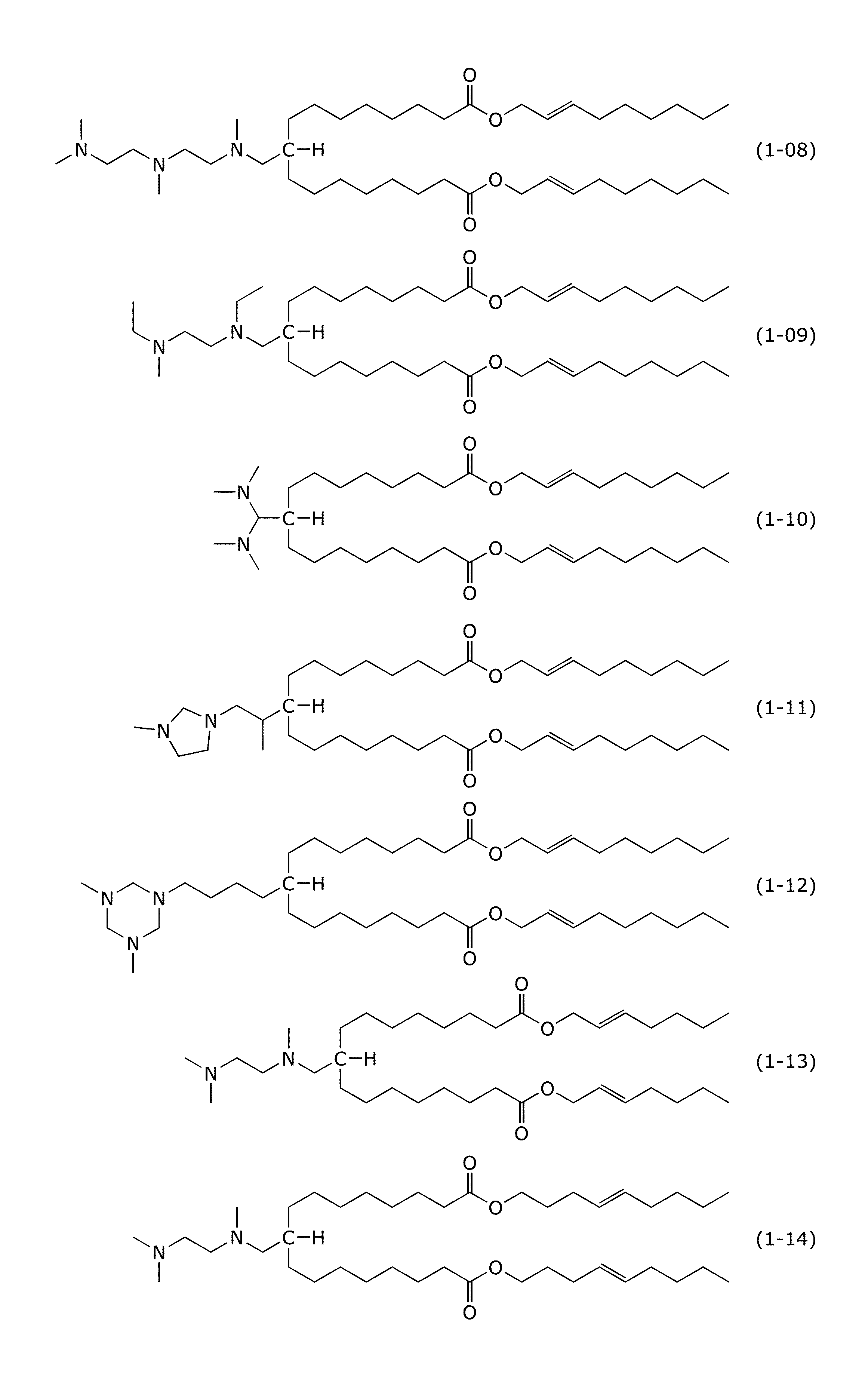
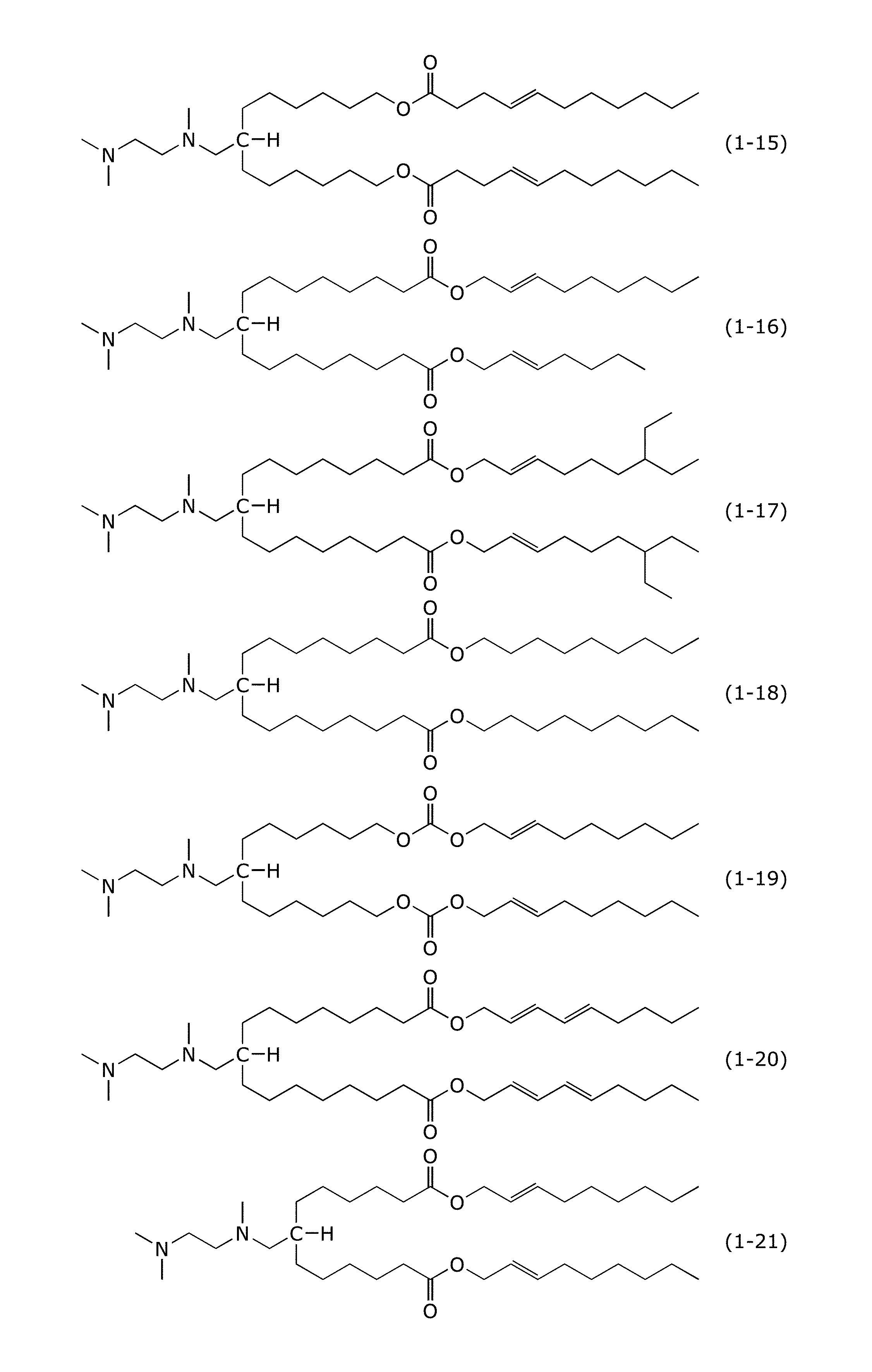
これらのうち、(1-01)および(1-02)はリポソームに用いた場合に優れた特性を発揮することができるので特に好ましい。
[化合物の製造方法]
本発明による化合物は任意の方法で製造することができる。例えば、化合物(1-01)および(1-02)は、例えば下記の工程図に従って製造することができる。
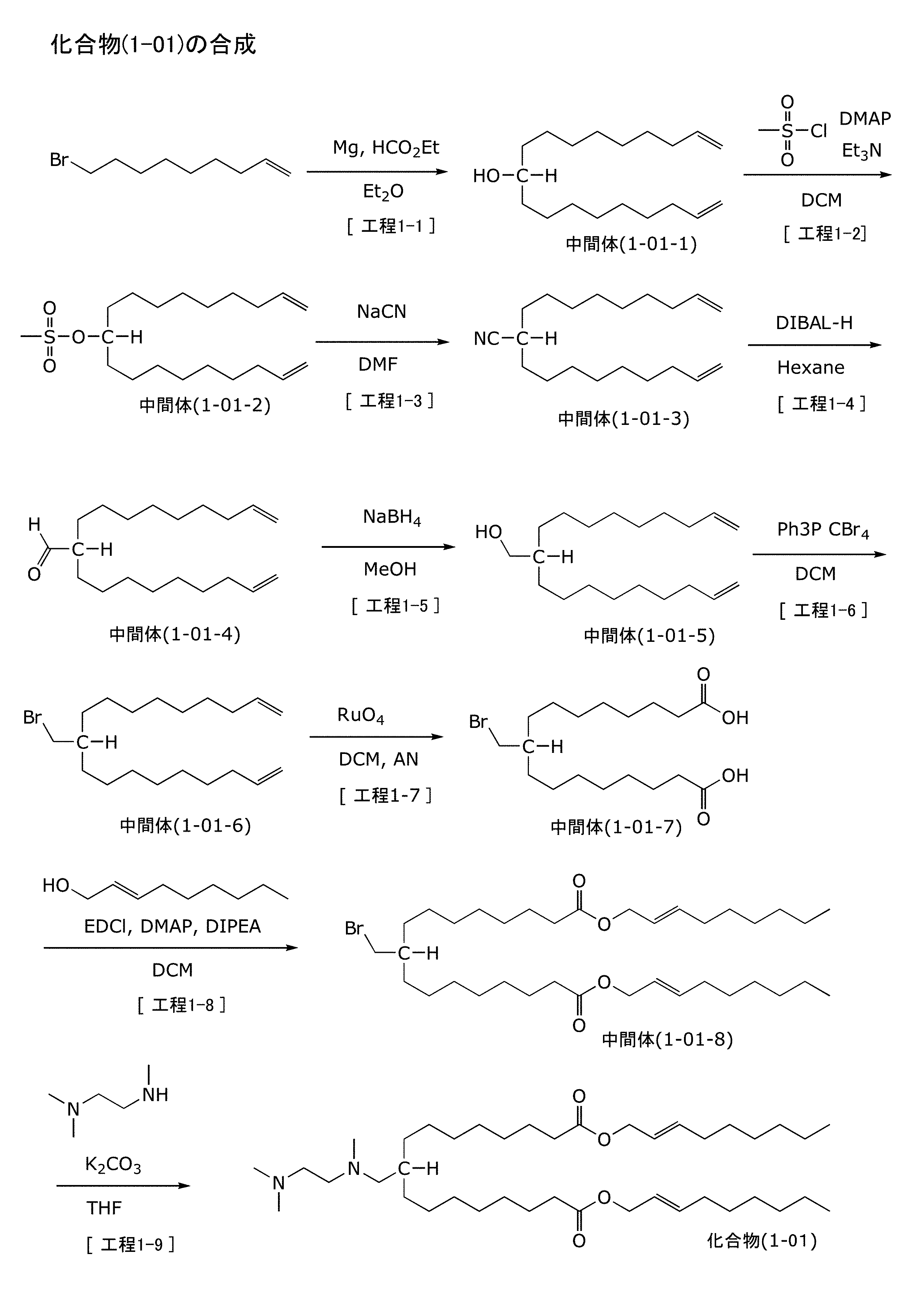

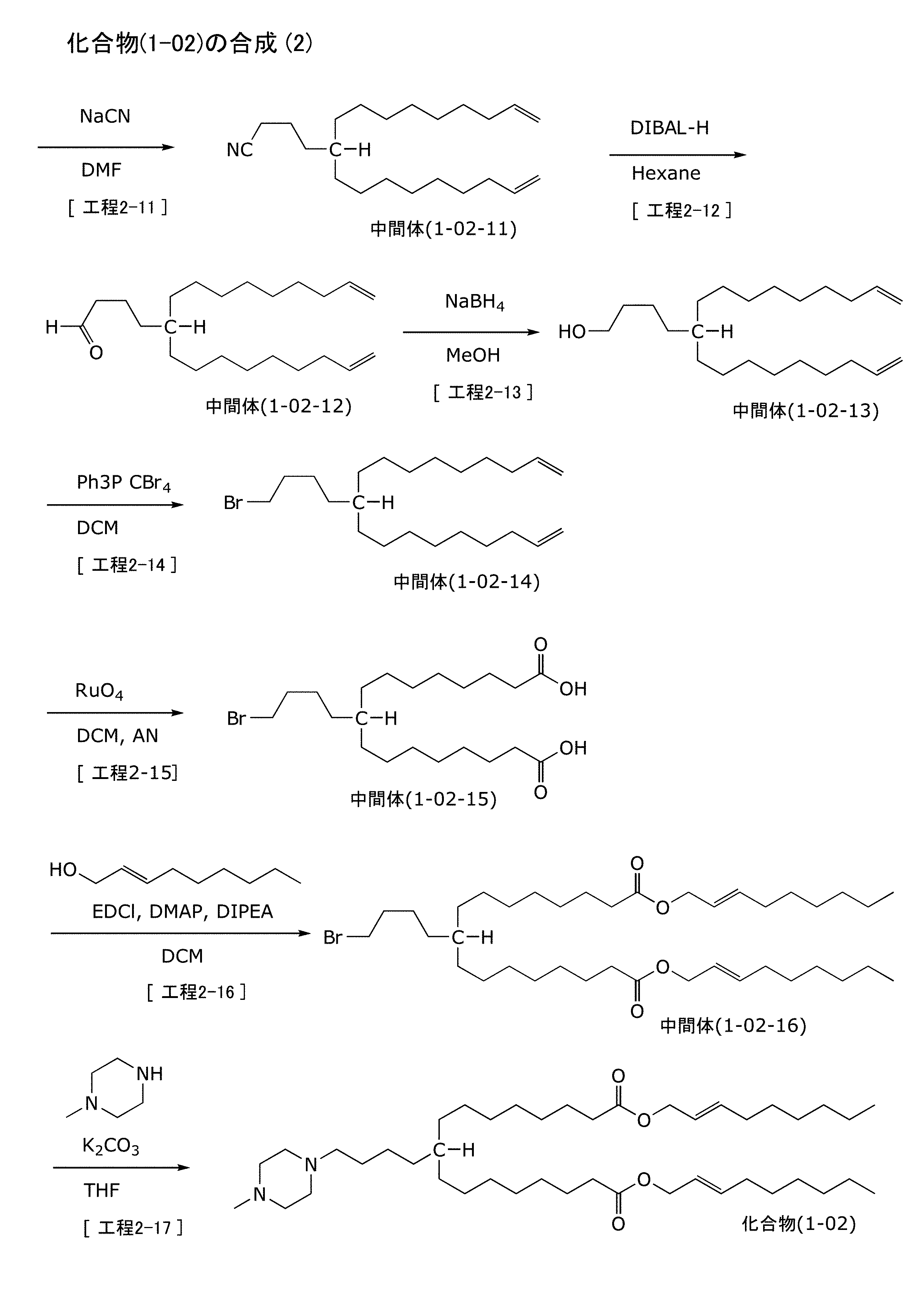
本発明による化合物は任意の方法で製造することができる。例えば、化合物(1-01)および(1-02)は、例えば下記の工程図に従って製造することができる。
[脂質粒子]
実施形態に寄れば脂質粒子が提供される。この脂質粒子の代表例はリポソームであるが、それに限定されず、核酸等と複合したリポプレックスなども包含される。またリポソームは、一枚膜リポソーム、多重層膜リポソームのいずれであってもよい。
実施形態に寄れば脂質粒子が提供される。この脂質粒子の代表例はリポソームであるが、それに限定されず、核酸等と複合したリポプレックスなども包含される。またリポソームは、一枚膜リポソーム、多重層膜リポソームのいずれであってもよい。
実施形態による脂質粒子は、上記した式(1)で表される化合物を含むものである。また、望ましくは膜を形成する脂質と、凝集を低減できる脂質とをさらに含むものである。
膜を形成する脂質とは、一般的にリポソームに用いられる脂質であれば、任意に用いることができる。この脂質は生分解性に優れた脂質であることが好ましい。
このような膜を形成する脂質の具体例は、ジアシルホスファチジルコリン、ジアシルホスファチジルエタノールアミン、セラミド、スフィンゴミエリン、ジヒドロスフィンゴミエリン、ケファリン、およびセレブロシドなどである。実施形態において脂質粒子に用いる膜を形成する脂質は目的とするリポソームのサイズや生体中におけるリポソームの安定性などを考慮して適切に選択される。これらのうち、ジアシルホスファチジルコリン、およびジアシルホスファチジルエタノールアミンは好ましいものである。ここで脂質に含まれるアシル基の炭化水素鎖の長さは10~20であることが好ましい。この炭化水素鎖は飽和炭化水素基であっても、不飽和炭化水素基であってもよい。
このような膜を形成する脂質は種々のものが知られており、例えば、
1,2-ジオレオイル-sn-グリセロ-3-ホスホエタノールアミン(DOPE)、
1,2-ステアロイル-sn-グリセロ-3-ホスホエタノールアミン(DSPE)、
1,2-ジパルミトイル-sn-グリセロ-3-ホスファチジルコリン(DPPC)、
1-パルミトイル-2-オレオイル-sn-グリセロ-3-ホスファチジルコリン(POPC)、
1,2-ジ-O-オクタデシル-3-トリメチルアンモニウムプロパン(DOTMA)、1,2-ジオレオイル-3-ジメチルアンモニウムプロパン(DODAP)、
1,2-ジミリストイル-3-ジメチルアンモニウムプロパン(14:0 DAP)、
1,2-ジパルミトイル-3-ジメチルアンモニウムプロパン(16:0 DAP)、
1,2-ジステアロイル-3-ジメチルアンモニウムプロパン(18:0 DAP)、
N-(4-カルボキシベンジル)-N,N-ジメチル-2,3-ビス(オレオイロキシ)プロパン(DOBAQ)、
1,2-ジオレオイル-3-トリメチルアンモニウムプロパン(DOTAP)、
1,2-ジオレオイル-sn-グリセロ-3-ホスホクロリン(DOPC)、
1,2-ジリノレオイル-sn-グリセロ-3-ホスホクロリン(DLPC)、
1,2-ジオレオイル-sn-グリセロ-3-ホスホ-L-セリン(DOPS)、および
コレステロール
などを好ましいものとして挙げることができる。また、これらのうちDOPE、DOTAP、またはコレステロールがより好ましく、DOPEとコレステロールの組み合わせ、DOTAPとコレステロールの組み合わせ、DOPEとDOTAPとコレステロールの組み合わせが特に好ましい。これらは、リポソーム等の膜を形成する機能に加えて、膜の融合効果も発揮することができる。
1,2-ジオレオイル-sn-グリセロ-3-ホスホエタノールアミン(DOPE)、
1,2-ステアロイル-sn-グリセロ-3-ホスホエタノールアミン(DSPE)、
1,2-ジパルミトイル-sn-グリセロ-3-ホスファチジルコリン(DPPC)、
1-パルミトイル-2-オレオイル-sn-グリセロ-3-ホスファチジルコリン(POPC)、
1,2-ジ-O-オクタデシル-3-トリメチルアンモニウムプロパン(DOTMA)、1,2-ジオレオイル-3-ジメチルアンモニウムプロパン(DODAP)、
1,2-ジミリストイル-3-ジメチルアンモニウムプロパン(14:0 DAP)、
1,2-ジパルミトイル-3-ジメチルアンモニウムプロパン(16:0 DAP)、
1,2-ジステアロイル-3-ジメチルアンモニウムプロパン(18:0 DAP)、
N-(4-カルボキシベンジル)-N,N-ジメチル-2,3-ビス(オレオイロキシ)プロパン(DOBAQ)、
1,2-ジオレオイル-3-トリメチルアンモニウムプロパン(DOTAP)、
1,2-ジオレオイル-sn-グリセロ-3-ホスホクロリン(DOPC)、
1,2-ジリノレオイル-sn-グリセロ-3-ホスホクロリン(DLPC)、
1,2-ジオレオイル-sn-グリセロ-3-ホスホ-L-セリン(DOPS)、および
コレステロール
などを好ましいものとして挙げることができる。また、これらのうちDOPE、DOTAP、またはコレステロールがより好ましく、DOPEとコレステロールの組み合わせ、DOTAPとコレステロールの組み合わせ、DOPEとDOTAPとコレステロールの組み合わせが特に好ましい。これらは、リポソーム等の膜を形成する機能に加えて、膜の融合効果も発揮することができる。
実施形態に用いられる、凝集を低減できる脂質は、脂質粒子の調合中に粒子同士の凝集を含む機能を発揮するものである。このような脂質としては種々のものが知られており、実施形態による脂質粒子には任意のものを選択して用いることができる。このような脂質の例としては、ポリエチレングリコール(PEG)修飾脂質、オメガ-アミノ(オリゴエチレングリコール)アルカン酸モノマーから誘導されるポリアミドオリゴマー(米国特許第6,320,017号)、モノシアロガングリオシドなどが挙げられる。より具体的には、米国特許第6,320,017号に挙げられている、ATTA8-DPSEなどのATTA脂質や、米国特許第5,820,873号、同第5,534,499号、および同第5,885,613号に記載されているポリエチレングリコール脂質コンジュゲートを用いることができる。
PEG修飾脂質は、脂質粒子が形成されたときに、脂質粒子の表面にアンカリング脂質部分を形成することができる。このようなPEG修飾脂質の例としては、PEG修飾ホスファチジルエタノールアミン、PEG修飾ホスファチジン酸、PEG-セラミドコンジュゲート(例えば特許第3920330号明細書に記載されているC14 PEG-CerまたはC20 PEG-Cer)、PEG修飾ジアルキルアミン、PEG修飾1,2-ジアシルオキシプロパン-3-アミン、PEG修飾ジアシルグリセロール(例えばト1,2-ジミリストイル-sn-グリセロール-メトキシポリエチレングリコール;PEG-DMG)およびPEG修飾ジアルキルグリセロールが挙げられる。このうち、PEG修飾ジアシルグリセロールおよびPEG修飾ジアルキルグリセロールが特に好ましい。
PEGなどの嵩高い修飾基を脂質表面に結合させる場合、修飾基と脂質粒子との結合が脂質粒子ないしリポソームの安定性に影響する。例えば米国特許第5,820,873号には、PEG修飾脂質におけるアシル鎖の長さ、アシル鎖の飽和度、および立体障害頭部基のサイズなどの特性が、脂質粒子の安定性に影響を及ぼすことを示している。したがってこれらの特性を調整することで、目的に応じた脂質粒子を得ることができる。例えば、PEG修飾脂質における修飾基を短くすることによってより早く脂質粒子を喪失させたり、修飾基を長くすることによって、血漿中の滞留時間を長くすることなどが可能である。
その結果、脂質粒子の標的組織への送達を改善できる場合もある。
その結果、脂質粒子の標的組織への送達を改善できる場合もある。
脂質粒子は、さらにその他の脂質を含むこともできる。このようなその他の脂質は、脂質粒子において一般的に用いられている物から任意に選択して用いることができる。例えば、毒性を調整するために、相対的に毒性の低い脂質を組み合わせることができる。また、脂質粒子に配位子を結合させるための官能基を導入するために、特定の構造を有する脂質を組み合わせることもできる。
さらには脂質粒子をリポソームとして用いる場合には、その内包物の漏出を抑制するための脂質としてステロール、例えばコレステロールを含むこともできる。さらに脂質粒子に標的作用物質をカップリングさせることもできる。このような場合のカップリング方法は、従来知られている任意の方法を採用することができる。
また、実施形態による脂質粒子は、下記式(2):
P-[X-W-Y-W’-Z]2 (2)
(式中、
Pは、1つ以上のエーテル結合を主鎖に含むアルキレンオキシであり、
Xは、それぞれ独立に、三級アミン構造を含む2価連結基であり、
Wは、それぞれ独立にC1~C6アルキレンであり、
Yは、それぞれ独立に、単結合、エーテル結合、カルボン酸エステル結合、チオカルボン酸エステル結合、チオエステル結合、アミド結合、カルバメート結合、および尿素結合からなる群から選ばれる2価連結基であり、
W’は、それぞれ独立に単結合またはC1~C6アルキレンであり、Zは、それぞれ独立に、脂溶性ビタミン残基、ステロール残基、またはC12~C22脂肪族炭化水素基である)
で表され、
構造中に、カルボン酸エステル結合、チオカルボン酸エステル結合、ジチオカルボン酸結合、アミド結合、カルバメート結合、カルボキシジオキシ結合、および尿素結合からなる群から選ばれる生分解性基を少なくとも一つ含む化合物をさらに含むことが好ましい。
P-[X-W-Y-W’-Z]2 (2)
(式中、
Pは、1つ以上のエーテル結合を主鎖に含むアルキレンオキシであり、
Xは、それぞれ独立に、三級アミン構造を含む2価連結基であり、
Wは、それぞれ独立にC1~C6アルキレンであり、
Yは、それぞれ独立に、単結合、エーテル結合、カルボン酸エステル結合、チオカルボン酸エステル結合、チオエステル結合、アミド結合、カルバメート結合、および尿素結合からなる群から選ばれる2価連結基であり、
W’は、それぞれ独立に単結合またはC1~C6アルキレンであり、Zは、それぞれ独立に、脂溶性ビタミン残基、ステロール残基、またはC12~C22脂肪族炭化水素基である)
で表され、
構造中に、カルボン酸エステル結合、チオカルボン酸エステル結合、ジチオカルボン酸結合、アミド結合、カルバメート結合、カルボキシジオキシ結合、および尿素結合からなる群から選ばれる生分解性基を少なくとも一つ含む化合物をさらに含むことが好ましい。
式(2)で表される化合物も生分解性を有する脂質化合物である。式(1)の化合物に対して、式(2)の化合物を組み合わせることで、新たな機能を発現させることが可能となる。例えば、式(2)の化合物をリポソームに適用した場合、核酸の内包量を向上させることができ、式(1)の化合物と式(2)の化合物をリポソームに適用した場合には、遺伝子治療や核酸医療、ゲノム診断などへの応用しやすくなる。
式(2)の化合物のひとつの特徴は、式(2)中のPがエーテル結合を含むことである。すなわち、Pは少なくとも一つの酸素を含み、その酸素は二つの炭素と結合している。
Pが含む酸素の数は特に限定されないが、好ましくは1~2個の酸素を含む。また、Pが含む炭素の数も特に限定されないが、Pに含まれる炭化水素鎖は炭素数が1~3であることが好ましく、Pに含まれる炭素の総数が3~8個であることが好ましい。好ましいPとして、以下のものが挙げられる。
-(CH2)2-O-(CH2)2-
-(CH2)2-O-(CH2)2-O-(CH2)2-
-(CH2)2-O-O-(CH2)2-
-(CH2)3-O-(CH2)2-O-(CH2)3-
-(CH2)2-O-CH2-O-(CH2)2-
このような構造を有することによって。立体構造の自由度が高くなる。この化合物をリポソームの構成に用いた場合、エーテル結合に含まれる酸素が、組み合わされる核酸等と水素結合を形成するため、核酸等の内包量が多くなる。
Pが含む酸素の数は特に限定されないが、好ましくは1~2個の酸素を含む。また、Pが含む炭素の数も特に限定されないが、Pに含まれる炭化水素鎖は炭素数が1~3であることが好ましく、Pに含まれる炭素の総数が3~8個であることが好ましい。好ましいPとして、以下のものが挙げられる。
-(CH2)2-O-(CH2)2-
-(CH2)2-O-(CH2)2-O-(CH2)2-
-(CH2)2-O-O-(CH2)2-
-(CH2)3-O-(CH2)2-O-(CH2)3-
-(CH2)2-O-CH2-O-(CH2)2-
このような構造を有することによって。立体構造の自由度が高くなる。この化合物をリポソームの構成に用いた場合、エーテル結合に含まれる酸素が、組み合わされる核酸等と水素結合を形成するため、核酸等の内包量が多くなる。
また、Xは三級アミン構造を含む2価連結基であり、好ましくはメチルイミノ、1,2-ピロリジンジイル、および1,3-ピロリジンジイルからなる群から選ばれる。この化合物をリポソームの構成に用いた場合、三級アミン構造によって、高い細胞膜透過性が発揮される。
式(2)中、-W-Y-W’-Zは、疎水部を構成している。この疎水部には生分解性基を含んでいる。ここで、生分解性基は、カルボン酸エステル結合(-C(=O)-O-)、チオカルボン酸エステル結合(-C(=O)-S-)、ジチオカルボン酸エステル結合(-C(=S)-S-)、アミド結合(-C(=O)-NH-)、カルバメート結合(-NH-C(=O)-O-)、カルボキシジオキシ結合(-O-C(=O)-O-)、および尿素結合(-NH-C(=O)-NH-)からなる群から選ばれる。
この生分解性基は、Yとして構造中に存在する場合の他、Zに含まれている場合もある。すなわち、Zが脂溶性ビタミンやステロールに由来する基であり、その構造中にカルボン酸エステル基などが含まれていてもよい。また生分解性基は、ZとYとの両方に含まれていてもよいし、またいずれかが2つ以上の生分解性基を含んでいてもよい。
YおよびW’は、WとZとを連結する2価基である。
Yは、単結合、エーテル結合、カルボン酸エステル結合、チオカルボン酸エステル結合、チオエステル結合、アミド結合、カルバメート結合、および尿素結合からなる群から選ばれる2価連結基である。またW’は、単結合またはC1~C6アルキレンである。
これらは元素を含まない単結合であってもよい。一方で、Zが生分解性基を含まない場合には、Yは生分解性基を含む。
Zは、脂溶性ビタミン残基、ステロール残基、またはC12~C22脂肪族炭化水素基である。これらのうち、脂溶性ビタミン残基またはステロール残基が好ましく、脂溶性ビタミン残基がより好ましい。
脂溶性ビタミン残基は、脂溶性ビタミンから誘導される基である。脂溶性ビタミンとしては、例えばレチノール、レチナール、エルゴステロール、7-デヒドロコレステロール、カルシフェロール、コルカルシフェロール、ジヒドロエルゴカルシフェロール、ジヒドロタキステロール、トコフェロール、およびトコトリエノールが挙げられる。これらの脂溶性ビタミンは末端にヒドロキシを有する。脂溶性ビタミン残基の一例は、これらのヒドロキシから水素が脱離したものである。また、脂溶性ビタミン誘導体に由来する基を用いることもできる。この脂溶性ビタミン誘導体とは、脂溶性ビタミンに含まれるヒドロキシが、チオヒドロキシ、カルボキシ、チオカルボキシ、またはジチオカルボキシに置換された化合物である。これらの脂溶性ビタミン残基は、末端に-S-、-C(=O)-O-、-C(=O)-S-、または-C(=S)-S-を有する。脂溶性ビタミン残基のうち、特に好ましいものは、レチノール(ビタミンA)、トコフェロール(ビタミンE)、またはそれらのカルボン酸誘導体に由来する基である。
ステロール残基は、ステロールから誘導される基である。ステロールとしては、例えば、コレステロール、スチグマステロール、β-シトステロール、ラノステロール、およびエルゴステロールが挙げられる。ステロール残基の一例は、これらステロールのヒドロキシから水素が脱離したものである。また、ステロール残基は、前記した脂溶性ビタミン誘導体に由来する基と同様の末端基を有していてもよい。特に好ましいステロール残基は、ステロール、コレステロール、またはそれらのカルボン酸誘導体に由来する基である。
C12~C22脂肪族炭化水素基は、直鎖状、分岐鎖状のいずれであってもよく、また環状構造を有していてもよい。また、脂肪族炭化水素基は、不飽和結合を含んでいてもよく、含む場合には一般に6個以下、好ましくは3個以下の不飽和結合を含む。脂肪族炭化水素基の炭素数は、好ましくは12~18であり、より好ましくは13~17である。
これらのZのうち、紫外線を吸収する構造を含むものが好ましい。具体的にはシクロヘキセン構造を含むことが好ましい。このように紫外線を吸収する構造を含むことによって、この化合物を成分として含有する脂質粒子の光による劣化の軽減することができ、また脂質粒子の挙動解析が必要な場合に、その解析を容易にすることが可能となる。
なお、式(2)の化合物は、二つの[X-W-Y-W’-Z]を含み、それぞれのX、W、Y、W’、Zは独立であって、同一であっても異なっていてもよいが、同一であって化合物の構造が対象であることが好ましい。
実施形態による化合物の各部位は、上記したとおりの構造を有するものであるが、実施形態による化合物は、下記式(2-01)~(2-12)で表される構造を有するものが好ましい。

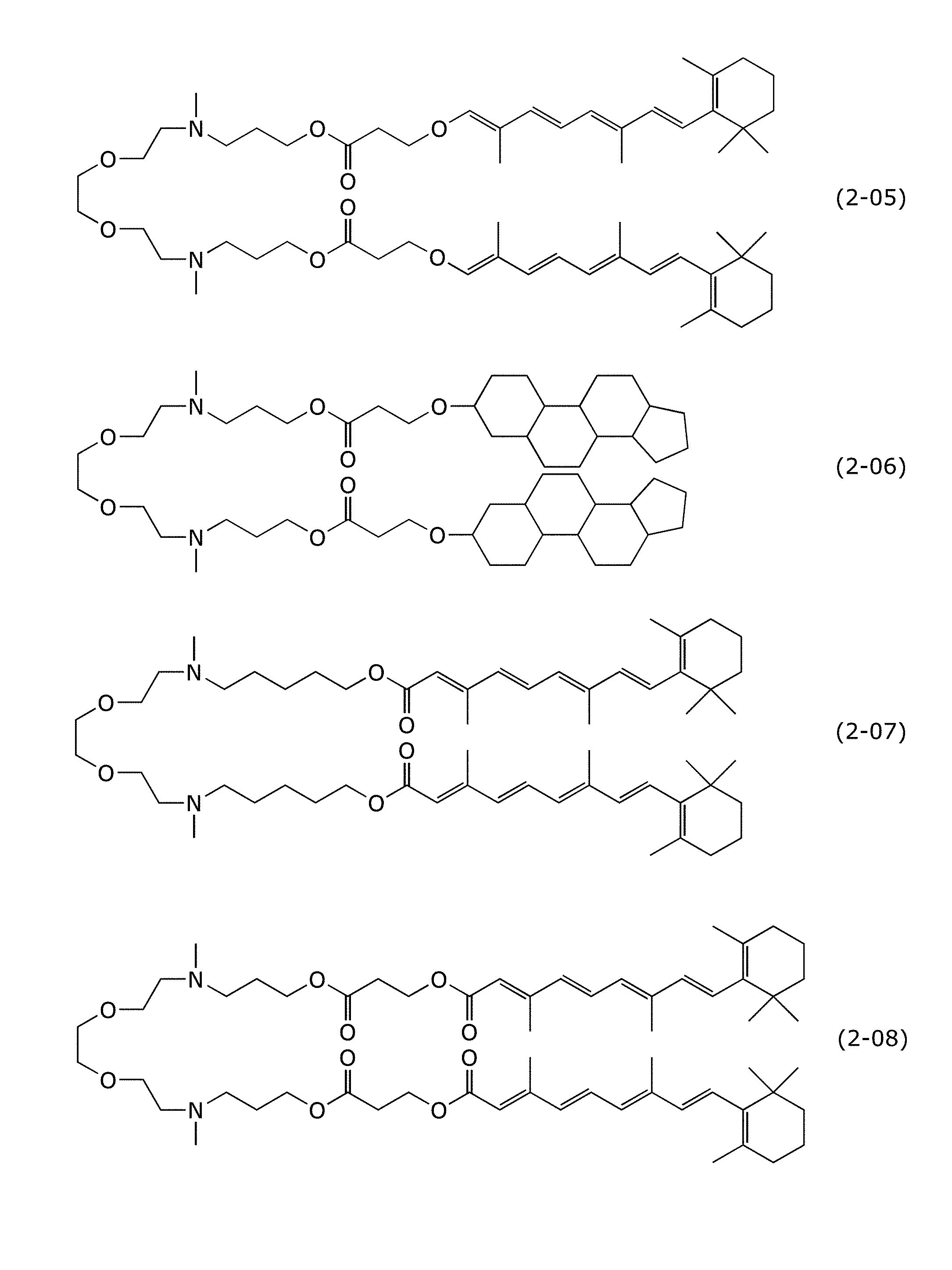
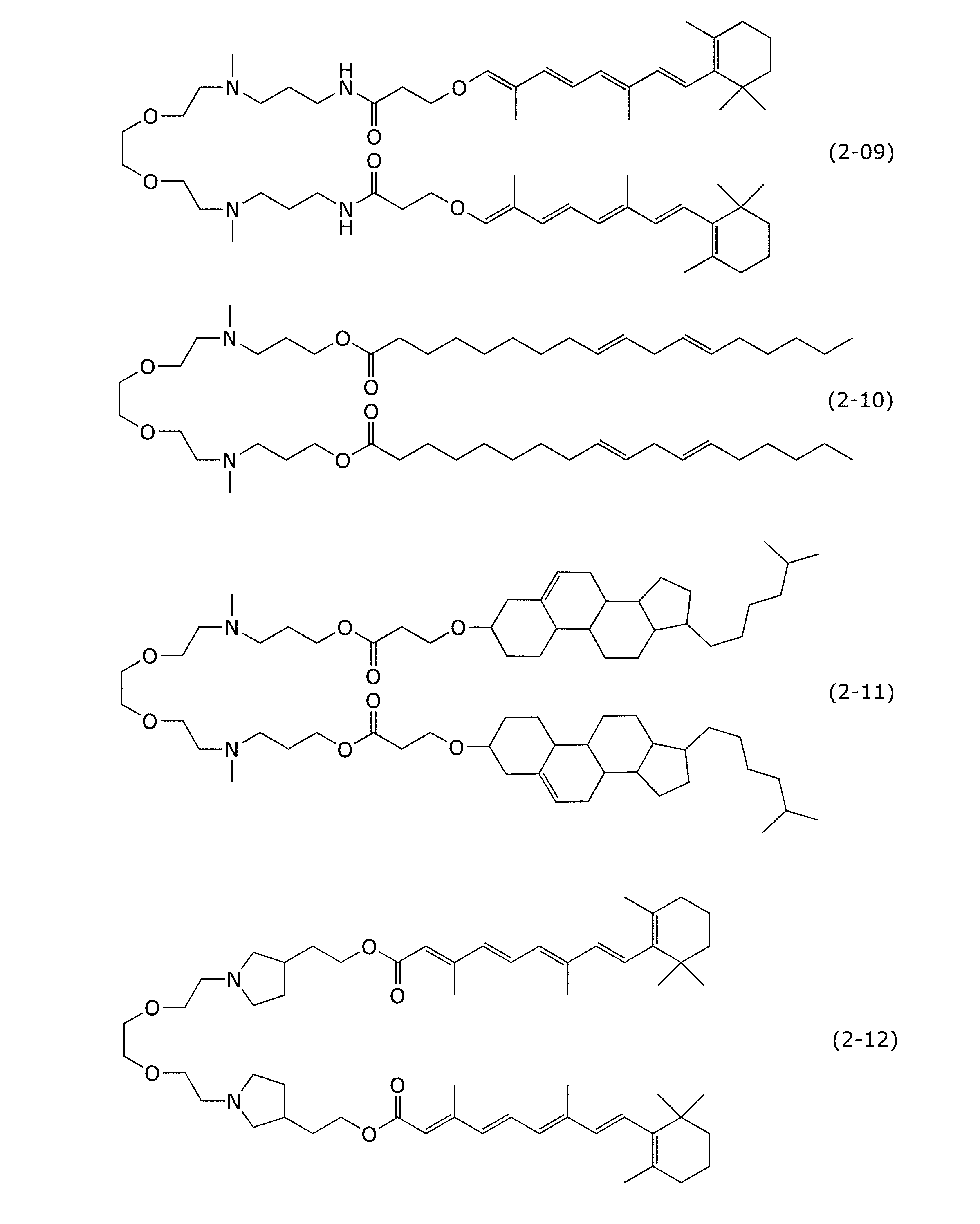
これらのうち、(2-01)~(2-04)は、式(1)の化合物と組み合わせてリポソームに用いた場合に優れた特性を発揮することができるので特に好ましい。
式(2)の化合物は、例えば下記の工程図に従って製造することができる。

これらの脂質を組み合わせて脂質粒子が構成されるが、その脂質粒子を構成する各脂質の配合比は目的に応じて調整されるので、限定されるものではない。しかし、脂質粒子に用いられる脂質の総モル数を基準として、一般に、
式(1)および(2)で表される脂質化合物を合計25~75モル%、
膜を形成する脂質を25~75モル%、
凝集を低減できる脂質を、1~10モル%
で配合されるのが一般的であり、好ましくは
式(1)および(2)で表される脂質化合物を合計30~60モル%、
膜を形成する脂質を30~65モル%、
凝集を低減できる脂質を、1~10モル%、例えば2.5モル%
である。ここで、式(1)の化合物と、膜を形成する脂質とのバランスが重要であり、一方だけが存在しても活性剤の導入率が十分高くならない。このため、式(1)または(2)の化合物と、膜を形成する脂質との配合比は、モル数基準で1:0.5~1:3であることが好ましく、1:0.75~1:2.1であることがより好ましい。
式(1)および(2)で表される脂質化合物を合計25~75モル%、
膜を形成する脂質を25~75モル%、
凝集を低減できる脂質を、1~10モル%
で配合されるのが一般的であり、好ましくは
式(1)および(2)で表される脂質化合物を合計30~60モル%、
膜を形成する脂質を30~65モル%、
凝集を低減できる脂質を、1~10モル%、例えば2.5モル%
である。ここで、式(1)の化合物と、膜を形成する脂質とのバランスが重要であり、一方だけが存在しても活性剤の導入率が十分高くならない。このため、式(1)または(2)の化合物と、膜を形成する脂質との配合比は、モル数基準で1:0.5~1:3であることが好ましく、1:0.75~1:2.1であることがより好ましい。
なお、式(1)または(2)で表される化合物はいずれも、膜を形成する脂質としても機能するが、実施形態においては、「膜を形成する脂質」は、式(1)または(2)の化合物を包含しないものとする。
実施形態による脂質粒子は、さらに活性剤を含むことができる。実施形態において活性剤とは、細胞、組織、器官、または被検体に特定効果を与えることのできる物質である。特定効果は、生物学的、生理学的、または美容的効果のいずれであってもよい。実施形態による脂質粒子を用いることで、さまざまな活性剤を生体内の目的部位に送達することができる。この活性剤は、脂質粒子の内部に封入されていても、外側または内側の脂質表面に結合していても、また脂質層の内部に配置されていてもよい。
活性剤の典型的な例は核酸であり、例えばプラスミド、オリゴヌクレオチド、ポリヌクレオチド、低分子干渉RNA(siRNA)、マイクロRNA(miRNA)、DNA、アプタマー、およびリボザイムからなる群から選択された核酸が挙げられる。また、アンチセンスオリゴヌクレオチド、アンタゴmir、aDNA、プラスミド、リボソームRNA(rRNA)、トランスファーRNA(tRNA)、核内低分子RNA(snRNA)、mRNAなどを用いることもできる。異なる種類のDNAやRNAを組み合わせて用いてもよい。
miRNAとしては、ヌクレオチド単位が17~25個連結したmiRNAを用いることができる。)。1つのより好ましい実施形態では、核酸はヌクレオチド単位が15~50個または20~30個連結したオリゴヌクレオチドである。siRNAは、例えば、ヌクレオチド単位を16~30個を含み、二本鎖領域を有するものあることができる。別の実施形態では、核酸は、免疫刺激性オリゴヌクレオチド、デコイオリゴヌクレオチド、スーパーmir、miRNA模倣体、またはmiRNAインヒビターである。スーパーmirとは、RNAもしくはデオキシリボ核酸DNA、またはこれらの両方、あるいは、これらの変性体の一本鎖、二本鎖、または部分的に二本鎖のオリゴマーまたはポリマーであって、miRNAと実質的に同一のヌクレオチド配列を有するとともに、その標的に対してアンチセンスであるオリゴマーまたはポリマーを指す。miRNA模倣体は、1つ以上のmiRNAの遺伝子サイレンシング能を模倣する目的で用いることのできる分子群を表す。したがって、「miRNA模倣体」という用語は、RNAi経路に入れるとともに、遺伝子発現を調節することができる合成非コードRNAを指す(すなわち、miRNA模倣体は、内在性miRNAの供給源から精製することによっては得られない)。
核酸を脂質粒子に組み合わせる場合、核酸の形態は特に限定されない。この核酸は、例えば、一本鎖DNAもしくはRNA、二本鎖DNAもしくはRNA、または、DNA-RNAハイブリッドであることができる。二本鎖RNAの例としてはsiRNAが挙げられる。一本鎖核酸としては、例えば、アンチセンスオリゴヌクレオチド、リボ酵素、miRNA、および三本鎖形成オリゴヌクレオチドが挙げられる。
実施形態による脂質粒子は、核酸を含む場合には、核酸と結合する化合物をさらに含むことができる。このような化合物としては、塩基性タンパク質、または塩基性ペプチドが挙げられ、好ましくはプロタミン、ヒストン、およびそれらの塩が挙げられる。たとえばヒストンおよびその塩は、核酸と結合し、核酸分子を畳み込む性質をもっている。またプロタミンは、核酸と結合し、さらにその核酸を巻き込む性質を持っている。このため、これらの化合物は脂質粒子に核酸を封入するのに有効である。
また、実施形態による脂質粒子は、細胞内での核酸の発現を調節する化合物をさらに含むことができる。細胞内での核酸の発現を調整することによりリポソームが送達された細胞に対して、可視化や細胞死の効果が得られるので、好ましい。このような化合物としてはレチノイン酸、環状アデノシン一リン酸(cAMP)、アスコルビン酸などが挙げられる。
また、実施形態による脂質粒子は、リポタンパク、アポリポタンパクなどを含んでいてもよい。
活性剤として、その他の治療剤を用いることもできる。用いることのできる治療剤の具体例は、ペプチド、ポリペプチド、サイトカイン、増殖因子、アポトーシス因子、分化誘発因子、細胞表面受容体およびそのリガンド、ホルモンなどが挙げられる。より具体的には、治療剤は、抗炎症化合物、抗うつ薬、興奮薬、鎮痛薬、抗生物質、避妊薬、解熱剤、血管拡張薬、血管新生阻害剤、細胞血管作動薬(cytovascular agents)、シグナル伝達阻害剤、心臓血管薬、腫瘍薬、ホルモン、およびステロイドが挙げられる。
脂質粒子に活性剤を組み合わせる場合、活性剤がより高い導入率で脂質粒子に導入されることが好ましい。また、脂質の特性に依存する細胞毒性による細胞死が低いことも好ましい。従来知られている脂質粒子を用いて核酸を導入した場合、一般的には導入率が低く、細胞毒性による細胞死の割合も高かった。これに対して、本実施形態による脂質粒子を用いた場合には、核酸の導入率が高く、細胞死も低減することができる。具体的には、従来の脂質粒子においては、導入率が10%程度、エレクトロポレーションによる細胞死が60~70%であるのに対して、実施形態による脂質粒子を用いた場合には、それぞれ70%以上、30%以下に低減される。
実施形態による脂質粒子は、目的に応じて任意の大きさに形成させることができる。しかしながら、実施形態による脂質粒子を医薬用途に用いようとする場合には、脂質粒子はナノオーダーサイズの粒子とされるのが一般的である。具体的には、実施形態による脂質粒子の平均粒子径は、一般に50nm~300nmであり、好ましくは50nm~200nmである。脂質粒子のサイズは、任意の方法で調整することができる。例えば、超音波処理によって脂質粒子を小さくすることができる。また、ポリカーボネート膜やセラミック膜を透過させて、脂質粒子を分別することでサイズ調整をすることもできる。なお、実施形態において、脂質粒子の平均粒子径は、例えば動的光散乱法を用いたゼータサイザーによって測定することができる。
また実施形態による脂質粒子のインビボ半減期(t1/2)は、一般に3時間未満であり、好ましくは2時間未満、特に好ましくは1時間未満である。ここで、インビボ半減期とは、例えば肝臓中、脾臓中、または血漿中の半減期を意味する。実施形態においては、脂質を構成する式(1)の化合物が生分解性基を有することによって、生分解性基を含まない脂質からなる脂質粒子に比較して、半減期が例えば10%未満となっている。
[脂質粒子の製造方法]
実施形態による脂質粒子は、従来知られている任意の方法で製造することができる。脂質粒子やリポソームを製造する方法としては、バンガム法、有機溶媒抽出法、界面活性剤除去法、凍結融解法などが知られており、それらを採用することもできる。また、例えば、式(1)で表される化合物、さらには膜を形成する脂質と、凝集を低減できる脂質とを、アルコールなどの有機溶媒に導入し、水性緩衝液を添加することで自然発生的に脂質粒子を形成させることもできる。この水性緩衝液に活性剤を組み合わせておくことで、脂質粒子に活性剤を導入することが可能である。
実施形態による脂質粒子は、従来知られている任意の方法で製造することができる。脂質粒子やリポソームを製造する方法としては、バンガム法、有機溶媒抽出法、界面活性剤除去法、凍結融解法などが知られており、それらを採用することもできる。また、例えば、式(1)で表される化合物、さらには膜を形成する脂質と、凝集を低減できる脂質とを、アルコールなどの有機溶媒に導入し、水性緩衝液を添加することで自然発生的に脂質粒子を形成させることもできる。この水性緩衝液に活性剤を組み合わせておくことで、脂質粒子に活性剤を導入することが可能である。
[脂質粒子の用途]
本実施形態による脂質粒子は、活性剤を細胞へ送達するために使用することができる。特に核酸等の活性剤の細胞への送達は、遺伝子工学、組み換えタンパク質の生産、及び遺伝子治療や細胞診断として知られている医療技術など、あらゆる分野で用いられる。一つの実施形態では、実施形態による脂質粒子と、担体とを含むことを特徴とする、活性剤を細胞へ送達するための組成物が提供される。他の実施形態では、活性剤を細胞へ送達するための、実施形態による脂質粒子が提供される。他の実施形態では、活性剤を細胞へ送達するための方法であって、該活性剤を含む実施形態による脂質粒子を細胞に接触させる(例えば、前記脂質粒子を被験体に投与する)ことを含む方法が提供される。他の実施形態では、活性剤を細胞へ送達するための、請求項9~22のいずれか1項に記載の脂質粒子の使用が提供される。一つの実施形態では、前記脂質粒子は、式(1)の化合物と式(2)の化合物の両方を含むものとされ、好ましくは、式(1)の化合物の含有量に対する式(2)の化合物の含有量のモル比は1未満とされる。一つの実施形態では、前記細胞は腫瘍細胞とされる。前記被験体は、好ましくはそのような処置を必要とする動物、より好ましくは哺乳動物、最も好ましくはヒトとされる。これらの用途につき、以下に具体的に説明する。
本実施形態による脂質粒子は、活性剤を細胞へ送達するために使用することができる。特に核酸等の活性剤の細胞への送達は、遺伝子工学、組み換えタンパク質の生産、及び遺伝子治療や細胞診断として知られている医療技術など、あらゆる分野で用いられる。一つの実施形態では、実施形態による脂質粒子と、担体とを含むことを特徴とする、活性剤を細胞へ送達するための組成物が提供される。他の実施形態では、活性剤を細胞へ送達するための、実施形態による脂質粒子が提供される。他の実施形態では、活性剤を細胞へ送達するための方法であって、該活性剤を含む実施形態による脂質粒子を細胞に接触させる(例えば、前記脂質粒子を被験体に投与する)ことを含む方法が提供される。他の実施形態では、活性剤を細胞へ送達するための、請求項9~22のいずれか1項に記載の脂質粒子の使用が提供される。一つの実施形態では、前記脂質粒子は、式(1)の化合物と式(2)の化合物の両方を含むものとされ、好ましくは、式(1)の化合物の含有量に対する式(2)の化合物の含有量のモル比は1未満とされる。一つの実施形態では、前記細胞は腫瘍細胞とされる。前記被験体は、好ましくはそのような処置を必要とする動物、より好ましくは哺乳動物、最も好ましくはヒトとされる。これらの用途につき、以下に具体的に説明する。
[組成物]
本実施形態による脂質粒子は、組成物として用いることができる。例えば、本実施形態の脂質粒子と担体とを含む組成物が提供される。このような組成物は医薬用途にも適用できるものである。
本実施形態による脂質粒子は、組成物として用いることができる。例えば、本実施形態の脂質粒子と担体とを含む組成物が提供される。このような組成物は医薬用途にも適用できるものである。
担体としては、従来知られているものから任意に選択して用いることができるが、例えば、水、生理食塩水のような食塩水、グリシン水溶液、緩衝液などが挙げられる。さらにこれらの担体に加え、安定性を改良するなどの目的で、アルブミン、リポタンパク、アポリポタンパク、グロブリンなどの糖タンパクを組合せてもよい。
実施形態による組成物は、標準的な方法により調製することができる。担体としては、生理食塩水が用いられることが一般的である。食塩水またはその他の塩含有担体を含む組成物中では、担体は好ましくは、脂質粒子の形成の後に加える。したがって、脂質粒子と核酸などの活性剤を組み合わせた後に、その組成物を生理食塩水のような製薬学的に許容可能な担体で置換または希釈することが一般的である。
実施形態による組成物は、必要に応じて補助剤を含んでもよい。たとえば、医薬用途の場合、製薬学的に許容可能な補助剤、例えばpH調整剤、緩衝化剤、張度調整剤などを補助剤として含めることで、医薬組成物を生理的状態に近づけることができる。このような機能を奏する補助剤としては、ナトリウムアセテート、ナトリウムラクテート、ナトリウムクロリド、カリウムクロリド、カルシウムクロリド、ヒドロキシエチルピペラジンエタンスルホン酸(HEPES)などが挙げられる。また、実施形態による組成物は、貯蔵安定性を改良するための脂質保護剤を含むこともできる。このような保護剤としては、フリーラジカルによるダメージを抑制する、α-トコフェロールのような脂肪親和性フリーラジカルクエンチャーや、脂質の過酸化損傷を抑制するフェリオキサミンのような水溶性キレーターが挙げられる。
その他、前記した活性剤などを組成物に添加することもできる。この活性剤は、脂質粒子に組み合わせた活性剤と同一のものであっても、異なったものであってもよい。また、核酸と結合する化合物や核酸の発現を調整する化合物を組成物に添加することもできる。
実施形態による組成物中に含まれる脂質粒子の濃度は、特に限定されず、組成物中に含まれる脂質粒子の含有率は、一般に0.01~30質量%、好ましくは0.05~10質量%である。脂質粒子の濃度は、目的に応じて適切に選択することができる。
実施形態による組成物は、従来の周知の方法によって滅菌することができる。滅菌された組成物は、そのまま投与可能な製剤として包装することのほか、乾燥させて包装することもできる。乾燥した組成物は、投与の直前に滅菌水溶液と組み合わせることで投与可能な調製物とすることができる。
実施形態による組成物は、キット形態とすることもできる。実施形態によるキットは、前記した脂質粒子と、細胞に前記脂質粒子を導入する導入剤を含むが、その形態は任意である。例えば活性剤を含まない脂質粒子を担体に分散させた分散物と活性剤とを個別容器に収容したキットや、乾燥させた脂質粒子と、活性剤と、担体とを個別容器に収容したキットなどが挙げられる。さらに、乾燥させた脂質粒子または脂質粒子分散物と、活性剤とを個別の製品とし、利用者が各製品を目的に応じて選択できるようにすることもできる。
該キットには、核酸導入の際に使用する試薬を組み合わせることができる。
該キットには、核酸導入の際に使用する試薬を組み合わせることができる。
[医薬組成物の利用方法]
実施形態による脂質粒子を医薬用途に用いた場合、組成物は、ヒトまたは動物の各種疾病の治療または診断に用いることができる。例えば、脂質粒子と組み合わせる活性剤として治療剤を適用することで治療剤を目的細胞に送達することで治療が可能となる。
実施形態による脂質粒子を医薬用途に用いた場合、組成物は、ヒトまたは動物の各種疾病の治療または診断に用いることができる。例えば、脂質粒子と組み合わせる活性剤として治療剤を適用することで治療剤を目的細胞に送達することで治療が可能となる。
例えば、各種の核酸を細胞に送達して接触させて疾患の予防又は治療をすることが可能である。このような核酸としては、オリゴヌクレオチド、siRNA、プラスミド、アンチセンス、またはリボザイムが挙げられる。これらの実施形態による脂質化合物は、これらの核酸を効率かつ迅速に取り込むことができる。例えば、RNAを短時間に、かつ安全に脂質粒子に導入することは、従来は難しかったが、実施形態による脂質化合物を用いることによって、それが容易に行うことが可能となる。
脂質粒子の調製に用いる脂質化合物や膜を形成する化合物を適切に組み合わせることによって、より効果的な細胞ターゲティングも可能となる。具体的には、化合物(1-01)、化合物(2-01)、DOPEおよびコレステロールの組み合わせは、肝癌細胞への送達に、化合物(1-01)または化合物(1-02)、DOTAP、およびコレステロールの組み合わせはT細胞性白血病細胞への送達に、化合物(1-01)、化合物(2-01)、DOTAP、DOPEおよびコレステロールの組み合わせは、乳がん細胞への送達に、好適に用いることができる。
また、脂質粒子の調製に用いる脂質化合物や膜を形成する化合物を適切に組み合わせることによって、より効果的な診断、治療および予防も可能となる。具体的には、化合物(1-01)、化合物(2-01)、DOPEおよびコレステロールの組み合わせは、肝癌の診断、治療および予防に、化合物(1-01)または化合物(1-02)、DOTAP、およびコレステロールの組み合わせはT細胞性白血病の診断、治療および予防に、化合物(1-01)、化合物(2-01)、DOTAP、DOPEおよびコレステロールの組み合わせは、乳がんの診断、治療および予防に好適に用いることができる。
また、核酸の送達は、インビトロまたはインビボのいずれで行うことができる。インビボ投与の方法としては、医薬組成物は、好ましくは非経口投与、すなわち、関節内投与、静脈内投与、腹腔内投与、皮下投与、または筋肉内投与が採用される。医薬組成物の静脈内投与または腹腔内投与を、ボーラス注入によって行うこともできる。
また、実施形態による医薬調製物を標的組織に直接塗布して、医薬組成物を標的組織に接触させることもできる。また、点滴による髄膜等への投与、内視鏡器具による投与も可能である。
特定の実施形態では、医薬組成物による処理は、一般に、生理学的温度(約37℃)で、1~24時間、好ましくは2~8時間の期間で行われる。インビトロによる適用において、対象となる細胞は特に限定されない。例えば、脊椎動物の細胞であっても、非脊椎動物の細胞であっても、あるいは植物の細胞であってもよい。しかしながら、好ましい実施形態では、細胞は動物細胞であり、より好ましくは哺乳類細胞であり、最も好ましくはヒト細胞である。
[合成例1] 化合物(1-01)の合成
前記した製造プロセスに従って、化合物(1-01)の合成を行った。具体的には、下記の通りの操作を行った。
前記した製造プロセスに従って、化合物(1-01)の合成を行った。具体的には、下記の通りの操作を行った。
第1工程
アルゴン雰囲気下、500mLフラスコにマグネシウム(17.38g、714.96mol、4.4eq.)とジエチルエーテル(165mL)とヨウ素(7mg)を仕込んだ。9-ブロモノン-1-エン(100.00g、487.47mol、3eq.)を室温下で数滴滴下した後、還流させながら2 時間かけて滴下した。室温で一晩熟成させ、滴下漏斗にグリニャール試薬をジエチルエーテル(40mL)で洗い込みながら移した。ギ酸エチル(12.04g、162.49mol、1eq.)とジエチルエーテル(165mL)を仕込んだ1000mL4つ口フラスコに、0℃以下で1.5時間かけてグリニャール試薬を滴下した。
アルゴン雰囲気下、500mLフラスコにマグネシウム(17.38g、714.96mol、4.4eq.)とジエチルエーテル(165mL)とヨウ素(7mg)を仕込んだ。9-ブロモノン-1-エン(100.00g、487.47mol、3eq.)を室温下で数滴滴下した後、還流させながら2 時間かけて滴下した。室温で一晩熟成させ、滴下漏斗にグリニャール試薬をジエチルエーテル(40mL)で洗い込みながら移した。ギ酸エチル(12.04g、162.49mol、1eq.)とジエチルエーテル(165mL)を仕込んだ1000mL4つ口フラスコに、0℃以下で1.5時間かけてグリニャール試薬を滴下した。
1時間室温で反応させた後、アセトン(100mL)を加え、水(200mL)と10%硫酸水溶液(267mL)を順次添加して分液した。水層をジエチルエーテル(300mL)で抽出し、硫酸ナトリウムで有機層を乾燥した。濾過濃縮して得た粗体(72.1g)をカラムクロマトグラフィー(シリカゲル721g、展開:ヘキサン→3%酢酸エチル/97%ヘキサン)で精製し、白色固体として中間体(1-01-1)を41.1g(収率98%)得た。
第2工程
アルゴン雰囲気下で、1000mLフラスコに中間体(1-01-1)(41.1g、146.53mmol、1eq.)をジクロロメタン(330mL)に溶解させて投入し、トリエチルアミン(59.31g、586.12mmol、4eq.)、4-ジメチルアミノピリジン(1.79g、14.65mmol、0.1eq.)を加えた。-5℃でメタンスルホニルクロリド(33.57g、293.06mmol、2eq.)を滴下した。室温で1時間攪拌後、氷水(17.6mL)でクエンチした。続いて、1N塩酸(30mL)と水(300mL)、飽和食塩水(300mL)で洗浄し、硫酸ナトリウムで乾燥した。濾過濃縮して、橙色オイルとして中間体(1-01-2)を49.6g(収率94%)得た。
アルゴン雰囲気下で、1000mLフラスコに中間体(1-01-1)(41.1g、146.53mmol、1eq.)をジクロロメタン(330mL)に溶解させて投入し、トリエチルアミン(59.31g、586.12mmol、4eq.)、4-ジメチルアミノピリジン(1.79g、14.65mmol、0.1eq.)を加えた。-5℃でメタンスルホニルクロリド(33.57g、293.06mmol、2eq.)を滴下した。室温で1時間攪拌後、氷水(17.6mL)でクエンチした。続いて、1N塩酸(30mL)と水(300mL)、飽和食塩水(300mL)で洗浄し、硫酸ナトリウムで乾燥した。濾過濃縮して、橙色オイルとして中間体(1-01-2)を49.6g(収率94%)得た。
第3工程
アルゴン雰囲気下で、1000mLフラスコにDMF(300mL)とシアン化ナトリウム(13.56g、276.65mmol、2eq.)を仕込んだ。DMF(200mL)に溶解した中間体(1-01-2)(49.6g、138.32mmol、1eq.)を添加し、55℃に加温して一晩反応させた。反応液を室温に戻して、水(500mL)で希釈し、酢酸エチル(800mL)で3回で抽出を繰り返した。抽出した有機層を水(500mL)、飽和食塩水(500mL)で洗浄し、硫酸ナトリウムで乾燥した。濾過濃縮して得た粗体(84.3g)をカラムクロマトグラフィー(シリカゲル1012g 展開:ヘキサン→5%酢酸エチル/95%ヘキサン)で精製し薄黄色オイルとして中間耐3を28.1g(収率70%)を得た。
アルゴン雰囲気下で、1000mLフラスコにDMF(300mL)とシアン化ナトリウム(13.56g、276.65mmol、2eq.)を仕込んだ。DMF(200mL)に溶解した中間体(1-01-2)(49.6g、138.32mmol、1eq.)を添加し、55℃に加温して一晩反応させた。反応液を室温に戻して、水(500mL)で希釈し、酢酸エチル(800mL)で3回で抽出を繰り返した。抽出した有機層を水(500mL)、飽和食塩水(500mL)で洗浄し、硫酸ナトリウムで乾燥した。濾過濃縮して得た粗体(84.3g)をカラムクロマトグラフィー(シリカゲル1012g 展開:ヘキサン→5%酢酸エチル/95%ヘキサン)で精製し薄黄色オイルとして中間耐3を28.1g(収率70%)を得た。
第4工程
アルゴン雰囲気下、2000mLフラスコに中間体(1-01-3)(28.1g、97.06mmol、1eq.)とヘキサン(280mL)を仕込んだ。-70℃で1M水素化ジイソブチルアルミニウム(DIBAL-H)のn-ヘキサン溶液(194.13mL、194.13mmol、2eq.)を滴下し、室温下で30分攪拌させた。0℃に氷冷し、メタノール(14mL)でクエンチした。この反応液に飽和塩化アンモニウム水溶液(1200mL)を加えて20分攪拌し、10%硫酸(450mL)を加えて分液した。続いてジエチルエーテル(500mL)で2回で抽出した。抽出した有機層を、炭酸水素ナトリウム飽和水溶液(500mL)、飽和食塩水(500mL)で洗浄し、硫酸ナトリウムで乾燥した。濾過濃縮して黄色オイルとして中間体(1-01-4)を25.3g(収率89%)を得た。
アルゴン雰囲気下、2000mLフラスコに中間体(1-01-3)(28.1g、97.06mmol、1eq.)とヘキサン(280mL)を仕込んだ。-70℃で1M水素化ジイソブチルアルミニウム(DIBAL-H)のn-ヘキサン溶液(194.13mL、194.13mmol、2eq.)を滴下し、室温下で30分攪拌させた。0℃に氷冷し、メタノール(14mL)でクエンチした。この反応液に飽和塩化アンモニウム水溶液(1200mL)を加えて20分攪拌し、10%硫酸(450mL)を加えて分液した。続いてジエチルエーテル(500mL)で2回で抽出した。抽出した有機層を、炭酸水素ナトリウム飽和水溶液(500mL)、飽和食塩水(500mL)で洗浄し、硫酸ナトリウムで乾燥した。濾過濃縮して黄色オイルとして中間体(1-01-4)を25.3g(収率89%)を得た。
第5工程
1000mLフラスコに中間体(1-01-4)(25.3g、86.5mmol、1eq.)とメタノール(253mL)を仕込んだ。0℃で水素化ホウ素ナトリウム(1.16g、30.27mmol、0.35eq.)を少しずつ加え、室温下で終夜攪拌した。反応液に酢酸(7mL)をpH4になるまで加えた。水(160mL)を加え、ジクロロメタン(400mL)で3回抽出し、有機層を硫酸ナトリウムで乾燥した。濾過濃縮して得た粗体(30.3g)をカラムクロマトグラフィー(シリカゲル304g 展開:5%酢酸エチル/95%ヘキサン)で精製し薄黄色オイルとして中間体(1-01-5)を22.13g(収率87%)得た。
1000mLフラスコに中間体(1-01-4)(25.3g、86.5mmol、1eq.)とメタノール(253mL)を仕込んだ。0℃で水素化ホウ素ナトリウム(1.16g、30.27mmol、0.35eq.)を少しずつ加え、室温下で終夜攪拌した。反応液に酢酸(7mL)をpH4になるまで加えた。水(160mL)を加え、ジクロロメタン(400mL)で3回抽出し、有機層を硫酸ナトリウムで乾燥した。濾過濃縮して得た粗体(30.3g)をカラムクロマトグラフィー(シリカゲル304g 展開:5%酢酸エチル/95%ヘキサン)で精製し薄黄色オイルとして中間体(1-01-5)を22.13g(収率87%)得た。
第6工程
アルゴン雰囲気下、1000mLフラスコに中間体(1-01-5)(22.13g、75.14mmol、1eq.)をジクロロメタン(220mL)で溶かし、テトラブロモメタン(29.90g、90.17mmol、1.2eq.)を加えた。0℃でジクロロメタン(63mL)に溶かしたトリフェニルホスフィン(29.56g、112.71mmol、1.5eq.)を滴下した。室温下で1 時間攪拌後、反応液を濃縮して得た粗体(21.3g)をカラムクロマトグラフィー(シリカゲル200g 展開:ヘキサン)で精製し無色透明オイルとして中間体(1-01-6)を14.5g(収率54%)を得た。
アルゴン雰囲気下、1000mLフラスコに中間体(1-01-5)(22.13g、75.14mmol、1eq.)をジクロロメタン(220mL)で溶かし、テトラブロモメタン(29.90g、90.17mmol、1.2eq.)を加えた。0℃でジクロロメタン(63mL)に溶かしたトリフェニルホスフィン(29.56g、112.71mmol、1.5eq.)を滴下した。室温下で1 時間攪拌後、反応液を濃縮して得た粗体(21.3g)をカラムクロマトグラフィー(シリカゲル200g 展開:ヘキサン)で精製し無色透明オイルとして中間体(1-01-6)を14.5g(収率54%)を得た。
第7工程
1000mLフラスコに6(5g、13.99mmol、1eq.)を入れ、クロロメタン(230mL)とアセトニトリル(230mL)に溶かし、塩化ルテニウム(III) (145mg、0.69mmol、Ru=40%)を添加した。10℃以下で水(115mL)に溶かした過ヨウ素酸ナトリウム(29.92g、139.89mmol、10eq.)を滴下し、室温下で終夜攪拌した。反応終了後、水(230mL)を加え、分液した。水層をジクロロメタン(100mL×2 回)で抽出して合わせた有機層に飽和食塩水(230mL)を加え、色が変わるまで3%硫化ナトリウムを滴下した。1M塩酸を酸性になるまで加え、分液した。有機層を硫酸ナトリウムで乾燥した。濾過濃縮して得た粗体(14.7g)をカラムクロマトグラフィー(シリカゲル300g 展開:クロロホルム→2% メタノール/98%クロロホルム)で精製し薄黄色オイルとして中間体(1-01-7)を2.73g(収率49%)を得た。
1000mLフラスコに6(5g、13.99mmol、1eq.)を入れ、クロロメタン(230mL)とアセトニトリル(230mL)に溶かし、塩化ルテニウム(III) (145mg、0.69mmol、Ru=40%)を添加した。10℃以下で水(115mL)に溶かした過ヨウ素酸ナトリウム(29.92g、139.89mmol、10eq.)を滴下し、室温下で終夜攪拌した。反応終了後、水(230mL)を加え、分液した。水層をジクロロメタン(100mL×2 回)で抽出して合わせた有機層に飽和食塩水(230mL)を加え、色が変わるまで3%硫化ナトリウムを滴下した。1M塩酸を酸性になるまで加え、分液した。有機層を硫酸ナトリウムで乾燥した。濾過濃縮して得た粗体(14.7g)をカラムクロマトグラフィー(シリカゲル300g 展開:クロロホルム→2% メタノール/98%クロロホルム)で精製し薄黄色オイルとして中間体(1-01-7)を2.73g(収率49%)を得た。
第8工程
100mLフラスコに7(2.73g、6.94mmol、1eq.)をジクロロメタン(45mL)に溶かし、シス-2-ノネン-1-オル(2.41g、16.93mmol、2.44eq.)、4-ジメチルアミノピリジン(85mg、0.69mmol、0.1eq.)、N、N-ジイソプロピルエチルアミン(4.39g、34.01mmol、4.9eq.) を仕込んだ。その後、1-(3-ジメチルアミノプロピル)-3-エチル-カルボジイミド塩酸塩(3.25g、16.93mmol、2.44eq.)を加え、室温下で終夜攪拌した。反応終了後、ジクロロメタン(45mL)で希釈し、水(45mL)、1M 塩酸(90mL)、重炭酸ナトリウム飽和水溶液(90mL)、飽和食塩水(90mL)で順次洗浄し、有機層を硫酸ナトリウムで乾燥した。濾過濃縮して得た粗体(3.7g)をカラムクロマトグラフィー(シリカゲル37g 展開:ヘキサン→5%酢酸エチル/95%ヘキサン)で精製し、中間体(1-01-8)を微黄色オイルとして1.62g(収率36%)得た。
100mLフラスコに7(2.73g、6.94mmol、1eq.)をジクロロメタン(45mL)に溶かし、シス-2-ノネン-1-オル(2.41g、16.93mmol、2.44eq.)、4-ジメチルアミノピリジン(85mg、0.69mmol、0.1eq.)、N、N-ジイソプロピルエチルアミン(4.39g、34.01mmol、4.9eq.) を仕込んだ。その後、1-(3-ジメチルアミノプロピル)-3-エチル-カルボジイミド塩酸塩(3.25g、16.93mmol、2.44eq.)を加え、室温下で終夜攪拌した。反応終了後、ジクロロメタン(45mL)で希釈し、水(45mL)、1M 塩酸(90mL)、重炭酸ナトリウム飽和水溶液(90mL)、飽和食塩水(90mL)で順次洗浄し、有機層を硫酸ナトリウムで乾燥した。濾過濃縮して得た粗体(3.7g)をカラムクロマトグラフィー(シリカゲル37g 展開:ヘキサン→5%酢酸エチル/95%ヘキサン)で精製し、中間体(1-01-8)を微黄色オイルとして1.62g(収率36%)得た。
第9工程
50mL のオートクレーブに8 (1.62g、2.52mmol、1eq.)をTHF(30mL)で溶かし、N,N,N’トリメチルエチレンジアミン(5.16g、50.48mmol、20eq.)と炭酸カリウム(1.26g、9.09mmol、3.6eq.)を仕込んだ。55℃に加温して6日間反応させた。反応終了後、反応液を室温に戻して、ジクロロメタン(60mL)で希釈し、水(30mL)を加えて分液した。水層をジクロロメタン(20mL)で3回抽出して、合わせた有機層を硫酸ナトリウムで乾燥した。濾過濃縮して得た粗体(2.3g)をカラムクロマトグラフィー(シリカゲル25g 展開:クロロホルム→5%メタノール/95%クロロホルム)で精製し微黄色オイルとして、目的の化合物(1-01)1.21g(収率72%)を得た。
50mL のオートクレーブに8 (1.62g、2.52mmol、1eq.)をTHF(30mL)で溶かし、N,N,N’トリメチルエチレンジアミン(5.16g、50.48mmol、20eq.)と炭酸カリウム(1.26g、9.09mmol、3.6eq.)を仕込んだ。55℃に加温して6日間反応させた。反応終了後、反応液を室温に戻して、ジクロロメタン(60mL)で希釈し、水(30mL)を加えて分液した。水層をジクロロメタン(20mL)で3回抽出して、合わせた有機層を硫酸ナトリウムで乾燥した。濾過濃縮して得た粗体(2.3g)をカラムクロマトグラフィー(シリカゲル25g 展開:クロロホルム→5%メタノール/95%クロロホルム)で精製し微黄色オイルとして、目的の化合物(1-01)1.21g(収率72%)を得た。
[合成例2] 化合物(2-01)の合成
前記した製造プロセスに従って、化合物(2-01)の合成を行った。具体的には、下記の通りの操作を行った。
前記した製造プロセスに従って、化合物(2-01)の合成を行った。具体的には、下記の通りの操作を行った。
アルゴン雰囲気下、200mLフラスコ中ニトリエチレングリコール5.00g(33mmol)、トリエチルアミン14.39mL(112mmol)、およびアセトニトリル(50mL)を導入した。0℃でメタンスルホニルクロライド7.97mL(103mmol)を滴下後、室温で1時間撹拌した。続いて、エタノール10mLを滴下し、未反応のメタンスルホニルクロライドを処理した後、濾過した。濾過後の反応液を50mLのジクロロメタンで4回洗浄し、Na2SO4で乾燥した。乾燥後の反応液を濾過した後、濃縮して、橙色オイル状の中間体(2-01-1)を8.21g得た(収率81%)。
次に、100mLフラスコに中間体(2-01-1)を842mg(2.75mmol)、K2CO3を950mg(6.87mmol)およびアセトニトロル15mLを導入した。室温で15分撹拌後、3-(メチルアミノ)-1-プロパノール735mg(8.258mmol)を滴下した。70℃に保温しながら一晩撹拌した。反応液を放冷後、不溶物を濾過により除去した。濾液を濃縮して粗製物720mgを得た。この粗製物を、カラムクロマトグラフィー(NHシリカゲル15g、展開液50%ヘキサン/クロロホルム)により精製して、微黄色透明オイル状の中間体(2-01-2)を348mg得た(収率43%)。
30mLナスフラスコに中間体(2-01-2)を300mg(1.03mmol)およびジクロロメタン10mLを導入し、レチノイン酸770mg(2.56mmol)、4-ジメチルアミノピリジン50mg(0.41mmol)、1-(3-ジメチルアミノプロピル)-3-エチルカルボジイミドハイドロクロライド590mg(3.08mmol)を加え、室温で一晩撹拌した。続いて反応液を10mLの水で2回洗浄し、Na2SO4で乾燥した。乾燥後の反応液を濾過した後、濃縮して、粗製物2.1gを得た。この粗製物を、カラムクロマトグラフィー(シリカゲル40g、展開液50%ヘキサン/クロロホルムおよびクロロホルム)により精製して、濃橙色オイル状の化合物(2-01)を262mg得た(収率29%)。
(脂質化合物を含むDNA/ペプチド・コア複合体内包リポソームの調製)
ベクターDNA溶液とDNA凝縮ペプチドを用いて、ベクターDNA-DNA凝縮ペプチドからなるコア複合体を調製した。ベクターDNAとして、サイトメガロウイルス初期プロモーター/エンハンサー、Nluc遺伝子、転写終結シグナルを組込んだプラスミドを使用した。DNA凝縮ペプチドとして、mHP-1(RQRQR-YY-RQRQR-GG-RRRRRR:配列番号1)とmHP-2(RRRRRR-YY-RQRQR-GG-RRRRRR:配列番号2)を1:3の割合で混合した混合物を使用した。
ベクターDNA溶液とDNA凝縮ペプチドを用いて、ベクターDNA-DNA凝縮ペプチドからなるコア複合体を調製した。ベクターDNAとして、サイトメガロウイルス初期プロモーター/エンハンサー、Nluc遺伝子、転写終結シグナルを組込んだプラスミドを使用した。DNA凝縮ペプチドとして、mHP-1(RQRQR-YY-RQRQR-GG-RRRRRR:配列番号1)とmHP-2(RRRRRR-YY-RQRQR-GG-RRRRRR:配列番号2)を1:3の割合で混合した混合物を使用した。
マイクロチューブ(プロテオセーブSS(商品名)1.5ml、住友ベークライト株式会社製)に、DNA凝縮ペプチド溶液(0.24 mg/ml、10mM HEPES、pH7.3)100μlを分注した。分注したペプチド溶液をボルテックスミキサー(1,500rpm)(MSV-3500(商品名)、BIOSAN社製)で撹拌しながら、ベクターDNA溶液(0.15mg/ml、10mM HEPES、pH7.3)200μlを滴下して混合した。
コア複合体を内包するリポソームは、エタノール注入法で調製した。マイクロチューブ(プロテオセーブSS(商品名)1.5ml、住友ベークライト株式会社製)に、表1に示された配合比の脂質溶液を、それぞれ50μl分注した。ここで、比較に用いる化合物として、式(R-01)で表される化合物を用いた。
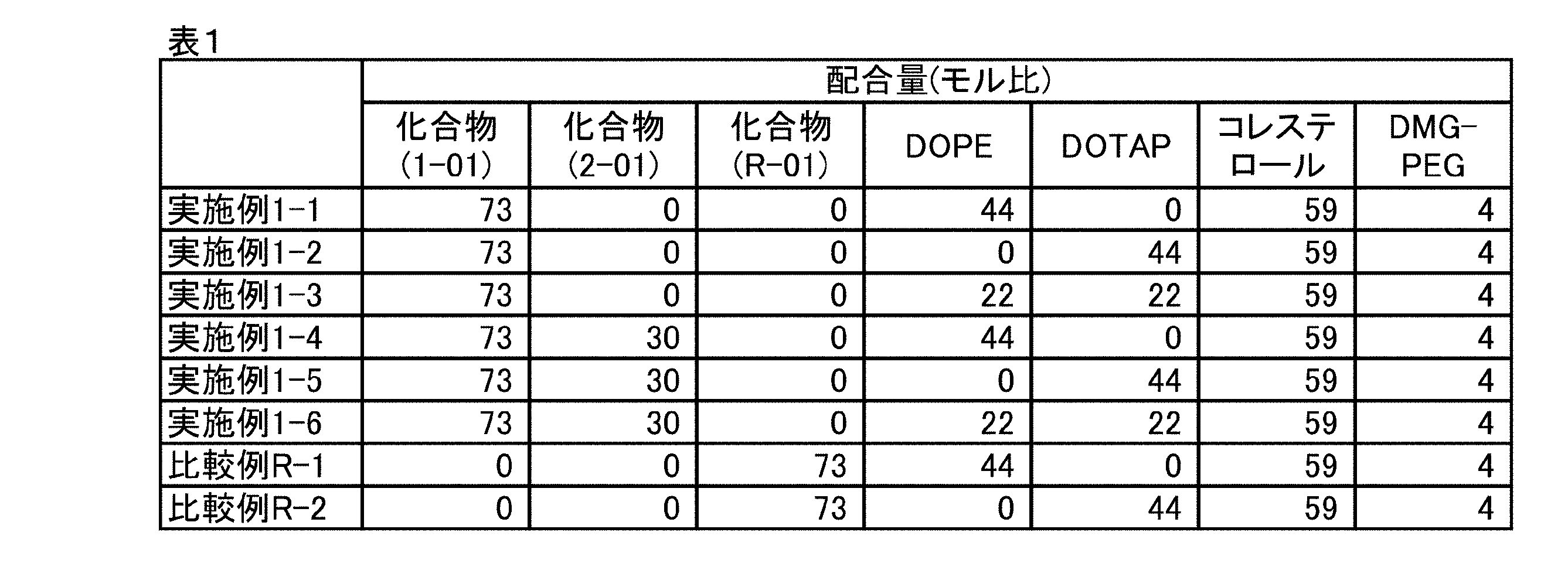

分注した脂質溶液をボルテックスミキサーで撹拌しながら、コア複合体50μlを滴下して混合した。滴下後、10mM HEPES(pH7.3)400μlを穏やかに添加して、ベクターDNA内包リポソームを調製した。更に10mM HEPES(pH7.3)を400μl加え、穏やかに混合した後、限外濾過スピンカラム(PT-1014(商品名)、株式会社アプロサイエンス製)を用いて、遠心によるバッファー交換と濃縮をおこない、100μLのコア複合体内包リポソーム(10mM HEPES、pH7.3)を調製した。
[内包DNA量の評価]
得られたリポソームについて、内包DNA量の測定を行った。測定は、Quant-iT PicoGreen dsDNA Assay Kit(サーモフィッシャーサイエンティフィック社)でおこなった。0.1% Triton-X100(商品名)を含むTris-EDTA緩衝液95μLに、リポソーム溶液5.0μLを加えて穏やかに縣濁した。室温に30分間静置した後、溶液にTris-EDTA緩衝液で200倍希釈したPicoGreen溶液100μLを加えてよく混合した。室温に5分間静置した後、溶液の蛍光強度(励起波長:485nm、蛍光波長:530nm)をマイクロタイタープレートリーダー:Mithras LB-940(商品名、ベルトール社製)で測定した。
DNA濃度は、既知濃度のλDNAで作成した検量線を用いて定量した。得られた数値から、リポソーム内包DNA量を、溶液1mLあたりのDNA量(μg DNA/mL)として算出した。結果は表2に示した通りである。
得られたリポソームについて、内包DNA量の測定を行った。測定は、Quant-iT PicoGreen dsDNA Assay Kit(サーモフィッシャーサイエンティフィック社)でおこなった。0.1% Triton-X100(商品名)を含むTris-EDTA緩衝液95μLに、リポソーム溶液5.0μLを加えて穏やかに縣濁した。室温に30分間静置した後、溶液にTris-EDTA緩衝液で200倍希釈したPicoGreen溶液100μLを加えてよく混合した。室温に5分間静置した後、溶液の蛍光強度(励起波長:485nm、蛍光波長:530nm)をマイクロタイタープレートリーダー:Mithras LB-940(商品名、ベルトール社製)で測定した。
DNA濃度は、既知濃度のλDNAで作成した検量線を用いて定量した。得られた数値から、リポソーム内包DNA量を、溶液1mLあたりのDNA量(μg DNA/mL)として算出した。結果は表2に示した通りである。
式(1-01)の化合物を含むリポソームは、式(R-01)の化合物を含むリポソームより、内包DNA量が高いことが明らかとなった。また、脂質化合物として式(2)の化合物を組み合わせると内包DNA量が多くなることも確認された。
[リポソーム表面電荷の測定]
リポソームの表面電荷(ゼータ電位)を、ゼータサイザー(ゼータサイザーナノZS(商品名)、Malvern Panalytical社製)で測定した。ゼータ電位測定用セル(DTS-1070(商品名)、Malvern Panalytical社製)にリポソーム溶液30μlを分注し、蒸留水870μlを加えて混合した後、セルをゼータサイザーにセットしてゼータ電位を測定した。得られた結果は表2に示すとおりであった。
リポソームの表面電荷(ゼータ電位)を、ゼータサイザー(ゼータサイザーナノZS(商品名)、Malvern Panalytical社製)で測定した。ゼータ電位測定用セル(DTS-1070(商品名)、Malvern Panalytical社製)にリポソーム溶液30μlを分注し、蒸留水870μlを加えて混合した後、セルをゼータサイザーにセットしてゼータ電位を測定した。得られた結果は表2に示すとおりであった。
膜を形成する脂質として、中性脂質であるDOPEのみ使用した場合(実施例1-4)と、DOPEに対してカチオン性脂質であるDOTAPを組み合わせた場合(実施例1-6)とを比較すると、後者のほうがゼータ電位をよりプラス側にシフトさせることができることがわかった。
[リポソームによるベクターDNA導入量の測定]
リポソームによる細胞へのベクターDNAの導入は、ベクターDNA上のNluc遺伝子の発現により定量化した。NLuc遺伝子の発現は、その発光量をマイクロタイタープレートリーダー: infinite F200(製品名、Tecan社製)で測定することで評価した。細胞は、ヒトT細胞性白血病細胞株Jurkat、ヒト乳がん由来の細胞株MCF-7、ヒト肝臓がん由来の細胞株Huh-7(American Type Culture Collectionより購入)を使用した。96穴培養プレートに、1×10⁶細胞/mLの細胞縣濁液を100μL播種した後、表1に示されるリポソーム溶液を1μL添加した。添加後、細胞を37℃、5%CO2雰囲気のインキュベータ内で48時間培養した後、NLucの酵素活性を測定した。NLucの酵素活性は、NanoGlo Luciferase Assay System(製品名、Promega社)を用いて、キット添付のマニュアルに従い、ルミノメーターで測定した。得られた結果は図1(Jurkat)、図2(MCF-7)、図3(Huh-7)に示すとおりであった。
リポソームによる細胞へのベクターDNAの導入は、ベクターDNA上のNluc遺伝子の発現により定量化した。NLuc遺伝子の発現は、その発光量をマイクロタイタープレートリーダー: infinite F200(製品名、Tecan社製)で測定することで評価した。細胞は、ヒトT細胞性白血病細胞株Jurkat、ヒト乳がん由来の細胞株MCF-7、ヒト肝臓がん由来の細胞株Huh-7(American Type Culture Collectionより購入)を使用した。96穴培養プレートに、1×10⁶細胞/mLの細胞縣濁液を100μL播種した後、表1に示されるリポソーム溶液を1μL添加した。添加後、細胞を37℃、5%CO2雰囲気のインキュベータ内で48時間培養した後、NLucの酵素活性を測定した。NLucの酵素活性は、NanoGlo Luciferase Assay System(製品名、Promega社)を用いて、キット添付のマニュアルに従い、ルミノメーターで測定した。得られた結果は図1(Jurkat)、図2(MCF-7)、図3(Huh-7)に示すとおりであった。
式(1)の脂質化合物は、膜を形成する脂質化合物を選択することで、比較に用いた(R-01)よりも高いNluc遺伝子発現効率を示すことが確認できた。
また、リポソームにより細胞内に取り込まれたNluc遺伝子発現効率は、式(1)の脂質化合物に式(2)の化合物を組み合わせることで、浮遊性よりも付着性の細胞に取り込まれやすくなることが示された。さらにDOTAPの有無で表面電荷を制御することにより、増殖様式の異なる細胞へ指向性があることがわかった。

[合成例3] 化合物(1-02)の合成
前記した製造プロセスに従って、化合物(1-02)の合成を行った。具体的には、下記の通りの操作を行った。
前記した製造プロセスに従って、化合物(1-02)の合成を行った。具体的には、下記の通りの操作を行った。
第1工程
アルゴン雰囲気下、500mLフラスコにマグネシウム(17.38g,714.96mmol,4.40eq.)とジエチルエーテル(165mL)とヨウ素(7mg)を仕込んだ。9-ブロモノン-1-エン(100.00g,487.47mol,3.00eq.)を室温下で数滴滴下した後、還流させながら2 時間かけて滴下した。室温で一晩熟成させ、滴下漏斗にグリニャール試薬をジエチルエーテル(40mL)で洗い込みながら移した。ギ酸エチル(12.04g,162.49mmol,1.00eq.)とジエチルエーテル(165mL)を仕込んだ1000mL4つ口フラスコに、0℃以下で1.5 時間かけてグリニャ-ル試薬を滴下した。1時間室温で反応させた後、アセトン(100mL)を加え、水(200mL)と10%硫酸(267mL)を順次添加して分液した。水層をジエチルエーテル(300mL)で抽出し、Na2SO4で有機層を乾燥した。濾過濃縮して得た粗体(72.1g)をカラムクロマトグラフィー(シリカゲル721g,展開:ヘキサン→3%酢酸エチル/97%ヘキサン)で精製し、白色固体として中間体(1-02-1)を41.1g(収率98%)得た。
アルゴン雰囲気下、500mLフラスコにマグネシウム(17.38g,714.96mmol,4.40eq.)とジエチルエーテル(165mL)とヨウ素(7mg)を仕込んだ。9-ブロモノン-1-エン(100.00g,487.47mol,3.00eq.)を室温下で数滴滴下した後、還流させながら2 時間かけて滴下した。室温で一晩熟成させ、滴下漏斗にグリニャール試薬をジエチルエーテル(40mL)で洗い込みながら移した。ギ酸エチル(12.04g,162.49mmol,1.00eq.)とジエチルエーテル(165mL)を仕込んだ1000mL4つ口フラスコに、0℃以下で1.5 時間かけてグリニャ-ル試薬を滴下した。1時間室温で反応させた後、アセトン(100mL)を加え、水(200mL)と10%硫酸(267mL)を順次添加して分液した。水層をジエチルエーテル(300mL)で抽出し、Na2SO4で有機層を乾燥した。濾過濃縮して得た粗体(72.1g)をカラムクロマトグラフィー(シリカゲル721g,展開:ヘキサン→3%酢酸エチル/97%ヘキサン)で精製し、白色固体として中間体(1-02-1)を41.1g(収率98%)得た。
第2工程
アルゴン雰囲気下で、1000mL フラスコに中間体(1-02-1)(41.1g,146.53mmol,1.00eq.)をジクロロメタン(330mL)で溶解させて投入し、トリチルアミン(59.31g,586.12mmol、4.00eq.)、4-ジメチルアミノピリジン(1.79g,14.65mmol,0.10eq.)を加えた。-5℃でメタンスルホニルクロリド(33.57g,293.06mmol,2.00eq.)を滴下した。室温で1時間攪拌後、氷水(17.6mL)でクエンチした。続いて、1N塩酸(30mL)と水(300mL)、飽和食塩水(300mL)で洗浄し、Na2SO4で乾燥した。濾過濃縮して、橙色オイルとして中間体(1-02-2)を49.6g(収率94%)得た。
アルゴン雰囲気下で、1000mL フラスコに中間体(1-02-1)(41.1g,146.53mmol,1.00eq.)をジクロロメタン(330mL)で溶解させて投入し、トリチルアミン(59.31g,586.12mmol、4.00eq.)、4-ジメチルアミノピリジン(1.79g,14.65mmol,0.10eq.)を加えた。-5℃でメタンスルホニルクロリド(33.57g,293.06mmol,2.00eq.)を滴下した。室温で1時間攪拌後、氷水(17.6mL)でクエンチした。続いて、1N塩酸(30mL)と水(300mL)、飽和食塩水(300mL)で洗浄し、Na2SO4で乾燥した。濾過濃縮して、橙色オイルとして中間体(1-02-2)を49.6g(収率94%)得た。
第3工程
アルゴン雰囲気下で、1000mL フラスコにDMF(300mL)とシアン化ナトリウム(13.56g,276.65mmol,2.00eq.)を仕込んだ。DMF(200mL)に溶解した中間体(1-02-2)49.6g,138.32mmol,1.00eq.)を添加し、55℃に加温して一晩反応させた。反応液を室温に戻して、水(500mL)で希釈し、酢酸エチル(800mL×3 回)で抽出した。抽出した有機層を水(500mL)、飽和食塩水(500mL)で洗浄し、Na2SO4で乾燥した。濾過濃縮して得た粗体(84.3g)をカラムクロマトグラフィー(シリカゲル1012g、展開:ヘキサン→5%酢酸エチル/95%ヘキサン)で精製し薄黄色オイルとして中間体(1-02-3)を28.1g(収率70%)を得た。
アルゴン雰囲気下で、1000mL フラスコにDMF(300mL)とシアン化ナトリウム(13.56g,276.65mmol,2.00eq.)を仕込んだ。DMF(200mL)に溶解した中間体(1-02-2)49.6g,138.32mmol,1.00eq.)を添加し、55℃に加温して一晩反応させた。反応液を室温に戻して、水(500mL)で希釈し、酢酸エチル(800mL×3 回)で抽出した。抽出した有機層を水(500mL)、飽和食塩水(500mL)で洗浄し、Na2SO4で乾燥した。濾過濃縮して得た粗体(84.3g)をカラムクロマトグラフィー(シリカゲル1012g、展開:ヘキサン→5%酢酸エチル/95%ヘキサン)で精製し薄黄色オイルとして中間体(1-02-3)を28.1g(収率70%)を得た。
第4工程
アルゴン雰囲気下、2000mL フラスコに中間体(1-02-3)(28.1g,97.06mmol,1.00eq.)とヘキサン(280mL)を仕込んだ。-70℃で1M DIBAL-n-ヘキサン(194.13mL,194.13mmol,2.00eq.)を滴下し、室温下で30分攪拌させた。0℃に氷冷し、メタノール(14mL)でクエンチした。この反応液に飽和NH4Cl水溶液(1200mL)を加えて20 分攪拌し、10%H2SO4(450mL)を加えて分液した。続いてジエチルエーテル(500mL×2回)で抽出した。抽出した有機層を、飽和NaHCO3水溶液(500mL)、飽和食塩水(500mL)で洗浄し、Na2SO4で乾燥した。濾過濃縮して黄色オイルとして中間体(1-02-4)を25.3g(収率89%)を得た。
アルゴン雰囲気下、2000mL フラスコに中間体(1-02-3)(28.1g,97.06mmol,1.00eq.)とヘキサン(280mL)を仕込んだ。-70℃で1M DIBAL-n-ヘキサン(194.13mL,194.13mmol,2.00eq.)を滴下し、室温下で30分攪拌させた。0℃に氷冷し、メタノール(14mL)でクエンチした。この反応液に飽和NH4Cl水溶液(1200mL)を加えて20 分攪拌し、10%H2SO4(450mL)を加えて分液した。続いてジエチルエーテル(500mL×2回)で抽出した。抽出した有機層を、飽和NaHCO3水溶液(500mL)、飽和食塩水(500mL)で洗浄し、Na2SO4で乾燥した。濾過濃縮して黄色オイルとして中間体(1-02-4)を25.3g(収率89%)を得た。
第5 工程
1000mLフラスコに中間体(1-02-4)(25.3g,86.5mmol,1.00eq.)と、メタノール(253mL)を仕込んだ。0℃で水素化ホウ素ナトリウム(1.16g,30.27mmol,0.35eq.)を少しずつ加え、室温下で終夜攪拌した。反応液に酢酸(7mL)をpH4になるまで加えた。水(160mL)を加え、ジクロロメタン(400mL×3回)で抽出し、有機層をNa2SO4で乾燥した。濾過濃縮して得た粗体(30.3g)をカラムクロマトグラフィー(シリカゲル304g、展開:5%酢酸エチル/95%ヘキサン)で精製し薄黄色オイルとして中間体(1-02-5)を22.13g(収率87%)得た。
1000mLフラスコに中間体(1-02-4)(25.3g,86.5mmol,1.00eq.)と、メタノール(253mL)を仕込んだ。0℃で水素化ホウ素ナトリウム(1.16g,30.27mmol,0.35eq.)を少しずつ加え、室温下で終夜攪拌した。反応液に酢酸(7mL)をpH4になるまで加えた。水(160mL)を加え、ジクロロメタン(400mL×3回)で抽出し、有機層をNa2SO4で乾燥した。濾過濃縮して得た粗体(30.3g)をカラムクロマトグラフィー(シリカゲル304g、展開:5%酢酸エチル/95%ヘキサン)で精製し薄黄色オイルとして中間体(1-02-5)を22.13g(収率87%)得た。
第6工程
アルゴン雰囲気下、1000mL フラスコに中間体(1-02-5)(22.13g,75.14mmol,1.00eq.)をジクロロメタン(220mL)で溶かし、テトラブロモメタン(29.90g,90.17mmol,1.20eq.)を加えた。0℃でジクロロメタン(63mL)に溶かしたトリフェニルホスフィン(29.56g,112.71mmol,1.50eq.)を滴下した。室温下で1 時間攪拌後、反応液を濃縮して得た粗体(21.3g)をカラムクロマトグラフィー(シリカゲル200g、展開:ヘキサン)で精製し無色透明オイルとして中間体(1-02-6)を14.5g(収率54%)を得た。
アルゴン雰囲気下、1000mL フラスコに中間体(1-02-5)(22.13g,75.14mmol,1.00eq.)をジクロロメタン(220mL)で溶かし、テトラブロモメタン(29.90g,90.17mmol,1.20eq.)を加えた。0℃でジクロロメタン(63mL)に溶かしたトリフェニルホスフィン(29.56g,112.71mmol,1.50eq.)を滴下した。室温下で1 時間攪拌後、反応液を濃縮して得た粗体(21.3g)をカラムクロマトグラフィー(シリカゲル200g、展開:ヘキサン)で精製し無色透明オイルとして中間体(1-02-6)を14.5g(収率54%)を得た。
第7工程
アルゴン雰囲気下で、200mL フラスコにエタノール (90mL)、20%エトキシナトリウム(溶媒:エタノール)(50.55g,148.57mmol,5.90eq.)を仕込み、65℃に加熱した。次いで、マロン酸ジエチル(24.20g, 151.09mmol,6.00eq.)、中間体(1-02-6)(9g,25.18mmol,1.00eq.)を加え、一晩加熱環流した。反応終了後、10℃以下で1N塩酸(90mL)を加え、クエンチした。反応液を酢酸エチル(200mL×3回)で抽出し、飽和NaHCO3水溶液(90mL)、飽和食塩水(90mL)で順次洗浄し、有機層をNa2SO4で乾燥した。濾過濃縮し、橙色オイルとして中間体(1-02-7)を7.31g(収率66%)を得た。
アルゴン雰囲気下で、200mL フラスコにエタノール (90mL)、20%エトキシナトリウム(溶媒:エタノール)(50.55g,148.57mmol,5.90eq.)を仕込み、65℃に加熱した。次いで、マロン酸ジエチル(24.20g, 151.09mmol,6.00eq.)、中間体(1-02-6)(9g,25.18mmol,1.00eq.)を加え、一晩加熱環流した。反応終了後、10℃以下で1N塩酸(90mL)を加え、クエンチした。反応液を酢酸エチル(200mL×3回)で抽出し、飽和NaHCO3水溶液(90mL)、飽和食塩水(90mL)で順次洗浄し、有機層をNa2SO4で乾燥した。濾過濃縮し、橙色オイルとして中間体(1-02-7)を7.31g(収率66%)を得た。
第8工程
200mL フラスコに中間体(1-02-7)(7.31g,16.74mmol,1.00eq.)、ジメチルスルホキシド(70mL)、塩化ナトリウム(9.78g,167.40mmol)を仕込み、一晩加熱環流した。反応終了後、反応液を濃縮して得た粗体(21.3g)をカラムクロマトグラフィー(シリカゲル200g 展開:ヘキサン→2%酢酸エチル/98%ヘキサン)で精製し中間体(1-02-8)を淡黄色オイルとして4.7g(収率51%)得た。
200mL フラスコに中間体(1-02-7)(7.31g,16.74mmol,1.00eq.)、ジメチルスルホキシド(70mL)、塩化ナトリウム(9.78g,167.40mmol)を仕込み、一晩加熱環流した。反応終了後、反応液を濃縮して得た粗体(21.3g)をカラムクロマトグラフィー(シリカゲル200g 展開:ヘキサン→2%酢酸エチル/98%ヘキサン)で精製し中間体(1-02-8)を淡黄色オイルとして4.7g(収率51%)得た。
第9 工程
アルゴン雰囲気下、200mL4つ口フラスコにリチュムアルミニウムハイドライド (734mg,19.34mmol,1.5eq.)とTHF(40mL)を仕込んだ。0℃でTHF(40mL)に溶解させた中間体(1-02-8)(4.7g,34.54mmol,1.00eq.)を滴下し、室温で一晩反応させた。0℃に氷冷し、水(3.3mL)、15%水酸化ナトリウム(0.8mL)でクエンチした。この反応液に酢酸エチル(50mL)を加えてセライト濾過し、酢酸エチル(100mL)でセライトを洗浄した。濾液を濃縮して得た粗体(4.9g)をカラムクロマトグラフィー(シリカゲル50g、展開:5%酢酸エチル95%ヘキサン)で精製し中間体(1-02-9)を無色オイルとして3.86g(収率93%)得た。
アルゴン雰囲気下、200mL4つ口フラスコにリチュムアルミニウムハイドライド (734mg,19.34mmol,1.5eq.)とTHF(40mL)を仕込んだ。0℃でTHF(40mL)に溶解させた中間体(1-02-8)(4.7g,34.54mmol,1.00eq.)を滴下し、室温で一晩反応させた。0℃に氷冷し、水(3.3mL)、15%水酸化ナトリウム(0.8mL)でクエンチした。この反応液に酢酸エチル(50mL)を加えてセライト濾過し、酢酸エチル(100mL)でセライトを洗浄した。濾液を濃縮して得た粗体(4.9g)をカラムクロマトグラフィー(シリカゲル50g、展開:5%酢酸エチル95%ヘキサン)で精製し中間体(1-02-9)を無色オイルとして3.86g(収率93%)得た。
第10工程
アルゴン雰囲気下で、100mL フラスコに中間体(1-02-9)(3.86g,11.97mmol,1.00eq.)をジクロロメタン(30mL)で溶解させて投入し、トリエチルアミン(4.84g,47.87mmol,4.00eq.)、4-ジメチルアミノピリジン(146mg,1.20mmol,0.10eq.)を加えた。-5℃でメタンスルホニルクロリド(2.74g,23.93mmol,2.00eq.)を滴下した。室温で1時間攪拌後、氷水(17.6mL)でクエンチした。続いて、1N塩酸(10mL)と水(30mL)、飽和食塩水(30mL)で洗浄し、Na2SO4で乾燥した。濾過濃縮して中間体(1-02-10)を褐色オイルとして、4.79g(収率99%)得た。
アルゴン雰囲気下で、100mL フラスコに中間体(1-02-9)(3.86g,11.97mmol,1.00eq.)をジクロロメタン(30mL)で溶解させて投入し、トリエチルアミン(4.84g,47.87mmol,4.00eq.)、4-ジメチルアミノピリジン(146mg,1.20mmol,0.10eq.)を加えた。-5℃でメタンスルホニルクロリド(2.74g,23.93mmol,2.00eq.)を滴下した。室温で1時間攪拌後、氷水(17.6mL)でクエンチした。続いて、1N塩酸(10mL)と水(30mL)、飽和食塩水(30mL)で洗浄し、Na2SO4で乾燥した。濾過濃縮して中間体(1-02-10)を褐色オイルとして、4.79g(収率99%)得た。
第11工程
アルゴン雰囲気下で、100mLフラスコにDMF(28mL)とシアン化カリウム(1.17g,23.94mmol,2.00eq.)を仕込んだ。DMF(20mL)に溶解した中間体(1-02-10)(4.79g,11.97mmol,1.00eq.)を添加し、55℃に加温して一晩反応させた。反応液を室温に戻して、水(50mL)で希釈し、酢酸エチル(100mL×3回)で抽出した。抽出した有機層を水(50mL)、飽和食塩水(50mL)で洗浄し、Na2SO4で乾燥した。濾過濃縮して得た粗体(11.4g)をカラムクロマトグラフィー(シリカゲル100g、展開:ヘキサン→5%酢酸エチル/95%ヘキサン)で精製し中間体(1-02-11)を無色オイルとして、3.6g(収率90%)得た。
アルゴン雰囲気下で、100mLフラスコにDMF(28mL)とシアン化カリウム(1.17g,23.94mmol,2.00eq.)を仕込んだ。DMF(20mL)に溶解した中間体(1-02-10)(4.79g,11.97mmol,1.00eq.)を添加し、55℃に加温して一晩反応させた。反応液を室温に戻して、水(50mL)で希釈し、酢酸エチル(100mL×3回)で抽出した。抽出した有機層を水(50mL)、飽和食塩水(50mL)で洗浄し、Na2SO4で乾燥した。濾過濃縮して得た粗体(11.4g)をカラムクロマトグラフィー(シリカゲル100g、展開:ヘキサン→5%酢酸エチル/95%ヘキサン)で精製し中間体(1-02-11)を無色オイルとして、3.6g(収率90%)得た。
第12工程
アルゴン雰囲気下で、100mLフラスコに中間体(1-02-11)(3.6g, 10.86mmol,1.00eq.)とヘキサン(36mL)を仕込んだ。-70℃で1M DIBAL-n-ヘキサン(21.71mL,21.71mmol,2.00eq.) を滴下し、室温下で30 分攪拌させた。0℃に氷冷し、メタノール(1.6mL)でクエンチした。この反応液に飽和NH4Cl水溶液(150mL)を加え20分攪拌し、10% 硫酸(50mL)を加えて分液した。続いてジエチルエーテル(50mL×2回)で抽出した。抽出した有機層を飽和NaHCO3水(50mL)、飽和食塩水(50mL)で洗浄し、Na2SO4で乾燥した。濾過濃縮して中間体(1-02-12)を黄色オイルとして、3.2g(収率88%)得た。
アルゴン雰囲気下で、100mLフラスコに中間体(1-02-11)(3.6g, 10.86mmol,1.00eq.)とヘキサン(36mL)を仕込んだ。-70℃で1M DIBAL-n-ヘキサン(21.71mL,21.71mmol,2.00eq.) を滴下し、室温下で30 分攪拌させた。0℃に氷冷し、メタノール(1.6mL)でクエンチした。この反応液に飽和NH4Cl水溶液(150mL)を加え20分攪拌し、10% 硫酸(50mL)を加えて分液した。続いてジエチルエーテル(50mL×2回)で抽出した。抽出した有機層を飽和NaHCO3水(50mL)、飽和食塩水(50mL)で洗浄し、Na2SO4で乾燥した。濾過濃縮して中間体(1-02-12)を黄色オイルとして、3.2g(収率88%)得た。
第13工程
100mL フラスコに中間体(1-02-12)(3.2g, 9.56mmol, 1.00eq.)とメタノール(32mL)を仕込んだ。0℃で水素化ホウ素ナトリウム(127mg, 3.35mmol,0.35eq.)を少しずつ加え、室温下で一晩攪拌した。反応液に酢酸(1mL)をpH4になるまで加えた。水(30mL)を加え、ジクロロメタン (30mL×3回)で抽出し、有機層をNa2SO4で乾燥した。濾過濃縮して得た粗体(3.17g)をカラムクロマトグラフィー(シリカゲル32g、展開:5%酢酸エチル/95%ヘキサン)で精製し中間体(1-02-13)を淡黄色オイルとして、1.12g(収率35%)得た。
100mL フラスコに中間体(1-02-12)(3.2g, 9.56mmol, 1.00eq.)とメタノール(32mL)を仕込んだ。0℃で水素化ホウ素ナトリウム(127mg, 3.35mmol,0.35eq.)を少しずつ加え、室温下で一晩攪拌した。反応液に酢酸(1mL)をpH4になるまで加えた。水(30mL)を加え、ジクロロメタン (30mL×3回)で抽出し、有機層をNa2SO4で乾燥した。濾過濃縮して得た粗体(3.17g)をカラムクロマトグラフィー(シリカゲル32g、展開:5%酢酸エチル/95%ヘキサン)で精製し中間体(1-02-13)を淡黄色オイルとして、1.12g(収率35%)得た。
第14工程
アルゴン雰囲気下で、30mL フラスコに中間体(1-02-13)(1g, 2.97mmol,1.00eq.)をジクロロメタン(10mL)で溶かし、テトラブロモメタン(1.18g,3.57mmol,1.20eq.)を加えた。0℃でジクロロメタン(5mL)に溶かしたトリフェニルホスフィン(1.17g,4.46mmol,1.50eq.)を滴下した。室温下で1時間攪拌後、反応液を濾過濃縮して得た粗体(7g)をカラムクロマトグラフィー(シリカゲル70g、展開:ヘキサン)で精製し中間体(1-02-14)を無色透明オイルとして、1.12g(収率94%)得た。
アルゴン雰囲気下で、30mL フラスコに中間体(1-02-13)(1g, 2.97mmol,1.00eq.)をジクロロメタン(10mL)で溶かし、テトラブロモメタン(1.18g,3.57mmol,1.20eq.)を加えた。0℃でジクロロメタン(5mL)に溶かしたトリフェニルホスフィン(1.17g,4.46mmol,1.50eq.)を滴下した。室温下で1時間攪拌後、反応液を濾過濃縮して得た粗体(7g)をカラムクロマトグラフィー(シリカゲル70g、展開:ヘキサン)で精製し中間体(1-02-14)を無色透明オイルとして、1.12g(収率94%)得た。
第15工程
200mLフラスコに中間体(1-02-14)(1.12g,2.80mmol,1.00eq.)を入れ、ジクロロメタン(51mL)とアセトニトリル(51mL)に溶かし、塩化ルテニウム(III)(29mg,0.14mmol,Ru=40%)を添加した。10℃以下で水(51mL)に溶かした過ヨウ素酸ナトリウム(5.99g,28.0mmol,10.00eq.)を滴下し、10℃以下で一晩攪拌した。反応終了後、水51mL)を加え、分液した。有機層に飽和食塩水(50mL)を加え、色が変わるまで3%Na2S水溶液を滴下した。1N塩酸を酸性になるまで加え、分液した。有機層をNa2SO4で乾燥し、濾過濃縮して得た粗体(5.24g)をカラムクロマトグラフィー(シリカゲル50g、展開:クロロホルム→5%メタノール/95%クロロホルム)で精製し中間体(1-02-15)を微黄色オイルとして、1.05g(収率86%)得た。
200mLフラスコに中間体(1-02-14)(1.12g,2.80mmol,1.00eq.)を入れ、ジクロロメタン(51mL)とアセトニトリル(51mL)に溶かし、塩化ルテニウム(III)(29mg,0.14mmol,Ru=40%)を添加した。10℃以下で水(51mL)に溶かした過ヨウ素酸ナトリウム(5.99g,28.0mmol,10.00eq.)を滴下し、10℃以下で一晩攪拌した。反応終了後、水51mL)を加え、分液した。有機層に飽和食塩水(50mL)を加え、色が変わるまで3%Na2S水溶液を滴下した。1N塩酸を酸性になるまで加え、分液した。有機層をNa2SO4で乾燥し、濾過濃縮して得た粗体(5.24g)をカラムクロマトグラフィー(シリカゲル50g、展開:クロロホルム→5%メタノール/95%クロロホルム)で精製し中間体(1-02-15)を微黄色オイルとして、1.05g(収率86%)得た。
第16工程
100mLフラスコに中間体(1-02-15)(1.00g,2.30mmol,1.00eq.)をジクロロメタン(30mL)に溶かし、シス-2-ノネン-1-オル(797mg,5.60mmol,2.44eq.)、4-ジメチルアミノピリジン(28mg,0.23mmol,0.10eq.)、N,N-ジイソプロピルエチルアミン(1.45g,11.25mmol,4.90eq.) を仕込んだ。その後、1-(3-ジメチルアミノプロピル)-3-エチル-カルボジイミド塩酸塩(1.07g,5.603mmol, 2.44eq.) を加え、室温下で一晩攪拌した。反応終了後、ジクロロメタン(30mL)で希釈し、水(30mL)、1N塩酸(30mL)、飽和NaHCO3水(30mL)、飽和食塩水(30mL)で順次洗浄し、有機層をNa2SO4 で乾燥した。濾過濃縮して得た粗体(1.92g)をカラムクロマトグラフィー(シリカゲル20g、展開:ヘキサン→2%酢酸エチル/98%ヘキサン)で精製し中間体(1-02-16)を微黄色オイルとして、77mg(収率5%)得た。
100mLフラスコに中間体(1-02-15)(1.00g,2.30mmol,1.00eq.)をジクロロメタン(30mL)に溶かし、シス-2-ノネン-1-オル(797mg,5.60mmol,2.44eq.)、4-ジメチルアミノピリジン(28mg,0.23mmol,0.10eq.)、N,N-ジイソプロピルエチルアミン(1.45g,11.25mmol,4.90eq.) を仕込んだ。その後、1-(3-ジメチルアミノプロピル)-3-エチル-カルボジイミド塩酸塩(1.07g,5.603mmol, 2.44eq.) を加え、室温下で一晩攪拌した。反応終了後、ジクロロメタン(30mL)で希釈し、水(30mL)、1N塩酸(30mL)、飽和NaHCO3水(30mL)、飽和食塩水(30mL)で順次洗浄し、有機層をNa2SO4 で乾燥した。濾過濃縮して得た粗体(1.92g)をカラムクロマトグラフィー(シリカゲル20g、展開:ヘキサン→2%酢酸エチル/98%ヘキサン)で精製し中間体(1-02-16)を微黄色オイルとして、77mg(収率5%)得た。
第17工程
50mLのオートクレーブに中間体(1-02-16)(77mg,0.11mmol,1.00eq.)をTHF(3mL)で溶かし、1-メチルピペラジン(225mg,2.25mmol,20.00eq.)と炭酸カリウム(56mg,0.41mmol,3.6eq.)を仕込んだ。55℃に加温して6日間反応させた。反応終了後、反応液を室温に戻して、ジクロロメタン(6mL)で希釈し、水(5mL)を加えて分液した。水層をジクロロメタン(6mL×3回)で抽出して合わせた有機層をNa2SO4で乾燥した。濾過濃縮して得た粗体(108mg)をカラムクロマトグラフィー(シリカゲル1g、展開:クロロホルム→10%メタノール/90%クロロホルム)で精製し、濃黄色オイルとして化合物(1-02)を54mg(収率68%)得た。
50mLのオートクレーブに中間体(1-02-16)(77mg,0.11mmol,1.00eq.)をTHF(3mL)で溶かし、1-メチルピペラジン(225mg,2.25mmol,20.00eq.)と炭酸カリウム(56mg,0.41mmol,3.6eq.)を仕込んだ。55℃に加温して6日間反応させた。反応終了後、反応液を室温に戻して、ジクロロメタン(6mL)で希釈し、水(5mL)を加えて分液した。水層をジクロロメタン(6mL×3回)で抽出して合わせた有機層をNa2SO4で乾燥した。濾過濃縮して得た粗体(108mg)をカラムクロマトグラフィー(シリカゲル1g、展開:クロロホルム→10%メタノール/90%クロロホルム)で精製し、濃黄色オイルとして化合物(1-02)を54mg(収率68%)得た。
[脂質化合物を含むDNA/ペプチド・コア複合体内包リポソームの調製]
ベクターDNA溶液とDNA凝縮ペプチドを用いて、ベクターDNA-DNA凝縮ペプチドからなるコア複合体を調製した。ベクターDNAとして、サイトメガロウイルス初期プロモーター/エンハンサー、Nluc遺伝子、転写終結シグナルを組込んだプラスミドを使用した。DNA凝縮ペプチドとして、mHP-1(RQRQR-YY-RQRQR-GG-RRRRRR:配列番号1)とmHP-2(RRRRRR-YY-RQRQR-GG-RRRRRR:配列番号2)を4:1の割合で混合した混合物を使用した。
ベクターDNA溶液とDNA凝縮ペプチドを用いて、ベクターDNA-DNA凝縮ペプチドからなるコア複合体を調製した。ベクターDNAとして、サイトメガロウイルス初期プロモーター/エンハンサー、Nluc遺伝子、転写終結シグナルを組込んだプラスミドを使用した。DNA凝縮ペプチドとして、mHP-1(RQRQR-YY-RQRQR-GG-RRRRRR:配列番号1)とmHP-2(RRRRRR-YY-RQRQR-GG-RRRRRR:配列番号2)を4:1の割合で混合した混合物を使用した。
マイクロチューブ(プロテオセーブSS(商品名)1.5ml、住友ベークライト株式会社製)に、DNA凝縮ペプチド溶液(0.255 mg/ml、10mM HEPES、pH7.3)100μlを分注した。分注したペプチド溶液をボルテックスミキサー(1 ,500rpm)(MSV-3500(商品名)、BIOSAN社製)で撹拌しながら、ベクターDNA溶液(0.15mg/ml、10mM HEPES、pH7.3)200 μlを滴下して混合した。
コア複合体を内包するリポソームは、エタノール注入法で調製した。マイクロチューブ(プロテオセーブSS(商品名)1.5ml、住友ベークライト株式会社製)に、表3に示された配合比の脂質溶液を、それぞれ50μl分注した。なお、表3中の参照例2-1および2-2は、前記した実施例1-2および1-4と同処方による別調製物である。

分注した脂質溶液をボルテックスミキサーで撹拌しながら、コア複合体50μlを滴下して混合した。滴下後、10mM HEPES(pH7.3)900μlを穏やかに添加して、コア複合体内包リポソームを調製した。限外濾過フィルター(CentriprepYM-50(商品名)、メルク株式会社製)を用いて、遠心によるバッファー交換と濃縮を行い、コア複合体内包リポソーム32mlを600μlに調製した。
[内包DNA量の評価]
得られたリポソームについて、内包DNA量の測定を行った。測定は、Quant-iT PicoGreen dsDNA Assay Kit(サーモフィッシャーサイエンティフィック社)でおこなった。0.1% Triton-X100(商品名)とヘパリンナトリウム塩(シグマアルドリッチジャパン合同会社)を含む Tris-EDTA緩衝液99.5μLに、リポソーム溶液0.5μLを加えて穏やかに縣濁した。室温に30分間静置した後、溶液にTris-EDTA緩衝液で200倍希釈したPicoGreen溶液100μLを加えてよく混合した。室温に5分間静置した後、溶液の蛍光強度(励起波長:485nm、蛍光波長:530nm)をマイクロタイタープレートリーダー:Mithras LB-940(商品名、ベルトール社製)で測定した。
得られたリポソームについて、内包DNA量の測定を行った。測定は、Quant-iT PicoGreen dsDNA Assay Kit(サーモフィッシャーサイエンティフィック社)でおこなった。0.1% Triton-X100(商品名)とヘパリンナトリウム塩(シグマアルドリッチジャパン合同会社)を含む Tris-EDTA緩衝液99.5μLに、リポソーム溶液0.5μLを加えて穏やかに縣濁した。室温に30分間静置した後、溶液にTris-EDTA緩衝液で200倍希釈したPicoGreen溶液100μLを加えてよく混合した。室温に5分間静置した後、溶液の蛍光強度(励起波長:485nm、蛍光波長:530nm)をマイクロタイタープレートリーダー:Mithras LB-940(商品名、ベルトール社製)で測定した。
DNA濃度は、既知濃度のλDNAで作成した検量線を用いて定量した。得られた数値から、リポソーム内包DNA量を、溶液1mLあたりのDNA量(μg DNA/mL)として算出した。結果は表4に示した通りである。
式(1-02)の化合物を含むリポソームは、式(1-01)の化合物を含むリポソームと、同等の内包DNA量を示すことが明らかとなった。また、式(2-01)の化合物を組み合わせると、内包DNA量が多くなることも確認された。
式(1-02)の化合物を含むリポソームは、式(1-01)の化合物を含むリポソームと、同等の内包DNA量を示すことが明らかとなった。また、式(2-01)の化合物を組み合わせると、内包DNA量が多くなることも確認された。
[リポソーム表面電荷の測定]
リポソームの表面電荷(ゼータ電位)を、ゼータサイザー(ゼータサイザーナノZS(商品名)、Malvern Panalytical社製)で測定した。ゼータ電位測定用セル(DTS-1070(商品名)、Malvern Panalytical社製)にリポソーム溶液10μlを分注し、蒸留水890μlを加えて混合した後、セルをゼータサイザーにセットしてゼータ電位を測定した。得られた結果は表4に示すとおりであった。
膜を形成する脂質として、中性脂質であるDOPEを使用した場合(参照例2-2および実施例2-2)と、DOPEに対してカチオン性脂質であるDOTAPを使用した場合(参照例2-1および実施例2-1)とを比較すると、後者のほうがゼータ電位をよりプラス側にシフトさせることができることがわかった。
リポソームの表面電荷(ゼータ電位)を、ゼータサイザー(ゼータサイザーナノZS(商品名)、Malvern Panalytical社製)で測定した。ゼータ電位測定用セル(DTS-1070(商品名)、Malvern Panalytical社製)にリポソーム溶液10μlを分注し、蒸留水890μlを加えて混合した後、セルをゼータサイザーにセットしてゼータ電位を測定した。得られた結果は表4に示すとおりであった。
膜を形成する脂質として、中性脂質であるDOPEを使用した場合(参照例2-2および実施例2-2)と、DOPEに対してカチオン性脂質であるDOTAPを使用した場合(参照例2-1および実施例2-1)とを比較すると、後者のほうがゼータ電位をよりプラス側にシフトさせることができることがわかった。
[リポソームによるベクターDNA導入量の測定]
リポソームによる細胞へのベクターDNAの導入は、ベクターDNA上のNluc遺伝子の発現により定量化した。NLuc遺伝子の発現は、その発光量をマイクロタイタープレートリーダー:infinite F200(製品名、Tecan社製)で測定することで評価した。細胞は、ヒトT細胞性白血病細胞株Jurkat(American Type Culture Collectionより購入)、ヒト末梢血単核球細胞PBMC(ロンザジャパン株式会社より購入)を使用した。96穴培養プレートに、Jurkatは1×10⁶細胞/mLの細胞縣濁液を100μL、PBMCは5×106細胞/mLの細胞縣濁液を100μL、播種した後、表1に示されるリポソーム溶液を、DNA量が0.8μg/ウェルになるように添加した。添加後、細胞を37℃、5%CO2雰囲気のインキュベータ内で48時間培養した後、NLucの酵素活性を測定した。NLucの酵素活性は、NanoGlo Luciferase Assay System(製品名、Promega社)を用いて、キット添付のマニュアルに従い、ルミノメーターで測定した。得られた結果は、図4(Jurkat)、図5(PBMC)に示すとおりであった。
式(1-02)の脂質化合物は、膜を形成する脂質化合物としてDOTAPを選択すると、Jurkat細胞において、式(1-01)よりも高いNluc遺伝子発現効率を示すことが確認できた。また、式(1-01)の脂質化合物は、膜を形成する脂質化合物として式(2-01)とDOPEを選択すると、PBMC細胞において、式(1-02)よりも高いNluc遺伝子発現効率を示すことが確認できた。
リポソームによる細胞へのベクターDNAの導入は、ベクターDNA上のNluc遺伝子の発現により定量化した。NLuc遺伝子の発現は、その発光量をマイクロタイタープレートリーダー:infinite F200(製品名、Tecan社製)で測定することで評価した。細胞は、ヒトT細胞性白血病細胞株Jurkat(American Type Culture Collectionより購入)、ヒト末梢血単核球細胞PBMC(ロンザジャパン株式会社より購入)を使用した。96穴培養プレートに、Jurkatは1×10⁶細胞/mLの細胞縣濁液を100μL、PBMCは5×106細胞/mLの細胞縣濁液を100μL、播種した後、表1に示されるリポソーム溶液を、DNA量が0.8μg/ウェルになるように添加した。添加後、細胞を37℃、5%CO2雰囲気のインキュベータ内で48時間培養した後、NLucの酵素活性を測定した。NLucの酵素活性は、NanoGlo Luciferase Assay System(製品名、Promega社)を用いて、キット添付のマニュアルに従い、ルミノメーターで測定した。得られた結果は、図4(Jurkat)、図5(PBMC)に示すとおりであった。
式(1-02)の脂質化合物は、膜を形成する脂質化合物としてDOTAPを選択すると、Jurkat細胞において、式(1-01)よりも高いNluc遺伝子発現効率を示すことが確認できた。また、式(1-01)の脂質化合物は、膜を形成する脂質化合物として式(2-01)とDOPEを選択すると、PBMC細胞において、式(1-02)よりも高いNluc遺伝子発現効率を示すことが確認できた。
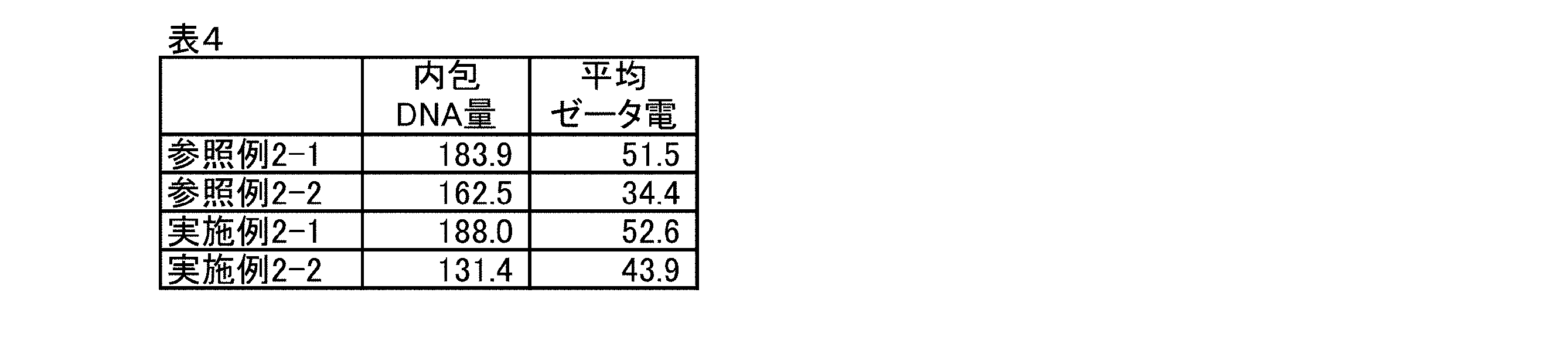
[脂質化合物を含むRNA内包リポソーム]
[RNA内包リポソームの調整]
メッセンジャーRNA(mRNA)は、レポーター遺伝子である緑色蛍光蛋白質GFPのmRNA(OZ Biosciences)を使用した。RNA内包リポソームは、GFP mRNA溶液を、表5に示された配合比の脂質溶液に加え、ピペッティングで縣濁した後、10mM HEPES(pH7.3)を静かに添加し、この溶液を遠心式限外ろ過で洗浄・濃縮して調整した。ここで、比較に用いる化合物として、式(R-01)で表される化合物を用いた。なお、比較例R-3は、比較例R-1と同処方による別調製物である。
[RNA内包リポソームの調整]
メッセンジャーRNA(mRNA)は、レポーター遺伝子である緑色蛍光蛋白質GFPのmRNA(OZ Biosciences)を使用した。RNA内包リポソームは、GFP mRNA溶液を、表5に示された配合比の脂質溶液に加え、ピペッティングで縣濁した後、10mM HEPES(pH7.3)を静かに添加し、この溶液を遠心式限外ろ過で洗浄・濃縮して調整した。ここで、比較に用いる化合物として、式(R-01)で表される化合物を用いた。なお、比較例R-3は、比較例R-1と同処方による別調製物である。

[内包RNA量の測定]
リポソームに内包されたRNA量は、QuantiFluor RNA System キット(Promega)で測定した。測定は、キット添付のマニュアルに従った。RNA内包量の測定結果を表6に示した。表5の配合比の脂質溶液で調整したRNA内包リポソームにおいては、リポソームの内包RNA量に顕著な違いは見られなかった。
リポソームに内包されたRNA量は、QuantiFluor RNA System キット(Promega)で測定した。測定は、キット添付のマニュアルに従った。RNA内包量の測定結果を表6に示した。表5の配合比の脂質溶液で調整したRNA内包リポソームにおいては、リポソームの内包RNA量に顕著な違いは見られなかった。

[リポソーム表面電荷の測定]
RNA内包リポソームの表面電荷(ゼータ電位)は、ゼータサイザー(ゼータサイザーナノZS、Malvern Panalytical社製)で測定した。リポソーム溶液をゼータ電位測定用セル(DTS-1070、Malvern Panalytical社製)に加えて、蒸留水で希釈・混合した後、セルをゼータサイザーの所定の位置にセットしてゼータ電位を測定した。表5で調整したRNA内包リポソームの内包RNA量と平均ゼータ電位は、表6に示すとおりであった。
RNA内包リポソームの表面電荷(ゼータ電位)は、ゼータサイザー(ゼータサイザーナノZS、Malvern Panalytical社製)で測定した。リポソーム溶液をゼータ電位測定用セル(DTS-1070、Malvern Panalytical社製)に加えて、蒸留水で希釈・混合した後、セルをゼータサイザーの所定の位置にセットしてゼータ電位を測定した。表5で調整したRNA内包リポソームの内包RNA量と平均ゼータ電位は、表6に示すとおりであった。
[リポソームによるRNA導入量の測定]
リポソームによる細胞へのRNAの導入は、RNAがコードするGFP遺伝子の発現により定量化した。GFP遺伝子の発現は、その蛍光量をフローサイトメーター(FACSVerse, BD Biosciences社製)で測定することで評価した。細胞は、ヒトT細胞性白血病細胞株:Jurkat(American Type Culture Collectionより購入)を使用した。TexMACS培地(Gibco社製)で培養したJurkatを遠心で回収した後、0.65×10⁷細胞となるように新鮮なTexMACSに縣濁した。48ウェル培養プレートに、1.0×10⁶細胞/ウェルとなるように、細胞縣濁液とTexMACSを各150μLを加えた。その後、表5に記載したRNA内包リポソームで、GFP RNA量を0.5μg/ウェルとなるようにウェルに添加して、37℃、5%CO2雰囲気で培養した。ここで、比較に用いるRNA導入方法として、リポフェクタミン試薬(Lipofectamine 3000、Invitrogen社製)を用いたリポフェクションと、エレクトロポレーションとによるRNA導入方法をおこなった。リポフェクションによる導入は、試薬に添付されたマニュアルに従って行った。エレクトロポレーションによる導入は、Jurkatを遠心で回収し、OptiMEM(Gibco)を加えて洗浄後、再度遠心で細胞を回収した。回収した細胞をOptiMEMに1.0×10⁷細胞/mLとなるように縣濁後、100μLの細胞縣濁液に0.5μgのGFP RNAを加えてキュベット電極に移し、エレクトロポレーションをおこなった。エレクトロポレーションは、CUY21 EDIT II(BEX)を使用し、以下の条件でおこなった。
リポソームによる細胞へのRNAの導入は、RNAがコードするGFP遺伝子の発現により定量化した。GFP遺伝子の発現は、その蛍光量をフローサイトメーター(FACSVerse, BD Biosciences社製)で測定することで評価した。細胞は、ヒトT細胞性白血病細胞株:Jurkat(American Type Culture Collectionより購入)を使用した。TexMACS培地(Gibco社製)で培養したJurkatを遠心で回収した後、0.65×10⁷細胞となるように新鮮なTexMACSに縣濁した。48ウェル培養プレートに、1.0×10⁶細胞/ウェルとなるように、細胞縣濁液とTexMACSを各150μLを加えた。その後、表5に記載したRNA内包リポソームで、GFP RNA量を0.5μg/ウェルとなるようにウェルに添加して、37℃、5%CO2雰囲気で培養した。ここで、比較に用いるRNA導入方法として、リポフェクタミン試薬(Lipofectamine 3000、Invitrogen社製)を用いたリポフェクションと、エレクトロポレーションとによるRNA導入方法をおこなった。リポフェクションによる導入は、試薬に添付されたマニュアルに従って行った。エレクトロポレーションによる導入は、Jurkatを遠心で回収し、OptiMEM(Gibco)を加えて洗浄後、再度遠心で細胞を回収した。回収した細胞をOptiMEMに1.0×10⁷細胞/mLとなるように縣濁後、100μLの細胞縣濁液に0.5μgのGFP RNAを加えてキュベット電極に移し、エレクトロポレーションをおこなった。エレクトロポレーションは、CUY21 EDIT II(BEX)を使用し、以下の条件でおこなった。
<ポアリングパルス(Pp)条件>
Pp, 225V; Pp on, 2.5ms; Pp off, 50.0ms
<ドライビングパルス(Pd)条件>
Pd, 20V; Pd on, 50.0ms; Pd off, 50.0ms; 5サイクル; Capacitor、1416.3μF
Pp, 225V; Pp on, 2.5ms; Pp off, 50.0ms
<ドライビングパルス(Pd)条件>
Pd, 20V; Pd on, 50.0ms; Pd off, 50.0ms; 5サイクル; Capacitor、1416.3μF
GFP RNAを導入した細胞を48時間培養した後、細胞を回収して1% BSA(Gibco)を含むリン酸緩衝液PBSに懸濁し、フローサイトメーターで、細胞のGFP蛍光強度(緑色蛍光強度)を測定した。図6に、測定結果をグラフで示した。グラフの縦軸は、相対蛍光強度とした。この結果、実施例3-1および3-2の脂質溶液を用いて調製したRNA内包リポソームは、他のRNA導入方法、すなわちリポフェクションによる導入とエレクトロポレーションによる導入よりも高い導入量を示した。また、RNA内包リポソームでは、実施例3-1の脂質溶液を含むリポソームが最も高い導入量を示すことが明らかになった。
[リポソームによるベクターDNA導入量の測定]
実施例1-3、1-4および1-6に従って、NLucを発現するプラスミドを含むコア複合体内包リポソーム(実施例4-1、4-2および4-3)を作製した。該リポソームを構成する脂質溶液の組成と表面電荷の測定結果を、以下の表7に示す。
実施例1-3、1-4および1-6に従って、NLucを発現するプラスミドを含むコア複合体内包リポソーム(実施例4-1、4-2および4-3)を作製した。該リポソームを構成する脂質溶液の組成と表面電荷の測定結果を、以下の表7に示す。

リポソームによる細胞へのベクターDNAの導入は、ベクターDNA上のNluc遺伝子の発現により定量化した。NLuc遺伝子の発現は、その発光量をマイクロタイタープレートリーダー: infinite F200(製品名、Tecan社製)で測定することで評価した。細胞は、ヒトT細胞性白血病細胞株Jurkat、ヒト乳がん由来の細胞株MCF-7、ヒト肝臓がん由来の細胞株Huh-7(American Type Culture Collectionより購入)を使用した。96穴培養プレートに、1×10⁶細胞/mLの細胞縣濁液を100μL播種した後、表7に示されるリポソーム溶液を1μL添加した。添加後、細胞を37℃、5%CO2雰囲気のインキュベータ内で48時間培養した後、NLucの酵素活性を測定した。NLucの酵素活性は、NanoGlo Luciferase Assay System(製品名、Promega社)を用いて、キット添付のマニュアルに従い、ルミノメーターで測定した。得られた結果は図7~11に示すとおりであった。
図7~9は、実施例4-1と実施例4-2とを比較したグラフであり、図7は乳がん細胞(細胞株MCF-7)、図8は肝臓がん細胞(細胞株Huh-7)、図9は白血病細胞(T-リンパ球、細胞株Jurkat)におけるNluc遺伝子の発現効率を示す。図7~9に示される結果から、化合物(2-01)の配合により、リポソームに含まれるベクターDNAは、浮遊性細胞よりも付着性細胞に取り込まれやすくなることが示された。
図10および11は、実施例4-2と実施例4-3とを比較したグラフであり、図10は乳がん細胞(細胞株MCF-7)、図11は肝臓がん細胞(細胞株Huh-7)におけるNluc遺伝子の発現効率を示す。図10および11に示される結果から、化合物(1-01)と化合物(2-01)の組合せを含有するリポソームにおいて、表面電荷の制御にDOTAPを使用するか否かにより、増殖様式の異なる細胞へ指向性を該リポソームに付与できることがわかった。
以上の通り、本発明のいくつかの実施形態を説明したが、これらの実施形態は、例として提示したものであり、発明の範囲を限定することは意図していない。これら新規な実施形態は、その他の様々な形態で実施されることが可能であり、発明の要旨を逸脱しない範囲で、種々の組み合わせ、省略、置き換え、変更などを行うことが可能である。これら実施形態やその変形は、発明の範囲や要旨に含まれるとともに、特許請求の範囲に記載された発明とその均等の範囲に含まれる。
Claims (40)
- 下記式(1)
Q-CHR2 (1)
(式中、
Qは、3級窒素を2つ以上含み、酸素を含まない含窒素脂肪族基であり、
Rは、それぞれ独立にC12~C24の脂肪族基であり、少なくとも一つのRは、その主鎖中または側鎖中に、-C(=O)-O-、-O-C(=O)-、-O-C(=O)-O-、-S-C(=O)-、-C(=O)-S-、-C(=O)-NH-、および-NH-C(=O)-からなる群から選択される連結基LRを含む)
で表されることを特徴とする化合物。 - 前記Qが、下記式(1-Q):
RQ1 2N-(CRQ2 2)q1-NRQ1-(CRQ2 2)q2-* (1-Q)(式中、
RQ1は、それぞれ独立に、アルキルであり、
RQ2は、それぞれ独立に、水素またはアルキルであり、
RQ1およびRQ2のうちのいずれか二つが結合して含窒素脂環を形成してもよく、q1は、1~4の数であり、
q2は、0~4の数であり、
*は、-CHR2への結合位置を表す)
で表される、請求項1に記載の化合物。 - 前記Qが、下記:

に示される構造のいずれかである、請求項1または2に記載の化合物。 - 前記Rが、下記式(1-R):
-LR1-C(=O)-O-LR2 (1-R)
(式中、
LR1はアルキレンであり、
LR2はアルケニルである)
で表される、請求項1~3のいずれか1項に記載の化合物。 - 前記LR1および前記LR2が、それぞれ下記式(1-R1)および(1-R2):
-(CH2)r1- (1-R1)
-CH2-CH=CH-(CH2)r2-H (1-R2)
(式中、
r1は、1~10の数であり、
r2は、1~10の数である)
で表される請求項4に記載の化合物。 - 前記r1が4~8の数である、請求項5に記載の化合物。
- 前記Rに含まれる、最も長い分子鎖が8原子以上である、請求項1~6のいずれか1項に記載の化合物。
- 下記式(1-01)~(1-21)で表される、請求項1~7のいずれか1項に記載の化合物。


- 請求項1~8のいずれか1項に記載された化合物を含む脂質粒子。
- 下記式(2):
P-[X-W-Y-W’-Z]2 (2)
(式中、
Pは、1つ以上のエーテル結合を主鎖に含むアルキレンオキシであり、
Xは、それぞれ独立に、三級アミン構造を含む2価連結基であり、
Wは、それぞれ独立にC1~C6アルキレンであり、
Yは、それぞれ独立に、単結合、エーテル結合、カルボン酸エステル結合、チオカルボン酸エステル結合、チオエステル結合、アミド結合、カルバメート結合、および尿素結合からなる群から選ばれる2価連結基であり、
W’は、それぞれ独立に単結合またはC1~C6アルキレンであり、
Zは、それぞれ独立に、脂溶性ビタミン残基、ステロール残基、またはC12~C22脂肪族炭化水素基である)
で表され、
構造中に、カルボン酸エステル結合、チオカルボン酸エステル結合、ジチオカルボン酸結合、アミド結合、カルバメート結合、カルボキシジオキシ結合、および尿素結合からなる群から選ばれる生分解性基を少なくとも一つ含む化合物をさらに含む、請求項9に記載の脂質粒子。 - 前記Pが、3~8個の炭素および1~2個の酸素を含む、請求項10に記載の脂質粒子。
- 前記Xが、それぞれ独立に、メチルイミノ、1,2-ピロリジンジイル、および1,3-ピロリジンジイルからなる群から選ばれる、請求項10または11に記載の脂質粒子。
- 前記Zが、脂溶性ビタミン残基またはステロール残基である、請求項10~12のいずれか1項に記載の脂質粒子。
- 膜を形成する脂質と、凝集を低減できる脂質とをさらに含む請求項9~13のいずれか1項に記載の脂質粒子。
- 前記の膜を形成する脂質が、
1,2-ジオレオイル-sn-グリセロ-3-ホスホエタノールアミン(DOPE)、
1,2-ステアロイル-sn-グリセロ-3-ホスホエタノールアミン(DSPE)、
1,2-ジパルミトイル-sn-グリセロ-3-ホスファチジルコリン(DPPC)、
1-パルミトイル-2-オレオイル-sn-グリセロ-3-ホスファチジルコリン(POPC)、
1,2-ジ-O-オクタデシル-3-トリメチルアンモニウムプロパン(DOTMA)、1,2-ジオレオイル-3-ジメチルアンモニウムプロパン(DODAP)、
1,2-ジミリストイル-3-ジメチルアンモニウムプロパン(14:0 DAP)、
1,2-ジパルミトイル-3-ジメチルアンモニウムプロパン(16:0 DAP)、
1,2-ジステアロイル-3-ジメチルアンモニウムプロパン(18:0 DAP)、
N-(4-カルボキシベンジル)-N,N-ジメチル-2,3-ビス(オレオイロキシ)プロパン(DOBAQ)、
1,2-ジオレオイル-3-トリメチルアンモニウムプロパン(DOTAP)、
1,2-ジオレオイル-sn-グリセロ-3-ホスホクロリン(DOPC)、
1,2-ジリノレオイル-sn-グリセロ-3-ホスホクロリン(DLPC)、
1,2-ジオレオイル-sn-グリセロ-3-ホスホ-L-セリン(DOPS)、および
コレステロール、
からなる群から選択され、
前記凝集を低減できる脂質がポリエチレングリコール(PEG)修飾脂質である、請求項14に記載の脂質粒子。 - 活性剤をさらに含む、請求項9~15のいずれか1項に記載の脂質粒子。
- 前記活性剤が、プラスミド、オリゴヌクレオチド、ポリヌクレオチド、siRNA、マイクロRNA、DNA、mRNA、アプタマー、およびリボザイムからなる群から選択された核酸である、請求項16に記載の脂質粒子。
- 前記活性剤が、少なくとも一種のDNAと、少なくとも一種のRNAとの組み合わせを含む、請求項16に記載の脂質粒子。
- 核酸と結合する化合物をさらに含む、請求項17または18に記載の脂質粒子。
- 前記核酸と結合する化合物が、塩基性タンパク質、または塩基性ペプチドである、請求項19に記載の脂質粒子。
- 前記核酸と結合する化合物が、プロタミンまたはヒストンである、請求項19または20に記載の脂質粒子。
- 細胞内での核酸の発現を調節する化合物をさらに含む、請求項19~21のいずれか1項に記載の脂質粒子。
- 請求項9~22のいずれか1項に記載の脂質粒子と、担体とを含むことを特徴とする組成物。
- 請求項9~22のいずれか1項に記載の脂質粒子と、担体とを含むことを特徴とする、活性剤を細胞へ送達するための組成物。
- 前記脂質粒子が、式(1)の化合物と式(2)の化合物の両方を含む、請求項24に記載の組成物。
- 式(1)の化合物の含有量に対する式(2)の化合物の含有量のモル比が1未満である、請求項25に記載の組成物。
- 前記細胞が腫瘍細胞である、請求項24~26のいずれか一項に記載の組成物。
- 活性剤を細胞へ送達するための、請求項9~22のいずれか1項に記載の脂質粒子。
- 式(1)の化合物と式(2)の化合物の両方を含む、請求項28に記載の脂質粒子。
- 式(1)の化合物の含有量に対する式(2)の化合物の含有量のモル比が1未満である、請求項29に記載の脂質粒子。
- 前記細胞が腫瘍細胞である、請求項28~30のいずれか1項に記載の脂質粒子。
- 活性剤を細胞へ送達するための方法であって、該活性剤を含む請求項9~22のいずれか1項に記載の脂質粒子を細胞に接触させることを含む、方法。
- 前記脂質粒子を被験体に投与することを含む、請求項32に記載の方法。
- 前記脂質粒子が、式(1)の化合物と式(2)の化合物の両方を含む、請求項32または33に記載の方法。
- 式(1)の化合物の含有量に対する式(2)の化合物の含有量のモル比が1未満である、請求項34に記載の方法。
- 前記細胞が腫瘍細胞である、請求項32~35のいずれか1項に記載の方法。
- 活性剤を細胞へ送達するための、請求項9~22のいずれか1項に記載の脂質粒子の使用。
- 前記脂質粒子が、式(1)の化合物と式(2)の化合物の両方を含む、請求項37に記載の使用。
- 式(1)の化合物の含有量に対する式(2)の化合物の含有量のモル比が1未満である、請求項38に記載の使用。
- 前記細胞が腫瘍細胞である、請求項37~39のいずれか1項に記載の使用。
Priority Applications (8)
| Application Number | Priority Date | Filing Date | Title |
|---|---|---|---|
| EP24150035.4A EP4331681A3 (en) | 2018-08-21 | 2019-03-14 | Method for delivering activators to cells |
| JP2020512056A JP6997862B2 (ja) | 2018-08-21 | 2019-03-14 | 生分解性化合物、脂質粒子、脂質粒子を含む組成物、およびキット |
| EP19853172.5A EP3842412B1 (en) | 2018-08-21 | 2019-03-14 | Biodegradable lipids for delivery of active compounds into tumor cells comprising two or more tertiary amino groups |
| CN201980004207.7A CN111164068B (zh) | 2018-08-21 | 2019-03-14 | 生物降解性化合物、脂质粒子、含有脂质粒子的组合物、及试剂盒 |
| US16/812,625 US11548857B2 (en) | 2018-08-21 | 2020-03-09 | Biodegradable compound, lipid particle, composition comprising lipid particle, and kit |
| JP2021164955A JP7209066B2 (ja) | 2018-08-21 | 2021-10-06 | 脂質粒子を含むキット、脂質粒子を利用した活性剤送達方法、および細胞の作製方法 |
| JP2022189553A JP7431929B2 (ja) | 2018-08-21 | 2022-11-28 | 生分解性化合物、脂質粒子、脂質粒子を含むキット、脂質粒子を利用した活性剤送達方法、および細胞の作製方法 |
| US18/059,765 US11952351B2 (en) | 2018-08-21 | 2022-11-29 | Lipid particle, composition comprising lipid particle, and method for delivering activators to cell |
Applications Claiming Priority (2)
| Application Number | Priority Date | Filing Date | Title |
|---|---|---|---|
| JP2018-154955 | 2018-08-21 | ||
| JP2018154955 | 2018-08-21 |
Related Child Applications (1)
| Application Number | Title | Priority Date | Filing Date |
|---|---|---|---|
| US16/812,625 Continuation US11548857B2 (en) | 2018-08-21 | 2020-03-09 | Biodegradable compound, lipid particle, composition comprising lipid particle, and kit |
Publications (1)
| Publication Number | Publication Date |
|---|---|
| WO2020039631A1 true WO2020039631A1 (ja) | 2020-02-27 |
Family
ID=69593040
Family Applications (1)
| Application Number | Title | Priority Date | Filing Date |
|---|---|---|---|
| PCT/JP2019/010681 Ceased WO2020039631A1 (ja) | 2018-08-21 | 2019-03-14 | 生分解性化合物、脂質粒子、脂質粒子を含む組成物、およびキット |
Country Status (5)
| Country | Link |
|---|---|
| US (2) | US11548857B2 (ja) |
| EP (2) | EP3842412B1 (ja) |
| JP (3) | JP6997862B2 (ja) |
| CN (1) | CN111164068B (ja) |
| WO (1) | WO2020039631A1 (ja) |
Cited By (7)
| Publication number | Priority date | Publication date | Assignee | Title |
|---|---|---|---|---|
| WO2021186233A1 (en) * | 2020-03-19 | 2021-09-23 | Shinshu University | Composition, lipid particle manufacturing kit, substance delivery method, and detection method |
| WO2021204175A1 (en) * | 2020-04-09 | 2021-10-14 | Suzhou Abogen Biosciences Co., Ltd. | Lipid nanoparticle composition |
| JP2022092968A (ja) * | 2020-12-11 | 2022-06-23 | 株式会社東芝 | 脂質粒子の製造方法 |
| US11510977B2 (en) | 2020-04-09 | 2022-11-29 | Suzhou Abogen Biosciences Co., Ltd. | Nucleic acid vaccines for coronavirus |
| JP2022187826A (ja) * | 2021-06-08 | 2022-12-20 | 株式会社東芝 | 核酸送達キャリア、その製造方法、核酸送達方法、細胞製造方法、細胞検出方法及びキット |
| JP2023039115A (ja) * | 2021-09-08 | 2023-03-20 | 株式会社東芝 | 物質送達キャリア及び組成物 |
| WO2024203577A1 (ja) * | 2023-03-29 | 2024-10-03 | 国立大学法人東北大学 | ジスルフィド結合を有するカチオン性脂質 |
Families Citing this family (7)
| Publication number | Priority date | Publication date | Assignee | Title |
|---|---|---|---|---|
| CN111164068B (zh) * | 2018-08-21 | 2023-11-14 | 株式会社东芝 | 生物降解性化合物、脂质粒子、含有脂质粒子的组合物、及试剂盒 |
| JP7769325B2 (ja) | 2019-07-23 | 2025-11-13 | 株式会社東芝 | Car-t細胞の製造方法、核酸導入キャリア及びキット |
| CN111658782A (zh) * | 2020-06-10 | 2020-09-15 | 深圳近邻生物科技有限公司 | mRNA疫苗递送载体及制备方法、mRNA疫苗及制备方法 |
| JP7585015B2 (ja) * | 2020-12-04 | 2024-11-18 | 株式会社東芝 | 核酸構築物のセット、キット、検出方法及び薬剤効果予測方法 |
| JP7436536B2 (ja) | 2022-02-21 | 2024-02-21 | 矢崎総業株式会社 | コネクタ |
| US20250161432A1 (en) * | 2022-06-14 | 2025-05-22 | Highfield Biopharmaceuticals Corporation | Cationic lipid compound, and preparation method therefor and use thereof |
| CN115947672B (zh) * | 2023-01-04 | 2024-02-27 | 成都威斯津生物医药科技有限公司 | 用于递送药物的化合物、脂质体及药物载体 |
Citations (9)
| Publication number | Priority date | Publication date | Assignee | Title |
|---|---|---|---|---|
| US5534499A (en) | 1994-05-19 | 1996-07-09 | The University Of British Columbia | Lipophilic drug derivatives for use in liposomes |
| US5820873A (en) | 1994-09-30 | 1998-10-13 | The University Of British Columbia | Polyethylene glycol modified ceramide lipids and liposome uses thereof |
| US5885613A (en) | 1994-09-30 | 1999-03-23 | The University Of British Columbia | Bilayer stabilizing components and their use in forming programmable fusogenic liposomes |
| US6320017B1 (en) | 1997-12-23 | 2001-11-20 | Inex Pharmaceuticals Corp. | Polyamide oligomers |
| JP5893611B2 (ja) | 2010-06-03 | 2016-03-23 | アルニラム・ファーマシューティカルズ・インコーポレーテッド | 活性剤の送達のための生分解性脂質 |
| WO2016210190A1 (en) * | 2015-06-24 | 2016-12-29 | Nitto Denko Corporation | Ionizable compounds and compositions and uses thereof |
| JP6093710B2 (ja) | 2011-11-18 | 2017-03-08 | 日油株式会社 | 細胞内動態を改善したカチオン性脂質 |
| WO2017222016A1 (ja) * | 2016-06-24 | 2017-12-28 | エーザイ・アール・アンド・ディー・マネジメント株式会社 | カチオン性脂質 |
| JP2019052102A (ja) * | 2017-09-13 | 2019-04-04 | 株式会社東芝 | 生分解性化合物、脂質粒子、脂質粒子を含む組成物、およびキット |
Family Cites Families (16)
| Publication number | Priority date | Publication date | Assignee | Title |
|---|---|---|---|---|
| NZ512244A (en) * | 1998-11-12 | 2003-12-19 | Invitrogen Corp | Polycationic transfection reagents for introducing anions into a cell |
| HUE056941T2 (hu) | 2004-12-22 | 2022-04-28 | Nitto Denko Corp | Gyógyszerhordozó és gyógyszerhordozó kit fibrózis gátlására |
| WO2009059450A1 (en) | 2007-11-05 | 2009-05-14 | Shanghai Jiaotong University | Peptide ligand directed drug delivery |
| US20100055168A1 (en) * | 2008-04-16 | 2010-03-04 | Abbott Laboratories | Cationic lipids and uses thereof |
| JP2013523651A (ja) | 2010-03-24 | 2013-06-17 | ノースイースタン ユニヴァーシティ | 多重コンパートメントのマクロファージ送達 |
| JP5817053B2 (ja) | 2010-04-02 | 2015-11-18 | 国立大学法人 千葉大学 | 腫瘍特異性を有するリポソーム |
| WO2013086354A1 (en) * | 2011-12-07 | 2013-06-13 | Alnylam Pharmaceuticals, Inc. | Biodegradable lipids for the delivery of active agents |
| AU2012347605B2 (en) | 2011-12-07 | 2017-09-21 | Alnylam Pharmaceuticals, Inc. | Branched alkyl and cycloalkyl terminated biodegradable lipids for the delivery of active agents |
| JP6044920B2 (ja) | 2012-03-27 | 2016-12-14 | 国立研究開発法人農業・食品産業技術総合研究機構 | 酸化ldl受容体に作用するリポソーム |
| US10182987B2 (en) | 2014-05-20 | 2019-01-22 | National University Corporation Hokkaido University | Lipid membrane structure for intracellular delivery of siRNA |
| HUE060907T2 (hu) | 2014-06-25 | 2023-04-28 | Acuitas Therapeutics Inc | Új lipidek és lipid nanorészecske formulációk nukleinsavak bevitelére |
| WO2016124765A1 (en) * | 2015-02-06 | 2016-08-11 | Cellectis | Primary hematopoietic cells genetically engineered by slow release of nucleic acids using nanoparticles |
| CA3009131C (en) | 2015-12-25 | 2024-06-04 | Kyowa Hakko Kirin Co., Ltd. | Compounds as cationic lipids and their use in nucleic acid delivery compositions |
| EP3792246B1 (en) | 2018-03-16 | 2024-11-27 | Kabushiki Kaisha Toshiba | Biodegradable compound, lipid particle, lipid particle-containing composition, and kit |
| CN111164068B (zh) * | 2018-08-21 | 2023-11-14 | 株式会社东芝 | 生物降解性化合物、脂质粒子、含有脂质粒子的组合物、及试剂盒 |
| CA3114435A1 (en) * | 2018-10-01 | 2020-04-09 | Alnylam Pharmaceuticals, Inc. | Biodegradable lipids for the delivery of active agents |
-
2019
- 2019-03-14 CN CN201980004207.7A patent/CN111164068B/zh active Active
- 2019-03-14 WO PCT/JP2019/010681 patent/WO2020039631A1/ja not_active Ceased
- 2019-03-14 EP EP19853172.5A patent/EP3842412B1/en active Active
- 2019-03-14 EP EP24150035.4A patent/EP4331681A3/en active Pending
- 2019-03-14 JP JP2020512056A patent/JP6997862B2/ja active Active
-
2020
- 2020-03-09 US US16/812,625 patent/US11548857B2/en active Active
-
2021
- 2021-10-06 JP JP2021164955A patent/JP7209066B2/ja active Active
-
2022
- 2022-11-28 JP JP2022189553A patent/JP7431929B2/ja active Active
- 2022-11-29 US US18/059,765 patent/US11952351B2/en active Active
Patent Citations (10)
| Publication number | Priority date | Publication date | Assignee | Title |
|---|---|---|---|---|
| US5534499A (en) | 1994-05-19 | 1996-07-09 | The University Of British Columbia | Lipophilic drug derivatives for use in liposomes |
| US5820873A (en) | 1994-09-30 | 1998-10-13 | The University Of British Columbia | Polyethylene glycol modified ceramide lipids and liposome uses thereof |
| US5885613A (en) | 1994-09-30 | 1999-03-23 | The University Of British Columbia | Bilayer stabilizing components and their use in forming programmable fusogenic liposomes |
| JP3920330B2 (ja) | 1994-09-30 | 2007-05-30 | ザ ユニバーシティー オブ ブリティッシュ コロンビア | ポリエチレングリコール変性されたセラミド脂質類及びそれらのリポソームへの使用 |
| US6320017B1 (en) | 1997-12-23 | 2001-11-20 | Inex Pharmaceuticals Corp. | Polyamide oligomers |
| JP5893611B2 (ja) | 2010-06-03 | 2016-03-23 | アルニラム・ファーマシューティカルズ・インコーポレーテッド | 活性剤の送達のための生分解性脂質 |
| JP6093710B2 (ja) | 2011-11-18 | 2017-03-08 | 日油株式会社 | 細胞内動態を改善したカチオン性脂質 |
| WO2016210190A1 (en) * | 2015-06-24 | 2016-12-29 | Nitto Denko Corporation | Ionizable compounds and compositions and uses thereof |
| WO2017222016A1 (ja) * | 2016-06-24 | 2017-12-28 | エーザイ・アール・アンド・ディー・マネジメント株式会社 | カチオン性脂質 |
| JP2019052102A (ja) * | 2017-09-13 | 2019-04-04 | 株式会社東芝 | 生分解性化合物、脂質粒子、脂質粒子を含む組成物、およびキット |
Cited By (18)
| Publication number | Priority date | Publication date | Assignee | Title |
|---|---|---|---|---|
| CN113710233B (zh) * | 2020-03-19 | 2023-09-26 | 国立大学法人信州大学 | 组合物、脂质颗粒制造试剂盒、物质递送方法和检测方法 |
| CN113710233A (zh) * | 2020-03-19 | 2021-11-26 | 国立大学法人信州大学 | 组合物、脂质颗粒制造试剂盒、物质递送方法和检测方法 |
| US12576038B2 (en) | 2020-03-19 | 2026-03-17 | Shinshu University | Composition, lipid particle manufacturing kit, substance delivery method, and detection method |
| JP2022529765A (ja) * | 2020-03-19 | 2022-06-24 | 国立大学法人信州大学 | 組成物、脂質粒子製造用キット、物質送達方法及び検出方法 |
| WO2021186233A1 (en) * | 2020-03-19 | 2021-09-23 | Shinshu University | Composition, lipid particle manufacturing kit, substance delivery method, and detection method |
| JP7244034B2 (ja) | 2020-03-19 | 2023-03-22 | 国立大学法人信州大学 | 組成物、脂質粒子製造用キット、物質送達方法及び検出方法 |
| WO2021204175A1 (en) * | 2020-04-09 | 2021-10-14 | Suzhou Abogen Biosciences Co., Ltd. | Lipid nanoparticle composition |
| CN114206827A (zh) * | 2020-04-09 | 2022-03-18 | 苏州艾博生物科技有限公司 | 脂质纳米颗粒组合物 |
| US11472766B2 (en) | 2020-04-09 | 2022-10-18 | Suzhou Abogen Biosciences Co., Ltd. | Lipid nanoparticle composition |
| US11510977B2 (en) | 2020-04-09 | 2022-11-29 | Suzhou Abogen Biosciences Co., Ltd. | Nucleic acid vaccines for coronavirus |
| TWI899203B (zh) * | 2020-04-09 | 2025-10-01 | 大陸商蘇州艾博生物科技有限公司 | 脂質奈米粒子組成物 |
| JP7508359B2 (ja) | 2020-12-11 | 2024-07-01 | 株式会社東芝 | 脂質粒子の製造方法 |
| JP2022092968A (ja) * | 2020-12-11 | 2022-06-23 | 株式会社東芝 | 脂質粒子の製造方法 |
| US12611382B2 (en) | 2020-12-11 | 2026-04-28 | Kabushiki Kaisha Toshiba | Method for manufacturing lipid particle |
| JP2022187826A (ja) * | 2021-06-08 | 2022-12-20 | 株式会社東芝 | 核酸送達キャリア、その製造方法、核酸送達方法、細胞製造方法、細胞検出方法及びキット |
| JP2023039115A (ja) * | 2021-09-08 | 2023-03-20 | 株式会社東芝 | 物質送達キャリア及び組成物 |
| JP7585166B2 (ja) | 2021-09-08 | 2024-11-18 | 株式会社東芝 | 物質送達キャリア及び組成物 |
| WO2024203577A1 (ja) * | 2023-03-29 | 2024-10-03 | 国立大学法人東北大学 | ジスルフィド結合を有するカチオン性脂質 |
Also Published As
| Publication number | Publication date |
|---|---|
| EP3842412A1 (en) | 2021-06-30 |
| JP7209066B2 (ja) | 2023-01-19 |
| JP6997862B2 (ja) | 2022-02-10 |
| JP2023016905A (ja) | 2023-02-02 |
| US11548857B2 (en) | 2023-01-10 |
| US20230099139A1 (en) | 2023-03-30 |
| EP3842412A4 (en) | 2022-06-15 |
| JPWO2020039631A1 (ja) | 2020-10-22 |
| EP4331681A3 (en) | 2024-05-22 |
| CN111164068B (zh) | 2023-11-14 |
| EP3842412B1 (en) | 2024-04-24 |
| US20200270217A1 (en) | 2020-08-27 |
| EP4331681A2 (en) | 2024-03-06 |
| JP7431929B2 (ja) | 2024-02-15 |
| JP2022025076A (ja) | 2022-02-09 |
| US11952351B2 (en) | 2024-04-09 |
| CN111164068A (zh) | 2020-05-15 |
Similar Documents
| Publication | Publication Date | Title |
|---|---|---|
| JP7431929B2 (ja) | 生分解性化合物、脂質粒子、脂質粒子を含むキット、脂質粒子を利用した活性剤送達方法、および細胞の作製方法 | |
| JP7153109B2 (ja) | 生分解性化合物および活性剤を含む脂質粒子を用いた、活性剤送達方法 | |
| CA2975371C (en) | Cationic lipid for nucleic acid delivery | |
| WO2023186149A1 (zh) | 一种脂质化合物、包含其的组合物及应用 | |
| CN117623978A (zh) | 可生物降解的氨基酸衍生可电离脂质及其制备方法与应用 | |
| JP6826014B2 (ja) | 生分解性化合物、脂質粒子、脂質粒子を含む組成物、およびキット | |
| EP4321524B1 (en) | Lipid and composition | |
| CN116836074B (zh) | 一种可离子化脂质或其药学上可接受的盐、组合物及应用 | |
| WO2005030835A1 (ja) | ポリエチレングリコール誘導体及びこれを膜構成成分とする薬物担体 | |
| CN118908849B (zh) | 苯酰胺类可电离脂质或其盐、纳米递送系统及其应用 | |
| CN121248455A (zh) | 一种基于n-乙酰半胱氨酸的可电离脂质、脂质纳米粒及制备方法与应用 | |
| WO2018062233A1 (ja) | カチオン性脂質としての化合物 | |
| KR20260059895A (ko) | 신규한 이온화 스테롤 유도체 및 이를 포함하는 지질 나노입자 조성물 | |
| CN120040464A (zh) | 一种新型可电离脂质分子的制备和应用 | |
| JP2025097726A (ja) | 脂質粒子、脂質粒子を含む組成物、脂質粒子を含むキット、および脂質粒子を利用した活性剤送達方法 |
Legal Events
| Date | Code | Title | Description |
|---|---|---|---|
| ENP | Entry into the national phase |
Ref document number: 2020512056 Country of ref document: JP Kind code of ref document: A |
|
| 121 | Ep: the epo has been informed by wipo that ep was designated in this application |
Ref document number: 19853172 Country of ref document: EP Kind code of ref document: A1 |
|
| NENP | Non-entry into the national phase |
Ref country code: DE |
|
| ENP | Entry into the national phase |
Ref document number: 2019853172 Country of ref document: EP Effective date: 20210322 |