WO2020037895A1 - 京尼平苷在促进骨骼肌快肌生成中的应用 - Google Patents
京尼平苷在促进骨骼肌快肌生成中的应用 Download PDFInfo
- Publication number
- WO2020037895A1 WO2020037895A1 PCT/CN2018/120798 CN2018120798W WO2020037895A1 WO 2020037895 A1 WO2020037895 A1 WO 2020037895A1 CN 2018120798 W CN2018120798 W CN 2018120798W WO 2020037895 A1 WO2020037895 A1 WO 2020037895A1
- Authority
- WO
- WIPO (PCT)
- Prior art keywords
- muscle
- geniposide
- skeletal muscle
- agents
- fast
- Prior art date
- Legal status (The legal status is an assumption and is not a legal conclusion. Google has not performed a legal analysis and makes no representation as to the accuracy of the status listed.)
- Ceased
Links
Images



Classifications
-
- A—HUMAN NECESSITIES
- A61—MEDICAL OR VETERINARY SCIENCE; HYGIENE
- A61K—PREPARATIONS FOR MEDICAL, DENTAL OR TOILETRY PURPOSES
- A61K31/00—Medicinal preparations containing organic active ingredients
- A61K31/70—Carbohydrates; Sugars; Derivatives thereof
- A61K31/7042—Compounds having saccharide radicals and heterocyclic rings
- A61K31/7048—Compounds having saccharide radicals and heterocyclic rings having oxygen as a ring hetero atom, e.g. leucoglucosan, hesperidin, erythromycin, nystatin, digitoxin or digoxin
-
- A—HUMAN NECESSITIES
- A23—FOODS OR FOODSTUFFS; TREATMENT THEREOF, NOT COVERED BY OTHER CLASSES
- A23L—FOODS, FOODSTUFFS OR NON-ALCOHOLIC BEVERAGES, NOT OTHERWISE PROVIDED FOR; PREPARATION OR TREATMENT THEREOF
- A23L2/00—Non-alcoholic beverages; Dry compositions or concentrates therefor; Preparation or treatment thereof
- A23L2/52—Adding ingredients
-
- A—HUMAN NECESSITIES
- A23—FOODS OR FOODSTUFFS; TREATMENT THEREOF, NOT COVERED BY OTHER CLASSES
- A23L—FOODS, FOODSTUFFS OR NON-ALCOHOLIC BEVERAGES, NOT OTHERWISE PROVIDED FOR; PREPARATION OR TREATMENT THEREOF
- A23L33/00—Modifying nutritive qualities of foods; Dietetic products; Preparation or treatment thereof
- A23L33/10—Modifying nutritive qualities of foods; Dietetic products; Preparation or treatment thereof using additives
- A23L33/125—Modifying nutritive qualities of foods; Dietetic products; Preparation or treatment thereof using additives containing carbohydrate syrups; containing sugars; containing sugar alcohols; containing starch hydrolysates
-
- A—HUMAN NECESSITIES
- A61—MEDICAL OR VETERINARY SCIENCE; HYGIENE
- A61P—SPECIFIC THERAPEUTIC ACTIVITY OF CHEMICAL COMPOUNDS OR MEDICINAL PREPARATIONS
- A61P21/00—Drugs for disorders of the muscular or neuromuscular system
-
- A—HUMAN NECESSITIES
- A23—FOODS OR FOODSTUFFS; TREATMENT THEREOF, NOT COVERED BY OTHER CLASSES
- A23V—INDEXING SCHEME RELATING TO FOODS, FOODSTUFFS OR NON-ALCOHOLIC BEVERAGES AND LACTIC OR PROPIONIC ACID BACTERIA USED IN FOODSTUFFS OR FOOD PREPARATION
- A23V2002/00—Food compositions, function of food ingredients or processes for food or foodstuffs
Definitions
- the invention relates to the application of geniposide in promoting skeletal muscle fast muscle formation, and belongs to the field of natural product treatment.
- Skeletal muscle is the organ that the human body directly participates in exercise, which accounts for about 40% -50% of the total weight of the human body, and is also the largest tissue of the human body. The movement and posture maintenance of the human body are inseparable from the normal functioning of its functions. Skeletal muscle can also be called striated muscle.
- the human body has about 600 skeletal muscles. Skeletal muscle cells are fibrous, unbranched, have obvious stripes, many nuclei, and are located below the cell membrane. Myocytes have many filamentous myofibrils arranged in parallel along the long axis of the cell.
- the most basic functional unit of the motor system also known as the motor unit, is composed of motor neurons and a bundle of muscle fibers. The muscle fibers have similar but not identical structures and functions.
- muscle fiber phenotypes are also called muscle fiber phenotypes.
- Skeletal muscle fibers can be divided into fast muscle fibers and slow muscle fibers according to their shape and function.
- slow muscle fibers In terms of metabolic characteristics, slow muscle fibers have a high aerobic oxidation capacity. They are characterized by a large number of mitochondria, large volumes, and high oxidase activity. They rely on oxidative phosphorylation to continuously produce ATP. Lipids are the preferred energy source for these fibers. High triglyceride content, rich capillaries, and high myoglobin content. Fast muscle fibers are activated when muscles need high-frequency contractions for a short period of time.
- Fast muscle fibers have higher anaerobic metabolism, which is manifested in the activity of enzymes involved in the anaerobic oxidation process of muscle fibers, which is higher than that of slow muscle fibers and higher muscle glycogen content.
- the percentage of different muscle fibers in the same muscle is called the percentage composition of muscle fiber types.
- the percentage composition of the two types of muscle fibers is closely related to some basic qualities.
- the percentage composition of slow muscle is related to general endurance and strength endurance; the percentage composition of fast muscle is related to speed and explosive power.
- MyHC myosin heavy chain
- MyHC gene family also known as myosin heavy chain gene family, is one of the most important myofibrillar proteins in skeletal muscle fibers. It is a major functional protein for muscle contraction and maintains the integrity of muscle cell structure. Its gene expression has become muscle The main molecular markers for fiber type division. Muscle contains different subtypes of myosin, that is, it exhibits different contractility and ATPase activity. First, specific muscle fiber types and four muscle fiber myosin heavy chains (myosinheavy) were identified in humans and sentinels. chain (MyHC) isomers.
- MyHC subtypes have been found in mammalian skeletal muscles, but only MyHC family types I, IIa, IIx, and IIb have been expressed in adult skeletal muscle, which correspond to type I (slow-oxidized type), Type IIa (rapid oxidation type), type IIx (intermediate type) and type IIb (rapid fermentation type) four muscle fiber types.
- type I slow-oxidized type
- Type IIa rapid oxidation type
- type IIx intermediate type
- type IIb rapid fermentation type
- the metabolic type transitions from oxidation to fermentation, and the contraction speed increases in turn.
- muscle fiber types can change. Studies have shown that in the model of skeletal muscle acute contusion, the increased expression of MyHC-IIb can promote the generation of new skeletal muscle.
- the diameter of skeletal muscle with higher type IIb fiber content tends to be larger.
- a high proportion of MyHC-IIb helps increase muscle mass.
- the increase of fast muscle mass can cause the decline of obesity and improve the metabolism by changing the fatty acid oxidation ability in remote tissues.
- Strength training may be particularly beneficial to obese people. More research points out that the transition from oxidative to glycolytic metabolism in skeletal muscle has potential benefits in diabetic states and can increase glucose homeostasis.
- MyHC-IIb is often absent in the elderly, suggesting that skeletal muscle composition is related to aging-related loss of muscle function and muscle disease.
- the maximum contraction speed of muscle fibers is mainly determined by the ATPase of myosin, its maximum strength is mainly determined by the cross-sectional area of muscle fibers.
- Gardenia fruit is the mature fruit of Gardenia jasminoides Ellis in the Rubiaceae family. It is mainly distributed in tropical and subtropical regions. Its production in China accounts for about 90% of the world's total.
- Gardenia fruit is the first dual-use medicine and food resource promulgated by the Ministry of Health. It is commonly used as traditional Chinese medicine, food additives, food coloring, oil extraction, etc. It has anti-inflammatory, analgesic, liver and gallbladder protection, and antioxidant effects. Its main active ingredients include cyclic ene ether terpenes and saffron glycosides.
- the cyclic ene ether terpenes are mainly geniposide and saffron glycosides are mainly saffronin.
- Genipin is one of the many pharmacologically active material bases of Gardenia jasminoides, and its content is mainly 3-9% depending on the place of origin. Its structural formula is shown in Figure 1. So far, geniposide has not been reported in promoting skeletal muscle fast myogenesis.
- the present invention provides a new use of genipin, which can be used to promote the formation of fast muscle of skeletal muscle, which is a type II muscle fiber in skeletal muscle muscle fiber; the promotion of skeletal muscle fast muscle production It refers to at least one type II muscle fiber increase in myoblasts and skeletal muscle tissue within a certain dose and time range, including the conversion of other muscle fibers into type II muscle fibers, increase in type II muscle fiber mass, or increase in type II muscle fiber area.
- the sources of geniposide include gardenia meal, gardenia fruit, eucommia ulmoides, Dihuang, Achyranthes bidentata, Hedyotis diffusa, Huanglian Jiedu decoction and the like.
- the geniposide When applying the geniposide, the geniposide is mixed with a pharmaceutically acceptable excipient to obtain a mixture; the pharmaceutically acceptable excipient includes a solvent, a propellant, a solubilizer, a solubilizer, an emulsifier, a colorant, Binders, disintegrating agents, fillers, lubricants, wetting agents, osmotic pressure regulators, stabilizers, glidants, flavoring agents, preservatives, suspending agents, coating materials, fragrances, anti-adhesives , Integrator, penetration enhancer, pH adjuster, buffering agent, plasticizer, surfactant, foaming agent, defoamer, thickener, inclusion agent, humectant, absorbent, diluent, flocculant With deflocculants, filter aids, release retarders, etc.
- geniposide or a composition thereof is made into an aerosol or dressing.
- geniposide is prepared as food
- the present invention also provides a compound or composition for promoting skeletal muscle fast muscle formation, the compound is genipin, and the composition is a composition containing genipin.
- the skeletal muscle fast muscle is a type of skeletal muscle fiber, that is, type II muscle fiber, also called white muscle.
- the skeletal muscle fast glucose metabolism is mainly glycolysis.
- the skeletal muscle fast muscle is more abundant in the gastrocnemius muscle and mainly plays a role in short-range anaerobic exercise.
- the promotion of skeletal muscle fast myogenesis refers to the decrease of type I muscle fibers (slow muscle), increase of type II muscle fibers (fast muscle), and / or type of muscle fibers in myoblasts and skeletal muscle tissue within a certain dose and time range. Transformation, and / or increase muscle mass and muscle fiber area. Promote skeletal muscle fast muscle formation is conducive to play a major role in short-term exercise.
- the source of the geniposide can be: gardenia meal, gardenia fruit, eucommia ulmoides, Dihuang, Achyranthes bidentata, Hedyotis diffusa, Huanglian Jiedu decoction and the like.
- composition also includes pharmaceutically acceptable excipients, including solvents, propellants, solubilizers, solubilizers, emulsifiers, colorants, binders, disintegrants, fillers, lubricants, wetting agents, osmotic pressure Regulators, stabilizers, glidants, flavoring agents, preservatives, suspending agents, coating materials, fragrances, anti-adhesives, integrators, penetration enhancers, pH regulators, buffers, plasticizers , Surfactant, foaming agent, defoaming agent, thickener, inclusion agent, humectant, absorbent, diluent, flocculant and deflocculant, filter aid, release retarder, etc.
- pharmaceutically acceptable excipients including solvents, propellants, solubilizers, solubilizers, emulsifiers, colorants, binders, disintegrants, fillers, lubricants, wetting agents, osmotic pressure Regulators,
- the compound or composition can also be used to prepare sports foods required for short-distance sports, such as functional drinks and functional biscuits.
- mice are administered by intraperitoneal injection of geniposide standards.
- the number of fast muscle muscle fibers in the administration group is significantly more than that in the control group, and the expression of type I fiber-related genes is significantly reduced.
- Type II fiber-related genes were significantly increased, which changed the skeletal muscle fiber classification.
- the present invention continues to be verified in in vitro experiments.
- C2C12 myoblasts stimulated with geniposide standards.
- geniposide treatment can increase fast muscle fiber. number. Therefore, we believe that geniposide has the effect of promoting skeletal muscle fast muscle formation, and has the potential application in short-distance sports food.
- Figure 1 The chemical structural formula of Genipin.
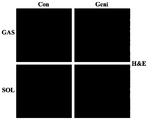
- Con is the blank control group;
- Geni is the geniposide treatment group.
- the proportion of type I muscle fibers in the SDH-stained GAS results was calculated.
- the data were expressed as mean ⁇ standard error, and each group was replicated three times in parallel. Compared with the control, *, P ⁇ 0.05; **, P ⁇ 0.01; ***, P ⁇ 0.001 (T test).
- FIG. 5 Real-time quantitative PCR (RT-qPCR) to detect mRNA expression levels of four MyHC subtypes MyHC-I, MyHC-IIa, MyHC-IIx, MyHC-IIb, slow muscle marker genes MB and Tnni1 in mouse skeletal muscle GAS. Data are expressed as mean ⁇ standard error, with three replicates per group. Compared with the control, *, P ⁇ 0.05; **, P ⁇ 0.01; ***, P ⁇ 0.001 (T test). Con is the blank control group; Geni is the geniposide treatment group.
- Figure 6C2C12 cells were differentiated for 2 days, and the cells were stimulated with 0.2 mg / mL genipin. After 12 hours, the cells were fixed and immunofluorescence was performed with Anti-myosin-fast (A) and Anti-myosin-slow (B) antibodies, respectively. For detection, use a fluorescence microscope to randomly capture the field of view under a 10X microscope. The selected field of view is representative. Con is the blank control group; Geni is the geniposide treatment group.
- FIG. 7 (A) C2C12 myotubes were stimulated with Genipin at different concentrations (0, 0.0125, 0.025, 0.05, 0.1, 0.2 mg / mL) for 12 h, RNA was extracted, and MyHC-I and MyHC- were analyzed by RT-qPCR. MRNA levels of IIa, MyHC-IIx, MyHC-IIb. (B) C2C12 myotube cells were treated with 0.4 mg / mL genipin for 0, 1, 2, 4, 8, and 12 h, respectively, and RNA was extracted. , MyHC-IIb mRNA level. Con is the blank control group; Geni is the geniposide treatment group. Data are expressed as mean ⁇ standard error, with three replicates per group. Compared with the control, *, P ⁇ 0.05; **, P ⁇ 0.01; ***, P ⁇ 0.001 (T test).
- mice used in the experiments were kept in SPF (Specific Pathogen-free) animal rooms for 6-8 weeks, and the animals could eat and drink freely (provided by Shanghai Slack Experimental Animal Center).
- the animal room was kept at a constant temperature of 22 ⁇ 3 ° C and a relative humidity of 35 ⁇ 5%.
- the 12-hour cycle was a day and night cycle.
- the use and operation of model animals are strictly in accordance with the regulations of the Animal Management and Use Committee of the School of Food Science and Technology of Jiangnan University.
- the male rats After the male rats have adapted to the new environment, they are randomly divided into two groups, the blank group and the treatment group. The blank group did not do any treatment.
- the treatment group was injected with geniposide standard (25 mg / kg) daily according to body weight (Figure 1) for 21 consecutive days. After 21 days, all mice were sacrificed, and the gastrocnemius muscle (GAS), soleus muscle (SOL), and tibialis anterior muscle (TA) in the left and right hind limbs were taken. The sections were used for omics analysis, and the remaining tissues were immediately frozen with liquid nitrogen and stored at -80 ° C for subsequent RNA extraction.
- GAS gastrocnemius muscle
- SOL soleus muscle
- TA tibialis anterior muscle
- C2C12 mouse myoblasts were cultured in a cell incubator at 37 ° C, 5% CO 2 , and grown in DMEM medium containing 10% fetal bovine serum (FBS) and 1% double antibody (P / S).
- FBS fetal bovine serum
- P / S double antibody
- HS horse serum
- C2C12 cells were differentiated on the 4th day, most of the myoblasts had differentiated into myotubes, then C2C12 cells were treated with genipin.
- Concentration gradient The cells were stimulated with 0, 0.0125, 0.025, 0.05, 0.1, 0.2 mg / mL genipin for 12 h.
- Time gradient C2C12 myotubes were treated with 0.4 mg / mL genipin for 0, 1, 2, 4, 8, 12 h.
- Immunofluorescence staining On the second day of C2C12 cell differentiation, stimulate cells with 0.2 mg / mL genipin for 12 hours, wash the culture solution, add methanol to fix, and then rinse 3 times with phosphate buffered saline (PBS) 10 minutes. A 3% bovine serum albumin (BSA) PBS solution was prepared, and polyethylene glycol octylphenyl ether (Triton X-100) was added to a final concentration of 0.1% to permeabilize the cells, and the cells were blocked at room temperature for 1 hour. Wash 3 times with PBS. Add Fast-Myosin-fast or Slow-Myosin-slow diluted at the appropriate ratio and bind overnight at 4 ° C.
- BSA bovine serum albumin
- Hematoxylin and eosin staining (HE), succinate dehydrogenase staining (SDH), and adenosine triphosphatase staining (ATPase) were used to observe the blank control group and the genipin treatment group in frozen sections of GAS and SOL tissues. happening. Observe the section with an inverted optical microscope.
- 2.1 Geniposide can change skeletal muscle fiber typing
Landscapes
- Health & Medical Sciences (AREA)
- Life Sciences & Earth Sciences (AREA)
- Chemical & Material Sciences (AREA)
- Engineering & Computer Science (AREA)
- Animal Behavior & Ethology (AREA)
- Veterinary Medicine (AREA)
- Nutrition Science (AREA)
- Food Science & Technology (AREA)
- Polymers & Plastics (AREA)
- Medicinal Chemistry (AREA)
- Pharmacology & Pharmacy (AREA)
- Public Health (AREA)
- Molecular Biology (AREA)
- General Health & Medical Sciences (AREA)
- Epidemiology (AREA)
- Mycology (AREA)
- Bioinformatics & Cheminformatics (AREA)
- Neurology (AREA)
- Orthopedic Medicine & Surgery (AREA)
- Physical Education & Sports Medicine (AREA)
- Chemical Kinetics & Catalysis (AREA)
- General Chemical & Material Sciences (AREA)
- Nuclear Medicine, Radiotherapy & Molecular Imaging (AREA)
- Organic Chemistry (AREA)
- Pharmaceuticals Containing Other Organic And Inorganic Compounds (AREA)
Abstract
京尼平苷在促进骨骼肌快肌生成中的应用,所述京尼平苷的来源包括:栀子粕、栀子果、杜仲、地黄、牛膝、白花蛇舌草、黄连解毒汤。用于促进骨骼肌快肌生成的食品,将京尼平苷制成食品,或将京尼平苷添加到饮料或蛋白粉中。用于促进骨骼肌快肌生成的化合物或组合物,将京尼平苷制成气雾剂或敷料。
Description
本发明涉及京尼平苷在促进骨骼肌快肌生成中的应用,属于天然产物治疗领域。
骨骼肌是人体直接参与运动的器官,约占人体总重量的40%-50%,也是人体最大的组织,人体的运动和姿态维持,都离不开其功能的正常发挥。骨骼肌又可称为横纹肌,人体大约有600多块骨骼肌。骨骼肌细胞呈纤维状,不分支,有明显横纹,核很多,且都位于细胞膜下方。肌细胞内有许多沿细胞长轴平行排列的细丝状肌原纤维。运动系统的最基本功能单位,也称运动单元,是由运动神经元和一束肌纤维组成,其中肌纤维具有相似、但不完全相同的结构和功能。许多(从几十到几百)的运动单元组装在一起,从而构成一块完整的骨骼肌,其中每一运动单元都有着自己特殊且唯一的作用。肌肉组装所用的运动单元都是特殊选择的,这样保证肌肉可以最好的完成运动功能所需的所有要求。肌纤维的异质性是骨骼肌强大适应能力的基础,同一块骨骼肌需要适应不同的运动要求,例如持续性低强度的活动(维持身体姿态);重复性中强度的运动(身体的运动);以及短时间极高强度的活动(跳远、踢)。另外,肌纤维结构和功能的性质,也称为肌纤维表型。
骨骼肌纤维按形态和功能可以分为快肌纤维和慢肌纤维。从代谢特征上区别,慢肌纤维有氧氧化能力较高,表现为线粒体数量多,体积大,氧化酶活性较高,依赖氧化磷酸化持续产生ATP,脂质是这类纤维的首选供能原料,甘油三酯含量高,毛细血管丰富,肌红蛋白含量高。而肌肉需要短时间内高频率收缩时快肌纤维被激活。快肌纤维无氧代谢能力较高,表现为肌纤维中参与无氧氧化过程酶的活性较慢肌纤维高,肌糖原含量较高。不同肌纤维在同一肌肉中所占的数量百分比称为肌纤维类型的百分组成。两类肌纤维百分组成与某些基本素质关系密切。慢肌百分组成与一般耐力和力量耐力有关;而快肌百分组成与速度、爆发力有关。
随着近年来研究的深入,骨骼肌肌纤维类型是由肌球蛋白重链(MyHC)亚型来决定的。MyHC基因家族又称肌球蛋白重链基因家族,是骨骼肌纤维中最重要的肌原纤维蛋白之一,是肌肉收缩的主要功能蛋白,维持肌细胞结构的完整性,它的基因表达已经成为肌肉纤维类型划分的主要分子标记。肌肉所含肌球蛋白的亚型不同,即表现出不同的收缩能力和ATPase活性,并且首先在人和哨齿类动物上确定了特定的肌纤维类型与四种肌纤维肌球蛋白重链(myosin heavy chain,MyHC)异构体中的某一种类型的对应关系。至今为止,在哺乳动物 骨骼肌中发现了八种MyHC亚型,但在成人骨骼肌中只表达了MyHC家族的Ⅰ、Ⅱa、Ⅱx和Ⅱb型,它们分别对应I型(慢速氧化型)、Ⅱa型(快速氧化型)、Ⅱx型(中间型)和Ⅱb型(快速酵解型)4种肌纤维类型,代谢类型从氧化到酵解过渡,收缩速度依次增加。在锻炼过程中,肌纤维类型可以转变。有研究表明,在骨骼肌急性挫伤模型中,MyHC-Ⅱb的表达升高,可以促进新骨骼肌生成。Ⅱb型纤维含量较高的骨骼肌的直径往往较大。高比例的MyHC-Ⅱb有助于增加肌肉质量。快肌质量的增加可以通过改变远程组织中脂肪酸氧化能力来引起肥胖的衰退并且改善代谢情况,力量训练可能特别有利于肥胖人群。更有研究指出,骨骼肌中氧化向糖酵解代谢转变在糖尿病状态下具有潜在益处,可以提高葡萄糖稳态。在老年人中MyHC-Ⅱb往往会缺失,这表明骨骼肌的组成与衰老相关的肌肉功能丧失和肌肉疾病有关。虽然肌纤维的最大收缩速度主要由肌球蛋白的ATP酶来决定,但其最大力量则主要由肌纤维的横截面积来决定。
栀子果是茜草科栀子属植物栀子Gardenia jasminoides Ellis的成熟果实,主要分布在热带、亚热带地区,在中国其产量约占世界总产量的90%。栀子果是卫生部颁布的首批药食两用资源,常用来做中药、食品添加剂、食用色素、榨油等,具有消炎、镇痛、保肝利胆、抗氧化等功效。其主要活性成分包含环烯醚萜、藏红花苷类,环烯醚萜类主要以京尼平苷为主,藏红花苷类主要以藏红花素为主。京尼平苷是栀子众多药理活性的物质基础之一,含量随产地的不同主要在3–9%,其结构式如图1所示。迄今为止,京尼平苷在促进骨骼肌快肌生成的作用方面还未见报道。
发明内容
本发明提供了京尼平苷的新用途,京尼平苷可用于促进骨骼肌快肌的生成,所述骨骼肌快肌为骨骼肌肌纤维中的Ⅱ型肌纤维;所述促进骨骼肌快肌生成是指在一定剂量和时间范围内,成肌细胞和骨骼肌组织中II型肌纤维增加,包括其他肌纤维转变为II型肌纤维、II型肌纤维质量增加或II型肌纤维面积增大的至少一种。
所述京尼平苷的来源包括:栀子粕、栀子果、杜仲,地黄、牛膝、白花蛇舌草、黄连解毒汤等。应用所述京尼平苷时,将京尼平苷与药学上接受的辅料混合得到混合物;所述药学上接受的辅料,包括溶剂、抛射剂、增溶剂、助溶剂、乳化剂、着色剂、黏合剂、崩解剂、填充剂、润滑剂、润湿剂、渗透压调节剂、稳定剂、助流剂、矫味剂、防腐剂、助悬剂、包衣材料、芳香剂、抗黏合剂、整合剂、渗透促进剂、pH值调节剂、缓冲剂、增塑剂、表面活性剂、发泡剂、消泡剂、增稠剂、包合剂、保湿剂、吸收剂、稀释剂、絮凝剂与反絮凝剂、助滤剂、释放阻滞剂等。或者,将京尼平苷或其组合物制成气雾剂或者敷料。或者,将京尼 平苷制备成适用于参加短距离剧烈运动的人的食品,所述食品包括运动饮料、蛋白粉。
本发明还提供了用于促进骨骼肌快肌生成的化合物或者组合物,所述化合物为京尼平苷,所述组合物为含有京尼平苷的组合物。所述骨骼肌快肌为骨骼肌肌纤维中的一类,即Ⅱ型肌纤维,也叫白肌。骨骼肌快肌的糖代谢是以糖酵解为主。骨骼肌快肌在腓肠肌中含量较多,主要在短距离无氧运动中起作用。所述促进骨骼肌快肌生成是指在一定剂量和时间范围内,成肌细胞和骨骼肌组织中I型肌纤维(慢肌)减少、II型肌纤维(快肌)增加,和/或肌纤维类型发生转化,和/或使肌肉质量增加、肌纤维面积增大。促进骨骼肌快肌生成有利于在短期运动中发挥主要作用。
所述京尼平苷的来源可以是:栀子粕、栀子果、杜仲,地黄、牛膝、白花蛇舌草、黄连解毒汤等。所述组合物,还包括药学上接受的辅料,包括溶剂、抛射剂、增溶剂、助溶剂、乳化剂、着色剂、黏合剂、崩解剂、填充剂、润滑剂、润湿剂、渗透压调节剂、稳定剂、助流剂、矫味剂、防腐剂、助悬剂、包衣材料、芳香剂、抗黏合剂、整合剂、渗透促进剂、pH值调节剂、缓冲剂、增塑剂、表面活性剂、发泡剂、消泡剂、增稠剂、包合剂、保湿剂、吸收剂、稀释剂、絮凝剂与反絮凝剂、助滤剂、释放阻滞剂等。
所述化合物或者组合物,还可以用于制备短距离运动所需运动食品,例如功能性饮料、功能性饼干。
本发明通过腹腔注射京尼平苷标品对小鼠进行给药处理,从切片染色和qPCR结果来看,给药组的快肌肌纤维数目明显多于对照组,Ⅰ型纤维相关基因表达明显减少,Ⅱ型纤维相关基因显著增加,改变了骨骼肌肌纤维分型。本发明继续在体外实验中进行验证,用京尼平苷标品刺激分化的C2C12成肌细胞,从免疫荧光结果来看,与空白对照组相比,京尼平苷的处理可以增加快肌肌纤维数目。因此,我们认为京尼平苷有促进骨骼肌快肌生成的作用,具有应用于短距离运动食品的潜在作用。
图1京尼平苷的化学结构式。
图2对小鼠骨骼肌腓肠肌、比目鱼肌(GAS、SOL)进行苏木精与伊红(HE)染色(n=3)(显微镜20倍,20X),Con为空白对照组;Geni为京尼平苷(geniposide)处理组。
图3对小鼠骨骼肌的GAS部分进行琥珀酸脱氢酶(SDH)染色(n=3)(20X),Con为空白对照组;Geni为京尼平苷(geniposide)处理组。对于SDH染色GAS结果中I型肌纤维的比例进行统计,数据用平均值±标准误表示,每组三次平行。与对照相比,*,P<0.05;**,P<0.01;***,P<0.001(T检验)。
图4(A)对小鼠骨骼肌GAS部分进行腺苷三磷酸酶(ATPase)染色(PH=4.3)(n=3)(20X),对于ATPase染色GAS结果中I型肌纤维的比例进行统计;(B)对小鼠骨骼肌SOL部分进行ATPase染色(PH=4.3)(n=3)(20X),对于ATPase染色SOL结果中I型肌纤维的比例进行统计;(C)对小鼠骨骼肌GAS部分进行ATPase染色(PH=10.5)(n=3)(20X),对于ATPase染色GAS结果中I型肌纤维的比例进行统计;(D)对小鼠骨骼肌SOL部分进行ATPase染色(PH=10.5)(n=3)(20X),对于ATPase染色SOL结果中I型肌纤维的比例进行统计。Con为空白对照组;Geni为geniposide处理组,与对照相比,*,P<0.05;**,P<0.01;***,P<0.001(T检验),每组三次平行。
图5实时定量PCR(RT-qPCR)检测小鼠骨骼肌GAS中MyHC四种亚型MyHC-Ⅰ、MyHC-Ⅱa、MyHC-Ⅱx、MyHC-Ⅱb、慢肌标志基因MB和Tnni1的mRNA表达水平,数据用平均值±标准误表示,每组三次平行。与对照相比,*,P<0.05;**,P<0.01;***,P<0.001(T检验)。Con为空白对照组;Geni为geniposide处理组。
图6C2C12细胞分化2天后,用0.2mg/mL的京尼平苷刺激细胞,12h后,固定细胞,分别用Anti-myosin-fast(A)和Anti-myosin-slow(B)的抗体进行免疫荧光检测,用荧光显微镜在10X镜下随机拍摄视野,图中所选视野具有代表性。Con为空白对照组;Geni为geniposide处理组。
图7(A)用不同浓度(0,0.0125,0.025,0.05,0.1,0.2mg/mL)的京尼平苷刺激C2C12肌管细胞12h,提取RNA,用RT-qPCR分析MyHC-Ⅰ、MyHC-Ⅱa、MyHC-Ⅱx、MyHC-Ⅱb的mRNA水平。(B)用0.4mg/mL的京尼平苷分别处理C2C12肌管细胞0、1、2、4、8、12h,提取RNA,用RT-qPCR分析MyHC-Ⅰ、MyHC-Ⅱa、MyHC-Ⅱx、MyHC-Ⅱb的mRNA水平。Con为空白对照组;Geni为geniposide处理组。数据用平均值±标准误表示,每组三次平行。与对照相比,*,P<0.05;**,P<0.01;***,P<0.001(T检验)。
实施例1京尼平苷促进骨骼肌快肌生成作用的验证
1实验方法
1.1动物实验
实验中所用6-8周的雄鼠饲养在SPF(无特定病原体)级动物房中,动物可以自由进食和饮水(由上海斯莱克实验动物中心提供)。动物房保持恒温22±3℃,相对湿度35±5%,12小时为周期昼夜循环。模式动物的使用和操作均严格按照江南大学食品科学与技术学院动物管理和使用委员会的规程进行。
待雄鼠适应了新环境之后,将其随机分为两组,空白组和处理组。空白组不做任何处理,处理组要根据体重每天注射京尼平苷标品(25mg/kg)(图1),连续21天。21天过后,处死所有小鼠,取左右后肢中的腓肠肌(GAS)、比目鱼肌(SOL)、胫骨前肌(TA),将右腿GAS、SOL固定在黄蓍树胶中进行快速冷冻再进行冰冻切片用于组学分析,其余组织用液氮立即冷冻,再放入-80℃保存用于之后RNA的提取。
1.2细胞培养、细胞处理、免疫荧光
C2C12小鼠成肌细胞置于37℃、5%CO
2的细胞培养箱中培养,生长在含有10%胎牛血清(FBS)和1%的双抗(P/S)的DMEM培养基中。C2C12细胞诱导分化为肌纤维时,需要将细胞培养基中FBS的成分更换为2%马血清(HS)即可。
待C2C12细胞分化第4天,成肌细胞大部分已经分化为肌管后,对C2C12细胞进行京尼平苷刺激处理。浓度梯度:用0、0.0125、0.025、0.05、0.1、0.2mg/mL的京尼平苷分别刺激细胞12h。时间梯度:用0.4mg/mL的京尼平苷分别处理C2C12肌管细胞0、1、2、4、8、12h。
免疫荧光染色:待C2C12细胞分化第2天,用0.2mg/mL的京尼平苷刺激细胞12h后,洗掉培液,加入甲醇固定,然后磷酸缓冲盐溶液(PBS)漂洗3次,每次10分钟。配制3%牛血清蛋白(BSA)的PBS溶液,加入终浓度为0.1%的聚乙二醇辛基苯基醚(Triton X-100)对细胞透化处理,室温封闭细胞1小时。PBS洗涤3次。加入按照适当比例稀释的快肌一抗Anti-myosin-fast或慢肌一抗Anti-myosin-slow,4℃结合过夜。一抗结合后,用PBS漂洗3次,加入二抗在室温下结合1小时,二抗结合过程中需要避光。再次漂洗,用4',6-二脒基-2-苯基吲哚(DAPI)对细胞核进行染色,PBS漂洗3次。在倒置荧光显微镜下观察样品,并拍摄照片。
1.3RNA提取和实时定量荧光PCR
使用Trizol试剂从C2C12细胞和组织样品中提取总RNA,并用Nanodrop对RNA浓度进行测定。使用Prime Script RT系统(Takara)合成第一链cDNA。实时定量PCR在ABI STEP-ONE7900 RT-PCR系统上进行。每个样品做三次平行。
表1 PT-PCR引物序列

1.4组学分析
使用苏木精和伊红染色(HE)、琥珀酸脱氢酶染色(SDH)和腺苷三磷酸酶染色(ATPase)观察GAS和SOL组织冰冻切片中空白对照组与京尼平苷处理组的情况。用倒置光学显微镜来观察切片。
2实验结果
2.1京尼平苷可以改变骨骼肌肌纤维分型
从图2中HE染色来看,京尼平苷的处理没有破坏小鼠骨骼肌肌纤维形态。SDH染色,Ⅰ型肌纤维(慢肌)呈深蓝色,Ⅱ型肌纤维(快肌)浅蓝色。由图3可知,GAS中京尼平苷组Ⅰ型肌纤维比例显著下降。接着我们用ATPase染色技术,对不同的肌肉进行了分型鉴定,并统计出其中的I型肌纤维的比例(图4)。在酸性的缓冲液条件下(pH=4.3)I型肌纤维将呈现黑色(图4A和图4B),而在碱性的缓冲液条件下(pH=10.5)II型肌纤维将呈现黑色(图4C和图4D)。从结果可以直观发现,不管是在GAS中还是在SOL中,京尼平苷的处理可以显著降低骨骼肌肌纤维中慢肌肌纤维的数量。
我们进一步检测GAS中相关肌纤维的基因表达变化。图5的结果显示,京尼平苷可以显著抑制慢肌相关基因(MyHC-Ⅰ、MB、Tnni1)表达,促进快肌相关基因(MyHC-Ⅱa、MyHC-Ⅱb、MyHC-Ⅱx)表达。因此我们认为,京尼平苷在体内可以改变骨骼肌肌纤维分型,导致肌纤维类型“慢→快”的转换,有助于维持快肌肌纤维的生理特性。
2.2京尼平苷对细胞系统中肌纤维类型的调控
为了进一步研究京尼平苷对肌纤维类型的改变,我们应用免疫荧光方法来标记不同类型的肌管。图6中,在分化2天的C2C12中进行京尼平苷的刺激能够显著增加快肌类型的肌管数目,同时减少慢肌类型的肌管数目。而且我们在C2C12细胞中重复了定量PCR的实验,用浓度梯度(图7A)和时间梯度(图7B)对细胞进行京尼平苷刺激,结果与体内实验得到结论基本一致,随着京尼平苷浓度上升(0.2mg/mL)和刺激时间增长(12h),慢肌基因 MyHC-Ⅰ表达显著降低,快肌基因MyHC-Ⅱb表达显著增加。我们得出结论,京尼平苷在体外也可以引起肌纤维类型“慢→快”的转换。


Claims (12)
- 京尼平苷的应用,其特征在于,用于促进骨骼肌快肌生成,所述骨骼肌快肌为骨骼肌肌纤维中的Ⅱ型肌纤维;所述促进骨骼肌快肌生成是指在一定剂量和时间范围内,成肌细胞和骨骼肌组织中II型肌纤维增加,包括其他肌纤维转变为II型肌纤维、II型肌纤维质量增加或II型肌纤维面积增大的至少一种。
- 根据权利要求1所述的应用,其特征在于,所述京尼平苷的来源包括:栀子粕、栀子果、杜仲,地黄、牛膝、白花蛇舌草、黄连解毒汤等。
- 根据权利要求1或2所述的应用,其特征在于,应用所述京尼平苷时,将京尼平苷与药学上接受的辅料混合得到混合物;所述药学上接受的辅料,包括溶剂、抛射剂、增溶剂、助溶剂、乳化剂、着色剂、黏合剂、崩解剂、填充剂、润滑剂、润湿剂、渗透压调节剂、稳定剂、助流剂、矫味剂、防腐剂、助悬剂、包衣材料、芳香剂、抗黏合剂、整合剂、渗透促进剂、pH值调节剂、缓冲剂、增塑剂、表面活性剂、发泡剂、消泡剂、增稠剂、包合剂、保湿剂、吸收剂、稀释剂、絮凝剂与反絮凝剂、助滤剂、释放阻滞剂等。
- 根据权利要求3所述的应用,其特征在于,将混合物制成气雾剂或者敷料。
- 根据权利要求1或2所述的应用,其特征在于,将京尼平苷制备成食品,所述食品适用于参加短距离剧烈运动的人。
- 根据权利要求5所述的应用,其特征在于,所述食品包括运动饮料、蛋白粉。
- 用于促进骨骼肌快肌生成的食品,其特征在于,将京尼平苷制备成食品。
- 根据权利要求7所述的食品,其特征在于,将京尼平苷添加到运动饮料或蛋白粉中。
- 用于促进骨骼肌快肌生成的化合物或者组合物,其特征在于,所述化合物为京尼平苷或者具有促进骨骼肌快肌生成作用的京尼平苷的衍生物,所述组合物为含有京尼平苷或者具有促进骨骼肌快肌生成作用的京尼平苷的衍生物的组合物。
- 根据权利要求9所述的化合物或者组合物,其特征在于,所述京尼平苷的来源包括:栀子粕、栀子果、杜仲,地黄、牛膝、白花蛇舌草、黄连解毒汤等。
- 根据权利要求9或10所述的化合物或者组合物,其特征在于,所述组合物包含药学上接受的辅料,所述药学上接受的辅料,包括溶剂、抛射剂、增溶剂、助溶剂、乳化剂、着色剂、黏合剂、崩解剂、填充剂、润滑剂、润湿剂、渗透压调节剂、稳定剂、助流剂、矫味剂、防腐剂、助悬剂、包衣材料、芳香剂、抗黏合剂、整合剂、渗透促进剂、pH值调节剂、缓冲剂、增塑剂、表面活性剂、发泡剂、消泡剂、增稠剂、包合剂、保湿剂、吸收剂、稀释剂、絮凝剂与反絮凝剂、助滤剂、释放阻滞剂等。
- 根据权利要求11所述的化合物或者组合物,其特征在于,是气雾剂或者敷料。
Applications Claiming Priority (2)
| Application Number | Priority Date | Filing Date | Title |
|---|---|---|---|
| CN201810960478.7 | 2018-08-22 | ||
| CN201810960478.7A CN108685934B (zh) | 2018-08-22 | 2018-08-22 | 京尼平苷在促进骨骼肌快肌生成中的应用 |
Publications (1)
| Publication Number | Publication Date |
|---|---|
| WO2020037895A1 true WO2020037895A1 (zh) | 2020-02-27 |
Family
ID=63841246
Family Applications (1)
| Application Number | Title | Priority Date | Filing Date |
|---|---|---|---|
| PCT/CN2018/120798 Ceased WO2020037895A1 (zh) | 2018-08-22 | 2018-12-13 | 京尼平苷在促进骨骼肌快肌生成中的应用 |
Country Status (2)
| Country | Link |
|---|---|
| CN (1) | CN108685934B (zh) |
| WO (1) | WO2020037895A1 (zh) |
Cited By (1)
| Publication number | Priority date | Publication date | Assignee | Title |
|---|---|---|---|---|
| KR20220099917A (ko) * | 2021-01-07 | 2022-07-14 | 한국식품연구원 | 치자 추출물을 유효성분으로 포함하는 근육 질환 예방, 개선 또는 치료용 조성물 |
Families Citing this family (4)
| Publication number | Priority date | Publication date | Assignee | Title |
|---|---|---|---|---|
| CN108685934B (zh) * | 2018-08-22 | 2020-01-07 | 江南大学 | 京尼平苷在促进骨骼肌快肌生成中的应用 |
| CN113455588A (zh) * | 2021-06-15 | 2021-10-01 | 浙江大学 | Dha作为饲料添加剂在调控肌纤维类型中的新用途 |
| CN116173093B (zh) * | 2022-07-26 | 2024-05-14 | 浙江大学 | 杜仲雄花提取物在制备抗肌肉衰老的食品或药物中的应用 |
| CN118452320B (zh) * | 2024-05-21 | 2025-02-18 | 内蒙古农业大学 | 阿魏酸在促进蒙古马肌肉纤维类型转变中的应用 |
Citations (6)
| Publication number | Priority date | Publication date | Assignee | Title |
|---|---|---|---|---|
| CN101548980A (zh) * | 2008-04-02 | 2009-10-07 | 山东靶点药物研究有限公司 | 京尼平苷及其衍生物、类似物在制备预防和/或治疗抑郁焦虑药物中的用途 |
| CN102908356A (zh) * | 2012-09-20 | 2013-02-06 | 中国科学院近代物理研究所 | 京尼平苷的应用 |
| CN103284942A (zh) * | 2012-03-02 | 2013-09-11 | 中国药科大学 | 一种高渗透性消炎镇痛乳膏 |
| CN103860575A (zh) * | 2014-04-03 | 2014-06-18 | 重庆理工大学 | 京尼平苷作为乙酰胆碱酯酶抑制剂的应用 |
| CN108464986A (zh) * | 2018-03-20 | 2018-08-31 | 江南大学 | 京尼平苷在缓解骨骼肌纤维化中的应用 |
| CN108685934A (zh) * | 2018-08-22 | 2018-10-23 | 江南大学 | 京尼平苷在促进骨骼肌快肌生成中的应用 |
-
2018
- 2018-08-22 CN CN201810960478.7A patent/CN108685934B/zh active Active
- 2018-12-13 WO PCT/CN2018/120798 patent/WO2020037895A1/zh not_active Ceased
Patent Citations (6)
| Publication number | Priority date | Publication date | Assignee | Title |
|---|---|---|---|---|
| CN101548980A (zh) * | 2008-04-02 | 2009-10-07 | 山东靶点药物研究有限公司 | 京尼平苷及其衍生物、类似物在制备预防和/或治疗抑郁焦虑药物中的用途 |
| CN103284942A (zh) * | 2012-03-02 | 2013-09-11 | 中国药科大学 | 一种高渗透性消炎镇痛乳膏 |
| CN102908356A (zh) * | 2012-09-20 | 2013-02-06 | 中国科学院近代物理研究所 | 京尼平苷的应用 |
| CN103860575A (zh) * | 2014-04-03 | 2014-06-18 | 重庆理工大学 | 京尼平苷作为乙酰胆碱酯酶抑制剂的应用 |
| CN108464986A (zh) * | 2018-03-20 | 2018-08-31 | 江南大学 | 京尼平苷在缓解骨骼肌纤维化中的应用 |
| CN108685934A (zh) * | 2018-08-22 | 2018-10-23 | 江南大学 | 京尼平苷在促进骨骼肌快肌生成中的应用 |
Non-Patent Citations (3)
| Title |
|---|
| PAN, HAIOU ET AL.: "Effects of Geniposide from Gardenia Fruit Pomace on Skeletal-Muscle Fibrosis", JOURNAL OF AGRICULTURAL AND FOOD CHEMISTRY, 13 June 2018 (2018-06-13), pages 5802 - 5811, XP055687486 * |
| QI, YAJING ET AL.: "Research Progress in Functional Ingredients in the Fruit of Gardenia Jasminoides Ellis", SCIENCE AND TECHNOLOGY OF FOOD INDUSTRY, vol. 34, no. 14, 31 December 2013 (2013-12-31), pages 363 - 369 * |
| WANG, LI ET AL.: "Functional Components in the Fruit of Gardenia Jasminoides Ellis and Their Application", FOOD AND MACHINERY, vol. 34, no. 7, 31 July 2018 (2018-07-31), pages entire document * |
Cited By (3)
| Publication number | Priority date | Publication date | Assignee | Title |
|---|---|---|---|---|
| KR20220099917A (ko) * | 2021-01-07 | 2022-07-14 | 한국식품연구원 | 치자 추출물을 유효성분으로 포함하는 근육 질환 예방, 개선 또는 치료용 조성물 |
| WO2022149901A1 (ko) * | 2021-01-07 | 2022-07-14 | 한국식품연구원 | 치자 추출물을 유효성분으로 포함하는 근육 질환 예방, 개선 또는 치료용 조성물 |
| KR102686892B1 (ko) * | 2021-01-07 | 2024-07-22 | 한국식품연구원 | 치자 추출물을 유효성분으로 포함하는 근육 질환 예방, 개선 또는 치료용 조성물 |
Also Published As
| Publication number | Publication date |
|---|---|
| CN108685934A (zh) | 2018-10-23 |
| CN108685934B (zh) | 2020-01-07 |
Similar Documents
| Publication | Publication Date | Title |
|---|---|---|
| CN108685934B (zh) | 京尼平苷在促进骨骼肌快肌生成中的应用 | |
| Liu et al. | Total saponins of Panax notoginseng enhance VEGF and relative receptors signals and promote angiogenesis derived from rat bone marrow mesenchymal stem cells | |
| Tachibana et al. | Pavoninins: shark-repelling ichthyotoxins from the defense secretion of the Pacific sole | |
| CN105722974B (zh) | 全能干细胞的诱导方法、及用该方法制备的全能干细胞 | |
| Tan et al. | Ginsenoside Rb1 improves energy metabolism in the skeletal muscle of an animal model of postoperative fatigue syndrome | |
| TWI830696B (zh) | 抑制肌纖維變性用組成物 | |
| CN114557998A (zh) | 一种抗鱼类疾病的原花青素类抑制剂及其制备方法 | |
| KR101241050B1 (ko) | 인삼열매 추출물을 함유하는 남성 성기능 개선용 조성물 | |
| CN102670978B (zh) | 一种黄精复方颗粒剂及其制备方法 | |
| WO2015190872A1 (ko) | 스피루리나 추출물을 유효성분으로 함유하는 비만 예방 및 치료용 약학적 조성물 | |
| CN116173093B (zh) | 杜仲雄花提取物在制备抗肌肉衰老的食品或药物中的应用 | |
| US20250073298A1 (en) | Composition comprising homogeneous polysaccharide or derivative thereof and method of using the same to improve muscle satellite cells | |
| JP2020040884A (ja) | アーティチョーク葉抽出物又はシナロピクリンを含む、筋肉細胞におけるエネルギー代謝の活性化による抗疲労用組成物 | |
| CN109864964B (zh) | 一种包含干细胞的抗衰老组合物及其应用 | |
| KR20210132050A (ko) | I형 콜라겐 또는 엘라스틴의 산생 촉진제 | |
| Nakamura et al. | Hemolymph patterns of free amino acids in the brine shrimp Artemia franciscana after three days starvation at different salinities | |
| CN1634910A (zh) | 注射用淫羊藿总黄酮的制备方法 | |
| JP2015202066A (ja) | 筋芽細胞分化促進食品及びその製法 | |
| US20230084354A1 (en) | Nutraceutical extracts of hippophae rhamnoides and terminalia chebula and uses thereof | |
| Kim et al. | Weissella confusa WiKim51 (Wilac D001) fermented mycelium extract attenuates joint inflammation through PGE2 regulation in collagen-induced arthritis rats | |
| Hussin et al. | Long-term Food Additive Monosodium Glutamate Induces the Differentiation of Pancreatic Adipose Tissue into newly Formed Islets of Langerhans | |
| Kocięcka et al. | The effect of Thymus Factor X (TFX Polfa) on the clinical course of human trichinellosis | |
| CN116898872A (zh) | 刺梨果多糖在制备预防或治疗心肌缺血药物中的应用 | |
| CN118267393A (zh) | 用于干细胞培养的小分子化合物 | |
| CN114098074A (zh) | 羟基红花黄色素a在增强耐力中的应用 |
Legal Events
| Date | Code | Title | Description |
|---|---|---|---|
| 121 | Ep: the epo has been informed by wipo that ep was designated in this application |
Ref document number: 18930979 Country of ref document: EP Kind code of ref document: A1 |
|
| NENP | Non-entry into the national phase |
Ref country code: DE |
|
| 122 | Ep: pct application non-entry in european phase |
Ref document number: 18930979 Country of ref document: EP Kind code of ref document: A1 |