WO2020032215A1 - 消臭剤組成物 - Google Patents
消臭剤組成物 Download PDFInfo
- Publication number
- WO2020032215A1 WO2020032215A1 PCT/JP2019/031506 JP2019031506W WO2020032215A1 WO 2020032215 A1 WO2020032215 A1 WO 2020032215A1 JP 2019031506 W JP2019031506 W JP 2019031506W WO 2020032215 A1 WO2020032215 A1 WO 2020032215A1
- Authority
- WO
- WIPO (PCT)
- Prior art keywords
- polyphenol
- extract
- odor
- deodorant composition
- body odor
- Prior art date
- Legal status (The legal status is an assumption and is not a legal conclusion. Google has not performed a legal analysis and makes no representation as to the accuracy of the status listed.)
- Ceased
Links
Images






Classifications
-
- A—HUMAN NECESSITIES
- A61—MEDICAL OR VETERINARY SCIENCE; HYGIENE
- A61K—PREPARATIONS FOR MEDICAL, DENTAL OR TOILETRY PURPOSES
- A61K36/00—Medicinal preparations of undetermined constitution containing material from algae, lichens, fungi or plants, or derivatives thereof, e.g. traditional herbal medicines
- A61K36/18—Magnoliophyta (angiosperms)
- A61K36/185—Magnoliopsida (dicotyledons)
- A61K36/74—Rubiaceae (Madder family)
- A61K36/742—Coffea, e.g. coffee
-
- A—HUMAN NECESSITIES
- A61—MEDICAL OR VETERINARY SCIENCE; HYGIENE
- A61K—PREPARATIONS FOR MEDICAL, DENTAL OR TOILETRY PURPOSES
- A61K31/00—Medicinal preparations containing organic active ingredients
- A61K31/045—Hydroxy compounds, e.g. alcohols; Salts thereof, e.g. alcoholates
- A61K31/05—Phenols
-
- A—HUMAN NECESSITIES
- A61—MEDICAL OR VETERINARY SCIENCE; HYGIENE
- A61K—PREPARATIONS FOR MEDICAL, DENTAL OR TOILETRY PURPOSES
- A61K31/00—Medicinal preparations containing organic active ingredients
- A61K31/21—Esters, e.g. nitroglycerine, selenocyanates
- A61K31/215—Esters, e.g. nitroglycerine, selenocyanates of carboxylic acids
- A61K31/216—Esters, e.g. nitroglycerine, selenocyanates of carboxylic acids of acids having aromatic rings, e.g. benactizyne, clofibrate
-
- A—HUMAN NECESSITIES
- A61—MEDICAL OR VETERINARY SCIENCE; HYGIENE
- A61K—PREPARATIONS FOR MEDICAL, DENTAL OR TOILETRY PURPOSES
- A61K38/00—Medicinal preparations containing peptides
- A61K38/16—Peptides having more than 20 amino acids; Gastrins; Somatostatins; Melanotropins; Derivatives thereof
- A61K38/43—Enzymes; Proenzymes; Derivatives thereof
- A61K38/44—Oxidoreductases (1)
-
- A—HUMAN NECESSITIES
- A61—MEDICAL OR VETERINARY SCIENCE; HYGIENE
- A61P—SPECIFIC THERAPEUTIC ACTIVITY OF CHEMICAL COMPOUNDS OR MEDICINAL PREPARATIONS
- A61P17/00—Drugs for dermatological disorders
-
- A—HUMAN NECESSITIES
- A61—MEDICAL OR VETERINARY SCIENCE; HYGIENE
- A61P—SPECIFIC THERAPEUTIC ACTIVITY OF CHEMICAL COMPOUNDS OR MEDICINAL PREPARATIONS
- A61P3/00—Drugs for disorders of the metabolism
Definitions
- the present invention relates to a deodorant composition effective for suppressing body odor.
- Body odors can be broadly classified into those derived from skin surface reactions and those derived from the body. Although there have been many reports of deodorant compositions for the purpose of suppressing body odor, most of them have been reported to be deodorants due to body odor generated by a reaction on the skin surface. Body odors derived from skin surface reactions include, for example, axillary odor, foot odor, aging odor, and the like. These odors are generated by decomposing secretions, such as sebum and sweat, which do not have an odor in themselves, by indigenous skin bacteria and the like. It has an odor. Therefore, as a method of suppressing body odor due to such a skin surface reaction, a deodorant such as a roll stick or a spray type by directly applying or spraying a deodorant on the skin surface is generally used.
- a deodorant such as a roll stick or a spray type by directly applying or spraying a deodorant on the skin surface is generally used.
- body odor derived from the body is an odor generated in the body and released through the skin, and more specifically, chemical substances taken into the body are absorbed by the blood, carried by the bloodstream, and released through the skin. It is an odor derived from blood. Therefore, body odors originating from the body are caused by sulfur-containing compounds generated by the decomposition of food residues in the oral cavity by bacteria and low-molecular malodor components generated by the decomposition of food in the stomach and intestines. Therefore, the excrement itself can be distinguished from excrement odors such as fecal odor and urine odor, which cause odor.
- body odors emitted from the body through the skin include body odors caused by ingesting foods having a strong flavor such as garlic and body odors caused by fatigue.
- Patent Literature 1 describes a deodorant composition in which deodorizing efficiency is significantly improved by combining polyphenol and polyphenol oxidase.
- Patent Literature 2 describes a deodorant composition containing a plant extract and an enzyme that oxidizes a phenolic compound.
- Patent Literature 3 describes a method of suppressing the odor of animal excrement by ingesting an edible food containing a plant extract and an enzyme that oxidizes a phenolic compound.
- Patent Documents 4 to 6 disclose, as an example of body odor derived from food, a deodorant composition in which garlic-derived body odor is targeted for deodorization.
- Patent Document 7 reports on suppression of aging odor by ingesting naturally occurring polyphenols orally.
- Japanese Patent No. 3562668 Japanese Patent No. 3625976 Japanese Patent Application Laid-Open No. 2000-50814 Japanese Patent No. 4641073 Japanese Patent No. 4865905 Japanese Patent No. 5828658 Japanese Patent Application Laid-Open No. 2007-314472
- an object of the present invention is to provide a deodorant composition capable of suppressing body odor derived from the body.
- a deodorant composition which suppresses body odor derived from the body by ingestion, and which comprises polyphenol and polyphenol oxidase.
- body odor derived from the body can be effectively suppressed only by ingesting the deodorant composition of the present invention orally.
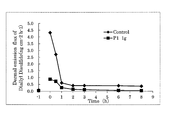
- FIG. 1 is a graph showing the measurement results of diallyl disulfide of Example 1 and Comparative Example 1.
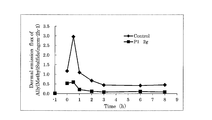
- FIG. 2 is a graph showing the measurement results of allyl methyl sulfide in Example 1 and Comparative Example 1.
- FIG. 3 is a graph showing the measurement results of diallyl disulfide of Example 2 and Comparative Example 1.
- FIG. 4 is a graph showing the measurement results of allyl methyl sulfide of Example 2 and Comparative Example 1.
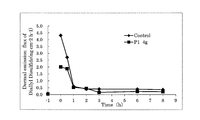
- FIG. 5 is a graph showing the measurement results of diallyl disulfide of Example 3 and Comparative Example 1.
- FIG. 6 is a graph showing the measurement results of allyl methyl sulfide of Example 3 and Comparative Example 1.
- FIG. 1 is a graph showing the measurement results of diallyl disulfide of Example 1 and Comparative Example 1.
- FIG. 2 is a graph showing the measurement results of allyl methyl sulfide in Example 1 and Comparative Example 1.
- FIG. 3 is a graph showing the measurement
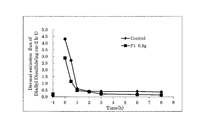
- FIG. 7 is a graph showing the measurement results of diallyl disulfide of Example 4 and Comparative Example 1.
- FIG. 8 is a graph showing the measurement results of allyl methyl sulfide of Example 4 and Comparative Example 1.
- FIG. 9 is a graph showing the measurement results of diallyl disulfide of Example 5 and Comparative Example 1.
- FIG. 10 is a graph showing the measurement results of allyl methyl sulfide of Example 5 and Comparative Example 1.
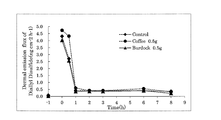
- FIG. 11 is a graph showing the measurement results of diallyl disulfide of Comparative Examples 1 to 3.
- FIG. 12 is a graph showing the results of measurement of allylmethyl sulfide in Comparative Examples 1 to 3.
- FIG. 13 is a graph showing the measurement results of ammonia in Example 6 and Comparative Example 4.
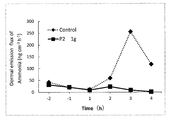
- FIG. 14 is a graph showing the measurement results of ammonia in Example 7 and Comparative Example 4.
- the present invention relates to a deodorant composition for suppressing body odor derived from the body by ingestion, and to a deodorant composition containing polyphenol and polyphenol oxidase.
- a deodorant composition containing polyphenol and polyphenol oxidase by orally ingesting a deodorant composition containing polyphenol and polyphenol oxidase, polyphenol is oxidized in vivo by the polyphenol oxidase to form a highly reactive quinone structure, and such a quinone structure compound further deodorizes. It is presumed that as a result of reacting with the substance, malodorous substances in the body are reduced and a deodorizing effect is obtained.
- the polyphenol as one component of the deodorant composition of the present invention refers to all compounds having a polyphenol structure in which at least two hydroxy groups are bonded to the same benzene ring. Polyphenols also include glycosides.
- polyphenols include, for example, apigenin, apigenin glycoside, acacetin, isorhamnetin, isorhamnetin glycoside, isoquercitrin, epicatechin, epicatechin gallate, epigallocatechin, epigallocatechin gallate, esculetin, ethyl protocate Citrate, ellagic acid, catechol, gamma acid, catechin, gardenine, gallocatechin, caffeic acid, caffeic acid ester, chlorogenic acid, kaempferol, kaempferol glycoside, quercetin, quercetin glycoside, quercetagenin, genisetin, genisetin Glycoside, gossypetin, gossypetin glycoside, gossypol, 4-dihydroxyanthraquinone, 1,4-dihydroxynaphthalene, cyanidin, cyanidin glycoside, sinensetin, diosmetin, dios, di
- those having an o-diphenol structure and / or a p-diphenol structure are particularly preferable because they can form a quinone structure upon contact with a polyphenol oxidase.
- flavonoids such as quercetin, epicatechin, and epigallocatechin and their glycosides, gallic acid, gallic acid ester, chlorogenic acid, caffeic acid, caffeic acid ester, tannic acid, pyrocatechol, nor Polyphenol compounds having an o-diphenol structure such as dihydroguaialectic acid, L-dopa, 4-methylcatechol, 5-methylcatechol, 4-methoxycatechol, 5-methoxycatechol, and hydroquinone are particularly preferred.
- Polyphenol can be prepared by a known method, but a commercially available product may be purchased or synthesized. Furthermore, a polyphenol-containing fraction prepared from a plant can also be used. Further, a plant extract containing a polyphenol can also be used. As the plant extract, one prepared by a known method may be used, or a commercially available one may be used.
- plants from which plant extracts are obtained include, for example, aloe, aniseed, elder, eleutherococ, psyllium, orange flower, allspice, oregano, valerian, camomil, capsicum pepper, cardamom, cassia, garlic, caraway seed , Clove, cumin seed, cola, coriander seed, quince, saffron, sunshaw, juniper berry, cinnamon, ginger, star anise, St.
- rosemary, sunflower seeds, grape skin, apples, carrot leaves, coffee (raw) beans, cacao (raw) beans, grape seeds, green tea leaves, black tea leaves, oolong tea leaves, perilla leaves, elder thyme, sage, spearmint, peppermint , Pears, bananas, thyme, quintessence, and gallic are preferred.
- the said plant can prepare a plant extract from single or several plants. Also, after obtaining a single plant extract, it can be mixed with a single plant extract of a different plant.
- the method for producing the plant extract is not particularly limited. The above-mentioned plant can also use the residue after using for other purposes.
- the extraction method may be any known method that achieves its purpose.
- the solvent is selected from those acceptable for food.
- examples of such a solvent include water, ethanol, propanol, butanol, acetone, hexane, propylene glycol, hydrous ethanol, hydrous propylene glycol, and the like, and hot water, hydrous ethanol, and hydrous propylene glycol are more preferable.
- the extraction method is not limited to solvent extraction, and there is no problem in supercritical extraction or the like.
- the polyphenol oxidase (phenolic compound oxidase), which is the other component of the deodorant composition of the present invention, is an enzyme having an action of oxidizing the above-mentioned polyphenol to a compound having a quinone structure, or phenol together with the action. It is an enzyme that has the action of adding a neutral hydroxyl group and oxidizing it to quinone.
- the polyphenol oxidase may be any enzyme having such an action, and examples thereof include polyphenol oxidase, monophenol oxidase, oxidase that generates hydrogen peroxide, and peroxidase. More specifically, preferred examples include laccase, tyrosinase, glucose oxidase, and peroxidase.
- a polyphenol oxidase obtained from a plant extract or a fungal extract can be used.
- the plant containing the enzyme fruits and vegetables such as apple, pear, and burdock are preferable.
- fungi containing enzymes include mushrooms of the genus Agaricus and the genus Agaricus, such as mushrooms and iris. Enzymes obtained from plant extracts are preferred from the viewpoint of ease of handling and availability, and flavor during oral ingestion.
- enzymes commercially available enzymes can be used, but they can also be prepared using known methods. Also, two or more enzymes can coexist.
- the above enzyme or enzyme-containing substance can be obtained by using a plant or fungus containing the enzyme as a raw material and treating it by a conventional method.
- a plant or fungus containing the enzyme for example, an extract from a plant containing the enzyme, an extract from a fungus containing the enzyme, or a lyophilized powder containing the extract, for example, acetone powder can be exemplified.
- the content of the enzyme or the composition containing the enzyme is also within the scope of the phenol oxidase of the present invention.
- the content of polyphenol in the deodorant composition of the present invention is preferably 2.00 mmol or less, more preferably 1.69 mmol or less, particularly preferably 0.85 mmol or less in terms of catechol.
- the lower limit of the polyphenol content is preferably 0.20 mmol or more, more preferably 0.42 mmol or more in terms of catechol, from the viewpoint of the deodorizing effect.
- the content of the polyphenol oxidase in the deodorant composition of the present invention is preferably 12.5 Units or more, more preferably 15 Units or more, from the viewpoint of deodorizing power.
- the deodorant composition of the present invention may contain other components in addition to the above-mentioned polyphenol and polyphenol oxidase as long as the effects of the present invention are not impaired.
- common additives such as carriers, stabilizers, extenders, dyes, antioxidants, fragrances and the like can be mentioned.
- the form of the deodorant composition of the present invention may be, for example, a liquid state such as a solution, a suspension, or an emulsion, a semi-solid state such as a cream, a solid form such as a powder, granules, capsules, tablets, and sheets. And any other form, and is not particularly limited.
- Polyphenol and polyphenol oxidase may be ingested in a homogeneous mixture, or polyphenol and polyphenol oxidase may be simultaneously ingested in different forms.
- the odor targeted by the body odor control method of the present invention is a body odor that originates in the body and is emitted from the skin and is emitted from the skin. More specifically, chemical substances taken into the body are absorbed by blood and transported by the bloodstream. It is a bloody odor released through the skin.
- the food odor, the body odor derived from fatigue, and the like are included in the classification. As a typical example of body odor generated in the body due to food, body odor emitted by garlic intake is known.
- Garlic (Allium sativum) is a plant of the genus Allium in the family Amaryllidaceae. It is known that ingredients belonging to the genus Allium such as garlic and leek smell because the components that are considered to be odorous substances are volatile sulfur compounds that emit an intense odor, such as diallyl disulfide and allyl methyl sulfide. I have. These substances generated by garlic intake are the main cause of bad breath and body odor through the oral mucosa and various organs. When garlic is consumed, it suffers from bad breath due to its unique and intense aroma after eating.
- a body odor containing a volatile sulfur compound such as diallyl disulfide and allyl methyl sulfide and a volatile nitrogen-containing compound such as ammonia can be effectively suppressed.
- the body odor emitted from the skin can be accurately collected and analyzed by using, for example, a skin gas collecting device (Japanese Patent No. 4654045).
- Peppermint extract Dried peppermint leaves were ground with a grinder and extracted with hot water at 85 to 95 ° C for 2 hours. The extract was filtered and the filtrate was washed three times with hexane. The aqueous layer was dried to obtain a peppermint extract.
- Grape skin extract After adding ethanol to grape skin (variety: Campbell), extraction was carried out with stirring at 70 ° C. for 2 hours. The extract was concentrated and dried to obtain a grape skin extract.
- the powder yield from the fruit was 3%.
- the enzyme specific activity was 30 Units / g. (3)
- Pear extract Using 100 g of pear, a pear extract was obtained in the same manner as in the preparation of the burdock extract. The yield was 15%.
- the enzyme specific activity was 63 Units / g.
- Apple Extract Using 100 g of apple, a pear extract was obtained in the same manner as in the preparation of the burdock extract described above. Yield was 18%.
- the enzyme specific activity was 53 Units / g.
- Reference Example 3 (mixture of enzyme and plant extract) (1) A green coffee bean extract obtained in Reference Example 1 (1) and a burdock extract obtained in Reference Example 2 (1) were mixed in an equal amount, and the mixture was passed through a mesh of 60 to obtain a sample P1. (2) A green coffee bean extract obtained in Reference Example 1 (1) and a prune extract obtained in Reference Example 2 (2) were mixed in equal amounts, and the mixture was subjected to a mesh pass to obtain a sample P2.
- Table 1 shows the deodorizing effect for each malodorous component.
- Sample P1 showed an excellent deodorizing effect on methyl mercaptan, ammonia and trimethylamine. In addition, it exhibited a deodorizing effect on lower fatty acids such as isovaleric acid and isobutyric acid.
- Body odor control test procedure Each sample (green coffee bean extract, burdock extract or prune extract, a mixture of both) was ingested by a subject, and the body odor suppressing effect was evaluated. Specifically, first, three adult male subjects were ingested 50 g of heated garlic from 9 am. Five minutes after the ingestion of garlic, each sample was dissolved in 200 ml of water and ingested. Then, skin gas was collected over time before and after garlic ingestion. The test was performed on the same day for all three subjects. Since the test results showed the same tendency for all three subjects, the results of one subject are described as examples.
- the skin gas was collected using a silica monolith-based adsorbent (manufactured by GL Sciences, MonoTrap (registered trademark) DCC18) as a collecting agent (a skin gas collecting device described in Japanese Patent No. 4654045). From the left forearm at a predetermined position. First, one hour from 8:00 am to 9:00 am was collected as skin gas before garlic ingestion. Measurement of skin gas after ingestion of garlic is started at 9:30 am, every 30 minutes from 9:30 am to 10:00 am and 10:00 am to 10:30 am, and 1 hour thereafter. Collection was performed at intervals.
- Examples 1, 3 to 5 Five minutes after completely ingesting 50 g of the heated garlic, the amount of the sample P1 shown in Table 2 (1: 1 mixture of the green coffee bean extract and the burdock extract prepared in Reference Example 3 (1)) was added to water. It was dissolved in 200 ml and ingested.
- sample P2 (a 1: 1 mixture of the green coffee bean extract and the prune extract prepared in Reference Example 3 (2)) was dissolved in 200 ml of water and ingested. .
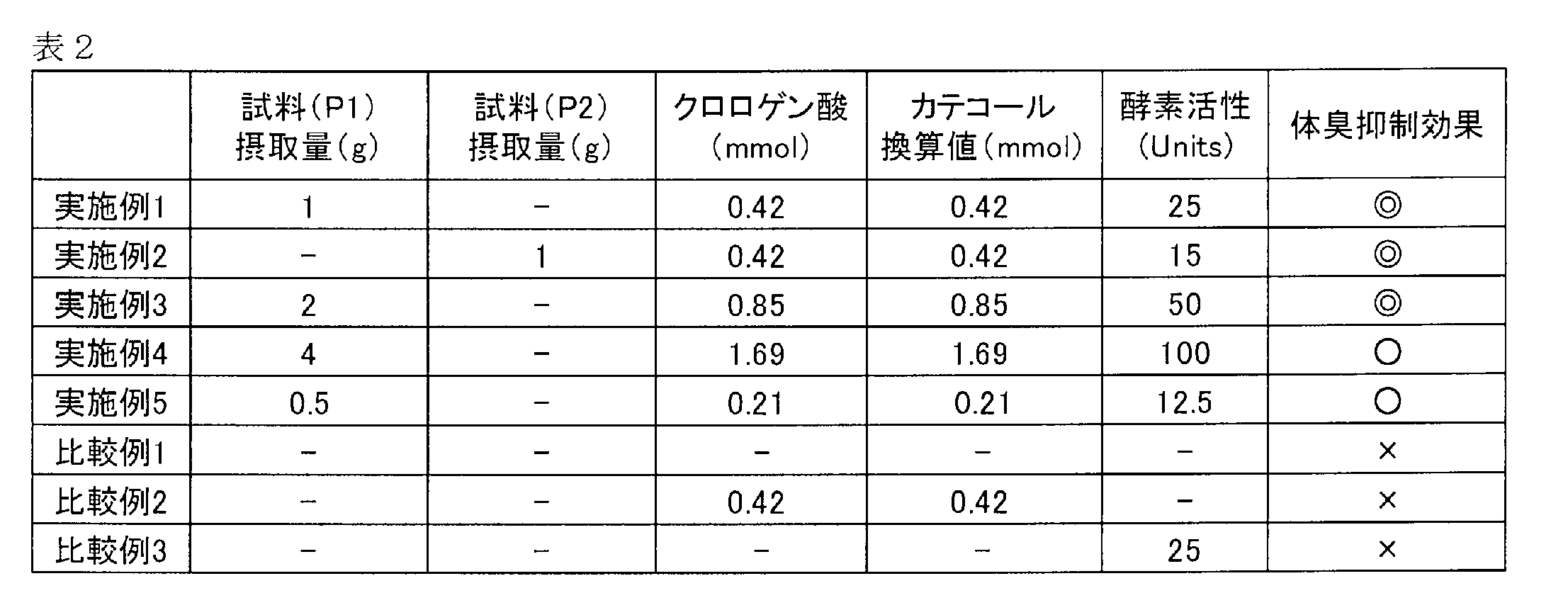
- Table 2 below shows the sample (P1 or P2) intake, the number of moles of polyphenolic substance (catechol-converted value (mmol)), and the number of Units of polyphenol oxidase in each Example and Comparative Example.
- the catechol-equivalent value (mmol) of polyphenol was calculated from the molecular weight and intake of the target polyphenol and the molecular weight of catechol.
- Table 2 shows the results of the body odor control test of each Example and Comparative Example.
- FIG. 1 shows the measurement results of diallyl disulfide of Example 1 and Comparative Example 1.
- FIG. 2 shows the measurement results of allyl methyl sulfide in Example 1 and Comparative Example 1.
- FIG. 3 shows the measurement results of diallyl disulfide of Example 2 and Comparative Example 1.
- FIG. 4 shows the measurement results of allyl methyl sulfide in Example 2 and Comparative Example 1.
- FIG. 5 shows the measurement results of diallyl disulfide of Example 3 and Comparative Example 1.
- FIG. 6 shows the measurement results of allyl methyl sulfide in Example 3 and Comparative Example 1.
- FIG. 7 shows the measurement results of diallyl disulfide of Example 4 and Comparative Example 1.
- FIG. 1 shows the measurement results of diallyl disulfide of Example 1 and Comparative Example 1.
- FIG. 2 shows the measurement results of allyl methyl sulfide in Example 1 and Comparative Example 1.
- FIG. 3 shows the measurement results of diallyl disulfide of Example
- FIG. 8 shows the measurement results of allylmethyl sulfide in Example 4 and Comparative Example 1.
- FIG. 9 shows the measurement results of diallyl disulfide of Example 5 and Comparative Example 1.
- FIG. 10 shows the measurement results of allyl methyl sulfide in Example 5 and Comparative Example 1.
- FIG. 11 shows the measurement results of diallyl disulfide of Comparative Examples 1 to 3.
- FIG. 12 shows the measurement results of allylmethyl sulfide in Comparative Examples 1 to 3.
- Evaluation criteria for body odor suppressing effect in Table 2 A Very effective in suppressing body odor derived from the body. :: Effective for suppressing body odor derived from the body. ⁇ : Ineffective in suppressing body odor derived from the body.
- Example 4 that is, when 4 g of the sample P1 was ingested, only diallyl disulfide was suppressed. From Example 2, it was confirmed that the emission of diallyl disulfide and allyl methyl sulfide was remarkably suppressed when polyphenol oxidase derived from the prune extract was similarly used in combination with polyphenol. Therefore, it is considered that the intake of polyphenolic substances and polyphenol oxidase is particularly effective for suppressing body odor. In addition, it can be confirmed that the inhibitory effect is already exerted 30 minutes after garlic is taken.
- the deodorant composition containing 0.21 mmol to 1.69 mmol of polyphenol in terms of catechol and 12.5 Units or more of polyphenol oxidase is particularly effective for suppressing body odor, more preferably in terms of catechol. It can be seen that the composition is a deodorant composition containing 0.42 mmol to 0.85 mmol of polyphenol and 15 Units to 50 Units of polyphenol oxidase.
- emission of diallyl disulfide and allyl methyl sulfide was not suppressed by ingestion of only the polyphenolic substance or polyphenol oxidase. Therefore, it was found that ingestion of a combination of a polyphenolic substance and a polyphenol oxidase was effective in suppressing body odor.
- Skin gas was collected from a predetermined position on the left forearm by a skin gas collecting device (described in Japanese Patent No. 4654045) using an ammonia collecting filter as a collecting agent.
- a skin gas collecting device described in Japanese Patent No. 4654045
- 1 hour from 9 am to 10 am and 1 hour from 10 am to 11 am were collected as skin gas before skipjack ingestion.
- the measurement of skin gas after skipjack ingestion was started at 11:30 am, and collection was performed at hourly intervals from 11:30 am to 15:30 am.
- the amount of ammonium ions in the extract from which the collection filter was extracted was measured by ion chromatography (manufactured by Shimadzu Corporation) to determine the emission flux (ngcm ⁇ 2 h ⁇ 1 ).
- the calculation formula of the radiation flux is the same as that described above.
- sample P1 (a 1: 1 mixture of green coffee bean extract and burdock extract prepared in Reference Example 3 (1)) was dissolved in 200 ml of water. Ingested.
- Example 7 Five minutes after ingesting 140 g of skipjack sashimi, 1 g of sample P2 (a 1: 1 mixture of green coffee bean extract and prune extract prepared in Reference Example 3 (2)) was dissolved in 200 ml of water and ingested.
- FIG. 13 shows the measurement results of ammonia in Example 6 and Comparative Example 4.
- FIG. 14 shows the measurement results of ammonia in Example 7 and Comparative Example 4.
- the intake of a mixture of polyphenolic substance green coffee bean extract
- polyphenol oxidase burdock extract or prune extract
- the deodorant composition of the present invention can control body odor generated from inside the body. Although only one of polyphenol and polyphenol oxidase is not effective in suppressing body odor, oral ingestion of a deodorant composition combining the two is effective in suppressing body odor. As described above, the deodorant composition of the present invention is composed of naturally occurring polyphenols and polyphenol oxidase, so that it can be taken orally, and is effective in suppressing body odor generated from inside the body and emitted through the skin. It was shown that there is.
- the present invention provides an orally ingestible deodorant composition and a method for suppressing body odor, which has an effect of deodorizing not only bad breath and fecal odor but also body odor emitted from the body.
Landscapes
- Health & Medical Sciences (AREA)
- Life Sciences & Earth Sciences (AREA)
- Animal Behavior & Ethology (AREA)
- Pharmacology & Pharmacy (AREA)
- Medicinal Chemistry (AREA)
- Chemical & Material Sciences (AREA)
- General Health & Medical Sciences (AREA)
- Public Health (AREA)
- Veterinary Medicine (AREA)
- Natural Medicines & Medicinal Plants (AREA)
- Epidemiology (AREA)
- Engineering & Computer Science (AREA)
- Bioinformatics & Cheminformatics (AREA)
- Microbiology (AREA)
- General Chemical & Material Sciences (AREA)
- Medical Informatics (AREA)
- Biotechnology (AREA)
- Mycology (AREA)
- Organic Chemistry (AREA)
- Alternative & Traditional Medicine (AREA)
- Nuclear Medicine, Radiotherapy & Molecular Imaging (AREA)
- Botany (AREA)
- Chemical Kinetics & Catalysis (AREA)
- Dermatology (AREA)
- Proteomics, Peptides & Aminoacids (AREA)
- Immunology (AREA)
- Gastroenterology & Hepatology (AREA)
- Emergency Medicine (AREA)
- Diabetes (AREA)
- Hematology (AREA)
- Obesity (AREA)
- Medicines Containing Plant Substances (AREA)
- Medicines That Contain Protein Lipid Enzymes And Other Medicines (AREA)
- Acyclic And Carbocyclic Compounds In Medicinal Compositions (AREA)
- Coloring Foods And Improving Nutritive Qualities (AREA)
Abstract
本発明は、経口摂取により体内由来の体臭を抑制する消臭剤組成物であって、ポリフェノール及びポリフェノール酸化酵素を含む消臭剤組成物に関する。
Description
本発明は、体臭の抑制に有効な消臭剤組成物に関する。
現代の超高齢化社会において、生活の質(QOL)の向上が求められている。つまり、如何に生活の質を高め、より良く生きていくかという点が重要視されている。その為には、周囲との良好な係わり・交わりを高め維持していく事が重要な要素になる。この良好な対人関係の維持に影響を及ぼす大きな要因の1つとして体臭が挙げられる。臭いは人を不快にさせる事もあるため、快適な生活を送るうえでは、体臭の予防と対策は重要である。
体臭は大きく分けて皮膚表面反応由来のものと体内由来のものの2つに分類される。体臭抑制を目的とした消臭剤組成物の報告はこれまでに数多くあるが、それらが消臭対象としている多くが皮膚表面の反応により発生する体臭である。皮膚表面反応由来の体臭として、例えば、腋臭・足臭・加齢臭等が挙げられ、これらは皮脂や汗等のそれ自体に臭いはない分泌物が皮膚常在菌等により分解されて発生する臭気である。そのため、このような皮膚表面反応由来の体臭の抑制方法としては、皮膚表面に消臭剤を直接塗布又は噴射する事によるロールスティック又はスプレータイプ等のデオドラント剤によるものが一般的である。
一方、体内由来の体臭とは、体内で発生し皮膚を通じて放散される臭気であり、より詳しくは、体内に取り込まれた化学物質が血液に吸収され、血流により運ばれ、皮膚を通じて放散される血液由来の臭気である。したがって、体内由来の体臭は、口腔内の食物残渣が菌により分解されて発生する含硫黄化合物が原因となり口腔から発せられる口臭や、食物が胃や腸で分解されて生成する低分子の悪臭成分が原因となり排泄物自体が臭気の元となる糞便臭や尿臭等の排泄物臭とは、区別できるものである。体内由来の体臭はその発生経路から、皮膚表面ではなく体の内側からのケアが重要とされている。この様に体の中から皮膚を通じて放散される体臭の例としては例えばニンニク等の強い風味を持つ食品を摂取する事により発生する体臭や、疲労により発生する体臭等が挙げられる。
臭いが人に不快感を与える場合はその臭いを抑制する工夫がなされている。
例えば、特許文献1には、ポリフェノールとポリフェノール酸化酵素を組み合わせる事で消臭効率が格段に向上した消臭剤組成物が記載されている。特許文献2には、植物抽出物とフェノール性化合物を酸化する酵素とを含む消臭剤組成物が記載されている。特許文献3には、植物抽出物とフェノール性化合物を酸化する酵素とを含む可食物を摂取することで動物の排泄物の臭気を抑制する方法が記載されている。
例えば、特許文献1には、ポリフェノールとポリフェノール酸化酵素を組み合わせる事で消臭効率が格段に向上した消臭剤組成物が記載されている。特許文献2には、植物抽出物とフェノール性化合物を酸化する酵素とを含む消臭剤組成物が記載されている。特許文献3には、植物抽出物とフェノール性化合物を酸化する酵素とを含む可食物を摂取することで動物の排泄物の臭気を抑制する方法が記載されている。
特許文献4~6には、食べ物由来の体臭の一例として、消臭の対象をニンニク由来の体臭としている消臭組成物について記載されている。
特許文献7には、天然由来のポリフェノールを経口摂取する事での加齢臭の抑制について報告されている。
しかしながら、上記特許文献1~3に記載の消臭剤組成物に関しては、口臭や環境臭または排泄物の臭気を対象とした消臭効果については記載しているものの、体内由来の体臭を対象とした試験は実施されていない。
また、上記特許文献4~6に記載の消臭剤組成物では、ニンニク摂取時の口臭に対しての消臭効果についてのみ試験を実施しており、その消臭効果からの類推により、体臭に対しての効果を謳っているに過ぎない。よって、これらの報告では実際に体臭を測定した試験例は記載されていない。
特許文献7で対象としている加齢臭は、一般的には皮膚表面反応に由来する臭気であり、体内由来の体臭とした試験は実施されていない。
また、上記特許文献4~6に記載の消臭剤組成物では、ニンニク摂取時の口臭に対しての消臭効果についてのみ試験を実施しており、その消臭効果からの類推により、体臭に対しての効果を謳っているに過ぎない。よって、これらの報告では実際に体臭を測定した試験例は記載されていない。
特許文献7で対象としている加齢臭は、一般的には皮膚表面反応に由来する臭気であり、体内由来の体臭とした試験は実施されていない。
このように、従来の技術では、体内で発生し、皮膚を通じて放散される臭気に対して効果を示す消臭剤組成物の報告例は無かった。さらに従来技術においては、体内由来の体臭について実際に体臭を測定したデータが示されていないにもかかわらず、口臭に対する効果からの類推によって体臭に対する消臭効果を謳っている報告も見受けられる。よって、体内由来の体臭を測定する事により消臭組成物の抑制効果を明確に示した報告例はほとんどない。
したがって、本発明は、体内由来の体臭を抑制できる消臭剤組成物を提供することを目的とする。
したがって、本発明は、体内由来の体臭を抑制できる消臭剤組成物を提供することを目的とする。
発明者らは鋭意研究した結果、ポリフェノールとポリフェノール酸化酵素を共存させると、体内由来の体臭を抑制できるという知見を得た。したがって、本発明は下記に関する。
〔1〕経口摂取により体内由来の体臭を抑制する消臭剤組成物であって、ポリフェノール及びポリフェノール酸化酵素を含む消臭剤組成物。
〔2〕ポリフェノールが、o-ジフェノール構造及びp-ジフェノール構造の少なくとも一方を含む、〔1〕に記載の消臭剤組成物。
〔3〕ポリフェノール酸化酵素が植物抽出物より得られる酵素である、〔1〕または〔2〕に記載の消臭剤組成物。
〔4〕ポリフェノールの含有量がカテコール換算で2mmol以下である、〔1〕~〔3〕のいずれか1に記載の消臭剤組成物。
〔5〕〔1〕~〔4〕のいずれか1に記載の消臭剤組成物を経口摂取することにより体内由来の体臭を抑制する方法。
〔1〕経口摂取により体内由来の体臭を抑制する消臭剤組成物であって、ポリフェノール及びポリフェノール酸化酵素を含む消臭剤組成物。
〔2〕ポリフェノールが、o-ジフェノール構造及びp-ジフェノール構造の少なくとも一方を含む、〔1〕に記載の消臭剤組成物。
〔3〕ポリフェノール酸化酵素が植物抽出物より得られる酵素である、〔1〕または〔2〕に記載の消臭剤組成物。
〔4〕ポリフェノールの含有量がカテコール換算で2mmol以下である、〔1〕~〔3〕のいずれか1に記載の消臭剤組成物。
〔5〕〔1〕~〔4〕のいずれか1に記載の消臭剤組成物を経口摂取することにより体内由来の体臭を抑制する方法。
本発明によれば、本発明の消臭剤組成物を経口摂取するだけで体内由来の体臭を効果的に抑制できる。
〔消臭剤組成物〕
本発明は、経口摂取により体内由来の体臭を抑制する消臭剤組成物であって、ポリフェノール及びポリフェノール酸化酵素を含む消臭剤組成物に関する。
本発明ではポリフェノールとポリフェノール酸化酵素を含む消臭剤組成物を経口摂取する事により、生体内でポリフェノールがポリフェノール酸化酵素によって酸化されて反応性の高いキノン構造になり、かかるキノン構造化合物がさらに悪臭物質と反応する結果、体内の悪臭物質が減少し消臭効果が得られるものと推測される。
本発明は、経口摂取により体内由来の体臭を抑制する消臭剤組成物であって、ポリフェノール及びポリフェノール酸化酵素を含む消臭剤組成物に関する。
本発明ではポリフェノールとポリフェノール酸化酵素を含む消臭剤組成物を経口摂取する事により、生体内でポリフェノールがポリフェノール酸化酵素によって酸化されて反応性の高いキノン構造になり、かかるキノン構造化合物がさらに悪臭物質と反応する結果、体内の悪臭物質が減少し消臭効果が得られるものと推測される。
〔ポリフェノール〕
本発明の消臭剤組成物の一方の成分であるポリフェノールは、同一ベンゼン環に少なくとも2個のヒドロキシ基が結合したポリフェノール構造を有する化合物全てを指す。ポリフェノールには、配糖体も含まれる。
本発明の消臭剤組成物の一方の成分であるポリフェノールは、同一ベンゼン環に少なくとも2個のヒドロキシ基が結合したポリフェノール構造を有する化合物全てを指す。ポリフェノールには、配糖体も含まれる。
ポリフェノールの具体例としては、例えば、アピゲニン、アピゲニン配糖体、アカセチン、イソラムネチン、イソラムネチン配糖体、イソクエルシトリン、エピカテキン、エピカテキンガレート、エピガロカテキン、エピガロカテキンガレート、エスキュレチン、エチルプロトカテキュ酸塩、エラグ酸、カテコール、ガンマ酸、カテキン、ガルデニン、ガロカテキン、カフェ酸、カフェ酸エステル、クロロゲン酸、ケンフェロール、ケンフェロール配糖体、ケルセチン、ケルセチン配糖体、ケルセタゲニン、ゲニセチン、ゲニセチン配糖体、ゴシペチン、ゴシペチン配糖体、ゴシポール、4-ジヒドロキシアントラキノン、1,4-ジヒドロキシナフタレン、シアニジン、シアニジン配糖体、シネンセチン、ジオスメチン、ジオスメチン配糖体、3,4’-ジフェニルジオール、シナピン酸、ステアリル-β-(3,5-ジ-t-ブチル-4-ヒドロキシフェニル)プロピオネート、スピナセチン、タンゲレチン、タキシホリン、タンニン酸、ダフネチン、チロシン、デルフィニジン、デルフィニジン配糖体、テアフラビン、テアフラビンモノガレート、テアフラビンビスガレート、トリセチニジン、L-ドーパ、ドーパミン、ナリンゲニン、ナリンジン、ノルジヒドログアヤレチック酸、ノルアドレナリン、ヒドロキノン、バニリン、パチュレチン、ハーバセチン、バニリルアルコール、バニトロープ、バニリンプロピレングリコールアセタール、バニリン酸、ビス(4-ヒドロキシフェニル)スルホン酸、ビスフェノールA、ピロカテコール、ビテキシン、4,4’-ビフェニルジオール、4-t-ブチルカテコール、2-t-ブチルヒドロキノン、プロトカテキュ酸、フロログルシノール、フェノール樹脂、プロシアニジン、プロデルフィニジン、フロレチン、フロレチン配糖体、フィゼチン、フォリン、フェルバセチン、フラクセチン、フロリジン、ペオニジン、ペオニジン配糖体、ペルオルゴニジン、ペルアグゴニジン配糖体、ペチュニジン、ペチュニジン配糖体、ヘスペレチン、ヘスペレジン、没食子酸、没食子酸エステル(没食子酸メチル、没食子酸エチル、没食子酸ドデシル、没食子酸ラウリル、没食子酸プロピル、没食子酸ブチル、没食子酸オクチル等)、マンジフェリン、マルビジン、マルビジン配糖体、ミリセチン、ミリセチン配糖体、2,2’-メチレンビス(4-メチル-6-t-ブチルフェノール)、2,2’-メチレンビス(4-エチル-6-t-ブチルフェノール)、2,2’-メチレンビス(4-メチル-6-t-ブチルフェノール)、2,2’-メチレンビス(4-エチル-6-t-ブチルフェノール)、メチルアトラレート、4-メチルカテコール、5-メチルカテコール、4-メトキシカテコール、5-メトキシカテコール、メチルカテコール-4-カルボン酸、2-メチルレゾルシノール、5-メチルレゾルシノール、モリン、リモシトリン、リモシトリン配糖体、リモシトロール、ルテオリン、ルテオリン配糖体、ルテオリニジン、ルテオリニジン配糖体、ルチン、レゾルシン、レスベラトロール、レゾルシノール、ロイコシアニジン、ロイコデルフィニジン等が挙げられる。
これらのポリフェノールの中でも、ポリフェノール酸化酵素と接触し、速やかにキノン構造を形成可能である事から、o-ジフェノール構造および/またはp-ジフェノール構造を有するものが特に好ましい。具体的には、ケルセチン、エピカテキン、および、エピガロカテキン等のフラボノイド類およびそれらの配糖体、没食子酸、没食子酸エステル、クロロゲン酸、カフェ酸、カフェ酸エステル、タンニン酸、ピロカテコール、ノルジヒドログアイアレクチック酸、L-ドーパ、4-メチルカテコール、5-メチルカテコール、4-メトキシカテコール、5-メトキシカテコール等のo-ジフェノール構造を有するポリフェノール化合物、および、ヒドロキノンが特に好ましい。
ポリフェノールは、公知の方法により調製できるが、市販品を購入しても、合成により調製してもよい。さらには、植物から調製したポリフェノール含有画分を使用することもできる。また、ポリフェノールを含む植物抽出物を使用することもできる。この植物抽出物は公知の方法により調製されたものを使用してもよいし、また市販のものを使用してもよい。
植物抽出物を得る植物の例としては、例えば、アロエ、アニスシード、エルダー、エレウテロコック、オオバコ、オレンジフラワー、オールスパイス、オレガノ、カノコソウ、カモミル、カプシカムペッパー、カルダモン、カシア、ガーリック、キャラウエイシード、クローブ、クミンシード、コーラ、コリアンダーシード、五倍子、サフラン、サンショウ、ジュニパーベリー、シナモン、ジンジャー、スター・アニス、セント・ジョーンズ・ウオルト、セロリーシード、セサミ(ゴマ)、ダイオウ、タラゴン、ターメリック、チィスル、デイルシード、ナツメグ、ネットル、ハイビスカス、ハマメリス、バーチ、バジル、ビター・オレンジ、フェンネル、プリムローズ、フェヌグリーク、ベルベナ、ベイローレル、ホップ、ボルドー、ホースラデイッシュ、ポピーシード、没食子、マリーゴールド、マロー、マジョラム、マスタード、ミルフォイル、ミントリーブス、メリッサ、メース、リンデン、リンドウ、ローズヒップ、ローズマリー、マンネンロウ、ひまわり種子、ブドウ果皮、リンゴ、ニンジン葉、バナナ、イチゴ、アンズ、モモ、プラム、パイナップル、ナシ、カキ、サクランボ、パパイヤ、マンゴー、アボガド、メロン、ビワ、イチジク、キウイ、プルーン、ブルーベリー、ブラックベリー、ラスベリー、ツルコケモモ、コーヒー豆、カカオ豆、ブドウ種子、グレープフルーツ種子、ペカンナッツ、カシューナッツ、クリ、ココナッツ、ピーナツ、クルミ、緑茶葉、紅茶葉、ウーロン茶葉、苦丁茶、マテ茶、ルイボス茶、タバコ、シソ葉、ニワタイム、セージ、ラベンダー、スペアミント、ペパーミント、サントリソウ、ヒソップ、メボウキ、マリーゴールド、タンポポ、アーチチョーク、ドイツカミルレ、キンミズヒキ、カンゾウ、アニス、ノコギリソウ、ユーカリ、ワームウッド、香油、シシウド、コロハ、シシトウガラシ、ウイキョウ、トウガラシ、コエンドロ種子、ヒメウイキョウ種子、ウイキョウ種子、ショウガ、西洋ワサビ、マヨラナ、ニホンハッカ、ハナハッカ、カラシナ、パセリ、コショウ、セイヴォリー、タラゴン、ウコン、ワサビ、イノンド種子、柑橘果実、西洋ナシ、タイム等や、ニンジン、ゴボウ、ピーマン、カブ、ジャガイモなどの野菜類全般が挙げられる。特に、ローズマリー、ひまわり種子、ブドウ果皮、リンゴ、ニンジン葉、コーヒー(生)豆、カカオ(生)豆、ブドウ種子、緑茶葉、紅茶葉、ウーロン茶葉、シソ葉、ニワタイム、セージ、スペアミント、ペパーミント、西洋ナシ、バナナ、タイム、五倍子、没食子が好ましい。前記植物は、単独あるいは複数の植物から植物抽出物を調製することができる。また、単独の植物抽出物を得た後、異なる植物の単独の植物抽出物と混合することもできる。前記植物抽出物の製造方法は特に制限されない。前記植物は他の用途にて使用した後の残渣を用いることもできる。
抽出方法は、目的が達せられる公知の方法ならいずれのものでもよい。消臭剤組成物が食品用である場合に、ポリフェノールを例えば溶剤抽出によって得る場合には、溶媒も食品に許容されるものが選ばれる。このような溶媒としては、例えば、水、エタノール、プロパノール、ブタノール、アセトン、ヘキサン、プロピレングリコール、含水エタノール、含水プロピレングリコール等が挙げられるが、熱水、含水エタノール、含水プロピレングリコールがより好ましい。抽出方法は、溶剤抽出に限らず、超臨界抽出等でも何ら問題無い。
〔ポリフェノール酸化酵素〕
本発明の消臭剤組成物のもう一方の成分であるポリフェノール酸化酵素(フェノール性化合物酸化酵素)は、上記ポリフェノールを、キノン構造を有する化合物に酸化する作用を有する酵素、あるいは当該作用と共に、フェノール性水酸基を付加させ、キノンに酸化させる作用を有する酵素である。
本発明の消臭剤組成物のもう一方の成分であるポリフェノール酸化酵素(フェノール性化合物酸化酵素)は、上記ポリフェノールを、キノン構造を有する化合物に酸化する作用を有する酵素、あるいは当該作用と共に、フェノール性水酸基を付加させ、キノンに酸化させる作用を有する酵素である。
ポリフェノール酸化酵素としては、かかる作用を有する酵素であればどのようなものでもよいが、例えば、ポリフェノールオキシダーゼ、モノフェノールオキシダーゼ、過酸化水素を生成するオキシダーゼおよびパーオキシダーゼを挙げることができる。より具体的には、ラッカーゼ、チロシナーゼ、グルコースオキシダーゼ、パーオキシダーゼを好ましく挙げることができる。
また、植物抽出物や菌類抽出物より得られるポリフェノール酸化酵素を用いることもできる。酵素を含む植物としては、リンゴ、ナシ、ゴボウなどの果物や野菜が好ましい。酵素を含む菌類としては、マッシュルームやイロガワリなどのハラタケ属やヤマドリタケ属のきのこが挙げられる。取扱いの容易さおよび入手のし易さ、経口摂取時の風味の観点から、植物抽出物から得られる酵素が好ましい。
これらの酵素としては、市販されているものを使用することができるが、公知の方法を用いて調製することもできる。また、酵素は二種以上共存させることができる。
上記酵素または酵素含有物は、当該酵素を含む植物または菌類を原料とし、定法により処理する事により得ることができる。例えば前記酵素を含む植物からの抽出物、前記酵素を含む菌類からの抽出物、あるいはそれら抽出物を含む凍結乾燥粉末、例えばアセトンパウダーを例示することができる。本発明においては、前記作用を有する限り、前記酵素の含有物または前記酵素を含む組成物も本発明のフェノール酸化酵素の範囲内のものである。
本発明の消臭剤組成物におけるポリフェノールの含有量は、カテコール換算で2.00mmol以下が好ましく、1.69mmol以下がより好ましく、0.85mmol以下が特に好ましい。ポリフェノールの含有量がかかる範囲であれば、体内由来の体臭に対して抑制効果を示す。一方、ポリフェノールが多すぎると、体内由来の体臭に対して抑制効果を示し辛くなる。また、ポリフェノール含有量の下限値については、消臭効果の観点から、カテコール換算で0.20mmol以上が好ましく、0.42mmol以上がより好ましい。
本発明の消臭剤組成物におけるポリフェノール酸化酵素の含有量は、消臭力の観点から12.5Units以上が好ましく、15Units以上がさらに好ましい。
〔その他の成分〕
本発明の消臭剤組成物は、上記のポリフェノールとポリフェノール酸化酵素以外に、本発明の効果を損なわない範囲で他の成分を含んでよい。例えば、担体、安定剤、増量剤、色素、抗酸化剤、香料等の常用の配合剤が挙げられる。
本発明の消臭剤組成物は、上記のポリフェノールとポリフェノール酸化酵素以外に、本発明の効果を損なわない範囲で他の成分を含んでよい。例えば、担体、安定剤、増量剤、色素、抗酸化剤、香料等の常用の配合剤が挙げられる。
本発明の消臭剤組成物の形態は、例えば液剤・懸濁剤・乳剤などの液体状態、クリーム状の様な半固形状態、粉末状、顆粒剤、カプセル剤、錠剤、シート等の固形形態など任意の形態をとりうるものであり、特に限定されない。
ポリフェノールとポリフェノール酸化酵素は均一に混合したものを摂取しても良いし、またポリフェノールとポリフェノール酸化酵素を別々の形態に配合したものを同時に摂取しても良い。
〔体臭抑制方法〕
上記本発明の消臭剤組成物を経口摂取することで、体内由来の体臭を抑制することができる。
本発明の体臭抑制方法が対象とする臭いは、体内で発生し皮膚から放散される体内由来の体臭であり、より詳しくは、体内に取り込まれた化学物質が血液に吸収され、血流により運ばれ、皮膚を通じて放散される血液由来の臭気である。これに分類されるものとして、食物由来の体臭や、疲労由来の体臭等が挙げられる。
食物由来により体内で発生する体臭の代表例として、ニンニク摂取により放散される体臭が知られている。ニンニク(Allium sativum)はヒガンバナ科ネギ属の植物である。ニンニク・ニラ等のネギ属に属する食材が臭うのは、臭い物質とされている成分がジアリルジスルフィド、アリルメチルスルフィド等の、強烈な臭いを放つ揮発性硫黄化合物であるためという事が知られている。ニンニク摂取により生じたこれらの物質は、口腔粘膜や各種臓器等を介する事で口臭や体臭の主な原因となる。ニンニクを摂取すると、食後からその独特で強烈な香気による口臭に悩まされる。またニンニク由来の香気成分が体内で代謝される事により、口臭だけでなく体臭によってもニンニク臭が漂うと言われており、持続性も高いとされている。
疲労由来の体臭としては、アンモニアが知られている。アンモニアはタンパク質やアミノ酸の代謝生成物として血中に存在し、皮膚からも放散されている。また運動等の身体への負荷や心的ストレス等の疲労によって、生成されたアンモニアが筋肉組織から血中に移行すると考えられている。この様に疲労による体臭の原因成分はアンモニアである事が明らかにされており、含窒素化合物に対しても効果を示す本発明の消臭剤組成物は、高タンパクな食品を摂取する事により発生する体臭や疲労由来の体臭も抑制可能と思われる。
したがって、本発明の体臭抑制方法によれば、ジアリルジスルフィド、アリルメチルスルフィド等の揮発性硫黄化合物や、アンモニア等の揮発性含窒素化合物を含む体臭を効果的に抑制することができる。
上記本発明の消臭剤組成物を経口摂取することで、体内由来の体臭を抑制することができる。
本発明の体臭抑制方法が対象とする臭いは、体内で発生し皮膚から放散される体内由来の体臭であり、より詳しくは、体内に取り込まれた化学物質が血液に吸収され、血流により運ばれ、皮膚を通じて放散される血液由来の臭気である。これに分類されるものとして、食物由来の体臭や、疲労由来の体臭等が挙げられる。
食物由来により体内で発生する体臭の代表例として、ニンニク摂取により放散される体臭が知られている。ニンニク(Allium sativum)はヒガンバナ科ネギ属の植物である。ニンニク・ニラ等のネギ属に属する食材が臭うのは、臭い物質とされている成分がジアリルジスルフィド、アリルメチルスルフィド等の、強烈な臭いを放つ揮発性硫黄化合物であるためという事が知られている。ニンニク摂取により生じたこれらの物質は、口腔粘膜や各種臓器等を介する事で口臭や体臭の主な原因となる。ニンニクを摂取すると、食後からその独特で強烈な香気による口臭に悩まされる。またニンニク由来の香気成分が体内で代謝される事により、口臭だけでなく体臭によってもニンニク臭が漂うと言われており、持続性も高いとされている。
疲労由来の体臭としては、アンモニアが知られている。アンモニアはタンパク質やアミノ酸の代謝生成物として血中に存在し、皮膚からも放散されている。また運動等の身体への負荷や心的ストレス等の疲労によって、生成されたアンモニアが筋肉組織から血中に移行すると考えられている。この様に疲労による体臭の原因成分はアンモニアである事が明らかにされており、含窒素化合物に対しても効果を示す本発明の消臭剤組成物は、高タンパクな食品を摂取する事により発生する体臭や疲労由来の体臭も抑制可能と思われる。
したがって、本発明の体臭抑制方法によれば、ジアリルジスルフィド、アリルメチルスルフィド等の揮発性硫黄化合物や、アンモニア等の揮発性含窒素化合物を含む体臭を効果的に抑制することができる。
なお、皮膚から放散される体臭は、例えば、皮膚ガス捕集装置(日本国特許第4654045号公報)を用いる事で正確に捕集・分析する事が可能である。
以下に実施例及び比較例を挙げて本発明をさらに詳細に説明するが、本発明はこれらに限定されない。
1.各試料の調製
〔参考例1〕(ポリフェノール含有植物抽出物の調製)
(1)生コーヒー豆抽出物
生コーヒー豆を粉砕機で粉砕後(メッシュ5mm)、水を加えて85~95℃で2時間抽出した。抽出物を濾過後、濾液をXAD-2(オルガノ(株)製)カラムに吸着させた。水で洗浄した後、メタノールで溶出させたものを濃縮乾固し、生コーヒー豆抽出物とした(クロロゲン酸含量30%)。
クロロゲン酸含量は、HPLC法により標品とのピーク面積比による検量線から測定した。
カラム:GC(ナカライテスク製)
展開溶媒:アセトニトリル、0.01Mリン酸溶液
検出:UV325nm
〔参考例1〕(ポリフェノール含有植物抽出物の調製)
(1)生コーヒー豆抽出物
生コーヒー豆を粉砕機で粉砕後(メッシュ5mm)、水を加えて85~95℃で2時間抽出した。抽出物を濾過後、濾液をXAD-2(オルガノ(株)製)カラムに吸着させた。水で洗浄した後、メタノールで溶出させたものを濃縮乾固し、生コーヒー豆抽出物とした(クロロゲン酸含量30%)。
クロロゲン酸含量は、HPLC法により標品とのピーク面積比による検量線から測定した。
カラム:GC(ナカライテスク製)
展開溶媒:アセトニトリル、0.01Mリン酸溶液
検出:UV325nm
その他各ポリフェノール化合物についても同様に、各々の標品とのピーク面積比による検量線から測定した。検出波長は、都度最適なものを選択した。
(2)ローズマリー抽出物
ローズマリーの葉および花100gに含水率40乃至60%のエタノール1Lを加えて3時間加熱還流し、温時濾過して抗酸化成分を含む濾液を得た。残渣を同じ溶媒で同様に抽出する操作をさらに2回繰り返し、得られた濾液を合わせた。この抽出液に水500mlを加えて非水溶性抗酸化成分を析出させ、さらに活性炭10gを加えて攪拌し、この溶液を1夜、冷所に放置した後、濾過して濾液を得た。この濾液を減圧下、濃縮して水溶性抗酸化成分区分(固体)を得た。
(3)茶抽出物
煎茶1kgを90℃の熱水10Lで1時間攪拌しながら抽出し、茶葉を濾過により除き、8.3Lの抽出液を得た。この液を1Lまで濃縮し、これにアセトン1Lを加えて攪拌し、生じた不溶物を遠心分離により除いた。上清液に酢酸エチル1Lを加えて攪拌し、30分間静置した。得られた酢酸エチル層を減圧下に濃縮し、水層に転換した後凍結乾燥して、純度60%の茶フェノールを97g得た。これを茶抽出物とした。
(4)ペパーミント抽出物
乾燥したペパーミントの葉をグラインダーで粉砕し、85~95℃の熱水で2時間抽出した。抽出液を濾過し、濾液をヘキサンで3回洗浄した。水層を乾燥して、ペパーミント抽出物とした。
(5)ブドウ果皮抽出物
ブドウ果皮(品種:キャンベル種)にエタノールを加えた後、70℃、2時間攪拌抽出した。抽出液を濃縮乾固したものをブドウ果皮抽出物とした。
(2)ローズマリー抽出物
ローズマリーの葉および花100gに含水率40乃至60%のエタノール1Lを加えて3時間加熱還流し、温時濾過して抗酸化成分を含む濾液を得た。残渣を同じ溶媒で同様に抽出する操作をさらに2回繰り返し、得られた濾液を合わせた。この抽出液に水500mlを加えて非水溶性抗酸化成分を析出させ、さらに活性炭10gを加えて攪拌し、この溶液を1夜、冷所に放置した後、濾過して濾液を得た。この濾液を減圧下、濃縮して水溶性抗酸化成分区分(固体)を得た。
(3)茶抽出物
煎茶1kgを90℃の熱水10Lで1時間攪拌しながら抽出し、茶葉を濾過により除き、8.3Lの抽出液を得た。この液を1Lまで濃縮し、これにアセトン1Lを加えて攪拌し、生じた不溶物を遠心分離により除いた。上清液に酢酸エチル1Lを加えて攪拌し、30分間静置した。得られた酢酸エチル層を減圧下に濃縮し、水層に転換した後凍結乾燥して、純度60%の茶フェノールを97g得た。これを茶抽出物とした。
(4)ペパーミント抽出物
乾燥したペパーミントの葉をグラインダーで粉砕し、85~95℃の熱水で2時間抽出した。抽出液を濾過し、濾液をヘキサンで3回洗浄した。水層を乾燥して、ペパーミント抽出物とした。
(5)ブドウ果皮抽出物
ブドウ果皮(品種:キャンベル種)にエタノールを加えた後、70℃、2時間攪拌抽出した。抽出液を濃縮乾固したものをブドウ果皮抽出物とした。
〔参考例2〕(ポリフェノール酸化酵素含有植物抽出物の調製)
(1)ゴボウ抽出物
洗浄したゴボウ100gに-20℃のアセトン400Lを入れてミキサーで磨砕した後、吸引濾過した。残渣は5℃の80%アセトン含水溶液500mlで十分洗浄し、濾液と合わせてアセトン溜去後、凍結乾燥して粉末にした。収率は20%であった。酵素比活性は50Units/gであった。
(2)プルーン抽出物
プルーン果実を洗浄後に種抜き、粉砕し水洗後、凍結乾燥して粉末にした。果実からの粉末収率は3%であった。酵素比活性は30Units/gであった。
(3)ナシ抽出物
ナシ100gを用いて、上記ゴボウ抽出物の調製と同様な操作によりナシ抽出物を得た。収率は15%であった。酵素比活性は63Units/gであった。
(4)リンゴ抽出物
リンゴ100gを用いて、上記ゴボウ抽出物の調製と同様な操作によりナシ抽出物を得た。収率は18%であった。酵素比活性は53Units/gであった。
(1)ゴボウ抽出物
洗浄したゴボウ100gに-20℃のアセトン400Lを入れてミキサーで磨砕した後、吸引濾過した。残渣は5℃の80%アセトン含水溶液500mlで十分洗浄し、濾液と合わせてアセトン溜去後、凍結乾燥して粉末にした。収率は20%であった。酵素比活性は50Units/gであった。
(2)プルーン抽出物
プルーン果実を洗浄後に種抜き、粉砕し水洗後、凍結乾燥して粉末にした。果実からの粉末収率は3%であった。酵素比活性は30Units/gであった。
(3)ナシ抽出物
ナシ100gを用いて、上記ゴボウ抽出物の調製と同様な操作によりナシ抽出物を得た。収率は15%であった。酵素比活性は63Units/gであった。
(4)リンゴ抽出物
リンゴ100gを用いて、上記ゴボウ抽出物の調製と同様な操作によりナシ抽出物を得た。収率は18%であった。酵素比活性は53Units/gであった。
(比活性の測定)
上記各抽出物について、クロロゲン酸(東京化成)1.7mg/Lを基質として5ml燐酸緩衝液(pH6.5)中で25℃、5分間反応させて、紫外線の吸収420nmでの吸光度を1上昇させる酵素を1単位(Units)と定義した。
上記各抽出物について、クロロゲン酸(東京化成)1.7mg/Lを基質として5ml燐酸緩衝液(pH6.5)中で25℃、5分間反応させて、紫外線の吸収420nmでの吸光度を1上昇させる酵素を1単位(Units)と定義した。
〔参考例3〕(酵素と植物抽出物の混合物)
(1)参考例1(1)で得られた生コーヒー豆抽出物と、参考例2(1)で得られたゴボウ抽出物を等量混合し、60メッシュpassしたものを試料P1とした。
(2)参考例1(1)で得られた生コーヒー豆抽出物と、参考例2(2)で得られたプルーン抽出物を等量混合し、60メッシュpassしたものを試料P2とした。
(1)参考例1(1)で得られた生コーヒー豆抽出物と、参考例2(1)で得られたゴボウ抽出物を等量混合し、60メッシュpassしたものを試料P1とした。
(2)参考例1(1)で得られた生コーヒー豆抽出物と、参考例2(2)で得られたプルーン抽出物を等量混合し、60メッシュpassしたものを試料P2とした。
〔参考例4〕(混合物の消臭活性)
参考例3(1)で得た試料P1を1質量%含んだ水溶液1.5mlをバイアル瓶に採取後、ヘッドスペース中の各悪臭成分が以下の濃度になる様に添加した[メチルメルカプタン(CH3SH):200ppm、アンモニア(NH3):100ppm、トリメチルアミン(TMA):100ppm、イソ吉草酸:10ppm、イソ酪酸:10ppm]。25℃で10分間振盪後に、ヘッドスペース中の各悪臭成分濃度をガス検知管(ガステック社製)によって測定した。
各悪臭成分に対して、消臭効果を表1に示した。
以下の式に従い、消臭率を算出した。
消臭率(%)={(ブランクの測定値)-(サンプルの測定値)}/(ブランクの測定値)×100
参考例3(1)で得た試料P1を1質量%含んだ水溶液1.5mlをバイアル瓶に採取後、ヘッドスペース中の各悪臭成分が以下の濃度になる様に添加した[メチルメルカプタン(CH3SH):200ppm、アンモニア(NH3):100ppm、トリメチルアミン(TMA):100ppm、イソ吉草酸:10ppm、イソ酪酸:10ppm]。25℃で10分間振盪後に、ヘッドスペース中の各悪臭成分濃度をガス検知管(ガステック社製)によって測定した。
各悪臭成分に対して、消臭効果を表1に示した。
以下の式に従い、消臭率を算出した。
消臭率(%)={(ブランクの測定値)-(サンプルの測定値)}/(ブランクの測定値)×100

試料P1はメチルメルカプタン、アンモニア、トリメチルアミンに優れた消臭効果を示した。また、イソ吉草酸、イソ酪酸といった低級脂肪酸に対しても消臭効果を示した。
2.体臭抑制試験手順
(方法)
各試料(生コーヒー豆抽出物、ゴボウ抽出物またはプルーン抽出物、両者の混合品)を被験者に摂取させて、体臭抑制効果を評価した。
具体的には、まず被験者である成人男性3名に、午前9時から加熱済ニンニク50gを摂取させた。ニンニクを摂取し終えて5分後に、各試料を水200mlに溶解しそれぞれ摂取させた。そしてニンニク摂取前後について、経時的に皮膚ガスの捕集を実施した。試験は3名とも同日に実施した。試験結果は3名とも同様の傾向を示したため、実施例として、そのうちの1名の被験者の結果を記載する。
皮膚ガスは、捕集剤としてシリカモノリス系吸着材(ジーエルサイエンス社製、MonoTrap(登録商標)DCC18)を使用した皮膚ガス捕集装置(日本国特許第4654045号公報に記載の皮膚ガス捕集装置の一種)により左前腕部の所定位置から捕集した。まずニンニク摂取前の皮膚ガスとして、午前8時~9時の1時間分を捕集した。ニンニク摂取後の皮膚ガスについては、午前9時30分より測定を開始し、午前9時30分~午前10時及び午前10時~午前10時30分は30分間隔で、それ以降は1時間間隔での捕集を実施した。
捕集後は、吸着剤を加熱脱離用バイアル瓶に移し、加熱脱離装置付ガスクロマトグラフィー/質量分析計(GC装置:アジレント・テクノロジー社製6890N、MS装置:日本電子社製Q1000GCMkII)によりジアリルジスルフィド、アリルメチルスルフィド量を測定し、放散フラックス(ngcm-2h-1)を求めた。
皮膚から放出される皮膚ガスの放散については日本国特許第4654045号公報で「放散フラックス」として定義されており、下記式により算出される。
J=W/(St)
J:皮膚ガスの放散フラックス
W:捕集材に捕集された皮膚ガス捕集量
S:開口部面積
t:捕集時間
(方法)
各試料(生コーヒー豆抽出物、ゴボウ抽出物またはプルーン抽出物、両者の混合品)を被験者に摂取させて、体臭抑制効果を評価した。
具体的には、まず被験者である成人男性3名に、午前9時から加熱済ニンニク50gを摂取させた。ニンニクを摂取し終えて5分後に、各試料を水200mlに溶解しそれぞれ摂取させた。そしてニンニク摂取前後について、経時的に皮膚ガスの捕集を実施した。試験は3名とも同日に実施した。試験結果は3名とも同様の傾向を示したため、実施例として、そのうちの1名の被験者の結果を記載する。
皮膚ガスは、捕集剤としてシリカモノリス系吸着材(ジーエルサイエンス社製、MonoTrap(登録商標)DCC18)を使用した皮膚ガス捕集装置(日本国特許第4654045号公報に記載の皮膚ガス捕集装置の一種)により左前腕部の所定位置から捕集した。まずニンニク摂取前の皮膚ガスとして、午前8時~9時の1時間分を捕集した。ニンニク摂取後の皮膚ガスについては、午前9時30分より測定を開始し、午前9時30分~午前10時及び午前10時~午前10時30分は30分間隔で、それ以降は1時間間隔での捕集を実施した。
捕集後は、吸着剤を加熱脱離用バイアル瓶に移し、加熱脱離装置付ガスクロマトグラフィー/質量分析計(GC装置:アジレント・テクノロジー社製6890N、MS装置:日本電子社製Q1000GCMkII)によりジアリルジスルフィド、アリルメチルスルフィド量を測定し、放散フラックス(ngcm-2h-1)を求めた。
皮膚から放出される皮膚ガスの放散については日本国特許第4654045号公報で「放散フラックス」として定義されており、下記式により算出される。
J=W/(St)
J:皮膚ガスの放散フラックス
W:捕集材に捕集された皮膚ガス捕集量
S:開口部面積
t:捕集時間
〔実施例1、3~5〕
加熱済ニンニク50gを完全に摂取し終えて5分後に、表2に示す量の試料P1(参考例3(1)で調製した生コーヒー豆抽出物とゴボウ抽出物の1:1混合物)を水200mlに溶解して摂取した。
加熱済ニンニク50gを完全に摂取し終えて5分後に、表2に示す量の試料P1(参考例3(1)で調製した生コーヒー豆抽出物とゴボウ抽出物の1:1混合物)を水200mlに溶解して摂取した。
〔実施例2〕
加熱済ニンニクを摂取し終えて5分後に、1gの試料P2(参考例3(2)で調製した生コーヒー豆抽出物とプルーン抽出物の1:1混合物)を水200mlに溶解して摂取した。
加熱済ニンニクを摂取し終えて5分後に、1gの試料P2(参考例3(2)で調製した生コーヒー豆抽出物とプルーン抽出物の1:1混合物)を水200mlに溶解して摂取した。
〔比較例1〕
加熱済ニンニクを摂取し終えて5分後に、水200mlを摂取した。
加熱済ニンニクを摂取し終えて5分後に、水200mlを摂取した。
〔比較例2〕
加熱済ニンニクを摂取し終えて5分後に、参考例1(1)で調製した生コーヒー豆抽出物0.5gを水200mlに溶解して摂取した。
加熱済ニンニクを摂取し終えて5分後に、参考例1(1)で調製した生コーヒー豆抽出物0.5gを水200mlに溶解して摂取した。
〔比較例3〕
加熱済ニンニクを摂取し終えて5分後に、参考例2(1)で調製したゴボウ抽出物0.5gを水200mlに溶解して摂取した。
加熱済ニンニクを摂取し終えて5分後に、参考例2(1)で調製したゴボウ抽出物0.5gを水200mlに溶解して摂取した。
各実施例及び比較例における試料(P1またはP2)摂取量、ポリフェノール性物質のmol数(カテコール換算値(mmol))、ポリフェノール酸化酵素のUnit数を下記表2に示した。
ポリフェノールのカテコール換算値(mmol)は対象とするポリフェノールの分子量及び摂取量とカテコールの分子量から算出した。
各実施例及び比較例の体臭抑制試験の結果を表2に示す。
ポリフェノールのカテコール換算値(mmol)は対象とするポリフェノールの分子量及び摂取量とカテコールの分子量から算出した。
各実施例及び比較例の体臭抑制試験の結果を表2に示す。
実施例1と比較例1のジアリルジスルフィドの測定結果を図1に示す。
実施例1と比較例1のアリルメチルスルフィドの測定結果を図2に示す。
実施例2と比較例1のジアリルジスルフィドの測定結果を図3に示す。
実施例2と比較例1のアリルメチルスルフィドの測定結果を図4に示す。
実施例3と比較例1のジアリルジスルフィドの測定結果を図5に示す。
実施例3と比較例1のアリルメチルスルフィドの測定結果を図6に示す。
実施例4と比較例1のジアリルジスルフィドの測定結果を図7に示す。
実施例4と比較例1のアリルメチルスルフィドの測定結果を図8に示す。
実施例5と比較例1のジアリルジスルフィドの測定結果を図9に示す。
実施例5と比較例1のアリルメチルスルフィドの測定結果を図10に示す。
比較例1~3のジアリルジスルフィドの測定結果を図11に示す。
比較例1~3のアリルメチルスルフィドの測定結果を図12に示す。
実施例1と比較例1のアリルメチルスルフィドの測定結果を図2に示す。
実施例2と比較例1のジアリルジスルフィドの測定結果を図3に示す。
実施例2と比較例1のアリルメチルスルフィドの測定結果を図4に示す。
実施例3と比較例1のジアリルジスルフィドの測定結果を図5に示す。
実施例3と比較例1のアリルメチルスルフィドの測定結果を図6に示す。
実施例4と比較例1のジアリルジスルフィドの測定結果を図7に示す。
実施例4と比較例1のアリルメチルスルフィドの測定結果を図8に示す。
実施例5と比較例1のジアリルジスルフィドの測定結果を図9に示す。
実施例5と比較例1のアリルメチルスルフィドの測定結果を図10に示す。
比較例1~3のジアリルジスルフィドの測定結果を図11に示す。
比較例1~3のアリルメチルスルフィドの測定結果を図12に示す。
表2における体臭抑制効果の評価基準
◎:体内由来の体臭の抑制に非常に有効である。
○:体内由来の体臭の抑制に有効である。
×:体内由来の体臭の抑制に効果がない。
◎:体内由来の体臭の抑制に非常に有効である。
○:体内由来の体臭の抑制に有効である。
×:体内由来の体臭の抑制に効果がない。
各測定結果より、ポリフェノール性物質(生コーヒー豆抽出物)及びポリフェノール酸化酵素(ゴボウ抽出物またはプルーン抽出物)の混合物の摂取により、ジアリルジスルフィド及びアリルメチルスルフィドの放散量が低下している事が確認出来る。
中でも、実施例1および3、すなわち試料P1を1gおよび2g摂取した際に、いずれの時間帯においても顕著にジアリルジスルフィド及びアリルメチルスルフィドが抑制されている事が確認できる。一方実施例5、すなわち試料P1を0.5g摂取した際にも抑制効果を示したものの、実施例1および3と比較してその効果は弱いものであった。実施例4、すなわち試料P1を4g摂取した際には、ジアリルジスルフィドのみが抑制されている。
実施例2より、プルーン抽出物由来のポリフェノール酸化酵素も同様に、ポリフェノールと併用することで、ジアリルジスルフィド及びアリルメチルスルフィドの放散が顕著に抑制されることが確認できた。
よって、ポリフェノール性物質及びポリフェノール酸化酵素の摂取が体臭抑制に特に有効であると考えられる。またその抑制効果については、ニンニクを摂取して30分後から既に発揮されている事も確認できる。
表2より、体臭抑制に特に有効であるのは、カテコール換算で0.21mmol~1.69mmolのポリフェノール、及び12.5Units以上のポリフェノール酸化酵素を含む消臭組成物であり、より好ましくはカテコール換算で0.42mmol~0.85mmolのポリフェノール、及び15Units~50Unitsのポリフェノール酸化酵素を含む消臭剤組成物であることが分かる。
また、比較例2および3の結果から、ポリフェノール性物質もしくはポリフェノール酸化酵素のみの摂取では、ジアリルジスルフィド及びアリルメチルスルフィドの放散が抑制されていない事が確認出来た。よって、ポリフェノール性物質とポリフェノール酸化酵素とを組み合わせて経口摂取する事が体臭抑制には有効であることが分かった。
中でも、実施例1および3、すなわち試料P1を1gおよび2g摂取した際に、いずれの時間帯においても顕著にジアリルジスルフィド及びアリルメチルスルフィドが抑制されている事が確認できる。一方実施例5、すなわち試料P1を0.5g摂取した際にも抑制効果を示したものの、実施例1および3と比較してその効果は弱いものであった。実施例4、すなわち試料P1を4g摂取した際には、ジアリルジスルフィドのみが抑制されている。
実施例2より、プルーン抽出物由来のポリフェノール酸化酵素も同様に、ポリフェノールと併用することで、ジアリルジスルフィド及びアリルメチルスルフィドの放散が顕著に抑制されることが確認できた。
よって、ポリフェノール性物質及びポリフェノール酸化酵素の摂取が体臭抑制に特に有効であると考えられる。またその抑制効果については、ニンニクを摂取して30分後から既に発揮されている事も確認できる。
表2より、体臭抑制に特に有効であるのは、カテコール換算で0.21mmol~1.69mmolのポリフェノール、及び12.5Units以上のポリフェノール酸化酵素を含む消臭組成物であり、より好ましくはカテコール換算で0.42mmol~0.85mmolのポリフェノール、及び15Units~50Unitsのポリフェノール酸化酵素を含む消臭剤組成物であることが分かる。
また、比較例2および3の結果から、ポリフェノール性物質もしくはポリフェノール酸化酵素のみの摂取では、ジアリルジスルフィド及びアリルメチルスルフィドの放散が抑制されていない事が確認出来た。よって、ポリフェノール性物質とポリフェノール酸化酵素とを組み合わせて経口摂取する事が体臭抑制には有効であることが分かった。
3.体臭抑制試験手順
各試料(生コーヒー豆抽出物とゴボウ抽出物の混合品、及び生コーヒー豆抽出物とプルーン抽出物の混合品)を被験者に摂取させて、体臭抑制効果を評価した。
具体的には、まず被験者である成人男性2名・女性1名に、午前11時からカツオ刺身140gを摂取させた。カツオを摂取し終えて5分後に、各試料を水200mlに溶解しそれぞれ摂取させた。そしてカツオ摂取前後について、経時的に皮膚ガスの捕集を実施した。試験は3名とも同日に実施した。試験結果は3名とも同様の傾向を示したため、実施例として、そのうちの1名の被験者の結果を記載する。
皮膚ガスは、捕集剤としてアンモニア捕集フィルターを使用した皮膚ガス捕集装置(日本国特許第4654045号公報に記載)により左前腕部の所定位置から捕集した。まずカツオ摂取前の皮膚ガスとして、午前9時~10時の1時間、午前10時~11時の1時間分を各々捕集した。カツオ摂取後の皮膚ガスについては、午前11時30分より測定を開始し、午前11時30分~午前15時30分まで、1時間間隔での捕集を実施した。
捕集後は、捕集フィルターを抽出した抽出液について、イオンクロマトグラフ(島津製作所製)によりアンモニウムイオン量を測定し、放散フラックス(ngcm-2h-1)を求めた。放散フラックスの算出式は、先に記載したものと同様である。
各試料(生コーヒー豆抽出物とゴボウ抽出物の混合品、及び生コーヒー豆抽出物とプルーン抽出物の混合品)を被験者に摂取させて、体臭抑制効果を評価した。
具体的には、まず被験者である成人男性2名・女性1名に、午前11時からカツオ刺身140gを摂取させた。カツオを摂取し終えて5分後に、各試料を水200mlに溶解しそれぞれ摂取させた。そしてカツオ摂取前後について、経時的に皮膚ガスの捕集を実施した。試験は3名とも同日に実施した。試験結果は3名とも同様の傾向を示したため、実施例として、そのうちの1名の被験者の結果を記載する。
皮膚ガスは、捕集剤としてアンモニア捕集フィルターを使用した皮膚ガス捕集装置(日本国特許第4654045号公報に記載)により左前腕部の所定位置から捕集した。まずカツオ摂取前の皮膚ガスとして、午前9時~10時の1時間、午前10時~11時の1時間分を各々捕集した。カツオ摂取後の皮膚ガスについては、午前11時30分より測定を開始し、午前11時30分~午前15時30分まで、1時間間隔での捕集を実施した。
捕集後は、捕集フィルターを抽出した抽出液について、イオンクロマトグラフ(島津製作所製)によりアンモニウムイオン量を測定し、放散フラックス(ngcm-2h-1)を求めた。放散フラックスの算出式は、先に記載したものと同様である。
〔実施例6〕
カツオ刺身140gを完全に摂取し終えて5分後に、1gの試料P1(参考例3(1)で調製した生コーヒー豆抽出物とゴボウ抽出物の1:1混合物)を水200mlに溶解して摂取した。
カツオ刺身140gを完全に摂取し終えて5分後に、1gの試料P1(参考例3(1)で調製した生コーヒー豆抽出物とゴボウ抽出物の1:1混合物)を水200mlに溶解して摂取した。
〔実施例7〕
カツオ刺身140g摂取し終えて5分後に、1gの試料P2(参考例3(2)で調製した生コーヒー豆抽出物とプルーン抽出物の1:1混合物)を水200mlに溶解して摂取した。
カツオ刺身140g摂取し終えて5分後に、1gの試料P2(参考例3(2)で調製した生コーヒー豆抽出物とプルーン抽出物の1:1混合物)を水200mlに溶解して摂取した。
〔比較例4〕
カツオ刺身140g摂取し終えて5分後に、水200mlを摂取した。
カツオ刺身140g摂取し終えて5分後に、水200mlを摂取した。
実施例6と比較例4のアンモニアの測定結果を図13に示す。
実施例7と比較例4のアンモニアの測定結果を図14に示す。
実施例7と比較例4のアンモニアの測定結果を図14に示す。
図13及び図14に示すように、ポリフェノール性物質(生コーヒー豆抽出物)及びポリフェノール酸化酵素(ゴボウ抽出物またはプルーン抽出物)の混合物の摂取により、アンモニアの放散量が低下している事が確認出来る。
上記実施例の結果から、本発明の消臭剤組成物により、体の内側から発生する体臭を制御できることが分かった。ポリフェノールもしくはポリフェノール酸化酵素の一方のみでは体臭の抑制には有効ではないが、両者を組み合わせた消臭剤組成物の経口摂取が体臭抑制に有効である。この様に本発明の消臭剤組成物は天然由来のポリフェノール及びポリフェノール酸化酵素から構成される為に経口摂取が可能であり、体の内側から発生し皮膚を通じて放散される体臭の抑制に有効であることが示された。
本発明を詳細にまた特定の実施態様を参照して説明したが、本発明の精神と範囲を逸脱することなく様々な変更や修正を加えることができることは当業者にとって明らかである。本出願は2018年8月9日出願の日本特許出願(特願2018-150820)に基づくものであり、その内容はここに参照として取り込まれる。
本発明は、口臭・糞便臭のみならず、体内から発せられる体臭に対しても消臭効果を示す経口摂取可能な消臭剤組成物及び体臭抑制方法を提供する。
Claims (5)
- 経口摂取により体内由来の体臭を抑制する消臭剤組成物であって、ポリフェノール及びポリフェノール酸化酵素を含む消臭剤組成物。
- ポリフェノールが、o-ジフェノール構造及びp-ジフェノール構造の少なくとも一方を含む、請求項1に記載の消臭剤組成物。
- ポリフェノール酸化酵素が植物抽出物より得られる酵素である、請求項1または2に記載の消臭剤組成物。
- ポリフェノールの含有量がカテコール換算で2mmol以下である、請求項1~3のいずれか1項に記載の消臭剤組成物。
- 請求項1~4のいずれか1項に記載の消臭剤組成物を経口摂取することにより体内由来の体臭を抑制する方法。
Priority Applications (1)
| Application Number | Priority Date | Filing Date | Title |
|---|---|---|---|
| JP2020535891A JP7376482B2 (ja) | 2018-08-09 | 2019-08-08 | 体内由来体臭抑制用消臭剤組成物 |
Applications Claiming Priority (2)
| Application Number | Priority Date | Filing Date | Title |
|---|---|---|---|
| JP2018150820 | 2018-08-09 | ||
| JP2018-150820 | 2018-08-09 |
Publications (1)
| Publication Number | Publication Date |
|---|---|
| WO2020032215A1 true WO2020032215A1 (ja) | 2020-02-13 |
Family
ID=69414894
Family Applications (1)
| Application Number | Title | Priority Date | Filing Date |
|---|---|---|---|
| PCT/JP2019/031506 Ceased WO2020032215A1 (ja) | 2018-08-09 | 2019-08-08 | 消臭剤組成物 |
Country Status (2)
| Country | Link |
|---|---|
| JP (1) | JP7376482B2 (ja) |
| WO (1) | WO2020032215A1 (ja) |
Cited By (1)
| Publication number | Priority date | Publication date | Assignee | Title |
|---|---|---|---|---|
| WO2022138698A1 (ja) * | 2020-12-25 | 2022-06-30 | 高砂香料工業株式会社 | 腸内細菌叢改善剤 |
Citations (3)
| Publication number | Priority date | Publication date | Assignee | Title |
|---|---|---|---|---|
| JP2000050814A (ja) * | 1998-08-05 | 2000-02-22 | Takasago Internatl Corp | 動物の排泄物の臭いを低減あるいは消去する方法、その方法に使用する配合剤およびその配合剤を含有する飼料、ペットフードあるいは食品 |
| JP2008289899A (ja) * | 2000-08-11 | 2008-12-04 | Takasago Internatl Corp | 消臭剤組成物およびその使用方法 |
| JP2014230966A (ja) * | 2006-03-22 | 2014-12-11 | 高砂香料工業株式会社 | 消臭剤組成物 |
-
2019
- 2019-08-08 WO PCT/JP2019/031506 patent/WO2020032215A1/ja not_active Ceased
- 2019-08-08 JP JP2020535891A patent/JP7376482B2/ja active Active
Patent Citations (3)
| Publication number | Priority date | Publication date | Assignee | Title |
|---|---|---|---|---|
| JP2000050814A (ja) * | 1998-08-05 | 2000-02-22 | Takasago Internatl Corp | 動物の排泄物の臭いを低減あるいは消去する方法、その方法に使用する配合剤およびその配合剤を含有する飼料、ペットフードあるいは食品 |
| JP2008289899A (ja) * | 2000-08-11 | 2008-12-04 | Takasago Internatl Corp | 消臭剤組成物およびその使用方法 |
| JP2014230966A (ja) * | 2006-03-22 | 2014-12-11 | 高砂香料工業株式会社 | 消臭剤組成物 |
Non-Patent Citations (4)
| Title |
|---|
| HIRAMOTO, TADAHIRO: "The material of foods with function claims, deodorant material created from food ingredients", DEOATAK, vol. 49, no. 2, February 2018 (2018-02-01), pages 40 - 45 * |
| KAKUMU, YUYA ET AL.: "Suppressive effect of body odor by Ingestion of naturally-derived deodorant materials composed of polyphenol and polyphenol oxidase", LECTURE ABSTRACTS OF THE 31ST ANNUAL CONFERENCE ON ODOR ENVIRONMENT, vol. 31, 1 August 2018 (2018-08-01), pages 90 - 91 * |
| NEGISHI, 0. ET AL.: "Deodorization with Ku-ding- cha Containing a Large Amount of Caffeoyl Quinic Acid Derivatives", JOURNAL OF AGRICULTURAL AND FOOD CHEMISTRY, vol. 52, no. 17, 2004, pages 5513 - 5518, XP002595488, DOI: 10.1021/jf049693j * |
| NEGISHI, 0. ET AL.: "Enzymatic Deodorization with Raw Fruits, Vegetables and Mushrooms", FOOD SCIENCE AND TECHNOLOGY RESEARCH, vol. 5, no. 2, 1999, pages 176 - 180, XP009166778, DOI: 10.3136/fstr.5.176 * |
Cited By (1)
| Publication number | Priority date | Publication date | Assignee | Title |
|---|---|---|---|---|
| WO2022138698A1 (ja) * | 2020-12-25 | 2022-06-30 | 高砂香料工業株式会社 | 腸内細菌叢改善剤 |
Also Published As
| Publication number | Publication date |
|---|---|
| JPWO2020032215A1 (ja) | 2021-08-12 |
| JP7376482B2 (ja) | 2023-11-08 |
Similar Documents
| Publication | Publication Date | Title |
|---|---|---|
| KR101402637B1 (ko) | 소취제 조성물 | |
| Bunawan et al. | Cosmos caudatus Kunth: A traditional medicinal herb | |
| US6294161B1 (en) | Deodorant composition | |
| EP1195099B1 (en) | Deodorant composition and its application | |
| JP5800446B2 (ja) | 弱酸性下の消臭組成物 | |
| Satchanska | Antibacterial activity of plant polyphenols | |
| JP4637494B2 (ja) | 義歯洗浄剤 | |
| KR20100089498A (ko) | 소취제 조성물 | |
| US20100240599A1 (en) | Antioxidant constituents | |
| JP7376482B2 (ja) | 体内由来体臭抑制用消臭剤組成物 | |
| JP3511057B2 (ja) | 消臭剤 | |
| JP5486783B2 (ja) | ペルオキシダーゼを用いた中性下の消臭組成物 | |
| WO2022138698A1 (ja) | 腸内細菌叢改善剤 | |
| Coulombe | Natural toxins and chemopreventives in plants | |
| JP4097229B2 (ja) | チューインガム及びその製造方法 | |
| Lim | Punica granatum | |
| Adiani et al. | Pepper Berries (Piper nigrum L.)–Drupes with Therapeutic and Nutraceutical Potential | |
| Satchanska | Antimicrobial activity of natural polyphenols | |
| JP5677927B2 (ja) | 消臭剤組成物 | |
| JP2023155171A (ja) | 持続性消臭剤組成物 | |
| JP2006025943A (ja) | 消臭用添加物及びそれを含有する機能性物品 | |
| JP2010158375A (ja) | 硫化水素用消臭剤組成物 | |
| JP2025134253A (ja) | 免疫調整効果に優れた食品素材及びそれを含む飲食品 | |
| JP2001163793A (ja) | 植物性成分による植物根茎の異臭、苦味成分の消臭、低減化方法 | |
| HK1158900A (en) | Deodorant composition comprising peroxidase and effective under neutral conditions |
Legal Events
| Date | Code | Title | Description |
|---|---|---|---|
| 121 | Ep: the epo has been informed by wipo that ep was designated in this application |
Ref document number: 19846601 Country of ref document: EP Kind code of ref document: A1 |
|
| ENP | Entry into the national phase |
Ref document number: 2020535891 Country of ref document: JP Kind code of ref document: A |
|
| NENP | Non-entry into the national phase |
Ref country code: DE |
|
| 122 | Ep: pct application non-entry in european phase |
Ref document number: 19846601 Country of ref document: EP Kind code of ref document: A1 |