WO2020031916A1 - 変性ポリオレフィン樹脂、水性分散体、及びプライマー - Google Patents
変性ポリオレフィン樹脂、水性分散体、及びプライマー Download PDFInfo
- Publication number
- WO2020031916A1 WO2020031916A1 PCT/JP2019/030580 JP2019030580W WO2020031916A1 WO 2020031916 A1 WO2020031916 A1 WO 2020031916A1 JP 2019030580 W JP2019030580 W JP 2019030580W WO 2020031916 A1 WO2020031916 A1 WO 2020031916A1
- Authority
- WO
- WIPO (PCT)
- Prior art keywords
- polyolefin resin
- resin
- modified polyolefin
- aqueous dispersion
- parts
- Prior art date
- Legal status (The legal status is an assumption and is not a legal conclusion. Google has not performed a legal analysis and makes no representation as to the accuracy of the status listed.)
- Ceased
Links
Classifications
-
- C—CHEMISTRY; METALLURGY
- C08—ORGANIC MACROMOLECULAR COMPOUNDS; THEIR PREPARATION OR CHEMICAL WORKING-UP; COMPOSITIONS BASED THEREON
- C08F—MACROMOLECULAR COMPOUNDS OBTAINED BY REACTIONS ONLY INVOLVING CARBON-TO-CARBON UNSATURATED BONDS
- C08F2/00—Processes of polymerisation
- C08F2/44—Polymerisation in the presence of compounding ingredients, e.g. plasticisers, dyestuffs, fillers
-
- C—CHEMISTRY; METALLURGY
- C08—ORGANIC MACROMOLECULAR COMPOUNDS; THEIR PREPARATION OR CHEMICAL WORKING-UP; COMPOSITIONS BASED THEREON
- C08F—MACROMOLECULAR COMPOUNDS OBTAINED BY REACTIONS ONLY INVOLVING CARBON-TO-CARBON UNSATURATED BONDS
- C08F255/00—Macromolecular compounds obtained by polymerising monomers on to polymers of hydrocarbons as defined in group C08F10/00
-
- C—CHEMISTRY; METALLURGY
- C08—ORGANIC MACROMOLECULAR COMPOUNDS; THEIR PREPARATION OR CHEMICAL WORKING-UP; COMPOSITIONS BASED THEREON
- C08L—COMPOSITIONS OF MACROMOLECULAR COMPOUNDS
- C08L51/00—Compositions of graft polymers in which the grafted component is obtained by reactions only involving carbon-to-carbon unsaturated bonds; Compositions of derivatives of such polymers
- C08L51/06—Compositions of graft polymers in which the grafted component is obtained by reactions only involving carbon-to-carbon unsaturated bonds; Compositions of derivatives of such polymers grafted on to homopolymers or copolymers of aliphatic hydrocarbons containing only one carbon-to-carbon double bond
-
- C—CHEMISTRY; METALLURGY
- C09—DYES; PAINTS; POLISHES; NATURAL RESINS; ADHESIVES; COMPOSITIONS NOT OTHERWISE PROVIDED FOR; APPLICATIONS OF MATERIALS NOT OTHERWISE PROVIDED FOR
- C09D—COATING COMPOSITIONS, e.g. PAINTS, VARNISHES OR LACQUERS; FILLING PASTES; CHEMICAL PAINT OR INK REMOVERS; INKS; CORRECTING FLUIDS; WOODSTAINS; PASTES OR SOLIDS FOR COLOURING OR PRINTING; USE OF MATERIALS THEREFOR
- C09D123/00—Coating compositions based on homopolymers or copolymers of unsaturated aliphatic hydrocarbons having only one carbon-to-carbon double bond; Coating compositions based on derivatives of such polymers
- C09D123/26—Coating compositions based on homopolymers or copolymers of unsaturated aliphatic hydrocarbons having only one carbon-to-carbon double bond; Coating compositions based on derivatives of such polymers modified by chemical after-treatment
-
- C—CHEMISTRY; METALLURGY
- C09—DYES; PAINTS; POLISHES; NATURAL RESINS; ADHESIVES; COMPOSITIONS NOT OTHERWISE PROVIDED FOR; APPLICATIONS OF MATERIALS NOT OTHERWISE PROVIDED FOR
- C09D—COATING COMPOSITIONS, e.g. PAINTS, VARNISHES OR LACQUERS; FILLING PASTES; CHEMICAL PAINT OR INK REMOVERS; INKS; CORRECTING FLUIDS; WOODSTAINS; PASTES OR SOLIDS FOR COLOURING OR PRINTING; USE OF MATERIALS THEREFOR
- C09D151/00—Coating compositions based on graft polymers in which the grafted component is obtained by reactions only involving carbon-to-carbon unsaturated bonds; Coating compositions based on derivatives of such polymers
- C09D151/06—Coating compositions based on graft polymers in which the grafted component is obtained by reactions only involving carbon-to-carbon unsaturated bonds; Coating compositions based on derivatives of such polymers grafted on to homopolymers or copolymers of aliphatic hydrocarbons containing only one carbon-to-carbon double bond
-
- C—CHEMISTRY; METALLURGY
- C09—DYES; PAINTS; POLISHES; NATURAL RESINS; ADHESIVES; COMPOSITIONS NOT OTHERWISE PROVIDED FOR; APPLICATIONS OF MATERIALS NOT OTHERWISE PROVIDED FOR
- C09D—COATING COMPOSITIONS, e.g. PAINTS, VARNISHES OR LACQUERS; FILLING PASTES; CHEMICAL PAINT OR INK REMOVERS; INKS; CORRECTING FLUIDS; WOODSTAINS; PASTES OR SOLIDS FOR COLOURING OR PRINTING; USE OF MATERIALS THEREFOR
- C09D5/00—Coating compositions, e.g. paints, varnishes or lacquers, characterised by their physical nature or the effects produced; Filling pastes
Definitions
- the present invention relates to a modified polyolefin resin, an aqueous dispersion, and a primer.
- the plastic substrate is generally a non-polar substrate, has a small surface free energy, and when the plastic substrate has crystallinity, the paint is particularly difficult to adhere.
- a composition containing a resin having good adhesion to a plastic substrate is used as a primer.
- Patent Document 1 describes an aqueous resin composition obtained by emulsion polymerization of a modified propylene-based random copolymer and a methacrylic acid ester monomer.
- One of the performances required for a coating film on an outer panel component of an automobile is high water resistance. Because of the need to respond to accelerated tests to evaluate high-pressure car washability, and the need to respond to temperature changes in each season, the coatings are not only resistant to water at room temperature, , High resistance to hot water is required. On the other hand, from the viewpoint of reducing the environmental load, an aqueous primer is preferable to an organic solvent primer.
- a coating film obtained by using a conventional aqueous dispersion of a resin modified with a (meth) acrylic ester such as Patent Document 1 has a high level of resistance required for a coating film on an outer plate. It did not have warm water.
- the present inventors have conducted intensive studies. As a result, the present inventors have developed a coating film having high warm water resistance by using a resin obtained by modifying a polyolefin resin or a modified resin thereof with a monomer group having a glass transition temperature of a predetermined temperature or higher. Was obtained. On the other hand, the present inventors have also found that when the glass transition temperature exceeds a predetermined temperature, the adhesion of the coating film to the substrate becomes poor. The present inventors have further studied and, surprisingly, have found that by controlling the hydroxyl value in addition to the glass transition temperature, high warm water resistance and good adhesion to a substrate can be realized. Completed the invention. That is, the present invention provides the following.
- the resin (A) is a polyolefin resin or a modified resin thereof
- the monomer group (B) is composed of one or more monomers selected from the group consisting of (meth) acrylic acid and (meth) acrylate,
- the one or more monomers are referred to as monomers (1) to (n), respectively, and the weight ratio of the monomer (n) in the monomer group (B) is referred to as Wn.
- the glass transition temperature of the homopolymer from the body (n) is defined as Tgn (K), and the hydroxyl value of the homopolymer from the monomer (n) is defined as Xn (mgKOH / g), where n is 1 or more.
- Tg of the monomer group (B) calculated from the following formulas (1) and (2) is 50 ° C. or more and 90 ° C. or less;
- a modified polyolefin resin wherein the hydroxyl value X of the monomer group (B) calculated from the following formula (3) is from 17 mgKOH / g to 50 mgKOH / g.
- Tg (° C.) Tg ′ + 273.15 (2)
- the weight ratio of the resin (A) to the monomer group (B) (resin (A) / monomer group (B)) is 20/80 or more and 95/5 or less, [1].
- An aqueous dispersion comprising the modified polyolefin resin according to any one of [1] to [4] and water.
- a primer comprising the modified polyolefin resin according to any one of [1] to [4].
- a method for producing a modified polyolefin resin comprising modifying the resin (A) with the monomer group (B) to obtain a modified polyolefin resin,
- the resin (A) is a polyolefin resin or a modified resin thereof
- the monomer group (B) is composed of one or more monomers selected from the group consisting of (meth) acrylic acid and (meth) acrylate,
- the one or more monomers are referred to as monomers (1) to (n), respectively, and the weight ratio of the monomer (n) in the monomer group (B) is referred to as Wn.
- the glass transition temperature of the homopolymer from the body (n) is defined as Tgn (K), and the hydroxyl value of the homopolymer from the monomer (n) is defined as Xn (mgKOH / g), where n is 1 or more.
- Tg of the monomer group (B) calculated from the following formulas (1) and (2) is 50 ° C. or more and 90 ° C. or less;
- a method for producing a modified polyolefin resin, wherein the hydroxyl value X of the monomer group (B) calculated from the following formula (3) is from 17 mgKOH / g to 50 mgKOH / g.
- Tg (° C.) Tg ′ + 273.15 (2)
- a modified polyolefin resin which has good adhesion and at the same time has high warm water resistance is obtained; an aqueous dispersion; And a primer capable of obtaining a coating film having good adhesion and high hot water resistance at the same time.
- (meth) acrylic acid means acrylic acid or methacrylic acid, or both.
- (meth) acrylate means acrylate or methacrylate, or both.
- (meth) acryloyl group means an acryloyl group or a methacryloyl group, or both.
- (meth) acrylate means acrylate or methacrylate, or both.
- the “composition” includes a product composed of only one component and a product containing two or more components.
- the “agent” includes a substance composed of only one kind of component and a substance containing two or more kinds of components.
- the modified polyolefin resin of the present invention is a modified product obtained by modifying the resin (A) with the monomer group (B).
- the resin (A) is a polyolefin resin or a modified resin thereof.
- the polyolefin resin contains an olefin polymer (polyolefin).
- a polyolefin obtained by using a Ziegler-Natta catalyst or a metallocene catalyst as a polymerization catalyst is preferable; polypropylene, or propylene and an ⁇ -olefin obtained by using a Ziegler-Natta catalyst or a metallocene catalyst as a polymerization catalyst (eg, Copolymers with ethylene, butene, 3-methyl-1-butene, 3-methyl-1-heptene); and polypropylene or propylene-based random copolymers obtained using a metallocene catalyst as a polymerization catalyst.
- polypropylene, ethylene-propylene copolymer, propylene-butene copolymer, or ethylene-propylene-butene copolymer obtained using a metallocene catalyst as a polymerization catalyst is even more preferred.
- the polyolefin obtained has the characteristics of a narrow molecular weight distribution, excellent random copolymerizability, a narrow composition distribution, and a wide range of copolymerizable comonomers.
- the propylene-based random copolymer refers to a polyolefin obtained by random copolymerization of propylene and an ⁇ -olefin, such as ethylene-propylene copolymer, propylene-butene copolymer, and ethylene-propylene-diene. Copolymer and ethylene-propylene-butene copolymer.
- the (co) polymer constituting the polyolefin resin may be a single type or a combination of a plurality of (co) polymers.
- metallocene catalysts can be used.
- a catalyst obtained by combining the following component (1) and component (2), and if necessary, component (3) is exemplified.
- the metallocene catalyst is preferably a catalyst obtained by combining the following components (1) and (2), and if necessary, component (3).
- Component (1) a metallocene complex that is a transition metal compound belonging to Groups 4 to 6 of the periodic table having at least one conjugated five-membered ring ligand.
- Component (2) ion-exchange layered silicate.
- Component (3) an organoaluminum compound.
- the structure of the polyolefin resin may be any of an isotactic structure, an atactic structure, a syndiotactic structure, and the like that can be taken by a general polymer compound.
- an isotactic structure polyolefin resin which can be obtained when a metallocene catalyst is used, is preferable in consideration of adhesion to a polyolefin substrate, particularly adhesion at low temperature drying.
- the content of propylene constituent units is preferably 60% by weight or more, more preferably 70% by weight or more, and further preferably 80% by weight or more.
- the adhesion (adhesion, adhesion) to the polyolefin substrate can be further improved.
- the propylene constituent unit content in the polyolefin resin may be the proportion of propylene in the raw material, but may be calculated by NMR analysis.
- the resin (A) may be a resin obtained by modifying a polyolefin resin.
- the type of modification is not particularly limited.
- the resin (A) is a resin obtained by modifying a polyolefin resin with plural kinds of modifying materials, the modification with plural kinds of modifying materials may be performed simultaneously or sequentially.
- Modification is preferably carboxylic acid modification and / or chlorine modification.
- the resin (A) may be an acid-modified polyolefin resin obtained by modifying a polyolefin resin with a carboxylic acid.
- the carboxylic acid that can be used for modifying the polyolefin resin is not particularly limited.
- ⁇ , ⁇ -unsaturated carboxylic acid and derivatives of ⁇ , ⁇ -unsaturated carboxylic acid eg, maleic acid, maleic anhydride, fumaric acid
- Citraconic acid citraconic anhydride, mesaconic acid, itaconic acid, itaconic anhydride, aconitic acid, aconitic anhydride, hymic anhydride, and (meth) acrylic acid
- the carboxylic acid is preferably an acid anhydride of ⁇ , ⁇ -unsaturated carboxylic acid or (meth) acrylic acid, more preferably maleic anhydride or (meth) acrylic acid.
- carboxylic acid includes an acid anhydride
- modification with a carboxylic acid includes modification with a carboxylic acid anhydride
- the degree of modification with carboxylic acid is preferably 1.0% by weight or more and 20% by weight or less, more preferably 1.5% by weight or more and 15% by weight. %, More preferably 2.5% by weight or more and 10% by weight or less.
- the degree of modification with carboxylic acid can be measured by a known method. For example, it can be determined by alkali titration or Fourier transform infrared spectroscopy.
- a known method can be used to modify the polyolefin resin with a carboxylic acid.
- a method of melting and modifying a polyolefin resin by adding a carboxylic acid and a radical reaction initiator for modification is a known method.
- the reaction apparatus is not particularly limited, and for example, a modification reaction may be performed using an extruder.
- the resin (A) may be a chlorinated polyolefin resin obtained by modifying a polyolefin resin with chlorine.
- the chlorine content of the chlorinated polyolefin resin is preferably at least 10% by weight, more preferably at least 15% by weight.
- the upper limit of the chlorine content is preferably 40% by weight or less, more preferably 35% by weight or less.
- the resulting modified polyolefin resin has excellent adhesion to the polyolefin substrate.
- the chlorine content is in this range, it is estimated that the modified polyolefin resin tends to easily show a linear structure due to steric repulsion between chlorine atoms. Therefore, it is presumed that the modified polyolefin resin becomes excellent in adhesion to the substrate. The above guesses are not intended to limit the invention.
- the chlorine content can be measured based on JIS-K7229.
- a known method can be used as a method of denaturation with chlorine.
- a polyolefin resin is dissolved in a chlorine-based solvent such as chloroform, and then chlorine gas is blown in to introduce chlorine.
- the modification with chlorine is performed by dispersing or dissolving a polyolefin resin in a medium such as water, carbon tetrachloride, or chloroform, in the presence of a catalyst or under irradiation of ultraviolet rays, under pressure or normal pressure, and 50 times. It can be performed by blowing chlorine gas in a temperature range of up to 140 ° C.
- the chlorinated solvent can be usually distilled off under reduced pressure, or may be replaced with another organic solvent.
- the resin (A) may be a resin obtained by modifying a polyolefin resin with a carboxylic acid and a chlorine.
- a resin obtained by performing a modification with a carboxylic acid and a modification with chlorine on a polyolefin resin is also referred to as an acid-modified chlorinated polyolefin resin.
- the resin (A) may be a modified product obtained by first modifying a polyolefin resin with a carboxylic acid and then modifying the polyolefin resin with a chlorine, or modifying the polyolefin resin first with a chlorine. Then, a modified product obtained by performing a modification with a carboxylic acid may be used.
- Examples of the method for producing the acid-modified chlorinated polyolefin resin include, for example, a method in which the acid-modified polyolefin resin obtained by the above method is modified by the above-described method of modifying with chlorine, or a method of producing a chlorinated polyolefin resin obtained by the above-described method.
- a method of performing modification by the above-described modification method using a carboxylic acid may be mentioned.
- the resin (A) may be in a form containing an optional additive.
- the resin (A) may be in a form containing a stabilizer.
- Optional stabilizers include, for example, epoxy compounds; metal soaps such as calcium stearate and lead stearate used as stabilizers for polyvinyl chloride resins; and organic metal compounds such as dibutyltin dilaurate and dibutyltin malate.
- a hydrotalcite compound such as dibutyltin dilaurate and dibutyltin malate.
- the epoxy compound is not particularly limited, but an epoxy compound that is compatible with the resin (A) is preferable.
- an epoxy compound that is compatible with the resin (A) is preferable.
- a compound having an epoxy equivalent of about 100 to 500 and having one or more epoxy groups per molecule is exemplified.
- Such epoxy compounds include, for example, epoxidized vegetable oils (epoxidized soybean oil, epoxidized linseed oil, etc.) obtained by epoxidizing a vegetable oil having a natural unsaturated group with a peracid such as peracetic acid; oleic acid Epoxidized fatty acid esters obtained by epoxidizing unsaturated fatty acids such as tall oil fatty acid and soybean oil fatty acid; epoxidized alicyclic compounds such as epoxidized tetrahydrophthalate; bisphenol A or polyhydric alcohol by condensation with epichlorohydrin Ethers such as bisphenol A glycidyl ether, ethylene glycol glycidyl ether, propylene glycol glycidyl ether, glycerol polyglycidyl ether, and sorbitol polyglycidyl ether; butyl glycidyl ether and 2-ethylhexyl ether Monoepoxy compounds
- the stabilizer may be used alone or in combination of two or more.
- the weight ratio of the stabilizer to the resin (A) should be 1 to 20% by weight (in terms of solid content). Is preferred.
- the lower limit of the weight average molecular weight (Mw) of the resin (A) is preferably 10,000 or more.
- the upper limit is preferably 150,000 or less.
- the weight-average molecular weight is 150,000 or less, when the resulting modified polyolefin resin is mixed with another resin to form a resin composition, the compatibility between the modified polyolefin resin and the other resin becomes good, and the resin composition The material can be excellent in adhesion to the substrate.
- the weight average molecular weight of the resin (A) can be determined from a standard polystyrene calibration curve by gel permeation chromatography (GPC).
- the monomer group (B) is composed of one or more monomers selected from the group consisting of (meth) acrylic acid and (meth) acrylate.
- (Meth) acrylic acid ester contains at least one, and preferably one, (meth) acryloyl group in the molecule.
- the glass transition temperature Tg of the monomer group (B) is usually 50 ° C or higher and 90 ° C or lower, preferably 55 ° C or higher, more preferably 60 ° C or higher, preferably 85 ° C or lower, more preferably 80 ° C or lower. It is as follows. When the glass transition temperature Tg of the monomer group (B) is equal to or higher than the lower limit, the adhesion (adhesion, adhesion) of the coating film to the substrate after the coating film is immersed in warm water. It becomes favorable, and the warm water resistance of the coating film can be improved.
- the glass transition temperature Tg of the monomer group (B) is equal to or higher than the temperature of hot water, when the coating film is immersed in hot water, the softening of the coating film is suppressed and the coating film and the substrate This is considered to be due to the improvement in the adhesion to the substrate.
- the above-mentioned reason does not limit the present invention.
- the glass transition temperature Tg of the monomer group (B) is equal to or less than the upper limit, appropriate flexibility is imparted to the coating film, and the adhesion (adhesion, adhesion) of the coating film to the substrate is obtained. ) Is good.
- the glass transition temperature Tg of the monomer group (B) is a value calculated from the following equations (1) and (2).
- the following equation (1) is called a FOX equation.
- Tg (° C.) Tg ′ + 273.15 ° (2)
- Wn is the monomer (n) in the monomer group (B) when the monomers constituting the monomer group (B) are respectively the monomers (1) to (n).
- Represents the weight percentage of Tgn represents the glass transition temperature (K) of the homopolymer from the monomer (n). The sum of the weight ratios of the monomers constituting the monomer group (B) is 1.
- Tg As the glass transition temperature of the homopolymer from the monomer (n), Tg described in Polymer Handbook (Wiley-Interscience Publication, 4th Edition, 1999) and product data can be used.
- the glass transition temperature (° C.) of the monomer group (B) in Examples is also a value calculated by the above formulas (1) and (2).
- the hydroxyl value X of the monomer group (B) is usually 17 mgKOH / g or more and 50 mgKOH / g or less, preferably 18 mgKOH / g or more, more preferably 19 mgKOH / g or more, and preferably 45 mgKOH / g or less. Preferably it is 40 mgKOH / g or less.
- the hydroxyl value X falls within the above range, the dispersibility of the modified polyolefin resin in a water-containing medium is improved, and the modified polyolefin resin can be a stable aqueous dispersion.
- the hydroxyl value X is equal to or more than the lower limit
- the adhesion (adhesion) of the overcoat to the base material is improved. It is considered that the reason is that an interaction such as a cross-linking reaction occurs between the modified polyolefin resin and the components in the top coat. Examples of the interaction include a cross-linking reaction with an isocyanate component frequently used as a curing agent in a top coat.
- the above-mentioned reason does not limit the present invention.
- the glass transition temperature of the monomer group (B) can be set to an appropriate temperature, and the warm water resistance of the coating film can be improved.
- the stability of the aqueous dispersion containing the modified polyolefin resin is improved. The reasons may be as follows. If the hydroxyl value X exceeds the above upper limit, it is considered that, when the modified polyolefin resin is used as an aqueous dispersion, the hydroxy groups appearing on the surfaces of the dispersed particles interact with each other, and the dispersed particles associate with each other.
- the hydroxyl value X is a value calculated from the following equation (3).
- Wn is the same as defined in the above formula (1), Xn represents the hydroxyl value (mgKOH / g) of the homopolymer from the monomer (n).
- the hydroxyl value of the homopolymer from the monomer (n) is usually the same as the hydroxyl value of the monomer (n).
- the hydroxyl value is usually determined by converting the amount (mol) of the hydroxyl group in 1 g of the monomer into the weight of potassium hydroxide.
- the hydroxyl value X can be increased by increasing the content of the monomer having a large hydroxyl value, and the hydroxyl group can be increased by decreasing the content of the monomer having a large hydroxyl value.
- the value X can be reduced.
- the hydroxyl value of the monomer group (B) is also a value calculated by the formula (3).
- the (meth) acrylic acid ester that can constitute the monomer group (B) may have a functional group such as a hydroxy group, a carboxy group, an alkoxysilyl group, an amide group, and a sulfanyl group.
- the monomer group (B) preferably contains a (meth) acrylic ester having a hydroxy group as a functional group other than the ester group and the carbon-carbon double bond.
- Examples of (meth) acrylates that can constitute the monomer group (B) include methyl (meth) acrylate, ethyl (meth) acrylate, n-butyl (meth) acrylate, cyclohexyl (meth) acrylate, -Methoxyethyl (meth) acrylate, hydroxyethyl (meth) acrylate (eg, 2-hydroxyethyl (meth) acrylate), isobornyl (meth) acrylate, glycidyl (meth) acrylate, octyl (meth) acrylate, lauryl (meth) acrylate , Tridecyl (meth) acrylate, stearyl (meth) acrylate, benzyl (meth) acrylate, phenyl (meth) acrylate, dimethylaminoethyl (meth) acrylate, diethylaminoethyl (meth)
- the weight ratio of the resin (A) to the monomer group (B) is preferably 20/80 or more, more preferably 30/70 or more, and preferably Is 95/5 or less, more preferably 90/10 or less, further preferably 70/30 or less, preferably 20/80 or more and 95/5 or less, and more preferably 30/70 or more and 90/10 or less. It is.
- the weight ratio of the resin (A) to the monomer group (B) falls within the above range, the adhesion (adhesion) of the coating film to the substrate becomes excellent, and the hot water resistance is improved.
- the method for modifying the resin (A) with the monomer group (B) is not particularly limited, and a conventionally known method can be used. For example, any of the following solution method, melt method, and emulsion polymerization can be adopted as the modification method.
- the resin (A) is dispersed in an organic solvent, and the resin (A) is modified with the monomer group (B). According to the solution method, it is possible to obtain a uniform graft polymer with few side reactions.
- the specific operation is exemplified below. First, the resin (A) is dissolved in an organic solvent, and then the resin (A) is heated and stirred together with the monomer group (B) in the presence of a reaction initiator (radical generator) to obtain a modified polyolefin resin.
- Examples of the organic solvent used in the solution method include aromatic hydrocarbon solvents (eg, toluene, xylene).
- the reaction temperature in the solution method is preferably from 60 ° C to 180 ° C.
- the melting method In the melting method, the resin (A) is heated and melted, and the resin (A) is modified by the monomer group (B). According to the melting method, the operation is simple and the reaction time can be shortened as compared with other methods. The specific operation is exemplified below.
- the resin (A) and a reaction initiator (radical generator) are heated and melted (heated and melted) and reacted with the monomer group (B) to obtain a modified polyolefin resin.
- the temperature of the heating and melting in the melting method is usually higher than the melting point of the resin (A), preferably higher than the melting point of the resin (A) and lower than 300 ° C.
- a conventionally known device such as a Banbury mixer, a kneader or an extruder can be used.
- the weight average molecular weight of the modified polyolefin resin can be easily increased, and the adhesion (adhesion) of the coating film to the substrate can be effectively improved.
- the specific operation is exemplified below.
- a composition obtained by mixing an aqueous dispersion of the resin (A), a reaction initiator (radical generator), a surfactant, and an auxiliary is prepared, and a monomer group (B) is added and reacted. To obtain a modified polyolefin resin.
- the aqueous dispersion of the resin (A) can be prepared using the same preparation method, the same surfactant, and the same auxiliary as the aqueous dispersion containing the modified polyolefin resin described below.
- reaction initiator radiation generator
- examples of a reaction initiator (radical generator) that can be used when modifying the resin (A) with the monomer group (B) include, for example, a composition containing an organic peroxide, a composition containing an azonitrile, and Compositions comprising persulfates are included.
- organic peroxide examples include di-tert-butyl peroxide, dicumyl peroxide, tert-butylcumyl peroxide, benzoyl peroxide, dilauryl peroxide, 2,5-dimethyl-2,5-di ( tert-butylperoxy) hexane, cumene hydroperoxide, tert-butylhydroperoxide, 1,1-bis (tert-butylperoxy) -3,5,5-trimethylcyclohexane, 1,1-bis (tert- Butylperoxy) -cyclohexane, cyclohexanone peroxide, tert-butylperoxybenzoate, tert-butylperoxyisobutyrate, tert-butylperoxy-3,5,5-trimethylhexanoate, tert-butylperoxy 2-ethylhexanoate, tert- butylperoxy isopropy
- Azonitriles include, for example, azobisisobutyronitrile and 1,1′-azobis (cyclohexanecarbonitrile).
- persulfate examples include ammonium persulfate, sodium persulfate, and potassium persulfate.
- reaction initiator A commercial product can be used as the reaction initiator.
- examples of commercially available products include "Perbutyl O” manufactured by NOF Corporation.
- reaction initiator a substance having an appropriate half-life temperature can be appropriately selected according to the temperature at which radical polymerization is performed.
- reaction initiator a substance having appropriate solubility in a reaction medium (for example, an organic solvent or water) can be appropriately selected.
- the modified polyolefin resin may contain a substance other than the modified olefin polymer.
- the modified polyolefin resin is a by-product that can be produced when the raw material polyolefin resin is modified, a by-product that can be produced when the resin (A) is modified by the monomer group (B), May be contained.
- the weight average molecular weight of the modified polyolefin resin is preferably 10,000 or more, more preferably 20,000 or more, preferably 1,000,000 or less, more preferably 200,000 or less.
- the weight average molecular weight of the modified polyolefin resin When the weight average molecular weight of the modified polyolefin resin is equal to or more than the lower limit, the cohesive force of the modified polyolefin resin becomes sufficient, and the resin can be excellent in adhesion to a substrate.
- the weight average molecular weight of the modified polyolefin resin is equal to or less than the upper limit, when the modified polyolefin resin is mixed with another resin to form a resin composition, the compatibility between the modified polyolefin resin and the other resin is good. And the resin composition may be excellent in adhesion to the substrate.
- the weight average molecular weight of the modified polyolefin resin can be determined from a standard polystyrene calibration curve by gel permeation chromatography (GPC).
- modified polyolefin resin of the present invention can be used as an adhesive for metals and / or resins, a primer, a binder for paint, a binder for ink, and the like.
- the modified polyolefin resin of the present invention has good adhesion to a plastic substrate and can provide a primer capable of forming a coating film having excellent hot water resistance, and therefore, a binder for an automotive plastic substrate paint, an automobile It is useful as a primer for coating plastic substrates.
- the modified polyolefin resin may be in the form of a resin composition containing other components such as an arbitrary solvent (including a dispersion medium) and an optional additive.
- the modified polyolefin resin may be in the form of an aqueous dispersion in which the resin is dispersed in a solvent containing water.
- the aqueous dispersion contains a modified polyolefin resin and water, and optionally contains optional components.
- Optional components include, for example, organic solvents, surfactants, auxiliaries, and crosslinking agents. Optional components are described further below.
- Examples of a method for obtaining an aqueous dispersion containing the modified polyolefin resin include a method for dispersing the modified polyolefin resin in a dispersion medium containing water, and a method for dispersing the resin (A) in the form of an aqueous dispersion of the monomer group (B). And a method of directly obtaining a modified polyolefin resin as an aqueous dispersion by emulsion polymerization.
- a conventionally known method can be used, and examples thereof include a forced emulsification method, a phase inversion emulsification method, a D-phase emulsification method, and a gel emulsification method.
- a forced emulsification method e.g., a forced emulsification method, a phase inversion emulsification method, a D-phase emulsification method, and a gel emulsification method.
- the resin (A) or the modified polyolefin resin is dispersed in an organic solvent, and then a surfactant, an auxiliary agent, and water are added to form an aqueous dispersion.
- a surfactant, an auxiliary agent, and water are added to a resin (A) or a modified polyolefin resin dispersed in an organic solvent, mixed, and then water is added.
- the solid content concentration of the composition may be adjusted as required (eg, 15 to 50 wt%).
- the aqueous dispersion may include a surfactant, and preferably includes a surfactant.
- the surfactant include a nonionic surfactant and an anionic surfactant, and a nonionic surfactant is preferable because the surfactant can maintain good water resistance of the coating film.
- Nonionic surfactants include, for example, polyoxyethylene alkyl ether, polyoxyethylene alkylene alkyl ether, polyoxyethylene derivative, polyoxyethylene fatty acid ester, polyoxyethylene polyhydric alcohol fatty acid ester, polyoxyethylene propylene polyol, polyoxyethylene Ethylene sorbitan fatty acid ester, polyoxyethylene hydrogenated castor oil, polyoxyalkylene polycyclic phenyl ether, polyoxyethylene alkylamine, alkylalkanolamide, polyalkylene glycol (meth) acrylate, and preferably polyoxyethylene alkyl ether, polyoxyethylene Oxyethylene fatty acid esters, polyoxyethylene sorbitan fatty acid esters, and polyoxyethylene alkylamines. , Particularly preferably a polyoxyethylene alkylamine.
- the nonionic surfactants may be used alone or as a mixture of two or more.
- anionic surfactant examples include alkyl sulfates, polyoxyethylene alkyl ether sulfates, alkylbenzene sulfonates, ⁇ -olefin sulfonates, methyl taurine salts, sulfosuccinates, ether sulfonates, and ether carboxylic acids. Salts, fatty acid salts, naphthalene sulfonic acid formalin condensate, alkylamine salts, quaternary ammonium salts, alkyl betaines, and alkylamine oxides are preferred, and polyoxyethylene alkyl ether sulfates and sulfosuccinates are preferred.
- the anionic surfactants may be used alone or as a mixture of two or more.
- the amount of the surfactant is preferably 0.1 to 20 parts by weight, and more preferably 0.1 to 10 parts by weight, based on 100 parts by weight of the resin (A) or the modified polyolefin resin. More preferably, there is.
- the addition amount of the surfactant is equal to or less than the upper limit, the adhesion (adhesion) and water resistance of the coating film obtained from the aqueous dispersion are improved, and the plasticity of the coating film is suppressed. And the occurrence of blocking of the coating film can be suppressed.
- a glycol monoalkyl ether compound may be used instead of or in addition to the above-mentioned nonionic surfactant and anionic surfactant. Since the compound has both a hydrophobic group and a hydrophilic group in one molecule, the resin component can be easily dispersed or emulsified in water, and the obtained aqueous dispersion can maintain good storage stability.
- glycol monoalkyl ether examples include ethylene glycol monomethyl ether, ethylene glycol monoethyl ether, ethylene glycol monopropyl ether, ethylene glycol monoisopropyl ether, ethylene glycol monobutyl ether, ethylene glycol monoisobutyl ether, and ethylene glycol mono-t-butyl ether.
- the molecular weight of the glycol monoalkyl ether compound is preferably less than 200.
- glycol monoalkyl ether compound may be used alone or in a combination of two or more in any ratio.
- the resin (A) is a resin modified with a carboxylic acid
- a basic substance to the aqueous dispersion as an auxiliary.
- the carboxy group in the resin component is appropriately neutralized, and the resin component is easily dispersed in water, so that the storage stability of the aqueous dispersion can be improved.
- Examples of the basic substance include ammonia, methylamine, ethylamine, dimethylamine, diethylamine, triethylamine, propylamine, isopropylamine, dipropylamine, isobutylamine, hexylamine, octylamine, and ethanolamine (eg, monoethanolamine (for example, Synonyms: 2-aminoethanol)), propanolamine, diethanolamine, N-methyldiethanolamine, N, N-dimethylethanolamine, N, N-diethylethanolamine, N, N-dibutylethanolamine, 2-dimethylamino-2- Methyl-1-propanol, 2-amino-2-methyl-1-propanol, 2-dimethylaminoethanol, 2-diethylaminoethanol, 3-ethoxypropylamine, 3-diethyla Nopropylamine, sec-butylamine, n-butylamine, 2-methoxyethylamine, 3-me
- the boiling point of the basic substance at normal pressure is preferably 200 ° C or lower.
- the basic substance can be easily removed at a low temperature, and when the coating film is dried at a low temperature. It is possible to improve the water resistance, moisture resistance, adhesion (adhesion) to a substrate such as a non-polar resin molded product, etc. of the coating film.
- the basic substance may be used alone or in a combination of two or more kinds at an arbitrary ratio.
- the pH of the aqueous dispersion is preferably 6 or more, and more preferably 12 or less. Thereby, the compatibility between the resin and other components that can be blended in the aqueous dispersion is improved, and the water resistance and moisture resistance of the coating film obtained from the aqueous dispersion are improved. Further, the preparation of the aqueous dispersion can be easily performed.
- the average particle diameter of the resin (A) or the modified polyolefin resin dispersed or emulsified in water is preferably 0.3 ⁇ m or less.
- the storage stability of the aqueous dispersion is improved, and the compatibility between the resin and other components that can be blended in the aqueous dispersion is improved.
- the properties of the coating film obtained from the aqueous dispersion are improved.
- the average particle diameter can be measured by particle size distribution measurement using a dynamic light scattering method.
- a measuring instrument at that time for example, "Zeta Sizer” manufactured by Malvern Inc. can be used.
- the aqueous dispersion may contain a crosslinking agent.
- the cross-linking agent means a compound that reacts with a functional group such as a hydroxy group, a carboxy group, or an amino group present in a modified polyolefin resin, a basic substance, or the like to form a cross-linked structure.
- the crosslinking agent may be water-soluble or may be in a form dispersed in water by some method.
- crosslinking agent examples include a blocked isocyanate compound, an aliphatic or aromatic epoxy compound, an amine compound, and an amino resin.
- the cross-linking agent may be used alone or in a combination of two or more kinds at an arbitrary ratio.
- the timing of adding the crosslinking agent is not particularly limited, and may be, for example, during the step of dispersing the modified polyolefin resin in an aqueous medium (water-based step) or after the water-based step.
- An aqueous dispersion containing a modified polyolefin resin has good adhesion to a plastic substrate and can form a coating film having excellent hot water resistance. Useful as a primer for coating materials.
- the method for producing a modified polyolefin resin includes modifying the resin (A) with the monomer group (B) to obtain a modified polyolefin resin.
- Examples and preferred examples of the resin (A) and the monomer group (B) are described in [1. Modified Polyolefin Resin] and the preferred examples described above.
- Examples and preferable examples of the method for modifying the resin (A) with the monomer group (B) are described in [1.4. Modification Method] and the preferred examples described above.
- ⁇ Preparation of test piece> The surface of the ultra-high rigidity polypropylene plate was degreased with isopropyl alcohol, and an aqueous dispersion of a modified polyolefin resin was spray-coated so that the dry coating film became 10 ⁇ m or more and 15 ⁇ m or less, and preheated at a melting point of the resin + 15 ° C. for 5 minutes. Next, a 1K aqueous base containing the modified polyolefin resin aqueous dispersion was spray-coated and allowed to stand for 10 minutes, after which a 2K aqueous clear was applied. Thereafter, a baking treatment was performed at the melting point of the resin + 15 ° C. for 30 minutes to produce a test piece. The following test was performed using this test piece.
- Adhesion test A linear cut reaching the substrate at 1 mm intervals was inserted vertically and horizontally in the coating film of the test piece to form 100 sections (cross-cuts), and a cellophane adhesive tape was adhered thereon and peeled off in the 180 ° direction. .
- the cellophane pressure-sensitive adhesive tape was adhered and peeled off 10 times for the same 100 sections, and the adhesion (adhesion) was evaluated according to the following criteria. There is no practical problem if the number of the stripped coatings is 50 or less. A: There is no peeling of the coating film.
- C The number of sections of the peeled coating film is more than 10 and 50 or less.
- D More than 50 sections of the peeled coating film.
- Residence time 10 minutes, rotation speed: 200 rpm, barrel temperature: 100 ° C (first and second barrels), 200 ° C (third to eighth barrels), 90 ° C (ninth and tenth barrels), 110 ° C (first to eleventh barrels) (Barrel). Thereafter, a vacuum treatment was performed to remove unreacted maleic anhydride to obtain an acid-modified polypropylene resin modified with maleic anhydride.
- an epoxy compound (Eposizer W-100EL, manufactured by Dainippon Ink and Chemicals, Inc.) was added as a stabilizer, and the mixture was supplied to an extruder equipped with a vent provided with a suction part for solvent removal on the screw shaft part, and deaerated. Solvents were solidified to obtain an acid-modified chlorinated polypropylene resin as an acid-modified chlorinated polyolefin resin.
- the obtained acid-modified chlorinated polyolefin resin had a weight average molecular weight of 150,000, a degree of modification with maleic anhydride of 10% by weight, and a chlorine content of 35% by weight.
- Residence time 10 minutes, rotation speed: 200 rpm, barrel temperature: 100 ° C (first and second barrels), 200 ° C (third to eighth barrels), 90 ° C (ninth and tenth barrels), 110 ° C (first to eleventh barrels) (Barrel).
- a vacuum treatment was performed to remove unreacted maleic anhydride to obtain an acid-modified polypropylene resin modified with maleic anhydride.
- the obtained acid-modified polyolefin resin had a weight average molecular weight of 10,000 and a degree of modification with maleic anhydride of 2% by weight.
- Table 1 shows a list of (modified) polyolefin resins produced in Production Examples 1 to 4.
- Example 1 Production of aqueous dispersion of resin (C-1)] (Modification of (meth) acrylate ester of acid-modified chlorinated polyolefin resin (A-1)) 100 parts of the acid-modified chlorinated polyolefin resin (A-1) as the resin (A) was dissolved in 50 parts of toluene, and 5 parts of an epoxy compound (Eposizer W-131, manufactured by DIC) was added. To this, 5.5 parts of peroxyester-based peroxide (perbutyl O, manufactured by NOF CORPORATION) was added at 85 ° C. in a nitrogen atmosphere.
- peroxyester-based peroxide perbutyl O, manufactured by NOF CORPORATION
- a (meth) acrylate monomer (41.1 parts of cyclohexyl methacrylate, 2-hydroxyethyl acrylate) represented by Component B-1 in Table 2 as monomer group (B). 7 parts) and reacted at 85 ° C. for 6 hours to obtain a modified polyolefin resin (C-1).
- the weight average molecular weight of the modified polyolefin resin (C-1) was 200,000.
- aqueous dispersion of resin (C-1) To 100 parts of the reaction solution after completion of the reaction, 50 parts of propylene glycol monomethyl ether and 7 parts of 2-amino-2-methyl-1-propanol were added. Under stirring at 90 ° C., 300 parts of deionized water at 90 ° C. was added over 60 minutes, and toluene and part of propylene glycol monomethyl ether were removed under reduced pressure. The mixture was cooled with stirring to room temperature, and the solid content was adjusted to 30 wt% with deionized water to obtain an aqueous dispersion composition (D-1) of a modified polyolefin resin.
- Example 2 Production of aqueous dispersion of resin (C-2)] (Modification of chlorinated polyolefin resin (A-2) with (meth) acrylate) 100 parts of a chlorinated polyolefin resin (A-2) as the resin (A) was dissolved in 50 parts of toluene, and 5 parts of an epoxy compound (Eposizer W-131, manufactured by DIC) was added. To this, 5.5 parts of peroxyester-based peroxide (perbutyl O, manufactured by NOF CORPORATION) was added at 85 ° C. in a nitrogen atmosphere.
- peroxyester-based peroxide perbutyl O, manufactured by NOF CORPORATION
- a (meth) acrylate monomer (8.9 parts of cyclohexyl methacrylate, 2-methoxyethyl acrylate) represented by Component B-2 in Table 2 as monomer group (B) And 0.9 parts of 2-hydroxyethyl acrylate) and reacted at 85 ° C. for 6 hours to obtain a modified polyolefin resin (C-2).
- the weight average molecular weight of the modified polyolefin resin (C-2) was 20,000.
- aqueous dispersion of resin (C-2) To 100 parts of the reaction solution after completion of the reaction, 50 parts of propylene glycol monomethyl ether and 7 parts of 2-amino-2-methyl-1-propanol were added. Under stirring at 90 ° C., 300 parts of deionized water at 90 ° C. was added over 60 minutes, and toluene and part of propylene glycol monomethyl ether were removed under reduced pressure. The mixture was cooled with stirring to room temperature, and the solid content was adjusted to 30 wt% with deionized water to obtain an aqueous dispersion composition (D-2) of a modified polyolefin resin. The content of toluene in the aqueous dispersion composition (D-2) was confirmed by gas chromatography, and was found to be 1% by weight or less based on the aqueous dispersion composition (D-2).
- Example 3 Production of aqueous dispersion of resin (C-3)] (Preparation of aqueous dispersion of acid-modified chlorinated polyolefin resin (A-1)) 100 parts of an acid-modified chlorinated polyolefin resin (A-1) as resin (A) and 25 parts of toluene are melted and kneaded at 90 ° C. for 30 minutes, and 75 parts of propylene glycol monomethyl ether and 2-amino-2-methyl 7 parts of -1-propanol were added. Under stirring at 90 ° C., 300 parts of deionized water at 90 ° C.
- A-1a an aqueous dispersion of an acid-modified chlorinated polyolefin resin.
- the content of toluene in the aqueous dispersion (A-1a) was confirmed by gas chromatography, and was found to be 1% by weight or less based on the aqueous dispersion (A-1a).
- the dispersion of (C-3) was cooled, an appropriate amount of deionized water was added, and the mixture was blown to obtain an aqueous dispersion composition (D-3) of a modified polyolefin resin (C-3) having a solid content of about 30%. .
- the weight average molecular weight of the modified polyolefin resin (C-3) was 1,000,000.
- Example 4 Production of aqueous dispersion of resin (C-4)] (Modification of polyolefin resin (A-4) with (meth) acrylate) 100 parts of the polyolefin resin (A-4) was dissolved in 50 parts of toluene, and 5 parts of an epoxy compound (Eposizer W-131, manufactured by DIC) was added. To this, 5.5 parts of peroxyester-based peroxide (perbutyl O, manufactured by NOF CORPORATION) was added at 85 ° C. in a nitrogen atmosphere.
- peroxyester-based peroxide perbutyl O, manufactured by NOF CORPORATION
- a (meth) acrylate monomer (41.1 parts of cyclohexyl methacrylate, 2-hydroxyethyl acrylate) represented by composition B-1 shown in Table 2 as monomer group (B). 7 parts) and reacted at 85 ° C. for 6 hours to obtain a modified polyolefin resin (C-4).
- the weight average molecular weight of the modified polyolefin resin (C-4) was 20,000.
- aqueous dispersion of modified polyolefin resin (C-4) To 100 parts of the reaction solution after completion of the reaction, 50 parts of propylene glycol monomethyl ether and 7 parts of 2-amino-2-methyl-1-propanol were added. Under stirring at 90 ° C., 300 parts of deionized water at 90 ° C. was added over 60 minutes, and toluene and part of propylene glycol monomethyl ether were removed under reduced pressure. The mixture was cooled to room temperature with stirring, and the solid content was adjusted to 30 wt% with deionized water to obtain an aqueous dispersion composition (D-4) of a modified polyolefin resin.
- the content of toluene in the aqueous dispersion composition (D-4) was confirmed by gas chromatography, and was found to be 1% by weight or less based on the aqueous dispersion composition (D-4) of the modified polyolefin resin.
- Example 5 Production of aqueous dispersion of resin (C-5)] (Modification of (meth) acrylate ester of acid-modified polyolefin resin (A-3)) 100 parts of the acid-modified polyolefin resin (A-3) was dissolved in 50 parts of toluene, and 5 parts of an epoxy compound (Eposizer W-131, manufactured by DIC) was added. To this, 5.5 parts of peroxyester-based peroxide (perbutyl O, manufactured by NOF CORPORATION) was added at 85 ° C. in a nitrogen atmosphere.
- peroxyester-based peroxide perbutyl O, manufactured by NOF CORPORATION
- a (meth) acrylate monomer (41.1 parts of cyclohexyl methacrylate, 2-hydroxyethyl acrylate) represented by composition B-1 shown in Table 2 as monomer group (B). 7 parts) and reacted at 85 ° C. for 6 hours to obtain a modified polyolefin resin (C-5).
- the weight average molecular weight of the modified polyolefin resin (C-5) was 10,000.
- aqueous dispersion of resin (C-5) To 100 parts of the reaction solution after completion of the reaction, 50 parts of propylene glycol monomethyl ether and 7 parts of 2-amino-2-methyl-1-propanol were added. Under stirring at 90 ° C., 300 parts of deionized water at 90 ° C. was added over 60 minutes, and toluene and part of propylene glycol monomethyl ether were removed under reduced pressure. The mixture was cooled with stirring to room temperature, and the solid content was adjusted to 30 wt% with deionized water to obtain an aqueous dispersion composition (D-5) of a modified polyolefin resin.
- the content of toluene in the aqueous dispersion composition (D-5) was confirmed by gas chromatography, and was found to be 1% by weight or less based on the aqueous dispersion composition (D-5) of the modified polyolefin resin.
- a (meth) acrylate monomer (n-butyl methacrylate 21.4 parts, 2-methoxy acrylate) represented by Composition B-4 shown in Table 2 as monomer group (B) (21.4 parts of ethyl) and reacted at 85 ° C. for 6 hours to obtain a modified polyolefin resin (C-6).
- the weight average molecular weight of the modified polyolefin resin (C-6) was 200,000.
- aqueous dispersion of resin (C-6) To 100 parts of the reaction solution after completion of the reaction, 50 parts of propylene glycol monomethyl ether and 7 parts of 2-amino-2-methyl-1-propanol were added. Under stirring at 90 ° C., 300 parts of deionized water at 90 ° C. was added over 60 minutes, and toluene and part of propylene glycol monomethyl ether were removed under reduced pressure. The mixture was cooled with stirring to room temperature, and the solid content was adjusted to 30 wt% with deionized water to obtain an aqueous dispersion composition (D-6) of a modified polyolefin resin.
- the content of toluene in the aqueous dispersion composition (D-6) was confirmed by gas chromatography, and was found to be 1% by weight or less based on the aqueous dispersion composition (D-6) of the modified polyolefin resin.
- a (meth) acrylate monomer (19.7 parts of cyclohexyl methacrylate, n-butyl methacrylate 21.) as a monomer group (B) represented by component B-5 shown in Table 2 (4 parts, 1.7 parts of 2-hydroxyethyl acrylate) and reacted at 85 ° C. for 6 hours to obtain a modified polyolefin resin (C-7).
- the weight average molecular weight of the modified polyolefin resin (C-7) was 190,000.
- aqueous dispersion of resin (C-7) To 100 parts of the reaction solution after completion of the reaction, 50 parts of propylene glycol monomethyl ether and 7 parts of 2-amino-2-methyl-1-propanol were added. Under stirring at 90 ° C., 300 parts of deionized water at 90 ° C. was added over 60 minutes, and toluene and part of propylene glycol monomethyl ether were removed under reduced pressure. The mixture was cooled with stirring to room temperature, and the solid content was adjusted to 30 wt% with deionized water to obtain an aqueous dispersion composition (D-7) of a modified polyolefin resin.
- the content of toluene in the aqueous dispersion composition (D-7) was confirmed by gas chromatography, and was found to be 1% by weight or less based on the aqueous dispersion composition (D-7) of the modified polyolefin resin.
- a (meth) acrylate monomer (41.1 parts of methyl methacrylate, 2-hydroxyethyl acrylate 1) represented by Component B-6 shown in Table 2 as monomer group (B) .7 parts) and reacted at 85 ° C. for 6 hours to obtain a modified polyolefin resin (C-8).
- the weight average molecular weight of the modified polyolefin resin (C-8) was 200,000.
- aqueous dispersion of resin (C-8) To 100 parts of the reaction solution after completion of the reaction, 50 parts of propylene glycol monomethyl ether and 7 parts of 2-amino-2-methyl-1-propanol were added. Under stirring at 90 ° C., 300 parts of deionized water at 90 ° C. was added over 60 minutes, and toluene and part of propylene glycol monomethyl ether were removed under reduced pressure. The mixture was cooled with stirring to room temperature, and the solid content was adjusted to 30 wt% with deionized water to obtain an aqueous dispersion composition (D-8) of a modified polyolefin resin.
- the content of toluene in the aqueous dispersion composition (D-8) was confirmed by gas chromatography, and was found to be 1% by weight or less based on the aqueous dispersion composition (D-8) of the modified polyolefin resin.
- (meth) acrylic acid ester (cyclohexyl methacrylate 38.1 parts, 2-hydroxyethyl acrylate 4.7 parts) represented by Component B-7 shown in Table 2 as monomer group (B) ) was added and the reaction was carried out at 85 ° C. for 6 hours to obtain a modified polyolefin resin (C-9).
- the weight average molecular weight of the modified polyolefin resin (C-9) was 210,000.
- the content of toluene in the aqueous dispersion composition (D-9) was confirmed by gas chromatography, and was found to be 1% by weight or less based on the aqueous dispersion composition (D-9) of the modified polyolefin resin.
- the aqueous dispersion composition (D-9) of the modified polyolefin resin could not be subjected to a physical property test because the viscosity was greatly increased and solidified one day after the preparation.
- Table 2 shows the composition ratio of the (meth) acrylate as the monomer group (B) when the resin (A) is modified.
- MMA methyl methacrylate
- CHMA cyclohexyl methacrylate
- nBMA n-butyl methacrylate
- 2MTA 2-methoxyethyl acrylate
- HEA 2-hydroxyethyl acrylate
- Test pieces were prepared for the prepared aqueous dispersion of the resin, and subjected to a warm water resistance test, an adhesion test, and a gasohol resistance test. Tables 3 and 4 also show the evaluation results.
- Examples 1 to 5 show that the glass transition temperature Tg of the monomer group (B) is from 50 ° C. to 90 ° C. and the hydroxyl value is from 17 mgKOH / g to 50 mgKOH / g. It can be seen that the aqueous dispersion containing such a modified polyolefin resin has good evaluations for any of warm water resistance, adhesion, and gasohol resistance.
- the aqueous dispersion containing the modified polyolefin resin according to Comparative Example 1 or Comparative Example 2 in which the glass transition temperature Tg of the monomer group (B) is less than 50 ° C. is hot water resistance, adhesion, and resistance to water. Any evaluation of gasohol property is poor and not suitable for practical use. Further, the aqueous dispersion containing the modified polyolefin resin according to Comparative Example 3 in which the glass transition temperature Tg of the monomer group (B) exceeds 90 ° C. was poor in evaluation of adhesion and gasohol resistance, and was practically used. Not suitable (Comparative Example 3).
- the aqueous dispersion containing the modified polyolefin resin according to Comparative Example 1 in which the hydroxyl value of the monomer group (B) is less than 17 mgKOH / g, was evaluated for any of warm water resistance, adhesion, and gasohol resistance. Bad and unsuitable for practical use.
- the aqueous dispersion containing the modified polyolefin resin according to Comparative Example 4 in which the hydroxyl value of the monomer group (B) exceeds 50 mgKOH / g, has poor stability, and thus has resistance to warm water, adhesion, and resistance to water. Gasohol properties cannot be evaluated and are not suitable for practical use.
Landscapes
- Chemical & Material Sciences (AREA)
- Organic Chemistry (AREA)
- Chemical Kinetics & Catalysis (AREA)
- Life Sciences & Earth Sciences (AREA)
- Polymers & Plastics (AREA)
- Medicinal Chemistry (AREA)
- Health & Medical Sciences (AREA)
- Engineering & Computer Science (AREA)
- Materials Engineering (AREA)
- Wood Science & Technology (AREA)
- General Chemical & Material Sciences (AREA)
- Paints Or Removers (AREA)
- Compositions Of Macromolecular Compounds (AREA)
- Polymerisation Methods In General (AREA)
- Graft Or Block Polymers (AREA)
Abstract
樹脂(A)を単量体群(B)で変性した変性物であり、前記樹脂(A)はポリオレフィン樹脂又はそれを変性した樹脂であり、前記単量体群(B)は、(メタ)アクリル酸及び(メタ)アクリル酸エステルからなる群より選択される、1種以上の単量体から構成され、下記式(1)及び(2)から算出される単量体群(B)のガラス転移温度Tgが50℃以上90℃以下であり、下記式(3)から算出される単量体群(B)の水酸基価Xが17mgKOH/g以上50mgKOH/g以下である、変性ポリオレフィン樹脂。Wn、Tgn、Xn、及びnは明細書に定義されたとおりである。
Description
本発明は、変性ポリオレフィン樹脂、水性分散体、及びプライマーに関する。
環境負荷の低減や製造コスト低減の観点から、自動車の外板部品の材料が、従来の鋼板からプラスチック基材へ置き換わりつつある。プラスチック製の外板部品上に形成された塗膜には、これまで鋼板製の外板上に形成された塗膜に求められていた塗膜性能がそのまま要求される。
一方で、プラスチック基材は一般に非極性基材であり、表面自由エネルギーが小さく、更にプラスチック基材が結晶性を有する場合は、特に塗料が付着しにくい。これを解決するために、プラスチック基材との付着が良好な樹脂を含む組成物がプライマーとして用いられている。
例えば、特許文献1には、プロピレン系ランダム共重合体の変性物と、メタクリル酸エステル単量体とを乳化重合して得られる、水性樹脂組成物が記載されている。
自動車の外板部品上の塗膜に求められる性能の1つに、高い耐水性が挙げられる。高圧洗車性を評価するための促進試験へ対応する必要があること、及び各季節における温度変化へ対応する必要があること等の理由から、塗膜には、常温の水への耐性だけでなく、温水への高い耐性が求められている。
一方で、環境負荷低減の観点から、有機溶剤系プライマーよりも水系プライマーが好ましい。
一方で、環境負荷低減の観点から、有機溶剤系プライマーよりも水系プライマーが好ましい。
しかしながら、特許文献1などの、従来の(メタ)アクリル酸エステルにより変性された樹脂の水性分散体を使用して得られる塗膜は、外板上の塗膜に求められるような高水準の耐温水性を備えていなかった。
したがって、水性分散体としてプラスチック基材上に塗布した場合にも、良好な付着性を有すると同時に高い耐温水性を有する塗膜が得られる、変性ポリオレフィン樹脂;水性分散体;及び、良好な付着性を有すると同時に高い耐温水性を有する塗膜が得られるプライマーが求められている。
前記課題を解決すべく、本発明者らは鋭意検討した。その結果、本発明者らは、ポリオレフィン樹脂又はそれを変性した樹脂を、ガラス転移温度が所定の温度以上である単量体群で変性した樹脂を用いることにより、高い耐温水性を有する塗膜が得られることを見出した。一方で、本発明者らは、かかるガラス転移温度が所定の温度を超えると、塗膜の基材に対する付着性が不良となることも見出した。本発明者らは、更に検討を進めた結果、意外にも、ガラス転移温度に加えて水酸基価を制御することにより、高い耐温水性及び基材に対する良好な付着性を実現できることを見出し、本発明を完成させた。すなわち、本発明は、以下を提供する。
[1] 樹脂(A)を単量体群(B)で変性した変性物であり、
前記樹脂(A)はポリオレフィン樹脂又はそれを変性した樹脂であり、
前記単量体群(B)は、(メタ)アクリル酸及び(メタ)アクリル酸エステルからなる群より選択される、1種以上の単量体から構成され、
前記1種以上の単量体をそれぞれ単量体(1)~単量体(n)とし、前記単量体群(B)における単量体(n)の重量割合をWnとし、前記単量体(n)からのホモポリマーのガラス転移温度をTgn(K)とし、前記単量体(n)からのホモポリマーの水酸基価をXn(mgKOH/g)とし、ここで、nは1以上の整数とすると、
下記式(1)及び(2)から算出される単量体群(B)のガラス転移温度Tgが50℃以上90℃以下であり、
下記式(3)から算出される単量体群(B)の水酸基価Xが17mgKOH/g以上50mgKOH/g以下である、変性ポリオレフィン樹脂。

Tg(℃)=Tg’+273.15 (2)

[2] 重量平均分子量が、10,000以上1,000,000以下である、[1]に記載の変性ポリオレフィン樹脂。
[3] 前記樹脂(A)が、カルボン酸により、及び/又は塩素によりポリオレフィン樹脂が変性されている樹脂である、[1]又は[2]に記載の変性ポリオレフィン樹脂。
[4] 前記樹脂(A)の、単量体群(B)に対する重量比率(樹脂(A)/単量体群(B))が、20/80以上95/5以下である、[1]~[3]のいずれか1つに記載の変性ポリオレフィン樹脂。
[5] [1]~[4]のいずれか1つに記載の変性ポリオレフィン樹脂及び水を含む、水性分散体。
[6] [1]~[4]のいずれか1つに記載の変性ポリオレフィン樹脂を含む、プライマー。
前記樹脂(A)はポリオレフィン樹脂又はそれを変性した樹脂であり、
前記単量体群(B)は、(メタ)アクリル酸及び(メタ)アクリル酸エステルからなる群より選択される、1種以上の単量体から構成され、
前記1種以上の単量体をそれぞれ単量体(1)~単量体(n)とし、前記単量体群(B)における単量体(n)の重量割合をWnとし、前記単量体(n)からのホモポリマーのガラス転移温度をTgn(K)とし、前記単量体(n)からのホモポリマーの水酸基価をXn(mgKOH/g)とし、ここで、nは1以上の整数とすると、
下記式(1)及び(2)から算出される単量体群(B)のガラス転移温度Tgが50℃以上90℃以下であり、
下記式(3)から算出される単量体群(B)の水酸基価Xが17mgKOH/g以上50mgKOH/g以下である、変性ポリオレフィン樹脂。
[3] 前記樹脂(A)が、カルボン酸により、及び/又は塩素によりポリオレフィン樹脂が変性されている樹脂である、[1]又は[2]に記載の変性ポリオレフィン樹脂。
[4] 前記樹脂(A)の、単量体群(B)に対する重量比率(樹脂(A)/単量体群(B))が、20/80以上95/5以下である、[1]~[3]のいずれか1つに記載の変性ポリオレフィン樹脂。
[5] [1]~[4]のいずれか1つに記載の変性ポリオレフィン樹脂及び水を含む、水性分散体。
[6] [1]~[4]のいずれか1つに記載の変性ポリオレフィン樹脂を含む、プライマー。
また本発明は以下を提供する。
[7] 樹脂(A)を単量体群(B)で変性して変性ポリオレフィン樹脂を得ることを含む、変性ポリオレフィン樹脂の製造方法であって、
前記樹脂(A)はポリオレフィン樹脂又はそれを変性した樹脂であり、
前記単量体群(B)は、(メタ)アクリル酸及び(メタ)アクリル酸エステルからなる群より選択される、1種以上の単量体から構成され、
前記1種以上の単量体をそれぞれ単量体(1)~単量体(n)とし、前記単量体群(B)における単量体(n)の重量割合をWnとし、前記単量体(n)からのホモポリマーのガラス転移温度をTgn(K)とし、前記単量体(n)からのホモポリマーの水酸基価をXn(mgKOH/g)とし、ここで、nは1以上の整数とすると、
下記式(1)及び(2)から算出される単量体群(B)のガラス転移温度Tgが50℃以上90℃以下であり、
下記式(3)から算出される単量体群(B)の水酸基価Xが17mgKOH/g以上50mgKOH/g以下である、変性ポリオレフィン樹脂の製造方法。

Tg(℃)=Tg’+273.15 (2)

[7] 樹脂(A)を単量体群(B)で変性して変性ポリオレフィン樹脂を得ることを含む、変性ポリオレフィン樹脂の製造方法であって、
前記樹脂(A)はポリオレフィン樹脂又はそれを変性した樹脂であり、
前記単量体群(B)は、(メタ)アクリル酸及び(メタ)アクリル酸エステルからなる群より選択される、1種以上の単量体から構成され、
前記1種以上の単量体をそれぞれ単量体(1)~単量体(n)とし、前記単量体群(B)における単量体(n)の重量割合をWnとし、前記単量体(n)からのホモポリマーのガラス転移温度をTgn(K)とし、前記単量体(n)からのホモポリマーの水酸基価をXn(mgKOH/g)とし、ここで、nは1以上の整数とすると、
下記式(1)及び(2)から算出される単量体群(B)のガラス転移温度Tgが50℃以上90℃以下であり、
下記式(3)から算出される単量体群(B)の水酸基価Xが17mgKOH/g以上50mgKOH/g以下である、変性ポリオレフィン樹脂の製造方法。
本発明によれば、水性分散体としてプラスチック基材上に塗布した場合にも、良好な付着性を有すると同時に高い耐温水性を有する塗膜が得られる、変性ポリオレフィン樹脂;水性分散体;及び、良好な付着性を有すると同時に高い耐温水性を有する塗膜が得られるプライマーを提供できる。
以下、本発明をその好適な実施形態に即して詳細に説明する。本発明は、以下の実施形態により限定されない。
本明細書において、「(メタ)アクリル酸」とは、アクリル酸若しくはメタクリル酸、又はその両方を意味する。
本明細書において、「(メタ)アクリル酸エステル」は、アクリル酸エステル若しくはメタクリル酸エステル、又はその両方を意味する。
本明細書において、「(メタ)アクリロイル基」は、アクリロイル基若しくはメタクリロイル基、又はその両方を意味する。
本明細書において、「(メタ)アクリレート」は、アクリレート若しくはメタクリレート、又はその両方を意味する。
本明細書において、「組成物」は、1種の成分のみから構成される物及び2種以上の成分を含む物を包含する。
本明細書において、「剤」は、1種の成分のみから構成される物及び2種以上の成分を含む物を包含する。
本明細書において、「(メタ)アクリル酸エステル」は、アクリル酸エステル若しくはメタクリル酸エステル、又はその両方を意味する。
本明細書において、「(メタ)アクリロイル基」は、アクリロイル基若しくはメタクリロイル基、又はその両方を意味する。
本明細書において、「(メタ)アクリレート」は、アクリレート若しくはメタクリレート、又はその両方を意味する。
本明細書において、「組成物」は、1種の成分のみから構成される物及び2種以上の成分を含む物を包含する。
本明細書において、「剤」は、1種の成分のみから構成される物及び2種以上の成分を含む物を包含する。
[1.変性ポリオレフィン樹脂]
本発明の変性ポリオレフィン樹脂は、樹脂(A)を単量体群(B)で変性した変性物である。
本発明の変性ポリオレフィン樹脂は、樹脂(A)を単量体群(B)で変性した変性物である。
[1.1.樹脂(A)]
樹脂(A)は、ポリオレフィン樹脂又はそれを変性した樹脂である。
(ポリオレフィン樹脂)
ポリオレフィン樹脂は、オレフィンの重合体(ポリオレフィン)を含む。ポリオレフィンとしては、重合触媒としてチーグラー・ナッタ触媒又はメタロセン触媒を用いて得られるポリオレフィンが好ましく;重合触媒としてチーグラー・ナッタ触媒又はメタロセン触媒を用いて得られる、ポリプロピレン、又はプロピレンとα-オレフィン(例、エチレン、ブテン、3-メチル-1-ブテン、3-メチル-1-ヘプテン)との共重合体がより好ましく;重合触媒としてメタロセン触媒を用いて得られる、ポリプロピレン又はプロピレン系ランダム共重合体が更に好ましく;重合触媒としてメタロセン触媒を用いて得られる、ポリプロピレン、エチレン-プロピレン共重合体、プロピレン-ブテン共重合体、又はエチレン-プロピレン-ブテン共重合体が更により好ましい。
樹脂(A)は、ポリオレフィン樹脂又はそれを変性した樹脂である。
(ポリオレフィン樹脂)
ポリオレフィン樹脂は、オレフィンの重合体(ポリオレフィン)を含む。ポリオレフィンとしては、重合触媒としてチーグラー・ナッタ触媒又はメタロセン触媒を用いて得られるポリオレフィンが好ましく;重合触媒としてチーグラー・ナッタ触媒又はメタロセン触媒を用いて得られる、ポリプロピレン、又はプロピレンとα-オレフィン(例、エチレン、ブテン、3-メチル-1-ブテン、3-メチル-1-ヘプテン)との共重合体がより好ましく;重合触媒としてメタロセン触媒を用いて得られる、ポリプロピレン又はプロピレン系ランダム共重合体が更に好ましく;重合触媒としてメタロセン触媒を用いて得られる、ポリプロピレン、エチレン-プロピレン共重合体、プロピレン-ブテン共重合体、又はエチレン-プロピレン-ブテン共重合体が更により好ましい。
なお、メタロセン触媒を用いると、得られるポリオレフィンは、分子量分布が狭く、ランダム共重合性に優れ、組成分布が狭く、共重合しうるコモノマーの範囲が広いという特徴を有する。
ここで、プロピレン系ランダム共重合体とは、プロピレン及びα-オレフィンをランダム共重合して得られるポリオレフィンをいい、例えば、エチレン-プロピレン共重合体、プロピレン-ブテン共重合体、エチレン-プロピレン-ジエン共重合体、エチレン-プロピレン-ブテン共重合体が挙げられる。なお、ポリオレフィン樹脂を構成する(共)重合体は、1種単独であってもよく、複数の(共)重合体の組み合わせであってもよい。
メタロセン触媒は、公知のものを使用しうる。例えば、下記成分(1)及び成分(2)、更に必要に応じて成分(3)を組み合わせて得られる触媒が挙げられる。中でも、メタロセン触媒は、下記成分(1)及び成分(2)、更に必要に応じて成分(3)を組み合わせて得られる触媒が好ましい。
成分(1):共役五員環配位子を少なくとも1つ有する周期律表4~6族の遷移金属化合物であるメタロセン錯体。
成分(2):イオン交換性層状ケイ酸塩。
成分(3):有機アルミニウム化合物。
成分(1):共役五員環配位子を少なくとも1つ有する周期律表4~6族の遷移金属化合物であるメタロセン錯体。
成分(2):イオン交換性層状ケイ酸塩。
成分(3):有機アルミニウム化合物。
ポリオレフィン樹脂の構造は、通常の高分子化合物が取り得る、アイソタクチック構造、アタクチック構造、シンジオタクチック構造等のいずれであってもよい。これらの構造の中でも、ポリオレフィン基材への付着性、特に低温乾燥での付着性を考慮すると、メタロセン触媒を用いた場合にとり得る、アイソタクチック構造のポリオレフィン樹脂が好ましい。
ポリオレフィン樹脂の成分組成として、プロピレン構成単位含有率は、60重量%以上が好ましく、70重量%以上がより好ましく、80重量%以上がさらに好ましい。プロピレン成分が60重量%以上であると、ポリオレフィン基材に対する付着性(密着性、接着性)がより良好となり得る。
なお、ポリオレフィン樹脂におけるプロピレン構成単位含有率は、原料におけるプロピレンの使用割合としうるが、NMR解析により算出してもよい。
(ポリオレフィン樹脂を変性した樹脂)
樹脂(A)は、ポリオレフィン樹脂を変性して得られる樹脂であってもよい。変性の種類は特に限定されない。樹脂(A)が、ポリオレフィン樹脂を複数種の変性材料により変性して得られる樹脂である場合、複数種の変性材料による変性は、同時に行ってもよく、逐次に行ってもよい。
樹脂(A)は、ポリオレフィン樹脂を変性して得られる樹脂であってもよい。変性の種類は特に限定されない。樹脂(A)が、ポリオレフィン樹脂を複数種の変性材料により変性して得られる樹脂である場合、複数種の変性材料による変性は、同時に行ってもよく、逐次に行ってもよい。
変性は、好ましくはカルボン酸による変性及び/又は塩素による変性である。
樹脂(A)は、ポリオレフィン樹脂をカルボン酸により変性して得られる、酸変性ポリオレフィン樹脂であってもよい。
ポリオレフィン樹脂の変性に用いうるカルボン酸としては、特に限定されないが、例えば、α,β-不飽和カルボン酸及びα,β-不飽和カルボン酸の誘導体(例、マレイン酸、無水マレイン酸、フマル酸、シトラコン酸、無水シトラコン酸、メサコン酸、イタコン酸、無水イタコン酸、アコニット酸、無水アコニット酸、無水ハイミック酸、(メタ)アクリル酸)が挙げられる。中でも、カルボン酸としては、α,β-不飽和カルボン酸の酸無水物又は(メタ)アクリル酸が好ましく、無水マレイン酸又は(メタ)アクリル酸がより好ましい。
なお、本明細書において、用語「カルボン酸」は、酸無水物を包含し、「カルボン酸による変性」には、カルボン酸無水物による変性が含まれるものとする。
ポリオレフィン樹脂をカルボン酸で変性する場合、カルボン酸による変性度(カルボン酸の含有率)は、好ましくは1.0重量%以上20重量%以下であり、より好ましくは1.5重量%以上15重量%以下であり、更に好ましくは2.5重量%以上10重量%以下である。
なお、カルボン酸による変性度(カルボン酸の含有率)は、公知の方法で測定することができる。例えば、アルカリ滴定法又はフーリエ変換赤外分光法によって求めることができる。
なお、カルボン酸による変性度(カルボン酸の含有率)は、公知の方法で測定することができる。例えば、アルカリ滴定法又はフーリエ変換赤外分光法によって求めることができる。
ポリオレフィン樹脂をカルボン酸により変性する方法としては、公知の方法を使用しうる。例えば、ポリオレフィン樹脂を溶融し、変性するためのカルボン酸及びラジカル反応開始剤を添加して変性する方法が挙げられる。反応装置には特に限定がなく、例えば、押出機を用いて変性反応を行ってもよい。
樹脂(A)は、ポリオレフィン樹脂を塩素により変性して得られる、塩素化ポリオレフィン樹脂であってもよい。
ポリオレフィン樹脂を塩素化する場合、塩素化されたポリオレフィン樹脂の塩素含有率は、10重量%以上が好ましく、15重量%以上がより好ましい。塩素含有率の上限は、40重量%以下が好ましく、35重量%以下がより好ましい。塩素含有率が前記範囲内に収まると、得られる変性ポリオレフィン樹脂が、ポリオレフィン基材への付着性に優れるものとなる。
塩素含有率が本範囲にあると、変性ポリオレフィン樹脂が、塩素原子同士の立体反発のため直鎖構造を示し易くなると推測される。そのため、変性ポリオレフィン樹脂が、基材への付着性に優れるものになると推測される。前記推測は、本発明を限定するものではない。
塩素含有率が本範囲にあると、変性ポリオレフィン樹脂が、塩素原子同士の立体反発のため直鎖構造を示し易くなると推測される。そのため、変性ポリオレフィン樹脂が、基材への付着性に優れるものになると推測される。前記推測は、本発明を限定するものではない。
なお、塩素含有率は、JIS-K7229に基づいて測定することができる。
塩素による変性の方法としては、公知の方法を用いうる。例えば、ポリオレフィン樹脂をクロロホルム等の塩素系溶媒に溶解した後、塩素ガスを吹き込み、塩素を導入する方法が挙げられる。より詳細には、例えば、塩素による変性は、ポリオレフィン樹脂を、水、四塩化炭素、又はクロロホルム等の媒体に分散又は溶解し、触媒の存在下又は紫外線の照射下、加圧又は常圧下、50~140℃の温度範囲で塩素ガスを吹き込むことにより行いうる。
塩素化の際に塩素系溶媒を使用した場合、塩素系溶媒は、通常、減圧留去され得、あるいは別の有機溶剤で置換されてもよい。
樹脂(A)は、ポリオレフィン樹脂に対して、カルボン酸による変性及び塩素による変性を行って得られる樹脂であってもよい。以下、ポリオレフィン樹脂に対して、カルボン酸による変性及び塩素による変性を行って得られる樹脂を、酸変性塩素化ポリオレフィン樹脂ともいう。
樹脂(A)は、ポリオレフィン樹脂に対して、カルボン酸による変性をまず行い、次いで塩素による変性を行って得られる変性物であってもよいし、ポリオレフィン樹脂に対して、塩素による変性をまず行い、次いでカルボン酸による変性を行って得られる変性物であってもよい。
酸変性塩素化ポリオレフィン樹脂を製造する方法としては、例えば、前記方法により得られる酸変性ポリオレフィン樹脂に対して、前記塩素による変性方法により変性を施す方法、又は前記方法により得られる塩素化ポリオレフィン樹脂に対して、前記カルボン酸による変性方法による変性を施す方法が挙げられる。
樹脂(A)は、任意の添加剤を含む形態であってもよい。例えば、樹脂(A)は、安定剤を含む形態であってもよい。
任意の安定剤としては、例えば、エポキシ化合物;ポリ塩化ビニル樹脂の安定剤として使用されている、ステアリン酸カルシウム、ステアリン酸鉛等の金属石鹸類;ジブチル錫ジラウレート、ジブチル錫マレート等の有機金属化合物類;ハイドロタルサイト化合物類が挙げられる。
エポキシ化合物としては、特に限定されないが、樹脂(A)と相溶することができるエポキシ化合物が好ましい。例えば、エポキシ当量が100から500程度で、1分子あたり1個以上のエポキシ基を有する化合物が挙げられる。
そのようなエポキシ化合物としては、例えば、天然の不飽和基を有する植物油を、過酢酸等の過酸でエポキシ化して得られるエポキシ化植物油(エポキシ化大豆油、エポキシ化アマニ油等);オレイン酸、トール油脂肪酸、大豆油脂肪酸等の、不飽和脂肪酸をエポキシ化したエポキシ化脂肪酸エステル類;エポキシ化テトラヒドロフタレート等のエポキシ化脂環式化合物;ビスフェノールA又は多価アルコールとエピクロルヒドリンとを縮合して得られる、例えば、ビスフェノールAグリシジルエーテル、エチレングリコールグリシジルエーテル、プロピレングリコールグリシジルエーテル、グリセロールポリグリシジルエーテル、ソルビトールポリグリシジルエーテル等のエーテル類;ブチルグリシジルエーテル、2-エチルヘキシルグリシジルエーテル、デシルグリシジルエーテル、ステアリルグリシジルエーテル、アリルグリシジルエーテル、フェニルグリシジルエーテル、sec-ブチルフェニルグリシジルエーテル、tert-ブチルフェニルグリシジルエーテル、フェノールポリエチレンオキサイドグリシジルエーテル等に代表される、モノエポキシ化合物類が挙げられる。
安定剤は、1種単独でもよいし、2種以上の組み合わせであってもよい。
樹脂(A)を任意の安定剤を含む形態として単量体群(B)により変性する場合、樹脂(A)に対する安定剤の重量比率は、1~20重量%(固形分換算)であることが好ましい。
樹脂(A)の重量平均分子量(Mw)の下限は、好ましくは10,000以上である。重量平均分子量が10,000以上であると、得られる変性ポリオレフィン樹脂を含む組成物の凝集力が十分であり、樹脂組成物が基材への付着性に優れるものとなりうる。また、その上限は、好ましくは150,000以下である。重量平均分子量が150,000以下であると、得られる変性ポリオレフィン樹脂に他の樹脂を配合して樹脂組成物とした場合に、変性ポリオレフィン樹脂と他の樹脂との相溶性が良好となり、樹脂組成物が基材への付着性に優れるものとなりうる。
なお、樹脂(A)の重量平均分子量は、ゲルパーミエーションクロマトグラフィー(GPC)法により、標準ポリスチレン検量線から求めうる。
[1.2.単量体群(B)]
単量体群(B)は、(メタ)アクリル酸及び(メタ)アクリル酸エステルからなる群より選択される、1種以上の単量体から構成される。
単量体群(B)は、(メタ)アクリル酸及び(メタ)アクリル酸エステルからなる群より選択される、1種以上の単量体から構成される。
(メタ)アクリル酸エステルは、分子内に、(メタ)アクリロイル基を少なくとも1個含み、好ましくは1個含む。
(単量体群(B)のガラス転移温度)
単量体群(B)のガラス転移温度Tgは、通常50℃以上90℃以下であり、好ましくは55℃以上、より好ましくは60℃以上であり、好ましくは85℃以下、より好ましくは80℃以下である。
単量体群(B)のガラス転移温度Tgが、前記下限値以上であることにより、塗膜を温水に浸漬した後における、塗膜の基材への付着性(接着性、密着性)が良好となり、塗膜の耐温水性が向上しうる。その理由としては、単量体群(B)のガラス転移温度Tgが、温水の温度以上であると、塗膜を温水に浸漬した場合に、塗膜の軟化が抑制されて塗膜と基材との密着性が向上するためと考えられる。ただし、前記理由は本発明を限定するものではない。
単量体群(B)のガラス転移温度Tgは、通常50℃以上90℃以下であり、好ましくは55℃以上、より好ましくは60℃以上であり、好ましくは85℃以下、より好ましくは80℃以下である。
単量体群(B)のガラス転移温度Tgが、前記下限値以上であることにより、塗膜を温水に浸漬した後における、塗膜の基材への付着性(接着性、密着性)が良好となり、塗膜の耐温水性が向上しうる。その理由としては、単量体群(B)のガラス転移温度Tgが、温水の温度以上であると、塗膜を温水に浸漬した場合に、塗膜の軟化が抑制されて塗膜と基材との密着性が向上するためと考えられる。ただし、前記理由は本発明を限定するものではない。
単量体群(B)のガラス転移温度Tgが、前記上限値以下であることにより、塗膜に適度な柔軟性が付与されて、塗膜の基材への付着性(接着性、密着性)が良好となる。
ここで、単量体群(B)のガラス転移温度Tgは、下記式(1)及び(2)から算出される値である。下記式(1)はFOX式と呼ばれる。

Tg(℃)=Tg’+273.15 (2)
前記式(1)において、
Wnは、単量体群(B)を構成する単量体をそれぞれ単量体(1)~単量体(n)とした場合の、単量体群(B)における単量体(n)の重量割合を表し、
Tgnは、単量体(n)からのホモポリマーのガラス転移温度(K)を表す。
単量体群(B)を構成する単量体のそれぞれの重量割合の合計は、1とする。
Wnは、単量体群(B)を構成する単量体をそれぞれ単量体(1)~単量体(n)とした場合の、単量体群(B)における単量体(n)の重量割合を表し、
Tgnは、単量体(n)からのホモポリマーのガラス転移温度(K)を表す。
単量体群(B)を構成する単量体のそれぞれの重量割合の合計は、1とする。
単量体(n)からのホモポリマーのガラス転移温度としては、ポリマーハンドブック(Wiley-Interscience Publication、4th Edition,1999)及び製品データに掲載されているTgを用いうる。
実施例における単量体群(B)のガラス転移温度(℃)も、前記式(1)及び(2)により算出された値である。
(単量体群(B)の水酸基価)
単量体群(B)の水酸基価Xは、通常17mgKOH/g以上50mgKOH/g以下であり、好ましくは18mgKOH/g以上、より好ましくは19mgKOH/g以上であり、好ましくは45mgKOH/g以下、より好ましくは40mgKOH/g以下である。
水酸基価Xが、前記範囲内に収まることにより、変性ポリオレフィン樹脂の含水媒体に対する分散性が良好となり、変性ポリオレフィン樹脂を、安定な水性分散体としうる。
単量体群(B)の水酸基価Xは、通常17mgKOH/g以上50mgKOH/g以下であり、好ましくは18mgKOH/g以上、より好ましくは19mgKOH/g以上であり、好ましくは45mgKOH/g以下、より好ましくは40mgKOH/g以下である。
水酸基価Xが、前記範囲内に収まることにより、変性ポリオレフィン樹脂の含水媒体に対する分散性が良好となり、変性ポリオレフィン樹脂を、安定な水性分散体としうる。
水酸基価Xが、前記下限値以上であることにより、変性ポリオレフィン樹脂をプライマーの成分として用いた場合に、上塗り塗料の基材への付着性(密着性)が向上する。
その理由としては、変性ポリオレフィン樹脂と上塗り塗料中の成分との間で、架橋反応などの相互作用が生じるためと考えられる。相互作用の例としては、上塗り塗料中に硬化剤として多用されるイソシアネート成分との架橋反応が挙げられる。ただし、前記理由は本発明を限定するものではない。
その理由としては、変性ポリオレフィン樹脂と上塗り塗料中の成分との間で、架橋反応などの相互作用が生じるためと考えられる。相互作用の例としては、上塗り塗料中に硬化剤として多用されるイソシアネート成分との架橋反応が挙げられる。ただし、前記理由は本発明を限定するものではない。
水酸基価Xが、前記上限値以下であることにより、単量体群(B)のガラス転移温度を適度な温度として、塗膜の耐温水性を向上させうる。また、変性ポリオレフィン樹脂を含む水性分散体の安定性が良好となる。
その理由としては、以下が考えられる。水酸基価Xが、前記上限値を超えると、変性ポリオレフィン樹脂を水性分散体とした場合に、分散粒子の表面に現れたヒドロキシ基が互いに相互作用して、分散粒子が互いに会合すると考えられる。したがって、水酸基価Xが前記上限値以下であると、分散粒子の会合が抑制されて、水性分散体の安定性が良好になると考えられる。ただし、前記理由は本発明を限定するものではない。
その理由としては、以下が考えられる。水酸基価Xが、前記上限値を超えると、変性ポリオレフィン樹脂を水性分散体とした場合に、分散粒子の表面に現れたヒドロキシ基が互いに相互作用して、分散粒子が互いに会合すると考えられる。したがって、水酸基価Xが前記上限値以下であると、分散粒子の会合が抑制されて、水性分散体の安定性が良好になると考えられる。ただし、前記理由は本発明を限定するものではない。
ここで、水酸基価Xは、下記式(3)から算出される値である。

前記式(3)において、
Wnは前記式(1)における定義と同様であり、
Xnは、単量体(n)からのホモポリマーの水酸基価(mgKOH/g)を表す。
Wnは前記式(1)における定義と同様であり、
Xnは、単量体(n)からのホモポリマーの水酸基価(mgKOH/g)を表す。
単量体(n)からのホモポリマーの水酸基価は、通常、単量体(n)における水酸基価の値と同値である。水酸基価は、通常、単量体1g中の水酸基量(mol)を、水酸化カリウムの重量に換算することで求められる。
通常、単量体群(B)において、水酸基価の大きい単量体の含有率を大きくすることにより、水酸基価Xを大きくでき、水酸基価の大きい単量体の含有率を小さくすることにより水酸基価Xを小さくできる。
実施例における、単量体群(B)の水酸基価も、前記式(3)により算出された値である。
単量体群(B)を構成しうる、(メタ)アクリル酸エステルは、例えば、ヒドロキシ基、カルボキシ基、アルコキシシリル基、アミド基、スルファニル基などの官能基を有していてもよい。(メタ)アクリル酸エステルは、エステル基(-(C=O)-O-で表される基)及び炭素-炭素二重結合以外に、官能基を、1種のみ有していてもよく、2種以上有していてもよい。ここで、アミド基とは、アミドから窒素原子に結合した水素原子を1個除いた残りの原子団を意味する。
(メタ)アクリル酸エステルが、エステル基(-(C=O)-O-で表される基)及び炭素-炭素二重結合以外に、官能基を有することにより、塗膜の基材への付着性(密着性)を向上させうる。
(メタ)アクリル酸エステルが、エステル基(-(C=O)-O-で表される基)及び炭素-炭素二重結合以外に、官能基を有することにより、塗膜の基材への付着性(密着性)を向上させうる。
単量体群(B)は、エステル基及び炭素-炭素二重結合以外の官能基として、ヒドロキシ基を有する(メタ)アクリル酸エステルを含むことが好ましい。
単量体群(B)を構成しうる、(メタ)アクリル酸エステルの例としては、メチル(メタ)アクリレート、エチル(メタ)アクリレート、n-ブチル(メタ)アクリレート、シクロヘキシル(メタ)アクリレート、2-メトキシエチル(メタ)アクリレート、ヒドロキシエチル(メタ)アクリレート(例、2-ヒドロキシエチル(メタ)アクリレート)、イソボルニル(メタ)アクリレート、グリシジル(メタ)アクリレート、オクチル(メタ)アクリレート、ラウリル(メタ)アクリレート、トリデシル(メタ)アクリレート、ステアリル(メタ)アクリレート、ベンジル(メタ)アクリレート、フェニル(メタ)アクリレート、ジメチルアミノエチル(メタ)アクリレート、ジエチルアミノエチル(メタ)アクリレート、N,N-ジメチルアミノエチル(メタ)アクリレート、アセトアセトキシエチル(メタ)アクリレート、1,4-ブタンジオールジ(メタ)アクリレート、1,6-ヘキサンジオールジ(メタ)アクリレート、1,9-ノナンジオールジ(メタ)アクリレート、トリプロピレングリコール(メタ)アクリレート、及びネオペンチルグリコール(メタ)アクリレートが挙げられる。
[1.3.樹脂(A)/単量体群(B)]
樹脂(A)の、単量体群(B)に対する重量比率(樹脂(A)/単量体群(B))は、好ましくは20/80以上、より好ましくは30/70以上であり、好ましくは95/5以下、より好ましくは90/10以下であり、更に好ましくは70/30以下であり、好ましくは20/80以上95/5以下であり、より好ましくは30/70以上90/10以下である。
樹脂(A)の単量体群(B)に対する重量比率が、上記範囲に収まることにより、塗膜の基材への付着性(密着性)が優れたものとなり、耐温水性が向上する。
樹脂(A)の、単量体群(B)に対する重量比率(樹脂(A)/単量体群(B))は、好ましくは20/80以上、より好ましくは30/70以上であり、好ましくは95/5以下、より好ましくは90/10以下であり、更に好ましくは70/30以下であり、好ましくは20/80以上95/5以下であり、より好ましくは30/70以上90/10以下である。
樹脂(A)の単量体群(B)に対する重量比率が、上記範囲に収まることにより、塗膜の基材への付着性(密着性)が優れたものとなり、耐温水性が向上する。
[1.4.変性方法]
樹脂(A)を、単量体群(B)で変性する方法としては、特に限定はなく、従前公知の方法を用いうる。例えば、変性方法として、下記の、溶液法、溶融法、及び乳化重合のいずれも採用しうる。
樹脂(A)を、単量体群(B)で変性する方法としては、特に限定はなく、従前公知の方法を用いうる。例えば、変性方法として、下記の、溶液法、溶融法、及び乳化重合のいずれも採用しうる。
(溶液法)
溶液法では、有機溶剤中に樹脂(A)を分散させ、樹脂(A)を単量体群(B)により変性する。
溶液法によれば、副反応が少なく、また均一なグラフト重合物を得ることができる。
具体的な操作を以下に例示する。まず、樹脂(A)を有機溶剤に溶解し、次いで反応開始剤(ラジカル発生剤)の存在下、樹脂(A)を単量体群(B)と共に加熱撹拌して変性ポリオレフィン樹脂を得る。
溶液法では、有機溶剤中に樹脂(A)を分散させ、樹脂(A)を単量体群(B)により変性する。
溶液法によれば、副反応が少なく、また均一なグラフト重合物を得ることができる。
具体的な操作を以下に例示する。まず、樹脂(A)を有機溶剤に溶解し、次いで反応開始剤(ラジカル発生剤)の存在下、樹脂(A)を単量体群(B)と共に加熱撹拌して変性ポリオレフィン樹脂を得る。
溶液法において用いる有機溶剤の例としては、芳香族炭化水素溶剤(例、トルエン、キシレン)が挙げられる。溶液法における反応温度は、好ましくは60℃以上180℃以下である。
(溶融法)
溶融法では、樹脂(A)を加熱溶融し、樹脂(A)を単量体群(B)により変性する。
溶融法によれば、操作が簡便であり、反応時間を他の方法と比較して短くしうる。
具体的な操作を以下に例示する。樹脂(A)及び反応開始剤(ラジカル発生剤)を加熱融解(加熱溶融)し、単量体群(B)と反応させて変性ポリオレフィン樹脂を得る。
溶融法では、樹脂(A)を加熱溶融し、樹脂(A)を単量体群(B)により変性する。
溶融法によれば、操作が簡便であり、反応時間を他の方法と比較して短くしうる。
具体的な操作を以下に例示する。樹脂(A)及び反応開始剤(ラジカル発生剤)を加熱融解(加熱溶融)し、単量体群(B)と反応させて変性ポリオレフィン樹脂を得る。
溶融法における加熱融解の温度は、通常樹脂(A)の融点以上であり、好ましくは樹脂(A)の融点以上300℃以下である。加熱融解は、バンバリーミキサー、ニーダー、押出機などの従前公知の機器を用いうる。
(乳化重合)
乳化重合によれば、変性ポリオレフィン樹脂の重量平均分子量を容易に大きくでき、塗膜の基材への付着性(密着性)を効果的に向上させうる。
具体的な操作を以下に例示する。樹脂(A)の水性分散体、反応開始剤(ラジカル発生剤)、界面活性剤、及び助剤を混合して得られる組成物を調製し、単量体群(B)を添加して反応させ、変性ポリオレフィン樹脂を得る。
乳化重合によれば、変性ポリオレフィン樹脂の重量平均分子量を容易に大きくでき、塗膜の基材への付着性(密着性)を効果的に向上させうる。
具体的な操作を以下に例示する。樹脂(A)の水性分散体、反応開始剤(ラジカル発生剤)、界面活性剤、及び助剤を混合して得られる組成物を調製し、単量体群(B)を添加して反応させ、変性ポリオレフィン樹脂を得る。
樹脂(A)の水性分散体は、後述する変性ポリオレフィン樹脂を含む水性分散体と、同様の調製方法、同様の界面活性剤、同様の助剤を用いて調製しうる。
樹脂(A)を単量体群(B)により変性する際に用いられうる反応開始剤(ラジカル発生剤)としては、例えば、有機過酸化物を含む組成物、アゾニトリル類を含む組成物、及び過硫酸塩を含む組成物が挙げられる。
有機過酸化物としては、例えば、ジ-tert-ブチルパーオキサイド、ジクミルパーオキサイド、tert-ブチルクミルパーオキサイド、ベンゾイルパーオキサイド、ジラウリルパーオキサイド、2,5-ジメチル-2,5-ジ(tert-ブチルパーオキシ)ヘキサン、クメンハイドロパーオキサイド、tert-ブチルハイドロパーオキサイド、1,1-ビス(tert-ブチルパーオキシ)-3,5,5-トリメチルシクロヘキサン、1,1-ビス(tert-ブチルパーオキシ)-シクロヘキサン、シクロヘキサノンパーオキサイド、tert-ブチルパーオキシベンゾエート、tert-ブチルパーオキシイソブチレート、tert-ブチルパーオキシ-3,5,5-トリメチルヘキサノエート、tert-ブチルパーオキシ-2-エチルヘキサノエート、tert-ブチルパーオキシイソプロピルカーボネート、及びクミルパーオキシオクトエートが挙げられる。
アゾニトリル類としては、例えば、アゾビスイソブチロニトリル、及び1,1’-アゾビス(シクロヘキサンカルボニトリル)が挙げられる。
過硫酸塩としては、例えば、過硫酸アンモニウム、過硫酸ナトリウム、及び過硫酸カリウムが挙げられる。
反応開始剤として、市販品を利用しうる。市販品としては、例えば、日本油脂社製「パーブチルO」が挙げられる。
反応開始剤(ラジカル発生剤)として、ラジカル重合を行う温度に応じて、適切な半減期温度を有する物を適宜選択できる。また、反応開始剤として、反応媒体(例えば、有機溶媒、水)に対して適切な溶解性を有する物を適宜選択できる。
[1.5.変性ポリオレフィン樹脂]
変性ポリオレフィン樹脂は、変性されたオレフィン重合体以外の物質を含んでいてもよい。
例えば、変性ポリオレフィン樹脂は、原料であるポリオレフィン樹脂を変性した際に生じ得る副生成物、樹脂(A)を単量体群(B)により変性した際に生じ得る副生成物、変性反応の際の未反応原料などを含んでいてもよい。
変性ポリオレフィン樹脂は、変性されたオレフィン重合体以外の物質を含んでいてもよい。
例えば、変性ポリオレフィン樹脂は、原料であるポリオレフィン樹脂を変性した際に生じ得る副生成物、樹脂(A)を単量体群(B)により変性した際に生じ得る副生成物、変性反応の際の未反応原料などを含んでいてもよい。
変性ポリオレフィン樹脂の重量平均分子量は、好ましくは10,000以上、より好ましくは20,000以上であり、好ましくは1,000,000以下、より好ましくは200,000以下である。
変性ポリオレフィン樹脂の重量平均分子量が、前記下限値以上であることにより、変性ポリオレフィン樹脂の凝集力が十分なものとなり、樹脂が基材への付着性に優れる物となりうる。
変性ポリオレフィン樹脂の重量平均分子量が、前記上限値以下であることにより、変性ポリオレフィン樹脂に他の樹脂を配合して樹脂組成物とした場合に、変性ポリオレフィン樹脂と他の樹脂との相溶性が良好となり、樹脂組成物が基材への付着性に優れる物となりうる。
変性ポリオレフィン樹脂の重量平均分子量が、前記上限値以下であることにより、変性ポリオレフィン樹脂に他の樹脂を配合して樹脂組成物とした場合に、変性ポリオレフィン樹脂と他の樹脂との相溶性が良好となり、樹脂組成物が基材への付着性に優れる物となりうる。
なお、変性ポリオレフィン樹脂の重量平均分子量は、ゲルパーミエーションクロマトグラフィー(GPC)法により、標準ポリスチレン検量線から求めうる。
[2.変性ポリオレフィン樹脂の用途]
本発明の変性ポリオレフィン樹脂は、金属及び/又は樹脂用の接着剤、プライマー、塗料用バインダー、インキ用バインダー等として用いられうる。中でも、本発明の変性ポリオレフィン樹脂は、プラスチック基材への付着性が良好であり、耐温水性に優れる塗膜を形成しうるプライマーを提供しうるので、自動車のプラスチック基材塗料用バインダー、自動車のプラスチック基材塗装用プライマーとして有用である。
本発明の変性ポリオレフィン樹脂は、金属及び/又は樹脂用の接着剤、プライマー、塗料用バインダー、インキ用バインダー等として用いられうる。中でも、本発明の変性ポリオレフィン樹脂は、プラスチック基材への付着性が良好であり、耐温水性に優れる塗膜を形成しうるプライマーを提供しうるので、自動車のプラスチック基材塗料用バインダー、自動車のプラスチック基材塗装用プライマーとして有用である。
[3.樹脂組成物]
変性ポリオレフィン樹脂は、任意の溶媒(分散媒を含む)、任意の添加剤などの、他の成分を含む樹脂組成物の形態としうる。
変性ポリオレフィン樹脂は、任意の溶媒(分散媒を含む)、任意の添加剤などの、他の成分を含む樹脂組成物の形態としうる。
[3.1.水性分散体]
例えば、変性ポリオレフィン樹脂は、水を含む溶媒中に樹脂が分散している、水性分散体の形態としうる。
例えば、変性ポリオレフィン樹脂は、水を含む溶媒中に樹脂が分散している、水性分散体の形態としうる。
(水性分散体が含みうる成分)
水性分散体は、変性ポリオレフィン樹脂及び水を含み、必要に応じて任意の成分を含む。任意の成分としては、例えば、有機溶剤、界面活性剤、助剤、及び架橋剤が挙げられる。任意の成分については、後で更に述べる。
水性分散体は、変性ポリオレフィン樹脂及び水を含み、必要に応じて任意の成分を含む。任意の成分としては、例えば、有機溶剤、界面活性剤、助剤、及び架橋剤が挙げられる。任意の成分については、後で更に述べる。
(水性分散体を得る方法)
変性ポリオレフィン樹脂を含む水性分散体を得る方法としては、例えば、変性ポリオレフィン樹脂を、水を含む分散媒に分散させる方法、及び樹脂(A)を水性分散体の形態で単量体群(B)と乳化重合させて、変性ポリオレフィン樹脂を水性分散体として直接得る方法が挙げられる。
変性ポリオレフィン樹脂を含む水性分散体を得る方法としては、例えば、変性ポリオレフィン樹脂を、水を含む分散媒に分散させる方法、及び樹脂(A)を水性分散体の形態で単量体群(B)と乳化重合させて、変性ポリオレフィン樹脂を水性分散体として直接得る方法が挙げられる。
樹脂(A)及び変性ポリオレフィン樹脂を水性分散体とする方法としては、従前公知の方法を用いることができ、例えば、強制乳化法、転相乳化法、D相乳化法、及びゲル乳化法が挙げられる。
具体的には、例えば、樹脂(A)又は変性ポリオレフィン樹脂を有機溶剤中に分散させ、次いで界面活性剤、助剤、及び水を加えて水性分散体とする方法が挙げられ、更に具体的には、例えば、有機溶剤中に分散させた樹脂(A)又は変性ポリオレフィン樹脂に対し、水以外の成分(界面活性剤、助剤など)を添加して混合後、水を添加する方法が挙げられる。
水以外の成分を添加し混合する際には、必要に応じて加熱(例えば50~200℃)してもよい。水を添加した後、必要に応じて、組成物の固形分濃度を調整してもよい(例えば15~50wt%)。
(界面活性剤)
水性分散体は、界面活性剤を含んでいてもよく、好ましくは界面活性剤を含む。
界面活性剤としては、例えば、ノニオン界面活性剤及びアニオン界面活性剤が挙げられ、塗膜の耐水性を良好に保持しうるので、ノニオン界面活性剤が好ましい。
水性分散体は、界面活性剤を含んでいてもよく、好ましくは界面活性剤を含む。
界面活性剤としては、例えば、ノニオン界面活性剤及びアニオン界面活性剤が挙げられ、塗膜の耐水性を良好に保持しうるので、ノニオン界面活性剤が好ましい。
ノニオン界面活性剤としては、例えば、ポリオキシエチレンアルキルエーテル、ポリオキシエチレンアルキレンアルキルエーテル、ポリオキシエチレン誘導体、ポリオキシエチレン脂肪酸エステル、ポリオキシエチレン多価アルコール脂肪酸エステル、ポリオキシエチレンプロピレンポリオール、ポリオキシエチレンソルビタン脂肪酸エステル、ポリオキシエチレン硬化ひまし油、ポリオキシアルキレン多環フェニルエーテル、ポリオキシエチレンアルキルアミン、アルキルアルカノールアミド、ポリアルキレングリコール(メタ)アクリレートが挙げられ、好ましくは、ポリオキシエチレンアルキルエーテル、ポリオキシエチレン脂肪酸エステル、ポリオキシエチレンソルビタン脂肪酸エステル、ポリオキシエチレンアルキルアミンであり、特に好ましくは、ポリオキシエチレンアルキルアミンである。前記ノニオン界面活性剤は、1種単独で用いても、2種以上を混合して用いてもよい。
アニオン界面活性剤としては、例えば、アルキル硫酸エステル塩、ポリオキシエチレンアルキルエーテル硫酸塩、アルキルベンゼンスルホン酸塩、α-オレフィンスルホン酸塩、メチルタウリン塩、スルホコハク酸塩、エーテルスルホン酸塩、エーテルカルボン酸塩、脂肪酸塩、ナフタレンスルホン酸ホルマリン縮合物、アルキルアミン塩、第四級アンモニウム塩、アルキルベタイン、及びアルキルアミンオキシドが挙げられ、好ましくは、ポリオキシエチレンアルキルエーテル硫酸塩及びスルホコハク酸塩である。前記アニオン界面活性剤は、1種単独で用いても、2種以上を混合して用いてもよい。
前記の界面活性剤の添加量は、樹脂(A)又は変性ポリオレフィン樹脂100重量部に対して、0.1重量部~20重量部であることが好ましく、0.1重量部~10重量部であることがより好ましい。界面活性剤の添加量が、前記上限値以下であると、水性分散体から得られる塗膜の付着性(密着性)及び耐水性が向上し、また塗膜の可塑性を抑制し、界面活性剤のブリードを抑制して塗膜のブロッキングの発生を抑制しうる。
界面活性剤として、前記のノニオン界面活性剤及びアニオン界面活性剤に代えて、又は加えて、グリコールモノアルキルエーテル化合物を用いてもよい。前記化合物は、一分子中に疎水基と親水基とを併せ持つため、樹脂成分を容易に水中に分散又は乳化させることができ、得られる水性分散体が良好な保存安定性を保持しうる。
グリコールモノアルキルエーテルとしては、例えば、エチレングリコールモノメチルエーテル、エチレングリコールモノエチルエーテル、エチレングリコールモノプロピルエーテル、エチレングリコールモノイソプロピルエーテル、エチレングリコールモノブチルエーテル、エチレングリコールモノイソブチルエーテル、エチレングリコールモノ-t-ブチルエーテル、エチレングリコールモノヘキシルエーテル、エチレングリコールモノデシルエーテル、プロピレングリコールモノメチルエーテル、プロピレングリコールモノエチルエーテル、プロピレングリコールモノプロピルエーテル、及びプロピレングリコールモノブチルエーテルが挙げられ、中でも、エチレングリコールモノブチルエーテル(ブチルセロソルブ)、プロピレングリコールモノメチルエーテル、及びプロピレングリコールモノプロピルエーテルが好ましく、プロピレングリコールモノメチルエーテル、エチレングリコールモノブチルエーテル、及びプロピレングリコールモノプロピルエーテルがより好ましい。
グリコールモノアルキルエーテル化合物の分子量は、好ましくは200未満である。これにより、水性分散体の沸点の上昇を抑えることができるので、水性分散体又は水性分散体を含むプライマーなどから得られる塗膜を乾燥する工程において、乾燥時間を短く、また乾燥温度を低くしうる。
グリコールモノアルキルエーテル化合物は、1種単独であってもよいし、2種以上の任意の比率の組み合わせであってもよい。
(助剤)
樹脂(A)が、カルボン酸により変性されている樹脂である場合は、塩基性物質を助剤として水性分散体に添加することが好ましい。これにより、樹脂成分におけるカルボキシ基が適度に中和され、樹脂成分が水中に分散しやすくなるために、水性分散体の保存安定性が良好なものとなりうる。
樹脂(A)が、カルボン酸により変性されている樹脂である場合は、塩基性物質を助剤として水性分散体に添加することが好ましい。これにより、樹脂成分におけるカルボキシ基が適度に中和され、樹脂成分が水中に分散しやすくなるために、水性分散体の保存安定性が良好なものとなりうる。
塩基性物質としては、例えば、アンモニア、メチルアミン、エチルアミン、ジメチルアミン、ジエチルアミン、トリエチルアミン、プロピルアミン、イソプロピルアミン、ジプロピルアミン、イソブチルアミン、ヘキシルアミン、オクチルアミン、エタノールアミン(例、モノエタノールアミン(別名:2-アミノエタノール))、プロパノールアミン、ジエタノールアミン、N-メチルジエタノールアミン、N,N-ジメチルエタノールアミン、N,N-ジエチルエタノールアミン、N,N-ジブチルエタノールアミン、2-ジメチルアミノ-2-メチル-1-プロパノール、2-アミノ-2-メチル-1-プロパノール、2-ジメチルアミノエタノール、2-ジエチルアミノエタノール、3-エトキシプロピルアミン、3-ジエチルアミノプロピルアミン、sec-ブチルアミン、n-ブチルアミン、2-メトキシエチルアミン、3-メトキシプロピルアミン、2,2-ジメトキシエチルアミン、モルホリン、N-メチルモルホリン、N-エチルモルホリン、ピペラジン類、ピロール、ピリジン、アルカリ金属化合物(例、水酸化ナトリウム、水酸化カリウム)、アルカリ土類金属化合物(例、水酸化マグネシウム)が挙げられる。中でも、乳化及び分散化の容易さの観点から、モルホリン、N,N-ジメチルエタノールアミン、N,N-ジエチルエタノールアミン、2-アミノ-2-メチル-1-プロパノールが好ましい。
塩基性物質の常圧時の沸点は、200℃以下であることが好ましい。これにより、例えば、水性分散体又は水性分散体を含むプライマーなどから得られる塗膜を乾燥する工程において、塩基性物質を低温で容易に除去することができ、低温で塗膜を乾燥させた場合の塗膜の耐水性、耐湿性、非極性樹脂成型品等の基材との付着性(接着性)などを良好なものとしうる。
塩基性物質は、1種単独であってもよいし、2種以上の任意の比率の組み合わせであってもよい。
水性分散体のpHは、好ましくは6以上であり、好ましくは12以下である。これにより、樹脂と水性分散体に配合されうる他成分との相溶性が良好となり、水性分散体から得られる塗膜の耐水性、耐湿性が向上する。また水性分散体の調製作業を容易に行いうる。
水性分散体において、水中に分散又は乳化した樹脂(A)又は変性ポリオレフィン樹脂の平均粒子径は、0.3μm以下であることが好ましい。これにより、水性分散体の貯蔵安定性が良好となり、また樹脂と水性分散体に配合されうる他成分との相溶性が良好となる。また、水性分散体から得られる塗膜の特性(例えば、非極性樹脂成型品等の基材への付着性、耐溶剤性、耐水性、耐湿性、耐ブロッキング性)が良好となる。
本明細書において、平均粒子径は、動的光散乱法を用いた粒度分布測定により測定でき、その際の測定機器としては、例えば、マルバーン社製「ゼータサイザー」を用いうる。
水性分散体は、架橋剤を含んでいてもよい。ここで、架橋剤とは、変性ポリオレフィン樹脂、塩基性物質等に存在するヒドロキシ基、カルボキシ基、アミノ基等の官能基と反応し、架橋構造を形成する化合物を意味する。
架橋剤は、水溶性であってもよいし、又は何らかの方法で水に分散されている形態であってもよい。
架橋剤としては、例えば、ブロックイソシアネート化合物、脂肪族又は芳香族のエポキシ化合物、アミン系化合物、及びアミノ樹脂が挙げられる。架橋剤は、1種単独であってもよいし、2種以上の任意の比率の組み合わせであってもよい。架橋剤の添加時期は、特に限定されず、例えば、変性ポリオレフィン樹脂を水性媒体に分散させる工程(水性化工程)の途中、又は水性化工程の後が挙げられる。
[3.2.水性分散体の用途]
変性ポリオレフィン樹脂を含む水性分散体は、プラスチック基材への付着性が良好であり、耐温水性に優れる塗膜を形成しうるので、例えば、自動車のプラスチック基材塗料用バインダー、自動車のプラスチック基材塗装用プライマーとして有用である。
変性ポリオレフィン樹脂を含む水性分散体は、プラスチック基材への付着性が良好であり、耐温水性に優れる塗膜を形成しうるので、例えば、自動車のプラスチック基材塗料用バインダー、自動車のプラスチック基材塗装用プライマーとして有用である。
「4.変性ポリオレフィン樹脂の製造方法]
本実施形態に係る、変性ポリオレフィン樹脂の製造方法は、樹脂(A)を単量体群(B)で変性して変性ポリオレフィン樹脂を得ることを含む。
樹脂(A)及び単量体群(B)の例及び好ましい例は、前記[1.変性ポリオレフィン樹脂]の項で説明した例及び好ましい例と同様である。
樹脂(A)を単量体群(B)で変性する方法の例及び好ましい例については、前記[1.4.変性方法]で説明した例及び好ましい例と同様である。
本実施形態に係る、変性ポリオレフィン樹脂の製造方法は、樹脂(A)を単量体群(B)で変性して変性ポリオレフィン樹脂を得ることを含む。
樹脂(A)及び単量体群(B)の例及び好ましい例は、前記[1.変性ポリオレフィン樹脂]の項で説明した例及び好ましい例と同様である。
樹脂(A)を単量体群(B)で変性する方法の例及び好ましい例については、前記[1.4.変性方法]で説明した例及び好ましい例と同様である。
以下、本発明を実施例により詳細に説明する。以下の実施例は、本発明を好適に説明するためのものであって、本発明を限定するものではない。なお、物性値等の測定方法は、別途記載がない限り、上記に記載した測定方法である。また、「部」は、特に断りがない限り、重量換算である。
[重量平均分子量(Mw)]:
GPCにより、下記条件に従い測定した。
装置:HLC-8320GPC(東ソー社製)
カラム:TSK-gel G-6000 H×L,G-5000 H×L,G-4000 H×L,G-3000 H×L,G-2000 H×L(東ソー社製)
溶離液:THF
流速:1mL/min
温度:ポンプオーブン、カラムオーブン40℃
注入量:100μL
標準物質:ポリスチレン EasiCal PS-1(Agilent Technology社製)
GPCにより、下記条件に従い測定した。
装置:HLC-8320GPC(東ソー社製)
カラム:TSK-gel G-6000 H×L,G-5000 H×L,G-4000 H×L,G-3000 H×L,G-2000 H×L(東ソー社製)
溶離液:THF
流速:1mL/min
温度:ポンプオーブン、カラムオーブン40℃
注入量:100μL
標準物質:ポリスチレン EasiCal PS-1(Agilent Technology社製)
[無水マレイン酸による変性度(%)]
アルカリ滴定法を用いて、JIS K 0070に準じた方法で測定を行った。
アルカリ滴定法を用いて、JIS K 0070に準じた方法で測定を行った。
[樹脂(A)の単量体群(B)に対する重量比率]
各成分の使用量より算出した。
各成分の使用量より算出した。
<試験片の作製>
超高剛性ポリプロピレン板の表面をイソプロピルアルコールで脱脂し、乾燥塗膜が10μm以上15μm以下となるよう変性ポリオレフィン樹脂の水性分散体をスプレー塗装し、樹脂の融点+15℃で5分間プレヒートを行った。次に、該変性ポリオレフィン樹脂水性分散体を含む1K水系ベースをスプレー塗装し10分静置後、2K水系クリアーを塗装した。その後、樹脂の融点+15℃で30分間の焼付け処理を行い、試験片を作製した。
この試験片を用いて以下の試験を行った。
超高剛性ポリプロピレン板の表面をイソプロピルアルコールで脱脂し、乾燥塗膜が10μm以上15μm以下となるよう変性ポリオレフィン樹脂の水性分散体をスプレー塗装し、樹脂の融点+15℃で5分間プレヒートを行った。次に、該変性ポリオレフィン樹脂水性分散体を含む1K水系ベースをスプレー塗装し10分静置後、2K水系クリアーを塗装した。その後、樹脂の融点+15℃で30分間の焼付け処理を行い、試験片を作製した。
この試験片を用いて以下の試験を行った。
[耐温水性試験]:
試験片を60℃の恒温水槽に1ヶ月間浸漬した後、塗膜表面にセロハン粘着テープを密着させて180°方向に引き剥がし、引き剥がした後の塗膜の剥離を以下に示す基準で評価した。
A:塗膜の剥離がない。
B:剥離した塗膜の面積が1%より多く10%以下である。
C:剥離した塗膜の面積が10%より多く50%以下である。
D:剥離した塗膜の面積が50%より多い。
試験片を60℃の恒温水槽に1ヶ月間浸漬した後、塗膜表面にセロハン粘着テープを密着させて180°方向に引き剥がし、引き剥がした後の塗膜の剥離を以下に示す基準で評価した。
A:塗膜の剥離がない。
B:剥離した塗膜の面積が1%より多く10%以下である。
C:剥離した塗膜の面積が10%より多く50%以下である。
D:剥離した塗膜の面積が50%より多い。
[付着性試験]:
試験片の塗膜に1mm間隔で素地に達する線状の刻みを縦横に入れて、100個の区画(碁盤目)を作り、その上にセロハン粘着テープを密着させて180°方向に引き剥がした。セロハン粘着テープを密着させて引き剥がす操作を同一の100個の区画につき10回行い、付着性(接着性)を以下に示す基準で評価した。剥離した塗膜の区画が50個以下であれば、実用上問題はない。
A:塗膜の剥離がない。
B:剥離した塗膜の区画が1個以上10個以下である。
C:剥離した塗膜の区画が10個より多く50個以下である。
D:剥離した塗膜の区画が50個より多い。
試験片の塗膜に1mm間隔で素地に達する線状の刻みを縦横に入れて、100個の区画(碁盤目)を作り、その上にセロハン粘着テープを密着させて180°方向に引き剥がした。セロハン粘着テープを密着させて引き剥がす操作を同一の100個の区画につき10回行い、付着性(接着性)を以下に示す基準で評価した。剥離した塗膜の区画が50個以下であれば、実用上問題はない。
A:塗膜の剥離がない。
B:剥離した塗膜の区画が1個以上10個以下である。
C:剥離した塗膜の区画が10個より多く50個以下である。
D:剥離した塗膜の区画が50個より多い。
[耐ガソホール性試験]
試験片を、レギュラーガソリン/エタノール=9/1(v/v)に120分浸漬し、塗膜の状態を観察し、耐ガソホール性を以下に示す基準で評価した。塗膜表面に剥離が生じていなければ、実用上問題はない。
A:塗膜表面に変化がない。
B:塗膜表面にわずかに変化がみられるが剥離はみられない。
C:塗膜表面に変化がみられるが剥離は生じていない。
D:塗膜表面に剥離が生じている。
試験片を、レギュラーガソリン/エタノール=9/1(v/v)に120分浸漬し、塗膜の状態を観察し、耐ガソホール性を以下に示す基準で評価した。塗膜表面に剥離が生じていなければ、実用上問題はない。
A:塗膜表面に変化がない。
B:塗膜表面にわずかに変化がみられるが剥離はみられない。
C:塗膜表面に変化がみられるが剥離は生じていない。
D:塗膜表面に剥離が生じている。
[総合評価]
上記試験(耐温水性試験、付着性試験、耐ガソホール試験)それぞれにおいて、試験結果がA~Cの範囲内であれば、実用上問題は無い。一項目でも試験結果がDであれば、実用に適さない。
上記試験(耐温水性試験、付着性試験、耐ガソホール試験)それぞれにおいて、試験結果がA~Cの範囲内であれば、実用上問題は無い。一項目でも試験結果がDであれば、実用に適さない。
[製造例1:樹脂(A)としての酸変性塩素化ポリオレフィン樹脂(A-1)の製造]:
メタロセン触媒を重合触媒として製造した、ポリオレフィン樹脂としてのプロピレン系ランダム共重合体(プロピレン構成単位含有率:96重量%、エチレン構成単位含有率:4重量%)100部、及びカルボン酸(α,β-不飽和カルボン酸環状無水物)としての無水マレイン酸10部、反応開始剤(ラジカル発生剤)としてのジ-t-ブチルパーオキサイド2部を、均一に混合し、二軸押出機(L/D=60、直径=15mm、第1バレル~第14バレル)に供給した。
メタロセン触媒を重合触媒として製造した、ポリオレフィン樹脂としてのプロピレン系ランダム共重合体(プロピレン構成単位含有率:96重量%、エチレン構成単位含有率:4重量%)100部、及びカルボン酸(α,β-不飽和カルボン酸環状無水物)としての無水マレイン酸10部、反応開始剤(ラジカル発生剤)としてのジ-t-ブチルパーオキサイド2部を、均一に混合し、二軸押出機(L/D=60、直径=15mm、第1バレル~第14バレル)に供給した。
滞留時間が10分、回転数200rpm、バレル温度が100℃(第1、2バレル)、200℃(第3~8バレル)、90℃(第9、10バレル)、110℃(第11~14バレル)の条件で反応を行った。その後、減圧処理を行って未反応の無水マレイン酸を除去し、無水マレイン酸で変性した酸変性ポリプロピレン樹脂を得た。
該酸変性ポリプロピレン樹脂100部を、グラスライニングされた反応釜に投入した。クロロホルムを加え、2kgf/cm2の圧力下、温度110℃で樹脂を十分に溶解した後、反応開始剤(ラジカル発生剤)としてのアゾビスイソブチロニトリル2部を加え、上記釜内圧力を2kgf/cm2に制御しながら塩素ガスを吹き込み、塩素化を行った。
反応終了後、安定剤としてエポキシ化合物(エポサイザーW-100EL、大日本インキ化学工業社製)を6部添加し、スクリューシャフト部に脱溶剤用吸引部を備えたベント付き押出機に供給し、脱溶剤し、固形化し、酸変性塩素化ポリオレフィン樹脂としての、酸変性塩素化ポリプロピレン樹脂を得た。得られた酸変性塩素化ポリオレフィン樹脂は、重量平均分子量が150,000であり、無水マレイン酸による変性度が10重量%であり、塩素含有率が35重量%であった。
[製造例2:樹脂(A)としての塩素化ポリオレフィン樹脂(A-2)の製造]:
メタロセン触媒を重合触媒として製造した、ポリオレフィン樹脂としてのプロピレン系ランダム共重合体(プロピレン構成単位含有率:80重量%、エチレン構成単位含有率:20重量%)100部を、グラスライニングされた反応釜に投入した。クロロホルムを加え、2kgf/cm2の圧力下、温度110℃で樹脂を十分に溶解した後、ラジカル発生剤としてのアゾビスイソブチロニトリル4部を加え、上記釜内圧力を3kgf/cm2に制御しながら塩素ガスを吹き込み、塩素化を行った。
メタロセン触媒を重合触媒として製造した、ポリオレフィン樹脂としてのプロピレン系ランダム共重合体(プロピレン構成単位含有率:80重量%、エチレン構成単位含有率:20重量%)100部を、グラスライニングされた反応釜に投入した。クロロホルムを加え、2kgf/cm2の圧力下、温度110℃で樹脂を十分に溶解した後、ラジカル発生剤としてのアゾビスイソブチロニトリル4部を加え、上記釜内圧力を3kgf/cm2に制御しながら塩素ガスを吹き込み、塩素化を行った。
反応終了後、安定剤としてエポキシ化合物(エポサイザーW-100EL、大日本インキ化学工業社製)を6部添加し、スクリューシャフト部に脱溶剤用吸引部を備えたベント付き押出機に供給し、脱溶剤し、固形化し、塩素化ポリプロピレン樹脂(A-2)を得た。得られた塩素化ポリオレフィン樹脂は、重量平均分子量が10,000であり、塩素含有率が15重量%であった。
[製造例3:樹脂(A)としての酸変性ポリオレフィン樹脂(A-3)の製造]:
メタロセン触媒を重合触媒として製造した、ポリオレフィン樹脂としてのプロピレン系ランダム共重合体(プロピレン構成単位含有率:80重量%、エチレン構成単位含有率:20重量%)100部、及びカルボン酸(α,β-不飽和ポリカルボン酸環状無水物)としての無水マレイン酸5部、反応開始剤(ラジカル発生剤)としてのジ-t-ブチルパーオキサイド6部を、均一に混合し、二軸押出機(L/D=60、直径=15mm、第1バレル~第14バレル)に供給した。
メタロセン触媒を重合触媒として製造した、ポリオレフィン樹脂としてのプロピレン系ランダム共重合体(プロピレン構成単位含有率:80重量%、エチレン構成単位含有率:20重量%)100部、及びカルボン酸(α,β-不飽和ポリカルボン酸環状無水物)としての無水マレイン酸5部、反応開始剤(ラジカル発生剤)としてのジ-t-ブチルパーオキサイド6部を、均一に混合し、二軸押出機(L/D=60、直径=15mm、第1バレル~第14バレル)に供給した。
滞留時間が10分、回転数200rpm、バレル温度が100℃(第1、2バレル)、200℃(第3~8バレル)、90℃(第9、10バレル)、110℃(第11~14バレル)の条件で反応を行った。その後、減圧処理を行って未反応の無水マレイン酸を除去し、無水マレイン酸で変性した酸変性ポリプロピレン樹脂を得た。得られた酸変性ポリオレフィン樹脂は、重量平均分子量が10,000であり、無水マレイン酸による変性度が2重量%であった。
[製造例4:樹脂(A)としてのポリオレフィン樹脂(A-4)の製造]:
メタロセン触媒を重合触媒として製造した、ポリオレフィン樹脂としてのプロピレン系ランダム共重合体(プロピレン構成単位含有率:80重量%、エチレン構成単位含有率:20重量%)100部、及びラジカル発生剤としてのジ-t-ブチルパーオキサイド6部を、均一に混合し、二軸押出機(L/D=60、直径=15mm、第1バレル~第14バレル)に供給した。
メタロセン触媒を重合触媒として製造した、ポリオレフィン樹脂としてのプロピレン系ランダム共重合体(プロピレン構成単位含有率:80重量%、エチレン構成単位含有率:20重量%)100部、及びラジカル発生剤としてのジ-t-ブチルパーオキサイド6部を、均一に混合し、二軸押出機(L/D=60、直径=15mm、第1バレル~第14バレル)に供給した。
滞留時間が10分、回転数200rpm、バレル温度が100℃(第1、2バレル)、200℃(第3~8バレル)、90℃(第9、10バレル)、110℃(第11~14バレル)の条件で反応を行い、ポリオレフィン樹脂(A-4)を得た。得られたポリオレフィン樹脂は、重量平均分子量が10,000であった。
製造例1~4で製造した(変性)ポリオレフィン樹脂の一覧を下記表1に記す。

[実施例1:樹脂(C-1)の水性分散体の製造]
(酸変性塩素化ポリオレフィン樹脂(A-1)の(メタ)アクリル酸エステル変性)
樹脂(A)としての酸変性塩素化ポリオレフィン樹脂(A-1)100部を、トルエン50部に溶解し、エポキシ化合物(エポサイザーW-131、DIC社製)5部を加えた。これに、窒素雰囲気中、85℃で、パーオキシエステル系過酸化物(パーブチルO、日本油脂社製)5.5部を加えた。その後、表2に記載の成分B-1で表される、単量体群(B)としての(メタ)アクリル酸エステル単量体(シクロヘキシルメタクリレート41.1部、アクリル酸2-ヒドロキシエチル1.7部)を添加し、85℃にて6時間反応を行って変性ポリオレフィン樹脂(C-1)を得た。なお、変性ポリオレフィン樹脂(C-1)の重量平均分子量は200,000であった。
(酸変性塩素化ポリオレフィン樹脂(A-1)の(メタ)アクリル酸エステル変性)
樹脂(A)としての酸変性塩素化ポリオレフィン樹脂(A-1)100部を、トルエン50部に溶解し、エポキシ化合物(エポサイザーW-131、DIC社製)5部を加えた。これに、窒素雰囲気中、85℃で、パーオキシエステル系過酸化物(パーブチルO、日本油脂社製)5.5部を加えた。その後、表2に記載の成分B-1で表される、単量体群(B)としての(メタ)アクリル酸エステル単量体(シクロヘキシルメタクリレート41.1部、アクリル酸2-ヒドロキシエチル1.7部)を添加し、85℃にて6時間反応を行って変性ポリオレフィン樹脂(C-1)を得た。なお、変性ポリオレフィン樹脂(C-1)の重量平均分子量は200,000であった。
(樹脂(C-1)の水性分散体の調製)
反応終了後の反応溶液100部に対し、プロピレングリコールモノメチルエーテル50部及び2-アミノ-2-メチル-1-プロパノール7部を添加した。90℃で撹拌下、90℃の脱イオン水300部を60分かけて添加し、トルエン及びプロピレングリコールモノメチルエーテルの一部を、減圧下にて除去した。室温まで撹拌しながら冷却し、脱イオン水にて固形分を30wt%となるよう調整して、変性ポリオレフィン樹脂の水性分散体組成物(D-1)を得た。水性分散体組成物(D-1)中のトルエンの含有率をガスクロマトグラフィーにより確認した結果、変性ポリオレフィン樹脂の水性分散体組成物(D-1)に対して1重量%以下であった。
反応終了後の反応溶液100部に対し、プロピレングリコールモノメチルエーテル50部及び2-アミノ-2-メチル-1-プロパノール7部を添加した。90℃で撹拌下、90℃の脱イオン水300部を60分かけて添加し、トルエン及びプロピレングリコールモノメチルエーテルの一部を、減圧下にて除去した。室温まで撹拌しながら冷却し、脱イオン水にて固形分を30wt%となるよう調整して、変性ポリオレフィン樹脂の水性分散体組成物(D-1)を得た。水性分散体組成物(D-1)中のトルエンの含有率をガスクロマトグラフィーにより確認した結果、変性ポリオレフィン樹脂の水性分散体組成物(D-1)に対して1重量%以下であった。
[実施例2:樹脂(C-2)の水性分散体の製造]
(塩素化ポリオレフィン樹脂(A-2)の(メタ)アクリル酸エステル変性)
樹脂(A)としての塩素化ポリオレフィン樹脂(A-2)100部を、トルエン50部に溶解し、エポキシ化合物(エポサイザーW-131、DIC社製)5部を加えた。これに、窒素雰囲気中、85℃で、パーオキシエステル系過酸化物(パーブチルO、日本油脂社製)5.5部を加えた。その後、表2に記載の成分B-2で表される、単量体群(B)としての(メタ)アクリル酸エステル単量体(メタクリル酸シクロヘキシル8.9部、アクリル酸2-メトキシエチル1.3部、アクリル酸2-ヒドロキシエチル0.9部)を添加し、85℃にて6時間反応を行って変性ポリオレフィン樹脂(C-2)を得た。なお、変性ポリオレフィン樹脂(C-2)の重量平均分子量は20,000であった。
(塩素化ポリオレフィン樹脂(A-2)の(メタ)アクリル酸エステル変性)
樹脂(A)としての塩素化ポリオレフィン樹脂(A-2)100部を、トルエン50部に溶解し、エポキシ化合物(エポサイザーW-131、DIC社製)5部を加えた。これに、窒素雰囲気中、85℃で、パーオキシエステル系過酸化物(パーブチルO、日本油脂社製)5.5部を加えた。その後、表2に記載の成分B-2で表される、単量体群(B)としての(メタ)アクリル酸エステル単量体(メタクリル酸シクロヘキシル8.9部、アクリル酸2-メトキシエチル1.3部、アクリル酸2-ヒドロキシエチル0.9部)を添加し、85℃にて6時間反応を行って変性ポリオレフィン樹脂(C-2)を得た。なお、変性ポリオレフィン樹脂(C-2)の重量平均分子量は20,000であった。
(樹脂(C-2)の水性分散体の調製)
反応終了後の反応溶液100部に対し、プロピレングリコールモノメチルエーテル50部及び2-アミノ-2-メチル-1-プロパノール7部を添加した。90℃で撹拌下、90℃の脱イオン水300部を60分かけて添加し、トルエン及びプロピレングリコールモノメチルエーテルの一部を、減圧下にて除去した。室温まで撹拌しながら冷却し、脱イオン水にて固形分を30wt%となるよう調整して、変性ポリオレフィン樹脂の水性分散体組成物(D-2)を得た。水性分散体組成物(D-2)中のトルエンの含有率をガスクロマトグラフィーにより確認した結果、水性分散体組成物(D-2)に対して1重量%以下であった。
反応終了後の反応溶液100部に対し、プロピレングリコールモノメチルエーテル50部及び2-アミノ-2-メチル-1-プロパノール7部を添加した。90℃で撹拌下、90℃の脱イオン水300部を60分かけて添加し、トルエン及びプロピレングリコールモノメチルエーテルの一部を、減圧下にて除去した。室温まで撹拌しながら冷却し、脱イオン水にて固形分を30wt%となるよう調整して、変性ポリオレフィン樹脂の水性分散体組成物(D-2)を得た。水性分散体組成物(D-2)中のトルエンの含有率をガスクロマトグラフィーにより確認した結果、水性分散体組成物(D-2)に対して1重量%以下であった。
[実施例3:樹脂(C-3)の水性分散体の製造]
(酸変性塩素化ポリオレフィン樹脂(A-1)の水性分散体の調製)
樹脂(A)としての酸変性塩素化ポリオレフィン樹脂(A-1)100部とトルエン25部とを、90℃で30分間溶融・混練し、プロピレングリコールモノメチルエーテル75部及び2-アミノ-2-メチル-1-プロパノール7部を添加した。90℃で撹拌下、90℃の脱イオン水300部を60分かけて添加し、トルエン及びプロピレングリコールモノメチルエーテルの一部を、減圧下にて除去した。室温まで撹拌しながら冷却し、脱イオン水にて固形分を30wt%となるよう調整して、酸変性塩素化ポリオレフィン樹脂の水性分散体(A-1a)を得た。水性分散体(A-1a)中のトルエンの含有率をガスクロマトグラフィーにより確認した結果、水性分散体(A-1a)に対して1重量%以下であった。
(酸変性塩素化ポリオレフィン樹脂(A-1)の水性分散体の調製)
樹脂(A)としての酸変性塩素化ポリオレフィン樹脂(A-1)100部とトルエン25部とを、90℃で30分間溶融・混練し、プロピレングリコールモノメチルエーテル75部及び2-アミノ-2-メチル-1-プロパノール7部を添加した。90℃で撹拌下、90℃の脱イオン水300部を60分かけて添加し、トルエン及びプロピレングリコールモノメチルエーテルの一部を、減圧下にて除去した。室温まで撹拌しながら冷却し、脱イオン水にて固形分を30wt%となるよう調整して、酸変性塩素化ポリオレフィン樹脂の水性分散体(A-1a)を得た。水性分散体(A-1a)中のトルエンの含有率をガスクロマトグラフィーにより確認した結果、水性分散体(A-1a)に対して1重量%以下であった。
(酸変性塩素化ポリオレフィン樹脂の水性分散体(A-1a)の乳化重合)
酸変性塩素化ポリオレフィン樹脂の水性分散体(A-1a)333部に、イオン交換水350部、ラウリル硫酸ナトリウム4.0部、過硫酸アンモニウム4.0部を添加し、窒素雰囲気下で70℃に加温後、表2に記載の組成B-3で表される、単量体群(B)としての(メタ)アクリル酸エステル単量体(メタクリル酸シクロヘキシル129部、メタクリル酸n-ブチル96.0部、アクリル酸2-ヒドロキシエチル9.7部)を約45分かけて添加し、70℃で6時間保持し、変性ポリオレフィン樹脂(C-3)の分散液を得た。(C-3)の分散液を冷却、脱イオン水を適量添加後ブローして、固形分約30%の変性ポリオレフィン樹脂(C-3)の水性分散体組成物(D-3)を得た。
変性ポリオレフィン樹脂(C-3)の重量平均分子量は、1,000,000であった。
酸変性塩素化ポリオレフィン樹脂の水性分散体(A-1a)333部に、イオン交換水350部、ラウリル硫酸ナトリウム4.0部、過硫酸アンモニウム4.0部を添加し、窒素雰囲気下で70℃に加温後、表2に記載の組成B-3で表される、単量体群(B)としての(メタ)アクリル酸エステル単量体(メタクリル酸シクロヘキシル129部、メタクリル酸n-ブチル96.0部、アクリル酸2-ヒドロキシエチル9.7部)を約45分かけて添加し、70℃で6時間保持し、変性ポリオレフィン樹脂(C-3)の分散液を得た。(C-3)の分散液を冷却、脱イオン水を適量添加後ブローして、固形分約30%の変性ポリオレフィン樹脂(C-3)の水性分散体組成物(D-3)を得た。
変性ポリオレフィン樹脂(C-3)の重量平均分子量は、1,000,000であった。
[実施例4:樹脂(C-4)の水性分散体の製造]
(ポリオレフィン樹脂(A-4)の(メタ)アクリル酸エステル変性)
ポリオレフィン樹脂(A-4)100部を、トルエン50部に溶解し、エポキシ化合物(エポサイザーW-131、DIC社製)5部を加えた。これに、窒素雰囲気中、85℃で、パーオキシエステル系過酸化物(パーブチルO、日本油脂社製)5.5部を加えた。その後、表2に記載の組成B-1で表される、単量体群(B)としての(メタ)アクリル酸エステル単量体(シクロヘキシルメタクリレート41.1部、アクリル酸2-ヒドロキシエチル1.7部)を添加し、85℃にて6時間反応を行って変性ポリオレフィン樹脂(C-4)を得た。なお、変性ポリオレフィン樹脂(C-4)の重量平均分子量は20,000であった。
(ポリオレフィン樹脂(A-4)の(メタ)アクリル酸エステル変性)
ポリオレフィン樹脂(A-4)100部を、トルエン50部に溶解し、エポキシ化合物(エポサイザーW-131、DIC社製)5部を加えた。これに、窒素雰囲気中、85℃で、パーオキシエステル系過酸化物(パーブチルO、日本油脂社製)5.5部を加えた。その後、表2に記載の組成B-1で表される、単量体群(B)としての(メタ)アクリル酸エステル単量体(シクロヘキシルメタクリレート41.1部、アクリル酸2-ヒドロキシエチル1.7部)を添加し、85℃にて6時間反応を行って変性ポリオレフィン樹脂(C-4)を得た。なお、変性ポリオレフィン樹脂(C-4)の重量平均分子量は20,000であった。
(変性ポリオレフィン樹脂(C-4)の水性分散体の調製)
反応終了後の反応溶液100部に対し、プロピレングリコールモノメチルエーテル50部及び2-アミノ-2-メチル-1-プロパノール7部を添加した。90℃で撹拌下、90℃の脱イオン水300部を60分かけて添加し、トルエン及びプロピレングリコールモノメチルエーテルの一部を、減圧下にて除去した。室温まで撹拌しながら冷却し、脱イオン水にて固形分を30wt%となるよう調整して、変性ポリオレフィン樹脂の水性分散体組成物(D-4)を得た。水性分散体組成物(D-4)中のトルエンの含有率をガスクロマトグラフィーにより確認した結果、変性ポリオレフィン樹脂の水性分散体組成物(D-4)に対して1重量%以下であった。
反応終了後の反応溶液100部に対し、プロピレングリコールモノメチルエーテル50部及び2-アミノ-2-メチル-1-プロパノール7部を添加した。90℃で撹拌下、90℃の脱イオン水300部を60分かけて添加し、トルエン及びプロピレングリコールモノメチルエーテルの一部を、減圧下にて除去した。室温まで撹拌しながら冷却し、脱イオン水にて固形分を30wt%となるよう調整して、変性ポリオレフィン樹脂の水性分散体組成物(D-4)を得た。水性分散体組成物(D-4)中のトルエンの含有率をガスクロマトグラフィーにより確認した結果、変性ポリオレフィン樹脂の水性分散体組成物(D-4)に対して1重量%以下であった。
[実施例5:樹脂(C-5)の水性分散体の製造]
(酸変性ポリオレフィン樹脂(A-3)の(メタ)アクリル酸エステル変性)
酸変性ポリオレフィン樹脂(A-3)100部を、トルエン50部に溶解し、エポキシ化合物(エポサイザーW-131、DIC社製)5部を加えた。これに、窒素雰囲気中、85℃で、パーオキシエステル系過酸化物(パーブチルO、日本油脂社製)5.5部を加えた。その後、表2に記載の組成B-1で表される、単量体群(B)としての(メタ)アクリル酸エステル単量体(シクロヘキシルメタクリレート41.1部、アクリル酸2-ヒドロキシエチル1.7部)を添加し、85℃にて6時間反応を行って変性ポリオレフィン樹脂(C-5)を得た。なお、変性ポリオレフィン樹脂(C-5)の重量平均分子量は10,000であった。
(酸変性ポリオレフィン樹脂(A-3)の(メタ)アクリル酸エステル変性)
酸変性ポリオレフィン樹脂(A-3)100部を、トルエン50部に溶解し、エポキシ化合物(エポサイザーW-131、DIC社製)5部を加えた。これに、窒素雰囲気中、85℃で、パーオキシエステル系過酸化物(パーブチルO、日本油脂社製)5.5部を加えた。その後、表2に記載の組成B-1で表される、単量体群(B)としての(メタ)アクリル酸エステル単量体(シクロヘキシルメタクリレート41.1部、アクリル酸2-ヒドロキシエチル1.7部)を添加し、85℃にて6時間反応を行って変性ポリオレフィン樹脂(C-5)を得た。なお、変性ポリオレフィン樹脂(C-5)の重量平均分子量は10,000であった。
(樹脂(C-5)の水性分散体の調製)
反応終了後の反応溶液100部に対し、プロピレングリコールモノメチルエーテル50部及び2-アミノ-2-メチル-1-プロパノール7部を添加した。90℃で撹拌下、90℃の脱イオン水300部を60分かけて添加し、トルエン及びプロピレングリコールモノメチルエーテルの一部を、減圧下にて除去した。室温まで撹拌しながら冷却し、脱イオン水にて固形分を30wt%となるよう調整して、変性ポリオレフィン樹脂の水性分散体組成物(D-5)を得た。水性分散体組成物(D-5)中のトルエンの含有率をガスクロマトグラフィーにより確認した結果、変性ポリオレフィン樹脂の水性分散体組成物(D-5)に対して1重量%以下であった。
反応終了後の反応溶液100部に対し、プロピレングリコールモノメチルエーテル50部及び2-アミノ-2-メチル-1-プロパノール7部を添加した。90℃で撹拌下、90℃の脱イオン水300部を60分かけて添加し、トルエン及びプロピレングリコールモノメチルエーテルの一部を、減圧下にて除去した。室温まで撹拌しながら冷却し、脱イオン水にて固形分を30wt%となるよう調整して、変性ポリオレフィン樹脂の水性分散体組成物(D-5)を得た。水性分散体組成物(D-5)中のトルエンの含有率をガスクロマトグラフィーにより確認した結果、変性ポリオレフィン樹脂の水性分散体組成物(D-5)に対して1重量%以下であった。
[比較例1:樹脂(C-6)の水性分散体の製造]
(酸変性塩素化ポリオレフィン樹脂(A-1)の(メタ)アクリル酸エステル変性)
酸変性塩素化ポリオレフィン樹脂(A-1)100部を、トルエン50部に溶解し、エポキシ化合物(エポサイザーW-131、DIC社製)5部を加えた。これに、窒素雰囲気中、85℃で、パーオキシエステル系過酸化物(パーブチルO、日本油脂社製)5.5部を加えた。その後、表2に記載の組成B-4で表される、単量体群(B)としての(メタ)アクリル酸エステル単量体(メタクリル酸n-ブチル21.4部、アクリル酸2-メトキシエチル21.4部)を添加し、85℃にて6時間反応を行って変性ポリオレフィン樹脂(C-6)を得た。なお、変性ポリオレフィン樹脂(C-6)の重量平均分子量は200,000であった。
(酸変性塩素化ポリオレフィン樹脂(A-1)の(メタ)アクリル酸エステル変性)
酸変性塩素化ポリオレフィン樹脂(A-1)100部を、トルエン50部に溶解し、エポキシ化合物(エポサイザーW-131、DIC社製)5部を加えた。これに、窒素雰囲気中、85℃で、パーオキシエステル系過酸化物(パーブチルO、日本油脂社製)5.5部を加えた。その後、表2に記載の組成B-4で表される、単量体群(B)としての(メタ)アクリル酸エステル単量体(メタクリル酸n-ブチル21.4部、アクリル酸2-メトキシエチル21.4部)を添加し、85℃にて6時間反応を行って変性ポリオレフィン樹脂(C-6)を得た。なお、変性ポリオレフィン樹脂(C-6)の重量平均分子量は200,000であった。
(樹脂(C-6)の水性分散体の調製)
反応終了後の反応溶液100部に対し、プロピレングリコールモノメチルエーテル50部及び2-アミノ-2-メチル-1-プロパノール7部を添加した。90℃で撹拌下、90℃の脱イオン水300部を60分かけて添加し、トルエン及びプロピレングリコールモノメチルエーテルの一部を、減圧下にて除去した。室温まで撹拌しながら冷却し、脱イオン水にて固形分を30wt%となるよう調整して、変性ポリオレフィン樹脂の水性分散体組成物(D-6)を得た。水性分散体組成物(D-6)中のトルエンの含有率をガスクロマトグラフィーにより確認した結果、変性ポリオレフィン樹脂の水性分散体組成物(D-6)に対して1重量%以下であった。
反応終了後の反応溶液100部に対し、プロピレングリコールモノメチルエーテル50部及び2-アミノ-2-メチル-1-プロパノール7部を添加した。90℃で撹拌下、90℃の脱イオン水300部を60分かけて添加し、トルエン及びプロピレングリコールモノメチルエーテルの一部を、減圧下にて除去した。室温まで撹拌しながら冷却し、脱イオン水にて固形分を30wt%となるよう調整して、変性ポリオレフィン樹脂の水性分散体組成物(D-6)を得た。水性分散体組成物(D-6)中のトルエンの含有率をガスクロマトグラフィーにより確認した結果、変性ポリオレフィン樹脂の水性分散体組成物(D-6)に対して1重量%以下であった。
[比較例2:樹脂(C-7)の水性分散体の製造]
(酸変性塩素化ポリオレフィン樹脂(A-1)の(メタ)アクリル酸エステル変性)
酸変性塩素化ポリオレフィン樹脂(A-1)100部を、トルエン50部に溶解し、エポキシ化合物(エポサイザーW-131、DIC社製)5部を加えた。これに、窒素雰囲気中、85℃で、パーオキシエステル系過酸化物(パーブチルO、日本油脂社製)5.5部を加えた。その後、表2に記載の成分B-5で表される、単量体群(B)としての(メタ)アクリル酸エステル単量体(メタクリル酸シクロヘキシル19.7部、メタクリル酸n-ブチル21.4部、アクリル酸2―ヒドロキシエチル1.7部)を添加し、85℃にて6時間反応を行って変性ポリオレフィン樹脂(C-7)を得た。なお、変性ポリオレフィン樹脂(C-7)の重量平均分子量は190,000であった。
(酸変性塩素化ポリオレフィン樹脂(A-1)の(メタ)アクリル酸エステル変性)
酸変性塩素化ポリオレフィン樹脂(A-1)100部を、トルエン50部に溶解し、エポキシ化合物(エポサイザーW-131、DIC社製)5部を加えた。これに、窒素雰囲気中、85℃で、パーオキシエステル系過酸化物(パーブチルO、日本油脂社製)5.5部を加えた。その後、表2に記載の成分B-5で表される、単量体群(B)としての(メタ)アクリル酸エステル単量体(メタクリル酸シクロヘキシル19.7部、メタクリル酸n-ブチル21.4部、アクリル酸2―ヒドロキシエチル1.7部)を添加し、85℃にて6時間反応を行って変性ポリオレフィン樹脂(C-7)を得た。なお、変性ポリオレフィン樹脂(C-7)の重量平均分子量は190,000であった。
(樹脂(C-7)の水性分散体の調製)
反応終了後の反応溶液100部に対し、プロピレングリコールモノメチルエーテル50部及び2-アミノ-2-メチル-1-プロパノール7部を添加した。90℃で撹拌下、90℃の脱イオン水300部を60分かけて添加し、トルエン及びプロピレングリコールモノメチルエーテルの一部を、減圧下にて除去した。室温まで撹拌しながら冷却し、脱イオン水にて固形分を30wt%となるよう調整して、変性ポリオレフィン樹脂の水性分散体組成物(D-7)を得た。水性分散体組成物(D-7)中のトルエンの含有率をガスクロマトグラフィーにより確認した結果、変性ポリオレフィン樹脂の水性分散体組成物(D-7)に対して1重量%以下であった。
反応終了後の反応溶液100部に対し、プロピレングリコールモノメチルエーテル50部及び2-アミノ-2-メチル-1-プロパノール7部を添加した。90℃で撹拌下、90℃の脱イオン水300部を60分かけて添加し、トルエン及びプロピレングリコールモノメチルエーテルの一部を、減圧下にて除去した。室温まで撹拌しながら冷却し、脱イオン水にて固形分を30wt%となるよう調整して、変性ポリオレフィン樹脂の水性分散体組成物(D-7)を得た。水性分散体組成物(D-7)中のトルエンの含有率をガスクロマトグラフィーにより確認した結果、変性ポリオレフィン樹脂の水性分散体組成物(D-7)に対して1重量%以下であった。
[比較例3:樹脂(C-8)の水性分散体の製造]
(酸変性塩素化ポリオレフィン樹脂(A-1)の(メタ)アクリル酸エステル変性)
酸変性塩素化ポリオレフィン樹脂(A-1)100部を、トルエン50部に溶解し、エポキシ化合物(エポサイザーW-131、DIC社製)5部を加えた。これに、窒素雰囲気中、85℃で、パーオキシエステル系過酸化物(パーブチルO、日本油脂社製)5.5部を加えた。その後、表2に記載の成分B-6で表される、単量体群(B)としての(メタ)アクリル酸エステル単量体(メタクリル酸メチル41.1部、アクリル酸2―ヒドロキシエチル1.7部)を添加し、85℃にて6時間反応を行って変性ポリオレフィン樹脂(C-8)を得た。なお、変性ポリオレフィン樹脂(C-8)の重量平均分子量は200,000であった。
(酸変性塩素化ポリオレフィン樹脂(A-1)の(メタ)アクリル酸エステル変性)
酸変性塩素化ポリオレフィン樹脂(A-1)100部を、トルエン50部に溶解し、エポキシ化合物(エポサイザーW-131、DIC社製)5部を加えた。これに、窒素雰囲気中、85℃で、パーオキシエステル系過酸化物(パーブチルO、日本油脂社製)5.5部を加えた。その後、表2に記載の成分B-6で表される、単量体群(B)としての(メタ)アクリル酸エステル単量体(メタクリル酸メチル41.1部、アクリル酸2―ヒドロキシエチル1.7部)を添加し、85℃にて6時間反応を行って変性ポリオレフィン樹脂(C-8)を得た。なお、変性ポリオレフィン樹脂(C-8)の重量平均分子量は200,000であった。
(樹脂(C-8)の水性分散体の調製)
反応終了後の反応溶液100部に対し、プロピレングリコールモノメチルエーテル50部及び2-アミノ-2-メチル-1-プロパノール7部を添加した。90℃で撹拌下、90℃の脱イオン水300部を60分かけて添加し、トルエン及びプロピレングリコールモノメチルエーテルの一部を、減圧下にて除去した。室温まで撹拌しながら冷却し、脱イオン水にて固形分を30wt%となるよう調整して、変性ポリオレフィン樹脂の水性分散体組成物(D-8)を得た。水性分散体組成物(D-8)中のトルエンの含有率をガスクロマトグラフィーにより確認した結果、変性ポリオレフィン樹脂の水性分散体組成物(D-8)に対して1重量%以下であった。
反応終了後の反応溶液100部に対し、プロピレングリコールモノメチルエーテル50部及び2-アミノ-2-メチル-1-プロパノール7部を添加した。90℃で撹拌下、90℃の脱イオン水300部を60分かけて添加し、トルエン及びプロピレングリコールモノメチルエーテルの一部を、減圧下にて除去した。室温まで撹拌しながら冷却し、脱イオン水にて固形分を30wt%となるよう調整して、変性ポリオレフィン樹脂の水性分散体組成物(D-8)を得た。水性分散体組成物(D-8)中のトルエンの含有率をガスクロマトグラフィーにより確認した結果、変性ポリオレフィン樹脂の水性分散体組成物(D-8)に対して1重量%以下であった。
[比較例4:樹脂(C-9)の水性分散体の製造]
(酸変性塩素化ポリオレフィン樹脂(A-1)の(メタ)アクリル酸エステル変性)
酸変性塩素化ポリオレフィン樹脂(A-1)100部を、トルエン50部に溶解し、エポキシ化合物(エポサイザーW-131、DIC社製)5部を加えた。これに、窒素雰囲気中、85℃で、パーオキシエステル系過酸化物(パーブチルO、日本油脂社製)5.5部を加えた。その後、表2に記載の成分B-7で表される、単量体群(B)としての(メタ)アクリル酸エステル(メタクリル酸シクロヘキシル38.1部、アクリル酸2―ヒドロキシエチル4.7部)を添加し、85℃にて6時間反応を行って変性ポリオレフィン樹脂(C-9)を得た。なお、変性ポリオレフィン樹脂(C-9)の重量平均分子量は210,000であった。
(酸変性塩素化ポリオレフィン樹脂(A-1)の(メタ)アクリル酸エステル変性)
酸変性塩素化ポリオレフィン樹脂(A-1)100部を、トルエン50部に溶解し、エポキシ化合物(エポサイザーW-131、DIC社製)5部を加えた。これに、窒素雰囲気中、85℃で、パーオキシエステル系過酸化物(パーブチルO、日本油脂社製)5.5部を加えた。その後、表2に記載の成分B-7で表される、単量体群(B)としての(メタ)アクリル酸エステル(メタクリル酸シクロヘキシル38.1部、アクリル酸2―ヒドロキシエチル4.7部)を添加し、85℃にて6時間反応を行って変性ポリオレフィン樹脂(C-9)を得た。なお、変性ポリオレフィン樹脂(C-9)の重量平均分子量は210,000であった。
(樹脂(C-9)の水性分散体の調製)
反応終了後の反応溶液100部に対し、プロピレングリコールモノメチルエーテル50部及び2-アミノ-2-メチル-1-プロパノール7部を添加した。90℃で撹拌下、90℃の脱イオン水300部を60分かけて添加し、トルエン及びプロピレングリコールモノメチルエーテルの一部を、減圧下にて除去した。室温まで撹拌しながら冷却し、脱イオン水にて固形分を30wt%となるよう調整して、変性ポリオレフィン樹脂の水性分散体組成物(D-9)を得た。水性分散体組成物(D-9)中のトルエンの含有率をガスクロマトグラフィーにより確認した結果、変性ポリオレフィン樹脂の水性分散体組成物(D-9)に対して1重量%以下であった。変性ポリオレフィン樹脂の水性分散体組成物(D-9)は、調製後1日で大きく増粘、固化したため、物性試験に供することができなかった。
反応終了後の反応溶液100部に対し、プロピレングリコールモノメチルエーテル50部及び2-アミノ-2-メチル-1-プロパノール7部を添加した。90℃で撹拌下、90℃の脱イオン水300部を60分かけて添加し、トルエン及びプロピレングリコールモノメチルエーテルの一部を、減圧下にて除去した。室温まで撹拌しながら冷却し、脱イオン水にて固形分を30wt%となるよう調整して、変性ポリオレフィン樹脂の水性分散体組成物(D-9)を得た。水性分散体組成物(D-9)中のトルエンの含有率をガスクロマトグラフィーにより確認した結果、変性ポリオレフィン樹脂の水性分散体組成物(D-9)に対して1重量%以下であった。変性ポリオレフィン樹脂の水性分散体組成物(D-9)は、調製後1日で大きく増粘、固化したため、物性試験に供することができなかった。
樹脂(A)を変性処理した際の、単量体群(B)としての(メタ)アクリル酸エステルの組成比を表2に記す。

表2の略称を以下に記す。
MMA:メタクリル酸メチル
CHMA:メタクリル酸シクロヘキシル
nBMA:メタクリル酸n-ブチル
2MTA:アクリル酸2-メトキシエチル
HEA:アクリル酸2-ヒドロキシエチル
MMA:メタクリル酸メチル
CHMA:メタクリル酸シクロヘキシル
nBMA:メタクリル酸n-ブチル
2MTA:アクリル酸2-メトキシエチル
HEA:アクリル酸2-ヒドロキシエチル
調製した樹脂の水性分散体について、試験片を作製し、耐温水性試験、付着性試験、耐ガソホール性試験を行った。評価結果を併せて表3及び表4に記す。
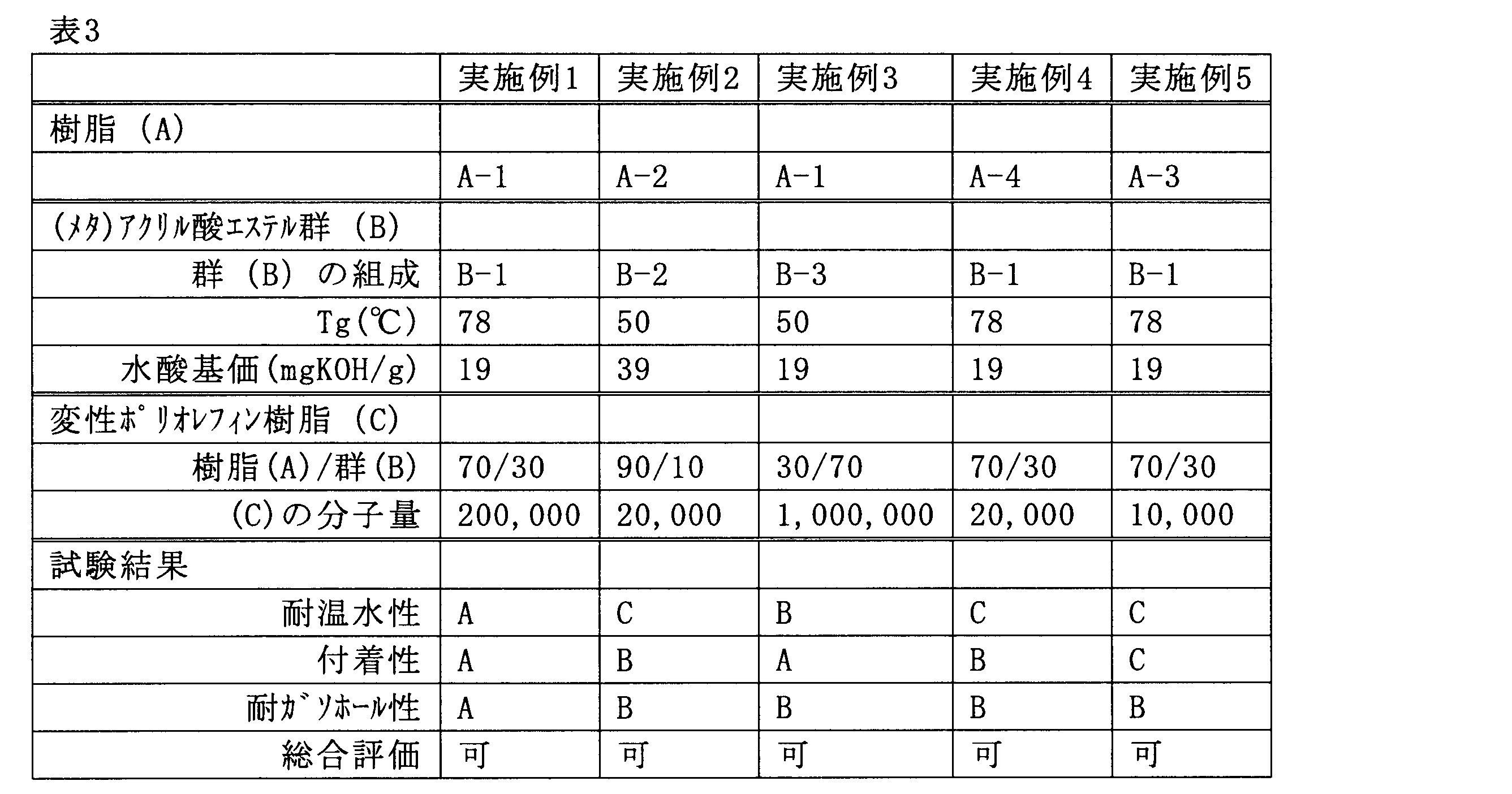
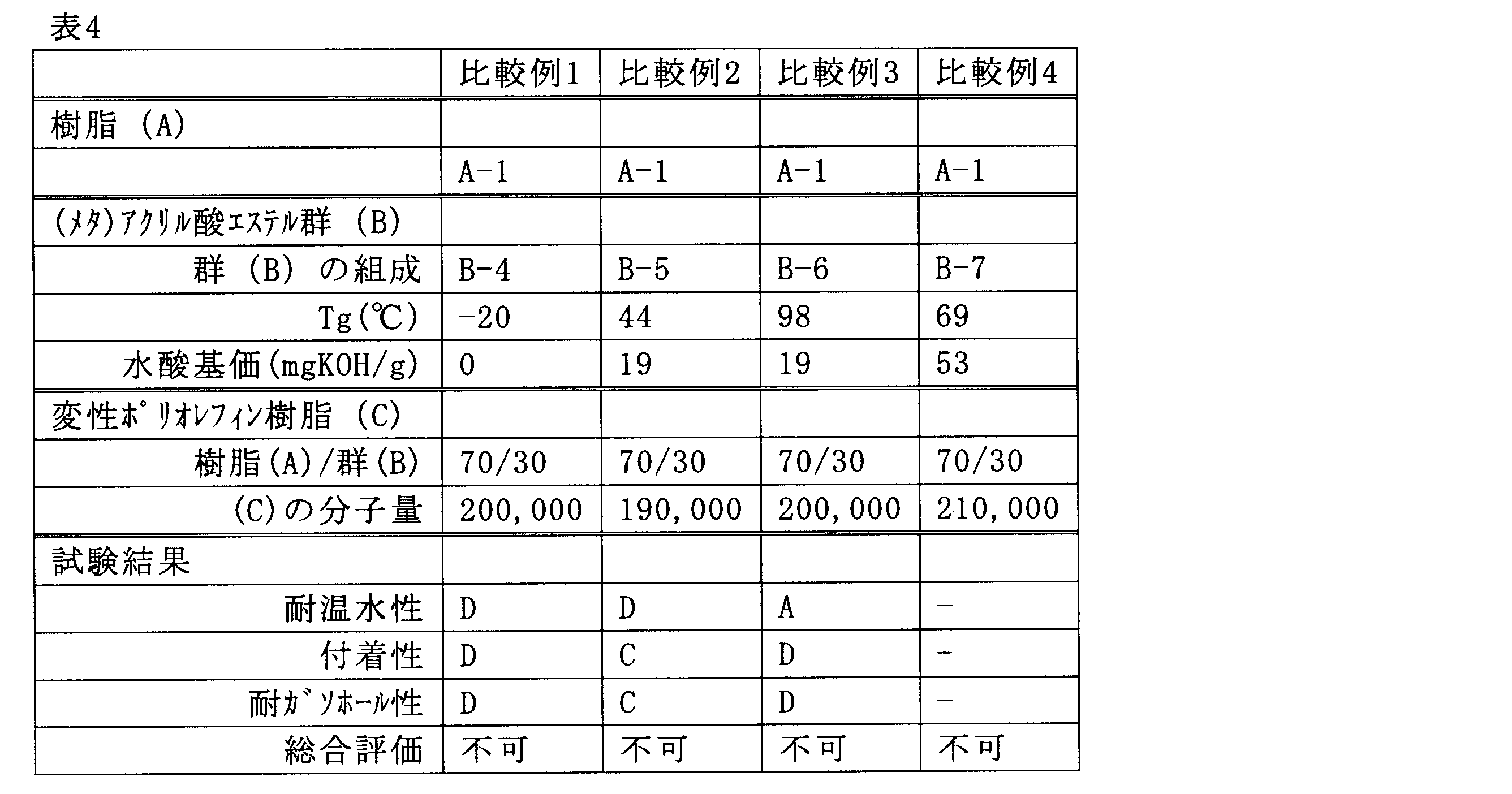
以上の結果によれば、単量体群(B)のガラス転移温度Tgが50℃以上90℃以下であり、かつ水酸基価が17mgKOH/g以上50mgKOH/g以下である、実施例1~5に係る変性ポリオレフィン樹脂を含む水性分散体は、耐温水性、付着性、及び耐ガソホール性のいずれの評価も良好であることが分かる。
一方、単量体群(B)のガラス転移温度Tgが、50℃未満である、比較例1、比較例2に係る変性ポリオレフィン樹脂を含む水性分散体は、耐温水性、付着性、及び耐ガソホール性のいずれかの評価が不良であり、実用に適さない。
また、単量体群(B)のガラス転移温度Tgが、90℃を超える比較例3に係る変性ポリオレフィン樹脂を含む水性分散体は、付着性及び耐ガソホール性の評価が不良であり、実用に適さない(比較例3)。
また、単量体群(B)のガラス転移温度Tgが、90℃を超える比較例3に係る変性ポリオレフィン樹脂を含む水性分散体は、付着性及び耐ガソホール性の評価が不良であり、実用に適さない(比較例3)。
単量体群(B)の水酸基価が、17mgKOH/g未満である、比較例1に係る変性ポリオレフィン樹脂を含む水性分散体は、耐温水性、付着性、及び耐ガソホール性のいずれの評価も不良であり、実用に適さない。
単量体群(B)の水酸基価が、50mgKOH/gを超える、比較例4に係る変性ポリオレフィン樹脂を含む水性分散体は、安定性が不良であるため、耐温水性、付着性、及び耐ガソホール性を評価できず、実用に適さない。
単量体群(B)の水酸基価が、50mgKOH/gを超える、比較例4に係る変性ポリオレフィン樹脂を含む水性分散体は、安定性が不良であるため、耐温水性、付着性、及び耐ガソホール性を評価できず、実用に適さない。
以上の結果は、本発明の変性ポリオレフィン樹脂を、水性分散体としてプラスチック基材上に塗布した場合に、良好な付着性を有すると同時に高い耐温水性を有する塗膜が得られることを示す。
Claims (6)
- 樹脂(A)を単量体群(B)で変性した変性物であり、
前記樹脂(A)はポリオレフィン樹脂又はそれを変性した樹脂であり、
前記単量体群(B)は、(メタ)アクリル酸及び(メタ)アクリル酸エステルからなる群より選択される、1種以上の単量体から構成され、
前記1種以上の単量体をそれぞれ単量体(1)~単量体(n)とし、前記単量体群(B)における単量体(n)の重量割合をWnとし、前記単量体(n)からのホモポリマーのガラス転移温度をTgn(K)とし、前記単量体(n)からのホモポリマーの水酸基価をXn(mgKOH/g)とし、ここで、nは1以上の整数とすると、
下記式(1)及び(2)から算出される単量体群(B)のガラス転移温度Tgが50℃以上90℃以下であり、
下記式(3)から算出される単量体群(B)の水酸基価Xが17mgKOH/g以上50mgKOH/g以下である、変性ポリオレフィン樹脂。


- 重量平均分子量が、10,000以上1,000,000以下である、請求項1に記載の変性ポリオレフィン樹脂。
- 前記樹脂(A)が、カルボン酸により、及び/又は塩素によりポリオレフィン樹脂が変性されている樹脂である、請求項1又は2に記載の変性ポリオレフィン樹脂。
- 前記樹脂(A)の、単量体群(B)に対する重量比率(樹脂(A)/単量体群(B))が、20/80以上95/5以下である、請求項1~3のいずれか1項に記載の変性ポリオレフィン樹脂。
- 請求項1~4のいずれか1項に記載の変性ポリオレフィン樹脂及び水を含む、水性分散体。
- 請求項1~4のいずれか1項に記載の変性ポリオレフィン樹脂を含む、プライマー。
Applications Claiming Priority (2)
| Application Number | Priority Date | Filing Date | Title |
|---|---|---|---|
| JP2018-152100 | 2018-08-10 | ||
| JP2018152100A JP7193266B2 (ja) | 2018-08-10 | 2018-08-10 | 変性ポリオレフィン樹脂、水性分散体、及びプライマー |
Publications (1)
| Publication Number | Publication Date |
|---|---|
| WO2020031916A1 true WO2020031916A1 (ja) | 2020-02-13 |
Family
ID=69415530
Family Applications (1)
| Application Number | Title | Priority Date | Filing Date |
|---|---|---|---|
| PCT/JP2019/030580 Ceased WO2020031916A1 (ja) | 2018-08-10 | 2019-08-02 | 変性ポリオレフィン樹脂、水性分散体、及びプライマー |
Country Status (2)
| Country | Link |
|---|---|
| JP (1) | JP7193266B2 (ja) |
| WO (1) | WO2020031916A1 (ja) |
Cited By (2)
| Publication number | Priority date | Publication date | Assignee | Title |
|---|---|---|---|---|
| CN116075430A (zh) * | 2020-07-27 | 2023-05-05 | 日本制纸株式会社 | 改性聚烯烃树脂及其用途 |
| EP4166583A4 (en) * | 2020-06-10 | 2024-05-22 | Nippon Paper Industries Co., Ltd. | DISPERSION COMPOSITION |
Families Citing this family (2)
| Publication number | Priority date | Publication date | Assignee | Title |
|---|---|---|---|---|
| CN111849280A (zh) * | 2020-07-23 | 2020-10-30 | 万辉(广州)高新材料有限公司 | 一种水性塑胶漆、制备方法及应用 |
| KR102796125B1 (ko) * | 2021-12-16 | 2025-04-18 | (주)이지켐 | 폴리올레핀 수분산체 및 이의 제조방법 |
Citations (9)
| Publication number | Priority date | Publication date | Assignee | Title |
|---|---|---|---|---|
| JPH10140073A (ja) * | 1996-11-11 | 1998-05-26 | Nof Corp | 塗料用樹脂組成物 |
| JP2002145967A (ja) * | 2000-11-06 | 2002-05-22 | Grand Polymer Co Ltd | 改質ポリプロピレン樹脂およびその製造方法 |
| JP2004091559A (ja) * | 2002-08-30 | 2004-03-25 | Nippon Paper Industries Co Ltd | 水性樹脂組成物 |
| JP2005163030A (ja) * | 2003-11-12 | 2005-06-23 | Nippon Paper Chemicals Co Ltd | 変性ポリオレフィン樹脂組成物およびその水分散物 |
| JP2009074047A (ja) * | 2007-08-28 | 2009-04-09 | Kansai Paint Co Ltd | 水性樹脂組成物、水性塗料組成物及びプラスチック成形品の塗装方法 |
| JP2011046777A (ja) * | 2009-08-25 | 2011-03-10 | Mitsubishi Chemicals Corp | ポリオレフィン系複合樹脂水性分散体及びその製造方法 |
| JP2016190941A (ja) * | 2015-03-31 | 2016-11-10 | 東洋インキScホールディングス株式会社 | 樹脂組成物 |
| WO2017110633A1 (ja) * | 2015-12-22 | 2017-06-29 | 日本製紙株式会社 | 変性ポリオレフィン樹脂 |
| WO2018062182A1 (ja) * | 2016-09-28 | 2018-04-05 | 日本製紙株式会社 | 変性ポリオレフィン系樹脂 |
-
2018
- 2018-08-10 JP JP2018152100A patent/JP7193266B2/ja active Active
-
2019
- 2019-08-02 WO PCT/JP2019/030580 patent/WO2020031916A1/ja not_active Ceased
Patent Citations (9)
| Publication number | Priority date | Publication date | Assignee | Title |
|---|---|---|---|---|
| JPH10140073A (ja) * | 1996-11-11 | 1998-05-26 | Nof Corp | 塗料用樹脂組成物 |
| JP2002145967A (ja) * | 2000-11-06 | 2002-05-22 | Grand Polymer Co Ltd | 改質ポリプロピレン樹脂およびその製造方法 |
| JP2004091559A (ja) * | 2002-08-30 | 2004-03-25 | Nippon Paper Industries Co Ltd | 水性樹脂組成物 |
| JP2005163030A (ja) * | 2003-11-12 | 2005-06-23 | Nippon Paper Chemicals Co Ltd | 変性ポリオレフィン樹脂組成物およびその水分散物 |
| JP2009074047A (ja) * | 2007-08-28 | 2009-04-09 | Kansai Paint Co Ltd | 水性樹脂組成物、水性塗料組成物及びプラスチック成形品の塗装方法 |
| JP2011046777A (ja) * | 2009-08-25 | 2011-03-10 | Mitsubishi Chemicals Corp | ポリオレフィン系複合樹脂水性分散体及びその製造方法 |
| JP2016190941A (ja) * | 2015-03-31 | 2016-11-10 | 東洋インキScホールディングス株式会社 | 樹脂組成物 |
| WO2017110633A1 (ja) * | 2015-12-22 | 2017-06-29 | 日本製紙株式会社 | 変性ポリオレフィン樹脂 |
| WO2018062182A1 (ja) * | 2016-09-28 | 2018-04-05 | 日本製紙株式会社 | 変性ポリオレフィン系樹脂 |
Cited By (3)
| Publication number | Priority date | Publication date | Assignee | Title |
|---|---|---|---|---|
| EP4166583A4 (en) * | 2020-06-10 | 2024-05-22 | Nippon Paper Industries Co., Ltd. | DISPERSION COMPOSITION |
| CN116075430A (zh) * | 2020-07-27 | 2023-05-05 | 日本制纸株式会社 | 改性聚烯烃树脂及其用途 |
| US12331140B2 (en) | 2020-07-27 | 2025-06-17 | Nippon Paper Industries Co., Ltd. | Modified polyolefin resin and use thereof |
Also Published As
| Publication number | Publication date |
|---|---|
| JP2020026487A (ja) | 2020-02-20 |
| JP7193266B2 (ja) | 2022-12-20 |
Similar Documents
| Publication | Publication Date | Title |
|---|---|---|
| JP5401098B2 (ja) | ポリオレフィン樹脂分散組成物およびその製造方法 | |
| JP3376244B2 (ja) | 塩素化ポリオレフィン系水性樹脂組成物 | |
| CA3009473C (en) | Modified polyolefin resin for adhesion to low-polarity base materials | |
| WO2020031916A1 (ja) | 変性ポリオレフィン樹脂、水性分散体、及びプライマー | |
| JP6976260B2 (ja) | 変性ポリオレフィン系樹脂 | |
| JP2008214414A (ja) | 変性ポリオレフィン分散樹脂組成物およびそれを含有するプライマー | |
| CN111225948B (zh) | 改性聚烯烃树脂组合物及其制备方法 | |
| JP6943882B2 (ja) | 変性ポリオレフィン系樹脂 | |
| KR102764547B1 (ko) | 수지 조성물 및 이의 용도 | |
| CN115667396A (zh) | 分散体组合物 | |
| JP7219751B2 (ja) | 樹脂組成物 | |
| CN116075430B (zh) | 改性聚烯烃树脂及其用途 | |
| JP2004161952A (ja) | バインダー樹脂組成物及びその用途 | |
| JP7680832B2 (ja) | 水分散体組成物及びその用途 | |
| JP7581185B2 (ja) | 変性ポリオレフィン樹脂組成物 | |
| WO2025158912A1 (ja) | 分散体組成物 | |
| WO2023190213A1 (ja) | 水性分散体組成物 |
Legal Events
| Date | Code | Title | Description |
|---|---|---|---|
| 121 | Ep: the epo has been informed by wipo that ep was designated in this application |
Ref document number: 19846928 Country of ref document: EP Kind code of ref document: A1 |
|
| NENP | Non-entry into the national phase |
Ref country code: DE |
|
| 122 | Ep: pct application non-entry in european phase |
Ref document number: 19846928 Country of ref document: EP Kind code of ref document: A1 |