WO2020003779A1 - ウレタン樹脂組成物、表面処理剤、及び、物品 - Google Patents
ウレタン樹脂組成物、表面処理剤、及び、物品 Download PDFInfo
- Publication number
- WO2020003779A1 WO2020003779A1 PCT/JP2019/019055 JP2019019055W WO2020003779A1 WO 2020003779 A1 WO2020003779 A1 WO 2020003779A1 JP 2019019055 W JP2019019055 W JP 2019019055W WO 2020003779 A1 WO2020003779 A1 WO 2020003779A1
- Authority
- WO
- WIPO (PCT)
- Prior art keywords
- mass
- urethane resin
- parts
- resin composition
- range
- Prior art date
- Legal status (The legal status is an assumption and is not a legal conclusion. Google has not performed a legal analysis and makes no representation as to the accuracy of the status listed.)
- Ceased
Links
Classifications
-
- C—CHEMISTRY; METALLURGY
- C08—ORGANIC MACROMOLECULAR COMPOUNDS; THEIR PREPARATION OR CHEMICAL WORKING-UP; COMPOSITIONS BASED THEREON
- C08K—Use of inorganic or non-macromolecular organic substances as compounding ingredients
- C08K3/00—Use of inorganic substances as compounding ingredients
- C08K3/34—Silicon-containing compounds
- C08K3/36—Silica
-
- C—CHEMISTRY; METALLURGY
- C08—ORGANIC MACROMOLECULAR COMPOUNDS; THEIR PREPARATION OR CHEMICAL WORKING-UP; COMPOSITIONS BASED THEREON
- C08L—COMPOSITIONS OF MACROMOLECULAR COMPOUNDS
- C08L75/00—Compositions of polyureas or polyurethanes; Compositions of derivatives of such polymers
- C08L75/04—Polyurethanes
-
- C—CHEMISTRY; METALLURGY
- C08—ORGANIC MACROMOLECULAR COMPOUNDS; THEIR PREPARATION OR CHEMICAL WORKING-UP; COMPOSITIONS BASED THEREON
- C08L—COMPOSITIONS OF MACROMOLECULAR COMPOUNDS
- C08L83/00—Compositions of macromolecular compounds obtained by reactions forming in the main chain of the macromolecule a linkage containing silicon with or without sulfur, nitrogen, oxygen or carbon only; Compositions of derivatives of such polymers
- C08L83/04—Polysiloxanes
-
- C—CHEMISTRY; METALLURGY
- C09—DYES; PAINTS; POLISHES; NATURAL RESINS; ADHESIVES; COMPOSITIONS NOT OTHERWISE PROVIDED FOR; APPLICATIONS OF MATERIALS NOT OTHERWISE PROVIDED FOR
- C09D—COATING COMPOSITIONS, e.g. PAINTS, VARNISHES OR LACQUERS; FILLING PASTES; CHEMICAL PAINT OR INK REMOVERS; INKS; CORRECTING FLUIDS; WOODSTAINS; PASTES OR SOLIDS FOR COLOURING OR PRINTING; USE OF MATERIALS THEREFOR
- C09D175/00—Coating compositions based on polyureas or polyurethanes; Coating compositions based on derivatives of such polymers
- C09D175/04—Polyurethanes
-
- C—CHEMISTRY; METALLURGY
- C09—DYES; PAINTS; POLISHES; NATURAL RESINS; ADHESIVES; COMPOSITIONS NOT OTHERWISE PROVIDED FOR; APPLICATIONS OF MATERIALS NOT OTHERWISE PROVIDED FOR
- C09D—COATING COMPOSITIONS, e.g. PAINTS, VARNISHES OR LACQUERS; FILLING PASTES; CHEMICAL PAINT OR INK REMOVERS; INKS; CORRECTING FLUIDS; WOODSTAINS; PASTES OR SOLIDS FOR COLOURING OR PRINTING; USE OF MATERIALS THEREFOR
- C09D183/00—Coating compositions based on macromolecular compounds obtained by reactions forming in the main chain of the macromolecule a linkage containing silicon, with or without sulfur, nitrogen, oxygen, or carbon only; Coating compositions based on derivatives of such polymers
- C09D183/04—Polysiloxanes
-
- C—CHEMISTRY; METALLURGY
- C09—DYES; PAINTS; POLISHES; NATURAL RESINS; ADHESIVES; COMPOSITIONS NOT OTHERWISE PROVIDED FOR; APPLICATIONS OF MATERIALS NOT OTHERWISE PROVIDED FOR
- C09D—COATING COMPOSITIONS, e.g. PAINTS, VARNISHES OR LACQUERS; FILLING PASTES; CHEMICAL PAINT OR INK REMOVERS; INKS; CORRECTING FLUIDS; WOODSTAINS; PASTES OR SOLIDS FOR COLOURING OR PRINTING; USE OF MATERIALS THEREFOR
- C09D5/00—Coating compositions, e.g. paints, varnishes or lacquers, characterised by their physical nature or the effects produced; Filling pastes
- C09D5/02—Emulsion paints including aerosols
-
- C—CHEMISTRY; METALLURGY
- C09—DYES; PAINTS; POLISHES; NATURAL RESINS; ADHESIVES; COMPOSITIONS NOT OTHERWISE PROVIDED FOR; APPLICATIONS OF MATERIALS NOT OTHERWISE PROVIDED FOR
- C09D—COATING COMPOSITIONS, e.g. PAINTS, VARNISHES OR LACQUERS; FILLING PASTES; CHEMICAL PAINT OR INK REMOVERS; INKS; CORRECTING FLUIDS; WOODSTAINS; PASTES OR SOLIDS FOR COLOURING OR PRINTING; USE OF MATERIALS THEREFOR
- C09D7/00—Features of coating compositions, not provided for in group C09D5/00; Processes for incorporating ingredients in coating compositions
- C09D7/40—Additives
- C09D7/42—Gloss-reducing agents
Definitions
- the present invention relates to a urethane resin composition, a surface treatment agent, and an article having a layer formed by the surface treatment agent.
- the surface is finished with a surface treatment agent from the viewpoint of imparting chemical resistance and design.
- the material used for the conventional surface treatment agent is mainly a solvent-based resin composition containing an organic solvent.
- an aqueous surface treatment agent substantially containing no organic solvent has been developed. Development is underway.
- aqueous surface treating agent for example, a polyurethane having specific mechanical properties, a carbodiimide crosslinking agent, and an aqueous surface treating agent containing a filler are disclosed (for example, see Patent Document 1).
- a polyurethane having specific mechanical properties for example, a carbodiimide crosslinking agent, and an aqueous surface treating agent containing a filler are disclosed (for example, see Patent Document 1).
- Patent Document 1 As the aqueous surface treating agent, for example, a polyurethane having specific mechanical properties, a carbodiimide crosslinking agent, and an aqueous surface treating agent containing a filler are disclosed (for example, see Patent Document 1).
- the conventional solvent-based resin composition is converted to an aqueous system, there is a problem in that the abrasion resistance is reduced.
- the aqueous surface treating agent also has a high surface friction coefficient, and further improvement in abrasion resistance has been demanded.
- the problem to be solved by the present invention is to provide a urethane resin composition which can provide a film having excellent wear resistance in a water-containing urethane resin composition.
- the present invention provides a urethane resin composition containing a urethane resin (A), water (B), and a silicone compound (C) having a number average molecular weight of 150,000 or more and less than 330,000. It is.
- the present invention also provides a surface treatment agent containing the urethane resin composition, and an article having a layer formed by the surface treatment agent.
- the urethane resin composition of the present invention can provide a film having excellent chemical resistance. Therefore, the urethane resin composition of the present invention can be suitably used as a surface treatment agent for various articles.
- the urethane resin composition of the present invention contains a urethane resin (A), water (B), and a silicone compound (C) having a specific number average molecular weight.
- the urethane resin (A) can be dispersed in water (B), and is, for example, a urethane resin having a hydrophilic group such as an anionic group, a cationic group, or a nonionic group; A urethane resin dispersed in B) can be used. These urethane resins (A) may be used alone or in combination of two or more.
- a method for obtaining the urethane resin having an anionic group for example, a method using one or more compounds selected from the group consisting of a compound having a carboxyl group and a compound having a sulfonyl group as a raw material may be mentioned.
- Examples of the compound having a carboxyl group include 2,2-dimethylolpropionic acid, 2,2-dimethylolbutanoic acid, 2,2-dimethylolbutyric acid, 2,2-dimethylolpropionic acid, and Herbic acid or the like can be used. These compounds may be used alone or in combination of two or more.
- Examples of the compound having a sulfonyl group include 3,4-diaminobutanesulfonic acid, 3,6-diamino-2-toluenesulfonic acid, 2,6-diaminobenzenesulfonic acid, and N- (2-aminoethyl)- 2-aminoethylsulfonic acid and the like can be used. These compounds may be used alone or in combination of two or more.
- the carboxyl group and the sulfonyl group may be partially or entirely neutralized by a basic compound in the resin composition.
- the basic compound include organic amines such as ammonia, triethylamine, pyridine, and morpholine; alkanolamines such as monoethanolamine and dimethylethanolamine; and metal base compounds including sodium, potassium, lithium, and calcium. Can be.
- a method for obtaining the urethane resin having a cationic group for example, a method using one or more compounds having an amino group as a raw material may be mentioned.
- Examples of the compound having an amino group include compounds having a primary and secondary amino group such as triethylenetetramine and diethylenetriamine; N-alkyldialkanolamines such as N-methyldiethanolamine and N-ethyldiethanolamine; Compounds having a tertiary amino group such as N-alkyldiaminoalkylamine such as diaminoethylamine and N-ethyldiaminoethylamine can be used. These compounds may be used alone or in combination of two or more.
- a method for obtaining the urethane resin having a nonionic group for example, a method using one or more compounds having an oxyethylene structure as a raw material may be mentioned.
- polyether polyol having an oxyethylene structure such as polyoxyethylene glycol, polyoxyethylene polyoxypropylene glycol, and polyoxyethylene polyoxytetramethylene glycol can be used. These compounds may be used alone or in combination of two or more.
- the amount of the raw material used for producing the urethane resin having the above hydrophilic group is such that urethane is more excellent in chemical resistance, abrasion resistance, weather resistance, and hydrolysis resistance. It is preferably in the range of 0.1 to 15% by mass, more preferably in the range of 1 to 10% by mass, and even more preferably in the range of 1.5 to 7% by mass of the raw material of the resin (A).
- Examples of the emulsifier that can be used for obtaining the urethane resin that is forcibly dispersed in water (B) include, for example, polyoxyethylene nonylphenyl ether, polyoxyethylene lauryl ether, polyoxyethylene styryl phenyl ether, polyoxyethylene Nonionic emulsifiers such as ethylene sorbitol tetraoleate and polyoxyethylene / polyoxypropylene copolymers; fatty acid salts such as sodium oleate; alkyl sulfates; alkyl benzene sulfonates; alkyl sulfosuccinates; naphthalene sulfonates; Anionic emulsifiers such as polyoxyethylene alkyl sulfate, sodium alkane sulfonate, sodium salt of alkyl diphenyl ether sulfonate; alkyl amine salt, alkyl trimethyl ammonium Arm salts,
- urethane resin (A) specifically, for example, a raw material used for producing the above-mentioned urethane resin having a hydrophilic group, polyisocyanate (a1), polyol (a2), and a chain extender ( The reactants of a3) can be used. For these reactions, known urethanation reactions can be used.
- polyisocyanate (a1) examples include aromatic polyisocyanates such as phenylene diisocyanate, tolylene diisocyanate, diphenylmethane diisocyanate, xylylene diisocyanate, naphthalene diisocyanate, polymethylene polyphenyl polyisocyanate, and carbodiimidated diphenylmethane polyisocyanate; hexamethylene diisocyanate And aliphatic or alicyclic polyisocyanates such as lysine diisocyanate, cyclohexane diisocyanate, isophorone diisocyanate, dicyclohexylmethane diisocyanate, xylylene diisocyanate, tetramethyl xylylene diisocyanate, dimer acid diisocyanate and norbornene diisocyanate. These polyisocyanates may be used alone or in combination of two or more.
- the polyisocyanate (a1) it is preferable to use an alicyclic polyisocyanate from the viewpoint of obtaining more excellent chemical resistance, abrasion resistance, and weather resistance, and at least the nitrogen atom of the isocyanate group is cyclohexane. It is more preferable to use a polyisocyanate having one or more structures directly connected to a ring, and it is more preferable to use isophorone diisocyanate and / or dicyclohexylmethane diisocyanate. Further, the amount of the alicyclic polyisocyanate used is preferably 30% by mass or more in the polyisocyanate (a1) from the viewpoint of obtaining more excellent chemical resistance, abrasion resistance, and weather resistance. , 40% by mass or more, more preferably 50% by mass or more.
- the alicyclic polyisocyanate and the aliphatic polyisocyanate may be used as the polyisocyanate (a1). It is preferable to use an isocyanate in combination, and it is preferable to use hexamethylene diisocyanate as the aliphatic polyisocyanate.
- the content of the alicyclic polyisocyanate in the polyisocyanate (a1) is preferably 30% by mass or more, more preferably 40% by mass or more, and even more preferably 50% by mass or more.
- the amount of the polyisocyanate (a1) used is in the range of 5 to 50% by mass in the raw material of the urethane resin (A) from the viewpoint that more excellent chemical resistance, abrasion resistance and weather resistance are obtained. It is preferably in the range of 15 to 40% by mass, more preferably in the range of 20 to 37% by mass.
- polyether polyol for example, polyether polyol, polyester polyol, polyacryl polyol, polycarbonate polyol, polybutadiene polyol and the like can be used. These polyols may be used alone or in combination of two or more. Among these, it is preferable to use a polycarbonate polyol from the viewpoint of obtaining more excellent chemical resistance, abrasion resistance, and weather resistance.
- polycarbonate polyol for example, a reaction product of a carbonate ester and / or phosgene and a compound having two or more hydroxyl groups can be used.
- Examples of the compound having two or more hydroxyl groups include ethylene glycol, propylene glycol, 1,3-propanediol, 1,4-butanediol, 1,3-butanediol, 1,2-butanediol, 2-methyl 1,3-propanediol, 1,5-pentanediol, neopentyl glycol, 1,6-hexanediol, 1,5-hexanediol, 3-methyl-1,5-pentanediol, 1,7-heptanediol 1,8-octanediol, 1,9-nonanediol, 1,8-nonanediol, 2-ethyl-2-butyl-1,3-propanediol, 1,10-decanediol, 1,12-dodecanediol 1,4-cyclohexanedimethanol, 1,3-cyclohexane
- 1,3-propanediol, 1,4-butanediol, 1,5-pentanediol, 1,6-propanediol, 1,6-pentanediol and 1,6-propanediol are more excellent in chemical resistance, abrasion resistance, and weather resistance. It is preferable to use one or more compounds selected from the group consisting of -hexanediol, 1,4-cyclohexanedimethanol, 3-methylpentanediol, and 1,10-decanediol. More preferred.
- the amount of the polycarbonate polyol used is preferably 85% by mass or more in the polyol (a2), and more preferably 90% by mass or more from the viewpoint of obtaining more excellent chemical resistance, abrasion resistance, and weather resistance. Is more preferable, and 95 mass% or more is still more preferable.
- the number average molecular weight of the polycarbonate polyol is preferably in the range of 100 to 100,000 from the viewpoint of obtaining more excellent chemical resistance, mechanical strength, abrasion resistance, and weather resistance. It is more preferably in the range of ⁇ 10,000, further preferably in the range of 2002002,500.
- the number average molecular weight of the polycarbonate polyol indicates a value measured by a gel permeation column chromatography (GPC) method.
- the number average molecular weight of the polyol (a2) other than the polycarbonate polyol is preferably in the range of 500 to 100,000, and more preferably in the range of 700 to 50,000, from the viewpoint that more excellent weather resistance is obtained. Preferably, the range is 800 to 10,000.
- the number average molecular weight of the polyol (a2) indicates a value measured by a gel permeation column chromatography (GPC) method.
- the amount of the polyol (a2) used is preferably in the range of 30 to 80% by mass, more preferably in the range of 40 to 75% by mass, and more preferably in the range of 50 to 70% by mass in the raw material of the urethane resin (A). Is more preferred.
- Examples of the chain extender (a3) include those having a number average molecular weight in the range of 50 to 450 (excluding the polycarbonate polyol), and specifically include ethylenediamine, 1,2-propanediamine, 6-hexamethylenediamine, piperazine, 2,5-dimethylpiperazine, isophoronediamine, 1,2-cyclohexanediamine, 1,3-cyclohexanediamine, 1,4-cyclohexanediamine, 4,4′-dicyclohexylmethanediamine, 3,
- a chain extender having an amino group such as 3'-dimethyl-4,4'-dicyclohexylmethanediamine, 1,4-cyclohexanediamine, hydrazine; ethylene glycol, diethylene glycol, triethylene glycol, propylene glycol, dipropylene glycol, , 3- Lopandiol, 1,3-butanediol, 1,4-butanediol, hexamethylene glycol, sac
- chain extender (a3) among those described above, a chain extender having an amino group is used, because more excellent chemical resistance, mechanical strength, abrasion resistance, and weather resistance are obtained. Is preferable, and piperazine and / or hydrazine are more preferable.
- the total amount of piperazine and hydrazine is preferably 30% by mass or more in the chain extender (a3), more preferably 50% by mass or more, and 60% by mass. The above is more preferable, and the amount is particularly preferably 80% by mass or more.
- the chain extender (a3) preferably has an average number of functional groups of less than 3, more preferably less than 2.5. Also,
- the method for producing the urethane resin (A) includes, for example, reacting the polyisocyanate (a1), the polyol (a2), and a raw material used for producing the urethane resin having a hydrophilic group, thereby obtaining an isocyanate group.
- the urethane resin (A) it is preferable to deactivate the isocyanate groups remaining in the urethane resin (A).
- an alcohol having one hydroxyl group such as methanol.
- the amount of the alcohol to be used is preferably in the range of 0.001 to 10 parts by mass with respect to 100 parts by mass of the urethane resin (A).
- an organic solvent when producing the urethane resin (A), an organic solvent may be used.
- the organic solvent include ketone compounds such as acetone and methyl ethyl ketone; ether compounds such as tetrahydrofuran and dioxane; acetate compounds such as ethyl acetate and butyl acetate; nitrile compounds such as acetonitrile; dimethylformamide and N-methylpyrrolidone.
- An amide compound or the like can be used.
- These organic solvents may be used alone or in combination of two or more. Preferably, the organic solvent is finally removed by a distillation method or the like.
- the content of the urethane bond in the urethane resin (A) is preferably in the range of 980 to 4,000 mmol / kg, from the viewpoint that more excellent chemical resistance, wear resistance, and weather resistance can be obtained.
- the range is more preferably from 2,000 to 3,500 mmol / kg, further preferably from 1,100 to 3,000 mmol / kg, and more preferably from 1,150 to 2,500 mmol / kg.
- the content of the urethane bond in the urethane resin (A) is determined by the following: the polyisocyanate (a1), the polyol (a2), the raw material used for producing the urethane resin having a hydrophilic group, and the chain extender (a3). ) Indicates a value calculated from the charged amount.
- the content of the urea bond in the urethane resin (A) is preferably in the range of 315 to 850 mmol / kg from the viewpoint of obtaining more excellent chemical resistance, abrasion resistance, and weather resistance, The range is more preferably from 350 to 830 mmol / kg, still more preferably from 400 to 800 mmol / kg, even more preferably from 410 to 770 mmol / kg.
- the content of the urea bond of the urethane resin (A) is based on the polyisocyanate (a1), the polyol (a2), the raw material used for producing the urethane resin having a hydrophilic group, and the chain extender. A value calculated from the charged amount of (a3) is shown.
- the content of the urethane resin (A) is preferably in the range of 3 to 50% by mass, and more preferably 5 to 30% by mass in the urethane resin composition from the viewpoint of coating properties, workability and storage stability. The range is more preferable.
- the water (B) ion-exchanged water, distilled water or the like can be used.
- the content of the water (B) is preferably in the range of 30 to 95% by mass in the urethane resin composition, from the viewpoint of coatability, workability and storage stability of the urethane resin composition, A range of 90% by mass is more preferable.
- the silicone compound (C) it is essential to use a compound having a number average molecular weight of 150,000 or more and less than 330,000 in order to obtain excellent wear resistance.
- a silicone compound having a relatively high molecular weight By using a silicone compound having a relatively high molecular weight, a coating film having a high surface strength and a small coefficient of friction is formed, and excellent wear resistance can be obtained.
- the number average molecular weight of the silicone compound (C) is preferably in the range of 200,000 to 300,000, more preferably 220,000 to 270,000, from the viewpoint of obtaining more excellent abrasion resistance.
- the number average molecular weight of the silicone compound (C) indicates a value measured by a gel permeation chromatography (GPC) method, and specifically, the measuring method is described in Examples.
- silicone compound (C) examples include polydimethylsiloxane, polymethylphenylsiloxane, polymethylhydrogensiloxane, and polymethylphenylhydrogensiloxane; modified products thereof; these silicone compounds and acryl. And the like can be used. These silicone compounds may be used alone or in combination of two or more. Among these, it is preferable to use polydimethylsiloxane from the viewpoint that more excellent wear resistance can be obtained.
- the silicone compound (C) is preferably in the form of an emulsion dispersed in water (B) from the viewpoint of affinity with water (B).
- a known surfactant may be contained.
- the urethane resin composition of the present invention contains the urethane resin (A), water (B), and silicone compound (C) as essential components, but may use other additives as necessary.
- Examples of the other additives include a filler (D), a crosslinking agent (E), an emulsifier, an antifoaming agent, a leveling agent, a thickener, a viscoelasticity adjusting agent, an antifoaming agent, a wetting agent, a dispersant, and a preservative.
- Agents, plasticizers, penetrants, fragrances, bactericides, acaricides, fungicides, ultraviolet absorbers, antioxidants, antistatic agents, flame retardants, dyes, pigments (e.g., titanium white, redwood, phthalocyanine, carbon Black, permanent yellow, etc.) can be used.
- These additives may be used alone or in combination of two or more.
- a filler (D) for imparting a matte feeling to the coating film, and mechanical properties of the coating film It is preferable to include a crosslinking agent (E) in order to improve the strength.
- Examples of the filler (D) include silica particles, organic beads, calcium carbonate, magnesium carbonate, barium carbonate, talc, aluminum hydroxide, calcium sulfate, kaolin, mica, asbestos, mica, calcium silicate, and alumina silicate. Can be used. These fillers may be used alone or in combination of two or more.
- silica particles for example, dry silica, wet silica and the like can be used. Of these, dry silica is preferred because of its high scattering effect and wide adjustment range of gloss value.
- the average particle size of these silica particles is preferably in the range of 2 to 14 ⁇ m, and more preferably in the range of 3 to 12 ⁇ m.
- the average particle size of the silica particles indicates the particle size (the particle size at D50 in the particle size distribution) when the integrated amount occupies 50% in the integrated particle amount curve of the particle size distribution measurement result.
- organic beads for example, acrylic beads, urethane beads, silicon beads, olefin beads and the like can be used.
- the amount of the filler (D) to be used can be appropriately determined according to the matt feeling to be imparted.
- the amount is 1 to 30 parts by mass with respect to 100 parts by mass of the urethane resin (A).
- the range is 3 to 10 parts by mass.
- crosslinking agent (E) for example, an isocyanate crosslinking agent, an epoxy crosslinking agent, a carbodiimide crosslinking agent, an oxazolidine crosslinking agent, an oxazoline crosslinking agent, a melamine crosslinking agent and the like can be used. These crosslinking agents may be used alone or in combination of two or more.
- the urethane resin composition of the present invention can provide a film having excellent chemical resistance. Therefore, the urethane resin composition of the present invention is suitably used as a surface treatment agent for various articles such as synthetic leather, polyvinyl chloride (PVC) leather, thermoplastic olefin resin (TPO) leather, dashboard, and instrument panel. be able to.
- PVC polyvinyl chloride
- TPO thermoplastic olefin resin
- the article of the present invention has a layer formed by the surface treatment agent.
- the article include, for example, synthetic leather, artificial leather, natural leather, automobile interior seats using polyvinyl chloride (PVC) leather, sports shoes, clothing, furniture, thermoplastic olefin (TPO) leather, and dashboard. , Instrument panels and the like.
- PVC polyvinyl chloride
- TPO thermoplastic olefin
- the thickness of the layer made of the surface treatment agent is, for example, in the range of 0.1 to 100 ⁇ m.
- urethane prepolymer solution in methyl ethyl ketone 6.8 parts by mass of hydrazine and 15 parts by mass of triethylamine were mixed with the methyl ethyl ketone solution of the urethane prepolymer, and then 820 parts by mass of ion-exchanged water was added to disperse the urethane resin (A-1) in water. A liquid was obtained. Next, methyl ethyl ketone was distilled off from the emulsion, and ion-exchanged water was further added to obtain an aqueous dispersion of a urethane resin (A-1) having a nonvolatile content of 30% by mass.
- urethane resin (A-3) having a nonvolatile content of 30% by mass.
- the urethane resin (A-3) obtained had a urethane bond content of 1,747 mmol / kg, a urea bond content of 576 mmol / kg, and an alicyclic structure content of 2,341 mmol / kg.
- Example 1 35 parts by mass of the aqueous dispersion of the urethane resin (A-1) obtained in Synthesis Example 1, 3 parts by mass of a carbodiimide crosslinking agent (“Carbodilite V-02-L2” manufactured by Nisshinbo Chemical Inc.), and a filler (manufactured by Evonik Degussa) ACEMATT TS 100, 2 parts by mass of silica particles produced by a dry method, average particle size: 10 ⁇ m, water dispersion of polydimethylsiloxane (polydimethylsiloxane content: 65% by mass, number average molecular weight: 25.5) By mixing 3 parts by mass of water and 57 parts by mass of water, a urethane resin composition was obtained.
- a carbodiimide crosslinking agent (“Carbodilite V-02-L2” manufactured by Nisshinbo Chemical Inc.)
- a filler manufactured by Evonik Degussa) ACEMATT
- Example 2 35 parts by mass of the aqueous dispersion of the urethane resin (A-1) obtained in Synthesis Example 1, 3 parts by mass of a carbodiimide crosslinking agent (“Carbodilite V-02-L2” manufactured by Nisshinbo Chemical Inc.), and a filler (manufactured by Evonik Degussa) ACEMATT TS 100, 2 parts by mass of silica particles produced by a dry method, average particle size: 10 ⁇ m, water dispersion of polydimethylsiloxane (polydimethylsiloxane content: 65% by mass, number average molecular weight: 25.5) A urethane resin composition was obtained by mixing 6 parts by mass of water and 54 parts by mass of water.
- a carbodiimide crosslinking agent (“Carbodilite V-02-L2” manufactured by Nisshinbo Chemical Inc.)
- a filler manufactured by Evonik Degussa) ACEMATT TS 100
- Example 3 35 parts by mass of the aqueous dispersion of the urethane resin (A-1) obtained in Synthesis Example 1, 3 parts by mass of a carbodiimide crosslinking agent (“Carbodilite V-02-L2” manufactured by Nisshinbo Chemical Inc.), and a filler (manufactured by Evonik Degussa) ACEMATT TS 100, 2 parts by mass of silica particles produced by a dry method, average particle size: 10 ⁇ m, water dispersion of polydimethylsiloxane (polydimethylsiloxane content: 65% by mass, number average molecular weight: 25.5) Urethane resin composition was obtained by mixing 0.5 parts by mass of 50000 parts by mass and 59.5 parts by mass of water.
- a carbodiimide crosslinking agent (“Carbodilite V-02-L2” manufactured by Nisshinbo Chemical Inc.)
- a filler manufactured by Evonik Degussa) ACE
- Example 1 A urethane resin composition was obtained in the same manner as in Example 1 except that the aqueous dispersion of polydimethylsiloxane was omitted.
- a carbodiimide cross-linking agent “Carbodilite V-02-L2” manufactured by Nisshinbo Chemical Inc.
- a filler (“ACEMATT” manufactured by Evonik Degussa
- the number average molecular weight of the polyol used in the synthesis example is a value measured by gel permeation column chromatography (GPC) under the following conditions.
- Measuring device High-speed GPC device (“HLC-8220GPC” manufactured by Tosoh Corporation) Column: The following columns manufactured by Tosoh Corporation were connected in series and used. "TSKgel G5000" (7.8 mm ID x 30 cm) x 1 "TSKgel G4000” (7.8 mm ID x 30 cm) x 1 "TSKgel G3000” (7.8 mm ID x 30 cm) x 1 Book “TSKgel G2000” (7.8 mm ID ⁇ 30 cm) ⁇ 1 Detector: RI (differential refractometer) Column temperature: 40 ° C Eluent: tetrahydrofuran (THF) Flow rate: 1.0 mL / min Injection volume: 100 ⁇ L (tetrahydrofuran solution with a sample concentration of 0.4% by mass) Standard sample: A calibration curve was prepared using the following standard polystyrene.
- the number average molecular weight of the silicone compound (C) is a value measured by GPC (gel permeation chromatography) under the following conditions.
- Measuring device High-speed GPC device (“HLC-8220GPC” manufactured by Tosoh Corporation) Column: The following columns manufactured by Tosoh Corporation were connected in series and used. "TSKgel GMHXL” (7.8 mm ID x 30 cm) x 4 detectors: RI (differential refractometer) Column temperature: 40 ° C Eluent: tetrahydrofuran (THF) Flow rate: 1.0 mL / min Injection volume: 100 ⁇ L Concentration: Analytical sample: 4 mg / mL tetrahydrofuran solution standard: 1 mg / mL tetrahydrofuran solution standard: A calibration curve was prepared using the following polyethylene oxide / polyethylene glycol.
- the urethane resin composition of the present invention has excellent abrasion resistance.
- Comparative Example 1 was an embodiment in which no silicone compound (C) was used, but the abrasion resistance was insufficient.
- Comparative Example 2 is an embodiment in which a silicone compound having a number average molecular weight below the range specified in the present invention was used instead of the silicone compound (C), but the abrasion resistance was insufficient.
- Comparative Example 3 is an embodiment in which a silicone compound having a number average molecular weight exceeding the range specified in the present invention is used instead of the silicone compound (C). It was difficult to use as.
Landscapes
- Chemical & Material Sciences (AREA)
- Organic Chemistry (AREA)
- Chemical Kinetics & Catalysis (AREA)
- Engineering & Computer Science (AREA)
- Materials Engineering (AREA)
- Wood Science & Technology (AREA)
- Life Sciences & Earth Sciences (AREA)
- Health & Medical Sciences (AREA)
- Medicinal Chemistry (AREA)
- Polymers & Plastics (AREA)
- Dispersion Chemistry (AREA)
- Compositions Of Macromolecular Compounds (AREA)
- Polyurethanes Or Polyureas (AREA)
Abstract
本発明は、ウレタン樹脂(A)、水(B)、及び、数平均分子量が15万以上33万未満であるシリコーン化合物(C)を含有することを特徴とするウレタン樹脂組成物を提供するものである。また、本発明は、前記ウレタン樹脂組成物を含有することを特徴とする表面処理剤、及び、その表面処理剤により形成された層を有することを特徴とする物品を提供するものである。前記シリコーン化合物(C)の含有量は、0.01~10質量%の範囲であるであることが好ましい。前記シリコーン化合物(C)は、ポリジメチルシロキサンであることが好ましい。前記シリコーン化合物(C)は、ポリジメチルシロキサンであることが好ましい。前記表面処理剤には、更にフィラー(D)を含有することが好ましい。
Description
本発明は、ウレタン樹脂組成物、表面処理剤、及び、表面処理剤による層を有する物品に関する。
自動車内装レザー用シートの製造工程においては、その表面に耐薬品性および意匠性付与の観点から、表面処理剤により仕上げがなされている。従来の表面処理剤に用いられる材料は、有機溶剤を含んだ溶剤系樹脂組成物が主流であったが、近年の環境規制の高まりを受け、有機溶剤を実質的に含まない水性表面処理剤の開発が進められている。
前記水性表面処理剤としては、例えば、特定の機械物性を有するポリウレタン、カルボジイミド架橋剤、及び、フィラーを含有する水性表面処理剤が開示されている(例えば、特許文献1を参照。)。しかしながら、従来の溶剤系樹脂組成物を水系化すると耐摩耗性が低下する問題があり、前記水性表面処理剤についても表面の摩擦係数が高く、更なる耐摩耗性の改善が求められていた。
本発明が解決しようとする課題は、水を含有するウレタン樹脂組成物において、耐摩耗性に優れる皮膜が得られるウレタン樹脂組成物を提供することである。
本発明は、ウレタン樹脂(A)、水(B)、及び、数平均分子量が15万以上33万未満であるシリコーン化合物(C)を含有することを特徴とするウレタン樹脂組成物を提供するものである。
また、本発明は、前記ウレタン樹脂組成物を含有することを特徴とする表面処理剤、及び、その表面処理剤により形成された層を有することを特徴とする物品を提供するものである。
本発明のウレタン樹脂組成物は、耐薬品性に優れる皮膜を得ることができる。よって、本発明のウレタン樹脂組成物は、各種物品の表面処理剤として好適に用いることができる。
本発明のウレタン樹脂組成物は、ウレタン樹脂(A)、水(B)、及び、特定の数平均分子量を有するシリコーン化合物(C)を含有するものである。
前記ウレタン樹脂(A)は、水(B)に分散し得るものであり、例えば、アニオン性基、カチオン性基、ノニオン性基等の親水性基を有するウレタン樹脂;乳化剤で強制的に水(B)中に分散したウレタン樹脂などを用いることができる。これらのウレタン樹脂(A)は単独で用いても2種以上を併用してもよい。
前記アニオン性基を有するウレタン樹脂を得る方法としては、例えば、カルボキシル基を有する化合物及びスルホニル基を有する化合物からなる群より選ばれる1種以上の化合物を原料として用いる方法が挙げられる。
前記カルボキシル基を有する化合物としては、例えば、2,2-ジメチロールプロピオン酸、2,2-ジメチロールブタン酸、2,2-ジメチロール酪酸、2,2-ジメチロールプロピオン酸、2,2-吉草酸等を用いることができる。これらの化合物は単独で用いても2種以上を併用してもよい。
前記スルホニル基を有する化合物としては、例えば、3,4-ジアミノブタンスルホン酸、3,6-ジアミノ-2-トルエンスルホン酸、2,6-ジアミノベンゼンスルホン酸、N-(2-アミノエチル)-2-アミノエチルスルホン酸等を用いることができる。これらの化合物は単独で用いても2種以上を併用してもよい。
前記カルボキシル基及びスルホニル基は、樹脂組成物中で、一部又は全部が塩基性化合物に中和されていてもよい。前記塩基性化合物としては、例えば、アンモニア、トリエチルアミン、ピリジン、モルホリン等の有機アミン;モノエタノールアミン、ジメチルエタノールアミン等のアルカノールアミン;ナトリウム、カリウム、リチウム、カルシウム等を含む金属塩基化合物などを用いることができる。
前記カチオン性基を有するウレタン樹脂を得る方法としては、例えば、アミノ基を有する化合物の1種又は2種以上を原料として用いる方法が挙げられる。
前記アミノ基を有する化合物としては、例えば、トリエチレンテトラミン、ジエチレントリアミン等の1級及び2級アミノ基を有する化合物;N-メチルジエタノールアミン、N-エチルジエタノールアミン等のN-アルキルジアルカノールアミン、N-メチルジアミノエチルアミン、N-エチルジアミノエチルアミン等のN-アルキルジアミノアルキルアミンなどの3級アミノ基を有する化合物などを用いることができる。これらの化合物は単独で用いても2種以上を併用してもよい。
前記ノニオン性基を有するウレタン樹脂を得る方法としては、例えば、オキシエチレン構造を有する化合物の1種又は2種以上を原料として用いる方法が挙げられる。
前記オキシエチレン構造を有する化合物としては、例えば、ポリオキシエチレングリコール、ポリオキシエチレンポリオキシプロピレングリコール、ポリオキシエチレンポリオキシテトラメチレングリコール等のオキシエチレン構造を有するポリエーテルポリオールを用いることができる。これらの化合物は単独で用いても2種以上を併用してもよい。
以上の親水性基を有するウレタン樹脂を製造するために用いる原料の使用量としては、より一層優れた耐薬品性、耐摩耗性、耐候性、及び、耐加水分解性が得られる点から、ウレタン樹脂(A)の原料中0.1~15質量%の範囲であることが好ましく、1~10質量%の範囲がより好ましく、1.5~7質量%の範囲が更に好ましい。
前記強制的に水(B)中に分散するウレタン樹脂を得る際に用いることができる乳化剤としては、例えば、ポリオキシエチレンノニルフェニルエーテル、ポリオキシエチレンラウリルエーテル、ポリオキシエチレンスチリルフェニルエーテル、ポリオキシエチレンソルビトールテトラオレエート、ポリオキシエチレン・ポリオキシプロピレン共重合体等のノニオン性乳化剤;オレイン酸ナトリウム等の脂肪酸塩、アルキル硫酸エステル塩、アルキルベンゼンスルフォン酸塩、アルキルスルホコハク酸塩、ナフタレンスルフォン酸塩、ポリオキシエチレンアルキル硫酸塩、アルカンスルフォネートナトリウム塩、アルキルジフェニルエーテルスルフォン酸ナトリウム塩等のアニオン性乳化剤;アルキルアミン塩、アルキルトリメチルアンモニウム塩、アルキルジメチルベンジルアンモニウム塩等のカチオン性乳化剤などを用いることができる。これらの乳化剤は単独で用いても2種以上を併用してもよい。
前記ウレタン樹脂(A)としては、具体的には、例えば、前記した親水性基を有するウレタン樹脂を製造するために用いる原料、ポリイソシアネート(a1)、ポリオール(a2)、及び、鎖伸長剤(a3)の反応物を用いることができる。これらの反応は公知のウレタン化反応を用いることができる。
前記ポリイソシアネート(a1)としては、例えば、フェニレンジイソシアネート、トリレンジイソシアネート、ジフェニルメタンジイソシアネート、キシリレンジイソシアネート、ナフタレンジイソシアネート、ポリメチレンポリフェニルポリイソシアネート、カルボジイミド化ジフェニルメタンポリイソシアネート等の芳香族ポリイソシアネート;ヘキサメチレンジイソシアネート、リジンジイソシアネート、シクロヘキサンジイソシアネート、イソホロンジイソシアネート、ジシクロヘキシルメタンジイソシアネート、キシリレンジイソシアネート、テトラメチルキシリレンジイソシアネート、ダイマー酸ジイソシアネート、ノルボルネンジイソシアネート等の脂肪族または脂環式ポリイソシアネートなどを用いることができる。これらのポリイソシアネートは単独で用いても2種以上を併用してもよい。
前記ポリイソシアネート(a1)としては、より一層優れた耐薬品性、耐摩耗性、及び、耐候性が得られる点から、脂環式ポリイソシアネートを用いることが好ましく、少なくともイソシアネート基の窒素原子がシクロヘキサン環と直接連結した構造を1つ以上有するポリイソシアネートを用いることがより好ましく、イソホロンジイソシアネート及び/又はジシクロヘキシルメタンジイソシアネートを用いることが更に好ましい。また、脂環式ポリイソシアネートの使用量としては、より一層優れた耐薬品性、耐摩耗性、及び、耐候性が得られる点から、ポリイソシアネート(a1)中30質量%以上であることが好ましく、40質量%以上がより好ましく、50質量%以上が更に好ましい。
また、本発明のウレタン樹脂組成物が表面処理剤として使用される際に、より一層の耐光性が求められる場合には、前記ポリイソシアネート(a1)として、前記脂環式ポリイソシアネートと脂肪族ポリイソシアネートとを併用することが好ましく、前記脂肪族ポリイソシアネートとしては、ヘキサメチレンジイソシアネートを用いることが好ましい。この際のポリイソシアネート(a1)中の前記脂環式ポリイソシアネートの含有量としては、30質量%以上であることが好ましく、40質量%以上がより好ましく、50質量%以上が更に好ましい。
前記ポリイソシアネート(a1)の使用量としては、より一層優れた耐薬品性、耐摩耗性、及び、耐候性が得られる点から、ウレタン樹脂(A)の原料中5~50質量%の範囲であることが好ましく、15~40質量%の範囲がより好ましく、20~37質量%の範囲が更に好ましい。
前記ポリオール(a2)としては、例えば、ポリエーテルポリオール、ポリエステルポリオール、ポリアクリルポリオール、ポリカーボネートポリオール、ポリブタジエンポリオール等を用いることができる。これらのポリオールは単独で用いても2種以上を併用してもよい。これらの中でも、より一層優れた耐薬品性、耐摩耗性、及び、耐候性が得られる点から、ポリカーボネートポリオールを用いることが好ましい。
前記ポリカーボネートポリオールとしては、例えば、炭酸エステル及び/又はホスゲンと、水酸基を2個以上有する化合物との反応物を用いることができる。
前記炭酸エステルとしては、例えば、ジメチルカーボネート、ジエチルカーボネート、ジフェニルカーボネート、エチレンカーボネート、プロピレンカーボネート等を用いることができる。これらの化合物は単独で用いても2種以上を併用してもよい。
前記水酸基を2個以上有する化合物としては、例えば、エチレングリコール、プロピレングリコール、1,3-プロパンジオール、1,4-ブタンジオール、1,3-ブタンジオール、1,2-ブタンジオール、2-メチル-1,3-プロパンジオール、1,5-ペンタンジオール、ネオペンチルグリコール、1,6-ヘキサンジオール、1,5-ヘキサンジオール、3-メチル-1,5-ペンタンジオール、1,7-ヘプタンジオール、1,8-オクタンジオール、1,9-ノナンジオール、1,8-ノナンジオール、2-エチル-2-ブチル-1,3-プロパンジオール、1,10-デカンジオール、1,12-ドデカンジオール、1,4-シクロヘキサンジメタノール、1,3-シクロヘキサンジメタノール、トリメチロールプロパン、3-メチルペンタンジオール、ネオペンチルグリコール、トリメチロールエタン、グリセリン等を用いることができる。これらの化合物は単独で用いても2種以上を併用してもよい。これらの中でも、より一層優れた耐薬品性、耐摩耗性、及び、耐候性が得られる点から、1,3-プロパンジオール、1,4-ブタンジオール、1,5-ペンタンジオール、1,6-ヘキサンジオール、1,4-シクロヘキサンジメタノール、3-メチルペンタンジオール、及び、1,10-デカンジオールからなる群から選ばれる1種以上の化合物を用いることが好ましく、1,6-ヘキサンジオールがより好ましい。
前記ポリカーボネートポリオールの使用量としては、より一層優れた耐薬品性、耐摩耗性、及び、耐候性が得られる点から、ポリオール(a2)中85質量%以上であることが好ましく、90質量%以上がより好ましく、95質量%以上が更に好ましい。
前記ポリカーボネートポリオールの数平均分子量としては、より一層優れた耐薬品性、機械的強度、耐摩耗性、及び、耐候性が得られる点から、100~100,000の範囲であることが好ましく、150~10,000の範囲より好ましく、200~2,500の範囲が更に好ましい。なお、前記ポリカーボネートポリオールの数平均分子量は、ゲル・パーミエーション・カラムクロマトグラフィー(GPC)法により測定した値を示す。
前記ポリカーボネートポリオール以外の前記ポリオール(a2)の数平均分子量としては、より一層優れた耐候性が得られる点から、500~100,000の範囲であることが好ましく、700~50,000の範囲より好ましく、800~10,000の範囲が更に好ましい。なお、前記ポリオール(a2)の数平均分子量は、ゲル・パーミエーション・カラムクロマトグラフィー(GPC)法により測定した値を示す。
前記ポリオール(a2)の使用量としては、ウレタン樹脂(A)の原料中30~80質量%の範囲であることが好ましく、40~75質量%の範囲がより好ましく、50~70質量%の範囲が更に好ましい。
前記鎖伸長剤(a3)としては、例えば、数平均分子量が50~450の範囲のもの(前記ポリカーボネートポリオールを除く。)であり、具体的には、エチレンジアミン、1,2-プロパンジアミン、1,6-ヘキサメチレンジアミン、ピペラジン、2,5-ジメチルピペラジン、イソホロンジアミン、1,2-シクロヘキサンジアミン、1,3-シクロヘキサンジアミン、1,4-シクロヘキサンジアミン、4,4’-ジシクロヘキシルメタンジアミン、3,3’-ジメチル-4,4’-ジシクロヘキシルメタンジアミン、1,4-シクロヘキサンジアミン、ヒドラジン等のアミノ基を有する鎖伸長剤;エチレングリコール、ジエチレンリコール、トリエチレングリコール、プロピレングリコール、ジプロピレングリコール、1,3-プロパンジオール、1,3-ブタンジオール、1,4-ブタンジオール、ヘキサメチレングリコール、サッカロース、メチレングリコール、グリセリン、ソルビトール、ビスフェノールA、4,4’-ジヒドロキシジフェニル、4,4’-ジヒドロキシジフェニルエーテル、トリメチロールプロパン等の水酸基を有する鎖伸長剤などを用いることができる。これらの鎖伸長剤は単独で用いても2種以上を併用してもよい。
前記鎖伸長剤(a3)としては、前記した中でも、より一層優れた耐薬品性、機械的強度、耐摩耗性、及び、耐候性が得られる点から、アミノ基を有する鎖伸長剤を用いることが好ましく、ピペラジン及び/又はヒドラジンがより好ましく、ピペラジン及びヒドラジンの合計量としては、前記鎖伸長剤(a3)中30質量%以上であることが好ましく、50質量%以上がより好ましく、60質量%以上が更に好ましく、80質量%以上が特に好ましい。また、前記鎖伸長剤(a3)としては、平均官能基数が3未満であること好ましく、2.5未満がより好ましい。また、
前記鎖伸長剤(a3)の使用量としては、より一層優れた耐薬品性、機械的強度、耐摩耗性、及び、耐候性が得られる点から、ウレタン樹脂(A)の原料中0.5~10質量%の範囲であることが好ましく、0.7~5質量%の範囲がより好ましく、0.9~2.3の範囲が更に好ましい。
前記ウレタン樹脂(A)の製造方法としては、例えば、前記ポリイソシアネート(a1)と前記ポリオール(a2)と前記親水性基を有するウレタン樹脂を製造するために用いる原料を反応させることによって、イソシアネート基を有するウレタンプレポリマーを製造し、次いで、前記ウレタンプレポリマーと、前記鎖伸長剤(a3)とを反応させることによって製造する方法;前記ポリイソシアネート(a1)、前記ポリオール(a2)、親水性基を有するウレタン樹脂を製造するために用いる原料、及び、前記鎖伸長剤(a3)を一括に仕込み反応させる方法等が挙げられる。これらの反応は、例えば50~100℃で3~10時間行うことが挙げられる。
前記親水性基を有するウレタン樹脂を製造するために用いる原料が有する水酸基、前記ポリオール(a2)が有する水酸基、及び、前記鎖伸長剤(a3)が有する水酸基及びアミノ基の合計と、前記ポリイソシアネート(a1)が有するイソシアネート基とのモル比[(イソシアネート基)/(水酸基及びアミノ基)]としては、0.8~1.2の範囲であることが好ましく、0.9~1.1の範囲であることがより好ましい。
前記ウレタン樹脂(A)を製造する際には、前記ウレタン樹脂(A)に残存するイソシアネート基を失活させることが好ましい。前記イソシアネート基を失活させる場合には、メタノール等の水酸基を1個有するアルコールを用いることが好ましい。前記アルコールの使用量としては、ウレタン樹脂(A)100質量部に対し、0.001~10質量部の範囲であることが好ましい。
また、前記ウレタン樹脂(A)を製造する際には、有機溶剤を用いてもよい。前記有機溶剤としては、例えば、アセトン、メチルエチルケトン等のケトン化合物;テトラヒドロフラン、ジオキサン等のエーテル化合物;酢酸エチル、酢酸ブチル等の酢酸エステル化合物;アセトニトリル等のニトリル化合物;ジメチルホルムアミド、N-メチルピロリドン等のアミド化合物などを用いることができる。これらの有機溶媒は単独で用いても2種以上を併用してもよい。なお、前記有機溶剤は、蒸留法等によって最終的には除去されることが好ましい。
前記ウレタン樹脂(A)のウレタン結合の含有量としては、より一層優れた耐薬品性、耐摩耗性、及び、耐候性が得られる点から、980~4,000mmol/kgの範囲が好ましく、1,000~3,500mmol/kgの範囲がより好ましく、1,100~3,000mmol/kgの範囲が更に好ましく、1,150~2,500mmol/kgの範囲が。なお、前記ウレタン樹脂(A)のウレタン結合の含有量は、前記ポリイソシアネート(a1)、ポリオール(a2)、親水性基を有するウレタン樹脂を製造するために用いる原料、および、鎖伸長剤(a3)の仕込み量から算出される値を示す。
前記ウレタン樹脂(A)のウレア結合の含有量としては、より一層優れた耐薬品性、耐摩耗性、及び、耐候性が得られる点から、315~850mmol/kgの範囲であることが好ましく、350~830mmol/kgの範囲がより好ましく、400~800mmol/kgの範囲が更に好ましく、410~770mmol/kgの範囲が更に好ましい。なお、なお、前記ウレタン樹脂(A)のウレア結合の含有量は、前記ポリイソシアネート(a1)、ポリオール(a2)、親水性基を有するウレタン樹脂を製造するために用いる原料、および、鎖伸長剤(a3)の仕込み量から算出される値を示す。
前記ウレタン樹脂(A)の脂環構造の含有量としては、より一層優れた耐薬品性、耐摩耗性、及び、耐候性が得られる点から、500~3,000mmol/kgの範囲であることが好ましく、600~2,900mmol/kgの範囲がより好ましく、700~2,700mmol/kgの範囲が更に好ましい。なお、なお、前記ウレタン樹脂(A)の脂環構造の含有量は、前記ポリイソシアネート(a1)、ポリオール(a2)、親水性基を有するウレタン樹脂を製造するために用いる原料、および、鎖伸長剤(a3)の仕込み量から算出される値を示す。
前記ウレタン樹脂(A)の含有量としては、塗工性、作業性および保存安定性の点から、ウレタン樹脂組成物中3~50質量%の範囲であることが好ましく、5~30質量%の範囲がより好ましい。
前記水(B)としては、イオン交換水、蒸留水等を用いることができる。前記水(B)の含有量としては、ウレタン樹脂組成物の塗工性、作業性および保存安定性の点から、ウレタン樹脂組成物中30~95質量%の範囲であることが好ましく、50~90質量%の範囲がより好ましい。
前記シリコーン化合物(C)としては、優れた耐摩耗性を得るうえで、数平均分子量が15万以上33万未満であるものを用いることが必須である。このように比較的高分子量のシリコーン化合物を用いることで、表面強度が高く、摩擦係数の小さな塗膜が形成され、優れた耐摩耗性を得ることができる。前記シリコーン化合物(C)の数平均分子量としては、より一層優れた耐摩耗性が得られる点から、20万~30万の範囲であることが好ましく、22万~27万の範囲がより好ましい。なお、前記シリコーン化合物(C)の数平均分子量は、ゲル・パーミエーション・クロマトグラフィー(GPC)法により測定した値を示し、具体的には実施例にてその測定方法を示す。
前記シリコーン化合物(C)としては、具体的には、例えば、ポリジメチルシロキサン、ポリメチルフェニルシロキサン、ポリメチルハイドロジェンシロキサン、ポリメチルフェニルハイドロジェンシロキサン;これらの変性物;これらのシリコーン化合物とアクリルとの共重合体などを用いることができる。これらのシリコーン化合物は単独で用いても2種以上を併用してもよい。これらの中でも、より一層優れた耐摩耗性が得られる点から、ポリジメチルシロキサンを用いることが好ましい。
前記シリコーン化合物(C)は、水(B)との親和性の点から、水(B)に分散したエマルジョンの形態をとっていることが好ましい。またかかる際には、公知の界面活性剤が含有されていてもよい。
前記シリコーン化合物(C)の含有量(=シリコーン化合物(C)固形分)としては、より一層優れた耐摩耗性が得られる点から0.01~10質量%の範囲であることが好ましく、0.1~7質量%の範囲がより好ましく、0.5~5質量%の範囲が更に好ましい。
本発明のウレタン樹脂組成物は、前記ウレタン樹脂(A)、水(B)、及び、シリコーン化合物(C)を必須成分として含有するが、必要に応じてその他の添加剤を用いてもよい。
前記その他の添加剤としては、例えば、フィラー(D)、架橋剤(E)、乳化剤、消泡剤、レベリング剤、増粘剤、粘弾性調整剤、消泡剤、湿潤剤、分散剤、防腐剤、可塑剤、浸透剤、香料、殺菌剤、殺ダニ剤、防かび剤、紫外線吸収剤、酸化防止剤、帯電防止剤、難燃剤、染料、顔料(例えば、チタン白、ベンガラ、フタロシアニン、カーボンブラック、パーマネントイエロー等)等を用いることができる。これらの添加剤は単独で用いても2種以上を併用しても良い。
前記その他の添加剤としては、本発明のウレタン樹脂組成物が表面処理剤として使用される場合には、その塗膜にマット感を付与するためにフィラー(D)、及び、塗膜の機械的強度を向上するために架橋剤(E)を含有することが好ましい。
前記フィラー(D)としては、例えば、シリカ粒子、有機ビーズ、炭酸カルシウム、炭酸マグネシウム、炭酸バリウム、タルク、水酸化アルミニウム、硫酸カルシウム、カオリン、雲母、アスベスト、マイカ、ケイ酸カルシウム、アルミナシリケイト等を用いることができる。これらのフィラーは、単独で用いても2種以上を併用してもよい。
前記シリカ粒子としては、例えば、乾式シリカ、湿式シリカ等を用いることができる。これらの中でも、散乱効果が高く光沢値の調整範囲が広くなることから、乾式シリカが好ましい。これらシリカ粒子の平均粒子径としては、2~14μmの範囲であることが好ましく、3~12μmの範囲がより好ましい。なお、前記シリカ粒子の平均粒子径は、粒度分布測定結果の積算粒子量曲線において、その積算量が50%を占めるときの粒子径(粒度分布におけるD50での粒子径)を示す。
前記有機ビーズとしては、例えば、アクリルビーズ、ウレタンビーズ、シリコンビーズ、オレフィンビーズ等を用いることができる。
前記フィラー(D)の使用量は、付与するマット感に応じて適宜決定することができるが、例えば、ウレタン樹脂(A)100質量部に対して、1~30質量部の範囲であることが好ましく、3~10質量部の範囲がより好ましい。
前記架橋剤(E)としては、例えば、イソシアネート架橋剤、エポキシ架橋剤、カルボジイミド架橋剤、オキサゾリジン架橋剤、オキサゾリン架橋剤、メラミン架橋剤等を用いることができる。これらの架橋剤は単独で用いても2種以上を併用してもよい。
前記架橋剤(E)の使用量としては、例えば、前記ウレタン樹脂(A)100質量部に対して、5~40質量部の範囲であることが好ましく、10~30質量部の範囲がより好ましい。
以上、本発明のウレタン樹脂組成物は、耐薬品性に優れる皮膜を得ることができる。よって、本発明のウレタン樹脂組成物は、合成皮革、ポリ塩化ビニル(PVC)レザー、熱可塑性オレフィン樹脂(TPO)レザー、ダッシュボード、インスツルメントパネル等の各種物品の表面処理剤として好適に用いることができる。
本発明の物品は、前記表面処理剤により形成された層を有する。
前記物品の具体的としては、例えば、合成皮革、人工皮革、天然皮革、ポリ塩化ビニル(PVC)レザーを用いた自動車内装シート、スポーツ靴、衣料、家具、熱可塑性オレフィン(TPO)レザー、ダッシュボード、インスツルメントパネル等が挙げられる。
前記表面処理剤による層の厚さとしては、例えば、0.1~100μmの範囲である。
以下、実施例を用いて、本発明をより詳細に説明する。
[合成例1]ウレタン樹脂(A-1)水分散体の調製
攪拌機、温度計、および窒素還流管を備えた四つ口フラスコに、メチルエチルケトン250質量部、及びオクチル酸第一錫0.001質量部を入れ、次いで、ポリカーボネートポリオール-1(1,4-ブタンジオール及び1,6-ヘキサンジオールを原料とするもの、数平均分子量:1,000)200質量部、2,2-ジメチロールプロピオン酸15質量部、イソホロンジイソシアネート49質量部、ヘキサメチレンジイソシアネート34質量部を入れ、70℃で1時間反応させ、ウレタンプレポリマーのメチルエチルケトン溶液を得た。
次いで、このウレタンプレポリマーのメチルエチルケトン溶液に、ヒドラジン6.8質量部、トリエチルアミン15質量部を混合させた後に、イオン交換水820質量部を加えてウレタン樹脂(A-1)が水に分散した乳化液を得た。
次いで、前記乳化液からメチルエチルケトンを留去し、更にイオン交換水を加えることで、不揮発分30質量%のウレタン樹脂(A-1)水分散体を得た。
得られたウレタン樹脂(A-1)のウレタン結合の含有量は2,052mmol/kg、ウレア結合の含有量は698mmol/kg、脂環構造の含有量は715mmol/kgであった。
攪拌機、温度計、および窒素還流管を備えた四つ口フラスコに、メチルエチルケトン250質量部、及びオクチル酸第一錫0.001質量部を入れ、次いで、ポリカーボネートポリオール-1(1,4-ブタンジオール及び1,6-ヘキサンジオールを原料とするもの、数平均分子量:1,000)200質量部、2,2-ジメチロールプロピオン酸15質量部、イソホロンジイソシアネート49質量部、ヘキサメチレンジイソシアネート34質量部を入れ、70℃で1時間反応させ、ウレタンプレポリマーのメチルエチルケトン溶液を得た。
次いで、このウレタンプレポリマーのメチルエチルケトン溶液に、ヒドラジン6.8質量部、トリエチルアミン15質量部を混合させた後に、イオン交換水820質量部を加えてウレタン樹脂(A-1)が水に分散した乳化液を得た。
次いで、前記乳化液からメチルエチルケトンを留去し、更にイオン交換水を加えることで、不揮発分30質量%のウレタン樹脂(A-1)水分散体を得た。
得られたウレタン樹脂(A-1)のウレタン結合の含有量は2,052mmol/kg、ウレア結合の含有量は698mmol/kg、脂環構造の含有量は715mmol/kgであった。
[合成例2]ウレタン樹脂(A-2)水分散体の調製
攪拌機、温度計、および窒素還流管を備えた四つ口フラスコに、メチルエチルケトン250質量部、及びオクチル酸第一錫0.001質量部を入れ、次いで、ポリカーボネートポリオール-3(1,6-ヘキサンジオールを原料とするもの、数平均分子量:2,000)を220質量部、2,2-ジメチロールプロピオン酸12質量部、ジシクロヘキシルメタンジイソシアネート70質量部を入れ、70℃で1時間反応させ、ウレタンプレポリマーのメチルエチルケトン溶液を得た。
次いで、このウレタンプレポリマーのメチルエチルケトン溶液に、ピペラジン4.5質量部、トリエチルアミン9質量部を混合させた後に、イオン交換水880質量部を加えてウレタン樹脂(A-2)が水に分散した乳化液を得た。
次いで、前記乳化液からメチルエチルケトンを留去し、更にイオン交換水を加えることで、不揮発分32質量%のウレタン樹脂(A-2)水分散体を得た。
得られたウレタン樹脂(A-2)のウレタン結合の含有量は1,278mmol/kg、ウレア結合の含有量は435mmol/kg、脂環構造の含有量は1,713mmol/kgであった。
攪拌機、温度計、および窒素還流管を備えた四つ口フラスコに、メチルエチルケトン250質量部、及びオクチル酸第一錫0.001質量部を入れ、次いで、ポリカーボネートポリオール-3(1,6-ヘキサンジオールを原料とするもの、数平均分子量:2,000)を220質量部、2,2-ジメチロールプロピオン酸12質量部、ジシクロヘキシルメタンジイソシアネート70質量部を入れ、70℃で1時間反応させ、ウレタンプレポリマーのメチルエチルケトン溶液を得た。
次いで、このウレタンプレポリマーのメチルエチルケトン溶液に、ピペラジン4.5質量部、トリエチルアミン9質量部を混合させた後に、イオン交換水880質量部を加えてウレタン樹脂(A-2)が水に分散した乳化液を得た。
次いで、前記乳化液からメチルエチルケトンを留去し、更にイオン交換水を加えることで、不揮発分32質量%のウレタン樹脂(A-2)水分散体を得た。
得られたウレタン樹脂(A-2)のウレタン結合の含有量は1,278mmol/kg、ウレア結合の含有量は435mmol/kg、脂環構造の含有量は1,713mmol/kgであった。
[合成例3]ウレタン樹脂(A-3)水分散体の調製
攪拌機、温度計、および窒素還流管を備えた四つ口フラスコに、メチルエチルケトン250質量部、及びオクチル酸第一錫0.001質量部を入れ、次いで、ポリカーボネートポリオール-4(1,6-ヘキサンジオールを原料とするもの、数平均分子量:2,000)を138質量部、ポリカーボネートポリオール-5(1,6-ヘキサンジオールを原料とするもの、数平均分子量:500)を55質量部、2,2-ジメチロールプロピオン酸13質量部、ジシクロヘキシルメタンジイソシアネート100質量部を入れ、70℃で1時間反応させ、ウレタンプレポリマーのメチルエチルケトン溶液を得た。
次いで、このウレタンプレポリマーのメチルエチルケトン溶液に、ピペラジン5.6質量部、トリエチルアミン10質量部を混合させた後に、イオン交換水880質量部を加えてウレタン樹脂(A-3)が水に分散した乳化液を得た。
次いで、前記乳化液からメチルエチルケトンを留去し、更にイオン交換水を加えることで、不揮発分30質量%のウレタン樹脂(A-3)水分散体を得た。
得られたウレタン樹脂(A-3)のウレタン結合の含有量は1,747mmol/kg、ウレア結合の含有量は576mmol/kg、脂環構造の含有量は2,341mmol/kgであった。
攪拌機、温度計、および窒素還流管を備えた四つ口フラスコに、メチルエチルケトン250質量部、及びオクチル酸第一錫0.001質量部を入れ、次いで、ポリカーボネートポリオール-4(1,6-ヘキサンジオールを原料とするもの、数平均分子量:2,000)を138質量部、ポリカーボネートポリオール-5(1,6-ヘキサンジオールを原料とするもの、数平均分子量:500)を55質量部、2,2-ジメチロールプロピオン酸13質量部、ジシクロヘキシルメタンジイソシアネート100質量部を入れ、70℃で1時間反応させ、ウレタンプレポリマーのメチルエチルケトン溶液を得た。
次いで、このウレタンプレポリマーのメチルエチルケトン溶液に、ピペラジン5.6質量部、トリエチルアミン10質量部を混合させた後に、イオン交換水880質量部を加えてウレタン樹脂(A-3)が水に分散した乳化液を得た。
次いで、前記乳化液からメチルエチルケトンを留去し、更にイオン交換水を加えることで、不揮発分30質量%のウレタン樹脂(A-3)水分散体を得た。
得られたウレタン樹脂(A-3)のウレタン結合の含有量は1,747mmol/kg、ウレア結合の含有量は576mmol/kg、脂環構造の含有量は2,341mmol/kgであった。
[実施例1]
合成例1で得られたウレタン樹脂(A-1)水分散体35質量部、カルボジイミド架橋剤(日清紡ケミカル株式会社製「カルボジライトV-02-L2」)3質量部、フィラー(エボニックデグサ社製「ACEMATT TS 100」、乾式法で製造されたシリカ粒子、平均粒子径:10μm)2質量部、ポリジメチルシロキサンの水分散体(ポリジメチルシロキサンの含有率;65質量%、数平均分子量;25.5万)3質量部、水57質量部を混合することで、ウレタン樹脂組成物を得た。
合成例1で得られたウレタン樹脂(A-1)水分散体35質量部、カルボジイミド架橋剤(日清紡ケミカル株式会社製「カルボジライトV-02-L2」)3質量部、フィラー(エボニックデグサ社製「ACEMATT TS 100」、乾式法で製造されたシリカ粒子、平均粒子径:10μm)2質量部、ポリジメチルシロキサンの水分散体(ポリジメチルシロキサンの含有率;65質量%、数平均分子量;25.5万)3質量部、水57質量部を混合することで、ウレタン樹脂組成物を得た。
[実施例2]
合成例1で得られたウレタン樹脂(A-1)水分散体35質量部、カルボジイミド架橋剤(日清紡ケミカル株式会社製「カルボジライトV-02-L2」)3質量部、フィラー(エボニックデグサ社製「ACEMATT TS 100」、乾式法で製造されたシリカ粒子、平均粒子径:10μm)2質量部、ポリジメチルシロキサンの水分散体(ポリジメチルシロキサンの含有率;65質量%、数平均分子量;25.5万)6質量部、水54質量部を混合することで、ウレタン樹脂組成物を得た。
合成例1で得られたウレタン樹脂(A-1)水分散体35質量部、カルボジイミド架橋剤(日清紡ケミカル株式会社製「カルボジライトV-02-L2」)3質量部、フィラー(エボニックデグサ社製「ACEMATT TS 100」、乾式法で製造されたシリカ粒子、平均粒子径:10μm)2質量部、ポリジメチルシロキサンの水分散体(ポリジメチルシロキサンの含有率;65質量%、数平均分子量;25.5万)6質量部、水54質量部を混合することで、ウレタン樹脂組成物を得た。
[実施例3]
合成例1で得られたウレタン樹脂(A-1)水分散体35質量部、カルボジイミド架橋剤(日清紡ケミカル株式会社製「カルボジライトV-02-L2」)3質量部、フィラー(エボニックデグサ社製「ACEMATT TS 100」、乾式法で製造されたシリカ粒子、平均粒子径:10μm)2質量部、ポリジメチルシロキサンの水分散体(ポリジメチルシロキサンの含有率;65質量%、数平均分子量;25.5万)0.5質量部、水59.5質量部を混合することで、ウレタン樹脂組成物を得た。
合成例1で得られたウレタン樹脂(A-1)水分散体35質量部、カルボジイミド架橋剤(日清紡ケミカル株式会社製「カルボジライトV-02-L2」)3質量部、フィラー(エボニックデグサ社製「ACEMATT TS 100」、乾式法で製造されたシリカ粒子、平均粒子径:10μm)2質量部、ポリジメチルシロキサンの水分散体(ポリジメチルシロキサンの含有率;65質量%、数平均分子量;25.5万)0.5質量部、水59.5質量部を混合することで、ウレタン樹脂組成物を得た。
[実施例4]
合成例1で得られたウレタン樹脂(A-2)水分散体35質量部、カルボジイミド架橋剤日清紡ケミカル株式会社製「カルボジライトV-02-L2」)3質量部、フィラー(エボニックデグサ社製「ACEMATT TS 100」、乾式法で製造されたシリカ粒子、平均粒子径:10μm)2質量部、ポリジメチルシロキサンの水分散体(ポリジメチルシロキサンの含有率;65質量%、数平均分子量;20万)3質量部、水57質量部を混合することで、ウレタン樹脂組成物を得た。
合成例1で得られたウレタン樹脂(A-2)水分散体35質量部、カルボジイミド架橋剤日清紡ケミカル株式会社製「カルボジライトV-02-L2」)3質量部、フィラー(エボニックデグサ社製「ACEMATT TS 100」、乾式法で製造されたシリカ粒子、平均粒子径:10μm)2質量部、ポリジメチルシロキサンの水分散体(ポリジメチルシロキサンの含有率;65質量%、数平均分子量;20万)3質量部、水57質量部を混合することで、ウレタン樹脂組成物を得た。
[実施例5]
合成例1で得られたウレタン樹脂(A-3)水分散体35質量部、カルボジイミド架橋剤日清紡ケミカル株式会社製「カルボジライトV-02-L2」)3質量部、フィラー(エボニックデグサ社製「ACEMATT TS 100」、乾式法で製造されたシリカ粒子、平均粒子径:10μm)2質量部、ポリジメチルシロキサンの水分散体(ポリジメチルシロキサンの含有率;65質量%、数平均分子量;30万)3質量部、水57質量部を混合することで、ウレタン樹脂組成物を得た。
合成例1で得られたウレタン樹脂(A-3)水分散体35質量部、カルボジイミド架橋剤日清紡ケミカル株式会社製「カルボジライトV-02-L2」)3質量部、フィラー(エボニックデグサ社製「ACEMATT TS 100」、乾式法で製造されたシリカ粒子、平均粒子径:10μm)2質量部、ポリジメチルシロキサンの水分散体(ポリジメチルシロキサンの含有率;65質量%、数平均分子量;30万)3質量部、水57質量部を混合することで、ウレタン樹脂組成物を得た。
[比較例1]
実施例1において、ポリジメチルシロキサンの水分散体を除いた以外は、実施例1と同様にしてウレタン樹脂組成物を得た。
実施例1において、ポリジメチルシロキサンの水分散体を除いた以外は、実施例1と同様にしてウレタン樹脂組成物を得た。
[比較例2]
合成例1で得られたウレタン樹脂(A-1)水分散体35質量部、カルボジイミド架橋剤日清紡ケミカル株式会社製「カルボジライトV-02-L2」)3質量部、フィラー(エボニックデグサ社製「ACEMATT TS 100」、乾式法で製造されたシリカ粒子、平均粒子径:10μm)2質量部、ポリジメチルシロキサンの水分散体(ポリジメチルシロキサンの含有率;65質量%、数平均分子量;10万)3質量部、水57質量部を混合することで、ウレタン樹脂組成物を得た。
合成例1で得られたウレタン樹脂(A-1)水分散体35質量部、カルボジイミド架橋剤日清紡ケミカル株式会社製「カルボジライトV-02-L2」)3質量部、フィラー(エボニックデグサ社製「ACEMATT TS 100」、乾式法で製造されたシリカ粒子、平均粒子径:10μm)2質量部、ポリジメチルシロキサンの水分散体(ポリジメチルシロキサンの含有率;65質量%、数平均分子量;10万)3質量部、水57質量部を混合することで、ウレタン樹脂組成物を得た。
[比較例3]
合成例1で得られたウレタン樹脂(A-1)水分散体35質量部、カルボジイミド架橋剤日清紡ケミカル株式会社製「カルボジライトV-02-L2」)3質量部、フィラー(エボニックデグサ社製「ACEMATT TS 100」、乾式法で製造されたシリカ粒子、平均粒子径:10μm)2質量部、水57質量部を混合した後、ポリジメチルシロキサンの水分散体(ポリジメチルシロキサンの含有率;65質量%、数平均分子量;50万)3質量部を添加したが、混合せず、耐摩耗性の試験を行うことができなかった。
合成例1で得られたウレタン樹脂(A-1)水分散体35質量部、カルボジイミド架橋剤日清紡ケミカル株式会社製「カルボジライトV-02-L2」)3質量部、フィラー(エボニックデグサ社製「ACEMATT TS 100」、乾式法で製造されたシリカ粒子、平均粒子径:10μm)2質量部、水57質量部を混合した後、ポリジメチルシロキサンの水分散体(ポリジメチルシロキサンの含有率;65質量%、数平均分子量;50万)3質量部を添加したが、混合せず、耐摩耗性の試験を行うことができなかった。
[数平均分子量の測定方法(1)]
合成例で用いたポリオールの数平均分子量は、ゲル・パーミエーション・カラムクロマトグラフィー(GPC)法により、下記の条件で測定し得られた値を示す。
合成例で用いたポリオールの数平均分子量は、ゲル・パーミエーション・カラムクロマトグラフィー(GPC)法により、下記の条件で測定し得られた値を示す。
測定装置:高速GPC装置(東ソー株式会社製「HLC-8220GPC」)
カラム:東ソー株式会社製の下記のカラムを直列に接続して使用した。
「TSKgel G5000」(7.8mmI.D.×30cm)×1本
「TSKgel G4000」(7.8mmI.D.×30cm)×1本
「TSKgel G3000」(7.8mmI.D.×30cm)×1本
「TSKgel G2000」(7.8mmI.D.×30cm)×1本
検出器:RI(示差屈折計)
カラム温度:40℃
溶離液:テトラヒドロフラン(THF)
流速:1.0mL/分
注入量:100μL(試料濃度0.4質量%のテトラヒドロフラン溶液)
標準試料:下記の標準ポリスチレンを用いて検量線を作成した。
カラム:東ソー株式会社製の下記のカラムを直列に接続して使用した。
「TSKgel G5000」(7.8mmI.D.×30cm)×1本
「TSKgel G4000」(7.8mmI.D.×30cm)×1本
「TSKgel G3000」(7.8mmI.D.×30cm)×1本
「TSKgel G2000」(7.8mmI.D.×30cm)×1本
検出器:RI(示差屈折計)
カラム温度:40℃
溶離液:テトラヒドロフラン(THF)
流速:1.0mL/分
注入量:100μL(試料濃度0.4質量%のテトラヒドロフラン溶液)
標準試料:下記の標準ポリスチレンを用いて検量線を作成した。
(標準ポリスチレン)
東ソー株式会社製「TSKgel 標準ポリスチレン A-500」
東ソー株式会社製「TSKgel 標準ポリスチレン A-1000」
東ソー株式会社製「TSKgel 標準ポリスチレン A-2500」
東ソー株式会社製「TSKgel 標準ポリスチレン A-5000」
東ソー株式会社製「TSKgel 標準ポリスチレン F-1」
東ソー株式会社製「TSKgel 標準ポリスチレン F-2」
東ソー株式会社製「TSKgel 標準ポリスチレン F-4」
東ソー株式会社製「TSKgel 標準ポリスチレン F-10」
東ソー株式会社製「TSKgel 標準ポリスチレン F-20」
東ソー株式会社製「TSKgel 標準ポリスチレン F-40」
東ソー株式会社製「TSKgel 標準ポリスチレン F-80」
東ソー株式会社製「TSKgel 標準ポリスチレン F-128」
東ソー株式会社製「TSKgel 標準ポリスチレン F-288」
東ソー株式会社製「TSKgel 標準ポリスチレン F-550」
東ソー株式会社製「TSKgel 標準ポリスチレン A-500」
東ソー株式会社製「TSKgel 標準ポリスチレン A-1000」
東ソー株式会社製「TSKgel 標準ポリスチレン A-2500」
東ソー株式会社製「TSKgel 標準ポリスチレン A-5000」
東ソー株式会社製「TSKgel 標準ポリスチレン F-1」
東ソー株式会社製「TSKgel 標準ポリスチレン F-2」
東ソー株式会社製「TSKgel 標準ポリスチレン F-4」
東ソー株式会社製「TSKgel 標準ポリスチレン F-10」
東ソー株式会社製「TSKgel 標準ポリスチレン F-20」
東ソー株式会社製「TSKgel 標準ポリスチレン F-40」
東ソー株式会社製「TSKgel 標準ポリスチレン F-80」
東ソー株式会社製「TSKgel 標準ポリスチレン F-128」
東ソー株式会社製「TSKgel 標準ポリスチレン F-288」
東ソー株式会社製「TSKgel 標準ポリスチレン F-550」
[数平均分子量の測定方法(2)]
シリコーン化合物(C)の数平均分子量は、GPC(ゲル・パーミエーション・クロマトグラフィー)法により、下記の条件で測定し得られた値を示す。
シリコーン化合物(C)の数平均分子量は、GPC(ゲル・パーミエーション・クロマトグラフィー)法により、下記の条件で測定し得られた値を示す。
測定装置:高速GPC装置(東ソー株式会社製「HLC-8220GPC」)
カラム:東ソー株式会社製の下記のカラムを直列に接続して使用した。
「TSKgel GMHXL」(7.8mmI.D.×30cm)×4本
検出器:RI(示差屈折計)
カラム温度:40℃
溶離液:テトラヒドロフラン(THF)
流速:1.0mL/分
注入量:100μL
濃度:分析試料:4mg/mLのテトラヒドロフラン溶液
標準物質:1mg/mLのテトラヒドロフラン溶液
標準物質:下記のポリエチレンオキシド/ポリエチレングリコールを用いて検量線を作成した。
カラム:東ソー株式会社製の下記のカラムを直列に接続して使用した。
「TSKgel GMHXL」(7.8mmI.D.×30cm)×4本
検出器:RI(示差屈折計)
カラム温度:40℃
溶離液:テトラヒドロフラン(THF)
流速:1.0mL/分
注入量:100μL
濃度:分析試料:4mg/mLのテトラヒドロフラン溶液
標準物質:1mg/mLのテトラヒドロフラン溶液
標準物質:下記のポリエチレンオキシド/ポリエチレングリコールを用いて検量線を作成した。
標準物質
〈ポリエチレンオキシド〉
東ソー株式会社製「TSKgel 標準ポリエチレンオキシド SE-70」
東ソー株式会社製「TSKgel 標準ポリエチレンオキシド SE-30」
東ソー株式会社製「TSKgel 標準ポリエチレンオキシド SE-15」
東ソー株式会社製「TSKgel 標準ポリエチレンオキシド SE-8」
東ソー株式会社製「TSKgel 標準ポリエチレンオキシド SE-5」
東ソー株式会社製「TSKgel 標準ポリエチレンオキシド SE-2」
〈ポリエチレングリコール〉
ポリエチレングリコール6,000
ポリエチレングリコール3,000
ポリエチレングリコール1,000
ポリエチレングリコール600
〈ポリエチレンオキシド〉
東ソー株式会社製「TSKgel 標準ポリエチレンオキシド SE-70」
東ソー株式会社製「TSKgel 標準ポリエチレンオキシド SE-30」
東ソー株式会社製「TSKgel 標準ポリエチレンオキシド SE-15」
東ソー株式会社製「TSKgel 標準ポリエチレンオキシド SE-8」
東ソー株式会社製「TSKgel 標準ポリエチレンオキシド SE-5」
東ソー株式会社製「TSKgel 標準ポリエチレンオキシド SE-2」
〈ポリエチレングリコール〉
ポリエチレングリコール6,000
ポリエチレングリコール3,000
ポリエチレングリコール1,000
ポリエチレングリコール600
[耐摩耗性の評価方法]
離型紙上に50μmバーコーターを用いて実施例および比較例で得られたウレタン樹脂組成物を塗工し、120℃で2分間ギアオーブンにて乾燥させ、評価用サンプルを得た。この評価サンプルについて、平面摩耗試験機(インテック株式会社製「AR-4S」)を使用して、2kg荷重、6号帆布を使用して評価した。具体的には、平面摩耗試験機の上に、4.5mmφのステンレスワイヤー、クッション材(厚さ;10mm、圧縮応力;1N/cm2)、試験片の順に置き、5%引っ張って固定した。このサンプルの摩耗状態を1千回毎に観察し、塗膜が破れて生地が露出するまでの回数を測定した。なお、耐摩耗性の評価ができなかったものは「-」とした。
離型紙上に50μmバーコーターを用いて実施例および比較例で得られたウレタン樹脂組成物を塗工し、120℃で2分間ギアオーブンにて乾燥させ、評価用サンプルを得た。この評価サンプルについて、平面摩耗試験機(インテック株式会社製「AR-4S」)を使用して、2kg荷重、6号帆布を使用して評価した。具体的には、平面摩耗試験機の上に、4.5mmφのステンレスワイヤー、クッション材(厚さ;10mm、圧縮応力;1N/cm2)、試験片の順に置き、5%引っ張って固定した。このサンプルの摩耗状態を1千回毎に観察し、塗膜が破れて生地が露出するまでの回数を測定した。なお、耐摩耗性の評価ができなかったものは「-」とした。

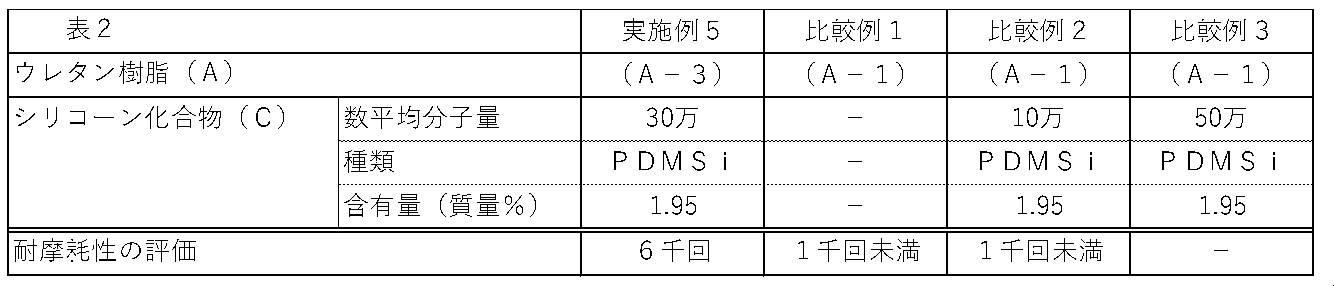
表1及び2中の「PDMSi」は、ポリジメチルシロキサンを示す。
本発明のウレタン樹脂組成物は、優れた耐摩耗性を有することがわかった。
一方、比較例1はシリコーン化合物(C)を一切使用しない態様であるが、耐摩耗性が不十分であった。
比較例2は、シリコーン化合物(C)の代わりに、本発明で規定する範囲を下回る数平均分子量を有するシリコーン化合物を用いた態様であるが、耐摩耗性が不十分であった。
比較例3は、シリコーン化合物(C)の代わりに、本発明で規定する範囲を上回る数平均分子量を有するシリコーン化合物を用いた態様であるが、ウレタン樹脂組成物としてうまく混合できず、表面処理剤として使用することが困難であった。
Claims (6)
- ウレタン樹脂(A)、水(B)、及び、数平均分子量が15万以上33万未満であるシリコーン化合物(C)を含有することを特徴とするウレタン樹脂組成物。
- 前記シリコーン化合物(C)の含有量が、0.01~10質量%の範囲である請求項1記載のウレタン樹脂組成物。
- 前記シリコーン化合物(C)が、ポリジメチルシロキサンである請求項1又は2記載のウレタン樹脂組成物。
- 請求項1~3のいずれか1項記載のウレタン樹脂組成物を含有することを特徴とする表面処理剤。
- 更にフィラー(D)を含有する請求項4記載の表面処理剤。
- 請求項4又は5記載の表面処理剤により形成された層を有することを特徴とする物品。
Priority Applications (2)
| Application Number | Priority Date | Filing Date | Title |
|---|---|---|---|
| CN201980041730.7A CN112313285B (zh) | 2018-06-27 | 2019-05-14 | 氨基甲酸酯树脂组合物、表面处理剂及物品 |
| JP2020527264A JP7298608B2 (ja) | 2018-06-27 | 2019-05-14 | ウレタン樹脂組成物、表面処理剤、及び、物品 |
Applications Claiming Priority (2)
| Application Number | Priority Date | Filing Date | Title |
|---|---|---|---|
| JP2018-121937 | 2018-06-27 | ||
| JP2018121937 | 2018-06-27 |
Publications (1)
| Publication Number | Publication Date |
|---|---|
| WO2020003779A1 true WO2020003779A1 (ja) | 2020-01-02 |
Family
ID=68986319
Family Applications (1)
| Application Number | Title | Priority Date | Filing Date |
|---|---|---|---|
| PCT/JP2019/019055 Ceased WO2020003779A1 (ja) | 2018-06-27 | 2019-05-14 | ウレタン樹脂組成物、表面処理剤、及び、物品 |
Country Status (3)
| Country | Link |
|---|---|
| JP (1) | JP7298608B2 (ja) |
| CN (1) | CN112313285B (ja) |
| WO (1) | WO2020003779A1 (ja) |
Cited By (2)
| Publication number | Priority date | Publication date | Assignee | Title |
|---|---|---|---|---|
| CN115975492A (zh) * | 2023-01-16 | 2023-04-18 | 帕珂表面处理技术(上海)有限公司 | 一种金属材料表面处理剂及其制备方法和用途 |
| CN118159424A (zh) * | 2021-10-12 | 2024-06-07 | Dic株式会社 | 层叠体及合成皮革 |
Citations (10)
| Publication number | Priority date | Publication date | Assignee | Title |
|---|---|---|---|---|
| JPS60108414A (ja) * | 1983-11-18 | 1985-06-13 | Asahi Glass Co Ltd | ポリウレタン系エラストマ−の製造方法 |
| JPS60245621A (ja) * | 1984-05-22 | 1985-12-05 | Asahi Glass Co Ltd | ポリウレタン系エラストマ−の製造方法 |
| JP2005220321A (ja) * | 2004-02-09 | 2005-08-18 | Dainichiseika Color & Chem Mfg Co Ltd | 微粒子シリカ分散親水性ポリウレタン樹脂組成物及びその製造方法 |
| JP2007314919A (ja) * | 2006-05-29 | 2007-12-06 | Dainippon Ink & Chem Inc | 皮革用表面仕上げ剤およびそれを用いた皮革 |
| WO2009102035A1 (ja) * | 2008-02-15 | 2009-08-20 | Asahi Kasei E-Materials Corporation | 樹脂組成物 |
| JP2012214778A (ja) * | 2011-03-30 | 2012-11-08 | Asahi Glass Co Ltd | 軟質ポリウレタンフォームの製造方法およびシート |
| JP2014101480A (ja) * | 2012-11-22 | 2014-06-05 | Dow Corning Toray Co Ltd | 潤滑被膜用塗料組成物 |
| JP2015214774A (ja) * | 2014-05-12 | 2015-12-03 | セーレン株式会社 | 合成皮革 |
| JP2016138242A (ja) * | 2014-12-22 | 2016-08-04 | 日信化学工業株式会社 | 皮革用コーティング剤及び該コーティング剤を形成した皮革 |
| WO2018001654A1 (en) * | 2016-06-30 | 2018-01-04 | Henkel Ag & Co. Kgaa | Waterborne hybrid polyurethane/polysiloxane dispersions |
Family Cites Families (7)
| Publication number | Priority date | Publication date | Assignee | Title |
|---|---|---|---|---|
| JP3292065B2 (ja) * | 1996-10-02 | 2002-06-17 | 信越化学工業株式会社 | シリコーン変性ポリウレタンエラストマー及びその製造方法 |
| CN100347252C (zh) * | 2003-04-30 | 2007-11-07 | 国家淀粉及化学投资控股公司 | 高耐磨性水基涂料 |
| US7368174B2 (en) | 2005-12-14 | 2008-05-06 | Lord Corporation | Aqueous dispersion coating composition having noise and/or friction abatement properties |
| US8476330B2 (en) * | 2007-07-13 | 2013-07-02 | Momentive Performance Materials Inc. | Polyurethane foam containing synergistic surfactant combinations and process for making same |
| CN101469055A (zh) * | 2007-12-26 | 2009-07-01 | 汉高股份两合公司 | 活性有机硅-聚氨酯预聚体及由其制备的无溶剂活性有机硅-聚氨酯乳液 |
| CN104152026A (zh) * | 2014-07-25 | 2014-11-19 | 上海蓝欧化工科技有限公司 | 耐磨涂料 |
| JP6179697B1 (ja) * | 2016-04-14 | 2017-08-16 | Dic株式会社 | 水性ウレタン樹脂組成物、及び、合成皮革 |
-
2019
- 2019-05-14 CN CN201980041730.7A patent/CN112313285B/zh active Active
- 2019-05-14 JP JP2020527264A patent/JP7298608B2/ja active Active
- 2019-05-14 WO PCT/JP2019/019055 patent/WO2020003779A1/ja not_active Ceased
Patent Citations (10)
| Publication number | Priority date | Publication date | Assignee | Title |
|---|---|---|---|---|
| JPS60108414A (ja) * | 1983-11-18 | 1985-06-13 | Asahi Glass Co Ltd | ポリウレタン系エラストマ−の製造方法 |
| JPS60245621A (ja) * | 1984-05-22 | 1985-12-05 | Asahi Glass Co Ltd | ポリウレタン系エラストマ−の製造方法 |
| JP2005220321A (ja) * | 2004-02-09 | 2005-08-18 | Dainichiseika Color & Chem Mfg Co Ltd | 微粒子シリカ分散親水性ポリウレタン樹脂組成物及びその製造方法 |
| JP2007314919A (ja) * | 2006-05-29 | 2007-12-06 | Dainippon Ink & Chem Inc | 皮革用表面仕上げ剤およびそれを用いた皮革 |
| WO2009102035A1 (ja) * | 2008-02-15 | 2009-08-20 | Asahi Kasei E-Materials Corporation | 樹脂組成物 |
| JP2012214778A (ja) * | 2011-03-30 | 2012-11-08 | Asahi Glass Co Ltd | 軟質ポリウレタンフォームの製造方法およびシート |
| JP2014101480A (ja) * | 2012-11-22 | 2014-06-05 | Dow Corning Toray Co Ltd | 潤滑被膜用塗料組成物 |
| JP2015214774A (ja) * | 2014-05-12 | 2015-12-03 | セーレン株式会社 | 合成皮革 |
| JP2016138242A (ja) * | 2014-12-22 | 2016-08-04 | 日信化学工業株式会社 | 皮革用コーティング剤及び該コーティング剤を形成した皮革 |
| WO2018001654A1 (en) * | 2016-06-30 | 2018-01-04 | Henkel Ag & Co. Kgaa | Waterborne hybrid polyurethane/polysiloxane dispersions |
Cited By (2)
| Publication number | Priority date | Publication date | Assignee | Title |
|---|---|---|---|---|
| CN118159424A (zh) * | 2021-10-12 | 2024-06-07 | Dic株式会社 | 层叠体及合成皮革 |
| CN115975492A (zh) * | 2023-01-16 | 2023-04-18 | 帕珂表面处理技术(上海)有限公司 | 一种金属材料表面处理剂及其制备方法和用途 |
Also Published As
| Publication number | Publication date |
|---|---|
| CN112313285B (zh) | 2023-05-12 |
| CN112313285A (zh) | 2021-02-02 |
| JPWO2020003779A1 (ja) | 2021-07-08 |
| JP7298608B2 (ja) | 2023-06-27 |
Similar Documents
| Publication | Publication Date | Title |
|---|---|---|
| WO2020129605A1 (ja) | ウレタン樹脂組成物、皮膜、及び、合成皮革 | |
| JP2021098912A (ja) | 合成皮革 | |
| JP2023171513A (ja) | ウレタン樹脂組成物、表面処理剤、及び、物品 | |
| JP7347711B2 (ja) | 合成皮革 | |
| JP7298608B2 (ja) | ウレタン樹脂組成物、表面処理剤、及び、物品 | |
| JP7342885B2 (ja) | ウレタン樹脂組成物、表面処理剤、及び、物品 | |
| JPWO2019235124A1 (ja) | 合成皮革 | |
| JP7294338B2 (ja) | ウレタン樹脂組成物、表面処理剤、及び、物品 | |
| JP7342416B2 (ja) | 水性樹脂組成物、表面処理剤、及び、物品 | |
| CN113085314A (zh) | 合成皮革 | |
| JP2021098911A (ja) | 合成皮革 | |
| JP7342884B2 (ja) | ウレタン樹脂組成物、表面処理剤、及び、物品 | |
| JP7745346B2 (ja) | ウレタン樹脂組成物、表面処理剤、及び、物品 | |
| WO2021131429A1 (ja) | 表面処理層、及び、物品 | |
| CN113573906B (zh) | 表面处理剂及物品 | |
| JP2021098914A (ja) | 合成皮革 | |
| JP7405077B2 (ja) | ウレタン樹脂組成物、表面処理剤、及び、物品 | |
| JPWO2020129669A1 (ja) | ウレタン樹脂組成物、表面処理剤、及び、物品 |
Legal Events
| Date | Code | Title | Description |
|---|---|---|---|
| 121 | Ep: the epo has been informed by wipo that ep was designated in this application |
Ref document number: 19825570 Country of ref document: EP Kind code of ref document: A1 |
|
| ENP | Entry into the national phase |
Ref document number: 2020527264 Country of ref document: JP Kind code of ref document: A |
|
| NENP | Non-entry into the national phase |
Ref country code: DE |
|
| 122 | Ep: pct application non-entry in european phase |
Ref document number: 19825570 Country of ref document: EP Kind code of ref document: A1 |