WO2020003537A1 - 増粘剤及び増粘剤の製造方法 - Google Patents
増粘剤及び増粘剤の製造方法 Download PDFInfo
- Publication number
- WO2020003537A1 WO2020003537A1 PCT/JP2018/024938 JP2018024938W WO2020003537A1 WO 2020003537 A1 WO2020003537 A1 WO 2020003537A1 JP 2018024938 W JP2018024938 W JP 2018024938W WO 2020003537 A1 WO2020003537 A1 WO 2020003537A1
- Authority
- WO
- WIPO (PCT)
- Prior art keywords
- resin
- thickener
- thickening component
- thickening
- resin layer
- Prior art date
- Legal status (The legal status is an assumption and is not a legal conclusion. Google has not performed a legal analysis and makes no representation as to the accuracy of the status listed.)
- Ceased
Links
Images


Classifications
-
- C—CHEMISTRY; METALLURGY
- C09—DYES; PAINTS; POLISHES; NATURAL RESINS; ADHESIVES; COMPOSITIONS NOT OTHERWISE PROVIDED FOR; APPLICATIONS OF MATERIALS NOT OTHERWISE PROVIDED FOR
- C09K—MATERIALS FOR MISCELLANEOUS APPLICATIONS, NOT PROVIDED FOR ELSEWHERE
- C09K3/00—Materials not provided for elsewhere
Definitions
- the present invention relates to a thickener and a method for producing the thickener.
- the drilling mud to which an additive such as a thickener is added may be used (for example, see Patent Document 1). ).
- the thickener dissolves immediately when mixed with water or the like, and the viscosity increases, and there is a problem that a large pumping pressure is generated when the wash water is pumped from the ground into the oil well. Therefore, it is desirable that the time until the thickener thickens can be adjusted.
- An object of one embodiment of the present invention is to provide a thickener capable of adjusting the time until thickening, and a method for producing the same.
- a thickener comprising a thickening component and a resin layer covering the thickening component.
- a thickener comprising: a thickening component having a hydroxyl group; and a protective substance which reacts with the hydroxyl group to form a protective group and from which the protective group is removable.
- the resin layer is made of a phenol resin, an epoxy resin, an acrylate resin, a polyester resin, a polyamide resin, a polyimide resin, a polyamideimide resin, a fluororesin, a nylon resin, a styrene resin, an acrylonitrile resin, a polyethylene resin, a polyolefin resin, and a polycarbonate resin.
- the thickener according to ⁇ 1> comprising at least one resin selected from the group consisting of vinyl chloride resin, polysulfone resin, silicone resin, and butyl rubber.
- the resin layer has a plurality of layers
- the resin contained in at least one of the plurality of layers has a different composition from the resin contained in another layer of the plurality of layers.
- the thickener according to any one of the above ⁇ 4> ⁇ 6>
- the resin layer includes a resin having a number average molecular weight of 1,000 to 1,000,000.
- ⁇ 8> The thickener according to any one of ⁇ 1> and ⁇ 3> to ⁇ 7>, wherein the resin layer accounts for 50% by mass or less based on the whole.
- ⁇ 9> The thickener according to any one of ⁇ 1> and ⁇ 3> to ⁇ 8>, wherein the thickness of the resin layer is 0.1 ⁇ m to 1000 ⁇ m.
- the thickening component is at least one selected from carboxymethylcellulose, hydroxyethylcellulose, modified hydroxyethylcellulose, polyanionic cellulose, guar gum, and chitansan gum. Thickener.
- a thickener comprising: a thickening component; and a protective portion that protects a portion of the thickening component that exhibits a thickening function and delays the thickening of the thickening component.
- a method for producing a thickener comprising: forming the resin layer covering the thickening component after the application.
- the resin applied to the surface of the thickening component is heated to a temperature equal to or higher than the softening temperature and lower than the curing temperature to cover the thickening component with the resin, and the resin coated with the thickening component is heated to a curing temperature or higher.
- ⁇ 14> heating the resin applied to the surface of the thickening component to a temperature equal to or higher than a melting temperature to coat the thickening component with the resin, and setting the resin coating the thickening component to a temperature lower than the melting temperature;
- ⁇ 15> The method for producing a thickener according to ⁇ 2>, wherein the hydroxyl group of the thickening component is reacted with the protective substance to form a protective group.
- ⁇ 16> The method according to any one of ⁇ 12> to ⁇ 15>, wherein the thickening component is at least one selected from carboxymethylcellulose, hydroxyethylcellulose, modified hydroxyethylcellulose, polyanionic cellulose, guar gum, and chitansan gum.
- a method for producing a thickener is at least one selected from carboxymethylcellulose, hydroxyethylcellulose, modified hydroxyethylcellulose, polyanionic cellulose, guar gum, and chitansan gum.
- a thickener capable of adjusting the time until thickening, and a method for producing the same.
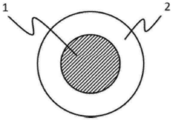
- FIG. 1 is a schematic cross-sectional view illustrating one embodiment of the present invention.
- FIG. 3 is a schematic sectional view showing another embodiment of the present invention.
- FIG. 3 is a schematic sectional view showing another embodiment of the present invention.
- FIG. 3 is a schematic sectional view showing another embodiment of the present invention.
- the present invention is not limited to the following embodiments.
- the constituent elements including element steps and the like
- the numerical ranges indicated by using “to” include the numerical values described before and after “to” as the minimum value and the maximum value, respectively.
- the upper limit or lower limit described in one numerical range may be replaced with the upper limit or lower limit of the numerical range described in other stages.
- the upper limit or the lower limit of the numerical range may be replaced with the value shown in the embodiment.
- each component may include a plurality of corresponding substances.
- the content of each component means the total content of the plurality of substances present in the composition unless otherwise specified.
- the “content rate” represents the mass% of each component when the total amount of the thickener is 100 mass%, unless otherwise specified.
- a thickener includes a thickening component, and a resin layer that covers the thickening component. Since the thickener is covered with the resin layer, the thickener can adjust the time until the thickener is thickened. For example, the thickener can delay the function expression of the thickening component.
- the thickener of the present disclosure may be used, for example, as a thickener for oil wells, or may be mixed with water to make washing water, and used for removing residues in oil wells.
- the thickener is not particularly limited as long as it has a thickening component and a resin layer covering the thickening component.
- the thickener of the present disclosure loses its potential or tends to lose its potential by external stimulus, that is, it may be one that expresses the function of the thickening component, and until the function of the thickening component is expressed. May be shortened.
- the external stimulus include mechanical stimulus such as external pressure and vibration, electric stimulus, solvent stimulus such as water, chemical stimulus such as acid and alkali, and thermal stimulus.
- the thickener may be one in which the function of a thickening component is developed by the resin layer being broken by an external stimulus, or until the resin layer becomes brittle and the function of the thickening component is developed. The time may be shortened.
- the thickening component of the present disclosure may be any as long as it exhibits a thickening function, preferably any one used for an oil well additive, and more preferably any one that contributes to oil well cleaning. . Further, the thickening component may exhibit a thickening function by reacting and interacting with a liquid such as water.
- the thickening component one having a hydroxyl group is preferable, and a polymer compound having a hydroxyl group is more preferable. More specifically, the thickening component preferably contains at least one selected from carboxymethylcellulose, hydroxyethylcellulose, modified hydroxyethylcellulose, polyanionic cellulose, guar gum and chitansan gum. Among them, carboxymethyl cellulose, hydroxyethyl cellulose and the like are preferable as the thickening component, and hydroxyethyl cellulose is more preferable.
- the thickening component for example, there is a solid or liquid at room temperature (25 ° C), and a solid at room temperature (25 ° C) is preferable from the viewpoint of resin coatability.
- the shape of the thickening component may be, for example, square, needle, or round, and is preferably round or square from the viewpoint of resin coatability.
- the particle diameter of the thickening component varies depending on its function, and is preferably from 0.1 ⁇ m to 5,000 ⁇ m, more preferably from 0.5 ⁇ m to 3,000 ⁇ m, from the viewpoint of resin coatability, It is more preferably from 1.0 ⁇ m to 2,000 ⁇ m, particularly preferably from 5.0 ⁇ m to 1,000 ⁇ m.
- the particle size of the thickening component can be measured by a laser diffraction method, sieving, or the like.
- the particle diameter of the thickener refers to the average particle diameter of the thickener contained in the thickener.
- the average particle size of the thickening component is an average particle size (D50) corresponding to 50% of the cumulative weight distribution from the smaller particle size side in the particle size distribution measured using a laser diffraction method.
- the content of the thickening component may be 25% by mass or more, 50% by mass or more, or 70% by mass to 99% by mass with respect to the whole. And it may be 80% by mass to 98% by mass.
- the resin layer included in the thickener of the present disclosure is a layer formed using a resin.
- the time until the function of the thickening component is developed can be adjusted, and for example, the function of the thickening component can be delayed.
- the resin layer may cover one thickening component, or may cover a plurality of thickening components. Further, the resin layer may cover one kind of thickening component or may cover a plurality of kinds of thickening components.
- “coating” indicates that the surface of the thickening component is not exposed in order to adjust the time until the function of the thickening component is developed.
- the thickener of the present disclosure and a thickener having no resin layer different from the present disclosure can be used in combination. It is preferable that the resin layer be able to withstand frictional pressure during mixing of washing water and other additives. Further, in the thickener of the present disclosure, the surface of the thickening component may be directly coated with a resin layer, another layer is disposed between the surface of the thickening component and the resin layer, via another layer Thus, the surface of the thickening component may be covered with a resin layer.
- the thickener according to the present disclosure referring to the drawings, as shown in FIG. 1, one obtained by coating one thickening component 1 with a resin layer 2 can be used. Furthermore, as shown in FIG. 2, as the thickener of the present disclosure, a thickener having a plurality of types of thickeners such as a thickener 3 and a thickener 4 coated with a resin layer 5 is used. You can also.
- the thickener of the present disclosure may be obtained by coating a granulated material of a thickening component with a resin layer.
- the resin layer tends to be coated with high uniformity, and the time until the function of the thickening component is developed tends to be adjusted later.
- the granulated material of the thickening component may be formed by binding the thickening components to each other using a binder resin or the like, or may be formed by binding using a thickening component having a binding property. Good.
- the binder resin may be the same component as the resin contained in the resin layer, or may be a different component.
- the thickener of the present disclosure When the thickener of the present disclosure is obtained by coating a granulated material of a thickener with a resin layer, a plurality of thickeners 8 are bound by a binder resin 9 as shown in FIG. It may be a granulated product and the granulated product is covered with the resin layer 10.
- the thickener of the present disclosure is composed of a plurality of types of thickeners, that is, a thickener component 12 partially covered with a resin layer 11 and a thickener component 13 that is completely covered. Can also be used.
- the layer structure of the resin layer may be a single layer or a plurality of layers, and can be selected according to the purpose.
- the resin contained in at least one of the plurality of layers may have a different composition from the resin contained in the other layers of the plurality of layers.
- the first resin layer and the second resin layer when viewed from the surface of the thickening component, have different properties such as different solubility in acids / alkali, water, organic solvents, etc., and different water vapor permeability.
- the time until the function of the thickening component can be adjusted can be adjusted by a method other than adjusting the thickness of the resin layer.
- the thickness of the resin layer is not particularly limited, and can be set in consideration of a required time until the function of the thickening component is developed. Specifically, the thickness of the resin layer is preferably from 0.1 ⁇ m to 1,000 ⁇ m, and from the viewpoint of expressing the function of the thickening component immediately after transporting the washing water into the oil well, is preferred. The thickness is more preferably from 0.5 ⁇ m to 800 ⁇ m, further preferably from 1.0 ⁇ m to 500 ⁇ m, and particularly preferably from 5.0 ⁇ m to 300 ⁇ m.
- the thickness of the resin layer can be determined by the FIB method in which a Ga + ion beam is irradiated in the x and y directions of the sample to perform sputtering, and the cross section is observed by focusing secondary electrons. Further, the thickness of the resin layer means a minimum thickness. The region where the thickness of the resin layer is minimum can be confirmed, for example, by observation with an electron microscope.
- the resin layer is, specifically, a phenol resin, an epoxy resin, an acrylate resin, a polyester resin, a polyamide resin, a polyimide resin, a polyamide imide resin, a fluororesin, a nylon resin, a styrene resin, an acrylonitrile resin, a polyethylene resin, a polyolefin resin, and a polycarbonate. It is preferable to include at least one resin selected from a resin, a vinyl chloride resin, a polysulfone resin, a silicone resin, and butyl rubber, and it is more preferable to include at least one of a phenol resin and an epoxy resin from the viewpoint of easy resin coating. And epoxy resin.
- the hydroxyl equivalent of the phenol resin is preferably from 80 g / eq to 200 g / eq, more preferably from 90 g / eq to 180 g / eq, even more preferably from 100 g / eq to 160 g / eq.
- the hydroxyl equivalent of the phenol resin is a value measured by a method according to JIS K 0070 (1992).
- the epoxy equivalent of the epoxy resin is preferably from 150 g / eq to 1000 g / eq, more preferably from 170 g / eq to 800 g / eq, and still more preferably from 180 g / eq to 600 g / eq.
- the epoxy equivalent of the epoxy resin is a value measured by a method according to JIS K 7236 (2009).
- the resin layer may include, as a resin, an alkali-soluble resin containing at least one functional group selected from an OH group, a COOH group, and an SO 3 H group.
- the resin layer preferably contains a network polymer from the viewpoint of controlling the time until the function is developed.
- the network polymer include a phenol resin and a urea resin.
- the number average molecular weight of the resin contained in the resin layer is preferably 1,000 to 1,000,000 from the viewpoint that the resin can be easily coated. In addition, the number average molecular weight can be measured by gel permeation chromatography (GPC).
- the content of the resin layer may be 75% by mass or less, 50% by mass or less, or 0.5% by mass to 40% by mass based on the whole. May be 1.0% to 30% by mass, or 3.0% to 25% by mass.
- DSC method differential scanning calorimetry
- TGA method thermogravimetric analysis method
- DTA method differential thermal analysis method
- SEM observation Scanning electron microscope observation
- EDX method energy dispersive X-ray spectroscopy
- FIB method focused ion beam method
- the thickener of the present disclosure for example, when a water-soluble thickener is selected, the thickener is added to water and stirred for a certain period of time, and the amount of the resin layer coated (content ) Can be estimated.
- the thickener of the present disclosure it is possible to confirm that the surface of the thickening component is covered with the resin by performing EDX analysis after SEM observation.
- the water vapor permeability of the resin contained in the resin layer may be 200 g / m 2 ⁇ day or less, preferably 1 g / m 2 ⁇ day to 190 g / m 2 ⁇ day, and more preferably 3 g / m 2 ⁇ day to It is more preferably 180 g / m 2 ⁇ day, still more preferably 5 g / m 2 ⁇ day to 150 g / m 2 ⁇ day, and more preferably 10 g / m 2 ⁇ day to 100 g / m 2 ⁇ day. Particularly preferred is 30 g / m 2 ⁇ day to 60 g / m 2 ⁇ day, and even more preferred.
- the water vapor permeability of the resin contained in the resin layer is 200 g / m 2 ⁇ day or less, when the thickener and water are mixed, the time until the function of the thickening component is developed tends to be reduced. . Further, when the water vapor permeability of the resin contained in the resin layer is 1 g / m 2 or more, there is a tendency that the coatability to the thickening component is excellent.
- the water vapor permeability of the resin contained in the resin layer is a value measured in accordance with the cup method of JIS Z0208 (1976).
- the transmittance coefficient of the resin contained in the resin layer is preferably 200 g ⁇ mm / m 2 ⁇ day or less, more preferably 1 g ⁇ mm / m 2 ⁇ day to 190 g ⁇ mm / m 2 ⁇ day. It is more preferably from 3 g ⁇ mm / m 2 ⁇ day to 180 g ⁇ mm / m 2 ⁇ day, particularly preferably from 5 g ⁇ mm / m 2 ⁇ day to 150 g ⁇ mm / m 2 ⁇ day, and 10 g.
- Mm / m 2 ⁇ day to 100 g ⁇ mm / m 2 ⁇ day is even more preferable, and 30 g ⁇ mm / m 2 ⁇ day to 60 g ⁇ mm / m 2 ⁇ day is even more preferable.
- the transmittance coefficient of the resin contained in the resin layer is 200 g ⁇ mm / m 2 ⁇ day or less, when the thickener and water are mixed, the time until the function of the thickening component is developed tends to be delayed. It is in. Further, when the transmittance coefficient of the resin contained in the resin layer is 1 g ⁇ mm / m 2 or more, there is a tendency that the coatability to the thickening component is excellent.
- the permeability coefficient is a product of the water vapor permeability and the thickness of the resin layer.
- the water vapor permeability and the permeability coefficient of the resin contained in the resin layer can be appropriately adjusted by changing the resin forming conditions such as the functional group of the resin contained in the resin layer, the curing temperature, and the curing time. is there.
- the resin forming conditions such as the functional group of the resin contained in the resin layer, the curing temperature, and the curing time. is there.
- the resin forming conditions such as the functional group of the resin contained in the resin layer, the curing temperature, and the curing time. is there.
- the resin forming conditions such as the functional group of the resin contained in the resin layer, the curing temperature, and the curing time. is there.
- the resin forming conditions such as the functional group of the resin contained in the resin layer, the curing temperature, and the curing time. is there.
- the resin forming conditions such as the functional group of the resin contained in the resin layer, the curing temperature, and the curing time. is there.
- the resin forming conditions such as the functional group of the resin contained in the resin
- the method for producing a thickener according to the present disclosure is the method for producing a thickener according to the above-described first aspect, and after applying the resin to the surface of the thickener, coating the thickener. This is a method for forming the resin layer.
- Specific Example 1 of the method for producing a thickener according to the present disclosure is that the resin applied to the surface of the thickening component is heated to a temperature equal to or higher than the softening temperature and lower than the curing temperature, and the resin is coated with the thickening component. May be heated to a curing temperature or higher to form a resin layer covering the thickening component.
- a thermosetting resin as the resin.
- the resin used for forming the resin layer is applied to the surface of the thickening component, the resin is heated to a softening temperature or higher and lower than the curing temperature, and the resin is coated with the thickening component. May be heated to a curing temperature or higher to form a resin layer covering the thickening component.
- the resin may be added to the thickening component. Heating may be performed as described above.
- the heating temperature of the resin is preferably equal to or higher than the curing temperature of the resin and lower than the denaturation temperature of the thickening component (for example, the temperature at which the thickening component becomes water-insoluble or hardly water-soluble).
- the method for producing a thickener in Example 1 is described in “(a) a step of applying a resin to the surface of a thickening component. (B) coating the thickening component with a resin by setting the resin to a softening temperature or higher and lower than a curing temperature. (C) heating the resin to a curing temperature or higher to form a resin layer covering the thickening component. " Further, the thickness of the resin layer can be adjusted by repeating the steps (a) to (c).
- the resin used in the step (a) is preferably in a state of a solution dissolved in a solvent.
- the viscosity of the resin solution used in the step (a) is preferably 500 mPa ⁇ s or less, more preferably 100 mPa ⁇ s or less, from the viewpoint of coating the resin with high uniformity on the thickening component. It is more preferably at most 50 mPa ⁇ s, particularly preferably at most 20 mPa ⁇ s.
- the viscosity of the resin solution used in the step (a) is the viscosity at 25 ° C. measured using an E-type viscometer.
- Examples of the method of heating the thickening component in the steps (b) and (c) include heating using a gas burner, an electric furnace, a dryer, or the like. It is desirable to use a dryer or an electric furnace that is easy to hold.
- the resin layer when a resin layer covering the thickener is formed using a mixture of a resin and a thickener, the resin layer may be formed by a wet method.
- a resin solution is prepared by dissolving a resin and a curing agent as necessary in a solvent, and the prepared resin solution and a thickening component are mixed together to form a resin layer that covers the thickening component using the mixture. Is also good.
- the coating is dried to evaporate the solvent, or the coating is heated to cure the resin, and the resin layer is formed. Good.
- the solvent a solvent having high compatibility with the resin and not reacting with the thickening component may be used, and a solvent having further excellent volatility is preferable.
- the solvent include ketones such as methyl ethyl ketone (MEK), methyl isobutyl ketone (MIBK) and acetone, dichloromethane, ethyl acetate, ethers and the like.
- the thickener may be produced by spray coating.
- a resin solution containing a thermosetting resin such as an epoxy resin, a phenol-based curing agent, a curing agent such as an imidazole-based curing agent, a solvent such as methyl ethyl ketone, etc.
- the thickener may be sprayed, followed by heating to remove the solvent and cure the thermosetting resin to produce a thickener.
- the thickening component is granulated, and after applying a resin used for forming a resin layer to the surface of the granulated material, a resin layer covering the granulated material may be formed. Good.
- the granulated material of the thickening component may be formed by binding the thickening components to each other using a binder resin or the like, or may be formed by binding using a thickening component having a binding property. Good.
- a granulated product obtained by mixing the thickening component and the binder resin and then binding the thickening components together by the binder resin may be formed.
- the granulated material may be formed by a wet method.
- a resin solution is prepared by dissolving a binder resin and, if necessary, a curing agent in a solvent, mixing the prepared resin solution with a thickening component, and binding the thickening components together using a mixture.
- Granules may be formed.
- the mixture may be dried to evaporate the solvent, or the mixture may be heated to cure the binder resin to form a granulated product.
- the content of the binder resin may be 30% by mass or less, may be 0.5% by mass to 20% by mass, and may be 1.0% by mass to 10% by mass. There may be.
- the total content of the resin layer and the binder resin may be 50% by mass or less, may be 0.5% by mass to 30% by mass, and may be 1.0% by mass. It may be from 25% by mass to 25% by mass.
- Specific Example 2 of the method for producing a thickener according to the present disclosure will be described.
- the specific example 2 of the above-mentioned method for producing a thickener is that the resin applied to the surface of the thickener is heated to a melting temperature or higher to coat the thickener with the resin, and then the resin coating the thickener is used. May be lower than the melting temperature to form a resin layer covering the thickening component.
- the resin after applying the resin used for forming the resin layer to the surface of the thickening component, the resin is heated to a melting temperature or higher, and the thickening component is coated with the applied resin, and further set to a melting temperature or higher.
- a method in which the resin is set to a temperature lower than the melting temperature to form a resin layer covering the thickening component may be used.
- the resin After heating the thickening component to a temperature higher than the melting temperature of the resin, the resin may be added to the thickening component at a temperature higher than the melting temperature of the resin. It may be adjusted below the melting temperature.
- the heating temperature of the resin is preferably equal to or higher than the melting temperature of the resin and lower than the denaturation temperature of the thickening component (for example, the temperature at which the thickening component becomes water-insoluble or hardly water-soluble).
- the method for producing the thickener in the specific example 2 is described as follows: “(a) a step of heating the thickening component to a temperature equal to or higher than the melting temperature of the resin used in the step (b). Adding a resin, and coating the thickening component with the added resin, and (c) forming a resin layer covering the thickening component by setting the temperature of the thickening component below the melting temperature of the resin. " It may be performed including three steps.
- Examples of the method of heating the thickening component in the step (a) and the method of heating the resin include heating with a gas burner, an electric furnace, a dryer, or the like, and the thickening component is not thermally decomposed and is as short as possible. From the viewpoint of heating over time, an electric furnace is preferred.
- the heating temperature of the resin and the heating temperature of the thickening component are preferably equal to or higher than the melting temperature of the resin and equal to or lower than the thermal decomposition temperature of the thickening component.
- the thickener may be manufactured by extrusion.
- a thickening component is mixed with a thermoplastic resin such as polyethylene, and the resulting mixture is charged into an extruder. Then, by heating the mixture in the extruder and cooling the mixture extruded from the die, a sheet-like or fibrous thickener can be obtained. The obtained thickener may be cut as necessary to form a pellet or the like.
- the heating temperature of the mixture in the extruder is preferably equal to or higher than the melting temperature of the thermoplastic resin, is equal to or higher than the melting temperature of the thermoplastic resin, and denatures the thickening component. More preferably, it is lower than the temperature.
- the heating temperature of the mixture in the extruder is preferably 120 ° C. or more and less than 140 ° C., and is 120 ° C. to 130 ° C. Is more preferable.
- the thickener according to the second embodiment of the present disclosure includes a thickening component having a hydroxyl group, and a protective substance which reacts with the hydroxyl group to form a protective group, and wherein the protective group is removable.
- This thickener can adjust the time until the function of the thickening component is developed by the elimination of the protecting group, since the hydroxyl group of the thickening component reacts with the protecting substance to form the protecting group.
- the thickener can delay the function expression of the thickening component.
- the thickening component used in this embodiment is not particularly limited as long as it has a hydroxyl group.
- the thickening component is preferably a polymer compound having a hydroxyl group, specifically, at least one selected from carboxymethylcellulose, hydroxyethylcellulose, modified hydroxyethylcellulose, polyanionic cellulose, guar gum and chitansan gum. preferable.
- the protective substance used in the thickener of the present disclosure is not particularly limited as long as it is a compound capable of forming a protective group by reacting with a hydroxyl group of a thickening component and releasing the protective group, that is, a compound capable of deprotection. Not done.
- the protective substance include aldehyde compounds, carbonyl compounds, trialkylsilyl halides, carboxylic acids, carboxylic anhydrides, and trityl halides.
- the aldehyde compound may be any compound capable of reacting with the hydroxyl group of the thickening component to form an acetal, and examples thereof include formaldehyde, acetaldehyde, glutaraldehyde and glyoxal.
- the carbonyl compound may be any compound that can react with a hydroxyl group of the thickening component to form an acetal, such as acetone.
- the trialkylsilyl halide may be any compound capable of reacting with a hydroxyl group of a thickening component and capable of trialkylsilylation. Examples thereof include trimethylsilyl halide, triethylsilyl halide and t-butyldimethylsilyl halide.
- the carboxylic acid may be any compound that can be esterified by reacting with the hydroxyl group of the thickening component, and examples thereof include formic acid, acetic acid, and oxalic acid.
- the carboxylic anhydride may be any compound capable of reacting with the hydroxyl group of the thickening component to be acetylated, such as acetic anhydride.
- the trityl halide may be any compound capable of reacting with a hydroxyl group of a thickening component and capable of being tritylated, such as trityl chloride.
- the content of the protective substance is preferably 0.0001% by mass to 5% by mass, and more preferably 0.001% by mass to 3% by mass with respect to 100% by mass of the thickening component. More preferably, it is 0.01% by mass to 1% by mass.
- the thickener of the present disclosure it is preferable that 50% or more of the hydroxyl groups of the thickening component is protected by a protective group, and it is more preferable that substantially 100% is protected by a protective group.
- the method for producing a thickener according to the present disclosure is the method for producing a thickener according to the second aspect described above, wherein the hydroxyl group of the thickening component is reacted with the protective substance to form a protective group.
- Preferred conditions for forming a protective group by reacting a hydroxyl group of a thickening component with a protective substance are the same as those for protecting a hydroxyl group using a protective substance in organic synthesis or the like.
- the thickener according to the third aspect of the present disclosure includes a thickening component, and a protecting unit that protects a part of the thickening component that exhibits a thickening function and delays the thickening of the thickening component.
- the thickener is capable of delaying the function expression of the thickening component until the protection of the site is released, since the portion that expresses the thickening function of the thickening component is protected.
- the protective portion may be, for example, a resin layer covering a thickening component like the thickener according to the above-described first embodiment, or may be a resin layer covering the thickening component according to the above-described second embodiment. And a protective substance which reacts with a hydroxyl group of the thickening component to form a protective group.
- the resin solutions (1) to (7) and Metrolose as a thickening component are added to the polycup such that the total amount of the resin and the curing agent is 20% by mass with respect to Metrolose.
- the mixture was stirred. After stirring, the mixture was dried to obtain coatings AG. Thereafter, the coatings A to G were put into a dryer at 120 ° C. for 1 hour, and the resin was cured to prepare thickeners A to G, respectively.
- the resin solutions (1) to (7) and Metrolose as a thickening component are added to the polycup so that the total amount of the resin and the curing agent is 40% by mass with respect to the Metrolse, The mixture was stirred. After stirring, the mixture was dried to obtain coatings HN. Thereafter, the coatings H to N were put into a dryer at 120 ° C. for one hour, and the resin was cured to produce thickeners H to N, respectively.
- the resin solutions (1) to (7) shown in Table 1 and Metrolose as a thickening component were mixed such that the total amount of the resin and the curing agent was 40% by mass with respect to the Metrolose.
- the resin was coated on Metroze by a wet method to prepare a thickener.
- the thickeners thus prepared were placed in a dryer and heated at 80 ° C. for 15 minutes and at 120 ° C. for 1 hour to cure the resin and increase the strength.
- thickeners H ′ to N ′ were prepared from the resin solutions (1) to (7), respectively.
- the tensile strength of the resin plate was measured as in (a) to (d).
- Samples 1 to 7 thickeners A to G: 4.8 g and ultrapure water: 160 mL
- Samples 8 to 14 thickeners H to N: 5.6 g and ultrapure water: 160 mL
- Sample 15 Metrolose: 4.0 g and ultrapure water: 160 mL
- Samples 1 'to 7' thickeners A 'to G': 4.8 g and ultrapure water: 160 mL
- Samples 8 'to 14' thickeners H 'to N': 5.6 g and ultrapure water: 160 mL
- Sample 15 ' Metrolose: 4.0 g and ultrapure water: 160 mL
- Sample 16 to 24 were each separated into 500 mL polybins, and stirred at room temperature at 780 rpm (rotation / minute) using a three-one motor (HEIDON FBL-600).
- Sample 16 thickener O: 8.0 g and ultrapure water: 160 mL
- Sample 17 thickener P: 6.0 g and ultrapure water: 160 mL
- Sample 18 thickener Q: 12.12 g and ultrapure water: 160 mL
- Sample 19 Thickener R: 8.0 g and ultrapure water: 160 mL
- Sample 21 thickener T: 5.0 g and ultrapure water: 160 mL
- Sample 22 thickener U: 4.7 g and ultrapure water: 160 mL
- Sample 23 thickener V: 4.44 g and ultrapure water: 160 mL
- Sample 24 thickener W: 4.2 g and ultrapure water:
- the sample liquid is taken out with a dropper every 30 minutes until 3 hours after the start of stirring and every 60 minutes thereafter, and the E-type viscometer (Toki Sangyo Co., Ltd. TV-22 type) was used to measure the viscosity of the sample liquid.
- the time until the increase in the viscosity of the sample liquid stopped was defined as the saturated viscosity reaching time, and the delay effect was confirmed.
- Table 10 shows the results.
- the resin coating amount means the resin amount with respect to Metroose.
- the water absorption of the thickeners 1 to 5 shown in Table 11 was determined by leaving each of the thickeners 1 to 5 at 25 ° C. and 85% for 72 hours and then calculating the water absorption based on the following formula (1).
- Water absorption (%) [(M2 ⁇ M1) / M1] ⁇ 100 Formula (1)
- ⁇ Potential evaluation method> The potential was evaluated by submerging the thickeners 1 to 5 in ultrapure water for a certain period of time and measuring the time until the function of the thickener was developed.
- Sample 25 thickener 1: 2.3 g and ultrapure water: 160 mL
- Sample 26 Thickener 2: 2.3 g and ultrapure water: 160 mL
- Sample 27 Thickener 3: 1.5 g and ultrapure water: 160 mL
- Sample 28 Thickener 4: 1.5 g and ultrapure water: 160 mL
- Sample 29 thickener 5: 3.2 g and ultrapure water: 160 mL
Landscapes
- Chemical & Material Sciences (AREA)
- Engineering & Computer Science (AREA)
- Materials Engineering (AREA)
- Organic Chemistry (AREA)
- Compositions Of Macromolecular Compounds (AREA)
- Medicinal Preparation (AREA)
Abstract
増粘成分と、前記増粘成分を被覆する樹脂層とを備える、増粘剤。
Description
本発明は、増粘剤及び増粘剤の製造方法に関する。
油井、ガス井等の掘削時には、油井内に堀屑等の残留物が生じる。油井内の残留物を除去するため、増粘剤を添加した洗浄水を用いる。このとき、増粘剤及び水は地上で混合し、その後油井内へポンピングすることにより油井内の残留物を除去する。
また、油井掘削後から生産体勢になるまでの間、油井の安定性を向上させることを目的に、増粘剤等の添加剤を添加した掘削泥水を用いることがある(例えば、特許文献1参照)。
増粘剤は、水等と混ぜると直ちに溶解して粘度が上昇してしまい、洗浄水を地上から油井内へポンピングする際に大きなポンピング圧になるという問題がある。そのため、増粘剤の増粘までの時間を調節可能であることが望ましい。
本発明の一形態は、増粘までの時間を調節可能な増粘剤、及びこの製造方法を提供することを目的とする。
前記課題を解決するための具体的手段は以下のとおりである。
<1> 増粘成分と、前記増粘成分を被覆する樹脂層とを備える、増粘剤。
<2> 水酸基を有する増粘成分と、前記水酸基と反応して保護基を形成しており、前記保護基が脱離可能である保護物質と、を備える、増粘剤。
<3> 前記樹脂層が、フェノール樹脂、エポキシ樹脂、アクリレート樹脂、ポリエステル樹脂、ポリアミド樹脂、ポリイミド樹脂、ポリアミドイミド樹脂、フッ素樹脂、ナイロン樹脂、スチレン樹脂、アクリロニトリル樹脂、ポリエチレン樹脂、ポリオレフィン樹脂、ポリカーボネート樹脂、塩化ビニル樹脂、ポリスルホン樹脂、シリコーン樹脂、及びブチルゴムから選ばれる少なくとも一種の樹脂を含む、前記<1>に記載の増粘剤。
<4> 前記樹脂層が、単層又は複数層である、前記<1>又は<3>に記載の増粘剤。
<5> 前記樹脂層が複数層である場合、前記複数層の少なくとも1つの層に含まれる樹脂が、前記複数層の他の層に含まれる樹脂と組成が異なる、前記<1>、前記<3>及び前記<4>のいずれか1つに記載の増粘剤。
<6> 前記樹脂層が、網目状高分子を含む、前記<1>及び前記<3>~<5>のいずれか1つに記載の増粘剤。
<7> 前記樹脂層が、数平均分子量1,000~1,000,000の樹脂を含む、前記<1>及び前記<3>~<6>のいずれか1つに記載の増粘剤。
<8> 前記樹脂層が、全体に対して50質量%以下である、前記<1>及び前記<3>~<7>のいずれか1つに記載の増粘剤。
<9> 前記樹脂層の厚さが、0.1μm~1000μmである、前記<1>及び前記<3>~<8>のいずれか1つに記載の増粘剤。
<10> 前記増粘成分は、カルボキシメチルセルロース、ヒドロキシエチルセルロース、修飾ヒドロキシエチルセルロース、ポリアニオン性セルロース、グアーガム及びキタンサンガムから選ばれる少なくとも一種である、前記<1>~<9>のいずれか1つに記載の増粘剤。
<11> 増粘成分と、前記増粘成分の増粘機能を発現する部位を保護し、前記増粘成分の増粘を遅延させる保護部と、を備える増粘剤。
<12> 前記<1>及び前記<3>~<9>のいずれか1つに記載の増粘剤の製造方法であって、前記増粘成分の表面に前記樹脂層の形成に用いる樹脂を付与した後、前記増粘成分を被覆する前記樹脂層を形成する、増粘剤の製造方法。
<13> 前記増粘成分の表面に付与された前記樹脂を軟化温度以上硬化温度未満にして前記樹脂により前記増粘成分を被覆し、前記増粘成分を被覆する前記樹脂を硬化温度以上に加熱し、前記増粘成分を被覆する前記樹脂層を形成する、前記<12>に記載の増粘剤の製造方法。
<14> 前記増粘成分の表面に付与された前記樹脂を溶解温度以上に加熱して前記樹脂により前記増粘成分を被覆し、前記増粘成分を被覆する前記樹脂を溶解温度未満にし、前記増粘成分を被覆する前記樹脂層を形成する、前記<12>に記載の増粘剤の製造方法。
<15> 前記<2>に記載の増粘剤の製造方法であって、前記増粘成分の前記水酸基と、前記保護物質とを反応させて保護基を形成する、増粘剤の製造方法。
<16> 前記増粘成分は、カルボキシメチルセルロース、ヒドロキシエチルセルロース、修飾ヒドロキシエチルセルロース、ポリアニオン性セルロース、グアーガム及びキタンサンガムから選ばれる少なくとも一種である、前記<12>~<15>のいずれか1つに記載の増粘剤の製造方法。
<1> 増粘成分と、前記増粘成分を被覆する樹脂層とを備える、増粘剤。
<2> 水酸基を有する増粘成分と、前記水酸基と反応して保護基を形成しており、前記保護基が脱離可能である保護物質と、を備える、増粘剤。
<3> 前記樹脂層が、フェノール樹脂、エポキシ樹脂、アクリレート樹脂、ポリエステル樹脂、ポリアミド樹脂、ポリイミド樹脂、ポリアミドイミド樹脂、フッ素樹脂、ナイロン樹脂、スチレン樹脂、アクリロニトリル樹脂、ポリエチレン樹脂、ポリオレフィン樹脂、ポリカーボネート樹脂、塩化ビニル樹脂、ポリスルホン樹脂、シリコーン樹脂、及びブチルゴムから選ばれる少なくとも一種の樹脂を含む、前記<1>に記載の増粘剤。
<4> 前記樹脂層が、単層又は複数層である、前記<1>又は<3>に記載の増粘剤。
<5> 前記樹脂層が複数層である場合、前記複数層の少なくとも1つの層に含まれる樹脂が、前記複数層の他の層に含まれる樹脂と組成が異なる、前記<1>、前記<3>及び前記<4>のいずれか1つに記載の増粘剤。
<6> 前記樹脂層が、網目状高分子を含む、前記<1>及び前記<3>~<5>のいずれか1つに記載の増粘剤。
<7> 前記樹脂層が、数平均分子量1,000~1,000,000の樹脂を含む、前記<1>及び前記<3>~<6>のいずれか1つに記載の増粘剤。
<8> 前記樹脂層が、全体に対して50質量%以下である、前記<1>及び前記<3>~<7>のいずれか1つに記載の増粘剤。
<9> 前記樹脂層の厚さが、0.1μm~1000μmである、前記<1>及び前記<3>~<8>のいずれか1つに記載の増粘剤。
<10> 前記増粘成分は、カルボキシメチルセルロース、ヒドロキシエチルセルロース、修飾ヒドロキシエチルセルロース、ポリアニオン性セルロース、グアーガム及びキタンサンガムから選ばれる少なくとも一種である、前記<1>~<9>のいずれか1つに記載の増粘剤。
<11> 増粘成分と、前記増粘成分の増粘機能を発現する部位を保護し、前記増粘成分の増粘を遅延させる保護部と、を備える増粘剤。
<12> 前記<1>及び前記<3>~<9>のいずれか1つに記載の増粘剤の製造方法であって、前記増粘成分の表面に前記樹脂層の形成に用いる樹脂を付与した後、前記増粘成分を被覆する前記樹脂層を形成する、増粘剤の製造方法。
<13> 前記増粘成分の表面に付与された前記樹脂を軟化温度以上硬化温度未満にして前記樹脂により前記増粘成分を被覆し、前記増粘成分を被覆する前記樹脂を硬化温度以上に加熱し、前記増粘成分を被覆する前記樹脂層を形成する、前記<12>に記載の増粘剤の製造方法。
<14> 前記増粘成分の表面に付与された前記樹脂を溶解温度以上に加熱して前記樹脂により前記増粘成分を被覆し、前記増粘成分を被覆する前記樹脂を溶解温度未満にし、前記増粘成分を被覆する前記樹脂層を形成する、前記<12>に記載の増粘剤の製造方法。
<15> 前記<2>に記載の増粘剤の製造方法であって、前記増粘成分の前記水酸基と、前記保護物質とを反応させて保護基を形成する、増粘剤の製造方法。
<16> 前記増粘成分は、カルボキシメチルセルロース、ヒドロキシエチルセルロース、修飾ヒドロキシエチルセルロース、ポリアニオン性セルロース、グアーガム及びキタンサンガムから選ばれる少なくとも一種である、前記<12>~<15>のいずれか1つに記載の増粘剤の製造方法。
本発明の一形態によれば、増粘までの時間を調節可能な増粘剤、及びこの製造方法を提供することができる。
以下、本発明を実施するための形態について詳細に説明する。但し、本発明は以下の実施形態に限定されるものではない。以下の実施形態において、その構成要素(要素ステップ等も含む)は、特に明示した場合を除き、必須ではない。数値及びその範囲についても同様であり、本発明を制限するものではない。
本開示において「~」を用いて示された数値範囲には、「~」の前後に記載される数値がそれぞれ最小値及び最大値として含まれる。
本開示中に段階的に記載されている数値範囲において、一つの数値範囲で記載された上限値又は下限値は、他の段階的な記載の数値範囲の上限値又は下限値に置き換えてもよい。また、本開示中に記載されている数値範囲において、その数値範囲の上限値又は下限値は、実施例に示されている値に置き換えてもよい。
本開示において各成分は該当する物質を複数種含んでいてもよい。増粘剤中に各成分に該当する物質が複数種存在する場合、各成分の含有率は、特に断らない限り、組成物中に存在する当該複数種の物質の合計の含有率を意味する。
また、本開示において、「含有率」とは、特に記載がなければ、増粘剤の全量を100質量%としたときの、各成分の質量%を表す。
本開示において「~」を用いて示された数値範囲には、「~」の前後に記載される数値がそれぞれ最小値及び最大値として含まれる。
本開示中に段階的に記載されている数値範囲において、一つの数値範囲で記載された上限値又は下限値は、他の段階的な記載の数値範囲の上限値又は下限値に置き換えてもよい。また、本開示中に記載されている数値範囲において、その数値範囲の上限値又は下限値は、実施例に示されている値に置き換えてもよい。
本開示において各成分は該当する物質を複数種含んでいてもよい。増粘剤中に各成分に該当する物質が複数種存在する場合、各成分の含有率は、特に断らない限り、組成物中に存在する当該複数種の物質の合計の含有率を意味する。
また、本開示において、「含有率」とは、特に記載がなければ、増粘剤の全量を100質量%としたときの、各成分の質量%を表す。
<増粘剤>
[第1の態様]
本開示の第1の態様に係る増粘剤は、増粘成分と、前記増粘成分を被覆する樹脂層とを備える。増粘剤は、増粘成分が樹脂層にて被覆されていることにより、増粘成分の増粘までの時間を調節できる。例えば、増粘剤は、増粘成分の機能発現を遅延させることができる。
[第1の態様]
本開示の第1の態様に係る増粘剤は、増粘成分と、前記増粘成分を被覆する樹脂層とを備える。増粘剤は、増粘成分が樹脂層にて被覆されていることにより、増粘成分の増粘までの時間を調節できる。例えば、増粘剤は、増粘成分の機能発現を遅延させることができる。
本開示の増粘剤は、例えば、油井用の増粘剤として用いてもよく、水と混合して洗浄水とし、油井内の残留物の除去に用いてもよい。
また、増粘剤は、増粘成分と、この増粘成分を被覆する樹脂層とを備えていれば、他に限定されるものではない。
また、増粘剤は、増粘成分と、この増粘成分を被覆する樹脂層とを備えていれば、他に限定されるものではない。
本開示の増粘剤は、外部からの刺激により、潜在性を失う又は潜在性を失いやすくなる、すなわち、増粘成分の機能が発現するものであってもよく、増粘成分の機能発現までの時間を短くできるものであってもよい。外部からの刺激としては、外部圧力、振動等の機械的な刺激、電気的な刺激、水等の溶媒、酸・アルカリ等の化学的な刺激、熱的な刺激などが挙げられる。例えば、増粘剤は、外部からの刺激により、樹脂層が壊れて増粘成分の機能が発現するものであってもよく、又は、樹脂層が脆くなり増粘成分の機能が発現するまでの時間が短くなるものであってもよい。
(増粘成分)
本開示の増粘成分は、増粘機能を発現するものであればよく、好ましくは油井用の添加剤に用いられるものであればよく、より好ましくは油井の洗浄に寄与するものであればよい。また、増粘成分は、水等の液体と接触して反応、相互作用等することにより、増粘機能を発現するものであってもよい。
本開示の増粘成分は、増粘機能を発現するものであればよく、好ましくは油井用の添加剤に用いられるものであればよく、より好ましくは油井の洗浄に寄与するものであればよい。また、増粘成分は、水等の液体と接触して反応、相互作用等することにより、増粘機能を発現するものであってもよい。
増粘成分としては、水酸基を有するものが好ましく、水酸基を有する高分子化合物がより好ましい。増粘成分としては、より具体的には、カルボキシメチルセルロース、ヒドロキシエチルセルロース、修飾ヒドロキシエチルセルロース、ポリアニオン性セルロース、グアーガム及びキタンサンガムから選ばれる少なくとも一種を含むことが好ましい。中でも、増粘成分としては、カルボキシメチルセルロース、ヒドロキシエチルセルロース等が好ましく、ヒドロキシエチルセルロースがより好ましい。
増粘成分としては、例えば、常温(25℃)にて、固体又は液体のものがあり、樹脂の被覆性の観点から常温(25℃)にて固体のものが好ましい。
増粘成分の形状は、角状、針状、丸状等が挙げられ、樹脂の被覆性の観点から、丸状又は角状が好ましい。
増粘成分の粒径は、その機能によってさまざまであり、樹脂の被覆性の観点から、0.1μm~5,000μmであることが好ましく、0.5μm~3,000μmであることがより好ましく、1.0μm~2,000μmであることが更に好ましく、5.0μm~1,000μmであることが特に好ましい。
尚、増粘成分の粒径は、レーザー回折法、篩い分け等で測定することができる。
尚、増粘成分の粒径は、レーザー回折法、篩い分け等で測定することができる。
また、本開示の増粘剤において、樹脂層が複数の増粘成分を被覆する場合、増粘成分の粒径は、増粘剤に含まれる増粘成分の平均粒径を指す。増粘成分の平均粒径は、レーザー回折法を用いて測定される粒子径分布において、重量累積分布の小粒径側からの累積50%に対応する平均粒径(D50)である。
本開示の増粘剤について、増粘成分の含有率は、全体に対して25質量%以上であってもよく、50質量%以上であってもよく、70質量%~99質量%であってもよく、80質量%~98質量%であってもよい。
(樹脂層)
本開示の増粘剤に含まれる樹脂層は、樹脂を用いて形成される層である。樹脂層により増粘成分を被覆することにより、増粘成分の機能発現までの時間を調節でき、例えば、増粘成分の機能発現を遅延させることができる。
尚、樹脂層は、1個の増粘成分を被覆するものであってもよく、複数個の増粘成分を被覆するものであってもよい。また、樹脂層は、1種の増粘成分を被覆するものであってもよく、複数種類の増粘成分を被覆するものであってもよい。
また、本開示において「被覆」とは、増粘成分の機能発現までの時間を調節するために、増粘成分の表面を露出させないようにすることを指す。
また、実使用状態においては、本開示の増粘剤と、本開示とは異なる、樹脂層を有さない増粘剤とを、併用することもできる。
尚、樹脂層は、洗浄水、その他添加物等の混合時の摩擦圧に耐えうるものが好ましい。
また、本開示の増粘剤において、増粘成分の表面は樹脂層により直接被覆されていてもよく、増粘成分の表面と樹脂層の間に別の層が配置され、別の層を介して増粘成分の表面が樹脂層により被覆されていてもよい。
本開示の増粘剤に含まれる樹脂層は、樹脂を用いて形成される層である。樹脂層により増粘成分を被覆することにより、増粘成分の機能発現までの時間を調節でき、例えば、増粘成分の機能発現を遅延させることができる。
尚、樹脂層は、1個の増粘成分を被覆するものであってもよく、複数個の増粘成分を被覆するものであってもよい。また、樹脂層は、1種の増粘成分を被覆するものであってもよく、複数種類の増粘成分を被覆するものであってもよい。
また、本開示において「被覆」とは、増粘成分の機能発現までの時間を調節するために、増粘成分の表面を露出させないようにすることを指す。
また、実使用状態においては、本開示の増粘剤と、本開示とは異なる、樹脂層を有さない増粘剤とを、併用することもできる。
尚、樹脂層は、洗浄水、その他添加物等の混合時の摩擦圧に耐えうるものが好ましい。
また、本開示の増粘剤において、増粘成分の表面は樹脂層により直接被覆されていてもよく、増粘成分の表面と樹脂層の間に別の層が配置され、別の層を介して増粘成分の表面が樹脂層により被覆されていてもよい。
本開示の増粘剤としては、図面を用いて説明すると、図1に示すように、1個の増粘成分1を樹脂層2にて被覆したものを用いることができる。更には、本開示の増粘剤としては、図2に示すように、増粘成分3及び増粘成分4といった複数種類の増粘成分を、樹脂層5にて被覆しているものを用いることもできる。
また、本開示の増粘剤は、増粘成分の造粒物を樹脂層により被覆したものであってもよい。増粘成分を造粒物とすることにより、樹脂層により均一性高く被覆できる傾向にあり、増粘成分の機能発現までの時間をより遅く調節できる傾向にある。
増粘成分の造粒物としては、増粘成分同士をバインダー樹脂等を用い、結着させて形成してもよく、結着性のある増粘成分を用い、結着させて形成してもよい。バインダー樹脂としては、樹脂層に含まれる樹脂と同じ成分であってもよく、違う成分であってもよい。
本開示の増粘剤が、増粘成分の造粒物を樹脂層により被覆したものである場合、図3に示すように、複数個の増粘成分8を、バインダー樹脂9により結着させて造粒物とし、造粒物を樹脂層10にて被覆したものであってもよい。
本開示の増粘剤は、図4に示すように、樹脂層11によって部分的に被覆された増粘成分12、及び完全に被覆された増粘成分13の複数種類の増粘成分からなるものを用いることもできる。
樹脂層は、その層構造を、単層としても複数層としてもよく、目的に応じて選択することができる。
樹脂層が複数層である場合、複数層の少なくとも1つの層に含まれる樹脂が、複数層の他の層に含まれる樹脂と組成が異なっていてもよい。例えば、増粘成分の表面から見て、1層目の樹脂層と2層目の樹脂層について、酸・アルカリ、水、有機溶媒等に対する溶解度が異なる、水蒸気透過度が異なるなど、性質の異なる樹脂を用いることで、樹脂層の膜厚調節以外の方法により、増粘成分の機能発現までの時間を調節することができる。
樹脂層が複数層である場合、複数層の少なくとも1つの層に含まれる樹脂が、複数層の他の層に含まれる樹脂と組成が異なっていてもよい。例えば、増粘成分の表面から見て、1層目の樹脂層と2層目の樹脂層について、酸・アルカリ、水、有機溶媒等に対する溶解度が異なる、水蒸気透過度が異なるなど、性質の異なる樹脂を用いることで、樹脂層の膜厚調節以外の方法により、増粘成分の機能発現までの時間を調節することができる。
樹脂層の厚さは、特に限定されるものではなく、増粘成分の機能を発現させるまでの要求時間等を考慮して設定できる。樹脂層の厚さは、具体的には、0.1μm~1,000μmであることが好ましく、油井内に洗浄水を輸送し終わった後に直ちに増粘成分の機能を発現させるという観点から、0.5μm~800μmであることがより好ましく、1.0μm~500μmであることが更に好ましく、5.0μm~300μmであることが特に好ましい。
尚、樹脂層の厚さは、Ga+イオンビームを試料のx方向及びy方向に照射してスパッタリングを行ない、2次電子を集束することによって断面を観察するFIB法によって調べることができる。
また、樹脂層の厚さとは、最小の厚さを意味する。樹脂層の厚さが最小となる領域は、例えば、電子顕微鏡による観察により確認することができる。
尚、樹脂層の厚さは、Ga+イオンビームを試料のx方向及びy方向に照射してスパッタリングを行ない、2次電子を集束することによって断面を観察するFIB法によって調べることができる。
また、樹脂層の厚さとは、最小の厚さを意味する。樹脂層の厚さが最小となる領域は、例えば、電子顕微鏡による観察により確認することができる。
樹脂層は、具体的には、フェノール樹脂、エポキシ樹脂、アクリレート樹脂、ポリエステル樹脂、ポリアミド樹脂、ポリイミド樹脂、ポリアミドイミド樹脂、フッ素樹脂、ナイロン樹脂、スチレン樹脂、アクリロニトリル樹脂、ポリエチレン樹脂、ポリオレフィン樹脂、ポリカーボネート樹脂、塩化ビニル樹脂、ポリスルホン樹脂、シリコーン樹脂、及びブチルゴムから選ばれる少なくとも一種の樹脂を含むことが好ましく、樹脂被覆がし易いという観点から、フェノール樹脂及びエポキシ樹脂の少なくとも一方を含むことがより好ましく、エポキシ樹脂を含むことが更に好ましい。
フェノール樹脂の水酸基当量は、80g/eq~200g/eqであることが好ましく、90g/eq~180g/eqであることがより好ましく、100g/eq~160g/eqであることが更に好ましい。
フェノール樹脂の水酸基当量は、JIS K 0070(1992)に準じた方法で測定される値とする。
フェノール樹脂の水酸基当量は、JIS K 0070(1992)に準じた方法で測定される値とする。
エポキシ樹脂のエポキシ当量は、150g/eq~1000g/eqであることが好ましく、170g/eq~800g/eqであることがより好ましく、180g/eq~600g/eqであることが更に好ましい。
エポキシ樹脂のエポキシ当量は、JIS K 7236(2009)に準じた方法で測定される値とする。
エポキシ樹脂のエポキシ当量は、JIS K 7236(2009)に準じた方法で測定される値とする。
樹脂層は、樹脂として、OH基、COOH基及びSO3H基から選ばれる少なくとも一種の官能基を含むアルカリ可溶性樹脂を含んでいてもよい。
また、樹脂層は、機能発現までの時間を制御する観点から、網目状高分子を含むことが好ましい。網目状高分子としては、フェノール樹脂、尿素樹脂等が挙げられる。
樹脂層に含まれる樹脂の数平均分子量は、樹脂被覆がし易いという観点から、1,000~1,000,000であることが好ましい。
尚、数平均分子量は、ゲル浸透クロマトグラフィー(GPC)により測定することができる。
樹脂層に含まれる樹脂の数平均分子量は、樹脂被覆がし易いという観点から、1,000~1,000,000であることが好ましい。
尚、数平均分子量は、ゲル浸透クロマトグラフィー(GPC)により測定することができる。
本開示の増粘剤について、樹脂層の含有率は、全体に対して75質量%以下であってもよく、50質量%以下であってもよく、0.5質量%~40質量%であってもよく、1.0質量%~30質量%であってもよく、3.0質量%~25質量%であってもよい。
本開示の増粘剤において、増粘成分の機能発現までの時間を確認する手法としては、示差走査熱量法(DSC法)、熱重量分析法(TGA法)、示差熱分析法(DTA法)、走査型電子顕微鏡観察(SEM観察)、エネルギー分散型X線分光法(EDX法)、集束イオンビーム法(FIB法)等が挙げられる。
本開示の増粘剤において、例えば増粘成分として水溶性のものを選定した場合、増粘剤を水に添加し一定時間撹拌させ、残渣質量を測定することによって樹脂層の被覆量(含有率)を見積もることができる。
また、本開示の増粘剤について、SEM観察後にEDX分析を行なうことによって増粘成分の表面が樹脂により被覆されていることを確認することができる。
樹脂層に含まれる樹脂の水蒸気透過度は、200g/m2・day以下であればよく、1g/m2・day~190g/m2・dayであることが好ましく、3g/m2・day~180g/m2・dayであることがより好ましく、5g/m2・day~150g/m2・dayであることが更に好ましく、10g/m2・day~100g/m2・dayであることが特に好ましく、30g/m2・day~60g/m2・dayであることがより一層好ましい。樹脂層に含まれる樹脂の水蒸気透過度が200g/m2・day以下であることにより、増粘剤と水とを混合した場合に、増粘成分の機能発現までの時間を遅くできる傾向にある。また、樹脂層に含まれる樹脂の水蒸気透過度が1g/m2以上であることにより、増粘成分への被覆性に優れる傾向にある。
本開示において、樹脂層に含まれる樹脂の水蒸気透過度は、JIS Z 0208(1976)のカップ法に準拠して測定した値である。
樹脂層に含まれる樹脂の透過度係数は、200g・mm/m2・day以下であることが好ましく、1g・mm/m2・day~190g・mm/m2・dayであることがより好ましく、3g・mm/m2・day~180g・mm/m2・dayであることが更に好ましく、5g・mm/m2・day~150g・mm/m2・dayであることが特に好ましく、10g・mm/m2・day~100g・mm/m2・dayであることがより一層好ましく、30g・mm/m2・day~60g・mm/m2・dayであることが更に一層好ましい。樹脂層に含まれる樹脂の透過度係数が200g・mm/m2・day以下であることにより、増粘剤と水とを混合した場合に、増粘成分の機能発現までの時間を遅くできる傾向にある。また、樹脂層に含まれる樹脂の透過度係数が1g・mm/m2以上であることにより、増粘成分への被覆性に優れる傾向にある。
なお、透過度係数は、水蒸気透過度と樹脂層の厚さとの積である。
なお、透過度係数は、水蒸気透過度と樹脂層の厚さとの積である。
樹脂層に含まれる樹脂の水蒸気透過度及び透過度係数は、例えば、樹脂層に含まれる樹脂が有する官能基、硬化温度、硬化時間等の樹脂の形成条件などを変更することで適宜調節可能である。
例えば、樹脂層に含まれる樹脂として疎水性の樹脂を用いる場合、水蒸気透過度及び透過度係数が小さくなる傾向にある。一方、樹脂層に含まれる樹脂として親水性の樹脂を用いる場合、具体的には、樹脂層に含まれる樹脂がヒドロキシル基等の親水性の官能基を有する場合、水蒸気透過度及び透過度係数が大きくなる傾向にある。
例えば、樹脂層に含まれる樹脂として疎水性の樹脂を用いる場合、水蒸気透過度及び透過度係数が小さくなる傾向にある。一方、樹脂層に含まれる樹脂として親水性の樹脂を用いる場合、具体的には、樹脂層に含まれる樹脂がヒドロキシル基等の親水性の官能基を有する場合、水蒸気透過度及び透過度係数が大きくなる傾向にある。
<増粘剤の製造方法>
本開示における増粘剤の製造方法は、前述の第1の態様に係る増粘剤の製造方法であって、前記増粘成分の表面に前記樹脂を付与した後、前記増粘成分を被覆する前記樹脂層を形成する方法である。
本開示における増粘剤の製造方法は、前述の第1の態様に係る増粘剤の製造方法であって、前記増粘成分の表面に前記樹脂を付与した後、前記増粘成分を被覆する前記樹脂層を形成する方法である。
〔具体例1〕
以下、本開示における増粘剤の製造方法の具体例1を示す。前述の増粘剤の製造方法の具体例1は、増粘成分の表面に付与された樹脂を軟化温度以上硬化温度未満にして樹脂により増粘成分を被覆した後、増粘成分を被覆する樹脂を硬化温度以上に加熱し、増粘成分を被覆する樹脂層を形成する方法であってもよい。
この具体例1では、樹脂として熱硬化性樹脂を用いることが好ましい。
以下、本開示における増粘剤の製造方法の具体例1を示す。前述の増粘剤の製造方法の具体例1は、増粘成分の表面に付与された樹脂を軟化温度以上硬化温度未満にして樹脂により増粘成分を被覆した後、増粘成分を被覆する樹脂を硬化温度以上に加熱し、増粘成分を被覆する樹脂層を形成する方法であってもよい。
この具体例1では、樹脂として熱硬化性樹脂を用いることが好ましい。
具体例1では、増粘成分の表面に樹脂層の形成に用いる樹脂を付与した後、樹脂を軟化温度以上硬化温度未満にして樹脂により増粘成分を被覆し、更に増粘成分を被覆する樹脂を硬化温度以上に加熱し、増粘成分を被覆する樹脂層を形成する方法であってもよい。なお、増粘成分を樹脂の軟化温度以上硬化温度未満とした後、増粘成分に樹脂を添加してもよく、樹脂の軟化温度以上硬化温度未満とした増粘成分の温度を樹脂の硬化温度以上に加熱してもよい。なお、樹脂の加熱温度は、樹脂の硬化温度以上であり、かつ増粘成分の変性温度(例えば、増粘成分が非水溶性又は難水溶性になる温度)未満であることが好ましい。
例えば、具体例1における増粘剤の製造方法は、「(a)増粘成分の表面に樹脂を付与する工程。(b)樹脂を軟化温度以上硬化温度未満にして樹脂により増粘成分を被覆する工程。(c)樹脂を硬化温度以上に加熱し、増粘成分を被覆する樹脂層を形成する工程。」の3つの工程を含んで行われる。
また、樹脂層の厚さは、(a)工程~(c)工程を繰り返すことにより、調節することができる。
また、樹脂層の厚さは、(a)工程~(c)工程を繰り返すことにより、調節することができる。
(a)工程にて用いる樹脂は、溶媒に溶解させた溶液の状態であることが好ましい。(a)工程にて用いる樹脂溶液の粘度は、増粘成分に対して均一性高く樹脂を被覆する観点から、500mPa・s以下であることが好ましく、100mPa・s以下であることがより好ましく、50mPa・s以下であることが更に好ましく、20mPa・s以下であることが特に好ましい。
尚、(a)工程にて用いる樹脂溶液の粘度は、E型粘度計を用いて測定される25℃での粘度である。
尚、(a)工程にて用いる樹脂溶液の粘度は、E型粘度計を用いて測定される25℃での粘度である。
(b)工程及び(c)工程にて増粘成分を加熱する方法としては、ガスバーナー、電気炉、乾燥機等による加熱が挙げられ、例えば、樹脂を軟化温度以上又は硬化温度以上の温度で保持することが容易である乾燥機又は電気炉を使用することが望ましい。
本開示における増粘剤の製造方法において、樹脂と増粘成分との混合物を用いて増粘成分を被覆する樹脂層を形成する場合、湿式方式にて樹脂層を形成してもよい。例えば、樹脂及び必要に応じて硬化剤を溶剤に溶解させて樹脂溶液を調製し、調製した樹脂溶液と増粘成分と混合し、混合物を用いて増粘成分を被覆する樹脂層を形成してもよい。増粘成分の表面に樹脂を被覆した後、必要に応じて、被覆物を乾燥させて溶剤を揮発させたり、被覆物を加熱して樹脂を硬化させたりして、樹脂層を形成してもよい。
このとき、溶剤としては、樹脂と相溶性が高く、且つ増粘成分と反応しないものを用いればよく、更に揮発性に優れるものが好ましい。溶剤としては、メチルエチルケトン(MEK)、メチルイソブチルケトン(MIBK)、アセトン等のケトン、ジクロロメタン、酢酸エチル、エーテル類などが挙げられる。
具体例1では、増粘剤をスプレーコーティングにより製造してもよい。例えば、増粘成分を撹拌容器内に添加して撹拌しつつ、エポキシ樹脂等の熱硬化性樹脂、フェノール系硬化剤、イミダゾール系硬化剤等の硬化剤、メチルエチルケトン等の溶剤などを含む樹脂溶液を増粘成分に噴霧し、次いで、加熱により溶剤の除去及び熱硬化性樹脂の硬化を行って増粘剤を製造してもよい。
本開示における増粘剤の製造方法において、増粘成分を造粒物とし、造粒物表面に樹脂層の形成に用いる樹脂を付与した後、造粒物を被覆する樹脂層を形成してもよい。
増粘成分の造粒物としては、増粘成分同士をバインダー樹脂等を用い、結着させて形成してもよく、結着性のある増粘成分を用い、結着させて形成してもよい。
バインダー樹脂を用いて造粒物を製造する場合、増粘成分、及びバインダー樹脂を混合した後、バインダー樹脂により増粘成分同士が結着されてなる造粒物を形成してもよい。
また、バインダー樹脂と増粘成分との混合物を用いて造粒物を形成する場合、湿式方式にて造粒物を形成してもよい。例えば、バインダー樹脂及び必要に応じて硬化剤を溶剤に溶解させて樹脂溶液を調製し、調製した樹脂溶液と増粘成分と混合し、混合物を用いて増粘成分同士を結着させてなる造粒物を形成してもよい。このとき、必要に応じて、混合物を乾燥させて溶剤を揮発させたり、混合物を加熱してバインダー樹脂を硬化させたりして、造粒物を形成してもよい。
本開示の増粘剤において、バインダー樹脂の含有率は、30質量%以下であってもよく、0.5質量%~20質量%であってもよく、1.0質量%~10質量%であってもよい。
また、本開示の増粘剤について、樹脂層及びバインダー樹脂の合計の含有率は、50質量%以下であってもよく、0.5質量%~30質量%であってもよく、1.0質量%~25質量%であってもよい。
〔具体例2〕
以下、本開示における増粘剤の製造方法の具体例2を示す。前述の増粘剤の製造方法の具体例2は、増粘成分の表面に付与された樹脂を溶解温度以上に加熱して樹脂により増粘成分を被覆し、次いで、増粘成分を被覆する樹脂を溶解温度未満にし、増粘成分を被覆する樹脂層を形成する方法であってもよい。
この具体例2では、樹脂として熱可塑性樹脂を用いることが好ましい。
尚、前述の具体例1と共通する事項については、その説明を省略する。
以下、本開示における増粘剤の製造方法の具体例2を示す。前述の増粘剤の製造方法の具体例2は、増粘成分の表面に付与された樹脂を溶解温度以上に加熱して樹脂により増粘成分を被覆し、次いで、増粘成分を被覆する樹脂を溶解温度未満にし、増粘成分を被覆する樹脂層を形成する方法であってもよい。
この具体例2では、樹脂として熱可塑性樹脂を用いることが好ましい。
尚、前述の具体例1と共通する事項については、その説明を省略する。
具体例2では、増粘成分の表面に樹脂層の形成に用いる樹脂を付与した後、樹脂を溶解温度以上に加熱し、付与された樹脂により増粘成分を被覆し、更に溶解温度以上とした樹脂を溶解温度未満とし、増粘成分を被覆する樹脂層を形成する方法であってもよい。なお、増粘成分を樹脂の溶解温度以上に加熱した後、樹脂の溶解温度以上とした増粘成分に樹脂を添加してもよく、樹脂の溶解温度以上とした増粘成分の温度を樹脂の溶解温度未満に調節してもよい。なお、樹脂の加熱温度は、樹脂の溶解温度以上であり、かつ増粘成分の変性温度(例えば、増粘成分が非水溶性又は難水溶性になる温度)未満であることが好ましい。
例えば、具体例2における増粘剤の製造方法は、「(a)増粘成分を、(b)工程にて用いる樹脂の溶解温度以上に加熱する工程。(b)加熱した増粘成分に対し、樹脂を添加し、添加した樹脂により増粘成分を被覆する工程。(c)増粘成分の温度を樹脂の溶解温度未満とし、増粘成分を被覆する樹脂層を形成する工程。」の3つの工程を含んで行われてもよい。
(a)工程にて増粘成分を加熱する方法、及び樹脂を加熱する方法としては、ガスバーナー、電気炉、乾燥機等による加熱が挙げられ、増粘成分が熱分解をせず且つ極力短時間で熱する観点から、電気炉であることが好ましい。
樹脂の加熱温度及び増粘成分の加熱温度は、樹脂の溶解温度以上且つ増粘成分の熱分解温度以下であることが好ましい。
樹脂の加熱温度及び増粘成分の加熱温度は、樹脂の溶解温度以上且つ増粘成分の熱分解温度以下であることが好ましい。
具体例2では、タクトタイムの短縮の観点から、増粘剤を押し出し成形により製造してもよい。例えば、増粘成分とポリエチレン等の熱可塑性樹脂とを混合し、得られた混合物を押出機に投入する。そして、押出機内にて混合物を加熱し、ダイから押し出した混合物を冷却することにより、シート状、繊維状の増粘剤を得ることができる。得られた増粘剤は必要に応じて切断し、ペレット状等にしてもよい。
増粘剤を押し出し成形により製造する場合、押出機内での混合物の加熱温度は、熱可塑性樹脂の溶解温度以上であることが好ましく、熱可塑性樹脂の溶解温度以上であり、かつ増粘成分の変性温度未満であることがより好ましい。例えば、熱可塑性樹脂としてポリエチレンを用い、かつ増粘成分としてヒドロキシエチルセルロースを用いる場合、押出機内での混合物の加熱温度は、120℃以上140℃未満であることが好ましく、120℃~130℃であることがより好ましい。
<増粘剤>
[第2の態様]
本開示の第2の態様に係る増粘剤は、水酸基を有する増粘成分と、前記水酸基と反応して保護基を形成しており、前記保護基が脱離可能である保護物質と、を備える。この増粘剤は、増粘成分の水酸基が保護物質と反応して保護基が形成されていることにより、保護基の脱離により増粘成分の機能が発現するまでの時間を調節できる。例えば、増粘剤は、増粘成分の機能発現を遅延させることができる。
[第2の態様]
本開示の第2の態様に係る増粘剤は、水酸基を有する増粘成分と、前記水酸基と反応して保護基を形成しており、前記保護基が脱離可能である保護物質と、を備える。この増粘剤は、増粘成分の水酸基が保護物質と反応して保護基が形成されていることにより、保護基の脱離により増粘成分の機能が発現するまでの時間を調節できる。例えば、増粘剤は、増粘成分の機能発現を遅延させることができる。
本態様にて用いる増粘成分としては、水酸基を有するものであれば特に制限されない。増粘成分としては、水酸基を有する高分子化合物であることが好ましく、具体的には、カルボキシメチルセルロース、ヒドロキシエチルセルロース、修飾ヒドロキシエチルセルロース、ポリアニオン性セルロース、グアーガム及びキタンサンガムから選ばれる少なくとも一種であることがより好ましい。
(保護物質)
本開示の増粘剤にて用いる保護物質は、増粘成分の水酸基と反応して保護基を形成し、且つ保護基が脱離可能な化合物、すなわち脱保護が可能な化合物であれば特に制限されない。保護物質としては、アルデヒド化合物、カルボニル化合物、ハロゲン化トリアルキルシリル、カルボン酸、無水カルボン酸、ハロゲン化トリチル等が挙げられる。
本開示の増粘剤にて用いる保護物質は、増粘成分の水酸基と反応して保護基を形成し、且つ保護基が脱離可能な化合物、すなわち脱保護が可能な化合物であれば特に制限されない。保護物質としては、アルデヒド化合物、カルボニル化合物、ハロゲン化トリアルキルシリル、カルボン酸、無水カルボン酸、ハロゲン化トリチル等が挙げられる。
アルデヒド化合物としては、増粘成分の水酸基と反応してアセタール化が可能な化合物であればよく、例えば、ホルムアルデヒド、アセトアルデヒド、グルタルアルデヒド及びグリオキザールが挙げられる。
カルボニル化合物としては、増粘成分の水酸基と反応してアセタール化が可能な化合物であればよく、アセトン等が挙げられる。
ハロゲン化トリアルキルシリルとしては、増粘成分の水酸基と反応してトリアルキルシリル化が可能な化合物であればよく、例えば、ハロゲン化トリメチルシリル、ハロゲン化トリエチルシリル及びハロゲン化t-ブチルジメチルシリルが挙げられる。
カルボン酸としては、増粘成分の水酸基と反応してエステル化が可能な化合物であればよく、例えば、ギ酸、酢酸及びシュウ酸が挙げられる。
無水カルボン酸としては、増粘成分の水酸基と反応してアセチル化が可能な化合物であればよく、無水酢酸等が挙げられる。
ハロゲン化トリチルとしては、増粘成分の水酸基と反応してトリチル化が可能な化合物であればよく、トリチルクロリド等が挙げられる。
カルボニル化合物としては、増粘成分の水酸基と反応してアセタール化が可能な化合物であればよく、アセトン等が挙げられる。
ハロゲン化トリアルキルシリルとしては、増粘成分の水酸基と反応してトリアルキルシリル化が可能な化合物であればよく、例えば、ハロゲン化トリメチルシリル、ハロゲン化トリエチルシリル及びハロゲン化t-ブチルジメチルシリルが挙げられる。
カルボン酸としては、増粘成分の水酸基と反応してエステル化が可能な化合物であればよく、例えば、ギ酸、酢酸及びシュウ酸が挙げられる。
無水カルボン酸としては、増粘成分の水酸基と反応してアセチル化が可能な化合物であればよく、無水酢酸等が挙げられる。
ハロゲン化トリチルとしては、増粘成分の水酸基と反応してトリチル化が可能な化合物であればよく、トリチルクロリド等が挙げられる。
本開示の増粘剤では、保護物質の含有率は、増粘成分100質量%に対して、0.0001質量%~5質量%であることが好ましく、0.001質量%~3質量%であることがより好ましく、0.01質量%~1質量%であることが更に好ましい。
本開示の増粘剤では、増粘成分の水酸基の50%以上が保護基により保護されていることが好ましく、実質的に100%が保護基により保護されていることがより好ましい。
<増粘剤の製造方法>
本開示における増粘剤の製造方法は、前述の第2の態様に係る増粘剤の製造方法であって、前記増粘成分の前記水酸基と、前記保護物質とを反応させて保護基を形成する。増粘成分の水酸基と、保護物質とを反応させて保護基を形成するときの好ましい条件は、有機合成等にて保護物質を用いて水酸基を保護するときと同様である。
本開示における増粘剤の製造方法は、前述の第2の態様に係る増粘剤の製造方法であって、前記増粘成分の前記水酸基と、前記保護物質とを反応させて保護基を形成する。増粘成分の水酸基と、保護物質とを反応させて保護基を形成するときの好ましい条件は、有機合成等にて保護物質を用いて水酸基を保護するときと同様である。
<増粘剤>
[第3の態様]
本開示の第3の態様に係る増粘剤は、増粘成分と、前記増粘成分の増粘機能を発現する部位を保護し、前記増粘成分の増粘を遅延させる保護部と、を備える。増粘剤は、増粘成分の増粘機能を発現する部位が保護されていることにより、当該部位の保護が解除されるまでの間、増粘成分の機能発現を遅延させることができる。
[第3の態様]
本開示の第3の態様に係る増粘剤は、増粘成分と、前記増粘成分の増粘機能を発現する部位を保護し、前記増粘成分の増粘を遅延させる保護部と、を備える。増粘剤は、増粘成分の増粘機能を発現する部位が保護されていることにより、当該部位の保護が解除されるまでの間、増粘成分の機能発現を遅延させることができる。
増粘成分の増粘を遅延させる保護部の具体的構成としては、増粘成分の増粘機能を発現する部位を保護し、保護が解除されることにより、増粘成分の増粘を発現可能とする構成であれば特に限定されない。保護部としては、例えば、前述の第1の態様に係る増粘剤のように、増粘成分を被覆する樹脂層であってもよく、前述の第2の態様に係る増粘剤のように、増粘成分の水酸基と反応して保護基を形成する保護物質であってもよい。
以下、本発明を実施例により具体的に説明するが、本発明はこれらの実施例に限定されるものではない。
<増粘剤の準備1>
増粘成分であるメトローズ(水溶性セルロースエーテル、登録商標、信越化学工業株式会社)を用い、被覆樹脂として以下の表1に示す樹脂を用いた。そして、表1の項目(1)~(7)に示す配合内容にて樹脂種(樹脂及び硬化剤)をポリビンに添加し、撹拌機中で混合させた。これにより、樹脂溶液(1)~(7)をそれぞれ調製した。
増粘成分であるメトローズ(水溶性セルロースエーテル、登録商標、信越化学工業株式会社)を用い、被覆樹脂として以下の表1に示す樹脂を用いた。そして、表1の項目(1)~(7)に示す配合内容にて樹脂種(樹脂及び硬化剤)をポリビンに添加し、撹拌機中で混合させた。これにより、樹脂溶液(1)~(7)をそれぞれ調製した。

次に、樹脂溶液(1)~(7)と増粘成分であるメトローズとを、メトローズに対して樹脂と硬化剤との合計である樹脂量が20質量%となるようにポリカップ内に添加し、混合物を撹拌した。
撹拌後、混合物を乾燥させて被覆物A~Gを得た。
その後、被覆物A~Gを120℃の乾燥機に1時間投入し、樹脂を硬化させ、増粘剤A~Gをそれぞれ作製した。
撹拌後、混合物を乾燥させて被覆物A~Gを得た。
その後、被覆物A~Gを120℃の乾燥機に1時間投入し、樹脂を硬化させ、増粘剤A~Gをそれぞれ作製した。
また、樹脂溶液(1)~(7)と増粘成分であるメトローズとを、メトローズに対して樹脂と硬化剤との合計である樹脂量が40質量%となるようにポリカップ内に添加し、混合物を撹拌した。
撹拌後、混合物を乾燥させて被覆物H~Nを得た。
その後、被覆物H~Nを120℃の乾燥機に1時間投入し、樹脂を硬化させ、増粘剤H~Nをそれぞれ作製した。
撹拌後、混合物を乾燥させて被覆物H~Nを得た。
その後、被覆物H~Nを120℃の乾燥機に1時間投入し、樹脂を硬化させ、増粘剤H~Nをそれぞれ作製した。
<増粘剤の準備2>
表1に示す樹脂溶液(1)~(7)と増粘成分であるメトローズとを、メトローズに対して樹脂と硬化剤との合計である樹脂量が20質量%となるように混合し、FS2型ハイスピードミキサー(株式会社アーステクニカ)を用いて湿式方式にてメトローズに樹脂を被覆して増粘剤を作製した。
そして、各々作製した増粘剤を180℃の乾燥機に入れ、80℃で15分、120℃で1時間加熱し、樹脂を硬化させて強度を高めた。以上により、樹脂溶液(1)~(7)から増粘剤A’~G’をそれぞれ作製した。
表1に示す樹脂溶液(1)~(7)と増粘成分であるメトローズとを、メトローズに対して樹脂と硬化剤との合計である樹脂量が20質量%となるように混合し、FS2型ハイスピードミキサー(株式会社アーステクニカ)を用いて湿式方式にてメトローズに樹脂を被覆して増粘剤を作製した。
そして、各々作製した増粘剤を180℃の乾燥機に入れ、80℃で15分、120℃で1時間加熱し、樹脂を硬化させて強度を高めた。以上により、樹脂溶液(1)~(7)から増粘剤A’~G’をそれぞれ作製した。
また、表1に示す樹脂溶液(1)~(7)と増粘成分であるメトローズとを、メトローズに対して樹脂と硬化剤との合計である樹脂量が40質量%となるように混合し、FS2型ハイスピードミキサー(株式会社アーステクニカ)を用いて湿式方式にてメトローズに樹脂を被覆して増粘剤を作製した。
そして、各々作製した増粘剤を乾燥機に入れ80℃で15分、120℃で1時間加熱し、樹脂を硬化させて強度を高めた。以上により、樹脂溶液(1)~(7)から増粘剤H’~N’をそれぞれ作製した。
そして、各々作製した増粘剤を乾燥機に入れ80℃で15分、120℃で1時間加熱し、樹脂を硬化させて強度を高めた。以上により、樹脂溶液(1)~(7)から増粘剤H’~N’をそれぞれ作製した。
<樹脂種のガラス転移温度の測定>
樹脂溶液(1)~(7)を、アルミニウム製パンに10mg秤量し、室温で3時間放置することで溶媒を揮発させた。パンを蓋で密閉し、示差走査熱量計(TA Instulment社 DSC25)を用いて10℃/分で30℃から250℃まで昇温させ、ガラス転移温度を測定した。結果を表2に示す。
樹脂溶液(1)~(7)を、アルミニウム製パンに10mg秤量し、室温で3時間放置することで溶媒を揮発させた。パンを蓋で密閉し、示差走査熱量計(TA Instulment社 DSC25)を用いて10℃/分で30℃から250℃まで昇温させ、ガラス転移温度を測定した。結果を表2に示す。

<樹脂板の引張強度測定>
以下、(a)~(d)のようにして、樹脂板の引張強度を測定した。
(a)樹脂溶液(1)~(7)を、アルミ板(縦11cm、横19cm、深さ1cm)の上に15.0g滴下した。樹脂溶液が滴下されたアルミ板をホットプレート上に置き、110℃で1時間、120℃で1時間の順番で樹脂溶液を加熱し、樹脂板を形成した。
(b)加熱後、ホットプレート上で樹脂板の温度が25℃になるまで冷却した。
(c)樹脂板の冷却後、アルミ板より樹脂板を剥がし、幅1cm、長さ10cmとなるように切断した。この切断した樹脂板を引張強度測定用の試料とした。
(d)引張強度測定用の試料の両端2.5cmずつを引張試験機(株式会社島津製作所、AGS-X 10N-10kN)のロードセル(10kN)で挟み、10mm/分の速度で引っ張り、破断時の試験力を測定し、その値を樹脂板の引張強度とした。
結果を表3に示す。
以下、(a)~(d)のようにして、樹脂板の引張強度を測定した。
(a)樹脂溶液(1)~(7)を、アルミ板(縦11cm、横19cm、深さ1cm)の上に15.0g滴下した。樹脂溶液が滴下されたアルミ板をホットプレート上に置き、110℃で1時間、120℃で1時間の順番で樹脂溶液を加熱し、樹脂板を形成した。
(b)加熱後、ホットプレート上で樹脂板の温度が25℃になるまで冷却した。
(c)樹脂板の冷却後、アルミ板より樹脂板を剥がし、幅1cm、長さ10cmとなるように切断した。この切断した樹脂板を引張強度測定用の試料とした。
(d)引張強度測定用の試料の両端2.5cmずつを引張試験機(株式会社島津製作所、AGS-X 10N-10kN)のロードセル(10kN)で挟み、10mm/分の速度で引っ張り、破断時の試験力を測定し、その値を樹脂板の引張強度とした。
結果を表3に示す。

<水蒸気透過度及び透過度係数の測定>
樹脂層に含まれる樹脂の水蒸気透過度を、JIS Z 0208(1976)のカップ法に準拠して測定した。水蒸気透過度を測定するための試料は、以下の(a)~(d)のようにして作製した。
(a)まず、樹脂溶液(1)~(7)を持ち手付きアルミカップ(65mL)に6.4gずつ添加した。
(b)上記(a)にて樹脂溶液が添加されたアルミカップをホットプレート上に置き、110℃で1時間、120℃で30分、150℃で30分及び180℃で1時間、この順で樹脂溶液を加熱した。
(c)上記(b)の後、平らな樹脂板を作製するため、加熱を止める前にアルミカップ上にガラス板をのせ、ホットプレート上で樹脂板の温度が25℃になるまで冷却した。
(d)上記(c)の後、アルミカップより樹脂板を剥がし、端部を研磨して平らな樹脂板を作製する。この樹脂板を水蒸気透過度を測定するための試料とした。
結果を表4に示す。なお、透過度係数は以下の式に基づき算出した。
透過度係数=水蒸気透過度×樹脂板の厚さ
樹脂層に含まれる樹脂の水蒸気透過度を、JIS Z 0208(1976)のカップ法に準拠して測定した。水蒸気透過度を測定するための試料は、以下の(a)~(d)のようにして作製した。
(a)まず、樹脂溶液(1)~(7)を持ち手付きアルミカップ(65mL)に6.4gずつ添加した。
(b)上記(a)にて樹脂溶液が添加されたアルミカップをホットプレート上に置き、110℃で1時間、120℃で30分、150℃で30分及び180℃で1時間、この順で樹脂溶液を加熱した。
(c)上記(b)の後、平らな樹脂板を作製するため、加熱を止める前にアルミカップ上にガラス板をのせ、ホットプレート上で樹脂板の温度が25℃になるまで冷却した。
(d)上記(c)の後、アルミカップより樹脂板を剥がし、端部を研磨して平らな樹脂板を作製する。この樹脂板を水蒸気透過度を測定するための試料とした。
結果を表4に示す。なお、透過度係数は以下の式に基づき算出した。
透過度係数=水蒸気透過度×樹脂板の厚さ

<潜在性評価方法>
潜在性については、超純水に一定時間増粘剤A~N、A’~N’を水没させ、増粘成分の機能が発現するまでの時間を測定することにより評価した。
潜在性については、超純水に一定時間増粘剤A~N、A’~N’を水没させ、増粘成分の機能が発現するまでの時間を測定することにより評価した。
まず、以下のサンプル1~15及びサンプル1’~15’を500mLのポリビンにそれぞれ取り分け、室温にてスリーワンモーター(HEIDON社 FBL-600)を用い780rpm(回転/分)にて撹拌した。
サンプル1~7・・・増粘剤A~G:4.8g及び超純水:160mL
サンプル8~14・・・増粘剤H~N:5.6g及び超純水:160mL
サンプル15・・・メトローズ:4.0g及び超純水:160mL
サンプル1’~7’・・・増粘剤A’~G’:4.8g及び超純水:160mL
サンプル8’~14’・・・増粘剤H’~N’:5.6g及び超純水:160mL
サンプル15’・・・メトローズ:4.0g及び超純水:160mL
サンプル1~7・・・増粘剤A~G:4.8g及び超純水:160mL
サンプル8~14・・・増粘剤H~N:5.6g及び超純水:160mL
サンプル15・・・メトローズ:4.0g及び超純水:160mL
サンプル1’~7’・・・増粘剤A’~G’:4.8g及び超純水:160mL
サンプル8’~14’・・・増粘剤H’~N’:5.6g及び超純水:160mL
サンプル15’・・・メトローズ:4.0g及び超純水:160mL
次に、サンプル1~15及びサンプル1’~15’から、撹拌開始3時間後までは30分毎、それ以降は60分毎にスポイトでサンプル液をそれぞれ取り出し、E型粘度計(東機産業株式会社 TV-22形)にてサンプル液の粘度を測定した。
サンプル液の粘度の上昇が停止するまでの時間を飽和粘度到達時間とし、遅延効果を確認した。
結果を表5~表8に示す。
サンプル液の粘度の上昇が停止するまでの時間を飽和粘度到達時間とし、遅延効果を確認した。
結果を表5~表8に示す。




表5~表8に示すように、メトローズを樹脂で被覆することにより、サンプル液の粘度上昇が停止するまでの時間を、樹脂で被覆していないメトローズ(表5~表8中のサンプル15及び15’)よりも遅延させることができた。
また、表5~表8に示すように、樹脂の被覆量を多くすることにより、サンプル液の粘度上昇が停止するまでの時間を遅延させることができた。
また、表5~表8に示すように、樹脂の被覆量を多くすることにより、サンプル液の粘度上昇が停止するまでの時間を遅延させることができた。
<増粘剤の準備3>
増粘成分であるメトローズ(水溶性セルロースエーテル、登録商標、信越化学工業株式会社)と被覆樹脂(ポリエチレン)とを、下記の表9の項目O~Wに示すようにそれぞれ混合させた。
増粘成分であるメトローズ(水溶性セルロースエーテル、登録商標、信越化学工業株式会社)と被覆樹脂(ポリエチレン)とを、下記の表9の項目O~Wに示すようにそれぞれ混合させた。
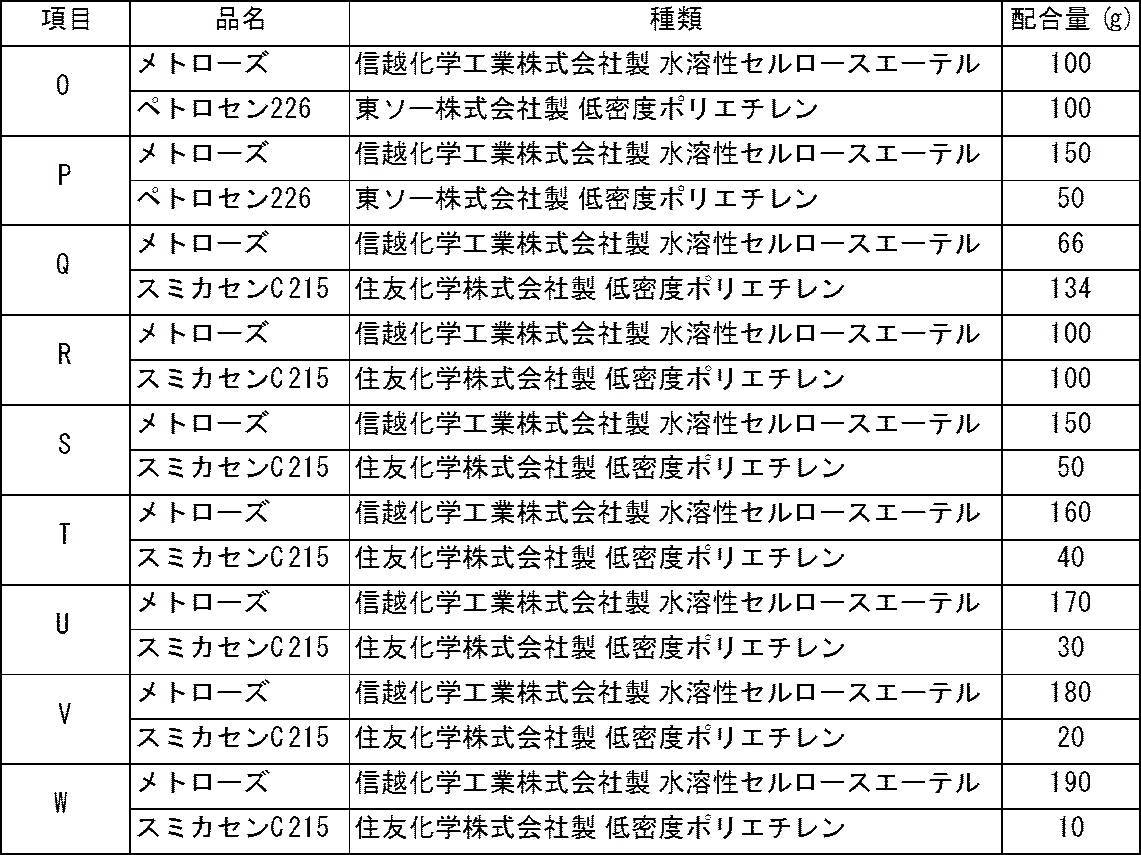
混合物をそれぞれ押出機(株式会社東洋精機製作所 ラボプラストミル4C150-01)に投入した。押出機の回転軸の回転数を60rpm(回転/分)、熱電対の温度を120℃に設定し、混合物を押出して直径3mmの繊維状の生成物を得た。生成物を長さ3mmに切断し、ペレット状の増粘剤O~Wを得た。
<潜在性評価方法>
潜在性については、超純水に一定時間増粘剤O~Wを水没させ、増粘剤の機能が発現するまでの時間を測定することにより評価した。
潜在性については、超純水に一定時間増粘剤O~Wを水没させ、増粘剤の機能が発現するまでの時間を測定することにより評価した。
まず、以下のサンプル16~24を500mLのポリビンにそれぞれ取り分け、室温にてスリーワンモーター(HEIDON社 FBL-600)を用い780rpm(回転/分)にて撹拌した。
サンプル16・・・増粘剤O:8.0g及び超純水:160mL
サンプル17・・・増粘剤P:6.0g及び超純水:160mL
サンプル18・・・増粘剤Q:12.12g及び超純水:160mL
サンプル19・・・増粘剤R:8.0g及び超純水:160mL
サンプル20・・・増粘剤S:6.0g及び超純水:160mL
サンプル21・・・増粘剤T:5.0g及び超純水:160mL
サンプル22・・・増粘剤U:4.7g及び超純水:160mL
サンプル23・・・増粘剤V:4.44g及び超純水:160mL
サンプル24・・・増粘剤W:4.2g及び超純水:160mL
サンプル16・・・増粘剤O:8.0g及び超純水:160mL
サンプル17・・・増粘剤P:6.0g及び超純水:160mL
サンプル18・・・増粘剤Q:12.12g及び超純水:160mL
サンプル19・・・増粘剤R:8.0g及び超純水:160mL
サンプル20・・・増粘剤S:6.0g及び超純水:160mL
サンプル21・・・増粘剤T:5.0g及び超純水:160mL
サンプル22・・・増粘剤U:4.7g及び超純水:160mL
サンプル23・・・増粘剤V:4.44g及び超純水:160mL
サンプル24・・・増粘剤W:4.2g及び超純水:160mL
次に、サンプル16~24から、撹拌開始3時間後までは30分毎、それ以降は60分毎にスポイトでサンプル液をそれぞれ取り出し、E型粘度計(東機産業株式会社 TV-22形)にてサンプル液の粘度を測定した。
撹拌開始後、サンプル液の粘度の上昇が停止するまでの時間を飽和粘度到達時間とし、遅延効果を確認した。
結果を表10に示す。なお、表10中、樹脂被覆量は、メトローズに対する樹脂量を意味する。
撹拌開始後、サンプル液の粘度の上昇が停止するまでの時間を飽和粘度到達時間とし、遅延効果を確認した。
結果を表10に示す。なお、表10中、樹脂被覆量は、メトローズに対する樹脂量を意味する。

表10に示すように、メトローズを樹脂で被覆することにより、粘度上昇が停止するまでの時間を、樹脂で被覆していないメトローズ(表5~表8中のサンプル15及び15’)よりも遅延させることができた。
また、表10に示すように、樹脂の被覆量を多くすることにより、サンプル液の粘度上昇が停止するまでの時間を遅延させることができた。
また、表10に示すように、樹脂の被覆量を多くすることにより、サンプル液の粘度上昇が停止するまでの時間を遅延させることができた。
<増粘剤の準備4>
増粘成分であるヒドロキシエチルセルロースをグリオキザール処理した増粘剤(グリオキザール処理HEC、増粘剤1~4)を準備し、ヒドロキシエチルセルロースをグリオキザール処理していない増粘剤(増粘剤5)を準備した。表11に示す増粘剤1~5の粘度は、増粘剤1~5を用いて1質量%又は2質量%の水溶液を調製し、25℃で60回転/分撹拌させたときの粘度(飽和粘度)である。
また、表11に示す増粘剤1~5の吸水率は、増粘剤1~5をそれぞれ25℃85%にて72時間放置した後、次式(1)に基づき吸水率を求めた。
吸水率(%)=[(M2-M1)/M1]×100 … 式(1)
M1:放置前の増粘剤の質量(g)
M2:25℃85%にて72時間放置した後の増粘剤の質量(g)
増粘成分であるヒドロキシエチルセルロースをグリオキザール処理した増粘剤(グリオキザール処理HEC、増粘剤1~4)を準備し、ヒドロキシエチルセルロースをグリオキザール処理していない増粘剤(増粘剤5)を準備した。表11に示す増粘剤1~5の粘度は、増粘剤1~5を用いて1質量%又は2質量%の水溶液を調製し、25℃で60回転/分撹拌させたときの粘度(飽和粘度)である。
また、表11に示す増粘剤1~5の吸水率は、増粘剤1~5をそれぞれ25℃85%にて72時間放置した後、次式(1)に基づき吸水率を求めた。
吸水率(%)=[(M2-M1)/M1]×100 … 式(1)
M1:放置前の増粘剤の質量(g)
M2:25℃85%にて72時間放置した後の増粘剤の質量(g)

<潜在性評価方法>
潜在性については、超純水に一定時間増粘剤1~5を水没させ、増粘剤の機能が発現するまでの時間を測定することにより評価した。
潜在性については、超純水に一定時間増粘剤1~5を水没させ、増粘剤の機能が発現するまでの時間を測定することにより評価した。
まず、以下のサンプル25~29を500mLのポリビンにそれぞれ取り分け、室温にてスリーワンモーター(HEIDON社 FBL-600)を用い780rpm(回転/分)にて撹拌した。
サンプル25・・・増粘剤1:2.3g及び超純水:160mL
サンプル26・・・増粘剤2:2.3g及び超純水:160mL
サンプル27・・・増粘剤3:1.5g及び超純水:160mL
サンプル28・・・増粘剤4:1.5g及び超純水:160mL
サンプル29・・・増粘剤5:3.2g及び超純水:160mL
サンプル25・・・増粘剤1:2.3g及び超純水:160mL
サンプル26・・・増粘剤2:2.3g及び超純水:160mL
サンプル27・・・増粘剤3:1.5g及び超純水:160mL
サンプル28・・・増粘剤4:1.5g及び超純水:160mL
サンプル29・・・増粘剤5:3.2g及び超純水:160mL
次に、サンプル25~28の各々のサンプルから、撹拌開始3時間後までは30分毎、それ以降は60分毎にスポイトでサンプル液をそれぞれ取り出し、E型粘度計(東機産業株式会社 TV-22形)にてサンプル液の粘度を測定した。サンプル29においては、撹拌開始後1分毎にスポイトでサンプル液を取り出し、同様にサンプル液の粘度を測定した。
撹拌開始からサンプル液の粘度の上昇が開始するまでの時間を増粘抑制時間、撹拌開始から粘度の上昇が停止するまでの時間を飽和粘度到達時間とし、増粘成分の機能発現の遅延効果を確認した。
結果を表12に示す。
撹拌開始からサンプル液の粘度の上昇が開始するまでの時間を増粘抑制時間、撹拌開始から粘度の上昇が停止するまでの時間を飽和粘度到達時間とし、増粘成分の機能発現の遅延効果を確認した。
結果を表12に示す。

表12に示すように、グリオキザール処理HECは、未処理HECと比較して増粘抑制時間及び飽和粘度到達時間が遅延し、グリオキザール処理によりHECの溶解が遅延することが明らかとなった。
本明細書に記載された全ての文献、特許出願、及び技術規格は、個々の文献、特許出願、及び技術規格が参照により取り込まれることが具体的且つ個々に記された場合と同程度に、本明細書中に参照により取り込まれる。
1.増粘成分、2.樹脂層、3.増粘成分、4.増粘成分、5.樹脂層、8.増粘成分、9.バインダー樹脂、10.樹脂層、11.樹脂層、12. 増粘成分、13.増粘成分
Claims (16)
- 増粘成分と、前記増粘成分を被覆する樹脂層とを備える、増粘剤。
- 水酸基を有する増粘成分と、前記水酸基と反応して保護基を形成しており、前記保護基が脱離可能である保護物質と、を備える、増粘剤。
- 前記樹脂層が、フェノール樹脂、エポキシ樹脂、アクリレート樹脂、ポリエステル樹脂、ポリアミド樹脂、ポリイミド樹脂、ポリアミドイミド樹脂、フッ素樹脂、ナイロン樹脂、スチレン樹脂、アクリロニトリル樹脂、ポリエチレン樹脂、ポリオレフィン樹脂、ポリカーボネート樹脂、塩化ビニル樹脂、ポリスルホン樹脂、シリコーン樹脂、及びブチルゴムから選ばれる少なくとも一種の樹脂を含む、請求項1に記載の増粘剤。
- 前記樹脂層が、単層又は複数層である、請求項1又は請求項3に記載の増粘剤。
- 前記樹脂層が複数層である場合、前記複数層の少なくとも1つの層に含まれる樹脂が、前記複数層の他の層に含まれる樹脂と組成が異なる、請求項1、請求項3及び請求項4のいずれか1項に記載の増粘剤。
- 前記樹脂層が、網目状高分子を含む、請求項1及び請求項3~請求項5のいずれか1項に記載の増粘剤。
- 前記樹脂層が、数平均分子量1,000~1,000,000の樹脂を含む、請求項1及び請求項3~請求項6のいずれか1項に記載の増粘剤。
- 前記樹脂層が、全体に対して50質量%以下である、請求項1及び請求項3~請求項7のいずれか1項に記載の増粘剤。
- 前記樹脂層の厚さが、0.1μm~1000μmである、請求項1及び請求項3~請求項8のいずれか1項に記載の増粘剤。
- 前記増粘成分は、カルボキシメチルセルロース、ヒドロキシエチルセルロース、修飾ヒドロキシエチルセルロース、ポリアニオン性セルロース、グアーガム及びキタンサンガムから選ばれる少なくとも一種である、請求項1~請求項9のいずれか1項に記載の増粘剤。
- 増粘成分と、前記増粘成分の増粘機能を発現する部位を保護し、前記増粘成分の増粘を遅延させる保護部と、を備える増粘剤。
- 請求項1及び請求項3~請求項9のいずれか1項に記載の増粘剤の製造方法であって、
前記増粘成分の表面に前記樹脂層の形成に用いる樹脂を付与した後、前記増粘成分を被覆する前記樹脂層を形成する、増粘剤の製造方法。 - 前記増粘成分の表面に付与された前記樹脂を軟化温度以上硬化温度未満にして前記樹脂により前記増粘成分を被覆し、
前記増粘成分を被覆する前記樹脂を硬化温度以上に加熱し、前記増粘成分を被覆する前記樹脂層を形成する、請求項12に記載の増粘剤の製造方法。 - 前記増粘成分の表面に付与された前記樹脂を溶解温度以上に加熱して前記樹脂により前記増粘成分を被覆し、
前記増粘成分を被覆する前記樹脂を溶解温度未満にし、前記増粘成分を被覆する前記樹脂層を形成する、請求項12に記載の増粘剤の製造方法。 - 請求項2に記載の増粘剤の製造方法であって、
前記増粘成分の前記水酸基と、前記保護物質とを反応させて保護基を形成する、増粘剤の製造方法。 - 前記増粘成分は、カルボキシメチルセルロース、ヒドロキシエチルセルロース、修飾ヒドロキシエチルセルロース、ポリアニオン性セルロース、グアーガム及びキタンサンガムから選ばれる少なくとも一種である、請求項12~請求項15のいずれか1項に記載の増粘剤の製造方法。
Priority Applications (1)
| Application Number | Priority Date | Filing Date | Title |
|---|---|---|---|
| PCT/JP2018/024938 WO2020003537A1 (ja) | 2018-06-29 | 2018-06-29 | 増粘剤及び増粘剤の製造方法 |
Applications Claiming Priority (1)
| Application Number | Priority Date | Filing Date | Title |
|---|---|---|---|
| PCT/JP2018/024938 WO2020003537A1 (ja) | 2018-06-29 | 2018-06-29 | 増粘剤及び増粘剤の製造方法 |
Publications (1)
| Publication Number | Publication Date |
|---|---|
| WO2020003537A1 true WO2020003537A1 (ja) | 2020-01-02 |
Family
ID=68984490
Family Applications (1)
| Application Number | Title | Priority Date | Filing Date |
|---|---|---|---|
| PCT/JP2018/024938 Ceased WO2020003537A1 (ja) | 2018-06-29 | 2018-06-29 | 増粘剤及び増粘剤の製造方法 |
Country Status (1)
| Country | Link |
|---|---|
| WO (1) | WO2020003537A1 (ja) |
Citations (8)
| Publication number | Priority date | Publication date | Assignee | Title |
|---|---|---|---|---|
| JPS471601B1 (ja) * | 1968-07-03 | 1972-01-17 | ||
| JPS57121083A (en) * | 1981-01-20 | 1982-07-28 | Sanyo Kokusaku Pulp Co Ltd | Method of preparing mud for civil engineering |
| JPH02161015A (ja) * | 1988-05-26 | 1990-06-20 | Konoike Constr Ltd | 特殊水中コンクリートの製造方法 |
| JPH07138131A (ja) * | 1993-11-16 | 1995-05-30 | Yuho Chem Kk | 水性マニキュア剤用粘度調節剤 |
| JP2009504821A (ja) * | 2005-08-10 | 2009-02-05 | コンストラクション リサーチ アンド テクノロジー ゲーエムベーハー | 建築化学用途の添加剤 |
| JP2012077129A (ja) * | 2010-09-30 | 2012-04-19 | Namics Corp | 樹脂組成物、および、それを用いた封止材 |
| WO2016060120A1 (ja) * | 2014-10-15 | 2016-04-21 | 王子ホールディングス株式会社 | 微細セルロース繊維を含む組成物 |
| JP2017105670A (ja) * | 2015-12-09 | 2017-06-15 | 日立化成株式会社 | コンクリート用添加剤及びこの添加剤の製造方法 |
-
2018
- 2018-06-29 WO PCT/JP2018/024938 patent/WO2020003537A1/ja not_active Ceased
Patent Citations (8)
| Publication number | Priority date | Publication date | Assignee | Title |
|---|---|---|---|---|
| JPS471601B1 (ja) * | 1968-07-03 | 1972-01-17 | ||
| JPS57121083A (en) * | 1981-01-20 | 1982-07-28 | Sanyo Kokusaku Pulp Co Ltd | Method of preparing mud for civil engineering |
| JPH02161015A (ja) * | 1988-05-26 | 1990-06-20 | Konoike Constr Ltd | 特殊水中コンクリートの製造方法 |
| JPH07138131A (ja) * | 1993-11-16 | 1995-05-30 | Yuho Chem Kk | 水性マニキュア剤用粘度調節剤 |
| JP2009504821A (ja) * | 2005-08-10 | 2009-02-05 | コンストラクション リサーチ アンド テクノロジー ゲーエムベーハー | 建築化学用途の添加剤 |
| JP2012077129A (ja) * | 2010-09-30 | 2012-04-19 | Namics Corp | 樹脂組成物、および、それを用いた封止材 |
| WO2016060120A1 (ja) * | 2014-10-15 | 2016-04-21 | 王子ホールディングス株式会社 | 微細セルロース繊維を含む組成物 |
| JP2017105670A (ja) * | 2015-12-09 | 2017-06-15 | 日立化成株式会社 | コンクリート用添加剤及びこの添加剤の製造方法 |
Similar Documents
| Publication | Publication Date | Title |
|---|---|---|
| Chang et al. | Effects of starch nanocrystal‐graft‐polycaprolactone on mechanical properties of waterborne polyurethane‐based nanocomposites | |
| TWI522368B (zh) | Production method of fine cellulose fiber dispersion | |
| CN103415536B (zh) | 具有改进的分散性能的水溶性聚合物粉末配制物 | |
| EP3083793B1 (fr) | Composition de poudres de poly-arylene-ether-cetone-cetones autorisant un excellent compromis coulabilite et coalescence adaptees au frittage laser | |
| FR2579604A1 (fr) | Procede pour preparer un gel aqueux, le gel ainsi obtenu et son utilisation en tant que support pour un parfum ou un desodorisant et en tant que lubrifiant | |
| JP5374343B2 (ja) | コアシェル粒子及びコアシェル粒子の製造方法 | |
| JP6605461B2 (ja) | ナノ粒子インク組成物、プロセスおよび応用 | |
| Arukalam et al. | Exploitation of natural gum exudates as green fillers in self-healing corrosion-resistant epoxy coatings | |
| Pattnaik et al. | Influence of waste vetiver root fiber on mechanical, hydrophobicity, and biodegradation of soy-based biocomposites as plastic substitute | |
| Fakraoui et al. | Comparative analysis of cellulose nanocrystals and cellulose nanofibrils on the physico‐chemical properties of polyvinyl alcohol/chitosan blend for sustainable food packaging | |
| TWI288169B (en) | Latent curing agent | |
| KR102421441B1 (ko) | 한천을 포함하는 생분해성 필름 및 이의 제조 방법 | |
| Gabriel et al. | Performance enhancement of NaOAc/Canna Edulis ker. starch-based bioplastic: mechanical and thermal behavior properties | |
| JP6515002B2 (ja) | 複合繊維とその製造方法、並びに、複合材とその製造方法 | |
| TW200936600A (en) | Microencapsulated silane coupling agent | |
| KR102693488B1 (ko) | Bnnt 함유 수분산 폴리우레탄-아크릴레이트 수지 복합체 및 이의 제조 방법 | |
| JP5360378B2 (ja) | 潜在性硬化剤の製造方法、及び接着剤の製造方法 | |
| JP5481013B2 (ja) | 潜在性硬化剤粒子の製造方法、接着剤製造方法 | |
| CN102821946B (zh) | 多层结构及其制备方法 | |
| TW200909624A (en) | Solution comprising blended material and solvent, fiber comprising the blended material, sheet-like material comprising the fiber, method for production of the fiber, and method for production of the sheet-like material | |
| JP2019001676A (ja) | コンクリート用添加剤及びコンクリート用添加剤の製造方法 | |
| WO2018230574A1 (ja) | コンクリート用添加剤及びコンクリート用添加剤の製造方法 | |
| Rasidi et al. | Properties of silanized nypa fruticans filled polylactic acid/recycled low density polyethylene biocomposites | |
| JP6515001B2 (ja) | 複合繊維とその製造方法、並びに、複合材とその製造方法 | |
| KR101586347B1 (ko) | 고분자 부가에 의해 열적 안정성이 증대된 방충용 조성물의 제조방법 |
Legal Events
| Date | Code | Title | Description |
|---|---|---|---|
| 121 | Ep: the epo has been informed by wipo that ep was designated in this application |
Ref document number: 18924331 Country of ref document: EP Kind code of ref document: A1 |
|
| NENP | Non-entry into the national phase |
Ref country code: DE |
|
| 122 | Ep: pct application non-entry in european phase |
Ref document number: 18924331 Country of ref document: EP Kind code of ref document: A1 |
|
| NENP | Non-entry into the national phase |
Ref country code: JP |